Morrison Lane GLS Reserve List 2026: 205-Unit Mohamed Sultan Plot Joins Holland Plain Tender Wave

Morrison Lane GLS Reserve List 2026: 205-Unit Mohamed Sultan Plot Joins Holland Plain Tender Wave

In the same week URA’s Holland Plain Confirmed-List tender prepares to close on 7 May 2026, the Authority has quietly added a second District 9 site to the live pipeline: Morrison Lane, a 6,669.8 sqm Reserve-List plot at Mohamed Sultan that can yield about 205 private residential units plus 500 sqm of first-storey commercial space. Reserve-List sites only go to tender if a developer triggers them by tabling a minimum bid the government accepts — making Morrison Lane a useful real-time read on developer appetite for the Robertson Quay / River Valley corridor at this point in the cycle.

Quick Answer

  • URA has released the Morrison Lane Reserve-List GLS site at Mohamed Sultan in District 9 under the 1H2026 GLS Programme.
  • Site area 6,669.8 sqm (~71,800 sq ft); maximum yield about 205 units + 500 sqm first-storey commercial.
  • Tenure: 99-year leasehold; zoning Residential with Commercial at 1st Storey.
  • As a Reserve-List site, it goes to tender only if a developer submits an acceptable trigger bid.
  • Industry watchers see a moderate chance of trigger, dependent on the Holland Plain tender result (closing 7 May 2026) and the broader CCR launch pipeline.
  • Indicative trigger price band: S$1,400–S$1,550 psf ppr, implying a launch ASP of ~S$2,800–S$3,000 psf.
  • Nearest live comp: River Valley Green Parcel C tender expected mid-2026 with Peck Hay Road also released in late April 2026.
Morrison Lane Mohamed Sultan GLS Reserve List Singapore 2026 hero
LovelyHomes — Morrison Lane Reserve-List GLS site, the second District 9 plot added to the 1H2026 tender pipeline.

What URA released and why it matters

The Morrison Lane site sits along Mohamed Sultan Road, on the River-Valley side of Robertson Quay, putting it firmly in the prime District 9 cluster that has driven a string of high-priced launches over the past 18 months. Reserve-List release is a deliberately softer signal than a Confirmed-List tender — URA puts the plot on offer, but only puts it to tender if a developer triggers it with a binding minimum bid the government finds acceptable.

The mechanism’s policy logic is balance: too few sites and prices spike; too many trigger-list bids and the market floods. Reserve-List release is also the cleanest way for URA to read developer appetite — a triggered site signals confidence; a sustained idle period signals capital tightness or pipeline saturation. Morrison Lane is the latest test point.

Morrison Lane GLS site specifications Singapore 2026
Figure 1: Morrison Lane snapshot — 6,669.8 sqm, 205 units, 99-yr leasehold, Reserve List 1H2026.

How the Robertson Quay / River Valley corridor has performed

The corridor has run hot. The most recent benchmark in the immediate area saw 84% of units cleared at an average price of S$3,050 psf on its launch weekend in late 2025. That’s a meaningful number for any Morrison Lane bidder modelling the eventual sell-through — at S$3,050 psf, a 70 sqm 2-bedroom unit prices at ~S$2.3m, well within the ABSD-conscious local-and-PR buyer pool that has been the engine of recent CCR sales.

The site’s location has additional structural pluses: a 5–10 minute walk to Great World MRT (TEL), the Robertson Quay F&B strip, and direct vehicular access to the CBD via Kim Seng / Havelock Road. Construction-noise and heritage-conservation overlays in Mohamed Sultan are well known and likely already priced into any developer’s underwriting.

Land bid economics — what a developer would need to clear

Reverse-engineering from a S$3,000 psf launch ASP target gives a working land-bid number around S$1,500 psf ppr. At that level, total land cost on Morrison Lane would land near S$385 million — a sized cheque that mid-cap developers can take down on their own, and that the recent Sim Lian Holland Link bid of S$368.4m at S$1,432 psf ppr (Aug 2025) sits comfortably below.

What changes the math is interest carry. A Reserve-List trigger means the developer commits to the bid before knowing the full launch window; with funding rates north of 4% on most senior debt, every 12-month delay adds roughly S$15m of carry on a site of this size. That cost discipline is one reason Reserve-List sites trigger most often when developers see a clean 12 to 18-month launch path on the calendar.

Morrison Lane GLS comparable land bids Singapore 2026
Figure 2: Morrison Lane indicative trigger price against recent District 9/10 land bids and launch ASPs.

Summary table — how Morrison Lane fits the 1H2026 pipeline

Site Units List Status
Holland Plain (2nd plot) ~280 Confirmed Closes 7 May 2026
Morrison Lane (Mohamed Sultan) ~205 + retail Reserve Available — trigger required
Bayshore Drive (mixed-use) ~1,800 (incl. mixed-use) Confirmed Closes 15 July 2026
Peck Hay Road ~340 Confirmed Tender live
River Valley Green Parcel C ~380 Confirmed Tender live

Worked Example: trigger-price scenario for a hypothetical mid-cap bidder

Site basics. 6,669.8 sqm × plot ratio 1.4 = max GFA 9,338 sqm (~100,500 sq ft). 205 residential units with average 70 sqm carpet area + 500 sqm first-storey retail.

Trigger bid scenario at S$1,500 psf ppr. 100,500 sq ft × S$1,500 = S$150.75m at the GFA cap; using the higher per-unit gross figure with allowances for void, the all-in land cost runs closer to S$385m on a site of this density.

Build cost. ~S$700–S$800 psf GFA (residential mid-luxe finish) for ~S$80m construction cost; +S$25m soft costs; +12% developer margin reserve.

Implied launch break-even ASP. Combining land + construction + soft + financing + margin lands at S$2,850–S$3,000 psf — broadly consistent with River Valley Green’s October 2025 launch at S$3,050 psf, supporting the trigger-price thesis.

Key sensitivity. Each S$100 psf ppr higher on land cost adds roughly S$170 psf on the launch ASP. The corridor’s recent absorption rates suggest the market can hold S$3,050 psf — but a trigger above S$1,600 psf ppr would push the launch break-even into a price band the corridor has not yet tested.

What this means for buyers

If you are a buyer watching Robertson Quay and Mohamed Sultan, Morrison Lane is unlikely to launch before the second half of 2027 even if triggered immediately. Closer-dated alternatives are stronger: River Valley Green Parcel C (tender live), and the next round of fringe District 9 launches that follow the Holland Plain auction outcome. The Morrison Lane release is a signal of pipeline depth, not an imminent launch event.

For investors thinking about pre-launch positioning, the more productive read is on the secondary market in nearby developments. Tightening developer margins typically front-run a price-firmness signal in the resale market — recently launched stacks within a 500m radius are worth watching for absorption velocity through the rest of 1H2026.

What might come next

Two immediate catalysts will set the tempo. First, the Holland Plain tender on 7 May 2026 — a strong field of bidders and a price north of S$1,500 psf ppr would materially raise the probability that Morrison Lane is triggered before the second half of 2026. Second, URA’s full Q1 2026 final stats have already landed; the next read is the April 2026 new-home sales data due in mid-May, which will tell us whether the Q1 +0.3% private-price uptick has carried into spring volumes.

If both signals print constructive, expect at least one or two of the 1H2026 Reserve-List sites — Morrison Lane being the highest-quality residential plot among them — to be triggered by Q3 2026.

FAQ

What is the Reserve List in URA’s GLS Programme?

Sites under the Reserve List are tendered only when a developer submits a minimum bid the government accepts. This contrasts with the Confirmed List, where URA tenders the site outright on a fixed schedule. Reserve-List release is a softer market signal that lets URA test appetite without forcing a sale.

How long does it take for a Reserve-List site to be triggered?

It varies. Some Reserve-List sites are triggered within weeks of release; others linger on the list for months or never trigger. The pace depends on developer balance-sheet capacity, the broader sales pipeline, financing costs, and how confident the market feels about end-buyer demand at the implied launch ASP.

Why is Morrison Lane considered District 9 rather than District 10?

Mohamed Sultan Road sits within the Singapore postal-district boundary for District 9, which covers River Valley, Orchard Road and Cairnhill. The neighbouring Robertson Quay area also falls in D09. District 10 starts further west, covering Bukit Timah, Holland and Tanglin proper.

When could a launch from Morrison Lane realistically happen?

If triggered in mid-2026 with a tender award by Q3, formal site planning typically takes 6 to 9 months, and pre-launch marketing 3 to 6 months. A practical earliest launch is late 2027 to early 2028. That timing also aligns with the rollout cadence of the wider Robertson Quay / River Valley pipeline through 2027.

Is the 500 sqm commercial space significant?

Five hundred square metres at the first storey is a small-to-mid-scale strata-retail footprint. It can support an F&B unit, a convenience store, a clinic and one or two service tenants. It does not transform the project’s character — this remains a residential development with a small ground-floor commercial layer typical of Mohamed Sultan’s mixed-zone overlay.

Will Morrison Lane affect prices in nearby developments?

The release alone does not move prices materially. A successful trigger and a strong land bid would tighten the margin assumption on adjacent developments, supporting firm-to-rising prices in the existing resale stock for 12 to 18 months as buyers pull forward purchases ahead of the new launch. A non-trigger or a weak final bid would have the opposite signal.

What should buyers do now?

If you are decision-time on a Robertson Quay / Mohamed Sultan unit, the Morrison Lane release tightens the supply story but does not change short-term pricing. Continue evaluating live launches and resale stock on their own merits. If you are an investor, watch the Holland Plain tender result on 7 May 2026 — that’s the highest-information event of the next two weeks.

Related Articles

Disclaimer

This article is general property-market commentary based on URA’s 1H2026 Government Land Sales Programme release and publicly available media coverage. Verify site specifications and tender procedures on the URA portal. Indicative bid prices, launch ASPs and timing scenarios are LovelyHomes synthesis based on industry comparables and should not be relied upon for purchase or investment decisions. Consult a licensed property professional and review the official URA Land Sales documentation before acting.

Tags: Morrison Lane GLS, Mohamed Sultan, Robertson Quay, District 9, URA Government Land Sales, Reserve List, 1H2026 GLS, Holland Plain GLS, Bayshore Drive, Peck Hay Road, River Valley Green, Singapore property news, land bid analysis.

One-North Residential Pipeline May 2026: Hudson Place Preview Sets the Tone for Media Circle

One-North Residential Pipeline May 2026: Hudson Place Preview Sets the Tone for Media Circle

The 327-unit Hudson Place Residences drew more than 3,500 visitors over its three-day May Day long-weekend preview from 1 to 3 May 2026, the strongest showing for any new launch in Singapore’s one-north precinct since the Media Circle plot was first awarded under the Government Land Sales programme. Booking day is set for 16 May 2026. The project is the fifth private condominium to break ground in the greater one-north area since 2024, and its preview turnout is being read as a barometer for buyer appetite in District 5 mid-prime as the Q2 2026 launch calendar lifts off.

Quick Answer

  • Hudson Place Residences is a 327-unit, 99-year leasehold condominium on Media Circle (lots 18 and 20), within walking distance of one-north MRT (Circle Line) and the Buona Vista MRT interchange.
  • Preview window 1–12 May 2026; booking day 16 May 2026. May Day three-day footfall: ~3,500 visitors.
  • Indicative pricing: 2-bedroom from S$1.40M, 3-bedroom from S$2.00M, 4-bedroom from S$2.70M; five penthouses on application. Unit sizes 646–2,196 sqft.
  • Hudson Place is the fifth new private condominium to break ground in the greater one-north precinct since 2024 (LyndenWoods, One-North Eden II, Pinetree Hill and Bloomsbury Residences are the earlier four).
  • Developer team: Qingjian Realty with joint-venture partners; the project sits within the maturing one-north tech-and-research cluster operated by JTC Corporation.
  • The District 5 mid-prime band has not seen three new condominiums break ground simultaneously since the 2014 launch wave.

The Preview That Set the Tempo

By Sunday evening on the May Day long weekend, agents working the Hudson Place Residences showflat had logged more than 3,500 unique visitors over three days. That headline number is comfortably above the 1,800–2,400 typical of a strong District 5 preview and well clear of the 1,200–1,500 range that has come to mark the median 2026 launch in Singapore. The preview is open through 12 May, with bookings opening on 16 May 2026.

Strong preview footfall does not always convert to strong booking-day take-up — Singapore’s launch market in 2025 saw several previews comfortably above 3,000 visitors translate into 50–60% take-up rather than the 80–90% range that defines a sell-out. The Hudson Place visitor count, however, has industry watchers paying attention because the preview crowd skewed local-resident rather than tourist-investor: a healthier mix for a project pricing 2-bedders at the S$1.4 million entry point.

Why Greater One-North Now

One-north is a 200-hectare research-and-development cluster run by JTC Corporation in Buona Vista. The precinct anchors Singapore’s biomedical, infocomm and media research economies, hosts the Biopolis, Fusionopolis and Mediapolis sub-zones, and has seen a steady office-build-out for two decades. What it has historically not had is a deep stock of private residential housing close to the workplaces. That is starting to change.

Five new private residential projects have either launched or broken ground in the greater one-north precinct since 2024. The first — LyndenWoods on Science Park Drive (343 units) — sat slightly outside the historic one-north boundary but signalled a developer view that the precinct’s residential demographic was deepening. One-North Eden II followed on Slim Barracks Rise. Pinetree Hill on Pine Grove served as the off-precinct anchor for the Pine Grove redevelopment band. Bloomsbury Residences (Q-Land-led JV) opened the southern Media Circle frontage. Hudson Place Residences is the fifth project, and the second within Media Circle proper.

Greater one-north residential pipeline 2024-2026 condominium projects table
Figure 1: Five condominiums have either launched or broken ground in greater one-north since 2024.

Hudson Place Residences in Numbers

The project occupies the lots at 18 and 20 Media Circle, with 327 units across the development. The unit mix is dominated by 2-bedroom and 3-bedroom layouts ranging from 646 sqft to 1,453 sqft, with a smaller 4-bedroom band running from 1,500 sqft to roughly 1,890 sqft, plus five penthouses topping the development at sizes up to 2,196 sqft. Tenure is 99 years from the GLS award; the location is officially within District 5 (Queenstown / Buona Vista / Pasir Panjang), the postcode catchment that has become a structural beneficiary of one-north’s expanding research workforce.

Hudson Place Residences May 2026 preview snapshot pricing 327 units 99-year leasehold Media Circle
Figure 2: Hudson Place Residences preview snapshot — sizes, pricing and key dates.

Project Specification — Summary Table

Item Detail
Project name Hudson Place Residences
Address 18 / 20 Media Circle, District 5
Tenure 99-year leasehold (from GLS award)
Total units 327 (incl. 5 penthouses)
Unit sizes 646 – 2,196 sqft
Bedroom mix 2-BR / 3-BR / 4-BR + Penthouses
Indicative entry price 2-BR from S$1.40M; 3-BR from S$2.00M; 4-BR from S$2.70M
Preview window 1 – 12 May 2026
Booking day 16 May 2026
Nearest MRT one-north MRT (Circle Line); Buona Vista MRT (CCL + EWL) interchange
Preview footfall (1–3 May) ~3,500 visitors

Connectivity and Catchment

Hudson Place sits within walking distance of the one-north MRT station on the Circle Line, and roughly a 10-minute walk to the Buona Vista MRT interchange, which serves both the Circle Line and the East-West Line. That dual-line position — comfortable to either Marina Bay or Jurong East — is one of the strongest connectivity profiles available in District 5 mid-prime. The catchment also encompasses the National University of Singapore campus on Kent Ridge, the Singapore Science Park to the south, and the Insead Singapore campus to the immediate east of the precinct boundary.

The implicit demographic — research and tech professionals, post-doc households, biomedical-industry mid-career managers — is the same demographic that has driven the rental-yield premium in District 5 over the last five years. One-North postcode rental yields have run 3.7–4.2% gross at recent sample points for 2-bedroom condominium units, against a 3.0–3.5% Singapore island-wide median. That yield premium is, in turn, the underwriting story that developers have been telling at preview events through April and May 2026.

Worked Example — A 2-Bedroom Yield Case

Consider a hypothetical 2-bedroom Hudson Place stack at S$1.40 million entry. A Singapore Citizen first-property buyer pays Buyer’s Stamp Duty of approximately S$36,600 on that price slab. ABSD does not apply for a Citizen first home. Loan-to-value at the bank-loan maximum 75% gives a S$1.05 million loan, and on a 2-year fixed package at 1.55% all-in (per current 2026 pricing) the monthly instalment over a 30-year tenure is approximately S$3,650.

If the unit rents at S$5,000 per month — a level consistent with the District 5 2-bedroom market for one-north–adjacent stock once TOP is reached — the gross rental yield on the entry price is 4.29% per annum. Net of management corporation maintenance fees of roughly S$430 per month, property tax under the non-owner-occupier rate band, and a small letting expense allowance, the net yield falls to roughly 3.2–3.5%. Cash flow is positive in the early years thanks to the 1.55% loan rate; if rates revert to 3% over the loan tenure, the cash-flow position narrows to roughly break-even before depreciation. The investment case at preview pricing therefore relies on a combination of yield and capital appreciation rather than yield alone — a profile typical of District 5 mid-prime in 2026.

What the Q2 2026 Launch Calendar Looks Like

Hudson Place is not the only project in the immediate Q2 2026 calendar. The District 5 launch sequence is unusually concentrated this quarter, with Bloomsbury Residences booking through April, Hudson Place at the May 16 booking day, and at least one further mid-prime launch sequenced for June. The risk inherent in three concurrent launches in the same postcode is volume — buyers can split decisions across showflats, which usually lengthens the absorption tail. The opportunity is price discipline: when buyers can comparison-shop, sub-prime stacks tend to clear at preview pricing rather than at a launch-day premium.

Through the rest of 2026 the precinct’s residential pipeline is expected to widen further. One additional Media Circle parcel was tendered late in 2025; outcome-bid figures suggested a launch tag in the region of S$2,000–2,150 psf ppr, putting the implied selling price at around S$2,250–2,400 psf when the project is launched in 2027–2028.

Why This Matters

For District 5 buyers and tenants, the one-north residential build-out is the structural story of the next decade. Five projects breaking ground in 24 months adds roughly 1,940 residential units to a precinct that has historically held a handful of condominiums at most — a step-change in scale that compresses commute times for one-north workers, deepens the rental pool, and stabilises the second-hand market with a steady supply of comparables. For investor-buyers, the Hudson Place launch is the data point that will tell the rest of the 2026 District 5 calendar what entry pricing the market will support; a strong booking-day take-up on 16 May would set the floor under Bloomsbury and the June launch, while a muted day would push developers to discount sharply.

What Might Come Next

Three things to watch through the rest of May. First, the 16 May booking-day take-up at Hudson Place — a sub-50% number would be the headline; 70–80% would be in line with a healthy launch; above 85% would be a clean signal that District 5 mid-prime has flipped from cautious to confident. Second, average-launch psf at booking versus the preview band: a clean print at S$2,200–2,250 psf would re-anchor the District 5 launch median; a S$2,300+ print would re-rate the precinct upward, with knock-on effects for the next Media Circle parcel; a S$2,100 number would be a softer signal. Third, residual buyer pool: how much of the 3,500 preview footfall translates to executed bookings, and how much defers to the June launch in the same postcode catchment. Hudson Place will be the first market read on Q2 2026 District 5 sentiment, and the answer matters for the rest of the launch calendar.

Frequently Asked Questions

When does Hudson Place Residences open for booking?

Booking day is 16 May 2026. The preview runs through 12 May; bookings cannot be exercised before the 16 May date set by the developer.

What is the tenure of Hudson Place Residences?

99-year leasehold, dating from the GLS award. The Media Circle land parcel was tendered under the Government Land Sales programme and the leasehold tenure follows the standard GLS framework.

What is the typical entry price?

Indicative entry pricing at preview is from S$1.40 million for a 2-bedroom unit. 3-bedroom layouts open from S$2.00 million, 4-bedders from S$2.70 million. Five penthouses are sold on application. Final pricing will be confirmed at booking on 16 May 2026.

How does Hudson Place compare to Bloomsbury Residences?

Both projects sit on Media Circle within the one-north precinct. Bloomsbury Residences was launched ahead of Hudson Place; Hudson sits at lots 18 and 20 with a slightly different connectivity vector — a marginally shorter walk to the one-north MRT station, a marginally longer walk to Buona Vista. Unit-mix and entry pricing are broadly comparable. Buyers comparing the two should compare specific stack orientations, view bands, and the project facility programmes side-by-side.

Is one-north a good rental investment area?

One-north has run a structural rental-yield premium for several years thanks to the deep tenant pool drawn from the research, biomedical and media clusters that JTC operates within the precinct. Recent sample-point gross yields for District 5 2-bedroom units have run 3.7–4.2%, comfortably above the Singapore island-wide median. The yield premium is sensitive to the precinct’s employment growth — buyers underwriting a pure rental investment should track the JTC tenant pipeline alongside their financial-arithmetic spreadsheet.

Will the simultaneous launches in District 5 hurt resale liquidity?

In the short term, three concurrent launches add competing supply and may slow the speed at which any one project clears its inventory. In the medium term, having a thicker stock of recent-vintage units in the same postcode usually improves resale liquidity by deepening the pool of comparables and reducing the price-per-unit volatility that thin one-launch-per-quarter postcodes can show. The first three years post-TOP are the period buyers should watch most carefully.

Related Articles

Disclaimer

This article is editorial commentary for general information only and does not constitute investment advice or a property recommendation. Pricing, unit mix, and launch dates are based on developer marketing material at the time of writing and remain subject to change at the developer’s discretion. Always verify the latest figures with the developer’s published Letter of Offer and the relevant pricing schedule. Consult URA at ura.gov.sg for Government Land Sales tender records and master plan zoning, JTC Corporation at jtc.gov.sg for one-north precinct planning information, IRAS at iras.gov.sg for prevailing BSD and ABSD rates, and a qualified solicitor for any specific purchase decision. LovelyHomes is editorially independent and is not affiliated with any developer, marketing agency, or sales representative for the projects referenced.

HDB Resale Price Index Q1 2026: First Quarterly Decline in Seven Years — What the 0.1% Dip Actually Means

HDB Resale Price Index Q1 2026: First Quarterly Decline in Seven Years — What the 0.1% Dip Actually Means

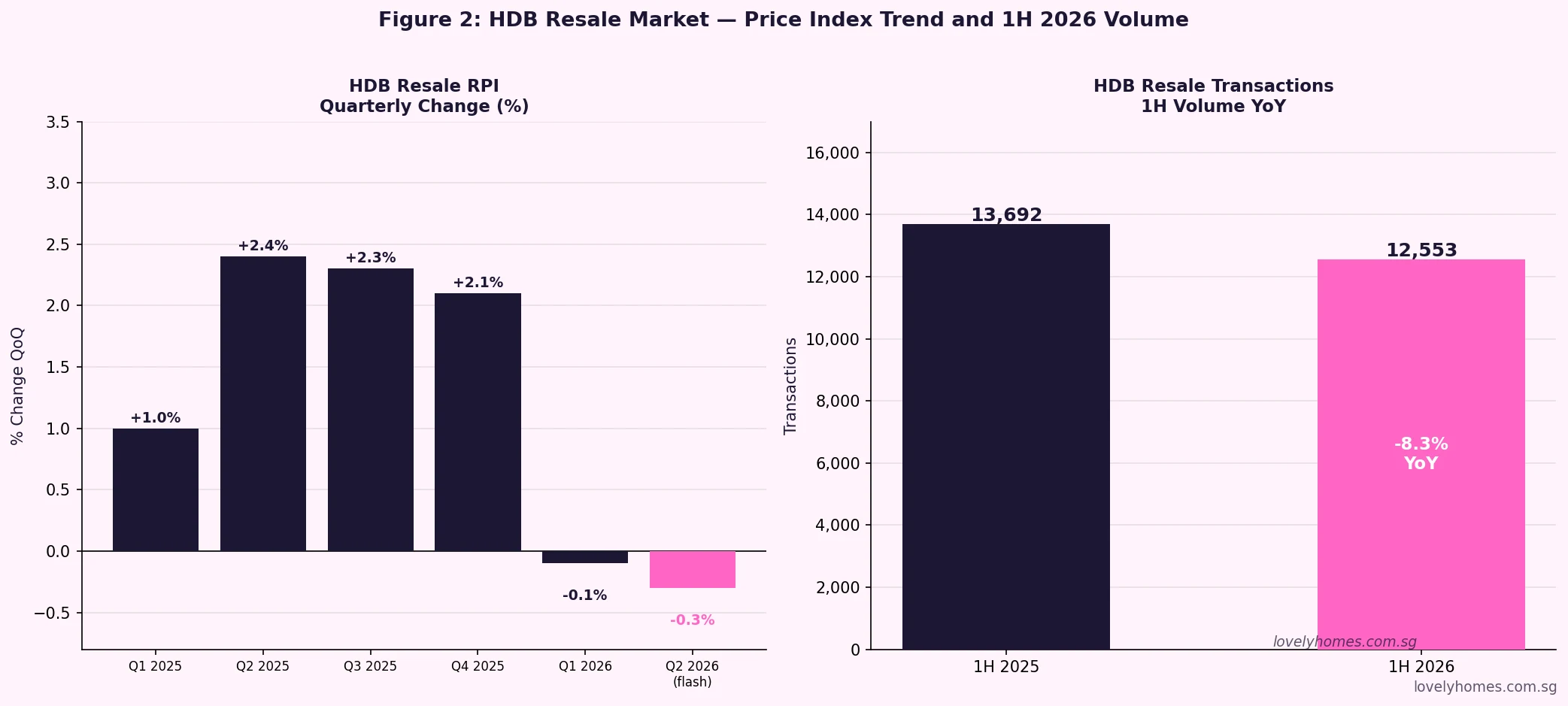
The Housing & Development Board’s flash estimate of the Q1 2026 Resale Price Index (RPI) reads 203.4 — a 0.1 percent dip from the 4Q 2025 reading of 203.6. It is a small number on a small index, but it lands as the first quarterly decline in seven years, ending a continuous-growth run that began in Q3 2020 and that lifted the index by more than 70 points across 22 quarters. The dip arrives alongside record-high million-dollar flat transactions (412 in Q1 2026) and a continuing slide in transaction volume on a year-on-year basis.

Quick Answer

  • HDB RPI Q1 2026 = 203.4, down 0.1 percent from Q4 2025’s 203.6 (HDB flash estimate, released 1 April 2026).
  • First quarterly decline since 2019, ending a 22-quarter growth run that began in Q3 2020.
  • Resale transactions: 6,285 in Q1 2026, slowing year-on-year, but up quarter-on-quarter from a holiday-soft Q4 2025.
  • Million-dollar flats: 412 transactions in Q1 2026 — a record quarterly figure, concentrated in mature estates like Bukit Merah, Toa Payoh and Queenstown.
  • Top-end stays hot, mass-market softens. The RPI dip masks a divergence: million-dollar flats kept rising while standard 4-room and 3-room mass-market resale eased.
  • Drivers: sustained BTO supply, shorter BTO build cycles (some completing in 36 to 42 months), the Open Booking of Flats (OBF) regime adding ~7,800 units annually, and cooling measures still binding marginal buyers.
  • Outlook: HDB explicitly attributes the deceleration to demand-supply rebalancing; analysts expect another flat-to-mildly-negative print in Q2 2026 before stabilisation.

The Number Itself

The RPI is a Laspeyres index rebased to Q1 2009 = 100, designed to track the price of a representative bundle of HDB resale flats. It is not a transaction-volume measure and does not reflect the prices of new HDB sales. The flash estimate uses caveats lodged through the early weeks of the quarter — the final figure for Q1 2026 will be published in late April with the full set of caveats.

The flash reading of 203.4 is 0.1 percent below the Q4 2025 print of 203.6. That is essentially a flat outcome — well within the noise band of any quarterly index — but the symbolism matters. The previous quarterly dip was in Q1 2019 (RPI 131.5, down from Q4 2018’s 131.5 — i.e. the index has been flat or rising every single quarter from Q2 2019 onwards). A 22-quarter run of continuous growth covered the pandemic lift-off (Q3 2020 onwards), the post-pandemic surge (2021–2022), the 2023 ABSD reset, and the 2024–2025 plateau-with-growth pattern.

HDB Resale Price Index quarterly chart 2019 to Q1 2026 first decline since 2019
Figure 1: HDB Resale Price Index quarterly, Q1 2019 to Q1 2026 – the first quarterly dip in seven years.

Why It Happened — Five Pressures

HDB’s own commentary points to a structural rebalancing of supply and demand. Five forces stand out.

BTO supply ramp-up. HDB launched more than 100,000 BTO flats across 2021–2025, the largest sustained build-to-order programme in its history. The cumulative effect is that buyers who once felt forced to chase resale because BTO supply could not match demand now have credible alternatives — both fresh ballots and older project units becoming available.

Shorter BTO build cycles. Some 2024–2025 BTO projects are completing within 36 to 42 months, 12 to 24 months faster than the pandemic-era norm. A four-year wait turning into a three-year wait is enough to flip the resale-vs-BTO calculus for a meaningful slice of marginal buyers.

Open Booking of Flats (OBF). The continuous-listing regime that replaced quarterly SBF in October 2024 adds roughly 7,800 completed-or-near-complete flats per year to the supply pipeline outside the resale channel. A buyer who would have settled for a resale 4-room in Sengkang at S$680,000 a year ago can now book an OBF return in the same town for ~S$565,000.

Cooling measures still binding. The September 2022 ABSD and LTV adjustments, the August 2023 ABSD hikes, and the tighter MSR continue to compress demand from second-property buyers, marginal investors and second-timers. The resale market — especially the high-quantum end — feels this most.

The million-dollar segment is an outlier. 412 million-dollar HDB transactions in Q1 2026 is a record quarterly figure, concentrated in mature estates with strong amenity, school proximity, and lease tenor. The top end is hot. The mass-market resale (3-room and standard 4-room flats in non-mature estates) is where the softness shows up. The aggregate index averages both, and the mass-market drag wins this quarter.

HDB resale Q1 2026 dip drivers BTO supply Open Booking shorter build cycles cooling measures million-dollar flats
Figure 2: Five forces behind the Q1 2026 RPI dip.

Summary — Key Q1 2026 Indicators

Indicator Q4 2025 Q1 2026 Change
RPI 203.6 203.4 -0.1% q-o-q
Resale Transactions ~6,070 6,285 +3.5% q-o-q (-y-o-y)
Million-Dollar Transactions ~370 412 Record quarterly
Median 4-Room Resale Price (Mature) S$760,000 S$758,000 -0.3%
Median 4-Room Resale Price (Non-Mature) S$612,000 S$608,000 -0.7%

Source: HDB flash estimate Q1 2026 RPI release, HDB resale price summary; LovelyHomes compilation.

Worked Example — A Buyer Looking at a 4-Room Resale Right Now

Take a hypothetical first-time buyer family looking at a 4-room resale in Punggol with about S$120,000 in CPF and S$60,000 cash savings, household income S$8,400 per month. Twelve months ago, the same flat traded at roughly S$632,000. Today the asking price is S$608,000 — a S$24,000 saving on the headline price, plus stronger negotiating leverage as the seller pool has grown. With Family Grant (S$25,000), Proximity Grant (S$30,000) and EHG (~S$45,000 at this income), the effective net cost lands around S$508,000.

The same buyer’s BTO option (next launch, October 2026) carries a ~3.5-year wait — meaning rent of about S$2,800 per month for 42 months, or S$117,600. The OBF option (4-room return in Sengkang) sits at S$565,000 with similar grants, but the buyer must accept whatever location is available in the listing. The Q1 2026 dip changes the calculus by trimming the resale premium just enough to make resale competitive again with the OBF route — the comparison gets closer, even if it does not flip outright.

Why This Matters For You

For buyers, the dip is mildly good news but does not change strategy. A 0.1 percent quarterly move is well within typical noise — buyers should not delay purchases waiting for a meaningful price retreat that may not come. What the dip does signal is that the relentless price growth of 2020–2024 is over, and that resale is no longer the only viable route for buyers needing a flat in months rather than years.

For sellers, the message is to price realistically. The Q1 2026 evidence is that listings priced ahead of valuation are sitting longer; price-to-value listings still clear within standard timeframes. Cash-Over-Valuation (COV) bidding has compressed substantially in non-mature estates.

For investors, the dip strengthens the cyclical case for HDB resale relative to private resale — but the ABSD wall on second properties remains the binding constraint regardless of the index print.

What Comes Next

Three things to watch over the coming quarters. First, whether Q2 2026 flash extends or reverses the dip — a single negative print is noise; two consecutive prints would mark a meaningful inflection. Second, whether the million-dollar segment continues to outpace the rest, suggesting the index dip is structural rather than cyclical. Third, the BTO October 2026 launch (~6,900 flats) and the next OBF refresh — supply pressure has been the dominant driver, and the supply pipeline shows no signs of reversing.

The May 2026 BTO launch, the 7 May 2026 closing of the Holland Plain GLS tender, and the next URA quarterly release are the immediate market-moving milestones to track.

Frequently Asked Questions

Is the Q1 2026 RPI dip the start of a crash?

No. A 0.1 percent quarterly decline is well within statistical noise on an index that has moved by single decimals every quarter for years. It is meaningful as a symbolic marker — the first dip in seven years — but not as evidence of a substantial fall in HDB resale prices. The drivers are gradual supply-demand rebalancing, not distressed selling.

If the index fell, why are million-dollar flats hitting records?

Two different segments. The RPI averages all resale flats, weighted by volume. Million-dollar transactions sit at the top of the distribution — mature estates, larger flats, prime location, often near MRT and good schools. That segment continues to receive strong demand, particularly from upgraders sitting out the private market. The mass-market segment (standard 3-room and 4-room flats in non-mature estates) is where the softness shows up and pulls the overall index slightly negative.

Should I delay buying because prices might fall further?

Generally no. A 0.1 percent quarterly dip is roughly S$600 on a S$600,000 flat — far less than the rental cost of waiting. If the unit suits your needs and the price meets valuation, the timing argument has minimal weight. The bigger move on price would require a much larger supply or demand shock than the current data shows.

How does the OBF regime affect resale prices?

Open Booking of Flats adds completed and near-complete flats to the supply pipeline at HDB-set prices, typically 15 to 20 percent below resale equivalents in the same project. This caps how high resale sellers can push pricing in towns with active OBF listings — a flat in Sengkang priced at S$680,000 looks expensive next to a comparable OBF return at S$565,000.

When does the final Q1 2026 RPI come out?

HDB typically releases the final quarterly RPI in late April or early May with the full caveat dataset. The flash estimate (203.4) was published on 1 April 2026; revisions are usually within 0.1 to 0.3 index points. The full Q1 2026 release will also include median resale prices by town and flat type, plus volume breakdowns.

Are private home prices doing the same thing?

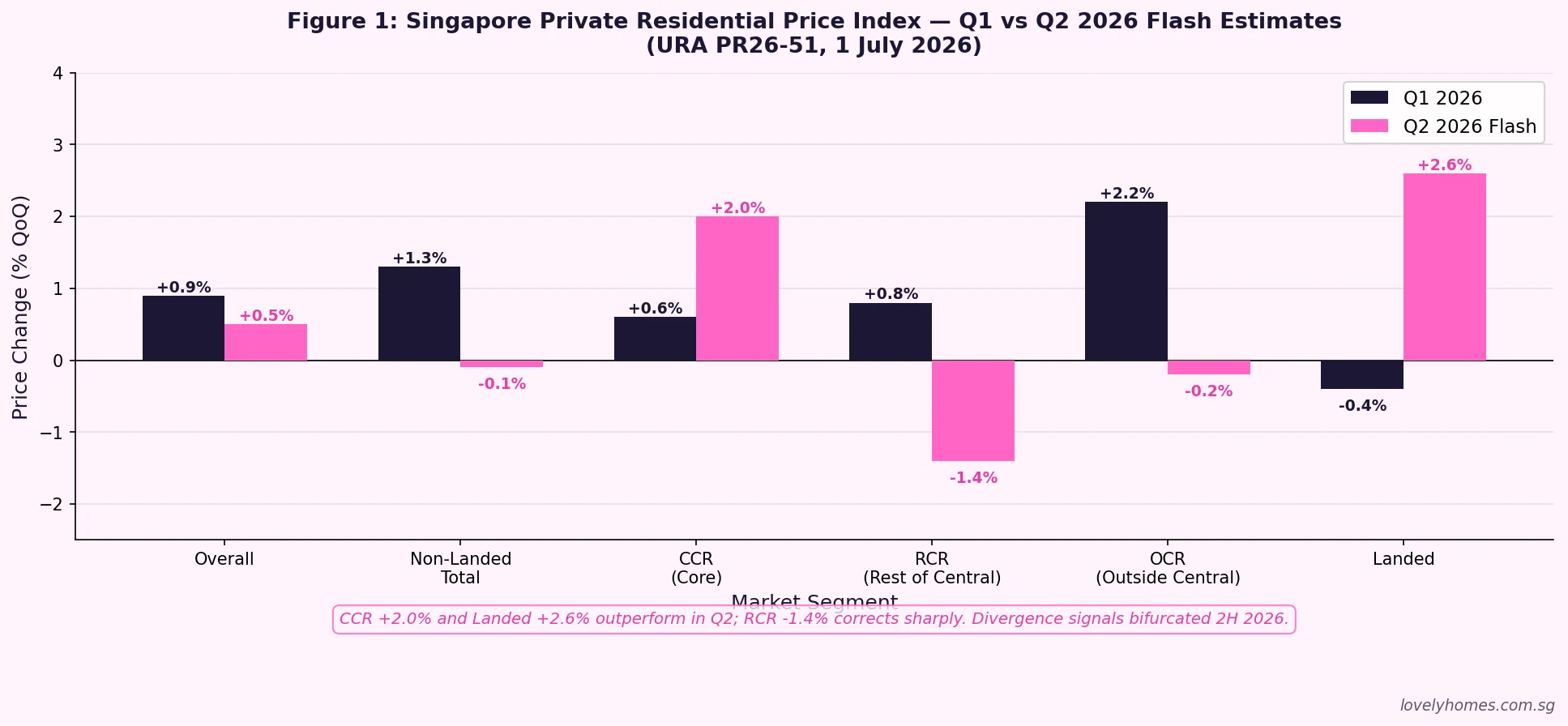
No — the URA private residential price index rose 0.9 percent q-o-q in Q1 2026 (revised up from a flash 0.3 percent), led by a 2.2 percent OCR increase. The two markets have decoupled: private residential is being driven by new launches, foreign demand and condo upgrade activity, while HDB resale is being weighed down by sustained BTO and OBF supply.

Related Articles

Disclaimer

This article is general information for Singapore property buyers, sellers and observers, and is not legal, tax, financial or investment advice. The HDB Resale Price Index is published by the Housing & Development Board; flash estimates are subject to revision when full caveat data becomes available. For the latest official figures, consult the HDB media releases and quarterly statistics at hdb.gov.sg. Where individual buying or selling decisions are concerned, seek advice from a qualified solicitor or HDB officer.

URA Releases Two CCR GLS Sites at Peck Hay Road and River Valley Green (Parcel C) — Tenders Close 11 and 18 June 2026

URA Releases Two CCR GLS Sites at Peck Hay Road and River Valley Green (Parcel C) — Tenders Close 11 and 18 June 2026

URA Releases Two CCR GLS Sites at Peck Hay Road and River Valley Green (Parcel C) — Tenders Close 11 and 18 June 2026

Singapore's Core Central Region land-sales programme returns with a 785-unit twin launch — and analysts are pricing top bids in the S$1,600–1,750 psf ppr band.

Quick Answer — what just happened in 30 seconds

  • The Urban Redevelopment Authority (URA) launched two Core Central Region (CCR) Government Land Sales (GLS) sites for tender on 9 April 2026 — Peck Hay Road (~315 units, near Newton MRT) and River Valley Green Parcel C (~470 units, next to Great World MRT).
  • Combined, the two sites can yield about 785 private homes — both 99-year leasehold residential plots in District 9.
  • The Peck Hay Road tender closes at 12 noon on 11 June 2026; River Valley Green (Parcel C) closes a week later, at 12 noon on 18 June 2026.
  • Analysts polled by EdgeProp, Stacked Homes and the firm research desks expect 6–8 bids on Peck Hay Road and 4–6 bids on River Valley Green (Parcel C), with top land bids of S$1,650–S$1,750 psf ppr and ~S$1,600 psf ppr respectively.
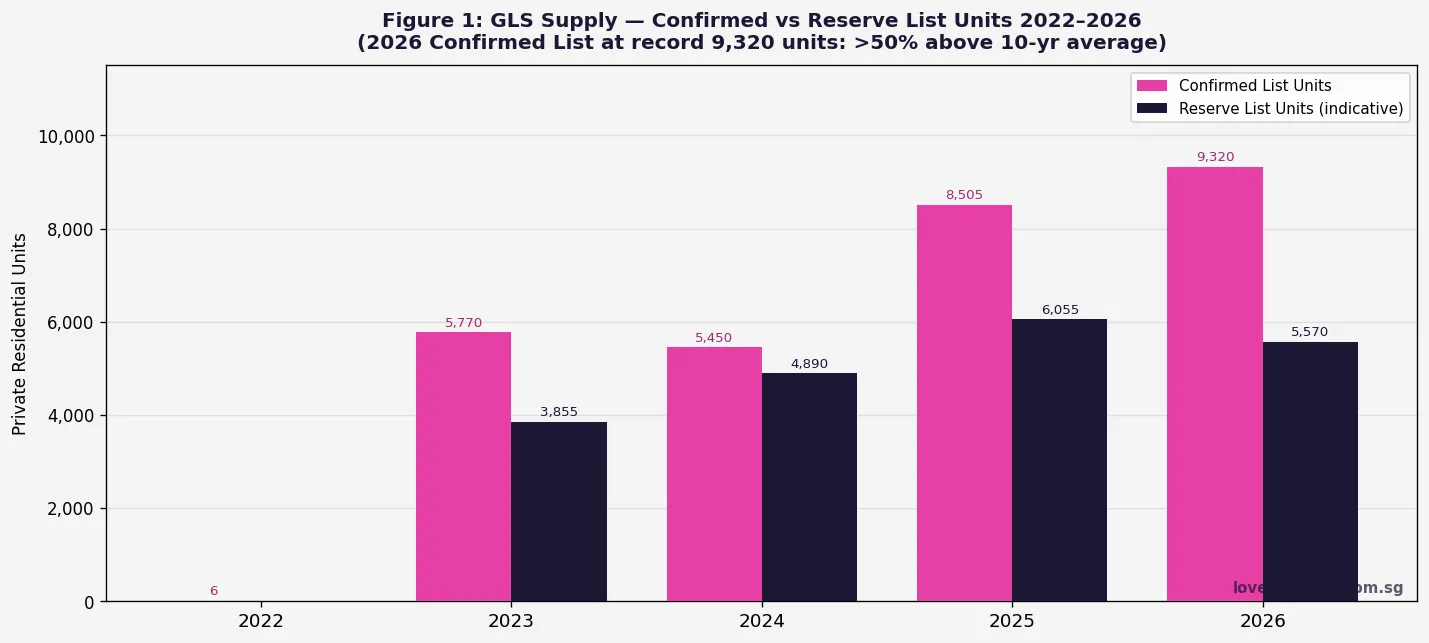
  • Both sites are part of the 1H2026 Confirmed List of 4,575 residential units — 50% above the past-decade Confirmed-List average per GLS programme.
  • Indicative launch pricing implied by the analyst land-rate band sits at S$3,200–S$3,500 psf for Peck Hay Road and S$2,950–S$3,150 psf for River Valley Green (Parcel C), depending on construction-cost and developer-margin assumptions.

What URA released — and why both sites matter

On 9 April 2026, URA placed Peck Hay Road and River Valley Green (Parcel C) on tender — the first paired CCR launch of the 1H2026 GLS programme. Both sites sit inside District 9, both are 99-year leasehold residential plots, and both will yield mid-density condominium developments. Together they account for roughly 17% of the 1H2026 Confirmed List units.

For context, the 1H2026 Confirmed List of 4,575 residential units is the largest single-half-year confirmed-list slate in over a decade — 50% above the average over the past ten 6-monthly programmes. URA has signalled, through repeated MND statements, that this elevated supply schedule is a deliberate response to private residential prices that have risen for ten consecutive quarters (Q1 2026 PPI +0.9%).

Peck Hay Road and River Valley Green Parcel C GLS launch 2026 hero — Singapore CCR sites
URA Peck Hay Road and River Valley Green (Parcel C) GLS launch — June 2026 tender closes.

Site profile — Peck Hay Road

The Peck Hay Road site is a compact 0.55-hectare plot tucked between Scotts Road, Newton Road and Bukit Timah Road, a five-minute walk from Newton MRT (NS21/DT11). The plot ratio is a notably high 4.9, reflecting its prime CCR positioning, with maximum permissible GFA of around 26,950 m² (290,000 sq ft). Indicative unit count: ~315 private homes, a development scale broadly similar to mid-tier CCR launches over the past three years.

The site's competitive context is unusually rich. It is one of the few remaining undeveloped private plots in the Newton-Scotts axis, where existing inventory comprises mature condominiums (Newton Suites, Newton 18, Newton One) and recent freehold redevelopments. Comparable nearby tender prints — though sparser than in the RCR — include the Boulevard 88 land deal in 2017 (~S$2,100 psf ppr, freehold) and the older Stevens Road / Dorsett land sales in 2020–2021 at the S$1,400–1,500 psf ppr band. The 2026 analyst expectation of S$1,650–1,750 psf ppr reflects the post-cooling-measures CCR premium.

Site profile — River Valley Green (Parcel C)

River Valley Green (Parcel C) is the third and final parcel of the River Valley Green release programme, following Parcel A (river-modern, awarded in 2025) and Parcel B (river-green, awarded in 2025 to Wing Tai). The Parcel C plot spans about 11,516 m², with a plot ratio of 3.5 and indicative unit count of ~470 private homes. It sits directly next to Great World MRT (TE15) and across the road from River Valley Primary School, putting it inside one of the most established residential enclaves in District 9.

Analysts expect a tighter bidder field on Parcel C (4–6 versus 6–8 on Peck Hay Road) — partly because two of the most active 2024–2025 CCR bidders (Wing Tai and the larger consortia of CDL/HongKong Land) are already exposed to nearby Parcel A and Parcel B and may not stretch into a third adjacent site at full premium. Top bid is projected around S$1,600 psf ppr, modestly below the Peck Hay Road expectation despite a slightly larger absolute outlay (~S$695M projected land cost).

Peck Hay Road River Valley Green Parcel C GLS site fact panel 2026
Figure 1 — Peck Hay Road and River Valley Green (Parcel C) site fact panel — both 99-year leasehold, total ~785 units.

Reading the analyst bid band against recent comparables

The analyst-projected S$1,650–1,750 psf ppr top bid for Peck Hay Road would set a new CCR Confirmed-List benchmark — a step up from the 02 May 2026 Dunearn Road award (D11) at S$1,625 psf ppr, and substantially above the 2025 RCR-belt benchmarks at Holland Drive (S$1,218 psf ppr) and the late-2024 Pinetree Hill (S$1,318 psf ppr). The chart below sets out the trajectory.

CCR RCR GLS land rates Singapore 2024 to projected 2026 comparison bar chart
Figure 2 — Confirmed-List land rates have risen ~30% from late-2024 RCR awards to mid-2026 CCR projections.

Worked Example — implied launch price for Peck Hay Road

Land cost

At an analyst top bid of S$1,700 psf ppr × 290,000 sq ft GFA = approximately S$493 million in land outlay alone.

Construction and finance

Indicative all-in construction cost on a CCR plot of this density: S$650–700 psf GFA, including main contract, M&E and superstructure. Finance cost over a 36-month build (taking BBR + 1.5%): S$120–140 psf GFA. Marketing, professional fees and provision for ABSD remission risk: S$80–100 psf GFA.

Indicative breakeven and launch

  • Land cost: S$1,700 psf ppr
  • Construction + M&E: S$675 psf GFA
  • Finance + soft costs: S$130 psf GFA
  • Marketing + ABSD provision: S$90 psf GFA
  • Indicative breakeven: ~S$2,595 psf
  • Indicative launch price (12% developer margin): ~S$2,900–3,100 psf
  • Aggressive assumption launch (CCR premium scenario): S$3,200–3,500 psf for select stacks

Translation: a 700 sq ft two-bedder on Peck Hay Road would launch at S$2.0M–S$2.4M; a 1,200 sq ft three-bedder at S$3.5M–S$4.2M.

What this means for buyers

For homebuyers, the immediate signal is that CCR new-launch pricing in 2027–2028 will sit comfortably above the S$2,800 psf threshold. Owner-occupiers prioritising location over per-square-foot value should monitor both tenders closely; pricing pressure from the post-tender comparable will affect every unsold inventory across Newton-Scotts and Great World. Buyers stretching into 4-bedroom inventory should budget for absolute prices in the S$5M+ range.

For investors, the picture is more nuanced. Rental yields in the CCR continue to sit at 3.0–3.5% gross — comfortably above CCR mortgage rates of 3.0–3.3%, but the price-rental gap has widened. The Peck Hay Road launch in particular will likely target the high-net-worth owner-occupier and affluent local-investor segment rather than yield buyers.

What this means for developers and the GLS programme

Developers face an unusually well-supplied 1H2026 programme, with the 4,575-unit Confirmed List sitting alongside the 1H2026 Reserve List. The strategic implication is that successful developers will be those with demonstrable execution speed — the ABSD-remission deadline forces full sell-through within five years of land acquisition, and a 470-unit launch needs to clear in a market where 2025 absorption rates were 60–80% in the first quarter of launch.

For the GLS programme itself, the Peck Hay Road and River Valley Green (Parcel C) tenders are the political bellwether — strong bids will validate the elevated supply schedule, while a soft set would invite questions about whether 4,575 units in one half-year is calibrated to actual demand.

What might come next

Three forward-looking watchpoints. First, both tender closes are within a fortnight of each other (11 and 18 June) — meaning the Peck Hay Road result will be a real-time read for the River Valley Green (Parcel C) bidder field. Second, three more 1H2026 sites remain on the Confirmed List for tender close in 2H2026 (Bayshore Drive among them, closing 15 July 2026). Third, the 2H2026 GLS programme will be announced around mid-June, and its scale will be cross-read against the Peck Hay / RVG-C clearance levels.

Summary table — Peck Hay Road vs River Valley Green (Parcel C) at a glance

Attribute Peck Hay Road River Valley Green (Parcel C)
Site area ~5,500 m² (0.55 ha) ~11,516 m²
Plot ratio 4.9 3.5
Maximum GFA ~26,950 m² ~40,300 m²
Indicative units ~315 ~470
Lease 99 years 99 years
Tender closes 11 June 2026, 12 noon 18 June 2026, 12 noon
Expected bidders 6–8 4–6
Analyst top bid S$1,650–1,750 psf ppr ~S$1,600 psf ppr
Implied launch S$3,200–3,500 psf (top stacks) S$2,950–3,150 psf

Frequently Asked Questions

What is a Government Land Sales (GLS) tender?

A GLS tender is the process by which the State of Singapore, through URA, sells residential, commercial or mixed-use land for private development. The Confirmed List is the headline programme — sites are launched on a fixed schedule. The Reserve List requires a developer to trigger a tender by submitting a minimum-price commitment.

Why are Peck Hay Road and River Valley Green Parcel C significant?

Both sites are inside Singapore's Core Central Region (District 9), where new-launch supply has been historically tight relative to demand. The combined ~785 units is a meaningful addition to a region that has seen no major Confirmed-List residential launch since 2024. They are also part of an unusually large 1H2026 Confirmed List (4,575 units, 50% above decade average).

What does "psf ppr" mean?

Per square foot per plot ratio — a normalised measure of land cost. It divides the tendered land price by the maximum permissible gross floor area (GFA), so two sites with different plot ratios can be compared on like-for-like terms.

How is the launch price calculated from the land bid?

Add construction cost (~S$650–700 psf GFA in 2026), financing cost over the build period (~S$120–140 psf GFA), marketing and ABSD-remission provisioning (~S$80–100 psf GFA), and a developer margin (10–15%). For a top bid at S$1,700 psf ppr, this implies a launch price band of roughly S$2,900–3,100 psf, with selected stacks pricing higher.

When are these condominiums likely to launch for sale?

If both tenders are awarded in late June 2026, the typical land-to-launch timeline is 12–18 months for design, planning approvals and showflat construction. Indicative public launch dates: Peck Hay Road in late 2027 to early 2028; River Valley Green (Parcel C) in early 2028.

Will the elevated 1H2026 Confirmed List supply cool prices?

The supply pipeline is materially larger than the past decade average, but the bulk of these units will reach launch only in 2027–2028. Q1 2026 PPI rose 0.9%; the supply-led cooling, if it materialises, is more likely to show in 2027 transaction volumes and asking-price moderation than in any near-term quarterly print.

Disclaimer. This article is editorial commentary based on publicly available URA media releases (pr26-28, 09 April 2026) and analyst commentary published by EdgeProp Singapore, Stacked Homes, The Edge Singapore, 99.co Insider, ERA research desk and Cushman & Wakefield. Forward-looking bid bands and launch pricing are estimates only, not guarantees. Verify current tender details on the URA website and the One-Stop Developer Portal. Engage a licensed property professional and a Singapore-qualified solicitor before committing to any transaction.

Wing Tai-Metro JV Wins Dunearn Road GLS at S$533M — S$1,625 psf ppr Sets New D11 Benchmark

Wing Tai-Metro JV Wins Dunearn Road GLS at S$533M — S$1,625 psf ppr Sets New D11 Benchmark

The Dunearn Road Government Land Sales (GLS) tender closed on 28 April 2026 with the Wing Tai Holdings and Metro Holdings joint venture submitting the top bid of S$533 million — equivalent to S$1,625 per square foot per plot ratio (psf ppr). Six developer bids contested the site, signalling sustained appetite for prime District 11 freehold-equivalent precincts despite the wider market’s cautious tone.

The result extends the steady price discovery in Bukit Timah Turf City — a precinct URA has signalled as a long-term residential growth area, anchored by Sixth Avenue MRT, the Bukit Timah Nature Reserve, and the Bukit Timah Plaza retail district. For buyers tracking the next CCR new launch, this tender frames the indicative pricing band for what is likely to launch in late 2027.

Quick Answer — Dunearn Road GLS at a glance

  • Tender closed: 28 April 2026
  • Top bid: S$533 million by Wing Tai Holdings + Metro Holdings JV
  • Land rate: S$1,625 psf ppr
  • Number of bids: 6 — strongest contest in the precinct so far
  • Site size: 19,042 sqm; ~330 residential units + 1,400 sqm commercial
  • Tenure: 99-year leasehold
  • Implied breakeven: ~S$2,650 psf; indicative launch psf above S$3,000
  • Expected launch: late 2027, subject to URA approval

What Happened — A Six-Bid Contest in District 11

URA released the Dunearn Road site on the 1H 2026 GLS Confirmed List in December 2025, with the tender closing on 28 April 2026. The site sits within the Bukit Timah Turf City precinct — a long-tail residential growth area that the Master Plan rezoned from racing-club use to mixed residential several years ago.

Six developer groups bid for the parcel. The Wing Tai Holdings and Metro Holdings joint venture — bidding through Winrich Investment Pte Ltd and Metrobilt Construction Pte Ltd — clinched the site with a S$533 million top bid, equivalent to S$1,625 psf ppr on the maximum allowable gross floor area. The runner-up bid is understood to have come within roughly 6% of the top, indicating a tightly contested tender rather than a one-developer outlier.

Dunearn Road GLS Singapore 2026 — S$533M top bid Wing Tai Metro JV, 6 bidders, 19042 sqm site, 330 residential units
Figure 1: Dunearn Road GLS — the closing fact panel.

How the Land Rate Compares

The S$1,625 psf ppr land rate sits right at the top of the recent Bukit Timah / D10–D11 GLS comparable set, narrowly above the S$1,610 psf ppr that Dunearn Road Parcel A cleared in March 2025. Both Dunearn Road parcels now anchor the precinct’s pricing.

Bukit Timah D10 D11 GLS tender psf comparison 2024-2026 — Holland Drive S$1218, Pine Grove S$1318, Dunearn Parcel A S$1610, Parcel B S$1625
Figure 2: Recent Bukit Timah / D10–D11 GLS tender outcomes — Dunearn Road Parcel B at the top.
Metric Reading What it means
6 bids on a CCR site Strong contest Refutes the “CCR is dead” narrative; ABSD-resilient buyer pool still exists for prime D11
S$1,625 psf ppr Top of band Sets the new floor for D11 precinct land rates; future tenders likely to anchor here
~330 units Mid-sized Manageable absorption profile; not a 1,000-unit mega-launch
Implied breakeven ~S$2,650 psf Premium pricing Launch psf above S$3,000 likely needed for healthy developer margins
99-year tenure Standard No freehold premium baked in — Bala’s Curve applies in the long run

Why District 11 Is Pulling Bids

The Dunearn Road tender outcome cuts against the broader CCR softness narrative in three ways:

  1. Bukit Timah Turf City master plan upside. URA has flagged the precinct as a major long-term residential growth area, with planned road and MRT enhancements funnelling traffic away from the existing Bukit Timah Road bottleneck. Future-precinct optionality — in particular the eventual mixed-use redevelopment of the surrounding Bukit Timah Plaza area — gives the Dunearn Road parcels a longer-tail upside than a typical CCR infill site.
  2. Sixth Avenue MRT proximity. The site sits within walking distance of Sixth Avenue MRT (Downtown Line). The recent re-rating of MRT-adjacent properties post-Cross Island Line announcement has lifted the implicit transit premium for sites in the Bukit Timah corridor.
  3. School catchment. The site falls within the catchment of several top primary schools — the perennial demand engine for District 11 family buyers, where ABSD is largely an irrelevance because the buyers are SC families on first-home purchases.

Indicative Launch Pricing — A Worked Example

Working backwards from the S$1,625 psf ppr land rate, industry figures typically estimate breakeven and indicative launch psf as follows. Worked Example: a developer paying S$1,625 psf for the land typically adds construction (~S$520–600 psf), professional fees and finance costs (~S$120–160 psf), and a margin and contingency layer (~S$280–320 psf), bringing all-in breakeven to roughly S$2,545–2,705 psf. Adding a healthy launch margin pushes indicative launch psf into the S$3,000–3,300 band. That places the new launch in the same general band as recent CCR new launches like 19 Nassim and the upper end of Watten Estate redevelopments.

Cost Component Indicative psf (S$)
Land cost 1,625
Construction 560
Professional fees + finance 140
Margin + contingency 300
Indicative breakeven ~2,625
Launch margin ~400
Indicative launch psf ~3,025

Per-unit prices for typical 3-bedroom (~1,000 sqft) units would therefore range S$3.0–3.3 million at launch. For 2-bedroom units (~700 sqft) a launch range of S$2.1–2.3 million is plausible. The actual pricing will depend on launch-window comparables, prevailing financing rates, and any cooling-measures recalibration in the meantime.

What It Means for Buyers and Investors

For owner-occupiers in the District 11 catchment:

  • Existing comparable resale stock in Bukit Timah Estate (e.g. Trevista, Cluny Park, Eng Neo Avenue) becomes a reference for upgrader value. Resale at S$2,400–2,600 psf for relatively new freehold stock starts looking competitive against an S$3,000+ psf new-launch.
  • The 99-year tenure is a structural disadvantage relative to the freehold stock surrounding it. See our Freehold vs 99-Year Leasehold guide for the holding-period maths.

For investors:

  • The implied breakeven sits well above the rental-yield supportable level. Net yields at S$3,000+ psf launch in District 11 typically come in at 2.0–2.5% — a yield-vs-capital-appreciation trade-off the buyer must accept upfront.
  • For ABSD-resilient buyers (SCs on first home, FTA-exempted nationals), the entry calculus is dominated by capital appreciation expectations. For ABSD-paying buyers (foreigners at 60%, entities at 65%), the entry math is far harder.

What Comes Next

The 1H 2026 GLS programme has several more tenders ahead. The Holland Plain site closes on 7 May 2026 — another D10 / Bukit Timah-adjacent parcel that will set the next price benchmark. Beyond that, the remaining 1H 2026 sites include Bayshore Drive (a major mixed-use parcel closing 15 July 2026) and EC sites at Sembawang Drive and Canberra Drive that will affect the EC pipeline rather than the prime CCR narrative.

For Dunearn Road Parcel B specifically, the next milestones are the developer’s formal site mobilisation, the URA development application, and the pre-launch marketing window — all typically running 12–18 months from tender award. A late-2027 launch window is the practical expectation.

Frequently Asked Questions

When will the Dunearn Road condo launch?

Likely late 2027. Tender awards typically take 12–18 months to translate into a formal launch, depending on URA development-application turnaround, design finalisation, and pre-launch marketing setup. Earlier launches are possible if the developer fast-tracks the design, but the late-2027 to early-2028 window is the realistic baseline.

What is the expected launch psf for Dunearn Road?

Working from the S$1,625 psf ppr land rate, indicative breakeven is S$2,500–2,700 psf and an indicative launch range of S$3,000–3,300 psf is plausible. Final pricing will reflect launch-window comparables, financing rates, and any future cooling-measure recalibration.

Is the Dunearn Road site freehold or leasehold?

99-year leasehold — the standard tenure for Singapore GLS sites. The 99-year clock starts from issuance, typically 1–2 years before TOP. By the time buyers move in around 2030, the remaining lease will likely be 96–97 years.

How does this tender compare with the Tanjong Rhu GLS?

The Tanjong Rhu (River Modern) GLS site cleared at S$709 million in March 2025 — a larger project on a Riverfront RCR site. Dunearn Road Parcel B at S$533 million is a different scale and a different micro-market. Both are signals of sustained developer appetite for well-located GLS sites despite cooling-measure pressure.

What other 1H 2026 GLS tenders should I track?

Holland Plain (closing 7 May 2026) is the next D10-adjacent site. Bayshore Drive (closing 15 July 2026) is the major mixed-use parcel for the new Bayshore precinct. Sembawang Drive and Canberra Drive are EC sites that will affect the 2027–2028 EC pipeline. Each tender result becomes a fresh data point for pricing the surrounding resale and new-launch markets.

Are there alternatives in the same area for buyers who do not want to wait?

Existing freehold or 999-year leasehold stock in Bukit Timah Estate is the immediate resale alternative. Newer 99-year leasehold stock at Watten Estate, Sixth Avenue, and Coronation Road can be compared on a like-for-like psf basis. Pinetree Hill in the Pine Grove precinct remains the recent benchmark for Dunearn-adjacent leasehold new launches.

Related Articles

Disclaimer: This article is for general information only and does not constitute legal, tax, or financial advice. Tender outcomes, launch pricing and indicative breakeven figures are based on publicly disclosed URA tender data and industry-standard estimation conventions. Always verify current GLS data with the URA Land Sales page and consult a licensed property professional or financial adviser before acting on any property purchase.

URA Q1 2026 Private Home Prices Rise 0.9% — Revised Up from +0.3% Flash, OCR Leads at +2.2%

URA Q1 2026 Private Home Prices Rise 0.9% — Revised Up from +0.3% Flash, OCR Leads at +2.2%

Singapore private home prices rose 0.9% in the first quarter of 2026 — almost three times the pace flagged in the URA flash estimate three weeks earlier. The final reading, published by the Urban Redevelopment Authority on 24 April 2026, marks the sixth consecutive quarter of growth in the private residential price index, and it tells a story that diverges sharply from the volume picture: prices firmed, but transactions slumped almost 40% quarter-on-quarter.

Quick Answer — what the URA Q1 2026 release shows

  • Overall private residential PPI: +0.9% q-o-q, sixth consecutive quarter of growth.
  • Sharp upward revision from the +0.3% flash estimate on 1 April.
  • Non-landed properties: +1.3%; landed: -1.8%, reversing the +3.4% prior quarter.
  • OCR led non-landed with +2.2%; RCR +0.8%; CCR +0.6%.
  • Transaction volume crashed: only 4,041 deals recorded by mid-March, -39.7% versus 4Q 2025.
  • Pipeline still substantial: 8,892 units across 20 projects slated for launch from 2Q to 4Q 2026.
URA Q1 2026 private home prices +0.9% — guide cover
URA Q1 2026 final release — private home prices revised up to +0.9%.

Flash to Final — A Substantial Upward Revision

URA flash estimates are released on the first business day of every quarter, before the full transaction sample is in. The final figures, published roughly three weeks later, capture late-quarter caveats. In most quarters the gap between flash and final is small — perhaps 0.1 to 0.3 percentage points. In Q1 2026 the gap was larger than usual: from +0.3% to +0.9%.

URA Q1 2026 flash vs final by region — overall +0.3% revised to +0.9%, OCR +2.2%
Figure 1: Flash vs final — URA Q1 2026 PPI revisions by region.

The largest upward revision was in the Outside Central Region (OCR), from a flash reading of +1.3% to a final +2.2%. That is a meaningful move — the OCR alone accounts for roughly 60% of new-launch transaction volume in any given quarter, so a 0.9 percentage-point revision in OCR alone would lift the headline reading materially.

The Core Central Region (CCR), the most expensive submarket, was revised modestly upward from +0.4% to +0.6%, after a punishing -3.5% in 4Q 2025. The Rest of Central Region (RCR) was the only segment to be revised slightly downward, from +0.9% to +0.8%.

Why Were OCR Numbers Revised So Sharply?

Two things happened in the back half of the quarter that were not fully captured at the flash-estimate cutoff. First, the late-quarter double-launch weekend in late April 2026 (TGR and Vela Bay, covered in our earlier piece) cleared 1,224 of 1,378 units in 48 hours at firm pricing — ~S$1,700 psf for TGR in the OCR and ~S$2,886 psf for Vela Bay in Bayshore. Both sets of transactions dragged up the OCR PPI when finally captured.

Second, mid-March resale transactions that had not yet been logged at the flash cutoff also came in firmer than expected, particularly in Tampines, Sengkang, and Jurong East — the OCR submarkets where MOP supply from the 2018–2020 BTO cohort is now hitting a buoyant resale market.

The Volume Story — A 39.7% Crash

The price firming has to be read against a steep drop in activity. Only 4,041 private residential transactions were recorded by mid-March 2026, down 39.7% versus the 6,699 transactions in 4Q 2025. That is the lowest quarterly transaction count in nearly two years.

URA Q1 2026 prices +0.9% but transactions -39.7% — divergence chart
Figure 2: The defining tension of Q1 2026 — firmer prices on much thinner volume.

The volume drop has two readable causes. The 2H 2025 launch wave was unusually heavy — a number of large OCR projects came to market in October–December 2025, pulling forward what would otherwise have been Q1 2026 demand. Q1 2026 was always going to look soft on volume by comparison.

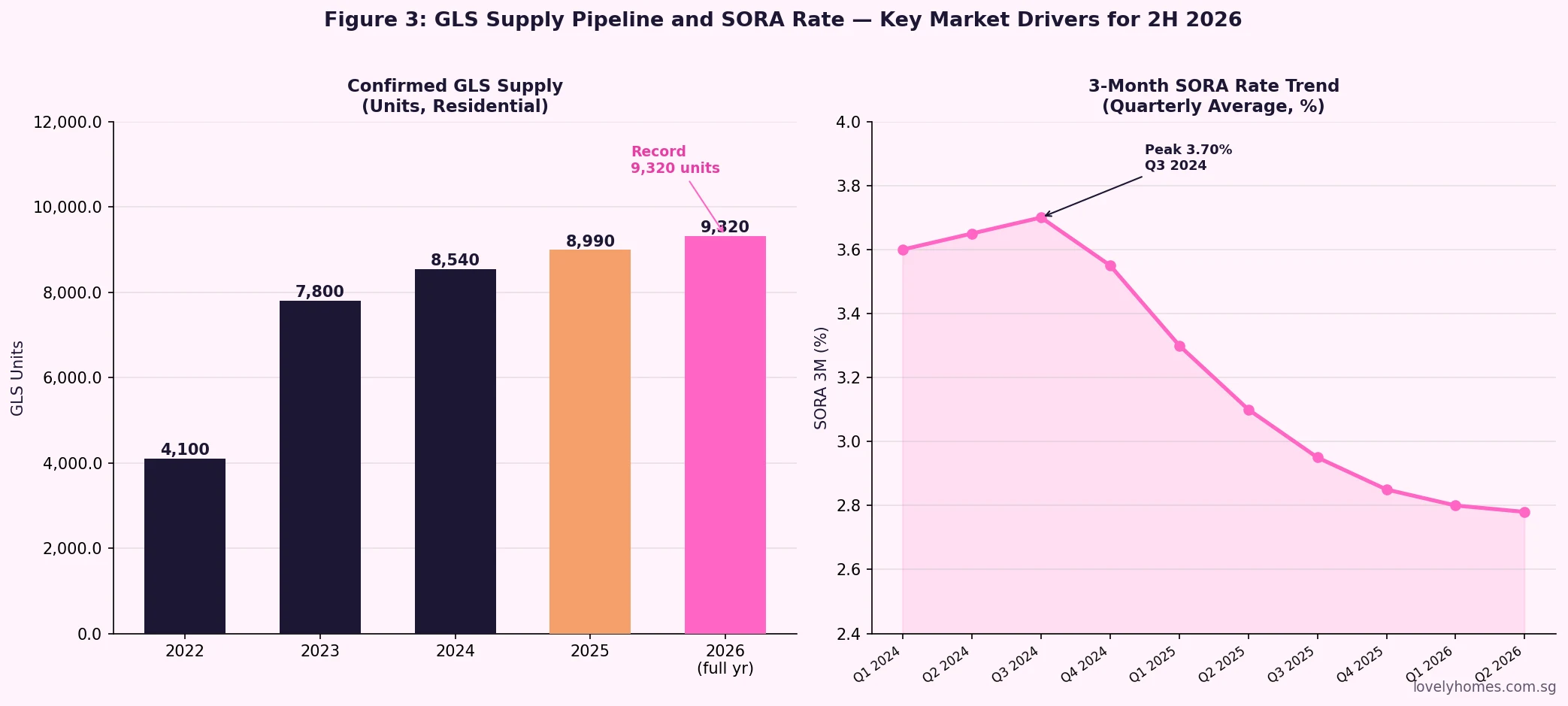
The second cause is sentiment. Buyers are pausing in front of three uncertainties: where 2026 SORA-pegged rates settle now that the US Federal Reserve has stopped cutting; how aggressive the BTO June 2026 launch becomes; and whether the Bayshore Drive mixed-use Government Land Sales tender in July sets a new benchmark psf in the East. Volume usually returns once these three questions get answered.

Landed -1.8% — Mean-Reverting After a Hot 4Q

The landed segment swung from +3.4% in 4Q 2025 to -1.8% in Q1 2026, a 5.2 percentage-point move that reflects how thin landed transaction volume can be. Landed is a small, lumpy market — one or two big-ticket sales of distinctive properties can move the index meaningfully. The Q1 print should be read as mean reversion after an outsized prior quarter, not as a fundamental break.

Rental Index +0.3% — Stabilising After 2024 Cool-Off

The private residential rental index ticked up 0.3% in Q1 2026 after the multi-quarter cool-off through 2024 and early 2025. Yields on private condos remain in the 3.0–3.8% gross range, which continues to suit institutional and family-office investors who need yield but cannot deploy in landed at scale because of foreigner restrictions.

What Comes Next — The Q2 to Q4 Pipeline

Indicator Q1 2026 reading What it implies for the rest of 2026
Overall PPI +0.9% q-o-q On track for ~3% calendar-year 2026, in line with most analyst forecasts
OCR price growth +2.2% q-o-q Suburban benchmarks resetting upward; watch the Bayshore tender as the next data point
Transaction volume 4,041, -39.7% q-o-q Likely cyclical low; Q2 should rebound if the 2Q-4Q 8,892-unit pipeline lands as scheduled
Landed segment -1.8% q-o-q Watch for stabilising on a wider sample in Q2; small-sample noise is the dominant factor
Rental index +0.3% q-o-q Yields steady; institutional appetite for buy-to-let condos persists

What This Means for Buyers — The Counter-Cyclical Window

For end-user buyers who have been waiting on the sidelines, Q1 2026 is the kind of moment that historically gets revisited as a buying window. Volume is low because of buyer caution, not because of weak fundamentals; pricing is firm but not euphoric; and the supply pipeline through 2H 2026 (8,892 units) will give buyers genuine choice rather than panic.

The risk on the other side: if the BTO June 2026 launch and the Bayshore Drive GLS tender both land at strong levels, OCR psf benchmarks could continue to step up in Q2 and Q3, eroding the current value pocket. Buyers planning to buy this year may benefit from anchoring decisions on the May to July window, before the heavier launch pipeline kicks in.

Frequently Asked Questions

Why was the upward revision from flash to final so large this quarter?

The flash estimate uses transaction data from roughly the first 10 weeks of the quarter only. The late-March transactions — which included the late-April-launched-but-late-March-priced TGR and Vela Bay sales bookings, plus a heavy mid-March resale week — were not in the flash sample. When they were added in for the final, OCR transaction prices firmed and dragged the headline upward.

Does this change the 2026 full-year forecast?

Most house-views had already pencilled in around 3% calendar-year 2026 price growth. Q1 at +0.9% is broadly consistent with that pace — not a beat, not a miss. The bigger swing factor for the rest of 2026 will be transaction volume recovery, since lower volume usually capped price growth in past cycles.

If volume is so weak, why are prices going up at all?

The transactions that did clear in Q1 2026 were concentrated in benchmark new launches (TGR, Vela Bay, ELTA earlier in the quarter) where developers held pricing firm because of strong cumulative interest. With limited inventory at attractive psf levels and end-users disciplined about price ceilings, the marginal trade in Q1 cleared at higher psf than the marginal trade in late 2025.

What does this mean for HDB upgraders?

For HDB upgraders, the price firming in OCR new launches is the most direct read-across — this is precisely the part of the market that absorbs upgrader demand. The flip side, however, is that HDB resale prices dipped 0.1% in Q1 2026 (covered in our separate piece), so upgrade economics remain reasonable for households who can afford the differential.

Does the URA Q1 2026 release affect cooling-measure expectations?

Almost certainly not. +0.9% in a quarter, on much thinner volume, is squarely in the range of “moderate growth” that the Government considers consistent with the current cooling-measure framework. Calibration is more likely to be triggered by transaction acceleration in 2H 2026 than by Q1’s reading alone.

How much new supply is coming?

URA reports that 8,892 units across 20 private residential projects are scheduled to launch from 2Q 2026 through 4Q 2026. That is a substantial pipeline, weighted to the OCR. Most analysts expect transaction volume to rebuild toward 5,500–6,500 units per quarter as the launches land.

Related Articles

Disclaimer

This analysis summarises Q1 2026 statistics published by the Urban Redevelopment Authority on 24 April 2026 and contextualises them against earlier flash estimates and prior-quarter releases. Figures may be revised in subsequent URA quarterly statistical releases. The piece does not constitute investment, tax, or legal advice. For authoritative figures consult URA, HDB, the Monetary Authority of Singapore, the Inland Revenue Authority of Singapore, CPF Board, and SingStat. Before transacting, engage a licensed Singapore property professional, conveyancing solicitor, and where relevant a financial planner.

Translate »