Singapore Property Downpayment Guide 2026: How Much Cash and CPF You Need

Singapore Property Downpayment Guide 2026: How Much Cash and CPF You Need

Singapore property downpayment 2026 — understanding exactly how much cash and CPF you need before you make an offer is one of the most practical steps any buyer can take. The rules changed on 20 August 2024 when MAS lowered the HDB Concessionary Loan LTV from 80% to 75%, and many buyers are still calculating on outdated figures. This guide consolidates every rule that applies in 2026, from BTO flats to freehold CCR condos, with specific dollar amounts at common price points.

Quick Answer: Singapore Property Downpayment 2026 — Key Facts

  • HDB Loan (BTO/Resale): LTV 75% → 25% downpayment, payable entirely from CPF OA — zero cash required for the downpayment itself.
  • Bank Loan (HDB or Private, 1st property): LTV 75% → 25% downpayment: minimum 5% cash, remaining 20% from CPF OA.
  • Bank Loan (2nd property, 1 outstanding loan): LTV 45% → 55% downpayment: minimum 25% cash, remaining 30% CPF OA.
  • Bank Loan (3rd+ property): LTV 35% → 65% downpayment: minimum 25% cash.
  • New Launch (Progressive Payment Scheme): 5% Option Fee in cash + 15% on exercise (CPF/cash) + stage payments during construction.
  • CPF cannot pay: BSD, ABSD, legal fees, agent commission — these are always cash out-of-pocket (unless funded by CPF OA for BSD/ABSD in certain cases — see below).
  • ABSD remission window: SC couple selling HDB must sell within 6 months of new private purchase to claim ABSD remission — plan cashflow accordingly.
  • MAS rule change: HDB loan LTV reduced from 80% → 75% on 20 August 2024. All downpayment calculations in 2026 use the new 75% figure.

What Is a Property Downpayment in Singapore?

The downpayment is the portion of the purchase price you must pay from your own resources — cash, CPF Ordinary Account (OA), or a combination — before the bank or HDB disburses the loan for the remainder. The Monetary Authority of Singapore (MAS) and HDB set Loan-to-Value (LTV) caps that determine how large a loan you can take, and therefore how large a downpayment you must make.

The LTV ratio is expressed as a percentage of the lower of the purchase price or the property’s valuation (known as the “valuation limit”). If you pay above valuation — a premium called Cash Over Valuation (COV) — the COV must be paid entirely in cash.
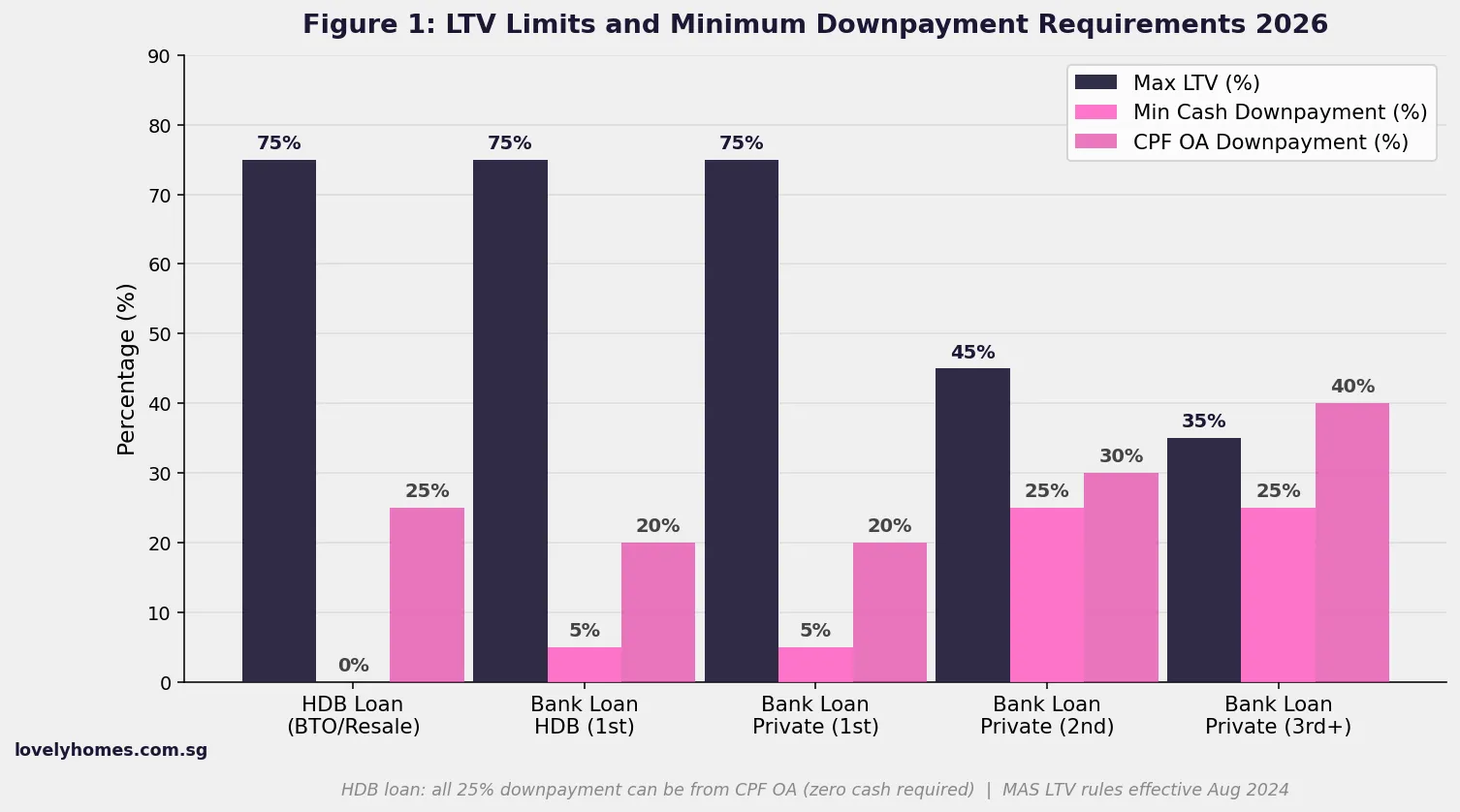
Singapore property LTV limits and minimum downpayment requirements 2026 by loan type
Figure 1: LTV Limits and Minimum Downpayment Requirements 2026 — HDB Loan vs Bank Loan by property count. Source: MAS, HDB (effective 20 Aug 2024).

HDB Loan Downpayment 2026

An HDB Concessionary Loan (commonly called the “HDB loan”) is available only for HDB flats (BTO, resale, DBSS) with an income ceiling of S$14,000 per household per month. As of 20 August 2024, the LTV cap is 75%, meaning you must provide a 25% downpayment.

The key advantage: the entire 25% may come from your CPF Ordinary Account — no cash is required for the downpayment itself. If your CPF OA balance does not cover the full 25%, any shortfall must be topped up in cash.

For BTO flats purchased under the Staggered Downpayment Scheme (SDS), the 25% is paid in two tranches: 2.5% on signing the Agreement for Lease, and 22.5% at key collection. Both tranches can be paid from CPF OA.

Flat Type LTV (HDB Loan) Downpayment Cash Required CPF OA Allowed
BTO (Standard/Plus/Prime) 75% 25% S$0 Up to 25%
HDB Resale 75% 25% + any COV COV in cash only Up to 25% of valuation
DBSS 75% 25% S$0 Up to 25%
2-room Flexi (Seniors SLS) 75% 25% S$0 Up to 25%

Bank Loan Downpayment — HDB Flats and Private Property

Bank loans follow the MAS LTV framework, which applies uniformly whether you are buying an HDB flat, EC, or private condominium. The LTV ceiling depends on the number of outstanding home loans you currently have at the point of applying for the new loan.

For your first property (no outstanding home loans), the LTV cap is 75%, giving a downpayment of 25%. Of that 25%, at least 5% must be paid in cash; the remaining 20% can come from CPF OA.

For your second property (one outstanding home loan), the LTV drops to 45%, requiring a 55% downpayment. At least 25% must be cash; the rest may be CPF OA.

For a third or subsequent property, the LTV falls further to 35%, requiring 65% downpayment (minimum 25% cash).
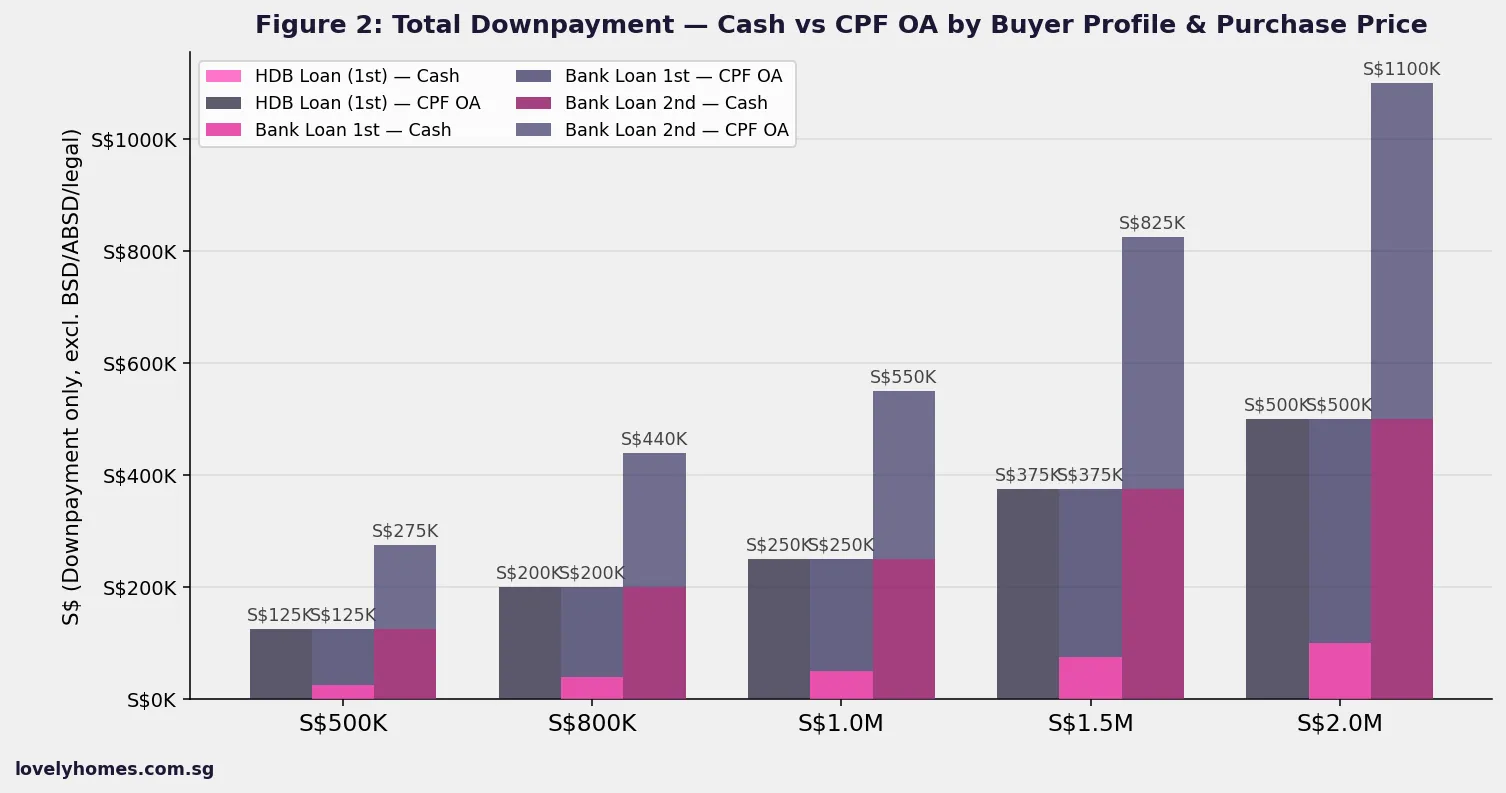
Singapore property downpayment cash vs CPF OA by buyer profile and purchase price 2026
Figure 2: Total Downpayment — Cash vs CPF OA by Buyer Profile and Purchase Price 2026. LTV rules: MAS Notice MAS 632.

New Launch Condo: Progressive Payment Scheme

When buying a new launch private condominium directly from the developer, the Progressive Payment Scheme (PPS) governs when and how you pay. The structure is different from a resale purchase:

  • Booking fee (Option Fee): 5% of purchase price — payable in cash on the day you exercise your option. This cannot come from CPF.
  • On signing Sale and Purchase Agreement (8 weeks later): 15% of purchase price — payable in cash or CPF OA after deducting the 5% already paid.
  • Progressive stage payments: Released as construction hits each milestone (foundations, structural frame, partition walls, etc.) — each stage is up to 10–11% of the price.
  • On Vacant Possession / TOP: Remaining balance typically 25% (before your bank loan kicks in fully).

Because new launch buyers typically take bank loans, the 5% + 15% = 20% upfront is split between cash (minimum 5%) and CPF OA. The bank loan of up to 75% is only drawn progressively as construction progresses — meaning your loan interest begins only on the amount drawn down, not the full loan amount.

Cash Over Valuation (COV) — the Hidden Cash Cost

When you buy an HDB resale flat and agree a price above the HDB-commissioned valuation, the excess is called Cash Over Valuation. COV must be paid entirely in cash — it cannot be funded by CPF OA or any loan.

As of Q1 2026, median COV for popular 4-room HDB resale flats in mature estates ranges from S$10,000 to S$50,000. For million-dollar flats, COV can exceed S$100,000. Always request the HDB valuation report before finalising your offer price.

What CPF Cannot Pay

Understanding what CPF OA cannot cover prevents nasty surprises on legal completion day. The following must always be paid in cash:

  • Buyer’s Stamp Duty (BSD) — CPF OA can pay BSD if the property is residential and you have enough CPF OA after accounting for the downpayment and any outstanding CPF charges. Check with your solicitor and CPF Board before assuming this.
  • Additional Buyer’s Stamp Duty (ABSD) — Same CPF OA rule as BSD above.
  • Cash Over Valuation (COV) — always cash only.
  • Legal fees — always cash.
  • Agent commission — always cash.
  • Property tax — always cash.

BSD and ABSD are significant: at S$1.5 million, BSD alone is S$44,600 and ABSD for a Singapore Citizen purchasing a second property is S$300,000. These must be funded before legal completion and are not financed by the loan.
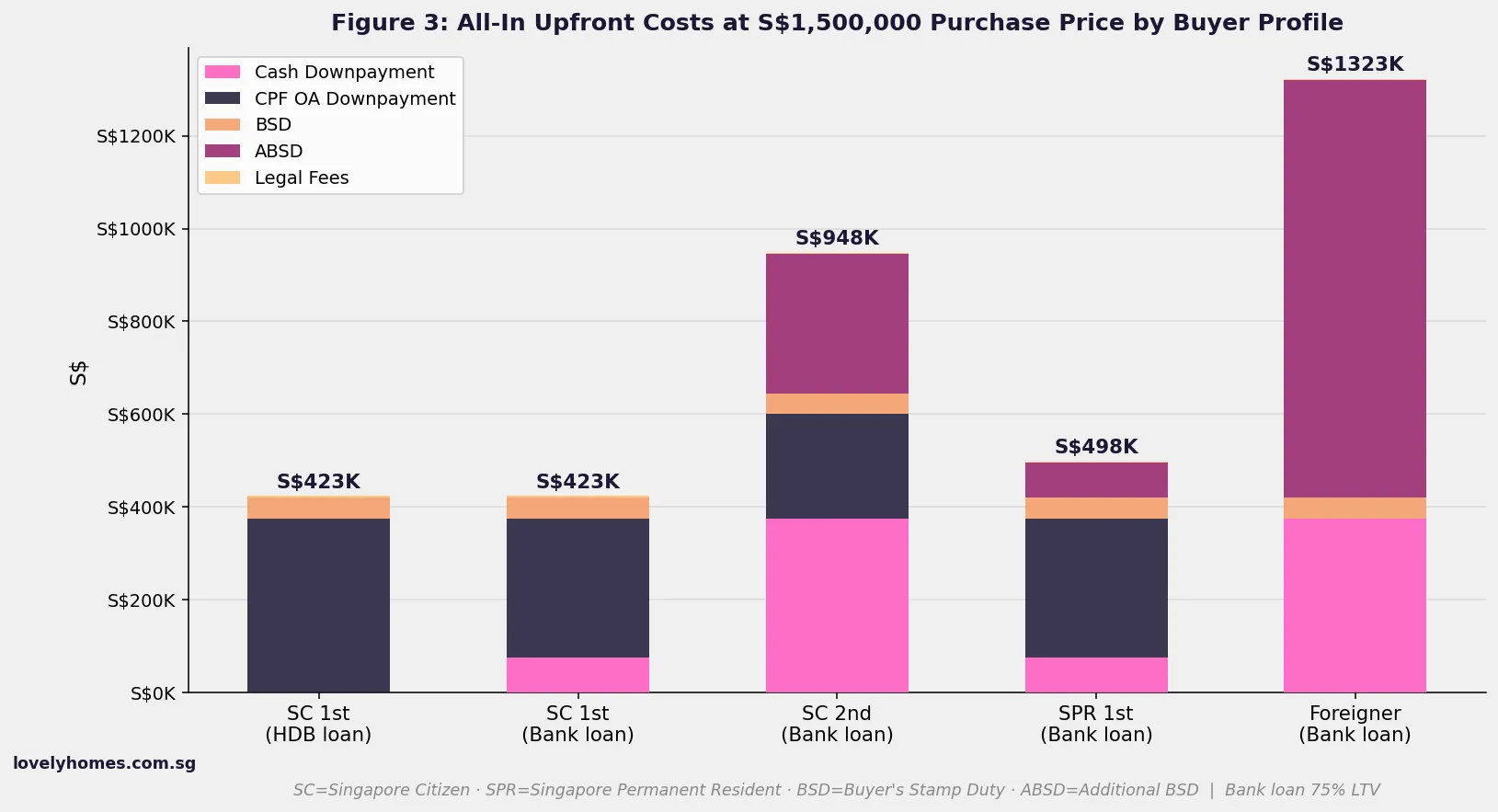
Singapore property all-in upfront costs BSD ABSD downpayment by buyer profile at S$1.5 million 2026
Figure 3: All-In Upfront Costs at S$1,500,000 by Buyer Profile 2026. Includes cash downpayment, CPF OA downpayment, BSD, ABSD, and legal fees. Source: IRAS, MAS.

Summary Table: Downpayment by Scenario 2026

Scenario LTV Cap Min Cash DP Max CPF OA Total DP
HDB Loan (1st HDB) 75% 0% 25% 25%
Bank Loan, HDB (1st) 75% 5% 20% 25%
Bank Loan, Private (1st) 75% 5% 20% 25%
Bank Loan, Private (2nd) 45% 25% 30% 55%
Bank Loan, Private (3rd+) 35% 25% 40% 65%
New Launch (PPS, 1st) 75% (on loan) 5% (booking) + 15% on S&P Part of 15%+ 20% upfront
COV (HDB Resale, any) N/A 100% cash None = COV amount

Worked Example: Mr & Mrs Lim — SC Couple Upgrading to a Private Condo

Mr and Mrs Lim are Singapore Citizens purchasing their first private property (they have already sold their HDB flat). Purchase price: S$1,650,000 for a 3-bedroom condo in the OCR. They take a bank loan.

  • LTV: 75% → loan amount S$1,237,500
  • Total downpayment (25%): S$412,500
  • Minimum cash (5%): S$82,500 cash
  • CPF OA portion (20%): S$330,000 from CPF OA (if available)
  • BSD: S$51,600 (payable from CPF OA or cash)
  • ABSD: Nil (first private property, SC)
  • Legal fees: ~S$4,000 cash
  • Agent commission (buyer’s side): S$0 (new launch — developer pays) or ~S$16,500 (resale, ~1%)
  • Monthly instalment: S$1,237,500 @ 3.2% fixed 30yr = S$5,345/mth → TDSR 38.2% on combined income S$14,000/mth ✓

Minimum liquid cash required on completion day: S$82,500 (downpayment) + S$51,600 (BSD, if not CPF) + S$4,000 (legal) = ~S$138,100 cash at minimum, assuming CPF OA covers the CPF-eligible portions.

Why Downpayment Planning Matters Beyond the Number

The downpayment figure is only the starting point. Buyers often underestimate total day-one liquidity requirements because BSD, ABSD (for second properties), and legal fees are payable within 14 days of exercising the Option to Purchase — before the bank loan is even applied for. For an upgrader buying a S$1.8 million condo while retaining an existing HDB, the ABSD alone can be S$360,000 (SC buying second residential property at 20%). Even if ABSD remission applies (selling the HDB within 6 months), the full amount must be paid upfront and is refunded only after the HDB is disposed of.

CPF accrued interest adds another dimension: every dollar of CPF OA withdrawn for property attracts 2.5% per annum compounded interest that must be refunded to your CPF account when you eventually sell. A buyer who taps the maximum CPF OA early in ownership will owe a substantially larger CPF refund at sale — reducing the net cash proceeds.

What Might Change in 2027 and Beyond

MAS reviews LTV and TDSR settings periodically as part of its property market calibration. When private residential prices rose sharply in 2021–2022, the MAS introduced cooling measures including ABSD hikes and TDSR tightening. Any future overheating or correction could trigger further LTV adjustments. The direction of change is typically a reduction in LTV (higher downpayment) during boom cycles and a relaxation during downturns. Buyers purchasing in 2026–2027 should stress-test their cashflow against a potential LTV reduction of 5–10 percentage points.

For HDB buyers specifically, the BRS/FRS for CPF withdrawal limits is adjusted annually and indirectly affects how much CPF OA remains available for property downpayment. The 2026 BRS is S$106,500 per person (both spouses), which is a floor CPF requires to remain after property pledging in some scenarios.

Frequently Asked Questions

Can I use my CPF OA to pay the full 25% downpayment with no cash at all?

Only if you are taking an HDB Concessionary Loan and your CPF OA balance is sufficient. The HDB loan requires no minimum cash component for the downpayment — the entire 25% can come from CPF OA. However, if you take a bank loan (for either an HDB flat or private property), at least 5% of the purchase price must be paid in cash even if your CPF OA is substantial. There is no exception to this 5% cash floor for bank loans.

How does Cash Over Valuation (COV) work and do I always need to pay it?

COV arises only in HDB resale transactions when the agreed price exceeds HDB’s own valuation of the flat. It is entirely optional — if you and the seller agree on a price at or below valuation, COV is zero. However, in a competitive resale market where popular 4-room flats in Toa Payoh or Queenstown routinely transact above valuation, a meaningful COV is unavoidable. COV cannot be financed by any loan or CPF — it is pure cash. Always commission a preliminary valuation estimate before making an offer and factor the likely COV into your cashflow.

What happens to my downpayment if the deal falls through?

For resale properties, the standard Option to Purchase (OTP) contains a 1% Option Fee paid by the buyer. If the buyer decides not to proceed, that 1% Option Fee is forfeited to the seller. If the seller decides not to proceed after granting the option but before the buyer exercises it, the seller must return the Option Fee plus an equal sum as penalty (i.e., 2× the Option Fee). For new launch purchases, the developer’s Sales and Purchase Agreement governs refund rights — buyers who pull out after exercising the option may lose all or part of the booking fee, and developers may sue for specific performance in some cases. For HDB, a booking fee of S$2,000 (2-room Flexi) to S$10,000 (5-room and larger) applies; this is forfeited if the buyer withdraws after signing the flat booking form.

Can I use a personal loan or credit card to fund part of the downpayment?

No. MAS rules explicitly prohibit using unsecured credit (personal loans, credit cards, renovation loans used as de facto downpayment funding) to meet property downpayment requirements. Banks are required to detect and penalise this under the MAS’s Total Debt Servicing Ratio framework. Any unsecured debt obtained close to a property purchase will increase your total debt obligations, reducing the loan quantum you can obtain, and could constitute misrepresentation on your loan application. The only permissible sources for downpayment are cash savings and CPF OA.

How does the downpayment change if I have an existing HDB loan?

If you are an upgrader who still has an outstanding HDB loan on your current flat, you are treated as having one outstanding home loan for LTV purposes. This means the LTV cap for your new purchase falls from 75% to 45% — requiring a 55% downpayment with at least 25% in cash. This is one key reason most upgraders sell their HDB first, extinguish the outstanding loan, and then purchase — so they qualify for the 75% LTV (first-loan) regime on the new private property. If you sell your HDB with proceeds and repay the HDB loan before exercising the OTP on the new property, you revert to zero outstanding loans and regain access to the 75% LTV tier.

Is there a difference in downpayment for a freehold versus a 99-year leasehold property?

From an MAS LTV perspective, no — the LTV caps and cash/CPF rules are the same regardless of tenure. However, banks may apply internal risk adjustments: for older 99-year leaseholds with a remaining lease of less than 60 years (or less than 30 years for CPF withdrawal), the effective LTV they are willing to lend may be lower than the MAS maximum, requiring a larger effective downpayment. HDB resale flats must have sufficient remaining lease to cover the youngest buyer to at least age 95 for CPF OA usage — if not, CPF withdrawal is capped or prohibited entirely.

Can I use my CPF to pay BSD and ABSD in addition to the downpayment?

Yes, CPF OA can pay BSD and ABSD for residential properties, but this comes at a cost: every dollar used reduces the CPF OA balance available for other purposes and must be refunded (with 2.5% p.a. accrued interest) on eventual sale. In practice, most buyers pay BSD and ABSD in cash to preserve their CPF OA for loan servicing. For ABSD on a second property (typically S$200,000–S$600,000+), paying from CPF OA is common simply because the cash outlay is prohibitive — but buyers should model the long-run CPF refund obligation before doing so.

Related Articles

Disclaimer: This article is for general information only and does not constitute financial, legal, or mortgage advice. Downpayment rules, LTV limits, and CPF withdrawal eligibility are set by MAS, HDB, and CPF Board and may be updated at any time. Verify current figures at mas.gov.sg, hdb.gov.sg, and cpf.gov.sg. Engage a licensed mortgage broker and solicitor before proceeding.

Singapore HDB BTO Application Guide 2026: Eligibility, HFE Letter, Balloting and Key Collection Explained

Singapore HDB BTO Application Guide 2026: Eligibility, HFE Letter, Balloting and Key Collection Explained

📌 Quick Answer: HDB BTO Application 2026

  • BTO (Build-To-Order) flats are HDB flats built after a sales application — you apply first, HDB builds to the number of units needed, so there is no speculative inventory.
  • Eligibility essentials: at least one Singapore Citizen applicant, combined household income at or below the flat-type ceiling (S$7,000–S$14,000), and no private property ownership in the 30 months before application.
  • The HDB Flat Eligibility (HFE) Letter is now mandatory before you can submit a BTO application — obtain it through the MyHDBPage portal with Singpass; it takes about 2–3 weeks.
  • BTO exercises are held roughly 4–5 times per year; each exercise lists flats in multiple towns, with application windows typically 5–7 days.
  • A successful ballot means you are invited to select a flat during a flat selection appointment; unsuccessful applicants join the queue for subsequent exercises.
  • Completion times range from 3 to 4.5 years after booking, depending on the project and site conditions.
  • Standard Minimum Occupation Period (MOP) is 5 years from the date of key collection. Plus and Prime model flats carry a 10-year MOP and resale restrictions.
  • Grants available: Enhanced CPF Housing Grant (EHG) up to S$120,000 for families, S$60,000 for singles; Proximity Housing Grant (PHG) up to S$30,000 for buying near parents.

What Is an HDB BTO Flat and How Does It Work?

The Build-To-Order (BTO) scheme is the Housing & Development Board’s primary mechanism for supplying new public housing to eligible Singapore households. Unlike resale flats — which are purchased from existing owners on the open market — BTO flats are sold directly by HDB at subsidised prices before construction begins. HDB only proceeds with a project once sufficient applications have been received, hence the “build to order” terminology. This demand-led model keeps supply aligned with actual household formation needs and limits speculative overbuilding.

BTO flats come in a range of types from 2-Room Flexi (35–47 sqm) through to 5-Room (110–113 sqm) and the 3-Generation (3Gen) layout designed for multi-generational households. Prices are subsidised relative to private market equivalents; a 4-room BTO flat in a non-mature estate typically prices at S$350,000–S$520,000, compared to resale equivalents at S$490,000–S$720,000 in the same area. The subsidy is funded by HDB and supported through a system of CPF Housing Grants that further reduce the effective purchase price for eligible households.

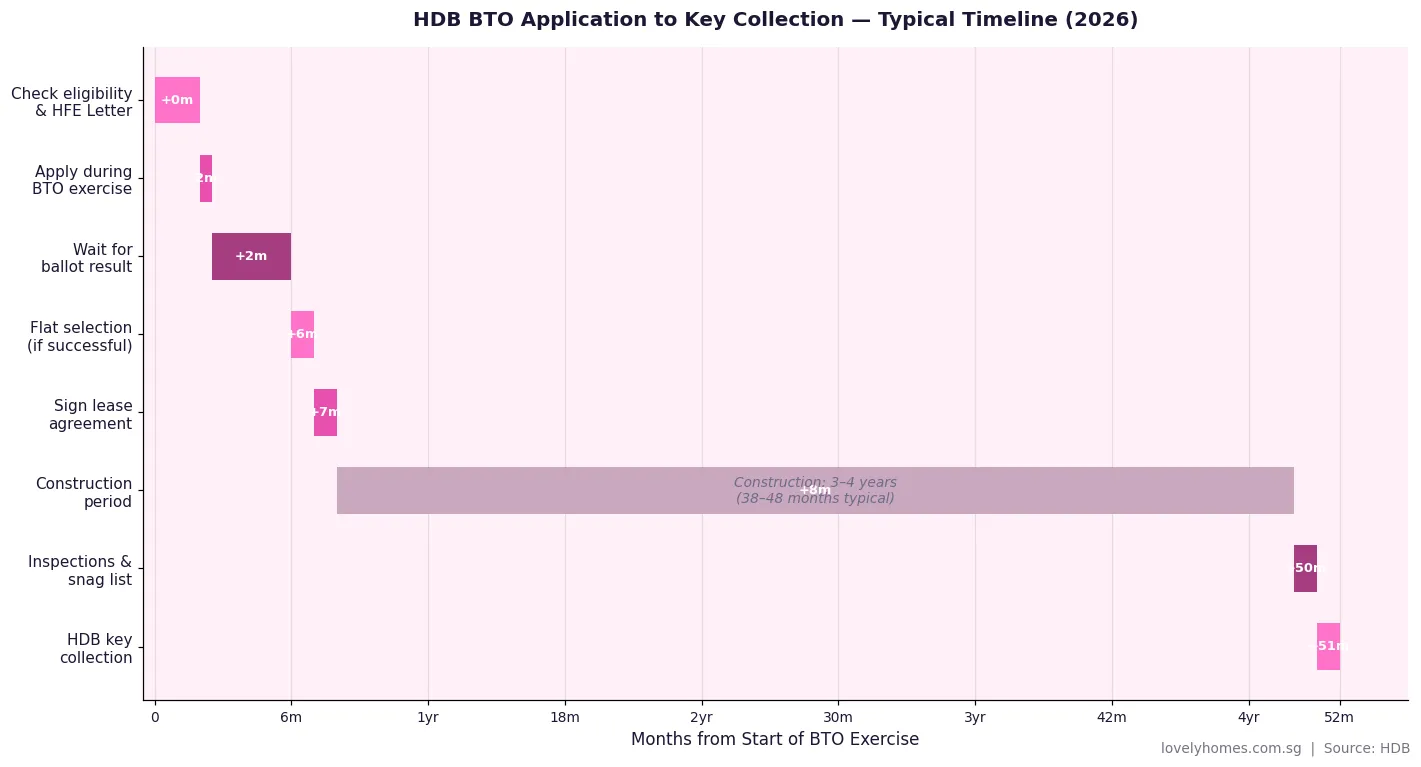
The BTO process involves several distinct stages — eligibility checking, HFE letter application, ballot application, flat selection, signing of the lease, a construction wait of three to four-and-a-half years, and finally key collection and move-in. This guide walks through each stage in detail with the 2026-current rules, timelines, and the specific grant amounts that apply this year.

HDB BTO application to key collection timeline Singapore 2026
Figure 1: Typical HDB BTO Journey — From Eligibility Check to Key Collection (2026). Construction phase is 38–48 months for most projects. Source: HDB.

BTO Eligibility: Who Can Apply?

HDB BTO flats are available only to Singapore Citizens and, under certain schemes, Singapore Permanent Residents (PRs). The eligibility framework as at June 2026 is set out below.

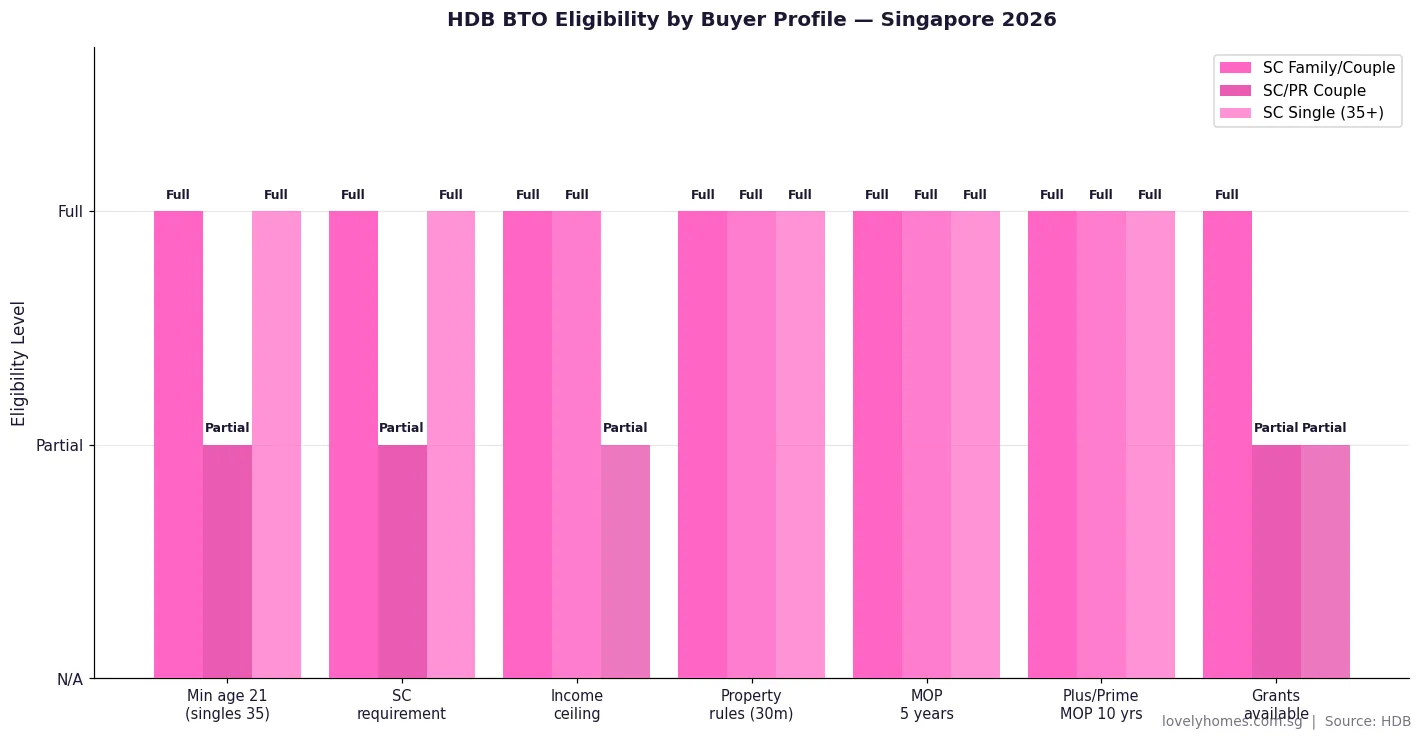
Eligibility Criterion SC Family / Couple SC/PR Couple SC Single (35+)
Minimum age 21 years (main applicant) 21 years (SC applicant) 35 years
SC requirement At least 1 SC applicant SC + PR (PR must be spouse) Must be SC
Income ceiling (4-Room) S$10,000/mth combined S$10,000/mth combined S$7,000/mth
Income ceiling (5-Room / 3Gen) S$14,000/mth combined S$14,000/mth combined Not eligible for 5-Room
Private property rule No private property 30 mths before & at application Same Same
Flat types eligible All types All types 2-Room Flexi only
EHG grant available Up to S$120,000 Up to S$120,000 (if SC component) Up to S$60,000

Foreigners who are neither SC nor PR cannot apply for BTO flats under any scheme. PRs who are single also cannot apply. Under the SC/PR scheme, the PR must be the applicant’s spouse and must obtain SC status within a specified period after key collection or face resale restrictions. Additionally, applicants must not own or have disposed of any flat in a manner that disqualifies them under HDB’s ownership rules — for example, those who have previously received a HDB housing subsidy are not eligible for a second subsidised flat unless they meet specific criteria such as the Married Child Priority Scheme (MCPS) rules.

The HDB Flat Eligibility (HFE) Letter: Step One

Since May 2023, prospective BTO buyers must obtain a HDB Flat Eligibility (HFE) Letter before applying for a BTO flat. The HFE Letter replaced the old Housing Loan Eligibility (HLE) letter and the flat eligibility check — it combines both into a single document that confirms: (a) which flat types you are eligible to purchase; (b) the maximum HDB concessionary loan amount; and (c) the CPF Housing Grants you qualify for.

To apply for an HFE Letter, log in at hdb.gov.sg using Singpass. You will need to provide income documents (CPF contribution history is auto-retrieved), particulars of all household members, and details of any existing properties. HDB typically issues the HFE Letter within 21 business days. The letter is valid for 6 months; apply for it approximately one month before the BTO exercise opens to ensure it is ready in time.

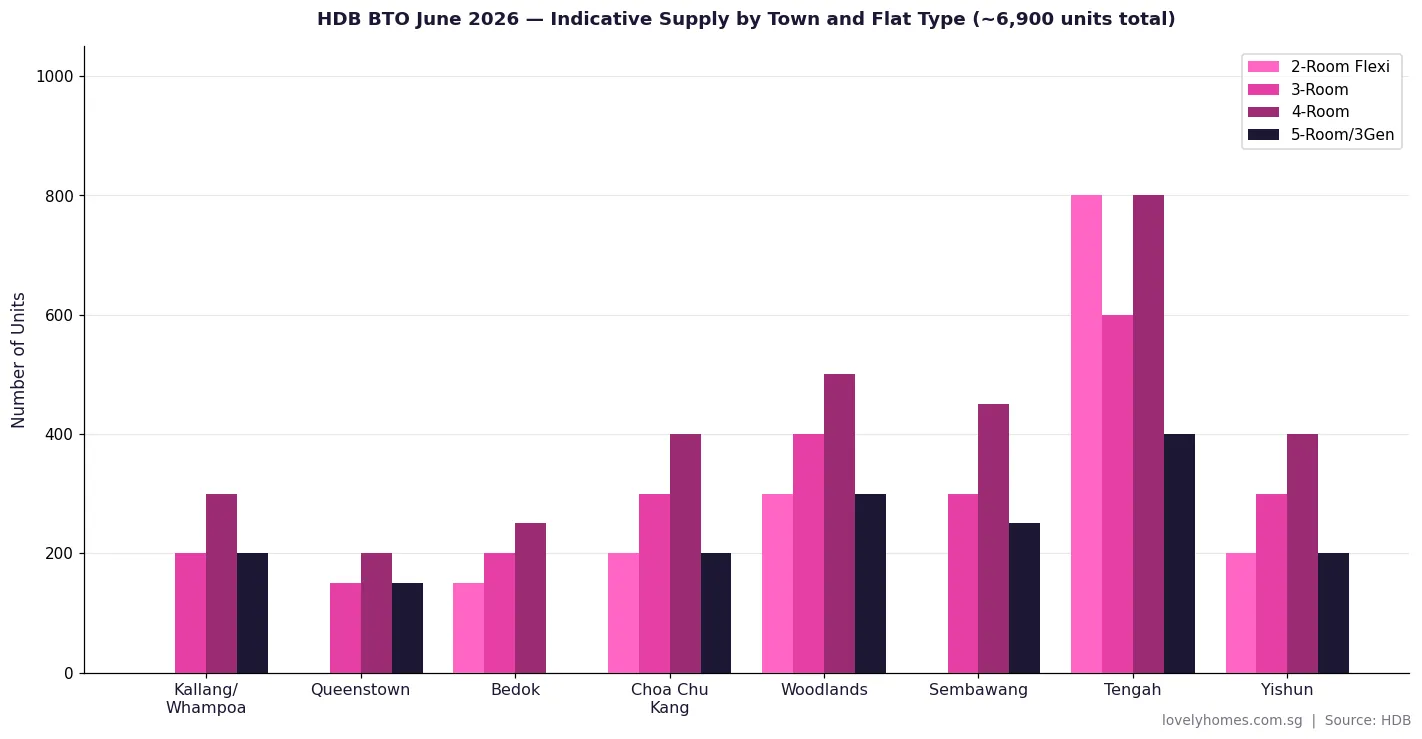
HDB BTO June 2026 supply by town and flat type
Figure 2: HDB BTO June 2026 — Indicative Unit Supply by Town and Flat Type (approximately 6,900 units across 8 towns). Source: HDB (figures indicative based on announced supply).

Applying for a BTO Flat: The Exercise and Ballot

HDB launches BTO exercises approximately 4–5 times per year, typically in February, May, August, and November (with occasional additional exercises). Each exercise lists projects in multiple towns. The application window is usually 5–7 days, during which eligible applicants may submit one application per exercise via the HDB website or at an HDB Branch.

Key rules during application: applicants may apply for only one flat type in one town per exercise. An application requires a non-refundable application fee of S$10. Successful applicants in the 2-Room Flexi Ballot who do not eventually select a flat will have the S$10 refunded. Households with more children receive priority queue positions under the Parenthood Priority Scheme (PPS), and first-timers receive ballot priority over second-timers.

After the application window closes, HDB computer-ballots all applicants. Results are released approximately 3 weeks later. Successful applicants receive a ballot queue number and a flat selection appointment within approximately 3–6 months. If the ballot number is not reached (all flats selected before your turn), the applicant is treated as unsuccessful and is given an additional ballot chance (2nd timer status not triggered — first-timer status preserved for a stated number of unsuccessful attempts).

First-Timer Priority and Queue Balloting

HDB’s priority allocation system is designed to give first-time buyers and families with young children a better chance of success. In a standard BTO exercise, approximately 85–90% of flat supply is set aside for first-timers (those who have never owned or received a housing subsidy before). The remaining 10–15% is allocated to second-timers. Within the first-timer pool, the Parenthood Priority Scheme (PPS) reserves a further 30% of supply for families with Singaporean children aged 18 or below.

After three or more unsuccessful ballots, first-timer applicants (with children) may apply under the Additional Ballots Scheme, which gives them a higher chance. HDB has progressively expanded priority rules — from 2024, those who have collected a BTO flat and are applying again (e.g., for a larger flat after having more children) are classified as second-timers and face a smaller allocation pool.

HDB BTO eligibility by buyer profile Singapore 2026
Figure 3: HDB BTO Eligibility Assessment by Buyer Profile (2026). “Full” = fully eligible; “Partial” = eligible with conditions or restrictions. Source: HDB.

Flat Selection, Booking and Signing the Lease

Upon receiving a flat selection appointment, applicants visit an HDB Branch (or select online via the portal in more recent exercises) and choose their preferred unit from the remaining available options. At selection, a booking fee is payable: S$2,000 for 2-Room Flexi, S$4,000 for 3-Room, S$8,000 for 4-Room and 5-Room/3Gen (as at 2026; fees are reviewed periodically). The booking fee is non-refundable if you subsequently withdraw from the purchase.

After booking, HDB typically schedules the signing of the Agreement for Lease (Lease Agreement) within 4–6 months. At this appointment, applicants pay the down payment and stamp fees. For those taking an HDB concessionary loan, the down payment is 10% of the flat price (payable via CPF OA or cash); for those using a bank loan, the down payment is 25% (with 5% minimum in cash). Buyer’s Stamp Duty (BSD) is also payable at this stage. After signing, construction proceeds and buyers await key collection.

CPF Housing Grants for BTO Buyers (2026)

BTO buyers may be eligible for significant grant support that directly reduces the effective purchase price. As at June 2026, the key grants are:

  • Enhanced CPF Housing Grant (EHG): Up to S$120,000 for families (income ≤ S$9,000/mth average over 12 months before application) and up to S$60,000 for singles. The EHG is income-tiered — a family earning S$2,000/mth receives the full S$120,000; at S$9,000/mth, the grant is S$5,000. Effective from 20 August 2024.
  • CPF Housing Grant — Families (Family Grant): An additional S$10,000–S$30,000 for eligible first-timer families purchasing 4-Room or smaller BTO flats, depending on flat type and town classification.
  • Step-Up CPF Housing Grant: S$15,000 for second-timer SC families moving from a 2-Room to a 3-Room BTO flat.
  • Proximity Housing Grant (PHG): S$30,000 for buying within 4 km of parents’ or child’s home; S$20,000 for buying in the same town. Available for resale HDB purchases — not BTO directly, but may apply on the eventual resale.

Grants are disbursed as CPF credits into the recipient’s OA account, reducing the cash required at booking and lease signing. They do not reduce the outstanding loan; rather, they offset the cash/CPF down payment needed.

📌 Worked Example: Mr & Mrs Goh — First-Timer BTO Application, Tampines 4-Room

Mr Goh (SC, age 29) and Mrs Goh (SC, age 27) are first-timer applicants. Combined household income: S$7,200/mth (based on 12-month CPF contribution average). One child aged 2. They apply for a 4-room BTO flat in Tampines during the June 2026 BTO exercise, priced at S$478,000.

  • HFE Letter: Applied 30 days before exercise opens; issued in 16 business days. Confirms eligibility for 4-Room, HDB loan S$382,400 (80% LTV), EHG S$50,000 (income S$7,200 tier).
  • Ballot result: Successful; queue number 38 out of 220 applicants for 240 available units. Flat selection appointment in Month 4.
  • Flat price: S$478,000. Grants: EHG S$50,000 → effective price S$428,000.
  • Booking fee: S$8,000 (cash or NETS).
  • BSD: (1% × S$180,000) + (2% × S$180,000) + (3% × S$118,000) = S$1,800 + S$3,600 + S$3,540 = S$8,940 on S$478,000.
  • HDB Loan: S$382,400 at 2.6% p.a. over 25 years → monthly instalment S$1,731. MSR: S$1,731 ÷ S$7,200 = 24.0% ✓ (below 30% MSR limit).
  • Total upfront cash outlay at lease signing: Booking fee S$8,000 + down payment (10% S$47,800 less EHG S$50,000 already in CPF OA) → effectively S$5,800 cash + S$8,940 BSD (payable by CPF OA) = approximately S$14,740 in cash/CPF.
  • Key collection: Estimated 3 years 8 months from booking, approximately Q2 2030. MOP: 5 years from key collection date (standard flat).

Plus and Prime BTO Flats: Stricter Rules for Better Locations

From 2024, HDB restructured the BTO flat classification. “Standard” flats (in non-mature, non-central estates) carry the familiar 5-year MOP and standard resale/rental rules. “Plus” flats — in choicer locations such as Kallang/Whampoa, Queenstown fringe, and new towns with strong transport links — carry a 10-year MOP and cannot be rented out for the first 10 years. “Prime” flats — in the most central, highest-demand locations near the CBD and in mature estates — carry a 10-year MOP, are subject to a subsidy clawback on first resale (buyers must return a portion of their capital gain to HDB), and have additional resale restrictions to ensure the flats remain affordable for future first-timers. If you are considering a Plus or Prime flat, factor the longer holding period and clawback into your financial planning.

Why the BTO Route Matters for Most Singapore Families

For first-timer Singapore Citizens, the BTO route remains the most financially sound path to home ownership. The built-in subsidy can be S$100,000 or more relative to resale market prices in the same estate, and when layered with the EHG and other grants, the effective discount for a median-income family can approach S$200,000 over the life of ownership. The trade-off is the waiting period — typically three to four-and-a-half years from booking to key collection — which requires careful planning if you are currently renting or living with parents.

The Plus and Prime restructuring reflects HDB’s continuing effort to balance locational desirability with long-term affordability. By imposing longer MOPs and clawbacks on high-demand locations, HDB aims to prevent BTO flats from functioning as pure financial instruments for short-term gain, keeping them as genuine homes for resident families. For buyers who prize flexibility and liquidity, the standard resale market or an Executive Condominium (EC) may be more appropriate despite the higher entry cost.

📊 Upcoming BTO Exercises and Policy Signals (2026–2027)

This section reflects publicly available information and should not be treated as investment advice.

HDB has announced approximately 6,900 BTO units for the June 2026 exercise across Kallang/Whampoa, Queenstown, Bedok, Choa Chu Kang, Woodlands, Sembawang, Tengah, and Yishun. The next exercise is expected in August or September 2026, with further supply planned for Tengah (which is receiving the largest allocation as the new town builds up) and potentially a new site in the Jurong Lake District area. HDB’s annual BTO supply target for 2024–2025 was 19,000–20,000 units; this pipeline is expected to continue through 2027 to address the demand backlog from the COVID-era construction delays. Buyers who are unsuccessful in the June 2026 exercise should track MyNiceHome and the HDB press releases portal for the August–September launch announcement.

Frequently Asked Questions: HDB BTO Application 2026

How long does it take to get a BTO flat from application to key collection?

The total journey from submitting a BTO application to receiving your keys typically spans four to five years. Allow 2–3 weeks to obtain the HFE Letter, then 5–7 days for the application window. Ballot results are released in approximately 3 weeks; flat selection appointments are scheduled 3–6 months after that. Construction takes 38–48 months (roughly 3–4 years) from project launch. So the full door-to-door period is approximately 44–54 months, or about 4 years from application date. Some projects in non-mature estates have been delivered in under 40 months; complex urban-infill sites have taken longer. HDB publishes an estimated completion date for each project at the time of launch, which is the most reliable reference for your specific project.

Can Singapore Permanent Residents (PRs) apply for a BTO flat?

PRs can apply for a BTO flat only under the SC/PR scheme — that is, when they are applying jointly with a Singapore Citizen spouse. A PR cannot apply for a BTO flat on their own, nor can two PRs apply together. Under the SC/PR scheme, the PR must subsequently obtain Singapore Citizenship within a specified period after key collection (HDB’s latest requirement is that the PR spouse applies for citizenship if they have not done so within a reasonable time). PR singles and unmarried PR couples are not eligible for BTO. PRs who are single or not applying with an SC spouse should consider the HDB resale market under the HDB resale rules for PRs, which permit PR family/couple applications for resale flats.

What is the income ceiling for BTO flats in 2026?

The income ceiling depends on the flat type. For 2-Room Flexi and 3-Room BTO flats, the ceiling is S$7,000 per month gross household income. For 4-Room flats, the ceiling is S$10,000 per month. For 5-Room and 3-Generation (3Gen) flats, the ceiling is S$14,000 per month. Income is assessed based on the average gross monthly income over the 12 months preceding the application. Bonuses, commission, and variable pay are included in the calculation. For self-employed or commission-based applicants, IRAS Notice of Assessment income averaged over 12 months is used. If your income fluctuates, it is advisable to time your application to a 12-month window when your average income falls below the ceiling.

What happens if I am unsuccessful in the BTO ballot?

If you apply but do not receive a ballot queue number, or if your queue number is not reached (all flats are selected before your turn), you are treated as an unsuccessful first-timer applicant. Your first-timer priority status is retained, and HDB gives you one additional ballot chance: in the next BTO exercise, you will be issued two ballot chances instead of one for the same flat type and town category (non-mature or mature). After two or more consecutive unsuccessful attempts, first-timer families with children may apply under the Married Child Priority Scheme (MCPS) or the Additional Ballots Scheme for enhanced priority. There is no penalty for multiple unsuccessful applications. You may also wish to consider the HDB Sales of Balance Flats (SBF) exercises, which release unsold BTO units from previous exercises at (typically) lower prices and with shorter remaining construction wait times.

Can I rent out my BTO flat before the MOP?

No. You cannot rent out the entire BTO flat before completing the Minimum Occupation Period (MOP), which is 5 years from the date of key collection for standard flats (10 years for Plus and Prime flats). During the MOP, you and at least one listed occupier must be physically residing in the flat. You may rent out individual rooms (but not the entire flat) to eligible tenants, subject to HDB approval and the Non-Citizen Quota (NCQ) rules. Full subletting of the entire flat is only permitted after the MOP is complete and upon receiving HDB’s written approval. Violation of the MOP subletting restriction is a serious offence under the Housing and Development Act and can result in the compulsory acquisition of the flat by HDB with no compensation to the owner.

How much CPF can I use to buy a BTO flat?

For HDB flats (including BTO), CPF Ordinary Account (OA) savings may be used to pay the down payment, monthly mortgage instalments, BSD, and legal/conveyancing fees, subject to the Valuation Limit (VL) and Withdrawal Limit (WL). The Valuation Limit is the lower of the purchase price and the HDB assessed value at purchase; you may withdraw up to 100% of the VL from CPF. The Withdrawal Limit is 120% of the VL — beyond this, no further CPF can be used for housing and all mortgage repayments must be in cash. Since BTO flats are new and HDB sets the price equal to the assessed value, the VL and purchase price are the same and the 120% WL is typically reached only after many years of repayment. Any CPF withdrawn for housing is subject to accrued interest at the OA rate of 2.5% per annum, which must be refunded to your CPF account upon the eventual sale of the flat.

What is the difference between BTO, SBF, and ROF flat types?

HDB offers three main channels for buying new or near-new subsidised flats: BTO (Build-To-Order) — new flats that have not yet been built; buyers commit before construction and wait 3–4.5 years for key collection. SBF (Sales of Balance Flats) — unsold units from previous BTO exercises, typically with shorter wait times (1–3 years) as construction is already underway or complete; these are released approximately twice per year. ROF (Re-Offer of Balance Flats) — flats returned or unselected from prior exercises, offered in smaller batches more frequently. BTO offers the widest choice and (for popular estates) the lowest price relative to eventual resale value, but requires the longest wait. SBF and ROF can be good options for buyers who need to move sooner or who prefer a known, near-complete building. Eligibility rules are broadly similar across all three channels.

Related Articles on HDB and Property Buying in Singapore

Disclaimer

This article is for general informational purposes only and does not constitute financial, legal, or housing advice. HDB BTO eligibility criteria, grant amounts, income ceilings, and MOP rules are set by the Housing & Development Board (HDB) and may be updated at any time. Always verify current eligibility at hdb.gov.sg and consult a licensed HDB solicitor or financial adviser before making any application or commitment. CPF rules are governed by the CPF Board; verify current withdrawal limits at cpf.gov.sg. LovelyHomes is not an HDB-authorised agent and this article does not constitute an application, booking, or commitment to any HDB flat.

Singapore Buyer’s Stamp Duty (BSD) 2026: Rates, Calculations and Worked Examples

Singapore Buyer’s Stamp Duty (BSD) 2026: Rates, Calculations and Worked Examples

📌 Quick Answer: Buyer’s Stamp Duty (BSD) in Singapore 2026

  • BSD is paid by every buyer of property in Singapore — residential or commercial — regardless of nationality, residency, or how many properties they own.
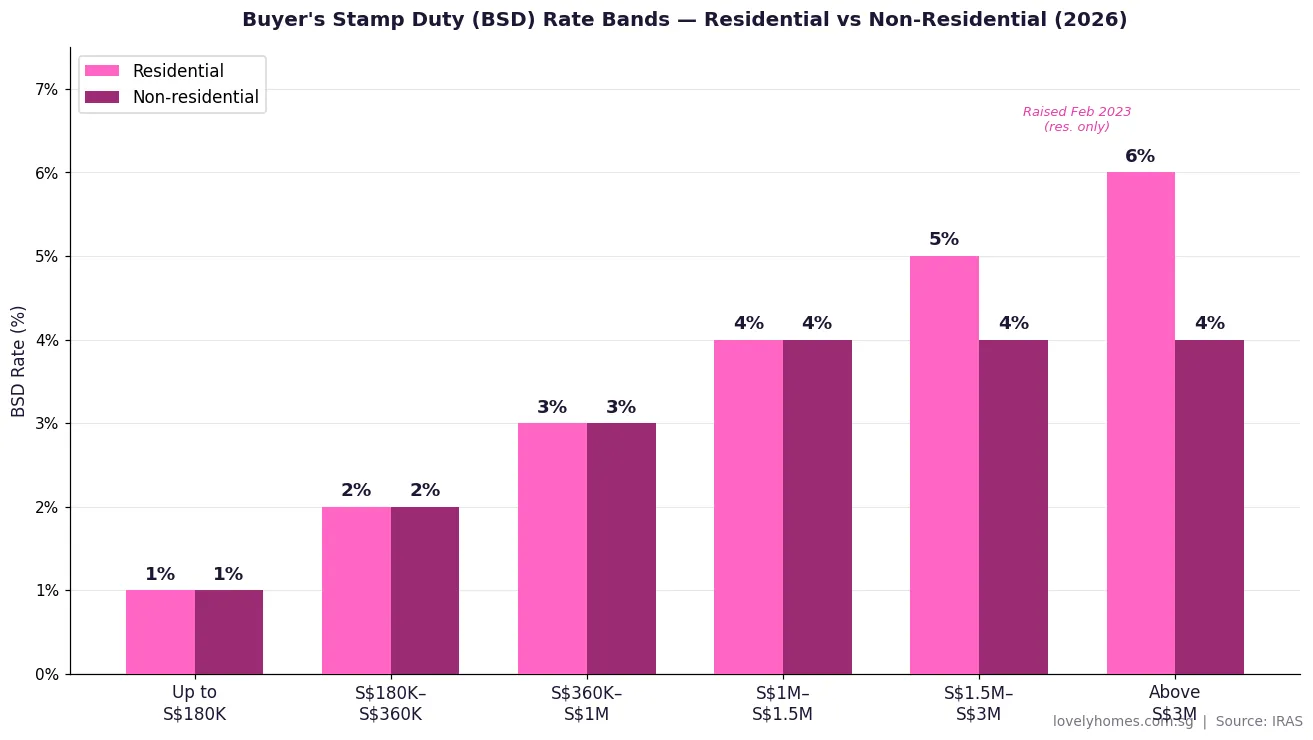
  • Residential BSD rates are progressive: 1% on the first S$180,000, rising to 6% on amounts above S$3 million (rates raised in February 2023 Budget).
  • Non-residential BSD is capped at 4% (no 5% or 6% tiers apply).
  • BSD must be paid within 14 days of exercising the Option to Purchase (OTP) or signing the Sale & Purchase (S&P) agreement.
  • On a S$1.5 million condo, BSD is S$44,600 — that is before any Additional Buyer’s Stamp Duty (ABSD) kicks in.
  • BSD is separate from ABSD: ABSD applies only to second or subsequent properties (for Singapore Citizens) or all properties (for Permanent Residents and foreigners).
  • No exemptions for first-time buyers — BSD applies to everyone; only certain inherited or court-ordered transfers are exempt.
  • CPF Ordinary Account funds may be used to pay BSD on eligible residential properties.

What Is Buyer’s Stamp Duty (BSD)?

Buyer’s Stamp Duty (BSD) is a tax levied by the Inland Revenue Authority of Singapore (IRAS) on every purchase or acquisition of property in Singapore. Unlike the Additional Buyer’s Stamp Duty (ABSD) — which applies only to certain buyers — BSD is universal: it falls on every transaction regardless of whether the buyer is a Singapore Citizen (SC), Permanent Resident (PR), foreigner, or corporate entity, and regardless of how many properties they already own.

BSD is calculated on the higher of the purchase price or the market value of the property. IRAS uses the property’s assessed annual value and recent comparable sales to determine market value; if your agreed price is below market value, IRAS will compute BSD on the higher market-value figure. The tax is administered under the Stamp Duties Act (Cap. 312) and must be paid promptly — late payment attracts penalties.

The February 2023 Budget introduced new higher rate tiers for residential property, bringing the top marginal rate to 6% for portions of the price above S$3 million. For non-residential property (commercial, industrial, mixed-use), the maximum rate remains 4%. Understanding BSD is therefore a mandatory step in any property budget — you cannot legally complete a purchase without stamping the documents.

BSD rate bands residential vs non-residential Singapore 2026
Figure 1: BSD Rate Bands — Residential vs Non-Residential (2026). Source: IRAS / Stamp Duties Act.

BSD Rates for Residential Property (2026)

The following progressive rate schedule applies to all residential property purchases from 15 February 2023 onwards (Budget 2023). Note that the rates are marginal — each band applies only to the portion of the price falling within that range, not the entire purchase price.

Purchase Price Band BSD Rate Maximum BSD in Band
First S$180,000 1% S$1,800
Next S$180,000 (S$180,001 – S$360,000) 2% S$3,600
Next S$640,000 (S$360,001 – S$1,000,000) 3% S$19,200
Next S$500,000 (S$1,000,001 – S$1,500,000) 4% S$20,000
Next S$1,500,000 (S$1,500,001 – S$3,000,000) 5% S$75,000
Remaining amount (above S$3,000,000) 6% Unlimited

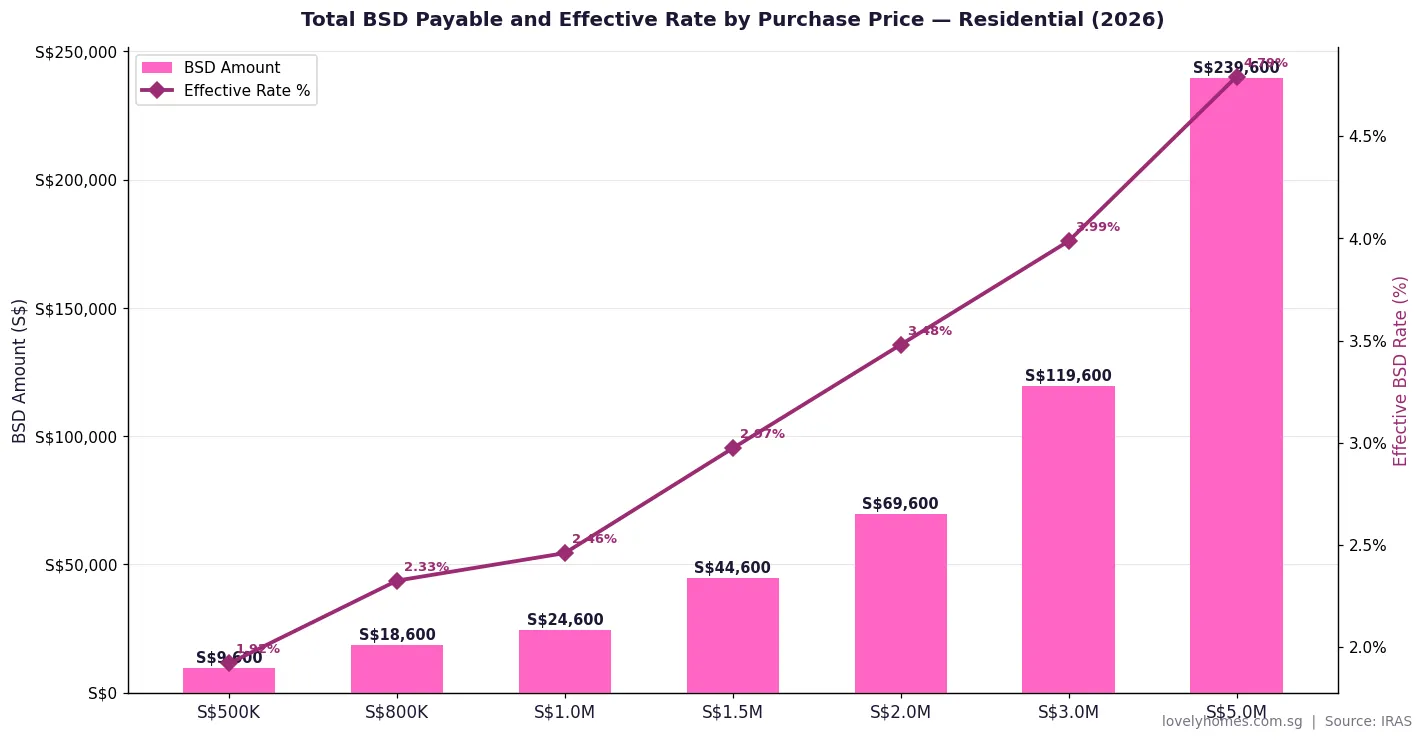
The cumulative BSD payable at the top of each band is S$1,800 → S$5,400 → S$24,600 → S$44,600 → S$119,600 and beyond. For a S$1 million property the BSD is exactly S$24,600; for a S$1.5 million property it is S$44,600; for a S$3 million property it is S$119,600.

BSD Rates for Non-Residential Property (2026)

Industrial, commercial, and mixed-use properties follow a different schedule that was last revised in 2018. The rates are lower and the top marginal rate is capped at 4%, reflecting government policy to keep transaction costs manageable for business property buyers.

Purchase Price Band BSD Rate Maximum BSD in Band
First S$180,000 1% S$1,800
Next S$180,000 (S$180,001 – S$360,000) 2% S$3,600
Next S$640,000 (S$360,001 – S$1,000,000) 3% S$19,200
Remaining amount (above S$1,000,000) 4% Unlimited

On a S$2 million shophouse, for instance, the BSD is S$24,600 (the S$1 million cumulative) plus 4% of S$1 million = S$40,000 → total S$64,600. Compare this to a residential property of the same price where BSD would be S$69,600. The difference is modest at S$2 million but widens materially at S$5 million and above.

Total BSD payable and effective rate by purchase price Singapore 2026
Figure 2: Total Residential BSD Payable and Effective Rate by Purchase Price (2026). Effective rate is BSD ÷ purchase price. Source: IRAS.

How to Calculate BSD Step by Step

BSD is a progressive tax, so the calculation requires applying each marginal rate to the corresponding band of the purchase price. The cleanest method is to use the marginal-band approach. Consider a S$1,800,000 residential property:

  1. 1% × S$180,000 = S$1,800
  2. 2% × S$180,000 = S$3,600
  3. 3% × S$640,000 = S$19,200
  4. 4% × S$500,000 = S$20,000
  5. 5% × S$300,000 (the remaining S$1.8M − S$1.5M = S$0.3M) = S$15,000
  6. Total BSD = S$59,600

IRAS also publishes a shortcut formula for common brackets. For residential properties priced between S$1 million and S$1.5 million the formula is: BSD = (4% × price) − S$15,400. For S$1 million: (4% × S$1M) − S$15,400 = S$40,000 − S$15,400 = S$24,600 ✓. These formulae are available in IRAS’s stamp duty calculator at iras.gov.sg.

When and How to Pay BSD

BSD must be paid within 14 days of the document being signed or executed — that is, within 14 days of exercising the Option to Purchase (OTP) for resale properties, or within 14 days of the date of the Sale & Purchase agreement for new launches. Late payment attracts a penalty of S$10 or the unpaid duty, whichever is higher, plus additional penalties of up to 4× the original duty for prolonged non-payment.

Payment is made through e-Stamping at the IRAS portal, accessible via Singpass. Solicitors acting for buyers routinely handle this on their clients’ behalf. The stamped document is legal evidence of the transaction; an unstamped instrument cannot be admitted as evidence in court.

BSD may be paid using CPF Ordinary Account (OA) funds for eligible residential properties — subject to the CPF withdrawal limit and valuation limit rules. If paying by CPF, the CPF Board will typically release the BSD payment to IRAS directly on completion. Cash payment via GIRO, credit/debit card, or bank transfer is also accepted. Foreigners without a Singpass account must pay through their appointed solicitor.

📌 Worked Example: Mr & Mrs Nair — D11 Condo S$2,200,000

Mr Nair is a Singapore Citizen; Mrs Nair is a Singapore Permanent Resident. This will be their first property. They are purchasing a 3-bedroom condominium in Newton / Novena (D11, RCR) at S$2,200,000. The solicitor will compute BSD as follows:

  • 1% × S$180,000 = S$1,800
  • 2% × S$180,000 = S$3,600
  • 3% × S$640,000 = S$19,200
  • 4% × S$500,000 = S$20,000
  • 5% × S$700,000 (S$2.2M − S$1.5M) = S$35,000
  • Total BSD = S$79,600 (effective rate: 3.62%)

ABSD position: because this is a joint purchase and Mrs Nair is a PR, the joint ABSD rate is determined by the buyer with the higher rate. SC buying 1st property = 0%; PR buying 1st property = 5%. As a mixed-citizenship couple, IRAS applies the higher rate — so ABSD of 5% × S$2,200,000 = S$110,000 applies. (They may request an ABSD remission if they intend to occupy the property, but remission is not automatic for SC/PR joint purchases on first property.)

Combined stamp duties: BSD S$79,600 + ABSD S$110,000 = S$189,600. Legal fees approximately S$5,500. Total transaction costs at completion: approximately S$195,100 (excluding down payment and financing costs).

Bank loan (SC income S$18,000/mth): 75% LTV = S$1,650,000 at 3.0% p.a. over 30 years → monthly instalment S$6,955. TDSR: (S$6,955 ÷ S$18,000) = 38.6% ✓ (below 55% TDSR limit).

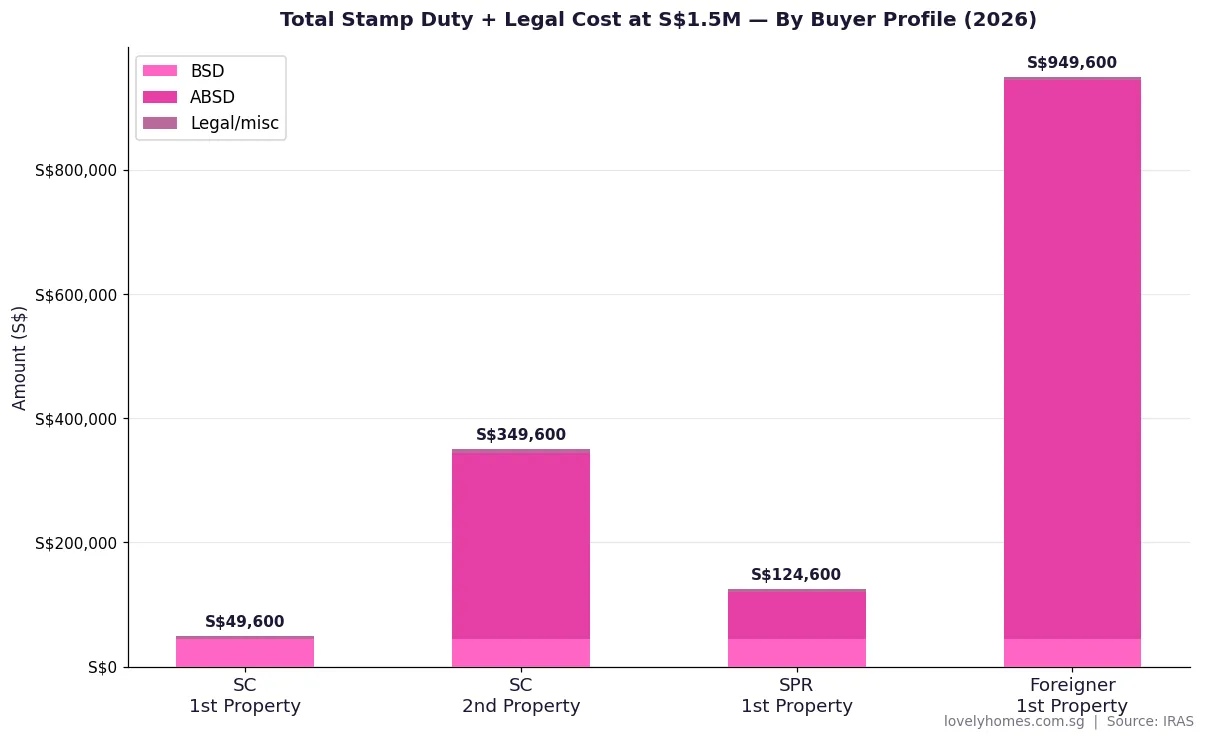
BSD and ABSD total stamp duty by buyer profile Singapore 2026 at S$1.5 million
Figure 3: Total Stamp Duty (BSD + ABSD + legal) at S$1.5M by Buyer Profile (2026). BSD is constant at S$44,600; ABSD varies by citizenship and property count. Source: IRAS.

Why BSD Matters: The True Cost of Buying Property in Singapore

BSD is a non-negotiable transaction cost that must be factored into every property budget from day one. At S$1 million, BSD alone is S$24,600 — roughly 2.5% of the purchase price. At S$3 million, it reaches S$119,600. For buyers stretching their budget to the maximum under Total Debt Servicing Ratio (TDSR) rules, forgetting to account for BSD can push a deal beyond their financial reach. Solicitors and mortgage advisers always incorporate BSD into the cashflow calculation alongside down payment, valuation fees, legal fees, and agent commissions.

Compared to peer jurisdictions, Singapore’s BSD is moderate but has been rising. Hong Kong’s stamp duty on residential property ranges from HK$100 to 4.25% of the price for the basic rate, with additional buyer’s stamps up to 30% for non-residents. Australia’s stamp duty varies by state and can exceed 5% in New South Wales and Victoria. Singapore’s BSD at an effective rate of around 2.5–4% for typical residential purchases sits within the regional norm, though the additional ABSD layers make total stamp costs for repeat or foreign buyers among the highest globally.

📊 What Might Come Next: BSD Outlook

This section is speculative and based on publicly available signals. It is not investment advice.

The February 2023 BSD increase targeted high-value transactions (above S$1.5 million), nudging effective rates higher for luxury properties. In the near term — through 2026 and into 2027 — industry observers do not anticipate a further upward revision to BSD, given that ABSD rates (raised to 60% for foreigners and 20% for SC second properties in April 2023) already provide strong price-stability signals. However, should the private residential price index continue its upward trajectory into the upper percentiles, a further adjustment to the S$3 million+ band (currently at 6%) cannot be ruled out in a future Budget.

For commercial and industrial BSD, a revision has been discussed informally in property finance circles, particularly given that strata industrial and shophouse prices have risen sharply since 2021. Any Budget announcement would take effect immediately on the date of the Budget speech, as has historically been the case.

Frequently Asked Questions: Buyer’s Stamp Duty Singapore

Does BSD apply to HDB flat purchases?

Yes. BSD applies to all residential property acquisitions in Singapore, including HDB resale flats and new BTO flat purchases. However, most HDB flats are priced well below S$1 million, so the effective BSD rate is typically 1–2%. For a S$600,000 4-room resale HDB flat, BSD is: (1% × S$180,000) + (2% × S$180,000) + (3% × S$240,000) = S$1,800 + S$3,600 + S$7,200 = S$12,600. The BSD on HDB purchases is significantly lower than on private condominiums. Note that for HDB purchases, CPF OA funds are routinely used to pay BSD, and the HDB will typically manage the stamping process on your behalf.

Is BSD different from ABSD? Can I avoid one but not the other?

BSD and ABSD are two separate taxes levied by IRAS. BSD applies to every buyer on every property — there is no exemption for first-time buyers. ABSD is an additional tax that applies to: Singapore Citizens buying a second or subsequent residential property (20% for second, 30% for third or more); Singapore PRs buying any residential property (5% first, 25% second and beyond); all foreigners buying any residential property (60% as of April 2023, with limited FTA exemptions for certain nationalities). It is impossible to avoid BSD; ABSD can be avoided by Singapore Citizens on their first property and in certain limited circumstances (e.g., FTA exemptions, ABSD remission for married couples). BSD is always payable on both residential and non-residential acquisitions.

What is the BSD deadline and what happens if I pay late?

BSD must be paid within 14 days of the date the relevant instrument is executed or signed. For resale properties, this means within 14 days of exercising the Option to Purchase (OTP). For new launch properties, within 14 days of signing the Sale & Purchase agreement. IRAS imposes penalties for late payment: S$10 or the unpaid duty (whichever is higher) for the first default, scaling up to 4× the outstanding duty for extended non-payment. In practice, conveyancing solicitors almost always handle BSD stamping within the 14-day window as a standard part of their service. You should therefore ensure you have the BSD funds ready to transfer to your solicitor’s client account well before the stamping deadline.

Can I use CPF to pay BSD in Singapore?

Yes, for eligible residential properties. CPF Ordinary Account (OA) savings may be used to pay BSD, subject to the applicable CPF withdrawal limits. The property must be used as a principal place of residence, and the purchase must satisfy CPF Board criteria (e.g., remaining lease of the property must meet the minimum occupation period requirements). CPF cannot be used to pay BSD on non-residential property purchases (shophouses, industrial, commercial). If you are using CPF for BSD, inform your solicitor at the start of the conveyancing process so they can arrange the CPF withdrawal in time. Any CPF withdrawn for BSD forms part of your total CPF withdrawal and attracts accrued interest at the OA rate of 2.5% per annum, which must be refunded to your CPF upon the eventual sale of the property.

Are there any exemptions from BSD in Singapore?

BSD exemptions are narrow. Transfers pursuant to a court order (e.g., divorce proceedings under section 112 of the Women’s Charter) may be exempt or subject to ad valorem duty on a different basis. Inherited property transferred via probate or letters of administration under intestate succession is also exempt from BSD (as it is a transmission, not a purchase). Government land acquisitions under the Land Acquisition Act are exempt. However, gifts of property between family members (including parents, siblings, and children) are generally not exempt unless effected as a court order; such transfers attract BSD at market value. There is no general first-time buyer exemption and no BSD discount for owner-occupiers — every voluntary purchase triggers the full progressive rate.

Is BSD based on the purchase price or the market value?

BSD is computed on the higher of the purchase price or the market value as assessed by IRAS at the time of the transaction. If you purchase a property below its assessed market value — for example, buying from a relative at a discounted price or acquiring a distressed-sale unit below prevailing comparable prices — IRAS will compute BSD on the market value, not the agreed price. Conversely, if you pay above market value (rare, but possible in competitive bidding situations), BSD is based on the actual price paid. IRAS cross-references the Urban Redevelopment Authority’s (URA) caveats database and the HDB resale transaction data to assess market value. Disputes about assessed value may be referred to the Stamp Duties Appeal Board.

Does BSD apply to property acquired through a company?

Yes. When a company — whether a Singapore-incorporated or foreign-incorporated entity — acquires property, BSD applies on the same basis as for individual buyers. The company must pay BSD on the higher of the purchase price or market value. In addition, corporate buyers are subject to ABSD at 65% for residential property (as of April 2023), making entity-held residential acquisitions extremely expensive. For commercial and industrial property, companies pay BSD at the non-residential rates (up to 4%) with no ABSD. Transfers of shares in a property-holding company may also attract stamp duty under Section 15 of the Stamp Duties Act; the rules are complex and specialist tax advice is recommended for such structures.

Related Articles on Singapore Property Taxes and Buying Costs

Disclaimer

This article is for general informational purposes only and does not constitute legal, financial, or tax advice. BSD rates and rules are set by the Inland Revenue Authority of Singapore (IRAS) and may change with each annual Budget. Always verify current rates and your personal BSD and ABSD obligations at iras.gov.sg before transacting. For a formal computation and to ensure timely stamping, engage a licensed Singapore conveyancing solicitor. LovelyHomes is not a licensed financial adviser or solicitor; no reliance should be placed on this article as a substitute for professional advice tailored to your specific circumstances.

Singapore Executive Condo (EC) Buying Guide 2026: Eligibility, Prices, MOP and the New 10-Year Rules Explained

Singapore Executive Condo (EC) Buying Guide 2026: Eligibility, Prices, MOP and the New 10-Year Rules Explained

Quick Answer — Singapore Executive Condo (EC) at a glance

  • EC household income ceiling: S$16,000/month (unchanged in 2026)
  • EC prices in 2026: roughly S$1.3M–S$2.2M for new launches, depending on unit size
  • At least one Singapore Citizen applicant required; co-applicant can be SC or PR
  • New EC sites from 8 May 2026: 10-year MOP and 15-year wait to full privatisation
  • Existing launched ECs retain the older 5-year MOP and 10-year privatisation timeline
  • ECs occupy the unique “sandwich class” position — priced above HDB BTO but below private condos
  • CPF Housing Grant of up to S$30,000 (Proximity Housing Grant) available for eligible EC buyers
  • Foreigners and companies cannot buy ECs during the initial launch period from developers

An Executive Condominium — universally abbreviated to EC in Singapore — is a hybrid housing type administered by the Housing & Development Board (HDB) but developed and sold by private property developers. ECs were introduced in 1995 to serve the “sandwich class” of Singaporeans who earn above the HDB BTO income ceiling of S$14,000/month but find private condominiums financially out of reach. In 2026, ECs remain one of Singapore’s most compelling property purchases for eligible buyers: they offer condominium-standard facilities (swimming pool, gym, function room, landscaped grounds, 24-hour security) at prices roughly 15–25% below comparable private condominiums, with the bonus of becoming fully private after a defined holding period. This guide covers every aspect of buying an EC in Singapore in 2026 — eligibility, pricing, the new 10-year MOP and 15-year privatisation rules, CPF usage, financing, and a worked financial example.

What Makes an EC Different from an HDB BTO and a Private Condo?

Understanding where an EC sits in Singapore’s housing ecosystem is the starting point for any prospective buyer. HDB Build-To-Order (BTO) flats are owned by the government, subject to significant resale restrictions, carry an income ceiling of S$14,000/month, and cannot be sold on the open market for five years from the date of key collection. At the other extreme, fully private condominiums have no income ceiling, no nationality restriction (subject to ABSD rates), and no minimum occupation period — but typically cost S$1.4M–S$3M+ for a new launch in 2026.

ECs sit between these two. During the initial restricted period, ECs operate under HDB rules — they must be sold by the developer at launch to eligible SC/PR applicants, buyers must meet the income ceiling, and a Minimum Occupation Period applies. Once privatised, an EC becomes indistinguishable from any other private condo in the eyes of the law. This trajectory — from subsidised hybrid to fully private asset — is what makes ECs uniquely attractive as a long-term investment vehicle, particularly for first-time buyers who can benefit from CPF grants while locking in capital appreciation over 10–15 years.

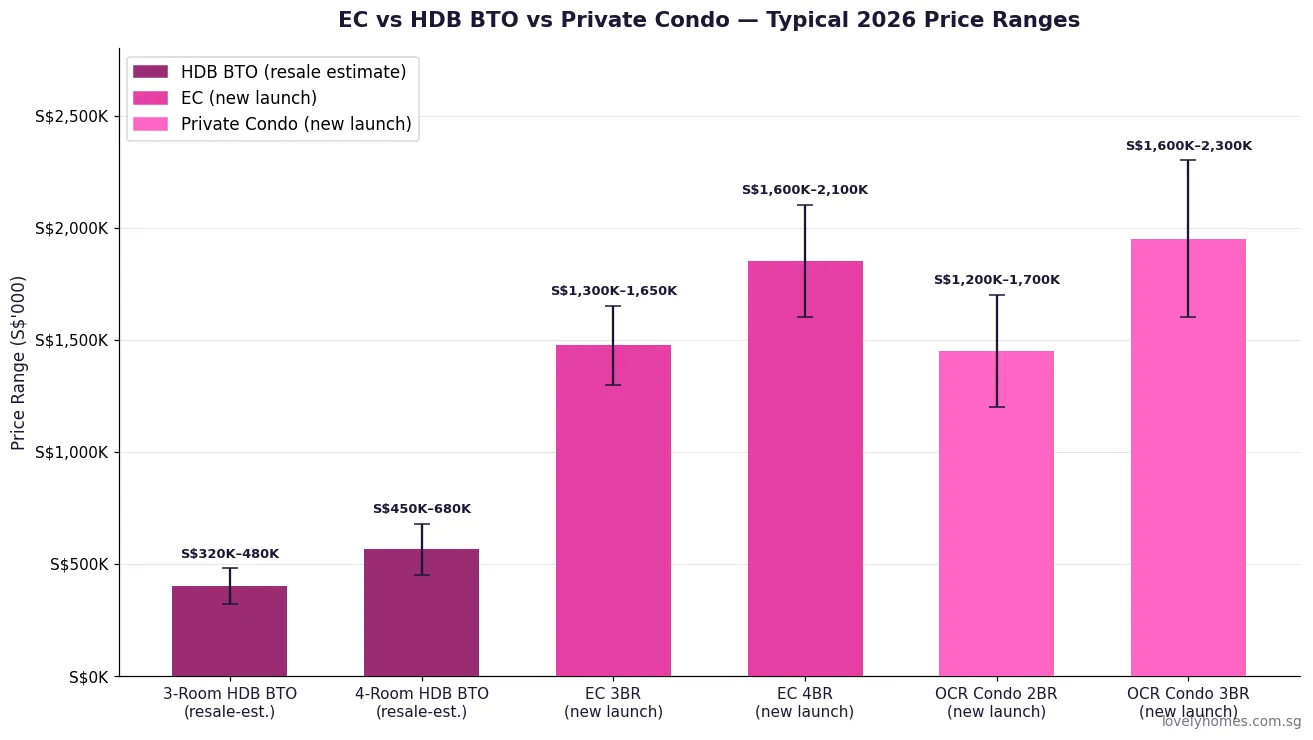
EC vs HDB BTO vs private condo price comparison Singapore 2026
Figure 1: Typical 2026 price ranges for 3-room/4-room HDB BTO flats (resale value estimates), EC new launches (3BR/4BR), and private OCR condo new launches. EC pricing typically falls 15–25% below equivalent private condos. Source: URA, HDB, developer sales data.

EC Eligibility — Who Can Buy?

EC eligibility is more restrictive than private condo eligibility and must be carefully assessed before any application. All of the following conditions must be met simultaneously.

Citizenship: At least one applicant in the application must be a Singapore Citizen. Co-applicants can be Singapore Citizens or Singapore Permanent Residents. Foreigners are categorically ineligible to purchase ECs during the initial launch period from the developer. Only after 10 years from the date the EC obtained its Temporary Occupation Permit (TOP) may foreigners purchase ECs on the open market.

Household income ceiling: The combined gross monthly household income of all applicants and any occupants listed in the application must not exceed S$16,000. This ceiling has not changed in Budget 2026. Gross income includes all sources — base salary, allowances, bonuses averaged over 12 months, self-employment income, rental income, and foreign income if the applicant is assessed for Singapore tax. Exceeding the ceiling by even S$1 at the time of application results in automatic disqualification, and HDB verifies income through IRAS tax assessments and CPF contribution records.

Age: All applicants must be at least 21 years old. Under the Joint Singles Scheme (JSS), two or more unmarried Singapore Citizens may jointly apply for an EC, but each must be at least 35 years old.

Private property cooling-off period: Applicants must not have disposed of any private residential property (locally or overseas) within 30 months before the EC application date. If you sold a private property on 1 January 2024, you cannot apply for an EC until 1 July 2026.

HDB ownership history: If you or any applicant has previously owned an HDB flat, the Minimum Occupation Period of that flat must be fully served before you may apply for an EC. Additionally, if you currently own or are listed as an occupant of an HDB flat, you must dispose of that HDB flat within six months of taking possession of the EC.

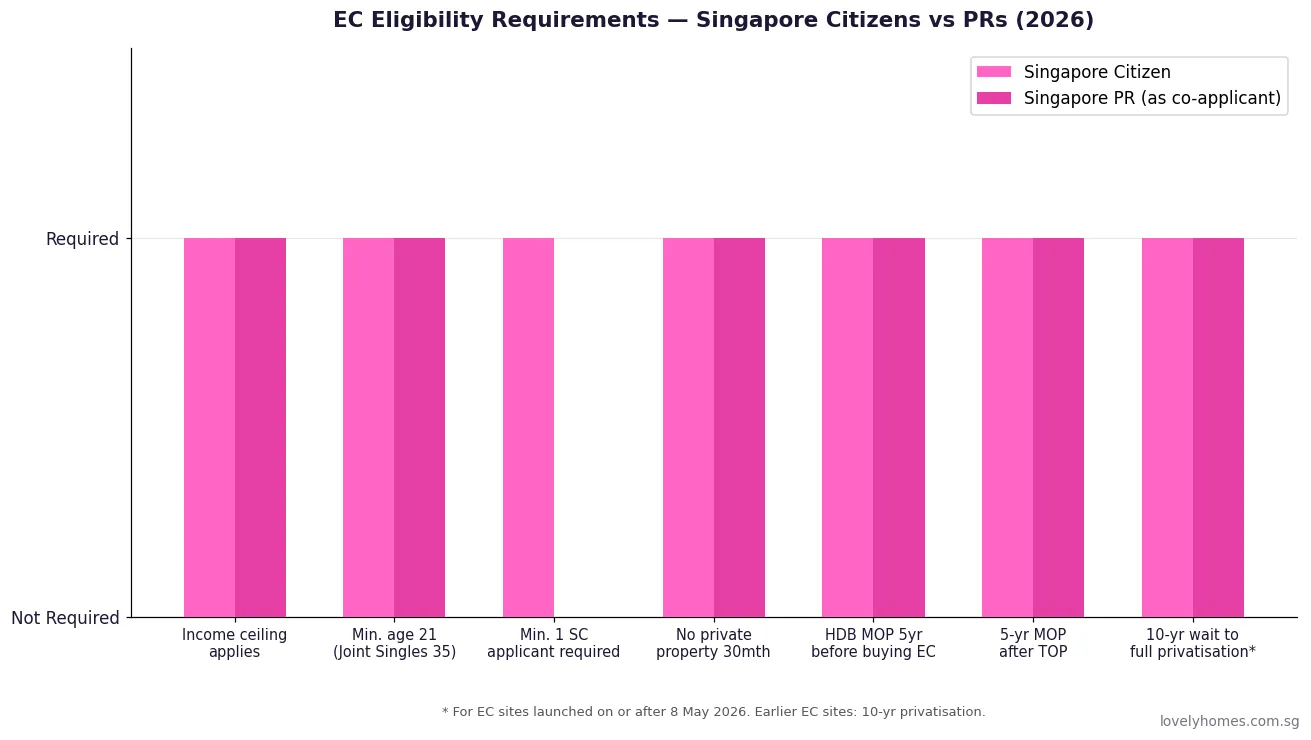
Singapore executive condo EC eligibility requirements 2026
Figure 2: EC eligibility requirements for Singapore Citizens and PRs as co-applicants, 2026. All criteria (income ceiling, citizenship, age, cooling-off period, MOP) must be satisfied simultaneously. Source: HDB.

EC Pricing in 2026 — What to Expect

New EC launches in 2026 are priced in the S$1,300–S$2,200 per square foot (psf) range, reflecting rising land costs. Upcoming EC sites at Jalan Loyang Besar (Pasir Ris) and Tampines Street 95 are expected to launch at around S$1,700 psf when they come to market, which translates to absolute prices of approximately S$1.4M for a 3-bedroom unit and S$1.8–S$2.0M for a 4-bedroom unit.

Currently available ECs illustrate the pricing landscape. Novo Place — a 504-unit development by Hoi Hup Realty and Sunway Developments — was released at indicative prices starting from S$1.298M for a 2-bedroom unit up to S$1.779M for a 4-bedroom-plus-study. Aurelle of Tampines is another active launch in 2026, reflecting the continued concentration of EC supply in the north-east corridor near good MRT connectivity.

EC Development Location Year of TOP (est.) Price Range (new launch) Units
Aurelle of Tampines Tampines Ave 11 ~2029 S$1.35M–S$2.0M 760
Novo Place Tengah Garden Walk ~2029 S$1.30M–S$1.78M 504
Lumina Grand Bukit Batok West Ave 5 ~2028 S$1.31M–S$1.65M (est.) 495
Altura Bukit Batok West Ave 8 ~2028 S$1.30M–S$1.65M (est.) 360
Jalan Loyang Besar (upcoming) Pasir Ris ~2030 ~S$1.40M–S$2.0M (projected) TBC

The New 10-Year MOP and 15-Year Privatisation Rules (From 8 May 2026)

On 8 May 2026, the Singapore Government announced a significant tightening of EC holding period rules for EC sites awarded on or after that date. Understanding the distinction between old-regime ECs (already launched) and new-regime ECs (future GLS site awards) is essential for any EC buyer in 2026.

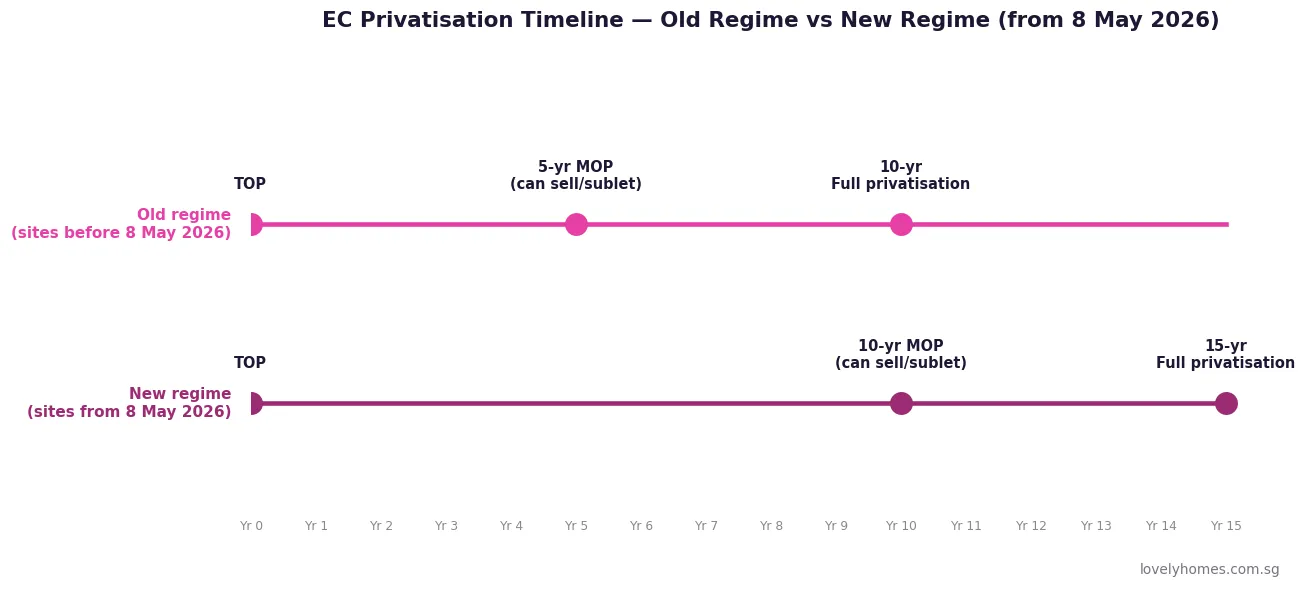
Singapore EC executive condo privatisation timeline old vs new regime 2026
Figure 3: EC privatisation timeline — old regime (EC sites awarded before 8 May 2026) vs new regime (EC sites awarded from 8 May 2026). Source: HDB announcement, 8 May 2026.

Old regime (Aurelle of Tampines, Novo Place, Lumina Grand, Altura, and all ECs launched before 8 May 2026): The familiar 5-year MOP applies from TOP. After the MOP, the EC may be sold on the open market to Singapore Citizens or PRs. After 10 years from TOP, the EC is fully privatised and may be sold to foreigners and entities — subject to ABSD.

New regime (EC sites awarded from 8 May 2026 onwards): The MOP extends to 10 years from TOP. Full privatisation — when the unit may be transacted with foreigners and entities — does not occur until 15 years from TOP. This significantly extends the illiquidity period and reduces the short-to-medium-term capital gain that characterized earlier EC purchases. The Government’s stated rationale is to ensure ECs genuinely serve the long-term housing needs of eligible Singaporeans rather than shorter-cycle investment objectives.

The practical implication for buyers in 2026: the four currently launched ECs (Aurelle, Novo Place, Lumina Grand, Altura) are old-regime projects and retain the more liquid 5-year MOP and 10-year privatisation timeline. New EC sites awarded after 8 May 2026 will carry the extended restrictions. Buyers who prioritise resale flexibility should prioritise current launches over future GLS-derived ECs.

Financing an EC — CPF, Bank Loans and TDSR

ECs are financed through bank loans (HDB concessionary loans are not available for ECs). The bank will assess the application under the Total Debt Servicing Ratio (TDSR) framework administered by the Monetary Authority of Singapore (MAS), capping total monthly debt repayments at 55% of gross monthly income. The maximum loan-to-value (LTV) ratio for an EC bank loan is 75% of the purchase price or valuation (whichever is lower), so buyers must have at least 25% in cash and/or CPF.

CPF Ordinary Account (OA) savings may be used for the downpayment (subject to the Valuation Limit and Withdrawal Limit), monthly mortgage instalments, and stamp duties on the EC purchase. However, CPF usage for ECs is governed by the same accrued interest rules as HDB loans — when you sell the EC, you must return to your CPF account the principal withdrawn plus 2.5% per annum accrued interest. This is not a penalty but a refund to your own retirement account, and it reduces the net cash proceeds from any eventual sale.

Buyers who currently own an HDB flat and are eligible to purchase an EC simultaneously (e.g., within the six-month disposal window) must be careful about ABSD exposure: if they have not yet sold their HDB when they execute the EC Sales and Purchase Agreement, they will technically hold two residential properties and may attract ABSD at 20% (SC second property) on the EC purchase price. Planning the HDB sale to precede the EC SPA execution by at least one day is the standard approach.

Worked Example: Mr and Mrs Lim — Buying Aurelle of Tampines EC

Mr Lim (SC) and Mrs Lim (SC) are a married couple in their mid-30s. Mr Lim earns S$9,500/month and Mrs Lim earns S$5,800/month — combined S$15,300/month, comfortably below the S$16,000 income ceiling. They currently live in Mrs Lim’s parents’ HDB flat and have no prior private property ownership. They are applying for a 4-bedroom unit at Aurelle of Tampines at S$1,780,000.

Eligibility checks:

  • Income: S$15,300/month — below S$16,000 ceiling ✓
  • Citizenship: both SC ✓
  • Age: both 34 and 36 — above 21 ✓
  • Private property cooling-off: neither has owned private property ✓
  • HDB ownership: neither owns an HDB flat in their own names ✓

Purchase costs:

  • Purchase price: S$1,780,000
  • Buyer’s Stamp Duty (BSD): S$1,780,000 × BSD schedule = S$4,600 (first S$180,000 × 1%) + S$27,600 (next S$360,000 × 2%) + S$36,000 (next S$360,000 × 3%) + S$39,200 (next S$880,000 × 4%) = S$56,600 (standard BSD calculation: (180,000×1%)+(360,000×2%)+(360,000×3%)+(880,000×4%) = 1,800+7,200+10,800+35,200 = S$55,000)
  • Additional Buyer’s Stamp Duty (ABSD): S$0 — SC buying first residential property ✓
  • Legal fees (EC S&P): approximately S$3,500
  • Total acquisition cost: approximately S$1,783,500 + S$55,000 BSD + S$3,500 legal = S$1,841,500

Financing:

  • Downpayment (25%): S$445,000 — funded from CPF OA + cash savings
  • Bank loan (75%): S$1,335,000 at 3.2% fixed over 25 years = approx S$6,420/month
  • TDSR check: S$6,420 ÷ S$15,300 = 42.0% — well within 55% TDSR ✓
  • MSR note: MSR (Mortgage Servicing Ratio) of 30% applies only to HDB loans, not to EC bank loans

Grant eligibility: The Lims do not qualify for the CPF Housing Grant (available only for HDB BTO buyers) or the Enhanced Housing Grant (EHG). However, if one set of parents lives within 4km of Aurelle of Tampines, the Proximity Housing Grant (PHG) of S$10,000 (living near parents) or S$20,000 (living with parents) may apply — reducing the effective purchase price.

Projected holding value: Assuming Aurelle of Tampines follows a typical EC appreciation trajectory, comparable ECs that TOPed around 2019–2020 and privatised around 2029–2030 have demonstrated 35–50% resale premium over launch price during the privatisation window. This is speculative — past EC performance does not guarantee future returns — but the long-term track record of ECs converting to fully private assets in strong MRT-connected locations has been broadly positive.

Why ECs Matter: The Sandwich Class Opportunity

ECs were specifically designed by the Ministry of National Development (MND) to address Singapore’s “sandwich class” dilemma — households too affluent for subsidised HDB housing but not wealthy enough to comfortably absorb private condo prices without significant financial strain. In 2026, this remains the precise demographic challenge: private condo prices have risen substantially since 2020, the income ceiling for HDB BTO remains S$14,000/month, and the S$14,001–S$16,000 income band represents hundreds of thousands of eligible Singaporean households.

For buyers who qualify, an EC in a well-located development is arguably the most efficient use of S$1.3–S$2.0M in Singapore’s property market — providing private facilities and capital appreciation without the full ABSD burden on a second purchase or the income-test barriers of HDB. The caveat is the holding period: buyers must be prepared for the unit to remain illiquid (under old-regime rules) for 5 years and (under new-regime rules) for 10 years before they can sell. EC buying is fundamentally a medium-to-long-term commitment, not a short-cycle trade.

What Might Come Next — EC Policy Outlook

The 8 May 2026 announcement extending the MOP to 10 years and privatisation to 15 years for new EC sites signals that the Government intends to reinforce EC’s owner-occupation objective and reduce speculative pressure. It is plausible that income ceilings may be reviewed upward if private condo prices continue to rise faster than household income growth — a precedent exists from the 2021 rise in the HDB BTO income ceiling from S$12,000 to S$14,000 and the parallel EC ceiling rise from S$14,000 to S$16,000. Future EC GLS allocations will likely continue to be concentrated in MRT-connected OCR towns such as Tengah, Tampines, Pasir Ris, and the north corridor, aligning with long-term infrastructure investment in these areas.

Summary: EC vs HDB BTO vs Private Condo

Feature HDB BTO Executive Condo (EC) Private Condo
Income ceiling S$14,000/mth S$16,000/mth None
Eligibility SC/PR (various schemes) Min. 1 SC; SC/PR only Open (with ABSD for foreigners)
MOP (new launch) 5 years 5 yrs (old) / 10 yrs (new*) None
Full privatisation N/A 10 yrs (old) / 15 yrs (new*) Already private
CPF Housing Grant Up to S$120,000 (EHG) PHG up to S$30,000 None
HDB loan available? Yes (2.6%) No — bank only No — bank only
Typical 2026 price S$300K–S$700K (resale) S$1.3M–S$2.2M S$1.4M–S$3.5M+
Foreign buyer eligible? No After 10 yrs TOP (old) / 15 yrs (new*) Yes (60% ABSD for foreigners)

* For EC GLS sites awarded from 8 May 2026 onwards.

Frequently Asked Questions

Can a Singapore Permanent Resident buy a new EC?

A PR cannot buy a new EC as the sole or principal applicant. At least one Singapore Citizen must be part of the application. A PR may be a co-applicant alongside a SC spouse under the Public Scheme, or an EC may be purchased under a family nucleus that includes at least one SC. After the EC is fully privatised (10 years under old-regime rules, 15 years under new-regime rules), PRs and foreigners may purchase ECs on the open market. On the open market, a PR purchasing a fully privatised EC is subject to PR ABSD rates (5% for first residential property, 30% for second+).

What is the difference between the 5-year MOP and the 10-year MOP?

The Minimum Occupation Period (MOP) is the period during which the EC cannot be sold on the open market. Under the old regime (ECs launched before 8 May 2026), the MOP is 5 years from the date the EC obtained its TOP. After 5 years, the EC may be sold to Singapore Citizens or PRs on the open market. After 10 years from TOP, it becomes fully private (saleable to foreigners). Under the new regime (EC GLS sites awarded from 8 May 2026), the MOP extends to 10 years from TOP, and full privatisation occurs only at 15 years. During the MOP period, the EC cannot be sublet in its entirety (individual rooms may be sublet with HDB approval), and the owner must occupy the unit as their primary residence.

Can I use my CPF to pay for an EC?

Yes. CPF Ordinary Account (OA) savings may be used for the downpayment (subject to the Valuation Limit — VL — which is the lower of purchase price or valuation), monthly mortgage instalments, legal fees, and stamp duties. When CPF OA is used, the CPF Act requires you to refund the principal amount withdrawn plus 2.5% per annum accrued interest when you sell the EC. This refund goes back into your CPF OA (and, where applicable, Special or Retirement Account up to the prevailing Full Retirement Sum). The accrued interest is not a penalty — it is your own retirement savings with its minimum guaranteed return. Buyers should model this refund when calculating net sale proceeds from a future EC sale.

Does ABSD apply when buying an EC?

Yes, the same ABSD schedule that applies to private condominiums applies to ECs. Singapore Citizens buying their first residential property pay 0% ABSD — this is the most favourable scenario and why many EC buyers time their HDB disposal to precede the EC purchase. Singapore Citizens buying a second residential property pay 20% ABSD on the EC’s purchase price. If a buyer still holds their HDB flat when they execute the EC Sales and Purchase Agreement, the HDB flat counts as a first property, making the EC the second — triggering 20% ABSD. HDB provides a conditional ABSD remission for married SC couples who sell their HDB flat within six months of purchasing the private property (including EC). Always consult an IRAS-registered solicitor to verify your ABSD status before signing.

What happens to my HDB flat if I buy an EC?

If you currently own an HDB flat and wish to purchase an EC, you must dispose of your HDB flat within six months of taking possession of the EC (i.e., within six months of key collection). Selling before key collection is the cleanest approach to avoid ABSD exposure. If you sell your HDB after executing the EC Sales and Purchase Agreement, you may be subject to ABSD at 20% on the EC, but may apply for ABSD remission from IRAS provided the HDB is disposed of within six months of the EC SPA date. The remission is available to married SC couples and requires a formal application — it is not automatic. Failure to meet the six-month timeline results in forfeiture of any ABSD remission.

Are there any resale restrictions during the MOP?

During the Minimum Occupation Period, the EC may not be sold, transferred, or sublet as a whole unit without HDB approval. Individual bedrooms may be rented to lodgers with HDB approval — the same rules that apply to HDB flat owners. The owner must continue to occupy the unit as their principal residence throughout the MOP. Breaching MOP restrictions is treated as an offence under the Housing and Development Act and the Planning Act, and may result in compulsory acquisition of the unit by HDB at the original purchase price — a severe financial consequence. After the MOP expires, the EC may be transacted freely on the open market.

Are ECs a good investment in 2026?

ECs have historically been strong investments for eligible buyers due to the price discount at launch relative to comparable private condos, CPF grant support for eligible applicants, and the capital appreciation that typically accompanies privatisation. Past ECs that TOPed around 2017–2020 and privatised around 2027–2030 are, in many cases, transacting at premiums of 40–60% over their original launch prices in 2014–2018. However, the extension of the holding period to 10 years (MOP) and 15 years (privatisation) for new-regime ECs significantly changes the investment calculus — it reduces the short-cycle gain that previous buyers enjoyed and increases the commitment required. ECs remain a sound medium-to-long-term investment for buyers who genuinely intend to live in the property, but are less suitable as shorter-horizon plays. As with any property purchase, future value is not guaranteed — economic conditions, interest rates, supply, and government policy all influence outcomes.

Related Articles

Disclaimer: This article is intended as general information only and does not constitute legal or financial advice. EC eligibility, income ceilings, ABSD rates, MOP rules, and privatisation timelines are set by government policy and may be revised without notice. All figures are based on information available as at June 2026. Always verify current conditions with the Housing & Development Board (HDB), the Inland Revenue Authority of Singapore (IRAS), and a qualified property solicitor before making any purchase decision. Past capital appreciation of ECs does not guarantee future returns. LovelyHomes does not act as a property agent and does not endorse any developer or property service provider.

Singapore Property Conveyancing Guide 2026: OTP, S&P Agreement, Legal Fees and Timelines Explained

Singapore Property Conveyancing Guide 2026: OTP, S&P Agreement, Legal Fees and Timelines Explained

Quick Answer: Conveyancing in Singapore 2026

  • Conveyancing is the legal process of transferring property ownership in Singapore, handled by licensed Singapore lawyers.
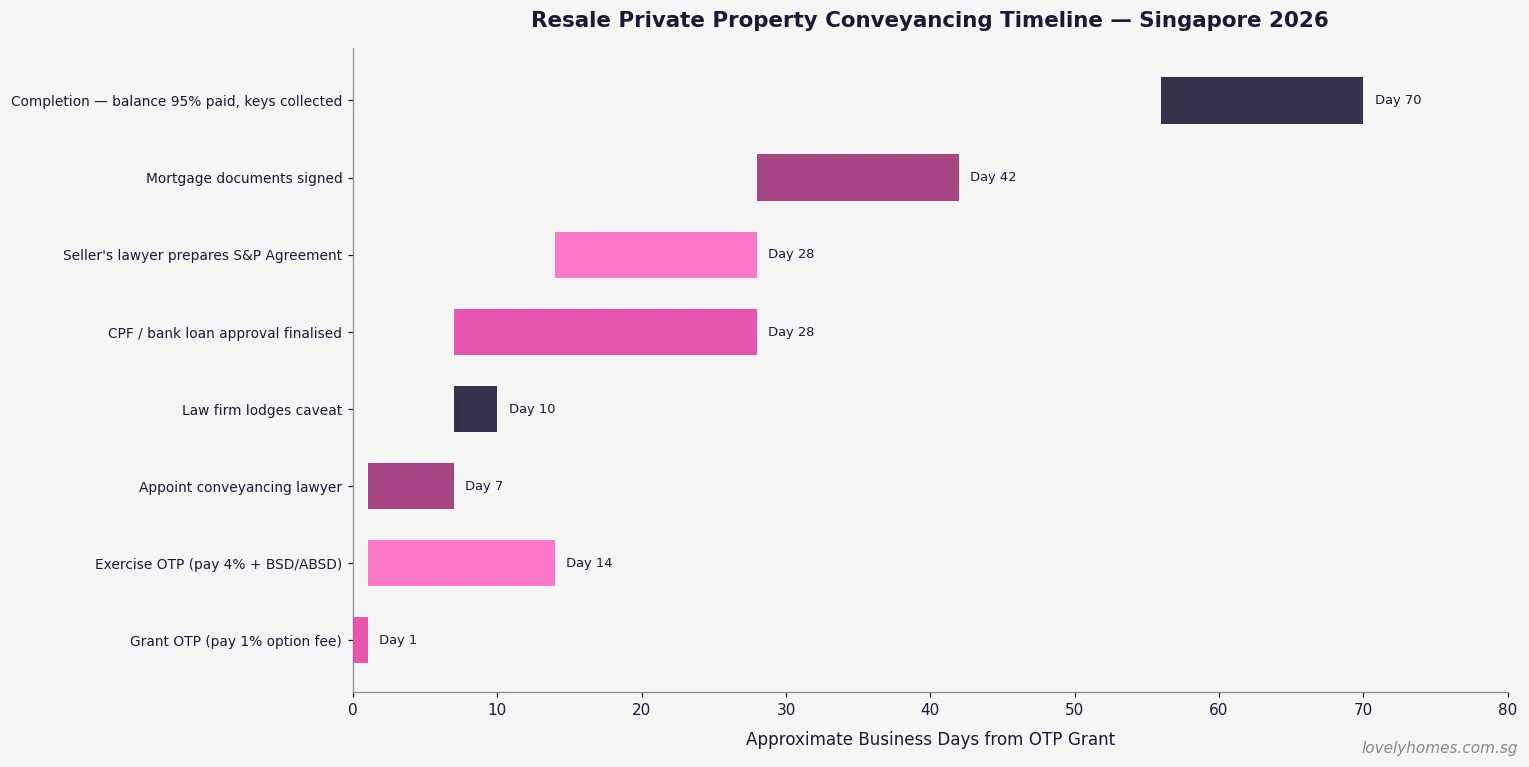
  • For private property, it involves an Option to Purchase (OTP), exercise of the OTP, and completion — typically over 8–12 weeks.
  • HDB resale transactions use the HDB Resale Portal and take approximately 8–10 weeks after HDB approval.
  • Buyer’s Stamp Duty (BSD) and Additional Buyer’s Stamp Duty (ABSD, if applicable) must be paid within 14 days of signing the OTP or S&P Agreement.
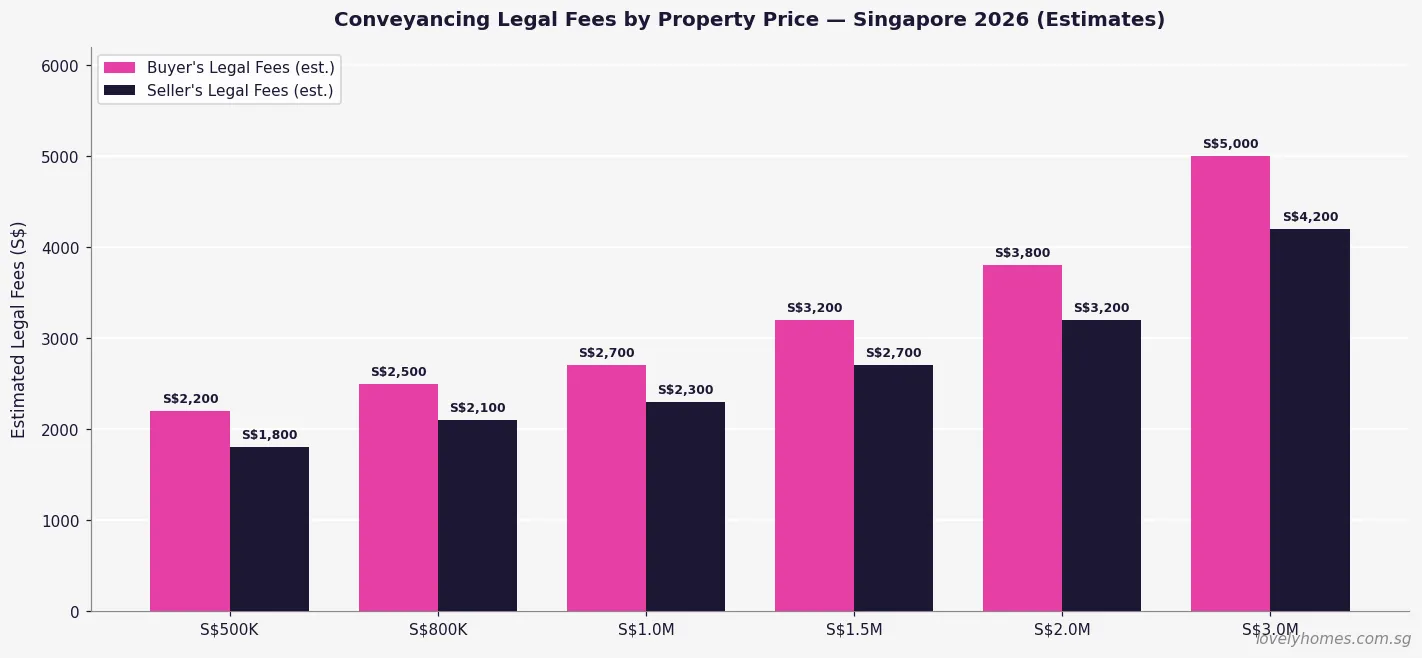
  • Legal fees for buyers typically range from S$2,200 to S$5,000 depending on property price; sellers pay S$1,800–S$4,200.
  • Disbursements (search fees, caveats, IRAS e-Stamping) add a further S$500–S$1,500 per transaction.
  • A conveyancing lawyer lodges a caveat on the title to protect the buyer’s interest between OTP exercise and completion.
  • CPF funds used for the purchase are refunded with 2.5% per annum accrued interest upon sale — factor this into your net proceeds calculation.

What Is Property Conveyancing?

Conveyancing is the Singapore legal process by which ownership of land or property is formally transferred from seller to buyer. Every private residential transaction — whether a new launch, resale condominium, landed property, or executive condominium — requires a conveyancing lawyer admitted to the Singapore Bar under the Legal Profession Act (Cap. 161). No individual may conduct their own conveyancing in Singapore; you must appoint a licensed law firm.

The Singapore Land Authority (SLA) maintains the land register under the Land Titles Act (Cap. 157). Separately, the Inland Revenue Authority of Singapore (IRAS) collects Buyer’s Stamp Duty (BSD) and Additional Buyer’s Stamp Duty (ABSD) via its e-Stamping portal. Your lawyer interfaces with both agencies on your behalf, making the choice of conveyancing firm a meaningful decision — not just a rubber stamp on your property purchase.

HDB flat transactions follow a slightly different route: they use the HDB Resale Portal and require HDB’s administrative approval, but buyers and sellers still appoint separate law firms (or use HDB’s approved conveyancing panel) to handle legal documents.

Step 1 — The Option to Purchase (OTP)

The OTP is a unilateral contract granting the buyer an exclusive right to purchase the property at an agreed price within a specified period. Under the Law Society of Singapore’s Conditions of Sale 2012, the standard OTP gives the buyer a 14-day option period from the date of grant. During this window, the property is effectively taken off the market.

Option fee: Typically 1% of the agreed purchase price, paid by cheque or cashier’s order to the seller (or seller’s lawyer). This fee is forfeited if the buyer does not exercise the option. It is not part of BSD — it is consideration for the option contract.

Exercising the OTP: The buyer exercises by paying a further 4% exercise fee (bringing the deposit to 5% total). BSD and ABSD are due within 14 days of exercising the OTP. Failure to pay on time attracts a late payment penalty of 5% per annum on the unpaid amount plus a flat 1% penalty.

Completion: Standard completion is 8–10 weeks after exercise. The buyer pays the remaining 95% of the purchase price (less any CPF utilised and bank loan disbursement) on completion day, and receives the keys and certificate of title.

Step 2 — The Sale and Purchase Agreement

Once the OTP is exercised, the seller’s lawyers typically issue a formal Sale and Purchase (S&P) Agreement within 2–4 weeks. The S&P Agreement sets out all conditions of sale including: completion date, vacant possession, included fixtures and fittings, representations and warranties on title, and risk allocation between exchange and completion.

For HDB resale flats, there is no separate S&P Agreement — instead, the parties register their Intent to Sell and Intent to Buy via the HDB Resale Portal, and HDB issues the resale completion letter setting the completion appointment.

Singapore property conveyancing timeline 2026 - OTP to completion business days
Figure 1: Typical conveyancing timeline for a resale private property in Singapore, measured in business days from OTP grant.

Step 3 — Stamp Duties: BSD and ABSD

Stamp duties are collected by IRAS under the Stamp Duties Act (Cap. 312). They are the buyer’s obligation. The Buyer’s Stamp Duty (BSD) rates as at 7 June 2026 are:

Purchase Price Bracket BSD Rate
First S$180,000 1%
Next S$180,000 2%
Next S$640,000 3%
Next S$500,000 4%
Next S$1,500,000 5%
Remainder above S$3,000,000 6%

Additional Buyer’s Stamp Duty (ABSD) applies on top of BSD for second and subsequent properties (Singapore Citizens), all purchases by Singapore Permanent Residents, and all purchases by foreigners and entities. For a complete ABSD table, see the LovelyHomes ABSD Singapore 2026 Guide.

Step 4 — Appointing Your Conveyancing Lawyer

You should appoint your conveyancing lawyer before you sign the OTP, so that they can advise you on the option terms and perform preliminary title searches. The Law Society of Singapore’s Conveyancing Practice Directions require lawyers to advise clients on conflicts of interest — the same law firm generally cannot act for both buyer and seller in the same transaction.

Your lawyer’s duties as buyer’s solicitor include: conducting all title searches; preparing or reviewing the S&P Agreement; handling BSD/ABSD payment to IRAS; lodging a caveat at SLA to protect your interest; liaising with your bank’s lawyers on mortgage documentation; requisitioning CPF funds from CPF Board; and attending completion to receive title from the seller.

Singapore conveyancing legal fees 2026 - buyer and seller estimates by property price
Figure 2: Estimated conveyancing legal fees for buyers and sellers by property price, Singapore 2026. Obtain written fee quotes from your firm before proceeding.

Legal Fees and Disbursements

Law Society scale fees for residential conveyancing were abolished in 2009, meaning firms now charge freely. As a buyer, expect to pay S$2,200–S$5,000 in professional fees depending on transaction price and complexity. On top of professional fees, your lawyer will pass through disbursements — out-of-pocket costs charged at cost. Typical disbursements include:

  • SLA title search: approx. S$30–S$80
  • SLA caveat registration: approx. S$64.45 (includes GST)
  • Bank mortgage registration: approx. S$350–S$500
  • SLA transfer lodgement fee: approx. S$28–S$38 per instrument
  • CPF requisition fee: approx. S$15–S$25 per utilisation
  • Property valuation fee: S$300–S$1,200 depending on property type

Budget approximately S$500–S$1,500 in disbursements for a straightforward private resale transaction, in addition to professional fees.

Singapore property buying costs comparison 2026 - HDB resale vs private condo BSD ABSD legal fees
Figure 3: Total upfront buying costs including BSD, ABSD and legal fees — HDB resale vs private condo at three price points, Singapore 2026.

Summary: Key Conveyancing Facts at a Glance

Item HDB Resale Private Resale New Launch
OTP / booking fee S$1 (HDB prescribed) Typically 1% of price Booking fee 5% on S&P day
OTP exercise fee N/A — HFE/portal process 4% within 14 days Further progress payments
BSD payment deadline 14 days from HDB flat offer letter 14 days from exercise 14 days from S&P date
Standard completion period 8–10 weeks (HDB schedule) 8–12 weeks from exercise On TOP or CSC date
Caveat filed by HDB portal (automatic) Buyer’s lawyer Developer’s panel lawyer
Buyer legal fees (indicative) S$1,500–S$2,200 S$2,200–S$5,000 S$2,200–S$3,500
Seller legal fees (indicative) S$1,000–S$1,800 S$1,800–S$4,200 N/A (developer pays)
CPF accrued interest on refund 2.5% p.a. on OA withdrawn 2.5% p.a. on OA withdrawn 2.5% p.a. on OA withdrawn

Worked Example: Mr and Mrs Koh Buy a Resale Condominium in Queenstown

Mr and Mrs Koh are Singapore Citizens purchasing their second property — a resale 2-bedroom condominium in Queenstown (District 3) for S$1,600,000. They are selling their HDB flat simultaneously (see our HDB Upgrader Guide 2026 for ABSD remission timing).

  • Option fee (1%): S$16,000 — paid by cashier’s order on grant of OTP.
  • BSD at exercise: 1% × S$180,000 + 2% × S$180,000 + 3% × S$640,000 + 4% × S$500,000 + 5% × S$100,000 = S$1,800 + S$3,600 + S$19,200 + S$20,000 + S$5,000 = S$49,600
  • ABSD remission: If HDB sold within the stipulated window, ABSD is remitted for SC joint first-time private purchase. If outside the window, ABSD at 20% = S$320,000 — manage this timing carefully.
  • Buyer’s legal fees: Approx. S$3,400 professional + S$900 disbursements = S$4,300
  • Valuation fee: S$700
  • Bank loan: S$1,200,000 at 3.0% p.a. over 30 years = S$5,058/mth; TDSR 36.1% on joint income S$14,000/mth — PASS.
  • Completion cash balance: S$1,600,000 − S$80,000 (deposit) − S$1,200,000 (bank) − S$100,000 (CPF) = S$220,000 cash

The entire conveyancing process, from OTP grant to completion, spans approximately 10 weeks — aligning with the typical resale timeline shown in Figure 1 above.

What to Watch in 2026 and Beyond

Singapore’s conveyancing framework has remained largely stable since the Land Titles Act was modernised in 1994, but two pressure points are worth watching. First, the Ministry of Law has periodically reviewed whether HDB flat conveyancing should be further streamlined through the portal — licensed lawyers remain mandatory as at 2026. Second, the SLA has been progressively digitalising title documents towards a fully electronic land registry, which reduces search turnaround times and potentially disbursement costs.

For buyers, the practical implication is that while stamp duties remain the dominant cost item (dwarfing legal fees for most transactions), shopping for a competitive legal fee quote matters more the larger your transaction. For a second-property private condominium purchaser, ABSD is typically 20–60 times larger than legal fees — making ABSD remission timing the single most important conveyancing consideration of all.

Frequently Asked Questions

Can I use the same lawyer as the seller?

Generally no. The Law Society’s Conveyancing Practice Directions prohibit a single law firm from acting for both buyer and seller in the same residential transaction — a conflict-of-interest rule designed to protect both parties. Exceptions exist for new launch sales where developer panel lawyers act for the developer, but you as the buyer still engage your own firm. Having separate representation ensures your lawyer’s duty runs exclusively to you.

What happens if I miss the BSD payment deadline?

BSD and ABSD must be paid within 14 days of signing the OTP or S&P Agreement. Late payment attracts a penalty of 5% per annum on the unpaid stamp duty, plus a flat penalty of 1% of the unpaid duty under the Stamp Duties Act. Your conveyancing lawyer will typically pay stamp duties on your behalf immediately on instruction — ensure you have sufficient cleared funds in your account by the day of exercise.

What is a caveat and why does my lawyer lodge one?

A caveat under the Land Titles Act is a formal notice lodged at the Singapore Land Registry (via SLA) once you have exercised the OTP. It signals to the world — including any subsequent buyer, mortgagee, or judgment creditor — that you have a legal interest in the property. This prevents the seller from dealing with the property inconsistently with your purchase contract during the period between exercise and completion. The caveat lodgement fee is approximately S$64 and is a standard disbursement.

How does CPF work in a property purchase?

Singapore Citizens and PRs may use their CPF Ordinary Account (OA) savings towards the purchase price and monthly mortgage instalments, subject to a Valuation Limit (VL) of 100% of the lower of purchase price or valuation, and a Withdrawal Limit (WL) of 120% of VL for properties with at least 30 years remaining lease. CPF monies withdrawn for property must be refunded with 2.5% p.a. accrued interest upon sale — returned to your own CPF account. See our HDB Upgrader Guide for worked CPF refund calculations.

What is the difference between new launch and resale conveyancing?

New launch transactions involve a developer under a Housing Developers (Control and Licensing) Act licence. Instead of an OTP, you sign a Standard Sale and Purchase Agreement in the prescribed form under the Housing Developers Rules, and pay a booking fee (typically 5%) on the day of signing. Stamp duties are payable within 14 days. Completion occurs on the issue of the Temporary Occupation Permit (TOP) or Certificate of Statutory Completion (CSC), which may be 2–5 years from booking. Your CPF usage and bank loan terms must be structured to accommodate drawdowns aligned with the developer’s progress billing schedule.

Can a foreigner buy Singapore property and what additional steps apply?

Foreigners may purchase private condominium units, executive condominiums that have reached their 10-year privatisation mark, and Sentosa Cove landed properties — subject to the Residential Property Act (Cap. 274). The conveyancing process is identical, except that ABSD at 60% of the purchase price is payable by foreigners on any residential property purchase as at 2026. US, Swiss, Icelandic, Norwegian, and Liechtenstein nationals benefit from Free Trade Agreement (FTA) exemptions and are treated at Singapore Citizen rates for ABSD purposes. See our Singapore Foreign Buyer Property Guide 2026.

What happens on completion day?

Completion is typically conducted at the seller’s lawyer’s office. Your bank disburses the loan directly to the seller’s lawyers; your CPF Board requisition is remitted; and you or your lawyer presents cashier’s orders for any remaining cash. The seller hands over keys and access cards. Title transfers on completion — your lawyer registers the transfer at SLA (typically processed within 1–3 business days). You will receive a Land Register printout confirming your name as the registered proprietor.

Related Articles

Disclaimer: This article is intended for general informational purposes only and does not constitute legal or financial advice. Conveyancing procedures, stamp duty rates, and CPF rules are subject to change. All figures, fees, and timelines cited are based on information available as at 7 June 2026. Readers should consult a licensed Singapore conveyancing lawyer and a Monetary Authority of Singapore (MAS) licensed financial adviser for advice specific to their circumstances. Authoritative references: IRAS (iras.gov.sg), Singapore Land Authority (sla.gov.sg), CPF Board (cpf.gov.sg), Law Society of Singapore (lawsociety.org.sg).

Buying Landed Property Singapore 2026: Eligibility, GCB Rules, BSD and Step-by-Step Guide

Buying Landed Property Singapore 2026: Eligibility, GCB Rules, BSD and Step-by-Step Guide

Quick Answer: Buying Landed Property in Singapore 2026

  • Who can buy: Singapore Citizens (SCs) may freely purchase all landed property types on the mainland. Singapore Permanent Residents (PRs) require approval from the Controller of Residential Property (CRP). Foreign nationals generally cannot purchase mainland landed property.
  • Good Class Bungalows (GCBs): Reserved exclusively for Singapore Citizens — PRs and foreigners are excluded even with CRP or SLA approval. Minimum plot 1,400 sqm; 39 gazetted areas across Singapore.
  • Strata-landed (cluster housing, townhouses): Generally purchasable by PRs and foreigners as these are classified as private residential (non-restricted) — but ABSD applies at the buyer’s applicable rate.
  • Sentosa Cove landed: Foreign nationals may apply to the SLA for approval; 60% ABSD still applies.
  • ABSD: SC first private property purchase: 0% ABSD. SC buying landed while still owning an HDB: 20% ABSD (or use the 6-month remission window). PR: 5% on first private property.
  • BSD: Progressive 1–6% on all purchases; for a S$4.2M terrace, BSD is S$191,600.
  • Property tax: Owner-occupied landed properties pay progressive property tax on Annual Value; revised rates effective 2023 can exceed S$10,000/year for higher-value landed homes.
  • Bank financing: LTV 75% (first property), TDSR 55%. No HDB concessionary loan — bank loans only for private property.

Why Landed Property Remains Singapore’s Most Coveted Real Estate

Singapore has roughly 73,000 landed residential properties — terraces, semi-detached houses, bungalows, and Good Class Bungalows — on an island of just 733 square kilometres. As a share of total housing stock, landed property represents less than 5% of all units. That scarcity, combined with land tenure that is often freehold, makes Singapore landed property one of the most tightly held and appreciating asset classes in Asia-Pacific.

For buyers who qualify — primarily Singapore Citizens — purchasing a landed home represents not just a lifestyle upgrade but a substantive long-term wealth accumulation strategy. URA data shows that the landed residential property price index has risen approximately 73% from Q1 2019 to Q1 2026, outpacing even the robust gains in the private non-landed segment.

This guide covers who may buy landed property in Singapore, the types of landed homes available, eligibility rules under the Residential Property Act (Cap 274) administered by the Singapore Land Authority (SLA), how stamp duties are calculated, and what a realistic transaction looks like from start to finish. All rules and figures reflect the position as at June 2026.

Types of Landed Property in Singapore

Singapore’s landed residential market is divided into five principal categories, each with its own planning parameters, price band, and ownership rules:

Landed property price ranges Singapore 2026 — terrace, semi-D, bungalow and GCB
Figure 1: Indicative Price Ranges by Landed Property Type, Singapore 2026. Source: URA caveats, industry data — Q1 2026. Ranges reflect the broad market; trophy assets and GCBs in prime districts can exceed the upper end shown.

1. Terrace Houses (Intermediate and End-Lot)

Terrace houses are the most accessible entry point into Singapore’s landed market. An intermediate terrace sits between two other units in a row; an end-lot terrace has one open side and typically commands a 10–20% premium. Standard terraces cover a land area of roughly 150–300 sqm (about 1,600–3,200 sqft). Prices range from approximately S$2.2 million for an older intermediate terrace in a non-prime district to S$5 million or more for a renovated freehold end-lot in a desirable estate like Serangoon Gardens (D19), Frankel Estate (D15), or Joo Chiat (D15).

2. Semi-Detached Houses

A semi-detached house shares one party wall with an adjacent unit; the other three sides are free-standing. Land areas typically range from 250 to 500 sqm. Semi-Ds in prime freehold estates (Bukit Timah D11, Holland Road D10) can fetch S$6–9 million, while newer leasehold developments in the north may trade at S$3.5–5 million.

3. Detached Bungalows

A detached bungalow stands on its own plot with no shared walls. Singapore’s Urban Redevelopment Authority (URA) stipulates minimum plot sizes for new detached dwellings, typically 400 sqm and above. Bungalows range widely: a mid-size freehold bungalow in D21 might list at S$6–8 million, while a trophy bungalow in prime D10 or D11 can exceed S$20 million.

4. Good Class Bungalows (GCBs)

GCBs are the pinnacle of Singapore’s residential hierarchy. Regulated by URA’s Good Class Bungalow Areas planning rules, these properties must sit on plots of at least 1,400 sqm (approximately 15,000 sqft), be capped at two storeys above ground plus one basement, and may not subdivide below the minimum plot size. There are 39 gazetted GCB areas across Singapore — concentrated in districts 10, 11, and 21 — including Nassim Road, Bishopsgate, Dalvey Estate, Swiss Club Road, Ridgewood, Caldecott Hill, and Frankel Estate. GCBs are reserved exclusively for Singapore Citizens; PRs and foreigners are ineligible regardless of wealth or residency track. Prices range from approximately S$18 million to over S$60 million, with the rarest Nassim Road GCBs occasionally transacting at S$3,500–S$5,000 psf of land.

5. Strata-Landed Housing

Strata-landed properties — cluster housing, townhouses, and similar formats that sit within a private condominium development on a strata title — occupy a unique middle ground. They are landed in appearance (each unit has its own ground floor and outdoor space) but are legally classified as strata units within a development, placing them outside the Residential Property Act’s “restricted residential property” regime. This means PRs and foreign nationals may purchase strata-landed homes without CRP or SLA approval (subject to the applicable ABSD). Prices are typically lower than equivalent standalone landed: a cluster terrace in a popular development might list at S$2.5–4 million.

Who Can Buy Landed Property: Eligibility by Buyer Status

Landed property purchase eligibility Singapore 2026 — SC, SPR and foreigner rules
Figure 2: Landed Property Purchase Eligibility by Buyer Status, Singapore 2026. Source: SLA, Residential Property Act (Cap 274). * PRs require CRP approval; foreigners require SLA approval for Sentosa Cove only.

Singapore Citizens (SC): Full Access to All Mainland Landed Types

Singapore Citizens may purchase any landed residential property on the Singapore mainland — terrace, semi-detached, bungalow, or GCB — without any prior approval from the SLA or CRP. The only constraint is financial: stamp duties, financing limits, and the HDB ownership rules discussed below. SC buyers who already own an HDB flat face an important restriction: under HDB rules, a flat owner who acquires a private residential property (including landed) must dispose of the HDB flat within six months of completing the private purchase, unless they qualify for the married-couple ABSD remission scheme and choose to retain the HDB temporarily.

Singapore Permanent Residents (PRs): Approval Required

PRs wishing to purchase mainland landed property must first obtain approval from the Controller of Residential Property (CRP), a statutory position within the SLA established under the Residential Property Act (Cap 274). Applications are assessed individually, with the CRP considering factors such as the length of PR status, economic contributions to Singapore (including taxes paid and businesses run), family ties, and the applicant’s immigration trajectory. There is no guarantee of approval, and processing typically takes several months. If approval is granted, conditions may be attached — for example, a prohibition on subletting the property.

PRs may, however, purchase strata-landed housing freely, without CRP approval, as it falls outside the “restricted residential property” definition. PRs are also ineligible for GCBs even if they obtain CRP approval for other landed types.

Foreign Nationals: Mainland Landed Prohibited

Foreign nationals (including those on Employment Passes, Dependent Passes, Long-Term Visit Passes, or any other Singapore immigration status short of PR or citizenship) may not purchase any mainland landed property in Singapore. This prohibition is absolute under the Residential Property Act and does not vary based on wealth, tenure in Singapore, or the type of visa held. The only exceptions are Sentosa Cove landed properties (purchasable with SLA/LDAU approval, with the 60% ABSD still applying) and strata-landed homes in private estates, which foreigners may purchase freely as private residential property.

Key distinction — strata-landed vs standalone landed: A foreigner or PR looking at a “landed” property must always check the title. If it is a strata title within a condominium development (cluster housing), it is purchasable without SLA/CRP approval. If it is a Torrens title on its own plot of land (standalone terrace, semi-D, bungalow), it is restricted under the Residential Property Act and requires approval for PRs, and is prohibited for foreigners on the mainland entirely.

Stamp Duties on Landed Property: BSD and ABSD

Stamp duty on landed property transactions works identically to other residential purchases — BSD is payable by all buyers, ABSD is layered on depending on buyer status and property count. The key difference is that the transaction values are significantly higher, which means BSD in the 5% and 6% brackets applies to a large portion of the purchase price.

Buying costs landed property Singapore 2026 — BSD and down payment at S$3.5M, S$6M and S$12M
Figure 3: Upfront Costs for SC Buying Landed Property as First Private Purchase (2026). BSD calculated at progressive 1–6% tiers effective 15 February 2023. 0% ABSD assumes SC first private property, HDB sold prior. 25% down payment shown on right axis.

ABSD and Landed Property: Critical Points for Upgraders

Many landed buyers in Singapore are HDB flat owners upgrading to private residential property. For a Singapore Citizen purchasing their first private residential property (having either sold the HDB first, or qualifying under the married-couple remission window), ABSD is 0%. However, a SC who buys landed before selling their existing HDB or private property must pay 20% ABSD upfront on the second property and may apply for a remission of this ABSD if the first property (HDB or private) is sold within six months of the second purchase’s completion date. This remission applies to married SC couples only; single buyers are not eligible.

PRs buying their first private residential property (including landed with CRP approval) pay 5% ABSD. A second PR purchase attracts 30% ABSD. Foreigners buying strata-landed or Sentosa Cove landed pay 60% ABSD.

Financing Landed Property: LTV, TDSR and Practical Considerations

Landed property purchasers in Singapore must use bank financing — there is no HDB concessionary loan option for private residential property. The MAS-regulated parameters are the same as for condominiums: LTV cap of 75% for the first property loan, subject to TDSR of 55% of gross monthly income. For a S$5 million semi-detached property, a 75% LTV loan equals S$3.75 million — carrying a monthly repayment of approximately S$15,800 at 3.0% over 30 years, requiring a household income of at least S$28,700/month to pass TDSR (with no other debts). This reflects the buyer demographic typical of the Singapore landed market.

One practical consideration specific to landed property transactions is the use of CPF. While SC buyers may use CPF Ordinary Account savings for the down payment and monthly loan instalments on private property (subject to the Valuation Limit and Withdrawal Limit rules), the higher absolute values involved mean that CPF often covers only a fraction of the total cost. Most landed buyers also deploy significant savings or proceeds from prior property sales.

Property Tax on Landed Homes

Property tax is levied annually by IRAS on the Annual Value (AV) of a property — the estimated gross annual rent it could command in the open market. AV for landed homes depends on the property type, size, location, and condition. A terrace in Serangoon Gardens might carry an AV of S$60,000–80,000; a Nassim Road bungalow might have an AV of S$200,000 or more.

Owner-occupied residential property tax rates (revised upward from 1 January 2024) are progressive:

Annual Value (AV) Owner-Occupied Rate Non-Owner-Occupied Rate
First S$8,000 0% 10%
S$8,001–S$30,000 4% 12%
S$30,001–S$40,000 6% 14%
S$40,001–S$55,000 10% 16%
S$55,001–S$70,000 14% 18%
S$70,001–S$85,000 18% 20%
S$85,001–S$100,000 22% 22%
Above S$100,000 32% 36%

For an owner-occupied terrace with an AV of S$72,000, annual property tax would be approximately S$8,160. A non-owner-occupied landed home (i.e., one that is tenanted or vacant) is taxed at the higher non-owner-occupied rate, which could result in an annual property tax bill of S$11,400 or more on the same AV.

Summary: Key Rules for Buying Landed Property in Singapore 2026

Parameter Singapore Citizen Singapore PR Foreigner
Terrace / Semi-D / Bungalow (mainland) ✓ Free to buy CRP approval needed ✗ Prohibited
Good Class Bungalow (GCB) ✓ Free to buy ✗ Ineligible ✗ Prohibited
Strata-landed (cluster housing) ✓ Free to buy ✓ Free to buy ✓ Free to buy
Sentosa Cove landed ✓ Free to buy ✓ Free to buy SLA/LDAU approval needed
ABSD (first private property) 0% 5% 60%
BSD Progressive 1–6% Progressive 1–6% Progressive 1–6%
SSD (if sold within 3 years) 12%/8%/4% 12%/8%/4% 12%/8%/4%
LTV cap (first property loan) 75% 75% 75% (bank only)
Minimum cash down payment 5% cash + CPF 5% cash + CPF 5% cash only (no CPF)
HDB ownership: must dispose Within 6 months of private purchase Within 6 months N/A (no HDB ownership)

Worked Example: Mr & Mrs Tan (Singapore Citizens) — Upgrading to a Serangoon Gardens Terrace at S$4,200,000

Profile: Mr Tan (46) and Mrs Tan (42), both Singapore Citizens, joint gross income S$28,000/month. They currently own a Tampines HDB 5-room flat that they sell for S$950,000. After repaying the outstanding HDB loan (S$150,000) and refunding CPF accrued interest (S$220,000 principal + S$32,000 interest = S$252,000), they net approximately S$548,000 in cash proceeds. They have additional savings of S$550,000. Combined liquid assets: S$1,098,000.

Step 1 — BSD calculation on S$4,200,000:

  • 1% × S$180,000 = S$1,800
  • 2% × S$180,000 = S$3,600
  • 3% × S$640,000 = S$19,200
  • 4% × S$500,000 = S$20,000
  • 5% × S$1,500,000 (S$1.5M–S$3.0M) = S$75,000
  • 6% × S$1,200,000 (S$3.0M–S$4.2M) = S$72,000
  • Total BSD = S$191,600

Step 2 — ABSD: The Tans sell their HDB before exercising the OTP on the terrace, so this is their first private residential purchase — ABSD = 0%.

Step 3 — Bank loan and TDSR:

  • LTV 75%: loan = S$4,200,000 × 75% = S$3,150,000
  • At 3.0% p.a. over 30 years: monthly instalment ≈ S$13,280
  • TDSR = S$13,280 ÷ S$28,000 = 47.4% — PASS (below 55% threshold)
  • Stressed at 4.0%: S$15,037/month ÷ S$28,000 = 53.7% — borderline; lender may require 25-year tenure instead

Step 4 — Cash outlay summary:

Item Amount (S$) Funding Source
25% down payment (incl. 5% cash minimum) S$1,050,000 5% cash S$210k + CPF S$420k + cash S$420k
BSD S$191,600 CPF OA (if sufficient) / cash
Legal fees (conveyancing + bank) S$7,500 Cash
Property valuation fee S$800 Cash
Total upfront (excl. ABSD) S$1,249,900 Cash available: S$1,098,000 + CPF used

CPF OA balance (combined) assumed at S$380,000 — covers BSD and part of down payment. The Tans’ total cash and CPF resources of approximately S$1,478,000 comfortably cover the S$1,249,900 needed, leaving a liquidity buffer of approximately S$228,100 plus ongoing CPF contributions. Monthly instalment S$13,280 at 3.0%/30yr.

Why Landed Property Holds a Special Place in Singapore’s Wealth Architecture

Singapore’s land constraints are structural and permanent. The Government has stated that no new landed residential land will be released through the Government Land Sales programme — landed supply growth comes only from existing plots being redeveloped or amalgamated. This fixed supply, combined with relentless demand from Singapore’s growing population of high-net-worth Citizens, underpins the asset’s long-run outperformance. Industry data suggests that freehold landed property has appreciated at approximately 5–7% per annum over two decades in prime districts, with GCBs in particular serving as wealth-preservation vehicles for Singapore’s wealthiest families.

Unlike condominiums, landed homes generate no management fee or sinking fund contributions (for standalone properties), offer true ground-floor living, and permit significant customisation through rebuilding or A&A (additions and alterations) works subject to URA guidelines. The combination of scarcity, control, and customisation makes landed property a distinct asset class rather than simply “a more expensive condo”.

What Might Come Next for Landed Property Policy?

This section represents editorial analysis and should not form the basis of any investment decision. The core restrictions on PR and foreign purchases of mainland landed property have been in place since the Residential Property Act’s enactment in 1976 and are unlikely to change materially. There has been no policy signal of any relaxation. The GCB rules in particular — which restrict purchases to SCs only — reflect a deliberate policy to preserve the nation’s most prestigious residential stock for citizens.

Looking further ahead, some observers speculate that as Singapore’s population of long-tenured, economically integrated PRs grows, there may be gradual liberalisation of the CRP approval process for PR buyers in the mid-tier landed market. Others have suggested that the Government could use landed property supply to reward exceptional talent (through a fast-tracked CRP approval linked to an enhanced-tier talent scheme). For now, however, the policy stance is unchanged: landed ownership on the Singapore mainland remains principally a citizen prerogative.

Frequently Asked Questions

Can a Singapore PR apply to buy a landed property on their own?

Yes — a Singapore Permanent Resident may apply to the Controller of Residential Property (CRP) at the Singapore Land Authority (SLA) for approval to purchase mainland landed residential property. The application is assessed individually. Key factors include the applicant’s length of PR status, economic contribution to Singapore (employment, taxes paid, business ownership), family ties to Singapore Citizens, and whether the applicant has applied for or is eligible to apply for citizenship. There is no published approval rate, and decisions are at the CRP’s discretion. PRs who are granted approval may purchase terrace houses, semi-detached houses, and detached bungalows, but not Good Class Bungalows (which are restricted to SCs only). The CRP approval does not reduce or waive the applicable ABSD — a PR buying a first private property still pays 5% ABSD.

What is the minimum plot size for a Good Class Bungalow?

A Good Class Bungalow (GCB) must sit on a plot of at least 1,400 sqm (approximately 15,069 sqft), as stipulated in URA’s Good Class Bungalow Areas planning rules. The building envelope is limited to two storeys above ground plus one basement storey. GCBs may not be subdivided below this minimum plot size, and amalgamation (combining two or more plots) is permitted only if the resulting plot meets the minimum size requirement. The 39 gazetted GCB areas are concentrated primarily in Districts 10, 11, and 21, with pockets in Districts 15 and 16. Any redevelopment or rebuilding on a GCB plot requires BCA and URA approval and must comply with the GCB planning parameters. Singapore Citizens wishing to purchase a GCB do not need any special government approval beyond the standard conveyancing process.

Can an SC who owns an HDB flat buy a landed property without selling the HDB first?

Yes, but with significant stamp duty consequences. A Singapore Citizen who owns an HDB flat and purchases a private residential property (including landed) without first selling the HDB will pay 20% ABSD on the private property. This ABSD is payable within 14 days of the OTP exercise. However, if the HDB flat is sold — and the sale is completed — within six months of the private purchase’s completion date, the SC (or married SC couple) may apply to IRAS for a remission of the 20% ABSD. This is the “married couple ABSD remission” scheme under the Stamp Duties Act. Note: the remission requires the couple to be lawfully married, and both spouses must be Singapore Citizens to qualify. Single SCs are not eligible for this remission and must sell their HDB first to avoid ABSD.

What are the typical costs to rebuild a landed property in Singapore?

Rebuilding a landed property in Singapore — demolishing the existing structure and constructing a new home — typically costs between S$2.5 million and S$5 million or more depending on the plot size, the architectural specification, the quality of finishes, and the contractor selected. Rebuilding a standard two-storey terrace on a 200 sqm plot might cost S$1.5–2.5 million for a mid-range build (around S$500–900 psf of built-up area). A GCB rebuild to a high specification can cost S$5–15 million. Before any demolition or reconstruction, the owner must obtain Planning Permission from URA and a Building Plan approval from BCA. Typically the entire process from appointment of an architect to receipt of a Temporary Occupation Permit (TOP) takes 2–4 years. During the rebuild period, the owner must either rent alternative accommodation or — if they have not yet moved in — remain patient.

Are landed property gains subject to capital gains tax in Singapore?

No — Singapore does not impose a general capital gains tax. Gains realised on the sale of landed (or any other) residential property are not taxable under the Income Tax Act, as long as the seller is not considered to be carrying on a trade or business in property. IRAS may assess an individual as a property trader — and therefore liable for income tax on gains — if they demonstrate a pattern of frequent buying and selling with the intention of profit rather than genuine long-term ownership. In practice, IRAS’s scrutiny is most intense for buyers who flip properties shortly after purchase and for those with professional connections to the property industry. For most individual landed property owners who hold their home for several years, there is no capital gains liability on a sale. The Seller’s Stamp Duty (SSD) at 12%/8%/4% for sales within the first three years of ownership is a deterrent to short-term flipping, but this is a stamp duty obligation rather than a capital gains tax.

Can foreigners who become PRs apply for CRP approval immediately?

Technically, an applicant may apply for CRP approval as soon as they are granted PR status. However, in practice the CRP’s assessment places significant weight on the duration of PR status as evidence of genuine long-term residence commitment. A fresh PR applicant applying immediately after receiving their PR is unlikely to succeed unless there are exceptional circumstances. Most approved applicants have held PR status for several years and have additional compelling ties to Singapore. The CRP does not publish a minimum qualifying period, and decisions are made on a case-by-case basis. Would-be PR buyers of landed property are generally advised by solicitors to wait at least three to five years after receiving PR before applying, and to build a strong profile of economic and social contributions to Singapore in the meantime.

What is “strata-landed” property and is it a good substitute for a standalone landed home?

Strata-landed housing — cluster houses, townhouses, and similar formats within a private estate — offers a landed-style living experience (ground-floor access, small garden, no unit above or below) within a condominium’s legal framework. They are generally more affordable than equivalent standalone landed homes, often located in suburban or newer estates, and available to PRs and foreigners without CRP approval. However, strata-landed homes come with condominium management fees (covering common facilities and security), are subject to the strata title’s collective management and by-laws, and may carry restrictions on exterior modifications. The land beneath a strata-landed unit is held collectively, unlike the exclusive freehold or leasehold land title of a standalone landed property. For buyers who prioritise the lifestyle of a landed home but face eligibility constraints (PRs, foreigners) or budget constraints (strata-landed is often S$500k–S$1.5M cheaper than comparable standalone), strata-landed can be an attractive alternative — albeit one that does not carry the same scarcity premium as a true standalone landed property in a prime estate.

Disclaimer: This article is for general informational purposes only and does not constitute legal, financial, or taxation advice. Eligibility rules, stamp duty rates, property tax schedules, and planning regulations are subject to change by the Government at any time. The information reflects the position as at June 2026. Before making any property transaction — particularly one involving the Residential Property Act, ABSD remission applications, or CRP approvals — readers should consult a Singapore-licensed solicitor, MAS-licensed financial adviser, and the relevant authorities: SLA (sla.gov.sg), IRAS (iras.gov.sg), URA (ura.gov.sg), and HDB (hdb.gov.sg). LovelyHomes does not accept liability for any loss arising from reliance on this article.

| Elegantly Designed by Little Big Red Dot | All Rights Reserved.

Translate »