Singapore Strata-Titled Landed Property Guide 2026: Cluster Houses, MCST Fees, Eligibility and Stamp Duties
🏡 Quick Answer: Strata-Titled Landed Property Singapore 2026
- Strata-titled landed (also called cluster housing) combines the feel of a landed home — your own ground floor, private garden or yard — with a shared strata scheme managed by a Management Corporation (MCST), similar to a condo.
- Not a “restricted residential property” under the Residential Property Act (Cap. 274): Singapore Permanent Residents (PRs) may purchase cluster houses freely without Singapore Land Authority (SLA) approval. Foreigners also may buy, subject to ABSD.
- Foreigners pay 60% ABSD (same as any private residential property). PRs pay 5% ABSD on their first purchase; 30% on subsequent. Singapore Citizens pay 0% ABSD on their first purchase.
- Prices range from S$2.5 million (cluster terrace, OCR/RCR) to S$12 million+ (cluster bungalow, prime districts). About 15–25% below equivalent standalone landed in the same location.
- Monthly MCST maintenance fees typically run S$300–S$700 for cluster terraces, S$500–S$1,200 for cluster bungalows, covering pool, gym, landscaping, security, and lift maintenance.
- Same BSD and LTV rules as private condos — progressive BSD 1–6%, LTV 75% (first property), TDSR 55%.
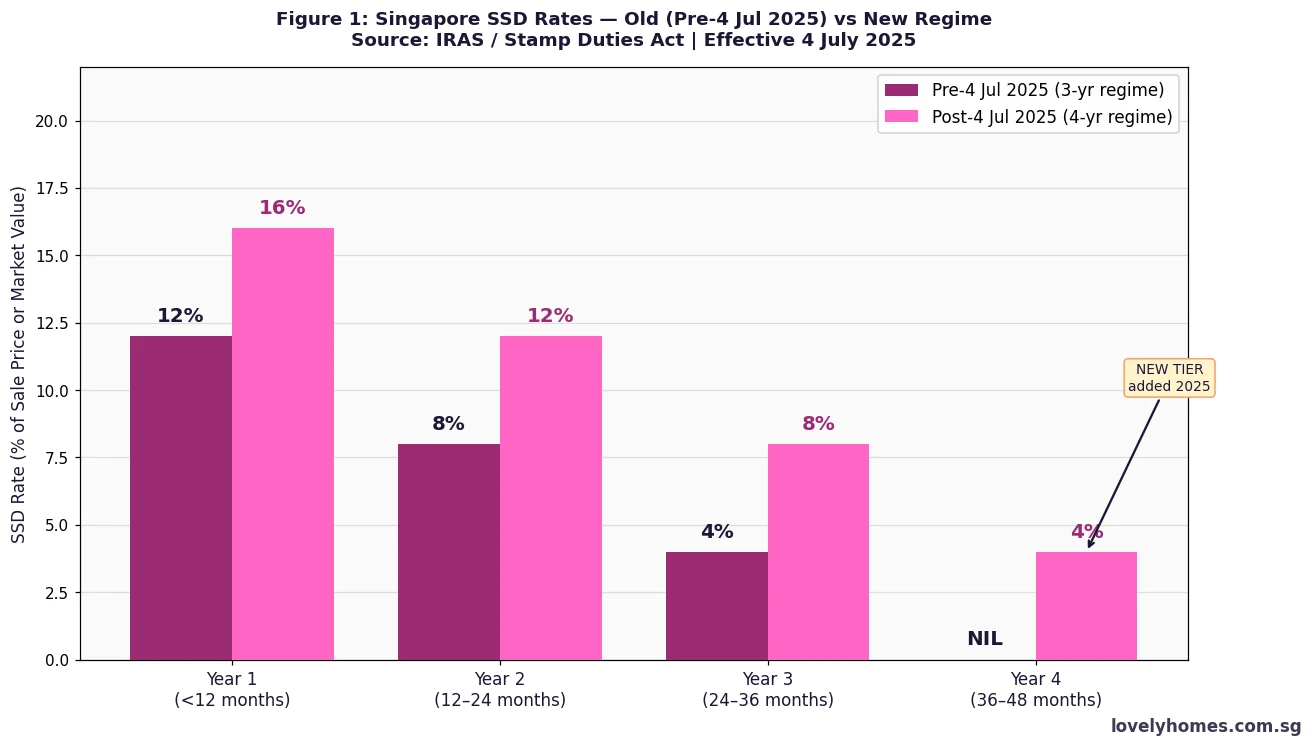
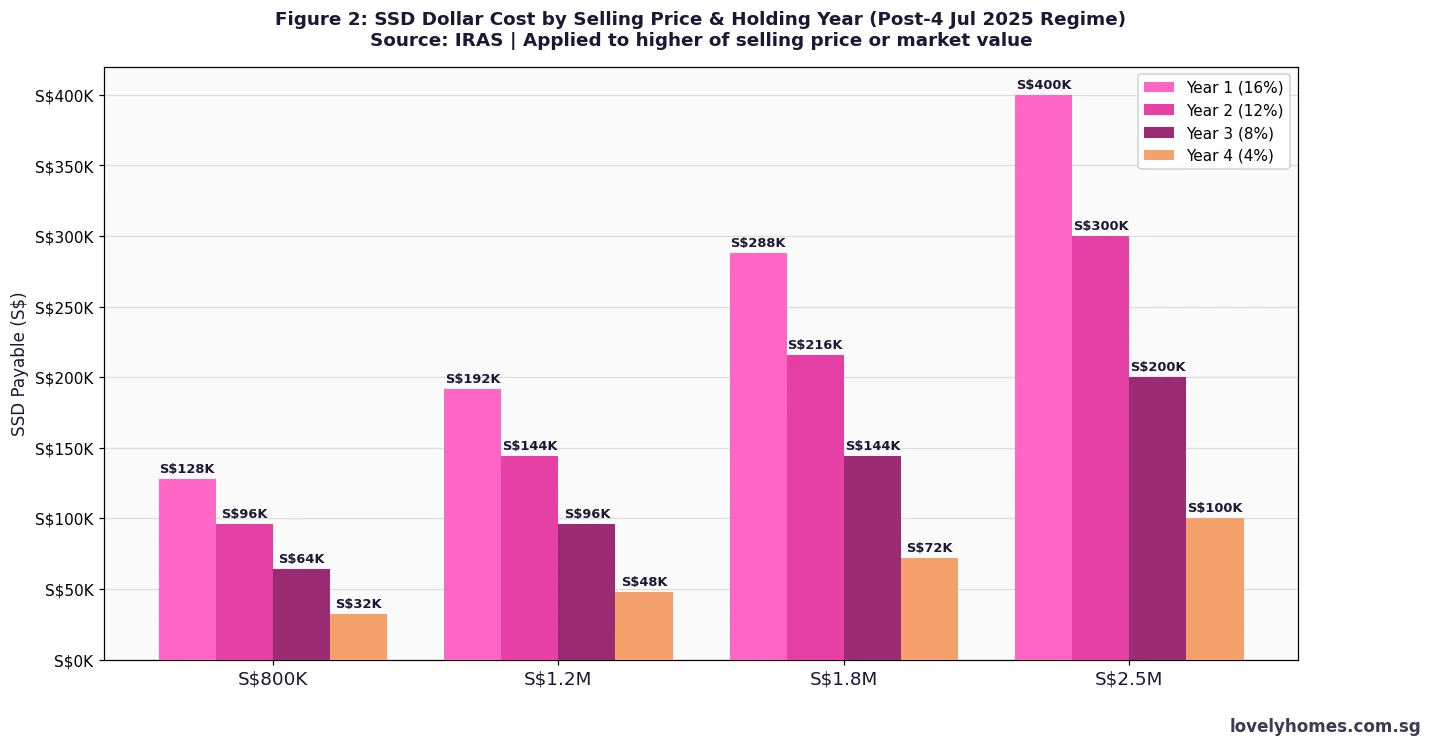
- Seller’s Stamp Duty (SSD) applies within 4 years of purchase at 16%/12%/8%/4% (new regime from 4 July 2025).
- AV-based property tax: strata landed AV is assessed like a condo (rental comparison), not at the higher rates typical of standalone landed.
What Is Strata-Titled Landed Property?
Singapore’s property market features two broad categories of landed homes. The first — and most familiar — is standalone landed property: your own land title, no shared management, complete independence. The second, less understood but increasingly popular among upgraders and foreign buyers, is strata-titled landed property, more commonly called cluster housing.
A strata-titled landed development consists of multiple individual landed units (terraces, semi-detached houses, or bungalows) built within a single fenced development on a shared piece of land. Each owner holds a strata title under the Land Titles (Strata) Act (Cap. 158), which confers:
- Ownership of a defined strata lot (your house, including the ground floor footprint and any private yard or garden).
- A proportionate share in the common property — swimming pool, gymnasium, BBQ pavilions, guard house, landscaped gardens, driveways, and visitor parking.
The development is governed by a Management Corporation (MCST) under the Building Maintenance and Strata Management Act (BMSMA, Cap. 30C), administered by the Building and Construction Authority (BCA). The MCST collects monthly management fees and sinking fund contributions, maintains common facilities, and passes by-laws binding on all unit owners — exactly as in a condominium development.
Well-known strata-landed developments in Singapore include Luxus Hills (Sengkang, D19), Watercove (Sembawang, D27), The Cassia (East Coast, D15), Straits at Joo Chiat (D15), Fernvale Lea (Sengkang), and Jervois Prive (Holland, D10). Many are built to semi-luxury specifications with communal facilities rivalling mid-tier condos.

The Critical Legal Distinction: Why PRs and Foreigners Can Buy Cluster Houses
The Residential Property Act (RPA, Cap. 274) restricts foreigners and PRs from purchasing certain categories of Singapore residential property without SLA approval — specifically “restricted residential properties”, which include standalone terrace houses, semi-detached houses, detached houses, and Good Class Bungalows.
Strata-titled landed properties are explicitly excluded from the RPA’s restricted category. Because each unit is held on a strata title (rather than a freehold/leasehold land title for the soil beneath), it falls outside the RPA’s definition of restricted residential property. This has a profound practical implication:
- Singapore Citizens: May purchase any cluster house freely. No approvals required.
- Permanent Residents: May purchase cluster houses freely — no CRP (Clearance to Purchase Residential Properties) or SLA approval needed, unlike standalone landed homes.
- Foreigners (non-PR): May purchase cluster houses freely — again, no SLA approval, unlike standalone landed which is generally only available to SCs and is rarely approved for foreigners. The 60% ABSD still applies.
This eligibility advantage makes strata-titled landed a strategic entry point for PRs who want the feel of a landed home but cannot yet obtain SLA approval for standalone landed, and for high-net-worth foreigners seeking a premium Singapore address with genuine ground-floor living.

Stamp Duties, Financing and Legal Process
Buyer’s Stamp Duty (BSD)
Strata-titled landed properties attract the same progressive BSD as any private residential property, administered by IRAS under the Stamp Duties Act. For a cluster terrace purchased at S$3.8 million:
| BSD Band | Amount Subject | Rate | BSD Payable |
|---|---|---|---|
| First S$180,000 | S$180,000 | 1% | S$1,800 |
| Next S$180,000 | S$180,000 | 2% | S$3,600 |
| Next S$640,000 | S$640,000 | 3% | S$19,200 |
| Next S$500,000 | S$500,000 | 4% | S$20,000 |
| Next S$1,500,000 | S$1,500,000 | 5% | S$75,000 |
| Above S$3,000,000 | S$800,000 | 6% | S$48,000 |
| Total BSD | S$3,800,000 | Effective 4.41% | S$167,600 |
Additional Buyer’s Stamp Duty (ABSD)
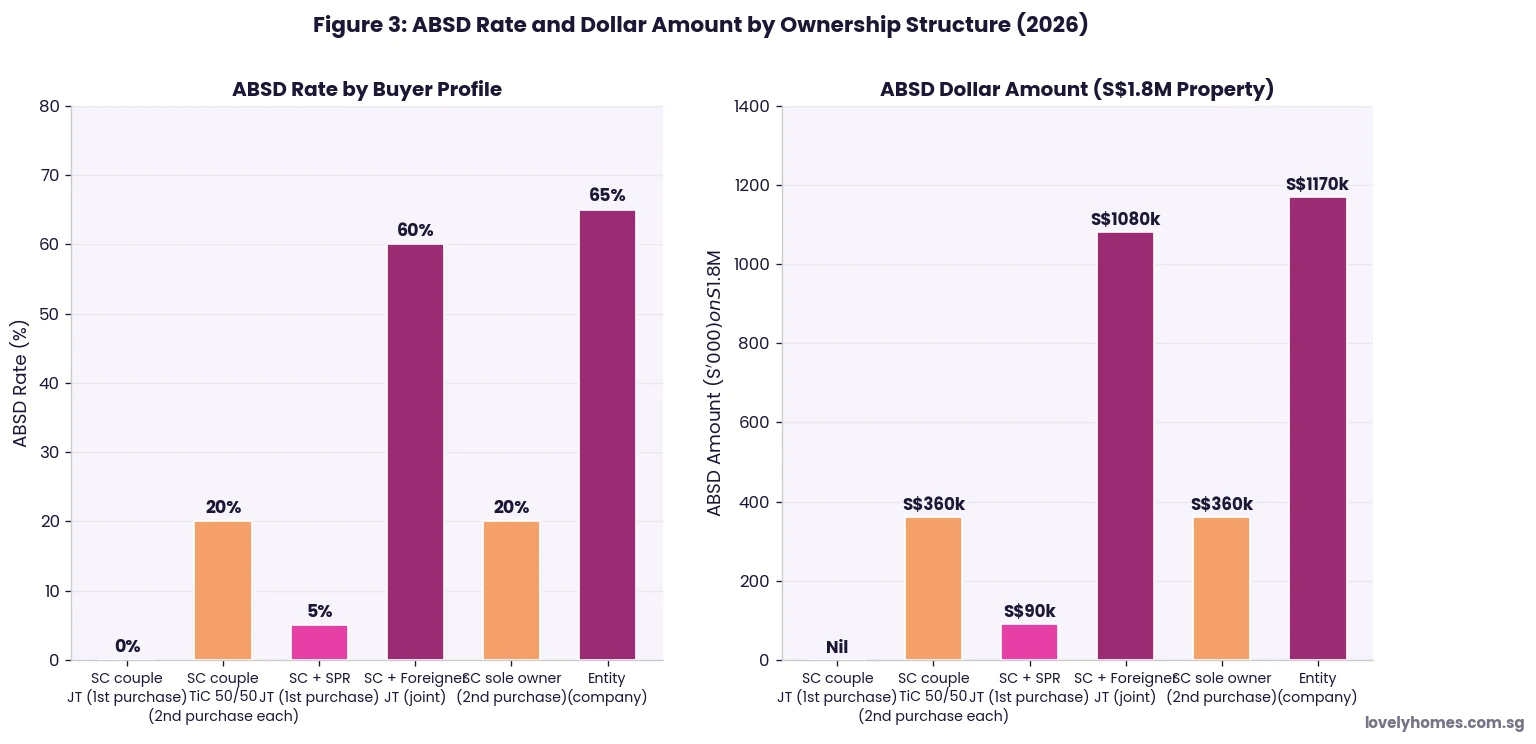
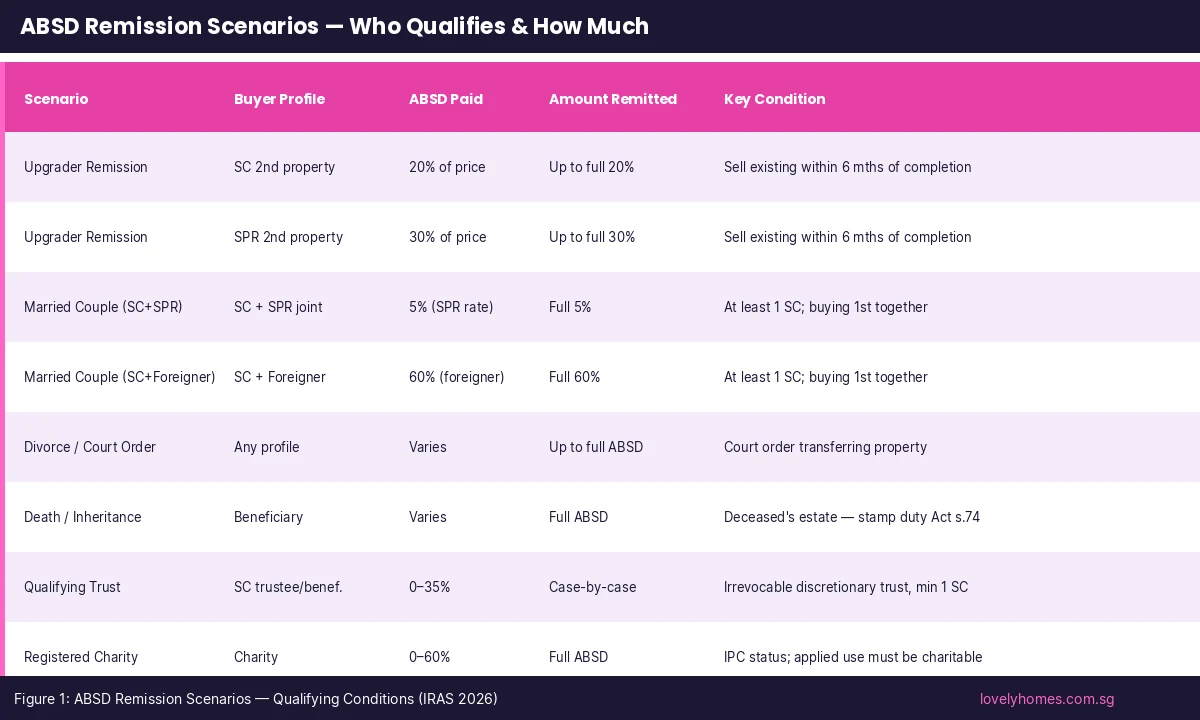
ABSD applies at the same rates as for any private residential purchase: SC first property 0%, SC second 20%, SC third+ 30%; SPR first 5%, SPR second 30%; foreigner 60%. There are no ABSD concessions specific to strata landed — the strata nature of the title does not affect ABSD liability.
Financing: LTV, TDSR and CPF
Bank financing for cluster housing follows the same framework as private condos: LTV up to 75% of the lower of purchase price or market valuation (first property, no outstanding loans), subject to a 55% Total Debt Servicing Ratio (TDSR) and 30% Mortgage Servicing Ratio (MSR, applicable only for HDB purchases). CPF Ordinary Account may be used for the downpayment and monthly instalments on residential strata landed property, subject to the Valuation Limit and Withdrawal Limit rules.
Seller’s Stamp Duty (SSD)
The four-year SSD regime introduced on 4 July 2025 applies fully to cluster housing: sell within Year 1 = 16%, Year 2 = 12%, Year 3 = 8%, Year 4 = 4%. Hold beyond four years and no SSD applies.
Understanding MCST Fees and What They Cover
Unlike standalone landed homeowners who manage their own upkeep entirely, cluster house owners pay monthly MCST contributions. These comprise two components:
- Management fund contributions (monthly): cover day-to-day operating expenses — security guard services, pool maintenance, landscaping, utilities for common areas, lift maintenance (where applicable), pest control, and MCST administrative costs.
- Sinking fund contributions (monthly): set aside for long-term capital expenditure — repainting the development, replacing pool pumps, resurfacing driveways, upgrading the guard house, major structural repairs.
Typical monthly MCST fees in 2026 (all-in):
| Property Type / Size | Low-End (S$/mth) | High-End (S$/mth) | Typical Facilities |
|---|---|---|---|
| Cluster terrace, 2,000–2,800 sqft | S$300 | S$500 | Pool, BBQ, 24hr security |
| Cluster terrace, 2,800–3,500 sqft | S$400 | S$650 | Pool, gym, playground, guard |
| Cluster semi-D, 3,500–5,000 sqft | S$500 | S$900 | Pool, gym, clubhouse, tennis |
| Cluster bungalow, 4,000–6,000 sqft+ | S$700 | S$1,300 | Full resort facilities, lift |
Before purchasing, check the MCST’s Annual General Meeting (AGM) minutes (last two years), the current sinking fund balance relative to the development’s age and size, and whether any special levies are pending. An underfunded sinking fund in an ageing development is a red flag — residents may face unexpected large levies. Sellers are obliged to disclose outstanding MCST debts to buyers as part of completion.
Worked Example: SPR Couple Buying Cluster Terrace
Mr and Mrs Patel — SPR Joint Purchase, Cluster Terrace, S$3.8 Million
Property: Cluster terrace, 2,800 sqft built-up, private garden, Sengkang (D19). New launch from developer.
Buyer profile: Mr Patel (Indian national, SPR); Mrs Patel (Indian national, SPR). Joint purchase. First property for both.
Stamp duties:
BSD: S$167,600 (4.41% effective rate on S$3.8M — calculated in full above).
ABSD: 5% × S$3.8M = S$190,000 (SPR first property).
Total stamp duties: S$357,600.
Financing:
LTV 75%: bank loan S$2,850,000. Downpayment 25%: S$950,000 (minimum 5% cash = S$190,000; balance S$760,000 may use CPF OA if available).
Assume S$190,000 cash + S$420,000 CPF + S$340,000 cash top-up (balance of 25%).
Bank loan S$2.85M @ 3.0% p.a., 30-year term → monthly instalment ~S$12,010/mth.
Gross income needed for TDSR 55%: S$12,010 / 0.55 = S$21,836/mth joint — Mr Patel S$14,000 + Mrs Patel S$10,000 = S$24,000/mth. TDSR PASS (50.0%).
MCST: S$480/mth (pool, gym, 24hr guard, landscaping).
Property tax (OO, est. AV ~S$48,000): ~S$3,160/yr (OO rate).
Total upfront costs: BSD + ABSD + legal S$4,500 + 25% downpayment = S$357,600 + S$4,500 + S$950,000 = S$1,312,100.
Monthly holding costs: Mortgage S$12,010 + MCST S$480 + property tax S$263 = ~S$12,753/mth.
Note: As SPR buyers, Mr and Mrs Patel enjoy one key advantage over standalone landed: no SLA approval required. Had they bought a standalone terrace, they would first need CRP clearance from the SLA — a discretionary process with no guaranteed outcome. The cluster house route removes that uncertainty entirely.

Strata Landed vs Standalone Landed: The Trade-Off
The choice between cluster housing and standalone landed involves meaningful trade-offs:
| Factor | Strata-Titled Landed (Cluster) | Standalone Landed |
|---|---|---|
| Eligibility (PR) | ✅ No approval needed | ⚠️ CRP required from SLA |
| Eligibility (Foreigner) | ✅ Permitted (+60% ABSD) | ❌ Generally not permitted |
| Freehold land ownership | ❌ Share in common land | ✅ Your land title |
| Renovation freedom | ⚠️ Limited by MCST by-laws | ✅ Subject only to URA/BCA rules |
| Shared facilities | ✅ Pool, gym, BBQ, security | ❌ Self-funded only |
| Monthly MCST fees | ⚠️ S$300–S$1,300/mth | ✅ None |
| Security | ✅ Guardhouse, access control | ⚠️ Self-arranged |
| Privacy | ⚠️ Shared driveway, neighbours | ✅ Highest privacy |
| Price (equivalent location) | ✅ 15–25% cheaper | ❌ Price premium |
| Capital appreciation | ⚠️ Slightly lower vs standalone | ✅ Historically stronger |
What Might Come Next
Strata-titled landed remains a niche but growing segment of Singapore’s residential market. Several trends may shape the sector in the near term. First, the continued rise in standalone landed prices — driven by very limited GLS supply — is pushing more upgraders towards cluster housing as an accessible landed alternative. Second, developers have increasingly favoured mixed strata-landed and condo components within the same development (e.g., Jervois Prive), blurring the boundary between condo and landed lifestyle. Third, the government has shown no intention of reclassifying strata-landed as “restricted” under the RPA, so PR and foreigner access is expected to remain in place. However, ABSD policy for foreigners (currently 60%) is a political lever — any material change would affect foreign demand for this segment immediately.
Frequently Asked Questions
Is a cluster house the same as a townhouse? What about a shophouse?
The terms overlap informally but have distinct legal meanings in Singapore. A cluster house is a strata-titled landed residential unit within a development — each unit has its own ground floor, private yard/garden, and may span multiple storeys. A townhouse typically refers to a multi-storey cluster unit with a similar configuration, though the term is not defined in statute. Both are strata-titled landed in legal terms. A shophouse, by contrast, is a conservation building with commercial use on the ground floor; it is categorised as a non-residential or mixed-use property and carries a different BSD/property tax regime, plus distinct SLA rules for foreign purchasers (who generally may buy shophouses with mixed commercial use).
Can an SPR buy a cluster house on a HDB concession loan?
No. HDB concessionary loans are available only for the purchase of HDB flats. Private residential properties — including strata-titled landed cluster houses — must be financed through commercial bank loans, subject to the LTV cap of 75% (first property), TDSR 55%, and the prevailing mortgage rates offered by licensed financial institutions. There is no government-subsidised loan for private property in Singapore regardless of the buyer’s residency status.
What renovations am I allowed to carry out in a cluster house?
MCST by-laws typically prohibit or restrict works that affect the common property, structural elements, or the external facade of the development. You generally need MCST approval before making external alterations (e.g., installing a patio cover, enlarging windows), carrying out structural works, or adding fixtures that penetrate the boundary wall between your unit and common property. Internal works (painting, flooring, kitchen and bathroom fittings) are usually permitted without MCST approval but may require prior notification if they create noise or affect building services. For all works, standard URA development control rules and BCA building regulations apply — a licensed contractor must be engaged for structural work. Unlike standalone landed owners who deal only with URA/BCA, cluster house owners have an additional layer of MCST approval to navigate.
If I own a cluster house, can I also own an HDB flat?
No. If you (or any occupier of your household nucleus listed in your HDB application) owns a private residential property — including a strata-titled cluster house — you are not eligible to own an HDB flat simultaneously, subject to limited exceptions. HDB rules require flat owners to dispose of any private residential property within six months of purchasing an HDB flat (for resale flats), and bar current private property owners from applying for BTO flats. ECs privatised after 10 years are treated as private property for HDB eligibility purposes. If you already own an HDB flat, buying a cluster house requires you to sell the flat within six months of the cluster house purchase, unless you are beyond the HDB Minimum Occupation Period (MOP) and comply with the HDB’s concurrent ownership rules.
Does strata-titled landed property qualify for ABSD remission for SC upgraders?
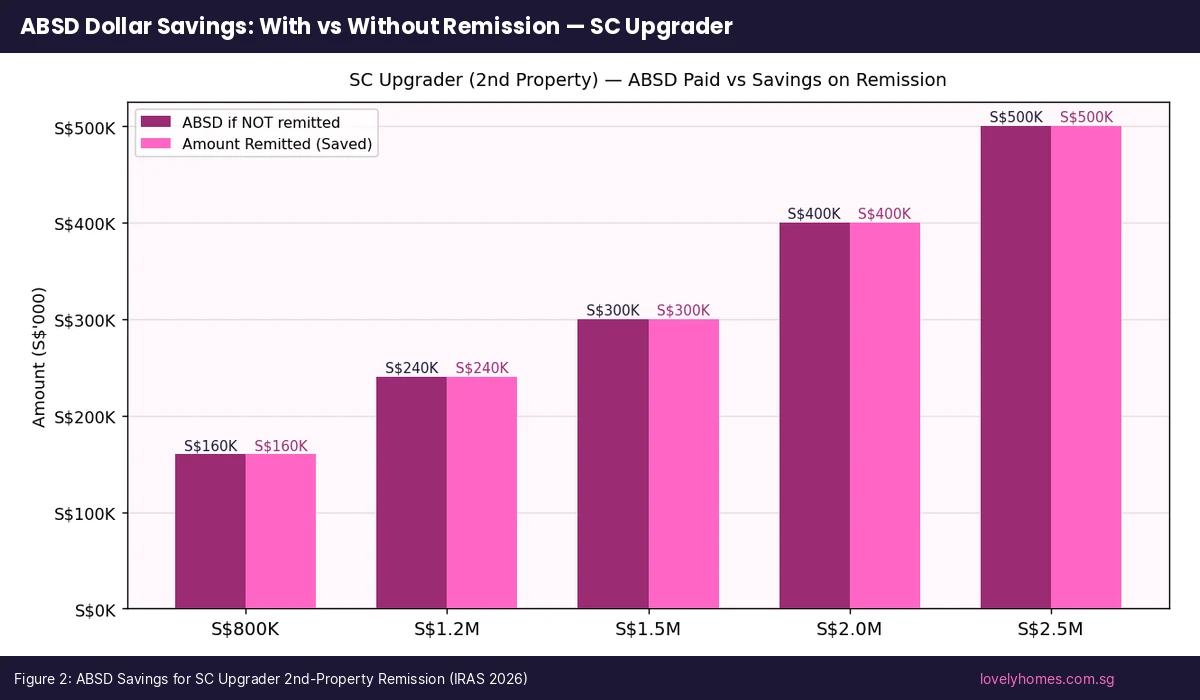
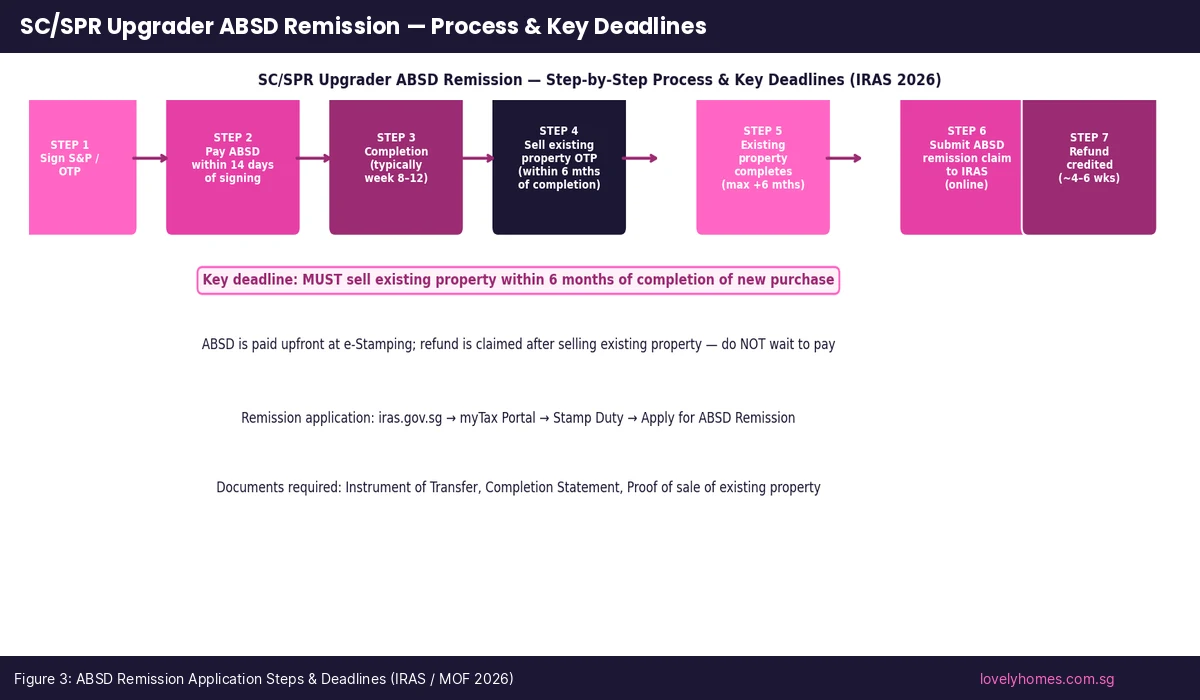
Yes. The ABSD upgrader remission available to Singapore Citizen (SC) married couples applies to strata-titled landed purchases in the same way as to any private residential property. If an SC married couple purchases a cluster house while still owning an HDB flat, they pay 20% ABSD upfront on the cluster house, then apply for a refund after selling the HDB flat within six months of the cluster house’s Temporary Occupation Permit (TOP) issue date or date of purchase (for resale cluster houses). The ABSD remission is a refund — IRAS does not waive the payment upfront. The eligibility requirements (SC couple, at least one spouse must be SC, no third residential property) are identical to those for upgrading to a private condo.
How is property tax assessed on a cluster house compared to a standalone landed home?
Property tax is based on Annual Value (AV), which IRAS determines by referencing comparable rental transactions. For a cluster house, IRAS typically looks at rental transactions for similar strata-landed properties in the same development or nearby comparable cluster developments. Because cluster houses rent at slightly lower rates per sqft than equivalent standalone landed (partly due to the shared driveway and MCST constraints), their AVs tend to be assessed somewhat lower than standalone equivalents of the same floor area, making property tax marginally more favourable. For a cluster terrace with AV around S$45,000–S$55,000 owner-occupied, the annual tax would be approximately S$3,000–S$4,640 under the 2026 owner-occupier schedule — comparable to a large CCR condo, and well below the S$12,000–S$20,000 that a standalone terrace of similar rental value would attract under non-OO rates.
What should I look for in the MCST accounts before buying a cluster house?
Request the last two years of AGM minutes and the current MCST financial statements (management fund balance and sinking fund balance). Key red flags: sinking fund below S$500,000 for a development older than 10 years with more than 30 units (may signal deferred maintenance); pending special levies for major works; recurring disputes in AGM minutes about unpaid contributions; and a high percentage of units with overdue MCST fees (signals financial stress in the development). Also check whether there are any pending legal actions against the MCST or individual owners, and whether the MCST has current insurance covering the common property. A well-managed MCST with a healthy sinking fund and regular maintenance is a key quality-of-life factor in cluster living and supports property values.
Related Articles
- Buying Landed Property Singapore 2026: Eligibility, GCB Rules, BSD and Step-by-Step Guide
- Singapore Condo MCST Guide 2026: Maintenance Fees, AGM, By-Laws and Your Rights as a Subsidiary Proprietor
- ABSD Singapore 2026: Complete Guide to Additional Buyer’s Stamp Duty
- Singapore Buyer’s Stamp Duty (BSD) 2026: Rates, Calculations and Worked Examples
- Singapore Seller’s Stamp Duty (SSD) 2026: New 4-Year Holding Period, Rates and Exemptions
- Using CPF to Buy Private Property in Singapore 2026: Valuation Limit, Withdrawal Limit and Accrued Interest
- Singapore Foreign Buyer Property Guide 2026: ABSD 60%, Eligibility and Property Types Explained
- Singapore Annual Property Tax Guide 2026: Annual Value, IRAS Rates and 2026 Rebate Explained
Disclaimer
This article is intended for general informational purposes only and does not constitute legal, tax, or financial advice. Eligibility rules, stamp duty rates, MCST regulations, and ABSD rates for strata-titled landed property are governed by Singapore statute and administrative guidelines that are subject to change by the relevant authorities. The Singapore Land Authority (SLA) administers the Residential Property Act; the Building and Construction Authority (BCA) administers the BMSMA; and IRAS administers stamp duties and property tax. Readers should obtain independent legal, tax, and financial advice specific to their circumstances before entering into any property transaction. Price and market data are illustrative based on industry information current as at June 2026.