HDB CPF Housing Grant Guide 2026: EHG, Family Grant, Step-Up, PHG and Singles Grant Explained

HDB CPF Housing Grant Guide 2026: EHG, Family Grant, Step-Up, PHG and Singles Grant Explained

×

Click outside or press Esc to close

For most Singaporeans, the CPF Housing Grant system is the single most valuable financial lever available when buying an HDB flat. The right grant — or combination of grants — can reduce the purchase price by S$30,000 to S$160,000 and cut the cash outlay needed at the point of sale dramatically. Yet many buyers remain unclear about which grants they qualify for, how the grants interact, and what happens when eligibility conditions change before completion. This guide covers every HDB CPF Housing Grant available in 2026: the Enhanced CPF Housing Grant (EHG), Family Grant, Step-Up CPF Housing Grant, Proximity Housing Grant (PHG), and the Singles Grant — with full eligibility tables, income ceiling rules, and a worked example.

Quick Answer — HDB Grants at a Glance (2026)

  • The Enhanced CPF Housing Grant (EHG) provides up to S$80,000 for first-timer SC couples buying BTO or resale flats (income ceiling S$9,000/mth).
  • The Family Grant provides S$80,000 (SC couple, BTO) to S$50,000 (resale), on top of EHG — making combined grants up to S$160,000 for qualifying couples.
  • The Step-Up CPF Housing Grant gives second-timer SC families S$15,000 towards a 4-room or smaller BTO flat.
  • The Proximity Housing Grant (PHG) provides S$30,000 (living with) or S$20,000 (living near) parents or child — for resale buyers.
  • The Singles Grant gives eligible single SC applicants aged ≥35 up to S$25,000 towards a resale flat or S$25,000 for a 2-room BTO.
  • All grants are administered by HDB and applied via the HDB Flat Portal (homes.hdb.gov.sg) — not through the CPF Board directly.
  • Grants offset the purchase price and reduce the HDB loan quantum required; they are not paid in cash to the buyer.

What Are HDB CPF Housing Grants and Who Administers Them?

HDB CPF Housing Grants are subsidies provided by the Housing and Development Board (HDB) under Singapore’s public housing policy. Despite the “CPF” label, the grants are designed and administered entirely by HDB; the Central Provident Fund (CPF) Board plays a secondary role in that CPF Ordinary Account (OA) savings may be used to fund the portion of the flat price not covered by grants. The grants exist because HDB’s policy mandate — set by the Ministry of National Development (MND) — is to ensure that public housing remains affordable across a wide income range. Grants are structured to taper off as household income rises, so they provide the greatest assistance to lower-income first-time buyers.

Importantly, grants are credited directly to reduce the flat’s purchase price or loan quantum — they are never paid to buyers in cash. This means they reduce the amount you borrow (and therefore the interest you pay over the loan tenure) rather than arriving as a lump sum in your bank account. Understanding this distinction is critical when doing upfront cost planning.

Grant Amounts by Household Income — EHG and Family Grant
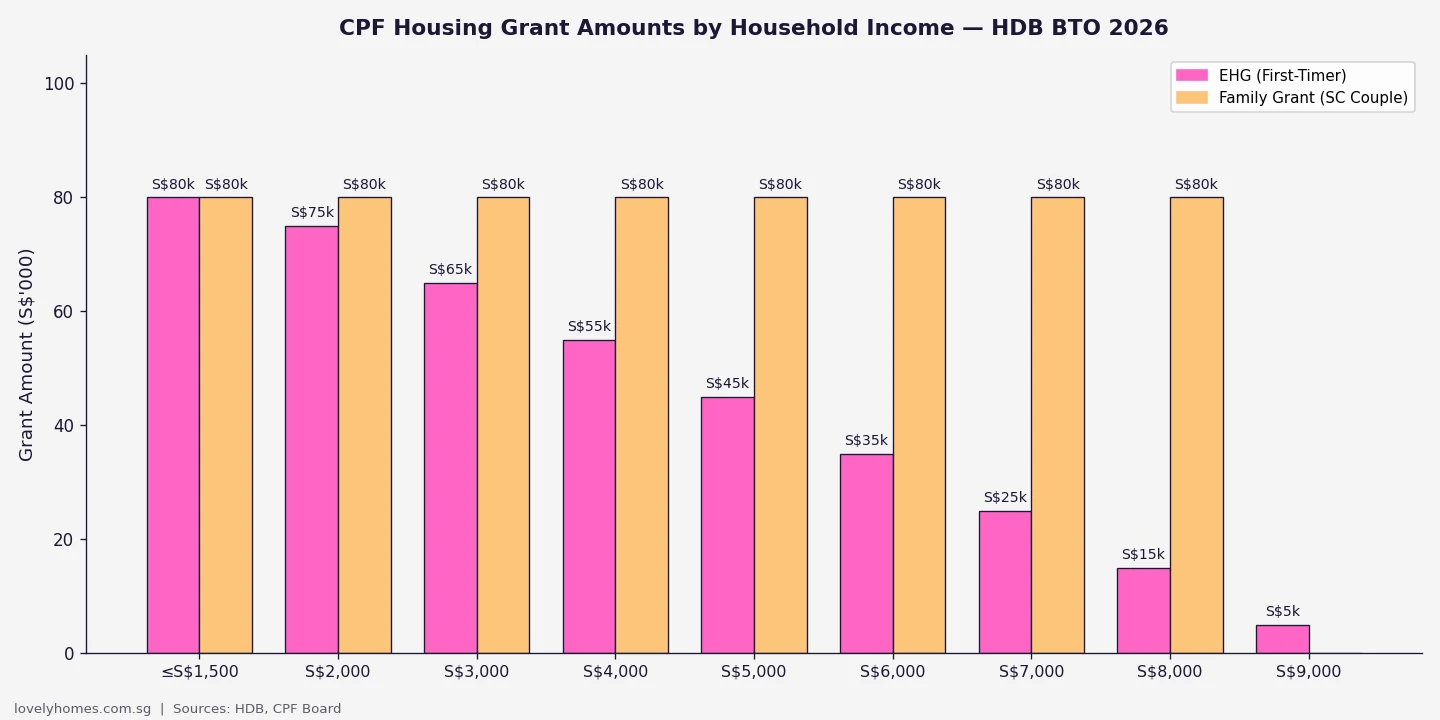
HDB CPF Housing Grant EHG and Family Grant amounts by household income 2026
Figure 1: Enhanced CPF Housing Grant (EHG) and Family Grant amounts by average household income — HDB BTO, SC couple first-timer, 2026. Source: HDB.

The EHG is the largest single grant available and applies across a wide income spectrum. Its key feature is that the grant amount decreases as income rises, in S$5,000–S$10,000 steps, from a maximum of S$80,000 for couples earning S$1,500 per month or less, stepping down to S$5,000 for couples earning between S$8,500 and S$9,000 per month. Couples with a gross monthly income above S$9,000 do not qualify for the EHG. Importantly, “household income” for grant purposes is the average gross monthly income of all working persons listed on the flat application, typically the two applicants and any occupants who are working.

Grant Eligibility Matrix — Who Qualifies for What
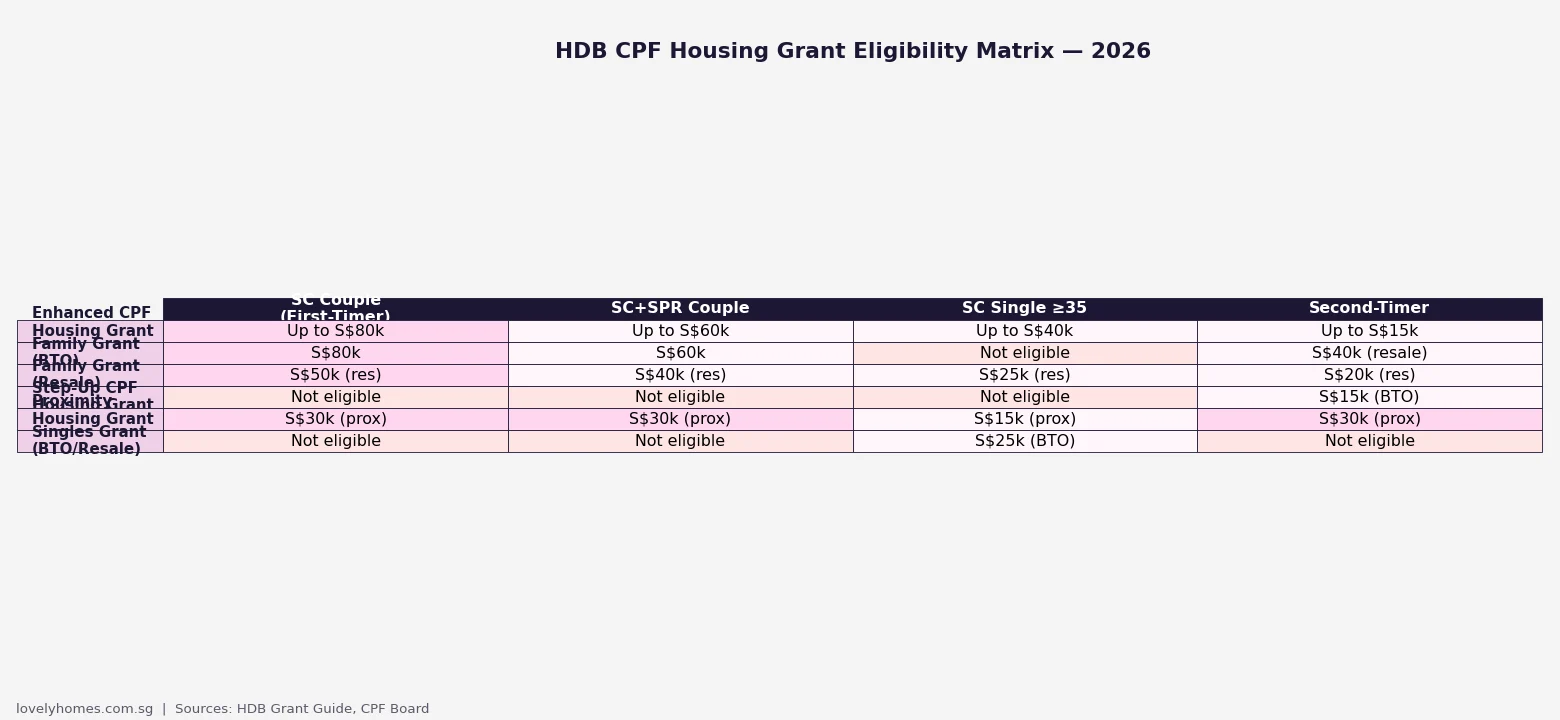
HDB CPF Housing Grant eligibility matrix 2026 — EHG Family Grant Step-Up PHG Singles
Figure 2: HDB CPF Housing Grant eligibility matrix — key buyer profiles versus grant type (2026). Source: HDB Grant Guide.

The matrix above illustrates how grants are layered across buyer profiles. An SC couple buying a BTO as first-timers can potentially stack the EHG (up to S$80,000) and the Family Grant (S$80,000), for a combined S$160,000 grant — the maximum available under any HDB grant combination. SC/SPR mixed-citizenship couples receive the Family Grant at a lower quantum (S$60,000 for BTO; S$50,000 for resale) and are eligible for the EHG, but at the EHG rate applicable to the SPR-tier income rules. Singles aged 35 and above receive a dedicated Singles Grant and are eligible for a scaled-down EHG.

Deep Dive: The Five Main HDB Grants in 2026

1. Enhanced CPF Housing Grant (EHG)

The EHG replaced the Additional CPF Housing Grant (AHG) and Special CPF Housing Grant (SHG) in September 2019. It is the most broadly applicable grant and covers both BTO and resale applications. Key conditions include: both applicants must have worked continuously for at least 12 months before the application date; the flat must not exceed a purchase price ceiling (for resale, the flat must be valued within the HDB resale price cap for the flat type and town); and applicants must not currently own or have disposed of private residential property within 30 months of application. The EHG applies regardless of flat type or location — a unique feature distinguishing it from the old SHG, which was restricted to non-mature estates.

2. Family Grant (BTO and Resale)

The Family Grant is citizenship-tiered and applies on top of the EHG. For SC-SC couples purchasing a new BTO flat, the Family Grant is S$80,000 regardless of income (subject to the S$14,000/mth income ceiling). For SC-SPR couples, the BTO Family Grant is S$60,000. For resale purchases, the quantum is S$50,000 (SC-SC) or S$40,000 (SC-SPR). The Family Grant can also be claimed by first-timer applicants who are singles applying under the Joint Singles Scheme, though the quantum is halved. There is no separate income ceiling for the Family Grant beyond the general resale/BTO eligibility income ceiling of S$14,000 per month gross household income.

3. Step-Up CPF Housing Grant

The Step-Up Grant is specifically for second-timer SC families — meaning applicants who previously owned or occupied an HDB flat, received a housing subsidy (including previous BTO application grant), or are currently living in a subsidised rental flat. The grant amount is S$15,000 and applies only to the purchase of a 4-room or smaller BTO flat. It is HDB’s way of facilitating the upgrading or right-sizing journey for mature families, while channelling the most significant grants to genuine first-timers. The income ceiling is S$7,000 per month.

4. Proximity Housing Grant (PHG)

The PHG is unique in that it is available for resale flat purchases only — it does not apply to BTO. It rewards buyers who choose to live near their parents or adult children. The quantum is S$30,000 if you buy a resale flat to live with parents or an unmarried child, and S$20,000 if you buy within 4 km of parents or a married child’s home. PHG can be combined with the EHG and Family Grant for resale purchases, making it a powerful stacking grant for families with a proximity reason to choose resale over BTO. There is no income ceiling for the PHG — it is available across all income levels subject to basic HDB eligibility.

5. Singles Grant

The Singles Grant is available to SC singles aged 35 and above applying for a 2-Room Flexi BTO flat or a resale flat. The quantum is S$25,000 for resale (4-room or smaller) and a scaled-down EHG for 2-Room Flexi BTO applications. Since January 2024, singles have been able to apply for 4-room resale flats (previously restricted to 5-room or smaller), broadening the effective pool. Singles who subsequently marry and upgrade to a larger flat may be treated as first-timers for the purposes of the EHG and Family Grant, subject to HDB’s conditions at the time of the subsequent purchase.

Summary Table — 2026 HDB Grant Quantum at a Glance

Grant Max Quantum Income Ceiling BTO / Resale
Enhanced CPF Housing Grant (EHG) S$80,000 S$9,000/mth Both
Family Grant (SC couple, BTO) S$80,000 S$14,000/mth BTO
Family Grant (SC couple, Resale) S$50,000 S$14,000/mth Resale
Family Grant (SC+SPR, BTO) S$60,000 S$14,000/mth BTO
Step-Up CPF Housing Grant S$15,000 S$7,000/mth BTO (4-room or smaller)
Proximity Housing Grant — With S$30,000 No ceiling Resale only
Proximity Housing Grant — Near S$20,000 No ceiling Resale only
Singles Grant (Resale) S$25,000 S$7,000/mth Resale (4-room or smaller)

Grant Impact on Upfront Cost — Three Worked Scenarios
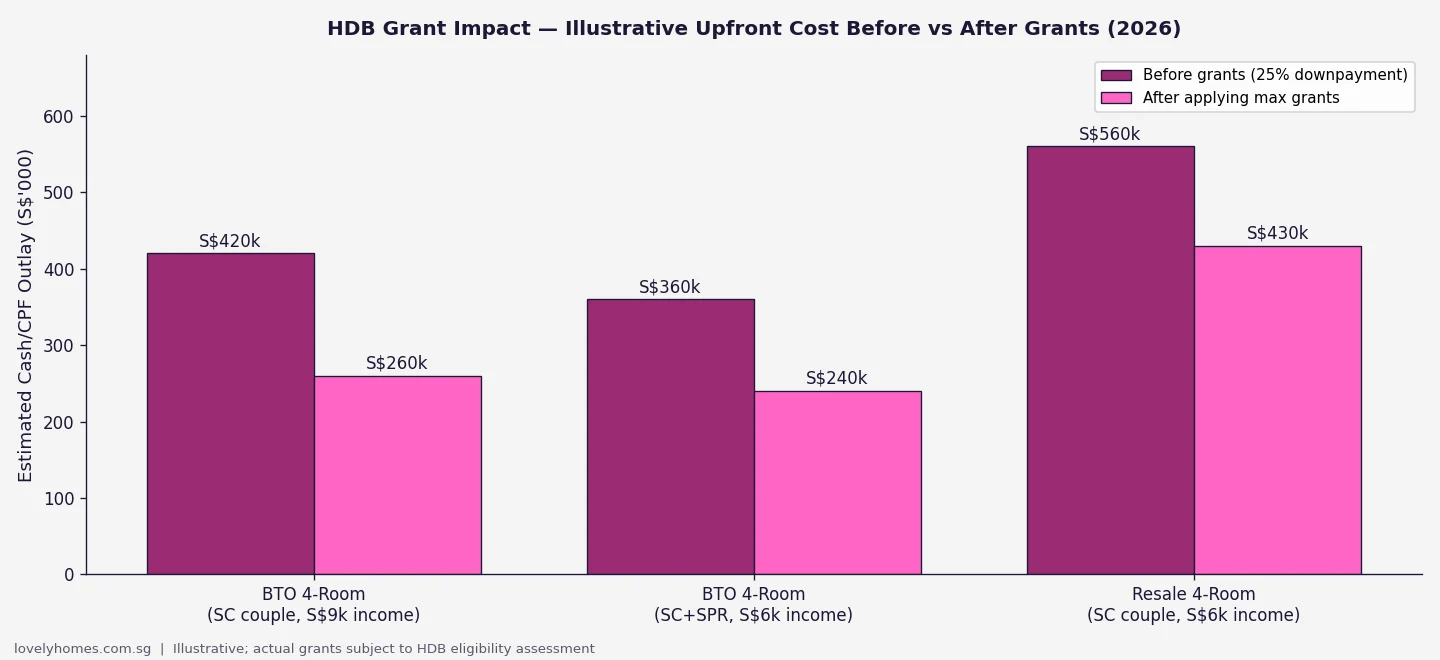
HDB grant impact on upfront cost before and after grants BTO resale 2026
Figure 3: Illustrative upfront cost (downpayment + BSD) before and after applying maximum available grants — three buyer scenarios (2026). Source: LovelyHomes estimates based on HDB data.

Scenario A — BTO 4-Room, SC Couple, S$9,000/mth household income: A 4-room BTO flat in a non-mature estate at S$420,000. Gross monthly income is S$9,000 — at the EHG ceiling, so EHG is S$5,000. Family Grant (BTO, SC couple) is S$80,000. Total grants: S$85,000. Adjusted purchase price for grant purposes: S$335,000. 10% downpayment (HDB loan): S$33,500 cash/CPF. BSD on S$335,000: S$5,350. Estimated upfront: ~S$38,850. Without grants: 10% of S$420,000 = S$42,000 + BSD S$6,900 = ~S$48,900. Grant saving: ~S$10,050 in upfront costs, plus S$85,000 reduction in loan principal.

Scenario B — Resale 4-Room, SC+SPR Couple, S$6,000/mth income: Resale flat at S$560,000. EHG at S$6,000 income = S$35,000; Family Grant (resale, SC+SPR) = S$40,000; PHG (living near parents) = S$20,000. Total grants: S$95,000. Adjusted price: S$465,000. 25% downpayment (bank loan): S$116,250. BSD on S$560,000: S$12,200. Upfront: ~S$128,450. Without grants: 25% of S$560,000 = S$140,000 + BSD S$12,200 = ~S$152,200. Grant saving upfront: ~S$23,750 — largely via reduced loan principal.

Scenario C — Single SC, Aged 38, Resale 4-Room, S$5,000/mth income: Resale flat at S$380,000. Singles Grant: S$25,000. EHG (single, S$5,000 income) = S$40,000. Total: S$65,000. Adjusted price: S$315,000. HDB loan 90% LTV: S$283,500; 10% downpayment cash/CPF: S$31,500. BSD on S$380,000: S$6,300. Upfront: ~S$37,800. Without grants: S$38,000 + S$6,300 = ~S$44,300.

Common Pitfalls and Misconceptions

The most common misconception is that HDB grants are paid out as cash. They are not — they reduce the assessed purchase price or outstanding loan, so the benefit is realised over the loan tenure (less interest) rather than immediately. A second common error is failing to check whether either applicant has previously received a housing subsidy. Any prior CPF Housing Grant, AHG, SHG, or EHG will classify you as a “second-timer” for certain grants, which can significantly reduce your eligible quantum. Third, buyers sometimes conflate the EHG income ceiling (S$9,000/mth) with the general HDB eligibility income ceiling (S$14,000/mth for families; S$7,000/mth for singles buying new 2-room BTO). These are separate thresholds — you can be eligible to buy an HDB flat but not eligible for the EHG if your income exceeds S$9,000/mth.

What Might Change — HDB Grant Policy Outlook (2026–2028)

Editorial analysis — not financial advice or a government forecast. Grant amounts have been periodically revised upward since the EHG’s introduction in 2019 to keep pace with rising HDB resale prices. Given that median resale prices have risen materially since 2021, there is broad industry expectation that the income ceilings and/or grant quanta will be reviewed again in either the FY2026 or FY2027 Budget. The Singles Grant was enhanced in January 2024 to allow 4-room resale access; further extension to cover 5-room flats remains a periodic policy discussion. The PHG’s absence from BTO purchases is another area where advocacy groups have sought extension, particularly for couples who choose resale specifically for proximity to elderly parents.

Frequently Asked Questions

Can I get both the EHG and the Family Grant at the same time?
Yes — the EHG and Family Grant are designed to be stacked. A first-timer SC couple buying a BTO flat can receive both grants simultaneously, for a combined maximum of S$160,000 (S$80,000 EHG + S$80,000 Family Grant) if their household income is S$1,500 per month or below. For most couples in the S$6,000–S$9,000 income range, the combined grant will be in the S$95,000–S$130,000 range. For resale purchases, the EHG (up to S$80,000) and Family Grant (up to S$50,000 for SC-SC couples) can similarly be stacked, and the Proximity Housing Grant can be added on top if proximity conditions are met.
What counts as “household income” for grant eligibility?
HDB uses the “average gross monthly household income” over the 12 months before your HDB application as the reference figure. This includes the gross income of all applicants and any listed occupants who are working. Income from employment (salary, allowances, commissions) and self-employment is included. CPF contributions, rental income from existing property, and investment returns are generally excluded. If one applicant is unemployed, their income is counted as S$0 for averaging purposes — which can actually raise grant eligibility for some couples where only one partner works.
Can permanent residents (SPRs) receive HDB grants?
SPRs cannot receive HDB grants in their own right — grants are tied to Singapore Citizenship status. However, in a SC-SPR couple, the SC spouse’s citizenship status makes the household eligible for the Family Grant (at the SC+SPR quantum: S$60,000 for BTO, S$40,000 for resale) and the EHG. The PHG and Step-Up Grant are also available to SC-SPR couples. Couples where both applicants are SPR receive no CPF Housing Grants and must pay full market price for their HDB flat.
What happens to the grant if I sell the flat within the Minimum Occupation Period (MOP)?
Selling an HDB flat before meeting the Minimum Occupation Period (MOP — typically 5 years for standard BTO/resale, 10 years for Prime/Plus location BTO flats purchased on or after the new classification framework) is not permitted. If you are forced to sell due to approved exceptional circumstances before MOP, HDB may claw back the grant amount. After the MOP, you retain the benefit of the grant — but you will not be eligible for further CPF Housing Grants on your next HDB purchase if you have already been classified as a second-timer.
Does the Proximity Housing Grant apply if I buy near a sibling rather than a parent?
No — the Proximity Housing Grant (PHG) applies only to proximity with parents or an unmarried child living with you, or proximity to a married child’s home. Siblings, grandparents, aunts, uncles, or other relatives are not eligible as the proximity anchor. The “living with” condition means the parents are registered as occupants of the flat you purchase. The “living near” condition means your new resale flat must be within 4 km of the parents’ or child’s current home. HDB verifies proximity using registered addresses.
If I previously took a CPF Housing Grant, can I get another one for my next flat?
Generally, no — once you have received a CPF Housing Grant (including the old AHG, SHG, or the current EHG or Family Grant), you are classified as a “second-timer” for subsequent flat purchases. Second-timers can apply for the Step-Up CPF Housing Grant (S$15,000 for 4-room or smaller BTO), but are not eligible for the EHG or Family Grant again. The Singles Grant and PHG may still be available in specific circumstances. This is why it is important to use your first-timer grant status strategically — ideally for the property where you will stay for the long term.
How do I apply for HDB grants and how long does approval take?
Grant applications are integrated into the HDB Flat Portal (homes.hdb.gov.sg) — you apply for grants as part of the flat application process, not as a separate standalone application. For BTO applications, grant eligibility is assessed after the HDB Letter of Offer (LOO) is issued, typically within 3–5 months of the ballot outcome. For resale transactions, grant eligibility is confirmed at the HDB appointment stage, after the Option to Purchase (OTP) has been granted and exercised. HDB typically completes the eligibility assessment within 2–4 weeks of receiving the required income documents. The grant credit appears on your HDB Resale Completion Appointment confirmation or your BTO Signing of Agreement for Lease document.

Related Articles


Disclaimer: This article is produced by the LovelyHomes Editorial Team for informational purposes only and does not constitute financial, legal, or housing advice. Grant amounts, income ceilings, and eligibility conditions are set by HDB and are subject to change without prior notice. All figures cited are based on publicly available HDB data as at June 2026. Readers should verify current grant eligibility and quantum directly with HDB via the HDB Flat Portal (homes.hdb.gov.sg), the HDB InfoWEB, or by calling the HDB Sales/Resale Enquiry hotline. Consult a licensed financial adviser before making any housing or financial decisions.
Singapore HDB BTO Guide 2026: Eligibility, Grants, Step-by-Step Process and Prices Explained

Singapore HDB BTO Guide 2026: Eligibility, Grants, Step-by-Step Process and Prices Explained

Quick Answer — HDB BTO 2026 at a Glance

  • HDB Build-To-Order (BTO) is Singapore’s primary scheme for first-time buyers to purchase a new public flat directly from HDB at a subsidised price, with a 3–5 year construction wait.
  • Since October 2024, all BTO flats fall into one of three tiers — Standard, Plus, or Prime — with progressively tighter resale restrictions as location value increases.
  • The Minimum Occupation Period (MOP) is 5 years for Standard and 10 years for Plus and Prime flats before you can sell or rent out the whole flat.
  • Eligible first-timer families can receive the Enhanced CPF Housing Grant (EHG) of up to S$80,000; singles can receive up to S$40,000.
  • The Proximity Housing Grant (PHG) adds up to S$30,000 for resale buyers living near parents; the Step-Up CPF Housing Grant adds S$15,000 for 2-room Flexi to 3-room upgraders.
  • A valid HDB Flat Eligibility (HFE) letter is mandatory before applying for any BTO or Sale of Balance Flats exercise (introduced May 2023).
  • HDB will launch approximately 19,600 BTO flats in 2026 across four exercises (February, June, October; the fourth in Q4 2026).
  • First-timer applicants who do not book a flat in their first or second ballot receive additional chances through the First-Timer Priority scheme.
  • The Tenants’ Priority Scheme (TCPS) was raised to 10% from the June 2026 BTO exercise, giving current HDB rental tenants a better chance of balloting a flat.
  • BSD applies on all property purchases including BTO; ABSD is nil for Singapore Citizens buying their first residential property.

What Is HDB Build-To-Order (BTO)?

The Build-To-Order scheme is the Housing & Development Board’s main mechanism for selling new public flats to Singaporeans. Unlike the earlier system where HDB built flats speculatively before putting them on the market, BTO works in reverse: HDB announces a project, collects applications for approximately one month, then — only if take-up is sufficient — awards a construction contract and begins building. This demand-driven model, introduced progressively in the early 2000s, reduces the risk of unsold inventory and allows HDB to calibrate supply to genuine demand across Singapore’s towns.

The practical consequence for buyers is a waiting time of three to five years between balloting and key collection, though HDB has been actively piloting shorter-wait BTO projects with waiting times of under three years. As of 2026, projects like Tampines Nova and selected Woodlands projects have offered sub-three-year waiting times under the Short Waiting Time (SWT) initiative.

BTO flats are priced at a discount to the open market to ensure affordability. The subsidy is built into the purchase price — not paid as a separate cheque — and is “clawed back” when you sell the flat by requiring CPF refunds and, in the case of Plus and Prime flats, a percentage of the resale price to be returned to HDB.

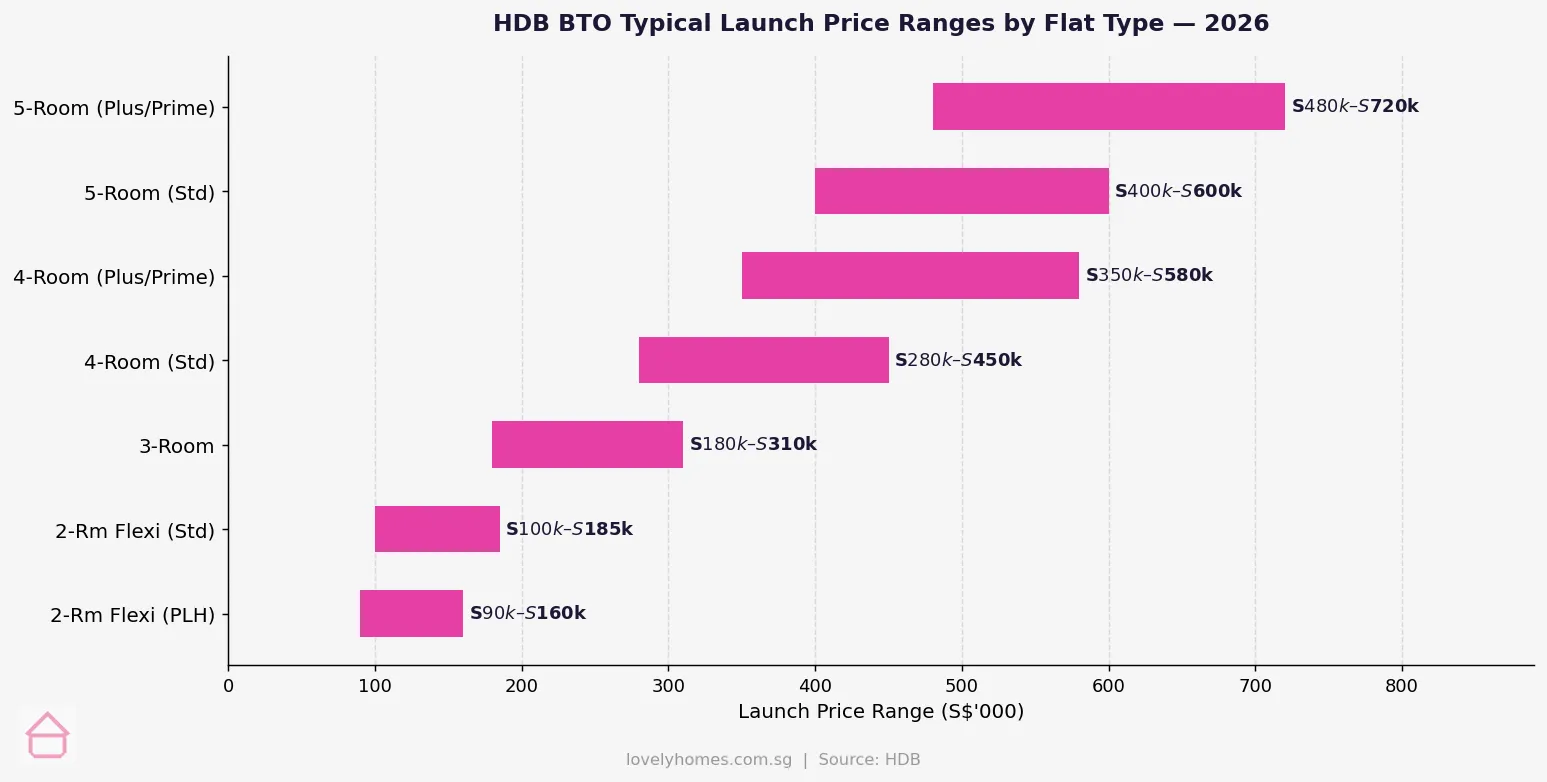
HDB BTO flat type price ranges Singapore 2026 — 2-Room Flexi to 5-Room Plus Prime Standard
Figure 1: Typical HDB BTO launch price ranges by flat type — 2026. Source: HDB. Indicative; actual prices vary by project and location.

Standard, Plus and Prime — The October 2024 Framework

The biggest structural change to the BTO system since the scheme’s launch was the introduction of the Standard, Plus and Prime classification framework in October 2024. The framework replaced the older Build-To-Order and Prime Location Public Housing (PLH) Model and applies to all BTO projects from the October 2024 exercise onwards.

Standard flats are in suburban locations with no exceptional accessibility advantage. They carry the existing 5-year MOP, can be rented out in whole after MOP, and carry no clawback on the resale price. Most estates — Woodlands, Choa Chu Kang, Sembawang, Sengkang — will be Standard designation.

Plus flats are in locations with better-than-average accessibility and amenities — typically mature towns or well-served suburban sites. They carry a 10-year MOP, may not be rented out in whole before the end of MOP, carry a clawback of a percentage of the resale price returned to HDB, and have an income ceiling of S$14,000 per month (identical to Standard in 2026). Bishan, Ang Mo Kio, and many Bukit Merah BTO sites now fall under Plus.

Prime flats are in the most central and accessible locations, including city-fringe and central-area sites such as Queenstown, Kallang/Whampoa, and Henderson. They carry the same 10-year MOP and clawback as Plus, have stricter subletting restrictions, and apply a higher clawback rate. The June 2026 BTO exercise includes Bukit Merah Berlayar, widely expected to be classified as Prime.

The rationale is that public housing subsidies should be appropriately scaled to how choice a location is. A flat at Queenstown — where resale prices touch S$1,000 per square foot — receives a larger implicit subsidy than a flat in Woodlands. The clawback is the mechanism for recapturing some of that subsidy when owners eventually sell at market prices.

Grants: EHG, PHG, Step-Up CPF and More

Singapore’s housing grants form a multi-layered system designed to ensure that the effective cost of a first BTO flat is within reach of lower- and middle-income families. The key grants available in 2026 are:

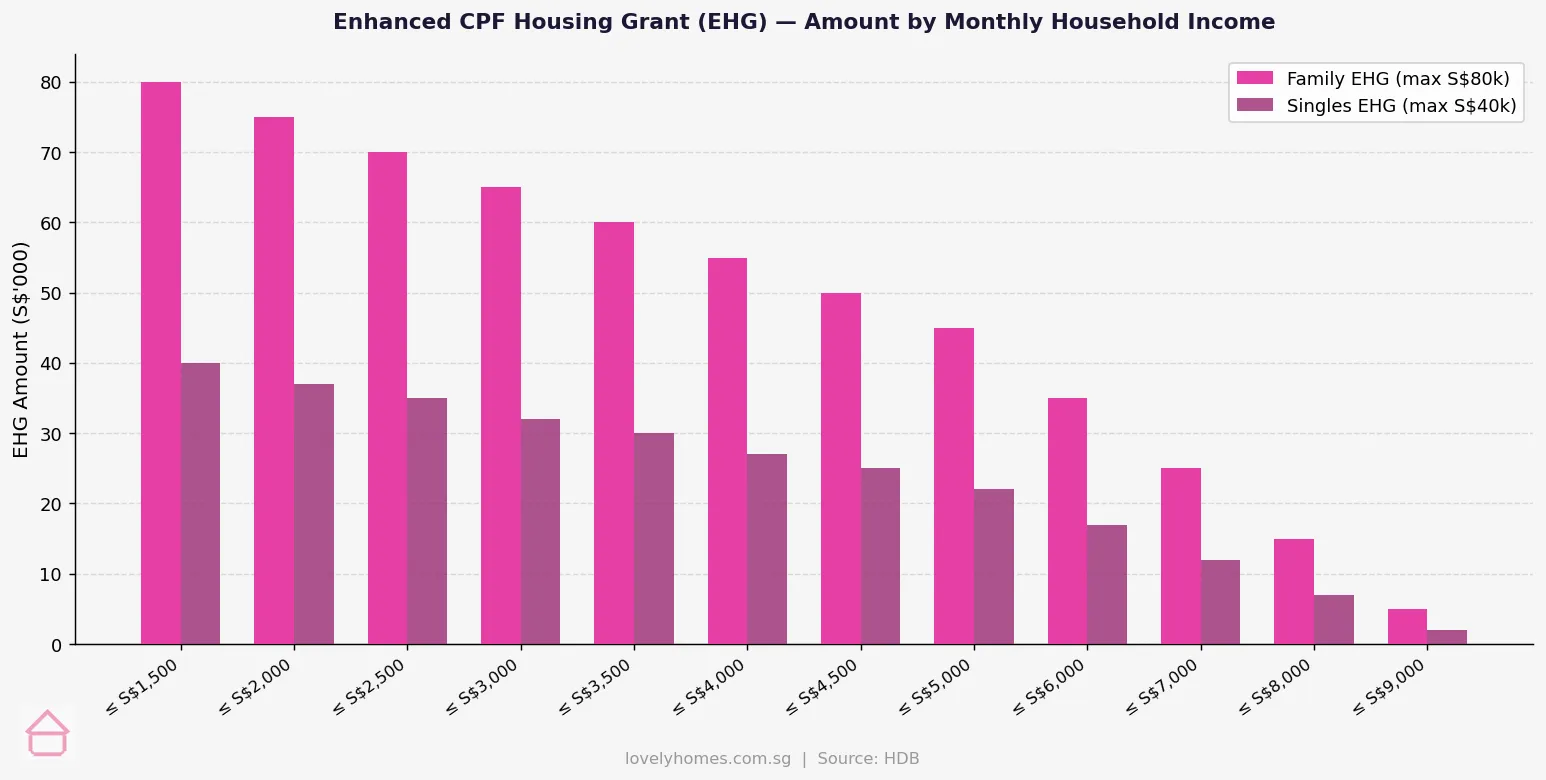
Enhanced CPF Housing Grant (EHG). Administered by CPF Board and HDB jointly, the EHG replaced the Additional CPF Housing Grant and Special CPF Housing Grant in September 2019. It is means-tested against average gross monthly household income over the preceding 12 months. For families, EHG ranges from S$5,000 at an income of S$9,000/month to S$80,000 at an income of S$1,500/month or below. Singles buying a 2-room Flexi flat receive half the family rate. EHG is paid into your CPF Ordinary Account (OA) and can be used for the flat’s purchase price and mortgage payments; it is not a cash grant.

Proximity Housing Grant (PHG). The PHG is available for resale flat purchases (not BTO directly, but relevant to those who buy resale instead of BTO). It pays S$30,000 if you live with parents/children or within 4 km of them, and S$20,000 if you live with or near a sibling. Singles receive half the family rate.

Step-Up CPF Housing Grant. For second-timer applicants who currently live in a 2-room HDB flat (rental or owned) and wish to buy a 2-room Flexi or 3-room BTO flat, the Step-Up Grant provides S$15,000. It recognises that some residents need a nudge rather than a full subsidy to upgrade from the smallest flat types.

Enhanced CPF Housing Grant EHG amount by monthly household income Singapore 2026 families and singles
Figure 2: EHG grant amount by monthly household income — families (max S$80k) vs singles (max S$40k). Source: HDB / CPF Board.

Eligibility: Who Can Apply for a BTO Flat?

BTO eligibility is governed by several overlapping criteria under the Housing and Development Act (Cap. 129). The main conditions in 2026 are:

Citizenship. At least one applicant must be a Singapore Citizen. Singapore Permanent Residents may only apply under the Public Scheme together with a Citizen family member. Foreigners are not eligible to buy new HDB flats.

Age. Applicants must be at least 21 years old for family schemes. Singles may apply from age 35 under the Single Singapore Citizen (SSC) Scheme, but only for 2-room Flexi flats in non-mature estates.

Family nucleus. Eligible family units include married couples, fiancé/fiancée (Option to Purchase granted on condition of marriage within 3 months), parents with children, and orphaned siblings. Singles must buy alone (no co-applicant outside of parents or siblings if orphaned).

Income ceiling. For Standard and Plus flats, the gross monthly household income ceiling is S$14,000 (S$7,000 for singles). For 2-room Flexi flats in non-mature estates, there is no income ceiling for some schemes.

Ownership restrictions. Applicants must not own or have recently sold private residential property in Singapore or overseas, and must not have enjoyed a previous housing subsidy (e.g., a previous BTO purchase) within the applicable waiting period.

HFE letter. Since May 2023, all applicants must obtain a valid HDB Flat Eligibility (HFE) letter before applying for any BTO or Sale of Balance Flats (SBF) exercise. The HFE letter confirms your eligibility, loan eligibility, and grant amounts in a single integrated assessment. It is valid for 9 months and should be obtained well before any exercise opens.

The Application and Balloting Process

HDB opens BTO application windows for approximately one month, typically twice a year (February and June/July, with an October exercise since 2022). During the window, eligible buyers submit a single application for one project of their choice, along with their preferred flat type. There is no fee to apply.

After the application window closes, HDB runs a computerised ballot to determine the order in which applicants may choose their units. Priority queues exist within the ballot: Married Child Priority Scheme (MCPS) for applicants buying near parents, Multi-Generation Priority Scheme (MGPS) for two households applying together, Tenants’ Priority Scheme (TCPS) for existing HDB rental tenants (raised to 10% from June 2026), and First-Timer Families Priority ensuring first-timers get precedence.

Applicants who are balloted but do not find a flat they want, or who miss their booking appointment, are deemed “unsuccessful” and may re-apply in future exercises. After a first unsuccessful ballot, first-timers receive one additional ballot chance in subsequent applications. After two unsuccessful ballots, they receive priority queue status, significantly improving their odds. HDB has indicated that the median waiting time for a first-timer to successfully book a BTO flat is approximately two application exercises.

Upon selection, applicants pay a booking fee of S$500 to S$2,000 (depending on flat type) and sign the Agreement for Lease, committing to buy the flat. The balance of the purchase price, plus BSD, is paid in tranches as construction milestones are met.

What Does a BTO Flat Actually Cost?

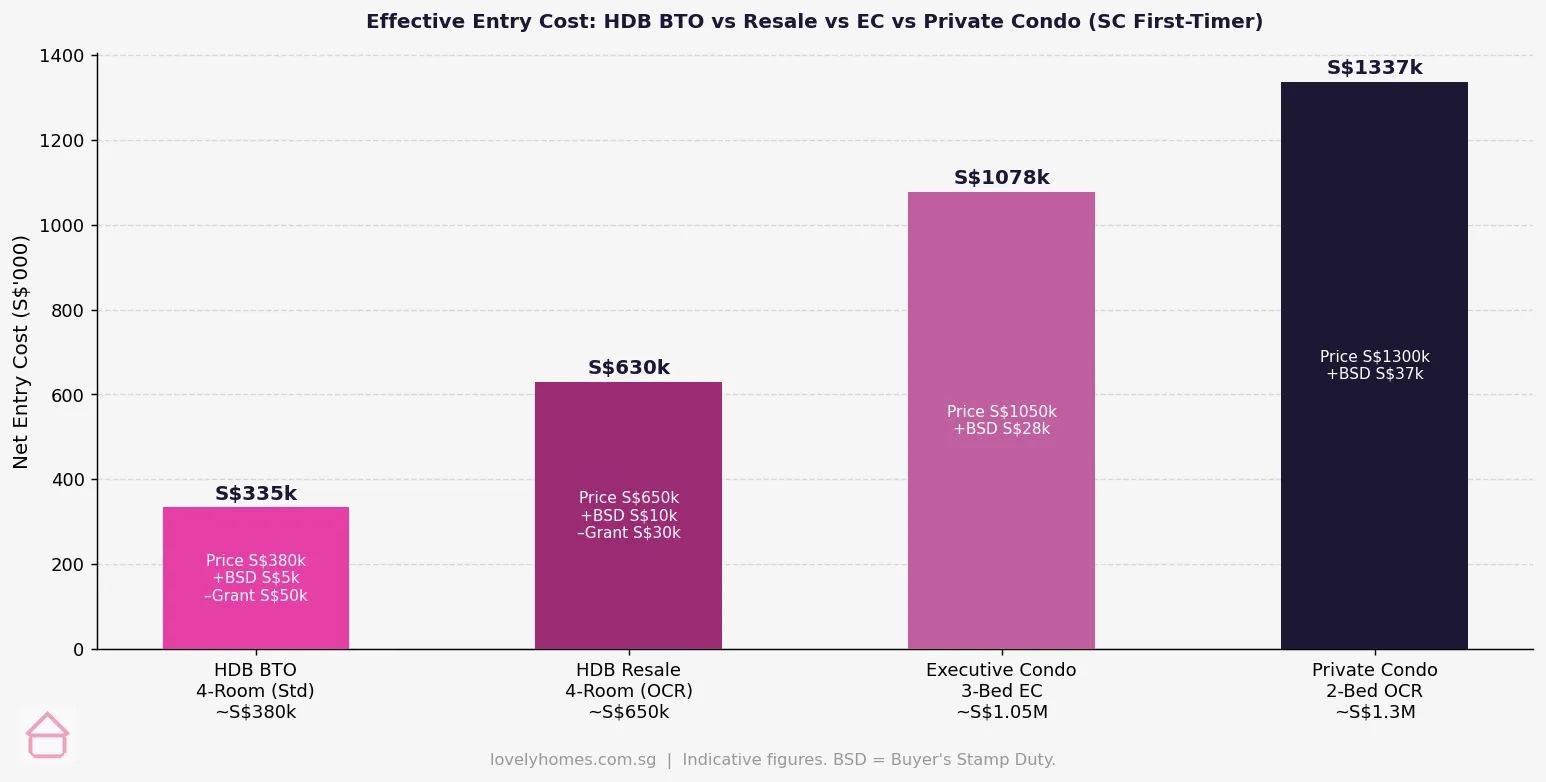
The out-of-pocket cost of a BTO flat depends on flat type, location (Standard vs Plus vs Prime), income-linked grants, whether you use a HDB concessionary loan or a bank loan, and CPF OA balances. The figures below represent the after-grant purchase prices for a typical Singapore Citizen first-timer family with a joint monthly income around S$6,000–8,000.

Net entry cost comparison HDB BTO vs resale vs EC vs private condo Singapore 2026 first-timer buyer
Figure 3: Effective entry cost (after grants, including BSD) — HDB BTO vs resale vs EC vs OCR private condo for a SC first-timer. Indicative figures.

Summary Comparison Table

Parameter Standard BTO Plus BTO Prime BTO HDB Resale
Location Non-mature estates Mature / well-served towns Central / city-fringe Any estate
MOP 5 years 10 years 10 years 5 years (existing MOP)
Whole-unit rental after MOP Yes Yes (after 10yr MOP) Restricted Yes
Resale clawback No Yes (% of resale price) Yes (higher %) No
EHG applicable? Yes Yes Yes Yes
PHG applicable? No No No Yes (up to S$30k)
Typical 4-Room price (2026) S$280k – S$450k S$350k – S$580k S$400k – S$700k S$500k – S$900k
Waiting time 3–5 years 3–5 years 3–5 years Immediate

Worked Example — Mr & Mrs Lim, Bishan Standard 4-Room BTO

Mr and Mrs Lim are a Singapore Citizen married couple in their late 20s. Their combined gross monthly income is S$7,200. They apply for a 4-Room Standard BTO flat in a Bishan project priced at S$395,000 (hypothetical launch price).

Grant calculation: At a household income of S$7,200, EHG for families is S$25,000. The flat is a BTO (not resale), so PHG does not apply. Net purchase price: S$395,000 − S$25,000 = S$370,000.

BSD: On S$370,000 — first S$180,000 at 1% = S$1,800; next S$180,000 at 2% = S$3,600; balance S$10,000 at 3% = S$300. BSD = S$5,700. ABSD: nil (SC first property).

Financing: HDB concessionary loan LTV 80% → loan = S$370,000 × 80% = S$296,000 (subject to HFE eligibility and credit assessment). The couple must fund at least 20% (S$74,000) from CPF OA and/or cash. Monthly instalment on a S$296,000 HDB loan at 2.6% over 25 years: approximately S$1,345 per month. MSR check: S$1,345 / S$7,200 = 18.7% — within the 30% MSR limit. TDSR: 18.7% — well within 55%.

Upfront cash: Booking fee (4-room) S$2,000 + BSD S$5,700 + balance of 20% downpayment via CPF OA S$72,000. If CPF OA balance is below S$72,000, the shortfall must be paid in cash.

Outcome: The Lims can feasibly service the flat on their combined income. The total effective entry cost of S$335,700 (after grants) is S$364,300 less than the equivalent OCR private condo — illustrating the ongoing role of BTO as Singapore’s primary affordability tool.

What Might Come Next — BTO Pipeline for 2026–2028

HDB has confirmed approximately 19,600 BTO flats for 2026 across the four exercises. Noteworthy launches expected in the second half of 2026 and beyond include the Toa Payoh West BTO project slated for the October 2026 exercise — the first significant public housing release in central Toa Payoh in over a decade and almost certain to attract oversubscription as a Standard or Plus project. Pearl’s Hill — a large site in the Chinatown/Outram Park corridor — is expected to yield approximately 1,700 new homes in a future exercise, potentially as a Prime project given its proximity to the CBD.

HDB is also studying the gradual release of land in the Greater Southern Waterfront (GSW) area for public housing over the longer term, and the Tengah “forest town” BTO pipeline will continue with further phases through 2027–2028. Buyers who miss the current exercises should monitor the HDB website for upcoming announcements and apply for an HFE letter in advance.

Frequently Asked Questions

Can I rent out my BTO flat before MOP?

No. You are not permitted to rent out the entire flat before the end of your MOP (5 years for Standard, 10 years for Plus/Prime). You may, however, rent out individual rooms within your flat at any time, subject to HDB’s approval and occupancy limits. Renting out the whole flat before MOP is a breach of the Housing & Development Act and can result in HDB compulsorily acquiring the flat at below-market value.

What happens if I miss my BTO booking appointment?

If you do not attend your booking appointment or decline to select a flat during your appointed slot, your application is cancelled. You forfeit your booking priority for that exercise. You may re-apply in future exercises, but your first-timer queue advantage resets. HDB does not guarantee a rescheduled appointment.

Is a HDB loan or a bank loan better for a BTO flat?

The HDB concessionary loan offers a rate of 0.1 percentage points above the CPF OA rate — currently 2.6% per annum — and is generally lower than bank rates, which were around 3.0–3.5% per annum in 2026. The HDB loan allows an LTV of 80% and does not require a cash downpayment; the full 20% downpayment can come from CPF OA. However, if you take a bank loan, you must pay at least 5% of the purchase price in cash (with the remaining 20% from CPF or cash), and LTV is capped at 75%. For most first-time buyers with limited cash savings, the HDB loan is generally more accessible.

What is the Minimum Occupation Period and does it restart if I sell?

The MOP begins from the date you receive your keys. For Standard BTO flats, MOP is 5 years; for Plus and Prime BTO flats launched from October 2024 onwards, it is 10 years. When you sell and buy a second HDB flat, the MOP for the second flat runs from the date of that flat’s key collection — it does not inherit or carry over from the first flat. Crucially, you must have satisfied the MOP before you are eligible to sell on the open market or purchase a private residential property concurrently with HDB flat ownership.

Can PRs buy a BTO flat?

Singapore Permanent Residents (PRs) cannot buy new BTO flats on their own. A PR can only buy a BTO flat if they are applying together with a Singapore Citizen spouse or family member under an eligible scheme (e.g., Public Scheme). The Citizen must be a co-applicant, not just a supporting document. PRs buying alone may purchase HDB resale flats (but not new BTO units), subject to their own eligibility conditions and a minimum 3-year PR residency requirement.

What is the TCPS and how does it help current HDB tenants?

The Tenants’ Priority Scheme (TCPS) allocates up to 10% of BTO flat supply across all exercises — raised from 5% in the June 2026 BTO exercise — to eligible existing HDB rental flat tenants. To qualify, the applicant must have been living in an HDB rental flat for a minimum period and meet all standard BTO eligibility criteria. The scheme is designed to give long-term rental tenants a pathway to home ownership with a statistical advantage in the ballot. Applications under TCPS count alongside other priority schemes (MCPS, MGPS, First-Timer Priority) where multiple schemes apply.

Related Articles

Disclaimer: This article provides general information about the HDB Build-To-Order scheme and housing grants as at 3 June 2026. It is not financial, legal, or housing advice. Eligibility criteria, grant amounts, income ceilings, and BTO project details are subject to change by HDB and CPF Board. Always verify your eligibility and loan limits with the official HDB website, the CPF Board, and your preferred financial institution before making any property purchase decision.

HDB BTO Application Guide Singapore 2026: Eligibility, Income Ceilings, Ballot & the EIP Quota

HDB BTO Application Guide Singapore 2026: Eligibility, Income Ceilings, Ballot & the EIP Quota

The Build-To-Order (BTO) flat is the default starting point for most Singaporean households — subsidised, brand-new, and built on land released by the Housing & Development Board (HDB) only when there are enough committed buyers. In 2026, every BTO launch in a mature estate sees a 4-7x oversubscription rate; popular projects in Queenstown or Kallang/Whampoa cross 10x. That ballot pressure is why understanding the eligibility schemes, income ceilings, grant stack, and Ethnic Integration Policy quota is the single most leveraged hour you will spend before keying in your application.

This 2026 guide walks you through every gate — from the four eligibility schemes and the S$14,000 income ceiling, through the ballot mechanics and queue numbers, into the grants stack that can knock S$80,000 off your purchase price, and the EIP/SPR quota that decides which racial profiles can bid for which units. Figures reflect HDB’s policy stack as at April 2026.

Quick Answer — BTO at a glance

  • Income ceiling: S$14,000 (combined, family scheme); S$21,000 (extended-family or joint singles); S$7,000 (single SC, 2-room Flexi only).
  • Citizenship: at least one Singapore Citizen for any scheme except Joint Singles (which requires all SC).
  • Minimum age: 21 for couples; 35 for singles applying alone.
  • Ballot: queue number is randomly drawn within priority groups; first-timers get up to 3 queue numbers (vs 1 for second-timers).
  • Top grant stack (first-timer SC+SC): EHG S$120k + Family Grant S$80k + Proximity Grant S$30k = up to S$230k for resale; up to S$80k for BTO.
  • EIP/SPR quotas: apply at both block and neighbourhood level; a unit may show as “quota reached” for your race even if available physically.
  • Application fee: S$10 non-refundable; ballot results in 4–6 weeks.

What is BTO and Why Does the Scheme Exist?

The Build-To-Order scheme is HDB’s primary public-housing supply channel: instead of speculatively building flats and trying to sell them, HDB collects applications first and only proceeds to construction when at least 65–70% of units in a project have committed buyers. The buyer commits early (signing the lease and paying the 5% downpayment) and waits 3.5–4.5 years for completion, in exchange for a steeply subsidised price relative to comparable resale stock.

The scheme replaced an earlier system called Registration for Flats (RFS) in April 2002 and has since become the dominant route for first-time HDB buyers. Roughly 20,000–25,000 BTO flats are launched per year across four launches (typically February, May, August, November). The 2026 supply target announced by the Ministry of National Development is 22,000 units.

The Five Eligibility Schemes — Pick One

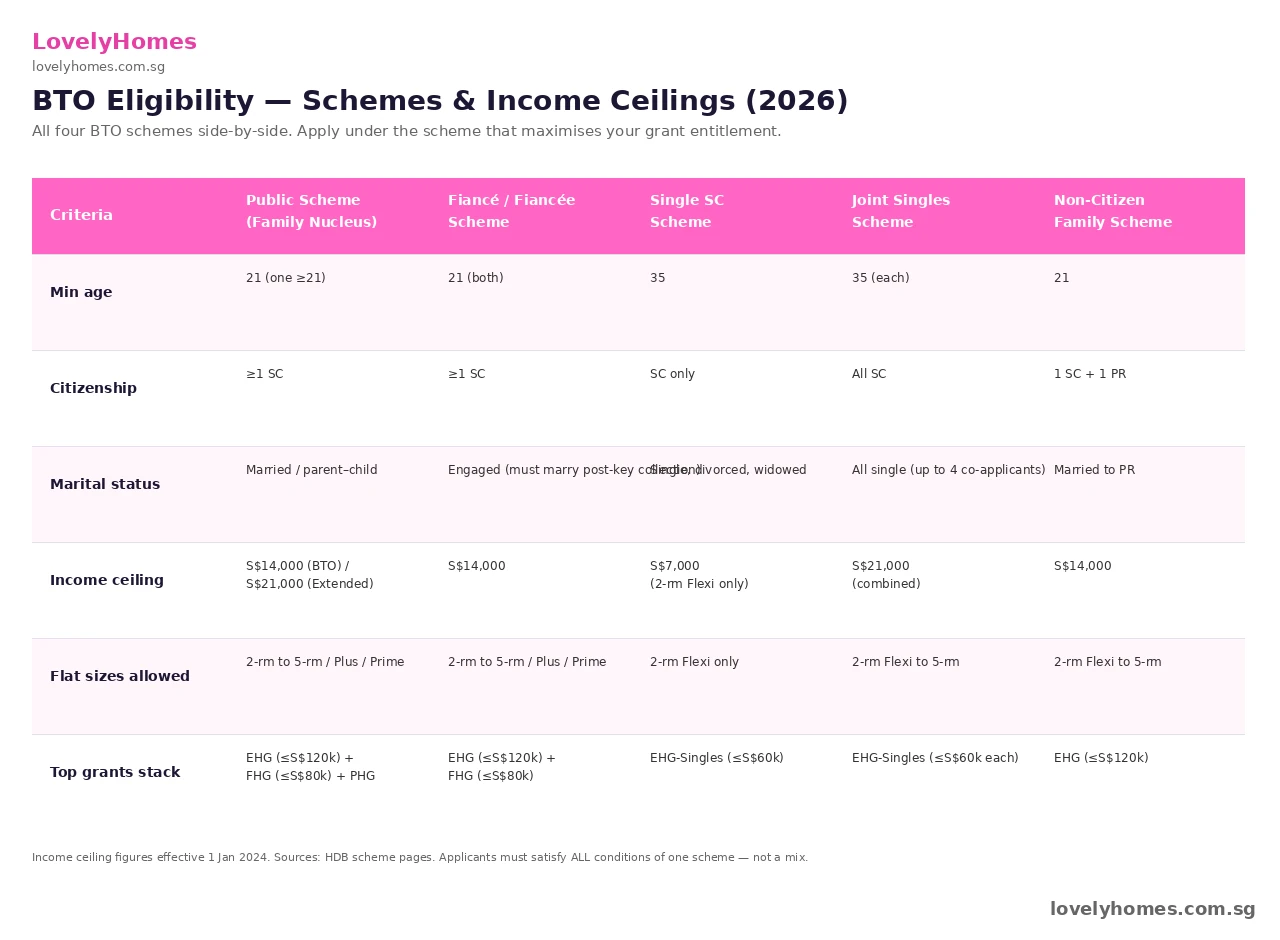
HDB classifies every applicant into exactly one of five schemes. Your scheme determines the income ceiling, age limits, allowed flat sizes, and the grant stack you qualify for. Choosing the right scheme is not optional — HDB will reject the application if you fit one scheme but apply under another.

HDB BTO application guide Singapore 2026 — eligibility schemes and income ceilings comparison
Figure 1: All five BTO eligibility schemes side-by-side — pick the one that maximises your grant entitlement.

Public Scheme (Family Nucleus)

The default scheme for married SC couples or parent-child households. At least one applicant must be a Singapore Citizen and at least one must be 21 or older. Combined gross household income is capped at S$14,000 for a standard application, or S$21,000 for an Extended-Family application (applicant + parents). The full range of flat types is available — 2-room Flexi to 5-room and 3Gen, including Plus and Prime locations.

Fiancé/Fiancée Scheme

For couples not yet married. Both applicants must be 21 or older and at least one a Singapore Citizen. The S$14,000 ceiling applies. The catch: you must produce a marriage certificate within 3 months of key collection, otherwise HDB has the right to repossess the unit. Couples who break off the engagement before key collection can withdraw without forfeiting the option fee.

Single Singapore Citizen Scheme

For singles aged 35 or older holding Singapore Citizenship. Only 2-room Flexi flats are available, and only in selected non-mature estates. Income ceiling is S$7,000. Couples who do not qualify under the Family or Fiancé schemes (e.g. one party is a foreigner) cannot use this route — it is genuinely a singles-only scheme.

Joint Singles Scheme

Two to four singles aged 35+ may co-apply. All must be Singapore Citizens. The combined income ceiling rises to S$21,000. Flat types extend up to 5-room. Joint singles must all hold equal shares; ownership cannot be reorganised after key collection. This scheme is increasingly used by adult siblings and long-term unmarried partners.

Non-Citizen Family Scheme

Where a Singapore Citizen is married to a Singapore Permanent Resident. The SC applicant must be 21 or older, the income ceiling sits at S$14,000, and only 2-room Flexi to 5-room flats are available (Plus and Prime are off-limits). Note: a Singapore Citizen married to a foreigner who is not a PR cannot apply under any HDB scheme — the household must wait for the foreigner to obtain PR status.

Income Ceilings — What Counts and How They Calculate

HDB’s income ceiling is based on average gross monthly household income. “Gross” means before CPF and tax. “Average” means the trailing 12-month average for salaried income; for variable income (commissions, bonuses, self-employment), HDB uses the most recent 24 months, divides by 24, then adds a 30% buffer to be conservative.

Applicants must submit Notice of Assessment (NOA) tax statements, the latest 3 months of payslips, and an Income Declaration (IRAS-issued for self-employed). HDB cross-checks against IRAS records. Inflated declarations to qualify for higher grants will be caught at the HFE (HDB Flat Eligibility) letter stage and the application rescinded; the ban from re-applying is 5 years.

For couples planning a BTO purchase but expecting one party to receive a windfall bonus or commission, timing matters: buy now while the trailing-12-month average is still under the ceiling, or wait until the 12 months have rolled past the bonus event.

The Application Process — What to Do, In Order

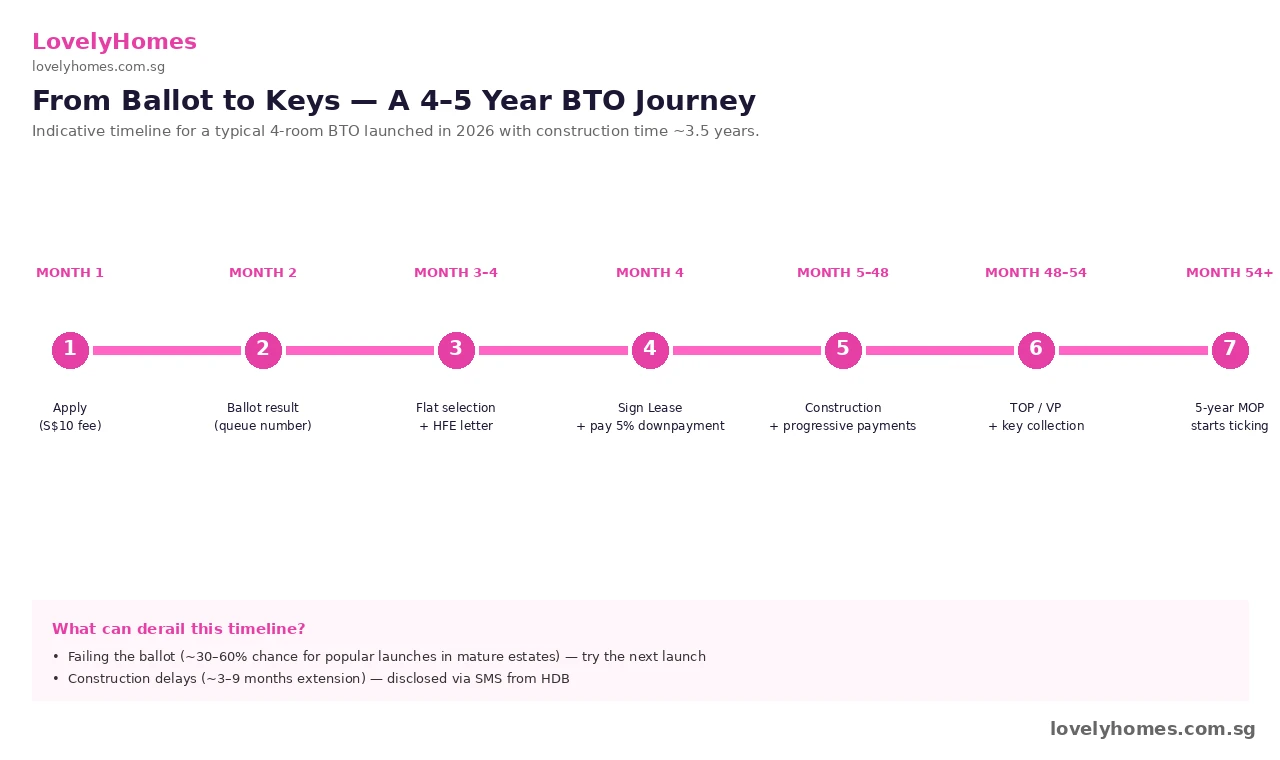
HDB BTO application guide Singapore 2026 — application timeline from ballot to key collection
Figure 2: Indicative 4–5 year BTO journey from ballot to key collection.

The mechanics of a BTO application have not changed materially since 2018, but the digital tooling has. Today every step bar key collection happens through the HDB Flat Portal and CPF/MyInfo integration:

  1. Obtain HFE Letter — the HDB Flat Eligibility letter (introduced 9 May 2023) bundles eligibility assessment, grant assessment, and loan eligibility into one document valid for 6 months. You need it before you can apply for any BTO. Generated through the HDB Flat Portal in 21 working days; lenders use it to issue an in-principle approval.
  2. Application window — each launch opens for 7 days. Apply via the HDB Flat Portal; the application fee is S$10 non-refundable. Applicants choose up to two flat types in their preferred town.
  3. Ballot — 3–5 weeks after close. Each application is randomly drawn within its priority group (First-Timer Family, First-Timer Single, Second-Timer, etc.) and assigned a queue number. First-timers receive up to 3 queue-number chances (the “3 queue numbers” rule introduced in 2022); second-timers receive 1.
  4. Flat selection appointment — you are booked into a 4-hour slot starting from queue number 1 onward. Lower queue numbers see the full selection; later applicants see only what is left. Bring your spouse, your HFE letter, and the option fee (S$500–2,000 by flat type, paid by NETS).
  5. Sign Agreement for Lease — about 4 months after selection. You pay 5% downpayment, less the option fee already paid. Funds may come from CPF OA + cash; if you are taking an HDB concessionary loan, no cash is required.
  6. Construction — typically 3.5–4 years. HDB releases progress updates by SMS and the Flat Portal.
  7. Notice of Vacant Possession + Key Collection — the final 5% of the price is paid; you collect keys and the 5-year Minimum Occupation Period (MOP) clock starts ticking.

The Ballot — How Queue Numbers Are Decided

The single biggest source of confusion among first-time applicants is the difference between “ballot” and “flat selection”. The ballot determines your queue number; flat selection is when you actually pick a unit. The queue is sequenced by:

  1. Priority groups (in order): Married Couples Priority Scheme (MCPS); Parenthood Priority Scheme (PPS); Multi-Generation Priority Scheme (MGPS); Tenants Priority Scheme; First-Timer Family; First-Timer Single; Second-Timer; Joint Singles.
  2. Within a priority group: a random ballot.
  3. Tiebreakers: later launches have started using the SC1 (sole-citizen 1-applicant) tiebreaker first.

Practical implication: a first-timer SC+SC couple with one child applying under PPS gets a meaningfully better queue position than the same couple without the priority application. Each launch reserves 30% of supply for first-timers, with the balance for second-timers and singles — so even a poor queue number does not necessarily mean exclusion if you are a first-timer.

The EIP and SPR Quotas — Why “Available” Doesn’t Mean “Available to You”

The Ethnic Integration Policy (EIP) was introduced in 1989 to prevent the formation of mono-ethnic enclaves. Every HDB block and every neighbourhood has a maximum proportion of flats that may be sold to each ethnic group:

  • Chinese: 84% of a neighbourhood, 87% of a block.
  • Malay: 22% of a neighbourhood, 25% of a block.
  • Indian / Other: 10% of a neighbourhood, 13% of a block.

The Singapore Permanent Resident (SPR) Quota sits on top of EIP and limits the proportion of non-Malaysian SPR households per neighbourhood (5%) and per block (8%). Malaysian SPRs are exempt because they are considered demographically and culturally close to Singaporean groups.

Each unit at flat selection shows the live EIP/SPR status. A unit may be physically vacant but unavailable to your ethnic group because the quota is full. You see this most acutely in popular projects in Bishan, Queenstown, or Bukit Merah, where Chinese-quota units sell out first while Indian-quota units may still be open at queue number 200+. Plan your back-up unit choices accordingly.

Grants — The Stack That Can Pay for Your Furniture

For BTO applicants, grants are awarded in fewer types than for resale buyers, but the absolute amounts are still material. As of 1 February 2024 the BTO-side grants are:

  • Enhanced CPF Housing Grant (EHG): S$5,000 to S$120,000 sliding scale by household income. The full S$120k is available for households earning up to S$1,500/month; the grant tapers to S$5,000 at the S$9,000–9,500 income band.
  • Family Grant: S$10,000 to S$80,000 depending on flat type and income, available only for resale BTO and for Plus/Prime BTO under the new classification. Standard BTOs do not qualify (the subsidy is built into the price).
  • Proximity Housing Grant (PHG): S$30,000 if buying with parents living in the same household; S$15,000 if buying within 4 km of parents’ existing flat.
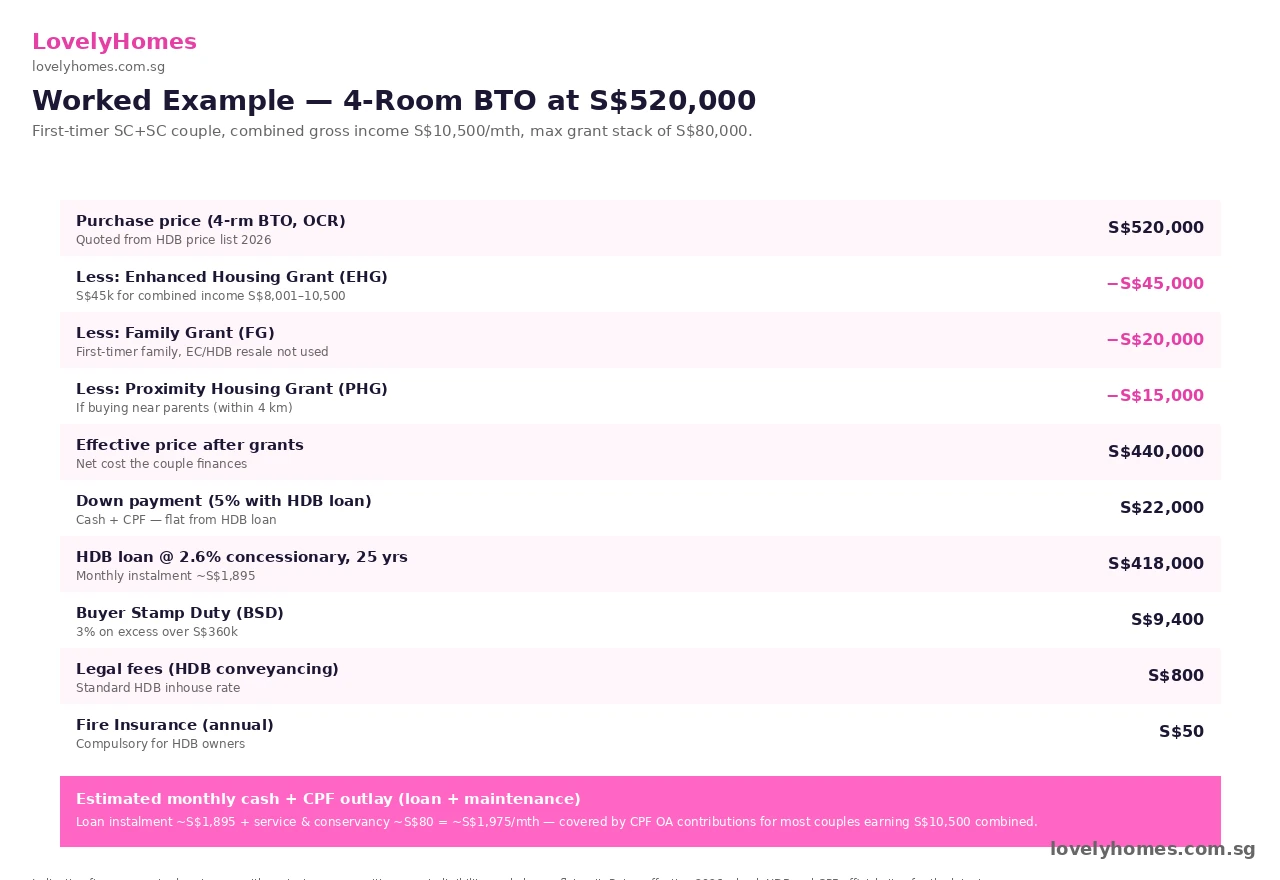
HDB BTO application guide Singapore 2026 — S$520K 4-room cost stack with grants
Figure 3: Worked example — SC+SC couple buying a S$520K 4-room BTO with a S$80K grant stack.

BTO Classification — Standard, Plus, Prime

From October 2024 onwards, every new BTO is classified as Standard, Plus, or Prime. This shifts the subsidy structure and the resale rules:

  • Standard: the legacy framework. 5-year MOP, no resale-price clawback, no income ceiling on the resale buyer. The default for non-mature estates.
  • Plus: 10-year MOP, income ceiling of S$14k applies even on resale, partial subsidy clawback at resale. Found in choicer locations within outer-mature estates.
  • Prime: 10-year MOP, S$14k income ceiling on resale, 6% subsidy clawback, no whole-flat rental ever (only room rental). Reserved for the most attractive locations like Queenstown and Kallang/Whampoa.

The classification affects your effective return on the flat 10 years out. A Plus flat in Hougang sold to a quota-restricted resale buyer will trade at a discount to the equivalent Standard flat in nearby Sengkang — that is the design intent, to keep the subsidy in the public-housing system.

Worked Example — SC+SC Couple, Combined S$10,500/Month

Take a 32-year-old + 30-year-old SC+SC couple, married, no children, combined gross income S$10,500/month. They are first-timers and applying under the Family Scheme. They target a 4-room BTO at S$520,000 in Punggol Coast (a Standard project).

  • Income ceiling check: S$10,500 < S$14,000. PASS.
  • Grants: EHG at the S$8,001–10,500 income band = S$45,000. Family Grant: not applicable for Standard BTOs. PHG: S$15,000 if their parents live within 4 km. Total: S$60,000.
  • Effective price: S$520,000 − S$60,000 = S$460,000.
  • Down payment (5% with HDB loan): S$23,000, payable from CPF OA.
  • HDB loan @ 2.6%, 25 years: S$437,000 principal × 2.6% ⇒ monthly instalment ~S$1,985.
  • BSD: 1% on first S$180k + 2% on next S$180k + 3% on next S$160k ≈ S$8,200, payable in cash or CPF OA.
  • Legal fees (HDB conveyancing): ~S$800.

Total upfront cash + CPF outlay: ~S$32,000 (downpayment + BSD + legal + option fee). Monthly outlay during construction: ~S$95/month service & conservancy charges only. Monthly outlay after key collection: ~S$2,070 (loan + S&C). Against a household income of S$10,500/month gross (~S$8,400 take-home), the loan is comfortably within the 30% MSR (Mortgage Servicing Ratio) limit for HDB loans.

Common Mistakes BTO Applicants Make

  1. Skipping the HFE letter — without it, you cannot apply. Generate the HFE 6–8 weeks before the launch you want.
  2. Choosing a project where your ethnic quota is already full — check the EIP status on the launch site before applying.
  3. Underestimating the income ceiling buffer — HDB adds a 30% buffer for variable income. Sit just under the ceiling, not at it.
  4. Applying as Family before marriage — if you are not yet married, you must use the Fiancé scheme. The Family scheme is for already-married couples.
  5. Ignoring the 5-year MOP — or now 10-year for Plus/Prime. The MOP starts on key collection, not application; selling within MOP requires HDB’s express consent and is rarely granted.

What This Means for You

For most Singaporean first-timer households, BTO remains the single most subsidised real-estate transaction available. A successful 4-room BTO in 2026 typically delivers a paper gain of 60–100% by the end of the 5-year MOP — not because the project is special, but because the price gap between BTO and resale is structurally maintained. The key is winning the ballot. Increase your odds by applying under the right priority scheme (PPS for couples with children, MCPS for newlyweds), targeting non-mature estates where oversubscription is lower, and being flexible on flat type (4-room ballots have higher success rates than 5-room).

What Might Come Next

The Ministry of National Development has signalled three policy directions for the 2026–2028 horizon. First, BTO supply is forecast to remain at 22,000–25,000 per year through 2028, after which the pipeline tapers to 18,000 as the demographic bulge passes. Second, the Plus/Prime classification is expected to be applied to roughly 30% of new launches by 2028, up from ~15% in 2025. Third, the Joint Singles Scheme age threshold may be lowered from 35 to 30 if the Singapore Together Forward dialogue feedback gains policy traction. None of these is yet officially confirmed; watch the COS speech each March for the firm announcements.

Summary — Eligibility & Grant Stack by Scheme (Quick Reference)

Scheme Min Age Citizenship Income Ceiling Flat Sizes Top Grant Stack
Public (Family Nucleus) 21 (one) ≥1 SC S$14,000 2-rm to 5-rm + 3Gen EHG up to S$120k + PHG S$30k
Fiancé/Fiancée 21 (both) ≥1 SC S$14,000 2-rm to 5-rm EHG up to S$120k + PHG
Single SC 35 SC only S$7,000 2-rm Flexi only EHG-Singles up to S$60k
Joint Singles 35 (each) All SC S$21,000 (combined) 2-rm Flexi to 5-rm EHG-Singles up to S$60k each
Non-Citizen Family 21 (SC) 1 SC + 1 PR S$14,000 2-rm Flexi to 5-rm EHG up to S$120k

Frequently Asked Questions

Can I apply for a BTO if I already own a private property?

Yes, but you must dispose of your private property within 30 months of key collection of the BTO. If you fail to do so, HDB may compulsorily acquire the BTO at original cost. The 30-month window is intended to allow for sale logistics. You also forfeit any first-timer status — you will be treated as a second-timer for grant calculations. Most second-time HDB applicants in this position are downsizing from a private property after children leave home, or rebalancing portfolios after en-bloc proceeds.

How long does the entire process take, from application to keys?

Plan for 4 to 4.5 years from application close to key collection on a typical BTO project, with a further 5 years (Standard) or 10 years (Plus/Prime) of Minimum Occupation Period before you can sell. The construction stage is the longest phase — typically 36–48 months from breaking ground. Projects in Tengah and Punggol have generally tracked the lower end; mature-estate projects in Queenstown and Bishan have hit the upper end due to site constraints.

What happens if I fail the ballot?

You forfeit only the S$10 application fee and may apply again at the next launch. There is no penalty or queue-number penalty for non-selection — in fact, first-timers retain their first-timer status and the 3-queue-number allocation. Many couples cycle through 4–6 launches before securing a unit in their preferred town. To shorten the wait, broaden the geographies you are willing to apply in, or apply under a priority scheme like Parenthood Priority if you have children.

Can I use a private bank loan instead of an HDB concessionary loan?

Yes — bank financing is allowed for BTO buyers, and currently many do because SORA-pegged floating rates have hovered around 3.5–3.8% (vs the HDB concessionary rate at 2.6%, fixed at CPF OA + 0.1%). The trade-off: bank loans require a 25% downpayment (5% cash + 20% cash/CPF) instead of the 0% cash + 20% CPF on an HDB loan. Once you choose bank financing for your first BTO, you cannot switch back to an HDB concessionary loan for the same flat. Most first-timer BTO buyers stay on the HDB loan for the cash-flow flexibility.

If we are not yet married, can we still apply?

Yes — under the Fiancé/Fiancée Scheme. Both applicants must be 21+ and at least one a Singapore Citizen. You declare your intention to marry; HDB requires you to produce a marriage certificate within 3 months of key collection. If the relationship breaks down before key collection, you may withdraw from the application and forfeit only the option fee — HDB will not pursue you for damages.

How does the EIP affect resale value of my flat?

The EIP can constrain the buyer pool when you eventually sell. If your block’s Chinese quota is full and you are Chinese, you can only sell to a non-Chinese buyer — which is a smaller market and typically yields a 1–3% price discount. The reverse is also true: minority-quota sellers in mature estates often see a small premium. Most owners do not feel this until they list; consult your conveyancing lawyer for an EIP-aware listing strategy.

Can I rent out my BTO flat after MOP?

For Standard BTOs: yes, after the 5-year MOP, you may rent out the entire flat under HDB’s Whole Flat Rental scheme (subject to a 6-monthly registration). For Plus and Prime BTOs: only room rental is permitted, never whole-flat rental. The whole-flat rental rule is a permanent restriction designed to keep the subsidy in the owner-occupier pool. Non-citizen sub-tenant quotas also apply: the Non-Citizen Quota caps non-Malaysian PRs at 5% of a neighbourhood and 8% of a block.

Related Articles

Disclaimer

This guide is for general information only and does not constitute legal, financial, or housing advice. Eligibility schemes, income ceilings, grant amounts, EIP/SPR quotas, and BTO classification rules are illustrative as at April 2026 and are subject to change at the discretion of the Housing & Development Board, the Ministry of National Development, and the Central Provident Fund Board. Always verify the latest figures with primary sources — the Housing & Development Board, the CPF Board, the Inland Revenue Authority of Singapore, and consult a qualified housing consultant or conveyancing lawyer before signing any agreement.

Translate »