Singapore Mortgage Calculator 2026: TDSR, LTV & Monthly Repayment Guide

Singapore Mortgage Calculator 2026: TDSR, LTV & Monthly Repayment Guide

⚡ Quick Answer — Singapore Mortgage Calculator 2026

  • Your maximum monthly loan repayment for a bank loan must not exceed 55% of gross monthly income (Total Debt Servicing Ratio, or TDSR).
  • For HDB flats and Executive Condominiums, an additional MSR cap of 30% applies — meaning your HDB/EC loan repayment cannot exceed 30% of gross income.
  • Bank loans: maximum 75% LTV (first property); HDB concessionary loans: maximum 80% LTV but for HDB flats only.
  • At 3.5% p.a. over 25 years, a S$1,000,000 loan costs approximately S$5,012 per month.
  • The standard annuity formula determines monthly repayment: M = P × [r(1+r)^n] / [(1+r)^n − 1], where P = principal, r = monthly rate, n = months.
  • TDSR stress-tests use a floor rate of 4.0% — banks must ensure borrowers can still pass TDSR at 4.0% even if the offered rate is lower.
  • CPF Ordinary Account savings may be used to fund the downpayment and monthly repayments (subject to the CPF usage limits tied to the property’s remaining lease).
  • Always compare rates from at least 3 banks and check for lock-in periods, prepayment penalties, and rate re-pricing clauses before committing.

What Is a Singapore Mortgage Calculator and Why Do You Need One?

A Singapore mortgage calculator is a financial tool that computes your estimated monthly home loan repayment based on the loan amount, interest rate, and loan tenure. It is the starting point for any property purchase in Singapore — before you can assess affordability, check TDSR compliance, or compare loan packages across banks, you need to know what a given loan size will cost you each month.

In Singapore, the Monetary Authority of Singapore (MAS) regulates home lending through two key ratios: the Total Debt Servicing Ratio (TDSR) and, for HDB properties and Executive Condominiums (ECs), the Mortgage Servicing Ratio (MSR). Understanding both is essential before signing any Option to Purchase.

The Core Formula: How Monthly Repayment Is Calculated

Singapore bank home loans use the standard reducing-balance annuity method. The formula is:

M = P × [ r(1+r)^n ] / [ (1+r)^n − 1 ]

Where: M = monthly repayment; P = principal loan amount; r = monthly interest rate (annual rate ÷ 12); n = total number of monthly payments (years × 12).

At 3.5% p.a. over 25 years: r = 0.035 ÷ 12 = 0.002917; n = 300. For P = S$1,000,000: M = 1,000,000 × [0.002917 × (1.002917)^300] / [(1.002917)^300 − 1] ≈ S$5,012 per month.

Monthly Repayments at Common Loan Sizes (2026)

Singapore home loan monthly repayment by loan amount 2026 at different rates
Figure 1: Monthly home loan repayment by loan amount at 3 rates, 25-year tenure. Calculated using standard annuity formula.

At the prevailing 2026 range of bank fixed rates (approximately 3.2–3.9% p.a.) and HDB concessionary rate (2.6%), the chart above illustrates how steeply monthly costs rise with loan size. A S$800,000 loan at 3.5% costs S$4,010 per month — a figure that requires a combined gross monthly income of at least S$7,290 to pass TDSR at 55%. At S$1.5M, you need S$13,655+ in combined monthly income to pass TDSR.

TDSR: What It Is and How It Limits Your Loan

The Total Debt Servicing Ratio (TDSR) was introduced by MAS in 2013 and tightened to its current 55% threshold in 2022. TDSR measures the proportion of a borrower’s gross monthly income that goes toward servicing all debt obligations — not just the home loan, but also car loans, credit cards (30% of outstanding balance counts), personal loans, and other property loans.

The practical implication: if your gross household income is S$10,000 per month, your total debt repayments across all outstanding loans cannot exceed S$5,500 per month to qualify for a new bank home loan. If you already have a car loan of S$800/mth and credit card outstanding of S$5,000 (counted at S$1,500/mth for TDSR), your maximum new home loan repayment is S$5,500 − S$800 − S$1,500 = S$3,200/mth — even if you have enough income for more.

Banks are required by MAS to stress-test TDSR using a floor interest rate of 4.0%. This means that even if your actual loan rate is 3.0%, the bank runs your TDSR calculation at 4.0% to ensure affordability under rate increases. This effectively reduces maximum loan eligibility by approximately 5–8% compared to a simple calculation at the offered rate.

Maximum Loan Eligibility by Income

Singapore TDSR MSR maximum loan eligibility by gross monthly income 2026
Figure 2: Maximum loan eligibility by gross monthly income under TDSR 55% (private) and MSR 30% (HDB/EC). Assumes 3.5% p.a., 25-year tenure.

The chart makes clear the significant difference between the TDSR-governed private property market and the MSR-governed HDB/EC market. A household earning S$12,000 per month can in principle qualify for a bank loan of up to ~S$1.32M for a private condo under TDSR 55% — but if buying an HDB resale flat or EC, the MSR cap of 30% limits the same household to a loan of ~S$724,000.

MSR: The Additional Constraint for HDB Flats and ECs

The Mortgage Servicing Ratio (MSR) applies specifically to HDB residential flats and ECs. It caps the monthly repayment on the HDB or EC loan at 30% of gross monthly income — a stricter constraint than TDSR for these property types. Both TDSR and MSR must be satisfied simultaneously when purchasing HDB or EC.

For example, a household with S$9,000/mth gross income: TDSR allows up to S$4,950/mth total debt (55%); MSR caps the HDB loan component at S$2,700/mth (30%). The HDB loan must fit within S$2,700/mth — meaning a maximum HDB loan of approximately S$539,000 at 2.6% HDB rate over 25 years.

LTV Limits: How Much Can You Borrow?

Singapore loan to value LTV limits 2026 bank versus HDB concessionary loan
Figure 3: Singapore LTV limits 2026 — bank vs HDB concessionary loan. Source: MAS Notice 645/632.

The Loan-to-Value (LTV) ratio is the maximum proportion of a property’s purchase price (or valuation, whichever is lower) that a lender will finance. In Singapore, LTV limits are set by MAS and depend on how many outstanding property loans a borrower holds at the time of purchase.

Summary Table: Key Mortgage Parameters for Singapore Home Buyers (2026)

Parameter Bank Loan (Private/HDB) HDB Concessionary Loan (HDB only)
Max LTV (1st property) 75% 80%
Min cash (1st property) 5% of price (cash only) Can be all CPF
TDSR cap 55% of gross income 55% (TDSR applies)
MSR cap (HDB/EC) 30% (HDB/EC only) 30%
Max loan tenure (< 65 yrs old) 30 years (condo); 25 years effective (HDB) 25 years
Stress-test floor rate 4.0% p.a. (MAS mandated) No stress test — fixed rate 2.6%
Eligibility for HDB loan Any borrower Must hold valid HLE; income ceiling applies
Repayment method CPF OA or cash CPF OA, HDB deduction, or cash

Worked Example: The Lim Family Buying Their First HDB

📌 Case Study: The Lim Family — 4-Room HDB Resale in Ang Mo Kio

Profile: Married couple, SC/SC, ages 32 and 30. Combined gross monthly income S$8,500. Buying a 4-room HDB resale flat in Ang Mo Kio at S$580,000. Eligible for Enhanced Housing Grant (EHG) of S$50,000 and Family Grant of S$50,000 (total grants S$100,000). Seeking HDB concessionary loan (HLE confirmed).

Step 1 — Loan amount: Purchase price S$580,000 minus grants S$100,000 = net S$480,000. HDB loan max 80% LTV of S$580,000 = S$464,000. But net after grants is S$480,000; applying 80% LTV to S$580,000 = S$464,000. Loan = S$464,000. Downpayment (20%) = S$116,000 — may be entirely from CPF OA.

Step 2 — Monthly repayment: HDB concessionary rate 2.6% p.a., 25-year tenure. M = 464,000 × [0.002167 × (1.002167)^300] / [(1.002167)^300 − 1] = S$2,094/mth.

Step 3 — MSR check: S$2,094 ÷ S$8,500 = 24.6% — below 30% MSR cap → PASS.

Step 4 — TDSR check: Assuming no other debt. S$2,094 ÷ S$8,500 = 24.6% — well below 55% TDSR → PASS.

Step 5 — BSD: First S$180,000 × 1% = S$1,800; next S$180,000 × 2% = S$3,600; remaining S$220,000 × 3% = S$6,600. Total BSD = S$12,000.

Total upfront cost: Downpayment S$116,000 (CPF) + BSD S$12,000 (CPF or cash) + legal fees ~S$3,000 + COV (if any) cash. Indicative upfront ≈ S$131,000 (mostly from CPF OA), with likely S$5,000–S$15,000 in cash for legal fees and any COV.

How Interest Rate Movements Affect Your Repayment

Singapore bank home loan rates are primarily linked to SORA (Singapore Overnight Rate Average), which replaced SIBOR/SOR as the benchmark rate in 2024. SORA is set daily by MAS and reflects the volume-weighted average rate of unsecured overnight SGD interbank transactions. Variable-rate packages are typically quoted as 3-month compounded SORA plus a spread (e.g., SORA + 0.75%). Fixed-rate packages lock the interest rate for 2–5 years before re-pricing.

As of mid-2026, the 3-month compounded SORA is approximately 2.8–3.0%, giving effective all-in variable rates of 3.55–3.75% for competitive packages. Fixed rates for 3-year locks are approximately 3.2–3.5%. The rate environment suggests that borrowers who locked in 2-year fixed rates in 2024 at ~3.8% are now approaching competitive re-pricing opportunities.

A 1% rise in interest rates on a S$1,000,000 loan over 25 years adds approximately S$500–S$560 per month to the repayment. Borrowers should stress-test their budgets at rates 1.5–2.0 percentage points above their current package to ensure they can absorb rate movements without TDSR breach.

What Might Change in Singapore Mortgage Regulation

MAS reviews TDSR and LTV parameters periodically as part of its macro-prudential framework. In a scenario of sustained high interest rates or rising household debt levels, further tightening (lower LTV caps, reduced TDSR thresholds) is possible. Conversely, if the property market softens significantly, regulators have historically relaxed restrictions to support demand. The 2022 TDSR reduction (from 60% to 55%) is the most recent change; the prior benchmark was 60% from 2013. Buyers should not assume current parameters will remain constant over a long holding period.

Forward-looking commentary is speculative and subject to MAS policy decisions which cannot be predicted.

Frequently Asked Questions

How do I use the TDSR formula to check my eligibility?

Calculate your total monthly debt obligations: add up all existing loan repayments (car loan, personal loan, credit card at 30% of outstanding balance, any other property loans). Then add the projected new home loan repayment. Divide the total by your gross monthly income. If the result is 0.55 or below, you pass TDSR. Banks calculate TDSR using a stress-test rate of 4.0% p.a., so use 4.0% when doing your own check to ensure accuracy. For joint borrowers, both gross incomes may be combined. However, if one borrower has existing debts, those are also included in the TDSR calculation against the combined income.

Can I use CPF to pay for my home loan repayments?

Yes, CPF Ordinary Account (OA) savings can be used for both the initial downpayment and ongoing monthly loan repayments on residential properties. There are three key limits to note. First, CPF usage is capped at the Valuation Limit (VL) — the lower of purchase price or market valuation. Second, once your CPF usage reaches the VL, further withdrawals require the property to have a remaining lease of at least 30 years and the remaining lease to extend beyond the youngest buyer’s age of 95. Third, CPF accrued interest (currently 2.5% p.a.) is added to the principal used, and this entire sum must be refunded to CPF on sale — reducing net cash proceeds. For HDB loans, CPF usage rules are more generous and integrated into the HDB payment process directly.

What is the difference between a fixed-rate and a variable-rate (SORA) home loan?

A fixed-rate package locks your interest rate for a defined period (typically 2–5 years), providing certainty over monthly repayments. After the fixed period, the loan re-prices to the bank’s prevailing rate — usually a SORA-linked package. A variable/SORA-linked package tracks the 3-month compounded SORA plus a spread. Your repayment fluctuates as SORA moves, but you benefit directly from rate cuts. In 2026, the choice between fixed and variable depends on your view of the SORA trajectory and your risk tolerance. Fixed packages are typically locked in for 2–3 years; leaving early incurs prepayment penalties of 1.0–1.5% of the outstanding loan amount. Always read the lock-in clause carefully before committing.

What happens if my TDSR exceeds 55% after I take the loan?

TDSR compliance is assessed at the point of loan application. Once the loan is granted and drawdown occurs, you are not in breach if your circumstances change (e.g., income drops, additional debt is taken on). However, if you wish to refinance to a new lender or take an additional loan, the new lender will re-assess TDSR at that point. If you fail TDSR, you cannot refinance or borrow more. Practically, this means maintaining a TDSR well below 55% is prudent — leaving buffer for life events such as job changes, medical expenses, or taking on a car loan. MAS requires banks to conduct TDSR reassessment when borrowers request loan top-ups or restructuring.

Is the HDB concessionary loan always better than a bank loan?

The HDB concessionary loan has a stable rate pegged at 0.1% above the CPF Ordinary Account rate — currently 2.6% p.a. — which provides predictability and does not carry lock-in penalties. However, bank loans often offer lower headline rates for the first 2–3 years (fixed packages at 3.0–3.5% have been available in recent cycles, and SORA packages can be lower still). The trade-off is rate risk after the fixed period. Practically: if you have limited cash reserves and need stability, the HDB loan is lower-risk. If you have buffer to absorb rate movements and can refinance actively, a bank loan may be cheaper over the full tenure. Once you take a bank loan for your HDB flat, you cannot switch back to an HDB loan on that property.

What is the maximum loan tenure in Singapore?

For bank loans, the maximum tenure is 30 years for private property (condo, landed) and effectively 25 years for HDB resale flats (banks may grant 30 years on paper but MAS caps the tenure at 25 years + borrower’s age ≤ 65, so younger buyers can access up to 30 years in practice). For HDB concessionary loans, the maximum is 25 years or up to age 65 for the youngest borrower, whichever is shorter. Longer tenures reduce monthly repayments but increase total interest paid significantly. A S$800,000 loan at 3.5% over 25 years costs S$321,500 in total interest; over 30 years it costs S$398,000 — S$76,500 more despite only S$490 lower monthly repayment.

Related Articles

Disclaimer

All loan calculations in this article are illustrative estimates based on the standard annuity formula. Actual monthly repayments, TDSR outcomes, and loan eligibility depend on each lender’s assessment criteria, prevailing interest rates at the time of application, borrower credit history, and MAS regulatory requirements in force at the time. Readers should not rely on these calculations as a guarantee of loan approval or as financial advice. Before applying for a home loan, consult a licensed mortgage broker, your preferred bank’s home loan officer, or a licensed financial adviser regulated by the Monetary Authority of Singapore (MAS). MAS home loan regulations: mas.gov.sg. CPF usage rules: cpf.gov.sg. HDB loan eligibility and HLE: hdb.gov.sg.

Jurong Lake District White Site 2026: Town Hall Link GLS Tender, 1,200 Homes and CRL CR19

Jurong Lake District White Site 2026: Town Hall Link GLS Tender, 1,200 Homes and CRL CR19

Quick Answer: JLD Town Hall Link White Site at a Glance

  • Site: Town Hall Link, Jurong Lake District (JLD), adjacent to the Jurong Town Hall national monument.
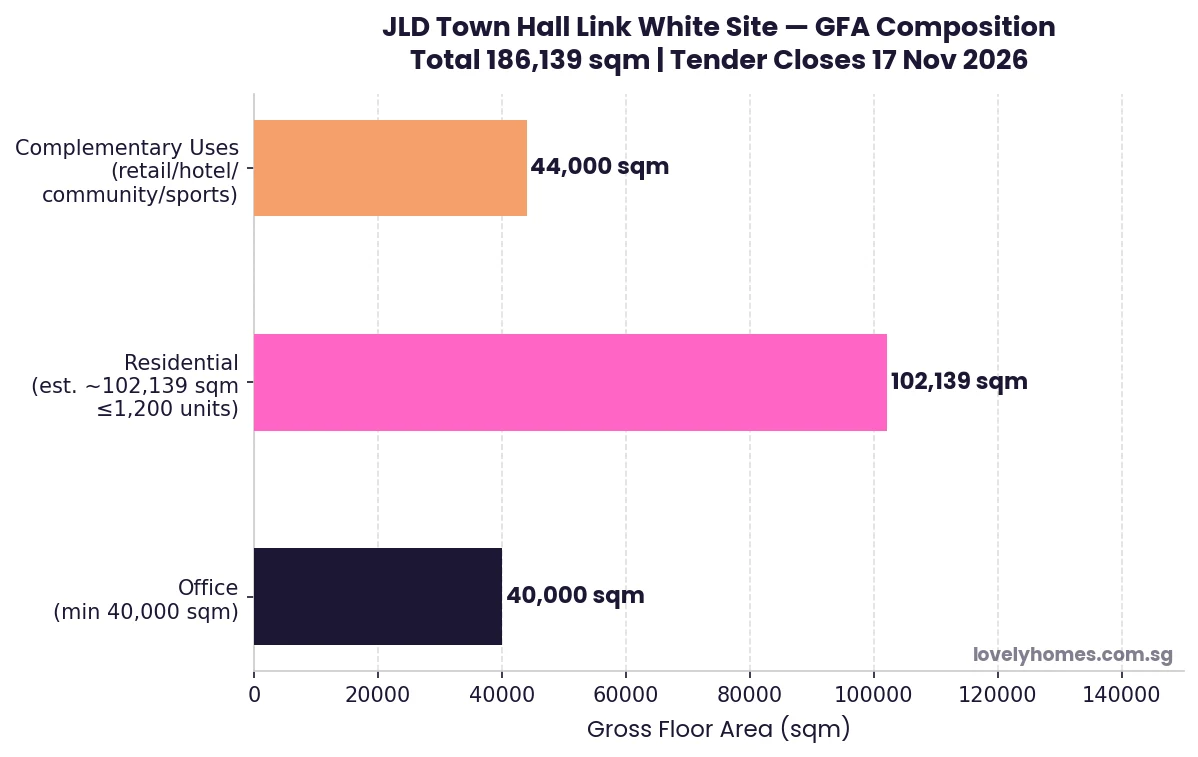
  • Total GFA: 186,139 sqm — one of the largest mixed-use sites launched in Singapore in recent years.
  • Residential: up to 1,200 private residential units.
  • Office: minimum 40,000 sqm — anchoring JLD’s ambition as the largest business node outside the city centre.
  • Complementary uses: up to 44,000 sqm for retail, serviced apartments, hotel, sports, community and medical facilities.
  • Connectivity: integrated with Jurong East MRT interchange (EWL/NSL), future JRL JE5 station, and upcoming CRL CR19 station (planned 2032).
  • Tender closes: 17 November 2026.
  • Why it matters: the White site designation gives developers flexibility to configure uses — residential, commercial, or mixed — based on market conditions at launch, making it one of Singapore’s most strategically significant land sales of 2026.

URA Launches JLD White Site: Singapore’s Most Anticipated 2H 2026 GLS Tender

The Urban Redevelopment Authority (URA) launched the tender for a White site at Town Hall Link in the Jurong Lake District (JLD) on 3 July 2026, marking one of the most significant Government Land Sales (GLS) moves of the year. At 186,139 sqm of total potential Gross Floor Area (GFA) — comprising a minimum 40,000 sqm of office, up to 1,200 private residential units, and 44,000 sqm of complementary uses — this site has the potential to define the next chapter of Singapore’s western regional centre.

The tender forms part of the Confirmed List for the 2H 2026 GLS Programme and will close at 12 noon on 17 November 2026. It comes less than two weeks after URA released its Q2 2026 property price flash estimate showing the overall private residential PPI rising a modest 0.5% — a market context that is stable enough for developers to bid with confidence, but not so frothy as to suggest over-payment risk.

JLD is Singapore’s flagship decentralisation initiative: a vision to create a vibrant live-work-play precinct in the western part of Singapore that can absorb commercial, residential, and civic activity without adding further pressure on the already-congested central business district. The Town Hall Link site occupies a prime position within this vision — sited next to the Jurong Town Hall national monument, directly connected to the Jurong East MRT interchange, and in the future path of two new MRT lines.

What Is a White Site?

A White site in Singapore’s GLS framework is a land parcel that developers may develop for any combination of uses permitted under the Master Plan, subject to a minimum requirement for one or more specified uses. Unlike purpose-specific GLS sites (e.g., residential-only or commercial-only), a White site allows developers to calibrate the use mix based on their read of market conditions at the time of design and launch.

For the Town Hall Link site specifically, the conditions are: minimum 40,000 sqm office; up to 1,200 residential units; and up to 44,000 sqm for complementary uses. The developer awarded the site will have latitude to decide the precise mix of hotel, serviced apartments, retail, community facilities, and sports/recreation components — creating significant design flexibility in exchange for the commitment to deliver a meaningful commercial core.

White sites have historically attracted strong bidding interest in Singapore because they reduce the development risk associated with committing entirely to a single use in a market that can shift between residential launch and commercial occupation. The last major White site in JLD — the site that became J Gateway and the surrounding cluster — generated keen bidding when it was first introduced.

Jurong Lake District JLD Town Hall Link white site GFA breakdown office residential complementary 2026

Figure 1: Town Hall Link White Site — indicative GFA breakdown by use. Total 186,139 sqm. Source: URA pr26-53, 3 July 2026.

The JLD Masterplan: Context for This Site

JLD’s transformation has been driven by two decades of sustained government investment in infrastructure and planning. The revitalised Jurong Lake Gardens (90 hectares) provides the greenery spine at the district’s heart. Two new MRT lines are changing the connectivity calculus dramatically:

  • Jurong Region Line (JRL): JE5 station at Jurong East and JE6 station at International Business Park (planned to open 2028).
  • Cross Island Line (CRL): CR19 station at the heart of the new JLD precinct (planned to open 2032).

The addition of CRL is particularly significant: it will provide a direct east-west connection from JLD to Ang Mo Kio, Pasir Ris, and eventually Changi — transforming what has historically been perceived as a “western” destination into a genuinely cross-island node. For the Town Hall Link site, the multi-level pedestrian connections to Jurong East MRT interchange and the upcoming CR19 station mean that residents and office workers at this development will enjoy arguably the best public transport connectivity of any mixed-use site currently on the GLS market.

The site sits next to the Jurong Town Hall, a gazetted national monument. This adjacency imposes design constraints — any development will need to respect the monument’s visual and physical setting — but also provides a distinctive civic character that differentiates the JLD precinct from purely commercial developments elsewhere.

Development Mix Analysis

Use Component GFA (sqm) Status Commentary
Office 40,000 minimum Mandatory Anchors JLD’s role as business node; positions site as corporate headquarters address
Private Residential Up to ~102,139 (est.), max 1,200 units Optional (developer discretion) 1,200 units at typical 80–90 sqm average ≈ 102,000 sqm; adds residential critical mass to district
Complementary Uses Up to 44,000 Optional (developer discretion) Can include: retail, hotel, serviced apartments, sports/recreation, medical clinics, community facilities, visitor attractions
Total GFA 186,139 One of Singapore’s largest mixed-use GLS sites

At 1,200 residential units, this would represent one of Singapore’s larger single-site condominium developments — comparable in scale to recent developments like Canninghill Piers (696 units) and Lentor Modern (605 units), but notably larger. The scale is appropriate for JLD’s ambition to create residential density that sustains the commercial base.

Key Catalysts and Infrastructure Timeline

The development that occupies this site will benefit from a series of planned catalysts over the 2026–2035 horizon:

Catalyst Timeline Impact on Site
JRL JE5 (Jurong East) and JE6 (International Business Park) Phased opening, 2027–2028 Improved east-west connectivity within JLD; connects IBP to Jurong East interchange
New Science Centre at JLD Expected by 2027 Adds visitor attraction and civic anchor to the precinct; drives weekend footfall
Jurong Gateway Hub (bus interchange + office + retail + community club + library + sports) Expected by 2028 Integrated civic hub immediately adjacent; dramatically increases JLD’s daytime and evening population
CRL CR19 station at JLD Planned 2032 Cross-island connectivity; potential 15% to 20% capital value uplift for residential units at this site based on historical TEL/MRT proximity premiums

Residential Investment Angle: 1,200 Units in JLD

If the awarded developer proceeds with the full 1,200-unit residential allocation, this will be among the more significant new private residential supply additions to JLD since the area last saw major development activity in the 2013–2017 era (J Gateway, Westwood Residences, Lake Grande, Twin Vew). JLD has historically commanded a premium relative to other OCR locations — driven by the live-work-play narrative, the lake setting, and the Jurong East MRT interchange’s accessibility to both the western industrial belt and the central business district via the East-West Line.

A new-launch condo at this site, post-CRL connectivity, could plausibly target $2,000–$2,400 psf based on the trajectory of comparable new launches in OCR/RCR boundary locations in 2025–2026. The tender price paid by the developer will be the key determinant of eventual launch pricing — a high land bid will translate into a premium launch price, while a competitive-but-measured bid could allow the developer to price attractively and generate strong take-up. The tender close date of 17 November 2026 gives the market approximately four and a half months to assess these dynamics.

What This Means for the Broader Market

The JLD White Site launch is a policy signal as well as a commercial opportunity. URA’s decision to include a major White site in the 2H 2026 Confirmed List — rather than deferring it to the Reserve List — indicates confidence that developer demand is sufficient to support a committed bid within the current market cycle. The White site mechanism also signals flexibility: if the residential market softens before design completion, the developer can weight the mix toward commercial and serviced apartment uses.

For existing JLD residential owners — in projects like J Gateway, Lake Grande, Twin Vew, and the upcoming The LakeGarden Residences — the Town Hall Link development represents both an opportunity (improved amenity and connectivity as the precinct builds out) and a risk (increased residential supply within the immediate catchment). On balance, the infrastructure and amenity uplift from the New Science Centre, Jurong Gateway Hub, and CRL CR19 is likely to outweigh the supply effect, particularly for well-located existing units.

What Might Come Next

The following is editorial commentary — not official guidance.

Bidding for the Town Hall Link site is expected to attract Singapore’s larger developers and possibly joint ventures. The scale of the site (186,139 sqm) requires significant capital — a land price in the S$1.5–S$2.5 billion range would not be surprising, depending on the assumed residential launch pricing and the developer’s commercial income projections. International developers with Asian regional headquarters-in-a-hub ambitions could also consider the mandatory 40,000 sqm office component as a corporate campus opportunity.

The CRL CR19 station opening in 2032 is a known future catalyst — developers will model this into their land bid assumptions. A project that launches residential units in 2028–2029 (assuming a 2027 tender award, 1-year design/approval, and early 2028 launch) would be telling buyers that their units will be CRL-connected by the time they reach the 5-year mark of ownership.

Frequently Asked Questions

What does “White site” mean for buyers of the eventual development?

A White site designation affects the developer’s design choices, not individual buyers’ rights. When the eventual development is launched for sale, buyers will purchase units in a standard private condominium development. They will benefit from the mixed-use amenities — retail, food and beverage, possibly a hotel or serviced apartment building within the same development — that result from the White site configuration. The White site label itself conveys no special lease conditions or restrictions on buyers beyond the standard conditions of a freehold or 99-year leasehold private condominium.

When will the residential units at Town Hall Link be available for sale?

The tender closes 17 November 2026. Assuming the tender is awarded in Q1 2027, and accounting for design, planning approval, and construction timelines, the earliest a residential launch could realistically occur is late 2027 or 2028. Physical completion (Temporary Occupation Permit) would likely follow in 2030–2032. Prospective buyers interested in this development should monitor URA and the awarded developer’s announcements in 2027.

How does the JLD CRL station affect property values nearby?

Historical evidence from Singapore MRT openings — most recently the Thomson-East Coast Line (TEL) stages 1–4 and the Downtown Line — suggests that residential properties within 500 metres of a new MRT station tend to appreciate by 8–15% relative to comparable properties further away in the 3–5 years following station opening. The effect is partially priced in ahead of the opening as buyers and investors anticipate the connectivity uplift. For CR19 (planned 2032), properties in the immediate JLD precinct likely already incorporate some forward-looking CRL premium in 2026. The full premium crystallises as the opening date approaches and actual connectivity is confirmed.

Is the Town Hall Link site freehold or leasehold?

GLS sites in Singapore are typically sold on 99-year leasehold terms. The Town Hall Link site is expected to follow this standard. Buyers of units in the eventual development will hold 99-year leasehold titles, with the lease commencement date tied to the date of the land award. Leasehold tenure is the norm for new GLS-sourced developments in Singapore; the premium-location attributes of the site — MRT connectivity, JLD masterplan, CRL uplift — are expected to sustain long-term value notwithstanding the leasehold structure.

What other major GLS sites were launched in 2H 2026?

The 2H 2026 GLS Confirmed List provides a total of 4,745 private residential units. In addition to the Town Hall Link White site, URA also launched sites at Lorong Puntong/Sin Ming Avenue (~140 units, TEL Bright Hill MRT, tender closes 15 September 2026) and Kitchener Link (~145 units, Reserve List, Farrer Park MRT NEL). The full 2H 2026 GLS programme — including industrial and commercial sites — is available on the URA website at ura.gov.sg/land-sales.

Related Articles

Disclaimer

This article is for general informational purposes only and does not constitute financial or investment advice. Details of the Town Hall Link White site are sourced from URA press release pr26-53 (3 July 2026) and the URA website. Developer bidding, design outcomes, launch pricing, and project timelines are speculative editorial commentary and do not represent commitments by URA or any developer. For authoritative site details and tender conditions, refer to ura.gov.sg. Consult a licensed financial adviser before making any property investment decision.

HDB Resale Procedure Guide 2026: Step-by-Step for Buyers and Sellers

HDB Resale Procedure Guide 2026: Step-by-Step for Buyers and Sellers

Quick Answer: HDB Resale in 2026 — Key Facts

  • Who manages HDB resale: the Housing & Development Board (HDB) via the HDB Resale Portal (my.hdb.gov.sg).
  • Process duration: typically 8–14 weeks from OTP exercise to legal completion.
  • Option to Purchase (OTP): validity up to 21 calendar days; option fee S$1–S$1,000 (non-refundable); exercise fee S$1–S$5,000.
  • Both parties must submit resale application within 7 days of OTP exercise — failure may invalidate the transaction.
  • Grants available: EHG (up to S$120,000), Family Grant (up to S$50,000), Proximity Housing Grant (S$20,000–S$30,000), Singles Grant — subject to eligibility.
  • Minimum Occupation Period (MOP): sellers must have occupied the flat for the MOP (typically 5 years) before listing for resale. Prime and Plus flats have enhanced MOP rules.
  • Ethnic Integration Policy (EIP): buyers must ensure the resale does not breach HDB’s EIP quota for the block and neighbourhood before exercising the OTP.
  • HDB loan vs bank loan: HDB loan offers up to 80% LTV at the concessionary rate (2.6% p.a. as at 2026); bank loans offer up to 75% LTV but competitive variable rates.

What Is the HDB Resale Market?

HDB resale flats are Housing & Development Board flats that have completed their Minimum Occupation Period (MOP) and are being sold by existing flat owners on the open market — as opposed to new BTO (Build-To-Order) or SBF (Sale of Balance Flats) exercises directly from HDB. The resale market offers buyers immediate availability and greater locational choice than BTO exercises, but at higher prices and without the benefit of the new-flat purchase price.

As at the second quarter of 2026, the HDB resale market is active: the HDB regularly publishes resale transaction data showing strong demand across mature and non-mature estates alike. Understanding the resale procedure thoroughly — from the first portal registration through to the handover of keys — is essential for both buyers and sellers navigating this market.

The HDB Resale Portal (accessible via my.hdb.gov.sg with a Singpass login) is the single platform through which all HDB resale transactions are managed. Both buyers and sellers must use this portal, and all key milestones — Intent to Sell, Intent to Buy, resale application, valuation request, and approval confirmation — flow through it.

HDB resale 8-step process guide Singapore 2026

Figure 1: HDB resale transaction — 8 core steps from registration to completion. Source: HDB, LovelyHomes.

Step 1: Register Intent to Sell (Seller) and Intent to Buy (Buyer)

Sellers must register their Intent to Sell (ITS) on the HDB Resale Portal before marketing the flat. This registration is valid for 12 months and can be done at any time — there is no fee. Once the ITS is active, the portal generates an indicative valuation range, a list of financial planning requirements, and eligibility details including whether any co-owners need to be involved. Sellers cannot grant an OTP to a buyer before registering ITS.

Buyers register their Intent to Buy (ITB) on the portal. This is where eligibility checks are made: HDB verifies whether the buyer meets the citizenship and family nucleus requirements, whether the EIP quota is available at the target flat, and whether the buyer has a valid HDB Loan Eligibility (HLE) letter or a bank Approval In Principle (AIP). The ITB is also valid for 12 months.

Both registrations can be done concurrently — buyers and sellers do not need to find each other before registering. In practice, most buyers register ITB first (to get their finances ready) before actively searching for a flat.

Step 2: Secure Financing — HLE Letter or Bank AIP

Before proceeding to the OTP stage, buyers must have their financing in place. There are two routes:

Feature HDB Concessionary Loan Bank Loan
Maximum LTV 80% of lower of valuation/price 75% of lower of valuation/price
Interest rate (2026) 2.6% p.a. (pegged to CPF OA rate + 0.1%) Variable; fixed/floating packages from ~2.5%–3.8% p.a.
MSR limit 30% of gross monthly household income 30% of gross monthly household income (HDB flats)
TDSR 55% (applies in conjunction with MSR) 55%
Cash down payment Minimum 20% (CPF OA can cover) Minimum 25% (5% must be in cash)
Eligibility SC/SC or SC/SPR households; income ceiling S$14,000/mth All eligible flat buyers
Prepayment penalty None Depends on package (typically 1.5% for fixed-rate packages)

A HDB Loan Eligibility (HLE) letter must be obtained from HDB before the buyer can proceed if using an HDB loan. The HLE is valid for 6 months and must be renewed if it lapses before the OTP is exercised. For bank loans, an Approval In Principle (AIP) from the bank serves the equivalent role.

The Mortgage Servicing Ratio (MSR) cap of 30% of gross household income applies specifically to HDB flat purchases. This is more restrictive than the general TDSR of 55% — buyers with higher incomes buying higher-priced resale flats may find the MSR the binding constraint on their loan quantum.

Step 3: Negotiate Price and Grant the Option to Purchase (OTP)

Once buyer and seller agree on a price, the seller issues an Option to Purchase. The OTP is a legally binding option contract: the buyer pays an option fee (S$1 to S$1,000 at the seller’s discretion) in exchange for the right to purchase the flat at the agreed price within the OTP validity period.

The OTP validity period must be at least 7 calendar days and no more than 21 calendar days. This gives the buyer time to exercise the option (i.e., formally commit to buy) while providing a brief cooling-off window. A buyer who decides not to exercise the option forfeits the option fee but has no further obligation to proceed.

Key negotiating points at this stage include: whether the seller agrees to include any fittings (air-conditioners, kitchen cabinets, curtain tracks), the completion timeline, and the allocation of expenses such as property tax for the partial year. These should be documented in the OTP or in a separate Schedule of Fixtures.

Step 4: Exercise the Option to Purchase

To exercise the OTP, the buyer signs the OTP and pays the exercise fee (S$1 to S$5,000) to the seller. Once exercised, the transaction is legally binding on both parties — neither party can withdraw without facing legal consequences. The exercise fee forms part of the overall purchase price (i.e., it is not a separate cost on top of the agreed price).

Before exercising, the buyer should: (a) confirm the EIP quota is available (this can be checked on the HDB Resale Portal using the flat’s postal code), (b) confirm the flat’s resale levy status if upgrading from a subsidised flat, and (c) confirm the CPF and cash amounts needed for completion. Exercising the OTP without completing these checks can result in a failed transaction and forfeiture of the exercise fee.

HDB resale transaction timeline weeks end to end Singapore 2026

Figure 2: Typical HDB resale timeline — ~14 weeks end-to-end from registration to completion. The longest phase is HDB processing (5–8 weeks). Source: HDB, LovelyHomes.

Step 5: Submit Resale Application (Both Parties, Within 7 Days)

After the OTP is exercised, both the buyer and seller must each submit their respective halves of the resale application on the HDB Resale Portal within 7 days of the OTP exercise date. This is a strict requirement — failure by either party to submit within 7 days may cause the application to lapse and require the OTP to be re-issued.

The buyer’s application requires: confirmation of financing (HLE letter or bank AIP), CPF withdrawal details, grant applications (EHG, Family Grant, etc.), and SPR/citizenship verification. The seller’s application requires: confirmation of bank loan redemption details (if there is an outstanding mortgage), CPF refund instructions, and details of any co-owners.

HDB will send an SMS or email to both parties confirming receipt of the complete application and providing an estimated processing timeline.

Step 6: HDB Valuation and Financial Endorsement

For buyers using an HDB concessionary loan, HDB commissions an official valuation of the flat. This valuation determines the loan quantum and the maximum CPF amount that may be used — the LTV ceiling is applied against whichever is lower, the agreed price or the HDB valuation. If the agreed price exceeds the HDB valuation (i.e., there is a Cash-Over-Valuation, or COV), the excess must be paid entirely in cash — CPF cannot be used for COV.

Cash-Over-Valuation became a significant market dynamic in the 2021–2023 resale boom, when median COV for 4-room resale flats in mature estates reached S$30,000–S$60,000. In a more moderate 2026 market, COV remains common in sought-after areas (central districts, near MRT) but has compressed from peak levels.

For bank loan buyers, the bank conducts its own valuation for lending purposes. The buyer should discuss the valuation outcome with the bank’s mortgage specialist before endorsing the financial plan.

Step 7: Resale Approval by HDB

HDB processes the resale application and checks that all eligibility conditions are met: flat ownership rules, EIP compliance, income ceiling (for grants), CPF withdrawal limits, MOP completion, and resale levy (if applicable for second-subsidised-flat buyers). Processing typically takes 5–8 weeks from the complete application date.

HDB notifies both buyer and seller by SMS and email once the resale is approved in principle and a completion appointment is set. At this stage, the conveyancing lawyers for both parties also receive documents to prepare for the transfer of title at completion.

Step 8: Completion Appointment at HDB Hub

The final step is the completion appointment, held at HDB Hub in Toa Payoh (or virtually for eligible straightforward cases). At this appointment:

  • Buyer and seller (or their lawyers) sign the Transfer Deed transferring ownership.
  • CPF refunds to the seller’s CPF OA account are processed (CPF monies used toward the original flat purchase must be returned with accrued interest).
  • The sale proceeds (net of CPF refund, outstanding mortgage redemption, and any resale levy) are disbursed to the seller.
  • Stamp duties (BSD, and ABSD if applicable) are confirmed as paid.
  • Keys are handed over, and the buyer takes possession of the flat.

The entire process from OTP exercise to completion typically takes 8–12 weeks, though complex cases (outstanding mortgage redemptions, CPF disputes, estate matters) may take longer.

HDB resale buyer upfront cost breakdown Singapore S$550,000 flat 2026

Figure 3: Typical upfront costs for a buyer of a S$550,000 4-room HDB resale flat — excluding grants and CPF housing schemes. Source: HDB, IRAS, LovelyHomes calculations.

HDB Resale Grants: Reducing Your Out-of-Pocket Cost

Eligible first-timer buyers of HDB resale flats may receive substantial CPF grants from HDB to reduce the effective purchase price. The main grants in 2026 are:

Grant Maximum Amount Key Eligibility Conditions
Enhanced CPF Housing Grant (EHG) S$120,000 (families); S$60,000 (singles) At least one first-timer applicant; monthly household income ≤ S$9,000 (families) or ≤ S$4,500 (singles); must buy flat that meets income-tiered price ceiling
Family Grant S$50,000 (SC/SC, 4-room and smaller); S$40,000 (SC/SC, 5-room and larger) At least one SC applicant; first-timer buying with SC or SPR spouse/fiancé; income ≤ S$14,000/mth
Half-Housing Grant S$25,000 (4-room and smaller); S$20,000 (5-room and larger) One first-timer, one second-timer applicant in the same household
Proximity Housing Grant (PHG) S$30,000 (moving to be near parents/children within 4km) SC or PR; living within 4km or in the same town as parents or married child; conditions apply
Singles Grant S$40,000 (SC, 4-room and smaller); S$25,000 (SC, 5-room and larger) Singapore Citizen aged 35+; first-timer single; resale flat only; income ≤ S$7,000/mth

Grants are disbursed directly by HDB into the buyer’s CPF OA account and can only be used toward the flat purchase — they cannot be withdrawn as cash. Buyers who receive grants are subject to a resale grant clawback if they sell the flat within 5 years of the grant. Planning the long-term holding horizon is therefore important when maximising grants.

Worked Example: Mr and Mrs Tan’s First HDB Resale Flat

Case Study — 4-room Jurong West Resale, S$550,000

Profile: Mr Tan (SC, 29) and Mrs Tan (SC, 28), first-timer household, combined gross income S$7,500/mth, no existing property.

Target flat: 4-room HDB resale in Jurong West (District 22), agreed price S$550,000. HDB valuation: S$545,000. COV = S$5,000 (to be paid in cash).

Grants:

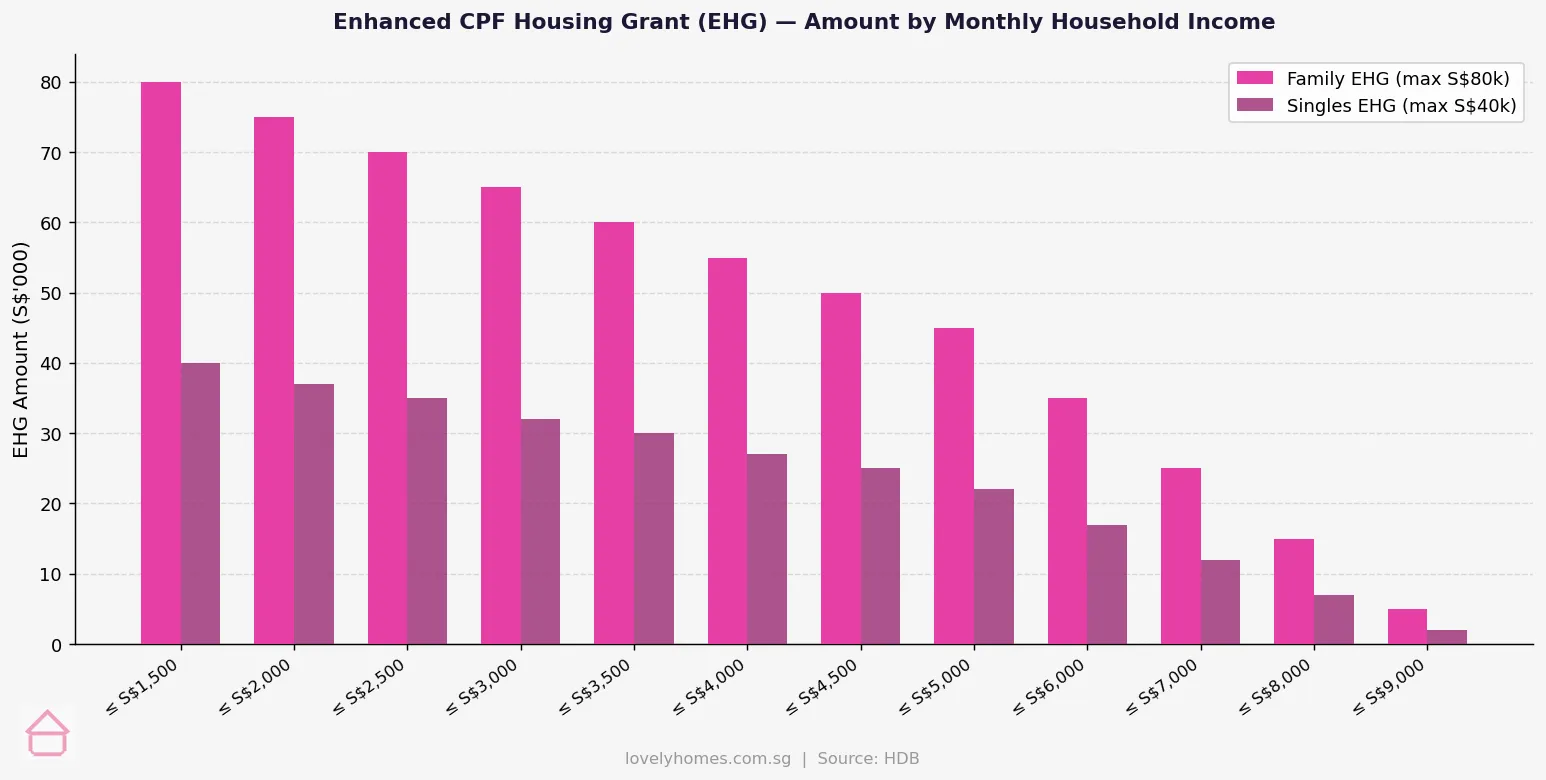
  • EHG: income S$7,500/mth → S$55,000 (income band S$7,001–S$8,000 for families)
  • Family Grant (SC/SC, 4-room): S$50,000
  • Total grants: S$105,000 — credited to CPF OA

Effective purchase cost after grants: S$550,000 − S$105,000 = S$445,000

Financing: HDB loan at 80% of S$545,000 (valuation) = S$436,000 maximum; MSR check: S$436,000 at 2.6% over 25 years ≈ S$1,982/mth. MSR = 30% × S$7,500 = S$2,250. S$1,982 ≤ S$2,250 → MSR PASS.

Upfront cash/CPF needed (excluding grants):

  • Down payment (20% of S$545,000 valuation): S$109,000 — payable from CPF OA or cash
  • COV: S$5,000 — must be cash (cannot use CPF for COV)
  • BSD: (S$180k×1%) + (S$180k×2%) + (S$190k×3%) = S$1,800 + S$3,600 + S$5,700 = S$11,100 (payable via CPF OA)
  • Legal fees (buyer’s conveyancing): ~S$2,500
  • OTP option fee (non-refundable): up to S$1,000
  • Total cash minimum: ~S$8,500 (COV + legal + option fee)
  • CPF OA used: ~S$109,000 + S$11,100 = S$120,100 (offset by S$105,000 grants → net CPF outflow ~S$15,100 if grants insufficient; actual depends on existing CPF OA balance)

This illustrates why first-timer couples with combined income around S$7,500/mth can often purchase a resale 4-room flat in a non-mature estate with relatively modest cash upfront, provided grants are maximised.

What This Means for Buyers and Sellers in 2026

The HDB resale market in mid-2026 is characterised by solid but moderating demand. With the BTO backlog largely cleared and significant new flat supply coming onstream, buyers have more choices than in the 2021–2022 peak. Resale prices in non-mature estates such as Jurong West, Woodlands, and Sengkang have stabilised or softened modestly, while mature estates — particularly those near Thomson-East Coast Line (TEL) stations — continue to command premiums.

For sellers, the 14-week timeline to completion means planning is critical, especially if the sale proceeds are needed to fund a new home purchase. Sellers should align OTP issuance with their own housing timeline to avoid a gap period. Where a new purchase is concurrent, engaging a conveyancing lawyer who can coordinate both transactions is strongly recommended.

For buyers, the combination of a higher-priced resale market and HDB’s 80% LTV cap means the absolute cash and CPF commitment is substantial. Maximising eligible grants — particularly the EHG and Family Grant — is the single most effective way to reduce upfront costs. Buyers should apply for the HLE letter well in advance and factor in the COV risk for popular precincts.

What Might Come Next

The following is analytical commentary based on publicly available signals — not official guidance.

HDB’s June 2026 BTO exercise produced 6,952 flats across 7 projects, with the Prime-classified Berlayar Rise (Bukit Merah) oversubscribed at 4.5× and Lakeview Cascadia (Bishan) at 4.7×. The continued strong demand for Prime and Plus flats signals that buyers remain willing to accept the enhanced MOP and clawback conditions for well-located flats. Over the medium term, as these new Prime/Plus flats reach their MOP in the early 2030s, they will add an entirely new tier of resale transactions subject to the Prime/Plus resale conditions — including clawback on subsidy.

HDB has signalled it will continue to release BTO supply at elevated levels to address the demand backlog. As supply catches up with demand over 2026–2028, resale prices — particularly in non-mature estates — are expected to moderate gradually. Buyers with a long-term horizon and flexibility on location have a strengthening case to wait for upcoming BTO exercises, while those needing immediate occupation continue to turn to the resale market.

Frequently Asked Questions

Can I buy an HDB resale flat without an HLE letter?

Yes — if you are using a bank loan rather than an HDB concessionary loan, you do not need an HLE letter. You would instead provide your bank’s Approval In Principle (AIP) letter as part of the resale application. However, you will need to have registered your Intent to Buy on the HDB Resale Portal and confirmed your financing method before the OTP is issued. If you wish to switch from a bank loan to an HDB loan at any point before completion, you would need to obtain an HLE letter at that stage — switching mid-way can delay the completion timeline.

What is Cash-Over-Valuation (COV) and how does it affect my purchase?

Cash-Over-Valuation (COV) is the difference between the agreed resale price and the HDB or bank valuation of the flat, when the agreed price is higher than the valuation. Because CPF and HDB loan proceeds are capped at a percentage of the lower of the valuation or the agreed price, any COV must be paid entirely in cash. For example, if the agreed price is S$680,000 but HDB’s valuation is S$650,000, the S$30,000 COV must be paid in cash. Buyers should budget for COV when purchasing in popular precincts where demand regularly pushes prices above HDB’s assessed value — checking recent transaction prices on the HDB website before negotiating helps set realistic expectations.

What happens if the HDB resale application lapses?

An HDB resale application lapses if both parties do not submit within 7 days of the OTP exercise, or if required documents are not provided within HDB’s stipulated timeframe. A lapsed application means the transaction does not proceed; the seller is not obligated to return the option fee and exercise fee, and both parties may face legal liability depending on which party caused the lapse. To prevent this, ensure both parties understand the 7-day submission window, and engage conveyancing lawyers before the OTP is exercised — they can guide both parties through the submission process efficiently.

How long does a seller have to vacate the flat after completion?

The transfer of possession happens at the completion appointment. From the completion date, the seller is typically required to vacate the flat immediately or within a very short grace period agreed in the OTP. In practice, seller and buyer may negotiate a short leaseback arrangement (where the seller continues to occupy for a few weeks post-completion as a tenant) if both parties agree and the terms are documented. Such arrangements must be disclosed to HDB as they may affect certain ownership rules. The flat must be vacant and in the agreed condition (with agreed fittings left in place) by the agreed possession date.

Can a Singapore Permanent Resident (SPR) buy an HDB resale flat?

Yes, Singapore Permanent Residents may purchase HDB resale flats — but with important restrictions. An SPR cannot buy an HDB resale flat alone; they must purchase with an SC spouse, child, or parent (i.e., the household must include at least one SC under the family scheme). SPRs applying under the Non-Citizen Spouse Scheme or the Non-Citizen Family Scheme with at least one SC member can proceed. Fully SPR households (no SC member) cannot buy HDB resale flats. SPRs also pay ABSD on the resale purchase (5% for an SPR purchasing a first residential property), while SCs buying their first residential property pay no ABSD.

What is the Resale Levy and when does it apply?

The HDB Resale Levy is a levy payable by second-timer buyers — those who have previously purchased a subsidised HDB flat (BTO, DBSS, or bought a resale flat with CPF housing grants) and now wish to purchase a second subsidised flat. The levy ranges from S$15,000 (2-room) to S$55,000 (5-room), must be paid in cash (not CPF), and is deducted from the sale proceeds of the first flat if the first flat is sold to HDB. The resale levy applies regardless of whether the second purchase is a BTO or a resale flat purchased with grants. Detailed levy amounts by flat type are covered in our dedicated HDB Resale Levy guide.

Do I need a lawyer for an HDB resale transaction?

Yes. Both buyer and seller in an HDB resale transaction are required to engage licensed conveyancing lawyers to represent their respective interests. Lawyers handle the OTP preparation and review, HDB portal submissions, CPF withdrawal applications, BSD and ABSD stamping, title transfer documentation, and coordination with the seller’s bank (for mortgage redemption). HDB maintains a list of conveyancing law firms and recommended panels for HDB transactions. Legal fees for an HDB resale transaction typically range from S$1,800 to S$3,000 for standard cases.

Related Articles

Disclaimer

This article is for general informational purposes only and does not constitute legal, financial, or housing advice. HDB resale eligibility criteria, grant amounts, interest rates, MOP requirements, and administrative procedures are set by the Housing & Development Board (HDB), IRAS, and the CPF Board and may change without prior notice. Readers should refer to official sources — www.hdb.gov.sg, www.iras.gov.sg, and www.cpf.gov.sg — for authoritative and up-to-date information. Before any property transaction, consult a licensed conveyancing solicitor and a qualified financial adviser.

HDB 2-Room Flexi Flat Singapore 2026: Complete Guide for Singles and Seniors

HDB 2-Room Flexi Flat Singapore 2026: Complete Guide for Singles and Seniors

Quick Answer — HDB 2-Room Flexi Flat at a Glance

  • What it is: A compact HDB flat type (approx. 36–45 sqm) with flexible lease options, designed for seniors aged 55 and above or eligible singles aged 35 and above.
  • Lease flexibility: Seniors may choose a short lease of 15, 20, 25, 30, 35, 40 or 45 years; singles and couples buy on the standard 99-year lease.
  • BTO price range: From approximately S$45,000 (senior, 15-year lease, non-mature estate) to S$140,000 (single, 99-year lease, non-mature estate BTO). Resale 2-room flats are priced by the open market.
  • Who can buy: SC singles (35+), SC/SPR couples where at least one is SC, and SC households aged 55+ (short-lease sub-type).
  • Income ceiling: S$7,000/mth for singles; S$14,000/mth for households.
  • Grants available: Enhanced Housing Grant (EHG) up to S$80,000 for eligible first-timers; Proximity Housing Grant (PHG) up to S$30,000 for resale buyers near family.
  • CPF usage: CPF Ordinary Account savings may be used for downpayment and monthly instalments, subject to CPF withdrawal limits and the flat’s remaining lease covering the youngest buyer to age 95.
  • MOP: Standard 5 years for regular 2-room Flexi flats; subletting of the whole flat is not allowed during MOP.
  • Resale restriction: Short-lease flats (below 99 years) may only be sold back to HDB — they are not on the open resale market.
  • Key regulator: All 2-Room Flexi applications are managed by the Housing & Development Board (HDB) at hdb.gov.sg.

What Is the HDB 2-Room Flexi Flat?

The HDB 2-Room Flexi flat is a purpose-designed public housing type introduced in 2015 to replace the earlier 2-room flat. Measuring between 36 and 45 square metres, it is the smallest flat type offered in Singapore’s public housing system. The “Flexi” in its name refers to the scheme’s most distinctive feature: eligible buyers aged 55 and above may opt for a short, right-sized lease rather than committing to the standard 99-year term.

The 2-Room Flexi was designed primarily in response to Singapore’s rapidly ageing population and the Government’s broader policy aim of allowing seniors to right-size their housing expenditure. A senior who no longer needs a large flat — or who wishes to monetise equity from an existing property — can purchase a short-lease 2-Room Flexi for a fraction of the cost of a standard flat, freeing up capital for retirement while remaining in the public housing ecosystem.

At the same time, the scheme remains open to younger singles aged 35 and above on a 99-year lease basis, giving unmarried Singaporeans their first route to public homeownership without the need to form a household with another person. This makes the 2-Room Flexi structurally significant as the only HDB flat type that a single Singaporean citizen aged 35 or above may purchase directly from HDB in a Build-To-Order (BTO) exercise.

HDB 2-Room Flexi BTO prices by lease option 2026 bar chart
Figure 1: HDB 2-Room Flexi BTO Indicative Prices by Lease Option (2026). Prices are for non-mature estate BTO exercises and will vary by project location, storey and prevailing grant deductions. Source: HDB.

Two Sub-Types of the 2-Room Flexi Flat

The 2-Room Flexi scheme comprises two distinct sub-types, which differ fundamentally in lease term, eligible buyers and exit options:

Feature Standard Lease (99yr) Short Lease (15–45yr)
Who may apply SC singles (35+), SC/SPR couples SC households aged 55+
Lease term 99 years (from land grant) 15, 20, 25, 30, 35, 40 or 45 years (buyer’s choice)
Indicative BTO price From ~S$138,000 (non-mature) From ~S$45,000 (15yr, non-mature)
CPF usage Yes, subject to lease-CPF rules Yes, subject to lease-CPF rules
Resale on open market Yes, after 5-year MOP No — must be sold back to HDB
Subletting (whole flat) After MOP, with HDB approval Not permitted
Key grant available EHG (up to S$80k), PHG Silver Housing Bonus (SHB)

Short-lease buyers should note the critical exit restriction: unlike standard 99-year flats, a flat purchased on a short lease cannot be sold on the open resale market after the MOP. Instead, it must be returned to HDB at the end of the chosen lease term (the flat effectively reverts to HDB), or it may be sold back to HDB before lease expiry if the owner wishes to exit early. This means short-lease 2-Room Flexi flats carry zero capital appreciation potential and are explicitly designed as consumption housing rather than investment assets.

Eligibility — Who Qualifies?

The Housing & Development Board (HDB) sets out clear eligibility conditions for the 2-Room Flexi scheme. As at 2026, the key criteria are:

HDB 2-Room Flexi eligibility matrix 2026
Figure 2: HDB 2-Room Flexi Eligibility Matrix (2026). Sources: HDB, CPF Board. Conditions are subject to change; verify at hdb.gov.sg before applying.

For the Standard 99-Year Lease (Singles and Couples)

  • Citizenship: At least one applicant must be a Singapore Citizen. SPR singles may not apply for a BTO 2-Room Flexi; they may only purchase on the resale market.
  • Age: At least 35 years of age for singles; standard family nucleus formation rules apply for couples (21 years and above).
  • Income ceiling: Gross monthly household income must not exceed S$7,000 for singles or S$14,000 for households (combined all income sources).
  • Property ownership restriction: Applicants must not own or have disposed of any private residential property (local or overseas) within the 30 months preceding application.
  • Existing HDB flat: Singles who currently own an HDB flat and are applying as first-time applicants may still be eligible, subject to conditions regarding the sale of the existing flat.

For the Short Lease (Seniors Aged 55+)

  • Citizenship: Singapore Citizens only.
  • Age: All applicants must be aged 55 or above at point of application.
  • Chosen lease term: The lease selected must cover the youngest applicant to at least age 95. For a 55-year-old, the minimum viable lease is therefore 40 years (55 + 40 = 95). HDB enforces this as a hard minimum.
  • Income ceiling: S$14,000/mth household (same as standard). No income ceiling applies if buyers intend to monetise their flat through the Silver Housing Bonus (SHB) scheme.
  • Existing property: Senior applicants may proceed even if they currently own an HDB flat, provided they commit to selling the existing flat (or subletting where applicable) within a prescribed period after collecting keys.

CPF Usage and Loan Mechanics

CPF Ordinary Account (OA) savings may be used to fund both the downpayment and monthly loan repayments for 2-Room Flexi purchases, subject to the CPF lease coverage requirement: the flat’s remaining lease must be able to cover the youngest buyer to age 95 for full CPF usage to be available.

For a 99-year BTO flat, this is rarely a constraint for applicants under 60. For short-lease buyers, the arithmetic matters. A 60-year-old buying a 35-year lease flat (lease ends when buyer is 95) meets the threshold exactly, allowing full CPF usage. A 60-year-old buying a 30-year lease (expires at 90) does not meet the threshold and will face CPF withdrawal limits, meaning more cash is required for the purchase.

The HDB Concessionary Loan at 2.60% per annum is available for eligible buyers of 2-Room Flexi flats, subject to the standard HLE (HDB Loan Eligibility) letter application and the Mortgage Servicing Ratio (MSR) test: monthly repayments must not exceed 30% of gross monthly household income.

Grants Available for 2-Room Flexi Buyers

Grant Who It Applies To Maximum Amount Eligibility Condition
Enhanced Housing Grant (EHG) First-timer SC buying BTO or resale S$80,000 (individual) / S$160,000 (family) Income ≤ S$9,000/mth; continuous employment ≥12 months
Family Grant SC/SC or SC/SPR couples, resale S$50,000 (SC/SC) / S$40,000 (SC/SPR) First-timer family nucleus; income and property conditions apply
Proximity Housing Grant (PHG) Resale buyers living near/with parents S$30,000 (within 4km) / S$20,000 (same town) At least one applicant lives within 4km of parents/children
Silver Housing Bonus (SHB) Seniors selling existing flat to right-size Up to S$30,000 cash bonus 55+; sold existing flat; purchase ≤ 3-room flat; top up to CPF RA
Singles Grant SC single buying resale ≤ 5-room S$25,000 35+, first-timer, income ≤ S$7,000/mth

Grant stacking rules are complex and income-dependent. As a general principle, BTO buyers may access the EHG only (Family Grant is for resale), while resale buyers may stack the Family Grant, EHG and PHG subject to eligibility. Full grant conditions are published by HDB at hdb.gov.sg and change periodically in line with policy reviews.

HDB 2-Room Flexi purchase price versus net cost after grants 2026
Figure 3: HDB 2-Room Flexi — Indicative Purchase Price vs Net Cost After Grants, by Buyer Profile (2026). Sources: HDB, CPF Board. Amounts are indicative; actual grants depend on household income, citizenship status and first-timer eligibility at point of application.

Worked Example: Senior Buying a 2-Room Flexi (Short Lease)

Case Study — Mr Tan (SC, 62), Right-Sizing to a 2-Room Flexi

Profile: Mr Tan, Singapore Citizen aged 62, retired, monthly income S$1,800 (CPF LIFE payout). Currently owns a 4-room HDB flat in Bishan (sold for S$720,000, net proceeds after CPF refund: S$210,000 cash). No outstanding housing loan.

Target: 2-Room Flexi BTO, Hougang estate (non-mature), 35-year lease (youngest occupier Mr Tan, aged 62 → lease expires at age 97 → meets the age-95 threshold for full CPF usage). Indicative BTO price: S$100,000.

Silver Housing Bonus (SHB) eligibility:

  • Sold 4-room flat: ✓
  • Right-sizing to ≤ 3-room: ✓
  • Top-up to CPF Retirement Account (RA): required for SHB disbursement
  • SHB amount: S$20,000 cash (subject to RA top-up of S$60,000 minimum from sale proceeds)

Financing:

  • Purchase price: S$100,000
  • Less EHG (income S$1,800/mth, eligible): S$20,000 (indicative; exact amount determined by HDB based on income at time of application)
  • Net purchase: S$80,000
  • HDB loan (80% LTV): S$64,000 @ 2.60% over 25 years
  • Monthly repayment: ~S$291/mth
  • MSR check: S$291 / S$1,800 = 16.2% — PASS

Upfront cash:

  • 20% downpayment: S$16,000 (payable via CPF OA, as lease covers to age 97)
  • BSD on S$100,000: 1% × S$100,000 = S$1,000
  • Legal and admin fees: ~S$1,500
  • Total cash needed: approximately S$2,500 (remaining from CPF OA and cash)

Outcome: Mr Tan retains approximately S$210,000 net cash from the sale of his Bishan flat, gains S$20,000 SHB cash, and moves into a new flat with monthly repayments of S$291 — effectively freeing up substantial retirement capital while maintaining HDB homeownership in a new estate close to existing community networks.

Note: SHB amounts, EHG amounts, CPF withdrawal limits and HDB loan eligibility are all subject to prevailing HDB policy at time of application. The above is a simplified indicative illustration only.

What the 2-Room Flexi Scheme Means for Singapore’s Housing Market

The 2-Room Flexi scheme plays a structural role in Singapore’s housing policy architecture. For seniors, it provides a formal right-sizing pathway that releases larger flats back to the resale pool — supporting supply for young families who need more space. For singles, it is the de facto entry point into HDB ownership, filling a gap left by the original public housing framework that was designed around family nuclei.

Internationally, Singapore’s right-to-buy-back policy for short-lease flats is unusual. Most countries with public housing allow open-market resale of all units regardless of lease structure. Singapore’s decision to ring-fence short-lease stock within the HDB system prevents speculative resale of taxpayer-subsidised elderly housing and keeps the scheme’s fiscal cost manageable — but it also means seniors must plan carefully: once a short-lease flat is purchased, capital is largely locked in until the lease expires or the flat is sold back to HDB at a regulated price.

Looking ahead, the Government has signalled continued refinement of the Flexi scheme as the population ages. The Lease Buyback Scheme (LBS) — which allows seniors to sell part of their remaining lease back to HDB in exchange for CPF RA top-ups — complements the Flexi scheme and is likely to be expanded further. Seniors nearing retirement should consider modelling both options (right-sizing via 2-Room Flexi vs staying in their existing flat and using LBS) as part of a holistic retirement planning exercise.

Frequently Asked Questions

Can a single person buy a 2-Room Flexi flat?

Yes. Singapore Citizens aged 35 and above who are single may purchase a 2-Room Flexi flat on the standard 99-year lease basis, either through a BTO exercise or on the open resale market. This is one of the very few HDB flat types available to singles. SPR singles may only purchase 2-Room Flexi flats on the resale market (not BTO). The income ceiling for single applicants is S$7,000/mth gross. Grant eligibility (EHG, Singles Grant for resale) depends on first-timer status, income and other conditions set by HDB. Note that under the HDB eligibility framework, singles purchasing a 2-Room Flexi BTO may only apply in non-mature estates — mature estate BTO exercises for 2-Room Flexi flats are reserved for seniors (55+) on the short-lease sub-type.

Can I sell my 2-Room Flexi flat on the open market?

It depends on the lease type. If you purchased a standard 99-year lease 2-Room Flexi flat, you may sell it on the open HDB resale market after completing the 5-year Minimum Occupation Period (MOP) — the same rules as any other HDB resale flat, subject to EIP quotas and SPR quota restrictions. However, if you purchased a short-lease 2-Room Flexi flat (15–45 year lease), it cannot be sold on the open market at any time. It may only be returned to HDB at the end of the chosen lease or sold back to HDB before lease expiry at a regulated price. This is a critical distinction that buyers must understand before committing.

What is the Minimum Occupation Period for a 2-Room Flexi flat?

The Minimum Occupation Period (MOP) for a 2-Room Flexi flat is 5 years from the date of key collection (or from the date the last registered occupier moves in, if later). During the MOP, the entire flat may not be sublet, though individual rooms may be rented out with HDB’s prior approval. The MOP requirement applies regardless of whether the flat is purchased on a 99-year or short-lease basis. After completing the MOP, the 99-year lease flat may be listed for open-market resale; the short-lease flat may only be returned to HDB. There is no provision to reduce the MOP for 2-Room Flexi flats under current policy.

How does the Silver Housing Bonus work with the 2-Room Flexi?

The Silver Housing Bonus (SHB) is a cash incentive for seniors who right-size from a larger HDB flat to a smaller one (3-room or smaller, including the 2-Room Flexi). Eligible seniors receive a cash bonus of up to S$30,000, paid by HDB, when they use a portion of their flat sale proceeds (typically S$60,000 or more) to top up their CPF Retirement Account (RA) — which in turn boosts their monthly CPF LIFE payouts in retirement. The SHB is designed to be used in conjunction with a 2-Room Flexi purchase: a senior sells their 4- or 5-room flat, receives the SHB cash bonus, tops up their CPF RA for higher LIFE payouts and moves into a new, fully subsidised Flexi flat. The exact SHB amount depends on the total CPF RA top-up made and prevailing policy parameters at time of application. Full details at hdb.gov.sg.

Can I use CPF to buy a 2-Room Flexi short-lease flat?

Yes, CPF Ordinary Account (OA) savings may be used for the downpayment and monthly loan repayments, but only if the flat’s remaining lease is sufficient to cover the youngest buyer to age 95. For example, a 58-year-old buying a 37-year lease flat (58 + 37 = 95) satisfies the threshold and can use CPF OA in full. A 60-year-old buying a 30-year lease flat (expires at age 90) does not meet the threshold and faces CPF withdrawal restrictions, requiring more cash out of pocket. Buyers should model the CPF usage calculation before selecting their preferred lease term, and HDB’s loan eligibility framework should be confirmed via an HLE application before committing to a BTO ballot or resale OTP.

What happens to the flat when the short lease expires?

When a short-lease 2-Room Flexi flat’s lease expires, ownership of the flat reverts to HDB. There is no compensation payable to the former buyer — the flat’s value was fully priced into the discounted purchase price, and the buyer would have received use of the property for the entire chosen lease period. This is analogous to an annuity: the buyer “spent” the purchase price buying the right to live in the flat for a defined number of years. If the owner passes away before the lease expires, the remaining lease value may be inherited by eligible successors (typically a spouse) subject to HDB’s inheritance and transfer rules. The Estate will not receive residual cash value for the remaining lease.

Are 2-Room Flexi flats available in mature estates?

2-Room Flexi BTO flats are launched in both mature and non-mature estates, but with different restrictions. In non-mature estates, both singles (99-year lease) and seniors (short lease) may apply. In mature estates, the BTO 2-Room Flexi allocation is typically prioritised for seniors aged 55 and above on the short-lease sub-type, with a smaller quota for singles. Applications by singles in mature-estate BTO exercises compete in a higher-demand ballot environment. For the open resale market, there are no estate restrictions — singles and couples may purchase any available 2-Room Flexi resale flat islandwide, subject to EIP and SPR quota availability in the target block. Mature estate 2-Room Flexi resale flats command a premium of 20–40% over comparable non-mature estate units due to location and amenity access.

Related Articles

Disclaimer

The information in this article is provided for general informational and educational purposes only as at July 2026 and does not constitute financial, legal or property advice. HDB eligibility conditions, grant amounts, lease rules and CPF usage limits are set by the Housing & Development Board, CPF Board and relevant government agencies and are subject to change without notice. The worked example figures are indicative only and will differ based on individual circumstances. Readers should refer to HDB (hdb.gov.sg), CPF Board (cpf.gov.sg) and IRAS (iras.gov.sg) for authoritative and current information, and should consult a CEA-registered property agent and a licensed financial adviser before making any housing or retirement planning decision.

×

Click anywhere or press Esc to close

Singapore HDB Minimum Occupation Period (MOP) 2026: Complete Guide — Rules, Restrictions and Upgrade Options

Singapore HDB Minimum Occupation Period (MOP) 2026: Complete Guide — Rules, Restrictions and Upgrade Options

Quick Answer: HDB MOP Singapore 2026

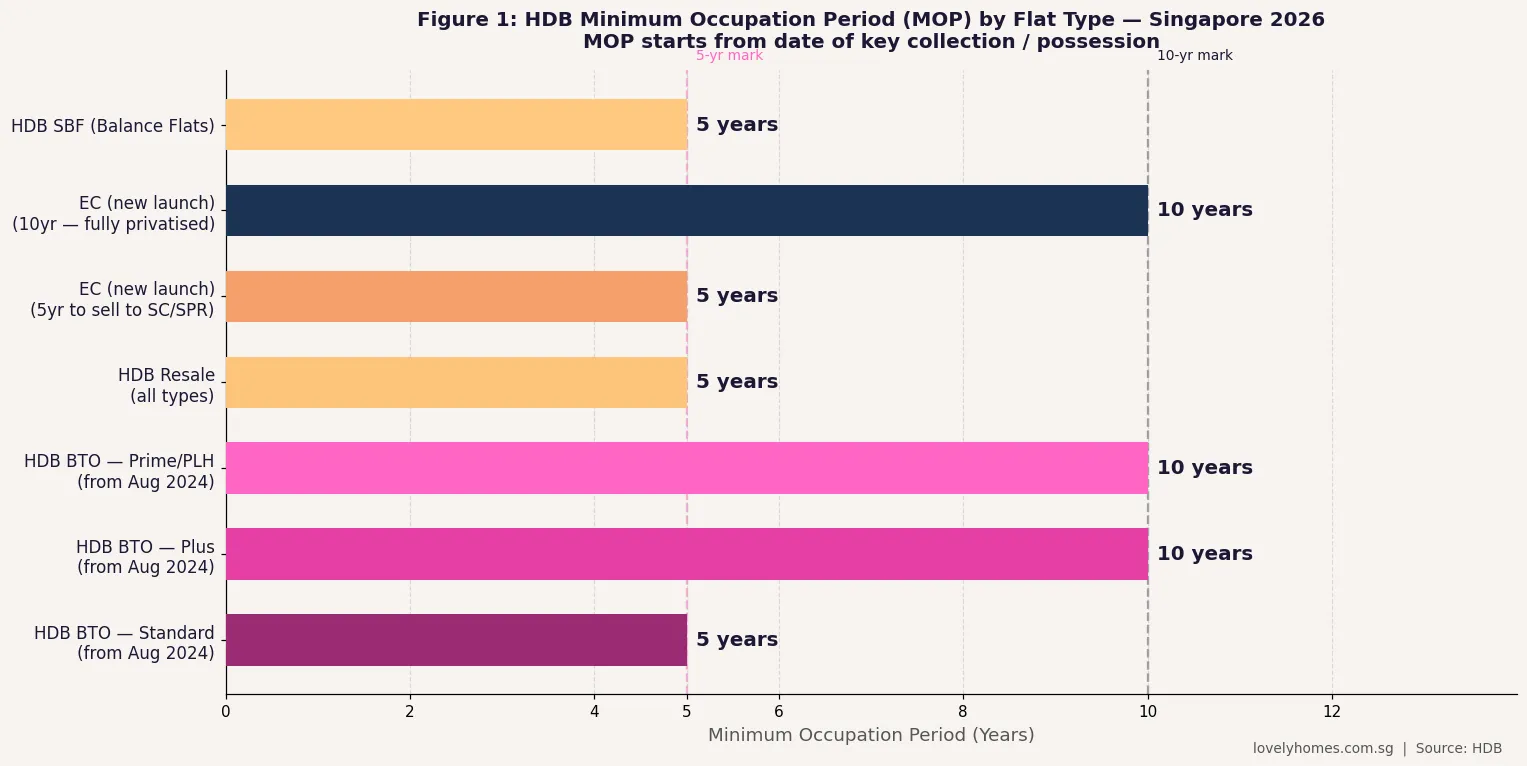
  • Standard HDB BTO and resale flats have a 5-year Minimum Occupation Period (MOP) counted from the date you collect the keys (TOP/possession date), not from when you sign the Sales & Purchase agreement.
  • Plus and Prime (PLH) classification flats introduced from the August 2024 BTO exercise have a longer 10-year MOP, reflecting their more desirable locations and heavier subsidy.
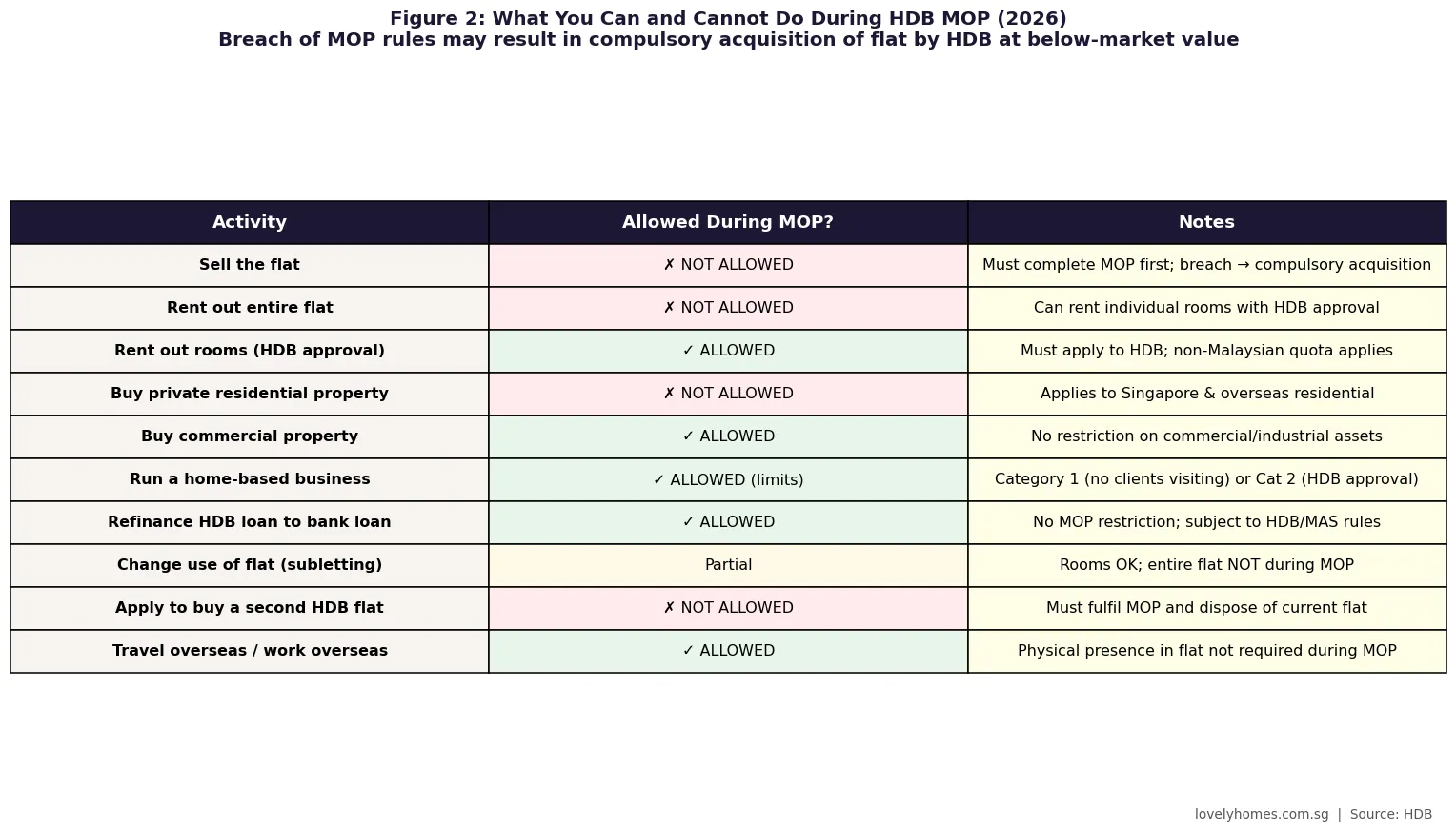
  • During MOP, you cannot sell your flat, rent out the entire flat, or purchase any other residential property in Singapore — including private property or an overseas residential investment.
  • You CAN rent out individual HDB bedrooms with prior HDB approval, and run approved home-based businesses from your flat during MOP.
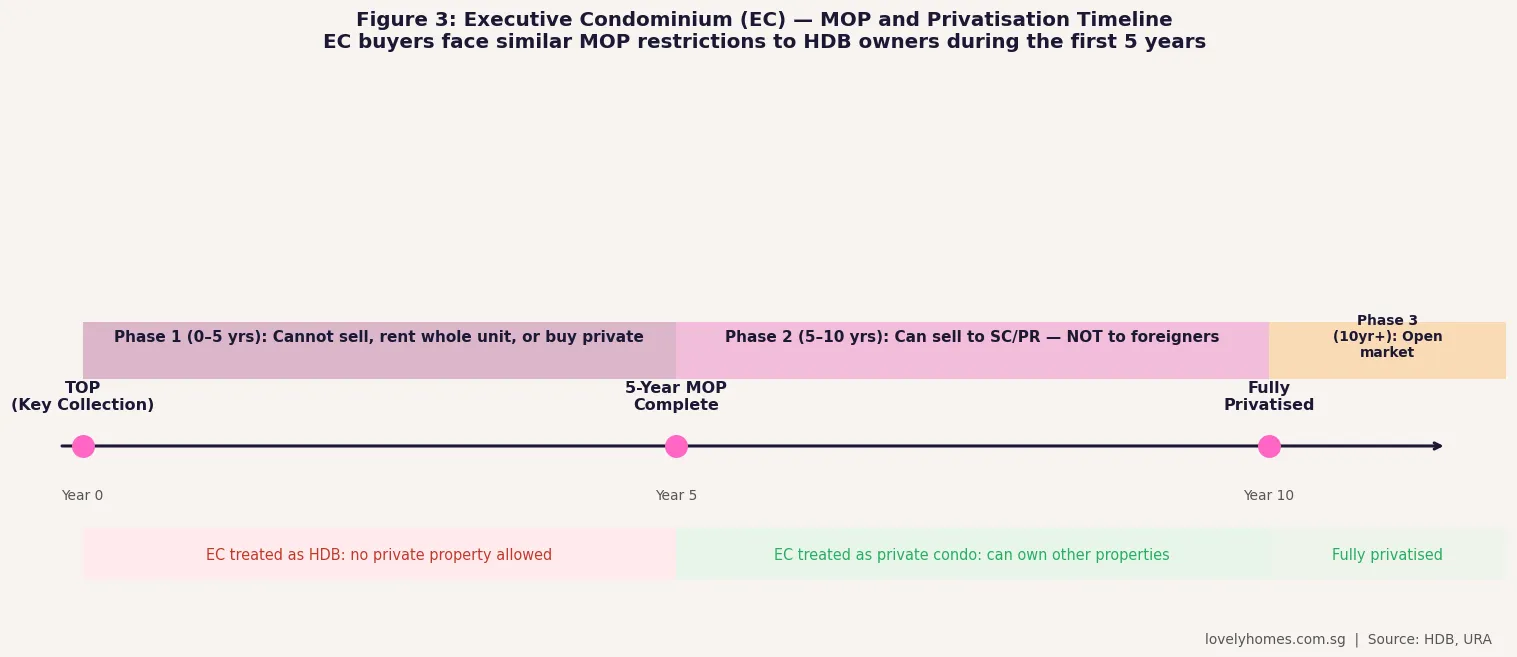
  • Executive Condominiums (ECs) have a 5-year MOP before they can be sold to Singapore Citizens and PRs, and a 10-year window before they are fully privatised and open to foreign buyers.
  • Breaching MOP rules can result in compulsory acquisition of the flat by HDB at a value set by HDB — typically below market value. Criminal penalties may also apply under the Housing & Development Act.
  • After MOP, you can sell the flat, upgrade to a private property, and — for HDB sellers upgrading to private — apply for ABSD remission if you complete the sale within 6 months of purchasing the private property.

What Is the HDB Minimum Occupation Period (MOP)?

The Minimum Occupation Period (MOP) is a statutory rule administered by the Housing & Development Board (HDB) that requires flat owners to physically occupy their HDB flat for a minimum period before they can sell it on the open market, rent it out entirely, or purchase other residential property in Singapore. The MOP is a key plank of Singapore’s public housing philosophy: HDB flats are subsidised national assets intended primarily as homes rather than investment vehicles, and the MOP is one mechanism through which HDB ensures flats remain owner-occupied.

The MOP was first introduced in the 1970s and has been refined multiple times since, most recently in 2024 with the introduction of the Plus and Prime flat classifications under the enhanced HDB framework. Understanding which MOP applies to your flat — and what you can and cannot do during that period — is critical before making any property decisions.

HDB MOP by flat type Singapore 2026 — Standard 5 years, Plus and Prime 10 years, EC 5 then 10 years
Figure 1: HDB Minimum Occupation Period by flat type, Singapore 2026. Plus and Prime classification flats (introduced from August 2024 BTO exercise) carry a 10-year MOP, double the Standard flat MOP. Source: HDB.

MOP Duration by Flat Type (2026)

Flat Type MOP Duration MOP Start Date Notes
Standard BTO Flat 5 years Date of key collection Applies to all pre-Aug 2024 BTO; continued for Standard classification from Aug 2024
Plus Classification BTO Flat 10 years Date of key collection From Aug 2024 BTO exercise; typically near MRT/town centres; subsidy clawback on resale
Prime / PLH Classification BTO Flat 10 years Date of key collection Central-location flats; subsidy clawback ~6–9% of resale price; income ceiling at resale
HDB Resale Flat 5 years Date of resale completion Fresh 5-year MOP runs from the date the resale transaction is completed (not from when the previous owner moved in)
Executive Condominium (EC) 5 years → 10 years Date of TOP At 5yr can sell to SC/PR; at 10yr fully privatised — open to foreigners (60% ABSD applies)
HDB Sale of Balance Flats (SBF) 5 years Date of key collection SBF flats unsold from previous BTO exercises; Standard classification MOP applies

Important note on the Plus and Prime MOP: The new 10-year MOP for Plus and Prime flats applies only to flats launched under the August 2024 BTO exercise onwards. Flats purchased in earlier exercises, even if they are in desirable locations that would now be classified as Plus or Prime, retain their original 5-year MOP. To confirm which classification applies to your flat, check your HDB flat portal or the original flat details under your BTO exercise.

What You Cannot Do During the HDB MOP

HDB MOP rules matrix 2026 — what you can and cannot do during the minimum occupation period
Figure 2: HDB MOP rules — allowed and prohibited activities during the Minimum Occupation Period. Source: HDB Housing & Development Act.

Selling the Flat

You cannot sell your HDB flat on the open resale market before your MOP is complete. This applies even if you face financial hardship — HDB does not grant MOP exemptions for distressed sellers. The only exception is a compulsory acquisition by HDB or by the State for public purposes, which is not initiated by the flat owner. If you attempt to sell before MOP, the transaction will be rejected by HDB’s system during the eligibility check.

Renting Out the Entire Flat

Renting out the entire flat (as a whole unit) is not allowed during MOP. This applies to both short-term and long-term rental arrangements. Platforms such as Airbnb and similar short-term rental services are also not permitted on HDB flats — the minimum lease tenure for any rental on HDB flats is three consecutive months. After MOP, whole-flat rental is allowed with HDB prior approval and is subject to the non-Malaysian foreign tenant quota.

Purchasing Other Residential Property in Singapore

During MOP, you and your co-owners on the flat cannot purchase any other private residential property in Singapore. This restriction extends to new launch condominiums, resale condominiums, Executive Condominiums (as a new buyer), landed property, and private apartments. Purchasing a second HDB flat is also not allowed during MOP.

Crucially, HDB’s definition of “residential property” in the MOP context refers to Singapore property only. There is no restriction on purchasing overseas residential property during MOP — only Singapore residential property is covered.

Purchasing a Second HDB Flat

HDB’s policy generally allows only one HDB flat per family nucleus at any time. Applying for a second BTO, SBF, or resale flat during MOP is not permitted. Once MOP is fulfilled, you may apply for a second HDB flat under specific schemes (e.g., the Studio Apartment scheme for elderly, or a new BTO after disposing of the first flat).

What You CAN Do During the HDB MOP

Rent Out Individual Rooms

Renting out individual bedrooms in your HDB flat (while you continue to live in the flat) is permitted during MOP, subject to HDB’s prior written approval. You must apply through the HDB Flat Portal before subletting. Each tenancy must be for a minimum of six months (for whole-flat subletting after MOP) or at least three months for room rental. Non-Malaysian foreign tenants are subject to the non-Malaysian quota: a maximum of two non-Malaysian foreign tenants per flat in the same block is the guideline, though HDB publishes real-time quota data by block.

Run Approved Home-Based Businesses

HDB permits flat owners to operate home-based businesses during MOP, subject to type and scale restrictions. Category 1 businesses (no employees visiting, no clients visiting, no signage) are allowed without prior approval. Category 2 businesses (up to two non-resident employees, clients may visit in small numbers) require prior approval from HDB. Manufacturing, food businesses, or any business that involves goods storage, noise, or frequent deliveries is not permitted.

Refinance to a Bank Loan

Switching from an HDB housing loan to a bank loan (or switching between bank loan packages) is allowed during MOP. There is no MOP restriction on refinancing decisions, and many flat owners take advantage of the 5-year MOP period to monitor interest rate movements and refinance when rates are favourable. MAS’s LTV and TDSR rules govern the refinancing terms.

When Does the MOP Start and End?

The MOP starts from the date you collect your keys (for BTO and SBF flats, this is the TOP date; for resale flats, this is the date of completion of the resale transaction — both milestones are reflected in your HDB Flat Portal). The MOP does not start from the date you sign the Sales & Purchase Agreement or from the date you pay the initial booking fee.

You can check your MOP end date in the HDB Flat Portal under “My Flat” → “Purchase Details”. The portal clearly shows whether your MOP has been fulfilled. Do not rely on verbal estimates from agents or CPF advisers — always verify on the portal directly.

One nuance: physical occupation is expected during MOP. HDB conducts periodic checks to ensure flat owners are residing in the flat. Extended overseas absences without HDB’s knowledge have been cited in compulsory acquisition cases. If you must be overseas for an extended period (e.g., for work), inform HDB and keep the flat in a lived-in condition.

Executive Condominium (EC): The Hybrid MOP Rules

Executive Condominium EC MOP and privatisation timeline Singapore 2026 — 5-year and 10-year milestones
Figure 3: Executive Condominium MOP and privatisation timeline. During the first 5 years, EC owners face HDB-equivalent MOP restrictions. At the 5-year mark, ECs can be sold on the open market to SC and PR buyers. At 10 years, ECs are fully privatised and open to foreign buyers (60% ABSD applies). Source: HDB, URA.

Executive Condominiums occupy a hybrid position between public and private housing. They are built by private developers but are sold at a subsidised price to qualifying buyers (income ceiling S$16,000 per month household income as of 2026). From a MOP standpoint, ECs are treated like HDB flats for the first 5 years:

During years 1–5: EC owners cannot sell their unit, rent out the whole unit, or purchase any other Singapore residential property. The rules are identical to HDB MOP. Critically, the 5-year MOP runs from the TOP date, not the booking date — for large EC projects, this can mean a 3–4 year gap between booking and TOP, followed by 5 more years of MOP, making the effective holding period 8–9 years from initial purchase commitment.

After year 5 (first privatisation): The EC can be sold on the open resale market to Singapore Citizens and Singapore PRs. It cannot yet be sold to foreigners, and ECs in the first 5–10 year window are not listed on the private market as “privatised condos” — they trade in a narrower SC/SPR market. ABSD rules for the buyer apply (5% for PR 1st property, 30% for PR 2nd+, etc.).

After year 10 (full privatisation): The EC is fully privatised and treated identically to a private condominium. Foreigners may purchase it, though the 60% foreigner ABSD applies. Owners may also rent the entire unit without prior HDB approval at this stage.

Plus and Prime Flat Additional Restrictions After MOP

The 2024 housing framework introduced substantive additional conditions for Plus and Prime classification flats beyond just the longer 10-year MOP. These are restrictions that run with the flat even after MOP and affect future resale:

Subsidy clawback: When you sell a Plus or Prime flat after your MOP, HDB claws back a portion of the subsidy embedded in the original purchase price — approximately 6–9% of the resale price, payable to HDB. This clawback is calculated as a percentage of the resale transaction price, not the original purchase price, so it increases in dollar terms as the flat appreciates.

Income ceiling for buyers: Buyers of Plus and Prime resale flats are subject to an income ceiling (the ceiling is the same as for BTO buyers — S$14,000/month for 4-room and larger Plus flats as of 2026). This narrows the pool of eligible resale buyers and may dampen price appreciation relative to Standard flats.

Ethnic Integration Policy (EIP): As with all HDB resale flats, EIP quotas apply — both block and neighbourhood levels. Buyers must check the relevant block’s EIP availability before submitting an offer.

After MOP: Your Property Upgrade Options

Once your MOP is fulfilled, your options expand significantly. The most common upgrade path is from HDB flat to private condominium. The timing of this upgrade carries stamp duty implications:

Option A — Sell HDB first, then buy private: You clear the HDB flat, receive sale proceeds (net of CPF refund), and purchase the private property as a “first property” — no ABSD for SC buyers, 5% ABSD for PR buyers. This is the most common and financially efficient path but requires temporary accommodation between the two transactions.

Option B — Buy private first, then sell HDB (concurrent ownership): As an SC buying private property while still owning an HDB flat (post-MOP), you pay 20% ABSD on the private property purchase. You then have six months from the private property’s completion (or from the purchase date for resale private properties) to sell the HDB flat and apply for an ABSD remission from IRAS. If the HDB is sold within six months, IRAS refunds the 20% ABSD. If you miss the six-month window, the 20% ABSD is forfeited.

The six-month window starts from either the issue of Temporary Occupation Permit (TOP) for a new private property or the date of exercise of the OTP for a resale private property. Given the complexity of timing, many HDB upgraders consult a lawyer and financial adviser before committing to Option B.

The 15-Month Wait-Out Period: From Private Back to HDB

The wait-out period is often confused with MOP. They are different rules targeting different situations. The 15-month wait-out period (introduced in September 2022) applies to private property owners who want to purchase an HDB resale flat. If you own or recently disposed of a private property, you must wait 15 months from the date of disposal before you can purchase an HDB resale flat.

This rule does not apply to HDB MOP — it is a separate downstream restriction. For example, if you complete your HDB MOP, sell your HDB flat, buy a private condo, and then later want to downgrade back to HDB, you must wait 15 months after selling the private condo before buying an HDB resale flat. This rule applies to both SC and PR private property owners.

Worked Example: The Tan Family’s Upgrade Journey

Mr and Mrs Tan (both Singapore Citizens) purchased a 4-room BTO flat in Punggol under the Standard classification in September 2019. They collected their keys in August 2021. Their MOP end date is therefore August 2026 — five years from key collection.

In March 2026, Mrs Tan checks the HDB portal and sees MOP will end in 5 months. The couple begin their private condo search. They find a 3-bedroom OCR resale condo in Jurong East priced at S$1.5M in June 2026.

They choose Option B (buy private first). As SC buying a second property: BSD ~S$42,600 + ABSD 20% = S$300,000. They pay S$342,600 in stamp duties. Their flat is still within MOP (keys August 2021, MOP August 2026 — they are just before MOP end), so HDB must confirm MOP end before they list the flat for sale.

After August 2026 (MOP fulfilled), they list their HDB flat. Sell it in October 2026 for S$780,000 — within the 6-month window from the condo OTP exercise date of June 2026. IRAS refunds the S$300,000 ABSD. Net stamp duty retained: S$42,600 BSD only. The family books temporary accommodation for 2 months while bridging the purchase and sale timelines.

Total net proceeds from HDB: S$780,000 − CPF refund S$220,000 (principal + accrued interest) − agent 1% S$7,800 − legal S$2,500 = net S$549,700 cash. The upgrade is financially viable.

Will MOP Rules Change?

The 10-year MOP for Plus and Prime flats is a relatively recent policy (from August 2024) and unlikely to be rolled back in the near term. If anything, the trend in Singapore public housing policy has been toward tightening MOP and adding post-MOP conditions rather than relaxing them, as the government works to ensure HDB flats remain primary homes rather than investment properties. The subsidy clawback mechanism for Plus and Prime flats may be extended to more flat types if HDB determines that Standard flat resale prices are diverging too sharply from BTO prices in certain areas. Buyers should model their long-term exit strategy under current rules and build in buffer for possible tightening.

Frequently Asked Questions

Can I stay overseas during my HDB MOP?

You are expected to physically occupy the flat during MOP, but there is no absolute rule against overseas travel. Extended absences (months or years) without HDB’s knowledge can attract scrutiny, and in confirmed cases of non-occupation, HDB may commence compulsory acquisition proceedings. If you need to relocate overseas temporarily for work (e.g., on a company secondment), inform HDB in writing and keep the flat utilities active. HDB conducts inspection exercises and spot checks and has compulsorily acquired flats where owners were clearly not residing in them during MOP.

Does my MOP reset if I add or remove an owner from the flat?

No — adding or removing an owner (for example, through marriage or divorce) does not reset the MOP clock. The MOP continues to run from the original key collection date. However, any change of ownership within MOP is a restricted transaction and must be approved by HDB. Not all ownership changes are approved during MOP — for example, transferring a flat to an ineligible person would be rejected. Consult HDB or a lawyer before any ownership change within the MOP window.

Can I buy an overseas investment property during MOP?

Yes. The HDB MOP restriction applies only to Singapore residential property. There is no restriction on purchasing overseas property (residential or commercial) during MOP. You are not required to declare overseas property purchases to HDB. However, if you are financing an overseas property purchase with a Singapore bank loan, that loan will be factored into your TDSR for future Singapore loan applications. From a Singapore tax perspective, rental income from overseas property is taxable in Singapore as foreign-sourced income if remitted to Singapore.

What happens if I breach the MOP?

A breach of MOP (typically: selling the flat, subletting the entire flat, or buying other residential property in Singapore without completing MOP) can result in HDB compulsorily acquiring the flat. HDB sets the acquisition price, which is typically the assessed market value minus a penalty deduction — in practice, this means the owner receives significantly less than the open-market value they would have received after MOP. In the most serious cases involving deliberate deception or fraud (e.g., falsely declaring occupancy), criminal charges may be brought under the Housing & Development Act, which carries fines of up to S$5,000 and/or imprisonment.

Does MOP apply to inherited HDB flats?

If you inherit an HDB flat from a deceased owner, the MOP of the original owner does not transfer to you as a fresh 5-year obligation. Instead, the inherited flat is subject to HDB’s estate rules — the eligible inheritor (e.g., a spouse or child who meets eligibility criteria) may retain the flat. If the inheritor already owns a flat, they may need to dispose of one within six months. Inherited flats that have not yet met MOP at the time of death are subject to HDB’s direction — in practice, HDB often allows the eligible inheritor to complete the remaining MOP. Always consult HDB’s estate administration team for inherited flat cases.

Can I buy a private property if my HDB is still within MOP and my spouse is not on the HDB title?

No — the restriction applies to the entire family nucleus (owner and spouse / co-habitant), not just the named owners on the HDB title. If one spouse is within MOP on an HDB flat, the other spouse (even if not on the HDB title) is also restricted from purchasing Singapore residential property. HDB looks at the family nucleus holistically. Attempting to buy private property in a non-owning spouse’s name to circumvent MOP is a known scheme that HDB and IRAS are alert to — it will be scrutinised and may result in both the stamp duty assessment and a referral for investigation.

Is there a MOP for HDB shophouses or commercial units?

No. MOP is specific to HDB residential flat units. HDB shophouses (commercial properties on the ground floor of HDB blocks) are governed by different rules and do not carry a MOP. Commercial properties generally do not have any MOP equivalent — you can sell or rent them freely at any time after purchase. The restrictions and ABSD rules that apply to residential property do not apply to commercial property purchases.

Related Articles

Disclaimer

This article provides general information about HDB MOP rules as at July 2026 and is not legal or financial advice. MOP durations, clawback percentages, and related policy conditions may change. Always verify current MOP status for your flat at hdb.gov.sg and check the specific BTO exercise details in your Lease Agreement. For estate planning, inheritance, and structural ownership changes, consult a Singapore-qualified lawyer. For ABSD remission eligibility, consult IRAS at iras.gov.sg.

Translate »