HDB Minimum Occupation Period (MOP) Singapore 2026: Complete Guide

HDB Minimum Occupation Period (MOP) Singapore 2026: Complete Guide

📌 Quick Answer: HDB Minimum Occupation Period (MOP) 2026

  • The MOP is the mandatory period you must live in your HDB flat before you are allowed to sell it on the open market or buy a private residential property.
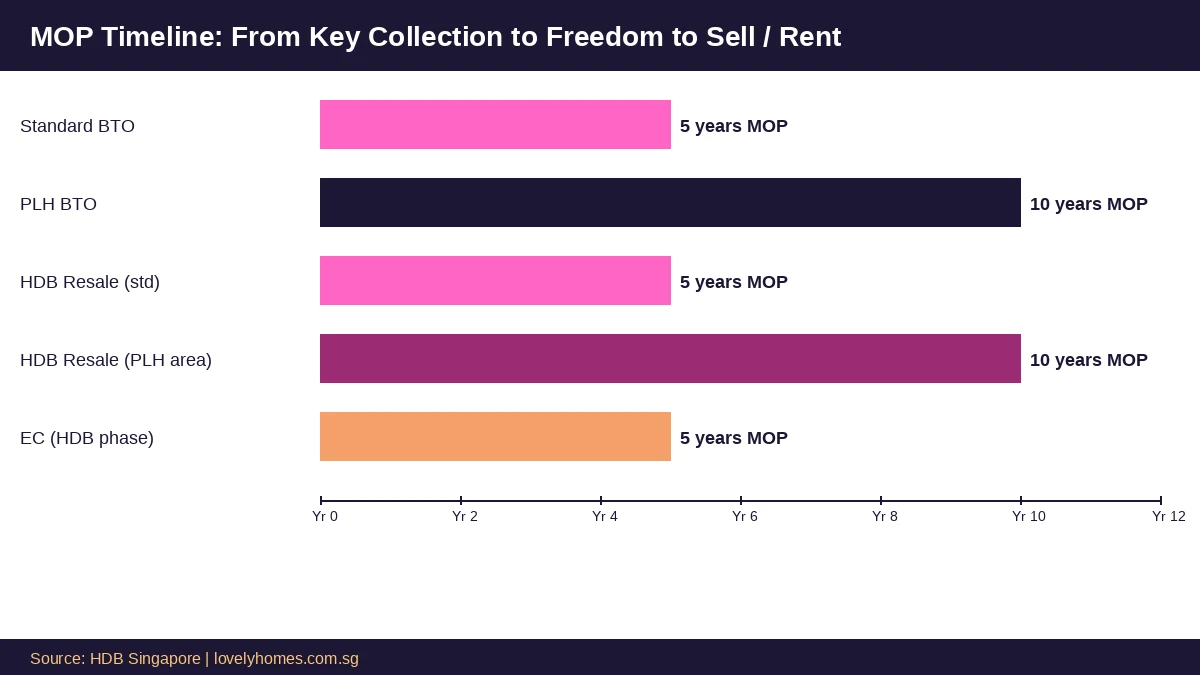
  • Standard BTO and resale flats carry a 5-year MOP, counted from the date you collect your keys (for BTO) or the date the resale transaction is completed.
  • Prime Location Housing (PLH) flats — introduced in October 2021 — carry a 10-year MOP and come with a permanent ban on renting out the whole flat.
  • During MOP you cannot sell the flat on the open market, rent out the entire flat, or purchase a private residential property without first disposing of the HDB flat.
  • Renting out individual rooms is permitted during MOP with HDB’s approval, provided occupancy caps are met.
  • Executive Condominiums (ECs) have a 5-year MOP under HDB rules; they become fully privatised at the 10-year mark.
  • Violation consequences include compulsory acquisition at below-market value, grant clawback, and debarment from future HDB applications.
  • The MOP applies to the flat, not the owner: any attempt to sell before expiry is void and attracts penalties.

What Is the HDB Minimum Occupation Period (MOP)?

The Minimum Occupation Period — universally known as MOP in Singapore property circles — is a Housing & Development Board (HDB) policy requiring flat owners to physically occupy their flat for a stipulated number of years before they are permitted to sell, rent the entire unit, or purchase a private residential property. The MOP is administered under the Housing and Development Act and is one of the most consequential rules shaping the Singapore HDB resale market.

HDB introduced the MOP to prevent speculative “flipping” of subsidised public housing. Because the government provides substantial grants and subsidies when selling BTO flats, it wants genuine owner-occupiers to benefit from those subsidies rather than investors who might resell immediately for a quick profit. The MOP therefore acts as a temporal lock-in that aligns the interests of flat buyers with the public-housing mission of HDB.

The standard MOP has stood at five years since 2010. However, the introduction of the Prime Location Housing (PLH) model in October 2021 created a new, more restrictive 10-year MOP for BTO projects in central and highly sought-after locations. Understanding which MOP category applies to your flat — and what you are and are not permitted to do during that period — is critical before making any property decision.
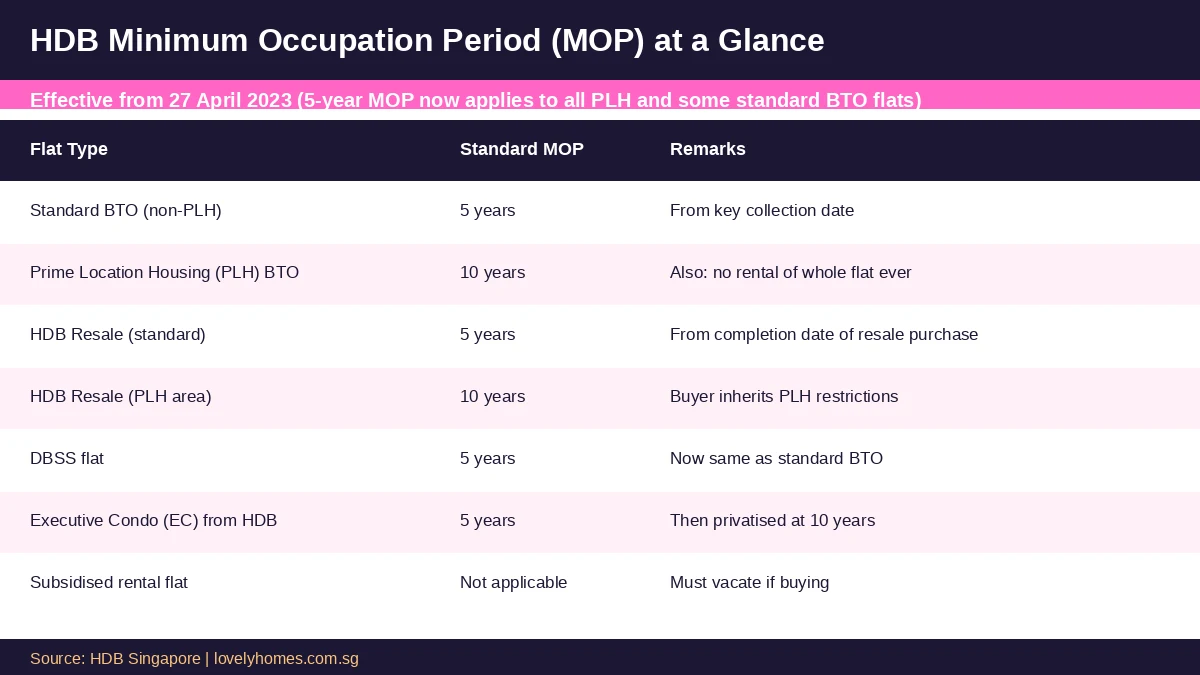
HDB MOP summary table Singapore 2026 standard BTO PLH resale EC
Figure 1: HDB Minimum Occupation Period at a Glance — standard BTO, PLH BTO, resale, and EC rules. Source: HDB Singapore.

How Is the MOP Counted?

The MOP clock starts differently depending on how you acquired the flat. For a BTO flat, the MOP begins on the date of key collection, which HDB formally records. If you collect your keys on 15 January 2022, your 5-year MOP expires on 15 January 2027. For a resale HDB flat, the MOP begins on the date the resale transaction is legally completed — that is, the date shown on the HDB resale completion letter, typically 8–12 weeks after HDB accepts the resale application. DBSS flats follow the same rule as resale. For an EC bought from an HDB-appointed developer, the MOP starts from the date of vacant possession (VP) and lasts five years, after which the EC becomes partially privatised and fully private at the 10-year mark.

Importantly, the MOP measures calendar time, not duration of active occupation. Even if you are posted overseas for work and your flat sits empty for part of the period, the clock does not pause. You must also maintain the flat as your sole registered address in Singapore during the MOP; abandoning the flat to stay elsewhere while the clock runs is a violation that HDB actively monitors through its inspection programme.

MOP by Flat Type — 2026 Reference Table

Flat Type MOP Duration Whole-flat Rental After MOP? Key Rule
Standard BTO (non-PLH) 5 years from key collection Yes, with HDB approval Flat must be primary residence during MOP
Prime Location Housing (PLH) BTO 10 years from key collection No — permanently prohibited Introduced Oct 2021; applies to centrally located BTO projects
HDB Resale (standard area) 5 years from completion Yes, with HDB approval Buyer’s MOP starts from resale completion date
HDB Resale (PLH-designated area) 10 years from completion No — permanently prohibited PLH restriction travels with the address, not the seller
DBSS flat 5 years Yes, with HDB approval Treated the same as standard BTO for MOP purposes
Executive Condo (EC) 5 years (HDB rules apply) Yes, after MOP + HDB approval Fully private at 10 years; no HDB restrictions thereafter

HDB MOP timeline chart 5-year 10-year standard PLH BTO Singapore 2026
Figure 2: MOP Timeline by Flat Type — visual comparison of 5-year versus 10-year lock-in periods. Source: HDB Singapore.

What Can You Do During the MOP?

Many flat owners are surprised to discover that the MOP is not a blanket prohibition on all activity — it targets sale and whole-flat rental specifically. Renting out spare bedrooms is permitted: HDB allows flat owners to sublet individual rooms, subject to occupancy caps and prior HDB approval via the resale portal. The total number of occupants including owners must not exceed the flat’s authorised occupancy limit — six persons for a 3-room flat, eight for larger flats as of 2026. Running a small home-based business under HDB’s Home-Based Small Scale Business guidelines is also permitted and does not affect the MOP. Internal renovations are allowed subject to HDB’s renovation guidelines and town council rules.

What is prohibited is more significant. You cannot sell the flat on the open market — any purported contract of sale during MOP is void. You cannot rent out the entire flat for standard flats during MOP, and for PLH flats this prohibition is permanent. You cannot purchase a private residential property in Singapore while an HDB flat is under MOP; if you do, HDB will require you to dispose of the HDB flat within six months and may impose financial penalties. Voluntary ownership transfers to family members are generally not permitted during MOP without HDB’s prior approval, which is granted only in specific circumstances such as divorce, death, or financial hardship.
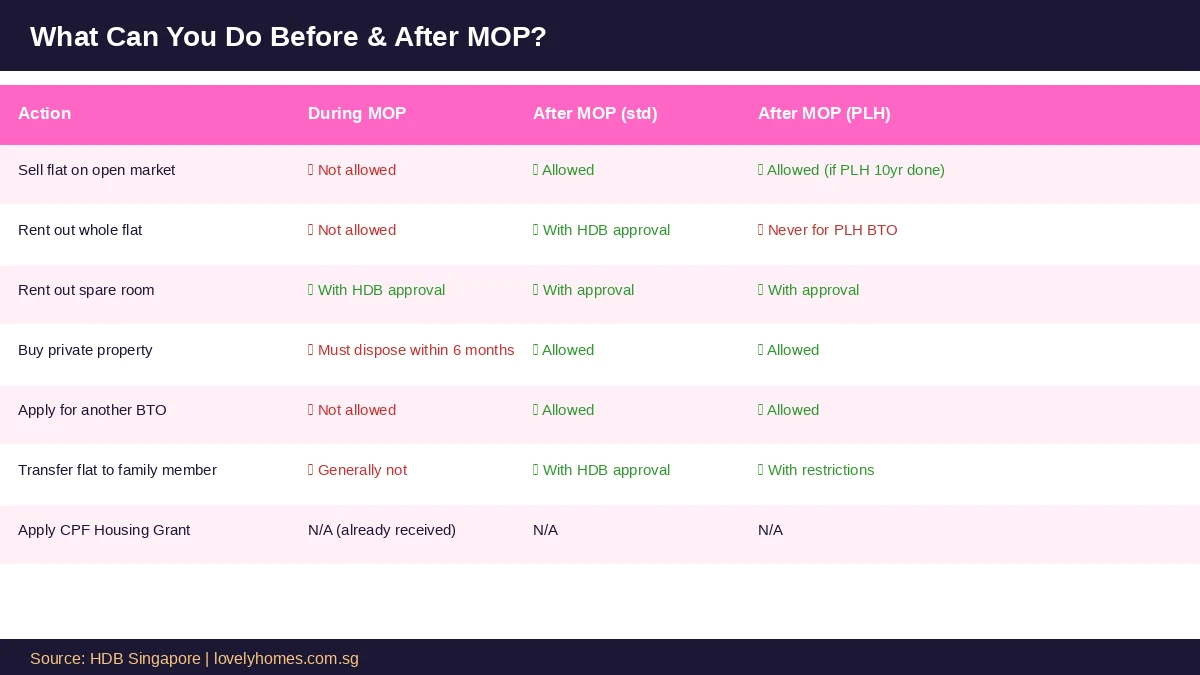
HDB MOP before and after comparison matrix Singapore 2026
Figure 3: Before vs. After MOP — permitted and prohibited actions by flat type. Source: HDB Singapore.

Worked Example: The Lim Family’s MOP Journey

👥 Scenario: Lim Family, 4-Room BTO in Tampines

Key collection date: 15 March 2021

MOP expiry date: 15 March 2026 (5-year standard MOP)

Goal in early 2026: Sell the flat and upgrade to a private condo.

  • From 15 March 2026, the Lims are free to list the flat on the open market via the HDB resale portal.
  • They may simultaneously exercise an OTP (Option to Purchase) on a private condo. If they buy the condo before completing the HDB sale, a 6-month disposal window applies.
  • Had they bought the condo in January 2026 — before MOP expiry — HDB would have required them to sell the flat within 6 months and could have imposed a financial penalty.
  • CPF Family Grant: Received at BTO purchase; not subject to clawback on MOP completion. A Resale Levy of S$50,000 applies if they later purchase another subsidised flat.
  • They had also rented out two spare bedrooms since October 2022 (with HDB approval), earning approximately S$1,800 per month — a permitted activity during MOP.

The PLH Model and the 10-Year MOP

The Prime Location Housing (PLH) model was launched by HDB in October 2021 to address public concern that prime-location BTO flats — particularly in districts such as Rochor and the Central Area — were underpriced relative to private property. The two key additional restrictions of the PLH model are the 10-year MOP and the permanent ban on renting out the whole flat.

For buyers of PLH BTO flats, this means the flat cannot be sold until 10 full years from key collection. Even after those 10 years, the whole-flat rental prohibition is perpetual — it is address-based and permanent, running with the flat and not the owner. A resale buyer who purchases a PLH-designated flat on the open market inherits the same restriction; there is no way to clear it by buying second-hand. Individual rooms may still be sublet with HDB approval.

The Ministry of National Development (MND) has indicated that the PLH model will be applied selectively. Research from industry analysts suggests that PLH resale transactions — when they eventually enter the market after 2031 for the earliest PLH BTO projects — may be priced at a discount to non-PLH flats of equivalent size and location, precisely because of the rental prohibition narrowing the buyer pool.

Consequences of Violating the MOP

Violation HDB Action Additional Consequence
Selling flat before MOP expires Void transaction; possible compulsory acquisition at below-market value Debarment from future HDB flat purchases for up to 5 years
Renting out whole flat during MOP Fine of S$3,000–S$5,000; instruction to terminate tenancy immediately Repeat offence may result in compulsory acquisition
Buying private property during MOP without disposing of HDB flat 6-month disposal notice issued by HDB Financial penalty; potential stamp duty complications
Giving false occupation declaration Civil and/or criminal prosecution under the Housing and Development Act Fines up to S$5,000 or imprisonment up to 6 months

What Happens After the MOP?

Once your MOP expires, you gain substantially greater freedom. You may list the flat for sale via the HDB resale portal; the price is negotiated freely between buyer and seller with no government-set ceiling. Standard flat owners may apply to HDB for permission to sublet the entire unit, typically approved for 6–36 months under the Fair Tenancy Framework. You may also purchase a private property concurrently with your HDB flat — note that Additional Buyer’s Stamp Duty at 20% applies to Singapore Citizens buying a second residential property. Married couples may also explore decoupling one partner’s name off the HDB flat to facilitate a private property purchase by the other partner at a lower ABSD rate, subject to eligibility.

What the MOP Means for Singapore’s Property Market

The MOP is one of the most effective supply-management tools in Singapore’s housing policy toolkit. By locking new BTO supply out of the resale market for five years, HDB ensures that subsidised flat sales benefit genuine first-time owner-occupiers rather than investors arbitraging the gap between discounted BTO prices and open-market resale values. The MOP also creates a predictable “event horizon” in the resale market: estates where BTO keys were collected in large numbers five years ago tend to see a surge of resale supply as those MOP clocks expire. Estates where keys were collected in 2020 and 2021 — including Tengah, Tampines North, and Canberra — will see their 5-year MOPs rolling off through 2025 and 2026, contributing to resale supply in those towns. Buyers looking for competitively priced resale flats would do well to track upcoming MOP expiry clusters using HDB’s transaction data on the HDB website and URA transaction records.

🔮 Looking Ahead: Will the MOP Change?

The 5-year standard MOP has remained stable since 2010, and the government has consistently defended it as appropriately calibrated. The 10-year PLH MOP is newer (effective from 2021) and will only be stress-tested when the first PLH BTO projects complete their wait and owners begin to sell from 2031 onwards. Should PLH resale prices still show large profits despite the longer lock-in, policymakers may consider extending the PLH MOP further or broadening the PLH classification. Conversely, if PLH proves to dampen demand and leads to undersubscribed BTO launches in prime locations, the criteria may be moderated. These are speculative projections — official policy remains as described above.

Frequently Asked Questions

Can I buy a private property while my HDB flat is under MOP?

No. Purchasing a private residential property in Singapore while your HDB flat is under MOP is prohibited. If you exercise an OTP on a private property before your MOP expires, HDB will issue a notice requiring you to dispose of the HDB flat within six months. Failure to comply can result in financial penalties and debarment from future HDB applications. The practical approach is to wait for the MOP to expire, then purchase the private property. You may co-own both thereafter, though the second-property ABSD of 20% (for Singapore Citizens) will apply to the private purchase.

Does the MOP restart if I add a family member to my flat?

No. Adding an authorised occupier or essential occupier to your flat does not reset the MOP clock. The MOP runs from your original key collection date (for BTO) or resale completion date and continues uninterrupted regardless of changes in the list of occupants. If you are seeking to transfer ownership — for example, adding a spouse as co-owner — HDB’s approval is required and may be subject to conditions, but an approved ownership change does not affect the MOP count.

Can I rent out my whole flat after MOP if it is a PLH flat?

No. The prohibition on renting out the entire flat is a permanent condition attached to all Prime Location Housing designated flats. It applies regardless of whether the flat has completed the 10-year MOP. Once a flat is designated PLH — determined by the BTO project it belongs to or, for resale flats, by the address being in a PLH-designated estate — the whole-flat rental ban is perpetual. You may still rent out individual rooms with HDB’s prior approval, subject to occupancy cap rules. If rental income is important to your long-term plan, verify whether any flat you are considering carries PLH status before committing.

What happens to my CPF housing grant if I sell before MOP?

Selling your HDB flat before the MOP expires is prohibited and any purported sale is void. Were HDB to compulsorily acquire the flat due to a MOP violation, CPF housing grants received would be subject to clawback — amounts deducted from the proceeds, returned to your CPF Ordinary Account, and you would face an additional financial penalty. Beyond the clawback, you would be debarred from purchasing an HDB flat or EC for up to five years. Attempting to circumvent the MOP is both illegal and financially destructive.

Can I sell my flat on the very day my MOP expires?

Yes. On the expiry date, you may submit a resale application via the HDB resale portal. In practice, most owners arrange a buyer in advance through private negotiation and grant the OTP a few days before the MOP date, with the actual HDB resale application submitted on or after the expiry date. Check with your conveyancing solicitor on precise timing — HDB’s position is that the resale application must be submitted after the MOP, though the OTP can be arranged a few days ahead.

How does the MOP interact with divorce proceedings?

If a couple holding an HDB flat divorces during the MOP, the Family Justice Courts of Singapore may make orders relating to the flat — including ordering a sale or transfer to one party — notwithstanding the MOP. HDB has an established process for court-ordered transfers that may occur before MOP expiry, handled case-by-case and requiring a court order before HDB will process the transfer. HDB does not automatically waive the MOP on divorce, but a court’s order can effectively override HDB’s normal MOP restriction for the purpose of the divorce settlement. Legal advice from a family law solicitor is strongly recommended.

What is the MOP for an EC bought on the resale market?

If you buy an EC on the resale market (i.e., after it has been privatised), there is no HDB MOP applicable to you as the buyer — the EC is already a private property. HDB rules only apply during the first 10 years of an EC’s life from the date of TOP (Temporary Occupation Permit). If you buy an EC that is, say, 12 years old on the resale market, you are buying a fully private condominium and the transaction is governed by standard private property rules, including ABSD if applicable.

Related Articles

Disclaimer: This article is for general informational purposes only and does not constitute legal, financial, or professional advice. HDB rules and policies are subject to change; always verify current requirements directly with the Housing & Development Board, the Inland Revenue Authority of Singapore, or your legal and financial advisers before making any property decision. LovelyHomes does not accept responsibility for reliance on information in this article.
Singapore Buyer’s Stamp Duty (BSD) 2026: Rates, Calculations and Worked Examples

Singapore Buyer’s Stamp Duty (BSD) 2026: Rates, Calculations and Worked Examples

📌 Quick Answer: Buyer’s Stamp Duty (BSD) in Singapore 2026

  • BSD is paid by every buyer of property in Singapore — residential or commercial — regardless of nationality, residency, or how many properties they own.
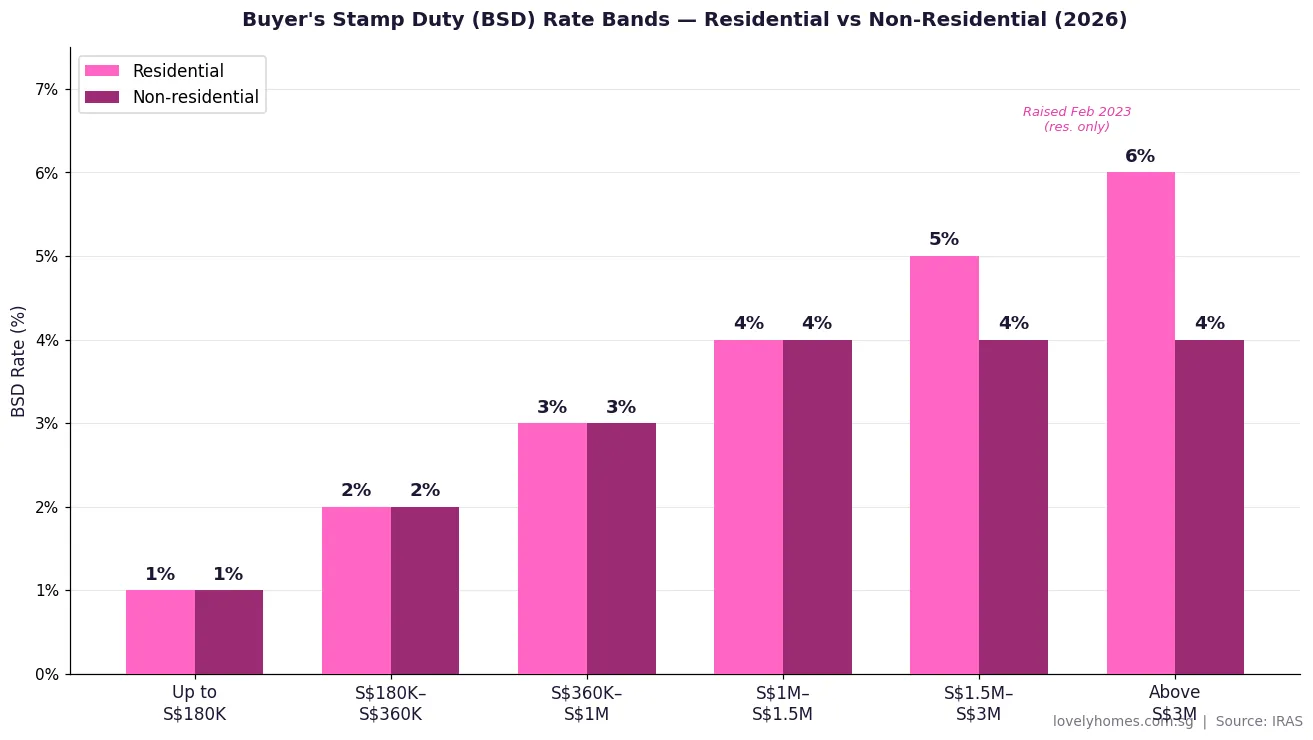
  • Residential BSD rates are progressive: 1% on the first S$180,000, rising to 6% on amounts above S$3 million (rates raised in February 2023 Budget).
  • Non-residential BSD is capped at 4% (no 5% or 6% tiers apply).
  • BSD must be paid within 14 days of exercising the Option to Purchase (OTP) or signing the Sale & Purchase (S&P) agreement.
  • On a S$1.5 million condo, BSD is S$44,600 — that is before any Additional Buyer’s Stamp Duty (ABSD) kicks in.
  • BSD is separate from ABSD: ABSD applies only to second or subsequent properties (for Singapore Citizens) or all properties (for Permanent Residents and foreigners).
  • No exemptions for first-time buyers — BSD applies to everyone; only certain inherited or court-ordered transfers are exempt.
  • CPF Ordinary Account funds may be used to pay BSD on eligible residential properties.

What Is Buyer’s Stamp Duty (BSD)?

Buyer’s Stamp Duty (BSD) is a tax levied by the Inland Revenue Authority of Singapore (IRAS) on every purchase or acquisition of property in Singapore. Unlike the Additional Buyer’s Stamp Duty (ABSD) — which applies only to certain buyers — BSD is universal: it falls on every transaction regardless of whether the buyer is a Singapore Citizen (SC), Permanent Resident (PR), foreigner, or corporate entity, and regardless of how many properties they already own.

BSD is calculated on the higher of the purchase price or the market value of the property. IRAS uses the property’s assessed annual value and recent comparable sales to determine market value; if your agreed price is below market value, IRAS will compute BSD on the higher market-value figure. The tax is administered under the Stamp Duties Act (Cap. 312) and must be paid promptly — late payment attracts penalties.

The February 2023 Budget introduced new higher rate tiers for residential property, bringing the top marginal rate to 6% for portions of the price above S$3 million. For non-residential property (commercial, industrial, mixed-use), the maximum rate remains 4%. Understanding BSD is therefore a mandatory step in any property budget — you cannot legally complete a purchase without stamping the documents.

BSD rate bands residential vs non-residential Singapore 2026
Figure 1: BSD Rate Bands — Residential vs Non-Residential (2026). Source: IRAS / Stamp Duties Act.

BSD Rates for Residential Property (2026)

The following progressive rate schedule applies to all residential property purchases from 15 February 2023 onwards (Budget 2023). Note that the rates are marginal — each band applies only to the portion of the price falling within that range, not the entire purchase price.

Purchase Price Band BSD Rate Maximum BSD in Band
First S$180,000 1% S$1,800
Next S$180,000 (S$180,001 – S$360,000) 2% S$3,600
Next S$640,000 (S$360,001 – S$1,000,000) 3% S$19,200
Next S$500,000 (S$1,000,001 – S$1,500,000) 4% S$20,000
Next S$1,500,000 (S$1,500,001 – S$3,000,000) 5% S$75,000
Remaining amount (above S$3,000,000) 6% Unlimited

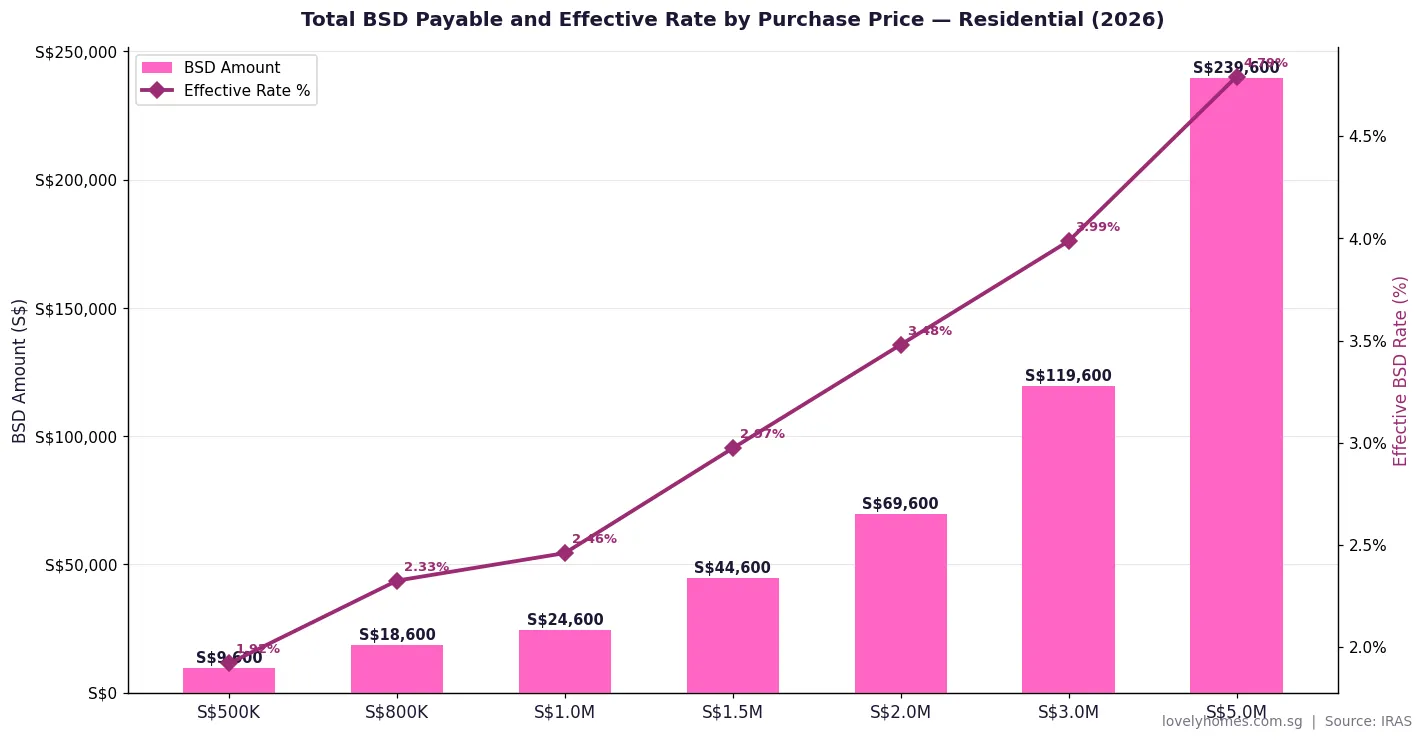
The cumulative BSD payable at the top of each band is S$1,800 → S$5,400 → S$24,600 → S$44,600 → S$119,600 and beyond. For a S$1 million property the BSD is exactly S$24,600; for a S$1.5 million property it is S$44,600; for a S$3 million property it is S$119,600.

BSD Rates for Non-Residential Property (2026)

Industrial, commercial, and mixed-use properties follow a different schedule that was last revised in 2018. The rates are lower and the top marginal rate is capped at 4%, reflecting government policy to keep transaction costs manageable for business property buyers.

Purchase Price Band BSD Rate Maximum BSD in Band
First S$180,000 1% S$1,800
Next S$180,000 (S$180,001 – S$360,000) 2% S$3,600
Next S$640,000 (S$360,001 – S$1,000,000) 3% S$19,200
Remaining amount (above S$1,000,000) 4% Unlimited

On a S$2 million shophouse, for instance, the BSD is S$24,600 (the S$1 million cumulative) plus 4% of S$1 million = S$40,000 → total S$64,600. Compare this to a residential property of the same price where BSD would be S$69,600. The difference is modest at S$2 million but widens materially at S$5 million and above.

Total BSD payable and effective rate by purchase price Singapore 2026
Figure 2: Total Residential BSD Payable and Effective Rate by Purchase Price (2026). Effective rate is BSD ÷ purchase price. Source: IRAS.

How to Calculate BSD Step by Step

BSD is a progressive tax, so the calculation requires applying each marginal rate to the corresponding band of the purchase price. The cleanest method is to use the marginal-band approach. Consider a S$1,800,000 residential property:

  1. 1% × S$180,000 = S$1,800
  2. 2% × S$180,000 = S$3,600
  3. 3% × S$640,000 = S$19,200
  4. 4% × S$500,000 = S$20,000
  5. 5% × S$300,000 (the remaining S$1.8M − S$1.5M = S$0.3M) = S$15,000
  6. Total BSD = S$59,600

IRAS also publishes a shortcut formula for common brackets. For residential properties priced between S$1 million and S$1.5 million the formula is: BSD = (4% × price) − S$15,400. For S$1 million: (4% × S$1M) − S$15,400 = S$40,000 − S$15,400 = S$24,600 ✓. These formulae are available in IRAS’s stamp duty calculator at iras.gov.sg.

When and How to Pay BSD

BSD must be paid within 14 days of the document being signed or executed — that is, within 14 days of exercising the Option to Purchase (OTP) for resale properties, or within 14 days of the date of the Sale & Purchase agreement for new launches. Late payment attracts a penalty of S$10 or the unpaid duty, whichever is higher, plus additional penalties of up to 4× the original duty for prolonged non-payment.

Payment is made through e-Stamping at the IRAS portal, accessible via Singpass. Solicitors acting for buyers routinely handle this on their clients’ behalf. The stamped document is legal evidence of the transaction; an unstamped instrument cannot be admitted as evidence in court.

BSD may be paid using CPF Ordinary Account (OA) funds for eligible residential properties — subject to the CPF withdrawal limit and valuation limit rules. If paying by CPF, the CPF Board will typically release the BSD payment to IRAS directly on completion. Cash payment via GIRO, credit/debit card, or bank transfer is also accepted. Foreigners without a Singpass account must pay through their appointed solicitor.

📌 Worked Example: Mr & Mrs Nair — D11 Condo S$2,200,000

Mr Nair is a Singapore Citizen; Mrs Nair is a Singapore Permanent Resident. This will be their first property. They are purchasing a 3-bedroom condominium in Newton / Novena (D11, RCR) at S$2,200,000. The solicitor will compute BSD as follows:

  • 1% × S$180,000 = S$1,800
  • 2% × S$180,000 = S$3,600
  • 3% × S$640,000 = S$19,200
  • 4% × S$500,000 = S$20,000
  • 5% × S$700,000 (S$2.2M − S$1.5M) = S$35,000
  • Total BSD = S$79,600 (effective rate: 3.62%)

ABSD position: because this is a joint purchase and Mrs Nair is a PR, the joint ABSD rate is determined by the buyer with the higher rate. SC buying 1st property = 0%; PR buying 1st property = 5%. As a mixed-citizenship couple, IRAS applies the higher rate — so ABSD of 5% × S$2,200,000 = S$110,000 applies. (They may request an ABSD remission if they intend to occupy the property, but remission is not automatic for SC/PR joint purchases on first property.)

Combined stamp duties: BSD S$79,600 + ABSD S$110,000 = S$189,600. Legal fees approximately S$5,500. Total transaction costs at completion: approximately S$195,100 (excluding down payment and financing costs).

Bank loan (SC income S$18,000/mth): 75% LTV = S$1,650,000 at 3.0% p.a. over 30 years → monthly instalment S$6,955. TDSR: (S$6,955 ÷ S$18,000) = 38.6% ✓ (below 55% TDSR limit).

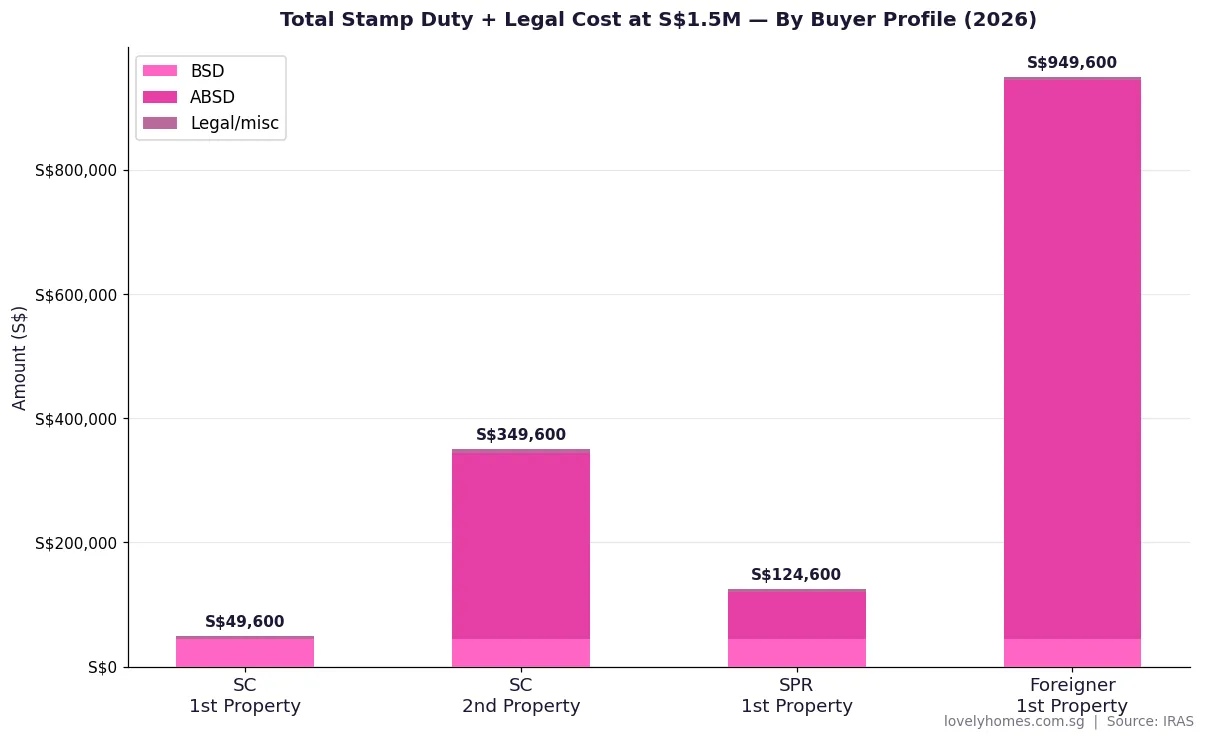
BSD and ABSD total stamp duty by buyer profile Singapore 2026 at S$1.5 million
Figure 3: Total Stamp Duty (BSD + ABSD + legal) at S$1.5M by Buyer Profile (2026). BSD is constant at S$44,600; ABSD varies by citizenship and property count. Source: IRAS.

Why BSD Matters: The True Cost of Buying Property in Singapore

BSD is a non-negotiable transaction cost that must be factored into every property budget from day one. At S$1 million, BSD alone is S$24,600 — roughly 2.5% of the purchase price. At S$3 million, it reaches S$119,600. For buyers stretching their budget to the maximum under Total Debt Servicing Ratio (TDSR) rules, forgetting to account for BSD can push a deal beyond their financial reach. Solicitors and mortgage advisers always incorporate BSD into the cashflow calculation alongside down payment, valuation fees, legal fees, and agent commissions.

Compared to peer jurisdictions, Singapore’s BSD is moderate but has been rising. Hong Kong’s stamp duty on residential property ranges from HK$100 to 4.25% of the price for the basic rate, with additional buyer’s stamps up to 30% for non-residents. Australia’s stamp duty varies by state and can exceed 5% in New South Wales and Victoria. Singapore’s BSD at an effective rate of around 2.5–4% for typical residential purchases sits within the regional norm, though the additional ABSD layers make total stamp costs for repeat or foreign buyers among the highest globally.

📊 What Might Come Next: BSD Outlook

This section is speculative and based on publicly available signals. It is not investment advice.

The February 2023 BSD increase targeted high-value transactions (above S$1.5 million), nudging effective rates higher for luxury properties. In the near term — through 2026 and into 2027 — industry observers do not anticipate a further upward revision to BSD, given that ABSD rates (raised to 60% for foreigners and 20% for SC second properties in April 2023) already provide strong price-stability signals. However, should the private residential price index continue its upward trajectory into the upper percentiles, a further adjustment to the S$3 million+ band (currently at 6%) cannot be ruled out in a future Budget.

For commercial and industrial BSD, a revision has been discussed informally in property finance circles, particularly given that strata industrial and shophouse prices have risen sharply since 2021. Any Budget announcement would take effect immediately on the date of the Budget speech, as has historically been the case.

Frequently Asked Questions: Buyer’s Stamp Duty Singapore

Does BSD apply to HDB flat purchases?

Yes. BSD applies to all residential property acquisitions in Singapore, including HDB resale flats and new BTO flat purchases. However, most HDB flats are priced well below S$1 million, so the effective BSD rate is typically 1–2%. For a S$600,000 4-room resale HDB flat, BSD is: (1% × S$180,000) + (2% × S$180,000) + (3% × S$240,000) = S$1,800 + S$3,600 + S$7,200 = S$12,600. The BSD on HDB purchases is significantly lower than on private condominiums. Note that for HDB purchases, CPF OA funds are routinely used to pay BSD, and the HDB will typically manage the stamping process on your behalf.

Is BSD different from ABSD? Can I avoid one but not the other?

BSD and ABSD are two separate taxes levied by IRAS. BSD applies to every buyer on every property — there is no exemption for first-time buyers. ABSD is an additional tax that applies to: Singapore Citizens buying a second or subsequent residential property (20% for second, 30% for third or more); Singapore PRs buying any residential property (5% first, 25% second and beyond); all foreigners buying any residential property (60% as of April 2023, with limited FTA exemptions for certain nationalities). It is impossible to avoid BSD; ABSD can be avoided by Singapore Citizens on their first property and in certain limited circumstances (e.g., FTA exemptions, ABSD remission for married couples). BSD is always payable on both residential and non-residential acquisitions.

What is the BSD deadline and what happens if I pay late?

BSD must be paid within 14 days of the date the relevant instrument is executed or signed. For resale properties, this means within 14 days of exercising the Option to Purchase (OTP). For new launch properties, within 14 days of signing the Sale & Purchase agreement. IRAS imposes penalties for late payment: S$10 or the unpaid duty (whichever is higher) for the first default, scaling up to 4× the outstanding duty for extended non-payment. In practice, conveyancing solicitors almost always handle BSD stamping within the 14-day window as a standard part of their service. You should therefore ensure you have the BSD funds ready to transfer to your solicitor’s client account well before the stamping deadline.

Can I use CPF to pay BSD in Singapore?

Yes, for eligible residential properties. CPF Ordinary Account (OA) savings may be used to pay BSD, subject to the applicable CPF withdrawal limits. The property must be used as a principal place of residence, and the purchase must satisfy CPF Board criteria (e.g., remaining lease of the property must meet the minimum occupation period requirements). CPF cannot be used to pay BSD on non-residential property purchases (shophouses, industrial, commercial). If you are using CPF for BSD, inform your solicitor at the start of the conveyancing process so they can arrange the CPF withdrawal in time. Any CPF withdrawn for BSD forms part of your total CPF withdrawal and attracts accrued interest at the OA rate of 2.5% per annum, which must be refunded to your CPF upon the eventual sale of the property.

Are there any exemptions from BSD in Singapore?

BSD exemptions are narrow. Transfers pursuant to a court order (e.g., divorce proceedings under section 112 of the Women’s Charter) may be exempt or subject to ad valorem duty on a different basis. Inherited property transferred via probate or letters of administration under intestate succession is also exempt from BSD (as it is a transmission, not a purchase). Government land acquisitions under the Land Acquisition Act are exempt. However, gifts of property between family members (including parents, siblings, and children) are generally not exempt unless effected as a court order; such transfers attract BSD at market value. There is no general first-time buyer exemption and no BSD discount for owner-occupiers — every voluntary purchase triggers the full progressive rate.

Is BSD based on the purchase price or the market value?

BSD is computed on the higher of the purchase price or the market value as assessed by IRAS at the time of the transaction. If you purchase a property below its assessed market value — for example, buying from a relative at a discounted price or acquiring a distressed-sale unit below prevailing comparable prices — IRAS will compute BSD on the market value, not the agreed price. Conversely, if you pay above market value (rare, but possible in competitive bidding situations), BSD is based on the actual price paid. IRAS cross-references the Urban Redevelopment Authority’s (URA) caveats database and the HDB resale transaction data to assess market value. Disputes about assessed value may be referred to the Stamp Duties Appeal Board.

Does BSD apply to property acquired through a company?

Yes. When a company — whether a Singapore-incorporated or foreign-incorporated entity — acquires property, BSD applies on the same basis as for individual buyers. The company must pay BSD on the higher of the purchase price or market value. In addition, corporate buyers are subject to ABSD at 65% for residential property (as of April 2023), making entity-held residential acquisitions extremely expensive. For commercial and industrial property, companies pay BSD at the non-residential rates (up to 4%) with no ABSD. Transfers of shares in a property-holding company may also attract stamp duty under Section 15 of the Stamp Duties Act; the rules are complex and specialist tax advice is recommended for such structures.

Related Articles on Singapore Property Taxes and Buying Costs

Disclaimer

This article is for general informational purposes only and does not constitute legal, financial, or tax advice. BSD rates and rules are set by the Inland Revenue Authority of Singapore (IRAS) and may change with each annual Budget. Always verify current rates and your personal BSD and ABSD obligations at iras.gov.sg before transacting. For a formal computation and to ensure timely stamping, engage a licensed Singapore conveyancing solicitor. LovelyHomes is not a licensed financial adviser or solicitor; no reliance should be placed on this article as a substitute for professional advice tailored to your specific circumstances.

Singapore Property Conveyancing Guide 2026: OTP, S&P Agreement, Legal Fees and Timelines Explained

Singapore Property Conveyancing Guide 2026: OTP, S&P Agreement, Legal Fees and Timelines Explained

Quick Answer: Conveyancing in Singapore 2026

  • Conveyancing is the legal process of transferring property ownership in Singapore, handled by licensed Singapore lawyers.
  • For private property, it involves an Option to Purchase (OTP), exercise of the OTP, and completion — typically over 8–12 weeks.
  • HDB resale transactions use the HDB Resale Portal and take approximately 8–10 weeks after HDB approval.
  • Buyer’s Stamp Duty (BSD) and Additional Buyer’s Stamp Duty (ABSD, if applicable) must be paid within 14 days of signing the OTP or S&P Agreement.
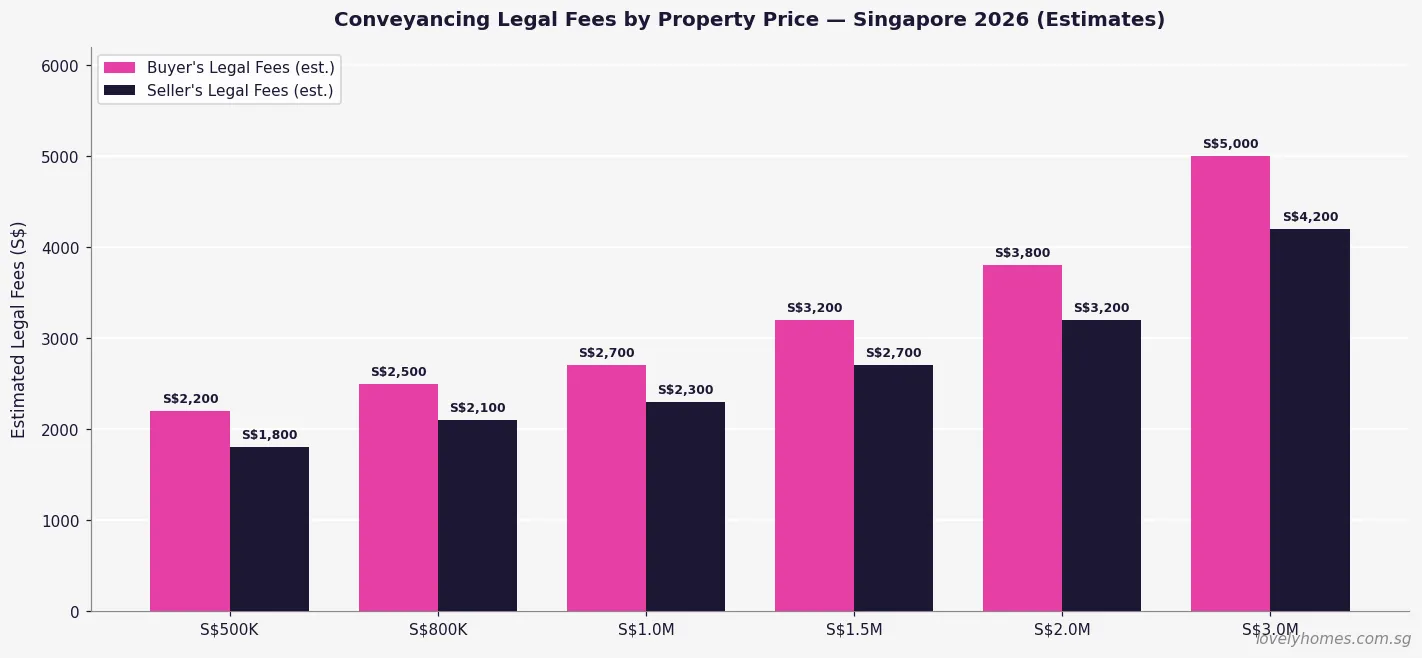
  • Legal fees for buyers typically range from S$2,200 to S$5,000 depending on property price; sellers pay S$1,800–S$4,200.
  • Disbursements (search fees, caveats, IRAS e-Stamping) add a further S$500–S$1,500 per transaction.
  • A conveyancing lawyer lodges a caveat on the title to protect the buyer’s interest between OTP exercise and completion.
  • CPF funds used for the purchase are refunded with 2.5% per annum accrued interest upon sale — factor this into your net proceeds calculation.

What Is Property Conveyancing?

Conveyancing is the Singapore legal process by which ownership of land or property is formally transferred from seller to buyer. Every private residential transaction — whether a new launch, resale condominium, landed property, or executive condominium — requires a conveyancing lawyer admitted to the Singapore Bar under the Legal Profession Act (Cap. 161). No individual may conduct their own conveyancing in Singapore; you must appoint a licensed law firm.

The Singapore Land Authority (SLA) maintains the land register under the Land Titles Act (Cap. 157). Separately, the Inland Revenue Authority of Singapore (IRAS) collects Buyer’s Stamp Duty (BSD) and Additional Buyer’s Stamp Duty (ABSD) via its e-Stamping portal. Your lawyer interfaces with both agencies on your behalf, making the choice of conveyancing firm a meaningful decision — not just a rubber stamp on your property purchase.

HDB flat transactions follow a slightly different route: they use the HDB Resale Portal and require HDB’s administrative approval, but buyers and sellers still appoint separate law firms (or use HDB’s approved conveyancing panel) to handle legal documents.

Step 1 — The Option to Purchase (OTP)

The OTP is a unilateral contract granting the buyer an exclusive right to purchase the property at an agreed price within a specified period. Under the Law Society of Singapore’s Conditions of Sale 2012, the standard OTP gives the buyer a 14-day option period from the date of grant. During this window, the property is effectively taken off the market.

Option fee: Typically 1% of the agreed purchase price, paid by cheque or cashier’s order to the seller (or seller’s lawyer). This fee is forfeited if the buyer does not exercise the option. It is not part of BSD — it is consideration for the option contract.

Exercising the OTP: The buyer exercises by paying a further 4% exercise fee (bringing the deposit to 5% total). BSD and ABSD are due within 14 days of exercising the OTP. Failure to pay on time attracts a late payment penalty of 5% per annum on the unpaid amount plus a flat 1% penalty.

Completion: Standard completion is 8–10 weeks after exercise. The buyer pays the remaining 95% of the purchase price (less any CPF utilised and bank loan disbursement) on completion day, and receives the keys and certificate of title.

Step 2 — The Sale and Purchase Agreement

Once the OTP is exercised, the seller’s lawyers typically issue a formal Sale and Purchase (S&P) Agreement within 2–4 weeks. The S&P Agreement sets out all conditions of sale including: completion date, vacant possession, included fixtures and fittings, representations and warranties on title, and risk allocation between exchange and completion.

For HDB resale flats, there is no separate S&P Agreement — instead, the parties register their Intent to Sell and Intent to Buy via the HDB Resale Portal, and HDB issues the resale completion letter setting the completion appointment.

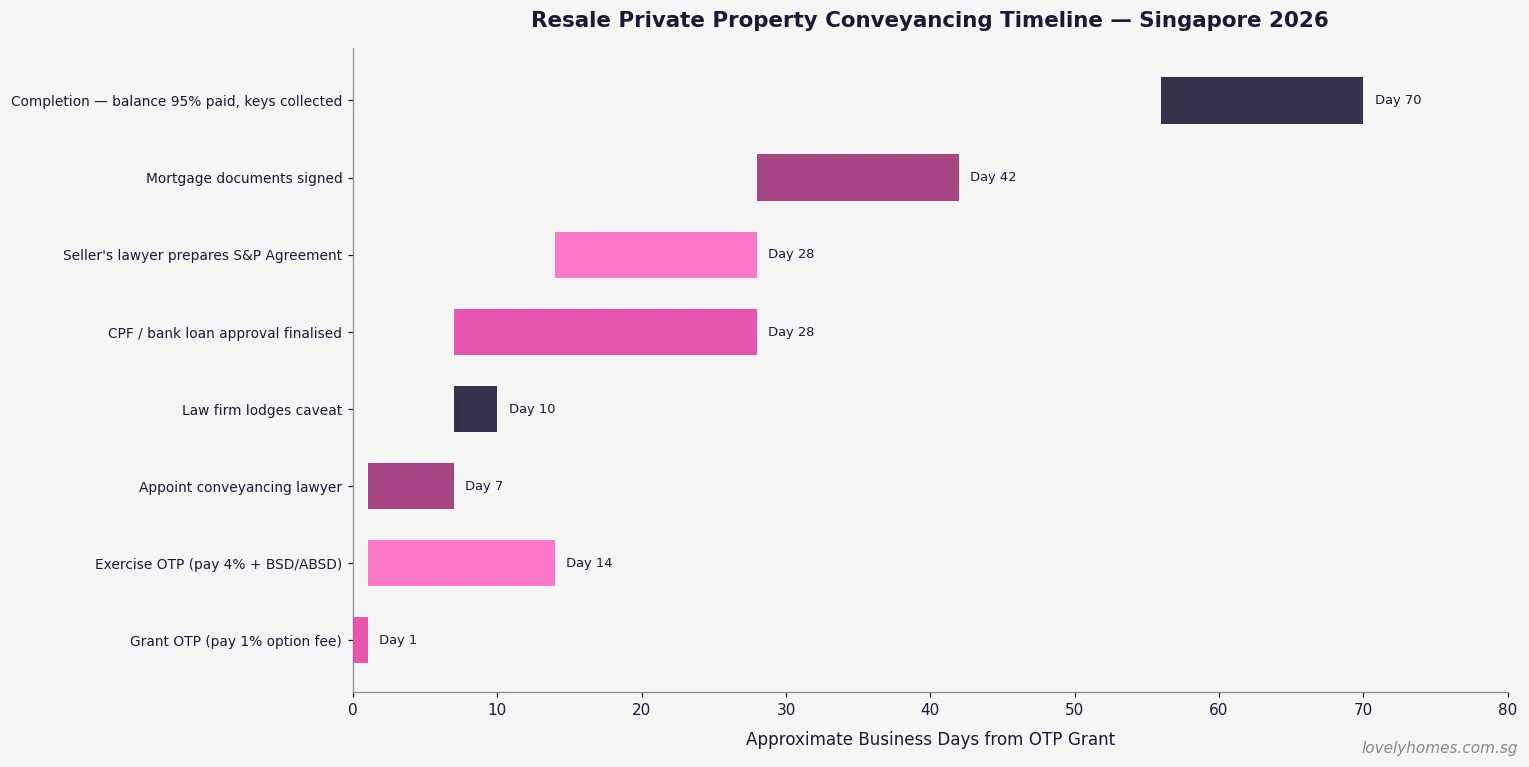
Singapore property conveyancing timeline 2026 - OTP to completion business days
Figure 1: Typical conveyancing timeline for a resale private property in Singapore, measured in business days from OTP grant.

Step 3 — Stamp Duties: BSD and ABSD

Stamp duties are collected by IRAS under the Stamp Duties Act (Cap. 312). They are the buyer’s obligation. The Buyer’s Stamp Duty (BSD) rates as at 7 June 2026 are:

Purchase Price Bracket BSD Rate
First S$180,000 1%
Next S$180,000 2%
Next S$640,000 3%
Next S$500,000 4%
Next S$1,500,000 5%
Remainder above S$3,000,000 6%

Additional Buyer’s Stamp Duty (ABSD) applies on top of BSD for second and subsequent properties (Singapore Citizens), all purchases by Singapore Permanent Residents, and all purchases by foreigners and entities. For a complete ABSD table, see the LovelyHomes ABSD Singapore 2026 Guide.

Step 4 — Appointing Your Conveyancing Lawyer

You should appoint your conveyancing lawyer before you sign the OTP, so that they can advise you on the option terms and perform preliminary title searches. The Law Society of Singapore’s Conveyancing Practice Directions require lawyers to advise clients on conflicts of interest — the same law firm generally cannot act for both buyer and seller in the same transaction.

Your lawyer’s duties as buyer’s solicitor include: conducting all title searches; preparing or reviewing the S&P Agreement; handling BSD/ABSD payment to IRAS; lodging a caveat at SLA to protect your interest; liaising with your bank’s lawyers on mortgage documentation; requisitioning CPF funds from CPF Board; and attending completion to receive title from the seller.

Singapore conveyancing legal fees 2026 - buyer and seller estimates by property price
Figure 2: Estimated conveyancing legal fees for buyers and sellers by property price, Singapore 2026. Obtain written fee quotes from your firm before proceeding.

Legal Fees and Disbursements

Law Society scale fees for residential conveyancing were abolished in 2009, meaning firms now charge freely. As a buyer, expect to pay S$2,200–S$5,000 in professional fees depending on transaction price and complexity. On top of professional fees, your lawyer will pass through disbursements — out-of-pocket costs charged at cost. Typical disbursements include:

  • SLA title search: approx. S$30–S$80
  • SLA caveat registration: approx. S$64.45 (includes GST)
  • Bank mortgage registration: approx. S$350–S$500
  • SLA transfer lodgement fee: approx. S$28–S$38 per instrument
  • CPF requisition fee: approx. S$15–S$25 per utilisation
  • Property valuation fee: S$300–S$1,200 depending on property type

Budget approximately S$500–S$1,500 in disbursements for a straightforward private resale transaction, in addition to professional fees.

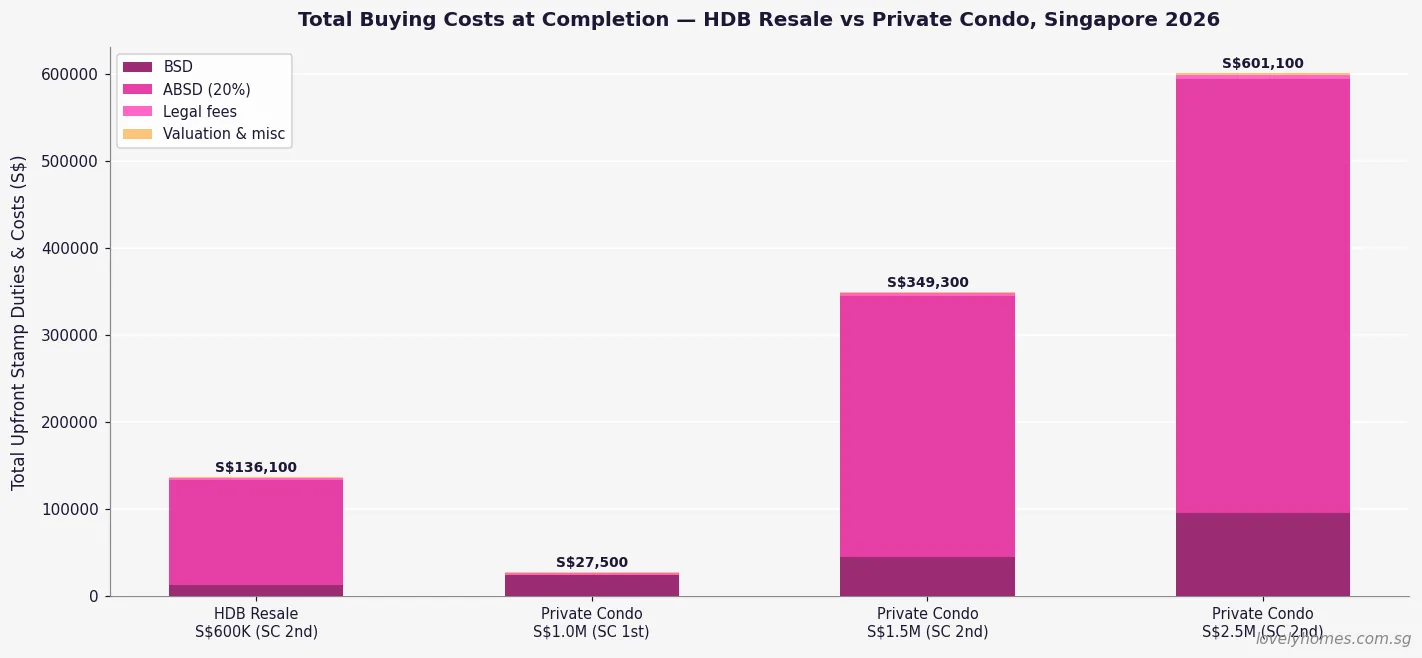
Singapore property buying costs comparison 2026 - HDB resale vs private condo BSD ABSD legal fees
Figure 3: Total upfront buying costs including BSD, ABSD and legal fees — HDB resale vs private condo at three price points, Singapore 2026.

Summary: Key Conveyancing Facts at a Glance

Item HDB Resale Private Resale New Launch
OTP / booking fee S$1 (HDB prescribed) Typically 1% of price Booking fee 5% on S&P day
OTP exercise fee N/A — HFE/portal process 4% within 14 days Further progress payments
BSD payment deadline 14 days from HDB flat offer letter 14 days from exercise 14 days from S&P date
Standard completion period 8–10 weeks (HDB schedule) 8–12 weeks from exercise On TOP or CSC date
Caveat filed by HDB portal (automatic) Buyer’s lawyer Developer’s panel lawyer
Buyer legal fees (indicative) S$1,500–S$2,200 S$2,200–S$5,000 S$2,200–S$3,500
Seller legal fees (indicative) S$1,000–S$1,800 S$1,800–S$4,200 N/A (developer pays)
CPF accrued interest on refund 2.5% p.a. on OA withdrawn 2.5% p.a. on OA withdrawn 2.5% p.a. on OA withdrawn

Worked Example: Mr and Mrs Koh Buy a Resale Condominium in Queenstown

Mr and Mrs Koh are Singapore Citizens purchasing their second property — a resale 2-bedroom condominium in Queenstown (District 3) for S$1,600,000. They are selling their HDB flat simultaneously (see our HDB Upgrader Guide 2026 for ABSD remission timing).

  • Option fee (1%): S$16,000 — paid by cashier’s order on grant of OTP.
  • BSD at exercise: 1% × S$180,000 + 2% × S$180,000 + 3% × S$640,000 + 4% × S$500,000 + 5% × S$100,000 = S$1,800 + S$3,600 + S$19,200 + S$20,000 + S$5,000 = S$49,600
  • ABSD remission: If HDB sold within the stipulated window, ABSD is remitted for SC joint first-time private purchase. If outside the window, ABSD at 20% = S$320,000 — manage this timing carefully.
  • Buyer’s legal fees: Approx. S$3,400 professional + S$900 disbursements = S$4,300
  • Valuation fee: S$700
  • Bank loan: S$1,200,000 at 3.0% p.a. over 30 years = S$5,058/mth; TDSR 36.1% on joint income S$14,000/mth — PASS.
  • Completion cash balance: S$1,600,000 − S$80,000 (deposit) − S$1,200,000 (bank) − S$100,000 (CPF) = S$220,000 cash

The entire conveyancing process, from OTP grant to completion, spans approximately 10 weeks — aligning with the typical resale timeline shown in Figure 1 above.

What to Watch in 2026 and Beyond

Singapore’s conveyancing framework has remained largely stable since the Land Titles Act was modernised in 1994, but two pressure points are worth watching. First, the Ministry of Law has periodically reviewed whether HDB flat conveyancing should be further streamlined through the portal — licensed lawyers remain mandatory as at 2026. Second, the SLA has been progressively digitalising title documents towards a fully electronic land registry, which reduces search turnaround times and potentially disbursement costs.

For buyers, the practical implication is that while stamp duties remain the dominant cost item (dwarfing legal fees for most transactions), shopping for a competitive legal fee quote matters more the larger your transaction. For a second-property private condominium purchaser, ABSD is typically 20–60 times larger than legal fees — making ABSD remission timing the single most important conveyancing consideration of all.

Frequently Asked Questions

Can I use the same lawyer as the seller?

Generally no. The Law Society’s Conveyancing Practice Directions prohibit a single law firm from acting for both buyer and seller in the same residential transaction — a conflict-of-interest rule designed to protect both parties. Exceptions exist for new launch sales where developer panel lawyers act for the developer, but you as the buyer still engage your own firm. Having separate representation ensures your lawyer’s duty runs exclusively to you.

What happens if I miss the BSD payment deadline?

BSD and ABSD must be paid within 14 days of signing the OTP or S&P Agreement. Late payment attracts a penalty of 5% per annum on the unpaid stamp duty, plus a flat penalty of 1% of the unpaid duty under the Stamp Duties Act. Your conveyancing lawyer will typically pay stamp duties on your behalf immediately on instruction — ensure you have sufficient cleared funds in your account by the day of exercise.

What is a caveat and why does my lawyer lodge one?

A caveat under the Land Titles Act is a formal notice lodged at the Singapore Land Registry (via SLA) once you have exercised the OTP. It signals to the world — including any subsequent buyer, mortgagee, or judgment creditor — that you have a legal interest in the property. This prevents the seller from dealing with the property inconsistently with your purchase contract during the period between exercise and completion. The caveat lodgement fee is approximately S$64 and is a standard disbursement.

How does CPF work in a property purchase?

Singapore Citizens and PRs may use their CPF Ordinary Account (OA) savings towards the purchase price and monthly mortgage instalments, subject to a Valuation Limit (VL) of 100% of the lower of purchase price or valuation, and a Withdrawal Limit (WL) of 120% of VL for properties with at least 30 years remaining lease. CPF monies withdrawn for property must be refunded with 2.5% p.a. accrued interest upon sale — returned to your own CPF account. See our HDB Upgrader Guide for worked CPF refund calculations.

What is the difference between new launch and resale conveyancing?

New launch transactions involve a developer under a Housing Developers (Control and Licensing) Act licence. Instead of an OTP, you sign a Standard Sale and Purchase Agreement in the prescribed form under the Housing Developers Rules, and pay a booking fee (typically 5%) on the day of signing. Stamp duties are payable within 14 days. Completion occurs on the issue of the Temporary Occupation Permit (TOP) or Certificate of Statutory Completion (CSC), which may be 2–5 years from booking. Your CPF usage and bank loan terms must be structured to accommodate drawdowns aligned with the developer’s progress billing schedule.

Can a foreigner buy Singapore property and what additional steps apply?

Foreigners may purchase private condominium units, executive condominiums that have reached their 10-year privatisation mark, and Sentosa Cove landed properties — subject to the Residential Property Act (Cap. 274). The conveyancing process is identical, except that ABSD at 60% of the purchase price is payable by foreigners on any residential property purchase as at 2026. US, Swiss, Icelandic, Norwegian, and Liechtenstein nationals benefit from Free Trade Agreement (FTA) exemptions and are treated at Singapore Citizen rates for ABSD purposes. See our Singapore Foreign Buyer Property Guide 2026.

What happens on completion day?

Completion is typically conducted at the seller’s lawyer’s office. Your bank disburses the loan directly to the seller’s lawyers; your CPF Board requisition is remitted; and you or your lawyer presents cashier’s orders for any remaining cash. The seller hands over keys and access cards. Title transfers on completion — your lawyer registers the transfer at SLA (typically processed within 1–3 business days). You will receive a Land Register printout confirming your name as the registered proprietor.

Related Articles

Disclaimer: This article is intended for general informational purposes only and does not constitute legal or financial advice. Conveyancing procedures, stamp duty rates, and CPF rules are subject to change. All figures, fees, and timelines cited are based on information available as at 7 June 2026. Readers should consult a licensed Singapore conveyancing lawyer and a Monetary Authority of Singapore (MAS) licensed financial adviser for advice specific to their circumstances. Authoritative references: IRAS (iras.gov.sg), Singapore Land Authority (sla.gov.sg), CPF Board (cpf.gov.sg), Law Society of Singapore (lawsociety.org.sg).

Conveyancing Fees Singapore 2026: Legal Costs for Buying & Selling Property

Conveyancing Fees Singapore 2026: Legal Costs for Buying & Selling Property

Buying or selling property in Singapore involves more than the purchase price and stamp duties. Every transaction — whether an HDB resale flat, a private condominium, or a landed house — requires a conveyancing lawyer to handle the legal transfer of ownership. These legal fees, plus the various disbursements that lawyers incur on your behalf, form part of the total transaction cost that every buyer and seller must budget for.

In Singapore, conveyancing is a regulated area of legal practice. The Law Society of Singapore previously prescribed a fixed fee scale, but that scale was abolished in 2009. Lawyers now charge based on the complexity of the transaction and market rates, though most firms price competitively within a fairly predictable band. This guide explains what conveyancing lawyers do, what you will pay, and how to manage the costs effectively in 2026.

Quick Answer — Key Takeaways

  • Buyer’s conveyancing fees for a S$1.5M private property typically range from S$2,800 to S$4,500 (legal fee) plus S$800–S$1,200 in disbursements.
  • Seller’s legal fees are generally lower — S$2,000 to S$3,500 plus disbursements of S$600–S$1,000.
  • For HDB resale flats, both buyer and seller pay separately for their own lawyers; HDB sets a guide for solicitors’ fees.
  • Disbursements are fixed government and third-party charges — Caveat filing, SLA searches, stamp duty lodgement — totalling S$400–S$1,000 for most transactions.
  • The conveyancing process from Option to Purchase (OTP) exercise to legal completion typically takes 8–12 weeks for private property and 12–16 weeks for HDB resale.
  • You may use the same law firm as the bank providing your mortgage loan (called an “acting for both” arrangement) to reduce total costs — though this is subject to the firm’s conflict-of-interest policies.
  • Buyers must pay Buyer’s Stamp Duty (BSD) within 14 days of exercising the OTP; ABSD (if applicable) is due at the same time.
  • GST at the prevailing rate (9% as at 2026) applies to lawyers’ professional fees but not to government disbursements.

What Is Conveyancing and Why Do You Need a Lawyer?

Conveyancing is the legal process by which ownership of a property is transferred from seller to buyer. In Singapore, this is a mandatory process overseen by qualified solicitors admitted to the Singapore Bar. Unlike some jurisdictions where buyers and sellers may self-represent, Singapore law requires a practising solicitor to execute the conveyancing documents, lodge the transfer with the Singapore Land Authority (SLA), and handle the settlement of funds.

For the buyer, the conveyancing lawyer: reviews the OTP and Sale and Purchase Agreement (SPA), conducts title searches to confirm ownership and encumbrances, lodges a caveat on the property title, handles stamp duty payment on your behalf, liaises with the bank (if you have a mortgage) to coordinate the mortgage documentation and drawdown, and oversees the completion — handing over the title in exchange for the purchase price.

For the seller, the conveyancing lawyer: reviews the OTP, liaises with the buyer’s solicitor, discharges any existing mortgage on the property, handles the discharge of the existing caveat, and receives and distributes the sale proceeds — repaying the outstanding loan to the bank and CPF (if CPF monies were used), and releasing the net balance to you.

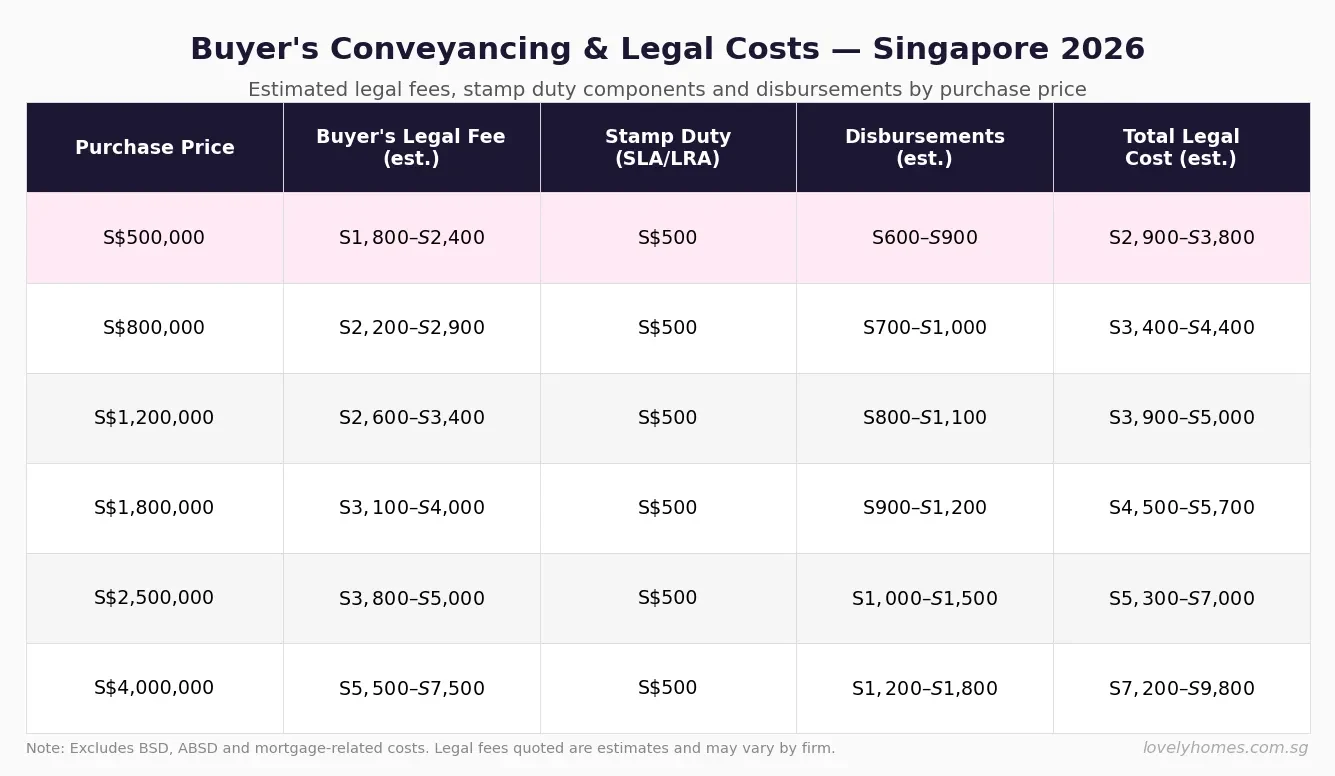
buyers conveyancing legal costs Singapore 2026 by property price table
Figure 1: Estimated buyer’s conveyancing fees and disbursements by property price (Singapore 2026). Excludes BSD, ABSD, and mortgage costs. Legal fees are market estimates; actual quotes may vary by firm. Source: LovelyHomes research, Law Society of Singapore guidance.

How Conveyancing Fees Are Structured

Since the abolition of the prescribed scale in 2009, Singapore law firms price conveyancing work in one of three ways: a fixed fee (most common for straightforward residential transactions), an ad valorem fee (a percentage of the purchase price, typically 0.1–0.25%), or an hourly rate (rare for standard residential work). The legal fee is subject to 9% GST.

On top of the professional fee, the lawyer will charge disbursements — third-party costs incurred on your behalf. These are typically passed through at cost (no markup) and are not subject to GST. Common disbursements include: SLA title search fees, caveat registration, stamp duty lodgement fee, HDB resale levy search (if applicable), legal requisitions to various government bodies (URA, LTA, PUB, NEA, SLA, ACRA), and the Electronic Payment fee for the Legal Practitioners Fidelity Fund (LPFF).

Fee Component Typical Range Chargeable? GST?
Professional (legal) fee — buyer S$1,800–S$7,500 (price-dependent) Yes Yes (9%)
Professional (legal) fee — seller S$1,500–S$5,000 (price-dependent) Yes Yes (9%)
SLA title search S$30–S$60 per search Disbursement No
Caveat lodgement S$64.45 Disbursement No
Stamp duty lodgement / e-stamping S$10–S$25 Disbursement No
Government requisitions (URA, LTA, etc.) S$200–S$400 Disbursement No
LPFF contribution S$100 (standard) Disbursement No
Mortgage documentation (if bank appoints same firm) S$800–S$2,500 Yes (bank-to-borrower) Yes (9%)

The Full Picture: Transaction Costs Beyond Legal Fees

Legal fees are only one component of the total cost of buying or selling. The dominant costs for buyers are Buyer’s Stamp Duty (BSD) and, where applicable, Additional Buyer’s Stamp Duty (ABSD). Sellers bear the property agent’s commission (if an agent is engaged). Understanding the full transaction cost envelope is essential for accurate budgeting.

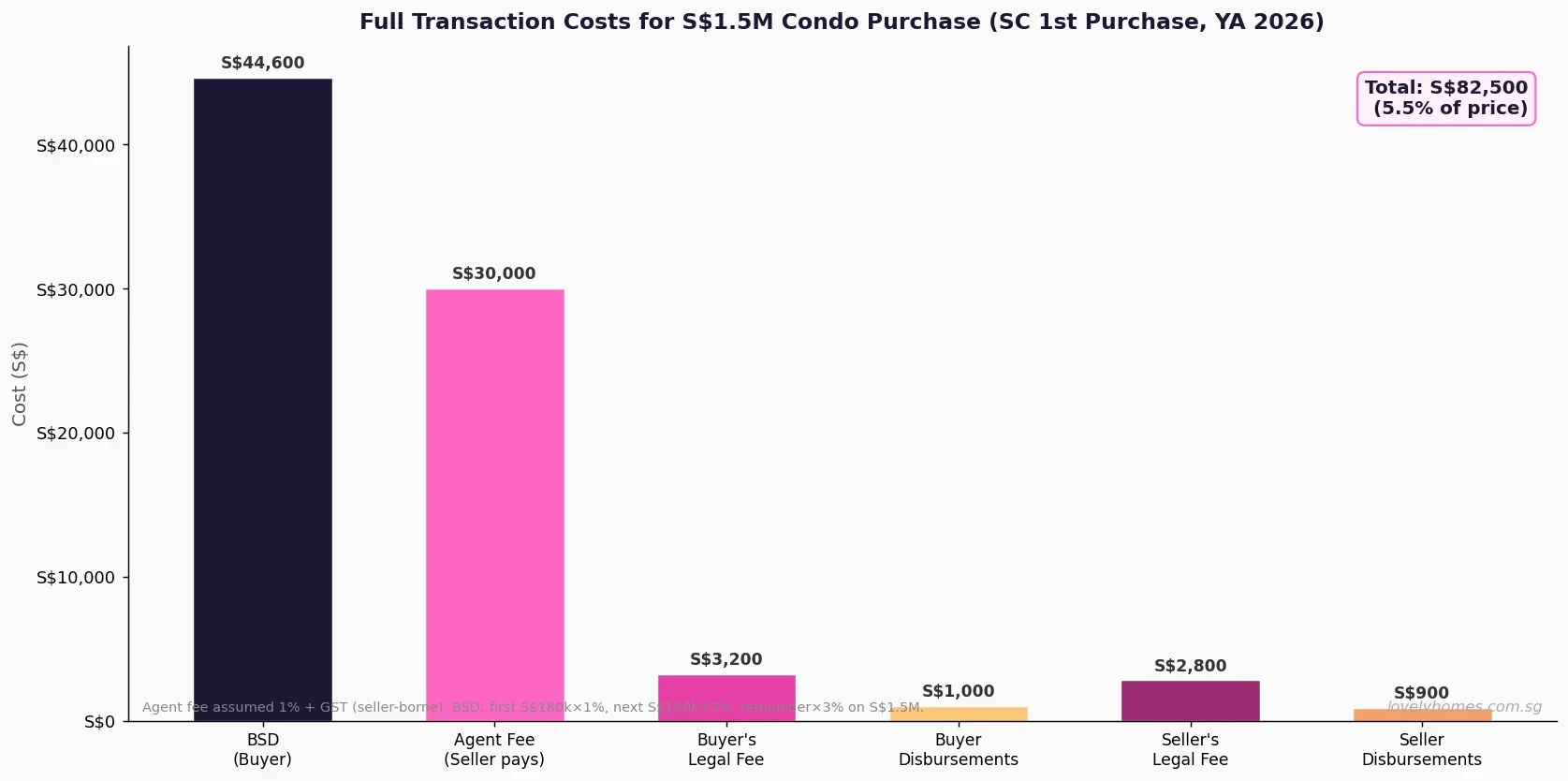
full transaction costs Singapore 1.5 million condo purchase 2026 BSD agent fee legal fees
Figure 2: Full transaction cost breakdown for a S$1.5M private condo purchase by a Singapore Citizen acquiring their first property (no ABSD). Agent fee assumed at 1% (seller-borne). BSD computed on the graduated scale. Source: IRAS, SLA, LovelyHomes research.

As the chart illustrates, BSD at S$44,600 dwarfs all other transaction costs for a first-time SC buyer at S$1.5M. BSD is calculated on the graduated scale: 1% on the first S$180,000, 2% on the next S$180,000, 3% on the next S$640,000, and 4% on the remainder. Total BSD on S$1.5M: S$180,000×1% + S$180,000×2% + S$640,000×3% + S$500,000×4% = S$1,800 + S$3,600 + S$19,200 + S$20,000 = S$44,600.

HDB Resale Flat — Conveyancing Fees

For HDB resale flat transactions, both buyer and seller must appoint their own lawyers. HDB no longer acts as the conveyancing party (it did so for many decades for straightforward HDB transactions, but now all HDB resale transactions go through private solicitors). The HDB sets a guide fee scale, though individual firms may charge within or beyond that band.

Purchase Price / Flat Type Buyer’s Legal Fee (Estimate) Seller’s Legal Fee (Estimate)
1- and 2-room flats (below S$300k) S$1,200–S$1,800 S$900–S$1,500
3-room flats (S$300k–S$450k) S$1,500–S$2,200 S$1,200–S$1,800
4-room flats (S$450k–S$650k) S$1,800–S$2,600 S$1,500–S$2,200
5-room / Executive flats (S$650k–S$900k) S$2,200–S$3,200 S$1,800–S$2,800
Maisonette / DBSS (above S$900k) S$2,800–S$4,000 S$2,200–S$3,500

HDB resale disbursements are broadly similar to private property: title searches, caveat registration (S$64.45), government requisitions (approximately S$150–S$250 for HDB-specific searches), and the LPFF contribution. The total HDB resale legal cost for buyer or seller is usually S$1,500–S$4,500 all-in, depending on flat value and firm.

Under HDB rules, a buyer using an HDB loan may use their lawyer to handle both the HDB loan documentation and the conveyancing — consolidating into one engagement. Buyers using a bank loan will need a separate mortgage solicitor engagement (often the same firm, as many firms act for both).

The Conveyancing Timeline: From OTP to Keys

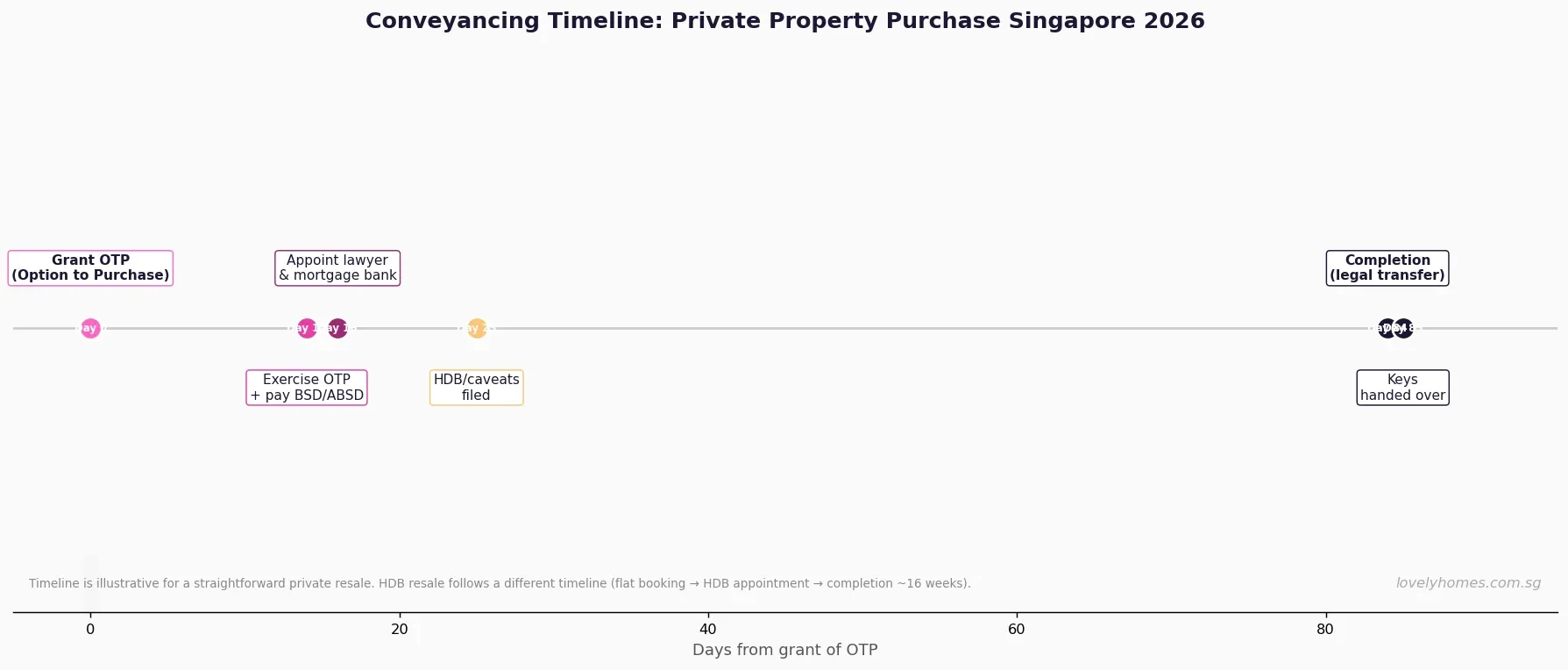
conveyancing timeline private property purchase Singapore 2026 OTP to completion
Figure 3: Illustrative conveyancing timeline for a private property purchase in Singapore (2026). Day 0 = grant of OTP. HDB resale follows a different timeline (approximately 16 weeks from flat booking to completion). Source: LovelyHomes research, SLA.

The timeline above reflects a standard, uncomplicated private resale transaction. Key milestones and deadlines:

  • Day 0 — OTP granted: The seller grants the buyer an Option to Purchase, typically with a 1% option fee. The buyer has 14 days (negotiable; commonly 14 days for private property) to exercise the OTP by paying the exercise fee (usually 4–9%, completing the 5–10% deposit).
  • Day 14 — OTP exercised and stamp duty due: BSD (and ABSD if applicable) must be paid to IRAS within 14 days of exercising the OTP, via e-Stamping or through your lawyer. BSD payment late by even one day attracts a 5–15% penalty.
  • Day 16 — Lawyer and bank formally appointed: Your lawyer receives the OTP, confirms instructions, and begins the legal due diligence — ordering title searches, government requisitions, and liaising with the seller’s solicitors to receive the draft SPA.
  • Day 25 — Caveat lodged: Your lawyer lodges a caveat on the property title with SLA, protecting your interest as buyer against any competing claims or encumbrances registered after this date.
  • Day 84 (approx.) — Legal completion: The seller’s lawyers hand over the property title documents; your lawyer simultaneously releases the purchase funds (mortgage drawdown + CPF withdrawal + cash) to the seller. The title is transferred.
  • Day 85 — Keys handed over: Typically the same day as legal completion or the following business day.

Worked Example: Total Legal Costs for Mr and Mrs Lee’s Condo Purchase

Property: 3-bedroom condominium in Buona Vista, purchase price S$1.9M. Singapore Citizens, first purchase — BSD applies, no ABSD. Bank loan of S$1.425M (75% LTV).

BSD calculation:

  • First S$180,000 × 1% = S$1,800
  • Next S$180,000 × 2% = S$3,600
  • Next S$640,000 × 3% = S$19,200
  • Remaining S$900,000 × 4% = S$36,000
  • BSD Total: S$60,600

Buyer’s legal costs (estimate):

  • Conveyancing professional fee: S$3,800 + 9% GST = S$4,142
  • Mortgage documentation fee (bank): S$1,800 + 9% GST = S$1,962
  • Disbursements (searches, caveat, requisitions, LPFF): S$980
  • Total buyer’s legal cost: S$7,084

Total upfront outlay by buyer:

  • Initial option fee (1%): S$19,000
  • Exercise fee (4%, completing 5% deposit): S$76,000
  • BSD: S$60,600
  • Legal fees + disbursements: S$7,084
  • Remaining cash portion at completion (25% – 5% deposit already paid): S$380,000 – S$95,000 = S$285,000 (if 25% down)
  • Total cash before completion: S$162,684 (option + BSD + legal)

Key insight: Legal fees account for approximately 4.4% of the total non-price transaction cost. BSD is the dominant cost at 37.3%. For planning purposes, budget at least S$165,000 in upfront costs (above the 5% deposit) for a S$1.9M purchase as a first-time SC buyer.

Practical Tips for Managing Conveyancing Costs

Get multiple quotes early. Contact two or three law firms before committing. Many reputable Singapore conveyancing firms provide free quotes via email or WhatsApp. The range across firms is usually S$400–S$800, which is worth shopping around for.

Use a panel firm for your mortgage bank. Banks maintain a panel of approved law firms for mortgage work. If your chosen conveyancing firm is also on your bank’s panel, the firm can act for both you and the bank in the same transaction, eliminating a duplicated engagement — saving S$1,500–S$3,000 in mortgage documentation fees. Ask your firm explicitly whether they are on your bank’s panel.

Understand what is included. When comparing quotes, check whether the stated fee includes disbursements or excludes them. A headline figure of S$1,800 that excludes all disbursements may end up costing more than a S$2,400 all-inclusive quote.

Keep records for rental income tax. If you are purchasing an investment property that you will rent out, your conveyancing fee is not itself deductible against rental income (it is capital expenditure). However, maintaining all records of your acquisition costs is important for computing any eventual capital gain or loss for income tax purposes if you sell (and for the base cost in any future en bloc or collective sale scenario).

Why Legal Costs Matter: Singapore vs Other Markets

Singapore’s conveyancing system is efficient and highly digitalised. The SLA’s integrated land registry means that title searches, caveats, and transfers are processed electronically and within days rather than weeks. Compared to the United Kingdom (where conveyancing often takes four to six months and legal fees on a comparable property can reach 0.5–1.0% of the purchase price), Singapore’s 8–12 week timeline and 0.15–0.25% legal fee benchmark represent a relatively streamlined and cost-effective system.

The most significant friction in Singapore’s property transaction costs remains stamp duty — BSD plus ABSD — which can amount to 5–40% of the purchase price depending on the buyer profile and property count. Legal fees are modest in comparison. For buyers focused on reducing transaction costs, understanding and minimising ABSD exposure (through careful timing, entity structure analysis, and buyer profile planning) yields far greater savings than shopping for the cheapest conveyancing quote.

What Might Change: Conveyancing Regulatory Outlook

This section is speculative. No major changes to the Singapore conveyancing framework are expected in 2026. The Ministry of Law has been examining ways to further digitalise the end-to-end property transaction process — including potential e-OTP frameworks and automated stamp duty computation — that could reduce reliance on solicitors for routine documentation in future years. However, the core requirement for a qualified Singapore solicitor to execute the transfer instrument and lodge with SLA is likely to remain in place for the foreseeable future. Any move toward a fully self-service model would require significant statutory amendment.

Summary: Conveyancing Fees at a Glance

Transaction Type Who Pays Legal Fee (est.) Disbursements (est.) Total (est.)
Private property purchase (S$1M–S$2M) Buyer S$2,600–S$4,200 + GST S$700–S$1,100 S$3,600–S$5,700
Private property purchase (S$2M–S$4M) Buyer S$3,800–S$6,500 + GST S$900–S$1,400 S$5,100–S$8,500
Private property sale Seller S$2,000–S$4,500 + GST S$600–S$900 S$2,800–S$5,800
HDB resale purchase (4-room, S$500k–S$650k) Buyer S$1,800–S$2,600 + GST S$400–S$700 S$2,400–S$3,500
HDB resale sale (4-room) Seller S$1,500–S$2,200 + GST S$350–S$600 S$1,985–S$3,000
Mortgage documentation (bank panel) Borrower S$800–S$2,500 + GST S$100–S$300 S$972–S$3,025

Frequently Asked Questions

Can I use one lawyer for both the buyer and the seller in the same transaction?

Generally, no. Under the Legal Profession (Professional Conduct) Rules, the same solicitor or firm cannot act for both buyer and seller in a property transaction, as the interests of the two parties are inherently conflicting. Each party must appoint their own lawyer. The exception applies to certain intra-family transfers or specific corporate restructurings — if in doubt, seek guidance from the Law Society of Singapore.

What happens if BSD or ABSD is paid late?

BSD and ABSD are due within 14 days of executing the Sale and Purchase Agreement (or exercising the OTP — whichever is the relevant instrument). If payment is late by up to three months, a 5% penalty surcharge applies on the outstanding stamp duty. For delays of three to six months, the penalty increases to 10%; beyond six months, 15%. In practice, your conveyancing lawyer will ensure stamp duty is paid on time — one of the core reasons why appointing a lawyer promptly after OTP exercise is important.

Do I need a separate lawyer for my mortgage, or can it be the same firm?

In most cases, the same law firm can handle both your conveyancing (title transfer) and the mortgage documentation for your bank — provided that firm is on your bank’s approved panel. This “acting for both” arrangement is standard practice in Singapore and reduces duplication. The mortgage documentation fee is a separate charge from the conveyancing fee, but using one firm is significantly cheaper than appointing two. Confirm with your chosen firm and your bank whether this arrangement is available for your specific loan product.

When should I appoint a conveyancing lawyer — before or after the OTP?

Ideally before, or at the very latest on the day the OTP is granted to you. Once you hold an OTP, you have a hard deadline (typically 14 days) to exercise it and pay BSD within another 14 days of exercise. If you appoint your lawyer only after exercising the OTP, you may lose time for the due diligence steps your lawyer needs to complete before recommending whether to proceed. For a first property purchase, most experienced buyers appoint a lawyer at the same time as they make their In-Principle Approval (IPA) application to the bank — months before finding a property.

What is a caveat, and why does my lawyer file one?

A caveat is a notice lodged on the land register with the Singapore Land Authority, alerting any third party who searches the title that you (the buyer) have an interest in the property. Once lodged, the caveat prevents the seller from transferring the property to anyone else, creating further encumbrances, or disposing of the property without your knowledge. The caveat costs S$64.45 to lodge and is typically filed within days of the SPA being signed. Your lawyer lodges it on your behalf as a standard step in every transaction.

Are conveyancing fees negotiable?

Yes, within limits. Since the prescribed scale was removed in 2009, law firms set their own fees. For straightforward transactions, fees are fairly competitive across firms and there is limited room to negotiate a significantly lower price without risking service quality. However, if you are transacting in multiple properties simultaneously (e.g., selling one and buying another), or if you are a repeat client of the firm, it is entirely reasonable to ask for a bundle discount. Always compare fee quotes from at least two firms before deciding.

What is the difference between the OTP and the Sale and Purchase Agreement (SPA)?

The Option to Purchase (OTP) is a short document — typically one to two pages — granted by the seller to the buyer for a consideration (the option fee, usually 1%). The OTP gives the buyer the exclusive right to purchase the property at an agreed price within the option period. The Sale and Purchase Agreement (SPA) is the full, binding contract that comes into force when the buyer exercises the OTP. For private properties, the SPA is a detailed document (often 20–50 pages) prepared by the seller’s solicitors and reviewed by the buyer’s solicitors. For HDB resale, a standard HDB Resale Agreement is used. Your conveyancing lawyer’s role includes reviewing both the OTP (before exercise) and the SPA (before and after execution).

Related Articles

Disclaimer

This article is for general informational purposes only and does not constitute legal, tax, or financial advice. Fee estimates are based on market research as at May 2026 and will vary by law firm, transaction complexity, and individual circumstances. Always obtain a formal written fee quote from a qualified Singapore solicitor before instructing them. For official guidance on stamp duties, consult the Inland Revenue Authority of Singapore (IRAS). For land registration and title matters, refer to the Singapore Land Authority (SLA). For lawyer referrals or complaints, contact the Law Society of Singapore.

Translate »