Singapore HDB Lease Buyback Scheme Guide 2026: Monetise Your Flat, Stay in Your Home

Singapore HDB Lease Buyback Scheme Guide 2026: Monetise Your Flat, Stay in Your Home

⚡ Quick Answer — HDB Lease Buyback Scheme 2026

  • The Lease Buyback Scheme (LBS) allows eligible elderly HDB flat owners to sell the tail end of their flat’s lease back to HDB while continuing to live in the flat until death.
  • You must be aged 65 or above (at least one owner), own a 3-Room or larger flat as your only residential property, and all owners must be Singapore Citizens.
  • Income ceiling: gross monthly household income must not exceed S$14,000.
  • You must retain a minimum of 20 years of remaining lease after the buyback — HDB will not purchase so much of the lease that you are left with under 20 years.
  • A mandatory portion of the sale proceeds is used to top up your CPF Retirement Account (RA) to the Full Retirement Sum (FRS), with the balance received in cash via CPF LIFE monthly payouts.
  • Proceeds are tax-free and do not affect HDB housing grants previously received.
  • The scheme is administered by HDB; valuation is done by HDB-appointed valuers.
  • LBS is a one-way arrangement — once signed, you cannot reverse the lease sold back to HDB.

What Is the HDB Lease Buyback Scheme?

The HDB Lease Buyback Scheme (LBS) is a monetisation programme introduced by HDB in 2009 and significantly enhanced in 2015 and 2019. It is designed specifically for elderly Singapore Citizens who own HDB flats but may have insufficient retirement savings. Under the scheme, an eligible flat owner sells a portion of the flat’s remaining lease back to HDB — typically the tail end — and receives a cash sum that is channelled partly into CPF LIFE for lifetime monthly income and partly as a cash lump sum.

The key characteristic that makes LBS distinct from outright sale is that the flat owner continues to live in the flat. HDB purchases only the remaining lease years beyond what the owner retains — the owner keeps at least 20 years of lease, which covers the expected lifespan of most applicants at 65 or older. There is no need to move out, purchase another property, or make any change to the living arrangement.

LBS is one of three Silver Housing Bonus schemes offered by the Singapore government to help elderly flat owners monetise their flats. The other two are (a) selling the flat outright on the open market and right-sizing to a smaller flat or rental flat under the Lease Buyback Scheme’s sister programme, and (b) the Senior Priority Scheme which gives priority for 2-Room Flexi flats. LBS is the option for those who want to stay where they are.
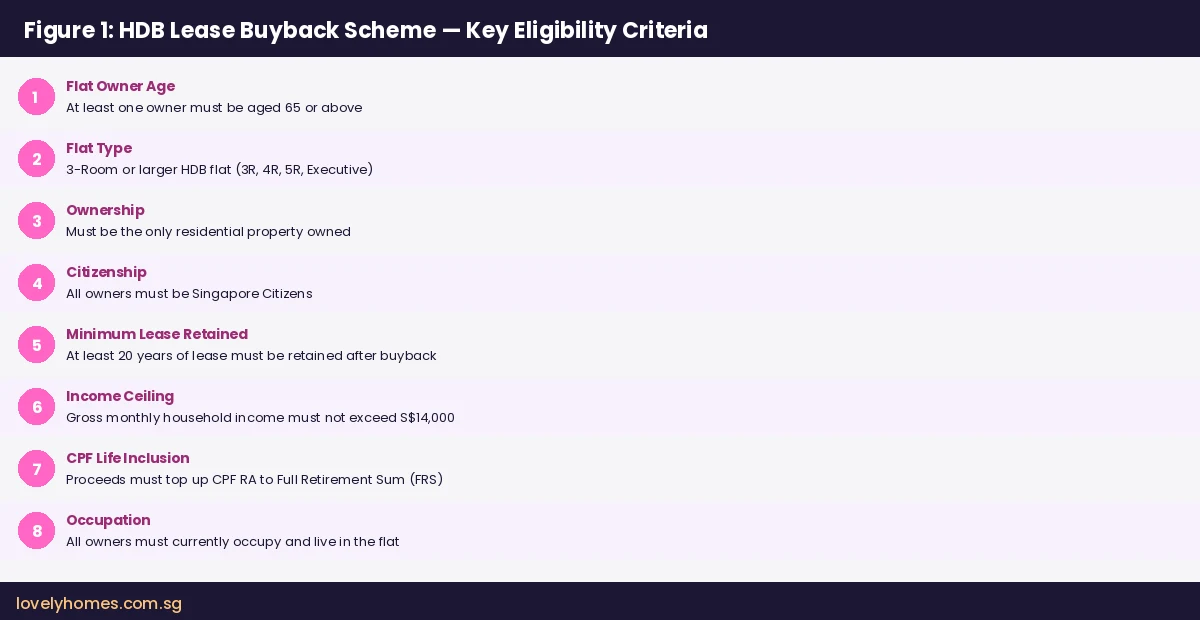
HDB Lease Buyback Scheme eligibility criteria Singapore 2026
Figure 1: HDB Lease Buyback Scheme — Key Eligibility Criteria 2026

Eligibility in Full

To qualify for LBS in 2026, a flat owner must meet all of the following conditions set by HDB:

Criterion Requirement Notes
Age At least one owner must be 65 or above Spouse may be younger
Flat type 3-Room flat or larger (3R, 4R, 5R, Executive) 2-Room Flexi flats are not eligible
Citizenship All flat owners must be Singapore Citizens SPR co-owners disqualify
Sole property Flat must be only residential property owned Overseas property also disqualifies
Occupation All owners must live in the flat No subletting of entire flat
Income ceiling Gross monthly household income not exceed S$14,000 Average last 12 months
Lease retained Minimum 20 years retained after buyback HDB will cap proceeds accordingly
CPF RA top-up Proceeds must first top up CPF RA to FRS (or BRS if property pledged) Mandatory, not optional
No outstanding judgments No bankruptcy proceedings, court orders on flat HDB checks SLA records

The income ceiling of S$14,000 per month is assessed on the gross monthly household income averaged over the 12 months preceding the LBS application. If the income ceiling was recently breached due to a one-time event (such as a bonus or redundancy payment), applicants should clarify the position with HDB directly.

How Much Will You Receive?

The proceeds from the LBS depend on two variables: the current market value of your flat (assessed by HDB’s appointed valuer) and the number of lease years you choose to sell. A flat valued at a higher market price will generate more proceeds from selling the same number of lease years than a flat in a lower-value estate.

HDB uses a straightforward proportional calculation: the proceeds from selling N years of lease is approximately N ÷ Total Remaining Lease × Market Value of the flat. For example, a flat with 65 years remaining lease and a market value of S$600,000 would generate proceeds of approximately 45 ÷ 65 × S$600,000 ≈ S$415,385 for selling the tail 45 years (retaining 20 years). This is a simplified illustration; HDB uses actuarial tables and discount factors in practice, so actual proceeds may differ.
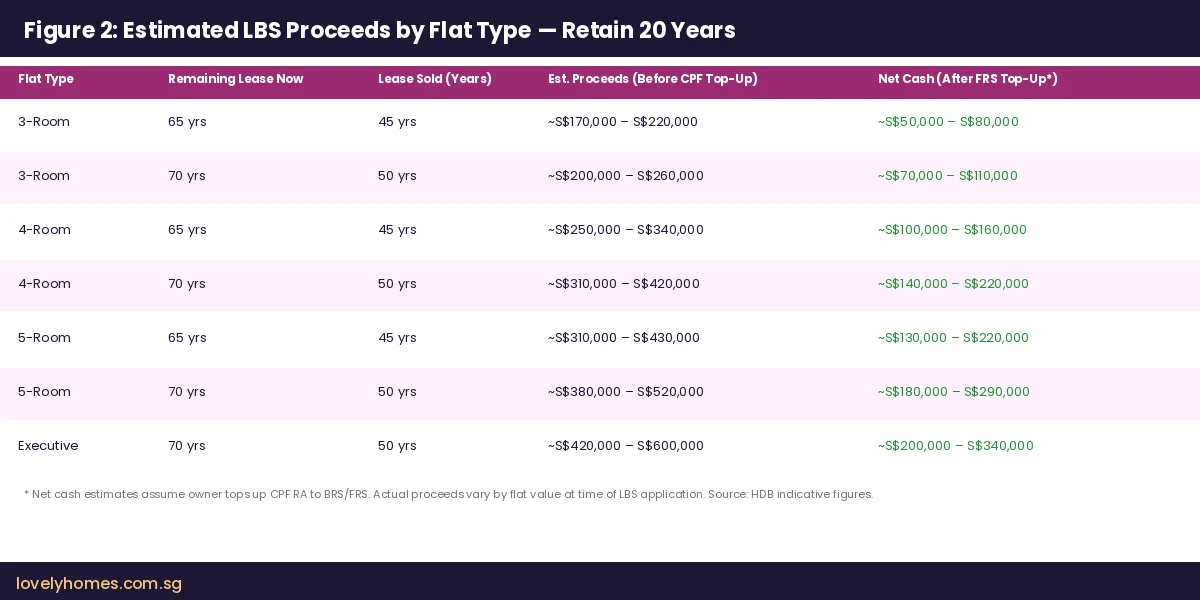
HDB Lease Buyback Scheme estimated proceeds by flat type 2026
Figure 2: Indicative LBS Proceeds by Flat Type — Retain 20 Years of Lease

How Proceeds Are Distributed

The LBS proceeds are not paid as a single lump sum to the flat owner. HDB directs the proceeds in a specific order mandated by the scheme rules:

  1. Refund any outstanding HDB housing loan — if the flat has a remaining HDB loan balance, this must be cleared first from the sale proceeds.
  2. Top up CPF Retirement Account to FRS — the mandatory retirement top-up. If the owner has pledged the property to HDB (opted for BRS instead of FRS), only the Basic Retirement Sum top-up is required. For 2026, the FRS is approximately S$213,000 for those turning 55 this year (the FRS adjusts annually at approximately 3.5%).
  3. Refund any CPF used for the flat plus accrued interest — CPF used in the original purchase (including accrued interest at 2.5% per annum) is refunded to the CPF OA from the proceeds.
  4. Remaining cash — any balance after the above deductions is paid to the flat owner as a cash lump sum. This cash is not locked into CPF.

The mandatory CPF RA top-up is then converted into CPF LIFE payouts — monthly income for the rest of the owner’s life, with amounts depending on the CPF LIFE plan selected (Standard Plan or Basic Plan).

The 5-Step Application Process
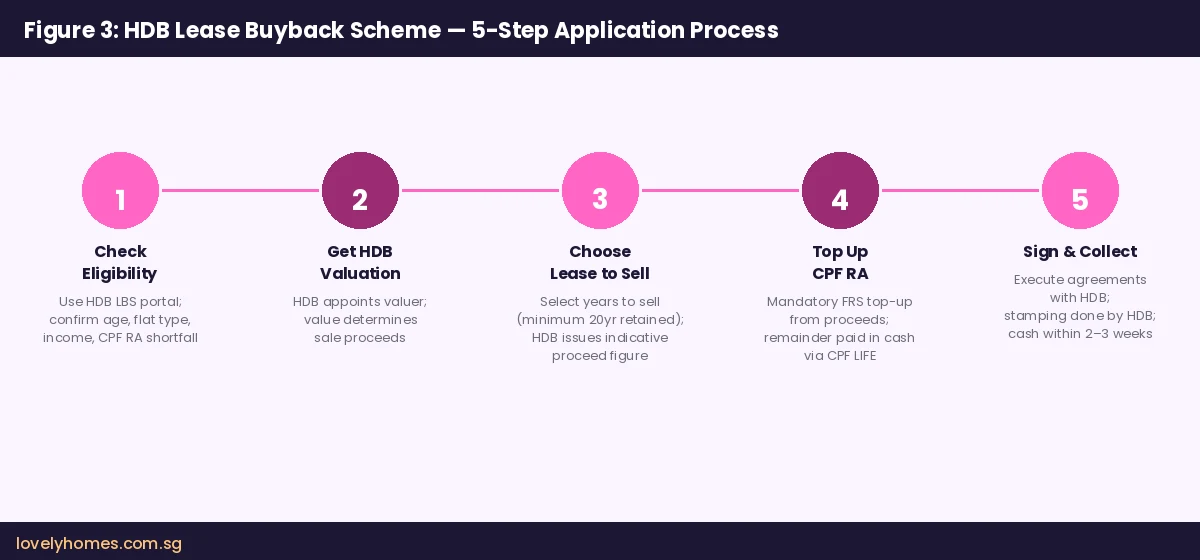
HDB Lease Buyback Scheme application process 5 steps Singapore 2026
Figure 3: HDB Lease Buyback Scheme — 5-Step Application Process

Applying for LBS is done entirely through HDB’s My HDBPage portal or at any HDB Branch Office. The process typically takes 2 to 3 months from initial application to receipt of funds. HDB’s officers will guide applicants through each stage, and there is no conveyancing fee or legal fee payable by the flat owner — HDB absorbs all transaction costs.

Worked Example — LBS in Action

Case Study: Mr and Mdm Lim, Sengkang 4-Room Flat

Profile: Mr Lim, 68, and Mdm Lim, 65, Singapore Citizens, co-own a 4-Room HDB flat in Sengkang. The flat has a remaining lease of 68 years and is valued by HDB’s appointed valuer at S$560,000. They have no outstanding HDB loan. Both live in the flat. Combined monthly income S$3,200. CPF RA balance (Mr Lim): S$80,000. FRS for their cohort: S$210,000.

Lease Years to Sell: Mr and Mdm Lim decide to sell 48 years of lease, retaining 20 years.

Estimated Proceeds (proportional illustration): 48 ÷ 68 × S$560,000 ≈ S$395,294 (subject to HDB’s actuarial computation; used as illustration only).

Distribution of Proceeds:

  • Outstanding HDB loan: S$0 (none)
  • CPF RA top-up to FRS: S$210,000 − S$80,000 (current balance) = S$130,000 to be topped up to CPF RA
  • CPF OA refund (original CPF used S$120,000 + accrued interest 15yr @2.5% ≈ S$56,000): S$176,000
  • Net cash received directly: S$395,294 − S$130,000 (CPF RA top-up) − S$176,000 (CPF refund) = ~S$89,294 cash lump sum

CPF LIFE payouts: With the CPF RA topped to the FRS of S$210,000 on the Standard Plan, Mr Lim (68 at application) would receive approximately S$1,200 – S$1,400 per month for life, depending on payouts at that age (indicative; actual payouts depend on CPF LIFE tables).

Summary: The Lims stay in their flat, receive ~S$89,294 in cash immediately, and enjoy around S$1,300/month CPF LIFE income. The flat remains their home for 20 more years, well past average life expectancy for a couple their age.

LBS vs Outright Sale — What Is Right for You?

Factor Lease Buyback Scheme Outright Sale and Right-Size
Continue living in same flat Yes No — must move out
Maximum proceeds Moderate (tail lease only) High (full flat value)
Disruption to lifestyle Minimal Significant
New flat or rental needed No Yes
Eligible flat types 3-Room and above Any HDB flat
CPF RA top-up required Yes (mandatory) Yes (if right-sizing to 2-Room Flexi under SHB)
Silver Housing Bonus (SHB) Eligible (up to S$30,000 bonus) Eligible under separate SHB scheme
Reversible No — permanent once executed Typically irreversible once flat sold

Silver Housing Bonus — Additional Incentive

Eligible flat owners who participate in the LBS may also receive the Silver Housing Bonus (SHB), an additional government grant to incentivise right-sizing and retirement monetisation. Under the SHB for LBS participants, the maximum bonus is S$30,000 for 3-Room flat owners and S$20,000 for 4-Room flat owners, subject to the income ceiling and CPF RA top-up requirements. The SHB is deposited into the CPF RA, not paid as direct cash. It is not available to owners of 5-Room or Executive flats.

What This Means for Singapore’s Ageing Society

The LBS exists because a large proportion of Singapore’s elderly population holds significant housing wealth locked in HDB flats but has insufficient liquid retirement savings. A 4-Room flat in a mature estate is often worth S$600,000 to over S$1,000,000, yet its owner may have only S$100,000 in CPF RA and minimal cash savings. LBS offers a structured way to extract some of that housing value without displacement.

Industry figures suggest fewer than 10,000 households have utilised LBS since its introduction, which is low relative to the estimated 200,000+ elderly HDB households that would qualify. HDB continues to refine the scheme — the 2019 enhancements expanded eligibility to all flat types 3-Room and above and lowered the minimum owner age from 65 to 65 (maintained). As Singapore’s resident population ages — by 2030 approximately one in four residents will be aged 65 or older — schemes like LBS are expected to become increasingly central to national retirement planning policy.

What Might Come Next

The government periodically reviews the LBS parameters including the income ceiling, minimum retained lease, and CPF top-up requirements. Policy observers expect that the income ceiling (currently S$14,000) could be raised further to extend eligibility to a broader group of middle-income elderly households. There is also industry discussion about whether the scheme could eventually be extended to 2-Room Flexi flat owners who reached the minimum occupation period — HDB has not indicated this is imminent. The FRS amount (the mandatory top-up target) rises each year in line with CPF adjustments; applicants should verify the current FRS directly with CPF Board at the time of application. The Silver Housing Bonus quantum may also be adjusted in future Budget statements.

Frequently Asked Questions

Can I apply for LBS if my spouse is a Singapore PR and not a citizen?

No. One of the hard eligibility requirements is that all flat owners must be Singapore Citizens. If your spouse is a Permanent Resident and is listed as a co-owner of the flat, you would not qualify for LBS. In this scenario, alternatives include transferring the flat solely to the citizen spouse (subject to stamp duty considerations) or exploring other monetisation options such as subletting the flat (if eligible) or outright sale. If the SPR spouse is not on the title and is merely a resident, LBS eligibility is not affected by the SPR’s presence in the flat.

What happens to the flat when I pass away — do my children inherit it?

After an LBS, the flat owner retains the balance of the lease they kept (typically 20 years). If you pass away before the retained lease expires, the remaining lease forms part of your estate and can be inherited by your beneficiaries. However, the beneficiaries would then own a flat with, say, 10 to 15 years of lease remaining. Given HDB’s rules on minimum lease for financing and CPF usage, a flat with fewer than 20 years of lease has very limited marketability. Beneficiaries should factor this into estate planning. If the lease expires before the last owner passes away, the flat reverts to HDB with no compensation.

Is the LBS a loan, and do I owe HDB money?

No. The LBS is not a loan. HDB is purchasing the tail end of your lease outright — it is a sale transaction. You receive proceeds (channelled through CPF RA top-up and cash) and there is no repayment obligation. You do not owe HDB anything after the LBS is completed. The flat simply has a shorter remaining lease than before — the portion sold to HDB is HDB’s property. There are no monthly repayments, no interest charges, and no negative equity risk.

Can I still sublet my rooms after LBS?

Yes, subject to HDB’s existing subletting rules. HDB flat owners may sublet spare bedrooms (not the entire flat) with HDB’s approval. LBS does not remove this right — the flat is still yours for the duration of the retained lease. You must continue to occupy the flat yourself, as owner-occupation is required both under LBS eligibility and under HDB subletting rules. Income from subletting is taxable as rental income and should be declared to IRAS.

How does LBS interact with my existing HDB loan?

If you still have an outstanding HDB housing loan at the time of the LBS application, the outstanding loan balance must be fully repaid from the LBS proceeds before any other distributions are made. This is the first priority in the proceeds waterfall. If the outstanding loan is large relative to the LBS proceeds, the net cash available to you (and the CPF RA top-up) will be reduced accordingly. Applicants with significant outstanding HDB loans should model this carefully before proceeding — in some cases, the net proceeds may be insufficient to generate a meaningful cash lump sum or CPF RA top-up.

Is there a deadline to apply for LBS?

There is no fixed deadline — LBS is an ongoing programme, not a time-limited offer. However, the scheme parameters (income ceiling, FRS top-up amount, SHB quantum) are reviewed periodically and may change. Flat owners who are eligible today should not assume the same eligibility conditions or proceeds will apply in future years, particularly as the FRS increases annually and market values fluctuate. Applying sooner rather than later is generally advisable for those who have decided to proceed, as the flat’s lease shortens each year, which mechanically reduces the proceeds achievable from selling the same number of tail lease years.

Will proceeds from LBS affect my MediShield Life or ComCare assistance?

The CPF RA top-up from LBS does not count as income for means-testing purposes for ComCare or other social assistance schemes — it is a retirement savings contribution, not earned income. The cash lump sum received, however, may be considered as an asset when assessed for means-tested schemes. Flat owners relying on ComCare or other income-tested benefits should declare the LBS transaction and consult the relevant agency (MSF for ComCare, CPF Board for Silver Support) to understand any impact on their assistance. MediShield Life premiums are not directly affected by LBS participation.

Disclaimer: This article is for general informational purposes only and does not constitute financial, legal or retirement planning advice. The Lease Buyback Scheme is administered by the Housing and Development Board (HDB). Eligibility conditions, proceeds, CPF retirement sum thresholds and Silver Housing Bonus amounts are subject to change at HDB’s and the government’s discretion. All figures cited (including FRS, CPF LIFE payouts and indicative proceeds) should be verified directly with HDB and CPF Board before making any decision. Visit www.hdb.gov.sg or call HDB at 1800 225 5432 for the most current information. LovelyHomes is an independent editorial platform and is not affiliated with any property agency, developer, financial institution or government body.
×

Click anywhere outside to close
Singapore HDB Resale Price Guide 2026 — Complete Breakdown by Town and Flat Type

Singapore HDB Resale Price Guide 2026 — Complete Breakdown by Town and Flat Type

⚡ Quick Answer — HDB Resale Prices 2026

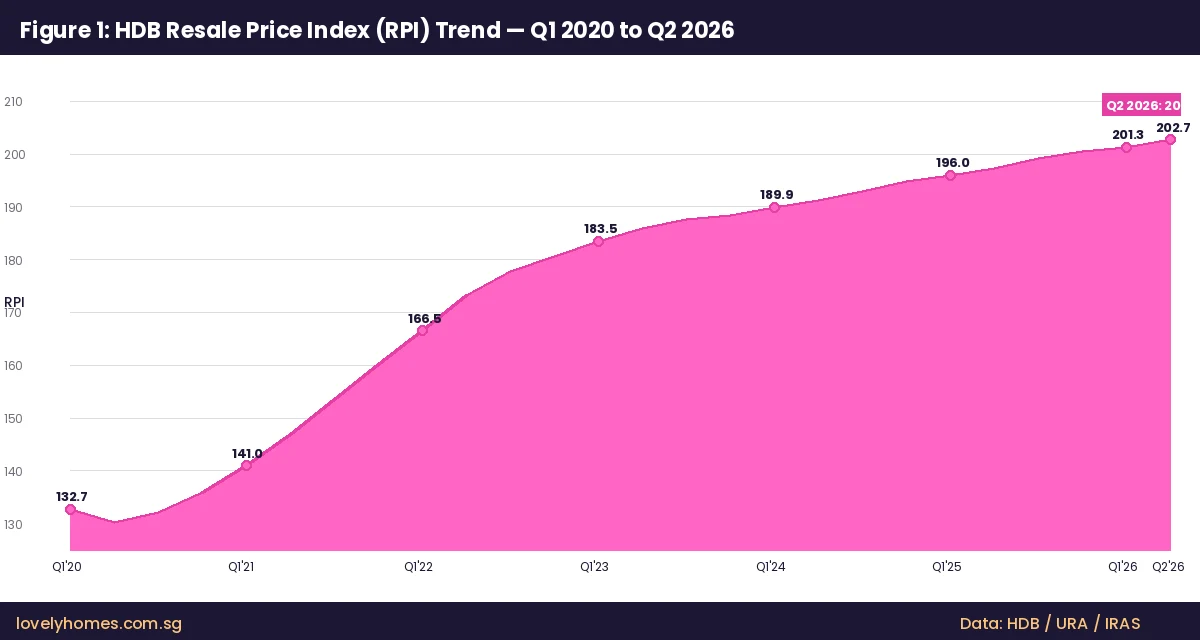
  • The HDB Resale Price Index (RPI) reached 202.7 in Q2 2026, up 0.7% quarter-on-quarter.
  • Mature estates (Queenstown, Toa Payoh, Bishan) command significant premiums of 30–70% over non-mature towns for equivalent flat types.
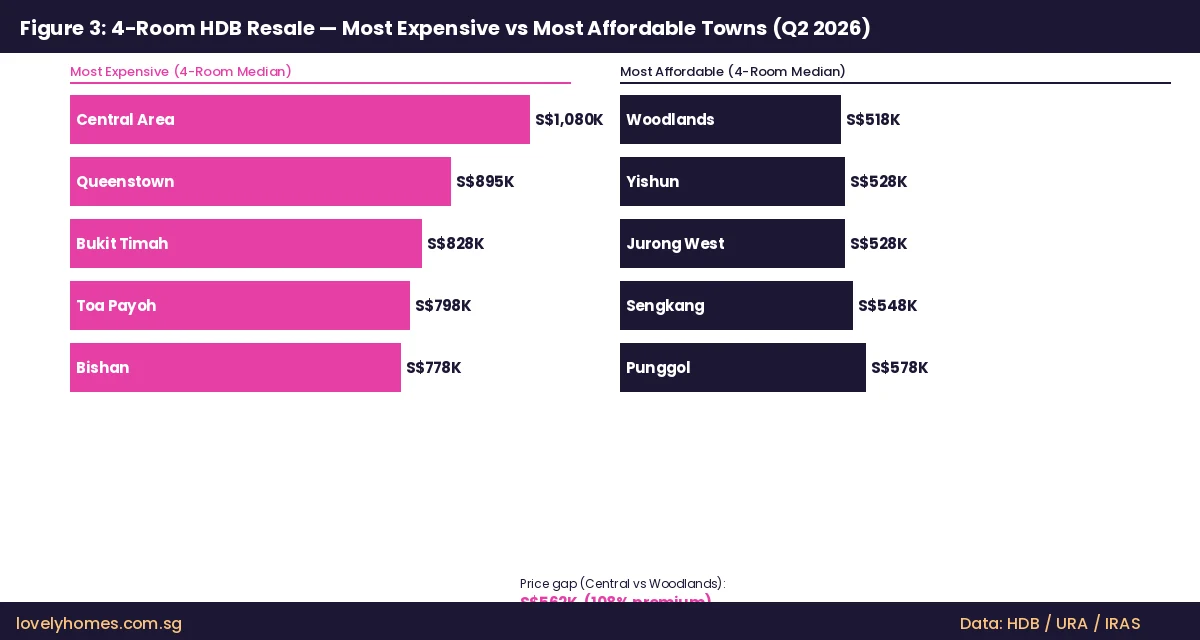
  • Median 4-Room resale prices range from around S$518,000 in Woodlands to over S$1,080,000 in the Central Area.
  • 5-Room and Executive flats in mature estates frequently transact above S$900,000; million-dollar HDB transactions continue at record pace in 2026.
  • Non-mature towns like Punggol and Sengkang offer 4-Room flats at S$548,000–S$578,000 — a more accessible entry point.
  • Remaining lease and minimum occupation period (MOP) both affect CPF usage and bank loan quantum — always check before buying.
  • The HDB resale market is governed by HDB under the Housing and Development Board Act (Cap. 129).
  • Buyers are eligible for grants: Enhanced CPF Housing Grant (EHG) up to S$120,000, CPF Housing Grant (CHG), and Proximity Housing Grant (PHG).

The HDB Resale Market in 2026

Singapore’s public housing resale market — administered by the Housing and Development Board (HDB) — remains one of the most active secondary property markets in Asia. Unlike new Build-To-Order (BTO) flats, resale flats can be purchased immediately (subject to eligibility), carry no Minimum Occupation Period (MOP) waiting time for the buyer, and are priced by negotiation between buyer and seller within market forces.

The resale market serves buyers who need immediate housing, those who missed their BTO ballot, permanent residents seeking their first home, and buyers prioritising location in mature, established neighbourhoods. In Q2 2026, HDB registered approximately 7,000 resale transactions — a robust level that reflects sustained demand across all flat types and estates.

Understanding how prices vary by town and flat type is essential before you begin your search. This guide draws on HDB Resale Price Index data, transaction records, and URA property market information to give you a clear picture of what to expect in 2026.

The HDB Resale Price Index — Where We Stand

The HDB Resale Price Index (RPI) is the authoritative benchmark published quarterly by HDB. It measures price movements using a fixed-weight methodology across a representative basket of resale transactions. A higher RPI does not tell you what any particular flat costs — it tells you how overall resale prices have moved relative to a base period.

HDB Resale Price Index trend Q1 2020 to Q2 2026 chart LovelyHomes
Figure 1: HDB Resale Price Index (RPI) — Q1 2020 to Q2 2026. Base year 2009 Q1 = 100. Source: HDB.

The RPI stood at 202.7 in Q2 2026, representing a cumulative increase of approximately 53% since Q1 2020. The index rose sharply through 2021–2022 as pandemic-era supply disruptions tightened the available resale stock, then moderated through 2023–2025 as BTO completions caught up with demand. Growth in 2026 has been more measured, averaging around 0.5–0.8% per quarter, suggesting the market has entered a more sustainable phase.

The RPI is published approximately three to four weeks after each quarter end. You can access current data at HDB’s resale statistics portal.

Mature Estates vs Non-Mature Estates — What the Distinction Means for Prices

HDB classifies towns and estates into two broad categories. Mature estates are those with well-established infrastructure, amenities, and transport links built up over decades — they include Ang Mo Kio, Bishan, Bukit Merah, Bukit Timah, Central Area, Clementi, Geylang, Kallang/Whampoa, Marine Parade, Pasir Ris, Queenstown, Serangoon, Tampines, Toa Payoh, and Tanjong Pagar. Non-mature estates are newer towns such as Choa Chu Kang, Hougang, Jurong East, Jurong West, Punggol, Sembawang, Sengkang, Woodlands, and Yishun.

The price differential between mature and non-mature estates reflects several factors: proximity to the Central Business District and Orchard Road, school catchment zones, established retail and dining options, MRT connectivity, and simply historical supply constraints (older estates were built on smaller land parcels with less total HDB stock).

For buyers, the choice involves a trade-off between affordability (non-mature) and liveability or capital appreciation (mature). Grants such as the Proximity Housing Grant (PHG) of up to S$30,000 and the CPF Housing Grant apply across both estate types, though income ceilings and quantum differ.

Resale Prices by Town — Q2 2026 Indicative Medians

HDB resale prices by town 2026 bar chart by flat type Singapore LovelyHomes
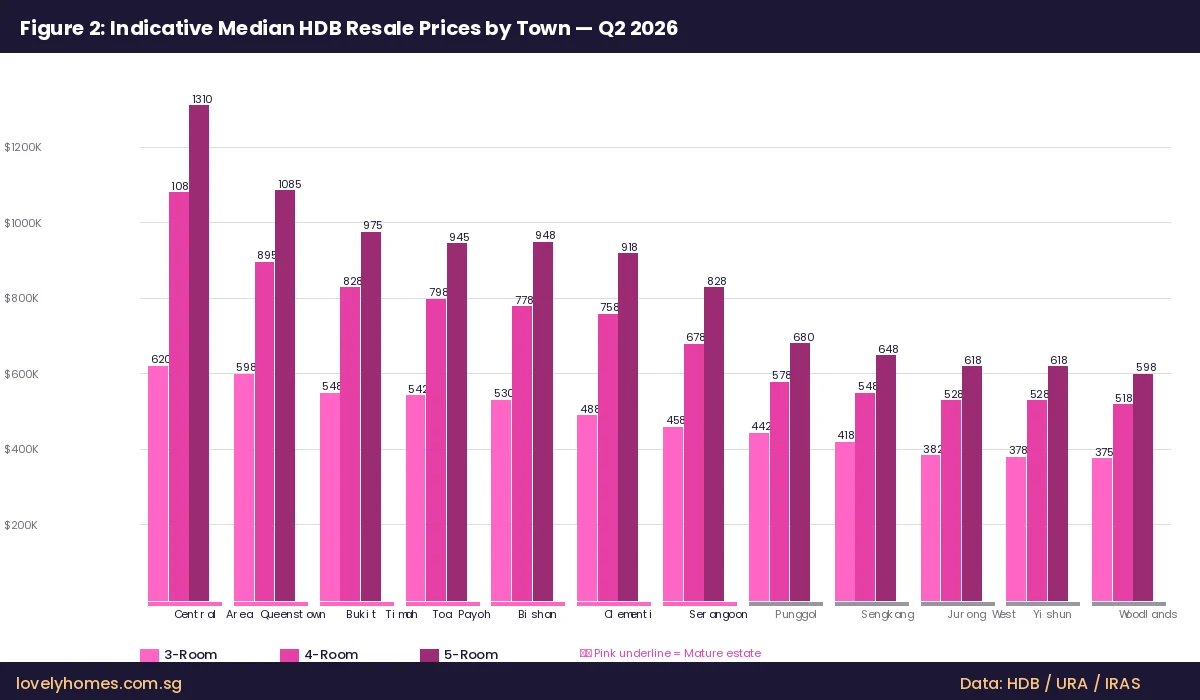
Figure 2: Indicative Median HDB Resale Prices by Town and Flat Type — Q2 2026. Source: HDB transaction records.

The following table summarises indicative median resale prices across major HDB towns in Q2 2026. These figures are derived from HDB transaction data and are intended as a planning guide; individual transactions vary based on floor level, facing, remaining lease, renovation condition, and negotiation.

Town Estate Type 3-Room Median 4-Room Median 5-Room Median
Central Area Mature S$620,000 S$1,080,000 S$1,310,000
Queenstown Mature S$598,000 S$895,000 S$1,085,000
Bukit Timah Mature S$548,000 S$828,000 S$975,000
Toa Payoh Mature S$542,000 S$798,000 S$945,000
Bishan Mature S$530,000 S$778,000 S$948,000
Ang Mo Kio Mature S$495,000 S$725,000 S$880,000
Clementi Mature S$488,000 S$758,000 S$918,000
Serangoon Mature S$458,000 S$678,000 S$828,000
Tampines Mature S$440,000 S$648,000 S$798,000
Bedok Mature S$428,000 S$618,000 S$768,000
Punggol Non-Mature S$442,000 S$578,000 S$680,000
Sengkang Non-Mature S$418,000 S$548,000 S$648,000
Hougang Non-Mature S$402,000 S$545,000 S$638,000
Jurong West Non-Mature S$382,000 S$528,000 S$618,000
Yishun Non-Mature S$378,000 S$528,000 S$618,000
Sembawang Non-Mature S$372,000 S$518,000 S$598,000
Woodlands Non-Mature S$375,000 S$518,000 S$598,000

Top 5 Most Expensive and Most Affordable Towns

Top 5 most expensive vs most affordable HDB resale towns 4-Room 2026 Singapore LovelyHomes
Figure 3: 4-Room HDB Resale — Top 5 Most Expensive vs Most Affordable Towns, Q2 2026. Source: HDB.

The price gap between Central Area 4-Room flats (median S$1,080,000) and Woodlands 4-Room flats (median S$518,000) amounts to approximately S$562,000 — a 108% premium for the same flat type in a more central location. This gap is primarily driven by proximity to the CBD, school catchment desirability, and the limited supply of older HDB stock in central Singapore.

Buyers with flexibility on location can achieve significant savings without sacrificing connectivity. Towns such as Punggol and Sengkang have benefited from the Cross Island Line and other MRT extensions, narrowing the effective transport disadvantage versus more central estates.

Worked Example — Buying a 4-Room Flat in Queenstown 2026

🔭 Worked Example: Mr & Mrs Wong purchase a 4-Room Queenstown resale flat

Buyer profile: Mr Wong (SC, 35) and Mrs Wong (SC, 33). Combined gross income S$9,500/month. First property. No private property owned or disposed of in the past 30 months.

Flat details: 4-Room flat, Queenstown, 28th floor, 6th-floor facing park, 75 years remaining lease. Agreed price: S$895,000. Valuation: S$892,000.

Stamp duty:
BSD: 1% × S$180,000 = S$1,800 + 2% × S$180,000 = S$3,600 + 3% × S$535,000 = S$16,050 = S$21,450
ABSD: Nil (first property for both SC buyers)
Total stamp duty: S$21,450, payable to IRAS within 14 days of HDB Resale Portal approval.

Grants:
CPF Housing Grant (CHG): S$50,000 (income S$9,500 < S$14,000 ceiling, mature estate)
EHG: S$15,000 (income S$9,500 — reduced EHG bracket)
PHG: Not applicable (neither set of parents lives in Queenstown)
Total grants: S$65,000

Financing:
Purchase price S$895,000 less grants S$65,000 = S$830,000 financed sum.
Bank loan (75% LTV on purchase price S$895,000, less 5% cash down): Loan S$671,250 @3.40% p.a. 25-year = approx S$3,338/month.
TDSR check: S$3,338 / S$9,500 = 35.1% — well within 55% TDSR limit.
CPF OA: S$80,000 applied to 15% down payment top-up. Cash down: S$44,750.

Total estimated cash outlay: S$44,750 (down payment) + S$21,450 (BSD) + S$6,000 (legal fees) + S$1,000 (HDB admin) ≈ S$73,200

What Drives HDB Resale Prices?

Several structural factors underpin resale valuations across all estates. Remaining lease is critical: flats with fewer than 60 years remaining face CPF usage proration under the lease-based framework administered by the CPF Board, which reduces effective purchasing power. Floor level typically adds 1–3% per 5 floors. Facing and view — park, reservoir, or city skyline — can command premiums of 5–10%. School proximity, particularly for popular primary schools with oversubscribed Phase 2C ballots, regularly adds 5–15% to nearby flat prices.

Macro factors include the prevailing interest rate environment (SORA-linked bank mortgage spreads), BTO supply pipeline (a large BTO launch can dampen resale demand in non-mature estates 2–3 years later as buyers divert to BTO), and broader economic conditions including employment and wage growth. MAS’s Total Debt Servicing Ratio (TDSR) of 55% and HDB’s Mortgage Servicing Ratio (MSR) of 30% act as structural demand constraints that prevent overheating.

What Might Come Next — HDB Resale Outlook

The outlook for the HDB resale market in H2 2026 and into 2027 is for continued measured growth, with most market observers expecting annual price increases of 2–4%. The completion of BTO projects delayed by the 2020–2022 construction slowdown will add to the supply of resale-eligible flats (those completing their 5-year MOP) from 2025 onwards, providing a natural pressure valve on resale prices.

Policy risk remains a consideration. HDB cooling measures introduced in August 2024, including a tightened 15-month wait period for private property downgraders seeking to purchase resale HDB flats, reduced one demand channel. Any further tightening — or conversely, any relaxation — would affect transaction volumes and prices accordingly. Buyers should monitor HDB and MAS announcements.

Frequently Asked Questions

Can I use CPF to buy any HDB resale flat regardless of remaining lease?

No. The CPF Board applies a lease-based proration rule. If the flat’s remaining lease at the time of purchase does not cover the youngest buyer to age 95, CPF usage is prorated downward. Flats with fewer than 20 years of remaining lease may not be eligible for CPF usage at all. You should always check the remaining lease and CPF proration via the CPF Board’s online calculator before making an offer.

Are HDB resale prices negotiable, and who sets the valuation?

Yes — the agreed transaction price is negotiated between buyer and seller. However, the bank loan quantum and CPF usage are based on the lower of the agreed price or HDB’s valuation (determined by HDB-appointed valuers). If you agree to pay above valuation, the difference (called the “cash over valuation” or COV) must be paid entirely in cash — it cannot be funded by CPF or a bank loan. COV has returned to some prime estates in 2026.

Do I need an HFE letter before I can buy a resale HDB flat?

Yes. The HDB Flat Eligibility (HFE) letter, introduced in May 2023, replaced the old HLE and OTP process. You must apply for and receive your HFE letter from HDB before you can sign an Option to Purchase (OTP) with the seller. The HFE letter confirms your eligibility to buy a resale flat, indicates the grants you are eligible for, and is valid for 6 months. The entire HFE application is done online via the HDB Resale Portal.

What grants are available when buying an HDB resale flat?

Three main grants are available depending on your profile. The Enhanced CPF Housing Grant (EHG) provides up to S$120,000 for families earning up to S$9,000 per month combined, on a sliding income scale. The CPF Housing Grant (CHG, formerly Family Grant) provides up to S$80,000 for purchases in non-mature estates and S$50,000 in mature estates. The Proximity Housing Grant (PHG) provides S$30,000 if you buy within 4km of your parents, or S$20,000 if you buy in the same town. Grants are credited to your CPF OA and applied towards the purchase price.

How does the Ethnic Integration Policy affect my flat search?

The Ethnic Integration Policy (EIP) sets racial proportion quotas per HDB block and neighbourhood to promote racial harmony. If a block has reached its Malay, Chinese, or Indian/Others quota, buyers from that ethnic group cannot purchase a flat in that block. This is checked automatically via the HDB Resale Portal and can meaningfully narrow the pool of available flats in some popular mature estate blocks. Always verify EIP quota status for any flat you are seriously considering.

Are million-dollar HDB flats a real trend, and should I be concerned about overpaying?

Yes — million-dollar HDB resale transactions have become increasingly common, concentrated in mature estates with high floors, city views, large unit sizes (5-Room and Executive), or particularly desirable location attributes. In Q2 2026, over 140 HDB resale transactions breached the S$1,000,000 mark. Whether this represents overpaying depends on your holding horizon, alternative options, and lifestyle priorities. These flats tend to be in estates where comparable private condominiums would cost S$2,500,000 or more, so the relative value can still be compelling. However, the resale HDB market has historically grown more slowly than private residential — factor this into your long-term financial plan.

What is the Minimum Occupation Period (MOP) for a resale flat I buy?

As a buyer of a resale HDB flat, you are subject to a 5-year MOP from the date of taking possession. During the MOP, you cannot sell the flat on the open market, rent it out entirely (partial subletting is allowed subject to HDB approval), or purchase a private residential property (locally). The MOP was extended to 10 years for Prime Location Public Housing (PLH) model flats launched from October 2021. Confirm the MOP applicable to your specific flat — especially if it is a PLH flat or a former DBSS unit — with HDB directly.

Disclaimer: The price data in this article is indicative and based on publicly available HDB transaction records and the HDB Resale Price Index as at Q2 2026. Individual flat prices depend on floor level, facing, condition, remaining lease, and negotiation. Grant eligibility, CPF usage rules, and financing limits are subject to change — always verify current figures at HDB.gov.sg, CPF.gov.sg, and MAS.gov.sg. Nothing in this article constitutes financial, legal, or property advice. Engage a licensed property professional and a qualified financial adviser before committing to any purchase.
×

Click anywhere outside to close
HDB BTO vs Resale Singapore 2026: Price, Wait Time, Grants and Which Is Right for You

HDB BTO vs Resale Singapore 2026: Price, Wait Time, Grants and Which Is Right for You


Quick Answer: HDB BTO vs Resale Singapore 2026

  • Price: BTO flats are sold at subsidised prices, typically 30–60% below comparable resale flats. A 4-room BTO in Tampines may be priced around S$380,000, versus S$680,000 or more on the resale market.
  • Wait time: BTO construction takes 4–5 years from selection to key collection for standard flats; 5–6 years for PLH Plus/Prime flats. Resale flats can be occupied within 8–12 weeks of exercising the OTP.
  • Grants: Both BTO and resale buyers can access the Enhanced Housing Grant (EHG) of up to S$120,000. Resale buyers additionally qualify for the Family Grant (up to S$50,000) and Proximity Housing Grant (PHG) of up to S$30,000.
  • Minimum Occupation Period (MOP): Standard BTO and resale flats have a 5-year MOP. Plus and Prime (PLH) flats carry a 10-year MOP with permanent restrictions on subletting the entire flat.
  • Location: BTO projects are often in non-mature estates (Tengah, Woodlands, Punggol, Sembawang), while resale gives access to mature estates (Bishan, Queenstown, Tampines, Toa Payoh) immediately.
  • Resale Levy: If you previously received a housing subsidy and buy a second subsidised flat (including BTO), you pay a Resale Levy of S$15,000–S$55,000 depending on the previous flat type.
  • CPF Housing Grants are credited directly to your CPF OA and reduce the loan quantum needed — they do not affect your cash outlay directly.
  • For most first-timer families earning under S$7,000/month, BTO in a non-mature estate offers the best financial outcome. Above S$7,000/month, resale with grants becomes competitive, especially for families needing immediate occupancy.

I. The Choice Every HDB Buyer Faces

Every year, tens of thousands of Singapore households face the same decision: apply for a new HDB Build-to-Order (BTO) flat, or buy an existing HDB resale flat on the open market? It is not a simple question. The financial stakes are large — the price gap between a subsidised BTO and a comparable resale flat in the same town can run to several hundred thousand dollars — and the practical consequences (particularly the 4-to-5-year wait for BTO keys) can affect life decisions around marriage, children, and career.

This guide compares BTO and resale across five critical dimensions: price, wait time, grants, location options, and MOP rules. It concludes with a worked example showing the total lifetime cost of each option for a typical young couple, and a decision framework for choosing which path suits your situation.

II. BTO Flats: Subsidised Pricing and the Ballot

The HDB Build-to-Order (BTO) programme offers new flats directly from HDB at heavily subsidised prices. As of 2026, HDB launches BTO exercises roughly six times per year, each offering several thousand units across multiple towns. Buyers apply through the HDB Flat Portal during the exercise window, and successful applicants are balloted for a queue number. Higher queue numbers wait longer for flat selection, and lower-demand towns naturally move faster.

BTO eligibility at a glance

To apply for a BTO flat, you must meet HDB’s eligibility criteria. At minimum, at least one applicant must be a Singapore Citizen; co-applicants may be SPR. The household must meet the income ceiling: S$14,000 per month for families; S$7,000 for singles applying under the Single Singapore Citizen scheme (applicable only for 2-room Flexi flats in non-mature estates). You must not own any other residential property at the time of application, and must not have previously received two housing subsidies.

Plus and Prime classification

Since the PLH (Plus/Prime Location Public Housing) model was introduced in late 2021 and subsequently evolved into the Plus/Prime classification under the HDB Redesign in 2024, certain BTO flats in well-connected or central locations carry additional restrictions: a 10-year MOP (versus the standard 5 years), permanent restrictions on subletting the entire flat after the MOP, and eligibility restrictions requiring all owners to be Singapore Citizens at the time of resale. These restrictions are designed to keep Plus/Prime flats within reach of genuine owner-occupiers rather than investors. Buyers of Plus/Prime flats should understand these constraints fully before applying — the restrictions run with the flat permanently.

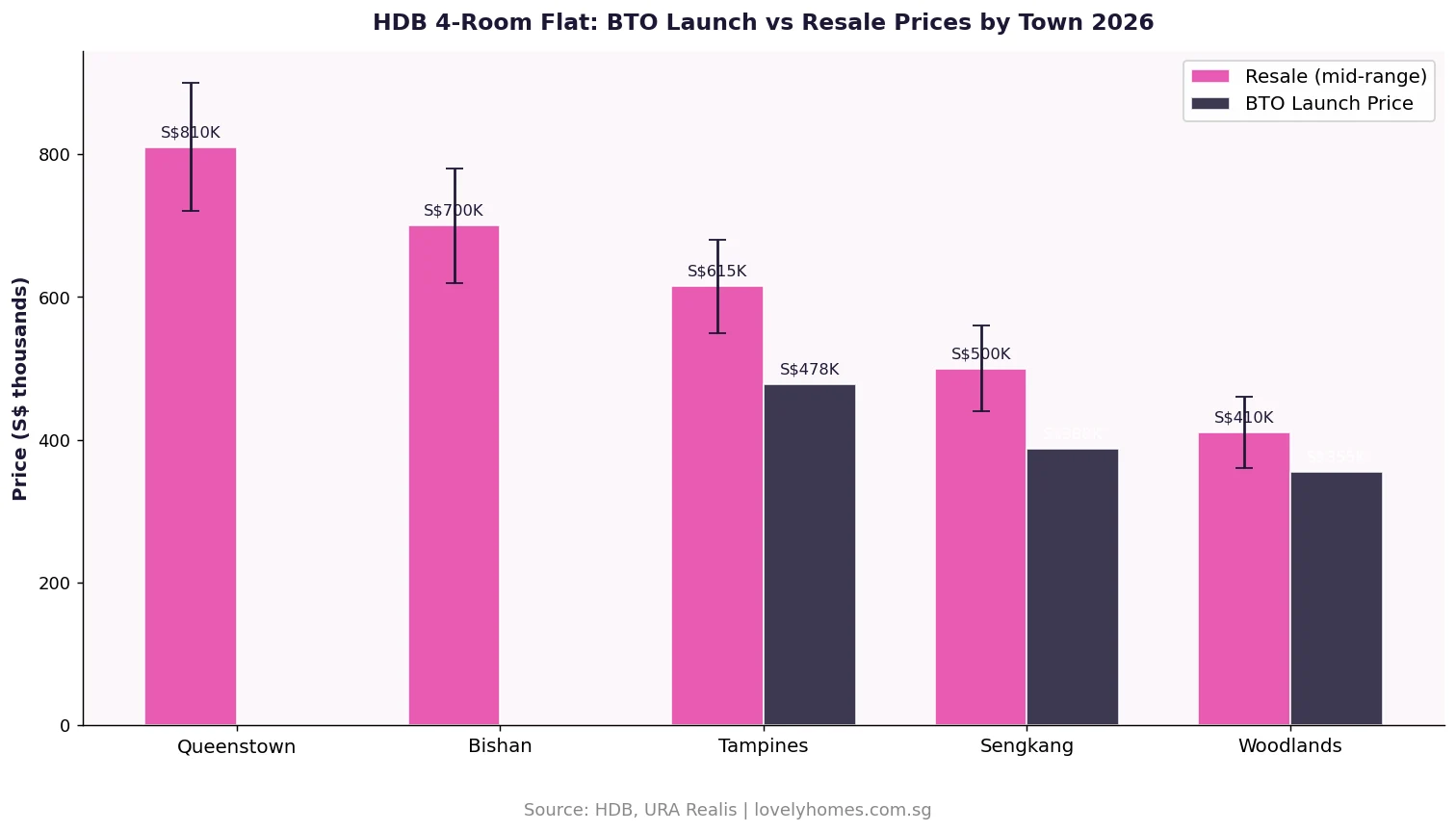
HDB BTO vs resale price comparison by town 4-room flat Singapore 2026
Figure 4: BTO versus resale 4-room flat prices by town, 2026. The resale premium over BTO ranges from 55% (Tampines) to over 77% (Queenstown). Subsidised BTO pricing is set by HDB based on location, flat type, and market conditions — the effective subsidy has grown as resale prices have risen faster than BTO selling prices over the past five years.

III. Resale HDB Flats: Market Pricing and Immediate Occupancy

An HDB resale flat is purchased from its existing owner at a price set by negotiation. Unlike BTO, there is no income ceiling for resale (except where grants are being claimed: the EHG income ceiling is S$9,000/month for families). The transaction follows the private-market model: you find a flat, agree a price, sign an Option to Purchase, and complete the sale through the HDB Resale Portal within a few months. There is no ballot, no construction wait, and no uncertainty about which specific flat you will receive — what you inspect is what you buy.

Cash Over Valuation (COV)

When the agreed purchase price exceeds HDB’s assessed market valuation, the excess is called Cash Over Valuation (COV). COV must be paid in cash — it cannot be financed by an HDB loan, a bank loan, or CPF. COV has been a significant factor in buoyant markets; in H1 2026, median COV for resale 4-room flats in mature estates ran between S$20,000 and S$60,000. Buyers must budget for COV in addition to the standard downpayment. For a flat where the valuation is S$650,000 but the agreed price is S$690,000, the COV of S$40,000 must be in cash — on top of the minimum 5% cash downpayment requirement for bank loans.

HDB Loan vs bank loan for resale

Resale buyers can use either an HDB concessionary loan or a bank loan. The HDB loan offers a rate of 2.6% per annum (pegged at 0.1% above the prevailing CPF OA interest rate), requires no minimum cash downpayment (the entire downpayment can come from CPF OA), and has no income ceiling for the loan itself. Bank loans offer potentially lower rates in favourable interest rate environments, but require a minimum 5% cash downpayment and are subject to the stricter TDSR and LTV limits administered by MAS.

IV. The Price Gap: What You Actually Pay

The BTO subsidy is the most powerful financial argument for the BTO route. HDB sets BTO selling prices with reference to market comparable values, then applies a subsidy — meaning a BTO flat is always priced below what an equivalent resale flat in the same estate trades for. The gap is typically widest in mature estates (where BTO supply is limited and resale demand is high) and narrowest in new towns (Tengah, Punggol) where BTO and resale prices are closer because resale supply in those towns is itself thin.

For a 4-room flat in Tampines in 2026, a comparable BTO selling price would be around S$380,000, while resale 4-room transactions in the same town run at S$650,000–S$720,000. The gap of approximately S$300,000 represents the subsidy, though buyers must deduct any grants received (which reduce both the effective BTO price and, for resale, the net resale cost). The counter-argument from resale buyers is that the S$300,000 premium purchases approximately 4–5 years of immediate occupancy — time that has significant economic value if you are currently renting or living with parents.

V. Wait Time: The Most Practical Differentiator

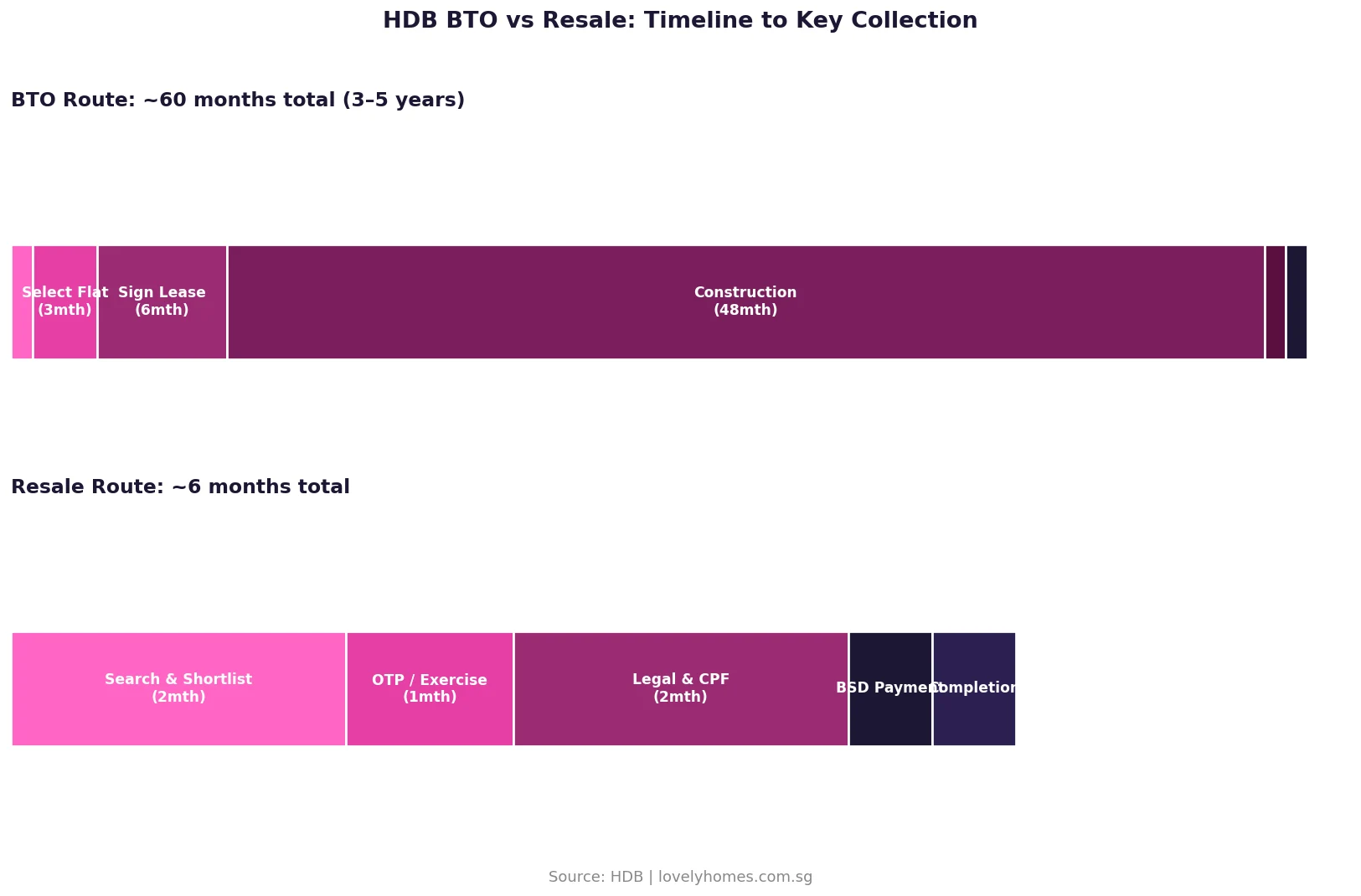
HDB BTO vs resale timeline wait time comparison months Singapore 2026
Figure 5: Timeline to key collection — BTO versus resale. A standard BTO buyer waits an average of 54 months (4.5 years) from HFE application to keys. A resale buyer, whether using an HDB or bank loan, typically collects keys within 4 to 5 months of starting the search. For families with a time-sensitive need — a child starting school, an expiring rental lease, or ageing parents — resale’s speed advantage is decisive.

The wait for a BTO flat is the single biggest practical obstacle for many buyers. From the time you submit your HFE Letter application to the time you collect keys for a new BTO flat, the typical elapsed time is 50–60 months for a standard flat and 60–72 months for a Plus or Prime flat. During this period, most buyers continue renting or living with family — at a cost. A young couple renting a 2-bedroom unit at S$2,500/month for 5 years pays S$150,000 in rent, which meaningfully erodes the financial advantage of the BTO subsidy.

Resale, by contrast, can move very quickly. From first viewing to key collection, a motivated buyer can complete a resale transaction in as little as 10 weeks — though 4 to 5 months is more typical when you account for finding the right flat, negotiating, and completing the HDB administrative process. For families with children already enrolled in nearby schools, or who need to accommodate elderly parents immediately, this speed premium is often worth more than the price differential.

VI. Housing Grants: Who Gets What

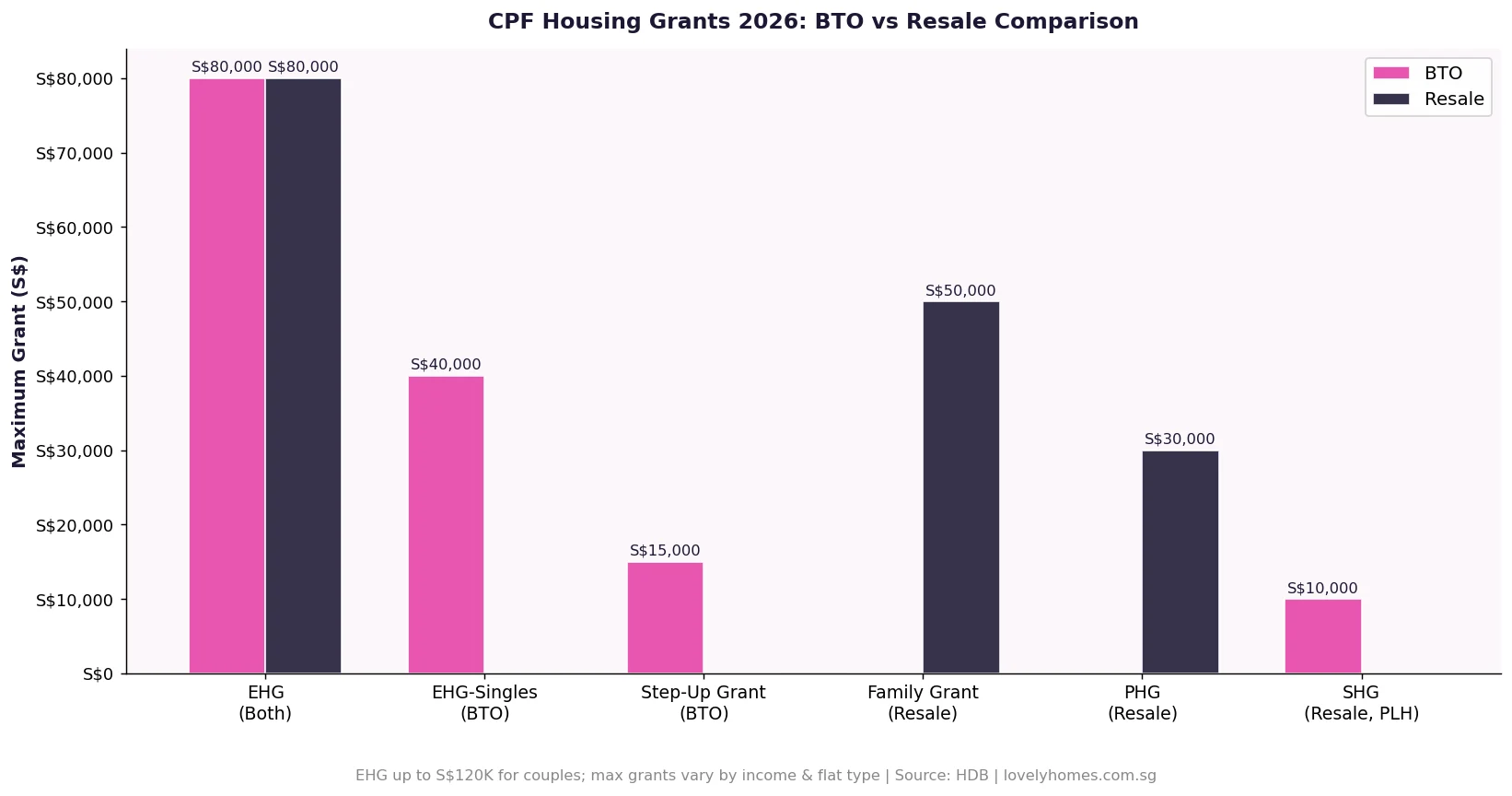
CPF housing grants BTO vs resale comparison EHG Family Grant PHG Singapore 2026
Figure 6: CPF Housing Grants available to BTO and resale buyers in 2026. Both routes offer the Enhanced Housing Grant (EHG) of up to S$120,000 for eligible first-timers. Resale buyers additionally qualify for the Family Grant (up to S$50,000) and the Proximity Housing Grant (PHG, up to S$30,000) — neither of which is available for BTO. All grants are credited to the buyer’s CPF OA and reduce the loan quantum needed.

The Enhanced Housing Grant (EHG) is available to first-timer families earning S$9,000/month or less (up to S$4,500 for singles). The maximum EHG is S$120,000, tapering to S$5,000 for households earning S$8,501–S$9,000. It is available for both BTO and resale flats. All grants are credited to the CPF OA of the buyers, reducing the loan and monthly repayments.

Resale buyers have access to two additional grants that BTO buyers cannot claim. The Family Grant (S$50,000 for a family of at least one SC buying their first resale flat) and the Step-Up CPF Housing Grant (S$15,000, for second-timer families moving from a 2-room Flexi to a larger resale flat). The Proximity Housing Grant (PHG) of up to S$30,000 is available to resale buyers living within 4 km of their parents or vice versa. PHG is also available for BTO flats located near parents under the Married Child Priority Scheme but as a grant only for resale.

The combined maximum grant package for a resale buyer (EHG S$120,000 + Family Grant S$50,000 + PHG S$30,000) is S$200,000 — substantially more than the maximum available to a BTO buyer. However, the BTO subsidy embedded in the lower selling price typically exceeds even the largest resale grant package for comparable flats.

VII. BTO vs Resale: Side-by-Side Summary

Factor BTO Flat Resale HDB
Price level Subsidised (30–60% below resale) Open market (higher)
Wait time 4–6 years (incl. construction) 8–16 weeks
Location choice Limited to launched projects (often non-mature estates) Any town, any flat
Condition Brand new, with defect warranty Existing condition (may need renovation)
EHG grant Up to S$120,000 Up to S$120,000
Family Grant Not applicable Up to S$50,000
PHG grant Not applicable (separate MCPS scheme) Up to S$30,000
COV Not applicable Possible — must be paid in cash
MOP 5 years (standard); 10 years (Plus/Prime) 5 years (standard); 10 years (PLH resale)
CPF usage From selection and loan disbursement From key collection
Renovation cost Full renovation needed from scratch May only need refresh
Resale Levy risk Yes, if previously subsidised flat owned Yes, if previously subsidised flat owned

VIII. Worked Example — Mr & Mrs Goh: BTO versus Resale in Tampines

Scenario: SC married couple, combined income S$8,500/month, first HDB purchase, targeting Tampines 4-room

Option A — BTO (standard, non-PLH):
Selling price: S$385,000. EHG: S$30,000 (income S$8,500/month, tapering scale). Net price after EHG: S$355,000. HDB loan at 2.6% 25yr on S$355,000 = S$1,609/month. MSR = 1,609/8,500 = 18.9% — well under 30% cap. Cash outlay: BSD S$5,550, legal ~S$1,500, total cash ~S$7,050. CPF downpayment: nil required for HDB loan (but couple choose to put S$35,500 CPF as 10% voluntary DP to reduce loan). Wait: 4.5 years. Interim: renting a 2BR at S$2,200/month = S$118,800 in rent over 54 months. True total cost at year 5: S$355,000 (loan) + S$118,800 (rent) + S$7,050 (cash) = S$480,850 — noting the flat is worth around S$650,000 at key collection (estimated).

Option B — Resale (mature estate, Tampines):
Purchase price: S$690,000. HDB valuation: S$660,000. COV: S$30,000 cash. EHG: S$30,000. Family Grant: S$50,000. Net loan: S$690,000 – S$30,000 (EHG OA) – S$50,000 (Family Grant OA) = S$610,000. HDB loan 80% on S$660,000 valuation = S$528,000; excess S$82,000 (= S$610,000 – S$528,000) financed by CPF OA. Monthly repayment at 2.6% 25yr on S$528,000 = S$2,391/month. MSR = 2,391/8,500 = 28.1% — just under 30% cap. Cash outlay: COV S$30,000 + BSD S$14,100 + legal S$2,500 = S$46,600. No rent during wait. True total cost at year 5: Loan serviced over 5 years ~S$143,460 (principal + interest); remaining principal ~S$489,000; total cash spent S$46,600 + S$143,460 = S$190,060 — but the flat is already worth S$690,000+ from day 1.

Verdict: For the Goh family, BTO saves approximately S$305,000 in purchase price but requires S$118,800 in rent and 4.5 years of waiting. The net financial advantage of BTO is approximately S$186,000 — significant but not overwhelming when accounting for the lifestyle and timing cost. If Mrs Goh is pregnant, or they need to move out of their current living situation, the calculus shifts toward resale.

IX. The Decision Framework: Which Should You Choose?

Choose BTO if you:

  • Can wait 4–5 years (ideally newly married, no children yet)
  • Have a lower income (EHG tapering makes BTO far cheaper)
  • Are flexible on location and willing to consider non-mature estates
  • Want a brand-new flat with developer defect warranty
  • Plan to customise the entire interior from scratch

Choose Resale if you:

  • Need to move within 6 months (rental expiry, child’s school enrolment)
  • Must live near parents (PHG + family proximity requirements)
  • Need a specific mature estate (schools, amenities, elderly parents nearby)
  • Are a second-timer and need immediate move-up
  • Have a higher income and the larger grant package bridges the cost gap

X. What May Change: BTO Supply and Policy Outlook

The government’s ramp-up to approximately 100,000 BTO units delivered between 2022 and 2025 has been maintained, with 2025 and 2026 exercises continuing at a pace of roughly 20,000–22,000 units per year. HDB has been strategic about including more BTO exercises in mature estates to meet demand from couples who might otherwise default to resale. The introduction of the 2022 Ballot Category (first-timer families receive two ballots versus one for others) has improved first-timer success rates. However, mature-estate BTO flat supply remains structurally tight given limited land availability.

Resale prices rose modestly through H1 2026, with the HDB Resale Price Index at 202.7 in Q2 2026 — a slight decline of 0.3% QoQ from Q1 2026 (203.0), suggesting the market is cooling at the margins. The government has no stated plans to remove or significantly loosen BTO eligibility criteria, and the Plus/Prime framework is likely to persist. Buyers who have been in the BTO queue since 2022–2023 are beginning to receive their keys in 2026–2027, which may add a modest wave of secondary market supply as some of them sell or upgrade.

XI. Frequently Asked Questions

Can a Singapore Permanent Resident (SPR) apply for a BTO flat?

SPRs cannot apply for a BTO flat on their own. However, an SPR can co-apply with a Singapore Citizen spouse (or parent, sibling, or child under the Public Scheme), provided at least one applicant is an SC. The SC must be the primary applicant. Under the Fiancé/Fiancée Scheme, an SC engaged to an SPR may apply, but the SPR must obtain SC status within six months of key collection. SPRs buying HDB resale flats on their own (without an SC co-applicant) are permitted, but they do not qualify for CPF Housing Grants and must use the Resale application only.

What is the Resale Levy and does it apply to me?

The Resale Levy applies to second-timer households who have previously received a direct subsidy (i.e., a first subsidised BTO or SBF flat), and who are now buying a second subsidised flat (another BTO or an EC from the developer). If you sold your first subsidised flat, HDB deducts the levy from the proceeds of that sale. If you still own it (e.g., you’re buying a concurrent BTO), the levy is paid in cash. The levy amount depends on your first flat type: S$15,000 for a 2-room Flexi, S$30,000 for a 3-room, S$40,000 for a 4-room, S$45,000 for a 5-room or 3Gen, and S$55,000 for an executive flat. Resale Levy does NOT apply if you are buying a resale flat — it only applies to purchases of new subsidised flats from HDB or a developer (EC).

Can I rent out my BTO or resale HDB flat before the MOP ends?

You cannot sublet the entire flat before the MOP expires. However, you may rent out individual bedrooms (not the entire flat) from the date of key collection, subject to HDB’s approval and prevailing subletting guidelines. HDB requires that you (the owner) continue to occupy the flat as your registered address and that the total number of occupants (including tenants) does not exceed the flat’s approved occupancy limit. For a 4-room flat, HDB generally permits renting out up to 3 bedrooms as long as the owner remains in residence. Overseas income earners who are temporarily overseas may apply to HDB for a subletting waiver under specific conditions. Violation of subletting rules is a serious offence — HDB can compulsorily acquire the flat.

How does the Enhanced Housing Grant (EHG) work for resale versus BTO?

The EHG is income-tested: the full S$120,000 is available to households earning S$1,500/month or less; it tapers down to S$5,000 for households earning S$8,501–S$9,000/month. The EHG quantum is identical whether you are buying a BTO or resale flat. It is credited to your CPF OA, from which it is then used toward the purchase price, reducing the loan amount. For BTO, the grant is applied at the time of booking; for resale, it is released at the completion appointment. Critically, for resale, the EHG cannot be used to pay Cash Over Valuation — only the base price (up to the valuation) can be funded from CPF. The COV above valuation is always cash.

What is the ballot priority system for BTO and how do I improve my chances?

HDB’s ballot priority system gives different numbers of ballot chances to different applicant categories. First-timer families applying under the Public Scheme receive two ballot chances per exercise; second-timers receive one. Married Child Priority Scheme (MCPS) applicants who want to live near parents receive an additional ballot. Applicants who have not been successful in three or more exercises may apply for the Married Child Priority Enhanced Ballot, which provides a higher ballot queue number priority. The Parenthood Priority Scheme (PPS) reserves a portion of units (up to 30%) for first-timer married couples with at least one Singapore Citizen child. To maximise your chances, apply in exercises with lower demand-to-supply ratios (typically non-mature estates), apply early to accumulate ballot count, and use all available priority schemes for which you qualify.

Is it possible to use both an HDB loan and a bank loan for the same purchase?

No. You must choose either an HDB concessionary loan or a bank loan — you cannot combine the two for the same property. The distinction matters because they have different LTV limits (HDB: 80% of valuation; bank: 75% on first property), different minimum cash requirements (HDB: zero; bank: minimum 5% cash), and different stress-test rules. You can switch from an HDB loan to a bank loan at any point during the loan tenure (refinancing), but you cannot revert back to an HDB loan once you have switched. The inability to return to the HDB loan is a significant consideration: bank loans, while potentially cheaper in low-interest environments, expose you fully to rate movements, whereas the HDB rate is effectively pegged to the CPF OA rate, which has historically been more stable.

Can I buy a private property while waiting for my BTO to complete?

Yes, with conditions. During the BTO construction period (before key collection), you may purchase private residential property — the MOP does not begin until keys are collected. However, if you own private property at the time of BTO key collection, HDB requires you to dispose of the private property within six months of collecting the BTO keys. If you fail to do so, you are in breach of HDB’s conditions, which can result in compulsory acquisition of the BTO flat. Note also that buying private property before BTO key collection means you will owe ABSD on the private property (since you are treated as already owning the BTO under the Agreement for Lease). The ABSD is 20% for an SC’s second property. Planning your property ladder while in the BTO queue requires careful sequencing with a property lawyer.

Disclaimer: This article is produced by LovelyHomes Editorial and is accurate as at 19 August 2026. HDB eligibility conditions, grant amounts, BTO selling prices, MOP rules, and loan parameters are subject to change at HDB’s and MAS’s discretion. All figures are illustrative and based on published data from HDB, MAS, CPF Board, and IRAS. Nothing in this article constitutes legal, financial, or property advice. Buyers should verify all information directly with HDB and engage a CEA-registered property agent and a licensed conveyancing solicitor for their specific transaction.

×

Click anywhere to close

Singapore HDB Flat Types Guide 2026: 2-Room Flexi to Executive and 3Gen Explained

Singapore HDB Flat Types Guide 2026: 2-Room Flexi to Executive and 3Gen Explained

Singapore HDB flat types guide 2026 — 2-room Flexi to Executive complete buyer guide lovelyhomes.com.sg
Singapore HDB Flat Types 2026 — From 2-Room Flexi to Executive and 3-Generation flats

🏠 Quick Answer: HDB Flat Types at a Glance

  • HDB offers six main flat types: 2-Room Flexi, 3-Room, 4-Room, 5-Room, Executive and 3-Generation (3Gen).
  • Floor areas range from 36 sqm (2-Room Flexi) to 143 sqm (Executive Apartment).
  • The general income ceiling for most families is S$14,000/month; 3Gen families qualify up to S$21,000/month.
  • Since August 2023, BTO flats are classified as Standard, Plus or Prime — determining the Minimum Occupation Period (MOP) and resale restrictions.
  • Plus and Prime flats carry a 10-year MOP and a subsidy clawback on resale; Standard flats retain the 5-year MOP.
  • Grants of up to S$120,000 (EHG) are available for eligible first-timer families purchasing BTO flats.
  • No income ceiling applies to purchase an HDB resale flat, but grant eligibility is income-tested.

What Are HDB Flat Types? A Plain-English Introduction

The Housing and Development Board (HDB) — Singapore’s public housing authority under the Ministry of National Development — offers a tiered range of flat types designed to accommodate households at different stages of life, from young singles and newly-weds purchasing their first home to multi-generational families seeking connected living. As at 2026, approximately 1.1 million HDB flats house about 78% of Singapore’s resident population, making HDB flat selection one of the most consequential decisions a Singaporean household will make.

Each flat type differs in floor area, bedroom count, eligible buyer profiles, applicable income ceilings and BTO launch price ranges. The introduction of the Standard, Plus and Prime classification in August 2023 added a further layer of nuance: two otherwise identical 4-room flats in different locations can now carry very different resale restrictions and Minimum Occupation Periods depending on their classification tier.

This guide walks through every flat type — what it offers, who can buy it, what it costs and what restrictions apply — so you can make a fully informed decision before your next BTO ballot.

The Six HDB Flat Types Explained

Singapore HDB flat types comparison table 2026 — size, price, eligibility by flat type
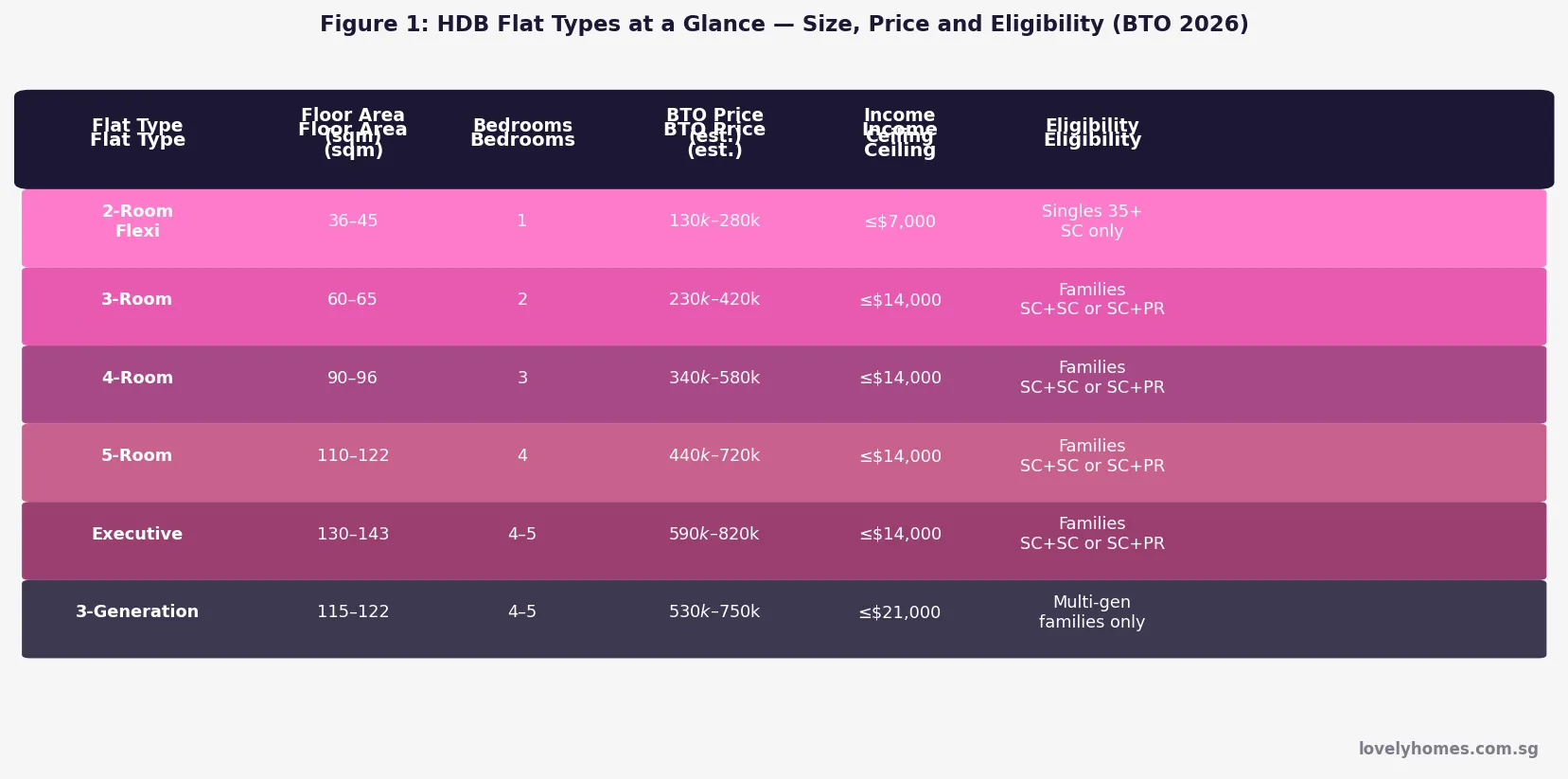
Figure 1: HDB Flat Types at a Glance — Size, Estimated BTO Price and Eligibility (2026)

2-Room Flexi Flat (36–45 sqm)

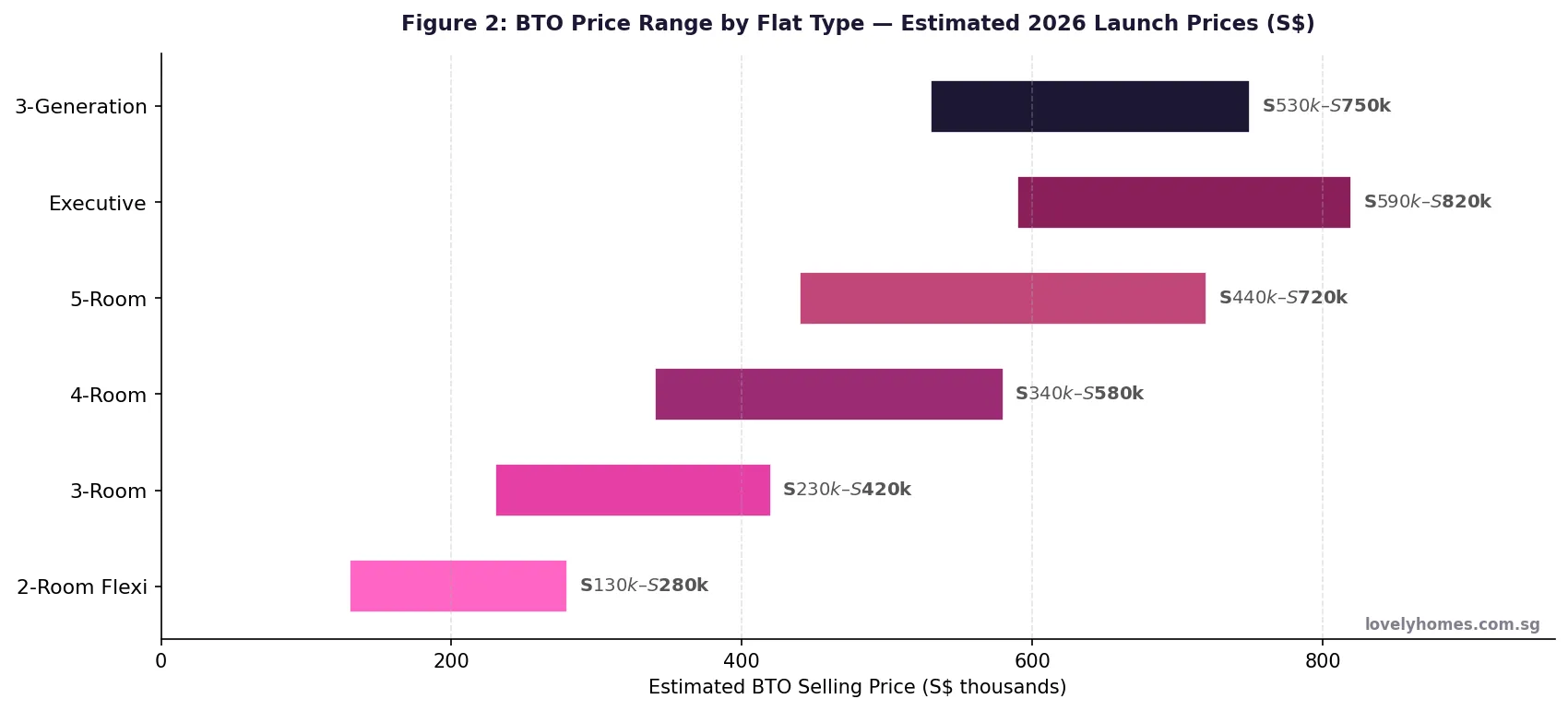
The 2-Room Flexi is HDB’s entry-level offering, designed primarily for singles aged 35 and above as well as elderly households and young families seeking an affordable start. With one bedroom and a living area of 36–45 sqm, it is the most compact flat type. Two lease options are available at BTO launch: a 99-year full lease (for families and younger applicants) and a short lease of 15 to 45 years in 5-year increments (for seniors under the Senior Priority Scheme who prefer lower outlay and right-sizing their estate). Estimated BTO launch prices range from S$130,000 to S$280,000 depending on location and classification. The income ceiling is S$7,000/month for singles and S$14,000 for families.

3-Room Flat (60–65 sqm)

The 3-Room flat provides two bedrooms and a dedicated living and dining space within 60–65 sqm. It suits smaller families, couples without children or singles applying under the Joint Singles Scheme (two SCs aged 35+). Estimated BTO prices run from S$230,000 to S$420,000. At resale, mature-estate 3-room flats in sought-after towns such as Queenstown or Toa Payoh regularly transact above S$600,000. The household income ceiling is S$14,000/month. First-timer families may receive the Enhanced CPF Housing Grant (EHG) of up to S$80,000 if household income does not exceed S$9,000/month.

4-Room Flat (90–96 sqm) — The Most Popular Type

The 4-Room flat remains Singapore’s most popular flat type, accounting for roughly 40% of all BTO applications in recent exercises. With three bedrooms and approximately 90–96 sqm of floor area, it comfortably accommodates a couple with one or two children. BTO prices range from S$340,000 to S$580,000 at Standard locations and can exceed S$650,000 for Prime sites in mature estates. The income ceiling is S$14,000/month. The 4-room flat’s combination of size, affordability and liquidity in the resale market makes it the default choice for most first-timer families.

5-Room Flat (110–122 sqm)

The 5-Room flat offers four bedrooms across 110–122 sqm, suiting larger families or households that prioritise a dedicated home office or guest room. At BTO, estimated prices span S$440,000 to S$720,000 — with Prime-classified 5-room flats in central areas reaching the upper end. Resale 5-room flats in mature estates routinely breach the S$1,000,000 mark, reflecting strong demand from upgraders. The income ceiling is S$14,000/month. The EHG applies for first-timers at lower income bands.

Executive Flat — Apartment (EA) and Maisonette (EM) (130–143 sqm)

Executive flats — built primarily between 1979 and 1999 — are the largest flat type at 130–143 sqm and are no longer launched as BTO; they are only available on the resale market. Two variants exist: the Executive Apartment (EA), which includes a utility room or study that can function as a fifth bedroom, and the Executive Maisonette (EM), a two-storey unit with the living area on one floor and bedrooms on the floor above. Resale prices for executive flats range broadly from S$590,000 to over S$820,000 depending on estate and condition. There is no income ceiling to purchase an executive flat on the resale market, though grant eligibility is income-tested.

3-Generation (3Gen) Flat (115–122 sqm)

The 3-Generation flat is a specialised design introduced by HDB to support multi-generational living under one roof. Measuring 115–122 sqm, it features two master bedrooms (each with an attached bathroom), a common bedroom and shared living areas — allowing two generations (parents and adult child’s family) to enjoy connected privacy without requiring two separate units. The 3Gen flat is available only to families applying under the Multi-Generation Priority Scheme (MGPS) or purchasing under the Married Child Priority Scheme with a parent/child co-applicant. The income ceiling is raised to S$21,000/month for the combined household. BTO prices range from approximately S$530,000 to S$750,000.

Singapore HDB BTO price range by flat type 2026 — 2-room Flexi to Executive estimated launch prices
Figure 2: Estimated BTO Launch Price Range by Flat Type — Singapore 2026 (S$)

Standard, Plus and Prime: The New Classification Framework

Since August 2023, every new BTO flat launched by HDB is classified as Standard, Plus or Prime. This framework replaced the earlier Mature/Non-Mature estate dichotomy and aims to match housing subsidies more precisely to location advantage — ensuring that flats in highly desirable or centrally located estates are accessible to a broader income range while discouraging short-term speculative resale.

Singapore HDB flat classification Standard vs Plus vs Prime 2026 — MOP and restriction differences
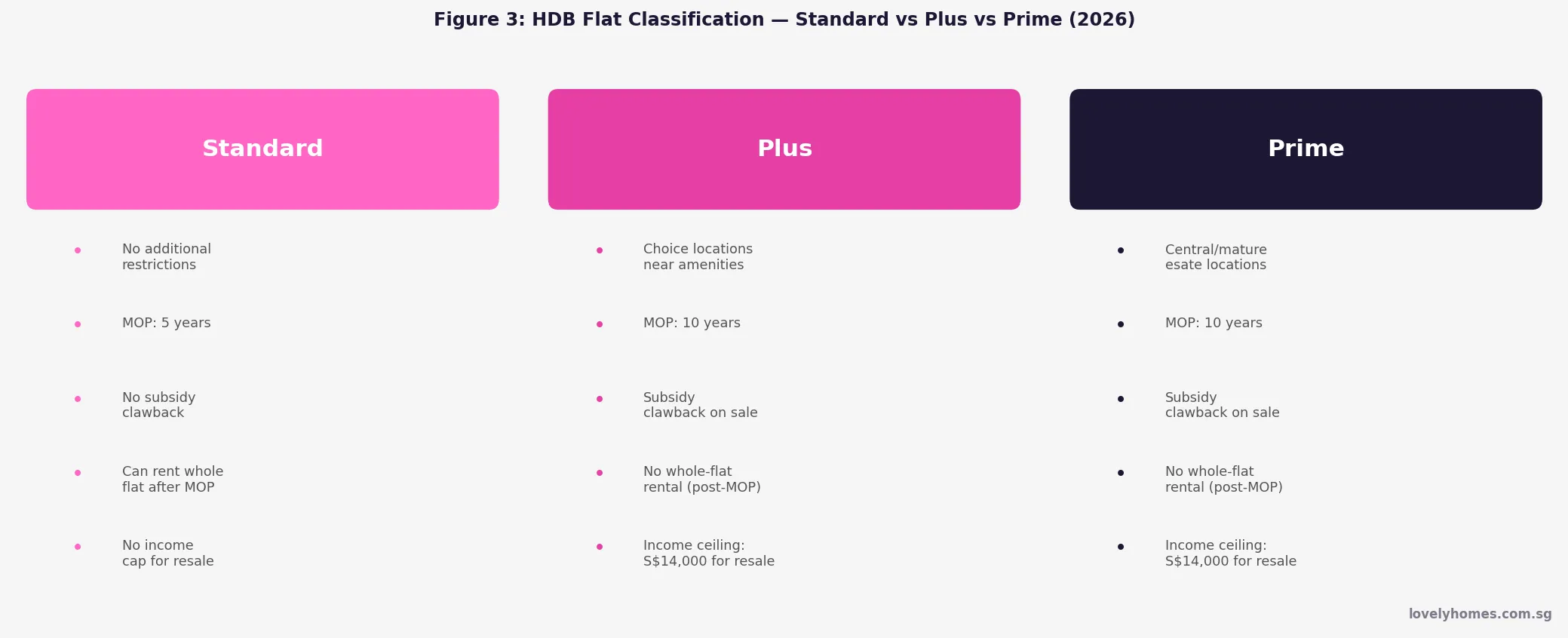
Figure 3: HDB Flat Classification Compared — Standard, Plus and Prime Restrictions (2026)

Standard Flats

Standard flats carry the baseline MOP of 5 years before the flat can be sold on the resale market. There is no subsidy clawback on resale, no restriction on whole-flat rental after the MOP, and no income ceiling for resale buyers. Standard flats are typically located in non-mature estates or peripheral areas of mature estates.

Plus Flats

Plus flats are located in choice locations — near MRT interchanges, town centres or major amenities — that command a meaningful locational premium over Standard flats. The extended MOP is 10 years. When a Plus flat is sold on the resale market, HDB recovers a proportion of the subsidy given at BTO (the subsidy clawback is pro-rated based on the resale price relative to market value at the time of sale). Whole-flat renting is not permitted after the MOP. Resale buyers of Plus flats must not exceed the income ceiling of S$14,000/month.

Prime Flats

Prime flats occupy the most central and desirable locations — typically in or near the city fringe, mature areas with exceptional connectivity, or towns with very high land values. Conditions are identical to Plus (10-year MOP, subsidy clawback, no whole-flat rental, S$14,000 resale income ceiling) but the subsidy quantum is typically larger given the higher land value and location premium. Examples of Prime-designated estates include Rochor, Kallang/Whampoa and Queenstown town centre sites.

HDB Eligibility Schemes — Who Can Buy Which Flat?

HDB eligibility is primarily governed by citizenship, marital status, age and household income. The six main eligibility schemes in 2026 are as follows.

Eligibility Scheme Who Qualifies Flat Types Available Income Ceiling
Family Scheme SC + SC or SC + PR (married or engaged couples, siblings/parents) All flat types S$14,000 (3Gen: S$21,000)
Singles Scheme Single SC citizen, aged 35 and above 2-Room Flexi only S$7,000
Joint Singles Scheme Two or more single SCs, each aged 35+ 2-Room Flexi to 5-Room S$14,000 combined
Non-Citizen Spouse Scheme SC + non-citizen (non-PR) spouse 2-Room Flexi only S$14,000
Fiancé/Fiancée Scheme Engaged SC couple (at least one SC) All flat types S$14,000
Multi-Generation Priority Scheme Married child + parents (at least one SC in each unit) 3Gen and 4-Room (priority) S$21,000 combined

In all cases, at least one buyer must be a Singapore Citizen. Permanent Residents (PRs) may not purchase a new BTO flat independently; they must apply jointly with a SC. PRs can purchase HDB resale flats after living in Singapore for 3 years, subject to HDB approval.

CPF Grants for BTO and Resale Flat Buyers (2026)

CPF housing grants are disbursed at purchase and credited directly to the buyer’s CPF Ordinary Account (OA), from which they can be used towards the purchase price or monthly loan instalments. The main grants in 2026 are:

Grant Max Amount Who Qualifies Income Ceiling
Enhanced CPF Housing Grant (EHG) S$120,000 (families)
S$60,000 (singles)
First-timer SC family buying any flat type ≤ S$9,000/mth (families)
≤ S$4,500/mth (singles)
Family Grant S$50,000 (SC+SC)
S$40,000 (SC+PR)
First-timer family buying resale flat (4-room or larger) ≤ S$14,000/mth
Enhanced Family Grant S$80,000 (SC+SC)
S$65,000 (SC+PR)
First-timer family buying resale flat in non-mature estate ≤ S$14,000/mth
Proximity Housing Grant (PHG) S$40,000 (within 4km)
S$20,000 (same town)
Resale buyers buying near parents/married child No ceiling
Step-Up CPF Housing Grant S$15,000 Second-timers moving from public rental / 2-room to larger flat ≤ S$7,000/mth

The EHG is only available for BTO applications and resale purchases completed from 11 September 2019. It cannot be combined with the Family Grant but may be stacked with the PHG. Grants are non-transferable and non-refundable if the household later sells the flat before the MOP.

Worked Example: BTO Application for a 4-Room Flat

Mr and Mrs Ahmad are a Singapore Citizen couple, both aged 30, with a combined household income of S$7,500 per month. They are first-timer applicants applying for a 4-Room Standard BTO flat at Tengah Plantation Close (non-mature estate) launched at a selling price of S$395,000.

Item Amount Notes
BTO selling price S$395,000 Standard flat, non-mature estate
Enhanced CPF Housing Grant (EHG) – S$55,000 HHI S$7,500/mth → EHG tier S$55k
Net price after grant S$340,000 Minimum downpayment basis
HDB concessionary loan (80% LTV) S$272,000 Rate 2.6% p.a., 25-year tenure
Monthly instalment (CPF OA) S$1,234/mth CPF OA fully utilised first
MSR check (30% of gross income) Max S$2,250/mth S$1,234 ÷ S$7,500 = 16.5% PASS ✓
Cash downpayment (5% minimum) S$17,000 Remaining 15% from CPF OA balance
Legal fees and misc. ≈ S$2,500 Conveyancing + stamp duty (BSD on HDB = nil for first-timer SCs below $400k)
Total cash needed Day 1 ≈ S$19,500 Assuming CPF OA has sufficient balance for 15% portion

BSD on an HDB flat priced at S$395,000 works out to S$6,750 (1%×S$180k + 2%×S$180k + 3%×S$35k), payable within 14 days of the Agreement for Lease signing. It is typically paid from CPF OA. ABSD does not apply as both Mr and Mrs Ahmad are first-time SC buyers.

What Flat Type Should You Choose?

Choosing the right flat type depends on three interlocking variables: your current household size and life stage, your affordability (income ceiling, CPF OA balance, servicing ratio) and your long-term resale or rental plans.

For a newly-wed couple in their late 20s with no immediate plans for children, a 3-Room flat offers manageable outlay with the option to upgrade to a larger resale flat after the MOP. Couples expecting two or more children within the MOP period will be better served by a 4-Room or 5-Room flat from the outset, given that HDB’s Transfer of Ownership rules during the MOP restrict flat type changes. For households with elderly parents who prefer co-location without full dependency, the 3Gen flat provides the most architecturally tailored solution — though the MOP restriction and limited resale market (only to families intending multi-gen living) reduce liquidity compared with a standard 5-room flat.

Where location matters more than size — for instance, a couple determined to live in Queenstown or Bishan — a Prime-classified 4-Room flat may still be preferable to a Standard 5-Room in a less central town, provided the household is comfortable with the 10-year MOP and the subsidy clawback on eventual resale.

What Might Come Next: HDB Policy Direction

HDB regularly reviews supply and eligibility policy in response to demographic trends. Several developments are likely to shape flat type availability and eligibility in the medium term.

First, Singapore’s ageing population will increase demand for shorter-lease 2-Room Flexi flats among seniors who prefer right-sizing their estate and reducing housing cost in retirement — HDB has indicated it will continue expanding the Senior Priority Scheme (SPS) supply to meet this need. Second, the government has signalled that BTO output will remain elevated through 2026–2028 to clear the backlog created by COVID-19 construction delays, with an annual target of approximately 19,600 BTO flats, meaning shorter waiting times and more choice. Third, the long-term viability of the Plus and Prime classification framework will depend on whether subsidy clawbacks effectively moderate secondary market prices in designated high-demand areas — an outcome that will take another 5–7 years of post-MOP resale data to assess fully.

Frequently Asked Questions

What is the difference between a 5-Room and an Executive flat?

Both are large flat types with four or more bedrooms, but they differ in origin and availability. 5-Room flats are actively launched as BTO flats and are available on both the BTO and resale markets. Executive flats — comprising the Executive Apartment (EA) and Executive Maisonette (EM) — were built primarily between 1979 and 1999 and are no longer launched as BTO flats; they are only available on the resale market. Executive flats are typically 130–143 sqm (slightly larger than 5-Room flats at 110–122 sqm), and the EM’s two-storey layout is a distinctive feature not found in any current BTO type. Because they are older and no longer in production, executive flats in good condition command a premium, particularly in mature estates.

Can a single person buy a 4-Room HDB flat?

Not as a standalone BTO purchase. Singles aged 35 and above are limited to the 2-Room Flexi flat under the Singles Scheme when buying directly from HDB at BTO. However, singles can buy any HDB resale flat type (including 4-Room, 5-Room or Executive) on the open resale market, subject to citizenship requirements (SC or PR with 3+ years of residency), provided they meet HDB’s eligibility conditions. Singles applying jointly with another single SC under the Joint Singles Scheme can access BTO flats up to 5-Room size.

What happens if I sell my Plus or Prime flat before the 10-year MOP?

Selling an HDB flat before the MOP is generally not permitted, regardless of flat classification. The MOP is computed from the date of key collection and applies even if you temporarily rent out rooms or move out of the flat. During the MOP, the flat cannot be sold on the open resale market or transferred in ownership (except in specific circumstances such as death, divorce, or marriage, which require HDB’s prior written approval). Owners who sell without approval are in breach of the Housing and Development Act and may face legal action, including a requirement to return the flat to HDB at the original purchase price.

What is the subsidy clawback for Plus and Prime flats?

When a Plus or Prime flat is sold on the resale market after the MOP, HDB recovers a portion of the initial housing subsidy granted at BTO. The clawback amount is calculated as a percentage of the resale price rather than a fixed dollar figure, and the applicable rate is disclosed to buyers at the point of BTO application. Broadly, the clawback ranges from 6% to 9% of the resale price, depending on the classification and the subsidy quantum at the time of original purchase. This clawback does not apply to Standard BTO flats. The amount is deducted at the point of resale completion and returned to HDB’s land account; it cannot be offset against CPF or legal fees.

Can PRs buy a BTO flat directly from HDB?

No. Permanent Residents cannot purchase new BTO flats directly from HDB. A PR must apply jointly with a Singapore Citizen spouse, parent or sibling under an eligible scheme (most commonly the Family Scheme). The SC co-applicant must be at least 21 years old. On the resale market, a PR household (with at least one SC owner) may purchase any HDB resale flat after residing in Singapore for at least 3 years. A PR-only household (no SC) is not eligible to purchase HDB resale flats.

How do I estimate my EHG amount?

The EHG is tiered based on the average gross monthly household income over the 12 months preceding the HDB application. For families, the maximum grant of S$120,000 applies at incomes of S$1,500/month or below, stepping down progressively to S$5,000 at income of S$9,000/month, and S$0 above S$9,000/month. For singles, the maximum is S$60,000 at income ≤ S$750/month, tapering to S$0 above S$4,500/month. The HDB e-Service at my.hdb.gov.sg provides an eligibility checker. Note that the EHG is only available to households where at least one buyer has not previously received an HDB housing subsidy (first-timer applicant).

Do Plus and Prime resale flats have an income ceiling for buyers?

Yes. Resale buyers of Plus and Prime classified BTO flats (after the MOP) must not exceed a household income of S$14,000 per month. This condition is analogous to the BTO income ceiling and is designed to ensure that the subsidised Plus and Prime flats continue to be accessible to lower and middle-income households even on the secondary market. Standard BTO resale flats carry no income ceiling for buyers. Buyers of executive flats and other pre-2023 resale flats also have no income ceiling, as those flats were not launched under the new classification framework.

Related Articles

Disclaimer

This guide is published by LovelyHomes for general informational purposes only and reflects the rules, prices and policies applicable as at 11 August 2026. HDB flat type availability, BTO selling prices, grant amounts, income ceilings and classification conditions are set by the Housing and Development Board and are subject to revision without notice. Actual BTO launch prices may differ from the indicative ranges quoted herein; buyers should refer to the official BTO sales brochure for confirmed figures. Nothing in this guide constitutes financial, legal or property advice. Readers are encouraged to consult the HDB InfoWEB at hdb.gov.sg, the HDB Branch Office at Toa Payoh Hub, or a licensed property agent or financial adviser before making any property purchasing decision. CPF usage rules are governed by the Central Provident Fund Board; readers should verify current rules at cpf.gov.sg. Loan eligibility is subject to the prevailing Total Debt Servicing Ratio (TDSR) and Mortgage Servicing Ratio (MSR) frameworks administered by MAS and HDB respectively.

Singapore HDB Resale Price Guide 2026: What You Really Pay Across Singapore’s Towns

Singapore HDB Resale Price Guide 2026: What You Really Pay Across Singapore’s Towns

Quick Answer — 10 Things to Know

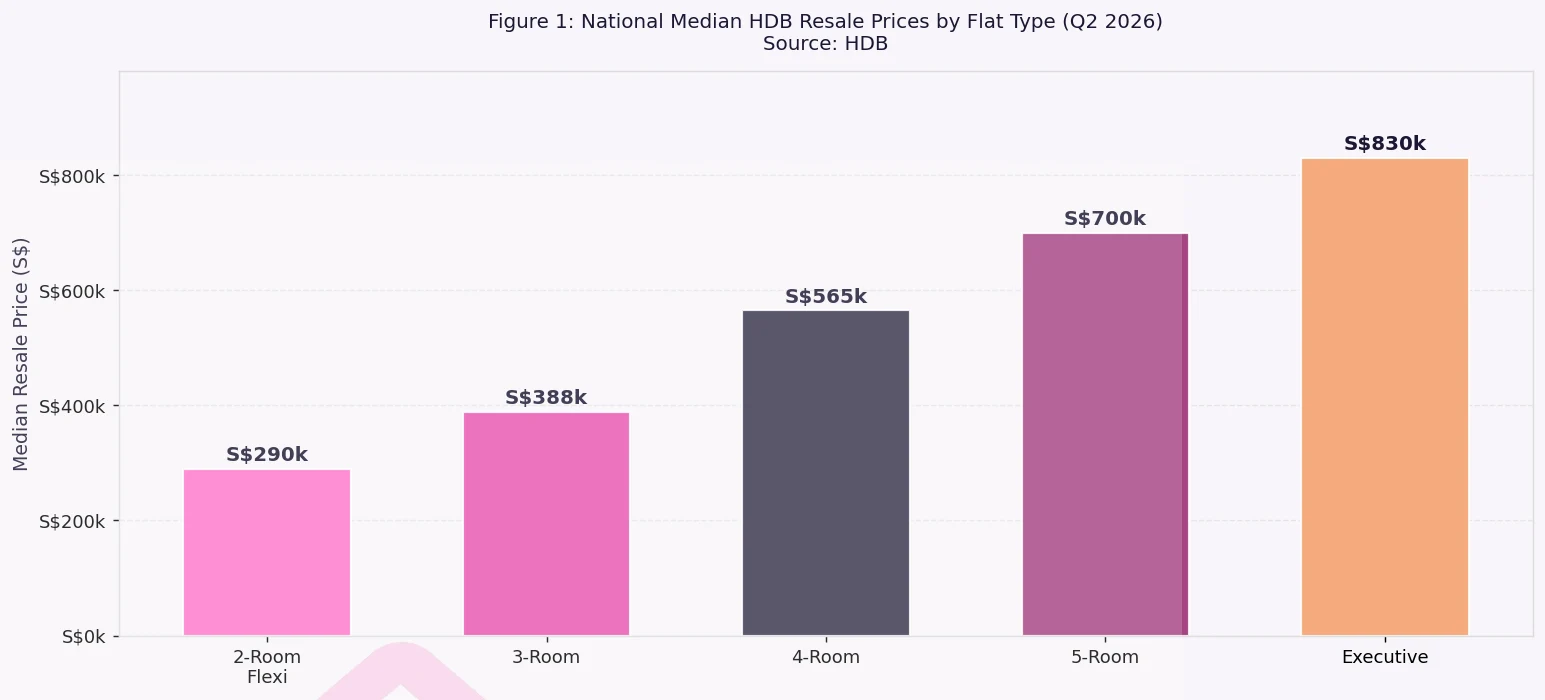
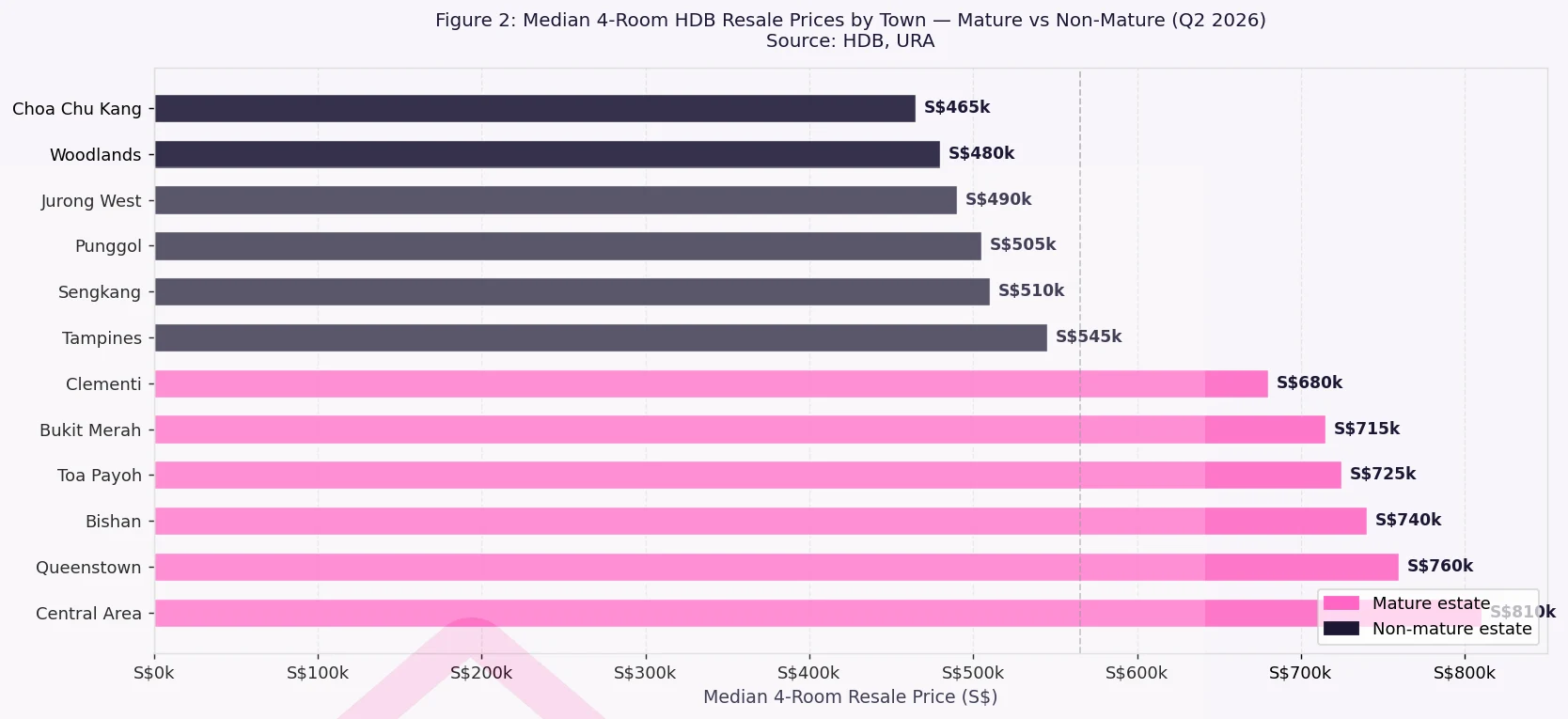
  • The national median HDB resale price for a 4-room flat in Q2 2026 is approximately S$565,000 — but individual towns range from S$465k to over S$800k.
  • Mature estates (Bishan, Queenstown, Toa Payoh) command a 30–60% premium over non-mature estates (Woodlands, Jurong West) for the same flat type.
  • You do not pay BSD or ABSD on the first property as a Singapore Citizen buying an HDB resale flat; however, BSD still applies and is computed on the purchase price.
  • Cash Over Valuation (COV) is the amount you pay above the official HDB valuation. COV cannot be financed by a bank or HDB loan — it must be paid in cash.
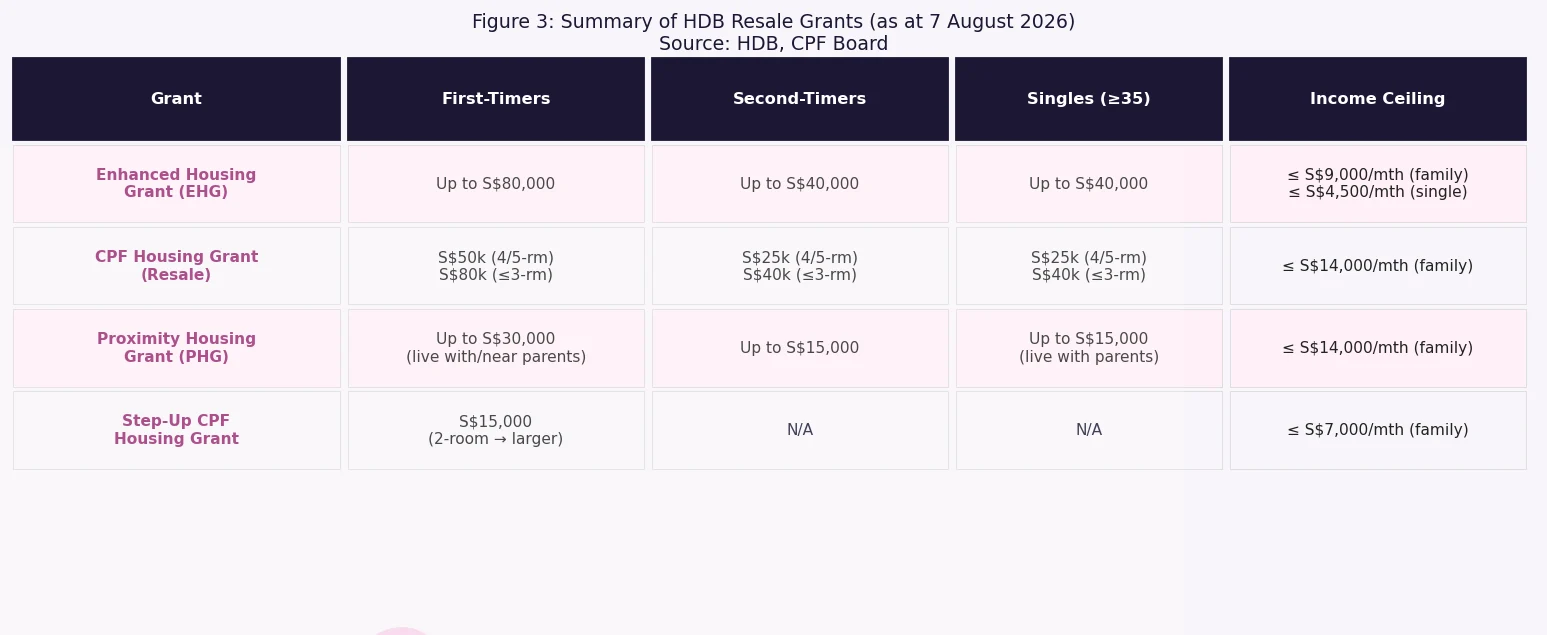
  • First-timer families can receive up to S$80,000 via the Enhanced Housing Grant (EHG) for a resale flat purchase, plus additional amounts via the CPF Housing Grant and Proximity Housing Grant (PHG).
  • You need a valid HDB Flat Eligibility (HFE) Letter before making an offer on a resale flat. The letter takes 21 working days to process and is valid for 6 months.
  • The resale market has no balloting: you find a flat, negotiate with the seller, agree a price, and exercise the Option to Purchase (OTP). HDB approval follows.
  • HDB resale flats are all on 99-year leases. Flats with fewer than 60 years remaining have restricted CPF use, and those below 30 years cannot use CPF at all.
  • The HDB Resale Price Index (RPI) rose approximately 4.2% in 2025 and is on track for 3–5% growth in 2026, driven by demand from upgraders and the dwindling BTO supply pipeline.
  • Comparing resale against BTO: resale is faster (can move in within 8–12 weeks of OTP exercise), costs more upfront, but benefits from immediate location and can be grant-subsidised up to a similar net cost as a BTO in some scenarios.

What the HDB Resale Market Is — and How It Works

The HDB resale market is Singapore’s secondary market for public housing flats. Unlike Build-To-Order (BTO) launches — where HDB acts as developer, sets the price, and buyers ballot for units — in the resale market, individual flat owners sell directly to buyers at market-determined prices. HDB plays a regulatory and financing role but does not set the transaction price.

The resale market is administered by the Housing and Development Board (HDB), established under the Housing and Development Act. All resale transactions must be processed through HDB’s Resale Portal. The CPF Housing Grants for resale flats are funded by the Central Provident Fund Board and disbursed to buyers through the CPF Ordinary Account mechanism.

In 2025, approximately 27,000 HDB resale transactions were completed — representing a market of around S$18–20 billion by value. Resale flat demand comes primarily from three groups: couples or singles not eligible for BTO (e.g. second-timers or non-first-timers), buyers who need a specific location unavailable in current BTO launches, and buyers who want to move in quickly rather than wait 3–5 years for BTO construction.

Singapore HDB resale median prices by flat type 2026 bar chart
Figure 1: National median HDB resale prices by flat type, Q2 2026. 4-room median: S$565,000. Source: HDB.

HDB Resale Prices by Flat Type — National Medians (Q2 2026)

Prices vary substantially by flat type, estate maturity, proximity to MRT stations, and specific floor level and facing. The national medians shown above represent a starting point; individual units within a single block can differ by 5–20% based on these sub-factors. As a general rule, units above the 10th floor command a premium, and units facing north-south (avoiding the afternoon west sun) are preferred in most estates.

Flat Type Typical Gross Floor Area National Median (Q2 2026) Mature Estate Range Non-Mature Estate Range
2-Room Flexi 36–45 sqm S$290,000 S$320k–S$420k S$240k–S$290k
3-Room 60–65 sqm S$388,000 S$430k–S$580k S$310k–S$380k
4-Room 90–105 sqm S$565,000 S$660k–S$810k S$455k–S$550k
5-Room 110–130 sqm S$700,000 S$780k–S$960k S$560k–S$680k
Executive 130–145 sqm S$830,000 S$870k–S$1.05M S$690k–S$820k

HDB Resale Prices by Town: Where You Pay the Most (and Least)

Town-by-town price variation is the most significant factor for a resale buyer. “Mature estates” are HDB’s classification for townships established before 1985, with well-developed amenities, denser MRT networks, and established community infrastructure. Non-mature estates are newer developments, typically further from the city but often newer in construction. From 1 August 2024, HDB replaced the “mature/non-mature” classification with Standard, Plus and Prime flat types for new BTO launches — but the older classification remains widely understood and used for resale comparisons.

HDB resale 4-room flat prices by town mature vs non-mature Singapore 2026
Figure 2: Median 4-room HDB resale prices by town, Q2 2026. Mature estates command a 30–60% premium over non-mature equivalents. Source: HDB, URA.

At the top of the price ladder, Central Area, Queenstown and Bishan consistently see 4-room resale flats transact above S$700,000 — and million-dollar transactions are now routine in these locations. The Central Area in particular regularly records transactions above S$900,000 for 4-room units, reflecting proximity to the CBD, excellent MRT connectivity and mature amenities. At the lower end, Woodlands, Choa Chu Kang and Jurong West offer 4-room resale flats in the S$460,000–S$490,000 range — representing meaningful value for buyers whose workplace location gives them flexibility.

It is important to note that the “million-dollar flat” phenomenon — HDB resale units transacting at S$1M or more — has become more widespread. In 2025, over 1,000 million-dollar HDB resale transactions were recorded, up from approximately 470 in 2024. These are concentrated in mature estates with remaining leases of 60+ years and premium floor levels.

Understanding Cash Over Valuation (COV)

The HDB valuation is an official independent valuation conducted by HDB after a buyer and seller agree on a price and the OTP is exercised. The valuation can come in at, above, or below the agreed transaction price. When the transaction price exceeds the valuation, the difference is called Cash Over Valuation (COV).

COV is important because it cannot be financed. Neither an HDB concessionary loan nor a bank loan can cover the COV component — it must be paid entirely in cash at the point of completion, in addition to any required cash down payment. In a hot resale market, sellers in prime locations routinely demand COV ranging from S$10,000 to S$80,000 or more. Buyers should budget explicitly for COV when evaluating resale flat affordability.

Conversely, if the valuation comes in higher than the agreed price (negative COV or “under-valuation”), the buyer benefits: they pay the agreed lower price, but CPF and loan calculations are based on the higher valuation — effectively giving the buyer additional CPF and loan headroom.

Grants Available for HDB Resale Buyers

Singapore’s system of housing grants for resale buyers is substantial and materially reduces the effective cost for eligible purchasers. The four main grants are the Enhanced Housing Grant (EHG), CPF Housing Grant (CHG), Proximity Housing Grant (PHG), and Step-Up CPF Housing Grant. All grants are disbursed via the CPF Board and applied at completion — they reduce the CPF outlay required, not the headline transaction price.

Singapore HDB resale grants summary table EHG CPF PHG 2026
Figure 3: Summary of HDB resale grants for eligible buyers as at 7 August 2026. Source: HDB, CPF Board.

The Enhanced Housing Grant (EHG), administered by HDB and introduced in September 2019, is the most generous: eligible first-timer families with a monthly household income of S$9,000 or below receive up to S$80,000 (income S$1,500–S$3,000 bracket) on a sliding scale. Singles aged 35 and above purchasing a resale flat alone can receive up to S$40,000. The EHG is means-tested, income-capped, and subject to a flat usage period of 5 years (Standard) or 10 years (Plus/Prime — though these classifications apply mainly to BTO purchases). The income ceiling for EHG for families is S$9,000 per month; for joint-income singles, S$4,500 each.

The CPF Housing Grant (CHG) provides S$50,000 for first-timer families buying a 4-room or larger resale flat (or S$80,000 for 3-room or smaller), with income ceiling S$14,000. Second-timers receive half these amounts. The Proximity Housing Grant (PHG) adds up to S$30,000 for families who buy a resale flat to live with or near their parents — one of the few grants explicitly tied to family proximity rather than income alone. The Step-Up CPF Housing Grant of S$15,000 applies to second-timer families living in a 2-room Flexi flat purchased under the Parenthood Priority Scheme who are upgrading to a larger flat.

The HDB Resale Process: From HFE to Keys

The HDB resale process is structured and well-documented, but has several stages where timing and preparation matter:

  1. Apply for HFE Letter (21 working days): The HDB Flat Eligibility (HFE) letter, administered by HDB, confirms your eligibility to buy an HDB flat, the grants you qualify for, and the loan amount HDB will offer. Without a valid HFE letter, you cannot submit a resale application. The letter is valid for 6 months.
  2. Arrange financing: Decide between an HDB concessionary loan (2.6% p.a. as at August 2026, up to 80% LTV) or a bank loan (market rates, up to 75% LTV). Obtain an HDB Loan Eligibility (HLE) letter or a bank’s Letter of Offer.
  3. Find a flat and negotiate: Check listings, visit units, and negotiate a price with the seller. Check the resale transacted prices for comparable units on the HDB website.
  4. Exercise Option to Purchase (OTP): Pay S$1 to receive the OTP, then pay 1% of the purchase price (or S$1,000, whichever is higher) within 21 days to exercise it. The exercise fee counts toward the purchase price.
  5. Submit resale application: Both buyer and seller submit their portions within 7 days of OTP exercise via the HDB Resale Portal.
  6. HDB valuation and endorsement: HDB conducts the valuation. The transaction is endorsed once all conditions are met.
  7. Completion: Typically 8–10 weeks from resale application submission. At completion, you pay remaining cash, CPF funds are released, and you receive the keys.

HDB Resale vs BTO: A Direct Comparison

Factor HDB Resale HDB BTO
Price Market-determined; typically higher HDB-subsidised; below market
Waiting time 8–12 weeks to move in 3–5 years construction wait
Location availability Any existing town Limited to current BTO sites
Grants EHG, CHG, PHG — up to ~S$160k combined EHG, AHG — up to ~S$80k
MOP 5 years (Standard); 10 years (Plus/Prime) 5 years (Standard); 10 years (Plus/Prime)
Flat condition Existing; may need renovation Brand new; standard fitting
Lease remaining Varies (check before buying) Full 99-year lease from launch
Income ceiling S$14,000/mth (family) for grants S$14,000/mth (family); S$16,000 for EC
Eligibility First and second-timers (different grant amounts) First-timers prioritised via ballot

Worked Example: Mr and Mrs Lee Buy a Toa Payoh 4-Room Resale

Mr and Mrs Lee are a Singapore Citizen couple, both aged 30, with a combined monthly income of S$8,500. They are first-timers and wish to buy a resale 4-room flat in Toa Payoh to be near Mrs Lee’s parents (within 4km). The agreed transaction price is S$720,000 and HDB’s valuation is S$700,000 — meaning COV of S$20,000.

Item Amount Notes
Purchase price S$720,000 Agreed with seller
HDB valuation S$700,000 COV = S$20,000 (cash only)
EHG (income S$8,500, first-timer) S$30,000 Sliding scale; disbursed via CPF
CPF Housing Grant (4-room) S$50,000 First-timer family grant
Proximity Housing Grant (PHG) S$20,000 Living within 4km of parents
Total Grants S$100,000 All disbursed via CPF Board
Net effective purchase price S$620,000 After grants
HDB loan (2.6%, 25yr, 80% LTV on S$700k val) S$560,000 Monthly: S$2,527/mth; MSR 29.7% ✓ (within 30%)
BSD (IRAS tiers on S$720k) S$16,200 Must be paid in cash
Cash required at completion ≈ S$56,200 COV S$20k + BSD S$16.2k + 5% cash downpayment S$36k less grants applied = residual

The Lees’ monthly instalment of S$2,527 represents a Mortgage Servicing Ratio (MSR) of 29.7% of their combined income — within the HDB 30% MSR cap. The TDSR is also well within the 55% MAS ceiling. The combined grants of S$100,000 materially reduce the effective cost of a flat that would otherwise represent 2026 open-market value of S$720,000.

What Might Come Next for HDB Resale Prices

Several forces shape the HDB resale market’s near-term outlook. On the demand side, the pipeline of BTO flats completing their 5-year MOP is expected to generate increased upgrade activity from 2026 to 2028, as the large cohort of BTO buyers from 2021–2023 work through their MOP periods. These upgraders typically sell their HDB flats into the resale market before buying private property — which simultaneously increases resale supply and, because sellers often use proceeds to fund private purchases, sustains resale prices.

On the supply side, HDB has ramped up BTO launches in 2024–2025, with a focus on standard estates. As these complete in 2028–2030, they will add inventory to towns like Tengah, Tampines North, and Kallang-Whampoa — which could moderate price growth in specific estates while sustaining demand in genuinely constrained mature locations. The HDB Resale Price Index, administered by HDB and published quarterly alongside URA’s private residential data, is the benchmark to watch.

Related Articles

Frequently Asked Questions

Do I need to pay ABSD when buying a resale HDB flat?

If you are a Singapore Citizen buying your first property, no ABSD applies. If you are a Singapore Citizen buying a second property (including a resale HDB flat as a second home), ABSD of 20% applies on the purchase price. Singapore Permanent Residents pay 5% ABSD on their first property and 30% on subsequent properties. Foreigners cannot purchase new or resale HDB flats at all. Buyer’s Stamp Duty (BSD) applies to all HDB resale transactions regardless of buyer profile — computed at IRAS’s tiered rates on the purchase price.

How is the HDB resale flat valuation determined, and who pays for it?

After the buyer exercises the Option to Purchase (OTP) and both parties submit the resale application, HDB engages a private valuer from its panel to conduct the official valuation. The cost of the valuation is borne by the buyer and is typically S$120–S$150 for HDB flats. The valuation reflects the estimated open-market value of the flat based on comparable transactions in the same estate and flat type. If the agreed transaction price exceeds the valuation, the difference (COV) must be paid in cash by the buyer. If the valuation exceeds the agreed price, the buyer benefits from a larger CPF and loan base — a scenario more common in slower market conditions.

Can I use both an HDB loan and CPF grants together?

Yes. HDB concessionary loans and CPF housing grants are separate mechanisms that can be used together. The CPF grants (EHG, CHG, PHG) are credited to your CPF Ordinary Account (OA) and can be used toward the purchase price — effectively reducing the cash or loan amount required. The HDB loan provides up to 80% of the official valuation at 2.6% p.a. (as at August 2026). You can therefore combine: grants (reducing your effective purchase cost) + HDB loan (funding up to 80% of valuation) + CPF OA savings (for down payment and monthly instalments). The 5% minimum cash down payment rule applies only to bank loans; HDB loans allow a full CPF-funded down payment above the 5% mark.

What is a million-dollar HDB flat and should I be concerned?

A “million-dollar HDB flat” is a resale flat that transacts at S$1 million or more. Over 1,000 such transactions occurred in 2025, primarily in mature estates like Toa Payoh, Queenstown, Bishan and the Central Area, for premium upper-floor 5-room and executive units with long remaining leases. These represent the thin upper tail of the resale market — the vast majority of resale transactions occur well below S$1 million. If you are a typical resale buyer in a non-mature estate, you are unlikely to encounter million-dollar pricing. However, million-dollar transactions do exert an anchoring effect on valuations in nearby blocks, so their existence can affect COV expectations even in mid-tier estates.

What happens if I buy a resale flat with fewer than 60 years of lease remaining?

Your CPF usage will be restricted if the flat’s remaining lease does not cover the youngest buyer to age 95 (full CPF use) or age 80 (pro-rated CPF use). Additionally, HDB concessionary loans require the flat’s remaining lease to cover the youngest buyer for the full loan tenure — typically 25 years. Flats with fewer than 30 years of lease remaining cannot use CPF at all and are very difficult to finance. These restrictions significantly reduce the buyer pool on future resale, potentially compressing the price you can achieve when you eventually sell. HDB publishes remaining lease data for all resale flats on its Resale Portal; always check this figure before making an offer.

Can I own an HDB flat and a private property at the same time?

During the HDB MOP (5 years for Standard flats, 10 years for Plus/Prime), you cannot own any private residential property in Singapore or overseas. After MOP, you may purchase private property without having to sell your HDB flat first — but doing so as a Singapore Citizen will trigger ABSD of 20% on the private property purchase price (as the HDB flat counts as a first property). Some families “decouple” — transferring the HDB flat to one spouse’s sole ownership so the other spouse can purchase private property as a “first property” with no ABSD. This strategy involves legal, stamp duty and CPF considerations and should be discussed with a conveyancing solicitor.

Disclaimer

This article is for general informational purposes only and does not constitute property, legal, tax or financial advice. Prices, grant amounts, income ceilings, loan rates, and government policies are based on publicly available data as at 7 August 2026 and may change. Verify current rules with HDB (hdb.gov.sg), CPF Board (cpf.gov.sg), IRAS (iras.gov.sg) and MAS (mas.gov.sg) before making any property decision. Engage a licensed property agent (CEA-registered) and solicitor where appropriate.

Translate »