How to Choose a Property Agent in Singapore 2026: CEA Checks, Red Flags and Questions to Ask

How to Choose a Property Agent in Singapore 2026: CEA Checks, Red Flags and Questions to Ask

Choosing how to select a property agent in Singapore 2026 is a decision that could save — or cost — tens of thousands of dollars. With approximately 35,000 licensed real estate salespersons registered with the Council for Estate Agencies (CEA) as at 2026, the quality and suitability of agents varies widely. This guide gives you a structured, step-by-step framework for finding, vetting, and working with the right agent for your specific transaction — whether you are buying, selling, or renting.

Quick Answer: How to Choose a Property Agent Singapore 2026 — Key Facts

  • CEA registration is mandatory: Every property agent in Singapore must be registered with the Council for Estate Agencies. Unregistered agents cannot lawfully conduct property transactions. Verify at eservices.cea.gov.sg using the agent’s phone number — if it does not match, stop dealing immediately.
  • Client’s Agreement is required by law: Under the Estate Agents Act, an agent must enter into a written Client’s Agreement with you before conducting any work on your behalf. Refuse any agent who asks you to proceed without one.
  • Dual representation is restricted: An agent cannot represent both buyer and seller in the same transaction — unless both parties give informed written consent. This is a common cause of conflict-of-interest disputes.
  • Commission rates are advisory, not fixed: CEA publishes advisory rates as a market benchmark; actual commission is negotiable. New launch buyer agents are paid by the developer, not the buyer.
  • Check disciplinary record: CEA’s Public Register shows past sanctions, fines, and licence suspensions. This is a critical check many buyers skip.
  • Specialisation matters: An agent who primarily transacts HDB resale may not have the market knowledge, network, or sub-sale experience for a D9 new launch.
  • Red flags: WhatsApp-only contact, pressure to pay before viewing, no CEA registration match on phone number, reluctance to sign Client’s Agreement.

Why the Right Property Agent Matters More Than the Platform

Online property portals, valuation tools, and AI-assisted market data have made property information more accessible than ever. But the actual execution of a property transaction — negotiating on price, managing the OTP timeline, coordinating between buyer’s and seller’s solicitors, handling mortgage applications, navigating HDB procedures — still depends heavily on the agent’s competence, ethics, and market network. A well-chosen agent protects your interests actively; a poor choice, or worse, a fraudulent one, can expose you to misrepresentation, conflicts of interest, and financial loss.

Step 1: Verify CEA Registration Before Anything Else

This is the single most important step and takes under two minutes. Visit eservices.cea.gov.sg and search using the phone number the agent contacted you from. If the phone number does not return a matching, currently active salesperson licence, stop all engagement immediately — this is a classic fraud indicator.

Do not rely solely on the business card, name, or IC number that the agent provides. Scammers regularly impersonate real agents by using stolen photos and legitimate-sounding names while substituting a different phone number that you are meant to contact.

The Public Register also shows:

  • The estate agency the agent is currently registered under.
  • Whether the licence is active, lapsed, or suspended.
  • The agent’s transaction history for the past 36 months (categories: HDB resale, HDB rental, private sale/resale, private rental).
  • Any disciplinary actions taken by CEA, including fines, reprimands, and licence revocations.
How to verify a CEA-registered property agent Singapore step by step guide 2026
Figure 2: How to Verify a CEA-Registered Property Agent — Six Steps from the CEA Public Register to signing the Client’s Agreement.

Step 2: Match the Agent’s Specialisation to Your Transaction

Transaction history is your most objective indicator of an agent’s specialisation. An agent with 50 HDB resale transactions in the past 36 months and zero private property transactions is unlikely to be the best choice for a high-value CCR condominium purchase. Conversely, a specialist in D9–D11 luxury resales may be unfamiliar with HDB procedures and the nuances of the CPF Housing Grant application process.

Ask the agent directly: “How many transactions of this specific type — resale 4-room HDB in Tampines / new launch in OCR / commercial shophouse — have you done in the past 12 months?” A trustworthy agent will show you their track record rather than deflect the question.

Key specialisation signals to look for:

  • HDB resale buyer: Look for 10+ HDB resale transactions in the past 36 months, familiarity with HFE letter procedures, and knowledge of the NCQ (Non-Citizen Quota) for rental scenarios.
  • Private resale buyer: Look for private property transaction history, knowledge of current sub-sale volumes in your target district, and relationships with mortgage brokers.
  • New launch buyer: Developer accreditation and attendance at developer previews; knowledge of ballot priority systems; familiarity with the Progressive Payment Scheme.
  • Seller (HDB or private): Track record of actual listings sold, average days on market for recent listings, familiarity with comparative market analysis.
Singapore property agent advisory commission rates 2026 by transaction type
Figure 1: Advisory Commission Rates by Transaction Type — Singapore 2026. Rates are non-binding benchmarks published by CEA. New launch buyer agents are compensated by the developer at no cost to the buyer.

Step 3: Understand Commission and Negotiate Clearly

Commission rates in Singapore are not regulated by law — the figures published by CEA are advisory rates that serve as market benchmarks. They are not binding on either party. In practice, most HDB seller agents charge around 2% of the transaction price; HDB buyer agents typically charge 0–1%. For private property, seller agents charge approximately 2% and buyer agents 0–1% on resale transactions.

For new launch private condominiums, the developer pays the buyer’s agent directly — the buyer pays no commission. Developer commissions for buyer’s agents typically range from 2% to 3% of the purchase price, sometimes higher for international buyers or premium units. This creates a structural incentive that is worth understanding: the buyer’s agent in a new launch transaction is economically the developer’s agent. Ask whether the agent has compared alternative units in different projects at the same price point before endorsing a specific development.

Always agree on commission in writing as part of the Client’s Agreement before any work begins. Verbal agreements on commission are difficult to enforce and frequently the source of disputes lodged with CEA.

Step 4: Insist on a Client’s Agreement

Under section 64 of the Estate Agents Act (Cap 95A), an estate agent and a registered salesperson must sign a Client’s Agreement with any client before performing any estate agency work. The Client’s Agreement must specify: the scope of services, the commission rate (or formula), the duration of the exclusive arrangement (if any), and the salesperson’s and agency’s registration details.

An agent who is reluctant to sign a Client’s Agreement is operating outside the legal framework — and likely has good reason to avoid a paper trail. Refuse to proceed without a signed Client’s Agreement in every circumstance. The Client’s Agreement also gives you a formal dispute mechanism: if an agent breaches its terms, you have grounds to file a complaint with CEA and seek compensation.

Dual Representation: Know Your Rights

Dual representation occurs when a single agent acts for both the buyer and the seller (or both landlord and tenant) in the same transaction. CEA rules permit dual representation only if both parties provide informed written consent — and only if the agent discloses the arrangement and both clients agree they understand the conflict of interest involved.

If an agent introduces you to a property and then reveals they are also representing the seller, you have every right to refuse and engage a separate buyer’s agent. In practice, the seller’s agent who shows you a property is acting for the seller; you should either negotiate directly or engage your own buyer’s agent to represent your interests.

Singapore property agent evaluation checklist criteria importance how to check 2026
Figure 3: Property Agent Evaluation Checklist — criteria ranked by importance and how to check each one before engaging.

Summary Table: What to Check When Choosing a Property Agent

Check How to Do It Importance
CEA licence is active Search phone number at eservices.cea.gov.sg Mandatory — do not proceed without this
No disciplinary record CEA Public Register → check actions tab Mandatory
Transaction history matches your property type CEA Public Register → transaction history tab High
Client’s Agreement signed before any work Request before first viewing or listing appointment Mandatory by law
Commission agreed in writing Included in Client’s Agreement High
Dual representation disclosed and consented to (if applicable) Ask directly; get written confirmation High
Reviews from past clients for same property type Google Business profile, referrals, developer feedback Moderate
Comparative market data provided Request a CMA report before pricing your listing or making an offer Moderate

Worked Example: Mr Tan — Selling an HDB Flat in Tampines

Mr Tan holds a 5-room HDB resale flat in Tampines (MOP completed). He shortlists three agents by asking each the same set of questions:

  • Agent A: CEA-registered, 22 HDB resale transactions in past 36 months including 8 in Tampines, no disciplinary record, quoted 2% commission, offered to sign Client’s Agreement immediately. Provided a Comparative Market Analysis showing recent 5-room transacted prices in Tampines (S$680K–S$760K range). Explained the SSD regime for his acquisition year (no SSD applicable — MOP completed, held more than 4 years).
  • Agent B: CEA-registered, 5 transactions in past 36 months (mix of HDB and private), quoted 1.5% but said “we can discuss after the listing”. Did not proactively offer the Client’s Agreement. Could not provide a CMA on the spot.
  • Agent C: Could not be verified by phone number on CEA Public Register — immediately disqualified.

Decision: Mr Tan engaged Agent A. The higher commission (2% vs 1.5%) was justified by the stronger local track record and the immediate CMA. The listing was priced at S$720,000, received three offers within 10 days, and was sold at S$736,000 — S$16,000 above asking price.

Commission paid: 2% × S$736,000 = S$14,720 + 9% GST = S$16,044.80 — fully accounted for in Mr Tan’s net sale proceeds.

Questions to Ask a Property Agent Before Engaging

The following 10 questions help filter out unsuitable agents quickly and give you the information you need to make an informed choice. A competent, ethical agent will answer each question directly:

  1. Can I search for your CEA registration using your phone number right now?
  2. How many transactions have you completed in the past 12 months for my specific property type and area?
  3. Are you willing to sign a Client’s Agreement today before we proceed further?
  4. Are you representing the seller (or buyer) of any properties you will show me?
  5. What is your commission rate and is it inclusive of GST?
  6. Can you provide a Comparative Market Analysis for my target area or my listing price?
  7. What is your exclusive period, and what are the exit conditions if I am unhappy?
  8. How do you handle co-broking — will you share commission with a buyer’s agent?
  9. Have you been subject to any CEA disciplinary proceedings?
  10. How and how often will you update me on enquiries and market feedback?

Why This Matters: The Cost of Getting It Wrong

CEA received approximately 370 consumer complaints against property agents in FY2025, the majority relating to misrepresentation, failure to disclose material facts, and commission disputes. An agent who misrepresents the remaining lease, the NCQ position, or the property’s Minimum Occupation Period status can expose you to legal liability and significant financial loss. The consequences of working with an unverified or unregistered agent are even more severe — any contract entered into with an unregistered person is voidable, and the agent has no professional indemnity insurance.

The estate agency industry in Singapore is regulated under the Estate Agents Act (Cap 95A) and the CEA Code of Ethics and Professional Client Care. CEA has the power to fine agents, suspend or revoke licences, and impose a public reprimand. These enforcement tools exist precisely because the consequences of dishonest or incompetent agency work in a high-value property market are severe.

What Might Change: Digital Tools and AI in Property Agency

Several platforms now offer AI-assisted valuations and transaction matching that reduce the information asymmetry between buyers, sellers, and agents. Industry watchers expect the share of transactions involving “self-service” buyer portals to grow modestly, particularly for straightforward HDB resale transactions. However, for higher-value or more complex transactions (CCR condos, commercial properties, en-bloc proceedings, cross-border purchases), the regulatory, legal, and negotiation complexities mean the licensed agent remains the essential professional for the foreseeable future.

CEA is also exploring digital licence verification tools embedded in property portal listings, which would surface real-time CEA registration status alongside every listing. If implemented, this would make basic verification automatic — though the more nuanced checks (disciplinary history, specialisation fit, commission terms) will always require the buyer or seller to engage directly.

Frequently Asked Questions

Do I have to pay an agent as a buyer in Singapore?

For new launch private condominiums, no — the developer pays the buyer’s agent’s commission. For HDB resale and private resale transactions, the convention is that the seller pays the seller’s agent and the buyer may or may not engage their own buyer’s agent (typically at 0–1% of the purchase price). Some buyers choose to rely on the seller’s agent to facilitate the transaction, which is permitted only if dual representation is disclosed and consented to in writing. Engaging your own buyer’s agent provides independent representation for a relatively modest fee and is generally advisable for high-value or complex transactions.

What is a Co-Broking arrangement and should I be concerned?

Co-broking occurs when a listing agent (representing the seller) works with another agent (representing the buyer), splitting the total commission between them. This is a standard and healthy market practice — it incentivises seller’s agents to accept viewings from co-brokers, widening the pool of buyers. The seller typically pays the full commission, which the two agents then divide. As a buyer, co-broking generally means you are properly represented. As a seller, you should ask whether your listing agent is willing to co-broke; an agent who refuses co-broking is limiting your buyer pool, which can reduce your final sale price.

What are the consequences if an agent misrepresents a property to me?

Misrepresentation by a licensed property agent is actionable under both the Estate Agents Act and the Misrepresentation Act (Cap 390). You may file a complaint with CEA for disciplinary action against the agent, claim damages from the agent’s estate agency (which carries professional indemnity insurance), and, in cases of fraudulent misrepresentation, pursue civil action or a police report. If the misrepresentation relates to material facts — remaining lease, whether the property is encumbered, rental tenancy status — and you can demonstrate reliance and loss, damages claims can be substantial. Always get material facts confirmed in writing during the offer process, and instruct your solicitor to conduct due diligence independently.

How do I check if a property agent has been disciplined by CEA?

The CEA Public Register at eservices.cea.gov.sg shows the disciplinary record for every registered salesperson, including the date, nature, and sanction of any disciplinary proceedings. You can search by the agent’s name, registration number, or phone number. Disciplinary actions range from advisory letters and fines (minor breaches) to licence suspension or revocation (serious breaches such as misrepresentation, unauthorised receipt of monies, or criminal convictions). An advisory letter for a minor procedural breach should not necessarily disqualify an otherwise strong candidate; a licence suspension for misrepresentation is a clear disqualifier.

Can I switch agents if I am unhappy after signing a Client’s Agreement?

The Client’s Agreement will specify its duration, typically 60–90 days for an exclusive listing or buyer-representation arrangement. Most agreements include early termination provisions with notice periods of 7–14 days. If the agent has materially breached the agreement — failed to meet agreed obligations, made misrepresentations, acted without authority — you may have grounds to terminate immediately without notice. If the agent has merely been unsatisfactory without a clear breach, you will typically need to wait out the notice period or negotiate a mutual early termination. Any dispute about termination rights can be escalated to CEA’s Dispute Resolution Scheme before going to the courts.

What if I want to buy or sell property without an agent?

Transacting without an agent is legally permissible for private property and HDB resale (the HDB also facilitates direct seller-to-buyer transactions through its Resale Portal). However, you take on the full responsibility for negotiating the OTP, conducting due diligence, managing the conveyancing timeline, coordinating with the other party’s solicitor, and ensuring all regulatory conditions are met. A licensed solicitor is still required for the legal transfer. For straightforward transactions in a familiar market, experienced buyers and sellers sometimes transact direct; for first-time buyers, those unfamiliar with Singapore property law, or those handling complex transactions, engaging a qualified agent is strongly advisable.

Related Articles

Disclaimer: This article is for general information only and does not constitute financial, legal, or professional advice. Information on CEA registration requirements and the Estate Agents Act may be updated by the Council for Estate Agencies. Verify all agent details at eservices.cea.gov.sg and consult the CEA website for the current Code of Ethics and professional standards. Engage a licensed solicitor for all conveyancing matters.

Singapore Property Downpayment Guide 2026: How Much Cash and CPF You Need

Singapore Property Downpayment Guide 2026: How Much Cash and CPF You Need

Singapore property downpayment 2026 — understanding exactly how much cash and CPF you need before you make an offer is one of the most practical steps any buyer can take. The rules changed on 20 August 2024 when MAS lowered the HDB Concessionary Loan LTV from 80% to 75%, and many buyers are still calculating on outdated figures. This guide consolidates every rule that applies in 2026, from BTO flats to freehold CCR condos, with specific dollar amounts at common price points.

Quick Answer: Singapore Property Downpayment 2026 — Key Facts

  • HDB Loan (BTO/Resale): LTV 75% → 25% downpayment, payable entirely from CPF OA — zero cash required for the downpayment itself.
  • Bank Loan (HDB or Private, 1st property): LTV 75% → 25% downpayment: minimum 5% cash, remaining 20% from CPF OA.
  • Bank Loan (2nd property, 1 outstanding loan): LTV 45% → 55% downpayment: minimum 25% cash, remaining 30% CPF OA.
  • Bank Loan (3rd+ property): LTV 35% → 65% downpayment: minimum 25% cash.
  • New Launch (Progressive Payment Scheme): 5% Option Fee in cash + 15% on exercise (CPF/cash) + stage payments during construction.
  • CPF cannot pay: BSD, ABSD, legal fees, agent commission — these are always cash out-of-pocket (unless funded by CPF OA for BSD/ABSD in certain cases — see below).
  • ABSD remission window: SC couple selling HDB must sell within 6 months of new private purchase to claim ABSD remission — plan cashflow accordingly.
  • MAS rule change: HDB loan LTV reduced from 80% → 75% on 20 August 2024. All downpayment calculations in 2026 use the new 75% figure.

What Is a Property Downpayment in Singapore?

The downpayment is the portion of the purchase price you must pay from your own resources — cash, CPF Ordinary Account (OA), or a combination — before the bank or HDB disburses the loan for the remainder. The Monetary Authority of Singapore (MAS) and HDB set Loan-to-Value (LTV) caps that determine how large a loan you can take, and therefore how large a downpayment you must make.

The LTV ratio is expressed as a percentage of the lower of the purchase price or the property’s valuation (known as the “valuation limit”). If you pay above valuation — a premium called Cash Over Valuation (COV) — the COV must be paid entirely in cash.

Singapore property LTV limits and minimum downpayment requirements 2026 by loan type
Figure 1: LTV Limits and Minimum Downpayment Requirements 2026 — HDB Loan vs Bank Loan by property count. Source: MAS, HDB (effective 20 Aug 2024).

HDB Loan Downpayment 2026

An HDB Concessionary Loan (commonly called the “HDB loan”) is available only for HDB flats (BTO, resale, DBSS) with an income ceiling of S$14,000 per household per month. As of 20 August 2024, the LTV cap is 75%, meaning you must provide a 25% downpayment.

The key advantage: the entire 25% may come from your CPF Ordinary Account — no cash is required for the downpayment itself. If your CPF OA balance does not cover the full 25%, any shortfall must be topped up in cash.

For BTO flats purchased under the Staggered Downpayment Scheme (SDS), the 25% is paid in two tranches: 2.5% on signing the Agreement for Lease, and 22.5% at key collection. Both tranches can be paid from CPF OA.

Flat Type LTV (HDB Loan) Downpayment Cash Required CPF OA Allowed
BTO (Standard/Plus/Prime) 75% 25% S$0 Up to 25%
HDB Resale 75% 25% + any COV COV in cash only Up to 25% of valuation
DBSS 75% 25% S$0 Up to 25%
2-room Flexi (Seniors SLS) 75% 25% S$0 Up to 25%

Bank Loan Downpayment — HDB Flats and Private Property

Bank loans follow the MAS LTV framework, which applies uniformly whether you are buying an HDB flat, EC, or private condominium. The LTV ceiling depends on the number of outstanding home loans you currently have at the point of applying for the new loan.

For your first property (no outstanding home loans), the LTV cap is 75%, giving a downpayment of 25%. Of that 25%, at least 5% must be paid in cash; the remaining 20% can come from CPF OA.

For your second property (one outstanding home loan), the LTV drops to 45%, requiring a 55% downpayment. At least 25% must be cash; the rest may be CPF OA.

For a third or subsequent property, the LTV falls further to 35%, requiring 65% downpayment (minimum 25% cash).

Singapore property downpayment cash vs CPF OA by buyer profile and purchase price 2026
Figure 2: Total Downpayment — Cash vs CPF OA by Buyer Profile and Purchase Price 2026. LTV rules: MAS Notice MAS 632.

New Launch Condo: Progressive Payment Scheme

When buying a new launch private condominium directly from the developer, the Progressive Payment Scheme (PPS) governs when and how you pay. The structure is different from a resale purchase:

  • Booking fee (Option Fee): 5% of purchase price — payable in cash on the day you exercise your option. This cannot come from CPF.
  • On signing Sale and Purchase Agreement (8 weeks later): 15% of purchase price — payable in cash or CPF OA after deducting the 5% already paid.
  • Progressive stage payments: Released as construction hits each milestone (foundations, structural frame, partition walls, etc.) — each stage is up to 10–11% of the price.
  • On Vacant Possession / TOP: Remaining balance typically 25% (before your bank loan kicks in fully).

Because new launch buyers typically take bank loans, the 5% + 15% = 20% upfront is split between cash (minimum 5%) and CPF OA. The bank loan of up to 75% is only drawn progressively as construction progresses — meaning your loan interest begins only on the amount drawn down, not the full loan amount.

Cash Over Valuation (COV) — the Hidden Cash Cost

When you buy an HDB resale flat and agree a price above the HDB-commissioned valuation, the excess is called Cash Over Valuation. COV must be paid entirely in cash — it cannot be funded by CPF OA or any loan.

As of Q1 2026, median COV for popular 4-room HDB resale flats in mature estates ranges from S$10,000 to S$50,000. For million-dollar flats, COV can exceed S$100,000. Always request the HDB valuation report before finalising your offer price.

What CPF Cannot Pay

Understanding what CPF OA cannot cover prevents nasty surprises on legal completion day. The following must always be paid in cash:

  • Buyer’s Stamp Duty (BSD) — CPF OA can pay BSD if the property is residential and you have enough CPF OA after accounting for the downpayment and any outstanding CPF charges. Check with your solicitor and CPF Board before assuming this.
  • Additional Buyer’s Stamp Duty (ABSD) — Same CPF OA rule as BSD above.
  • Cash Over Valuation (COV) — always cash only.
  • Legal fees — always cash.
  • Agent commission — always cash.
  • Property tax — always cash.

BSD and ABSD are significant: at S$1.5 million, BSD alone is S$44,600 and ABSD for a Singapore Citizen purchasing a second property is S$300,000. These must be funded before legal completion and are not financed by the loan.

Singapore property all-in upfront costs BSD ABSD downpayment by buyer profile at S$1.5 million 2026
Figure 3: All-In Upfront Costs at S$1,500,000 by Buyer Profile 2026. Includes cash downpayment, CPF OA downpayment, BSD, ABSD, and legal fees. Source: IRAS, MAS.

Summary Table: Downpayment by Scenario 2026

Scenario LTV Cap Min Cash DP Max CPF OA Total DP
HDB Loan (1st HDB) 75% 0% 25% 25%
Bank Loan, HDB (1st) 75% 5% 20% 25%
Bank Loan, Private (1st) 75% 5% 20% 25%
Bank Loan, Private (2nd) 45% 25% 30% 55%
Bank Loan, Private (3rd+) 35% 25% 40% 65%
New Launch (PPS, 1st) 75% (on loan) 5% (booking) + 15% on S&P Part of 15%+ 20% upfront
COV (HDB Resale, any) N/A 100% cash None = COV amount

Worked Example: Mr & Mrs Lim — SC Couple Upgrading to a Private Condo

Mr and Mrs Lim are Singapore Citizens purchasing their first private property (they have already sold their HDB flat). Purchase price: S$1,650,000 for a 3-bedroom condo in the OCR. They take a bank loan.

  • LTV: 75% → loan amount S$1,237,500
  • Total downpayment (25%): S$412,500
  • Minimum cash (5%): S$82,500 cash
  • CPF OA portion (20%): S$330,000 from CPF OA (if available)
  • BSD: S$51,600 (payable from CPF OA or cash)
  • ABSD: Nil (first private property, SC)
  • Legal fees: ~S$4,000 cash
  • Agent commission (buyer’s side): S$0 (new launch — developer pays) or ~S$16,500 (resale, ~1%)
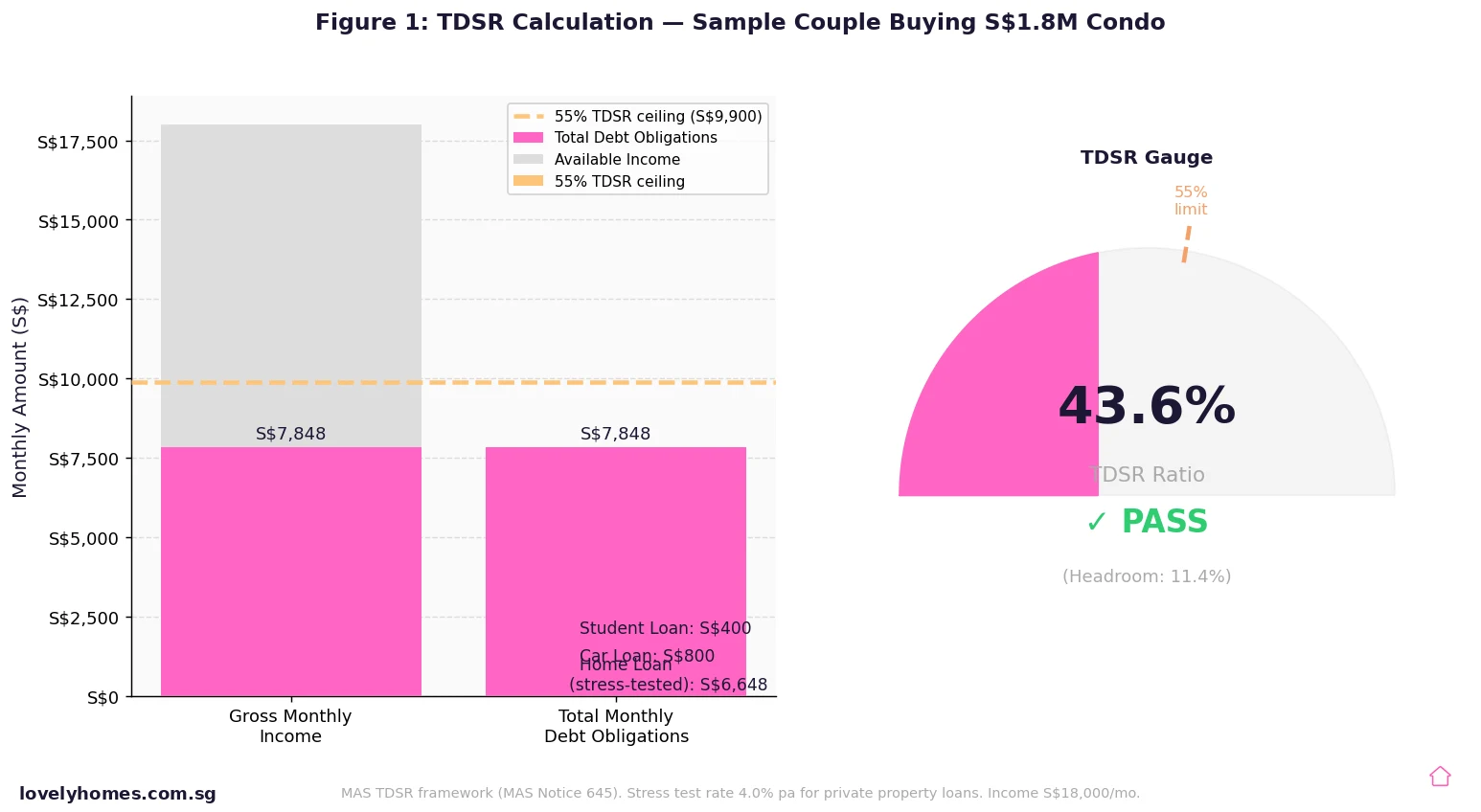
  • Monthly instalment: S$1,237,500 @ 3.2% fixed 30yr = S$5,345/mth → TDSR 38.2% on combined income S$14,000/mth ✓

Minimum liquid cash required on completion day: S$82,500 (downpayment) + S$51,600 (BSD, if not CPF) + S$4,000 (legal) = ~S$138,100 cash at minimum, assuming CPF OA covers the CPF-eligible portions.

Why Downpayment Planning Matters Beyond the Number

The downpayment figure is only the starting point. Buyers often underestimate total day-one liquidity requirements because BSD, ABSD (for second properties), and legal fees are payable within 14 days of exercising the Option to Purchase — before the bank loan is even applied for. For an upgrader buying a S$1.8 million condo while retaining an existing HDB, the ABSD alone can be S$360,000 (SC buying second residential property at 20%). Even if ABSD remission applies (selling the HDB within 6 months), the full amount must be paid upfront and is refunded only after the HDB is disposed of.

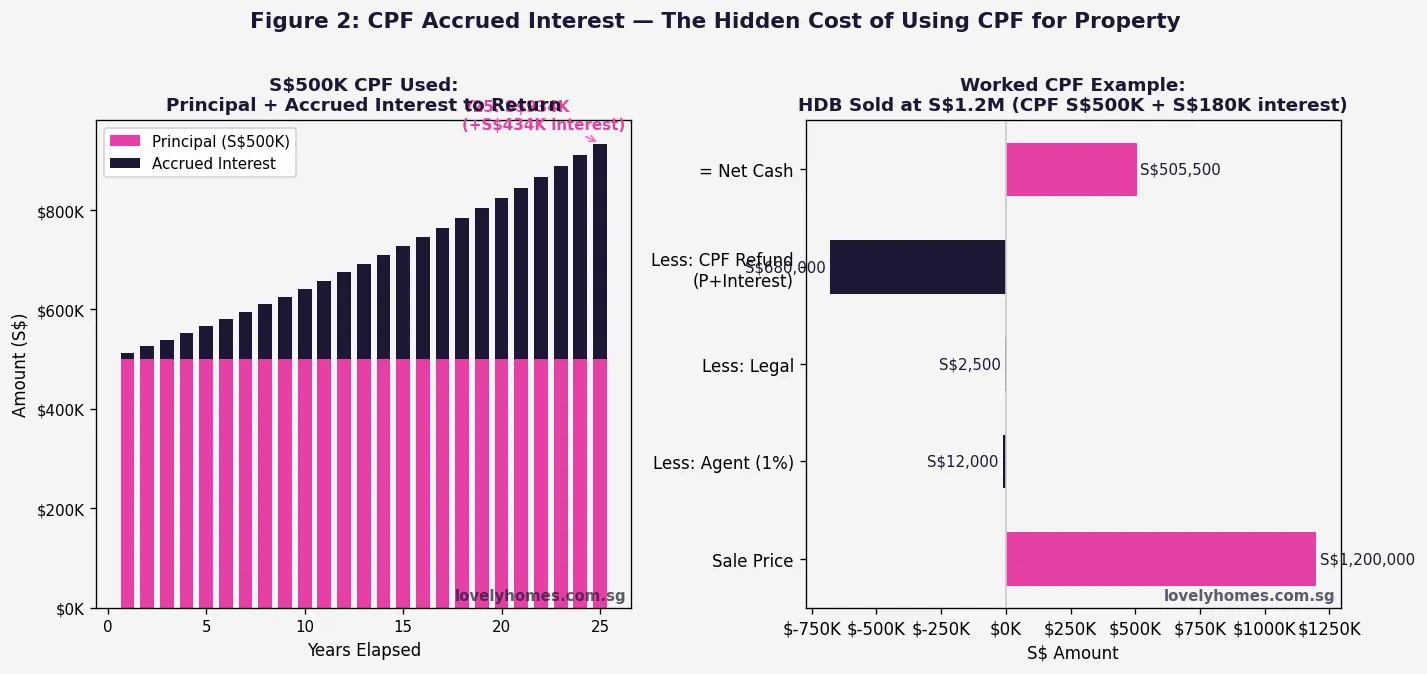
CPF accrued interest adds another dimension: every dollar of CPF OA withdrawn for property attracts 2.5% per annum compounded interest that must be refunded to your CPF account when you eventually sell. A buyer who taps the maximum CPF OA early in ownership will owe a substantially larger CPF refund at sale — reducing the net cash proceeds.

What Might Change in 2027 and Beyond

MAS reviews LTV and TDSR settings periodically as part of its property market calibration. When private residential prices rose sharply in 2021–2022, the MAS introduced cooling measures including ABSD hikes and TDSR tightening. Any future overheating or correction could trigger further LTV adjustments. The direction of change is typically a reduction in LTV (higher downpayment) during boom cycles and a relaxation during downturns. Buyers purchasing in 2026–2027 should stress-test their cashflow against a potential LTV reduction of 5–10 percentage points.

For HDB buyers specifically, the BRS/FRS for CPF withdrawal limits is adjusted annually and indirectly affects how much CPF OA remains available for property downpayment. The 2026 BRS is S$106,500 per person (both spouses), which is a floor CPF requires to remain after property pledging in some scenarios.

Frequently Asked Questions

Can I use my CPF OA to pay the full 25% downpayment with no cash at all?

Only if you are taking an HDB Concessionary Loan and your CPF OA balance is sufficient. The HDB loan requires no minimum cash component for the downpayment — the entire 25% can come from CPF OA. However, if you take a bank loan (for either an HDB flat or private property), at least 5% of the purchase price must be paid in cash even if your CPF OA is substantial. There is no exception to this 5% cash floor for bank loans.

How does Cash Over Valuation (COV) work and do I always need to pay it?

COV arises only in HDB resale transactions when the agreed price exceeds HDB’s own valuation of the flat. It is entirely optional — if you and the seller agree on a price at or below valuation, COV is zero. However, in a competitive resale market where popular 4-room flats in Toa Payoh or Queenstown routinely transact above valuation, a meaningful COV is unavoidable. COV cannot be financed by any loan or CPF — it is pure cash. Always commission a preliminary valuation estimate before making an offer and factor the likely COV into your cashflow.

What happens to my downpayment if the deal falls through?

For resale properties, the standard Option to Purchase (OTP) contains a 1% Option Fee paid by the buyer. If the buyer decides not to proceed, that 1% Option Fee is forfeited to the seller. If the seller decides not to proceed after granting the option but before the buyer exercises it, the seller must return the Option Fee plus an equal sum as penalty (i.e., 2× the Option Fee). For new launch purchases, the developer’s Sales and Purchase Agreement governs refund rights — buyers who pull out after exercising the option may lose all or part of the booking fee, and developers may sue for specific performance in some cases. For HDB, a booking fee of S$2,000 (2-room Flexi) to S$10,000 (5-room and larger) applies; this is forfeited if the buyer withdraws after signing the flat booking form.

Can I use a personal loan or credit card to fund part of the downpayment?

No. MAS rules explicitly prohibit using unsecured credit (personal loans, credit cards, renovation loans used as de facto downpayment funding) to meet property downpayment requirements. Banks are required to detect and penalise this under the MAS’s Total Debt Servicing Ratio framework. Any unsecured debt obtained close to a property purchase will increase your total debt obligations, reducing the loan quantum you can obtain, and could constitute misrepresentation on your loan application. The only permissible sources for downpayment are cash savings and CPF OA.

How does the downpayment change if I have an existing HDB loan?

If you are an upgrader who still has an outstanding HDB loan on your current flat, you are treated as having one outstanding home loan for LTV purposes. This means the LTV cap for your new purchase falls from 75% to 45% — requiring a 55% downpayment with at least 25% in cash. This is one key reason most upgraders sell their HDB first, extinguish the outstanding loan, and then purchase — so they qualify for the 75% LTV (first-loan) regime on the new private property. If you sell your HDB with proceeds and repay the HDB loan before exercising the OTP on the new property, you revert to zero outstanding loans and regain access to the 75% LTV tier.

Is there a difference in downpayment for a freehold versus a 99-year leasehold property?

From an MAS LTV perspective, no — the LTV caps and cash/CPF rules are the same regardless of tenure. However, banks may apply internal risk adjustments: for older 99-year leaseholds with a remaining lease of less than 60 years (or less than 30 years for CPF withdrawal), the effective LTV they are willing to lend may be lower than the MAS maximum, requiring a larger effective downpayment. HDB resale flats must have sufficient remaining lease to cover the youngest buyer to at least age 95 for CPF OA usage — if not, CPF withdrawal is capped or prohibited entirely.

Can I use my CPF to pay BSD and ABSD in addition to the downpayment?

Yes, CPF OA can pay BSD and ABSD for residential properties, but this comes at a cost: every dollar used reduces the CPF OA balance available for other purposes and must be refunded (with 2.5% p.a. accrued interest) on eventual sale. In practice, most buyers pay BSD and ABSD in cash to preserve their CPF OA for loan servicing. For ABSD on a second property (typically S$200,000–S$600,000+), paying from CPF OA is common simply because the cash outlay is prohibitive — but buyers should model the long-run CPF refund obligation before doing so.

Related Articles

Disclaimer: This article is for general information only and does not constitute financial, legal, or mortgage advice. Downpayment rules, LTV limits, and CPF withdrawal eligibility are set by MAS, HDB, and CPF Board and may be updated at any time. Verify current figures at mas.gov.sg, hdb.gov.sg, and cpf.gov.sg. Engage a licensed mortgage broker and solicitor before proceeding.

Buying Property Near Top Schools in Singapore 2026: Complete Guide

Buying Property Near Top Schools in Singapore 2026: Complete Guide

📌 Quick Answer: Buying Property Near Top Schools in Singapore 2026

  • School proximity drives property premiums: homes within 1 km of an oversubscribed primary school can command 8–18% higher prices than comparable homes 2 km away, depending on the district.
  • MOE’s Phase 2C priority gives Singapore Citizens living within 1 km of a school priority registration places before those living within 2 km — making the 1 km radius the most prized zone.
  • Bukit Timah, Novena, and Queenstown carry the largest school-proximity premiums; Jurong and Tampines carry the smallest, though still meaningful.
  • Not all popular schools are equally scarce: a school oversubscribed at Phase 2C is the one that matters for the proximity premium. Schools that regularly have vacancies at Phase 2C generate no meaningful price premium.
  • HDB resale flats near top schools are significantly cheaper entry points than condos and still qualify for Phase 2C priority as long as your registered address is within the distance cut-off.
  • The premium is time-limited: once your child has secured a place, the school-proximity rationale diminishes and you may be able to upsize or relocate without premium pricing.
  • Distance is measured straight-line from the main gate of the property to the school’s main gate using MOE’s official measurement tool — not Google Maps driving distance.
  • Verify distance before transacting: even 50 metres can determine whether you fall inside or outside the 1 km cutoff, so always use the MOE School Finder to confirm.

Why School Proximity Matters in Singapore Property

Singapore’s Primary 1 (P1) registration system is one of the most consequential drivers of residential property demand in the country. Unlike many education systems where school admission is determined purely by merit or choice, Singapore’s Phase 2C priority system gives automatic preference to children living closest to a school when balloting places are contested. This policy — administered by the Ministry of Education (MOE) — has created a predictable and enduring link between residential addresses and primary school access, making the 1 km radius around any oversubscribed primary school one of the most reliably valued assets in the Singapore property market.

For parents weighing their next property purchase, understanding how the P1 registration phases work, which schools generate meaningful premiums, and how to quantify the value of proximity is not a luxury — it is a core part of the buying decision. For investors who do not have school-going children, the same proximity premium represents a defensible demand floor that tends to support property values even through softer markets.

This guide explains the MOE priority phase system in full, maps the districts and schools that generate the largest premiums, provides a worked example of the financial implications, and offers a framework for deciding whether the school-proximity premium is worth paying for your specific situation.

MOE primary school priority registration phases 2026 Singapore Phase 2C 1km 2km
Figure 1: MOE Primary School Priority Registration Phases 2026 — Phase 2C gives priority to Singapore Citizens within 1 km first, then 2 km. Source: Ministry of Education Singapore.

MOE Primary 1 Registration Phases — How Proximity Works

The P1 registration exercise is structured in phases that proceed in order of priority. A school only opens to later phases if vacancies remain after earlier phases are filled. The relevant phases for proximity are Phase 2B and Phase 2C.

Phase 2B gives priority to children whose parents are active volunteers at the school (40 hours per year for at least the preceding year), who have community or CCA connections to the school, or whose parents are of the relevant religious affiliation for mission schools. Within Phase 2B, if there are more applicants than places, children living within 2 km of the school are given priority over those living further away. Distance matters even here.

Phase 2C is the general registration phase for all Singapore Citizens. This is where proximity becomes most critical. If the number of Phase 2C applicants exceeds the remaining vacancies, MOE ballots first among children living within 1 km of the school, then — if vacancies remain — among those living within 2 km, and finally — if still not full — among those living further away. For the most oversubscribed schools, the ballot has historically been decided entirely within the 1 km tier, meaning that a family living at 1.1 km may receive no priority whatsoever.

Phase 2C Supplementary covers Singapore Permanent Residents after all Singapore Citizen applicants have been processed. Phase 3 covers non-PR foreigners and is only relevant if the school still has vacancies after all citizen and PR phases are complete — an unusual scenario for popular schools.

Which Schools Generate the Largest Property Premiums?

Not every primary school generates a proximity premium. The premium is driven by two factors working together: the school’s perceived academic and co-curricular reputation, and its level of oversubscription at Phase 2C. A school that clears all its places by Phase 1 or Phase 2A1 (alumni parents’ children) before Phase 2C is even reached is effectively inaccessible via proximity alone — distance does not help if the school fills up before the distance-based phases. Conversely, a school with consistent Phase 2C balloting in the 1 km zone generates a hard, measurable demand for nearby addresses.

The schools that have historically generated the most sustained proximity premiums — based on their consistent oversubscription at Phase 2C and their reputation — cluster in the following districts: Bukit Timah (District 21), Novena and Newton (District 11), Queenstown and Buona Vista (District 10), Bishan and Ang Mo Kio (District 20), and Marine Parade (District 15). These areas also happen to be among Singapore’s most expensive residential districts for reasons beyond schools alone, which makes it challenging to isolate the school premium precisely.

Property price premium near top schools Singapore districts 2025 1km vs 2km
Figure 2: Indicative Resale Price Premium — within 1 km of a top primary school vs. beyond 2 km, by district (2025 data). Source: URA resale caveats and industry analysis. Not financial advice.

Key Districts and Their School-Proximity Premium Characteristics

District Notable Schools Typical Premium (1km vs 2km+) Property Type
Bukit Timah (D21) Nanyang Primary, Methodist Girls’ Primary 15–20% Landed, high-end condo
Novena / Newton (D11) Anglo-Chinese School (Primary), Saint Joseph’s Institution Junior 14–18% Condo, terrace
Queenstown / Buona Vista (D10) Raffles Girls’ Primary, Henry Park Primary 13–17% Condo, HDB (older)
Bishan / Ang Mo Kio (D20) Ai Tong School, Catholic High Primary, Pei Hwa Presbyterian 10–14% Condo, HDB
Marine Parade (D15) Tao Nan School, CHIJ Katong Primary 10–13% Condo, shophouse
Clementi / West Coast (D5) Nan Hua Primary, Clementi Primary 9–13% HDB, condo
Tampines / Pasir Ris (D18) Poi Ching School, Elias Park Primary 7–10% HDB, EC
Jurong East (D22) Rulang Primary, Fuhua Primary 6–9% HDB, EC

Top primary schools by district Singapore property proximity price 2026
Figure 3: Selected Top Primary Schools by District — historically oversubscribed at Phase 2C with indicative 1 km property price ranges. Source: MOE, URA. Not an official MOE ranking.

Worked Example: The Tan Family’s School-Proximity Purchase

🏫 Scenario: Tan Family, Child Entering P1 in 2028

Target school: Ai Tong School, Bishan (historically oversubscribed at Phase 2C within 1 km)

Budget: S$1.8 million for a condominium

Without school premium: A comparable 3-bedroom condo 2.5 km from Ai Tong in Ang Mo Kio averages S$1.55 million in 2025 resale.

With school premium: A comparable 3-bedroom condo within 1 km of Ai Tong averages S$1.78 million — a premium of approximately S$230,000 (14.8%).

  • The Tans have a child born in 2021, meaning P1 registration is in 2027 (for entry in January 2028).
  • They need to be registered at the address before the Phase 2C registration exercise, which typically opens in July 2027 and requires the address to be active at least 30 months before the exercise for Phase 2B purposes.
  • Break-even analysis: The S$230,000 premium represents approximately S$19,200 per year over a 12-year horizon (primary through secondary school). If the school-proximity effect sustains the property’s relative value through resale, the net cost may be substantially less — or even zero if the 1 km zone appreciates faster than the 2.5 km zone.
  • ABSD: As Singapore Citizens buying a second property, the Tans pay 20% ABSD on S$1.78 million = S$356,000. If this is their first property, no ABSD applies.

Is the School-Proximity Premium Worth Paying?

The answer depends on three variables: the school in question, the phase at which you expect to compete, and your time horizon. If you are a Phase 2B volunteer parent, you may already enjoy priority within 2 km — paying the 1 km premium may not be necessary. If you have no Phase 2B connection and the school is consistently balloted within the 1 km zone at Phase 2C, then the 1 km address is effectively a prerequisite for reasonable access, and the premium reflects a real, functional benefit rather than pure sentiment.

From a resale perspective, the proximity premium tends to be self-reinforcing in areas with good overall fundamentals (MRT access, amenities, estate quality). It is weakest in areas where the school is the sole driver of demand — in those cases, the premium may erode once your child has completed primary school and you decide to sell. The strongest investment case is therefore found where school proximity overlaps with strong general demand: Bukit Timah, Queenstown, and Bishan all fit this profile.

First-time buyers and HDB upgraders should note that HDB resale flats in the 1 km catchment area of oversubscribed schools can represent excellent value. A 4-room HDB flat in Bishan within 1 km of Ai Tong or Catholic High Primary typically transacts at S$700,000–S$900,000 in 2025 — a fraction of the condo price while qualifying for exactly the same Phase 2C priority. The trade-off is flat size, lease remaining, and the absence of condominium facilities.

What Investors Should Know About the School-Proximity Premium

For property investors without school-going children, the school-proximity premium is a demand-side floor to understand rather than a purchasing criterion. The premium is most durable in schools that are oversubscribed consistently year after year, such as those on the MOE’s School Information Service with Phase 2C balloting records visible at MOE’s P1 registration results page. Schools that recently became popular due to merger or re-branding may not sustain the same premium. URA’s transaction data, accessible at ura.gov.sg, allows investors to overlay resale transaction prices against school catchment boundaries to quantify the premium empirically for any school they are considering.

One structural risk to the school-proximity premium is MOE policy change. In 2019, MOE capped the number of children who can benefit from Phase 2B volunteerism, and has periodically adjusted how distance tiers are applied. Any future change to Phase 2C that removes or reduces the distance priority would directly erode the 1 km premium. Buyers who are paying a large premium on the basis of school access alone should keep this policy risk in mind.

🔮 Looking Ahead: Will the School-Proximity Premium Persist?

Singapore’s P1 registration system has been broadly stable for decades, and the government has shown little appetite for eliminating the distance-based priority — it is seen as a reasonable community-based principle. However, MOE has been expanding school capacity at the primary level and has encouraged parents to consider neighbourhood schools as credible alternatives to branded schools. If these efforts succeed in reducing the prestige gap between schools, the Phase 2C premium for any individual school may narrow. The safest bet remains properties in estates with multiple oversubscribed schools within range, so that the premium is supported by a cluster of demand rather than a single school. These are speculative observations — official policy may change without notice.

Frequently Asked Questions

How exactly does MOE measure the 1 km distance?

MOE measures the straight-line distance from the main entrance of your home to the main gate of the school. This is not walking distance or driving distance — it is the straight-line (crow flies) measurement. MOE uses its own GIS system to calculate this; the result may differ from Google Maps or other mapping tools by up to 100–200 metres in some cases. You can check your address against any school using the MOE School Finder tool. Always verify using MOE’s official tool before relying on any proximity claim made by a property agent or listing.

Can I use a relative’s address to get the 1 km priority?

No. MOE requires you to be genuinely registered and residing at the address provided. Using a relative’s or friend’s address to claim proximity priority is considered fraudulent and may result in the child’s application being rejected, even after a school place has been allocated. MOE conducts checks including cross-referencing with NRIC records, HDB or URA records, and utility bills. Parents found to have provided false addresses face disqualification from the registration exercise and potential legal consequences. The address must be your genuine principal place of residence at the time of registration.

Does the school-proximity premium apply to secondary schools too?

Not in the same way. Secondary school admission in Singapore is primarily determined by PSLE results (Direct School Admission aside), so residential proximity plays no formal role in secondary school access. The property premium phenomenon is therefore primarily a primary school effect. That said, some parents choose to live near certain secondary schools for practical convenience (shorter commute), and a cluster of good primary and secondary schools in the same area can create a compounding “educational belt” effect on property values — as seen in the Bishan–Ang Mo Kio corridor.

Will buying an HDB flat near a top school get me the same Phase 2C priority as a condo?

Yes. MOE’s Phase 2C priority is based on the registered residential address and its distance from the school — it does not distinguish between property types. An HDB flat within 1 km of Ai Tong School receives exactly the same Phase 2C ballot priority as a private condominium within 1 km. The key is that the address must be your genuine place of residence and registered in the HDB or URA records. For HDB buyers, note that the MOP (Minimum Occupation Period) means you must already own or purchase an HDB flat that is within 1 km — you cannot simply rent a nearby property to claim proximity.

How long before the P1 registration exercise must I live at the address?

For Phase 2C, MOE requires the child to be residing at the registered address. There is no explicit minimum duration stated for Phase 2C, but MOE may request supporting documentation. For Phase 2B (volunteer parent priority), the volunteerism must be completed in the year before registration, typically requiring at least 40 hours of actual service at the school. If you purchase a property specifically for school access, moving in at least several months before the registration exercise (which typically opens in July for January the following year) is strongly advisable to avoid any documentary issues.

What if I rent a property near the school rather than buying?

Renting is a legitimate and often lower-cost strategy for securing the proximity priority without paying the purchase premium. A tenancy agreement and utility bills in your name at a 1 km address are typically accepted as evidence of residence for MOE purposes. However, renting near a top school can itself be expensive — landlords in these catchment areas are aware of the demand and price accordingly. Rental premiums of 10–15% over comparable properties outside the catchment are not uncommon in Bukit Timah and Queenstown. If you only need the proximity for one registration year, renting for 12 months may be materially cheaper than paying the purchase premium over a longer horizon.

Are international schools affected by the same proximity rules?

No. International schools in Singapore operate under different admission frameworks set by the individual school and the Ministry of Education’s International Schools Unit. They are not subject to the MOE P1 Phase 2C priority system, so residential proximity to an international school creates no formal priority advantage. Property premiums near international schools do exist in some cases — particularly near the American School, United World College, and the German European School — but these are driven by the convenience of expatriate communities rather than any formal regulatory priority linked to the address.

Related Articles

Disclaimer: This article is for general informational purposes only and does not constitute legal, financial, or educational advice. Property prices, school admission policies, and MOE phase criteria are subject to change; always verify current rules directly with the Ministry of Education and Urban Redevelopment Authority. Price premiums cited are indicative estimates based on publicly available URA transaction data and industry analysis — they are not financial advice. Consult a licensed financial adviser and property professional before making any property decision. School names and reputations are referenced for informational purposes only; LovelyHomes does not endorse or rank any school.

HDB Minimum Occupation Period (MOP) Singapore 2026: Complete Guide

HDB Minimum Occupation Period (MOP) Singapore 2026: Complete Guide

📌 Quick Answer: HDB Minimum Occupation Period (MOP) 2026

  • The MOP is the mandatory period you must live in your HDB flat before you are allowed to sell it on the open market or buy a private residential property.
  • Standard BTO and resale flats carry a 5-year MOP, counted from the date you collect your keys (for BTO) or the date the resale transaction is completed.
  • Prime Location Housing (PLH) flats — introduced in October 2021 — carry a 10-year MOP and come with a permanent ban on renting out the whole flat.
  • During MOP you cannot sell the flat on the open market, rent out the entire flat, or purchase a private residential property without first disposing of the HDB flat.
  • Renting out individual rooms is permitted during MOP with HDB’s approval, provided occupancy caps are met.
  • Executive Condominiums (ECs) have a 5-year MOP under HDB rules; they become fully privatised at the 10-year mark.
  • Violation consequences include compulsory acquisition at below-market value, grant clawback, and debarment from future HDB applications.
  • The MOP applies to the flat, not the owner: any attempt to sell before expiry is void and attracts penalties.

What Is the HDB Minimum Occupation Period (MOP)?

The Minimum Occupation Period — universally known as MOP in Singapore property circles — is a Housing & Development Board (HDB) policy requiring flat owners to physically occupy their flat for a stipulated number of years before they are permitted to sell, rent the entire unit, or purchase a private residential property. The MOP is administered under the Housing and Development Act and is one of the most consequential rules shaping the Singapore HDB resale market.

HDB introduced the MOP to prevent speculative “flipping” of subsidised public housing. Because the government provides substantial grants and subsidies when selling BTO flats, it wants genuine owner-occupiers to benefit from those subsidies rather than investors who might resell immediately for a quick profit. The MOP therefore acts as a temporal lock-in that aligns the interests of flat buyers with the public-housing mission of HDB.

The standard MOP has stood at five years since 2010. However, the introduction of the Prime Location Housing (PLH) model in October 2021 created a new, more restrictive 10-year MOP for BTO projects in central and highly sought-after locations. Understanding which MOP category applies to your flat — and what you are and are not permitted to do during that period — is critical before making any property decision.

HDB MOP summary table Singapore 2026 standard BTO PLH resale EC
Figure 1: HDB Minimum Occupation Period at a Glance — standard BTO, PLH BTO, resale, and EC rules. Source: HDB Singapore.

How Is the MOP Counted?

The MOP clock starts differently depending on how you acquired the flat. For a BTO flat, the MOP begins on the date of key collection, which HDB formally records. If you collect your keys on 15 January 2022, your 5-year MOP expires on 15 January 2027. For a resale HDB flat, the MOP begins on the date the resale transaction is legally completed — that is, the date shown on the HDB resale completion letter, typically 8–12 weeks after HDB accepts the resale application. DBSS flats follow the same rule as resale. For an EC bought from an HDB-appointed developer, the MOP starts from the date of vacant possession (VP) and lasts five years, after which the EC becomes partially privatised and fully private at the 10-year mark.

Importantly, the MOP measures calendar time, not duration of active occupation. Even if you are posted overseas for work and your flat sits empty for part of the period, the clock does not pause. You must also maintain the flat as your sole registered address in Singapore during the MOP; abandoning the flat to stay elsewhere while the clock runs is a violation that HDB actively monitors through its inspection programme.

MOP by Flat Type — 2026 Reference Table

Flat Type MOP Duration Whole-flat Rental After MOP? Key Rule
Standard BTO (non-PLH) 5 years from key collection Yes, with HDB approval Flat must be primary residence during MOP
Prime Location Housing (PLH) BTO 10 years from key collection No — permanently prohibited Introduced Oct 2021; applies to centrally located BTO projects
HDB Resale (standard area) 5 years from completion Yes, with HDB approval Buyer’s MOP starts from resale completion date
HDB Resale (PLH-designated area) 10 years from completion No — permanently prohibited PLH restriction travels with the address, not the seller
DBSS flat 5 years Yes, with HDB approval Treated the same as standard BTO for MOP purposes
Executive Condo (EC) 5 years (HDB rules apply) Yes, after MOP + HDB approval Fully private at 10 years; no HDB restrictions thereafter

HDB MOP timeline chart 5-year 10-year standard PLH BTO Singapore 2026
Figure 2: MOP Timeline by Flat Type — visual comparison of 5-year versus 10-year lock-in periods. Source: HDB Singapore.

What Can You Do During the MOP?

Many flat owners are surprised to discover that the MOP is not a blanket prohibition on all activity — it targets sale and whole-flat rental specifically. Renting out spare bedrooms is permitted: HDB allows flat owners to sublet individual rooms, subject to occupancy caps and prior HDB approval via the resale portal. The total number of occupants including owners must not exceed the flat’s authorised occupancy limit — six persons for a 3-room flat, eight for larger flats as of 2026. Running a small home-based business under HDB’s Home-Based Small Scale Business guidelines is also permitted and does not affect the MOP. Internal renovations are allowed subject to HDB’s renovation guidelines and town council rules.

What is prohibited is more significant. You cannot sell the flat on the open market — any purported contract of sale during MOP is void. You cannot rent out the entire flat for standard flats during MOP, and for PLH flats this prohibition is permanent. You cannot purchase a private residential property in Singapore while an HDB flat is under MOP; if you do, HDB will require you to dispose of the HDB flat within six months and may impose financial penalties. Voluntary ownership transfers to family members are generally not permitted during MOP without HDB’s prior approval, which is granted only in specific circumstances such as divorce, death, or financial hardship.

HDB MOP before and after comparison matrix Singapore 2026
Figure 3: Before vs. After MOP — permitted and prohibited actions by flat type. Source: HDB Singapore.

Worked Example: The Lim Family’s MOP Journey

👥 Scenario: Lim Family, 4-Room BTO in Tampines

Key collection date: 15 March 2021

MOP expiry date: 15 March 2026 (5-year standard MOP)

Goal in early 2026: Sell the flat and upgrade to a private condo.

  • From 15 March 2026, the Lims are free to list the flat on the open market via the HDB resale portal.
  • They may simultaneously exercise an OTP (Option to Purchase) on a private condo. If they buy the condo before completing the HDB sale, a 6-month disposal window applies.
  • Had they bought the condo in January 2026 — before MOP expiry — HDB would have required them to sell the flat within 6 months and could have imposed a financial penalty.
  • CPF Family Grant: Received at BTO purchase; not subject to clawback on MOP completion. A Resale Levy of S$50,000 applies if they later purchase another subsidised flat.
  • They had also rented out two spare bedrooms since October 2022 (with HDB approval), earning approximately S$1,800 per month — a permitted activity during MOP.

The PLH Model and the 10-Year MOP

The Prime Location Housing (PLH) model was launched by HDB in October 2021 to address public concern that prime-location BTO flats — particularly in districts such as Rochor and the Central Area — were underpriced relative to private property. The two key additional restrictions of the PLH model are the 10-year MOP and the permanent ban on renting out the whole flat.

For buyers of PLH BTO flats, this means the flat cannot be sold until 10 full years from key collection. Even after those 10 years, the whole-flat rental prohibition is perpetual — it is address-based and permanent, running with the flat and not the owner. A resale buyer who purchases a PLH-designated flat on the open market inherits the same restriction; there is no way to clear it by buying second-hand. Individual rooms may still be sublet with HDB approval.

The Ministry of National Development (MND) has indicated that the PLH model will be applied selectively. Research from industry analysts suggests that PLH resale transactions — when they eventually enter the market after 2031 for the earliest PLH BTO projects — may be priced at a discount to non-PLH flats of equivalent size and location, precisely because of the rental prohibition narrowing the buyer pool.

Consequences of Violating the MOP

Violation HDB Action Additional Consequence
Selling flat before MOP expires Void transaction; possible compulsory acquisition at below-market value Debarment from future HDB flat purchases for up to 5 years
Renting out whole flat during MOP Fine of S$3,000–S$5,000; instruction to terminate tenancy immediately Repeat offence may result in compulsory acquisition
Buying private property during MOP without disposing of HDB flat 6-month disposal notice issued by HDB Financial penalty; potential stamp duty complications
Giving false occupation declaration Civil and/or criminal prosecution under the Housing and Development Act Fines up to S$5,000 or imprisonment up to 6 months

What Happens After the MOP?

Once your MOP expires, you gain substantially greater freedom. You may list the flat for sale via the HDB resale portal; the price is negotiated freely between buyer and seller with no government-set ceiling. Standard flat owners may apply to HDB for permission to sublet the entire unit, typically approved for 6–36 months under the Fair Tenancy Framework. You may also purchase a private property concurrently with your HDB flat — note that Additional Buyer’s Stamp Duty at 20% applies to Singapore Citizens buying a second residential property. Married couples may also explore decoupling one partner’s name off the HDB flat to facilitate a private property purchase by the other partner at a lower ABSD rate, subject to eligibility.

What the MOP Means for Singapore’s Property Market

The MOP is one of the most effective supply-management tools in Singapore’s housing policy toolkit. By locking new BTO supply out of the resale market for five years, HDB ensures that subsidised flat sales benefit genuine first-time owner-occupiers rather than investors arbitraging the gap between discounted BTO prices and open-market resale values. The MOP also creates a predictable “event horizon” in the resale market: estates where BTO keys were collected in large numbers five years ago tend to see a surge of resale supply as those MOP clocks expire. Estates where keys were collected in 2020 and 2021 — including Tengah, Tampines North, and Canberra — will see their 5-year MOPs rolling off through 2025 and 2026, contributing to resale supply in those towns. Buyers looking for competitively priced resale flats would do well to track upcoming MOP expiry clusters using HDB’s transaction data on the HDB website and URA transaction records.

🔮 Looking Ahead: Will the MOP Change?

The 5-year standard MOP has remained stable since 2010, and the government has consistently defended it as appropriately calibrated. The 10-year PLH MOP is newer (effective from 2021) and will only be stress-tested when the first PLH BTO projects complete their wait and owners begin to sell from 2031 onwards. Should PLH resale prices still show large profits despite the longer lock-in, policymakers may consider extending the PLH MOP further or broadening the PLH classification. Conversely, if PLH proves to dampen demand and leads to undersubscribed BTO launches in prime locations, the criteria may be moderated. These are speculative projections — official policy remains as described above.

Frequently Asked Questions

Can I buy a private property while my HDB flat is under MOP?

No. Purchasing a private residential property in Singapore while your HDB flat is under MOP is prohibited. If you exercise an OTP on a private property before your MOP expires, HDB will issue a notice requiring you to dispose of the HDB flat within six months. Failure to comply can result in financial penalties and debarment from future HDB applications. The practical approach is to wait for the MOP to expire, then purchase the private property. You may co-own both thereafter, though the second-property ABSD of 20% (for Singapore Citizens) will apply to the private purchase.

Does the MOP restart if I add a family member to my flat?

No. Adding an authorised occupier or essential occupier to your flat does not reset the MOP clock. The MOP runs from your original key collection date (for BTO) or resale completion date and continues uninterrupted regardless of changes in the list of occupants. If you are seeking to transfer ownership — for example, adding a spouse as co-owner — HDB’s approval is required and may be subject to conditions, but an approved ownership change does not affect the MOP count.

Can I rent out my whole flat after MOP if it is a PLH flat?

No. The prohibition on renting out the entire flat is a permanent condition attached to all Prime Location Housing designated flats. It applies regardless of whether the flat has completed the 10-year MOP. Once a flat is designated PLH — determined by the BTO project it belongs to or, for resale flats, by the address being in a PLH-designated estate — the whole-flat rental ban is perpetual. You may still rent out individual rooms with HDB’s prior approval, subject to occupancy cap rules. If rental income is important to your long-term plan, verify whether any flat you are considering carries PLH status before committing.

What happens to my CPF housing grant if I sell before MOP?

Selling your HDB flat before the MOP expires is prohibited and any purported sale is void. Were HDB to compulsorily acquire the flat due to a MOP violation, CPF housing grants received would be subject to clawback — amounts deducted from the proceeds, returned to your CPF Ordinary Account, and you would face an additional financial penalty. Beyond the clawback, you would be debarred from purchasing an HDB flat or EC for up to five years. Attempting to circumvent the MOP is both illegal and financially destructive.

Can I sell my flat on the very day my MOP expires?

Yes. On the expiry date, you may submit a resale application via the HDB resale portal. In practice, most owners arrange a buyer in advance through private negotiation and grant the OTP a few days before the MOP date, with the actual HDB resale application submitted on or after the expiry date. Check with your conveyancing solicitor on precise timing — HDB’s position is that the resale application must be submitted after the MOP, though the OTP can be arranged a few days ahead.

How does the MOP interact with divorce proceedings?

If a couple holding an HDB flat divorces during the MOP, the Family Justice Courts of Singapore may make orders relating to the flat — including ordering a sale or transfer to one party — notwithstanding the MOP. HDB has an established process for court-ordered transfers that may occur before MOP expiry, handled case-by-case and requiring a court order before HDB will process the transfer. HDB does not automatically waive the MOP on divorce, but a court’s order can effectively override HDB’s normal MOP restriction for the purpose of the divorce settlement. Legal advice from a family law solicitor is strongly recommended.

What is the MOP for an EC bought on the resale market?

If you buy an EC on the resale market (i.e., after it has been privatised), there is no HDB MOP applicable to you as the buyer — the EC is already a private property. HDB rules only apply during the first 10 years of an EC’s life from the date of TOP (Temporary Occupation Permit). If you buy an EC that is, say, 12 years old on the resale market, you are buying a fully private condominium and the transaction is governed by standard private property rules, including ABSD if applicable.

Related Articles

Disclaimer: This article is for general informational purposes only and does not constitute legal, financial, or professional advice. HDB rules and policies are subject to change; always verify current requirements directly with the Housing & Development Board, the Inland Revenue Authority of Singapore, or your legal and financial advisers before making any property decision. LovelyHomes does not accept responsibility for reliance on information in this article.

Translate »