TDSR and MSR Singapore 2026: The Complete Borrowing Limits Guide

TDSR and MSR Singapore 2026: The Complete Borrowing Limits Guide

TDSR and MSR Singapore 2026: 55% and 30% borrowing limits infographic
Figure 1: The two numbers that decide every Singapore home loan — TDSR at 55% of income and MSR at 30% for HDB and EC purchases.

If you have ever wondered why the bank’s pre-approval letter gave you a smaller loan than you budgeted for — or why a friend on the same salary can borrow noticeably more than you — the answer almost always comes down to two acronyms: TDSR and MSR. These are the two borrowing limits the Monetary Authority of Singapore (MAS) bakes into every residential mortgage, and in 2026 they are the single biggest determinants of how much home you can actually finance.

This guide is the 2026 edition. It covers exactly how TDSR and MSR are calculated, how they interact with the loan-to-value (LTV) cap, where the 4.0% stress-test rate comes from, what counts as income, what doesn’t, and — crucially — how to game the numbers in your favour without breaking any rules. We walk through a fully-worked Singapore example end-to-end and finish with the policy trajectory so you know what to watch for next.

Quick Answer: The 10 Things Every Singapore Borrower Should Know

  • TDSR is 55%. Total monthly debt repayments — including the new mortgage — cannot exceed 55% of your gross monthly income. Applies to every residential property loan.
  • MSR is 30%. Mortgage repayments on an HDB flat or Executive Condominium (EC) bought from the developer cannot exceed 30% of gross monthly income. Private condos and landed property have no MSR.
  • Stress-test rate is 4.0%. TDSR and MSR are calculated at a medium-term interest rate of 4.0% for residential loans, regardless of the rate you actually pay today.
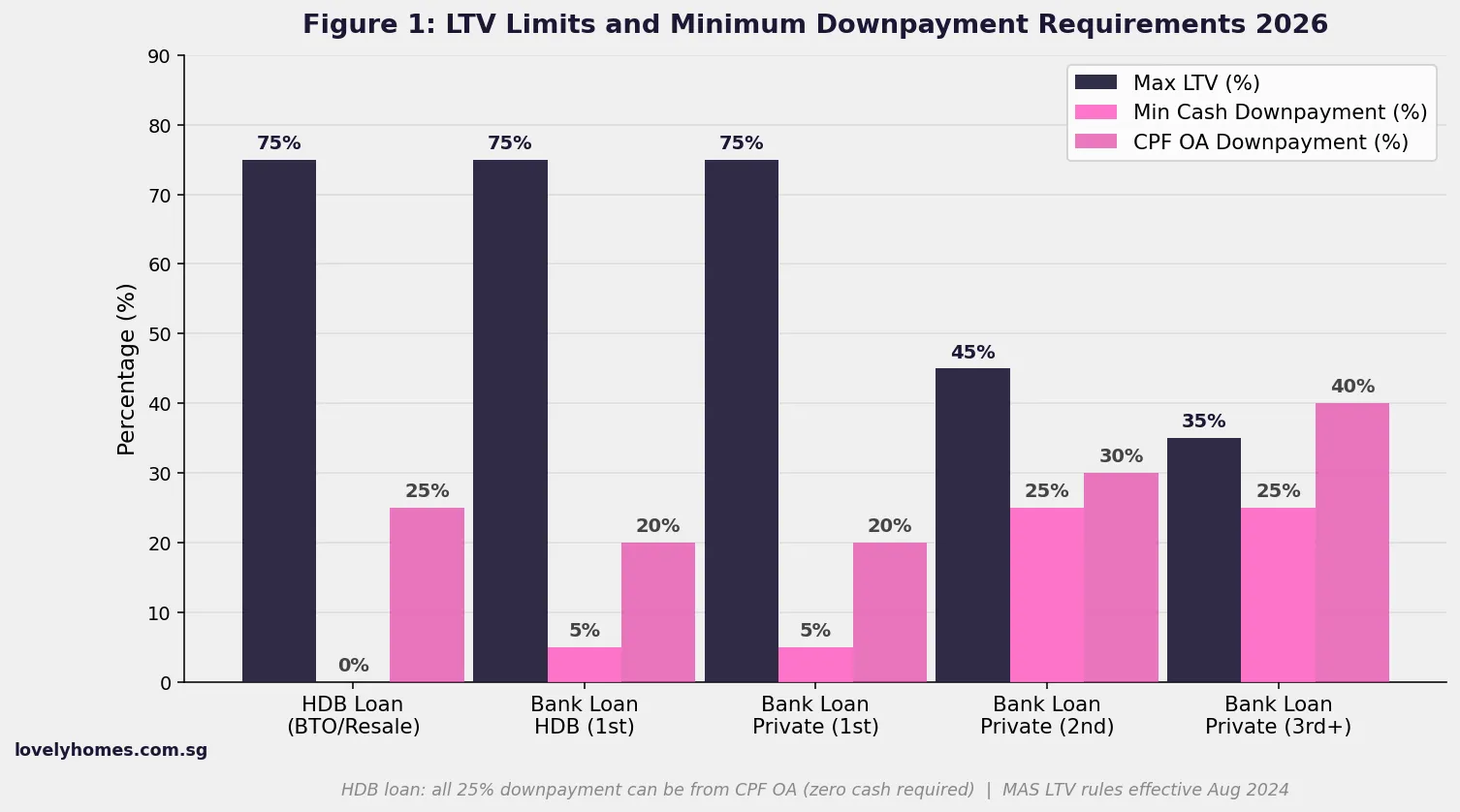
  • LTV caps layer on top. First housing loan: up to 75% of purchase price. Second housing loan: up to 45%. Third and beyond: up to 35%.
  • Age and tenure matter. If the loan tenure pushes past age 65, or exceeds 30 years (25 for HDB), the LTV cap drops by 20 percentage points.
  • Variable income is haircut by 30%. Commission, bonus, rental and freelance earnings are only counted at 70% of the proven figure.
  • Existing debts eat into headroom. Car loans, credit-card minimum payments, student loans, and other mortgages all hit your TDSR ceiling before the new home loan does.
  • Guarantors are counted too. If you guarantee a sibling’s loan, it may sit in your TDSR — not theirs.
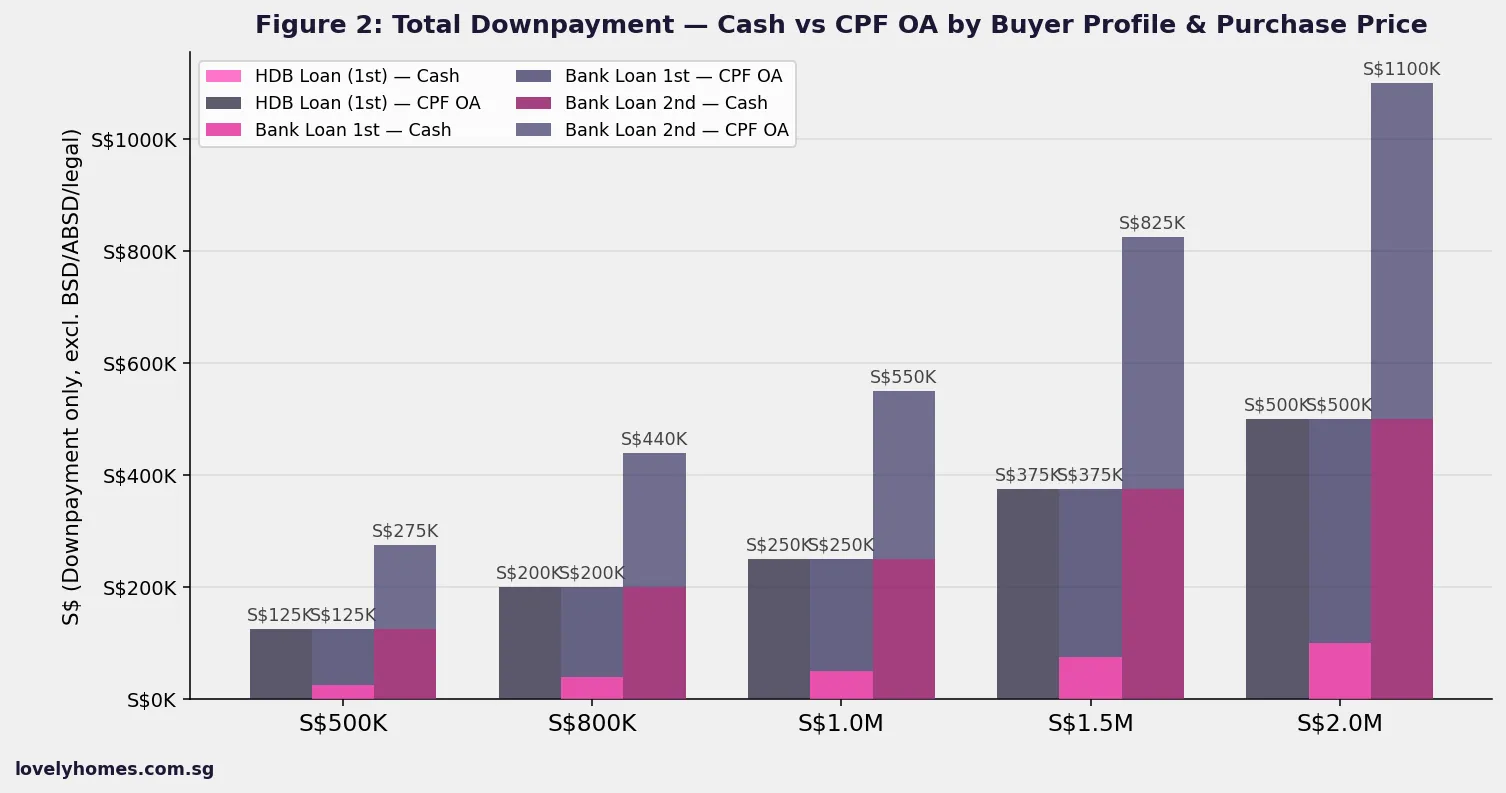
  • Cash down-payment rules mirror LTV. The first 5% (25% at higher LTV tiers) must be paid in cash; the balance can be CPF Ordinary Account funds.
  • Refinancing carve-out. Borrowers refinancing an owner-occupied property with no cash-out may be exempted from TDSR — a narrow but useful escape hatch.

What Is TDSR — The Framework That Underpins Every Home Loan

The Total Debt Servicing Ratio was introduced in June 2013 as part of MAS’s cooling-measures programme (see our full cooling measures timeline for the wider context). Its purpose is simple: to stop households from levering up to a level where a modest rise in interest rates would push them into negative cash flow. The 2010s saw Singapore’s household debt-to-GDP ratio climb past 70%, and MAS wanted a circuit-breaker that worked the same way regardless of which bank a buyer walked into.

TDSR caps all monthly debt obligations at 55% of gross monthly income. “All debt” is deliberately broad: it includes the prospective home-loan instalment (calculated at the stress-test rate), existing mortgages, car loans, personal loans, renovation loans, student loans, credit-card minimum repayments and any loans you have personally guaranteed. Even a dormant credit card with a S$20,000 limit is counted if the bank uses the 3% minimum-payment convention.

The ratio was originally set at 60% in 2013 and tightened to 55% in December 2021, where it remains in 2026. That three-percentage-point shave looks small on paper but at a typical Singapore household income removes roughly S$150,000–S$200,000 of borrowing capacity.

What Is MSR — The Second Ratio You Cannot Ignore for HDB and EC Buyers

The Mortgage Servicing Ratio is narrower but stricter. Introduced for HDB loans in 2011 and extended to bank loans on HDB flats in 2013, MSR caps the mortgage portion alone at 30% of gross monthly income for purchases of HDB flats and Executive Condominiums bought directly from the developer.

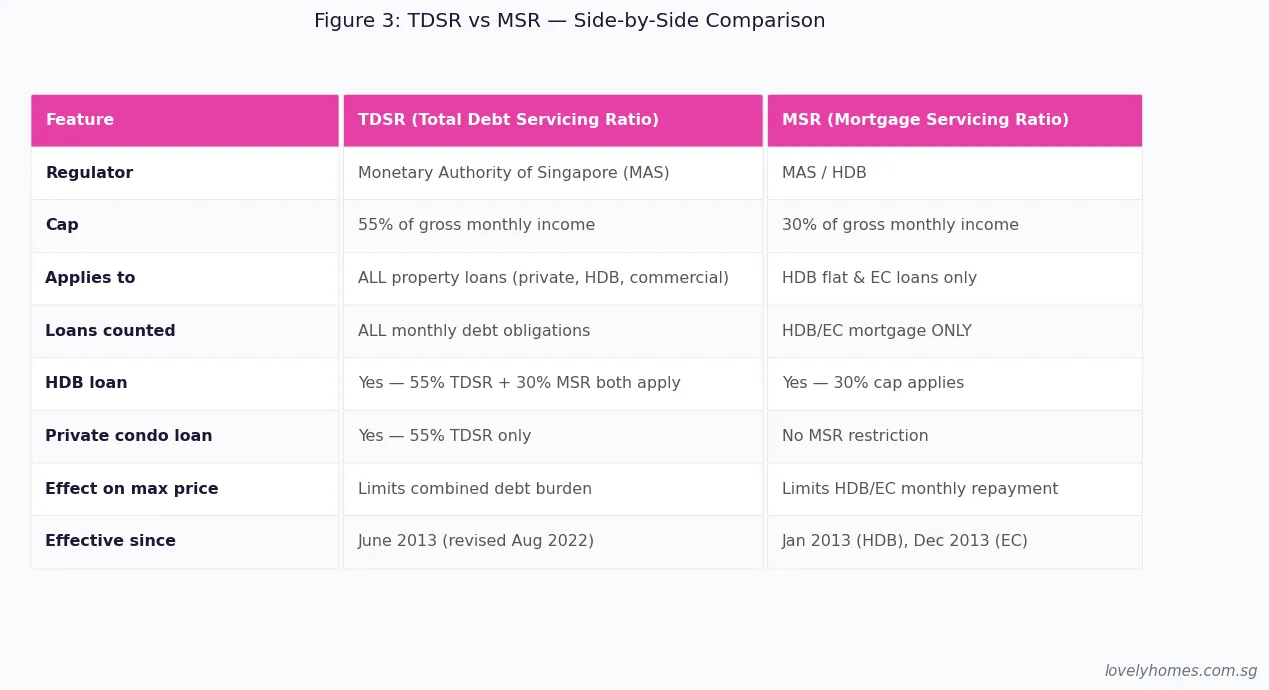
MSR is a subset of TDSR, not a substitute. HDB and new-EC buyers must clear both ratios — the tighter of the two binds. In practice MSR is almost always the binding constraint for HDB buyers because existing debt rarely adds up to the 25-percentage-point gap between MSR (30%) and TDSR (55%). For EC buyers the numbers narrow as the project moves through its 10-year maturation period — after the five-year minimum occupation period and the ten-year privatisation, a resale EC is treated like a private condo for borrowing-limit purposes, so TDSR alone applies.

For a side-by-side look at which ratios hit which property type, the matrix below summarises 2026 rules.

Singapore TDSR MSR LTV by property type matrix 2026
Figure 2: 2026 borrowing limits by property type. HDB flats and ECs face both MSR and TDSR; private condos, landed property and commercial assets only face TDSR.

How the 4.0% Stress-Test Rate Works — And Why It Matters More Than Your Actual Rate

Here is the trap that catches most first-time buyers: banks must calculate your monthly instalment using an assumed rate of 4.0% for residential mortgages, even if your actual rate is 2.5% or 3.0%. This is the medium-term interest rate, set by MAS and reviewed from time to time. It was revised upward from 3.5% to 4.0% in September 2022 and has not moved since.

Why 4.0%? The rate is designed to approximate the long-run average that Singapore floating-rate loans have oscillated around over a 30-year horizon. It is deliberately punitive — regulators would rather have borrowers told “you qualify for less” at origination than have the same borrowers go into arrears when rates spike. Anyone who lived through the 2022–2023 rate cycle, when three-month SORA went from 0.2% to 3.8% in 18 months, will appreciate the logic.

The mechanic: the bank plugs a 4.0% rate into the standard amortisation formula using your chosen loan tenure, derives an assumed monthly instalment, and tests that figure against your TDSR (55%) and, if applicable, MSR (30%). Your actual repayment — calculated at whatever rate the bank is offering — will be lower in most cases, leaving you with a margin of safety that MAS consciously engineered.

What Counts as Income — And Why Variable Pay Is Penalised

Income for TDSR/MSR purposes is not what you see on your IRAS tax statement. MAS prescribes a structured treatment:

  • Fixed salary. Counted at 100%. Evidenced by payslips (usually three to six months) and the latest CPF contribution history.
  • Variable income. Commission, bonus, overtime, and freelance earnings are haircut by 30%, so only 70% of the verified average is recognised. The haircut applies to the entire variable component, even if you can show multiple years of steady track record.
  • Rental income. Counted at 70% of the gross rent receivable, net of void periods. A two-year tenancy agreement is strong evidence; month-to-month leases are viewed more sceptically.
  • Self-employed / business income. Two years of Notice of Assessment (NOA) are the default evidentiary bar, with the 30% haircut applied.
  • Allowances and AWS. Typically 100% if contractual and evidenced; otherwise haircut.

This is where the seemingly simple 55% number becomes surprisingly individual. A banker earning S$12,000 monthly but with 40% of that as variable gets assessed on S$7,200 fixed + S$3,360 post-haircut variable = S$10,560 — so the TDSR ceiling drops to S$5,808 per month rather than the nominal S$6,600.

What Counts as Debt — The Items Borrowers Miss

The other half of the equation is debt. The headline items — the new home loan instalment, existing mortgages, and car loans — are obvious. Less obvious items often catch borrowers out:

  • Credit-card minimum payments. Banks use a 3% minimum convention on the outstanding balance (or sometimes on the total credit limit). If you carry S$30,000 revolving credit across cards, that is a S$900 monthly hit on your TDSR — shaving S$192,000 off your loan ceiling at a 4.0% stress rate over 30 years.
  • Renovation and personal loans. Unsecured loan instalments count in full.
  • Student loans. Included in TDSR from the date repayments begin.
  • Guarantor obligations. If you have co-signed a relative’s loan and there is no formal debt-transfer, some banks will count the full instalment against you. Others use 50%. Ask the relationship manager explicitly.
  • Outstanding ABSD remission obligations. If you are on a remission schedule (e.g. from selling a prior property to claim remission on a new purchase), the existing loan remains in TDSR until the sale completes.

A Fully-Worked Example: A S$10,000-a-Month Household Buying a Private Condo

TDSR worked example Singapore S$10,000 monthly income
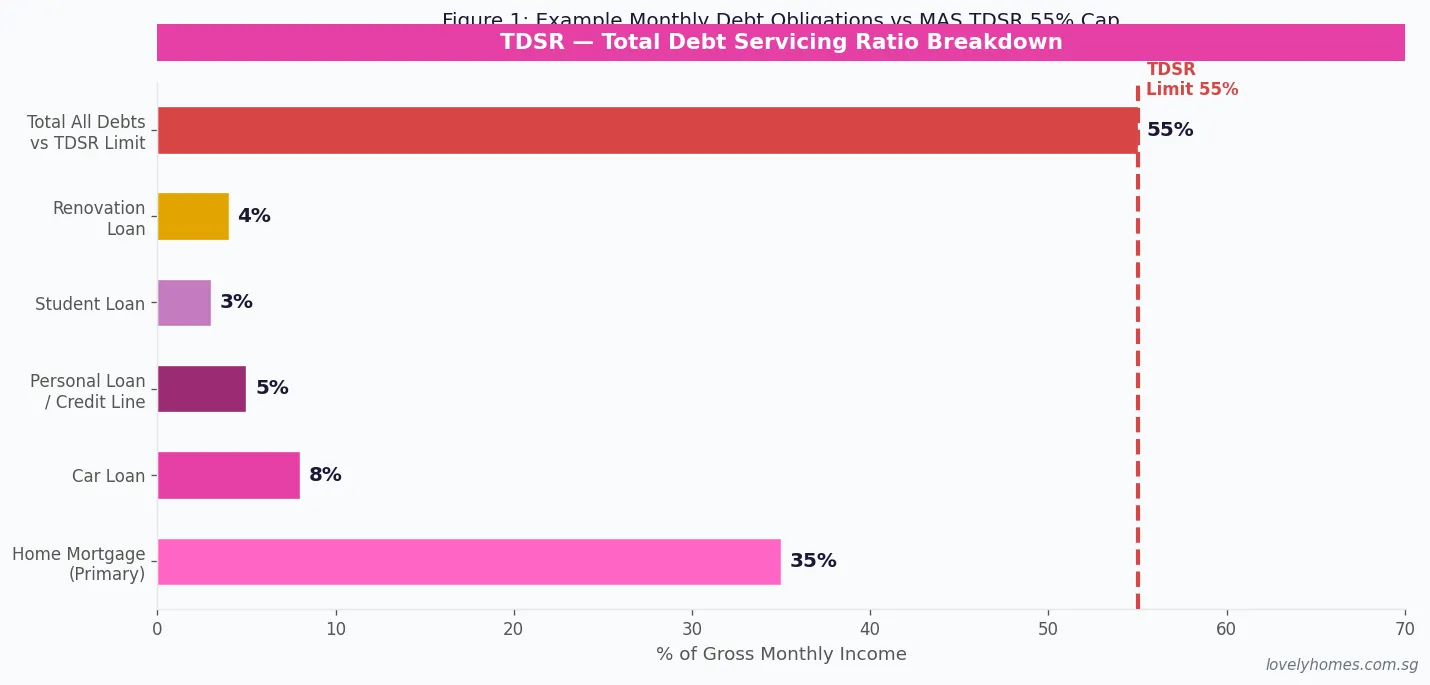
Figure 3: How different existing-debt profiles crater the monthly headroom available for a new mortgage, given a household earning S$10,000 gross.

Consider a dual-income couple: combined gross monthly salary S$10,000, both on fixed pay, no variable component. They are looking at a S$1.8 million resale private condo in District 15.

Step 1 — TDSR cap. 55% × S$10,000 = S$5,500. No MSR applies because this is a private condo.

Step 2 — Existing debts. One car loan at S$800/month and revolving credit balances generating a S$300/month minimum payment. Total existing obligations: S$1,100.

Step 3 — Headroom for the new mortgage. S$5,500 − S$1,100 = S$4,400 per month available for the new home loan instalment.

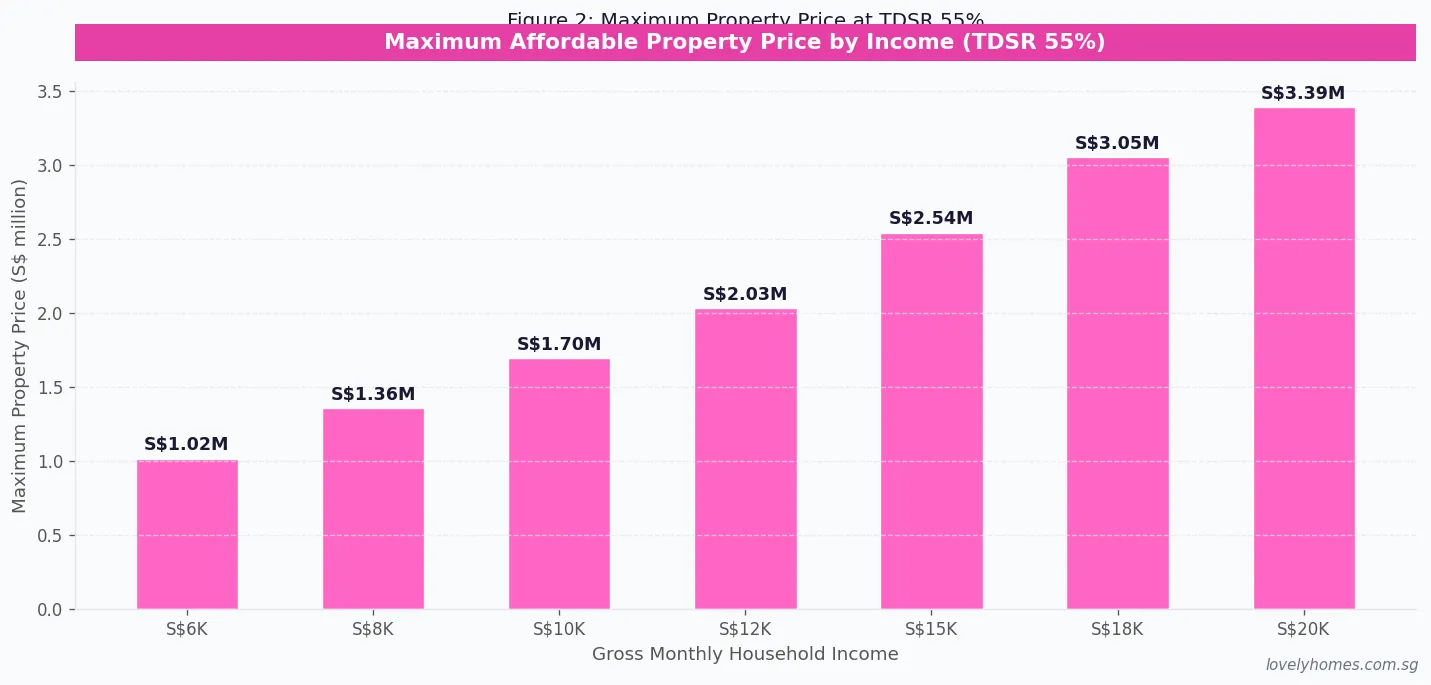
Step 4 — Maximum loan principal. At the 4.0% stress rate over a 30-year tenure, S$4,400 monthly funds approximately S$922,000 of loan principal (standard amortisation formula: P = M × [(1 − (1 + r)^(−n)) / r]).

Step 5 — LTV cap. At 75% LTV on an S$1.8m purchase, the bank could lend up to S$1,350,000 — but TDSR limits them to S$922,000 here, so TDSR binds, not LTV. The couple needs S$878,000 of combined cash and CPF equity.

Flip the same household to an HDB flat at S$700,000: now MSR binds first. 30% × S$10,000 = S$3,000 maximum mortgage instalment. That fundamentally funds roughly S$628,000 — well below the 75% LTV ceiling of S$525,000… wait. In this case the 75% LTV actually binds below MSR, because S$525,000 of loan needs only about S$2,500/month at 4.0% over 25 years, comfortably inside MSR. So the couple’s CPF-plus-cash needs to fill the remaining S$175,000.

These two scenarios show the recurring pattern: for HDB/EC buyers, MSR or LTV usually binds; for private/landed buyers, TDSR usually binds. The flow of the calculation matters, and every added dollar of existing debt has a disproportionate impact through the 30-year amortisation lever.

How to Legitimately Maximise Your Borrowing Ceiling

Nothing below involves gaming the system — each lever is recognised by banks and MAS. Together they can add S$200,000–S$400,000 to a buyer’s loan ceiling.

  • Close dormant credit facilities. A S$50,000 unused overdraft or a clutch of credit cards still hits TDSR via the 3% minimum rule. A week of admin before you apply for pre-approval can move the needle.
  • Pay down the car loan. High-instalment vehicle finance is the single most common TDSR killer. A S$1,000 monthly car note costs you roughly S$210,000 of home-loan capacity at 4.0%/30yr.
  • Lengthen the tenure (cautiously). A 30-year tenure beats a 25-year one on headline TDSR because the stress-rate instalment is lower — but watch the age-65 and 30-year triggers that knock the LTV down 20 points.
  • Co-apply with a higher earner. Joint applications aggregate income and debt. If spouses have different debt loads, consider which combination maximises the pooled headroom.
  • Formalise variable income. A commissioned sales professional with one year of written contracts may be haircut more heavily than one with two years of NOAs. Waiting one tax cycle can unlock meaningful capacity.
  • Use a Loan Assessment before committing. Banks in Singapore offer in-principle approval (IPA) at no cost. Three IPAs from different banks let you benchmark the figure.

How Singapore’s Framework Compares Globally

Singapore is not alone in prescribing debt-service ratios, but its combination is unusually strict. Hong Kong applies a 50% debt-service ratio with a 70% LTV cap for first-time owner-occupiers — broadly comparable but no separate MSR for public housing. The United Kingdom uses a 4.5× income loan-to-income ratio at most lenders (soft cap), with affordability stress-tested at 3 percentage points over the reversion rate. Australia’s prudential regulator APRA applies a serviceability buffer of 3 percentage points over the contracted rate — a rule-of-thumb approach rather than a hard ratio.

The common thread in all four jurisdictions is a stress-test mechanism designed to withstand a rate spike. Singapore’s 4.0% medium-term rate is higher (more conservative) than the contracted-rate buffers used in the UK and Australia, which is one reason Singaporean household debt has been more resilient through recent cycles than peers. MAS has been explicit that this is by design: household leverage is viewed as a systemic risk, not purely a consumer-protection issue.

What Might Come Next — The Forward View

The 4.0% stress rate has held since September 2022. Three scenarios could prompt a revision in the next 12–18 months:

  • Sustained higher long-term rates. If three-month SORA settles above 3.5% on a durable basis, MAS may nudge the medium-term rate to 4.25% or 4.5% to preserve the buffer it represents.
  • Renewed leverage in the private condo segment. If luxury-segment TDSR headroom is being used aggressively to bid up prime-district prices, expect tighter LTV on second/third loans rather than a TDSR change.
  • Public housing affordability stress. If HDB resale prices outrun wage growth materially, MSR could tighten from 30% to 25%. This would be the single most consequential move for first-time buyers.

None of the above is signalled by MAS at the time of writing (April 2026) — but the Financial Stability Review due in November 2026 is the data release to watch. Historically MAS has adjusted TDSR and MSR in the December statement that accompanies the cooling-measures package.

Frequently Asked Questions

1. Does TDSR apply to refinancing my existing mortgage?
For owner-occupied properties, a clean refinance without any cash-out and without extending the principal is generally exempted from TDSR under a carve-out MAS introduced to avoid penalising existing borrowers. If you take a cash-out top-up or increase the principal, the full TDSR test applies. For investment-property refinancing, TDSR applies in full regardless of cash-out status, so build in a review of your current debt profile before signing any refinance Letter of Offer.

2. How is TDSR calculated if I am self-employed with irregular income?
Banks use two years of Notice of Assessment (NOA) as the primary evidentiary source, take the simple average, apply the 30% haircut, and treat the resulting figure as your recognised gross monthly income. A particularly strong year — say a bumper bonus — will be smoothed. If you have less than two years of NOAs the bank will often decline or require a significantly larger down-payment. Incorporating yourself through a Pte Ltd does not change this; director’s remuneration drawn as salary is still subject to the haircut.

3. Can I borrow more by stretching the loan tenure?
Up to a point, yes. A 30-year tenure reduces the stress-rate instalment versus a 25-year tenure, increasing how much loan principal S$4,400 (in our worked example) can support. But two triggers cap the benefit: if your loan extends past age 65 or exceeds 30 years (25 for HDB), the LTV cap drops by 20 percentage points — from 75% to 55% on a first loan. The net effect is usually worse, not better. Most brokers recommend landing the tenure such that the loan concludes at or just before age 65.

4. Are joint-borrower applications better than going solo?
Usually, because they aggregate income while both parties still share the TDSR ceiling. The nuance is “income-weighted average age” for tenure calculations — if a 55-year-old and a 35-year-old co-apply, the bank blends their ages by income share to determine the maximum allowable tenure. Adding a much older co-applicant to a younger borrower can shorten the tenure and reduce the headroom on paper. Structured correctly, joint applications reliably produce higher approvals than solo for dual-income households.

5. What happens to TDSR if interest rates fall sharply?
Nothing, in the short run. The 4.0% stress rate is a regulatory input, not a market rate. Falling SORA means your actual monthly instalment shrinks and your actual debt-service ratio improves, but the ceiling at which MAS sets the TDSR bar is unchanged. Over a multi-year horizon, if rates settle well below 4.0% on a sustained basis, MAS may consider lowering the stress rate — but the precedent is that adjustments are infrequent (the last move was September 2022).

6. Does CPF Ordinary Account balance count as income for TDSR?
No. CPF OA is treated as equity (part of the down-payment and subsequent instalments), not as income. The monthly CPF contribution inflow also does not count as additional income — your CPF contributions are already a reduction from your gross pay, and gross pay is what banks use. The only way CPF affects borrowing capacity indirectly is through the Home Protection Scheme (for HDB loans) and through the cash-CPF split in the down-payment.

7. I was denied because of TDSR — what are my options?
First, get the denial reasoning in writing and compare it with a second IPA at a different bank — underwriting interpretations vary on edge cases, particularly around variable income and guarantor obligations. Second, tackle the debt side: clear a car loan, consolidate or close credit cards, discharge a guarantor role. Third, stretch the timeline: a fresh NOA next April may unlock the variable-income shortfall. Fourth, reduce the target property price — a 10% lower purchase price typically requires a proportionally smaller loan and therefore a smaller headroom. Finally, consider a joint application with a fixed-income parent (though this binds their future TDSR too).

Related LovelyHomes Guides

Disclaimer

This article is an editorial guide for general information only and does not constitute financial, legal or mortgage advice. The figures quoted reflect rules in force on the date of publication (April 2026) and may change. Confirm the authoritative position with the Monetary Authority of Singapore (MAS), the Housing & Development Board (HDB), your bank’s credit officer and a licensed mortgage broker before committing to any loan or property purchase. Interest-rate scenarios and worked examples are illustrative; your actual borrowing ceiling depends on the full underwriting review at application.

First-Time Home Buyer Singapore 2026: The Complete Walkthrough

First-Time Home Buyer Singapore 2026: The Complete Walkthrough

Buying your first home in Singapore is the single largest financial decision most people ever make. It has regulatory gates (HFE, TDSR, MSR), financial gates (downpayment, stamp duty, renovation), and procedural gates (OTP, resale application, completion). This 2026 walkthrough moves through all eight gates in the order you will actually encounter them.

If you are still deciding between flat types, read our comparison of BTO, resale and EC first. This article assumes you know roughly what you want to buy, and are ready to work out how.

Quick Answer — The 8 Gates

  1. Budget and debt audit — work out TDSR and MSR.
  2. HFE letter or bank IPA — locks your loan ceiling.
  3. Shortlist and compare — narrow to 3–5 options.
  4. Viewings and offer — expect 3–8 viewings before firming.
  5. OTP and option fee — commits both parties.
  6. Stamp duty and loan drawdown — the money phase.
  7. Completion — legal transfer and final balance.
  8. Keys and renovation — you own a home.
First-time home buyer 8-step journey Singapore 2026
Every Singapore first-time buyer moves through the same eight gates — in order.

Gate 1: Budget and Debt Audit

Before you look at a single listing, sit down with your household income and debt obligations. Two ratios govern what banks will lend you:

  • TDSR 55%: All monthly debts (existing loans, minimum credit-card payments, new home loan) must be at or below 55% of gross income.
  • MSR 30%: For HDB and EC buyers only — home loan alone is capped at 30% of gross income.

See our detailed TDSR and MSR guide for a worked example.

Work out your upfront cash

Your upfront cash comprises:

  • Option fee and exercise fee (HDB: up to S$5,000 total; private: typically 5% of purchase price)
  • Downpayment beyond CPF (minimum 5% cash for all property types with a bank loan)
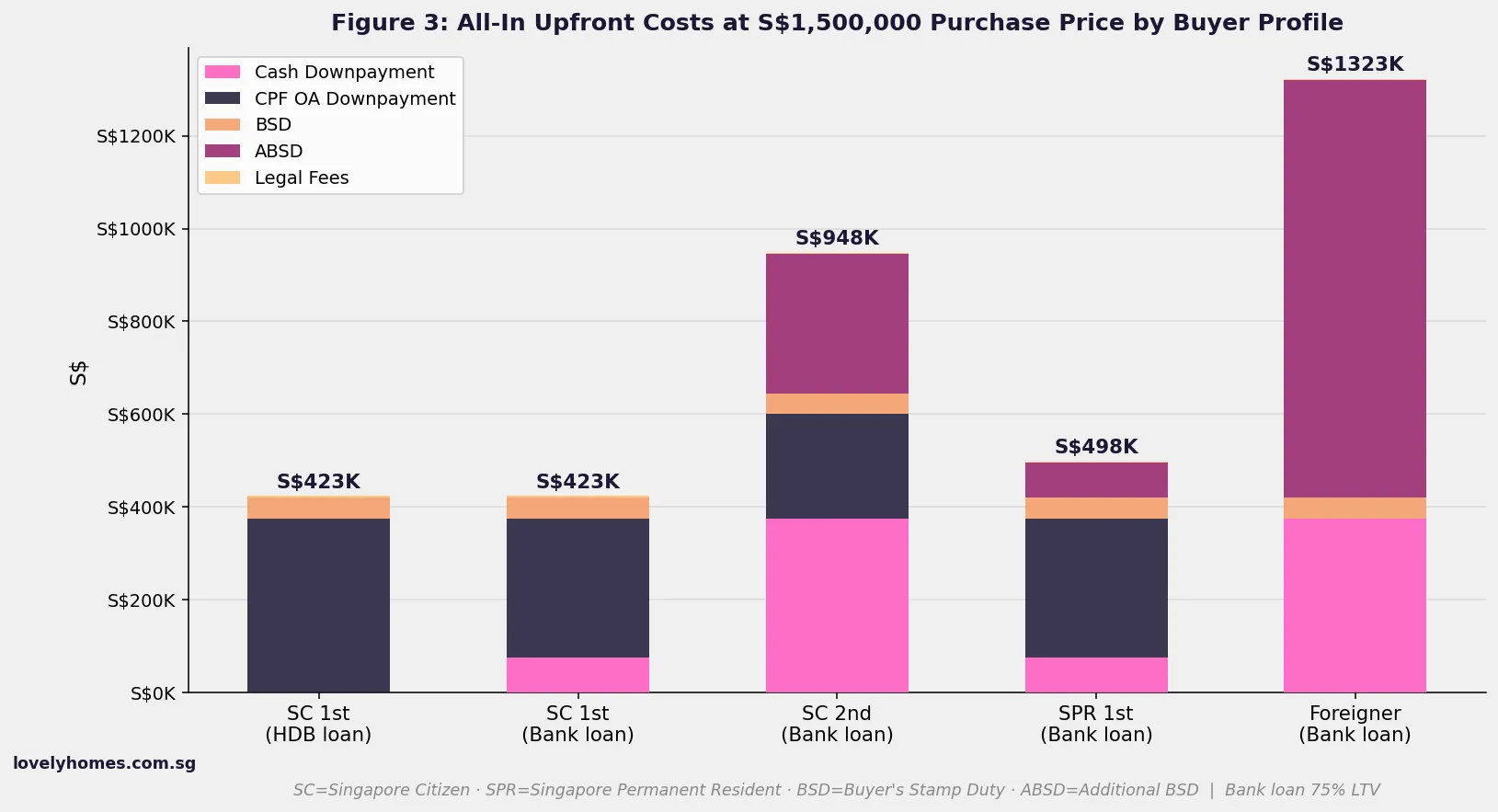
  • Buyer Stamp Duty (BSD) — see our BSD guide
  • ABSD if applicable — see our ABSD guide
  • Legal fees, valuation fees, agent commission
  • Renovation buffer — typical 3–5 room HDB renovation runs S$50k–S$100k

Gate 2: HFE Letter or Bank IPA

With the maths squared away, you need a financing lock:

  • HDB route: Apply for an HFE letter via the HDB Flat Portal. Takes ~2 weeks. Valid 6 months.
  • Private condo route: Apply for Bank IPA (in-principle approval). Typically 3–5 working days. Valid 30 days.

An HFE or IPA is the document a seller or developer will ask to see before engaging seriously. It also tells you how much you can actually borrow, which constrains your flat search.

Gate 3: Shortlist and Compare

Use the HDB Resale Portal (for HDB), 99.co, PropertyGuru, and our own LovelyHomes listings (for private) to narrow a shortlist. Criteria that matter:

  • Transport: Walking distance to MRT, commute to work, future Cross Island Line / Jurong Region Line stations.
  • Schools: 1km and 2km catchment for primary schools if you have young children.
  • Layout: North-South orientation, natural ventilation, bomb shelter location.
  • Remaining lease (HDB): Affects loan tenure and CPF usage.
  • Maintenance fees (private): Check the strata table for the monthly MCST fee.

Gate 4: Viewings and Offer

Expect 3–8 viewings before you firm on a unit. At each viewing, check:

  • Water pressure and drainage (run taps, flush toilets)
  • Ceiling for water staining (upstairs leaks)
  • Door frames for termite damage
  • Window seals for water ingress
  • Electrical outlet locations and DB box condition
  • Noise during the day and evening

When you are ready to offer, recognise that asking prices are typically 3–8% above the agreed-on transaction price for HDB resale, and 5–10% for private condos. Start below asking.

Gate 5: OTP and Option Fee

Once price is agreed, the seller issues the Option to Purchase:

  • HDB resale: S$1,000 option fee (fixed by HDB). 21 days to exercise.
  • Private resale: 1% of purchase price. 14 days to exercise.
  • New launch condo: 5% on booking, then S&P Agreement within 8 weeks.

This is the commitment point. Engage a conveyancing lawyer during this window, and if buying private with a bank loan, lock the loan offer now.

Gate 6: Stamp Duty and Loan Drawdown

Within 14 days of OTP exercise, you must pay Buyer Stamp Duty via IRAS. If ABSD applies (second or subsequent property, PR, or foreigner), it is due at the same time. Your lawyer will handle the filing and remittance.

Your bank will now process the loan in earnest. They will send a valuer to the property, finalise the loan offer, and coordinate with your lawyer for completion.

Gate 7: Completion

For HDB, completion happens at the HDB Hub, typically 8–12 weeks after the resale application. For private, it happens at your lawyer’s office, typically 8–12 weeks after OTP exercise. At completion:

  • You pay the final cash balance
  • Your CPF is debited for the CPF portion
  • Your bank disburses the loan
  • The seller receives the proceeds
  • Legal title transfers to you
  • You receive the keys

Gate 8: Keys and Renovation

Congratulations — you own a home. From this point:

  • Apply for HDB renovation permit if structural changes (hacking, plumbing relocation).
  • Pay renovation deposit (HDB: S$200 refundable; MCST: varies).
  • Attend fire-safety briefing (HDB only) before renovation begins.
  • Budget realistically: 4-room HDB renovation runs S$50,000–S$80,000 on average in 2026.
  • MOP clock starts (HDB and EC) from the completion date.

Worked Example: S$780,000 BTO Flat, First-Timer Couple

A married couple, both SCs, combined monthly income S$9,500, buying a 4-room BTO in Tengah at S$380,000 (Standard flat):

Component Amount
Purchase price S$380,000
CPF Housing Grant (EHG) S$55,000
Effective price S$325,000
HDB loan @ 75% S$244,000
Downpayment (cash + CPF) S$81,000
Of which minimum cash S$16,300 (5%)
Buyer Stamp Duty S$5,700
Legal fees ~S$500
Minimum cash upfront ~S$23,000
Monthly HDB loan (25 yr, 2.6%) ~S$1,108

Against a household income of S$9,500, this represents an MSR of 11.7% — well inside the 30% limit. TDSR is also comfortable if there are no other debts.

Common Mistakes First-Timers Make

  • Viewing first, financing second. Without an HFE or IPA, you cannot make a binding offer.
  • Forgetting renovation cost. Budget S$50k–S$100k. It is often the second-largest cost after the downpayment.
  • Ignoring CPF accrued interest. The CPF you use will need to be returned with ~2.5% annual compounding when you sell. See our CPF guide.
  • Choosing HDB Legal for complex cases. HDB Legal is great for straightforward cases but offers no flexibility if your situation has quirks (trust ownership, divorce partial transfer, etc).
  • Maxing the loan tenure. The longest tenure minimises instalments but means vastly more interest over time.

FAQ — First-Time Buyer 2026

How long does the whole process take from first viewing to keys?

For HDB resale: 4–6 months. For private condo: 3–5 months. For BTO: add the 3–5 year build wait after selection.

Can I use my parents’ CPF to buy?

Yes, if they are named as co-applicants or under the Essential Occupier scheme. Their contribution becomes a charge on the flat like any other CPF usage.

Should I choose HDB loan or bank loan?

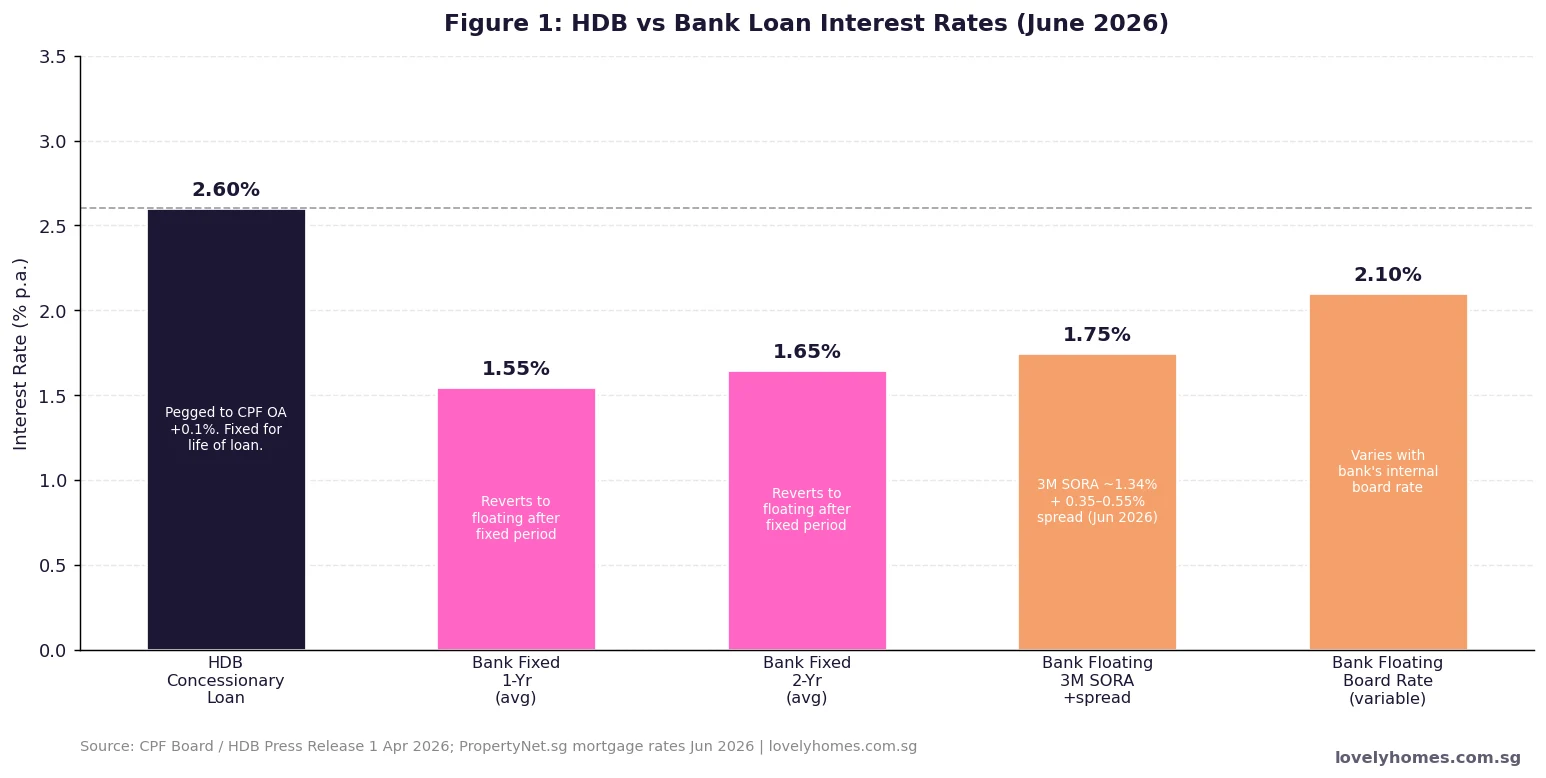
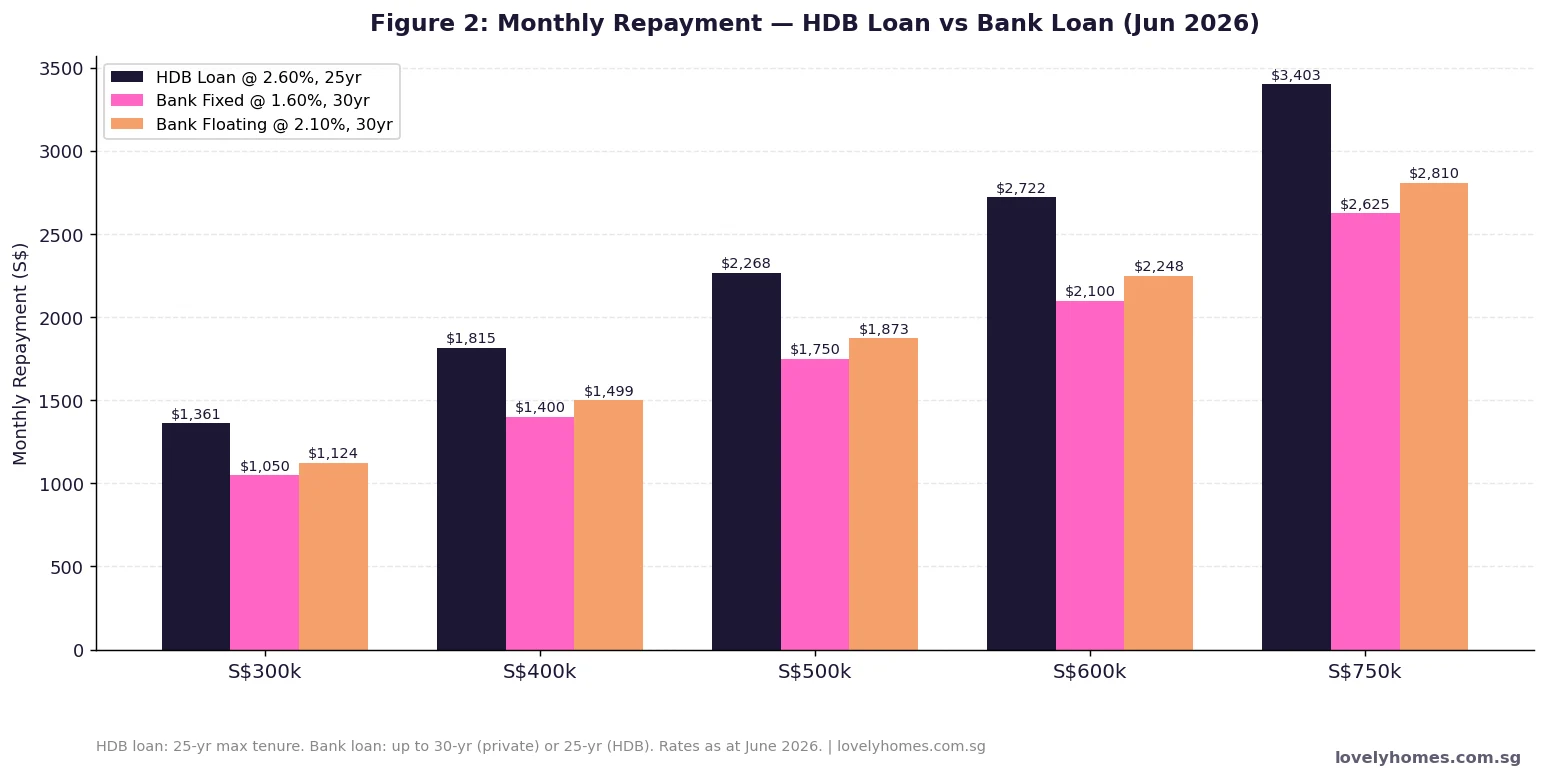
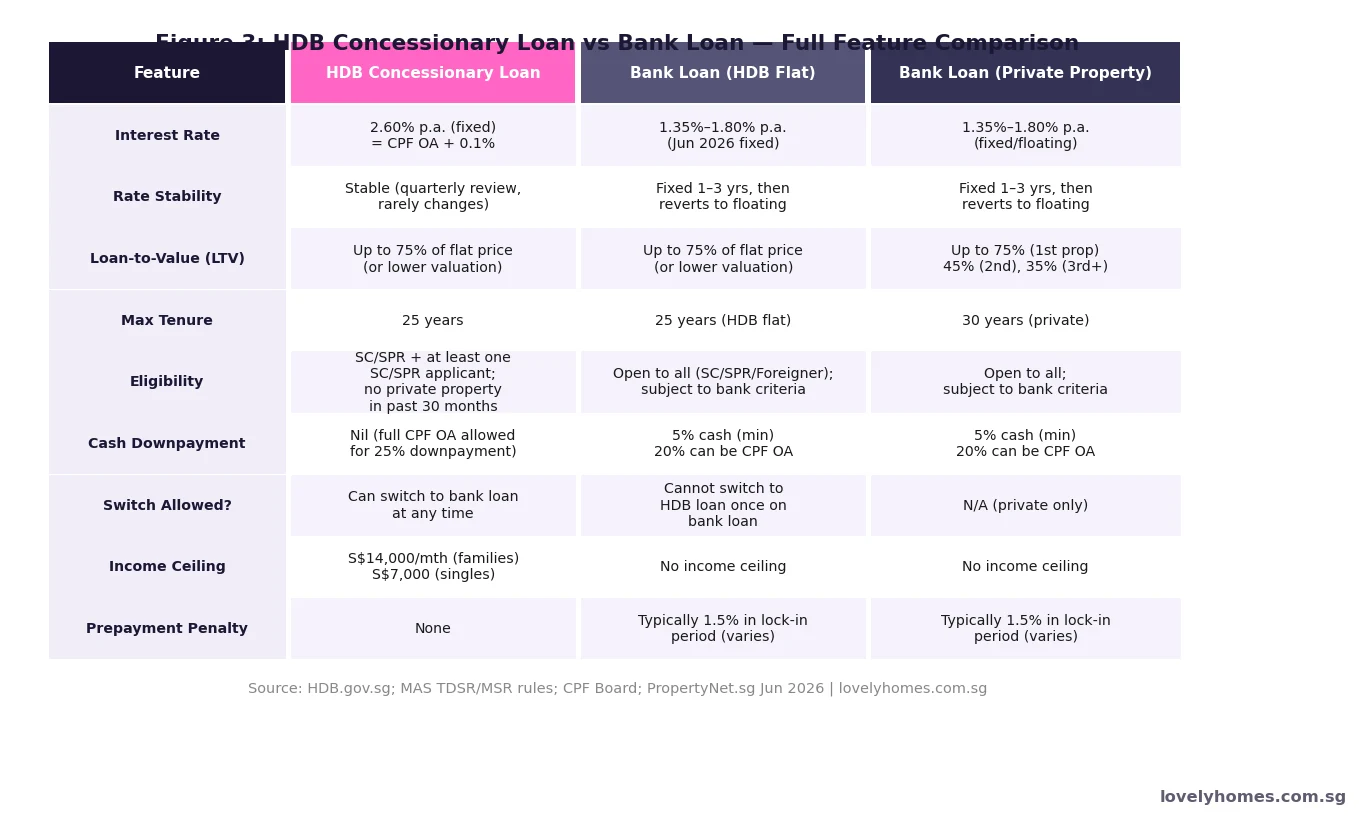
HDB loan: fixed 2.6% rate, forgiving on TDSR stress test, flexible on prepayment. Bank loan: potentially lower floating rates but exposed to SORA volatility. See our fixed vs floating guide.

Do I need a lawyer for my first home purchase?

Yes. For HDB, the HDB Legal service is low-cost. For private, you will need an external conveyancing firm. Expect to pay S$2,000–S$3,500 including disbursements.

What grants am I eligible for as a first-timer?

CPF Housing Grant (up to S$80k for families depending on income), Enhanced CPF Housing Grant, and Proximity Housing Grant if living near or with parents. Your HFE letter will compute your exact entitlement.

Disclaimer: Regulations, rates and grants change over time. Verify current rules with HDB, your bank, and IRAS before committing. Consider engaging a qualified financial advisor for tax and CPF planning on large purchases.


Bridging Loan Singapore 2026: How to Buy Before You Sell

Bridging Loan Singapore 2026: How to Buy Before You Sell

A bridging loan in Singapore is a short-term loan — typically 3 to 6 months — that covers the gap between buying your next home and receiving the sale proceeds from your current one. For upgraders who want to move into the new place before the buyer of the old one pays up, the bridge is often the single tool that makes the whole sequence possible without triggering a 20%+ ABSD bill.

This 2026 guide walks through how a bridging loan works, when it beats paying ABSD upfront, what it actually costs, and the scenarios where a bridge genuinely rescues an upgrade vs the ones where it quietly lights cash on fire.

Quick Answer — Bridging Loan at a Glance

  • Tenure: typically 3–6 months, interest-only.
  • Rate: typically 5%–6% p.a. (materially higher than a normal mortgage).
  • Amount: bridges the downpayment of the new property, backed by expected sale proceeds of the current one.
  • Purpose: lets you avoid holding two properties simultaneously (which triggers ABSD).
  • Cost: S$5k–S$10k for a typical 3-month bridge — usually far less than the ABSD it avoids.

Why Bridging Loans Exist: The Upgrader’s Timing Problem

Singapore’s ABSD regime penalises buyers who hold two residential properties at the same time. A Singapore Citizen upgrading from an HDB flat to a condo pays 20% ABSD on the new property if they complete the purchase before the old HDB is sold. On a S$1.5m condo, that is S$300,000 in ABSD — potentially claimable back six months later under the married couple remission, but only if the old property sells on time.

The cleanest way to avoid that 20% outlay is the sell-first, buy-second route. But this creates a different problem: where do you live while waiting to complete your new home? Renting is expensive and disruptive, and the mechanics of moving a family twice in a year are brutal.

Bridging loans solve the cash-flow mismatch so you can effectively buy-first-sell-second without ever holding both properties at completion.

How a Bridging Loan Works, Step by Step

Bridging loan Singapore timeline diagram showing existing home sale, bridging drawn, both homes overlap and sale repays bridge
Figure 1: Your existing home sells after your new home completes — a bridging loan covers the downpayment on the new home until sale proceeds arrive.
  1. You sell your existing home. OTP exercised, buyer’s 5% deposit received, completion date agreed (typically 10–14 weeks out).
  2. You buy your new home. OTP exercised on new property, downpayment due before your old sale completes.
  3. The bridging loan is drawn. Your bank issues a loan of up to 80% of the expected sale proceeds to fund the new downpayment. Interest accrues monthly at ~5–6% p.a. (interest-only, no principal repayment).
  4. Sale of old home completes. Proceeds flow straight into the bridging loan, clearing principal and accrued interest in one tranche. Any surplus is yours.
  5. Normal mortgage on new home continues. The bridge is gone; you carry only the new home’s regular mortgage.

Costs and Rates

Singapore bridging loans typically charge 5%–6% per annum, payable monthly on the outstanding balance. Banks rarely charge formal setup fees, but valuation and legal costs can total S$1,500–S$2,500.

Worked example: S$400k bridge for 4 months

  • Bridge amount: S$400,000
  • Rate: 5.5% p.a.
  • Interest per month: S$400,000 × 5.5% / 12 = S$1,833
  • Total interest over 4 months: S$7,333
  • Plus ~S$2,000 in legal/valuation
  • All-in cost: ~S$9,333

Compare that to the alternative: pay 20% ABSD of S$300,000 upfront on the new property, tying up cash for 6+ months while waiting for the remission refund to arrive. A bridging loan is almost always cheaper.

Two Flavours of Bridging Loan

  • Capitalised bridging loan (HDB-style): interest rolls into the loan and is paid off together with principal at sale completion. Simpler, slightly more expensive.
  • Simultaneous repayment bridging loan: monthly interest paid from your cash-flow during the bridge period. Slightly cheaper in absolute terms but requires ongoing cash outlay.

Most banks offer both; ask for quotes on each.

When a Bridging Loan Makes Sense

  1. You have a firm buyer for your existing home. OTP exercised, 5% deposit received. Banks require this as proof of expected sale proceeds.
  2. You are buying within 3–6 months of the old sale completing. Longer gaps make the interest cost unpalatable.
  3. You cannot wait for the old sale to complete before buying. If the new property is a once-in-a-decade opportunity (unit you’ve been watching for years, developer early-bird), time-sensitivity justifies the cost.
  4. You would otherwise pay ABSD and claim refund. The bridging interest is almost always less than the opportunity cost of parking 20% of purchase price with IRAS for 6+ months.

When a Bridging Loan is a Trap

  1. Your existing home hasn’t sold. Without a firm OTP, no bank will issue a bridging loan. Some private lenders will, at 8%+ — almost never worth it.
  2. Your buyer falls through. If your buyer rescinds or fails to complete, your bridging loan converts into a permanent, high-cost second mortgage. Make sure your buyer is well-qualified.
  3. Your sale completion slips. Each month of delay costs another S$1,800–S$2,000 on a S$400k bridge. Build a realistic completion timeline, not a hopeful one.
  4. You are eligible for the married couple ABSD remission anyway. If you are an SC couple upgrading, you may pay ABSD upfront and claim it back within 6 months of the new property’s TOP. The bridging loan just moves the cash-flow friction; it does not eliminate stamp duty.

Bridging Loans vs. ABSD Remission: The Real Comparison

Most Singaporean upgraders have two viable paths for buying before selling:

  • Path A: Pay ABSD, claim remission. Pay 20% ABSD (S$300,000 on a S$1.5m buy) up front. Sell old home within 6 months of new property’s completion (TOP). Claim full remission. Time value of money lost: ~S$7,500 at 2.5% p.a. for 6 months. No bridging interest.
  • Path B: Take bridging loan. Sell old home first (complete before new buy), use bridge to fund new downpayment. Pay 0% ABSD on new property. Bridging interest cost: ~S$7,000–S$10,000.

Path B is usually cheaper in absolute terms. Path A is simpler (no sale-timing risk) and is the default if your existing home is in a slow-selling segment.

How to Apply

Every major Singapore bank offers bridging loans. The application flow is standard:

  1. Get an OTP on your new property and OTP-back on your existing home (from the buyer).
  2. Approach your intended bank for both the new-home mortgage and the bridge as a joint application.
  3. Submit the old-home OTP as proof of expected sale proceeds.
  4. Bank values both properties, confirms bridge quantum.
  5. Bridge is drawn at the new-home completion; settled at old-home completion.

Most banks insist you take the new mortgage from them too — bridging loans are effectively a loss-leader to capture the long-term mortgage customer.

Frequently Asked Questions

Can I get a bridging loan if my existing home has not yet received an OTP?

Not from a mainstream bank. Some private financing providers will consider it, at rates starting around 8% p.a. In almost every case, it is cheaper to delay the new purchase than to use private financing.

What happens if the sale of my existing home falls through?

The bridging loan becomes due at the original 6-month mark. Most banks will consider extending or converting to a term loan, but at materially higher rates. Always plan for this contingency by having a backup buyer or a Plan B.

Is the interest on a bridging loan tax-deductible?

Generally no for owner-occupied property. Investment property rules differ — consult a tax professional.

Can I use CPF to service the bridging loan?

No. Bridging loans must be serviced in cash. CPF can fund the underlying downpayment but not the bridge interest.

What is the maximum bridge amount?

Typically 80% of the expected net sale proceeds of the existing property, subject to the bank’s internal risk assessment.

What to Do Next

  1. ABSD Singapore 2026 Complete Guide — the tax the bridging loan helps you avoid.
  2. Condo Downpayment Singapore 2026 — what the bridging loan is actually funding.
  3. All Home Loans & Mortgages.

Disclaimer: This guide is general information, not financial advice. Bridging loan terms vary by bank and property profile. Always consult a licensed mortgage broker before committing to a bridge and upgrade sequence.


Fixed vs Floating Home Loan Singapore 2026: Which Should You Pick?

Fixed vs Floating Home Loan Singapore 2026: Which Should You Pick?

Choosing between a fixed vs floating home loan in Singapore is the single biggest interest-rate decision most Singaporeans ever make. Get it right, and you save S$200–S$500 a month on a typical condo mortgage. Get it wrong — lock in fixed just before a rate cut, or float into a rate-hike cycle — and the same decision costs you S$50,000+ over a loan term.

This 2026 guide cuts through the bank-marketing gloss. No one knows where SORA will be in two years, but the decision framework is knowable. Here it is.

Quick Answer — Fixed vs Floating 2026

  • Fixed: 2.55%–2.85% for 3-year packages; instalment locked; 1.5% penalty if you break lock-in.
  • Floating (SORA): 2.25%–2.55% headline; resets every 1 or 3 months; usually no or light lock-in.
  • Fixed wins when: you prioritise certainty, have tight cashflow, or expect rates to rise.
  • Floating wins when: you have rate-shock buffer, are planning to sell within 2–3 years, or believe rates are peaking.
  • Neither is strictly better — it depends on your time horizon and cash-flow tolerance.

What “Fixed” and “Floating” Actually Mean

A fixed-rate package contractually locks in your interest rate for a set term, typically 1, 2, 3, or 5 years. Your monthly instalment is flat; the bank bears the rate risk. At the end of the fixed term, the loan reverts to a floating rate (a “rollover” rate set by the bank) until you refinance or the loan matures.

A floating-rate package is priced as a benchmark plus a spread. In Singapore, the benchmark is almost always SORA 3M (the Singapore Overnight Rate Average, compounded over 3 months). A typical quote: “SORA 3M + 0.60% p.a., no lock-in”. Your rate resets every 1 or 3 months depending on the reset frequency.

Fixed vs floating home loan Singapore 2026 side-by-side comparison showing rates, lock-in and rate risk
Figure 1: Same loan, two packages. The gap in headline rate is small; the gap in lock-in and rate risk is the real decision.

The 2026 Rate Environment

SORA 3M is currently sitting around 2.3% after peaking at 3.9% in late 2023. Market consensus for 2026–2027 is a gradual drift to 2.0%–2.5%, with the Fed’s trajectory dominating.

In this environment, fixed rates and floating rates are pricing close: 3-year fixed packages quote around 2.55%–2.85%, and floating SORA+spread packages quote 2.25%–2.55%. The floating edge is roughly 30 bps.

Banks price this way because they are hedging a forward rate view. If banks thought rates would fall sharply, fixed rates would be materially cheaper than floating (banks want to lock in the highest rate they can). If they thought rates would rise, fixed would be materially more expensive.

When Fixed Wins

Fixed is the right call if any of the following apply:

  1. Tight monthly cash-flow. If a 100-bps rate rise would make your monthly instalment uncomfortable, pay the small fixed-rate premium for certainty.
  2. First-time buyer. First-time buyers often have the least cash buffer; predictability outweighs marginal rate savings.
  3. Property bought for the long haul. If you intend to hold 10+ years, locking in 3 years of certainty through the next rate cycle is worth it.
  4. Macro view: rising rates. If you believe the Fed or MAS will hike, fixed hedges you. The bank is taking the other side of that bet at a market-cleared price, but if your macro read is strong, that is the trade.

When Floating Wins

Floating is right when:

  1. You plan to sell or upgrade within 2–3 years. Floating packages typically have no lock-in past month 6–12. Fixed packages impose a 1.5% penalty that can cost S$12,000+ on an S$800k loan.
  2. You have substantial cash reserves. A 6-month emergency fund means you can ride out a 100-bps hike without distress.
  3. Macro view: falling or flat rates. Floating captures every cut as it happens; fixed locks you out of savings.
  4. You’re a property investor. Investors typically prioritise net yield and use cash buffers to manage rate risk; floating usually wins over an investment holding period.

The Hybrid Options

Two hybrid structures are popular in 2026:

  • Fixed-then-floating (“step-up”). 2-year fixed at 2.65%, converts to SORA+spread thereafter. Gives you short-term certainty with upside later.
  • Partial split. Some banks let you split the loan — e.g. 50% fixed, 50% floating. Effective blended rate halfway between the two packages, and you diversify rate risk.

The hybrid approaches are rarely dominated by a pure fixed or floating choice — they usually emerge as “middle” options when banks want to compete on flexibility.

Lock-In: The Real Cost Driver

Lock-in is more important than headline rate for most borrowers. A 2.85% 3-year fixed with a 3-year lock-in effectively bets you do not need to refinance or sell before month 36. If rates fall 50 bps and you want to switch, you pay 1.5% of outstanding — often S$10,000–S$15,000 — to break the lock-in.

Floating packages typically waive the lock-in after 6–12 months. This portability is why floating wins for anyone who might move, upgrade, or refinance mid-term.

SORA Reset Frequency: 1M vs 3M

Most floating packages now price against 3M SORA (the 3-month compounded average). The 1M version resets faster — you capture rate cuts sooner but also eat rate hikes sooner. In 2026’s low-volatility environment, 3M is slightly cheaper on spread but marginally less reactive.

The replacement of SIBOR and SOR with SORA was completed in mid-2024; any legacy SIBOR/SOR loans have been migrated or are on run-off.

Worked Comparison: S$800k Loan Over 25 Years

Consider two competing packages today for an identical loan:

  • Package A — 3Y Fixed at 2.75%: monthly S$3,691, lock-in 3Y, 1.5% break penalty (S$12,000).
  • Package B — SORA 3M + 0.55% (~2.30% effective): monthly S$3,516, lock-in 6M, no break penalty after.

If rates stay flat, Package B saves S$175 × 36 = S$6,300 over the first 3 years, with no lock-in risk. If SORA rises 100 bps, Package B payment rises to ~S$4,015 — S$324 more than A after the rise. Package B bet loses S$7,500 over 2 years of hikes.

The cross-over point is roughly a 60 bps sustained rise. Your view on that probability decides the trade.

Frequently Asked Questions

Can I switch from floating to fixed mid-term?

Yes, by refinancing or re-pricing with your existing bank. Re-pricing usually has no cost; refinancing has switching costs. Both are subject to whatever lock-in remains.

What if I want to prepay part of the loan?

Most packages allow partial prepayment of up to 25% of outstanding per year without penalty. Check the specific prepayment clause — some fixed packages are stricter.

Do I need MRTA (mortgage reducing term assurance)?

Not technically required for bank loans on private property, but most buyers take it. HDB loans with CPF require the HPS (see our CPF for Property guide).

Is there still SIBOR or SOR in 2026?

No. Both benchmarks were retired in mid-2024 and replaced with SORA. Any remaining SIBOR/SOR references in older documentation should be treated as historical.

Should I time the refinance to Fed meetings?

Marginally useful. Fed rate decisions move SORA, but banks lag Fed moves by weeks. The more reliable signal is your own lock-in expiry date — see our refinancing guide.

What to Do Next

  1. Home Loan Refinancing 2026 — the same decision, applied at your package reset.
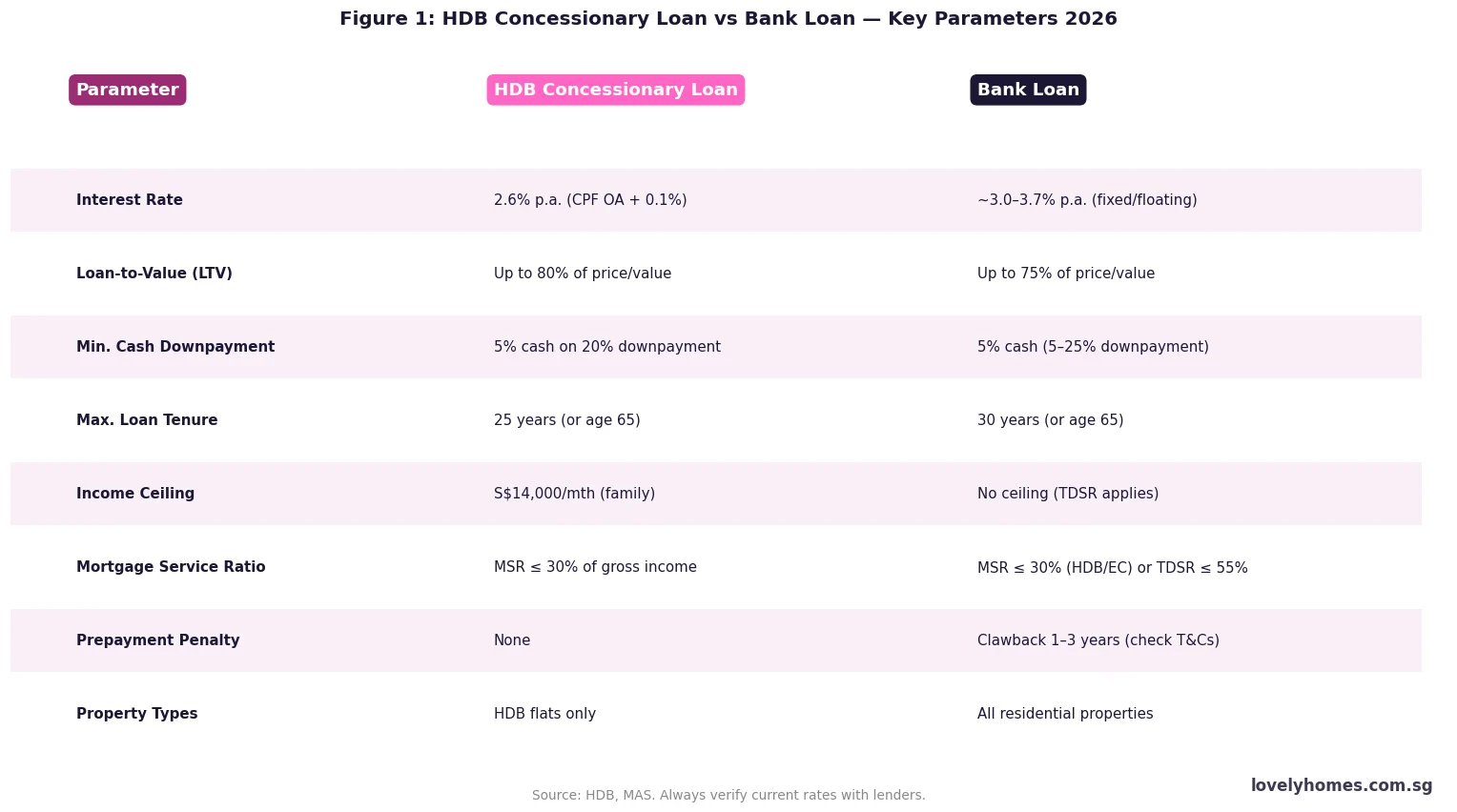
  2. HDB Loan vs Bank Loan — fixed vs floating only applies to bank loans.
  3. All Home Loans & Mortgages.

Disclaimer: This guide is general information, not financial advice. Rate levels quoted are illustrative of 2026 packages and change frequently. Always obtain a current IPA and package terms directly from banks or a licensed mortgage broker before deciding.


Home Loan Refinancing Singapore 2026: When, How & Is It Worth It?

Home Loan Refinancing Singapore 2026: When, How & Is It Worth It?

Home loan refinancing in Singapore means replacing your existing mortgage with a new one — usually at a lower rate, sometimes with a new bank, occasionally with the same bank under a new package. In a market where SORA has been swinging between 2.8% and 3.6% for the past 24 months, refinancing at the right moment can save a typical buyer S$3,000–S$6,000 per year.

Mistime it, and the legal costs, valuation fees and lock-in penalties wipe out the saving. This 2026 guide walks through when refinancing actually pays, how to do the break-even maths, and the traps that catch most Singapore homeowners.

Quick Answer — Refinancing at a Glance

  • Typical saving: 0.4–0.8% lower rate vs your legacy package, worth S$200–S$400 a month on a S$800k loan.
  • Typical cost: ~S$3,000 in legal and valuation fees (often fully subsidised by the new bank on loans above S$500k).
  • Break-even: 12–18 months on a typical S$800k loan.
  • Lock-in penalty: Usually 1.5% of outstanding if you refinance during the original package’s lock-in.
  • Best windows: 3 months before your existing package’s lock-in ends; when SORA 3M has moved by ≥0.5% in your favour.

What Refinancing Actually Is

When you refinance, your new bank pays off the old bank in full and a fresh loan is registered against your property. Your CPF usage, property title and outstanding principal transfer across. What changes is the interest rate structure, the lock-in period, and — if you switch bank — the lender.

Three flavours exist:

  • Re-pricing (same bank, new package). No conveyancing required, no legal fees, but banks typically offer worse rates than they do to outsiders.
  • Refinancing (new bank). Full switch with legal and valuation costs (~S$3,000), but meaningfully better rates.
  • Refinancing from HDB loan to bank loan. A one-way door — you cannot switch back to an HDB concessionary loan afterwards.

Break-Even: The Only Calculation That Matters

Break-even is simply: how many months of lower interest does it take to repay the switching costs?

Break-even months = Switching costs ÷ Monthly interest saving

On a S$800,000 loan, dropping from 3.2% to 2.6% saves roughly S$4,800 of interest in year one (S$400/month). If the full legal + valuation cost is S$3,000 and the new bank subsidises S$2,000, net cost is S$1,000 — break-even at ~3 months. Even with zero subsidy and S$3,000 full cost, break-even is around month 13.

Break-even timeline for refinancing a S$800k Singapore home loan from 3.2 percent to 2.6 percent
Figure 1: On a S$800k, 25-year loan dropping 0.6%, the refinance pays back its S$3,000 cost by month 13 and compounds from there.

The Lock-In Trap

Every home loan package has a lock-in period — typically 2–3 years for fixed-rate packages, 1–2 years for floating. Refinancing during lock-in triggers a penalty of 1.5% of the outstanding principal. On a S$800k loan, that is S$12,000.

In almost every case, this penalty kills the business case for refinancing. The exception: if SORA has dropped so dramatically that even paying S$12,000 today is recouped within 2 years of lower rates. Rare, but it happens during rate-cut cycles.

The three-month rule

MAS banks require 3 months’ notice to refinance or to exit to a new lender. If your lock-in ends on 1 October, start engaging new banks by 1 July. Waiting until August leaves you paying the legacy rate for the full notice period.

When Refinancing Makes Sense in 2026

Three concrete triggers should make you look at your package:

  1. Your lock-in ends within 4 months. 90% of refinancing wins come from the reset window around the end of a 2-year or 3-year fixed package. Banks actively target this window with cashback subsidies.
  2. SORA 3M has moved ≥0.5% in your favour since you last locked. Tiny moves rarely pay for switching costs; 0.5%+ moves almost always do.
  3. Your bank’s published rack rate is ≥0.3% above a new competitor. If your legacy package has lapsed into an expensive floating-rate default, you are overpaying regardless of macro conditions.

Fixed vs Floating at Refinance Time

The decision framework at refinance is the same as at origination: certainty vs upside. See our dedicated Fixed vs Floating Home Loan Singapore 2026 guide for a full breakdown. The only nuance at refinance time: your new package will reset your lock-in clock, so a 3-year fixed refinance locks you in for a further 3 years regardless of what happens to rates.

The Refinancing Checklist

Once you have decided refinancing makes sense, execution is largely administrative:

  1. Request a fresh In-Principle Approval (IPA) from 2–3 competing banks. This is free and commits you to nothing.
  2. Compare: headline rate, lock-in period, subsidy on legal & valuation, any cashback, prepayment rules.
  3. Pick the package and accept the Letter of Offer. Instruct a conveyancing lawyer (the new bank typically has a panel).
  4. Serve 3 months’ notice to your existing bank (email or physical letter).
  5. Discharge of mortgage and registration of new mortgage happens on the redemption date, usually 8–10 weeks later.
  6. Direct Debit for the old GIRO is cancelled and replaced with the new one.

The process runs itself once you sign. Your only vigilance point: verify the new monthly instalment has kicked in and the old GIRO is stopped, to avoid paying both banks briefly.

Common Mistakes

  • Focusing only on headline rate. A 2.35% loan with a 3-year lock-in and no subsidy is often worse than a 2.55% loan with 2-year lock-in and S$2,000 subsidy.
  • Refinancing too early. Switching costs are real. Sub-0.3% rate improvements rarely justify the effort.
  • Forgetting CPF accrued interest. Refinancing does not pause CPF accrued interest — if you want to reduce it, a voluntary housing refund is the separate tool.
  • Ignoring partial prepayment options. Some packages let you prepay up to 25% of outstanding without penalty. If you have a windfall, a prepayment often beats a refinance.

Frequently Asked Questions

Does refinancing affect my credit score?

Minimally. A single credit inquiry when the new bank pulls your file is normal. Multiple simultaneous applications within a short window are usually scored as a single inquiry by the Credit Bureau.

Will I need to top up cash if the property has declined in value?

Possibly. New banks will value the property afresh; if the new LTV exceeds their internal limit, they may ask for a cash top-up to bring LTV back in line. This is the biggest technical obstacle to mid-cycle refinances.

Can I refinance with my existing bank?

Yes — this is “re-pricing”. No legal fees, but typically inferior rates. Always get two outside quotes first and then negotiate.

How does refinancing interact with TDSR?

For owner-occupied properties, TDSR is not applied to refinances. For investment properties, TDSR applies with a debt-reduction plan if you are above 55%.

Is the subsidy really “free”?

It is, in the sense that the bank absorbs the legal and valuation fees — but most subsidies come with a clawback clause: redeem the loan within 3 years and you repay the subsidy. Always read the clawback condition.

What to Do Next

  1. Fixed vs Floating Home Loan 2026 — the refinance decision simplified.
  2. HDB Loan vs Bank Loan — especially if you are considering leaving HDB financing.
  3. All Home Loans & Mortgages guides.

Disclaimer: This guide is for general information and not financial advice. Package rates and lock-in rules change frequently. Always verify current offers directly with banks or through a licensed mortgage broker.


Translate »