Singapore Home Loan Complete Guide 2026: HDB Loans, Bank Loans, TDSR, MSR and Best Rates Explained

Singapore Home Loan Complete Guide 2026: HDB Loans, Bank Loans, TDSR, MSR and Best Rates Explained

Quick Answer — Singapore Home Loans at a Glance (2026)

  • Two main options: HDB Concessionary Loan (2.6% p.a., LTV 80%) and Bank Loan (~3.0–3.7% p.a., LTV 75%).
  • MSR caps your HDB or EC loan instalment at 30% of gross income; TDSR caps all debt at 55% of income.
  • Bank loans require a minimum 5% cash downpayment; HDB loans require 5% cash on the 20% downpayment portion.
  • Floating-rate loans are pegged to SORA (Singapore Overnight Rate Average) — 3M SORA ~2.4% at June 2026.
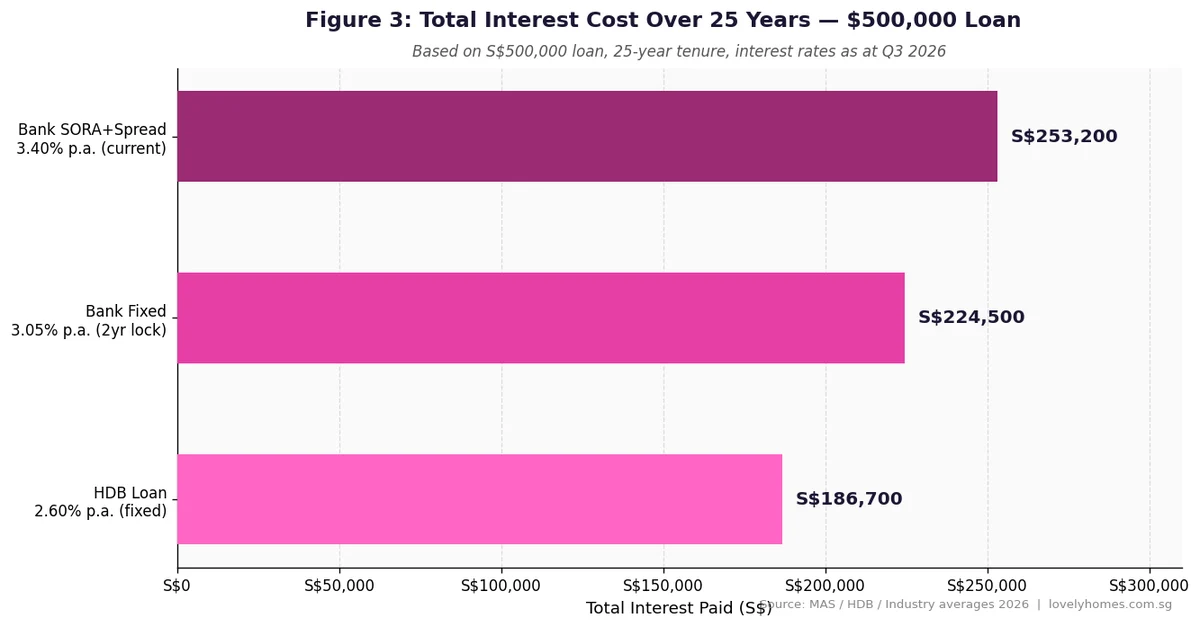
  • A S$1 million loan at 3.5% over 25 years costs S$85,000 more in total interest than at 2.6%.
  • Lock-in periods of 1–3 years are standard on bank fixed-rate packages; exiting early triggers a clawback of ~1.5% of the outstanding loan.
  • Refinancing after the lock-in expires can save tens of thousands; always compare at least 3 banks’ packages.

What Is a Home Loan and Why Does the Structure Matter?

A home loan (or housing loan) is a secured credit facility from a lender — either the Housing and Development Board or a licensed bank — that allows you to finance the purchase of a residential property in Singapore. The property serves as collateral; if you default, the lender can repossess and sell it to recover the outstanding debt.

The structure matters because small differences in interest rate, tenure, and loan-to-value ratio compound dramatically over a 25–30-year horizon. A 0.9 percentage point difference (say, 2.6% vs 3.5%) on a S$600,000 HDB loan over 25 years translates to roughly S$51,000 in additional interest. That is not a minor detail. Beyond the rate, two Monetary Authority of Singapore (MAS) rules govern how much you can borrow: the Mortgage Servicing Ratio (MSR) for HDB and Executive Condominium (EC) purchases, and the Total Debt Servicing Ratio (TDSR) for all property loans.

HDB Concessionary Loan vs Bank Loan — The Key Differences

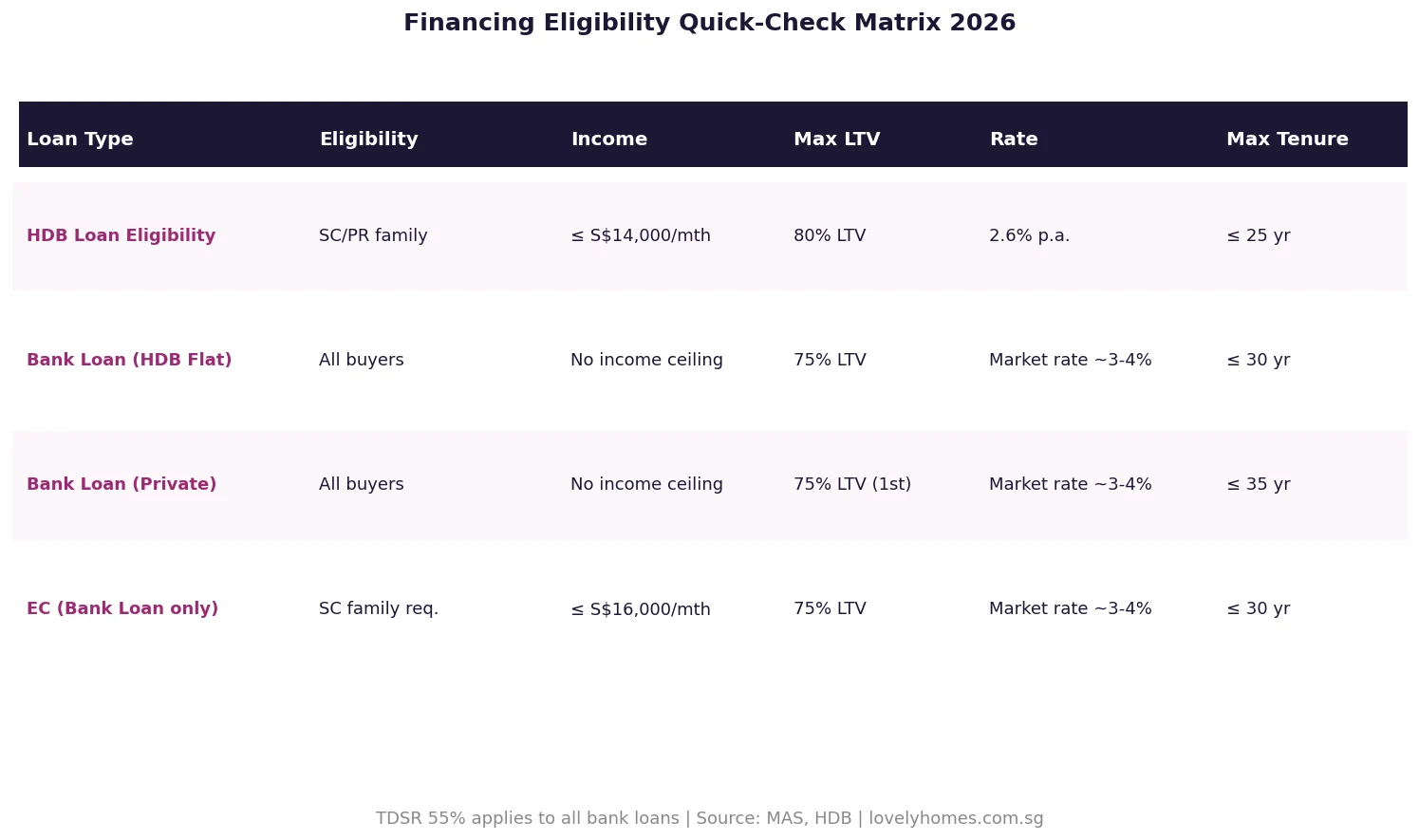
Every Singapore home buyer faces the same first question: HDB loan or bank loan? Each has distinct advantages and constraints. The comparison below sets out the essential differences.

HDB concessionary loan vs bank loan comparison table 2026 key parameters Singapore
Figure 1: HDB Concessionary Loan vs Bank Loan — Key Parameters (2026). Source: HDB, MAS.

The HDB loan rate of 2.6% p.a. is fixed at 0.1% above the CPF Ordinary Account (OA) rate of 2.5%. It moves only if the CPF OA rate changes — which has not happened since July 1999. Bank loans fluctuate with market rates. At June 2026, the best 2-year fixed bank packages sit at approximately 3.0–3.2% p.a., while SORA-pegged floating packages range from SORA+0.75% to SORA+1.20% (3M SORA ~2.4%, implying ~3.15–3.60% all-in).

HDB Concessionary Loan — Eligibility and Key Rules

To qualify for the HDB loan, at least one buyer must be a Singapore Citizen; the household gross income must not exceed S$14,000 per month (families) or S$7,000 (singles); and no buyer may currently own or have disposed of private property in the 30 months before the flat application. You also need a valid HDB Flat Eligibility (HFE) letter — a mandatory pre-application document from HDB confirming your loan eligibility, CPF grant entitlement and maximum loan quantum (mandatory since May 2023, valid for 9 months).

The maximum loan under the HDB loan is 80% of the lower of the purchase price or valuation. On a S$700,000 flat that is S$560,000. The remaining 20% (S$140,000) is the downpayment — at least 5% (S$35,000) must be cash; the rest may come from CPF OA.

Bank Loans — LTV, Lock-in and SORA

Bank loans allow a longer maximum tenure (30 years vs 25 years), access to all property types, and — potentially — lower rates during low-rate periods. The trade-off is variability and the lock-in period. Most bank fixed rates carry a lock-in of 1–3 years, after which the loan reprices to a floating SORA-pegged rate. The Loan-to-Value (LTV) for a bank loan is 75% if you have no outstanding loans; 45% if you have one; 35% if two or more. SORA replaced SIBOR as the benchmark rate on 1 October 2024 following the MAS phase-out of SIBOR.

MSR and TDSR — How Much Can You Actually Borrow?

The MAS introduced the TDSR framework in June 2013 and has maintained it as the primary constraint on borrowing. For HDB and EC purchases, the MSR applies as a tighter cap.

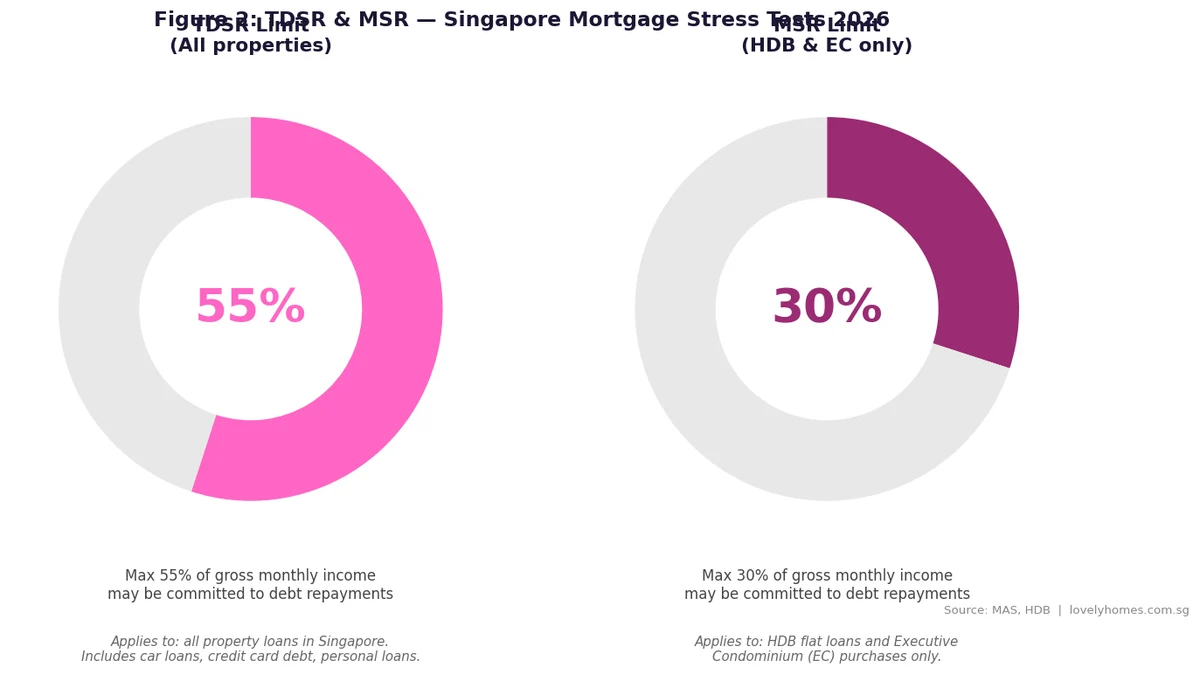
  • TDSR ≤ 55%: Total monthly debt obligations — home loan plus all other debts — must not exceed 55% of gross monthly income.
  • MSR ≤ 30%: For HDB and EC purchases only — the monthly home loan repayment alone must not exceed 30% of gross monthly income.
Maximum home loan quantum by household income MSR 30 percent TDSR 55 percent comparison chart Singapore 2026
Figure 2: Maximum Loan Quantum by Household Income — MSR (HDB/EC) vs TDSR (private property), 2026.

A household earning S$10,000 per month can borrow up to approximately S$826,000 on an HDB loan (MSR 30% at 2.6% p.a. over 25 years) or up to S$1,514,000 under TDSR on a bank loan for private property (55% at 3.0% p.a. over 30 years). The MSR is the binding constraint for HDB buyers; TDSR is the constraint for private property buyers.

Fixed Rate vs Floating Rate (SORA) — Which Is Better?

Fixed-rate packages offer certainty: the rate is locked for 2–3 years. After the lock-in, the loan reverts to a floating rate and you may reprice or refinance. Breaking the lock-in early triggers a clawback penalty of approximately 1.0–1.75% of the outstanding loan.

Floating-rate packages pegged to 3M compounded SORA move with the market. When rates fall, your instalment falls. When rates rise (as they did sharply in 2022–2023), your instalment rises. Floating packages currently sit at SORA + 0.75%–1.20%.

Total interest cost on S$1 million home loan by rate scenario 2026 HDB 2.6 percent bank fixed SORA floating
Figure 3: Total Interest Cost on S$1 Million Loan (25-year tenure) by Rate Scenario. Source: LovelyHomes calculations, indicative June 2026.

The chart shows the cost differential starkly. The HDB loan at 2.6% costs approximately S$377,000 in total interest over 25 years on a S$1 million loan. A bank fixed rate at 3.5% costs S$462,000 — a S$85,000 difference. For buyers of private property or ECs using bank financing, the choice between fixed and floating hinges on your rate outlook and risk tolerance.

CPF and Home Loan Financing

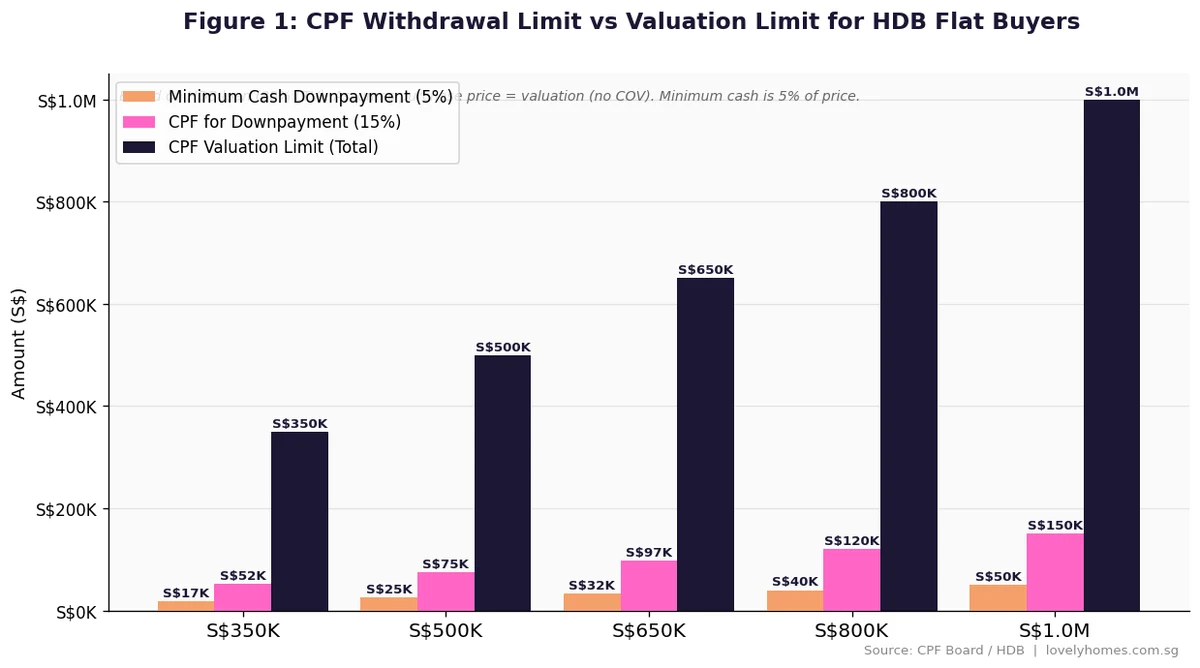
Most Singapore buyers use their CPF Ordinary Account (OA) to service instalments and fund the downpayment. The rules are set by the Central Provident Fund Board under the CPF Act (Cap 36). The key constraints are the Valuation Limit (VL) — the lower of price or valuation — and the Withdrawal Limit (WL), which is 120% of the VL. CPF OA can be used freely up to the VL; above the VL up to the WL only if you have set aside the Basic Retirement Sum (S$106,500 in 2026) in your CPF accounts.

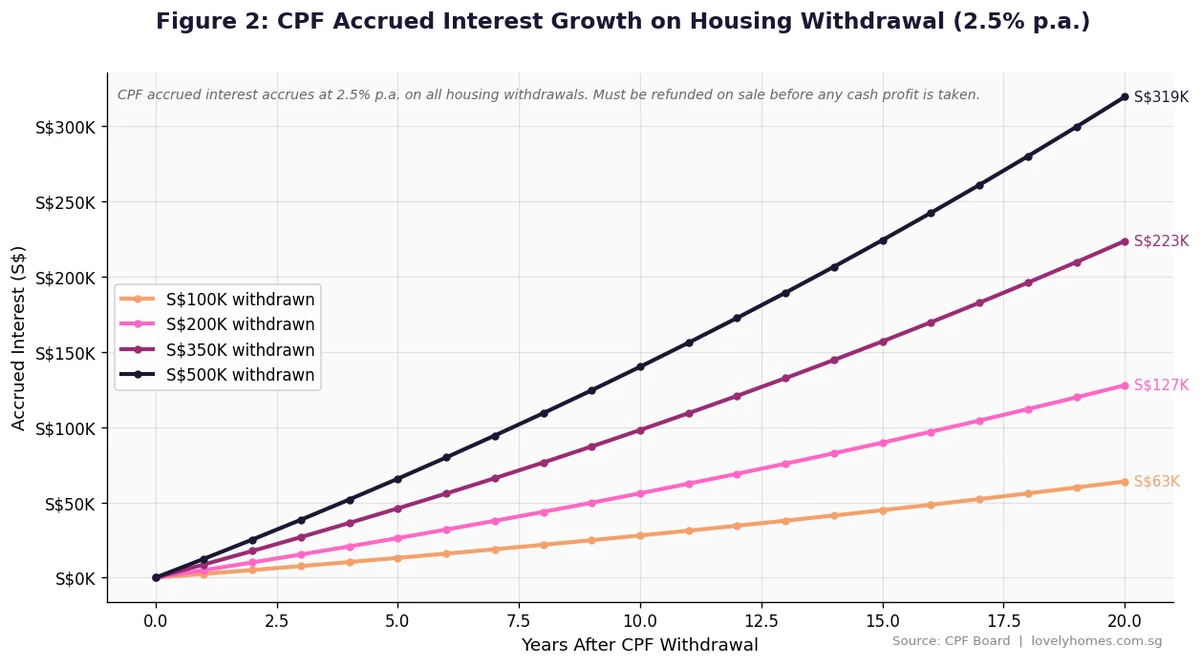
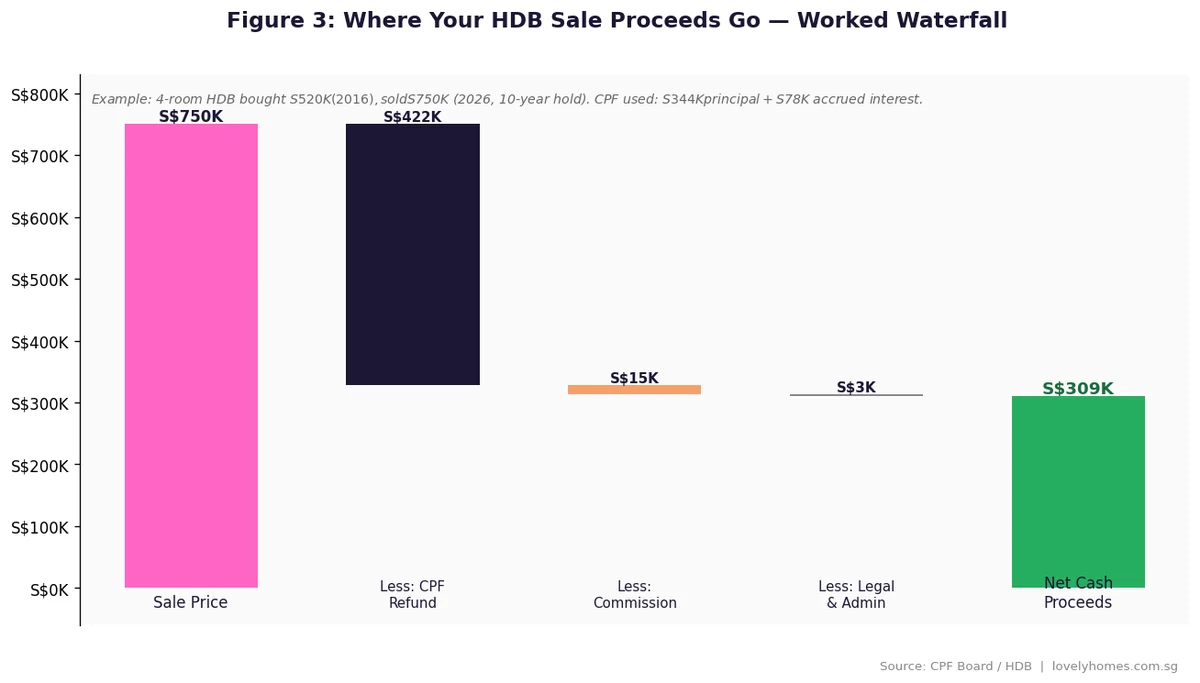
A critical point: when you sell the property, you must refund to CPF the total principal withdrawn plus accrued interest at 2.5% p.a. This is not a penalty — it restores your retirement savings — but it reduces net cash proceeds from sale. See our CPF Property Withdrawal Limits 2026 guide for detail.

Summary Table — Singapore Home Loan Framework 2026

Parameter HDB Concessionary Loan Bank Loan (HDB/EC) Bank Loan (Private)
Rate (Jun 2026) 2.6% p.a. fixed ~3.0–3.7% p.a. ~3.0–3.7% p.a.
Loan-to-Value 80% 75% 75%
MSR Cap ≤ 30% ≤ 30% N/A
TDSR Cap ≤ 55% ≤ 55% ≤ 55%
Max Tenure 25 years (age 65) 30 years (age 65) 30 years (age 65)
Min Cash Down 5% of price 5% of price 5% of price
Lock-in / Clawback None 1–3 yr clawback 1–3 yr clawback
Property Types HDB flats only HDB + EC All types

Worked Example — Mr & Mrs Wong Buying Bishan 4-Room HDB Resale

Mr & Mrs Wong are a Singapore Citizen couple. Joint gross income: S$9,500 per month. They plan to purchase a 4-room HDB resale flat in Bishan at S$680,000. This is their first property. They hold S$90,000 combined CPF OA. They qualify for an Enhanced Housing Grant (EHG) of S$60,000 (income S$9,001–S$10,000) and a Proximity Housing Grant (PHG) of S$30,000 (parents within 4 km). Total housing grants: S$90,000.

  • Purchase price: S$680,000
  • HDB Loan (80% LTV): S$544,000
  • Downpayment (20%): S$136,000 — CPF OA S$90,000 + cash S$46,000
  • Grants applied: S$90,000 (EHG + PHG) — reduces net purchase price
  • Monthly instalment (2.6%, 25yr): S$2,468/month
  • MSR check: S$2,468 ÷ S$9,500 = 26.0% — PASS (threshold 30%)
  • Buyer’s Stamp Duty (BSD): 1% × S$180k + 2% × S$180k + 3% × S$320k = S$15,000
  • Legal fees: ~S$2,800 | HDB caveat: S$64.45
  • ABSD: Nil (SC first property)
  • Total cash outlay: ~S$46,000 (downpayment cash) + S$15,000 (BSD) + S$2,800 (legal) = ~S$63,800

The HDB loan is the clear choice here: the 2.6% fixed rate is materially cheaper than any bank offering in June 2026, the couple meets the S$14,000 income ceiling comfortably, and the S$90,000 grants significantly reduce the net outlay. Total cost of ownership over 25 years at 2.6%: approximately S$680,000 principal + S$200,000 interest + S$63,800 upfront costs = S$943,800 in total expenditure on a flat that, based on OCR HDB price growth of ~10% per year over the past 5 years, may be worth substantially more at resale.

Refinancing and Repricing — When and How

Repricing means switching to a new package with your existing bank; refinancing means moving to a new lender. Refinancing is generally more powerful but involves legal fees of S$1,800–S$3,500 and a valuation fee of S$200–S$500. Most banks offer cashback of S$1,800–S$2,000 to offset these costs. The optimal window to refinance is 3–6 months before your lock-in expires. Never refinance within the lock-in unless savings clearly outweigh the clawback penalty.

What to Watch in H2 2026

3M SORA has been stable at approximately 2.3–2.5% since early 2026 as global central banks paused tightening. The key variable remains the US Federal Reserve: any cut flows through to SORA within weeks. For buyers who value certainty, a 2-year fixed package now locks in June 2026 rates. For buyers expecting rates to fall over the next 12–18 months, a floating SORA package may deliver lower effective payments over the loan lifecycle. The prudent approach regardless: stress-test your affordability at a rate 1.5–2.0 percentage points above your current package rate.

Frequently Asked Questions

Can I switch from an HDB loan to a bank loan after purchasing?

Yes. You can refinance from the HDB loan to a bank loan at any time after the HDB loan is active — there is no lock-in or clawback on the HDB side. You will need a conveyancing lawyer to discharge the HDB mortgage and register the bank mortgage. Bank loans typically cover 75% LTV, so if your outstanding HDB loan balance is below 75% of the current valuation, it can be fully refinanced. Note: once you switch to a bank loan, you cannot switch back to the HDB loan.

What happens if SORA rises sharply on my floating-rate loan?

Floating-rate borrowers bear the full rate risk. A 1 percentage point rise in SORA increases the monthly instalment on a S$600,000 loan (30yr) by approximately S$300. MAS requires banks to stress-test borrowers at a floor of 3.5% or contractual rate plus 1%, whichever is higher — so your loan was approved assuming you can handle a rate rise. Budget a meaningful buffer above your starting instalment.

Can I use CPF to pay stamp duty?

BSD and ABSD must be paid in cash within 14 days of signing the OTP. After payment, you may apply for CPF reimbursement from your OA. The initial cash payment is mandatory. This is a common cash-flow surprise: on a S$680,000 HDB flat, BSD is approximately S$15,000 cash on top of the downpayment.

What is the difference between repricing and refinancing?

Repricing means switching packages with your current lender (processing fee S$0–S$800; limited to that bank’s offerings). Refinancing means moving to a new lender (legal fees S$1,800–S$3,500; access to the full market). Refinancing is generally more effective but involves more paperwork and a 1–3 month processing window. Cashbacks from new lenders typically offset legal costs.

Does my car loan or personal loan reduce how much I can borrow for a home?

Yes — under TDSR, all outstanding debt obligations count against your 55% cap. A car loan of S$1,200/month and personal loan of S$500/month on a S$10,000/month income household reduces the permissible home loan instalment to S$3,800/month (55% × S$10k − S$1,700). MAS allows a 30% haircut on variable income (bonuses, commissions) when computing TDSR.

Can a foreigner get a home loan in Singapore?

Yes — foreigners can obtain bank loans for Singapore private residential property. The HDB loan is available only to eligible Singapore Citizens and Permanent Residents buying HDB flats. Note that foreigners purchasing private residential property pay 60% ABSD as at 2026 — see our ABSD guide for the full rate table. Bank loans for foreigners follow the same LTV and TDSR framework, though some banks may apply slightly stricter income documentation requirements for non-residents.

Related Articles

Disclaimer: This guide is for general information only and does not constitute financial, legal, or mortgage advice. Interest rates, LTV limits, MSR, TDSR, and CPF rules are subject to change. Always verify current rates with your lender or mortgage broker, and consult a licensed financial adviser before making borrowing decisions. Official references: MAS, HDB, CPF Board, IRAS.

Singapore Property Checklist for First-Time Buyers 2026: Complete Step-by-Step Guide

Singapore Property Checklist for First-Time Buyers 2026: Complete Step-by-Step Guide

Singapore Property Checklist for First-Time Buyers 2026: Complete Step-by-Step Guide

Quick Answer — Key Facts for First-Time Buyers in 2026

  • Singapore Citizens buying their first residential property pay 0% ABSD — only BSD applies
  • Maximum grants for HDB buyers: EHG S$120,000 + CPF Housing Grant S$80,000 = up to S$200,000 combined
  • Bank loan LTV: 75% (private property); HDB concessionary loan: 90% — but you must not own other property and meet income ceiling
  • TDSR ceiling: 55% of gross monthly income; MSR ceiling for HDB/EC: 30%
  • BSD on S$700k HDB resale: ~S$17,400; on S$1.4M condo: ~S$44,600 — payable within 14 days of OTP
  • Always sell your current home before buying a second one to avoid triggering the 20% SC second-property ABSD
  • Conveyancing lawyer and IPA (In-Principle Approval) should be secured before you commit to an OTP

Buying your first property in Singapore is one of the largest financial decisions you will ever make — and one of the most bureaucratically complex. Between eligibility rules, grant calculations, loan approvals, stamp duties, and legal processes, first-time buyers in 2026 face a matrix of decisions that can take months to navigate correctly. The cost of getting it wrong — particularly on ABSD, CPF rules, or MOP requirements — can run into the hundreds of thousands of dollars.

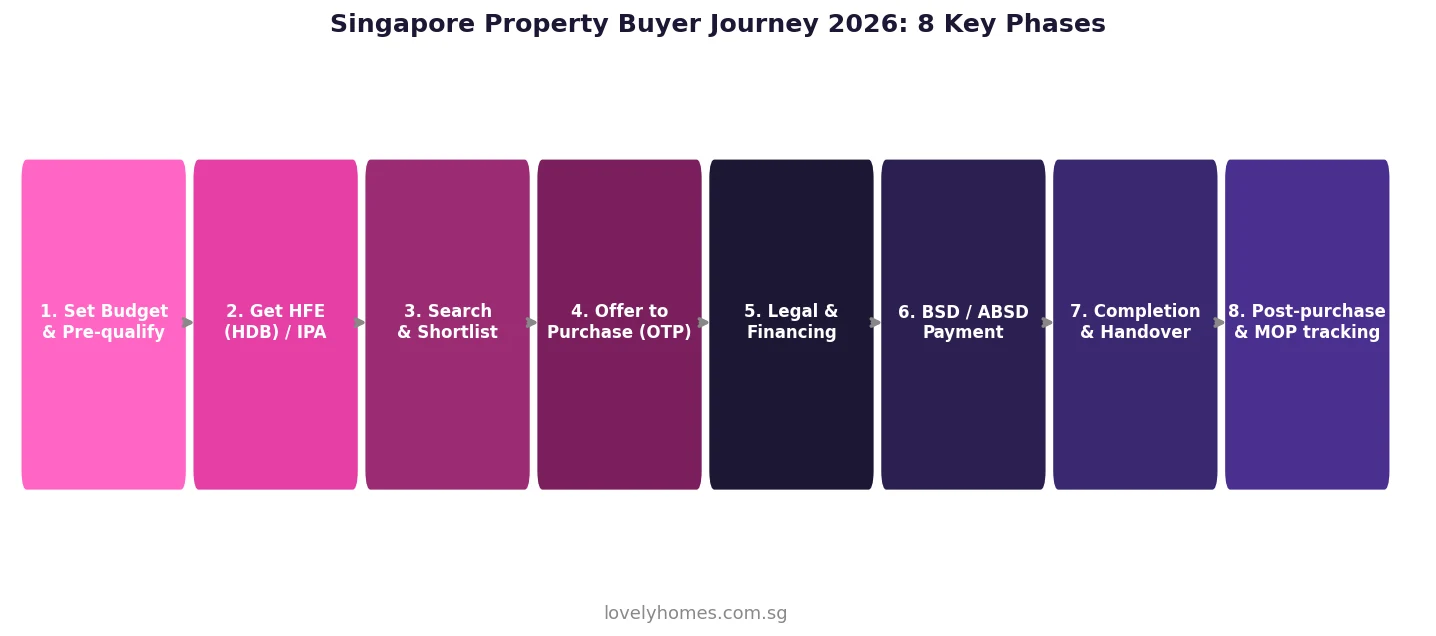
This checklist is designed to walk you through every step of the Singapore property buying process in the right sequence. Whether you are planning to buy an HDB flat (BTO or resale), an executive condominium, or a private condo or landed property, the framework below applies — with notes on where the process diverges for each property type.

The 10-Step Singapore Property Buying Checklist

Singapore first-time property buyer 10-step checklist 2026
Figure 1: The 10-step Singapore property buying process — applicable to HDB resale and private property purchases, 2026.

Step 1 — Determine Your Eligibility

Before browsing listings, you need to know what you are legally allowed to buy. Singapore’s property eligibility framework is citizenship-dependent and property-type-specific.

Singapore Citizens (SC) have the broadest access: they can purchase HDB flats (BTO, resale, EC), private condominiums, and (with restrictions) landed property. There is no property ownership limit per se, but each additional residential property increases your ABSD exposure significantly — from 0% on the first to 20% on the second.

Singapore Permanent Residents (SPR) may purchase resale HDB flats (with a family nucleus and after three years of PR), private condominiums, and certain ECs on the open market. SPRs pay 5% ABSD on their first residential property purchase. They cannot buy new BTO flats directly and face additional HDB Ethnic Integration Policy (EIP) restrictions on resale flats.

Foreigners (non-PR) are restricted to private condominiums and certain commercial properties. They pay 60% ABSD on any Singapore residential property. Nationals from Iceland, Liechtenstein, Norway, Switzerland, and the United States are treated as Singapore Citizens for ABSD purposes under FTA provisions.

If you are buying a BTO HDB flat, additional eligibility conditions apply: income ceiling (S$7,000/mth for 2-room Flexi, S$14,000/mth for 3-room and above), family nucleus requirement for most schemes, first-timer status, and the Ethnic Integration Policy quota at the block and neighbourhood level.

Step 2 — Secure Your In-Principle Approval (IPA)

An IPA (also called an AIP — Approval In Principle) from a bank or, for HDB loans, HDB itself, is your preliminary loan commitment. It is not the final loan offer, but it tells you — and the seller’s agent — how much you can borrow, which in turn defines your maximum purchase price.

For bank loans, the key constraints are the Total Debt Servicing Ratio (TDSR) at 55% of gross monthly income, and the Loan-to-Value (LTV) limit of 75% for private property. For HDB concessionary loans, the Mortgage Servicing Ratio (MSR) of 30% applies (your monthly loan repayment cannot exceed 30% of gross income), and the LTV is 90%. However, to qualify for a HDB loan, your household income must not exceed S$14,000/mth, and you must not own any private residential property.

Secure your IPA before viewing seriously or making any offers. An IPA is typically valid for 30 days (bank) or 6 months (HDB HLE), and it will save you from falling in love with a property you cannot actually finance.

Step 3 — Set Your Total Budget Including All Costs

First-time buyer upfront costs comparison HDB resale versus private condo Singapore 2026
Figure 2: Estimated upfront cash outlay for a Singapore Citizen first-time buyer — HDB resale S$700k vs new launch private condo S$1.4M. Source: IRAS BSD tables, MAS LTV framework, May 2026.

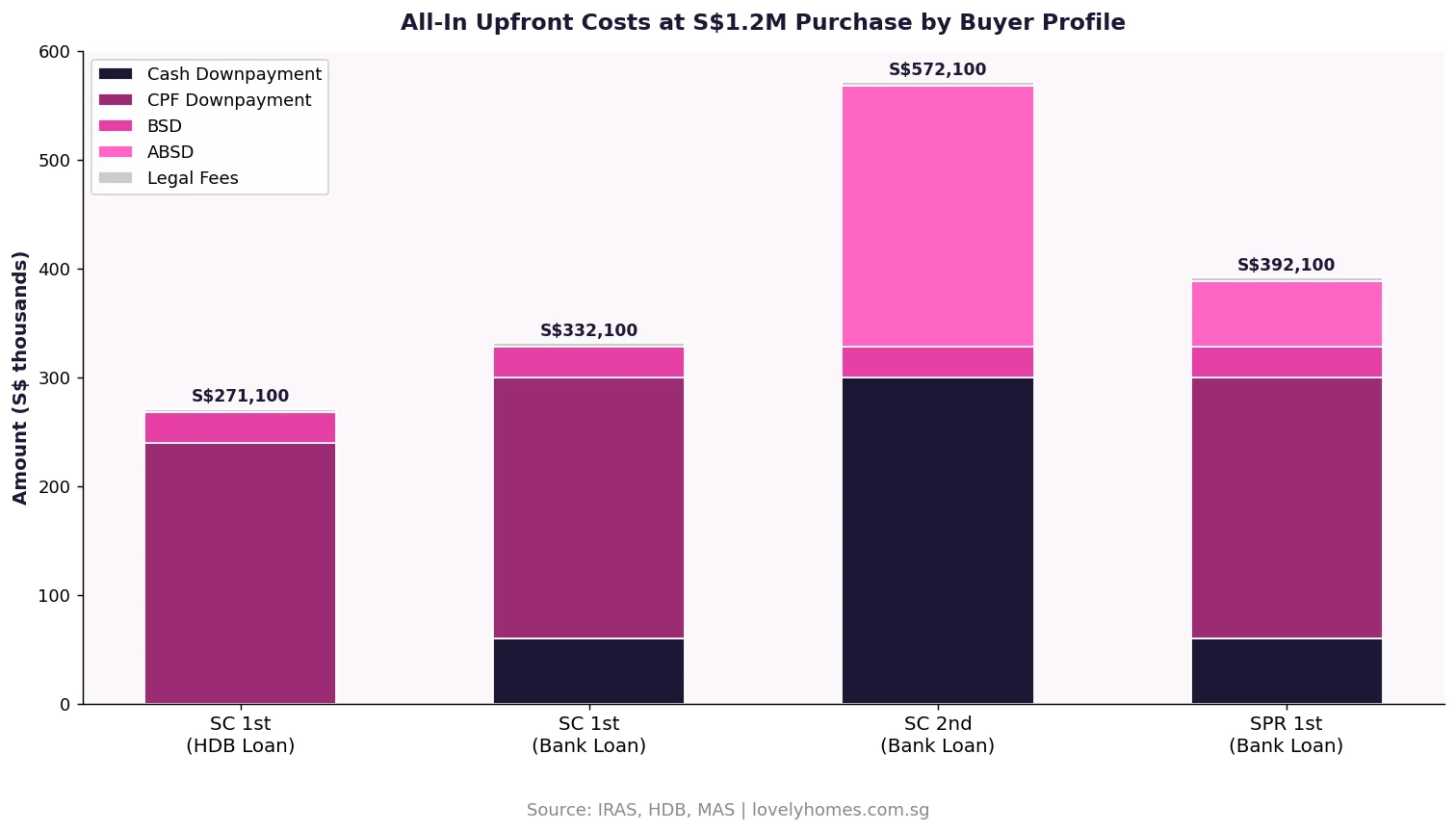
Your headline property price is just the beginning. The full upfront cost of purchasing includes Buyer’s Stamp Duty (BSD), the down payment (with a mandatory cash component), legal fees, and in some cases agent commission. For a first-time SC buyer, ABSD is zero — but BSD is unavoidable.

Cost Item HDB Resale S$700k Private Condo S$1.4M Notes
Buyer’s Stamp Duty (BSD) S$17,400 S$44,600 Payable in cash within 14 days of OTP
ABSD (SC, 1st property) S$0 S$0 0% for SC first property — confirm ownership count
Down Payment (cash portion) S$70,000 (10%) S$280,000 (20% of 25%) Minimum 5% cash for HDB; 5% cash for private (rest CPF)
Legal Fees (conveyancing) ~S$2,500 ~S$5,000 Includes title search, CPF charge registration
Agent Commission (buyer side) ~S$7,000 (1%) S$0 New launch: developer pays; resale private: negotiated
Total Estimated Cash Outlay ~S$96,900 ~S$329,600 Remainder of down payment can use CPF OA

Note that for private property, only the first 5% of the purchase price must be paid in cash (before or at OTP exercise). The remaining 20% of the 25% down payment can come from CPF Ordinary Account. For HDB loans, only 5% cash is required upfront — the remaining 85% is funded by the HDB concessionary loan.

Steps 4–6 — Research, Engage Your Lawyer Early, and View Properties

The biggest mistake first-time buyers make is viewing properties extensively before understanding their financing ceiling and legal standing. The reverse sequence — finance and legal first, then view — saves both time and negotiating leverage.

Property type selection (Step 4) depends on your income, CPF balance, timeline, and lifestyle priorities. The decision matrix in Figure 3 below compares HDB, private condo, and EC across the key dimensions first-time buyers care about most.

HDB versus private condo versus EC decision matrix for first-time buyers Singapore 2026
Figure 3: HDB vs Private Condo vs Executive Condominium — first-time buyer decision matrix, May 2026.

Engaging a conveyancing lawyer early (Step 5) is advice most first-time buyers receive too late. A good conveyancing lawyer will review the OTP before you sign it, not after. They will flag title issues, outstanding mortgages on the property, caveat searches, and CPF charge implications — all of which affect whether and at what price you should proceed. Legal fees for a straightforward purchase are modest (S$2,500–S$5,000) relative to the transaction value; do not treat them as a cost to defer.

When viewing properties (Step 6), check the remaining lease tenure carefully — especially for HDB flats and older freehold condominiums. CPF Ordinary Account funds cannot be used if the remaining lease does not cover the youngest buyer to age 95. A 60-year-old resale HDB flat may look attractively priced, but the financing and CPF limitations will materially alter your actual cost of acquisition.

Steps 7–8 — Exercise the OTP and Pay Stamp Duty

When you have identified your property, the seller will issue an Option to Purchase (OTP) in exchange for an option fee (typically 1% of the purchase price). You have a defined window — 21 calendar days for private property under the standard Law Society OTP — to exercise the option by paying the exercise price (typically another 4–9% for private, with the first 1% option fee credited) or walk away (forfeiting the 1% option fee).

Within 14 days of the OTP signing date, you must pay Buyer’s Stamp Duty (and ABSD if applicable) to IRAS via e-Stamping. Late payment attracts penalties starting at 5% of the duty payable. BSD cannot be paid from CPF — it must be in cash. This is why ensuring you have sufficient liquidity before signing the OTP is essential.

Steps 9–10 — Sale & Purchase Agreement and Completion

After exercising the OTP, your lawyer will coordinate the formal Sale and Purchase (S&P) Agreement, CPF Ordinary Account authorisation, and the loan drawdown with your bank. For new launch condominiums, the payment schedule follows the Progressive Payment Scheme (NPS) — where each tranche is tied to construction milestones — or the full lump-sum payment at completion for resale. The Deferred Payment Scheme (DPS) for executive condominiums was abolished on 8 May 2026 — all new EC purchases now follow the Normal Payment Scheme (NPS).

At completion (or key collection for BTO), your lawyer discharges their obligations and you register as the new owner at the Singapore Land Authority. Arrange for SP Group and StarHub connectivity, conduct a thorough defects inspection, and retain the developer’s or seller’s maintenance obligations where applicable.

Worked Example — SC First-Time Buyer, S$700k HDB Resale in Tampines

Ms Tan, a 31-year-old Singapore Citizen, is buying her first home — a 4-room HDB resale flat in Tampines listed at S$700,000. She earns S$6,800 per month. She has applied for an Enhanced Housing Grant (EHG) and CPF Housing Grant (CHG), and has S$120,000 in her CPF Ordinary Account.

Grants calculation: At S$6,800/mth (singles scheme), EHG = S$35,000 (approximately, based on the singles-rate EHG table at ~S$6,500–S$7,000 bracket). If she buys with a co-applicant (e.g. her mother, Singles scheme not applicable — assuming she buys as a single first-timer), or as a couple. For simplicity, assume Ms Tan buys jointly with her fiancé (combined income S$10,500/mth): EHG = S$40,000 + CHG = S$80,000 = S$120,000 total grants applied to the purchase price, reducing the effective cost.

BSD: On S$700,000 = (1%×S$180k) + (2%×S$180k) + (3%×S$340k) = S$1,800 + S$3,600 + S$10,200 = S$15,600 (payable in cash within 14 days).

Financing: Grants reduce the purchase price for grant disbursement, but BSD is still calculated on the full S$700,000 transaction price. HDB concessionary loan: 90% LTV on S$700,000 – grants S$120,000 = net S$580,000 → 90% = S$522,000 loan. Monthly repayment at 2.6% over 25 years: approximately S$2,370. MSR check: S$2,370 ÷ S$10,500 = 22.6% — within the 30% MSR ceiling.

Cash outlay at purchase: BSD S$15,600 + 10% down payment S$70,000 (min S$35,000 cash; balance from CPF OA) + legal S$2,500 + agent S$7,000 = approximately S$95,100 total, of which a minimum S$57,600 must be in cash (with the rest from CPF OA).

What to Watch in 2H 2026

Singapore’s property market for first-time buyers in the second half of 2026 will be shaped by three key developments. First, the June 2026 BTO exercise offering 6,900 flats across Bishan, Ang Mo Kio, Bukit Merah, Sembawang, and Woodlands will open for applications in mid-June — this is the largest BTO exercise of the year and the first to include Bishan Lakeview units in over four decades. First-timers with strong ballot positioning should register their interest before the application window closes.

Second, bank interest rates continue to ease in Singapore: the three-month SORA fell to approximately 1.20% as at May 2026, and major banks’ fixed-rate packages (2-year) now sit in the 1.75–1.85% range. For first-time buyers with long planning horizons, locking a rate now before any policy shift is worth discussing with a mortgage broker.

Third, the EC market is adjusting to the 8 May 2026 changes: the Deferred Payment Scheme is gone, the MOP is 10 years (up from five), and the first-timer quota has expanded to 90%. First-timers with the income and budget to qualify for an EC now have a higher allocation probability than at any point in the past five years — but they also face a longer hold requirement before they can monetise the property.

Frequently Asked Questions

Do I need to pay ABSD as a first-time Singapore Citizen buyer?

No. Singapore Citizens purchasing their first residential property pay 0% ABSD. You pay only Buyer’s Stamp Duty (BSD), which is a progressive tax starting at 1% on the first S$180,000 and rising to 6% on the portion above S$3,000,000. However, if you own any residential property at the time of OTP signing — including inherited property or a share in a property — you will be treated as a second-property buyer and face 20% ABSD. Always verify your property ownership profile via the IRAS myTax Portal before signing any OTP.

Can I use CPF to pay Buyer’s Stamp Duty?

No. BSD (and ABSD, if applicable) cannot be paid from your CPF Ordinary Account. These duties must be paid in cash within 14 days of the OTP signing date. CPF OA funds can, however, be used toward the property’s down payment (subject to the Valuation Limit), monthly mortgage instalments, and certain legal fees. Ensure you have sufficient cash liquidity to cover stamp duties before you exercise any OTP.

What is the difference between HDB loan and bank loan for first-time buyers?

An HDB concessionary loan charges a fixed rate of 2.6% per annum (0.1% above CPF OA rate), allows up to 90% LTV, and can be refinanced to a bank later (irreversibly — you cannot switch back to HDB loan once moved to a bank). A bank loan currently offers fixed rates of approximately 1.75–1.85% for a two-year lock-in (as at May 2026), requires a minimum 25% down payment with 5% in cash, and requires a stress test. For buyers who prioritise certainty and lower initial cash outlay, the HDB loan is simpler. For those who want to minimise total interest over a long loan tenure, a bank loan often saves significantly more — but exposes you to rate refixing risk every 2–3 years. See our Home Loan Comparison Singapore 2026 guide for a detailed worked comparison.

How long does the HDB BTO process take from ballot to key collection?

The full BTO cycle — from launch ballot to key collection — typically takes four to five years for standard construction timelines, though some projects take longer. The sequence is: Launch (application window) → Ballot result (2–3 months) → Flat selection queue (typically 6–12 months) → Sign S&P Agreement (within the selection window) → Construction period (3–4 years typically) → Temporary Occupation Permit (TOP) → Key collection. For buyers who need housing sooner, resale HDB flats, Sale of Balance Flats (SBF), or private property are the alternatives. See our HDB BTO Ballot System 2026 guide for full ballot probability data by flat type and estate classification.

What happens if I sign an OTP and then cannot secure a loan?

If your bank does not approve the final loan (distinct from the IPA, which is only in-principle), you will forfeit the option fee (typically 1% of the purchase price) and potentially face claims from the seller if the failure to complete is attributable to financing. This is why securing a firm IPA before signing the OTP is essential. Most conveyancing lawyers will recommend including a financing condition in the OTP for resale transactions, which allows you to withdraw and recover the option fee if you cannot secure financing by a specified date — though sellers do not always agree to such conditions in competitive markets.

Can foreigners buy HDB flats or ECs in Singapore?

No. Foreigners (non-PR) cannot purchase HDB flats (BTO or resale) or new ECs from developers. They are restricted to private condominiums and most commercial/industrial property. A foreign national would pay 60% ABSD on any Singapore residential property purchase. The only exception is citizens of the five FTA countries (Iceland, Liechtenstein, Norway, Switzerland, USA) who are treated as Singapore Citizens for ABSD purposes — but even these buyers cannot purchase HDB flats or new ECs, as that restriction is based on citizenship/PR status, not on ABSD rates.

Related Articles

Disclaimer: This checklist is for general informational purposes only and does not constitute financial, legal, or property advice. All figures, grant amounts, BSD rates, LTV limits, and loan terms cited are based on publicly available sources including IRAS, HDB, MAS, and CPF Board as at May 2026, and are subject to change. Past performance is not indicative of future results. Consult a licensed conveyancing lawyer, financial adviser, and HDB/CEA-registered property agent before making any property transaction. Verify current grants, rates, and eligibility conditions at HDB.gov.sg, IRAS.gov.sg, and MAS.gov.sg.

LTV Limits Singapore 2026: How Much You Can Borrow for Your Home or Investment Property

LTV Limits Singapore 2026: How Much You Can Borrow for Your Home or Investment Property

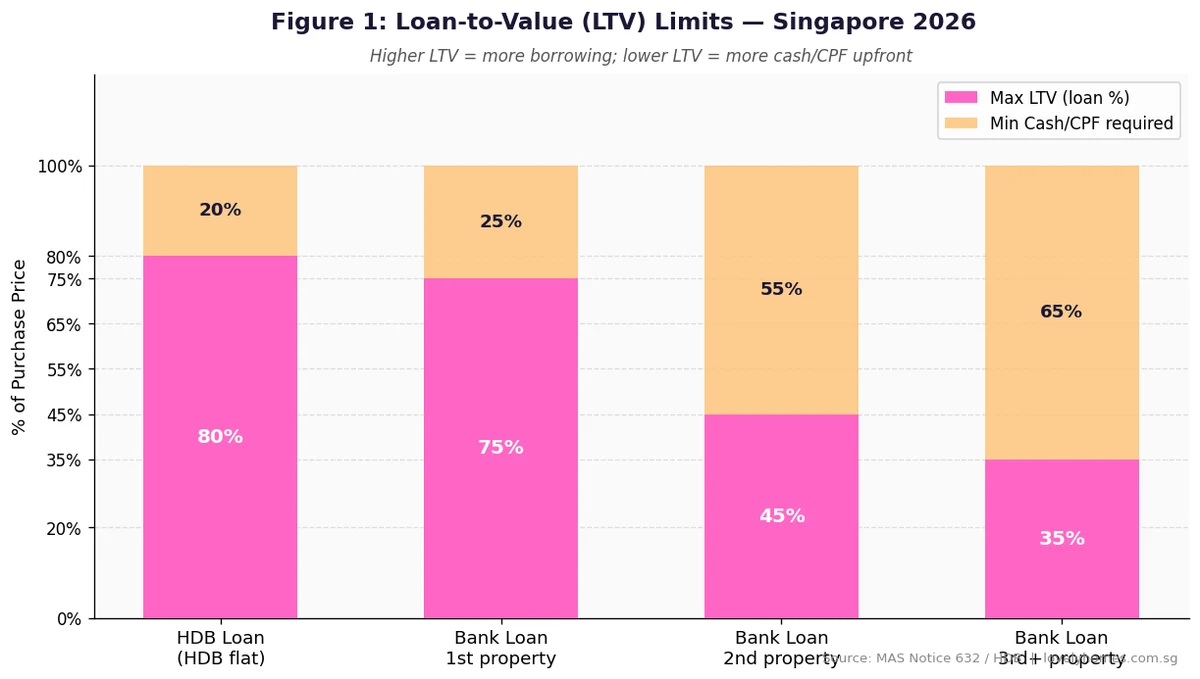
Loan-to-Value (LTV) is the single most important number in a Singapore home-purchase budget. It tells you, before anything else, the maximum slice of the property price the bank is willing to lend — and therefore the cash and CPF you need to bring yourself. Misread it by even five percentage points and you may find yourself short by tens of thousands of dollars on completion day.

This guide walks you through the LTV framework as it stands in 2026 — the rate ladder by housing-loan count, how tenure and age cut into the cap, how LTV interacts with TDSR and MSR, and the practical decisions buyers face. The framework is set by the Monetary Authority of Singapore (MAS) Notice 645 and reinforced by HDB’s own concessionary loan rules.

Quick Answer — LTV at a glance

  • Bank loan, first housing loan: up to 75% LTV, tenure up to 30 years for private (25 years for HDB).
  • Second housing loan: up to 45% LTV; third or more: up to 35%.
  • If tenure exceeds 30 years OR runs past borrower age 65: caps drop to 55% / 25% / 15%.
  • HDB Concessionary loan: up to 75% LTV, 25-year max tenure.
  • The cash component of the down-payment is at least 5% (private) or 10% (HDB Concessionary).
  • LTV is one of three gates — you must also pass TDSR (55%) and, for HDB/EC, MSR (30%).

What Is Loan-to-Value — and Why Does It Exist?

LTV is the ratio of the housing loan amount to the property’s purchase price or market value, whichever is lower. Banks use it as a first-pass risk control: a higher LTV means thinner equity from the borrower, which means less cushion if property prices fall.

MAS sets the LTV ceiling industry-wide. The ceiling has been progressively tightened since the cooling-measure era began in 2013, as the regulator’s priority shifted from supporting first-time owner-occupiers to discouraging investment-driven leverage. The most recent recalibration was December 2021, which lowered LTV on second housing loans from 50% to 45% and on third loans from 40% to 35%. That framework remains in force in 2026.

LTV Limits Singapore 2026 — guide cover
LTV limits Singapore 2026 — the cap that sets the size of your loan.

The 2026 LTV Ladder — Bank Housing Loans

The headline number you have heard — “75% LTV” — only applies to first-time housing-loan borrowers under standard tenure. Once you have an existing housing loan or stretch the tenure beyond the conservative limit, the cap falls sharply.

LTV ladder Singapore 2026 — 75% first loan, 45% second loan, 35% third loan; tenure-cut to 55%/25%/15%
Figure 1: LTV ladder for bank housing loans, by housing-loan count and tenure.
Borrower scenario Standard LTV If tenure > 30 yrs OR runs past age 65
No outstanding housing loan 75% 55%
One outstanding housing loan 45% 25%
Two or more outstanding loans 35% 15%

Two practical points are worth flagging. First, the 30-year tenure rule does not mean a 30-year loan is always available — banks themselves often cap tenure earlier for older borrowers. Second, the “outstanding housing loan” count includes loans for properties you co-own as a guarantor or as a second name on the title; the regulator does not look only at your primary mortgage.

Cash Component — The Mandatory Minimum

LTV defines the maximum the bank will lend; the rest must come from the buyer. But of that “rest”, a minimum portion must be in cash and cannot be funded from CPF Ordinary Account.

Loan type Minimum cash Balance from CPF or cash
Bank loan, 75% LTV 5% of price 20% of price
Bank loan, 55% LTV (long tenure) 10% of price 35% of price
Bank loan, 45% LTV (2nd loan) 25% of price 30% of price
HDB Concessionary loan 10% of price 15% of price (CPF or cash)

The cash floor is the practical constraint that catches most upgraders by surprise. A buyer with a S$1.5M target and 75% LTV needs S$75,000 cash on the table at exercise day — on top of BSD, ABSD, and legal fees. CPF Ordinary Account balances cannot substitute for this minimum.

The Three Gates — LTV, TDSR, and MSR

LTV is only one of three caps. Banks must also satisfy:

LTV TDSR MSR three-gate framework Singapore 2026
Figure 2: The three gates — your loan is the smallest of the three answers.
  • LTV — absolute % of property value, set by MAS as above.
  • TDSR (Total Debt Servicing Ratio) — total monthly debt repayments capped at 55% of gross monthly income, stress-tested against a 4.0% medium-term interest rate even though current bank rates are well below that. All debts count: home loans, car loans, education loans, personal loans, credit-card minimum repayments.
  • MSR (Mortgage Servicing Ratio) — only for HDB flats and Executive Condos within MOP, capped at 30% of gross monthly income.

The bank computes the maximum loan under each rule and lends you the smaller of the three. A buyer at 75% LTV but with a heavy car loan can find their actual loan capped by TDSR rather than LTV; an HDB buyer with no other debts often finds MSR — not LTV — is the binding constraint.

Worked Example — Three Buyer Profiles, Three Loan Sizes

Consider three buyers all looking at the same S$1.5M private condo, taking a 30-year loan at 2.85% fixed:

Three buyer profiles, three loan sizes on a S$1.5M private condo
Figure 3: Three buyer profiles compared on identical S$1.5M condo.

The first-time buyer at age 35, salary S$10k/month, no other loans, gets the textbook 75% LTV: S$1,125,000 loan, S$375,000 down (5% cash + 20% CPF/cash). Monthly payment S$4,663 — comfortably inside 55% of S$10k.

The second-property buyer at age 48 with one outstanding home loan is capped at 45% LTV: S$675,000 loan only, S$825,000 down. This buyer also pays 20% ABSD on the new property — an additional S$300,000.

The upgrader to a tenure that runs past age 65 at age 50 is capped at 55% LTV (because the 30-year tenure runs to age 80, well past 65): S$825,000 loan only. Same income as the second buyer, but bigger loan because no existing housing loan; still smaller than the first-time buyer because of the tenure rule.

HDB Concessionary Loan — A Different Beast

The HDB Concessionary loan, available to buyers of new and resale HDB flats meeting income and ownership criteria, runs on its own framework:

  • LTV: up to 75% of valuation, identical to first-time bank loan.
  • Tenure cap: 25 years for new flats, 25 or 30 years for resale depending on age.
  • Interest rate: pegged to CPF Ordinary Account rate plus 0.1% — currently 2.60% (CPF OA at 2.5% + 0.1% spread, rate-locked).
  • MSR-only gate: 30% of gross income, no separate TDSR overlay.
  • Rule of two: Singapore households are limited to two HDB Concessionary loans across a lifetime, with a five-year wait between the first and second.

For comparable risk profiles, the Concessionary loan typically beats bank loans on cost; the trade-off is the more rigid tenure cap and the requirement to deplete CPF OA balances above S$20,000 first.

What This Means for You as a Buyer in 2026

The 2026 environment is the tightest LTV regime Singapore has had in two decades. Combined with stress-tested TDSR at 4.0% and ABSD at 20% on second properties for citizens, the effective leverage available to a typical buyer is materially below where it sat pre-2018.

Three practical conclusions:

  1. Plan around the binding gate, not around LTV alone. Run all three checks before committing — ask your banker to model TDSR with all your debts, and MSR if you are buying HDB or EC.
  2. Tenure is now a real lever for older buyers. Choosing a 25-year tenure that ends before 65 can keep you on the 75% LTV track even at age 40. Stretching to 30 years past 65 cuts to 55%.
  3. Reserve capital, not just cash. The 5% mandatory-cash floor is the headline; in practice you also need BSD, ABSD, legal fees, and a six-month reserve buffer. A S$1.5M purchase typically requires S$120,000 in cash on the table at exercise.

Frequently Asked Questions

Is LTV calculated on the purchase price or the valuation?

The lower of the two. If a property is bought at S$1.5M but the valuation is S$1.45M, the bank applies LTV to S$1.45M. The remaining S$50,000 must be covered in cash — this is the dreaded “valuation gap” that catches buyers in rising markets.

Does selling my existing property before buying a new one reset my LTV count?

Yes — provided the existing housing loan is fully discharged before the OTP date on the new purchase. Banks check the credit bureau records on the day of credit assessment, and a discharged loan no longer counts as outstanding. This is why “sell-then-buy” buyers can access the 75% LTV track that “buy-then-sell” buyers cannot.

Can I take a 35-year loan if I am only 30 years old?

The MAS framework permits it, but bank policies vary. Most banks prefer to cap tenure at 30 years even for young borrowers. Even where 35 years is permitted, the over-30 tenure rule kicks in and reduces the LTV cap to 55% on the first loan — usually a poor trade-off.

Does my spouse’s housing loan affect my LTV count?

If you co-borrow on a single property, you are counted as one applicant for LTV purposes. If your spouse has a separate property in their sole name with an outstanding loan, that does not count against you when you buy in your sole name — this is the basis of decoupling strategies that release ABSD allowance.

What happens if my loan application is approved but my income drops before completion?

Banks reserve the right to re-underwrite at completion. A material income drop (typically more than 20%) between approval and completion can lead to a loan reduction or, in extreme cases, withdrawal. Buyers facing this should engage their banker proactively rather than wait for completion day.

Are there any loans that bypass LTV?

Not for residential property. Some private banks offer “lombard” or asset-backed lending against shares, bonds, or insurance policies, which sit outside the housing-loan framework, but these are not housing loans and the security is the financial portfolio, not the property. They are an option mainly for high-net-worth borrowers with substantial liquid investments.

Does SORA-pegged versus fixed-rate make a difference to LTV?

No. LTV is set by the housing-loan count and tenure, regardless of the rate type. Fixed and floating loans face the same LTV cap. Choice between fixed and SORA is a separate decision driven by rate outlook and personal risk preference.

Related Articles

Disclaimer

This article provides general information about LTV and related housing-loan rules in Singapore as at May 2026. It is not financial, tax, or legal advice. LTV ceilings, cash-component rules, TDSR and MSR are set by the Monetary Authority of Singapore, the Inland Revenue Authority of Singapore, and the Housing & Development Board, and may be amended at any time. For authoritative figures, consult MAS, HDB, CPF Board, the Urban Redevelopment Authority, and SingStat. Before signing an Option to Purchase, engage a licensed Singapore mortgage banker, conveyancing solicitor, and where relevant a financial planner to model your situation specifically.

Singapore Home Loan Guide 2026: LTV, TDSR, Fixed vs SORA & How to Get the Best Rate

Singapore Home Loan Guide 2026: LTV, TDSR, Fixed vs SORA & How to Get the Best Rate

For most Singaporeans, the home loan is the largest financial commitment of their lives — and in a market where private condo prices now range from S$1.2 million to S$4 million and beyond, getting the loan structure right can save (or cost) hundreds of thousands of dollars over a 25–30 year mortgage. This guide covers everything you need to know about home loans in Singapore in 2026: how much you can borrow, what the rates look like, how to compare packages, and how to build the strongest possible loan application.

Quick Answer — Singapore Home Loan Basics 2026

  • Maximum LTV: 75% for first private property (5% cash + 20% CPF/cash); 45% if holding an existing property
  • TDSR cap: Total monthly debt repayments cannot exceed 55% of gross monthly income
  • Typical fixed rates (2026): 2.5%–3.5% p.a. for 2–3 year lock-in packages
  • SORA benchmark: 3-month SORA fluctuates; total SORA-linked rate approximately 3.3%–3.8% in April 2026
  • Maximum loan tenure: 30 years (or limited so borrower does not exceed age 65 at loan end)
  • IPA (In-Principle Approval): Obtain before visiting any showflat — it defines your budget precisely
Singapore Home Loan Key Parameters 2026
Private residential properties — framework in force as at 24 April 2026

Maximum LTV (first property) 75% — bank loan; 80% — HDB concessionary loan (for HDB flats)
Maximum LTV (if holding 1 property) 45% bank loan
Maximum LTV (if holding 2+ properties) 35% bank loan
Minimum Cash Down Payment 5% of purchase price (first property, 75% LTV)
Total Debt Servicing Ratio (TDSR) 55% of gross monthly income — all debt obligations
Mortgage Servicing Ratio (MSR) 30% of gross income — applies to HDB and EC loans only
Stress Test Rate Typically 4% p.a. or prevailing rate + 2%, whichever is higher
Typical Fixed Rate (2026) ~2.5%–3.5% p.a. (3-year package) — compare across banks
Typical SORA-linked (2026) 3M SORA + spread (~0.7%–0.9%); total ~3.3%–3.8% p.a.
Max Loan Tenure 30 years (private); 25 years if borrower age at end of tenure >65
Source: MAS Regulations + MND / bank rate surveys — 24 April 2026
LovelyHomeslovelyhomes.com.sg

How Much Can You Borrow? LTV, TDSR, and Stress Tests Explained

Your maximum home loan in Singapore is determined by three overlapping constraints. The most restrictive of the three sets your actual limit.

1. Loan-to-Value (LTV): For a private property loan from a bank, the LTV ceiling is 75% of the purchase price or market value (whichever is lower) for buyers with no outstanding property loans. This means a maximum loan of S$1.387 million on a S$1.85 million purchase. If you hold an existing property loan (e.g., you are buying a second property before selling the first), the LTV drops sharply to 45%, requiring a 55% down payment. These LTV rules are set by MAS and apply uniformly across all banks.

2. Total Debt Servicing Ratio (TDSR): Your total monthly repayments across all debts — home loan, car loan, personal loan, credit card minimum payment, student loan — must not exceed 55% of your gross monthly income. Banks assess TDSR at a stress-tested rate (the higher of 4% p.a. or the prevailing rate plus 2%) to ensure your repayment capacity holds under adverse rate conditions. A joint applicant’s income can be combined; however, guarantors’ income typically cannot be included for TDSR purposes.

3. Loan Tenure Cap: Banks impose a maximum tenure of 30 years, subject to the borrower not exceeding age 65 at loan maturity. A 45-year-old borrower is therefore limited to a 20-year tenure; a 35-year-old can take the full 30 years. Shorter tenure = higher monthly instalment but lower total interest paid. Longer tenure = lower monthly instalment but significantly higher total interest cost over the life of the loan.

Down Payment: What You Need in Cash vs CPF

At 75% LTV, the required down payment is 25% of the purchase price. Of this 25%, at least 5% must be in cash (hard cash — not CPF, not bank loan). The remaining 20% can be funded from any combination of cash and CPF Ordinary Account (OA) savings. This means a buyer purchasing a S$2 million condo must have at least S$100,000 in cash available on the day of OTP exercise, plus access to S$400,000 in additional cash and/or CPF OA for the remaining down payment component.

For upgraders who have just sold an HDB, the CPF OA refund (principal + accrued interest) can provide a significant top-up — in many cases, several hundred thousand dollars — making the 20% non-cash component relatively manageable. The critical cash requirement is the minimum 5%.

Fixed Rate vs SORA-Linked: Which Package is Right for You?

The Singapore Overnight Rate Average (SORA) replaced SIBOR as the benchmark rate for floating-rate home loans from 2021 onwards. As of April 2026, the 3-month compounded SORA sits in the range of approximately 2.5%–3.0%, with bank spreads of 0.7%–0.9%, producing effective all-in SORA-linked rates of approximately 3.3%–3.8% per annum. Fixed-rate packages for 2–3 year lock-in periods are broadly competitive at 2.5%–3.5% p.a. depending on the bank and loan quantum.

Fixed Rate vs SORA-Floating — When Each Makes Sense

Package Type Rate Profile Best For Key Risk
Fixed Rate (2–3 yr lock-in) Rate fixed for 2–3 yrs, then reverts to board/SORA Buyers who want payment certainty; rate rising environment Early repayment penalty during lock-in
SORA Floating Rate moves monthly with 3-month SORA + spread Buyers expecting rates to fall; short hold period Payment volatility; budgeting harder
Fixed + SORA Hybrid First 2 yrs fixed, then SORA Hedge approach; balance of certainty and flexibility Transition risk if SORA spikes after lock-in expires
HDB Concessionary Loan (HDB only) 2.6% p.a. flat (CPF OA rate + 0.1%); 80% LTV HDB flat buyers; first-timers with limited cash Only for HDB flats; not available for private property
Key Takeaway
As at April 2026, fixed rates are broadly competitive with SORA-linked packages. Buyers planning a >5-year hold with stable income generally benefit from a 2-year fixed package for predictability, then re-finance at the end of the lock-in.
Source: MAS / bank surveys — April 2026
LovelyHomeslovelyhomes.com.sg

Worked Example — S$1.85m New Launch Purchase

The following illustrates the full upfront financial requirement for a Singapore Citizen couple buying their first private property (a new launch condo at S$1.85 million) after selling their HDB flat.

Worked Example — S$1.85m New Launch Condo Purchase (SC, First Property)

Item Amount Basis
Purchase Price S$1,850,000 New launch indicative price
Down Payment (25%) S$462,500 5% cash (S$92,500) + 20% CPF/cash (S$370,000)
Buyer’s Stamp Duty (BSD) ~S$62,100 Progressive BSD table; paid in cash within 14 days of OTP
ABSD (SC 1st property) S$0 0% for Singapore Citizen first purchase
Loan Amount (75% LTV) S$1,387,500 Subject to TDSR and stress test
Monthly Instalment (3% fixed, 30 yr) ~S$5,849/month Estimated; varies by bank and package
TDSR threshold (55% rule) Monthly income ≥ S$10,635 (combined, all debts) To support the above instalment with zero other debt
Legal / Conveyancing (est.) ~S$3,500–S$5,000 One-time cost; varies by law firm
Total Upfront Cash Required ~S$100,000–S$110,000 5% cash down + BSD + legal (CPF funds balance)
Key Takeaway
A Singapore Citizen couple with a combined gross monthly income of S$12,000 can comfortably qualify for a S$1.387 million home loan on a S$1.85 million first property, using CPF OA for the 20% non-cash component of the down payment.
Source: IRAS + MAS + Bank estimates — 24 April 2026
LovelyHomeslovelyhomes.com.sg

How to Secure the Best Home Loan: A Step-by-Step Approach

1. Pull your credit report: Before approaching any bank, request your credit report from Credit Bureau Singapore (CBS). A credit score above 1,844 (AA or BB grade) gives you the strongest negotiating position. Clear any outstanding small debts that may drag down your score.

2. Compile your income documents: The standard package is your most recent 3 months’ payslips, latest CPF contribution history statement (12 months), Notice of Assessment (NOA) for the past 2 years, and your NRIC. Self-employed buyers need their NOA for 2 years plus certified management accounts or bank statements. Commission-based earners typically have their variable income haircut by 30% for TDSR calculation.

3. Obtain IPAs from at least 3 banks: Compare the IPA quantum, the indicative rate offered, and the lock-in terms. Banks compete actively for quality home loan customers; do not accept the first offer. Use a mortgage broker if you prefer to have the comparison done for you, but be aware they receive referral fees and may not compare all available options.

4. Read the fine print on lock-in periods and clawback: Most competitive fixed-rate packages have a 2–3 year lock-in during which early redemption triggers a penalty (typically 1.5% of the outstanding loan). Check also for legal fee subsidies, valuation fee waivers, and free conversion clauses — these can save S$3,000–S$8,000 in the first year and are worth negotiating.

5. Consider a mortgage offset account: Some banks offer a 100% offset account facility that links your current account balance to your mortgage principal. Funds parked in this account reduce your effective interest cost dollar for dollar. This is particularly valuable for buyers who accumulate savings quickly or receive occasional large bonuses.

Using CPF for Your Home Loan

Your CPF Ordinary Account can be used to fund (a) the initial down payment (the non-cash component of the 25%), (b) the BSD, (c) monthly mortgage instalments up to the Valuation Limit, and (d) legal fees. The key rule is the CPF Usage Limit for private property:

  • If the property’s remaining lease covers the youngest buyer to age 95, full CPF usage is permitted up to the property’s Valuation Limit.
  • If the remaining lease does NOT cover the youngest buyer to age 95 but covers at least 60 years, CPF usage is capped pro-rata.
  • If the remaining lease is less than 30 years, CPF cannot be used at all.

For new launch condos (99-year leasehold, purchased in 2026), the lease will comfortably cover the youngest buyer to age 95 in the vast majority of cases, so full CPF usage is available. Remember: when you sell the property, all CPF monies drawn must be returned to your OA with accrued interest — this is not optional and is enforced automatically by the CPF Board upon completion of sale.

Frequently Asked Questions

Can I take a loan from HDB and a bank simultaneously?

No. The HDB concessionary loan (2.6% p.a., 80% LTV) is available only for HDB flats. Private property purchases must use a bank loan. You cannot hold an HDB loan and a bank mortgage on a private property simultaneously; the two loan types are for distinct property classes.

How does SORA work for home loans?

The Singapore Overnight Rate Average (SORA) is published daily by MAS and represents the weighted average overnight unsecured borrowing rate among banks. Most banks use the 3-month compounded SORA (3M Compounded SORA), which is smoothed and less volatile than the daily rate. Your mortgage rate = 3M Compounded SORA + bank spread. Both components change over time; your monthly instalment adjusts accordingly, typically quarterly. Check the MAS SORA statistics page for the latest published rate.

What is the stress test rate and why does it matter?

Banks assess your TDSR at the higher of (a) 4% p.a. or (b) the prevailing rate plus a 2% buffer. This “stress test rate” is typically higher than the actual rate you will pay, so the loan amount you are approved for is lower than what you could technically service at today’s market rate. This is a deliberate prudential measure to ensure borrowers can still service the loan if rates rise significantly.

Can I refinance during the lock-in period?

You can, but you will typically incur an early redemption penalty of 0.75%–1.5% of the outstanding loan balance. After the lock-in period expires, you are free to re-price (switch to a new package with the same bank) or refinance (move to a different bank) without penalty. Most active mortgage managers review their loan package at the end of every lock-in period.

Does a larger down payment lead to a better rate?

Not directly in Singapore’s home loan market. Unlike some markets where LTV directly influences the mortgage rate, Singapore banks generally offer the same rate bands across LTV ranges (within the MAS limit). However, a larger down payment reduces your loan quantum, which may bring you within a bank’s “premium package” tier (typically loans above S$1.5 million attract slightly different product options). Focus more on the total-cost comparison between packages than on trying to optimise the down payment size for rate purposes.

Related Guides

Disclaimer: All information in this article is for general educational purposes only and does not constitute financial, legal, or mortgage advice. Loan rates, LTV limits, CPF rules, and MAS regulations are subject to change. Always obtain a personalised In-Principle Approval from a licensed bank and consult a licensed financial adviser before committing to any home loan. Interest rates quoted are indicative as at April 2026 and will vary by bank, product, and applicant profile.


Progressive Payment Scheme Singapore 2026: How It Works for New-Launch Condo Buyers

Progressive Payment Scheme Singapore 2026: How It Works for New-Launch Condo Buyers

The Progressive Payment Scheme (PPS) is the default payment structure for new-launch private residential property in Singapore. Under the scheme, you pay a small deposit on booking, incremental tranches as construction reaches each milestone, and the final balance only when the keys are handed over at TOP. This 2026 guide walks through each stage, the CPF and cash flow at every milestone, and the practical cash-flow implications for a typical Singapore buyer.

Quick Answer
  • The Progressive Payment Scheme spreads purchase payments across seven construction milestones, from OTP booking to CSC (final 12-month defect period).
  • On launch day you pay 5% in cash (the Option fee). Within 8 weeks you pay a further 15% on Sale & Purchase signing — of which up to 5% may be from your CPF Ordinary Account.
  • The remaining 80% is drawn progressively from your home loan as construction reaches foundation, walls, ceiling/roof, TOP and CSC.
  • Monthly mortgage payments begin after the first drawdown — not on the day you sign the OTP.
  • PPS is the default for new-launch condominiums. The Deferred Payment Scheme (DPS), where available, pushes the bulk of payments to TOP but typically carries a price premium and stricter eligibility.

What is the Progressive Payment Scheme?

The Progressive Payment Scheme is the payment structure prescribed by the Urban Redevelopment Authority for property sold in the primary market under the Housing Developers (Control and Licensing) Act. Under PPS, the purchase price is paid in incremental tranches timed to construction milestones, rather than in a single lump sum at handover. The structure exists for two reasons: it reduces the buyer’s financing burden during the 3–4 year build period, and it gives the developer progressive cash-flow to fund construction without requiring 100% escrow.

PPS applies to all uncompleted private residential property purchased directly from the developer. For completed-and-TOP-issued stock sold in the primary market, the payment structure is different — typically the full balance is due within 12 weeks of OTP.

The seven PPS milestones

Progressive Payment Scheme — Seven-Stage Timeline 5%OTP (booking fee)15%S&P signing (within 8 weeks)10%Foundation10%Carpark + walls25%Ceiling + roof25%TOP — keys issued10%CSC (within 12 months) Source: URA Progressive Payment Schedule · LovelyHomes editorial lovelyhomes.com.sg

Stage 1 — Option to Purchase (5% in cash)

On launch day, you pay a 5% Option fee to the developer in cash or cashier’s order. This secures your right to purchase the specific unit for a 3-week Option period. During this window, you finalise financing, commission a conveyancing lawyer and decide whether to proceed. If you do not exercise the Option, you forfeit 1.25% of the Option fee (one-quarter of the 5%) and the developer returns the balance 3.75%.

Stage 2 — Sale & Purchase Agreement (15% within 8 weeks)

Within 8 weeks of Option exercise, you sign the Sale & Purchase Agreement and pay a further 15% of the purchase price. A typical split is 5% in additional cash and 10% from CPF Ordinary Account, though this varies by buyer. At this stage, you also pay Buyer’s Stamp Duty and, if applicable, Additional Buyer’s Stamp Duty to IRAS — due within 14 days of S&P signing.

Stage 3 to 5 — Construction-linked draws (45% total)

Once construction reaches each milestone, the developer issues a payment notice. Your home-loan bank draws down against your loan facility to pay the developer directly. Monthly mortgage instalments begin on the bank side after the first drawdown. The three construction-linked milestones are: foundation complete (10%); reinforced concrete framework, carpark and partition walls complete (10%); ceiling, roof and external wall complete with windows installed (25%). Typical elapsed time between Stage 2 and Stage 5 is 24–30 months for a mid-size project.

Stage 6 — TOP and key handover (25%)

When the Temporary Occupation Permit is issued, the developer notifies the buyer. You pay the next 25% tranche and receive the keys. You can now occupy the unit, lease it out, or commission renovation work. The MCST (management corporation strata title) is also constituted at or shortly after this milestone, and your monthly maintenance-fee obligation begins.

Stage 7 — Certificate of Statutory Completion (10%, within 12 months)

The final 10% is held back and released when the Certificate of Statutory Completion is issued — typically within 12 months of TOP. CSC confirms that all building works conform to the approved plans and that the defects-liability period has been honoured. This hold-back is the buyer’s main leverage during the first-year defects period, and you should work through your defects snag list methodically before authorising the final tranche.

How the CPF + cash + loan split actually works

The payment split varies by buyer, but a common structure for a Singapore Citizen first-time buyer is:

Typical PPS Payment Split — SC First-Time Buyer MILESTONE% OF PRICESOURCE 1. OTP (booking)5%Cash / cashier’s order2. S&P signing15%5% cash + 10% CPF OA3. Foundation10%Home loan drawdown4. Carpark / walls10%Home loan drawdown5. Ceiling / roof25%Home loan drawdown6. TOP (keys)25%Home loan drawdown7. CSC10%Home loan drawdown (final) Source: LovelyHomes editorial · rates accurate as at 23 April 2026 lovelyhomes.com.sg

The 5%/15% split at the front of the scheme is not legally fixed — it is the default under URA rules. A buyer with additional CPF headroom may redirect more of Stage 2 from cash to CPF. A buyer with limited CPF but strong cash flow may pay Stage 2 entirely in cash. Your conveyancing lawyer will confirm the precise split on your S&P, and your bank’s mortgage specialist will coordinate the CPF withdrawal application.

Worked example — S$2,000,000 purchase

Consider a Singapore Citizen first-time buyer purchasing a S$2 million new-launch condominium under PPS. Total BSD is S$64,600, ABSD is nil on a first property.

Cash-flow walkthrough — S$2M purchase, SC 1st property
Purchase price: S$2,000,000
Stage 1 (OTP, launch day):
5% cash: S$ 100,000
Stage 2 (S&P, 8 weeks):
5% cash: S$ 100,000
10% CPF OA: S$ 200,000
BSD (paid in 14 days): S$ 64,600 (from cash or CPF)
Upfront total (weeks 0-8):
Cash required: S$ 200,000 – 264,600
CPF required: S$ 200,000 – 264,600
Stages 3-7 (24-48 months):
80% loan drawdown: S$1,600,000 (monthly instalment from first drawdown)
Approx. monthly mortgage at 3.5% / 30 yrs on S$1.6M:
Full-loan equivalent: S$ 7,184 per month
Starts: After Stage 3 first drawdown, scales as loan balance grows

Note two things. First, the BSD payment at Stage 2 is often overlooked in cash-flow planning. A S$2 million purchase carries approximately S$64,600 of BSD due within 14 days of S&P — a buyer who has budgeted only the 5% cash at OTP is likely to be caught short. Second, the monthly mortgage payment ramps up over the construction period: from roughly S$900 per month after Stage 3 (10% of loan drawn) to the full S$7,184 once all drawdowns are complete at TOP.

How monthly mortgage payments scale across milestones

Monthly Mortgage Build-Up — S$1.6M Home Loan, 3.5% p.a., 30 yrs MILESTONELOAN DRAWNMONTHLY INSTALMENT Before Stage 3S$ 0S$ 0Stage 3 (foundation)S$ 200,000~ S$ 898Stage 4 (carpark / walls)S$ 400,000~ S$ 1,796Stage 5 (ceiling / roof)S$ 900,000~ S$ 4,041Stage 6 (TOP)S$ 1,400,000~ S$ 6,286Stage 7 (CSC final)S$ 1,600,000~ S$ 7,184 Source: LovelyHomes editorial · rates accurate as at 23 April 2026 lovelyhomes.com.sg

This ramp is the single most important cash-flow feature of PPS. A buyer who qualifies on the full-loan TDSR check still has a much lighter monthly burden in the first 18–24 months of construction, which can be useful for offsetting stamp duty and renovation savings.

PPS vs Deferred Payment Scheme (DPS)

For completed inventory of some developments — particularly foreign-developer-owned assets and late-cycle unsold stock — developers sometimes offer a Deferred Payment Scheme as an alternative. Under DPS, the buyer pays 20% at OTP and S&P combined, defers the remaining 80% to TOP (or up to 3 years later for completed units), and takes no home-loan drawdowns during the deferral period.

PPS vs DPS — At a glance FEATUREPPS (DEFAULT)DPS (WHERE OFFERED) Who qualifiesAll new-launch buyersUsually completed or late-cycle onlyLaunch-day cash5%5–10%Loan drawdownsStage 3 onwardsBulk deferred to TOP / laterPrice premium over PPSTypically 3–5% higherMonthly mortgage during buildRamps upNil until deferral endsCash-flow benefitSpread over 3-4 yearsConcentrated at TOP Source: LovelyHomes editorial · rates accurate as at 23 April 2026 lovelyhomes.com.sg

DPS improves short-term cash flow at the cost of a slightly higher purchase price. For a buyer expecting a large cash event (bonus, asset sale, parental gift) at TOP, DPS can make sense. For a buyer with steady cash flow through the construction period, PPS is materially cheaper on a total-cost basis.

Common pitfalls to avoid

Pitfall 1 — Budgeting only the 5% at OTP

The 5% OTP is not the upfront cost. You need 20% plus BSD/ABSD in the first 8 weeks. Add renovation, agent, legal and moving costs and you are looking at 22–25% of purchase price in the first 12 weeks, not 5%.

Pitfall 2 — Forgetting BSD is due 14 days after S&P

BSD is not paid at TOP. It is due within 14 days of S&P signing. On a S$2M purchase that is S$64,600 — budgeted separately from the 20% downpayment.

Pitfall 3 — Mixing up loan disbursement schedule with own cash flow

The bank draws your loan on the developer’s notice — you do not pay the developer directly. But the bank’s monthly instalment on the drawn loan balance comes out of your account from the first drawdown.

Pitfall 4 — Releasing the CSC tranche before defects are fixed

The final 10% is your main leverage during the 12-month defects-liability period. Work through the snag list methodically and only authorise CSC release when outstanding defects are resolved or formally noted.

The PPS stamp-duty timing gotcha

Buyer’s Stamp Duty and Additional Buyer’s Stamp Duty are payable within 14 days of the dutiable instrument. For a new-launch PPS purchase, the dutiable instrument is the Sale & Purchase Agreement signed at Stage 2 — not the Option to Purchase signed at Stage 1. This timing nuance matters for three reasons.

First, you have a measurable planning window — roughly 10 weeks from launch day — to assemble the cash to pay both the Stage 2 downpayment and the stamp duty. Second, the ABSD exemption application window (for married couples claiming spousal ABSD remission, for example) opens at the S&P stage, not at OTP. Third, if the government announces a cooling-measure change between OTP and S&P, the stamp-duty rate that applies is the rate in force on the S&P date, not the OTP date. This has historically been a source of significant buyer anxiety during cooling-measure cycles.

Frequently asked questions

1. Do all new-launch private condominiums in Singapore follow PPS?

Yes. PPS is the default payment structure prescribed by URA for uncompleted private residential property sold in the primary market. Deferred Payment Scheme alternatives are available only for completed or late-cycle inventory at the developer’s discretion.

2. When does my monthly mortgage payment start?

Your monthly mortgage payment starts after the first loan drawdown — typically at Stage 3 (foundation complete), which is usually 6–12 months after S&P signing. Until the first drawdown, you pay no mortgage instalment.

3. Can I pay the whole purchase price upfront?

No. URA rules require the developer to collect payment against milestones under PPS, and a lump-sum upfront payment is not permitted on a new-launch uncompleted unit. You can, of course, make an agreed partial pre-payment on your home loan at any time once the loan has been drawn.

4. What happens if I cannot meet a progress-payment milestone?

Your loan facility covers the milestone drawdowns automatically — the bank pays the developer against your loan balance. The mortgage instalment comes out of your bank account monthly. A genuine default scenario would only arise if your monthly cash flow cannot service the mortgage instalment. Speak to your bank immediately if this looks likely; options typically include a short-term restructure or, in extreme cases, a resale exit.

5. Can I use CPF for the 5% OTP booking fee?

No. The 5% OTP must be paid in cash or cashier’s order. CPF can be used from Stage 2 onwards, subject to the Valuation Limit and Withdrawal Limit framework.

6. When is ABSD payable under PPS?

ABSD (and BSD) is payable within 14 days of signing the Sale & Purchase Agreement at Stage 2, not at OTP. Budget the stamp duty separately from the Stage 2 downpayment.

7. What is the Option fee forfeiture if I do not exercise the OTP?

One-quarter of the 5% Option fee — 1.25% of the purchase price — is forfeited to the developer. The remaining 3.75% is returned within a reasonable period. This is the standard URA-prescribed position and cannot be waived.

8. Does PPS apply to Executive Condominiums?

Yes. Executive Condominiums follow the same PPS milestones as private condominiums. The main EC-specific difference is eligibility and resale-restriction rules on the buyer side, not on the payment-schedule side.

9. Does PPS apply to HDB BTO flats?

No. HDB BTO flats follow a different payment schedule: 10% Option fee at booking (mostly from CPF), then the balance at key collection. Construction-linked progressive drawdowns do not apply to BTO.

10. How long does the full PPS cycle take?

Typically 3–4 years from OTP to CSC for a mid-size project: 2–3 months from OTP to S&P, then 24–36 months through construction to TOP, then a further 12 months to CSC.

11. Can I sell the unit before TOP?

Yes, subject to the standard resale rules for private property. You can sell the uncompleted unit to another buyer via a ‘sub-sale’ arrangement, with the original buyer’s obligations novated to the new buyer. The Seller’s Stamp Duty framework applies on the gain, and Additional Buyer’s Stamp Duty applies to the new buyer — both on the sub-sale price, not the original purchase price.

12. What happens if the developer delays TOP?

The Sale & Purchase Agreement specifies a contractual TOP deadline. If the developer misses it, liquidated damages are payable to the buyer per the S&P terms — typically a fraction of the purchase price per month of delay. Review your S&P clauses carefully; liquidated damages are not uniform across developers.

Related guides on LovelyHomes

Disclaimer. This article is for general information only and does not constitute legal, financial or tax advice. Figures referenced reflect the position as at 23 April 2026 and are subject to change without notice. Always verify the latest rates and policies with the official authority — IRAS, HDB, URA, CPF or MAS — before making any property decision. Consult a qualified lawyer, mortgage broker or accountant for advice specific to your circumstances.


Translate »