HDB Lease Decay Singapore 2026: CPF Limits, Bank LTV and What Buyers Must Know
- HDB leases run for 99 years from the date of completion. As a lease decays, the flat becomes harder to finance and less attractive to buyers.
- When the remaining lease at purchase is below 60 years, both the bank loan quantum and CPF usable are significantly restricted under MAS and CPF Board rules.
- Banks require that the flat’s remaining lease covers the youngest buyer to at least age 95. If it does not, the maximum LTV is reduced — and in many cases, bank financing is unavailable entirely.
- CPF usage is limited by the Valuation Limit (lower of purchase price or valuation); for flats with lease below 60 years at purchase, additional pro-rated caps apply.
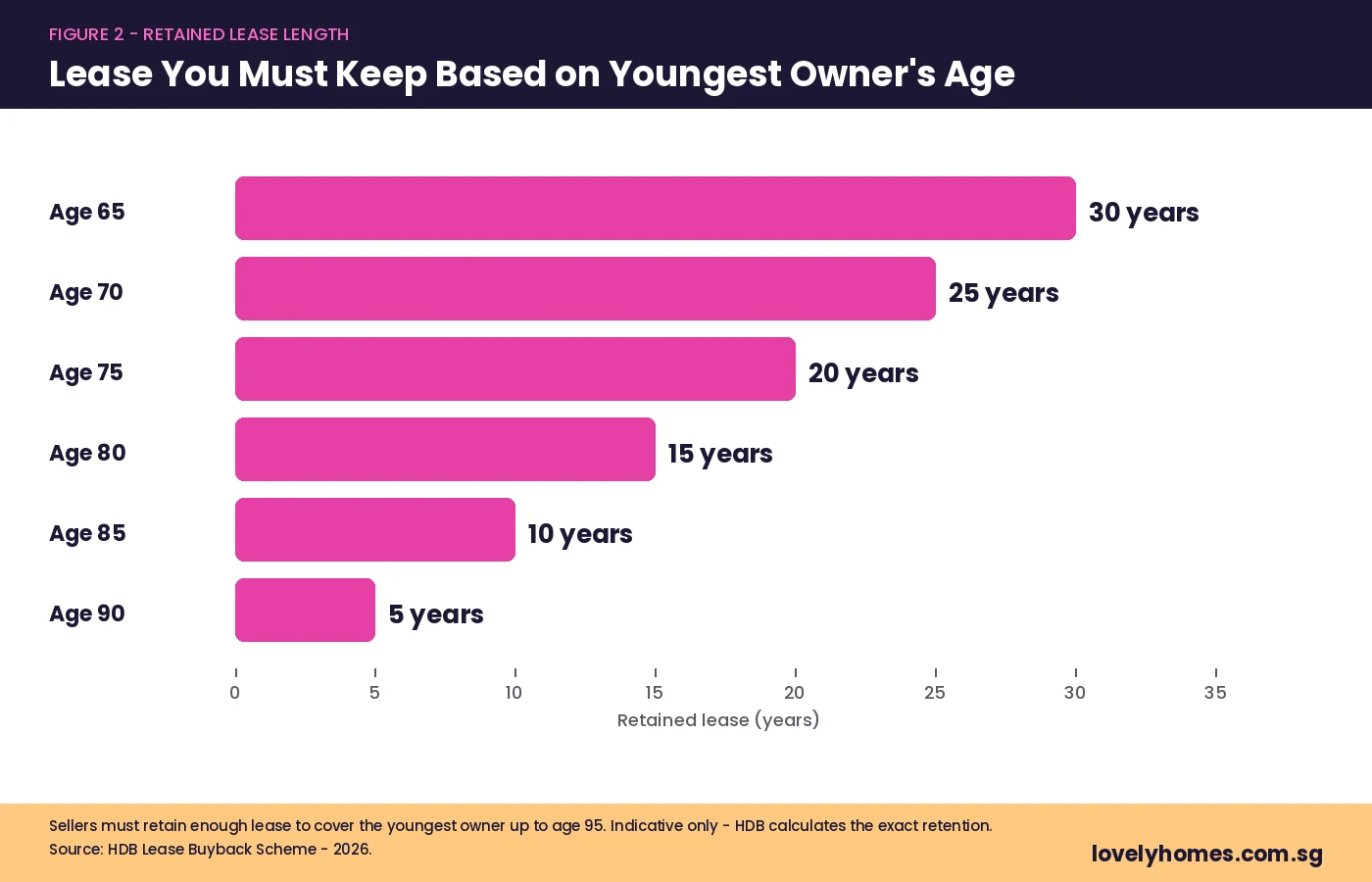
- The HDB Lease Buyback Scheme (LBS) lets elderly owners in 4-room or smaller flats sell a portion of their remaining lease back to HDB to fund retirement, while retaining a 30-year lease to live in.
- As Singapore’s HDB stock ages — 350,000+ flats were built before 1990 — lease decay is one of the most important and under-discussed topics for HDB owners and buyers in 2026.
What Is HDB Lease Decay and Why Does It Matter?
Every HDB flat in Singapore is built on 99-year leasehold land. Unlike freehold property — which exists in perpetuity — an HDB flat’s lease counts down from the date of completion. A flat completed in 1980 will have about 53 years left on its lease in 2026. One completed in 1990 will have about 63 years remaining. A flat built in 2000 will have about 73 years left.
Lease decay matters because the value of a leasehold property is partly a function of how much usable lease remains. A flat with 30 years left is worth considerably less than an equivalent flat with 70 years remaining — not because of any difference in physical condition, but because buyers and banks face real constraints on financing, CPF usage, and future resalability. The Urban Redevelopment Authority administers land sales under the State Lands Act, and HDB administers flat leases under the Housing and Development Act.
In 2026, approximately 350,000 HDB flats — roughly one-third of Singapore’s entire public housing stock — are more than 35 years old. This is not a niche concern. It affects hundreds of thousands of owners planning their retirement, their estate, their upgrading strategy, and their financing options.

How the Bank LTV is Affected by Remaining Lease
MAS Monetary Authority of Singapore sets the rules on Loan-to-Value (LTV) ratios for residential property loans under Notice MAS 632 and its housing loan guidelines. For HDB flats, the standard maximum LTV for a bank loan is 75% of the lower of purchase price or valuation. However, this full 75% LTV only applies when the flat’s remaining lease at the point of purchase is at least 30 years AND it covers the youngest buyer to at least age 95.
The key rule is the “lease coverage” test:
- If the remaining lease at purchase date does not cover the youngest buyer to age 95, the maximum LTV is pro-rated. The formula is: Max LTV = 75% × (remaining lease ÷ 30 years), subject to a minimum remaining lease of 20 years.
- If remaining lease is below 20 years, most banks will decline to finance the purchase entirely.
In practice, this means:
| Remaining Lease at Purchase | Buyer Age (Youngest) | Lease Covers to Age 95? | Max Bank LTV |
|---|---|---|---|
| 70 years | 25 | Yes (25+70=95) | 75% |
| 60 years | 30 | Yes (30+60=90 — short by 5yr) | ~60% (pro-rated) |
| 50 years | 40 | No (40+50=90) | ~55% (pro-rated) |
| 40 years | 45 | No (45+40=85) | ~45% (pro-rated) |
| 30 years | 50 | No (50+30=80) | ~30% |
| 20 years | Any | No | ~20% or bank decline |
Note that if the flat’s remaining lease does cover the youngest buyer to age 95, the full 75% LTV can still be obtained even for older flats — it is the age-of-buyer + remaining-lease combination that matters, not the remaining lease alone.
CPF Usage Limits on Short-Lease Flats
CPF Board rules under the CPF Act restrict how much Ordinary Account savings can be used toward a flat purchase when the remaining lease is short. The standard rules are:
- Remaining lease ≥ 20 years AND covers youngest buyer to age 95: CPF can be used up to the Valuation Limit (VL) (lower of purchase price or valuation), and up to the Withdrawal Limit of 120% of VL for private properties (not applicable to HDB).
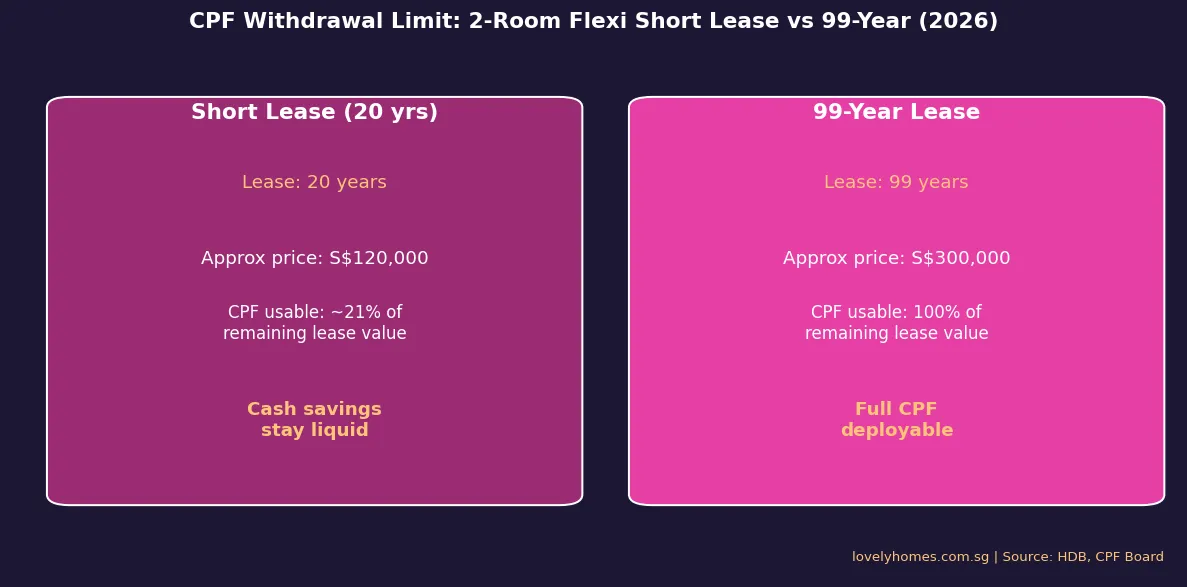
- Remaining lease ≥ 20 years but does NOT cover youngest buyer to age 95: CPF usage is pro-rated — you can use CPF up to the VL, but the maximum CPF you can withdraw is reduced proportionally by the shortfall in lease coverage.
- Remaining lease below 20 years: No CPF OA can be used for the purchase at all.
This pro-rating is significant. On a flat with 45 years remaining purchased by a 55-year-old (combined age + lease = 100, coverage to 95 is +5 years short), the CPF usable is reduced proportionally. On a flat with 30 years remaining, CPF usage is severely restricted. Buyers in this situation must fund the gap from cash savings.

How Lease Decay Affects Resale Value
The market impact of lease decay has been measured empirically by HDB and academic researchers. Industry figures show a general discount of 10–25% for flats with fewer than 60 years remaining versus comparable flats with 70+ years, controlling for floor, facing and estate. The discount steepens sharply below 50 years, where buyer pools shrink due to financing constraints.
URA and HDB data show that flats in mature estates built in the late 1970s to early 1980s — Toa Payoh, Queenstown, Ang Mo Kio, Bukit Merah — are approaching 45–50 years in age. Many are still transacting at reasonable prices due to their prime locations, large flat sizes and mature infrastructure. However, when these flats approach the 30-year-remaining mark (around 2049–2060 for the earliest ones), buyer financing will be severely constrained, and the market for these flats will narrow considerably.
This is not inevitable decline — HDB has the authority to announce Selective En bloc Redevelopment Scheme (SERS) for selected blocks, which offers owners replacement flats at subsidised prices and effectively renews the lease. However, SERS is selective; only about 5% of HDB flats have been selected for SERS since the programme began in 1995. Owners of older flats should not assume SERS will apply to their block.
The HDB Lease Buyback Scheme (LBS)
For elderly HDB owners, the Lease Buyback Scheme (LBS) administered by HDB offers an option to monetise a portion of the flat’s remaining lease while continuing to live in it. Under LBS:
- Eligible households (at least one owner aged 65+; SC household; 4-room or smaller flat; at least one owner has not previously participated in LBS) can sell a portion of the flat’s tail lease back to HDB, retaining a minimum 30-year lease to live in.
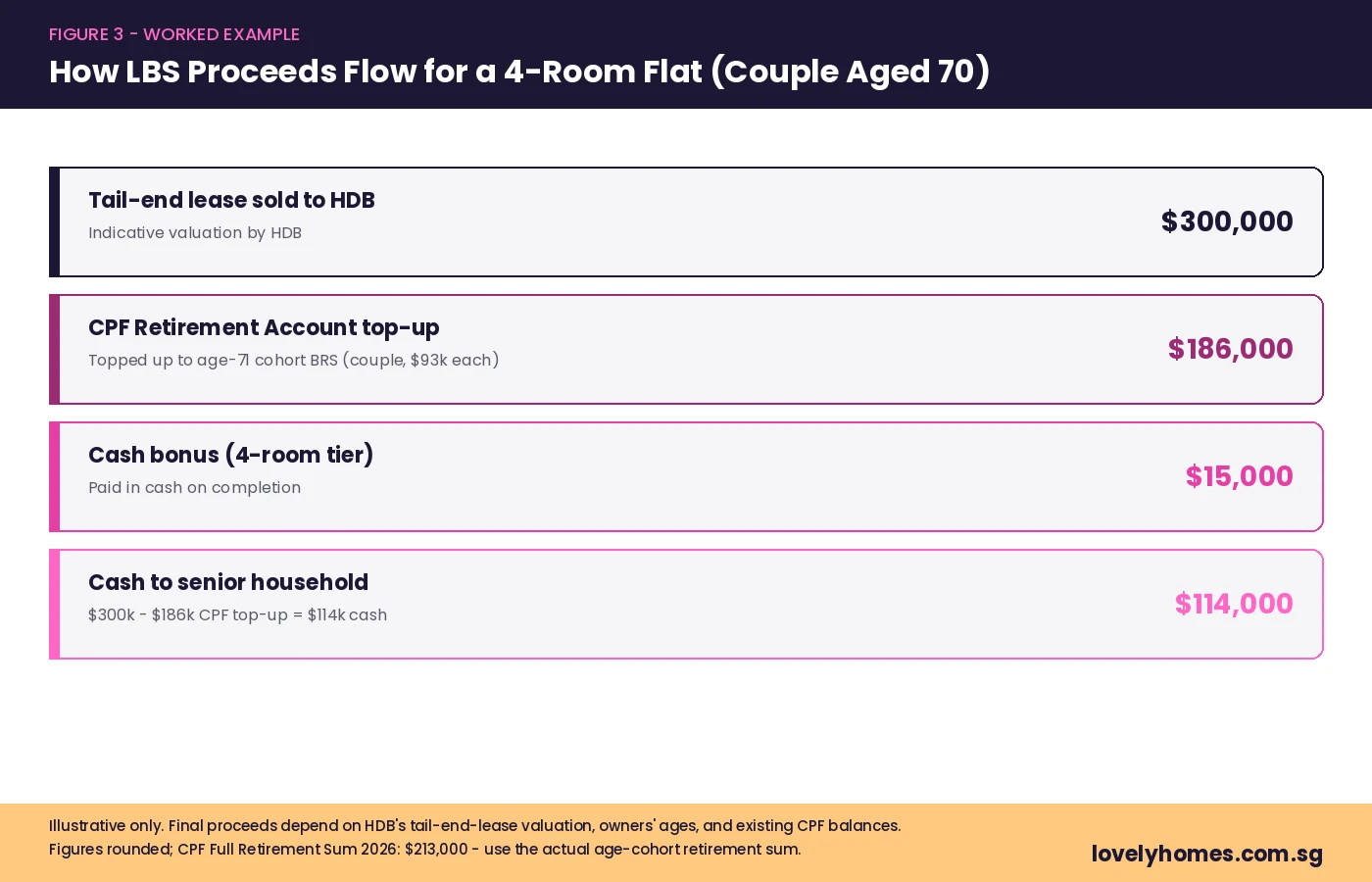
- Proceeds from the lease sale are used first to top up CPF Retirement Account, with any excess paid as cash. The top-up creates a CPF LIFE annuity stream providing monthly income for life.
- The monthly income from CPF LIFE on a LBS top-up varies by age and top-up quantum, but HDB estimates that a couple aged 65 and 62 in a 3-room flat in Ang Mo Kio could receive a combined CPF LIFE payout of approximately S$1,300–1,800 per month for life, depending on the property valuation and which portion of the lease is sold.
- LBS proceeds are exempt from the usual ABSD and BSD rules on property transactions — it is treated as a lease surrendering arrangement, not a sale and purchase.
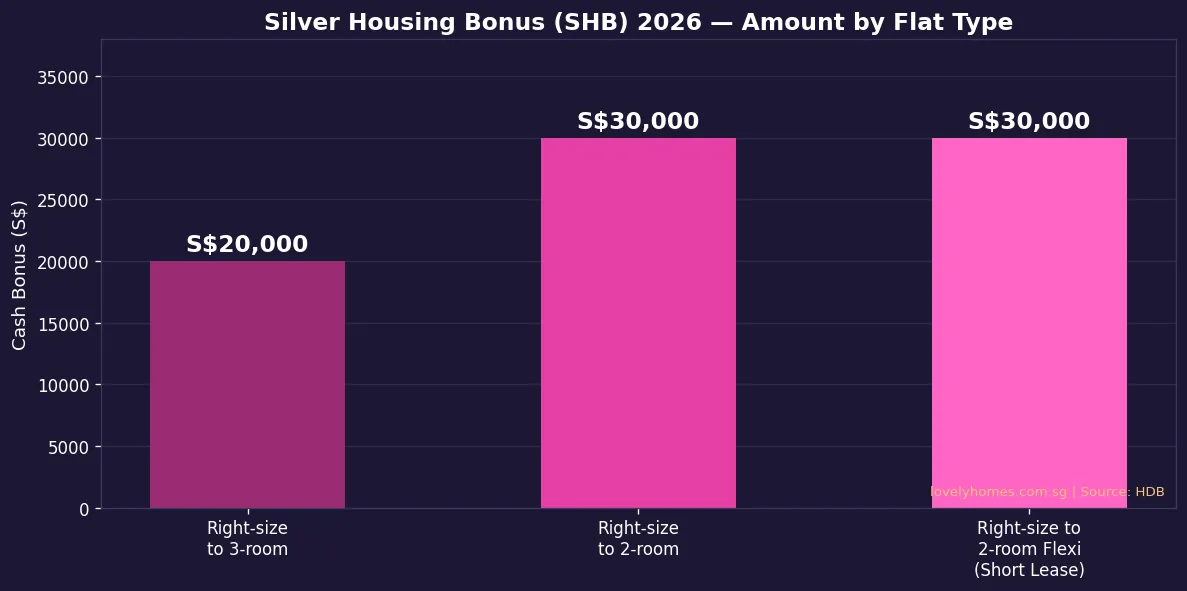
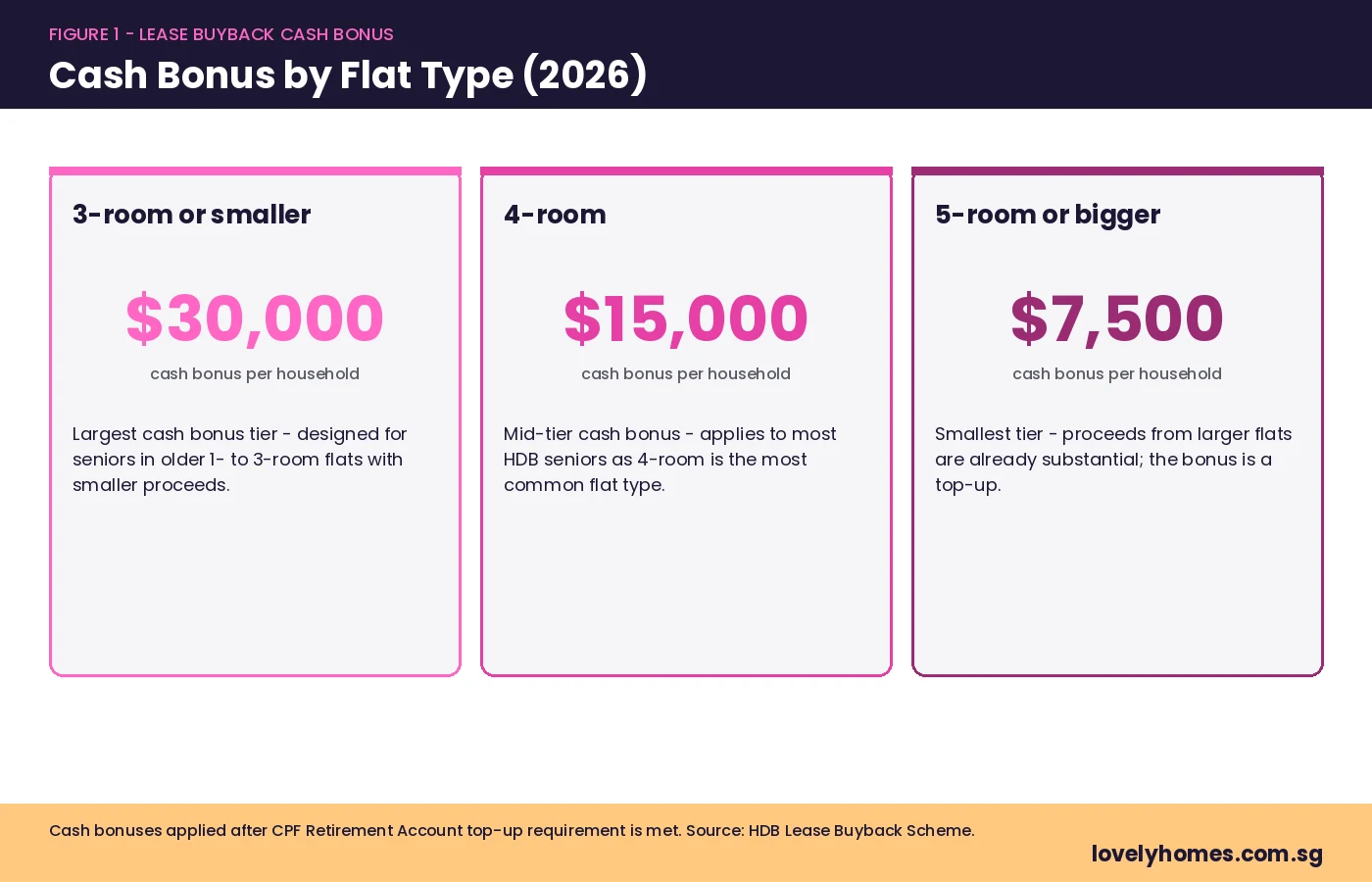
As at May 2026, the HDB LBS is available island-wide for eligible flats in 4-room or smaller categories. HDB announced enhancements to LBS in the 2023 Budget, including a higher grant of up to S$30,000 for eligible households to reduce the mandatory Retirement Account top-up requirement.

Worked Example — The Lim Family
Mr Lim, aged 52, and Mrs Lim, aged 49, are Singapore Citizens considering purchasing a resale HDB 4-room flat in Toa Payoh. The flat was completed in 1980 and has approximately 53 years remaining on its lease. The asking price is S$560,000; HDB’s indicative valuation is S$540,000 (Valuation Limit = S$540,000).
Bank LTV calculation: The youngest buyer (Mrs Lim, age 49) plus remaining lease = 49 + 53 = 102. This covers Mrs Lim to age 102, exceeding the 95-year threshold. Therefore, the standard 75% LTV applies. Maximum bank loan = 75% × S$540,000 = S$405,000.
CPF usage: Remaining lease (53 years) ≥ 20 years, and the coverage test is met (102 ≥ 95). CPF can be used up to the Valuation Limit of S$540,000. The Lims have S$180,000 combined in CPF OA — they can use the full S$180,000 toward the purchase.
Total funding stack: S$405,000 (bank loan) + S$180,000 (CPF) = S$585,000. Purchase price is S$560,000. Surplus funding covers the S$20,000 cash-over-valuation (COV) and legal fees.
However — the Lims should note that 10 years from now (2036), when they are 62 and 59, the flat will have only 43 years remaining. A resale buyer at that point (say, aged 52) + 43 years = 95 exactly — just passing the coverage test at 75% LTV. By 2041 (40 years remaining), any buyer aged 55+ will face a reduced LTV. The pool of qualified buyers shrinks, which limits exit pricing. The Lims decide to purchase the flat as a short-to-medium-term hold (targeting resale by 2034–2035) rather than a retirement-anchor asset.
What Might Come Next — VERS and the Long-Term Policy Question
The Singapore government is actively managing the challenge of an ageing HDB stock. The Voluntary Early Redevelopment Scheme (VERS), announced in the 2018 National Day Rally by then-Prime Minister Lee Hsien Loong, is intended to give households in older estates a choice to have their blocks redeveloped before the lease expires. Unlike SERS, VERS is not compulsory and the compensation terms will be less generous than SERS (there is no equivalent subsidy to replacement flats). As at 2026, VERS has not yet been formally rolled out — HDB has indicated it is still in the planning phase, with details to be announced when blocks approach around 70 years of age.
The broader policy question — what happens when HDB leases run out — is one the government has addressed directly. HDB and the Ministry of National Development have stated that at lease expiry, the flat is returned to the state with no compensation. The government has been explicit that HDB flats are not freehold assets and their value will decline toward zero as the lease expires. This has prompted debate about whether the public housing model — which is used as a major retirement asset by most Singaporeans — is sustainable as the stock ages.
Summary — Key Rules at a Glance
| Scenario | Bank LTV | CPF Usable? | Eligibility for HDB Loan |
|---|---|---|---|
| ≥60 yrs remaining, covers buyer to 95 | 75% | Yes, up to VL | Yes (standard) |
| 45–59 yrs remaining | 55–65% (pro-rated) | Yes, pro-rated | Yes (check CPF limit) |
| 30–44 yrs remaining | 30–50% (pro-rated) | Yes, pro-rated | Subject to eligibility |
| 20–29 yrs remaining | 20–30% | Limited | Restricted; cash-heavy |
| Below 20 yrs remaining | Bank decline likely | No | Cash only (rare) |
| SERS / VERS block | Replacement flat terms | CPF used for compensation | Governed by HDB scheme |
| LBS eligible (≥65yr owner) | N/A (lease portion sold to HDB) | Top-up to RA | 4-room and below |
Frequently Asked Questions
What happens to my HDB flat when the 99-year lease expires?
When an HDB lease expires, the flat is returned to the state (HDB / Singapore Land Authority) with no compensation to the owner. The government has been explicit that HDB flats are not freehold assets. In practice, this scenario is still decades away for most flats — the oldest HDB flats completed in the early 1960s are approaching 60+ years, and Singapore’s government is expected to have addressed the stock through programmes like VERS or redevelopment long before the leases run to zero. However, the principle that HDB flat values trend toward zero at lease expiry is policy, not speculation.
Can I still get a bank loan if the HDB flat has less than 60 years remaining?
Yes, in most cases — provided the remaining lease covers the youngest buyer to at least age 95, the full 75% LTV still applies regardless of remaining lease length. If it does not, the LTV is pro-rated. Banks will typically decline financing only when the remaining lease is below 20 years or when no meaningful loan tenure can be structured within the remaining lease period. The key formula is: Youngest buyer’s age + Remaining lease ≥ 95 for full LTV. If your age is 40 and the flat has 60 years remaining, 40+60=100 ≥ 95, so you get the full 75% LTV.
Can I use CPF to buy a flat with a short lease?
CPF OA can be used if the remaining lease is at least 20 years AND the flat’s remaining lease (at the point of purchase) covers the youngest buyer to at least age 95. If the lease does not meet the age-95 coverage test, CPF usage is pro-rated. If the remaining lease is below 20 years, CPF cannot be used at all. CPF Board administers these rules under the CPF Act, and the specific CPF usage limit for your purchase can be confirmed with HDB or a conveyancing solicitor before committing to a purchase.
What is the Lease Buyback Scheme (LBS) and who qualifies?
The HDB Lease Buyback Scheme (LBS) allows elderly flat owners to sell a portion of their remaining lease to HDB, retaining at least 30 years to live in the flat. Eligibility criteria include: at least one owner aged 65 or above; all owners are Singapore Citizens; the flat is a 4-room or smaller unit; all owners must not own any other property; the flat must have at least 20 years of remaining lease. Proceeds from the lease sale are channelled primarily into the CPF Retirement Account to fund CPF LIFE monthly payouts. There is also an LBS bonus grant of up to S$30,000 (announced Budget 2023) for households that do not require a mandatory RA top-up. Full details at hdb.gov.sg.
What is SERS and how likely is my flat to be selected?
SERS — Selective En bloc Redevelopment Scheme — is an HDB programme under which entire precincts or blocks are compulsorily acquired and residents offered replacement flats in new HDB developments, typically nearby and at subsidised prices. Selection is based on site potential, development opportunity and planning considerations. Since SERS began in 1995, approximately 90 sites (around 35,000 flats) have been selected — roughly 5% of Singapore’s HDB stock. There is no published formula for SERS selection; HDB has indicated that older flats in areas with redevelopment potential are more likely to be considered. VERS (Voluntary Early Redevelopment Scheme) is a forthcoming programme for flats not selected under SERS, but its details and compensation terms have not yet been announced.
Does a short lease on an HDB flat affect my TDSR or MSR?
A shorter lease affects your loan quantum (via LTV pro-rating) and your CPF usable amount, but not the TDSR or MSR percentage thresholds themselves. TDSR (55% of gross monthly income) and MSR (30% for HDB) apply based on the monthly repayment for whatever loan quantum you qualify for. If a shorter lease means you can only borrow 45% LTV instead of 75%, your monthly payment is lower and TDSR/MSR are easier to satisfy — but you need substantially more cash upfront to bridge the gap.
Should I avoid buying an older HDB flat as an investment?
Older HDB flats in prime estates — Toa Payoh, Queenstown, Bishan, Ang Mo Kio — have historically traded at a premium despite ageing leases, due to location, size (larger old flats) and mature amenities. However, as these flats approach the 50-year mark and lease decay becomes a financing constraint, the buyer pool narrows and price appreciation is expected to moderate. Industry figures suggest that the premium for old prime-estate flats versus new BTO flats has been compressing since 2022. Investors considering older flats should factor in: reduced buyer pool at resale, possible CPF accrued interest shortfall on exit, inability to refinance to more competitive bank rates if lease coverage is borderline, and no SERS guarantee. A short holding period (3–7 years within MOP, where applicable) generally mitigates these risks more effectively than a long hold.
Related Articles
- CPF for Property Purchase Singapore 2026: Withdrawal Limits and Accrued Interest
- HDB MOP Singapore 2026: Minimum Occupation Period Rules for Standard, Plus and Prime
- HDB Resale Procedure Singapore 2026: HFE Letter, OTP, Resale Portal and Key Collection
- En Bloc Sale Singapore 2026: How the Collective Sale Process Works
- HDB 2-Room Flexi for Seniors Singapore 2026: Flat Types, Silver Housing Bonus and Lease Options
- Singapore Home Loan Interest Rates 2026: SORA vs Fixed Rate Complete Guide
Disclaimer
This article is for general informational purposes only and does not constitute financial, legal or property advice. HDB lease rules and CPF usage limits are set by the Housing and Development Board and the CPF Board respectively; these rules are subject to change. The Lease Buyback Scheme, SERS and VERS are government programmes administered by HDB under the Housing and Development Act; eligibility and compensation terms may change. Indicative property prices and net proceeds figures are illustrative only and do not constitute a valuation. For advice on a specific flat purchase, consult a licensed property agent (CEA-registered), a financial adviser (MAS-licensed), and a conveyancing solicitor. Official sources: hdb.gov.sg, cpf.gov.sg, mas.gov.sg, ura.gov.sg.
Click anywhere or press Esc to close