⚡ Quick Answer — River Valley Green Parcel C Award
The URA has awarded the River Valley Green (Parcel C) GLS tender to SMCL Haven 3 Pte. Ltd. and CSC Land Group (Singapore) Pte. Ltd. (URA pr26-48, 23 June 2026).
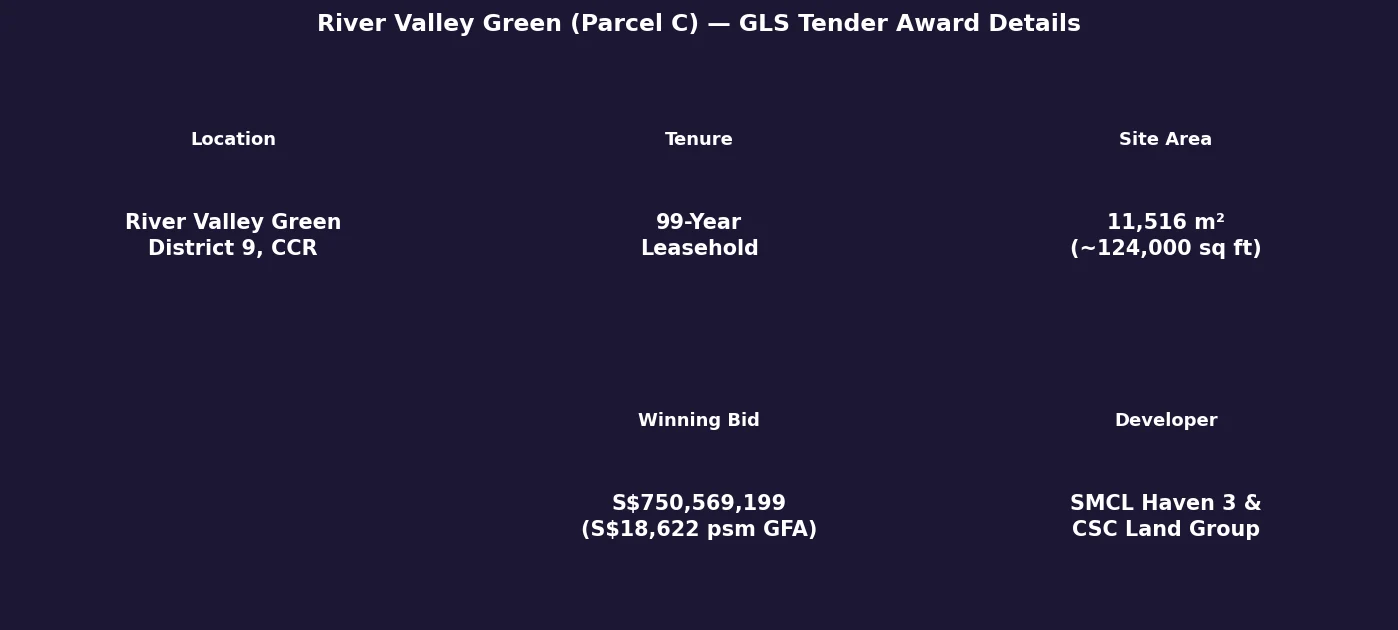
The winning bid was S$750,569,199 — equivalent to S$18,621.77 per square metre of GFA.
The site occupies 11,516 m² of land with a maximum permissible GFA of 40,306 m², on a 99-year leasehold tenure.
The land rate of S$18,622 psm GFA translates to approximately S$1,730 per square foot of GFA — a benchmark that will inform CCR launch pricing from this developer.
Estimated breakeven for the developer (land + construction + carrying costs) points to launch prices in the range of S$3,200–S$3,800 psf, depending on unit mix and construction timeline.
The River Valley Green precinct (D09 CCR) continues to attract firm developer conviction despite the elevated ABSD environment for foreign buyers.
URA Awards River Valley Green Parcel C for S$750.6 Million
The Urban Redevelopment Authority (URA) confirmed on 23 June 2026 that the Government Land Sales (GLS) tender for River Valley Green (Parcel C) has been awarded to SMCL Haven 3 Pte. Ltd. and CSC Land Group (Singapore) Pte. Ltd. — a joint-venture consortium — at a bid price of S$750,569,199, or S$18,621.77 per square metre of permissible gross floor area (GFA).
The site was launched for tender on 9 April 2026 as part of URA’s first-half 2026 Government Land Sales programme and closed for bids on 18 June 2026. The 99-year leasehold residential parcel is the third of three River Valley Green sites to be tendered by URA, completing the planned residential component of the River Valley Green development corridor adjacent to Alexandra Canal.
Site Specifications and Award Details
Figure 1: River Valley Green (Parcel C) — GLS tender award details. Source: URA pr26-48, 23 June 2026.
What the Land Rate Signals About the CCR Market
The S$18,621.77 psm GFA land rate is a significant data point for the Core Central Region (CCR) residential market. To contextualise: this rate implies a total land cost of approximately S$1,730 per square foot on GFA — before construction, financing, professional fees, and developer profit are factored in.
Industry estimates suggest a typical CCR high-end residential project carries total development costs (land + construction + fees + financing) of S$3,000–S$3,500 psf on GFA before profit. Applying a 15–20% developer margin, the anticipated launch price range for the future project is approximately S$3,200–S$3,800 psf. This range is consistent with the broader CCR pricing environment in 2026 (median S$2,500–S$3,800 psf depending on project age and location) and suggests developers continue to price in buyer demand from Singapore-based ultra-high-net-worth individuals and PRs, notwithstanding the 60% ABSD deterrent for foreign buyers.
The award contrasts with the broader narrative of cooling CCR volumes: while the number of new sale transactions in D09 has declined since the 2023 ABSD hike, absolute pricing has held firm. The S$750.6M bid is a vote of confidence that there is an addressable buyer base — primarily Singapore Citizens and PRs — willing to transact at S$3,200+ psf in the River Valley sub-district.
Context: The River Valley Green GLS Programme
River Valley Green (Parcel C) is the final piece in a three-parcel residential GLS programme that URA has been releasing along the River Valley Green corridor. Earlier parcels in the same corridor attracted competitive bids, establishing a price trajectory for the sub-district. The proximity to the Great World MRT station (Thomson–East Coast Line), opened in 2022, has been a consistent factor cited by market participants in supporting GLS valuations along the Alexandra Canal fringe.
CSC Land Group is a Singapore-based developer with a portfolio spanning residential and mixed-use developments across the island. SMCL Haven 3 Pte. Ltd. is the project-specific SPV established for this joint venture. The choice of a joint-venture structure for a S$750M+ land parcel is consistent with Singapore market practice for managing capital concentration risk on large CCR sites.
Summary: River Valley Green Parcel C at a Glance
Detail
Data
URA Press Release
pr26-48, 23 June 2026
Site Location
River Valley Green (Parcel C), District 9
Tenure
99-Year Leasehold
Land Area
11,516 m² (~124,000 sq ft)
Max Permissible GFA
40,306 m² (~434,000 sq ft)
Winning Bidder
SMCL Haven 3 Pte. Ltd. & CSC Land Group (Singapore) Pte. Ltd.
Winning Bid (total)
S$750,569,199
Bid Per PSM of GFA
S$18,621.77
Bid Per PSF of GFA (approx.)
S$1,730
Estimated Launch PSF (industry est.)
S$3,200–S$3,800 psf (subject to project planning)
Frequently Asked Questions
What is a GLS tender and how does URA award it?
A Government Land Sales (GLS) tender is Singapore’s primary mechanism for releasing state land to private developers for residential or mixed-use development. Sites are offered on a Confirmed List (mandatory release within a programme period) or a Reserve List (released only when a developer triggers the tender by committing to a minimum bid). Bidders submit sealed tenders by a closing date; URA evaluates bids and awards to the highest qualifying tenderer, subject to a technical reserve price. The award is binding — developers must pay the full bid price and complete development within the stipulated period. The GLS programme is coordinated jointly by URA and the Singapore Land Authority (SLA).
What does this award mean for current River Valley property owners?
For owners of existing freehold and leasehold properties in the River Valley and Orchard fringe (D09), the S$18,622 psm GFA land rate provides a valuation signal. Developers will need to launch the future project at S$3,200–S$3,800+ psf to cover costs — which anchors new-launch comparable pricing in the precinct. Existing resale units in the River Valley sub-district typically trade at a 10–20% discount to new launches of equivalent specification, suggesting a price floor around S$2,800–S$3,400 psf for resale transactions near this site. However, each property is valued on its own merits, and owners should commission a formal valuation from a licensed appraiser before drawing conclusions about their specific unit.
When can buyers expect a new project launch from this site?
Based on typical Singapore residential development timelines — site planning approval (6–12 months), construction (3–4 years for a high-rise residential project) — a project launch from the River Valley Green Parcel C site could be expected in 2027–2028, with TOP (Temporary Occupation Permit) around 2030–2032. This is an estimate based on industry norms and is subject to the developer’s planning decisions, the Economic Development Board’s (EDB) permit process, and building construction pace. The developer has not yet made public announcements about the project name, unit mix, or launch timeline.
Is the 60% ABSD deterring foreign buyers from CCR new launches?
The 60% Additional Buyer’s Stamp Duty (ABSD) for foreign individuals, introduced in April 2023 (raised from 30%), has significantly reduced the proportion of foreign buyers in the CCR new launch market. URA data for 2023–2025 shows foreign purchases as a share of private residential transactions fell from roughly 7–8% (pre-2023) to under 3% post-ABSD hike. In dollar value terms, the deterrent is stark: a foreigner buying a S$4M CCR unit pays S$2.4M in ABSD alone. However, developers targeting the S$3,200–S$3,800 psf range for River Valley Green Parcel C are primarily underwriting to Singapore Citizen and PR demand — the ABSD regime makes foreign buyer demand a bonus rather than a base case for CCR projects launched post-2023.
How does this site compare to the Peck Hay Road GLS award?
The Peck Hay Road site (URA pr26-45, 16 June 2026) was awarded at a different psm GFA rate reflecting its distinct location, plot ratio, and site characteristics. Both sites are in the CCR (D09) and on 99-year leasehold tenure, but their proximity to MRT stations, site geometry, and view potential differ. River Valley Green Parcel C’s proximity to Great World MRT (TEL) is a key differentiator from the Peck Hay Road site, which is closer to the Orchard sub-precinct. Comparing land rates across sites of different specifications is useful for market context but should not be treated as a direct apples-to-apples benchmark.
All figures in this article are sourced directly from URA press release pr26-48 (23 June 2026). Developer cost estimates, launch price projections, and valuation commentary are based on industry consensus estimates as at July 2026 and are speculative — they do not constitute a valuation or investment advice. Actual launch prices, project timelines, and market outcomes will depend on factors including developer decisions, construction costs, interest rates, and government policy. Readers should consult a licensed appraiser and property professional for advice specific to their circumstances. Official GLS data: ura.gov.sg/land-sales.
Orchard Road sits in District 9 (D09), part of Singapore’s Core Central Region (CCR) — the island’s premier luxury residential address.
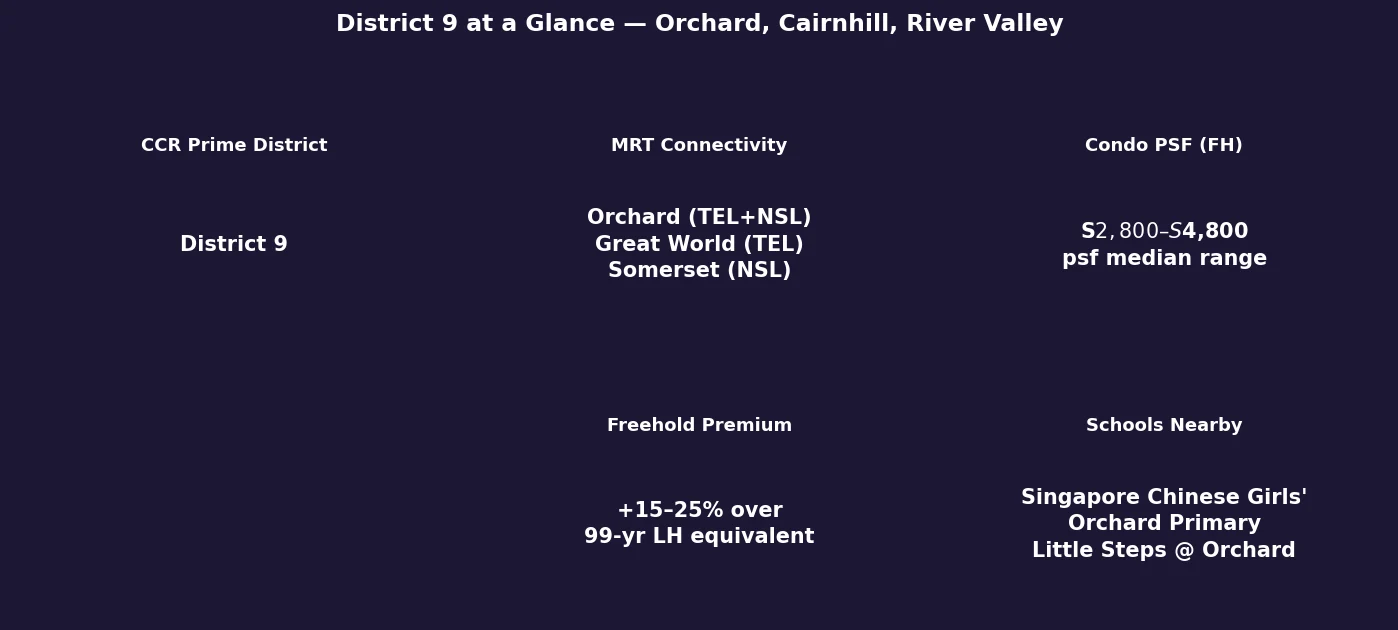
Freehold condo median prices range from S$2,800 to S$4,800 psf in 2026; leasehold units fetch S$2,200–S$3,200 psf.
TEL’s Orchard and Great World stations now give the precinct triple MRT access (Thomson–East Coast Line, North–South Line).
Gross rental yields average 2.5–3.2% — lower than OCR but underpinned by multinational corporate and diplomatic demand.
Freehold properties command a 15–25% premium over equivalent leasehold units in the same sub-district.
HDB supply is extremely limited (old Rochor/ Cairnhill estate stock only) — almost all residential stock here is private condo or landed.
ABSD applies to all purchases: Singapore Citizens buying a second property pay 20%, Permanent Residents 25% (first), foreigners 60%.
Capital appreciation over the 2019–2026 period has averaged +5–7% per annum for freehold D09 condos in the mid-luxury tier.
What Is District 9 and Why Does Orchard Road Matter?
District 9 — officially encompassing the planning areas of Orchard, Cairnhill, Leonie Hill, and River Valley — is Singapore’s best-known luxury address. The Orchard Road shopping belt, which stretches roughly 2.2 kilometres from Tanglin Road to Dhoby Ghaut, is both a retail landmark and the spine around which the surrounding residential market is priced. Properties within walking distance of Orchard MRT command a persistent scarcity premium: supply is structurally constrained by conservation zones, a dense grid of existing freehold developments, and the absence of Government Land Sales (GLS) Confirmed List sites since 2019.
The Urban Redevelopment Authority (URA) classifies D09 as part of the Core Central Region (CCR) — the most tightly regulated of Singapore’s three residential market segments. CCR properties attract the highest stamp duties for non-citizens and are subject to the full suite of Additional Buyer’s Stamp Duty (ABSD) cooling measures introduced and refined between 2011 and 2023.
Property Landscape: What You Can Buy in D09
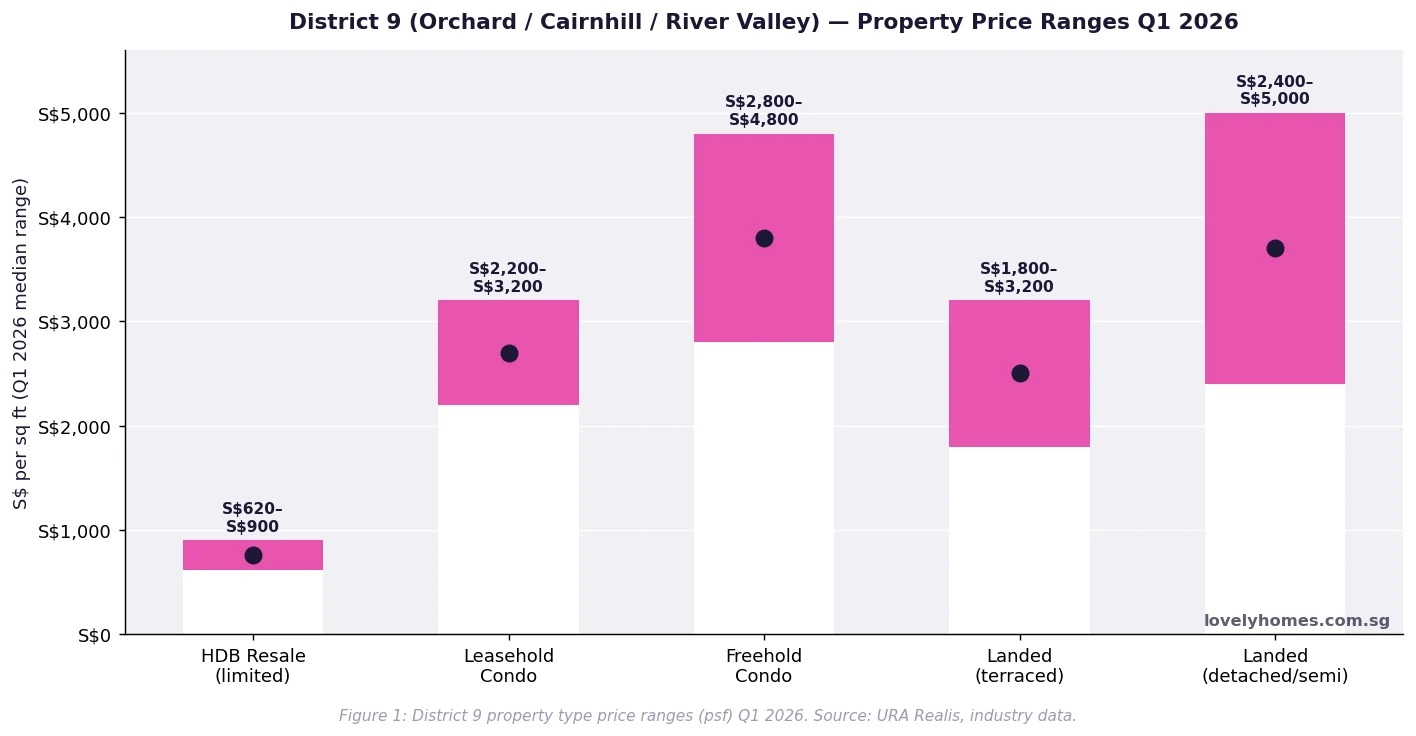
Figure 1: District 9 property type price ranges (psf), Q1 2026. Source: URA Realis, industry data.
The D09 residential market is almost entirely composed of private non-landed and landed properties. The key segments are:
Leasehold condominiums (99-year): typically newer developments built post-2000, PSF ranges S$2,200–S$3,200 in 2026. Examples include Highline Residences and 1919 (formerly Noisy Elephant). Leasehold developments offer more flexibility in financing but carry a lease-decay risk that buyers must factor in for re-sale after 2050.
Freehold condominiums: the dominant premium tier, with PSF ranging S$2,800–S$4,800 depending on storey, renovations, and project prestige. Established freehold addresses along Cairnhill, Emerald Hill, and Orchard Boulevard include projects whose 30-to-40-year-old vintages still command strong re-sale premiums due to their perpetual tenure and walk-to-Orchard-MRT location.
Landed (terrace and semi-detached): a small but significant segment, with terrace houses along Cairnhill Road and Ardmore Park environs transacting at S$1,800–S$3,200 psf on land. Semi-detached and detached bungalows (Good Class Bungalow fringe) sit at S$2,400–S$5,000+ psf on land. Foreigners are generally not permitted to purchase landed property in Singapore without Ministerial approval.
HDB resale flats: extremely rare in D09. The few remaining HDB blocks near Cairnhill and the old Rochor estate are among the most idiosyncratic properties in Singapore — priced S$620–S$900 psf due to their central location, but subject to stringent Ethnic Integration Policy (EIP) quotas and conventional HDB resale restrictions.
D09 at a Glance: Key Facts for Buyers
Figure 2: District 9 at a glance — Orchard, Cairnhill, River Valley.
MRT Connectivity: Why the TEL Changed Everything
For most of Singapore’s modern history, D09’s primary MRT connection was Orchard station on the North–South Line (NSL), opened in 1987. The Thomson–East Coast Line (TEL) Stage 3, which began operating in November 2022, transformed connectivity in the district in two significant ways.
First, Orchard station became an interchange between the NSL and TEL — dramatically cutting travel times to Thomson, Bishan, Woodlands, and the eastern corridor without changing trains. Second, Great World station (TEL), opened in 2022, gave the River Valley sub-district its own direct MRT access for the first time, adding a meaningful premium uplift to residential properties within 400 metres of the station. Industry estimates suggest the Great World TEL opening contributed a 6–10% PSF uplift to the immediately surrounding catchment.
Somerset station (NSL) anchors the Orchard Road retail strip’s southern end and serves as a secondary access point for Orchard sub-market properties. The combined station density — Orchard, Somerset, and Great World within roughly 1.5 km — gives D09 an MRT connectivity score that few other Singapore districts can match.
Rental Market and Investment Yields
D09 draws a high proportion of expatriate tenants from multinational corporations (particularly financial services, technology, and professional services firms) who prefer central locations with proximity to international schools and the CBD. This profile supports relatively stable rental demand even when broader market rental cycles soften.
Gross rental yields in D09 average 2.5–3.2% for condominiums in 2026. By comparison, OCR districts such as D27 (Yishun) or D23 (Bukit Panjang) offer 3.4–4.2%. The D09 yield discount is structural: absolute capital values are higher, which compresses the yield percentage even when absolute rental income is also elevated. A two-bedroom freehold condo at S$2.5M might fetch S$7,500–S$9,000 per month in rent — a 3.6–4.3% gross yield in dollar terms, but modest relative to the entry price.
Net yields after management fees, maintenance, property tax, and vacancy allowances typically run 1.8–2.5%. Investors in D09 are largely buying for capital appreciation and portfolio positioning rather than yield maximisation.
Summary Table: D09 Property at a Glance
Property Type
Typical PSF (2026)
Tenure
Gross Yield Est.
Best For
Leasehold Condo
S$2,200–S$3,200
99-year LH
2.8–3.5%
Capital appreciation, lower entry
Freehold Condo
S$2,800–S$4,800
Freehold
2.5–3.2%
Long-term hold, scarcity premium
Terrace (landed)
S$1,800–S$3,200 (land psf)
Freehold
1.5–2.5%
Generational wealth, redevelopment
Semi-D / Bungalow
S$2,400–S$5,000+ (land psf)
Freehold
1.2–2.0%
Ultra-prime, lowest yield segment
HDB Resale (rare)
S$620–S$900
Remaining lease
3.0–4.0%
Owner-occupiers; EIP restrictions apply
Worked Example: Buying a 2-Bedroom Freehold Condo in D09
📌 Case Study: Mr & Mrs Tan — 2-Bedroom Freehold Condo, D09
Profile: Singapore Citizen + Singapore Citizen, joint purchase of their first residential property. Combined gross monthly income S$18,000. Buying a 2-bedroom freehold condo at S$2,200,000.
Buyer’s Stamp Duty (BSD): First S$180,000 × 1% = S$1,800; next S$180,000 × 2% = S$3,600; next S$640,000 × 3% = S$19,200; next S$500,000 × 4% = S$20,000; next S$700,000 × 5% = S$35,000 ≈ S$79,600 BSD (effective rate ~3.62%)
ABSD: First property for both SC purchasers → S$0 ABSD
LTV and financing (bank loan): 75% LTV max → loan S$1,650,000. At 3.5% p.a., 25-year tenure: monthly repayment = S$8,272. TDSR: S$8,272 / S$18,000 = 45.9% — below the 55% TDSR cap → PASS.
Upfront cash requirement: 5% cash = S$110,000; balance 20% down (CPF or cash) = S$440,000; BSD S$79,600; legal/misc ~S$8,000. Total upfront ≈ S$637,600.
Note: If buying a second property or if either buyer is not SC, ABSD applies. A second-property SC purchase adds S$440,000 (20%) ABSD. Foreign buyers add S$1,320,000 (60%) ABSD. See our ABSD Complete Guide for full rates.
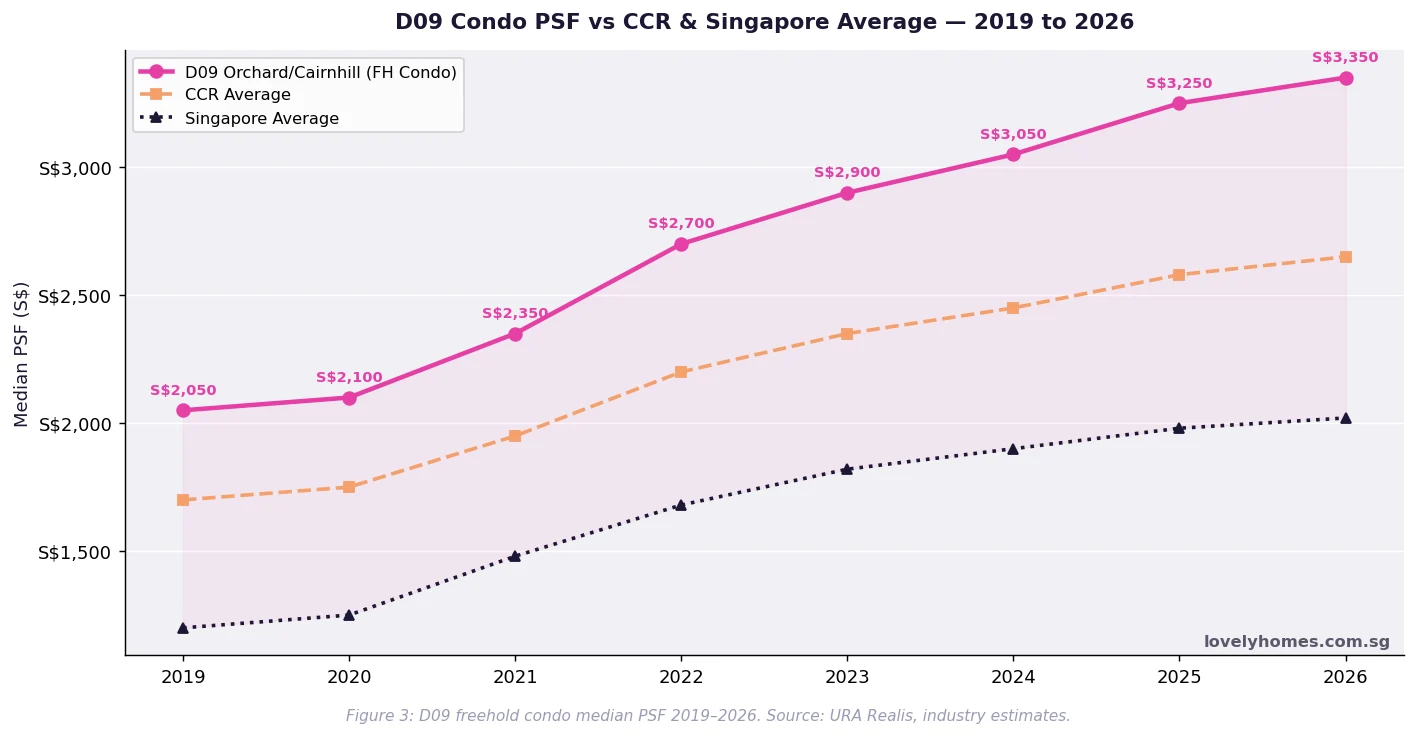
D09 Price Trend: How Orchard Road Condos Have Performed Since 2019
Figure 3: D09 freehold condo median PSF 2019–2026 vs CCR and Singapore averages. Source: URA Realis, industry estimates.
Freehold D09 condominiums appreciated from a median ~S$2,050 psf in 2019 to approximately S$3,350 psf by Q1 2026 — a 63% increase over seven years, or roughly 7% per annum compounded. This comfortably outpaced both the CCR average (+56%) and the Singapore-wide average (+68% from a much lower base).
The 2020 dip was shallow and brief: D09 benefited from an ultra-low interest rate environment and surging demand from ultra-high-net-worth buyers relocating to Singapore under the Global Investor Programme (GIP) and family office expansion. The 2023 ABSD increases (60% for foreigners, 65% for entities) dampened volume but exerted little downward pressure on freehold CCR pricing due to the structural scarcity of such units.
Why District 9 Matters in a Portfolio Context
For Singapore property investors, D09 serves a distinct portfolio role compared to OCR or RCR assets. Freehold tenure in D09 acts as a store-of-value comparable to a blue-chip equity position: low yield, low volatility in nominal terms, and a structural scarcity floor. The supply pipeline is thin — no major GLS site has been launched in the Orchard/Cairnhill sub-district since the 2010s — and the freehold nature of most existing stock means developers acquire sites only through collective sales, which cycle slowly and at significant cost.
Compared to peer markets such as Hong Kong’s Peak or Sydney’s Mosman, D09 freehold condo pricing at S$3,000–S$4,500 psf (approximately HK$26,000–HK$39,000 per sq ft or A$5,500–A$8,300 per sq ft) remains broadly competitive for a stable, AAA-sovereign-rated city with no capital gains tax, no inheritance tax, and full repatriation of rental income and sale proceeds.
What Might Come Next for Orchard Road Property
Two macro catalysts are worth watching. First, the URA Master Plan 2025 (gazetted December 2025) includes proposals to introduce limited residential GLS activity at the Orchard Boulevard fringe — potentially adding 600–800 new leasehold units to the precinct over the 2028–2032 horizon. If realised, this would modestly widen the leasehold–freehold PSF gap but is unlikely to cap freehold pricing. Second, TEL Stage 4 (Bayshore to Sungei Bedok) and Stage 5 completions are driving demand relocation from D09 toward D15/D16; while this eases upward pressure on D09 pricing, it also reflects a broader market deepening that historically lifts all CCR boats over the medium term.
Forward-looking commentary is speculative. Property markets are influenced by macro factors including interest rates, government cooling measures, and global capital flows that cannot be predicted with certainty.
Frequently Asked Questions
Can foreigners buy property on Orchard Road?
Yes, foreigners may purchase private condominiums in D09 (including Orchard Road and River Valley). However, the Additional Buyer’s Stamp Duty for foreign purchasers is 60% of the purchase price — a significant barrier. Foreigners are generally prohibited from purchasing landed residential property (terrace houses, semi-detached, detached bungalows) in Singapore without specific Ministerial approval. The restriction does not apply to units in strata-titled developments (condominiums). Foreigners who are Singapore Permanent Residents (SPR) pay a lower ABSD of 5% (first property), 30% (second), or 35% (third+), as at 2026.
What is the difference between Orchard Road, River Valley, and Cairnhill within D09?
District 9 covers three loosely overlapping sub-precincts. Orchard Road proper refers to the retail boulevard and its immediately flanking residential streets (Orchard Boulevard, Claymore Hill, Ardmore Park). Properties here command the sharpest freehold premiums. Cairnhill is the quieter residential enclave to the north of Orchard Road, characterised by mid-size freehold blocks on elevated terrain with city views. River Valley lies to the south and west, sloping towards the Singapore River; it is more mid-market relative to Cairnhill and has benefited most from the Great World TEL station opening, which added MRT-first access to a previously bus-dependent sub-precinct.
Are there HDB flats in Orchard Road / D09?
HDB flats in D09 are extremely rare. The handful of remaining HDB blocks near Cairnhill and the former Rochor estate are among the oldest in the stock (1970s–1980s vintage). They are resale only — no new BTO supply has been announced for D09 — and are subject to standard HDB resale eligibility rules including the Ethnic Integration Policy (EIP) quotas, which can constrain the buyer pool. The EIP quota for some blocks in the area is reached at times, particularly for Chinese-ethnicity buyers. Due to their central location, prices can reach S$700–S$900 psf, though resale volume is very low.
What ABSD do I pay on a second property purchase in D09?
ABSD rates (effective 2023) applicable to second-property purchases: Singapore Citizens 20%; Singapore PRs 30%; foreigners 60%. For a S$2,200,000 condo in D09, a Singapore Citizen buying their second property would pay S$440,000 in ABSD on top of BSD (~S$79,600), for total stamp duty of ~S$519,600. This significantly raises the break-even holding period. Most buyers paying ABSD at the 20% rate need to hold the property for approximately 8–12 years before capital appreciation covers the stamp duty cost, depending on leverage and rental income. Our ABSD complete guide has a full worked example with holding-period analysis.
Is D09 a good district for rental investment?
D09 is well-suited to investors who prioritise capital preservation and portfolio prestige over yield. Gross rental yields average 2.5–3.2%, which is among the lowest in Singapore by district. However, the tenant base — predominantly corporate expatriates, senior professionals, and high-net-worth individuals — is financially resilient and generates stable occupancy rates. Vacancy rates in D09 have historically tracked below the national condo vacancy average. The key risk is yield compression during interest rate cycles: when bank loan rates rise to 3.5–4.0%+, the carry cost of a highly leveraged D09 property can turn negative. Investors should stress-test their numbers at prevailing bank rates before committing.
What are the most established condo projects in Orchard Road?
Several freehold developments along Orchard Road and Cairnhill have maintained strong resale markets across multiple property cycles. Ardmore Park (Ardmore Park Road), Four Seasons Park (Cuscaden Road), Grange Infinite (Grange Road), The Ardmore (Ardmore Park), and Leonie Parc View (Leonie Hill) are among the well-regarded addresses. These projects typically offer large unit sizes (1,500–3,500 sq ft is common), high ceiling heights, and established common facilities. Newer freehold launches in the precinct include 15 Holland Hill (technically D10 fringe). Always verify the remaining lease, MCST management quality, and any outstanding special levies before committing to a specific project.
How does the Orchard Road masterplan affect property values?
The URA Orchard Road masterplan — actively implemented since the mid-2010s — repositions the district from a pure retail belt to a mixed-use “live, work, play” precinct. This includes the introduction of residential uses in selected retail podiums, increased greenery, pedestrianisation of side streets, and the long-term redevelopment of older hotel and commercial sites. For residential buyers, the masterplan signals continued public-sector investment in the streetscape and connectivity — a positive indicator for long-term capital values. The introduction of residential GLS sites flagged in the 2025 Master Plan, if confirmed, would add supply but also validate the URA’s confidence in the precinct’s long-term demand fundamentals.
All property prices, PSF figures, rental yields, and market projections in this article are based on publicly available data from URA Realis, HDB, and industry sources as at Q1–Q2 2026. They are indicative estimates and do not constitute a valuation, investment advice, or recommendation to buy or sell. Singapore property transactions involve significant stamp duties, financing obligations, and regulatory constraints. Readers should consult a licensed property professional, licensed financial adviser, and legal counsel before making any property purchase decision. Official stamp duty rates and eligibility rules are published by the Inland Revenue Authority of Singapore (IRAS) at iras.gov.sg. Zoning and planning information should be verified with the Urban Redevelopment Authority (URA) at ura.gov.sg. HDB resale eligibility rules are published at hdb.gov.sg.
Refinancing replaces your existing home loan with a new one from a different bank, typically to secure a lower interest rate; repricing keeps the same bank but renegotiates the rate.
The best time to refinance is when your lock-in period expires — usually 2–3 years after taking the loan. Refinancing within the lock-in incurs a break cost of typically 1.5% of the outstanding loan amount.
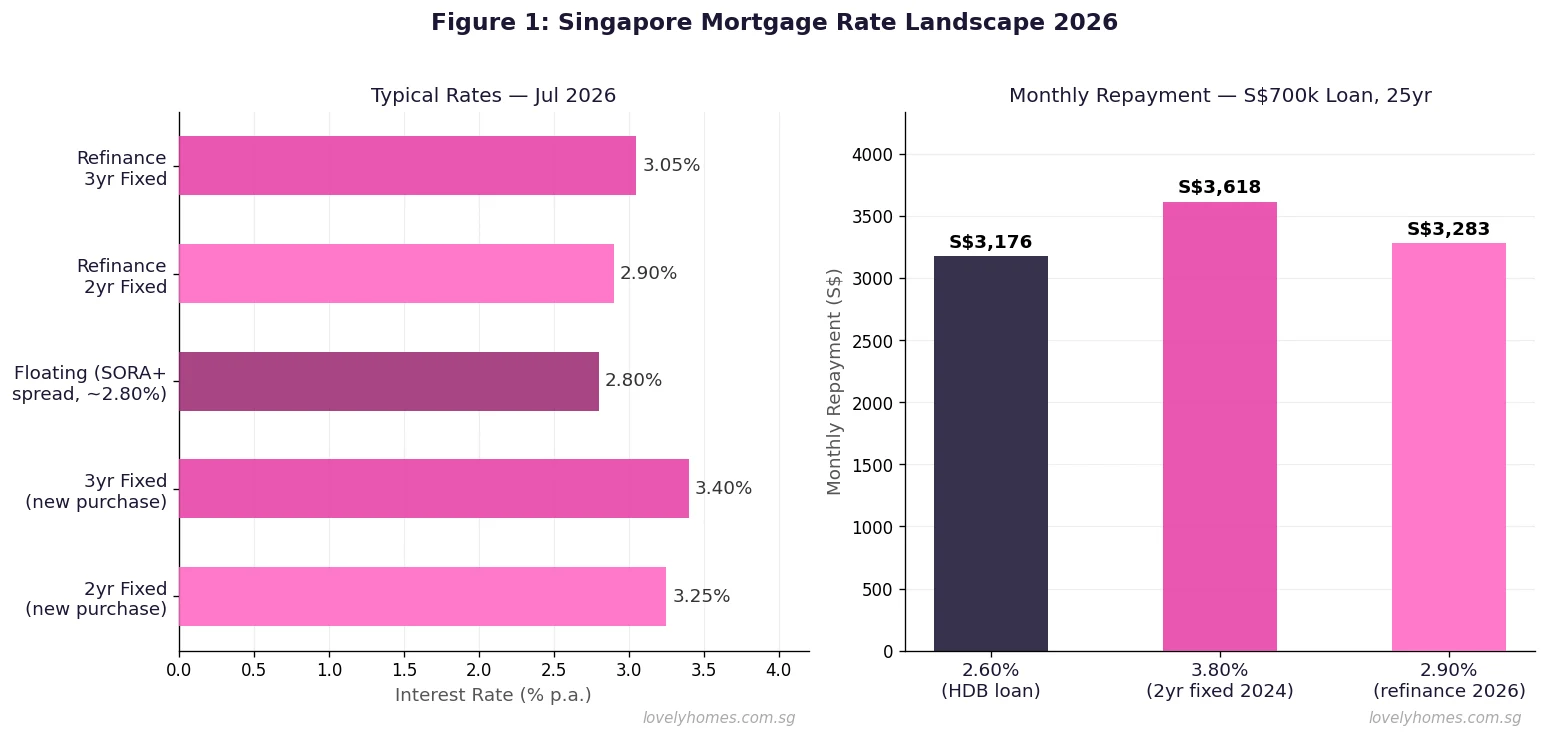
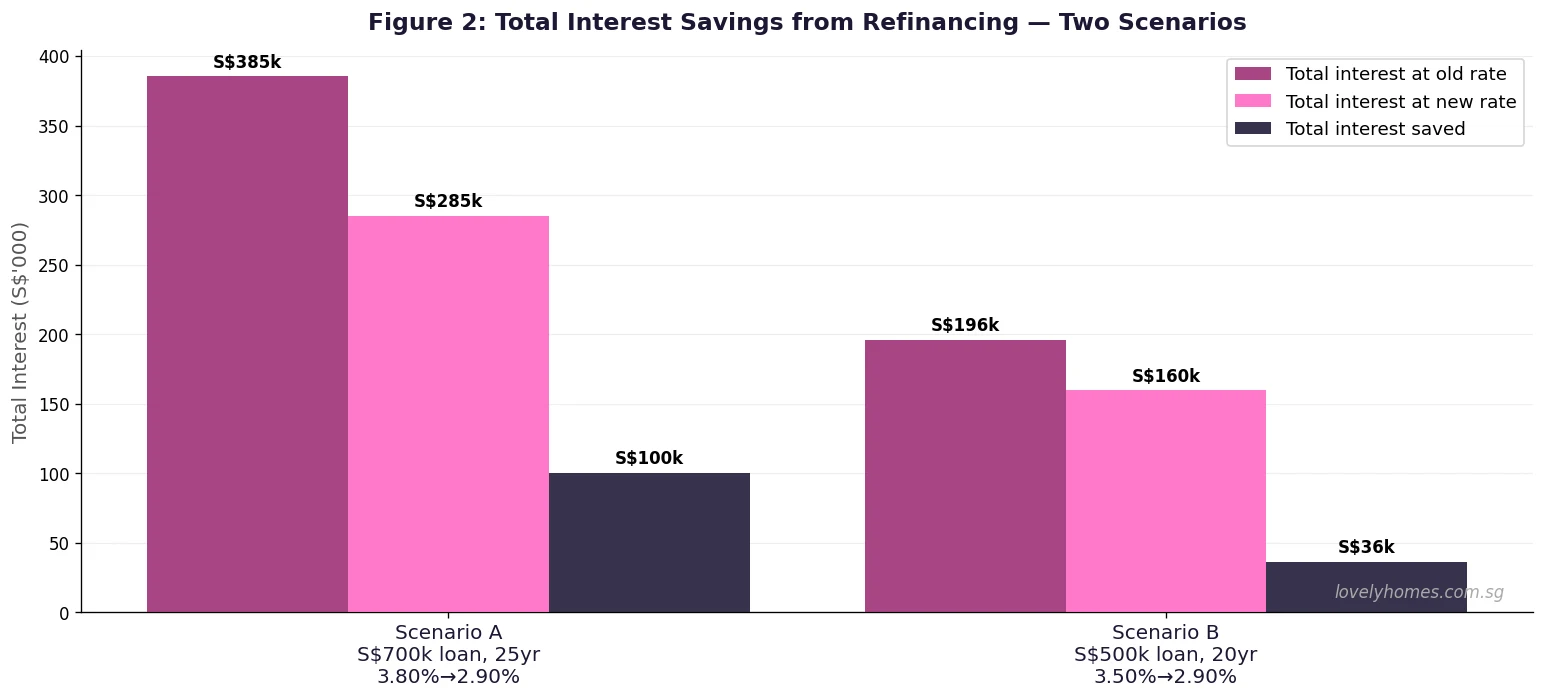
Typical savings in 2026: a borrower refinancing a S$700,000 loan from 3.80% (a 2024-vintage fixed rate) to 2.90% (current refinance rate) saves approximately S$78,000 in total interest over 25 years, or around S$260/month.
Transaction costs are modest: legal fees run S$1,800–S$3,000; valuation fees S$300–S$600; some banks offer full legal subsidy packages for refinancers.
SORA-pegged floating rates (Singapore Overnight Rate Average) offer potential savings when rates fall but expose you to upward repricing; fixed rates provide certainty for 2–3 years.
CPF OA funds can service the new loan, but the CPF accrued interest rule means any CPF monies used must be repaid (with accrued interest at 2.5% p.a.) on eventual sale.
Total Debt Servicing Ratio (TDSR) still applies at refinancing — you must prove the new monthly repayment stays within 55% of your gross monthly income.
Process timeline: from application to completion is typically 4–8 weeks; allow 3 months before lock-in expiry to start comparing packages.
In Singapore’s rate environment of 2024–2026, tens of thousands of homeowners took out fixed-rate mortgages at 3.50%–4.00% when the US Federal Reserve was tightening monetary policy. As those lock-in periods approach their two-year anniversary, refinancing has moved from a niche financial exercise to a mainstream priority. This guide explains exactly when to refinance, how to calculate whether it is worth it, what the process looks like and what to watch out for.
Refinancing vs Repricing: What Is the Difference?
These two terms are often conflated, but they involve distinct processes with different cost structures:
Refinancing means taking out a new home loan from a different bank to repay your existing loan. The new bank’s solicitors handle the discharge of the old mortgage and registration of the new one. You bear legal costs (S$1,800–S$3,000), valuation fees (S$300–S$600), and potentially a break cost if you exit before the lock-in period ends. Many banks offer legal subsidy packages that rebate S$1,800–S$2,500 to offset these costs for loans above a certain quantum.
Repricing means renegotiating your interest rate with your existing bank without changing lenders. The bank may offer this as a retention offer when your lock-in approaches expiry. Repricing is simpler and cheaper (typically S$200–S$800 in administration fees), but the rate offered is often not as competitive as what a new lender will offer to win your business. The trade-off is convenience versus maximum savings.
Rule of thumb: Always get competing quotes before accepting a repricing offer from your current bank. The rate gap between a repricing offer and an aggressive refinance package from a rival bank is often 0.30%–0.60% — which on a S$700,000 loan translates to S$2,100–S$4,200 per year in interest savings.
Figure 1: Left — typical mortgage rate offerings in Singapore as at July 2026, showing the current 2yr and 3yr fixed rates for new purchases and refinancing. Right — monthly repayment comparison for a S$700,000 loan at three rate scenarios over 25 years. Floating SORA-pegged rates are currently below most fixed offerings. Source: major Singapore bank public rate sheets, July 2026.
When Should You Refinance?
The single most important factor is the lock-in period. Most Singapore bank home loans carry a lock-in of 2–3 years, during which refinancing or full redemption triggers a penalty — typically 1.5% of the outstanding loan amount. On a S$700,000 outstanding balance, that is a S$10,500 penalty. You should almost never refinance within the lock-in unless the rate savings are dramatic and you have a very long holding horizon.
Outside the lock-in, refinancing is worth pursuing if the new rate is at least 0.50% lower than your current all-in rate. Below that threshold, the transaction costs (legal fees, valuation, time) may not justify the exercise unless your loan quantum is very large. The breakeven analysis in the next section provides the full framework.
Other triggers that make refinancing particularly timely:
Your property has appreciated significantly, improving your Loan-to-Value (LTV) ratio and qualifying you for a lower rate tier.
Your income has increased, qualifying you for a larger loan or improving your TDSR buffer, allowing you to reduce the loan tenure and total interest.
Interest rates in the market have fallen materially (as has been occurring in Singapore in 2025–2026 as the Fed easing cycle feeds through to SORA and fixed-rate offerings).
You want to switch from a floating-rate package (with rate uncertainty) to a fixed-rate package for budget certainty.
How Much Can You Save? The Breakeven Calculation
The refinancing decision is fundamentally a breakeven analysis: total savings from a lower rate versus total cost of switching. Here is the framework:
Step 2 — Calculate total switching cost:
Legal fees: S$2,500 (conservatively; some banks subsidise S$1,800–S$2,500)
Valuation fee: S$500
Total cost: S$3,000 (or as low as S$700 if legal subsidy applies)
Step 3 — Calculate breakeven period:
Breakeven = Total cost ÷ Monthly saving = S$3,000 ÷ S$260 = approximately 11.5 months
With full legal subsidy: S$700 ÷ S$260 = approximately 2.7 months
If you plan to hold the property for more than 12 months after refinancing (virtually all owner-occupiers will), the refinancing exercise pays for itself many times over.
Figure 2: Total interest savings across two refinancing scenarios. Scenario A (S$700k, 25 years remaining, 3.80%→2.90%) saves approximately S$78,000 in total interest. Scenario B (S$500k, 20 years remaining, 3.50%→2.90%) saves approximately S$38,000. Note: figures are illustrative estimates based on standard amortisation; actual savings depend on your bank’s compounding convention and any prepayment. Source: LovelyHomes calculations using standard reducing-balance methodology.
Choosing Between SORA Floating and Fixed Rate
Singapore bank mortgages are broadly offered in two flavours: floating rate (pegged to the Singapore Overnight Rate Average, or SORA, plus a spread) and fixed rate (a guaranteed rate for a defined period, usually 2–3 years).
As at July 2026, 3-month compounded SORA is approximately 2.35% per annum, and bank spreads on SORA packages run from 0.45% to 0.65%, giving an all-in floating rate of approximately 2.80%–3.00%. This is lower than most 2-year or 3-year fixed offerings (2.90%–3.40%). The floating rate appears attractive at current levels — but it will reprice every quarter as SORA moves, and there is no guarantee it stays below fixed rates in 2027–2028 if global rate pressures return.
For borrowers who:
Have a tight monthly budget and cannot absorb rate increases → choose fixed rate (2–3 years).
Expect to sell within 2 years (and want no lock-in) → choose a floating package with no lock-in.
Are refinancing opportunistically and comfortable with rate uncertainty → floating SORA may deliver better outcomes if rates continue declining.
Many borrowers opt for a hybrid: fixed rate for 2 years to lock in current savings, then assess the rate environment at the next repricing/refinancing window.
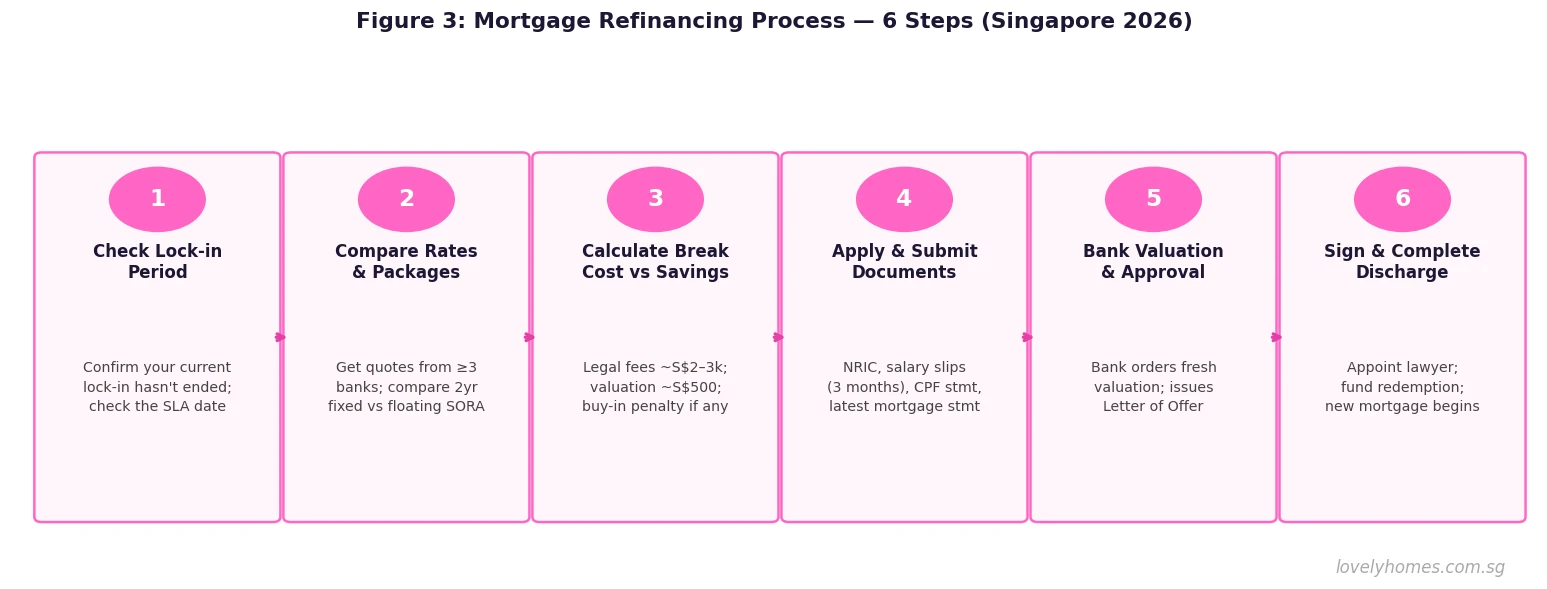
The 6-Step Refinancing Process
Figure 3: The mortgage refinancing process in Singapore from lock-in check to new mortgage commencement. Most homeowners complete the process in 4–8 weeks. Starting 3 months before your lock-in expiry gives you enough time to compare packages without pressure. Source: LovelyHomes.
The process works as follows in more detail:
Step 1 — Check lock-in period: review your current Letter of Offer (LOO) or contact your bank. Note the exact lock-in expiry date. If lock-in ends in 3 months or less, start immediately.
Step 2 — Compare packages from ≥3 banks: use mortgage brokers or direct bank websites. Compare: all-in rate, lock-in period, legal subsidy quantum, clawback conditions (most banks claw back subsidies if you refinance again within 3 years), late payment penalties.
Step 3 — Calculate break-even: use the formula above. Factor in any legal subsidy. Confirm the new bank’s loan quantum by checking your LTV (outstanding loan vs current valuation).
Step 4 — Apply and submit documents: typically required — NRIC/passport, last 3 months’ payslips, last 2 years’ NOA or CPF annual statement (for self-employed), last 3 months’ CPF transaction history, latest mortgage statement, title deed or SLA record search. Processing time: 2–3 weeks.
Step 5 — Valuation and Letter of Offer: the new bank orders a valuation (S$300–S$600; usually paid by borrower). On approval, a formal LOO is issued. Read all conditions carefully — especially the lock-in, penalty clauses and clawback on subsidies.
Step 6 — Legal completion: appoint a solicitor (often from the bank’s panel to qualify for subsidy). The solicitor handles mortgage discharge from old bank and registration of new charge. The process takes 2–4 weeks from LOO acceptance. On completion, the old loan is fully redeemed and the new mortgage commences.
Summary: When Refinancing Makes Sense
Situation
Refinance?
Reason
Lock-in expired, rate gap ≥0.50%
Yes
Savings clear the transaction cost in <12 months
Lock-in expired, rate gap <0.25%
No / Reprice only
Transaction costs may outweigh savings on small loans
Within lock-in, penalty 1.5%
No
Break cost typically exceeds 3–5 years of rate savings
Property value up significantly
Yes, if lock-in expired
Better LTV unlocks lower rate tier
Planning to sell within 12 months
No
Insufficient time to recover transaction costs
Want certainty vs. floating rate
Switch to fixed
Budget certainty has value beyond raw rate comparison
Want maximum saving now
Floating SORA package
SORA ~2.80% is below fixed rates as at July 2026
Worked Example: The Tan Household Refinancing Decision
Mr and Mrs Tan are Singapore Citizens who purchased a D15 condominium in March 2024 at S$1,450,000. They took a S$1,087,500 (75% LTV) bank loan at a 2-year fixed rate of 3.80% per annum. Their lock-in expires in March 2026 (which has now passed). Their outstanding balance as at July 2026 is approximately S$1,040,000 with 23 years remaining.
Current monthly payment: S$1,040,000 @3.80%, 23 years = S$5,730/month Proposed refinance rate: 2-year fixed at 2.90% from Bank B New monthly payment: S$1,040,000 @2.90%, 23 years = S$5,323/month Monthly saving: S$407 Annual saving: S$4,884
Transaction costs:
Legal fees: S$2,800 (solicitors for discharge and new mortgage)
Valuation: S$500
Legal subsidy from Bank B: S$2,000 Net out-of-pocket cost: S$1,300
Breakeven: S$1,300 ÷ S$407/month = 3.2 months
Total interest saving over 23 years (rough estimate): S$112,000
Verdict: Refinancing is strongly justified. The Tan household breaks even in just over 3 months, and with Bank B’s legal subsidy absorbing most of the switching cost, the exercise is essentially self-funding within a quarter. Their combined TDSR at S$5,323/month on S$18,000 combined income is 29.6% — well within the 55% cap.
What Might Come Next
Singapore mortgage rates are tied to global monetary conditions via SORA, which tracks the US Federal Reserve’s policy rate with a lag. If the Fed continues its easing cycle into 2027 — as futures markets tentatively suggest — SORA could drift lower, making floating-rate packages increasingly attractive. However, the US election cycle, inflation trajectory and any geopolitical disruptions could reverse this direction quickly.
For 2026 specifically, the window of opportunity for borrowers with 2024-vintage fixed loans at 3.50%–4.00% approaching lock-in expiry is now open. Industry data suggests Singapore mortgage refinancing volumes in Q1–Q2 2026 have exceeded 2023 levels as a result. Borrowers who act in 2026 are capturing a rate environment that is materially better than two years ago; those who wait may find rates have either risen again or the best packages are no longer available.
What is the difference between a lock-in period and a clawback period?
A lock-in period is the minimum period you must hold the loan before you can redeem or refinance it without penalty. Refinancing within the lock-in typically triggers a break cost of 1.50% of the outstanding loan amount. A clawback period is separate and relates to any subsidies the bank gave you when you took the loan — legal subsidies, cashback and valuation fee rebates. If you refinance to a different bank within the clawback period (commonly 3–5 years), the new bank will not claw back anything, but your existing bank may require you to return the subsidies it paid. Clawback clauses vary by bank and package — always read the fine print in your Letter of Offer.
Can I refinance an HDB loan to a bank loan?
Yes — you can refinance from an HDB concessionary loan (currently 2.60% p.a.) to a bank loan. This is sometimes done when a borrower wants a longer tenure or wishes to free up CPF OA funds (by paying down the HDB loan with cash). However, the move is irreversible: once you switch from an HDB loan to a bank loan, you cannot return to an HDB loan. You also lose the flexibility of the HDB concessionary rate, which is pegged to the CPF OA rate plus 0.10% and tends to be more stable than market rates. As at July 2026, SORA-based bank floating rates (approximately 2.80%) are marginally higher than the HDB rate (2.60%), making the switch financially neutral to slightly negative at current rates — but bank packages with lock-ins set now may offer competitive 2-year fixed rates of 2.90%–3.10%. Consider this decision carefully and model the scenarios over your full remaining tenure.
Does TDSR apply when refinancing?
Yes, TDSR (Total Debt Servicing Ratio) applies at the point of refinancing. The bank will re-assess your income and all existing credit obligations (car loans, personal loans, outstanding credit card balances) to ensure the new monthly mortgage repayment, combined with all other debt obligations, does not exceed 55% of your gross monthly income. In practice, most refinancers who took a loan 2–3 years ago and have maintained their income pass TDSR comfortably — the new repayment is typically lower than the old one. If your income has fallen since the original loan, however, you may face difficulties qualifying for the same loan quantum at refinancing, especially if property values have declined and the bank’s fresh valuation results in a lower LTV ceiling.
How do I know if my property has appreciated enough to get a better rate?
When you refinance, the new bank orders a fresh valuation of your property. If the valuation comes in higher than when you originally purchased (e.g., your outstanding loan is S$700,000 but your property is now valued at S$1,200,000, giving an LTV of 58%), some banks offer lower rates for loans below a certain LTV threshold (typically 60% or 70% LTV). Check whether the bank’s rate sheet distinguishes by LTV tier. Additionally, a higher valuation means the bank is lending against a more valuable asset, which improves its credit comfort. If you believe your property has appreciated significantly, it is worth commissioning a preliminary desktop valuation before formally applying.
What documents do I need to refinance a Singapore home loan?
Standard documentation required for a refinancing application in Singapore includes: (1) NRIC or Singapore passport; (2) last 3 months’ payslips (for salaried employees) or last 2 years’ Income Tax Notice of Assessment (for self-employed or variable-income earners); (3) CPF contribution history for the past 12 months (downloadable from the CPF website); (4) latest mortgage statement showing outstanding balance and remaining tenure; (5) property title or SLA records search printout; (6) IRAS property tax statement (to confirm Annual Value); and (7) bank statements for the past 3 months if requested for income verification. Some banks also require the original Letter of Offer from your current bank. Preparing these in advance shortens the processing time from 2–3 weeks to 1–2 weeks.
Can I use CPF to pay off the legal fees when refinancing?
No. Legal fees and valuation fees at refinancing must be paid in cash. CPF Ordinary Account (OA) funds can only be used to service the ongoing monthly mortgage repayments (subject to the Valuation Limit and Withdrawal Limit rules) and, at the point of original purchase, for the downpayment and BSD. The transaction costs associated with refinancing — solicitors’ fees, valuation, any break cost — are out-of-pocket cash expenses. However, if a bank offers a legal subsidy rebate as part of its refinancing package, that rebate is typically credited to your loan account or paid directly to your solicitor, effectively reducing your cash outlay to near zero. Always check the terms of any subsidy before signing.
Is there a minimum loan amount to refinance in Singapore?
Most Singapore banks have an informal minimum loan quantum of around S$300,000 for refinancing to be commercially viable, as the legal and administrative processing costs are fixed regardless of loan size. For very small outstanding balances (below S$200,000 with only 5–8 years remaining), the interest saving may not justify the switching cost — a simple repricing request to your existing bank is likely more appropriate. There is no regulatory minimum loan size; the practical constraint is economic: at S$200,000 outstanding and a 0.50% rate saving, the annual interest saving is only S$1,000, which barely covers legal fees. Larger loan balances (S$500,000 and above) consistently produce compelling breakeven timelines of under 12 months when switching from a high-rate vintage to current market rates.
Disclaimer: The information in this article is for general educational purposes only and does not constitute financial advice. Mortgage interest rates, SORA, TDSR rules, bank packages and CPF withdrawal limits are subject to change. The calculations in this article use standard reducing-balance amortisation methodology and are for illustrative purposes only — your actual savings will vary depending on your bank’s compounding convention, exact outstanding balance, remaining tenure and prevailing market rates at the time of refinancing. Always obtain independent advice from a licensed financial adviser, mortgage broker or your bank before making any refinancing decision. LovelyHomes does not act as a licensed financial adviser and does not receive referral fees from any bank or broker.
Watch: Supply is thin — no major new private residential GLS in D02 for several years; scarcity premium is real
Tanjong Pagar is one of Singapore’s most layered neighbourhoods. It is at once a bustling CBD business district, a conserved Peranakan and shophouse enclave, a mature HDB heartland anchored by the globally celebrated Pinnacle@Duxton, and the gateway to Singapore’s most ambitious land transformation project — the Greater Southern Waterfront (GSW). For property buyers and investors in 2026, the neighbourhood presents a rare combination: tight existing supply, a proven rental market, and a long-term government-backed regeneration catalyst that will reshape the southern coast of Singapore over the coming decades.
This guide covers everything you need to know about buying, renting, and investing in Tanjong Pagar — from live Q1 2026 price data across HDB resale and private condominiums, to the eligibility rules that govern who can buy what, a worked cost example, and an honest assessment of what the Greater Southern Waterfront means for property values in D02.
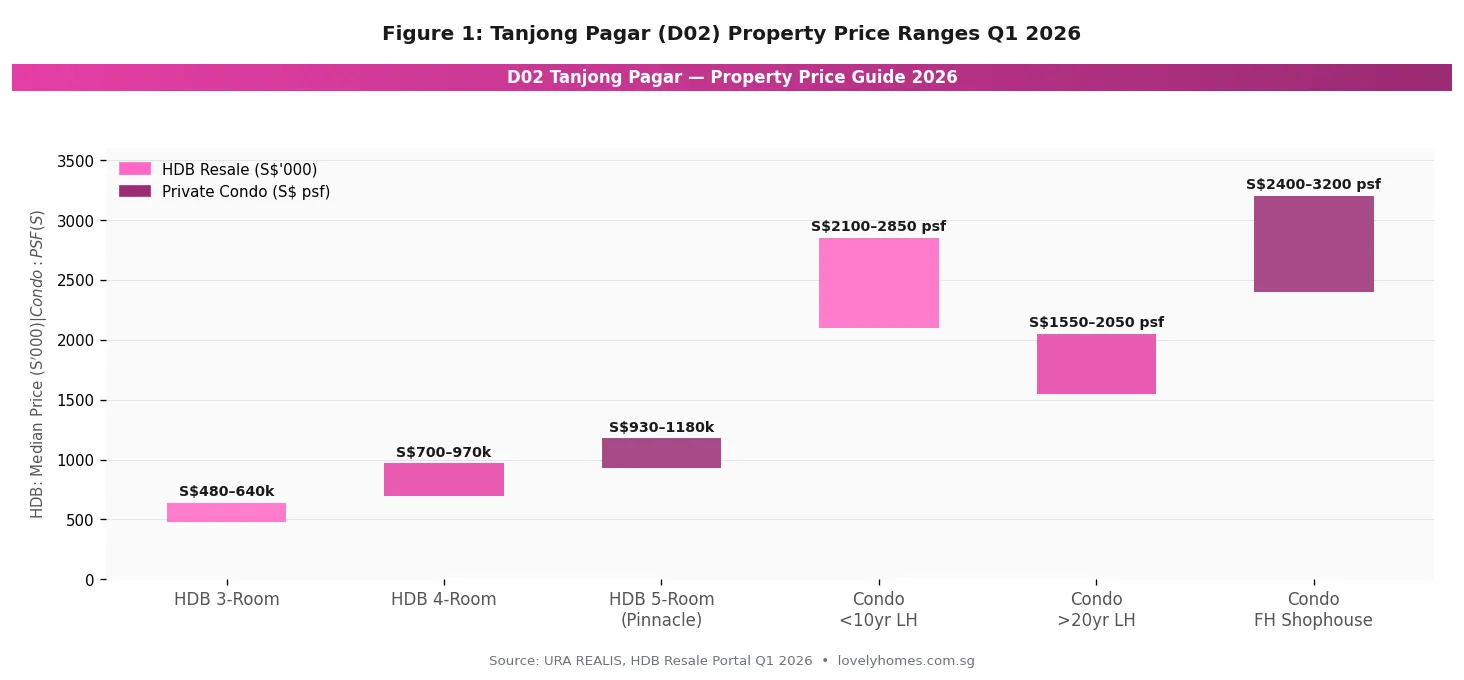
Figure 1: Tanjong Pagar (D02) property price ranges, Q1 2026. HDB resale prices are medians in S$’000; private condo data reflects median PSF (S$) for non-landed units ≤1,500 sqft. Sources: URA REALIS, HDB Resale Portal.
Where Is Tanjong Pagar and What Makes It Distinctive?
Tanjong Pagar sits in District 02, bounded roughly by Outram Road to the west, Maxwell Road and Neil Road to the north, Keppel Road to the south, and Anson Road to the east. The district is administered within the Outram planning area, and sits firmly within Singapore’s Core Central Region (CCR) — the premium market segment encompassing the traditional prime districts (D9, D10, D11), the CBD core (D1, D2, D6), and Sentosa.
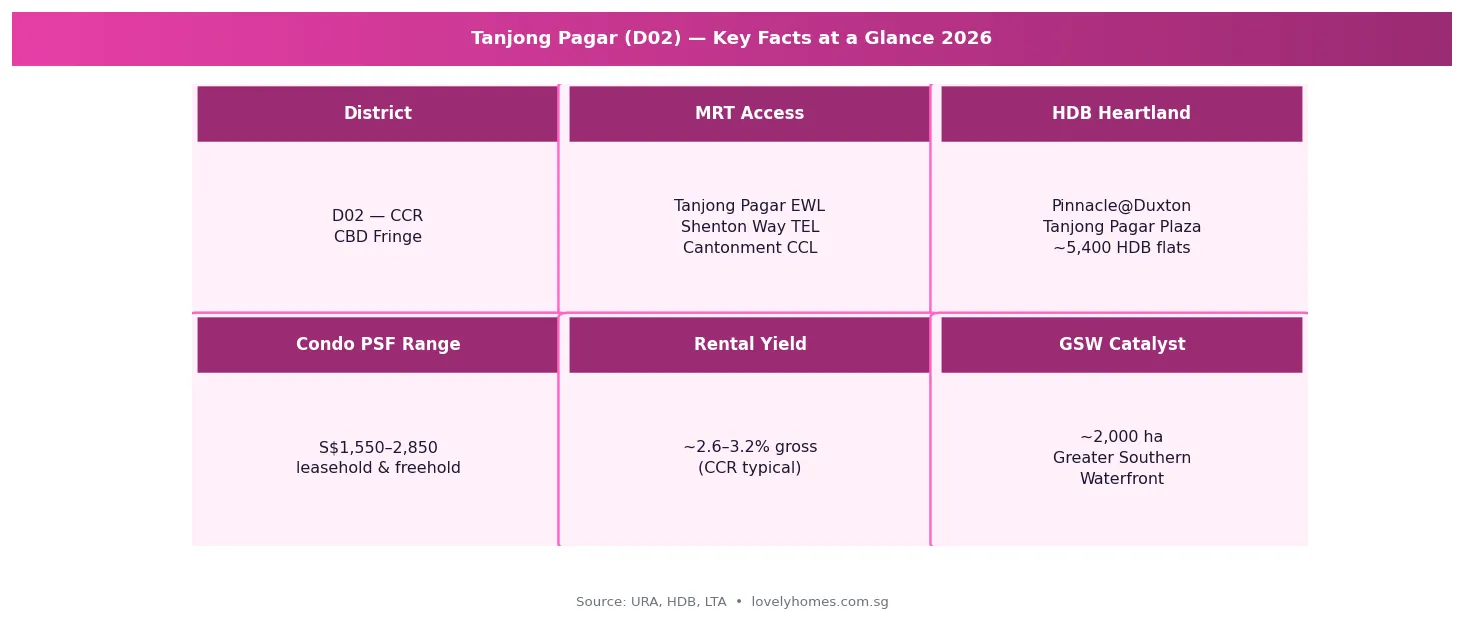
What distinguishes Tanjong Pagar from the rest of the CCR is its mix. Unlike Orchard Road (D9/D10) or Holland Village (D10), which are predominantly private residential, Tanjong Pagar houses approximately 5,400 HDB flats alongside office towers, conserved shophouses, food courts, Chinatown Heritage Centre, and one of Singapore’s most recognisable public housing landmarks. This diversity of tenure and use gives the neighbourhood an urban texture that attracts a broad buyer and tenant base.
Figure 2: Tanjong Pagar (D02) key facts at a glance, 2026. Sources: URA, HDB, LTA.
Transport Connectivity: Three MRT Lines and Walking-Distance Access
Connectivity is one of D02’s strongest selling points. Residents can access three MRT lines without a bus transfer:
Tanjong Pagar MRT (EW15 — East-West Line): The original station, opened in 1987, connects directly west to Jurong and east to Tampines, Changi Airport, and Pasir Ris. The one-stop hop to Raffles Place (EW14) places the financial district within a two-minute train ride. Outram Park (EW16/NE3/TE17) — one stop west — offers further cross-platform access to the North-East Line and Thomson-East Coast Line.
Shenton Way TEL (TEL17 — Thomson-East Coast Line, Stage 3): Opened in November 2022, Shenton Way TEL sits a short walk north of the Tanjong Pagar residential cluster. The TEL offers seamless one-transfer connectivity to Woodlands (via Orchard and Newton), to East Coast (via Bayshore and Bedok South on TEL Stage 4), and eventually to Sungei Bedok where a cross-platform interchange with the East-West Line will complete the full loop. For Tanjong Pagar residents, the TEL meaningfully reduces commute times to the northern towns and to the Katong/Marine Parade corridor.
Cantonment MRT (CC28 — Circle Line): Opened in September 2022 as part of the Circle Line Stage 6 (closing the loop), Cantonment station sits on Cantonment Road just south of the Pinnacle@Duxton. The Circle Line connects Tanjong Pagar residents directly to one-north, Harbourfront, Dhoby Ghaut, and the eastern nodes of the CCL without going through the city centre interchange.
This three-line connectivity is uncommon even by Singapore standards. Most heartland towns have one or two lines; D02’s triple access gives it a commuting advantage that supports both tenant demand and rental premiums.
HDB Resale Market in Tanjong Pagar: Prices, What to Expect
The HDB resale market in Tanjong Pagar is among the most expensive in Singapore for public housing. The reasons are structural: limited supply (most of the area is private or commercial), exceptional connectivity, and the prestige associated with the Pinnacle@Duxton address. Buyers should expect to pay a meaningful premium over comparable flats in Queenstown or Buona Vista, let alone OCR towns like Tampines or Sengkang.
Flat Type
Approx. Floor Area
Q1 2026 Median Price
Price Range
Key Precinct
3-Room
~65–73 sqm
S$555,000
S$480k–S$640k
Tanjong Pagar Plaza, Cantonment Rd
4-Room
~90–105 sqm
S$820,000
S$700k–S$970k
Tanjong Pagar Plaza, Pinnacle (lower floors)
5-Room (Pinnacle)
~110–120 sqm
S$1,050,000
S$930k–S$1.18M
Pinnacle@Duxton exclusively
Pinnacle@Duxton — the seven-tower, 50-storey public housing development completed in 2010 — warrants special mention. Units here, particularly those on higher floors with city and sea views, have consistently transacted above S$1 million since 2021. The development enjoys Minimum Occupation Period (MOP) completed status, and resale units come with the added draw of the iconic sky bridge and rooftop gardens, which are open to the public. Buyers should note: as a leasehold HDB flat with a 99-year tenure commencing 2010, Pinnacle units have approximately 83 years remaining as at 2026 — factoring in lease decay is essential when assessing long-term value.
HDB Eligibility Rules That Apply in D02
The standard HDB resale eligibility framework applies — Singapore Citizens and Permanent Residents who meet the citizenship/family nucleus requirements may purchase. There are no specific restrictions unique to D02, but buyers should note: if any flat in the precinct falls within a Prime classification zone (under HDB’s August 2024 Prime/Plus/Standard framework for BTO), resale of those units after MOP will attract a clawback on subsidies received at purchase. As at 2026, most Tanjong Pagar resale flats are legacy stock not subject to new-framework clawbacks — but prospective buyers should verify the specific block’s classification with HDB before committing.
Private Condo and Freehold Market in D02
D02 Tanjong Pagar has a limited supply of private condominiums compared to neighbouring districts. Development sites are scarce in this dense, mixed-use environment. Notable private residential projects in and around the precinct include Icon (leasehold, completed 2007), One Shenton (leasehold, Shenton Way), V on Shenton (leasehold), 76 Shenton (freehold conservation shophouse redevelopment), and the Artra development at Alexandra View. Freehold conservation shophouses on Club Street, Tanjong Pagar Road, and Duxton Hill command premium valuations as alternative assets.
The PSF range varies significantly by age, tenure, and location within the precinct. As a general guide for Q1 2026:
Property Type
Tenure
PSF Range (S$)
Typical Monthly Rent (2BR)
Est. Gross Yield
Condo <10 yr old, LH
99-year
S$2,100–S$2,850
S$5,800–S$7,500
~2.8–3.1%
Condo >15 yr old, LH
99-year
S$1,550–S$2,050
S$4,200–S$5,600
~2.9–3.2%
Freehold shophouse resi
Freehold
S$2,400–S$3,200
S$6,000–S$9,000
~2.5–2.9%
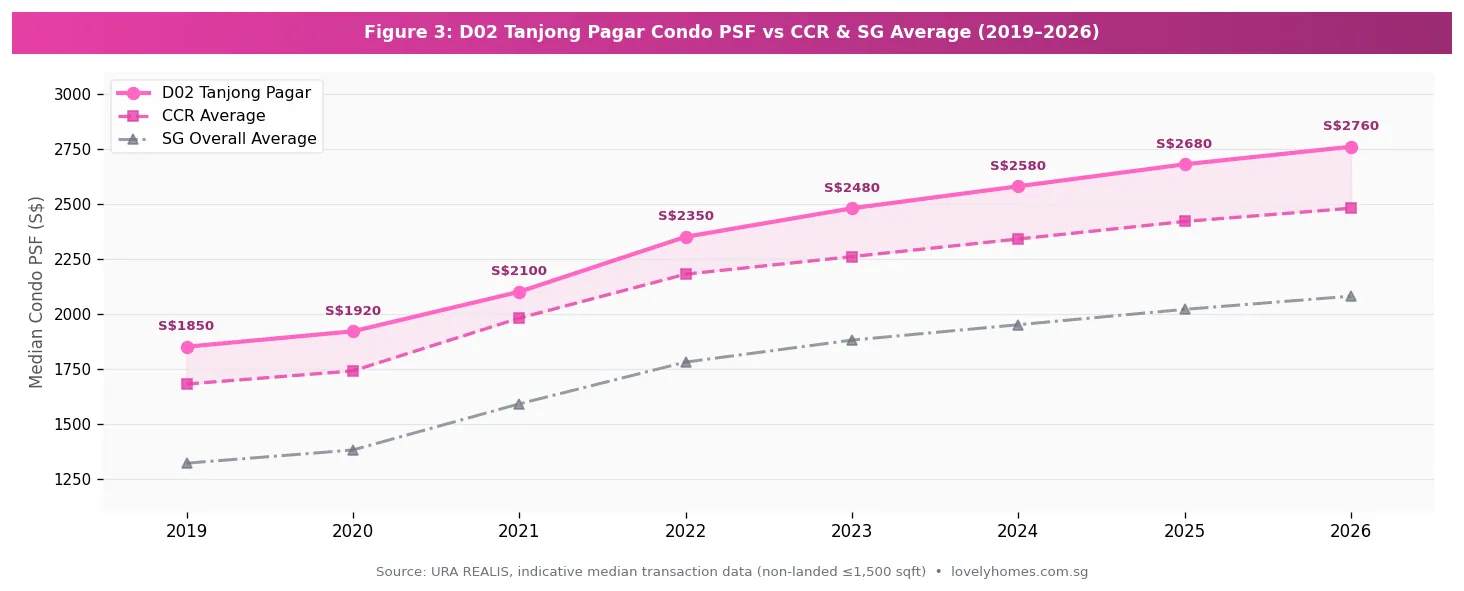
Figure 3: D02 Tanjong Pagar median condo PSF (non-landed, ≤1,500 sqft) versus CCR average and Singapore overall, 2019–2026. Sources: URA REALIS, indicative median transaction data.
As Figure 3 illustrates, D02 has consistently traded at a premium above the CCR average — reflecting the district’s CBD-adjacency advantage. The gap widened between 2021 and 2023 as post-pandemic demand for city-fringe living spiked. Since 2024, the gap has stabilised, with D02 running approximately S$250–S$320 psf above the CCR mean. The absence of significant new supply — no major GLS site has been released in D02 in recent years — has supported prices even as broader CCR activity moderated in 2024.
The Greater Southern Waterfront: What It Means for Tanjong Pagar Property
The Greater Southern Waterfront (GSW) is the Singapore Government’s most ambitious urban transformation project south of the city. It encompasses approximately 2,000 hectares of land stretching from Pasir Panjang in the west to Marina East in the east — a stretch of southern coastline currently occupied by port terminals, industrial facilities, golf courses, and government land. As the Tanjong Pagar Port (the world’s largest container port by throughput when it operated) progressively relocates to Tuas by the early 2030s, this vast land bank becomes available for mixed-use development over the following two to three decades.
For Tanjong Pagar property owners, the GSW is both an opportunity and a long-dated one. Key facts that property buyers should understand:
Scale and timeline: At 2,000 ha, the GSW is larger than Marina Bay and Tampines combined. Development will be phased over 20–30 years. The first parcels to emerge will be around Keppel and Telok Blangah; those closest to Tanjong Pagar could see activity within 10–15 years.
Planned character: URA’s masterplan envisions a live-work-play precinct with new residential districts, public green spaces, a new waterfront promenade, cultural institutions, and a potential new MRT connection along the southern coast. The Keppel Club site (approximately 44 ha) was the first major GSW parcel to be tendered, with the winning developer awarded the white site in early 2023 for a mixed-use development that will include over 9,000 residential units — becoming one of Singapore’s largest planned private housing estates.
Property value implications: Historical precedent from Marina Bay and one-north suggests that government-planned transformations deliver measured but real uplift to surrounding residential values — typically concentrated in the 5–10 years before and during initial development. For D02 owners, the GSW catalyst is a hold thesis rather than an immediate trading play.
Key Takeaway: The GSW will materially reshape Singapore’s southern coast but on a multigenerational timeline. Buyers who purchase in Tanjong Pagar for own occupation benefit from the neighbourhood’s current strengths (connectivity, heritage, supply scarcity) and receive the GSW as optionality — not as a near-term flip thesis.
Worked Example: Buying a Tanjong Pagar Condo in 2026
The Scenario: Mr and Mrs Tan (SC/SC), first-time buyers, purchasing a 2-bedroom condo
Property: 2-bedroom leasehold condo near Tanjong Pagar, 700 sqft at S$2,400 psf = S$1,680,000
Stamp duty: Buyer’s Stamp Duty (BSD) = 1% on first S$180k + 2% on next S$180k + 3% on next S$640k + 4% on next S$500k + 5% on remainder
= S$1,800 + S$3,600 + S$19,200 + S$20,000 + S$9,000 = BSD S$53,600
ABSD: S$0 — SC first property, ABSD exempt
LTV and downpayment: With income of S$15,000/mth combined, TDSR ceiling is 55% → max monthly debt S$8,250. Assume 75% LTV bank loan at 3.5% over 25 years:
Loan = S$1,260,000; monthly repayment ≈ S$6,310 → TDSR 42.1% PASS
Cash required upfront:
— 5% cash downpayment: S$84,000 (cash only; CPF cannot cover first 5%)
— 20% balance: S$336,000 (cash or CPF OA)
— BSD: S$53,600
— Legal fees / stamp duty / valuation: ~S$6,000
— Total upfront: approx. S$479,600 (depending on CPF OA balance)
Note: SPR or SC second-property buyers would pay ABSD of 5% (SPR first) or 20% (SC second) respectively, materially increasing the total cost. Always compute your personal profile’s ABSD liability before committing.
Why Tanjong Pagar Matters for Property Investors in 2026
In a market where OCR prices have risen sharply since 2020 and the gap between CCR and OCR has narrowed, Tanjong Pagar offers a rare proposition: a CCR address at a price point that, in historical context, is more accessible than it has been. The CCR-to-OCR price differential compressed significantly between 2021 and 2024 as mass-market demand pushed OCR prices upward while CCR remained relatively range-bound.
For long-term holders, D02 has three structural advantages that distinguish it from comparable CCR districts. First, the supply pipeline is thin — no significant new private residential completions are expected in D02 through 2028, meaning existing stock bears no dilution risk from new units coming online. Second, the tenant pool is diversified across CBD professionals, Chinatown heritage seekers, and increasingly, short-stay visitors and digital nomads who value the neighbourhood’s walkable character. Third, the GSW represents a call option on Singapore’s next major urban precinct — one that, unlike speculative GLS bids, requires no premium payment.
Comparable CCR districts (D9 Orchard, D10 Bukit Timah, D11 Novena) all carry higher average PSFs and lower yield profiles. D02’s position as the undervalued cousin of the prime districts has been a persistent feature of the Singapore market, partly because of the neighbourhood’s historic industrial associations and partly because of its relative unfamiliarity to overseas buyers. Both factors are changing.
What Might Come Next for Tanjong Pagar Property
This section reflects editorial analysis and speculation based on current trends. It should not be treated as a forecast or investment advice.
The most consequential near-term catalyst for D02 values is likely the Keppel integrated development — the first major GSW residential project — which, if it proceeds on schedule, could deliver initial units by the late 2020s to early 2030s. When Marina Bay Sands and the Marina Bay Financial Centre arrived, surrounding Districts 1 and 2 saw demonstrable price appreciation driven by improved amenity, connectivity, and perception uplift. A similar dynamic is plausible as the first GSW precincts activate, though the scale and timeline introduce significant uncertainty.
The URA Q2 2026 price index (released 1 July 2026, URA pr26-51) showed the CCR rebounding +2.0% quarter-on-quarter, outperforming the RCR (-1.4%) and OCR (-0.2%). If the CCR rebound is sustained, D02 stands to benefit disproportionately given its supply constraints and improving sentiment around the GSW. That said, global interest rate trajectories and Singapore’s continued vigilance on cooling measures (ABSD rates remain elevated since 2023) remain the key headwinds for any near-term price acceleration.
Foreigners may purchase private condominiums in Tanjong Pagar freely, but may not purchase HDB flats (including Pinnacle@Duxton). Foreign buyers pay a 60% ABSD on their purchase price, on top of BSD. Freehold conservation shophouses classified as strata commercial or strata residential may be available, but restrictions apply — consult a licensed property agent and conveyancing solicitor before proceeding. Singapore Permanent Residents (SPRs) pay 5% ABSD on their first residential property purchase.
What is the MOP for HDB flats in Tanjong Pagar?
HDB resale flats in Tanjong Pagar (including Pinnacle@Duxton) have a standard Minimum Occupation Period of 5 years from the date the seller obtained the keys. You cannot resell or rent out the entire flat during MOP. After MOP, the full flat may be rented out, subject to HDB’s rental eligibility rules. New BTO flats in prime-classified zones carry an extended 10-year MOP under the framework introduced in August 2024.
How does buying a Pinnacle@Duxton flat differ from a standard HDB purchase?
Pinnacle@Duxton units transact as standard HDB resale flats under the HDB resale process — there is no special purchase mechanism. However, buyers should be aware of several unique features: the 50-storey height means piped gas is unavailable above certain floors; the sky bridge and rooftop garden access was previously charged (S$6 for residents) and open to the public; and the premium commanded by higher floors can be substantial. Lease decay is an important consideration: with a 99-year lease commencing 2010, the remaining lease in 2026 is approximately 83 years. HDB’s loan eligibility will be affected by the lease duration — ensure the flat meets the remaining-lease requirement for your desired loan tenure.
Is there a significant COV (Cash Over Valuation) in Tanjong Pagar?
In a tight supply market like D02, COV is common. COV is the amount a buyer pays above the HDB-commissioned bank valuation — it must be paid entirely in cash, not CPF. For popular blocks and high floors at Pinnacle@Duxton, COV of S$30,000–S$80,000 has been observed in recent transactions. Buyers should budget for COV explicitly and factor it into their cash liquidity planning alongside the standard 5% cash downpayment and BSD.
What is the Greater Southern Waterfront and when will it affect property prices?
The Greater Southern Waterfront (GSW) is Singapore’s government-planned transformation of approximately 2,000 hectares of southern coastal land, from Pasir Panjang to Marina East, as the Tanjong Pagar Port relocates to Tuas by the early 2030s. Development will proceed in phases over 20–30 years. The Keppel integrated development (white site awarded 2023) is the first major residential precinct to emerge from the GSW, with an estimated 9,000+ homes planned. Property values in D02 are unlikely to see an immediate step-change from GSW; the effect will be gradual, strongest when the first GSW precincts open and new amenities, waterfront access, and additional MRT nodes materialise. Buyers today are effectively pre-positioning.
What rental income can I expect from a Tanjong Pagar condo?
Based on Q1 2026 rental market data, a 2-bedroom unit (600–800 sqft) in a leasehold condo in D02 typically commands S$4,200–S$7,500 per month, depending on age of the building, floor level, and furnishing. Smaller studio or 1-bedroom units (400–500 sqft) rent in the S$3,200–S$5,000 range and are popular with single CBD professionals. Gross rental yields typically fall in the 2.6–3.2% range for private condos at current price levels — not the highest in Singapore but supported by consistently low vacancy given the CBD tenant base. HDB flats may be rented out after MOP; rental returns on HDB in D02 can be relatively attractive given the lower absolute price relative to nearby private units.
Are there upcoming GLS or new launch condos in Tanjong Pagar?
As at July 2026, there are no confirmed GLS sites in District 02 Tanjong Pagar on the URA Confirmed List for 1H or 2H 2026. The GSW Keppel integrated development is the closest major upcoming supply, but it is physically distinct from the current D02 residential cluster and is expected to be launched as a new growth node rather than a competitor to existing D02 stock. Supply scarcity in D02 proper is expected to persist through at least 2028, which supports both rental and capital values.
Disclaimer: This article is produced for general information and educational purposes only. Price data represents indicative medians drawn from publicly available URA REALIS, HDB Resale Portal, and industry sources for Q1 2026; individual transactions may differ materially. Nothing in this article constitutes financial, investment, legal, or property advice. The Greater Southern Waterfront projections are based on URA planning documents and are subject to change. Readers should conduct their own due diligence and consult a licensed property agent, conveyancing solicitor, and independent financial adviser before making any property purchase decision. Official resources: URA, HDB, IRAS, MAS.
Quick Answer: JLD Town Hall Link White Site at a Glance
Site: Town Hall Link, Jurong Lake District (JLD), adjacent to the Jurong Town Hall national monument.
Total GFA: 186,139 sqm — one of the largest mixed-use sites launched in Singapore in recent years.
Residential: up to 1,200 private residential units.
Office: minimum 40,000 sqm — anchoring JLD’s ambition as the largest business node outside the city centre.
Complementary uses: up to 44,000 sqm for retail, serviced apartments, hotel, sports, community and medical facilities.
Connectivity: integrated with Jurong East MRT interchange (EWL/NSL), future JRL JE5 station, and upcoming CRL CR19 station (planned 2032).
Tender closes: 17 November 2026.
Why it matters: the White site designation gives developers flexibility to configure uses — residential, commercial, or mixed — based on market conditions at launch, making it one of Singapore’s most strategically significant land sales of 2026.
URA Launches JLD White Site: Singapore’s Most Anticipated 2H 2026 GLS Tender
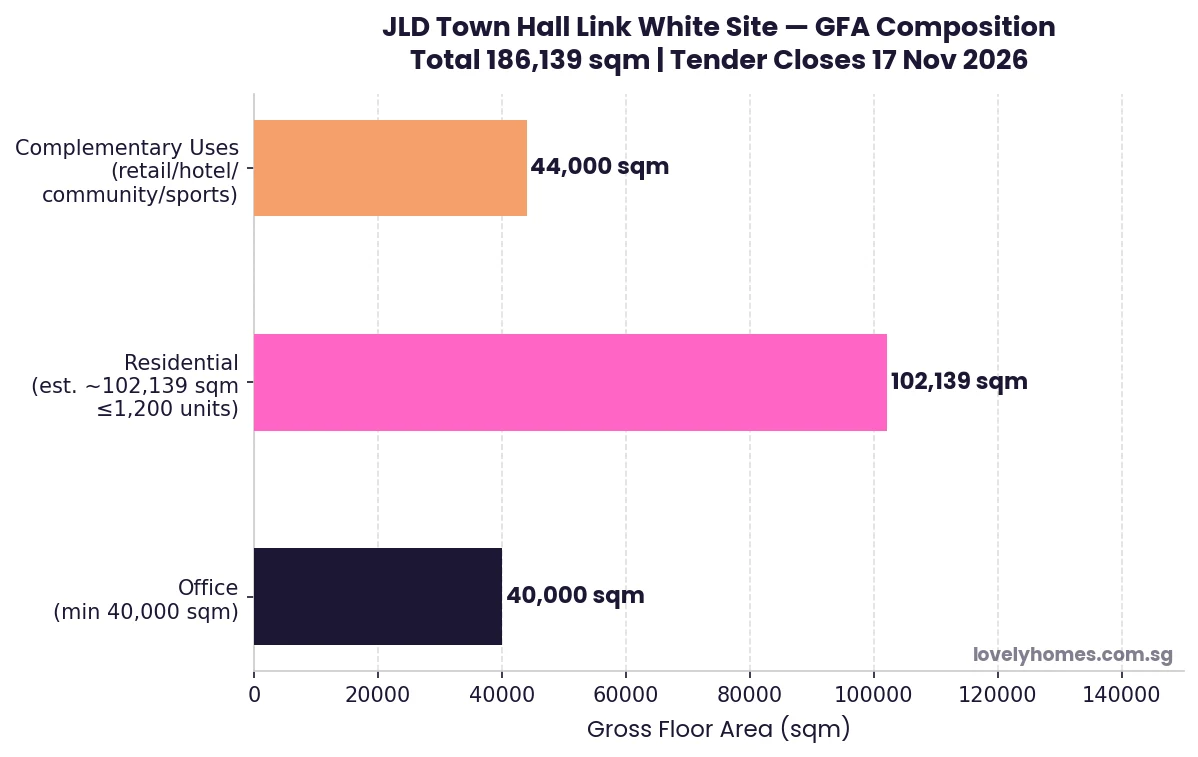
The Urban Redevelopment Authority (URA) launched the tender for a White site at Town Hall Link in the Jurong Lake District (JLD) on 3 July 2026, marking one of the most significant Government Land Sales (GLS) moves of the year. At 186,139 sqm of total potential Gross Floor Area (GFA) — comprising a minimum 40,000 sqm of office, up to 1,200 private residential units, and 44,000 sqm of complementary uses — this site has the potential to define the next chapter of Singapore’s western regional centre.
The tender forms part of the Confirmed List for the 2H 2026 GLS Programme and will close at 12 noon on 17 November 2026. It comes less than two weeks after URA released its Q2 2026 property price flash estimate showing the overall private residential PPI rising a modest 0.5% — a market context that is stable enough for developers to bid with confidence, but not so frothy as to suggest over-payment risk.
JLD is Singapore’s flagship decentralisation initiative: a vision to create a vibrant live-work-play precinct in the western part of Singapore that can absorb commercial, residential, and civic activity without adding further pressure on the already-congested central business district. The Town Hall Link site occupies a prime position within this vision — sited next to the Jurong Town Hall national monument, directly connected to the Jurong East MRT interchange, and in the future path of two new MRT lines.
What Is a White Site?
A White site in Singapore’s GLS framework is a land parcel that developers may develop for any combination of uses permitted under the Master Plan, subject to a minimum requirement for one or more specified uses. Unlike purpose-specific GLS sites (e.g., residential-only or commercial-only), a White site allows developers to calibrate the use mix based on their read of market conditions at the time of design and launch.
For the Town Hall Link site specifically, the conditions are: minimum 40,000 sqm office; up to 1,200 residential units; and up to 44,000 sqm for complementary uses. The developer awarded the site will have latitude to decide the precise mix of hotel, serviced apartments, retail, community facilities, and sports/recreation components — creating significant design flexibility in exchange for the commitment to deliver a meaningful commercial core.
White sites have historically attracted strong bidding interest in Singapore because they reduce the development risk associated with committing entirely to a single use in a market that can shift between residential launch and commercial occupation. The last major White site in JLD — the site that became J Gateway and the surrounding cluster — generated keen bidding when it was first introduced.
Figure 1: Town Hall Link White Site — indicative GFA breakdown by use. Total 186,139 sqm. Source: URA pr26-53, 3 July 2026.
The JLD Masterplan: Context for This Site
JLD’s transformation has been driven by two decades of sustained government investment in infrastructure and planning. The revitalised Jurong Lake Gardens (90 hectares) provides the greenery spine at the district’s heart. Two new MRT lines are changing the connectivity calculus dramatically:
Jurong Region Line (JRL): JE5 station at Jurong East and JE6 station at International Business Park (planned to open 2028).
Cross Island Line (CRL): CR19 station at the heart of the new JLD precinct (planned to open 2032).
The addition of CRL is particularly significant: it will provide a direct east-west connection from JLD to Ang Mo Kio, Pasir Ris, and eventually Changi — transforming what has historically been perceived as a “western” destination into a genuinely cross-island node. For the Town Hall Link site, the multi-level pedestrian connections to Jurong East MRT interchange and the upcoming CR19 station mean that residents and office workers at this development will enjoy arguably the best public transport connectivity of any mixed-use site currently on the GLS market.
The site sits next to the Jurong Town Hall, a gazetted national monument. This adjacency imposes design constraints — any development will need to respect the monument’s visual and physical setting — but also provides a distinctive civic character that differentiates the JLD precinct from purely commercial developments elsewhere.
Development Mix Analysis
Use Component
GFA (sqm)
Status
Commentary
Office
40,000 minimum
Mandatory
Anchors JLD’s role as business node; positions site as corporate headquarters address
Private Residential
Up to ~102,139 (est.), max 1,200 units
Optional (developer discretion)
1,200 units at typical 80–90 sqm average ≈ 102,000 sqm; adds residential critical mass to district
Complementary Uses
Up to 44,000
Optional (developer discretion)
Can include: retail, hotel, serviced apartments, sports/recreation, medical clinics, community facilities, visitor attractions
Total GFA
186,139
One of Singapore’s largest mixed-use GLS sites
At 1,200 residential units, this would represent one of Singapore’s larger single-site condominium developments — comparable in scale to recent developments like Canninghill Piers (696 units) and Lentor Modern (605 units), but notably larger. The scale is appropriate for JLD’s ambition to create residential density that sustains the commercial base.
Key Catalysts and Infrastructure Timeline
The development that occupies this site will benefit from a series of planned catalysts over the 2026–2035 horizon:
Catalyst
Timeline
Impact on Site
JRL JE5 (Jurong East) and JE6 (International Business Park)
Phased opening, 2027–2028
Improved east-west connectivity within JLD; connects IBP to Jurong East interchange
New Science Centre at JLD
Expected by 2027
Adds visitor attraction and civic anchor to the precinct; drives weekend footfall
Jurong Gateway Hub (bus interchange + office + retail + community club + library + sports)
Expected by 2028
Integrated civic hub immediately adjacent; dramatically increases JLD’s daytime and evening population
CRL CR19 station at JLD
Planned 2032
Cross-island connectivity; potential 15% to 20% capital value uplift for residential units at this site based on historical TEL/MRT proximity premiums
Residential Investment Angle: 1,200 Units in JLD
If the awarded developer proceeds with the full 1,200-unit residential allocation, this will be among the more significant new private residential supply additions to JLD since the area last saw major development activity in the 2013–2017 era (J Gateway, Westwood Residences, Lake Grande, Twin Vew). JLD has historically commanded a premium relative to other OCR locations — driven by the live-work-play narrative, the lake setting, and the Jurong East MRT interchange’s accessibility to both the western industrial belt and the central business district via the East-West Line.
A new-launch condo at this site, post-CRL connectivity, could plausibly target $2,000–$2,400 psf based on the trajectory of comparable new launches in OCR/RCR boundary locations in 2025–2026. The tender price paid by the developer will be the key determinant of eventual launch pricing — a high land bid will translate into a premium launch price, while a competitive-but-measured bid could allow the developer to price attractively and generate strong take-up. The tender close date of 17 November 2026 gives the market approximately four and a half months to assess these dynamics.
What This Means for the Broader Market
The JLD White Site launch is a policy signal as well as a commercial opportunity. URA’s decision to include a major White site in the 2H 2026 Confirmed List — rather than deferring it to the Reserve List — indicates confidence that developer demand is sufficient to support a committed bid within the current market cycle. The White site mechanism also signals flexibility: if the residential market softens before design completion, the developer can weight the mix toward commercial and serviced apartment uses.
For existing JLD residential owners — in projects like J Gateway, Lake Grande, Twin Vew, and the upcoming The LakeGarden Residences — the Town Hall Link development represents both an opportunity (improved amenity and connectivity as the precinct builds out) and a risk (increased residential supply within the immediate catchment). On balance, the infrastructure and amenity uplift from the New Science Centre, Jurong Gateway Hub, and CRL CR19 is likely to outweigh the supply effect, particularly for well-located existing units.
What Might Come Next
The following is editorial commentary — not official guidance.
Bidding for the Town Hall Link site is expected to attract Singapore’s larger developers and possibly joint ventures. The scale of the site (186,139 sqm) requires significant capital — a land price in the S$1.5–S$2.5 billion range would not be surprising, depending on the assumed residential launch pricing and the developer’s commercial income projections. International developers with Asian regional headquarters-in-a-hub ambitions could also consider the mandatory 40,000 sqm office component as a corporate campus opportunity.
The CRL CR19 station opening in 2032 is a known future catalyst — developers will model this into their land bid assumptions. A project that launches residential units in 2028–2029 (assuming a 2027 tender award, 1-year design/approval, and early 2028 launch) would be telling buyers that their units will be CRL-connected by the time they reach the 5-year mark of ownership.
Frequently Asked Questions
What does “White site” mean for buyers of the eventual development?
A White site designation affects the developer’s design choices, not individual buyers’ rights. When the eventual development is launched for sale, buyers will purchase units in a standard private condominium development. They will benefit from the mixed-use amenities — retail, food and beverage, possibly a hotel or serviced apartment building within the same development — that result from the White site configuration. The White site label itself conveys no special lease conditions or restrictions on buyers beyond the standard conditions of a freehold or 99-year leasehold private condominium.
When will the residential units at Town Hall Link be available for sale?
The tender closes 17 November 2026. Assuming the tender is awarded in Q1 2027, and accounting for design, planning approval, and construction timelines, the earliest a residential launch could realistically occur is late 2027 or 2028. Physical completion (Temporary Occupation Permit) would likely follow in 2030–2032. Prospective buyers interested in this development should monitor URA and the awarded developer’s announcements in 2027.
How does the JLD CRL station affect property values nearby?
Historical evidence from Singapore MRT openings — most recently the Thomson-East Coast Line (TEL) stages 1–4 and the Downtown Line — suggests that residential properties within 500 metres of a new MRT station tend to appreciate by 8–15% relative to comparable properties further away in the 3–5 years following station opening. The effect is partially priced in ahead of the opening as buyers and investors anticipate the connectivity uplift. For CR19 (planned 2032), properties in the immediate JLD precinct likely already incorporate some forward-looking CRL premium in 2026. The full premium crystallises as the opening date approaches and actual connectivity is confirmed.
Is the Town Hall Link site freehold or leasehold?
GLS sites in Singapore are typically sold on 99-year leasehold terms. The Town Hall Link site is expected to follow this standard. Buyers of units in the eventual development will hold 99-year leasehold titles, with the lease commencement date tied to the date of the land award. Leasehold tenure is the norm for new GLS-sourced developments in Singapore; the premium-location attributes of the site — MRT connectivity, JLD masterplan, CRL uplift — are expected to sustain long-term value notwithstanding the leasehold structure.
What other major GLS sites were launched in 2H 2026?
The 2H 2026 GLS Confirmed List provides a total of 4,745 private residential units. In addition to the Town Hall Link White site, URA also launched sites at Lorong Puntong/Sin Ming Avenue (~140 units, TEL Bright Hill MRT, tender closes 15 September 2026) and Kitchener Link (~145 units, Reserve List, Farrer Park MRT NEL). The full 2H 2026 GLS programme — including industrial and commercial sites — is available on the URA website at ura.gov.sg/land-sales.
This article is for general informational purposes only and does not constitute financial or investment advice. Details of the Town Hall Link White site are sourced from URA press release pr26-53 (3 July 2026) and the URA website. Developer bidding, design outcomes, launch pricing, and project timelines are speculative editorial commentary and do not represent commitments by URA or any developer. For authoritative site details and tender conditions, refer to ura.gov.sg. Consult a licensed financial adviser before making any property investment decision.