Kovan Neighbourhood Guide Singapore 2026: HDB Prices, Condos & Investment Outlook

Kovan Neighbourhood Guide Singapore 2026: HDB Prices, Condos & Investment Outlook

Quick Answer — Kovan / D19 at a Glance

  • District: D19 (Hougang, Kovan, Serangoon North); served by North East Line (NEL) at Kovan (NE13) and Hougang (NE14) stations.
  • HDB resale: 4-room flats range from S$510,000–S$620,000; 5-room from S$660,000–S$760,000 (Q1 2026).
  • Condos: Non-landed private homes trade at S$1,450–S$1,700 psf, a meaningful 25–30% discount to RCR average.
  • Rental yield: Approximately 3.3–3.6% for Kovan-area condos; strong tenant demand from families and young professionals.
  • Schools: Maris Stella High School, CHIJ St Joseph’s Convent, Kovan Primary School and Montfort Secondary within close reach.
  • Investment catalyst: The Cross Island Line (CRL) Serangoon North station (Phase 1, 2030) will add a second MRT line to the broader D19 corridor.
  • Upcoming supply: Limited new-launch condo pipeline in the immediate Kovan/Hougang precinct keeps resale values supported.
  • Buyer profile: HDB upgraders, families seeking mature estate amenities, and investors targeting OCR rental demand.
  • BSD: On a S$1.5M condo, Buyer’s Stamp Duty totals S$44,600; ABSD is S$0 for Singapore Citizens buying their first property.
  • Next step: Apply for HDB Loan Eligibility (HLE) or bank pre-approval; engage a CEA-registered agent to access HDB resale portal.

What Is the Kovan / D19 Neighbourhood?

Kovan is a mature residential precinct in District 19, nestled in the north-eastern quadrant of Singapore between the more bustling Serangoon and the HDB heartlands of Hougang. Administered by the Hougang–Punggol Town Council (under the broader Aljunied GRC and Hougang SMC divisions), D19 spans Hougang, Kovan, Serangoon North and parts of Upper Serangoon — a broad swathe of land that mixes older public housing, low-density walk-up apartments, newer private condominiums and some semi-detached and terrace houses.

The estate gained a reputation for quiet, laid-back living: tree-lined streets, local coffeeshops, community markets and the charming Kovan F&B hub along Upper Serangoon Road. Unlike the more commercially dense Serangoon or Toa Payoh, Kovan retains a neighbourhood feel, making it a consistent favourite among families who want amenity access without city-centre noise and pricing.

The North East Line (NEL) has anchored the estate’s connectivity since 2003. Kovan MRT (NE13) sits roughly in the centre of the precinct, while Hougang MRT (NE14) serves the broader HDB heartland to the north. The upcoming Cross Island Line (CRL) — with a Serangoon North station planned under Phase 1 (expected 2030) — will add a second MRT line to the broader D19 corridor, strengthening connectivity to Pasir Ris, Jurong and the city core.

D19 Kovan HDB resale price ranges by flat type Q1 2026
Figure 1: Kovan / D19 HDB Resale Price Ranges by Flat Type, Q1 2026 (S$’000). Source: HDB, industry transaction data. Ranges reflect lower-to-upper end of transacted prices.

HDB Resale Market in Kovan and Hougang

The bulk of public housing in D19 is concentrated in Hougang estate, one of Singapore’s largest and most established HDB towns. Hougang Central and Hougang Street areas contain mostly 3-room to executive apartment blocks built in the 1980s and 1990s, with a smaller supply of newer 4-room and 5-room flats dating from the 2000s. Kovan itself has limited HDB stock — the precinct is dominated more by walk-up apartments and private condominiums — but buyers seeking HDB ownership in D19 typically look at Hougang Ave 2, Hougang Ave 8, Upper Serangoon Road and the Hougang Central cluster.

As at Q1 2026, median transacted prices in D19 for HDB resale flats are as follows: 3-room flats range between S$330,000 and S$420,000 depending on floor level, facing and lease remaining; 4-room flats fall in the S$510,000–S$620,000 band, with prime upper-floor units in sought-after blocks pushing past S$600,000; 5-room flats and executive apartments trade between S$660,000 and S$760,000, and the very best executive apartments (rare in D19) have tested S$920,000.

The HDB resale market in D19 has been steady rather than spectacular. The estate does not attract the speculative frenzy of D3 (Tiong Bahru) or D10 (Bukit Timah), but precisely this stability makes it appealing to genuine owner-occupiers. Resale flat buyers should note that all purchases are subject to the HDB Ethnic Integration Policy (EIP) and the Singapore Permanent Resident (SPR) quota, both of which limit supply in individual blocks and neighbourhoods and can affect resale timing.

Kovan D19 neighbourhood key facts 2026 at a glance
Figure 2: Kovan / D19 Neighbourhood Key Facts at a Glance (2026). Sources: URA, HDB, MOE school portal.

Private Condominiums in Kovan D19

The private residential market in Kovan is anchored by a cluster of well-regarded condominiums, most built in the 2000s to mid-2010s. Key developments include:

  • The Minton (Hougang St 11, 1,145 units, TOP 2013) — one of the largest private developments in D19; swimming pools, recreational facilities; 4–5 min walk to Hougang MRT.
  • Kovan Melody (Kovan Road, 778 units, TOP 2007) — established estate, good rental demand; 6 min walk to Kovan MRT.
  • Kovan Residences (Upper Serangoon Road, 393 units, TOP 2013) — freehold tenure; one of the area’s premium addresses.
  • The Scala (Serangoon Ave 3, 468 units, TOP 2013) — adjacent to NEX mall and Serangoon MRT interchange; technically D19/D13 border.

Transacted PSF across these developments ranges from S$1,450 to S$1,700 in Q1 2026, with freehold units (notably Kovan Residences) commanding a 12–15% premium over leasehold stock. This represents a roughly 25–30% discount to the RCR average (approximately S$2,300–S$2,500 psf) — a meaningful value proposition for buyers who want private housing without paying CCR or RCR prices.

Rental demand is supported by the estate’s family-friendly character, school proximity and NEL connectivity. A 3-bedroom unit at The Minton or Kovan Melody typically commands S$4,200–S$5,200/mth in 2026, translating to gross rental yields of approximately 3.3–3.6%. These are modest by CCR standards but comparable to other OCR-fringe estates.

Schools and Education

D19’s school roster is one of its strongest selling points for family buyers. Within the 1km registration radius of Kovan MRT or Hougang Central, buyers can access:

School Type Distance from Kovan MRT Notable
Kovan Primary School Primary ~600m SAP school; bilingual programme
Xinghua Primary School Primary ~900m Established, strong CCA programme
CHIJ St Joseph’s Convent Girls’ Primary (mission) ~1.2km MOE school, strong pastoral tradition
Maris Stella High School Independent (boys) ~1.1km Consistently top-ranked independent school
Montfort Secondary School Secondary ~1.4km SAP school; strong performing arts
Serangoon Garden Secondary Secondary ~2km Near Serangoon Gardens precinct

Maris Stella High School in particular has long driven family buyer demand in the Kovan precinct. As an independent all-boys school with direct-admission and talent programmes, it consistently attracts families who prioritise secondary school options at point of primary registration. The 1km radius around Kovan MRT encompasses Maris Stella’s registration zone, making addresses near Upper Serangoon Road and Kovan Road especially sought-after for family buyers.

Amenities and Lifestyle

Kovan’s retail scene is deliberately low-key. The area’s character is defined by its Kovan food enclave — a cluster of independent F&B outlets, local eateries, cafés and neighbourhood shops along Kovan Road and Upper Serangoon Road, stretching roughly between Kovan MRT and Hougang MRT. This strip has gentrified quietly over the past decade and now includes artisan coffee shops, Japanese restaurants, local hawker favourites and weekend farmers’ market pop-ups.

For larger retail needs, residents have quick access to:

  • Heartland Mall Kovan — a medium-sized suburban mall at Kovan MRT, anchored by Fairprice and a mix of F&B and services.
  • Hougang Mall — near Hougang MRT; NTUC FairPrice anchor, cinema and family dining.
  • NEX Mall Serangoon — two stops away on the NEL; one of the largest suburban malls in Singapore with 580,000 sq ft of retail, a rooftop pet pool and family entertainment.

Parks and green spaces include Hougang Stadium, the tree-lined corridors of Kovan Road and the Serangoon Park Connector, which connects to the broader round-island park connector network. The Punggol Waterway is one NEL stop further and provides a riverside recreational option that many D19 residents treat as their extended backyard.

Connectivity: NEL and the Coming CRL Uplift

The North East Line (NEL) is D19’s primary rail artery. From Kovan MRT (NE13), the NEL runs direct to:

  • Serangoon interchange (NE12) — 1 stop, connection to CCL and Bishan
  • Dhoby Ghaut (NE6) — 6 stops, interchange with NSL and CCL (city centre)
  • Outram Park (NE3) — 9 stops, connection to EWL and TEL (city fringe)

Journey time from Kovan to Raffles Place is approximately 25–30 minutes by train — competitive with many CCR and RCR addresses when accounting for door-to-door travel. The NEL’s operational frequency of approximately 2.5 minutes during peak hours makes it one of the more reliable commuter lines.

The transformative catalyst for D19’s medium-term investment story is the Cross Island Line (CRL). CRL Phase 1, currently under construction, includes a Serangoon North station that will sit approximately 1.5km west of Kovan MRT, within the broader D19 corridor. When completed (expected around 2030), this station will offer a direct cross-island rail connection from Hougang / Serangoon North through Punggol, Ang Mo Kio, Bright Hill, Clementi, West Coast and on to Changi — dramatically reducing transfer requirements for residents who currently commute to the north-west or south-west.

Research by the Urban Redevelopment Authority (URA) and independent property analysts consistently shows MRT proximity within 500m commands a 5–12% price premium for private residential properties. The CRL effect, though not yet priced in for Kovan proper (Kovan MRT is NEL, not CRL), is expected to lift values in Serangoon North sub-zones within D19 over the 2027–2032 period as construction activity and station footprints become visible.

D19 Kovan condo PSF trend vs RCR and Singapore average 2019 to 2026
Figure 3: D19 Kovan / Serangoon Condo PSF Trend vs RCR and Singapore Average (2019–2026 estimate). Sources: URA realis, industry transaction data.

Investment Outlook for Kovan D19

From a property investment standpoint, D19 sits in a compelling mid-tier position: established enough to have deep rental demand and school-driven owner-occupier interest, but not yet priced to perfection in the way that D11 (Novena) or D9 (Orchard) are. The PSF discount to RCR (~25–30%) and to CCR (~40–45%) creates a valuation buffer that appeals to value-oriented investors.

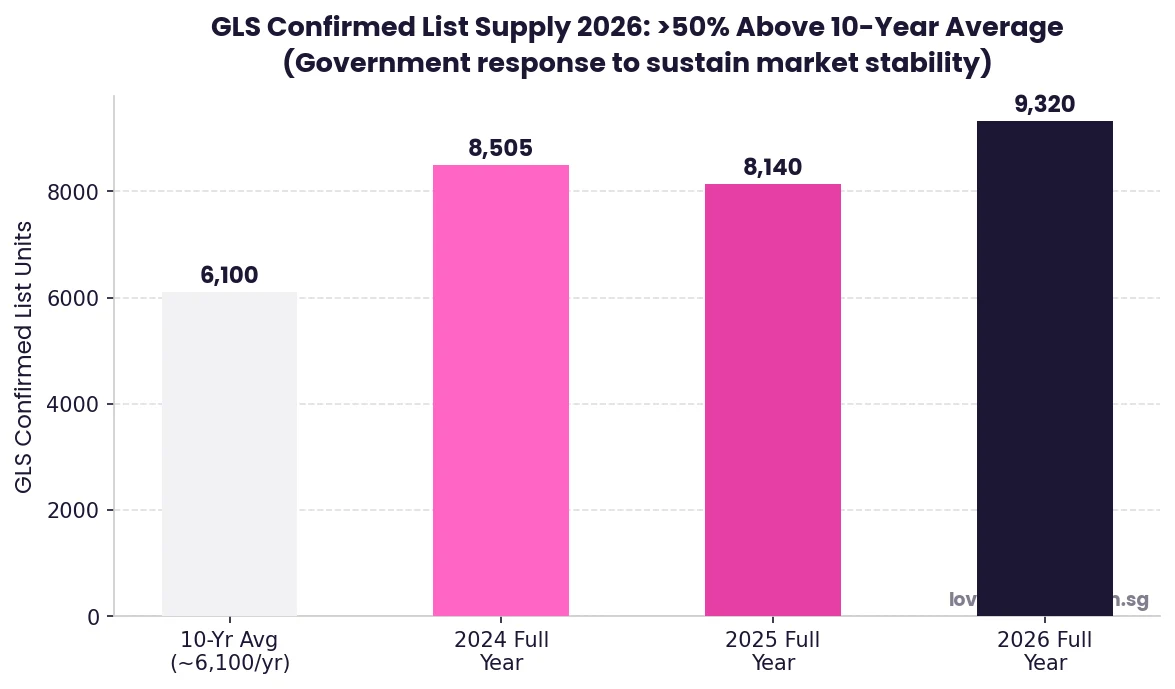
The supply picture is favourable. There are no major new-launch condominium sites in the immediate Kovan/Hougang precinct in URA’s 2H 2026 GLS Confirmed List. The most proximate recent supply came from Kovan Jewel and a handful of boutique freehold developments. This supply scarcity, combined with steady rental demand (especially from families with children at Maris Stella and Kovan Primary), supports occupancy rates of 92–95% in well-managed D19 condominiums.

Risks to monitor include: broader Singapore macro headwinds (higher-for-longer interest rates compressing buyer affordability); the ABSD regime (which makes multiple-property investment expensive for Singapore Citizens and essentially prohibitive for Singapore Permanent Residents and foreigners); and the five-year Seller’s Stamp Duty (SSD) holding-period requirement, which locks in investors for a minimum period before tax-free disposal is possible. Buyers should also note that ABSD for a Singapore Citizen’s second property is 20%, significantly raising the cost of entry for investors who already own one property.

Worked Example: Buying a 4-Room HDB Resale Flat in Hougang

Case Study — Lim Couple (SC/SC), First HDB Resale Purchase

Profile: Mr and Mrs Lim, Singapore Citizens, both aged 33, combined gross household income S$7,200/mth, no existing property ownership.

Target: 4-room HDB resale flat, Hougang Ave 8, Blk 418C (5th floor), 92 sqm, lease commencing 1993 (72 years remaining).

Agreed price: S$578,000.

CPF Housing Grants available:

  • Enhanced Housing Grant (EHG): S$30,000 (income S$7,200/mth, both first-timers)
  • Family Grant (resale, SC/SC): S$50,000
  • Total grants: S$80,000

Financing (HDB loan):

  • Purchase price: S$578,000
  • Less grants: S$80,000
  • Net purchase price: S$498,000
  • HDB loan (80% LTV): S$462,400 @ 2.60% p.a. over 25 years
  • Monthly repayment: approximately S$2,099/mth
  • MSR check: S$2,099 / S$7,200 = 29.2% — PASS (must be ≤30%)

Stamp duty:

  • BSD on S$578,000: 1% × S$180k + 2% × S$180k + 3% × S$218k = S$1,800 + S$3,600 + S$6,540 = S$11,940
  • ABSD: S$0 (SC, first property)

Upfront cash required:

  • 20% downpayment (cash + CPF): S$115,600; CPF OA (assumed S$60,000 each) covers S$80,000 → cash S$35,600
  • BSD in cash: S$11,940
  • Legal and admin fees: ~S$2,500
  • Total cash outlay: approximately S$50,040

Note: Actual grant amounts depend on household income, citizenship status and eligibility checks by HDB at point of application. TDSR and MSR calculations are indicative; engage an HDB officer or licensed mortgage broker for a precise assessment.

What the Numbers Mean for Buyers

Kovan / D19 offers a rare combination in Singapore’s property market: school-belt proximity, mature estate amenities, NEL connectivity and pricing that remains accessible to HDB upgraders and first-time private property buyers alike. The Lim couple’s example illustrates how an S$578,000 4-room resale flat — with maximum grants reducing the effective loan to S$462,400 — delivers an MSR of 29.2% at a S$7,200/mth combined income, leaving meaningful financial headroom for living expenses, savings and future property goals.

For investors, the S$1,450–S$1,700 psf price band for Kovan condominiums compares favourably to equivalent-quality stock in D13 (Serangoon) or D14 (Geylang/Eunos), while offering better school catchment and a quieter living environment. The CRL uplift story — though not yet a reality — gives D19 a medium-term catalyst that many other mature OCR estates lack.

What might come next for Kovan? URA’s long-term planning maps indicate densification of the Upper Serangoon Road corridor, with some existing industrial and mixed-use sites potentially rezoned for residential or mixed-development use over the next decade. Any rezoning announcements would act as material catalysts for land value and, consequently, resale prices in the immediate vicinity.

Frequently Asked Questions

Is Kovan a good area to live in Singapore?

Yes, Kovan is consistently rated as one of Singapore’s most liveable mature OCR estates. Its combination of North East Line connectivity, reputable schools (Maris Stella High, Kovan Primary), a vibrant independent F&B scene, low-density residential character and competitive property prices make it particularly popular with families. It lacks the commercial density of Toa Payoh or Tampines but offers a quieter, more residential lifestyle that many owner-occupiers prefer. The upcoming Cross Island Line Serangoon North station (Phase 1, ~2030) will further strengthen its connectivity case.

What are HDB resale flat prices in Hougang / Kovan 2026?

As at Q1 2026, 4-room HDB resale flats in the Hougang / Kovan D19 area are transacting in the range of S$510,000–S$620,000. 5-room flats and executive apartments fetch S$660,000–S$760,000. 3-room flats — increasingly limited in supply — range from S$330,000 to S$420,000. Premium units with long remaining leases (70+ years), high floors or desirable block facings tend to transact at the upper end or occasionally above the range. All HDB resale transactions require an Option to Purchase (OTP) and are subject to EIP and SPR quota restrictions.

Can foreigners buy property in Kovan / D19?

Foreigners (non-Singapore Citizens and non-Permanent Residents) are prohibited from purchasing HDB flats under any circumstances. For private condominiums in D19 — such as The Minton, Kovan Melody or Kovan Residences — foreigners may purchase subject to paying Additional Buyer’s Stamp Duty (ABSD) of 60% of the purchase price (as at January 2024, per IRAS). This is in addition to Buyer’s Stamp Duty (BSD) of approximately S$43,800–S$54,600 on a S$1.5M unit. Singapore Permanent Residents buying their first property pay 5% ABSD. The cost burden makes foreign investment in private condominiums in D19 generally marginal on a yield basis, though some investors still proceed for capital appreciation or estate-planning reasons.

Which condos are near Kovan MRT?

The closest condominiums to Kovan MRT (NE13) include Heartland Mall Kovan (retail, not residential), Kovan Melody (~650m, 778 units, leasehold 99yr, TOP 2007), Kovan Residences (~800m, 393 units, freehold, TOP 2013) and The Scala (~1.2km towards Serangoon). Further along Hougang Ave, The Minton (1,145 units, leasehold, TOP 2013) is approximately 1km from Hougang MRT. There are no major new-launch condominiums currently available for purchase in the immediate Kovan/Hougang precinct as at July 2026; the nearest new-launch pipeline is in Tampines North and the Greater Plantation Loop.

How does the CRL Serangoon North station affect D19 property values?

The Cross Island Line (CRL) Phase 1 Serangoon North station is expected to open around 2030 and will sit approximately 1.5km from Kovan MRT within the broader D19 corridor. Property research consistently shows that MRT stations within 500m of a development command a 5–12% premium over comparable properties without such proximity. Properties directly adjacent to the Serangoon North station box (likely between Upper Serangoon Road and Ang Mo Kio Ave 3) stand to benefit most. Kovan proper (served by the existing NEL) is less directly exposed, but improved network connectivity across D19 broadly supports price floors and rental demand. Buyers who can identify future station catchment areas ahead of station opening often capture the best appreciation.

What CPF Housing Grants are available for HDB resale in D19?

First-timer Singapore Citizens buying an HDB resale flat in D19 may be eligible for the Enhanced Housing Grant (EHG) — up to S$80,000 for individuals or S$160,000 for families depending on household income — and the Family Grant of up to S$50,000 (SC/SC couple) or S$40,000 (SC/SPR couple). The Proximity Housing Grant (PHG) of up to S$30,000 is available when buying within 4km of parents or children. Grants are administered by HDB and disbursed directly against the purchase price or loan. Full details on eligibility conditions, income ceilings and grant stacking rules are covered in our HDB CPF Housing Grant Guide 2026.

What is the Minimum Occupation Period (MOP) for Kovan HDB flats?

All HDB flats in D19 — whether Standard, Plus or Prime classification — are subject to a Minimum Occupation Period (MOP) before the flat can be sold on the open resale market or rented out entirely. For Standard flats in Hougang / Kovan, the MOP is 5 years from date of key collection (or from the date the last occupier moves in, if applicable). Plus flats (a newer classification introduced in August 2024) carry a 10-year MOP. Prime flats have a 10-year MOP with a subsidy clawback on resale. The HDB does not classify existing Hougang and Kovan flats as Prime; they are generally Standard or Plus depending on specific project and location. Full MOP rules are detailed in our HDB MOP Complete Guide 2026.

Related Articles

Disclaimer

The information in this article is provided for general informational purposes only as at July 2026 and does not constitute financial, legal or property investment advice. Property prices, HDB resale figures, PSF data and grant amounts are indicative based on available URA, HDB and industry transaction data and may differ from actual conditions at time of purchase. All property transactions in Singapore are subject to prevailing stamp duty rates (ABSD, BSD, SSD), HDB eligibility rules, CPF Board regulations and financial institution lending criteria. Readers should consult a CEA-registered property agent, a licensed mortgage adviser and where appropriate a qualified lawyer before making any property purchase decision. For authoritative information, refer to the Urban Redevelopment Authority (ura.gov.sg), Housing & Development Board (hdb.gov.sg), Inland Revenue Authority of Singapore (iras.gov.sg) and the Monetary Authority of Singapore (mas.gov.sg).

×

Click anywhere or press Esc to close

Novena Neighbourhood Guide Singapore 2026: D11 Medical Hub, Prices & Investment Outlook

Novena Neighbourhood Guide Singapore 2026: D11 Medical Hub, Prices & Investment Outlook

⚡ Quick Answer: Novena Neighbourhood D11 at a Glance

  • District 11 (D11) — Newton and Novena planning areas in the Core Central Region (CCR). Almost entirely private residential.
  • Freehold condos average S$2,600–3,200 psf in Q1 2026; 99-year leasehold condos range from S$2,100–2,600 psf.
  • Medical hub demand: Mount Elizabeth Hospital, Mount Elizabeth Novena Hospital, and Tan Tock Seng Hospital (TTSH) generate sustained rental demand from healthcare professionals and medical tourists.
  • MRT connectivity: Novena (North South Line) and Newton (NSL + Downtown Line) provide direct access to Raffles Place, Marina Bay, and Orchard Road.
  • Gross rental yield: approximately 2.5%–3.2% for condos, comparable to other prime CCR districts.
  • Supply constraint: no new Government Land Sales (GLS) sites have been released in D11 since 2019, reinforcing price resilience for existing freehold stock.
  • Ideal buyer: upgraders, medical professionals, expatriate tenants, long-term capital preservation investors.

What Makes Novena Singapore’s Medical Hub Precinct?

Novena sits within District 11 — one of Singapore’s most established and tightly held residential precincts. Bounded roughly by Thomson Road to the north, Bukit Timah Road to the west, Newton Circus to the south, and Balestier Road to the east, D11 is home to a cluster of private hospitals that is unmatched anywhere else on the island. Mount Elizabeth Hospital on Orchard Road, its sister facility Mount Elizabeth Novena Hospital on Novena Rise, and Tan Tock Seng Hospital on Moulmein Road together form Singapore’s largest private medical hub. This concentration of world-class healthcare institutions is not just a lifestyle amenity — it is a structural driver of residential demand.

Medical professionals, hospital support staff, and visiting doctors on short-term rotations all need housing within comfortable distance of these facilities. International patients and their families, many from across Southeast Asia, the Middle East, and China, often prefer to base themselves in Novena rather than Orchard so they can be close to treatment. The result is a rental market that is unusually resilient even during broader property downturns, because hospital activity does not follow the economic cycle in the same way that corporate leasing does.

Beyond healthcare, Novena offers the quiet residential character of the old Central Region without the intensity of Orchard Road. United Square on Thomson Road is Singapore’s best-known education mall, drawing families with school-age children. Novena Square 1 and 2 and Square 2 along Thomson Road provide everyday retail and dining. St. Joseph’s Institution International, Anglo-Chinese School (Primary), and the Singapore Chinese Girls’ School are all within close proximity, adding an education premium on top of the medical one.

D11 Property Price Ranges — What Buyers Pay in 2026

D11 Novena property price ranges by type Q1 2026 — HDB resale and condo PSF bar chart

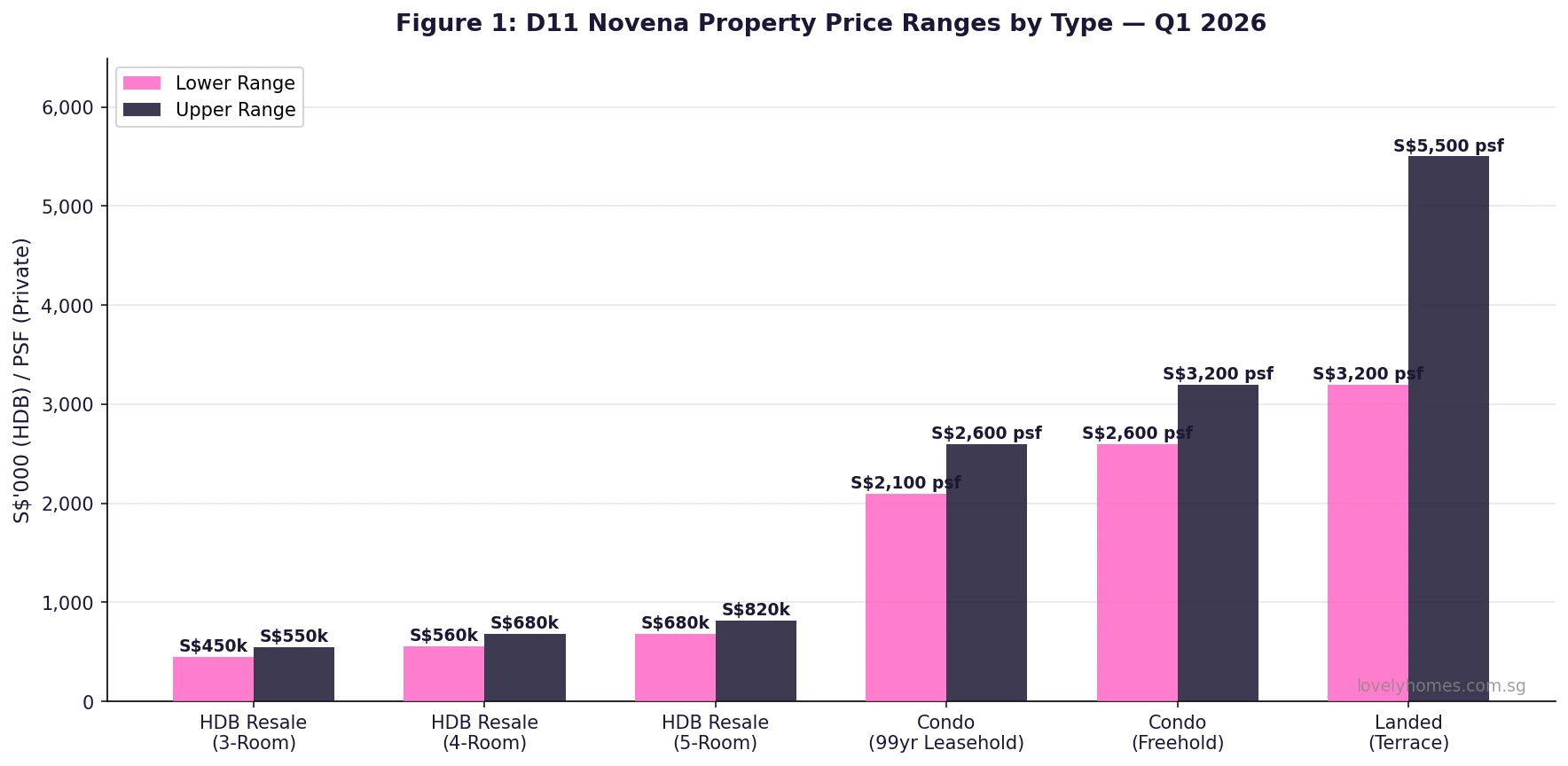
Figure 1: D11 Newton/Novena residential property price ranges by type — Q1 2026. HDB resale figures reflect fringe estates (Moulmein/Thomson). Sources: URA REALIS, HDB Resale Portal Q1 2026.

District 11 is overwhelmingly private residential. The handful of HDB resale flats that fall within or immediately adjacent to the planning area — mainly in the Moulmein and Newton fringe — transact at a premium to equivalent flat types elsewhere, given their central address. A 4-room HDB resale in this catchment has fetched S$560,000–680,000 in Q1 2026, reflecting the locational scarcity: only a few hundred HDB flats exist across the entire D11 footprint.

The dominant residential product in D11 is the private condo. Freehold condos — which make up the majority of stock given the age of development — have held between S$2,600 and S$3,200 psf in Q1 2026. Key developments such as City Square Residences (freehold, Kitchener Road), Novena Regency (freehold, Thomson Road), and The Trizon (freehold, off Mount Sinai) sit in this range. Newer 99-year developments have traded at a 15–20% discount to equivalent freehold stock, at S$2,100–2,600 psf, reflecting the leasehold haircut that remains deeply ingrained in Singapore buyer psychology.

Landed property in D11 — predominantly terrace and semi-detached houses in the Upper Thomson and Spring Road areas — commands S$3,200–5,500 psf on land area depending on remaining lease, configuration, and orientation. Good Class Bungalow (GCB) plots in the adjacent Ridout Road and Nassim areas start well above S$15 million for eligible parcels.

Property Type Typical Size Price From Price To Notes
HDB Resale (3-Room) 65–70 sqm S$450,000 S$550,000 Moulmein/Newton fringe only
HDB Resale (4-Room) 90–100 sqm S$560,000 S$680,000 Moulmein/Newton fringe only
Condo 1-Bed (FH) 45–55 sqm S$1,200,000 S$1,600,000 Strong rental demand from medical staff
Condo 2-Bed (FH) 75–95 sqm S$1,700,000 S$2,400,000 Most liquid unit type in D11
Condo 3-Bed (FH) 120–150 sqm S$2,800,000 S$4,200,000 Family-friendly, education catchment
Landed Terrace (FH) 150–200 sqm land S$3,200 psf land S$5,500 psf land Only Singapore Citizens eligible

Location and Connectivity: MRT, TEL and Road Networks

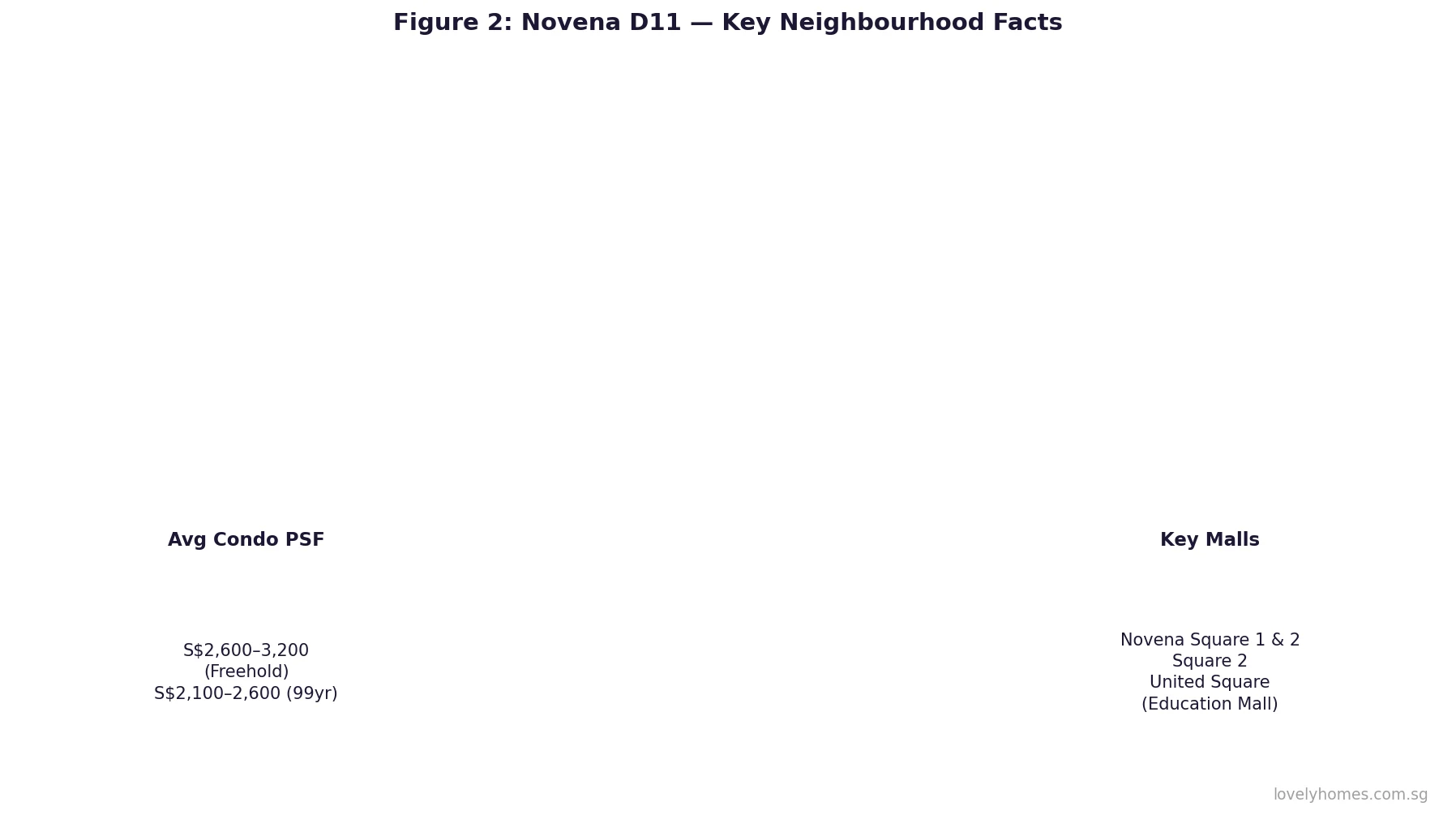
Novena neighbourhood key facts 2026 — district D11 MRT lines medical hub condo yields and malls

Figure 2: Novena D11 — key neighbourhood facts for property buyers and investors, 2026.

Novena station on the North South Line (NSL) gives residents a 4-minute train ride to Toa Payoh and a 6-minute ride to Orchard. Newton interchange station — one of only five interchange stations on the NSL — connects to the Downtown Line (DTL), enabling direct access to Buona Vista, one-north, and the Botanic Gardens without a transfer. Journey times to Raffles Place run at approximately 13–15 minutes, making D11 one of the best-connected residential precincts for CBD workers in Singapore.

The Thomson-East Coast Line (TEL) has further enhanced D11’s connectivity position without D11 itself sitting on the new line. Stevens interchange (TEL + DTL, opened December 2022) is a 5-minute drive or short bus ride from Novena, linking residents to TE1 (Woodlands North) and the full TEL corridor south through Stevens, Napier, Orchard Boulevard, and Orchard into the eastern spine. For Novena residents, TEL Stage 4’s opening in 2024 — connecting Founders’ Memorial, Tanjong Rhu, and the East Coast corridor — extended journey time savings for those commuting eastward.

By road, the Central Expressway (CTE) entrance at Moulmein Road provides fast north-south access. The Pan Island Expressway (PIE) junction at Adam Road is under 10 minutes from Novena. These road links are especially valued by residents who need to reach Changi Airport, the western industrial corridor, or the north.

The Medical Hub Premium: Why Hospitals Drive Novena Property Values

Singapore’s position as Southeast Asia’s foremost medical tourism destination directly benefits D11 landlords. Mount Elizabeth Novena Hospital — a 333-bed private tertiary hospital opened in 2012 by Parkway Pantai — anchors the Novena Specialist Centre cluster along Irrawaddy Road, home to more than 200 specialist clinics. Tan Tock Seng Hospital, Singapore’s second-largest public acute care hospital with approximately 1,700 beds, generates thousands of shift-based healthcare workers who need residential options within cycling or walking distance.

The practical implication is a rental market that outperforms broader D11 yield expectations in the sub-S$5,000/month segment. A typical 1-bedroom freehold condo (50–55 sqm) in Novena commands S$3,800–4,500/month, yielding approximately 2.8–3.2% gross on an acquisition cost of S$1.4–1.6 million. Two-bedroom units (80–95 sqm) attract medical families and senior specialists, renting at S$5,500–7,000/month for a gross yield of 2.5–3.0% on a S$2.0–2.4 million entry price.

This yield compression relative to fringe districts reflects the capital value premium commanded by CCR freehold stock — buyers are partly paying for capital preservation and the scarcity of new supply, not just income return. Investors who entered D11 between 2017 and 2020 and chose freehold units are now sitting on total returns (rental + capital appreciation) of approximately 30–45% over six years, comfortably outperforming CPF Ordinary Account returns and most balanced investment portfolios.

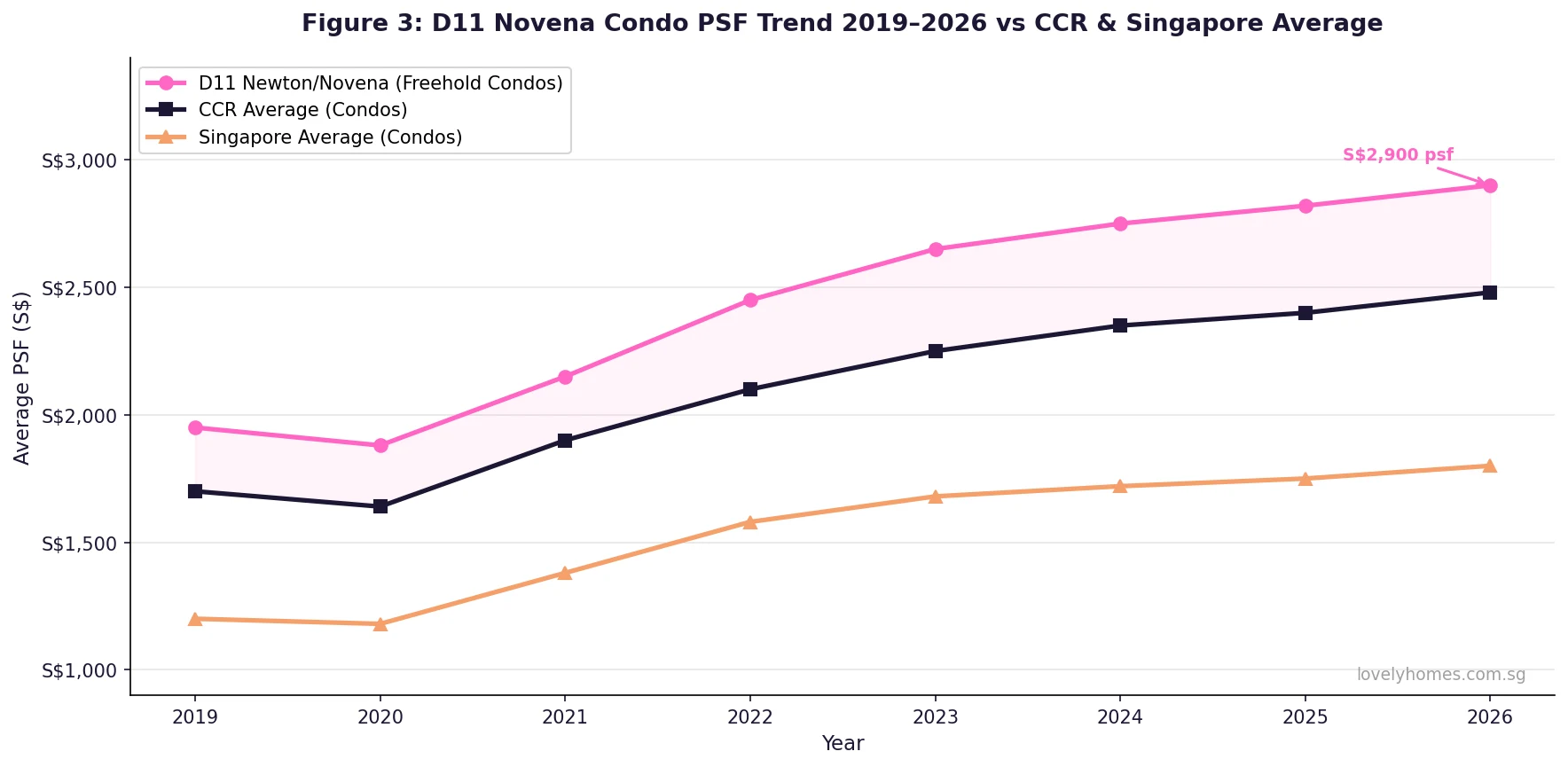
D11 Condo Price Trend 2019–2026

D11 Novena condo PSF trend 2019 to 2026 versus CCR and Singapore average line chart

Figure 3: D11 Newton/Novena average condo PSF trend 2019–2026 versus CCR and Singapore overall average. Source: URA REALIS, LovelyHomes analysis.

The chart above illustrates D11’s trajectory over the past seven years. Starting from roughly S$1,950 psf in 2019, freehold D11 condos contracted slightly during the pandemic-affected 2020 period before recovering strongly through 2021–2022 on the back of Singapore’s post-Covid reopening and a structural shift in buyer demand toward quality freehold assets. By 2023, D11 average freehold condo PSF had crossed S$2,600 psf for the first time. The 2022 and 2023 ABSD increases tempered transaction volumes — particularly for foreigners and second-property buyers — but did not dent per-unit pricing meaningfully, as supply in D11 is too constrained for any oversupply dynamic to emerge.

The shaded pink band in Figure 3 represents the D11 freehold premium over the broader CCR average. This premium has widened from approximately S$250 psf in 2019 to over S$420 psf in Q1 2026, reflecting both the structural scarcity of freehold stock in D11 and growing buyer preference for fully private, low-density living with minimal commercial encroachment.

Worked Example: Buying a 2-Bedroom Freehold Condo in Novena

📋 Case Study: Mr & Mrs Lee (SC/SC) — 2-Bed Freehold Condo, Novena, S$2,100,000

Profile: Singapore Citizens, first property purchase for both, combined gross income S$14,000/month. Buying a 2-bedroom freehold condo in Novena at S$2,100,000 for owner-occupation, no existing properties.

  • ABSD: S$0 (SC buying first residential property — no ABSD)
  • BSD (Buyer’s Stamp Duty):
    • 1% on first S$180,000 = S$1,800
    • 2% on next S$180,000 = S$3,600
    • 3% on next S$640,000 = S$19,200
    • 4% on next S$500,000 = S$20,000
    • 5% on next S$600,000 = S$30,000 (i.e. 2,100k less 1,500k threshold)
    • Total BSD: S$74,600 (effective 3.55%)
  • Loan: 75% LTV = S$1,575,000. At 3.5% p.a. over 25 years → monthly repayment ≈ S$7,882
  • TDSR check: S$7,882 / S$14,000 = 56.3% — exceeds the 55% TDSR limit. FAIL.
  • Resolution: Increase down payment to 35% (S$735,000), reducing loan to S$1,365,000 (65% LTV). Monthly repayment ≈ S$6,830. TDSR = 48.8% — PASS.
  • Or: Look at 99yr leasehold option at S$1,750,000 — TDSR at 75% LTV = S$6,568/mth = 46.9% — PASS with standard down payment.
  • Total upfront (with increased 35% down payment + BSD + legal fees ~S$8,000): approximately S$817,600

This example illustrates that D11 freehold condos at S$2M+ often push buyers to the TDSR boundary. Buyers with household income below S$13,000/month should model carefully before committing to prime CCR property at full 75% LTV.

What This Means for You: Investment Outlook for Novena 2026

D11’s investment case rests on three pillars: supply scarcity, institutional demand from the medical cluster, and the freehold tenure of the majority of its stock. No new GLS residential sites have been released in D11 since 2019, and URA’s long-term planning approach for the Novena area — classified as a Medical and Healthcare Hub in the 2019 Concept Plan — is to intensify medical uses rather than add residential supply. This means existing condo owners benefit from a structurally undersupplied rental market.

Peer-country comparison is instructive: Singapore’s medical tourism arrivals have recovered to pre-2020 levels and are projected to grow at 6–8% per year through 2030, according to Singapore Tourism Board data. Bangkok’s Sukhumvit medical precinct and Kuala Lumpur’s Bangsar medical cluster — both D11 comparators — trade at significantly lower absolute values but have shown similar rental demand dynamics when anchored by hospital clusters.

The 2023 ABSD increase to 20% for Singapore Citizens purchasing their second property has been the primary headwind, reducing the pool of upgrader-investors who would previously have held a D11 condo as a rental asset. However, institutional landlords, family offices, and HNW individuals — many of whom hold D11 property through structures exempt from or partially insulated from ABSD — have partially absorbed this demand withdrawal. Transaction volumes in D11 are lower than 2021–2022 peaks but prices have held firm.

For owner-occupiers, Novena remains one of Singapore’s best-value CCR living addresses on a “livability per dollar spent” basis: lower psf than Orchard/River Valley (D09/D10), with arguably better day-to-day amenities (healthcare, education, F&B) and equivalent MRT connectivity. First-time buyers with sufficient income ($13,000+/month household) priced out of Orchard condos will increasingly look to D11 freehold units as a value entry point into the CCR.

What Might Come Next for Novena?

URA’s Draft Master Plan 2025 (public consultation 2025–2026) has not released any residential-zoned GLS parcels within D11. The long-term direction for Novena is healthcare intensification: the Novena Health City vision positions the precinct as a full-service integrated medical district, with possible expansion of outpatient facilities and specialist centres along Irrawaddy Road and Balestier. Any rezoning of existing commercial or industrial sites in the area for residential use would be a meaningful catalyst — but industry observers see this as unlikely before 2030.

In the shorter term, the broader TEL completion in 2025 (Stages 4–5) and the continued growth of the Cross Island Line (CRL) network — which brings better connectivity to D11 feeder suburbs — are expected to sustain buyer appetite for CCR property including D11. If Singapore’s government chooses to recalibrate ABSD for second properties (reducing the 20% SC rate) as part of a future cooling-measures review, D11 would be among the prime beneficiaries given its investor-grade stock base.

Frequently Asked Questions: Buying Property in Novena

Are there HDB flats available in Novena for purchase?

Very few. D11 is almost entirely private residential, with only a small number of HDB resale flats in the Moulmein and Thomson fringe of the district. Buyers seeking public housing close to D11 typically look at nearby Toa Payoh (D12) or Novena-adjacent blocks in Moulmein Road. There are no BTO launches planned for D11 given the Master Plan’s designation of the area as a Medical and Healthcare Hub.

Can foreigners buy property in Novena?

Foreigners (non-Singapore Citizens and non-Permanent Residents) may purchase private condominiums (strata-titled, non-landed) in D11, including Novena, subject to paying Additional Buyer’s Stamp Duty (ABSD) of 60% on the purchase price as of April 2023. Landed property in D11 is restricted to Singapore Citizens only, with limited exceptions requiring Singapore Land Authority (SLA) approval for Permanent Residents in non-GCB landed categories.

What is the ABSD rate for a second property purchase in Novena?

As at 1 July 2026, a Singapore Citizen purchasing a second residential property pays ABSD of 20% on the purchase price. A Permanent Resident buying a first property pays 5% ABSD. A foreign buyer pays 60%. There is no ABSD for a Singapore Citizen purchasing their first residential property. For a D11 condo priced at S$2.0 million, the ABSD for a SC second-property purchase would be S$400,000 — a significant holding cost that most investors factor into their return model before committing.

What is the typical rental yield for condos in Novena?

Gross rental yields for condominiums in D11 Newton/Novena typically range from 2.5% to 3.2% per year in 2026, depending on unit size, floor level, and age of development. Smaller 1-bedroom units (45–55 sqm) tend to achieve the highest yields (2.9–3.2%) due to strong demand from single medical professionals, while larger 3-bedroom family units yield closer to 2.5% gross. Net yields after maintenance fees, property tax, and agent fees are typically 0.5–0.8% lower than gross.

What is the Minimum Occupation Period (MOP) for a condo in D11?

Private condominiums do not have a Minimum Occupation Period (MOP) requirement. Only HDB flats are subject to MOP (5 years for Standard flats, 10 years for Prime and Plus BTO flats). Private condo owners may rent out their unit from day one of ownership, provided they comply with URA tenancy regulations including the 3-month minimum rental period. This makes D11 condos immediately income-generating for buyers who intend to lease the property out.

How does Novena compare to Orchard Road (D09/D10) for property investment?

Novena (D11) generally offers lower entry prices than Orchard (D09) and River Valley (D10) at equivalent quality levels, with freehold condos in D11 averaging S$2,600–3,200 psf versus D09/D10 freehold at S$3,200–4,500 psf. Rental yields are comparable (2.5–3.2% across both zones). D11 benefits from the medical hub demand driver, which is more stable than the expatriate corporate demand that historically underpinned D09/D10 rentals. Buyers seeking CCR exposure with lower absolute outlay and a differentiated demand driver typically favour D11 over D09/D10.

Is Novena suitable for families with school-age children?

Yes — D11 is one of Singapore’s best-positioned districts for families prioritising education access alongside healthcare. Anglo-Chinese School (Primary) is located off Barker Road within the district. The Singapore Chinese Girls’ School (SCGS) is on Emerald Hill in adjacent D10. St. Joseph’s Institution International (SJI International) on Malcolm Road serves the international school market. United Square on Thomson Road is Singapore’s premier education-focused mall, housing enrichment centres, tuition providers, and learning-focused retail. Proximity to the Botanic Gardens (5 minutes by car) adds park space for families.

Related Articles

Disclaimer: This article is for general information purposes only and does not constitute financial, legal, or property advice. Property prices, stamp duty rates, HDB eligibility rules, and mortgage terms are subject to change. All figures cited are indicative based on publicly available URA REALIS data and industry analysis as at Q1/Q2 2026. Readers should verify current rules with the Urban Redevelopment Authority (ura.gov.sg), Housing & Development Board (hdb.gov.sg), Inland Revenue Authority of Singapore (iras.gov.sg), and seek advice from a licenced property agent, mortgage broker, and solicitor before making any property transaction decision.

HDB Resale Prices Fall for Second Consecutive Quarter: Q2 2026 Flash Estimate Breakdown

HDB Resale Prices Fall for Second Consecutive Quarter: Q2 2026 Flash Estimate Breakdown

Quick Summary: HDB Resale Market Q2 2026

  • The HDB Resale Price Index (RPI) fell 0.3% in Q2 2026 (flash estimate, 1 July 2026), following a 0.1% decline in Q1 2026.
  • This marks the first back-to-back quarterly RPI decline since early 2019 — a meaningful shift after a 12-quarter streak of price growth from mid-2020.
  • Estimated transactions: ~6,268 in Q2 2026 (as at 29 June 2026), down about 10.2% versus Q2 2025’s 6,981 transactions.
  • The full Q2 data from HDB — including town-level breakdowns and flat-type analysis — is expected by 23 July 2026.
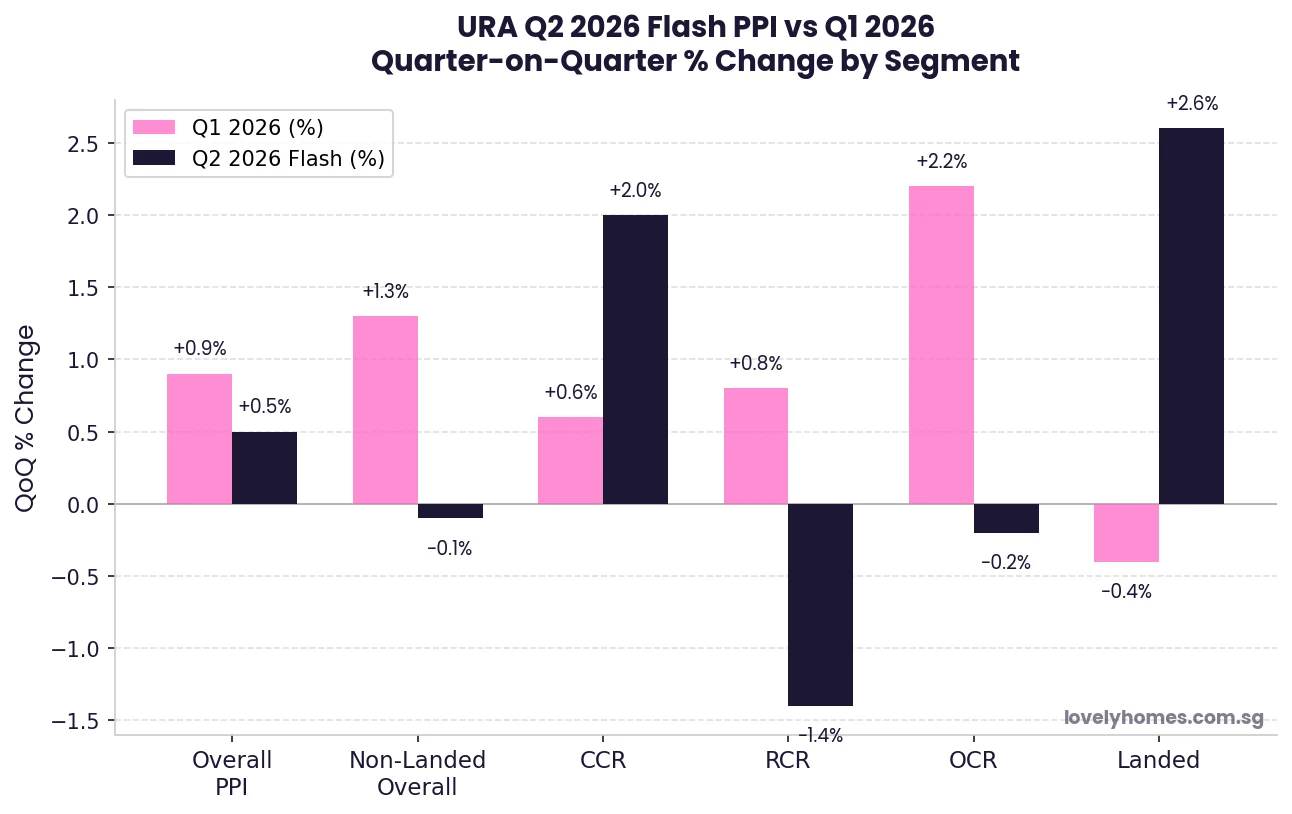
  • Meanwhile, private residential prices rose 0.5% in Q2 2026 (URA flash estimate), a divergence between public and private markets.
  • The October 2026 BTO exercise (~8,000 flats, 7 projects) and a growing private pipeline should continue to moderate resale demand in 2H 2026.

HDB Resale Prices Fall for a Second Consecutive Quarter in Q2 2026

The Housing & Development Board released its Q2 2026 flash estimate on 1 July 2026, showing the Resale Price Index (RPI) declined 0.3% quarter-on-quarter — deepening the 0.1% dip recorded in Q1 2026. The two consecutive quarterly declines are the first since early 2019, ending a remarkable run of price growth that had seen the RPI climb more than 30% from its 2020 post-pandemic lows.

The data point comes on the same day as URA’s Q2 2026 private residential flash estimate, which showed a more modest picture: private home prices rising 0.5%, with gains concentrated in the Core Central Region (+2.0%) and landed segment (+2.6%), while the Rest of Central Region (-1.4%) and Outside Central Region (-0.2%) softened. The divergence between the two markets — private prices edging up while HDB resale prices retreat — is a notable feature of Singapore’s mid-2026 property landscape.

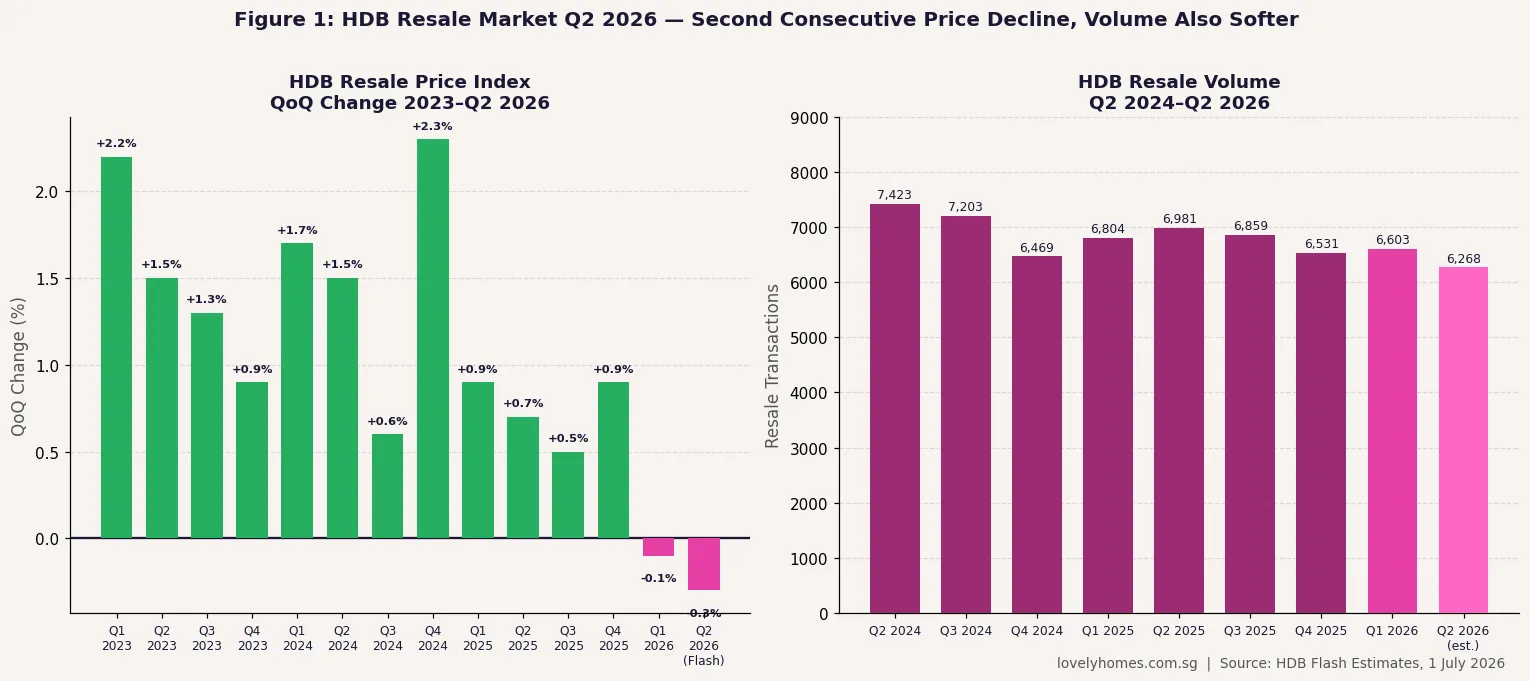
HDB Resale Price Index QoQ change 2023 to Q2 2026 and resale transaction volume trend
Figure 1: (Left) HDB Resale Price Index QoQ change, Q1 2023 to Q2 2026. Two consecutive declines in Q1 and Q2 2026 mark the first back-to-back quarterly retreat since early 2019. (Right) Estimated resale transaction volume, Q2 2024 to Q2 2026 — Q2 2026 volume (~6,268) is the softest in the chart window. Source: HDB Flash Estimates, 1 July 2026.

Why Are HDB Resale Prices Softening?

Several structural forces are bearing down on HDB resale demand in mid-2026. First, the sheer volume of BTO supply entering the market is creating competition at the margins. HDB launched approximately 19,600 BTO flats across 2026, with the October exercise alone adding close to 8,000 units across seven projects — including two projects at Bayshore (Prime classification, 2,500 units combined), Caldecott (Prime, 1,430 units), and Yishun Chencharu (Standard, 1,580 units). Buyers who might previously have turned to the resale market for faster access to housing in desired towns now have BTO options that, while involving a wait of several years, offer meaningful subsidies.

Second, resale volume has been declining. An estimated 6,268 transactions in Q2 2026 represents a drop of approximately 10.2% compared to 6,981 in Q2 2025. Fewer transactions mean fewer comparable sales pushing prices higher — the resale market is losing the self-reinforcing momentum it enjoyed during 2021–2024.

Third, the cooling measures introduced in 2022–2023 — the 15-month wait-out period for private property owners wanting to buy HDB resale flats, tightened income ceilings under the HFE framework, and the introduction of Plus and Prime classifications — have added friction for demand that was previously unconstrained. The Ethnic Integration Policy (EIP) also continues to block transactions in certain blocks, narrowing the effective buyer pool in popular mature estates.

What the Divergence Between Private and HDB Prices Means

The contrast between private (+0.5%) and HDB resale (-0.3%) prices in Q2 2026 reflects different demand profiles. Private residential demand in Singapore is increasingly driven by upgraders, high-net-worth individuals, and (at the CCR end) wealthy foreigners paying the 60% ABSD — a buyer cohort that is relatively insensitive to BTO supply. HDB resale demand, by contrast, comes principally from first-timers who cannot get a BTO (due to ballot failure, income ceiling, or timing), second-timers who have completed their MOP and want a larger resale flat before upgrading, and PRs who have been resident long enough to qualify. This segment is more directly substitutable with BTO supply.

The CCR’s 2.0% private price gain in Q2 2026 also reflects some flight-to-quality within the private market — buyers who can afford CCR are moving upstream as OCR and RCR sentiment softens. This bifurcation is a characteristic of a market entering a more discerning phase after broad-based appreciation.

Context: Is This a Correction or a Reset?

A 0.3% quarterly decline does not in isolation constitute a correction — it represents a modest pullback after an extended run-up. The HDB RPI reached its cycle high in Q4 2025 or Q1 2026 (the full data will clarify the exact peak). From cycle trough in Q2 2019 to approximate peak in Q4 2025, the RPI gained roughly 30%+ over six years. A mild two-quarter retreat is, from a long-term perspective, a normalisation.

Industry figures suggest the retreat is orderly rather than distressed. Median resale flat prices remain close to or at multi-year highs on an absolute basis — it is the rate of growth that has reversed, not a broad-based collapse. The Bidadari estate’s record S$945,000 resale transaction (a 3-room flat at 118A Alkaff Crescent in June 2026, as reported by LovelyHomes) shows that premium locations can still command record prices even as the broader index softens.

What to Watch in 2H 2026

The full Q2 2026 HDB statistics (expected 23 July 2026) will provide the town-level and flat-type breakdown that the flash estimate lacks. Market participants will be looking at whether the price softening is concentrated in particular flat types (5-room and executive flats, which saw the sharpest run-up) or distributed across the board. The MOP unlock pipeline — the volume of BTO flats reaching their 5-year MOP in 2026 — is also a factor: a large cohort of flats from 2019–2021 BTO launches reaching MOP simultaneously could add resale supply.

With the October BTO exercise applications opening in September 2026 (HFE deadline 15 September 2026), buyer attention is likely to shift toward the BTO market in 3Q 2026, further dampening resale activity near term. The 2H 2026 private pipeline includes several significant new launches — any softening in developer sales could, through the upgrader channel, reduce demand for HDB resale from MOP-cleared flat owners looking to cash out for a private upgrade.

Frequently Asked Questions

Does the -0.3% RPI mean my flat is worth less than last quarter?

At a market level, yes — the flash estimate indicates that the average resale flat transacted in Q2 2026 sold at prices approximately 0.3% lower than the average in Q1 2026. However, individual flat values depend on estate, block, floor, flat condition, and proximity to amenities. A Bidadari flat in a sought-after block may still have appreciated even as the overall index dipped. The RPI is a market-level index, not a valuation of your specific flat. For an accurate current valuation, engage an HDB-registered salesperson for a Comparative Market Analysis or use HDB’s official transaction data portal.

Why are private prices rising while HDB resale prices fall?

The two markets have different demand drivers. Private residential demand in Singapore is partly sustained by high-income upgraders, global wealth, and CCR buyers who are relatively insulated from BTO supply effects. HDB resale demand, by contrast, is more directly substitutable with BTO supply — buyers who want an HDB flat can increasingly choose a new BTO over a resale flat, especially with the expanded supply in 2026. The 15-month wait-out period also constrains one source of HDB resale demand (private property sellers downsizing). The result is diverging price trends.

Should I wait to buy an HDB resale flat if prices are declining?

Market timing in housing is notoriously difficult, and the decision to buy an HDB resale flat should primarily be driven by your housing needs, financial readiness, and family circumstances — not by short-term RPI movements. A 0.3% quarterly decline is small relative to the transaction costs of delaying a purchase (rental costs, stamp duties). That said, if you are financially able to wait and are flexible on timing, the 2H 2026 market may offer a wider selection at steady or modestly lower prices given the pipeline of October BTO and new private launches drawing attention away from resale. Always work with a qualified professional and check your HFE letter status before making any commitment.

When will the full Q2 2026 HDB data be released?

HDB typically releases the full quarterly resale statistics approximately three weeks after the flash estimate — so the full Q2 2026 data (with flat-type and town-level breakdowns, median transaction prices, and complete volume figures) is expected around 23 July 2026. LovelyHomes will publish an in-depth analysis when the full data is available. The full URA Q2 2026 private residential statistics are also expected on 25 July 2026.

Is this the start of a bigger HDB resale price correction?

Based on Q2 2026 flash data alone, it is premature to call a structural correction. Two consecutive quarters of mild declines (−0.1% and −0.3%) are consistent with a soft landing rather than a downturn. The HDB government remains committed to ensuring an adequate supply of BTO flats and has levers — including BTO supply pacing and eligibility criteria — to manage the market. Historical context is useful: the last significant HDB resale correction (2013–2019) saw the RPI decline approximately 13% over six years, driven by a deliberate policy supply surge. The current situation — a mild two-quarter pullback within a broadly healthy economy — does not yet suggest a repeat of that trajectory.

Related Articles

Disclaimer

The data in this article is drawn from HDB and URA flash estimates released on 1 July 2026. Flash estimates are preliminary and subject to revision when the full quarterly statistics are published. Transaction volume figures (as at 29 June 2026) are unaudited estimates. This article is not financial or investment advice. For current HDB resale data, visit hdb.gov.sg. For URA private residential data, visit ura.gov.sg.

×

Click anywhere to close

Singapore HDB Minimum Occupation Period (MOP) 2026: Complete Guide — Rules, Restrictions and Upgrade Options

Singapore HDB Minimum Occupation Period (MOP) 2026: Complete Guide — Rules, Restrictions and Upgrade Options

Quick Answer: HDB MOP Singapore 2026

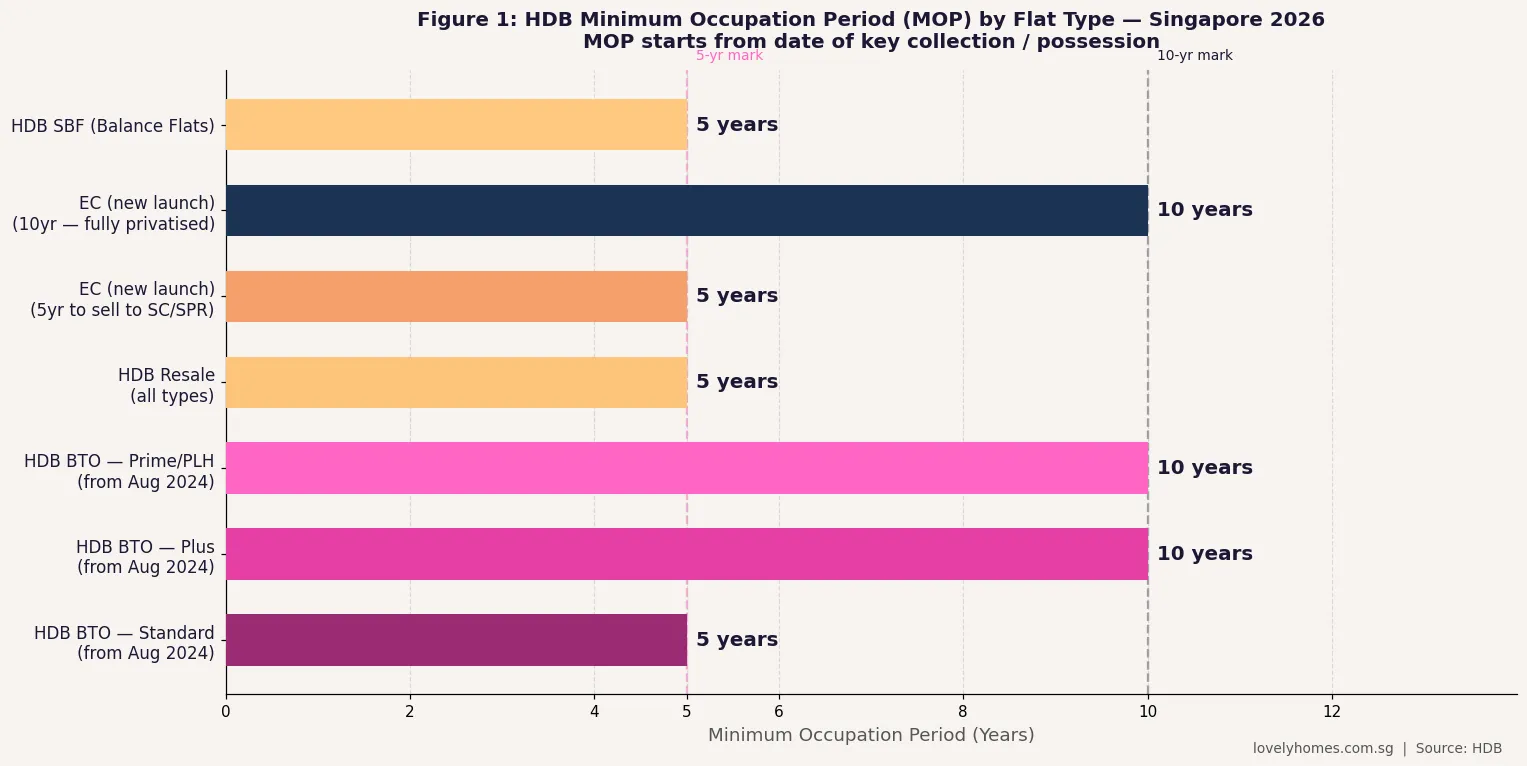
  • Standard HDB BTO and resale flats have a 5-year Minimum Occupation Period (MOP) counted from the date you collect the keys (TOP/possession date), not from when you sign the Sales & Purchase agreement.
  • Plus and Prime (PLH) classification flats introduced from the August 2024 BTO exercise have a longer 10-year MOP, reflecting their more desirable locations and heavier subsidy.
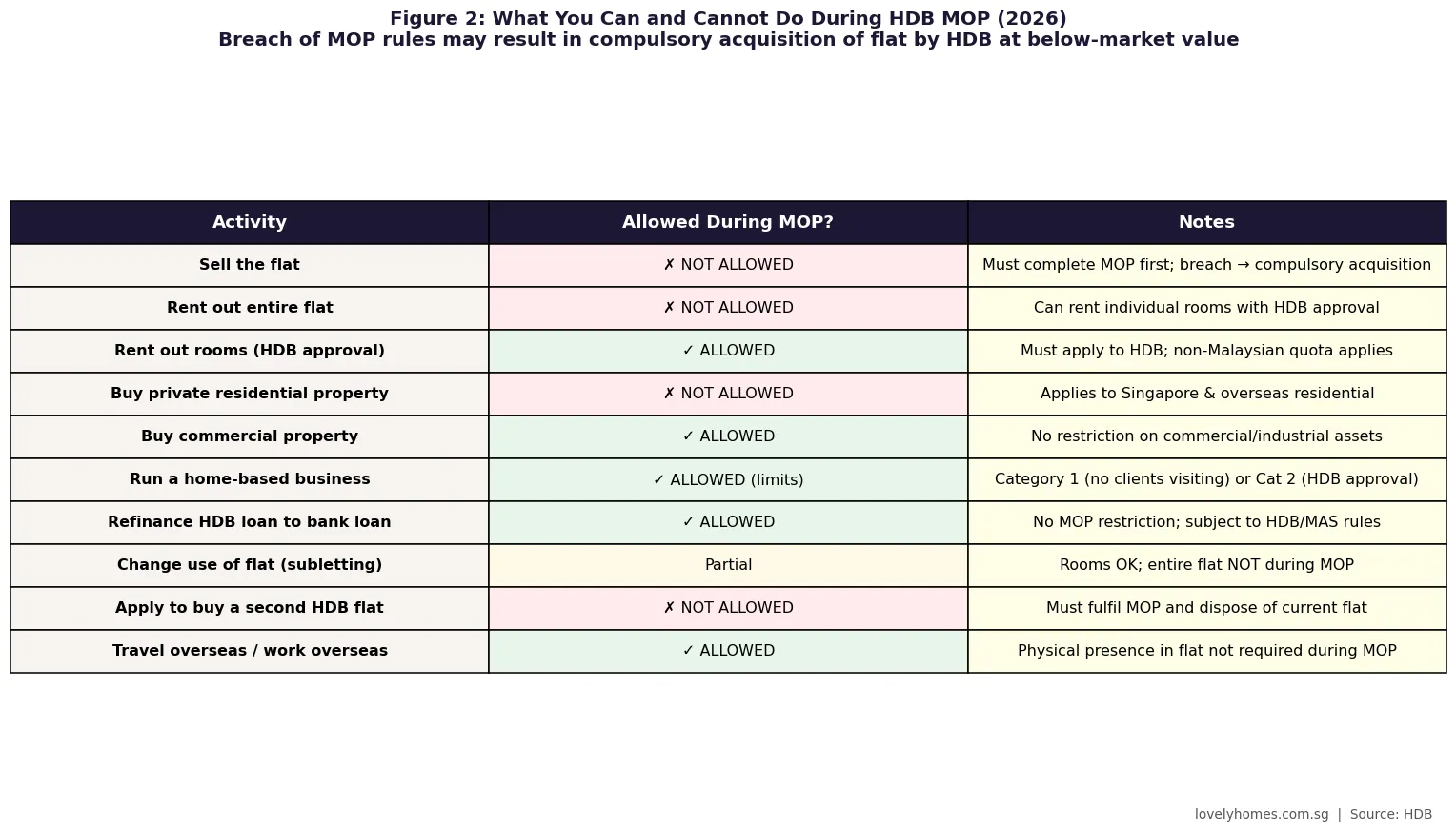
  • During MOP, you cannot sell your flat, rent out the entire flat, or purchase any other residential property in Singapore — including private property or an overseas residential investment.
  • You CAN rent out individual HDB bedrooms with prior HDB approval, and run approved home-based businesses from your flat during MOP.
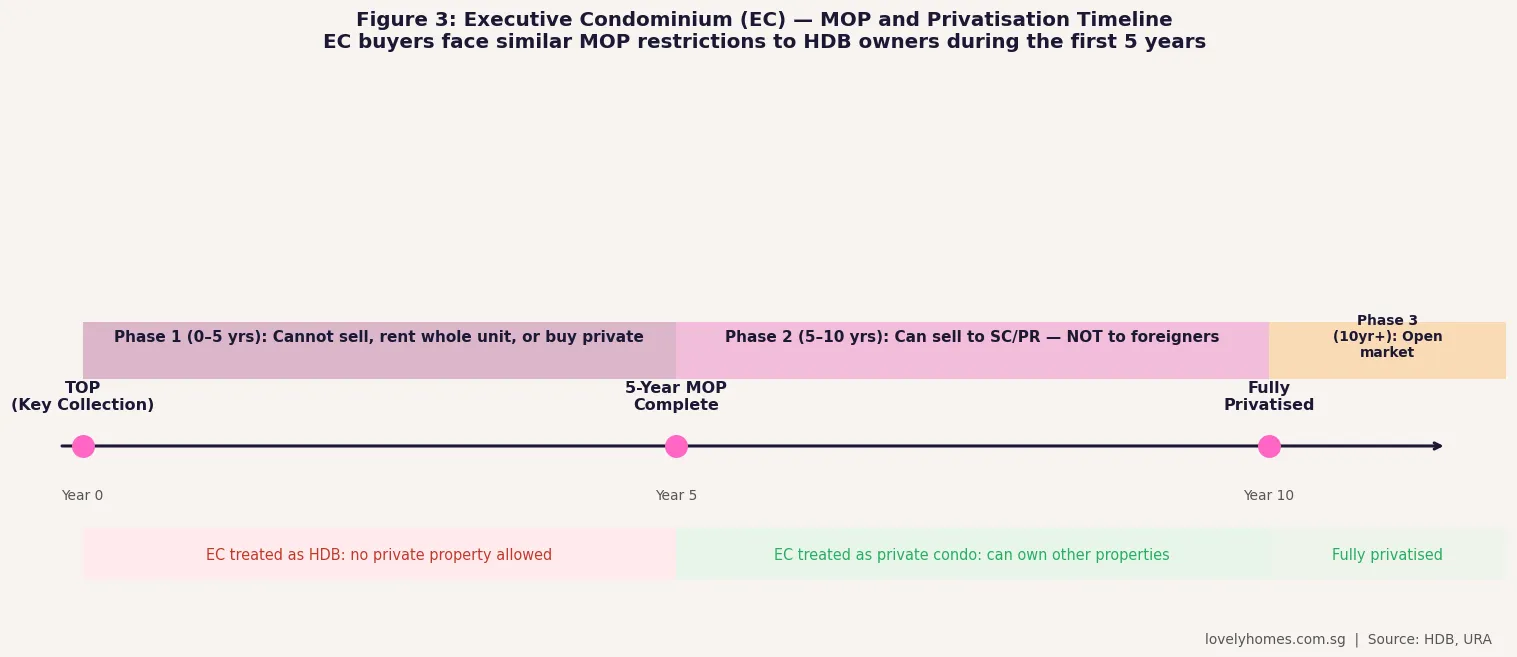
  • Executive Condominiums (ECs) have a 5-year MOP before they can be sold to Singapore Citizens and PRs, and a 10-year window before they are fully privatised and open to foreign buyers.
  • Breaching MOP rules can result in compulsory acquisition of the flat by HDB at a value set by HDB — typically below market value. Criminal penalties may also apply under the Housing & Development Act.
  • After MOP, you can sell the flat, upgrade to a private property, and — for HDB sellers upgrading to private — apply for ABSD remission if you complete the sale within 6 months of purchasing the private property.

What Is the HDB Minimum Occupation Period (MOP)?

The Minimum Occupation Period (MOP) is a statutory rule administered by the Housing & Development Board (HDB) that requires flat owners to physically occupy their HDB flat for a minimum period before they can sell it on the open market, rent it out entirely, or purchase other residential property in Singapore. The MOP is a key plank of Singapore’s public housing philosophy: HDB flats are subsidised national assets intended primarily as homes rather than investment vehicles, and the MOP is one mechanism through which HDB ensures flats remain owner-occupied.

The MOP was first introduced in the 1970s and has been refined multiple times since, most recently in 2024 with the introduction of the Plus and Prime flat classifications under the enhanced HDB framework. Understanding which MOP applies to your flat — and what you can and cannot do during that period — is critical before making any property decisions.

HDB MOP by flat type Singapore 2026 — Standard 5 years, Plus and Prime 10 years, EC 5 then 10 years
Figure 1: HDB Minimum Occupation Period by flat type, Singapore 2026. Plus and Prime classification flats (introduced from August 2024 BTO exercise) carry a 10-year MOP, double the Standard flat MOP. Source: HDB.

MOP Duration by Flat Type (2026)

Flat Type MOP Duration MOP Start Date Notes
Standard BTO Flat 5 years Date of key collection Applies to all pre-Aug 2024 BTO; continued for Standard classification from Aug 2024
Plus Classification BTO Flat 10 years Date of key collection From Aug 2024 BTO exercise; typically near MRT/town centres; subsidy clawback on resale
Prime / PLH Classification BTO Flat 10 years Date of key collection Central-location flats; subsidy clawback ~6–9% of resale price; income ceiling at resale
HDB Resale Flat 5 years Date of resale completion Fresh 5-year MOP runs from the date the resale transaction is completed (not from when the previous owner moved in)
Executive Condominium (EC) 5 years → 10 years Date of TOP At 5yr can sell to SC/PR; at 10yr fully privatised — open to foreigners (60% ABSD applies)
HDB Sale of Balance Flats (SBF) 5 years Date of key collection SBF flats unsold from previous BTO exercises; Standard classification MOP applies

Important note on the Plus and Prime MOP: The new 10-year MOP for Plus and Prime flats applies only to flats launched under the August 2024 BTO exercise onwards. Flats purchased in earlier exercises, even if they are in desirable locations that would now be classified as Plus or Prime, retain their original 5-year MOP. To confirm which classification applies to your flat, check your HDB flat portal or the original flat details under your BTO exercise.

What You Cannot Do During the HDB MOP

HDB MOP rules matrix 2026 — what you can and cannot do during the minimum occupation period
Figure 2: HDB MOP rules — allowed and prohibited activities during the Minimum Occupation Period. Source: HDB Housing & Development Act.

Selling the Flat

You cannot sell your HDB flat on the open resale market before your MOP is complete. This applies even if you face financial hardship — HDB does not grant MOP exemptions for distressed sellers. The only exception is a compulsory acquisition by HDB or by the State for public purposes, which is not initiated by the flat owner. If you attempt to sell before MOP, the transaction will be rejected by HDB’s system during the eligibility check.

Renting Out the Entire Flat

Renting out the entire flat (as a whole unit) is not allowed during MOP. This applies to both short-term and long-term rental arrangements. Platforms such as Airbnb and similar short-term rental services are also not permitted on HDB flats — the minimum lease tenure for any rental on HDB flats is three consecutive months. After MOP, whole-flat rental is allowed with HDB prior approval and is subject to the non-Malaysian foreign tenant quota.

Purchasing Other Residential Property in Singapore

During MOP, you and your co-owners on the flat cannot purchase any other private residential property in Singapore. This restriction extends to new launch condominiums, resale condominiums, Executive Condominiums (as a new buyer), landed property, and private apartments. Purchasing a second HDB flat is also not allowed during MOP.

Crucially, HDB’s definition of “residential property” in the MOP context refers to Singapore property only. There is no restriction on purchasing overseas residential property during MOP — only Singapore residential property is covered.

Purchasing a Second HDB Flat

HDB’s policy generally allows only one HDB flat per family nucleus at any time. Applying for a second BTO, SBF, or resale flat during MOP is not permitted. Once MOP is fulfilled, you may apply for a second HDB flat under specific schemes (e.g., the Studio Apartment scheme for elderly, or a new BTO after disposing of the first flat).

What You CAN Do During the HDB MOP

Rent Out Individual Rooms

Renting out individual bedrooms in your HDB flat (while you continue to live in the flat) is permitted during MOP, subject to HDB’s prior written approval. You must apply through the HDB Flat Portal before subletting. Each tenancy must be for a minimum of six months (for whole-flat subletting after MOP) or at least three months for room rental. Non-Malaysian foreign tenants are subject to the non-Malaysian quota: a maximum of two non-Malaysian foreign tenants per flat in the same block is the guideline, though HDB publishes real-time quota data by block.

Run Approved Home-Based Businesses

HDB permits flat owners to operate home-based businesses during MOP, subject to type and scale restrictions. Category 1 businesses (no employees visiting, no clients visiting, no signage) are allowed without prior approval. Category 2 businesses (up to two non-resident employees, clients may visit in small numbers) require prior approval from HDB. Manufacturing, food businesses, or any business that involves goods storage, noise, or frequent deliveries is not permitted.

Refinance to a Bank Loan

Switching from an HDB housing loan to a bank loan (or switching between bank loan packages) is allowed during MOP. There is no MOP restriction on refinancing decisions, and many flat owners take advantage of the 5-year MOP period to monitor interest rate movements and refinance when rates are favourable. MAS’s LTV and TDSR rules govern the refinancing terms.

When Does the MOP Start and End?

The MOP starts from the date you collect your keys (for BTO and SBF flats, this is the TOP date; for resale flats, this is the date of completion of the resale transaction — both milestones are reflected in your HDB Flat Portal). The MOP does not start from the date you sign the Sales & Purchase Agreement or from the date you pay the initial booking fee.

You can check your MOP end date in the HDB Flat Portal under “My Flat” → “Purchase Details”. The portal clearly shows whether your MOP has been fulfilled. Do not rely on verbal estimates from agents or CPF advisers — always verify on the portal directly.

One nuance: physical occupation is expected during MOP. HDB conducts periodic checks to ensure flat owners are residing in the flat. Extended overseas absences without HDB’s knowledge have been cited in compulsory acquisition cases. If you must be overseas for an extended period (e.g., for work), inform HDB and keep the flat in a lived-in condition.

Executive Condominium (EC): The Hybrid MOP Rules

Executive Condominium EC MOP and privatisation timeline Singapore 2026 — 5-year and 10-year milestones
Figure 3: Executive Condominium MOP and privatisation timeline. During the first 5 years, EC owners face HDB-equivalent MOP restrictions. At the 5-year mark, ECs can be sold on the open market to SC and PR buyers. At 10 years, ECs are fully privatised and open to foreign buyers (60% ABSD applies). Source: HDB, URA.

Executive Condominiums occupy a hybrid position between public and private housing. They are built by private developers but are sold at a subsidised price to qualifying buyers (income ceiling S$16,000 per month household income as of 2026). From a MOP standpoint, ECs are treated like HDB flats for the first 5 years:

During years 1–5: EC owners cannot sell their unit, rent out the whole unit, or purchase any other Singapore residential property. The rules are identical to HDB MOP. Critically, the 5-year MOP runs from the TOP date, not the booking date — for large EC projects, this can mean a 3–4 year gap between booking and TOP, followed by 5 more years of MOP, making the effective holding period 8–9 years from initial purchase commitment.

After year 5 (first privatisation): The EC can be sold on the open resale market to Singapore Citizens and Singapore PRs. It cannot yet be sold to foreigners, and ECs in the first 5–10 year window are not listed on the private market as “privatised condos” — they trade in a narrower SC/SPR market. ABSD rules for the buyer apply (5% for PR 1st property, 30% for PR 2nd+, etc.).

After year 10 (full privatisation): The EC is fully privatised and treated identically to a private condominium. Foreigners may purchase it, though the 60% foreigner ABSD applies. Owners may also rent the entire unit without prior HDB approval at this stage.

Plus and Prime Flat Additional Restrictions After MOP

The 2024 housing framework introduced substantive additional conditions for Plus and Prime classification flats beyond just the longer 10-year MOP. These are restrictions that run with the flat even after MOP and affect future resale:

Subsidy clawback: When you sell a Plus or Prime flat after your MOP, HDB claws back a portion of the subsidy embedded in the original purchase price — approximately 6–9% of the resale price, payable to HDB. This clawback is calculated as a percentage of the resale transaction price, not the original purchase price, so it increases in dollar terms as the flat appreciates.

Income ceiling for buyers: Buyers of Plus and Prime resale flats are subject to an income ceiling (the ceiling is the same as for BTO buyers — S$14,000/month for 4-room and larger Plus flats as of 2026). This narrows the pool of eligible resale buyers and may dampen price appreciation relative to Standard flats.

Ethnic Integration Policy (EIP): As with all HDB resale flats, EIP quotas apply — both block and neighbourhood levels. Buyers must check the relevant block’s EIP availability before submitting an offer.

After MOP: Your Property Upgrade Options

Once your MOP is fulfilled, your options expand significantly. The most common upgrade path is from HDB flat to private condominium. The timing of this upgrade carries stamp duty implications:

Option A — Sell HDB first, then buy private: You clear the HDB flat, receive sale proceeds (net of CPF refund), and purchase the private property as a “first property” — no ABSD for SC buyers, 5% ABSD for PR buyers. This is the most common and financially efficient path but requires temporary accommodation between the two transactions.

Option B — Buy private first, then sell HDB (concurrent ownership): As an SC buying private property while still owning an HDB flat (post-MOP), you pay 20% ABSD on the private property purchase. You then have six months from the private property’s completion (or from the purchase date for resale private properties) to sell the HDB flat and apply for an ABSD remission from IRAS. If the HDB is sold within six months, IRAS refunds the 20% ABSD. If you miss the six-month window, the 20% ABSD is forfeited.

The six-month window starts from either the issue of Temporary Occupation Permit (TOP) for a new private property or the date of exercise of the OTP for a resale private property. Given the complexity of timing, many HDB upgraders consult a lawyer and financial adviser before committing to Option B.

The 15-Month Wait-Out Period: From Private Back to HDB

The wait-out period is often confused with MOP. They are different rules targeting different situations. The 15-month wait-out period (introduced in September 2022) applies to private property owners who want to purchase an HDB resale flat. If you own or recently disposed of a private property, you must wait 15 months from the date of disposal before you can purchase an HDB resale flat.

This rule does not apply to HDB MOP — it is a separate downstream restriction. For example, if you complete your HDB MOP, sell your HDB flat, buy a private condo, and then later want to downgrade back to HDB, you must wait 15 months after selling the private condo before buying an HDB resale flat. This rule applies to both SC and PR private property owners.

Worked Example: The Tan Family’s Upgrade Journey

Mr and Mrs Tan (both Singapore Citizens) purchased a 4-room BTO flat in Punggol under the Standard classification in September 2019. They collected their keys in August 2021. Their MOP end date is therefore August 2026 — five years from key collection.

In March 2026, Mrs Tan checks the HDB portal and sees MOP will end in 5 months. The couple begin their private condo search. They find a 3-bedroom OCR resale condo in Jurong East priced at S$1.5M in June 2026.

They choose Option B (buy private first). As SC buying a second property: BSD ~S$42,600 + ABSD 20% = S$300,000. They pay S$342,600 in stamp duties. Their flat is still within MOP (keys August 2021, MOP August 2026 — they are just before MOP end), so HDB must confirm MOP end before they list the flat for sale.

After August 2026 (MOP fulfilled), they list their HDB flat. Sell it in October 2026 for S$780,000 — within the 6-month window from the condo OTP exercise date of June 2026. IRAS refunds the S$300,000 ABSD. Net stamp duty retained: S$42,600 BSD only. The family books temporary accommodation for 2 months while bridging the purchase and sale timelines.

Total net proceeds from HDB: S$780,000 − CPF refund S$220,000 (principal + accrued interest) − agent 1% S$7,800 − legal S$2,500 = net S$549,700 cash. The upgrade is financially viable.

Will MOP Rules Change?

The 10-year MOP for Plus and Prime flats is a relatively recent policy (from August 2024) and unlikely to be rolled back in the near term. If anything, the trend in Singapore public housing policy has been toward tightening MOP and adding post-MOP conditions rather than relaxing them, as the government works to ensure HDB flats remain primary homes rather than investment properties. The subsidy clawback mechanism for Plus and Prime flats may be extended to more flat types if HDB determines that Standard flat resale prices are diverging too sharply from BTO prices in certain areas. Buyers should model their long-term exit strategy under current rules and build in buffer for possible tightening.

Frequently Asked Questions

Can I stay overseas during my HDB MOP?

You are expected to physically occupy the flat during MOP, but there is no absolute rule against overseas travel. Extended absences (months or years) without HDB’s knowledge can attract scrutiny, and in confirmed cases of non-occupation, HDB may commence compulsory acquisition proceedings. If you need to relocate overseas temporarily for work (e.g., on a company secondment), inform HDB in writing and keep the flat utilities active. HDB conducts inspection exercises and spot checks and has compulsorily acquired flats where owners were clearly not residing in them during MOP.

Does my MOP reset if I add or remove an owner from the flat?

No — adding or removing an owner (for example, through marriage or divorce) does not reset the MOP clock. The MOP continues to run from the original key collection date. However, any change of ownership within MOP is a restricted transaction and must be approved by HDB. Not all ownership changes are approved during MOP — for example, transferring a flat to an ineligible person would be rejected. Consult HDB or a lawyer before any ownership change within the MOP window.

Can I buy an overseas investment property during MOP?

Yes. The HDB MOP restriction applies only to Singapore residential property. There is no restriction on purchasing overseas property (residential or commercial) during MOP. You are not required to declare overseas property purchases to HDB. However, if you are financing an overseas property purchase with a Singapore bank loan, that loan will be factored into your TDSR for future Singapore loan applications. From a Singapore tax perspective, rental income from overseas property is taxable in Singapore as foreign-sourced income if remitted to Singapore.

What happens if I breach the MOP?

A breach of MOP (typically: selling the flat, subletting the entire flat, or buying other residential property in Singapore without completing MOP) can result in HDB compulsorily acquiring the flat. HDB sets the acquisition price, which is typically the assessed market value minus a penalty deduction — in practice, this means the owner receives significantly less than the open-market value they would have received after MOP. In the most serious cases involving deliberate deception or fraud (e.g., falsely declaring occupancy), criminal charges may be brought under the Housing & Development Act, which carries fines of up to S$5,000 and/or imprisonment.

Does MOP apply to inherited HDB flats?

If you inherit an HDB flat from a deceased owner, the MOP of the original owner does not transfer to you as a fresh 5-year obligation. Instead, the inherited flat is subject to HDB’s estate rules — the eligible inheritor (e.g., a spouse or child who meets eligibility criteria) may retain the flat. If the inheritor already owns a flat, they may need to dispose of one within six months. Inherited flats that have not yet met MOP at the time of death are subject to HDB’s direction — in practice, HDB often allows the eligible inheritor to complete the remaining MOP. Always consult HDB’s estate administration team for inherited flat cases.

Can I buy a private property if my HDB is still within MOP and my spouse is not on the HDB title?

No — the restriction applies to the entire family nucleus (owner and spouse / co-habitant), not just the named owners on the HDB title. If one spouse is within MOP on an HDB flat, the other spouse (even if not on the HDB title) is also restricted from purchasing Singapore residential property. HDB looks at the family nucleus holistically. Attempting to buy private property in a non-owning spouse’s name to circumvent MOP is a known scheme that HDB and IRAS are alert to — it will be scrutinised and may result in both the stamp duty assessment and a referral for investigation.

Is there a MOP for HDB shophouses or commercial units?

No. MOP is specific to HDB residential flat units. HDB shophouses (commercial properties on the ground floor of HDB blocks) are governed by different rules and do not carry a MOP. Commercial properties generally do not have any MOP equivalent — you can sell or rent them freely at any time after purchase. The restrictions and ABSD rules that apply to residential property do not apply to commercial property purchases.

Related Articles

Disclaimer

This article provides general information about HDB MOP rules as at July 2026 and is not legal or financial advice. MOP durations, clawback percentages, and related policy conditions may change. Always verify current MOP status for your flat at hdb.gov.sg and check the specific BTO exercise details in your Lease Agreement. For estate planning, inheritance, and structural ownership changes, consult a Singapore-qualified lawyer. For ABSD remission eligibility, consult IRAS at iras.gov.sg.

June 2026 BTO Results: Berlayar Rise and Lakeview Cascadia Dominate With 4.5-4.7 Times Oversubscription

June 2026 BTO Results: Berlayar Rise and Lakeview Cascadia Dominate With 4.5-4.7 Times Oversubscription

The June 2026 Build-To-Order (BTO) sales exercise closed on 24 June 2026 after five days of applications, confirming a pattern that has defined Singapore’s public housing market all year: Prime-classified projects in central and mature estates are dramatically oversubscribed, while Standard projects in the north and north-east attract softer demand — in some cases failing to reach full first-timer subscription. Here is the complete picture.

Quick Answer — June 2026 BTO Results at a Glance

  • 6,952 flats launched across 7 projects in Ang Mo Kio, Bishan, Bukit Merah, Sembawang, and Woodlands.
  • Total applications: 22,634 — overall subscription rate of 3.3 times (as at 5pm, 24 June 2026).
  • Star project: Berlayar Rise (Bukit Merah, Prime) — 8,824 applications, 4.5× oversubscribed. Nearly 40% of all applications in the exercise.
  • Runner-up: Lakeview Cascadia (Bishan, Prime) — 5,799 applications, 4.7× for certain flat types.
  • Weakest demand: Sembawang Portico and Sembawang Brook — first-timer family rates fell below 1× for all 3-room and larger flat types.
  • Singles demand surge: Woodgrove Acres (Woodlands) 2-bedroom flexi units hit 17.8× for first-timer singles.
  • More than 2,500 flats offered have wait times of three years or less under HDB’s expedited build programme.

The Full Project-by-Project Breakdown

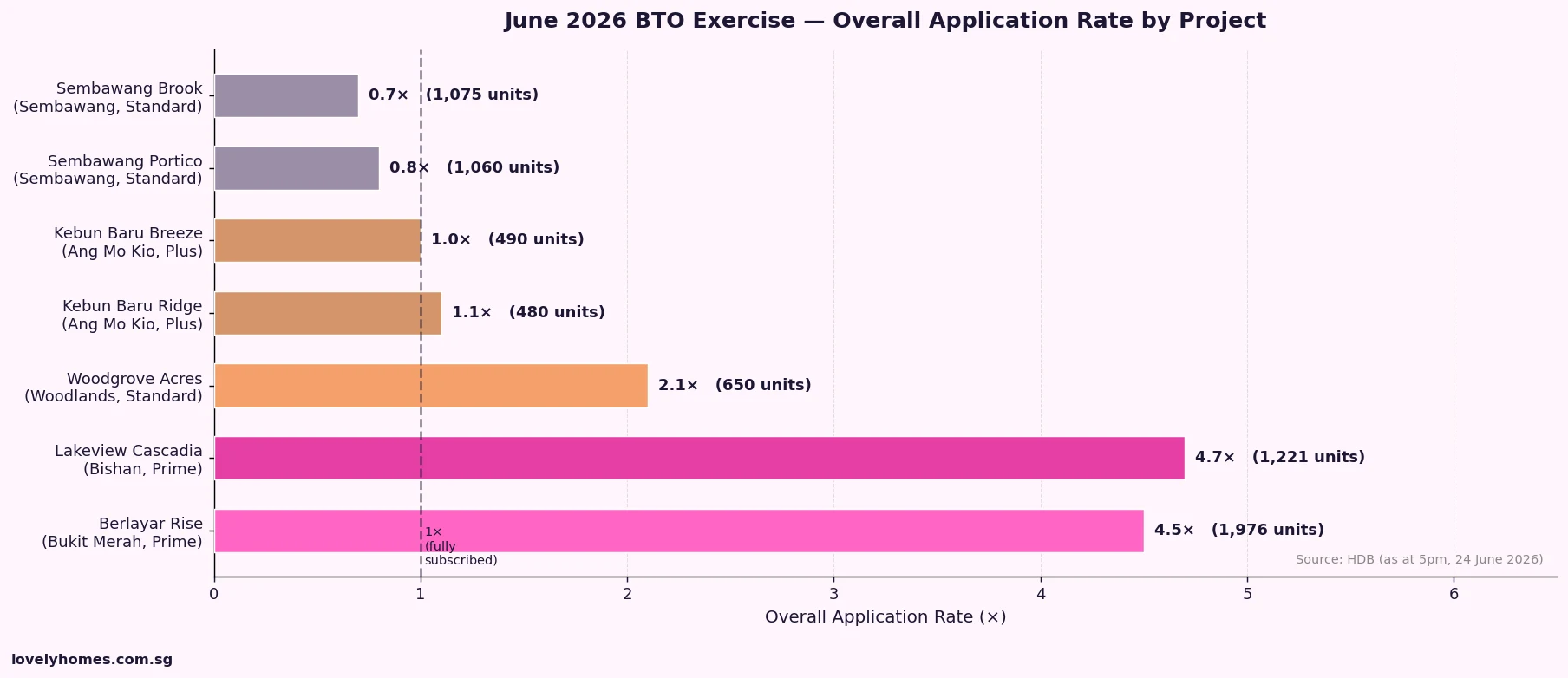
June 2026 BTO exercise application rate by project bar chart — Berlayar Rise, Lakeview Cascadia, Woodgrove Acres, Kebun Baru, Sembawang
Figure 1: Overall application rate by project, June 2026 BTO exercise (as at 5pm, 24 June 2026). Source: HDB Singapore.
Project Town Classification Units Applications Overall Rate
Berlayar Rise Bukit Merah Prime 1,976 8,824 4.5×
Lakeview Cascadia Bishan Prime 1,221 5,799 4.7×
Woodgrove Acres Woodlands Standard ~650 ~2× (singles 17.8×)
Kebun Baru Ridge Ang Mo Kio Plus ~480 ~1.1× (3-room 2T: 22.9×)
Kebun Baru Breeze Ang Mo Kio Plus ~490 ~1.0×
Sembawang Portico Sembawang Standard ~1,060 <1× (families)
Sembawang Brook Sembawang Standard ~1,075 <1× (families)

Source: HDB. Application rates as at 5pm, 24 June 2026. Woodgrove Acres, Kebun Baru, and Sembawang project unit counts are approximate; official HDB breakdown shows total 6,952 units across all 7 projects.

Berlayar Rise: The Greater Southern Waterfront Magnet

Berlayar Rise in Bukit Merah accounted for nearly 40% of all applications in the June exercise — a remarkable concentration of demand in a single project. The draw is straightforward: this is a Prime-classified development integrated with Telok Blangah MRT station on the Circle Line, positioned squarely within the Greater Southern Waterfront (GSW) transformation precinct. Prices for 4-room flats are estimated to start from around S$580,000 — a figure that, while elevated for public housing, represents a meaningful discount to what an equivalent private resale unit in the Telok Blangah/Bukit Merah corridor would cost (typically S$1.2–1.6 million for a comparable size).

The Prime designation means buyers are subject to the standard Prime location conditions: a 10-year Minimum Occupation Period (MOP), an income ceiling of S$14,000 for families, and subsidy clawback on resale (estimated at approximately 14%, based on the precedent set by the nearby Berlayar Residences project). For buyers who can meet those conditions and want a foothold in the GSW story, Berlayar Rise offers compelling long-term value. The development sits near the future Telok Blangah market and hawker centre, and the broader GSW transformation — connecting Keppel, Harbourfront, and Pasir Panjang — is a generational urban-planning project that will unfold over the next 15–20 years.

Prime vs Plus vs Standard: A Market Verdict

June 2026 BTO units offered versus applications by Prime Plus Standard classification chart
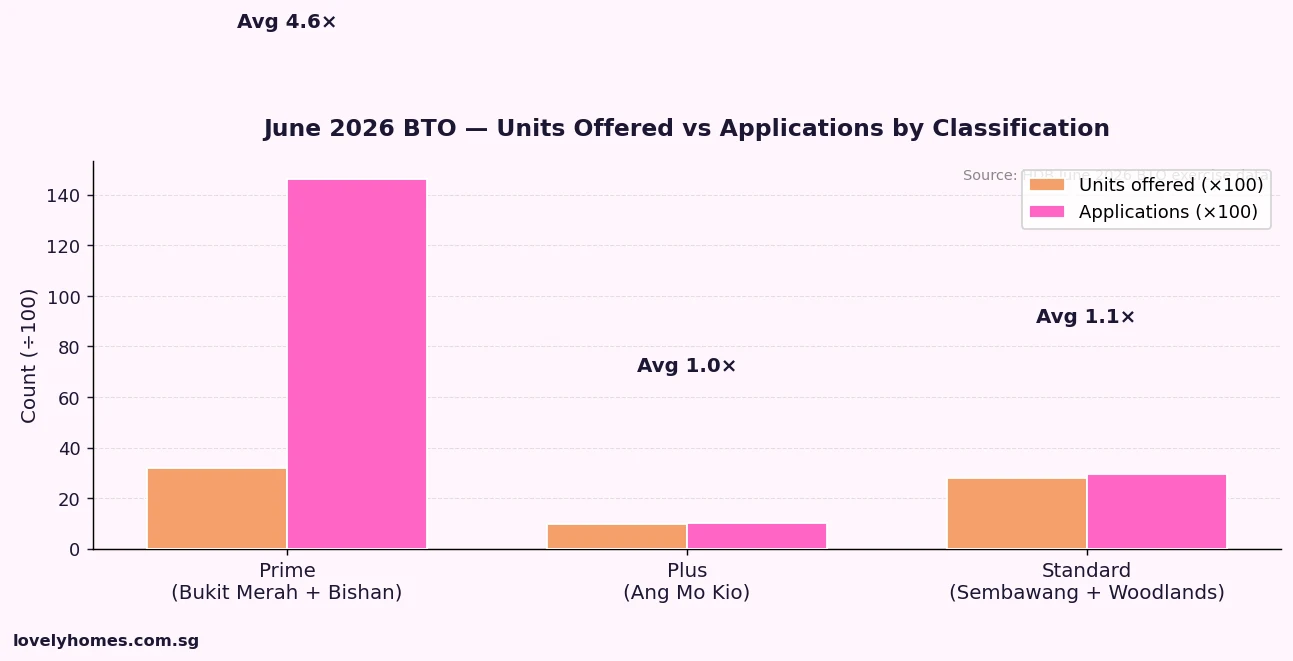
Figure 2: Units offered vs applications by BTO classification — June 2026 exercise. Prime projects (Bukit Merah + Bishan) absorbed the majority of demand despite representing fewer units. Source: HDB.

The June 2026 results are the clearest data point yet that Singapore’s three-tier BTO classification system (Prime, Plus, Standard) is functioning broadly as intended — but with some unintended consequences at the Standard end.

Prime projects (Berlayar Rise and Lakeview Cascadia) together offered 3,197 units but attracted approximately 14,623 applications — an average rate of 4.6 times. This is precisely the outcome the Government anticipated when it introduced the classification: demand for centrally located, well-connected projects is intense, and the subsidy recovery and MOP conditions are not deterring buyers who value location above all else.

Plus projects (Kebun Baru Breeze and Ridge in Ang Mo Kio) sat at approximately 1× overall subscription for first-timer families — marginally fully subscribed, which means successful ballots are likely but not certain for this cohort. The Plus designation was designed to sit between Prime and Standard in both location quality and subsidy level, and the Ang Mo Kio projects are genuinely well-located (D20, established mature estate, near Yio Chu Kang and Ang Mo Kio MRT). The lukewarm response may reflect the Plus conditions — 6-year MOP and clawback provisions — deterring the upgrader segment that has traditionally been the main buyer of Ang Mo Kio BTO flats.

Standard projects in Sembawang fell below full subscription for families. This is consistent with the market’s verdict on northern Singapore’s accessibility: despite the upcoming Cross Island Line (CRL) timeline, Sembawang remains a long commute for most CBD workers. The two projects together offered over 2,100 units — the largest supply block in the exercise — but attracted insufficient family demand to be oversubscribed. Unsuccessful ballot applicants from more competitive projects will likely be allocated here under HDB’s concession scheme.

The Singles Story: Woodlands Breaks Records

The most striking single data point in the June exercise was Woodgrove Acres in Woodlands: 2-bedroom flexi flats — the designated flat type for first-timer singles — were 17.8 times oversubscribed. This is an extraordinary figure that reflects both the shortage of BTO supply for singles (who are restricted to 2-bedroom flexi flats) and the growing demographic weight of single-person households in Singapore. The government has been incrementally expanding singles’ eligibility for BTO housing, but the 17.8× rate suggests the supply pipeline for singles remains severely constrained relative to demand.

What This Means for BTO Applicants

For applicants who were unsuccessful in the Berlayar Rise and Lakeview Cascadia ballots, the practical options are to re-apply in the October 2026 BTO exercise (details not yet announced), consider the concession flat allocation scheme which may direct them to Sembawang, or explore the HDB resale market where wait times are zero. Resale prices in mature estates have risen, but the Enhanced CPF Housing Grant (EHG) is available for resale purchases and can offset up to S$120,000 of the purchase price for eligible first-timers.

For families considering Sembawang, the below-1× first-timer rate means that applicants in this tranche are virtually guaranteed a flat if they apply — a rare situation in the BTO context. The trade-off is location and commute time, but Sembawang does offer genuine value: 4-room BTO flats in Standard Sembawang projects are typically priced in the S$330,000–S$430,000 range, representing the lowest entry point into new public housing available anywhere in the exercise.

What Might Come Next

The October 2026 BTO exercise is expected to launch in mid-October. HDB has indicated it will continue offering at least one Prime project per exercise to maintain supply at the most competitive tier. Industry observers expect the next Prime project to be in the Queenstown or Geylang/Kallang corridor, given the land parcels currently under preparation. For the Sembawang and Woodlands Standard supply overhang, HDB may consider adjusting pricing or flat-type mix in future launches to better match demand.

Frequently Asked Questions

What happens if a BTO project is undersubscribed?

If a BTO project does not receive sufficient applications to fill all available units within a flat type during the initial application period, HDB opens unsold flats for Sale of Balance Flats (SBF) exercises or re-offers them in subsequent BTO exercises. For the Sembawang Standard projects in June 2026, HDB’s concession flat scheme may direct unsuccessful applicants from oversubscribed projects to take up these units, often with a priority queue position. Buyers who accept concession flats in less popular projects lose the right to re-ballot in the same exercise but gain a guaranteed flat allocation.

What is the subsidy clawback for Berlayar Rise (Prime)?

The exact clawback percentage for Berlayar Rise has not yet been officially confirmed by HDB, but based on the precedent of the nearby Berlayar Residences (a Prime project from the October 2025 exercise), the clawback is estimated at approximately 14% of the resale price on first resale after the 10-year MOP. This means that if you sell a Berlayar Rise flat in 2036+ at, say, S$900,000, approximately S$126,000 would be clawed back by HDB before you receive your net sale proceeds. The clawback is intended to recover some of the Prime location subsidy from sellers who benefit from the price appreciation in the GSW area. Always check the specific clawback terms in your sales agreement.

Can first-timer singles apply for Berlayar Rise or Lakeview Cascadia?

First-timer singles (aged 35 and above) may apply for 2-bedroom flexi flats in Prime and Plus projects, subject to the same income ceiling (S$7,000 per month for singles) and the additional MOP/clawback conditions. However, the quota for singles in Prime projects is limited, and competition for 2-bedroom flexi units in Prime projects is historically intense. The June 2026 exercise did not publicly disclose the singles-specific application rate for Berlayar Rise or Lakeview Cascadia, but based on past exercises, 2-bedroom flexi units in Prime projects typically see subscription rates well above 5×.

What is the Minimum Occupation Period for these projects?

The MOP varies by classification: Prime projects (Berlayar Rise, Lakeview Cascadia) have a 10-year MOP. Plus projects (Kebun Baru Breeze and Ridge in Ang Mo Kio) have a 6-year MOP. Standard projects (Woodgrove Acres, Sembawang Portico, Sembawang Brook) have the standard 5-year MOP. During the MOP, owners cannot sell the flat on the open market or rent out the entire flat. Partial renting of individual rooms is permitted after an owner has fulfilled occupation requirements. The longer MOP for Prime and Plus projects is part of the policy design to moderate speculative demand and ensure these subsidised flats serve genuine owner-occupiers over the medium term.

When will the October 2026 BTO exercise launch?

HDB typically announces each BTO exercise approximately one month before applications open. Based on the 2025–2026 schedule, the October 2026 exercise is likely to open for applications in mid-to-late October 2026, with flat details announced in mid-September 2026. LovelyHomes will cover the October 2026 BTO launch as soon as HDB releases official details. You can subscribe to HDB’s e-alerts at homes.hdb.gov.sg to be notified when new launches are announced.

Related Articles

Disclaimer: Application rates and project details are sourced from HDB Singapore (as at 5pm, 24 June 2026) and industry reporting. Figures are subject to change as HDB publishes final ballot results. Subsidy clawback estimates are indicative based on comparable projects and are not official HDB figures for Berlayar Rise. Always refer to HDB’s official flat listings and consult a licensed property agent or HDB directly before making any application or purchase decision. LovelyHomes is not affiliated with HDB or any property agency.

Translate »