JLD White Site Launched 3 July 2026: Up to 1,200 Homes and 186,000 sqm Mixed-Use Development at Jurong Lake District

JLD White Site Launched 3 July 2026: Up to 1,200 Homes and 186,000 sqm Mixed-Use Development at Jurong Lake District

Singapore’s Jurong Lake District (JLD) took a significant leap forward on 3 July 2026 when the Urban Redevelopment Authority (URA) launched the tender for a major White site at Town Hall Link under the second-half 2026 Government Land Sales (GLS) Confirmed List. The site, adjacent to the Jurong Town Hall national monument and flanked by two MRT lines, is earmarked for up to 1,200 private residential units and a minimum of 40,000 sqm of office space within a total potential Gross Floor Area (GFA) of 186,139 sqm. It is the most significant new residential supply announcement for JLD in several years, and it reinforces the Government’s long-standing commitment to transforming the Jurong corridor into Singapore’s largest mixed-use business district outside the city centre.

Quick Answer — JLD White Site at a glance

  • What: URA has launched a GLS tender for a White site at Town Hall Link, Jurong Lake District.
  • Scale: 186,139 sqm total GFA — minimum 40,000 sqm office, up to 1,200 residential units, 44,000 sqm complementary uses.
  • MRT access: Direct connection to Jurong East MRT interchange (EWL + NSL + JRL) and the future CR19 Cross Island Line station (2032).
  • Context: Part of Singapore’s decentralisation strategy; JLD is targeted to become the largest mixed-use business node outside the CBD.
  • Tender close: 17 November 2026, 12 noon.
  • Property implication: First major new private residential supply in the JLD precinct for several years; expect strong developer interest and premium pricing on award.

What Is the JLD White Site and Why Does It Matter?

A White site in Singapore’s GLS framework is a land parcel where the developer is given significant flexibility in determining the mix of uses, subject to minimum requirements. At Town Hall Link, the developer must deliver at least 40,000 sqm of office space (non-negotiable) and may add up to 1,200 private residential units alongside 44,000 sqm of complementary commercial uses such as retail, serviced apartments, hotel, sports and recreational facilities, community spaces, medical clinics, or visitor attractions. The White classification is typically reserved for strategically significant sites where the Government wants the market to determine the optimal product mix — making this tender a test of developer confidence in the JLD vision.

The significance of this announcement extends well beyond the site itself. JLD has been a Government-backed transformational project for more than a decade, anchored by the relocation of Singapore’s second CBD away from the congested city core. The area has seen the revitalisation of the 90-hectare Jurong Lake Gardens, the completion of the Jurong Region Line (JRL), and plans for the Cross Island Line (CRL) station at CR19 in the heart of the precinct (targeted for opening in 2032). The Town Hall Link White site is “seamlessly connected” to the Jurong East MRT interchange via multi-level pedestrian linkages, according to URA.
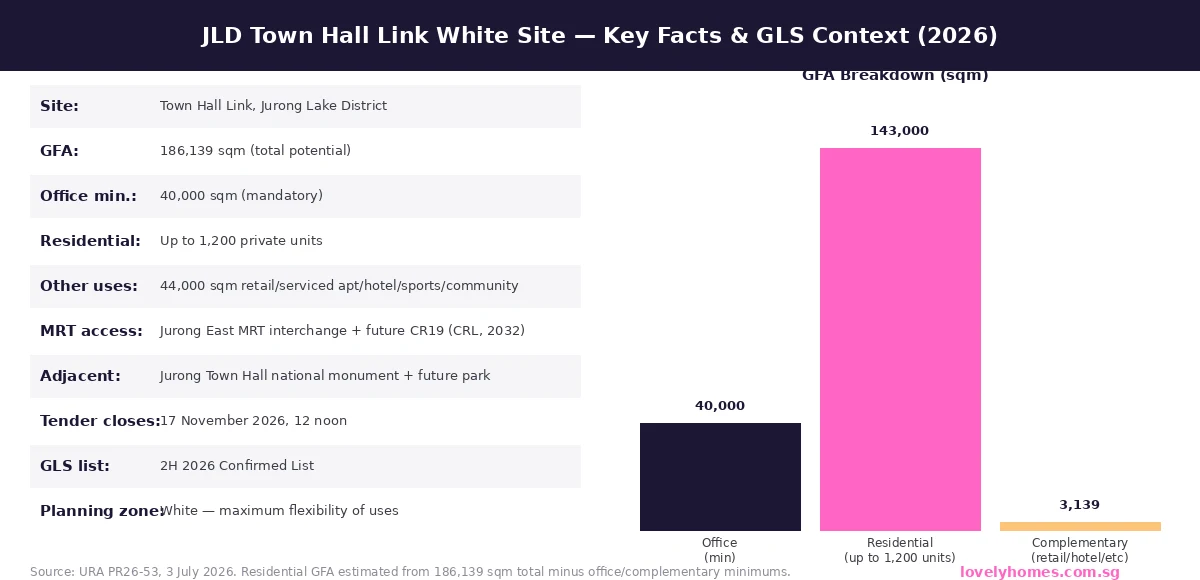
JLD white site 2026 key facts — GFA 186,139 sqm, 40,000 sqm office, up to 1,200 residential units, tender closes 17 November 2026
Figure 1: JLD Town Hall Link White Site — Key Facts and GFA Breakdown (Source: URA PR26-53, 3 July 2026)

The JLD Vision: Decentralisation in Action

Singapore’s decentralisation strategy is a long-held urban planning objective. Concentrating economic activity exclusively in the Central Business District and Orchard Road corridor creates congestion, inflates commercial rents, and forces workers into lengthy commutes. JLD is the flagship expression of the alternative vision: a large-scale, self-sustaining regional centre in the west of Singapore, integrating employment, retail, housing, and recreational space in a single walkable precinct.

The Government has invested heavily in the infrastructure backbone. The Jurong Lake Gardens, opened in phases from 2019, provides 90 hectares of recreational greenery wrapping around Jurong Lake and the Chinese and Japanese Gardens. The JRL, opened in stages from 2026, connects the precinct to Tengah, Choa Chu Kang, and Boon Lay. The forthcoming CR19 station on the Cross Island Line will add a further orbital connection in 2032, making JLD one of the best-connected suburban nodes in Singapore’s rail network.

Complementing the White site, two major anchor projects are already under development nearby: the New Science Centre (relocating from its Jurong East home of four decades) and the Jurong Gateway Hub, an integrated development comprising a bus interchange, offices, shops, a library, a community club, and sports facilities. Together with the White site, these projects will define the physical character of the precinct for the next generation.

What the White Site Means for Property Buyers and Investors

Dimension Detail Property Implication
New supply Up to 1,200 private residential units at Town Hall Link First significant new private supply in the JLD precinct for several years; relieves latent demand from west Singapore buyers
Price premium JLD White site is likely an RCR or OCR premium location; comparable JLD projects (J’den, Lake Grande) have traded at S$2,000–S$2,500 psf Expect developer ask price in the S$2,200–S$2,800 psf range on new launch; potential for appreciation as JLD matures
MRT connectivity Jurong East interchange (3 lines) + future CR19 (CRL, 2032) Transport connectivity among the best in any non-central precinct; key demand driver for both owner-occupiers and investors
Tender timeline Tender closes 17 November 2026; award ~January 2027; launch likely 2027–2028; TOP ~2032–2033 Buyers planning a JLD purchase should not expect keys before 2032; factor progressive payment schedule and interim housing into planning
Office anchor Min. 40,000 sqm office must be delivered; targets MNC tenants and financial/professional services firms Office anchor strengthens daytime population and amenity spending, supporting residential values in the precinct
Government commitment New Science Centre, Jurong Gateway Hub, JRL, CRL CR19 all delivering 2026–2032 Infrastructure already committed; limited execution risk vs speculative master plans in other regions

JLD Property Market Context

The private residential market in the JLD corridor has been characterised by limited new supply in recent years. J’den (formerly JEM 2 / Jurong Point 2 site), launched in 2023, sold briskly at an average of approximately S$2,450 psf at launch, underscoring demand from west Singapore buyers seeking integrated development proximity. Older condominiums in the area (Lake Grande, Parc Westlake, Lakeville) have traded resale at lower psf levels but have appreciated meaningfully over their launch prices.

The White site at Town Hall Link is a different proposition: a larger, more prominent, and better-connected site adjacent to both heritage (Jurong Town Hall) and nature (the future park). Developers tendering for this site will need to deliver a mixed-use product integrating office, residential, and retail — a complex brief that typically appeals to the largest developers with integrated development track records. The 1,200-unit residential cap, while meaningful, represents a medium-density residential component within a predominantly commercial site.

For buyers tracking west Singapore property, the White site tender provides a clear signal: JLD is still an active, Government-supported investment in Singapore’s urban future. The tender award (expected early 2027) and any subsequent launch announcement will be significant market events for the west corridor.

What to Watch Next

The tender closes on 17 November 2026. Bids are expected from Singapore’s major developers, and possibly consortia given the scale and complexity of the White site requirements. The tender award will reveal the market’s view of JLD land value — a key data point for pricing expectations on the eventual new launch. Any premium bid above market expectations would signal high developer confidence in JLD residential absorption; a cautious single bidder would suggest more measured enthusiasm.

Separately, the full Q2 2026 URA private residential data release (expected ~24 July 2026) will include CCR, RCR, and OCR transaction data that contextualises JLD’s position in the wider market. The Q2 flash estimate showed overall prices up +0.5% with CCR leading — a context in which a well-connected, large-scale JLD development arriving in 2027–2028 could attract strong demand from both upgraders and investors seeking alternatives to pricier CCR addresses.

Frequently Asked Questions About the JLD White Site

What is a White site in Singapore’s GLS programme?

A White site is a land parcel sold by URA under the Government Land Sales programme where the developer has flexibility to incorporate a range of uses — residential, commercial, hotel, recreational, and community — subject to minimum requirements set by URA. The White classification is used for strategic locations where the Government wants the private market to determine the most commercially viable use mix, while ensuring a minimum anchor use (in this case, 40,000 sqm of office) is delivered to support the Government’s planning goals. White sites are typically larger and more complex than single-use residential or commercial sites, and they attract the largest and most financially capable developers.

When will the JLD White site residential units be available for purchase?

The tender closes on 17 November 2026. Following award (likely early 2027), the developer will typically spend 12–18 months on design, approvals, and construction preparation before launching for sale. A reasonable estimate for launch to the public is late 2027 to 2028. Construction of a mixed-use development of this scale typically takes 4–5 years, suggesting Temporary Occupation Permit (TOP) around 2032–2033 — which coincides with the opening of the CR19 Cross Island Line station in the heart of JLD. Buyers interested in this project should plan for a progressive payment schedule over this period and interim housing arrangements.

How does the JLD White site compare to other west Singapore property options?

The JLD White site will deliver a qualitatively different product from most west Singapore residential projects. Its direct connection to the Jurong East interchange (which currently serves the East-West Line, North-South Line, and Jurong Region Line) and the future CR19 station makes it exceptionally well-connected — comparable connectivity exists in only a handful of suburban locations in Singapore. The adjacent Jurong Town Hall national monument and future park provide irreplaceable location attributes. However, buyers should note that the residential component is capped at 1,200 units within a larger commercial development, meaning the residential element is not a standalone condominium but part of an integrated mixed-use project — similar to Duo Residences in Bugis or Marina One Residences at Marina Bay. Pricing will reflect this premium integrated product positioning.

Is Jurong Lake District a good area for property investment?

JLD has strong structural fundamentals as a long-term investment: committed Government infrastructure, rail connectivity improving through 2032, a large employment base (Jurong East, International Business Park, Biopolis in one-stop range), and a diversified demographic base. The risk factors are the long development timeline (appreciation is gradual rather than immediate), competition from other west corridor supply (Tengah, Bukit Batok, Jurong East BTO supply is meaningful), and execution risk on the commercial components of the mixed-use development. Industry analysts generally view JLD as a medium-term (5–10 year) capital appreciation story rather than a short-term trading position. The announcement of the White site tender strengthens the longer-term investment case. As with all property investments, buyers should assess their own holding capacity and financial position carefully before committing.

What is the Cross Island Line and why does it matter for JLD?

The Cross Island Line (CRL) is a new MRT line currently under construction by the Land Transport Authority. It will run across Singapore from Changi in the east to Jurong in the west, passing through several major nodes including Clementi, Jurong Lake District, and Ang Mo Kio. The CR19 station, located in the heart of JLD, is planned to open in 2032. When operational, CR19 will add a key orbital connection to the existing East-West Line and North-South Line services at Jurong East interchange, effectively giving JLD three distinct MRT lines through the precinct. This level of rail connectivity is rare outside the central area of Singapore, and it is a significant long-term demand driver for both commercial and residential property in JLD.

Related Articles

Disclaimer: This article is based on URA press release PR26-53 dated 3 July 2026 and publicly available Government data. Residential unit count, GFA figures, and MRT opening dates are as stated by URA and LTA and are subject to change. Price projections, investment analysis, and developer interest assessments represent editorial analysis only and do not constitute financial advice. Readers should conduct their own due diligence and consult licensed professionals before making any property purchase decision. For the authoritative site details, visit URA Land Sales. LovelyHomes does not provide financial or property advisory services.
Singapore HDB Upgrader Guide 2026: Steps, Costs, ABSD Remission and Timing

Singapore HDB Upgrader Guide 2026: Steps, Costs, ABSD Remission and Timing

HDB upgrader — the Singaporean who has served their Minimum Occupation Period, built up equity in their flat, and now wants to step up to a private condo or a larger resale flat — is one of the most financially significant actors in Singapore’s property market. For many families, this is the single largest financial decision of their lives: timing it correctly can mean saving S$300,000 in ABSD; getting it wrong can mean paying that sum in full, in cash, within 14 days. This guide walks through every step, cost, rule, and strategy for the Singapore HDB upgrader in 2026.

Quick Answer — HDB upgrader essentials

  • MOP requirement: You must complete the 5-year Minimum Occupation Period on your HDB flat before selling it or buying a private residential property.
  • Three upgrade paths: Bigger HDB resale (no ABSD), Executive Condo EC (no ABSD, income ceiling S$16,000), or private condo (ABSD 20% if buying before selling).
  • ABSD remission window: If you buy a private condo before selling your HDB, you pay ABSD 20% upfront — but IRAS will refund it if you sell your HDB within 6 months of the private OTP date.
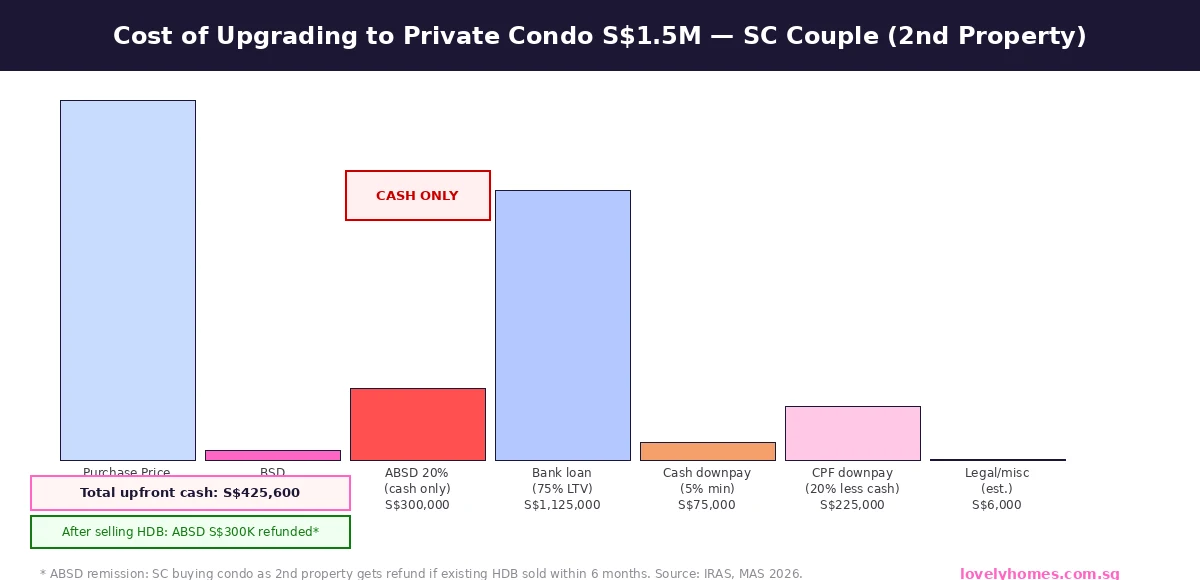
  • Financial pressure point: ABSD on a S$1.5M condo is S$300,000 cash — ring-fenced before the 14-day ABSD payment deadline.
  • CPF accrued interest: Budget for the CPF principal + accrued interest refund on HDB sale — this reduces your immediate cash payout but returns money to your CPF OA.
  • TDSR impact: Buying before selling your HDB means your HDB loan is still on your record for TDSR purposes — get the stress test done early.

Who Is the HDB Upgrader?

The HDB upgrader broadly refers to a Singapore household that currently owns an HDB flat (BTO or resale) and plans to move to a higher-value property — either a bigger or better-located HDB resale flat, an Executive Condominium (EC), or a private condominium or landed property. The upgrade motivation is typically a combination of changing family needs (growing household size, desire for better facilities), improved household income over time, and investment considerations (private property appreciates differently from HDB).

In 2026, upgrader demand remains a significant driver of both the HDB resale market and the new private launch market. The typical upgrader profile is a dual-income Singapore Citizen couple in their mid-30s to mid-40s, with a paid-down HDB flat carrying S$300,000–S$600,000 in equity, and combined income sufficient to pass the Total Debt Servicing Ratio (TDSR) stress test for a S$1.2M–S$2M condominium.

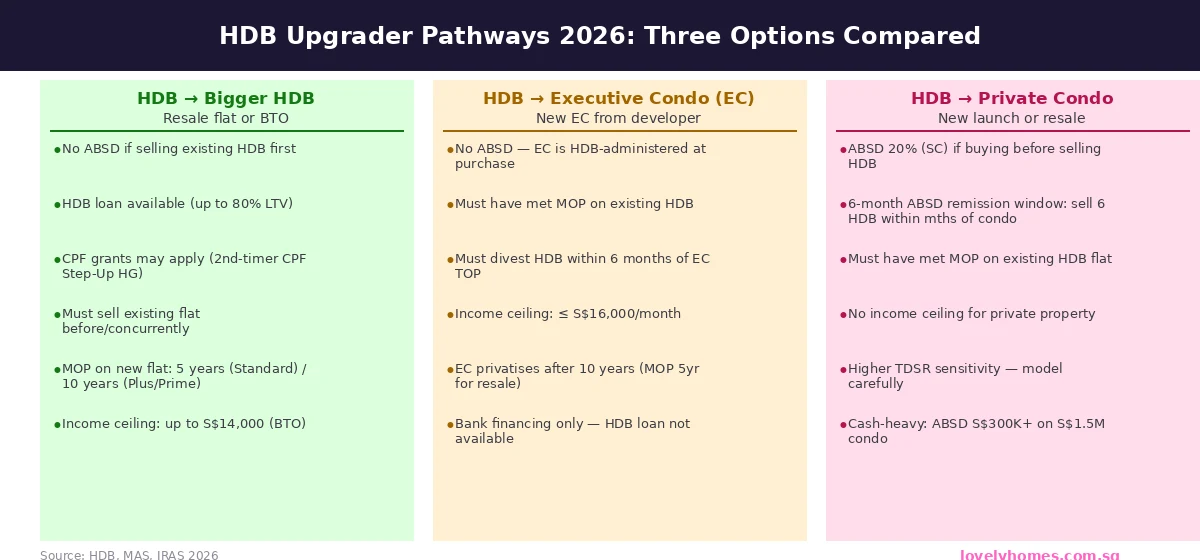
HDB upgrade pathways 2026 comparison — bigger HDB resale, executive condo EC, or private condo
Figure 1: Three HDB Upgrade Pathways Compared — Bigger HDB Resale, EC, and Private Condo (Source: HDB, MAS, IRAS 2026)

Step 1 — Check Your MOP Status

The Minimum Occupation Period (MOP) is the first gate every HDB upgrader must pass. You must have physically occupied your flat for the full MOP period before you can sell it on the open market or purchase a private residential property.

MOP durations in 2026 depend on flat classification. Standard BTO and resale HDB flats (both mature and non-mature estates) carry a 5-year MOP from the date the keys are collected. Plus and Prime classification flats introduced under the new framework carry a 10-year MOP. Executive Condominiums are HDB-administered at purchase and carry a 5-year MOP for resale; they are fully privatised after 10 years.

The MOP clock begins from the date of key collection (for BTO) or completion (for resale). It runs continuously regardless of whether you remain in the flat or rent it out (in some cases). Partial absence — such as working overseas — may pause the MOP clock, and you must reconfirm your MOP status with HDB before proceeding.

MOP Warning for Plus/Prime Flat Buyers: If you purchased a Plus or Prime classification BTO flat (launched from the August 2023 exercise onwards), your MOP is 10 years, not 5 years. Buyers who purchased these flats in 2023–2024 will not be able to upgrade to private property until 2033–2034 at the earliest. Factor this extended lock-up into your long-term planning.

Step 2 — Choose Your Upgrade Path

Once MOP is confirmed, you have three main upgrade paths. Each carries different ABSD treatment, financing rules, income restrictions, and flexibility.

Path A: Bigger HDB Resale Flat. The most financially conservative option. Upgrading from a 3-room to a 5-room or executive flat in a different estate carries no ABSD (you are not buying a second property — you are buying another HDB flat while selling the first). You can use an HDB housing loan (LTV 80%) and may qualify for the Step-Up CPF Housing Grant (up to S$15,000 for second-timers buying a 4-room or smaller resale flat). The downside is that HDB resale flats do not appreciate in the same way as private property and cannot be rented out without restriction.

Path B: Executive Condominium (EC). An EC sits between public and private housing. At launch, it is sold by a developer under HDB rules — meaning no ABSD at purchase (it is treated as a first-timer residential property). You must divest your existing HDB flat within 6 months of EC completion (TOP), otherwise penalties apply. The household income ceiling is S$16,000/month. After 5 years from TOP, you can sell on the open market to Singapore Citizens and PRs; after 10 years, it is fully privatised and can be sold to foreigners. Bank financing only — no HDB loan for EC.

Path C: Private Condominium or Landed Property. The most expensive and financially demanding path. If you buy a private property before selling your HDB flat, you are technically holding two residential properties simultaneously — triggering ABSD of 20% for Singapore Citizens. You have two sub-options: sell your HDB first (safer, no ABSD, but you need interim accommodation), or buy first and claim the ABSD remission by selling within the 6-month window.

HDB to condo upgrade cost breakdown 2026 — ABSD S$300,000 cash, downpayment, BSD, legal fees for S$1.5M condo
Figure 2: Cost Breakdown for Upgrading to Private Condo S$1.5M — SC Couple (2nd Property) (Source: IRAS, MAS 2026)

The ABSD Remission Strategy — Buy First, Sell Later

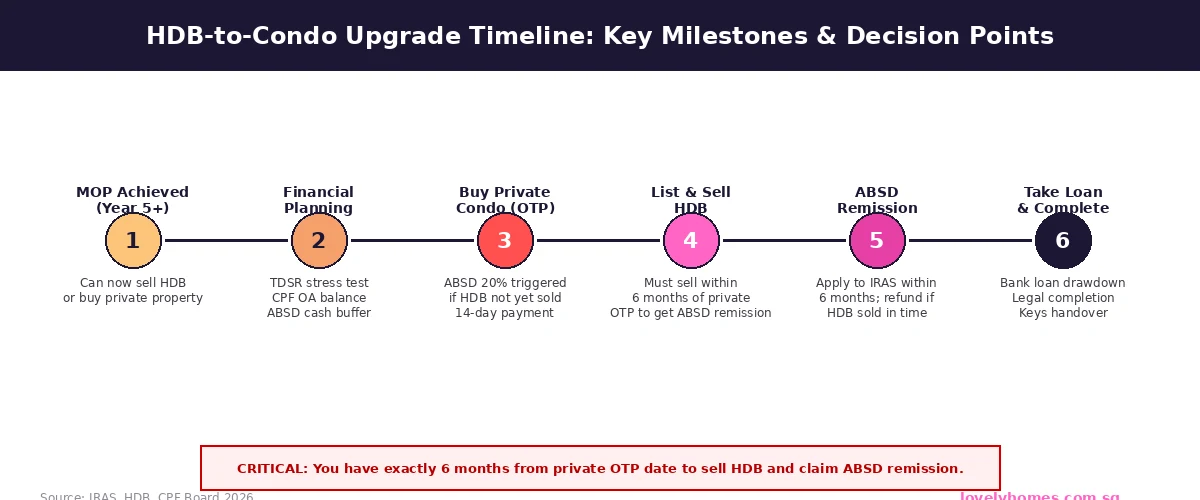
The most common upgrader strategy for those targeting private property is the “buy first, sell later” approach using the ABSD remission for married couples (where at least one spouse is a Singapore Citizen). Under this framework:

  • You sign the OTP for the private property and pay ABSD 20% (for SC) within 14 days of OTP date — in cash.
  • You simultaneously list and market your HDB flat for sale.
  • You must complete the sale of your HDB flat within 6 months of the private property OTP date (not completion date).
  • Within 6 months of HDB sale completion (and within the original 6-month window), you file for the ABSD remission with IRAS.
  • If approved, IRAS refunds the full ABSD paid, with no interest (i.e., you have effectively loaned the Government S$300,000 interest-free for up to 6–12 months).

The risk is liquidity: you need S$300,000+ in ready cash to pay the ABSD at the 14-day deadline. If you cannot sell your HDB within 6 months — due to market conditions, a slow transaction, or a buyer who defaults — the ABSD is not refunded. Some upgraders bridge the gap with a bridging loan, but these are expensive (typically prime + 1–2%) and have their own TDSR implications.

HDB upgrader timeline Singapore 2026 — MOP, OTP, HDB sale, ABSD remission 6-month window
Figure 3: HDB-to-Condo Upgrade Timeline — Key Milestones and the Critical 6-Month ABSD Remission Window (Source: IRAS, HDB 2026)

Summary: Upgrade Path Comparison at a Glance

Factor Bigger HDB Resale Executive Condo (EC) Private Condo
ABSD None (HDB-to-HDB, sell first) None at purchase 20% SC if buying before selling HDB; refundable if HDB sold within 6 months
Financing HDB loan (80% LTV) or bank Bank loan only Bank loan only
Income Ceiling None for resale; S$14,000 for BTO S$16,000/month None
MOP to Sell New Property 5 years (10 for Plus/Prime) 5 years (privatised at 10 years) No MOP (private property)
CPF OA Usable? Yes (HDB and bank loans) Yes (bank loan) Yes (up to Valuation Limit)
Rental Flexibility Restricted — HDB rules apply Restricted pre-privatisation Full rental freedom
Typical Price Range S$350K–S$800K S$900K–S$1.6M S$1.2M–S$3M+

Financial Planning for the Upgrade

Beyond the ABSD, upgraders must plan for a cluster of costs that come together at roughly the same time. A disciplined approach models each of the following:

CPF accrued interest on HDB sale proceeds: Your CPF principal withdrawn for the HDB flat, plus 2.5% p.a. compounded interest for every year you held it, must be refunded to your CPF OA from the HDB sale proceeds. On a S$350,000 CPF withdrawal held for 8 years, accrued interest is approximately S$78,000 — meaning S$428,000 goes back to CPF, not to your cash pocket (though it is available for the condo purchase).

TDSR with two loans: If you buy the condo before selling your HDB, both your HDB loan instalment and the projected condo loan instalment are counted in your TDSR. On a combined income of S$15,000/month, the 55% TDSR cap allows maximum total monthly debt obligations of S$8,250. If your HDB instalment is S$1,500 and the projected condo instalment is S$5,800, your combined TDSR is 48.7% — within limits. Lenders will also stress-test the condo loan at a higher rate (currently 4%), so run this calculation carefully.

6-month bridging period cash buffer: Between paying the private property ABSD, the downpayment, and waiting for the HDB sale to complete and CPF refund to process, upgraders need a substantial cash buffer. Industry guidance suggests setting aside at least 12 months of combined mortgage payments plus the full ABSD amount as liquid savings before signing the private OTP.

Worked Example: The Lim Family’s Upgrade

Profile: Mr and Mrs Lim, SC couple, combined income S$14,500/month. Own a 4-room Punggol BTO flat (keys August 2020), CPF OA balance: Mr S$182,000, Mrs S$145,000. Cash savings: S$380,000. Target: OCR 3-bedroom condo at S$1.55M.

MOP check: Keys August 2020 → MOP satisfied August 2025 ✓

BSD on S$1.55M: S$46,600 (from CPF OA) ✓

ABSD (SC 2nd property): S$310,000 — must be paid in cash at OTP

Downpayment: Bank loan 75% LTV = S$1,162,500 loan. Remaining 25% = S$387,500. Min cash 5% = S$77,500. Balance from CPF = S$310,000

Cash required at OTP: ABSD S$310,000 + option fee 1% S$15,500 = S$325,500 cash within 14 days of OTP

TDSR check: Projected condo instalment at 3.5% over 25yr = S$5,802/mth. HDB instalment still on record: S$1,340/mth. Combined S$7,142/mth ÷ S$14,500 = 49.3% ✓ (under 55%)

HDB sale (6 months after OTP): Sold for S$760,000. CPF refund: S$319,000 (principal) + S$38,000 (accrued 5.5yr at 2.5%) = S$357,000 to CPF OA. Outstanding HDB loan: S$368,000. Net cash from HDB sale: S$760,000 − S$368,000 − S$357,000 (CPF) − S$8,000 (legal/misc) = S$27,000 net cash

ABSD remission: IRAS refunds S$310,000 ABSD within ~10 weeks of HDB sale completion ✓

Net position post-transaction: S$27,000 new cash + S$310,000 ABSD refund + S$357,000 new CPF OA balance → strong CPF position for condo loan repayments; minimal cash surplus (S$337,000 pre-condo closing costs from HDB cash + ABSD refund)

Common Mistakes HDB Upgraders Make

Forgetting ABSD is cash: The single most common error. Buyers who have set aside the full downpayment in CPF but do not have liquid cash for the ABSD face a crisis at the 14-day deadline. No lender will advance ABSD as part of the mortgage; no CPF withdrawal is permitted for ABSD.

Not accounting for the CPF refund: Many upgraders estimate their HDB “profit” as sale price minus outstanding loan, forgetting that a large CPF principal and accrued interest amount must first be returned to CPF. This can reduce cash-in-hand from the HDB sale by S$200,000–S$450,000 depending on how long the flat was owned and how much CPF was used.

Missing the 6-month window: If the HDB sale process hits delays — a buyer who withdraws, a bank valuation dispute, or an HDB resale application processing delay — the 6-month window can expire. Once it does, the ABSD is not refunded. Upgraders should list the HDB flat immediately after signing the private OTP, price it competitively, and have legal conveyancing engaged in parallel.

Underestimating TDSR exposure: Some upgraders are surprised when their bank pre-approval does not cover the desired loan quantum because the HDB loan is still reflected in their TDSR. Always get a fresh In-Principle Approval (IPA) with both loans in scope before signing the private OTP.

What Might Come Next for HDB Upgraders

Singapore’s cooling measures framework has not changed since April 2023, and upgrader ABSD at 20% represents the base cost of accessing private property while still holding an HDB flat. The Government has shown no appetite for relaxing this rate in the near term, given its explicit goal of moderating speculative demand from HDB-to-private upgraders. Any future relaxation would likely be preceded by a sustained period of flat or declining private property prices.

The emergence of Plus and Prime HDB classification flats, with 10-year MOPs and restrictions on renting out to non-family members, has already created a two-tier HDB resale market. Upgraders who purchased Plus or Prime flats in 2023–2024 face a much longer lock-up, and their upgrading flexibility will be significantly constrained until the early-to-mid 2030s. The long-term impact of this policy on upgrader dynamics is still playing out.

Frequently Asked Questions About HDB Upgrading

Do I have to sell my HDB flat before buying a private condo to avoid ABSD?

You do not have to sell first, but if you buy before selling, you will pay ABSD 20% (SC) or 30% (PR) upfront in cash. The ABSD remission framework allows you to claim a full refund if you sell your HDB within 6 months of signing the private OTP. The “sell first” approach avoids the ABSD cash outlay entirely but means you need temporary housing between HDB completion and condo handover (which can be 2–4 years for new launches). Most upgraders choose “buy first, sell within 6 months” to avoid the gap, provided they have sufficient cash for the ABSD.

Can I use my HDB flat’s rental income to help with the TDSR for the condo loan?

Yes — but only if you have HDB’s approval to sublet the flat and you can provide documented rental income. Lenders typically apply a haircut of 30% to rental income when calculating TDSR (i.e., only 70% of gross rental income is counted as qualifying income). If your HDB flat generates S$2,500/month in verified rental income, S$1,750 may be added to your income base for TDSR purposes. Note that owner-occupiers on MOP cannot legally sublet their entire flat until MOP is completed, so this applies primarily to upgraders who have already completed MOP and chosen to rent out their HDB while purchasing a condo.

What happens if I fail to sell my HDB within 6 months and miss the ABSD remission?

If you do not sell your HDB within 6 months of the private OTP date, you forfeit the ABSD remission permanently. The S$300,000+ ABSD you paid in cash is retained by IRAS — it cannot be recovered. This is a catastrophic financial outcome for most households. To mitigate this risk: price your HDB competitively from day one, engage conveyancing lawyers for both transactions simultaneously, and do not accept a buyer for the HDB who requires more than 8–10 weeks to complete. If you are approaching the 5-month mark and the HDB has not sold, consider drastically reducing the asking price or seeking legal advice on options.

Is an EC a good upgrade target compared to a private condo?

An EC offers a unique value proposition: you buy at a price typically S$200,000–S$500,000 below a comparable private condo in the same location, with the same physical quality (developer-built to private standards). The trade-off is the HDB ownership conditions for the first 5–10 years — no subletting to foreigners, must divest HDB within 6 months of EC TOP, and income ceiling of S$16,000. For upgraders who meet the income ceiling and are comfortable with the constraints, ECs have historically outperformed many private condo segments in capital appreciation after privatisation at 10 years. However, ECs are only available as new launches — there is currently no resale EC from a developer; the secondary market is for existing privatised ECs sold by owners.

Can both spouses use their CPF OA for the condo purchase even if they are selling the HDB?

Yes. Once the HDB sale is completed, CPF refunds (principal + accrued interest) are credited back to each owner’s CPF OA in proportion to their respective CPF usage on the flat. Those refreshed CPF OA balances can then be applied to the condo purchase — for downpayment, monthly loan repayments, and BSD — subject to the condo’s own Valuation Limit. Many upgraders rely on this CPF “recycling” to fund a significant portion of the condo downpayment after the ABSD remission is returned to their bank account.

What is the Seller’s Stamp Duty (SSD) impact when upgrading?

Seller’s Stamp Duty applies to private residential properties sold within 3 years of purchase — at 12% (Year 1), 8% (Year 2), or 4% (Year 3). HDB flats are exempt from SSD. For most HDB upgraders, SSD is not relevant to the HDB sale (no SSD applies). SSD would only become relevant if you later sold the private condo within 3 years of purchase — which is an important consideration for upgraders who buy a new-launch condo that is still under construction. If market conditions deteriorate and you needed to exit quickly, SSD could cost S$180,000+ on a S$1.5M condo sold in Year 1.

Related Articles

Disclaimer: This article is for general informational purposes only and does not constitute financial, legal, or property advice. ABSD rates, MOP rules, CPF withdrawal limits, and TDSR/MSR parameters are set by the Government and may change. All figures reflect the framework as at 3 July 2026. Readers should verify current rules with HDB, IRAS, and CPF Board, and consult a licensed financial adviser and property solicitor before proceeding with any upgrade transaction. LovelyHomes does not provide financial, legal, or property advisory services.
Singapore CPF for Property Guide 2026: How to Use Your OA, Valuation Limits and Accrued Interest Explained

Singapore CPF for Property Guide 2026: How to Use Your OA, Valuation Limits and Accrued Interest Explained

CPF for property Singapore — your Central Provident Fund Ordinary Account (CPF OA) is almost certainly your largest source of savings, and the rules governing how you can use it to buy a home are among the most misunderstood in Singapore’s property landscape. Buyers regularly assume they can use CPF for everything from their Additional Buyer’s Stamp Duty (ABSD) to their renovation bills — and are caught short at completion. Others sell a flat and are alarmed to see how much accrued interest has accumulated in their CPF ledger. This guide explains every rule, limit, and quirk in plain English.

Quick Answer — CPF for property at a glance

  • CPF OA can be used for downpayment, monthly loan instalments, Buyer’s Stamp Duty, and legal fees.
  • CPF OA cannot be used for ABSD (cash only), Cash Over Valuation, option fee, agent commission, or renovation.
  • Valuation Limit (VL): You may use CPF up to the purchase price or market value, whichever is lower.
  • Beyond VL: CPF can be used up to 120% of VL — but only if you have set aside the Full Retirement Sum (FRS).
  • Accrued interest rate: 2.5% p.a. compounded on all CPF withdrawn for property. On sale, principal + accrued interest is refunded to your CPF OA — it does not vanish.
  • Lease rule: Property must have at least 30 years’ remaining lease for CPF to be used; graduated limits apply between 30 and 60 years.
  • For the latest rules, check CPF Board’s official housing page.

What Is the CPF Ordinary Account and Why Is It Used for Property?

The CPF is Singapore’s mandatory social security savings scheme. Every employed Singapore Citizen and Permanent Resident contributes a percentage of their monthly wages into three accounts: the Ordinary Account (OA), Special Account (SA), and MediSave Account (MA). For most working-age Singaporeans, the OA accumulates the largest balance over time — and it earns a minimum guaranteed interest of 2.5% per annum, with an additional 1% on the first S$60,000 of combined CPF balances (with a cap of S$20,000 for OA).

The Government allows the OA to be used for housing because property ownership is a central pillar of Singapore’s social compact. By permitting CPF OA usage, the scheme effectively unlocks decades of compulsory savings for the single largest purchase most households will ever make. The trade-off is that money withdrawn from CPF for property must eventually be returned — with interest — to the account so it remains available for retirement.

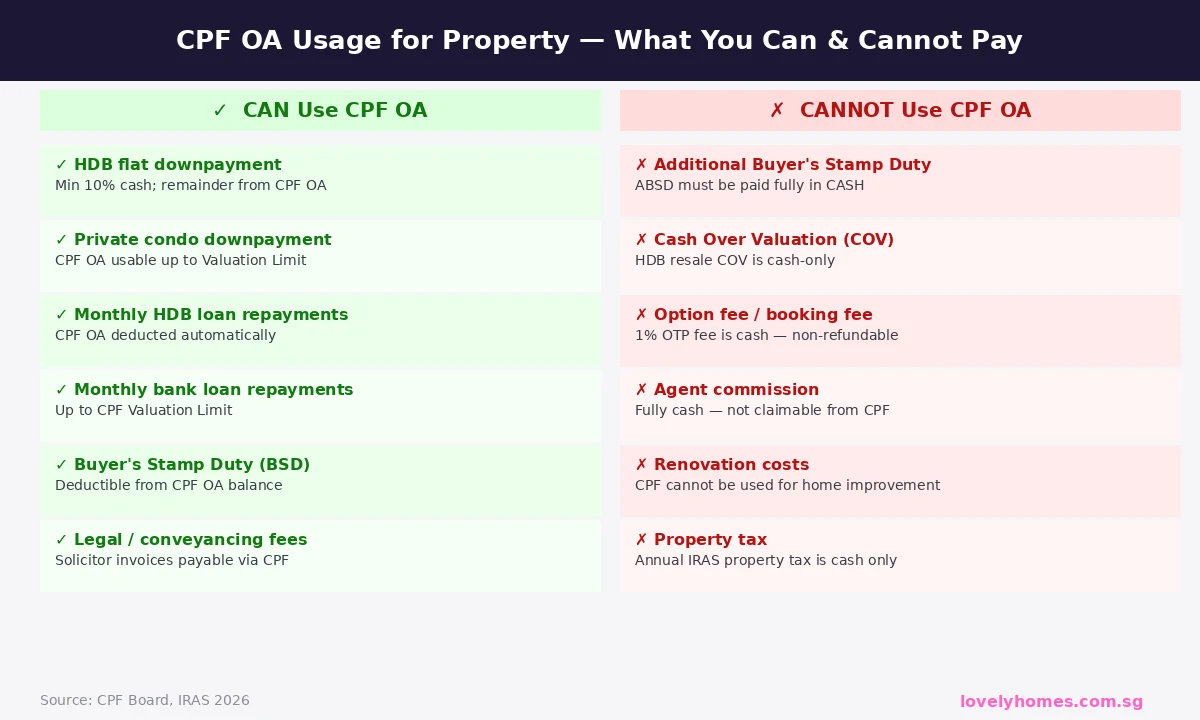
CPF OA property usage table 2026 — can vs cannot pay: downpayment, BSD, ABSD cash only
Figure 1: CPF OA Usage for Property — What You Can and Cannot Pay (Source: CPF Board, IRAS 2026)

What Can You Use CPF OA For?

Your CPF OA balance can be applied to the following property-related expenses in 2026:

Downpayment: For an HDB flat purchased using an HDB loan, the minimum cash downpayment is 10% of the purchase price; the remaining 10% of the required 20% downpayment can come from CPF OA. For bank-financed purchases (HDB or private), the minimum cash downpayment is 5% of the purchase price (for loans up to 75% LTV), with the remaining 20% payable from CPF OA or cash.

Monthly loan repayments: Both HDB housing loan instalments and bank mortgage instalments can be paid from your CPF OA. HDB loans deduct directly via GIRO from your CPF OA. For bank loans, you must submit a CPF housing withdrawal application.

Buyer’s Stamp Duty (BSD): BSD can be paid from CPF OA — this is often overlooked by first-time buyers. At current rates, BSD on a S$600,000 HDB flat is approximately S$11,400, all of which can come from OA.

Legal and conveyancing fees: Solicitor fees for the purchase transaction are claimable from CPF OA, subject to the Valuation Limit rule.

What Cannot Be Paid with CPF OA?

Additional Buyer’s Stamp Duty (ABSD) is the most significant item. Regardless of how large your CPF OA balance is, 100% of your ABSD liability must be paid in cash. At 20% for a Singapore Citizen purchasing a second residential property, this means a cash outlay of S$320,000 on a S$1.6M condo — before any other costs. Buyers who have not ring-fenced this amount routinely find themselves in difficulty at the 14-day ABSD payment deadline.

Cash Over Valuation (COV) in the HDB resale market is another cash-only item. Where a buyer agrees to pay above the HDB assessed value, the excess (COV) cannot be financed by either HDB loan or CPF.

Option fees, booking fees, good faith deposits — the initial 1% OTP fee and any booking deposit for new launches must be paid in cash. CPF cannot be applied until the formal sales process is completed.

The Valuation Limit: How Much CPF Can You Use?

The Valuation Limit (VL) is the core rule governing total CPF usage on any single property. It is defined as the purchase price or the market value at the time of purchase, whichever is lower. You may use your CPF OA (and that of any co-owner or joint purchaser) to pay for the property purchase up to this limit.

Once cumulative CPF withdrawals (principal) reach the VL, no further CPF can be withdrawn for that property — unless you qualify for the 120% Valuation Limit extension.

To use CPF beyond the VL (up to 120% VL), the following conditions must be met:

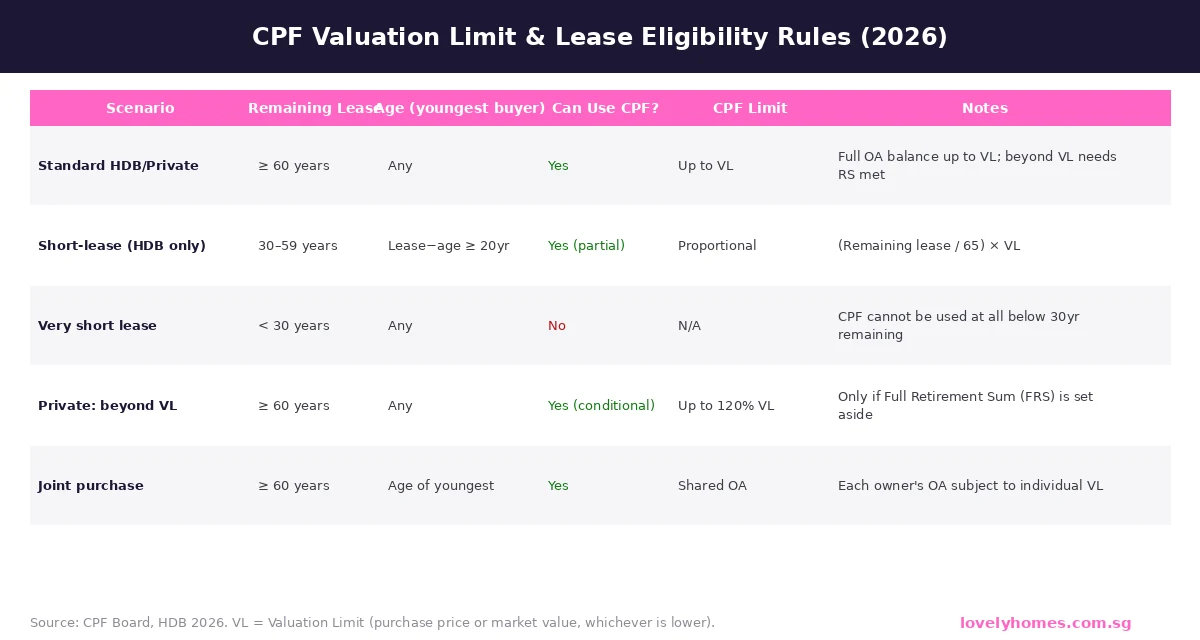
  • The property must have a remaining lease of at least 60 years.
  • The property must have sufficient remaining lease to cover the youngest buyer to age 95.
  • The buyer must have set aside or be setting aside the Full Retirement Sum (FRS) in their CPF SA and OA combined (S$213,000 as at 1 January 2026).
CPF valuation limit and remaining lease eligibility rules 2026 — HDB and private property
Figure 2: CPF Valuation Limit & Lease Eligibility Rules — Singapore 2026 (Source: CPF Board, HDB)

The Lease Rule: Remaining Lease and Age

CPF usage for property is not just limited by the VL — it is also constrained by the remaining lease of the property, particularly relevant for resale HDB flats with shorter tenures.

The general framework is: the property’s remaining lease, at the time of purchase, must be sufficient to cover the youngest buyer to age 95. Where the remaining lease falls short of 60 years, a pro-rated withdrawal limit applies. The formula used is: (Remaining Lease / 65 years) × Valuation Limit. Below 30 years of remaining lease, CPF cannot be used at all.

In practical terms, most buyers of resale HDB flats in mature estates should verify remaining lease carefully. A 50-year-old flat with 49 years remaining means the youngest buyer must be under 46 to receive full CPF access. This has become increasingly relevant as older HDB estates approach their tipping points.

CPF Accrued Interest: The Most Misunderstood Rule

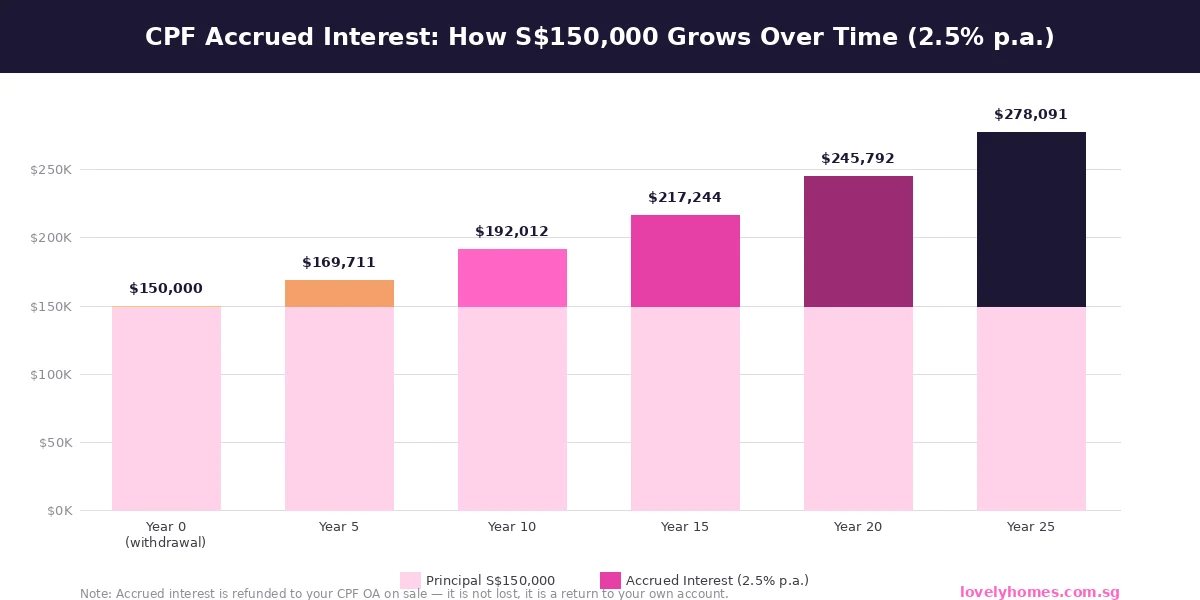
When you use CPF OA to buy a property, CPF Board tracks how much you have withdrawn. It then charges accrued interest on that amount at 2.5% per annum, compounded annually — the same rate your OA would have earned had the money remained in your account. The accrued interest accumulates throughout your period of ownership.

When you sell the property, the net sale proceeds must first be used to refund CPF the principal withdrawn plus all accrued interest. This refund goes back into your CPF OA — it is not a tax, fine, or fee. You are simply returning money to your own retirement savings with the interest it would have earned. The cash you receive after CPF refund, outstanding loan repayment, and transaction costs is your actual cash profit.

Many sellers are surprised by how large the CPF accrued interest sum is after 10–15 years of ownership. A S$150,000 CPF withdrawal grows to approximately S$191,000 after 10 years and S$244,000 after 20 years at 2.5% p.a. — meaning S$94,000 in accrued interest over 20 years returns to your CPF OA on sale.

CPF accrued interest chart 2026 — S$150,000 at 2.5% per annum over 0 to 25 years
Figure 3: CPF Accrued Interest Growth — S$150,000 OA Withdrawal at 2.5% p.a. Compounded (Source: CPF Board formula)

Summary: CPF Rules at a Glance

Rule / Limit What It Means Key Number (2026) Source
Minimum Cash Downpayment (HDB Loan) 10% of purchase price must be in cash; balance of 10% from CPF OA 10% cash HDB
Minimum Cash Downpayment (Bank Loan) 5% cash; next 20% from CPF OA or cash 5% cash MAS / CPF Board
Valuation Limit (VL) Total CPF withdrawable capped at lower of purchase price or market value 100% VL CPF Board
Beyond VL (120% cap) Additional CPF use if FRS met and lease ≥ 60 years 120% VL CPF Board
Minimum Remaining Lease Below 30 years: no CPF use; 30–59 years: pro-rated 30 years CPF Board
Accrued Interest Rate 2.5% p.a. compounded on all OA withdrawals for housing 2.5% p.a. CPF Board
ABSD Not payable via CPF — 100% cash Cash only IRAS
CPF Refund on Sale Principal + accrued interest refunded to CPF OA from sale proceeds Mandatory CPF Board

Worked Example: CPF in Action for a Resale HDB Purchase

The Tans — SC couple, combined income S$8,500/month, buying a 4-room resale flat in Tampines

Purchase price: S$640,000 | HDB valuation: S$625,000 | COV: S$15,000

Financing: HDB housing loan (LTV 80%) = S$500,000 loan; 20% downpayment = S$128,000

  • Minimum cash downpayment (10%): S$64,000 in cash
  • Remaining downpayment (10%): S$64,000 from CPF OA ✓
  • COV S$15,000: Cash only (cannot use CPF) ✓
  • BSD on S$640,000: S$12,600 — payable from CPF OA ✓
  • Legal fees (est.): S$2,800 — payable from CPF OA ✓
  • Total CPF used at purchase: S$64,000 + S$12,600 + S$2,800 = S$79,400
  • Monthly instalment at HDB loan 2.60% over 25 years: S$2,275/month (MSR 26.8% ✓ under 30%)

After 8 years (selling):

  • CPF principal withdrawn (downpayment + instalment contributions): S$218,000 (estimated)
  • Accrued interest at 2.5% p.a. over 8 years: approx. S$24,500
  • CPF refund required: S$242,500 (back into CPF OA — not a loss)
  • Outstanding HDB loan at sale: ~S$384,000
  • If sale price = S$780,000: Net cash after CPF refund + loan repayment: ~S$153,500

Why CPF Accrued Interest Is Not a Penalty

A common misconception is that CPF accrued interest represents a hidden cost of home ownership. It does not. The 2.5% p.a. accrued interest is precisely the return your OA would have earned had you not withdrawn the funds. When you sell and refund CPF, the money returns to your retirement account — meaning you have effectively used the property as an alternative vehicle for your CPF savings during the period of ownership.

The practical implication is that sellers should model their net cash position including the CPF refund, rather than treating the refund as pure cost. In a rising market, property appreciation typically far outstrips the accrued interest — the effective “cost” of using CPF is simply the opportunity cost of not having that money in your OA earning 2.5%. For most Singaporeans buying in a rising market, this is an excellent trade.

Where accrued interest does matter more acutely is for sellers in a flat or declining market, or for sellers who have held for a very long time at low appreciation. A 20-year hold with heavy CPF usage and modest appreciation can result in a smaller-than-expected cash payout — with the “profit” largely returned to CPF. This is not a loss, but it shapes the seller’s immediate liquidity position.

What Might Come Next for CPF and Property

CPF housing rules have been periodically tightened since the 2016 Enhanced Retirement Sum (ERS) framework was introduced. The Government’s stated trajectory is to gradually raise the retirement sums (BRS, FRS, ERS) each year by approximately 3.5%, which in turn raises the bar for the 120% VL extension. By 2030, the FRS is projected to exceed S$250,000, meaning buyers relying on the 120% rule will need substantially more CPF savings set aside.

There is ongoing policy discussion about the tension between property as a retirement asset and CPF as a retirement savings vehicle. The Retirement and Re-employment Act framework and the silver housing bonus schemes suggest the Government is nudging older Singaporeans to unlock property equity for retirement rather than relying on CPF alone. Buyers today should factor in that CPF usage rules may tighten further for properties with shorter remaining leases as the HDB lease decay issue becomes more pronounced in the 2030s and 2040s.

Frequently Asked Questions About CPF and Property

Can I use CPF to pay my ABSD?

No. The Additional Buyer’s Stamp Duty (ABSD) must be paid entirely in cash, regardless of how large your CPF OA balance is. IRAS has never permitted CPF to be used for ABSD since the duty was introduced in 2011. This is one of the most commonly misunderstood rules in Singapore property finance. If you are a Singapore Citizen buying a second property, you must have the full ABSD amount (currently 20% of purchase price) available in cash at the 14-day payment deadline after signing the Option to Purchase.

What happens to my CPF if I sell at a loss?

Even if you sell at a loss, you are still required to refund your CPF the principal withdrawn plus accrued interest — up to the available sale proceeds. If the net sale proceeds after repaying the outstanding loan are insufficient to cover the full CPF refund, you refund whatever is available. Any shortfall in the CPF refund does not need to be made up from your other savings — it is simply not refunded. However, this scenario (selling for less than you owe CPF + loan) is a genuine financial risk that buyers should model before purchasing.

Can I use my spouse’s CPF OA to buy property if they are not a co-owner?

No. Only registered co-owners of the property may use their CPF OA for that property. However, you can add a family member as a co-owner to allow their CPF to be used, subject to HDB and MAS eligibility rules. For private property, there is no prohibition on adding a spouse or family member as a co-owner, though stamp duty and legal implications should be reviewed with a solicitor. You cannot use someone else’s CPF even with their written consent unless they are a co-owner on the title.

Does buying a property with CPF affect my CPF LIFE annuity payout?

Indirectly, yes. Because CPF OA withdrawn for property (plus accrued interest) is refunded to CPF on sale, the funds that return to your account can then be transferred to the Retirement Account (RA) when you turn 55, boosting your CPF LIFE payout. However, if your property has not been sold by retirement age and you have drawn down heavily from OA, your CPF LIFE baseline payout may be lower if you have not independently met the Full Retirement Sum. The key planning point is to not assume that housing CPF withdrawals have no retirement impact — model your retirement savings position including expected CPF refund on eventual sale.

I bought an HDB flat and later upgraded to a private condo. Can I transfer remaining CPF usage from the HDB to the condo?

No. Your CPF housing withdrawals are tracked per property. When you sell the HDB flat, the CPF principal and accrued interest are refunded to your OA. Those funds are then available as fresh OA balance to be applied to the purchase of your next property. However, you do not “carry over” any unused CPF limit from the HDB flat — you start fresh with the new property’s own Valuation Limit. The refunded CPF balance effectively becomes available capital you can redeploy toward the condo’s downpayment and loan repayments.

Is there a limit on how much CPF I can use each month for loan repayments?

There is no separate monthly CPF withdrawal cap beyond the overall Valuation Limit rule. As long as your cumulative withdrawals (downpayment + BSD + legal fees + cumulative monthly instalments) have not reached the VL (or 120% VL if applicable), you may continue to pay monthly instalments from CPF OA. Once you hit the VL, all subsequent instalments must be paid in cash. For most buyers with moderate remaining OA balances or mid-priced properties, VL exhaustion typically occurs somewhere between 10 and 20 years of ownership — and only then does the monthly cash commitment escalate.

Can foreigners or PRs use CPF for property in Singapore?

Singapore Permanent Residents (PRs) contribute to CPF and may use their CPF OA to purchase HDB resale flats and private property, subject to the same VL, lease, and ABSD rules as Singapore Citizens. PRs face a 5% ABSD on their first residential property purchase (versus 0% for SC first property), which must be paid in cash. Foreigners are not CPF contributors and therefore have no CPF OA to access. All property acquisition costs for foreigners — downpayment, BSD, ABSD at 60%, legal fees — must be funded from cash or offshore financing.

Related Articles

Disclaimer: This article is for general informational purposes only. CPF housing rules, valuation limits, and retirement sum thresholds are updated periodically by the CPF Board and may change after the publication date of this article. All figures reflect the framework as at 3 July 2026. Readers should verify current rules at cpf.gov.sg and consult a licensed financial adviser or HDB-appointed solicitor before making any property purchase or CPF withdrawal decision. LovelyHomes does not provide financial or legal advice.

Singapore Condo Buying Process 2026: Step-by-Step from Offer to Keys — OTP, BSD, ABSD and Completion

Singapore Condo Buying Process 2026: Step-by-Step from Offer to Keys — OTP, BSD, ABSD and Completion

Buying a condominium in Singapore is one of the largest financial decisions most households will ever make. Whether you are a first-timer upgrading from an HDB flat, a permanent resident purchasing your first private home, or a foreigner entering Singapore’s property market, the process involves multiple stages, strict regulatory requirements, and substantial upfront costs. This guide walks you through every step — from checking your eligibility and financing to collecting your keys and settling in — so you can proceed with confidence and without surprises.

Quick Answer — Key Takeaways

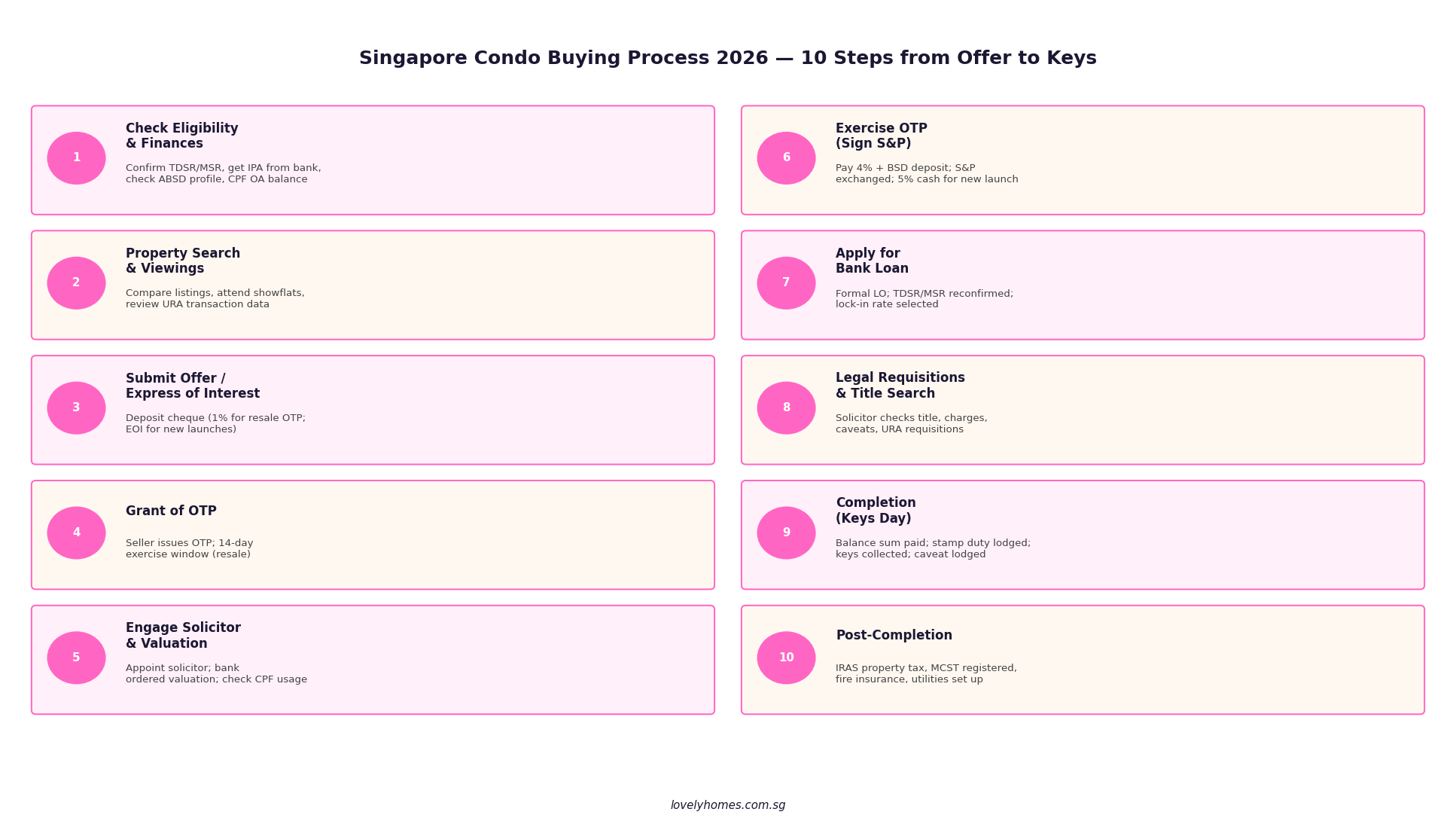
  • A Singapore condo purchase follows 10 distinct stages: eligibility check → search → offer → OTP → solicitor/valuation → exercise OTP (S&P) → bank loan → requisitions → completion → post-completion.
  • Buyer’s Stamp Duty (BSD) is payable by all buyers; rates run from 1% to 6%, administered by IRAS.
  • Additional Buyer’s Stamp Duty (ABSD) applies to Singapore citizens purchasing a second or subsequent residential property, Singapore Permanent Residents from their first purchase, and all foreigners — rates range from 5% to 65% of the purchase price.
  • The Total Debt Servicing Ratio (TDSR) cap is 55% of gross monthly income; the Mortgage Servicing Ratio (MSR) cap of 30% applies only to HDB loans, not private condo purchases.
  • The minimum cash down payment is 5% of the purchase price (for bank loans); the remainder of the 25% LTV shortfall can come from CPF Ordinary Account funds.
  • Completion of a resale condo typically takes 10–12 weeks after option exercise; a new launch can take 3–5 years to TOP depending on construction progress.
  • Legal fees for a condo purchase typically run S$2,500–S$4,000 for a standard transaction, covering title search, requisitions, and completion.
  • A In-Principle Approval (IPA) from your bank should be obtained before making any offer — it costs nothing and lasts 30 days.

What Is a Condominium in Singapore?

Under Singapore law, a condominium is a privatised residential development governed by the Building Maintenance and Strata Management Act (BMSMA), administered by the Building and Construction Authority (BCA) and the relevant Management Corporation Strata Title (MCST). Condominiums differ from HDB flats in that they are privately built and sold, carry strata titles, are managed by an MCST, and typically feature shared amenities such as a swimming pool, gymnasium, and security. They can be sold on a freehold, 999-year leasehold, or 99-year leasehold basis. The Urban Redevelopment Authority (URA) regulates the development, sale, and advertising of private residential property, while IRAS administers stamp duties.

Step 1 — Check Your Eligibility and Financing

Before viewing a single showflat or property listing, establish your financial position. Singapore’s Monetary Authority of Singapore (MAS) mandates that all residential loans are subject to the Total Debt Servicing Ratio (TDSR) of 55% — meaning all monthly debt obligations (including the proposed mortgage) cannot exceed 55% of gross monthly income. Unlike HDB purchases, private condo purchases are not subject to the 30% Mortgage Servicing Ratio (MSR) cap.

Obtain an In-Principle Approval (IPA) from a bank before making any offer. The IPA is free, takes one to three working days, and tells you the maximum loan quantum, indicative interest rate, and monthly repayment. As at 1 July 2026, Singapore bank SORA-linked packages are pricing at approximately 1.15%–1.35% spread over the 3-Month Compounded SORA (currently around 1.07%), giving effective rates of approximately 2.22%–2.42%. Fixed-rate packages for two-year terms are available at approximately 2.55%–2.80%.

Simultaneously, check your ABSD profile: Are you a Singapore Citizen (SC), Permanent Resident (SPR), or foreigner? How many residential properties do you currently own or have you previously owned? Your ABSD liability — which can add 0% to 65% of the purchase price — will directly affect your cash requirements.

Step 2 — Property Search and Viewings

Search listings on URA’s Real Estate Information System (REALIS) for actual transacted prices, which reflect what buyers actually paid rather than asking prices. For new launches, request access to the developer’s showflat; for resale units, arrange viewings through the seller’s representative. Compare stacks, floor plans, and psf prices across comparable transactions before forming a view on value.

At this stage, commission your own valuation if considering a resale unit — banks will only loan against the lower of the transacted price or the formal valuation. A gap between the two means cash top-up from your own funds.

The 10-Step Buying Process — Visual Overview

Singapore condo buying process 2026 — 10-step timeline from offer to keys
Figure 1: The Singapore condo buying process in 10 steps — from eligibility check to post-completion. Source: LovelyHomes editorial, based on CEA and IRAS guidelines 2026.

Step 3–4 — Making an Offer and the Option to Purchase (OTP)

For a resale condo, the buying process is governed by the Controller of Housing under the Housing Developers (Control and Licensing) Act for new launches, and by common law for resale. In a resale transaction, the buyer and seller agree on a price, and the seller grants the buyer an Option to Purchase (OTP). The buyer pays an option fee (typically 1% of the purchase price), which grants them the exclusive right to buy the property within 14 calendar days. During this 14-day window, the buyer must arrange financing, engage a solicitor, and decide whether to proceed.

For a new launch, the process differs: buyers register an Expression of Interest (EOI) or join a ballot, attend a showflat, and — if selected — pay a 5% booking fee to receive the Sales & Purchase Agreement (S&P) from the developer. For a new EC (Executive Condominium), additional eligibility rules under HDB guidelines apply.

Step 5–6 — Engaging Your Solicitor and Exercising the OTP

Once you have decided to proceed, engage a solicitor immediately. Your solicitor will conduct a title search via the Singapore Land Authority (SLA) to confirm ownership, identify any caveats or encumbrances (outstanding mortgages, charges, or restrictive covenants), and raise legal requisitions with government agencies. To exercise the OTP, the buyer pays a further 4% of the purchase price (bringing the total deposit to 5%) and receives the signed S&P agreement. The balance of the purchase price is payable on completion, typically 10–12 weeks later for a resale unit.

BSD is payable within 14 days of exercising the OTP (for Singapore-issued documents) and can be paid from CPF Ordinary Account funds. ABSD is payable within 14 days of executing the S&P agreement and must be paid in cash.

Stamp Duty Deep-Dive: BSD and ABSD

Singapore BSD rates 2026 and ABSD rates by buyer profile — condo buying stamp duty guide
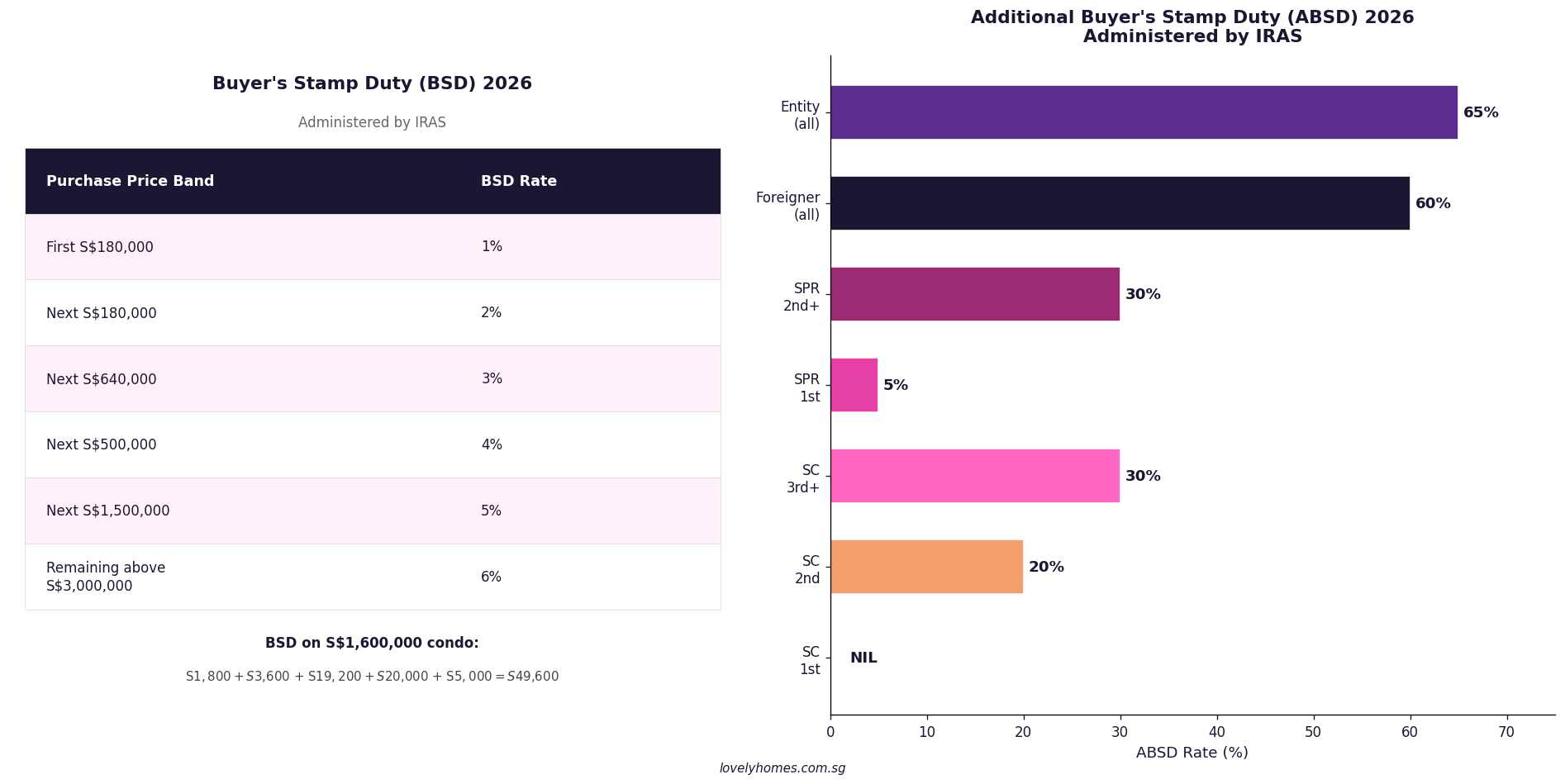
Figure 2: Left — BSD rates by purchase price band (IRAS 2026). Right — ABSD rates by buyer profile (IRAS 2026). SC = Singapore Citizen, SPR = Singapore Permanent Resident.

BSD is levied on all residential property purchases in Singapore, at progressive rates administered by the Inland Revenue Authority of Singapore (IRAS): 1% on the first S$180,000, 2% on the next S$180,000, 3% on the next S$640,000, 4% on the next S$500,000, 5% on the next S$1,500,000, and 6% on amounts above S$3,000,000. On a S$1,600,000 condo, BSD amounts to S$49,600.

ABSD is an additional stamp duty introduced by the government to moderate investment demand. As at 1 July 2026, key ABSD rates are: SC 1st property 0%, SC 2nd 20%, SC 3rd+ 30%; SPR 1st property 5%, SPR 2nd+ 30%; foreigners (all) 60%; entities (all) 65%. ABSD must be settled in cash within 14 days of the date of the instrument — it cannot be paid using CPF funds.

Buyer Profile BSD (S$1.6M) ABSD Rate ABSD Amount Total Stamp Duty
SC — 1st property S$49,600 NIL NIL S$49,600
SC — 2nd property S$49,600 20% S$320,000 S$369,600
SC — 3rd+ property S$49,600 30% S$480,000 S$529,600
SPR — 1st property S$49,600 5% S$80,000 S$129,600
Foreigner — any property S$49,600 60% S$960,000 S$1,009,600

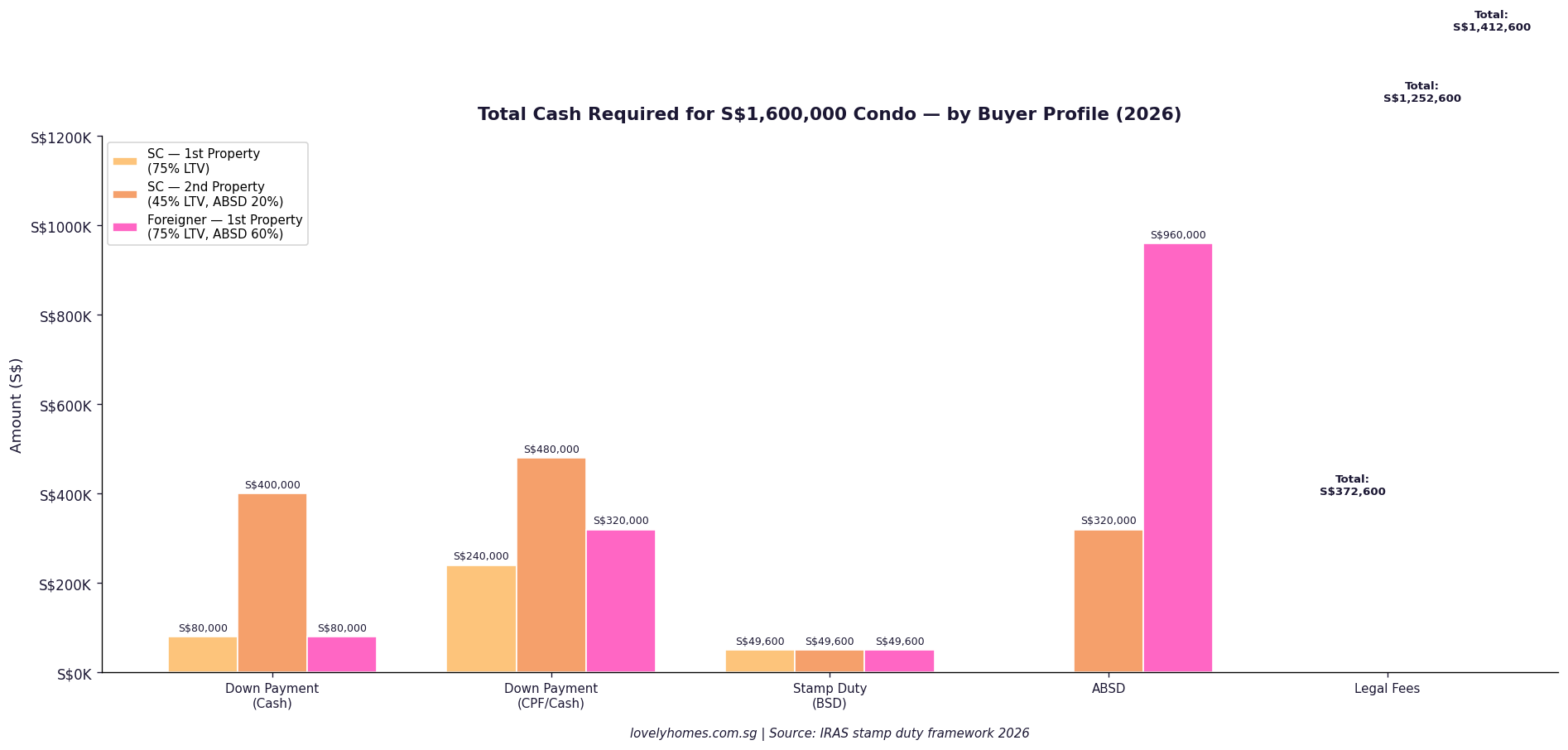
Total Cash Required — Three Buyer Profiles for a S$1.6M Condo

Total cash required to buy a S$1.6M condo Singapore 2026 — SC first property, SC second property, foreigner
Figure 3: Breakdown of total cash required to purchase a S$1,600,000 condominium in Singapore under three buyer profiles (2026). ABSD and down payment assumptions based on MAS LTV framework and IRAS stamp duty rates. Source: LovelyHomes editorial analysis.

Step 7 — Applying for Your Bank Loan

After exercising the OTP, your solicitor notifies the bank to proceed with the formal loan. The bank issues a Letter of Offer (LO), which sets out the loan quantum, interest rate structure, lock-in period (typically two to three years), and prepayment penalty. Review the LO carefully before signing. The Loan-to-Value (LTV) limit for a first housing loan is 75% of the lower of the purchase price and the bank’s valuation; for a second outstanding housing loan, LTV drops to 45%; for a third or subsequent, 35%. These limits are set by MAS and were last revised in September 2022.

Note that CPF Ordinary Account funds can be used to service the monthly instalment and to pay for the BSD — but not for ABSD or cash top-up arising from a valuation gap.

Step 8–9 — Requisitions, Title Search and Completion

Your solicitor will raise legal requisitions with IRAS (property tax status), the Land Transport Authority (road interpretation plan), the Public Utilities Board (water and drainage charges), and other relevant authorities. These take five to ten working days. On completion, the buyer’s solicitor forwards the balance purchase price (net of the deposit already paid) to the seller’s solicitor, who simultaneously releases the title. Your caveat is lodged at SLA on the same day, protecting your interest. Keys are handed over and you become the registered proprietor.

Worked Example: The Teo Family — SC Couple Buying a 2nd Property

Mr and Mrs Teo are Singapore Citizens purchasing a 3-bedroom OCR condo in Tampines at S$1,600,000 as their second residential property. They currently own an HDB flat in Bedok (MOP cleared), which they are retaining. Their combined gross monthly income is S$18,000.

  • BSD: S$49,600 — paid from CPF Ordinary Account.
  • ABSD (20%, 2nd property SC): S$320,000 — paid in cash at signing.
  • Down payment: 55% (LTV 45% for 2nd property) = S$880,000 total equity. Minimum 25% cash = S$400,000; remaining 30% (S$480,000) may come from CPF OA.
  • Bank loan: S$720,000 at 2.35% (2yr fixed); monthly repayment ~S$3,180. TDSR = 17.7% — well below 55% cap.
  • Legal fees: ~S$3,200.
  • Total cash outlay at completion: S$400,000 (cash downpayment) + S$320,000 (ABSD) + S$3,200 (legal) = S$723,200 cash; CPF drawdown S$529,600 (BSD + remaining downpayment).

This example illustrates why a Singapore Citizen buying a second residential property must maintain substantial liquid reserves — ABSD alone accounts for S$320,000 that must be settled in cash.

Why This Matters: Cooling Measures and the Investment Calculus

Singapore’s layered stamp duty framework — BSD plus ABSD plus Seller’s Stamp Duty (SSD) — is a deliberate policy tool that the Ministry of Finance and MAS use to moderate speculative activity and maintain housing affordability. Since April 2023, when ABSD was raised sharply (SC 2nd property from 17% to 20%; foreigner from 30% to 60%), transaction volumes among investment buyers have moderated but have not collapsed. Demand from owner-occupiers and upgraders has remained resilient, underpinned by Singapore’s robust employment market and steady inflow of high-net-worth residents. URA’s Q2 2026 Flash Estimates, released 1 July 2026, show the overall PPI still rising — +0.5% QoQ — even as the market digests the significant supply pipeline of 61,000 units expected to complete over the next few years.

New Launch vs Resale — Which Should You Buy?

New launches offer the ability to select your unit from a plan, benefit from the Progressive Payment Scheme (PPS), and potentially capture price appreciation between the launch date and TOP. However, they carry construction risk, deferred occupation, and you cannot see the exact finished product. Resale condos offer immediate entry, known physical condition, and existing community — but require cash top-up for any valuation gap. A thorough due diligence process, including engaging a structural inspector (approximately S$300–S$600) and reviewing the MCST’s financials, is advisable for resale condos.

What Might Come Next

With 9,320 private residential units on the 2026 GLS Confirmed List — over 50% above the 10-year annual average — supply is rising. URA’s full Q2 2026 data (due 24 July 2026) will clarify whether the modest +0.5% QoQ growth reflects genuine price moderation or a base effect from a particularly strong Q1. Analysts are watching whether the Federal Reserve’s policy trajectory, MAS exchange rate management, and global economic uncertainty will affect the purchasing power of foreign buyers who still face a 60% ABSD threshold. For Singapore Citizens buying within their first property, the outlook remains favourable — ABSD-free access to the market at a time when interest rates are declining from their 2023–2024 peaks.

Frequently Asked Questions

Can I use my CPF to pay ABSD?

No. ABSD must be paid entirely in cash. This distinguishes it from BSD, which can be settled using CPF Ordinary Account funds. ABSD must be paid to IRAS within 14 days of executing the instrument (typically the Sales & Purchase Agreement), so you must have the cash available before signing. This is one reason why financial planners recommend stress-testing your liquidity before committing to a second property purchase.

What happens if the bank valuation is lower than my purchase price?

If the bank’s formal valuation is S$1,550,000 but you are purchasing at S$1,600,000, the bank will only lend against the lower figure. With a 75% LTV, your loan quantum drops to S$1,162,500 instead of S$1,200,000 — meaning you must fund the S$37,500 shortfall from cash or CPF. This is known as a cash over valuation (COV) situation, though HDB uses this term more formally. For private condos, always check comparable transactions on URA REALIS and obtain a preliminary estimate from your bank before committing.

How long does a resale condo purchase take from offer to keys?

From the date the OTP is exercised to legal completion, the typical timeline is 10–12 weeks. The first four weeks involve legal requisitions, title search, and bank processing. Completion is then scheduled between the buyer’s and seller’s solicitors to align with the bank’s disbursement schedule. Delays can arise from outstanding property tax arrears, disputed caveats, or bank processing backlogs during peak periods. Build contingency time into your planning, especially if you need to vacate your current home simultaneously.

Do I need a solicitor, or can I use the developer’s panel firm for a new launch?

For a new launch, the developer’s solicitors handle the S&P agreement on a panel basis, and buyers can use them without engaging separate legal representation — the fee is typically absorbed by the developer. However, it is strongly advisable to engage your own independent solicitor (approximately S$2,500–S$3,500 for a standard new launch transaction) so that someone is specifically acting in your interests, reviewing payment schedules, and flagging any unusual conditions. For resale transactions, you must engage your own solicitor.

Can a foreigner buy any type of condo in Singapore?

Foreigners (non-citizens, non-PRs) may purchase units in private condominiums and apartments in Singapore without restriction, subject to the 60% ABSD. However, foreigners cannot purchase HDB flats, executive condominiums within the first 10 years of completion, or landed residential property (houses, bungalows, semi-detached, or terraced) without prior approval from the Land Dealings Approval Unit (LDAU) under SLA. Approval is rarely granted except in exceptional circumstances of permanent residency or significant economic contribution.

What is the Seller’s Stamp Duty (SSD), and does it affect my purchase?

SSD is payable by the seller, not the buyer — but it affects the seller’s net proceeds and can influence pricing and negotiation. SSD rates are 12% (if sold within 1 year), 8% (within 2 years), 4% (within 3 years), and nil beyond. If you plan to resell within three years, factor SSD into your exit modelling. On a S$1,600,000 condo sold at S$1,750,000 in 18 months, SSD at 8% = S$140,000 — wiping out most of the gross gain.

Is there a minimum occupation period for private condos?

There is no Minimum Occupation Period (MOP) for private condos in the same sense as HDB flats. However, the SSD effectively imposes a three-year hold before selling without penalty. If you purchased using an HDB resale flat that was originally classified under the MOP rules, you would also need to comply with those rules separately before buying the private property (unless you are an SC buying as a 2nd property). Confirm with HDB if any concurrent ownership obligations apply to your specific situation.

Related Articles

Disclaimer: This article is produced for general informational purposes only and does not constitute financial, legal, or investment advice. Property prices, stamp duty rates, LTV limits, TDSR thresholds, and interest rates are subject to change by the relevant Singapore authorities (URA, IRAS, MAS, SLA, HDB, CPF Board). Readers should consult licensed financial advisers, solicitors, and CEA-registered property salespersons before making any property purchase decisions. Always verify current rates directly with IRAS at www.iras.gov.sg and MAS at www.mas.gov.sg.

HDB Resale Price Records June 2026: Bidadari 3-Room Flat Hits S$945,000 — Singapore’s New All-Time Record

HDB Resale Price Records June 2026: Bidadari 3-Room Flat Hits S$945,000 — Singapore’s New All-Time Record

Quick Answer: Key Takeaways

  • A 3-room HDB resale flat at 118A Alkaff Crescent, Bidadari sold for S$945,000 in June 2026 — a new all-time record for 3-room HDB resale flats in Singapore.
  • The flat is on the 16th–18th floor, spans approximately 72 sqm, achieved S$1,219 psf, and has a remaining lease of approximately 93 years 6 months.
  • This surpasses the previous record of S$930,000 set in October 2025 (also at Alkaff Crescent, Bidadari).
  • Bidadari commands a structural premium driven by its park integration, Woodleigh MRT access, and comparatively newer lease commencing from 2019.
  • Singapore’s overall HDB resale market remains active in mid-2026, with million-dollar HDB transactions continuing at pace.
  • The record does not mean all 3-room flats are heading there — location, floor, lease, and estate quality are the primary valuation drivers.

Bidadari 3-Room Flat Breaks S$945,000 Record — June 2026

Singapore’s HDB resale market registered another record in June 2026: a 3-room flat at 118A Alkaff Crescent in the Bidadari estate changed hands at S$945,000, the highest transacted price ever recorded for a 3-room HDB resale flat in Singapore. The unit sits on the 16th to 18th floor, has a floor area of approximately 72 sqm (775 sqft), and achieved a price per square foot of S$1,219. With the lease commencing in 2019, the remaining lease at transaction is approximately 93 years and 6 months — among the longest available in the HDB resale market, which is itself a key pricing driver.

The transaction surpasses the previous 3-room record of S$930,000, transacted in October 2025 at 115C Alkaff Crescent — also in Bidadari, and also on a high floor. The fact that both records come from the same estate is not a coincidence.

Why Bidadari Commands a Premium

Bidadari was Singapore’s most ambitious HDB estate design project in a generation. Developed as part of the Bidadari Masterplan by HDB and URA, the estate integrates an 11-hectare Heritage Lake, the 10-hectare Bidadari Park, a network of park connectors, and a biodiversity corner into a residential development that was always intended to feel different from standard HDB estates. The flats — BTO from approximately 2016 to 2019 in multiple phases — only entered the resale market from around 2022 onwards (after the 5-year Minimum Occupation Period).

Key structural reasons for Bidadari’s premium:

  • New lease, long remaining tenure: BTO flats built from 2016–2019 have leases starting then, meaning buyers in 2026 receive approximately 90–93 years of remaining lease — more than almost anywhere else in the resale market, where mature-estate flats commonly carry 60–75 years of remaining lease.
  • Woodleigh MRT (NE Line): Direct MRT access to the city and Dhoby Ghaut interchange within approximately 10 minutes.
  • Park integration: The park, lake, and heritage biodiversity corner are physical amenities baked into the masterplan — not afterthoughts. Buyers pay for this.
  • School catchment: Cedar Girls’ Secondary School, Woodleigh Primary School, and proximity to MacPherson are among the school catchments residents cite.
  • Limited supply: Bidadari was a single-phase estate — HDB does not develop more land there. Once the original BTO batches are fully occupied and past MOP, supply is capped.

Context: HDB Resale Price Records in Singapore 2026

The S$945,000 Bidadari 3-room transaction sits within a broader 2026 narrative of continued HDB resale price pressure in select estates. Singapore’s million-dollar HDB transaction count — flats transacting above S$1 million — has remained elevated since the post-pandemic 2021–2022 surge, though the rate of new records has moderated as buyers absorb the impact of ABSD increases and interest rate adjustments.

  • Million-dollar HDB transactions continue to occur primarily in Bishan, Queenstown, Toa Payoh, Buona Vista, and Central for large flat types.
  • Bidadari has emerged as the standout performer for smaller flat types (3-room and 4-room), where its premium lease and park access translate into record psf figures.
  • Towns with very short remaining leases (below 60 years) are seeing growing price bifurcation — buyers have become acutely lease-aware since TDSR and CPF withdrawal rules tightened the cost of buying short-lease flats.
  • The HDB resale price index for 2H 2025 rose approximately 2.6% according to HDB flash data, and the market remains seller-favoured in premium estates.

What This Means for Buyers

If you are a first-time buyer targeting an affordable 3-room resale flat, Bidadari is now firmly out of range for most standard grant stacks. A S$945,000 resale flat requires substantial cash and CPF — buyers would need balances well above the S$800,000 level at which most bank valuations on 3-rooms settle, with any gap above valuation payable in cash. A buyer with strong CPF savings and Family Grant eligibility can still structure a purchase — the long remaining lease makes CPF usage efficient compared to older stock.

For upgraders and investors, the Bidadari record confirms that premium HDB locations with newer leases increasingly behave like a sub-segment of their own — the S$1,200+ psf that Bidadari 3-room units now command exceeds the psf of many suburban OCR freehold condos purchased in the early 2010s.

Perspective check: A S$945,000 3-room HDB flat is extraordinary, but should be read as a record for a specific product type (high-floor, premium estate, newer lease) — not an indicator of where Singapore’s median 3-room flat trades. The vast majority of 3-room resale transactions in 2026 occur between S$350,000 and S$550,000 in mature towns.

HDB Resale Trends to Watch in 2H 2026

  • URA Q2 2026 Flash Estimates: Not yet released as of 1 July 2026. When released, these will clarify whether the overall market continued to appreciate or moderate in April–June 2026.
  • Interest rate trajectory: SORA-based mortgage rates have been influenced by US Federal Reserve policy. Any easing supports higher sustainable prices; tightening would dampen buyer capacity.
  • MOP releases from 2021–2022 BTO exercises: A significant number of BTO flats from 2021–2022 will reach their 5-year MOP from 2026 onwards, adding resale supply in newer estates including Tengah, Tampines, and Kallang/Whampoa.
  • Policy risk: Singapore’s government has historically moved quickly to cool the property market when transaction volumes and prices exceed policy comfort levels.

Frequently Asked Questions

Can I use CPF to buy a high-price HDB resale flat like those in Bidadari?

Yes, CPF can be used to purchase any HDB resale flat, including those at S$900,000+. However, the CPF Valuation Limit applies: you can only use CPF up to the assessed valuation of the flat (not the transacted price, if it is higher). For a S$945,000 transaction where the bank values the flat at S$900,000, your CPF usage is capped at S$900,000 combined (inclusive of BSD). The gap between transacted price and valuation must be paid in cash.

Why are Bidadari flats so expensive compared to nearby mature estates?

Bidadari’s premium over comparable mature estates (e.g., Toa Payoh or MacPherson) reflects the combination of new lease (93–95 years remaining vs. 60–75 in nearby mature towns), exceptional park and MRT integration, and scarcity of supply. Toa Payoh 3-room flats on high floors typically transact at S$600,000–S$750,000 — Bidadari commands a 25–35% premium. Buyers are pricing in 20–30 extra years of lease and the park lifestyle premium, both broadly rational given how the Singapore HDB market values lease longevity.

Are there more record-breaking transactions likely in Bidadari?

It is plausible, though not certain. Bidadari’s highest-floor units in the most sought-after blocks are a finite pool. As each generation of owners hits MOP and selectively sells, the next wave of premium transactions will depend on whether buyer demand remains strong enough to absorb these prices. Given the 90+ year leases running to 2112–2115, demand from younger, longer-horizon buyers is likely to remain robust in the near term.

Related Articles

Disclaimer

This article is for general information only and does not constitute financial or property advice. Transaction data is sourced from publicly available HDB resale records. Remaining lease and floor information are indicative based on published reports. Always verify current data with the Housing & Development Board (HDB) before any property transaction. Consult a licensed financial adviser and a licensed conveyancing solicitor for advice specific to your circumstances.

×Click anywhere to close

Translate »