HDB Resale Market Q2 2026: Price Index Falls -0.3% as Million-Dollar Flat Sales Hit Record High

HDB Resale Market Q2 2026: Price Index Falls -0.3% as Million-Dollar Flat Sales Hit Record High

Singapore’s HDB resale market delivered a paradox in the second quarter of 2026: prices fell for the second consecutive quarter, yet million-dollar flat transactions hit their highest-ever quarterly count. Understanding both trends, and what sits beneath them, is essential for any buyer, seller, or investor making decisions in the second half of 2026.

This analysis draws on HDB’s official Q2 2026 public housing data (published 24 July 2026) and URA’s Q2 2026 real estate statistics to give you a ground-level view of where the market stands and where it is heading.

Quick Answer — HDB Resale Q2 2026 at a Glance

  • HDB Resale Price Index (RPI): 202.7 — a decrease of 0.3% QoQ (second consecutive quarterly decline)
  • Total resale transactions Q2 2026: 6,396 units — up 1.8% from Q1’s 6,285
  • Million-dollar flat sales Q2 2026: 491 transactions — a new quarterly record, up 19.5% QoQ
  • Average price of million-dollar flats: S$1,147,216 — down slightly (-0.3%) from Q1
  • Share of million-dollar flats in total resale: 7.7% (up from 6.5% in Q1)
  • Top towns by volume: Jurong West, Punggol, Sengkang, Tampines, Woodlands
  • BTO supply in 2026: approximately 19,600 flats planned across three sales exercises
  • Private residential comparison: overall private PPI +0.5% QoQ (landed +2.5%; most non-landed segments flat or negative)

The Resale Price Index: Two Consecutive Quarterly Declines

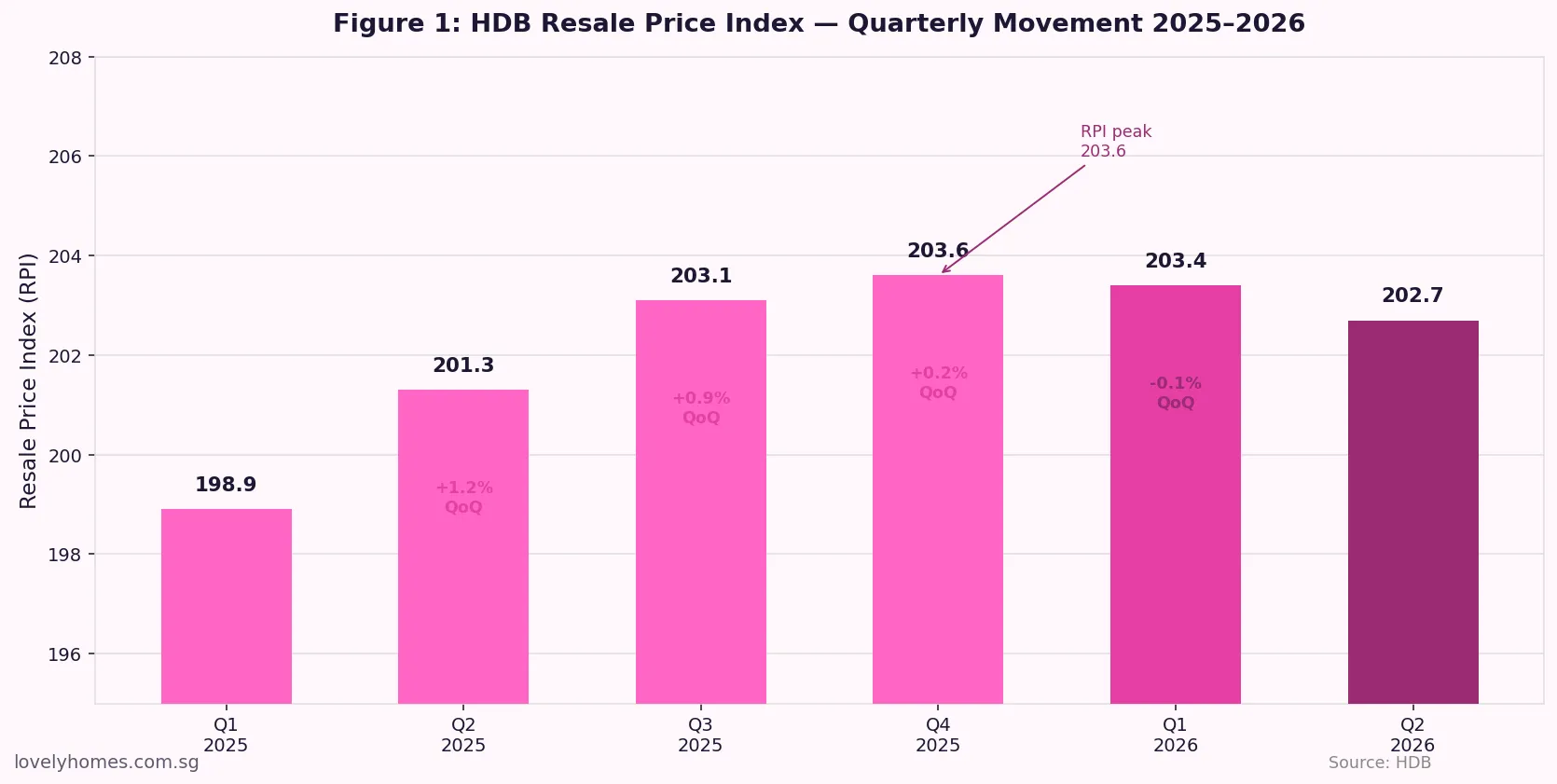
The HDB Resale Price Index for Q2 2026 came in at 202.7 — a decrease of 0.3% from 203.4 in Q1 2026. This follows a 0.1% decline in Q1 2026 from the Q4 2025 peak of 203.6. Taken together, the RPI has now shed 0.9 index points, or 0.44%, from its peak.

To put that in perspective: the RPI has not entered a sustained downward correction. The peak reached in Q4 2025 followed one of the strongest recovery runs in the HDB resale market’s history. Over the calendar year 2025, the RPI rose from 198.9 to 203.6 — a gain of 4.7 index points, or roughly 2.4%. The current two-quarter softening represents a very modest retracement, not a crash.

What is driving the softness? Two structural factors are at play. First, a significant volume of BTO flats completed in 2022 and 2023 are reaching their five-year Minimum Occupation Period (MOP) and flowing onto the resale market as sellers who bought at subsidised prices look to cash out. This supply pressure is most visible in the OCR and newer estates. Second, affordability constraints are biting: the TDSR and MSR frameworks cap borrowing, and rising resale prices over 2024 and 2025 mean that fewer first-time buyers can stretch to larger or better-located flats.
HDB Resale Price Index quarterly movement 2025 to 2026
Figure 1: HDB Resale Price Index — quarterly movement 2025 to Q2 2026. Source: HDB.

Million-Dollar Flat Sales: A Record That Needs Context

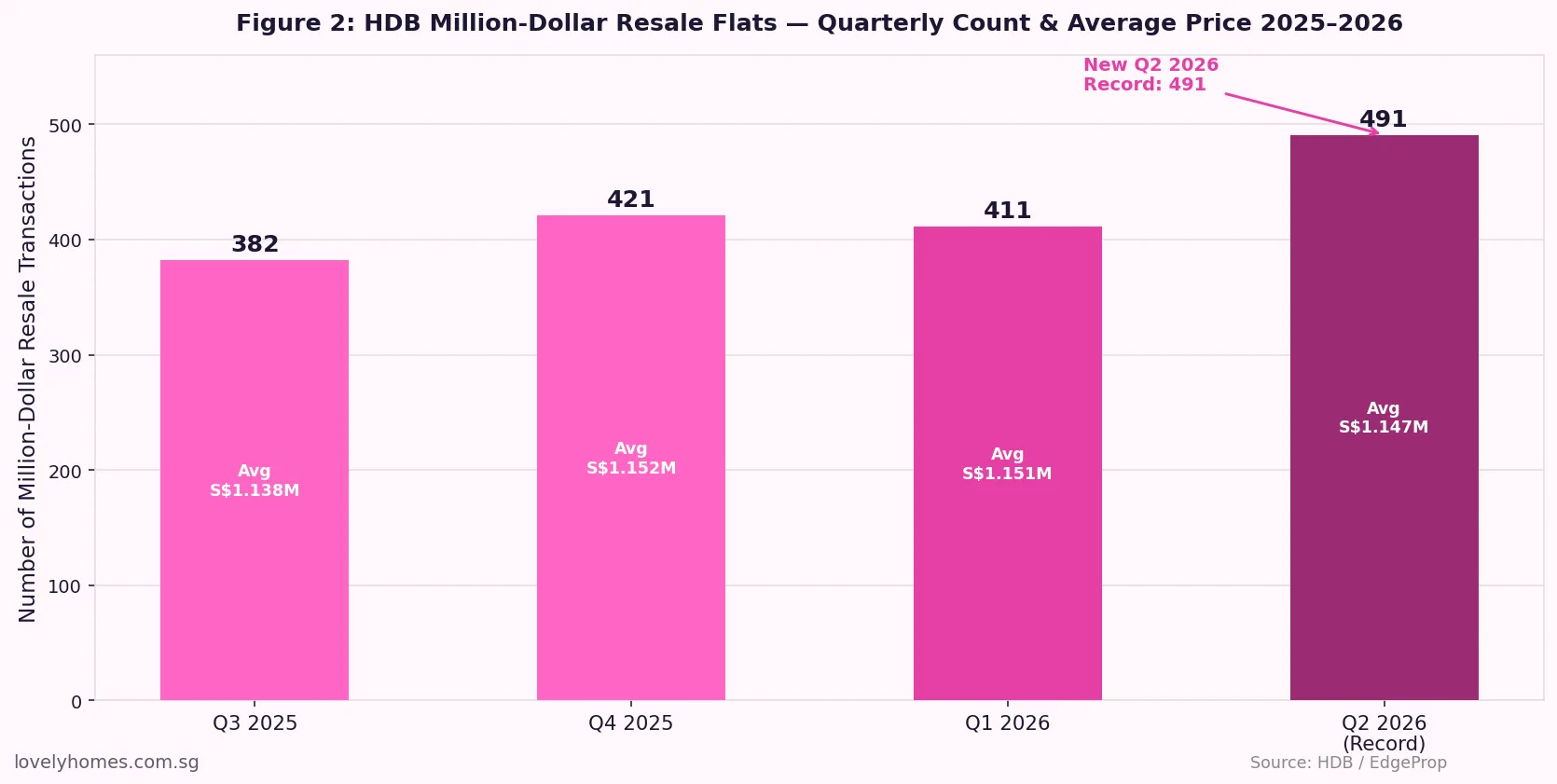
The headline that grabbed attention in Q2 2026 was the record 491 million-dollar resale transactions — up from 411 in Q1 2026 and well above the previous quarterly record. At first glance, a falling RPI alongside a record number of million-dollar sales seems contradictory. The explanation lies in market segmentation.

The HDB resale market is not one market — it is several markets stacked on top of each other. Larger flat types (five-room and executive) in prime or sought-after locations (Bishan, Queenstown, Toa Payoh, Buona Vista, Kallang) have continued to command strong prices because demand from asset-rich buyers or upgraders downsizing from private property remains robust. These are precisely the buyers most likely to cross the million-dollar threshold. Meanwhile, the broader market — four-room and below, in the OCR towns — experienced the softening that pulled the aggregate RPI downward.

The average price of million-dollar flats softened marginally, from S$1,150,651 in Q1 2026 to S$1,147,216 in Q2 2026. This 0.3% decline in average price, alongside a 19.5% surge in volume, confirms that more flats crossed the million-dollar mark at prices just above the threshold rather than the upper end of the premium segment rising sharply.
HDB million-dollar resale flat transactions Q3 2025 to Q2 2026 quarterly record
Figure 2: HDB million-dollar resale flat transactions by quarter, Q3 2025 to Q2 2026. Average price shown per bar. Source: HDB, EdgeProp.

Transaction Volume and Top Towns

At 6,396 resale transactions, Q2 2026 volume rose 1.8% from Q1’s 6,285 — a modest quarter-on-quarter improvement that nonetheless keeps the annual run rate above 25,000 transactions for the second year running. Volume held up despite the price softening, suggesting that buyers who had been waiting on the sidelines returned once prices began to moderate.

The top five HDB towns by resale volume in Q2 2026 were Jurong West, Punggol, Sengkang, Tampines, and Woodlands, collectively accounting for 35.7% of all transactions. These are predominantly OCR towns characterised by high BTO supply, relatively younger flat stock coming off MOP, and strong demand from first-time buyers priced out of the central region. Their dominance in volume statistics helps explain the RPI softness: OCR transactions, which skew lower in absolute price, are pulling the aggregate index down even as CCR and prime RCR transactions remain strong.
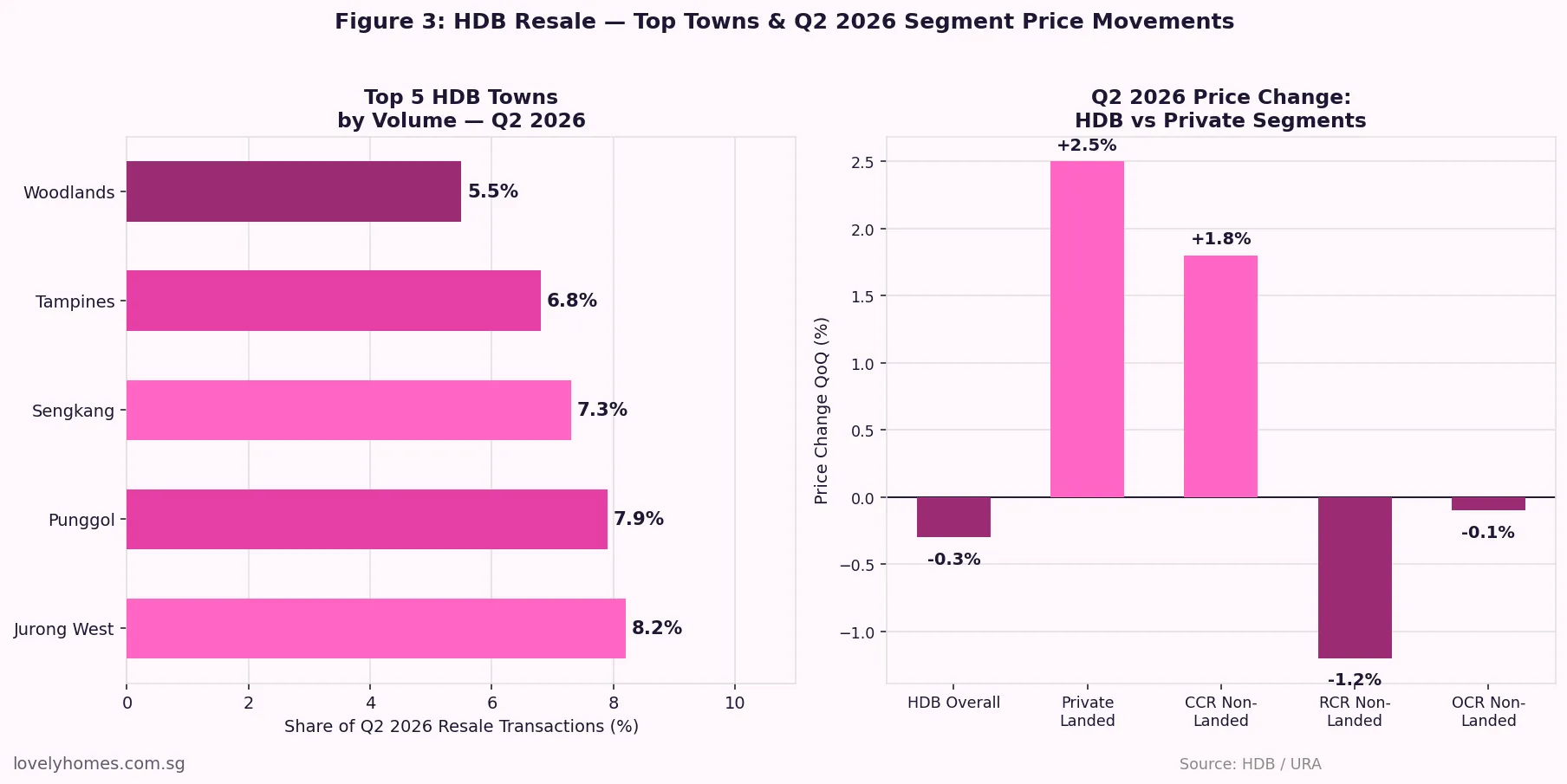
Figure 3 top HDB towns by resale volume Q2 2026 and segment price changes comparison
Figure 3: Top HDB towns by share of Q2 2026 resale volume (left) and Q2 2026 price movements across HDB and private residential segments (right). Source: HDB, URA.

HDB vs Private Residential: A Tale of Two Markets

Comparing the HDB resale market with private residential in Q2 2026 reveals an interesting divergence. The overall private residential Property Price Index rose 0.5% QoQ — apparently stronger than HDB’s -0.3%. But the private sector figure masks sharp segmentation of its own.

Segment Q2 2026 QoQ Price Change Context
HDB Resale (overall) -0.3% Second consecutive quarterly decline; OCR BTO supply overhang
Private Landed +2.5% Strong demand, very limited supply; reversal of Q1’s -0.4%
Private Non-Landed CCR +1.8% Foreign and high-net-worth demand; luxury segment resilient despite 60% ABSD
Private Non-Landed RCR -1.2% Mass-market competition from HDB and OCR condos; supply from recent completions
Private Non-Landed OCR -0.1% Broadly flat; same supply pressures as HDB but mitigated by upgrader demand
Private Residential Rental +0.7% Rental market recovering after sharp corrections in 2024; vacancy 6.4%

The private market’s +0.5% aggregate figure is heavily influenced by the landed segment’s 2.5% bounce and CCR’s 1.8% gain — segments where supply is tightest and buyers are least price-sensitive. The HDB market’s softness reflects the same affordability pressure visible in RCR and OCR private condos. In this sense, the two markets are telling the same story: the upper end holds, the mid-to-mass market moderates.

BTO Supply Pipeline: The Structural Overhang

HDB plans to launch approximately 19,600 BTO flats in 2026 across three sales exercises (February, June, and October). Of these, over 4,000 units are expected to have waiting times of under three years — a deliberate policy response to the BTO queue bottleneck that stretched to five years or longer for some estates during the COVID disruption years of 2020 to 2022.

The medium-term implication for the resale market is straightforward. The cohort of flats built in 2021 to 2023 — many of which were bought as emergency “market rate” BTO applications during the queue crisis — will reach MOP in the period from 2026 to 2028. This flow of supply is expected to maintain moderate price pressure on resale HDB, particularly in the OCR, for at least the next two years. Sellers in these estates who bought at subsidised BTO prices with a relatively short wait will still profit handsomely; buyers entering the resale market should expect continued modest price softening, which actually works in their favour.

Worked Example: Buying a Million-Dollar 5-Room Flat in Bishan

Mrs Rahman, a Singapore Citizen, is purchasing a 35-year-old 5-room flat in Bishan from an upgrader for S$1,100,000. She is 42, has an HDB loan eligibility (HLE), and plans to use a bank loan. Her husband’s gross monthly income is S$9,500; hers is S$5,500. Here is how the numbers work:

  • Purchase price: S$1,100,000
  • BSD: S$31,100 (1% on first S$180K + 2% on next S$180K + 3% on next S$640K + 4% on next S$100K)
  • ABSD: Nil (first residential property for both, Singapore Citizens)
  • Bank loan (75% LTV): S$825,000 — bank stress-test rate 4.0%, 25-year tenure, monthly instalment S$4,358
  • MSR check (HDB rule): S$4,358 / S$15,000 = 29.1% (below 30% MSR cap — PASS)
  • TDSR check: S$4,358 / S$15,000 = 29.1% (below 55% TDSR cap — PASS)
  • Downpayment (25%): S$275,000 — minimum 5% cash (S$55,000) + balance CPF OA (S$220,000)
  • Total upfront costs: S$275,000 (DP) + S$31,100 (BSD) + legal S$4,500 = S$310,600
  • CPF caveat: Flat has 65 years remaining. CPF usage is not restricted (above 60-year threshold). If the flat were below 60 years remaining, CPF withdrawal would be prorated.

The transaction qualifies comfortably, but it is worth noting that the S$55,000 minimum cash requirement must come from the buyer’s own savings — no CPF OA funds can substitute for this tranche. This is the single most common stumbling block for buyers stretching to the million-dollar segment.

What This Means for Buyers and Sellers

For buyers: the two-quarter price softening in the HDB resale market is a genuine opportunity window, particularly in the OCR. Estate towns such as Punggol, Sengkang, and Woodlands that dominate volume figures are seeing the largest supply overhang — which means the most negotiating headroom. Buyers should still model their TDSR and MSR carefully using stressed interest rates (4.0%+), and should factor in the CPF accrued interest obligation that will need to be refunded on eventual resale. Read our TDSR and MSR complete guide before applying for any bank loan.

For sellers: if you are considering selling a resale HDB flat, Q3 and Q4 2026 may prove to be better windows than Q3 2027, when additional BTO MOP supply is expected to hit the market. Volume in the S$800K–S$1.1M segment remains strong, and the million-dollar record demonstrates that premium flats in desirable locations are still attracting robust demand. Price your property accurately against recent comparables — the days of 20% premiums over asking are gone for most estates.

What Might Come Next

The trajectory for the second half of 2026 is moderately bearish for the HDB resale RPI in the near term, with a stabilisation expected in 2027 as the BTO MOP supply overhang begins to thin. Several external factors could shift this scenario: a sharper-than-expected global slowdown that prompts interest rate cuts could ease monthly instalment burdens and re-energise demand; conversely, any re-acceleration of inflation would force rates higher and squeeze affordability further. The October 2026 BTO launch will be closely watched — if demand for short-wait-time flats is strong, it may absorb some of the pressure from the resale pipeline. The Government has reiterated its commitment to maintaining a high and steady supply of public housing and has ruled out rolling back cooling measures in the current environment.

FAQ: Is the HDB resale market in a downturn?

Not in any structural sense. Two consecutive quarterly declines of -0.1% and -0.3% amount to a combined drop of approximately 0.44% from the Q4 2025 peak. By comparison, the market rose roughly 2.4% over all of 2025. This is a modest price correction, not a market collapse. Volume remains healthy at over 6,300 transactions per quarter. The correction is supply-driven and concentrated in the OCR, not a sign of deteriorating demand fundamentals.

FAQ: Why are million-dollar HDB flat sales at a record if prices are falling?

Market segmentation is the answer. The HDB resale market covers everything from three-room flats in Woodlands at S$300,000 to five-room executive flats in Queenstown at S$1.3 million. The aggregate RPI captures the average across all flat types and locations. When OCR volume dominates (as it does), the aggregate index is pulled lower even if the premium segment (large flats in mature, central estates) is holding or rising. In Q2 2026, 7.7% of all resale transactions crossed the million-dollar mark — which is itself a record share.

FAQ: Should I buy HDB resale now or wait for prices to fall further?

Timing the market is notoriously difficult, and the answer depends heavily on your personal circumstances. If you need housing now, the current softening is a reasonable entry point — particularly in high-supply OCR towns where negotiating headroom is greatest. If you are buying primarily as an investment and can afford to wait, there may be slightly more supply-driven softening to come over the next two to three quarters. What you should absolutely not do is wait indefinitely: HDB public housing exists to provide affordable, stable homes, and the risk of waiting for a lower price while interest rates, inflation, or policy changes shift the goalposts is real.

FAQ: Does the falling HDB RPI mean private property is a better buy?

Not necessarily. Private non-landed prices in the RCR fell 1.2% in Q2 2026 — worse than HDB’s -0.3%. OCR private condos were broadly flat. The landed segment rose 2.5%, but that is accessible only to Singapore Citizens and Permanent Residents with significant capital. HDB resale remains considerably cheaper on a per-square-foot basis than comparable private alternatives and carries no ABSD for first-time citizen buyers. The comparison depends on your profile, budget, and long-term plans.

FAQ: How does the BTO supply pipeline affect resale prices?

When BTO flats reach their five-year Minimum Occupation Period, sellers who bought them at subsidised prices enter the resale market. Since their entry cost is far below market, they can price competitively and still generate a healthy profit. This supply pressure — particularly in the OCR towns where BTO volume was highest during 2021 to 2023 — is the primary structural driver of the current price softening. The pressure should begin to ease in 2028 to 2029 as that cohort thins out.

FAQ: What is the outlook for HDB resale in H2 2026?

Industry watchers broadly expect the RPI to remain range-bound in the region of 200 to 203, with a possible further quarter or two of marginal declines before stabilising. Volume is expected to hold up, driven by the steady flow of owner-occupier demand and upgraders. Million-dollar flat transactions are likely to maintain elevated levels given the structural shift in the share of larger, well-located flats trading at or above that threshold. Any government intervention — whether additional cooling measures or stimulus — would materially change this outlook.

Related Articles

Disclaimer: This analysis is for general information only and is not financial or investment advice. Property prices can rise and fall. All figures are drawn from HDB and URA official releases (July 2026) and third-party research. Always verify current data on hdb.gov.sg and ura.gov.sg, and consult a licensed property agent or financial adviser before making any property decision.
Singapore Leasehold vs Freehold Property Guide 2026: Price Premiums, CPF Rules and What to Buy

Singapore Leasehold vs Freehold Property Guide 2026: Price Premiums, CPF Rules and What to Buy

Quick Answer: Leasehold vs Freehold at a Glance

  • Three tenure types exist in Singapore: freehold (ownership in perpetuity), 999-year leasehold (effectively freehold for practical purposes), and 99-year leasehold (the most common for new private residential launches and HDB flats).
  • Freehold costs more upfront: industry figures show freehold non-landed condominiums typically command a 8–18% price premium over comparable 99-year leasehold properties in the same district, depending on location and age.
  • HDB flats are always leasehold: all HDB flats are on 99-year leases from the date of construction. You cannot own an HDB flat on a freehold basis.
  • CPF rules differ by remaining lease: properties with fewer than 60 years remaining on the lease attract CPF usage restrictions. Below 20 years, no CPF can be used at all.
  • Financing is affected at low lease terms: HDB loans are not available for flats with under 20 years remaining; bank financing is restricted for properties with short leases relative to the buyer’s age.
  • Lease decay is real but gradual: price discounts due to a short remaining lease are most pronounced below 60 years and accelerate sharply below 30 years. Above 60 years, the market generally treats leasehold and freehold as broadly equivalent in terms of financing and CPF eligibility.
  • En bloc potential favours leasehold: older 99-year leasehold properties in prime locations can be attractive candidates for collective sale (en bloc), which can deliver a premium to market value. Freehold sites are also acquired for en bloc but at different pricing dynamics.
  • For most owner-occupiers, tenure is secondary to location and price: a well-located 99-year flat in a mature estate typically outperforms a poorly-located freehold property over any reasonable holding period.

Understanding Singapore’s Property Tenure System

Singapore’s property tenure system is rooted in English land law and is administered by the Singapore Land Authority (SLA). Three forms of tenure exist for private residential property: freehold, 999-year leasehold, and 99-year leasehold.

Freehold means the land is owned absolutely by the titleholder, with no fixed expiry date. In law, freehold land reverts to the state only if the owner dies intestate with no heirs. As at 2026, approximately 30% of Singapore’s private residential properties are freehold or 999-year leasehold. Many of these are older developments in central districts such as D9, D10, D11 and D15, as well as Conservation Areas where the government has preserved the historical character of the built environment.

999-year leasehold is a colonial-era form of tenure that was commonly granted before the 1960s. For all practical purposes, a 999-year lease is indistinguishable from freehold in terms of financing, CPF eligibility and market pricing. A buyer today purchasing a 999-year leasehold property with, say, 940 years remaining will never face any lease-related constraints in their lifetime or those of their descendants.

99-year leasehold is the dominant tenure for most of Singapore’s private residential land released under the Government Land Sales (GLS) programme since the 1970s. New condominium launches on GLS sites are therefore almost always 99-year leasehold, as are all HDB flats and Executive Condominiums (ECs). The 99-year clock starts from the date the lease is issued by the state, which is typically close to the TOP date for new launches.

Freehold vs 99-year leasehold price premium by district Singapore 2026 D9 D10 D15 D19
Figure 1: Freehold price premium over comparable 99-year leasehold condominiums by district in 2026. The premium is highest in mass-market and OCR districts where leasehold supply dominates and freehold alternatives are scarce, and lower in CCR districts where both tenure types are abundant.

CPF Rules: How Remaining Lease Affects What You Can Use

The CPF Board applies a set of rules that link your eligibility to use Ordinary Account (OA) savings for a property purchase to the remaining lease of that property. These rules were tightened progressively in 2019 and remain in force as at August 2026.

The overarching principle is that the remaining lease at the time of purchase must be able to cover the youngest buyer to age 95. This is applied as follows. If the remaining lease is 60 years or more, the CPF Board imposes no restriction on OA usage — you can use your CPF OA to fund the downpayment, the loan repayments, and other allowable costs up to the Valuation Limit. This applies to the overwhelming majority of new launches and most resale condominiums less than 39 years old.

Where the remaining lease is between 20 and 59 years, the CPF OA usage is prorated. The formula is: CPF limit as a percentage of the property value equals the remaining lease divided by the reference lease of 95 minus the youngest buyer’s age. For example, a buyer aged 35 purchasing a property with 50 years remaining can use CPF up to: 50/(95-35) = 50/60 = 83.3% of the purchase price or valuation. Below 20 years of remaining lease, CPF cannot be used at all for the property purchase.

CPF withdrawal eligibility by remaining lease Singapore 2026 buyer aged 35 prorated above 60 years
Figure 2: CPF OA withdrawal eligibility as a percentage of purchase price by remaining lease for a buyer aged 35. Full CPF access requires at least 60 years remaining. Below 20 years, no CPF can be used. Prorated access applies in between.

Financing: How Banks Treat Leasehold Properties

Banks in Singapore apply their own lending policies on top of MAS LTV rules when assessing loans for leasehold properties. The key constraint is loan tenure: most banks require the loan to be repaid before the property lease expires, subject to a minimum remaining lease at loan maturity. In practice, this means:

For a 99-year leasehold condominium with, say, 78 years remaining, a buyer aged 35 applying for a 30-year loan would leave 48 years on the lease after the loan is repaid — which is generally acceptable. However, for a property with 45 years remaining, the same 30-year loan would leave only 15 years of lease, below what many banks consider adequate security. Banks will typically reduce the loan tenure or the quantum in such cases, effectively requiring a larger downpayment.

HDB concessionary loans impose additional restrictions: HDB does not provide loans for flats with fewer than 20 years remaining on the lease. For flats between 20 and 59 years remaining, HDB’s loan quantum is also subject to the CPF prorating rules described above.

Price Premiums and Investment Considerations

The freehold premium in Singapore is real but contested. Freehold land is inherently scarce — the government does not release new freehold GLS sites — so older freehold developments hold a structural scarcity premium. In central districts (D9, D10, D11), where many freehold developments are Conservation properties or legacy buildings, the premium can be modest (8–11%) because the buildings themselves are ageing and require capital expenditure. In more suburban districts (D15, D19, D20), the premium can be higher (14–18%) because freehold alternatives are genuinely rare, so the scarcity commands a broader bid.

However, from a total-returns perspective, many studies of Singapore residential prices over the past two decades have found that well-located 99-year leasehold condominiums have outperformed freehold properties in absolute terms. This is because 99-year leasehold GLS sites are typically well-planned with good transport connectivity, while freehold developments are often older, built to lower gross floor area ratios, and lacking modern amenity standards. Location, connectivity and project quality tend to outweigh tenure over a 5–10 year holding period for a typical owner-occupier.

For investors with longer time horizons or en bloc aspirations, the calculus changes. An older 99-year leasehold development on a large freehold-equivalent plot in a prime location can attract collective sale interest as the lease erodes. En bloc collective sales can deliver 20–40% premiums above individual market value in some cases, depending on the development baseline rate, plot ratio uplift and prevailing land demand. Freehold developments are not immune to en bloc pressure — many freehold sites have been collectively sold in Singapore — but the pricing dynamics and developer appetite differ.

Freehold vs 99-year leasehold private non-landed price index Singapore 2016 to 2026 URA
Figure 3: Illustrative private non-landed residential price index for freehold and 99-year leasehold properties in Singapore (2016 = 100), based on URA REALIS transactional data and industry analysis. Both tenure types have appreciated meaningfully; leasehold indices reflect greater volume from new GLS supply cycles.

Summary Comparison: Freehold vs 99-Year Leasehold (2026)

Factor Freehold / 999-Year 99-Year Leasehold
Upfront price 8–18% premium in most districts Lower entry price; dominant in GLS pipeline
CPF eligibility Full CPF access (no restriction) Full access if 60+ years remain; prorated 20–59 years; none below 20 years
Bank financing Standard LTV/TDSR apply; full tenure flexibility Loan tenure constrained by remaining lease at maturity
En bloc potential Developer interest; pricing dynamics differ Higher en bloc momentum as lease erodes in prime locations
State acquisition risk Compulsory acquisition at market value; no lease expiry Lease expires; building must be returned to state at end of lease
Supply scarcity High; no new freehold GLS sites released Abundant; most new launches are 99-year leasehold
HDB flats Not available — HDB flats are always leasehold All HDB flats are 99-year leasehold
Short-term returns (5–10 yr) Strong; location and scarcity underpin value Often comparable or superior for well-located GLS projects

Worked Example: Comparing a Freehold and Leasehold Purchase in District 15

Mr and Mrs Lim, Singapore Citizens in their early 40s, are considering two units in the East Coast area. Option A is a freehold two-bedroom condominium unit priced at S$1,480,000 in a 30-year-old development. Option B is a 99-year leasehold two-bedroom unit in a newer development (15 years old, 84 years remaining lease) priced at S$1,260,000. Both offer similar floor areas and are within 500 metres of each other.

Upfront costs — Option A (Freehold):
Purchase price: S$1,480,000.
BSD: S$42,600.
ABSD: Nil (first private property for both SCs).
Bank loan (75% LTV): S$1,110,000. Cash downpayment (5%): S$74,000. CPF downpayment: S$296,000.
Legal fees: ~S$3,800.
Total upfront: approximately S$420,400 (cash S$74,000 + CPF S$296,000 + BSD/legal S$46,400 in cash or CPF).

Upfront costs — Option B (99-year, 84 years remaining):
Purchase price: S$1,260,000.
BSD: S$35,600.
ABSD: Nil.
Bank loan (75% LTV): S$945,000. Cash downpayment (5%): S$63,000. CPF downpayment: S$252,000.
Legal fees: ~S$3,500.
CPF eligibility: 84 years remaining is well above 60-year threshold — full CPF access. PASS.
Total upfront: approximately S$354,100 (cash S$63,000 + CPF S$252,000 + BSD/legal S$39,100).

Monthly commitment comparison:
Option A at 3.5% over 30 years: ~S$4,984/month.
Option B at 3.5% over 30 years: ~S$4,241/month.
Monthly saving with Option B: ~S$743.

Price break-even analysis:
To justify the S$220,000 price premium for the freehold unit, Mr and Mrs Lim need Option A to outperform Option B by that margin over their holding period. Over 10 years at 1.5% per annum additional appreciation on the freehold unit, the gap closes to approximately S$168,000 — not quite closing the premium. Over 15 years at 2% per annum additional appreciation, the premium is essentially erased. The conclusion: the freehold premium is not guaranteed to be recovered within a typical 10-year holding period, particularly for an older building with higher maintenance costs.

Why This Matters: Tenure, Policy and Long-Term Wealth

Singapore’s approach to land tenure reflects a deliberate policy choice by the state to retain long-term control over land use and redevelopment. By issuing 99-year leases for most GLS land, the government retains the ability to reconfigure land use as Singapore’s needs evolve over generations, without compensating landowners for the underlying land value. This is a fundamental structural reality of the Singapore property market: unlike most Western countries, there is a finite duration to most private property ownership.

For wealth planning purposes, the key implication is that freehold property can be held across multiple generations without the complication of lease expiry, whereas 99-year leasehold property is ultimately a depreciating asset whose residual value approaches zero as the lease nears expiry. In practice, almost no privately-held 99-year leasehold development in Singapore has yet reached lease expiry — the oldest leases date from the 1960s and are still in the 30–40 years remaining range. As more leases approach the 30-year and below threshold, the market will price in lease decay more aggressively, and both the CPF restrictions and financing limitations will affect a larger proportion of resale transactions.

What Might Come Next: Leasehold Policy Outlook

The government has signalled, through periodic Parliamentary responses, that there is no plan to introduce a blanket lease extension programme similar to that of Hong Kong (where the government offered 50-year lease renewals in 1997). HDB’s Voluntary Early Redevelopment Scheme (VERS) and the legacy SERS programme are the primary mechanisms for addressing ageing flats, but both are selective and not available to all estates. This means buyers of older HDB resale flats with under 60 years remaining should not plan their financial returns around the assumption of a lease extension.

For private properties, individual freehold extensions of 99-year leasehold land are theoretically available from SLA but are rare and expensive (typically at market rate for the additional lease years, often hundreds of thousands of dollars per unit). The practical mechanism for older 99-year leasehold private developments is en bloc collective sale to a developer who will clear and redevelop the site. This has historically delivered meaningful premiums to unit holders, but is contingent on 80% consent from the MCST, market appetite, and urban planning parameters.

Frequently Asked Questions

Is a 999-year leasehold property the same as freehold for practical purposes?

For all practical purposes, yes. A 999-year leasehold property is treated identically to a freehold property by banks, the CPF Board, and the market. The lease term is so long that no buyer, lender or regulator needs to factor in lease decay. In valuation practice, 999-year leasehold and freehold properties are assessed as equivalent, and you will not face CPF restrictions or financing limitations based on the tenure type. The only theoretical distinction is that a freehold titleholder owns the land absolutely, whereas a 999-year leaseholder has a lease from the state.

Can I use CPF to buy an old HDB flat with fewer than 60 years remaining?

Yes, but with a prorated limit. If the remaining lease is between 20 and 59 years, your CPF usage is capped at (remaining lease / (95 minus your age)) as a percentage of the purchase price or valuation. For example, a buyer aged 40 purchasing an HDB flat with 45 years remaining can use CPF up to 45/(95-40) = 81.8% of value. If the remaining lease is below 20 years, no CPF can be used at all. Note that HDB’s concessionary loan is also unavailable for flats with under 20 years remaining. These restrictions are designed to ensure CPF savings are used for assets that will cover the buyer into retirement.

Does lease tenure affect ABSD or BSD calculations?

No. ABSD and BSD are computed on the purchase price or market value, whichever is higher, with no adjustment for lease tenure. A freehold property and a 99-year leasehold property of identical value attract the same BSD and ABSD. However, the fact that freehold properties typically command a higher price than comparable leasehold properties will result in higher absolute BSD and ABSD liabilities for freehold purchases. The tenure itself has no direct bearing on the stamp duty rate applied by IRAS.

If I buy a 99-year leasehold property and the lease expires, what happens?

At the end of the lease, ownership of the land and all structures on it reverts to the state at no cost. The property owner receives no compensation for the land value. In practice, this scenario is unlikely to affect most current owners: the vast majority of 99-year leasehold developments in Singapore were launched from the 1970s onwards, meaning the earliest leases will not expire until the 2070s. Long before expiry, the government or MCST will typically facilitate SERS, VERS or en bloc redevelopment. However, buyers of units in developments with, say, 30–40 years remaining should factor the eventual reversion into their financial planning.

Is buying freehold always a better investment than 99-year leasehold?

Not necessarily. Investment returns in Singapore property are driven primarily by location, connectivity, supply-demand dynamics and unit quality, not tenure alone. Many well-located 99-year leasehold condominiums near MRT stations in mature estates have delivered stronger total returns over 10–15 year holding periods than freehold counterparts in less accessible locations. The freehold premium may or may not be recovered depending on holding period, rental income and capital appreciation. For most owner-occupiers with a 5–15 year horizon, the tenure decision is secondary to buying a well-located, well-priced property that meets their lifestyle needs.

What is the VERS and how does it apply to HDB owners?

The Voluntary Early Redevelopment Scheme (VERS) is an HDB programme that allows residents of selected older HDB estates to vote on whether to return their flats to HDB in exchange for compensation, earlier than the lease expiry date. VERS is selective — not all estates are eligible — and requires a high proportion of residents to agree. Unlike the older SERS programme, which offered direct replacement flats, VERS compensation is monetary and the form and quantum of assistance for alternative housing are still being finalised by HDB. As at August 2026, VERS has not been rolled out to any estate on a full basis. Buyers of older HDB resale flats should not factor VERS payouts into their financial planning with certainty.

Related Articles

Disclaimer

This article is for general information and educational purposes only and does not constitute financial, legal or property advice. Tenure rules, CPF eligibility, financing conditions, and government policies are subject to change. Price premiums and market observations are indicative and based on industry data; they do not constitute a guarantee of future performance. Always consult a licensed financial adviser, conveyancing solicitor and the relevant government agencies before making any property purchase decision. Official sources: Singapore Land Authority (sla.gov.sg), CPF Board (cpf.gov.sg), HDB (hdb.gov.sg), URA (ura.gov.sg).

Singapore TDSR & MSR Borrowing Limits Guide 2026: How Much Can You Borrow?

Singapore TDSR & MSR Borrowing Limits Guide 2026: How Much Can You Borrow?

Quick Answer: TDSR & MSR at a Glance

  • TDSR 55%: The Total Debt Servicing Ratio caps all your monthly debt repayments at 55% of gross monthly income. Introduced by MAS in 2013 and tightened to 55% in September 2022.
  • MSR 30%: The Mortgage Servicing Ratio applies only to HDB and Executive Condominium (EC) loans, capping the housing loan instalment at 30% of gross monthly income.
  • LTV limits: First property (bank loan) 75%; first property (HDB loan) 80%; second property 45%; third and subsequent 35%.
  • Stress-test rates: Bank loan TDSR calculations use the higher of the actual rate or 4% p.a. (floating), or 3% p.a. (fixed). HDB loans are assessed at 2.6% p.a. actual rate.
  • Minimum cash: Bank loans require at least 5% cash for a first property; 25% cash for a second or subsequent property.
  • Both rules stack: For HDB and EC purchases with a bank loan, BOTH TDSR and MSR must be satisfied simultaneously. The binding constraint is whichever gives the lower maximum loan.
  • Variable income: MAS requires lenders to apply a 30% haircut to variable or commission-based income (e.g. bonuses, overtime) when computing TDSR.
  • Existing debt matters: Car loans, personal loans, student loans and outstanding credit card balances all reduce how much you can borrow for a property loan.

What Is TDSR and Why Does It Exist?

The Total Debt Servicing Ratio (TDSR) is a borrowing framework administered by the Monetary Authority of Singapore (MAS) under MAS Notice 632. It was introduced in June 2013 to prevent households from over-borrowing against their incomes, and it applies to all property loans granted by financial institutions in Singapore — including banks, merchant banks and finance companies.

In practical terms, TDSR means that the total of all your monthly debt repayments — your housing loan instalment plus every other loan you service — must not exceed 55% of your gross monthly income. This 55% ceiling was tightened from 60% in September 2022 as part of a broader package of cooling measures aimed at moderating property demand. If your combined debt obligations would breach this threshold, the lender is required to reduce or reject the loan.

The TDSR framework applies to loans for any property purchase: HDB resale flats, private condominiums, landed homes, and commercial property. What changes depending on the property type is whether the Mortgage Servicing Ratio (MSR) also comes into play.

What Is MSR and When Does It Apply?

The Mortgage Servicing Ratio is a tighter, property-specific rule that sits inside the TDSR framework. MSR caps the monthly instalment on a housing loan used to purchase an HDB flat or an Executive Condominium (EC) at no more than 30% of the borrower’s gross monthly income. It applies to both HDB concessionary loans and bank loans where the security is an HDB flat or an EC.

MSR does not apply to private condominium purchases. For private property, only TDSR binds. This is a common source of confusion: many buyers assume a 30% limit applies to all property loans, but in reality the 30% cap is exclusive to the public and EC market. A buyer of a private apartment is free to commit up to 55% of income to total debt servicing, provided the housing loan does not push combined repayments above that ceiling.

If you are buying an EC with a bank loan, you must satisfy both TDSR (55%) and MSR (30%) at the same time. In practice, MSR is almost always the binding constraint for EC buyers, because 30% is more restrictive than 55%.

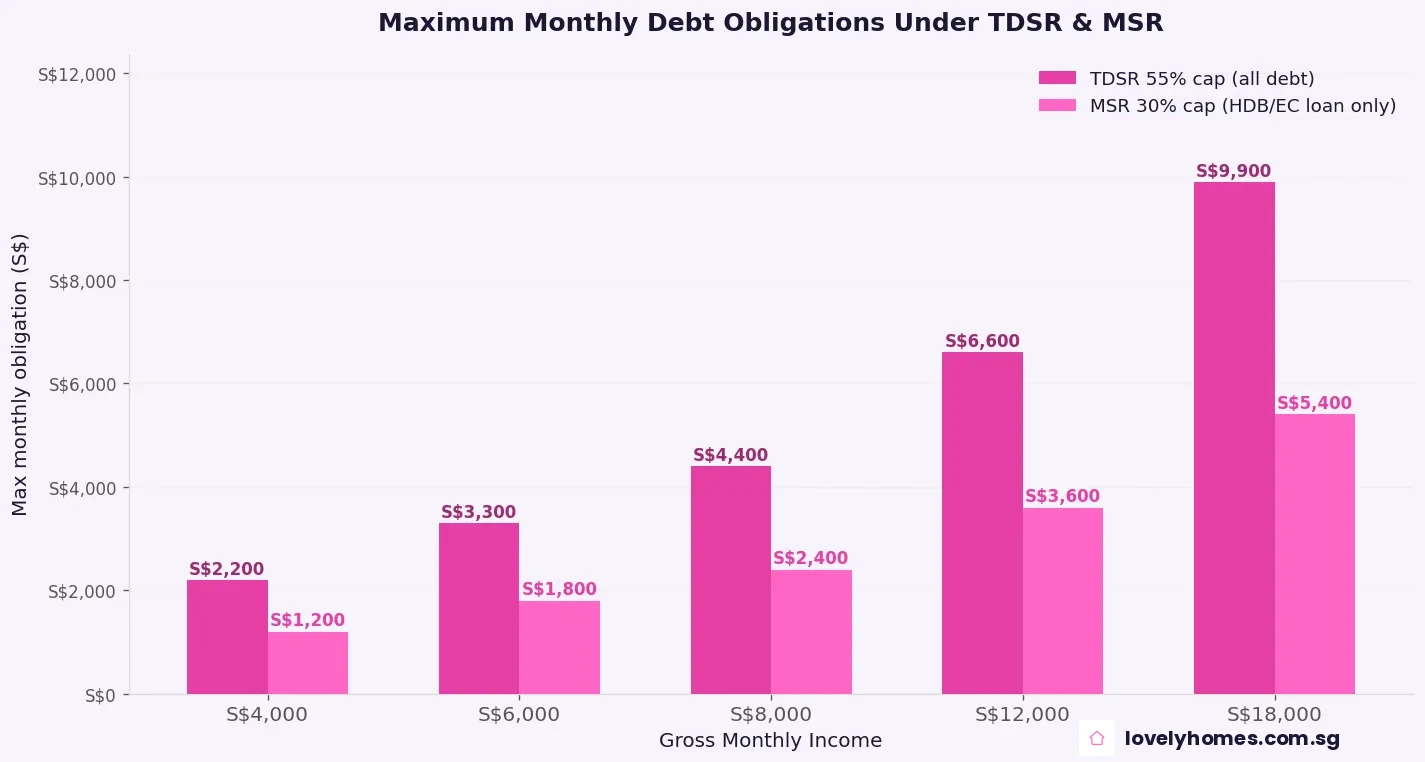
TDSR 55% vs MSR 30% maximum monthly debt obligations by gross monthly income Singapore 2026
Figure 1: Maximum monthly debt obligations under TDSR (55%) and MSR (30%) for gross monthly incomes of S$4,000 to S$18,000. MSR applies only to HDB and EC loans; TDSR applies to all property types.

LTV Limits: How Much Can You Borrow?

The Loan-to-Value (LTV) ratio sets the maximum loan amount as a percentage of the property’s purchase price or market valuation, whichever is lower. LTV rules are set by MAS and the HDB and operate independently of TDSR — both must be satisfied, and the lower of the two maximum loan amounts applies.

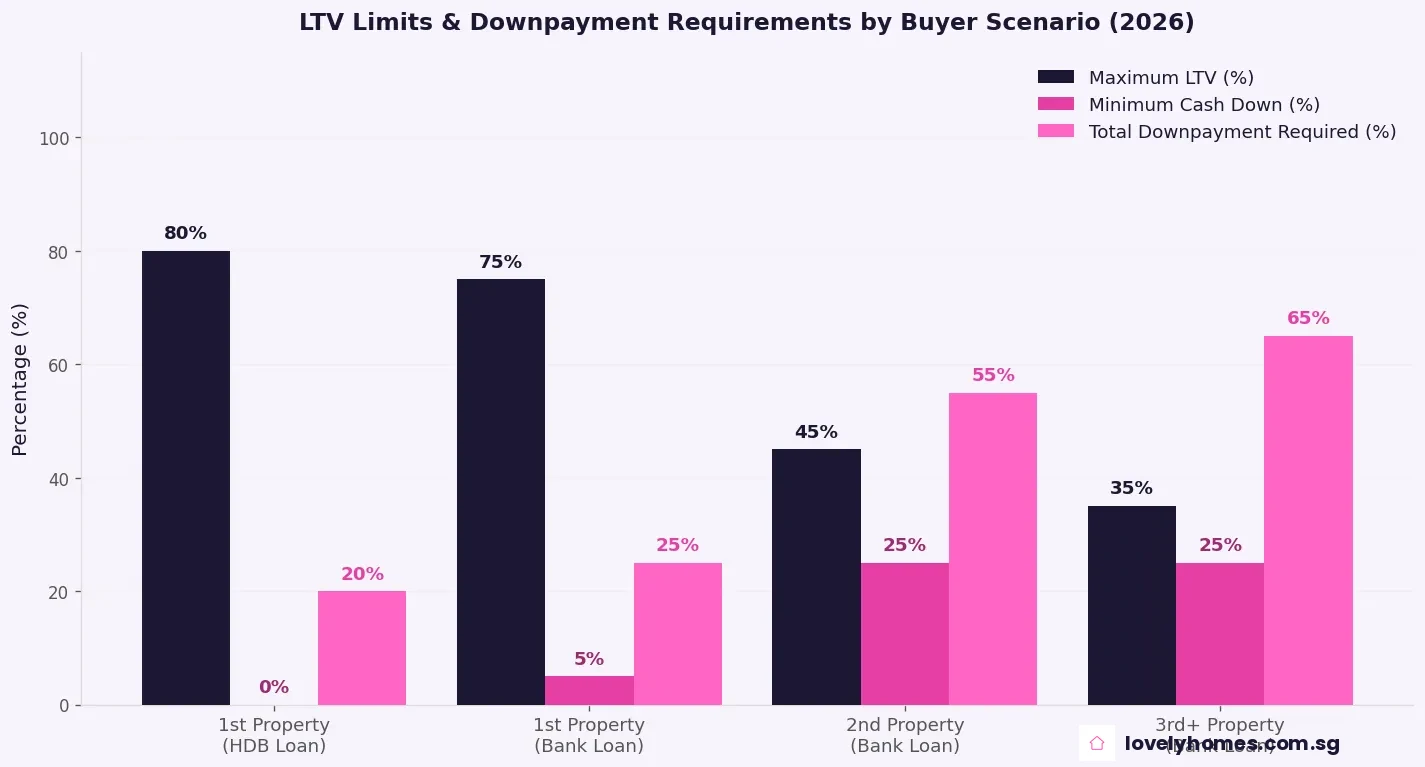
For a first residential property purchased with a bank loan, the LTV limit is 75%, meaning you can borrow up to three-quarters of the property value and must fund the remaining 25% from your own resources. Of that 25%, at least 5% must be paid in cash; the balance can come from CPF Ordinary Account (OA) savings. For second properties, the LTV drops sharply to 45%, with a minimum cash requirement of 25% of the purchase price. For third and subsequent properties, the LTV is 35%.

For HDB concessionary loans, the LTV is 80%, and HDB does not impose a minimum cash downpayment — the entire downpayment can be funded from CPF OA. This makes HDB loans particularly accessible for buyers with limited cash savings but healthy CPF balances.

LTV limits and downpayment requirements by buyer scenario Singapore 2026 first second third property
Figure 2: LTV limits and downpayment requirements by buyer scenario in Singapore 2026. Bank loans require 5% cash for first property and 25% cash for second or subsequent properties.

How TDSR Is Computed: What Counts as Debt?

Understanding what income and debt figures your bank will use is critical to knowing your real borrowing limit. The following guidelines apply under MAS Notice 632.

Income included in TDSR calculation: Fixed monthly salary, regular allowances confirmed by the employer, rental income (after a 30% haircut), and investment income (after a 30% haircut). Variable income such as commissions, bonuses and overtime is eligible but subject to a 30% haircut — meaning only 70% of your average variable income over the past 12 months is recognised.

Debt counted in TDSR: All monthly loan repayments must be included: the proposed housing loan instalment (calculated at the stress-test rate — see below), car loans, personal loans, outstanding credit card balances (counted at 5% of the outstanding balance per month, or the minimum monthly repayment if higher), student loans, and other secured or unsecured borrowings. Investment property loan instalments also count, even if the property is tenanted and generating rental income.

Debt excluded from TDSR: Insurance premiums, utility bills, hire-purchase agreements for vehicles entered into before 26 August 2013, and medisave contributions are excluded from the TDSR computation.

Stress-Test Rates: Why Your Maximum Loan Is Lower Than You Think

Banks do not use the actual prevailing interest rate when computing your TDSR. Instead, MAS requires them to use a stress-test rate — a notional higher rate designed to ensure you can still service the loan if interest rates rise. The stress-test rates currently prescribed under MAS Notice 632 are:

  • For floating-rate loans (e.g. SORA-pegged): the higher of the prevailing floating rate plus 1 percentage point, or 4% p.a.
  • For fixed-rate loans: the higher of the prevailing fixed rate, or 3% p.a.

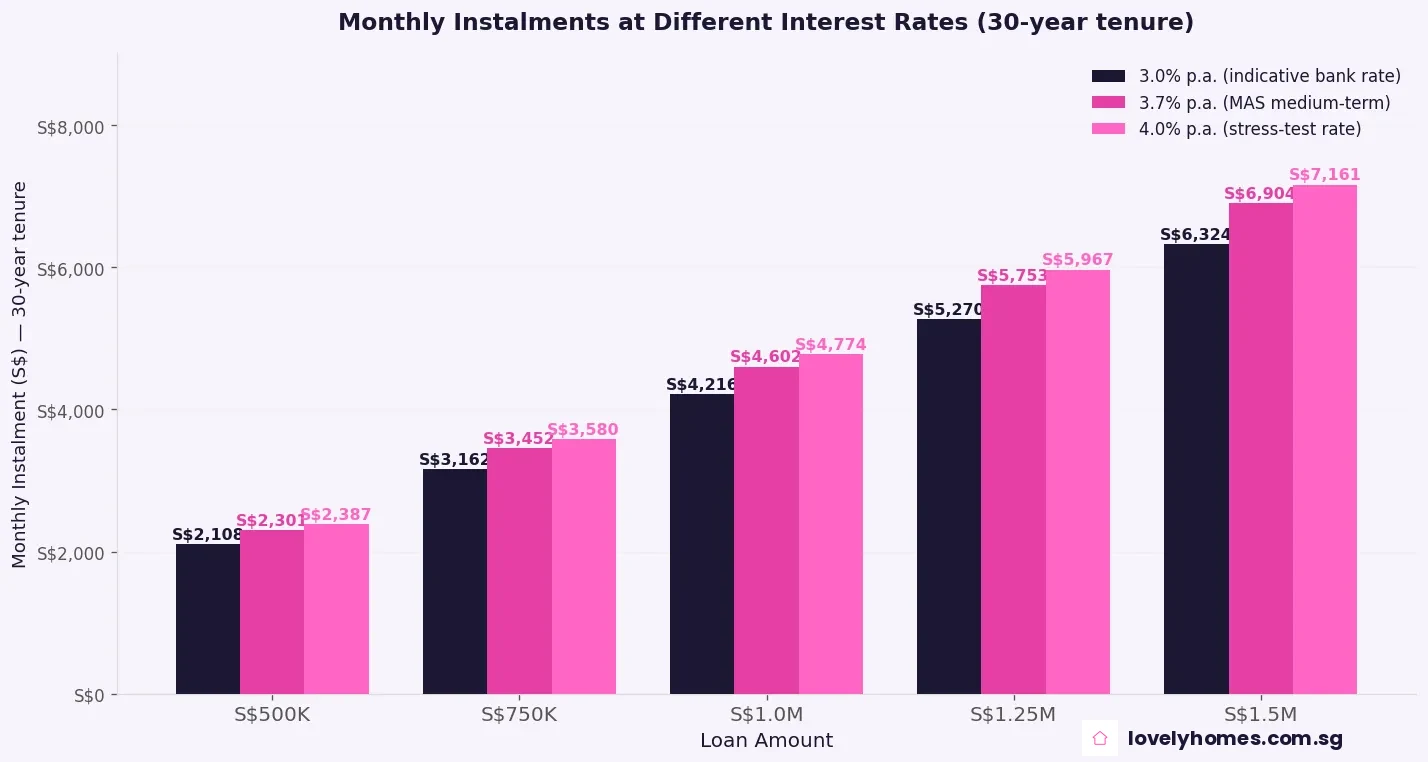
In practice, with SORA currently well below 3%, the 4% floor is the binding constraint for most floating-rate borrowers. This means your maximum eligible loan is calculated assuming you are already paying instalments at 4% p.a., even if the rate on offer today is significantly lower. This is a deliberate policy choice by MAS to build a buffer against rising rates.

Monthly instalments at different interest rates 3% 3.7% 4% stress test Singapore property loan 30-year tenure
Figure 3: Monthly instalments at 3.0% (indicative bank rate), 3.7% (MAS medium-term benchmark) and 4.0% (stress-test rate) for loan amounts from S$500,000 to S$1.5 million on a 30-year tenure. TDSR is assessed at the stress-test rate, not the actual rate.

Summary: TDSR & MSR Rules at a Glance (2026)

Rule Limit Applies To Administered By
TDSR 55% of gross monthly income All property loans (HDB, private, commercial) MAS (Notice 632)
MSR 30% of gross monthly income HDB and EC loan instalments only MAS / HDB
LTV (1st property, bank) 75% of value Bank loan for any property MAS
LTV (1st property, HDB loan) 80% of value HDB concessionary loan only HDB
LTV (2nd property, bank) 45% of value Any second property bank loan MAS
LTV (3rd+ property, bank) 35% of value Third or subsequent property MAS
Minimum cash (1st, bank) 5% of purchase price First property bank loan MAS
Minimum cash (2nd/3rd+, bank) 25% of purchase price Second and subsequent properties MAS

Worked Example: TDSR, MSR and LTV in Action

Mr and Mrs Wong are Singapore Citizens. Their combined gross monthly income is S$11,000 (Mr Wong S$7,000 fixed salary; Mrs Wong S$4,000 fixed salary). They have a car loan with a monthly instalment of S$900. They wish to purchase a 4-room HDB resale flat in Tampines for S$635,000. They are evaluating both an HDB concessionary loan and a bank loan on a 25-year tenure.

HDB concessionary loan scenario:
LTV 80%: maximum loan = S$635,000 x 80% = S$508,000.
Monthly instalment at 2.6% p.a. over 25 years: approximately S$2,305/month.
MSR check: S$2,305 / S$11,000 = 20.9% — well within the 30% MSR limit. PASS.
TDSR check: (S$2,305 + S$900) / S$11,000 = 29.1% — well within the 55% TDSR limit. PASS.
Minimum downpayment: 20% = S$127,000 (can be fully funded from CPF OA; no minimum cash required for HDB loans).

Bank loan scenario:
LTV 75%: maximum loan = S$635,000 x 75% = S$476,250.
Stress-test rate at 4% p.a. over 25 years: monthly instalment = approximately S$2,508/month.
MSR check: S$2,508 / S$11,000 = 22.8% — within 30% MSR limit. PASS.
TDSR check (stress test): (S$2,508 + S$900) / S$11,000 = 30.98% — within 55% TDSR limit. PASS.
Actual instalment at 3.5%: approximately S$2,383/month.
Minimum downpayment: 25% = S$158,750; of which at least 5% cash = S$31,750 (balance S$127,000 from CPF OA).

In this scenario, TDSR and MSR are easily met for both loan types. The practical constraint is the LTV: the HDB loan allows borrowing S$508,000 versus S$476,250 for the bank loan. Buyers who have CPF OA savings but limited cash liquidity will find the HDB loan more accessible (no minimum cash downpayment). Buyers with strong CPF balances and competitive fixed-rate offers from banks may prefer the bank loan to obtain a potentially lower effective rate.

Why These Rules Matter for Singapore Property Buyers

Singapore’s TDSR and MSR framework is among the most comprehensive borrower-protection regimes in the region. The rules serve two distinct purposes. First, they protect households from the financial distress that follows over-borrowing: a borrower who commits 70% of income to debt servicing has almost no buffer for unexpected expenses, job loss, or rising interest rates. Second, they cool speculative demand by making it harder to pyramid property loans across multiple properties without meaningful income growth.

In practice, buyers frequently misjudge how tightly the rules bind. A family with S$12,000 combined gross income and a S$1,500/month car loan can only allocate S$5,100 to housing (TDSR: S$6,600 minus S$1,500 car). At the 4% stress-test rate on a 30-year tenure, that limits the loan to approximately S$1.07 million — well below the 75% LTV on many private condominiums in the Outside Central Region. Knowing your TDSR headroom before you start viewing properties prevents disappointment.

Peer-country context: Hong Kong’s TDSR equivalent caps at 50% (with a 60% ceiling at higher LTV thresholds), and Australia imposes a 3 percentage-point serviceability buffer above the applicable rate under APRA guidelines. Singapore’s 55% TDSR with a 4% stress-test floor is broadly in line with international standards — firm enough to prevent excess, flexible enough not to freeze out creditworthy middle-income buyers.

What Might Change Next: Forward-Looking Considerations

MAS reviews the TDSR stress-test rates periodically. With the global rate cycle having peaked in 2023 and benchmark rates declining through 2025 and into 2026, some commentators have speculated that MAS may soften the 4% floor for floating-rate loans if SORA remains suppressed. However, as at August 2026, MAS has given no indication of adjusting TDSR parameters, and the existing framework is viewed as the appropriate long-term calibration. Buyers should plan on the basis of existing rules rather than anticipated relaxation.

The MSR 30% limit for HDB and EC loans has been stable since its introduction in 2013. Any increase in income ceilings for HDB flats or ECs (currently S$14,000 per month for standard HDB; S$16,000 for ECs) would expand the pool of eligible buyers without adjusting the MSR percentage itself.

Frequently Asked Questions

Does TDSR apply if I am buying a property under a sole name while my spouse has no income?

Yes. TDSR is applied to the borrower or borrowers named on the loan application. If you are the sole borrower, your gross monthly income alone is used. Your spouse’s income is only included if they are a co-borrower on the loan. Adding a co-borrower with income can increase your eligible loan amount, but both parties become jointly liable for the debt. If your spouse has no income and you are the sole earner, only your income is recognised by the lender.

How does rental income affect TDSR?

Rental income from an investment property is recognised in TDSR calculations, but only at 70% of its value (a 30% haircut, consistent with the treatment of other variable income). You will need to provide tenancy agreements, tax documents, or a lender-accepted declaration to have rental income recognised. Note that the full outstanding loan on the tenanted property (including its monthly instalment) still counts as debt in your TDSR calculation, so the net benefit of rental income on your TDSR position depends on the rental yield relative to the loan instalment.

Does MSR apply to EC purchases with a bank loan?

Yes. ECs are classified as public housing for the first 10 years (until privatisation), and MAS applies MSR to any bank loan used to purchase an EC during this period. This means your monthly EC loan instalment must not exceed 30% of gross monthly income, regardless of whether a bank or the developer is financing the purchase. For buyers comparing ECs with private condominiums, this is a material difference: the same gross income unlocks a meaningfully larger private loan under TDSR alone.

What happens to my TDSR if I have an outstanding renovation loan?

Renovation loans are unsecured personal loans and count in full toward your TDSR calculation. If you took a S$50,000 renovation loan repayable over 5 years at S$900/month, that S$900 reduces your TDSR headroom for the proposed mortgage. It is therefore advisable to either fully repay renovation and personal loans before applying for a property loan, or factor them into your borrowing plan from the outset. Most banks will decline or reduce a property loan application where existing debt already consumes a significant portion of the 55% ceiling.

Can I use my CPF savings to reduce the loan amount and improve my TDSR position?

Absolutely. Making a larger CPF downpayment reduces the loan principal, which in turn reduces the monthly instalment and therefore the TDSR ratio. For example, if you put 40% down using CPF OA rather than the minimum 20%, the loan drops from 80% to 60% of the property value, cutting the monthly instalment roughly proportionally. However, note that CPF savings earmark a 2.5% p.a. accrued interest charge: when you sell the property, the CPF board recoups the principal plus all accrued interest, which reduces your net sale proceeds. Using CPF to improve TDSR does not eliminate this cost.

Are there any exemptions from TDSR?

MAS provides a limited TDSR exemption for owner-occupier purchases where the outstanding loan amount does not exceed S$200,000. In practice, very few Singapore properties are priced low enough to benefit from this exemption. There is no general TDSR exemption for first-time buyers, for purchases of HDB flats, or for any particular nationality or residency status. The exemption for purely commercial properties (non-residential) is governed separately under a different MAS notice, and is generally not applicable to residential purchases.

Related Articles

Disclaimer

This article is for general information purposes only and does not constitute financial, legal or mortgage advice. TDSR, MSR and LTV rules are subject to change by MAS and HDB at any time. Borrowing limits depend on your individual financial profile, income documentation, and the specific property and loan product. Always consult a licensed financial adviser and your bank before committing to any property purchase or loan. Official sources: MAS (mas.gov.sg) and HDB (hdb.gov.sg).

URA Launches GLS Sites at Marina Gardens Lane and Orchard Boulevard: 500 New Homes for Singapore’s 2H 2026 Land Programme

URA Launches GLS Sites at Marina Gardens Lane and Orchard Boulevard: 500 New Homes for Singapore’s 2H 2026 Land Programme

Quick Answer: URA GLS Marina Gardens Lane and Orchard Boulevard — 6 Key Facts

  • The Urban Redevelopment Authority (URA) released two residential GLS sites on 13 August 2026 under the 2H 2026 Government Land Sales Programme.
  • Marina Gardens Lane (near Marina South MRT, Thomson-East Coast Line): ~390 residential units; tender closes 15 October 2026.
  • Orchard Boulevard (near Orchard Boulevard MRT, TEL): ~110 residential units; tender closes 29 October 2026.
  • Both sites form part of the 2H 2026 Confirmed List, which totals 4,745 residential units — more than 50% above the 10-year annual average Confirmed List supply.
  • Marina South is a planned car-lite, waterfront residential precinct that URA has been developing progressively since the early 2020s.
  • Orchard Boulevard offers rare prime District 10 (CCR) land in a location that has seen very limited new private supply in recent years.

Two Prime Sites Released Under Singapore’s 2H 2026 GLS Programme

The Urban Redevelopment Authority (URA) today released two residential land parcels for sale under the Confirmed List of the second-half 2026 Government Land Sales (GLS) Programme. The sites — at Marina Gardens Lane and Orchard Boulevard — are among the most closely watched land parcels in the 2H 2026 programme, given their locations in two distinctly different but equally sought-after precincts of Singapore.

The GLS programme is the Singapore government’s primary mechanism for releasing state land for private residential and commercial development. Sites on the Confirmed List are launched regardless of market demand signals; the Reserve List operates on application. Today’s release expands the already large 2H 2026 Confirmed List — one that URA has deliberately sized at well above historical norms to address the persistent supply-demand imbalance in Singapore’s private residential market.

I. Marina Gardens Lane: Marina South’s Next Chapter

The Marina Gardens Lane site is located in Marina South, a waterfront precinct that URA has been developing as Singapore’s newest large-scale residential neighbourhood. The area is positioned along the Greater Southern Waterfront, adjacent to Marina Bay, and is designed as a car-lite community with high-quality public transport connectivity via the Thomson-East Coast Line (TEL) at Marina South MRT station.

The Marina Gardens Lane site can potentially yield approximately 390 residential units. The tender closes at noon on 15 October 2026. This is consistent with previous Marina South GLS releases — the area has seen multiple sites released since 2021, and the emerging neighbourhood is beginning to take shape with the first residential towers under construction.

Marina South’s appeal to developers lies in several factors. It offers large, contiguous land parcels of a size that is extremely difficult to assemble through en bloc collective sales in the established private market. It has direct MRT connectivity. And it benefits from URA’s planning vision for the precinct — a walkable, green, waterfront residential community with proximity to Marina Bay’s business, lifestyle, and entertainment hub. Industry data suggests Marina South launches in the surrounding area have attracted significant buyer interest, particularly from upgraders and investors who see the long-term development trajectory of the precinct.

II. Orchard Boulevard: Rare Prime CCR Supply

The Orchard Boulevard site is located in District 10, one of Singapore’s most prestigious residential addresses. At approximately 110 units, it is a significantly smaller site than Marina Gardens Lane — reflecting both the limited scale of developable land in this part of the Core Central Region (CCR) and the very high land values that make large sites financially prohibitive.

The Orchard Boulevard site is near the Orchard Boulevard MRT station on the Thomson-East Coast Line, providing direct connectivity along the TEL corridor from Woodlands to the East Coast. New private residential supply in District 10 has been extremely limited over the past several years — the combination of high land costs, few available sites, and the long development timeline means that buyers seeking brand-new freehold or 99-year leasehold private apartments in this part of Singapore have had very few options. The tender for this site closes at noon on 29 October 2026.

Note on scale: With only ~110 potential units, the Orchard Boulevard site is likely to attract developers aiming at the luxury or ultra-luxury CCR buyer segment. Unit sizes are typically larger in CCR developments — this site may yield fewer than 110 units if the developer opts for larger floor plates, or could push to maximum plot ratio to maximise saleable area.

III. The Bigger Picture — 2H 2026 GLS Supply in Context

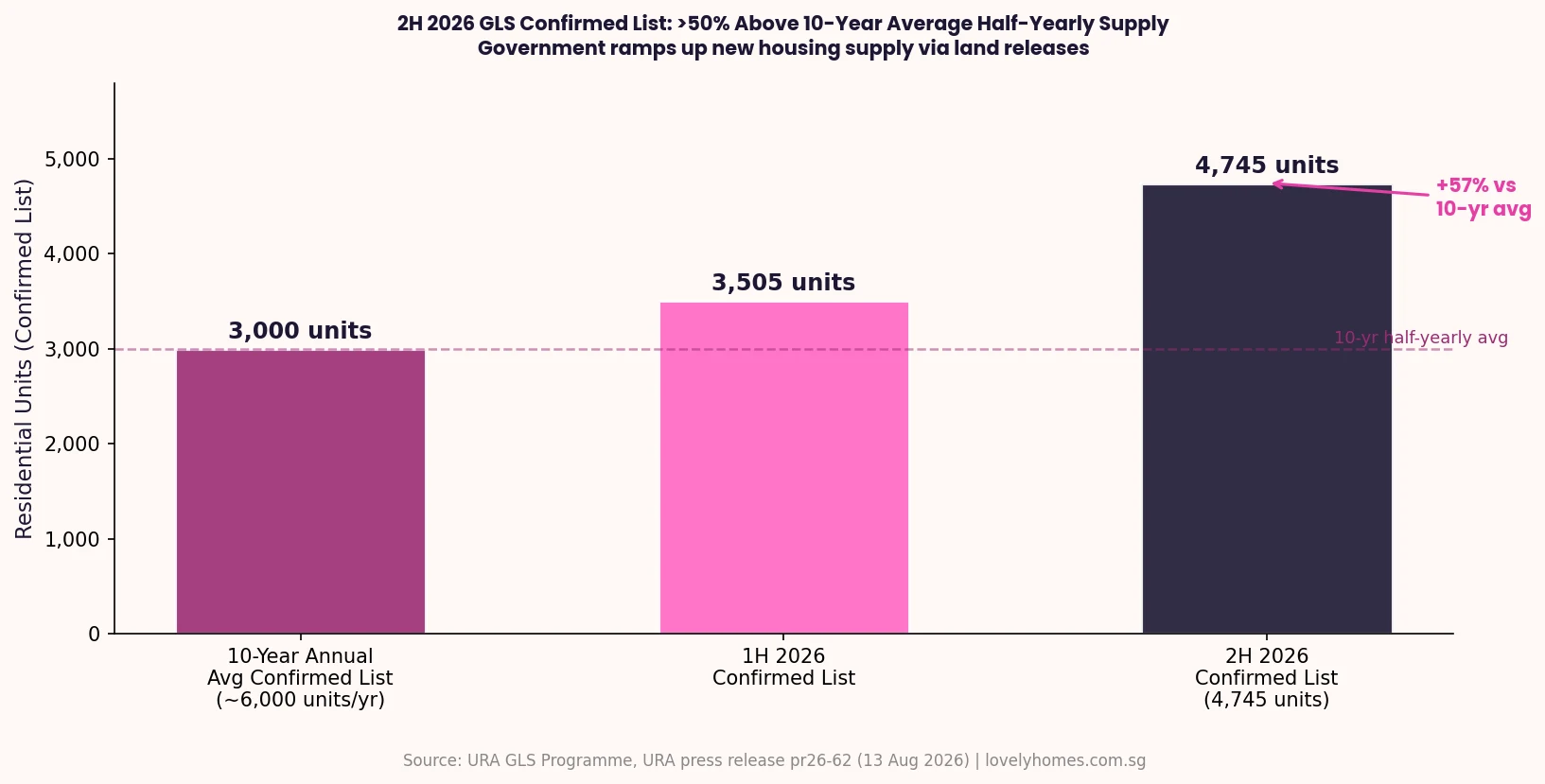
Both sites are part of the URA’s 2H 2026 GLS Confirmed List, which was announced earlier this year and totals 4,745 residential units across all confirmed sites for the second half of 2026. To put this figure in context:

URA 2H2026 GLS Confirmed List 4745 units supply comparison Singapore 2026 bar chart
Figure 1: 2H 2026 GLS Confirmed List at 4,745 Units — More Than 50% Above the 10-Year Average Half-Yearly Confirmed List Supply. Source: URA GLS Programme, URA press release pr26-62 (13 August 2026)
GLS Period Confirmed List Units Vs 10-Yr Avg (half-yr)
10-Year Average (annual) — approx. ~6,000 per year (~3,000 per half) Baseline
1H 2026 Confirmed List ~3,505 units +17% vs half-yr avg
2H 2026 Confirmed List 4,745 units +58% vs half-yr avg

The 2H 2026 Confirmed List represents a deliberate policy decision by the Singapore government to front-load supply into the market at a time when private residential prices have continued to rise despite multiple rounds of ABSD adjustments. The view from URA is that the medium-term supply pipeline — comprising GLS sites, en bloc redevelopments, and executive condominium launches — must be sufficiently deep to moderate price growth and maintain housing affordability, particularly for Singaporean upgraders who face the 20% ABSD rate on their second purchase.

A larger GLS pipeline has two effects on the broader market. First, it increases future supply, which in time translates to more completed units available for buyers. Second, it gives developers alternatives to en bloc bids — with more GLS land available, developers are less compelled to pay high premiums for collective sale sites in the secondary market. Industry analysts suggest this is one reason the en bloc market has been comparatively muted in 2H 2026, even as individual sites like City Plaza (S$970M, 13 August tender) have attracted interest.

IV. What This Means for Buyers, Sellers and Investors

For buyers considering new launch properties in Marina South or the Orchard Boulevard corridor, the release of these sites signals that new developments are in the pipeline, but completion will be 3–5 years away from tender close. Buyers who need to transact now should look at existing new launches in adjacent areas (TEL-connected precincts, Marina Bay fringe) rather than waiting for these specific sites to be marketed.

For sellers of existing private residential properties in Marina South or District 10, a larger GLS pipeline may apply some price discipline to new launches (as developers face higher land costs from competitive bidding for GLS sites alongside a larger total supply). However, resale properties in established prime districts with immediate availability and leasehold tenure clarity continue to command buyer attention from owner-occupiers.

For en bloc owners in nearby precincts, the point made above is relevant: a more active GLS programme reduces developer urgency to acquire en bloc sites at significant premiums. Developments pursuing collective sales in Marina-adjacent or Orchard-adjacent locations may find that their expected premiums are moderated as developers weigh GLS alternatives.

V. What Might Come Next

The next GLS tender deadlines — 15 October 2026 for Marina Gardens Lane and 29 October 2026 for Orchard Boulevard — will be followed by a period of evaluation by URA. Developers typically submit a single sealed bid at tender close, and URA evaluates bids on the basis of price (highest acceptable bid) and development quality criteria (for some sites with specific design requirements). Results for both sites can be expected approximately 4–8 weeks after tender close.

Following any award, the developer typically has 5 years from the date of award to complete the development (with possible extensions). Given the 2026 award timeline, residents could expect new completions from these sites as early as 2030–2031, adding to Singapore’s private residential inventory in that period.

Frequently Asked Questions: URA GLS Sites 2026

What is the Government Land Sales (GLS) programme?

The Government Land Sales programme is administered by URA (for residential and commercial sites) and JTC (for industrial sites). Under the GLS, the government releases state-owned land for private development through competitive tender. The Confirmed List comprises sites that will be launched regardless of market demand; the Reserve List comprises sites that are only launched if a developer applies and the government accepts the proposed price. The GLS programme is the primary mechanism by which Singapore regulates the supply of private residential land and ensures that housing supply keeps broadly pace with demand.

What is Marina South and why is it significant?

Marina South is a planned residential and mixed-use precinct at the southern tip of the Marina Bay area, adjacent to the Gardens by the Bay waterfront. URA has designated it as a car-lite neighbourhood, meaning it is designed with high-quality public transport connections (Marina South MRT on the TEL), cycling infrastructure, and minimal surface car parking. It is part of the broader Greater Southern Waterfront transformation that will eventually link Tanjong Pagar, Keppel, Sentosa, and Marina Bay into a continuous waterfront live-work-play corridor. The Marina Gardens Lane site released today is one of several GLS sites URA has progressively released in the precinct since 2021 to build up the neighbourhood’s residential population.

When will the new developments on these sites be ready for buyers?

Developers who win the tender typically have 5 years from the award date to obtain Temporary Occupation Permit (TOP). With tender closes in October 2026 and a typical development timeline of 3–5 years post-award, buyers could expect TOP for these developments as early as 2030 and as late as 2031–2032. New launch marketing (sales prior to construction completion) would typically begin 6–18 months after the award, subject to the developer’s marketing strategy and the prevailing market conditions at that time.

Does a higher GLS supply mean property prices will fall?

Not necessarily, and not immediately. New GLS supply does not translate into completed units for 3–5 years. In the near term, a larger pipeline signals future supply additions, which can moderate buyer expectations of price appreciation and give buyers and sellers more negotiating latitude. Over the medium term, if completed supply outpaces demand growth, prices in certain segments may experience softer growth or modest corrections. However, Singapore’s property market is also supported by population growth, strong GDP, continued expatriate demand, and limited land — structural factors that underpin long-term demand. URA’s GLS calibration is designed to moderate prices, not engineer sharp falls.

Are these sites freehold or leasehold?

GLS sites released by the Singapore government are almost always on 99-year leasehold tenure, as the government retains underlying ownership of state land. Freehold land in Singapore predominantly comprises private land that has been in private ownership since colonial times or was converted. The Marina Gardens Lane and Orchard Boulevard sites released today are expected to be 99-year leasehold — the full terms and conditions are available in the eDeveloper’s Packet sold through URA’s One-Stop Developer Portal at digitalservice.ura.gov.sg.

Disclaimer: This article is for general information only and is based on publicly available information from URA press release pr26-62 dated 13 August 2026. Development unit counts, tender timelines, and site details are subject to change. Pricing and development outcomes will depend on competitive bidding and subsequent developer decisions. This article does not constitute financial or property investment advice. For official GLS site information, visit URA Land Sales (ura.gov.sg). For official property statistics, refer to URA Property Data.

×

Click anywhere to close

Singapore En Bloc Sale Process Guide 2026: How Collective Sales Work, Rules and What Owners Can Expect

Singapore En Bloc Sale Process Guide 2026: How Collective Sales Work, Rules and What Owners Can Expect

Quick Answer: Singapore En Bloc Sale — 8 Key Facts

  • An en bloc (collective sale) requires 80% consent by share value and strata area for developments aged 10 years or more; 90% for those under 10 years.
  • The legal framework is the Land Titles (Strata) Act (LTSA), administered by the Strata Titles Board (STB) under the Ministry of Law.
  • Owners elect a Sale Committee (SC) at an Extraordinary General Meeting (EGM) to manage the process on their behalf.
  • A Collective Sale Agreement (CSA) sets the reserve price, distribution formula and other binding terms — all consenting owners sign it.
  • STB reviews the application and mediates objections; dissenting minority owners have limited grounds for challenge once the consent threshold is met.
  • Proceeds are split by share value, strata area, or a hybrid of both — the formula is agreed in the CSA before marketing begins.
  • There is no capital gains tax on en bloc proceeds in Singapore; proceeds are treated as capital receipts for most owner-occupiers.
  • The average en bloc cycle runs 18–36 months from Sale Committee formation to final distribution of funds.

Introduction: What Is an En Bloc Sale and Why Does It Matter?

An en bloc sale — derived from the French phrase meaning “all together” — is a mechanism unique to Singapore’s strata-titled property market. It allows the entire ownership of a development (every unit, every owner) to be sold simultaneously to a single purchaser, typically a property developer. Unlike a standard private sale where one owner transacts independently, an en bloc overrides individual preference: once the statutory consent threshold is achieved and the Strata Titles Board (STB) approves the sale, all owners — including those who voted against — must sell at the agreed price.

For Singapore’s urban renewal, en bloc is a critical tool. It allows ageing, low-density developments on prime land to be redeveloped into higher-density housing, bringing new supply to the market and allowing developers to assemble large contiguous sites that would otherwise be impossible to acquire piecemeal. For the individual owner, it can represent a windfall — or an unwelcome forced exit. Understanding how the process works, what your rights are, and how the proceeds are calculated is essential for any property owner in a strata development.

This guide covers the full en bloc process under the Land Titles (Strata) Act (LTSA), the consent thresholds, the 8-step collective sale timeline, how distribution formulas work, what minority owners can do, and a worked example of how the numbers are calculated.

I. Legal Framework and Consent Thresholds

En bloc sales in Singapore are governed by the Land Titles (Strata) Act (LTSA), Chapter 158A, specifically Sections 84A to 84G. The Urban Redevelopment Authority (URA) issues development controls that dictate what a developer can build on the acquired site, and the Strata Titles Board (STB) — a quasi-judicial body under the Ministry of Law — adjudicates all en bloc applications.

The most critical threshold is consent. Before any sale can proceed to STB, owners representing the required percentage of both share value and strata floor area must sign the Collective Sale Agreement (CSA). The thresholds depend on the age of the development:

En bloc consent threshold table Singapore 80 percent 90 percent LTSA
Figure 1: En Bloc Consent Thresholds under the Land Titles (Strata) Act — Source: Singapore Statutes Online, Ministry of Law

The “age” of a development is measured from the date of issue of the latest Temporary Occupation Permit (TOP) or the date of the strata subdivision, whichever is earlier. For mixed developments (residential + commercial), the threshold applies to all strata unit types combined. A development that barely cleared 80% consent is just as legally valid as one with 95% — the STB cannot impose a higher threshold than the statute requires.

It is worth noting that the share value — a number assigned to each unit by the Land Titles (Strata) Act based on the unit’s size and level — is not the same as the strata area. A large penthouse might have a high strata area but a different share value. Developers and legal advisers pay close attention to which units’ owners have and have not signed, as a small cluster of high-share-value units can hold out against the 80% threshold even if far more than 80% of owners by head count have consented.

II. The 8-Step En Bloc Process in Singapore

From the first EGM to the final distribution of funds, a successful en bloc sale typically follows eight distinct stages. Each stage has legal and procedural requirements under the LTSA, and the timelines can vary significantly depending on the development’s size, the level of owner consensus, and whether STB mediation is needed.

En bloc collective sale 8-step process Singapore STB LTSA flowchart
Figure 2: The 8-Step Collective Sale Process in Singapore — from EGM to proceeds distribution. Source: LTSA, Strata Titles Board

Step 1 — EGM and Sale Committee Formation: Any owner can call an Extraordinary General Meeting (EGM) to propose forming a Sale Committee. The SC is elected by majority vote among attendees. It must comprise at least 3 elected subsidiary proprietors and may not include any person who has a conflict of interest (for example, someone who stands to profit from the sale as a developer’s agent).

Step 2 — Appoint Lawyers and Marketing Agent: The SC engages a law firm specialising in collective sales and a marketing agent. The marketing agent’s role is to assess the market, recommend a reserve price, and manage the tender or expression-of-interest process. Under editorial rules, LovelyHomes does not name specific agencies — only that the SC selects via competitive pitch.

Step 3 — Draft the Collective Sale Agreement (CSA): The CSA is the binding contract between all consenting owners. It must specify the reserve price, the apportionment method for distributing proceeds, the time limit for achieving consent, the sale method (public tender, private treaty, or expression of interest), and the sale committee’s authority to negotiate. The LTSA and related regulations prescribe minimum information requirements for the CSA.

Step 4 — Achieve 80% (or 90%) Consent: Owners are given the opportunity to read the CSA, seek independent legal advice, and sign (or not sign). The SC has up to 12 months from the date the first owner signs to achieve the required threshold. If the threshold is not reached within 12 months, the collective sale attempt lapses and a new EGM must be called to start again. This is why developments like City Plaza — which took three attempts over nearly a decade — are notable.

Step 5 — STB Application: Once the consent threshold is met, the SC must apply to the STB within 12 months of achieving the required percentage. The application must include the CSA, a valuation report confirming the reserve price is not less than market value, and statutory declarations from the SC members.

Step 6 — STB Notice and Mediation: The STB serves notice on all subsidiary proprietors, including dissenting owners. A 60-day mediation period follows, during which an STB mediator attempts to resolve objections. Most objections at this stage relate to the distribution formula or alleged procedural irregularities.

Step 7 — STB Order or High Court Approval: If mediation fails or all objections are resolved, the STB proceeds to make a formal order approving the sale. If the STB cannot resolve the matter — typically because objectors raise complex legal issues — the sale must be approved by the High Court. A High Court appeal against an STB order is also possible but requires leave and is rarely granted for procedural grounds alone.

Step 8 — Completion and Distribution: The developer completes the purchase (typically 12 weeks from STB order), and the sale proceeds are distributed to all owners according to the CSA apportionment formula, less legal fees and the SC’s costs.

III. How Are En Bloc Proceeds Distributed?

The distribution formula is one of the most contested aspects of any en bloc negotiation, because different formulas can produce dramatically different payouts for large versus small units. The LTSA does not mandate a specific formula — the SC and owners must agree on one in the CSA. Three main approaches are used in practice:

  • Share Value Method: Each owner receives a share of the total proceeds proportional to their unit’s share value. This tends to favour units on higher floors (which typically have higher share values under LTSA schedules).
  • Strata Area Method: Each owner receives a share proportional to their unit’s strata floor area. This tends to favour physically larger units, regardless of floor level.
  • Hybrid Method (most common): A weighted combination of share value and strata area — for example, 50% by share value and 50% by strata area. This is designed to be perceived as the fairest outcome by the broadest number of owners.
En bloc distribution formula share value strata area hybrid comparison Singapore
Figure 3: How Formula Choice Affects Individual Payouts — Illustrative 100-Unit Development, S$200M Total. Source: LovelyHomes analysis based on LTSA framework

As the chart illustrates, the hybrid method produces a middle outcome — small units receive slightly more than under the pure share value method (if their strata area percentage is higher than their share value percentage), while large units receive slightly less. Selecting the formula is therefore a political act within the development, and the SC must manage expectations carefully to avoid the formula becoming the reason owners refuse to sign the CSA.

IV. What Minority Owners Can Do — Grounds for STB Objection

An owner who does not wish to sell their unit can refuse to sign the CSA. But once the 80% (or 90%) threshold is crossed, their refusal no longer has any legal effect on whether the sale proceeds — they will be compelled to sell at the reserve price set in the CSA. Their recourse is limited to challenging the process before the STB.

Under Section 84A(9) of the LTSA, the STB shall approve a sale unless it is satisfied that:

  • The transaction is not in good faith, taking into account the sale price, the method of distribution of the sale proceeds, and the relationship between any of the purchasers and the subsidiary proprietors; or
  • The sale and purchase agreement would require a minority owner to be relocated to an alternative property that is not a comparable equivalent to their current unit.

The STB has very limited discretion to refuse a sale if the statutory requirements have been met. Courts have consistently held that the collective interests of the majority — and Singapore’s urban renewal objectives — outweigh the individual rights of dissenting minority owners, provided the process was conducted lawfully. However, any procedural irregularity in the CSA or the SC’s conduct can provide grounds for challenge, which is why well-advised SCs engage experienced law firms from the outset.

V. Development Charge — What It Is and Why It Affects the Sale Price

When a developer acquires an en bloc site and proposes to redevelop it at a higher intensity (more units, taller buildings, or a change of use), the Urban Redevelopment Authority (URA) levies a Development Charge (DC). The DC represents a tax on the enhancement in land value arising from the change in approved use or plot ratio.

DC rates are published quarterly by URA and vary by use group and development charge sector. For a residential site moving from 1.4 to 2.1 plot ratio, the DC can be substantial — potentially tens of millions of dollars. Developers factor the DC into their land bid price, meaning a higher expected DC reduces the maximum price a developer can profitably pay for the site. This is why the SC’s marketing agent always models the DC when recommending a reserve price.

Key En Bloc Fact Details
Governing Statute Land Titles (Strata) Act (LTSA), Chapter 158A
Consent Threshold (≥10 yrs) 80% by share value AND strata area
Consent Threshold (<10 yrs) 90% by share value AND strata area
Time to achieve consent 12 months from first CSA signature
STB application deadline 12 months from achieving consent threshold
STB mediation window 60 days after all parties notified
Typical full cycle 18–36 months (longer if High Court involved)
Capital Gains Tax on proceeds None (Singapore has no CGT)
Development Charge Paid by developer; reduces viable bid price
Distribution formula Share value, strata area, or hybrid — agreed in CSA

VI. Worked Example — The Numbers Behind a Typical En Bloc Sale

Consider a hypothetical 120-unit freehold condominium in District 14, built in 2008 (now 18 years old — well past the 10-year threshold). The development has a total strata area of 10,000 sqm and a total share value of 1,200. The SC has set a reserve price of S$240 million.

Mr and Mrs Lim own a 90 sqm unit on the 8th floor with a share value of 10. Their CPF Ordinary Account balance was drawn down by S$250,000 to purchase the unit in 2012, at an initial purchase price of S$850,000. The accrued interest on their CPF drawdown at 2.5% p.a. over 14 years is approximately S$104,000, making the total CPF refund obligation S$354,000 on sale.

Under the hybrid formula (50% share value, 50% strata area):

  • Share value %: 10/1,200 = 0.833%
  • Strata area %: 90/10,000 = 0.900%
  • Hybrid average: (0.833% + 0.900%) / 2 = 0.867%
  • Gross proceeds: S$240M × 0.867% = S$2,080,800

After deductions:

  • Legal fees (SC’s allocated cost to each owner): approximately S$3,500
  • CPF refund (principal + accrued interest): S$354,000 to CPF OA
  • Remaining bank mortgage (assume S$0 — fully paid off): S$0
  • Net cash received: approximately S$2,080,800 − S$3,500 − S$354,000 = S$1,723,300

If the Lims then wish to buy a replacement private property at S$1.8M (their second property, having now exited their only existing property), they would pay BSD of S$58,600 and zero ABSD — because they are SC buyers purchasing a first property after selling their only existing property. (The 28 July 2026 removal of the 15-month wait-out period for HDB resale is also relevant: if the Lims preferred to downgrade, they could now buy a non-subsidised HDB resale without waiting 15 months.)

VII. What This Means for Property Buyers and Sellers

If your current development is more than 10 years old and your management committee has received expressions of interest from developers, the en bloc process may be closer than you think. Understanding the CSA terms — especially the distribution formula and the reserve price relative to your own property’s valuation — is essential before you decide whether to sign. You are not legally required to consult a lawyer, but the LTSA expressly permits you to obtain independent legal advice at your own cost before signing the CSA.

If you are buying into a development with known en bloc potential, factor in the possibility that a successful sale could require you to exit within 12–24 months of purchase. The entry price, the potential payout, and your ability to secure replacement housing on short notice are all material considerations. En bloc potential can inflate the asking price of ageing developments in prime districts — do your own valuation analysis before paying a premium based purely on en bloc speculation.

VIII. What Might Come Next for Singapore En Bloc Sales

The Singapore en bloc market is cyclical. Activity tends to pick up when land-hungry developers exhaust Government Land Sales (GLS) options, when land values are rising strongly, and when the GLS Confirmed List is perceived as insufficient. URA’s 13 August 2026 release of two new GLS sites — Marina Gardens Lane and Orchard Boulevard — adds to a 2H2026 Confirmed List of 4,745 units, which is more than 50% above the 10-year average. A larger GLS pipeline gives developers more alternatives to en bloc bids and may dampen en bloc premiums over the near term.

Industry observers suggest that amendments to the LTSA to further protect minority owners or to streamline the STB process remain under periodic review by the Ministry of Law. Any changes to the consent thresholds or grounds of objection would materially alter the en bloc calculus for both owners and developers. For now, the 80%/90% framework established since 1999 remains intact.

Frequently Asked Questions: En Bloc Sales in Singapore

Can I be forced to sell my unit even if I voted against the en bloc?

Yes. Once the consent threshold (80% for developments aged 10 years or more; 90% for younger developments) has been met and the Strata Titles Board (STB) has approved the sale, all subsidiary proprietors — including those who refused to sign the Collective Sale Agreement (CSA) — are legally bound by the sale. Your only recourse is to lodge a formal objection with the STB on the limited grounds specified in the Land Titles (Strata) Act, primarily that the transaction is not in good faith or that the sale price is insufficient for you to purchase a comparable replacement property.

How long does an en bloc take from start to finish?

A straightforward en bloc where consent is achieved quickly and no STB objections are contested can be completed in as little as 18 months from the first EGM. More complex cases — particularly those involving multiple attempts at consent (as City Plaza’s three-attempt history shows) or where minority owners mount STB and then High Court challenges — can take 3–5 years or more from first EGM to final payout. The 12-month windows for achieving consent and for filing the STB application are statutory, but the STB and court processes themselves can extend considerably beyond that.

Will I pay income tax or capital gains tax on my en bloc proceeds?

For most owner-occupiers and long-term investors, no. Singapore has no capital gains tax, and en bloc proceeds received by an individual subsidiary proprietor are generally treated as capital receipts rather than income, and are therefore not subject to income tax. The exception is a developer or property trader who buys units in a development with the express intention of facilitating and profiting from an en bloc sale — in that situation, the IRAS may treat the profits as taxable income from a property trading business. If you are uncertain about your tax position, seek advice from a tax professional before the sale completes.

What is a Development Charge and who pays it?

The Development Charge (DC) is a levy payable by the developer (not the selling owners) to the Singapore Land Authority (SLA) when the proposed development exceeds the previously approved intensity or changes the use of the site. DC rates are published quarterly by URA and differ by use group and development charge sector. In practical terms, a high expected DC reduces the maximum land bid price a developer can sustain, which is why the SC’s marketing agent always models the DC when recommending the reserve price. Owners indirectly bear the DC through its effect on the bid price they receive, even though the legal obligation rests with the developer.

Can a development make more than one attempt at en bloc?

Yes. There is no statutory limit on the number of en bloc attempts a development can make. If the consent threshold is not achieved within 12 months of the first CSA signature, the attempt lapses. The Sale Committee may call a new EGM, elect a new (or reconstituted) SC, and begin the process again from the CSA stage. Developments like City Plaza (three attempts: 2012, 2018, 2021–2026) and many others in Singapore’s collective sale history have made multiple attempts before eventually succeeding — sometimes after significant shifts in the property market improved owners’ appetite for the reserve price on offer.

Is there a minimum reserve price that the Sale Committee must set?

The LTSA does not specify a minimum absolute figure. However, the CSA and the STB application must be accompanied by a valuation report from a licensed independent valuer confirming that the reserve price is not less than the market value of the property as a whole at the time of the application. In practice, most SCs set the reserve price at or above market value (often 10–30% above for prime sites) to make the collective sale financially attractive to consenting owners. Setting a reserve price that a valuer cannot certify as at least equal to market value would be grounds for STB to reject the application.

What happens to the proceeds if the sale falls through after STB approval?

If the sale falls through after the STB order — for example because the developer fails to exercise the option after the tender closes, or the developer is unable to complete — the deposit paid by the developer under the sale and purchase agreement is typically forfeited to the consenting owners (distributed according to the CSA apportionment formula). The development then continues to be owned by the subsidiary proprietors on their existing strata titles, and the SC would need to either re-launch the sale or wind up. The STB order itself does not expire if the sale is being actively pursued, but any further delay that requires a new STB application would restart the process.

Disclaimer: This article is for general information only and does not constitute legal, tax, or financial advice. En bloc processes and property legislation in Singapore can be complex and change over time. For advice specific to your situation — including whether to sign a Collective Sale Agreement, your rights as a dissenting owner, or the tax treatment of en bloc proceeds — consult a qualified Singapore lawyer, tax adviser, or licensed valuer. Official information on the Land Titles (Strata) Act is available at Singapore Statutes Online (sso.agc.gov.sg). STB procedures are documented at stratatitlesboard.gov.sg. URA Development Charge rates are published quarterly at ura.gov.sg.

×

Click anywhere to close

Translate »