Renting a Condo in Singapore 2026: Complete Guide to Leases, Costs and Tenant Rights

Renting a Condo in Singapore 2026: Complete Guide to Leases, Costs and Tenant Rights

Quick Answer — Renting a condo in Singapore at a glance

  • Median condo rent in 2026: S$3,100–S$5,700/month depending on unit size and region
  • URA private residential rental index fell 1.2% in Q1 2026 as new supply enters the market
  • Minimum legal tenancy for private property: 3 months (short-term rentals under 3 months are prohibited)
  • Upfront costs: typically 1+1 month security deposit + half-month agent commission
  • Stamp duty on tenancy agreement: 0.4% × annual rent × number of years
  • Landlord must supply a functional, habitable unit; tenant pays utilities and minor repairs
  • Look for a diplomatic clause if your stay may be cut short — usually exercisable after month 12
  • The non-citizen quota (NCQ) limits foreign tenants in HDB estates to 8% per neighbourhood and 11% per block — condo rentals have no NCQ restriction

Renting a condominium in Singapore is the entry point for most expatriates, professionals on employment passes, and Singaporeans who are in between home ownership. It is also increasingly attractive to local upgraders who sell their HDB flat but want flexibility before committing to a private purchase. In 2026, the rental market has shifted in tenants’ favour: vacancy rates have edged up to around 7%, the Urban Redevelopment Authority (URA) reported a 1.2% quarterly decline in the private residential rental index in Q1 2026, and landlords in many districts are now negotiating where they once insisted. This guide explains how renting a condo in Singapore actually works — from understanding what a unit costs across different regions, to signing a legally compliant tenancy agreement, to knowing your rights as a tenant when things go wrong.

The Singapore Private Rental Market in 2026

Singapore’s private residential rental market is administered indirectly by the URA, which tracks rental transactions and publishes quarterly price and rental indices. Unlike HDB rentals, private condo rentals are not subject to nationality quotas — a landlord may rent to any nationality with a valid pass or PR status. The market is therefore more internationalised, with a significant proportion of tenants being expatriates on Employment Passes (EP) or S Passes, as well as Singaporeans awaiting new-launch completion.

After an extraordinary run-up of over 40% in rental values between 2021 and 2023 — driven by post-pandemic return of expats, supply constraints, and HDB delays — the market began softening in late 2023 and has continued to normalise. As at Q1 2026, private residential rents remain elevated against 2019 levels but are declining gradually as the pipeline of 17,032 unsold units (URA Q1 2026) and completions from 2022–2024 launches add supply. Vacancy has widened to an estimated 7%, giving tenants meaningful negotiating leverage for the first time in years.

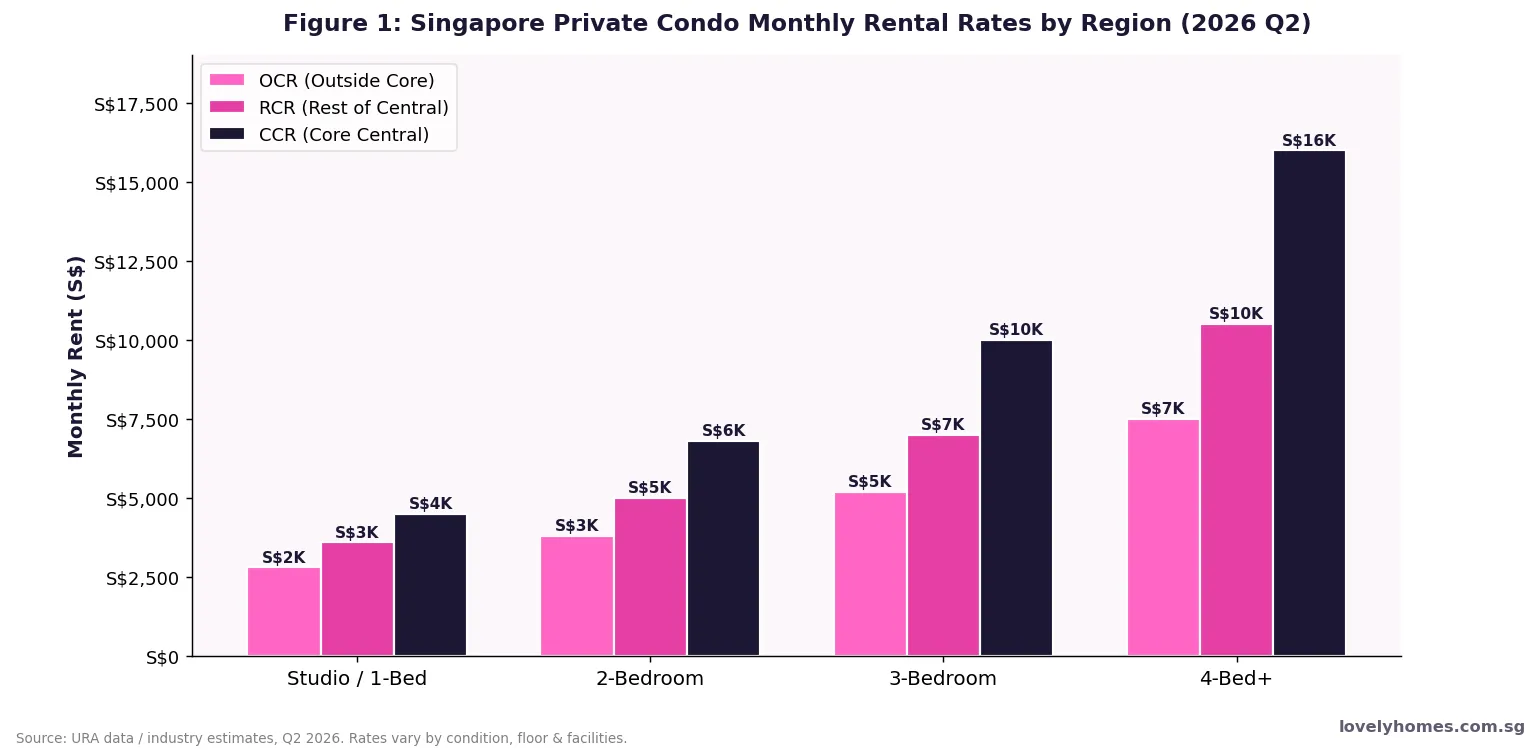
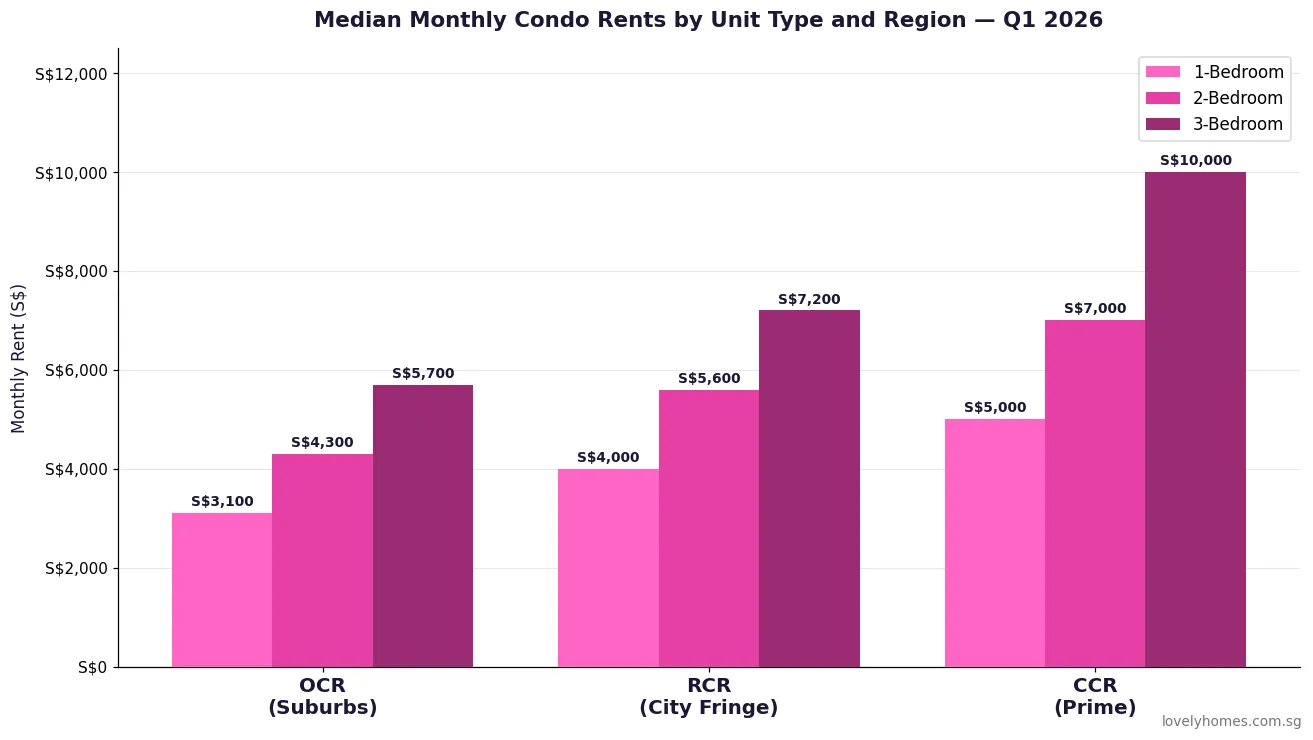
Singapore condo median rental rates by unit type and region 2026
Figure 1: Median monthly condo rents by unit type and region, Q1 2026. OCR = Outside Central Region (suburbs); RCR = Rest of Central Region (city fringe); CCR = Core Central Region (prime). Source: URA, industry estimates.

Condo Rental Rates by Region and Unit Type

Rental rates vary significantly by district, unit size, floor level, and age of development. The URA divides Singapore into three broad rental markets: the Core Central Region (CCR), covering Districts 9, 10, 11, and the Downtown Core; the Rest of Central Region (RCR), covering city-fringe areas such as Queenstown, Bishan, Toa Payoh, and Geylang; and the Outside Central Region (OCR), covering mass-market suburbs such as Punggol, Sengkang, Tampines, Woodlands, and Jurong.

Unit Type OCR (Suburbs) RCR (City Fringe) CCR (Prime)
Studio / 1-Bedroom S$2,800–S$3,500/mth S$3,500–S$4,500/mth S$4,000–S$6,000/mth
2-Bedroom S$3,800–S$5,000/mth S$4,800–S$6,500/mth S$5,500–S$9,000/mth
3-Bedroom S$5,000–S$6,500/mth S$6,000–S$8,500/mth S$7,500–S$14,000/mth
4-Bedroom / Penthouse S$6,500–S$9,000/mth S$7,500–S$12,000/mth S$10,000–S$25,000+/mth

These are indicative ranges for units in good condition within well-maintained developments. Older freehold condos in established CCR districts (such as Nassim Road or Ardmore Park) can command premiums well above the ranges shown. Conversely, mass-market condos in OCR estates near an MRT station but without premium fittings typically sit at the lower end. Furnished units command a premium of roughly 10–20% over unfurnished equivalents, though most condo landlords provide at minimum white goods and air-conditioning units.

Types of Condo Available for Rent

Singapore’s private residential market offers several distinct product types under the broad “condo” umbrella. A standard condominium is a multi-unit strata development of six or more floors with full facilities — swimming pool, gym, function room, and 24-hour security. An apartment block (fewer than five floors, no mandatory facilities) is technically different from a condominium under the Planning Act but is marketed identically. Landed property — terraces, semi-detached, detached houses — is rented by Singaporeans and permanent residents with ease, but foreigners require approval from the Singapore Land Authority under the Residential Property Act to rent non-condominium landed property; condo units are fully open to foreigners.

Serviced apartments, though physically similar to condos, operate under a hotel licence and are typically rented on weekly or monthly terms. They sit outside the standard tenancy framework and carry no stamp duty obligation but command significant rent premiums for the flexibility and daily services included. They are a popular bridge while a new expatriate’s permanent housing is arranged.

Step-by-Step Rental Process

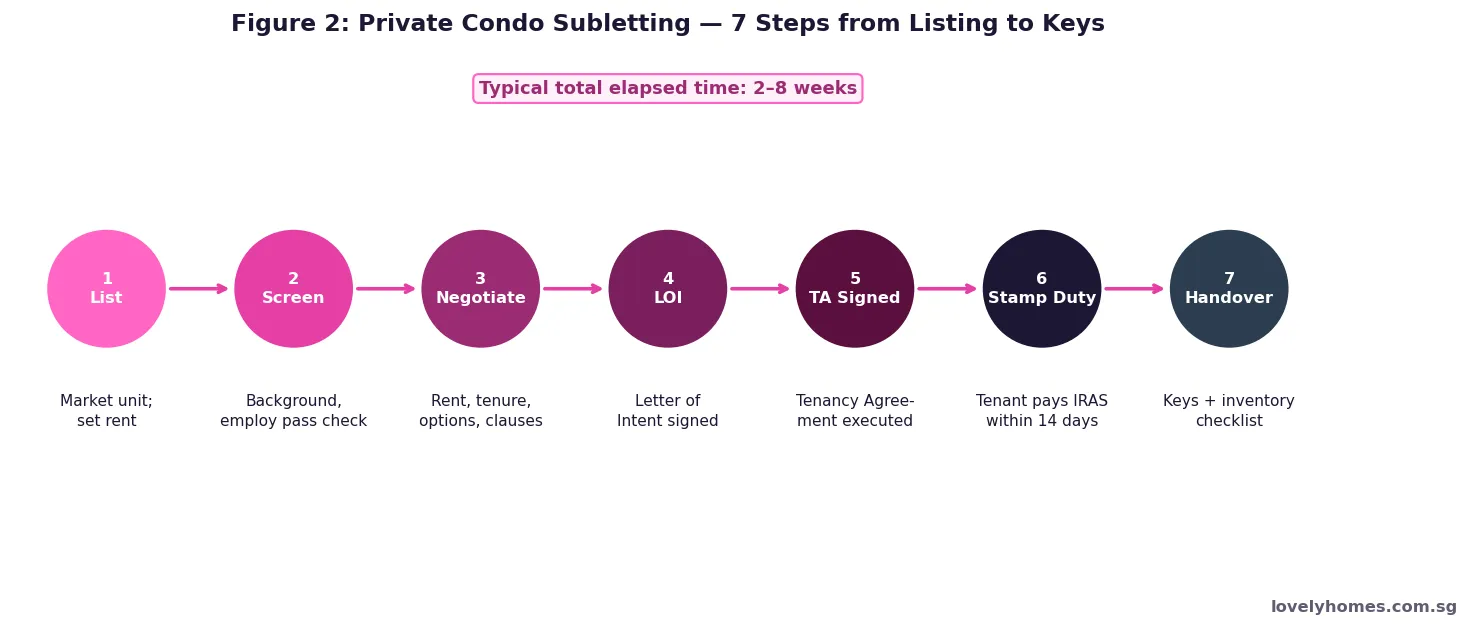
Renting a condo in Singapore follows a reasonably standardised process, though timelines can compress or extend depending on landlord circumstances and market conditions.

Step 1 — Search and shortlist. Most tenants search on PropertyGuru, 99.co, or STProperty. View three to five properties in person before making an offer. Pay attention to maintenance standards, lift lobby cleanliness, pool condition, and the responsiveness of the management corporation (MCST) — all signal how well-managed the development is.

Step 2 — Letter of Intent (LOI). Once you identify a unit, you submit a Letter of Intent — a one-page document specifying the agreed rent, tenancy term, move-in date, and any special requests (additional parking, pet clause, specific appliances). The LOI is accompanied by a good-faith deposit equal to one month’s rent. The landlord has three to seven days to sign or counter-propose.

Step 3 — Tenancy Agreement (TA). Once the LOI is agreed, the landlord’s solicitor (or the landlord directly) prepares the Tenancy Agreement. This is the binding legal contract. Review it carefully — particularly the diplomatic clause, the inventory schedule, the repair obligations, and any early termination penalties. Once signed, both parties pay the stamp duty on the TA.

Step 4 — Stamp duty and move-in. The tenant (or landlord, depending on agreement) stamps the TA with the Inland Revenue Authority of Singapore (IRAS) at 0.4% of the annual rent multiplied by the number of years of the tenancy. On the move-in date, the balance of the security deposit is paid and a thorough condition check of the unit is conducted and documented.

Rental Yields — Understanding the Landlord’s Perspective

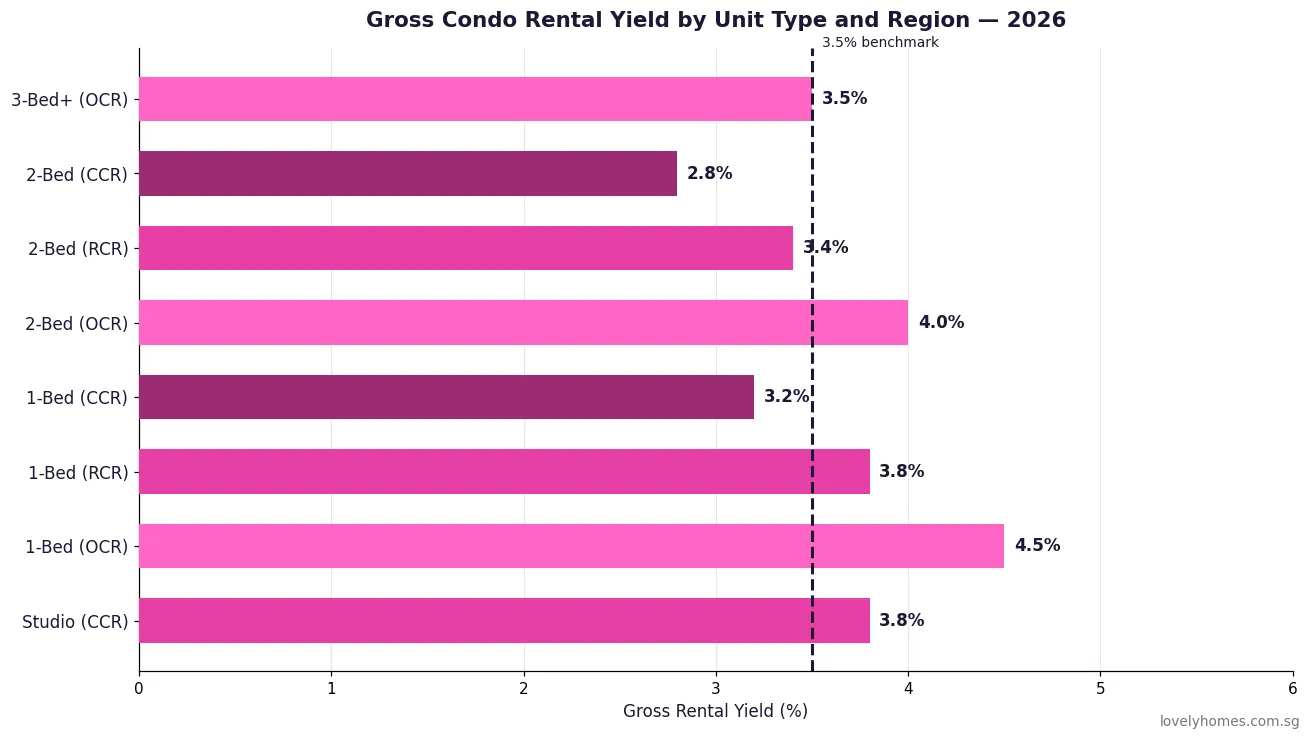
Gross rental yield is the annual rent divided by the purchase price of the property. Understanding yields helps tenants appreciate why landlords price units the way they do, and can be a useful data point in negotiations — a landlord who bought at the peak of 2022–2023 faces significant yield compression and may be more flexible on rent than official asking prices suggest.

Gross condo rental yield by unit type and region Singapore 2026
Figure 2: Gross rental yield by unit type and region, 2026. Smaller units in OCR outperform on yield; prime CCR condos yield the least but attract higher-income tenants. Source: industry estimates based on URA transaction data.

Costs to Budget For as a Tenant

The headline monthly rent is not the only cost a prospective condo tenant must account for. Before signing, budget for the following upfront payments.

Security deposit: The market convention is one month’s security deposit per year of tenancy. A standard two-year tenancy therefore requires a two-month security deposit — typically paid in two instalments: one at LOI stage and one at TA signing. The deposit is held by the landlord and returned within 14 days of vacating (subject to any deductions for damage beyond fair wear and tear).

Agent commission: For a two-year or longer lease, the tenant typically pays half a month’s commission to the tenant’s agent, and the landlord pays one month to the landlord’s agent. For shorter leases, commission structures vary. Always clarify this before engagement — some co-broking arrangements shift the full commission to the tenant.

Stamp duty on tenancy agreement: The rate is 0.4% of the total rent payable. For a two-year tenancy at S$4,500/month, this works out to S$4,500 × 12 × 2 × 0.4% = S$432. This is typically paid by the tenant within 14 days of signing the TA.

Utilities: Utilities (electricity, water, gas) are the tenant’s responsibility in virtually all private condo tenancies. In 2026, a typical 2BR condo unit incurs electricity costs of approximately S$120–S$220/month depending on air-conditioning usage. The Open Electricity Market (OEM) allows tenants to choose between retailers for potentially lower rates.

Cost Item Typical Amount Who Pays Timing
Security deposit (2yr lease) 2 months’ rent Tenant At LOI + at TA signing
Agent commission 0.5–1 month’s rent Tenant (0.5) + Landlord (1) At TA signing
Stamp duty on TA 0.4% × annual rent × years Usually tenant Within 14 days of TA signing
First month’s rent 1 month’s rent Tenant On move-in date
Utilities connection S$100–S$200 deposit Tenant Before move-in
Minor maintenance Varies Tenant (fair wear & tear) Throughout tenancy

Tenancy Agreement — Key Clauses to Negotiate

The Tenancy Agreement is a standard-form document in Singapore, often based on the Law Society’s approved template, but landlords routinely customise it. As a tenant, pay particular attention to the following clauses before signing.

Diplomatic clause: This entitles the tenant to terminate the lease early if they receive a confirmed repatriation or job transfer. The standard form allows exercise after the first 12 months of a 24-month lease, with two months’ written notice. Not all landlords will agree to this, especially for shorter leases. If you are on an Employment Pass that could be cancelled, insist on this clause.

Repair obligations: The landlord is generally responsible for structural repairs and maintaining fixed installations such as built-in kitchen appliances, water heaters, and air-conditioning systems in working order. The tenant is responsible for day-to-day maintenance — changing light bulbs, maintaining cleanliness, and repairing damage caused by the tenant. The TA should specify a cost threshold (commonly S$150–S$300) below which the tenant handles repairs without recourse to the landlord.

Pet clause: Most condo tenancy agreements prohibit pets by default. If you have a pet, negotiate the pet clause in the LOI stage — do not assume goodwill after signing. Landlords who agree often require an additional deposit.

Subletting: Subletting without written landlord consent is a breach of the TA. If you may need to sublet a room, negotiate an express subletting clause at the outset. Note that subleasing to more than six unrelated persons in a condo unit breaches the Urban Redevelopment Authority’s occupancy cap regulations.

Worked Example: Mr Rajesh, Renting a 3-Bedroom OCR Condo

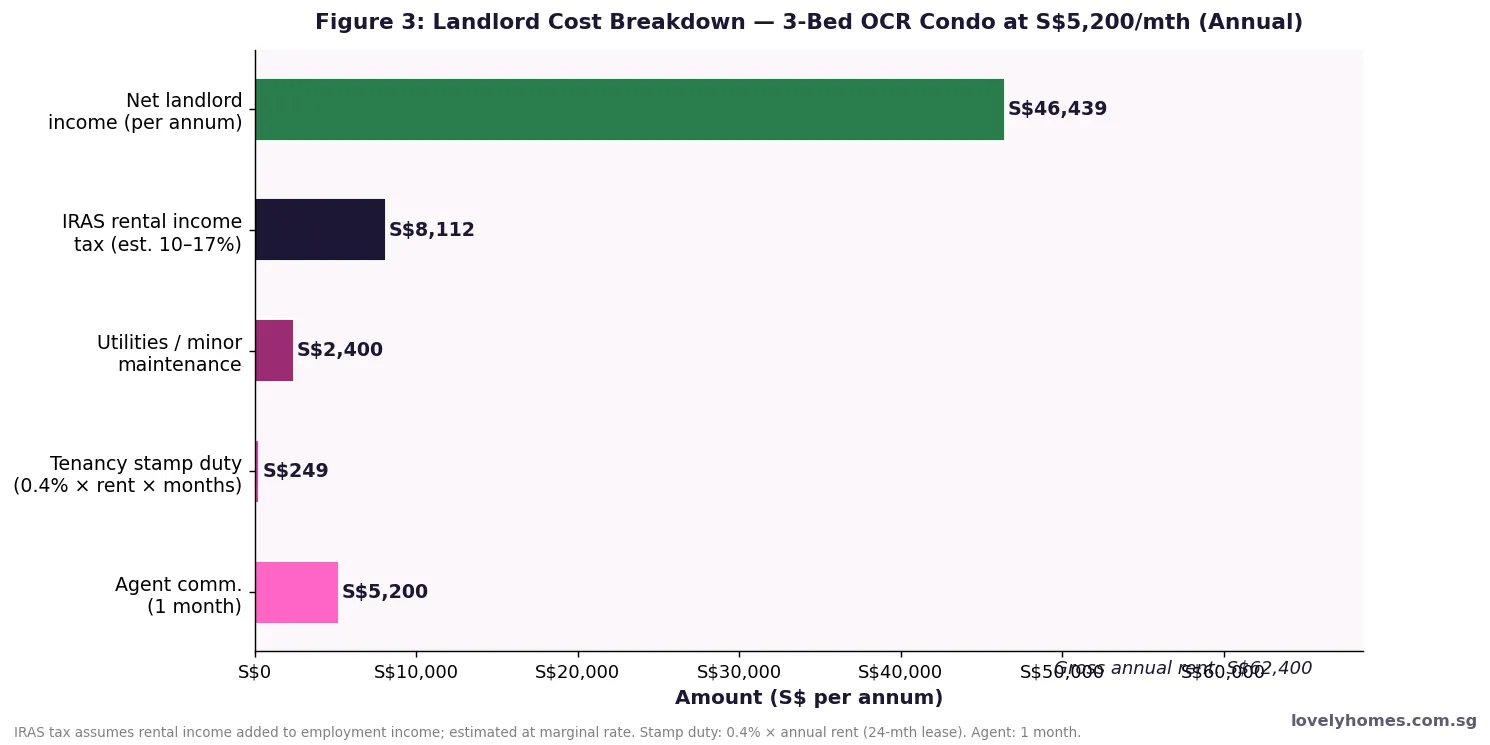
Mr Rajesh is a Malaysian national on an Employment Pass, earning S$12,000/month. He is relocating from a company-provided serviced apartment to a self-arranged private condo for a 24-month lease starting 1 August 2026. He identifies a 3-bedroom, 1,300 sq ft condo unit in Sengkang (OCR) at S$5,200/month (unfurnished).

Upfront costs:

  • Good-faith deposit at LOI: S$5,200 (1 month)
  • Balance security deposit at TA signing: S$5,200 (2nd month of 2-month deposit)
  • First month’s rent: S$5,200
  • Stamp duty: S$5,200 × 12 × 2 × 0.4% = S$499
  • Tenant agent commission (0.5 month): S$2,600
  • Utilities connection deposit: S$150
  • Total upfront: approximately S$18,849

Ongoing monthly: Rent S$5,200 + estimated utilities S$200 = S$5,400/month. This represents 45% of Mr Rajesh’s gross income, within the comfort range for a single-income expat household. He negotiated a diplomatic clause exercisable after month 14 with two months’ written notice, which his employer agreed to support if repatriation is required.

Market check: The landlord originally listed at S$5,500/month. Because vacancy in the OCR rental market has widened and two similar units in the same development are vacant, Mr Rajesh’s agent negotiated S$5,200 — a S$300/month or S$7,200 saving over the two-year lease. This illustrates the current market dynamic: asking prices are often negotiable by 5–8% for quality tenants willing to commit to longer terms.

The Market Shift: What the Rental Index Tells Us

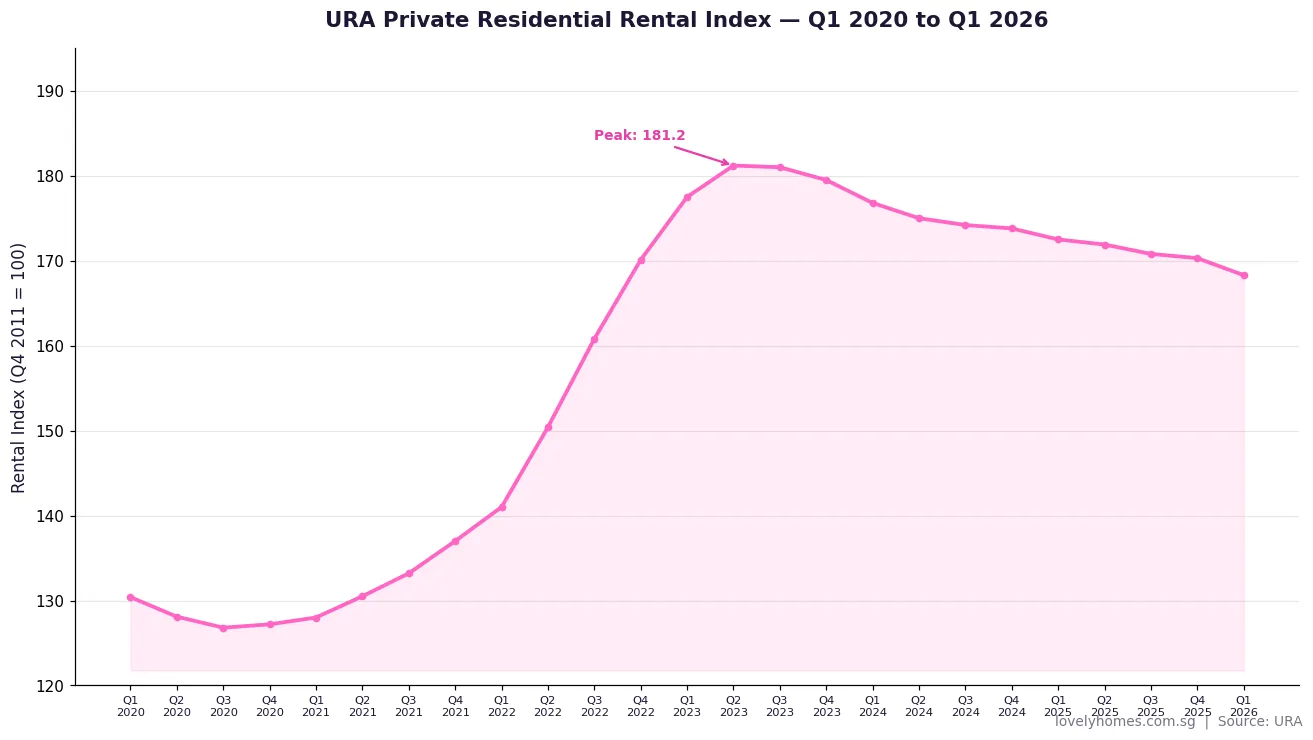
URA private residential rental index trend Q1 2020 to Q1 2026
Figure 3: URA Private Residential Rental Index, Q1 2020 to Q1 2026. After peaking in early 2023, rents have declined for eight consecutive quarters. The index remains approximately 29% above Q1 2020 levels. Source: URA.

The URA private residential rental index peaked around Q1 2023 at approximately 181.5 (base Q4 2011 = 100). It has since declined to around 168.3 in Q1 2026 — a fall of about 7.3% from peak — but remains some 29% above Q1 2020 pre-pandemic levels. This context matters for tenants: rents are lower than the 2023 frenzy but are not at pre-2021 levels, and the rate of decline has slowed. A sustained oversupply scenario would push rents further down; conversely, if global business activity picks up and EP inflows accelerate, the market could tighten again by late 2026 or 2027.

What Might Come Next — Rental Market Outlook

The short-to-medium outlook for Singapore condo rentals in 2026 and 2027 leans modestly in tenants’ favour. Three supply-side factors support further gentle softening: the completion pipeline from 2022–2024 new launches continues to deliver units; the 2H 2026 Government Land Sales programme announced in June 2026 will add further medium-term supply; and the 17,032 unsold private units as at Q1 2026 represent a substantial buffer. On the demand side, the Singapore labour market remains tight with EP inflows expected to hold at current levels, which should provide a floor under rental demand.

That said, the era of 8–15% annual rental increases is clearly over for now. Tenants in 2026 should expect flat to modestly declining rents in OCR and RCR areas, while CCR prime districts — where international tenant budgets are less price-sensitive — may see more stable or even firmer rents if global financial activity sustains. Tenants renewing leases expiring in mid-2026 should push firmly for discounts of 5–10% versus their 2024 contracted rates.

Frequently Asked Questions

Can a foreigner rent a condo in Singapore?

Yes. Foreigners with a valid pass (Employment Pass, S Pass, Dependent Pass, Long-Term Visit Pass, or Student Pass) may rent any private condo unit without restriction. There is no nationality quota on private condo rentals, unlike HDB estates which are subject to the non-citizen quota. Foreigners may not rent landed property (terrace, semi-detached, or detached house) without approval from the Singapore Land Authority under the Residential Property Act, but this restriction does not apply to condominium units.

What is the minimum tenancy period for a condo?

The minimum tenancy for a private residential property in Singapore is three consecutive months. Short-term rentals of less than three months — including Airbnb-style arrangements — are illegal for private residential units under the Planning Act. Penalties for illegal short-term rentals are severe: landlords face fines of up to S$200,000 for each infringement. Serviced apartments that are licensed as hotels operate under different rules and may rent on daily or weekly terms.

How much is stamp duty on a condo tenancy agreement?

Stamp duty on a Tenancy Agreement is payable to the Inland Revenue Authority of Singapore (IRAS) at a rate of 0.4% of the total rent payable over the lease term. The formula is: Annual Rent × Number of Years × 0.4%. For a 2-year lease at S$4,800/month, the calculation is S$4,800 × 12 × 2 × 0.4% = S$461. Stamp duty must be paid within 14 days of signing the TA. Either the landlord or the tenant may pay — it is negotiable but conventionally the tenant’s responsibility. The stamped TA is the enforceable document for any dispute resolution in the Singapore courts.

What is a diplomatic clause and do I need one?

A diplomatic clause (also called a “relocation clause”) entitles the tenant to terminate the lease early if they receive a confirmed job transfer, repatriation, or redundancy. In Singapore, the standard diplomatic clause allows the tenant to break a 2-year lease after 12 months by giving two months’ written notice and providing documentary evidence (e.g., a letter from the employer). The clause is named “diplomatic” because it was originally designed for embassy and diplomatic personnel but is now used widely by all corporate tenants on Employment Passes. If there is any chance you may be relocated during your lease, insist on a diplomatic clause before signing — it cannot easily be added after the TA is executed.

Who is responsible for air-conditioning servicing?

The landlord is responsible for ensuring the air-conditioning units are in working order at the commencement of the tenancy. During the tenancy, the maintenance obligation depends on the TA wording. Most standard TAs require the tenant to service the air-conditioning units every three months and maintain them in working order for normal wear and tear, while the landlord is responsible for major repairs (compressor failure, refrigerant recharging) that exceed the minor repair threshold (typically S$150–S$300). Always ensure the TA specifies who pays for which type of air-con repair to avoid disputes.

Can my landlord increase the rent mid-tenancy?

No. Once a Tenancy Agreement is signed and stamped, the agreed rent is contractually fixed for the duration of the lease. The landlord cannot unilaterally increase the rent during the tenancy term. Rent may only be renegotiated at renewal. This is one key reason to sign a longer lease in a falling rental market — it locks in your current rate and protects against any potential reversal. Conversely, in a rising rental market, signing a shorter lease preserves your ability to relocate to a lower-priced unit or negotiate more aggressively at expiry.

How do I get my security deposit back?

At the end of the tenancy, both landlord and tenant (or their agents) conduct a check-out inspection against the original check-in inventory report. The landlord has 14 days from the end of the tenancy to return the deposit (or the agreed balance). Deductions may only be made for damage beyond fair wear and tear — meaning damage caused by misuse, negligence, or accident, not ordinary ageing. If the landlord disputes deductions, the tenant can escalate to the Small Claims Tribunal (SCT) — the SCT hears rental disputes up to S$30,000 and does not require legal representation. Always photograph the unit thoroughly at both check-in and check-out and keep all written communications with the landlord.

Related Articles

Disclaimer: This article is intended as general information only and does not constitute legal or financial advice. Rental market figures are indicative estimates based on URA published data and industry surveys as at Q1–Q2 2026 and may differ from individual transactions. Tenancy law, stamp duty rates, and regulatory requirements may change — always verify current figures with the Inland Revenue Authority of Singapore (IRAS), the Urban Redevelopment Authority (URA), and a qualified property lawyer before entering into any tenancy. LovelyHomes does not act as a property agent and does not endorse any landlord, developer, or property service provider.

Singapore Rental Market Guide 2026: HDB and Condo Rents, Yields and Outlook Explained

Singapore Rental Market Guide 2026: HDB and Condo Rents, Yields and Outlook Explained

Quick Answer: Singapore Rental Market 2026

  • Singapore’s private residential rental index rose 0.3% in Q1 2026 (URA), recovering from a 0.5% dip in Q4 2025, but remains below the 2023 peak.
  • HDB rental index eased 0.1% in Q1 2026, continuing a gradual softening from the 2023 high after two years of elevated rents.
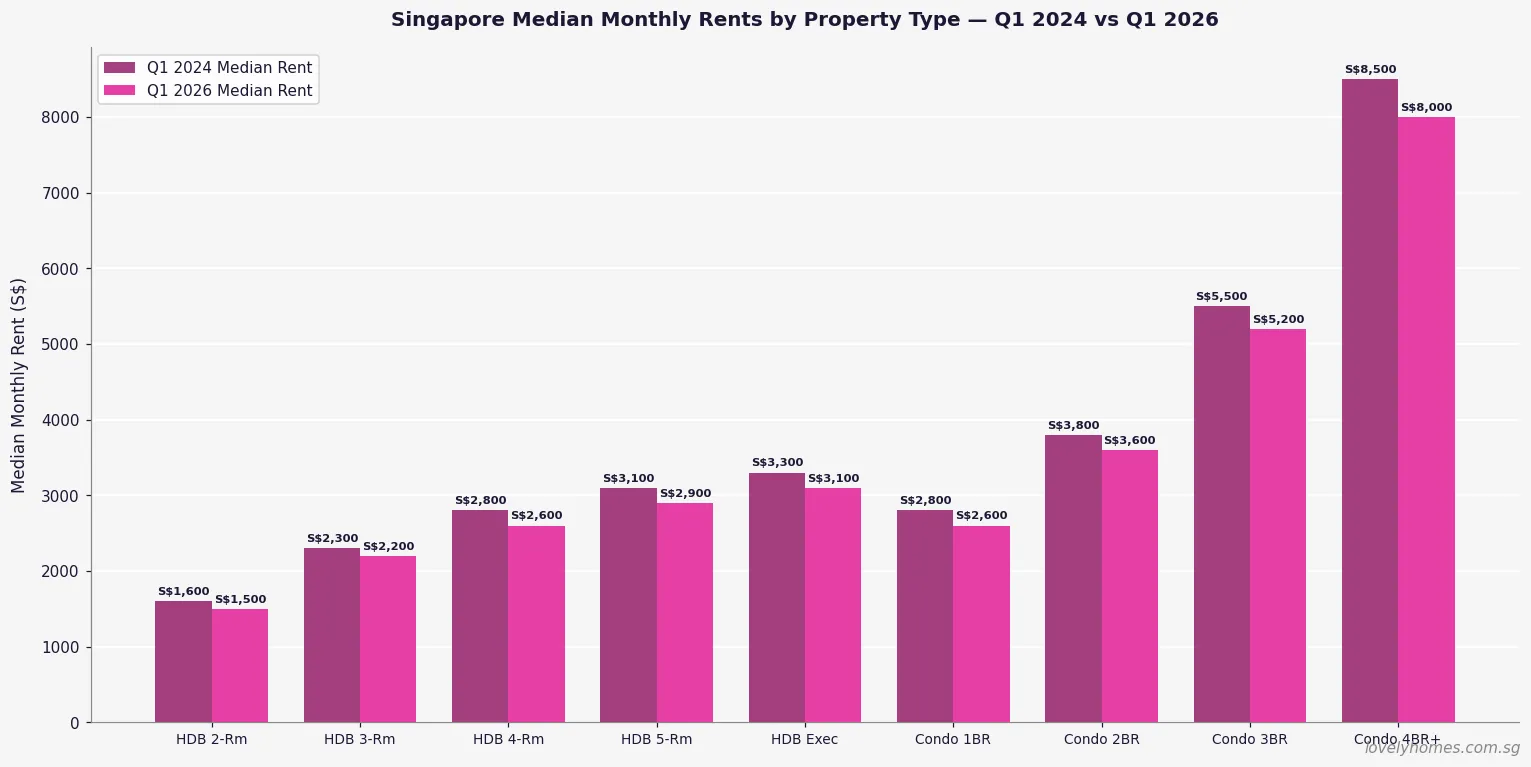
  • Median rents in Q1 2026: HDB 4-room S$2,600/mth, condominium 2-bedroom S$3,600/mth (OCR), condominium 3-bedroom S$5,200/mth.
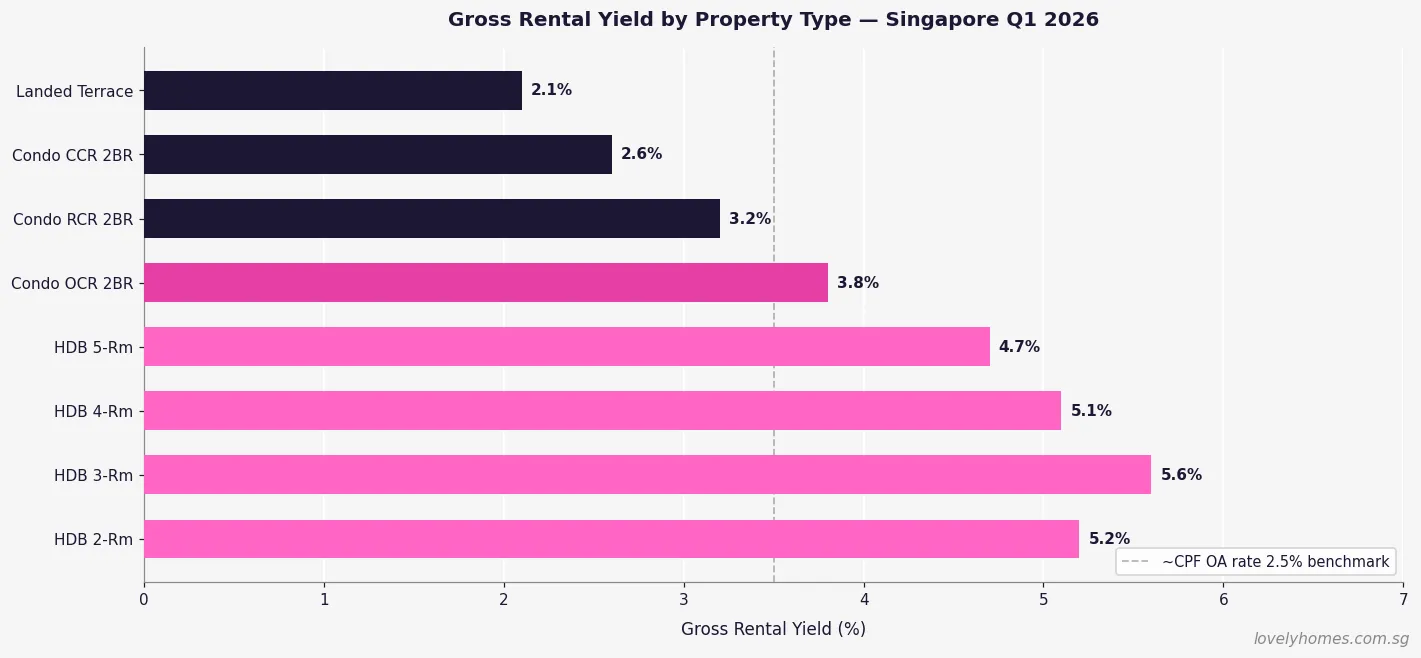
  • Gross rental yields remain attractive for HDB (4.7–5.6%) compared with private condominiums in Core Central Region (CCR) (2.6%).
  • Rising supply from 2024–2025 completions is the dominant dampener; landlords must price competitively in 2026.
  • Demand drivers: foreign professional workforce (Employment Pass/S Pass holders), expat families on education visas, and domestic upgraders waiting for new homes to complete.
  • Short-term rentals (fewer than 3 months) remain prohibited for residential properties in Singapore under URA regulations.
  • Landlords must declare rental income on their annual income tax returns to IRAS; allowable deductions include mortgage interest, property tax, and maintenance fees.

Understanding Singapore’s Rental Market

Singapore’s residential rental market is one of Asia’s most closely watched — shaped by a unique interplay of government-controlled HDB supply, private condominium completions, immigration policy, and one of the highest proportions of home ownership in the world (approximately 89%). Unlike many global cities, Singapore’s rental sector is comparatively small: most residents own their HDB flats. The rental pool is disproportionately driven by the expatriate workforce and a domestic segment of upgraders temporarily between properties.

The Urban Redevelopment Authority (URA) tracks the Private Residential Rental Index quarterly; HDB separately tracks the HDB Rental Index. Both indices are released alongside quarterly real estate statistics — the primary authoritative source for rental market data. The Q1 2026 URA statistics confirmed that private rental growth has moderated after the exceptional surge of 2021–2023, when the market rose over 50% from its COVID-era trough on the back of a supply drought and surging foreign workforce arrivals.

Rental Index Trend: 2020–2026

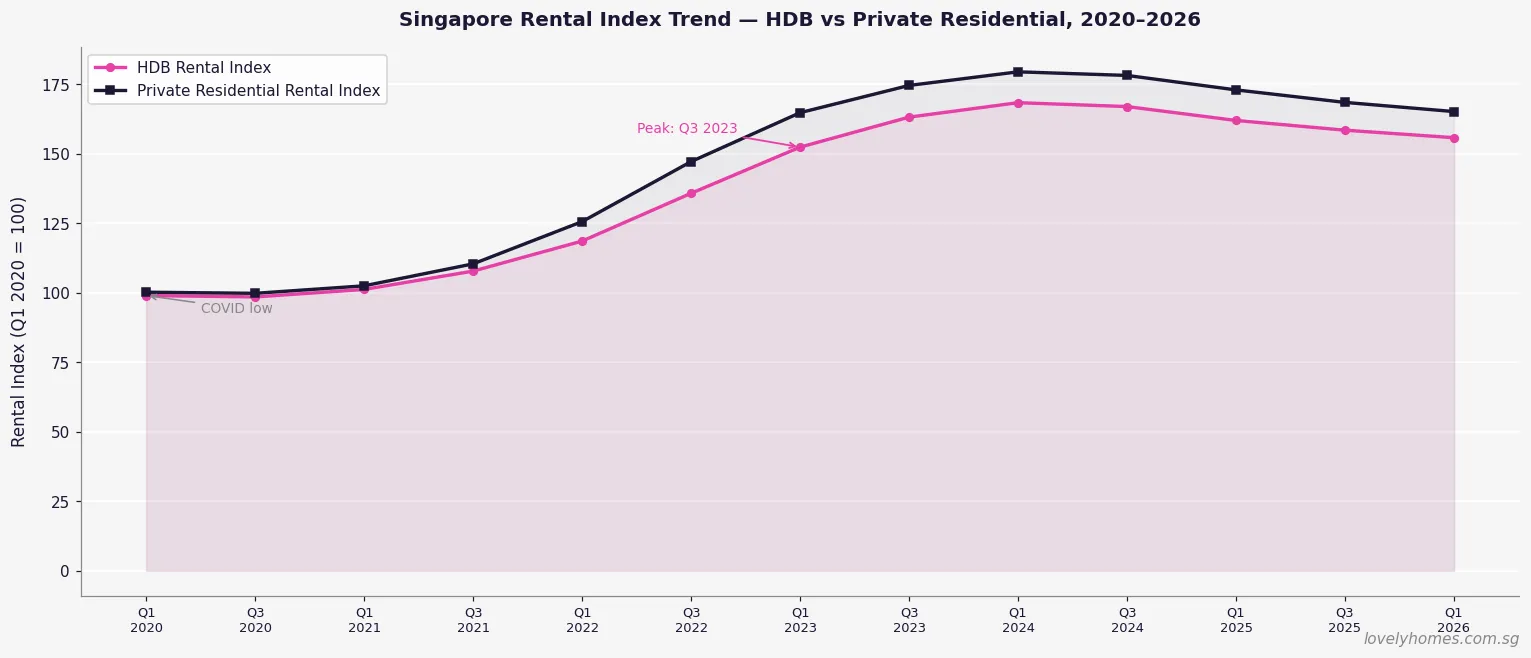
The rental cycle of this decade is one of the most dramatic in Singapore’s property history. From a base of approximately 100 in early 2020, the HDB Rental Index rose to a peak of approximately 163 by mid-2023 before softening. Private residential rents peaked near 175 in mid-2023. As at Q1 2026, both indices have retreated — the HDB index to approximately 156, the private residential index to approximately 165 — representing a correction of roughly 4–6% from peak.

Singapore rental index trend 2020 to 2026 - HDB vs private residential rental index
Figure 1: Singapore HDB and Private Residential Rental Index trend, Q1 2020 – Q1 2026 (Q1 2020 = 100). Sources: URA, HDB quarterly real estate statistics.

The correction has been driven primarily by supply normalisation — a wave of private condominium completions in 2024–2025 (including several large integrated developments) added significant rental stock to the market, while post-COVID foreign workforce growth moderated as global companies trimmed headcount in 2024–2025. Nevertheless, rents remain approximately 55% higher in absolute terms than pre-COVID levels for most property types.

Median Monthly Rents by Property Type, Q1 2026

Industry figures from Q1 2026 show median monthly rents across property types as follows. HDB room types continue to offer the most accessible entry point for tenants, while Core Central Region (CCR) condominiums command a substantial premium reflecting proximity to the CBD and top international schools.

Singapore median monthly rents 2026 - HDB and condo by room type Q1 2024 vs Q1 2026
Figure 2: Singapore median monthly rents Q1 2024 vs Q1 2026 by property type. All figures are indicative medians; individual transacted rents vary by location, floor, condition, and furnishing.

Key observations from the Q1 2026 data: HDB 3-room rents have eased from approximately S$2,300/mth in Q1 2024 to approximately S$2,200/mth, a modest 4.3% decline. Private condominium 3-bedroom rents have softened more noticeably from approximately S$5,500/mth to S$5,200/mth (−5.5%). Executive flat rents remain relatively sticky at approximately S$3,100/mth, reflecting persistently high demand from larger families displaced from the HDB resale market by the 15-month wait.

Gross Rental Yields by Property Type

Gross rental yield is calculated as annual rent divided by market value. In Singapore’s context, it is an imperfect but useful comparator — particularly when set against the CPF Ordinary Account rate of 2.5% p.a. and typical bank mortgage rates of 3.0–3.7% p.a. in 2026. Properties yielding below the mortgage rate require careful cash flow modelling; properties yielding above 4.5% can generate positive carry even at current financing costs.

Singapore rental yield by property type 2026 - HDB condo landed gross yield comparison
Figure 3: Gross rental yield by property type, Singapore Q1 2026. Yields are gross — deduct mortgage interest, property tax, management fees, vacancy, and maintenance for net yield calculations.

HDB flats deliver the highest gross yields precisely because their prices are regulated and their transacted values remain significantly below equivalent private condominiums. A well-located 3-room HDB in Toa Payoh with a transacted rent of S$2,200/mth and a resale value of approximately S$470,000 generates a gross yield of approximately 5.6% — among the highest in Singapore’s residential market. However, HDB landlords face non-citizen quota constraints (8% or 11% per block/neighbourhood) and must comply with the Minimum Occupation Period (MOP) rules and HDB approval requirements. See our comprehensive HDB Rental Guide 2026 for full details.

Landlord Obligations and Legal Framework

Residential tenancies in Singapore are governed primarily by contract law — there is no Residential Tenancies Act equivalent to those in the United Kingdom or Australia. The standard Tenancy Agreement is a contractual document prepared by either party’s lawyer or the property agent. Key regulatory requirements for landlords include:

  • Stamp duty on tenancy agreements: The tenant is liable to pay stamp duty on the tenancy agreement via IRAS e-Stamping. The rate is 0.4% of the total rent for leases of 1–4 years; for leases exceeding 4 years, the rate is 4% of the average annual rent. In practice, landlords should confirm the stamp duty is paid within 14 days of signing, as IRAS treats it as a condition for the agreement to be legally admissible in court.
  • Short-term rental prohibition: URA regulations prohibit the use of private residential properties for accommodation for periods of fewer than 3 consecutive months. Platforms such as Airbnb, Agoda (short-stay listings), and similar are prohibited for residential properties. Violations carry fines of up to S$200,000 per offence.
  • HDB subletting rules: HDB flat owners who have completed their Minimum Occupation Period (MOP) may sublet their whole flat or individual bedrooms, subject to HDB approval, non-citizen quota compliance, and the maximum occupancy limits (8 persons per flat until 31 December 2026 under the current temporary relaxation).
  • Property tax: Landlords pay property tax at non-owner-occupier rates (typically 10–20% of the Annual Value for private properties, 10% for HDB), which is a deductible expense against rental income.
  • Rental income tax: Rental income is taxable as personal income in Singapore. Allowable deductions include mortgage interest, property tax, fire insurance premiums, maintenance fees, and depreciation of approved furniture at 20% per annum declining balance.

Summary: Singapore Rental Market at a Glance, 2026

Property Type Typical Monthly Rent Gross Yield Key Tenant Profile
HDB 2-room S$1,400–S$1,600 ~5.2% Singles, young couples
HDB 3-room S$2,000–S$2,400 ~5.6% Small families, couples
HDB 4-room S$2,400–S$2,800 ~5.1% Families, expat workers
HDB 5-room S$2,600–S$3,200 ~4.7% Families, management expats
Condo 1-bedroom (OCR) S$2,400–S$2,800 ~3.8% Young professionals
Condo 2-bedroom (OCR) S$3,200–S$4,000 ~3.8% Couples, small families
Condo 2-bedroom (CCR) S$4,500–S$6,500 ~2.6% Senior expat executives
Landed Terrace S$6,000–S$10,000 ~2.1% High-net-worth families

Worked Example: Mr Rajan Buys a 3-Room HDB to Rent Out in Ang Mo Kio

Mr Rajan, a Singapore Citizen, purchased a 3-room HDB resale flat in Ang Mo Kio in August 2021 for S$450,000. His MOP completed in August 2026 and he immediately lists it for whole-flat rental while upgrading to a condominium. Key figures:

  • Purchase price: S$450,000 in August 2021.
  • MOP completion: August 2026 (5 years from key collection).
  • Estimated market rent (Q1 2026): S$2,100–S$2,300/mth for a well-maintained 3-room in Ang Mo Kio.
  • Monthly gross income: S$2,200/mth (midpoint).
  • Annual gross rent: S$26,400.
  • Gross yield: S$26,400 / S$450,000 = 5.9% (calculated on original purchase price; current AV-based valuation ~S$480,000 gives ~5.5%).
  • Property tax (non-owner-occupier): Annual Value approximately S$24,000; property tax approximately S$2,400/yr at 10%.
  • Mortgage interest (if outstanding loan S$150,000 at 2.6%): ~S$3,900/yr (deductible).
  • Net rental income (estimated): S$26,400 − S$2,400 (property tax) − S$3,900 (interest) − S$1,200 (maintenance, insurance) = approximately S$18,900/yr, taxable at Mr Rajan’s personal income rate.
  • Stamp duty on 12-month tenancy at S$2,200/mth: 0.4% × S$26,400 = S$105.60 (tenant’s liability but landlords confirm this is paid).

The non-citizen quota check (8% neighbourhood / 11% block) must be confirmed with HDB before signing the Tenancy Agreement. HDB approval is required for whole-flat rental; approval is typically granted within 3–5 business days via the HDB Resale Portal.

What Might Come Next for Singapore Rents

The 2026 rental market is characterised by a bifurcation: HDB rents are gradually softening as more MOP flats come onto the rental market and demand moderates, while premium private rents in the CCR are proving stickier, supported by a resilient pool of senior expatriate tenants who cannot or will not rent HDB. The key upside risk to the softening thesis is a reversal in Singapore’s technology and financial services hiring cycle — any rebound in Employment Pass issuances (which fell in 2024–2025 under tighter Fair Consideration Framework scrutiny) would tighten rental supply rapidly given the low vacancy rates in well-located projects. The key downside risk is continued elevated completions through 2026–2027 from the record launch years of 2021–2022, which will maintain supply pressure on mid-market condominiums.

For investors evaluating rental yield against price appreciation potential, the OCR condominium segment offers the most balanced risk-reward in 2026: gross yields of approximately 3.5–4.0% are competitive with bank deposit rates after factoring in leverage, while capital value upside from Jurong Lake District and Cross Island Line catalysts provides a medium-term appreciation thesis. See our Singapore Property Investment Guide 2026 for a full cross-asset comparison.

Frequently Asked Questions

Are Singapore rents going up or down in 2026?

Singapore’s rental market is in a gradual softening phase in 2026. According to URA Q1 2026 data, the private residential rental index rose 0.3% quarter-on-quarter — a marginal recovery after a 0.5% dip in Q4 2025 — but remains below the 2023 peak. HDB rents eased 0.1% in Q1 2026. The dominant factors are increased supply from 2024–2025 completions and moderating foreign workforce demand. Most market observers expect rents to remain broadly flat to slightly lower through 2026, with premium CCR properties proving more resilient than mass-market OCR condominiums and HDB flats.

Can I Airbnb my Singapore condo or HDB flat?

No. URA regulations prohibit the use of private residential properties for short-term accommodation of fewer than 3 consecutive months. This applies equally to condominiums, landed properties, and HDB flats. Listing a Singapore residential property on Airbnb, Agoda short-stay, or similar platforms is a regulatory offence carrying fines of up to S$200,000 per offence. HDB additionally prohibits subletting to short-term visitors regardless of platform. The minimum tenancy period for all residential properties in Singapore is 3 months.

Do I need to declare rental income to IRAS?

Yes. Rental income is taxable as personal income in Singapore and must be declared on your annual Income Tax return. IRAS requires landlords to report gross rent received, then deduct allowable expenses: mortgage interest (on the loan for the rented property), property tax paid, fire insurance premiums, cost of maintenance and repairs (but not capital improvements), management fees, and furniture depreciation at 20% per annum declining balance on approved items. Failure to declare rental income attracts penalties of up to 200% of the tax undercharged. See IRAS’s guide at iras.gov.sg for the current rental income declaration checklist.

What is the non-citizen quota for HDB rentals?

HDB imposes a Non-Citizen Quota (NCQ) to preserve the social mix of HDB estates. The quota limits the proportion of HDB flats in each block and neighbourhood that may be rented to non-Malaysia foreigners (i.e., all non-citizens who are not Malaysian citizens). The limits are 8% at the neighbourhood level and 11% at the block level. If either quota has been met, the landlord cannot rent to a non-Malaysian foreigner regardless of HDB approval status. Malaysia citizens are exempt from the NCQ. Singapore PRs count as citizens for NCQ purposes. Always check the NCQ status on the HDB website before signing any Tenancy Agreement with a foreign tenant.

What is a diplomatic clause in a tenancy agreement?

A diplomatic clause (or Diplomatic Break Clause) is a contractual provision that allows the tenant to terminate the tenancy early if they are relocated or transferred out of Singapore by their employer — typically with 2 months’ written notice after the first year of the lease. It is commonly requested by expatriate tenants and their employers. Landlords generally accept diplomatic clauses for premium properties where the tenant pool is predominantly expatriate. The clause should specify the minimum tenancy period before it can be activated (typically 12 months), the notice period, and whether any penalty or notice fee applies. If the tenant exercises the clause, they forgo the security deposit for the unused period — the exact mechanism is a matter of negotiation.

How is stamp duty on a tenancy agreement calculated?

Stamp duty on a Tenancy Agreement is calculated under the Stamp Duties Act (Cap. 312). For a lease of 1–4 years, the duty is 0.4% of the total rent payable over the tenancy period. For a lease exceeding 4 years, the duty is 4% of the average annual rent. Example: a 12-month lease at S$3,500/mth = total rent S$42,000; stamp duty = 0.4% × S$42,000 = S$168. Payment is due within 14 days of signing via the IRAS e-Stamping portal. The stamp duty is the tenant’s liability by default, but the Tenancy Agreement may specify otherwise. An unstamped tenancy agreement is inadmissible as evidence in court, though the tenancy itself remains contractually enforceable as between the parties.

What is a typical security deposit for a Singapore rental?

The market convention in Singapore is one month’s rent as security deposit for every year of tenancy — so a 1-year lease typically requires a 1-month deposit, and a 2-year lease requires a 2-month deposit. For leases with a diplomatic clause, landlords sometimes negotiate a 2-month deposit for a 1-year lease as additional security against early termination. There is no statutory cap on the security deposit amount in Singapore — it is entirely a matter of negotiation. The deposit should be held in a separate client account by the agent or returned directly to the landlord, and must be refunded within 14 days after the end of the tenancy (less any deductions for damage or unpaid rent, supported by receipts and a condition report).

Related Articles

Disclaimer: This article is intended for general informational purposes only and does not constitute legal, tax, or financial advice. Rental figures, yields, and index data cited are based on information available as at 7 June 2026 and are subject to change. Individual rental outcomes depend on property location, condition, furnishing level, and prevailing market conditions. Readers should consult a licensed Singapore real estate agent (CEA-registered), a Monetary Authority of Singapore (MAS) licensed financial adviser, and IRAS for personalised rental income tax guidance. Authoritative references: URA (ura.gov.sg), HDB (hdb.gov.sg), IRAS (iras.gov.sg), CEA (cea.gov.sg).

Rental Income Tax in Singapore 2026: A Landlord’s Guide to Declaring, Deducting and Saving

Rental Income Tax in Singapore 2026: A Landlord’s Guide to Declaring, Deducting and Saving

Renting out your Singapore condo or HDB flat sounds simple — sign a tenancy agreement, collect a monthly transfer, repeat. Then April rolls around, and the IRAS e-filing portal asks you to declare your net rental income. Suddenly you are wrestling with deductible mortgage interest, the 15% deemed-expense option, what counts as “repairs” versus “improvements”, and whether your S$420 monthly MCST bill is a write-off (it is). Get it wrong by a thousand dollars in either direction, and the result is either a real cash tax overpayment, or an IRAS query letter you do not want to receive.

This guide walks you through how rental income is taxed in Singapore in 2026, what the IRAS rules actually say, the two paths you can choose between for expense deductions, and a fully-worked example using realistic 2026 numbers for a typical leveraged condo investor. By the end you should be able to fire up your IRAS Income Tax e-Filing screen, key in Total Annual Rent, Allowable Expenses and Net Rental Income, and be confident the numbers reconcile to your actual cashflow.

Quick Answer — how Singapore taxes your rental income in 2026

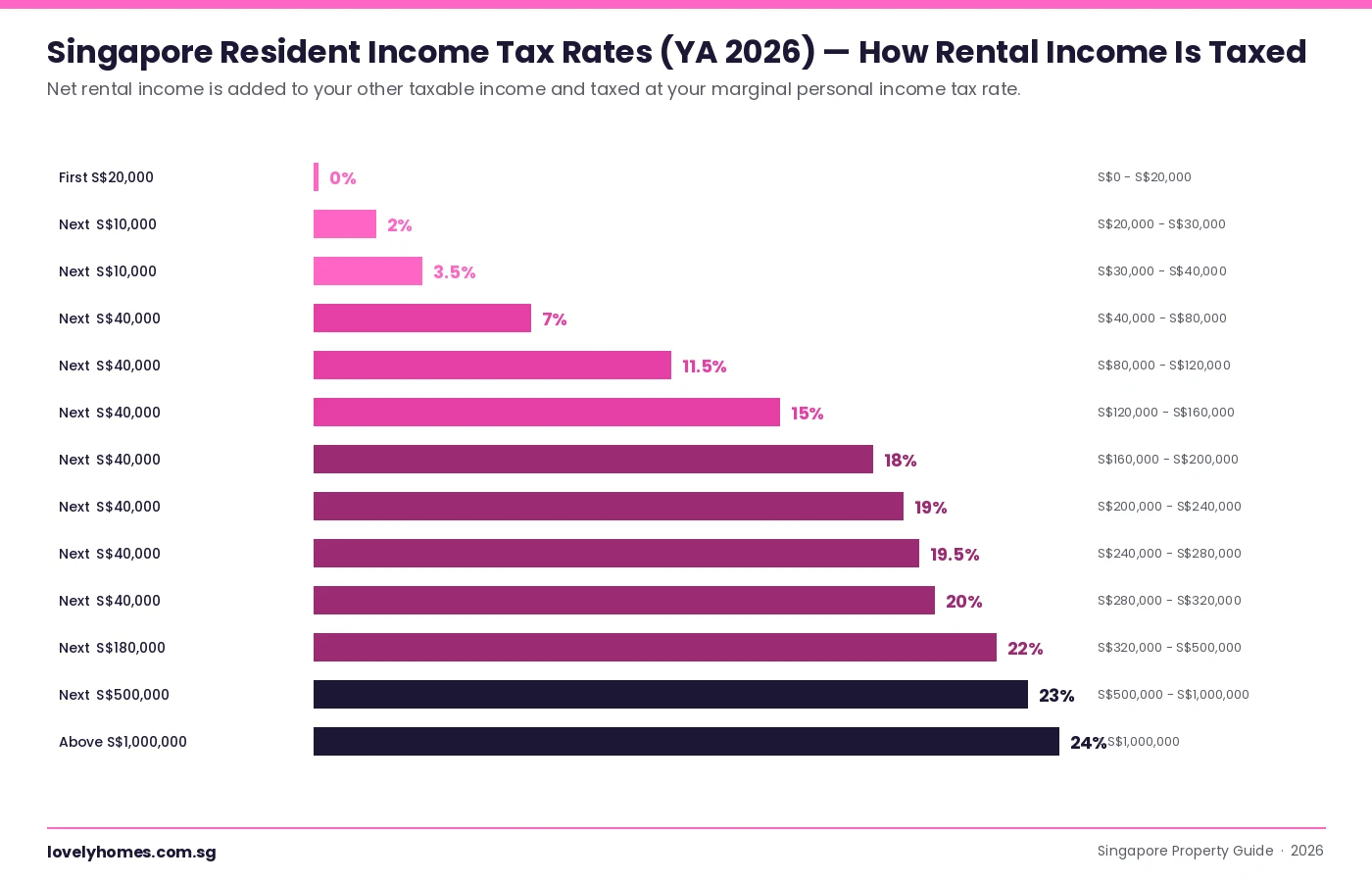
  • Rental income is not a separate tax — net rental is added to your other income and taxed at your marginal personal income tax rate (0% to 24% for residents in YA 2026).
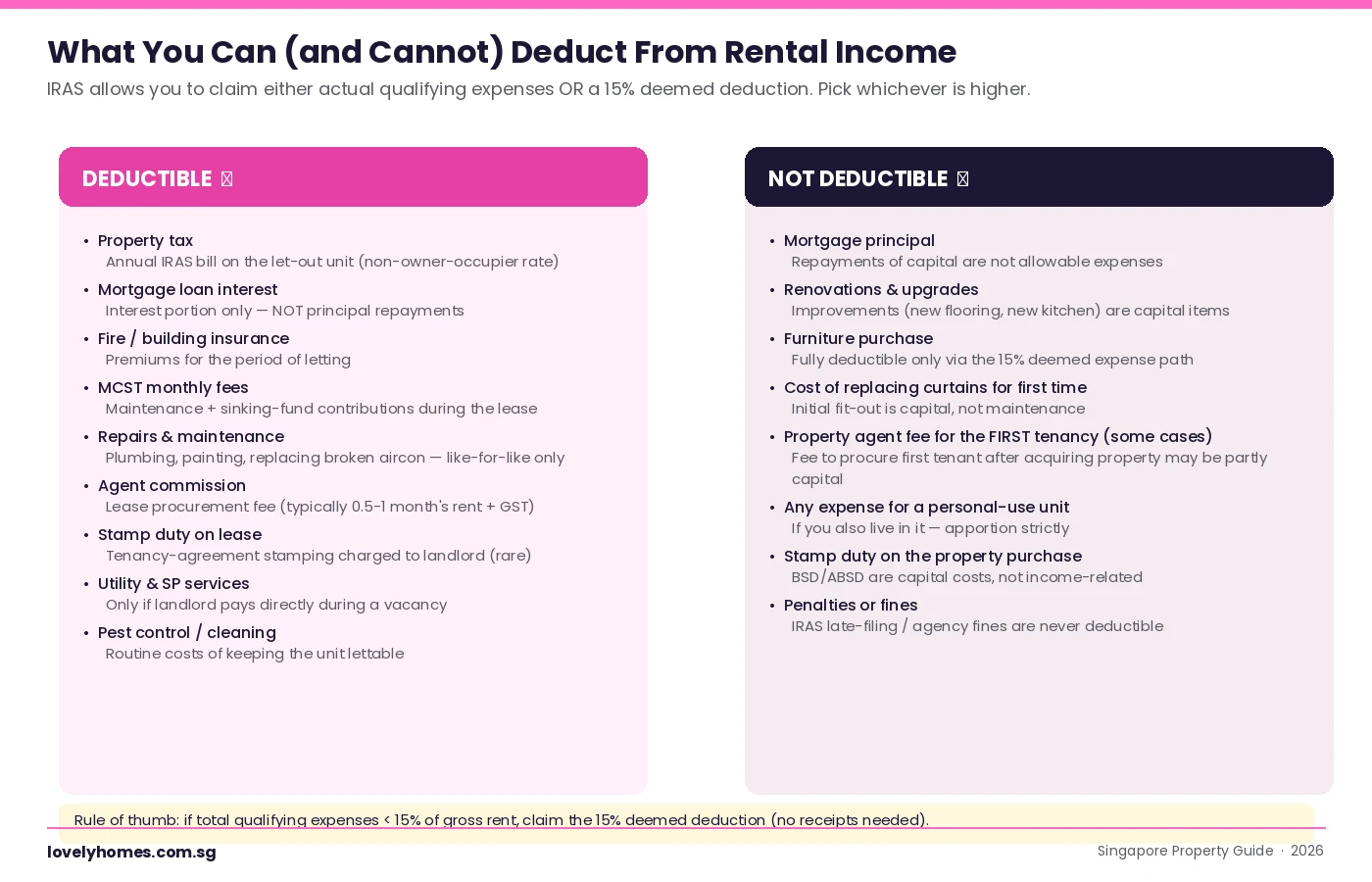
  • You can claim actual qualifying expenses (with receipts) OR a flat 15% deemed-expense deduction. Pick whichever is higher.
  • Mortgage loan interest is always deductible on top of the 15% deemed deduction — do not forget this; it is the single largest line for most leveraged landlords.
  • Property tax for a tenanted unit is at the higher non-owner-occupier rate (12-36% of AV in YA 2026). It is fully deductible from rental income.
  • Furniture, renovations and capital upgrades are not deductible — they are capital items.
  • Foreign-property rents owned by a Singapore tax resident are taxable only if remitted to Singapore (with conditions).
  • Filing deadline: 15 April (paper) or 18 April (e-Filing) for individuals, every year of assessment.

What “Rental Income” Means for IRAS Purposes

Under section 10(1)(f) of the Income Tax Act 1947, “rents” derived from any property in Singapore are chargeable to tax. The Comptroller of Income Tax interprets this broadly: it covers the basic monthly rent, anything else the tenant pays you under the tenancy agreement, and certain non-cash benefits.

What goes into your gross rent figure on your tax return:

  • Monthly rent — the headline figure on the tenancy agreement.
  • Furniture and fittings rent — if your tenant pays a separate fee for furnishings, it is rent.
  • Maintenance fees billed to the tenant if they pass through you (uncommon but valid).
  • Compensation for early termination of the lease (if not specifically structured as damages).
  • Any non-refundable lease premium received.

What is not rental income: the tenant’s security deposit while you still hold it (you owe it back), and any reimbursement of utility bills paid by the tenant directly to SP Group, M1, etc. Forfeited security deposits, however, do count as rental income at the time of forfeiture.

How Rental Income Is Taxed: The Marginal-Rate Mechanic

Singapore does not have a separate “rental tax” or a flat rate on rental income. Instead, your net rental income — gross rent less allowable expenses — is added to all your other taxable income (employment income, trade or self-employment profits, interest, royalties) and taxed at the resident progressive rates.

Singapore resident progressive income tax rates YA 2026 used to tax net rental income — 13-band structure from 0 to 24 percent
Figure 1. The 13-band Singapore resident personal income tax structure for YA 2026. The point at which your additional rental income is taxed depends on where the slice falls on the ladder — for someone earning S$120,000 from employment, an extra dollar of rental income is taxed at 11.5%; for someone earning S$250,000, the same dollar is taxed at 19%.
Existing income before rent Marginal rate on next S$1 of rental income Tax on +S$10,000 net rent
S$30,000 (e.g. retiree) 3.5% / 7% ~S$525
S$80,000 (mid-career employee) 11.5% S$1,150
S$120,000 11.5% / 15% ~S$1,250
S$200,000 (senior professional) 18% / 19% ~S$1,850
S$500,000 (top tier) 22% / 23% ~S$2,250

The same rental property therefore generates very different tax outcomes for two landlords. A retired SC with no employment income may pay almost no tax on a S$60,000 gross rent year, while a senior professional earning S$250,000 from employment can lose 19-22% of every dollar of net rent to the marginal-rate stack. This is why high-income Singaporean landlords often plan property purchases under the lower-earning spouse’s name — a perfectly legitimate (though ABSD-sensitive) way to lower household tax.

What You Can Deduct: The Two Paths

Once you have your gross rent, IRAS lets you choose between two paths to compute net rental income. The choice is made property by property on each year’s filing — there is no lock-in.

Singapore rental income deductible versus non-deductible expenses 2026 IRAS actual expenses path versus 15 percent deemed deduction shortcut
Figure 2. Allowable vs disallowable rental-income deductions in Singapore 2026, with the 15% deemed-expense shortcut highlighted. Mortgage interest is uniquely allowable on top of the deemed expense — do not double-count it under Path A.

Path A: Actual qualifying expenses

You add up every expense incurred wholly and exclusively in earning the rent during the year and deduct it from gross rent. Required to keep receipts and supporting documentation for 5 years (IRAS Income Tax Records Keeping Requirement). The full list of typical deductible items:

  • Property tax on the tenanted unit (non-owner-occupier rate, 12-36% of AV in 2026).
  • Mortgage loan interest — the interest portion of every monthly instalment. The principal repayment portion is not deductible.
  • Fire / building insurance premiums.
  • MCST monthly fees (maintenance + sinking-fund contributions) for the period of letting.
  • Repairs and maintenance — like-for-like fixes only. Replacing a broken aircon compressor is repair; replacing the entire aircon system with a higher-end model is partly improvement (not deductible).
  • Agent commission on lease procurement (typically 0.5-1 month of rent + GST). The first-tenancy commission may be partly disallowable; subsequent commissions are fully deductible.
  • Stamp duty on the tenancy agreement — if landlord has agreed to bear it (rare; usually tenant pays).
  • Vacancy-period utilities and SP Services when paid directly by the landlord.
  • Routine cleaning, pest control, gardening attributable to the unit during letting.

Path B: 15% deemed expense + mortgage interest

From YA 2017 onwards, IRAS allows residential-property landlords to claim a flat 15% deemed deduction on gross rent in lieu of itemising actual expenses, plus their actual mortgage interest. No receipts are needed for the 15% portion.

This is a real shortcut for low-cost landlords. If you own a HDB flat free-and-clear (no mortgage interest), with low MCST and minimal repairs, your actual qualifying expenses might be 8-12% of rent — the 15% path delivers a higher deduction, with no admin. For leveraged condo landlords, by contrast, mortgage interest alone often runs 50-70% of rent; the actual-expense path almost always wins.

Important: the 15% deemed-expense path is only available for residential property let to a tenant who occupies the unit. Commercial property landlords, AirBnB-style serviced-apartment hosts, and corporate-structured property trusts cannot use it.

Worked Example: A S$1.5M Condo Let at S$5,000/Month

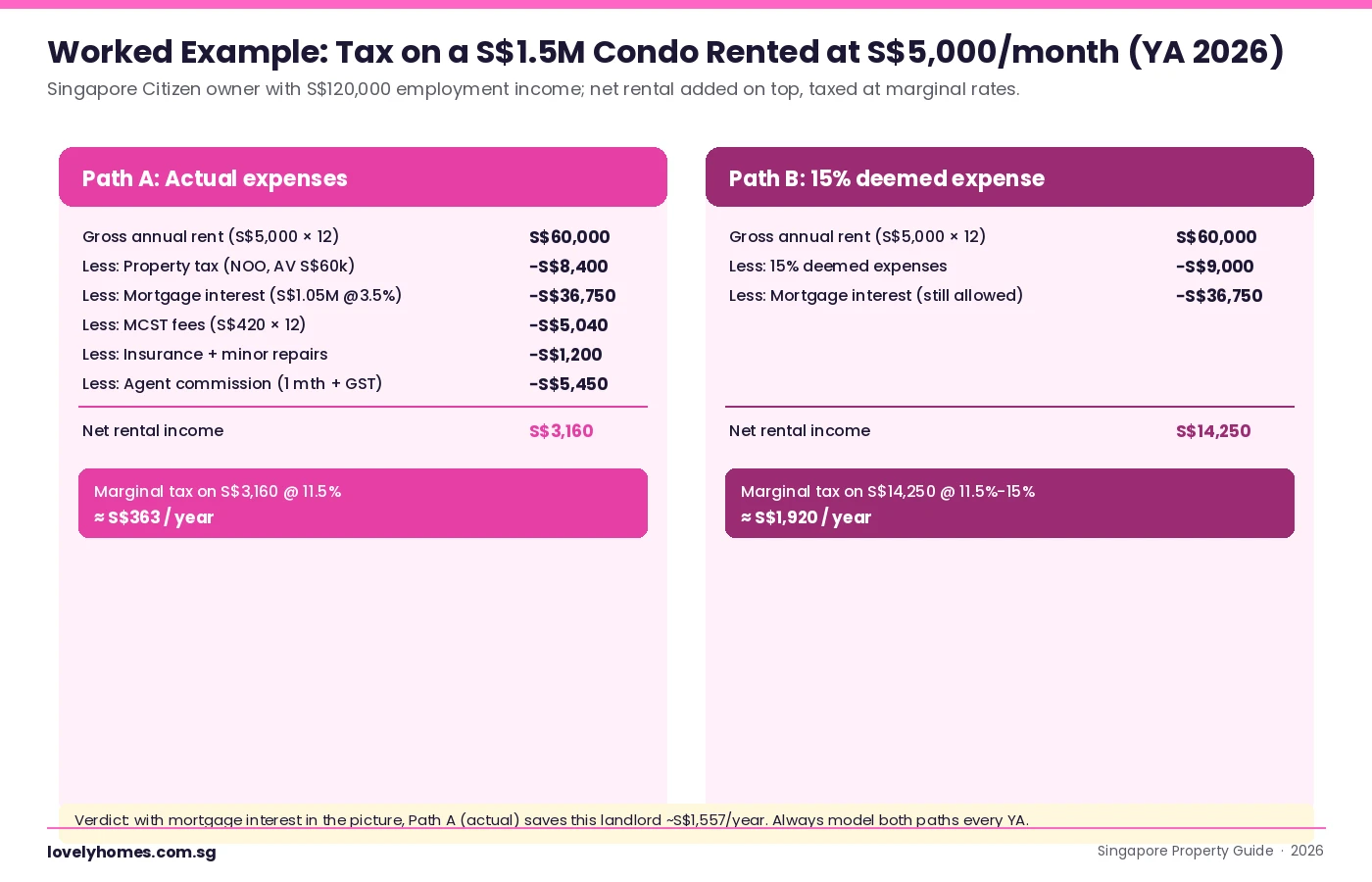
Numbers make this concrete. Consider a Singapore Citizen owner-occupier of a 1,000-sqft 3-bedroom OCR condo bought at S$1.5M with a S$1.05M loan (LTV 70%) at 3.5% all-in. The unit is rented at S$5,000/month from January to December. The owner has S$120,000 of employment income.

Worked rental income tax example S$1.5M Singapore condo S$5000 monthly rent YA 2026 — actual expense path versus 15 percent deemed deduction
Figure 3. Side-by-side comparison of the two computational paths for the same property. With S$36,750 of mortgage interest in the picture, the actual-expense path produces near-zero net rental income; the 15% deemed path gives a worse outcome and saddles the landlord with ~S$1,557 of avoidable tax for the year.

Three lessons from this example:

  1. For any landlord with a meaningful mortgage, Path A almost always wins. Mortgage interest is the single biggest deductible.
  2. If you remortgage and your interest expense changes mid-year, your tax position changes mid-year — track it monthly.
  3. The marginal rate matters as much as the deduction. A landlord at the 22% bracket saves ~S$340 more on the same S$1,557 deduction than the same landlord at the 15% bracket.

Property Tax for Tenanted Units

The instant your property is rented out, IRAS automatically reclassifies it from owner-occupied to non-owner-occupied (NOO). The tax rate ladder differs sharply:

  • Owner-occupier rates: 0% on the first S$8,000 of AV, rising progressively to 32% on AV above S$100,000.
  • Non-owner-occupier rates: 12% on the first S$30,000 of AV, rising to 36% above S$60,000 AV in 2026.

For a typical S$1.5M OCR condo with an AV of around S$60,000, the owner-occupier annual property tax would be about S$8,400; the same unit as a NOO investment is taxed at S$8,400 (owing to the band structure crossing 12%/24%/36%) — in this band, NOO is significantly higher. You must notify IRAS within 15 days of the unit becoming tenanted (or vacated) so the rate is correctly applied. This NOO property tax is then a fully deductible expense against your rental income on the income-tax side.

Joint Owners and Couples

For jointly-held properties, IRAS apportions rental income and deductions equally by default among co-owners, regardless of who actually pays the mortgage or collects the rent. If you want a different split (e.g. 70/30 to reflect actual capital contributions or beneficial ownership), you must file a declaration of beneficial interest and IRAS may ask for evidence.

This is the heart of the Singapore tax-planning playbook for couples: where one spouse earns in the top marginal bracket and the other earns less, splitting the rental income via a 50/50 joint-tenancy or a deliberately-skewed tenancy-in-common can lower household tax materially. The trade-off — ABSD — is covered in our Joint Tenancy vs Tenancy in Common guide.

Vacancy, Mid-Year Letting, and Voids

When you let your property only for part of the year, only the rent received is taxable, and only the expenses attributable to the letting period are deductible (pro-rated). Common scenarios:

  • Owner moves overseas mid-year and rents out from August. Pro-rate the property tax (NOO rate from 1 August), MCST fees, and insurance from August onwards. Mortgage interest is fully deductible against rent because the loan continues throughout, but only the August-December portion is matched against the August-December rent.
  • Tenant moves out, unit vacant for 2 months, new tenant moves in. Vacancy-period expenses (utilities, MCST, mortgage interest) are still deductible if the property was actively marketed for re-letting during the void.
  • Property partly let, partly self-occupied. Only the let portion’s expenses are deductible; the personal-occupation portion is not. Apportion strictly by floor area and time.

What Might Come Next: Rental Tax Watchpoints

The basic IRAS framework has been stable since the 15% deemed-expense option was introduced in YA 2017. Two areas to watch in 2026:

  • Short-term let crackdown. URA’s 3-month minimum residential let rule is now policed more aggressively. AirBnB-style sub-3-month lets are not legal residential lettings and may also be reclassified as a trade by IRAS, attracting higher tax and disqualifying the 15% deemed path.
  • NOO property-tax escalation. The NOO rate ladder has steepened in each Budget since 2022 (peak rate raised from 27% to 36% over three years). Investors should model continuing escalation when underwriting yield.

None of the above is a tax-rate change yet. We will update this guide when Budget 2027 announcements land in February 2027.

Frequently Asked Questions

I let out a single room in my owner-occupied flat. Is that rental income?

Yes. The rent received from a sub-let or room-let is taxable on the same basis as a whole-unit let. You can deduct a fair-share portion of expenses — typically based on the floor area of the let room versus total floor area, multiplied by the days let. The 15% deemed-expense path is also available. You do not have to convert the entire property’s tax status to NOO — that conversion only applies if the whole unit is let out and you no longer occupy it.

Can I deduct the cost of a new sofa I bought when I started renting out the unit?

Not under Path A — the initial fit-out of furnishings is a capital cost, not a maintenance cost. However, if you choose Path B (15% deemed deduction), the deemed-expense covers wear-and-tear and replacement furnishings implicitly. If you replace a broken sofa with a like-for-like sofa later, that is deductible as a repair under Path A.

I am a Singapore tax resident with an apartment in London that I rent out. Is the UK rent taxable in Singapore?

Foreign-source rental income earned by a Singapore tax-resident individual is taxable only when remitted to Singapore (and even then, certain remittances are tax-exempt under section 13(7A) of the Income Tax Act). If the UK rental income stays in a UK bank account and you do not bring it back, it is generally not taxable in Singapore. UK tax on the rent (HMRC Self Assessment) is a separate matter — you should keep that compliance current to avoid double-tax issues. Singapore has a Double Taxation Agreement with the UK that provides relief.

Can my parent (who has no employment income) be the named landlord to lower household tax?

The beneficial owner of the property is the person taxed on the rental income, not necessarily the legal title-holder. If your parent merely holds the title but you funded the deposit, paid the mortgage, and collect the rent, IRAS will still tax you. Genuine transfers to a parent (with proper SDL stamping, ABSD implications, and a real change in beneficial ownership) can shift the tax base, but the costs and ABSD trigger usually outweigh the income-tax savings unless the property has a long runway. Always model the all-in cost across BSD, ABSD, conveyancing, and 5+ years of expected tax savings before transferring.

What happens if I file the wrong figure?

If IRAS detects a discrepancy via its automated checks against your bank records, agent-reported tenancy stampings, and property-tax NOO classification, you will receive an enquiry letter (typically 1-2 years after filing) asking you to reconcile. Genuine errors made in good faith can be self-corrected via an Objection or Amendment within 4 years. Deliberate under-declaration can attract a penalty of up to 200% of the tax undercharged plus interest, plus criminal prosecution in serious cases. The honest path is materially cheaper than the alternative.

Is there any way to claim depreciation on the building structure?

No. Singapore tax law does not allow capital allowances (depreciation) on residential buildings or land. This is one of the structural differences from the US, UK and Australian regimes, where depreciation can shelter meaningful rental cashflow. The only “depreciation-equivalent” reliefs available to Singapore landlords are repairs (Path A) and the 15% deemed expense (Path B).

Do I need to register for GST as a residential landlord?

No. Residential lettings are exempt supplies under the Goods and Services Tax Act — you do not charge GST on rent, and you cannot register for GST on the basis of residential rental income alone. Commercial-property landlords are different: they charge 9% GST (in 2024 onwards) on rent, and must register if their taxable turnover exceeds S$1 million per year.

Related Articles

Disclaimer

This guide is for general information only and does not constitute tax, legal, or financial advice. Singapore income tax law — including the rates, deductibility rules, and remission frameworks discussed above — is subject to change at the discretion of the Minister for Finance and the Comptroller of Income Tax. Always verify the current position on the Inland Revenue Authority of Singapore rental-income page, the relevant individual income tax rate schedules, and the latest annual Ministry of Finance Budget statement — and consult a licensed tax adviser before acting on any specific position. Worked examples are illustrative only; your actual tax outcome will depend on your full facts.

Translate »