Tenancy Agreement Singapore 2026: A Landlord and Tenant’s Complete Guide to the Rental Contract

Tenancy Agreement Singapore 2026: A Landlord and Tenant’s Complete Guide to the Rental Contract

Last updated 28 April 2026. Reflects IRAS lease stamp duty rules current as at FY2026 and standard market norms reported by URA’s quarterly rental statistics.

Quick Answer — 30-second takeaways

  • A Singapore tenancy agreement is the binding contract between a landlord and tenant. It is governed by Singapore contract law and the principles of the Civil Law Act and the Conveyancing and Law of Property Act.
  • Standard residential terms are 12 or 24 months. Anything shorter than 3 months risks being treated as serviced accommodation, which is regulated separately.
  • Security deposit: typically 1 month’s rent per year of lease, capped at 2 months. Refundable within 14 days of handover, less reasonable deductions.
  • Diplomatic clause: standard on 24-month leases, lets the tenant terminate after 12 months on 2 months’ notice if posted out of Singapore.
  • Lease stamp duty (LSD): 0.40% of total rent across the lease term, payable by the tenant within 14 days of execution, e-stamped at iras.gov.sg.
  • Minor repairs cap: tenant pays first S$150–S$250 of any repair; landlord pays the excess. Aircon servicing 3-monthly is the tenant’s cost.
  • Disputes ≤ S$30,000 can be heard at the Small Claims Tribunals (SCT) with both parties’ consent. Larger disputes go to the State Courts.

What a tenancy agreement is — and what it isn’t

A tenancy agreement (often abbreviated TA) is the written contract that creates a legal lease between a property owner (the landlord) and an occupant (the tenant). It records the parties, the property, the term, the rent, the deposit, and the rules for living in and looking after the home.

Singapore does not have a dedicated Residential Tenancy Act. Tenancy agreements are governed by general contract law, supplemented by the Civil Law Act 1909, the Conveyancing and Law of Property Act 1886, and — for HDB rentals — by the rules of the Housing and Development Board. This means that what is “standard” in a Singapore tenancy is largely set by market practice and by widely-used template clauses, not by statute. Landlords and tenants who do not read every clause carefully can find themselves bound by terms the other side considers normal but they did not expect.

A tenancy agreement is not a Letter of Intent (LOI). The LOI is the pre-contract document the prospective tenant submits with a good-faith deposit. The TA is the binding lease that follows once the LOI is accepted. Stamp duty is payable on the TA, not the LOI.
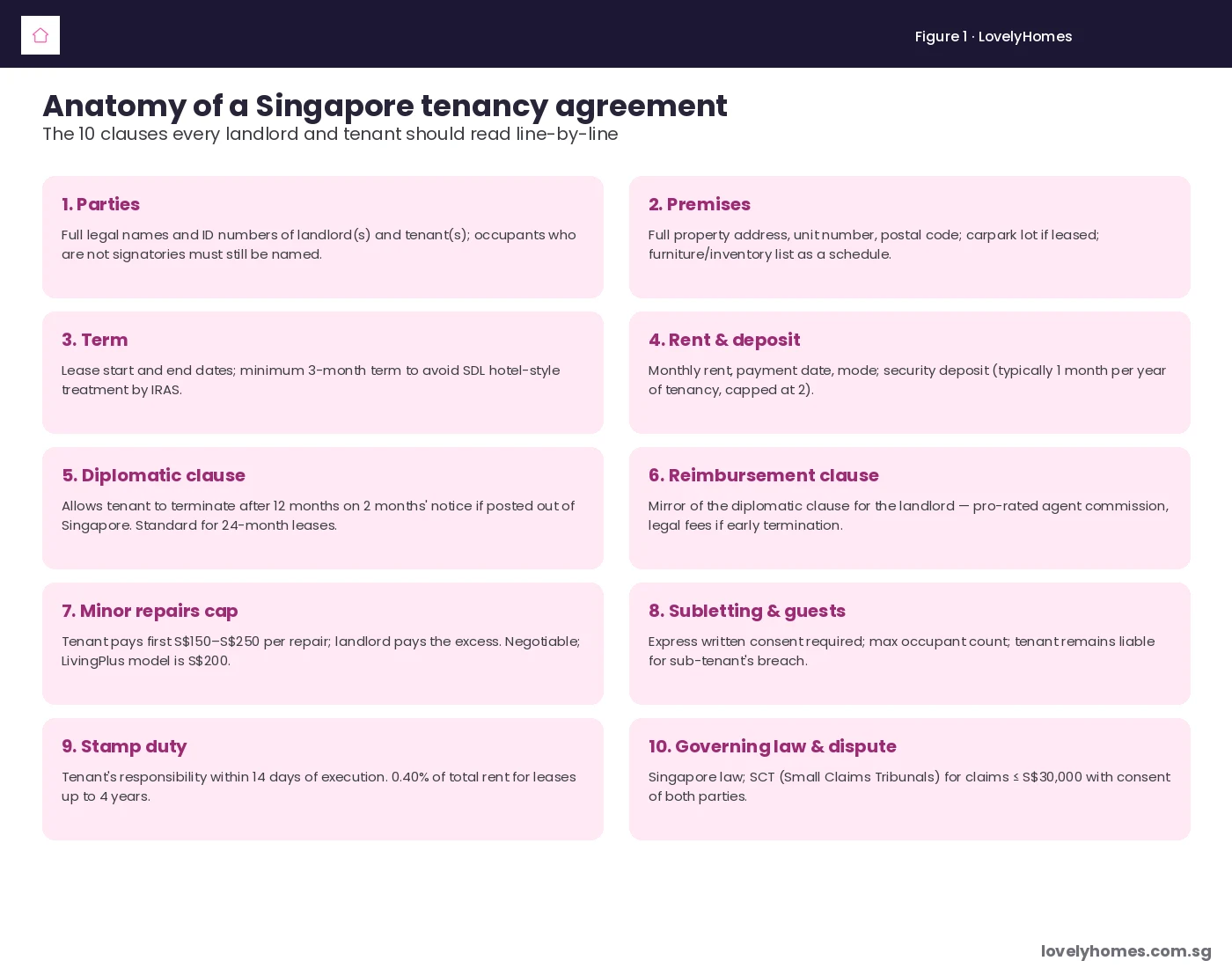
Singapore tenancy agreement 2026 — 10 key clauses every landlord and tenant should read line by line
Figure 1: The 10 clauses that do most of the work in a Singapore tenancy agreement.

Who can be a landlord, and who can be a tenant

For private property, any property owner can lease their unit, subject to building by-laws and the conditions of any mortgage. The Urban Redevelopment Authority requires a minimum lease of 3 months for private residential property; below that threshold the lease is treated as short-stay accommodation and is generally not allowed unless the unit is licensed serviced apartment stock.

For HDB flats, the rental rules are stricter:

  • The flat must have met its Minimum Occupation Period (MOP), which is typically 5 years for new flats and 5 years for resale flats with grant.
  • The owner must apply for HDB approval to rent out the whole flat or individual rooms.
  • Rentals to non-citizen households must respect the Ethnic Integration Policy (EIP) and Singapore Permanent Resident (SPR) quota.
  • Maximum 6 unrelated occupants per flat (4 for 1- and 2-room flats).
  • The minimum rental period is 6 months for whole-flat HDB rentals.

Tenants can be Singapore Citizens, Permanent Residents, work-pass holders, students or any other lawfully present individual. For non-resident tenants, landlords must verify that the tenant holds a valid pass throughout the lease — leasing to an individual without a valid pass is an offence under the Immigration Act.

The 10 clauses that do all the work

A typical Singapore residential TA runs to 8–14 pages. Most of the legal heavy-lifting happens in ten clauses, summarised in Figure 1 above and explored below.

Term and renewal

The lease term is fixed: it has a defined start date and end date. Holding-over (continuing to occupy after expiry without a new TA) creates a tenancy at will, which is terminable on short notice and offers neither party much protection. Most landlords negotiate renewal 2–3 months before expiry; the LSD on the renewal lease must be re-stamped at the new rent.

Rent and security deposit

Rent is payable monthly in advance. The market norm for the security deposit is 1 month’s rent per year of lease, capped at 2 months. The deposit secures the landlord against damage beyond fair wear and tear, unpaid rent, and unpaid utility bills. It is refunded within 14 days of handover, less itemised deductions. Disputes over deposit deductions are the single most common Singapore tenancy dispute, and the Small Claims Tribunals see hundreds each year.

Diplomatic clause and reimbursement clause

The diplomatic clause allows a tenant to terminate after 12 months on 2 months’ written notice if they are required to leave Singapore (typically because of a job posting or visa cancellation). It is market-standard on 24-month leases and rare on 12-month leases. The mirror is the reimbursement clause: if the tenant terminates early, they must reimburse the landlord on a pro-rated basis for the agent’s commission and legal fees of the original lease.

Minor repairs cap

Tenants are responsible for minor repairs up to a contractual cap, typically S$150–S$250 per item. Landlords pay the excess. The clause prevents petty disputes about light bulbs and tap washers, while keeping major repairs (aircon compressor failure, roof leaks, structural defects) on the landlord’s account. Air-conditioner servicing every 3 months is the tenant’s cost; receipts must be produced at handover.

Inventory and handover

An inventory list — usually a schedule attached to the TA — records every item of furniture, every appliance, and every fixture provided. At move-in, both parties walk through and sign off. At move-out, deductions for missing or damaged items are calculated against this list. Photo evidence at both ends saves arguments.

Stamp duty clause

The TA will state which party is responsible for paying lease stamp duty. By Singapore market practice and IRAS guidance, the tenant pays. Failure to e-stamp within 14 days exposes the lease to a penalty of 4 times the duty or S$10, whichever is higher, and the unstamped lease is inadmissible as evidence in a Singapore court (the duty must be paid before the lease can be relied on in litigation).
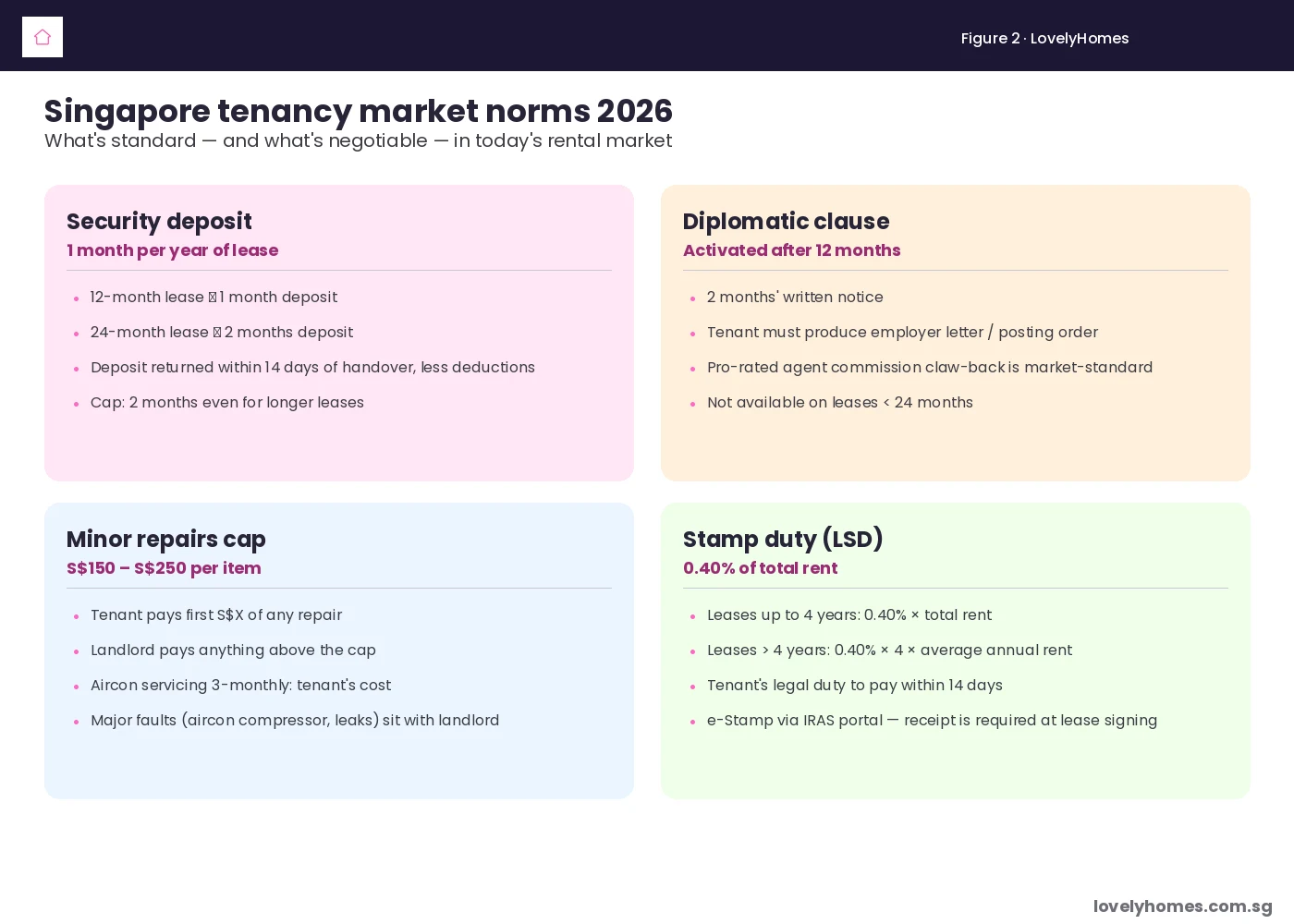
Singapore tenancy agreement 2026 — market norms for deposit, diplomatic clause, minor repairs cap, and stamp duty
Figure 2: The four “norms” most often negotiated — deposit, diplomatic clause, repairs cap, and stamp duty.

Lease stamp duty: the maths

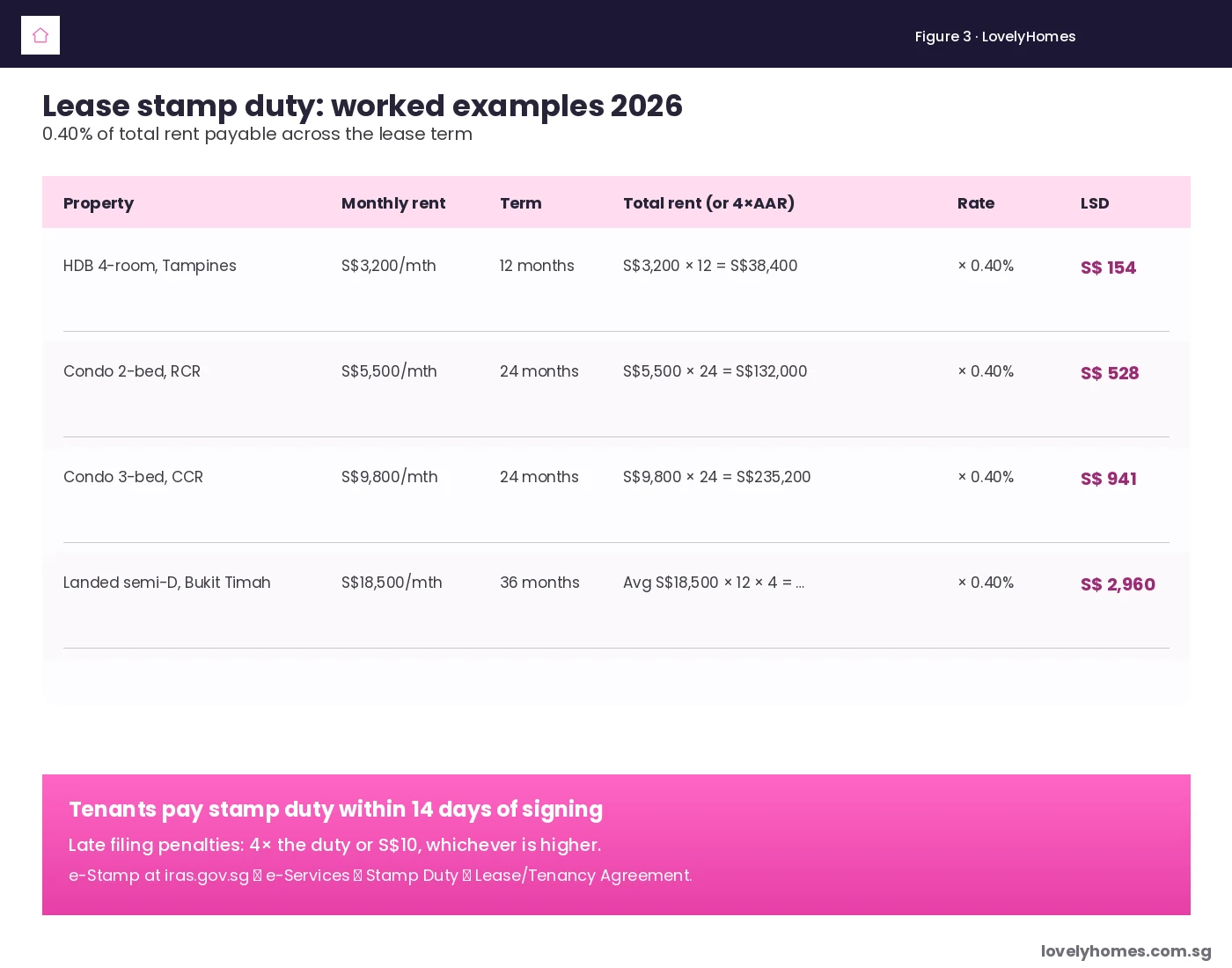
Lease stamp duty (LSD) is the only tax on a Singapore tenancy. It is levied at 0.40% of total rent across the lease term, capped at four times the average annual rent for leases longer than 4 years. The duty is the tenant’s legal obligation under section 33 of the Stamp Duties Act, payable within 14 days of execution.

Lease term Stamp duty formula Notes
≤ 4 years 0.40% × total rent across the term Most common; covers all 12- and 24-month leases
> 4 years 0.40% × 4 × average annual rent Caps the duty for long leases
Lease with premium / variable rent BSD-style staircase rates apply to premium; LSD on the rent component Rare in residential — common in commercial
Singapore lease stamp duty worked examples 2026 for HDB, condo and landed properties
Figure 3: Worked LSD examples across HDB and private property at 2026 market rents.

The IRAS portal e-stamps the lease in real time. The tenant pays via PayNow, eNETS or credit card, prints the certificate, and brings the original to the lease signing. Many landlords now make production of the e-stamp certificate a precondition to handing over keys — a sensible safeguard, because once keys are handed over the landlord’s leverage drops sharply.

Negotiating the lease — what to push on, what to leave alone

Singapore tenancy agreements are negotiable. The points that move most often:

  • Diplomatic clause activation date. Tenants often ask for activation at month 9 instead of month 12. Landlords typically refuse. The 12-month default holds.
  • Minor repairs cap. Tenants ask for S$300; landlords often want S$150. The S$200 LivingPlus number is the comfortable middle.
  • Whitegoods inclusion. Whether refrigerator, washer, dryer, microwave, oven, vacuum and rice cooker are included is line-by-line negotiation. List each item by brand and model in the inventory schedule.
  • Repainting before handover. A clause requiring the tenant to repaint before move-out used to be standard. It is increasingly replaced by a fixed reinstatement fee (S$300–S$800) plus normal wear-and-tear treatment.
  • Pet clause. “No pets” is the default. Tenants with pets must negotiate a specific carve-out and an additional deposit. HDB has its own approved-breed list for flats.
  • Smoking. “No smoking inside the unit” is now standard, and landlords reasonably claim against deposit if walls and curtains carry residual smoke odour.

What happens if things go wrong

The Singapore framework for tenancy disputes is informal but well-trodden:

  • Small Claims Tribunals (SCT). Hears disputes ≤ S$20,000 (or up to S$30,000 with both parties’ consent in writing) for tenancies of up to 2 years. Hearings are tenant- and landlord-friendly: no lawyers in the courtroom, fees from S$10, decisions usually within 4–6 weeks. The most common claims are deposit deductions, damage to inventory, and unpaid rent.
  • State Courts. Larger disputes, longer leases, and complex commercial-residential overlaps. Lawyers represent both sides; costs follow the event.
  • HDB and the Housing & Estate Disputes Resolution Centre. For HDB rental disputes specifically, HDB will mediate before parties resort to the SCT.
  • Mediation via the Singapore Mediation Centre. Voluntary and confidential. Useful where the parties want to preserve a working relationship — for example, a landlord who wants the tenant to stay another year.

What this means for you

For tenants: read every clause. Push back on anything ambiguous. Pay LSD on time and keep the certificate. Photograph the unit on move-in and move-out. Save every WhatsApp message about repairs — these are evidence in any future SCT claim.

For landlords: use a template TA from a Singapore conveyancing lawyer (not a generic internet template). Check the tenant’s pass status throughout the lease. Inspect the unit twice during a 24-month lease — once at month 6, once at month 18 — with proper notice. Reply in writing to repair requests. The landlord’s deposit deduction is much harder to defend in the SCT if the inspection trail is thin.

What might come next

The Ministry of National Development has been studying the case for codifying residential tenancy law in Singapore — the United Kingdom, Australia and several jurisdictions in continental Europe have moved in this direction. As at April 2026, no draft Bill has been tabled. The likeliest medium-term reforms are: a statutory deposit scheme along the lines of the UK Tenancy Deposit Scheme; a standard tenancy agreement template published by URA or HDB; and clearer rules on the deductibility of fair wear and tear. None of these are imminent, but landlords and tenants who structure their TAs around the existing market norms are well-positioned for any future statutory framework.

Frequently asked questions

Who pays the property agent’s commission?

Singapore market practice is that each side pays its own agent. The landlord pays the landlord’s agent (typically 1 month of annual rent on a 24-month lease, half a month on a 12-month lease). The tenant typically pays the tenant’s agent only on shorter or smaller-rent leases (under S$3,500/month) where the landlord’s agent’s fee is too thin to share. CEA’s Code of Ethics and Professional Client Care requires written disclosure of who pays whom before any signing.

Can a tenant break the lease before the diplomatic clause activates?

Only if the landlord agrees, or if the landlord is in fundamental breach (uninhabitable conditions, refusal to make repairs, harassment). Otherwise, an early termination is a breach of contract. The tenant remains liable for rent until the landlord re-lets the unit; the security deposit is forfeited; the original agent’s commission is clawed back pro-rata. Most landlords are willing to release a tenant if a replacement tenant on equivalent terms is presented.

Can the landlord enter the property without notice?

No. The TA grants the tenant exclusive possession. The landlord may enter only with reasonable notice (typically 24 hours in writing) and at reasonable times, except in emergencies (fire, flood, gas leak). Repeated unannounced visits are a breach of the covenant for quiet enjoyment and can support a tenant’s claim for damages.

What if the tenant has overstayed or won’t leave?

Self-help eviction is unlawful in Singapore. The landlord must give the contractual notice (or, if the lease has expired, a notice to quit), and if the tenant still does not leave, file for a Writ of Possession at the State Courts. Locking the tenant out, removing belongings, or cutting utilities is a criminal offence under the Protection from Harassment Act 2014 and the Distress Act 1872.

Does GST apply to residential rent?

No. Residential rent is exempt from GST under the Fourth Schedule to the GST Act. GST applies only to commercial leases — and only when the landlord is GST-registered (i.e., turnover above S$1 million in a 12-month period).

Can a tenant sub-let to a third party?

Only with the landlord’s written consent. Most TAs have an express anti-subletting clause. Even where consent is given, the head tenant remains liable to the landlord for the sub-tenant’s behaviour, rent and damage. For HDB rentals, all sub-letting must additionally have HDB approval; unauthorised sub-letting is a serious offence and can result in compulsory acquisition of the flat.

Is a verbal lease enforceable?

A verbal residential lease for 3 years or less is technically enforceable under the Conveyancing and Law of Property Act, but in practice it is almost impossible to prove the terms. For any lease over 3 years, the law requires a written, signed deed, registered with the Singapore Land Authority. As a landlord or tenant, you should never proceed without a written, e-stamped TA.
Disclaimer. This article is general guidance only and does not constitute legal advice. Singapore tenancy law is governed by the Civil Law Act 1909, the Conveyancing and Law of Property Act 1886, the Stamp Duties Act 1929, the Small Claims Tribunals Act 1984, and HDB regulations for public housing. Always read your specific tenancy agreement carefully and consult a licensed Singapore lawyer for high-value or unusual terms. Verify lease stamp duty rates against iras.gov.sg, HDB rental approval rules against hdb.gov.sg, and URA short-stay rules against ura.gov.sg.
Tenancy Agreement
Rental
Lease Stamp Duty
Singapore Property
Renting Guide
Diplomatic Clause
Security Deposit
Landlord
Tenant
HDB Rental

Decoupling for Married Couples Singapore 2026: Saving ABSD on a Second Home — Legally and Step-by-Step

Decoupling for Married Couples Singapore 2026: Saving ABSD on a Second Home — Legally and Step-by-Step

Last updated 28 April 2026. Reflects ABSD rates effective 27 April 2023 and Buyer’s Stamp Duty rates effective 14 February 2023.

Quick Answer — 30-second takeaways

  • Decoupling is the legal restructuring of a co-owned residential property so that one spouse ends up holding 100% of it. The other spouse is then restored to first-time-buyer status and can buy a second residential property without paying ABSD.
  • For a married Singapore Citizen (SC) couple, ABSD on a S$1.5 million second home is 20% (S$300,000). Decoupling typically costs S$50,000–S$70,000 in BSD on the internal transfer plus legal fees.
  • The maths almost always favours decoupling once the second property is above S$1 million.
  • Decoupling is only legal for private residential property. HDB flats cannot be decoupled (since 1 April 2016, except in narrow exceptions like divorce, death or financial hardship).
  • The receiving spouse must be able to solo-service the loan under TDSR (60%) and refund any CPF used by the outgoing spouse with 2.5% accrued interest.
  • Decoupling is administered by IRAS for stamp duty and CPF Board for refund of utilised CPF; conveyancing must be handled by a licensed Singapore lawyer.
  • Allow 6 to 10 weeks end-to-end. Add 2–4 weeks if the loan must be refinanced into one name.

What is decoupling?

“Decoupling” is the informal name for a transaction in which co-owners of a Singapore residential property restructure their ownership so that one party transfers their share to the other. The receiving owner ends up with 100% legal title; the outgoing owner ends up with no residential property in their name.

The reason this is done is rarely sentimental. It is an Additional Buyer’s Stamp Duty (ABSD) avoidance technique — and a perfectly legal one, provided it is structured as an arms-length sale at market value, with stamp duty correctly paid on the transferred share. Once the outgoing spouse no longer owns any residential property, they are restored to “first residential property” status with the Inland Revenue Authority of Singapore (IRAS), and any subsequent purchase falls outside the punitive ABSD net.

The technique was already common before the 27 April 2023 ABSD hike that took the second-property rate for SCs from 17% to 20%. After that hike, decoupling became one of the most-discussed topics on Singapore property forums — and a regular line item in mass-affluent household financial plans.

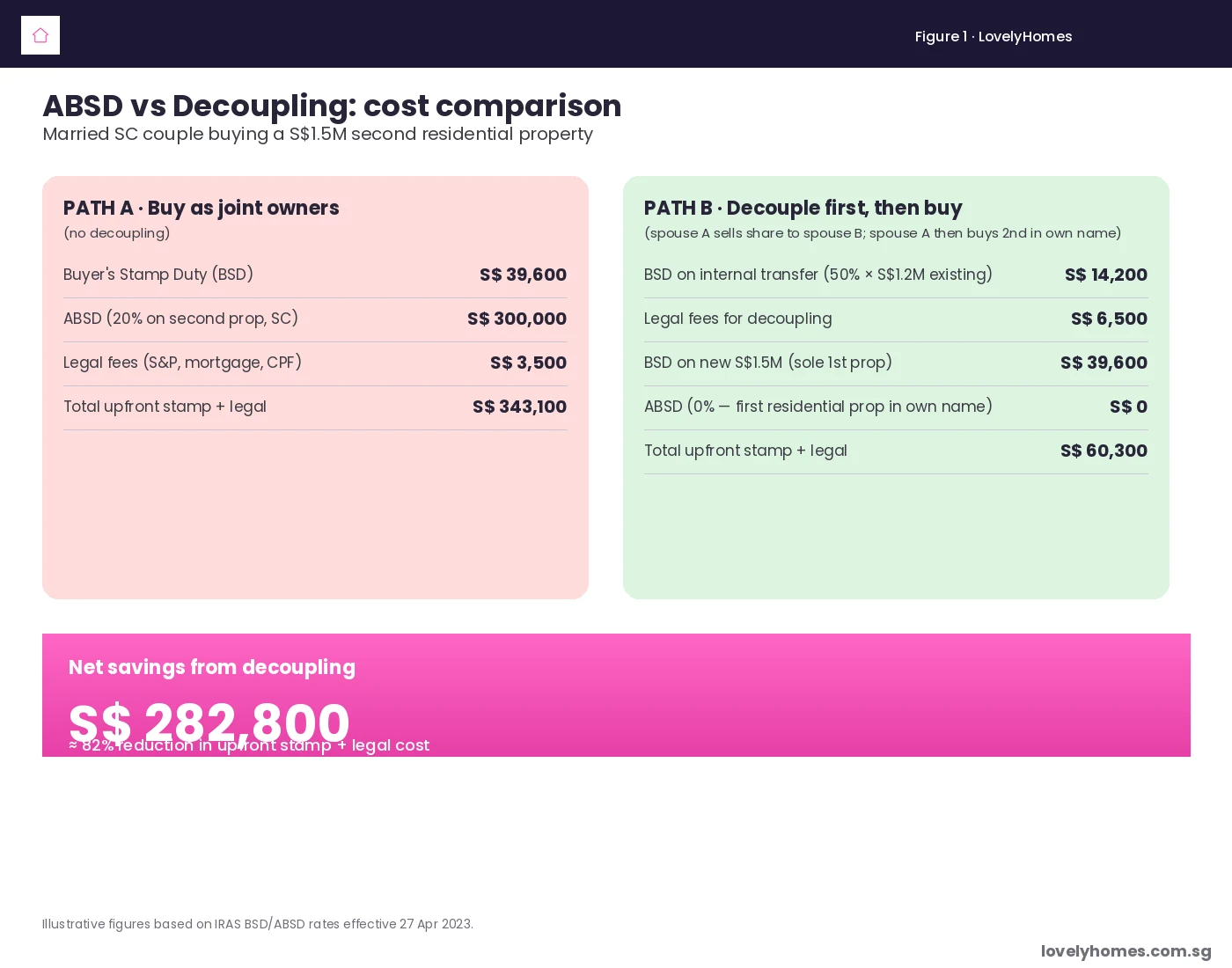
Decoupling property Singapore 2026 — ABSD vs decoupling cost comparison for a S$1.5M second home
Figure 1: For a married SC couple buying a S$1.5 million second residential property, decoupling cuts upfront stamp + legal cost from S$343,100 to S$60,300 — a saving of S$282,800.

Why decoupling exists — the ABSD wall

Singapore’s ABSD regime treats any residential property held by either spouse as a household-level holding for stamp duty purposes. Under IRAS rules a married couple is taxed as a single buyer profile: if either spouse has an existing residential property, the next purchase is treated as a second (or third) property and attracts ABSD at the higher band, even if the new property is bought solely in the unencumbered spouse’s name.

The 2026 ABSD ladder for residential property is:

Buyer profile 1st residential 2nd residential 3rd & subsequent
Singapore Citizen (SC) 0% 20% 30%
Singapore PR 5% 30% 35%
Foreigner 60% 60% 60%
Entity / Trust 65% 65% 65%

For a married SC couple, the 20% band on a S$1.5 million purchase is S$300,000 — payable upfront, in cash or CPF, within 14 days of exercising the Option to Purchase. That is the wall decoupling is designed to remove.

Who can decouple — and who cannot

Decoupling is only available for private residential property: condos, executive condominiums (after the privatisation date), and landed homes. It is not available for HDB flats — the Housing and Development Board removed the loophole on 1 April 2016, requiring HDB flats to be held jointly under specified eligibility schemes (Public, Fiance, Joint Singles, etc.) and prohibiting “part-share” transfers between named owners except in narrow circumstances like divorce, death of co-owner, financial hardship or marriage to an existing co-owner.

Within private residential property, decoupling typically works for couples where:

  • The property has appreciated enough that BSD on the transferred share is meaningfully smaller than the avoided ABSD;
  • The receiving spouse can solo-service the existing mortgage under the 60% Total Debt Servicing Ratio (TDSR);
  • Both parties are aligned that the outgoing spouse will end up holding the new property in their sole name (with the implications that brings on inheritance, CPF refund and divorce settlement).

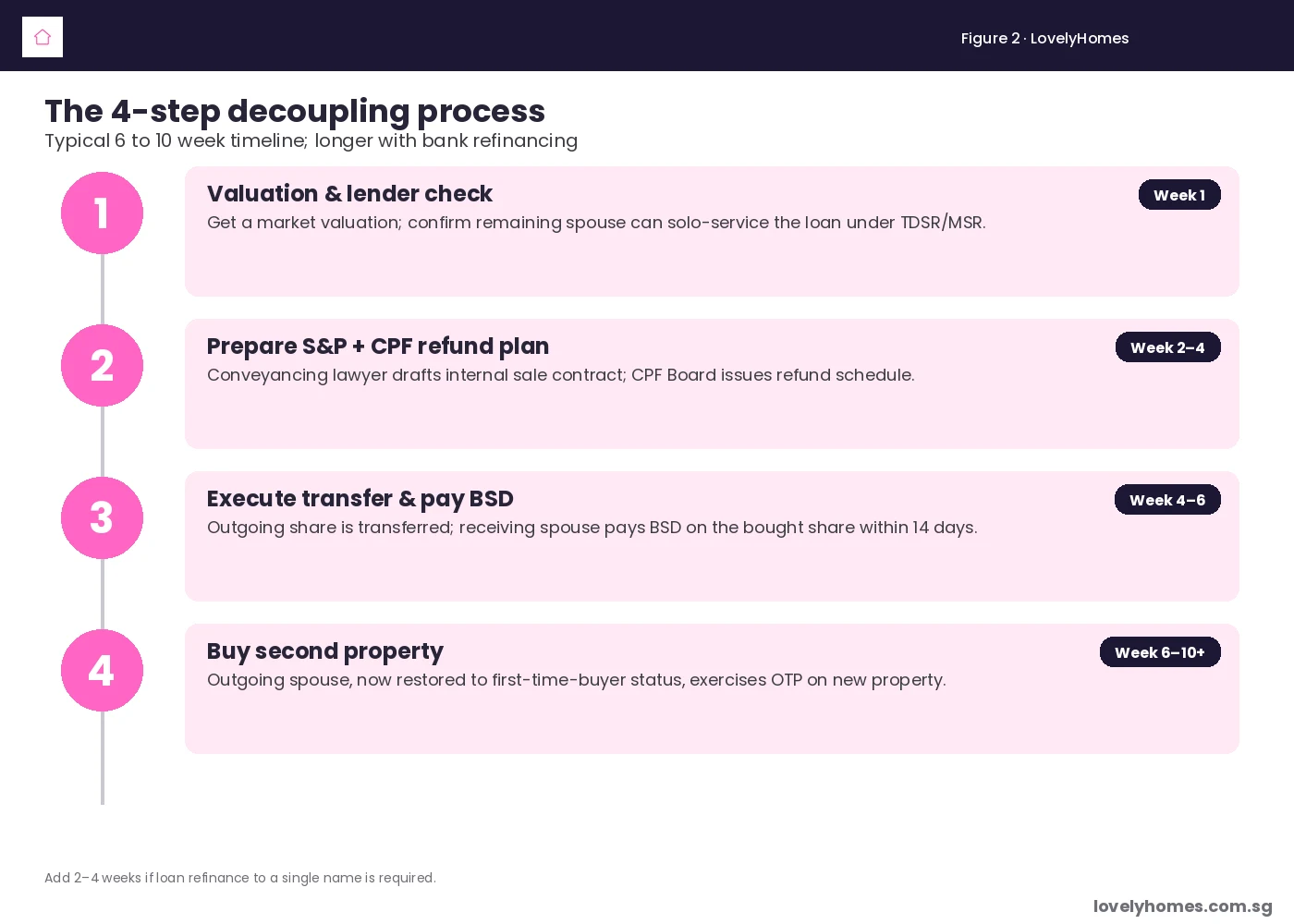
The 4-step decoupling process

Decoupling property Singapore 2026 — 4-step process timeline from valuation to second purchase
Figure 2: The decoupling timeline: valuation, S&P drafting, transfer + BSD payment, then the second purchase.

Step 1 — Valuation and lender check

The conveyancing lawyer obtains a market valuation. The receiving spouse approaches the existing mortgagee bank (or an alternative bank) to confirm they can solo-service the loan under TDSR — meaning total monthly debt repayments cannot exceed 60% of gross monthly income. The Monetary Authority of Singapore caps the loan tenure at 30 years for private property and the loan-to-value ratio at 75% for the first housing loan.

Step 2 — Prepare S&P agreement and CPF refund schedule

The lawyer drafts an internal sale and purchase agreement at market value. CPF Board issues a refund schedule covering all CPF principal previously used by the outgoing spouse plus 2.5% accrued interest from the date each contribution was used. This is non-negotiable: the CPF refund is a lien on the property and must be settled at completion.

Step 3 — Execute the transfer and pay BSD

On completion, legal title transfers from joint to sole ownership. The receiving spouse pays BSD on the value of the share bought (i.e., 50% of the market valuation in a 50/50 joint tenancy, scaled accordingly for tenancy-in-common). BSD must be paid within 14 days of execution; late payment attracts IRAS penalties.

Step 4 — Buy the second property

The outgoing spouse, now restored to “no residential property” status, exercises the Option to Purchase on the new property and pays standard BSD only — no ABSD. There is no waiting period required between Step 3 and Step 4, but in practice the second OTP is often timed to coincide with the new launch ballot date or resale negotiation.

What decoupling actually costs

Decoupling is not free. The cost stack is dominated by BSD on the share transferred at market value. Other line items include legal fees, valuation, and any bank refinancing/discharge fees if the loan moves to a single name.

Cost line Typical range Notes
BSD on internal transfer S$8,000 – S$30,000+ Calculated on 50% of market value at standard BSD rates
Conveyancing legal fees S$5,000 – S$8,000 One firm typically acts for both spouses; ask for an itemised quote
Bank legal subsidy clawback up to S$2,000 If the existing mortgage was taken < 3 years ago
Valuation report S$300 – S$600 Required by both bank and lawyer
Bank early-repayment penalty 1.50% of outstanding loan Only if existing loan is within lock-in period; waived if simply refinancing in same name
CPF refund (with accrued 2.5% interest) Varies Cash flow item, not a sunk cost — money is returned to your CPF account

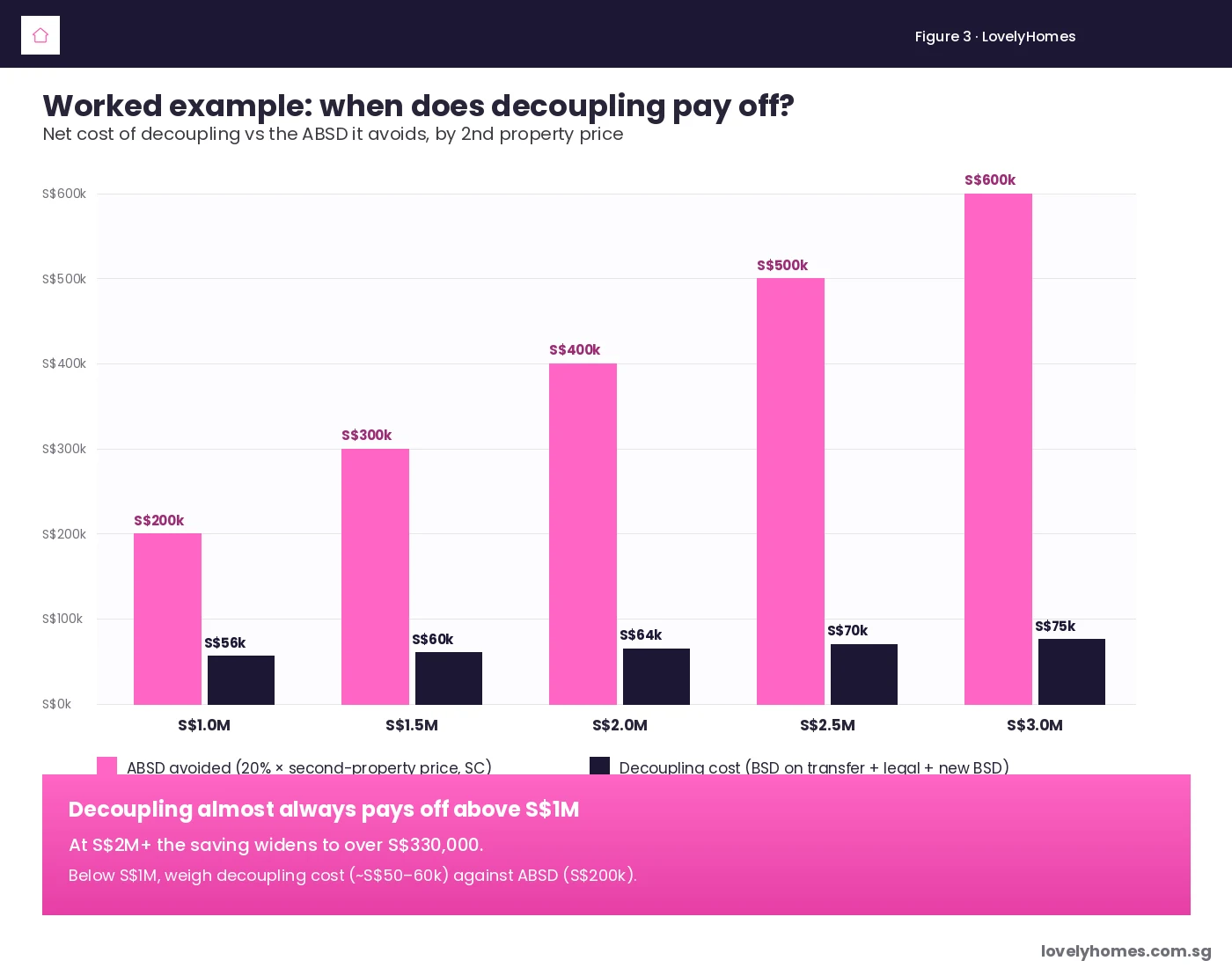
When does decoupling pay off?

Decoupling property Singapore 2026 — worked example showing ABSD avoided vs decoupling cost across S$1M to S$3M second-property prices
Figure 3: Across the S$1 million to S$3 million range, decoupling produces large net savings — and the gap widens with second-property price.

Worked example — Mr and Mrs Tan

Mr and Mrs Tan are both Singapore Citizens. They own a S$1.2 million Outside-Central-Region condo as joint tenants (50/50). They are looking to buy a S$1.5 million Rest-of-Central-Region condo for investment.

Path A — buy as joint owners, no decoupling:

  • BSD on S$1.5M = S$39,600
  • ABSD at 20% (second residential property, SC) = S$300,000
  • Legal fees on the new S&P = S$3,500
  • Total upfront: S$343,100

Path B — Mrs Tan sells her 50% share to Mr Tan first; Mr Tan then buys the new property in his sole name:

  • BSD on internal transfer of 50% × S$1.2M = S$14,200 (paid by Mr Tan)
  • Legal + valuation + bank fees ≈ S$6,500
  • Mrs Tan now has no residential property. She buys the S$1.5M ROC condo in her sole name.
  • BSD on new S$1.5M = S$39,600
  • ABSD = S$0 (first residential property in her name)
  • Total upfront: S$60,300

Net saving: S$282,800, or roughly 82% of the original cost. That number is the entire reason decoupling exists as a household financial-planning lever.

The risks people forget to weigh

Decoupling looks like a tax-arbitrage layup. It is — but the structure has consequences that linger long after the BSD is paid.

  • Loss of joint protection. Once the property is in one name, the outgoing spouse has no automatic legal interest in it. In divorce, ancillary matrimonial property division still applies — but creditor exposure (e.g. the sole owner’s business debts) shifts.
  • Loss of right of survivorship. Joint tenancy carries automatic survivorship: when one spouse dies, the survivor takes the whole property. After decoupling, the property passes via the sole owner’s will (or intestacy rules) — make sure both estate plans are updated immediately.
  • CPF cash-flow sting. The accrued-interest refund on CPF used can be substantial — often S$50,000 to S$150,000 in cash that has to be parked back in the outgoing spouse’s CPF account.
  • Refinance friction. If TDSR fails on a single income, decoupling cannot proceed. Some couples bridge this by adding a parent or adult child as a co-borrower, but this triggers fresh ABSD considerations.
  • Future ABSD changes. The outgoing spouse only retains “first residential property” status until they buy. If the new purchase is delayed and ABSD is hiked again, the saving narrows.

Decoupling vs alternatives

Decoupling is one of three structural ways for couples to manage ABSD. The other two are:

  • Buying in one spouse’s name from the start. Cheaper than decoupling because there is no internal transfer cost — but only works if you start the journey with this in mind. Most couples don’t.
  • Buying through a trust for a child. ABSD at the trust rate (65%) is usually paid upfront and refunded if the trust beneficiary is a citizen child under 21 and meets IRAS conditions. This is a niche structure for high-net-worth families.

For most existing joint-owner couples, decoupling is the most direct route. The “buy from one name” technique is preferable for new couples planning their property ladder before the first purchase.

What might come next

The Ministry of Finance has reviewed the decoupling loophole multiple times since 2017 without closing it for private property. The April 2023 ABSD hike effectively made decoupling more attractive, not less, because the avoided amount grew. If a future cooling-measures package extends the post-2016 HDB anti-decoupling rule to private property — for example, by treating the receiving spouse’s holding as a “household second property” if the divestment was within 3 years — the technique would be neutered overnight. As of April 2026 there is no public signal of such a move, and Singapore’s policy preference has been to raise stamp duty rather than restrict ownership structures. Treat this as policy risk, not a base case.

Frequently asked questions

Can I decouple my HDB flat?

No. Since 1 April 2016, HDB flats can only be held under HDB’s eligibility schemes (Public Scheme, Fiance Scheme, Joint Singles, etc.), and “part-share” transfers between named owners are not permitted except in narrow circumstances: divorce, death of co-owner, financial hardship, marriage of a co-owner, or renunciation of citizenship by a co-owner. The pre-2016 path of selling one party’s share to the other to free up an ABSD slot is closed for HDB.

Will IRAS treat decoupling as tax avoidance?

IRAS has consistently treated genuine decoupling as a legitimate restructuring, provided the transfer is at market value and BSD is correctly paid on the share transferred. The General Anti-Avoidance Provision in section 33 of the Stamp Duties Act has not been used to challenge bona fide decoupling. The risk arises only if the transfer is not at arm’s length or if the receiving spouse subsequently transfers the property back — that pattern would attract scrutiny.

How long does the whole process take?

Six to ten weeks is typical: one to two weeks for valuation and S&P drafting, three to four weeks to the transfer completion and BSD payment, and a further two weeks of buffer for the second property’s OTP timeline. If the loan needs to be refinanced into a single name with a different bank, add another two to four weeks for credit underwriting.

Can I decouple just before retirement?

Yes, but think carefully. The receiving spouse must continue to solo-service any remaining loan; if their income drops in retirement, TDSR may already be tight. Many retirees opt to redeem the loan in full at decoupling, which avoids TDSR issues but pulls cash or CPF out of liquid reserves.

Can I decouple if my property is still within Seller’s Stamp Duty (SSD) holding period?

Yes. SSD only applies on a sale to a third party within the holding period (3 years from purchase for residential property). An internal transfer between spouses is ordinarily exempt from SSD, but check with your conveyancing lawyer because the exemption depends on documentation of the transfer being a transfer of beneficial interest, not a market sale to an unrelated party.

Does CPF need to be refunded immediately?

Yes. The outgoing spouse’s CPF principal plus 2.5% accrued interest must be refunded to their CPF Ordinary Account at completion. The CPF refund is a lien on the property — completion will not proceed without it. The funds can subsequently be used by that spouse for the second property’s downpayment, subject to CPF housing rules.

What if I’m not married — can two siblings or partners decouple?

Decoupling is structurally available to any joint owners, not only married couples. However, the ABSD treatment is different: unmarried co-owners are not aggregated for ABSD by IRAS in the same way spouses are. Two unmarried joint owners who each own only one residential property are already at first-property ABSD on their respective slots. Decoupling for unmarried co-owners is mostly relevant for estate planning, debt segregation, or pre-marriage clean-up rather than ABSD avoidance.

Disclaimer. This article is general guidance only and does not constitute legal, tax or financial advice. Stamp duty, CPF and conveyancing rules in Singapore are administered by the Inland Revenue Authority of Singapore (IRAS), the CPF Board and the Singapore Land Authority respectively. Always consult a licensed Singapore conveyancing lawyer and verify current rates against iras.gov.sg, cpf.gov.sg and mas.gov.sg before acting. Loan eligibility under TDSR/MSR is set by the Monetary Authority of Singapore.
Decoupling
ABSD
Buyer’s Stamp Duty
Property Tax
Singapore Property
Conveyancing
Property Investment
Tax & Legal
Joint Tenancy
CPF Refund

HDB Resale Prices Slip 0.1% in Q1 2026 — First Quarterly Decline in Almost Seven Years

HDB Resale Prices Slip 0.1% in Q1 2026 — First Quarterly Decline in Almost Seven Years

The Housing & Development Board released its full Q1 2026 statistics on 24 April 2026, confirming what the flash estimate had hinted at three weeks earlier: the HDB Resale Price Index slipped 0.1% quarter-on-quarter, the first quarterly contraction in almost seven years. The last time HDB resale prices fell on a QoQ basis was Q2 2019, before the post-COVID supply squeeze and the surge in million-dollar transactions reset the public-housing market.

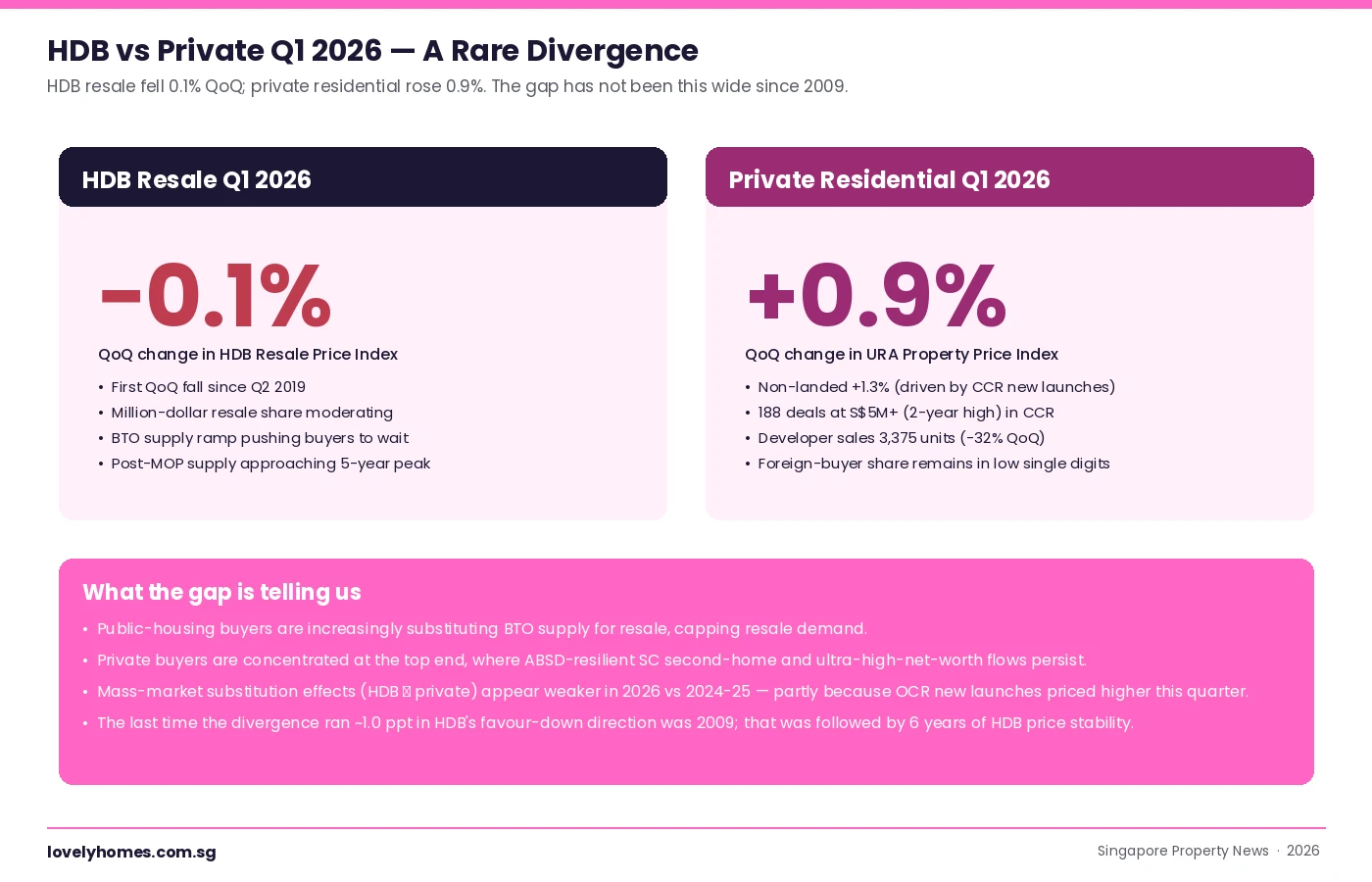
The headline is small in absolute terms — one-tenth of one percent — but it lands as the inflection most market participants have been waiting for since price growth stalled in mid-2024. Coupled with a private residential market that rose 0.9% in the same quarter, Q1 2026 is the rarest of episodes: a clean break in the public-vs-private price trajectory.

Quick Answer — what changed in Q1 2026

  • HDB Resale Price Index: −0.1% QoQ — first quarterly fall since Q2 2019 (27 quarters ago).
  • Private Property Price Index: +0.9% QoQ — led by non-landed at +1.3%.
  • Million-dollar HDB resale share moderated after a record-setting 2025.
  • HDB pipeline: 6,900 BTO flats coming in June 2026 across Ang Mo Kio, Bishan, Bukit Merah, Sembawang, Woodlands.
  • Developer sales for private new launches: ~3,375 units, −32% QoQ after a heavy 4Q 2025 launch slate.
  • The HDB-vs-private QoQ gap (~1.0 ppt) is the widest in HDB’s-down direction since 2009.

The Number in Context

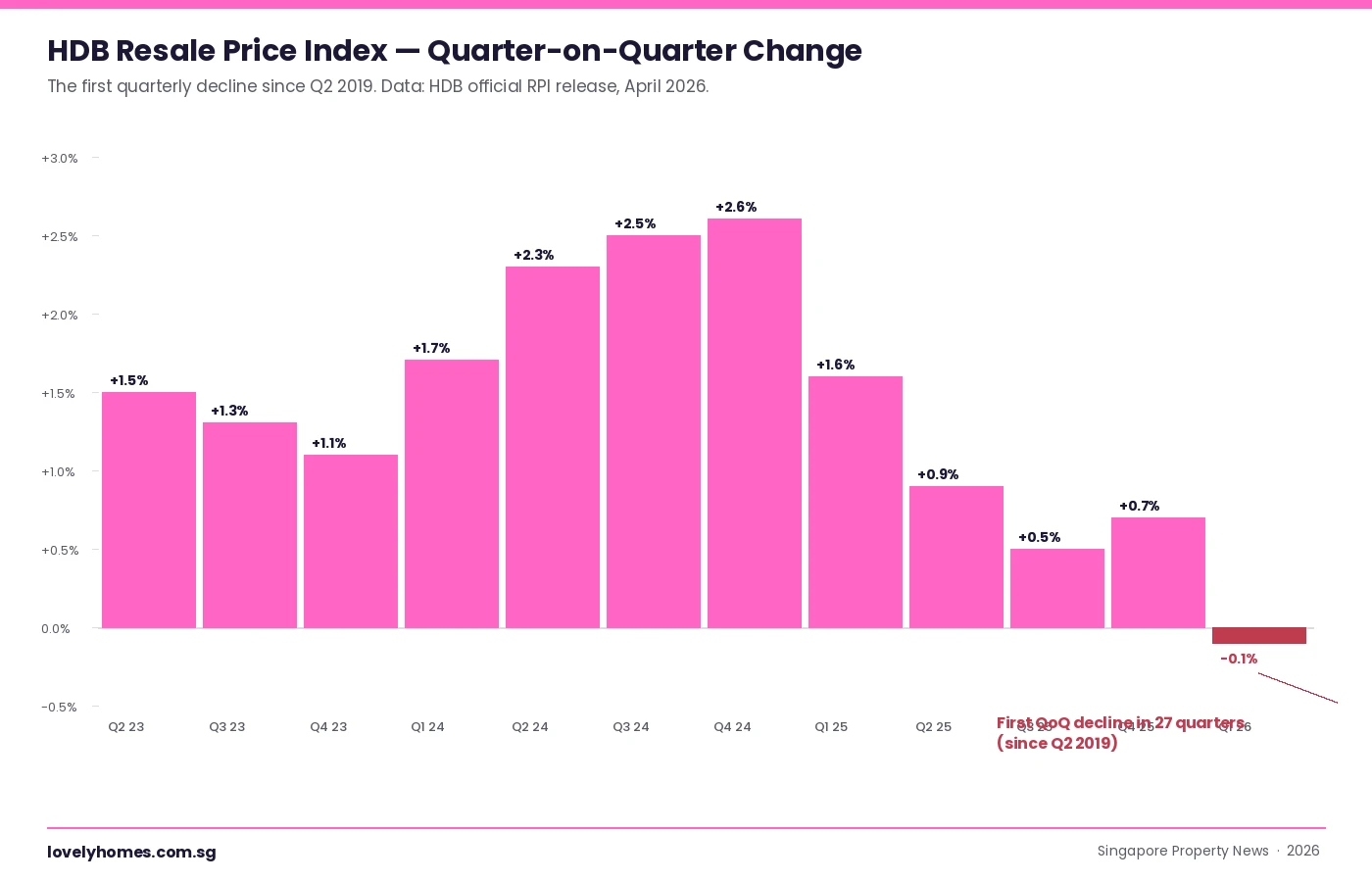
HDB Resale Price Index history makes the Q1 print feel less like a sudden drop and more like the natural end of a deceleration. Growth was 2.5% in Q3 2024 at its peak, slowed to 0.5% in Q3 2025, and ticked up modestly to 0.7% in Q4 2025 before turning negative in Q1 2026. The chart below sets the trajectory out cleanly.

HDB Resale Price Index quarter on quarter percentage change Q2 2023 to Q1 2026 first decline since Q2 2019
Figure 1. HDB Resale Price Index, quarter-on-quarter percentage change from Q2 2023 to Q1 2026. Q1 2026 is the first negative print in 27 quarters; the previous decline was Q2 2019. Growth had been decelerating for five consecutive quarters before turning negative.

Reading the bars carefully, the deceleration has been visible since Q2 2025 (+0.9%) and has been a steady step-down rather than a spike-then-fall. That tells us the Q1 2026 fall is most likely the cumulative effect of supply-side and demand-side easing rather than a single-quarter shock.

The Divergence: HDB Down, Private Up

The single most striking feature of Q1 2026 is not the HDB number on its own — it is how it sits next to the private market.

HDB resale negative 0.1 percent versus private residential positive 0.9 percent Q1 2026 Singapore housing divergence
Figure 2. HDB resale fell 0.1% QoQ while private residential rose 0.9% in Q1 2026, with non-landed private property up 1.3%. The 1.0 ppt gap in HDB’s down-direction has not been seen since 2009.

The mass-market substitution effect — private buyers priced out of the bottom end downgrading to HDB resale, supporting prices — has weakened compared with 2024-2025. Two reasons appear to be at play. First, OCR new launch projects launched in Q1 2026 priced higher than the comparable launches a year ago, which discouraged the marginal HDB-to-private trade-up buyer and, by feedback, reduced cash-over-valuation pressure on resale. Second, the private market’s gain is narrowly concentrated at the top end (188 transactions of S$5M+, the highest in two years), which does not transmit downward into mass-market public housing.

What Drove the HDB Softness

Three structural drivers, all working in the same direction:

  1. BTO supply is back. HDB has put roughly 19,600 BTO flats to ballot across the three exercises in 2025 and the May 2026 launch. The pipeline announcement of another 6,900 flats in June 2026 reinforces the message: first-time buyers can wait, and many are. Substitution from resale to BTO is now structurally easier than at any point since 2019.
  2. Post-MOP supply is approaching a 5-year peak. Flats from the 2018-2020 BTO bumper slate are clearing their five-year Minimum Occupation Period, putting more resale stock on the market exactly as demand cools. EdgeProp has tracked roughly 25,000-26,000 MOP-eligible units coming online in 2026 alone, a higher number than the 2024 cohort.
  3. Million-dollar mania has cooled. The volume of S$1m+ HDB resale transactions stabilised in late 2025 and shows the first signs of moderation in Q1 2026. This does not pull the index meaningfully on its own, but it removes one of the louder narrative supports of the previous two-year run.

Summary Statistics — Q1 2026 Market Scoreboard

Metric Q4 2025 Q1 2026 QoQ change
HDB Resale Price Index +0.7% −0.1% −0.8 ppt
URA Private Residential PPI +0.6% +0.9% +0.3 ppt
URA Non-Landed Sub-Index −0.2% +1.3% +1.5 ppt
Developer launches (uncompleted units) 2,632 1,844 −30%
Unsold pipeline (incl. ECs) ~16,800 17,032 +1.4%

What This Means for Buyers and Sellers

HDB buyers — particularly first-timers — have a cleaner case to be patient. With BTO supply rising, post-MOP resale supply rising, and price momentum reversing, the cost of waiting six to twelve months is lower than at any point in the last three years. Buyers who must transact in 2026 should benchmark against fewer comparable sales rather than panic-bid; offers at the lower end of the previous month’s transaction band are realistic.

HDB sellers need to recalibrate. Pricing aspirations anchored on Q3 2024-style runaway million-dollar headlines are now visibly out of line with the market. Buyers’ agents are reporting the first widespread instances of price reductions on listings sitting more than 30 days, which had been almost unheard of since 2020. The right pricing strategy is: list at the median of the most recent six transactions in your block-and-flat-type bracket, not the high.

Private-market buyers face the opposite signal. Top-end CCR continued to absorb in volume, mid-tier RCR new launches priced well, and the unsold pipeline has begun to rise for the first time in five quarters — a sign that absorption is lagging supply. Mass-market OCR resale comparables are softening (helped by the HDB knock-on); buyers in this segment have negotiating leverage they did not have in 2024.

What Might Come Next

The Q2 2026 numbers, to be released in late July, will tell us whether Q1 was a one-quarter wobble or the start of a flatlining/down trend. Watch:

  • The BTO June 2026 ballot uptake — if first-timer demand for the Bishan and Ang Mo Kio sites is heavily oversubscribed, that confirms the substitution-from-resale-to-BTO story.
  • Median CoV (cash-over-valuation) — if median CoV continues to drift toward zero across mature estates, sellers will follow.
  • 5-year-MOP-onset volume in 2H 2026 — we expect another 12,000-13,000 units to hit MOP in the second half, doubling the resale supply boost relative to 1H.
  • Cooling-measure response — with the public side cooling on its own, MOF/MND have one less reason to introduce new public-housing-targeted measures. ABSD-side calibration is more likely if private prices keep accelerating.

Frequently Asked Questions

Is HDB resale officially in a “downturn” now?

One quarter of −0.1% does not constitute a downturn by any conventional definition — analysts typically wait for two consecutive quarters of contraction or a cumulative drop of ≥ 1% before using that label. What Q1 2026 is, is the first credible inflection in the multi-year uptrend. The market is now in a state where flat-to-mildly-negative is the most likely path through 2026, with renewed growth contingent on demand-side surprise (faster job growth, immigration tailwinds) or supply-side disappointment (BTO delays, slower MOP releases).

How does the −0.1% break down by flat type?

HDB does not publish flat-type sub-indices in the headline release, but transaction-level analysis from third-party platforms suggests softness was concentrated in 4-room and 5-room mature-estate units — the segments that drove the 2024-25 million-dollar run-up. 3-room and Executive Apartments held up better. Non-mature-estate prices were close to flat. We expect HDB’s breakdown press release later in May to confirm this pattern.

Does this affect HDB BTO ballot demand?

Indirectly, yes — in two opposing directions. A softer resale market makes resale a more accessible alternative to BTO (lower headline asking prices, less million-dollar drama), which could reduce BTO oversubscription. But uncertainty about future resale prices also pushes risk-averse first-timers toward BTO’s known-cost path, which could increase ballot demand. The June 2026 ballot will be the cleanest read on which effect dominates.

Are the cooling measures from December 2024 finally working?

The August 2024 HDB-loan tightening (LTV cut from 80% to 75% for HDB loans) and the December 2024 cooling measures certainly removed marginal demand at the top of the price band. But the resale slowdown is at least as much a supply story (BTO ramp + MOP wave) as a demand story (cooling measures + interest rates). Officials will be cautious about declaring victory; the gap to private prices will be the metric they watch closest.

Should I delay my HDB resale purchase?

If you have a flexible 12-month buying window, the case for patience has strengthened. If you need to transact in the next 90 days (e.g. for relocation, family reasons, or a coordinated upgrade), the headline change is small enough that timing arguments are second-order — price the unit you want and negotiate hard against current comparables. The bigger risk for buyers right now is overpaying the late-cycle list price, not underpaying ahead of a rebound.

How does this compare to the 2009 episode?

2009 was the global-financial-crisis quarter when HDB resale fell 0.8% as Singapore entered a technical recession. The current episode is much smaller in scale (−0.1%) and the macro backdrop is different — no recession, employment is solid, and interest rates are easing rather than spiking. So 2009 is a useful reference for “first decline after years of growth”, but not for the magnitude or duration of what may follow.

Related Articles

Disclaimer

This piece is for general information only and does not constitute investment, financial, or property advice. Statistics are drawn from the Housing & Development Board Q1 2026 release of 24 April 2026 and the Urban Redevelopment Authority Q1 2026 release of the same date. Always verify current figures with the primary sources, and consult a licensed property professional before transacting.

Rental Income Tax in Singapore 2026: A Landlord’s Guide to Declaring, Deducting and Saving

Rental Income Tax in Singapore 2026: A Landlord’s Guide to Declaring, Deducting and Saving

Renting out your Singapore condo or HDB flat sounds simple — sign a tenancy agreement, collect a monthly transfer, repeat. Then April rolls around, and the IRAS e-filing portal asks you to declare your net rental income. Suddenly you are wrestling with deductible mortgage interest, the 15% deemed-expense option, what counts as “repairs” versus “improvements”, and whether your S$420 monthly MCST bill is a write-off (it is). Get it wrong by a thousand dollars in either direction, and the result is either a real cash tax overpayment, or an IRAS query letter you do not want to receive.

This guide walks you through how rental income is taxed in Singapore in 2026, what the IRAS rules actually say, the two paths you can choose between for expense deductions, and a fully-worked example using realistic 2026 numbers for a typical leveraged condo investor. By the end you should be able to fire up your IRAS Income Tax e-Filing screen, key in Total Annual Rent, Allowable Expenses and Net Rental Income, and be confident the numbers reconcile to your actual cashflow.

Quick Answer — how Singapore taxes your rental income in 2026

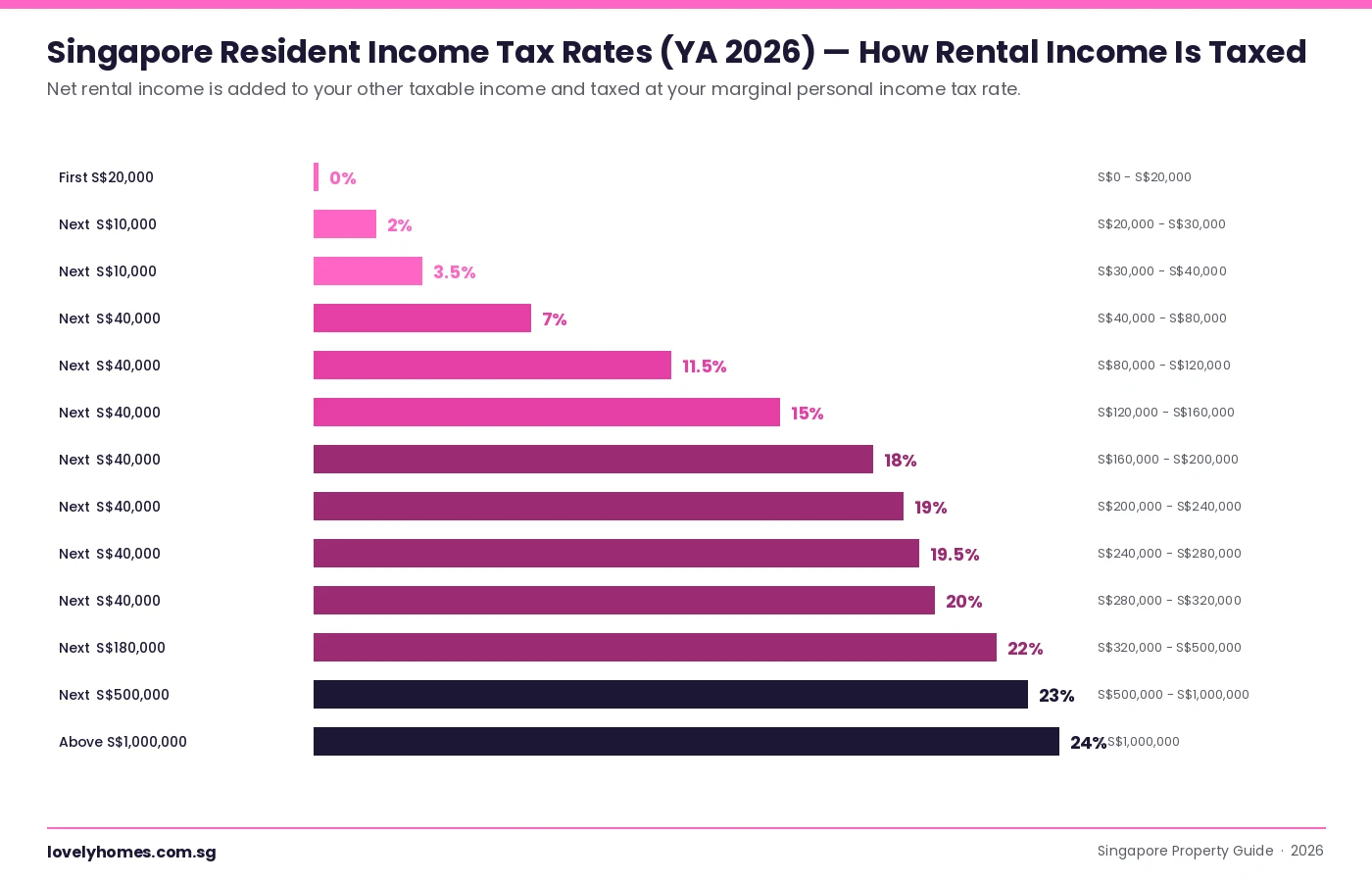
  • Rental income is not a separate tax — net rental is added to your other income and taxed at your marginal personal income tax rate (0% to 24% for residents in YA 2026).
  • You can claim actual qualifying expenses (with receipts) OR a flat 15% deemed-expense deduction. Pick whichever is higher.
  • Mortgage loan interest is always deductible on top of the 15% deemed deduction — do not forget this; it is the single largest line for most leveraged landlords.
  • Property tax for a tenanted unit is at the higher non-owner-occupier rate (12-36% of AV in YA 2026). It is fully deductible from rental income.
  • Furniture, renovations and capital upgrades are not deductible — they are capital items.
  • Foreign-property rents owned by a Singapore tax resident are taxable only if remitted to Singapore (with conditions).
  • Filing deadline: 15 April (paper) or 18 April (e-Filing) for individuals, every year of assessment.

What “Rental Income” Means for IRAS Purposes

Under section 10(1)(f) of the Income Tax Act 1947, “rents” derived from any property in Singapore are chargeable to tax. The Comptroller of Income Tax interprets this broadly: it covers the basic monthly rent, anything else the tenant pays you under the tenancy agreement, and certain non-cash benefits.

What goes into your gross rent figure on your tax return:

  • Monthly rent — the headline figure on the tenancy agreement.
  • Furniture and fittings rent — if your tenant pays a separate fee for furnishings, it is rent.
  • Maintenance fees billed to the tenant if they pass through you (uncommon but valid).
  • Compensation for early termination of the lease (if not specifically structured as damages).
  • Any non-refundable lease premium received.

What is not rental income: the tenant’s security deposit while you still hold it (you owe it back), and any reimbursement of utility bills paid by the tenant directly to SP Group, M1, etc. Forfeited security deposits, however, do count as rental income at the time of forfeiture.

How Rental Income Is Taxed: The Marginal-Rate Mechanic

Singapore does not have a separate “rental tax” or a flat rate on rental income. Instead, your net rental income — gross rent less allowable expenses — is added to all your other taxable income (employment income, trade or self-employment profits, interest, royalties) and taxed at the resident progressive rates.

Singapore resident progressive income tax rates YA 2026 used to tax net rental income — 13-band structure from 0 to 24 percent
Figure 1. The 13-band Singapore resident personal income tax structure for YA 2026. The point at which your additional rental income is taxed depends on where the slice falls on the ladder — for someone earning S$120,000 from employment, an extra dollar of rental income is taxed at 11.5%; for someone earning S$250,000, the same dollar is taxed at 19%.
Existing income before rent Marginal rate on next S$1 of rental income Tax on +S$10,000 net rent
S$30,000 (e.g. retiree) 3.5% / 7% ~S$525
S$80,000 (mid-career employee) 11.5% S$1,150
S$120,000 11.5% / 15% ~S$1,250
S$200,000 (senior professional) 18% / 19% ~S$1,850
S$500,000 (top tier) 22% / 23% ~S$2,250

The same rental property therefore generates very different tax outcomes for two landlords. A retired SC with no employment income may pay almost no tax on a S$60,000 gross rent year, while a senior professional earning S$250,000 from employment can lose 19-22% of every dollar of net rent to the marginal-rate stack. This is why high-income Singaporean landlords often plan property purchases under the lower-earning spouse’s name — a perfectly legitimate (though ABSD-sensitive) way to lower household tax.

What You Can Deduct: The Two Paths

Once you have your gross rent, IRAS lets you choose between two paths to compute net rental income. The choice is made property by property on each year’s filing — there is no lock-in.

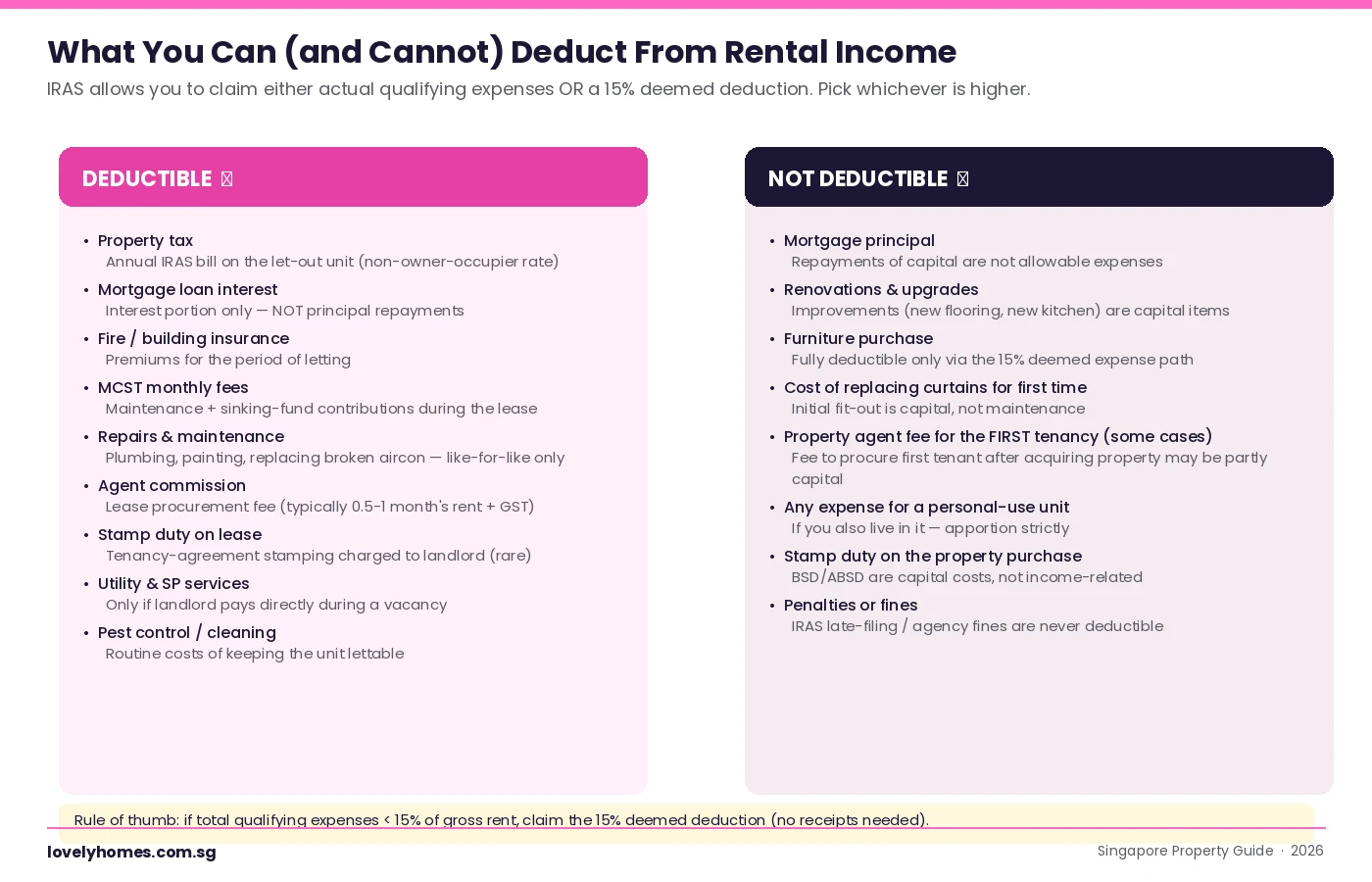
Singapore rental income deductible versus non-deductible expenses 2026 IRAS actual expenses path versus 15 percent deemed deduction shortcut
Figure 2. Allowable vs disallowable rental-income deductions in Singapore 2026, with the 15% deemed-expense shortcut highlighted. Mortgage interest is uniquely allowable on top of the deemed expense — do not double-count it under Path A.

Path A: Actual qualifying expenses

You add up every expense incurred wholly and exclusively in earning the rent during the year and deduct it from gross rent. Required to keep receipts and supporting documentation for 5 years (IRAS Income Tax Records Keeping Requirement). The full list of typical deductible items:

  • Property tax on the tenanted unit (non-owner-occupier rate, 12-36% of AV in 2026).
  • Mortgage loan interest — the interest portion of every monthly instalment. The principal repayment portion is not deductible.
  • Fire / building insurance premiums.
  • MCST monthly fees (maintenance + sinking-fund contributions) for the period of letting.
  • Repairs and maintenance — like-for-like fixes only. Replacing a broken aircon compressor is repair; replacing the entire aircon system with a higher-end model is partly improvement (not deductible).
  • Agent commission on lease procurement (typically 0.5-1 month of rent + GST). The first-tenancy commission may be partly disallowable; subsequent commissions are fully deductible.
  • Stamp duty on the tenancy agreement — if landlord has agreed to bear it (rare; usually tenant pays).
  • Vacancy-period utilities and SP Services when paid directly by the landlord.
  • Routine cleaning, pest control, gardening attributable to the unit during letting.

Path B: 15% deemed expense + mortgage interest

From YA 2017 onwards, IRAS allows residential-property landlords to claim a flat 15% deemed deduction on gross rent in lieu of itemising actual expenses, plus their actual mortgage interest. No receipts are needed for the 15% portion.

This is a real shortcut for low-cost landlords. If you own a HDB flat free-and-clear (no mortgage interest), with low MCST and minimal repairs, your actual qualifying expenses might be 8-12% of rent — the 15% path delivers a higher deduction, with no admin. For leveraged condo landlords, by contrast, mortgage interest alone often runs 50-70% of rent; the actual-expense path almost always wins.

Important: the 15% deemed-expense path is only available for residential property let to a tenant who occupies the unit. Commercial property landlords, AirBnB-style serviced-apartment hosts, and corporate-structured property trusts cannot use it.

Worked Example: A S$1.5M Condo Let at S$5,000/Month

Numbers make this concrete. Consider a Singapore Citizen owner-occupier of a 1,000-sqft 3-bedroom OCR condo bought at S$1.5M with a S$1.05M loan (LTV 70%) at 3.5% all-in. The unit is rented at S$5,000/month from January to December. The owner has S$120,000 of employment income.

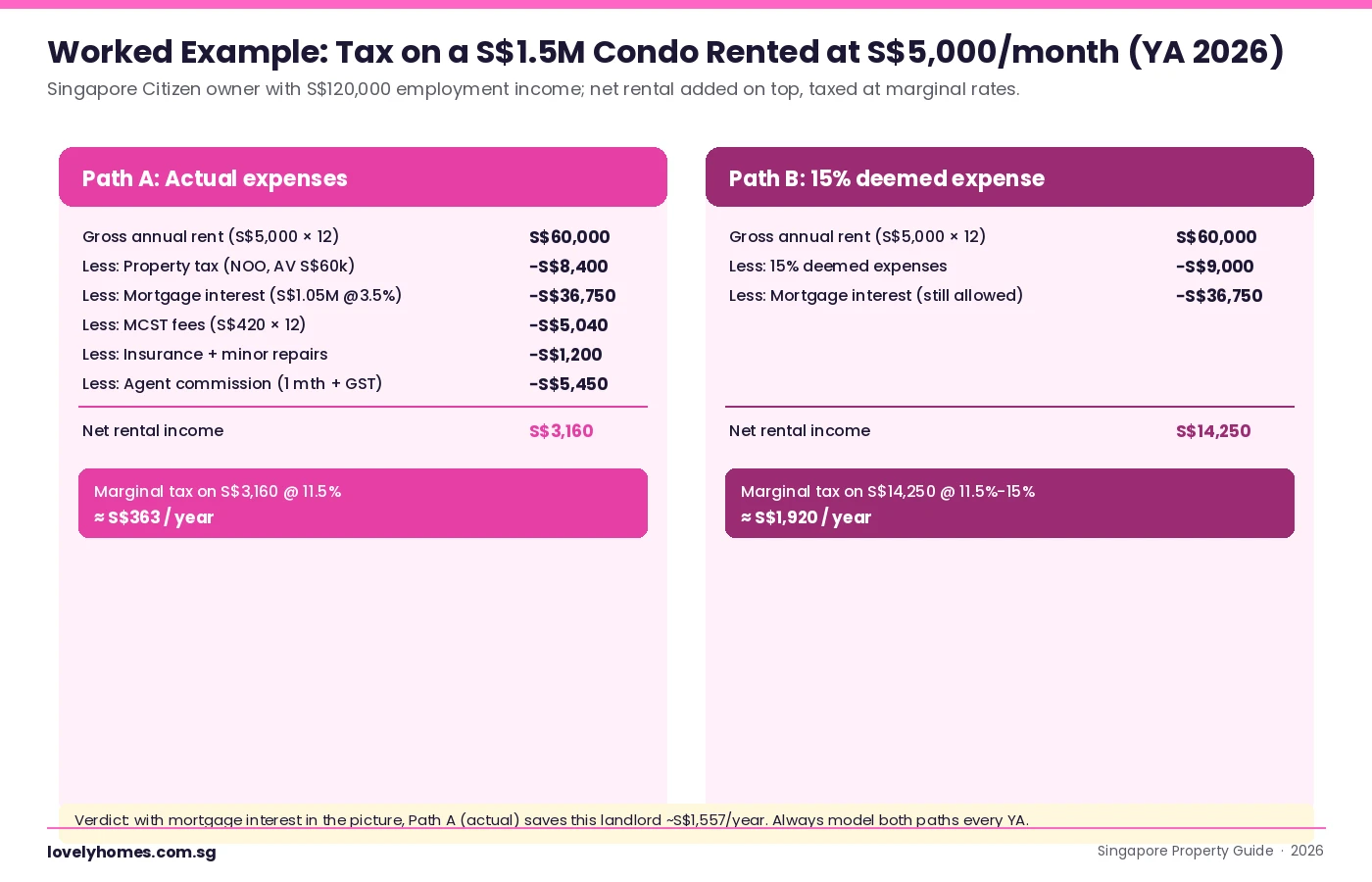
Worked rental income tax example S$1.5M Singapore condo S$5000 monthly rent YA 2026 — actual expense path versus 15 percent deemed deduction
Figure 3. Side-by-side comparison of the two computational paths for the same property. With S$36,750 of mortgage interest in the picture, the actual-expense path produces near-zero net rental income; the 15% deemed path gives a worse outcome and saddles the landlord with ~S$1,557 of avoidable tax for the year.

Three lessons from this example:

  1. For any landlord with a meaningful mortgage, Path A almost always wins. Mortgage interest is the single biggest deductible.
  2. If you remortgage and your interest expense changes mid-year, your tax position changes mid-year — track it monthly.
  3. The marginal rate matters as much as the deduction. A landlord at the 22% bracket saves ~S$340 more on the same S$1,557 deduction than the same landlord at the 15% bracket.

Property Tax for Tenanted Units

The instant your property is rented out, IRAS automatically reclassifies it from owner-occupied to non-owner-occupied (NOO). The tax rate ladder differs sharply:

  • Owner-occupier rates: 0% on the first S$8,000 of AV, rising progressively to 32% on AV above S$100,000.
  • Non-owner-occupier rates: 12% on the first S$30,000 of AV, rising to 36% above S$60,000 AV in 2026.

For a typical S$1.5M OCR condo with an AV of around S$60,000, the owner-occupier annual property tax would be about S$8,400; the same unit as a NOO investment is taxed at S$8,400 (owing to the band structure crossing 12%/24%/36%) — in this band, NOO is significantly higher. You must notify IRAS within 15 days of the unit becoming tenanted (or vacated) so the rate is correctly applied. This NOO property tax is then a fully deductible expense against your rental income on the income-tax side.

Joint Owners and Couples

For jointly-held properties, IRAS apportions rental income and deductions equally by default among co-owners, regardless of who actually pays the mortgage or collects the rent. If you want a different split (e.g. 70/30 to reflect actual capital contributions or beneficial ownership), you must file a declaration of beneficial interest and IRAS may ask for evidence.

This is the heart of the Singapore tax-planning playbook for couples: where one spouse earns in the top marginal bracket and the other earns less, splitting the rental income via a 50/50 joint-tenancy or a deliberately-skewed tenancy-in-common can lower household tax materially. The trade-off — ABSD — is covered in our Joint Tenancy vs Tenancy in Common guide.

Vacancy, Mid-Year Letting, and Voids

When you let your property only for part of the year, only the rent received is taxable, and only the expenses attributable to the letting period are deductible (pro-rated). Common scenarios:

  • Owner moves overseas mid-year and rents out from August. Pro-rate the property tax (NOO rate from 1 August), MCST fees, and insurance from August onwards. Mortgage interest is fully deductible against rent because the loan continues throughout, but only the August-December portion is matched against the August-December rent.
  • Tenant moves out, unit vacant for 2 months, new tenant moves in. Vacancy-period expenses (utilities, MCST, mortgage interest) are still deductible if the property was actively marketed for re-letting during the void.
  • Property partly let, partly self-occupied. Only the let portion’s expenses are deductible; the personal-occupation portion is not. Apportion strictly by floor area and time.

What Might Come Next: Rental Tax Watchpoints

The basic IRAS framework has been stable since the 15% deemed-expense option was introduced in YA 2017. Two areas to watch in 2026:

  • Short-term let crackdown. URA’s 3-month minimum residential let rule is now policed more aggressively. AirBnB-style sub-3-month lets are not legal residential lettings and may also be reclassified as a trade by IRAS, attracting higher tax and disqualifying the 15% deemed path.
  • NOO property-tax escalation. The NOO rate ladder has steepened in each Budget since 2022 (peak rate raised from 27% to 36% over three years). Investors should model continuing escalation when underwriting yield.

None of the above is a tax-rate change yet. We will update this guide when Budget 2027 announcements land in February 2027.

Frequently Asked Questions

I let out a single room in my owner-occupied flat. Is that rental income?

Yes. The rent received from a sub-let or room-let is taxable on the same basis as a whole-unit let. You can deduct a fair-share portion of expenses — typically based on the floor area of the let room versus total floor area, multiplied by the days let. The 15% deemed-expense path is also available. You do not have to convert the entire property’s tax status to NOO — that conversion only applies if the whole unit is let out and you no longer occupy it.

Can I deduct the cost of a new sofa I bought when I started renting out the unit?

Not under Path A — the initial fit-out of furnishings is a capital cost, not a maintenance cost. However, if you choose Path B (15% deemed deduction), the deemed-expense covers wear-and-tear and replacement furnishings implicitly. If you replace a broken sofa with a like-for-like sofa later, that is deductible as a repair under Path A.

I am a Singapore tax resident with an apartment in London that I rent out. Is the UK rent taxable in Singapore?

Foreign-source rental income earned by a Singapore tax-resident individual is taxable only when remitted to Singapore (and even then, certain remittances are tax-exempt under section 13(7A) of the Income Tax Act). If the UK rental income stays in a UK bank account and you do not bring it back, it is generally not taxable in Singapore. UK tax on the rent (HMRC Self Assessment) is a separate matter — you should keep that compliance current to avoid double-tax issues. Singapore has a Double Taxation Agreement with the UK that provides relief.

Can my parent (who has no employment income) be the named landlord to lower household tax?

The beneficial owner of the property is the person taxed on the rental income, not necessarily the legal title-holder. If your parent merely holds the title but you funded the deposit, paid the mortgage, and collect the rent, IRAS will still tax you. Genuine transfers to a parent (with proper SDL stamping, ABSD implications, and a real change in beneficial ownership) can shift the tax base, but the costs and ABSD trigger usually outweigh the income-tax savings unless the property has a long runway. Always model the all-in cost across BSD, ABSD, conveyancing, and 5+ years of expected tax savings before transferring.

What happens if I file the wrong figure?

If IRAS detects a discrepancy via its automated checks against your bank records, agent-reported tenancy stampings, and property-tax NOO classification, you will receive an enquiry letter (typically 1-2 years after filing) asking you to reconcile. Genuine errors made in good faith can be self-corrected via an Objection or Amendment within 4 years. Deliberate under-declaration can attract a penalty of up to 200% of the tax undercharged plus interest, plus criminal prosecution in serious cases. The honest path is materially cheaper than the alternative.

Is there any way to claim depreciation on the building structure?

No. Singapore tax law does not allow capital allowances (depreciation) on residential buildings or land. This is one of the structural differences from the US, UK and Australian regimes, where depreciation can shelter meaningful rental cashflow. The only “depreciation-equivalent” reliefs available to Singapore landlords are repairs (Path A) and the 15% deemed expense (Path B).

Do I need to register for GST as a residential landlord?

No. Residential lettings are exempt supplies under the Goods and Services Tax Act — you do not charge GST on rent, and you cannot register for GST on the basis of residential rental income alone. Commercial-property landlords are different: they charge 9% GST (in 2024 onwards) on rent, and must register if their taxable turnover exceeds S$1 million per year.

Related Articles

Disclaimer

This guide is for general information only and does not constitute tax, legal, or financial advice. Singapore income tax law — including the rates, deductibility rules, and remission frameworks discussed above — is subject to change at the discretion of the Minister for Finance and the Comptroller of Income Tax. Always verify the current position on the Inland Revenue Authority of Singapore rental-income page, the relevant individual income tax rate schedules, and the latest annual Ministry of Finance Budget statement — and consult a licensed tax adviser before acting on any specific position. Worked examples are illustrative only; your actual tax outcome will depend on your full facts.

Strata Title and MCST in Singapore 2026: How Your Condo Is Actually Run

Strata Title and MCST in Singapore 2026: How Your Condo Is Actually Run

If you own a condominium, executive condo, or strata-titled landed home in Singapore, you do not really own a building — you own a slice of one, a “strata lot“. Everything outside that slice (the lift you ride to work, the pool you swim in, the lobby that smells faintly of Diptyque) is common property, and it is run by a body corporate called the Management Corporation Strata Title — the MCST.

Most owners pay their monthly maintenance fee, attend an AGM once in a blue moon, and never think about it again. Then a leak appears in the carpark, the lifts hit 25 years and need a S$2 million modernisation, or someone wants to put a new awning on their balcony — and suddenly the structure that runs your home becomes very real, very fast. This guide walks you through how strata title actually works in Singapore, what your MCST does, where your money goes, and the rights and obligations you signed up for the moment your conveyancing lawyer registered your title at the Singapore Land Authority.

Quick Answer — strata title and MCST in 30 seconds

  • You own a strata lot (your unit + accessory areas) plus a share value in common property.
  • The MCST manages common property under the Building Maintenance and Strata Management Act (BMSMA 2004).
  • Your monthly bill funds two ring-fenced pots: a Management Fund (~75%) for day-to-day running and a Sinking Fund (~25%) for major capital works.
  • Decisions are made at AGMs by share-value vote — ordinary majority for routine matters, ≥75% special resolution for capital expenditure above S$200,000.
  • Indicative monthly fees: S$280-450 OCR mass-market, S$420-680 mid-tier RCR, S$780-1,400 luxury CCR, S$1,500+ ultra-luxury.
  • Renovations affecting common property require written MCST approval before BCA submission (BMSMA s.37).
  • Disputes above the council level go to the Strata Titles Boards — not the civil courts in the first instance.

What Is Strata Title and Why Does Singapore Use It?

Strata title is the legal mechanism that makes vertical, multi-owner property possible. When a developer builds a condominium, the Singapore Land Authority registers a strata plan dividing the building into individual lots (the units, plus accessory lots like balconies, planter boxes and air-con ledges) and common property (everything else). Each lot is a separate parcel of land in law, with its own title deed, its own share value, and its own set of rights to the common property.

Without strata title, only the developer or a single co-owner group could hold the title to a multi-storey building — you would be buying a long lease from them, not freehold ownership of a defined unit. Strata title gives you genuine real-estate ownership, the right to mortgage your lot independently, and the right to participate in governance of the building. The trade-off is that you must accept a co-ownership regime: a council elected by other owners, by-laws that bind you, and a duty to contribute to communal expenses whether you use the facilities or not.

Singapore’s strata regime sits inside the Building Maintenance and Strata Management Act 2004 (BMSMA), supplemented by the Land Titles (Strata) Act 1967. Together they cover roughly 12,000 strata-titled developments and over 750,000 strata lots across the island as at the start of 2026. If you own anywhere in Singapore that is not landed-on-its-own-plot, you are almost certainly subject to BMSMA.

The Core Concept: Strata Lot, Common Property, Share Value

Three pieces of paper are issued when your conveyancing completes: the certificate of title for your strata lot, the strata plan for the development, and the schedule of share values. They define everything that follows.

Strata lot

Your physical unit, defined by the centre line of internal walls, the upper surface of the floor, and the under-side of the ceiling slab. Accessory lots include balconies, private enclosed spaces (PES), aircon ledges, and any car-park or storage spaces specifically allocated to your unit on the strata plan. You can renovate inside your strata lot largely as you wish — subject to BCA rules, MCST house rules, and structural integrity.

Common property

Everything outside your strata lot that is not somebody else’s lot. Lifts, lobbies, pools, gyms, gardens, common corridors, the external façade, the roof, the basement carpark, M&E plant rooms, and the structural slabs themselves. Common property is owned collectively by all subsidiary proprietors as tenants-in-common in the proportion of their share values, and managed by the MCST.

Share value

A whole number assigned to each lot in the strata plan that determines (a) your voting weight at general meetings and (b) your contribution to the common funds. Larger units get higher share values. A typical 1,000 sqft 3-bedroom unit might carry 10 share values; a 600 sqft 2-bedroom might carry 6. If your unit’s share value is 10 out of a building total of 5,000, you pay 0.2% of every common-fund expense and cast 10 votes (out of 5,000) on every resolution.

Indicative MCST Fees by Condo Segment (2026)

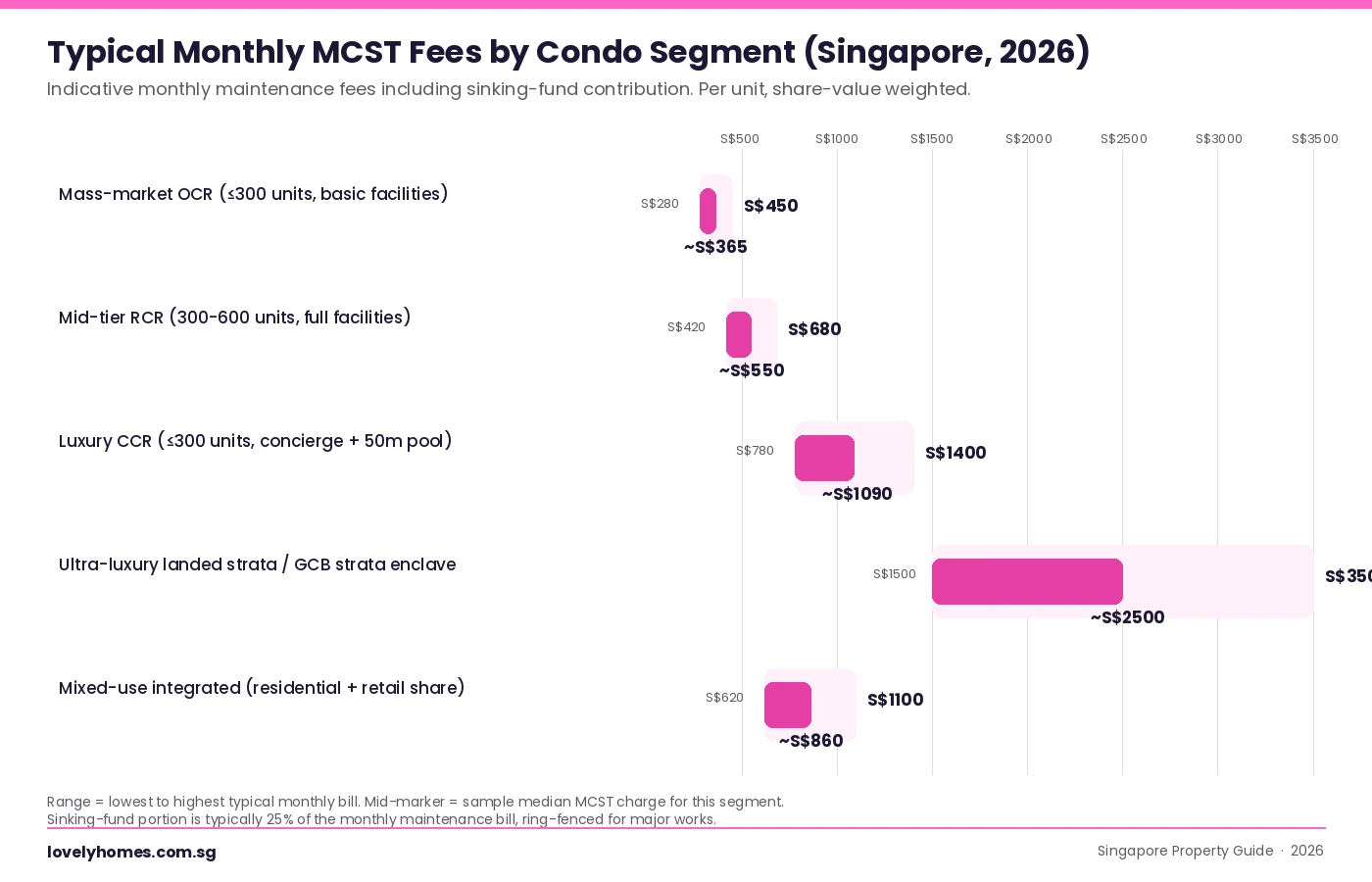
Before you commit to a unit, look at the monthly maintenance bill. It is the single biggest variable holding cost of ownership and varies enormously by segment. The figure below sets out what most owners actually pay across five common segments of the Singapore market in 2026.

Singapore MCST monthly maintenance fees by condo segment 2026 — OCR mid-tier RCR luxury CCR ultra-luxury mixed-use comparison
Figure 1. Typical monthly MCST fees by condo segment, 2026. Mid-tier RCR developments cluster around S$550/month; CCR luxury and integrated mixed-use developments routinely exceed S$1,000/month due to higher staffing, premium finishes and shared retail-component costs.
Segment Typical monthly fee (per unit) Sinking fund share Drivers of cost
Mass-market OCR S$280-450 ~25% Basic facilities, lower headcount, fewer lifts, surface carparks
Mid-tier RCR S$420-680 ~25% Full facilities suite, multi-deck basement carpark, larger landscape
Luxury CCR S$780-1,400 ~25-30% 24-hr concierge, valet, branded F&M for plant, smaller lot count to share costs
Strata landed / GCB enclave S$1,500-3,500 ~30% Few lots, large land area, perimeter security, private roads
Mixed-use integrated S$620-1,100 ~25% Shared cost-allocation with retail/commercial component, dual-MCST structures

One important nuance: integrated developments often have two MCSTs — one for the residential strata, one for the entire development. Your monthly bill is therefore the sum of both layers. Always ask the marketing agent for the dual-MCST cost breakdown before signing.

The Two Funds Inside Every MCST Bill

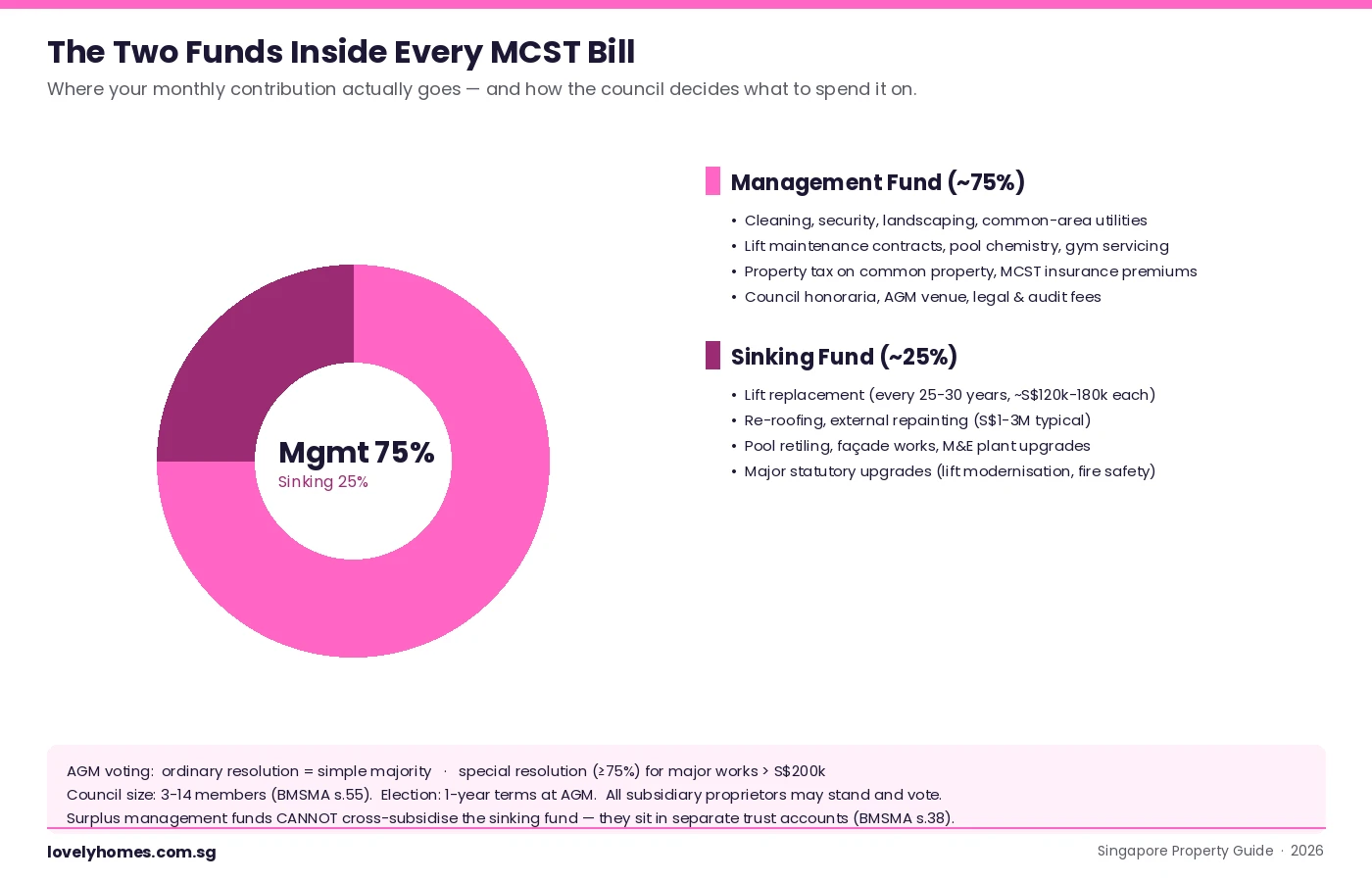
Your monthly maintenance fee is not a single pot of money. By law it splits into two ring-fenced trust accounts — the Management Fund (general operations) and the Sinking Fund (capital reserves) — and the council cannot move money freely between them.

Singapore MCST management fund vs sinking fund 75-25 split with AGM voting structure under BMSMA 2026
Figure 2. Where your MCST contribution actually goes. The 75/25 management/sinking split is convention, not law — specific developments may sit anywhere between 70/30 and 80/20 depending on age, plant complexity, and council appetite.

Management Fund

Pays for everything that recurs: cleaning contracts, security guarding, lift maintenance, pool chemistry, gym servicing, common-area utilities, landscaping, MCST insurance premiums, property tax on common property (yes — the building itself is taxed on the rental value of its common areas), council members’ honoraria, AGM venue, audit and legal fees, and the salary of the appointed managing agent. If the toilet roll runs out in the lobby, the management fund replaces it.

Sinking Fund

Funds large, infrequent capital works that would otherwise hit owners with sudden special levies. Lift modernisation (typically required at 25-30 years and costing S$120k-180k per lift), exterior repainting, re-roofing, façade re-cladding, pool retiling, M&E plant replacement, and statutory upgrades (e.g. lift safety upgrades mandated by BCA, fire-system retrofits required by SCDF). A well-run building should hold roughly 2-3 years of operating expenditure in the sinking fund at any time.

Why the wall between them matters

Section 38 of the BMSMA prohibits using management-fund money to pay for sinking-fund items, and vice versa. This protects future owners: if the council were free to spend the sinking fund on day-to-day items, you would arrive at the 25-year mark with no money for the lift modernisation, and the council would have to issue a one-off levy of, say, S$15,000 per unit to make up the gap. Always read the audited accounts before bidding on a resale unit — a depleted sinking fund is a hidden liability the buyer inherits.

Governance: Council, AGMs, Voting

The MCST is the body corporate; the council is its elected board. Owners (subsidiary proprietors) elect a council of 3 to 14 members at the AGM, each serving one-year terms. The council appoints office-bearers (chair, secretary, treasurer) and engages a managing agent — a licensed property-management firm that runs the day-to-day operation.

Annual General Meeting (AGM)

Must be held within 15 months of the previous one. Owners receive at least 14 days’ written notice with the agenda, audited accounts, the proposed annual budget, and any resolutions for vote. Standard agenda items: receive the audited accounts, fix the next year’s budget and contribution rates, elect the council, appoint the auditor, transact special resolutions.

Resolution thresholds

  • Ordinary resolution — simple majority of the share values voted. Used for routine business: budget approval, council elections, day-to-day spending decisions within budget.
  • Special resolution — ≥75% of share values voted in favour, with ≤25% against. Required for capital expenditure exceeding S$200,000 (s.40 BMSMA), variation of by-laws, and certain by-law-affecting matters.
  • 90% resolution — required to vary common property boundaries or transfer common property.
  • Unanimous resolution — required for any change that affects an individual lot owner’s title or rights.

Extraordinary General Meetings (EGM)

Called between AGMs for urgent matters — usually a special-resolution capital project (e.g. lift modernisation), an unplanned major repair, or to vote on a collective sale resolution. Owners holding ≥20% of share values can requisition an EGM directly.

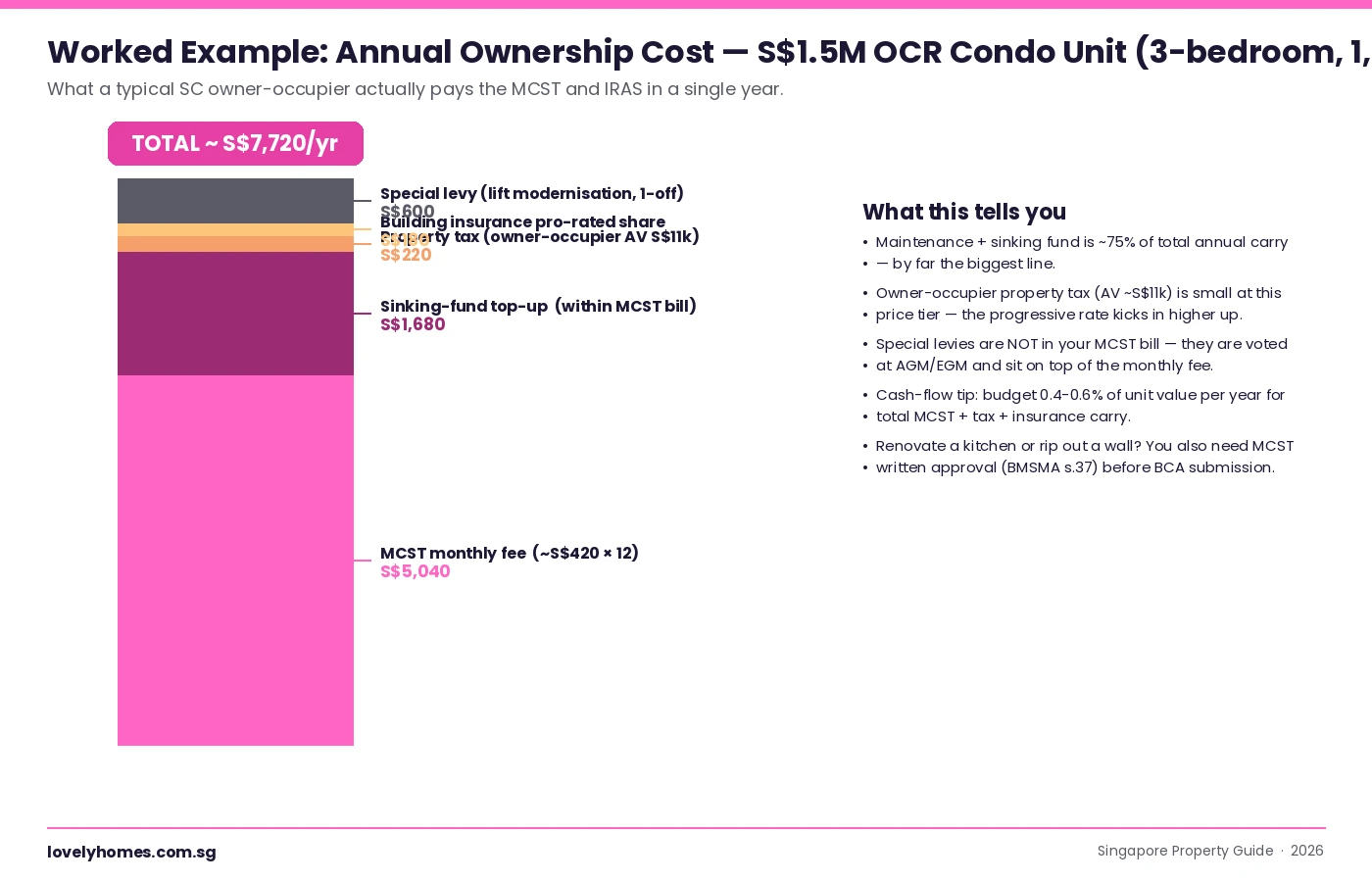
Worked Example: What a S$1.5M OCR Condo Owner Pays in a Year

Numbers ground the abstract. Here is what a typical Singapore Citizen owner-occupier of a 1,000-sqft, 3-bedroom unit in a mid-tier OCR development worth S$1.5 million actually pays the MCST and IRAS over a year, assuming no leasehold-related issues and no rental income.

Worked example annual ownership cost S$1.5M Singapore OCR condo 2026 — MCST sinking property tax insurance special levy stack
Figure 3. Annual ownership cost stack for a S$1.5M OCR 3-bedroom condo unit, 2026. Maintenance and sinking-fund contributions dominate; property tax is comparatively small at this AV tier. A one-off lift modernisation special levy of S$600 is included to show how capital works can spike a single year’s bill.

Three observations stand out. First, the recurring carry on a S$1.5M unit is a real number — about S$5,000-7,000 per year, or 0.4-0.5% of unit value, before any one-off special levies. Second, the property-tax line at this AV tier is genuinely small; most of your tax burden was paid up front as BSD when you bought. Third, special levies are not in the monthly bill — they are voted at AGM/EGM and sit on top, often with 3-6 months’ notice. Plan a 1-2% capital reserve of unit value over a 10-year horizon if you want to avoid surprises.

Your Rights and Obligations as a Subsidiary Proprietor

Buying a strata lot binds you to a contract you may never have read — the by-laws of the development, set out in the First Schedule of the BMSMA (the prescribed by-laws) and in any additional by-laws passed by special resolution at the AGM. Key obligations every owner has:

  • Pay contributions on time — arrears attract interest (often 10% p.a.) and the MCST may register a charge on your title under s.34 BMSMA after 30 days, blocking refinancing or sale until paid.
  • Get written approval before altering common property — even private balcony tinting or aircon-ledge enclosures usually need MCST consent under s.37.
  • Comply with the by-laws on noise hours, pet keeping, short-let restrictions (typically minimum 3 months for residential), commercial use limitations, and exterior-facade alterations.
  • Allow access for the MCST or its contractors to perform repairs to common property running through your lot, on reasonable notice.

Conversely, the rights you can enforce:

  • Inspect the records — minutes, accounts, contracts. Owners are entitled to see anything in the corporate register on reasonable notice (a small fee may apply).
  • Stand for council, attend and vote at general meetings, and propose resolutions.
  • Requisition an EGM if you can muster 20% of share values.
  • Apply to the Strata Titles Boards if the council acts unreasonably, refuses by-law-approved alterations, or makes invalid decisions.

Disputes: The Strata Titles Boards

The Strata Titles Boards (STB) — constituted under the BMSMA and the Building Maintenance Act — are the specialised tribunal that hears strata disputes. Most owner-vs-MCST or owner-vs-owner strata disputes cannot go to the High Court in the first instance; they must come through the STB. Common applications:

  • Section 92 applications to compel the MCST to take a specific action (e.g. carry out a long-overdue repair).
  • Section 31 applications to vary or invalidate a by-law that is unreasonable or oppressive.
  • Collective-sale applications under the Land Titles (Strata) Act — the 80%/90% en-bloc consent threshold mechanic is litigated here.
  • Disputes over share values, accessory-lot rights, and exclusive-use grants over common property.

STB filing fees are modest (S$500-1,000 typically) and the process is faster and lighter than the High Court — expect 6-9 months from filing to determination on most matters.

What to Watch When Buying Resale

If you are buying a strata-titled resale, the MCST is going to be your landlord-of-sorts. A few things to inspect before exercising the OTP:

  1. Last 3 years of audited accounts. Look for a healthy sinking fund, no qualified audit opinions, and no pattern of outsized recurring deficits.
  2. Latest AGM minutes. Check for upcoming capital works that may trigger a special levy. Lift modernisation, repainting, and façade works in the pipeline will hit your wallet.
  3. Outstanding maintenance arrears on the lot. Ask your conveyancer to obtain a section 50 certificate from the MCST — arrears transfer with the lot.
  4. By-laws. Read the additional by-laws — some buildings restrict pet weight, prohibit short-lets entirely, ban exterior changes, or impose dress codes in common areas.
  5. Legal disputes. Ask whether the MCST is currently in any STB or High Court proceedings — ongoing disputes can mean a deteriorating building or financial drain.

How Strata Title Differs From Other Tenure Forms

Singapore’s strata regime is similar in principle to Hong Kong’s multi-storey buildings regime, the Australian strata title system (from which the term originates), and US condominium ownership — but the BMSMA framework is more prescriptive than most. By comparison:

  • vs HDB ownership — HDB flat owners are not subsidiary proprietors of an MCST. The HDB itself manages the estate. Town councils handle the day-to-day common-property functions, funded by service-and-conservancy charges (S&CC).
  • vs landed property — A standalone landed home on a freehold or 99-year leasehold parcel has no MCST and no shared common property. You bear all costs and decisions yourself, but you also have full autonomy.
  • vs strata-landed — Cluster housing and strata-landed enclaves do have an MCST, but with a much smaller lot count (often 30-100). Their fees are correspondingly higher per unit because fixed costs are spread thin.

What Might Come Next: Strata Reform Watch

BCA and the Ministry of National Development have been quietly consulting on a third tranche of BMSMA amendments since 2024. The most-talked-about proposals as at April 2026:

  • Mandatory minimum sinking-fund balance tied to building age (e.g. 18 months of opex once the building is over 10 years old). Aimed at preventing under-funded sinking funds.
  • Compulsory professional MCST chairs for buildings of over 500 lots, in response to dispute volumes from large integrated developments.
  • Streamlined STB process for routine repairs — a fast-track procedure to compel obvious common-property maintenance.
  • Stricter rules on short-term lets — aligning the BMSMA with URA’s 3-month minimum-let regime to give MCSTs cleaner enforcement teeth.

None of the above is yet law. We will update this guide when the next round of amendments is gazetted.

Frequently Asked Questions

Can the MCST force me to renovate or repair my own unit?

Generally no — renovations inside your strata lot are your decision, subject to BCA structural rules and any by-law restrictions (e.g. flooring requirements above the second storey). The MCST can however require you to remedy a condition inside your lot that is causing damage to common property or to neighbouring lots — a leaking bathroom waterproofing membrane, for example, where moisture is reaching the unit below. If you fail to act, the MCST can perform the works and charge them back to your lot under s.41 BMSMA.

What happens if the council goes broke?

If the management fund runs out, the MCST cannot pay contractors or salaries. The council must call an EGM to pass a special levy (a one-off contribution from all owners pro-rata to share value) to recapitalise. Repeated insolvency is a sign of either chronic under-budgeting or council misconduct — in extreme cases the STB can appoint an interim manager to run the MCST under s.85.

Can I rent out my parking space to non-residents?

It depends on whether your parking lot is an accessory lot, an exclusive-use common-property right, or a transient-use right. Accessory lots can typically be sublet to anyone in some buildings but most modern by-laws restrict carpark sub-letting to residents of the development only for security reasons. Always check the additional by-laws and house rules — sub-letting to non-residents in breach of by-laws is enforceable by the STB.

How are votes weighted — one-lot-one-vote or by share value?

Share-value votes apply by default. So a penthouse with a share value of 24 has roughly 4 times the voting weight of a 1-bedroom unit with a share value of 6. This is intentional: larger units pay more to the common funds and bear more of the financial impact of decisions, so they vote in proportion. Some routine matters (e.g. council elections) may also be conducted on a one-vote-per-lot basis under the BMSMA’s voting rules.

If I am buying a brand-new condo, when does the MCST actually come into existence?

The MCST is constituted automatically on the date the strata-title plan is registered with the SLA. In practice, the developer manages the building from TOP onwards under an “interim period” with an interim management committee (often staffed by the developer and a few early-mover owners). The first AGM — where the permanent council is elected — must be held within 13 months of the first lot being conveyed (s.27 BMSMA). Until then, your monthly fee is charged at developer-set rates, which may be re-budgeted up or down at the first AGM.

Do I need MCST consent for a kitchen renovation?

If the renovation is purely cosmetic and stays within your lot — new countertops, replacement appliances, repainting — you usually only need to notify the managing agent and pay any renovation deposit / debris fee under house rules. If you are touching any wet area, structural element, exterior, or anything that could affect a neighbouring lot or common property, you need written MCST approval before submitting plans to BCA. Most buildings require approved-contractor lists, work-hour windows (typically 9am-6pm Monday-Saturday, no Sundays/public holidays), and a renovation deposit of S$1,000-3,000.

How do collective sales fit into the strata regime?

Collective sale (en-bloc) is the process by which the MCST as a whole sells the entire development to a redeveloper, with proceeds distributed among lot owners. Under the Land Titles (Strata) Act, an 80% share-value-and-floor-area consent threshold applies to developments over 10 years old (90% for younger ones). The STB hears applications and may approve, vary, or reject the sale. Successful collective sales effectively dissolve the MCST on completion. We cover the process in detail in our En-Bloc Sale Process Guide.

Related Articles

Disclaimer

This guide is for general information only and does not constitute legal, tax, or financial advice. The Building Maintenance and Strata Management Act, the Land Titles (Strata) Act, and associated subsidiary legislation are the authoritative sources of strata-title law in Singapore and have been amended several times since 2004. Always verify the current position with the Building and Construction Authority, the Singapore Land Authority, the Ministry of Law, and the Inland Revenue Authority of Singapore — and consult a licensed conveyancing or strata-management lawyer before acting on any specific matter.

Translate »