MCST Guide Singapore 2026: Management Corporation, Maintenance Fees, Sinking Fund and By-Laws Explained
Quick Answer: MCST in Singapore
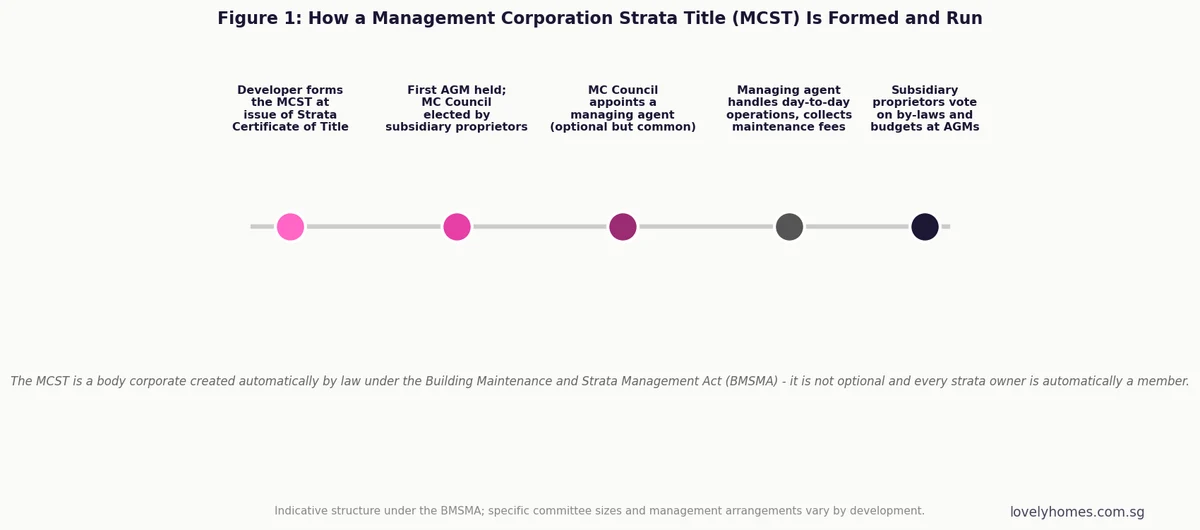
- MCST stands for Management Corporation Strata Title, the body corporate automatically formed by law under the Building Maintenance and Strata Management Act (BMSMA) the moment a strata development’s Strata Certificate of Title is issued.
- Every unit owner (called a subsidiary proprietor) in a strata development, whether a condominium, strata landed estate, or mixed-use building, is automatically a member of the MCST, with voting rights proportional to their unit’s share value.
- The MCST is run day-to-day by an elected Management Council (MC), typically supported by a professional managing agent, and is responsible for maintaining common property, enforcing by-laws, and managing the development’s finances.
- Owners pay recurring maintenance fees to fund day-to-day upkeep, and separately contribute to a sinking fund, a statutorily required reserve for major long-term works such as repainting, lift replacement or roof repairs.
- By-laws set out rules for the development (such as renovation approval, pet policies, and use of common facilities) and are legally binding on all subsidiary proprietors and their tenants.
- Major decisions, such as large sinking fund withdrawals, by-law amendments, or collective sale (en bloc), typically require a general meeting resolution, with the required voting threshold varying by the type and significance of the decision.
- Disputes between owners, or between an owner and the MC, that cannot be resolved internally can be referred to the Strata Titles Boards (STB), a specialised tribunal for strata-related disputes.
What Is an MCST and Why Does Every Strata Owner Belong to One?
A Management Corporation Strata Title (MCST) is a body corporate created automatically by operation of law the moment a strata subdivision’s Strata Certificate of Title is issued, under the Building Maintenance and Strata Management Act (BMSMA). This is not something a developer or owners opt into; it is a legal consequence of owning a unit within a strata-subdivided development, which includes most private condominiums, executive condominiums after privatisation, strata landed housing estates, and many mixed-use commercial-residential buildings. Every unit owner, referred to under the BMSMA as a subsidiary proprietor, automatically becomes a member of the MCST for their development the moment they take title to their unit, with no separate application or membership fee involved.
The MCST exists to solve a structural problem inherent to strata living: while each owner holds exclusive title to their own unit, the development also contains substantial common property, corridors, lifts, swimming pools, gyms, gardens, car parks and building facades, that no single owner owns individually but that all owners share and depend on. The MCST is the legal vehicle through which this shared property is maintained, insured, repaired and governed collectively, with costs and decision-making rights allocated among owners according to each unit’s share value, a figure assigned to every unit reflecting its proportionate interest in the development, which in turn determines both an owner’s voting weight and their proportionate share of maintenance costs.
The Management Council and the Managing Agent
Day-to-day governance of the MCST sits with an elected Management Council (MC), made up of subsidiary proprietors who volunteer or are nominated to serve, typically elected or re-elected at the development’s Annual General Meeting (AGM). The MC is legally responsible for maintaining common property, managing the development’s finances (including setting the annual budget and maintenance fee levels), enforcing by-laws, and representing the MCST in dealings with contractors, authorities and, where necessary, legal proceedings. Because most MC members are volunteer owners rather than property management professionals, the vast majority of developments appoint a professional managing agent, a licensed property management firm, to handle day-to-day operations: collecting maintenance fees, coordinating cleaning, security and landscaping contractors, managing accounts, and providing administrative support to the MC. The managing agent acts on the MC’s instructions and within its approved budget; ultimate decision-making authority remains with the MC and, for the largest decisions, with subsidiary proprietors voting at general meetings.
Maintenance Fund vs Sinking Fund: What’s the Difference?
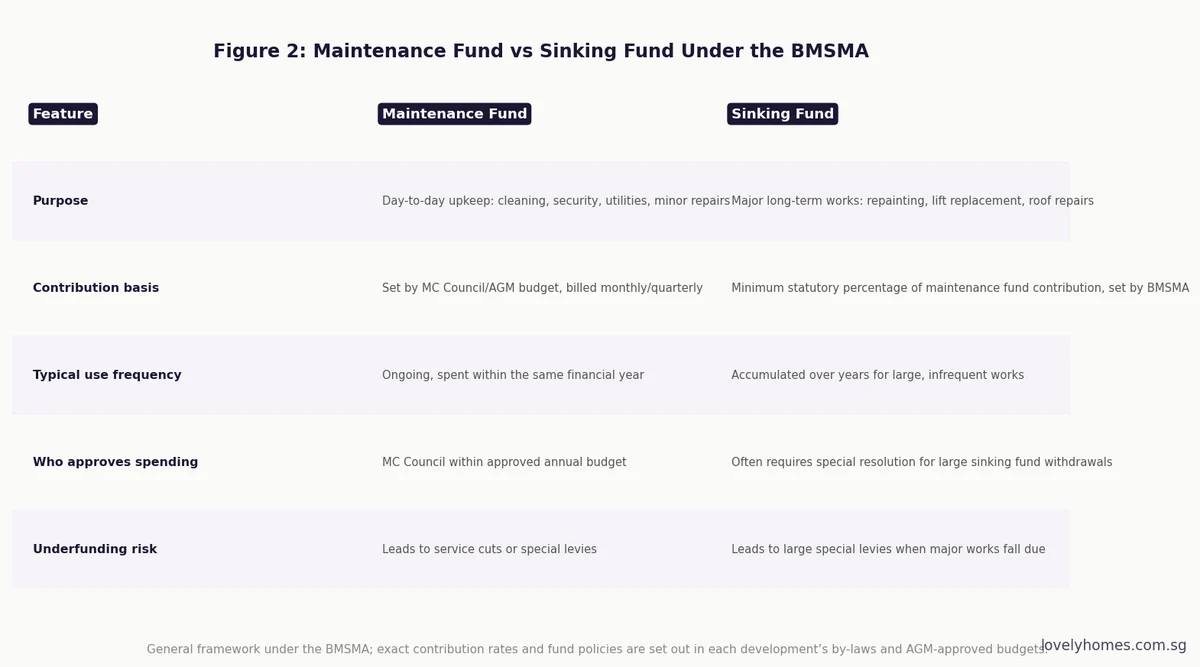
Every subsidiary proprietor contributes to two distinct pools of money, and confusing the two is one of the most common misunderstandings among first-time strata owners. The maintenance fund covers day-to-day, recurring operating costs: security, cleaning, common area utilities, landscaping, minor repairs, insurance and the managing agent’s fee. Contributions are set by the MC’s approved annual budget and billed to owners monthly or quarterly, with the fund intended to be largely spent within the same financial year it is collected. The sinking fund, by contrast, is a long-term reserve specifically intended for major, infrequent capital works, such as repainting the building’s exterior, replacing lifts, or major roof and facade repairs, that occur perhaps once every decade or longer but at a very substantial cost when they do. The BMSMA requires MCSTs to contribute a minimum percentage of the maintenance fund collection into the sinking fund each year specifically to ensure this reserve is not neglected, since an underfunded sinking fund forces owners into large, unplanned special levies when major works eventually become unavoidable.
By-Laws: The Rules That Govern Your Development
Every MCST operates under a set of by-laws, which function as the development’s internal rulebook and are legally binding on all subsidiary proprietors, their tenants and their guests. Standard by-laws prescribed under the BMSMA cover matters such as noise, obstruction of common property, and use of shared facilities, while each MCST can also adopt additional by-laws specific to its own development, commonly covering renovation approval procedures, pet ownership policies, short-term rental restrictions, and rules for using facilities like function rooms or barbecue pits. Amending by-laws, or adopting new ones, typically requires a resolution passed at a general meeting by subsidiary proprietors, with the required voting threshold depending on the nature of the by-law being changed. Owners planning renovations should always check the by-laws and obtain any required MC approval before starting work, since unauthorised renovations, particularly those affecting common property, structural elements or the building’s fire safety systems, can result in the MC ordering reinstatement at the owner’s own cost.
Disputes and the Strata Titles Boards
Disagreements are not uncommon in strata living, whether between neighbouring owners, or between an owner and the MC over issues like alleged by-law breaches, disputed maintenance fee levies, or common property repair responsibility. Where a dispute cannot be resolved through the development’s internal processes, either party can apply to the Strata Titles Boards (STB), a specialised tribunal established specifically to hear and adjudicate strata-related disputes under the BMSMA and the Land Titles (Strata) Act. The STB offers a more accessible and typically faster route than the general courts for strata-specific issues, though its jurisdiction is limited to matters falling within the relevant strata legislation, and more complex civil claims may still need to proceed through the ordinary court system.
Summary: MCST Facts at a Glance
| Question | Short Answer |
|---|---|
| Do I need to join the MCST separately? | No, membership is automatic by law the moment you take title to a strata unit. |
| What determines my voting weight? | Your unit’s share value, which also determines your proportionate maintenance cost. |
| Who runs the MCST day to day? | An elected Management Council, usually supported by a professional managing agent. |
| What’s the sinking fund for? | Major long-term works like repainting, lift replacement and roof repairs. |
| Are by-laws legally binding? | Yes, on all subsidiary proprietors, tenants and guests. |
| Where do unresolved disputes go? | The Strata Titles Boards (STB), a specialised tribunal for strata disputes. |
Worked Example: A Quarterly Maintenance Fee Breakdown
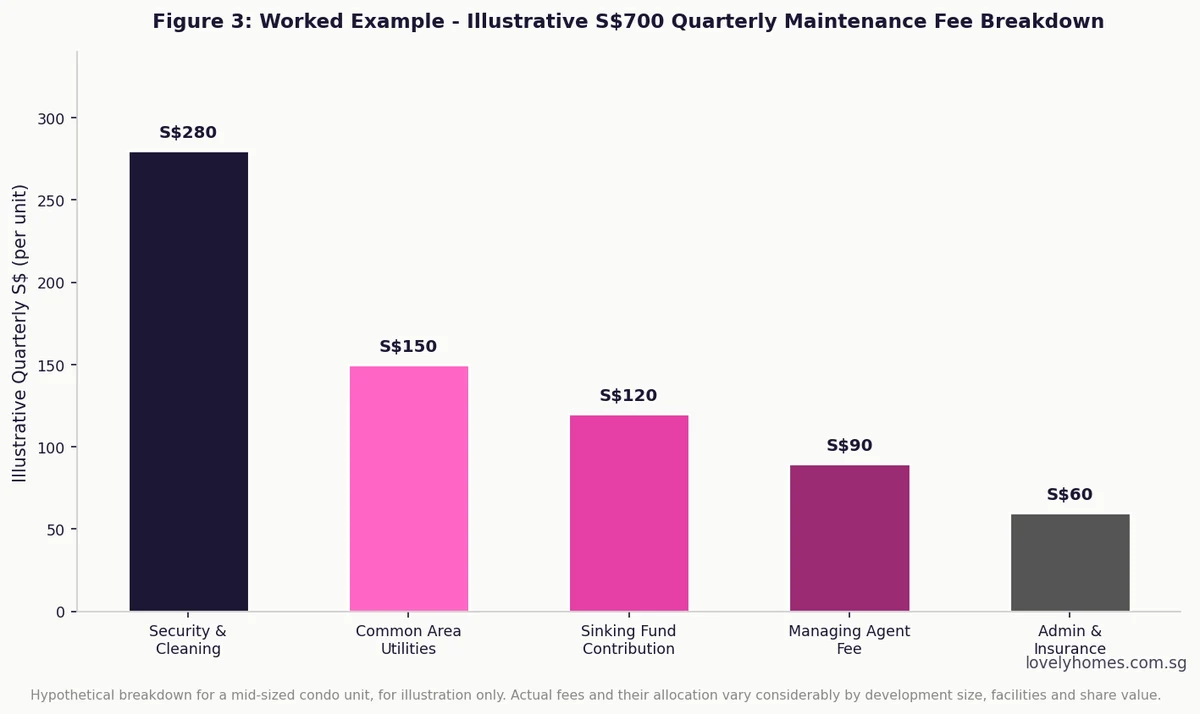
Profile: Ms Tan owns a unit in a mid-sized condominium and is billed an illustrative S$700 quarterly maintenance fee by the MCST’s managing agent.
Breakdown: of this amount, approximately S$280 covers security and cleaning, S$150 covers common area utilities (lighting, pumps, lift power), S$120 is the mandatory sinking fund contribution, S$90 is the managing agent’s fee, and the remaining S$60 covers administrative costs and building insurance.
Why it varies: a smaller development with fewer shared facilities (no pool, gym or 24-hour concierge) would typically have a meaningfully lower quarterly fee, while a large development with extensive facilities and a high building age (and therefore more frequent major works) would typically levy higher fees, particularly for the sinking fund component.
These figures are hypothetical and illustrative only; actual maintenance fees depend entirely on your specific development’s size, facilities, age, and MC-approved budget.
Why This Matters for Strata Owners and Buyers
Understanding how an MCST works is genuinely useful before, not just after, buying a strata property. Prospective buyers should review a development’s maintenance fee history, sinking fund balance and any planned major works or upcoming special levies, information typically available by requesting the MCST’s recent AGM minutes and financial statements through the seller or agent, since a poorly funded sinking fund can translate into a large, unwelcome special levy shortly after purchase. For existing owners, staying engaged with the MCST, attending AGMs, reading meeting minutes, and understanding by-laws before renovating, is the most effective way to protect both the value of a shared asset and avoid costly disputes or reinstatement orders down the line.
What Might Come Next
The following is informed speculation, not confirmed policy. As Singapore’s stock of ageing strata developments grows, sinking fund adequacy and major works funding are likely to remain an area of continued regulatory and industry attention, potentially including clearer guidance or updated minimum contribution benchmarks for MCSTs managing older buildings facing more frequent major repairs. Growing interest in short-term rental platforms has also put pressure on some MCSTs to tighten by-laws around subletting and visitor access, a trend that may continue as more developments update their house rules, though no economy-wide regulatory change specific to strata by-laws has been signalled as at this writing.
Frequently Asked Questions
Can I opt out of MCST membership if I don’t use the shared facilities?
No. MCST membership is a legal consequence of owning a strata title unit, not a voluntary arrangement, so you cannot opt out or stop contributing to maintenance fees regardless of how often you use shared facilities.
What happens if I don’t pay my maintenance fees?
The MCST can take legal action to recover unpaid maintenance fees, including obtaining a court order, and persistent non-payment can affect an owner’s standing at general meetings and, in serious cases, lead to further legal consequences.
Do I need MC approval before renovating my unit?
In most developments, yes, particularly for works affecting common property, structural elements, or fire safety systems. Always check your development’s by-laws and submit a renovation application before starting work.
How is my share value determined?
Share value is assigned to each unit at the time the strata subdivision is approved, generally reflecting factors such as unit size and type, and is set out in the development’s strata title plan.
Can the MCST force a special levy on all owners?
Yes, where existing funds are insufficient for necessary works, the MCST can pass a resolution at a general meeting to impose a special levy on all subsidiary proprietors, typically apportioned according to share value.
Where do I go if I have a dispute with my MC?
After exhausting the development’s internal processes, disputes can be referred to the Strata Titles Boards (STB), a specialised tribunal for strata-related matters under the BMSMA and Land Titles (Strata) Act.
Is a managing agent legally required?
No, appointing a managing agent is common practice but not a strict legal requirement; some smaller MCSTs are self-managed by their Management Council without an external agent.
Related Articles on LovelyHomes
Click anywhere outside to close