Singapore Property Land Tenure Guide 2026: 99-Year vs Freehold vs 999-Year Explained

Singapore Property Land Tenure Guide 2026: 99-Year vs Freehold vs 999-Year Explained

Quick Answer: Singapore Land Tenure at a Glance

  • Freehold means you own the land in perpetuity — no expiry date. More common in CCR/RCR and older landed estates.
  • 999-year leasehold is functionally near-freehold for most buyers’ lifetimes; found mainly in older District 9–11 properties and some landed estates.
  • 99-year leasehold is the most common tenure for HDB flats and most modern private condominiums in Singapore; lease starts from the date of grant, not your purchase date.
  • Freehold resale properties command roughly 15–25% price premium over comparable 99-year leaseholds in the same district.
  • CPF OA use and bank loan availability are restricted when a property’s remaining lease falls below 60 years (CPF) or 30 years (bank financing).
  • Value decay under Bala’s Table becomes measurably steep once a 99-year lease drops below 60 years remaining — roughly equivalent to a flat purchased new in 1965.
  • The Singapore Land Authority (SLA) administers all land titles; lease top-ups are discretionary and not guaranteed.

Land tenure is one of the most fundamental — and most misunderstood — concepts in the Singapore property market. When you buy a private condominium or landed home, you are not just buying bricks and mortar: you are buying a right to occupy the land beneath for a defined period. That period, and what happens as it runs down, has profound consequences for your mortgage eligibility, CPF usage, resale value, and long-term investment returns.

Singapore operates under three primary tenure types: freehold (perpetual ownership), 999-year leasehold (quasi-freehold for practical purposes), and 99-year leasehold (the dominant tenure for HDB flats and most modern private developments). Each carries different price dynamics, financing rules, and exit strategies. This guide, correct as at 24 June 2026, explains what each tenure type means, how it affects your purchase decision, and what buyers and investors need to know before signing any Option to Purchase.
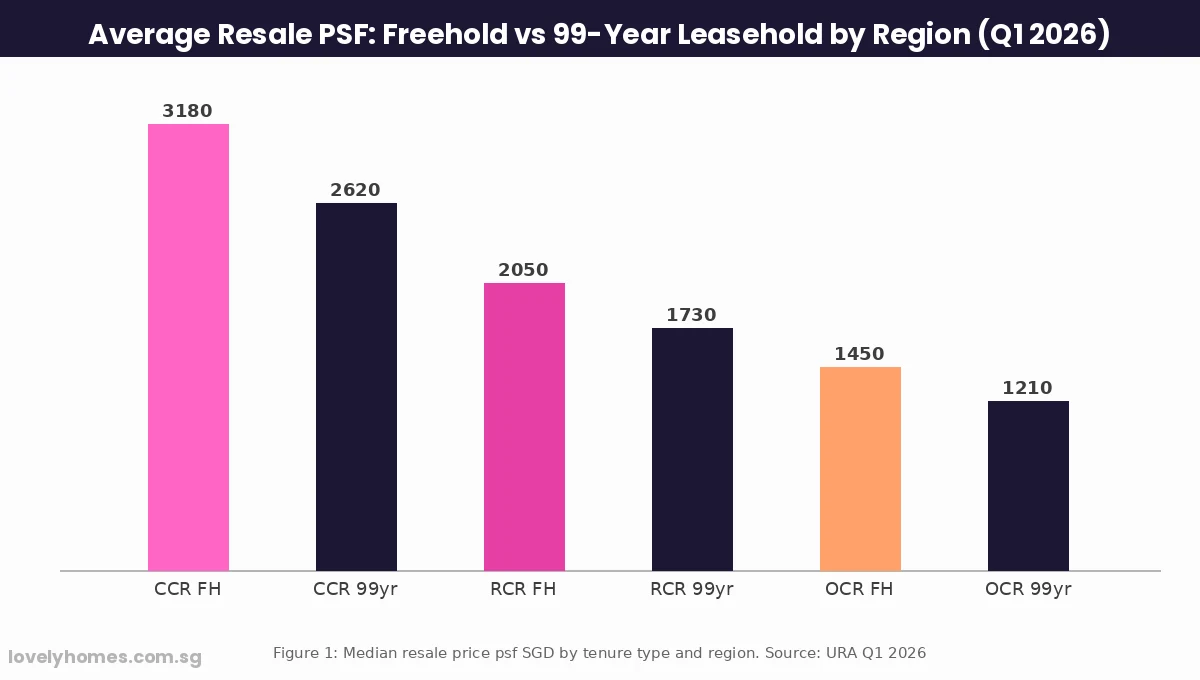
Freehold vs 99-year leasehold average resale price psf by region Singapore Q1 2026
Figure 1: Median resale price per square foot (PSF) in SGD — freehold vs 99-year leasehold by market region, Q1 2026. Source: URA Realis

What Does Land Tenure Mean in Singapore?

All land in Singapore is ultimately owned by the state. When you purchase a freehold property, the government grants you perpetual right to that parcel; when you purchase a leasehold property, you receive the right to occupy the land for a defined term. HDB flats are all built on 99-year leasehold land granted by the Housing & Development Board, which in turn holds the land from the state. Private leaseholds are similarly titled under the Land Titles (Strata) Act, administered by the Singapore Land Authority (SLA).

The practical implication is straightforward: a 99-year leasehold property bought new today will have zero land value — and may be compulsorily acquired — when the lease expires 99 years hence. A freehold property, by contrast, can theoretically be passed on to your descendants indefinitely. In practice, most Singaporeans will never own a property long enough for this distinction to matter personally, but it matters enormously to the resale market, to developers calculating en-bloc potential, and to CPF Board and bank underwriters assessing loan risk.

The Three Tenure Types: Freehold, 999-Year and 99-Year

Freehold

A freehold title in Singapore confers perpetual ownership of the land. The property can be sold, inherited, or redeveloped without any lease-expiry concern. Freehold land is disproportionately concentrated in the Core Central Region (CCR), particularly Districts 9, 10, and 11, as well as in older landed residential estates in districts like D15 (East Coast) and D19 (Serangoon Gardens). Because supply is finite — the government rarely grants new freehold sites in the Government Land Sales programme — freehold properties trade at a sustained premium over 99-year equivalents.

999-Year Leasehold

A relic of colonial land grants, 999-year leases are functionally indistinguishable from freehold for any buyer whose investment horizon is shorter than several centuries. Properties holding 999-year titles include some older landed estates in Districts 9, 10, and 11, as well as certain heritage shophouses. Banks treat 999-year and freehold identically for loan-to-value purposes; CPF Board similarly imposes no material restrictions. From a market-pricing perspective, 999-year properties command a modest 5–10% premium over comparable 99-year leaseholds, but typically trade at a slight discount to true freehold owing to the perception gap among less-informed buyers.

99-Year Leasehold

The dominant tenure for HDB flats and for most private condominiums launched since the 1980s. When a developer acquires a Government Land Sales site, the land comes with a 99-year lease running from the date of state grant — not the date the units are sold. This distinction matters: if a developer takes two years to build and TOP, the first owner enters at 97 years remaining. By the time a flat is resold five years later, the remaining lease may be only 92 years. Each transfer compresses the remaining term further.

The 99-year structure is by design: the government retains the ability to redevelop land as planning priorities evolve, and the Selective En-Bloc Redevelopment Scheme (SERS) — under which HDB compulsorily acquires older estates at market value and rehouses residents — is the clearest expression of this model. SERS compensation has historically been generous, but it is not guaranteed, and fewer than 5% of HDB estates have been selected since the programme began in 1995.
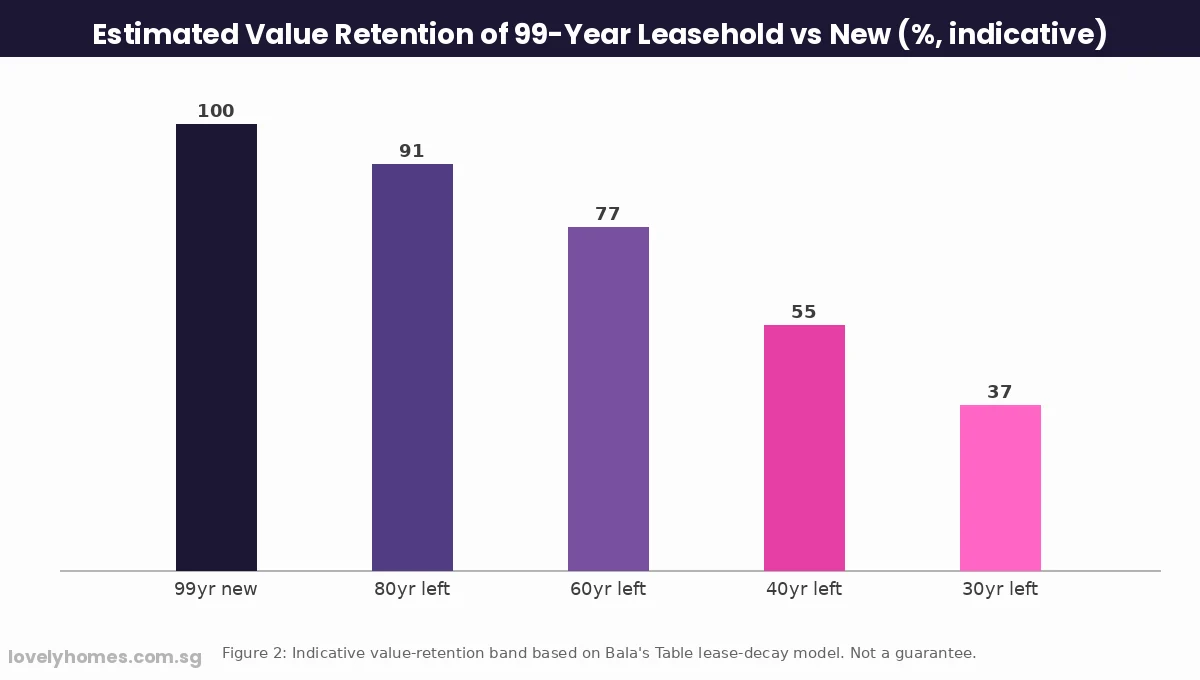
99-year leasehold value decay chart Singapore Bala's Table lease decay model
Figure 2: Indicative value retention of a 99-year leasehold property at different remaining lease durations, based on Bala’s Table. Not a guarantee of actual market prices. Source: LovelyHomes analysis

How Lease Decay Works: Bala’s Table Explained

Singapore’s property valuation profession applies Bala’s Table — a standardised depreciation formula used by licensed valuers — to determine the land value attributable to a leasehold site relative to a freehold equivalent. The table, developed by the late Chief Valuer TC Bala, accounts for the non-linear nature of lease decay: value does not fall in a straight line. Instead, the first 40 years of a 99-year lease retain the bulk of their value, while decay accelerates steeply once the remaining term drops below 60 years.

Practically, a 99-year leasehold property with 80 years remaining retains roughly 91% of its freehold-equivalent land value; at 60 years remaining, approximately 77%; at 40 years remaining, only about 55%. These are not exact market outcomes — sentiment, location, and property condition all intervene — but the directional trend is well-established. Properties approaching 30 years remaining often struggle to attract bank financing and CPF usage altogether, sharply limiting the pool of eligible buyers and putting downward pressure on price.

CPF Rules and Bank Financing by Remaining Lease

The CPF Board and commercial banks both impose restrictions tied to remaining lease duration. These restrictions become a significant pricing factor for older leasehold properties and should be front of mind for any buyer of a resale leasehold property.

CPF OA withdrawal restrictions (CPF Board, 2026): To use CPF Ordinary Account (OA) savings for a property purchase, the remaining lease must be at least 20 years. However, where the remaining lease does not cover the youngest buyer to the age of 95, CPF withdrawal is prorated based on the lease coverage ratio. Practically, a property with fewer than 60 years remaining will see meaningful CPF withdrawal restrictions. A property with fewer than 30 years remaining will typically see CPF usage restricted to very small amounts that make it effectively unusable for most buyers.

Bank loan availability: Most commercial banks in Singapore will not extend a housing loan if the remaining lease at loan maturity is less than 30 years. This effectively creates a financing cliff: properties whose leases will fall below 30 years during the expected loan tenure become very difficult to mortgage, dramatically reducing buyer pools. For a buyer seeking a 25-year loan, this means a property with 54 years remaining today (30 + 25 = 55 years minimum requirement, with slight buffer) may already face bank restrictions from certain lenders.
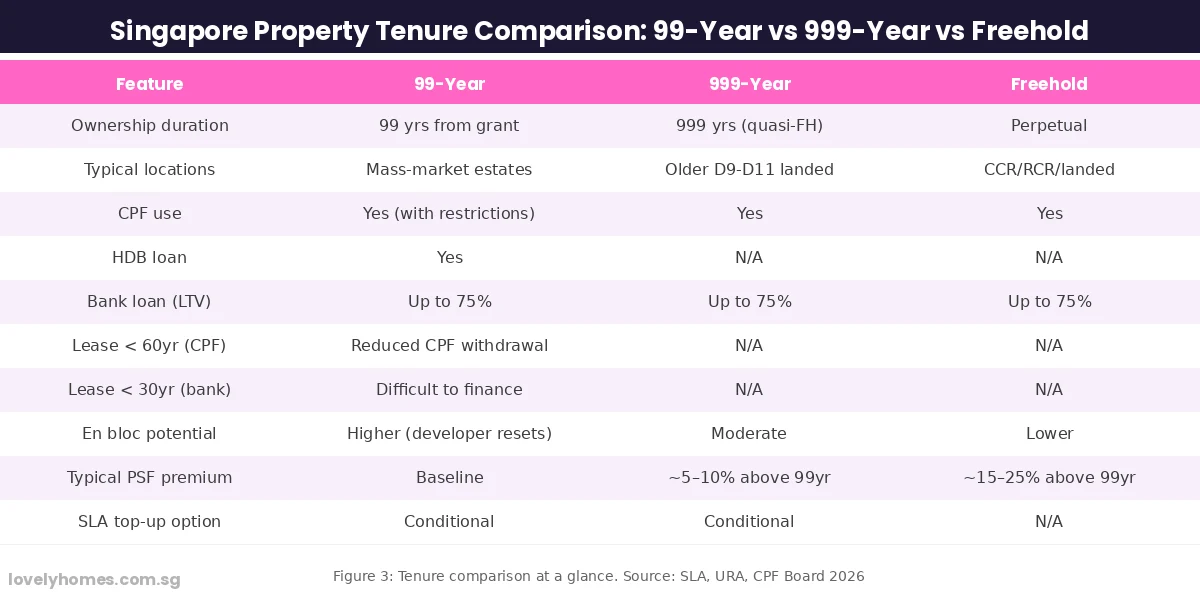
Singapore property tenure comparison table 99-year vs 999-year vs freehold 2026
Figure 3: Singapore property tenure comparison at a glance — 99-year vs 999-year vs freehold. Source: SLA, URA, CPF Board 2026

Price Premium: How Much More Does Freehold Cost?

The freehold premium in Singapore’s private residential market is real but variable. Across the market as of Q1 2026, URA Realis transaction data shows freehold resale properties trading at approximately 18–22% above comparable 99-year units in the same district and development class. The premium is most compressed in the OCR (Outer Central Region), where affordability constraints and the dominance of 99-year GLS supply have thinned the buyer pool for freehold stock. In the CCR, the premium is most pronounced because freehold supply is finite and demand from high-net-worth buyers and foreigners (who pay 60% ABSD and tend to prioritise tenure permanence) sustains elevated pricing.

However, the premium is not universal or permanent. Several factors compress it: strong new-launch condo launches on 99-year land in the same area; sentiment swings toward newer facilities over older freehold stock; and the government’s ABSD-driven cooling of foreign buyer demand since April 2023. Buyers should never assume that freehold status alone justifies a premium purchase — location, remaining lease (for 99-year comparables), age of building, and facility quality all matter more in the short-to-medium term.

Quick Reference: Land Tenure Rules at a Glance

Rule / Parameter 99-Year Leasehold 999-Year / Freehold
Typical tenure start Date of state grant (before developer build) Perpetual (FH) / colonial grant (999yr)
CPF OA use (min remaining lease) ≥ 20 years; prorated below 60 years No restriction
Bank loan (min remaining at maturity) ≥ 30 years (most banks) No restriction
Typical PSF premium vs 99yr Baseline +15–25% (FH); +5–10% (999yr)
Value decay (Bala’s Table) Accelerates below 60yr remaining None
En bloc potential High — developer resets to 99yr Lower — developer pays FH premium
SLA lease top-up (discretionary) Possible in select estates N/A
ABSD treatment Same as FH Same as 99yr

Worked Example: 99-Year vs Freehold — A Buyer’s Calculation

Mr and Mrs Wong are a Singapore Citizen couple in their early 40s, combined monthly income of S$16,000, with their HDB Minimum Occupation Period (MOP) recently cleared. They are considering two options for their first private condominium purchase in District 19:

  • Option A — 99-Year Leasehold: A well-appointed 3-bedroom condominium at Serangoon, built in 2012, with approximately 85 years remaining on its 99-year lease. Asking price S$1.45M (S$1,380 psf).
  • Option B — Freehold: A comparable 3-bedroom freehold condominium in the same neighbourhood, built in 2008. Asking price S$1.70M (S$1,620 psf) — a 17.2% premium over Option A.

Stamp duty comparison (both as 2nd property — ABSD remission strategy: sell HDB first):

  • BSD on S$1.45M: S$43,800 (CPF). BSD on S$1.70M: S$56,800 (CPF).
  • ABSD (SC 2nd property before HDB sale): S$290,000 (20%) vs S$340,000 (20%). Subject to ABSD remission if HDB sold within 6 months of purchase completion.

Bank financing: Both options qualify easily at 85 and freehold remaining lease. At 75% LTV: Option A loan S$1,087,500 @3.1% 30yr = S$4,685/mth (TDSR 29.3% — PASS). Option B loan S$1,275,000 @3.1% 30yr = S$5,497/mth (TDSR 34.4% — PASS).

20-year resale outlook: If Bala’s Table decay holds, Option A at 65 years remaining (in 20 years) retains roughly 80% of its current freehold-equivalent land value; Option B retains 100%. At a 3% compound annual capital appreciation baseline before decay effects, Option B’s perpetual tenure provides a structural hedge against the lease-decay headwind that will increasingly weigh on Option A beyond year 20.

The verdict for the Wongs: If they plan to exit within 10–12 years, Option A’s lower entry price and higher TDSR headroom make it the pragmatic choice — lease decay will be minimal in that window. If their horizon extends to 20+ years or they plan to pass the property to children, the S$250,000 upfront premium of Option B may be justified by the absent lease-decay risk.

What This Means for Buyers and Investors

For most Singaporeans whose investment horizon is under 15 years, the 99-year vs freehold debate is largely academic. In that window, location, property condition, and market sentiment dominate returns; lease decay makes only a marginal dent. The freehold premium, however, means you are paying a significant sum for insurance against a risk you may never face. The rational framework is straightforward: buy freehold if you plan to hold generational wealth or if you are purchasing in a location where supply of 99-year land is abundant and freehold is genuinely scarce. Otherwise, the 99-year product — particularly in new launches with modern facilities — offers better entry economics.

For investors targeting en-bloc exit, the calculus flips. Ageing 99-year leasehold condominiums with plot ratios below the current Master Plan allowance and lease starting to decay offer the highest en-bloc probability — developers need to reset the lease to 99 years from acquisition, making older leaseholds disproportionately attractive for collective sale. For an en-bloc investor, freehold status can actually reduce probability of a successful bid because developers pay a higher land price for equivalent redevelopment potential.

What Might Come Next: Policy and Market Outlook

Several policy trends will shape the tenure premium over the next decade. First, the government’s confirmed intent to replenish the SLA lease top-up scheme selectively — most recently applied to the Farrer Road and Boon Lay clusters — suggests that some 99-year leaseholds nearing the 40-year remaining mark may receive top-ups, partially arresting decay. However, these are discretionary, site-specific, and not widely available. Second, as Singapore’s urban redevelopment continues to pivot land away from landed and low-density uses toward mixed-use and transit-oriented development, freehold landed estates in the Core Central Region may face increasing redevelopment pressure — paradoxically making their freehold status more valuable as a negotiating chip in collective sale proceedings.

Third, the government’s ongoing review of HDB flat pricing and subsidy structures — including the HDB’s recent commentary on asset enhancement aspirations vs housing-as-a-home objectives — is likely to produce further policy signals on whether the 99-year model for public housing will be extended, supplemented, or restructured. Any formal announcement of an expanded SERS programme or a new lease buyback extension scheme would meaningfully affect the value calculus for older 99-year stock.

FAQ: Singapore Property Land Tenure

Does tenure type affect how much ABSD I pay?
No. The Additional Buyer’s Stamp Duty (ABSD) rate in Singapore is determined entirely by buyer profile (Singapore Citizen, Permanent Resident, or Foreigner) and ownership count (first, second, third property). Tenure type — freehold, 999-year, or 99-year — has no effect on ABSD rates. ABSD is administered by the Inland Revenue Authority of Singapore (IRAS). For a full breakdown of ABSD rates by buyer profile, refer to our ABSD Singapore 2026 complete guide.
Can I use my CPF OA to buy a 99-year leasehold property?
Yes, subject to two conditions. First, the remaining lease at the time of purchase must be at least 20 years. Second, CPF withdrawal is prorated where the remaining lease does not cover the youngest buyer to the age of 95. In practice, most buyers purchasing a 99-year leasehold that was launched within the last 20 years will have no CPF restriction. Problems arise for older resale leaseholds — particularly those with fewer than 60 years remaining — where CPF usage may be significantly curtailed. The CPF Board’s online calculator allows you to check CPF usage eligibility by remaining lease.
What happens when a 99-year HDB lease expires?
At lease expiry, the land reverts to the state — the HDB flat owner receives no compensation and loses the right to occupy. In practice, no HDB estate has yet reached the end of its 99-year lease (the earliest post-independence flats would reach this point around 2060), so there is no established precedent. The government has indicated through various policy statements that HDB residents in expiring estates would be rehoused, but the terms and pricing of any such scheme have not been formalised. Most HDB observers expect an expanded Selective En-Bloc Redevelopment Scheme (SERS) or an equivalent programme, but this remains speculative. Buyers of very old HDB resale flats should factor this uncertainty into their purchase decision — particularly the CPF and financing restrictions that kick in as remaining lease shrinks.
Is a 999-year leasehold really as good as freehold?
For all practical purposes, yes. No living buyer will ever be affected by the difference between 999 years and perpetuity — even if a 999-year property was granted in 1826 (early colonial Singapore), it would still have over 800 years remaining. Banks and CPF Board treat 999-year and freehold identically. The only meaningful distinction is perception-based: some buyers and investors — particularly less experienced ones — conflate “999-year” with “short lease” owing to the word “leasehold” appearing in the title. This perception gap can occasionally compress the secondary market price below a true freehold equivalent of similar specification, creating a minor buying opportunity for informed buyers who understand the distinction.
Can I apply to the SLA to extend my 99-year lease?
In theory, yes — SLA does consider lease top-up applications on a case-by-case basis. However, these are not routine or commonly approved. SLA evaluates each application against planning objectives, development potential, and public interest. Where approved, a premium is payable based on the difference in land value between the existing remaining lease and the extended term. In practice, the instances of SLA approving lease top-ups for private residential properties have been limited to select estates (such as areas near major MRT interchanges where redevelopment is planned). You should not purchase a 99-year leasehold property in anticipation of an SLA lease top-up — treat any potential top-up as an unexpected upside, never a baseline assumption.
How does an en-bloc sale affect leasehold properties differently from freehold?
In a collective sale, the developer who acquires the site will typically obtain a fresh 99-year lease from the state (even if they acquire a freehold site — they may redevelop on a new 99-year lease if the GLS mechanism is used). For owners of an ageing 99-year leasehold condominium, an en-bloc sale can therefore be particularly valuable: their diminishing lease is effectively “reset” by the developer, and the sale proceeds are based on the full redevelopment potential of the site rather than the decaying residual value of their individual units. This is why you sometimes see older 99-year condominiums command surprisingly high collective sale valuations — the land value is assessed on plot ratio and location rather than the remaining lease held by current owners. Our en-bloc seller’s guide 2026 covers the full collective sale process.
Does tenure matter when renting out a property?
No — tenure type has no effect on your ability to rent out a private property or on the rental income you can earn. Tenants do not care (and generally do not know) whether the property is freehold or 99-year. However, tenure indirectly matters through capital allocation: because freehold properties have a higher purchase price, your yield (rental income as a percentage of purchase price) will typically be lower on a freehold property than on an equivalent 99-year one. For yield-focused investors, this means 99-year leaseholds with modern facilities in strong rental catchment areas (near MRT, universities, business parks) often generate better rental yields than freehold properties at higher price points. See our Singapore property portfolio guide 2026 for yield and ABSD analysis.

Disclaimer: This article is for general informational purposes only and does not constitute legal, financial, or property advice. Singapore property regulations, CPF rules, and lending criteria change periodically. All figures cited are indicative or based on publicly available data as at 24 June 2026. For current rates and rules, refer to the Urban Redevelopment Authority (URA), the Singapore Land Authority (SLA), and the CPF Board. Consult a licensed property professional and a solicitor before making any property decision.

Singapore HDB Resale Price Index Guide 2026: What the RPI Measures, How to Read It and Q1 2026 Data

Singapore HDB Resale Price Index Guide 2026: What the RPI Measures, How to Read It and Q1 2026 Data

Quick Answer: HDB Resale Price Index (RPI) Guide 2026

  • The RPI measures price movement, not price levels — it shows whether HDB resale flats are getting more or less expensive on a like-for-like basis, quarter by quarter.
  • Current base: Q1 2012 = 100 — an RPI of 203.4 in Q1 2026 means prices have doubled (+103.4%) since the 2012 base year on a quality-adjusted basis.
  • Q1 2026 RPI: 203.4 (−0.1% QoQ) — the first quarterly dip since Q2 2019; still +1.2% year-on-year.
  • The index is published by HDB quarterly, approximately 4 weeks after each quarter end, alongside full transaction data at hdb.gov.sg.
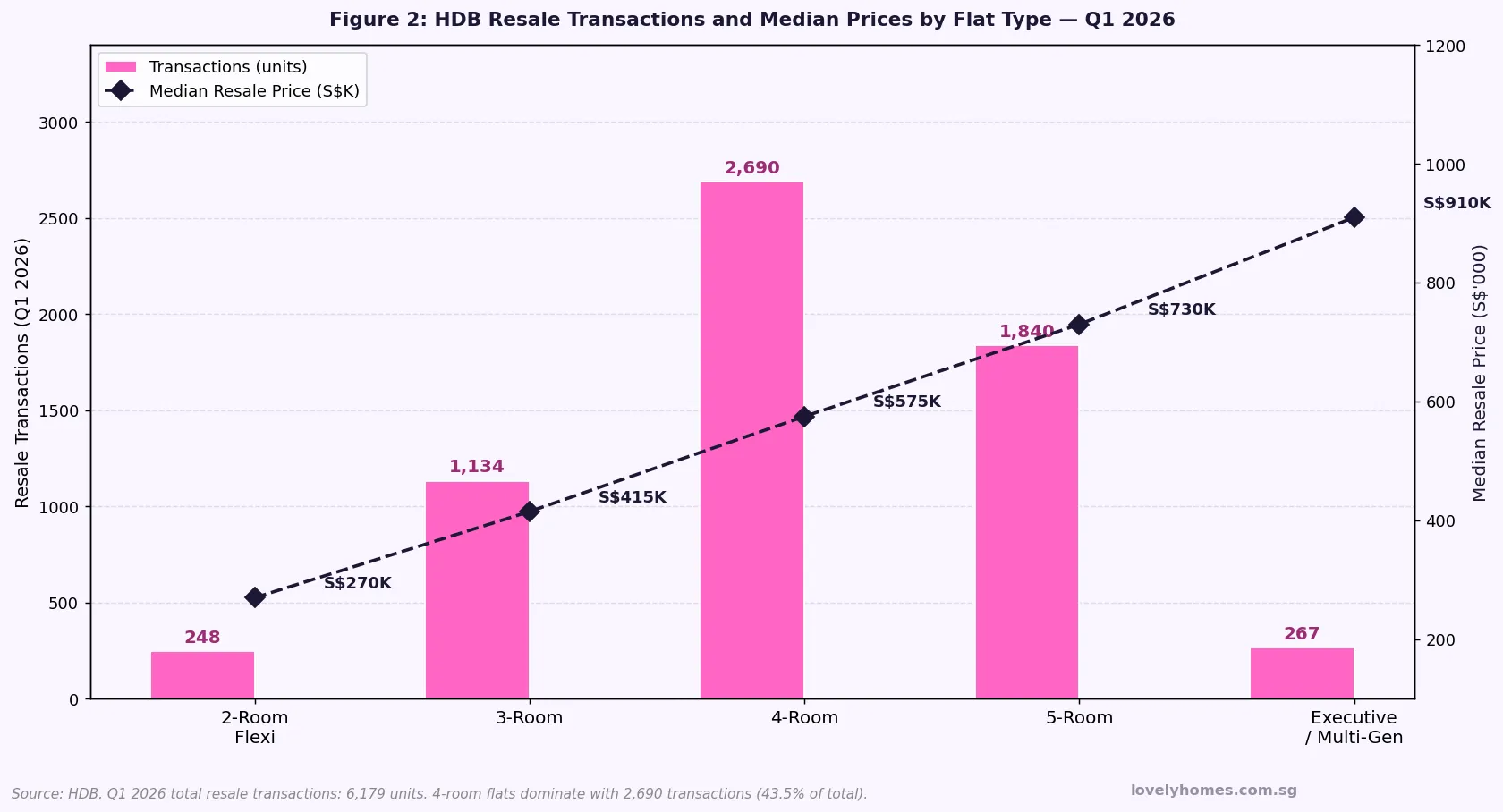
  • 6,179 HDB resale transactions in Q1 2026 — a 17.6% QoQ increase in volume, confirming active demand even as prices edged down.
  • 412 million-dollar HDB flats in Q1 2026 — a record quarterly high, concentrated in mature estates and larger flat types.
  • The RPI controls for composition — if more cheaper flats transact in one quarter, the index removes that mix effect so you see pure price movement.
  • Best used alongside median prices and psf data — the RPI tells you trend direction; median prices and psf data tell you absolute costs for the specific flat type and town you are targeting.

What Is the HDB Resale Price Index?

The HDB Resale Price Index, commonly abbreviated to RPI, is Singapore’s official measure of price movement in the public housing resale market. Published by the Housing & Development Board (HDB) on a quarterly basis, it tracks how much the price of a typical HDB resale flat has changed relative to a defined base period — currently Q1 2012, which is set at a value of 100.

Crucially, the RPI is an index of price change, not an index of absolute price levels. An RPI of 203.4 in Q1 2026 does not mean that the average HDB flat costs S$203,400. It means that, on a quality-adjusted basis, HDB resale prices have more than doubled (+103.4%) since Q1 2012. To understand what a specific flat type costs in your target town today, you need to look at HDB’s median transaction data or check resale listings — but to understand whether the overall market is rising, falling, or holding steady, the RPI is the definitive source.

The RPI is administered by HDB under the Housing and Development Act and forms part of the quarterly real estate statistics package released jointly with the Urban Redevelopment Authority (URA). Unlike anecdotal price reports or listing-based averages, it is grounded in actual completed transactions registered through HDB’s resale portal, making it the most authoritative measure of HDB market conditions available to buyers, sellers, researchers, and policymakers.

How the HDB Resale Price Index Is Computed

The RPI is constructed using a hedonic regression model — a statistical technique that isolates the effect of price changes from changes in the mix of properties transacted. In practice, this means that if a given quarter sees relatively more transactions of smaller, cheaper flats in non-mature estates (compared to the previous quarter), the index adjusts for this compositional shift so that the resulting index movement reflects genuine price change rather than a change in what was being sold.

The regression model controls for multiple property characteristics simultaneously:

  • Flat type: 2-room Flexi, 3-room, 4-room, 5-room, executive / multi-generation
  • Town: each of Singapore’s 26 HDB towns is represented separately
  • Floor area: larger flats typically command higher prices, controlling for size isolates per-square-metre movements
  • Remaining lease: flats with shorter remaining leases trade at discounts; the model controls for the CPF and HDB loan accessibility cliff at 60 years remaining lease
  • Storey range: higher floors command premiums, particularly in mature estates

The resulting index is chain-linked quarterly — meaning each period’s change is calculated relative to the immediately preceding period, and the cumulative chain is then rescaled to Q1 2012 = 100. This approach allows the model to be updated with new transaction data each quarter without retroactively revising earlier index values materially.

HDB publishes the RPI alongside full transaction data, including the number of registered resale applications, median transaction prices by flat type and town, and the number of million-dollar transactions. All data is freely available at hdb.gov.sg under “Resale Statistics.”

HDB resale price index RPI historical trend chart 2009 to Q1 2026 Singapore
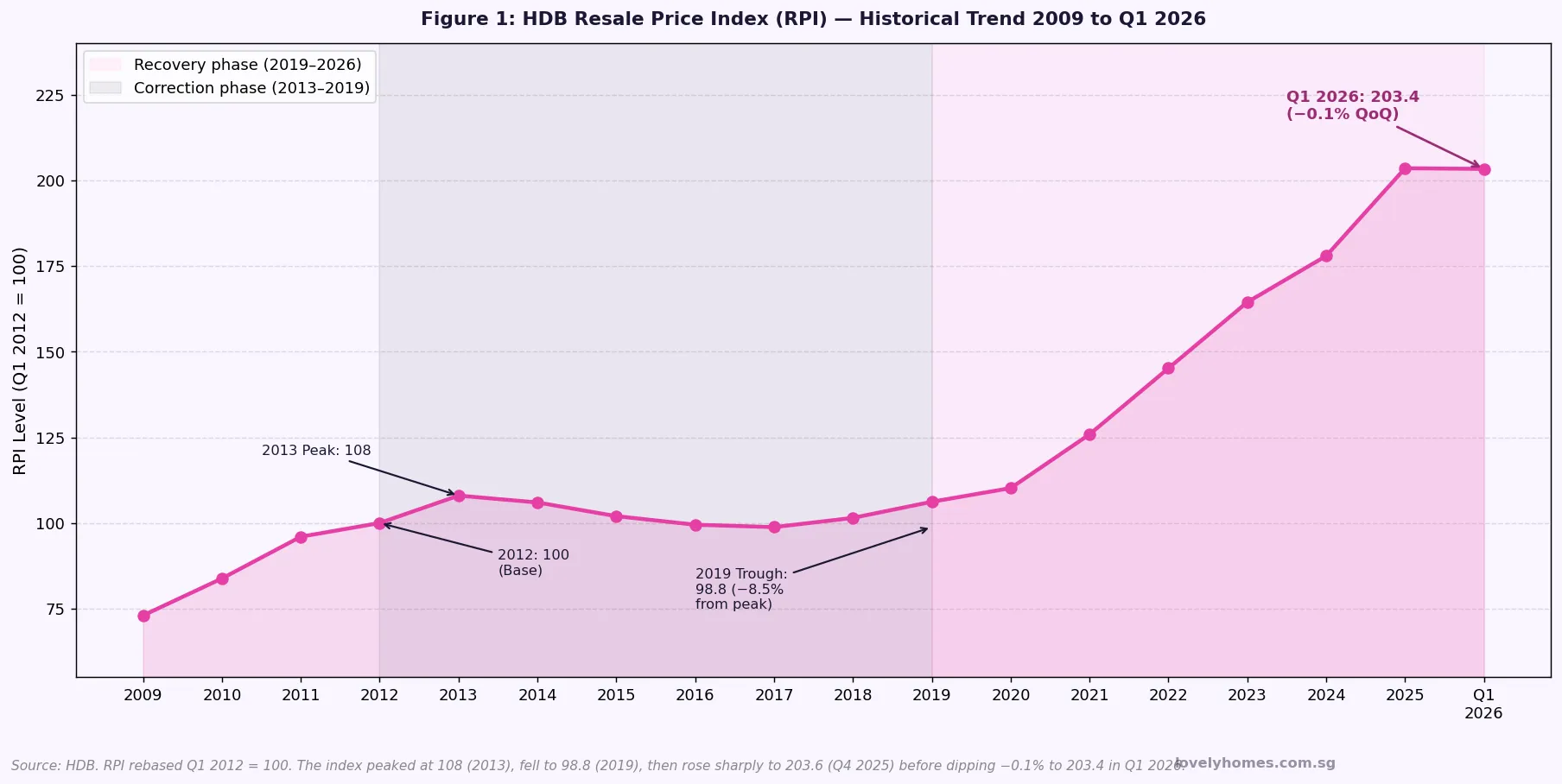
Figure 1: HDB Resale Price Index (RPI) — Historical Trend 2009 to Q1 2026 (Q1 2012 = 100). From the 2009 base, the RPI peaked at 108 (2013), corrected to 98.8 (2019), then surged to 203.6 (Q4 2025) before dipping −0.1% in Q1 2026. Source: HDB.

Historical Trend: Three Distinct Phases

The RPI’s history from its inception is best understood as three distinct phases, each shaped by different policy and macroeconomic forces administered by HDB and the Ministry of National Development (MND).

Phase 1 — The Boom (2009–2013): Following the Global Financial Crisis, Singapore’s HDB resale market surged as demand for public housing far outpaced the supply of new BTO flats. Buyers — including permanent residents who were then eligible to purchase resale flats from the open market — competed aggressively, pushing the RPI from approximately 73 (2009) to a peak of 108 in 2013. Cash Over Valuation (COV) payments — cash premiums paid above HDB’s official valuation — became endemic, sometimes reaching S$30,000 to S$50,000 on popular blocks.

Phase 2 — The Correction (2013–2019): The government responded to the HDB boom with a combination of cooling measures: tighter ABSD rates, loan-to-value (LTV) restrictions, the Total Debt Servicing Ratio (TDSR) framework (introduced June 2013), and a significant expansion of BTO supply. The abolition of the cash-over-valuation mechanism in March 2014 was particularly impactful, removing the ability of sellers to demand cash premiums above the official HDB valuation. The RPI fell from its 2013 peak of 108 to a trough of approximately 98.8 in 2019 — a 8.5% correction over six years.

Phase 3 — The Recovery and Surge (2019–2026): A combination of pandemic-driven demand (more time at home, family formation decisions, desire for larger spaces), supply disruptions to the BTO pipeline from COVID-19 construction delays, and low interest rates drove an extraordinary resale price surge from 2020 onwards. The RPI climbed from approximately 98.8 (2019) to 203.6 (Q4 2025) — a doubling over six years. In Q1 2026, the index recorded its first quarterly dip (−0.1%) in nearly seven years, closing at 203.4 and signalling a possible inflection point.

Q1 2026: The Data in Detail

The Q1 2026 HDB resale market delivered a nuanced picture. The headline RPI fell 0.1% to 203.4 — the first quarterly decline since Q2 2019. Yet transaction volumes surged 17.6% QoQ to 6,179 registered applications. These two data points are not contradictory: rising volume alongside a modestly lower index indicates that demand remains healthy but that buyers are exercising greater price discipline, with fewer sellers able to command the premium pricing that characterised 2022 to 2024.

Year-on-year, the RPI remains 1.2% higher than Q1 2025, confirming that the long-term trajectory is still upward — the Q1 2026 dip is most accurately described as a pause rather than a reversal. Regionally, mature estates (Queenstown, Toa Payoh, Bishan, Clementi) continued to command premiums of 20% to 40% above HDB’s median valuation for comparable flat types, driven by proximity to MRT stations, reputable schools, and established amenities.

HDB resale transactions and median prices by flat type Q1 2026 bar chart Singapore
Figure 2: HDB Resale Transactions and Median Prices by Flat Type, Q1 2026. 4-room flats dominate with 2,690 transactions (43.5% of total). Median resale price range: S$270K (2-room Flexi) to S$910K (Executive). Source: HDB.

Million-Dollar HDB Flats: A Market Within a Market

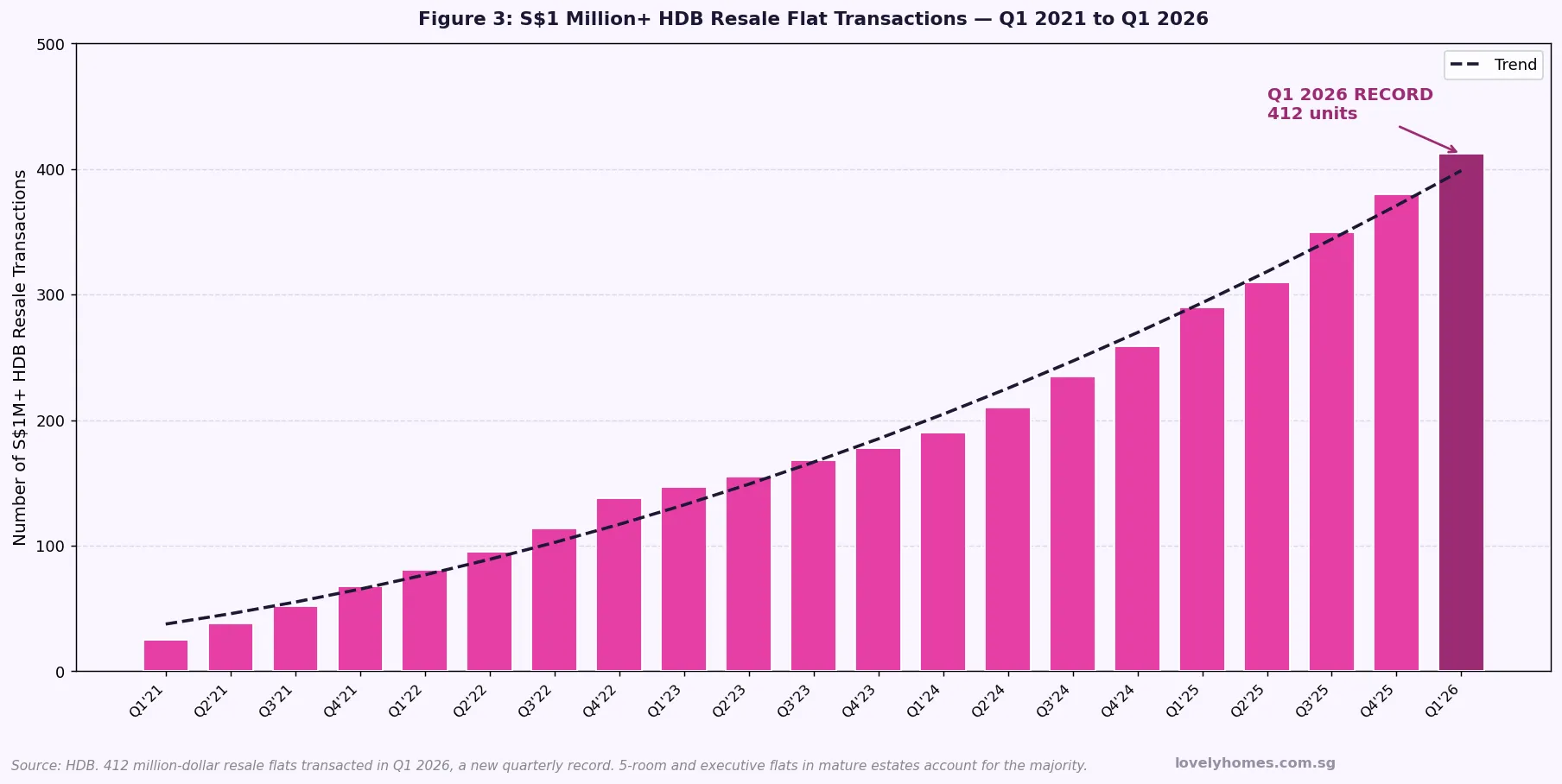
One of the most discussed HDB market phenomena of the 2020s is the emergence of million-dollar resale flats. In Q1 2026, a record 412 HDB resale flats transacted at S$1 million or above — surpassing the previous quarterly record and representing approximately 6.7% of all Q1 2026 resale transactions.

These transactions are concentrated in a specific subset of the HDB stock: 5-room flats and executive flats with large floor areas (typically above 120 square metres), located in mature estates with long remaining leases (above 80 years), on high floors with favourable orientations, and near MRT interchanges or in prime postal districts (D10, D11, D20). Bishan, Queenstown, Toa Payoh, and Ang Mo Kio feature prominently in million-dollar transaction data; newer towns such as Punggol, Sengkang, and Sembawang feature far less frequently.

Importantly, million-dollar HDB transactions are not captured differently in the RPI computation — the regression model treats them as part of the overall market. However, they have an outsized influence on public perception of the HDB resale market’s valuation and can distort discussions of “average” or “median” prices if the underlying flat-type mix is not considered. A buyer targeting a 3-room flat in Sengkang should not benchmark their purchase against a 5-room executive unit in Queenstown that transacted at S$1.1 million.

Million dollar HDB resale flat transactions quarterly trend Q1 2021 to Q1 2026 Singapore
Figure 3: S$1 Million+ HDB Resale Transactions — Quarterly Trend Q1 2021 to Q1 2026. Record 412 units in Q1 2026. Concentrated in executive/5-room flats in mature estates. Source: HDB.

How to Read and Use the RPI

The RPI is most useful as a directional indicator of market momentum rather than a precise predictor of any specific flat’s price. When the index rises consecutively for several quarters, it signals broad-based market strength — a time when buyers may need to act decisively and sellers can price assertively. When the index is flat or declining, as in Q1 2026, it signals that the balance of power is shifting toward buyers, who have more negotiating leverage and face less competition from other purchasers.

For buyers, the RPI should be read alongside HDB’s median resale price data by town and flat type, which provides the absolute dollar benchmarks needed to assess whether a specific listed price is fair. For example, if the median 4-room resale price in Tampines is S$575,000 and a seller is asking S$630,000, you know you are being asked to pay a 9.6% premium — which may or may not be justified by the specific unit’s attributes (level, renovation, facing, proximity to MRT). The RPI tells you nothing about that specific 9.6% premium; it only tells you whether the overall market is trending up or down.

For sellers, the RPI provides market context for pricing decisions. A flat priced well above the market trend during a period of RPI softening (as in Q1 2026) is likely to sit unsold for longer, accumulating mortgage costs and opportunity cost. Pricing within 5% of recent comparable transactions (using HDB’s open data on recent resale transactions, updated weekly) optimises both speed of sale and realised price.

RPI vs Median Prices: Understanding the Difference

Measure What It Shows Best Used For Limitation
HDB Resale Price Index (RPI) Quality-adjusted price movement QoQ and YoY Trend direction, timing decisions Does not give absolute price levels
Median Resale Price (by town/type) Mid-point of all transacted prices for a flat type in a town Benchmarking a specific purchase or sale Sensitive to composition; large-flat bias if few 3-rooms transact
Median PSF (S$/sqft) Price normalised for size, allowing cross-town comparison Comparing value across different flat sizes Remaining lease and floor level differences not reflected
Transaction Volume Number of completed resale deals per period Gauging market activity and liquidity Volume and price can move independently
Cash-Over-Valuation (COV) Premium paid above HDB valuation (post-2014: now rare in formal sense) Historical context; indicative of seller leverage HDB abolished mandatory COV reporting in 2014

Worked Example: Using the RPI to Time a Resale Flat Sale

Mr and Mrs Tan are a Singapore Citizen couple who purchased a 4-room HDB flat in Ang Mo Kio (AMK) in 2019 at S$495,000. Their flat completed its 5-year MOP in Q1 2024. They are now considering selling to upgrade to a condominium. They want to use the RPI to assess whether Q2 2026 is a good time to list the flat.

Step 1 — Reading the RPI: The RPI stood at approximately 98.8 in 2019 (when they bought) and is at 203.4 as at Q1 2026. This represents a 106% increase in the index — suggesting that on a market-wide basis, resale prices have roughly doubled since their purchase. However, this is the market-wide figure; AMK is a mature estate and may have outperformed or underperformed the market.

Step 2 — Checking median data: HDB’s resale statistics show that the median 4-room resale price in Ang Mo Kio was approximately S$585,000 in Q1 2026, up from S$490,000 in Q1 2024. This is a 19.4% increase in two years — slightly above the RPI gain for the same period (+2.4% over those 6 quarters), suggesting AMK has outperformed the market slightly.

Step 3 — Evaluating timing: With the RPI at 203.4 and a first quarterly dip in Q1 2026, the market is at a high valuation point relative to history. Selling in a cooling market typically takes longer — average HDB resale time-to-sell in Q1 2026 was approximately 4 to 6 weeks for well-priced units. The Tans’ flat has a long remaining lease (approximately 86 years), which preserves CPF eligibility for buyers. They price the flat at S$595,000 (2% above median), engage an agent to list it in April 2026, and it transacts within 5 weeks at S$588,000. Net equity after repaying the outstanding HDB loan of S$120,000 and CPF refund of S$210,000 (with accrued interest) is approximately S$258,000 in cash — which they use as part of the ABSD remission exercise for their condominium purchase.

What the Q1 2026 Dip Means for the Market

The −0.1% QoQ RPI reading in Q1 2026 is best interpreted as a signal of market equilibration rather than the start of a downturn. Several structural factors underpin this view. First, the large BTO pipeline of the 2022–2024 period — including the Plus and Prime Plus flat categories introduced under the new HDB flat classification framework — is beginning to reach completion and release first-timers back into the HDB ecosystem. As these buyers resell, they add supply to the market. Second, the June 2026 BTO exercise (6,952 units including the landmark Bishan Lakeview and Bishan Shunfu projects) will absorb first-timer demand that might otherwise have competed in the resale market. Third, affordability constraints at current price levels — with a median 4-room resale flat in a mature estate costing S$570,000 to S$730,000 — are more binding today than at any time in HDB’s history.

None of this suggests an imminent price crash. The structural demand drivers for HDB resale — the marriage and family formation rate, the 5-year MOP cycle releasing flat supply, the absence of new HDB supply in many mature estates, and the continued preference of Singapore households for home ownership — remain robust. The most likely H2 2026 scenario is continued modest volume growth in HDB resale transactions alongside approximately flat-to-slightly-positive quarterly RPI changes, with individual estate and flat-type performance diverging significantly from the market average.

What Might Come Next for the RPI

The Q2 2026 HDB resale statistics will be released by HDB in late July 2026 and will provide the next definitive data point. Given that: (a) BTO application volumes for June 2026 are high (suggesting first-timer demand has been partially redirected to BTO); (b) the resale market in April and May 2026 maintained healthy volume; and (c) private property prices continued to rise in Q1 2026, keeping resale HDB prices competitive relative to condominium alternatives — the most likely outcome for Q2 2026 is a small positive RPI change in the range of 0% to +0.5%.

Over the medium term, the million-dollar HDB flat segment is likely to remain buoyant — sustained by the finite supply of large flats in mature estates with long leases, and by the fact that each en-bloc cycle in the private market temporarily redirects sellers back to the public housing segment. Conversely, the mass-market 4-room resale segment in non-mature estates may see modest price moderation as BTO completions add supply and as the affordability ceiling binds more buyers.

Frequently Asked Questions

How often is the HDB Resale Price Index published?

The RPI is published by HDB on a quarterly basis, typically within four weeks of the end of each calendar quarter. The Q1 (January–March) data is released in late April; Q2 (April–June) in late July; Q3 (July–September) in late October; and Q4 (October–December) in late January of the following year. HDB also publishes flash estimates for the quarter before the full release — these are preliminary figures that may be revised slightly in the final report. All releases are publicly available on hdb.gov.sg under “Resale Statistics.”

Does the RPI measure the price of all HDB flats, including new BTO flats?

No. The RPI measures only HDB resale flat transactions — flats that have completed their Minimum Occupation Period (MOP) and are being sold on the open market by existing owners. It does not capture the price of new BTO flats sold directly by HDB, which are heavily subsidised and priced below market. The RPI therefore reflects the “market price” of public housing rather than the subsidised launch price of new flat exercises. This is why the RPI can rise substantially even when HDB continues to offer new BTO flats at subsidised prices — the resale market and the BTO market serve partly different buyer profiles and operate under different pricing mechanisms.

What does an RPI of 203.4 mean in practical terms?

An RPI of 203.4 (Q1 2026, with Q1 2012 = 100) means that the quality-adjusted price of a typical HDB resale flat has increased by approximately 103.4% since Q1 2012. This is a market-wide average — individual flat types, towns, and specific blocks will have diverged from this average significantly. Mature estate flats in Bishan, Queenstown, and Toa Payoh have outperformed the market, while flats in newer estates such as Punggol and Sengkang, or smaller flat types, may have underperformed. The 203.4 level also tells you that, relative to the 2013 RPI peak of 108, the current market is approximately 88% higher — highlighting how dramatically the affordability environment for resale HDB buyers has changed over the past decade.

Can I use the RPI to predict the future price of a specific flat?

The RPI is not designed to predict the price of a specific flat. It measures broad market trends using a hedonic regression approach, which means it controls for the average influence of flat characteristics. Your specific flat’s future price will be influenced by factors the RPI does not capture individually: the quality of your renovation, whether a new MRT station is planned nearby, the school allocation proximity, the remaining lease length relative to CPF accessibility rules, and whether the block has been earmarked for Selective En-bloc Redevelopment Scheme (SERS) consideration. For flat-specific valuation, obtain an HDB-commissioned valuation report or consult a licensed appraiser before signing any Option to Purchase.

What is the significance of the 60-year remaining lease threshold?

The 60-year remaining lease threshold is critical because it governs both CPF usage and HDB loan eligibility for resale flat purchasers. Under the CPF rules administered by the Central Provident Fund Board (CPFB), buyers can use CPF Ordinary Account funds to purchase a resale flat only if the flat’s remaining lease covers the youngest buyer to at least age 95. For a 35-year-old buyer, this means the flat must have at least 60 years of remaining lease. Similarly, HDB requires a minimum remaining lease of 20 years for a resale flat to be eligible for an HDB loan, and the loan tenure is capped so that the flat’s remaining lease meets the age-95 requirement. Flats approaching the 60-year lease boundary typically transact at a discount of 10% to 20% below comparable flats with longer leases — making remaining lease length one of the most important pricing variables in the HDB resale market.

How does the HDB RPI compare to the URA’s private property PPI?

The HDB RPI and the URA Private Property Price Index (PPI) are both hedonic regression-based indices, but they measure different markets. The PPI covers private residential properties (non-landed condominium and apartment transactions), while the RPI covers only HDB resale flats. Historically, the two indices have moved in the same broad direction but at different rates: private property prices tend to be more volatile, amplifying both upturns and downturns relative to the HDB market, which benefits from more structural demand (the 80% of Singapore residents who live in HDB flats). In Q1 2026, the indices diverged — the PPI rose 0.9% QoQ while the RPI fell 0.1% QoQ — reflecting the differing supply dynamics, buyer profiles, and regulatory contexts of the two markets.

Is the HDB resale market affected by Additional Buyer’s Stamp Duty (ABSD)?

Yes, but less directly than the private market. HDB resale flats are subject to ABSD when purchased as a second or subsequent property. A Singapore Citizen buying a resale HDB flat as a first home pays zero ABSD — this is the typical scenario for most resale buyers. However, an SC couple who already own a private property and wish to purchase a resale HDB flat would face ABSD of 20% on the second property — making the transaction financially unattractive in most cases. Permanent Residents purchasing their first HDB resale flat pay 5% ABSD, while PRs purchasing a second property pay 30%. Foreigners cannot purchase HDB resale flats at all under the Residential Property Act. These ABSD rules effectively concentrate HDB resale demand among first-time SC buyers and upgrading SC couples in the ABSD remission window — shaping the demographics and price sensitivity of the resale market.

Related Articles

Disclaimer

This article is for general informational and educational purposes only and does not constitute financial, investment, or property advice. All HDB Resale Price Index data is sourced from official HDB quarterly releases. CPF rules, ABSD rates, HDB loan eligibility criteria, and remaining lease policies are correct as at June 2026 and are subject to change by the relevant authorities. For the most current data, visit hdb.gov.sg, cpf.gov.sg, and iras.gov.sg. Individual property valuations and transaction outcomes vary. Consult a CEA-registered property agent and a conveyancing solicitor for advice specific to your circumstances.


Click anywhere or press Esc to close

Singapore Property Market Mid-Year Review 2026: H1 Results, Price Trends and 2H Outlook

Singapore Property Market Mid-Year Review 2026: H1 Results, Price Trends and 2H Outlook

Quick Answer: Singapore Property Market Mid-Year Review 2026

  • Private prices up 0.9% QoQ in Q1 2026 — the sixth consecutive quarter of growth; Outside Central Region (OCR) leads at +2.2% QoQ.
  • HDB resale dips −0.1% QoQ to RPI 203.4 — the first quarterly decline since Q2 2019, though still +1.2% year-on-year.
  • Record 412 million-dollar HDB flats changed hands in Q1 2026, a new quarterly high despite the headline price softening.
  • Developer sales collapsed 71.1% MoM in May 2026 (447 units), reflecting a thin launch pipeline — only one project launched that month.
  • 42,561 units in the pipeline (including ECs) with 17,032 unsold — providing a supply buffer that moderates price surges.
  • Private rental softened −1.2% QoQ in Q1 2026; vacancy edged to 6.2%, though OCR bucked the trend with a modest +1.0% rental gain.
  • 2H2026 GLS programme launched 9 confirmed sites (4,745 units), including the Jurong Lake District white site and Orchard Boulevard.
  • River Valley Green Parcel C set a new CCR GLS benchmark at S$1,730 psf ppr (June 2026), signalling continued developer confidence in prime addresses.
  • BTO June 2026 released 6,952 flats across 7 projects, including the first new HDB in Bishan in 40 years — absorbing first-timer demand from the resale market.
  • Full-year 2026 private price growth forecast at ~3%; URA Q2 2026 flash estimates expected in the first week of July — watch for confirmation of the trend.

Introduction: Where Singapore Property Stands at Mid-Year 2026

Six months into 2026, Singapore’s property market has delivered a split verdict. The private residential sector continues its steady upward march — the URA Private Property Price Index (PPI) rose 0.9% in Q1 2026, its sixth consecutive quarterly gain. At the same time, the HDB resale market recorded a rare 0.1% quarterly dip for the first time in nearly seven years, a signal that affordability constraints are beginning to bite in the public housing segment even as million-dollar flat transactions set new records.

This mid-year review consolidates the key price, transaction, supply, and rental data published by the Urban Redevelopment Authority (URA) and the Housing & Development Board (HDB) through Q1 2026, and frames the outlook for the second half of the year. Whether you are a first-time buyer weighing an HDB flat, an upgrader eyeing a new launch condominium, or an investor managing a rental property portfolio, understanding the H1 2026 data is essential context for decisions made in the months ahead.

Private Residential Market: Sixth Consecutive Quarter of Growth

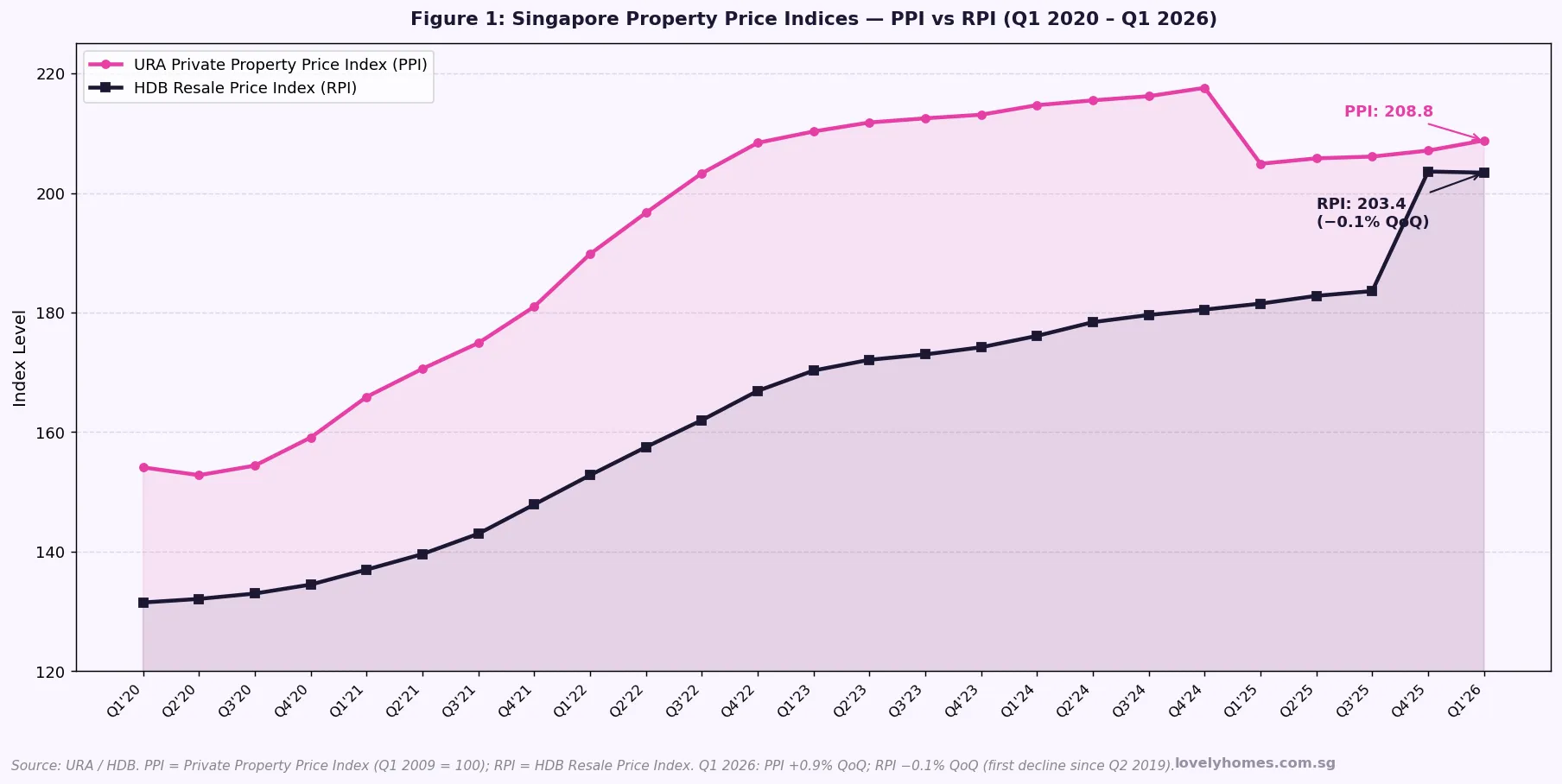
The URA’s Q1 2026 Real Estate Statistics confirmed a 0.9% quarter-on-quarter increase in the private residential PPI, bringing the index to 208.8. This builds on gains posted in every quarter since Q3 2024, and represents a 2.63% year-on-year improvement from Q1 2025.

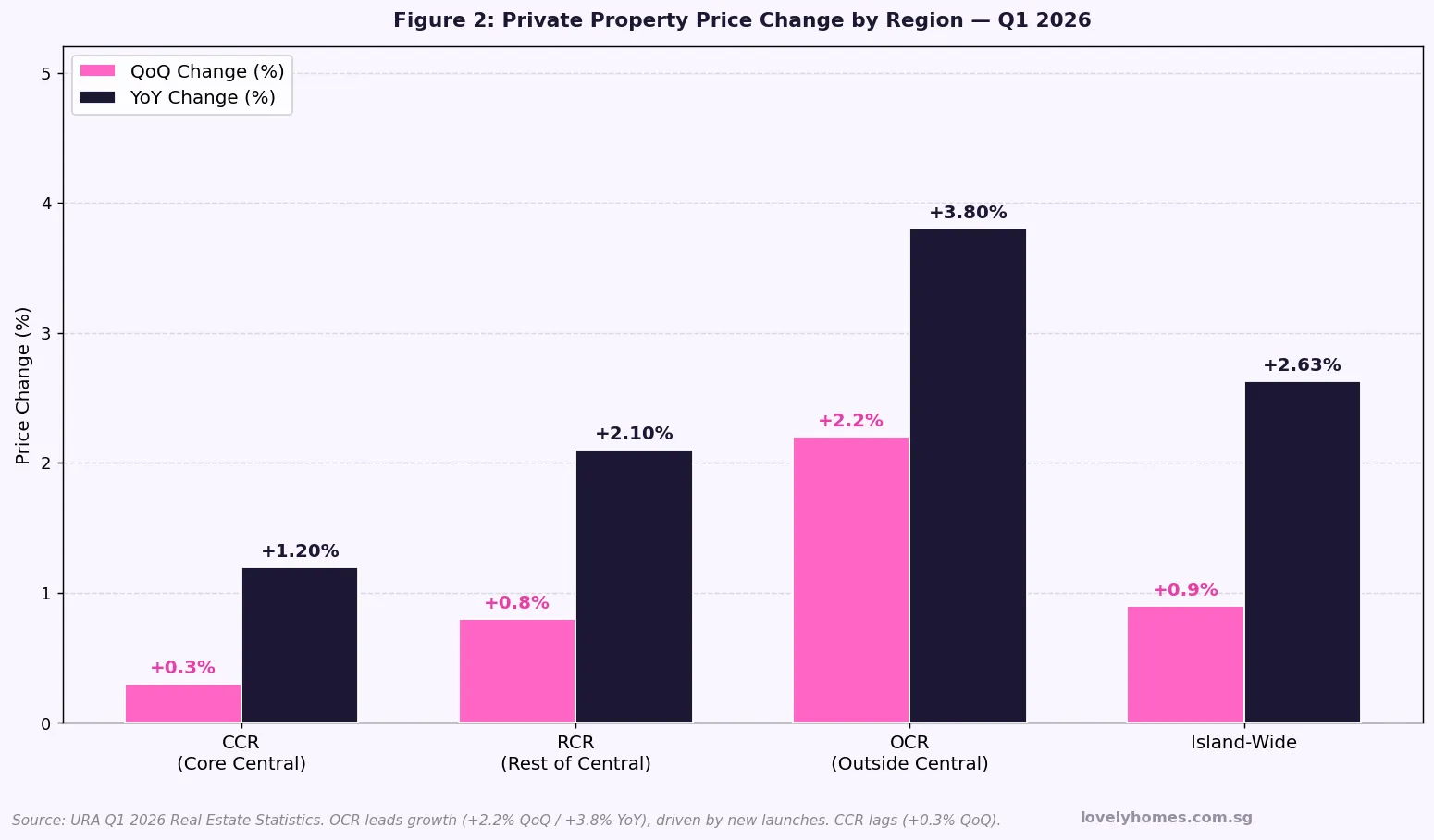
The growth, however, is not uniform across regions. The Outside Central Region (OCR) — Singapore’s mass-market suburban segment — leads with a 2.2% QoQ gain and 3.8% year-on-year increase, driven primarily by newly launched projects in areas such as Tampines, Tengah, and Bukit Batok. The Rest of Central Region (RCR) came in second at +0.8% QoQ, while the Core Central Region (CCR) advanced only 0.3% QoQ — reflecting the combined drag of high absolute prices, the 60% Additional Buyer’s Stamp Duty (ABSD) on foreign purchasers, and a thinner pipeline of new launches in the prime districts.

Singapore private property price index PPI versus HDB resale price index RPI Q1 2020 to Q1 2026 chart
Figure 1: URA Private Property Price Index (PPI) vs HDB Resale Price Index (RPI), Q1 2020 – Q1 2026. PPI +0.9% QoQ to 208.8; RPI −0.1% QoQ to 203.4. Source: URA / HDB.

HDB Resale Market: First Price Dip in Seven Years

The HDB Resale Price Index (RPI) fell 0.1% in Q1 2026 to 203.4, the first quarterly decline since Q2 2019. While modest in numerical terms, the reversal ends a run of 26 consecutive quarters of price growth in the public resale market. On a year-on-year basis, the index remains 1.2% higher than Q1 2025, indicating that the longer-term trajectory of HDB prices is intact — this is a pause rather than a correction.

Transaction volumes, by contrast, accelerated sharply. HDB registered 6,179 resale transactions in Q1 2026, a 17.6% increase over Q4 2025’s 5,256 cases. This combination of higher volume alongside a slightly lower index is consistent with composition effects: more buyers are transacting in less mature estates or in smaller flat types, which pulls the index down even as demand itself remains solid.

Most strikingly, Q1 2026 saw a record 412 HDB resale flats change hands at S$1 million or above — surpassing the previous record. Executive flats and 5-room units in mature estates such as Queenstown, Bishan, and Toa Payoh account for the majority of these million-dollar transactions. The persistence of such transactions at elevated price points signals that a subset of buyers remains willing to pay premium prices for location, remaining lease, and flat condition.

Singapore private property price change by region CCR RCR OCR Q1 2026 grouped bar chart
Figure 2: Private Property Price Change by Region, Q1 2026. OCR leads at +2.2% QoQ, CCR lags at +0.3% QoQ. Source: URA Q1 2026 Real Estate Statistics.

New Launch and Developer Sales: Volatile Monthly Figures, Steady Fundamentals

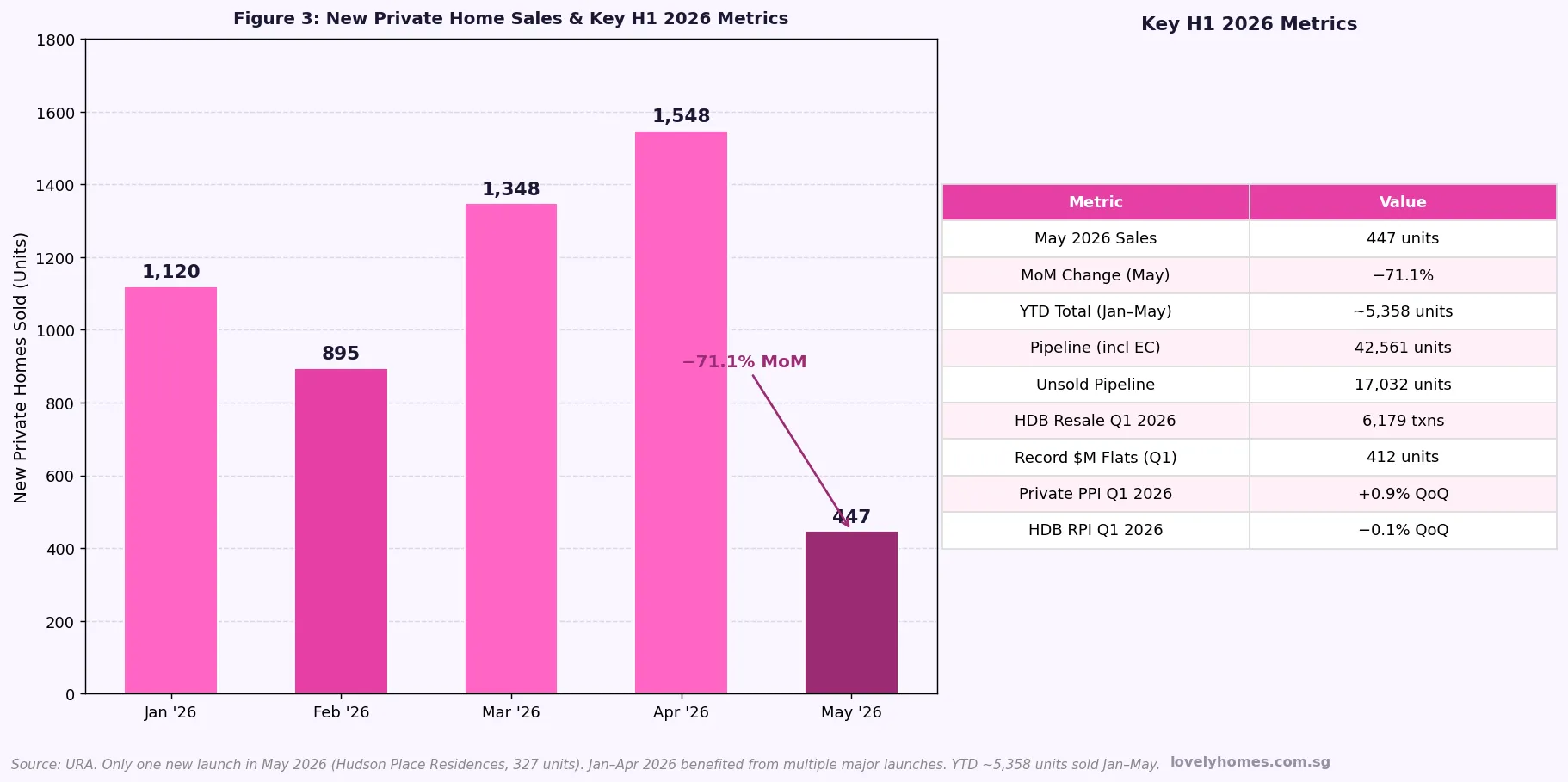
Developer sales in Singapore fluctuate dramatically month to month, largely as a function of which projects happen to launch in any given period. May 2026 illustrated this vividly: only 447 new private homes were sold — a 71.1% month-on-month collapse from April 2026’s 1,548 units. This decline was not a market failure; it simply reflected the absence of major new launches, with only Hudson Place Residences (327 units in Balestier, 201 sold at an average S$2,458 psf) entering the market that month.

Year-to-date through May 2026, approximately 5,358 new private homes had been transacted — a healthy pace relative to 2025, which was itself a recovery year. The River Valley Green Parcel C Government Land Sales (GLS) tender, which closed on 18 June 2026, attracted four bids with the top offer of S$750.6 million (S$1,730 psf per plot ratio) from a Sunway-MCL-CSC Land joint venture. That result — a 22% premium over the adjacent Parcel B tender two years earlier — signals that developers remain confident in the absorption of prime CCR product, notwithstanding the 60% ABSD on foreign buyers.

Singapore new private home developer sales Jan to May 2026 bar chart and key H1 2026 metrics table
Figure 3: New Private Home Sales (Jan–May 2026) and Key H1 2026 Market Metrics. May 2026 dip reflects thin launch pipeline. Source: URA.

Rental Market: Supply Headwinds Keep Rents Soft

Singapore’s private residential rental index declined 1.2% in Q1 2026, continuing the softening trend that began after the 2023 peak. Vacancy rates edged up from 6.0% in Q4 2025 to 6.2% in Q1 2026, reflecting the cumulative effect of completions from the elevated 2023–2025 GLS award cycle reaching the market simultaneously. Median condominium rents in Q1 2026 were approximately S$3,600 per month for a 2-bedroom unit in the OCR and S$5,200 per month for a 3-bedroom unit.

The OCR rental sub-market was an exception to the softening, posting a +1.0% QoQ gain, supported by demand from foreign professionals holding Employment Passes and from local upgraders seeking interim accommodation while awaiting new home completions. The CCR, where per-square-foot rents at S$6.20 are highest, saw the sharpest decline (−0.5% QoQ) as tenant options widened. HDB rental remained more resilient, supported by tighter eligibility controls and a smaller rental pool relative to demand.

Landlords pricing competitively — particularly in the RCR, where PSF rents fell 1.2% QoQ to S$5.40 — are finding that well-maintained, well-located units continue to attract tenants quickly. Those with outdated furnishings or aggressive asking rents are facing extended vacancy periods of 30 to 60 days in some cases.

Supply Pipeline and the 2H2026 GLS Programme

As at Q1 2026, 42,561 units (including executive condominiums) held planning approval, with 17,032 remaining unsold. This supply overhang provides a structural moderating force on private residential prices — a concern acknowledged by analysts who forecast full-year 2026 private price growth in the 2% to 4% range, with consensus estimates clustering around 3%.

The Government announced the 2H2026 GLS Confirmed List on 3 June 2026, comprising nine sites with a combined yield of approximately 4,745 units. Key sites include: the Jurong Lake District (JLD) white site (mixed use, yielding approximately 1,760 residential units), Orchard Boulevard (approximately 485 units in the CCR), Lentor Gardens Parcels A and B, Bayshore Road (mixed use), and the Jurong East executive condominium site. These awards, once tendered and developed over the 2027–2030 horizon, will continue the government’s policy of maintaining adequate supply to prevent speculative price surges.

On the HDB side, the June 2026 BTO exercise launched 6,952 flats across seven projects in Ang Mo Kio, Bishan, Bukit Merah, Sembawang, and Woodlands. Notably, the Bishan Lakeview and Bishan Shunfu projects mark the first new HDB flats in the Bishan estate in over four decades — a significant milestone that generated substantial first-timer interest. With approximately 50% of the June 2026 BTO units classified as Plus or Prime (carrying enhanced restrictions including a 10-year Minimum Occupation Period and tighter rental and resale conditions), the absorption of first-timer demand from the resale market may ease more gradually than prior exercises.

Key H1 2026 Metrics at a Glance

Metric Value / Change Source / Notes
URA Private Property PPI (Q1 2026) 208.8 (+0.9% QoQ, +2.63% YoY) URA Q1 2026 Real Estate Statistics
HDB Resale Price Index (Q1 2026) 203.4 (−0.1% QoQ, +1.2% YoY) HDB Q1 2026 — first decline since Q2 2019
OCR Price Change (Q1 2026) +2.2% QoQ / +3.8% YoY URA — leads all regions
CCR Price Change (Q1 2026) +0.3% QoQ / +1.2% YoY URA — moderated by ABSD impact on foreign buyers
New Private Homes Sold (May 2026) 447 units (−71.1% MoM) URA — thin launch month; one project launched
YTD Developer Sales (Jan–May 2026) ~5,358 units URA — healthy pace vs 2025
HDB Resale Transactions (Q1 2026) 6,179 (+17.6% QoQ) HDB — strong demand rebound
Million-Dollar HDB Flats (Q1 2026) 412 (new quarterly record) HDB — 5-room / exec flats in mature estates
Private Pipeline (incl ECs) 42,561 units; 17,032 unsold URA Q1 2026
Private Rental Index (Q1 2026) −1.2% QoQ; vacancy 6.2% URA — supply pressure from recent completions
River Valley Green Parcel C GLS S$1,730 psf ppr (top bid) URA tender closed 18 June 2026
2H2026 Confirmed GLS Supply 9 sites / ~4,745 units URA / MND — announced 3 June 2026

Worked Example: The Lim Family — Deciding Whether to Buy in H2 2026

Mr and Mrs Lim are a Singapore Citizen couple with a combined gross monthly income of S$14,000. Their HDB flat in Tampines (5-room, purchased 2019) completed its 5-year Minimum Occupation Period (MOP) in 2024. They wish to upgrade to a condominium in the OCR — specifically, they are considering a 3-bedroom unit at an upcoming Tampines new launch priced at S$1.65 million.

As first-time private property purchasers (they currently own only the HDB flat), the ABSD position is as follows: under the SC Couple ABSD Remission Scheme, they may purchase the condo and pay 20% ABSD (S$330,000 in cash), then sell their HDB within 6 months of the condominium’s completion to qualify for a full ABSD refund. Alternatively, if they sell their HDB first, they become first-time private buyers and pay zero ABSD — but they would need interim rental accommodation, adding approximately S$3,200 to S$3,600 per month in rent costs. The BSD on S$1.65 million is S$47,600 (payable from CPF).

On the mortgage, with S$14,000 gross income and no other credit obligations, the maximum TDSR-55% exposure is S$7,700 per month. A 75% LTV loan of S$1,237,500 at 3.2% over 30 years costs approximately S$5,338 per month — representing a TDSR of 38.1%, comfortably within the limit. Their HDB CPF Ordinary Account balance of S$280,000 can fully cover the BSD and contribute toward the cash down payment. With H1 2026 data showing OCR prices rising fastest (+2.2% QoQ), waiting beyond 2026 carries the risk of further price appreciation — the Lim family’s analysis suggests buying now, with the ABSD remission strategy, offers the most cost-effective path.

Why H1 2026 Data Matters for Buyers, Sellers and Investors

The divergence between private and HDB price trends in Q1 2026 has meaningful implications across buyer segments. For HDB upgraders, the slight moderation in HDB resale prices — combined with continued OCR private price growth — may marginally compress the equity gain from a resale flat sale. However, the record pace of million-dollar HDB transactions indicates that well-located mature-estate flats continue to attract premium valuations, providing upgraders with strong exit equity.

For investors, the rental market data warrants careful attention. A 1.2% QoQ decline in private rental coupled with rising vacancy rates suggests that the yield compression of 2024–2025 is continuing into 2026. Gross yields in the CCR have compressed to approximately 2.6% — below the prevailing bank fixed deposit rate — prompting a reassessment of the investment case for prime rental properties. OCR yields remain more attractive at approximately 4.0% to 4.5%, supported by domestic upgrader demand for rentals.

For sellers, the RPI dip is a reminder that the HDB resale market is not a one-way escalator. The combination of a large June 2026 BTO exercise absorbing first-timer demand, a growing pool of alternative supply from Plus and Prime flats reaching resale eligibility in future years, and affordability constraints on younger buyers, suggests that HDB resale price growth in H2 2026 will remain modest.

What Might Come Next in H2 2026

Several events and data releases will shape Singapore’s property market in the second half of 2026. The URA Q2 2026 flash estimates — expected in the first week of July 2026 — will provide the first indication of whether the private market maintained its growth trajectory or softened in the April-to-June period. Analysts will be particularly focused on whether the OCR can sustain its outsized QoQ gains given that multiple new launches — including projects in Tengah and Bukit Timah — were scheduled for the quarter.

On the supply side, the Lorong Puntong GLS tender (0.43 ha, approximately 140 units, near Bright Hill MRT) was scheduled for launch in late June 2026, with results expected in Q3 2026. The Sembawang Drive executive condominium GLS site — the first EC in the north of Singapore to be tendered under the new 10-year MOP rules — will also attract close attention for its pricing implications on the EC market. Should these tenders attract aggressive bids — as River Valley Green Parcel C did — it would signal continued developer confidence despite rising completion volumes.

ABSD policy is, for the time being, unchanged. The current rates — 20% for Singapore Citizens purchasing a second property, 60% for foreigners — remain in place as structural cooling measures. Any adjustment would likely require a material deterioration in market fundamentals or a significant policy signal from the Ministry of National Development. For H2 2026, the base case among analysts is steady rates, steady growth of roughly 2% to 3%, and continued healthy transaction volumes in both HDB resale and new launches.

Frequently Asked Questions

What does the PPI +0.9% in Q1 2026 mean for buyers?

The 0.9% quarterly gain in the URA Private Property Price Index (PPI) reflects the weighted average price movement across all private residential transactions in Q1 2026. For a buyer purchasing a S$1.5 million condominium, a 0.9% QoQ increase would translate to approximately S$13,500 of price appreciation in a single quarter — though individual property price movements vary significantly by location, project age, and unit attributes. The PPI is most useful as a market-wide temperature gauge rather than a predictor of any specific property’s trajectory. Buyers should note that OCR prices (+2.2% QoQ) rose substantially faster than the island-wide average, suggesting stronger near-term price momentum in suburban new launches.

Why did HDB resale prices dip in Q1 2026 despite record million-dollar transactions?

These two data points are not contradictory. The HDB Resale Price Index (RPI) uses a regression model that controls for flat type, floor area, remaining lease, and town — it measures the like-for-like price movement, stripping out changes in the composition of what transacted. In Q1 2026, a higher share of transactions occurred in non-mature estates and in smaller flat types, which mathematically pulled the index down even as premium flats in mature estates continued to transact at record prices. The 412 million-dollar transactions reflect demand for a specific niche of the HDB market — larger, well-located flats with long remaining leases — rather than the broad-based market captured by the RPI.

Should I wait for Q2 2026 data before making a buying decision?

Timing the market based on quarterly index releases is rarely a reliable strategy. By the time URA publishes Q2 2026 flash estimates (expected first week of July 2026), property prices will reflect conditions from April to June — data that is already two to three months old. More importantly, the index captures market-wide trends, not the specific property you intend to purchase. If a target property fits your financial capacity (TDSR and MSR within limits), your housing needs, and your long-term plans, waiting for one additional data point is unlikely to materially improve the outcome. The more useful discipline is ensuring your ABSD position is optimised and your mortgage is competitively priced before signing the Option to Purchase.

Is the private rental market going to keep falling in H2 2026?

The primary driver of private rental softening — elevated completions from the 2023–2025 construction cycle — will continue to exert downward pressure through at least mid-2027, as the bulk of the pipeline reaches the market. However, rental declines are unlikely to be severe because demand from foreign professionals (Employment Pass and S Pass holders) and domestic upgraders awaiting new home completion provides a floor. The OCR rental market, which already posted a positive 1.0% QoQ gain in Q1 2026, is likely to prove the most resilient. Landlords in the CCR should price realistically and invest in renovation quality to stand out in a market where tenants have expanding choices.

What is the significance of the River Valley Green Parcel C S$1,730 psf ppr bid?

The S$1,730 psf per plot ratio (psf ppr) top bid on River Valley Green Parcel C — submitted by a Sunway MCL and CSC Land joint venture — represents the highest CCR GLS land rate in Singapore’s history for that precinct. The psf ppr metric reflects the price paid per square foot of the site’s plot ratio (i.e., the total allowable gross floor area). When developers pay S$1,730 psf ppr, they typically need to sell the resulting apartments at approximately S$2,800 to S$3,200 psf to achieve acceptable returns after construction costs, professional fees, financing costs, and developer profit. This benchmarks what buyers can expect the eventual River Valley Green project — likely marketed in 2027 or 2028 — to be priced at upon launch.

How does the 2H2026 GLS programme affect buyers of new launches?

The nine confirmed list sites in the 2H2026 GLS programme — comprising approximately 4,745 units including the Jurong Lake District white site and Orchard Boulevard — will take two to four years to develop and launch. GLS awards made in 2H2026 will therefore result in new projects entering the market approximately in 2028 to 2030. For buyers considering new launches in 2026 or 2027, the GLS pipeline primarily affects expectations about the medium-term supply environment rather than the immediate availability of units. It also provides comfort that the government is managing supply actively — a signal that extreme price surges, as seen in 2021 to 2023, are unlikely to recur in this cycle.

Can Singapore Citizens pay ABSD in CPF?

No. ABSD — including the 20% levied on Singapore Citizens purchasing a second property — must be paid entirely in cash. Only Buyer’s Stamp Duty (BSD) may be paid from the CPF Ordinary Account (for properties purchased for occupation, not purely for investment). For a second property purchase at S$1.65 million, the ABSD of S$330,000 must be funded from cash savings. If the buyer is a Singapore Citizen couple who currently own one HDB flat and are purchasing a private property with intent to sell the HDB within 6 months of the new property’s completion, they may qualify for a full ABSD remission under the SC Couple Remission Scheme — in which case the S$330,000 is paid upfront and later refunded by the Inland Revenue Authority of Singapore (IRAS).

Related Articles

Disclaimer

This article is for general informational purposes only and does not constitute financial, legal, or property investment advice. All property price data is sourced from official releases by the Urban Redevelopment Authority (URA) and the Housing & Development Board (HDB). ABSD rates, BSD rates, CPF rules, LTV limits, and TDSR thresholds are correct as at June 2026 and are subject to change without notice. Readers should verify current rates at ura.gov.sg, hdb.gov.sg, iras.gov.sg, and mas.gov.sg before making any property transaction. All worked examples use illustrative figures; individual circumstances vary. Consult a licensed mortgage broker, conveyancing solicitor, and CEA-registered property agent for advice specific to your situation.


Click anywhere or press Esc to close

Singapore 2H2026 GLS Programme Guide: 9 Sites, 4,745 New Homes and What the Pipeline Means

Singapore 2H2026 GLS Programme Guide: 9 Sites, 4,745 New Homes and What the Pipeline Means

Quick Answer: Singapore’s 2H2026 Government Land Sales (GLS) Confirmed List, announced by URA on 3 June 2026, offers nine sites that can yield 4,745 private homes — including 735 Executive Condo units and 1,200 homes in the landmark Jurong Lake District white site. Full-year Confirmed List supply reaches 9,320 units: 50 per cent above the ten-year annual average. Nine sites span five regions; competition remains robust with an average of 4.6 bidders per GLS tender in 2026.

  • Total supply: 4,745 units — 4,010 private + 735 executive condo (EC).
  • Sites: Nine Confirmed List sites (eight private residential + one white site), plus a separate Reserve List of thirteen sites.
  • Announced: 3 June 2026 by the Ministry of National Development (MND).
  • Full-year supply: 9,320 Confirmed List units in 2026 — 50% above the 10-year annual average of approximately 6,200 units.
  • Standout plot: Townhall Link white site in Jurong Lake District — 3.72 ha, 1,200 homes + 83,350 sqm commercial GFA; tender opens July 2026.
  • First EC in Jurong East in ~30 years: Jurong East Avenue 1 (735 units) under new 10-year MOP rules.
  • Orchard Boulevard: Boutique CCR site (110 units); expected top bid up to S$1,700 psf ppr, up to 8 bidders.
  • Market temperature: Average 4.6 bidders per GLS tender in 2026 vs 2.4 in 2024 — developer confidence remains firm.

What Is the Government Land Sales Programme?

The Government Land Sales programme is the primary mechanism through which the Singapore government releases state land for private residential and mixed-use development. Administered jointly by URA (for private residential sites) and HDB (for EC sites), the GLS programme is announced twice a year — once for the first half (1H) and once for the second half (2H) of the calendar year. Sites are categorised into two lists: the Confirmed List, which is released unconditionally for tender regardless of market conditions, and the Reserve List, which is released only when a developer submits a minimum bid above URA’s reserve price and triggers an application.

The GLS programme is the government’s single most powerful tool for managing private housing supply. Historically, the annual volume of Confirmed List sites has been calibrated against unsold developer inventory, price trends, and macroeconomic conditions. A high Confirmed List release — as in 2026 — signals a government intent to pre-empt price overheating by ensuring adequate forward supply. Buyers, investors, and developers all watch the programme closely because the sites released today shape the supply of completions three to four years ahead.

The Nine 2H2026 Confirmed List Sites

Singapore 2H2026 GLS Confirmed List: all nine sites with regions, unit yields and key highlights
Figure 1: 2H2026 Confirmed List — nine sites with unit yields and key details. Source: URA press release, 3 June 2026. Click to enlarge.

The nine sites span four broad market segments. Two Core Central Region (CCR) sites — Orchard Boulevard and Holland Plain — introduce 610 units in the city’s most premium residential precinct, continuing the measured release of CCR supply that has characterised government policy since 2023. Four Rest of Central Region (RCR) sites — Marina Gardens Lane, Tanjong Rhu Close, Berlayar Close, and East Coast Road — concentrate development in emerging waterfront and city-fringe precincts with excellent transport connectivity. One Outside Central Region (OCR) site at De Souza Avenue adds mass-market supply in the Bukit Timah planning area. The white site at Townhall Link is the most transformative, anchoring the second phase of the Jurong Lake District’s development as Singapore’s second Central Business District. And the EC site at Jurong East Avenue 1 is the first such site offered in the Jurong East area in nearly three decades.

Unit Supply by Site and Region

2H2026 GLS Confirmed List unit yield by site: Orchard Blvd 110, Holland Plain 500, Marina Gardens 390, Tanjong Rhu 505, Berlayar Close 695, East Coast Road 85, De Souza Ave 415, JLD white site 1200, Jurong East EC 735
Figure 2: Unit yield per site, 2H2026 GLS Confirmed List. The JLD white site (1,200 homes) and Jurong East EC (735 units) account for 41% of total supply. Source: URA, 3 June 2026. Click to enlarge.

Orchard Boulevard (CCR, 110 units)

Situated at the corner of Orchard Boulevard and Tomlinson Road, this 0.34-hectare residential site is described by market observers as “probably one of the last few land plots along Orchard Boulevard”. At a projected top bid of up to S$1,700 per square foot per plot ratio (psf ppr), the site offers a manageable unit yield that limits absolute development risk and is expected to draw up to eight bidders. For context, the most recently awarded CCR site in the vicinity — which became Upperhouse at Orchard Boulevard — was sold in February 2024 at S$1,616 psf ppr and has moved about 80 per cent of units to date, providing developers confidence in the precinct’s demand fundamentals. The boutique scale of the site (likely to yield a 20-storey tower of approximately 110 units) appeals to buyers seeking exclusivity and the proximity to the Thomson-East Coast Line’s Orchard station.

Holland Plain (CCR, ~500 units)

This site is the second CCR site in the 2H2026 Confirmed List and is adjacent to two recently-awarded sites — one at Holland Link awarded to Sim Lian Group at S$1,432 psf ppr in 2025, and a neighbouring Holland Plain site awarded at S$1,391 psf ppr one month prior to the 2H2026 programme announcement. The clustering of three adjacent sites serves a dual purpose: building critical mass in a precinct that is still largely characterised by landed housing and ageing condominiums, while potentially moderating bidding behaviour by reducing the scarcity premium that developers might otherwise price in for isolated plots.

Marina Gardens Lane (RCR, ~390 units)

This is the third site to be offered in the Marina South precinct — Singapore’s emerging waterfront residential neighbourhood on reclaimed land adjacent to Marina Bay. Measuring 0.6 hectares with a residential-with-commercial-at-first-storey zoning, it can yield approximately 390 homes and 150 square metres of commercial space. The site is within walking distance of the upcoming Marina South MRT station on the Thomson-East Coast Line. It is adjacent to One Marina Gardens (937 units), which a Kingsford-led consortium developed and which has sold approximately 68 per cent of units since its April 2025 launch at around S$2,280 psf. The smaller scale of this site is expected to attract mid-sized developers who might otherwise be deterred by the very large plot sizes typical of Marina South.

Tanjong Rhu Close (RCR, ~505 units)

Industry observers consistently rank this as one of the most attractive plots in the 2H2026 programme. Measuring 1.23 hectares, the site is immediately adjacent to a site on Tanjong Rhu Road that was awarded in February 2026 to a City Developments–Woh Hup joint venture at S$1,455 psf ppr — a record land rate for a pure residential site in the Rest of Central Region. The site benefits from its position in a well-regarded enclave close to Marina Bay and the Kallang sports precinct, with the Katong Park and Tanjong Rhu MRT stations approximately ten minutes on foot. Future units are likely to command sea views, adding a premium that historically commands 5–10 per cent above comparable units without such aspects.

Berlayar Close (RCR, ~695 units)

Spanning 2.82 hectares, the Berlayar Close site is the largest of the RCR plots and represents the third site in the Greater Southern Waterfront — a 30-kilometre stretch from Marina East to Pasir Panjang that the government has earmarked for a new waterfront city over the coming decades. The first Greater Southern Waterfront site, at Telok Blangah, was awarded in November 2025 to Kingsford Group at S$1,326 psf ppr and can yield about 745 units. A second Berlayar Drive site (about 415 units) is currently open for tender, closing in August 2026. The Telok Blangah MRT station on the Circle Line is approximately ten minutes on foot.

East Coast Road (RCR, ~85 units)

At 0.55 hectares, this is the smallest of the eight private residential sites, yielding approximately 85 units — a boutique development in the Siglap area, one of Singapore’s last remaining low-density residential enclaves characterised by landed housing and pre-war bungalows. The site carries a minimum unit size requirement of 100 square metres, limiting the ability to create smaller high-yield units and naturally targeting buyers who prioritise space. The site’s distance from the nearest MRT is expected to temper competition, making it more attractive to niche developers focused on landed-style condominium product than to volume builders.

De Souza Avenue (OCR, ~415 units)

Located in the Bukit Timah planning area, this 2.22-hectare site is adjacent to the site of The Sen (347 units), which developer Sustained Land purchased in July 2024 at S$841 psf ppr. The Sen launched in November 2025 and moved about 23 per cent of units on its launch weekend. Interest in De Souza Avenue is expected to be moderate — the site is some distance from an MRT station and lacks a strong HDB upgrader catchment nearby. However, the Bukit Timah address and proximity to good schools, including Pei Hwa Presbyterian, Bukit Timah Primary, and Methodist Girls’ School, give it a defined appeal to families in the primary-school balloting window.

The JLD White Site: Singapore’s Next CBD Pillar

The Townhall Link white site is the most consequential release in the 2H2026 GLS programme. At 3.72 hectares, it is the largest Confirmed List plot and the only mixed-use white site. It can yield up to 1,200 housing units alongside a minimum of 40,000 square metres of office space and 44,000 square metres of additional uses — retail, serviced apartments, hotel, and community facilities — for a total commercial gross floor area of approximately 83,350 square metres.

The site was carved from the former 6.5-hectare master developer plot at Jurong Lake District, which attracted a sole bid of S$640 psf ppr in 2024 that URA rejected as too low. The decision to sub-divide the master plot into smaller parcels reflects a pragmatic acknowledgement that the scale of the original site was deterring competitive bidding and delaying the JLD’s transformation. The Townhall Link site is connected to or in close proximity to four MRT lines: the North-South, East-West, Jurong Region, and the under-construction Cross Island line. It is intended to “spearhead the transformation of JLD into Singapore’s secondary CBD”, in URA’s own words. Its tender opens in July 2026.

The Jurong East EC Site: A 30-Year Gap Closes

The EC site at Jurong East Avenue 1 is the first executive condominium to be offered in Jurong East since Westmere in 1996 — a gap of approximately 30 years. The site can yield 735 units across an area of approximately 2 hectares, making it a large EC development by any measure. It will be the first EC launched under the new ten-year MOP and 15-year privatisation rules announced on 8 May 2026, making its bid result and eventual launch price a critical data point for how the rule changes affect developer land valuations and end-unit pricing.

Demand for EC in the western region — specifically in Jurong East — has historically been strong, driven by a large pool of young Singaporean families working in the Jurong Industrial Estate, the International Business Park, and the growing Jurong Lake District commercial cluster. The site brings full-year EC supply on the Confirmed List to 1,370 units (635 from 1H2026 + 735 from 2H2026), substantially below the 1,970 EC units supplied in 2025. This measured reduction likely reflects the government’s intent to assess how market participants respond to the new MOP framework before recommitting to higher EC volumes.

Historical Context: 2026 Supply at a 10-Year High

Singapore GLS Confirmed List annual supply 2016-2026: 9,320 units in 2026 is 50% above the 10-year average of around 6,200 units
Figure 3: GLS Confirmed List annual supply 2016–2026F. The 2026 combined total of 9,320 units is 50% above the 10-year annual average. Source: URA / MND. Click to enlarge.

Combining the 1H2026 Confirmed List (4,575 units) with the 2H2026 Confirmed List (4,745 units) yields a full-year total of 9,320 Confirmed List units for 2026. This is 50 per cent above the ten-year annual average of approximately 6,200 units and represents the highest Confirmed List supply since at least 2013. The elevated supply programme is a deliberate policy response to private property price growth that has outpaced income growth in Singapore — the private residential property price index (PPI) reached 208.8 in Q1 2026 (URA data), up from 131.5 at the start of 2020, a 59 per cent increase over six years.

The high supply programme has been accompanied by sustained developer appetite. The average number of bidders per GLS tender (excluding ECs) has risen from 2.4 in 2024 to 4.6 in 2026 year-to-date — close to the 5.6 recorded in 2025, a historically active year. Recent launches such as Pinery Residences, River Modern, and Tengah Garden Residences have moved over 90 per cent of units on their respective launch weekends, confirming that end-user demand remains robust despite the elevated ABSD rates introduced in April 2023.

2H2026 GLS Programme: Summary Table

Site Region Est. Units Area Notable Feature
Orchard Boulevard CCR 110 0.34 ha Boutique; among last Orchard Blvd plots; up to 8 bidders
Holland Plain CCR ~500 ~2 ha Third adjacent site; precinct-building strategy
Marina Gardens Lane RCR ~390 0.60 ha Third Marina South plot; near future Marina South MRT
Tanjong Rhu Close RCR ~505 1.23 ha Adjacent to Feb 2026 RCR record; sea views; highly sought-after
Berlayar Close RCR ~695 2.82 ha Greater Southern Waterfront; third GSW site
East Coast Road RCR ~85 0.55 ha Boutique Siglap landed enclave; 100 sqm min unit size
De Souza Avenue OCR ~415 2.22 ha Bukit Timah school belt; some distance from MRT
Townhall Link (White Site) JLD ~1,200 homes
+83,350 sqm GFA
3.72 ha Largest site; mega mixed-use; anchors JLD as Singapore’s 2nd CBD
Jurong East Ave 1 (EC) Western 735 EC ~2 ha First EC in Jurong East since 1996; new 10-yr MOP rules apply
TOTAL 9 sites 4,745 units 4,010 private + 735 EC | Full-year Confirmed List: 9,320 units

Worked Example: What the GLS Programme Means for a Buyer Targeting a Launch in 2027–2028

Mr and Mrs Tan are Singapore Citizens planning to upgrade from their HDB flat in Jurong West to a private condominium. Their combined income is S$15,000 per month. They are watching two sites from the 2H2026 GLS programme: the Jurong East Avenue 1 EC (for its income-ceiling alignment and proximity) and the De Souza Avenue site (for its school catchment and OCR pricing).

Option A — Jurong East EC: Land tender expected mid-2H2026; launch likely 2027. At the 2H2026 land release price, comparable EC units in western Singapore have been pricing at S$1,000–S$1,150 psf. A three-bedroom 95 sqm unit might launch at approximately S$1.1M. BSD: S$24,600. ABSD: 0% (first-time SC couple, EC is first property). If the Tans sell their HDB first, down payment at 25% = S$275,000 (5% cash S$55,000 + 20% CPF S$220,000). Bank loan: S$825,000 at 3.1% 30yr = S$3,527/month. TDSR: 23.5% (PASS). However, the ten-year MOP means this unit cannot be sold until approximately 2037–2038 — a significant illiquidity constraint for a couple in their thirties.

Option B — De Souza Avenue private condo: Land tender expected 3Q2026; launch likely 2027–2028. Comparable OCR condominiums near Bukit Timah are launching at S$1,900–S$2,200 psf. A three-bedroom 90 sqm unit might launch at S$1.75M. BSD: S$54,600. ABSD: S$350,000 (20%, SC second property — payable upfront if HDB not yet sold; eligible for remission upon HDB sale within six months). Bank loan: S$1,312,500 at 3.1% 30yr = S$5,619/month. TDSR: 37.5% (PASS under 55%). The private condo has no MOP (Sellers’ Stamp Duty applies for three years post-purchase: 12%/8%/4%), giving far greater flexibility.

Conclusion: The EC route offers substantially lower upfront cost and zero ABSD for a first-time buyer, but the ten-year MOP creates a fifteen-year horizon to liquid resale that requires careful long-term planning. The private condo route demands significantly more cash and ABSD outlay but provides full flexibility and an open buyer pool upon privatisation from day one. For the Tans, if they are highly confident about remaining in the western region for at least fifteen years and do not anticipate significant financial changes, the EC represents better value for money. If their circumstances are likely to change — relocation, family expansion, employment shifts — the private condo’s liquidity premium is well worth paying.

Why the 2H2026 Programme Matters for Singapore’s Property Market

Singapore’s approach to GLS supply management has historically been counter-cyclical: the government releases more land when prices are rising and less when they are correcting. The 2026 Confirmed List total of 9,320 units — the highest in at least a decade — is a clear signal that the government views the prevailing price trajectory as requiring active supply-side management. Private residential prices rose 2.63 per cent year-on-year in Q1 2026 (URA PPI), and the broader context of elevated ABSD rates since April 2023 has not fully dampened demand from genuine owner-occupiers and local investors.

The concentration of RCR sites (Marina Gardens Lane, Tanjong Rhu Close, Berlayar Close, East Coast Road) reflects a deliberate policy to develop Singapore’s waterfront precincts — Marina South, Tanjong Rhu, and the Greater Southern Waterfront — as premium residential addresses that can absorb demand from residents upgrading from ageing RCR stock. The JLD white site, by contrast, is an economic-development play as much as a housing play: the combined residential and commercial component at Townhall Link is intended to accelerate the transformation of Jurong into a self-sufficient live-work-play district.

Peer cities have drawn different supply-side lessons. Hong Kong’s chronic supply shortage and sky-high prices are a cautionary tale for what happens when GLS supply lags consistently behind demand for decades. Sydney’s experience with developer-driven oversupply in the mid-2010s showed that excessive releases can cause sharp short-term corrections. Singapore’s managed approach — calibrated half-yearly, responsive to data — has broadly achieved its goal of a stable market, though at the cost of perpetually high price levels relative to household income.

What Might Come Next

With the 2H2026 Confirmed List sites feeding into the launch pipeline for 2027 and 2028, buyers watching the GLS programme should expect a well-supplied private residential market for the next two to three years. The key swing factor will be the outcome of the JLD Townhall Link tender: if multiple developers bid competitively, it signals robust institutional confidence in the Singapore market; if the tender attracts few bidders or a below-reserve outcome, it may prompt URA to revise the Reserve List strategy. URA Q2 2026 Flash Estimates — expected in the first week of July 2026 — will be the next major data point for whether the elevated supply programme is having the intended moderating effect on prices.

The 1H2027 GLS programme, likely to be announced in December 2026, will also be closely watched. If unsold developer inventory remains elevated (42,561 units in the pipeline as at Q1 2026, of which 17,032 remain unsold), the government may maintain or marginally reduce Confirmed List supply. If take-up continues at the robust pace seen in H1 2026, the supply programme may be sustained or expanded.

Frequently Asked Questions

What is the difference between the Confirmed List and the Reserve List?

The Confirmed List is released for tender by URA regardless of market conditions — developers can submit bids at any time once the site is listed. The Reserve List is held back: a developer must submit a minimum-price application to trigger an official tender for a Reserve List site. The government uses this structure to maintain supply certainty (Confirmed List) while keeping optionality for responsive releases (Reserve List). In practice, a strong Reserve List application signals developer appetite and is often seen as a leading indicator of market activity.

How long does it take from a GLS award to a new launch?

Typically, a developer needs six to twelve months after land award to complete design planning, obtain approvals, and prepare sales materials before launching the project. Construction then takes three to four years from launch before TOP is achieved. So a 2H2026 GLS site awarded in late 2026 or early 2027 would likely launch in mid-2027 to mid-2028 and reach TOP around 2030–2032. Buyers planning to purchase on the primary market should factor in this timeline when deciding whether to buy a new launch or a completed resale unit.

What does “psf ppr” mean and why does it matter?

PSF ppr stands for “price per square foot per plot ratio” — the standard land-value metric used in Singapore GLS tenders. It is calculated as (bid price ÷ land area in sqft ÷ plot ratio). Plot ratio is the zoning parameter that determines how much total floor area a developer may build on a given site. A higher psf ppr means the developer paid more for each unit of developable floor area, which generally flows through to higher end-unit launch prices. Comparing psf ppr across adjacent sites is the most reliable way to track land cost trends across a precinct over time.

Can foreigners buy units launched from 2H2026 GLS sites?

Yes — private residential units launched from all 2H2026 GLS sites (excluding the EC) are open for purchase by foreigners. However, the Additional Buyer’s Stamp Duty for foreigners purchasing any residential property in Singapore is 60 per cent of the purchase price (as at June 2026), making foreign purchases of new private condominiums extremely expensive. The EC at Jurong East Avenue 1 is subject to the standard EC rules: foreigners may not purchase new ECs at all, and can only enter the EC market after full privatisation (15 years from TOP under the new rules).

Does a high GLS supply programme necessarily mean lower prices?

Not necessarily, at least not in the short term. GLS supply translates into completions three to four years after the land award date, meaning the pipeline from 2H2026 will add meaningful inventory only around 2030–2032. In the interim, the supply of completed private homes available for immediate purchase is relatively thin, which can sustain price levels even when forward supply is high. The government’s primary intent is to prevent a structural undersupply from driving prices to extreme levels — as has occurred in Hong Kong — rather than to engineer a price correction. Whether 2026’s elevated supply pipeline produces meaningful price moderation will depend heavily on interest-rate trends, immigration policy, and overall economic growth through 2030.

When can I buy a unit in the 2H2026 GLS sites?

Units in 2H2026 GLS sites will only be available for sale once developers have been awarded the land and prepared their sales launches. Based on the typical timeline, most 2H2026 sites will tender in Q3–Q4 2026, with awards following in early 2027. Launches are likely between mid-2027 and end-2028, depending on developer readiness. The JLD Townhall Link white site tender opens in July 2026 and is likely to be awarded later in 2026; given its complexity, the launch of its residential component may be 2028 or later. Keep an eye on URA’s new sale launches page and the official project showroom announcements for confirmed launch dates.

Related Articles

Disclaimer: This article is for general informational and educational purposes only. GLS programme details, site unit yields, and timeline estimates are based on the URA press release of 3 June 2026 and subsequent market commentary. Actual tender outcomes, launch prices, unit counts, and development timelines are subject to change depending on market conditions, regulatory requirements, and developer decisions. Readers should verify all information directly with the Urban Redevelopment Authority (ura.gov.sg), the Housing and Development Board (hdb.gov.sg), and the Ministry of National Development (mnd.gov.sg), and consult a licensed property agent or financial adviser before making any investment or purchase decision.

×

Singapore Executive Condo Guide 2026: Eligibility, New MOP Rules and EC vs BTO vs Condo

Singapore Executive Condo Guide 2026: Eligibility, New MOP Rules and EC vs BTO vs Condo

Quick Answer: Executive Condominiums (ECs) are a Singapore government-subsidised housing hybrid — built by private developers but sold under HDB rules. From 8 May 2026, new EC Government Land Sale sites carry a 10-year Minimum Occupation Period (up from five) and a 15-year full privatisation timeline. The income ceiling remains S$16,000 per month. The Deferred Payment Scheme has been removed and 90 per cent of units are now reserved for first-time buyers.

  • Who can buy: Singapore Citizens must be the core applicant; at least one SC is required. SPR-only households cannot buy new ECs.
  • Income ceiling: Combined gross household income must not exceed S$16,000 per month (unchanged from Budget 2025).
  • New MOP (from 8 May 2026): ECs launched from GLS sites with tender closing on or after 8 May 2026 carry a 10-year MOP from TOP — double the previous five years.
  • Privatisation extended: Full privatisation (all buyers including foreigners eligible) moves from 10 to 15 years from TOP for new-rule sites.
  • DPS removed: The Deferred Payment Scheme is no longer available. Buyers must use the Progressive Payment Scheme.
  • First-timer quota increased: 90 per cent of units at new EC launches are reserved for first-time buyers (up from 70 per cent).
  • Four 2026 ECs still under old rules: Lumina Grand, Novo Place, Aurelle of Tampines, and Parktown Residence were launched before 8 May 2026 and retain the five-year MOP / ten-year privatisation timeline.
  • HDB loan still available: Eligible buyers may use an HDB concessionary loan at 2.6 per cent per annum if all conditions are met.

What Is an Executive Condominium?

An Executive Condominium is a distinct housing type that sits between a HDB flat and a fully private condominium. The Housing Development Board (HDB) identifies the land; the Ministry of National Development releases it via the Government Land Sale (GLS) programme; and a private developer wins the tender, designs the project, and sells the units. Buyers get condominium facilities — pool, gym, security, clubhouse — at a purchase price that typically runs 15 to 25 per cent below comparable private launches in the same neighbourhood.

ECs exist because successive Singapore governments have recognised a “sandwich class” of households earning too much to qualify for a BTO flat yet unable to absorb the upfront costs of an unsubsidised private condominium. The EC scheme, introduced in 1999, bridges that gap by allowing developers to cross-subsidise construction costs through land pricing, passing savings to buyers within a strict income ceiling and occupancy framework. The Urban Redevelopment Authority (URA) and HDB jointly administer the framework; the Inland Revenue Authority of Singapore (IRAS) handles stamp-duty obligations; and the Central Provident Fund (CPF) Board governs CPF usage for EC purchases.

Executive Condo Rules: Old vs New (from 8 May 2026)

On 8 May 2026, the Ministry of National Development announced the most significant changes to EC rules in over a decade. The government cited concerns about ECs being treated as short-term investment vehicles — with buyers “flipping” units soon after the five-year MOP — rather than serving their core purpose as long-term owner-occupied housing for eligible Singaporean families. The three changes are interlocking: extending the MOP, removing the DPS, and tilting unit allocation firmly towards genuine first-time owner-occupiers.

Executive Condo MOP rules comparison: old 5-year vs new 10-year MOP from 8 May 2026
Figure 1: EC rules at a glance — before and after 8 May 2026. New rules apply to GLS sites with tender closing on or after 8 May 2026. Click to enlarge.

The Minimum Occupation Period is the lock-in window during which an EC owner must occupy the unit as their primary residence. Under the previous framework, the MOP ran five years from the date of TOP (Temporary Occupation Permit), measured from the developer’s handover — not the application date. Under the new framework, GLS sites awarded post-8 May 2026 carry a ten-year MOP. Until the MOP clears, an owner cannot sell the unit on the open market, rent out the whole unit, or purchase another residential property without disposing of the EC first. Room-by-room subletting is not applicable (ECs are not HDB flats); the entire-unit rental restriction means the property is effectively illiquid for the full MOP period.

Privatisation refers to the point at which all restrictions on buyers are lifted and the EC is treated identically to a fully private condominium. Under old rules, privatisation occurred ten years from TOP. Under the new rules for post-8 May 2026 sites, privatisation occurs fifteen years from TOP. Between the MOP clearance and full privatisation, units may only be transacted between Singapore Citizens and Permanent Residents — an important constraint for sellers in the secondary market.

The Deferred Payment Scheme allowed buyers to pay only the booking fee and option fee at the point of signing the Sales and Purchase Agreement, with the balance deferred until closer to TOP. Critics argued DPS enabled speculative purchasing — particularly for investors who intended to sell within the MOP window via illegal arrangements or who were treating the unit as a leveraged bet on construction-phase price appreciation. Its removal means all EC buyers must follow the Progressive Payment Scheme: instalments are released to the developer as construction milestones are reached, requiring buyers to service the mortgage from early in the construction period.

EC Eligibility: Who Qualifies to Buy

Eligibility for a new EC from a developer is more restrictive than for a private condominium but more accessible than for a new BTO flat. The key eligibility conditions are set by HDB and enforced at the point of application.

Executive Condo eligibility matrix Singapore 2026: buyer profiles, new EC launch eligibility, MOP, privatisation
Figure 2: EC eligibility by buyer profile and stage of ownership. New rules apply from GLS sites tendered on/after 8 May 2026. Click to enlarge.

The citizenship requirement is non-negotiable: at least one applicant must be a Singapore Citizen, and the household must form a family nucleus (married couple, parent and child, fiancé/fiancée, sibling scheme). Singapore Permanent Residents cannot purchase new ECs from a developer — they may only enter the EC resale market after the five-year or ten-year MOP has elapsed (depending on which rules apply to that project). Foreigners cannot own ECs at all until full privatisation.

The income ceiling of S$16,000 per month applies to the combined gross monthly income of all co-applicants. Gross income includes basic salary, fixed allowances, overtime pay that has been consistent over twelve months, and net rental income. Variable income such as commissions and bonuses is assessed based on a twelve-month average. The ceiling is checked at the point of application for the EC and at the point of booking — if income rises above S$16,000 between application and booking, eligibility lapses.

Second-timer applicants — households that have previously received a CPF housing grant or purchased a subsidised flat — face additional constraints. A second-timer household that previously owned a subsidised HDB flat must observe a 30-month wait-out period from the date of disposal before applying for an EC. Households that previously bought an EC are not eligible for a second EC. These rules exist to limit the subsidy flowing to repeat buyers.

An important distinction: no CPF housing grants are available for EC purchases. The EHG (Enhanced Housing Grant), Family Grant, and Proximity Housing Grant are all HDB resale grants and do not apply to ECs. The subsidy embedded in EC pricing comes from the lower land cost passed on by the developer, not from a direct cash grant. An HDB concessionary loan at 2.6 per cent per annum is available to eligible EC buyers, subject to the loan-to-value limits and the Mortgage Servicing Ratio (30 per cent of gross income) for HDB loan borrowers.

EC vs HDB BTO vs Private Condo: How Do They Compare?

The choice between a BTO flat, an EC, and a private condominium is one of the most consequential financial decisions a Singapore household will make. The three types differ across price, eligibility, grants, loan terms, liquidity, and long-term investment profile.

Singapore EC vs HDB BTO vs private condo comparison 2026: price, MOP, grants, loan, eligibility
Figure 3: EC vs HDB BTO vs private condo side-by-side for 2026 buyers. Click to enlarge.

On pricing, new ECs typically launch at S$900 psf to S$1,300 psf depending on location, compared with S$1,400–S$2,500 psf for new private condominiums in comparable OCR or RCR locations. A four-bedroom EC unit might launch at S$1.1M–S$1.4M where a similar private condo unit would cost S$1.5M–S$2.2M. The discount reflects the land-cost subsidy, the income-ceiling restriction that limits the buyer pool, and the MOP illiquidity premium that the market prices in.

On resale liquidity, the extended ten-year MOP introduced in May 2026 materially lengthens the lock-in. A buyer who purchases a new EC launching in 2026 will typically receive TOP around 2029–2031, putting the MOP clearance at 2039–2041 — a fifteen-to-sixteen year horizon from purchase to open-market resale. This has direct implications for financial planning: the unit cannot be monetised in the short to medium term, and buyers who face unexpected life changes (job loss, divorce, relocation) have very limited exit options short of HDB’s exceptional hardship routes.

On grants and loans, the BTO route offers the broadest subsidy package — up to S$120,000 in EHG for the lowest-income first-timer couples, plus Family Grant and PHG on top. ECs offer no direct grants but do offer HDB concessionary loan access if income qualifications are met. Private condominiums offer neither grants nor HDB loans.

EC Pricing: What to Expect at Launch and Resale

At launch, ECs are priced with reference to a HDB-capped ceiling to keep them accessible within the income ceiling. Industry data from Q1–Q2 2026 shows EC new launch median prices ranging from approximately S$1,020 psf (Canberra/Sembawang area) to S$1,280 psf (Tampines and Tengah). In absolute terms, a three-bedroom EC of about 90–100 sqm typically asks S$1.0M–S$1.25M at launch; a four-bedroom of 120–130 sqm asks S$1.2M–S$1.45M.

In the resale market, ECs that have cleared their five-year MOP (under the old rules) have historically demonstrated strong appreciation, driven by the privatisation uplift as buyer eligibility broadens. The EC Resale Price Index tracked by URA shows EC resale prices rose approximately 63 per cent between 2019 and Q1 2026, from a median of S$760 psf to S$1,240 psf. However, past performance under the old five-year MOP framework may not be a reliable indicator of resale performance under the new ten-year MOP, as the longer holding period and changed buyer composition may affect price dynamics.

Summary of EC Rules (2026 at a Glance)

Parameter Old Rules (launched ECs) New Rules (post-8 May 2026 GLS)
Income Ceiling S$16,000/mth S$16,000/mth (unchanged)
Minimum Occupation Period 5 years from TOP 10 years from TOP
Full Privatisation 10 years from TOP 15 years from TOP
Deferred Payment Scheme Available Removed
First-timer Unit Allocation 70% of units 90% of units
Resale (SC/SPR buyers) After 5 years After 10 years
Open to All Buyers (incl. foreigners) After 10 years After 15 years
HDB Loan Access Yes (income ≤S$16K) Yes (income ≤S$16K)
CPF Housing Grants Not available Not available

Worked Example: The Chua Family’s EC Decision

Mr and Mrs Chua are a Singapore Citizen couple in their early thirties. Mr Chua is a project manager earning S$7,800 per month; Mrs Chua is a senior accountant earning S$5,400 per month. Their combined gross income is S$13,200 per month — comfortably within the S$16,000 EC income ceiling. They currently rent a two-bedroom condo in Serangoon and want to own their first property. They are deciding between an EC launching in late 2026 and a four-room HDB BTO in a non-mature estate.

Option A — EC in Tengah (new GLS site, 10-yr MOP rules apply): Launch price S$1.18M for a three-bedroom 950 sqft unit. BSD: S$33,600 (from CPF). ABSD: Nil (first purchase, SC couple). Down payment: 25% = S$295,000 (5% cash S$59,000 + 20% CPF/cash S$236,000). Bank loan: 75% = S$885,000 at 3.1% p.a. over 30 years = S$3,782/month. TDSR check: S$3,782 / S$13,200 = 28.7% (PASS, under 55%). MSR check (HDB loan): S$3,960 / S$13,200 = 30.0% (right at limit — comfortably passed). Total cash required at completion: approximately S$89,000 (5% cash DP + BSD + legal fees ~S$3,500 + valuation S$800).

Option B — 4-Room BTO in Bukit Batok (non-mature, non-PLH): Estimated launch price S$380,000 after grants (EHG S$80,000 + Family Grant S$80,000 = S$160,000 off a S$540,000 base price). HDB loan: S$304,000 at 2.6% over 25 years = S$1,371/month. MSR: S$1,371 / S$13,200 = 10.4% (well under 30%). Cash needed at booking: approximately S$15,000 (option fee + other charges). CPF: S$304,000 covers loan principal; substantial CPF reserves remain.

Analysis: The BTO route is dramatically more affordable on a monthly-commitment basis and requires far less upfront cash. The EC offers larger unit size, full condo facilities, and stronger capital appreciation potential (the Tengah precinct is actively developing). The critical constraint introduced by the new ten-year MOP is that the Chuas would not be able to sell the EC until approximately 2039 — a fifteen-year horizon from their current stage of life. If Mrs Chua later leaves the workforce to raise children or the household’s financial circumstances change, they cannot liquidate the property without facing exceptional difficulty. For this family, the BTO’s flexibility may outweigh the EC’s appreciation potential.

Why the May 2026 Rule Changes Matter

Singapore’s EC market has periodically been criticised as a conduit for subsidised investment gains — particularly when buyers have sold EC units shortly after the MOP at substantial profits, effectively converting government land cost subsidies into private capital gains. The five-year MOP, combined with a DPS that required minimal upfront capital commitment, created an environment where some buyers were more speculator than home-owner.

The May 2026 changes are the most targeted intervention in the EC framework since the income ceiling was last adjusted. They signal that the government is willing to structurally reclassify ECs as genuine long-term owner-occupier housing — closer in spirit to a BTO flat than to a private condo — rather than as a short-term investment with a built-in privatisation “uplift”. Internationally, comparable public-private hybrid housing in cities like Hong Kong (Home Ownership Scheme), Taipei (National Housing), and Seoul (public apartments) carry similarly long holding requirements, suggesting that Singapore’s adjustment aligns with prevailing global practice for subsidised ownership schemes.

For developers, the changes reduce the speculative demand premium that had inflated EC launch prices in recent years, and the removal of DPS increases the financing burden on buyers during construction. For legitimate first-time owner-occupiers within the income band — the EC’s intended beneficiaries — the changes should reduce competition from investment-oriented buyers and may moderate launch prices over the medium term.

What Might Come Next for Singapore ECs

With the new rules firmly in place, the pipeline for EC supply will be shaped by market response to the ten-year MOP. The upcoming EC site at Jurong East Avenue 1 (735 units from the 2H2026 GLS programme) will be the first EC tender launched under the new rules, making its bid results and eventual launch price a closely watched benchmark for how much the rule changes have affected developer land valuations. If land bids come in materially lower than legacy EC sites in comparable locations, it would confirm that the MOP extension has reduced the speculative premium developers were pricing into land costs.

The government may over time consider further income ceiling adjustments if the S$16,000 ceiling proves too low to serve households in the S$14,000–S$18,000 range who are priced out of both BTO flats and private condominiums as housing costs rise. It is also conceivable that a transitional EC category — serving the gap between the old and new MOP frameworks — could be introduced to address short-term market dislocations. These remain speculative; official policy has not signalled any near-term revision to the ceiling or MOP.

Frequently Asked Questions

Does the new 10-year MOP apply to ECs already on sale in 2026?

No. The new ten-year MOP applies only to ECs arising from GLS sites whose tender closing dates fall on or after 8 May 2026. The four EC projects already launched in 2026 before that date — Lumina Grand (Bukit Batok), Novo Place (Tengah), Aurelle of Tampines, and Parktown Residence (Tampines North) — retain the original five-year MOP and ten-year privatisation rules. Buyers of those projects are not affected by the May 2026 announcement.

Can my CPF Ordinary Account funds be used to buy an EC?

Yes. CPF Ordinary Account (OA) savings can be used for an EC purchase, including the initial down payment (subject to the 5% minimum cash requirement), stamp duties (BSD), and monthly mortgage instalments. However, CPF housing grants — the EHG, Family Grant, Step-Up Grant and Proximity Housing Grant — are not applicable to EC purchases. These grants are restricted to HDB flat purchases.

What is the Additional Buyer’s Stamp Duty (ABSD) for an EC purchase?

For first-time Singapore Citizen buyers, ABSD is 0% on an EC purchase — the same as for any other first residential property. If you own a HDB flat and are buying an EC as your second property, ABSD of 20% applies (for SC buyers on a second property as at June 2026). The SC couple ABSD remission scheme — where you pay ABSD upfront and claim a refund after selling your HDB within six months — applies to EC purchases in the same way as it does to private condos. Always verify the ABSD rate applicable to your specific profile via the IRAS stamp-duty calculator before committing.

Can a Singapore Permanent Resident buy a new EC at launch?

No. SPR-only households cannot purchase new ECs from developers. An SPR may co-apply as a secondary applicant alongside a Singapore Citizen primary applicant. After the MOP elapses, an SPR purchasing on the resale market can do so as a buyer (treated as a second-property SPR purchase, subject to the prevailing ABSD rate of 30% on their second property). SPRs who are sole purchasers can only enter the EC market after full privatisation, at which point the unit is treated as a fully private condominium.

What are the consequences of renting out an EC during the MOP?

Renting out the entire EC unit during the MOP is prohibited and constitutes a serious breach of the EC purchase conditions. HDB investigates tip-offs and conducts periodic checks. If found to be in violation, the owner may be compelled to surrender the property to the Housing and Development Board, potentially at a price below market value. Partial room rental is not applicable to ECs (ECs are private strata properties, not HDB flats, so the HDB room-rental framework does not apply). Owners who genuinely need to vacate the unit during the MOP should seek guidance from HDB directly — exceptional circumstances such as overseas posting may be accommodated on a case-by-case basis.

Does the MOP clock start from the date of purchase or the date of TOP?

The MOP clock starts from the date of TOP (Temporary Occupation Permit) — not the date of purchase, application, or Sales and Purchase Agreement signing. For a new EC launch in 2026, construction typically takes three to four years, so TOP might be obtained around 2029–2030. The ten-year MOP would then expire around 2039–2040. This means the total horizon from purchase to open-market resale is effectively thirteen to fifteen years — a substantially longer illiquidity period than the prior five-year MOP framework implied.

If I previously bought a BTO flat, can I buy an EC?

Yes, subject to a 30-month wait-out period. If you received a CPF housing grant when you bought your BTO or subsidised HDB flat, you are classified as a second-timer. You must dispose of your HDB flat and wait 30 months from the disposal date before you can apply for a new EC. If you bought your HDB flat without any grant, the second-timer classification may differ — check with HDB. Note that under the higher first-timer allocation of 90%, a second-timer household competing for the remaining 10% of units at a popular EC launch will face materially lower balloting odds.

Related Articles

Disclaimer: This article is for general informational purposes only and does not constitute financial, legal, or property advice. EC rules, income ceilings, MOP requirements, and stamp duty rates are set by Singapore government bodies including the Housing Development Board (HDB), the Ministry of National Development (MND), the Urban Redevelopment Authority (URA), and the Inland Revenue Authority of Singapore (IRAS) and are subject to change. Readers should verify current rules directly with HDB at hdb.gov.sg, URA at ura.gov.sg, and IRAS at iras.gov.sg, and consult a licensed property agent registered with the Council for Estate Agencies (CEA) or a solicitor before making any property purchase decision.

×

Translate »