June 2026 BTO Launch Preview: 6,900 Flats Across 7 Projects in 5 Towns

June 2026 BTO Launch Preview: 6,900 Flats Across 7 Projects in 5 Towns

HDB has unveiled the June 2026 Build-to-Order (BTO) sales exercise — the largest single launch of the year and the broadest geographic spread Singapore has seen in the post-classification era. Roughly 6,900 flats across seven projects in five towns will go on sale in the second week of June 2026, with the headline names being the first BTO at Lakeview (Bishan) in over forty years, the Berlayer Crescent project in Bukit Merah, two Plus-class projects in Ang Mo Kio, two big-supply Standard projects in Sembawang, and a 640-unit Standard project in Woodlands. About 47% of the supply has been classified Prime, 5% Plus, and the remaining 48% Standard — which means most of June’s launches will sit under HDB’s tighter resale framework with 10-year MOP and subsidy clawback.

This preview consolidates what HDB has confirmed, what industry research desks are guiding on indicative prices, and what Lovelyhomes’ own readers are likely to weigh up before the BTO portal opens. Application closes 15 June 2026 (rounded — exact date in HDB’s portal); ballot results follow approximately three weeks later.

Quick Answer — June 2026 BTO at a glance

  • Total supply: ~6,900 flats across 7 projects.
  • Towns: Bishan, Ang Mo Kio, Bukit Merah, Sembawang, Woodlands.
  • Mix: ~3,250 Prime (47%), ~370 Plus (5%), ~3,280 Standard (48%).
  • First-of-kind: first BTO at Lakeview in over forty years; first Pasir Panjang Prime since the classification framework launched.
  • Indicative 4-room price range: ~S$360k Sembawang/Woodlands → ~S$820k Bishan Lakeview, before EHG / PHG.
  • MOP: 10 years (Prime, Plus); 5 years (Standard).
  • Resale buyer income ceiling: S$14,000/month for Prime and Plus; none for Standard.
  • Application window: opens approximately 11 June 2026; closes mid-June; ballot ~early July.

The Seven Sites

June 2026 BTO seven sites table — Lakeview, Ang Mo Kio twin, Berlayer Crescent, Sembawang Drive, Sungei Sembawang, Woodlands
Figure 1: All seven June 2026 BTO sites, with rough unit counts, classification, and MRT access.

The June launch is dominated by two town clusters. The first is the Sembawang–Woodlands northern corridor, contributing roughly 2,640 of the 6,900 flats. Sembawang Drive alone is the single largest site of the run at around 1,130 units, with the smaller Sungei Sembawang project adding another ~870 units along the river edge near Sembawang MRT. Woodlands South contributes the remaining ~640 units. All three are Standard-class — the cheapest segment, the shortest MOP, and the largest pool of eligible resale buyers come 2031–32.

The second cluster is the central-mature corridor: Bishan’s Lakeview project (~1,200 units, Prime), the twin Ang Mo Kio sites near Mayflower MRT (combined ~1,500 units, Plus), and Bukit Merah’s Berlayer Crescent project near Pasir Panjang MRT (~750 units, Prime). This is where the headline-grabbing prices will sit. Indicative talk on Lakeview 4-room flats has run as high as S$820,000 before grants — a level that historically would have been a Bukit Merah or Tiong Bahru number, not a Bishan one. The Lakeview supply is the first BTO at the site since the late 1970s, and the project is positioned to be the tallest in its immediate area, with stacks oriented for MacRitchie Reservoir views.

Classification — Three Different Resale Worlds

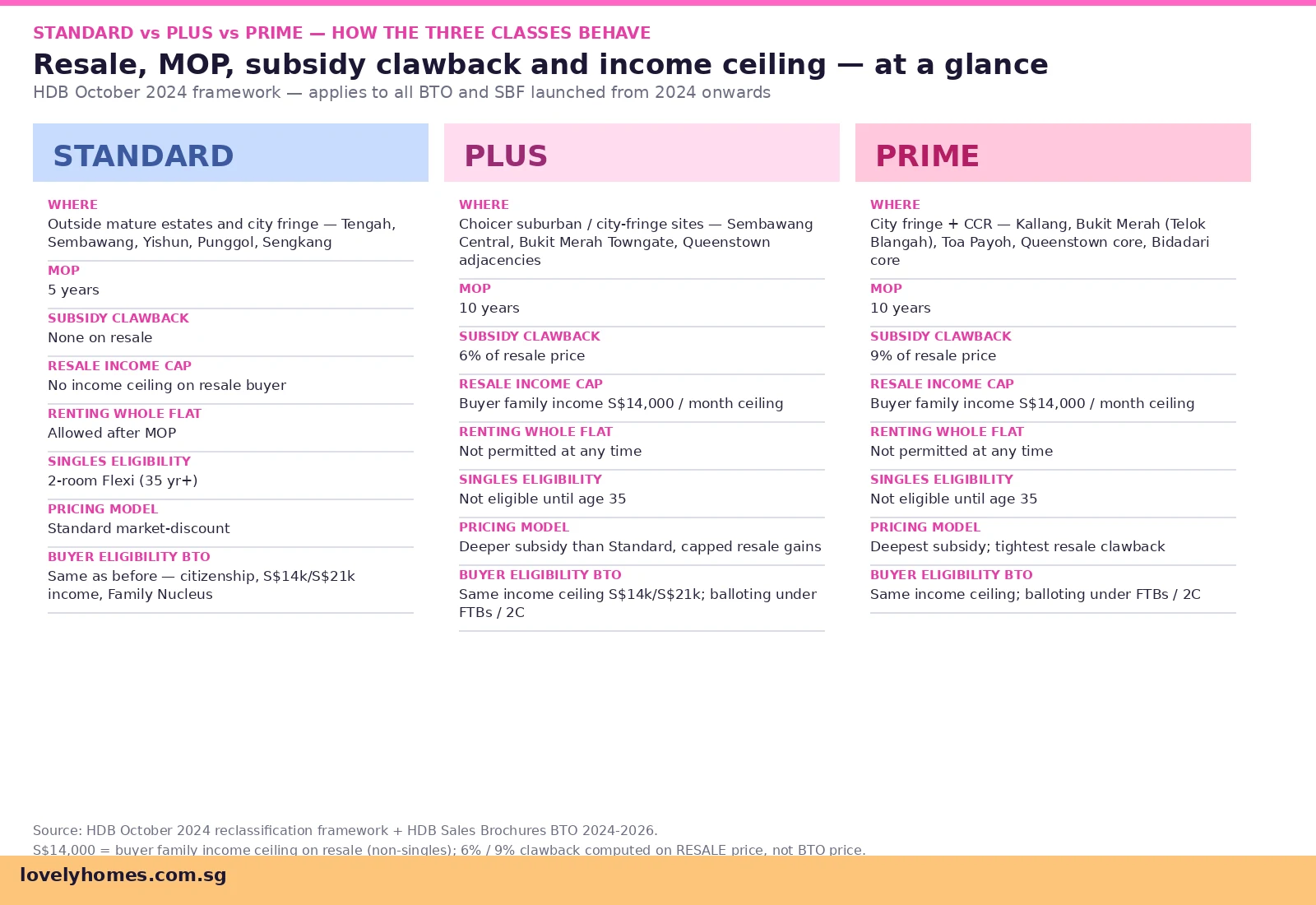
June 2026 BTO Standard Plus Prime classification — MOP, resale rules, subsidy clawback comparison
Figure 2: How each class will behave at MOP — Standard at year 5 with no clawback; Plus and Prime at year 10 with subsidy clawback and a S$14,000 buyer income ceiling.

HDB’s October 2024 classification framework is in full effect for the June 2026 launch. The Standard class behaves like the BTOs of the last two decades: 5-year MOP, open resale market on graduation, no clawback. The Plus class — represented in June by the Ang Mo Kio twin — carries a 10-year MOP, a ~6% subsidy clawback at first resale, and a S$14,000 income ceiling on the resale buyer. The Prime class — Lakeview, Berlayer Crescent — runs the same 10-year MOP and S$14,000 buyer ceiling, with a heavier ~9% clawback on first resale to reflect the deeper original subsidy.

The implication for buyers is that Plus and Prime are explicitly engineered as long-hold homes with a smaller resale pool. Standard is the one that retains the historical “BTO as wealth-builder” pattern. For first-time-buyer households running the affordability vs upside arithmetic, Standard at Sembawang or Woodlands is structurally different from Prime at Bishan — even before the price difference is factored in.

Indicative Pricing — Where the Money Lands

June 2026 BTO indicative 4-room prices — Bishan to Woodlands ranges from S$360k to S$820k before grants
Figure 3: Indicative 4-room prices before EHG and PHG grants. Final selling prices will appear on HDB’s BTO application page when the launch window opens.

HDB will publish the firm price tables when the application window opens. The indicative ranges sit roughly as follows for 4-room flats: Bishan Lakeview at S$640,000 to S$820,000; Bukit Merah Berlayer Crescent at S$620,000 to S$780,000; Ang Mo Kio at S$520,000 to S$640,000; Sembawang sites at S$360,000 to S$500,000; Woodlands at S$380,000 to S$510,000. These are mid-launch indications drawn from neighbouring BTO comparables and the early-2026 launch curve, not committed HDB figures. The Enhanced CPF Housing Grant (EHG) of up to S$120,000 and the Proximity Housing Grant (PHG) of up to S$30,000 are still claimable on top — meaning eligible first-timer households at Sembawang could see net selling prices as low as S$240,000 for a 4-room.

Worked Example — The Lim Household at Lakeview

Consider Mr Lim (33) and Mrs Lim (31), Singapore Citizens, first-timers with combined gross household income S$8,500/month. They apply for a 4-room flat at the Bishan Lakeview Prime project. Indicative price: S$760,000. They qualify for EHG of S$30,000 (combined-income tier) — Prime/Plus PHG of S$30,000 if Mrs Lim’s parents live within 4km, which they do. Net price: S$700,000. CPF OA balance: S$110,000. They opt for an HDB Concessionary Loan at 80% LTV (S$560,000 loan, S$140,000 downpayment).

The MSR check: at HDB’s stress rate of 4%, an S$560,000 loan over 25 years yields a monthly instalment of approximately S$2,956. That is 34.8% of S$8,500 — above the 30% MSR cap. To pass MSR, they must lengthen tenure to 30 years (instalment drops to ~S$2,672 / 31.4% — still over) or accept a smaller loan (~S$481,000 / S$2,539 / 29.9% — clears MSR). The MSR is the hardest constraint here, and at S$8,500 income the Lakeview Prime price point is right at the edge of affordability. Households below S$8,000/month will struggle to pass MSR at S$760,000 even with the maximum-tenure stretch; households at S$10,000–11,000/month clear it comfortably.

What this means for the ballot: Lakeview Prime will draw a higher-income applicant pool than typical first-timer BTO. Sembawang Standard at S$420,000 list pulls a much wider applicant pool that easily clears MSR at S$5,000–6,000/month combined. Application strategy follows the price gradient.

Comparison Table — June 2026 vs Recent Quarters

Sales Exercise Total Flats Towns Prime / Plus / Standard
Feb 2026 BTO ~5,500 Bedok, Bukit Batok, Hougang, Tengah, Toa Payoh ~22% / ~10% / ~68%
May 2026 BTO (preview) ~3,800 Bukit Merah, Tampines, Tengah, Woodlands ~30% / ~12% / ~58%
June 2026 BTO ~6,900 Bishan, AMK, Bukit Merah, Sembawang, Woodlands ~47% / ~5% / ~48%
Oct 2026 BTO (announced) ~7,200 Toa Payoh-Caldecott, Punggol, Yishun, others TBC TBC

What This Means for Different Buyer Profiles

First-time HDB buyer at S$5,000–7,000 combined income. Sembawang Drive, Sungei Sembawang, and Woodlands are the right fit. Standard class, 5-year MOP, prices that pass MSR comfortably with EHG-stacked subsidies. The northern corridor will face heavy first-timer demand but the supply is large enough to keep ballot odds reasonable for first-timers.

First-time HDB buyer at S$8,000–11,000 combined income. Ang Mo Kio Plus is the sweet-spot. Mature estate, MRT proximity, school catchment, and a price band that clears MSR with margin. The 10-year MOP and S$14,000 resale-buyer ceiling are real downsides if the household is upgrade-minded, but for buy-and-hold it is the strongest value-for-money in the launch.

First-time HDB buyer at S$11,000+ combined income. Bishan Lakeview and Bukit Merah Berlayer Crescent become serious. The Prime classification means the household must accept a long hold and a smaller resale pool, but the locations are in the top decile of HDB-accessible neighbourhoods. Affordability at S$760,000–820,000 only works at the higher income tier.

Second-timers and upgraders. The Plus and Prime sites apply the second-timer 70/30 quota; second-timers should expect lower ballot odds at Lakeview and Berlayer specifically. Standard sites at Sembawang and Woodlands are more accessible to second-timers because of the larger supply and the absence of the income ceiling on resale.

What Might Come Next

HDB has guided 19,600 BTO flats across 2026 (Feb + May/June + October). The October 2026 exercise is expected to be even larger than June, anchored by the Toa Payoh West / Caldecott MRT project (~1,600 flats including 240 Community Care Apartments) and supplementary supply at Punggol and Yishun. With Pearl’s Hill (60 storeys, ~1,700 flats) confirmed for the 2027 pipeline as Singapore’s tallest public housing, the next 18 months are looking like the highest-supply year of the post-COVID cycle. Whether that supply pulls down the HDB Resale Price Index — which slipped 0.1% in Q1 2026, the first quarterly decline in seven years — is the watch-point analysts will be tracking through 2H 2026.

Worked Example — Sembawang Drive Standard for the Median Household

Mr & Mrs Wong, both 30, combined income S$6,500/month, apply for Sembawang Drive Standard 4-room at indicative S$430,000. They claim EHG S$70,000 (combined income tier) — net price S$360,000. HDB Concessionary Loan at 80% LTV (S$288,000 loan; S$72,000 downpayment, fully claimable from CPF Ordinary Account). MSR at 4% / 25 years on S$288,000 = approximately S$1,521/month, which is 23.4% of S$6,500 — clears MSR with margin. TDSR not relevant for HDB Concessionary Loan. Cash outlay at completion: roughly S$5,000 of legal and stamp-duty incidentals. This is the median-income BTO arithmetic that the Standard class is engineered to deliver — and Sembawang Drive is one of the cleanest examples of it in the entire 2026 calendar.

Frequently Asked Questions

When does the June 2026 BTO application open and close?

HDB will open the application portal in the second week of June 2026, typically running for one calendar week. Ballot results follow approximately three weeks after the close. The exact dates appear on the HDB BTO application page once the launch is live; this preview was prepared from HDB’s announcement timeline and will be updated when firm dates are published.

What is the difference between Prime, Plus, and Standard?

HDB’s October 2024 framework defines three classes by location desirability and subsidy depth. Prime (~47% of June supply) carries the deepest subsidies, a 10-year MOP, a ~9% subsidy clawback on first resale, and a S$14,000/month income ceiling on the resale buyer. Plus (~5% of June supply) sits one tier below — same 10-year MOP and S$14,000 resale ceiling, with a lighter ~6% clawback. Standard (~48% of June supply) is the historical BTO model — 5-year MOP, no clawback, no resale ceiling.

Can I stack EHG and PHG on a Prime or Plus flat?

Yes. The Enhanced CPF Housing Grant (EHG) of up to S$120,000 for first-timer families is available across all three classes. The Proximity Housing Grant (PHG) of S$30,000 (married applicants living within 4km of parents) and S$10,000 (single applicants) is also available across all classes. Step-up Grant and Family Grant follow the same rules. Grant stacking does not change the MOP or clawback rules.

Why is Bishan Lakeview so much more expensive than Sembawang?

Three reasons. First, the location quality — proximity to MRT, mature estate amenities, and reservoir views — drives a higher base price band before subsidy. Second, Lakeview is Prime, which means HDB is delivering a larger absolute subsidy on a higher base price; the indicative price you see is already net of that subsidy. Third, redevelopment or land-cost factors specific to a central site push the underlying construction and tendering cost above an outer-town site like Sembawang Drive.

What is MSR and will I clear it?

MSR (Mortgage Servicing Ratio) caps your HDB or EC mortgage instalment at 30% of gross monthly income, computed at HDB’s 4% stress-test rate over your chosen tenure. For a 4-room flat at S$760,000 (Lakeview indicative) with an 80% loan and 25-year tenure, MSR clears at roughly S$8,800/month combined household income or higher. At S$420,000 (Sembawang indicative) the clear-MSR threshold drops to roughly S$5,000/month combined. See the LovelyHomes TDSR Singapore 2026 guide for the detailed mechanics.

Can I sell my Plus or Prime BTO before MOP?

Generally no. The MOP for Plus and Prime is 10 years from key collection, during which you cannot sell, rent out the entire flat, or buy a private property. Limited exceptions exist for divorce, financial hardship, and bereavement — applied case by case by HDB. Renting out individual rooms is permitted from the start, subject to HDB’s room-rental rules.

Related Articles

Disclaimer: This preview is based on HDB’s published announcements and industry-research-desk indications as of 04 May 2026. Final unit counts, classifications, indicative prices, and application dates appear on the HDB BTO application page once the sales exercise opens. All figures should be verified against the official HDB website before acting on them. This guide is for general information only and does not constitute legal, tax, or financial advice. Consult a licensed mortgage broker or HDB officer for advice specific to your circumstances.

TDSR Singapore 2026: How the 55% Cap and 4.0% Stress Test Decide Your Home Loan

TDSR Singapore 2026: How the 55% Cap and 4.0% Stress Test Decide Your Home Loan

TDSR Singapore 2026 — short for the Total Debt Servicing Ratio framework — is the single biggest test that decides how much a Singapore bank will lend you for a home loan. Get on the wrong side of it, and a S$2 million property becomes a S$1.4 million budget overnight. This is the rule that quietly resizes every Singapore property purchase, including yours.

The TDSR caps your total monthly debt repayments at 55% of your gross monthly income, calculated using a 4.0% stress-test rate rather than the actual rate your bank quotes you. It applies to all loans secured by residential property in Singapore — first home, investment property, refinancing, and decoupling. Together with the LTV (Loan-to-Value) cap and the MSR (Mortgage Servicing Ratio) for HDB and Executive Condominium purchases, it forms the three-gate framework every borrower must pass.

This guide explains how TDSR works in 2026, why MAS sets the rules the way it does, what the 4.0% stress test actually does to your borrowing power, and how a real Singapore household sees their loan sized in practice. All figures reflect the framework administered by the Monetary Authority of Singapore (MAS Notice 645 to banks; Notice 825 to finance companies), last updated to current effective form in MAS’ 2021 calibration.

Quick Answer — TDSR at a glance

  • What it is: a 55% cap on your monthly debt obligations as a share of your gross monthly income.
  • Who sets it: the Monetary Authority of Singapore (MAS), via Notice 645 to banks and Notice 825 to finance companies.
  • Stress-test rate: 4.0% per annum for residential property loans (3.5% for non-residential), regardless of your actual mortgage rate.
  • What counts as debt: mortgage instalments, car loans, study loans, credit-card minimums, personal loans, and renovation loans — yes, all of them.
  • Income haircut: 30% deduction on rental income, bonuses, and variable income before TDSR is computed.
  • How it interacts with LTV and MSR: all three caps run in parallel; the lowest one binds. For private property, LTV usually binds. For HDB and EC, MSR usually binds before TDSR.
  • Penalty for failing: the bank either reduces your loan, lengthens your tenure (subject to LTV step-down at 30+ years), or rejects the application.

What TDSR Is — and Why MAS Built It

Before 2013, Singapore had no aggregate debt-servicing rule. Buyers could chain a property loan on top of a car loan on top of a personal loan, and as long as each loan passed its own affordability check, the bank cleared the deal. That worked when interest rates were anchored near zero, but the regulator could see what would happen the moment rates normalised: leveraged households would be forced to deleverage in a rising-rate environment, dragging property prices and consumption down with them.

The TDSR was introduced on 28 June 2013 as MAS Notice 645 to banks. The intent, in the regulator’s own framing in the 2013 consultation paper, was to “ensure financial prudence and prevent over-borrowing” by capping the share of household income spent on servicing all forms of debt. The 60% cap was reduced to 55% with effect from 16 December 2021 as part of a broader cooling-measure package — the calibration that still applies in 2026.

The cap is computed against a stress-test rate, not your actual contracted rate. This matters because Singapore mortgage rates float — most home loans here are pegged to a benchmark like SORA or 3M-SOFR rather than locked at a fixed rate for life. If your loan would barely scrape through at today’s 3.0% rate, MAS does not want you discovering at year three that 4.5% means you can no longer make the repayment. The 4.0% test rate is a built-in shock absorber.

TDSR Singapore 2026 three-gate framework — LTV cap, TDSR 55% with 4 percent stress, MSR 30% HDB only
Figure 1: The three-gate borrowing framework — every Singapore home loan must pass LTV, TDSR and (for HDB/EC) MSR. The lowest cap wins.

Who TDSR Applies To

The TDSR framework covers every property loan extended by a MAS-regulated bank or finance company in Singapore. That sweep is wider than people realise:

  • New residential purchases — HDB resale, Executive Condominium, private condo, landed property.
  • Refinancing of an existing home loan if the loan is for an investment property (owner-occupier refinances were exempted in 2017 subject to the borrowing limit not increasing).
  • Equity loans (also called term loans or cash-out loans) secured against residential property.
  • Loans for buy-to-let or buy-to-flip purchases.
  • Joint loans where any borrower is providing income to support the application.

Borrowers exempt from TDSR are limited and specific: the small number of HDB Concessionary Loans (which use HDB’s own affordability framework rather than the bank rules), and a handful of refinancing exemptions for owner-occupiers under MAS’ 2017 calibration. If your loan is from an OCBC, DBS, UOB, Standard Chartered, HSBC, Citibank, Maybank, RHB, Bank of China, ICBC or any other MAS-licensed bank, TDSR applies.

The 55% Cap, Step by Step

The arithmetic looks deceptively simple. Take your gross monthly income, multiply by 55%, and that is the maximum total monthly debt the bank will let you carry. The complication is on either side of the equation.

On the income side: banks accept fixed monthly income at face value, but apply a 30% haircut to anything variable. Bonuses, commissions, allowances, and rental income all get reduced to 70% of their reported value before TDSR. Self-employed income is documented through two years of Notice of Assessment (NOA) from IRAS, and the bank will typically use the lower of the two years (or an average, depending on policy). Foreign-currency income is converted at the bank’s prevailing rate and may take a further haircut.

On the debt side: banks take every monthly debt obligation and add them together. For mortgages, the bank substitutes a 4.0% stress-test rate (residential) or 3.5% (non-residential) and recomputes the instalment as if the loan ran at that rate over the proposed tenure. Car loans, study loans, and personal loans are taken at their actual repayment amounts. For credit cards, MAS prescribes that 3% of the outstanding balance is treated as the monthly obligation, regardless of whether the cardholder pays in full each month — the regulator’s logic is that the credit line itself represents a contingent claim on income.

The 4.0% Stress Test — What It Does to Your Loan

The single biggest mechanism inside TDSR is the stress-test rate. For residential loans, the bank computes your borrowing capacity as if the rate were 4.0% per annum, even when the actual quoted rate is 3.0% or lower.

TDSR Singapore 2026 stress test impact — 4 percent test rate cuts borrowing power versus actual 3 percent rate
Figure 2: The 4.0% stress test removes roughly S$228,000 of borrowing power on a 30-year tenure for a S$15,000-income household compared with a real 3.0% rate.

The arithmetic is unforgiving. At 3.0% over 30 years, S$8,250 of allowable monthly debt service supports a loan of approximately S$1,955,000. At 4.0% over the same tenure, the same S$8,250 supports only S$1,727,000 — a reduction of S$228,000 in maximum borrowing. Lengthening the tenure to ease the monthly figure does not solve the problem either, because tenures beyond 30 years (or that take the borrower past age 65) trigger a step-down in the LTV cap from 75% to 55%.

The buffer matters because Singapore mortgages reprice. A 3M-SOFR-pegged loan written at 3.10% in early 2026 could float up to 4.50% within a single rate-up cycle, as it did in 2022–23. A household that just barely cleared TDSR at 3.10% would be in repayment distress at 4.50%. The 4.0% test makes sure that household’s mortgage was sized with the rate-up baked in.

How TDSR Interacts with LTV and MSR

TDSR does not run in isolation. It is one of three rules — LTV, TDSR, MSR — that all apply to a property purchase, and the lowest cap wins.

LTV (Loan-to-Value) sits in MAS Notice 645 alongside TDSR and caps the loan as a percentage of the property’s value. First housing loans are capped at 75% LTV (55% if tenure exceeds 30 years or the borrower’s age at end of loan exceeds 65). Second housing loans drop to 45%. Third loans to 35%. LTV is what determines your minimum downpayment.

MSR (Mortgage Servicing Ratio) applies only to HDB flats (BTO and resale) and Executive Condominium purchases from the developer. It caps the mortgage instalment alone — not all debts, just the mortgage — at 30% of gross monthly income. MSR exists because HDB and EC purchases use a national affordability lens: the regulator treats first homes for citizens differently from investment property.

For most Singapore Citizen first-time private-condo buyers, LTV at 75% binds before TDSR does. For HDB and EC buyers, MSR at 30% binds before TDSR — because once you’re spending 30% of income on the mortgage alone, you’ve used up most of the 55% TDSR allowance even before adding car loans or credit cards. For private second properties or borrowers with car loans and other commitments, TDSR usually binds before LTV.

Worked Example — Mr & Mrs Lim and the S$1.8M Tampines Condo

Mr Lim is 38, a Singapore Citizen earning S$8,500 fixed plus a S$24,000 annual bonus. Mrs Lim is 36, a Singapore Citizen earning S$5,500 fixed. They have one S$650/month car loan. They are eyeing a S$1.8 million Tampines condo, first private property for both of them, joint name. Tenure 30 years. Below is exactly how a Singapore bank would size their loan in 2026.

TDSR Singapore 2026 worked example Mr and Mrs Lim S$1.8M Tampines condo three-gate cap and cost stack
Figure 3: The Lim household’s S$1.8M purchase walked through the three caps and the resulting cash plus CPF stack.

Step 1 — Compute gross monthly income. Mr Lim’s fixed S$8,500 + 70% of his S$2,000/month bonus equivalent (S$1,400) = S$9,900. Mrs Lim’s fixed S$5,500 = S$5,500. Combined gross monthly income for TDSR = S$15,400. The bank will round and document, but for our purposes call it S$15,000.

Step 2 — Apply the three caps. LTV at 75% caps the loan at S$1,350,000. TDSR allows S$8,250 of monthly debt; subtract S$650 of car-loan repayment and S$8,250 − S$650 = S$7,600 left for the mortgage; at the 4.0% stress rate over 30 years, S$7,600/month supports a loan of approximately S$1,591,000. MSR does not apply (private condo). The lowest cap wins, so the binding cap is the LTV at S$1,350,000.

Step 3 — Build the cash + CPF stack. The S$1.8M purchase requires S$1,350,000 from the bank (75% LTV) and S$450,000 from the buyers (25% downpayment). Of that S$450,000, at least 5% (S$90,000) must be cash by MAS rule; the remaining S$360,000 can be CPF Ordinary Account or cash. Add Buyer’s Stamp Duty of approximately S$64,600 (1% on first S$200,000 + 2% on next S$160,000 + 3% on next S$640,000 + 4% on next S$500,000 + 5% on next S$300,000 of the S$1.8M). Add legal fees of approximately S$3,500 + 9% GST. The total entry cost is roughly S$1,869,600 — of which S$1,350,000 is loan, S$300,000 is typical CPF use, and S$219,600 is cash out of pocket.

Step 4 — What happens if Mrs Lim’s income drops. Suppose Mrs Lim moves to part-time at S$3,000/month. Combined gross drops to S$12,900. TDSR at 55% allows S$7,095 of monthly debt; minus S$650 car loan = S$6,445 for mortgage; at 4% over 30 years that supports about S$1,350,000 — exactly the LTV cap. Any further income drop and TDSR overtakes LTV as the binding constraint, and the loan amount falls. This is why couples about to apply for a mortgage think hard about timing maternity leave or job changes around the application date.

Common TDSR Workarounds and Whether They Work

Buyers and brokers have spent the better part of a decade looking for ways around TDSR. Most do not work, and the ones that do are blunt instruments. The most legitimate is extending tenure, but Singapore’s LTV step-down at 30 years (or age 65) means the cost of stretching tenure to lower the monthly is a 20-percentage-point drop in LTV — usually not worth it. Adding a guarantor works in principle: an additional income contributor is included in the gross-income calculation, but the guarantor must legally be on the loan, takes a property count for ABSD purposes, and is fully liable. Decoupling (one spouse sells out of the marital home, the other buys solo to free up an “additional property” slot) is a real strategy used by upgraders, but it is engineered for ABSD avoidance, not TDSR. Pledging fixed deposits as “show funds” can boost the bank’s recognised income on a pro-rated basis (typically 4-year amortisation), but the pledged amounts are locked. The illegitimate routes — undeclared rental income, hidden side loans, fake bonus letters — are mortgage fraud and the banks’ compliance teams flag them quickly.

What This Means for You

If you are about to apply for a home loan in Singapore in 2026, three actions cut TDSR risk before you even speak to a bank:

Pay down the car loan. A S$1,000/month car loan removes S$1,000 from your TDSR allowance, which removes roughly S$210,000 of mortgage borrowing power at the 4% stress rate over 30 years. If you can clear the car loan before applying, do it.

Settle the credit-card balances. MAS’ 3% rule means a S$30,000 outstanding balance is treated as S$900/month against your TDSR even if you pay in full each month. Pay it down before pulling your credit bureau report for the bank.

Document your variable income properly. If 30% of your income is bonus and commission, the 30% haircut hurts. Two years of consistent NOAs help. A formal letter from your employer setting out the annualised bonus structure helps further. Self-employed and freelance income takes more documentation but can be made to work.

Comparison with Other Asian Markets

Singapore’s 55% TDSR is at the strict end of Asian property regulation. Hong Kong’s HKMA caps total debt at 50% (or 60% for borrowers passing a stress-test buffer), with stress rates that have moved with the cycle. Australia’s APRA prudential rules cap serviceability tests using a buffer of around 3 percentage points above quoted rate — a different approach but similar conservatism. Korea’s DSR (Debt Service Ratio) caps were tightened to 40% for individual borrowers in 2022 in the first wave of post-COVID cooling. Singapore’s framework is closest in spirit to Hong Kong’s, and was explicitly modelled on HKMA’s earlier work — both jurisdictions concluded that household leverage in property cycles is the systemic risk to manage, and both built buffers around stress-test rates.

What Might Come Next

The 55% cap was the December 2021 calibration of a 60% rule that was already eight years old by then. The natural watch-points for the next adjustment are: (a) sustained increases in household-debt-to-income ratios above the 2024 baseline, which would invite a tightening to 50%; (b) a sharp rate-up cycle that exposes a cohort of borrowers stress-tested at 4.0% but underwater at 5.5%, which would invite a higher stress rate; or (c) a turn in the property cycle severe enough to threaten financial-stability metrics, which would invite a temporary loosening as part of a counter-cyclical package. Industry expects the 4.0% stress rate to be revisited within the 2026–27 window if the SORA-based mortgage benchmark moves materially. None of these are signalled by MAS as imminent at this writing.

Summary Table — TDSR Singapore 2026 at a Glance

Element 2026 Value Notes
TDSR cap (residential) 55% Of gross monthly income; lowered from 60% on 16 December 2021.
Stress-test rate (residential) 4.0% p.a. Used to size monthly instalment regardless of contracted rate.
Stress-test rate (non-residential) 3.5% p.a. Lower buffer for commercial and industrial property loans.
Variable-income haircut 30% Applied to bonuses, commissions, rental income, allowances.
Credit-card minimum servicing rule 3% of outstanding Treated as monthly obligation regardless of repayment habit.
LTV cap — first housing loan 75% Steps down to 55% if tenure > 30 yrs OR age at end of loan > 65.
LTV cap — second housing loan 45% Steps down to 25% if tenure > 30 yrs OR age at end of loan > 65.
MSR cap (HDB/EC only) 30% Mortgage instalment alone, gross monthly income basis.
Minimum cash component (private) 5% Rest of downpayment can be CPF Ordinary Account.
Regulator MAS Notice 645 (banks) and Notice 825 (finance companies).

Frequently Asked Questions

Is TDSR the same as MSR?

No. TDSR caps your total monthly debt at 55% of gross monthly income, including car loans, credit cards, study loans, personal loans, and the new mortgage. MSR caps your mortgage instalment alone at 30% of gross monthly income, but only applies to HDB flats and Executive Condominiums purchased from the developer. For an HDB or EC purchase, both run in parallel — and you must pass both. For private property, only TDSR applies.

Can I get around TDSR by lengthening my mortgage tenure?

Yes, but at a cost. Stretching tenure lowers the monthly instalment and improves your TDSR ratio, but the moment your tenure exceeds 30 years (or your age at end of loan exceeds 65), MAS Notice 645 steps your LTV cap down from 75% to 55%. That means a 20-percentage-point reduction in the maximum loan, which usually wipes out the gain from the lower monthly. For most buyers, capping tenure at 30 years and structuring around income or down-payment is a better lever.

Does TDSR apply when I refinance my current home loan?

For an owner-occupied property, TDSR was relaxed in 2017 — you can refinance for the same outstanding amount even if your TDSR exceeds 55%, as long as you do not borrow additional money on top. For an investment property (any home you do not occupy), TDSR applies in full at every refinance. Equity term loans always trigger a fresh TDSR assessment.

How does the bank treat my variable income or rental income?

MAS rules apply a 30% haircut. Bonuses, commissions, allowances, and rental income are reduced to 70% of their reported value before being added to your TDSR income base. Banks typically require two years of NOA from IRAS to evidence variable income. Self-employed income is documented with two years of NOA and may be averaged or assessed at the lower of the two years. Foreign-currency income takes a further FX-conversion haircut at the bank’s prevailing rate.

What counts as “debt” for the TDSR calculation?

Everything on your monthly repayment schedule plus a regulatory rule for credit cards. Mortgage instalments (stress-tested at 4.0%), car loan repayments, study loan repayments, personal loan repayments, and renovation loan repayments are taken at their actual monthly amounts. Credit cards are treated as 3% of the outstanding balance per month, even if you pay in full. Family or informal debts are not included unless they appear on your credit bureau report.

Why is the stress-test rate 4.0% when bank rates are 3.0%?

The 4.0% rate is a buffer against the next rate-up cycle. Singapore mortgages float against benchmarks like SORA and 3M-SOFR, and rate cycles can move 1.5–2.0 percentage points within 12–18 months — as 2022–23 demonstrated when the 3-month SOFR went from 0.05% in early 2022 to above 5% by mid-2023. MAS sizes loans against the higher rate so households can absorb the cycle without falling into repayment distress.

Does TDSR apply to non-residential property loans?

Yes. The same 55% cap applies, but the stress-test rate is 3.5% for non-residential property (commercial, industrial) rather than 4.0% for residential. The lower buffer reflects the different risk profile of commercial real estate loans, where rental yields and cash-flow tests are also tighter at the property level.

Related Articles

Disclaimer: This guide is for general information only and does not constitute legal, tax, or financial advice. TDSR rules and stress-test rates are set by the Monetary Authority of Singapore and may be revised with notice. Always verify the current position on the MAS Notice 645 page and consult a licensed mortgage broker, financial adviser, or banker for advice on your specific circumstances.

Executive Condominium Singapore 2026: Complete Guide to Eligibility, MOP, Privatisation & Pricing

Executive Condominium Singapore 2026: Complete Guide to Eligibility, MOP, Privatisation & Pricing

Executive Condominiums (ECs) are Singapore’s most distinctive housing hybrid — built by private developers, regulated by HDB for the first ten years, then quietly graduating into full private property. For the right buyer profile, an EC delivers condo facilities, family-sized layouts and capital appreciation at a 25–35% discount to comparable mass-market private condos. For the wrong buyer profile, the eligibility rules, MOP restrictions and resale-levy traps can be expensive surprises.

This guide walks through how ECs work in 2026 — who can buy, how much you can borrow, what happens at the 5-year MOP and 10-year privatisation milestones, and the worked maths on a typical S$1.46 million Tampines unit. Figures reflect the rules administered by the Housing & Development Board (HDB) and the financing limits set by the Monetary Authority of Singapore (MAS).

Quick Answer — Executive Condominium 2026 at a glance

  • Income ceiling: S$16,000 gross monthly household income
  • At least one applicant must be a Singapore Citizen; co-applicant can be SC or PR
  • Minimum Occupation Period (MOP): 5 years owner-occupier from key collection
  • After MOP: sell to SCs or PRs only on the open market
  • Privatisation: 10 years from TOP — sell to anyone, including foreigners
  • Loan: 75% LTV from a bank, 30% MSR cap (HDB-style during MOP), 55% TDSR stress-tested at 4.0%
  • CPF Enhanced Housing Grant (EHG): up to S$30,000 for first-timers (vs S$120,000 for BTO/resale)
  • Stamp duty: BSD applies normally; ABSD is 0% on a first EC bought from the developer

What is an Executive Condominium — and Why Does It Exist?

An Executive Condominium is a class of housing introduced in 1995 to bridge the gap between HDB flats and private condominiums. The Government’s logic was simple: a sandwich class of professionals earned too much to qualify for a BTO flat, but could not yet afford a S$1.5 million private condo. ECs solved that with a structured concession — private-condo developers build to private specifications (gym, pool, security, full Strata-Title), but the units are sold at HDB-style prices to eligible Singaporean families, with restrictions on resale and ownership for the first ten years.

The economic trade-off is straightforward. Buyers accept a 5-year MOP (no selling, no whole-unit subletting) and a further 5-year ban on selling to foreigners, in exchange for entry pricing roughly 25–35% below comparable mass-market private condos. After ten years, the EC is fully privatised and trades like any other private property — at which point much of the discount has typically been realised as capital gain.

The EC Lifecycle — From Public to Private in 10 Years

The most-misunderstood feature of an EC is that it changes legal status three times across its first decade. Buyers who plan around these milestones consistently outperform buyers who treat an EC like a regular condo from day one.

Executive Condominium Singapore lifecycle — Year 0 public, Year 5 MOP, Year 10 privatisation, Year 11 private condo
Figure 1: The four stages of an EC’s lifecycle — public during MOP, semi-public until Year 10, fully private thereafter.

Year 0 – TOP and Key Collection

You move in. The unit is treated as HDB property under the Executive Condominium Housing Scheme. You may not sell, transfer or rent the entire unit. Renting individual rooms is permitted (subject to HDB sub-letting rules), but the household must continue to occupy the flat as the principal residence.

Year 5 – MOP Ends

The Minimum Occupation Period of 5 years (from the issuance of the Temporary Occupation Permit, or in practice from key collection) ends. You may now sell on the open market — but only to Singapore Citizens or Permanent Residents. Whole-unit rental is permitted. The unit still counts as HDB-equivalent for ABSD purposes (which means an SC family selling and buying a private condo elsewhere may still face ABSD on the next purchase, depending on timing).

Year 10 – Privatisation

Ten years from TOP, the EC is reclassified as a private property. Restrictions on foreign-buyer eligibility lift. The Strata Title comes through cleanly — in most projects, owners receive a Subsidiary Strata Certificate of Title (SSCT) at this milestone. Sale to anyone, anywhere in the world, becomes possible. From this point onwards, the EC is, for all market and legal purposes, a private condominium.

Year 11+ – Mature Private Condo

Resale prices typically converge with comparable mass-market private condos in the same district. Historic data from URA caveats suggests the privatisation premium is often 8–15% — the simple act of crossing the 10-year threshold tends to add a measurable price uplift, on top of the underlying district-level appreciation.

Who Can Buy an EC in 2026? Eligibility Snapshot

EC eligibility is administered by HDB, even though the developer is private. The rules are stricter than a private-condo purchase but looser than a BTO. The 2026 framework is unchanged from the 2025 reset, with the gross monthly household income ceiling holding at S$16,000.

Executive Condominium Singapore 2026 eligibility matrix — citizenship, S$16,000 income ceiling, family nucleus, 30-month no-private-property rule
Figure 2: EC eligibility snapshot for 2026 buyers.

The detail behind each row matters:

  • Income ceiling: S$16,000 gross household income at the date of the Option to Purchase. A single dollar over disqualifies. HDB looks at the trailing 12 months in most cases. Variable bonuses are typically averaged.
  • Citizenship: at least one SC. The classic mixed-citizenship case — SC + PR — is allowed under the Public Scheme. SC + foreigner is not allowed for new ECs from the developer (only for resale ECs after privatisation).
  • 30-month rule: if you have owned or disposed of any private residential property in the last 30 months, you cannot buy a new EC. This catches HDB-upgrader-then-downgrader patterns. The 30 months runs from the date of disposal — not the date of physical move-out.
  • Resale levy: if you have previously bought a subsidised flat from HDB or a previous EC, a resale levy applies on the new EC purchase. The levy is fixed (not means-tested) and is deducted from the CPF refund or paid in cash at the next purchase. See our HDB Resale Levy guide for the lookup tables.

Financing an EC — The Three Gates

EC financing is a hybrid of HDB-style and private-style limits. Because the unit is HDB-classified during the first five years, the Mortgage Servicing Ratio (MSR) cap of 30% applies. But because HDB does not issue concessionary loans on ECs, the buyer must use a bank loan — meaning private-loan rules apply too: 75% LTV cap, 55% TDSR, and stress-testing at the medium-term interest-rate floor of 4.0%.

The financing pass requires clearing all three gates in turn:

  1. LTV (Loan-to-Value): bank loan capped at 75% of the lower of price or valuation. The remaining 25% must be in cash and CPF, with at least 5% in cash.
  2. TDSR (Total Debt Servicing Ratio): 55% of gross monthly income, stress-tested at 4.0% medium-term floor. All debts count — car loans, education loans, credit-card minimums.
  3. MSR (Mortgage Servicing Ratio): 30% of gross monthly income on the mortgage instalment alone, again stress-tested at 4.0%. This is the binding constraint for most EC buyers.

For full mechanics, see our LTV Limits Singapore 2026 guide and the companion TDSR & MSR explainer.

Worked Example — A S$1.46M Tampines EC for a Dual-Income SC Couple

Let’s run a realistic 2026 case. Mr and Mrs Lim, both 32, both Singapore Citizens, no children yet, combined gross monthly income S$13,500. They are first-timer buyers (no prior subsidised housing) and have S$160,000 cash savings plus S$220,000 combined CPF Ordinary Account balance. They intend to buy a 4-bedroom unit at Aurelle of Tampines at S$1,460,000.

Component Amount (S$) Notes
Purchase price 1,460,000 Aurelle of Tampines, ~828 sq ft, 4-bed
Cash + CPF down payment (25%) 365,000 5% cash (S$73,000) + 20% cash or CPF (S$292,000)
Bank loan (75% LTV) 1,095,000 25-year tenure, 2.85% pa fixed indicative
Monthly instalment 5,094 37.7% of gross — fails MSR 30% cap
Adjusted loan (to clear 30% MSR @ 4% stress) 763,000 Implies S$697,000 cash + CPF down payment
Buyer’s Stamp Duty (BSD) 36,200 Progressive on S$1.46M, payable in cash within 14 days
ABSD (first home, SC) 0 EC is exempt from ABSD on the first-home purchase
CPF Enhanced Housing Grant (EHG) 5,000 Income S$13,500 → EHG S$5,000 (capped, EC band)
Legal & conveyancing 3,000 Approximate, including title search and registration
Effective net upfront outlay ~731,200 After EHG offset; the binding constraint is MSR, not LTV

The headline finding: at this income level, MSR — not LTV — is the binding constraint. The Lims can borrow up to S$763,000 (giving a stress-tested instalment of ~30% of gross at 4.0%), which means they need almost double their original cash + CPF down payment. Many EC buyers run into this exact wall and either (a) extend tenure to the maximum 30 years allowed by the bank, (b) bring in a third co-applicant from the family nucleus, or (c) downsize to a 3-bedroom unit at S$1.2 million.

EC vs HDB BTO vs Mass-Market Private Condo

For dual-income families earning S$13,000–16,000 a month, the choice in 2026 typically comes down to three options. The trade-offs are summarised below.

Dimension 5-room BTO EC (e.g. Aurelle) Mass-market private condo
Indicative price (4-bed) S$680k S$1.46m S$2.20m
Indicative psf S$680–780 S$1,766 S$2,400–2,600
Income ceiling S$14,000 S$16,000 None
Time to keys 4–5 yrs 3–4 yrs 3–4 yrs (new launch)
MOP 5 yrs 5 yrs (HDB-style) None
Privatisation N/A 10 yrs from TOP Already private
CPF EHG cap S$120,000 S$30,000 None
Loan source HDB or bank Bank only Bank only
LTV cap 85% (HDB) / 75% (bank) 75% 75%
MSR cap 30% 30% N/A

The right choice depends on the household’s priorities. BTO maximises grants and minimises price but requires patience and a thinner facility set. ECs add condo facilities and a faster handover but demand much more cash. A mass-market private condo gives full flexibility but at a meaningful premium and without the EC’s built-in price cushion.

EC Launches in Singapore — The 2024–2026 Sales Track Record

The EC market has materially tightened since the 2023 cooling measures. With the 60% ABSD wall pushing foreign and investor demand out of the mass-market private space, EC launches have absorbed a disproportionate share of upgrader demand. The chart below tracks first-month sell-through across the most recent EC launches.

Executive Condominium launch sell-through Singapore 2024 to 2026 — Aurelle of Tampines 90 percent, Otto Place 91 percent, Coastal Cabana 78 percent
Figure 3: EC launch sell-through, 2024–2026, first month of launch.

The standout pair — Aurelle of Tampines (March 2025, 90%) and Otto Place at Plantation Close (July 2025, 91%) — effectively re-priced the EC market upwards, both clearing above S$1,700 psf. Coastal Cabana in Pasir Ris (January 2026, 78%) confirmed that the new pricing band held. The 2026 pipeline is thin — Rivelle Tampines is the next major release expected, with Miltonia Close (Yishun) and the Sembawang Drive site coming through 2027–2028. Thin pipeline plus strong upgrader demand has been a recipe for sustained pricing power in the EC segment.

Why This Matters for You

For most dual-income SC households earning S$13,000–16,000 a month, an EC is the single most efficient way to access condo facilities and family-size layouts without paying private-condo prices. The five things that determine whether the maths works in your favour:

  1. Income trajectory. Bonuses and increments after OTP do not retroactively disqualify you, but they do reduce the value of any EHG you may have applied for. Apply at the lowest reasonable income point.
  2. Cash buffer. The 5% minimum cash component (S$73,000 on a S$1.46m unit) plus BSD (S$36,200) plus furnishing reserve must come from cash, not CPF. Underestimating this is the most common reason ECs fall through at the OTP-exercise stage.
  3. MSR vs LTV. Most EC buyers think in terms of LTV (75%); the real binding constraint is MSR (30%). Stress-test your monthly instalment at the 4.0% medium-term floor, not at the bank’s teaser rate.
  4. 30-month rule. If anyone in the household has owned a private property recently, the clock starts from disposal date, not the move-out date. This blocks more EC purchases than buyers expect.
  5. Privatisation premium. The 10-year reclassification from EC to private is a documented price uplift event of 8–15% on top of underlying district appreciation. Holding through Year 10 is almost always the higher-EV choice.

What Might Come Next

The 2026–2027 EC outlook depends on three policy variables to watch.

  • Income ceiling. Last raised to S$16,000 in September 2019. If household incomes continue to drift upwards, a recalibration to S$18,000–20,000 would expand the addressable EC buyer pool significantly. Government has not signalled this in 2026.
  • Mortgage rates. Three-month SORA was around 2.95% in April 2026, with 25-year fixed at 2.78–2.85%. A meaningful drop in rates would loosen the MSR constraint and immediately raise EC affordability ceilings; a meaningful rise would do the opposite. The 4.0% stress-test floor remains the more binding number for the foreseeable future.
  • EC supply. The 1H 2026 GLS programme has slotted Sembawang Drive and Canberra Drive as EC sites. If both are awarded and launched in 2027, the pipeline thickens. If either is withdrawn or pushed to 2028, expect continued price discipline at the existing-launch level.

Frequently Asked Questions

Can a Permanent Resident buy a new EC?

Yes, but only as a co-applicant alongside at least one Singapore Citizen. Two PRs cannot buy a new EC together; the SC anchor is mandatory under the Public Scheme. Two PRs can, however, buy a resale EC after the unit has been privatised at Year 10.

Can a foreigner buy an EC?

Not within the first ten years from TOP. After privatisation at Year 10, the EC is a fully private property and may be bought by foreigners, subject to the standard ABSD framework (60% on residential property as of 2026). Before Year 10, even a fully privatised resale EC remains restricted to Singapore Citizens and PRs.

Do I pay ABSD when I buy a new EC from the developer?

No. EC purchases under the Executive Condominium Housing Scheme are exempt from ABSD on the first-home transaction. ABSD applies normally on any subsequent residential property purchase — including a private condo bought after the EC.

What happens if my income exceeds S$16,000 after I sign the OTP?

You are not retroactively disqualified. The income test is applied at the date the OTP is granted. A subsequent pay rise, bonus, or windfall does not affect your eligibility — though it may affect the EHG you receive (if any). HDB occasionally re-checks income at the date of S&P signing for resale ECs; for new ECs, the OTP-date check is generally final.

Can I rent out the entire EC unit during MOP?

No. Whole-unit subletting is prohibited during the 5-year MOP. Renting individual rooms is permitted, but the household must continue to occupy the unit as the principal residence. Breaching this rule can result in compulsory acquisition of the unit by HDB at the original purchase price.

If I sell my EC after MOP but before Year 10, who can I sell to?

Singapore Citizens and Permanent Residents only. Foreign buyers, companies and trusts are excluded. The pool of eligible buyers expands at Year 10 when the EC is fully privatised — which is why many EC owners prefer to hold through privatisation if the holding cost is manageable.

How does the resale levy work for an EC?

If you previously bought a subsidised flat from HDB (BTO, SBF, EC, etc.) and now buy a new EC, you pay a resale levy on the second purchase. The levy is fixed by the type of the previous flat — ranging from S$15,000 (2-room BTO) to S$55,000 (Executive flat). It is deducted from your CPF refund or paid in cash at the time of OTP exercise. Singapore households can take only two subsidised housing units in a lifetime.

Related Articles

Disclaimer: This guide is for general information only and does not constitute legal, tax, or financial advice. EC eligibility, income ceilings, grant amounts and financing rules can change. Always verify the current position with the HDB Executive Condominium eligibility page, the IRAS Stamp Duty page, the Central Provident Fund Board (CPF) and a licensed conveyancing lawyer or financial adviser before signing any OTP.

LTV Limits Singapore 2026: How Much You Can Borrow for Your Home or Investment Property

LTV Limits Singapore 2026: How Much You Can Borrow for Your Home or Investment Property

Loan-to-Value (LTV) is the single most important number in a Singapore home-purchase budget. It tells you, before anything else, the maximum slice of the property price the bank is willing to lend — and therefore the cash and CPF you need to bring yourself. Misread it by even five percentage points and you may find yourself short by tens of thousands of dollars on completion day.

This guide walks you through the LTV framework as it stands in 2026 — the rate ladder by housing-loan count, how tenure and age cut into the cap, how LTV interacts with TDSR and MSR, and the practical decisions buyers face. The framework is set by the Monetary Authority of Singapore (MAS) Notice 645 and reinforced by HDB’s own concessionary loan rules.

Quick Answer — LTV at a glance

  • Bank loan, first housing loan: up to 75% LTV, tenure up to 30 years for private (25 years for HDB).
  • Second housing loan: up to 45% LTV; third or more: up to 35%.
  • If tenure exceeds 30 years OR runs past borrower age 65: caps drop to 55% / 25% / 15%.
  • HDB Concessionary loan: up to 75% LTV, 25-year max tenure.
  • The cash component of the down-payment is at least 5% (private) or 10% (HDB Concessionary).
  • LTV is one of three gates — you must also pass TDSR (55%) and, for HDB/EC, MSR (30%).

What Is Loan-to-Value — and Why Does It Exist?

LTV is the ratio of the housing loan amount to the property’s purchase price or market value, whichever is lower. Banks use it as a first-pass risk control: a higher LTV means thinner equity from the borrower, which means less cushion if property prices fall.

MAS sets the LTV ceiling industry-wide. The ceiling has been progressively tightened since the cooling-measure era began in 2013, as the regulator’s priority shifted from supporting first-time owner-occupiers to discouraging investment-driven leverage. The most recent recalibration was December 2021, which lowered LTV on second housing loans from 50% to 45% and on third loans from 40% to 35%. That framework remains in force in 2026.

LTV Limits Singapore 2026 — guide cover
LTV limits Singapore 2026 — the cap that sets the size of your loan.

The 2026 LTV Ladder — Bank Housing Loans

The headline number you have heard — “75% LTV” — only applies to first-time housing-loan borrowers under standard tenure. Once you have an existing housing loan or stretch the tenure beyond the conservative limit, the cap falls sharply.

LTV ladder Singapore 2026 — 75% first loan, 45% second loan, 35% third loan; tenure-cut to 55%/25%/15%
Figure 1: LTV ladder for bank housing loans, by housing-loan count and tenure.
Borrower scenario Standard LTV If tenure > 30 yrs OR runs past age 65
No outstanding housing loan 75% 55%
One outstanding housing loan 45% 25%
Two or more outstanding loans 35% 15%

Two practical points are worth flagging. First, the 30-year tenure rule does not mean a 30-year loan is always available — banks themselves often cap tenure earlier for older borrowers. Second, the “outstanding housing loan” count includes loans for properties you co-own as a guarantor or as a second name on the title; the regulator does not look only at your primary mortgage.

Cash Component — The Mandatory Minimum

LTV defines the maximum the bank will lend; the rest must come from the buyer. But of that “rest”, a minimum portion must be in cash and cannot be funded from CPF Ordinary Account.

Loan type Minimum cash Balance from CPF or cash
Bank loan, 75% LTV 5% of price 20% of price
Bank loan, 55% LTV (long tenure) 10% of price 35% of price
Bank loan, 45% LTV (2nd loan) 25% of price 30% of price
HDB Concessionary loan 10% of price 15% of price (CPF or cash)

The cash floor is the practical constraint that catches most upgraders by surprise. A buyer with a S$1.5M target and 75% LTV needs S$75,000 cash on the table at exercise day — on top of BSD, ABSD, and legal fees. CPF Ordinary Account balances cannot substitute for this minimum.

The Three Gates — LTV, TDSR, and MSR

LTV is only one of three caps. Banks must also satisfy:

LTV TDSR MSR three-gate framework Singapore 2026
Figure 2: The three gates — your loan is the smallest of the three answers.
  • LTV — absolute % of property value, set by MAS as above.
  • TDSR (Total Debt Servicing Ratio) — total monthly debt repayments capped at 55% of gross monthly income, stress-tested against a 4.0% medium-term interest rate even though current bank rates are well below that. All debts count: home loans, car loans, education loans, personal loans, credit-card minimum repayments.
  • MSR (Mortgage Servicing Ratio) — only for HDB flats and Executive Condos within MOP, capped at 30% of gross monthly income.

The bank computes the maximum loan under each rule and lends you the smaller of the three. A buyer at 75% LTV but with a heavy car loan can find their actual loan capped by TDSR rather than LTV; an HDB buyer with no other debts often finds MSR — not LTV — is the binding constraint.

Worked Example — Three Buyer Profiles, Three Loan Sizes

Consider three buyers all looking at the same S$1.5M private condo, taking a 30-year loan at 2.85% fixed:

Three buyer profiles, three loan sizes on a S$1.5M private condo
Figure 3: Three buyer profiles compared on identical S$1.5M condo.

The first-time buyer at age 35, salary S$10k/month, no other loans, gets the textbook 75% LTV: S$1,125,000 loan, S$375,000 down (5% cash + 20% CPF/cash). Monthly payment S$4,663 — comfortably inside 55% of S$10k.

The second-property buyer at age 48 with one outstanding home loan is capped at 45% LTV: S$675,000 loan only, S$825,000 down. This buyer also pays 20% ABSD on the new property — an additional S$300,000.

The upgrader to a tenure that runs past age 65 at age 50 is capped at 55% LTV (because the 30-year tenure runs to age 80, well past 65): S$825,000 loan only. Same income as the second buyer, but bigger loan because no existing housing loan; still smaller than the first-time buyer because of the tenure rule.

HDB Concessionary Loan — A Different Beast

The HDB Concessionary loan, available to buyers of new and resale HDB flats meeting income and ownership criteria, runs on its own framework:

  • LTV: up to 75% of valuation, identical to first-time bank loan.
  • Tenure cap: 25 years for new flats, 25 or 30 years for resale depending on age.
  • Interest rate: pegged to CPF Ordinary Account rate plus 0.1% — currently 2.60% (CPF OA at 2.5% + 0.1% spread, rate-locked).
  • MSR-only gate: 30% of gross income, no separate TDSR overlay.
  • Rule of two: Singapore households are limited to two HDB Concessionary loans across a lifetime, with a five-year wait between the first and second.

For comparable risk profiles, the Concessionary loan typically beats bank loans on cost; the trade-off is the more rigid tenure cap and the requirement to deplete CPF OA balances above S$20,000 first.

What This Means for You as a Buyer in 2026

The 2026 environment is the tightest LTV regime Singapore has had in two decades. Combined with stress-tested TDSR at 4.0% and ABSD at 20% on second properties for citizens, the effective leverage available to a typical buyer is materially below where it sat pre-2018.

Three practical conclusions:

  1. Plan around the binding gate, not around LTV alone. Run all three checks before committing — ask your banker to model TDSR with all your debts, and MSR if you are buying HDB or EC.
  2. Tenure is now a real lever for older buyers. Choosing a 25-year tenure that ends before 65 can keep you on the 75% LTV track even at age 40. Stretching to 30 years past 65 cuts to 55%.
  3. Reserve capital, not just cash. The 5% mandatory-cash floor is the headline; in practice you also need BSD, ABSD, legal fees, and a six-month reserve buffer. A S$1.5M purchase typically requires S$120,000 in cash on the table at exercise.

Frequently Asked Questions

Is LTV calculated on the purchase price or the valuation?

The lower of the two. If a property is bought at S$1.5M but the valuation is S$1.45M, the bank applies LTV to S$1.45M. The remaining S$50,000 must be covered in cash — this is the dreaded “valuation gap” that catches buyers in rising markets.

Does selling my existing property before buying a new one reset my LTV count?

Yes — provided the existing housing loan is fully discharged before the OTP date on the new purchase. Banks check the credit bureau records on the day of credit assessment, and a discharged loan no longer counts as outstanding. This is why “sell-then-buy” buyers can access the 75% LTV track that “buy-then-sell” buyers cannot.

Can I take a 35-year loan if I am only 30 years old?

The MAS framework permits it, but bank policies vary. Most banks prefer to cap tenure at 30 years even for young borrowers. Even where 35 years is permitted, the over-30 tenure rule kicks in and reduces the LTV cap to 55% on the first loan — usually a poor trade-off.

Does my spouse’s housing loan affect my LTV count?

If you co-borrow on a single property, you are counted as one applicant for LTV purposes. If your spouse has a separate property in their sole name with an outstanding loan, that does not count against you when you buy in your sole name — this is the basis of decoupling strategies that release ABSD allowance.

What happens if my loan application is approved but my income drops before completion?

Banks reserve the right to re-underwrite at completion. A material income drop (typically more than 20%) between approval and completion can lead to a loan reduction or, in extreme cases, withdrawal. Buyers facing this should engage their banker proactively rather than wait for completion day.

Are there any loans that bypass LTV?

Not for residential property. Some private banks offer “lombard” or asset-backed lending against shares, bonds, or insurance policies, which sit outside the housing-loan framework, but these are not housing loans and the security is the financial portfolio, not the property. They are an option mainly for high-net-worth borrowers with substantial liquid investments.

Does SORA-pegged versus fixed-rate make a difference to LTV?

No. LTV is set by the housing-loan count and tenure, regardless of the rate type. Fixed and floating loans face the same LTV cap. Choice between fixed and SORA is a separate decision driven by rate outlook and personal risk preference.

Related Articles

Disclaimer

This article provides general information about LTV and related housing-loan rules in Singapore as at May 2026. It is not financial, tax, or legal advice. LTV ceilings, cash-component rules, TDSR and MSR are set by the Monetary Authority of Singapore, the Inland Revenue Authority of Singapore, and the Housing & Development Board, and may be amended at any time. For authoritative figures, consult MAS, HDB, CPF Board, the Urban Redevelopment Authority, and SingStat. Before signing an Option to Purchase, engage a licensed Singapore mortgage banker, conveyancing solicitor, and where relevant a financial planner to model your situation specifically.

HDB BTO Application Guide Singapore 2026: Eligibility, Income Ceilings, Ballot & the EIP Quota

HDB BTO Application Guide Singapore 2026: Eligibility, Income Ceilings, Ballot & the EIP Quota

The Build-To-Order (BTO) flat is the default starting point for most Singaporean households — subsidised, brand-new, and built on land released by the Housing & Development Board (HDB) only when there are enough committed buyers. In 2026, every BTO launch in a mature estate sees a 4-7x oversubscription rate; popular projects in Queenstown or Kallang/Whampoa cross 10x. That ballot pressure is why understanding the eligibility schemes, income ceilings, grant stack, and Ethnic Integration Policy quota is the single most leveraged hour you will spend before keying in your application.

This 2026 guide walks you through every gate — from the four eligibility schemes and the S$14,000 income ceiling, through the ballot mechanics and queue numbers, into the grants stack that can knock S$80,000 off your purchase price, and the EIP/SPR quota that decides which racial profiles can bid for which units. Figures reflect HDB’s policy stack as at April 2026.

Quick Answer — BTO at a glance

  • Income ceiling: S$14,000 (combined, family scheme); S$21,000 (extended-family or joint singles); S$7,000 (single SC, 2-room Flexi only).
  • Citizenship: at least one Singapore Citizen for any scheme except Joint Singles (which requires all SC).
  • Minimum age: 21 for couples; 35 for singles applying alone.
  • Ballot: queue number is randomly drawn within priority groups; first-timers get up to 3 queue numbers (vs 1 for second-timers).
  • Top grant stack (first-timer SC+SC): EHG S$120k + Family Grant S$80k + Proximity Grant S$30k = up to S$230k for resale; up to S$80k for BTO.
  • EIP/SPR quotas: apply at both block and neighbourhood level; a unit may show as “quota reached” for your race even if available physically.
  • Application fee: S$10 non-refundable; ballot results in 4–6 weeks.

What is BTO and Why Does the Scheme Exist?

The Build-To-Order scheme is HDB’s primary public-housing supply channel: instead of speculatively building flats and trying to sell them, HDB collects applications first and only proceeds to construction when at least 65–70% of units in a project have committed buyers. The buyer commits early (signing the lease and paying the 5% downpayment) and waits 3.5–4.5 years for completion, in exchange for a steeply subsidised price relative to comparable resale stock.

The scheme replaced an earlier system called Registration for Flats (RFS) in April 2002 and has since become the dominant route for first-time HDB buyers. Roughly 20,000–25,000 BTO flats are launched per year across four launches (typically February, May, August, November). The 2026 supply target announced by the Ministry of National Development is 22,000 units.

The Five Eligibility Schemes — Pick One

HDB classifies every applicant into exactly one of five schemes. Your scheme determines the income ceiling, age limits, allowed flat sizes, and the grant stack you qualify for. Choosing the right scheme is not optional — HDB will reject the application if you fit one scheme but apply under another.

HDB BTO application guide Singapore 2026 — eligibility schemes and income ceilings comparison
Figure 1: All five BTO eligibility schemes side-by-side — pick the one that maximises your grant entitlement.

Public Scheme (Family Nucleus)

The default scheme for married SC couples or parent-child households. At least one applicant must be a Singapore Citizen and at least one must be 21 or older. Combined gross household income is capped at S$14,000 for a standard application, or S$21,000 for an Extended-Family application (applicant + parents). The full range of flat types is available — 2-room Flexi to 5-room and 3Gen, including Plus and Prime locations.

Fiancé/Fiancée Scheme

For couples not yet married. Both applicants must be 21 or older and at least one a Singapore Citizen. The S$14,000 ceiling applies. The catch: you must produce a marriage certificate within 3 months of key collection, otherwise HDB has the right to repossess the unit. Couples who break off the engagement before key collection can withdraw without forfeiting the option fee.

Single Singapore Citizen Scheme

For singles aged 35 or older holding Singapore Citizenship. Only 2-room Flexi flats are available, and only in selected non-mature estates. Income ceiling is S$7,000. Couples who do not qualify under the Family or Fiancé schemes (e.g. one party is a foreigner) cannot use this route — it is genuinely a singles-only scheme.

Joint Singles Scheme

Two to four singles aged 35+ may co-apply. All must be Singapore Citizens. The combined income ceiling rises to S$21,000. Flat types extend up to 5-room. Joint singles must all hold equal shares; ownership cannot be reorganised after key collection. This scheme is increasingly used by adult siblings and long-term unmarried partners.

Non-Citizen Family Scheme

Where a Singapore Citizen is married to a Singapore Permanent Resident. The SC applicant must be 21 or older, the income ceiling sits at S$14,000, and only 2-room Flexi to 5-room flats are available (Plus and Prime are off-limits). Note: a Singapore Citizen married to a foreigner who is not a PR cannot apply under any HDB scheme — the household must wait for the foreigner to obtain PR status.

Income Ceilings — What Counts and How They Calculate

HDB’s income ceiling is based on average gross monthly household income. “Gross” means before CPF and tax. “Average” means the trailing 12-month average for salaried income; for variable income (commissions, bonuses, self-employment), HDB uses the most recent 24 months, divides by 24, then adds a 30% buffer to be conservative.

Applicants must submit Notice of Assessment (NOA) tax statements, the latest 3 months of payslips, and an Income Declaration (IRAS-issued for self-employed). HDB cross-checks against IRAS records. Inflated declarations to qualify for higher grants will be caught at the HFE (HDB Flat Eligibility) letter stage and the application rescinded; the ban from re-applying is 5 years.

For couples planning a BTO purchase but expecting one party to receive a windfall bonus or commission, timing matters: buy now while the trailing-12-month average is still under the ceiling, or wait until the 12 months have rolled past the bonus event.

The Application Process — What to Do, In Order

HDB BTO application guide Singapore 2026 — application timeline from ballot to key collection
Figure 2: Indicative 4–5 year BTO journey from ballot to key collection.

The mechanics of a BTO application have not changed materially since 2018, but the digital tooling has. Today every step bar key collection happens through the HDB Flat Portal and CPF/MyInfo integration:

  1. Obtain HFE Letter — the HDB Flat Eligibility letter (introduced 9 May 2023) bundles eligibility assessment, grant assessment, and loan eligibility into one document valid for 6 months. You need it before you can apply for any BTO. Generated through the HDB Flat Portal in 21 working days; lenders use it to issue an in-principle approval.
  2. Application window — each launch opens for 7 days. Apply via the HDB Flat Portal; the application fee is S$10 non-refundable. Applicants choose up to two flat types in their preferred town.
  3. Ballot — 3–5 weeks after close. Each application is randomly drawn within its priority group (First-Timer Family, First-Timer Single, Second-Timer, etc.) and assigned a queue number. First-timers receive up to 3 queue-number chances (the “3 queue numbers” rule introduced in 2022); second-timers receive 1.
  4. Flat selection appointment — you are booked into a 4-hour slot starting from queue number 1 onward. Lower queue numbers see the full selection; later applicants see only what is left. Bring your spouse, your HFE letter, and the option fee (S$500–2,000 by flat type, paid by NETS).
  5. Sign Agreement for Lease — about 4 months after selection. You pay 5% downpayment, less the option fee already paid. Funds may come from CPF OA + cash; if you are taking an HDB concessionary loan, no cash is required.
  6. Construction — typically 3.5–4 years. HDB releases progress updates by SMS and the Flat Portal.
  7. Notice of Vacant Possession + Key Collection — the final 5% of the price is paid; you collect keys and the 5-year Minimum Occupation Period (MOP) clock starts ticking.

The Ballot — How Queue Numbers Are Decided

The single biggest source of confusion among first-time applicants is the difference between “ballot” and “flat selection”. The ballot determines your queue number; flat selection is when you actually pick a unit. The queue is sequenced by:

  1. Priority groups (in order): Married Couples Priority Scheme (MCPS); Parenthood Priority Scheme (PPS); Multi-Generation Priority Scheme (MGPS); Tenants Priority Scheme; First-Timer Family; First-Timer Single; Second-Timer; Joint Singles.
  2. Within a priority group: a random ballot.
  3. Tiebreakers: later launches have started using the SC1 (sole-citizen 1-applicant) tiebreaker first.

Practical implication: a first-timer SC+SC couple with one child applying under PPS gets a meaningfully better queue position than the same couple without the priority application. Each launch reserves 30% of supply for first-timers, with the balance for second-timers and singles — so even a poor queue number does not necessarily mean exclusion if you are a first-timer.

The EIP and SPR Quotas — Why “Available” Doesn’t Mean “Available to You”

The Ethnic Integration Policy (EIP) was introduced in 1989 to prevent the formation of mono-ethnic enclaves. Every HDB block and every neighbourhood has a maximum proportion of flats that may be sold to each ethnic group:

  • Chinese: 84% of a neighbourhood, 87% of a block.
  • Malay: 22% of a neighbourhood, 25% of a block.
  • Indian / Other: 10% of a neighbourhood, 13% of a block.

The Singapore Permanent Resident (SPR) Quota sits on top of EIP and limits the proportion of non-Malaysian SPR households per neighbourhood (5%) and per block (8%). Malaysian SPRs are exempt because they are considered demographically and culturally close to Singaporean groups.

Each unit at flat selection shows the live EIP/SPR status. A unit may be physically vacant but unavailable to your ethnic group because the quota is full. You see this most acutely in popular projects in Bishan, Queenstown, or Bukit Merah, where Chinese-quota units sell out first while Indian-quota units may still be open at queue number 200+. Plan your back-up unit choices accordingly.

Grants — The Stack That Can Pay for Your Furniture

For BTO applicants, grants are awarded in fewer types than for resale buyers, but the absolute amounts are still material. As of 1 February 2024 the BTO-side grants are:

  • Enhanced CPF Housing Grant (EHG): S$5,000 to S$120,000 sliding scale by household income. The full S$120k is available for households earning up to S$1,500/month; the grant tapers to S$5,000 at the S$9,000–9,500 income band.
  • Family Grant: S$10,000 to S$80,000 depending on flat type and income, available only for resale BTO and for Plus/Prime BTO under the new classification. Standard BTOs do not qualify (the subsidy is built into the price).
  • Proximity Housing Grant (PHG): S$30,000 if buying with parents living in the same household; S$15,000 if buying within 4 km of parents’ existing flat.
HDB BTO application guide Singapore 2026 — S$520K 4-room cost stack with grants
Figure 3: Worked example — SC+SC couple buying a S$520K 4-room BTO with a S$80K grant stack.

BTO Classification — Standard, Plus, Prime

From October 2024 onwards, every new BTO is classified as Standard, Plus, or Prime. This shifts the subsidy structure and the resale rules:

  • Standard: the legacy framework. 5-year MOP, no resale-price clawback, no income ceiling on the resale buyer. The default for non-mature estates.
  • Plus: 10-year MOP, income ceiling of S$14k applies even on resale, partial subsidy clawback at resale. Found in choicer locations within outer-mature estates.
  • Prime: 10-year MOP, S$14k income ceiling on resale, 6% subsidy clawback, no whole-flat rental ever (only room rental). Reserved for the most attractive locations like Queenstown and Kallang/Whampoa.

The classification affects your effective return on the flat 10 years out. A Plus flat in Hougang sold to a quota-restricted resale buyer will trade at a discount to the equivalent Standard flat in nearby Sengkang — that is the design intent, to keep the subsidy in the public-housing system.

Worked Example — SC+SC Couple, Combined S$10,500/Month

Take a 32-year-old + 30-year-old SC+SC couple, married, no children, combined gross income S$10,500/month. They are first-timers and applying under the Family Scheme. They target a 4-room BTO at S$520,000 in Punggol Coast (a Standard project).

  • Income ceiling check: S$10,500 < S$14,000. PASS.
  • Grants: EHG at the S$8,001–10,500 income band = S$45,000. Family Grant: not applicable for Standard BTOs. PHG: S$15,000 if their parents live within 4 km. Total: S$60,000.
  • Effective price: S$520,000 − S$60,000 = S$460,000.
  • Down payment (5% with HDB loan): S$23,000, payable from CPF OA.
  • HDB loan @ 2.6%, 25 years: S$437,000 principal × 2.6% ⇒ monthly instalment ~S$1,985.
  • BSD: 1% on first S$180k + 2% on next S$180k + 3% on next S$160k ≈ S$8,200, payable in cash or CPF OA.
  • Legal fees (HDB conveyancing): ~S$800.

Total upfront cash + CPF outlay: ~S$32,000 (downpayment + BSD + legal + option fee). Monthly outlay during construction: ~S$95/month service & conservancy charges only. Monthly outlay after key collection: ~S$2,070 (loan + S&C). Against a household income of S$10,500/month gross (~S$8,400 take-home), the loan is comfortably within the 30% MSR (Mortgage Servicing Ratio) limit for HDB loans.

Common Mistakes BTO Applicants Make

  1. Skipping the HFE letter — without it, you cannot apply. Generate the HFE 6–8 weeks before the launch you want.
  2. Choosing a project where your ethnic quota is already full — check the EIP status on the launch site before applying.
  3. Underestimating the income ceiling buffer — HDB adds a 30% buffer for variable income. Sit just under the ceiling, not at it.
  4. Applying as Family before marriage — if you are not yet married, you must use the Fiancé scheme. The Family scheme is for already-married couples.
  5. Ignoring the 5-year MOP — or now 10-year for Plus/Prime. The MOP starts on key collection, not application; selling within MOP requires HDB’s express consent and is rarely granted.

What This Means for You

For most Singaporean first-timer households, BTO remains the single most subsidised real-estate transaction available. A successful 4-room BTO in 2026 typically delivers a paper gain of 60–100% by the end of the 5-year MOP — not because the project is special, but because the price gap between BTO and resale is structurally maintained. The key is winning the ballot. Increase your odds by applying under the right priority scheme (PPS for couples with children, MCPS for newlyweds), targeting non-mature estates where oversubscription is lower, and being flexible on flat type (4-room ballots have higher success rates than 5-room).

What Might Come Next

The Ministry of National Development has signalled three policy directions for the 2026–2028 horizon. First, BTO supply is forecast to remain at 22,000–25,000 per year through 2028, after which the pipeline tapers to 18,000 as the demographic bulge passes. Second, the Plus/Prime classification is expected to be applied to roughly 30% of new launches by 2028, up from ~15% in 2025. Third, the Joint Singles Scheme age threshold may be lowered from 35 to 30 if the Singapore Together Forward dialogue feedback gains policy traction. None of these is yet officially confirmed; watch the COS speech each March for the firm announcements.

Summary — Eligibility & Grant Stack by Scheme (Quick Reference)

Scheme Min Age Citizenship Income Ceiling Flat Sizes Top Grant Stack
Public (Family Nucleus) 21 (one) ≥1 SC S$14,000 2-rm to 5-rm + 3Gen EHG up to S$120k + PHG S$30k
Fiancé/Fiancée 21 (both) ≥1 SC S$14,000 2-rm to 5-rm EHG up to S$120k + PHG
Single SC 35 SC only S$7,000 2-rm Flexi only EHG-Singles up to S$60k
Joint Singles 35 (each) All SC S$21,000 (combined) 2-rm Flexi to 5-rm EHG-Singles up to S$60k each
Non-Citizen Family 21 (SC) 1 SC + 1 PR S$14,000 2-rm Flexi to 5-rm EHG up to S$120k

Frequently Asked Questions

Can I apply for a BTO if I already own a private property?

Yes, but you must dispose of your private property within 30 months of key collection of the BTO. If you fail to do so, HDB may compulsorily acquire the BTO at original cost. The 30-month window is intended to allow for sale logistics. You also forfeit any first-timer status — you will be treated as a second-timer for grant calculations. Most second-time HDB applicants in this position are downsizing from a private property after children leave home, or rebalancing portfolios after en-bloc proceeds.

How long does the entire process take, from application to keys?

Plan for 4 to 4.5 years from application close to key collection on a typical BTO project, with a further 5 years (Standard) or 10 years (Plus/Prime) of Minimum Occupation Period before you can sell. The construction stage is the longest phase — typically 36–48 months from breaking ground. Projects in Tengah and Punggol have generally tracked the lower end; mature-estate projects in Queenstown and Bishan have hit the upper end due to site constraints.

What happens if I fail the ballot?

You forfeit only the S$10 application fee and may apply again at the next launch. There is no penalty or queue-number penalty for non-selection — in fact, first-timers retain their first-timer status and the 3-queue-number allocation. Many couples cycle through 4–6 launches before securing a unit in their preferred town. To shorten the wait, broaden the geographies you are willing to apply in, or apply under a priority scheme like Parenthood Priority if you have children.

Can I use a private bank loan instead of an HDB concessionary loan?

Yes — bank financing is allowed for BTO buyers, and currently many do because SORA-pegged floating rates have hovered around 3.5–3.8% (vs the HDB concessionary rate at 2.6%, fixed at CPF OA + 0.1%). The trade-off: bank loans require a 25% downpayment (5% cash + 20% cash/CPF) instead of the 0% cash + 20% CPF on an HDB loan. Once you choose bank financing for your first BTO, you cannot switch back to an HDB concessionary loan for the same flat. Most first-timer BTO buyers stay on the HDB loan for the cash-flow flexibility.

If we are not yet married, can we still apply?

Yes — under the Fiancé/Fiancée Scheme. Both applicants must be 21+ and at least one a Singapore Citizen. You declare your intention to marry; HDB requires you to produce a marriage certificate within 3 months of key collection. If the relationship breaks down before key collection, you may withdraw from the application and forfeit only the option fee — HDB will not pursue you for damages.

How does the EIP affect resale value of my flat?

The EIP can constrain the buyer pool when you eventually sell. If your block’s Chinese quota is full and you are Chinese, you can only sell to a non-Chinese buyer — which is a smaller market and typically yields a 1–3% price discount. The reverse is also true: minority-quota sellers in mature estates often see a small premium. Most owners do not feel this until they list; consult your conveyancing lawyer for an EIP-aware listing strategy.

Can I rent out my BTO flat after MOP?

For Standard BTOs: yes, after the 5-year MOP, you may rent out the entire flat under HDB’s Whole Flat Rental scheme (subject to a 6-monthly registration). For Plus and Prime BTOs: only room rental is permitted, never whole-flat rental. The whole-flat rental rule is a permanent restriction designed to keep the subsidy in the owner-occupier pool. Non-citizen sub-tenant quotas also apply: the Non-Citizen Quota caps non-Malaysian PRs at 5% of a neighbourhood and 8% of a block.

Related Articles

Disclaimer

This guide is for general information only and does not constitute legal, financial, or housing advice. Eligibility schemes, income ceilings, grant amounts, EIP/SPR quotas, and BTO classification rules are illustrative as at April 2026 and are subject to change at the discretion of the Housing & Development Board, the Ministry of National Development, and the Central Provident Fund Board. Always verify the latest figures with primary sources — the Housing & Development Board, the CPF Board, the Inland Revenue Authority of Singapore, and consult a qualified housing consultant or conveyancing lawyer before signing any agreement.

CPF Housing Grant Singapore 2026: Complete Guide to EHG, Family Grant & Proximity Grant

CPF Housing Grant Singapore 2026: Complete Guide to EHG, Family Grant & Proximity Grant

Quick Answer — CPF Housing Grants at a glance

  • First-timer families can receive up to S$80,000 in Enhanced CPF Housing Grant (EHG) for BTO or resale flats (household income ≤ S$9,000/month).
  • Singles buying a 2-Room Flexi BTO qualify for up to S$40,000 EHG (individual income ≤ S$4,500/month).
  • Resale buyers can stack the Family Grant (up to S$50,000) with the EHG and the Proximity Housing Grant (PHG, up to S$30,000) — potentially S$160,000 in total grants.
  • The PHG has no income ceiling and rewards buyers who live near or with parents or children.
  • All CPF grants go into your CPF Ordinary Account (OA) and are used against the purchase price — but they accrue interest that must be refunded upon sale.
  • Grants do not eliminate your cash component of the downpayment — at least 5% cash is still required for bank loans.
  • Applications are via the HDB flat portal and must be completed before exercising the Option to Purchase (OTP).

What Are CPF Housing Grants and Who Administers Them?

CPF Housing Grants are direct subsidies paid by the Singapore Government into the buyer’s CPF Ordinary Account (OA) to help Singaporeans afford their first — and in some cases, second — HDB flat. They are administered jointly by the Housing & Development Board (HDB) and the Central Provident Fund Board (CPF Board), with eligibility rules updated periodically to reflect prevailing market conditions and government housing policy.

Unlike an ABSD remission or a bank subsidy, a CPF Housing Grant is a genuine cash transfer from the public purse into your CPF OA. It immediately reduces the amount you need to borrow or fund from savings, which lowers your monthly mortgage instalment. However, grants are not free in the accounting sense: when you eventually sell the flat, the grant amount — plus accrued interest at the CPF OA rate of 2.5% per annum — must be refunded back into your CPF OA. The net effect is deferred rather than eliminated cost.

As of 26 April 2026, the key grant types in force are the Enhanced CPF Housing Grant (EHG), the Family Grant, the Proximity Housing Grant (PHG), and the Step-Up CPF Housing Grant for eligible second-timers under the Fresh Start Housing Scheme.

Enhanced CPF Housing Grant (EHG) — Rates and Eligibility

The Enhanced CPF Housing Grant, introduced in September 2019 to replace the Additional CPF Housing Grant (AHG) and Special CPF Housing Grant (SHG), is the flagship subsidy for first-timer buyers. It is progressive — the lower the household income, the higher the grant — and applies to both new BTO flats and resale HDB flats, making it more flexible than its predecessors.

Enhanced CPF Housing Grant EHG amounts by monthly household income band Singapore 2026

Figure 1: EHG amounts (S$’000) for singles vs families, by monthly household income band. Source: HDB (2026).

EHG for Families

For married or engaged couples — including those applying under the Fiancé/Fiancée Scheme — the EHG ranges from S$5,000 (household income ≤ S$8,000/month) to S$80,000 (household income ≤ S$1,500/month). The income assessed is the average gross monthly income of both applicants over the 12 months preceding the application. If the combined household income exceeds S$9,000/month, no EHG is payable.

EHG for Singles

First-timer singles aged 35 and above buying a 2-Room Flexi BTO flat in a non-mature estate qualify for EHG on a scaled basis, up to S$40,000 (individual income ≤ S$1,500/month). A single with income ≤ S$4,500/month qualifies for a minimum S$5,000 grant. Singles buying resale flats under the Single Singapore Citizen (SSC) scheme are also eligible, provided they purchase a 5-room flat or smaller.

Monthly Gross Income (Household) EHG — Families EHG — Singles
≤ S$1,500 S$80,000 S$40,000
≤ S$2,500 S$75,000 S$35,000
≤ S$3,500 S$70,000 S$30,000
≤ S$4,500 S$65,000 S$25,000
≤ S$5,500 S$60,000 S$20,000
≤ S$6,500 S$55,000 S$15,000
≤ S$7,500 S$50,000 S$10,000
≤ S$9,000 S$30,000–S$40,000 Not eligible

Family Grant — For Resale HDB Buyers

The Family Grant is available exclusively to buyers of resale HDB flats and is stackable on top of the EHG. It acknowledges that resale flat prices in many estates carry a premium over BTO prices, and provides an additional buffer for buyers who prefer a specific location or immediate occupancy over the BTO ballot process.

The Family Grant is administered by HDB and paid into the CPF OA of eligible applicants. Key parameters as of 2026:

  • SC + SC couple or family: S$50,000
  • SC + SPR couple or family: S$40,000
  • Singles (SSC scheme, resale 5-room or smaller): S$25,000
  • Income ceiling: S$14,000/month combined household income
  • Flat type restriction: any resale flat type; no restriction by town or estate

The S$14,000/month income ceiling makes the Family Grant accessible to many dual-income professional couples who earn too much for the EHG but still value the additional subsidy when purchasing resale.

Proximity Housing Grant (PHG) — Rewarding Family Ties

Introduced in August 2015, the Proximity Housing Grant is one of the most distinctive features of Singapore’s housing policy. It uses a direct cash subsidy to incentivise multi-generational proximity — encouraging adult children to live near, or with, their elderly parents. It applies only to resale HDB flats and has no income ceiling, meaning higher-earning buyers can benefit too.

Proximity Housing Grant PHG amounts by scenario Singapore 2026 living with or within 4km of parents

Figure 3: PHG amounts by proximity scenario, for families and singles. Source: HDB (2026).

The PHG has four tiers based on whether you are buying as a family or single, and whether you are moving with parents or children (same household) or within 4 km of them:

Buyer Type Living With Parents/Child Living Within 4 km
Families (married/engaged couples) S$30,000 S$20,000
Singles (SSC scheme) S$15,000 S$10,000

The “living with” criterion requires the parent or child to be registered on the same flat as an occupier. The “within 4 km” criterion uses the straight-line distance between postal codes, verified at the point of application. The PHG is a one-time benefit — once received, it cannot be claimed again on a subsequent flat purchase.

Step-Up CPF Housing Grant — Fresh Start Scheme

The Step-Up CPF Housing Grant is a targeted measure for a specific group: second-timer applicants who previously owned a subsidised flat and now qualify for a second chance at affordable owner-occupied housing under HDB’s Fresh Start Housing Scheme, which was introduced in October 2016 and expanded over subsequent years.

Eligibility is tightly defined: second-timer families with at least one child aged under 16; monthly household income ≤ S$7,000; must apply for a 2-Room Flexi BTO flat; must not currently own a flat or private residential property; and must fulfil a 5-year Fresh Start Housing Scheme Minimum Occupation Period on the new flat. The grant amount is up to S$50,000. It is not stackable with the EHG.

CPF Housing Grants at a Glance — Summary Table

CPF Housing Grant Singapore 2026 summary table EHG Family Grant PHG Step-Up Grant amounts and eligibility

Figure 2: Summary of all CPF Housing Grant types — amounts, income ceilings, and eligible property types. Source: HDB / CPF Board (2026).

Worked Example — Maximum Grant Stack for a Resale Buyer

Scenario: SC + SC First-Timer Couple, Resale Flat Near Parents

Buyer profile: Mr and Mrs Tan — married, both Singapore Citizens, first-timer applicants. Combined monthly gross income: S$6,800. Mrs Tan’s parents reside in the same block as the resale flat they are purchasing in Ang Mo Kio.

  • EHG (family, income band S$6,500–S$7,500): S$50,000
  • Family Grant (SC + SC, resale): S$50,000
  • PHG (same block as parents = “living with”): S$30,000
  • Total grants: S$130,000

Purchase price: S$600,000 (4-Room resale, Ang Mo Kio)
Effective net cost after grants: S$470,000 (before stamp duties and legal fees).
BSD on S$600,000: approximately S$12,600.
ABSD: Nil (first residential property, Singapore Citizen buyers).
Legal / conveyancing fees: approximately S$2,500–S$4,000.

Taking an HDB concessionary loan at 90% LTV: loan = S$540,000 less S$130,000 grants = S$410,000 loan needed, reducing the monthly instalment significantly versus purchasing without grants.

The CPF Accrued Interest Rule — The Hidden Cost of Grants

Every dollar drawn from your CPF OA — including grant monies — accrues interest at the CPF OA rate (currently 2.5% per annum). When you sell the flat, the CPF Board requires you to refund the principal amount used (including grants) plus the hypothetical interest that amount would have earned in the OA. This refund is returned to your CPF OA — not the government — and is available for future use in retirement or a subsequent property purchase.

Practical implication: a S$80,000 EHG held for 10 years accrues approximately S$22,000–S$25,000 in interest (compounded at 2.5% p.a.), bringing the total CPF refund for the grant alone to roughly S$102,000–S$105,000. Plan for this when modelling net sale proceeds on exit. If the sale price is insufficient to cover the full CPF refund, you keep the shortfall — you are not personally liable to top up the difference.

Why CPF Housing Grants Matter for Singapore’s Property Market

CPF Housing Grants fulfil a dual function in Singapore’s property ecosystem. At the individual level, they represent one of the most powerful demand-side subsidies in the world — transferring significant public funds directly to low- and middle-income buyers to help them achieve owner-occupation without over-relying on private financing. At the market level, they compress effective pricing for first-timers in the HDB resale segment, sustaining affordability across economic cycles.

The 2019 introduction of the EHG deliberately raised the income ceiling to S$9,000/month (from S$6,000/month under the legacy AHG/SHG regime), reflecting the Government’s recognition that median household incomes had risen and the historical ceilings were excluding a growing segment of first-timers who genuinely needed assistance.

Compared with equivalent policies in Hong Kong — where the Home Ownership Scheme provides a flat discount on market price rather than a direct grant — or Australia, where the First Home Owner Grant is a modest flat sum, Singapore’s progressive, stackable grant framework is both more generous and more targeted to income need.

What Might Come Next — Grant Policy Outlook for 2026–2028

The CPF Housing Grant framework is reviewed periodically in tandem with BTO flat pricing and HDB resale indices. Three plausible near-term developments:

  1. EHG income ceiling revision: With household income growth continuing, HDB may raise the S$9,000/month family ceiling to extend coverage to the lower-professional bracket — especially as Prime Location Public Housing (PLH) flat prices edge towards S$700,000–S$800,000 in central estates.
  2. PHG extension to BTO buyers: Currently restricted to resale buyers, extending the PHG to BTO buyers in family-friendly towns like Tengah and Bidadari has been discussed in policy circles, though not confirmed as of this date.
  3. Grant indexing to flat type or BTO pricing band: A flat S$80,000 EHG ceiling becomes proportionally less meaningful as PLH BTO prices climb. Grant amounts indexed to flat type could better reflect affordability gaps across different segments.

These are speculative. Always verify current grant levels at the HDB Grant Eligibility page before exercising any OTP.

Frequently Asked Questions

Can I use CPF Housing Grants towards the downpayment?

Grants are credited into your CPF OA and can be applied in the same way as your own CPF savings — towards the downpayment, the purchase price, and stamp duties (BSD). However, if you are taking a bank loan, the minimum 5% cash downpayment must be paid in cash; CPF (including grants) cannot cover this component. If you are taking an HDB concessionary loan, there is no mandatory cash component, so grants can fully offset the downpayment requirement alongside your other CPF OA balance.

Can both the EHG and Family Grant be claimed for the same resale flat purchase?

Yes. For resale flat purchases, a first-timer SC couple can claim both the EHG and the Family Grant simultaneously, provided they meet the eligibility criteria for each. If the couple also qualifies for the PHG — for example, buying near parents — that can be added on top. The theoretical maximum for an SC + SC couple buying resale is S$80,000 (EHG) + S$50,000 (Family) + S$30,000 (PHG living-with) = S$160,000, though achieving the maximum EHG requires a household income ≤ S$1,500/month, which is uncommon for buyers at today’s resale prices.

Does receiving a CPF Housing Grant affect my HDB Loan Eligibility (HLE)?

Grants and HLE are assessed separately. Your HDB Loan Eligibility letter determines the maximum HDB concessionary loan you can borrow, based on income, credit history, outstanding debts, and MSR/TDSR compliance. Grants reduce the net amount you need to borrow, but the HLE loan quantum is not directly inflated by the grant. You apply for both the HLE and the grant through the HDB flat portal before exercising the OTP.

I am a Singapore Permanent Resident married to a Singapore Citizen. What grants are we eligible for?

An SC + SPR couple counts as a mixed-citizenship household for CPF grant purposes. You are eligible for the EHG at the family rate (since one applicant is SC), the Family Grant at the reduced SC + SPR amount of S$40,000, and the PHG if applicable. You are not eligible for the full SC + SC Family Grant of S$50,000. The SPR spouse’s income is included in the combined household income calculation for EHG and Family Grant means-testing.

What happens to my grant if I divorce after purchasing the flat?

Divorce does not trigger a grant clawback. The grant remains in the CPF OA of the respective owner(s) and normal CPF refund-on-sale rules apply. However, if the divorce results in one party retaining the flat and the other being bought out, the outgoing party’s CPF contributions — including grant amounts attributed to them — must be refunded at that point, with accrued interest. This is handled through the matrimonial asset division process, usually with the assistance of a family law solicitor.

Can I appeal for a higher grant if my income is irregular or I am self-employed?

Yes. HDB uses average gross monthly income over the 12 months preceding the application for means-testing. If your income is irregular — for example, you are a freelancer, commission-based worker, or recently returned to employment — HDB has a declared income process for the self-employed and an appeal mechanism for unusual circumstances. Supporting documents such as Notice of Assessment from IRAS, payslips, or CPF contribution history are typically required. Speak to an HDB branch officer early in the process if your income situation is non-standard.

Do the grants expire if I do not use them within a certain period?

CPF Housing Grants are credited into your CPF OA at the point of flat purchase — they are not a time-limited voucher. However, your eligibility to receive grants can change: if your income rises above the ceiling before application, or if you purchase a private property before your HDB flat, you may lose eligibility. The grant application must be submitted before you exercise the Option to Purchase, and the grant is disbursed only upon completion of the purchase.

Disclaimer: This article is intended for general information only and does not constitute financial, legal, or tax advice. CPF Housing Grant amounts, income ceilings, and eligibility conditions are subject to change. Always verify current grant details on the official HDB Grant Eligibility page and the CPF Board Home Ownership page. Consult a licensed property agent (CEA-registered) or HDB branch officer before making any purchase decision.

×

Click anywhere to close

Translate »