Property Division in a Singapore Divorce 2026: What Happens to Your HDB Flat and Private Property

Property Division in a Singapore Divorce 2026: What Happens to Your HDB Flat and Private Property

Quick Answer: Property Division in a Singapore Divorce

  • Under Section 112 of the Women’s Charter, the Family Justice Courts divide “matrimonial assets”, not just assets held in joint names, and the matrimonial home is almost always included in that pool, whichever spouse’s name it is registered under.
  • For an HDB flat, one spouse can apply to retain the flat by buying over the other’s share (subject to HDB eligibility and approval), or the couple can sell the flat and split the net proceeds according to the court-ordered ratio.
  • For private property, the same principle applies: retain-and-buy-over, sell-and-split, or transfer of the whole property to one party with a payout to the other.
  • The Court of Appeal’s “structured approach” (from ANJ v ANK) is the standard method for dividing assets in a long dual-income marriage: direct financial contributions and indirect (including homemaking) contributions are each ratioed, then averaged, then adjusted for other factors.
  • A transfer of property pursuant to a divorce court order is exempt from Additional Buyer’s Stamp Duty (ABSD), but ordinary Buyer’s Stamp Duty (BSD) is still payable on the value of the share being transferred.
  • Any CPF savings (principal plus accrued interest at 2.5% p.a.) used towards the property generally must be refunded to the relinquishing spouse’s CPF account upon transfer, unless the court orders otherwise.
  • Contested divorces involving significant assets or young children can take well over a year to resolve; simplified, uncontested divorces with an agreed consent order can move considerably faster.
  • This is a general guide only. Every marriage’s facts are different, and specific legal advice from a family lawyer is essential before agreeing to any division of property.

What Happens to Property When a Marriage Ends in Singapore?

When a marriage in Singapore ends in divorce, the couple’s property, including the family home, does not automatically split down the middle or stay with whoever’s name is on the title. Instead, the Family Justice Courts apply the framework set out in the Women’s Charter (Cap 353), primarily Section 112, to divide what the law calls “matrimonial assets” between the two parties in a manner the court considers just and equitable. This is a fundamentally different concept from simple legal ownership: a flat registered solely in the husband’s name can still be treated as a shared matrimonial asset if it was acquired during the marriage or used as the family home, and a wife with no income of her own can still be awarded a substantial share for her non-financial contributions as a homemaker and caregiver.

For most Singaporean couples, the family home, whether an HDB flat or private property, is by far the largest asset in the pool, which is why property division is usually the single most consequential financial outcome of a divorce. This guide walks through how the courts decide what counts, how the division ratio is worked out, what actually happens to an HDB flat or private property afterwards, and the stamp duty and CPF mechanics that follow.

What counts as a matrimonial asset under the Women's Charter Singapore divorce 2026
Figure 1: A general summary of what is typically included in, and excluded from, the matrimonial asset pool.

What Counts as a “Matrimonial Asset”?

Under Section 112, a matrimonial asset is broadly any asset acquired by either or both parties during the marriage, plus any asset acquired before the marriage by one party that was ordinarily used or enjoyed by both parties (or their children) or that was substantially improved during the marriage by the other party or both parties together. In practice, this sweeps in far more than most people expect: salaries and bonuses earned and saved during the marriage, investment portfolios, CPF balances, insurance policies with cash value, the family car, and, critically, the matrimonial home, even if that home was purchased by one spouse before the wedding, because a home lived in by both spouses is almost always treated as a matrimonial asset regardless of whose name is on the title or when it was bought.

Assets that generally fall outside the pool include property acquired by one spouse through gift or inheritance and kept separate throughout the marriage, and assets one party owned before the marriage that were never used, enjoyed or improved by the other spouse. The key qualifier is “generally”: if a gifted or inherited asset was subsequently used as the family home, or was substantially improved using matrimonial funds or the other spouse’s efforts, it can be pulled back into the divisible pool. Because this line is fact-sensitive and frequently disputed, couples with pre-marital property, inheritances or significant gifts should get specific legal advice early rather than assume an asset is automatically excluded.

How the Courts Divide Assets: The Structured Approach

For long, dual-income marriages, the Court of Appeal’s decision in ANJ v ANK [2015] SGCA 34 set out what has become the standard “structured approach” for dividing the matrimonial asset pool. The court first works out each party’s direct financial contribution ratio, based on how much each party paid towards acquiring, improving and paying down the assets, including CPF contributions and mortgage instalments. It then separately works out an indirect contribution ratio, which captures both indirect financial contributions (such as paying for household expenses or children’s education while the other party services the mortgage) and non-financial contributions, most importantly homemaking and caregiving, which the courts have repeatedly emphasised deserve real, not token, recognition.

The structured approach to dividing matrimonial assets Singapore divorce 2026
Figure 2: The four-step structured approach the Family Justice Courts commonly use for a long, dual-income marriage.

The two ratios (direct and indirect) are then averaged to produce each party’s headline entitlement percentage of the asset pool. Finally, the court considers whether the “other factors” listed in Section 112(2), such as the duration of the marriage, the needs of any children, the age and health of each party, and each party’s future earning capacity, warrant an adjustment from that headline figure. For shorter marriages, single-income households, or cases where a strict structured calculation would not achieve a just outcome, the courts retain discretion to apply a more “broad-brush” or global assessment instead. There is no fixed formula that guarantees any particular split; every case ultimately turns on its own facts, which is why obtaining advice from a family lawyer before agreeing to (or contesting) a proposed division is so important.

What Happens to an HDB Flat After a Divorce?

For couples whose main asset is an HDB flat, there are broadly three outcomes once the court has decided the division ratio, or once the parties reach an agreed consent order. First, one spouse can apply to retain the flat by buying over the other’s share of the flat’s value, effectively becoming the sole owner, subject to HDB’s eligibility rules (citizenship or PR status, not owning another HDB flat or private property beyond permitted limits, and HDB’s approval of the ownership transfer). Second, the couple can agree to sell the flat on the open market and split the net sale proceeds according to the court-ordered ratio, after settling the outstanding mortgage, CPF refund and any resale levy considerations. Third, in some cases, the court may order the flat to be retained temporarily for the benefit of the children, with a spouse granted a right of occupation until a later trigger event (such as the youngest child turning 21) before the flat is eventually sold or transferred.

Because HDB flats sit within a public housing scheme, any of these outcomes still requires HDB’s approval of the change in ownership or occupancy, on top of the family court’s order; a court order alone does not automatically override HDB’s eligibility framework, so parties should factor in this additional administrative step and its processing time when planning next steps after the ancillary matters hearing.

What Happens to Private Property After a Divorce?

Private property division follows the same underlying Section 112 principles, but without HDB’s eligibility overlay, giving couples somewhat more flexibility in how they structure the outcome. A spouse can retain the property by refinancing the existing mortgage into their sole name and paying the other spouse their share of the equity, the property can be sold on the open market with proceeds split per the court order, or, less commonly, the property can be transferred into joint names under a different ownership structure (for example, converting a joint tenancy into a tenancy-in-common with unequal shares reflecting the court’s division ratio) so both parties retain an interest pending a later sale. Whichever route is chosen, refinancing or transferring sole ownership will require the retaining spouse to qualify for a mortgage on their own income and creditworthiness, which is often a genuine practical constraint, particularly if the property was originally financed based on both spouses’ combined income.

Stamp Duty and CPF Considerations on a Divorce-Related Transfer

Two financial mechanics apply whenever a property (or a share of one) changes hands as part of a divorce settlement. First, stamp duty: a transfer of property pursuant to a court order made in divorce or judicial separation proceedings is exempt from Additional Buyer’s Stamp Duty (ABSD), recognising that this is a division of existing matrimonial assets rather than a fresh purchase. However, ordinary Buyer’s Stamp Duty (BSD) still applies, calculated on the market value of the share being transferred to the retaining spouse, on the same progressive BSD scale that applies to any other residential property transaction.

Second, CPF refunds: where CPF Ordinary Account savings were used to fund the property (whether for the downpayment, monthly instalments, or both), the spouse who is relinquishing their share is generally required to refund the CPF principal amount used plus accrued interest at 2.5% per annum, compounded over the years the CPF monies were utilised, back into their own CPF account upon the transfer, unless the court’s order specifies a different treatment. This CPF refund obligation can be a significant, sometimes underestimated, cash-flow consideration for the retaining spouse, since it effectively adds to the buyout cost even though the money is going into the other spouse’s CPF account rather than being paid out in cash.

Summary: Property Division in a Singapore Divorce at a Glance

Question Short Answer
Which law governs property division? Section 112 of the Women’s Charter (Cap 353).
Is the home included even if in one spouse’s name? Almost always yes, if it was used as the matrimonial home.
What is the “structured approach”? Average of direct and indirect contribution ratios, then adjusted for other factors.
Is ABSD payable on a divorce transfer? No, it is exempt; BSD is still payable on the transferred share’s value.
Does CPF need to be refunded? Generally yes, principal plus 2.5% p.a. accrued interest, unless the court orders otherwise.
Does HDB need to approve the outcome? Yes, HDB’s own eligibility and approval rules apply on top of the court order.

Worked Example: Dividing the Asset Pool for Mr and Mrs Tan

Profile: Mr and Mrs Tan have been married for 14 years and are divorcing. Their matrimonial asset pool, comprising their private condo (net of the outstanding mortgage), joint savings, CPF balances used towards the home, and investment accounts, totals S$1,450,000.

Step 1, direct contributions: Mrs Tan’s income funded roughly 40% of the direct financial contributions towards the assets (mortgage instalments, CPF, cash savings); Mr Tan’s income funded the remaining 60%.

Step 2, indirect contributions: Mrs Tan took a career break for six years to care for their two children and managed the household throughout the marriage; the court assesses her indirect contribution ratio at 70%, against Mr Tan’s 30%.

Step 3, average the ratios: Mrs Tan’s headline entitlement is (40% + 70%) / 2 = 55%. Mr Tan’s headline entitlement is (60% + 30%) / 2 = 45%.

Step 4, adjustment: the court considers the children’s needs and Mrs Tan’s reduced earning capacity after her career break, and decides no further adjustment is warranted, confirming the 55/45 split.

Outcome: Mrs Tan is entitled to S$1,450,000 x 55% = S$797,500; Mr Tan is entitled to S$1,450,000 x 45% = S$652,500. Mr Tan chooses to retain the condo (valued at S$1,650,000, with S$650,000 outstanding on the mortgage, giving net equity of S$1,000,000 within the pool); he refinances the mortgage in his sole name and pays Mrs Tan a cash equalisation sum to reflect her 55% share of the total pool, alongside her share of the other assets, and separately refunds the CPF used towards the home (principal plus 2.5% p.a. accrued interest) into her CPF account. Buyer’s Stamp Duty is payable on the value of the share being transferred into Mr Tan’s sole name, while ABSD is exempt because the transfer is made pursuant to the divorce court order.

Worked example asset pool division 55 45 split Singapore divorce 2026
Figure 3: Illustrative division of the S$1.45m asset pool in the Tan family worked example above.

Why This Matters When You’re Going Through a Divorce

Property is usually the single largest, and often the most emotionally charged, asset in a divorce, which makes understanding the framework before entering negotiations genuinely valuable. Couples who understand how the structured approach works, and who gather clear documentation of their direct and indirect contributions early, are typically better placed to reach a fair consent order without a lengthy contested hearing. Equally important is recognising the practical follow-through: a court order determining the division ratio is not the end of the process for property specifically, since HDB approval, mortgage refinancing eligibility, stamp duty and CPF refund calculations all still need to be worked through afterwards, and underestimating these steps can delay finalising the split even after the ancillary matters hearing has concluded.

What Might Come Next

The following is informed speculation, not confirmed policy. As dual-income households and more equal caregiving arrangements become more common in Singapore, it is plausible that future case law could continue refining how indirect, non-financial contributions are weighted relative to direct financial contributions, building further on the structured approach set out in ANJ v ANK. Some family law commentary has also floated whether HDB’s approval process for post-divorce ownership transfers could be streamlined or made more predictable in processing time, given how frequently this step follows a court order, though no specific change to HDB’s process has been announced as at this writing.

Frequently Asked Questions

Does it matter whose name the HDB flat or property is registered under?

Not as much as many people assume. The court looks at whether the asset is a “matrimonial asset” under Section 112, not simply whose name appears on the title. A flat solely in one spouse’s name is still very likely to be divided if it served as the matrimonial home.

Is inherited property automatically excluded from division?

Generally, yes, if it was kept separate and never used or improved during the marriage. However, if inherited property was used as the family home, or substantially improved with matrimonial funds or the other spouse’s efforts, it can still be brought into the divisible pool, so this should be checked with a family lawyer rather than assumed.

Can a spouse who never worked still get a share of the property?

Yes. The structured approach explicitly recognises indirect, non-financial contributions such as homemaking and caregiving, and the Court of Appeal has repeatedly emphasised these deserve genuine, not token, weighting, sometimes resulting in the non-earning spouse receiving close to or even above half of the pool.

Do we have to sell the flat if we cannot agree on who keeps it?

If neither party can afford or qualify to buy over the other’s share, or the parties cannot agree, the court can order the flat to be sold on the open market with proceeds divided according to the ordered ratio. Selling is the common fallback when a buy-over is not practically achievable.

Is ABSD really exempt for a divorce-related property transfer?

Yes, a transfer of property made pursuant to a court order in divorce or judicial separation proceedings is exempt from Additional Buyer’s Stamp Duty. Ordinary Buyer’s Stamp Duty, however, still applies to the value of the share being transferred.

How long does the property division process usually take?

This varies enormously. An uncontested divorce with an agreed consent order on property division can be finalised in a matter of months, while a contested case involving disputed valuations, significant assets, or young children can take well over a year before the ancillary matters are resolved.

Can we agree on our own division without going through the full court process?

Yes. Many couples negotiate a consent order, often with the help of family lawyers or mediators, setting out an agreed division of assets, which the court then formalises. This is typically faster and less costly than a fully contested hearing, provided both parties genuinely agree on the terms.

Disclaimer: This article is intended for general informational purposes only and does not constitute legal advice. Matrimonial asset division depends entirely on each couple’s specific facts, and outcomes vary case by case. Always consult a qualified family lawyer, and refer to the Family Justice Courts, the Housing & Development Board (HDB), the Inland Revenue Authority of Singapore (IRAS) and the CPF Board before making any decisions about dividing property in a divorce.
×

Click anywhere outside to close
Singapore Mortgage SORA Guide 2026: Fixed vs Floating Home Loans

Singapore Mortgage SORA Guide 2026: Fixed vs Floating Home Loans

Quick Answer: Singapore Mortgage SORA Guide 2026

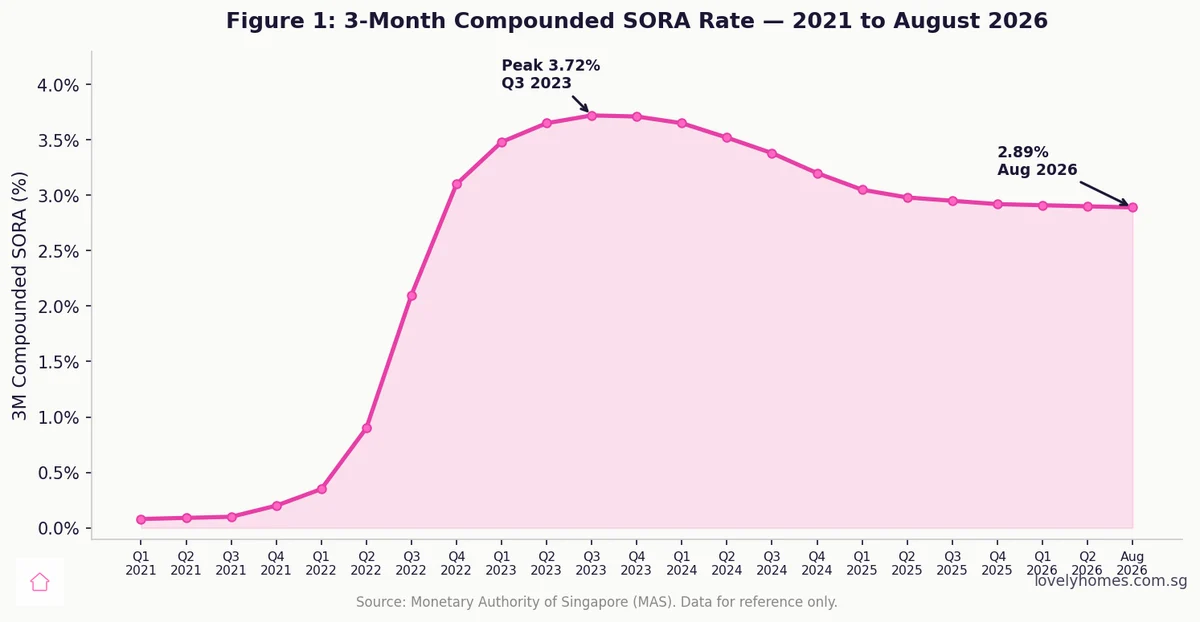
  • The 3-Month Compounded SORA rate stood at approximately 2.89% as at August 2026, down from its peak of 3.72% in Q3 2023.
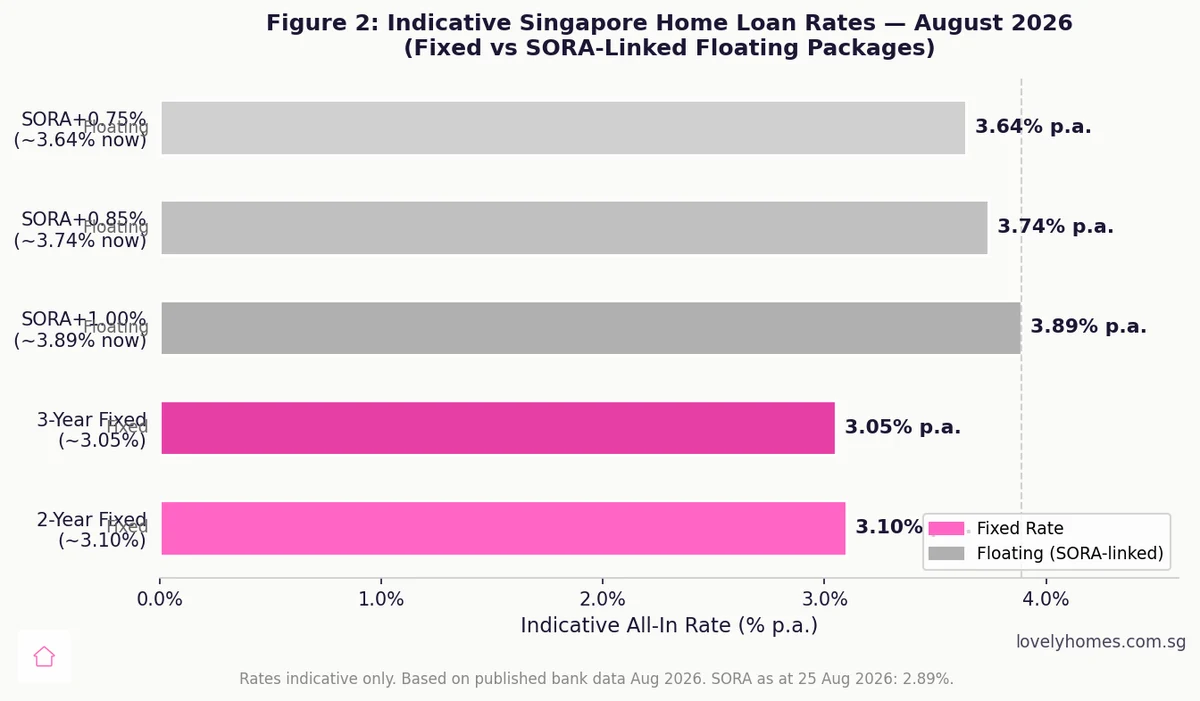
  • Most Singapore home loans are either fixed-rate packages (2–3 year fixed at ~3.05%–3.10% p.a.) or SORA-linked floating packages (SORA + bank spread of 0.75%–1.00%).
  • SIBOR and SOR — the old benchmarks — are gone. SIBOR was discontinued on 31 December 2024; all floating-rate mortgages now use SORA.
  • MAS publishes SORA daily based on actual overnight SGD interbank transactions; it is the official risk-free benchmark for Singapore dollar interest rates.
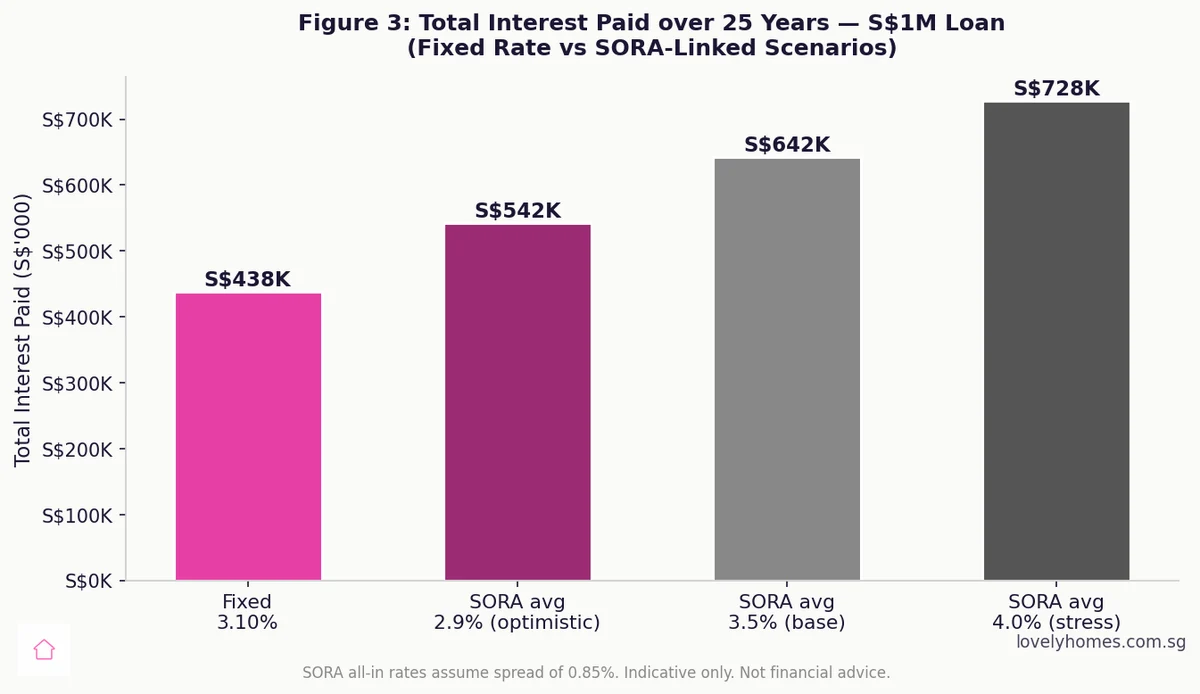
  • For a S$1,000,000 loan over 25 years, each 0.50% difference in average interest rate adds roughly S$70,000–S$80,000 in total interest.
  • The Total Debt Servicing Ratio (TDSR) cap of 55% of gross monthly income applies to all property loans; the Mortgage Servicing Ratio (MSR) of 30% applies only to HDB and EC loans.
  • Refinancing is typically available after the lock-in period expires — usually after 2 or 3 years. A rate differential of 0.30%–0.50% is often cited as a trigger point.

What Is SORA and Why Does It Matter for Your Mortgage?

When you take out a home loan in Singapore, the interest rate you pay is not plucked from thin air. For floating-rate mortgages, it is anchored to a benchmark — and since 2021, that benchmark has been the Singapore Overnight Rate Average (SORA), published daily by the Monetary Authority of Singapore (MAS).

SORA reflects the volume-weighted average rate of actual overnight SGD-denominated interbank lending transactions conducted between 8:00 am and 6:15 pm each business day. Because it is based on real transactions rather than estimates or quotes, it is considered more robust and transparent than its predecessors, SOR (Swap Offer Rate) and SIBOR (Singapore Interbank Offered Rate).

SOR was discontinued on 30 September 2021. SIBOR — once Singapore’s dominant floating-rate benchmark for mortgages — was retired on 31 December 2024. Since then, all new floating-rate home loans in Singapore are SORA-based. If you are on an existing SIBOR loan, your bank will have transitioned you to SORA by the end of 2024.

Understanding SORA — how it moves, how it feeds into your monthly repayment, and how it compares to fixed-rate packages — is essential knowledge for any Singapore home buyer or property owner refinancing in 2026.

Singapore SORA mortgage rate trend 2021 to 2026 — 3-month compounded rate chart
Figure 1: 3-Month Compounded SORA rate trend from 2021 to August 2026. Source: MAS.

How SORA-Linked Home Loans Work

Your SORA-linked mortgage rate is expressed as: Compounded SORA + bank spread. The compounded SORA is typically the 3-month or 1-month compounded average, lagged by a brief period (usually two business days). The bank spread — sometimes called the bank margin — is fixed for the loan term and reflects the bank’s cost of funds, operational margin, and competitive positioning. It typically ranges from 0.75% to 1.00% for residential loans.

So if the 3-Month Compounded SORA is 2.89% and your spread is 0.85%, your all-in rate is 3.74% per annum. This rate resets periodically — typically every quarter for a 3-month SORA product — meaning your monthly repayment can change when SORA moves.

Lock-in Period and Clawback Clauses

Most floating-rate SORA packages come with a lock-in period of one to three years. During this period, full or partial prepayment attracts a clawback penalty — typically 1.50% of the outstanding loan amount. Refinancing to another bank is also restricted until the lock-in expires. Once the lock-in ends, you are free to refinance or reprice without penalty (though repricing within the same bank may involve a fee of around S$500–S$800).

Fixed-Rate Packages: Payment Certainty at a Premium

Fixed-rate mortgage packages in Singapore offer a guaranteed interest rate for a defined period — typically 2 or 3 years — after which the loan reverts to a floating rate (usually SORA-linked or the bank’s board rate). As at August 2026, indicative 2-year fixed rates from major Singapore banks sit at around 3.10% per annum, while 3-year fixed packages are priced at approximately 3.05%.

Fixed rates are attractive when SORA is expected to rise, or when a borrower simply cannot tolerate payment volatility. The trade-off is that you pay a premium for certainty — if SORA falls significantly, you will pay more in interest than a floating-rate borrower. In a declining rate environment, floating borrowers benefit first.

Singapore home loan fixed rate vs SORA floating rate comparison August 2026
Figure 2: Indicative Singapore home loan rates — fixed vs SORA-linked floating, August 2026.

TDSR, MSR and How They Affect Your Loan Quantum

Before any bank will approve your home loan, it runs two key affordability tests mandated by MAS:

Ratio Full Name Cap Applies To
TDSR Total Debt Servicing Ratio 55% All property loans
MSR Mortgage Servicing Ratio 30% HDB flat and EC loans only

The TDSR counts all monthly debt obligations — including credit card minimum payments, car loans, student loans, and the proposed mortgage — as a percentage of your gross monthly income. Banks typically apply a stress-test rate of 4.50% (or the actual contract rate plus 1.00%, whichever is higher) when computing affordability. This stress test ensures borrowers can still service their loans if rates rise materially.

Summary: Fixed Rate vs Floating SORA — At a Glance

Factor Fixed Rate SORA Floating
Rate certainty High — rate locked for 2–3 years Low — resets quarterly
Current all-in rate (Aug 2026) ~3.05%–3.10% p.a. ~3.64%–3.89% p.a.
Benefits when rates fall No — locked in at higher rate Yes — repayment drops
Benefits when rates rise Yes — protected for lock-in period No — repayment rises
Typical lock-in period 2–3 years 1–2 years
Refinancing flexibility After lock-in expires After lock-in expires
Best suited for Risk-averse borrowers; rising-rate environment Rate-savvy borrowers; falling-rate environment

Worked Example: Mr and Mrs Kumar’s Condo Purchase

Profile: Mr and Mrs Kumar, both Singapore Citizens. Combined gross monthly income: S$15,000. No existing loans. Purchasing a 3-bedroom condo in Queenstown for S$1,800,000 — their first residential property.

Stamp duties:

  • Buyer’s Stamp Duty (BSD): S$1,800,000 at progressive rates → S$58,600 (1% on first S$180K = S$1,800; 2% on next S$180K = S$3,600; 3% on next S$640K = S$19,200; 4% on next S$500K = S$20,000; 5% on remainder S$300K = S$15,000)
  • Additional Buyer’s Stamp Duty (ABSD): 0% — first residential property for SC

Bank loan: 75% LTV → S$1,350,000 loan. Over 25 years.

Scenario A — Fixed rate 3.10%: Monthly repayment = S$1,350,000 × [0.031/12 / (1 − (1+0.031/12)^{−300})] ≈ S$6,461/mth. TDSR = S$6,461 / S$15,000 = 43.1% — comfortably within the 55% cap.

Scenario B — SORA floating (SORA 2.89% + spread 0.85% = 3.74% all-in): Monthly repayment ≈ S$6,921/mth. TDSR = 46.1% — still within cap, but S$460/mth more than the fixed option at current rates.

Total interest difference over 25 years: If SORA averages 3.00% over the loan tenure (spread 0.85% = all-in 3.85%), total interest under floating ≈ S$779,000 vs fixed at S$638,000 — a difference of ~S$141,000 favouring the fixed rate in this scenario. However, if SORA falls to average 2.00%, the floating borrower pays only ~S$640,000 in total interest — roughly the same.

Singapore home loan total interest paid over 25 years fixed rate vs SORA scenarios
Figure 3: Total interest paid over 25 years on a S$1M loan — fixed rate vs SORA-linked scenarios.

What This Means for You: Choosing in 2026

As at August 2026, fixed-rate packages are priced below current all-in SORA floating rates — a reversal of the situation seen in 2021 and early 2022 when SORA was near zero. This makes fixed rates comparatively attractive right now. The decision, however, depends on your view of where SORA will move over your intended holding period.

MAS has maintained a tight monetary policy stance through 2025 and into early 2026 via its exchange rate-based approach, which has contributed to SORA remaining above 2.80%. If global rate-cutting cycles (particularly by the US Federal Reserve) gain pace in late 2026 and 2027, SORA could drift lower — benefiting floating borrowers. If inflation proves sticky, SORA may remain elevated and fixed-rate borrowers will be better positioned.

A pragmatic approach: if your lock-in period is 2 years, a fixed-rate package lets you review the situation in late 2028 when the macro picture may be clearer. If cash-flow certainty is paramount — for example, if your TDSR is tight or your household income is variable — a fixed rate reduces financial stress.

Refinancing: When and How

Most borrowers refinance at the end of their lock-in period. A common rule of thumb is to consider refinancing when the new package offers a rate at least 0.30%–0.50% lower than your current effective rate, and you have more than 10 years remaining on the loan (so the interest savings outweigh transaction costs). Legal and valuation fees for refinancing typically run S$2,500–S$4,500. Some banks offer cashback refinancing packages that cover part of these costs.

Note that your new bank will re-apply the TDSR stress test at the point of refinancing. If your income has fallen or you have taken on additional debts since your original loan, you may find your approved loan quantum reduced.

What Might Come Next for SORA and Mortgage Rates

Speculating on rate movements is inherently uncertain. What we can say is that MAS has signalled a data-dependent approach, watching Singapore’s core inflation and output gap carefully. Economists polled in mid-2026 expect 3-Month Compounded SORA to remain in the 2.70%–2.90% range through the end of 2026, with potential for a slow decline toward 2.40%–2.60% through 2027 if the US Federal Reserve cuts rates by a cumulative 75–100 basis points. That said, these are forecasts — not commitments — and the actual path could deviate significantly.

Borrowers should stress-test their affordability at rates at least 1.00% above current levels before committing to a floating-rate package, and should read the fine print of any lock-in clauses carefully before signing.

Frequently Asked Questions

What is the difference between SORA and SIBOR?

SIBOR (Singapore Interbank Offered Rate) was a quote-based benchmark derived from rates that banks said they would lend at — not necessarily rates from actual transactions. It was discontinued on 31 December 2024. SORA is transaction-based, computed from overnight interbank lending that actually took place, making it more transparent and manipulation-resistant. MAS publishes SORA daily on its website.

Can I switch from a SORA loan to a fixed-rate loan mid-term?

Within the lock-in period, switching incurs a clawback penalty (typically 1.50% of the outstanding loan amount). After the lock-in expires, you can reprice within the same bank or refinance to a different bank. Some banks allow a one-time repricing during the lock-in for a flat fee, but this is product-specific. Read your facility letter carefully.

Is the stress-test rate the same as the actual loan rate?

No. Banks compute your TDSR using a stressed interest rate — typically 4.50% or the contract rate plus 1.00%, whichever is higher. This is a regulatory requirement by MAS to ensure that borrowers can service their loans even if rates rise. Your actual monthly repayment is calculated using the contract rate (e.g. 3.10% for fixed, or SORA + spread for floating).

How does the MSR differ from the TDSR?

The Mortgage Servicing Ratio (MSR) applies only to loans for HDB flats and Executive Condominiums. It caps monthly mortgage repayments at 30% of gross monthly income — stricter than the TDSR’s 55% cap. The TDSR applies to all property loans and includes all debt obligations (not just the mortgage). For private condominiums, only TDSR applies; for HDB/EC, both TDSR and MSR apply, and the tighter of the two governs.

Can I use CPF to repay my mortgage?

Singapore Citizens and Permanent Residents can use their CPF Ordinary Account (OA) savings to service monthly mortgage instalments for HDB flats and private residential property, subject to the CPF Valuation Limit and Withdrawal Limit rules. There is a key condition: if the remaining lease of the property cannot cover the youngest buyer to age 95, CPF usage is pro-rated or disallowed. Foreigners cannot use CPF.

What is the maximum loan tenure for a Singapore home loan?

For HDB loans: maximum 25 years (or up to age 65, whichever is shorter). For bank loans on HDB flats: maximum 25 years. For bank loans on private property: maximum 30 years (or up to age 75). Loan tenures above 25 years for HDB or above 30 years for private property attract a lower LTV cap of 55% (instead of 75%).

Where can I find the daily SORA rate?

MAS publishes SORA on its website at mas.gov.sg/monetary-policy/sora. The page shows the overnight rate and the 1-month, 3-month, and 6-month compounded averages. Banks use the 3-month compounded SORA as the standard reference for most residential home loan packages.

Disclaimer: This article is intended for general informational purposes only and does not constitute financial, legal, or tax advice. Interest rate information is indicative as at August 2026 and is subject to change without notice. SORA figures are sourced from the Monetary Authority of Singapore (MAS) at mas.gov.sg. CPF rules are published by the CPF Board at cpf.gov.sg. Always consult a licensed financial adviser and your bank’s mortgage specialist before making any borrowing decisions.
×

Click anywhere outside to close

Singapore Property Market Outlook 2027

Singapore Property Market Outlook 2027

⚡ Quick Answer — Singapore Property Market Outlook 2027

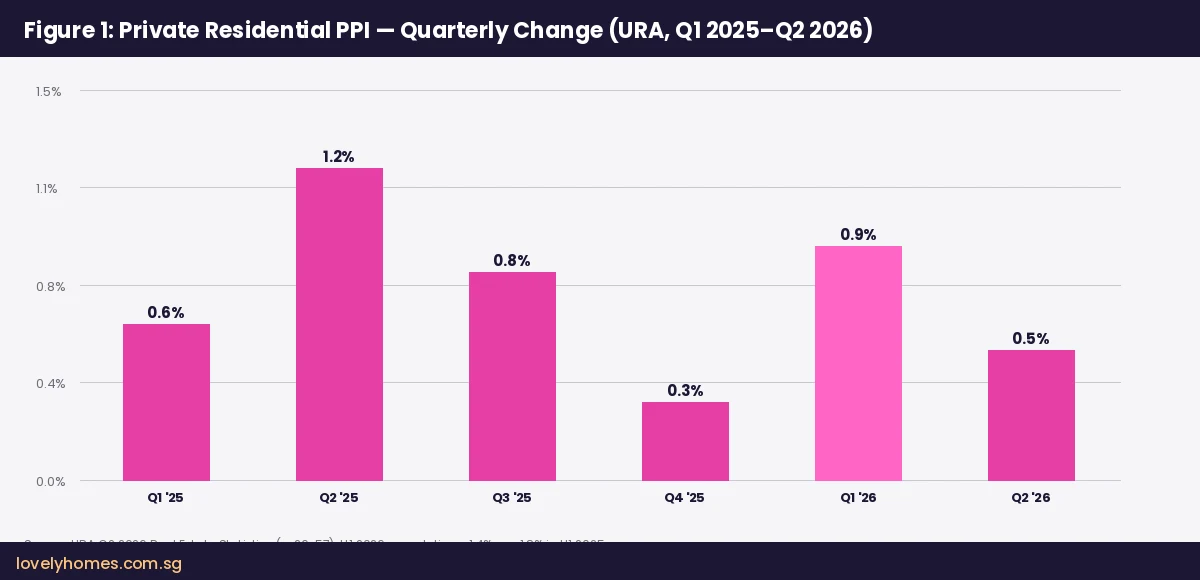
  • The URA’s private residential Property Price Index (PPI) rose 0.5% in Q2 2026, slowing from 0.9% in Q1. Cumulative H1 2026 growth of 1.4% is below the 1.8% in H1 2025.
  • Landed property rebounded strongly at +2.5% in Q2, while non-landed prices eased slightly by -0.1% — a divergence driven by scarcity of landed land.
  • The Core Central Region (CCR) is the only non-landed segment still rising (+1.8% in Q2), supported by foreign capital and prime upgrader demand.
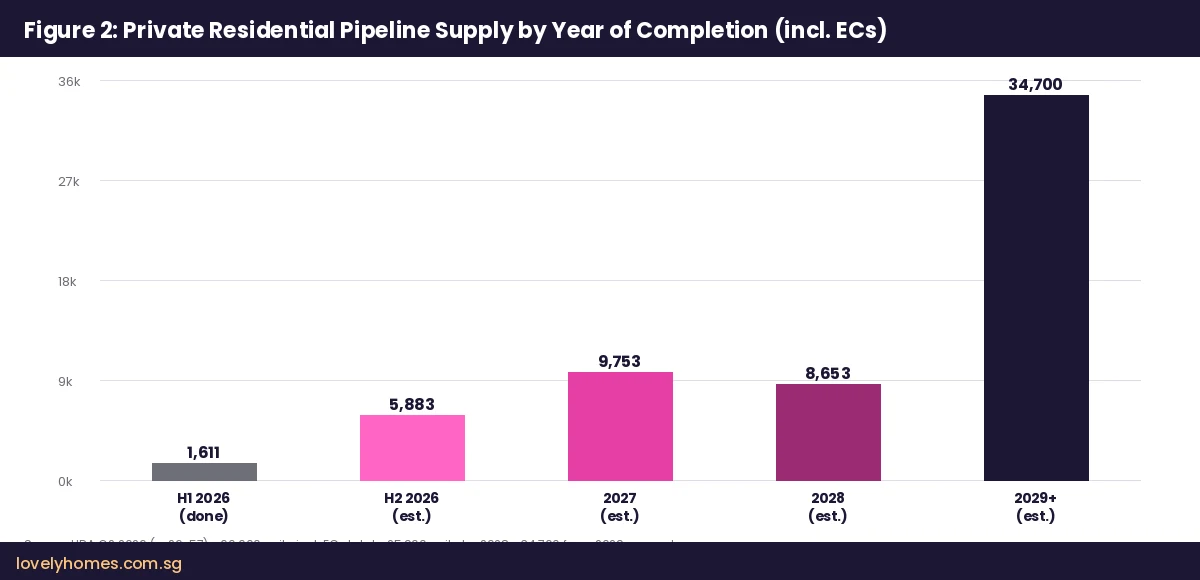
  • ~60,600 private residential units (incl. ECs) are expected to complete in the coming years; roughly 9,750 units are due in 2027 alone.
  • The vacancy rate rose to 6.4% in Q2 2026 and is expected to climb further as completions accelerate in 2027, which may moderate rental growth.
  • HDB resale prices eased 0.3% in Q2 2026 — the first quarterly slip in several years — as a wave of MOP-cleared flats enters the market.
  • The IMF forecasts Singapore’s GDP growth at 3.5% in 2026 and 2.7% in 2027; slower growth typically tempers speculative property demand.
  • Consensus outlook for 2027 private residential prices: +1% to +3%, with wide variance depending on US rates, trade conditions, and cooling measure adjustments.

The Singapore Property Market in Context

Singapore’s private residential property market has been one of the most resilient in the Asia-Pacific region. Even through successive rounds of cooling measures since 2009 — including landmark Additional Buyer’s Stamp Duty (ABSD) rate hikes in April 2023 and September 2022 — prices have continued their long-run upward trajectory. The Urban Redevelopment Authority (URA) oversees the market through its quarterly price index releases, Government Land Sales (GLS) programme, and planning regulations that constrain new supply.

As at August 2026, the market is entering a new phase: one defined by meaningful supply delivery, softening rental momentum, and a more cautious macroeconomic backdrop. Understanding the data from H1 2026 is the starting point for any view on 2027.

Private Residential Prices — The H1 2026 Snapshot

The URA’s Q2 2026 Real Estate Statistics, released on 24 July 2026, confirmed a further moderation in price growth. The overall private residential PPI grew 0.5% in Q2 2026, down from 0.9% in Q1 2026. This brings the cumulative gain for H1 2026 to 1.4%, below the 1.8% recorded in the same period of 2025. The direction of travel is clear: price growth is slowing, but the market has not turned outright negative on an overall basis.

Rental momentum provides additional context. Residential rentals rose 0.7% in Q2 2026 (following +0.3% in Q1), driven by landed rentals (+2.7%) while non-landed rentals grew a more modest 0.4%. The vacancy rate for completed non-landed private property rose from 6.2% in Q1 to 6.4% in Q2 — a signal that supply is catching up with occupied demand.

Singapore private residential PPI quarterly change Q1 2025 to Q2 2026 — LovelyHomes
Figure 1: Singapore private residential PPI quarterly change Q1 2025–Q2 2026 (Source: URA pr26-57, 24 July 2026)

Landed vs Non-Landed: A Diverging Story

The headline PPI masks a significant divergence within the private residential market. Landed property — comprising terrace houses, semi-detached homes, bungalows and Good Class Bungalows (GCBs) — rebounded sharply to +2.5% in Q2 2026 after a brief -0.4% dip in Q1. This rebound reflects the structural scarcity of landed supply in Singapore, where the total landed stock barely grows and GCBs are restricted to Singapore Citizens. Landed residential land simply cannot be replicated at scale, giving the segment a long-term price floor.

Non-landed properties, by contrast, dipped 0.1% in Q2 2026 against the +1.3% in Q1 — a clear signal of easing demand relative to supply. Breaking this down by region tells an important story. The Core Central Region (CCR), comprising Districts 9, 10, 11, Downtown Core and Sentosa, saw non-landed prices rise 1.8% in Q2 (up from +0.6% in Q1). The Rest of Central Region (RCR) fell 1.2% (from +0.8% in Q1). The Outside Central Region (OCR), which makes up the bulk of mass-market volume, dipped 0.1% (from +2.2% in Q1).

The OCR shift is particularly noteworthy. The OCR saw the strongest gains through 2024 and early 2025 as buyers priced out of the CCR moved into mass-market condominiums in Tengah, Tampines, Woodlands and Punggol. That momentum is now moderating as a wave of new completions enters the market and TDSR constraints cap affordability at prevailing income levels.

Supply Pipeline: What Is Coming in 2027

The URA’s pipeline data as at end Q2 2026 confirms the extent of coming supply. There were 42,472 private residential units (including executive condominiums) with planning approval, of which 15,810 remained unsold by developers. A further 18,153 units without planning approval included the 4,745 units on the Confirmed List of the GLS programme for H2 2026. The Government has maintained the 2026 full-year Confirmed List at 9,320 units — over 50% above the 10-year annual average — confirming its policy commitment to supply-side stability.

Looking specifically at 2027: approximately 9,753 private residential units are expected to complete that year, compared with approximately 7,494 (1,611 in H1 + 5,883 in H2) units in 2026. This acceleration in completions will put upward pressure on vacancies and moderate the rental price level — a structural shift from the supply drought of 2021–2022 that drove rental spikes of 30%+ in some submarkets.

Singapore private residential pipeline supply by year of completion including ECs — LovelyHomes
Figure 2: Private residential pipeline supply by expected year of completion (incl. ECs), as at end Q2 2026 (Source: URA pr26-57)

Demand Drivers: Employment, Population and Global Capital

Singapore’s property market demand rests on three structural pillars. First, employment and income growth: the labour market has remained tight, with unemployment at historically low levels, supporting mortgage affordability at TDSR-constrained households. The Ministry of Manpower and the Economic Development Board have continued to attract high-value global businesses, keeping expatriate and professional demand for both owner-occupied and rental residential stock elevated.

Second, population and household formation: Singapore’s resident population has grown steadily, and the government’s ongoing public housing programme cannot fully absorb demand for private residential living among higher-income residents. The permanent resident community, at around 550,000, provides a significant pool of buyers eligible for private property on day one of obtaining PR status.

Third, global capital allocation: Singapore functions as a regional wealth management and family office hub. Ultra-high-net-worth individuals (UHNWIs) from Southeast Asia, mainland China, India and beyond have established Singapore as a base, driving demand for GCBs, CCR condominiums and District 9/10 landed properties. While the 60% ABSD rate for foreigners introduced in April 2023 has sharply reduced individual foreign buyer volumes, institutional and family office-channelled demand has continued through Singapore Citizens and permanent residents.

HDB Resale: Supply Pressure in 2026 and Beyond

HDB resale prices eased 0.3% in Q2 2026, according to HDB’s flash data — the first quarterly decline in several years. This is primarily a supply story. Approximately 13,484 HDB flats reached their five-year Minimum Occupation Period (MOP) in 2026, adding a large cohort of eligible resale supply to the market. At the same time, HDB plans to launch approximately 7,960 new BTO flats in the October 2026 sales exercise (covering towns including Bedok, Geylang, Sembawang, Tengah, Toa Payoh and Yishun), providing buyers with additional alternatives to the resale market.

The interaction between the HDB and private property market is direct. HDB upgraders — SC households exercising their HDB flat equity to purchase private properties — are among the largest buyers of new-launch condominiums in the OCR. If HDB resale prices remain flat or continue to ease, upgrader equity is constrained, reducing the pool of cash-equipped buyers for OCR new launches. This downward transmission effect is one reason why OCR private prices softened in Q2 2026.

The Key Market Metrics at a Glance

Metric H1 2026 (Actual) Full Year 2025 (Ref.) 2027 Consensus Est.
Private PPI Growth (half-year) +1.4% +1.8% H1 / ~3.0% FY +1.0%–3.0% (full year)
Developer Launches ~3,627 units ~10,000 units ~9,000–11,000 units
Developer Sales ~4,154 units ~8,600 units ~8,000–10,000 units
Resale Transactions ~7,038 units ~16,200 units ~14,000–16,000 units
Vacancy Rate (non-landed) 6.4% (Q2) ~6.0% 6.5%–7.0% (rising supply)
Rental Index Growth +1.0% cumulative +0.5% FY +1%–2% (moderating)
HDB Resale Price Growth -0.3% Q2 (easing) +3.8% FY 0%–2%
GLS Confirmed List Units 4,575 (H1) ~8,000 Subject to H2 2026 review
Pipeline (unsold, approved) 15,810 units ~18,000 Declining as launches clear
Vacancy (CCR / RCR / OCR) 8.3% / 6.1% / 5.6% ~8.0% / 5.8% / 5.0% Rising modestly in all

Macroeconomic Wild Cards for 2027

Several macro factors will shape the 2027 outlook. The IMF projects Singapore’s GDP growth at 3.5% in 2026, slowing to 2.7% in 2027 — a meaningful deceleration driven by global trade uncertainty, softening demand from major trading partners, and the knock-on effects of US Federal Reserve monetary policy on regional capital flows. A sustained high-rate environment in the United States keeps the opportunity cost of holding leveraged Singapore property elevated, even with SORA-based mortgages running at approximately 3.4% in mid-2026.

Currency dynamics also matter: a stronger Singapore dollar relative to the Chinese yuan, Indian rupee and regional currencies reduces the purchasing power of foreign-origin UHNWIs — a secondary factor given Singapore’s position as a wealth management hub. Conversely, any softening of the ABSD regime for foreigners (currently 60%, introduced April 2023) could trigger a sharp uptick in CCR demand; however, there are no public signals that this is imminent.

Finally, the Government’s track record of preemptive calibration must be accounted for. Singapore has adjusted cooling measures eight times since 2009 — both tightening and easing — in response to market conditions. Any sharp price acceleration in 2027 would likely prompt further supply-side or demand-side measures; any sustained downturn could trigger targeted relaxation.

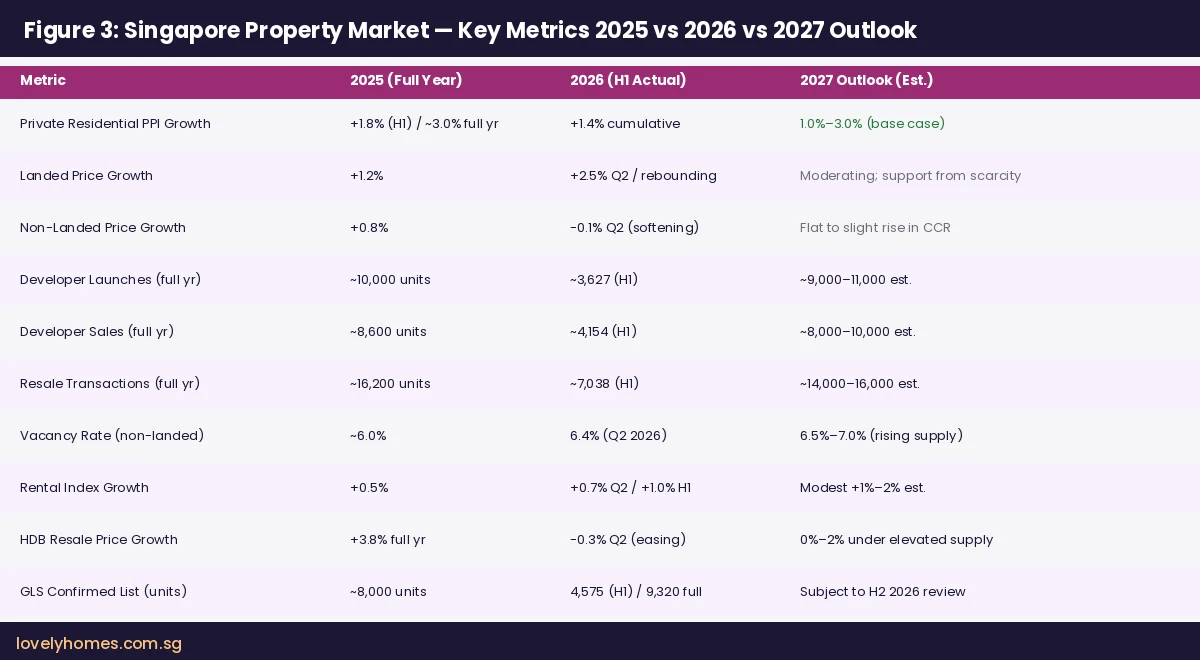
Singapore property market key metrics 2025 vs 2026 vs 2027 outlook comparison table — LovelyHomes
Figure 3: Singapore property market key metrics — 2025, 2026 H1, and 2027 consensus outlook (Sources: URA, Cushman & Wakefield, IMF)

Worked Example: A 2027 Purchase Decision

📈 Case Study: Mr and Mrs Lau — Buying a 3BR OCR Condo in Early 2027

Profile: Mr and Mrs Lau, both Singapore Citizens, ages 38 and 36. Combined gross monthly income S$16,000. First-time private property purchase. Target: 3BR OCR resale condo, Sengkang or Punggol, projected price S$1,750,000 in early 2027.

Buyer’s Stamp Duty (BSD):
First S$180,000 × 1% = S$1,800
Next S$180,000 × 2% = S$3,600
Next S$640,000 × 3% = S$19,200
Next S$500,000 × 4% = S$20,000
Remaining S$250,000 × 5% = S$12,500
Total BSD: S$57,100. ABSD: S$0 (first property, both SC).

Financing (bank loan, LTV 75%):
Loan amount: S$1,312,500. Stress-test rate 4% over 30 years: monthly instalment ~S$6,265. TDSR: 6,265/16,000 = 39.2% — well within the 55% cap.

Cash outlay at exercise:
5% cash OTP deposit: S$87,500. Balance 20% (CPF OA + cash): S$262,500. BSD: S$57,100. Legal fees: ~S$4,500. Total required capital: approximately S$411,600 (partly from CPF OA).

Rental yield check (if investor): OCR 3BR market rent in Sengkang/Punggol approximately S$4,200–S$4,600/mth (mid-2026 data). Gross yield: ~2.9%–3.1% on S$1.75M — below mortgage carrying cost at 3.4%, implying a negative carry of ~0.3%–0.5% per annum before tax deductions. A long hold (7+ years) and capital appreciation thesis is required for this to be positive-return.

What This Means for Buyers and Investors

For owner-occupiers, the 2027 outlook is cautiously supportive. Price growth is moderating rather than collapsing, and the Government has made clear it will sustain a high level of GLS supply to prevent a speculative boom. Buyers who can comfortably meet TDSR and have genuine long-term holding intent are not buying at a cyclical peak by the standards of Singapore’s property history. OCR condominiums, in particular, may benefit from continued HDB upgrader demand even as individual transactions become more price-sensitive.

For investors, the calculus is more nuanced. Gross rental yields of 2.5%–3.5% remain below mortgage carrying costs in most OCR segments, meaning residential investment is primarily a capital appreciation play. With the vacancy rate rising and rental growth moderating, investors with short holding periods face negative carry. The CCR — particularly Districts 9 and 10 — offers slightly stronger yield compression dynamics driven by the wealth management clientele, but entry prices are higher and the market is more susceptible to global capital flow shifts.

For HDB upgraders, the sequencing of sale and purchase matters more in 2027 than in prior years: with HDB resale prices plateauing and OCR private prices also moderating, the relative exchange rate between the two markets is more favourable for upgraders who sell HDB and buy OCR private. Timing the HDB sale to maximise equity extraction while avoiding the 3-year SSD window on any private property they already own will be the key planning challenge.

What Might Come Next — Looking Beyond 2027

This section represents editorial analysis and is not a forecast or guarantee of future performance.

Singapore’s long-run property market is shaped by three structural forces that are unlikely to reverse: land scarcity, population policy (the government continues to attract global talent), and the city-state’s role as a regional financial hub. These factors argue for a moderate upward drift in prices over any five-to-ten year period, punctuated by policy-induced cooling episodes.

The near-term risk to watch in 2027 is an overshoot in vacancy. If the approximately 9,753 completions due in 2027 arrive into a market where rental demand growth is decelerating — driven by cooling global tech sector hiring and a slower inflow of new employment pass holders — vacancy could push toward 7.5%–8% in the non-landed private segment. Landlords would face downward rental pressure, reducing carrying returns for investors and potentially triggering resale by over-leveraged owners.

The URA’s Q3 2026 flash estimates, expected in October 2026, will be the next major data point. Any acceleration in prices would likely prompt a GLS supply response; any continued softening may prompt a relaxation of the 15-month wait-out period for private-to-HDB purchasers (introduced July 2023), which was already removed in July 2026 for most cases. Watch this space.

Frequently Asked Questions

Will Singapore private property prices fall in 2027?

A broad-based price decline is not the base-case scenario under current data. The market has seen price growth slow — from +1.8% in H1 2025 to +1.4% in H1 2026 — but not turn negative on the overall PPI. Specific submarkets such as RCR (-1.2% in Q2 2026) have already seen quarterly softening. Whether 2027 produces a full-year decline depends heavily on global interest rates, Singapore’s GDP trajectory, and whether the Government adjusts cooling measures. Most industry analysts see a range of +1% to +3% for the full year 2027, with a flat or marginally negative outcome possible if macro conditions deteriorate sharply.

What is the current TDSR cap and how does it affect my borrowing?

The Total Debt Servicing Ratio (TDSR) is set by the Monetary Authority of Singapore (MAS) at 55% of gross monthly income for all property loan applications. It includes all debt obligations — mortgage, car loans, personal loans, credit card minimum payments, and any guarantor arrangements. The stress test for residential property loans requires the bank to apply a minimum rate of 4% per annum when calculating whether the TDSR is met, regardless of the actual prevailing rate. For a household earning S$12,000/mth, the maximum total monthly debt is S$6,600; if the only debt is the new mortgage, the maximum loan supported is approximately S$1,385,000 on a 30-year term at 4% stress-test rate.

Is now a good time to buy private property in Singapore?

This depends entirely on your financial position, holding period and purpose. For long-term owner-occupiers with stable income and a 10+ year horizon, Singapore residential property has historically delivered positive real returns after accounting for ABSD, BSD, maintenance and mortgage interest. For investors with a 3–5 year horizon, the current rent-to-price yield of 2.5%–3.5% in most segments is below mortgage carrying cost, implying negative carry. Anyone buying primarily for short-term capital gain faces meaningful risk given the slowing price growth environment and the Seller’s Stamp Duty (SSD) applicable to properties sold within 3 years. Always take advice from a licensed financial adviser before any major purchase.

What happens to property prices if interest rates fall in 2027?

Lower interest rates reduce mortgage servicing costs and improve TDSR-affordability, which typically expands the pool of eligible buyers and supports price growth. Since Singapore mortgages are predominantly SORA-linked (3-month SORA was approximately 2.55% in mid-2026), any US Federal Reserve rate cuts would transmit into Singapore lending rates over a 3–6 month lag. However, the government has historically offset rate-driven demand surges with cooling measures (GLS supply increases, ABSD tightening) to prevent a speculative boom. A fall in rates is therefore unlikely to produce a sustained price acceleration unless the Government simultaneously relaxes demand-side measures.

How does the GLS programme affect 2027 supply?

The Government Land Sales (GLS) programme is the primary mechanism by which the URA manages private residential supply. The Confirmed List for the full year 2026 is 9,320 units — over 50% above the 10-year annual average. These units, once tendered and developed, will complete approximately 3–4 years later, adding to the 2029–2030 delivery pipeline. The H2 2026 Confirmed List of 4,745 units was released in the June 2026 GLS announcement and includes sites in areas such as Marina Gardens Lane and Orchard Boulevard. The GLS Reserve List provides additional potential supply if developer demand justifies activation through competitive bids.

Should I wait for cooling measures to be lifted before buying?

Waiting for cooling measure relaxation is a timing strategy that carries its own risks. When cooling measures have been relaxed in the past — for example, the partial SSD reduction in March 2017 — prices responded quickly as pent-up demand was released. By the time a relaxation is announced and implemented, the best-value units may already be under offer. Additionally, there is no certainty on the timing of any relaxation: the Government has consistently stated that measures will be calibrated to market conditions, which means relaxation only occurs when the market has already moderated. Buying at moderation (today) may be preferable to waiting for a signal that pushes prices back up. Personal holding capacity and purpose remain the deciding factors.

How does the 2027 pipeline compare to historical supply?

The approximately 9,753 private residential units (incl. ECs) expected to complete in 2027 is significantly above the completion volumes of 2021 and 2022, when fewer than 7,000 units were delivered annually due to COVID-19 construction delays. The post-COVID catch-up delivery, combined with the sustained GLS programme since 2022, means 2026–2028 will see above-average supply. Historical completions of 14,000–18,000 units per year occurred in the 2015–2017 cycle; the current 2026–2028 cycle, at approximately 7,500 to 9,750 per year, is moderate rather than aggressive by Singapore standards. This context is important: even elevated 2027 completions do not represent the extreme oversupply scenarios seen in some other global markets.

Disclaimer: This article is for general informational purposes only and does not constitute financial, investment or legal advice. Property market outlooks and forecasts are inherently uncertain; actual market outcomes may differ materially from any projections expressed here. All figures are sourced from publicly available data published by URA, HDB, MAS and international organisations including the IMF. Readers should conduct their own due diligence and consult a licensed financial adviser, mortgage broker or property professional before making any purchase or investment decision. Official data can be accessed at ura.gov.sg, hdb.gov.sg and mas.gov.sg.
×

Click anywhere outside to close
Singapore Property Conveyancing Process Guide 2026: Legal Fees, Timeline and Due Diligence

Singapore Property Conveyancing Process Guide 2026: Legal Fees, Timeline and Due Diligence

Quick Answer — Property Conveyancing Singapore 2026: Key Takeaways

  • Conveyancing is the legal process of transferring property ownership from seller to buyer; in Singapore it is governed by the Conveyancing and Law of Property Act (Cap. 61) and conducted by licensed solicitors registered with the Law Society of Singapore.
  • For private residential property, the buyer and seller each engage their own solicitors; for HDB resale flats, HDB’s in-house legal team handles the registration, though buyers may seek independent advice.
  • The typical private property conveyancing timeline is 8 to 12 weeks from OTP exercise to completion (key collection); the full process from OTP issue to keys is typically 10 to 14 weeks.
  • Buyer’s legal fees follow the Law Society conveyancing fee scale: approximately S$2,800–S$6,200 all-in (legal fees plus disbursements plus 9% GST) for most residential transactions.
  • A caveat must be lodged with the Singapore Land Authority (SLA) within 14 days of exercising the OTP to protect the buyer’s interest against subsequent encumbrances.
  • Due diligence searches — title search, CPF charge search, property tax check, URA planning search — are essential and typically cost S$400–S$800 total; your solicitor will conduct these on your behalf.
  • Stamp duty (BSD and ABSD) is payable to IRAS within 14 days of signing the OTP or sale and purchase agreement, whichever is earlier.

What Is Property Conveyancing?

Property conveyancing is the legal transfer of ownership of real property from one party to another. In Singapore, every residential and commercial property transaction — whether a resale private condominium, a HDB flat, a landed house, or a strata office unit — involves a conveyancing process governed primarily by the Conveyancing and Law of Property Act (Cap. 61) and the Land Titles Act (Cap. 157). The process encompasses drafting and reviewing the sale and purchase agreement, conducting due diligence searches on the title, managing stamp duty compliance, coordinating the drawdown of housing loans and CPF funds, lodging the transfer instrument with the Singapore Land Authority (SLA), and completing the financial settlement between the parties.

Conveyancing in Singapore is performed by advocates and solicitors who are members of the Law Society of Singapore. The Law Society publishes a non-binding conveyancing fee scale — the Conveyancing Scale — which most firms use as a guide, though fees are ultimately negotiable. Many law firms offer fixed conveyancing packages for straightforward residential transactions.

Unlike some jurisdictions where buyers can conveyance themselves (“DIY conveyancing”), Singapore does not permit this for property transactions where a mortgage is involved or where CPF funds are used. Even for cash purchases, the complexity of SLA registration and due diligence searches makes engaging a solicitor strongly advisable.

The Conveyancing Process for Private Residential Property

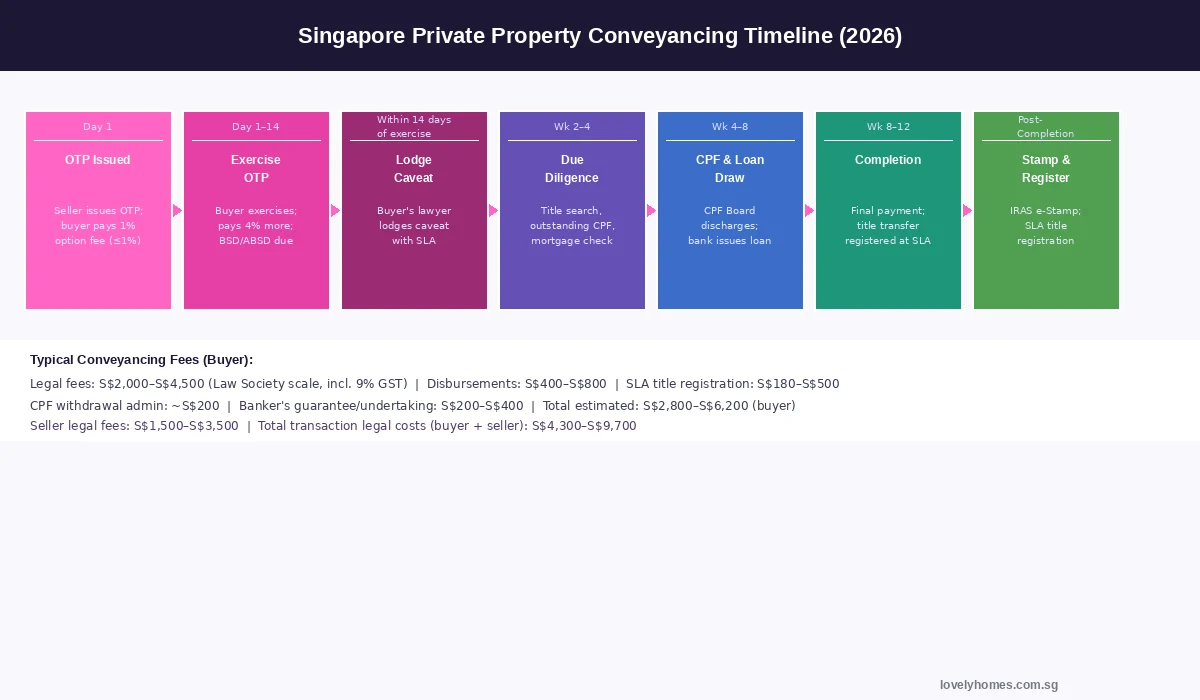
Singapore private property conveyancing timeline 7 steps from OTP to completion
Figure 1: Singapore Private Property Conveyancing Timeline — From OTP to Title Registration (2026)

Step 1 — Option to Purchase (OTP)

The conveyancing process begins when the seller grants the buyer an Option to Purchase. In Singapore, the OTP for private residential property is typically drafted on the standard Law Society option form (or a developer’s standard form for new launches). The buyer pays the seller an option fee, usually 1% of the agreed purchase price, to secure the OTP. The OTP grants the buyer an exclusive right to purchase the property within the option period — typically 14 calendar days, though parties may agree on a longer period (often up to 21 days for resale private property).

During the option period, the buyer should immediately instruct a solicitor, who will commence preliminary due diligence and advise on any issues. The seller’s solicitor will simultaneously prepare the draft Sale and Purchase Agreement (SPA) or the standard transfer documentation.

Step 2 — Exercising the OTP and Paying Stamp Duty

To exercise the OTP, the buyer signs the acceptance copy and pays the option exercise fee (typically the balance of the downpayment component, often 4% of the purchase price, making a total of 5% paid before the loan drawdown). The signed OTP or SPA is returned to the seller’s solicitor. Buyer’s Stamp Duty (BSD) is payable to IRAS within 14 days of the date of the OTP exercise (or the date of the SPA, whichever is earlier). BSD is calculated progressively: 1% on the first S$180,000; 2% on the next S$180,000; 3% on the next S$640,000; 4% on the next S$500,000; 5% on amounts from S$1.5 million to S$3 million; and 6% on any amount above S$3 million. Additional Buyer’s Stamp Duty (ABSD) is also payable within 14 days if applicable (e.g., 20% for SC purchasing a second property, or 60% for foreigners).

BSD and ABSD are paid via the IRAS e-Stamping portal. Your solicitor will handle this on your behalf.

Step 3 — Lodging the Caveat

Within 14 days of exercising the OTP, the buyer’s solicitor lodges a caveat against the property at SLA. The caveat is a legal notice that the buyer has an interest in the property; it prevents the seller from dealing with the property in a manner inconsistent with the buyer’s right (for example, granting a second mortgage or selling to another party). The caveat lodgement fee at SLA is S$64.45 (as of 2026). If a caveat is not lodged in time and the seller creates a subsequent encumbrance, the buyer’s interest may be defeated. Prompt lodgement is therefore a critical step.

Step 4 — Due Diligence Searches

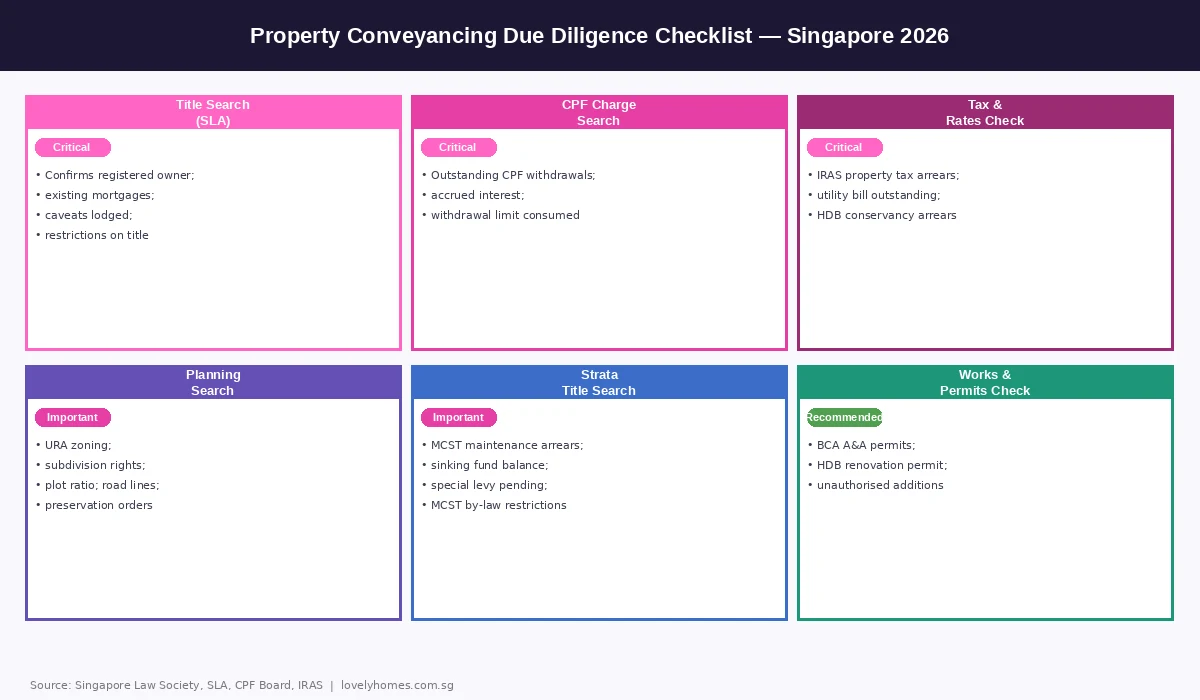
Singapore property conveyancing due diligence checklist title search CPF planning checks
Figure 3: Property Conveyancing Due Diligence Checklist — Critical, Important and Recommended Searches

While the administrative processes proceed, the buyer’s solicitor conducts a suite of due diligence searches:

Title search (SLA): Confirms the seller is the registered proprietor, discloses any existing mortgages, caveats, charges, or restrictions encumbering the title. A property with an undischarged mortgage requires the seller to use the sale proceeds to redeem the mortgage before or on completion. A property with a CPF charge requires the seller to refund their CPF OA withdrawals (plus accrued interest at 2.5% p.a.) to CPF Board upon sale.

CPF charge search (CPF Board): Reveals the total CPF funds withdrawn by the seller and the accrued interest, which must be refunded to the seller’s CPF OA on completion. This affects the net proceeds the seller receives and can have implications for the buyer if the outstanding CPF refund approaches or exceeds the sale price.

Property tax search (IRAS): Confirms whether any property tax, conservancy charges (for HDB), or MCST contributions are in arrears. Unpaid property tax is a charge on the property that runs with the land; the buyer’s solicitor will require that all arrears are cleared before completion.

URA planning search: Reveals the zoning and planning parameters for the property — whether it is zoned residential, the gross plot ratio, road line plans (which may affect the usable area or value), and any preservation or conservation status. For landed property buyers in particular, this search is indispensable to understand development potential.

Strata title search (for condominiums and strata-titled properties): Discloses outstanding MCST maintenance contributions, sinking fund balance, any special levies, and MCST by-law restrictions that may affect the buyer’s use and enjoyment.

Step 5 — CPF Withdrawal and Loan Drawdown

If the buyer is using CPF OA funds, the buyer’s solicitor applies to the CPF Board to approve the withdrawal. CPF Board charges a flat administrative fee of approximately S$200 for the initial drawdown. CPF OA funds can only be applied up to the Valuation Limit (the lower of the purchase price and the property’s assessed valuation) and subject to the Withdrawal Limit (Valuation Limit plus accrued interest, capped at age-related rules). If the buyer is using a bank loan, the bank’s solicitor (who may be the same firm, or a separate firm in a situation of conflict) issues a Solicitor’s Undertaking to the buyer’s solicitor confirming the bank will release the loan proceeds on completion. For HDB loans, HDB directly disburses the loan at the Second Appointment.

Step 6 — Completion

Completion is the point at which the sale is finalised. The buyer pays the outstanding balance of the purchase price (calculated as the purchase price less the 5% option fee already paid, less the loan amount, less CPF OA applied, minus the seller’s CPF refund and outstanding mortgage amounts). Funds are transferred between solicitors via lawyers’ account. The seller delivers vacant possession (unless a tenancy is being taken subject to an existing tenancy) and hands over keys, title documents, and relevant warranties or maintenance manuals. On the same day, the transfer instrument is lodged with SLA for registration, which typically takes one to three working days. Once registered, the buyer is the legal owner of the property.

Step 7 — Post-Completion

After completion, the buyer’s solicitor ensures the title registration is updated at SLA and delivers the original title documents to the buyer (or the bank, if a mortgage is taken). IRAS is notified of the change in ownership for property tax purposes. The buyer should update their residential address with relevant authorities (ICA, IRAS, CPF, banks) and arrange for fire insurance (compulsory for HDB; advisable for private property) and home contents insurance. For condominium buyers, the MCST should be notified of the change in ownership so maintenance fee invoices are redirected.

Conveyancing Fees — What You Pay

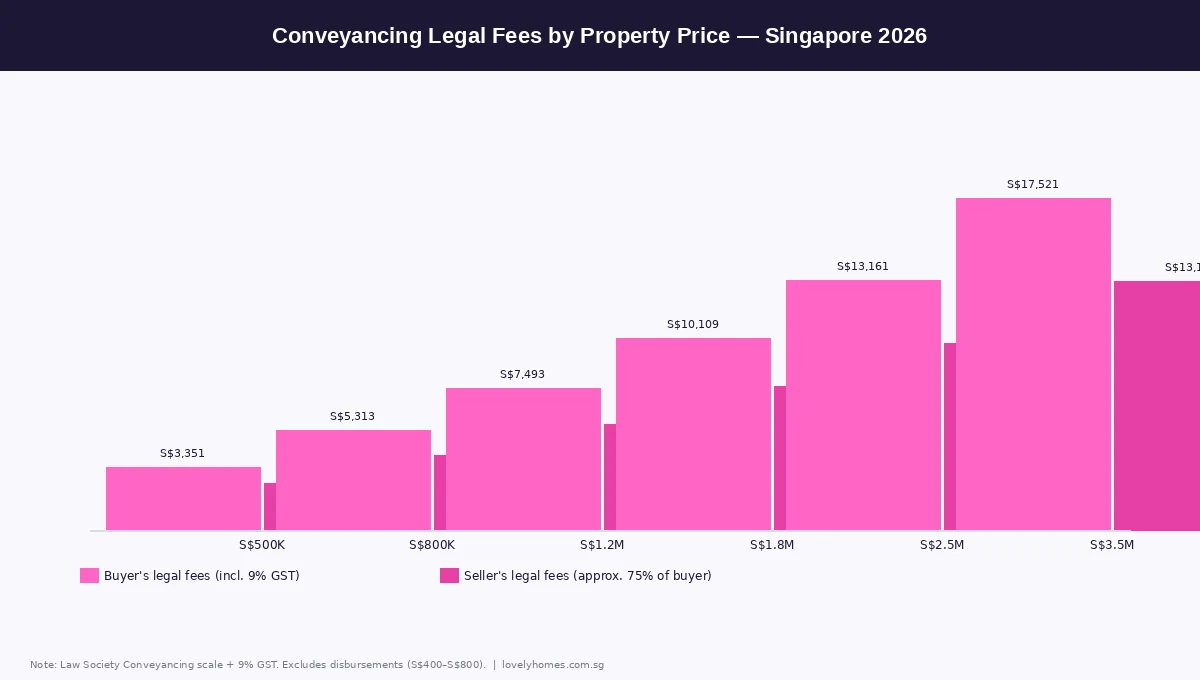
Singapore conveyancing legal fees by property price buyer and seller comparison 2026
Figure 2: Conveyancing Legal Fees by Property Price — Buyer and Seller Comparison, Singapore 2026

The Law Society of Singapore publishes a recommended conveyancing fee scale. The scale applies to the purchase price (or the valuation, whichever is higher). The scale rates are: 0.75% on the first S$30,000; 0.70% on the next S$30,000; 0.60% on the next S$940,000; and 0.40% on any amount above S$1,000,000. These are before GST at 9%. In practice, most law firms offer fixed-fee packages for residential conveyancing, particularly for transactions below S$3 million, so the actual fee quoted may be somewhat below or above the scale for a given transaction.

Disbursements are additional and cover the out-of-pocket expenses incurred by your solicitor on your behalf: SLA lodgement fees (caveat S$64.45, transfer S$180–S$500 depending on value), title search fees (S$8–S$20 per search type), planning search (S$130), CPF Board fees (~S$200), stamp duty (paid to IRAS on your behalf), court filing fees (if relevant), and photocopying and postage. Total disbursements for a standard residential transaction typically range from S$400 to S$800.

For reference, at a purchase price of S$1,200,000, the Law Society scale fee (pre-GST) is approximately S$7,850; at S$1,800,000 it is approximately S$10,250; and at S$2,500,000 it is approximately S$13,250. Adding 9% GST and disbursements, the total buyer’s legal cost at S$1,200,000 is approximately S$8,960–S$9,300; at S$1,800,000 approximately S$11,500–S$11,900. Seller’s legal fees are typically 70–80% of the buyer’s, as the seller’s work is somewhat less involved (no loan drawdown, no CPF application).

Summary — Conveyancing Fees and Disbursements

Item Who Pays Typical Cost Notes
Buyer’s legal fees Buyer S$2,000–S$8,000+ Law Society scale + 9% GST; depends on price
Seller’s legal fees Seller S$1,500–S$6,000+ Approx. 70–80% of buyer’s scale; varies
SLA caveat lodgement Buyer S$64.45 Payable at lodgement; buyer’s solicitor handles
SLA title registration Buyer S$180–S$500 Based on property value; scales up
Title / property search fees Buyer (mainly) S$50–S$300 Multiple searches; included in disbursements
URA planning search Buyer S$130 Essential for landed and larger transactions
CPF Board admin fee Buyer ~S$200 For CPF OA drawdown; once-off on first property
Bank undertaking fee Buyer S$200–S$400 Issued by buyer’s solicitor to bank/HDB
Total (buyer) — S$1.2M property Buyer ~S$3,500–S$9,500 Varies widely by firm and fixed-package deals

HDB Resale Conveyancing — Simplified Process

HDB resale flat conveyancing follows a slightly different path. HDB’s in-house legal team handles the registration of the title transfer, the CPF charge, and the HDB mortgage (if using an HDB loan). Buyers and sellers do not need to engage private solicitors for the straightforward conveyancing work; instead, they submit documents and instructions through HDB’s online Resale Portal. HDB charges an administrative fee (S$80–S$640 depending on flat size) for the processing.

However, buyers are strongly recommended to engage a private solicitor for independent advice if: the transaction involves a sub-sale (selling before TOP); there is a tenancy in place; the seller is a deceased estate; there are disputes or negotiations over conditions of sale; or significant COV is involved. Private solicitors for HDB resale typically charge S$500–S$1,500 for an advisory role, as they are not doing the formal registration work.

Worked Example — Mr and Mrs Ng, D15 Condo Purchase

Scenario

Mr and Mrs Ng are Singapore Citizens purchasing a 2-bedroom resale condominium in District 15 (Marine Parade) for S$1,480,000. They are using a bank loan (LTV 75%) and CPF OA funds. They engage Solicitor A for S$3,800 (fixed package, incl. disbursements, excl. stamp duty).

Key Figures

  • Purchase price: S$1,480,000
  • BSD: 1%×S$180K + 2%×S$180K + 3%×S$640K + 4%×S$480K = S$1,800 + S$3,600 + S$19,200 + S$19,200 = S$43,800
  • ABSD: nil (first property, SC couple)
  • Option fee paid (1%): S$14,800
  • Option exercise fee (4%): S$59,200 (total 5% upfront: S$74,000)
  • Bank loan (75%): S$1,110,000 at 3.40% / 30-year tenure = S$4,908/mth; TDSR: S$4,908 ÷ S$14,000 (combined income) = 35.1% — PASS
  • Balance CPF OA available: S$220,000 (applied towards 20% balance downpayment)
  • Total cash outlay: S$74,000 (DP) + S$43,800 (BSD) + S$3,800 (legal) + S$2,200 (disbursements) = S$123,800

Timeline

OTP issued: 1 August 2026. OTP exercised: 12 August 2026 (day 11 — within 14 days). BSD paid via IRAS e-Stamping: 14 August 2026 (2 days after exercise — within 14 days). Caveat lodged by Solicitor A: 14 August 2026. Title search, CPF charge search, tax search, planning search: 15–22 August 2026. CPF Board application for OA withdrawal: 18 August 2026 (approx. 10–14 working days to approve). Bank loan letter of offer signed: 16 August 2026. Completion date agreed: 14 October 2026 (9 weeks from exercise). SLA title registration: 15 October 2026. Keys collected: 14 October 2026.

Note on Solicitor Selection

Mr and Mrs Ng obtained three quotes. Fixed-package fees ranged from S$2,800 to S$4,500 (all-in excluding stamp duty). They chose a mid-range firm with a dedicated property department, having verified the solicitor’s practising certificate on the Law Society’s Find a Lawyer portal. They explicitly confirmed the scope: quote covered caveat lodgement, full title and search suite, CPF application, SPA review, completion, and SLA registration.

Why This Matters — Conveyancing Protects Your Largest Asset

A residential property is typically the largest single purchase a Singapore household makes. The conveyancing process exists to ensure that the buyer receives a clean, unencumbered title and that the transfer is legally effective and registered. Without proper due diligence, a buyer risks inheriting the seller’s outstanding debts (which run with the property as charges), discovering zoning restrictions that prevent intended use, or finding undisclosed encumbrances that reduce the property’s value or mortgageability.

Singapore’s Torrens title system (introduced via the Land Titles Act) provides strong protection once a title is registered. Under the indefeasibility principle, a bona fide purchaser for value who registers their interest cannot have it set aside by a prior unregistered interest — provided the buyer did not have notice of the prior interest. This underscores the importance of lodging the caveat promptly (to protect against subsequent encumbrances) and completing the registration quickly after completion.

Compared to many other jurisdictions, Singapore conveyancing is relatively streamlined. The electronic SLA system (e-lodgement), IRAS e-Stamping, and CPF’s online disbursement system mean that most steps can be completed electronically with minimal paper. The entire process from exercising the OTP to title registration is typically accomplished within 10 to 14 weeks for a standard resale private property transaction.

What Might Come Next

The legal profession in Singapore has been steadily adopting technology to streamline conveyancing. The Law Society’s conveyancing platform and the SLA’s online systems have already reduced turnaround times substantially. Discussions around further digitisation — including electronic signatures for sale and purchase agreements and blockchain-based title registration — are ongoing at the industry level. It is possible that completion timelines could be compressed further in coming years as digital systems mature. For buyers, this means quicker certainty of title; for sellers, faster receipt of proceeds. These developments will not change the fundamental due diligence requirements, which remain the buyer’s best protection.

Frequently Asked Questions

Do I need a solicitor for an HDB resale flat purchase?

Strictly speaking, you do not need to engage a private solicitor for an HDB resale flat, because HDB’s in-house legal team handles the formal conveyancing work (including registration of the title transfer, HDB mortgage, and CPF charge). Both buyer and seller transact through HDB’s Resale Portal. However, many buyers choose to engage a private solicitor for independent advice, particularly where there is a complex situation such as a divorce, estate matter, dispute over conditions, or significant COV. Private solicitors for HDB resale typically charge S$500–S$1,500 for an advisory role.

Can I use the same solicitor as the seller to save money?

In Singapore, the same firm can act for both buyer and seller in a property transaction only in limited circumstances — where there is no conflict of interest and both parties give informed consent. In practice, most law firms will not act for both parties in a residential property transaction due to the inherent conflicts (particularly around price negotiation and title defects). If you are a buyer, you should engage your own solicitor to ensure your interests are protected independently. For HDB resale, this question does not arise as HDB handles the formal work centrally.

What happens if the seller cannot discharge their mortgage before completion?

If the seller has an existing mortgage over the property, their solicitor will coordinate with the mortgagee bank to discharge the mortgage upon completion using the sale proceeds. The seller’s net proceeds are calculated as: sale price minus outstanding mortgage redemption amount minus CPF refund obligation minus legal fees and agent commission. If the outstanding mortgage and CPF obligations together exceed the sale price (a situation of “negative equity”), the seller must make up the shortfall in cash before completion can proceed. Your solicitor will conduct a title search to identify the seller’s outstanding mortgage early in the process so that these issues are identified promptly.

What is a completion account and how is it calculated?

A completion account is a financial statement prepared by the solicitors shortly before completion, setting out exactly how much money needs to change hands on the day of completion. For the buyer, it shows the balance purchase price (after deducting the option fee already paid, the loan drawdown, and CPF funds applied), plus any adjustments for property tax (apportioned to the date of completion — the buyer takes on property tax from the completion date onwards). For the seller, it shows the sale proceeds net of the outstanding mortgage redemption, CPF refund, legal fees, and agent commission. Both solicitors agree the completion account before completion takes place.

How long does a new launch (direct developer purchase) conveyancing take?

A new launch (developer sale under the Housing Developers Rules) follows a different timeline from a resale purchase. The buyer and developer sign the Sale and Purchase Agreement within 3 weeks of the Option Date. BSD is payable within 14 days of execution. Progress payments are then disbursed by the buyer’s bank to the developer’s solicitor as construction milestones are reached, under the Standard Payment Scheme. The completion of the transaction occurs upon issuance of the Temporary Occupation Permit (TOP) and Vacant Possession; the buyer’s solicitor coordinates the drawdown of the final tranche, registration of the mortgage, and title transfer. This process can span several years from the OTP to final completion if the project is under construction.

What is the difference between a caveat and a mortgage in terms of protecting my interest?

A caveat is a notice lodged with SLA that alerts anyone searching the title to the fact that you have a claim or interest in the property. It does not in itself transfer title; it merely protects your position while the full transfer is being processed. A mortgage, by contrast, is a legal charge over the property granted to the lender as security for the loan; it is registered and remains on the title until the loan is fully repaid. As a buyer, your solicitor lodges a caveat immediately after you exercise the OTP to protect your interest before completion; once the title is registered in your name, the caveat is automatically removed and replaced by your registered title.

What should I check about my solicitor before engaging them?

Verify that the solicitor holds a valid practising certificate on the Law Society’s Find a Lawyer portal. Check that the firm has a dedicated property or conveyancing practice, not just a general litigation firm. Ask for a clear written quote covering the full scope: draft SPA review, caveat lodgement, all standard searches, CPF application, bank coordination, completion, and SLA registration — so there are no surprise additional charges. Confirm whether the quote is inclusive of all disbursements or whether disbursements are quoted separately. Enquire about the solicitor’s availability and response times, as property transactions are time-sensitive.

Disclaimer: This article is for general information only and does not constitute legal or financial advice. Conveyancing fees, SLA charges, and stamp duty rates are subject to change. Always engage a licensed advocate and solicitor registered with the Law Society of Singapore for advice on your specific transaction. Verify the latest IRAS stamp duty rules at iras.gov.sg, SLA procedures at sla.gov.sg, and CPF Board requirements at cpf.gov.sg.

Singapore Annual Value & Property Tax Complete Guide 2026

Singapore Annual Value & Property Tax Complete Guide 2026

Quick Answer

Annual Value (AV) is IRAS’s estimate of the gross annual rent your property would command if rented out unfurnished. Property tax equals AV multiplied by the applicable rate. Owner-occupiers pay 0% on the first S$8,000 of AV, rising to 26% on the top band. Investment properties pay 12% to 36%. IRAS reviews AVs annually; you have 30 days to object to a revised notice.

Every property owner in Singapore receives an annual property tax bill from IRAS. Yet most homeowners pay without fully understanding what drives the number. Annual Value is the engine behind the calculation, and a working knowledge of how AV is set and how tax rates apply to it puts you in a position to verify your bill, identify errors, and appeal where warranted.

This guide covers everything you need to know: what Annual Value is, how IRAS arrives at it, the full 2026 progressive rate schedules for both owner-occupied and non-owner-occupied properties, step-by-step calculation method, and how to challenge an AV you believe is too high.

1. What Is Annual Value?

Annual Value is defined under the Property Tax Act as the gross amount at which a property can reasonably be expected to let from year to year if the tenant pays all maintenance and repair costs and the landlord pays insurance and property tax. In plain terms: it is the estimated annual rent for the property unfurnished, excluding maintenance fees, furniture, and fittings.

Three common misconceptions are worth clearing up:

  • AV is not the property’s market value. A $2 million condominium may have an AV of only $38,000 because AV tracks rental value, not sale price.
  • AV is not the actual rent you charge. If your actual rent differs from the market norm, IRAS uses market comparables instead.
  • AV does not include furniture or service charges. These are stripped out before AV is set.

For HDB flats, AVs are generally modest: a 4-room flat in a mature estate might carry an AV of $12,000 to $20,000. A private condominium in the Core Central Region can carry an AV exceeding $60,000. Landed properties in prime districts can exceed $150,000.

Singapore property tax rates by Annual Value band owner-occupied vs non-owner-occupied 2026
Figure 1: Progressive property tax rates by Annual Value band for owner-occupied (OO) versus non-owner-occupied (NOO) residential properties in Singapore, effective 2026.

2. How IRAS Determines Your AV

IRAS uses a market-comparables method. Its assessors examine actual rental transactions for properties similar to yours in type, size, location, floor level, age, and condition. For HDB flats, IRAS draws on HDB rental data. For private residential properties, it references URA rental transaction records.

The key steps IRAS follows:

  1. Identify comparable rentals. IRAS looks at recent rental contracts for properties closely matching yours in the same estate or neighbourhood.
  2. Adjust for differences. If comparables are on a higher floor or are newer, IRAS adjusts the reference rent downward for your property.
  3. Strip out non-qualifying components. Furniture, air-conditioning units, and service charges are excluded. Only the bare unfurnished rent counts.
  4. Set the AV. The result is expressed as an annual figure and takes effect from 1 January of the relevant year.

IRAS reviews AVs annually. When market rents rise significantly, AV revisions follow. When market rents soften, AVs can be revised downward. You will receive a Revised Notice of Annual Value when IRAS changes your property’s AV.

How IRAS determines Annual Value for property tax Singapore step-by-step process
Figure 2: The IRAS Annual Value determination process, from market rental data collection to AV notice issuance.

3. Property Tax Rates 2026

Singapore uses a progressive property tax system with separate rate schedules for owner-occupied (OO) and non-owner-occupied (NOO) residential properties. Industrial, commercial, and non-residential properties are subject to a flat 10% rate, which this guide does not cover.

3a. Owner-Occupied Residential Rates (effective from 1 January 2023)

You qualify for OO rates if the property is your primary residence and you have applied for the owner-occupier tax concession at IRAS. OO rates are significantly lower than NOO rates at all AV levels.

Annual Value Band Tax Rate Max Tax on Band
First S$8,000 0% S$0
S$8,001 to S$30,000 4% S$880
S$30,001 to S$40,000 6% S$600
S$40,001 to S$55,000 10% S$1,500
S$55,001 to S$70,000 14% S$2,100
S$70,001 to S$85,000 20% S$3,000
Above S$85,000 26% Uncapped

3b. Non-Owner-Occupied Residential Rates (effective from 1 January 2024)

NOO rates apply to all residential properties that are rented out, left vacant, or used as a second home where no OO concession has been applied for. The rates are substantially higher and were raised as part of a broader property cooling package.

Annual Value Band Tax Rate Max Tax on Band
First S$30,000 12% S$3,600
S$30,001 to S$45,000 20% S$3,000
S$45,001 to S$60,000 28% S$4,200
Above S$60,000 36% Uncapped
Singapore annual property tax payable by Annual Value level owner-occupied vs investment 2026
Figure 3: Total annual property tax payable at four representative Annual Value levels. The gap between owner-occupier and non-owner-occupied rates widens substantially as AV increases.

4. How to Calculate Your Property Tax

The calculation is progressive: each portion of AV falling within a band is taxed at that band’s rate. Sum the results across all bands to get your total annual tax.

Step 1: Find your AV

Log in to myTax Portal and navigate to “View My Property” to see your current AV. Your annual property tax bill also states the AV used.

Step 2: Determine OO or NOO status

If you live in the property and have applied for the owner-occupier concession (or it was applied automatically for your HDB flat), use OO rates. Otherwise use NOO rates. You can claim OO status for only one residential property.

Step 3: Apply the progressive rates band by band

Start from the lowest band and work upward. The first $8,000 of AV is taxed at 0% (OO), the next slice at 4%, and so on. Each band applies only to the AV that falls within it.

5. Worked Examples

Example A: 4-room HDB in Tampines, AV = S$18,000

Owner-Occupied (you live there):

Band Amount Rate Tax
First S$8,000 S$8,000 0% S$0
S$8,001 to S$18,000 S$10,000 4% S$400
Total Annual Tax S$400 (S$33/month)

Non-Owner-Occupied (rented out or vacant):

Band Amount Rate Tax
First S$18,000 (within $30k band) S$18,000 12% S$2,160
Total Annual Tax S$2,160 (S$180/month)

Key insight: Renting out this HDB flat increases the annual property tax by S$1,760. Factor this into your rental yield calculation as a landlord.

Example B: City Fringe Condominium, AV = S$48,000

Owner-Occupied:

Band Amount Rate Tax
First S$8,000 S$8,000 0% S$0
S$8,001 to S$30,000 S$22,000 4% S$880
S$30,001 to S$40,000 S$10,000 6% S$600
S$40,001 to S$48,000 S$8,000 10% S$800
Total Annual Tax S$2,280 (S$190/month)

Non-Owner-Occupied (investment or vacant):

Band Amount Rate Tax
First S$30,000 S$30,000 12% S$3,600
S$30,001 to S$45,000 S$15,000 20% S$3,000
S$45,001 to S$48,000 S$3,000 28% S$840
Total Annual Tax S$7,440 (S$620/month)

6. AV Review and Appeals

IRAS reviews all property AVs at least annually. When market rents move significantly, your AV may be revised. You have the right to object if you believe the new AV is incorrect.

Grounds for Objection

You should have evidence that the AV is set higher than the market rent for comparable unfurnished properties in your area. The strongest evidence is actual rental comparables: lease agreements or rental transaction data from URA or HDB showing similar units renting for less.

Objection Process

  1. File within 30 days of the date on the Revised Notice of Annual Value. Late objections are generally not accepted.
  2. Submit via myTax Portal. Log in, navigate to “Object to Annual Value”.
  3. Provide comparables. Upload lease agreements, HDB or URA rental transaction records for similar nearby units.
  4. IRAS reviews and decides. IRAS will uphold the AV, revise it downward, or request additional information.
  5. Escalate to the Valuation Review Board (VRB) if IRAS rejects your objection. You have 30 days from IRAS’s refusal to file with the VRB.

Important: You must continue paying property tax at the original AV while your objection is pending. If the objection succeeds, IRAS will refund the difference.

7. How to Reduce Your Property Tax Bill

Claim the Owner-Occupier Concession

If you live in your private property and have not yet applied for the concessionary OO rates, do so via myTax Portal. HDB occupiers are generally applied OO rates automatically, but private property owners must actively apply. You can claim OO status for only one residential property at a time.

Monitor Your AV Annually

When market rents fall, your AV should be revised downward. If you have not received a revised notice but believe rents in your area have dropped materially, write to IRAS to request a review with supporting rental comparables.

Consider Your Rental Arrangements

If you rent out only a room within your owner-occupied HDB flat (permitted under HDB rules subject to quotas), the OO concession still applies to the whole flat. Only when the flat is fully rented out does NOO status apply. Plan accordingly when making rental decisions.

Use GIRO to Spread Payments

Property tax cannot be reduced by payment method, but GIRO instalments spread the cash flow impact across the year without penalty. New GIRO arrangements can be set up on myTax Portal at any time.

8. Frequently Asked Questions

What is Annual Value in Singapore?

Annual Value is IRAS’s estimate of the gross annual rent a property would generate if rented out unfurnished. It excludes furniture, fittings, and service charges, and is not the same as market value or actual rent received. AV is the base on which property tax is calculated.

How do I find my property’s Annual Value?

Log in to myTax Portal (mytax.iras.gov.sg) and select “View My Property”. Your most recent property tax bill also states the AV used for that year.

What is the 2026 property tax rate for a HDB flat?

Owner-occupied HDB flats pay 0% on the first S$8,000 of AV and 4% on the balance up to S$30,000 AV. Most 4-room HDB flats have an AV of S$12,000 to S$20,000, so annual tax for owner-occupiers is typically S$160 to S$480. Fully rented-out flats pay 12% on the full AV under NOO rates.

Is property tax deductible in Singapore?

Property tax paid on a rented-out property is deductible against rental income for income tax purposes. Property tax on your owner-occupied home is not tax-deductible.

Can I appeal my Annual Value?

Yes. File an objection via myTax Portal within 30 days of the Revised Notice of Annual Value, with rental comparables as evidence. If IRAS rejects it, escalate to the Valuation Review Board within a further 30 days.

Do I pay property tax on a vacant property?

Yes. A vacant residential property that is not your owner-occupied home is subject to NOO property tax rates, even if no rental income is received. Tax is calculated on Annual Value, not actual rent.

Disclaimer: This article is for general informational purposes only and does not constitute tax or legal advice. Property tax rates, AV assessment methods, and IRAS policies may change. Verify all figures and rules directly with IRAS or via myTax Portal. LovelyHomes accepts no liability for reliance on the information published here.

Singapore Property Gifting and Inheritance Guide 2026: Wills, CPF, Stamp Duty and What Families Must Know

Singapore Property Gifting and Inheritance Guide 2026: Wills, CPF, Stamp Duty and What Families Must Know

Quick Answer: Property Gifting and Inheritance in Singapore — 8 Key Facts

  • Singapore has no estate duty or inheritance tax — abolished on 15 February 2008 by the Inland Revenue Authority of Singapore (IRAS).
  • CPF monies are not part of your estate; they go to CPF nominees (or the Public Trustee if no nomination is made) under the CPF Act — not your Will.
  • Property held as joint tenants passes automatically to the surviving owner by right of survivorship — no probate is required for that share.
  • Property held as tenants in common requires a grant of probate (or letters of administration) to transfer the deceased’s share.
  • Inheritance via a Will or intestate succession does not attract ABSD — the transfer is not a purchase.
  • A deed of gift (transfer during your lifetime) does attract BSD on the market value, and may attract ABSD if the recipient already owns property.
  • CPF accrued interest (2.5% p.a. on all CPF OA used for a property) must be refunded to the original owner’s CPF OA on any sale or transfer — even on inheritance.
  • Muslim property owners in Singapore are also subject to Faraid (Islamic inheritance law), administered through the Syariah Court — special rules apply.

Introduction: Why Property Transfer Rules Matter in Singapore

Property is typically the single largest asset in a Singapore household’s balance sheet. When ownership changes — whether through a parent’s passing, a gift between spouses, or a lifetime transfer to children — the legal, tax, and CPF implications can be significant and are frequently misunderstood. Many families discover the consequences only after a transaction has already occurred, when options are limited and costs cannot be reversed.

Singapore’s rules on property transfer are spread across several statutes: the Intestate Succession Act (Cap 146) for estates without a Will; the Wills Act (Cap 352) for estates with one; the Stamp Duties Act (Cap 312) for BSD and ABSD; the CPF Act (Cap 36) for CPF monies; and the Land Titles Act (Cap 157) for the mechanics of registration. This guide brings together all the key rules in one place, with concrete examples and the stamp duty implications of each route.

A core principle to understand at the outset: receiving property through death carries no ABSD; receiving it through a gift during the giver’s lifetime may. This distinction shapes every piece of property estate-planning advice in Singapore.

I. No Estate Duty and No Inheritance Tax in Singapore

Singapore abolished estate duty on 15 February 2008. Before that date, estates above a certain threshold paid a levy on their value at death. Today, there is no estate duty, no inheritance tax, and no wealth tax in Singapore. This makes Singapore one of the most inheritance-tax-efficient jurisdictions in the world for property owners.

However, “no inheritance tax” does not mean “no costs at death.” The estate administration process — obtaining a grant of probate or letters of administration, transferring the property title at the Singapore Land Authority (SLA), and dealing with any CPF obligations — involves professional fees, court fees, and in some cases stamp duty on the transfer to beneficiaries. Understanding these costs helps families plan efficiently.

For comparison: the United Kingdom levies inheritance tax at 40% on estates above £325,000 (approximately S$560,000 as at August 2026). Australia, Canada, and New Zealand have no federal inheritance tax but may impose capital gains tax on inherited assets on disposal. Singapore’s framework is considerably simpler and lower-cost for most estates.

II. The 4 Routes by Which Property Passes in Singapore

There are four main pathways by which ownership of a Singapore property can change hands — each with different procedural requirements and stamp duty implications:

4 ways property passes in Singapore joint tenancy will intestate deed of gift comparison 2026
Figure 1: The 4 Routes by Which Singapore Property Passes — Key Differences at a Glance. Source: Intestate Succession Act, Land Titles Act, CPF Act

Route A — Joint Tenancy (Right of Survivorship)

When two or more people own a property as joint tenants (the default under Singapore land law unless specified otherwise), the property automatically passes to the surviving joint tenant(s) on the death of one owner. No probate or letters of administration are required. The surviving owner simply notifies the Singapore Land Authority (SLA) by lodging a Statutory Declaration of Death and a copy of the death certificate. The process typically takes a few weeks and costs a few hundred dollars in SLA fees and professional charges.

Critically, there is no ABSD and no BSD on a right-of-survivorship transfer. It is not a purchase in the legal sense. This is one of the most tax-efficient ways for a married couple to hold property — particularly where both are Singapore Citizens and the property is their only home.

Route B — Will (Tenants in Common)

If the deceased owned their share of the property as a tenant in common (explicitly specified in the title deed), their share passes according to their Will. A grant of probate must be obtained from the High Court — or the Family Justice Courts for smaller estates — before the executor can transfer the property title to the beneficiary. The process typically takes 4–8 weeks for straightforward estates, longer if the Will is contested. There is no ABSD and no BSD on a transfer of property to a beneficiary under a Will.

Route C — Intestate Succession (No Will)

If a person dies without a Will (intestate), their assets — including their share of any property held as tenants in common — are distributed according to the Intestate Succession Act (ISA). For non-Muslim Singaporeans, the ISA provides a statutory distribution order: if the deceased has a spouse and children, the spouse receives half and the children share the other half equally. If there are no children, the spouse receives everything. If there is neither spouse nor children, the estate passes to parents, then siblings, and so on. Letters of administration must be obtained to administer the estate — a process similar to probate but without a Will. No ABSD or BSD is payable on the transfer.

Muslim property owners are subject to Faraid (Islamic inheritance law), which prescribes fixed shares for specific heirs under Syariah law. The Syariah Court Assistance Scheme and MUIS (Majlis Ugama Islam Singapura) can provide guidance.

Route D — Deed of Gift (Inter Vivos Transfer)

A deed of gift is a legal document by which a property owner transfers ownership of a property to another person during their lifetime, for no monetary consideration (or for a consideration below market value). This approach is sometimes used for estate planning purposes — for example, transferring a property to an adult child while still alive to ensure clarity over ownership. However, it is not tax-free:

  • BSD is payable on the higher of the consideration or the market value of the property.
  • ABSD is payable based on the recipient’s buyer profile — just as if they had purchased the property at full market value.
Key planning insight: If your goal is to pass a property to a child who already owns property, a deed of gift will trigger ABSD at 20% (if the child is a Singapore Citizen buying their second property). If the property passes instead through your Will after death, the child receives it with no ABSD at all. This difference of potentially hundreds of thousands of dollars makes the timing of any transfer critical.

III. Stamp Duty Implications — BSD and ABSD by Transfer Type

The stamp duty treatment of each transfer type is one of the most practically important issues for Singapore property owners and their families. The table and chart below summarise the key positions as at August 2026:

BSD ABSD stamp duty property inheritance gift deed Singapore 2026 comparison chart
Figure 2: Buyer’s Stamp Duty (BSD) and ABSD by Transfer Type — Illustrative S$1.5 Million Property, Singapore Citizen Buyer 2026. Source: IRAS, BSD rates (20 Feb 2023), ABSD rates (27 Apr 2023)
Transfer Type BSD Payable? ABSD Payable? Probate Required?
Inheritance via Will No No Yes (grant of probate)
Intestate (no Will) No No Yes (letters of administration)
Right of survivorship (joint tenancy) No No No
Deed of gift — recipient’s 1st property (SC) Yes, on market value No No
Deed of gift — recipient’s 2nd property (SC) Yes, on market value Yes — 20% on market value No
Spousal gift SC to SC — sole property Yes, on market value No (remission available) No
Sale below market value Yes, on higher of price or market value Based on buyer profile No

The ABSD remission for spousal transfers is available where a Singapore Citizen transfers their sole property to their Singapore Citizen spouse, and the spouse does not own any other residential property. The remission is administered by IRAS and must be applied for — it is not automatic. Full details are in the Stamp Duties Act and IRAS’s published guidance.

IV. CPF Monies — A Separate Universe

One of the most commonly misunderstood aspects of Singapore estate planning is that CPF monies are not part of your legal estate. The CPF Act (Cap 36) creates a completely separate regime: CPF savings — including the CPF OA balance, Special Account, Medisave Account, and Retirement Account — are distributed to named nominees as specified in a CPF nomination, not according to your Will and not according to the Intestate Succession Act.

If you have not made a CPF nomination, your CPF savings are paid to the Public Trustee, who distributes them under the Intestate Succession Act (for non-Muslims) or Muslim Inheritance Law (for Muslims). This process can be slower and more bureaucratic than a direct CPF nomination. The practical advice is simple: file a CPF nomination. It takes approximately 15 minutes online via my.cpf.gov.sg and costs nothing.

CPF nominations cover the CPF savings balance. They do not directly determine what happens to a property that was bought using CPF money — the property itself still passes under the Will, intestate rules, or right of survivorship as applicable. What they do determine is the CPF OA balance that remains after the CPF accrued interest obligation has been settled.

V. CPF Accrued Interest — The Often-Overlooked Obligation

If a property was purchased using CPF Ordinary Account funds, an accrued interest obligation accumulates throughout the period of ownership. The CPF Board charges 2.5% per annum on the CPF principal withdrawn, compounding annually. This accrued interest must be refunded to the original owner’s CPF OA upon sale or transfer of the property — regardless of whether the transfer is a sale, gift, or inheritance.

CPF accrued interest property Singapore refund OA 2.5 percent annual growth over time chart 2026
Figure 3: CPF Accrued Interest Grows Significantly Over Time — S$300,000 CPF OA Used at Purchase. Source: CPF Board (2.5% p.a. OA interest rate), LovelyHomes analysis

As the chart shows, a S$300,000 CPF drawdown at purchase grows to a refund obligation of approximately S$404,000 after 15 years and S$539,000 after 25 years. This is money that must go back to the CPF OA — it cannot be distributed to heirs as cash. Families planning to pass property to their children should factor this into the estate plan, especially where the property was substantially CPF-financed and the CPF proceeds would be needed for the deceased’s retirement funding.

Special note on inherited HDB flats: If an HDB flat passes to an heir and the heir plans to sell it rather than retain it, the CPF accrued interest obligation on the original owner’s CPF drawdown must be settled from the sale proceeds. The heir’s own CPF cannot be used to settle someone else’s CPF accrued interest.

VI. HDB-Specific Rules for Inheritance

HDB flat inheritance is subject to additional rules beyond the standard property transfer framework, because HDB flats carry eligibility criteria and occupancy restrictions.

When an HDB flat owner passes away, the eligible heir(s) — typically the surviving spouse, children, or parents — may retain the flat only if they meet HDB’s eligibility criteria at the time of transfer. The key conditions are:

  • The heir must be a Singapore Citizen or Permanent Resident.
  • If the heir already owns a private residential property, they must dispose of it within 6 months of taking over the HDB flat.
  • HDB’s eligibility schemes (e.g., Public Scheme, Fiancé/Fiancée Scheme) must be met if a new household is formed.
  • If no eligible heir exists, or if all eligible heirs decline to retain the flat, HDB may buy back the flat at market valuation.

The 30-month wait-out period that normally applies to private property owners buying HDB resale does not apply to inherited HDB flats. An heir can take over an inherited HDB flat regardless of whether they own or recently owned a private property, though the 6-month disposal condition applies.

VII. Worked Example — Two Scenarios for a S$1.5 Million Condo

Mr Tan (Singapore Citizen, aged 62) owns a S$1.5 million freehold condominium in District 15, purchased in 2012 for S$900,000. He used S$300,000 from his CPF Ordinary Account. The remaining mortgage is fully paid off. Accrued CPF interest over 14 years at 2.5% p.a. ≈ S$124,000. Total CPF refund obligation: S$424,000.

Scenario A — Mr Tan passes away, property passes to his wife (SC) via joint tenancy:

  • Title passes automatically by right of survivorship — no probate, no BSD, no ABSD.
  • SLA lodgement fee approximately S$380.
  • CPF refund: S$424,000 goes to Mr Tan’s CPF OA (which then passes to his CPF nominees — likely his wife, if nominated).
  • Wife’s net position: property worth S$1.5M in her name; CPF proceeds (S$424,000) to her own CPF via nomination. Zero stamp duty.

Scenario B — Mr Tan wishes to gift the condo to his son (SC, already owns 1 property) via deed of gift during his lifetime:

  • BSD on S$1.5M: S$44,600 (payable by the son as recipient).
  • ABSD: son is a SC acquiring his second residential property → 20% × S$1.5M = S$300,000 (payable by the son).
  • CPF refund obligation on transfer: S$424,000 must be refunded to Mr Tan’s CPF OA at the point of transfer.
  • Total immediate cost to family: BSD S$44,600 + ABSD S$300,000 = S$344,600 in stamp duty alone.

The contrast is stark. Leaving the property via a Will at death costs the son zero stamp duty; gifting it during Mr Tan’s lifetime costs S$344,600 in ABSD and BSD. Unless there is a compelling non-tax reason for the lifetime gift — for example, protecting the asset from creditors, or addressing a specific family situation — the inheritance route is almost always more efficient from a stamp duty perspective.

VIII. What This Means for Singapore Property Owners

The three most actionable steps for any Singapore property owner concerned about estate planning are straightforward. First, check how your property is held — if you own jointly with your spouse, is it as joint tenants (right of survivorship) or tenants in common (share passes by Will/intestate)? If you want automatic transfer on death, joint tenancy is the simpler route. Second, file a CPF nomination if you have not already done so. Third, make a Will — even a simple one — so that your specific intentions are documented, particularly for any property held as tenants in common, any bank accounts, and any other assets outside the CPF.

If you are considering gifting a property to a family member during your lifetime, model the ABSD and BSD impact carefully before proceeding. In most cases where the recipient already owns property, the stamp duty cost of a lifetime gift is so large that waiting and passing the property through a Will — or restructuring ownership to joint tenancy — is the significantly more tax-efficient approach.

IX. What Might Come Next

The stamp duty treatment of family transfers has been a topic of periodic policy debate in Singapore. There has been no public indication from the Ministry of Finance or IRAS as at August 2026 of planned changes to the ABSD treatment of deed-of-gift transactions. The ABSD remission framework for spouses remains as last updated in April 2023. Any future changes — for example, an expanded spousal remission or an ABSD concession for transfers between parents and children — would be announced via the annual Budget Statement.

It is also worth noting that as Singapore’s baby boomer cohort ages, the quantum of residential property changing hands through inheritance is set to increase substantially over the next two decades. Estate administration firms and law firms specialising in wills and probate have noted a material uptick in demand, a trend likely to continue through the late 2020s and 2030s.

Frequently Asked Questions: Property Inheritance and Gifting in Singapore

Is there inheritance tax on property in Singapore?

No. Singapore abolished estate duty with effect from 15 February 2008. There is no inheritance tax, no estate duty, and no capital gains tax in Singapore. Property received by a beneficiary through a Will or through intestate succession is received entirely free of any transfer tax. This means that — unlike in the UK, US, or many European jurisdictions — the full value of a Singapore property estate passes to the beneficiaries without any IRAS levy on the transmission itself.

Can I pass my HDB flat to my adult child?

Yes, subject to conditions. The heir must meet HDB’s eligibility criteria to retain the flat — they must be a Singapore Citizen or Permanent Resident, and the new household must qualify under one of HDB’s eligibility schemes. If the heir already owns a private property, they must sell it within 6 months of taking over the HDB flat. If no eligible heir wishes to retain the flat, HDB will buy it back at market value. Note that the HDB inheritance process is managed directly through HDB’s branches and does not go through SLA in the same way as private property transfers.

What is CPF accrued interest and do I need to repay it on an inherited property?

When CPF Ordinary Account funds are used to purchase a property, the CPF Board levies interest at 2.5% per annum on the amount withdrawn, compounding annually. This accrued interest — which is notional, in the sense that it was foregone investment return in the CPF account — must be refunded to the original owner’s CPF OA when the property is sold or transferred. On inheritance, the accrued interest obligation is settled from the sale proceeds if the property is sold, or from the estate’s liquid assets if the property is retained by the heir. The heir’s own CPF cannot be used to settle the deceased’s accrued interest obligation.

What is the difference between joint tenancy and tenants in common?

Joint tenancy means all owners hold the property together as a single undivided whole — no one owner holds a defined percentage. On the death of one owner, their “interest” automatically transfers to the surviving owners without probate. Tenants in common means each owner holds a defined share (e.g. 50/50, or 60/40), and each share can be dealt with independently — including being left to beneficiaries under a Will or passing under the Intestate Succession Act. You can change the ownership type from joint tenancy to tenants in common (called severance of joint tenancy) by lodging a unilateral notice with SLA, and vice versa by executing a Deed of Mutual Consent. Both owners’ consent is required to convert from tenants in common to joint tenancy.

Can I gift my property to avoid stamp duty?

No — gifting a property during your lifetime does not avoid stamp duty. BSD is payable on the market value of the property at the time of the gift, and ABSD is payable based on the recipient’s buyer profile (SC, PR, or foreigner) and the number of residential properties they already own. In most cases where the recipient already owns property, the stamp duty cost of a deed of gift is substantial. The only stamp-duty-efficient way to pass property to a family member who already owns property is to leave it through a Will (or via right of survivorship), as inheritance via Will or intestate succession does not attract BSD or ABSD.

What happens if someone passes away without a Will in Singapore?

If the deceased was not Muslim, their estate — including their share of any property held as tenants in common — is distributed according to the Intestate Succession Act (ISA, Cap 146). The ISA sets out a fixed hierarchy: surviving spouse and children each receive a share (50% to spouse, 50% equally among children if both exist); if only a spouse, they take the entire estate; if only children, they share equally; and so on up the family tree. A family member must apply for Letters of Administration at the Family Justice Courts to administer the estate. If the deceased was Muslim, the Syariah Court and MUIS govern the distribution under Faraid (Islamic inheritance law).

Do foreign heirs pay ABSD when inheriting Singapore property?

No. The transfer of property to a beneficiary under a Will or via intestate succession is not treated as a purchase under the Stamp Duties Act, and therefore does not attract ABSD — regardless of the beneficiary’s nationality or residency status. However, if a foreign heir subsequently sells the inherited property and then buys another Singapore residential property, they would pay ABSD at the foreigner rate (currently 60%) on that subsequent purchase. The inheritance itself is stamp-duty-free, but future acquisitions are not exempt.

Disclaimer: This article is for general information only and does not constitute legal, tax, or financial advice. Singapore property law, CPF rules, and stamp duty policy are complex and subject to change. The examples in this article are illustrative and based on rates and rules as at August 2026 — always verify current rates with official sources. For advice specific to your estate planning, CPF nominations, Will drafting, or stamp duty position, consult a qualified Singapore lawyer, a CPF Board-authorised service provider, or a licensed tax adviser. Official information is available from: IRAS at iras.gov.sg; CPF Board at cpf.gov.sg; HDB at hdb.gov.sg; Singapore Statutes Online at sso.agc.gov.sg.

×

Click anywhere to close

Translate »