Singapore Property Inheritance Law Guide 2026: Intestate Succession, CPF Nomination and Estate Planning Explained

Singapore Property Inheritance Law Guide 2026: Intestate Succession, CPF Nomination and Estate Planning Explained

When a property owner dies in Singapore, what happens to their flat or condo depends on three things: how the property is held, whether there is a valid Will, and whether CPF was used to finance the purchase. Get any one of these wrong and the outcome can be starkly different from what the owner intended — delays of months or years, unintended beneficiaries, or unexpected stamp duty costs for heirs. This guide explains Singapore property inheritance law in plain English: the Intestate Succession Act, CPF nomination, survivorship rules for Joint Tenancy and Tenancy-in-Common, the probate process, and the estate-planning steps every property owner should consider.

Quick Answer — Key Takeaways

  • No estate duty in Singapore since 15 February 2008 (Estate Duty Act repealed).
  • CPF monies are NOT part of your estate — they pass via CPF nomination and bypass your Will entirely.
  • Joint Tenancy triggers the right of survivorship: the surviving co-owner receives the deceased’s share automatically, overriding any Will.
  • Tenancy-in-Common means your share forms part of your estate and is distributed per your Will or the Intestate Succession Act (Cap 146) if you die without one.
  • Without a valid Will, the Intestate Succession Act governs distribution — it does not follow the wishes of the deceased.
  • Probate (Grant of Probate or Letters of Administration) is required for TiC shares and sole-ownership properties before the property can be transferred.
  • Inherited property may attract ABSD if the beneficiary already owns residential property in Singapore.
  • Muslims in Singapore are governed by Islamic Inheritance Law (Faraid) under the Administration of Muslim Law Act — the Intestate Succession Act does not apply to them.

What Governs Property Inheritance in Singapore?

Singapore property inheritance sits at the intersection of three legal regimes. The Intestate Succession Act (Cap 146), administered by the Ministry of Law, governs who receives a deceased’s estate when there is no valid Will — or when a Will does not dispose of all assets. The Conveyancing and Law of Property Act (Cap 61) and the Land Titles Act (Cap 157) govern how the registered title in a property is dealt with on death, including the operation of survivorship in Joint Tenancy. Finally, the Central Provident Fund Act governs CPF monies separately — CPF savings, including amounts used for property, are handled via a CPF nomination and sit entirely outside the estate.

The result is that two co-owners of the same property can have their shares pass in completely different ways depending solely on whether they hold as Joint Tenants or Tenants-in-Common. Understanding this distinction is arguably the single most important estate-planning decision a Singapore property owner can make.

Intestate Succession: Who Inherits If There Is No Will?

If you own a property share (or own solely) and die without a valid Will, your share passes according to the Intestate Succession Act. The Act lays down a fixed priority order — spouse, children, parents, siblings, and so on — and the proportions are non-negotiable. You cannot “informally” direct assets to a partner, a sibling you are close to, or a charity: only a valid Will achieves that.

Singapore intestate succession act property distribution table 2026
Figure 1: Singapore Intestate Succession Act (Cap 146) — How Your Property Share Is Distributed Without a Will. Source: Singapore Statutes Online / Ministry of Law.

A few critical points the Act does not protect against. If you are in a long-term relationship but unmarried, your partner receives nothing under the ISA. If you have step-children but never legally adopted them, they too receive nothing. And if you have children from a prior relationship, the Act distributes equally between all biological children — which may not match your intentions at all. A properly drafted Will, reviewed by a Singapore-qualified solicitor, is the only reliable remedy.

Scenario Spouse Receives Children Receive Parents Receive
Spouse only (no children, no parents) 100%
Spouse + children 50% 50% equally
Spouse + parents (no children) 50% 50%
Children only (no spouse) 100% equally
Parents only (no spouse, no children) 100%
No spouse, no children, no parents Siblings → uncles/aunts → grandparents → Government (bona vacantia)

Joint Tenancy vs Tenancy-in-Common: The Death Outcome

How a property is co-owned is registered in the Certificate of Title held by the Singapore Land Authority (SLA). The two modes — Joint Tenancy and Tenancy-in-Common — have diametrically different consequences on death.

In a Joint Tenancy, all co-owners hold the property as a single, undivided whole. On the death of one co-owner, their interest extinguishes and vests automatically in the surviving co-owner(s) by the right of survivorship. This transmission is recorded by SLA via a statutory declaration — no Grant of Probate is needed, no estate administration is required. Critically, a Joint Tenant cannot bequeath their “share” in a Will because they do not hold a severable share to give: the moment you die, it is gone. This makes Joint Tenancy an extremely efficient mechanism for a married couple intending the property to pass to the surviving spouse, but a potentially inflexible one if their wishes are more nuanced.

In a Tenancy-in-Common, each co-owner holds a defined percentage share (e.g., 60%/40%). That share is a distinct legal asset belonging to the individual. On death, it forms part of their estate and passes per their Will — or per the ISA if there is no Will. The estate must go through probate before the share can be transferred to a beneficiary. This extra step takes time and costs money, but it gives the property owner complete flexibility over who receives their share.

Joint tenancy vs tenancy in common property death Singapore 2026
Figure 2: Joint Tenancy vs Tenancy-in-Common — How Your Property Share Passes on Death in Singapore.

CPF Nomination: The Asset That Bypasses Your Will

Many Singaporeans do not realise that CPF savings — including amounts used for property under the Public Housing Scheme or the Private Properties Scheme — are not part of the estate on death. Under the Central Provident Fund Act, CPF savings are distributed by the CPF Board directly to nominees in the proportions specified in a CPF nomination form. If no nomination is made, the monies are transferred to the Public Trustee for distribution under the ISA. They cannot be directed by a Will.

This creates a common planning gap. Suppose a homeowner uses S$200,000 of CPF OA to pay for a flat over 15 years. When they die, that S$200,000 (with accrued interest) does not form part of the property — it is a CPF debt secured against the estate. CPF will require the estate to refund the principal plus 2.5% per annum accrued interest before the property net proceeds are distributed. If the CPF nomination names different beneficiaries from the Will’s property beneficiaries, the two streams can conflict: the property proceeds go one way, the CPF refund goes another. Co-ordinating CPF nominations and Will provisions is essential.

The Probate and Estate Administration Process

For any property that passes via the estate — either sole ownership or a Tenancy-in-Common share — the personal representative must obtain a Grant of Probate (if there is a Will) or Letters of Administration (if there is no Will) from the Family Justice Courts before title can be transferred to beneficiaries. The process is administered under the Probate and Administration Act (Cap 251) and the Family Justice Act.

Singapore estate administration probate flowchart property 2026
Figure 3: Singapore Estate Administration Flowchart — 7 Steps from Death to Property Transfer.

The timeline for an uncontested, straightforward Singapore estate is typically two to six months from death to completion. Complexity arises when assets are held overseas, when there are disputes between beneficiaries, when the deceased held property under a trust, or when the Will itself is challenged. Cross-border estates involving property in multiple jurisdictions (e.g., a Singapore condo plus a Malaysian property) require re-sealing of the Singapore Grant of Probate or separate proceedings in each jurisdiction.

One important point: no estate duty has applied in Singapore since 15 February 2008. The Estate Duty Act was repealed and the IRAS no longer requires any filing of estate duty returns. This makes Singapore one of the most estate-duty-friendly jurisdictions in Asia.

ABSD on Inherited Property

Receiving a property share by inheritance does not exempt you from Additional Buyer’s Stamp Duty. IRAS treats an inheritance as an acquisition just as any other transfer. If, at the date you inherit the property, you already own one or more residential properties in Singapore, ABSD applies at the rate corresponding to your profile and the number of properties you will then own. As at 2026, for Singapore Citizens, a second residential property attracts ABSD at 20%, and a third or subsequent property attracts 30%.

Buyer Profile 1st Residential Property 2nd Residential Property 3rd+ Residential Property
Singapore Citizen (SC) 0% 20% 30%
Singapore PR (SPR) 5% 30% 35%
Foreigner 60% 60% 60%
Entity (company/trust) 65% 65% 65%

There is a limited ABSD remission for married couples who inherit through a deceased spouse under the Joint Tenancy survivorship mechanism: survivorship does not constitute a separate acquisition, so no ABSD is payable on the automatic transmission to the surviving spouse. However, where a beneficiary inherits via a Will or the ISA and is already a property owner, ABSD is payable.

Worked Example: The Lim Family Estate

Background. Mr Lim Ah Kow (SC) passed away on 1 March 2026. He owned two properties: a 4-room HDB flat in Ang Mo Kio (held in Joint Tenancy with his wife, Mrs Lim) and a 40% share in a D15 condo held as Tenants-in-Common with his brother (60% share).

HDB flat (Joint Tenancy). Mrs Lim, the surviving Joint Tenant, lodges a statutory declaration of survivorship with SLA. The HDB flat vests automatically in Mrs Lim. No probate needed. No ABSD (survivorship is not a fresh acquisition). Total time: approximately 3–4 weeks for SLA to update the title. The HDB flat does not go through Mr Lim’s estate at all.

D15 condo share (40%, Tenancy-in-Common). Mr Lim had a valid Will leaving his entire estate to Mrs Lim. The executor (Mrs Lim’s solicitor) applies for a Grant of Probate at the Family Justice Courts. This takes approximately 6–8 weeks. Once the Grant is issued, SLA transmission orders the condo share registered in Mrs Lim’s name. Because Mrs Lim already owns the HDB flat (her first property), this condo share is her second residential property. ABSD at 20% is payable on the market value of the 40% share. If the condo’s value at the date of transmission is S$2,200,000, the 40% share = S$880,000 × 20% ABSD = S$176,000 payable by Mrs Lim.

CPF refund. Mr Lim used S$95,000 CPF OA principal for the condo, accumulated over 8 years. Accrued interest at 2.5% p.a. ≈ S$21,000. Total CPF refund required from the estate: S$116,000. This is deducted from the condo share’s net sale/transfer proceeds before the estate is distributed.

Takeaway. A well-drafted Will and advance CPF nomination review could have positioned the transfer differently — for example, placing the condo share in trust for adult children who do not yet own property, potentially deferring or eliminating the ABSD exposure.

Why This Matters: Estate Planning for Singapore Property Owners

Singapore’s property market is one of the most valuable wealth stores for middle-class families in Asia. Many households have 70–80% of their net worth locked in residential property. Despite this, surveys consistently find that a large majority of Singaporeans do not have a valid Will. The combination of no estate duty and a straightforward probate system means that the barriers to basic estate planning are genuinely low — a simple Will costs as little as S$200–S$500 through a qualified solicitor, or slightly more through the Public Trustee’s office.

The stakes are high. A Joint Tenant who wants to leave their share to their children (not the co-owner) must first sever the Joint Tenancy — converting to Tenancy-in-Common — before a Will can take effect. Failing to do so means the survivorship mechanism overrides the Will entirely. Conversely, a Tenancy-in-Common owner who wants an immediate, hassle-free transfer to a spouse may benefit from converting to Joint Tenancy to remove the probate burden.

Compared to many Asian jurisdictions, Singapore has no forced heirship rules for non-Muslims (Malaysia, Indonesia, and others do). This means a Singapore resident can, subject to the Inheritance (Family Provision) Act (Cap 138), effectively direct their entire estate to whomever they wish — provided they do so in a valid Will. The flexibility is a planning opportunity that many families leave on the table.

What Might Come Next: Estate Planning Trends in Singapore

Several developments on the horizon are worth monitoring. The Ministry of Law’s ongoing review of the Electronic Wills framework — proposed to allow remote witnessing of Wills in certain circumstances — may reduce friction for Singaporeans who live overseas or who lack access to a physical notary. Any reforms here would be welcome given that Singapore’s expatriate and overseas-resident community is large and mobile.

On the ABSD front, there is no current indication that the government intends to introduce an inheritance exemption for residential property. The ABSD regime, which was significantly tightened in April 2023, continues to treat all acquisitions — including inheritances — on the same footing. Families with complex multi-generation property holdings should seek specialist legal and tax advice rather than assuming future policy relief.

Finally, as more Singapore property assets are held through family trusts and private trust companies — a structure increasingly popular with high-net-worth families — the interaction between trust law and property transmission will become more important. The Trustees Act (Cap 337) and the Variable Capital Companies Act 2018 provide a sophisticated toolkit for those with sufficient assets to justify the complexity.

Frequently Asked Questions

If I hold my HDB flat as Joint Tenants with my spouse, does it still go through my estate when I die?

No. The right of survivorship operates automatically on your death. Your share extinguishes and vests in your surviving spouse without any need for probate or Letters of Administration. The surviving spouse simply files a statutory declaration of survivorship with the Singapore Land Authority (SLA). This process takes approximately three to four weeks. The HDB flat does not form part of your estate and cannot be directed by your Will.

Can I override the Intestate Succession Act by naming someone in my CPF nomination?

No — CPF nominations and the Intestate Succession Act operate on entirely separate assets. A CPF nomination directs only your CPF monies (Ordinary Account, Special Account, Retirement Account, and MediSave), not your property. If you die intestate, your property share passes according to the ISA regardless of what your CPF nomination says. To direct your property to a specific person outside the ISA rules, you must make a valid Will. The two instruments complement each other but address different assets.

My father died without a Will and held his condo solely. How long will it take before I can sell the property?

For an intestate estate (no Will), the appointed administrator must apply for Letters of Administration at the Family Justice Courts. In uncontested cases where the estate is straightforward, this typically takes four to eight weeks from the filing date. Once the Letters are issued, the administrator can instruct solicitors to transfer title to beneficiaries (or to sell). If the estate must first be distributed to multiple beneficiaries who then need to agree to sell, the process can take several months longer. Total timeline from death to sale completion in a typical uncontested case: approximately four to eight months.

Will I have to pay ABSD when I inherit a property from a deceased family member?

It depends on your existing property holdings. IRAS treats an inheritance as an acquisition. If you already own one or more residential properties in Singapore, you will pay ABSD at the applicable rate on the inherited share’s value. The only exception is where property passes via Joint Tenancy survivorship to the surviving co-owner — that automatic vesting is not treated as a fresh acquisition for ABSD purposes. For all other transmissions (Will, intestate succession), ABSD applies. Always seek IRAS and legal advice before accepting an inherited property if you already own residential property.

What is the difference between a Grant of Probate and Letters of Administration?

A Grant of Probate is issued by the Family Justice Courts when the deceased left a valid Will naming an executor, who then applies for the grant. It confirms the Will is valid and authorises the executor to administer the estate. Letters of Administration are issued when there is no Will (intestate), or when the named executor is unable or unwilling to act. An administrator is appointed — usually the next of kin according to a statutory priority order — and letters are issued authorising them to administer the estate. Both documents carry the same practical legal effect: they authorise the holder to deal with the deceased’s assets, including transferring Singapore property via SLA.

Can a Singapore foreigner or Permanent Resident own inherited landed property?

Foreigners (non-Singapore Citizens) are generally prohibited from owning restricted residential property in Singapore, including most landed housing on the mainland (detached houses, semi-detached houses, terrace houses), under the Residential Property Act (Cap 274). However, the RPA contains an exemption for property acquired by inheritance — a foreigner who inherits a restricted property does not automatically breach the RPA. The foreigner has a reasonable period to divest the property. The Singapore Land Authority will generally allow a temporary exemption for estate administration, but the beneficiary should seek legal advice promptly on the timeline and conditions.

Does Singapore recognise foreign Wills for Singapore property?

Singapore courts generally recognise a foreign Will if it is validly executed according to the law of the place where it was made, the place where the testator was domiciled, or the law of Singapore, under the Wills Act (Cap 352). However, even with a recognised foreign Will, a Grant of Probate must still be obtained from the Family Justice Courts (or a foreign grant re-sealed in Singapore) before property in Singapore can be transferred. The practical advice is to make a separate Singapore Will if you own Singapore property and are domiciled overseas — this significantly reduces delay and cost for your estate.
Disclaimer: This article is for general informational purposes only and does not constitute legal or financial advice. Singapore property inheritance law — including intestate succession, probate, CPF nominations, and ABSD on inherited property — is a complex area where individual circumstances vary significantly. Always consult a qualified Singapore solicitor for estate planning, Will drafting, and probate matters, and an IRAS-registered tax professional for stamp duty advice. For authoritative information, refer to the Ministry of Law (mlaw.gov.sg), the Singapore Statutes Online (sso.agc.gov.sg), the IRAS (iras.gov.sg), the CPF Board (cpf.gov.sg), and the Singapore Land Authority (sla.gov.sg). All rates and thresholds are current as at June 2026 and subject to change.
×

Click anywhere or press Esc to close

HDB Loan vs Bank Loan Singapore 2026: Rates, LTV, Eligibility and Which Saves You More

HDB Loan vs Bank Loan Singapore 2026: Rates, LTV, Eligibility and Which Saves You More

📌 Quick Answer: HDB Loan vs Bank Loan Singapore 2026

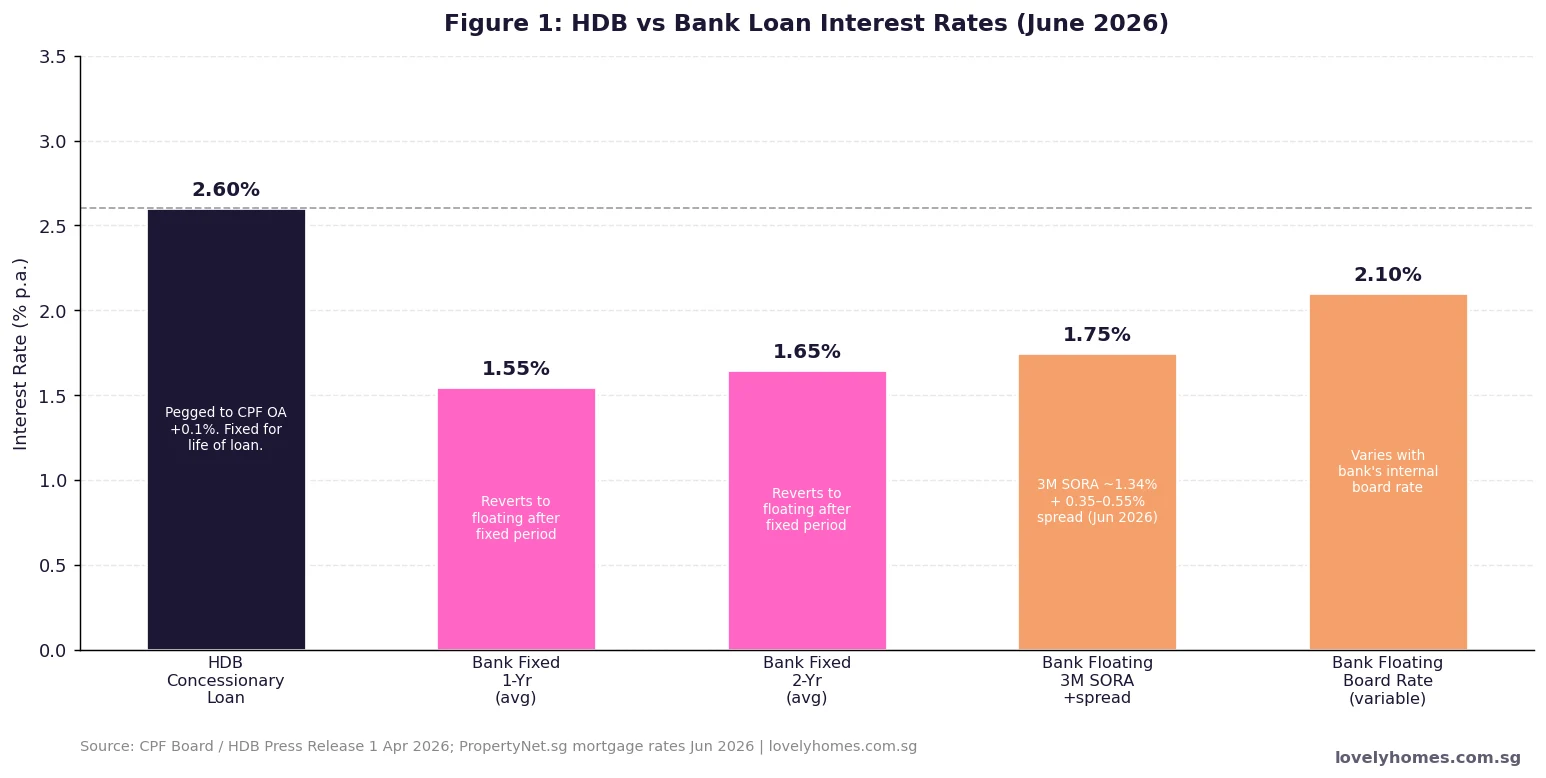
  • HDB loan rate: 2.60% p.a. (fixed at CPF OA rate + 0.1% = 2.5% + 0.1%), unchanged from January to June 2026. Bank fixed rates are lower at 1.35%–1.65% for 1-year and 1.55%–1.80% for 2-year packages as at June 2026.
  • LTV is now the same: Both HDB loans and bank loans offer up to 75% LTV for HDB flats following the August 2024 policy change (previously 80% for HDB loans). The minimum downpayment is 25% for both.
  • Key difference — cash downpayment: With an HDB loan, the entire 25% downpayment can be paid from your CPF OA. With a bank loan, you must pay at least 5% in cash, with the remaining 20% from CPF OA.
  • One-way door: You can switch from an HDB loan to a bank loan at any time. But once you are on a bank loan, you cannot switch back to the HDB concessionary loan.
  • HDB loan eligibility: Subject to an income ceiling of S$14,000/mth (families) or S$7,000/mth (singles). Bank loans have no income ceiling but apply standard TDSR/MSR rules.
  • Rate risk: The HDB rate is stable and rarely changes. Bank fixed rates revert to floating (SORA-based) after the fixed period — typically 1–3 years — meaning repayments can rise if SORA increases.
  • Bottom line: Bank loans save on interest but require cash downpayment and carry rate risk. HDB loans offer stability and zero-cash downpayment but cost more in interest over the long run.

Every HDB flat buyer in Singapore must make one of the most consequential financing decisions of their lives: take the Housing & Development Board’s own concessionary loan, or borrow from a bank. The choice affects how much cash you need upfront, what you pay monthly for up to 25 years, and how exposed you are to interest rate fluctuations.

This guide explains both options in full — rates, LTV, eligibility, cashflow impact, and the one-way door rule — so you can make a fully informed decision before exercising your HDB Flat Eligibility (HFE) letter or signing a bank Letter of Offer. It also covers the role of the Mortgage Servicing Ratio (MSR) and Total Debt Servicing Ratio (TDSR), which govern how much either type of lender can lend you.

Interest Rates: HDB Loan vs Bank Loan (June 2026)

The interest rate difference is the single most scrutinised comparison between the two options. As at June 2026, the data is as follows.

HDB concessionary loan 2.60 percent versus bank fixed and floating loan rates Singapore June 2026 comparison bar chart
Figure 1: HDB Loan vs Bank Loan Interest Rates as at June 2026. HDB rate is 2.60% p.a. Bank fixed rates range from 1.35%–1.80%; floating SORA-based rates are around 1.70%–1.90%. Click to enlarge.

The HDB Concessionary Rate

The HDB concessionary interest rate is pegged at 0.1% above the prevailing CPF Ordinary Account (OA) interest rate. The CPF OA rate has been at its floor of 2.5% p.a. continuously since 2009, making the HDB loan rate 2.60% p.a. The CPF Board reviews OA rates quarterly (in January, April, July, and October). The HDB and CPF Board confirmed on 29 March 2026 that the rate remains unchanged at 2.60% for the April–June 2026 quarter.

The HDB rate is therefore effectively fixed for most borrowers’ planning purposes — it has not changed in over 15 years. However, it is technically variable, and a CPF OA rate increase (which requires the prevailing 3-month average yields of 10-year SGS bonds and similar benchmarks to exceed 2.5%) would flow through to HDB loan repayments.

Bank Loan Rates (June 2026)

Bank loan rates in Singapore come in two main varieties: fixed-rate packages (where the rate is locked for 1–3 years, then reverts to a floating rate) and floating-rate packages (pegged to 3-month SORA or the bank’s internal board rate). As at June 2026, the range observed in the market is as follows. For fixed 1-year packages, rates range from approximately 1.35% to 1.65% p.a. For fixed 2-year packages, rates range from approximately 1.55% to 1.80% p.a. Floating SORA-based packages price at 3-month SORA (~1.34%) plus a spread of 0.35%–0.55%, resulting in effective rates of approximately 1.70%–1.90% p.a.

The critical caveat for bank fixed rates is that after the initial fixed period expires, the loan typically reverts to a floating rate — either SORA-based or the bank’s board rate — which is currently around 2.0%–2.5% p.a. Borrowers who take a 1-year fixed package at 1.45% should budget for a step-up to a floating rate when the fixed period ends, unless they refinance to another fixed package (which typically incurs legal and valuation fees of S$2,000–S$3,500).

Loan-to-Value and Downpayment Requirements

One of the most important practical differences between the two loan types is the cash component of the downpayment. Since August 2024, both HDB loans and bank loans have the same LTV cap of 75% for HDB flats. However, the source of the downpayment differs significantly.

Item HDB Concessionary Loan Bank Loan (HDB flat)
Loan-to-Value (LTV) Up to 75% Up to 75%
Minimum downpayment 25% of purchase price 25% of purchase price
Minimum cash downpayment Nil (full CPF OA allowed) 5% cash required
Balance of downpayment 25% from CPF OA 20% from CPF OA
Max tenure (HDB flat) 25 years 25 years
Max tenure (private) N/A 30 years

For a flat priced at S$500,000, the HDB loan borrower can fund the entire S$125,000 downpayment from CPF OA savings — requiring zero cash at exercise. The bank loan borrower must bring S$25,000 in cash (5%), with the remaining S$100,000 from CPF OA. For first-time buyers with limited liquid savings but substantial CPF OA balances, this distinction can be decisive.

Monthly Repayment Comparison

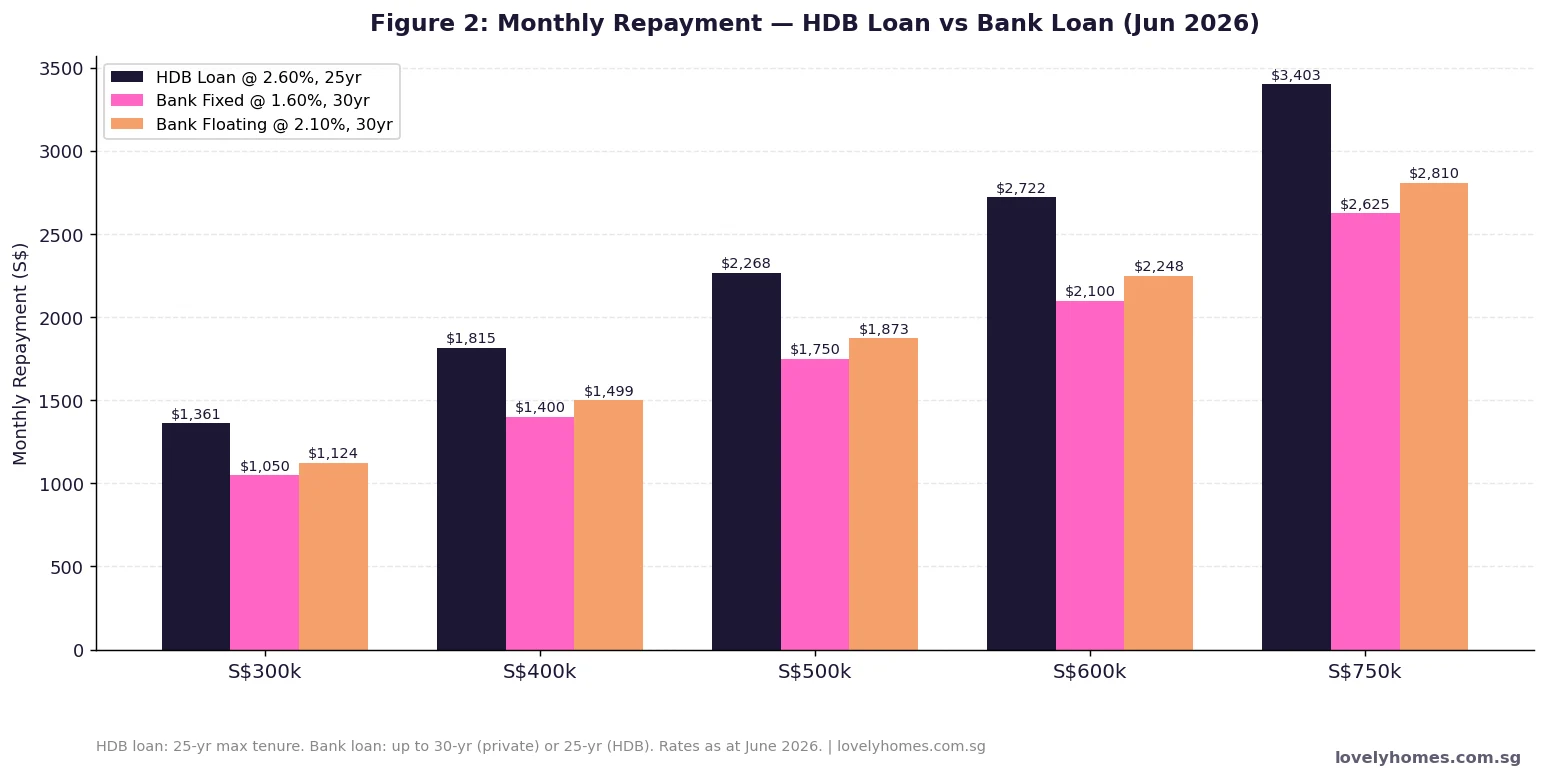
Despite the higher HDB rate, the impact on monthly repayments is less dramatic than many buyers expect, because the HDB loan uses a shorter maximum tenure of 25 years while bank loans for HDB flats are also capped at 25 years.

Monthly repayment comparison HDB loan 2.60 percent versus bank fixed 1.60 percent and floating 2.10 percent Singapore 2026 at various loan amounts
Figure 2: Monthly Repayment Comparison — HDB Loan vs Bank Loan at S$300k–S$750k loan amounts. Bank loan at 1.60% (fixed, 30yr equivalent for illustration) saves S$150–S$380/mth versus HDB loan; floating at 2.10% narrows the gap. Click to enlarge.

At a S$500,000 loan, the HDB borrower at 2.60% over 25 years pays approximately S$2,260/mth. The bank borrower at 1.60% over 25 years pays approximately S$2,020/mth — a saving of S$240/mth, or S$2,880/year. Over the full 25-year tenure, this compounds to a total interest saving of approximately S$34,000–S$40,000. However, if the bank rate reverts to 2.50% floating after the initial fixed period, the saving shrinks substantially. The total interest difference over 25 years narrows to S$5,000–S$12,000 depending on the rate path taken by SORA.

Eligibility: Who Can Take an HDB Loan?

Not all buyers can choose between the two options — the HDB concessionary loan has eligibility criteria that bank loans do not.

To qualify for an HDB loan in 2026, the borrower must meet the following requirements. The household gross monthly income must not exceed S$14,000 for families (including couples), or S$7,000 for singles applying under the Single Singapore Citizen or Joint Singles Scheme. At least one borrower must be a Singapore Citizen. The co-borrower (if any) must be a Singapore Citizen or Permanent Resident. The borrower must not have disposed of any private residential property in the 30 months immediately before the flat application — the HDB loan is intended for buyers who are in genuine need of public housing finance, not for investors cycling between private property and HDB. The flat being purchased must be an HDB flat (resale or BTO); HDB loans are not available for private condominium purchases.

Bank loans have none of these eligibility restrictions — they are open to Singapore Citizens, SPRs, foreigners, companies, and buyers of any income level. The governing constraints for bank loans are the Mortgage Servicing Ratio (MSR) — capped at 30% of gross monthly income for HDB flat purchases — and the Total Debt Servicing Ratio (TDSR) — capped at 55% of gross monthly income for all property purchases.

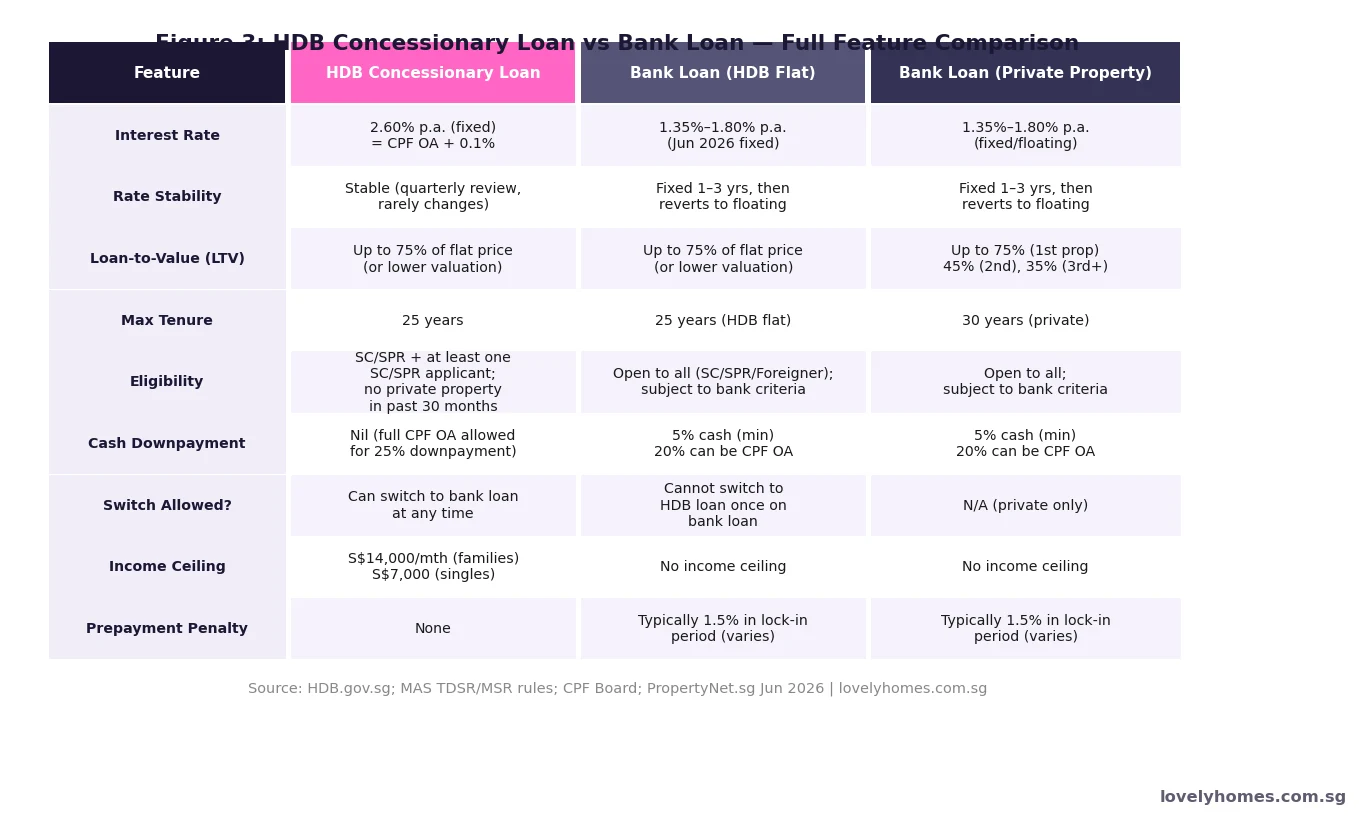
Full Feature Comparison Table

HDB concessionary loan versus bank loan full feature comparison table Singapore 2026 — interest rate LTV eligibility tenure cash downpayment prepayment penalty
Figure 3: HDB Loan vs Bank Loan — Full Feature Comparison (2026). Nine features compared side-by-side. Click to enlarge.

The One-Way Door Rule

Perhaps the most important strategic consideration is the one-way door: you can switch from an HDB loan to a bank loan at any time, but you cannot switch from a bank loan back to an HDB loan.

This asymmetry has significant implications. Buyers who start on an HDB loan preserve optionality — if bank rates fall materially (as they did in 2021–2023 and again in 2025–2026 as the SORA rate cycle eased), they can refinance to a bank loan at the more favourable rate. Buyers who start on a bank loan, by contrast, are permanently locked out of the HDB concessionary rate. This means that if bank rates were to rise significantly (as they did in 2022–2023 when 3M SORA peaked above 3.8%), a bank loan borrower who refinanced cannot fall back to the HDB rate as a safety net.

Given that bank rates are currently at or near their cyclical lows as at June 2026, the relative attractiveness of a bank loan is greatest at present. But starting on a bank loan is an irreversible choice — buyers with lower risk tolerance or less financial flexibility may prefer to start on the HDB loan and refinance later if rates remain favourable.

Worked Example: S$550,000 Resale 4-Room HDB

Mr and Mrs Goh are SC joint buyers, gross household income S$9,000/mth. They are purchasing a resale 4-room HDB flat in Bedok for S$550,000. They have CPF OA savings totalling S$130,000 between them and liquid cash savings of S$80,000.

Option A — HDB Concessionary Loan:
Loan amount (75% LTV): S$412,500
Downpayment: S$137,500 (all from CPF OA — no cash required)
Monthly repayment @ 2.60%, 25yr: S$1,862/mth
MSR check: S$1,862 / S$9,000 = 20.7% ✅ (under 30% cap)
Cash preserved: S$80,000
Total interest over 25yr: ~S$148,500

Option B — Bank Loan (1.60% fixed 2-yr, then SORA ~2.10% thereafter):
Loan amount (75% LTV): S$412,500
Downpayment: S$137,500 (5% cash = S$27,500 + CPF OA S$110,000)
Monthly repayment @ 1.60%, 25yr: S$1,675/mth (fixed period)
Monthly repayment after fixed period @ 2.10%: S$1,784/mth (illustrative)
MSR check: S$1,784 / S$9,000 = 19.8% ✅
Cash required upfront: S$27,500 (leaves S$52,500 liquid)
Total interest over 25yr (blended at ~2.10%): ~S$132,000 — saving ~S$16,500 vs HDB loan over full tenure

Decision: The bank loan saves approximately S$16,500 in total interest over 25 years (assuming the blended rate stays around 2.10%). However, the Gohs must commit S$27,500 in cash now, reducing their emergency fund. Given their stable employment and comfortable MSR headroom, they might reasonably prefer the bank loan. If either spouse expected a career break or job change, the HDB loan’s nil-cash requirement and rate stability would be more prudent. The right answer depends on cashflow resilience, not just rate arithmetic.

MSR and TDSR: The Regulatory Caps That Govern Both

Regardless of whether you take an HDB or bank loan, your maximum loan quantum is limited by the Monetary Authority of Singapore’s (MAS) borrower stress-test rules. For HDB flat purchases, the MSR caps your monthly property loan repayments at 30% of gross monthly income. The TDSR caps total monthly debt repayments (including car loans, personal loans, credit card minimum payments, and all property loans) at 55% of gross monthly income.

Practically speaking, the MSR is the binding constraint for most HDB buyers. A couple earning S$8,000/mth can service a maximum monthly repayment of S$2,400 (30% MSR). At 2.60% over 25 years, this translates to a maximum loan of approximately S$510,000. At 1.60% over 25 years, the maximum loan is approximately S$572,000 — about 12% higher. The higher loan quantum available under a bank loan can sometimes allow a buyer to afford a higher-value flat.

Why This Matters: The Rate Cycle Context

As at June 2026, Singapore’s 3-month SORA has eased to approximately 1.34% p.a. from a peak of over 3.8% in late 2023, reflecting the US Federal Reserve’s rate-cutting cycle that began in late 2024. Bank fixed rates have consequently fallen to multi-year lows. This environment — low bank rates, stable HDB rate — makes the bank loan comparison particularly favourable relative to the 2022–2023 period, when SORA-based floating rates exceeded the HDB rate.

Comparable markets offer useful perspective. In Australia, the Reserve Bank rate is 3.35% (June 2026), making equivalent fixed mortgages over 5.0% p.a. In Hong Kong, HIBOR-linked mortgages sit around 3.5%–4.0%. Singapore’s bank rates at 1.60%–1.80% fixed reflect the city-state’s position as a global financial centre with deep SGS bond markets — structural factors that have historically kept Singapore mortgage rates below comparable developed markets.

What Might Come Next

The MAS reviews TDSR/MSR thresholds periodically. There is no current indication of a change to the 30% MSR or 55% TDSR limits — they were last revised in September 2022, when the TDSR was lowered from 60% to 55%. However, if the Singapore property market were to overheat (the URA Private Residential Price Index rose 0.9% in Q1 2026, after several quarters of moderation), further macro-prudential tightening cannot be ruled out. On the CPF side, the OA rate is reviewed quarterly — sustained strong SGS yields could theoretically push the OA rate above 2.5%, which would raise the HDB loan rate. This has not occurred in over 15 years but is a tail risk worth monitoring.

Frequently Asked Questions

Can I use my CPF OA for the cash component of a bank loan downpayment?
No. The 5% cash component of a bank loan downpayment for an HDB flat must be paid in cash — CPF funds cannot be used for this component. The remaining 20% of the 25% downpayment can come from your CPF OA. CPF funds can, however, be used to pay Buyer’s Stamp Duty (BSD) on an HDB resale flat, as well as the monthly loan repayments, subject to your CPF OA balance not falling below the applicable Basic Retirement Sum (BRS) in later life. Check the CPF Board’s guidelines at CPF.gov.sg.
What happens to my HDB loan if the CPF OA rate increases?
If the CPF OA rate rises — say from 2.5% to 2.75% — the HDB concessionary loan rate rises by the same amount, from 2.60% to 2.85%. Your monthly repayment would increase accordingly. HDB typically gives borrowers notice before rate changes take effect. Practically, an OA rate rise requires average 10-year SGS yields to sustain above 2.5%, which has not occurred since 2008. An OA rate increase would simultaneously increase the returns on your CPF OA savings — the same savings you are using to service the loan — partially offsetting the impact.
I took a bank loan. Can I switch back to the HDB loan if bank rates rise sharply?
No. Once you are on a bank loan for an HDB flat, you cannot switch back to the HDB concessionary loan at any point. This is one of the most important asymmetries between the two loan types. If bank rates rise sharply after you refinance (as occurred in 2022–2023, when SORA-linked rates jumped from under 0.5% to over 3.8%), you have no option to revert to the HDB rate. Your mitigation strategies are: refinancing to another bank’s fixed-rate package (which locks in a new fixed rate for 1–3 years at the cost of legal/valuation fees of S$2,000–S$3,500), or riding out the floating rate if you have sufficient cashflow buffer. This is why financial advisers often suggest that buyers with lower risk tolerance or tighter cashflow margins consider starting on the HDB loan, preserving the option to switch to a bank loan later.
Does taking an HDB loan affect my ability to buy a second property?
Yes, indirectly. If you have an outstanding HDB loan when you purchase a second property, the outstanding HDB loan balance is counted as a debt under the TDSR framework. This reduces the maximum loan quantum you can obtain for the second property. Additionally, if you purchase a second property before selling the first, you face the ABSD on the second purchase (20% for SC, 30% for SPR, 60% for foreigners on a second property as at 2026). The type of loan — HDB or bank — does not directly change the ABSD position, but the higher monthly repayment of the HDB loan at 2.60% (compared to a bank loan at 1.60%) increases your TDSR exposure, which may reduce your loan eligibility for the second property. See our ABSD 2026 Guide for the full stamp duty framework.
Can foreigners or SPRs take an HDB loan?
SPRs can take an HDB concessionary loan as a co-applicant alongside a Singapore Citizen principal applicant — for example, an SC-SPR married couple can jointly apply for an HDB loan. The SC must be listed as the primary applicant. Foreign nationals without Permanent Residency cannot take an HDB loan and are not eligible to purchase new HDB flats. They may purchase resale HDB flats in limited circumstances (SPR + at least one SC in the family nucleus) or private property. For resale HDB flat purchases by SC-SPR couples, the HDB loan eligibility income ceiling of S$14,000/mth applies to the combined household income.
What is an HFE letter and do I need it before approaching a bank?
An HDB Flat Eligibility (HFE) letter confirms your eligibility to purchase an HDB flat and, if applicable, your eligibility for an HDB concessionary loan and CPF housing grants. The HFE letter is mandatory for all HDB flat purchases (BTO and resale). You apply for the HFE letter via the HDB flat portal with your SingPass, and HDB assesses your eligibility based on citizenship, income, CPF OA balance, and prior property ownership. The HFE letter is valid for 9 months. You should obtain the HFE letter before approaching banks for a mortgage, as the HFE confirms your eligibility position and helps banks assess your loan application accurately. If the HFE letter confirms HDB loan eligibility, it does not mean you must take the HDB loan — you are free to choose a bank loan instead. Find out more at HDB.gov.sg.
Is the MSR calculated on gross or net income?
The MSR is calculated on gross monthly income — that is, your income before CPF contributions, personal income tax, or any other deductions. This is consistent with the TDSR framework administered by MAS. Variable income (bonuses, commissions, overtime) is typically assessed at 30% of the monthly average over the most recent 12 months by most lenders, though practices vary. Self-employed individuals use IRAS-assessed income over the most recent 2 years. The 30% MSR cap means that if your gross household income is S$10,000/mth, your maximum monthly HDB loan repayment (principal + interest) is S$3,000. At 2.60% over 25 years, this implies a maximum loan of approximately S$636,000. Use our Singapore Property Downpayment Guide for full affordability calculations.

Related Articles

Disclaimer: This article provides general information for educational purposes as at June 2026 based on publicly available data from the Housing & Development Board (HDB), the Monetary Authority of Singapore (MAS), the CPF Board, and publicly quoted mortgage rates from Singapore banks as at June 2026. Interest rates, LTV limits, MSR/TDSR thresholds, and eligibility criteria may change at any time following government or MAS policy announcements. The worked example and rate figures are illustrative. This article does not constitute financial advice. Readers should consult a licensed mortgage adviser, HDB, or a qualified financial planner before making any home loan decision.

Singapore Joint Property Ownership Guide 2026: Joint Tenancy, Tenancy-in-Common, ABSD and CPF Rules

Singapore Joint Property Ownership Guide 2026: Joint Tenancy, Tenancy-in-Common, ABSD and CPF Rules

📌 Quick Answer: Joint Property Ownership in Singapore (2026)

  • Two ownership structures exist: Joint Tenancy (JT) — equal, undivided shares with automatic survivorship; and Tenancy-in-Common (TiC) — defined shares that can be unequal, with no survivorship right.
  • HDB flats default to joint tenancy for married couples; tenancy-in-common is permitted and commonly used for investment structuring (e.g. 99/1 split), though IRAS scrutinises artificial arrangements.
  • ABSD applies per buyer — each co-owner’s ABSD rate is based on their own individual property count. A transfer of share between co-owners may attract ABSD and BSD on the transferred portion.
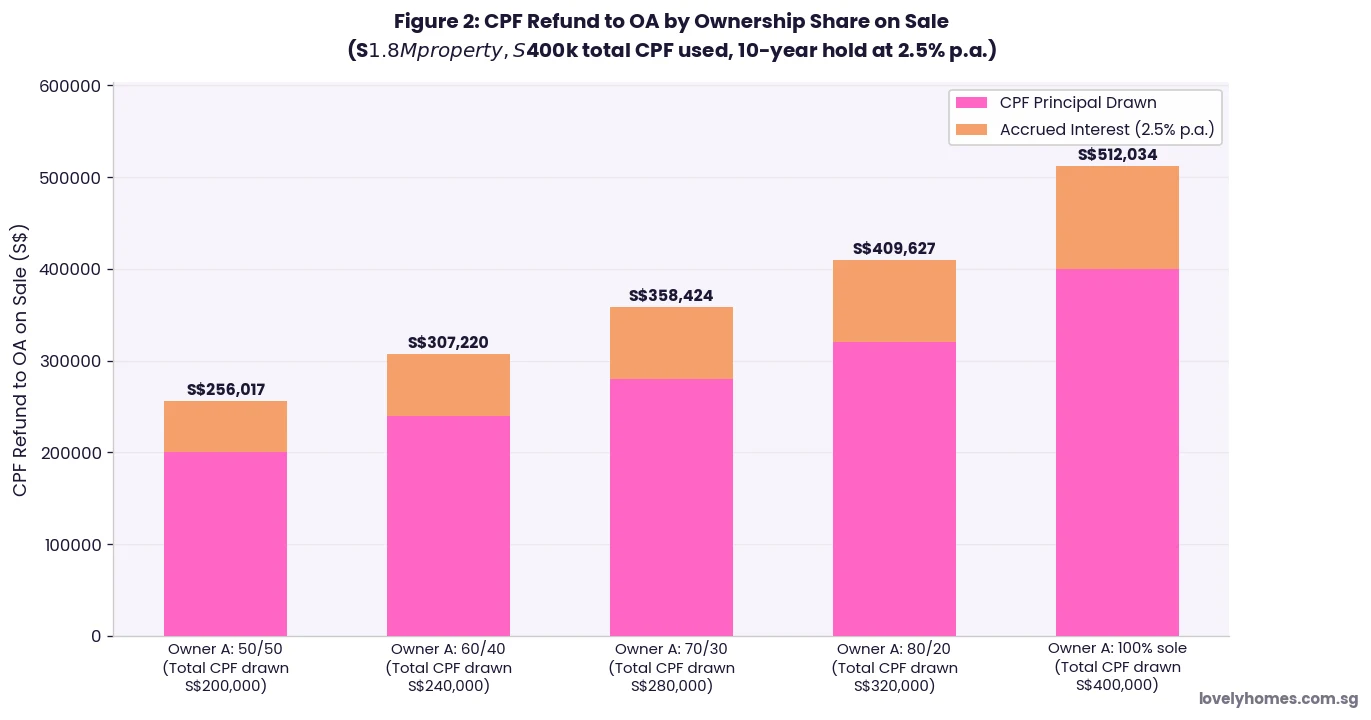
  • CPF Ordinary Account usage is allocated per owner’s share. Each owner refunds their own CPF drawn — principal plus 2.5% p.a. accrued interest — to their own OA upon sale.
  • Decoupling (transferring one spouse’s share to the other) allows one party to then purchase a second property with a lower ABSD rate as a “first-time buyer” — but costs BSD on the half-share and requires full bank refinancing checks.
  • Intestacy risk: Under tenancy-in-common, your share passes via your will (or the Intestate Succession Act if you die without a will). Under joint tenancy, the surviving owner inherits automatically regardless of your will.

Joint Property Ownership in Singapore: An Overview

Purchasing property with a spouse, family member, or investment partner is common in Singapore. Whether you are a married couple buying your first HDB flat, siblings co-investing in a private condo, or business partners acquiring a shophouse, the legal form of co-ownership you choose has significant consequences for your stamp duties, CPF usage, mortgage liability, inheritance planning, and future asset reallocation strategy.

Singapore property law recognises two main forms of co-ownership: joint tenancy and tenancy-in-common. These are derived from English common law and codified in Singapore’s Land Titles Act (Cap. 157). They differ fundamentally in the nature of the ownership interest each party holds and in how that interest passes on death.

Understanding which structure applies to your purchase — and whether switching between them makes sense at different life stages — is essential for anyone who co-owns or intends to co-own property in Singapore.

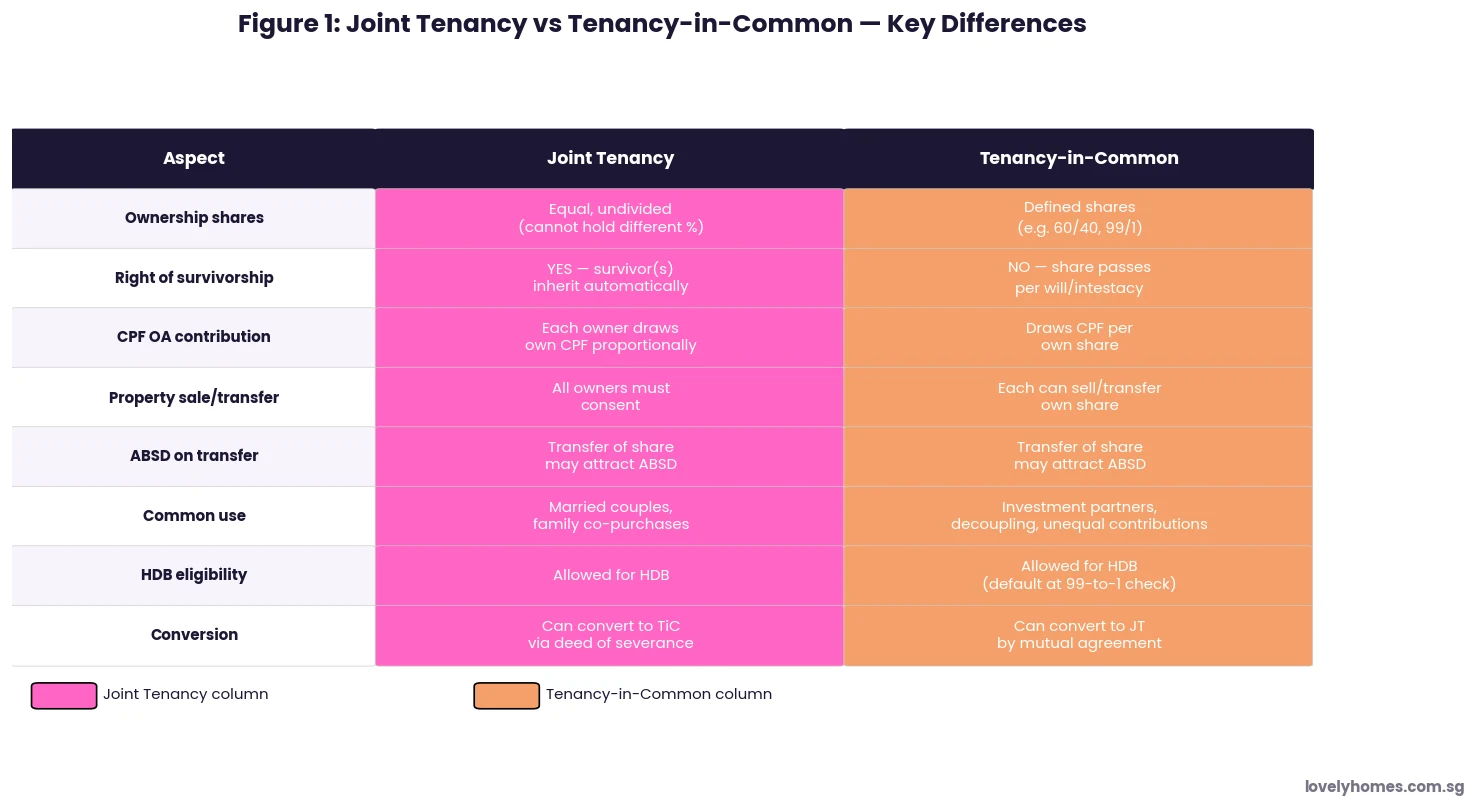
Joint tenancy vs tenancy-in-common Singapore 2026 — comparison table ownership shares survivorship CPF ABSD
Figure 1: Joint Tenancy vs Tenancy-in-Common — eight key differences covering ownership shares, survivorship, CPF, ABSD implications, and conversion.

Joint Tenancy: Equal Ownership with Survivorship

In a joint tenancy, every co-owner holds an equal and undivided interest in the entire property. There are no defined percentage shares — each joint tenant owns 100% of the property, concurrently with the other joint tenants. This may sound paradoxical, but it is precisely this conceptual structure that enables the right of survivorship: when one joint tenant dies, their interest does not form part of their estate but instead vests automatically in the surviving joint tenant(s), regardless of what their will says.

For married couples purchasing their matrimonial home, joint tenancy reflects the expectation of mutual commitment: neither party can unilaterally dispose of their share without the other’s consent, and neither party can bequeath the property to a third party outside the marriage while the other spouse survives. This makes joint tenancy the default and legally preferred form for HDB flat ownership by married couples.

Practical implications of joint tenancy:

  • A court order (e.g. in a divorce or a creditor’s claim) can sever a joint tenancy and convert it to a tenancy-in-common, enabling the sale of one party’s share.
  • Banks typically treat all joint tenants as jointly and severally liable for the mortgage. If one party defaults, the other is fully liable for the outstanding debt.
  • All joint tenants must consent to a sale or mortgage. This is both a protection and a constraint.
  • For CPF purposes, each joint tenant is deemed to have drawn CPF in proportion to their purchase price contribution, even though the legal title is held equally.

Tenancy-in-Common: Defined Shares and Investment Flexibility

In a tenancy-in-common, each co-owner holds a separate, defined fractional interest in the property. The shares need not be equal — they can be set at any percentage that reflects the parties’ respective financial contributions or commercial agreement: 50/50, 70/30, 90/10, even 99/1. Each tenancy-in-common share is a distinct, transferable legal interest. An owner can sell, mortgage, or bequeath their share independently of the others.

No right of survivorship exists under tenancy-in-common. If you die with a 40% share in a property, that 40% passes according to your will. If you have no will, it is distributed under the Intestate Succession Act (Cap. 146) — which may not align with your wishes. This is a frequently overlooked planning gap, particularly for unmarried co-owners or investment partners.

Tenancy-in-common is commonly chosen for:

  • Investment properties where each co-owner contributes a different amount and wants a proportionate return.
  • Decoupling strategies where one spouse later transfers their share to the other to free up their ABSD count for a second purchase.
  • Multi-generational purchases involving parents and children with different financial contributions.
  • Sibling or business-partner purchases where the parties are not romantically involved and have independent estate plans.

ABSD Implications: How Co-Ownership Affects Your Stamp Duty

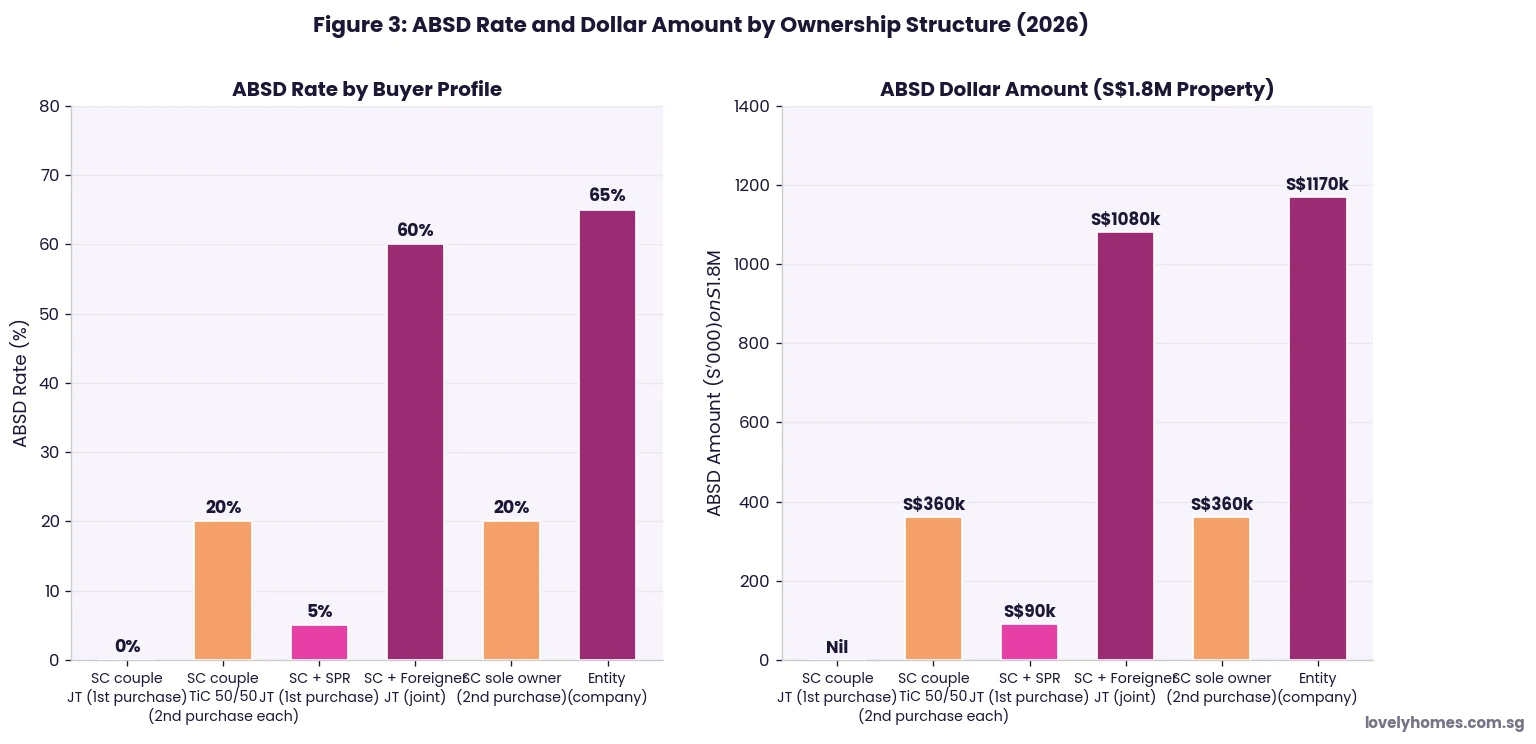
Additional Buyer’s Stamp Duty (ABSD) is charged on the full purchase price of the property, not on each buyer’s share. However, the applicable ABSD rate for each buyer is determined by their own individual residential property count in Singapore at the time of purchase. This creates important nuances in co-ownership situations.

For example, if Singapore Citizen Mr Lim (first property) and Permanent Resident Ms Chen (first property for her) jointly purchase a condo, the ABSD rate is the higher of the two applicable rates — in this case, 5% (SPR rate for first property) — applied to the full purchase price. The system does not split the ABSD proportionally; the most onerous applicable rate prevails.

ABSD rates and dollar amounts by ownership structure Singapore 2026 — joint tenancy tenancy-in-common entity
Figure 3: ABSD rate and dollar amount by ownership structure on a S$1.8M property. Note: entity purchases attract 65% ABSD with no remission available.
Co-ownership Profile ABSD Rate ABSD on S$1.8M Note
SC + SC (both first property) 0% Nil SC first-property exemption
SC (first) + SPR (first) 5% S$90,000 Higher rate (SPR) applies
SC (second) + SC (first) 20% S$360,000 Higher rate applies; payable in full on 100% price
SC + Foreigner 60% S$1,080,000 Foreigner rate applies to full price
Company / entity 65% S$1,170,000 No remission available for entities

Source: IRAS, effective as of June 2026.

CPF Usage Under Co-Ownership: Shares and Refund Rules

When a property is co-owned, each party may contribute their own CPF Ordinary Account (OA) funds towards the purchase — for the down payment, monthly mortgage instalments, BSD, and legal fees. The amount each co-owner can draw is subject to the usual CPF Valuation Limit (VL) and Withdrawal Limit (WL) constraints, applied to their proportionate share of the property.

Under tenancy-in-common, CPF contributions are tracked per owner’s defined share. Under joint tenancy, CPF draws are typically in proportion to the purchase price contribution, even though legal ownership is equal and undivided. On sale of the property, each owner must refund their own CPF principal plus accrued interest at 2.5% per annum into their own Ordinary Account. This refund is mandatory regardless of whether the sale price exceeds the purchase price.

CPF refund to OA on sale by ownership share Singapore 2026 — principal and accrued interest
Figure 2: CPF refund obligation by ownership share — illustrative example of a S$1.8M property with S$400,000 total CPF drawn, held for 10 years at 2.5% p.a. The higher the ownership share, the larger the CPF refund on sale.

Decoupling: Converting Tenancy to Free Up ABSD Count

Decoupling refers to the process of transferring one co-owner’s share to the other, so that the transferring party becomes a zero-property owner and can subsequently buy a new property at a lower ABSD rate. This strategy is most commonly used by married couples who co-own a private property and wish to purchase a second investment property without incurring the 20% ABSD on the second purchase.

The transfer attracts BSD on the transferred share at prevailing rates. For example, if the transfer value of the half-share is S$900,000, BSD is approximately S$26,600. Legal fees for the decoupling conveyancing typically run S$4,000–S$8,000 plus GST. ABSD is also payable on the transferee’s side if it triggers a property count increase.

Since April 2023, IRAS has applied heightened scrutiny to 99-to-1 arrangements — where one party buys 99% and the other 1% specifically to exploit ABSD count. Arrangements that IRAS determines to be artificial may result in the ABSD being levied on the full value rather than the proportionate share. Buyers should seek proper legal advice and ensure their co-ownership structure reflects genuine commercial intent.

Worked Example: Mr & Mrs Wong — Converting JT to TiC for Decoupling

📄 Worked Example — Married SC Couple Converting Ownership for Second Purchase

Background: Mr & Mrs Wong, both Singapore Citizens, jointly own a Bishan private condo purchased in 2021 for S$1,600,000. Outstanding loan: S$880,000. Mr Wong’s CPF OA drawn: S$180,000 (principal). Mrs Wong’s CPF OA drawn: S$120,000 (principal). Property current market value: S$2,000,000. Ownership: joint tenancy 50/50.

Goal: Purchase a second investment condo (S$1,500,000 in OCR) without paying 20% ABSD (S$300,000).

Step 1 — Convert JT to TiC: Mr & Mrs Wong execute a deed of severance to convert joint tenancy to tenancy-in-common in equal shares. Cost: approximately S$800 in SLA fees + legal disbursements.

Step 2 — Decouple: Mrs Wong transfers her 50% share (value: S$1,000,000) to Mr Wong. BSD on S$1,000,000: S$24,600. Mrs Wong’s CPF refund obligation: S$120,000 × (1.025)^5 ≈ S$135,900. Legal fees: S$5,500. Total decoupling cost: approximately S$30,100 + CPF refund.

Step 3 — Mr Wong refinances: Bank reassesses TDSR on sole ownership. New mortgage S$1,120,000 (existing S$880,000 + S$240,000 top-up for decoupling costs). Monthly S$4,711 @3.2% 30yr — Mr Wong’s income S$14,000/month, TDSR 33.7% PASS.

Step 4 — Mrs Wong buys second condo: As a Singapore Citizen first-property buyer, Mrs Wong pays 0% ABSD on the S$1,500,000 OCR condo. ABSD saving vs joint purchase: S$300,000. Net saving after decoupling costs: S$269,900.

Note: This is an illustrative example. Actual ABSD/BSD rates, CPF drawdown, TDSR assessment, and legal costs may vary. Seek legal and financial advice before executing any property transfer.

Joint Ownership and Estate Planning: The Survivorship Risk

One of the most consequential differences between joint tenancy and tenancy-in-common is the estate-planning dimension, which is frequently overlooked by younger buyers focused on financing and stamp duties.

Under joint tenancy, your interest in the property does not exist as a separate asset in your estate. When you die, your joint tenancy interest extinguishes and the survivors’ interests expand to absorb it. Your will cannot override this. If you are a joint tenant and die, the property belongs entirely to the survivor, regardless of your wishes. This is protective in a stable marriage but potentially damaging in an estranged or second-marriage scenario, where you may prefer a portion of the property to pass to children from a prior relationship.

Under tenancy-in-common, your defined share is an asset in your estate. It passes per your will, or per the Intestate Succession Act if you die intestate. This gives you full testamentary control over your property share but requires that you actually execute a valid will and keep it updated. Unmarried co-owners and investment partners should always hold as tenants-in-common and maintain current wills.

What Might Change Next: Ownership Structure Policy Outlook

The following is editorial analysis and is not government policy. The government’s tightening of 99-to-1 arrangements in April 2023 signalled that IRAS will continue to scrutinise co-ownership structures that appear designed primarily to circumvent ABSD, rather than reflecting genuine co-ownership intentions. Future refinements may include clearer IRAS guidance on acceptable tenancy-in-common ratios, or legislative changes to deem artificial structures as ABSD-liable on the full purchase value. Buyers considering unconventional co-ownership splits for tax planning purposes should seek specific legal advice in the current regulatory environment.

Frequently Asked Questions

Can HDB flat owners hold as tenants-in-common?
Yes. HDB flats may be held as tenants-in-common with defined shares, and this is not uncommon in practice — particularly for parents purchasing together with an adult child, or for siblings jointly buying a flat. However, HDB stipulates that all co-owners must satisfy the eligibility conditions for owning an HDB flat (e.g. citizenship, income, property ownership rules). HDB has previously confirmed that it does not generally prohibit tenancy-in-common, but it does monitor unequal splits (such as 99/1) that appear structured to minimise ABSD exposure. The IRAS anti-avoidance provisions under the Stamp Duties Act would apply in such cases.
Does a joint tenancy convert to tenancy-in-common automatically on divorce?
Not automatically. In a divorce, the matrimonial flat remains held under whatever ownership structure it was registered in (usually joint tenancy) until the Court issues an order dealing with the flat as part of ancillary matters. The Family Justice Courts may order a sale, a transfer to one spouse, or a deferred sale arrangement. The joint tenancy is only converted to tenancy-in-common if the parties mutually agree to sever it before the divorce is finalised, or if a court order explicitly directs a transfer of defined shares. Until such steps are taken, the property continues to be jointly held and both parties remain jointly liable for the mortgage.
If my co-owner refuses to sell, can I force a sale?
Yes, but the process differs by ownership type. Under joint tenancy, either owner can apply to the High Court for an order of sale under the Conveyancing and Law of Property Act (Cap. 61) if agreement cannot be reached. Under tenancy-in-common, each owner can similarly seek a court-ordered sale of the whole property, with proceeds distributed in proportion to shares. In practice, court-ordered sales are a last resort and carry significant legal costs. Most ownership disputes are resolved by one party buying out the other’s share at an agreed valuation or via a professional valuer.
Does ABSD apply when a parent transfers a property share to a child?
Yes. A transfer of a property share — whether by sale, gift, or part-gift — is a dutiable transaction. BSD is payable on the higher of the consideration or the market value of the share transferred. ABSD is also payable at the transferee’s applicable rate if the transfer increases the transferee’s Singapore residential property count. Only a limited number of transfers are exempt from ABSD, including transfers between spouses (subject to conditions under the Stamp Duties Act) and transfers pursuant to a court order (e.g. in a divorce). Transfers from parent to child are not automatically ABSD-exempt.
Can a Singapore Permanent Resident co-own an HDB flat as a tenant-in-common?
Yes, with conditions. A Singapore Permanent Resident can be included as a co-owner of an HDB flat under a family nucleus where the primary applicant is a Singapore Citizen. The SPR co-owner may be listed as a joint tenant or tenant-in-common. However, an SPR cannot be the sole buyer of a new HDB flat and cannot purchase an HDB flat independently without a SC co-applicant under the relevant eligibility scheme. The CPF OA contributions of the SPR co-owner are treated the same as those of a SC owner for property purchase purposes.
What is the difference between “tenancy” (as in renting) and “tenancy-in-common”?
The word “tenancy” in tenancy-in-common is a historical legal term derived from English common law referring to the holding or tenure of land — it has nothing to do with the landlord-tenant relationship in a rental context. A tenant-in-common is a co-owner who holds a defined share of a property. A tenant in the rental sense is a person who leases property from a landlord under a tenancy agreement. The two uses of the word “tenancy” are entirely unrelated and should not be confused.
Should I hold investment property as joint tenancy or tenancy-in-common?
For investment properties between unrelated parties (e.g. friends, siblings, business partners), tenancy-in-common is almost always preferable. It allows each party to hold a proportionate share reflecting their capital contribution, to independently mortgage or sell their share (subject to any co-ownership agreement), and to bequeath their interest per their will without the surviving co-owner automatically inheriting. For married couples buying an investment property together, the answer depends on their estate planning preferences and whether decoupling is a future consideration. In all cases, investment co-owners should sign a co-ownership agreement governing decision-making, cost-sharing, and exit rights.

Related Articles

Disclaimer: This article is for general educational purposes only and should not be construed as legal, financial, or tax advice. Property ownership law, ABSD regulations, CPF rules, and stamp duty rates in Singapore are subject to change by the government, MAS, IRAS, and CPF Board. The examples and figures in this article are illustrative only. Before entering into any co-ownership arrangement, executing a transfer of shares, or making any property investment decision, readers should seek independent legal advice from an Advocate and Solicitor of the Supreme Court of Singapore, and financial advice from a licensed financial adviser regulated by MAS. Consult the Inland Revenue Authority of Singapore (IRAS), HDB, and CPF Board for current official guidance.

Singapore CPF Housing Grant Guide 2026: EHG, PHG, Family Grant and How to Apply

Singapore CPF Housing Grant Guide 2026: EHG, PHG, Family Grant and How to Apply

📌 Quick Answer: CPF Housing Grants in Singapore (2026)

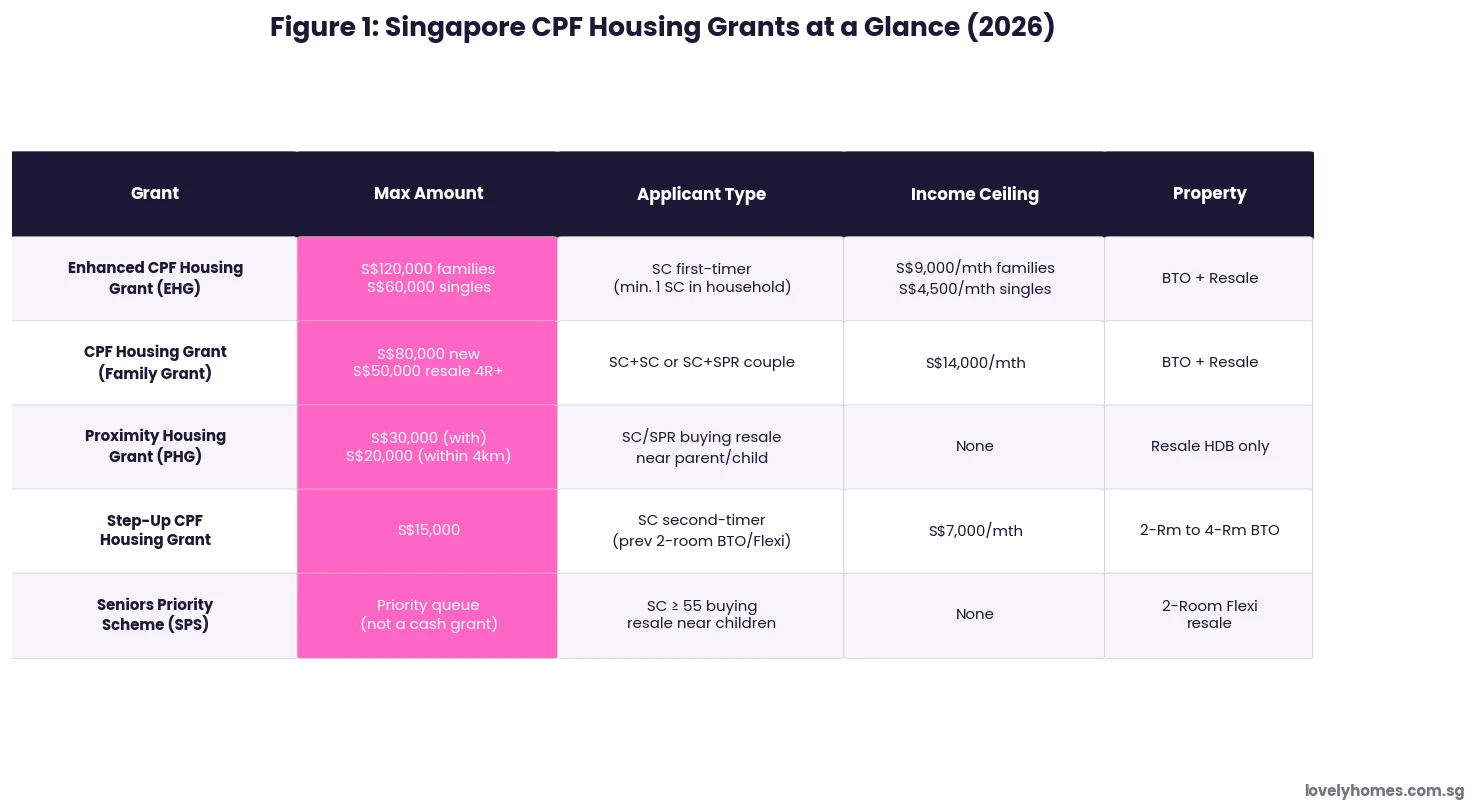
  • Enhanced CPF Housing Grant (EHG): Up to S$120,000 for families earning ≤ S$9,000/month, or S$60,000 for singles earning ≤ S$4,500/month — available for both BTO and resale HDB flats.
  • CPF Housing Grant (Family Grant): Up to S$80,000 for new BTO or S$50,000 for resale flats; income ceiling S$14,000/month for SC+SC or SC+SPR couples.
  • Proximity Housing Grant (PHG): S$30,000 to live together with parents/children, or S$20,000 to live within 4 km — no income ceiling, resale flats only.
  • Step-Up CPF Housing Grant: S$15,000 for second-timer families upgrading from a 2-room subsidised flat to a 2–4 room BTO; income ceiling S$7,000/month.
  • Maximum stacking: A Singapore Citizen family buying a resale flat can receive up to S$230,000 by combining the EHG + Family Grant + PHG.
  • How to apply: All CPF housing grants are applied for through the HDB Flat Eligibility (HFE) letter — there is no separate application form; the grants are assessed automatically.
  • CPF OA for private property: Grants do not apply to private property purchases; however, your CPF Ordinary Account balance can be used for the down payment, monthly instalments, and stamp duties on private property — subject to the Valuation Limit and Withdrawal Limit.

What Are CPF Housing Grants?

CPF housing grants are cash subsidies administered by the Housing and Development Board (HDB) and funded from the government’s housing budget. They reduce the cash or CPF Ordinary Account (OA) outlay required to purchase a subsidised HDB flat, effectively lowering the loan quantum needed and the monthly instalment burden for eligible Singapore Citizens and Permanent Residents.

Unlike bursaries or income supplement schemes, CPF housing grants are credited directly into the buyer’s CPF Ordinary Account once the flat purchase is completed, and are applied first to reduce the purchase price at the point of resale or disbursed at key collection for BTO flats. They do not count as accrued interest and do not need to be repaid upon sale, but the grant amount — along with accrued interest at 2.5% per annum on any CPF used — must be refunded to CPF upon the sale or transfer of the flat.

The grant landscape was significantly reformed on 20 August 2024, when the EHG for families was raised from S$80,000 to S$120,000 and the singles grant doubled from S$30,000 to S$60,000. The Family Grant and PHG remain at their current levels as of June 2026.

CPF housing grants Singapore 2026 overview table — EHG PHG Family Grant Step-Up amounts eligibility
Figure 1: Singapore CPF Housing Grants at a Glance — Grant types, maximum amounts, income ceilings and eligible property types (2026).

Enhanced CPF Housing Grant (EHG): The Largest Grant

The EHG is the flagship CPF housing grant, designed to help lower-income Singaporeans purchase their first flat. It replaced the Additional CPF Housing Grant (AHG) and Special Housing Grant (SHG) in September 2019, combining them into a single, more generous scheme with a sliding scale tied to household income.

Key eligibility conditions for the EHG (2026):

  • At least one applicant must be a Singapore Citizen, and the household must include at least one other Singapore Citizen or Permanent Resident.
  • All applicants and occupants must be first-timer applicants (no prior ownership of an HDB flat or private property in Singapore).
  • Monthly household income must not exceed S$9,000 (families) or S$4,500 (singles buying a 2-room Flexi under the Single Singapore Citizen Scheme).
  • All working applicants must have been employed continuously for at least 12 months and must be working at the time of the HFE letter application.
  • The flat purchased must have a remaining lease of at least 20 years and must cover the youngest buyer until at least age 95.

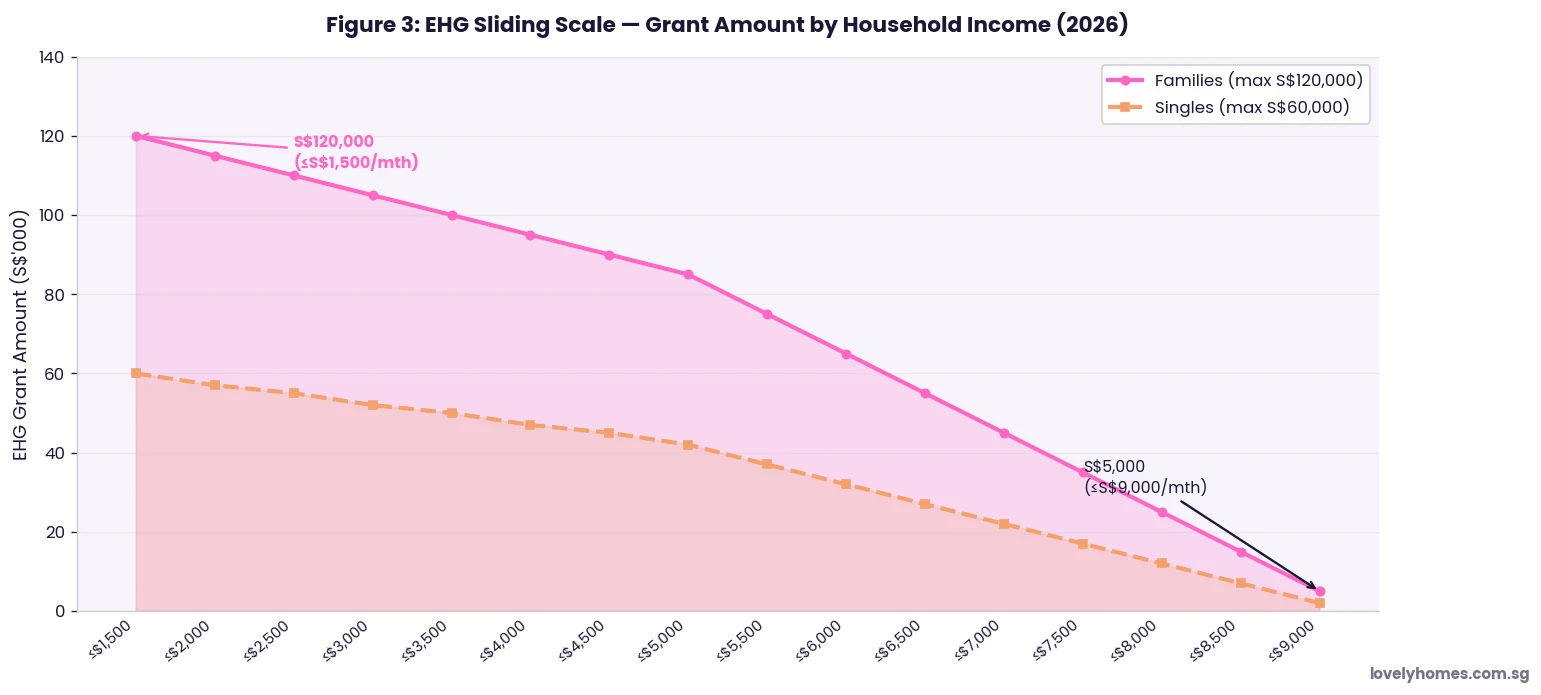
The EHG amount is determined on a sliding scale: applicants at the lowest income bracket (≤ S$1,500/month) receive the maximum S$120,000, tapering down to S$5,000 for households earning close to the S$9,000 ceiling. See Figure 3 for the full sliding scale. This design ensures that the subsidy is proportionally larger for those who need it most.

The EHG applies to both new BTO flats and resale HDB flats, making it one of the few grants usable across the full flat type spectrum. It does not apply to Design, Build and Sell Scheme (DBSS) flats or Executive Condominiums (ECs).

CPF Housing Grant (Family Grant): The Mainstream Grant

The Family Grant is available to Singapore Citizen households with a broader income range, up to S$14,000 per month. Unlike the EHG, it is not means-tested on a sliding scale — eligible buyers receive the full amount or nothing.

Flat Type Grant Amount (SC+SC) Grant Amount (SC+SPR) Income Ceiling
New 2-room Flexi to 4-room BTO S$40,000 S$30,000 S$14,000/mth
New 5-room or larger BTO S$40,000 S$30,000 S$14,000/mth
Resale 2-room to 3-room S$40,000 S$30,000 S$14,000/mth
Resale 4-room and larger S$50,000 S$40,000 S$14,000/mth
Singles (2-room Flexi resale only) S$25,000 N/A S$7,000/mth

Source: HDB, effective as of June 2026.

The Family Grant for resale 4-room and larger flats was raised to S$50,000 (SC+SC) and S$40,000 (SC+SPR) in the same August 2024 revision. This reflects the government’s effort to keep resale HDB flats affordable as median prices in many towns have risen sharply since 2020.

Proximity Housing Grant (PHG): Living Near Family

The Proximity Housing Grant was introduced in August 2015 to incentivise multi-generational proximity — a social policy objective as much as a financial one. It is unique in having no income ceiling, meaning even higher-income families can benefit from it when buying resale flats near parents or children.

The PHG pays S$30,000 if the applicant purchases a resale flat to live in the same flat as their parents or child (joint application or within the same household). It pays S$20,000 if the resale flat is purchased within 4 kilometres of the parent’s or child’s residence. The 4 km is measured using the straight-line distance between the two postal addresses. It applies to resale HDB flats only — it cannot be applied to BTO flats or DBSS flats.

To receive the PHG, at least one of the parents or child must be a Singapore Citizen or Permanent Resident. The proximity requirement must be maintained for five years after the key collection of the resale flat; failure to do so may result in a clawback of the grant.

Step-Up CPF Housing Grant and Other Targeted Grants

The Step-Up CPF Housing Grant of S$15,000 is specifically targeted at second-timer Singapore Citizen families who previously purchased a 2-room subsidised flat (BTO) and wish to upgrade to a 2-room to 4-room BTO flat. The income ceiling is S$7,000/month and the household must not own any other private property. This grant acknowledges the financial difficulty of moving up the housing ladder on a modest income.

The Seniors’ Priority Scheme (SPS) is not a cash grant but provides elderly Singapore Citizens aged 55 and above with priority allocation in BTO exercises when they are purchasing a 2-room Flexi flat near their adult children. Priority is given to multi-generational applicants — parents applying together with children — further reinforcing the proximity-and-community theme across Singapore’s housing grant framework.

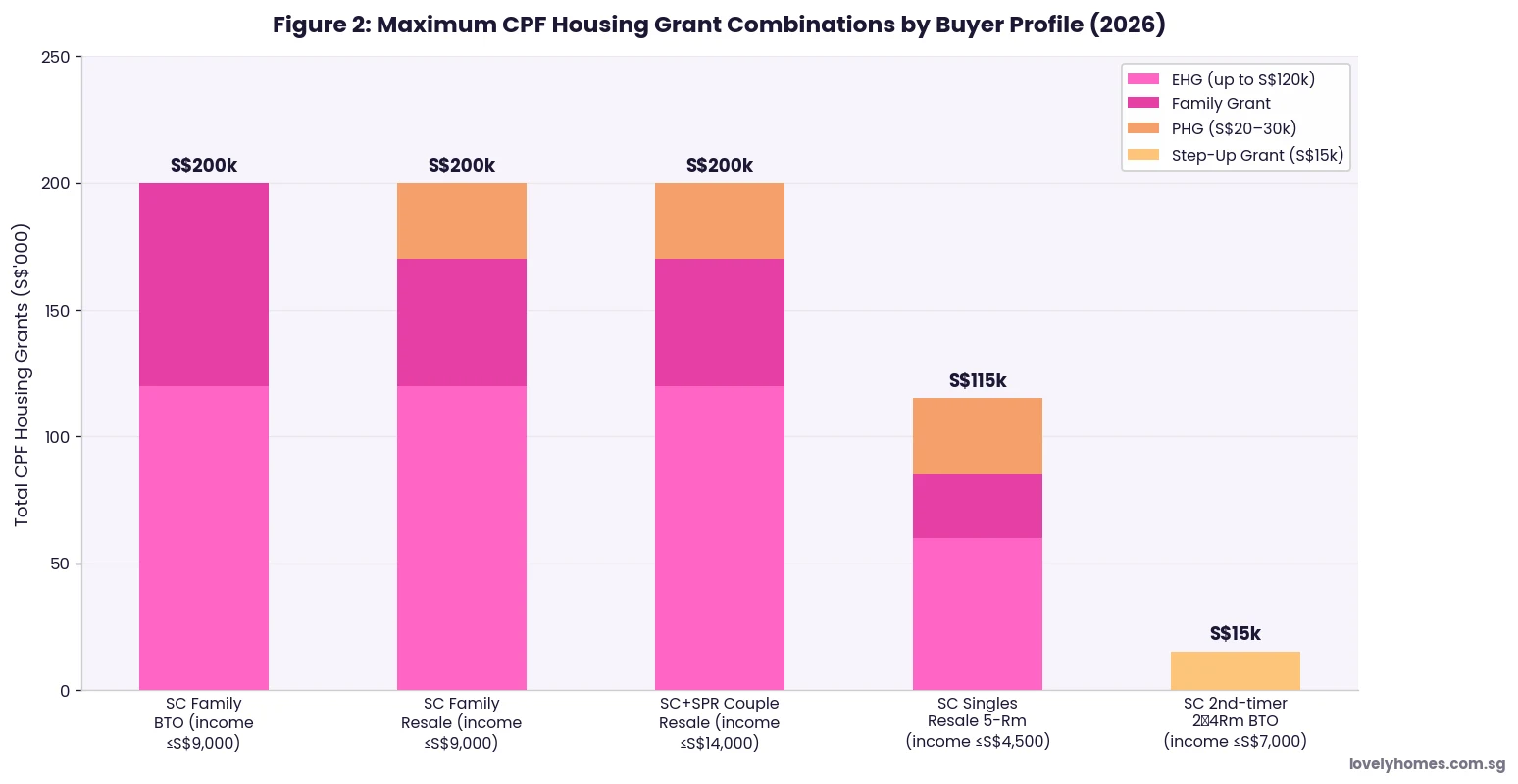
CPF housing grant combinations by buyer profile 2026 — EHG PHG Family Grant Step-Up maximum stacking
Figure 2: Maximum CPF housing grant combinations by buyer profile. A Singapore Citizen family purchasing a resale flat near parents can stack up to S$230,000 in grants.

How to Apply for CPF Housing Grants

All CPF housing grants are administered through a single gateway: the HDB Flat Eligibility (HFE) letter. Introduced in May 2023, the HFE letter replaced the previous system of separate Eligibility Letters for different grants. To apply, eligible buyers must log in to the HDB Flat Portal (flat.hdb.gov.sg) with their Singpass and submit an HFE application. The assessment is integrated with CPF and IRAS data and typically takes around 21 working days.

The HFE letter is mandatory before a buyer can:

  • Book a BTO flat during a sales launch exercise;
  • Exercise an Option to Purchase (OTP) for a resale HDB flat;
  • Apply for an HDB loan.

Once issued, the HFE letter is valid for nine months. It confirms the buyer’s eligibility, the specific grants they qualify for and their amounts, and the maximum HDB loan they may borrow. Buyers must obtain a new HFE letter if their circumstances change materially (e.g., income, marital status, property ownership) or if the existing letter expires.

Grant Summary Table: All CPF Housing Grants at a Glance

Grant Max Amount Min SC Required BTO? Resale? Income Ceiling
EHG (Families) S$120,000 1 SC S$9,000/mth
EHG (Singles) S$60,000 Applicant is SC S$4,500/mth
Family Grant (SC+SC) S$50,000 resale 4R+ 2 SC S$14,000/mth
Family Grant (SC+SPR) S$40,000 resale 4R+ 1 SC S$14,000/mth
PHG (living together) S$30,000 1 SC/SPR None
PHG (within 4 km) S$20,000 1 SC/SPR None
Step-Up Grant S$15,000 1 SC ✓ (2–4 Rm) S$7,000/mth

Note: Buyers must be first-timers for EHG and Family Grant. Grants are not available for EC (Executive Condo) or private property purchases. Source: HDB, June 2026.

Worked Example: How Much Can Mr & Mrs Tan Actually Save?

📄 Worked Example — SC Couple Buying Resale 4-Room Flat in Tampines

Profile: Mr & Mrs Tan, both Singapore Citizens, first-time buyers. Combined household income S$7,800/month. Mrs Tan’s parents live in Tampines, 1.2 km from the flat they are considering. They have been employed continuously for 14 months.

Flat: 4-room resale HDB flat in Tampines, asking price S$620,000.

Grants they qualify for:

  • EHG: Household income S$7,800/month → approximately S$35,000 (sliding scale; income ≤ S$7,500/month band).
  • Family Grant (SC+SC, resale 4-room): S$50,000.
  • PHG (within 4 km of Mrs Tan’s parents): S$20,000.

Total grants: S$35,000 + S$50,000 + S$20,000 = S$105,000

Effective purchase price after grants: S$620,000 − S$105,000 = S$515,000

Buyer’s Stamp Duty (BSD): On S$620,000 — 1% × S$180,000 + 2% × S$180,000 + 3% × S$260,000 = S$13,200

HDB Loan (at 80% LTV on effective price S$515,000): S$412,000 at 2.6% p.a. over 25 years → monthly instalment S$1,864/month (MSR: 23.9% — PASS at 30% ceiling).

Cash outlay at completion (5% cash + BSD + legal): 5% × S$515,000 + S$13,200 + S$2,500 (legal) = S$41,450 cash. Balance of CPF OA available for the remaining 15% down payment.

Note: Grant amounts are illustrative based on the published EHG sliding scale. Actual grant eligibility is confirmed via the HFE letter. BSD calculated on full purchase price (not after grants). CPF accrued interest at 2.5% p.a. applies to all CPF withdrawn.

Why CPF Housing Grants Matter: The Broader Policy Context

Singapore’s CPF housing grant framework is one of the most generous owner-occupier subsidy systems in Asia. In a city where median resale HDB flat prices have risen by roughly 40–55% since 2020, grants of S$100,000–S$230,000 provide meaningful relief for households in the S$4,000–S$9,000/month income band — the working and lower-middle class that earns too much for full public housing in many neighbouring countries but faces real affordability pressure in Singapore’s private market.

The August 2024 doubling of the EHG was a direct policy response to research showing that pre-grant affordability had deteriorated for first-timers in the S$5,000–S$9,000 income band since 2020. By front-loading the subsidy into the capital cost rather than the monthly instalment, HDB avoids the MAS mortgage stress-test complexity that would arise from an interest-rate subsidy model.

From a buyer’s perspective, the grants also have a leveraging effect: a S$120,000 EHG on a S$450,000 BTO flat reduces the loan quantum by 27%, lowering the debt-service burden by approximately S$540/month on a 25-year HDB loan — a meaningful improvement in household cash flow over the life of the mortgage.

EHG sliding scale by household income Singapore 2026 — families and singles grant amounts
Figure 3: The EHG sliding scale — grant amount decreases as household income rises, from S$120,000 at ≤S$1,500/month to S$5,000 at ≤S$9,000/month. Singles receive half of the family amount.

What Might Change Next: Grant Policy Outlook 2026–2028

The August 2024 EHG increase followed roughly four years of HDB price inflation, suggesting that grant levels are periodically reviewed against affordability indices rather than adjusted on a fixed schedule. The following is editorial speculation based on observable trends and is not government policy.

Given that the URA private residential price index has continued to rise modestly in Q1 2026 (+0.5% QoQ) and HDB resale prices remain elevated (RPI 216.3 in Q1 2026), a further grant increase would not be out of place if the next round of BTO supply does not materially ease affordability pressure. The income ceiling for the EHG (S$9,000/month for families) was last revised in 2019; with median household income now at approximately S$10,000–S$11,000/month, there is a structural argument for raising the ceiling to include more middle-income households — though this would carry a significant fiscal cost.

There is also industry discussion about whether the PHG’s 4-km definition should be relaxed to accommodate households in sprawling new towns (Tengah, Punggol North) where the road network means 4 km of air-line distance may correspond to a 15-minute drive. Whether HDB adjusts the proximity metric to a travel-time standard remains to be seen.

Frequently Asked Questions

Can I use CPF housing grants for an Executive Condo (EC)?
No. CPF housing grants — including the EHG, Family Grant, PHG, and Step-Up Grant — are not available for Executive Condo purchases. ECs are co-developed by private developers and are considered a hybrid between public and private housing. They are subsidised only indirectly: EC buyers enjoy a lower land cost embedded in the pricing, and second-timer EC buyers may use their CPF Ordinary Account balance. However, no cash grant is payable. The grants exclusively apply to HDB flats (BTO and resale).
If my income increases after receiving the grant, does HDB claw it back?
No. Grant eligibility is assessed at the time of the HFE letter application, and the grant amount is fixed at that point. A subsequent increase in income after the application date does not trigger a clawback. However, if you misrepresent your income on the HFE application — for example, by failing to disclose commission income or rental income — HDB may require repayment of the grant and impose penalties under the Housing and Development Act. It is important to declare all sources of income accurately at the time of application.
My parents live overseas. Can I still get the Proximity Housing Grant?
No. The PHG requires that the parents or children you are purchasing near are Singapore Citizens or Permanent Residents, and they must be residing in Singapore at the relevant address. The grant is specifically designed to encourage multi-generational proximity within Singapore’s social fabric and does not apply to buyers seeking to be near family members based overseas. If your parents are in the process of relocating to Singapore, they must be in residence at the qualifying address at the time of the HFE letter application.
Can the grants be used to pay Buyer’s Stamp Duty or legal fees?
Not directly. CPF housing grants are credited into the buyer’s CPF Ordinary Account. From there, CPF OA funds can be used to pay the Buyer’s Stamp Duty (BSD) on HDB resale flats or new BTO flats, as well as legal conveyancing fees. So while the grant does not directly pay these costs, it increases the CPF OA balance available to cover them. Additional Buyer’s Stamp Duty (ABSD) cannot be paid from CPF — it must be paid in cash within 14 days of signing the Option to Purchase or Sale and Purchase Agreement.
I previously sold an HDB flat and am buying again. Can I still get any grants?
Second-timer buyers have more limited grant access. The Family Grant and EHG are generally reserved for first-timers. However, you may be eligible for the Step-Up CPF Housing Grant (S$15,000) if you are upgrading from a 2-room Flexi BTO flat to a larger flat. The PHG also has no first-timer restriction, so if you are purchasing a resale flat near parents or children, you may still qualify for the PHG regardless of prior HDB ownership. Confirm your exact eligibility via the HFE letter portal.
What happens to the grants when I sell my flat?
When you sell your HDB flat, all CPF monies withdrawn for the flat — including the grant amount — must be refunded to your CPF Ordinary Account, along with accrued interest at 2.5% per annum. The grant itself is not repaid to HDB; it is simply treated as CPF OA funds that were used for the flat purchase. The refund reduces your cash profit from the sale. For example, if you received a S$120,000 EHG 10 years ago, the refund to CPF on sale would be S$120,000 × (1.025)^10 ≈ S$153,600. This is a common point of confusion among upgraders who expect a larger cash balance after sale.
Do foreigners or PRs qualify for CPF housing grants?
Singapore Permanent Residents (SPRs) have limited access to CPF housing grants. An SPR can be included as a co-applicant in an HFE application where the primary applicant is a Singapore Citizen, and the household can then qualify for the EHG and Family Grant at the SC+SPR rates (which are typically S$10,000–S$15,000 lower than SC+SC rates). SPRs applying alone do not qualify for any CPF housing grant, and they cannot purchase HDB flats without a Singapore Citizen co-applicant. Foreign nationals have no access to CPF housing grants and cannot purchase subsidised HDB flats.

Related Articles

Disclaimer: The information in this article is for general educational purposes only and reflects publicly available data from the Housing and Development Board (HDB) and Central Provident Fund Board (CPF) as of June 2026. Grant amounts, eligibility criteria, and income ceilings are subject to change by the government at any time. This article does not constitute financial, legal, or housing advisory advice. For a definitive assessment of your grant eligibility, apply for an HDB Flat Eligibility (HFE) letter at flat.hdb.gov.sg. For personalised financial guidance, consult a licensed mortgage broker or financial adviser regulated by MAS.

Buying a Condo in Singapore 2026: OTP, Stamp Duties, TDSR and Step-by-Step Process Explained

Buying a Condo in Singapore 2026: OTP, Stamp Duties, TDSR and Step-by-Step Process Explained

×

Click anywhere to close
Quick Answer — Buying a Condo in Singapore 2026: Key Facts

  • Any Singapore Citizen (SC), Permanent Resident (SPR), or foreigner may buy a private condominium — no eligibility restrictions apply beyond the owner-occupier requirement lifted for private property.
  • Bank loans cover up to 75% LTV; minimum cash downpayment is 5% of purchase price; the remaining 20% may come from CPF OA.
  • Total Debt Servicing Ratio (TDSR) cap: 55% of gross monthly income. No Mortgage Servicing Ratio (MSR) applies to private property.
  • Buyer’s Stamp Duty (BSD) is payable by everyone: S$44,600 on a S$1.5M condo; S$69,600 on S$2.0M.
  • Additional Buyer’s Stamp Duty (ABSD): 0% for SC buying their first property; 20% for SC second property; 60% for foreigners.
  • For resale condos, the Option to Purchase (OTP) process runs 14 days; completion typically 70–90 days. New launch condos use a booking fee/S&P process taking 8–12 weeks to first payment milestone.
  • Condo prices range from roughly S$700K (OCR 1BR) to S$6.5M+ (CCR 4BR) in 2026.
  • No Capital Gains Tax applies in Singapore — profits on sale are generally tax-free (Seller’s Stamp Duty applies if sold within 4 years).

A private condominium is the most aspirational stepping stone in Singapore’s property ladder. It represents the point at which a buyer exits the HDB framework — and its attendant rules — and enters the open market. Yet the process of buying a condo, especially for first-timers, involves a layer of documents, timelines, and financial calculations that can feel daunting. This guide walks through every stage: from eligibility and financing, to the Option to Purchase (OTP), stamp duties, CPF rules, and what you will actually pay before you get the keys.

All figures are current as at 11 June 2026. Regulations on loan-to-value (LTV), TDSR, and stamp duties are set by the Monetary Authority of Singapore (MAS), the Inland Revenue Authority of Singapore (IRAS), and the CPF Board respectively.

Who Can Buy a Condo in Singapore?

Private condominium units are open to all buyers regardless of citizenship or residency status — Singapore Citizens, Singapore Permanent Residents, and foreigners may all purchase. There is no income ceiling, no minimum occupation period restriction prior to purchase, and no ethnic integration quota. The key constraints are purely financial: ABSD rates, LTV limits, and TDSR/income requirements.

One constraint that often surprises first-time private buyers: if you currently own an HDB flat, you must dispose of it within six months of taking possession of the condo (if you are an SC) — failing to do so means you will have paid 20% ABSD on the condo and will face IRAS penalties. This “sell first” obligation is the operational heart of the Singapore upgrader journey and we cover it in detail in our HDB Upgrading Guide 2026.

Condo Price Ranges in Singapore 2026

Prices vary dramatically by location. Singapore’s private residential market is segmented into three main regions: Outside Central Region (OCR), Rest of Central Region (RCR), and Core Central Region (CCR). OCR encompasses the heartland suburbs — Tampines, Sengkang, Jurong, Punggol. RCR covers the city fringe — Queenstown, Toa Payoh, Bishan, Eunos. CCR is prime — Districts 9, 10, 11, Marina Bay, Sentosa.

Singapore condo price ranges by region 2026 — OCR RCR CCR comparison bar chart
Figure 1: Singapore private condo price ranges by unit type and region (2026). OCR = Outside Central Region; RCR = Rest of Central Region; CCR = Core Central Region. Source: URA, industry transaction data.

For a 3-bedroom unit in 2026, an OCR condo typically transacts at S$1.4M–S$1.9M; the same unit in the CCR can reach S$2.6M–S$4.5M or beyond for prime addresses. New launches carry a new-launch premium over resale units of roughly 5–15% in most districts.

New Launch vs Resale: Key Differences

The most fundamental decision before buying a condo is whether you are looking at a new launch (bought directly from the developer, often before the building is complete) or a resale unit (bought from a private seller on the open market).

New launches are typically launched with deferred payment: a booking fee of 5% (cash only), then 15% at S&P signing (within 8 weeks), then progressive payments tied to construction milestones. You take possession 3–5 years after booking. During that period, no rental income and no physical inspection of the unit. The upside: you lock in today’s price and CPF/mortgage cashflow spreads across years. Developers often offer stamp-duty absorption or furniture voucher promotions on slow-moving units.

Resale condos are completed units. You can inspect them, move in within 10–12 weeks of OTP exercise, and rent them out immediately. The OTP process involves a 1% option fee, followed by 14 days to decide and exercise. On exercise, you pay a further 4% (totalling 5% of purchase price), then complete within 70–90 business days.

Feature New Launch Resale Condo
Payment structure Progressive (booking fee → milestones) Full 5% on OTP + balance at completion
Time to possession 3–5 years (from booking) 10–12 weeks from OTP exercise
Physical inspection Show unit only (not actual unit) Full inspection possible
Rental income Only after TOP (3–5 years) Immediately after completion
CPF + loan drawdown Progressive during construction Full drawdown at completion
SSD risk Only on re-sale within 4 years of TOP Applies if sold within 4 years of purchase
Price premium vs resale Typically +5–15% for comparable location Benchmark price
Renovation needed? Bare unit; full reno required Often move-in ready or partial reno

The Condo Buying Process — Step by Step

Singapore condo buying process step-by-step timeline 2026 — OTP exercise BSD ABSD completion
Figure 2: Step-by-step condo buying timeline for a resale transaction. New launch timelines differ: milestone payments replace the single-completion structure.

For a resale condo, the legal process is tightly choreographed:

Step 1 — Loan Pre-Approval (IPA). Before making any offer, obtain an In-Principle Approval (IPA) from your chosen bank. This confirms your borrowing capacity and signals seriousness to sellers. IPAs are valid for 30 days.

Step 2 — Property Search & Negotiation. View units, compare recent caveats on URA’s Real Estate Information System (REALIS), and negotiate the price. Once agreed, the seller’s representative issues the OTP.

Step 3 — Receive and Pay OTP Option Fee (1%). The option fee is typically 1% of the purchase price (negotiable for very high-value properties). This gives you the exclusive right to purchase for 14 days.

Step 4 — Exercise OTP (+ 4% cash). Within 14 days, your lawyers will advise you to exercise the OTP by paying the remaining 4% exercise fee (total 5% paid). At this stage, you engage a conveyancing lawyer if you haven’t already.

Step 5 — Stamp Duty: BSD + ABSD (within 14 days of OTP). Both BSD and ABSD must be stamped within 14 calendar days of signing the OTP. Late payment incurs IRAS penalties. BSD can be reimbursed from CPF post-stamping; ABSD must be paid in cash.

Step 6 — CPF Drawdown & Mortgage Disbursement. Your lawyers submit the CPF withdrawal application and lodge a caveat at the Singapore Land Authority (SLA). The bank releases the loan funds.

Step 7 — Completion (S&P / Transfer). Typically within 70–90 days of OTP exercise for a resale condo. Title transfers, keys are handed over.

Financing a Condo Purchase: LTV, TDSR and Loan Options

Private condo buyers borrow from commercial banks (not HDB). The key regulatory frameworks are:

Loan-to-Value (LTV) limits. For your first property mortgage with a bank: LTV 75%, meaning you can borrow up to 75% of the purchase price or valuation (whichever is lower). For a second property, LTV drops to 45%; third and subsequent to 35%. These MAS limits were last updated in August 2024, when the HDB loan LTV was reduced from 80% to 75%.

Total Debt Servicing Ratio (TDSR). No more than 55% of your gross monthly income may be committed to total debt obligations — home loan, car loan, credit card minimum payments, personal loans, all included. Banks apply a stress test interest rate of 4.0% (as at 2026) regardless of the actual offered rate, which is usually lower.

No MSR for private property. The Mortgage Servicing Ratio (MSR) — which caps housing loan payments at 30% of income — only applies to HDB flats and ECs bought from developers. Private condo buyers only need to satisfy TDSR.

Interest rates. Most banks in 2026 offer SORA-pegged packages (3-month SORA at approximately 2.4%) or fixed-rate packages. All-in rates for 30-year private property loans typically range 3.1%–3.8% in mid-2026. Always compare SIBOR-to-SORA transition implications with your relationship manager. More detail in our Singapore Home Loan Complete Guide 2026.

Stamp Duties: BSD and ABSD Explained

Every condo buyer pays Buyer’s Stamp Duty (BSD) — a progressive tax on purchase price. On top of that, ABSD applies for second-and-subsequent properties or non-citizens:

Purchase Price BSD Payable Effective BSD Rate
S$800,000 S$18,600 2.33%
S$1,200,000 S$33,600 2.80%
S$1,500,000 S$44,600 2.97%
S$2,000,000 S$69,600 3.48%
S$2,500,000 S$94,600 3.78%
S$3,000,000 S$119,600 3.99%
S$4,000,000 S$219,600 5.49%

For ABSD, remember: SC 1st property = 0% ABSD; SC 2nd = 20%; SC 3rd+ = 30%; SPR 1st = 5%; SPR 2nd = 30%; Foreigner = 60% (all properties). Full details in our ABSD Complete Guide 2026.

Total upfront cost to buy S$1.5M condo by buyer profile 2026 — BSD ABSD downpayment comparison
Figure 3: Total upfront cash and CPF required for a S$1.5M condo across buyer profiles (2026). LTV 75% assumed (25% downpayment). BSD S$44,600 applies to all profiles.

Using CPF to Buy a Condo

Your CPF Ordinary Account (OA) may be used to pay the downpayment (the 20% non-cash portion) and ongoing monthly mortgage instalments for a private condo, subject to:

The Valuation Limit (VL): total CPF usage cannot exceed the lower of the purchase price or the valuation at the time of purchase — so if you pay S$1,650,000 for a condo valued at S$1,600,000, your CPF ceiling is S$1,600,000.

The Withdrawal Limit (WL): once you have drawn CPF up to the VL and still have an outstanding bank loan, you may draw a further 20% of VL provided you have set aside the applicable Basic Retirement Sum (BRS — S$106,500 in 2026) in your CPF accounts.

The 5% cash rule: the minimum 5% downpayment must be in cash. CPF may only fund the remaining 20% of the 25% total downpayment.

Critically: every dollar of CPF drawn for property accrues interest at 2.5% per annum compounding. When you eventually sell, you must refund the principal plus all accrued interest back to your CPF OA. This does not reduce your profit on paper, but it does reduce the cash you take home from the sale. Read the full analysis in our CPF Private Property Guide 2026.

Choosing Between OCR, RCR and CCR

The three-region framework is more than a price guide — it reflects fundamentally different buyer profiles, rental markets, and investment theses:

OCR (Outside Central Region) is where most Singaporean families and HDB upgraders buy. Yields are strongest here — typically 3.8%–4.8% gross for 2BR/3BR units — because rental demand from expats, young professionals, and domestic upgraders is broad. Capital appreciation can be rapid when an infrastructure catalyst (a new MRT line, a GLS announcement) lands nearby. The tradeoff: commute times to CBD are longer, and CCR-calibre tenants (senior bankers, diplomats) rarely rent in OCR.

RCR (Rest of Central Region) is the sweet spot for many: city-fringe convenience, more manageable entry prices than CCR, yet close enough to attract both expat and local renters. Districts 3, 10 (parts), 14, 15, 20 are all RCR. Yields run 3.2%–4.2%. New launches here have outperformed on price appreciation in the 2020–2026 run, driven by URA master-plan transformations (Queenstown, Kallang, Pearl’s Hill).

CCR (Core Central Region) is Singapore’s luxury and investment-grade market. Prices per square foot range from S$2,500 to S$5,000+ for prime District 9/10/11 addresses. Rental yields are the weakest (2.5%–3.5%) because asset values are high, but capital preservation in USD/GBP/EUR terms attracts significant foreign (FTA-exempt) and ultra-high-net-worth demand. The 60% ABSD has effectively handed CCR supply to the FTA-exempt buyer pool.

Worked Example: Mr & Mrs Chen Buy Their First Condo

Profile: SC couple, first private property, joint income S$16,000/mth

Property: 3-bedroom OCR condo in Sengkang, S$1,650,000. Freehold.

BSD: S$180K×1% + S$180K×2% + S$640K×3% + S$500K×4% + S$150K×5% = S$1,800 + S$3,600 + S$19,200 + S$20,000 + S$7,500 = S$52,100

ABSD: 0% (SC, first residential property)

Financing: Bank loan 75% LTV = S$1,237,500 @3.2% 30yr
Monthly repayment = approximately S$5,354/mth
TDSR = S$5,354 / S$16,000 = 33.5% — PASS (below 55% ceiling)

Downpayment (25%): S$412,500
  — Cash (min 5%): S$82,500
  — CPF OA (up to 20%): S$330,000

Total upfront outlay:
Downpayment: S$412,500
BSD (can reimburse from CPF after stamping): S$52,100
Legal & conveyancing fees: ~S$4,200
Grand total: ~S$468,800

Note on SSD: If the Chens sell within 4 years of purchase, SSD applies: 16% (Year 1), 12% (Year 2), 8% (Year 3), 4% (Year 4). They plan to hold long-term, so SSD is not a concern. Full details: SSD Guide 2026.

What This Means for Singapore Property Buyers in 2026

The private condo market in 2026 sits in a period of relative stability after the sharp price run of 2020–2023. URA’s private residential price index for Q1 2026 shows OCR prices up 1.1% quarter-on-quarter — moderate, not frothy. Interest rates, while above the near-zero era of 2010–2021, have stabilised: 3M SORA has hovered around 2.4% since late 2025. The TDSR and LTV framework means buyers are better-capitalised than in previous cycles.

For SC first-timers, the 0% ABSD window is exceptionally powerful: you can buy a S$1.6M condo and pay zero ABSD. Compare this to your SPR peer who pays 5% (S$80,000) or your foreigner colleague who pays 60% (S$960,000). Singapore citizenship carries extraordinary financial value in the property market — an advantage worth leveraging before your second purchase triggers the 20% ABSD.

What Might Come Next for the Condo Market

The Government’s track record on cooling measures is well-established: when private prices accelerate beyond what income growth can justify, additional rounds of ABSD increases, LTV tightening, or supply-side intervention (GLS increases) follow. The 2H2026 GLS programme announced in June 2026 adds approximately 4,010 private residential units to the Confirmed List — a signal that supply is being managed upward to prevent affordability deterioration.

Speculation (not official MAS guidance): if private price growth accelerates beyond 5–6% annually in the second half of 2026, the Government may revisit ABSD or TDSR thresholds, as it has done in April 2023. Buyers with strong holding power and clear owner-occupier intent are best insulated from policy risk; leveraged short-term investors should be especially mindful of SSD exposure within the four-year window.

Frequently Asked Questions

Can I buy a condo while still owning an HDB flat?

Yes — but with significant financial consequences. An SC who holds an HDB flat and buys a private condo will trigger 20% ABSD on the condo (second property rate), as they are deemed to hold two residential properties. To avoid ABSD, most upgraders adopt a “sell first, buy second” sequence, disposing of the HDB before exercising the condo OTP. Alternatively, the ABSD remission scheme allows an SC couple to buy a replacement home while still owning the first property, provided they sell the first within six months of the later of the condo’s purchase or its TOP date. See our full analysis in the HDB Upgrading Guide 2026.

Is there a minimum income to buy a private condo?

There is no statutory minimum income requirement. However, the TDSR framework means that your borrowing capacity — and therefore the price range you can access with a loan — is directly tied to gross income. A borrower with S$6,000/mth gross income is limited to a monthly mortgage payment of approximately S$3,300 (55% TDSR). At 3.2% over 30 years, that equates to roughly a S$762,000 loan. At 75% LTV, the maximum purchase price would be around S$1,016,000. Buyers with no debt obligations will find this headroom useful; those with car loans and credit card debt will find it tighter.

What is the difference between freehold and 99-year leasehold condos?

In Singapore, freehold (FH) and 999-year leasehold condos hold title in perpetuity, while 99-year leasehold (LH99) condos revert to the State at lease expiry. As a practical matter, a 99-year leasehold condo built today has roughly 92–95 years remaining — well within the CPF “cover to age 95” rule for most buyers. LH99 condos are typically 10–15% cheaper than equivalent freehold units, and price growth on LH99 units can be equally strong within the first 30 years. CPF usage becomes restricted once remaining lease falls below a threshold that does not cover the youngest buyer to age 95. Read more about lease decay implications in our related investment analysis.

Can I use CPF to pay ABSD?

No. ABSD (and BSD) must be paid in cash within 14 days of signing the OTP or S&P Agreement. However, you may apply to CPF Board to reimburse BSD from your OA after it has been stamped — so while the cash must flow out first, you can recover the BSD component from CPF. ABSD remains a pure cash cost and cannot be reimbursed from CPF.

What happens if I cannot exercise the OTP within 14 days?

If you fail to exercise the OTP within 14 days, the option lapses and the seller retains your 1% option fee as forfeiture. You have no further obligation to proceed with the purchase. If you have already stamped the OTP (i.e. paid BSD), you may apply to IRAS for a refund of part of the stamp duty paid — though this process involves fees and is not guaranteed. Always ensure your financing is in order before paying the option fee.

Is there Capital Gains Tax on condo profits in Singapore?

Singapore does not levy a Capital Gains Tax (CGT). Profits from the sale of a private condo are generally not taxable, provided the activity is not deemed a trade (i.e. you are not treated as a property dealer by IRAS). The exception is the Seller’s Stamp Duty (SSD) — introduced as a transaction deterrent — which applies at 16%/12%/8%/4% if you sell within 4 years of purchase respectively. Beyond the four-year holding window, there is no SSD and no CGT. See our detailed SSD Guide 2026.

Can a foreigner buy a condo in Singapore, and how much does it cost?

Yes — foreigners may purchase private condominium units without restrictions (other than ABSD). However, the ABSD rate for foreigners is 60% of the purchase price or valuation (whichever is higher). On a S$1.5M condo, that is S$900,000 in ABSD alone, on top of BSD of S$44,600. Citizens of Iceland, Liechtenstein, Norway, Switzerland, and the United States are entitled to Singapore Citizen ABSD rates under Free Trade Agreement provisions — so an American buying their first Singapore condo pays 0% ABSD. Our Foreign Buyer Guide 2026 covers the full picture.

Disclaimer: This guide is for general information purposes only and does not constitute legal, financial, or tax advice. All figures are current as at 11 June 2026 and are subject to change by MAS, IRAS, CPF Board, or HDB. LTV, TDSR, and ABSD rules are regularly reviewed by the Singapore Government. Always verify current rates at IRAS, MAS, and CPF Board, and engage a licensed conveyancing lawyer and mortgage broker before committing to any property transaction.

Translate »