Singapore ABSD Remission and Refund Guide 2026: SC Couple Scheme, 6-Month Window and Clawback Rules

Singapore ABSD Remission and Refund Guide 2026: SC Couple Scheme, 6-Month Window and Clawback Rules

Quick Answer: ABSD Remission & Refund Singapore 2026 — Key Takeaways

  • The ABSD remission scheme for Singapore Citizen (SC) married couples allows a full refund of the 20% ABSD paid on a second residential property purchase — provided both spouses are SC and the existing property is sold within 6 months of the new purchase’s completion date.
  • Remission is not automatic: you must apply to IRAS within the 6-month window. IRAS does not proactively initiate the refund.
  • If the 6-month window is missed, IRAS will clawback the full ABSD plus interest at 5% per annum from the date of the original transaction.
  • ABSD must be paid upfront within 14 days of exercising the OTP — the remission is a refund after the fact, not a waiver at the point of purchase.
  • The remission applies to the first joint property purchase by a SC married couple where both spouses are SC and neither has previously owned another residential property in Singapore simultaneously.
  • For SPR married couples buying their first joint property, a separate 5% ABSD remission applies with no sale requirement.
  • Developers buying residential land for development qualify for a partial ABSD remission if all units are sold within 5 years; the unsold-unit penalty is significant.
  • ABSD remission is separate from BSD — Buyer’s Stamp Duty is never remitted and is always a sunk cost of purchase.
  • Careful timing of the HDB sale is essential: sellers must not delay their HDB OTP exercise if they wish to stay within the 6-month window.

What Is ABSD Remission and Who Administers It?

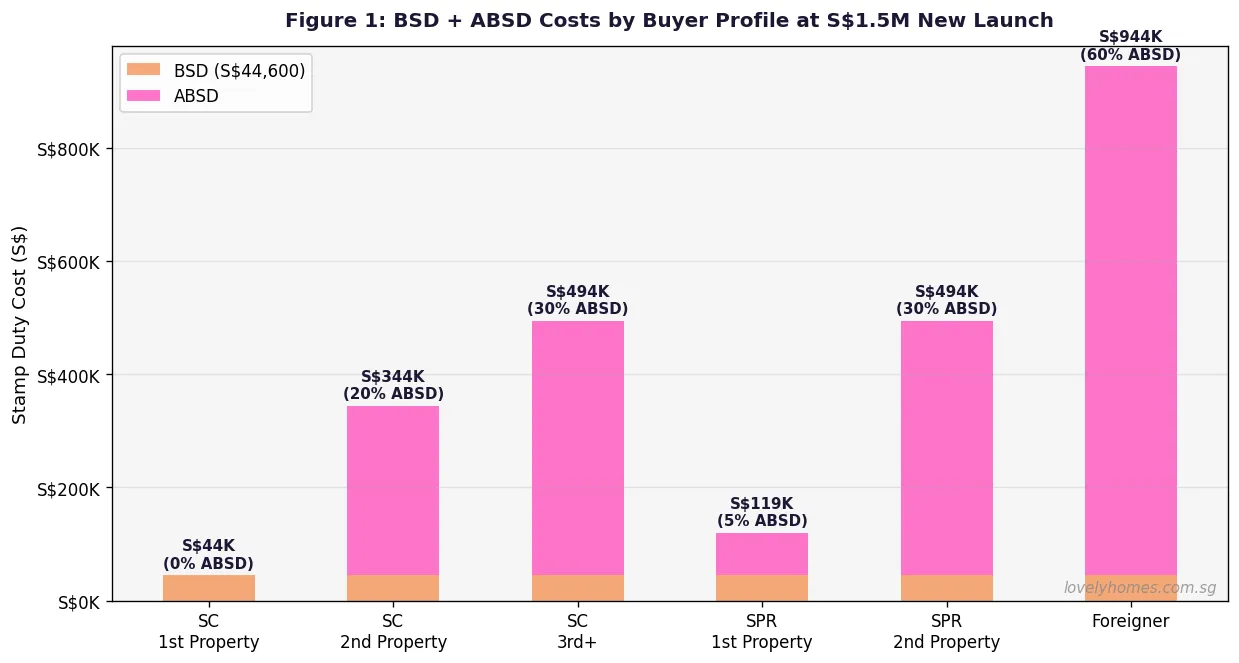
Additional Buyer’s Stamp Duty (ABSD) is levied by the Inland Revenue Authority of Singapore (IRAS) on residential property purchases in Singapore, on top of the standard Buyer’s Stamp Duty (BSD). The ABSD rates introduced in April 2023 are among the highest in Singapore’s property history — 20% for Singapore Citizens buying a second property, 30% for SC buying a third or subsequent property, and 60% for foreign buyers on any purchase. These rates were designed explicitly to curb speculative activity and cool an overheated market.

However, recognising that many SC married couples engage in sequential upgrading — selling their HDB flat and buying a private condominium as a genuine housing upgrade rather than an investment — the government provides a remission (refund) mechanism for a specific, tightly defined buyer profile. This remission does not reduce the ABSD rate payable at purchase; instead, the full ABSD must be paid upfront, and a refund application is made after the old property is sold within the prescribed window.

ABSD remission policy is set by the Ministry of Finance (MOF) and administered by IRAS. Changes to remission criteria require an MOF announcement, usually as part of the broader set of property cooling measure adjustments. The current remission framework has been in force since the April 2023 cooling measure revision.

Eligibility Matrix: Who Qualifies for ABSD Remission?

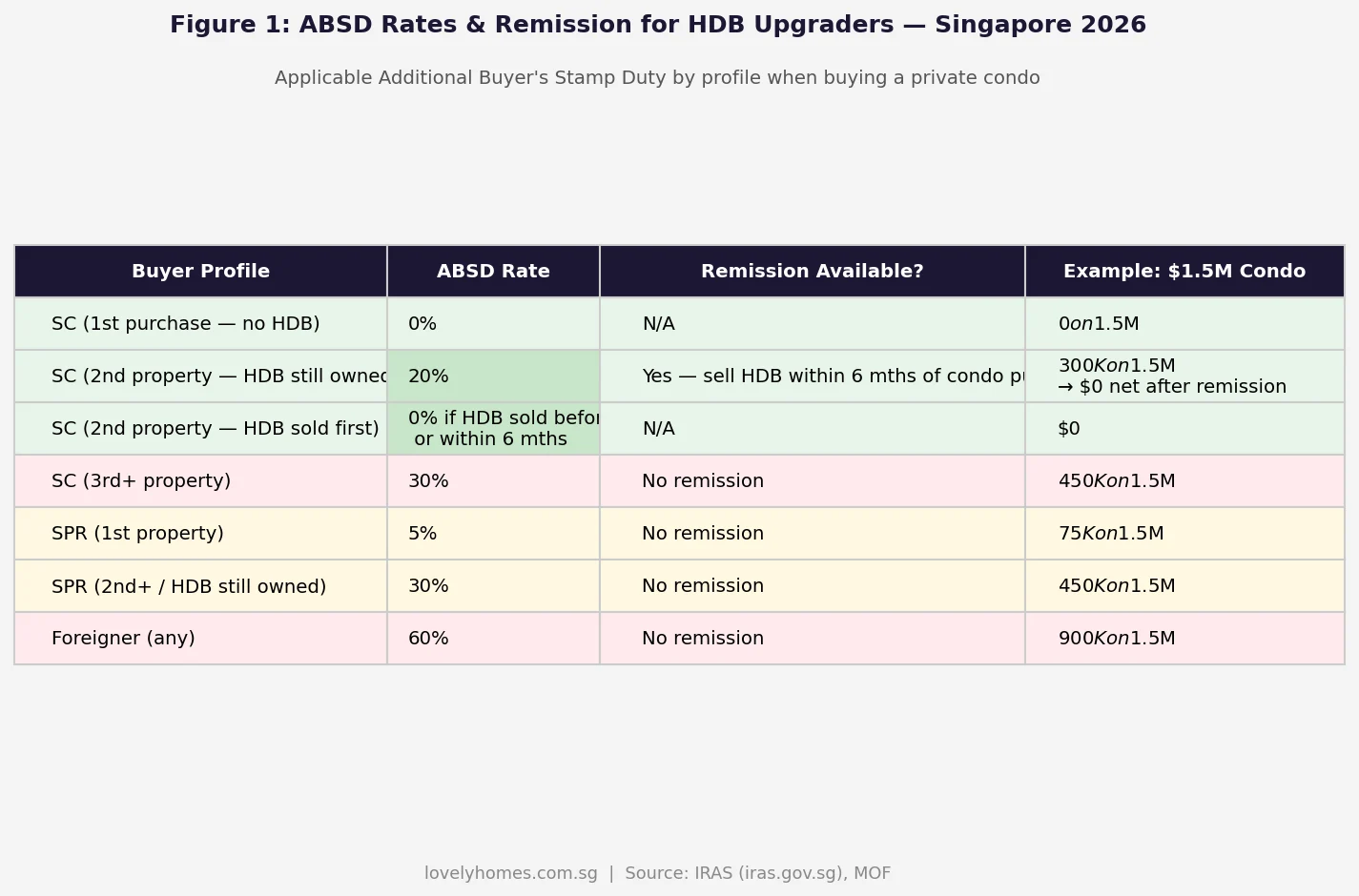
ABSD remission eligibility matrix by buyer profile Singapore 2026
Figure 1: ABSD Remission Eligibility by Buyer Profile — as of June 2026. Source: IRAS.

The eligibility criteria are deliberately narrow. The SC married couple remission is the most widely applicable scenario and applies to upgraders transitioning from their HDB flat to a private condominium. Both spouses must be Singapore Citizens (not Permanent Residents, not foreigners) at the time of the new purchase, the new purchase must be their first jointly-owned residential property together (neither spouse may hold another residential property at the time of purchase), and the existing property — typically an HDB flat — must be sold and the sale completed within 6 months of the new property’s purchase completion date.

Critically, the “completion date” for a new launch condominium is the Temporary Occupation Permit (TOP) date, not the date the OTP was exercised or the Sales and Purchase Agreement (SPA) was signed. For resale private properties, completion is typically 10–12 weeks after OTP exercise. This distinction matters greatly for the 6-month window calculation: an SC couple who exercises an OTP on an under-construction new launch today does not begin their 6-month countdown until the project obtains TOP — which could be 3 to 5 years away. This is a significant planning advantage for new-launch buyers compared to resale buyers.

How Much Is the ABSD Remission Worth?

ABSD remission amounts at various property purchase prices Singapore SC couple 2026
Figure 2: ABSD Remission Value for SC Married Couple at the 20% Rate — Across Various Purchase Prices.

At the current 20% ABSD rate for SC buying a second property, the remission amounts are material — often exceeding the total legal, agent, and renovation costs of the purchase combined. A couple buying a S$1.5 million condominium faces S$300,000 in upfront ABSD, all of which can be recovered if the HDB flat is sold in time. At S$2 million, the recoverable ABSD is S$400,000. These are not marginal amounts: they represent a fundamental difference in the affordability and financial feasibility of the upgrade.

It is worth noting that ABSD cannot be paid from CPF — it must be paid in cash. This means a couple must have S$300,000 to S$600,000 or more in liquid cash available at the time of purchase (before the remission is received). For many upgrading households, this is the single biggest financial planning challenge of the entire transaction. Some couples structure a bridging loan to cover the ABSD temporarily, which is repaid once the HDB flat is sold and the remission is received. The cost of the bridging loan — typically at prime rate or slightly above, for 3–6 months — is a relatively small price for preserving the remission eligibility.

The 6-Month Window: How It Works and the Clawback Risk

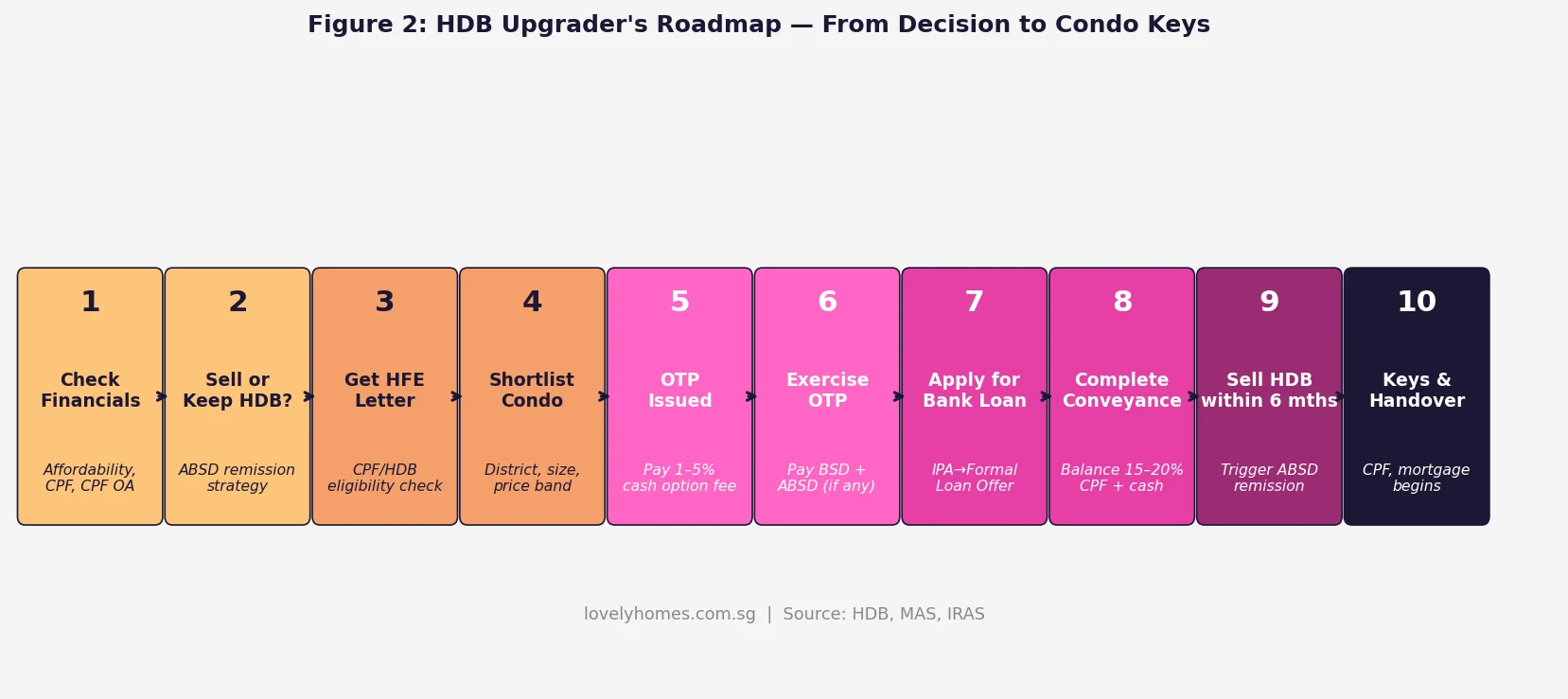
ABSD SC couple remission step by step timeline 6 month clawback window Singapore
Figure 3: ABSD SC Married Couple Remission — Step-by-Step Timeline and the 6-Month Clawback Window.

The 6-month window begins on the completion date of the new property purchase, not from the OTP date or the SPA signing date. For a private condominium under construction, this is the TOP date. For a resale condominium, it is the completion of the property transfer — typically 10–12 weeks after OTP exercise. The existing property sale must be completed within this 6-month window, not merely contracted or in progress. A scenario where the HDB OTP is exercised on Month 5 but the HDB sale only completes on Month 7 would fail the test.

If the 6-month window is missed — whether due to a buyer falling through on the HDB flat, a delayed completion, or simply poor timeline management — IRAS will issue an assessment for the full ABSD plus interest at 5% per annum from the date of the new property’s stamp duty payment. On a S$300,000 ABSD amount, 5% interest is S$15,000 per year. If the miss is discovered and collected 18 months later, the clawback amount would be approximately S$322,500. There is no grace period and no appeal mechanism short of demonstrating exceptional extenuating circumstances, which IRAS assesses on a case-by-case basis with a high bar for approval.

ABSD Remission at a Glance: Summary Table

Parameter Details
Who qualifies (main scheme) Singapore Citizen married couples — both spouses must be SC; first joint property purchase
ABSD rate paid upfront 20% (SC 2nd property) — must be paid in cash within 14 days of OTP exercise
Remission quantum Full 20% of purchase price refunded if conditions met
Condition — existing property Existing HDB flat or private residential property must be fully sold and completed
Deadline to sell Within 6 months of new property completion date (TOP for new launches; legal completion for resale)
How to apply IRAS e-Stamping portal — submit remission application with documentary proof of sale
Refund timeline Typically 3–4 weeks after IRAS approves the application
Clawback if missed Full ABSD + 5% per annum interest from date of original stamp duty payment
SPR couple (1st joint) 5% ABSD remission — no sale condition; applies to first joint purchase where neither holds residential property
Can CPF be used for ABSD? No — ABSD must be paid in cash; CPF cannot be used for ABSD
Does BSD get remitted? No — BSD is always payable and is not remitted under any scheme

Worked Example: The Ng Family SC Couple Upgrade

Scenario: SC couple selling Sengkang HDB and buying a Tampines resale 3BR condo

Mr and Mrs Ng are Singapore Citizens, married, joint owners of a 5-room HDB flat in Sengkang (Market Value: S$720,000, mortgage outstanding: S$180,000, CPF drawn: S$350,000 + S$65,000 accrued interest = S$415,000). MOP cleared. They wish to upgrade to a 3-bedroom resale condominium in Tampines priced at S$1,600,000.

ABSD calculation:
Purchase price: S$1,600,000
ABSD rate (SC 2nd property): 20%
ABSD payable: S$320,000 (cash, within 14 days of OTP)
BSD: S$44,600 (can use CPF)
Legal fees: ~S$3,500
Agent commission: ~S$16,800 (if using buyer’s agent at 1%+GST)

Cash flow at purchase:
Down payment (25% of S$1.6M): S$400,000 (5% cash = S$80,000 + 20% CPF/cash = S$320,000)
ABSD: S$320,000 cash
BSD (can use CPF): S$44,600
Legal + misc: ~S$20,300
Total cash required before remission: ~S$420,300

HDB sale proceeds (to fund the purchase):
Sale price: S$720,000
Less: outstanding mortgage S$180,000
Less: CPF refund (principal + accrued interest) S$415,000
Less: legal fees + agent commission: ~S$14,800
Net cash from HDB sale: ≈S$110,200

Remission strategy:
The Ngs complete the condominium purchase on 15 July 2026. They have until 15 January 2027 (6 months) to complete the HDB flat sale. They list the HDB at S$720,000 immediately, receive an OTP from a buyer in August 2026, and the sale completes on 15 October 2026 — well within the 6-month window. They apply to IRAS for remission in November 2026 and receive the S$320,000 refund by mid-December 2026.

Net position after remission:
ABSD refunded: S$320,000
Net cash outlay (BSD + legal + agent): ~S$63,100
CPF refund reinvested to CPF OA: S$415,000 (can be redrawn for new condo mortgage servicing)
This is a financially viable upgrade — the key risk is the 6-month sale timeline.

What This Means for Upgraders: Practical Takeaways

For the vast majority of HDB upgraders — SC couples who have cleared their MOP and wish to own a private condominium — the ABSD remission scheme is what makes the upgrade financially viable. Without it, the 20% ABSD on a S$1.5 million–S$2 million condominium would represent a permanent, irrecoverable cost of S$300,000 to S$400,000, which would push many upgrades into the realm of financial imprudence. With the remission, the upgrade structure works — but only if the timing is managed with precision.

The most important practical point is that the HDB sale should not wait until the condominium purchase completes. Upgraders who procrastinate on listing their HDB flat — waiting to see if the condominium purchase proceeds, or delaying to maximise HDB rental income — run a real risk of missing the 6-month window. In a slower resale market, a flat may take 2–4 months to find a buyer and another 8–10 weeks to complete. That is already 5–6 months consumed. There is very little margin for slippage.

The comparison with HDB upgraders buying new launch condominiums is instructive: new launch buyers typically have 3–5 years before TOP, giving them ample time to sell their HDB flat — often at the most favourable market moment. Resale condominium buyers, by contrast, must manage the HDB sale on a much tighter 6-month clock.

What Might Come Next: Remission Policy Outlook

The ABSD remission framework is a carve-out within the broader ABSD system that the Ministry of Finance has maintained consistently since ABSD’s introduction in 2011, though the qualifying conditions and rates have evolved alongside each cooling measure adjustment. There is no current indication that the SC married couple remission will be abolished — it serves an important social function by supporting genuine upgrading rather than speculative multi-property accumulation. However, the remission conditions could tighten further if the government observes systematic abuse or if the market overheats again.

A potential policy direction that has occasionally been discussed in market commentary is the application of ABSD to new launch OTP exercise dates rather than TOP dates, which would eliminate the time advantage new launch buyers currently have over resale buyers in managing the 6-month HDB sale window. If implemented, this would be a material tightening that would force many upgraders to sell their HDB flat before the condominium purchase — reversing the current sequencing that most buyers prefer.

Frequently Asked Questions

Can I use CPF to pay the ABSD before receiving the remission?

No. ABSD must be paid entirely in cash — CPF Ordinary Account funds cannot be used to pay ABSD under any circumstances. This is a hard rule set by IRAS and CPF Board. Only Buyer’s Stamp Duty (BSD) and the property purchase price can be funded using CPF. If you do not have sufficient cash for the ABSD upfront, you may need to explore a bridging loan to cover the amount temporarily, which is repaid once the HDB sale completes and the ABSD remission is received. Always consult a bank or licensed financial adviser about bridging loan options and costs before proceeding.

Does the ABSD remission apply if my spouse is a Singapore Permanent Resident, not a citizen?

No. The SC married couple ABSD remission requires both spouses to be Singapore Citizens at the time of the new property purchase. If one spouse is an SPR and the other is an SC, the SC-couple remission does not apply. In this scenario, the combined SC+SPR buyer profile attracts a 30% ABSD on the second property (or the applicable rate based on the profile with the higher ABSD obligation), and no remission is available for the difference above the SPR rate. SPR married couples buying their first joint residential property can qualify for a separate full remission of their 5% ABSD — but this applies only to SPR+SPR couples on a genuinely first joint purchase where neither holds another residential property.

What if my HDB flat sale falls through after I have already purchased the condominium — can I extend the 6-month window?

IRAS does not provide an automatic extension of the 6-month window due to a failed HDB sale. However, IRAS may consider an extension in exceptional and documented circumstances — for example, if the buyer of the HDB flat absconds or commits a fundamental breach, causing the sale to abort, and the seller (you) acted in good faith to find an alternative buyer promptly. These situations are assessed individually and are not guaranteed. If a buyer falls through, you should immediately relist the flat and notify your conveyancer and IRAS in writing. In a difficult HDB resale market or if the flat is in an over-quota block (EIP), the risk of a failed sale is higher — factor this into your planning before exercising the condominium OTP.

The new launch condominium I bought has been delayed past its expected TOP. Does this affect my 6-month window?

For new launch condominiums, the 6-month remission window begins at the actual TOP date, not the projected or contractual TOP date. If TOP is delayed by 6 or 12 months, your 6-month window shifts accordingly — you have more time to sell your HDB flat. This is generally advantageous: if your HDB flat has already been sold before TOP (as many prudent upgraders do), the delay merely means you wait longer in rental or temporary accommodation before moving into the new property. However, if you have not yet sold the HDB flat and are waiting for clarity on TOP before acting, a TOP delay can compress the effective timeline between TOP and your actual start of marketing, so do not wait for the very last moment.

Is there an ABSD remission for Singapore Citizens who are not married — for example, singles or divorced individuals?

No. The full ABSD remission for a second residential property is only available to married Singapore Citizen couples. Single SC individuals, divorced SC individuals, and cohabiting SC couples (unmarried) do not qualify for the remission and must pay the full 20% ABSD on a second property purchase without any refund mechanism. This is a deliberate policy choice — the remission is designed to support the family unit’s housing upgrade, not individual investment. Singles who wish to own a private condominium after selling their HDB flat may consider selling first and then buying as a first-time private property buyer with no existing HDB — this eliminates the ABSD entirely rather than triggering and then seeking remission.

What documents do I need to apply for the ABSD remission, and how do I submit them?

The ABSD remission application is submitted through IRAS’s e-Stamping portal (mytax.iras.gov.sg). You will need: (a) the stamp duty reference number from the original ABSD payment; (b) a copy of the signed HDB resale completion documents or the private property sale and purchase agreement with evidence of completion (typically a letter from your solicitor confirming that the sale has been completed); (c) evidence that the selling party is the same person/persons who purchased the new property (NRIC details); and (d) your marriage certificate, if not already on record with IRAS. Your conveyancer or property lawyer can typically prepare and submit the remission application as part of the conveyancing engagement — confirm with them early in the process so they are ready to file as soon as the HDB sale completes.

Can the ABSD remission be used if the new property is bought in one spouse’s sole name, not jointly?

This is a nuanced point. The SC married couple remission applies to purchases made in the joint names of both spouses. If the new condominium is purchased in the sole name of one spouse only, the SC married couple scheme may not apply — the buying spouse is effectively treated as an individual, and whether the purchase constitutes a “second property” depends on whether that spouse already holds other residential property. If the buying spouse has never owned a residential property before (having sold their share in the HDB flat prior to purchase, for example), they may qualify as a first-time buyer with 0% ABSD — this is the “decoupling” strategy. Decoupling and ABSD remission are alternative approaches to the same upgrading problem; they are not typically combined in the same transaction. Consult a licensed conveyancer before choosing a structure.

Disclaimer: This article is for general informational purposes only and does not constitute tax, legal, or financial advice. ABSD rates, remission conditions, and application procedures are subject to change by the Ministry of Finance (MOF) and IRAS. Always verify current rates and eligibility conditions at iras.gov.sg before making any property purchase or sale decision. Consult a licensed conveyancer, qualified financial adviser, or tax professional before proceeding with any transaction involving ABSD. The worked examples in this article are illustrative only and may not reflect your specific financial circumstances.

Singapore Joint Property Ownership Guide 2026: Joint Tenancy vs Tenancy in Common Explained

Singapore Joint Property Ownership Guide 2026: Joint Tenancy vs Tenancy in Common Explained

Key Takeaways: Singapore Joint Property Ownership 2026

  • Two modes of co-ownership: Joint Tenancy (JT) — equal shares, right of survivorship; Tenancy in Common (TiC) — flexible proportions, passes via Will or intestacy.
  • ABSD on joint purchases: For mixed-profile co-purchases (e.g. one owner already owns property), ABSD is calculated based on the higher ownership count across all co-owners. A Singapore Citizen who already owns an HDB buying a private condo jointly with a first-timer SPR pays the SC second-property ABSD rate of 20% on the full purchase price.
  • CPF usage: Each co-owner draws on their own CPF Ordinary Account for their respective mortgage contributions. There is no cross-pooling of CPF funds between co-owners.
  • ABSD and decoupling: Married couples who hold property under JT may consider “decoupling” — severing the JT into TiC and transferring one spouse’s share to the other — as a strategy to free up the departing spouse’s ABSD first-property entitlement. BSD applies on the transfer but ABSD is nil if the transferring spouse is disposing of their only property.
  • Death under JT: Title vests automatically in the surviving co-owner(s) — no probate required. CPF monies do not follow survivorship and are returned to the deceased’s estate.
  • Divorce: Courts may order sale or transfer of jointly owned property. Both parties lose first-timer HDB status; CPF grants are clawed back.
  • Foreigners and joint ownership: A Singapore Citizen or PR may co-purchase a private condo with a foreigner under JT or TiC, but the foreigner’s ABSD rate (60% as at June 2026) applies to the entire purchase price — not just the foreigner’s share.

Introduction: Why Joint Property Ownership Matters in Singapore

Jointly owned property is the norm in Singapore. The vast majority of HDB flats are purchased by couples or families as joint owners, and many private condominiums and landed homes are also held under co-ownership arrangements. Yet the legal and financial mechanics of joint property ownership are surprisingly misunderstood — even by experienced property owners.

The two recognised forms of co-ownership under Singapore law are Joint Tenancy and Tenancy in Common. The choice between them has far-reaching implications for estate planning, ABSD strategy, CPF withdrawal, and what happens to the property on the death of a co-owner or the breakdown of a marriage. Understanding these mechanics is not just a legal formality — it can mean the difference between a clean, probate-free property transfer and years of legal disputes, or the difference between a well-timed decoupling saving S$300,000 in ABSD and an unnecessary stamp duty bill.

This guide covers both forms of co-ownership in depth, explains how the ABSD framework applies to joint purchases across different buyer-profile combinations, and provides a worked example for couples navigating the HDB-to-private upgrade path.

Figure 1: Joint tenancy vs tenancy in common comparison table Singapore 2026
Figure 1: Joint Tenancy vs Tenancy in Common — key differences at a glance. Source: SLA.gov.sg, HDB.gov.sg

Joint Tenancy (JT): What It Means and How It Works

A Joint Tenancy is the default co-ownership structure for HDB flats purchased by married couples in Singapore, and it is also commonly used by couples purchasing private residential property together. Under JT, co-owners hold the property in equal, undivided shares. There is no “60/40 split” or any other fractional allocation — each joint tenant holds an identical and indivisible interest in the whole property.

The defining legal feature of JT is the right of survivorship (jus accrescendi). When one joint tenant dies, their interest in the property does not form part of their estate — it passes automatically and immediately to the surviving joint tenant(s) by operation of law. This means:

  • No probate or letters of administration are required for the property title.
  • The property cannot be bequeathed by Will — any attempt to do so is ineffective against JT property.
  • The Singapore Land Authority (SLA) will transfer the title to the survivor(s) upon production of the death certificate and relevant forms.

One consequence property owners sometimes overlook is that CPF monies do not follow the right of survivorship. Even if the property is held under JT, the CPF contributions the deceased co-owner made towards the property are refunded to their CPF account and then distributed according to their CPF nomination — or, if no nomination exists, under the Intestate Succession Act. This means the surviving spouse does not automatically receive the CPF monies used to pay the mortgage, and may need to refinance or use their own CPF to discharge the remaining loan.

Tenancy in Common (TiC): Flexible Shares and Estate Planning

Under a Tenancy in Common, co-owners hold distinct and quantified proportions of the property — for example, 50/50, 70/30, or any other split agreed upon at the time of purchase. Each co-owner’s share is their individual asset and may be dealt with separately: they may sell their share, mortgage it (subject to bank consent), or leave it by Will.

The key distinction from JT is that there is no right of survivorship in TiC. When a co-owner under TiC dies, their share forms part of their estate and is distributed according to their Will or, if there is no valid Will, under the Intestate Succession Act (Cap. 146). This means probate proceedings (or letters of administration if there is no Will) are required before the deceased’s share can be transferred to beneficiaries.

TiC is often the preferred structure when:

  • Co-owners are not married to each other (e.g. siblings, friends, or business partners co-purchasing an investment property) and wish to hold proportionate shares reflecting their respective financial contributions.
  • Couples wish to hold proportions that reflect their CPF contributions or cash payments accurately, for clean accounting on eventual sale.
  • One co-owner wants the flexibility to bequeath their share to a specific beneficiary (e.g. children from a prior marriage) rather than have it vest automatically in the surviving spouse.
  • A decoupling strategy is being implemented (see below).

ABSD on Joint Purchases: The Higher-Count Rule

The Additional Buyer’s Stamp Duty (ABSD) framework applies to the full purchase price of a jointly acquired property, at the rate applicable to the co-owner with the highest ownership count. This is often misunderstood: buyers do not pay ABSD on “their share” of the purchase price — the duty is assessed on the whole transaction.

Practical examples as at June 2026:

  • Two Singapore Citizens, both first-time buyers (neither owns any property): ABSD = 0%. The most favourable outcome — no duty above the standard Buyer’s Stamp Duty (BSD).
  • SC couple where one spouse already owns an HDB flat: ABSD = 20% on the full purchase price. The spouse who owns the HDB has a higher ownership count, so the 20% SC second-property rate applies to the entire purchase.
  • SC + Singapore Permanent Resident, both first-time buyers: ABSD = 5% on the full purchase price (SPR first-property rate). The SPR’s ownership profile drives the rate.
  • SC (owns HDB) + SPR (first-time buyer): The SC is the higher-count owner — ABSD = 20%.
  • SC + foreigner (any ownership profile), post-February 2023: ABSD = 60% on the full purchase price. The foreigner’s rate applies regardless of the SC co-owner’s profile. This rule was tightened in April 2023 and remains in force as at June 2026.
  • Two SPRs, both first-time buyers: ABSD = 10% on the full purchase price.

Figure 2: ABSD rates on joint property purchases by buyer profile combination Singapore 2026
Figure 2: ABSD rates on joint purchases by co-owner profile combination as at June 2026. Source: IRAS.gov.sg

CPF Usage in Joint Property Purchases

Each co-owner draws on their own CPF Ordinary Account (OA) to fund their respective mortgage instalments and/or part of the downpayment. There is no pooling of CPF funds across co-owners, and no co-owner may use another’s CPF without that person’s explicit authorisation through a CPF nomination or legal assignment — neither of which is available for mortgage purposes.

For HDB flats under JT, each owner’s CPF contribution is tracked separately by the Central Provident Fund Board (CPF). On sale of the flat, each owner must refund their own CPF principal withdrawn plus the accrued interest (calculated at 2.5% per annum) back to their own CPF OA. These refunds are entirely separate — even under JT, CPF repayments do not cross between co-owners.

This has important implications for couples planning an ABSD remission strategy. If Wife uses significantly more CPF than Husband towards the property, her CPF refund obligation on sale will be larger — reducing the net cash she receives. This must be factored into the financial model for any property upgrade or decoupling exercise.

Changing Between JT and TiC: Deed of Severance and Decoupling

It is possible to convert a JT into a TiC — and vice versa — through a legal process. Converting from JT to TiC is called severance and can be done unilaterally by one joint tenant (i.e. without the other’s consent) by serving a notice of severance, though in practice solicitors will draft a Deed of Severance to document the transaction formally. Converting from TiC to JT requires the agreement of all co-owners and is done by deed.

Decoupling is a related but distinct strategy that has gained popularity among HDB upgrader couples. It involves one co-owner transferring their share in a jointly owned property to the other co-owner, so that the transferring co-owner ends up with no property in their name. The “clean” spouse can then purchase a new property as a first-time buyer, paying 0% ABSD (for SC first-property buyers).

The decoupling process involves:

  • A Deed of Severance (if converting from JT to TiC first) or direct transfer deed.
  • Buyer’s Stamp Duty (BSD) on the value of the share transferred. For a S$1.8 million condo, a 50% share transfer attracts BSD on S$900,000 — approximately S$24,600.
  • ABSD on the share transferred — this is generally nil if the transferring co-owner is disposing of their only property interest, but care must be taken around whether they hold any other property interests.
  • CPF refund: The transferring owner must refund their CPF principal and accrued interest to their OA at the time of transfer.
  • Bank refinancing: The remaining owner must demonstrate sufficient TDSR headroom to service the loan as sole borrower. This is the most common practical barrier to decoupling.
  • Legal fees: Typically S$3,000–S$6,000 for the full decoupling exercise.

For a detailed analysis of decoupling costs and worked examples, see our dedicated guide: Singapore Property Decoupling Guide 2026.

Joint Ownership, Death and Divorce

Figure 3: Joint property ownership on death or divorce — Singapore legal consequences 2026
Figure 3: What happens to jointly owned property on death (left) or divorce (right). Source: SLA.gov.sg, HDB.gov.sg, mlaw.gov.sg

On death under JT: Title vests in the surviving joint tenant(s) automatically by the right of survivorship. The surviving owner must notify SLA, HDB (for HDB flats), and the bank, and submit the required documentation (death certificate, SD/5 or equivalent form for SLA). There is no need to engage the courts for a Grant of Probate in respect of the property itself. However, as noted, CPF monies are returned to the deceased’s estate and must be distributed via their CPF nomination or Will.

On death under TiC: The deceased’s share forms part of their estate. If they have a valid Will, the share will be distributed according to its terms after Grant of Probate. If there is no Will, the share is distributed under the Intestate Succession Act — which specifies default distribution rules based on family relationships (e.g. spouse, children, parents). Probate proceedings typically take two to six months. During this period, the property cannot be sold or transferred without a court order.

On divorce: Jointly owned property — whether HDB or private — becomes a matrimonial asset subject to division by the Family Justice Courts (FJC) under the Women’s Charter. The court has broad discretion to order sale of the property and division of proceeds, or transfer of one spouse’s share to the other. Considerations include the length of the marriage, each party’s financial contributions, and the welfare of any children.

For HDB flats on divorce, both parties lose their first-timer status. Any CPF Housing Grants (EHG, AHG, Family Grant) received are subject to clawback. The departing spouse must refund their CPF principal and accrued interest. If the receiving spouse wishes to purchase another HDB flat subsequently, they will be treated as a second-timer buyer with the associated restrictions.

Worked Example: SC Couple — JT vs TiC and the ABSD Upgrade Decision

The Lim Family — Choosing Between JT and TiC for a Private Condo Purchase

Profile: Mr Lim (SC, owns HDB Sengkang 4-room, MOP cleared 2024) and Mrs Lim (SC, no other property). Joint gross income S$16,000/month.

Target: 3-bedroom private condo in District 19, S$2,000,000.

Option A — Joint purchase of condo (both on title):

  • Mr Lim is a second-time property owner (owns HDB) → ABSD rate = 20% SC second property
  • ABSD on full purchase price: 20% × S$2,000,000 = S$400,000 upfront
  • BSD: S$74,600
  • ABSD remission: sell HDB within 6 months of SPA → recover S$400,000
  • Risk: if HDB cannot be sold within 6 months, ABSD is forfeited
  • Bank loan: 75% LTV = S$1,500,000 @ 3.0% over 30 years → S$6,321/mth; TDSR 39.5% — PASS

Option B — Decouple HDB first, Mrs Lim buys condo as sole purchaser:

  • Step 1: Decouple HDB. Mr Lim transfers his 50% share to Mrs Lim. BSD on S$550K (50% of S$1.1M HDB value) ≈ S$11,400. ABSD nil (Mr Lim disposing of only property). CPF refund by Mr Lim: principal + accrued interest ≈ S$130,000 to his OA. Mrs Lim’s TDSR must support full HDB loan as sole borrower.
  • Step 2: Mr Lim (now owning nothing) buys the S$2M condo as a first-time buyer: ABSD = 0%. BSD = S$74,600.
  • Total stamp duty: S$11,400 (HDB transfer BSD) + S$74,600 (condo BSD) = S$86,000
  • Saving vs Option A (net of remission): decoupling saves S$0 upfront ABSD vs A’s remission — but eliminates the remission timing risk entirely and allows Mr Lim to retain the HDB as a rental property (MOP cleared). Net rental yield on S$1.1M HDB estimated at 4.2% per annum.
  • Practical constraint: Mrs Lim must qualify under TDSR for HDB loan solo. At S$8,000 income, HDB loan maximum at 30% MSR for 25 years ≈ S$696K. HDB outstanding balance ~S$260,000 — well within limit. ✅

Recommended approach: For couples where keeping the HDB as a rental property is financially viable and the TDSR supports solo HDB ownership, decoupling and a clean first-purchase of the private property is generally more tax-efficient and risk-free than the simultaneous purchase + ABSD remission route. The key question is always whether the remaining co-owner’s TDSR supports solo mortgage servicing.

Summary: Joint Ownership Rules at a Glance

Feature Joint Tenancy Tenancy in Common
Ownership shares Equal and undivided Any proportion agreed
On death Right of survivorship — auto-transfer Passes via Will / ISA — probate needed
CPF on death Refunded to estate (not survivorship) Refunded to estate
Estate planning Cannot bequeath by Will Can bequeath TiC share by Will
HDB flat default JT (married couples) Available by request
ABSD basis Higher ownership count of any co-owner Higher ownership count of any co-owner
Decoupling / Severance Convert to TiC → transfer share Transfer share directly by deed
Suitable for Married couples, simple estate Investors, co-buyers, complex estates

What Might Change: Policy Outlook for Joint Ownership 2026

Singapore’s legal framework for co-ownership — rooted in English common law and codified in the Conveyancing and Law of Property Act (Cap. 61) and the Land Titles Act (Cap. 157) — has remained stable for decades. There are no announced reforms to the JT/TiC framework as at June 2026.

However, the ABSD framework governing joint purchases has evolved significantly since 2021. The April 2023 increase in foreigner ABSD to 60% was a major shift that effectively eliminated most mixed SC-foreigner joint property purchases in Singapore. The rule that the higher-ownership-count co-owner’s ABSD rate applies to the full purchase price has remained unchanged, and the government has shown no signs of softening this position given the property market’s continued strength.

Decoupling as an ABSD-reduction strategy has attracted increased scrutiny from IRAS since 2021. While decoupling remains a legitimate tax planning technique as at June 2026, IRAS has the power to disregard transactions that appear to be purely tax-motivated under its general anti-avoidance provisions. Property owners considering decoupling should ensure there is a genuine, non-tax rationale (such as portfolio management, retirement planning, or change in financial circumstances) and should take legal advice before proceeding.

Frequently Asked Questions

If I hold a property under Joint Tenancy and my co-owner dies, do I pay ABSD?

No — the transfer of title from a deceased joint tenant to the surviving joint tenant(s) by the right of survivorship is not a “purchase” and does not trigger ABSD. However, it is a dutiable transaction for stamp duty purposes under the Stamp Duties Act. The surviving owner must attend to the transmission of title at the Singapore Land Authority (SLA) and will need to pay a nominal transmission fee; this is not the same as stamp duty on a purchase. The surviving owner should also notify the bank and CPF Board of the change in ownership circumstances.

Can a foreigner co-own an HDB flat with a Singapore Citizen?

No. HDB flats — both BTO and resale — may only be purchased by Singapore Citizens and, in certain circumstances, Singapore Permanent Residents. Foreigners (i.e. non-Citizens, non-PRs) are not eligible to purchase or co-own HDB flats under any scheme. The restriction applies regardless of whether the other co-purchaser is a SC or SPR. Foreigners who wish to own residential property in Singapore may do so through private condominiums, apartments or (with Singaporeland Authority approval) restricted residential property, but not HDB flats or Executive Condominiums during their MOP period.

What happens to ABSD if I add or remove a co-owner from an existing property title?

Adding a co-owner to an existing property title is treated as a partial purchase by the incoming co-owner. BSD and potentially ABSD will apply on the value of the share being acquired, based on the incoming co-owner’s buyer profile and existing property ownership count. For example, if a SC who already owns two properties is added as a co-owner, they will pay the third-property ABSD rate (30% for SC as at June 2026) on the value of the share they are acquiring. Removing a co-owner (transferring their share to the remaining owner) triggers BSD — and potentially ABSD — on the transferring share in the hands of the receiving owner, based on their profile and ownership count at the time of transfer.

If my spouse and I hold our HDB flat under Joint Tenancy, can we sever it to Tenancy in Common for a decoupling exercise?

Yes — HDB permits the conversion of a joint tenancy to a tenancy in common (and vice versa) for HDB flats, subject to HDB’s approval. The process requires both owners to apply to HDB and to engage solicitors to prepare the relevant deed. Once converted to TiC, one co-owner can transfer their share to the other, triggering BSD on the transferred portion. ABSD on the transfer will depend on the profiles of both parties at the time of the transfer — if the transferring owner is disposing of their only property interest, ABSD is generally nil on that transfer. The receiving owner’s ABSD position on any subsequent purchase depends on their resultant ownership count after the transfer is completed.

Can my partner and I — unmarried — purchase an HDB flat jointly?

Unmarried couples below the age of 35 may purchase an HDB BTO flat jointly only if both are Singapore Citizens and they qualify under the Fiancé/Fiancée Scheme (they must marry within three months of key collection). Otherwise, unmarried couples generally do not qualify for joint HDB BTO purchases. Unmarried Singapore Citizens aged 35 and above may purchase a 2-room Flexi flat in a non-mature estate under the Single Singapore Citizen (SSC) scheme, but only as a single buyer — not jointly with an unmarried partner. For resale HDB flats, unmarried couples may apply under the Non-Citizen Spouse Scheme or the Joint Singles Scheme if both are Singapore Citizens and both are aged 35 or above.

What is the ABSD implication of inheriting a property share under Tenancy in Common?

Inheriting a property share under a deceased’s Will or intestacy does not trigger ABSD — inheritance is not a purchase. However, the inherited share is counted as a property interest for future ABSD purposes. If you inherit a 50% TiC share in a condominium, you are now treated as owning that property for ABSD purposes. Any subsequent property purchase you make will be assessed as a second (or later) property purchase, with the corresponding ABSD rate. You may choose to disclaim the inheritance to avoid this ABSD impact, but you should take legal and financial advice before doing so, as disclaimer is irrevocable.

How does a Lasting Power of Attorney (LPA) interact with jointly owned property?

A Lasting Power of Attorney (LPA) registered under the Mental Capacity Act (Cap. 177A) allows a person (the “donor”) to appoint a trusted individual (the “donee”) to make decisions about their personal welfare and/or property and financial affairs if the donor loses mental capacity. An LPA donee with authority over property and financial affairs can deal with the donor’s share of a jointly owned property — including signing sale and purchase agreements — on the donor’s behalf. For JT property, the donee can act in respect of the donor’s JT interest. For TiC property, the donee can deal with the donor’s defined share. HDB requires the Office of the Public Guardian’s endorsed LPA before it will process transactions involving a co-owner who lacks mental capacity.

Disclaimer: This article is for general informational purposes only and does not constitute legal, financial or property advice. Singapore property ownership laws, ABSD rates, HDB policies and CPF regulations are subject to change. Readers should verify current rules with the Inland Revenue Authority of Singapore (IRAS), HDB, Singapore Land Authority (SLA), CPF Board and Ministry of Law before making any property decision. Always consult a qualified Singapore property lawyer, licensed financial adviser or certified estate planner for advice tailored to your situation.

Tags: joint tenancy Singapore, tenancy in common Singapore, joint ownership property Singapore 2026, ABSD joint purchase, decoupling ABSD, Singapore property co-ownership, JT vs TiC, CPF joint property, Singapore property inheritance, joint ownership divorce Singapore, joint property ownership rules 2026

×

Click outside or press ESC to close

Singapore Property Decoupling Guide 2026: How to Save ABSD by Transferring Ownership

Singapore Property Decoupling Guide 2026: How to Save ABSD by Transferring Ownership

Quick Answer: What Is Property Decoupling in Singapore?

  • Decoupling means one co-owner transfers their share of a jointly-owned property to the other, so the transferring party exits as an owner — and can buy a new property as a “first-time buyer” with 0% ABSD.
  • The most common use: a married SC couple who jointly own an HDB flat or private property uses decoupling to allow one spouse to buy an investment condo with 0% ABSD instead of 20%.
  • Costs include Buyer’s Stamp Duty (BSD) on the transferred share, legal fees (S$3,000–S$6,000 combined), and a fresh bank valuation — typically S$30,000–S$40,000 all-in for a S$1.8M property.
  • The decoupled (remaining) owner must pass TDSR at 55% as a sole borrower — this is the most common deal-killer.
  • Decoupling an HDB flat is generally not permitted to facilitate a subsequent private property purchase — HDB rules require both owners to occupy the flat; voluntary transfer usually requires HDB approval and income ceiling checks.
  • For private property owners, decoupling is a legal tax-planning strategy upheld by IRAS — provided there is genuine consideration and no sham arrangement.
  • Timeline: 6–12 weeks from lawyer engagement to SLA registration. Plan ahead before the intended new purchase.

What Is Property Decoupling?

Property decoupling is the process by which one co-owner of a Singapore property transfers their ownership share to the other co-owner. The transferring party is then legally no longer a property owner and — crucially — can buy a new property as a first-time buyer, paying 0% Additional Buyer’s Stamp Duty (ABSD) where they would otherwise have paid 20% (as a Singapore Citizen purchasing a second property) or 30% (as a Singapore Citizen purchasing a third property).

Decoupling is administered under the Land Titles Act (Cap. 157) and is regulated by the Singapore Land Authority (SLA), which updates the property register to reflect the new ownership structure. All stamp duties arising from the transfer are collected by the Inland Revenue Authority of Singapore (IRAS) under the Stamp Duties Act.

The strategy became widely discussed after successive rounds of ABSD increases — from 7% for Singapore Citizens’ second properties in 2011 to 20% today — made the tax difference between a first and second purchase extremely significant. At a S$1.8M condo, the ABSD delta between a first-time buyer (0%) and a second-time buyer (20%) is S$360,000. A decoupling transaction that costs S$32,000–S$37,000 therefore offers a potential net saving of over S$320,000.

Figure 1: Decoupling Cost Components 2026 - BSD Legal Fees CPF Refund for Property Share Transfer Singapore
Figure 1: Decoupling Cost Components — for a S$1.8M private condo (2026). Source: IRAS, SLA, industry estimates.

How Decoupling Works: The Mechanics

There are two main ways a co-ownership is structured in Singapore: Joint Tenancy (JT) and Tenancy-in-Common (TiC). In a Joint Tenancy, both owners hold an undivided equal share with right of survivorship — you cannot specify different percentages. In a Tenancy-in-Common, owners hold defined shares (e.g., 60/40) and can sell, will, or transfer their individual share independently.

Decoupling under Joint Tenancy first requires converting the ownership to Tenancy-in-Common (via a unilateral instrument of severance, filed with SLA), then one party transfers their defined share to the other. Under Tenancy-in-Common, the transfer can proceed directly. The receiving party pays Buyer’s Stamp Duty on the value of the acquired share; ABSD may or may not apply depending on how many properties the receiving party will own after the transfer.

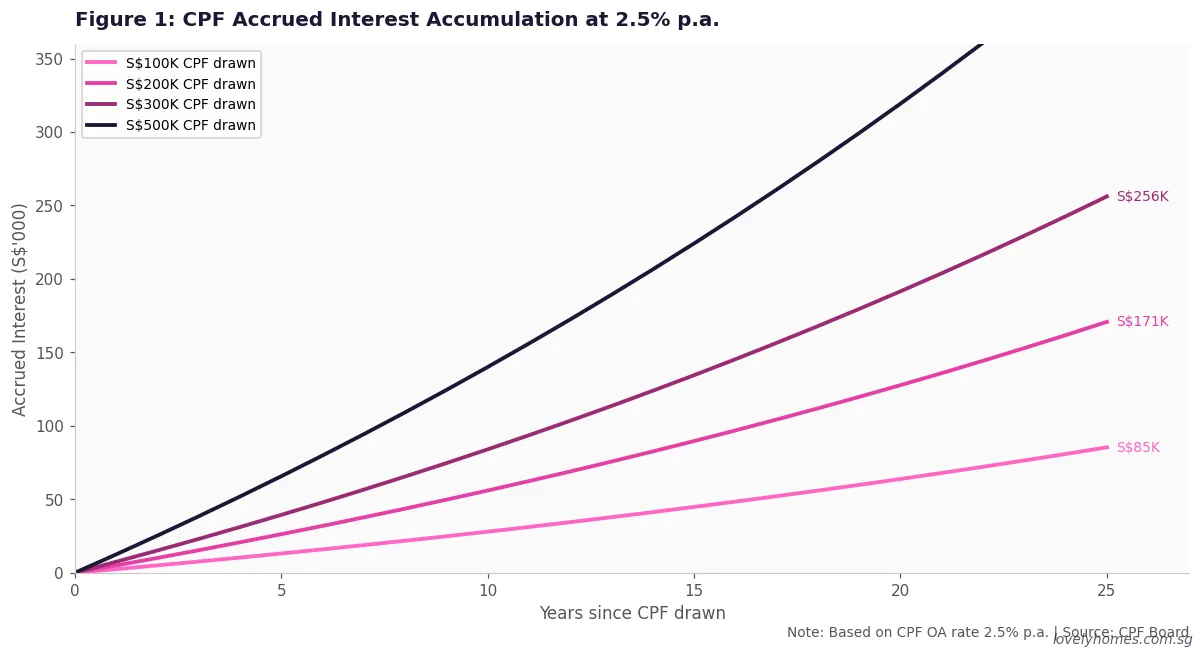
Key consideration — CPF: If CPF Ordinary Account funds were used to service the mortgage, the CPF Act requires that when a co-owner transfers their share, the CPF principal plus accrued interest at 2.5% per annum must be refunded to the transferor’s CPF OA. This is not a cash expense but it reduces the seller’s CPF balance available for the next purchase.

Can You Decouple an HDB Flat?

This is one of the most frequently asked questions — and the answer is nuanced. Under HDB rules, the owners of an HDB flat must generally all be listed occupiers and must fulfil the Minimum Occupation Period (MOP) before they can own any private property. Voluntarily transferring a flat interest within a married couple (i.e., removing one spouse as owner) requires HDB approval and the remaining owner must still meet eligibility criteria, income ceiling rules, and the Essential Occupier scheme does not allow the transferring party to immediately buy a private property without potential complications.

IRAS has also scrutinised HDB decoupling arrangements and has in certain cases assessed that ABSD relief was not applicable where the transaction lacked genuine commercial consideration. As a result, HDB decoupling to facilitate immediate private property purchase is generally not a viable strategy — the risk of IRAS anti-avoidance provisions applying is high. Couples who own an HDB flat and wish to invest in private property are better served by completing the MOP, selling the HDB flat, and purchasing the private property — or examining the HDB upgrader ABSD remission scheme.

Private property decoupling, by contrast, has a cleaner legal basis and is widely recognised as a legitimate planning tool by IRAS and the courts, provided it is a genuine arms-length transaction with fair value consideration.

The Stamp Duty Costs of Decoupling

The transferee (receiving party) pays Buyer’s Stamp Duty on the value of the share being acquired. BSD is calculated on the higher of the purchase price and the market value of the share. For a S$1.8M condo where one party acquires the other’s 50% share:

BSD Tier Rate On S$900K share
First S$180,000 1% S$1,800
Next S$180,000 2% S$3,600
Next S$640,000 3% S$19,200
Remaining S$0 (capped at S$900K) 4%
Total BSD S$24,600

ABSD is payable if the transferee will own more than the number of properties that attracts 0% ABSD after the transfer. If the transferee is a Singapore Citizen and this is their only property after receiving the share, ABSD = 0%. If the transfer results in them owning a second property, 20% ABSD applies on the S$900K share value — S$180,000 in additional stamp duty — which would make decoupling economically unattractive in most cases.

Figure 2: ABSD Savings vs Decoupling Cost for SC Couple - Second Property at 20 Percent ABSD Singapore 2026
Figure 2: ABSD savings versus decoupling cost for a Singapore Citizen couple across four property price points (2026). The net saving column assumes the transferee buys a replacement property worth the same value as the original. Source: IRAS, LovelyHomes analysis.

TDSR: The Critical Constraint

The Total Debt Servicing Ratio (TDSR) — capped at 55% of gross monthly income by the Monetary Authority of Singapore (MAS) — applies to the remaining owner who takes on the full mortgage as a sole borrower. This is the single most common reason decoupling fails at the planning stage.

To illustrate: if a couple jointly earns S$18,000 per month and has an outstanding mortgage of S$1.2M on their existing condo at 3.0% interest, their joint monthly repayment is approximately S$5,056. Under joint ownership, their combined TDSR is 28.1% — well within the 55% cap. But if one party decouples, the remaining owner must demonstrate that on their own income they can service S$5,056 per month without exceeding TDSR 55%. If the remaining owner earns S$9,000 per month, their solo TDSR is 56.2% — which just exceeds the cap. The bank will require either the loan to be reduced (requiring a partial capital repayment) or the TDSR to be restructured (longer tenure).

Before proceeding with decoupling, both parties should obtain a bank indicative assessment for the sole-borrower scenario. This should be done before signing any transfer documents.

The Step-by-Step Decoupling Process

Figure 3: 8-Step Property Decoupling Process Singapore 2026 - Deed of Severance SLA Registration Timeline
Figure 3: The 8-step property decoupling process in Singapore. Typical timeline is 6–12 weeks. Source: SLA, legal industry practice.

The decoupling process follows a well-established sequence governed by the Land Titles Act and SLA’s conveyancing procedures. Critically, both the transferor and transferee must engage separate legal counsel — the same firm cannot act for both parties in a transfer.

  1. TDSR Pre-Assessment — The remaining owner checks with their bank whether they can service the existing mortgage as a sole borrower. The bank will apply the prevailing TDSR stress test (4% p.a. or the contractual rate, whichever is higher). This step is essential before spending on legal fees.
  2. Engage Two Law Firms — Transferor and transferee each appoint their own conveyancing solicitors. Each firm’s fees range from S$1,500 to S$3,000 depending on complexity.
  3. Agree on Consideration and Share Structure — The transfer is at market value (or at least not at gross undervalue) to avoid IRAS anti-avoidance. A fresh bank valuation (S$500–S$800) is typically required.
  4. Compute and Pay Stamp Duty — IRAS must receive the BSD (and ABSD if applicable) within 14 days of the date of the transfer instrument. Late payment attracts penalties.
  5. CPF Board Notification — If CPF OA funds were used, the lawyers notify CPF Board. The transferor’s CPF principal plus accrued interest (compounded at 2.5% p.a.) is refunded to their CPF OA from the transfer proceeds.
  6. SLA Registration — The transfer instrument is lodged with SLA. Title registration updates typically take 2–4 weeks. The property register is updated to reflect the sole owner.
  7. Bank Refinancing — The bank may require the mortgage to be restructured under the sole borrower’s name. This is the point at which TDSR compliance is formally verified by the lender.
  8. New Purchase by Transferor — Once the SLA title update is confirmed, the transferor (now holding zero properties) can purchase a new property as a first-time buyer — paying 0% ABSD (for Singapore Citizens).

Worked Example: The Wong Family’s Decoupling Plan

Situation: Mr and Mrs Wong are both Singapore Citizens. They jointly own a 99-year leasehold condo in District 19 purchased in April 2021 for S$1,450,000. Current market value: S$1,800,000. Outstanding mortgage: S$980,000 at 3.0% p.a. (25-year term remaining, monthly repayment S$4,644). Mr Wong earns S$10,000/month; Mrs Wong earns S$9,000/month.

Goal: Mrs Wong to decouple (transfer her 50% share to Mr Wong), then purchase a S$1.5M OCR investment condo in her own name at 0% ABSD.

Step 1 — TDSR Check for Mr Wong as sole borrower:
S$4,644 ÷ S$10,000 = 46.4% — within TDSR 55%. ✓ Bank confirms sole-borrower eligibility.

Step 2 — Transfer Costs:
Half of market value = S$900,000
BSD on S$900,000: S$1,800 + S$3,600 + S$19,200 = S$24,600
ABSD: 0% (Mr Wong receives 50% share → still 1 property for him)
Legal fees (two firms): ~S$5,500
Valuation: S$700
Total transfer cost: ≈ S$30,800

Step 3 — CPF Refund to Mrs Wong:
CPF used over 5 years: ~S$210,000 principal + S$26,500 accrued interest = S$236,500 returned to Mrs Wong’s CPF OA. This is not a cash cost — it is her retirement savings being restored.

Step 4 — Mrs Wong’s New Purchase (S$1.5M condo, as 1st-time buyer):
BSD: S$1,500 + S$3,000 + S$18,000 = S$22,500 (BSD on first S$1.5M)
Wait — S$1.5M: First S$180K @1% S$1,800 + next S$180K @2% S$3,600 + next S$640K @3% S$19,200 + remaining S$500K @4% S$20,000 = S$44,600 BSD
ABSD: S$0 (first property)
Bank loan: 75% LTV = S$1,125,000 at 3.1% over 30 years → S$4,802/month
TDSR check: S$4,802 ÷ S$9,000 = 53.4% — just within 55%. ✓

Net Benefit:
ABSD that would have been paid (20% on S$1.5M) = S$300,000 saved
Less decoupling cost: S$30,800
Net saving: S$269,200 — a 9× return on the decoupling cost.

Why This Matters: ABSD Rates Make Decoupling Highly Valuable

Singapore’s ABSD rates for Singapore Citizens stand at 20% for second properties and 30% for third properties — among the highest in the Asia-Pacific region. Compared to Hong Kong’s Buyer’s Stamp Duty (eliminated for non-permanent residents in 2024), Malaysia’s RPGT, or Australia’s state-level stamp duties, Singapore’s ABSD is calibrated specifically to discourage speculative multiple-property ownership by residents.

For Singapore Citizens in the income range of S$9,000–S$15,000 per month — the typical HDB upgrader profile — the ABSD on a second condo purchase ranges from S$240,000 (at S$1.2M) to S$500,000 (at S$2.5M). At these magnitudes, the one-time decoupling cost of S$30,000–S$50,000 represents a 6–10× return on the planning investment, making it one of the highest-value legal tax-planning exercises available to Singapore property owners.

IRAS has not indicated any intention to prohibit private property decoupling, though they have tightened scrutiny of sham arrangements and HDB transfers aimed at circumventing ABSD. The key requirement is that the transfer reflects genuine consideration and commercial reality.

What Might Come Next

Decoupling will remain a viable strategy as long as the ABSD gap between first and subsequent properties remains large. There has been periodic speculation that MAS or MOF might introduce new anti-avoidance provisions targeting systematic decoupling — such as a “look-through” rule treating decoupled couples as a single ownership unit. As of June 2026, no such rule has been announced, and the current legislative framework treats each individual’s property count independently.

However, buyers should note that the government regularly reviews ABSD rates at Budget time. Any reduction in the first-to-second property ABSD delta would reduce the economic case for decoupling. Conversely, any further ABSD increase would make decoupling even more valuable.

Summary: Is Decoupling Right for You?

Factor Favourable for Decoupling Works Against Decoupling
Property type Private condo / landed HDB flat (generally not viable)
TDSR (remaining owner) Well below 55% on sole income Tight or above 55% on sole income
CPF usage Low CPF drawn / paid mostly cash Heavy CPF use → large refund to OA
Property value Higher value → larger ABSD saving Low value → smaller saving relative to cost
Intended new purchase Same or higher value condo No specific next purchase planned
Timeline 3–6+ months before intended purchase Urgent (6–12 weeks minimum needed)

Frequently Asked Questions

Does decoupling trigger Seller’s Stamp Duty (SSD)?

SSD applies if the property is sold within 3 years of purchase: 12% in year 1, 8% in year 2, and 4% in year 3. A decoupling transfer is treated as a sale of the transferor’s share for SSD purposes. If the condo was purchased less than 3 years ago, SSD will apply on the value of the transferred share — significantly increasing the cost. For a S$900,000 share transferred in year 1, SSD would be S$108,000. Plan decoupling only after the SSD holding period has passed.

Can we use CPF to pay for the BSD and costs of decoupling?

Yes, the transferee (receiving party) may use their CPF OA to pay the BSD on the transferred share, provided the property is already within the approved CPF usage framework (e.g., remaining lease covers at least 30 years). The transferor cannot use CPF for costs; however, if their CPF was used in the original mortgage, they will receive a CPF refund which is credited back to their OA — this can then fund the downpayment for their new purchase.

Can a Singapore Citizen decouple with a Permanent Resident spouse?

Yes, but the ABSD implications are more complex. If the SC spouse is the transferee (receives the share), their property count determines the ABSD rate — 0% if it becomes their first or only property. If the SPR spouse is the transferee, they would pay ABSD at 5% (SPR first property) on the received share. Given that SPR ABSD rates are higher than SC rates, it is typically more efficient for the SC spouse to remain as sole owner post-transfer. However, IRAS anti-avoidance provisions require commercial justification — consult a tax lawyer before proceeding.

Does my bank need to approve the decoupling?

Yes. If there is an outstanding mortgage on the property, the bank is a secured creditor with a registered charge. The bank must consent to the transfer of ownership and will typically require the remaining borrower (sole owner post-transfer) to pass a new creditworthiness assessment, including TDSR at 55%. Some banks may require partial repayment to reduce the loan balance before approving the sole-borrower structure. Engage your bank early — before signing the transfer instrument.

Is there a risk that IRAS disallows the ABSD saving?

IRAS has broad anti-avoidance powers under section 33A of the Stamp Duties Act, which allows IRAS to disregard or vary any arrangement that has the effect of reducing stamp duty liability if the arrangement has no commercial substance. For private property decoupling between genuine co-owners at market value, the risk is low provided: (a) the transfer is at full market value supported by a bank valuation; (b) there is genuine consideration passing between parties (not a gift at zero value); (c) the parties are not transferring back within a short period. Sham decouplings — paper transfers with no actual cash or CPF refund — carry serious legal risk.

After decoupling, when can the transferor buy a new property?

As soon as the SLA register is updated to remove the transferor as an owner, they are legally a first-time buyer for ABSD purposes. There is no mandatory waiting period post-registration. However, practically, the buyer should obtain the SLA title search confirming the updated ownership before signing any Option to Purchase (OTP) for the new property — ABSD is assessed on the buyer’s ownership status at the time of OTP exercise.

Can we reverse a decoupling if plans change?

A reversal (transferring the share back) is legally possible but would incur fresh BSD on the re-transfer, and potentially ABSD if the re-acquiring party now holds a second property. The SSD clock also restarts from the date of the original purchase in most interpretations. Reversals are expensive and should be avoided. Decoupling should only be executed when there is a firm plan to proceed with the new purchase.

Related Articles

Disclaimer: The information in this article is provided for general educational purposes only. Stamp duty rates, CPF rules, and TDSR regulations cited are based on IRAS, MAS, and CPF Board guidelines current as at June 2026 and are subject to change. LovelyHomes does not provide legal, tax, or financial advice. Before executing any property transfer or decoupling arrangement, consult a licensed conveyancing solicitor, a tax specialist registered with IRAS, and a bank or MAS-licensed mortgage adviser. Authoritative sources: IRAS (iras.gov.sg), SLA (sla.gov.sg), MAS (mas.gov.sg), CPF Board (cpf.gov.sg).

Singapore Property Investment Portfolio Guide 2026: ABSD Strategy, Rental Yields and How to Build Wealth Through Property

Singapore Property Investment Portfolio Guide 2026: ABSD Strategy, Rental Yields and How to Build Wealth Through Property

Building a property investment portfolio in Singapore is one of the most effective wealth strategies available to citizens and permanent residents — but it comes with significant structural constraints. The Additional Buyer’s Stamp Duty (ABSD) at 20% on a second property and 30% on a third makes uninformed multi-property acquisitions extremely expensive. This Singapore property portfolio guide 2026 shows you how to sequence purchases, manage leverage, and balance yield against capital appreciation — while keeping your ABSD bill as low as legally possible.

Quick Answer: 10 Key Rules for Singapore Property Portfolio Building (2026)

  • ABSD for SC — 0% on 1st, 20% on 2nd, 30% on 3rd+ property. These rates effective 27 April 2023 are the primary portfolio constraint.
  • ABSD for SPR — 5% on 1st, 30% on 2nd, 35% on 3rd+. SPRs face a heavier cost burden for multi-property portfolios.
  • Decoupling — SC couples can split joint ownership so each spouse buys their next property as a “first” owner, deferring ABSD on the second purchase.
  • SC upgrader remission — SC couples who buy a second property while still owning a first can claim back the 20% ABSD paid if they sell the first within 6 months.
  • TDSR 55% — applies to all property loans. Each additional mortgage reduces your capacity to borrow for subsequent properties.
  • OCR gross yields top the regions at 3.5–4.2% for 1BR/studio units in Q2 2026; CCR yields are thinner at 2.2–2.8%.
  • Leveraged return — with a 25% downpayment on a S$1.5M property appreciating 3% (S$45,000/year), the levered equity return on your S$375,000 capital is 12% — before debt service.
  • Rental income is taxable — IRAS taxes net rental income (after allowable deductions) at your marginal personal income tax rate. See our full rental income tax guide.
  • CPF for investment property — you may use CPF OA to service a mortgage on an investment property, but the full principal + accrued interest at 2.5% p.a. must be refunded upon sale.
  • SSD (Seller’s Stamp Duty) — 12% if sold within 1 year, 8% within 2 years, 4% within 3 years of purchase. Hold for at least 3 years to avoid SSD entirely.

Why ABSD Is the Central Portfolio Planning Variable

Every Singapore property portfolio strategy must begin with ABSD as the primary cost driver. At 20% on a second purchase, the ABSD alone on a S$1.5M property equals S$300,000 — a figure that takes years of rental income to recoup. At 30% on a third purchase, the ABSD on the same property price is S$450,000.

This does not mean multi-property ownership is irrational — far from it. But it does mean that the holding period must be long enough for capital appreciation and rental income to justify the ABSD outlay. At Singapore’s long-run private residential price growth of approximately 3–4% per annum, a S$1.5M property appreciates by S$45,000–S$60,000 per year. At that pace, a 20% ABSD of S$300,000 is “recovered” through capital gains alone in approximately 5–7 years — before factoring in rental income.

ABSD rates by property count and buyer profile Singapore 2026 SC SPR foreigner
Figure 1: ABSD Rates by Property Count and Buyer Profile (2026). SC = Singapore Citizen, SPR = Singapore Permanent Resident. Click to enlarge.

Core Portfolio Strategies for Singapore Investors

Given the ABSD regime, Singapore investors have developed four primary multi-property acquisition strategies:

Strategy 1 — The Upgrader Path (Own Home + 1 Investment Property) is the most common approach for SC couples. You own a property as your primary residence, then purchase a second investment property absorbing the 20% ABSD. To minimise the ABSD hit, couples often time this acquisition after the first property has appreciated substantially, so the ABSD as a percentage of equity is relatively lower. The SC upgrader ABSD remission is irrelevant here because you are retaining both properties simultaneously.

Strategy 2 — Decoupling involves separating joint ownership so one spouse owns the first property outright and the other spouse (who now has zero property count) purchases a new property as a “first” buyer at 0% ABSD. The cost of decoupling is BSD on the transfer of share (typically S$20,000–S$35,000 for a S$1–S$1.5M property) plus legal fees (~S$3,000–S$5,000). This is compared against the ABSD saving of 20% on the new purchase. See our full decoupling guide for worked examples.

Strategy 3 — HDB Upgrader Sequence involves living in an HDB flat for the minimum occupation period (MOP), then purchasing a private property with the SC couple ABSD remission. Because SC couples buying a private property while still owning an HDB flat pay 20% ABSD upfront and claim it back upon HDB sale within 6 months, the effective cost of the upgrade (assuming timely HDB sale) is zero ABSD. This gives the couple one primary residence (private) plus the HDB sale proceeds to reinvest — most commonly into a second investment property at 20% ABSD.

Strategy 4 — Executive Condominium (EC) Early Entry involves purchasing an EC at initial launch price (subsidised below comparable private condo), fulfilling the 5-year MOP, then after the 10-year mark (full privatisation), treating the EC the same as any private property. At full privatisation, many EC owners have a substantial equity base from price appreciation — the average EC has appreciated 40–60% from launch to full privatisation — which they can redeploy as a private property downpayment.

Rental Yield Analysis: Where to Invest for Income

The gross rental yield is a primary investment return metric — it tells you the annual rent as a percentage of the purchase price before deducting costs. In practice, net yields (after maintenance, property tax at non-owner-occupier rates, vacancy, and management) are approximately 1.2–1.8% lower than gross yields.

Gross rental yields by region and unit type Singapore 2026 OCR RCR CCR
Figure 2: Gross Rental Yields by Region and Unit Type — Q2 2026 Estimates. Based on URA rental transaction data and industry figures. Click to enlarge.

OCR (Outside Central Region) small-format units consistently deliver the highest gross yields in Singapore — a 1-bedroom or studio in the OCR can command S$2,800–S$3,500/mth in rental while being priced at S$900,000–S$1.1M (resale). This translates to a gross yield of 3.5–4.2%. By contrast, a CCR (Core Central Region) 2-bedroom at S$2.5M may only fetch S$5,000–S$6,000/mth — a gross yield of approximately 2.4–2.9%.

However, capital appreciation potential does not always follow yield. CCR properties — especially freehold developments in Districts 9, 10, and 11 — have historically commanded a premium for scarcity and location, and tend to outperform in appreciation during recovery periods. An investor prioritising capital growth over income may rationally accept a lower yield in the CCR. Most Singapore retail investors optimise for a combination: OCR or RCR (Rest of Central Region) new launches or resale condos in MRT-proximate locations with decently-sized units (2–3 bedroom) that attract stable tenants (young professionals, expat families).

Financing Your Portfolio: TDSR and Leverage Management

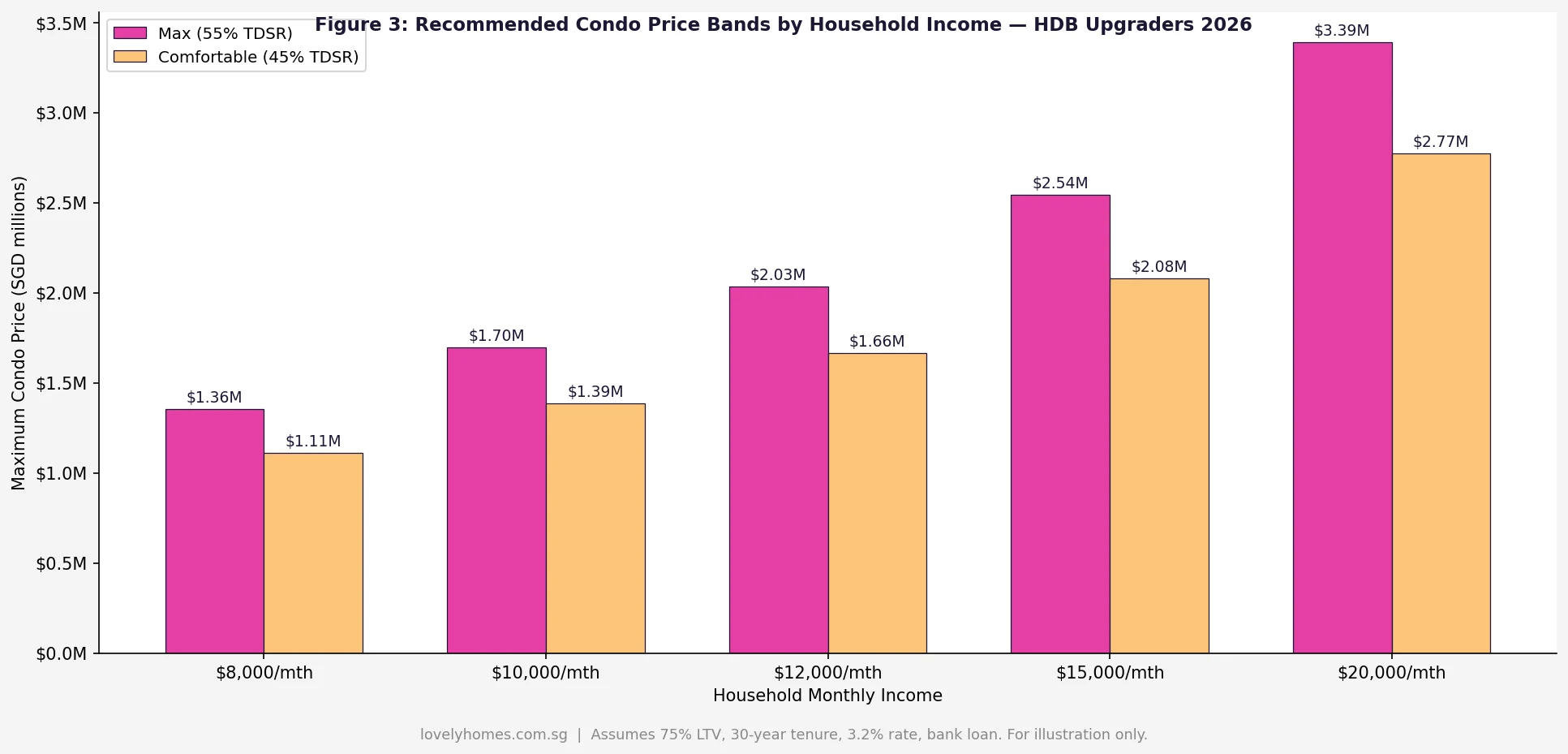
Each additional property purchase consumes TDSR headroom. With a TDSR ceiling of 55% of gross income and a typical 30-year loan at 3.0% consuming approximately S$422/mth per S$100,000 borrowed, a household earning S$15,000/mth has a maximum total debt service capacity of S$8,250/mth. If their first home mortgage absorbs S$4,000/mth, only S$4,250/mth remains for a second mortgage — which at 3.0% over 30 years supports approximately S$1.0M in additional borrowing.

Gross Income TDSR Ceiling (55%) Existing Mortgage Remaining Debt Service Max Additional Borrowing (30yr, 3.0%)
S$10,000 S$5,500/mth S$2,200/mth S$3,300/mth ~S$780,000
S$15,000 S$8,250/mth S$3,500/mth S$4,750/mth ~S$1,125,000
S$20,000 S$11,000/mth S$4,500/mth S$6,500/mth ~S$1,540,000
S$25,000 S$13,750/mth S$5,500/mth S$8,250/mth ~S$1,955,000

Note that MAS applies a stress-test rate of 4.0% when computing TDSR for property loans — meaning your loan is assessed at 4.0% even if the actual contracted rate is 1.6%. This reduces maximum borrowing by approximately 12% compared to calculating at the actual market rate. See our mortgage guide for detailed stress-test calculations.

The ABSD remission timing also creates a short-term financing challenge: under the SC upgrader remission scheme, you pay 20% ABSD at purchase and recover it only after the first property is sold (within 6 months). If the sale is delayed or the price disappoints, the ABSD remains permanently forfeited. For many households, the 20% ABSD represents 1–2 years of total household income — a significant liquidity risk that demands careful sequencing.

Worked Example: The Wong Family’s Two-Property Strategy

💼 Case Study: SC Couple, S$18,000/mth Combined, Building a Portfolio

Profile: Mr and Mrs Wong, Singapore Citizens, combined gross income S$18,000/mth, no car loan, no personal debt. Current home: OCR condo purchased 2018 for S$1,100,000, now valued at S$1,480,000 (S$380,000 unrealised gain). Outstanding mortgage: S$580,000 @ 1.65% (recently repriced), monthly repayment S$2,124/mth.

Step 1 — Decouple the existing condo (cost: ~S$28,000): Mr Wong transfers his 50% share to Mrs Wong. BSD on S$740,000 (50% of S$1,480,000) = S$1,800 + S$3,600 + (S$380,000 × 3%) = S$16,800. Legal fees ~S$4,500. CPF accrued interest adjustment (Mr Wong’s share) refunded to his CPF. Total decoupling cost: ~S$21,300 (BSD + legal). Mrs Wong now owns 100% of the condo; Mr Wong has zero property count.

Step 2 — Mr Wong buys a second property as a first-time buyer (0% ABSD): Mr Wong purchases an OCR 2-bedroom resale condo at S$1,250,000. BSD = S$1,800 + S$3,600 + S$19,200 + (S$30,000 × 4%) = S$25,800. Bank loan 75% LTV: S$937,500 @ 3.0%, 30yr = S$3,951/mth. TDSR = (S$2,124 + S$3,951) ÷ S$18,000 = 33.8% ✓. Downpayment: 5% cash S$62,500 + 20% CPF S$250,000.

Portfolio outcome: Family owns two properties with S$0 ABSD paid (vs S$250,000 ABSD if bought jointly as second property). Total stamp duty cost of the strategy: S$25,800 (BSD on new purchase) + S$21,300 (decoupling) = S$47,100 vs S$275,800 (BSD + 20% ABSD if no decoupling). Saving: S$228,700.

Rental income from second property: OCR 2BR rented at S$3,400/mth, gross yield 3.26%. Deductible mortgage interest ~S$2,344/mth (year 1). IRAS net rental approximately S$12,672/year, taxable at Mr Wong’s marginal rate.

What This Means for Singapore Property Investors in 2026

The current environment presents a complex but workable picture for portfolio investors. Rental yields have compressed slightly from their 2022–2023 peak (when supply was constrained and rental prices spiked), but remain healthy relative to pre-pandemic norms. With the 3-month compounded SORA near 1.07% in Q2 2026, financing costs for floating-rate mortgages are at a multi-year low — improving net yield spreads for investors who borrowed on floating rates.

Capital appreciation prospects are moderate rather than exceptional: private residential prices are forecast to grow 2–4% in 2026, with OCR continuing to outperform on a volume basis. The 42,561-unit supply pipeline with 17,032 units unsold suggests that new launch developers will compete on pricing, limiting upside but also reducing downside risk for existing stock.

The key structural tailwind for portfolio investors remains Singapore’s land scarcity and population trajectory. As reported by URA, private residential land supply is inherently constrained, and the high-density GLS model ensures that new supply is priced to reflect market conditions. Long-term investors in freehold or 999-year leasehold assets benefit from this scarcity premium, which does not accrue to 99-year leasehold properties approaching the midpoint of their lease.

What Might Come Next for Portfolio Investors

Looking into 2H2026, several developments warrant attention. URA’s Q2 2026 Flash Estimates (expected early July 2026) will confirm whether Q1’s modest 0.9% price growth has sustained or slowed. The 2H2026 GLS Confirmed List released by URA includes nine sites totalling approximately 4,745 residential units — a healthy supply level that should prevent price overheating.

There is ongoing speculation within the investment community about whether the government will review ABSD rates, particularly for SC second purchases, given that the 2023 increase to 20% (from 17%) has effectively cooled multi-property acquisition volume. However, with property prices still elevated relative to household incomes, most analysts believe existing ABSD rates will remain unchanged through at least 2027.

Interest rate direction is the other key variable. MAS monetary policy operates via the Singapore Dollar exchange rate rather than interest rates directly, but global rate movements (particularly US Federal Reserve policy) feed through to SORA. If rates rise again in 2027, floating-rate borrowers may face higher servicing costs, tightening net yields.

Singapore multi-property portfolio strategies ABSD capital comparison 2026
Figure 3: Singapore Multi-Property Portfolio Strategies — ABSD and Capital Comparison (2026). Click to enlarge.

Frequently Asked Questions

Is it worth buying a second property in Singapore given the 20% ABSD?

It depends on your financial position, holding period, and investment objectives. At 20% ABSD on a S$1.5M second property, you are paying S$300,000 upfront that earns zero yield until recovered through capital gains or rental income. At a 3% annual capital appreciation rate, you recover that ABSD purely from price growth in approximately 6–7 years. If you also collect rental income (say S$3,500/mth gross on a 2BR OCR property), the combined return justifies the ABSD over a 5–7 year holding horizon. The key is ensuring you have the liquidity to absorb the ABSD, sufficient TDSR headroom to service both mortgages, and a realistic exit strategy if plans change.

Can my spouse and I both own a property individually without paying ABSD?

Yes — if you decouple your existing jointly-owned property first (so each spouse has a solo ownership) and then one spouse purchases a new property in their name alone, that new purchase is treated as their “first” property (0% ABSD for SC). The cost is the BSD on the transfer of share plus legal fees, which is typically far less than 20% ABSD on the new purchase. The technical process is a deed of severance (converting joint tenancy to tenancy-in-common) followed by a transfer of share from one spouse to the other. IRAS assesses BSD on the market value of the share transferred. See our joint ownership and decoupling guide for full details.

What is the Seller’s Stamp Duty and how does it affect portfolio management?

Seller’s Stamp Duty (SSD) applies to residential properties sold within 3 years of purchase: 12% if sold within 1 year, 8% within 1–2 years, and 4% within 2–3 years. Properties held for more than 3 years have no SSD. This means that any investment property must be held for at least 3 years to avoid SSD — a minimum holding period that should align naturally with a serious investment thesis. For portfolio investors, SSD effectively prevents short-term speculation and encourages medium-to-long-term holding strategies that are more consistent with genuine wealth building. Industrial and commercial properties are subject to separate SSD rules.

Can I use my CPF to buy an investment property?

Yes, CPF Ordinary Account (OA) funds may be used to service the downpayment and monthly mortgage of an investment property (a property you do not intend to reside in). However, all CPF principal withdrawn plus accrued interest at the CPF OA rate of 2.5% per annum (compounded) must be refunded to your CPF account when the property is sold. For a property held 15 years with S$300,000 CPF withdrawn over that period, the accrued interest alone could be S$130,000–S$150,000. This significantly reduces your net cash proceeds on sale. Using CPF for an investment property is a viable strategy but requires careful modelling of the CPF refund obligation before committing.

Is freehold always better than 99-year leasehold for investment?

Not necessarily — it depends on the purchase price differential, location, and your investment horizon. Freehold properties command a price premium of approximately 10–20% over comparable 99-year leasehold properties in the same location. For an investment property you intend to hold 10–15 years and sell, a 99-year leasehold in a prime location may offer equivalent or better returns if bought at the right price. The lease decay effect (where properties under 60 years remaining lose CPF and HDB loan eligibility) is most pronounced for leases approaching 40–60 years remaining — much less relevant for a new 99-year leasehold in 2026 (which would reach 60 years remaining only in 2087). Freehold is more valuable for generational wealth transfer where you intend to pass the property to heirs indefinitely.

How do I declare rental income from my investment property?

Rental income from Singapore properties is taxed as personal income under the IRAS progressive tax framework. You must declare gross rental income in your annual income tax filing, but you may deduct allowable expenses: mortgage interest (not principal repayment), property tax at non-owner-occupier rates, fire insurance premiums, maintenance and repair costs, and agent commission (if applicable). You cannot deduct renovation costs (capital expenses), furniture purchases, or personal expenses. The net rental income (after deductions) is added to your other income sources and taxed at your marginal rate (0% to 24%). IRAS requires you to file by 18 April each year.

What is the minimum down payment for a second investment property?

For a second property financed with a bank loan, the Loan-to-Value (LTV) limit is reduced from 75% (first property) to 45% if you have one outstanding property loan. This means a minimum downpayment of 55% — of which at least 25% must be in cash. If you have two or more outstanding property loans, the LTV drops to 35% (minimum downpayment 65%, with 25% in cash). This progressively higher downpayment requirement, combined with ABSD, makes third and fourth investment properties extremely capital-intensive. Most Singapore retail investors limit themselves to two residential properties — one primary residence, one investment.

Disclaimer: This article is for general information and educational purposes only and does not constitute financial, tax, or investment advice. ABSD rates, LTV limits, TDSR/MSR rules, and CPF policies are subject to legislative change. Always verify current figures with official sources: IRAS, MAS, URA, CPF Board, and HDB. Seek advice from a licensed financial adviser before making investment decisions.


Click anywhere to close

Singapore First-Time Buyer Complete Guide 2026: HDB BTO, Resale or New Launch

Singapore First-Time Buyer Complete Guide 2026: HDB BTO, Resale or New Launch

Buying your first home in Singapore is one of the most important financial decisions you will make. Whether you are eyeing a HDB BTO flat, a resale flat, or a new launch private condo, this Singapore first-time buyer guide 2026 walks you through eligibility rules, CPF housing grants, stamp duty, financing limits, and how to choose the right option for your income and life stage.

Quick Answer: 10 Things Every Singapore First-Time Buyer Must Know

  • No ABSD — Singapore Citizens (SC) buying their first residential property pay 0% Additional Buyer’s Stamp Duty.
  • HDB BTO is the cheapest entry — subsidised prices plus up to S$200,000 in CPF grants for eligible families.
  • MSR 30% — for HDB loans, your monthly mortgage cannot exceed 30% of gross income.
  • TDSR 55% — for any property loan, total debt obligations (including car, personal loans) cannot exceed 55% of gross income, administered by MAS.
  • HDB downpayment — 10% if using HDB concessionary loan; 25% (5% cash mandatory) if using a bank loan.
  • Private property downpayment — 25% total (5% cash OTP, 20% CPF/cash); maximum loan-to-value (LTV) is 75%.
  • Buyer’s Stamp Duty (BSD) is payable by all buyers — from 1% on the first S$180,000 to 6% on amounts above S$3M.
  • BTO wait time — typically 3 to 5 years; Shorter Waiting Time (SWT) flats offer ~3 years.
  • Resale HDB — ready immediately but no CPF housing grants via HDB loan if income exceeds ceiling; also subject to Cash-over-Valuation (COV).
  • New launch private — no HDB eligibility restrictions, but no CPF grants, higher prices, and progress payments apply.

Who Qualifies as a First-Time Buyer in Singapore?

The Singapore government defines a first-time residential property buyer as a person who has not previously owned or held any residential property (HDB flat, private condo, landed property) in Singapore. First-timers benefit from zero ABSD on their purchase, as well as priority balloting for HDB BTO flats.

For HDB flats specifically, citizenship and household composition also matter. Singapore Citizens (SC) can purchase both HDB flats and private property. Singapore Permanent Residents (SPR) may buy HDB resale flats (subject to Ethnic Integration Policy and Non-Citizen Quota) but cannot purchase new HDB BTO flats directly. Foreigners cannot purchase HDB flats at all and face a 60% ABSD on private property purchases since April 2023.

Income ceilings apply for HDB BTO and some grant schemes. For most BTO exercises in 2026, the gross monthly household income ceiling is S$14,000 (or S$21,000 for multi-generation families).

HDB BTO vs resale vs new launch comparison Singapore 2026 first-time buyer guide
Figure 1: HDB BTO vs HDB Resale vs New Launch Private — First-Timer Comparison (2026). Click to enlarge.

Understanding Your Budget: TDSR, MSR, LTV and Downpayment

Before choosing between HDB and private property, you must understand what you can actually borrow. Two MAS-administered rules govern this:

Rule Applies To Limit Administered By
MSR (Mortgage Servicing Ratio) HDB loans and bank loans for HDB/EC 30% of gross monthly income MAS / HDB
TDSR (Total Debt Servicing Ratio) All property loans 55% of gross monthly income MAS
LTV — HDB concessionary loan HDB flats, HDB loan 80% of flat value HDB
LTV — Bank loan (1st property) Any property, bank loan 75% of property value MAS
Minimum cash downpayment (HDB loan) HDB flat 0% cash; 10% from CPF/cash HDB
Minimum cash downpayment (bank loan) Any property 5% cash; remaining 20% CPF/cash MAS

Your TDSR calculation includes all monthly obligations — mortgage, car loan, student loan, credit card minimum payments. If you carry a car loan of S$900/mth, that reduces your maximum mortgage by the same amount.

For HDB buyers using an HDB loan, the HDB concessionary rate in 2026 is 2.60% per annum — 0.10% above the CPF Ordinary Account interest rate of 2.50%. Bank loan rates in Q2 2026 range from approximately 1.55% (1-year fixed) to 1.80% (SORA-linked floating), making banks cheaper in the short term but subject to rate revision. Read our full mortgage guide 2026 for a detailed comparison.

CPF Housing Grants for First-Time Buyers

One of the most powerful tools for Singapore first-time buyers is the suite of CPF Housing Grants administered by HDB. These are disbursed directly to reduce the purchase price or go towards the mortgage, and are not counted as income. Only HDB flats (BTO and resale) qualify — private property purchases do not attract CPF grants.

CPF housing grants by buyer profile Singapore 2026 EHG family grant PHG
Figure 2: Maximum CPF Housing Grants by Buyer Profile (2026). Stacked from left: EHG, Family Grant, Proximity Grant, Step-Up Grant. Click to enlarge.

Key grants in 2026 (updated from August 2024 enhancements):

Enhanced Housing Grant (EHG) — income-tested grant of up to S$120,000 for families and S$60,000 for singles. Administered by HDB. The amount scales with income: households earning up to S$1,500/mth receive the full S$120,000; the grant tapers to S$5,000 at S$9,000/mth (families). For a full breakdown, see our CPF Housing Grant Guide 2026.

Family Grant — S$50,000–S$80,000 for SC couples buying resale HDB flats; S$40,000–S$60,000 for SC+SPR couples. Administered by HDB. Available on resale flats only (not BTO). Amount depends on whether both applicants are SC or one is SPR, and on the flat type purchased.

Proximity Housing Grant (PHG) — up to S$30,000 (living with parents) or S$20,000 (living near parents, within 4 km) for resale purchases. Both buyer and parent must be SC. Recipients must maintain the proximity arrangement for five years or refund the grant pro-rata.

Step-Up CPF Housing Grant — S$15,000 for second-timers who previously stayed in a 2-room flat and are upgrading to a 2-room or 3-room BTO flat. Not applicable for most typical first-time buyers.

Buyer’s Stamp Duty for First-Time Buyers

Every property purchase in Singapore is subject to Buyer’s Stamp Duty (BSD), administered by the Inland Revenue Authority of Singapore (IRAS). BSD applies to all buyers regardless of nationality or ownership count. First-time SC buyers pay 0% ABSD but still pay BSD.

BSD 2026 rates (on the higher of purchase price or market value):

Property Value Band BSD Rate BSD Payable on Band
First S$180,000 1% S$1,800
Next S$180,000 2% S$3,600
Next S$640,000 3% S$19,200
Next S$500,000 4% S$20,000
Next S$1,500,000 5% S$75,000
Amount above S$3,000,000 6% On remainder

On a typical resale 4-room HDB flat at S$480,000, BSD = S$1,800 + S$3,600 + (S$120,000 × 3%) = S$9,000. BSD must be paid within 14 days of the Option to Purchase (OTP) being exercised. IRAS levies a 5% penalty for late payment.

For a deeper dive into all stamp duty rules including ABSD and the SC upgrader remission, see our complete ABSD Singapore 2026 guide.

HDB BTO vs Resale vs New Launch: Which Is Right for You?

The fundamental decision for every Singapore first-time buyer is which housing type to pursue. There is no single right answer — it depends on your income, timeline, family situation, and priorities.

HDB BTO is almost always the best value proposition for eligible first-timers. With government subsidies baked in and CPF grants on top, a typical SC couple earning S$8,000/mth could buy a 4-room BTO flat in a non-mature estate for S$280,000–S$350,000 before grants — effectively S$160,000–S$230,000 net after an EHG+Family Grant stack of up to S$120,000. The downside is the wait: 3 to 5 years before you receive your keys, although Shorter Waiting Time flats (around 2.5–3 years) are now available in every BTO exercise.

HDB Resale offers immediacy — you can move in within 8–12 weeks of OTP exercise. Resale flats are eligible for the Family Grant and PHG (but not EHG for buyers above the income ceiling), and there is no income ceiling for the resale purchase itself. However, prices have appreciated significantly: a Tampines 4-room resale in Q1 2026 averages around S$498,000, and Central-area mature estate 4-room flats exceed S$700,000. Cash-over-Valuation (COV) is not covered by CPF and must be paid in cash.

New Launch Private Condo is the most flexible option in terms of nationality eligibility (SC, SPR, foreigners all qualify) but also the most expensive. With OCR new launches from around S$1.3M for a studio/1-bedroom unit in 2026, the cash outlay — 5% OTP in cash, 20% in CPF/cash, BSD ~S$28,600 — is substantial. There are no CPF grants. The advantage is that ABSD is 0% for a first-time SC buyer and the development is brand new, but you will wait 3–5 years for TOP. See our complete new launch condo buying guide 2026 for the full process.

Maximum affordable property price by gross income Singapore first-time buyer 2026
Figure 3: Maximum Affordable Property Price by Gross Household Income (2026). Based on MSR 30% for HDB and TDSR 55% for private. Click to enlarge.

Worked Example: The Tan Family

👤 Case Study: SC Couple, S$8,500/mth Combined, First-Time Buyers — Sengkang

Profile: Mr and Mrs Tan, Singapore Citizens, combined gross income S$8,500/mth, no existing debt. Looking for a 4-room flat in Sengkang, both aged 30.

Option A — HDB BTO (Sengkang, 4-Room, estimated S$310,000):

  • EHG: S$50,000 (income-tested at S$8,500/mth); Family Grant: S$50,000 — total grants S$100,000
  • Net price after grants: S$210,000
  • HDB loan (80% LTV): S$168,000 @ 2.60%, 25 years → monthly S$759/mth
  • MSR: S$759 ÷ S$8,500 = 8.9% ✓ Well below 30%
  • BSD on S$310,000: S$1,800 + S$3,600 + (S$130,000 × 3%) = S$9,300
  • Total cash outlay: S$9,300 (BSD) + S$42,000 (10% DP) = S$51,300 (mostly CPF)
  • Wait: ~3–4 years

Option B — HDB Resale (Sengkang 4-Room, S$480,000):

  • EHG (if S$8,500 ≤ S$9,000 ceiling): S$30,000; Family Grant: S$50,000; PHG: S$20,000 — total grants S$100,000
  • HDB loan (80% LTV on S$460,000 valuation): S$368,000 @ 2.60%, 25 years → S$1,664/mth
  • MSR: S$1,664 ÷ S$8,500 = 19.6% ✓ Below 30%
  • BSD: S$1,800 + S$3,600 + (S$120,000 × 3%) = S$9,000
  • COV (S$480K purchase − S$460K valuation): S$20,000 in cash
  • Total cash outlay: S$9,000 (BSD) + S$48,000 (10% DP) + S$20,000 (COV) = S$77,000
  • Available immediately

Option C — New Launch OCR Studio, S$1,350,000:

  • No CPF grants available
  • Bank loan (75% LTV): S$1,012,500 @ 3.0%, 30 years → S$4,270/mth
  • TDSR: S$4,270 ÷ S$8,500 = 50.2% ✓ Below 55% but stretched
  • BSD: S$1,800 + S$3,600 + S$19,200 + S$20,000 + (S$30,000 × 5%) = S$46,100
  • Cash outlay: S$67,500 (5% OTP cash) + S$270,000 (20% CPF/cash) + S$46,100 (BSD) = S$383,600
  • Wait: ~4 years for TOP

Verdict: For the Tan family at S$8,500/mth, Option A (BTO) offers the best value. Option B (resale) is viable with a higher cash outlay. Option C (new launch) is technically possible but leaves minimal financial headroom. The right choice depends on their urgency for housing and CPF savings available.

What This Means for First-Time Buyers in 2026

Singapore’s first-time buyer landscape in 2026 is shaped by three big forces. First, interest rates have fallen significantly — 3-month compounded SORA sits near 1.07% as at Q2 2026, down from a peak of 3.52% in late 2023. This meaningfully improves affordability for bank-loan borrowers. A S$500,000 HDB loan at 3.4% cost S$2,475/mth; at 1.65% it costs S$1,999/mth — a saving of S$476/mth.

Second, HDB supply has increased substantially. With 19,600 BTO flats across three 2026 exercises (February, June, October), competition ratios for non-mature town BTO flats have eased compared to the pandemic-era crush of 2020–2022. The June 2026 BTO exercise alone launched 6,952 units including the first Bishan flats in 40 years. However, mature-town and Prime/Plus-classified flats remain competitive.

Third, HDB resale and private property prices remain elevated. Private property values rose 3% in 2025 and a further 0.9% in Q1 2026, making affordability a genuine concern for first-timers targeting private condos. HDB resale prices moderated slightly — the Resale Price Index fell 0.1% in Q1 2026, the first dip since Q1 2023 — but headline prices in mature estates are still at record highs.

What Might Come Next for First-Time Buyers

Looking into 2H2026 and 2027, several policy and market developments are worth monitoring. URA’s Q2 2026 Flash Estimates are expected in early July 2026 and will indicate whether the mild Q1 2026 slowdown in private prices has continued. The October 2026 BTO exercise is the third and final major exercise of the year — buyers who missed June should prepare for October.

On the financing front, analysts expect MAS to maintain its current TDSR and MSR thresholds, though any renewed inflationary pressure could prompt review. The CPF Ordinary Account interest rate (currently 2.50% p.a., underpinning the HDB loan rate of 2.60%) is reviewed quarterly.

En-bloc activity is also expected to increase in 2026–2028 as older estates mature. This will release more resale units into the market but also reduce the supply of older affordable stock. First-timers watching the URA pipeline would note that 17,032 units from the 42,561-unit private residential pipeline remain unsold, which should moderate new launch price growth through 2026.

Frequently Asked Questions

Can a Singapore Citizen buy a HDB flat and a private property at the same time?

Yes, an SC may own both — but strict sequencing rules apply. If you buy a private property while still owning a HDB flat, you must sell the HDB flat within six months of the private purchase. Failure to do so means the ABSD remission for SC upgraders is not available and 20% ABSD on the second purchase is permanently forfeited. There is no restriction on owning a private property first and then buying an HDB flat, provided you sell the private property before or at the time of the HDB purchase (subject to HDB eligibility rules including MOP restrictions).

Do first-time buyers pay ABSD in Singapore?

Singapore Citizens buying their first residential property pay 0% ABSD. Singapore Permanent Residents (SPR) buying their first property pay 5% ABSD. Foreigners pay 60% ABSD regardless of purchase count. BSD (Buyer’s Stamp Duty) is payable by all buyers on every purchase. Note: if you have previously owned any residential property — including inherited property or overseas property — you are technically not a first-time buyer for ABSD purposes, and the relevant ABSD rates for your second or subsequent purchase apply.

Can I use CPF to pay for my downpayment and BSD?

For HDB flats with an HDB concessionary loan, you may use your CPF Ordinary Account (OA) balance to fund the full 10% downpayment and to pay BSD. No minimum cash is required beyond normal living expenses. For bank loans (HDB or private), the mandatory 5% cash OTP payment cannot be funded by CPF — it must come from cash. The remaining 20% of the downpayment may be paid from CPF OA, cash, or a combination. BSD may be paid via CPF for both HDB and private purchases, provided sufficient OA balance exists.

What is the HDB Flat Eligibility (HFE) letter and is it mandatory?

The HDB Flat Eligibility (HFE) letter is a document issued by HDB confirming your eligibility to purchase an HDB flat (BTO or resale), your indicative CPF grant quantum, and your indicative HDB loan eligibility. From May 2023 onward, the HFE letter replaced the old HDB Loan Eligibility (HLE) letter and CPF Housing Grant eligibility letter. It is mandatory — you cannot exercise an OTP for a resale flat, or apply for a BTO flat, without a valid HFE letter. An HFE letter is valid for 9 months from the date of issue. Apply via the HDB website with your Singpass account.

I earn above S$14,000/mth. Can I still buy an HDB flat?

The S$14,000/mth gross household income ceiling applies to BTO flat applications in most (non-PLH) exercises. For resale HDB flats, there is no income ceiling — any SC/SPR household may purchase a resale flat regardless of income, subject to standard eligibility rules (MOP, family nucleus, citizenship). However, CPF housing grants (EHG, Family Grant, PHG) all have income ceilings: the EHG phases out completely above S$9,000/mth, and the Family Grant is available up to S$14,000/mth. If you earn above S$14,000/mth, a resale HDB flat remains an option but you will not receive any CPF grants.

What happens to my CPF when I sell my first home?

When you sell your property, you must refund your CPF Ordinary Account for all CPF principal withdrawn plus accrued interest at the CPF OA rate of 2.5% per annum, compounded annually. This refund goes back into your CPF account — it is not lost, but it is no longer immediately accessible as cash. For example, if you withdrew S$200,000 from CPF over 10 years, you must refund approximately S$255,680 (principal + accrued interest at 2.5% compound). This significantly affects your net cash proceeds on sale. See our complete guide to CPF accrued interest for a full worked example.

Should I buy a HDB flat first or a private condo first?

This is the classic Singapore property question. Buying HDB first (with grants) and upgrading to private later is the conventional path: you maximise government subsidies, build CPF equity, and then use the HDB sale proceeds plus CPF refund as your private downpayment. The ABSD remission for SC couples buying their second property while still owning an HDB flat means you pay 20% ABSD upfront but receive it back (net of nil) provided you sell the HDB within 6 months of the private purchase — this is the standard upgrader route. Buying private first and then buying HDB is allowed, but you must sell the private property first; you also miss out on the HDB grants entirely if you have previously owned private property.

Disclaimer: This article is for general information only and does not constitute financial or legal advice. Property prices, stamp duty rates, CPF policies, and HDB rules are subject to change. Always verify current figures with official sources: HDB, IRAS, CPF Board, URA, and MAS. Seek advice from a licensed financial adviser or HDB-appointed housing agent before committing to any purchase.


Click anywhere to close

Singapore Home Loan Refinancing Guide 2026: When to Switch, What It Costs and How Much You Save

Singapore Home Loan Refinancing Guide 2026: When to Switch, What It Costs and How Much You Save

As the 3-month compounded SORA rate settles near 1.07% in June 2026 — down from its 3.52% peak in Q2 2023 — Singapore homeowners sitting on 2021–2023 vintage floating-rate loans are staring at potential savings of S$400–S$1,000 per month simply by switching lenders. This guide explains exactly when refinancing makes sense, what it costs, and how to calculate your break-even in under five minutes.

Quick Answer: Home Loan Refinancing in Singapore 2026

  • Repricing = switching to a new package within your existing bank (no legal fees; limited rate reduction). Refinancing = switching to a new bank entirely (broader savings; legal costs of S$2,500–S$3,500, usually subsidised).
  • Best fixed rate as at June 2026: approximately 1.55% p.a. (1-year) and 1.65% p.a. (2-year) for private property bank loans.
  • SORA floating rate (3M compounded): ~1.07%, meaning all-in floating packages run at approximately 1.47–1.67% p.a. with typical spreads.
  • Trigger rule of thumb: refinance if the rate differential exceeds 0.5 percentage points and savings over the lock-in period outweigh legal and valuation costs.
  • Break-even formula: total refinancing cost ÷ monthly savings = months to break even. At S$800,000 outstanding loan, savings of ~S$800/mth and costs of ~S$3,000 breaks even in under 4 months.
  • Lock-in trap: early redemption penalty is typically 1.5% of the outstanding loan; on S$800,000, that is S$12,000 — which often wipes out several years of savings.
  • HDB homeowners: you may only switch from an HDB concessionary loan to a bank loan once — there is no return. Check MAS TDSR 55% and MSR 30% compliance before switching.

Repricing vs Refinancing: What Is the Difference?

These two terms are frequently confused, but they describe very different transactions with materially different cost profiles.

Repricing occurs within your existing bank. You notify your loan officer that you wish to move to a new rate package — say, from an expiring 2-year fixed package to a new 2-year fixed at the current prevailing rate. The bank assesses the request, may charge a small administration fee (typically S$0–S$500), and adjusts your loan terms. No lawyers are involved, no valuation is required, and the process is completed in 1–3 weeks. The limitation: you are confined to the rates that particular bank is willing to offer you.

Refinancing involves discharging your existing mortgage and registering a new mortgage with a different bank. This requires a conveyancing lawyer to handle the discharge and registration, a fresh valuation of the property, and completion of the new bank’s credit underwriting process. The reward: you have access to every bank’s current promotional rates, which often undercut what your existing bank is willing to reprice you to, and new banks routinely offer legal subsidies and cashback to attract refinancing clients.

Repricing versus refinancing comparison table Singapore home loan 2026
Figure 1: Repricing vs Refinancing — key differences. For most homeowners post lock-in, refinancing delivers superior savings despite the one-time legal cost, which banks often subsidise.

When Does Refinancing Make Financial Sense?

Four conditions typically align to make refinancing worthwhile:

1. Your lock-in period has expired. Most Singapore bank loans carry a lock-in period of 2–3 years, during which early redemption attracts a penalty of around 1.5% of the outstanding loan amount. On an S$800,000 loan, this is S$12,000 — enough to negate several years of rate savings. Never refinance during the lock-in period unless the rate differential is extraordinary and you have run the full maths.

2. There is a rate differential of at least 0.5% p.a. Below 0.3%, the cost and administrative effort of refinancing rarely justify the switch. Between 0.3% and 0.5%, repricing within the same bank may deliver better net value. Above 0.5%, refinancing to a new bank is typically the superior option, especially if the new bank offers legal subsidies.

3. You have at least 3–5 years remaining on the loan. Refinancing costs are a one-time outlay recouped over the remaining loan term. If you plan to sell the property within 18–24 months, the break-even analysis may not support a refinancing.

4. The property valuation supports the Loan-to-Value ratio. Refinancing requires a fresh valuation. If property values have declined since purchase — or if you have an older property with a shorter remaining lease — the new bank may impose a lower LTV, requiring you to top up cash to reduce the loan quantum before the new mortgage can be registered.

Current Rates and Potential Savings (June 2026)

As at June 2026, the Monetary Authority of Singapore (MAS) publishes the 3-month compounded SORA at approximately 1.07%. Bank spreads on floating packages typically run at 0.40–0.60 percentage points above SORA, placing all-in floating rates at approximately 1.47–1.67% p.a. Fixed-rate packages for 1-year and 2-year lock-ins are offered at approximately 1.55% and 1.65% respectively by major Singapore lenders.

For homeowners who took 2-year or 3-year fixed packages in 2022–2023 at rates of 3.0–3.75% p.a. (many of which have now expired or will expire within the next 12 months), the savings opportunity is substantial. A borrower refinancing S$800,000 from 3.50% to 1.65% on a 25-year loan would reduce monthly repayments from approximately S$4,006 to S$3,212 — a saving of S$794 per month, or S$9,528 per year. Over a 2-year fixed period, that is S$19,056 in gross savings against legal and valuation costs of approximately S$3,000–S$4,000.

Monthly payment savings from refinancing Singapore home loan 3.5 to 1.65 percent 2026 bar chart
Figure 2: Monthly savings by loan amount if refinancing from 3.50% (2023 peak) to 1.65% fixed (June 2026). Figures are illustrative for a 25-year remaining tenor. Source: LovelyHomes calculation.

Step-by-Step: How to Refinance Your Singapore Home Loan

Step 1 — Check your lock-in expiry date. Review your existing loan letter or call your bank. Note the lock-in end date and the penalty rate (usually 1.5%) that applies if you redeem early.

Step 2 — Get competing quotes. Contact at least 3–4 banks or use a licensed mortgage broker to compare packages. Look at the all-in rate (not just the headline), the lock-in period, any clawback conditions on legal subsidies, and the cashback quantum.

Step 3 — Apply to the preferred bank. Submit your income documents (CPF contribution statements, last 3 months’ payslips or Notice of Assessment, existing loan statements). The new bank will run a fresh credit assessment and order a valuation of your property.

Step 4 — Instruct a conveyancing lawyer. The new bank will recommend panel solicitors. If the bank offers legal subsidy, this typically covers S$2,000–S$3,500 of the legal cost. You bear any shortfall.

Step 5 — Sign and complete. The lawyers handle the discharge of the existing mortgage and registration of the new mortgage with the Singapore Land Authority (SLA). Timeline: 4–8 weeks from application. Your first new payment is typically due the following month.

Break-even calculation: Divide total out-of-pocket cost (legal shortfall + valuation + any admin fees) by monthly savings. If break-even is under 12 months, refinancing is strongly justified on pure financial grounds.

HDB vs Private Property: Key Differences When Refinancing

HDB flat owners face an additional, irreversible consideration: the HDB concessionary loan. At 2.60% p.a. (pegged at CPF OA rate + 0.10%), the HDB loan has historically been competitive with bank loans in high-rate environments. In June 2026, however, bank fixed rates at 1.55–1.65% are substantially below the HDB loan rate.

Crucially, the switch from an HDB loan to a bank loan is one-way. Once you refinance out of the HDB concessionary loan, you cannot return to it. You must also have a minimum 5% cash downpayment available when refinancing, since HDB allows 0% cash downpayment but banks require 5% cash (with the balance in cash or CPF). Additionally, the HDB Mortgage Servicing Ratio (MSR) of 30% of gross monthly income continues to apply — the bank will stress-test your repayments at 4% per annum.

Private property homeowners do not face the one-way constraint and have more flexibility in switching between floating and fixed packages. However, they are subject to the Monetary Authority of Singapore’s (MAS) Total Debt Servicing Ratio (TDSR) cap of 55% of gross monthly income. A borrower refinancing must demonstrate that all monthly debt obligations (including the new mortgage) do not exceed 55% of gross income at a stressed rate of 4%.

Summary Table: Refinancing at a Glance

Parameter Typical Value / Rule Source
Best fixed rate (Jun 2026) — 2yr ~1.65% p.a. Bank market, MAS
3M Compounded SORA (Jun 2026) ~1.07% MAS
Floating all-in rate (SORA + spread) ~1.47–1.67% p.a. Bank market
Early redemption penalty (lock-in) 1.5% of outstanding loan Bank standard
Legal fees (refinancing) S$2,500–S$3,500 (often subsidised) Conveyancing practice
Valuation fee S$500–S$800 Panel valuers
HDB loan → bank loan One-way; cannot revert HDB rules
TDSR stress test rate 4% p.a. MAS Notice 645
MSR limit (HDB) 30% of gross monthly income MAS / HDB
Typical break-even period 3–6 months (post lock-in, large loan) LovelyHomes calculation

Worked Example: The Ng Family Refinance Their Queenstown Condo

Scenario: SC couple with an expiring 3-year fixed package

Property: 3BR resale condo in Queenstown (D3), purchased in 2022 at S$1,950,000. Outstanding loan: S$1,200,000 with 22 years remaining.

Current rate: 3.40% p.a. fixed (2022 vintage, lock-in expired June 2026).

Current monthly payment: S$7,188 (estimated for S$1.2M at 3.40%, 22yr).

Refinancing option chosen: 2-year fixed package at 1.65% p.a. with a major Singapore bank. Bank offers full legal subsidy up to S$3,200 and S$1,000 cashback.

New monthly payment: S$6,119 (S$1.2M at 1.65%, 22yr).

Monthly saving: S$1,069.

Out-of-pocket cost: Valuation S$750 + admin S$200 = S$950 (legal fully subsidised). Cashback offsets the residual: net cost S$0, net cashback S$50 surplus.

Annual saving: S$12,828. Over the 2-year fixed period: S$25,656 in gross savings against near-zero cost.

TDSR check: Combined gross income S$18,500/mth. New monthly payment S$6,119. TDSR = 6,119 / 18,500 = 33.1% — well below the 55% MAS cap. PASS.

Conclusion: The Ngs should refinance immediately. At the current rate differential of 1.75 percentage points, every month they delay costs approximately S$1,069 in avoidable interest.

Why Now May Be the Best Window to Refinance

The SORA rate trajectory from 2022 to 2026 describes one of the most compressed monetary tightening-and-easing cycles in Singapore’s modern history. Rates rose from near-zero in Q1 2022 to a peak of 3.52% in Q2 2023, then declined steadily as the US Federal Reserve pivoted and MAS maintained a policy of modest Singapore Dollar appreciation. By Q2 2026, 3M SORA stands at approximately 1.07% — its lowest level since early 2022.

For homeowners whose fixed packages are expiring in H2 2026 or H1 2027, this is the optimal re-locking window. Fixed rates at 1.55–1.65% represent historically low absolute levels for Singapore dollar mortgages, and locking in for 2–3 years insulates borrowers from any future rate volatility while the MAS recalibrates policy stance in response to global conditions.

Singapore 3M SORA rate history 2022 to 2026 line chart refinancing window
Figure 3: 3M Compounded SORA — Q1 2022 to Q2 2026. Rates peaked at 3.52% in Q2 2023 and have fallen to ~1.07% in June 2026. The shaded zone marks the high-savings refinancing window. Source: MAS.

What Might Come Next for Singapore Mortgage Rates

Forecasting interest rates with precision is notoriously difficult, and homeowners should treat any interest rate outlook as a probabilistic scenario rather than a point prediction. That said, market pricing as at June 2026 suggests that 3M compounded SORA is expected to remain broadly stable in the 0.9–1.2% range through end-2026, with a modest rise toward 1.4–1.6% by end-2027 if global growth recovers and the US Federal Reserve pivots toward a less accommodative stance.

For Singapore homeowners, this implies that the current fixed-rate window at 1.55–1.65% — if locked in for 2 years — provides reasonable downside protection even if SORA nudges higher in 2027. Floating-rate borrowers would face upward rate exposure if that scenario materialises. Whether to fix or float depends on individual risk tolerance, loan quantum, and holding horizon, and the decision should be reviewed with a licensed financial adviser or mortgage broker.

MAS continues to monitor household debt levels through the TDSR framework and has not signalled any near-term changes to the 55% cap or the 4% stress-test assumption. The framework has proven effective in preventing excessive leverage, and its parameters are unlikely to change in a benign rate environment.

FAQ: Singapore Home Loan Refinancing

Can I refinance if I bought my property under the Deferred Payment Scheme (DPS)?

Under the Deferred Payment Scheme for new launches, the full mortgage typically kicks in only at TOP. Before TOP, you may be on a bridging or construction loan. Refinancing in the conventional sense (full mortgage switch) generally becomes available and practical once the property reaches TOP and you draw down the full loan amount. If your DPS loan has a lock-in clause that extends post-TOP, check the penalty terms before refinancing. Most new launch mortgages with post-TOP lock-ins of 2 years will be eligible for refinancing in the 24 months following TOP.

What is a legal subsidy, and is it a clawback if I refinance again within 3 years?

When a bank offers a legal subsidy to attract a refinancing client, it is essentially paying part of your conveyancing costs as an acquisition incentive. Most legal subsidies come with a clawback clause: if you refinance again before a specified period — typically 2–3 years — you are required to repay all or part of the subsidy. This creates a de facto lock-in even when the loan package itself does not have a formal lock-in. Always read the letter of offer and mortgage terms carefully for clawback conditions before accepting a legal subsidy.

Does refinancing affect my credit score or TDSR?

A refinancing application triggers a credit enquiry, which may temporarily affect your credit score under the CBS (Credit Bureau Singapore) system. Multiple applications within a short period can have a compounding effect, so it is advisable to narrow your shortlist before formally applying. TDSR is reassessed at refinancing, which is important for borrowers whose income has changed since the original loan. If your income has fallen — or if you have taken on additional debt obligations — you may find that fewer banks are willing to offer a refinancing, or that the eligible loan quantum has reduced.

Can I use CPF OA savings to pay the outstanding loan before refinancing to reduce the principal?

Yes. If you have CPF OA savings that have not yet been applied to the property (i.e., beyond the Valuation Limit or Basic Retirement Sum considerations), you may use CPF OA to partially redeem the loan principal. However, any CPF OA funds used for the property are subject to the CPF accrued interest rule: when you eventually sell, you must refund the CPF principal plus accrued interest at 2.5% per annum back to your CPF OA. Reducing your loan principal before refinancing may improve your LTV ratio and help you access better rate tiers at the new bank.

Is there any restriction on refinancing if my property has a short remaining lease?

Yes. Banks apply progressively stricter LTV limits as a leasehold property’s remaining lease shortens. Under MAS guidelines, if the remaining lease at the point of loan maturity is less than 20 years, the maximum LTV is significantly reduced. For properties where the remaining lease + loan tenure falls below 35 years, some banks impose additional haircuts or decline refinancing entirely. HDB-loaned homeowners with shorter-lease flats face the same constraints when switching to a bank loan. If your flat has 50 or fewer years of lease remaining, assess the LTV implications carefully before initiating a refinancing application.

What documents do I need to prepare for a refinancing application?

Standard documentation for a Singapore home loan refinancing includes: your NRIC or passport, the existing mortgage loan statement (showing outstanding balance and monthly payment), the last 6 months’ CPF contribution statement, your last 3 months’ payslips (or last 2 years’ NOA if self-employed), the property’s title deed reference (your conveyancing lawyer can retrieve this), and — if the property is rented out — the tenancy agreement and rental income records. Processing time is typically 2–4 weeks for employed applicants with straightforward income profiles.

Disclaimer: This article is for general information only and does not constitute financial or legal advice. Mortgage rates, MAS regulations, CPF rules, and bank policies change frequently. Always obtain independent advice from a licensed financial adviser or mortgage broker, and verify current rates directly with your bank. Source references: Monetary Authority of Singapore (mas.gov.sg), CPF Board (cpf.gov.sg), Housing and Development Board (hdb.gov.sg).

Translate »