Tampines North Neighbourhood Guide Singapore 2026: Property Prices, MRT, Schools and Investment Outlook

Tampines North Neighbourhood Guide Singapore 2026: Property Prices, MRT, Schools and Investment Outlook

Quick Answer — Tampines North 2026 at a Glance

  • Tampines North is Singapore’s newest planned sub-town within the established Tampines New Town in District 18 (D18), located in the northeast of Singapore, approximately 25 km from the CBD.
  • The area currently has excellent EWL access via Tampines MRT (EW2) and DTL access via Tampines DT32; the upcoming Cross Island Line (CRL) Tampines North Station (~2030) will significantly reduce journey times to the west and Jurong Lake District.
  • Parktown Residence (1,193 units), the largest launch in Tampines in years, is integrated with the future Tampines North MRT station and includes a new hawker centre, community club, and retail space.
  • HDB resale 4-room flats in Tampines currently trade between S$520,000 and S$700,000; executive condominiums such as Aurelle of Tampines launched from around S$1,100,000.
  • Gross rental yields in D18 run from 4.8% (HDB 4-room) down to 2.9% (private 3-bedroom), above the Singapore average for the same flat types.
  • UWCSEA East Campus, Temasek Polytechnic, and Singapore University of Technology and Design (SUTD) all anchor the area’s education catchment.
  • Tampines Hub, Singapore’s largest community centre (60,000 sqm), Tampines Mall, Century Square, White Sands, and IKEA make Tampines North one of the best-served retail sub-markets outside the city.
  • The 5-year HDB resale price growth in D18 has been approximately 24–28%, in line with the broader OCR market and supported by the CRL pre-announcement uplift.

Tampines North: Where Is It and Why Does It Matter?

Tampines North is the designated northern section of Tampines New Town — a planned urban extension built out on land that was, until the mid-2010s, largely farmland and industrial reserve. In URA’s parlance, “Tampines North” refers specifically to the sub-town north of Tampines Avenue 10, anchored by the future Tampines North MRT station on the Cross Island Line. The rest of Tampines — served by Tampines MRT on the East-West Line and Tampines DTL on the Downtown Line — is the mature, established town Singaporeans know well.

For property buyers, the distinction matters because Tampines North carries a CRL uplift thesis — the Cross Island Line station is expected to open circa 2030, bringing a third MRT line to the area and cutting the journey time to Jurong Lake District, Singapore’s second CBD, by more than 30 minutes compared to the current EWL route. This pre-station infrastructure play is similar to the uplift enjoyed by Jurong East in the early 2010s as the EWL–NSL interchange became a recognised commercial hub.

The broader Tampines district is classified as an OCR (Outside Central Region) submarket by URA, commanding lower per-square-foot prices than the city core but delivering superior gross rental yields for buy-to-let investors. In Q1 2026, URA data shows OCR private residential prices up approximately 2.2% quarter-on-quarter and HDB resale prices broadly stable across the east.

Property Prices — What You Can Expect to Pay in 2026
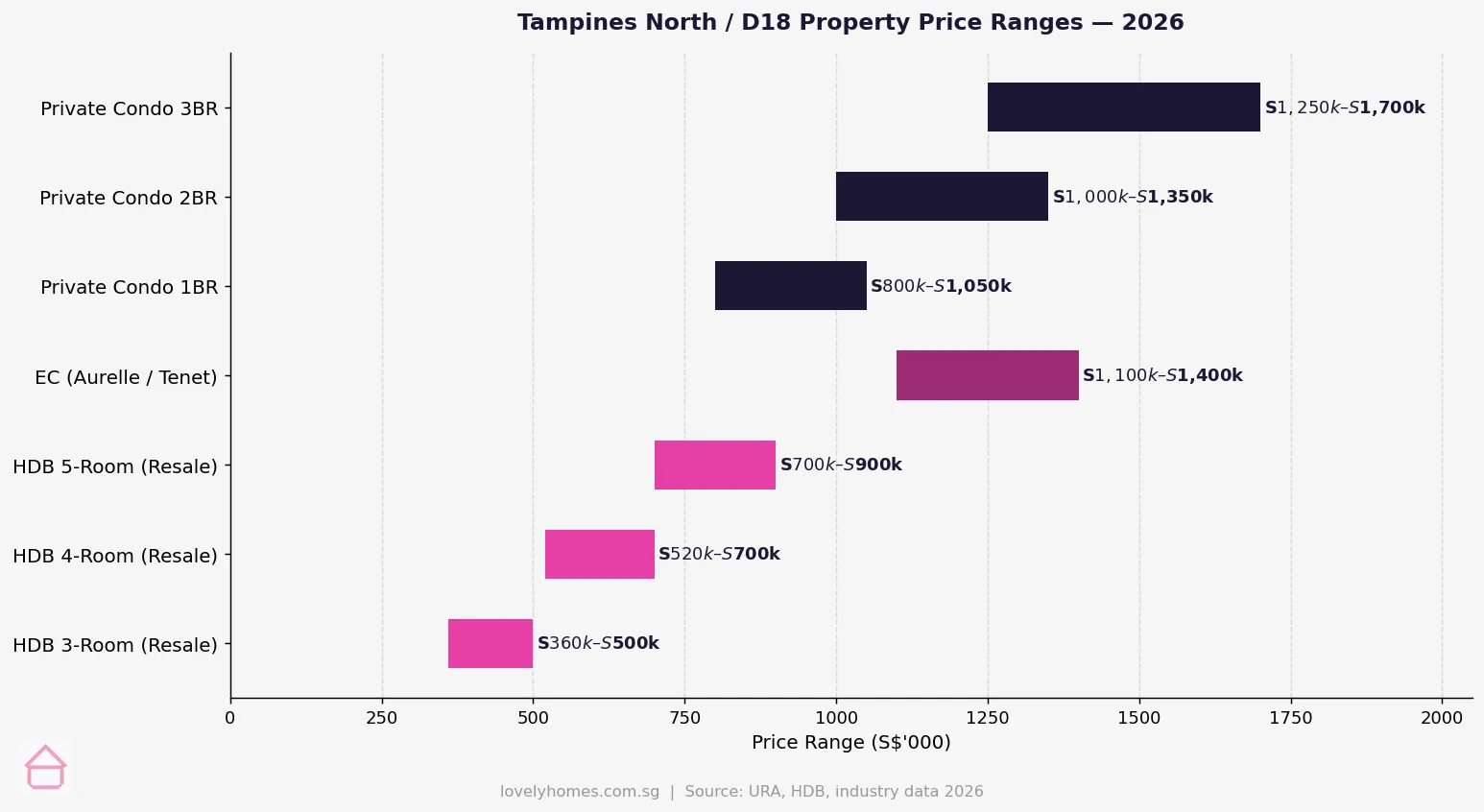
Tampines North D18 property price ranges 2026 — HDB resale EC and private condo
Figure 1: Tampines North / D18 property price ranges — 2026. Indicative. Source: URA, HDB, industry data.

HDB resale prices in Tampines have risen meaningfully since the 2021 cooling-measure-driven market trough. A typical HDB 4-room resale flat in the Tampines North sub-town trades between S$520,000 and S$700,000 depending on floor level, specific block location relative to greenery and noise, and remaining lease. Units closer to Tampines North (the newer blocks built from 2018–2023) tend to command slight premiums given longer remaining leases and proximity to the future CRL station.

Executive Condominiums — a uniquely Singaporean asset class that blends subsidised pricing for SC/PR buyers with private condominium facilities — are prominent in Tampines North. Aurelle of Tampines EC (583 units, Sim Lian Group) launched in 2025 at an average of approximately S$1,350 per square foot, with entry prices from around S$1.1M for 2-bedroom units. The project sits within a 10-minute walk of the future CRL station site. Tenet EC, an older privatised EC in the area, now trades on the resale market between S$1.0M and S$1.3M for 3-bedroom units.

Private condominiums in Tampines North are dominated by the mega-project Parktown Residence — a 1,193-unit, 99-year leasehold integrated development launched in 2025 by a UOL Group, CapitaLand and HDB co-development. It is physically integrated with the Tampines North MRT station and includes a hawker centre, a community club, and a retail precinct. Entry pricing for 1-bedroom units started at approximately S$800,000–S$900,000; 3-bedroom units were in the S$1.35M–S$1.7M range at launch.

MRT Connectivity — The CRL Catalyst

Tampines North is already well-connected by two existing MRT lines and will gain a third by around 2030, making it one of the best-positioned OCR sub-towns for transport connectivity outside the mature estates closer to the city.

The East-West Line (EWL) passes through Tampines (EW2) and Simei (EW3), connecting directly to Changi Airport in one stop and to the city core via Paya Lebar in seven stops. The Downtown Line (DTL) has Tampines (DT32) as its eastern terminus, connecting via Bedok Reservoir, Kembangan, and Marine Parade to the Botanic Gardens and Buona Vista, then turning north-west toward the city. The DTL journey from Tampines to the Botanic Gardens is approximately 30 minutes.

The transformative addition is the Cross Island Line (CRL), specifically Phase 2 (CRL2), which brings a dedicated Tampines North station. CRL links Tampines North westwards through Defu, Hougang, Serangoon North, Ang Mo Kio, and onwards to Jurong Lake District — bypassing the city core and eliminating the need for a transfer at Paya Lebar or City Hall for passengers heading west. The LTA has indicated Phase 2 is targeted for completion around 2030. For property buyers, the practical implication is that the CRL uplift is currently priced into Parktown Residence (which fronts the station site) but only partially priced into the wider HDB resale market, meaning today’s buyers may capture some of the remaining discount-to-station pricing.

Amenities — Everything You Need Within 10 Minutes
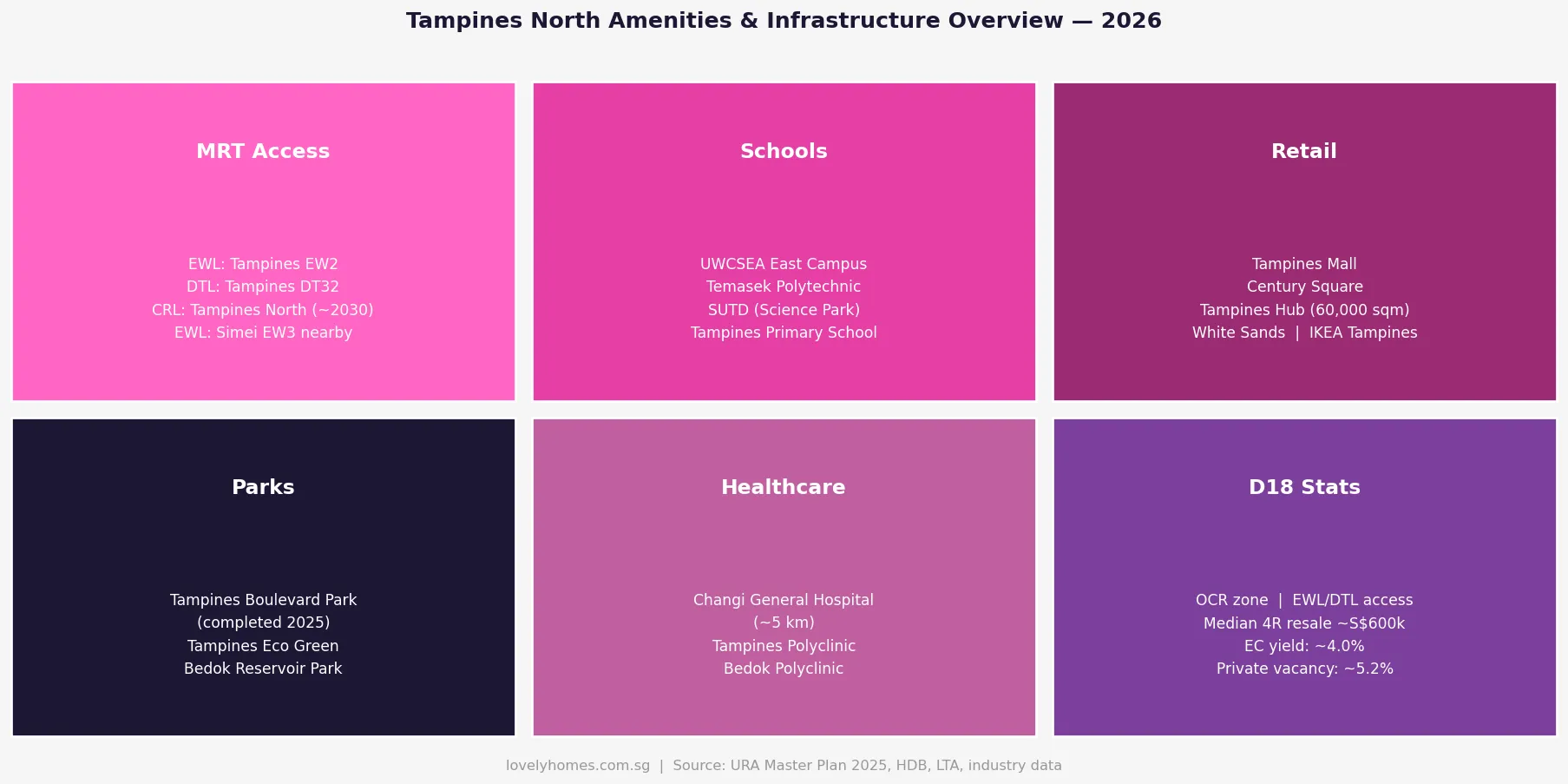
Tampines North Singapore amenities overview 2026 MRT schools retail parks healthcare
Figure 2: Tampines North key amenities overview — MRT, schools, retail, parks, healthcare and district statistics.

Retail and food. Tampines is arguably the best-served OCR sub-market for retail outside Bishan/Ang Mo Kio. The town centre is anchored by Tampines Mall (280,000 sqft), Century Square (revamped in 2021, 560,000 sqft), and White Sands. The IKEA Tampines store and Courts Megastore on Tampines North Link add destination retail. Tampines Hub — opened in 2017 and at 60,000 sqm Singapore’s largest integrated community and lifestyle hub — houses the community library, an Olympic-sized swimming complex, a hawker centre, sports courts, and a 5,000-seat stadium.

Parks and greenery. The Tampines Boulevard Park (completed late 2025) runs along the length of Tampines Avenue 9 as a 3.2-km linear park connecting Tampines North to the Central Catchment, with cycling paths, fitness stations, and community gardens. Tampines Eco Green (36 ha) is a secondary forest reserve within the town, unusual for an urban estate and valued by residents for birdwatching and nature trails. The Bedok Reservoir Regional Park is a 10-minute cycle away.

Healthcare. Changi General Hospital (CGH), a 1,000-bed acute regional hospital, is approximately 5 km from Tampines North. Tampines Polyclinic and Bedok Polyclinic both serve the broader catchment, with a third polyclinic at Pasir Ris serving the eastern corridor.

Schools — A Strong Education Catchment

UWCSEA East Campus (United World College of South-East Asia) sits within Tampines, consistently ranked among the top international schools in Singapore and drawing an expat tenant base that anchors higher-end rental demand. Temasek Polytechnic (TP), one of Singapore’s five polytechnics, is located on Tampines Avenue 1 and adds a significant student population of approximately 18,000 enrolled students. Singapore University of Technology and Design (SUTD), a research university set up in partnership with MIT and ZHEJIANG University, is located at the Changi-Tampines border and draws an educated demographic to the wider east. Primary and secondary schools within the Tampines North catchment include Tampines Primary School, Elias Park Primary, Junyuan Secondary, and St. Hilda’s Primary (popular 1-km circle school further south).

Investment Outlook — Yield vs Capital Growth
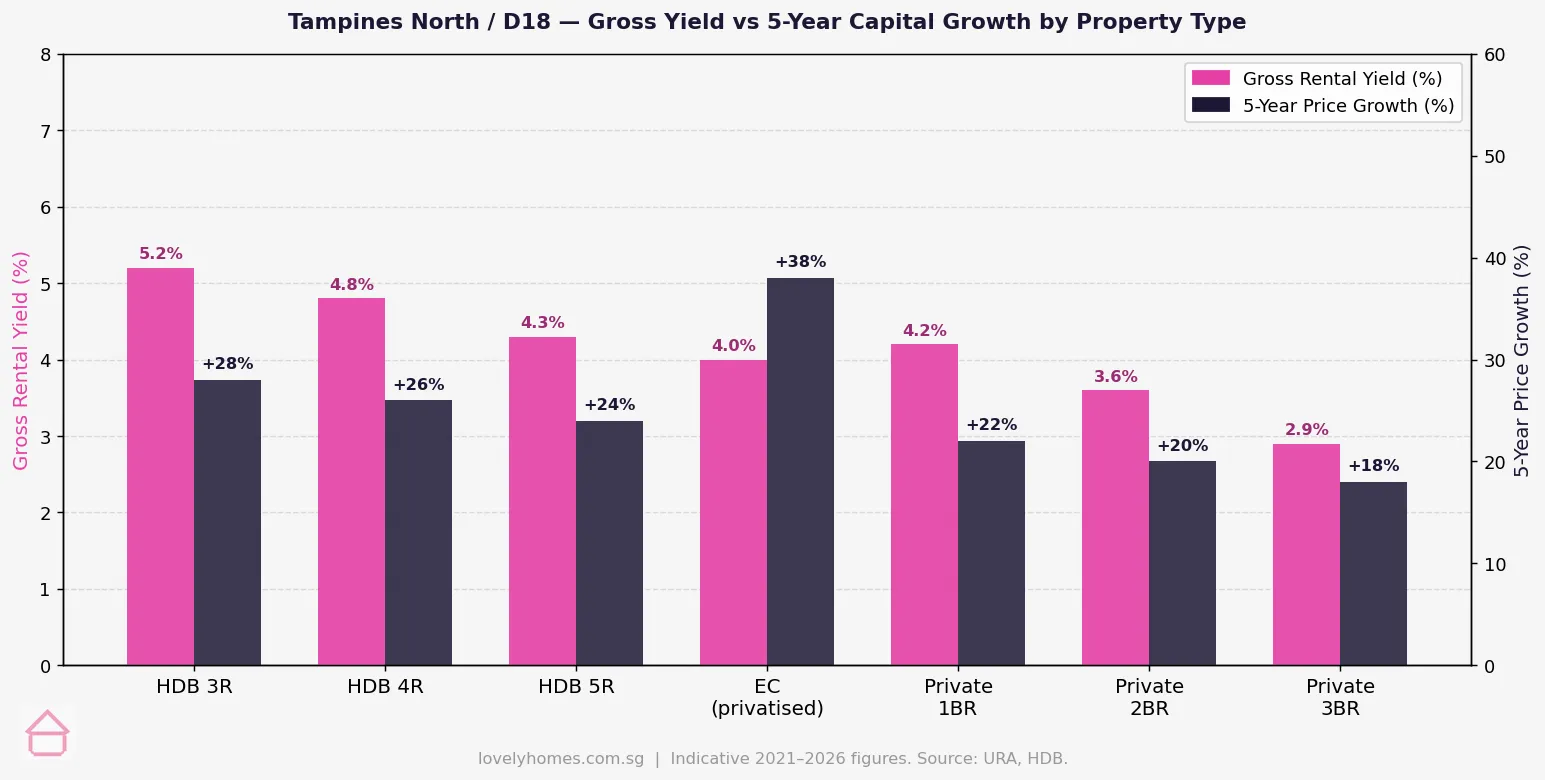
Tampines North D18 gross rental yield vs 5-year capital growth by property type 2026
Figure 3: D18 Tampines North — estimated gross rental yield vs 5-year capital growth (2021–2026) by property type. Indicative.

The investment case for Tampines North rests on two distinct thesis strands depending on the buyer’s horizon. Short-to-medium-term (1–5 years), the yield-on-cost argument favours HDB resale and older privatised ECs: gross yields of 4.8% on a S$600,000 4-room resale flat, with low vacancy and a large tenant pool anchored by UWCSEA, SUTD, and TP staff and students. Longer-term (5–10 years), the capital growth argument points to the CRL opening circa 2030 as the primary catalyst, with EC and Parktown Residence buyers positioned to benefit from station-adjacency re-rating.

Five-year price growth (2021–2026) in D18 has been approximately 24–28% for HDB resale and 35–38% for privatised ECs, both broadly in line with or slightly above the URA OCR PPI growth over the same period. Private condominiums have grown more modestly at 18–22% given higher absolute entry prices. The important caveat is that the Tampines North private market is predominantly occupied by projects launched from 2022–2025 whose resale data is limited; the 2030 CRL opening is the true test of the station-adjacency premium thesis.

Property Comparison Summary

Property Type Price Range (2026) PSF (est.) Gross Yield Tenure Key Development
HDB 3-Room (Resale) S$360k – S$500k S$420–S$560 psf ~5.2% 99yr (remaining) Various blocks
HDB 4-Room (Resale) S$520k – S$700k S$450–S$600 psf ~4.8% 99yr (remaining) Tampines North BTO blocks
HDB 5-Room (Resale) S$700k – S$900k S$420–S$540 psf ~4.3% 99yr (remaining) Various blocks
EC (privatised/resale) S$1.0M – S$1.4M S$900–S$1,200 psf ~4.0% 99yr leasehold Tenet EC, Aurelle of Tampines
Private Condo 1BR S$800k – S$1,050k S$1,400–S$1,700 psf ~4.2% 99yr leasehold Parktown Residence
Private Condo 2BR S$1.0M – S$1.35M S$1,300–S$1,600 psf ~3.6% 99yr leasehold Parktown Residence, Pinery
Private Condo 3BR S$1.25M – S$1.70M S$1,200–S$1,500 psf ~2.9% 99yr leasehold Parktown Residence

Worked Example — Mr & Mrs Ng, Buying Tampines North 4-Room HDB Resale

Mr and Mrs Ng are a Singapore Citizen married couple, both in their early 30s. Their combined gross monthly income is S$9,500. They wish to sell their current 3-room HDB flat in Jurong West (fully paid off at S$480,000) and upgrade to a 4-room resale HDB flat in Tampines North, targeting proximity to Temasek Polytechnic where Mrs Ng works.

They identify a 4-room resale flat on the 12th floor of a Tampines North block with a remaining lease of 72 years, listed at S$660,000.

Stamp duties: BSD on S$660,000 — first S$180,000 at 1% = S$1,800; next S$180,000 at 2% = S$3,600; next S$300,000 at 3% = S$9,000. BSD = S$14,400. ABSD: nil — SC married couple, concurrent sale of existing HDB means property count stays at one.

Grants: At S$9,500 joint income, EHG for resale is S$15,000. PHG: if Tampines North is within 4 km of Mrs Ng’s parents’ home in Pasir Ris — qualifying distance — PHG = S$20,000 (living near parents). Total grants = S$35,000. Net effective price = S$660,000 − S$35,000 = S$625,000.

Financing: HDB concessionary loan LTV 80% = S$500,000. Monthly instalment: S$500,000 at 2.6% over 25 years ≈ S$2,274/month. MSR: S$2,274 / S$9,500 = 23.9% — within the 30% MSR limit. TDSR: 23.9% — well within 55%. Cash upfront (5% cash + BSD): S$33,000 + S$14,400 = S$47,400.

Outcome: The Ngs can feasibly complete the purchase, using the S$480,000 proceeds from their Jurong West flat to fund the upfront costs and CPF top-up, with the CRL opening in 2030 providing a potential capital gain catalyst within their 10-year holding horizon.

What Might Come Next for Tampines North

The structural story for Tampines North is the CRL. Once the Cross Island Line Tampines North station opens (~2030), the area transitions from “well-connected east sub-town” to “triple-line MRT hub” — a designation shared by fewer than ten stations in Singapore. The immediate consequence is typically a rental yield compression (higher prices) and a transaction volume uplift as buyers from outside the east discover the area.

Beyond CRL, the URA Master Plan 2025 identifies a stretch of land near Sungei Loyang — northeast of Tampines North — as a potential new neighbourhood study area. An environmental study is underway; if positive, this could yield an additional residential supply pipeline of several thousand units beyond 2030, including park space and community facilities that would benefit Tampines North residents further north.

For existing Tampines residents, the advice is to document their lease adequacy carefully: flats with remaining leases dropping below 60 years within a 20-year horizon will lose CPF financing eligibility, which progressively reduces the buyer pool for those units on resale. This is a watch-point particularly for older blocks in the southern part of Tampines town.

Frequently Asked Questions

Is Tampines North a good area to buy property in 2026?

For buyers with a 7-10 year investment horizon, Tampines North has a credible structural case built on the CRL opening (~2030), strong rental demand from UWCSEA and TP, one of Singapore’s best OCR retail hubs, and prices that remain below RCR comparables for similar connectivity. Short-term buyers should be aware that private condo prices in Tampines North are already partly pricing in the CRL uplift, particularly Parktown Residence. HDB resale buyers get better value relative to future connectivity than private condo buyers.

Which MRT lines serve Tampines North?

As of 2026, Tampines North is served by the East-West Line (EWL) at Tampines (EW2) and the Downtown Line (DTL) at Tampines (DT32). Both stations share a common paid concourse. The upcoming Cross Island Line (CRL) Tampines North station, targeted around 2030, will add a third line specifically serving the northern sub-town and integrated with Parktown Residence. Simei (EW3) on the EWL also serves the southern edge of Tampines North.

Can foreigners buy property in Tampines North?

Foreign individuals (non-PRs) may purchase private condominium units in Tampines North, such as Parktown Residence, subject to the 65% Additional Buyer’s Stamp Duty (ABSD) on the purchase price. Singapore PRs buying their first property pay 5% ABSD. Foreigners and PRs cannot purchase HDB flats or executive condominiums below 10 years old (except PRs buying resale HDB with a Citizen spouse). The 65% ABSD rate was introduced in April 2023 and remains in force as of June 2026.

What is Parktown Residence and how is it different from a regular condo?

Parktown Residence is a 1,193-unit 99-year leasehold integrated development co-developed by UOL Group, CapitaLand, and HDB, launched in 2025. “Integrated” in this context means it is physically connected to the Tampines North MRT station (CRL), a hawker centre, a community club, and a retail precinct within a single development. Residents will have sheltered, direct access to the CRL station without going to street level. This is similar to the Bidadari integration model (Woodleigh Residences + Woodleigh MRT) and commands a moderate premium over non-integrated private condos nearby.

How does Tampines North compare to nearby Bedok or Pasir Ris for property investment?

Tampines North has a younger housing stock on average than Bedok (where many leases are entering the 40-50 year range) and a cleaner CRL catalyst story than Pasir Ris (which benefits from the EWL and the Pasir Ris-Punggol Regional Line, but has already partly priced in those upgrades). Bedok offers more mature amenities and better CBD commute times via the EWL, while Pasir Ris offers more land area and green space. Tampines North is the strongest play for buyers specifically betting on the CRL station uplift over a 5-10 year horizon.

What income is needed to buy a condo in Tampines North in 2026?

For a 2-bedroom private condo in Tampines North at approximately S$1.2M, assuming a bank loan at LTV 75% and a 30-year tenure at 3.0% per annum: the loan quantum is S$900,000 and the monthly instalment approximately S$3,795. Under TDSR at 55%, the required gross monthly income is approximately S$6,900. In practice, lenders typically want comfortable headroom, so a combined household income of S$10,000–S$12,000 per month is advisable for sustainable financing at this quantum. Cash/CPF available for the downpayment (25%) plus BSD should be in the S$320,000–S$350,000 range.

Related Articles

Disclaimer: This article provides general information about the Tampines North property market as at 3 June 2026. Property prices, yields, and infrastructure timelines are indicative and subject to change. This is not investment advice. Refer to official sources including URA, HDB, and LTA for authoritative figures, and consult a licensed property agent and financial adviser before making any property purchase decision.
Singapore HDB BTO Guide 2026: Eligibility, Grants, Step-by-Step Process and Prices Explained

Singapore HDB BTO Guide 2026: Eligibility, Grants, Step-by-Step Process and Prices Explained

Quick Answer — HDB BTO 2026 at a Glance

  • HDB Build-To-Order (BTO) is Singapore’s primary scheme for first-time buyers to purchase a new public flat directly from HDB at a subsidised price, with a 3–5 year construction wait.
  • Since October 2024, all BTO flats fall into one of three tiers — Standard, Plus, or Prime — with progressively tighter resale restrictions as location value increases.
  • The Minimum Occupation Period (MOP) is 5 years for Standard and 10 years for Plus and Prime flats before you can sell or rent out the whole flat.
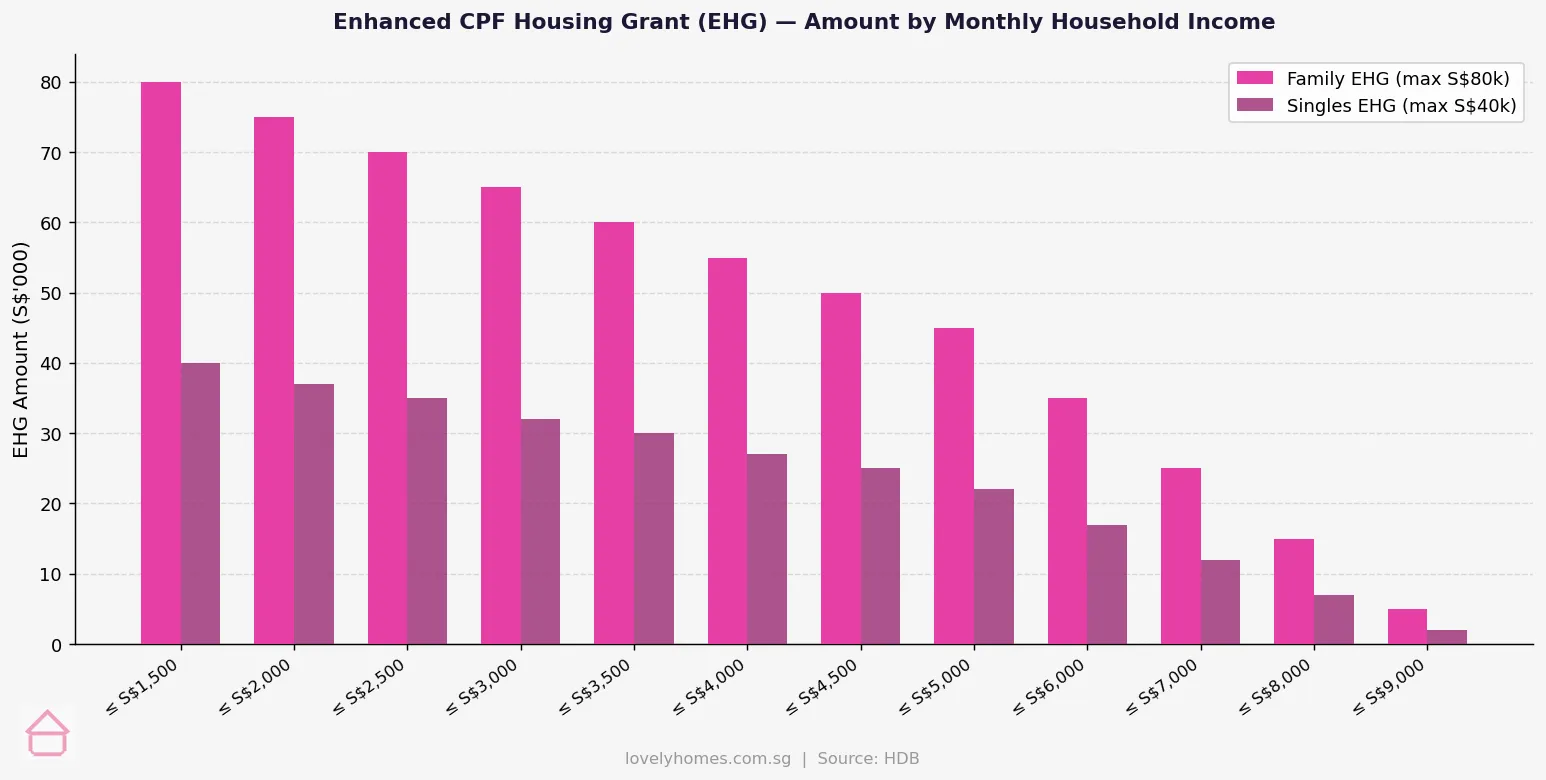
  • Eligible first-timer families can receive the Enhanced CPF Housing Grant (EHG) of up to S$80,000; singles can receive up to S$40,000.
  • The Proximity Housing Grant (PHG) adds up to S$30,000 for resale buyers living near parents; the Step-Up CPF Housing Grant adds S$15,000 for 2-room Flexi to 3-room upgraders.
  • A valid HDB Flat Eligibility (HFE) letter is mandatory before applying for any BTO or Sale of Balance Flats exercise (introduced May 2023).
  • HDB will launch approximately 19,600 BTO flats in 2026 across four exercises (February, June, October; the fourth in Q4 2026).
  • First-timer applicants who do not book a flat in their first or second ballot receive additional chances through the First-Timer Priority scheme.
  • The Tenants’ Priority Scheme (TCPS) was raised to 10% from the June 2026 BTO exercise, giving current HDB rental tenants a better chance of balloting a flat.
  • BSD applies on all property purchases including BTO; ABSD is nil for Singapore Citizens buying their first residential property.

What Is HDB Build-To-Order (BTO)?

The Build-To-Order scheme is the Housing & Development Board’s main mechanism for selling new public flats to Singaporeans. Unlike the earlier system where HDB built flats speculatively before putting them on the market, BTO works in reverse: HDB announces a project, collects applications for approximately one month, then — only if take-up is sufficient — awards a construction contract and begins building. This demand-driven model, introduced progressively in the early 2000s, reduces the risk of unsold inventory and allows HDB to calibrate supply to genuine demand across Singapore’s towns.

The practical consequence for buyers is a waiting time of three to five years between balloting and key collection, though HDB has been actively piloting shorter-wait BTO projects with waiting times of under three years. As of 2026, projects like Tampines Nova and selected Woodlands projects have offered sub-three-year waiting times under the Short Waiting Time (SWT) initiative.

BTO flats are priced at a discount to the open market to ensure affordability. The subsidy is built into the purchase price — not paid as a separate cheque — and is “clawed back” when you sell the flat by requiring CPF refunds and, in the case of Plus and Prime flats, a percentage of the resale price to be returned to HDB.

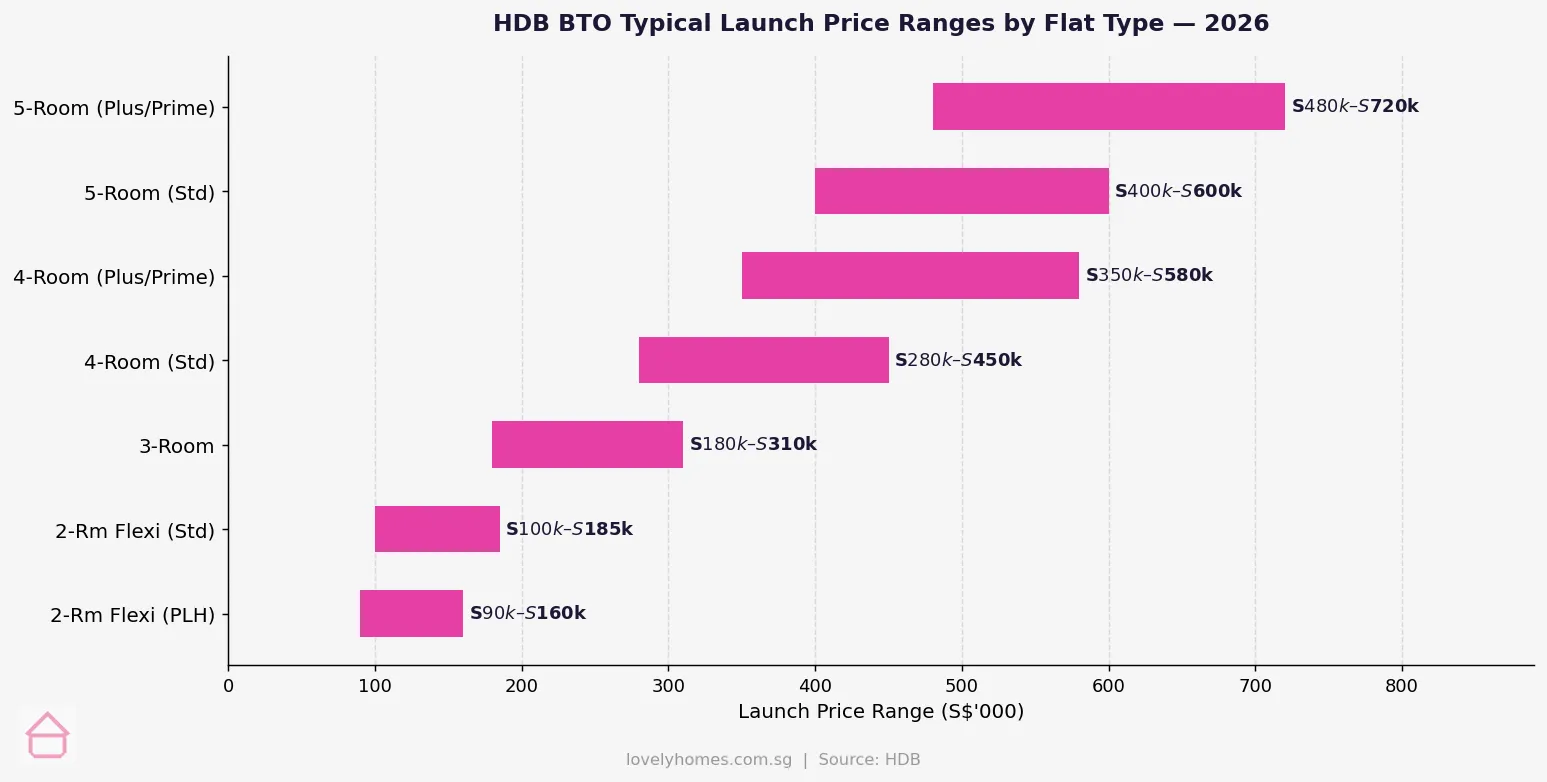
HDB BTO flat type price ranges Singapore 2026 — 2-Room Flexi to 5-Room Plus Prime Standard
Figure 1: Typical HDB BTO launch price ranges by flat type — 2026. Source: HDB. Indicative; actual prices vary by project and location.

Standard, Plus and Prime — The October 2024 Framework

The biggest structural change to the BTO system since the scheme’s launch was the introduction of the Standard, Plus and Prime classification framework in October 2024. The framework replaced the older Build-To-Order and Prime Location Public Housing (PLH) Model and applies to all BTO projects from the October 2024 exercise onwards.

Standard flats are in suburban locations with no exceptional accessibility advantage. They carry the existing 5-year MOP, can be rented out in whole after MOP, and carry no clawback on the resale price. Most estates — Woodlands, Choa Chu Kang, Sembawang, Sengkang — will be Standard designation.

Plus flats are in locations with better-than-average accessibility and amenities — typically mature towns or well-served suburban sites. They carry a 10-year MOP, may not be rented out in whole before the end of MOP, carry a clawback of a percentage of the resale price returned to HDB, and have an income ceiling of S$14,000 per month (identical to Standard in 2026). Bishan, Ang Mo Kio, and many Bukit Merah BTO sites now fall under Plus.

Prime flats are in the most central and accessible locations, including city-fringe and central-area sites such as Queenstown, Kallang/Whampoa, and Henderson. They carry the same 10-year MOP and clawback as Plus, have stricter subletting restrictions, and apply a higher clawback rate. The June 2026 BTO exercise includes Bukit Merah Berlayar, widely expected to be classified as Prime.

The rationale is that public housing subsidies should be appropriately scaled to how choice a location is. A flat at Queenstown — where resale prices touch S$1,000 per square foot — receives a larger implicit subsidy than a flat in Woodlands. The clawback is the mechanism for recapturing some of that subsidy when owners eventually sell at market prices.

Grants: EHG, PHG, Step-Up CPF and More

Singapore’s housing grants form a multi-layered system designed to ensure that the effective cost of a first BTO flat is within reach of lower- and middle-income families. The key grants available in 2026 are:

Enhanced CPF Housing Grant (EHG). Administered by CPF Board and HDB jointly, the EHG replaced the Additional CPF Housing Grant and Special CPF Housing Grant in September 2019. It is means-tested against average gross monthly household income over the preceding 12 months. For families, EHG ranges from S$5,000 at an income of S$9,000/month to S$80,000 at an income of S$1,500/month or below. Singles buying a 2-room Flexi flat receive half the family rate. EHG is paid into your CPF Ordinary Account (OA) and can be used for the flat’s purchase price and mortgage payments; it is not a cash grant.

Proximity Housing Grant (PHG). The PHG is available for resale flat purchases (not BTO directly, but relevant to those who buy resale instead of BTO). It pays S$30,000 if you live with parents/children or within 4 km of them, and S$20,000 if you live with or near a sibling. Singles receive half the family rate.

Step-Up CPF Housing Grant. For second-timer applicants who currently live in a 2-room HDB flat (rental or owned) and wish to buy a 2-room Flexi or 3-room BTO flat, the Step-Up Grant provides S$15,000. It recognises that some residents need a nudge rather than a full subsidy to upgrade from the smallest flat types.

Enhanced CPF Housing Grant EHG amount by monthly household income Singapore 2026 families and singles
Figure 2: EHG grant amount by monthly household income — families (max S$80k) vs singles (max S$40k). Source: HDB / CPF Board.

Eligibility: Who Can Apply for a BTO Flat?

BTO eligibility is governed by several overlapping criteria under the Housing and Development Act (Cap. 129). The main conditions in 2026 are:

Citizenship. At least one applicant must be a Singapore Citizen. Singapore Permanent Residents may only apply under the Public Scheme together with a Citizen family member. Foreigners are not eligible to buy new HDB flats.

Age. Applicants must be at least 21 years old for family schemes. Singles may apply from age 35 under the Single Singapore Citizen (SSC) Scheme, but only for 2-room Flexi flats in non-mature estates.

Family nucleus. Eligible family units include married couples, fiancé/fiancée (Option to Purchase granted on condition of marriage within 3 months), parents with children, and orphaned siblings. Singles must buy alone (no co-applicant outside of parents or siblings if orphaned).

Income ceiling. For Standard and Plus flats, the gross monthly household income ceiling is S$14,000 (S$7,000 for singles). For 2-room Flexi flats in non-mature estates, there is no income ceiling for some schemes.

Ownership restrictions. Applicants must not own or have recently sold private residential property in Singapore or overseas, and must not have enjoyed a previous housing subsidy (e.g., a previous BTO purchase) within the applicable waiting period.

HFE letter. Since May 2023, all applicants must obtain a valid HDB Flat Eligibility (HFE) letter before applying for any BTO or Sale of Balance Flats (SBF) exercise. The HFE letter confirms your eligibility, loan eligibility, and grant amounts in a single integrated assessment. It is valid for 9 months and should be obtained well before any exercise opens.

The Application and Balloting Process

HDB opens BTO application windows for approximately one month, typically twice a year (February and June/July, with an October exercise since 2022). During the window, eligible buyers submit a single application for one project of their choice, along with their preferred flat type. There is no fee to apply.

After the application window closes, HDB runs a computerised ballot to determine the order in which applicants may choose their units. Priority queues exist within the ballot: Married Child Priority Scheme (MCPS) for applicants buying near parents, Multi-Generation Priority Scheme (MGPS) for two households applying together, Tenants’ Priority Scheme (TCPS) for existing HDB rental tenants (raised to 10% from June 2026), and First-Timer Families Priority ensuring first-timers get precedence.

Applicants who are balloted but do not find a flat they want, or who miss their booking appointment, are deemed “unsuccessful” and may re-apply in future exercises. After a first unsuccessful ballot, first-timers receive one additional ballot chance in subsequent applications. After two unsuccessful ballots, they receive priority queue status, significantly improving their odds. HDB has indicated that the median waiting time for a first-timer to successfully book a BTO flat is approximately two application exercises.

Upon selection, applicants pay a booking fee of S$500 to S$2,000 (depending on flat type) and sign the Agreement for Lease, committing to buy the flat. The balance of the purchase price, plus BSD, is paid in tranches as construction milestones are met.

What Does a BTO Flat Actually Cost?

The out-of-pocket cost of a BTO flat depends on flat type, location (Standard vs Plus vs Prime), income-linked grants, whether you use a HDB concessionary loan or a bank loan, and CPF OA balances. The figures below represent the after-grant purchase prices for a typical Singapore Citizen first-timer family with a joint monthly income around S$6,000–8,000.

Net entry cost comparison HDB BTO vs resale vs EC vs private condo Singapore 2026 first-timer buyer
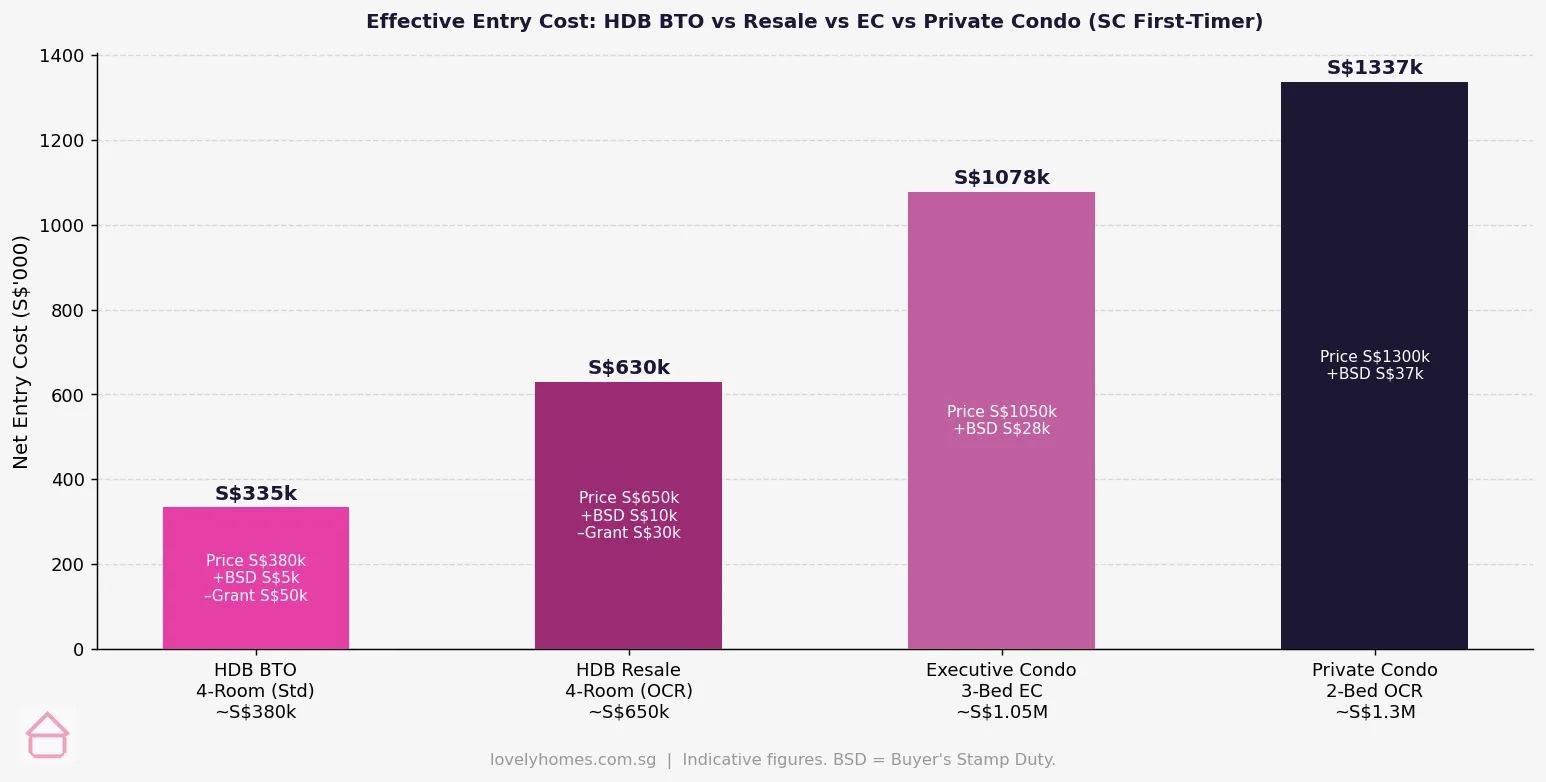
Figure 3: Effective entry cost (after grants, including BSD) — HDB BTO vs resale vs EC vs OCR private condo for a SC first-timer. Indicative figures.

Summary Comparison Table

Parameter Standard BTO Plus BTO Prime BTO HDB Resale
Location Non-mature estates Mature / well-served towns Central / city-fringe Any estate
MOP 5 years 10 years 10 years 5 years (existing MOP)
Whole-unit rental after MOP Yes Yes (after 10yr MOP) Restricted Yes
Resale clawback No Yes (% of resale price) Yes (higher %) No
EHG applicable? Yes Yes Yes Yes
PHG applicable? No No No Yes (up to S$30k)
Typical 4-Room price (2026) S$280k – S$450k S$350k – S$580k S$400k – S$700k S$500k – S$900k
Waiting time 3–5 years 3–5 years 3–5 years Immediate

Worked Example — Mr & Mrs Lim, Bishan Standard 4-Room BTO

Mr and Mrs Lim are a Singapore Citizen married couple in their late 20s. Their combined gross monthly income is S$7,200. They apply for a 4-Room Standard BTO flat in a Bishan project priced at S$395,000 (hypothetical launch price).

Grant calculation: At a household income of S$7,200, EHG for families is S$25,000. The flat is a BTO (not resale), so PHG does not apply. Net purchase price: S$395,000 − S$25,000 = S$370,000.

BSD: On S$370,000 — first S$180,000 at 1% = S$1,800; next S$180,000 at 2% = S$3,600; balance S$10,000 at 3% = S$300. BSD = S$5,700. ABSD: nil (SC first property).

Financing: HDB concessionary loan LTV 80% → loan = S$370,000 × 80% = S$296,000 (subject to HFE eligibility and credit assessment). The couple must fund at least 20% (S$74,000) from CPF OA and/or cash. Monthly instalment on a S$296,000 HDB loan at 2.6% over 25 years: approximately S$1,345 per month. MSR check: S$1,345 / S$7,200 = 18.7% — within the 30% MSR limit. TDSR: 18.7% — well within 55%.

Upfront cash: Booking fee (4-room) S$2,000 + BSD S$5,700 + balance of 20% downpayment via CPF OA S$72,000. If CPF OA balance is below S$72,000, the shortfall must be paid in cash.

Outcome: The Lims can feasibly service the flat on their combined income. The total effective entry cost of S$335,700 (after grants) is S$364,300 less than the equivalent OCR private condo — illustrating the ongoing role of BTO as Singapore’s primary affordability tool.

What Might Come Next — BTO Pipeline for 2026–2028

HDB has confirmed approximately 19,600 BTO flats for 2026 across the four exercises. Noteworthy launches expected in the second half of 2026 and beyond include the Toa Payoh West BTO project slated for the October 2026 exercise — the first significant public housing release in central Toa Payoh in over a decade and almost certain to attract oversubscription as a Standard or Plus project. Pearl’s Hill — a large site in the Chinatown/Outram Park corridor — is expected to yield approximately 1,700 new homes in a future exercise, potentially as a Prime project given its proximity to the CBD.

HDB is also studying the gradual release of land in the Greater Southern Waterfront (GSW) area for public housing over the longer term, and the Tengah “forest town” BTO pipeline will continue with further phases through 2027–2028. Buyers who miss the current exercises should monitor the HDB website for upcoming announcements and apply for an HFE letter in advance.

Frequently Asked Questions

Can I rent out my BTO flat before MOP?

No. You are not permitted to rent out the entire flat before the end of your MOP (5 years for Standard, 10 years for Plus/Prime). You may, however, rent out individual rooms within your flat at any time, subject to HDB’s approval and occupancy limits. Renting out the whole flat before MOP is a breach of the Housing & Development Act and can result in HDB compulsorily acquiring the flat at below-market value.

What happens if I miss my BTO booking appointment?

If you do not attend your booking appointment or decline to select a flat during your appointed slot, your application is cancelled. You forfeit your booking priority for that exercise. You may re-apply in future exercises, but your first-timer queue advantage resets. HDB does not guarantee a rescheduled appointment.

Is a HDB loan or a bank loan better for a BTO flat?

The HDB concessionary loan offers a rate of 0.1 percentage points above the CPF OA rate — currently 2.6% per annum — and is generally lower than bank rates, which were around 3.0–3.5% per annum in 2026. The HDB loan allows an LTV of 80% and does not require a cash downpayment; the full 20% downpayment can come from CPF OA. However, if you take a bank loan, you must pay at least 5% of the purchase price in cash (with the remaining 20% from CPF or cash), and LTV is capped at 75%. For most first-time buyers with limited cash savings, the HDB loan is generally more accessible.

What is the Minimum Occupation Period and does it restart if I sell?

The MOP begins from the date you receive your keys. For Standard BTO flats, MOP is 5 years; for Plus and Prime BTO flats launched from October 2024 onwards, it is 10 years. When you sell and buy a second HDB flat, the MOP for the second flat runs from the date of that flat’s key collection — it does not inherit or carry over from the first flat. Crucially, you must have satisfied the MOP before you are eligible to sell on the open market or purchase a private residential property concurrently with HDB flat ownership.

Can PRs buy a BTO flat?

Singapore Permanent Residents (PRs) cannot buy new BTO flats on their own. A PR can only buy a BTO flat if they are applying together with a Singapore Citizen spouse or family member under an eligible scheme (e.g., Public Scheme). The Citizen must be a co-applicant, not just a supporting document. PRs buying alone may purchase HDB resale flats (but not new BTO units), subject to their own eligibility conditions and a minimum 3-year PR residency requirement.

What is the TCPS and how does it help current HDB tenants?

The Tenants’ Priority Scheme (TCPS) allocates up to 10% of BTO flat supply across all exercises — raised from 5% in the June 2026 BTO exercise — to eligible existing HDB rental flat tenants. To qualify, the applicant must have been living in an HDB rental flat for a minimum period and meet all standard BTO eligibility criteria. The scheme is designed to give long-term rental tenants a pathway to home ownership with a statistical advantage in the ballot. Applications under TCPS count alongside other priority schemes (MCPS, MGPS, First-Timer Priority) where multiple schemes apply.

Related Articles

Disclaimer: This article provides general information about the HDB Build-To-Order scheme and housing grants as at 3 June 2026. It is not financial, legal, or housing advice. Eligibility criteria, grant amounts, income ceilings, and BTO project details are subject to change by HDB and CPF Board. Always verify your eligibility and loan limits with the official HDB website, the CPF Board, and your preferred financial institution before making any property purchase decision.
Orchard Road & Somerset Neighbourhood Guide Singapore 2026: Property Prices, MRT and Investment Outlook

Orchard Road & Somerset Neighbourhood Guide Singapore 2026: Property Prices, MRT and Investment Outlook

×Click anywhere or press Esc to close

Orchard Road and Somerset form the heart of Singapore’s Core Central Region (CCR). District 9 is synonymous with premium shopping malls, five-star hotels, top private schools, and a deeply liquid residential market populated by both wealthy locals and high-net-worth expatriates. Whether you are buying your first private home, upgrading from the HDB heartlands, or managing an investment portfolio, District 9 represents a distinct value proposition: scarcity, prestige, and sustained long-term capital appreciation.

This guide covers District 9 property prices in 2026, the MRT network serving Orchard and Somerset, top schools, lifestyle amenities, rental yields, a detailed investor analysis, and a worked example for upgraders. All data reflects Q1 2026 URA Realis statistics and publicly available industry information.

Quick Answer — Orchard Road & Somerset at a Glance

  • Location: District 9, Core Central Region (CCR). Bounded by Scotts Road (north), River Valley Road (south), Clemenceau Avenue (west), Dhoby Ghaut (east).
  • Property type mix: ~55% leasehold condos, ~45% freehold condos; no significant HDB supply in Orchard proper (limited HDB estates in Somerset fringes).
  • Typical condo prices: 1BR S$1.1–1.8M; 2BR S$1.8–3.0M; 3BR S$2.6–4.5M; 4BR+ S$4.2–7.0M (Q1 2026).
  • Average non-landed PSF: S$2,500–S$3,500 (freehold premium: +15–25% vs 99-yr equivalents).
  • MRT: NSL Orchard (NS22), NSL/TEL Orchard (TE14 — twin interchange), NSL Somerset (NS23), DTL Stevens (DT10), CCL Botanic Gardens (CC19).
  • Rental market: Vacancy <3% CCR-wide; strong expat demand from finance, tech, and diplomatic community; gross yields 2.7–3.5%.
  • 5-year capital growth: +14–18% for condos; freehold units show stronger upside, especially post-en-bloc premium.
  • ABSD note: Foreign buyers pay 60% ABSD on any residential property here — Singapore Citizen upgraders face 20% on a second property.

Where Exactly Is Orchard Road / Somerset — District 9 Defined

District 9 in Singapore’s URA postal district system covers the Orchard Road corridor and its immediate surrounds: Orchard, Somerset, River Valley, and the Cairnhill / Scotts Road residential enclave. It sits squarely in the CCR — the market segment that includes the most expensive residential land in Singapore.

The district is bounded to the north by Scotts Road and Dunearn Road, to the south by River Valley Road, to the west by Holland Road near its junction with Clemenceau Avenue, and to the east by the Dhoby Ghaut / Bras Basah interchange. Key residential precincts include Cairnhill (freehold conservation houses and condos), Scotts Road (ultra-luxury residential), Leonie Hill / Anthony Road (mid-to-upper-tier condos), Somerset / Oxley Road (denser condo belt), and River Valley (hybrid commercial-residential strip with shophouse clusters).

For the adjacent River Valley and Robertson Quay precinct, see our dedicated River Valley & Robertson Quay Neighbourhood Guide 2026. For the District 10 corridor (Holland Village, Tanglin, Buona Vista), see our Buona Vista & Holland Village Guide.

Property Prices in District 9 — Orchard & Somerset 2026

District 9 Orchard Somerset property price ranges 2026 — HDB resale condo shophouse
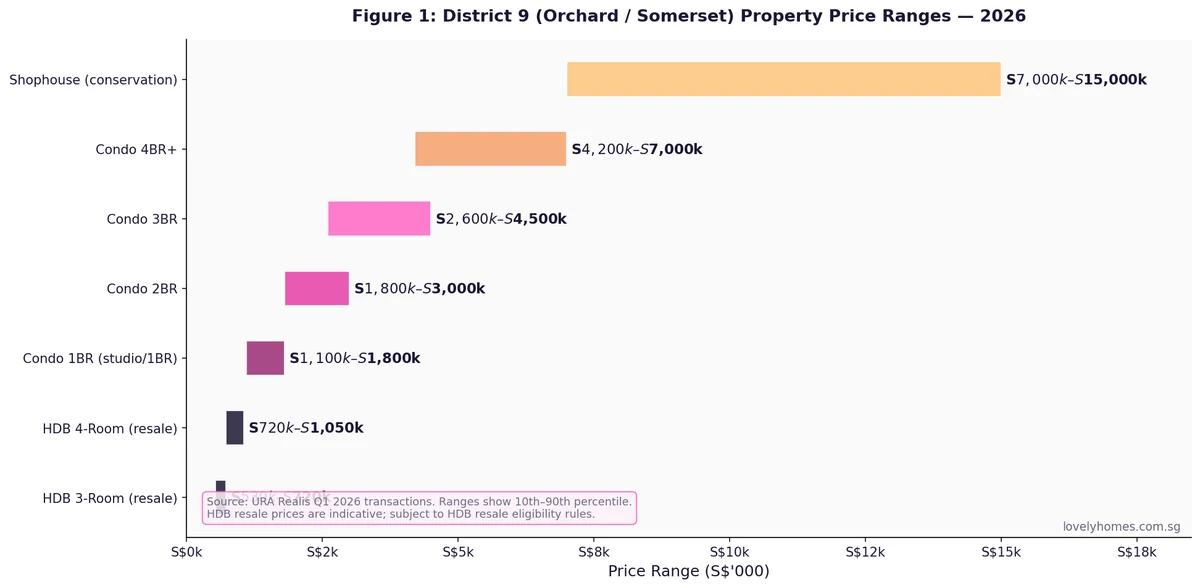
Figure 1: District 9 property price ranges by type — Q1 2026. Source: URA Realis. Ranges reflect 10th–90th percentile of transacted prices.

The typical price entry points in Orchard / Somerset are among the highest in Singapore outside of Sentosa Cove. A 1-bedroom or studio unit — favoured by investors and young expatriate professionals — transacts between S$1.1 million and S$1.8 million. At the upper end, a 4-bedroom-plus condo in a quality freehold development on Scotts Road or Cairnhill Circle commands S$4.2 million to S$7 million.

Conservation shophouses in the precinct (primarily along Orchard Road’s side streets and the Emerald Hill enclave) represent a distinct asset class: 2,200–4,500 sq ft of strata area, no ABSD for commercial and mixed-use strata titles, and scarcity driven by heritage conservation rules. Prices range from S$7 million to S$15 million or more for larger units on premium lots.

Price per square foot (PSF) benchmarks (Q1 2026):

Development / Type Tenure Approx PSF (Q1 2026) Notes
Cairnhill / Scotts Rd luxury Freehold S$3,200–S$4,500 Boulevard 88, Gramercy Park
Orchard / Somerset mid-upper Freehold S$2,600–S$3,500 Skyline @ Orchard, 8 Hullet
River Valley mid-tier condos 99-yr S$2,200–S$2,800 Martin Modern, The Avenir
HDB resale (Somerset fringes) 99-yr S$700–S$950 Limited supply; very few D09 HDB flats
Conservation shophouse Freehold/999-yr S$3,000–S$5,000+ Emerald Hill, Orchard surrounds

MRT Connectivity — Why D09 Is a Multi-Line Hub

District 9 is one of the best-served MRT districts in Singapore, sitting at the convergence of four lines. This multi-line access underpins the area’s sustained rental demand from expatriates who typically require CBD proximity and do not own cars.

The North-South Line (NSL) serves Orchard (NS22) and Somerset (NS23). Orchard is a major interchange and the line’s most commercially prominent station, with connections to the grade-level Orchard Road shopping belt. From Orchard, Raffles Place is 5 minutes; Marina Bay is 8 minutes.

The Thomson-East Coast Line (TEL) opened its Stage 2 in August 2021, delivering a new Orchard station (TE14) directly adjacent to the NSL Orchard station. The TEL gives direct access south to Great World (TE15), Havelock (TE16), Maxwell (TE18), and Shenton Way (TE19/DTL CE1) — cutting commute times to the Marina Bay financial corridor. Northwards, the TEL connects to Stevens (TE11), Caldecott (TE9), and eventually Woodlands North (TE2).

The Downtown Line (DTL) station at Stevens (DT10) is a short cab or walk from the northern fringe of D09 (Scotts Road/Dunearn Road). This line serves Bugis, Promenade, Bayfront, and the western corridor through Buona Vista and Clementi.

The Circle Line (CCL) station at Botanic Gardens (CC19) serves the western edge of the district, providing access to one-north (CC23), Harbourfront (CC29/NE1), and the eastern CCL loop.

Schools, Healthcare, and Lifestyle

Orchard Road Somerset amenities grid 2026 — MRT schools retail parks healthcare statistics
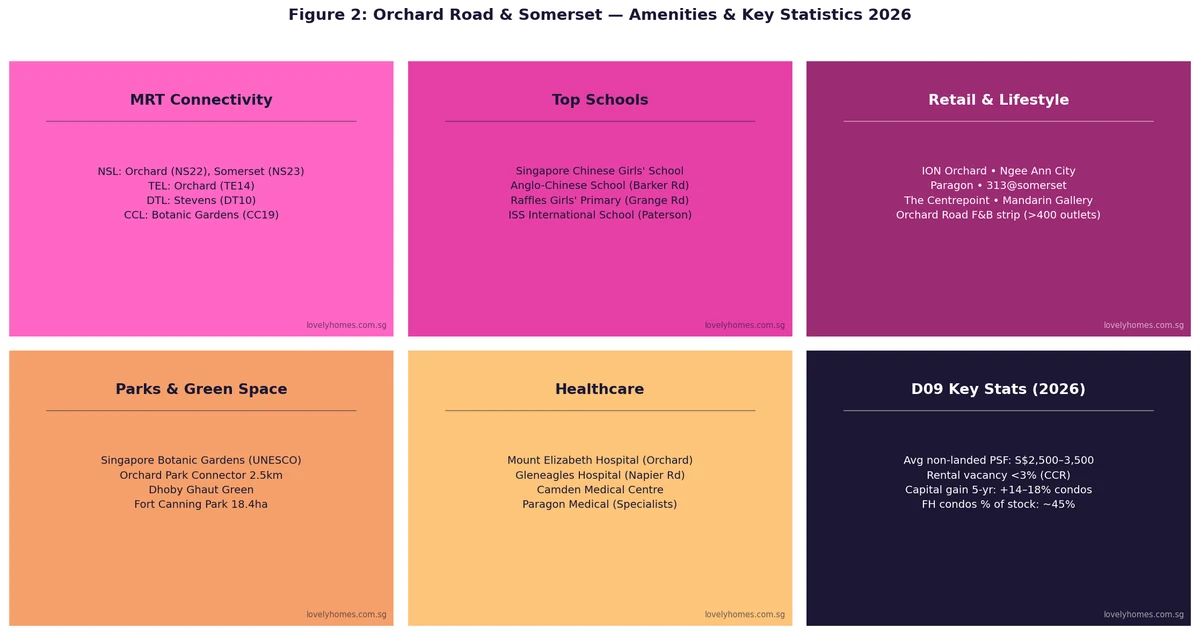
Figure 2: Orchard Road & Somerset — amenities and key statistics, 2026.

Top primary schools within 1–2km: Raffles Girls’ Primary School (Grange Road, 0.9km from Orchard MRT) is perennially over-subscribed and has a significant influence on residential demand within its 1km balloting radius. Singapore Chinese Girls’ School (Springleaf Avenue, primary campus) and Anglo-Chinese School (Barker Road, primary) are also within the broader D09/D11 catchment.

International schools: ISS International School (Paterson Road) sits directly within the district, drawing enrolments from the large expatriate community in the Orchard and River Valley condos. GESS International School (Bukit Timah Road, nearby) and EtonHouse International School (Mountbatten Road) are within reasonable distance.

Healthcare: Mount Elizabeth Hospital on Orchard Road is one of Singapore’s premier private hospitals, specialising in oncology, cardiology, and complex surgical procedures. Gleneagles Hospital (Napier Road, ~1.2km) is another major private facility. Camden Medical Centre is a specialist-only medical building on Orchard Road itself. For emergency and specialist care, Singapore General Hospital (Outram) is accessible via the TEL in under 10 minutes.

Retail and F&B: The Orchard Road corridor hosts ION Orchard (Capitaland’s flagship mixed-use development), Ngee Ann City, Paragon, Mandarin Gallery, 313@Somerset, The Centrepoint, Knightsbridge, and Forum The Shopping Mall — more than 2.5 million sq ft of retail within 1.5km. The area’s F&B scene ranges from hawker centres at Killiney Road and Takashimaya Food Hall to Michelin-starred restaurants at Mandarin Oriental and Shangri-La Hotel.

Green space: The Singapore Botanic Gardens (UNESCO World Heritage Site, 82ha) is accessible via CCL Botanic Gardens, providing a world-class green lung immediately to the west of the district. Fort Canning Park (18.4ha) sits at the eastern edge of D09, offering a historic hilltop park connecting to Dhoby Ghaut and Clarke Quay. The Orchard Park Connector (2.5km) links the precinct to MacRitchie.

Rental Market and Investment Case

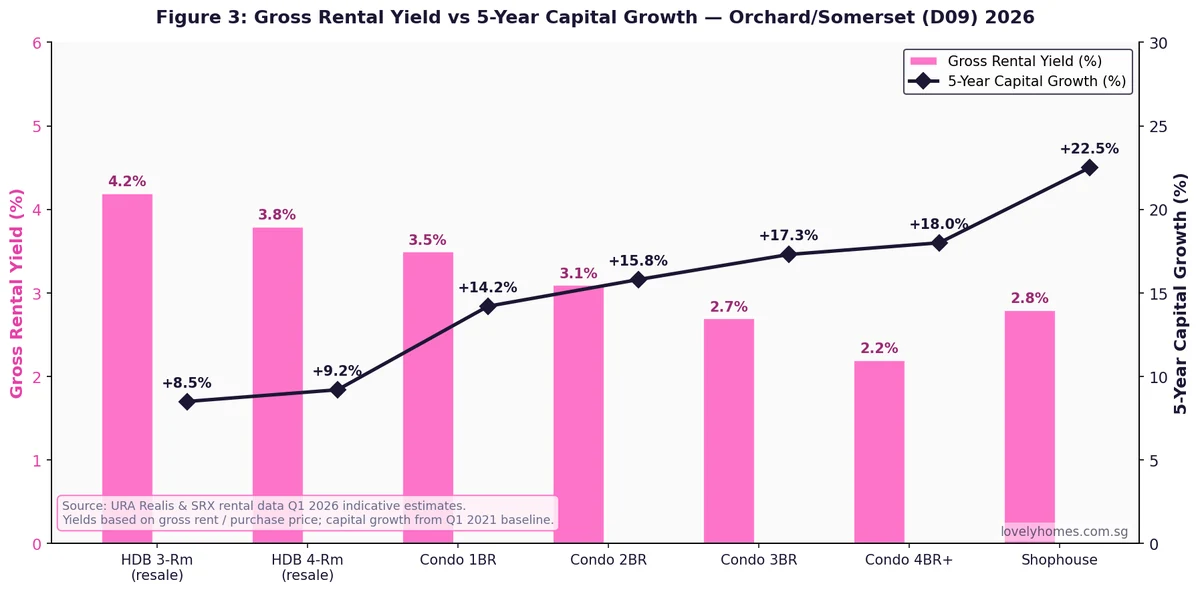
Orchard Somerset District 9 gross rental yield vs 5-year capital growth 2026
Figure 3: Gross rental yield vs 5-year capital growth by property type — District 9 (Orchard/Somerset), 2026.

The Orchard / Somerset rental market is driven primarily by expatriate demand from Singapore’s finance, technology, and international trading sectors, supplemented by diplomatic and media professionals. Vacancy rates across the CCR have held below 3% since 2022, reflecting tightened expat supply (fewer new completions in D09 in the 2023–2025 cycle) and sustained rental growth.

Gross rental yields in D09 typically run 2.2–3.5% depending on unit type, reflecting the high absolute purchase prices. The 1-bedroom segment commands the highest gross yield (approximately 3.5%) because monthly rentals for 1BR units are relatively strong (S$3,500–S$6,500/month) relative to purchase prices. The 4-bedroom-plus segment yields less on a gross basis (approximately 2.2%) but benefits most from capital appreciation — freehold trophy assets in D09 showed 18–22% 5-year price growth.

The long-term investment thesis for D09 rests on land supply constraints. There are no new GLS residential sites in the Orchard Road core; all new supply must come from en-bloc redevelopment of ageing freehold buildings. Historically, en-bloc activity in D09 has been lumpy and infrequent, which means supply shocks are rare. The CCR Private Property Index has risen approximately 40% since Q1 2019 — a compounded annual growth rate of around 5.5%.

Worked Example: SC Upgrader Buying a 2BR Freehold Condo in D09

Mr & Mrs Teo are Singapore Citizens. They have sold their Tampines 5-room HDB flat (received CPF accrued interest refund, net cash proceeds S$380,000). Joint income S$17,000/month. They want to buy a 2-bedroom freehold condo on River Valley Road at S$2,200,000. They now hold zero residential properties after the HDB sale.

  • Purchase price: S$2,200,000 (freehold, District 9)
  • BSD: S$74,600
  • ABSD: S$0 (SC first private property after HDB sale)
  • Total stamp duty: S$74,600
  • Loan (75% LTV, bank): S$1,650,000 @ 3.0% p.a., 25-year tenure
  • Monthly instalment: approximately S$7,832/month
  • TDSR check: S$7,832 / S$17,000 = 46.1% — within the 55% TDSR ceiling ✓
  • 5% mandatory cash (on bank loan): S$110,000
  • CPF OA drawdown (down payment balance): up to Valuation Limit (S$2,200,000 × 100% = S$2,200,000 — no restriction for private property first purchase by buyers under 55)
  • Estimated total cash required at exercise of OTP: BSD S$74,600 + 1% OTP deposit S$22,000 + 5% cash component S$110,000 = approximately S$206,600 plus legal fees (~S$3,500–5,000).
  • Monthly running costs: Mortgage S$7,832 + maintenance fees (est. S$500–S$800/month) + property tax (annual value ~S$36,000 → non-owner-occupied tax ~S$1,080/yr if rented; owner-occupied ~S$260/yr)

At a 3.1% gross rental yield on S$2.2M, the property could generate approximately S$5,683/month gross rent if rented out — covering approximately 73% of the mortgage outlay. After deducting management fees, maintenance, and vacancy allowance, the net cash shortfall for a buy-to-let investor would be approximately S$2,500–S$3,000/month on this particular scenario. Most D09 buyers are therefore hybrid occupier-investors who intend to live in the property for several years before potentially renting it out.

Is Orchard Road / Somerset a Good Buy in 2026?

For Singapore Citizens and PRs buying their primary residence, D09 offers a compelling value proposition if you value proximity to Orchard Road amenities, top schools in the 1km radius, and multi-line MRT access. The scarcity of new supply in the immediate Orchard precinct means existing freehold buildings tend to hold and grow value well over a 5–10 year horizon.

For pure investors managing yield expectations, the mathematics are tighter than in the OCR. A D09 condo at S$2.5M will typically yield 2.8–3.2% gross — meaningfully lower than a comparable Tampines or Bedok condo at 3.8–4.2%. The case for D09 as an investment property is therefore primarily a capital appreciation story, not a yield story.

For foreign nationals considering a purchase here, the 60% ABSD makes D09 residential property a prohibitively expensive investment at current prices — unless the property will serve as a long-term primary residence in Singapore. On a S$3M property, the total upfront cost including BSD and ABSD exceeds S$2.1M in stamp duty alone. See our ABSD Complete Guide 2026 for how FTA nationals (US citizens, Swiss nationals) can mitigate this.

What Might Change in Orchard & Somerset — The Forward View

The following is analytical speculation, not official policy.

The URA’s long-term masterplan has consistently designated Orchard Road as Singapore’s premier lifestyle and shopping corridor. In the 2023 URA Concept Plan, there is mention of injecting more mixed-use and residential components into the Orchard belt — particularly along the Somerset-Dhoby Ghaut stretch — to enliven the area and support permanent resident activity. If implemented, this could bring some new residential supply to the district over the 2030–2040 horizon, but the planning quantum is unlikely to materially alter the current supply dynamics.

The TEL full opening (Stage 4 and beyond) will continue to enhance D09’s connectivity, particularly southwards to the Greater Southern Waterfront precincts. Any rebalancing of demand from the Sentosa / Harbourfront precinct back to the Orchard corridor would be a positive for D09 capital values.

Frequently Asked Questions

Is Orchard Road a good place to buy property in 2026?

For Singapore Citizens and PRs, yes — particularly if you are buying for long-term capital appreciation and benefit from the lifestyle amenities (top-tier retail, world-class healthcare, park access) and premium school catchments (Raffles Girls’ Primary 1km zone). For pure yield investors or foreign buyers facing 60% ABSD, the numbers are significantly harder. D09 suits owner-occupier-investors with a 7–10 year or longer investment horizon.

Which MRT lines serve Orchard Road and Somerset?

Four MRT lines serve D09. The North-South Line (NSL) serves Orchard (NS22) and Somerset (NS23). The Thomson-East Coast Line (TEL) provides a second Orchard interchange station (TE14), giving direct access south to the CBD and Shenton Way. Stevens (DT10) on the Downtown Line serves the Scotts/Dunearn Road fringe of the district. Botanic Gardens (CC19) on the Circle Line is at the western edge. This multi-line coverage gives D09 residents arguably the best public transport access of any residential district outside the CBD itself.

Can foreigners buy property in Orchard Road?

Yes — foreigners can purchase private condominiums and apartments in Singapore, including in District 9. However, the ABSD at 60% applies regardless of which property it is or whether it is the buyer’s first or fifth. Foreigners cannot purchase HDB flats. Citizens of the US, Switzerland, Iceland, Liechtenstein, and Norway receive SC-equivalent ABSD treatment under their respective Free Trade Agreements. Landed property in Singapore is generally restricted to Singapore Citizens; foreigners require LDAU approval to purchase landed residential property.

What are the best condominiums in Orchard / Somerset?

Benchmark developments in D09 include: Boulevard 88 (Freehold, Cuscaden Road — ultra-luxury, S$4,000–5,500 psf), Gramercy Park (Freehold, Grange Road — S$3,200–4,000 psf), The Avenir (Freehold, River Valley Road — S$2,800–3,200 psf, 376 units), 8 Hullet (Freehold, Hullet Road, boutique), Skyline @ Orchard Boulevard (Freehold, S$2,800–3,400 psf), and Martin Modern (99-yr, Martin Place — S$2,200–2,600 psf, GuocoLand, sold-out at launch). The “best” condo depends on your priority: yield, capital growth, prestige, or lifestyle fit.

How does District 9 compare to District 10 (Holland / Tanglin) as an investment?

Both districts sit in the CCR and share many characteristics (premium prices, expat rental demand, freehold stock, strong school catchments). D09 (Orchard) typically commands a PSF premium of S$200–400 over D10 (Holland Village / Tanglin) at comparable quality, reflecting its higher street-presence value, superior MRT connectivity, and denser retail-F&B ecosystem. D10 tends to offer larger unit sizes for the same budget and has traditionally attracted family-oriented buyers (larger condos, proximity to the Botanic Gardens, established landed belt). For investors focused on yield vs price, D10 is slightly more favourable; for pure capital appreciation, the two are closely matched historically.

Is there new HDB supply in Orchard Road or Somerset?

No. There is no planned HDB BTO supply in the Orchard Road or Somerset core. The very limited HDB stock that exists in the D09 area (primarily older estates on the margins, e.g. near Cairnhill) was built decades ago and rarely comes on the resale market. The Somerset-Dhoby Ghaut belt is fully committed to private residential and commercial development. HDB upgraders moving into D09 are typically accessing the private resale condominium market, not HDB flats.

Related Articles


Disclaimer: This guide is for general informational purposes only and does not constitute financial, legal, or tax advice. Property prices, yields, and market conditions change. Always verify the latest figures with URA Realis and HDB Resale Portal. Consult a licensed financial adviser and conveyancing lawyer before any property transaction. Stamp duty figures are indicative — verify with IRAS before transacting.

Singapore Stamp Duty Complete Guide 2026: BSD, ABSD, SSD and ACD Explained

Singapore Stamp Duty Complete Guide 2026: BSD, ABSD, SSD and ACD Explained

×Click anywhere or press Esc to close

Singapore stamp duty is not a single tax — it is a suite of four distinct levies that can collectively add hundreds of thousands of dollars to the cost of a property transaction. Understanding each one, when it applies, and how to calculate it is essential before you sign any Option to Purchase. This guide covers all four: Buyer’s Stamp Duty (BSD), Additional Buyer’s Stamp Duty (ABSD), Seller’s Stamp Duty (SSD), and Additional Conveyance Duty (ACD).

All figures are current as at 31 May 2026. For the authoritative position, always refer to the IRAS Stamp Duty page and consult a licensed conveyancing lawyer before transacting.

Quick Answer — Singapore Stamp Duty at a Glance

  • BSD — payable by EVERY buyer on every property purchase. Progressive rates 1%–6%.
  • ABSD — additional levy on top of BSD. Singapore Citizens pay 0% on their first property, 20% on their second, 30% on their third+. PRs pay 5%/30%/35%. Foreigners pay 60% on any residential property.
  • SSD — payable by the SELLER if the property is sold within 3 years of purchase. Rates: 12% (Year 1), 8% (Year 2), 4% (Year 3), nil thereafter.
  • ACD — applies when residential property is transferred indirectly through corporate equity. Flat 33% on the residential property value component.
  • BSD and ABSD are payable within 14 days of the Option to Purchase (OTP) or Sale & Purchase Agreement.
  • SSD is payable within 14 days of the sale contract.
  • CPF cannot be used to pay stamp duty at the point of purchase — you must pay in cash first, then apply for CPF reimbursement.
  • ABSD remission is available to Singapore Citizen couples replacing their matrimonial home — subject to conditions and strict timelines.

What Is Stamp Duty and Why Does Singapore Use It?

Stamp duty is a transaction tax levied on documents that effect the transfer of a property or shares in a property-holding entity. In Singapore, the Inland Revenue Authority of Singapore (IRAS) administers all stamp duties under the Stamp Duties Act (Cap. 312). The modern stamp duty regime serves two purposes: raising revenue, and acting as a macro-prudential tool to moderate speculative demand in the residential property market.

When you buy a residential property, you will encounter BSD and possibly ABSD. When you sell, SSD may apply if you sell too quickly. If a property changes hands through an equity transfer in a company, ACD enters the picture. Each levy has its own trigger, its own rate schedule, and its own payment deadline.

Buyer’s Stamp Duty (BSD) — the Baseline Tax Every Buyer Pays

BSD is the foundational property transaction tax. Every buyer — regardless of citizenship, residency status, or how many properties they already own — pays BSD on every property purchase. It is computed on the higher of the purchase price or the market value of the property at the time of acquisition.

The rates are progressive for residential property:

Purchase Price / Market Value BSD Rate Max BSD from This Tier
First S$180,000 1% S$1,800
Next S$180,000 2% S$3,600
Next S$640,000 3% S$19,200
Next S$500,000 4% S$20,000
Next S$1,500,000 5% S$75,000
Above S$3,000,000 6% No cap

A separate, flat-rate BSD schedule applies to non-residential property (commercial, industrial): 1% on the first S$180,000, 2% on the next S$180,000, and 3% on the remainder — capped at 3%. The progressive residential schedule shown above took effect for instruments executed on or after 15 February 2023, when the 5% and 6% tiers were introduced for high-value transactions.

Worked example (BSD only, S$1.5M residential condo):

First S$180,000 × 1% = S$1,800
Next S$180,000 × 2% = S$3,600
Next S$640,000 × 3% = S$19,200
Next S$500,000 × 4% = S$20,000
Total BSD = S$44,600

BSD is a fixed cost — there is no way to reduce it lawfully short of negotiating a lower purchase price. It is also not remissible (there are no BSD remission schemes for residential buyers equivalent to the ABSD remission).

Additional Buyer’s Stamp Duty (ABSD) — the Policy Lever

ABSD was introduced in December 2011 and has been raised five times since, most recently in April 2023. It is the single largest upfront cost for most second-property buyers and foreigners. ABSD is levied on top of BSD, at a flat rate on the entire purchase price.

Total stamp duty BSD plus ABSD by buyer profile Singapore 2026 — SC SPR foreigner entity table
Figure 1: Total stamp duty (BSD + ABSD) payable by buyer profile and property price — Singapore 2026. Source: IRAS.

The current ABSD rate schedule (applicable to instruments executed on or after 27 April 2023) is:

Buyer Profile 1st Property 2nd Property 3rd & Subsequent
Singapore Citizen (SC) 0% 20% 30%
Singapore Permanent Resident (SPR) 5% 30% 35%
Foreigner (individual) 60% 60% 60%
Entity (company, trustee) 65% 65% 65%
Housing developer 40%* 40%* 40%*

* 5% of the developer ABSD is non-remittable. The remaining 35% is remittable upon completing the project and selling all units within 5 years.

FTA nationals — citizens of Iceland, Liechtenstein, Norway, Switzerland, and the United States — are accorded Singapore Citizen ABSD treatment under the respective Free Trade Agreements.

For a detailed breakdown of ABSD remission schemes (including the Married Couple Remission for upgraders), see our ABSD Complete Guide 2026.

Seller’s Stamp Duty (SSD) — the Anti-Flipping Tax

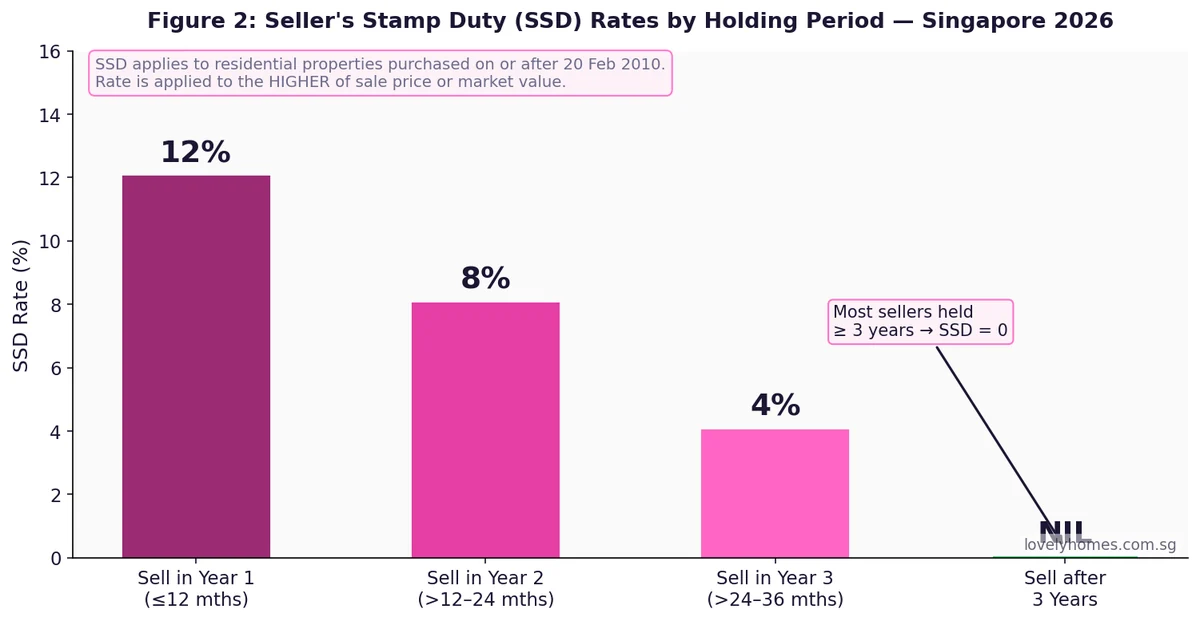
SSD was introduced in February 2010 to discourage short-term residential property speculation. It is paid by the seller (not the buyer) when a residential property is disposed of within three years of its acquisition. The rate depends on how quickly the seller flips the property:

Seller's Stamp Duty SSD rates by holding period Singapore 2026
Figure 2: SSD rates by holding period — residential property, Singapore 2026. Source: IRAS.

SSD is calculated on the higher of the sale price or the market value at the time of disposal. The holding period is measured from the date of purchase (execution of the Sale & Purchase Agreement) to the date of sale (execution of the disposal S&P). SSD does not apply to properties acquired before 20 February 2010, nor does it apply to commercial or industrial property.

Note: If you inherit a property and subsequently sell it, the SSD holding period runs from the original purchase date (the date the deceased acquired the property), not from the date of inheritance. This is a common source of confusion. If a parent bought a condo in 2024 and passed away in 2025, and the heir sells in early 2026, SSD at 8% could still apply.

The SSD is the reason most investor-buyers hold Singapore residential property for at least three years before selling. In practice, the combination of SSD and the time needed to recover transaction costs (BSD + ABSD + legal fees + agent commissions) means the effective minimum hold for a profitable flip is typically four to five years.

Additional Conveyance Duty (ACD) — the Entity Transfer Tax

ACD was introduced in May 2017 to close a loophole that allowed buyers to acquire residential property held in companies without paying ABSD — by buying shares in the company rather than the property directly. Under the ACD regime, a transfer of equity interests in a residential-property-holding entity is taxed as if it were a direct property acquisition.

ACD applies when:

  • The acquirer obtains a significant ownership interest (≥50%) in an entity (company, trust, or partnership);
  • That entity holds Singapore residential property as its primary asset; and
  • The residential property component exceeds a de minimis threshold.

The ACD rate is 33% on the residential property value component, levied on top of the existing stamp duty on the share transfer (which is normally 0.2%). For a $10 million residential property held in a company, an ACD transaction could trigger an additional $3.3 million in duty — making it broadly equivalent in cost to a direct ABSD transaction.

ACD is highly specialised and typically arises in commercial real estate transactions, family wealth restructuring, or en-bloc-related scenarios. Most individual residential buyers will never encounter it. If you are structuring a transaction that involves acquiring shares in a company that holds Singapore residential property, engage a tax adviser with stamp-duty expertise before proceeding.

Summary: All Four Singapore Stamp Duties at a Glance

Duty Who Pays When It Applies Rate (Residential) Deadline
BSD Buyer All property purchases 1%–6% progressive 14 days from OTP/S&P
ABSD Buyer 2nd+ property / foreigner / entity 0%–65% flat on full price 14 days from OTP/S&P
SSD Seller Sold within 3 years of purchase 4%–12% flat on full price 14 days from disposal S&P
ACD Acquirer of equity ≥50% stake in residential-property entity 33% on resi property value 14 days from share transfer

Comprehensive Worked Example: SC Couple Upgrading from HDB to Private Condo

Mr & Mrs Pang are Singapore Citizens. They own a Bishan 5-room HDB flat (purchased 2018, fully paid under CPF). They want to buy a S$2,000,000 2-bedroom freehold condo in District 10 and sell the HDB afterwards. Here is the full stamp duty picture:

Scenario A: Buy the condo BEFORE selling the HDB

Because they still own the HDB, the condo is their second residential property. ABSD at 20% is triggered.

  • BSD on S$2,000,000: S$64,600
  • ABSD (20%): S$400,000
  • Total stamp duty: S$464,600
  • However, they can apply for the ABSD Married Couple Remission — they get the S$400,000 back if they sell the HDB within 6 months of the later of (a) the condo’s purchase date or (b) its TOP date.
  • They must pay the ABSD upfront in cash and wait for the refund.

Scenario B: Sell the HDB FIRST, then buy the condo

After selling the HDB, they hold zero residential properties. The condo becomes their first residential property. Zero ABSD.

  • BSD on S$2,000,000: S$64,600
  • ABSD: S$0
  • Total stamp duty: S$64,600
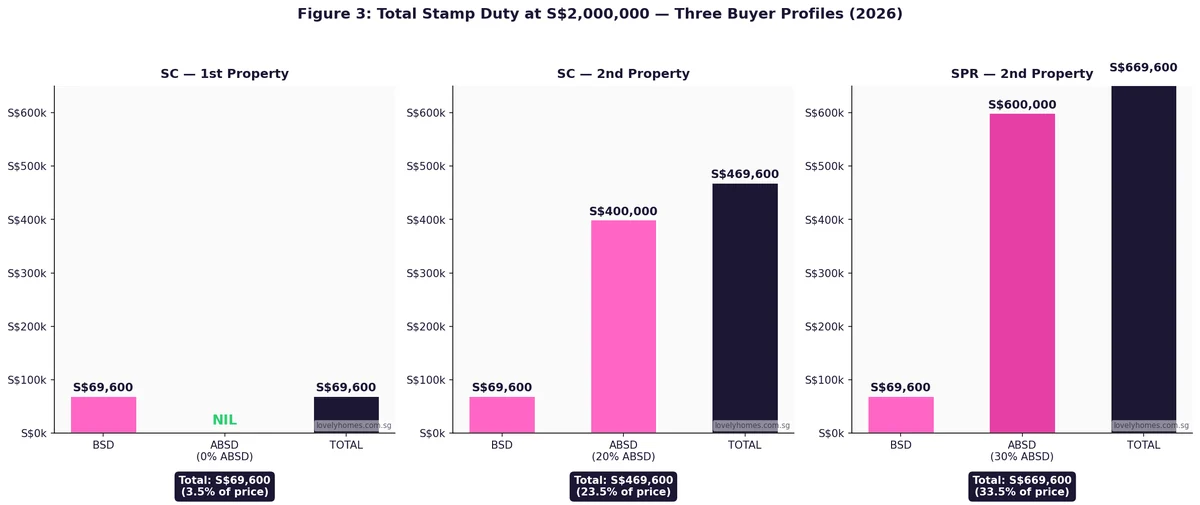
Total stamp duty worked example three buyer profiles at S 2 million Singapore 2026
Figure 3: Total stamp duty at S$2,000,000 — SC 1st property, SC 2nd property, and SPR 2nd property compared. Source: IRAS 2026.

Scenario B saves the Pangs S$400,000 and avoids the need for the remission application. The trade-off is the risk of not finding a new home before the HDB sale completes — and potentially needing temporary accommodation in the interim. Many upgrading couples use a bridging loan to manage this gap.

When Does Stamp Duty Really Matter? — Why These Numbers Are So Significant

Stamp duty in Singapore is, by international standards, among the highest in the world for non-citizen buyers. A foreign individual purchasing a S$3 million residential property in 2026 faces: BSD of approximately S$119,600 plus ABSD of S$1,800,000 — a total of S$1,919,600, or 64% of the purchase price. This is intentional: the Government has consistently stated that Singapore’s residential property market is primarily for Singaporeans to live in, and the ABSD is the mechanism that enforces that policy goal.

For Singapore Citizens, the numbers are far more manageable — but still significant. A first-time buyer at S$2 million pays S$64,600 in BSD alone. For an upgrader buying their second property at the same price, adding S$400,000 in ABSD transforms what might otherwise be a healthy financial decision into a transaction that requires either substantial cash reserves or careful sequencing via the remission route.

Stamp duty also has a secondary effect on the property market as a whole: it creates a minimum holding period incentive. Investors who pay BSD and ABSD on entry need their property to appreciate by at least those amounts — plus legal costs, agent commissions, and financing costs — before they break even on a sale. This structurally discourages short-term speculation and was a deliberate part of the policy design when rates were raised in 2021 and 2023.

What Might Change in 2026 and Beyond?

This section is speculative analysis, not official policy.

As at May 2026, there has been no signal from the Ministry of Finance or MAS of imminent changes to the stamp duty regime. Private residential prices rose 0.9% in Q1 2026 — a moderate pace that does not, on its own, suggest further tightening is imminent. The Government has traditionally intervened when quarterly price growth exceeds 2–3% or when transaction volumes indicate re-entry of speculative buyers.

Watch for the following triggers that could lead to a review: (1) sustained quarter-on-quarter private price growth above 2% for two or more consecutive quarters; (2) a significant rise in foreign buyer transactions as a proportion of total; (3) a global interest rate environment that makes Singapore dollar assets more attractive to offshore capital. Conversely, a sharp economic slowdown could prompt targeted relief — as was done in 2020 with the COVID-19 stamp-duty deferral scheme.

Frequently Asked Questions

Can I use my CPF to pay stamp duty?

No, not at the point of payment. BSD and ABSD (and SSD for sellers) must be paid in cash by the statutory deadline. After the duty has been stamped and paid, you may apply to withdraw from your CPF Ordinary Account to reimburse the cash outlay, provided the property qualifies under CPF Board rules and you have sufficient OA balance. The CPF withdrawal is a reimbursement step, not a direct payment channel.

Does SSD apply if I sell because of financial hardship?

There are no hardship exemptions to SSD built into the Stamp Duties Act. SSD is triggered automatically on any disposal within 3 years of purchase, regardless of the reason for sale. IRAS has no general discretion to waive SSD except in the specific circumstances defined in the Act (e.g. compulsory acquisition by the state). If you are facing distress and need to sell within the SSD window, factor the SSD cost into your net sale proceeds before deciding.

My spouse is a foreigner. Do we pay 60% ABSD on our first home together?

For a jointly-owned first matrimonial home where one owner is a Singapore Citizen and the other is a foreigner, the couple can apply for ABSD remission to be taxed at the SC rate (0% on a first property). The remission is available for a property that will be used as the couple’s matrimonial home, and conditions must be met. The ABSD is still payable upfront at the foreigner rate; the remission is applied for thereafter. Engage a conveyancing lawyer well before the OTP is exercised to ensure the remission application is properly structured.

Is stamp duty payable on a property gift (transfer without payment)?

Yes. BSD (and ABSD where applicable) is computed on the market value of the property at the time of transfer, even if no money changes hands. A parent transferring a private condo to an adult child as a gift is treated as a purchase at market value for stamp duty purposes. The child is treated as the buyer and must pay BSD and ABSD based on their own buyer profile and existing property count.

How is stamp duty calculated for an uncompleted property (new launch)?

For an uncompleted unit bought directly from the developer, the stamp duty is computed on the purchase price stated in the Sale & Purchase Agreement (which is executed at the point of booking the unit). ABSD — where applicable — is payable within 14 days of the S&P execution, which means the full ABSD amount is due upfront even though the project may not complete for several years. The Married Couple Remission window (6 months to sell the existing property) runs from the later of the S&P date or the Temporary Occupation Permit (TOP) date.

Does stamp duty apply to HDB flat purchases?

Yes. BSD applies to all HDB flat purchases (new BTO and resale) at the same progressive rates as private residential property. For new BTO flats, BSD is computed on the selling price set by HDB; for resale, it is on the higher of the resale price or HDB’s valuation. ABSD also applies to HDB flat purchases under the same rules — although Singapore Citizen first-time buyers pay 0% ABSD, meaning only BSD is due. SPR first-time buyers face 5% ABSD even on an HDB flat purchase.

Related Articles


Disclaimer: This article is for general informational purposes only and does not constitute legal, tax, or financial advice. Stamp duty rates and remission rules may change. Always verify the current position with the IRAS Stamp Duty page and the Ministry of Finance. Consult a licensed conveyancing lawyer or tax specialist before transacting.

Singapore Landed Property Guide 2026: Types, Rules, Prices & Who Can Buy

Landed property in Singapore is the apex of local real estate — a scarce, tightly regulated asset class that accounts for just 5% of residential dwellings, occupies about 80 sqkm of the island, and is almost entirely reserved for Singapore Citizens. For buyers who qualify, landed homes deliver three things that condominiums cannot: private land ownership, multi-generational living space, and freehold tenure on the overwhelming majority of stock. This 2026 guide explains the four main landed typologies (Detached, Semi-Detached, Terrace and Cluster/Strata-Landed), the Residential Property Act rules that govern foreign and PR ownership, typical pricing by district, and the structural demand drivers that have made landed property Singapore’s most consistent long-term outperformer.

Singapore landed property guide 2026 bungalow semi-detached terrace
Figure 1: Singapore landed property — Good Class Bungalow, Detached, Semi-Detached, Terrace and Cluster.

Quick Answer

  • Landed property = Detached, Semi-Detached, Terrace, and Cluster/Strata-Landed.
  • Good Class Bungalow (GCB): detached on ≥ 1,400 sqm in one of 39 gazetted GCB areas.
  • Ownership: Singapore Citizens only (landed non-Sentosa); PRs and foreigners need LDAU approval.
  • Tenure: majority freehold; some 99-year and 999-year stock in specific estates.
  • Share of housing stock: approx. 5% of Singapore’s residential dwellings.
  • Median price (2026): Semi-D S$5.8M–S$7.5M; Terrace S$4.2M–S$5.8M; GCB S$25M+.
  • Sentosa Cove: the only landed enclave open to non-resident foreigners, subject to LDAU approval.

What Counts as Landed Property in Singapore

Under the Residential Property Act (RPA), “landed residential property” comprises detached, semi-detached and terrace houses, and — for legal purposes — vacant residential land. Strata-landed (cluster) housing sits in a hybrid zone: it is physically a landed house but legally a strata lot under the Building Maintenance and Strata Management Act.

Typology Definition Key Characteristics
Detached / Bungalow Standalone house on its own plot; minimum 400 sqm plot by URA. Full privacy; highest price point. GCB sub-category at 1,400+ sqm.
Semi-Detached Pair of houses sharing one party wall; minimum 200 sqm per plot. Second most expensive typology; balances space and price.
Terrace Row houses sharing two party walls; minimum 150 sqm per plot. Most affordable landed entry; concentrated in older estates.
Cluster / Strata-Landed Gated enclave of landed units sharing common facilities (pool, gym, guardhouse). Body-corporate-managed; foreigners eligible without LDAU approval (as strata).
Good Class Bungalow (GCB) Detached on ≥ 1,400 sqm in a gazetted GCB Area (39 areas). Singapore’s most exclusive housing; SC buyers only.
Shophouse (conservation) Historically residential/commercial; zoned on a case-by-case basis. Commercial-dominant usage today, but some remain residential.

The 39 Good Class Bungalow Areas

Good Class Bungalows — the pinnacle of Singapore residential — are concentrated in 39 gazetted areas. Each plot must meet four criteria: (1) minimum 1,400 sqm plot size, (2) minimum 18.5m plot width, (3) no more than two storeys plus an attic, and (4) at least 3m side setback. The best-known GCB areas include Tanglin, Nassim, Queen Astrid, Bishopsgate, Chatsworth, Cluny, Cornwall, Dalvey, Gallop, White House Park and Holland Park.

Key takeaway

There are approximately 2,800 GCB plots in Singapore — a fixed, non-expandable pool. The scarcity alone has driven GCB prices to compound at 7%–9% p.a. over the last two decades, outpacing the broader residential index.

Who Can Buy Landed Property in Singapore?

Singapore Citizens

SCs have the fewest restrictions: they can purchase any landed property on the mainland, in Sentosa Cove, or in strata form, subject only to ABSD rules (0% on 1st, 20% on 2nd, 30% on 3rd+ property) and standard financing rules.

Singapore Permanent Residents (PR)

PRs cannot purchase landed property on the mainland without specific approval from the Land Dealings (Approval) Unit (LDAU) of the Singapore Land Authority. In practice, LDAU approval for PRs is rare — usually granted only for PRs of at least 5 years’ standing who demonstrate substantial economic contribution to Singapore. PRs may freely purchase strata-landed (cluster) housing and Sentosa Cove landed (subject to LDAU).

Foreigners (Non-Resident)

Non-resident foreigners may purchase Sentosa Cove landed property (subject to LDAU approval, typically granted for 1 plot with owner-occupation conditions), and may freely purchase strata-landed cluster housing. Mainland landed is effectively closed to foreign buyers.

Entities (Companies, Trusts)

Entities are generally prohibited from owning landed residential property. Certain family-office and LDAU-approved trusts have been granted exceptions, but these are the minority. Entities face a 65% ABSD rate across the board.

Buyer Type Mainland Landed Strata-Landed (Cluster) Sentosa Cove
Singapore Citizen Yes Yes Yes
PR (≥ 5 yrs) LDAU approval (rare) Yes LDAU approval
PR (< 5 yrs) Effectively No Yes Rare
Foreigner No (mainland) Yes LDAU approval
Entity No Yes (subject to ABSD 65%) No

Tenure: Freehold, 999-Year and 99-Year Landed

Most landed stock in Singapore is freehold, a product of colonial-era land grants. A material minority is 999-year leasehold — functionally equivalent to freehold for all planning purposes. A smaller segment is 99-year leasehold, typically in newer developments such as Sentosa Cove and specific GLS strata-landed projects.

Freehold / 999-year command a 5%–12% price premium over 99-year peers. At the 60-year leasehold mark, CPF usage begins to taper (by the 30-year remaining point, CPF is materially restricted), which structurally caps the buyer pool for older leasehold landed — and compresses prices.

Price Benchmarks by Typology and District (2026)

Typology Representative Districts Tenure Mix 2026 Price Band
Detached (GCB) D10 Tanglin / D11 Nassim Freehold S$25M – S$80M+
Detached (non-GCB) D10 / D11 / D15 Freehold S$8M – S$18M
Semi-Detached D10 Holland / D11 Novena / D15 Katong Freehold S$6.5M – S$9M
Semi-Detached D13 Potong Pasir / D14 Eunos / D19 Hougang Freehold / 999-yr S$4.5M – S$6M
Terrace (Inter / Corner) D10 / D11 / D15 Freehold S$5M – S$7.5M
Terrace (Inter / Corner) D13 / D14 / D19 / D25 Freehold / 999-yr / 99-yr S$3M – S$5M
Cluster / Strata-Landed D10 / D11 / D16 / D19 Freehold / 99-yr S$3.5M – S$7M
Sentosa Cove Bungalow D4 Sentosa 99-yr S$15M – S$40M+

Cluster Housing: The Strata-Landed Alternative

For buyers who want a landed lifestyle without the upkeep burden — and for PRs and foreigners whose mainland landed options are effectively zero — cluster (strata-landed) housing offers a compromise. Cluster developments are gated enclaves of terraces or semi-detached units, managed under a body corporate with shared facilities (swimming pool, gym, tennis court, 24/7 security). Because the units are legally strata lots rather than landed titles, they fall outside the RPA’s landed-ownership restrictions.

Flagship cluster developments include The Shaughnessy (Holland), Victoria Park Villas (Bukit Timah), Jardin (Bukit Timah) and Archipelago (Bedok Reservoir). Pricing typically runs at a 15%–25% discount to comparable freehold detached landed within the same district.

Financing Landed Property

Landed purchases are subject to the same LTV, TDSR and MSR frameworks as condominiums — up to 75% LTV for first housing loan, stepped down for second and subsequent loans. Because absolute quantums are higher, the cash requirement is significant. For a S$6M terrace:

Line Item Amount
Purchase Price S$6,000,000
Buyer’s Stamp Duty (BSD) S$229,600
ABSD (SC 1st property) S$0
Legal fees S$5,000
Minimum Cash Downpayment (5%) S$300,000
CPF + Cash Downpayment (20%) S$1,200,000
Loan Quantum (75%) S$4,500,000
Monthly Mortgage (4.0%, 25-yr) Approx. S$23,750
Total Cash Upfront S$534,600

Stress-test your borrowing envelope using our TDSR/MSR guide. Most banks will require comfort on both household income resilience and liquid asset reserves for landed quantums > S$5M.

The Landed Investment Case

Scarcity

Singapore’s landed stock is capped. URA’s Master Plan does not meaningfully add new landed zoning — the only additions are small infill sites and occasional en-bloc redevelopments. The approximately 72,000 landed units on the island represent a finite pool that cannot grow in line with population or wealth.

Demand: Second-Generation Singaporean Wealth

A generation of Singaporeans who benefited from the 1998–2008 and 2013–2023 property cycles are now handing down wealth. Landed is the preferred destination for that capital: it is stable, defensible, and tax-efficient (no capital gains tax on primary residence). The “upgrade ladder” — HDB → condo → landed — is a real phenomenon driving steady demand at the mid-tier.

Underperformance in Weak Markets

The counter-argument: landed prices are less liquid than condominiums. In the 2008–2009 GFC drawdown and the 2014–2017 cooling-measures cycle, landed stock took 18–30 months longer than the condo market to clear at the new equilibrium. Buyers with time horizons shorter than 10 years should consider this liquidity premium.

Landed vs Condominium: Trade-offs

Dimension Landed Condominium
Privacy Full Shared common areas
Land ownership Yes (freehold / 99-yr) No (strata lot)
Maintenance Owner’s responsibility Managed by MCST
Facilities None unless built by owner Pool, gym, security, lounges
Renovation flexibility High (subject to URA GFA) Low (interior only, MCST rules)
Price entry (2026) S$3.5M – S$80M+ S$1.2M – S$20M+
Typical absolute quantum S$4.5M+ mid-tier S$1.8M+ mid-tier
Foreign/PR eligibility Restricted (mainland) Open to all
Annual property tax (AV) Generally higher (land) Lower per sqft
Capital growth 2000–2024 Approx. 6.2% p.a. Approx. 4.8% p.a.

Regulatory and Planning Considerations

Envelope Control

URA enforces an “Envelope Control” regime across most landed estates, capping building height (typically 2 storeys plus attic; 3 storeys in designated zones), setback distances (at least 2m front, 2m side for terraces), and GFA. Reconstruction or redevelopment must comply with the prevailing envelope.

Conservation Areas

Certain shophouse and black-and-white bungalow zones are gazetted conservation areas, subject to URA’s Conservation Guidelines. External alterations require URA written approval and must preserve heritage character.

Drainage Reserves and Plot Ratio

Some landed plots carry URA drainage reserves or setback obligations that effectively reduce buildable GFA. Always confirm with URA’s Master Plan zoning map and the developer’s Schedule of Conditions before offering.

Frequently Asked Questions

Can a foreigner buy landed property in Singapore?

Not on the mainland — the Residential Property Act restricts mainland landed to Singapore Citizens. Foreigners can purchase strata-landed (cluster) housing freely, and Sentosa Cove landed with LDAU approval.

What is the minimum plot size for a bungalow?

400 sqm under URA guidelines. A Good Class Bungalow requires a minimum 1,400 sqm plot in one of 39 gazetted GCB areas.

Is a cluster house considered landed?

Physically yes, legally no. Cluster units are strata lots under BMSMA and are not subject to the RPA’s landed restrictions. Foreign and PR buyers can purchase them without LDAU approval.

Can a PR buy a mainland terrace house?

Only with LDAU approval, which is granted selectively to PRs with substantial economic contribution to Singapore. Most PR applications for mainland landed are declined.

How is property tax calculated on landed?

Based on Annual Value (AV) set by IRAS, which reflects the market rental value of the property. Owner-occupier rates range from 0% to 32% (progressive); non-owner-occupier rates from 12% to 36%. See our property tax guide.

What is the difference between GCB Area and GCB?

A GCB Area is a gazetted zone (one of 39) in which GCB controls apply. A GCB is a specific detached bungalow within a GCB Area that meets the plot-size and setback criteria. A house in a GCB Area that does not meet GCB criteria is simply a detached house within that zone.

Can I convert a terrace into a semi-detached?

In theory yes, subject to URA planning approval and sufficient GFA, side setback and party-wall agreements. In practice, such conversions are rare and require consent from the neighbouring unit owner.

Is Sentosa Cove a good buy?

Sentosa Cove is Singapore’s only waterfront landed enclave and the only mainland-adjacent landed market open to foreign buyers (with LDAU approval). It has underperformed the broader landed index since 2014 due to cooling measures and limited tenant pool, but has recently re-rated on non-resident demand.

Related Guides

External Authority Sources

Disclaimer: Specifications, price bands and eligibility rules are current as at the time of writing. Always verify regulatory positions with URA, SLA and a qualified conveyancing lawyer before committing to a landed purchase. Nothing on this page is financial, tax, or legal advice.


Translate »