EV Charging Guide for Singapore HDB and Condo Owners 2026: BMSMA Rules, Costs and How to Get a Charger Installed
Quick Answer: EV Charging for Homeowners
- Electric vehicles accounted for roughly 57.6% of new car registrations in Singapore in Q1 2026, the first quarter EVs have outnumbered combustion and hybrid models, which is rapidly turning home charging access into a genuine property consideration.
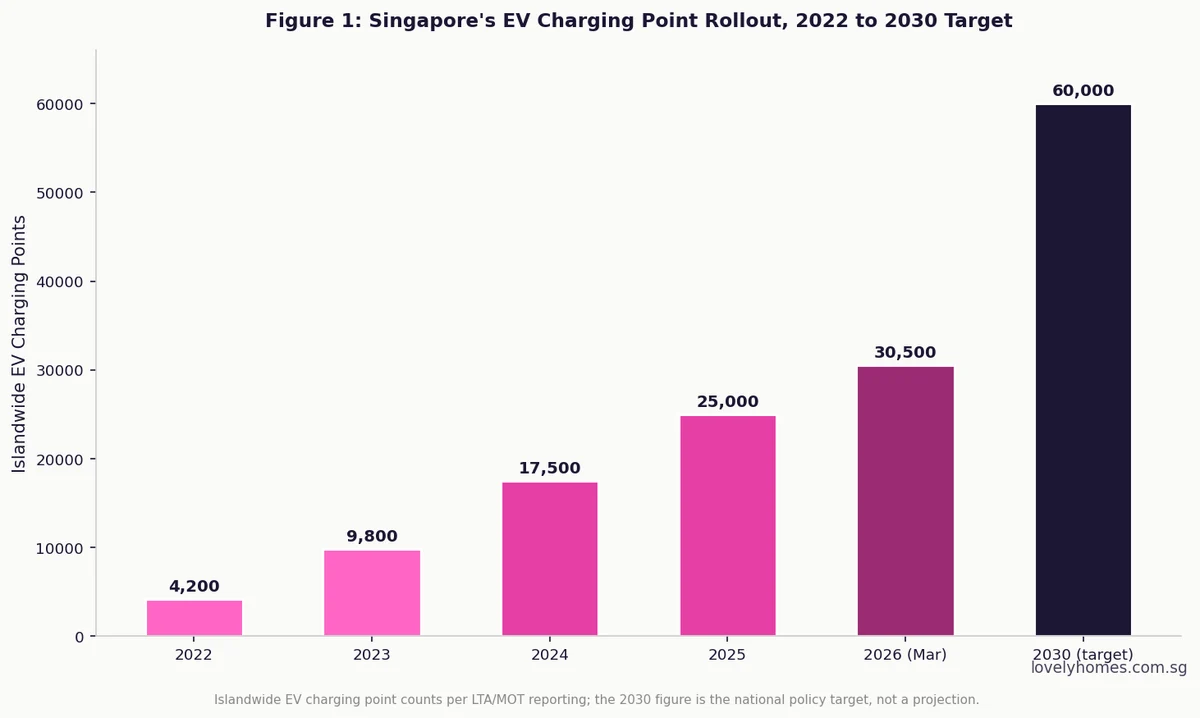
- Singapore had around 30,500 EV charging points in operation islandwide as at end March 2026, against a national target of 60,000 points by 2030 set by the Land Transport Authority (LTA).
- From April 2026, new Build-To-Order (BTO) flats have chargers installed in carparks as residents collect their keys, rather than waiting for the town council to take over the estate’s electrical systems.
- For condominiums, a 2026 amendment to the Building Maintenance and Strata Management Act (BMSMA) lowered the vote needed to approve EV charger installation to a simple majority (50%), provided the charge point operator’s lease is no more than 10 years and does not draw on the Management Fund.
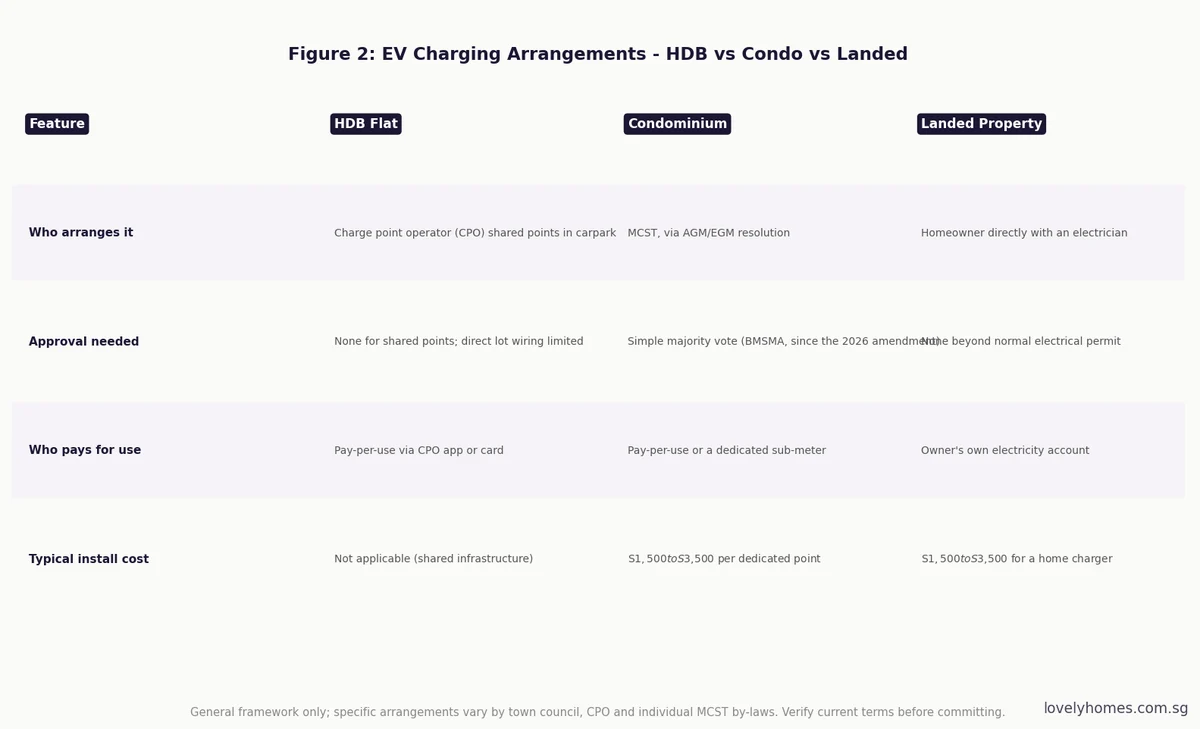
- HDB flat owners generally rely on shared, pay-per-use charging points installed by charge point operators (CPOs) in the carpark, rather than a dedicated point wired to their own lot.
- Installing a dedicated charging point, whether in a condo car park or at a landed home, typically costs in the region of S$1,500 to S$3,500, depending on cable run distance and the charger model chosen.
- Buyers evaluating a resale flat or condo should check what charging arrangement, if any, already exists, since retrofitting shared infrastructure is far more complex than installing a point at a landed property.
Why EV Charging Has Become a Housing Question, Not Just a Car Question
For most of the last decade, electric vehicles were a niche concern in Singapore’s car market. That has changed decisively: electric cars made up an estimated 57.6% of new car registrations in the first quarter of 2026, overtaking petrol, diesel and hybrid models combined for the first time. This shift matters well beyond the motor trade, because unlike a petrol car, an EV needs somewhere to plug in, and where that “somewhere” can be found now depends heavily on what kind of home a buyer lives in. A landed homeowner can usually install a charger with little more than an electrician’s visit. A condominium owner needs their Management Corporation Strata Title (MCST) on board. An HDB flat owner, until very recently, had almost no path to a dedicated charging point at all.
This is why EV charging access is quietly becoming a factor buyers and sellers weigh alongside more traditional considerations like MRT distance and school proximity, particularly for buyers who already own or are planning to buy an electric vehicle. Government policy has been moving quickly to keep pace, and this guide sets out exactly what the rules are for each housing type as they stand in 2026.
The National Rollout: Where Singapore Stands in 2026
Singapore’s EV charging infrastructure is coordinated by the Land Transport Authority (LTA), working through its subsidiary tasked with public charging deployment, alongside the Ministry of Transport (MOT). The national target is 60,000 EV charging points by 2030, and the islandwide count had reached roughly 30,500 points by end March 2026, putting the programme roughly on the halfway mark of its trajectory with four years remaining. This is a mix of public charging points in commercial carparks, workplace charging, and points progressively deployed into HDB carparks, which remain the single largest category of residential parking in Singapore.
A significant policy shift took effect in April 2026: chargers are now installed in new BTO carparks as residents collect their keys, rather than only after the town council formally takes over the estate’s electrical systems, which could previously take months or years after the first residents moved in. This change was made specifically to support residents who already own an EV at the point of key collection, and to encourage others who had been waiting for convenient charging before making the switch themselves.
HDB Flats: Shared Charging, Not a Dedicated Point
For the large majority of HDB flat owners, EV charging today means using a shared, pay-per-use charging point installed in the estate’s carpark by a charge point operator (CPO) under arrangement with the town council, rather than having a dedicated charger wired to their own parking lot. Drivers typically pay via the CPO’s own mobile app or an RFID card, with rates set per kWh or per charging session, similar in concept to paying for parking itself. This shared model exists because HDB carparks were not originally designed with individual, lot-specific power wiring, and retrofitting tens of thousands of lots with dedicated circuits would be both costly and impractical in the near term.
The practical implication for HDB owners is that charging convenience depends heavily on how many shared points exist in a given estate and how frequently they are occupied, rather than on anything the individual flat owner can control or install themselves. Newer estates, and estates that have gone through the April 2026 policy change described above, are seeing chargers appear earlier in the estate’s life; older, established estates depend on the pace of retrofit rollout by the town council and CPOs. Prospective HDB buyers who already own or plan to buy an EV should check the specific block and carpark’s current charging provision before assuming convenient access, since this varies significantly by estate and even by carpark within the same town.
Condominiums: The 2026 BMSMA Change That Matters
Condominium owners face a different, and until recently more difficult, path: installing a charger requires the consent of the Management Corporation Strata Title (MCST), which historically needed a special resolution passed at an Annual General Meeting (AGM) or Extraordinary General Meeting (EGM), often requiring a high supermajority of votes that was difficult to muster in practice. A 2026 amendment to the Building Maintenance and Strata Management Act (BMSMA) changed this materially: MCSTs can now approve EV charger installation with a simple majority vote (more than 50%), provided two conditions are met: the charge point operator’s lease for the installation is no more than 10 years, and the arrangement does not draw down on the development’s Management Fund (the fund used for day-to-day upkeep, as distinct from the longer-term Sinking Fund).
This lower voting threshold was introduced specifically because the previous supermajority requirement had proven to be a significant practical barrier, with many EV-owning residents unable to gather sufficient support even when a majority of owners were broadly in favour. For an owner wanting a dedicated point at their own lot, the practical process now typically involves approaching the MCST council, proposing the appointment of a CPO under commercial terms that satisfy the lease-length and funding conditions above, and putting the resolution to a vote at the next general meeting.
Landed Property: The Simplest Path
Landed homeowners have by far the simplest route to home charging, since they own both the property and its electrical supply outright, with no MCST or town council approval required. Installation is typically a matter of engaging a licensed electrician to assess the home’s existing electrical capacity, install a dedicated circuit if needed, and mount a home charging unit, usually near the driveway or car porch. Costs are broadly similar to the condo scenario described below, generally in the region of S$1,500 to S$3,500, though homes with older or lower-capacity electrical systems may need a supply upgrade first, adding to the total cost.
Summary: EV Charging Facts at a Glance
| Question | Short Answer |
|---|---|
| Who runs Singapore’s EV charging rollout? | The Land Transport Authority (LTA), working with the Ministry of Transport (MOT) and licensed charge point operators. |
| What is the national charging point target? | 60,000 points by 2030, up from roughly 30,500 as at end March 2026. |
| Can HDB owners install a dedicated charger? | Generally no; most HDB owners rely on shared, pay-per-use points installed by CPOs in the estate carpark. |
| What changed for condos in 2026? | The BMSMA vote threshold for approving a charger dropped to a simple majority, subject to lease-length and funding conditions. |
| How much does a dedicated charger cost? | Roughly S$1,500 to S$3,500 for a condo or landed installation, depending on wiring distance and equipment. |
| Do new BTO flats get chargers automatically? | Since April 2026, chargers are progressively installed as residents collect keys, rather than only after town council takeover. |
Worked Example: Getting a Charger Installed at a Condo
The scenario: Mr and Mrs Lim own a unit in an existing condominium with no EV chargers currently installed. They have just bought an electric vehicle and want a dedicated point at their own car park lot.
The process: They approach the MCST council with a proposal to appoint a CPO on a 7-year lease, which satisfies the BMSMA condition that the lease not exceed 10 years, and structure the commercial terms so that the CPO, not the Management Fund, bears the installation cost, recovering it instead through per-use charging fees from residents. The proposal is tabled at the next AGM.
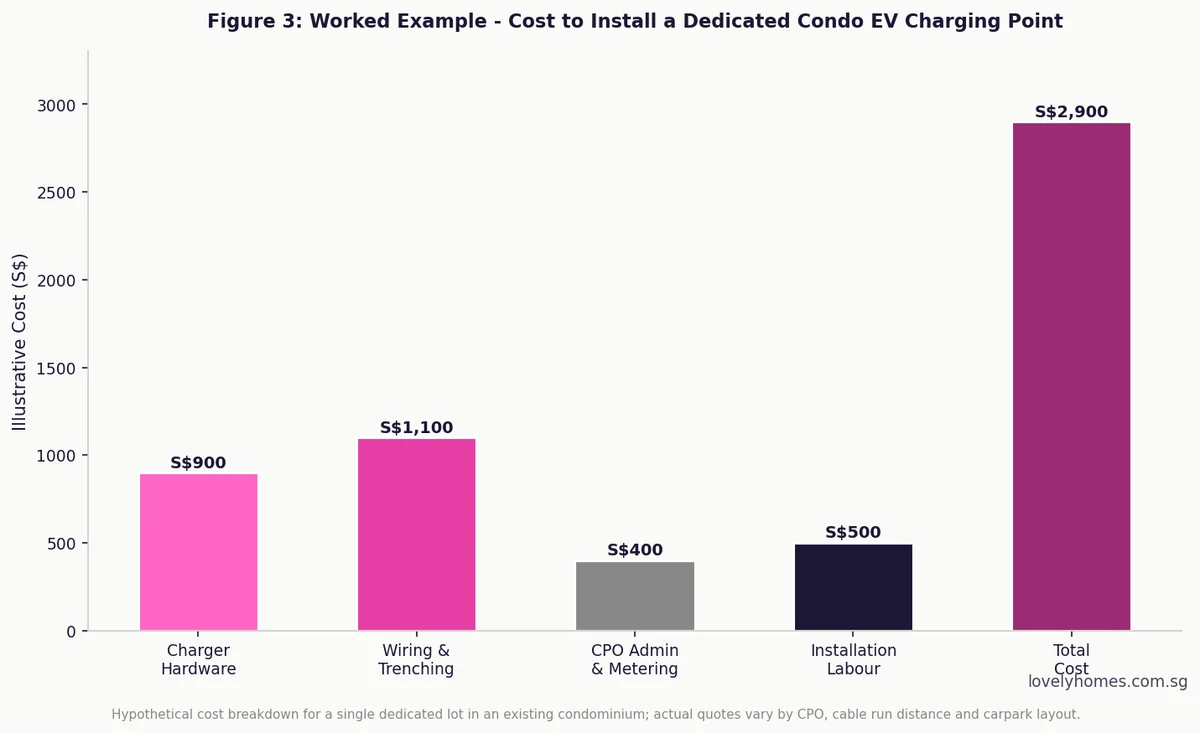
The vote and the cost: Under the pre-2026 rules, this would have required a much higher supermajority, which the Lims estimate would have been difficult to secure given mixed views among owners. Under the 2026 simple-majority rule, the resolution passes with 54% support. Installation at their specific lot costs approximately S$2,900 in total: roughly S$900 for the charger hardware, S$1,100 for wiring and trenching from the nearest distribution board, S$400 for CPO administration and metering setup, and S$500 in installation labour.
These figures are illustrative only; actual costs and vote outcomes depend on the specific development’s layout, the CPO chosen, and the composition of owners at any given MCST.
Why This Matters for Buyers, Sellers and Investors
With electric vehicles now the majority of new car registrations, EV charging provision is quickly moving from a nice-to-have to a genuine differentiator between comparable homes, particularly for condominiums where installation still depends on collective agreement rather than an individual owner’s decision. A condo development that has already appointed a CPO and eased its by-laws to reflect the 2026 BMSMA change offers a smoother path for an EV-owning buyer than one that has not, all else being equal. For landlords, offering a unit with existing or easily arranged charging access may become a modest but real point of differentiation as more tenants themselves switch to electric vehicles. For HDB buyers, checking a specific estate’s current charging point density is a sensible, low-effort addition to the usual due diligence checklist, alongside remaining lease and MRT access.
What Might Come Next
The following is informed speculation, not confirmed policy. Given the pace of EV adoption already observed in 2026, further easing of the BMSMA framework for condominiums, or a dedicated push to retrofit dedicated charging capability into older HDB carparks beyond the current shared-point model, are both plausible directions, though neither has been confirmed as at this writing. It is also plausible that future BTO developments will be designed from the outset with higher-capacity electrical infrastructure to support a larger proportion of dedicated, rather than shared, charging points, given how quickly EV ownership has moved from a minority to a majority of new car purchases.
Frequently Asked Questions
Can I install my own EV charger at an HDB carpark lot?
Generally no. Most HDB carparks use a shared, pay-per-use charging model run by charge point operators rather than dedicated wiring to individual lots, though this may evolve as infrastructure investment continues.
What vote does a condo need to approve an EV charger under the 2026 rules?
A simple majority of more than 50%, provided the charge point operator’s lease does not exceed 10 years and the arrangement does not draw on the Management Fund.
How much does it cost to install a home EV charger in Singapore?
Typically around S$1,500 to S$3,500 for a condo or landed installation, depending on cable run distance, charger model and whether any electrical supply upgrade is needed.
Do all new BTO flats now come with EV chargers from key collection?
Since April 2026, chargers are progressively installed in new BTO carparks as residents collect their keys, rather than only after town council takeover, though coverage still depends on the specific project and rollout schedule.
Who pays for electricity used at a shared HDB charging point?
The driver pays the charge point operator directly, usually via a mobile app or RFID card, similar in principle to paying for parking or a toll.
Does having an EV charger increase a property’s resale value?
There is no established premium specific to EV charging access yet, but it is increasingly viewed as a convenience factor that can support a property’s appeal, particularly to EV-owning buyers, as adoption continues to rise.
What is Singapore’s overall EV charging point target?
The Land Transport Authority has set a target of 60,000 EV charging points islandwide by 2030, up from around 30,500 points in operation as at end March 2026.
Related Articles on LovelyHomes
Click anywhere outside to close