Singapore EC Resale Guide 2026: Complete Guide to Buying an Executive Condominium Resale

Singapore EC Resale Guide 2026: Complete Guide to Buying an Executive Condominium Resale

Quick Answer: Singapore EC Resale 2026

  • ECs are a hybrid housing class — built by private developers but subject to HDB eligibility rules for the first 10 years. After 10 years from completion, they are fully privatised and open to all buyers including foreigners.
  • 5-year MOP before you can sell in the open market (to Singapore Citizens and PRs only). 10 years before foreigners may buy.
  • No HDB loan for EC resale — bank loan only, regardless of citizenship. CPF OA funds are available for SC and SPR buyers.
  • EC resale prices averaged S$1,200–S$1,240 per square foot (PSF) in Q1 2026, up from S$760 PSF in 2019 — a 63% increase over 7 years.
  • ABSD applies to EC resale purchases for 2nd-and-above properties; SC first-property buyers pay 0% ABSD even within the 5-to-10-year window.
  • No income ceiling for resale EC buyers — income limits only apply to new EC applications.
  • The Ethnic Integration Policy (EIP) applies to EC resale within the 5-to-10-year window (before full privatisation).
  • CPF withdrawal limits and the Withdrawal Limit (WL) / Valuation Limit (VL) framework apply to EC resale purchases the same way they do for private condos.

What Is an Executive Condominium and Who Administers EC Resale?

The Executive Condominium (EC) is a uniquely Singaporean housing class — sometimes called a “sandwich-class” product — built by private developers on land sold by the Housing and Development Board (HDB) at subsidised prices. ECs look identical to private condominiums from the outside, with full condo facilities (swimming pool, gymnasium, BBQ pits, guard house), but they carry a set of HDB-derived restrictions during the first decade of their existence.

HDB administers EC eligibility rules under the Housing and Development (Executive Condominium Housing Scheme) Act 1996 (Cap 129A). The Urban Redevelopment Authority (URA) tracks EC transaction data and publishes quarterly resale price statistics. The Inland Revenue Authority of Singapore (IRAS) administers stamp duties on EC resale transactions — Buyer’s Stamp Duty (BSD), Additional Buyer’s Stamp Duty (ABSD), and Seller’s Stamp Duty (SSD where applicable). This guide reflects rules as at June 2026.
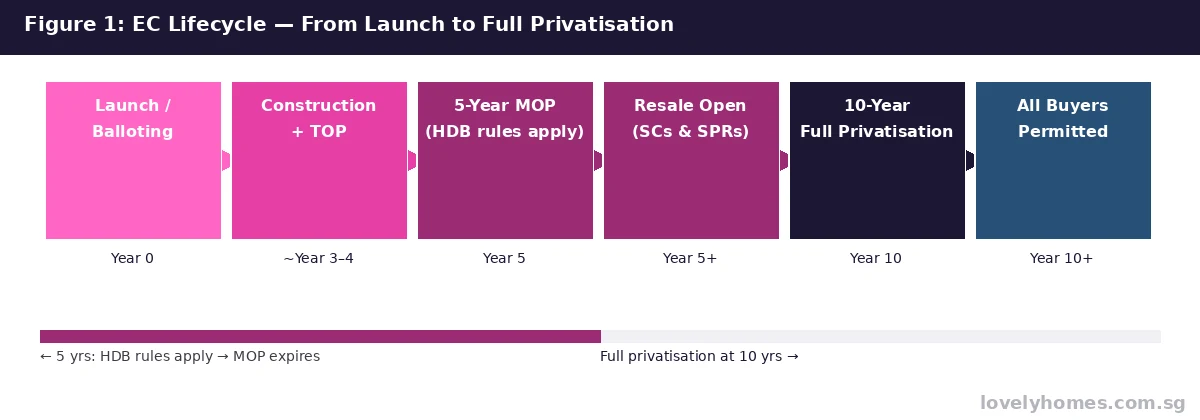
Singapore EC executive condominium lifecycle from launch to full privatisation 5 year MOP 10 year
Figure 1: The EC lifecycle — from HDB-controlled launch to full privatisation at year 10. The resale window opens at the 5-year MOP mark.

EC Resale: The Two Distinct Windows

Understanding the timeline is essential because EC resale operates under fundamentally different rules depending on when you buy:

Window 1 — After 5-Year MOP, Before 10-Year Full Privatisation

Once the EC’s 5-year MOP has been served (calculated from the date of the Temporary Occupation Permit, not key collection), the original HDB-scheme owner may sell to Singapore Citizens or Singapore Permanent Residents in the open market. During this window, HDB eligibility restrictions still apply:

  • Eligible buyers: Singapore Citizens and Singapore PRs only (foreigners cannot buy).
  • The Ethnic Integration Policy (EIP) applies — buyers must comply with the ethnic quota for the block and neighbourhood.
  • No income ceiling applies to resale buyers (income limits are only for new EC applicants).
  • Bank loan only — HDB loans are not available for any EC purchase, new or resale.

Window 2 — After 10-Year Full Privatisation

After 10 years from the EC’s completion (TOP date), the development is fully privatised and HDB restrictions are lifted entirely. From this point, the EC is treated identically to any private condominium for all purposes:

  • Eligible buyers: Singapore Citizens, Singapore PRs, foreigners, and companies.
  • No EIP applies.
  • ABSD at full private condo rates applies to foreigners (60% from February 2023).
  • Seller’s Stamp Duty (SSD) obligations for original buyers were served under private-condo rules.

EC Resale Price Trends 2019–2026
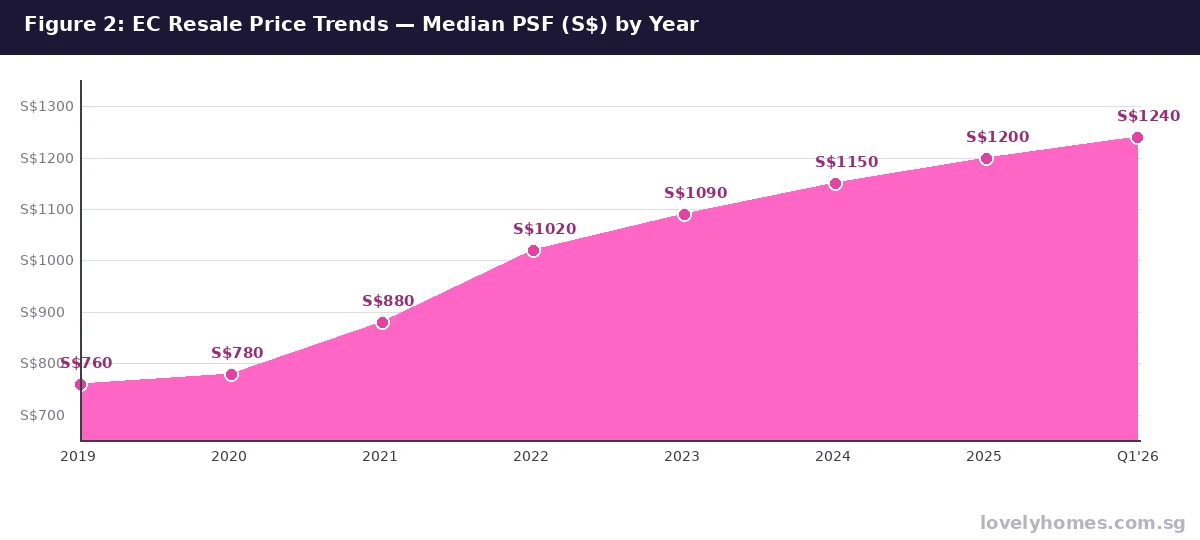
Singapore EC resale price trends median PSF 2019 to Q1 2026
Figure 2: EC resale median transacted price per square foot (PSF) 2019–Q1 2026. Prices rose 63% from S$760 PSF to S$1,240 PSF over seven years.

EC resale prices have outperformed many market segments over the post-COVID recovery and tightening cycle. The key drivers of EC resale price appreciation include:

  • Supply scarcity: EC launches are far fewer in number than HDB BTO launches, and the total stock of ECs is limited. With only a handful of projects entering the resale window each year, demand consistently outpaces supply.
  • Upgrader demand: ECs appeal primarily to HDB upgraders — households who have served their HDB MOP and are looking to move into condo-style living at a price point below new private launches. This demand is structural and persistent.
  • Location quality: Most ECs are sited in mature or established towns (Tampines, Sengkang, Jurong, Woodlands) with good MRT and bus connectivity, making them attractive as primary residences rather than pure investment plays.
  • No income ceiling at resale: Resale buyers face no income ceiling, unlike new EC applicants who are capped at S$16,000/month household income. This broadens the resale buyer pool considerably.

As at Q1 2026, industry figures show median EC resale prices at approximately S$1,200–S$1,240 PSF, with some mature-estate ECs transacting above S$1,400 PSF. This compares to typical new EC launch prices of S$1,350–S$1,500 PSF — meaning a well-located resale EC is often priced comparably to a new launch, but with the benefit of knowing the actual unit and finished state.

Eligibility, Restrictions and Stamp Duties
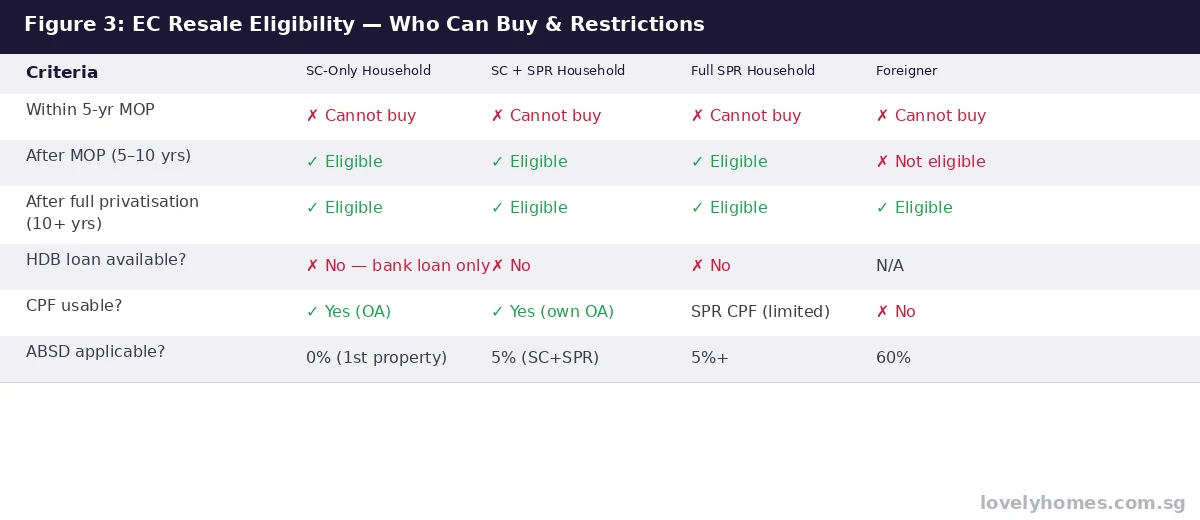
Singapore EC resale eligibility who can buy SC SPR foreigner MOP rules 2026
Figure 3: EC resale eligibility by buyer category and timing window — from MOP to full privatisation.
Buyer Profile 5–10 Yr Window After 10 Yrs ABSD (1st Property SC) ABSD (2nd Property SC)
SC only household Eligible Eligible 0% 20%
SC + SPR household Eligible Eligible 5% (on full purchase price) 20%+ (SC rate applies)
Full SPR household Eligible Eligible 5% 30%
Foreigner Not eligible Eligible 60% 60%
Singapore company Not eligible Eligible 35% 35%

Buyer’s Stamp Duty (BSD)

BSD applies to all EC resale purchases at the standard residential rates: 1% on the first S$180,000, 2% on the next S$180,000, 3% on the next S$640,000, 4% on the next S$500,000, 5% on the next S$1,500,000, and 6% on the remainder above S$3,000,000. BSD is administered by IRAS and must be paid within 14 days of the date of acceptance of the Option to Purchase (OTP).

CPF and Loan Rules

Bank loan only — HDB loans are not available for any EC purchase, including resale. The maximum Loan-to-Value (LTV) ratio is 75% of the property value (or purchase price, whichever is lower) for a first housing loan from a bank, subject to the Mortgage Servicing Ratio (MSR) of 30% of gross monthly income and the Total Debt Servicing Ratio (TDSR) of 55%, both administered by the Monetary Authority of Singapore (MAS).

CPF Ordinary Account (OA) funds may be used to service the loan and pay the downpayment for SC and SPR buyers, subject to the CPF Withdrawal Limit (WL) and Valuation Limit (VL) rules. Once CPF withdrawals hit the VL (equal to the lower of the purchase price or valuation), further withdrawal requires the property’s remaining lease to cover the youngest buyer to age 95.

The Resale Process: From OTP to Keys

The EC resale process is broadly similar to a private condominium resale and is governed by the Conveyancing and Law of Property Act (Cap 61) and standard Law Society of Singapore conditions of sale. Key milestones include:

Step Timeline Key Actions
1. Option to Purchase (OTP) Day 0 Seller grants OTP; buyer pays 1% option fee (typically). OTP is valid 14 days.
2. Exercise OTP Day 7–14 Buyer exercises OTP, pays 4% exercise fee (cash); BSD due within 14 days of exercise.
3. HDB resale checklist (if applicable) Day 7–14 Required if seller is an original HDB-scheme EC owner within the 5–10 year window.
4. Engage solicitors Day 7–21 Both parties engage conveyancing solicitors (same firm only with conflict-of-interest waiver).
5. Secure bank loan & CPF approval Week 2–6 Letter of Offer from bank; CPF OA withdrawal letter of authority.
6. Completion Week 8–12 Balance purchase price paid; keys handed over; SLA caveat registered.

Worked Example: The Lim Family, EC Resale in Sengkang

Mr and Mrs Lim are Singapore Citizens with a combined gross income of S$14,000/month. They are currently in HDB MOP (completed in March 2026) and are looking to upgrade to a 4-bedroom EC resale unit in Sengkang priced at S$1,480,000. The EC obtained its TOP in 2019 and has been in its resale window since 2024.

Stamp duties:

  • BSD: 1% x S$180,000 = S$1,800 + 2% x S$180,000 = S$3,600 + 3% x S$640,000 = S$19,200 + 4% x S$480,000 = S$19,200 = S$43,800
  • ABSD: 0% — SC household, first property (HDB sold simultaneously with EC purchase, remission applied)
  • Total stamp duties: S$43,800

Financing:

  • Bank loan: 75% LTV = S$1,110,000 (bank offers S$1,110,000 at 3.1% for 25 years)
  • Monthly instalment: approximately S$5,324/month; MSR = 38.0% — EXCEEDS 30% MSR cap
  • MSR adjustment: Maximum loan at 30% MSR = S$4,200/month. Reverse-engineer loan: approximately S$878,500 at 3.1% for 25 years.
  • Revised LTV: S$878,500 / S$1,480,000 = 59.4%. Downpayment: S$601,500 (5% cash S$74,000 + 20% CPF/cash S$226,000 + additional S$301,500).

Note: The Lims should explore a 30-year tenure — at 3.1% for 30 years, S$1,110,000 = approximately S$4,740/month (MSR 33.9%, still above cap). Even at 30 years, the MSR constraint limits their borrowing. The EC at S$1,480,000 may be at the upper end of their budget. A S$1,300,000 unit would produce MSR of ~30.0% (just within cap) at 30 years, making it the comfortable maximum.

Why ECs Represent a Compelling Upgrader Proposition

From a financial-planning perspective, ECs offer something private condominiums typically do not: the ability to tap CPF housing grants at the new-launch stage (up to S$30,000 for first-timer families), combined with private condo facilities and a historically strong resale trajectory. The “wait and see” option that many HDB upgraders exercise — waiting for EC resale after MOP rather than committing to new private — reflects the consensus that EC resale offers better value-for-money than a new private launch of comparable size and location.

For investors buying a fully privatised EC (post-10-year window), the product trades essentially as a private condominium with a slightly lower absolute price. Rental yields on mature ECs have ranged from 3.0% to 4.5% gross as at early 2026, broadly comparable to the OCR private condominium market.

What Might Come Next: EC Policy and Supply Outlook

This section is editorial speculation and does not constitute confirmed government policy.

The government has signalled its intent to calibrate EC supply to demand, with the 2H2026 Government Land Sales (GLS) programme including two EC sites. With approximately 5,000–6,000 new EC units expected to enter the market annually over 2026–2029 from recent launches, supply in the resale window should gradually increase. This may exert some moderation on the near-term price trajectory, though structural upgrader demand is expected to remain supportive. Any change to the income ceiling for new EC applicants (currently S$16,000/month) could affect the buyer pool for new launches without directly impacting resale eligibility.

Frequently Asked Questions

Can I use my CPF to buy an EC resale unit?

Yes, Singapore Citizens may use their CPF Ordinary Account (OA) savings to pay for the downpayment and service the mortgage on an EC resale purchase, subject to the CPF Withdrawal Limit (WL) and Valuation Limit (VL). The VL is equal to the lower of the purchase price or the property’s valuation at the time of purchase. Once CPF withdrawals reach the VL, you may only continue withdrawing if the property’s remaining lease covers the youngest buyer to at least age 95. Singapore PRs may use their CPF OA too, but the rules on VL and lease coverage apply equally to them.

Is ABSD payable on an EC resale purchase?

It depends on your profile and property count. For a Singapore Citizen purchasing their first residential property (i.e., the HDB flat has been or will be sold), ABSD is 0%. For a Singapore Citizen purchasing a second property, ABSD is 20% on the full purchase price. SC + SPR joint buyers pay 5% ABSD on any purchase. PRs purchasing their first property pay 5%; second property 30%. Foreigners pay 60% regardless of property count. ABSD is administered by IRAS and must be paid within 14 days of the OTP exercise date.

What is the difference between the EC MOP and the HDB MOP?

Both are 5-year periods, but they are measured from different dates. The HDB MOP for BTO flats is measured from the date of flat possession (key collection). The EC MOP is measured from the date the Temporary Occupation Permit (TOP) is issued for the development — not from when individual buyers receive their keys, and not from the Sales & Purchase agreement date. This means that if you purchased an EC before TOP was issued (i.e. at launch), your MOP countdown does not start until the building physically completes and receives its TOP.

Can an EC resale buyer get an HDB loan?

No. HDB concessionary loans are not available for any EC purchase — new or resale, within or outside the MOP window. This is a hard rule under the EC scheme: all EC financing must be through a licensed financial institution (bank or finance company). The absence of the HDB loan option means EC buyers must have at least 5% of the purchase price in cash (the minimum bank downpayment) and must qualify under the bank’s credit assessment, MSR, and TDSR criteria.

Does the Ethnic Integration Policy apply to EC resale?

Yes, but only within the 5-to-10-year window (before full privatisation). During this period, EC resale transactions are subject to the EIP quotas administered by HDB — the buyer’s ethnicity must not cause the EC block or neighbourhood to exceed its allocated proportion for that ethnic group. After full privatisation (10 years from TOP), the EIP ceases to apply and the EC trades as a fully private development with no ethnic quota restrictions. You can check EIP quota availability for a specific EC on the HDB e-Service portal.

What is the Seller’s Stamp Duty situation for EC resale sellers?

Seller’s Stamp Duty (SSD) for residential properties, administered by IRAS, applies when you sell within 3 years of purchase: 12% if sold in year 1, 8% in year 2, and 4% in year 3. For EC original owners, SSD is assessed from the date the Sales & Purchase agreement was signed (i.e. the launch purchase date). Since ECs typically have a 5-year MOP, any sale after MOP will be at least 5 years after purchase, well past the 3-year SSD window. For resale buyers who subsequently re-sell, the SSD clock restarts from their own purchase date.

Is there any income ceiling for buying an EC in the resale market?

No. The S$16,000/month household income ceiling only applies to applicants for new EC launches (where the developer applies HDB eligibility criteria at point of sale). It does not apply to EC resale buyers at any stage. A household earning S$50,000/month could freely purchase an EC resale unit after MOP without any income-related restriction. This is one of the key attractions of EC resale compared to applying for a new EC launch.

Related Articles

Disclaimer

This article is produced by the LovelyHomes Editorial Team for general information purposes only. It is not legal, tax, or financial advice. EC eligibility rules, stamp duty rates, and CPF withdrawal limits are subject to change; always verify current requirements with hdb.gov.sg, iras.gov.sg, and mas.gov.sg before committing to any property transaction. Consult a licensed financial adviser and conveyancing solicitor for advice tailored to your circumstances.
Singapore Private Property Buying Costs 2026: Complete All-In Cost Guide for Every Buyer Profile

Singapore Private Property Buying Costs 2026: Complete All-In Cost Guide for Every Buyer Profile

Quick Answer — Private Property Buying Costs at a Glance

  • Buying private property in Singapore involves three stamp duties: Buyer’s Stamp Duty (BSD), Additional Buyer’s Stamp Duty (ABSD), and — for resale within 3 years — Seller’s Stamp Duty (SSD, paid by the seller).
  • BSD is payable by every buyer on every property purchase, at progressive rates of 1%–6% on the purchase price or market value, whichever is higher.
  • ABSD ranges from 0% (Singapore Citizen first property) to 60% (foreigner) and is computed on the full price from the first dollar — it is not progressive.
  • Beyond stamp duties, buyers face legal fees (est. S$2,500–S$5,000), valuation (S$500–S$2,000), and agent commission for resale purchases (typically 1% + 9% GST).
  • The minimum cash downpayment for a private property bank loan is 5% of the purchase price; the total downpayment is 25% (5% cash + 20% cash or CPF).
  • Ongoing costs after purchase include property tax (administered by IRAS), MCST maintenance fees, mortgage servicing, and insurance.
  • All stamp duties must be paid within 14 days of exercising the Option to Purchase (OTP) or signing the Sale and Purchase Agreement (S&P), whichever is earlier.

What Are the Private Property Buying Costs in Singapore?

Purchasing private property in Singapore — whether a condominium, apartment, landed house, strata-titled shophouse, or commercial unit — involves a structured set of costs that go well beyond the headline purchase price. The Singapore government, through the Inland Revenue Authority of Singapore (IRAS), administers stamp duties that can represent a significant portion of the total outlay. For a foreigner buying a S$2 million condominium in 2026, the combined BSD and ABSD alone amount to S$1,269,600 — nearly two-thirds of the purchase price again.

This guide covers every material cost a private property buyer incurs in Singapore in 2026: upfront stamp duties, legal and professional fees, mortgage-related costs, and the ongoing holding costs that continue after completion. Costs are broken down for five buyer profiles — Singapore Citizen first property, Singapore Citizen second property, Singapore Permanent Resident (SPR) first property, SPR second property, and foreigner — at representative price points.

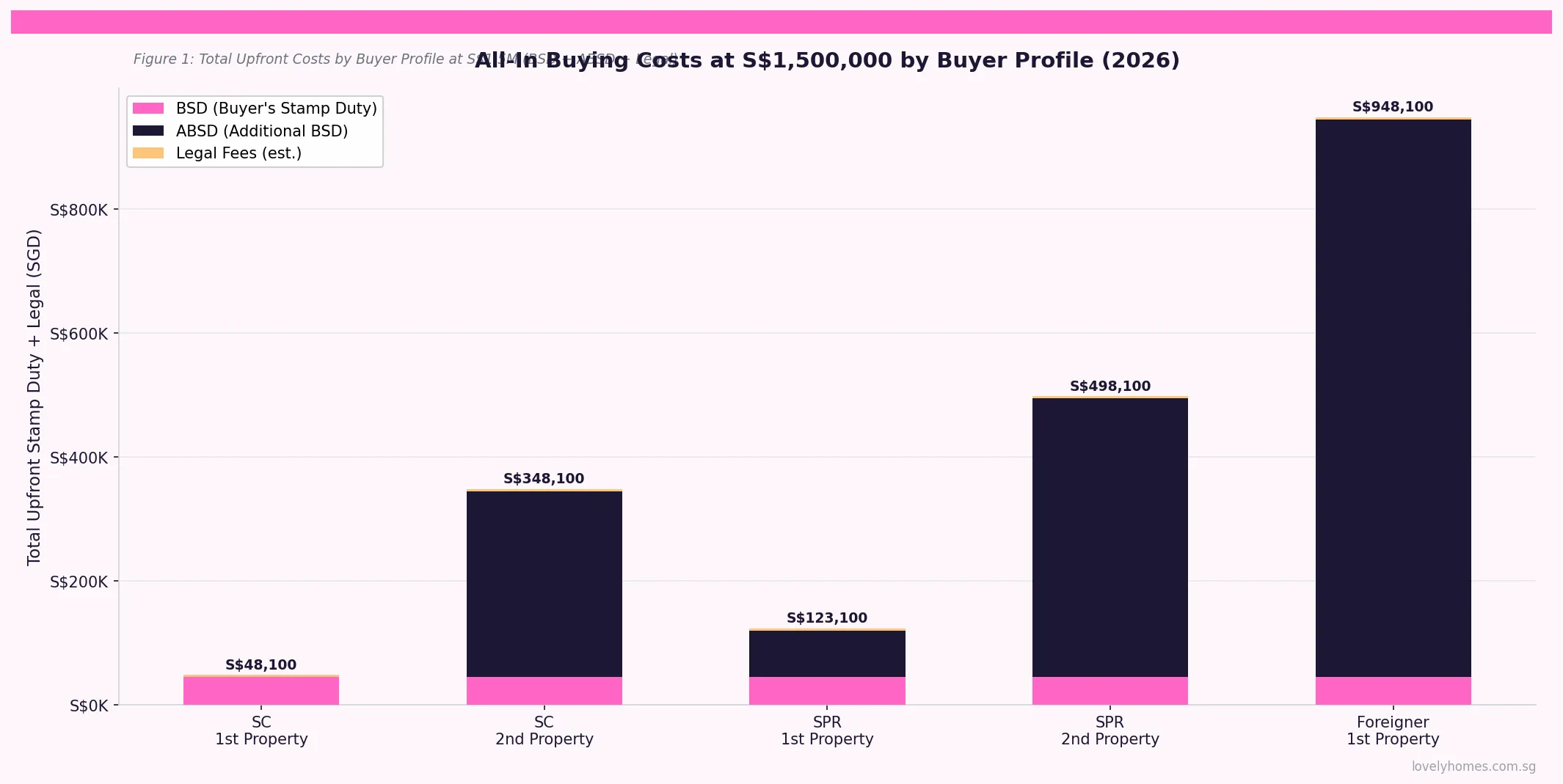
Singapore private property all-in buying costs by buyer profile at S$1.5M 2026
Figure 1: Total upfront costs (BSD + ABSD + legal fees) at S$1,500,000 for five buyer profiles. The SC first-property buyer pays S$48,100; the foreigner pays S$948,100. Source: IRAS; LovelyHomes, 2026.

Buyer’s Stamp Duty (BSD): What Every Buyer Pays

BSD is a compulsory tax administered by IRAS on every property purchase in Singapore. It applies to all buyers regardless of nationality, residency status, or how many properties they own. It is computed on the higher of the purchase price or the property’s market value as assessed by IRAS.

BSD uses a progressive rate structure. The rates for residential property in 2026 are:

Portion of Value BSD Rate BSD on This Band
First S$180,000 1% S$1,800
Next S$180,000 (S$180K–S$360K) 2% S$3,600
Next S$640,000 (S$360K–S$1.0M) 3% S$19,200
Next S$500,000 (S$1.0M–S$1.5M) 4% S$20,000
Next S$1,500,000 (S$1.5M–S$3.0M) 5% S$75,000
Amount exceeding S$3,000,000 6% Varies

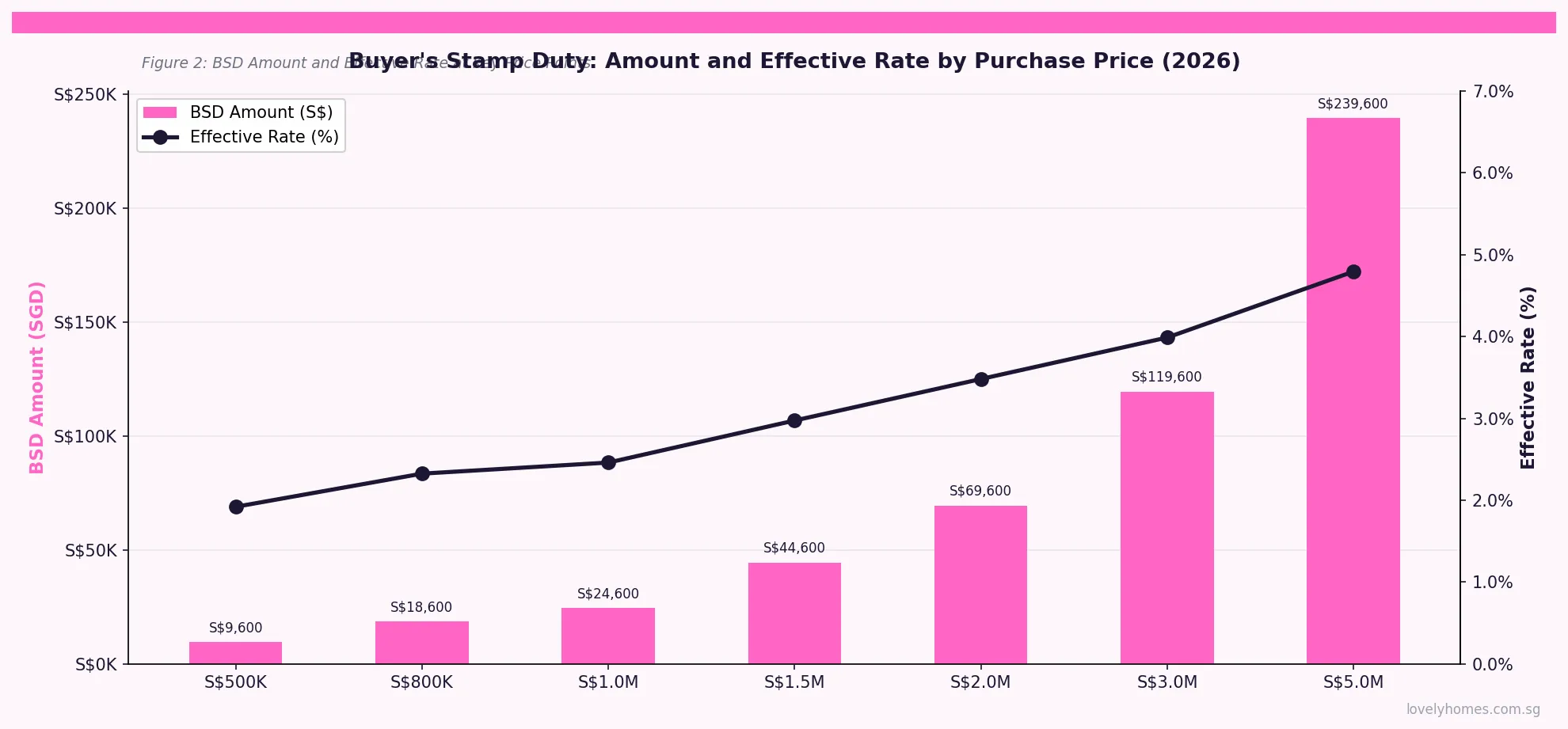
Using the above schedule, BSD on a S$1,500,000 purchase is S$44,600 (effective rate 2.97%); on a S$2,000,000 purchase it is S$69,600 (effective rate 3.48%); on a S$3,000,000 purchase it is S$119,600 (effective rate 3.99%). BSD is due to IRAS within 14 days of the Option to Purchase being exercised (or the date of the contract, whichever is earlier). Late payment attracts a penalty of 5% per annum on the unpaid amount.

BSD can be paid from CPF Ordinary Account (OA) funds, provided the property is residential and the CPF member is eligible. Most buyers use a combination of CPF OA and cash.

Buyer Stamp Duty amount and effective rate by purchase price Singapore 2026
Figure 2: BSD dollar amount (bars) and effective rate (line) at seven price points from S$500,000 to S$5,000,000. The 6% top rate kicks in above S$3,000,000. Source: IRAS; LovelyHomes, 2026.

Additional Buyer’s Stamp Duty (ABSD): The Nationality and Ownership Surcharge

ABSD is a flat-rate stamp duty levied on top of BSD, applied as a percentage of the full purchase price from the first dollar. Unlike BSD, ABSD is not progressive — the stated rate applies to the entire price. ABSD rates are determined by the buyer’s citizenship status and the number of residential properties they own at the time of purchase. The 2026 ABSD schedule, unchanged since the April 2023 round of cooling measures, is:

Buyer Profile 1st Property 2nd Property 3rd+ Property
Singapore Citizen 0% 20% 30%
Singapore Permanent Resident 5% 30% 30%
Foreigner (including most work pass holders) 60% 60% 60%
Entity (company, trust, collective investment scheme) 65% 65% 65%
Developer (housing developer licence) 35% (remittable on completion conditions)

What counts as “owning” a property for ABSD purposes? IRAS counts every residential property in Singapore in which you hold a legal or beneficial interest — including properties held jointly or as a co-owner, properties held through a trust, and properties inherited (even if you did not pay for them). Overseas property does not count. If you are a SC buying your second property, you will pay 20% ABSD on the full purchase price — S$300,000 on a S$1.5M purchase.

ABSD must also be paid within 14 days of exercising the OTP (or signing the S&P). Unlike BSD, ABSD cannot be paid from CPF — it must be paid entirely in cash. This is a crucial planning consideration for second-property buyers who may be CPF-rich but cash-light.

One key relief: Singapore Citizen married couples who own one residential property jointly may apply for ABSD remission when they sell the first property within 6 months of buying a new one. This remission restores the SC couple to effectively 0% ABSD on the second purchase. The 6-month clock starts from the completion of the new purchase.

Seller’s Stamp Duty (SSD): A Reminder for Buyers Who May Resell Quickly

Buyers should also be aware of the Seller’s Stamp Duty (SSD), which applies if the property is resold within three years of acquisition. SSD is paid by the seller, but it affects the resale market because sellers typically factor it into their pricing:

  • Sold within 1 year: 12% SSD
  • Sold within 2 years: 8% SSD
  • Sold within 3 years: 4% SSD
  • Sold after 3 years: 0% SSD

For buyers who contemplate flipping a property within 3 years, the combined SSD exposure can make the transaction economically unattractive. Planning a minimum 3-year hold eliminates SSD entirely.

Professional and Transaction Fees

Beyond stamp duties, buyers incur a set of professional fees for the conveyancing and mortgage process:

Fee Item Typical Range Who Pays Notes
Legal fees (conveyancing — buyer’s solicitor) S$2,500–S$5,000 Buyer Higher for complex transactions; covers OTP, S&P, title search, SLA registration
Valuation fee S$500–S$2,000 Buyer Required by bank for mortgage; Singapore Institute of Surveyors and Valuers (SISV) accredited valuer
Mortgage processing fee S$0–S$500 Buyer Many banks waive this; check with your lender
Agent commission (resale purchase) 1%–2% + 9% GST Buyer Not mandatory; buyer’s agent commission is separately negotiated. New launches: 0% (developer pays co-broke)
Property tax (pro-rated at completion) Varies Shared at completion Seller reimburses buyer for unused portion of pre-paid property tax

Downpayment and Loan Structure

For private property financed by a bank loan, MAS mandates a minimum downpayment of 25% of the purchase price (or market value, whichever is lower). The breakdown is:

  • 5% must be paid in cash (the Option Exercise Fee of 1% + the balance of 4% at exercise, or 5% at S&P signing for new launches)
  • The remaining 20% can be paid from CPF Ordinary Account, cash, or a combination
  • 75% maximum LTV (Loan-to-Value) — i.e., the bank loan covers up to 75% of the lower of price or value

For a second property, the LTV ceiling drops to 45%, meaning a downpayment of 55% — with a minimum of 25% in cash. For a third or subsequent property, the LTV is 35%, with a minimum 25% cash downpayment. MAS’s TDSR (Total Debt Servicing Ratio) framework caps total monthly debt obligations (including the new mortgage) at 55% of gross monthly income.

Full private property cost breakdown 5 buyer profiles S$2M Singapore 2026
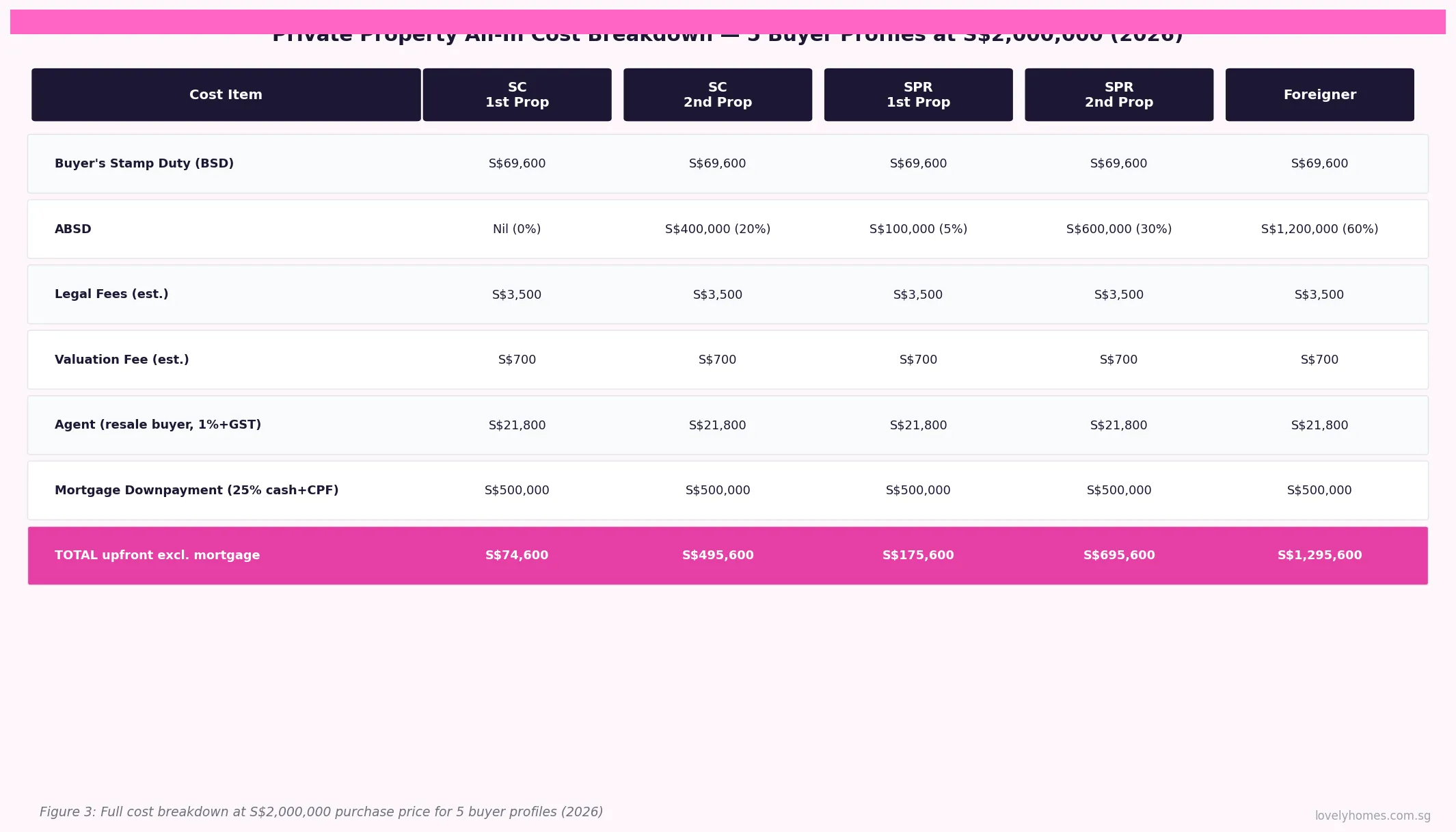
Figure 3: Complete upfront cost breakdown for five buyer profiles at S$2,000,000 (BSD + ABSD + legal + valuation + agent 1%). SC first-property buyers face S$74,600 beyond the downpayment; foreigners face S$1,295,600. Source: IRAS; LovelyHomes calculations, 2026.

Ongoing Ownership Costs After Completion

The upfront costs are only part of the picture. Once you own the property, several recurring costs apply:

Ongoing Cost Typical Annual Amount Administered By
Property Tax S$0–S$20,000+ (depends on AV and usage) IRAS
MCST Maintenance Fees (condo) S$3,000–S$30,000 (S$250–S$2,500/mth) MCST (management corporation)
Sinking Fund Contributions Included in MCST fees (10% of maintenance) MCST
Fire Insurance (mandatory for mortgaged property) S$100–S$400 Insurer (MAS-regulated)
Home Contents Insurance S$200–S$800 Optional; insurer
Utilities (electricity, water, gas) S$2,400–S$7,200 (S$200–S$600/mth) SP Group, PUB
Mortgage Servicing Based on loan amount, tenure, rate Bank (MAS-regulated)

Property tax is computed by IRAS on the property’s Annual Value (AV) — a notional figure representing the estimated annual rent the property would fetch unfurnished. Owner-occupied residential properties enjoy concessionary progressive rates starting at 0% on the first S$8,000 of AV. Investment or rented-out properties face higher non-owner-occupier rates. From 2025, IRAS adopted new AV ranges following a property market review.

Worked Example: The Rajan Family’s Private Property Purchase

Scenario: SC Joint Purchase, Second Property at S$2,100,000

Mr Rajan (Singapore Citizen) and Mrs Rajan (Singapore Citizen) currently own a Bishan HDB flat which they plan to sell within 6 months. They are buying a 3-bedroom resale condominium in District 15 (Marine Parade / East Coast) at S$2,100,000. Because they still own the HDB, ABSD at the SC second-property rate of 20% applies upfront; they will apply for ABSD remission after selling the HDB.

Cost Item Amount Notes
Purchase Price S$2,100,000 Market value confirmed S$2,100,000
BSD S$74,600 1%/2%/3%/4%/5% progressive; S$44,600 (on S$1.5M) + S$30,000 (5% × S$600K above S$1.5M)
ABSD (20% — SC 2nd property) S$420,000 Paid upfront in cash; ABSD remission applied after HDB sold within 6 months
ABSD Remission (refund after HDB sale) -S$420,000 Applied to IRAS within 6 months of completing new purchase; HDB must be sold first
Legal Fees (buyer) S$3,500 Conveyancing, SLA registration, title search
Valuation Fee S$800 Bank-appointed SISV valuer
Agent Commission (1% + 9% GST) S$22,890 Buyer’s agent for resale purchase
Downpayment (25% of S$2.1M) S$525,000 5% cash S$105,000 + 20% CPF/cash S$420,000
Bank Loan (75% LTV) S$1,575,000 @3.0% p.a., 30-year tenure, monthly S$6,639
TDSR Check S$6,639 / S$12,000 = 55.3% At the TDSR 55% ceiling — couple must clear any other debt obligations before completing
Net upfront cash outlay (before ABSD refund) S$626,790 BSD + ABSD + legal + val + agent + 5% cash DP
Net upfront after ABSD remission S$206,790 After S$420,000 ABSD refund once HDB sold within 6 months

Key risk: Mr and Mrs Rajan must sell the HDB within 6 months of completing the D15 purchase to qualify for ABSD remission. If they miss the window, the S$420,000 ABSD is forfeited. The transaction should be sequenced carefully with both their agent and solicitor to ensure the disposal timeline is locked in before exercising the OTP on the new purchase.

What This Means for Private Property Buyers in 2026

Singapore’s private property buying cost structure is deliberately designed to differentiate between residents buying their home and investors — domestic or foreign — seeking to accumulate property. The ABSD regime effectively creates three distinct cost environments: near-zero cost for SC first-timers; a moderate but significant surcharge for SC second-timers and SPR first-timers; and a prohibitively high 60% surcharge for foreigners.

In a peer-country comparison, Singapore’s residential property stamp duty regime is among the steepest globally for non-resident investors. Hong Kong’s stamp duty for non-permanent residents stands at 15%; Canada’s foreign buyers’ tax varies by province. Singapore’s 60% ABSD, introduced in April 2023, is explicitly designed to insulate the domestic housing market from speculative capital inflows.

For Singaporeans buying their first private property, the cost structure is relatively benign: BSD of 2.97%–3.99% at S$1.5M–S$3M is comparable to transaction costs in other major cities. The MCST fees, property tax, and financing costs are the recurring burden that deserves more careful modelling — a S$4,000/month mortgage, S$800/month MCST, and S$400/month property tax creates an all-in occupancy cost of S$5,200/month before utilities, which must be assessed against the TDSR of the purchasing household.

What Might Come Next

The following is editorial speculation and should not be relied upon for financial decisions.

The current ABSD regime, introduced in April 2023, has been in force for over three years. In that period, private residential transaction volumes involving foreigners have fallen dramatically. Some industry observers have speculated that the government may consider a modest easing of the foreigner rate if volumes remain suppressed to a degree that affects market liquidity in the luxury segment. However, the government has given no signal of any impending change, and Singapore’s housing policy framework has historically prioritised stability over volume. Any adjustment to ABSD would be announced by MND (Ministry of National Development) and MOF (Ministry of Finance) jointly and implemented immediately at announcement — there is no advance notice period.

Frequently Asked Questions

Can I pay ABSD using CPF Ordinary Account funds?

No. ABSD must be paid entirely in cash. Unlike BSD, which can be paid from your CPF OA for a residential property purchase, ABSD is not an allowable CPF withdrawal purpose. This makes ABSD a significant liquidity consideration for buyers who are CPF-rich but cash-light — for example, a Singapore Citizen buying a second property at S$1.5M would need S$300,000 in cash for ABSD alone, on top of the 5% cash downpayment of S$75,000, totalling S$375,000 in cash before legal fees.

What is the 14-day stamp duty deadline and what happens if I miss it?

BSD and ABSD must be paid to IRAS within 14 calendar days of the date you exercise the Option to Purchase (OTP) or sign the Sale and Purchase Agreement (S&P), whichever is earlier. For new launches, it is typically 14 days from the date of the S&P. If you miss this deadline, IRAS charges a penalty of 5% per annum on the unpaid stamp duty, accruing daily. For large ABSD amounts, even a few days’ delay can cost thousands of dollars in penalties. Your solicitor should be engaged well before the OTP exercise date to ensure the stamping is completed in time.

I am a foreigner but my spouse is a Singapore Citizen. Do we still pay 60% ABSD?

Yes and no. If you and your Singapore Citizen spouse are purchasing the property jointly, ABSD is charged at the rate applicable to the buyer with the highest ABSD liability — which in this case would be 60% for the foreigner. However, since 16 February 2023, there is no longer an ABSD remission for married couples with mixed citizenship (one SC and one foreigner) purchasing their first jointly-owned residential property. The full 60% ABSD applies. One common planning approach is for the SC spouse to purchase the property solely in their own name, in which case no ABSD applies (for their first property). This creates financing and ownership planning considerations that should be discussed with a solicitor.

Is valuation mandatory for all private property purchases?

Valuation is not required by law for every purchase, but it is effectively mandatory whenever you take a bank loan — the bank will appoint its own panel valuer to determine the market value before approving the LTV ratio. If the bank valuation comes in below the purchase price, the LTV is calculated on the lower valuation figure, meaning you must make up the difference in cash. For cash purchases, valuation is optional but advisable for ABSD calculation purposes (ABSD is charged on the higher of price or market value). IRAS can independently assess market value and charge ABSD accordingly.

Can I avoid paying agent commission as a buyer?

For new launch condominiums, developers typically pay the buyer’s agent commission through their co-broke arrangement; buyers pay no direct commission. For resale private properties, a buyer’s agent commission is customary (typically 1% + 9% GST) but not legally mandated. You may choose to transact without a buyer’s agent and negotiate directly with the seller’s agent; however, the seller’s agent represents the seller’s interests, not yours. CEA (Council for Estate Agencies) guidelines distinguish clearly between representing one or both parties. Using a buyer’s agent generally costs 1% but provides representation, market data, and negotiation support.

What ongoing property tax will I pay on a S$2M condominium?

Property tax is based on the Annual Value (AV) — IRAS’s estimate of the annual market rent the property could command, unfurnished. For a S$2M condominium, the AV might be approximately S$48,000–S$60,000 per annum depending on location and unit size. For owner-occupiers, the 2026 progressive rate yields approximately S$2,400–S$4,000/year at those AV levels. For non-owner-occupiers (renting out the unit), the non-OO rates apply and the annual property tax can be S$8,000–S$14,000 on the same AV. Check the IRAS property tax calculator at iras.gov.sg for an accurate estimate for your specific property.

For a new launch, when exactly do I pay BSD and ABSD?

For a new private residential launch, you typically pay a 5% booking fee to the developer upon selecting your unit (this secures the unit). BSD and ABSD are due within 14 days of signing the Sale and Purchase Agreement (S&P), which is typically issued 8 to 12 weeks after the booking date. This means you have roughly 2–3 months from booking to arrange the stamp duty cash — but do not leave it late. Your solicitor will handle the stamping electronically via IRAS e-Stamping and will liaise directly with IRAS on the calculation.

Disclaimer: This article is for general informational purposes only and does not constitute financial, legal, or taxation advice. Stamp duty rates, ABSD schedules, and MAS lending limits are subject to change by the Singapore government without notice and are typically effective immediately upon announcement. Readers should verify current rates directly with IRAS, mortgage eligibility with your bank and MAS, and CPF withdrawal rules with CPF Board. Worked examples use estimated figures for illustration; actual costs will vary by transaction. Consult a licensed property professional (CEA-registered) and a qualified financial adviser before making any property investment decision.

×

Click anywhere to close

Singapore Private Property Resale Process 2026: Step-by-Step Guide from OTP to Keys

Singapore Private Property Resale Process 2026: Step-by-Step Guide from OTP to Keys

Quick Answer: Buying a Private Resale Property in Singapore 2026

  • The full resale process — from engaging a solicitor to receiving keys — typically takes 10–14 weeks.
  • You pay an Option Fee (1% of price) to secure the OTP, then exercise it within 14 days by paying the balance 4%.
  • Buyer’s Stamp Duty (BSD) must be paid within 14 days of exercising the OTP; ABSD is also due at exercise.
  • CPF Ordinary Account can be used for private property purchases subject to the Valuation Limit and Withdrawal Limit.
  • Foreigners and PRs face Additional Buyer’s Stamp Duty (ABSD) of 60% and 5–30% respectively.
  • A licensed solicitor is legally required for conveyancing — buyers and sellers cannot use the same law firm.
  • The Total Debt Servicing Ratio (TDSR) cap of 55% applies to all private property mortgage loans.

What Is the Private Property Resale Process in Singapore?

Purchasing a resale private property — whether a condominium, apartment, or landed house — in Singapore follows a structured legal and financial process regulated by the Urban Redevelopment Authority (URA), the Singapore Land Authority (SLA), and the Inland Revenue Authority of Singapore (IRAS). Unlike buying a new launch (where you deal with a developer over a preview and balloting exercise), a resale transaction involves a private seller, a binding Option to Purchase (OTP), and a conveyancing timeline governed by the Law Society Conditions of Sale.

The process is considerably more compressed than buying a new launch — you can move in within 12 weeks of the OTP being granted, compared to the 3–5 year construction wait for a new launch. This immediacy comes with its own demands: due diligence, financing pre-approval, and legal fees must all be lined up before the OTP is granted.

This guide walks through every step from identifying a property to receiving keys, and explains the stamp duties, CPF rules, and financing mechanics that determine how much cash you need to have ready.

The 10-Step Private Resale Process: A Timeline Overview

Figure 1 below shows the typical timeline across the ten stages of a private resale transaction. The entire process from engaging a solicitor to key collection typically spans 10 to 14 weeks (8 to 12 weeks for the legal completion period), though parties can agree to a shorter or longer completion period of up to 12 weeks by mutual consent.

Singapore private property resale process 10-step timeline buyer guide 2026
Figure 1: Typical timeline for a private resale property transaction in Singapore — 10 steps, 10–14 weeks. Source: LovelyHomes editorial.

Step 1: Engage a Solicitor (Before You Even Make an Offer)

The first step — one many buyers skip at their peril — is engaging a conveyancing solicitor before making any offer on a property. You need your solicitor in place because: (a) the OTP’s 14-day exercise window moves fast; (b) your solicitor must review the OTP wording and raise any queries before you exercise; and (c) you need legal confirmation of the CPF rules, title status, encumbrances, and outstanding maintenance fees before committing.

Buyer and seller cannot use the same law firm. Typical buyer legal fees for a S$1.5M condo range from S$3,500 to S$5,000 (inclusive of disbursements such as SLA caveat registration, title search, and stamp duty filing). Fees are broadly governed by the Law Society’s conveyancing fee guidelines but are now freely negotiable.

Your solicitor will conduct a title search via SLA to confirm the seller has clear, unencumbered title; check for any outstanding mortgage that must be discharged on completion; verify there is no Subsidiary Strata Land Act (SSLA) restriction or approved change of use that affects the property; and review the Management Corporation Strata Title (MCST) accounts for outstanding arrears and sinking fund adequacy. For a deeper primer on MCST issues, see our Singapore Condo MCST Guide 2026.

Step 2: Search and View Properties — Due Diligence Before the OTP

Before agreeing to any price, buyers should undertake thorough due diligence on the unit and the development. Key checks include: verifying the actual floor area against the strata title plan; confirming the remaining lease term (for leasehold developments); reviewing the MCST annual report for sinking fund balance and any pending special levies; checking for outstanding renovations bans or works on the common property; and reviewing recent comparable transactions in the development (available via URA REALIS or on the URA website’s Resale Transactions tool).

Buyers should also verify their eligibility. Singapore Citizens may purchase all private property types. Permanent Residents may purchase apartments, condominiums, and commercial property freely but require approval from the Land Dealings (Approval) Unit to purchase landed residential property. Foreigners may only purchase landed property in designated areas (Sentosa Cove) or with SLA approval, and face 60% ABSD on any residential purchase.

Step 3: Grant and Exercise of the Option to Purchase (OTP)

Once you have agreed on a price, the seller grants you an Option to Purchase in exchange for the Option Fee — typically 1% of the agreed purchase price paid in cash. The OTP gives you an exclusive right to purchase the property at the agreed price, typically for a 14-day option period (this period is agreed between parties and can be shorter or longer).

During the option period, your solicitor reviews the OTP. If you are satisfied, you exercise the OTP by signing it and paying the exercise fee — typically the balance 4% of the purchase price in cash or a combination of cash and CPF. On exercise, the OTP becomes a binding contract. The completion date is set for 8–12 weeks from the exercise date.

If you do not exercise the OTP within the period, the Option Fee is forfeited to the seller. There is no other penalty — the purchase simply does not proceed. This is why due diligence and financing must be in order before granting an OTP.

Step 4: Stamp Duties — BSD and ABSD (Due Within 14 Days)

Buyer’s Stamp Duty (BSD) is payable on all property purchases. It is calculated on a graduated scale on the purchase price or market value, whichever is higher. On a S$1.5M purchase, BSD is S$44,600 (effective rate approximately 2.97%). BSD must be paid via IRAS e-Stamping within 14 days of the date of the OTP exercise.

Additional Buyer’s Stamp Duty (ABSD) applies to SC buyers purchasing a second or subsequent residential property, and to all PR and foreigner buyers. ABSD rates in 2026 are: SC 2nd property 20%, SC 3rd+ 30%, SPR 1st property 5%, SPR 2nd+ 30%, foreigners 60%. For a full ABSD breakdown, see our ABSD Singapore 2026 Complete Guide. ABSD is also due within 14 days of exercise.

Both BSD and ABSD can be paid from CPF Ordinary Account (for residential property). However, ABSD amounts for second properties are substantial — for example, a SC buying a S$1.5M second property pays S$300,000 in ABSD alone, which would exhaust most CPF balances. The ABSD remission scheme allows SC couples who are upgraders to claim a refund of the ABSD if they sell their existing residential property within 6 months of purchasing the new one. See our Stamp Duty Remission Guide for details.

Upfront Stamp Duty and Legal Costs by Buyer Profile (S$1.5M)

Figure 2 illustrates the total upfront stamp duties and legal costs at a S$1.5M purchase price across five buyer profiles. The disparity between a SC first-time buyer (S$49,100) and a foreigner (S$944,600) underlines why Singapore’s ABSD is one of the world’s most aggressive foreign-buyer deterrents.

Upfront stamp duty and costs private property resale Singapore S$1.5M by buyer profile 2026
Figure 2: Total upfront stamp duties and legal costs at S$1.5M for five buyer profiles (Q2 2026 ABSD rates). Source: IRAS, LovelyHomes editorial.

Step 5: Arranging the Mortgage

Private property purchases must comply with the Monetary Authority of Singapore’s Total Debt Servicing Ratio (TDSR) framework. Under the TDSR, monthly debt obligations — including the new mortgage plus any existing credit facilities — cannot exceed 55% of gross monthly income. Unlike HDB loans (which have a 30% Mortgage Servicing Ratio cap), private property loans use TDSR only.

The Loan-to-Value (LTV) ratio for a first private property mortgage is up to 75%, requiring a minimum 25% downpayment (of which 5% must be in cash). For a buyer with an existing outstanding mortgage, the LTV drops to 45% (first subsequent loan). See the prior reference in our Property Downpayment Guide 2026.

Banks will commission an independent valuation of the property. If the valuation comes in below the agreed price, the bank will lend only against the valuation — meaning the buyer must fund the shortfall in cash. For example, if you agreed to pay S$1,550,000 but the valuation is S$1,500,000, the bank’s 75% LTV is based on S$1,500,000, so the buyer must fund the additional S$50,000 from cash.

For CPF usage: CPF Ordinary Account can be used for the downpayment and monthly instalments for private property up to the property’s Valuation Limit (the lower of purchase price or valuation). Beyond the Valuation Limit, the Withdrawal Limit (120% of the property value for properties with sufficient lease) applies. See our CPF for Private Property Guide 2026 for the full mechanics.

Step 6: Lodge a Caveat with the Singapore Land Authority (SLA)

Once the OTP is exercised, your solicitor should promptly lodge a Caveat with the SLA. A caveat protects your interest in the property by registering your claim against the title. It prevents the seller from selling to a third party or granting another mortgage on the same property. The caveat fee is approximately S$150–S$200. Caveats are registered via the SLA’s e-Conveyancing system.

Step 7: Completion of the Sale and Purchase

Completion is the legal transfer of title from seller to buyer. On the completion date (typically 8–12 weeks from OTP exercise), all parties’ solicitors meet (or exchange completion documents electronically via e-Conveyancing). The buyer’s solicitor pays the balance purchase price from the mortgage loan drawdown and any remaining CPF/cash. The seller’s solicitor receives the funds and transfers title.

At completion, the seller’s outstanding mortgage is discharged from the sale proceeds. The SLA registers the transfer of title and the buyer’s new mortgage. The buyer’s solicitor registers the mortgage instrument. Typically, keys are handed over on the completion date or shortly thereafter.

Singapore Resale Condo Price Ranges by Region and Unit Type (Q1 2026)

Figure 3 illustrates indicative resale condo price ranges by unit size and region. The Core Central Region (CCR — Districts 9, 10, 11, and the Downtown Core) commands the highest prices, particularly for larger units. The Outside Central Region (OCR) offers the widest value range for buyers seeking more affordable entry points.

Singapore resale condo price ranges by unit type and region OCR RCR CCR Q1 2026
Figure 3: Indicative resale condo price ranges by unit type and region, Q1 2026. Error bars show typical market range. Source: URA Resale Transactions data, LovelyHomes editorial.

Private Resale Process at a Glance: Key Facts Table

Stage Who Acts Key Deadline Typical Cost
Engage solicitor Buyer Before OTP S$3,500–S$5,000
Grant OTP / Option Fee (1%) Seller grants, Buyer pays At agreement 1% of price (cash)
Exercise OTP (4%) Buyer Within 14 days 4% of price (cash/CPF)
BSD + ABSD payment Buyer via solicitor 14 days from exercise Varies (BSD + any ABSD)
Lodge caveat (SLA) Buyer’s solicitor Promptly after exercise ~S$150–S$200
Mortgage drawdown Buyer / Bank Before completion Bank valuation fee S$300–S$700
Completion / Key collection Both solicitors 8–12 weeks from exercise Balance purchase price

Worked Example: The Kumar Family Buying a Resale 3-Bedroom in the RCR

Scenario: SC Couple, First Private Property, Selling Their HDB

Mr Kumar (38, SC) earns S$9,500/month; Mrs Kumar (36, SC) earns S$8,800/month. Joint income: S$18,300/month. They currently own an HDB flat (5-room, Tampines) with no outstanding mortgage. They wish to upgrade to a private resale 3-bedroom condo in the RCR.

  • Target unit: 3-bedroom resale condo, RCR (District 3), 1,000 sqft, freehold.
  • Agreed price: S$2,100,000
  • Bank valuation: S$2,050,000 (shortfall S$50,000 — must fund in cash)
  • BSD: S$74,600 (progressive on S$2,100,000: 1% × S$180K + 2% × S$180K + 3% × S$640K + 4% × S$500K + 5% × S$600K = S$74,600)
  • ABSD: 20% × S$2,100,000 = S$420,000 (SC 2nd property — HDB still owned at time of purchase)
  • ABSD remission plan: The Kumars plan to sell their HDB flat within 6 months of completion. If sold within 6 months, ABSD S$420,000 is refunded by IRAS. They pay ABSD upfront and claim the remission later.
  • Loan (75% LTV on valuation S$2,050,000): S$1,537,500 at 3.1% p.a., 30 years → S$6,567/month
  • TDSR check: S$6,567 ÷ S$18,300 = 35.9% (below 55% cap — PASS)
  • Downpayment (25% of S$2,050,000): S$512,500 (5% cash = S$102,500 + 20% CPF = S$410,000)
  • Price shortfall (purchase price above valuation): S$50,000 (cash)
  • Total cash at exercise and completion: Option fee S$21,000 (1%) + exercise S$84,000 (4%) + BSD S$74,600 + ABSD S$420,000 + valuation shortfall S$50,000 + legal S$5,200 + CPF mortgage arrangement S$0 = S$654,800 gross cash outlay (S$234,800 net after ABSD remission assuming HDB sold within 6 months)

Key takeaway: The Kumars’ biggest cash item is the upfront ABSD of S$420,000 — which they recover after selling the HDB. The net out-of-pocket (excluding ABSD) is approximately S$234,800. Planning the HDB sale timeline to remain within the 6-month remission window is critical.

Why the Private Resale Market Has Structural Depth

Unlike new launches, where pricing is controlled by the developer and buyers often face limited negotiation leverage, the resale market allows genuine price discovery between informed parties. This creates opportunities for buyers who do thorough research — understanding block-level transaction data, comparable lease terms, and development-specific factors like upcoming en-bloc potential, MCST financial health, and facilities.

The resale market also offers a distinct advantage: immediate occupation. For families with school enrolment timelines, existing rental commitments, or home sale proceeds that need to be redeployed promptly, the 10–14 week completion window is a significant operational benefit over a 3–5 year new-launch wait.

Resale buyers are also protected by a more mature legal framework. The Law Society Conditions of Sale provide standardised terms. The conveyancing system is transparent, title searches are reliable, and disputes are resolvable via the High Court or the Small Claims Tribunal (for deposits and agent disputes).

What Might Come Next for Singapore’s Private Resale Market?

This section reflects editorial analysis and forward-looking opinion, not a guarantee of future market performance.

The private resale market in 2026 is characterised by moderate volumes and selective price growth. OCR resale condos have held up well due to strong HDB upgrader demand — particularly from families exiting their MOP-completed BTO flats and entering the private market for the first time. CCR volumes remain relatively subdued as the 60% ABSD on foreign buyers has largely eliminated the speculative froth that characterised 2010–2013.

Looking ahead, the GLS tender pipeline — including sites at River Valley Green Parcel C (tendered June 2026), Town Hall Link white site (July 2026), and several OCR sites — will deliver new supply from 2028 onwards. This supply pipeline, while healthy, is not expected to flood the market given construction cost inflation and developer pricing discipline. The 2H2026 GLS Confirmed List of nine sites yielding approximately 4,745 residential units is broadly consistent with household formation rates and replacement demand.

For resale buyers, the near-term window before new-launch supply hits the market in volume (2027–2028) may represent a relative opportunity for well-priced resale units in established OCR and RCR estates.

Frequently Asked Questions: Buying Private Resale Property in Singapore

Can buyer and seller use the same solicitor?

No. Buyer and seller in a private property transaction must each engage their own separate law firm. This is a professional conduct requirement under the Legal Profession (Professional Conduct) Rules. Having the same solicitor act for both parties creates a conflict of interest — the solicitor cannot independently advise each party on a transaction where interests may diverge. In practice, buyers sometimes attempt to share a solicitor to save costs; this is not permitted for private property transactions (though an exception exists for certain straightforward HDB transactions under specific conditions).

What happens if my bank valuation comes in below the agreed price?

If the bank’s independent valuation of the property is lower than the agreed purchase price, the bank will only lend based on the lower valuation. The buyer must fund the difference (the shortfall between valuation and price) entirely in cash. CPF cannot be used for amounts above the valuation, and the ABSD is still calculated on the actual purchase price (the higher amount). For example, if you paid S$1,600,000 for a unit valued at S$1,550,000, you fund the S$50,000 shortfall in cash; BSD and ABSD are calculated on S$1,600,000. Buyers can seek a second valuation from a different valuer if they believe the first is too conservative, but banks are not obliged to accept it.

What is a Diplomatic Clause and should I request one?

A Diplomatic Clause is a lease termination right inserted into a tenancy agreement (not a purchase OTP). It allows a tenant to terminate an ongoing tenancy early if they are required to relocate due to work reasons (typically due to a transfer or job loss). It typically kicks in after a minimum period (commonly 12–14 months) with 2 months’ notice. It is relevant for buyers who intend to rent out the unit before moving in or while relocating — they would negotiate a Diplomatic Clause into the tenancy they offer to their tenant, not into the OTP for the purchase. It is standard practice for developments popular with expatriate tenants in CCR and RCR.

Does ABSD apply if I buy a private property with my spouse for the first time?

If both you and your spouse are Singapore Citizens purchasing your first residential property together, no ABSD applies. SC buyers (individually or jointly) are exempt from ABSD on their first residential property. If one spouse already owns property (including overseas property counts for ABSD purposes), ABSD will apply based on the higher-count buyer’s profile. For example, if you own an HDB flat (first property) and your spouse does not, joint purchase of a private condo is treated as a second property for ABSD purposes — the 20% SC 2nd-property ABSD applies on the entire purchase price. Decoupling strategies (where one party transfers their share to the other) may be considered to reset the count; see our Joint Property Ownership Guide for the decoupling mechanics and costs.

What are the key differences between buying a new launch condo and a resale condo?

There are several material differences. New launches are purchased from a developer during a preview/balloting period using the standard Sale and Purchase Agreement (SPA) under the Housing Developers (Control and Licensing) Act, with a progressive payment schedule as construction milestones are met. Resale purchases use an OTP and a Law Society SPA, with full payment at completion. New launches typically offer developer discounts and stamp duty absorption deals near launch, but buyers wait 3–5 years for completion. Resale condos allow immediate occupation and give you a complete picture of the actual unit, renovation condition, view, and development quality before committing. Resale buyers can also inspect the MCST accounts in detail before purchase, something impossible for a new launch. Price transparency also favours resale — URA publishes every resale transaction, whereas new-launch prices require asking agents or checking URA REALIS.

Can I negotiate below the seller’s asking price?

Yes — negotiation is standard in the private resale market. Reference points for your offer include: recent comparable transactions in the same development (from URA Resale Transactions data), the property’s age and condition, any pending special levies or MCST deficits, how long the unit has been listed, and the seller’s motivation (e.g., upgrading, emigrating, financial pressure). In a buyers’ market (higher inventory, slower volume), 3–8% below asking is not unusual for motivated sellers. In a tight market (low inventory, fast absorption), properties can transact at or above asking. Always let the bank’s independent valuation inform your offer ceiling — paying significantly above valuation means funding the excess in cash without CPF or loan coverage.

Do I need a property agent to buy a resale condo?

No — there is no legal requirement to engage a buyer’s agent for a private resale transaction. However, a buyer’s agent provides value through: identifying suitable listings and arranging viewings; interpreting transaction data to assess fair market value; negotiating the OTP price and conditions; and coordinating between the solicitors and seller’s agent. Buyer’s commission for private resale is typically not charged to buyers directly — it is paid by the seller via a co-broking arrangement with the seller’s agent. Effectively, you get buyer’s representation at no direct cost in most resale transactions. For those who proceed without an agent, ensure your solicitor reviews the OTP carefully before exercise, and do your own comparable transaction research via URA REALIS.

Related Articles


Disclaimer: The information in this article is for general educational purposes only and does not constitute financial, investment, or legal advice. Stamp duty rates, CPF rules, LTV limits, and property market conditions are subject to change by the relevant Singapore government bodies. Verify current rates and rules with IRAS (iras.gov.sg), HDB (hdb.gov.sg), CPF Board (cpf.gov.sg), URA (ura.gov.sg), and the Monetary Authority of Singapore (mas.gov.sg). All property transactions should be conducted through a licensed solicitor for conveyancing. Engage a Council for Estate Agencies (CEA)-licensed property agent if you require professional property advisory services.

Peck Hay Road GLS Awarded to CDL-Hong Leong JV at S$1,865 PSF PPR: What Buyers Need to Know

Peck Hay Road GLS Awarded to CDL-Hong Leong JV at S$1,865 PSF PPR: What Buyers Need to Know

📌 Quick Answer: Peck Hay Road GLS Award (June 2026)

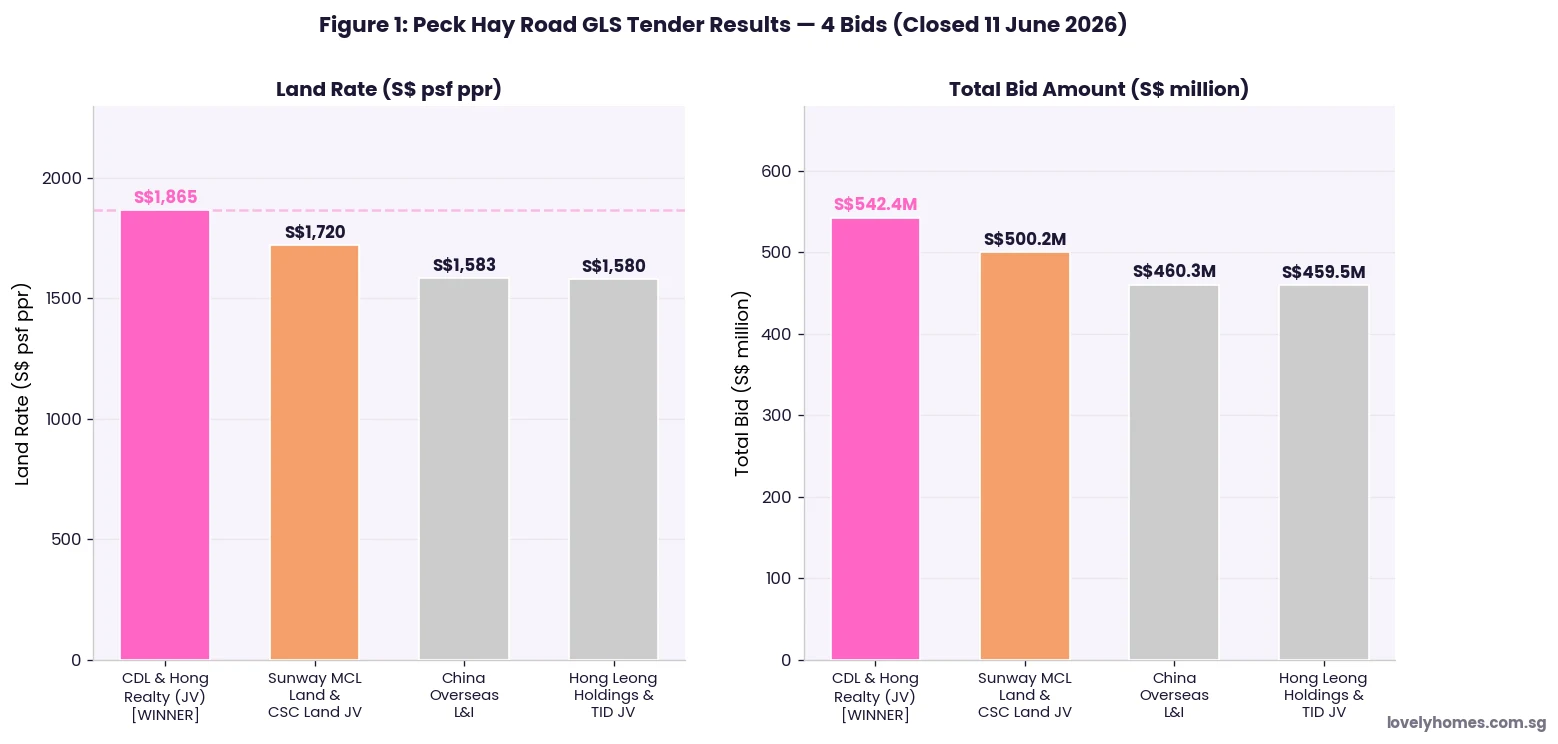
  • Winner: City Developments Limited (CDL) and Hong Realty (a Hong Leong Group subsidiary) joint venture, with a top bid of S$542.4 million or S$1,865 per square foot per plot ratio (psf ppr).
  • Four bids were received when the tender closed on 11 June 2026, with the CDL-Hong Leong JV coming in 8.4% above the second-highest bidder (Sunway MCL Land & CSC Land Group at S$1,720 psf ppr).
  • Development potential: The 0.55-hectare site in the Newton area (District 11, CCR) has a gross plot ratio of 4.9 and is expected to yield approximately 315 private residential units.
  • Projected launch price: Industry observers estimate an average selling price of approximately S$3,600–S$4,000 psf, based on the winning land rate and current CCR construction costs.
  • Market signal: The confident bidding — four bids, strong premium over second — reflects continued developer conviction in prime Singapore residential despite global headwinds.

Singapore’s Newton District Gets a New Landmark: Peck Hay Road GLS Awarded

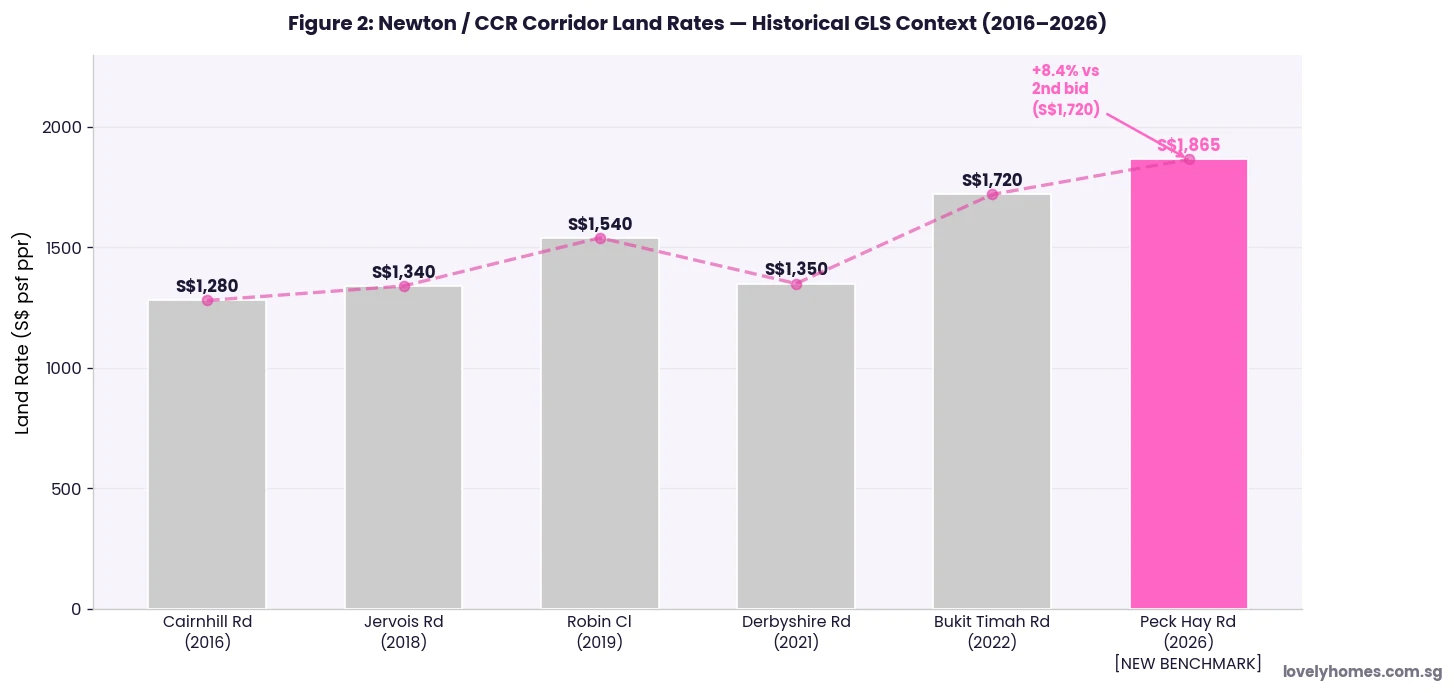
The Government Land Sale (GLS) site at Peck Hay Road, Newton, has been awarded to a joint venture between City Developments Limited (CDL) and Hong Realty Private Limited, a subsidiary of the Hong Leong Group, following the close of the tender on 11 June 2026. The winning bid of S$542.4 million — equivalent to S$1,865 psf per plot ratio — sets a new benchmark for land rates in the Newton corridor and is the highest price paid for a residential GLS site in the District 11 area in recent memory.

The site sits within a short walk of Newton MRT Station (North-South Line and Downtown Line interchange) in the prime Core Central Region (CCR), minutes from the Orchard Road shopping belt. It is a rare land parcel in a district that has seen virtually no new GLS activity in recent years, making the award a significant event for luxury property buyers and investors who have been waiting for a premium new launch in Newton.

Peck Hay Road GLS tender results 2026 — all four bidders land rate and total bid CDL Hong Leong winner
Figure 1: Peck Hay Road GLS Tender Results — four bids received; CDL-Hong Leong JV won at S$1,865 psf ppr, 8.4% above the second bidder (S$1,720 psf ppr). Tender closed 11 June 2026.

The Bid Results: Four Credible Bids Signal Developer Confidence

The tender drew four bids from established developers — a healthy response by Singapore GLS standards in 2026, where some suburban sites have attracted only two or three bids. The bid results in full:

Bidder Total Bid Land Rate (psf ppr) Premium vs 2nd
CDL & Hong Realty JV 🏆 S$542.4M S$1,865 +8.4%
Sunway MCL Land & CSC Land Group JV S$500.2M S$1,720
China Overseas Land & Investment S$460.3M S$1,583
Hong Leong Holdings & TID JV S$459.5M S$1,580

Source: URA, tender results 11 June 2026. Land area: 5,578 sqm (0.55 ha). GFA: 27,330 sqm. Gross plot ratio: 4.9. Maximum 315 residential units.

The spread between the highest and lowest bids — roughly 18% — is relatively tight for a prime CCR site, suggesting broad alignment among developers on the land’s underlying value. The 8.4% premium that CDL-Hong Leong paid over the second bidder is, by itself, a meaningful commitment to capturing this particular site, likely driven by both parties’ existing pipeline management and brand positioning in the District 11 premium segment.

Notable: Hong Leong Group entities placed two separate bids — via the CDL-Hong Realty JV (winner) and via Hong Leong Holdings-TID JV (fourth place). This is not unusual for large property groups with multiple subsidiaries; different legal entities bid independently and the group as a whole gains optionality on the outcome.

Site Details and Development Parameters

The Peck Hay Road GLS site is located at the intersection of Peck Hay Road and Bukit Timah Road — a prestigious address within the Newton estate. Key development parameters set by URA in the tender conditions:

Parameter Specification
Land area 5,578 sqm (approximately 0.55 hectares)
Gross plot ratio 4.9
Maximum GFA (residential) 27,330 sqm
Permitted use Residential
Estimated unit count Approximately 315 units
Tenure 99-year leasehold
District District 11, Core Central Region (CCR)
Nearest MRT Newton (NS21/DT11) — approximately 300m

The 99-year leasehold tenure is standard for GLS sites in Singapore’s CCR. The site’s location within a short walk of Newton MRT — one of only two MRT interchanges south of the PIE in the CCR — gives it exceptional connectivity: Downtown Line trains reach Marina Bay in approximately 12 minutes, and North-South Line trains reach Orchard in two stops.

Newton CCR corridor GLS land rates historical context 2016-2026 — Peck Hay Road new benchmark psf ppr
Figure 2: Newton and CCR corridor GLS land rates in historical context — the Peck Hay Road award at S$1,865 psf ppr sets a new benchmark for the Newton/CCR precinct, exceeding the previous Bukit Timah Road benchmark of S$1,720 psf ppr (2022).

What Will the Future Development Be Called and How Much Will It Cost?

CDL and Hong Leong have not yet released a project name or official launch timeline. Based on the winning land rate of S$1,865 psf ppr, plus typical construction costs, professional fees, developer profit margin, and marketing costs in the current environment, industry observers estimate a break-even cost of approximately S$3,100–S$3,300 psf and an anticipated average launch price of S$3,600–S$4,000 psf — potentially pushing above S$4,000 psf for premium high-floor or penthouse units with city or Bukit Timah Hill views.

At S$3,800 psf, a typical 1,000 sqft 2-bedroom unit would be priced at approximately S$3,800,000. A 1,500 sqft 3-bedroom unit would approach S$5,700,000. This places the development squarely in CCR luxury territory, targeting high-net-worth buyers — predominantly Singapore Citizens and Permanent Residents given the 60% ABSD applicable to foreigners.

The typical timeline from GLS award to project launch in Singapore is 18–30 months, meaning the Peck Hay Road development could expect to preview in late 2027 or 2028. CDL has a strong track record in the CCR, having previously developed Gramercy Park (84 units, Grange Road) and New Futura (124 units, Leonie Hill), both considered exemplars of luxury Singapore residential design.

What This Means for the Newton Property Market

The award has several implications for Newton and broader CCR buyers and sellers:

Benchmark land rate effect: At S$1,865 psf ppr, this site establishes a new data point that developers, valuers, and banks will reference in assessing residual land values and resale property prices in the Newton, Novena, and Moulmein precincts. Owners of existing CCR condos in the area may find that their properties are valued slightly higher in subsequent bank valuations, reflecting the premium paid for new land.

Supply context: With only approximately 315 units, this development will not materially alter CCR supply dynamics. The total CCR pipeline (units under construction or recently launched but unsold) remains manageable, and the Newton micro-market has seen almost no significant new launches since the Neu At Novena and Pullman Residences projects. The scarcity of prime Newton new launches is itself a pricing support for the future development.

Buyer profile: At the projected S$3,800–S$4,000 psf, this development will largely serve the Singapore affluent and ultra-high-net-worth segment, alongside institutional and family-office buyers. Given the 60% ABSD applicable to foreign nationals (with limited FTA exemptions for US, Swiss, and selected other nationals), the buyer pool will be predominantly local, supplemented by Permanent Residents and FTA-exempt nationalities.

Frequently Asked Questions

What is a GLS tender, and how does it work?
A Government Land Sale (GLS) tender is the process by which the Singapore Land Authority (SLA), on behalf of the government, releases state land for private development by selling it to the highest qualified bidder. GLS sites are released on a Confirmed List (sites that will definitely be tendered) or a Reserve List (sites that can be triggered by developer application). The Peck Hay Road site was on the Confirmed List for the 1H 2026 GLS Programme. Developers submit sealed bids by the tender closing date; the site is typically awarded to the highest bidder, provided the bid exceeds the government’s reserve price. The winning developer pays the full bid price to the state and then develops the land within the conditions set by the Planning Permission.
What is “psf ppr” and why is it used for GLS bids?
PSF PPR stands for “per square foot per plot ratio.” It is the standard metric for comparing GLS bids because it normalises land costs across sites of different sizes and different development densities. For example, a site with a gross plot ratio (GPR) of 4.9 can yield 4.9 times its land area in gross floor area (GFA). Multiplying the site area by the GPR gives the allowable GFA. The land cost per square foot of GFA is then a direct input into the developer’s break-even cost analysis. A higher psf ppr means a higher land cost per unit of development floor area, which in turn implies a higher launch price is needed to achieve a viable profit margin.
When will the CDL-Hong Leong Newton development launch?
No official launch timeline has been announced. Typically, after a GLS award the developer spends 6–12 months on design, planning, and regulatory approvals (including URA Written Permission) before commencing construction, and a further 12–18 months before the first public preview. Based on this typical timeline, the Peck Hay Road development is likely to preview in late 2027 or mid-to-late 2028. LovelyHomes will publish a dedicated New Launch project page when CDL-Hong Leong announces the project name, preview date, and unit mix.
Can foreigners buy units in this development?
Yes — private condominiums in Singapore are open to foreign buyers. However, foreigners pay a 60% Additional Buyer’s Stamp Duty (ABSD) on the full purchase price in addition to the standard Buyer’s Stamp Duty (BSD). At an estimated purchase price of S$3.8M per unit, the ABSD alone would be S$2.28M, making the total acquisition cost approximately S$6.1M+ for a foreign buyer. Nationals from the United States, Switzerland, Iceland, Liechtenstein, and Norway are exempt from ABSD under their respective Free Trade Agreements with Singapore, making the development more accessible to buyers from those countries.
What other CCR GLS sites are coming up?
The River Valley Green (Parcel C) tender — a mixed-use site in District 9 — closes on 18 June 2026. The outcome of that tender will provide another data point on developer appetite for prime Singapore residential land in mid-2026. Beyond that, the 2H 2026 GLS Programme (announced 3 June 2026) includes one CCR confirmed-list residential site. LovelyHomes will publish coverage of each GLS award as results are announced.

Related Articles

Disclaimer: This article is based on publicly available information from URA, property research platforms, and industry commentary as of 12 June 2026. Projected launch prices and development timelines are illustrative estimates based on land rate analysis and historical precedents — they are not confirmed by CDL, Hong Leong Group, or any official source. Property prices, market conditions, and government policy may change. This article does not constitute an offer to buy or sell any property, nor financial or investment advice. Readers should conduct their own due diligence and consult a licensed property agent and financial adviser before making any property investment decision. For official GLS information, visit URA.gov.sg.

Singapore Joint Property Ownership Guide 2026: Joint Tenancy, Tenancy-in-Common, ABSD and CPF Rules

Singapore Joint Property Ownership Guide 2026: Joint Tenancy, Tenancy-in-Common, ABSD and CPF Rules

📌 Quick Answer: Joint Property Ownership in Singapore (2026)

  • Two ownership structures exist: Joint Tenancy (JT) — equal, undivided shares with automatic survivorship; and Tenancy-in-Common (TiC) — defined shares that can be unequal, with no survivorship right.
  • HDB flats default to joint tenancy for married couples; tenancy-in-common is permitted and commonly used for investment structuring (e.g. 99/1 split), though IRAS scrutinises artificial arrangements.
  • ABSD applies per buyer — each co-owner’s ABSD rate is based on their own individual property count. A transfer of share between co-owners may attract ABSD and BSD on the transferred portion.
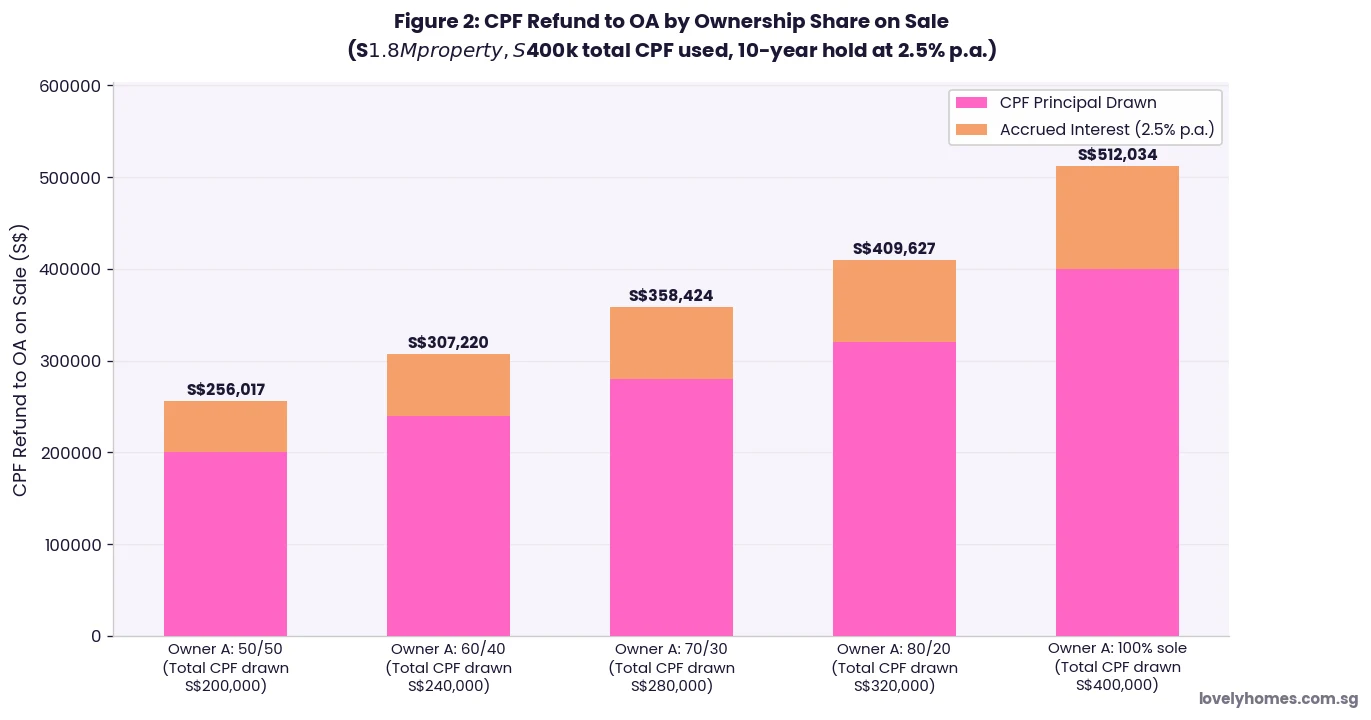
  • CPF Ordinary Account usage is allocated per owner’s share. Each owner refunds their own CPF drawn — principal plus 2.5% p.a. accrued interest — to their own OA upon sale.
  • Decoupling (transferring one spouse’s share to the other) allows one party to then purchase a second property with a lower ABSD rate as a “first-time buyer” — but costs BSD on the half-share and requires full bank refinancing checks.
  • Intestacy risk: Under tenancy-in-common, your share passes via your will (or the Intestate Succession Act if you die without a will). Under joint tenancy, the surviving owner inherits automatically regardless of your will.

Joint Property Ownership in Singapore: An Overview

Purchasing property with a spouse, family member, or investment partner is common in Singapore. Whether you are a married couple buying your first HDB flat, siblings co-investing in a private condo, or business partners acquiring a shophouse, the legal form of co-ownership you choose has significant consequences for your stamp duties, CPF usage, mortgage liability, inheritance planning, and future asset reallocation strategy.

Singapore property law recognises two main forms of co-ownership: joint tenancy and tenancy-in-common. These are derived from English common law and codified in Singapore’s Land Titles Act (Cap. 157). They differ fundamentally in the nature of the ownership interest each party holds and in how that interest passes on death.

Understanding which structure applies to your purchase — and whether switching between them makes sense at different life stages — is essential for anyone who co-owns or intends to co-own property in Singapore.

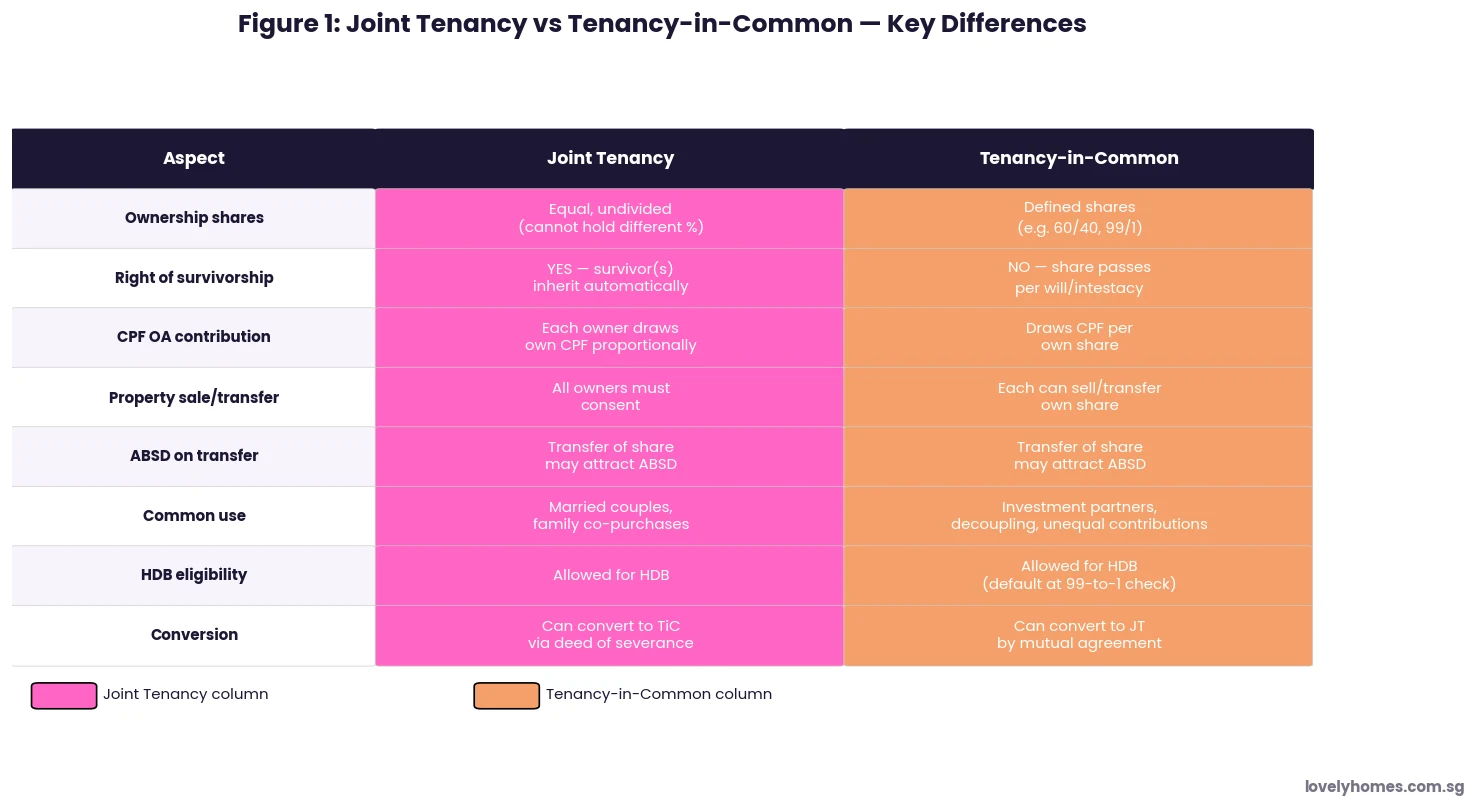
Joint tenancy vs tenancy-in-common Singapore 2026 — comparison table ownership shares survivorship CPF ABSD
Figure 1: Joint Tenancy vs Tenancy-in-Common — eight key differences covering ownership shares, survivorship, CPF, ABSD implications, and conversion.

Joint Tenancy: Equal Ownership with Survivorship

In a joint tenancy, every co-owner holds an equal and undivided interest in the entire property. There are no defined percentage shares — each joint tenant owns 100% of the property, concurrently with the other joint tenants. This may sound paradoxical, but it is precisely this conceptual structure that enables the right of survivorship: when one joint tenant dies, their interest does not form part of their estate but instead vests automatically in the surviving joint tenant(s), regardless of what their will says.

For married couples purchasing their matrimonial home, joint tenancy reflects the expectation of mutual commitment: neither party can unilaterally dispose of their share without the other’s consent, and neither party can bequeath the property to a third party outside the marriage while the other spouse survives. This makes joint tenancy the default and legally preferred form for HDB flat ownership by married couples.

Practical implications of joint tenancy:

  • A court order (e.g. in a divorce or a creditor’s claim) can sever a joint tenancy and convert it to a tenancy-in-common, enabling the sale of one party’s share.
  • Banks typically treat all joint tenants as jointly and severally liable for the mortgage. If one party defaults, the other is fully liable for the outstanding debt.
  • All joint tenants must consent to a sale or mortgage. This is both a protection and a constraint.
  • For CPF purposes, each joint tenant is deemed to have drawn CPF in proportion to their purchase price contribution, even though the legal title is held equally.

Tenancy-in-Common: Defined Shares and Investment Flexibility

In a tenancy-in-common, each co-owner holds a separate, defined fractional interest in the property. The shares need not be equal — they can be set at any percentage that reflects the parties’ respective financial contributions or commercial agreement: 50/50, 70/30, 90/10, even 99/1. Each tenancy-in-common share is a distinct, transferable legal interest. An owner can sell, mortgage, or bequeath their share independently of the others.

No right of survivorship exists under tenancy-in-common. If you die with a 40% share in a property, that 40% passes according to your will. If you have no will, it is distributed under the Intestate Succession Act (Cap. 146) — which may not align with your wishes. This is a frequently overlooked planning gap, particularly for unmarried co-owners or investment partners.

Tenancy-in-common is commonly chosen for:

  • Investment properties where each co-owner contributes a different amount and wants a proportionate return.
  • Decoupling strategies where one spouse later transfers their share to the other to free up their ABSD count for a second purchase.
  • Multi-generational purchases involving parents and children with different financial contributions.
  • Sibling or business-partner purchases where the parties are not romantically involved and have independent estate plans.

ABSD Implications: How Co-Ownership Affects Your Stamp Duty

Additional Buyer’s Stamp Duty (ABSD) is charged on the full purchase price of the property, not on each buyer’s share. However, the applicable ABSD rate for each buyer is determined by their own individual residential property count in Singapore at the time of purchase. This creates important nuances in co-ownership situations.

For example, if Singapore Citizen Mr Lim (first property) and Permanent Resident Ms Chen (first property for her) jointly purchase a condo, the ABSD rate is the higher of the two applicable rates — in this case, 5% (SPR rate for first property) — applied to the full purchase price. The system does not split the ABSD proportionally; the most onerous applicable rate prevails.

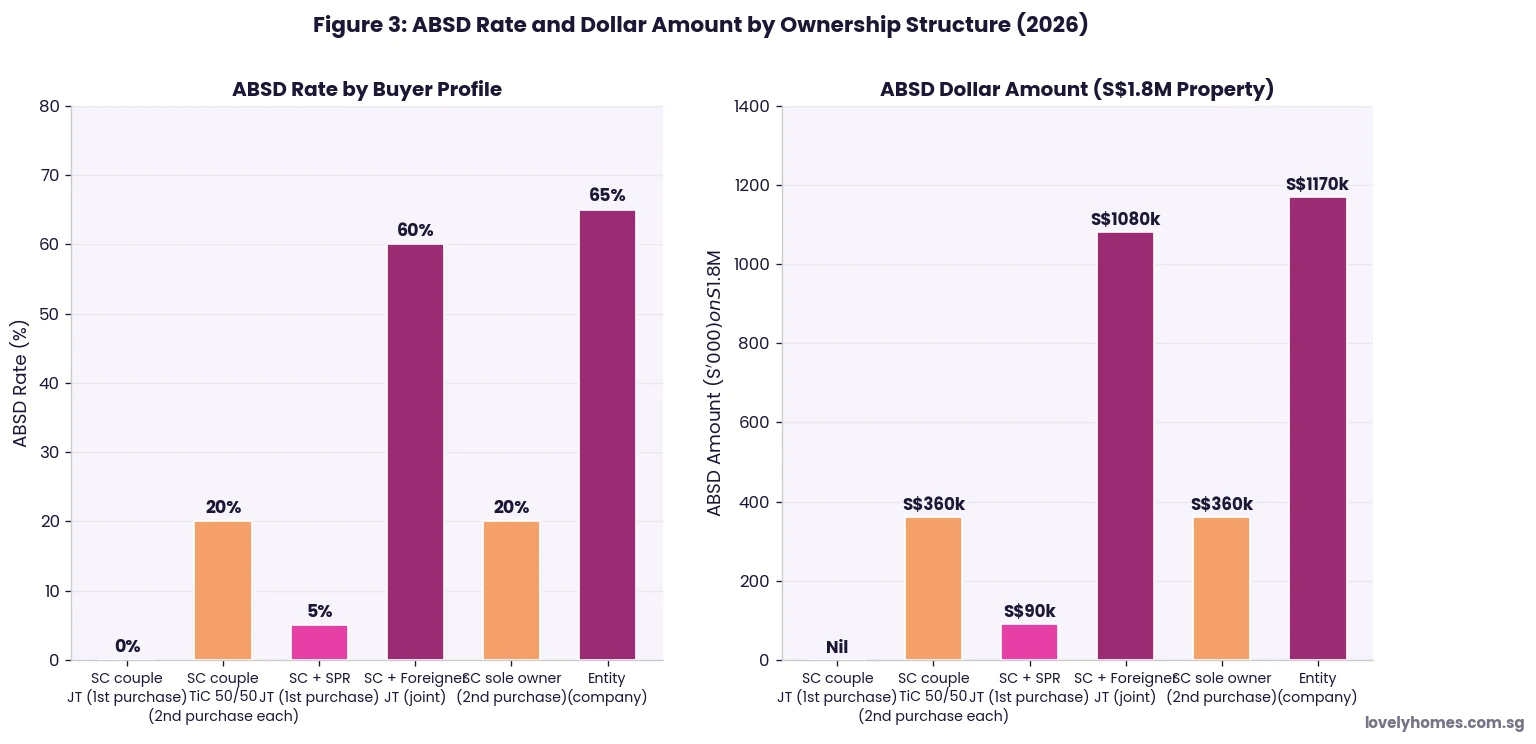
ABSD rates and dollar amounts by ownership structure Singapore 2026 — joint tenancy tenancy-in-common entity
Figure 3: ABSD rate and dollar amount by ownership structure on a S$1.8M property. Note: entity purchases attract 65% ABSD with no remission available.
Co-ownership Profile ABSD Rate ABSD on S$1.8M Note
SC + SC (both first property) 0% Nil SC first-property exemption
SC (first) + SPR (first) 5% S$90,000 Higher rate (SPR) applies
SC (second) + SC (first) 20% S$360,000 Higher rate applies; payable in full on 100% price
SC + Foreigner 60% S$1,080,000 Foreigner rate applies to full price
Company / entity 65% S$1,170,000 No remission available for entities

Source: IRAS, effective as of June 2026.

CPF Usage Under Co-Ownership: Shares and Refund Rules

When a property is co-owned, each party may contribute their own CPF Ordinary Account (OA) funds towards the purchase — for the down payment, monthly mortgage instalments, BSD, and legal fees. The amount each co-owner can draw is subject to the usual CPF Valuation Limit (VL) and Withdrawal Limit (WL) constraints, applied to their proportionate share of the property.

Under tenancy-in-common, CPF contributions are tracked per owner’s defined share. Under joint tenancy, CPF draws are typically in proportion to the purchase price contribution, even though legal ownership is equal and undivided. On sale of the property, each owner must refund their own CPF principal plus accrued interest at 2.5% per annum into their own Ordinary Account. This refund is mandatory regardless of whether the sale price exceeds the purchase price.

CPF refund to OA on sale by ownership share Singapore 2026 — principal and accrued interest
Figure 2: CPF refund obligation by ownership share — illustrative example of a S$1.8M property with S$400,000 total CPF drawn, held for 10 years at 2.5% p.a. The higher the ownership share, the larger the CPF refund on sale.

Decoupling: Converting Tenancy to Free Up ABSD Count

Decoupling refers to the process of transferring one co-owner’s share to the other, so that the transferring party becomes a zero-property owner and can subsequently buy a new property at a lower ABSD rate. This strategy is most commonly used by married couples who co-own a private property and wish to purchase a second investment property without incurring the 20% ABSD on the second purchase.

The transfer attracts BSD on the transferred share at prevailing rates. For example, if the transfer value of the half-share is S$900,000, BSD is approximately S$26,600. Legal fees for the decoupling conveyancing typically run S$4,000–S$8,000 plus GST. ABSD is also payable on the transferee’s side if it triggers a property count increase.

Since April 2023, IRAS has applied heightened scrutiny to 99-to-1 arrangements — where one party buys 99% and the other 1% specifically to exploit ABSD count. Arrangements that IRAS determines to be artificial may result in the ABSD being levied on the full value rather than the proportionate share. Buyers should seek proper legal advice and ensure their co-ownership structure reflects genuine commercial intent.

Worked Example: Mr & Mrs Wong — Converting JT to TiC for Decoupling

📄 Worked Example — Married SC Couple Converting Ownership for Second Purchase

Background: Mr & Mrs Wong, both Singapore Citizens, jointly own a Bishan private condo purchased in 2021 for S$1,600,000. Outstanding loan: S$880,000. Mr Wong’s CPF OA drawn: S$180,000 (principal). Mrs Wong’s CPF OA drawn: S$120,000 (principal). Property current market value: S$2,000,000. Ownership: joint tenancy 50/50.

Goal: Purchase a second investment condo (S$1,500,000 in OCR) without paying 20% ABSD (S$300,000).

Step 1 — Convert JT to TiC: Mr & Mrs Wong execute a deed of severance to convert joint tenancy to tenancy-in-common in equal shares. Cost: approximately S$800 in SLA fees + legal disbursements.

Step 2 — Decouple: Mrs Wong transfers her 50% share (value: S$1,000,000) to Mr Wong. BSD on S$1,000,000: S$24,600. Mrs Wong’s CPF refund obligation: S$120,000 × (1.025)^5 ≈ S$135,900. Legal fees: S$5,500. Total decoupling cost: approximately S$30,100 + CPF refund.

Step 3 — Mr Wong refinances: Bank reassesses TDSR on sole ownership. New mortgage S$1,120,000 (existing S$880,000 + S$240,000 top-up for decoupling costs). Monthly S$4,711 @3.2% 30yr — Mr Wong’s income S$14,000/month, TDSR 33.7% PASS.

Step 4 — Mrs Wong buys second condo: As a Singapore Citizen first-property buyer, Mrs Wong pays 0% ABSD on the S$1,500,000 OCR condo. ABSD saving vs joint purchase: S$300,000. Net saving after decoupling costs: S$269,900.

Note: This is an illustrative example. Actual ABSD/BSD rates, CPF drawdown, TDSR assessment, and legal costs may vary. Seek legal and financial advice before executing any property transfer.

Joint Ownership and Estate Planning: The Survivorship Risk

One of the most consequential differences between joint tenancy and tenancy-in-common is the estate-planning dimension, which is frequently overlooked by younger buyers focused on financing and stamp duties.

Under joint tenancy, your interest in the property does not exist as a separate asset in your estate. When you die, your joint tenancy interest extinguishes and the survivors’ interests expand to absorb it. Your will cannot override this. If you are a joint tenant and die, the property belongs entirely to the survivor, regardless of your wishes. This is protective in a stable marriage but potentially damaging in an estranged or second-marriage scenario, where you may prefer a portion of the property to pass to children from a prior relationship.

Under tenancy-in-common, your defined share is an asset in your estate. It passes per your will, or per the Intestate Succession Act if you die intestate. This gives you full testamentary control over your property share but requires that you actually execute a valid will and keep it updated. Unmarried co-owners and investment partners should always hold as tenants-in-common and maintain current wills.

What Might Change Next: Ownership Structure Policy Outlook

The following is editorial analysis and is not government policy. The government’s tightening of 99-to-1 arrangements in April 2023 signalled that IRAS will continue to scrutinise co-ownership structures that appear designed primarily to circumvent ABSD, rather than reflecting genuine co-ownership intentions. Future refinements may include clearer IRAS guidance on acceptable tenancy-in-common ratios, or legislative changes to deem artificial structures as ABSD-liable on the full purchase value. Buyers considering unconventional co-ownership splits for tax planning purposes should seek specific legal advice in the current regulatory environment.

Frequently Asked Questions

Can HDB flat owners hold as tenants-in-common?
Yes. HDB flats may be held as tenants-in-common with defined shares, and this is not uncommon in practice — particularly for parents purchasing together with an adult child, or for siblings jointly buying a flat. However, HDB stipulates that all co-owners must satisfy the eligibility conditions for owning an HDB flat (e.g. citizenship, income, property ownership rules). HDB has previously confirmed that it does not generally prohibit tenancy-in-common, but it does monitor unequal splits (such as 99/1) that appear structured to minimise ABSD exposure. The IRAS anti-avoidance provisions under the Stamp Duties Act would apply in such cases.
Does a joint tenancy convert to tenancy-in-common automatically on divorce?
Not automatically. In a divorce, the matrimonial flat remains held under whatever ownership structure it was registered in (usually joint tenancy) until the Court issues an order dealing with the flat as part of ancillary matters. The Family Justice Courts may order a sale, a transfer to one spouse, or a deferred sale arrangement. The joint tenancy is only converted to tenancy-in-common if the parties mutually agree to sever it before the divorce is finalised, or if a court order explicitly directs a transfer of defined shares. Until such steps are taken, the property continues to be jointly held and both parties remain jointly liable for the mortgage.
If my co-owner refuses to sell, can I force a sale?
Yes, but the process differs by ownership type. Under joint tenancy, either owner can apply to the High Court for an order of sale under the Conveyancing and Law of Property Act (Cap. 61) if agreement cannot be reached. Under tenancy-in-common, each owner can similarly seek a court-ordered sale of the whole property, with proceeds distributed in proportion to shares. In practice, court-ordered sales are a last resort and carry significant legal costs. Most ownership disputes are resolved by one party buying out the other’s share at an agreed valuation or via a professional valuer.
Does ABSD apply when a parent transfers a property share to a child?
Yes. A transfer of a property share — whether by sale, gift, or part-gift — is a dutiable transaction. BSD is payable on the higher of the consideration or the market value of the share transferred. ABSD is also payable at the transferee’s applicable rate if the transfer increases the transferee’s Singapore residential property count. Only a limited number of transfers are exempt from ABSD, including transfers between spouses (subject to conditions under the Stamp Duties Act) and transfers pursuant to a court order (e.g. in a divorce). Transfers from parent to child are not automatically ABSD-exempt.
Can a Singapore Permanent Resident co-own an HDB flat as a tenant-in-common?
Yes, with conditions. A Singapore Permanent Resident can be included as a co-owner of an HDB flat under a family nucleus where the primary applicant is a Singapore Citizen. The SPR co-owner may be listed as a joint tenant or tenant-in-common. However, an SPR cannot be the sole buyer of a new HDB flat and cannot purchase an HDB flat independently without a SC co-applicant under the relevant eligibility scheme. The CPF OA contributions of the SPR co-owner are treated the same as those of a SC owner for property purchase purposes.
What is the difference between “tenancy” (as in renting) and “tenancy-in-common”?
The word “tenancy” in tenancy-in-common is a historical legal term derived from English common law referring to the holding or tenure of land — it has nothing to do with the landlord-tenant relationship in a rental context. A tenant-in-common is a co-owner who holds a defined share of a property. A tenant in the rental sense is a person who leases property from a landlord under a tenancy agreement. The two uses of the word “tenancy” are entirely unrelated and should not be confused.
Should I hold investment property as joint tenancy or tenancy-in-common?
For investment properties between unrelated parties (e.g. friends, siblings, business partners), tenancy-in-common is almost always preferable. It allows each party to hold a proportionate share reflecting their capital contribution, to independently mortgage or sell their share (subject to any co-ownership agreement), and to bequeath their interest per their will without the surviving co-owner automatically inheriting. For married couples buying an investment property together, the answer depends on their estate planning preferences and whether decoupling is a future consideration. In all cases, investment co-owners should sign a co-ownership agreement governing decision-making, cost-sharing, and exit rights.

Related Articles

Disclaimer: This article is for general educational purposes only and should not be construed as legal, financial, or tax advice. Property ownership law, ABSD regulations, CPF rules, and stamp duty rates in Singapore are subject to change by the government, MAS, IRAS, and CPF Board. The examples and figures in this article are illustrative only. Before entering into any co-ownership arrangement, executing a transfer of shares, or making any property investment decision, readers should seek independent legal advice from an Advocate and Solicitor of the Supreme Court of Singapore, and financial advice from a licensed financial adviser regulated by MAS. Consult the Inland Revenue Authority of Singapore (IRAS), HDB, and CPF Board for current official guidance.

Translate »