Singapore Private Property Resale Process 2026: Step-by-Step Guide from OTP to Keys

Singapore Private Property Resale Process 2026: Step-by-Step Guide from OTP to Keys

Quick Answer: Buying a Private Resale Property in Singapore 2026

  • The full resale process — from engaging a solicitor to receiving keys — typically takes 10–14 weeks.
  • You pay an Option Fee (1% of price) to secure the OTP, then exercise it within 14 days by paying the balance 4%.
  • Buyer’s Stamp Duty (BSD) must be paid within 14 days of exercising the OTP; ABSD is also due at exercise.
  • CPF Ordinary Account can be used for private property purchases subject to the Valuation Limit and Withdrawal Limit.
  • Foreigners and PRs face Additional Buyer’s Stamp Duty (ABSD) of 60% and 5–30% respectively.
  • A licensed solicitor is legally required for conveyancing — buyers and sellers cannot use the same law firm.
  • The Total Debt Servicing Ratio (TDSR) cap of 55% applies to all private property mortgage loans.

What Is the Private Property Resale Process in Singapore?

Purchasing a resale private property — whether a condominium, apartment, or landed house — in Singapore follows a structured legal and financial process regulated by the Urban Redevelopment Authority (URA), the Singapore Land Authority (SLA), and the Inland Revenue Authority of Singapore (IRAS). Unlike buying a new launch (where you deal with a developer over a preview and balloting exercise), a resale transaction involves a private seller, a binding Option to Purchase (OTP), and a conveyancing timeline governed by the Law Society Conditions of Sale.

The process is considerably more compressed than buying a new launch — you can move in within 12 weeks of the OTP being granted, compared to the 3–5 year construction wait for a new launch. This immediacy comes with its own demands: due diligence, financing pre-approval, and legal fees must all be lined up before the OTP is granted.

This guide walks through every step from identifying a property to receiving keys, and explains the stamp duties, CPF rules, and financing mechanics that determine how much cash you need to have ready.

The 10-Step Private Resale Process: A Timeline Overview

Figure 1 below shows the typical timeline across the ten stages of a private resale transaction. The entire process from engaging a solicitor to key collection typically spans 10 to 14 weeks (8 to 12 weeks for the legal completion period), though parties can agree to a shorter or longer completion period of up to 12 weeks by mutual consent.

Singapore private property resale process 10-step timeline buyer guide 2026
Figure 1: Typical timeline for a private resale property transaction in Singapore — 10 steps, 10–14 weeks. Source: LovelyHomes editorial.

Step 1: Engage a Solicitor (Before You Even Make an Offer)

The first step — one many buyers skip at their peril — is engaging a conveyancing solicitor before making any offer on a property. You need your solicitor in place because: (a) the OTP’s 14-day exercise window moves fast; (b) your solicitor must review the OTP wording and raise any queries before you exercise; and (c) you need legal confirmation of the CPF rules, title status, encumbrances, and outstanding maintenance fees before committing.

Buyer and seller cannot use the same law firm. Typical buyer legal fees for a S$1.5M condo range from S$3,500 to S$5,000 (inclusive of disbursements such as SLA caveat registration, title search, and stamp duty filing). Fees are broadly governed by the Law Society’s conveyancing fee guidelines but are now freely negotiable.

Your solicitor will conduct a title search via SLA to confirm the seller has clear, unencumbered title; check for any outstanding mortgage that must be discharged on completion; verify there is no Subsidiary Strata Land Act (SSLA) restriction or approved change of use that affects the property; and review the Management Corporation Strata Title (MCST) accounts for outstanding arrears and sinking fund adequacy. For a deeper primer on MCST issues, see our Singapore Condo MCST Guide 2026.

Step 2: Search and View Properties — Due Diligence Before the OTP

Before agreeing to any price, buyers should undertake thorough due diligence on the unit and the development. Key checks include: verifying the actual floor area against the strata title plan; confirming the remaining lease term (for leasehold developments); reviewing the MCST annual report for sinking fund balance and any pending special levies; checking for outstanding renovations bans or works on the common property; and reviewing recent comparable transactions in the development (available via URA REALIS or on the URA website’s Resale Transactions tool).

Buyers should also verify their eligibility. Singapore Citizens may purchase all private property types. Permanent Residents may purchase apartments, condominiums, and commercial property freely but require approval from the Land Dealings (Approval) Unit to purchase landed residential property. Foreigners may only purchase landed property in designated areas (Sentosa Cove) or with SLA approval, and face 60% ABSD on any residential purchase.

Step 3: Grant and Exercise of the Option to Purchase (OTP)

Once you have agreed on a price, the seller grants you an Option to Purchase in exchange for the Option Fee — typically 1% of the agreed purchase price paid in cash. The OTP gives you an exclusive right to purchase the property at the agreed price, typically for a 14-day option period (this period is agreed between parties and can be shorter or longer).

During the option period, your solicitor reviews the OTP. If you are satisfied, you exercise the OTP by signing it and paying the exercise fee — typically the balance 4% of the purchase price in cash or a combination of cash and CPF. On exercise, the OTP becomes a binding contract. The completion date is set for 8–12 weeks from the exercise date.

If you do not exercise the OTP within the period, the Option Fee is forfeited to the seller. There is no other penalty — the purchase simply does not proceed. This is why due diligence and financing must be in order before granting an OTP.

Step 4: Stamp Duties — BSD and ABSD (Due Within 14 Days)

Buyer’s Stamp Duty (BSD) is payable on all property purchases. It is calculated on a graduated scale on the purchase price or market value, whichever is higher. On a S$1.5M purchase, BSD is S$44,600 (effective rate approximately 2.97%). BSD must be paid via IRAS e-Stamping within 14 days of the date of the OTP exercise.

Additional Buyer’s Stamp Duty (ABSD) applies to SC buyers purchasing a second or subsequent residential property, and to all PR and foreigner buyers. ABSD rates in 2026 are: SC 2nd property 20%, SC 3rd+ 30%, SPR 1st property 5%, SPR 2nd+ 30%, foreigners 60%. For a full ABSD breakdown, see our ABSD Singapore 2026 Complete Guide. ABSD is also due within 14 days of exercise.

Both BSD and ABSD can be paid from CPF Ordinary Account (for residential property). However, ABSD amounts for second properties are substantial — for example, a SC buying a S$1.5M second property pays S$300,000 in ABSD alone, which would exhaust most CPF balances. The ABSD remission scheme allows SC couples who are upgraders to claim a refund of the ABSD if they sell their existing residential property within 6 months of purchasing the new one. See our Stamp Duty Remission Guide for details.

Upfront Stamp Duty and Legal Costs by Buyer Profile (S$1.5M)

Figure 2 illustrates the total upfront stamp duties and legal costs at a S$1.5M purchase price across five buyer profiles. The disparity between a SC first-time buyer (S$49,100) and a foreigner (S$944,600) underlines why Singapore’s ABSD is one of the world’s most aggressive foreign-buyer deterrents.

Upfront stamp duty and costs private property resale Singapore S$1.5M by buyer profile 2026
Figure 2: Total upfront stamp duties and legal costs at S$1.5M for five buyer profiles (Q2 2026 ABSD rates). Source: IRAS, LovelyHomes editorial.

Step 5: Arranging the Mortgage

Private property purchases must comply with the Monetary Authority of Singapore’s Total Debt Servicing Ratio (TDSR) framework. Under the TDSR, monthly debt obligations — including the new mortgage plus any existing credit facilities — cannot exceed 55% of gross monthly income. Unlike HDB loans (which have a 30% Mortgage Servicing Ratio cap), private property loans use TDSR only.

The Loan-to-Value (LTV) ratio for a first private property mortgage is up to 75%, requiring a minimum 25% downpayment (of which 5% must be in cash). For a buyer with an existing outstanding mortgage, the LTV drops to 45% (first subsequent loan). See the prior reference in our Property Downpayment Guide 2026.

Banks will commission an independent valuation of the property. If the valuation comes in below the agreed price, the bank will lend only against the valuation — meaning the buyer must fund the shortfall in cash. For example, if you agreed to pay S$1,550,000 but the valuation is S$1,500,000, the bank’s 75% LTV is based on S$1,500,000, so the buyer must fund the additional S$50,000 from cash.

For CPF usage: CPF Ordinary Account can be used for the downpayment and monthly instalments for private property up to the property’s Valuation Limit (the lower of purchase price or valuation). Beyond the Valuation Limit, the Withdrawal Limit (120% of the property value for properties with sufficient lease) applies. See our CPF for Private Property Guide 2026 for the full mechanics.

Step 6: Lodge a Caveat with the Singapore Land Authority (SLA)

Once the OTP is exercised, your solicitor should promptly lodge a Caveat with the SLA. A caveat protects your interest in the property by registering your claim against the title. It prevents the seller from selling to a third party or granting another mortgage on the same property. The caveat fee is approximately S$150–S$200. Caveats are registered via the SLA’s e-Conveyancing system.

Step 7: Completion of the Sale and Purchase

Completion is the legal transfer of title from seller to buyer. On the completion date (typically 8–12 weeks from OTP exercise), all parties’ solicitors meet (or exchange completion documents electronically via e-Conveyancing). The buyer’s solicitor pays the balance purchase price from the mortgage loan drawdown and any remaining CPF/cash. The seller’s solicitor receives the funds and transfers title.

At completion, the seller’s outstanding mortgage is discharged from the sale proceeds. The SLA registers the transfer of title and the buyer’s new mortgage. The buyer’s solicitor registers the mortgage instrument. Typically, keys are handed over on the completion date or shortly thereafter.

Singapore Resale Condo Price Ranges by Region and Unit Type (Q1 2026)

Figure 3 illustrates indicative resale condo price ranges by unit size and region. The Core Central Region (CCR — Districts 9, 10, 11, and the Downtown Core) commands the highest prices, particularly for larger units. The Outside Central Region (OCR) offers the widest value range for buyers seeking more affordable entry points.

Singapore resale condo price ranges by unit type and region OCR RCR CCR Q1 2026
Figure 3: Indicative resale condo price ranges by unit type and region, Q1 2026. Error bars show typical market range. Source: URA Resale Transactions data, LovelyHomes editorial.

Private Resale Process at a Glance: Key Facts Table

Stage Who Acts Key Deadline Typical Cost
Engage solicitor Buyer Before OTP S$3,500–S$5,000
Grant OTP / Option Fee (1%) Seller grants, Buyer pays At agreement 1% of price (cash)
Exercise OTP (4%) Buyer Within 14 days 4% of price (cash/CPF)
BSD + ABSD payment Buyer via solicitor 14 days from exercise Varies (BSD + any ABSD)
Lodge caveat (SLA) Buyer’s solicitor Promptly after exercise ~S$150–S$200
Mortgage drawdown Buyer / Bank Before completion Bank valuation fee S$300–S$700
Completion / Key collection Both solicitors 8–12 weeks from exercise Balance purchase price

Worked Example: The Kumar Family Buying a Resale 3-Bedroom in the RCR

Scenario: SC Couple, First Private Property, Selling Their HDB

Mr Kumar (38, SC) earns S$9,500/month; Mrs Kumar (36, SC) earns S$8,800/month. Joint income: S$18,300/month. They currently own an HDB flat (5-room, Tampines) with no outstanding mortgage. They wish to upgrade to a private resale 3-bedroom condo in the RCR.

  • Target unit: 3-bedroom resale condo, RCR (District 3), 1,000 sqft, freehold.
  • Agreed price: S$2,100,000
  • Bank valuation: S$2,050,000 (shortfall S$50,000 — must fund in cash)
  • BSD: S$74,600 (progressive on S$2,100,000: 1% × S$180K + 2% × S$180K + 3% × S$640K + 4% × S$500K + 5% × S$600K = S$74,600)
  • ABSD: 20% × S$2,100,000 = S$420,000 (SC 2nd property — HDB still owned at time of purchase)
  • ABSD remission plan: The Kumars plan to sell their HDB flat within 6 months of completion. If sold within 6 months, ABSD S$420,000 is refunded by IRAS. They pay ABSD upfront and claim the remission later.
  • Loan (75% LTV on valuation S$2,050,000): S$1,537,500 at 3.1% p.a., 30 years → S$6,567/month
  • TDSR check: S$6,567 ÷ S$18,300 = 35.9% (below 55% cap — PASS)
  • Downpayment (25% of S$2,050,000): S$512,500 (5% cash = S$102,500 + 20% CPF = S$410,000)
  • Price shortfall (purchase price above valuation): S$50,000 (cash)
  • Total cash at exercise and completion: Option fee S$21,000 (1%) + exercise S$84,000 (4%) + BSD S$74,600 + ABSD S$420,000 + valuation shortfall S$50,000 + legal S$5,200 + CPF mortgage arrangement S$0 = S$654,800 gross cash outlay (S$234,800 net after ABSD remission assuming HDB sold within 6 months)

Key takeaway: The Kumars’ biggest cash item is the upfront ABSD of S$420,000 — which they recover after selling the HDB. The net out-of-pocket (excluding ABSD) is approximately S$234,800. Planning the HDB sale timeline to remain within the 6-month remission window is critical.

Why the Private Resale Market Has Structural Depth

Unlike new launches, where pricing is controlled by the developer and buyers often face limited negotiation leverage, the resale market allows genuine price discovery between informed parties. This creates opportunities for buyers who do thorough research — understanding block-level transaction data, comparable lease terms, and development-specific factors like upcoming en-bloc potential, MCST financial health, and facilities.

The resale market also offers a distinct advantage: immediate occupation. For families with school enrolment timelines, existing rental commitments, or home sale proceeds that need to be redeployed promptly, the 10–14 week completion window is a significant operational benefit over a 3–5 year new-launch wait.

Resale buyers are also protected by a more mature legal framework. The Law Society Conditions of Sale provide standardised terms. The conveyancing system is transparent, title searches are reliable, and disputes are resolvable via the High Court or the Small Claims Tribunal (for deposits and agent disputes).

What Might Come Next for Singapore’s Private Resale Market?

This section reflects editorial analysis and forward-looking opinion, not a guarantee of future market performance.

The private resale market in 2026 is characterised by moderate volumes and selective price growth. OCR resale condos have held up well due to strong HDB upgrader demand — particularly from families exiting their MOP-completed BTO flats and entering the private market for the first time. CCR volumes remain relatively subdued as the 60% ABSD on foreign buyers has largely eliminated the speculative froth that characterised 2010–2013.

Looking ahead, the GLS tender pipeline — including sites at River Valley Green Parcel C (tendered June 2026), Town Hall Link white site (July 2026), and several OCR sites — will deliver new supply from 2028 onwards. This supply pipeline, while healthy, is not expected to flood the market given construction cost inflation and developer pricing discipline. The 2H2026 GLS Confirmed List of nine sites yielding approximately 4,745 residential units is broadly consistent with household formation rates and replacement demand.

For resale buyers, the near-term window before new-launch supply hits the market in volume (2027–2028) may represent a relative opportunity for well-priced resale units in established OCR and RCR estates.

Frequently Asked Questions: Buying Private Resale Property in Singapore

Can buyer and seller use the same solicitor?

No. Buyer and seller in a private property transaction must each engage their own separate law firm. This is a professional conduct requirement under the Legal Profession (Professional Conduct) Rules. Having the same solicitor act for both parties creates a conflict of interest — the solicitor cannot independently advise each party on a transaction where interests may diverge. In practice, buyers sometimes attempt to share a solicitor to save costs; this is not permitted for private property transactions (though an exception exists for certain straightforward HDB transactions under specific conditions).

What happens if my bank valuation comes in below the agreed price?

If the bank’s independent valuation of the property is lower than the agreed purchase price, the bank will only lend based on the lower valuation. The buyer must fund the difference (the shortfall between valuation and price) entirely in cash. CPF cannot be used for amounts above the valuation, and the ABSD is still calculated on the actual purchase price (the higher amount). For example, if you paid S$1,600,000 for a unit valued at S$1,550,000, you fund the S$50,000 shortfall in cash; BSD and ABSD are calculated on S$1,600,000. Buyers can seek a second valuation from a different valuer if they believe the first is too conservative, but banks are not obliged to accept it.

What is a Diplomatic Clause and should I request one?

A Diplomatic Clause is a lease termination right inserted into a tenancy agreement (not a purchase OTP). It allows a tenant to terminate an ongoing tenancy early if they are required to relocate due to work reasons (typically due to a transfer or job loss). It typically kicks in after a minimum period (commonly 12–14 months) with 2 months’ notice. It is relevant for buyers who intend to rent out the unit before moving in or while relocating — they would negotiate a Diplomatic Clause into the tenancy they offer to their tenant, not into the OTP for the purchase. It is standard practice for developments popular with expatriate tenants in CCR and RCR.

Does ABSD apply if I buy a private property with my spouse for the first time?

If both you and your spouse are Singapore Citizens purchasing your first residential property together, no ABSD applies. SC buyers (individually or jointly) are exempt from ABSD on their first residential property. If one spouse already owns property (including overseas property counts for ABSD purposes), ABSD will apply based on the higher-count buyer’s profile. For example, if you own an HDB flat (first property) and your spouse does not, joint purchase of a private condo is treated as a second property for ABSD purposes — the 20% SC 2nd-property ABSD applies on the entire purchase price. Decoupling strategies (where one party transfers their share to the other) may be considered to reset the count; see our Joint Property Ownership Guide for the decoupling mechanics and costs.

What are the key differences between buying a new launch condo and a resale condo?

There are several material differences. New launches are purchased from a developer during a preview/balloting period using the standard Sale and Purchase Agreement (SPA) under the Housing Developers (Control and Licensing) Act, with a progressive payment schedule as construction milestones are met. Resale purchases use an OTP and a Law Society SPA, with full payment at completion. New launches typically offer developer discounts and stamp duty absorption deals near launch, but buyers wait 3–5 years for completion. Resale condos allow immediate occupation and give you a complete picture of the actual unit, renovation condition, view, and development quality before committing. Resale buyers can also inspect the MCST accounts in detail before purchase, something impossible for a new launch. Price transparency also favours resale — URA publishes every resale transaction, whereas new-launch prices require asking agents or checking URA REALIS.

Can I negotiate below the seller’s asking price?

Yes — negotiation is standard in the private resale market. Reference points for your offer include: recent comparable transactions in the same development (from URA Resale Transactions data), the property’s age and condition, any pending special levies or MCST deficits, how long the unit has been listed, and the seller’s motivation (e.g., upgrading, emigrating, financial pressure). In a buyers’ market (higher inventory, slower volume), 3–8% below asking is not unusual for motivated sellers. In a tight market (low inventory, fast absorption), properties can transact at or above asking. Always let the bank’s independent valuation inform your offer ceiling — paying significantly above valuation means funding the excess in cash without CPF or loan coverage.

Do I need a property agent to buy a resale condo?

No — there is no legal requirement to engage a buyer’s agent for a private resale transaction. However, a buyer’s agent provides value through: identifying suitable listings and arranging viewings; interpreting transaction data to assess fair market value; negotiating the OTP price and conditions; and coordinating between the solicitors and seller’s agent. Buyer’s commission for private resale is typically not charged to buyers directly — it is paid by the seller via a co-broking arrangement with the seller’s agent. Effectively, you get buyer’s representation at no direct cost in most resale transactions. For those who proceed without an agent, ensure your solicitor reviews the OTP carefully before exercise, and do your own comparable transaction research via URA REALIS.

Related Articles


Disclaimer: The information in this article is for general educational purposes only and does not constitute financial, investment, or legal advice. Stamp duty rates, CPF rules, LTV limits, and property market conditions are subject to change by the relevant Singapore government bodies. Verify current rates and rules with IRAS (iras.gov.sg), HDB (hdb.gov.sg), CPF Board (cpf.gov.sg), URA (ura.gov.sg), and the Monetary Authority of Singapore (mas.gov.sg). All property transactions should be conducted through a licensed solicitor for conveyancing. Engage a Council for Estate Agencies (CEA)-licensed property agent if you require professional property advisory services.

Singapore Property Conveyancing Guide 2026: OTP, S&P Agreement, Legal Fees and Timelines Explained

Singapore Property Conveyancing Guide 2026: OTP, S&P Agreement, Legal Fees and Timelines Explained

Quick Answer: Conveyancing in Singapore 2026

  • Conveyancing is the legal process of transferring property ownership in Singapore, handled by licensed Singapore lawyers.
  • For private property, it involves an Option to Purchase (OTP), exercise of the OTP, and completion — typically over 8–12 weeks.
  • HDB resale transactions use the HDB Resale Portal and take approximately 8–10 weeks after HDB approval.
  • Buyer’s Stamp Duty (BSD) and Additional Buyer’s Stamp Duty (ABSD, if applicable) must be paid within 14 days of signing the OTP or S&P Agreement.
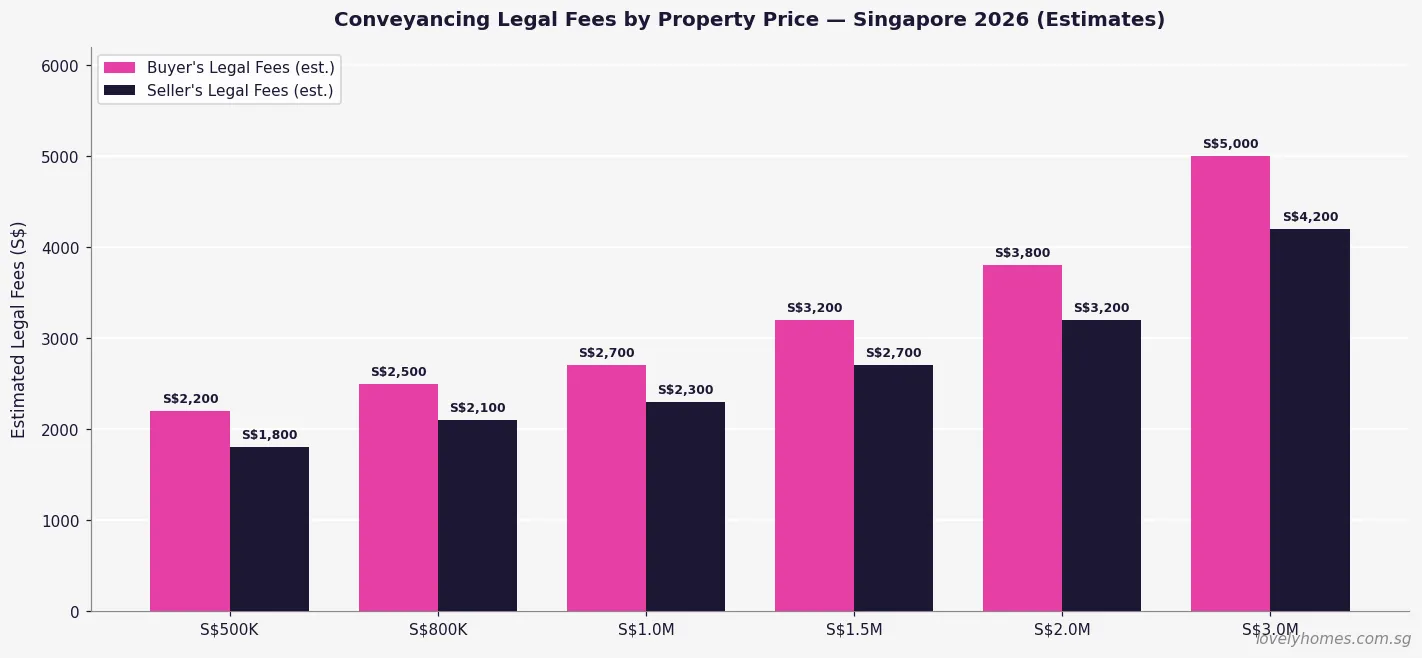
  • Legal fees for buyers typically range from S$2,200 to S$5,000 depending on property price; sellers pay S$1,800–S$4,200.
  • Disbursements (search fees, caveats, IRAS e-Stamping) add a further S$500–S$1,500 per transaction.
  • A conveyancing lawyer lodges a caveat on the title to protect the buyer’s interest between OTP exercise and completion.
  • CPF funds used for the purchase are refunded with 2.5% per annum accrued interest upon sale — factor this into your net proceeds calculation.

What Is Property Conveyancing?

Conveyancing is the Singapore legal process by which ownership of land or property is formally transferred from seller to buyer. Every private residential transaction — whether a new launch, resale condominium, landed property, or executive condominium — requires a conveyancing lawyer admitted to the Singapore Bar under the Legal Profession Act (Cap. 161). No individual may conduct their own conveyancing in Singapore; you must appoint a licensed law firm.

The Singapore Land Authority (SLA) maintains the land register under the Land Titles Act (Cap. 157). Separately, the Inland Revenue Authority of Singapore (IRAS) collects Buyer’s Stamp Duty (BSD) and Additional Buyer’s Stamp Duty (ABSD) via its e-Stamping portal. Your lawyer interfaces with both agencies on your behalf, making the choice of conveyancing firm a meaningful decision — not just a rubber stamp on your property purchase.

HDB flat transactions follow a slightly different route: they use the HDB Resale Portal and require HDB’s administrative approval, but buyers and sellers still appoint separate law firms (or use HDB’s approved conveyancing panel) to handle legal documents.

Step 1 — The Option to Purchase (OTP)

The OTP is a unilateral contract granting the buyer an exclusive right to purchase the property at an agreed price within a specified period. Under the Law Society of Singapore’s Conditions of Sale 2012, the standard OTP gives the buyer a 14-day option period from the date of grant. During this window, the property is effectively taken off the market.

Option fee: Typically 1% of the agreed purchase price, paid by cheque or cashier’s order to the seller (or seller’s lawyer). This fee is forfeited if the buyer does not exercise the option. It is not part of BSD — it is consideration for the option contract.

Exercising the OTP: The buyer exercises by paying a further 4% exercise fee (bringing the deposit to 5% total). BSD and ABSD are due within 14 days of exercising the OTP. Failure to pay on time attracts a late payment penalty of 5% per annum on the unpaid amount plus a flat 1% penalty.

Completion: Standard completion is 8–10 weeks after exercise. The buyer pays the remaining 95% of the purchase price (less any CPF utilised and bank loan disbursement) on completion day, and receives the keys and certificate of title.

Step 2 — The Sale and Purchase Agreement

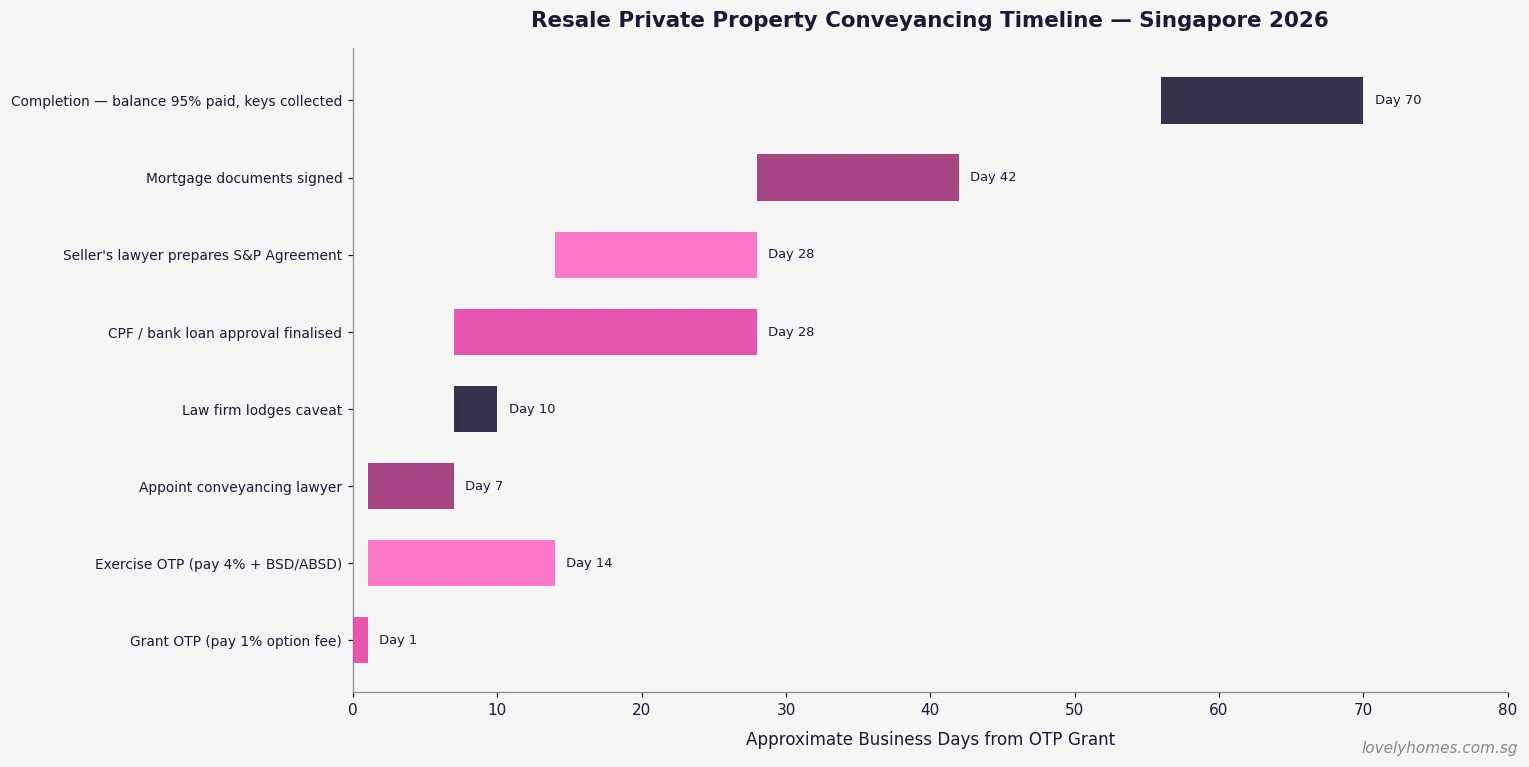
Once the OTP is exercised, the seller’s lawyers typically issue a formal Sale and Purchase (S&P) Agreement within 2–4 weeks. The S&P Agreement sets out all conditions of sale including: completion date, vacant possession, included fixtures and fittings, representations and warranties on title, and risk allocation between exchange and completion.

For HDB resale flats, there is no separate S&P Agreement — instead, the parties register their Intent to Sell and Intent to Buy via the HDB Resale Portal, and HDB issues the resale completion letter setting the completion appointment.

Singapore property conveyancing timeline 2026 - OTP to completion business days
Figure 1: Typical conveyancing timeline for a resale private property in Singapore, measured in business days from OTP grant.

Step 3 — Stamp Duties: BSD and ABSD

Stamp duties are collected by IRAS under the Stamp Duties Act (Cap. 312). They are the buyer’s obligation. The Buyer’s Stamp Duty (BSD) rates as at 7 June 2026 are:

Purchase Price Bracket BSD Rate
First S$180,000 1%
Next S$180,000 2%
Next S$640,000 3%
Next S$500,000 4%
Next S$1,500,000 5%
Remainder above S$3,000,000 6%

Additional Buyer’s Stamp Duty (ABSD) applies on top of BSD for second and subsequent properties (Singapore Citizens), all purchases by Singapore Permanent Residents, and all purchases by foreigners and entities. For a complete ABSD table, see the LovelyHomes ABSD Singapore 2026 Guide.

Step 4 — Appointing Your Conveyancing Lawyer

You should appoint your conveyancing lawyer before you sign the OTP, so that they can advise you on the option terms and perform preliminary title searches. The Law Society of Singapore’s Conveyancing Practice Directions require lawyers to advise clients on conflicts of interest — the same law firm generally cannot act for both buyer and seller in the same transaction.

Your lawyer’s duties as buyer’s solicitor include: conducting all title searches; preparing or reviewing the S&P Agreement; handling BSD/ABSD payment to IRAS; lodging a caveat at SLA to protect your interest; liaising with your bank’s lawyers on mortgage documentation; requisitioning CPF funds from CPF Board; and attending completion to receive title from the seller.

Singapore conveyancing legal fees 2026 - buyer and seller estimates by property price
Figure 2: Estimated conveyancing legal fees for buyers and sellers by property price, Singapore 2026. Obtain written fee quotes from your firm before proceeding.

Legal Fees and Disbursements

Law Society scale fees for residential conveyancing were abolished in 2009, meaning firms now charge freely. As a buyer, expect to pay S$2,200–S$5,000 in professional fees depending on transaction price and complexity. On top of professional fees, your lawyer will pass through disbursements — out-of-pocket costs charged at cost. Typical disbursements include:

  • SLA title search: approx. S$30–S$80
  • SLA caveat registration: approx. S$64.45 (includes GST)
  • Bank mortgage registration: approx. S$350–S$500
  • SLA transfer lodgement fee: approx. S$28–S$38 per instrument
  • CPF requisition fee: approx. S$15–S$25 per utilisation
  • Property valuation fee: S$300–S$1,200 depending on property type

Budget approximately S$500–S$1,500 in disbursements for a straightforward private resale transaction, in addition to professional fees.

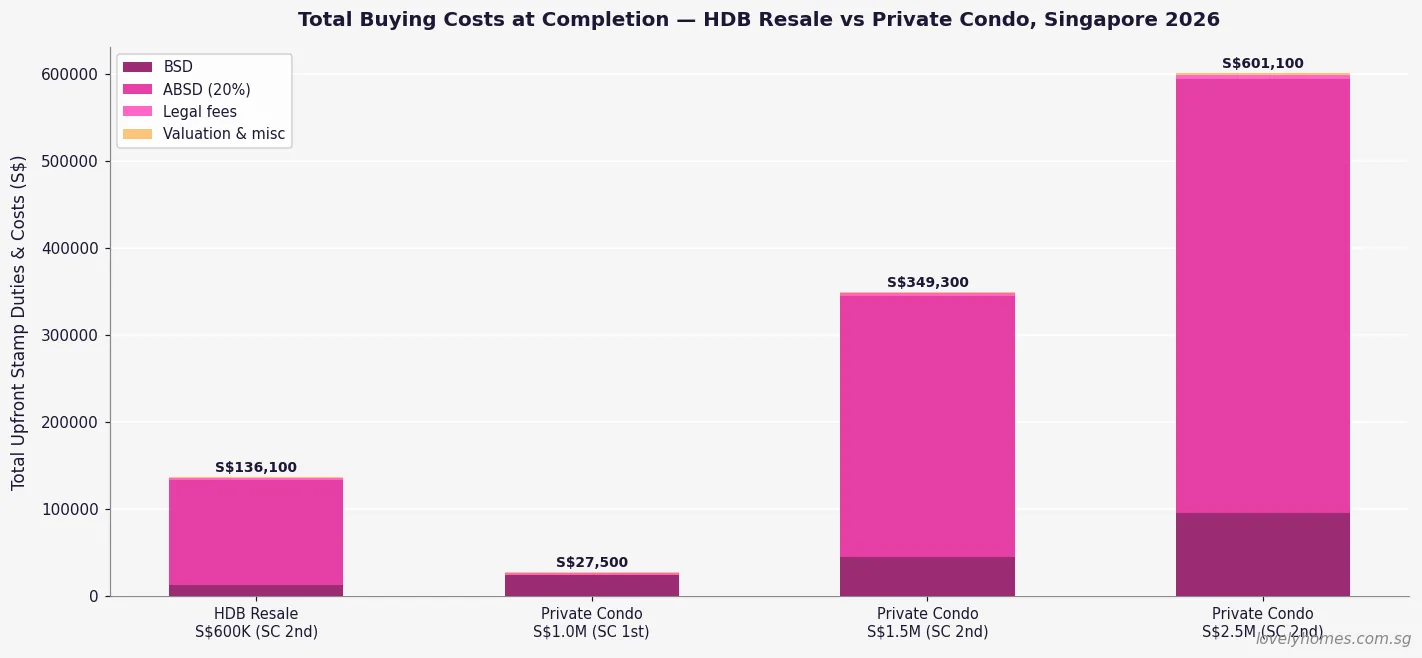
Singapore property buying costs comparison 2026 - HDB resale vs private condo BSD ABSD legal fees
Figure 3: Total upfront buying costs including BSD, ABSD and legal fees — HDB resale vs private condo at three price points, Singapore 2026.

Summary: Key Conveyancing Facts at a Glance

Item HDB Resale Private Resale New Launch
OTP / booking fee S$1 (HDB prescribed) Typically 1% of price Booking fee 5% on S&P day
OTP exercise fee N/A — HFE/portal process 4% within 14 days Further progress payments
BSD payment deadline 14 days from HDB flat offer letter 14 days from exercise 14 days from S&P date
Standard completion period 8–10 weeks (HDB schedule) 8–12 weeks from exercise On TOP or CSC date
Caveat filed by HDB portal (automatic) Buyer’s lawyer Developer’s panel lawyer
Buyer legal fees (indicative) S$1,500–S$2,200 S$2,200–S$5,000 S$2,200–S$3,500
Seller legal fees (indicative) S$1,000–S$1,800 S$1,800–S$4,200 N/A (developer pays)
CPF accrued interest on refund 2.5% p.a. on OA withdrawn 2.5% p.a. on OA withdrawn 2.5% p.a. on OA withdrawn

Worked Example: Mr and Mrs Koh Buy a Resale Condominium in Queenstown

Mr and Mrs Koh are Singapore Citizens purchasing their second property — a resale 2-bedroom condominium in Queenstown (District 3) for S$1,600,000. They are selling their HDB flat simultaneously (see our HDB Upgrader Guide 2026 for ABSD remission timing).

  • Option fee (1%): S$16,000 — paid by cashier’s order on grant of OTP.
  • BSD at exercise: 1% × S$180,000 + 2% × S$180,000 + 3% × S$640,000 + 4% × S$500,000 + 5% × S$100,000 = S$1,800 + S$3,600 + S$19,200 + S$20,000 + S$5,000 = S$49,600
  • ABSD remission: If HDB sold within the stipulated window, ABSD is remitted for SC joint first-time private purchase. If outside the window, ABSD at 20% = S$320,000 — manage this timing carefully.
  • Buyer’s legal fees: Approx. S$3,400 professional + S$900 disbursements = S$4,300
  • Valuation fee: S$700
  • Bank loan: S$1,200,000 at 3.0% p.a. over 30 years = S$5,058/mth; TDSR 36.1% on joint income S$14,000/mth — PASS.
  • Completion cash balance: S$1,600,000 − S$80,000 (deposit) − S$1,200,000 (bank) − S$100,000 (CPF) = S$220,000 cash

The entire conveyancing process, from OTP grant to completion, spans approximately 10 weeks — aligning with the typical resale timeline shown in Figure 1 above.

What to Watch in 2026 and Beyond

Singapore’s conveyancing framework has remained largely stable since the Land Titles Act was modernised in 1994, but two pressure points are worth watching. First, the Ministry of Law has periodically reviewed whether HDB flat conveyancing should be further streamlined through the portal — licensed lawyers remain mandatory as at 2026. Second, the SLA has been progressively digitalising title documents towards a fully electronic land registry, which reduces search turnaround times and potentially disbursement costs.

For buyers, the practical implication is that while stamp duties remain the dominant cost item (dwarfing legal fees for most transactions), shopping for a competitive legal fee quote matters more the larger your transaction. For a second-property private condominium purchaser, ABSD is typically 20–60 times larger than legal fees — making ABSD remission timing the single most important conveyancing consideration of all.

Frequently Asked Questions

Can I use the same lawyer as the seller?

Generally no. The Law Society’s Conveyancing Practice Directions prohibit a single law firm from acting for both buyer and seller in the same residential transaction — a conflict-of-interest rule designed to protect both parties. Exceptions exist for new launch sales where developer panel lawyers act for the developer, but you as the buyer still engage your own firm. Having separate representation ensures your lawyer’s duty runs exclusively to you.

What happens if I miss the BSD payment deadline?

BSD and ABSD must be paid within 14 days of signing the OTP or S&P Agreement. Late payment attracts a penalty of 5% per annum on the unpaid stamp duty, plus a flat penalty of 1% of the unpaid duty under the Stamp Duties Act. Your conveyancing lawyer will typically pay stamp duties on your behalf immediately on instruction — ensure you have sufficient cleared funds in your account by the day of exercise.

What is a caveat and why does my lawyer lodge one?

A caveat under the Land Titles Act is a formal notice lodged at the Singapore Land Registry (via SLA) once you have exercised the OTP. It signals to the world — including any subsequent buyer, mortgagee, or judgment creditor — that you have a legal interest in the property. This prevents the seller from dealing with the property inconsistently with your purchase contract during the period between exercise and completion. The caveat lodgement fee is approximately S$64 and is a standard disbursement.

How does CPF work in a property purchase?

Singapore Citizens and PRs may use their CPF Ordinary Account (OA) savings towards the purchase price and monthly mortgage instalments, subject to a Valuation Limit (VL) of 100% of the lower of purchase price or valuation, and a Withdrawal Limit (WL) of 120% of VL for properties with at least 30 years remaining lease. CPF monies withdrawn for property must be refunded with 2.5% p.a. accrued interest upon sale — returned to your own CPF account. See our HDB Upgrader Guide for worked CPF refund calculations.

What is the difference between new launch and resale conveyancing?

New launch transactions involve a developer under a Housing Developers (Control and Licensing) Act licence. Instead of an OTP, you sign a Standard Sale and Purchase Agreement in the prescribed form under the Housing Developers Rules, and pay a booking fee (typically 5%) on the day of signing. Stamp duties are payable within 14 days. Completion occurs on the issue of the Temporary Occupation Permit (TOP) or Certificate of Statutory Completion (CSC), which may be 2–5 years from booking. Your CPF usage and bank loan terms must be structured to accommodate drawdowns aligned with the developer’s progress billing schedule.

Can a foreigner buy Singapore property and what additional steps apply?

Foreigners may purchase private condominium units, executive condominiums that have reached their 10-year privatisation mark, and Sentosa Cove landed properties — subject to the Residential Property Act (Cap. 274). The conveyancing process is identical, except that ABSD at 60% of the purchase price is payable by foreigners on any residential property purchase as at 2026. US, Swiss, Icelandic, Norwegian, and Liechtenstein nationals benefit from Free Trade Agreement (FTA) exemptions and are treated at Singapore Citizen rates for ABSD purposes. See our Singapore Foreign Buyer Property Guide 2026.

What happens on completion day?

Completion is typically conducted at the seller’s lawyer’s office. Your bank disburses the loan directly to the seller’s lawyers; your CPF Board requisition is remitted; and you or your lawyer presents cashier’s orders for any remaining cash. The seller hands over keys and access cards. Title transfers on completion — your lawyer registers the transfer at SLA (typically processed within 1–3 business days). You will receive a Land Register printout confirming your name as the registered proprietor.

Related Articles

Disclaimer: This article is intended for general informational purposes only and does not constitute legal or financial advice. Conveyancing procedures, stamp duty rates, and CPF rules are subject to change. All figures, fees, and timelines cited are based on information available as at 7 June 2026. Readers should consult a licensed Singapore conveyancing lawyer and a Monetary Authority of Singapore (MAS) licensed financial adviser for advice specific to their circumstances. Authoritative references: IRAS (iras.gov.sg), Singapore Land Authority (sla.gov.sg), CPF Board (cpf.gov.sg), Law Society of Singapore (lawsociety.org.sg).

Conveyancing Fees Singapore 2026: Legal Costs for Buying & Selling Property

Conveyancing Fees Singapore 2026: Legal Costs for Buying & Selling Property

Buying or selling property in Singapore involves more than the purchase price and stamp duties. Every transaction — whether an HDB resale flat, a private condominium, or a landed house — requires a conveyancing lawyer to handle the legal transfer of ownership. These legal fees, plus the various disbursements that lawyers incur on your behalf, form part of the total transaction cost that every buyer and seller must budget for.

In Singapore, conveyancing is a regulated area of legal practice. The Law Society of Singapore previously prescribed a fixed fee scale, but that scale was abolished in 2009. Lawyers now charge based on the complexity of the transaction and market rates, though most firms price competitively within a fairly predictable band. This guide explains what conveyancing lawyers do, what you will pay, and how to manage the costs effectively in 2026.

Quick Answer — Key Takeaways

  • Buyer’s conveyancing fees for a S$1.5M private property typically range from S$2,800 to S$4,500 (legal fee) plus S$800–S$1,200 in disbursements.
  • Seller’s legal fees are generally lower — S$2,000 to S$3,500 plus disbursements of S$600–S$1,000.
  • For HDB resale flats, both buyer and seller pay separately for their own lawyers; HDB sets a guide for solicitors’ fees.
  • Disbursements are fixed government and third-party charges — Caveat filing, SLA searches, stamp duty lodgement — totalling S$400–S$1,000 for most transactions.
  • The conveyancing process from Option to Purchase (OTP) exercise to legal completion typically takes 8–12 weeks for private property and 12–16 weeks for HDB resale.
  • You may use the same law firm as the bank providing your mortgage loan (called an “acting for both” arrangement) to reduce total costs — though this is subject to the firm’s conflict-of-interest policies.
  • Buyers must pay Buyer’s Stamp Duty (BSD) within 14 days of exercising the OTP; ABSD (if applicable) is due at the same time.
  • GST at the prevailing rate (9% as at 2026) applies to lawyers’ professional fees but not to government disbursements.

What Is Conveyancing and Why Do You Need a Lawyer?

Conveyancing is the legal process by which ownership of a property is transferred from seller to buyer. In Singapore, this is a mandatory process overseen by qualified solicitors admitted to the Singapore Bar. Unlike some jurisdictions where buyers and sellers may self-represent, Singapore law requires a practising solicitor to execute the conveyancing documents, lodge the transfer with the Singapore Land Authority (SLA), and handle the settlement of funds.

For the buyer, the conveyancing lawyer: reviews the OTP and Sale and Purchase Agreement (SPA), conducts title searches to confirm ownership and encumbrances, lodges a caveat on the property title, handles stamp duty payment on your behalf, liaises with the bank (if you have a mortgage) to coordinate the mortgage documentation and drawdown, and oversees the completion — handing over the title in exchange for the purchase price.

For the seller, the conveyancing lawyer: reviews the OTP, liaises with the buyer’s solicitor, discharges any existing mortgage on the property, handles the discharge of the existing caveat, and receives and distributes the sale proceeds — repaying the outstanding loan to the bank and CPF (if CPF monies were used), and releasing the net balance to you.

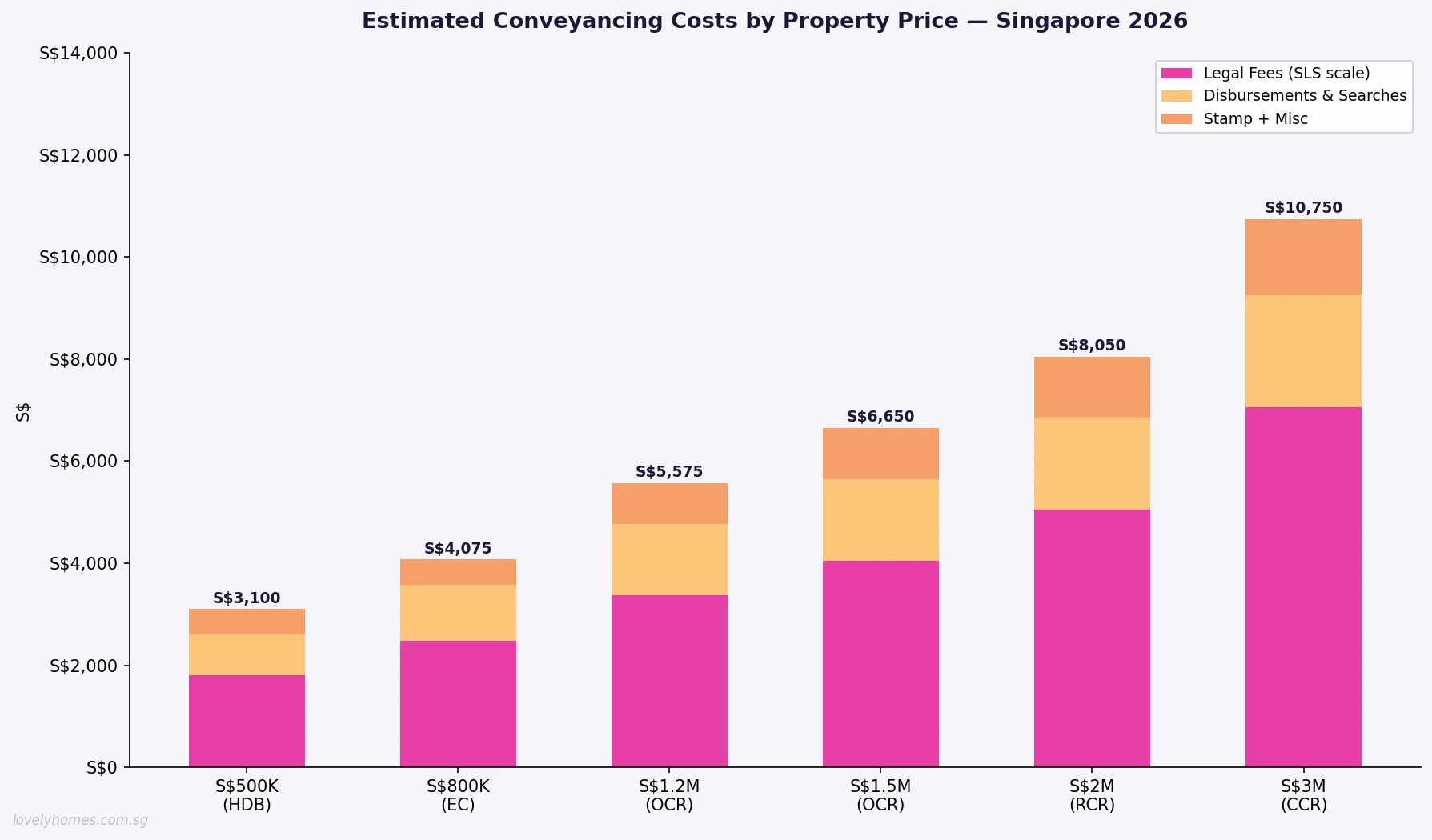
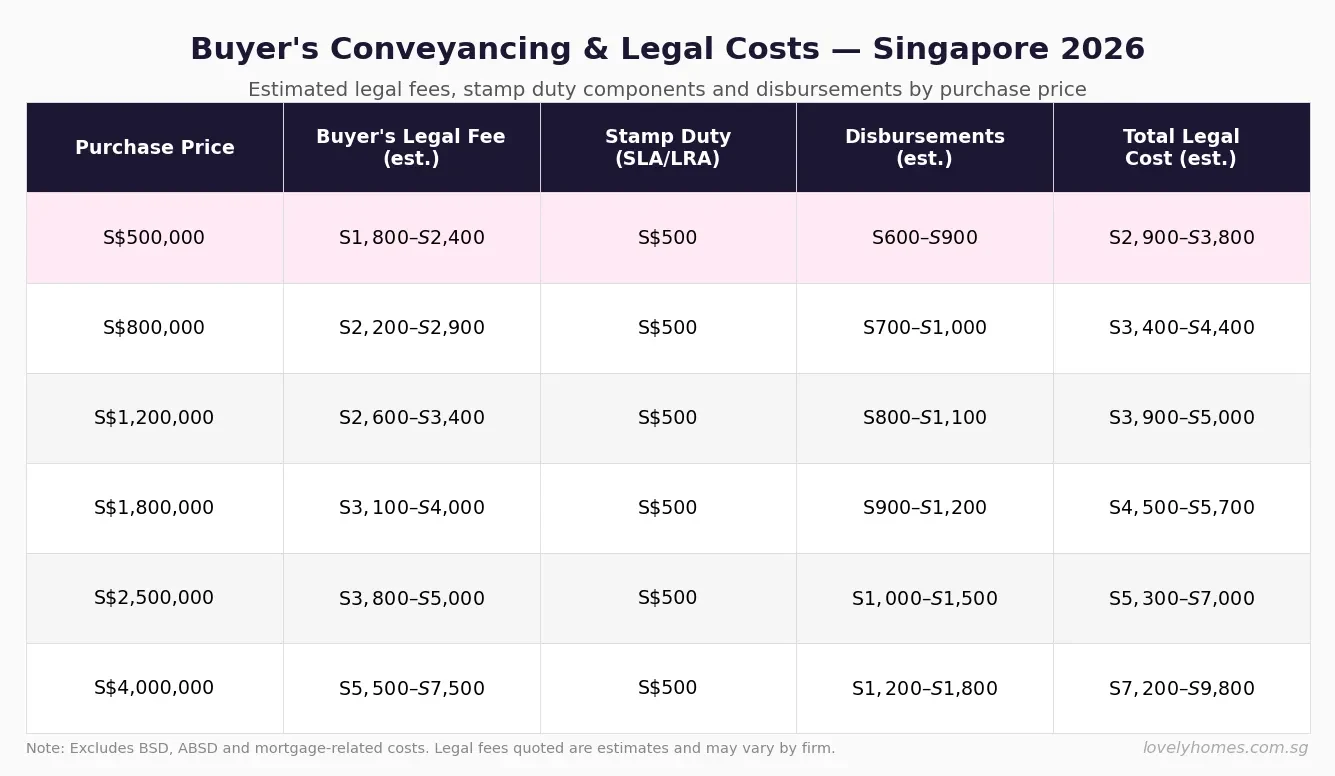
buyers conveyancing legal costs Singapore 2026 by property price table
Figure 1: Estimated buyer’s conveyancing fees and disbursements by property price (Singapore 2026). Excludes BSD, ABSD, and mortgage costs. Legal fees are market estimates; actual quotes may vary by firm. Source: LovelyHomes research, Law Society of Singapore guidance.

How Conveyancing Fees Are Structured

Since the abolition of the prescribed scale in 2009, Singapore law firms price conveyancing work in one of three ways: a fixed fee (most common for straightforward residential transactions), an ad valorem fee (a percentage of the purchase price, typically 0.1–0.25%), or an hourly rate (rare for standard residential work). The legal fee is subject to 9% GST.

On top of the professional fee, the lawyer will charge disbursements — third-party costs incurred on your behalf. These are typically passed through at cost (no markup) and are not subject to GST. Common disbursements include: SLA title search fees, caveat registration, stamp duty lodgement fee, HDB resale levy search (if applicable), legal requisitions to various government bodies (URA, LTA, PUB, NEA, SLA, ACRA), and the Electronic Payment fee for the Legal Practitioners Fidelity Fund (LPFF).

Fee Component Typical Range Chargeable? GST?
Professional (legal) fee — buyer S$1,800–S$7,500 (price-dependent) Yes Yes (9%)
Professional (legal) fee — seller S$1,500–S$5,000 (price-dependent) Yes Yes (9%)
SLA title search S$30–S$60 per search Disbursement No
Caveat lodgement S$64.45 Disbursement No
Stamp duty lodgement / e-stamping S$10–S$25 Disbursement No
Government requisitions (URA, LTA, etc.) S$200–S$400 Disbursement No
LPFF contribution S$100 (standard) Disbursement No
Mortgage documentation (if bank appoints same firm) S$800–S$2,500 Yes (bank-to-borrower) Yes (9%)

The Full Picture: Transaction Costs Beyond Legal Fees

Legal fees are only one component of the total cost of buying or selling. The dominant costs for buyers are Buyer’s Stamp Duty (BSD) and, where applicable, Additional Buyer’s Stamp Duty (ABSD). Sellers bear the property agent’s commission (if an agent is engaged). Understanding the full transaction cost envelope is essential for accurate budgeting.

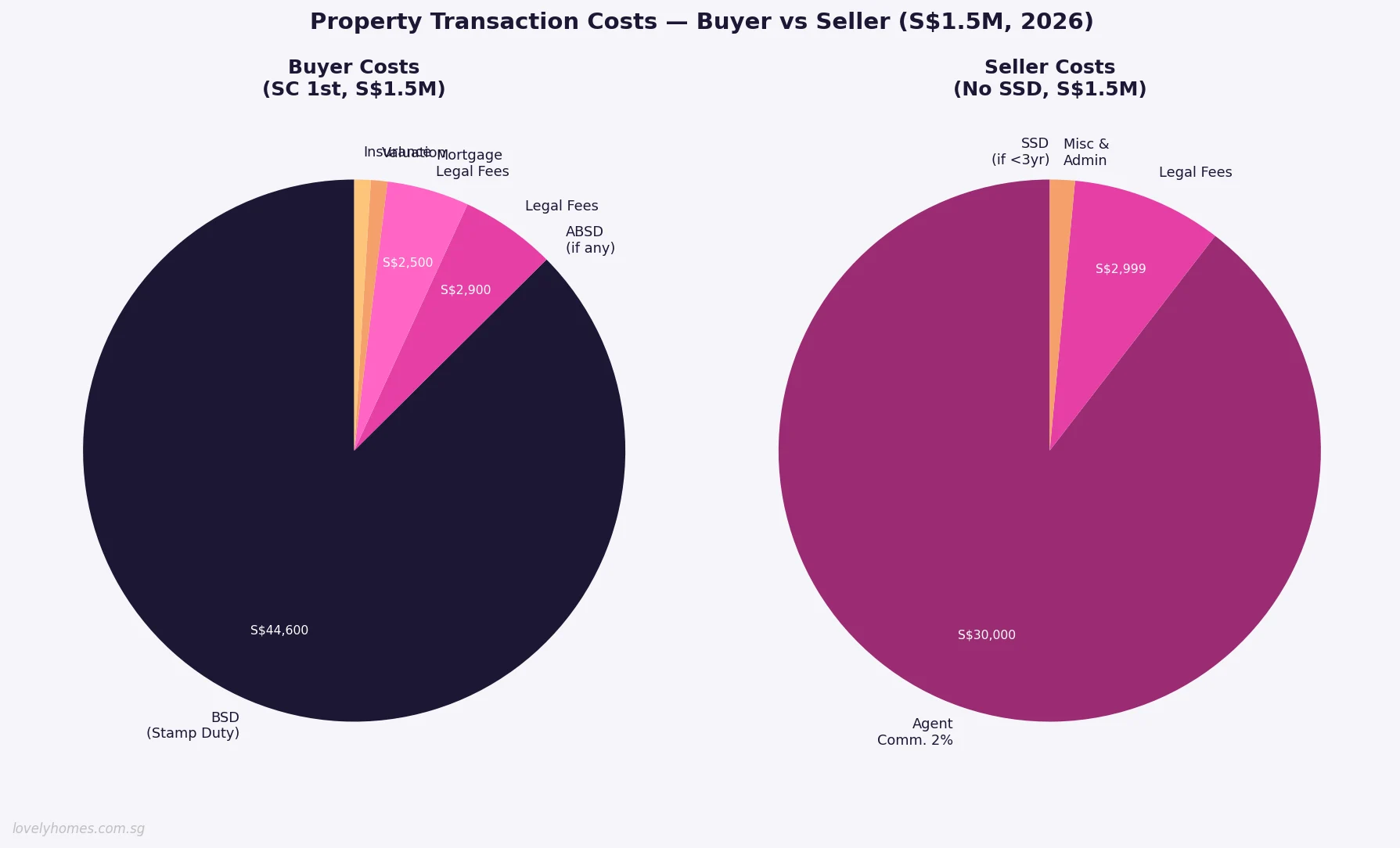
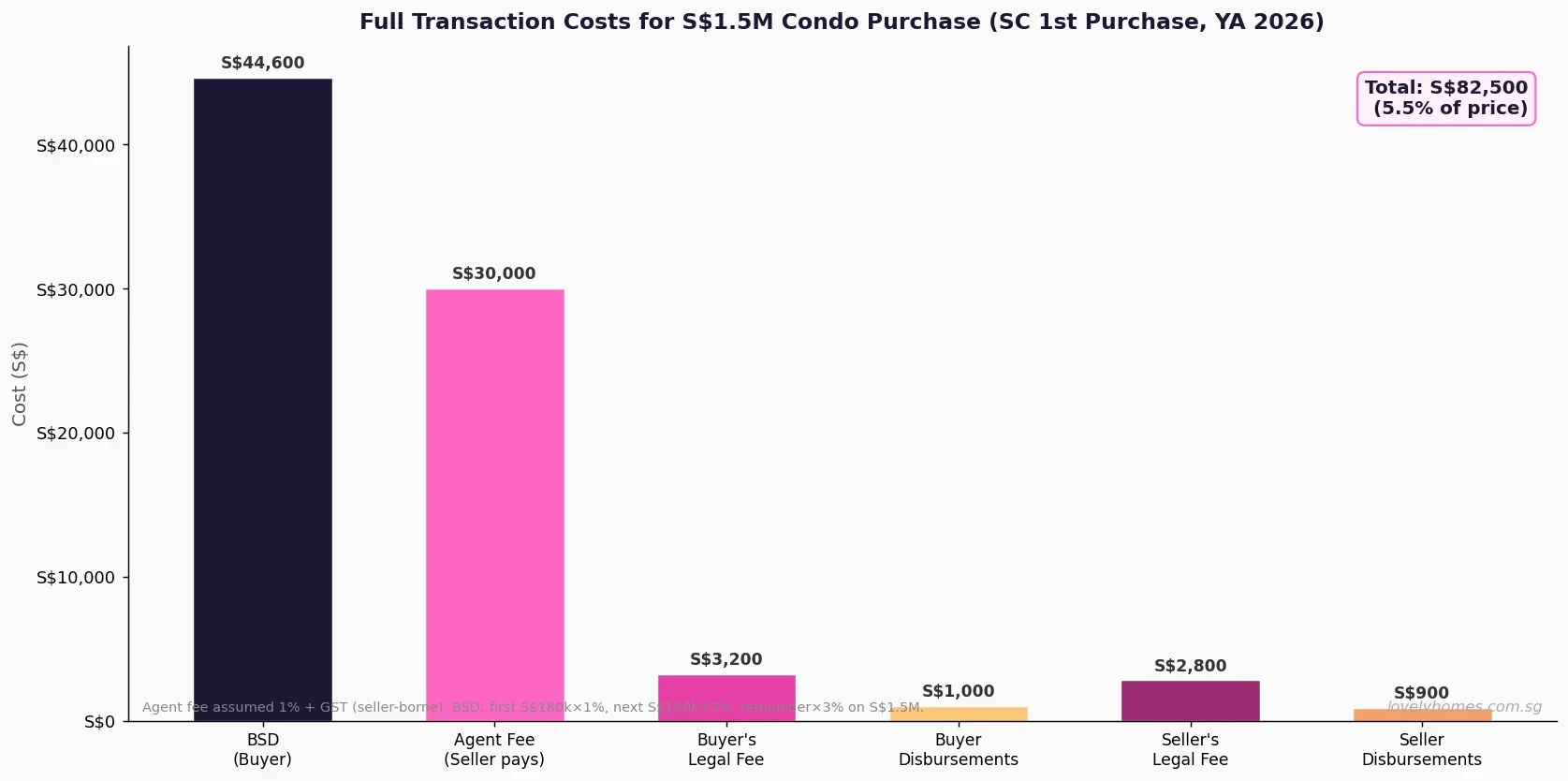
full transaction costs Singapore 1.5 million condo purchase 2026 BSD agent fee legal fees
Figure 2: Full transaction cost breakdown for a S$1.5M private condo purchase by a Singapore Citizen acquiring their first property (no ABSD). Agent fee assumed at 1% (seller-borne). BSD computed on the graduated scale. Source: IRAS, SLA, LovelyHomes research.

As the chart illustrates, BSD at S$44,600 dwarfs all other transaction costs for a first-time SC buyer at S$1.5M. BSD is calculated on the graduated scale: 1% on the first S$180,000, 2% on the next S$180,000, 3% on the next S$640,000, and 4% on the remainder. Total BSD on S$1.5M: S$180,000×1% + S$180,000×2% + S$640,000×3% + S$500,000×4% = S$1,800 + S$3,600 + S$19,200 + S$20,000 = S$44,600.

HDB Resale Flat — Conveyancing Fees

For HDB resale flat transactions, both buyer and seller must appoint their own lawyers. HDB no longer acts as the conveyancing party (it did so for many decades for straightforward HDB transactions, but now all HDB resale transactions go through private solicitors). The HDB sets a guide fee scale, though individual firms may charge within or beyond that band.

Purchase Price / Flat Type Buyer’s Legal Fee (Estimate) Seller’s Legal Fee (Estimate)
1- and 2-room flats (below S$300k) S$1,200–S$1,800 S$900–S$1,500
3-room flats (S$300k–S$450k) S$1,500–S$2,200 S$1,200–S$1,800
4-room flats (S$450k–S$650k) S$1,800–S$2,600 S$1,500–S$2,200
5-room / Executive flats (S$650k–S$900k) S$2,200–S$3,200 S$1,800–S$2,800
Maisonette / DBSS (above S$900k) S$2,800–S$4,000 S$2,200–S$3,500

HDB resale disbursements are broadly similar to private property: title searches, caveat registration (S$64.45), government requisitions (approximately S$150–S$250 for HDB-specific searches), and the LPFF contribution. The total HDB resale legal cost for buyer or seller is usually S$1,500–S$4,500 all-in, depending on flat value and firm.

Under HDB rules, a buyer using an HDB loan may use their lawyer to handle both the HDB loan documentation and the conveyancing — consolidating into one engagement. Buyers using a bank loan will need a separate mortgage solicitor engagement (often the same firm, as many firms act for both).

The Conveyancing Timeline: From OTP to Keys

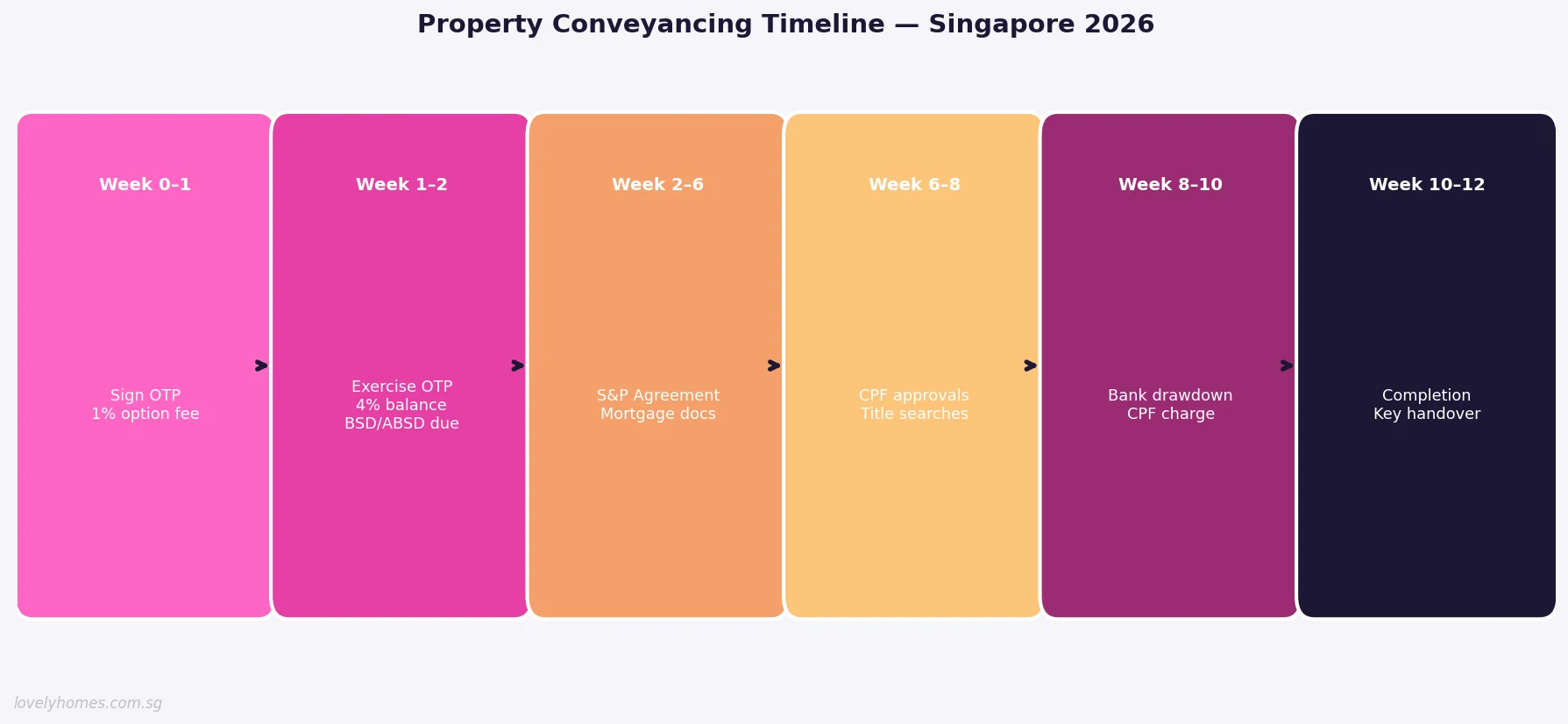
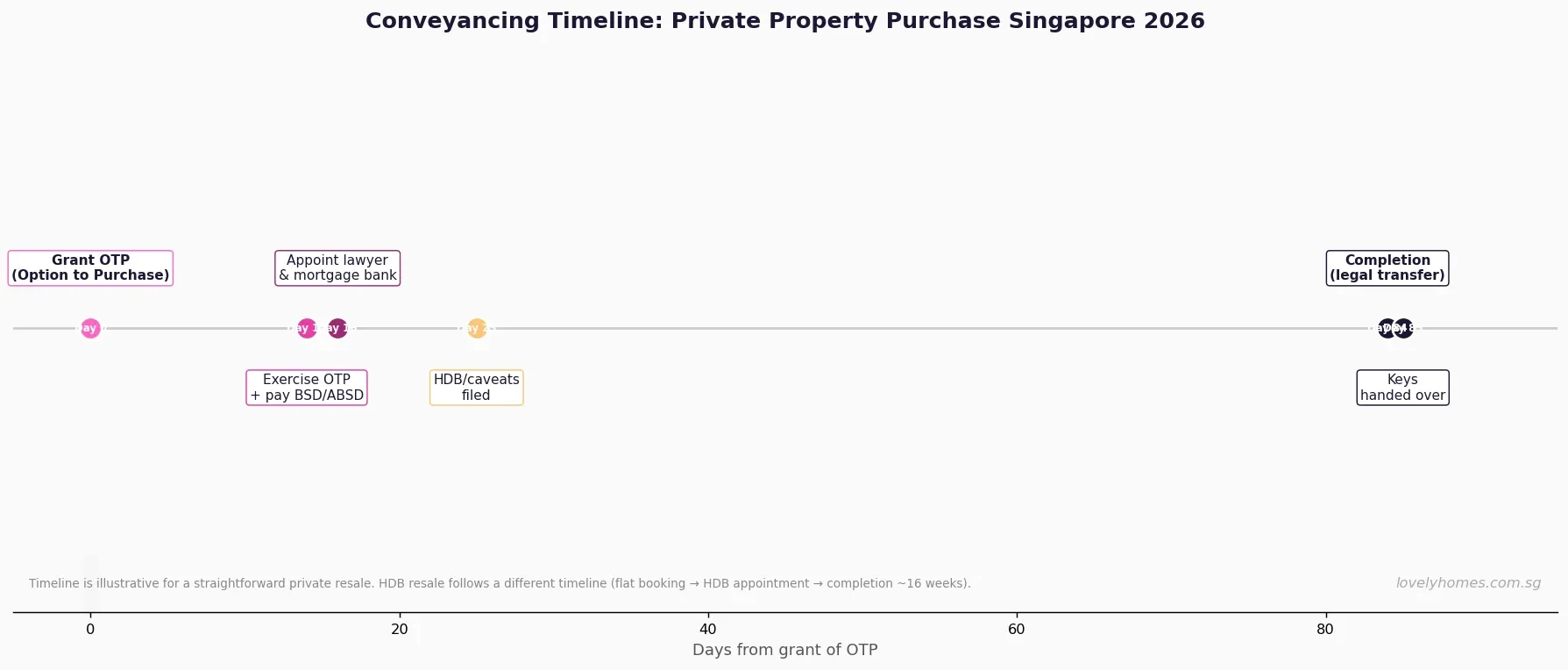
conveyancing timeline private property purchase Singapore 2026 OTP to completion
Figure 3: Illustrative conveyancing timeline for a private property purchase in Singapore (2026). Day 0 = grant of OTP. HDB resale follows a different timeline (approximately 16 weeks from flat booking to completion). Source: LovelyHomes research, SLA.

The timeline above reflects a standard, uncomplicated private resale transaction. Key milestones and deadlines:

  • Day 0 — OTP granted: The seller grants the buyer an Option to Purchase, typically with a 1% option fee. The buyer has 14 days (negotiable; commonly 14 days for private property) to exercise the OTP by paying the exercise fee (usually 4–9%, completing the 5–10% deposit).
  • Day 14 — OTP exercised and stamp duty due: BSD (and ABSD if applicable) must be paid to IRAS within 14 days of exercising the OTP, via e-Stamping or through your lawyer. BSD payment late by even one day attracts a 5–15% penalty.
  • Day 16 — Lawyer and bank formally appointed: Your lawyer receives the OTP, confirms instructions, and begins the legal due diligence — ordering title searches, government requisitions, and liaising with the seller’s solicitors to receive the draft SPA.
  • Day 25 — Caveat lodged: Your lawyer lodges a caveat on the property title with SLA, protecting your interest as buyer against any competing claims or encumbrances registered after this date.
  • Day 84 (approx.) — Legal completion: The seller’s lawyers hand over the property title documents; your lawyer simultaneously releases the purchase funds (mortgage drawdown + CPF withdrawal + cash) to the seller. The title is transferred.
  • Day 85 — Keys handed over: Typically the same day as legal completion or the following business day.

Worked Example: Total Legal Costs for Mr and Mrs Lee’s Condo Purchase

Property: 3-bedroom condominium in Buona Vista, purchase price S$1.9M. Singapore Citizens, first purchase — BSD applies, no ABSD. Bank loan of S$1.425M (75% LTV).

BSD calculation:

  • First S$180,000 × 1% = S$1,800
  • Next S$180,000 × 2% = S$3,600
  • Next S$640,000 × 3% = S$19,200
  • Remaining S$900,000 × 4% = S$36,000
  • BSD Total: S$60,600

Buyer’s legal costs (estimate):

  • Conveyancing professional fee: S$3,800 + 9% GST = S$4,142
  • Mortgage documentation fee (bank): S$1,800 + 9% GST = S$1,962
  • Disbursements (searches, caveat, requisitions, LPFF): S$980
  • Total buyer’s legal cost: S$7,084

Total upfront outlay by buyer:

  • Initial option fee (1%): S$19,000
  • Exercise fee (4%, completing 5% deposit): S$76,000
  • BSD: S$60,600
  • Legal fees + disbursements: S$7,084
  • Remaining cash portion at completion (25% – 5% deposit already paid): S$380,000 – S$95,000 = S$285,000 (if 25% down)
  • Total cash before completion: S$162,684 (option + BSD + legal)

Key insight: Legal fees account for approximately 4.4% of the total non-price transaction cost. BSD is the dominant cost at 37.3%. For planning purposes, budget at least S$165,000 in upfront costs (above the 5% deposit) for a S$1.9M purchase as a first-time SC buyer.

Practical Tips for Managing Conveyancing Costs

Get multiple quotes early. Contact two or three law firms before committing. Many reputable Singapore conveyancing firms provide free quotes via email or WhatsApp. The range across firms is usually S$400–S$800, which is worth shopping around for.

Use a panel firm for your mortgage bank. Banks maintain a panel of approved law firms for mortgage work. If your chosen conveyancing firm is also on your bank’s panel, the firm can act for both you and the bank in the same transaction, eliminating a duplicated engagement — saving S$1,500–S$3,000 in mortgage documentation fees. Ask your firm explicitly whether they are on your bank’s panel.

Understand what is included. When comparing quotes, check whether the stated fee includes disbursements or excludes them. A headline figure of S$1,800 that excludes all disbursements may end up costing more than a S$2,400 all-inclusive quote.

Keep records for rental income tax. If you are purchasing an investment property that you will rent out, your conveyancing fee is not itself deductible against rental income (it is capital expenditure). However, maintaining all records of your acquisition costs is important for computing any eventual capital gain or loss for income tax purposes if you sell (and for the base cost in any future en bloc or collective sale scenario).

Why Legal Costs Matter: Singapore vs Other Markets

Singapore’s conveyancing system is efficient and highly digitalised. The SLA’s integrated land registry means that title searches, caveats, and transfers are processed electronically and within days rather than weeks. Compared to the United Kingdom (where conveyancing often takes four to six months and legal fees on a comparable property can reach 0.5–1.0% of the purchase price), Singapore’s 8–12 week timeline and 0.15–0.25% legal fee benchmark represent a relatively streamlined and cost-effective system.

The most significant friction in Singapore’s property transaction costs remains stamp duty — BSD plus ABSD — which can amount to 5–40% of the purchase price depending on the buyer profile and property count. Legal fees are modest in comparison. For buyers focused on reducing transaction costs, understanding and minimising ABSD exposure (through careful timing, entity structure analysis, and buyer profile planning) yields far greater savings than shopping for the cheapest conveyancing quote.

What Might Change: Conveyancing Regulatory Outlook

This section is speculative. No major changes to the Singapore conveyancing framework are expected in 2026. The Ministry of Law has been examining ways to further digitalise the end-to-end property transaction process — including potential e-OTP frameworks and automated stamp duty computation — that could reduce reliance on solicitors for routine documentation in future years. However, the core requirement for a qualified Singapore solicitor to execute the transfer instrument and lodge with SLA is likely to remain in place for the foreseeable future. Any move toward a fully self-service model would require significant statutory amendment.

Summary: Conveyancing Fees at a Glance

Transaction Type Who Pays Legal Fee (est.) Disbursements (est.) Total (est.)
Private property purchase (S$1M–S$2M) Buyer S$2,600–S$4,200 + GST S$700–S$1,100 S$3,600–S$5,700
Private property purchase (S$2M–S$4M) Buyer S$3,800–S$6,500 + GST S$900–S$1,400 S$5,100–S$8,500
Private property sale Seller S$2,000–S$4,500 + GST S$600–S$900 S$2,800–S$5,800
HDB resale purchase (4-room, S$500k–S$650k) Buyer S$1,800–S$2,600 + GST S$400–S$700 S$2,400–S$3,500
HDB resale sale (4-room) Seller S$1,500–S$2,200 + GST S$350–S$600 S$1,985–S$3,000
Mortgage documentation (bank panel) Borrower S$800–S$2,500 + GST S$100–S$300 S$972–S$3,025

Frequently Asked Questions

Can I use one lawyer for both the buyer and the seller in the same transaction?

Generally, no. Under the Legal Profession (Professional Conduct) Rules, the same solicitor or firm cannot act for both buyer and seller in a property transaction, as the interests of the two parties are inherently conflicting. Each party must appoint their own lawyer. The exception applies to certain intra-family transfers or specific corporate restructurings — if in doubt, seek guidance from the Law Society of Singapore.

What happens if BSD or ABSD is paid late?

BSD and ABSD are due within 14 days of executing the Sale and Purchase Agreement (or exercising the OTP — whichever is the relevant instrument). If payment is late by up to three months, a 5% penalty surcharge applies on the outstanding stamp duty. For delays of three to six months, the penalty increases to 10%; beyond six months, 15%. In practice, your conveyancing lawyer will ensure stamp duty is paid on time — one of the core reasons why appointing a lawyer promptly after OTP exercise is important.

Do I need a separate lawyer for my mortgage, or can it be the same firm?

In most cases, the same law firm can handle both your conveyancing (title transfer) and the mortgage documentation for your bank — provided that firm is on your bank’s approved panel. This “acting for both” arrangement is standard practice in Singapore and reduces duplication. The mortgage documentation fee is a separate charge from the conveyancing fee, but using one firm is significantly cheaper than appointing two. Confirm with your chosen firm and your bank whether this arrangement is available for your specific loan product.

When should I appoint a conveyancing lawyer — before or after the OTP?

Ideally before, or at the very latest on the day the OTP is granted to you. Once you hold an OTP, you have a hard deadline (typically 14 days) to exercise it and pay BSD within another 14 days of exercise. If you appoint your lawyer only after exercising the OTP, you may lose time for the due diligence steps your lawyer needs to complete before recommending whether to proceed. For a first property purchase, most experienced buyers appoint a lawyer at the same time as they make their In-Principle Approval (IPA) application to the bank — months before finding a property.

What is a caveat, and why does my lawyer file one?

A caveat is a notice lodged on the land register with the Singapore Land Authority, alerting any third party who searches the title that you (the buyer) have an interest in the property. Once lodged, the caveat prevents the seller from transferring the property to anyone else, creating further encumbrances, or disposing of the property without your knowledge. The caveat costs S$64.45 to lodge and is typically filed within days of the SPA being signed. Your lawyer lodges it on your behalf as a standard step in every transaction.

Are conveyancing fees negotiable?

Yes, within limits. Since the prescribed scale was removed in 2009, law firms set their own fees. For straightforward transactions, fees are fairly competitive across firms and there is limited room to negotiate a significantly lower price without risking service quality. However, if you are transacting in multiple properties simultaneously (e.g., selling one and buying another), or if you are a repeat client of the firm, it is entirely reasonable to ask for a bundle discount. Always compare fee quotes from at least two firms before deciding.

What is the difference between the OTP and the Sale and Purchase Agreement (SPA)?

The Option to Purchase (OTP) is a short document — typically one to two pages — granted by the seller to the buyer for a consideration (the option fee, usually 1%). The OTP gives the buyer the exclusive right to purchase the property at an agreed price within the option period. The Sale and Purchase Agreement (SPA) is the full, binding contract that comes into force when the buyer exercises the OTP. For private properties, the SPA is a detailed document (often 20–50 pages) prepared by the seller’s solicitors and reviewed by the buyer’s solicitors. For HDB resale, a standard HDB Resale Agreement is used. Your conveyancing lawyer’s role includes reviewing both the OTP (before exercise) and the SPA (before and after execution).

Related Articles

Disclaimer

This article is for general informational purposes only and does not constitute legal, tax, or financial advice. Fee estimates are based on market research as at May 2026 and will vary by law firm, transaction complexity, and individual circumstances. Always obtain a formal written fee quote from a qualified Singapore solicitor before instructing them. For official guidance on stamp duties, consult the Inland Revenue Authority of Singapore (IRAS). For land registration and title matters, refer to the Singapore Land Authority (SLA). For lawyer referrals or complaints, contact the Law Society of Singapore.

Translate »