HDB Minimum Occupation Period (MOP) Singapore 2026: Complete Guide

HDB Minimum Occupation Period (MOP) Singapore 2026: Complete Guide

📌 Quick Answer: HDB Minimum Occupation Period (MOP) 2026

  • The MOP is the mandatory period you must live in your HDB flat before you are allowed to sell it on the open market or buy a private residential property.
  • Standard BTO and resale flats carry a 5-year MOP, counted from the date you collect your keys (for BTO) or the date the resale transaction is completed.
  • Prime Location Housing (PLH) flats — introduced in October 2021 — carry a 10-year MOP and come with a permanent ban on renting out the whole flat.
  • During MOP you cannot sell the flat on the open market, rent out the entire flat, or purchase a private residential property without first disposing of the HDB flat.
  • Renting out individual rooms is permitted during MOP with HDB’s approval, provided occupancy caps are met.
  • Executive Condominiums (ECs) have a 5-year MOP under HDB rules; they become fully privatised at the 10-year mark.
  • Violation consequences include compulsory acquisition at below-market value, grant clawback, and debarment from future HDB applications.
  • The MOP applies to the flat, not the owner: any attempt to sell before expiry is void and attracts penalties.

What Is the HDB Minimum Occupation Period (MOP)?

The Minimum Occupation Period — universally known as MOP in Singapore property circles — is a Housing & Development Board (HDB) policy requiring flat owners to physically occupy their flat for a stipulated number of years before they are permitted to sell, rent the entire unit, or purchase a private residential property. The MOP is administered under the Housing and Development Act and is one of the most consequential rules shaping the Singapore HDB resale market.

HDB introduced the MOP to prevent speculative “flipping” of subsidised public housing. Because the government provides substantial grants and subsidies when selling BTO flats, it wants genuine owner-occupiers to benefit from those subsidies rather than investors who might resell immediately for a quick profit. The MOP therefore acts as a temporal lock-in that aligns the interests of flat buyers with the public-housing mission of HDB.

The standard MOP has stood at five years since 2010. However, the introduction of the Prime Location Housing (PLH) model in October 2021 created a new, more restrictive 10-year MOP for BTO projects in central and highly sought-after locations. Understanding which MOP category applies to your flat — and what you are and are not permitted to do during that period — is critical before making any property decision.
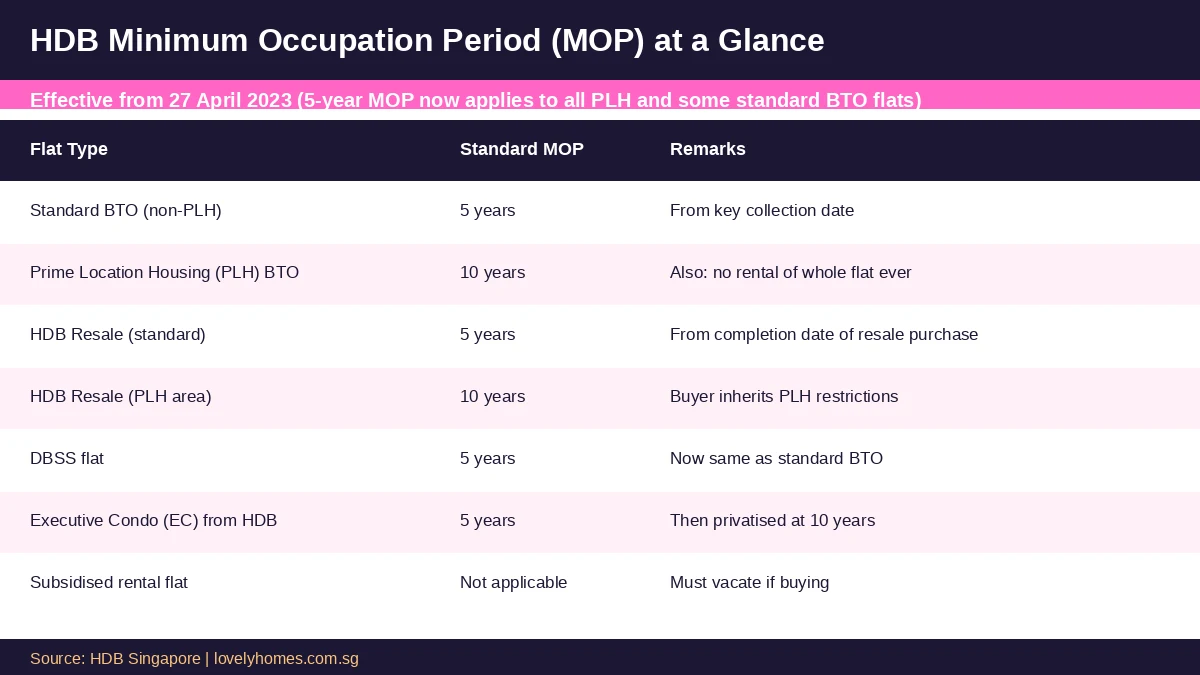
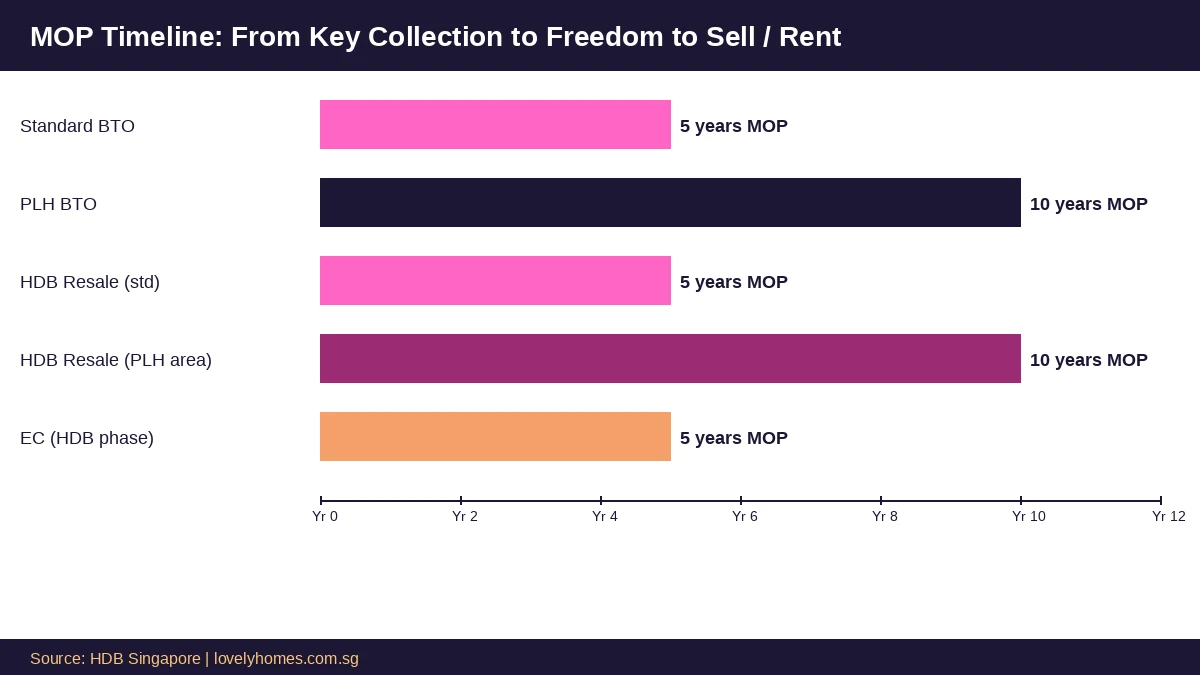
HDB MOP summary table Singapore 2026 standard BTO PLH resale EC
Figure 1: HDB Minimum Occupation Period at a Glance — standard BTO, PLH BTO, resale, and EC rules. Source: HDB Singapore.

How Is the MOP Counted?

The MOP clock starts differently depending on how you acquired the flat. For a BTO flat, the MOP begins on the date of key collection, which HDB formally records. If you collect your keys on 15 January 2022, your 5-year MOP expires on 15 January 2027. For a resale HDB flat, the MOP begins on the date the resale transaction is legally completed — that is, the date shown on the HDB resale completion letter, typically 8–12 weeks after HDB accepts the resale application. DBSS flats follow the same rule as resale. For an EC bought from an HDB-appointed developer, the MOP starts from the date of vacant possession (VP) and lasts five years, after which the EC becomes partially privatised and fully private at the 10-year mark.

Importantly, the MOP measures calendar time, not duration of active occupation. Even if you are posted overseas for work and your flat sits empty for part of the period, the clock does not pause. You must also maintain the flat as your sole registered address in Singapore during the MOP; abandoning the flat to stay elsewhere while the clock runs is a violation that HDB actively monitors through its inspection programme.

MOP by Flat Type — 2026 Reference Table

Flat Type MOP Duration Whole-flat Rental After MOP? Key Rule
Standard BTO (non-PLH) 5 years from key collection Yes, with HDB approval Flat must be primary residence during MOP
Prime Location Housing (PLH) BTO 10 years from key collection No — permanently prohibited Introduced Oct 2021; applies to centrally located BTO projects
HDB Resale (standard area) 5 years from completion Yes, with HDB approval Buyer’s MOP starts from resale completion date
HDB Resale (PLH-designated area) 10 years from completion No — permanently prohibited PLH restriction travels with the address, not the seller
DBSS flat 5 years Yes, with HDB approval Treated the same as standard BTO for MOP purposes
Executive Condo (EC) 5 years (HDB rules apply) Yes, after MOP + HDB approval Fully private at 10 years; no HDB restrictions thereafter

HDB MOP timeline chart 5-year 10-year standard PLH BTO Singapore 2026
Figure 2: MOP Timeline by Flat Type — visual comparison of 5-year versus 10-year lock-in periods. Source: HDB Singapore.

What Can You Do During the MOP?

Many flat owners are surprised to discover that the MOP is not a blanket prohibition on all activity — it targets sale and whole-flat rental specifically. Renting out spare bedrooms is permitted: HDB allows flat owners to sublet individual rooms, subject to occupancy caps and prior HDB approval via the resale portal. The total number of occupants including owners must not exceed the flat’s authorised occupancy limit — six persons for a 3-room flat, eight for larger flats as of 2026. Running a small home-based business under HDB’s Home-Based Small Scale Business guidelines is also permitted and does not affect the MOP. Internal renovations are allowed subject to HDB’s renovation guidelines and town council rules.

What is prohibited is more significant. You cannot sell the flat on the open market — any purported contract of sale during MOP is void. You cannot rent out the entire flat for standard flats during MOP, and for PLH flats this prohibition is permanent. You cannot purchase a private residential property in Singapore while an HDB flat is under MOP; if you do, HDB will require you to dispose of the HDB flat within six months and may impose financial penalties. Voluntary ownership transfers to family members are generally not permitted during MOP without HDB’s prior approval, which is granted only in specific circumstances such as divorce, death, or financial hardship.
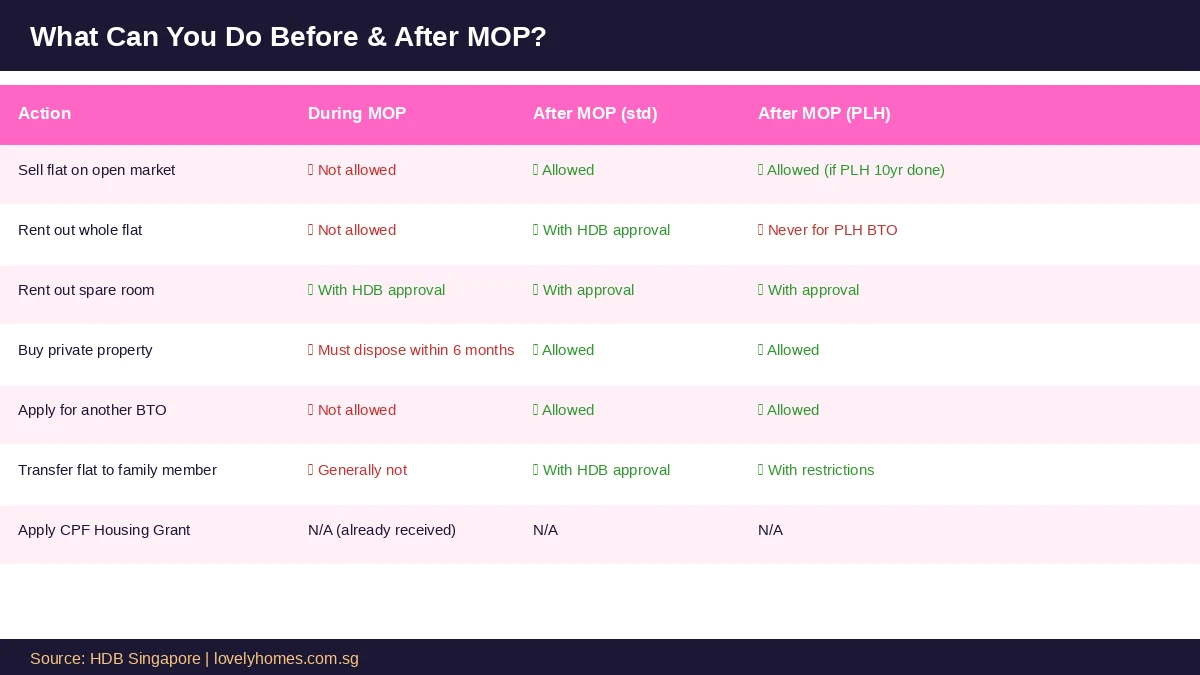
HDB MOP before and after comparison matrix Singapore 2026
Figure 3: Before vs. After MOP — permitted and prohibited actions by flat type. Source: HDB Singapore.

Worked Example: The Lim Family’s MOP Journey

👥 Scenario: Lim Family, 4-Room BTO in Tampines

Key collection date: 15 March 2021

MOP expiry date: 15 March 2026 (5-year standard MOP)

Goal in early 2026: Sell the flat and upgrade to a private condo.

  • From 15 March 2026, the Lims are free to list the flat on the open market via the HDB resale portal.
  • They may simultaneously exercise an OTP (Option to Purchase) on a private condo. If they buy the condo before completing the HDB sale, a 6-month disposal window applies.
  • Had they bought the condo in January 2026 — before MOP expiry — HDB would have required them to sell the flat within 6 months and could have imposed a financial penalty.
  • CPF Family Grant: Received at BTO purchase; not subject to clawback on MOP completion. A Resale Levy of S$50,000 applies if they later purchase another subsidised flat.
  • They had also rented out two spare bedrooms since October 2022 (with HDB approval), earning approximately S$1,800 per month — a permitted activity during MOP.

The PLH Model and the 10-Year MOP

The Prime Location Housing (PLH) model was launched by HDB in October 2021 to address public concern that prime-location BTO flats — particularly in districts such as Rochor and the Central Area — were underpriced relative to private property. The two key additional restrictions of the PLH model are the 10-year MOP and the permanent ban on renting out the whole flat.

For buyers of PLH BTO flats, this means the flat cannot be sold until 10 full years from key collection. Even after those 10 years, the whole-flat rental prohibition is perpetual — it is address-based and permanent, running with the flat and not the owner. A resale buyer who purchases a PLH-designated flat on the open market inherits the same restriction; there is no way to clear it by buying second-hand. Individual rooms may still be sublet with HDB approval.

The Ministry of National Development (MND) has indicated that the PLH model will be applied selectively. Research from industry analysts suggests that PLH resale transactions — when they eventually enter the market after 2031 for the earliest PLH BTO projects — may be priced at a discount to non-PLH flats of equivalent size and location, precisely because of the rental prohibition narrowing the buyer pool.

Consequences of Violating the MOP

Violation HDB Action Additional Consequence
Selling flat before MOP expires Void transaction; possible compulsory acquisition at below-market value Debarment from future HDB flat purchases for up to 5 years
Renting out whole flat during MOP Fine of S$3,000–S$5,000; instruction to terminate tenancy immediately Repeat offence may result in compulsory acquisition
Buying private property during MOP without disposing of HDB flat 6-month disposal notice issued by HDB Financial penalty; potential stamp duty complications
Giving false occupation declaration Civil and/or criminal prosecution under the Housing and Development Act Fines up to S$5,000 or imprisonment up to 6 months

What Happens After the MOP?

Once your MOP expires, you gain substantially greater freedom. You may list the flat for sale via the HDB resale portal; the price is negotiated freely between buyer and seller with no government-set ceiling. Standard flat owners may apply to HDB for permission to sublet the entire unit, typically approved for 6–36 months under the Fair Tenancy Framework. You may also purchase a private property concurrently with your HDB flat — note that Additional Buyer’s Stamp Duty at 20% applies to Singapore Citizens buying a second residential property. Married couples may also explore decoupling one partner’s name off the HDB flat to facilitate a private property purchase by the other partner at a lower ABSD rate, subject to eligibility.

What the MOP Means for Singapore’s Property Market

The MOP is one of the most effective supply-management tools in Singapore’s housing policy toolkit. By locking new BTO supply out of the resale market for five years, HDB ensures that subsidised flat sales benefit genuine first-time owner-occupiers rather than investors arbitraging the gap between discounted BTO prices and open-market resale values. The MOP also creates a predictable “event horizon” in the resale market: estates where BTO keys were collected in large numbers five years ago tend to see a surge of resale supply as those MOP clocks expire. Estates where keys were collected in 2020 and 2021 — including Tengah, Tampines North, and Canberra — will see their 5-year MOPs rolling off through 2025 and 2026, contributing to resale supply in those towns. Buyers looking for competitively priced resale flats would do well to track upcoming MOP expiry clusters using HDB’s transaction data on the HDB website and URA transaction records.

🔮 Looking Ahead: Will the MOP Change?

The 5-year standard MOP has remained stable since 2010, and the government has consistently defended it as appropriately calibrated. The 10-year PLH MOP is newer (effective from 2021) and will only be stress-tested when the first PLH BTO projects complete their wait and owners begin to sell from 2031 onwards. Should PLH resale prices still show large profits despite the longer lock-in, policymakers may consider extending the PLH MOP further or broadening the PLH classification. Conversely, if PLH proves to dampen demand and leads to undersubscribed BTO launches in prime locations, the criteria may be moderated. These are speculative projections — official policy remains as described above.

Frequently Asked Questions

Can I buy a private property while my HDB flat is under MOP?

No. Purchasing a private residential property in Singapore while your HDB flat is under MOP is prohibited. If you exercise an OTP on a private property before your MOP expires, HDB will issue a notice requiring you to dispose of the HDB flat within six months. Failure to comply can result in financial penalties and debarment from future HDB applications. The practical approach is to wait for the MOP to expire, then purchase the private property. You may co-own both thereafter, though the second-property ABSD of 20% (for Singapore Citizens) will apply to the private purchase.

Does the MOP restart if I add a family member to my flat?

No. Adding an authorised occupier or essential occupier to your flat does not reset the MOP clock. The MOP runs from your original key collection date (for BTO) or resale completion date and continues uninterrupted regardless of changes in the list of occupants. If you are seeking to transfer ownership — for example, adding a spouse as co-owner — HDB’s approval is required and may be subject to conditions, but an approved ownership change does not affect the MOP count.

Can I rent out my whole flat after MOP if it is a PLH flat?

No. The prohibition on renting out the entire flat is a permanent condition attached to all Prime Location Housing designated flats. It applies regardless of whether the flat has completed the 10-year MOP. Once a flat is designated PLH — determined by the BTO project it belongs to or, for resale flats, by the address being in a PLH-designated estate — the whole-flat rental ban is perpetual. You may still rent out individual rooms with HDB’s prior approval, subject to occupancy cap rules. If rental income is important to your long-term plan, verify whether any flat you are considering carries PLH status before committing.

What happens to my CPF housing grant if I sell before MOP?

Selling your HDB flat before the MOP expires is prohibited and any purported sale is void. Were HDB to compulsorily acquire the flat due to a MOP violation, CPF housing grants received would be subject to clawback — amounts deducted from the proceeds, returned to your CPF Ordinary Account, and you would face an additional financial penalty. Beyond the clawback, you would be debarred from purchasing an HDB flat or EC for up to five years. Attempting to circumvent the MOP is both illegal and financially destructive.

Can I sell my flat on the very day my MOP expires?

Yes. On the expiry date, you may submit a resale application via the HDB resale portal. In practice, most owners arrange a buyer in advance through private negotiation and grant the OTP a few days before the MOP date, with the actual HDB resale application submitted on or after the expiry date. Check with your conveyancing solicitor on precise timing — HDB’s position is that the resale application must be submitted after the MOP, though the OTP can be arranged a few days ahead.

How does the MOP interact with divorce proceedings?

If a couple holding an HDB flat divorces during the MOP, the Family Justice Courts of Singapore may make orders relating to the flat — including ordering a sale or transfer to one party — notwithstanding the MOP. HDB has an established process for court-ordered transfers that may occur before MOP expiry, handled case-by-case and requiring a court order before HDB will process the transfer. HDB does not automatically waive the MOP on divorce, but a court’s order can effectively override HDB’s normal MOP restriction for the purpose of the divorce settlement. Legal advice from a family law solicitor is strongly recommended.

What is the MOP for an EC bought on the resale market?

If you buy an EC on the resale market (i.e., after it has been privatised), there is no HDB MOP applicable to you as the buyer — the EC is already a private property. HDB rules only apply during the first 10 years of an EC’s life from the date of TOP (Temporary Occupation Permit). If you buy an EC that is, say, 12 years old on the resale market, you are buying a fully private condominium and the transaction is governed by standard private property rules, including ABSD if applicable.

Related Articles

Disclaimer: This article is for general informational purposes only and does not constitute legal, financial, or professional advice. HDB rules and policies are subject to change; always verify current requirements directly with the Housing & Development Board, the Inland Revenue Authority of Singapore, or your legal and financial advisers before making any property decision. LovelyHomes does not accept responsibility for reliance on information in this article.
Singapore HDB BTO Application Guide 2026: Eligibility, HFE Letter, Balloting and Key Collection Explained

Singapore HDB BTO Application Guide 2026: Eligibility, HFE Letter, Balloting and Key Collection Explained

📌 Quick Answer: HDB BTO Application 2026

  • BTO (Build-To-Order) flats are HDB flats built after a sales application — you apply first, HDB builds to the number of units needed, so there is no speculative inventory.
  • Eligibility essentials: at least one Singapore Citizen applicant, combined household income at or below the flat-type ceiling (S$7,000–S$14,000), and no private property ownership in the 30 months before application.
  • The HDB Flat Eligibility (HFE) Letter is now mandatory before you can submit a BTO application — obtain it through the MyHDBPage portal with Singpass; it takes about 2–3 weeks.
  • BTO exercises are held roughly 4–5 times per year; each exercise lists flats in multiple towns, with application windows typically 5–7 days.
  • A successful ballot means you are invited to select a flat during a flat selection appointment; unsuccessful applicants join the queue for subsequent exercises.
  • Completion times range from 3 to 4.5 years after booking, depending on the project and site conditions.
  • Standard Minimum Occupation Period (MOP) is 5 years from the date of key collection. Plus and Prime model flats carry a 10-year MOP and resale restrictions.
  • Grants available: Enhanced CPF Housing Grant (EHG) up to S$120,000 for families, S$60,000 for singles; Proximity Housing Grant (PHG) up to S$30,000 for buying near parents.

What Is an HDB BTO Flat and How Does It Work?

The Build-To-Order (BTO) scheme is the Housing & Development Board’s primary mechanism for supplying new public housing to eligible Singapore households. Unlike resale flats — which are purchased from existing owners on the open market — BTO flats are sold directly by HDB at subsidised prices before construction begins. HDB only proceeds with a project once sufficient applications have been received, hence the “build to order” terminology. This demand-led model keeps supply aligned with actual household formation needs and limits speculative overbuilding.

BTO flats come in a range of types from 2-Room Flexi (35–47 sqm) through to 5-Room (110–113 sqm) and the 3-Generation (3Gen) layout designed for multi-generational households. Prices are subsidised relative to private market equivalents; a 4-room BTO flat in a non-mature estate typically prices at S$350,000–S$520,000, compared to resale equivalents at S$490,000–S$720,000 in the same area. The subsidy is funded by HDB and supported through a system of CPF Housing Grants that further reduce the effective purchase price for eligible households.

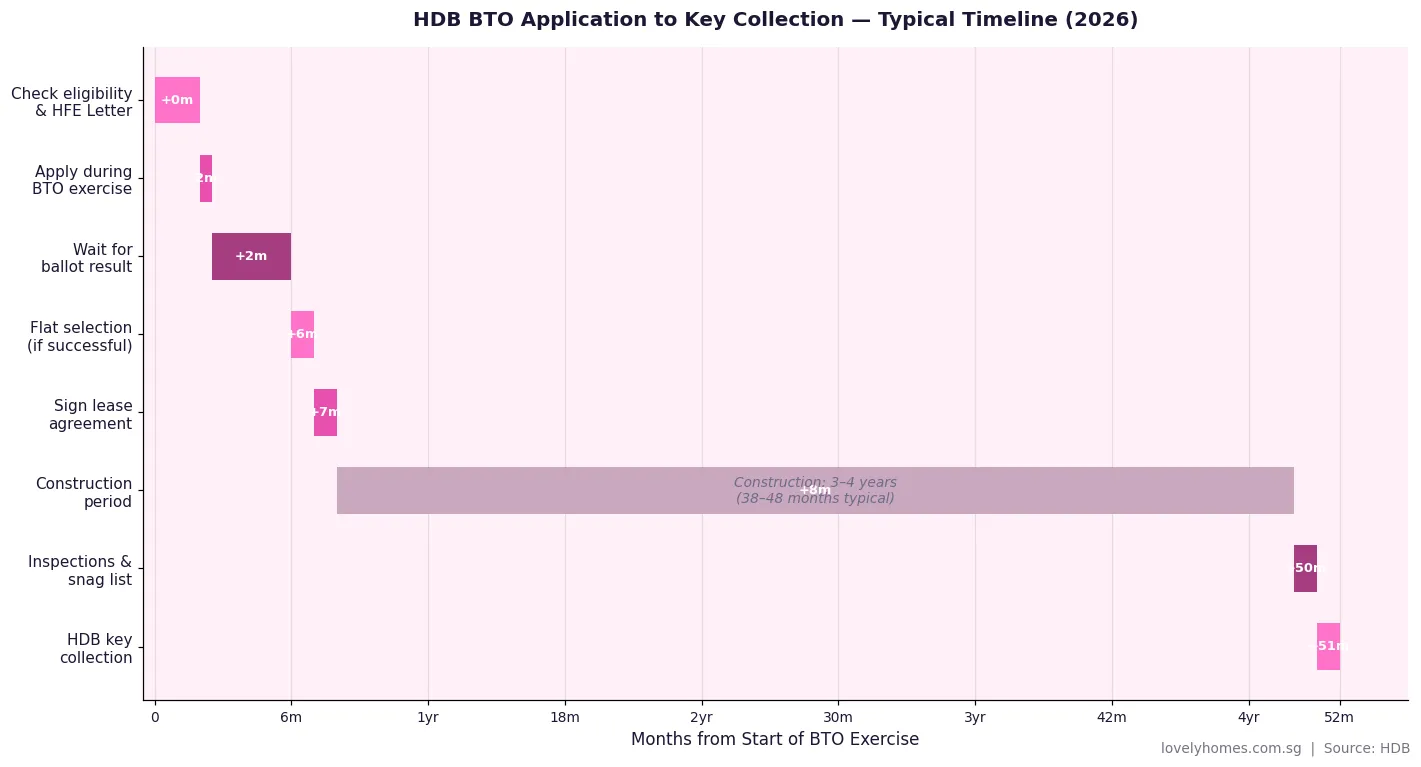
The BTO process involves several distinct stages — eligibility checking, HFE letter application, ballot application, flat selection, signing of the lease, a construction wait of three to four-and-a-half years, and finally key collection and move-in. This guide walks through each stage in detail with the 2026-current rules, timelines, and the specific grant amounts that apply this year.

HDB BTO application to key collection timeline Singapore 2026
Figure 1: Typical HDB BTO Journey — From Eligibility Check to Key Collection (2026). Construction phase is 38–48 months for most projects. Source: HDB.

BTO Eligibility: Who Can Apply?

HDB BTO flats are available only to Singapore Citizens and, under certain schemes, Singapore Permanent Residents (PRs). The eligibility framework as at June 2026 is set out below.

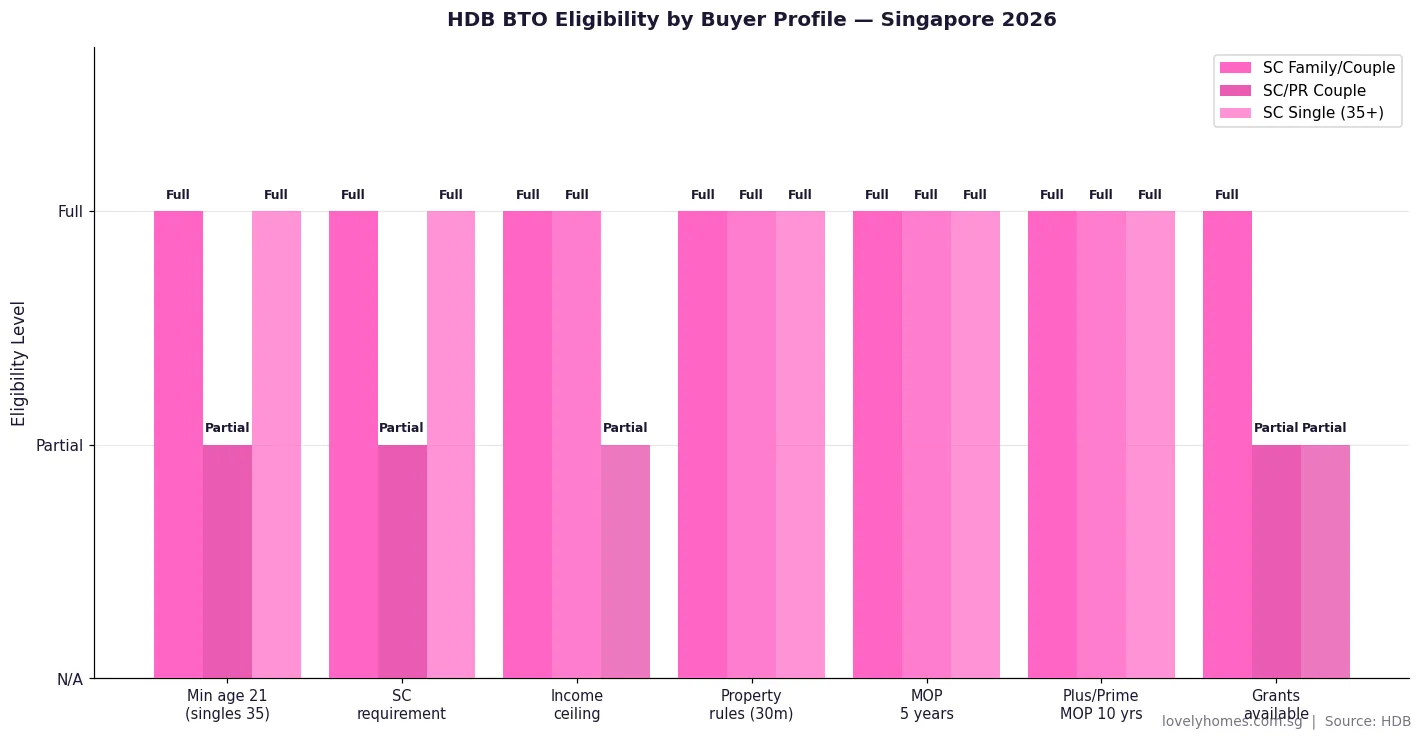
Eligibility Criterion SC Family / Couple SC/PR Couple SC Single (35+)
Minimum age 21 years (main applicant) 21 years (SC applicant) 35 years
SC requirement At least 1 SC applicant SC + PR (PR must be spouse) Must be SC
Income ceiling (4-Room) S$10,000/mth combined S$10,000/mth combined S$7,000/mth
Income ceiling (5-Room / 3Gen) S$14,000/mth combined S$14,000/mth combined Not eligible for 5-Room
Private property rule No private property 30 mths before & at application Same Same
Flat types eligible All types All types 2-Room Flexi only
EHG grant available Up to S$120,000 Up to S$120,000 (if SC component) Up to S$60,000

Foreigners who are neither SC nor PR cannot apply for BTO flats under any scheme. PRs who are single also cannot apply. Under the SC/PR scheme, the PR must be the applicant’s spouse and must obtain SC status within a specified period after key collection or face resale restrictions. Additionally, applicants must not own or have disposed of any flat in a manner that disqualifies them under HDB’s ownership rules — for example, those who have previously received a HDB housing subsidy are not eligible for a second subsidised flat unless they meet specific criteria such as the Married Child Priority Scheme (MCPS) rules.

The HDB Flat Eligibility (HFE) Letter: Step One

Since May 2023, prospective BTO buyers must obtain a HDB Flat Eligibility (HFE) Letter before applying for a BTO flat. The HFE Letter replaced the old Housing Loan Eligibility (HLE) letter and the flat eligibility check — it combines both into a single document that confirms: (a) which flat types you are eligible to purchase; (b) the maximum HDB concessionary loan amount; and (c) the CPF Housing Grants you qualify for.

To apply for an HFE Letter, log in at hdb.gov.sg using Singpass. You will need to provide income documents (CPF contribution history is auto-retrieved), particulars of all household members, and details of any existing properties. HDB typically issues the HFE Letter within 21 business days. The letter is valid for 6 months; apply for it approximately one month before the BTO exercise opens to ensure it is ready in time.

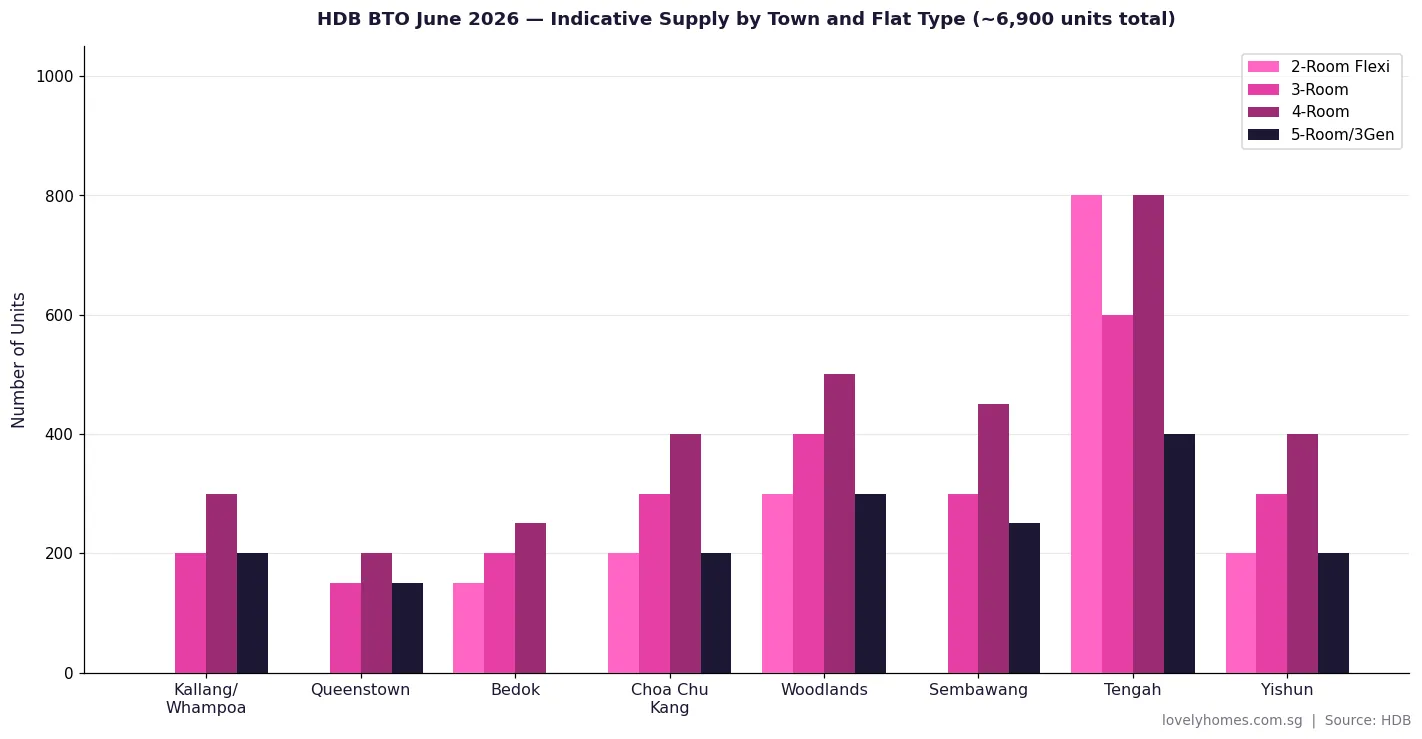
HDB BTO June 2026 supply by town and flat type
Figure 2: HDB BTO June 2026 — Indicative Unit Supply by Town and Flat Type (approximately 6,900 units across 8 towns). Source: HDB (figures indicative based on announced supply).

Applying for a BTO Flat: The Exercise and Ballot

HDB launches BTO exercises approximately 4–5 times per year, typically in February, May, August, and November (with occasional additional exercises). Each exercise lists projects in multiple towns. The application window is usually 5–7 days, during which eligible applicants may submit one application per exercise via the HDB website or at an HDB Branch.

Key rules during application: applicants may apply for only one flat type in one town per exercise. An application requires a non-refundable application fee of S$10. Successful applicants in the 2-Room Flexi Ballot who do not eventually select a flat will have the S$10 refunded. Households with more children receive priority queue positions under the Parenthood Priority Scheme (PPS), and first-timers receive ballot priority over second-timers.

After the application window closes, HDB computer-ballots all applicants. Results are released approximately 3 weeks later. Successful applicants receive a ballot queue number and a flat selection appointment within approximately 3–6 months. If the ballot number is not reached (all flats selected before your turn), the applicant is treated as unsuccessful and is given an additional ballot chance (2nd timer status not triggered — first-timer status preserved for a stated number of unsuccessful attempts).

First-Timer Priority and Queue Balloting

HDB’s priority allocation system is designed to give first-time buyers and families with young children a better chance of success. In a standard BTO exercise, approximately 85–90% of flat supply is set aside for first-timers (those who have never owned or received a housing subsidy before). The remaining 10–15% is allocated to second-timers. Within the first-timer pool, the Parenthood Priority Scheme (PPS) reserves a further 30% of supply for families with Singaporean children aged 18 or below.

After three or more unsuccessful ballots, first-timer applicants (with children) may apply under the Additional Ballots Scheme, which gives them a higher chance. HDB has progressively expanded priority rules — from 2024, those who have collected a BTO flat and are applying again (e.g., for a larger flat after having more children) are classified as second-timers and face a smaller allocation pool.

HDB BTO eligibility by buyer profile Singapore 2026
Figure 3: HDB BTO Eligibility Assessment by Buyer Profile (2026). “Full” = fully eligible; “Partial” = eligible with conditions or restrictions. Source: HDB.

Flat Selection, Booking and Signing the Lease

Upon receiving a flat selection appointment, applicants visit an HDB Branch (or select online via the portal in more recent exercises) and choose their preferred unit from the remaining available options. At selection, a booking fee is payable: S$2,000 for 2-Room Flexi, S$4,000 for 3-Room, S$8,000 for 4-Room and 5-Room/3Gen (as at 2026; fees are reviewed periodically). The booking fee is non-refundable if you subsequently withdraw from the purchase.

After booking, HDB typically schedules the signing of the Agreement for Lease (Lease Agreement) within 4–6 months. At this appointment, applicants pay the down payment and stamp fees. For those taking an HDB concessionary loan, the down payment is 10% of the flat price (payable via CPF OA or cash); for those using a bank loan, the down payment is 25% (with 5% minimum in cash). Buyer’s Stamp Duty (BSD) is also payable at this stage. After signing, construction proceeds and buyers await key collection.

CPF Housing Grants for BTO Buyers (2026)

BTO buyers may be eligible for significant grant support that directly reduces the effective purchase price. As at June 2026, the key grants are:

  • Enhanced CPF Housing Grant (EHG): Up to S$120,000 for families (income ≤ S$9,000/mth average over 12 months before application) and up to S$60,000 for singles. The EHG is income-tiered — a family earning S$2,000/mth receives the full S$120,000; at S$9,000/mth, the grant is S$5,000. Effective from 20 August 2024.
  • CPF Housing Grant — Families (Family Grant): An additional S$10,000–S$30,000 for eligible first-timer families purchasing 4-Room or smaller BTO flats, depending on flat type and town classification.
  • Step-Up CPF Housing Grant: S$15,000 for second-timer SC families moving from a 2-Room to a 3-Room BTO flat.
  • Proximity Housing Grant (PHG): S$30,000 for buying within 4 km of parents’ or child’s home; S$20,000 for buying in the same town. Available for resale HDB purchases — not BTO directly, but may apply on the eventual resale.

Grants are disbursed as CPF credits into the recipient’s OA account, reducing the cash required at booking and lease signing. They do not reduce the outstanding loan; rather, they offset the cash/CPF down payment needed.

📌 Worked Example: Mr & Mrs Goh — First-Timer BTO Application, Tampines 4-Room

Mr Goh (SC, age 29) and Mrs Goh (SC, age 27) are first-timer applicants. Combined household income: S$7,200/mth (based on 12-month CPF contribution average). One child aged 2. They apply for a 4-room BTO flat in Tampines during the June 2026 BTO exercise, priced at S$478,000.

  • HFE Letter: Applied 30 days before exercise opens; issued in 16 business days. Confirms eligibility for 4-Room, HDB loan S$382,400 (80% LTV), EHG S$50,000 (income S$7,200 tier).
  • Ballot result: Successful; queue number 38 out of 220 applicants for 240 available units. Flat selection appointment in Month 4.
  • Flat price: S$478,000. Grants: EHG S$50,000 → effective price S$428,000.
  • Booking fee: S$8,000 (cash or NETS).
  • BSD: (1% × S$180,000) + (2% × S$180,000) + (3% × S$118,000) = S$1,800 + S$3,600 + S$3,540 = S$8,940 on S$478,000.
  • HDB Loan: S$382,400 at 2.6% p.a. over 25 years → monthly instalment S$1,731. MSR: S$1,731 ÷ S$7,200 = 24.0% ✓ (below 30% MSR limit).
  • Total upfront cash outlay at lease signing: Booking fee S$8,000 + down payment (10% S$47,800 less EHG S$50,000 already in CPF OA) → effectively S$5,800 cash + S$8,940 BSD (payable by CPF OA) = approximately S$14,740 in cash/CPF.
  • Key collection: Estimated 3 years 8 months from booking, approximately Q2 2030. MOP: 5 years from key collection date (standard flat).

Plus and Prime BTO Flats: Stricter Rules for Better Locations

From 2024, HDB restructured the BTO flat classification. “Standard” flats (in non-mature, non-central estates) carry the familiar 5-year MOP and standard resale/rental rules. “Plus” flats — in choicer locations such as Kallang/Whampoa, Queenstown fringe, and new towns with strong transport links — carry a 10-year MOP and cannot be rented out for the first 10 years. “Prime” flats — in the most central, highest-demand locations near the CBD and in mature estates — carry a 10-year MOP, are subject to a subsidy clawback on first resale (buyers must return a portion of their capital gain to HDB), and have additional resale restrictions to ensure the flats remain affordable for future first-timers. If you are considering a Plus or Prime flat, factor the longer holding period and clawback into your financial planning.

Why the BTO Route Matters for Most Singapore Families

For first-timer Singapore Citizens, the BTO route remains the most financially sound path to home ownership. The built-in subsidy can be S$100,000 or more relative to resale market prices in the same estate, and when layered with the EHG and other grants, the effective discount for a median-income family can approach S$200,000 over the life of ownership. The trade-off is the waiting period — typically three to four-and-a-half years from booking to key collection — which requires careful planning if you are currently renting or living with parents.

The Plus and Prime restructuring reflects HDB’s continuing effort to balance locational desirability with long-term affordability. By imposing longer MOPs and clawbacks on high-demand locations, HDB aims to prevent BTO flats from functioning as pure financial instruments for short-term gain, keeping them as genuine homes for resident families. For buyers who prize flexibility and liquidity, the standard resale market or an Executive Condominium (EC) may be more appropriate despite the higher entry cost.

📊 Upcoming BTO Exercises and Policy Signals (2026–2027)

This section reflects publicly available information and should not be treated as investment advice.

HDB has announced approximately 6,900 BTO units for the June 2026 exercise across Kallang/Whampoa, Queenstown, Bedok, Choa Chu Kang, Woodlands, Sembawang, Tengah, and Yishun. The next exercise is expected in August or September 2026, with further supply planned for Tengah (which is receiving the largest allocation as the new town builds up) and potentially a new site in the Jurong Lake District area. HDB’s annual BTO supply target for 2024–2025 was 19,000–20,000 units; this pipeline is expected to continue through 2027 to address the demand backlog from the COVID-era construction delays. Buyers who are unsuccessful in the June 2026 exercise should track MyNiceHome and the HDB press releases portal for the August–September launch announcement.

Frequently Asked Questions: HDB BTO Application 2026

How long does it take to get a BTO flat from application to key collection?

The total journey from submitting a BTO application to receiving your keys typically spans four to five years. Allow 2–3 weeks to obtain the HFE Letter, then 5–7 days for the application window. Ballot results are released in approximately 3 weeks; flat selection appointments are scheduled 3–6 months after that. Construction takes 38–48 months (roughly 3–4 years) from project launch. So the full door-to-door period is approximately 44–54 months, or about 4 years from application date. Some projects in non-mature estates have been delivered in under 40 months; complex urban-infill sites have taken longer. HDB publishes an estimated completion date for each project at the time of launch, which is the most reliable reference for your specific project.

Can Singapore Permanent Residents (PRs) apply for a BTO flat?

PRs can apply for a BTO flat only under the SC/PR scheme — that is, when they are applying jointly with a Singapore Citizen spouse. A PR cannot apply for a BTO flat on their own, nor can two PRs apply together. Under the SC/PR scheme, the PR must subsequently obtain Singapore Citizenship within a specified period after key collection (HDB’s latest requirement is that the PR spouse applies for citizenship if they have not done so within a reasonable time). PR singles and unmarried PR couples are not eligible for BTO. PRs who are single or not applying with an SC spouse should consider the HDB resale market under the HDB resale rules for PRs, which permit PR family/couple applications for resale flats.

What is the income ceiling for BTO flats in 2026?

The income ceiling depends on the flat type. For 2-Room Flexi and 3-Room BTO flats, the ceiling is S$7,000 per month gross household income. For 4-Room flats, the ceiling is S$10,000 per month. For 5-Room and 3-Generation (3Gen) flats, the ceiling is S$14,000 per month. Income is assessed based on the average gross monthly income over the 12 months preceding the application. Bonuses, commission, and variable pay are included in the calculation. For self-employed or commission-based applicants, IRAS Notice of Assessment income averaged over 12 months is used. If your income fluctuates, it is advisable to time your application to a 12-month window when your average income falls below the ceiling.

What happens if I am unsuccessful in the BTO ballot?

If you apply but do not receive a ballot queue number, or if your queue number is not reached (all flats are selected before your turn), you are treated as an unsuccessful first-timer applicant. Your first-timer priority status is retained, and HDB gives you one additional ballot chance: in the next BTO exercise, you will be issued two ballot chances instead of one for the same flat type and town category (non-mature or mature). After two or more consecutive unsuccessful attempts, first-timer families with children may apply under the Married Child Priority Scheme (MCPS) or the Additional Ballots Scheme for enhanced priority. There is no penalty for multiple unsuccessful applications. You may also wish to consider the HDB Sales of Balance Flats (SBF) exercises, which release unsold BTO units from previous exercises at (typically) lower prices and with shorter remaining construction wait times.

Can I rent out my BTO flat before the MOP?

No. You cannot rent out the entire BTO flat before completing the Minimum Occupation Period (MOP), which is 5 years from the date of key collection for standard flats (10 years for Plus and Prime flats). During the MOP, you and at least one listed occupier must be physically residing in the flat. You may rent out individual rooms (but not the entire flat) to eligible tenants, subject to HDB approval and the Non-Citizen Quota (NCQ) rules. Full subletting of the entire flat is only permitted after the MOP is complete and upon receiving HDB’s written approval. Violation of the MOP subletting restriction is a serious offence under the Housing and Development Act and can result in the compulsory acquisition of the flat by HDB with no compensation to the owner.

How much CPF can I use to buy a BTO flat?

For HDB flats (including BTO), CPF Ordinary Account (OA) savings may be used to pay the down payment, monthly mortgage instalments, BSD, and legal/conveyancing fees, subject to the Valuation Limit (VL) and Withdrawal Limit (WL). The Valuation Limit is the lower of the purchase price and the HDB assessed value at purchase; you may withdraw up to 100% of the VL from CPF. The Withdrawal Limit is 120% of the VL — beyond this, no further CPF can be used for housing and all mortgage repayments must be in cash. Since BTO flats are new and HDB sets the price equal to the assessed value, the VL and purchase price are the same and the 120% WL is typically reached only after many years of repayment. Any CPF withdrawn for housing is subject to accrued interest at the OA rate of 2.5% per annum, which must be refunded to your CPF account upon the eventual sale of the flat.

What is the difference between BTO, SBF, and ROF flat types?

HDB offers three main channels for buying new or near-new subsidised flats: BTO (Build-To-Order) — new flats that have not yet been built; buyers commit before construction and wait 3–4.5 years for key collection. SBF (Sales of Balance Flats) — unsold units from previous BTO exercises, typically with shorter wait times (1–3 years) as construction is already underway or complete; these are released approximately twice per year. ROF (Re-Offer of Balance Flats) — flats returned or unselected from prior exercises, offered in smaller batches more frequently. BTO offers the widest choice and (for popular estates) the lowest price relative to eventual resale value, but requires the longest wait. SBF and ROF can be good options for buyers who need to move sooner or who prefer a known, near-complete building. Eligibility rules are broadly similar across all three channels.

Related Articles on HDB and Property Buying in Singapore

Disclaimer

This article is for general informational purposes only and does not constitute financial, legal, or housing advice. HDB BTO eligibility criteria, grant amounts, income ceilings, and MOP rules are set by the Housing & Development Board (HDB) and may be updated at any time. Always verify current eligibility at hdb.gov.sg and consult a licensed HDB solicitor or financial adviser before making any application or commitment. CPF rules are governed by the CPF Board; verify current withdrawal limits at cpf.gov.sg. LovelyHomes is not an HDB-authorised agent and this article does not constitute an application, booking, or commitment to any HDB flat.

Singapore Buyer’s Stamp Duty (BSD) 2026: Rates, Calculations and Worked Examples

Singapore Buyer’s Stamp Duty (BSD) 2026: Rates, Calculations and Worked Examples

📌 Quick Answer: Buyer’s Stamp Duty (BSD) in Singapore 2026

  • BSD is paid by every buyer of property in Singapore — residential or commercial — regardless of nationality, residency, or how many properties they own.
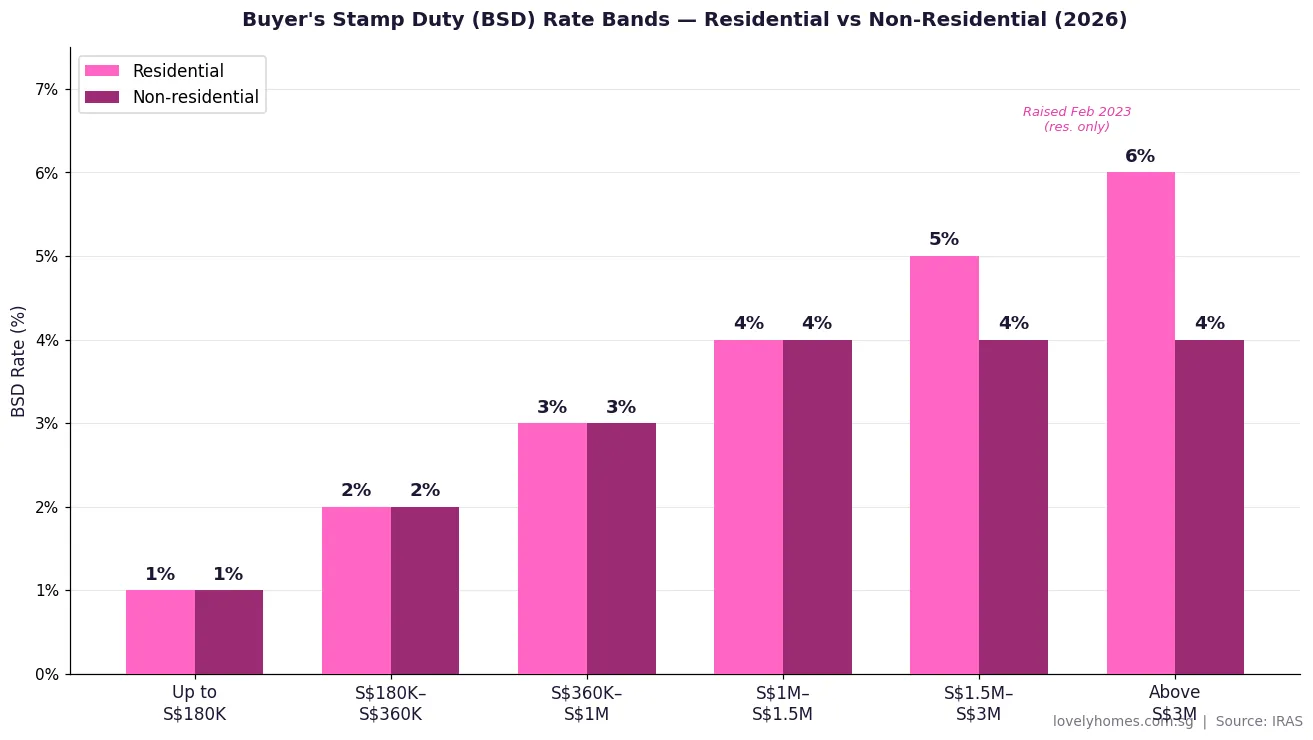
  • Residential BSD rates are progressive: 1% on the first S$180,000, rising to 6% on amounts above S$3 million (rates raised in February 2023 Budget).
  • Non-residential BSD is capped at 4% (no 5% or 6% tiers apply).
  • BSD must be paid within 14 days of exercising the Option to Purchase (OTP) or signing the Sale & Purchase (S&P) agreement.
  • On a S$1.5 million condo, BSD is S$44,600 — that is before any Additional Buyer’s Stamp Duty (ABSD) kicks in.
  • BSD is separate from ABSD: ABSD applies only to second or subsequent properties (for Singapore Citizens) or all properties (for Permanent Residents and foreigners).
  • No exemptions for first-time buyers — BSD applies to everyone; only certain inherited or court-ordered transfers are exempt.
  • CPF Ordinary Account funds may be used to pay BSD on eligible residential properties.

What Is Buyer’s Stamp Duty (BSD)?

Buyer’s Stamp Duty (BSD) is a tax levied by the Inland Revenue Authority of Singapore (IRAS) on every purchase or acquisition of property in Singapore. Unlike the Additional Buyer’s Stamp Duty (ABSD) — which applies only to certain buyers — BSD is universal: it falls on every transaction regardless of whether the buyer is a Singapore Citizen (SC), Permanent Resident (PR), foreigner, or corporate entity, and regardless of how many properties they already own.

BSD is calculated on the higher of the purchase price or the market value of the property. IRAS uses the property’s assessed annual value and recent comparable sales to determine market value; if your agreed price is below market value, IRAS will compute BSD on the higher market-value figure. The tax is administered under the Stamp Duties Act (Cap. 312) and must be paid promptly — late payment attracts penalties.

The February 2023 Budget introduced new higher rate tiers for residential property, bringing the top marginal rate to 6% for portions of the price above S$3 million. For non-residential property (commercial, industrial, mixed-use), the maximum rate remains 4%. Understanding BSD is therefore a mandatory step in any property budget — you cannot legally complete a purchase without stamping the documents.

BSD rate bands residential vs non-residential Singapore 2026
Figure 1: BSD Rate Bands — Residential vs Non-Residential (2026). Source: IRAS / Stamp Duties Act.

BSD Rates for Residential Property (2026)

The following progressive rate schedule applies to all residential property purchases from 15 February 2023 onwards (Budget 2023). Note that the rates are marginal — each band applies only to the portion of the price falling within that range, not the entire purchase price.

Purchase Price Band BSD Rate Maximum BSD in Band
First S$180,000 1% S$1,800
Next S$180,000 (S$180,001 – S$360,000) 2% S$3,600
Next S$640,000 (S$360,001 – S$1,000,000) 3% S$19,200
Next S$500,000 (S$1,000,001 – S$1,500,000) 4% S$20,000
Next S$1,500,000 (S$1,500,001 – S$3,000,000) 5% S$75,000
Remaining amount (above S$3,000,000) 6% Unlimited

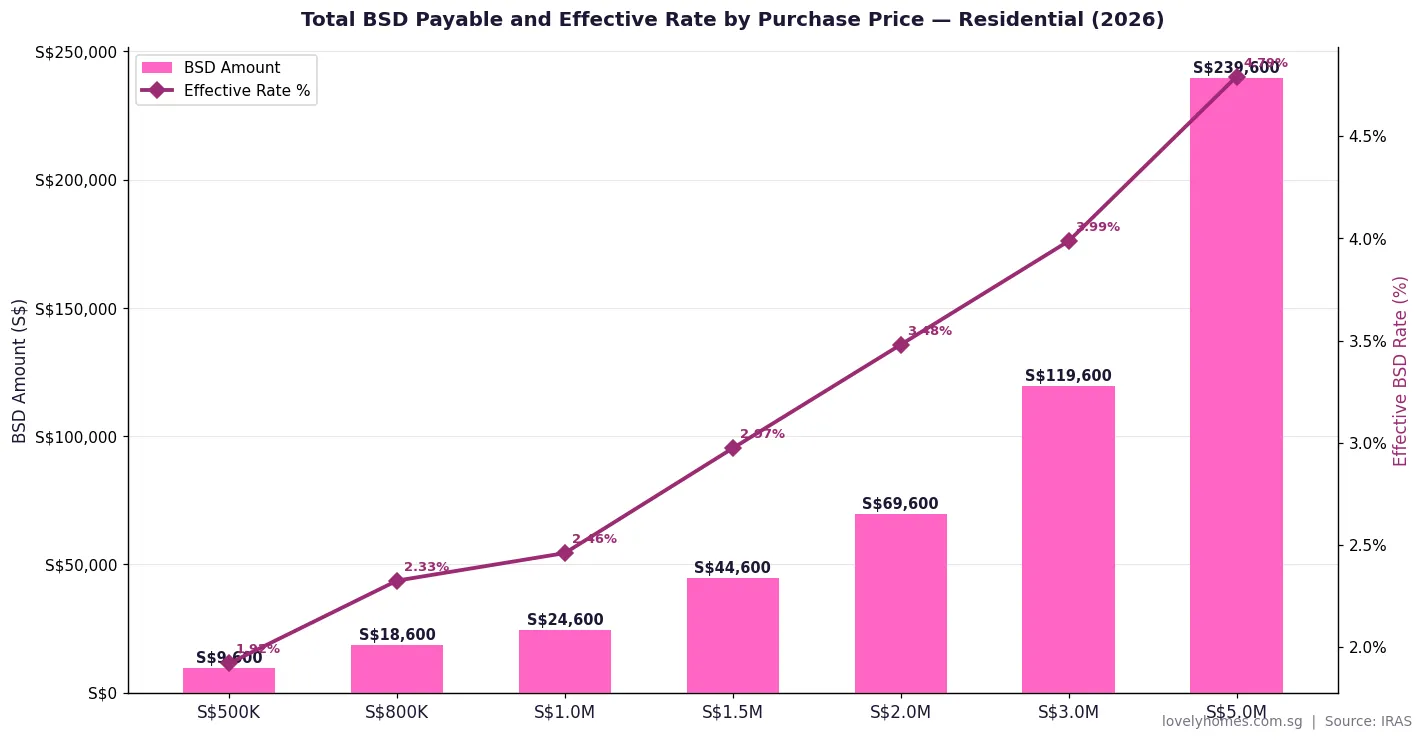
The cumulative BSD payable at the top of each band is S$1,800 → S$5,400 → S$24,600 → S$44,600 → S$119,600 and beyond. For a S$1 million property the BSD is exactly S$24,600; for a S$1.5 million property it is S$44,600; for a S$3 million property it is S$119,600.

BSD Rates for Non-Residential Property (2026)

Industrial, commercial, and mixed-use properties follow a different schedule that was last revised in 2018. The rates are lower and the top marginal rate is capped at 4%, reflecting government policy to keep transaction costs manageable for business property buyers.

Purchase Price Band BSD Rate Maximum BSD in Band
First S$180,000 1% S$1,800
Next S$180,000 (S$180,001 – S$360,000) 2% S$3,600
Next S$640,000 (S$360,001 – S$1,000,000) 3% S$19,200
Remaining amount (above S$1,000,000) 4% Unlimited

On a S$2 million shophouse, for instance, the BSD is S$24,600 (the S$1 million cumulative) plus 4% of S$1 million = S$40,000 → total S$64,600. Compare this to a residential property of the same price where BSD would be S$69,600. The difference is modest at S$2 million but widens materially at S$5 million and above.

Total BSD payable and effective rate by purchase price Singapore 2026
Figure 2: Total Residential BSD Payable and Effective Rate by Purchase Price (2026). Effective rate is BSD ÷ purchase price. Source: IRAS.

How to Calculate BSD Step by Step

BSD is a progressive tax, so the calculation requires applying each marginal rate to the corresponding band of the purchase price. The cleanest method is to use the marginal-band approach. Consider a S$1,800,000 residential property:

  1. 1% × S$180,000 = S$1,800
  2. 2% × S$180,000 = S$3,600
  3. 3% × S$640,000 = S$19,200
  4. 4% × S$500,000 = S$20,000
  5. 5% × S$300,000 (the remaining S$1.8M − S$1.5M = S$0.3M) = S$15,000
  6. Total BSD = S$59,600

IRAS also publishes a shortcut formula for common brackets. For residential properties priced between S$1 million and S$1.5 million the formula is: BSD = (4% × price) − S$15,400. For S$1 million: (4% × S$1M) − S$15,400 = S$40,000 − S$15,400 = S$24,600 ✓. These formulae are available in IRAS’s stamp duty calculator at iras.gov.sg.

When and How to Pay BSD

BSD must be paid within 14 days of the document being signed or executed — that is, within 14 days of exercising the Option to Purchase (OTP) for resale properties, or within 14 days of the date of the Sale & Purchase agreement for new launches. Late payment attracts a penalty of S$10 or the unpaid duty, whichever is higher, plus additional penalties of up to 4× the original duty for prolonged non-payment.

Payment is made through e-Stamping at the IRAS portal, accessible via Singpass. Solicitors acting for buyers routinely handle this on their clients’ behalf. The stamped document is legal evidence of the transaction; an unstamped instrument cannot be admitted as evidence in court.

BSD may be paid using CPF Ordinary Account (OA) funds for eligible residential properties — subject to the CPF withdrawal limit and valuation limit rules. If paying by CPF, the CPF Board will typically release the BSD payment to IRAS directly on completion. Cash payment via GIRO, credit/debit card, or bank transfer is also accepted. Foreigners without a Singpass account must pay through their appointed solicitor.

📌 Worked Example: Mr & Mrs Nair — D11 Condo S$2,200,000

Mr Nair is a Singapore Citizen; Mrs Nair is a Singapore Permanent Resident. This will be their first property. They are purchasing a 3-bedroom condominium in Newton / Novena (D11, RCR) at S$2,200,000. The solicitor will compute BSD as follows:

  • 1% × S$180,000 = S$1,800
  • 2% × S$180,000 = S$3,600
  • 3% × S$640,000 = S$19,200
  • 4% × S$500,000 = S$20,000
  • 5% × S$700,000 (S$2.2M − S$1.5M) = S$35,000
  • Total BSD = S$79,600 (effective rate: 3.62%)

ABSD position: because this is a joint purchase and Mrs Nair is a PR, the joint ABSD rate is determined by the buyer with the higher rate. SC buying 1st property = 0%; PR buying 1st property = 5%. As a mixed-citizenship couple, IRAS applies the higher rate — so ABSD of 5% × S$2,200,000 = S$110,000 applies. (They may request an ABSD remission if they intend to occupy the property, but remission is not automatic for SC/PR joint purchases on first property.)

Combined stamp duties: BSD S$79,600 + ABSD S$110,000 = S$189,600. Legal fees approximately S$5,500. Total transaction costs at completion: approximately S$195,100 (excluding down payment and financing costs).

Bank loan (SC income S$18,000/mth): 75% LTV = S$1,650,000 at 3.0% p.a. over 30 years → monthly instalment S$6,955. TDSR: (S$6,955 ÷ S$18,000) = 38.6% ✓ (below 55% TDSR limit).

BSD and ABSD total stamp duty by buyer profile Singapore 2026 at S$1.5 million
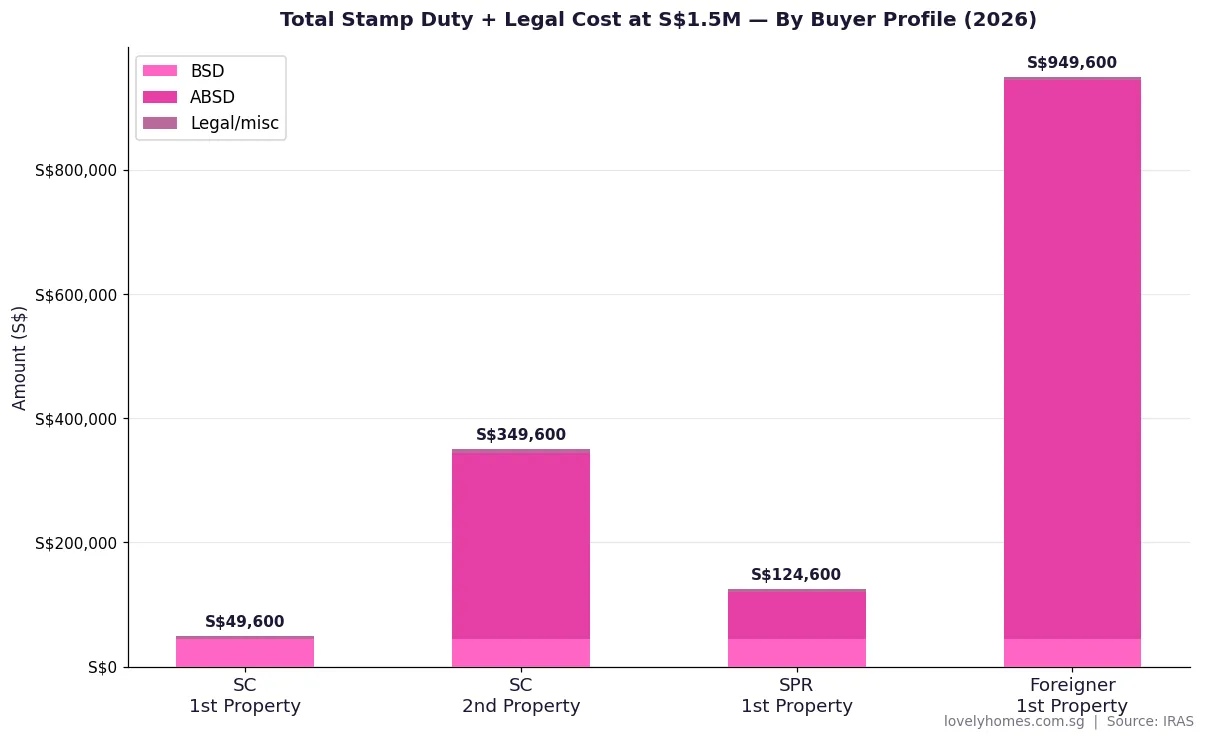
Figure 3: Total Stamp Duty (BSD + ABSD + legal) at S$1.5M by Buyer Profile (2026). BSD is constant at S$44,600; ABSD varies by citizenship and property count. Source: IRAS.

Why BSD Matters: The True Cost of Buying Property in Singapore

BSD is a non-negotiable transaction cost that must be factored into every property budget from day one. At S$1 million, BSD alone is S$24,600 — roughly 2.5% of the purchase price. At S$3 million, it reaches S$119,600. For buyers stretching their budget to the maximum under Total Debt Servicing Ratio (TDSR) rules, forgetting to account for BSD can push a deal beyond their financial reach. Solicitors and mortgage advisers always incorporate BSD into the cashflow calculation alongside down payment, valuation fees, legal fees, and agent commissions.

Compared to peer jurisdictions, Singapore’s BSD is moderate but has been rising. Hong Kong’s stamp duty on residential property ranges from HK$100 to 4.25% of the price for the basic rate, with additional buyer’s stamps up to 30% for non-residents. Australia’s stamp duty varies by state and can exceed 5% in New South Wales and Victoria. Singapore’s BSD at an effective rate of around 2.5–4% for typical residential purchases sits within the regional norm, though the additional ABSD layers make total stamp costs for repeat or foreign buyers among the highest globally.

📊 What Might Come Next: BSD Outlook

This section is speculative and based on publicly available signals. It is not investment advice.

The February 2023 BSD increase targeted high-value transactions (above S$1.5 million), nudging effective rates higher for luxury properties. In the near term — through 2026 and into 2027 — industry observers do not anticipate a further upward revision to BSD, given that ABSD rates (raised to 60% for foreigners and 20% for SC second properties in April 2023) already provide strong price-stability signals. However, should the private residential price index continue its upward trajectory into the upper percentiles, a further adjustment to the S$3 million+ band (currently at 6%) cannot be ruled out in a future Budget.

For commercial and industrial BSD, a revision has been discussed informally in property finance circles, particularly given that strata industrial and shophouse prices have risen sharply since 2021. Any Budget announcement would take effect immediately on the date of the Budget speech, as has historically been the case.

Frequently Asked Questions: Buyer’s Stamp Duty Singapore

Does BSD apply to HDB flat purchases?

Yes. BSD applies to all residential property acquisitions in Singapore, including HDB resale flats and new BTO flat purchases. However, most HDB flats are priced well below S$1 million, so the effective BSD rate is typically 1–2%. For a S$600,000 4-room resale HDB flat, BSD is: (1% × S$180,000) + (2% × S$180,000) + (3% × S$240,000) = S$1,800 + S$3,600 + S$7,200 = S$12,600. The BSD on HDB purchases is significantly lower than on private condominiums. Note that for HDB purchases, CPF OA funds are routinely used to pay BSD, and the HDB will typically manage the stamping process on your behalf.

Is BSD different from ABSD? Can I avoid one but not the other?

BSD and ABSD are two separate taxes levied by IRAS. BSD applies to every buyer on every property — there is no exemption for first-time buyers. ABSD is an additional tax that applies to: Singapore Citizens buying a second or subsequent residential property (20% for second, 30% for third or more); Singapore PRs buying any residential property (5% first, 25% second and beyond); all foreigners buying any residential property (60% as of April 2023, with limited FTA exemptions for certain nationalities). It is impossible to avoid BSD; ABSD can be avoided by Singapore Citizens on their first property and in certain limited circumstances (e.g., FTA exemptions, ABSD remission for married couples). BSD is always payable on both residential and non-residential acquisitions.

What is the BSD deadline and what happens if I pay late?

BSD must be paid within 14 days of the date the relevant instrument is executed or signed. For resale properties, this means within 14 days of exercising the Option to Purchase (OTP). For new launch properties, within 14 days of signing the Sale & Purchase agreement. IRAS imposes penalties for late payment: S$10 or the unpaid duty (whichever is higher) for the first default, scaling up to 4× the outstanding duty for extended non-payment. In practice, conveyancing solicitors almost always handle BSD stamping within the 14-day window as a standard part of their service. You should therefore ensure you have the BSD funds ready to transfer to your solicitor’s client account well before the stamping deadline.

Can I use CPF to pay BSD in Singapore?

Yes, for eligible residential properties. CPF Ordinary Account (OA) savings may be used to pay BSD, subject to the applicable CPF withdrawal limits. The property must be used as a principal place of residence, and the purchase must satisfy CPF Board criteria (e.g., remaining lease of the property must meet the minimum occupation period requirements). CPF cannot be used to pay BSD on non-residential property purchases (shophouses, industrial, commercial). If you are using CPF for BSD, inform your solicitor at the start of the conveyancing process so they can arrange the CPF withdrawal in time. Any CPF withdrawn for BSD forms part of your total CPF withdrawal and attracts accrued interest at the OA rate of 2.5% per annum, which must be refunded to your CPF upon the eventual sale of the property.

Are there any exemptions from BSD in Singapore?

BSD exemptions are narrow. Transfers pursuant to a court order (e.g., divorce proceedings under section 112 of the Women’s Charter) may be exempt or subject to ad valorem duty on a different basis. Inherited property transferred via probate or letters of administration under intestate succession is also exempt from BSD (as it is a transmission, not a purchase). Government land acquisitions under the Land Acquisition Act are exempt. However, gifts of property between family members (including parents, siblings, and children) are generally not exempt unless effected as a court order; such transfers attract BSD at market value. There is no general first-time buyer exemption and no BSD discount for owner-occupiers — every voluntary purchase triggers the full progressive rate.

Is BSD based on the purchase price or the market value?

BSD is computed on the higher of the purchase price or the market value as assessed by IRAS at the time of the transaction. If you purchase a property below its assessed market value — for example, buying from a relative at a discounted price or acquiring a distressed-sale unit below prevailing comparable prices — IRAS will compute BSD on the market value, not the agreed price. Conversely, if you pay above market value (rare, but possible in competitive bidding situations), BSD is based on the actual price paid. IRAS cross-references the Urban Redevelopment Authority’s (URA) caveats database and the HDB resale transaction data to assess market value. Disputes about assessed value may be referred to the Stamp Duties Appeal Board.

Does BSD apply to property acquired through a company?

Yes. When a company — whether a Singapore-incorporated or foreign-incorporated entity — acquires property, BSD applies on the same basis as for individual buyers. The company must pay BSD on the higher of the purchase price or market value. In addition, corporate buyers are subject to ABSD at 65% for residential property (as of April 2023), making entity-held residential acquisitions extremely expensive. For commercial and industrial property, companies pay BSD at the non-residential rates (up to 4%) with no ABSD. Transfers of shares in a property-holding company may also attract stamp duty under Section 15 of the Stamp Duties Act; the rules are complex and specialist tax advice is recommended for such structures.

Related Articles on Singapore Property Taxes and Buying Costs

Disclaimer

This article is for general informational purposes only and does not constitute legal, financial, or tax advice. BSD rates and rules are set by the Inland Revenue Authority of Singapore (IRAS) and may change with each annual Budget. Always verify current rates and your personal BSD and ABSD obligations at iras.gov.sg before transacting. For a formal computation and to ensure timely stamping, engage a licensed Singapore conveyancing solicitor. LovelyHomes is not a licensed financial adviser or solicitor; no reliance should be placed on this article as a substitute for professional advice tailored to your specific circumstances.

Singapore Executive Condo (EC) Buying Guide 2026: Eligibility, Prices, MOP and the New 10-Year Rules Explained

Singapore Executive Condo (EC) Buying Guide 2026: Eligibility, Prices, MOP and the New 10-Year Rules Explained

Quick Answer — Singapore Executive Condo (EC) at a glance

  • EC household income ceiling: S$16,000/month (unchanged in 2026)
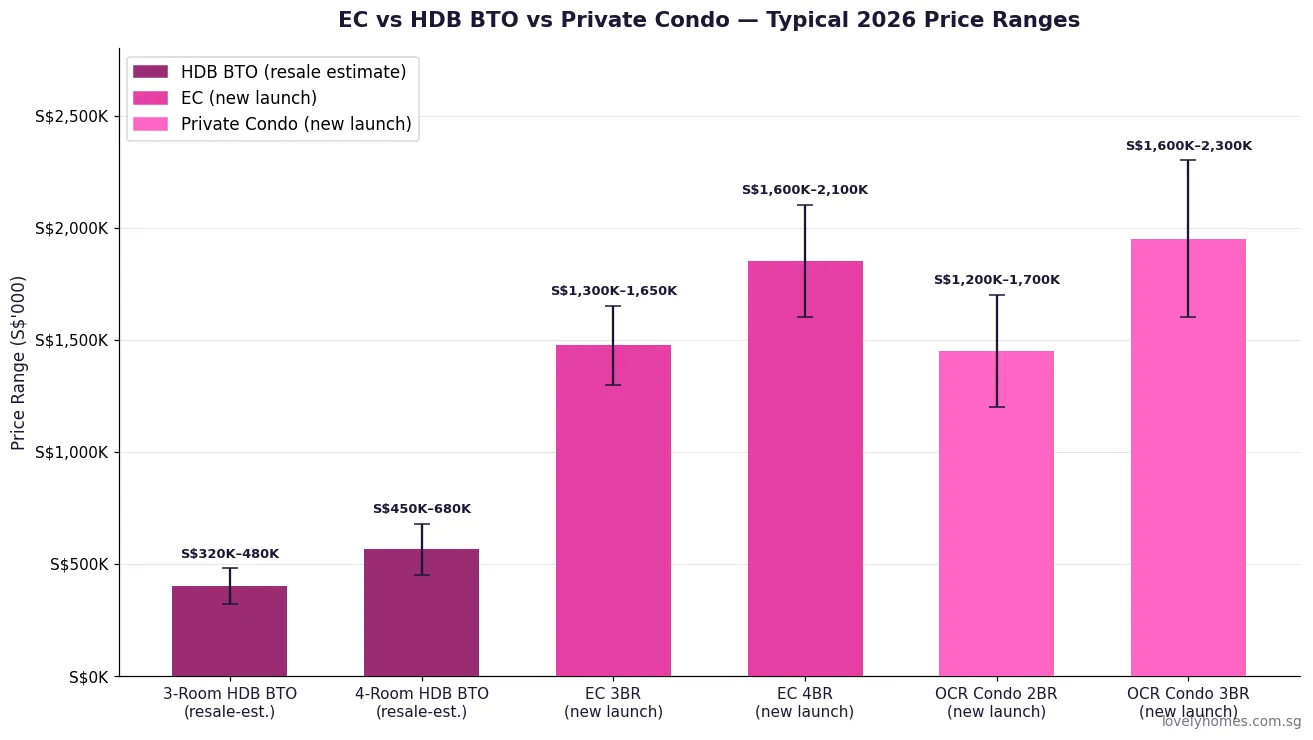
  • EC prices in 2026: roughly S$1.3M–S$2.2M for new launches, depending on unit size
  • At least one Singapore Citizen applicant required; co-applicant can be SC or PR
  • New EC sites from 8 May 2026: 10-year MOP and 15-year wait to full privatisation
  • Existing launched ECs retain the older 5-year MOP and 10-year privatisation timeline
  • ECs occupy the unique “sandwich class” position — priced above HDB BTO but below private condos
  • CPF Housing Grant of up to S$30,000 (Proximity Housing Grant) available for eligible EC buyers
  • Foreigners and companies cannot buy ECs during the initial launch period from developers

An Executive Condominium — universally abbreviated to EC in Singapore — is a hybrid housing type administered by the Housing & Development Board (HDB) but developed and sold by private property developers. ECs were introduced in 1995 to serve the “sandwich class” of Singaporeans who earn above the HDB BTO income ceiling of S$14,000/month but find private condominiums financially out of reach. In 2026, ECs remain one of Singapore’s most compelling property purchases for eligible buyers: they offer condominium-standard facilities (swimming pool, gym, function room, landscaped grounds, 24-hour security) at prices roughly 15–25% below comparable private condominiums, with the bonus of becoming fully private after a defined holding period. This guide covers every aspect of buying an EC in Singapore in 2026 — eligibility, pricing, the new 10-year MOP and 15-year privatisation rules, CPF usage, financing, and a worked financial example.

What Makes an EC Different from an HDB BTO and a Private Condo?

Understanding where an EC sits in Singapore’s housing ecosystem is the starting point for any prospective buyer. HDB Build-To-Order (BTO) flats are owned by the government, subject to significant resale restrictions, carry an income ceiling of S$14,000/month, and cannot be sold on the open market for five years from the date of key collection. At the other extreme, fully private condominiums have no income ceiling, no nationality restriction (subject to ABSD rates), and no minimum occupation period — but typically cost S$1.4M–S$3M+ for a new launch in 2026.

ECs sit between these two. During the initial restricted period, ECs operate under HDB rules — they must be sold by the developer at launch to eligible SC/PR applicants, buyers must meet the income ceiling, and a Minimum Occupation Period applies. Once privatised, an EC becomes indistinguishable from any other private condo in the eyes of the law. This trajectory — from subsidised hybrid to fully private asset — is what makes ECs uniquely attractive as a long-term investment vehicle, particularly for first-time buyers who can benefit from CPF grants while locking in capital appreciation over 10–15 years.

EC vs HDB BTO vs private condo price comparison Singapore 2026
Figure 1: Typical 2026 price ranges for 3-room/4-room HDB BTO flats (resale value estimates), EC new launches (3BR/4BR), and private OCR condo new launches. EC pricing typically falls 15–25% below equivalent private condos. Source: URA, HDB, developer sales data.

EC Eligibility — Who Can Buy?

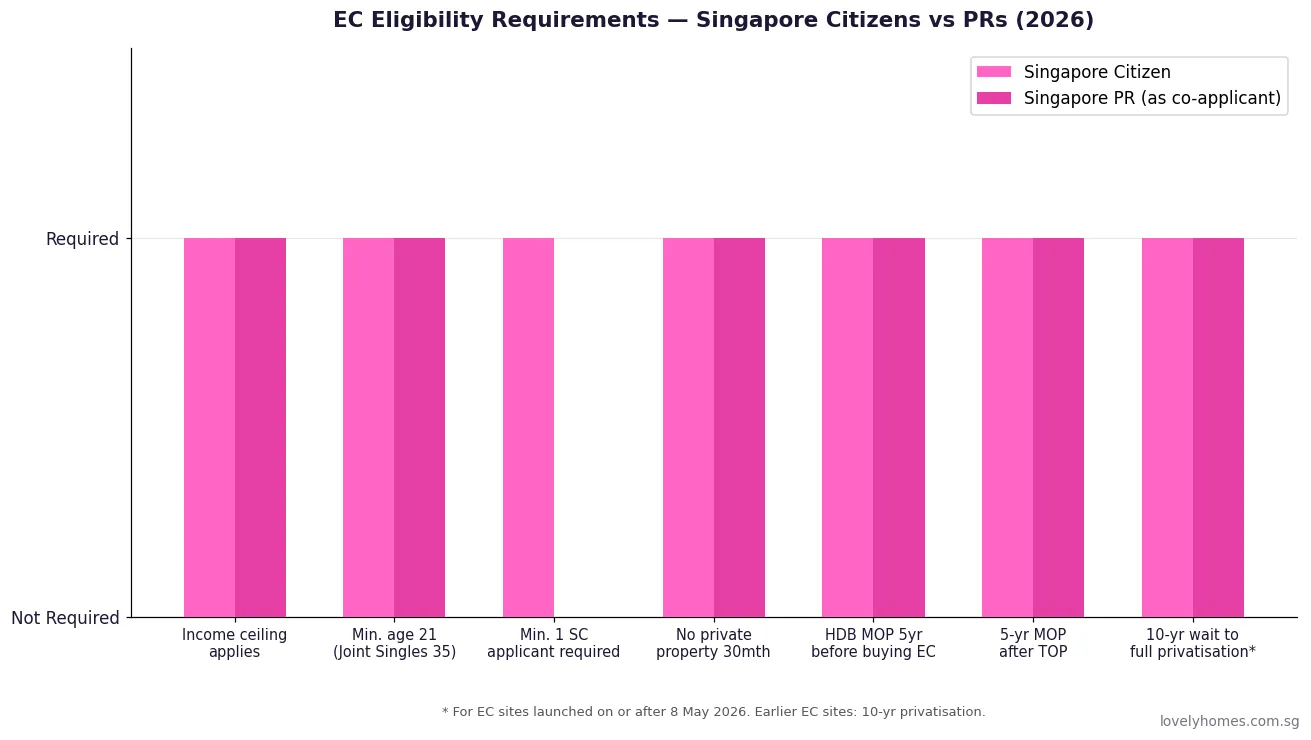
EC eligibility is more restrictive than private condo eligibility and must be carefully assessed before any application. All of the following conditions must be met simultaneously.

Citizenship: At least one applicant in the application must be a Singapore Citizen. Co-applicants can be Singapore Citizens or Singapore Permanent Residents. Foreigners are categorically ineligible to purchase ECs during the initial launch period from the developer. Only after 10 years from the date the EC obtained its Temporary Occupation Permit (TOP) may foreigners purchase ECs on the open market.

Household income ceiling: The combined gross monthly household income of all applicants and any occupants listed in the application must not exceed S$16,000. This ceiling has not changed in Budget 2026. Gross income includes all sources — base salary, allowances, bonuses averaged over 12 months, self-employment income, rental income, and foreign income if the applicant is assessed for Singapore tax. Exceeding the ceiling by even S$1 at the time of application results in automatic disqualification, and HDB verifies income through IRAS tax assessments and CPF contribution records.

Age: All applicants must be at least 21 years old. Under the Joint Singles Scheme (JSS), two or more unmarried Singapore Citizens may jointly apply for an EC, but each must be at least 35 years old.

Private property cooling-off period: Applicants must not have disposed of any private residential property (locally or overseas) within 30 months before the EC application date. If you sold a private property on 1 January 2024, you cannot apply for an EC until 1 July 2026.

HDB ownership history: If you or any applicant has previously owned an HDB flat, the Minimum Occupation Period of that flat must be fully served before you may apply for an EC. Additionally, if you currently own or are listed as an occupant of an HDB flat, you must dispose of that HDB flat within six months of taking possession of the EC.

Singapore executive condo EC eligibility requirements 2026
Figure 2: EC eligibility requirements for Singapore Citizens and PRs as co-applicants, 2026. All criteria (income ceiling, citizenship, age, cooling-off period, MOP) must be satisfied simultaneously. Source: HDB.

EC Pricing in 2026 — What to Expect

New EC launches in 2026 are priced in the S$1,300–S$2,200 per square foot (psf) range, reflecting rising land costs. Upcoming EC sites at Jalan Loyang Besar (Pasir Ris) and Tampines Street 95 are expected to launch at around S$1,700 psf when they come to market, which translates to absolute prices of approximately S$1.4M for a 3-bedroom unit and S$1.8–S$2.0M for a 4-bedroom unit.

Currently available ECs illustrate the pricing landscape. Novo Place — a 504-unit development by Hoi Hup Realty and Sunway Developments — was released at indicative prices starting from S$1.298M for a 2-bedroom unit up to S$1.779M for a 4-bedroom-plus-study. Aurelle of Tampines is another active launch in 2026, reflecting the continued concentration of EC supply in the north-east corridor near good MRT connectivity.

EC Development Location Year of TOP (est.) Price Range (new launch) Units
Aurelle of Tampines Tampines Ave 11 ~2029 S$1.35M–S$2.0M 760
Novo Place Tengah Garden Walk ~2029 S$1.30M–S$1.78M 504
Lumina Grand Bukit Batok West Ave 5 ~2028 S$1.31M–S$1.65M (est.) 495
Altura Bukit Batok West Ave 8 ~2028 S$1.30M–S$1.65M (est.) 360
Jalan Loyang Besar (upcoming) Pasir Ris ~2030 ~S$1.40M–S$2.0M (projected) TBC

The New 10-Year MOP and 15-Year Privatisation Rules (From 8 May 2026)

On 8 May 2026, the Singapore Government announced a significant tightening of EC holding period rules for EC sites awarded on or after that date. Understanding the distinction between old-regime ECs (already launched) and new-regime ECs (future GLS site awards) is essential for any EC buyer in 2026.

Singapore EC executive condo privatisation timeline old vs new regime 2026
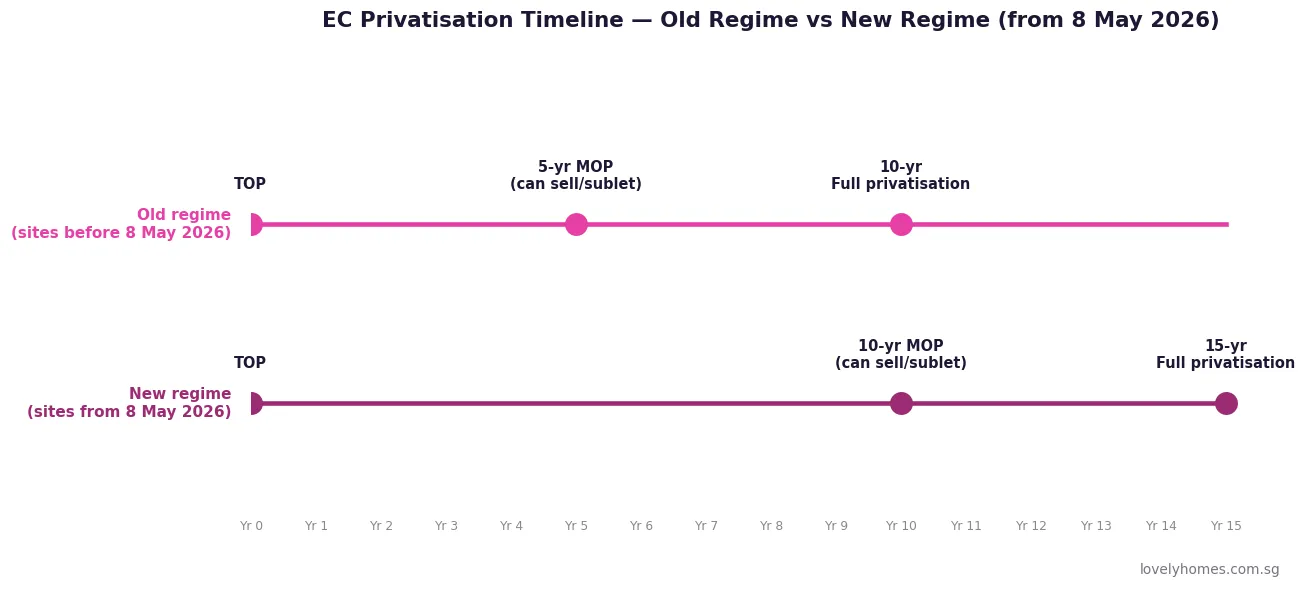
Figure 3: EC privatisation timeline — old regime (EC sites awarded before 8 May 2026) vs new regime (EC sites awarded from 8 May 2026). Source: HDB announcement, 8 May 2026.

Old regime (Aurelle of Tampines, Novo Place, Lumina Grand, Altura, and all ECs launched before 8 May 2026): The familiar 5-year MOP applies from TOP. After the MOP, the EC may be sold on the open market to Singapore Citizens or PRs. After 10 years from TOP, the EC is fully privatised and may be sold to foreigners and entities — subject to ABSD.

New regime (EC sites awarded from 8 May 2026 onwards): The MOP extends to 10 years from TOP. Full privatisation — when the unit may be transacted with foreigners and entities — does not occur until 15 years from TOP. This significantly extends the illiquidity period and reduces the short-to-medium-term capital gain that characterized earlier EC purchases. The Government’s stated rationale is to ensure ECs genuinely serve the long-term housing needs of eligible Singaporeans rather than shorter-cycle investment objectives.

The practical implication for buyers in 2026: the four currently launched ECs (Aurelle, Novo Place, Lumina Grand, Altura) are old-regime projects and retain the more liquid 5-year MOP and 10-year privatisation timeline. New EC sites awarded after 8 May 2026 will carry the extended restrictions. Buyers who prioritise resale flexibility should prioritise current launches over future GLS-derived ECs.

Financing an EC — CPF, Bank Loans and TDSR

ECs are financed through bank loans (HDB concessionary loans are not available for ECs). The bank will assess the application under the Total Debt Servicing Ratio (TDSR) framework administered by the Monetary Authority of Singapore (MAS), capping total monthly debt repayments at 55% of gross monthly income. The maximum loan-to-value (LTV) ratio for an EC bank loan is 75% of the purchase price or valuation (whichever is lower), so buyers must have at least 25% in cash and/or CPF.

CPF Ordinary Account (OA) savings may be used for the downpayment (subject to the Valuation Limit and Withdrawal Limit), monthly mortgage instalments, and stamp duties on the EC purchase. However, CPF usage for ECs is governed by the same accrued interest rules as HDB loans — when you sell the EC, you must return to your CPF account the principal withdrawn plus 2.5% per annum accrued interest. This is not a penalty but a refund to your own retirement account, and it reduces the net cash proceeds from any eventual sale.

Buyers who currently own an HDB flat and are eligible to purchase an EC simultaneously (e.g., within the six-month disposal window) must be careful about ABSD exposure: if they have not yet sold their HDB when they execute the EC Sales and Purchase Agreement, they will technically hold two residential properties and may attract ABSD at 20% (SC second property) on the EC purchase price. Planning the HDB sale to precede the EC SPA execution by at least one day is the standard approach.

Worked Example: Mr and Mrs Lim — Buying Aurelle of Tampines EC

Mr Lim (SC) and Mrs Lim (SC) are a married couple in their mid-30s. Mr Lim earns S$9,500/month and Mrs Lim earns S$5,800/month — combined S$15,300/month, comfortably below the S$16,000 income ceiling. They currently live in Mrs Lim’s parents’ HDB flat and have no prior private property ownership. They are applying for a 4-bedroom unit at Aurelle of Tampines at S$1,780,000.

Eligibility checks:

  • Income: S$15,300/month — below S$16,000 ceiling ✓
  • Citizenship: both SC ✓
  • Age: both 34 and 36 — above 21 ✓
  • Private property cooling-off: neither has owned private property ✓
  • HDB ownership: neither owns an HDB flat in their own names ✓

Purchase costs:

  • Purchase price: S$1,780,000
  • Buyer’s Stamp Duty (BSD): S$1,780,000 × BSD schedule = S$4,600 (first S$180,000 × 1%) + S$27,600 (next S$360,000 × 2%) + S$36,000 (next S$360,000 × 3%) + S$39,200 (next S$880,000 × 4%) = S$56,600 (standard BSD calculation: (180,000×1%)+(360,000×2%)+(360,000×3%)+(880,000×4%) = 1,800+7,200+10,800+35,200 = S$55,000)
  • Additional Buyer’s Stamp Duty (ABSD): S$0 — SC buying first residential property ✓
  • Legal fees (EC S&P): approximately S$3,500
  • Total acquisition cost: approximately S$1,783,500 + S$55,000 BSD + S$3,500 legal = S$1,841,500

Financing:

  • Downpayment (25%): S$445,000 — funded from CPF OA + cash savings
  • Bank loan (75%): S$1,335,000 at 3.2% fixed over 25 years = approx S$6,420/month
  • TDSR check: S$6,420 ÷ S$15,300 = 42.0% — well within 55% TDSR ✓
  • MSR note: MSR (Mortgage Servicing Ratio) of 30% applies only to HDB loans, not to EC bank loans

Grant eligibility: The Lims do not qualify for the CPF Housing Grant (available only for HDB BTO buyers) or the Enhanced Housing Grant (EHG). However, if one set of parents lives within 4km of Aurelle of Tampines, the Proximity Housing Grant (PHG) of S$10,000 (living near parents) or S$20,000 (living with parents) may apply — reducing the effective purchase price.

Projected holding value: Assuming Aurelle of Tampines follows a typical EC appreciation trajectory, comparable ECs that TOPed around 2019–2020 and privatised around 2029–2030 have demonstrated 35–50% resale premium over launch price during the privatisation window. This is speculative — past EC performance does not guarantee future returns — but the long-term track record of ECs converting to fully private assets in strong MRT-connected locations has been broadly positive.

Why ECs Matter: The Sandwich Class Opportunity

ECs were specifically designed by the Ministry of National Development (MND) to address Singapore’s “sandwich class” dilemma — households too affluent for subsidised HDB housing but not wealthy enough to comfortably absorb private condo prices without significant financial strain. In 2026, this remains the precise demographic challenge: private condo prices have risen substantially since 2020, the income ceiling for HDB BTO remains S$14,000/month, and the S$14,001–S$16,000 income band represents hundreds of thousands of eligible Singaporean households.

For buyers who qualify, an EC in a well-located development is arguably the most efficient use of S$1.3–S$2.0M in Singapore’s property market — providing private facilities and capital appreciation without the full ABSD burden on a second purchase or the income-test barriers of HDB. The caveat is the holding period: buyers must be prepared for the unit to remain illiquid (under old-regime rules) for 5 years and (under new-regime rules) for 10 years before they can sell. EC buying is fundamentally a medium-to-long-term commitment, not a short-cycle trade.

What Might Come Next — EC Policy Outlook

The 8 May 2026 announcement extending the MOP to 10 years and privatisation to 15 years for new EC sites signals that the Government intends to reinforce EC’s owner-occupation objective and reduce speculative pressure. It is plausible that income ceilings may be reviewed upward if private condo prices continue to rise faster than household income growth — a precedent exists from the 2021 rise in the HDB BTO income ceiling from S$12,000 to S$14,000 and the parallel EC ceiling rise from S$14,000 to S$16,000. Future EC GLS allocations will likely continue to be concentrated in MRT-connected OCR towns such as Tengah, Tampines, Pasir Ris, and the north corridor, aligning with long-term infrastructure investment in these areas.

Summary: EC vs HDB BTO vs Private Condo

Feature HDB BTO Executive Condo (EC) Private Condo
Income ceiling S$14,000/mth S$16,000/mth None
Eligibility SC/PR (various schemes) Min. 1 SC; SC/PR only Open (with ABSD for foreigners)
MOP (new launch) 5 years 5 yrs (old) / 10 yrs (new*) None
Full privatisation N/A 10 yrs (old) / 15 yrs (new*) Already private
CPF Housing Grant Up to S$120,000 (EHG) PHG up to S$30,000 None
HDB loan available? Yes (2.6%) No — bank only No — bank only
Typical 2026 price S$300K–S$700K (resale) S$1.3M–S$2.2M S$1.4M–S$3.5M+
Foreign buyer eligible? No After 10 yrs TOP (old) / 15 yrs (new*) Yes (60% ABSD for foreigners)

* For EC GLS sites awarded from 8 May 2026 onwards.

Frequently Asked Questions

Can a Singapore Permanent Resident buy a new EC?

A PR cannot buy a new EC as the sole or principal applicant. At least one Singapore Citizen must be part of the application. A PR may be a co-applicant alongside a SC spouse under the Public Scheme, or an EC may be purchased under a family nucleus that includes at least one SC. After the EC is fully privatised (10 years under old-regime rules, 15 years under new-regime rules), PRs and foreigners may purchase ECs on the open market. On the open market, a PR purchasing a fully privatised EC is subject to PR ABSD rates (5% for first residential property, 30% for second+).

What is the difference between the 5-year MOP and the 10-year MOP?

The Minimum Occupation Period (MOP) is the period during which the EC cannot be sold on the open market. Under the old regime (ECs launched before 8 May 2026), the MOP is 5 years from the date the EC obtained its TOP. After 5 years, the EC may be sold to Singapore Citizens or PRs on the open market. After 10 years from TOP, it becomes fully private (saleable to foreigners). Under the new regime (EC GLS sites awarded from 8 May 2026), the MOP extends to 10 years from TOP, and full privatisation occurs only at 15 years. During the MOP period, the EC cannot be sublet in its entirety (individual rooms may be sublet with HDB approval), and the owner must occupy the unit as their primary residence.

Can I use my CPF to pay for an EC?

Yes. CPF Ordinary Account (OA) savings may be used for the downpayment (subject to the Valuation Limit — VL — which is the lower of purchase price or valuation), monthly mortgage instalments, legal fees, and stamp duties. When CPF OA is used, the CPF Act requires you to refund the principal amount withdrawn plus 2.5% per annum accrued interest when you sell the EC. This refund goes back into your CPF OA (and, where applicable, Special or Retirement Account up to the prevailing Full Retirement Sum). The accrued interest is not a penalty — it is your own retirement savings with its minimum guaranteed return. Buyers should model this refund when calculating net sale proceeds from a future EC sale.

Does ABSD apply when buying an EC?

Yes, the same ABSD schedule that applies to private condominiums applies to ECs. Singapore Citizens buying their first residential property pay 0% ABSD — this is the most favourable scenario and why many EC buyers time their HDB disposal to precede the EC purchase. Singapore Citizens buying a second residential property pay 20% ABSD on the EC’s purchase price. If a buyer still holds their HDB flat when they execute the EC Sales and Purchase Agreement, the HDB flat counts as a first property, making the EC the second — triggering 20% ABSD. HDB provides a conditional ABSD remission for married SC couples who sell their HDB flat within six months of purchasing the private property (including EC). Always consult an IRAS-registered solicitor to verify your ABSD status before signing.

What happens to my HDB flat if I buy an EC?

If you currently own an HDB flat and wish to purchase an EC, you must dispose of your HDB flat within six months of taking possession of the EC (i.e., within six months of key collection). Selling before key collection is the cleanest approach to avoid ABSD exposure. If you sell your HDB after executing the EC Sales and Purchase Agreement, you may be subject to ABSD at 20% on the EC, but may apply for ABSD remission from IRAS provided the HDB is disposed of within six months of the EC SPA date. The remission is available to married SC couples and requires a formal application — it is not automatic. Failure to meet the six-month timeline results in forfeiture of any ABSD remission.

Are there any resale restrictions during the MOP?

During the Minimum Occupation Period, the EC may not be sold, transferred, or sublet as a whole unit without HDB approval. Individual bedrooms may be rented to lodgers with HDB approval — the same rules that apply to HDB flat owners. The owner must continue to occupy the unit as their principal residence throughout the MOP. Breaching MOP restrictions is treated as an offence under the Housing and Development Act and the Planning Act, and may result in compulsory acquisition of the unit by HDB at the original purchase price — a severe financial consequence. After the MOP expires, the EC may be transacted freely on the open market.

Are ECs a good investment in 2026?

ECs have historically been strong investments for eligible buyers due to the price discount at launch relative to comparable private condos, CPF grant support for eligible applicants, and the capital appreciation that typically accompanies privatisation. Past ECs that TOPed around 2017–2020 and privatised around 2027–2030 are, in many cases, transacting at premiums of 40–60% over their original launch prices in 2014–2018. However, the extension of the holding period to 10 years (MOP) and 15 years (privatisation) for new-regime ECs significantly changes the investment calculus — it reduces the short-cycle gain that previous buyers enjoyed and increases the commitment required. ECs remain a sound medium-to-long-term investment for buyers who genuinely intend to live in the property, but are less suitable as shorter-horizon plays. As with any property purchase, future value is not guaranteed — economic conditions, interest rates, supply, and government policy all influence outcomes.

Related Articles

Disclaimer: This article is intended as general information only and does not constitute legal or financial advice. EC eligibility, income ceilings, ABSD rates, MOP rules, and privatisation timelines are set by government policy and may be revised without notice. All figures are based on information available as at June 2026. Always verify current conditions with the Housing & Development Board (HDB), the Inland Revenue Authority of Singapore (IRAS), and a qualified property solicitor before making any purchase decision. Past capital appreciation of ECs does not guarantee future returns. LovelyHomes does not act as a property agent and does not endorse any developer or property service provider.

Renting a Condo in Singapore 2026: Complete Guide to Leases, Costs and Tenant Rights

Renting a Condo in Singapore 2026: Complete Guide to Leases, Costs and Tenant Rights

Quick Answer — Renting a condo in Singapore at a glance

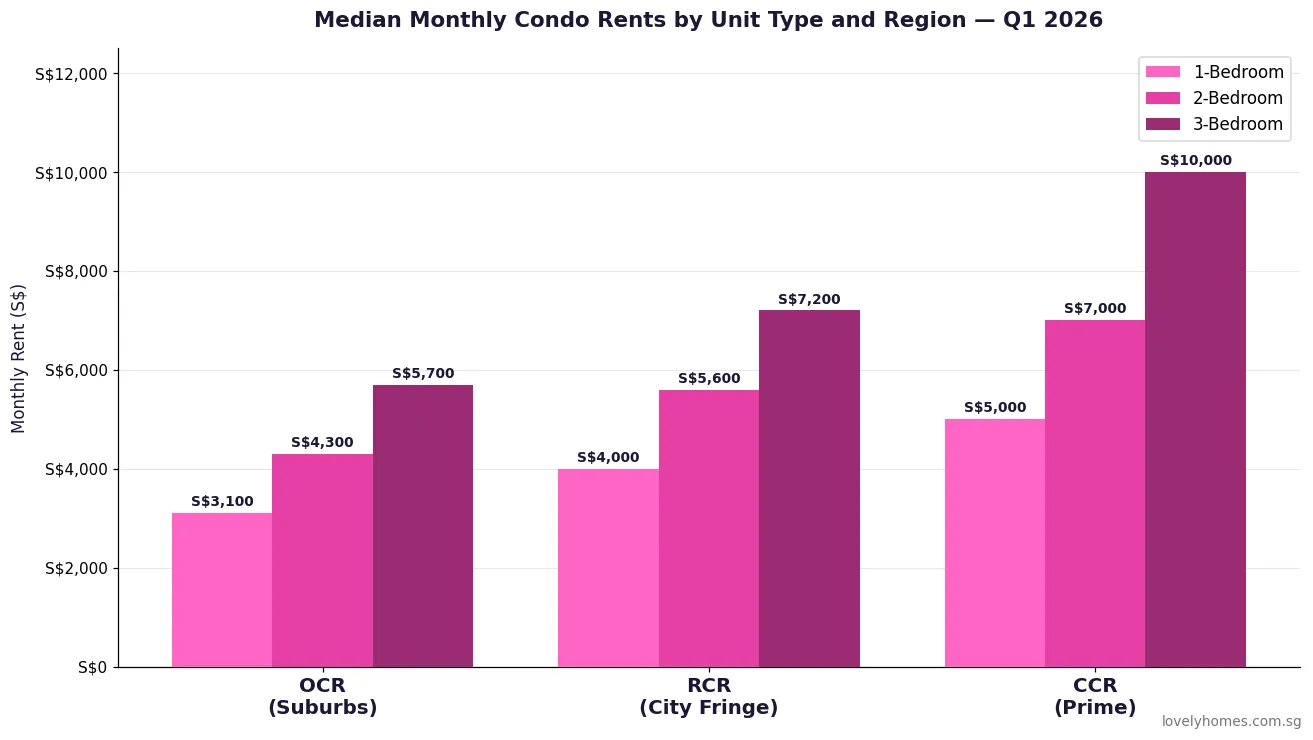
  • Median condo rent in 2026: S$3,100–S$5,700/month depending on unit size and region
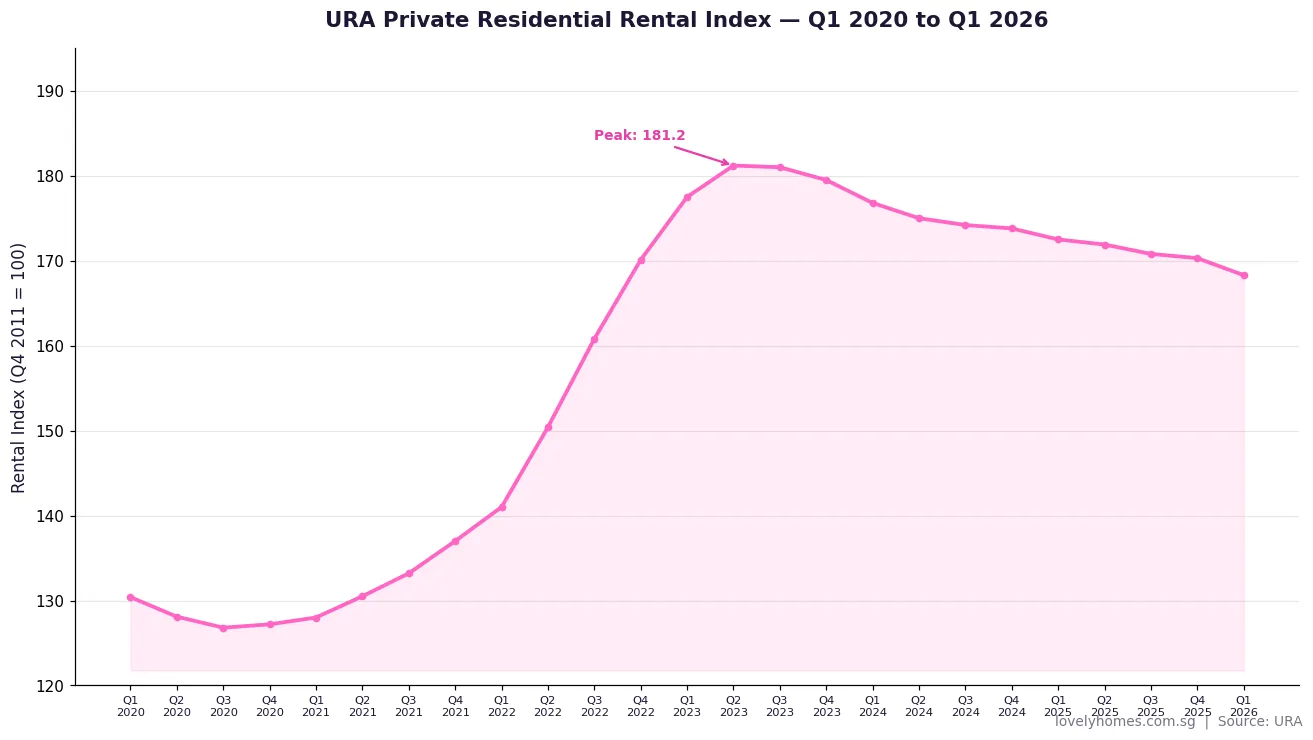
  • URA private residential rental index fell 1.2% in Q1 2026 as new supply enters the market
  • Minimum legal tenancy for private property: 3 months (short-term rentals under 3 months are prohibited)
  • Upfront costs: typically 1+1 month security deposit + half-month agent commission
  • Stamp duty on tenancy agreement: 0.4% × annual rent × number of years
  • Landlord must supply a functional, habitable unit; tenant pays utilities and minor repairs
  • Look for a diplomatic clause if your stay may be cut short — usually exercisable after month 12
  • The non-citizen quota (NCQ) limits foreign tenants in HDB estates to 8% per neighbourhood and 11% per block — condo rentals have no NCQ restriction

Renting a condominium in Singapore is the entry point for most expatriates, professionals on employment passes, and Singaporeans who are in between home ownership. It is also increasingly attractive to local upgraders who sell their HDB flat but want flexibility before committing to a private purchase. In 2026, the rental market has shifted in tenants’ favour: vacancy rates have edged up to around 7%, the Urban Redevelopment Authority (URA) reported a 1.2% quarterly decline in the private residential rental index in Q1 2026, and landlords in many districts are now negotiating where they once insisted. This guide explains how renting a condo in Singapore actually works — from understanding what a unit costs across different regions, to signing a legally compliant tenancy agreement, to knowing your rights as a tenant when things go wrong.

The Singapore Private Rental Market in 2026

Singapore’s private residential rental market is administered indirectly by the URA, which tracks rental transactions and publishes quarterly price and rental indices. Unlike HDB rentals, private condo rentals are not subject to nationality quotas — a landlord may rent to any nationality with a valid pass or PR status. The market is therefore more internationalised, with a significant proportion of tenants being expatriates on Employment Passes (EP) or S Passes, as well as Singaporeans awaiting new-launch completion.

After an extraordinary run-up of over 40% in rental values between 2021 and 2023 — driven by post-pandemic return of expats, supply constraints, and HDB delays — the market began softening in late 2023 and has continued to normalise. As at Q1 2026, private residential rents remain elevated against 2019 levels but are declining gradually as the pipeline of 17,032 unsold units (URA Q1 2026) and completions from 2022–2024 launches add supply. Vacancy has widened to an estimated 7%, giving tenants meaningful negotiating leverage for the first time in years.

Singapore condo median rental rates by unit type and region 2026
Figure 1: Median monthly condo rents by unit type and region, Q1 2026. OCR = Outside Central Region (suburbs); RCR = Rest of Central Region (city fringe); CCR = Core Central Region (prime). Source: URA, industry estimates.

Condo Rental Rates by Region and Unit Type

Rental rates vary significantly by district, unit size, floor level, and age of development. The URA divides Singapore into three broad rental markets: the Core Central Region (CCR), covering Districts 9, 10, 11, and the Downtown Core; the Rest of Central Region (RCR), covering city-fringe areas such as Queenstown, Bishan, Toa Payoh, and Geylang; and the Outside Central Region (OCR), covering mass-market suburbs such as Punggol, Sengkang, Tampines, Woodlands, and Jurong.

Unit Type OCR (Suburbs) RCR (City Fringe) CCR (Prime)
Studio / 1-Bedroom S$2,800–S$3,500/mth S$3,500–S$4,500/mth S$4,000–S$6,000/mth
2-Bedroom S$3,800–S$5,000/mth S$4,800–S$6,500/mth S$5,500–S$9,000/mth
3-Bedroom S$5,000–S$6,500/mth S$6,000–S$8,500/mth S$7,500–S$14,000/mth
4-Bedroom / Penthouse S$6,500–S$9,000/mth S$7,500–S$12,000/mth S$10,000–S$25,000+/mth

These are indicative ranges for units in good condition within well-maintained developments. Older freehold condos in established CCR districts (such as Nassim Road or Ardmore Park) can command premiums well above the ranges shown. Conversely, mass-market condos in OCR estates near an MRT station but without premium fittings typically sit at the lower end. Furnished units command a premium of roughly 10–20% over unfurnished equivalents, though most condo landlords provide at minimum white goods and air-conditioning units.

Types of Condo Available for Rent

Singapore’s private residential market offers several distinct product types under the broad “condo” umbrella. A standard condominium is a multi-unit strata development of six or more floors with full facilities — swimming pool, gym, function room, and 24-hour security. An apartment block (fewer than five floors, no mandatory facilities) is technically different from a condominium under the Planning Act but is marketed identically. Landed property — terraces, semi-detached, detached houses — is rented by Singaporeans and permanent residents with ease, but foreigners require approval from the Singapore Land Authority under the Residential Property Act to rent non-condominium landed property; condo units are fully open to foreigners.

Serviced apartments, though physically similar to condos, operate under a hotel licence and are typically rented on weekly or monthly terms. They sit outside the standard tenancy framework and carry no stamp duty obligation but command significant rent premiums for the flexibility and daily services included. They are a popular bridge while a new expatriate’s permanent housing is arranged.

Step-by-Step Rental Process

Renting a condo in Singapore follows a reasonably standardised process, though timelines can compress or extend depending on landlord circumstances and market conditions.

Step 1 — Search and shortlist. Most tenants search on PropertyGuru, 99.co, or STProperty. View three to five properties in person before making an offer. Pay attention to maintenance standards, lift lobby cleanliness, pool condition, and the responsiveness of the management corporation (MCST) — all signal how well-managed the development is.

Step 2 — Letter of Intent (LOI). Once you identify a unit, you submit a Letter of Intent — a one-page document specifying the agreed rent, tenancy term, move-in date, and any special requests (additional parking, pet clause, specific appliances). The LOI is accompanied by a good-faith deposit equal to one month’s rent. The landlord has three to seven days to sign or counter-propose.

Step 3 — Tenancy Agreement (TA). Once the LOI is agreed, the landlord’s solicitor (or the landlord directly) prepares the Tenancy Agreement. This is the binding legal contract. Review it carefully — particularly the diplomatic clause, the inventory schedule, the repair obligations, and any early termination penalties. Once signed, both parties pay the stamp duty on the TA.

Step 4 — Stamp duty and move-in. The tenant (or landlord, depending on agreement) stamps the TA with the Inland Revenue Authority of Singapore (IRAS) at 0.4% of the annual rent multiplied by the number of years of the tenancy. On the move-in date, the balance of the security deposit is paid and a thorough condition check of the unit is conducted and documented.

Rental Yields — Understanding the Landlord’s Perspective

Gross rental yield is the annual rent divided by the purchase price of the property. Understanding yields helps tenants appreciate why landlords price units the way they do, and can be a useful data point in negotiations — a landlord who bought at the peak of 2022–2023 faces significant yield compression and may be more flexible on rent than official asking prices suggest.

Gross condo rental yield by unit type and region Singapore 2026
Figure 2: Gross rental yield by unit type and region, 2026. Smaller units in OCR outperform on yield; prime CCR condos yield the least but attract higher-income tenants. Source: industry estimates based on URA transaction data.

Costs to Budget For as a Tenant

The headline monthly rent is not the only cost a prospective condo tenant must account for. Before signing, budget for the following upfront payments.

Security deposit: The market convention is one month’s security deposit per year of tenancy. A standard two-year tenancy therefore requires a two-month security deposit — typically paid in two instalments: one at LOI stage and one at TA signing. The deposit is held by the landlord and returned within 14 days of vacating (subject to any deductions for damage beyond fair wear and tear).

Agent commission: For a two-year or longer lease, the tenant typically pays half a month’s commission to the tenant’s agent, and the landlord pays one month to the landlord’s agent. For shorter leases, commission structures vary. Always clarify this before engagement — some co-broking arrangements shift the full commission to the tenant.

Stamp duty on tenancy agreement: The rate is 0.4% of the total rent payable. For a two-year tenancy at S$4,500/month, this works out to S$4,500 × 12 × 2 × 0.4% = S$432. This is typically paid by the tenant within 14 days of signing the TA.

Utilities: Utilities (electricity, water, gas) are the tenant’s responsibility in virtually all private condo tenancies. In 2026, a typical 2BR condo unit incurs electricity costs of approximately S$120–S$220/month depending on air-conditioning usage. The Open Electricity Market (OEM) allows tenants to choose between retailers for potentially lower rates.

Cost Item Typical Amount Who Pays Timing
Security deposit (2yr lease) 2 months’ rent Tenant At LOI + at TA signing
Agent commission 0.5–1 month’s rent Tenant (0.5) + Landlord (1) At TA signing
Stamp duty on TA 0.4% × annual rent × years Usually tenant Within 14 days of TA signing
First month’s rent 1 month’s rent Tenant On move-in date
Utilities connection S$100–S$200 deposit Tenant Before move-in
Minor maintenance Varies Tenant (fair wear & tear) Throughout tenancy

Tenancy Agreement — Key Clauses to Negotiate

The Tenancy Agreement is a standard-form document in Singapore, often based on the Law Society’s approved template, but landlords routinely customise it. As a tenant, pay particular attention to the following clauses before signing.

Diplomatic clause: This entitles the tenant to terminate the lease early if they receive a confirmed repatriation or job transfer. The standard form allows exercise after the first 12 months of a 24-month lease, with two months’ written notice. Not all landlords will agree to this, especially for shorter leases. If you are on an Employment Pass that could be cancelled, insist on this clause.

Repair obligations: The landlord is generally responsible for structural repairs and maintaining fixed installations such as built-in kitchen appliances, water heaters, and air-conditioning systems in working order. The tenant is responsible for day-to-day maintenance — changing light bulbs, maintaining cleanliness, and repairing damage caused by the tenant. The TA should specify a cost threshold (commonly S$150–S$300) below which the tenant handles repairs without recourse to the landlord.

Pet clause: Most condo tenancy agreements prohibit pets by default. If you have a pet, negotiate the pet clause in the LOI stage — do not assume goodwill after signing. Landlords who agree often require an additional deposit.

Subletting: Subletting without written landlord consent is a breach of the TA. If you may need to sublet a room, negotiate an express subletting clause at the outset. Note that subleasing to more than six unrelated persons in a condo unit breaches the Urban Redevelopment Authority’s occupancy cap regulations.

Worked Example: Mr Rajesh, Renting a 3-Bedroom OCR Condo

Mr Rajesh is a Malaysian national on an Employment Pass, earning S$12,000/month. He is relocating from a company-provided serviced apartment to a self-arranged private condo for a 24-month lease starting 1 August 2026. He identifies a 3-bedroom, 1,300 sq ft condo unit in Sengkang (OCR) at S$5,200/month (unfurnished).

Upfront costs:

  • Good-faith deposit at LOI: S$5,200 (1 month)
  • Balance security deposit at TA signing: S$5,200 (2nd month of 2-month deposit)
  • First month’s rent: S$5,200
  • Stamp duty: S$5,200 × 12 × 2 × 0.4% = S$499
  • Tenant agent commission (0.5 month): S$2,600
  • Utilities connection deposit: S$150
  • Total upfront: approximately S$18,849

Ongoing monthly: Rent S$5,200 + estimated utilities S$200 = S$5,400/month. This represents 45% of Mr Rajesh’s gross income, within the comfort range for a single-income expat household. He negotiated a diplomatic clause exercisable after month 14 with two months’ written notice, which his employer agreed to support if repatriation is required.

Market check: The landlord originally listed at S$5,500/month. Because vacancy in the OCR rental market has widened and two similar units in the same development are vacant, Mr Rajesh’s agent negotiated S$5,200 — a S$300/month or S$7,200 saving over the two-year lease. This illustrates the current market dynamic: asking prices are often negotiable by 5–8% for quality tenants willing to commit to longer terms.

The Market Shift: What the Rental Index Tells Us

URA private residential rental index trend Q1 2020 to Q1 2026
Figure 3: URA Private Residential Rental Index, Q1 2020 to Q1 2026. After peaking in early 2023, rents have declined for eight consecutive quarters. The index remains approximately 29% above Q1 2020 levels. Source: URA.

The URA private residential rental index peaked around Q1 2023 at approximately 181.5 (base Q4 2011 = 100). It has since declined to around 168.3 in Q1 2026 — a fall of about 7.3% from peak — but remains some 29% above Q1 2020 pre-pandemic levels. This context matters for tenants: rents are lower than the 2023 frenzy but are not at pre-2021 levels, and the rate of decline has slowed. A sustained oversupply scenario would push rents further down; conversely, if global business activity picks up and EP inflows accelerate, the market could tighten again by late 2026 or 2027.

What Might Come Next — Rental Market Outlook

The short-to-medium outlook for Singapore condo rentals in 2026 and 2027 leans modestly in tenants’ favour. Three supply-side factors support further gentle softening: the completion pipeline from 2022–2024 new launches continues to deliver units; the 2H 2026 Government Land Sales programme announced in June 2026 will add further medium-term supply; and the 17,032 unsold private units as at Q1 2026 represent a substantial buffer. On the demand side, the Singapore labour market remains tight with EP inflows expected to hold at current levels, which should provide a floor under rental demand.

That said, the era of 8–15% annual rental increases is clearly over for now. Tenants in 2026 should expect flat to modestly declining rents in OCR and RCR areas, while CCR prime districts — where international tenant budgets are less price-sensitive — may see more stable or even firmer rents if global financial activity sustains. Tenants renewing leases expiring in mid-2026 should push firmly for discounts of 5–10% versus their 2024 contracted rates.

Frequently Asked Questions

Can a foreigner rent a condo in Singapore?

Yes. Foreigners with a valid pass (Employment Pass, S Pass, Dependent Pass, Long-Term Visit Pass, or Student Pass) may rent any private condo unit without restriction. There is no nationality quota on private condo rentals, unlike HDB estates which are subject to the non-citizen quota. Foreigners may not rent landed property (terrace, semi-detached, or detached house) without approval from the Singapore Land Authority under the Residential Property Act, but this restriction does not apply to condominium units.

What is the minimum tenancy period for a condo?

The minimum tenancy for a private residential property in Singapore is three consecutive months. Short-term rentals of less than three months — including Airbnb-style arrangements — are illegal for private residential units under the Planning Act. Penalties for illegal short-term rentals are severe: landlords face fines of up to S$200,000 for each infringement. Serviced apartments that are licensed as hotels operate under different rules and may rent on daily or weekly terms.

How much is stamp duty on a condo tenancy agreement?

Stamp duty on a Tenancy Agreement is payable to the Inland Revenue Authority of Singapore (IRAS) at a rate of 0.4% of the total rent payable over the lease term. The formula is: Annual Rent × Number of Years × 0.4%. For a 2-year lease at S$4,800/month, the calculation is S$4,800 × 12 × 2 × 0.4% = S$461. Stamp duty must be paid within 14 days of signing the TA. Either the landlord or the tenant may pay — it is negotiable but conventionally the tenant’s responsibility. The stamped TA is the enforceable document for any dispute resolution in the Singapore courts.

What is a diplomatic clause and do I need one?

A diplomatic clause (also called a “relocation clause”) entitles the tenant to terminate the lease early if they receive a confirmed job transfer, repatriation, or redundancy. In Singapore, the standard diplomatic clause allows the tenant to break a 2-year lease after 12 months by giving two months’ written notice and providing documentary evidence (e.g., a letter from the employer). The clause is named “diplomatic” because it was originally designed for embassy and diplomatic personnel but is now used widely by all corporate tenants on Employment Passes. If there is any chance you may be relocated during your lease, insist on a diplomatic clause before signing — it cannot easily be added after the TA is executed.

Who is responsible for air-conditioning servicing?

The landlord is responsible for ensuring the air-conditioning units are in working order at the commencement of the tenancy. During the tenancy, the maintenance obligation depends on the TA wording. Most standard TAs require the tenant to service the air-conditioning units every three months and maintain them in working order for normal wear and tear, while the landlord is responsible for major repairs (compressor failure, refrigerant recharging) that exceed the minor repair threshold (typically S$150–S$300). Always ensure the TA specifies who pays for which type of air-con repair to avoid disputes.

Can my landlord increase the rent mid-tenancy?

No. Once a Tenancy Agreement is signed and stamped, the agreed rent is contractually fixed for the duration of the lease. The landlord cannot unilaterally increase the rent during the tenancy term. Rent may only be renegotiated at renewal. This is one key reason to sign a longer lease in a falling rental market — it locks in your current rate and protects against any potential reversal. Conversely, in a rising rental market, signing a shorter lease preserves your ability to relocate to a lower-priced unit or negotiate more aggressively at expiry.

How do I get my security deposit back?

At the end of the tenancy, both landlord and tenant (or their agents) conduct a check-out inspection against the original check-in inventory report. The landlord has 14 days from the end of the tenancy to return the deposit (or the agreed balance). Deductions may only be made for damage beyond fair wear and tear — meaning damage caused by misuse, negligence, or accident, not ordinary ageing. If the landlord disputes deductions, the tenant can escalate to the Small Claims Tribunal (SCT) — the SCT hears rental disputes up to S$30,000 and does not require legal representation. Always photograph the unit thoroughly at both check-in and check-out and keep all written communications with the landlord.

Related Articles

Disclaimer: This article is intended as general information only and does not constitute legal or financial advice. Rental market figures are indicative estimates based on URA published data and industry surveys as at Q1–Q2 2026 and may differ from individual transactions. Tenancy law, stamp duty rates, and regulatory requirements may change — always verify current figures with the Inland Revenue Authority of Singapore (IRAS), the Urban Redevelopment Authority (URA), and a qualified property lawyer before entering into any tenancy. LovelyHomes does not act as a property agent and does not endorse any landlord, developer, or property service provider.

Translate »