Can You Own Two HDB Flats in Singapore? Eligibility, MOP and Resale Levy Rules Explained (2026)

Can You Own Two HDB Flats in Singapore? Eligibility, MOP and Resale Levy Rules Explained (2026)

Quick Answer: Can You Own Two HDB Flats?

  • No — HDB operates a strict one-flat-per-household policy. You generally cannot own two HDB flats at the same time.
  • If you’re upgrading, you’re normally given a 6-month window after collecting keys to a new flat to dispose of your existing one.
  • You must have passed your current flat’s Minimum Occupation Period (MOP) — typically 5 years — before you can sell it.
  • Buying a new subsidised flat (BTO/SBF) as a “second-timer” triggers a resale levy of S$15,000–S$50,000, depending on the flat type you previously sold.
  • Owning an HDB flat does not stop you from also owning private property — that’s a separate question governed by Additional Buyer’s Stamp Duty (ABSD), not HDB’s one-flat rule.
  • Divorce, inheritance and essential-occupier changes are assessed case-by-case by HDB and can create temporary dual-interest situations.
  • A related but separate rule — the 15-month wait-out period for private property owners buying HDB resale flats — was removed on 28 July 2026.

What Does “One Flat Per Household” Actually Mean?

The Housing & Development Board (HDB) administers Singapore’s public housing programme under the Housing and Development Act, and one of its foundational rules is that a household may only own one HDB flat at a time. This applies whether the flat was bought new (BTO, Sale of Balance Flats) or on the open resale market.

The rule exists because HDB flats are subsidised public assets, built on state land and — in the case of new flats — sold below market cost, with government grants layered on top for eligible buyers. Allowing households to accumulate multiple subsidised flats would undermine the scheme’s core purpose: ensuring every Singaporean household has access to affordable, owner-occupied housing, rather than allowing HDB flats to be treated as an investment or rental portfolio. This is fundamentally different from the private property market, where owning multiple homes is permitted but taxed progressively through Additional Buyer’s Stamp Duty (ABSD).

So when people ask “can I own two HDB flats?”, the honest, direct answer is no — not on an ongoing basis. But there is nuance in exactly how and when you can transition from one flat to another, which is what the rest of this guide covers.

Timeline for buying a second HDB flat while owning the first — MOP and 6-month disposal rule Singapore
Figure 1: The general timeline for upgrading from one HDB flat to another. Source: HDB.

The 6-Month Overlap Rule When You’re Upgrading

HDB does allow a short transitional overlap. If you already own a flat and successfully buy another one — whether a resale flat or a new flat from HDB — you are generally required to dispose of your existing flat within 6 months of collecting the keys to the new one. This is a compliance condition, not an option: HDB tracks it, and buyers who fail to sell within the window can face enforcement action, including compulsory acquisition of the surplus flat in serious cases, subject to appeal for genuine hardship.

In practice, most households list their existing flat for sale in parallel with completing the purchase of the new one, so that both transactions close close together. Some buyers choose to sell first and rent temporarily, avoiding the overlap risk altogether — though this adds moving costs and uncertainty.

The MOP Constraint: Why You Can’t “Just Buy Another Flat” Early

The Minimum Occupation Period (MOP) — typically 5 years from key collection for most flat types — is the other constraint that governs timing. You cannot sell, or rent out the whole of, an HDB flat before its MOP is up. Since disposing of your existing flat is a precondition for buying a second one, your MOP effectively sets the earliest date you can realistically “upgrade.” Attempting to buy a new flat before your existing flat has cleared MOP will simply not be approved, because you would have no way to meet the 6-month disposal condition.

This is a different (though related) concept to the MOP requirements for Executive Condominiums, which run for 5 years from TOP and carry their own resale and subletting restrictions — see our Executive Condominium Buyer Guide for that separate framework.

Resale Levy: The Cost of Being a “Second-Timer”

If you previously owned a subsidised HDB flat (bought directly from HDB — BTO, SBF, or another new-flat scheme) and dispose of it, then later buy another new subsidised flat from HDB, you are classified as a “second-timer” applicant and must pay a resale levy. This is a fixed cash amount, payable to HDB, intended to level the playing field between second-timers (who already benefited from one subsidy) and genuine first-timer households.

HDB resale levy amounts by flat type for second-timer applicants Singapore 2026
Figure 2: Indicative HDB resale levy by flat type previously sold. Confirm the current schedule with HDB, as amounts are reviewed periodically.

Important distinction: the resale levy applies only when your next flat is a new subsidised flat purchased directly from HDB. If, instead, you sell your existing HDB flat and buy another flat on the open resale market, no resale levy applies — resale flats are transacted at market price with no fresh HDB subsidy involved in that specific purchase.

What About HDB + Private Property, or Two Private Properties?

This is where a lot of confusion comes in, because the rules are entirely different depending on the property type. Owning an HDB flat does not prevent you from separately owning private property — plenty of Singaporeans do both. What changes is the tax treatment: from your second residential property onward (HDB or private, counted together), Additional Buyer’s Stamp Duty (ABSD) applies at 20% for Singapore Citizens, 30% for Singapore Permanent Residents, and 60% for most foreigners. See our ABSD Singapore 2026 Complete Guide for full rates and worked examples.

Can you own two HDB flats or an HDB flat plus private property Singapore scenarios 2026
Figure 3: Ownership scenario matrix — what’s allowed and what isn’t.

Special Situations: Divorce, Inheritance and Essential Occupiers

Real households don’t always fit neatly into the general rule, and HDB does assess a number of situations case-by-case:

  • Divorce: where a court order divides matrimonial assets, one ex-spouse may retain the existing flat while the other applies for a new one — sometimes with a temporary overlap. Each case is reviewed on its own facts.
  • Inheritance: inheriting a share of an HDB flat (for example, from a deceased parent) is not a “purchase” and does not by itself breach the one-flat rule, but it can affect your eligibility to buy a subsidised flat later. See our HDB Flat Inheritance Guide for how CPF nomination and transmission work.
  • Essential Occupier changes: removing or adding an essential occupier can, in some cases, unlock new eligibility — but this doesn’t create a right to own two flats simultaneously.

Because these situations are fact-specific, the safest step is always to check directly with HDB before committing to a purchase.

Summary: Two-Flat Ownership Questions at a Glance

Question Short Answer
Can I own two HDB flats at once? No, except a brief transition window when upgrading.
How long is the transition window? Typically 6 months from key collection of the new flat.
When can I start the process? Only after your current flat clears its MOP (usually 5 years).
Does a resale levy always apply? Only if your next flat is a new subsidised flat (BTO/SBF), not a resale flat.
Can I keep my HDB and buy private property? Yes, subject to ABSD from the 2nd residential property.

Worked Example: The Tans’ HDB-to-HDB Upgrade

Profile: Mr and Mrs Tan, Singapore Citizens, own a 4-room flat in Bukit Batok bought in 2018 (MOP cleared in 2023). Current flat is worth approximately S$550,000 on the resale market.

Step 1: In August 2026, the Tans find and sign an OTP for a 5-room resale flat in Bukit Panjang priced at S$680,000. Because they are buying another resale flat (not a new subsidised flat), no resale levy applies.

Step 2: The resale transaction completes and keys are collected around 28 November 2026 (the standard 8–12 week HDB resale completion timeline).

Step 3: The 6-month disposal clock starts on 28 November 2026. The Tans must complete the sale of their Bukit Batok flat by 28 May 2027. They list it for sale in parallel with their own purchase to avoid the deadline pressure, and it sells in February 2027 — well within the window.

Outcome: Because they timed the sale of the old flat within the 6-month window and were buying resale-to-resale, the Tans incurred no resale levy and no HDB enforcement risk. Their only additional cost versus a normal purchase was the Buyer’s Stamp Duty on the new flat (progressive rate, approximately S$16,100 on S$680,000) and standard conveyancing fees.

Why This Matters: HDB’s Non-Price Rationing Model

It’s worth understanding why HDB takes this approach instead of simply taxing multiple ownership the way private property does through ABSD. Public housing in Singapore is deliberately rationed by eligibility rules, not by price — the goal is universal, affordable owner-occupation, not investment access at a cost. Private housing, by contrast, is rationed by price (ABSD, LTV limits, TDSR) precisely because it is meant to also function as an investable asset class, open to multiple ownership for those willing to pay the tax. Comparing the two systems side by side helps explain why “just pay more” is never an option for a second HDB flat, the way it effectively is for a second condo.

What Might Come Next

The following is informed speculation, not confirmed policy. HDB has shown a willingness to adjust adjacent rules when market conditions shift — the removal of the 15-month wait-out period for private property owners buying HDB resale flats on 28 July 2026 is a recent example, following two consecutive quarters of HDB Resale Price Index softening. If resale price moderation continues through 2026 and into 2027, it is plausible that HDB could review other transitional mechanics, such as the length of the 6-month disposal window or aspects of the resale levy schedule — though there has been no signal of imminent change to the core one-flat-per-household policy itself, which remains a structural pillar of the public housing system.

Frequently Asked Questions

Can I keep my HDB flat and buy a private condo?

Yes. Owning an HDB flat does not disqualify you from buying private property. You will pay Additional Buyer’s Stamp Duty (ABSD) on the private property as your second residential property — 20% for Singapore Citizens, 30% for Singapore Permanent Residents. Your CPF usage and financing rules also differ for a second property, so it’s worth reading our ABSD and financing guides before committing.

What happens if I can’t sell my old flat within 6 months?

You should contact HDB proactively if you anticipate missing the deadline. HDB may grant a short extension in genuine circumstances (for example, a fallen-through sale), but persistent non-compliance can lead to enforcement action, including compulsory acquisition of the surplus flat. It is far safer to list your existing flat for sale well before collecting keys to the new one.

Does the resale levy apply if I buy a resale flat instead of a BTO?

No. The resale levy only applies when you buy a new subsidised flat directly from HDB (BTO, Sale of Balance Flats, or similar schemes) after having previously owned a subsidised flat. Buying another resale flat on the open market does not trigger a resale levy, because resale transactions carry no fresh HDB subsidy.

Can divorced couples each end up owning an HDB flat?

In some cases, yes — where a court order allocates the matrimonial flat to one party, the other may subsequently qualify to buy a new or resale flat under their own eligibility. HDB assesses these applications individually, taking into account the terms of the court order and each party’s eligibility scheme. It’s best to check directly with HDB once your court order is finalised.

Can I rent out my old flat while waiting to sell it?

Renting out the whole flat instead of selling it does not satisfy the disposal condition — HDB requires actual disposal (sale or transfer of ownership), not subletting, within the 6-month window. Subletting a room while you still live there is a separate matter governed by HDB’s subletting rules and is not a substitute for disposal once you own a second flat.

Can Singapore PRs go through this same upgrading process?

Singapore Permanent Residents can own an HDB resale flat (subject to the usual eligibility schemes) and are also bound by the one-flat-per-household rule and the 6-month disposal condition. PRs face a higher ABSD rate if they separately hold private property, and are not eligible to buy new subsidised flats (BTO/SBF) in the way citizens are, which changes the “second-timer” calculus considerably.

Where can I check the current official resale levy schedule?

HDB publishes the current resale levy schedule on its official website. Because amounts are periodically reviewed, always confirm the exact figure applicable to your flat type and application date directly with HDB before making financial commitments.

Disclaimer: This article is intended for general informational purposes only and does not constitute legal or financial advice. HDB eligibility rules, resale levy amounts and disposal timelines are subject to change and individual circumstances vary considerably. Always confirm your specific situation with the Housing & Development Board (HDB) directly, and consult the CPF Board for CPF-related questions, before making any purchase decision.
×

Click anywhere outside to close
HDB Resale Levy Singapore 2026: Amounts, Who Pays, Exemptions and How It Works

HDB Resale Levy Singapore 2026: Amounts, Who Pays, Exemptions and How It Works

HDB resale levy Singapore 2026 complete guide
Figure 0: HDB Resale Levy Singapore 2026 — Complete Guide to Amounts, Exemptions and How It Works

Quick Answer — HDB Resale Levy at a Glance

  • The HDB Resale Levy is a payment required when a second-timer household buys a new subsidised HDB flat or an Executive Condominium (EC) unit after previously enjoying a housing subsidy.
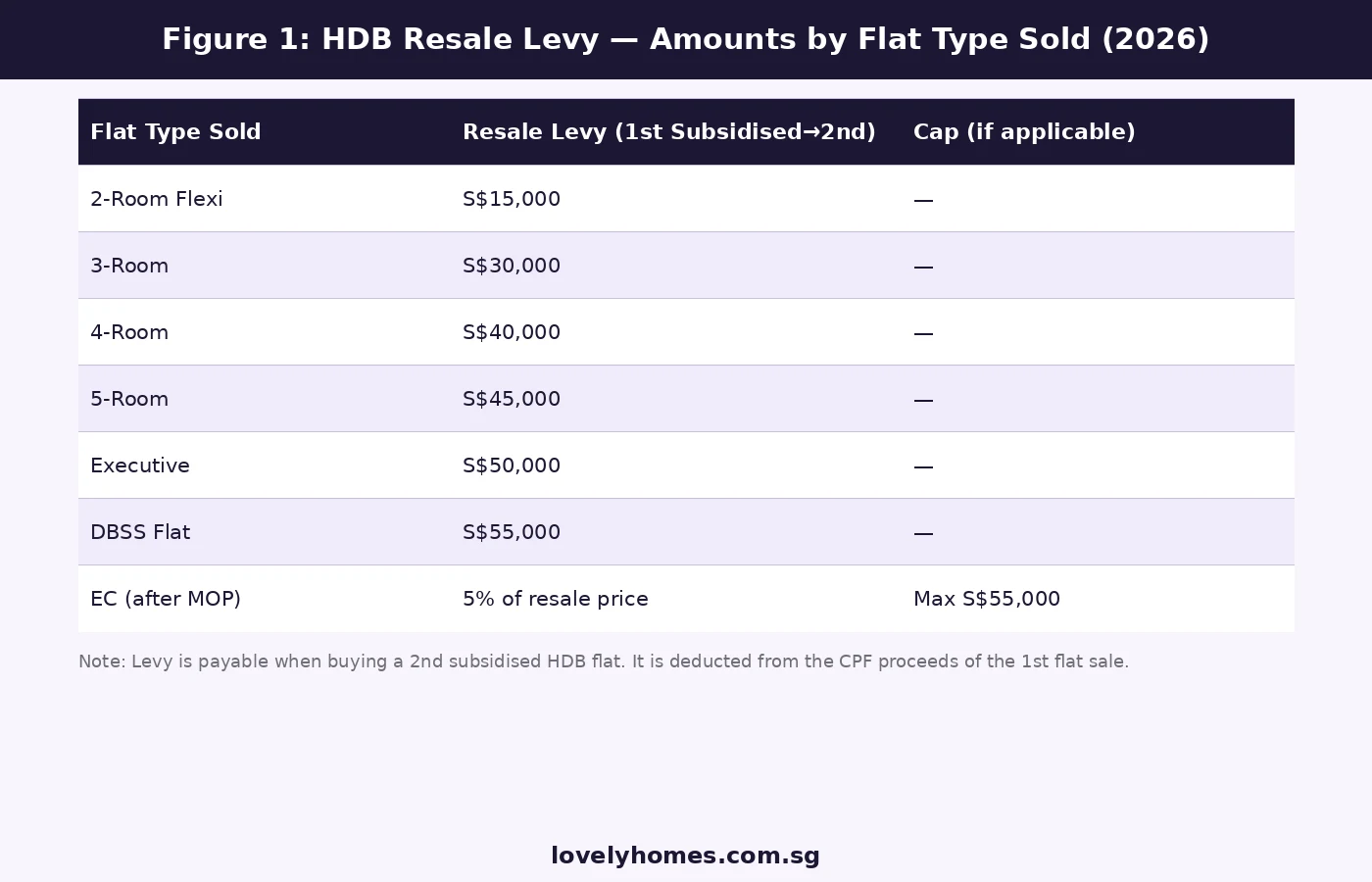
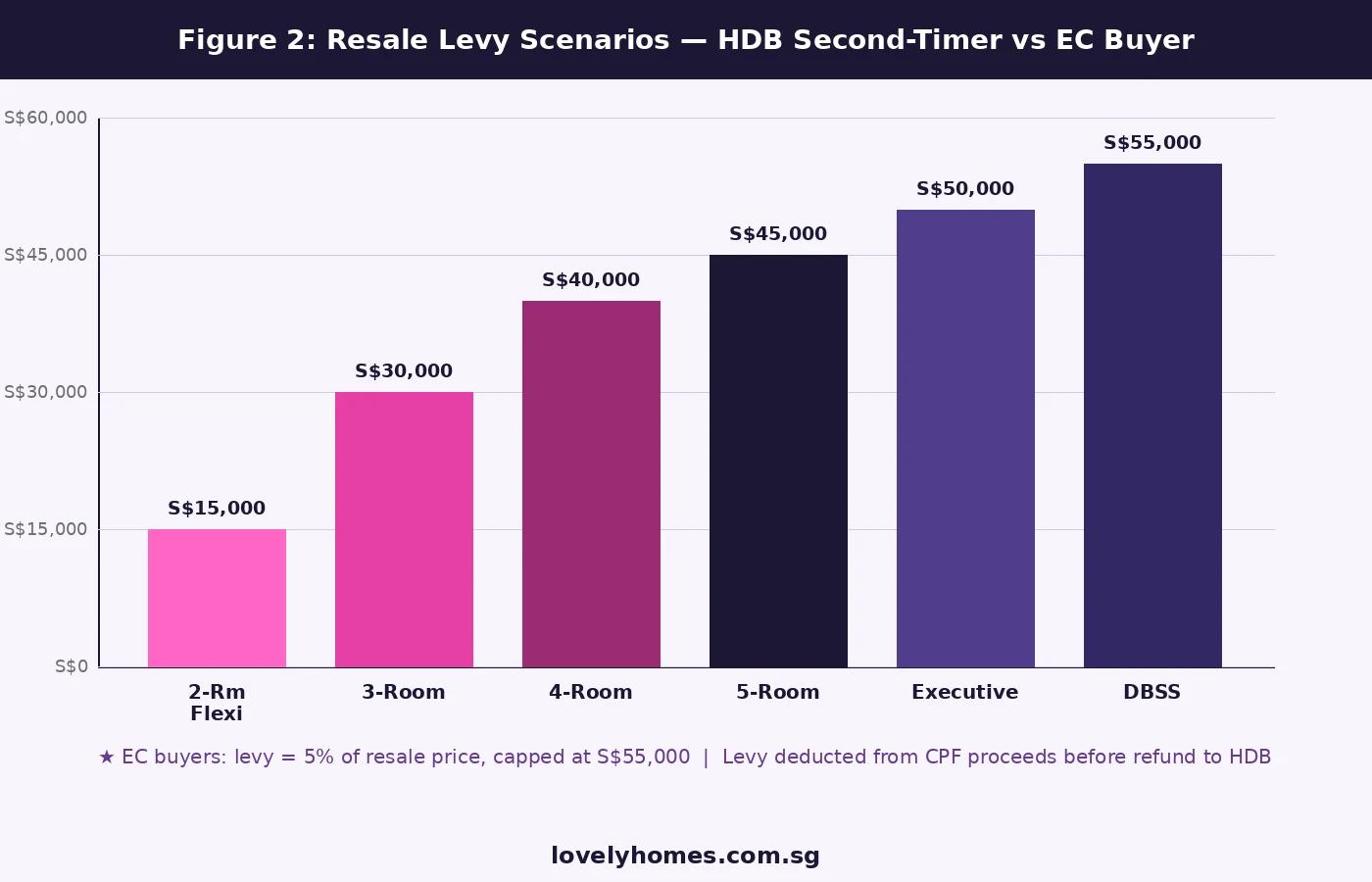
  • Levy amounts range from S$15,000 (for a 2-Room Flexi sold) to S$55,000 (for a DBSS flat sold), with EC buyers paying 5% of resale price (capped at S$55,000).
  • It is paid by deduction from the CPF refund when your first flat is sold — you do not write a cheque.
  • Exemptions apply if you bought your first flat on the resale market without any CPF Housing Grant, inherited the flat, or received it via a court order.
  • The levy does not apply when buying a private property — only a second subsidised HDB flat or EC triggers it.
  • Getting the levy wrong can delay your second flat booking and result in owing HDB cash if your CPF proceeds are insufficient.
  • From 3 March 2006, all levy amounts were fixed at the flat-type level — they are not a percentage of the first flat’s resale price (except for EC).

What Is the HDB Resale Levy?

The HDB Resale Levy is a subsidy recovery mechanism administered by the Housing & Development Board (HDB) under Singapore’s public housing framework. When the government provides a housing subsidy — such as the Central Provident Fund (CPF) Housing Grant, the Additional CPF Housing Grant (AHG), the Special CPF Housing Grant (SHG), or the Enhanced CPF Housing Grant (EHG) — it does so on the understanding that this benefit is tied to one subsidised flat per household. If that household later purchases a second subsidised flat or Executive Condominium unit, they are required to “return” a portion of the earlier subsidy benefit in the form of the resale levy.

The policy was introduced to ensure that public housing subsidies are targeted at households that genuinely need them and to maintain the long-term sustainability of Singapore’s public housing system. HDB administers the levy and collects it automatically at the point of sale of the first flat — it is not a separate bill sent to you but a deduction from your CPF Ordinary Account (OA) proceeds before they are refunded.

As at July 2026, the levy framework has remained stable since the flat-type rate schedule was fixed on 3 March 2006. Understanding it correctly is essential for any second-timer household planning to upgrade or right-size within the public housing system.

HDB resale levy amounts by flat type 2026 — S$15,000 to S$55,000 table
Figure 1: HDB Resale Levy Amounts by Flat Type Sold (2026). Fixed rates since 3 March 2006; EC applies a 5% rate with S$55,000 cap. Source: HDB Singapore.

Who Pays the HDB Resale Levy?

You are required to pay the resale levy if all three of the following conditions are met:

  1. You (or your co-applicant, spouse, or essential occupier) previously purchased a subsidised HDB flat — meaning you received a CPF Housing Grant, AHG, SHG, EHG, Step-Up CPF Grant, or bought directly from HDB at a subsidised price in a Build-To-Order (BTO) or Selective En-bloc Redevelopment Scheme (SERS) exercise.
  2. You subsequently sold that subsidised flat (or are in the process of doing so).
  3. You are now applying to buy a second subsidised flat from HDB — either a new BTO flat, a SERS flat, a Design, Build and Sell Scheme (DBSS) unit, or an Executive Condominium (EC) unit from a developer.

The key point is that the levy applies to subsidised second-time purchases only. If your second property is a private condominium, a landed home, a resale HDB flat (from the open market), or any commercial property, no resale levy is chargeable. Many upgraders mistakenly believe the levy applies whenever they buy a second property — it does not. It is specifically a tax on accessing public subsidies a second time.

Couples and Joint Applications

For married couples and joint flat buyers, the resale levy status of either party is taken into account. If either the main applicant or the co-applicant previously received a housing subsidy, the levy is applicable to the household. This prevents a household from circumventing the levy simply by swapping the person listed as main applicant on the second purchase. The rule is designed to capture the household’s cumulative subsidy benefit, not merely the individual’s.

Singles

Singles purchasing under the Single Singapore Citizen (SSC) scheme — eligible for 2-Room Flexi BTO flats — are also subject to the levy if they previously benefited from a housing subsidy. As the levy amount for a 2-Room Flexi flat is S$15,000, it is still a meaningful cost for solo buyers planning to upsize.

HDB Resale Levy Amounts (2026)

The levy amount depends on the type of flat you previously sold. Since 3 March 2006, the rates have been fixed at the following flat-type level:

Flat Type Sold (First Flat) Resale Levy Payable Notes
2-Room Flexi S$15,000 Applies to subsidised 2-Room Flexi BTO flats
3-Room S$30,000
4-Room S$40,000 Most common upgrader profile
5-Room S$45,000
Executive Flat S$50,000 HDB Executive flat (not EC)
DBSS Flat S$55,000 Design, Build and Sell Scheme (discontinued)
EC (Executive Condominium) 5% of resale price Capped at S$55,000; applies after the EC’s 5-year MOP when sold on the open market

One common source of confusion is that the levy is based on the type of flat you sold, not on its resale price. Whether you sold your 4-Room flat for S$500,000 or S$900,000, the levy is always S$40,000. The EC rule is the sole exception: there the levy is 5% of the EC’s resale price (i.e. the proceeds from selling the EC), subject to a maximum of S$55,000.

HDB resale levy bar chart by flat type Singapore 2026 — S$15,000 to S$55,000
Figure 2: Resale Levy by Flat Type (2026). The levy is flat-based, not price-based — except for EC where it is 5% of resale price, capped at S$55,000. Source: HDB Singapore.

How and When Is the Resale Levy Paid?

The resale levy is settled automatically at the completion of the sale of your first flat. HDB deducts the levy amount from the CPF Ordinary Account (OA) refund you would otherwise receive when the flat sale is completed. You do not receive a separate invoice from HDB and you do not make a cash payment at any counter.

Here is how the sequence works:

  1. Apply to buy second flat: When you apply for a BTO flat or EC as a second-timer, HDB identifies your levy status at the point of application.
  2. HDB confirms levy payable: HDB notifies you of the levy amount in the appointment letter for your second flat booking.
  3. First flat sold: On the day of the legal completion of your first flat sale, the CPF Board refunds your OA principal and accrued interest as usual — but before the refund is credited to you, HDB deducts the levy amount directly from those CPF proceeds.
  4. Balance returned: The net CPF refund (after levy deduction) is credited to your OA account.

What If Your CPF Refund Is Less Than the Levy Amount?

This can happen in rare situations — for instance, if the outstanding HDB loan and CPF accrued interest together consume most of the sale proceeds. In such cases, the shortfall must be made up in cash. HDB will require you to pay the difference out-of-pocket before the second flat booking proceeds. This is one reason why financial planning ahead of an upgrade is important: always model your net CPF position against the levy amount before committing to a second BTO application.

Who Is Exempt from the HDB Resale Levy?

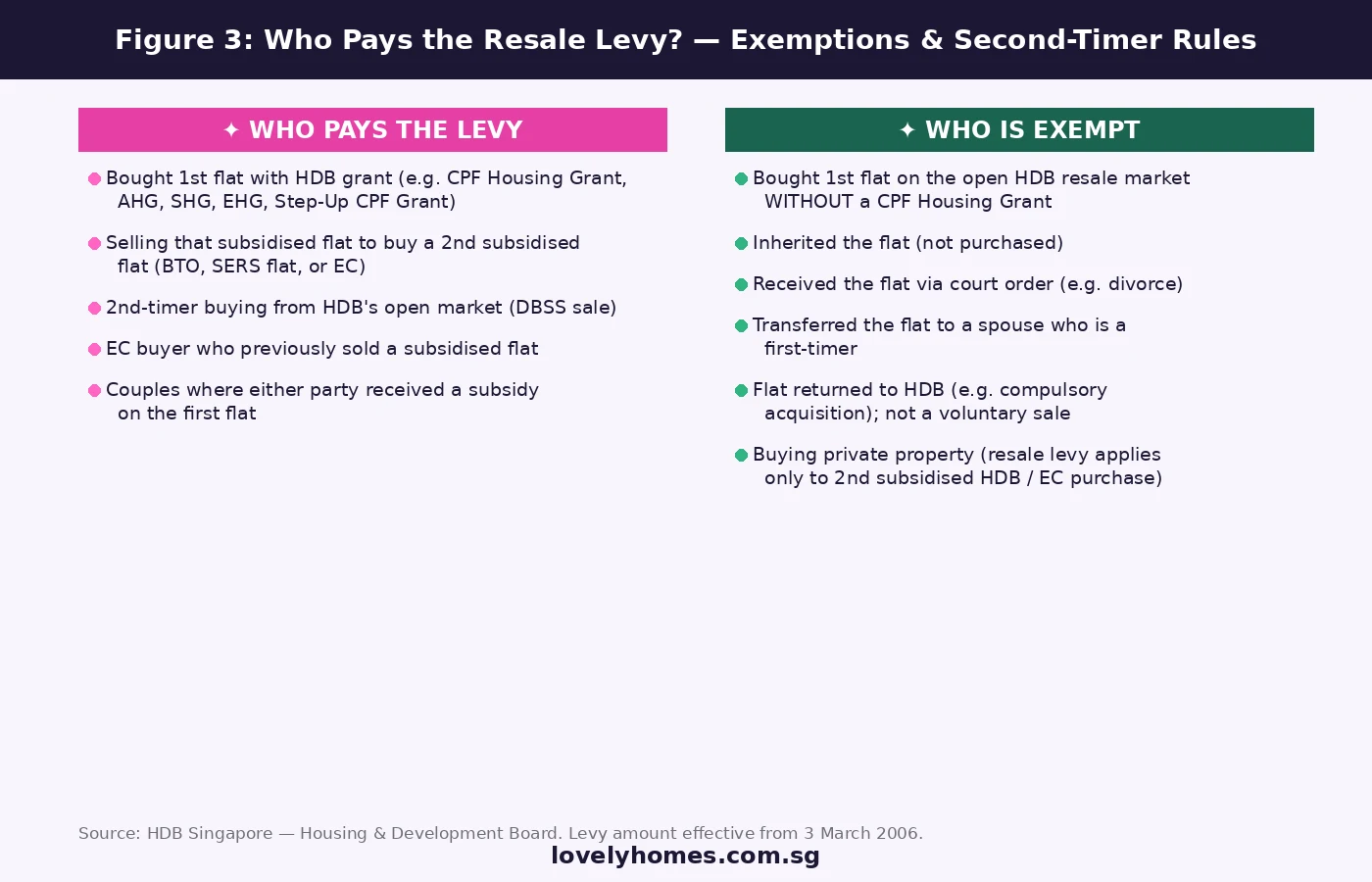
Not everyone who has previously owned an HDB flat will be required to pay the resale levy. Key exemptions include:

  • Resale flat purchased without a CPF Housing Grant: If you bought your first flat on the open HDB resale market and did not receive any CPF Housing Grant (Family Grant, Enhanced Housing Grant, Proximity Housing Grant, or any earlier-generation grant), you are not a “subsidised” flat owner for levy purposes. The levy reflects subsidy recovery — without a subsidy, there is nothing to recover.
  • Inherited flat: If the flat was left to you in a will or through intestacy, you did not receive a direct purchase subsidy, so the levy does not apply.
  • Court order transfer: Flats transferred to one party as part of a divorce settlement are generally exempt because the transfer is not a voluntary purchase attracting a subsidy.
  • Private property purchasers: The levy applies only when the second purchase is a subsidised BTO flat or EC. Upgraders to private property are not subject to the levy — though they face ABSD (Additional Buyer’s Stamp Duty) instead.
  • Flat returned to HDB involuntarily: If your first flat was compulsorily acquired by the government (e.g. for road widening or MRT works), this is not considered a voluntary sale and the levy is not triggered.

HDB resale levy exemptions and second-timer rules Singapore 2026 — who pays vs exempt
Figure 3: Who Pays vs Who Is Exempt — HDB Resale Levy 2026. Source: HDB Singapore.

Worked Example: The Tan Family’s Second BTO Application

Scenario

Mr and Mrs Tan (both Singapore Citizens) purchased a 4-Room BTO flat in Tampines in January 2019 at S$420,000, using a CPF Housing Grant of S$40,000. They have fulfilled the 5-year Minimum Occupation Period (MOP) and sell the flat in July 2026 for S$710,000.

They are applying for a new 5-Room BTO flat in Tengah at a subsidised price of S$620,000 — a second subsidised HDB purchase, making them second-timers.

Levy Calculation

Flat type sold 4-Room
Resale Levy payable S$40,000
Sale price of 1st flat S$710,000
Outstanding HDB loan (est.) S$235,000
CPF principal + accrued interest refund S$278,000
Levy deducted from CPF refund – S$40,000
Net CPF refund after levy S$238,000
Net cash proceeds S$710,000 − S$235,000 (loan) − S$278,000 (CPF) = S$197,000 cash

The Tans’ second flat purchase proceeds normally. The S$40,000 levy is handled automatically by HDB and CPF Board; neither party needs to make a separate payment. The net cash received is S$197,000, which can go toward the downpayment and costs of the new flat.

Special Situations and Edge Cases

EC Owners Selling and Buying a Second BTO

If you bought an EC (fully privatised after 10 years) and now wish to purchase a new BTO flat, you are subject to the resale levy at 5% of the EC’s resale price, subject to a maximum of S$55,000. Because EC prices have risen significantly — many ECs in mature estates now resale at S$1.2M–S$1.8M — the effective levy is almost always the capped S$55,000. For example, an EC sold for S$1.4M would attract a levy of S$70,000 in the absence of the cap; the cap holds it at S$55,000.

SERS Flat Recipients

Households that received a replacement flat under the Selective En-bloc Redevelopment Scheme (SERS) are treated as having received a housing subsidy. If they subsequently wish to buy a second new flat from HDB or an EC, the levy applies based on the type of flat they were re-housed in.

Divorce and Reassignment of Flat Ownership

When a flat is transferred to a divorced spouse under a court order, that spouse is considered a second-timer if the transferred flat was a subsidised purchase. If they later apply for a new BTO flat, the levy will apply. Seeking early legal advice on how divorce asset division affects CPF and HDB subsidy status is advisable.

Concurrent Applications

Some second-timers apply for a BTO flat while still occupying their first flat. HDB allows this — but the levy is held in reserve and deducted at the point of the first flat’s sale completion. You must sell your first flat within 6 months of collecting the keys to the second (this is the standard condition for second-timers purchasing new flats).

Why the Resale Levy Matters for Your Upgrade Strategy

The resale levy is one of several interlocking costs that second-timer households must budget for when planning an upgrade within the public housing system. It is easy to overlook because it is deducted automatically from CPF, making it feel invisible — but it directly reduces the cash and CPF resources available for your second flat.

Consider the total cost of a 4-Room BTO upgrade: beyond the flat price itself, a second-timer household must account for the Buyer’s Stamp Duty (BSD) on the new flat, legal fees, potential income grant reductions (second-timers receive smaller EHG amounts than first-timers), renovation costs, and the S$40,000 resale levy. These costs collectively can reduce the effective CPF buffer you have on hand.

In contrast, upgrading to private property involves no resale levy — but attracts ABSD of 20% as a second property purchase (if you own the HDB flat at the time of buying private, and have not yet sold it). The ABSD on a S$1.5M private property would be S$300,000 — a very different magnitude. Households navigating this choice should consider the full cost picture of each route. Our ABSD Singapore 2026 Complete Guide and HDB Upgrader Guide 2026 cover the private-property upgrade path in detail.

Frequently Asked Questions — HDB Resale Levy 2026

Q1. Can I avoid the resale levy by selling my flat before applying for the BTO?

No. Your levy status is determined by your subsidy history, not by the sequence of sale and purchase. Whether you sell before or after booking the BTO flat, the levy still applies because you previously received a CPF Housing Grant. Selling early may give you more CPF OA funds to draw on, but it does not remove the levy obligation.

Q2. My spouse is a first-timer. Does the household still pay the levy?

Yes. HDB assesses the household as a unit. If either the main applicant or co-applicant has previously received a housing subsidy, the entire household is classified as a second-timer for levy purposes. There is no mechanism to apply as a “first-timer” household if one party is a second-timer. However, in this situation, the household may be eligible for a reduced levy in some cases — consult HDB directly for your specific profile.

Q3. Is the resale levy the same as the CPF accrued interest I must return?

No — these are two completely different obligations. CPF accrued interest (at 2.5% p.a.) is the amount you owe your own CPF account for the OA savings you withdrew to pay for the flat. It is returned to your OA upon sale — you are repaying yourself. The resale levy, in contrast, is paid to HDB as a subsidy recovery charge. Both deductions happen at the point of sale, but they serve entirely different purposes and go to different places.

Q4. Can I use CPF to pay the resale levy, or must it come from cash?

The levy is deducted automatically from the CPF OA refund you receive when your first flat is sold. You do not need to arrange a separate cash payment unless your CPF refund is insufficient to cover the levy — in which case HDB will require the shortfall in cash before releasing the booking fee for your new flat. Always check your estimated CPF refund against the applicable levy amount before committing to a second BTO booking.

Q5. Does the resale levy apply if I buy an EC as a first-time EC buyer but sold an earlier subsidised flat?

Yes. If you are buying an EC and you previously sold a subsidised HDB flat, the resale levy is payable. The EC levy is the higher of: 5% of the resale price of your sold flat or (if you are selling a non-EC subsidised flat) the flat-type levy amount — unless you are selling the EC itself, in which case it is 5% of the EC’s resale price (capped S$55,000). HDB’s levy assessment letter, issued before your EC booking, will specify the exact amount applicable to your situation.

Q6. Has the HDB resale levy changed recently? Will it increase?

The flat-type levy rates have been unchanged since 3 March 2006. As at July 2026, there has been no announcement by HDB or the Ministry of National Development (MND) of any impending change to the levy framework. Given that BTO prices have risen considerably since 2006, some analysts have speculated that a levy increase is overdue — but this is speculative. Decisions on the levy are policy matters resting with MND. Monitor HDB press releases and MND Budget announcements for any changes.

Q7. What happens if I cannot sell my first flat in time to pay the levy before the second flat completion?

Second-timers purchasing a new HDB flat must generally sell their existing flat within 6 months of collecting the keys to the new flat. If you have not sold your first flat by the time you need to complete the purchase of the new flat, HDB may defer key collection or require you to arrange an interim cash payment for the levy amount. Contact HDB directly if your sale is delayed — they may grant a time extension in genuine cases, but this is not guaranteed and is assessed case by case.

Related Articles

Disclaimer: The information in this article is intended for general educational purposes only. HDB policies, levy amounts, and eligibility rules can change. Always verify current requirements directly with the Housing & Development Board (HDB), the CPF Board, and the Ministry of National Development (MND). This article does not constitute financial, legal, or property advice. Consult a licensed property agent (CEA-registered), a qualified financial adviser, or a solicitor for advice specific to your situation.

×

Click anywhere outside to close
HDB Resale Levy Singapore 2026: Who Pays It, How Much, and How to Avoid It

HDB Resale Levy Singapore 2026: Who Pays It, How Much, and How to Avoid It

HDB resale levy Singapore 2026 — full guide hero image
HDB Resale Levy Singapore 2026 — who pays, when, and how to plan around it.

Quick answer — the resale levy in 30 seconds

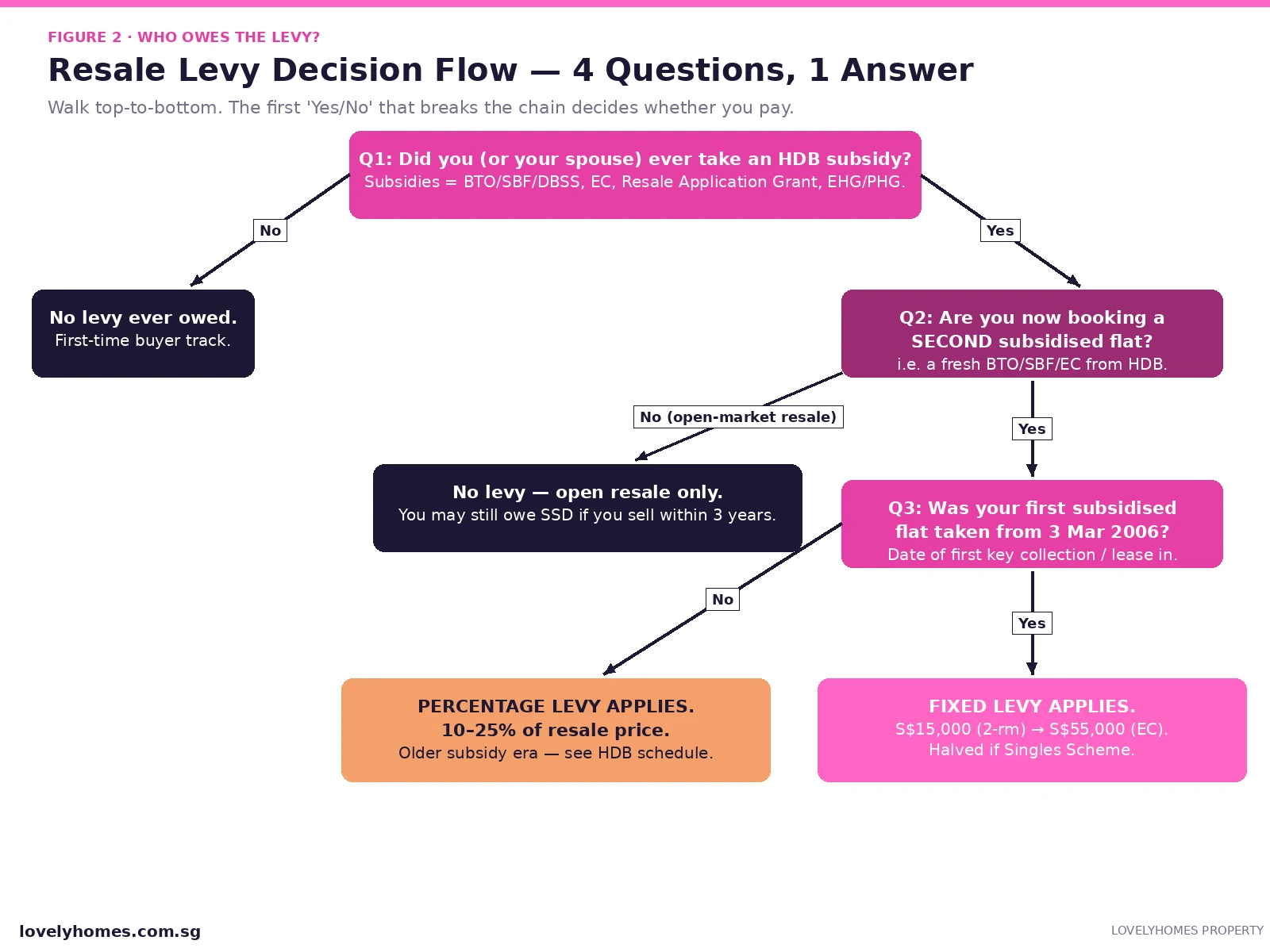
  • The HDB resale levy is a one-off charge on second-timer households who take a second housing subsidy from HDB (BTO, Sale of Balance Flats, or a new Executive Condominium).
  • It does not apply if you sell your subsidised flat and buy on the open resale market without claiming any fresh HDB grant.
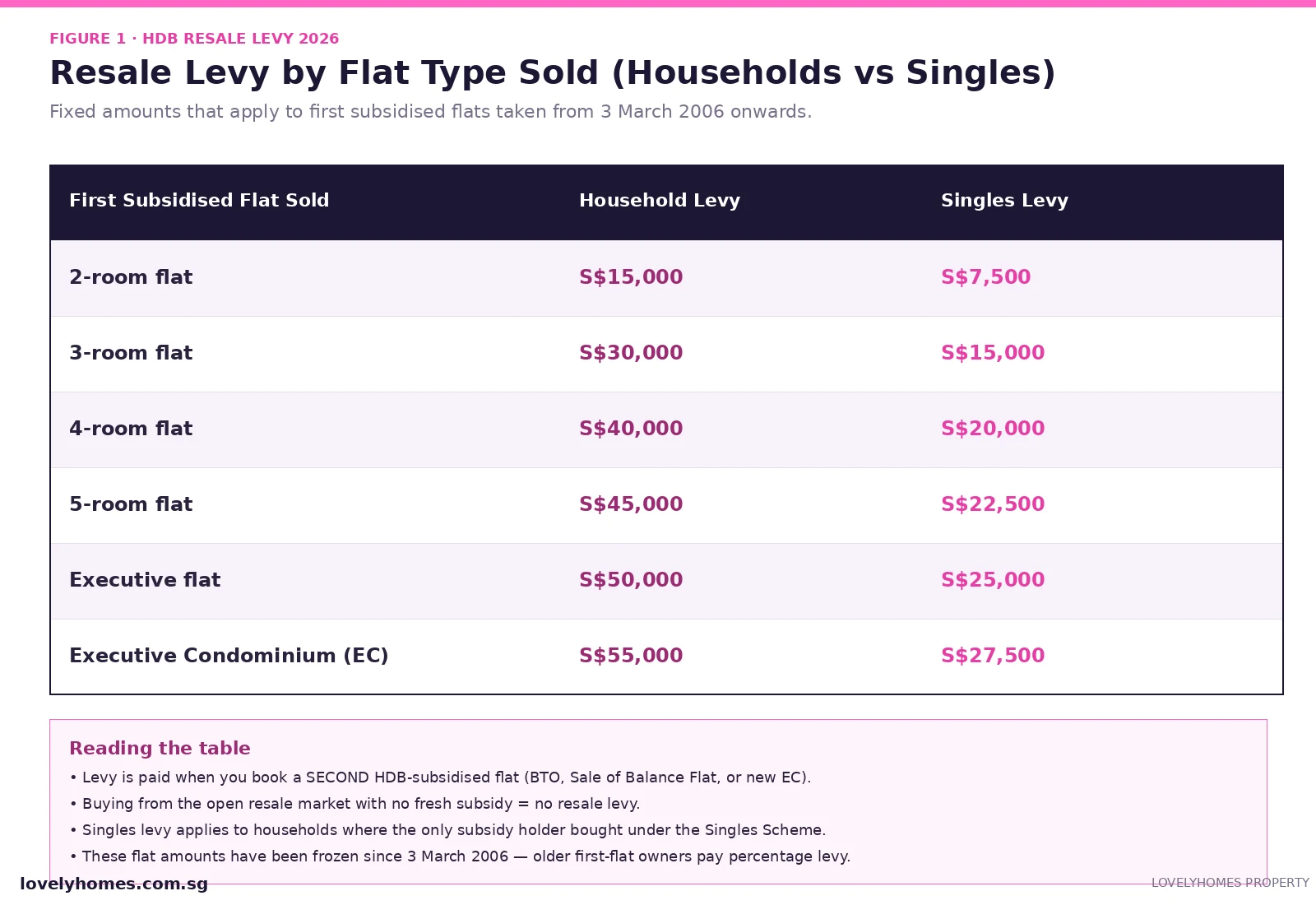
  • For first subsidised flats taken from 3 March 2006, the levy is a fixed amount — S$15,000 for a 2-room sold up to S$55,000 for an EC.
  • Households who got their first subsidy before 3 March 2006 pay a percentage levy of 10–25% of the resale price instead.
  • Singles Scheme buyers pay half the household amount.
  • The levy is paid in cash (or net cash proceeds from selling the first flat) — CPF cannot be used.
  • Payment is collected at the point of booking the second subsidised flat, before key collection.
  • Buying on the open market means no levy, but you still face BSD, ABSD (where applicable) and SSD if you sell within three years.

What is the HDB resale levy?

The resale levy is a charge that the Housing & Development Board (HDB) imposes on a household which has already enjoyed a housing subsidy and now wants a second bite at one. The Government’s logic is straightforward: public housing subsidies are taxpayer-funded, and a household should not collect them twice without contributing back. Selling the first subsidised flat is fine; what triggers the levy is the act of booking another subsidised flat — a fresh BTO, a Sale of Balance Flat, an open booking unit, or a brand-new Executive Condominium directly from the developer.

Crucially, the levy is administered by HDB, not IRAS. It is separate from Buyer’s Stamp Duty, ABSD, and Seller’s Stamp Duty. You can owe stamp duties and a resale levy in different scenarios, and they are calculated, paid, and tracked independently.

HDB resale levy Singapore 2026 — fixed levy amounts by flat type for households and singles
Figure 1 · Fixed-dollar resale levy amounts in force since 3 March 2006. Source: HDB.

Who actually pays the levy?

The resale levy travels with the household, not the property. If at any point in your housing history you (or your spouse, or your essential occupier) have already enjoyed an HDB subsidy, you are a second-timer in HDB’s eyes the next time you approach them for a fresh subsidy. The subsidies that count include:

  • A new flat purchased directly from HDB (BTO, Sale of Balance Flats, Re-Offer of Balance Flats, open-booking flats).
  • A Design, Build and Sell Scheme (DBSS) flat bought from a private developer.
  • An Executive Condominium bought directly from the developer (first hand).
  • A resale flat bought with one of the older Resale Application Grants — CPF Housing Grant for Family, Singles Grant, or Half-Housing Grant — taken before changes to the levy rules.
  • HUDC flats and SERS replacement flats taken under HDB schemes count similarly.

If your only subsidy was the Enhanced CPF Housing Grant (EHG) or the Family Grant on a resale flat purchased after 3 March 2006, you are not automatically deemed a levy-paying second-timer for the purpose of a future resale flat purchase — but you do pay the levy if you next buy a new flat or new EC.

How the levy is calculated

Two regimes apply, and the dividing line is the date of your first subsidised flat’s key collection (or in the case of an EC, the date you signed the Sale & Purchase Agreement).

Fixed-dollar levy (first flat from 3 March 2006)

This is the regime almost every modern buyer falls under. The amount is locked to the type of flat you sold:

First subsidised flat sold Household levy Singles Scheme levy
2-room flat S$15,000 S$7,500
3-room flat S$30,000 S$15,000
4-room flat S$40,000 S$20,000
5-room flat S$45,000 S$22,500
Executive flat / HUDC S$50,000 S$25,000
Executive Condominium S$55,000 S$27,500

The fixed amount does not move with property prices, which is good news for households whose first flat appreciated heavily in resale. A 4-room sold today for S$700,000 still owes only S$40,000 in levy — about 5.7% of the resale price.

Percentage levy (first flat before 3 March 2006)

Older second-timers face the legacy regime. Levy is set as a percentage of the higher of the resale price or 90% of the market valuation:

First subsidised flat sold Household levy % Singles Scheme levy %
2-room flat 10% 5%
3-room flat 20% 10%
4-room flat 22.5% 11.25%
5-room flat 25% 12.5%
Executive flat / HUDC 25% 12.5%

For a household that sold a 4-room legacy flat for S$650,000, the percentage levy lands at S$146,250 — markedly higher than the modern fixed levy. This is one reason long-time HDB owners often choose to remain in the resale market rather than ballot for a fresh BTO.

When and how the levy is paid

HDB collects the resale levy at the point of booking the second subsidised flat. In practice this means:

  1. You sell your first subsidised flat. CPF is refunded with accrued interest; the cash balance is yours.
  2. You ballot for, queue, and book a second BTO/SBF/SBF or sign for an EC.
  3. HDB issues a payment notice for the levy, payable in cash only. CPF cannot be used.
  4. Levy is paid before signing the lease agreement / S&P. Failure to pay forfeits the booking.

If the second flat is booked before the first has been sold, HDB defers the levy to the resale completion date and may require an undertaking. Some buyers structure it this way to avoid being homeless between sale and BTO completion, especially in long-build projects.

HDB resale levy 2026 decision flow — who owes the levy
Figure 2 · Walk the four questions in order — the first answer that breaks the chain decides your outcome.

Who is exempt or partially relieved?

HDB allows a small set of waivers and concessions, and these matter most for older households and downgraders:

  • Buying a 2-room Flexi flat on a short lease (45 years or less) at age 55 and above. The resale levy is waived in full to encourage right-sizing.
  • Buying a Studio Apartment / Community Care Apartment. No resale levy applies (these are senior-targeted typologies).
  • Divorce settlements where one party retains the existing flat. No levy event; only one of the parties may face a levy if they later buy a fresh subsidised flat.
  • Sub-letting income or rental of bedrooms does not trigger the levy. The levy only fires when the subsidised flat is sold and a new subsidised flat is booked.
  • Open-market resale purchases without grants are not levy events. You can move from a 4-room HDB to another resale 5-room without grant, and no levy is triggered.

Resale levy vs CPF refund vs stamp duty — separating the bills

It is easy to confuse three different cash flows that all hit a second-timer household at roughly the same time. They are independent and add up:

What you pay Who collects Triggers Source of funds
Resale levy HDB Booking second subsidised flat Cash only
CPF accrued interest CPF Board (refund into your OA) Sale of any flat Auto-deducted from sale proceeds
Buyer’s Stamp Duty IRAS Any property purchase Cash + CPF allowed
Additional Buyer’s Stamp Duty IRAS Second / third / foreign buyer purchase Cash + CPF allowed
Seller’s Stamp Duty IRAS Sale within 3-year holding period From sale proceeds

The CPF accrued interest is not a fee — it is your own money being returned to your OA — but it shrinks the cash you can deploy on the next purchase. Plan around it the same way you plan around the resale levy.

Worked example — same family, two paths

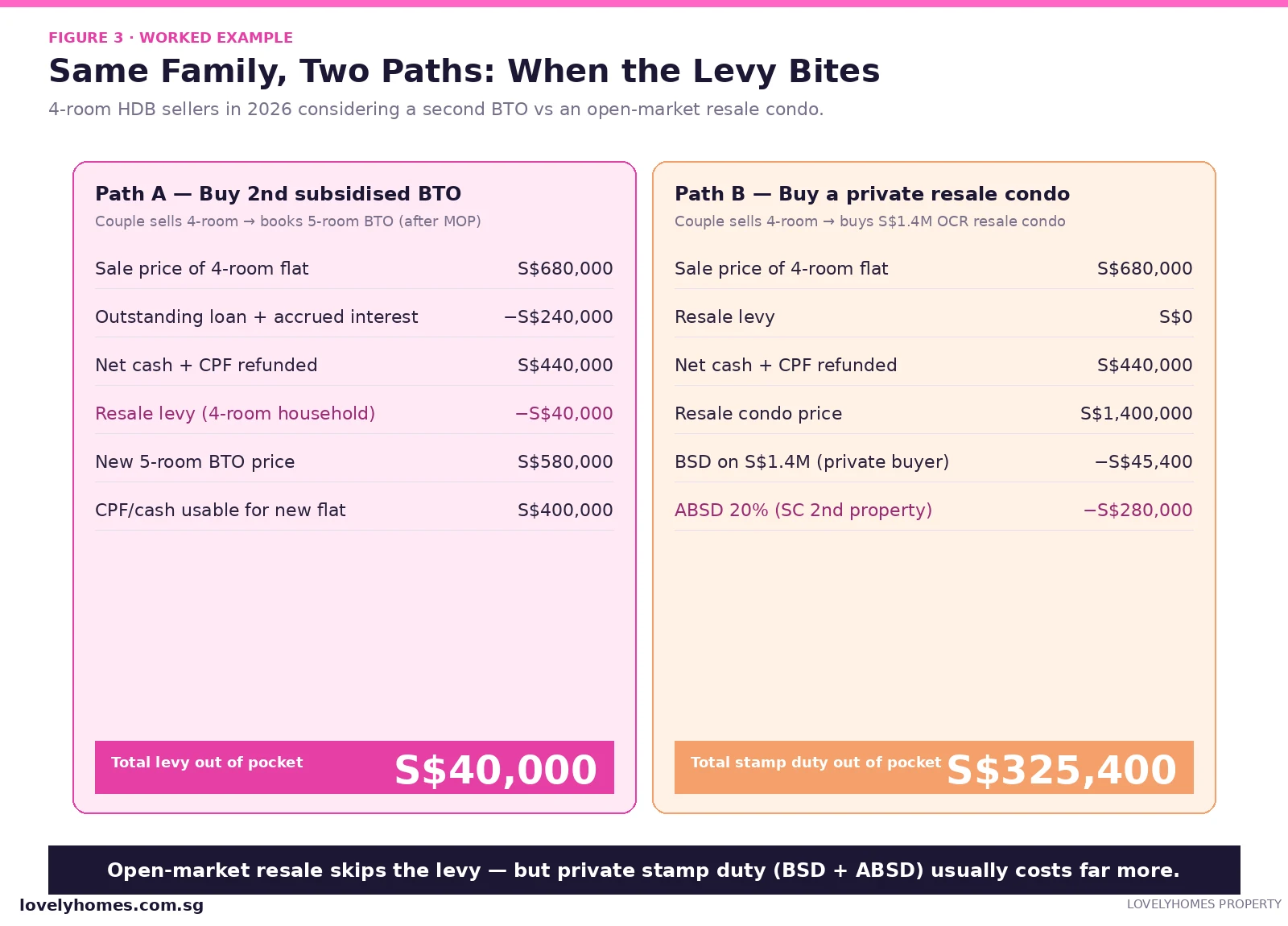
Take a Singapore Citizen couple, married 12 years, who bought a 4-room BTO in Punggol for S$320,000 in 2014 with a Family Grant. In 2026 they have hit the 5-year MOP, the flat is valued at S$680,000, and they are deciding whether to upgrade through a fresh BTO or to buy a private resale condo.

HDB resale levy worked example 2026 — second BTO vs private resale condo cost stack
Figure 3 · Whichever way they go, the resale levy is small relative to private stamp duty.

Path A — buying a 5-room BTO — costs S$40,000 in levy plus the new flat price of S$580,000. Path B — buying an S$1.4M open-market resale condo — skips the levy entirely but adds S$45,400 in BSD and S$280,000 in ABSD at the 20% citizen-second-property rate, totalling S$325,400 in stamp duty. The headline conclusion: the resale levy is real money, but it is dwarfed by ABSD whenever the alternative is a private-market upgrade. Couples often see this comparison only after they put pen to paper, which is why it pays to model both routes early.

Why the levy exists at all

Singapore’s housing model rests on two policy pillars: keeping public housing affordable to first-timers, and rationing taxpayer subsidies. Without a levy, a household could ride the BTO market repeatedly — cashing in on resale price growth at each cycle and stepping up to bigger flats with full subsidies each time. The levy is the friction that makes a second BTO a deliberate choice rather than a default. It also keeps queues for new BTOs balanced — first-timers always get priority, but second-timers compete for the remaining quota and pay the levy if they win one.

Compared with peer markets, the Singapore approach is unusual. Hong Kong’s Home Ownership Scheme uses a price clawback rather than a flat levy. Australia’s First Home Owner Grant has no second-time levy because grants there are smaller and time-limited. The Singaporean fixed-dollar approach is a useful piece of housing-policy plumbing that most buyers only encounter once.

What this means for you

If you are a current HDB owner thinking about your next move, the levy reshapes the decision in three concrete ways. First, it makes the open resale route surprisingly competitive — for many flat types the levy is comparable to the lawyer-and-valuer fees on a private resale and is comfortably under the BSD on a S$1.5M condo. Second, because the levy is fixed, smaller flat owners (2-room, 3-room) face a friendlier upgrade path than larger flat owners; the household that sold a 5-room or EC pays the most. Third, the levy is cash-only — that imposes a real liquidity hit at exactly the moment you are also funding the down-payment, legal fees, and renovation on the next home.

A common mistake is to treat the levy as one of many transaction costs and bake it into the budget late. Run the numbers up front, ideally on the same spreadsheet you use for down payment and LTV planning. If you are upgrading to a private property, the right comparison is the levy versus the ABSD and BSD on the alternative — almost always a smaller bill, in absolute terms, than the stamp duties on a S$1.5M+ condo.

What might come next

The fixed-dollar regime has been frozen since March 2006. Construction costs and median flat prices have roughly tripled since then, which has progressively eroded the real value of the levy. There has been periodic public commentary that the Government may reconsider the schedule — either by indexing it to a property price benchmark or by raising the EC and 5-room amounts. In the same vein, the percentage-based legacy regime continues to age out as pre-2006 first-flat owners exit the market.

Two policy directions are plausible from here. One is a recalibration that pushes the larger-flat levies upward to keep relative ratios stable as flat prices move. The other is a structural rethink that ties the levy to the resale price like the legacy regime, but capped to avoid punishing strong resale gains. Either direction would arrive with notice and a generous grace period for booked transactions; speculation is not a reason to rush a BTO ballot. The forward-looking view here is that some upward adjustment is likely over the next several years, but transparency and lead time are part of HDB’s playbook.

Frequently asked questions

Does the resale levy apply if I sell my HDB and buy a private condo?

No. The levy only triggers when you book another subsidised flat from HDB (BTO, SBF, fresh EC). Buying a private resale condo or a new condo from a developer does not engage the levy at all — although you will face full BSD plus ABSD where applicable.

Does the resale levy apply when I buy a resale flat with a CPF grant?

For first subsidised flats taken from 3 March 2006 onwards, second-timer households who buy a resale flat with grants are subject to a smaller adjustment rather than a full resale levy. Historically (pre-March 2006) a percentage levy did apply. Always check HDB’s resale flat eligibility letter for your specific case before you make an offer.

Can I pay the resale levy from my CPF Ordinary Account?

No. The levy is payable in cash. The cash you have on hand from the sale of your first flat — after CPF is refunded with accrued interest — is the typical source of funds. Some households top up with a small bridging loan to cover the gap between flat sale completion and second-flat booking.

What if my spouse and I both owned subsidised flats before marriage?

HDB looks at the household, not the individual. If either of you previously took an HDB subsidy, the next subsidised flat the new household books is treated as a second purchase. Only one resale levy is owed per household per flat sold.

Will the levy be waived if I am buying a smaller flat to right-size?

Only in tightly defined cases — chiefly the 2-room Flexi short-lease flat at 55+, and Studio Apartment / Community Care Apartment purchases. Right-sizing into a longer-lease 2-room or 3-room generally still triggers the levy if it is a fresh subsidised flat.

Does the resale levy apply to Executive Condominium buyers?

Yes — and it is the largest category, S$55,000 for households who previously sold an EC. Crucially, the levy fires on the first hand EC purchase only. After the EC’s 5-year MOP and 10-year privatisation, subsequent buyers are private-market buyers and never face the levy.

If I divorce and one of us keeps the flat, does the other party still owe the levy?

The party who retains the flat keeps the subsidy attribution; if they later remarry and book another subsidised flat, the levy applies. The other party’s eligibility is reviewed against their new household status — the levy is only assessed at the point of booking a fresh subsidised purchase.

Disclaimer: This article summarises the resale levy regime as administered by the Housing & Development Board (HDB) of Singapore. Levy amounts, eligibility rules and waivers may be updated by HDB from time to time. Always verify the current schedule against the HDB resale levy page on hdb.gov.sg, your eligibility letter, and where relevant the Inland Revenue Authority of Singapore (IRAS), the Central Provident Fund (CPF) Board, the Monetary Authority of Singapore (MAS), and SingStat for housing market data. This article does not constitute legal, financial or tax advice — speak to a licensed conveyancing lawyer, a HDB-listed mortgage advisor, or a registered financial adviser before transacting.

Translate »