Singapore Home Loan Complete Guide 2026: HDB Loans, Bank Loans, TDSR, MSR and Best Rates Explained

Singapore Home Loan Complete Guide 2026: HDB Loans, Bank Loans, TDSR, MSR and Best Rates Explained

Quick Answer — Singapore Home Loans at a Glance (2026)

  • Two main options: HDB Concessionary Loan (2.6% p.a., LTV 80%) and Bank Loan (~3.0–3.7% p.a., LTV 75%).
  • MSR caps your HDB or EC loan instalment at 30% of gross income; TDSR caps all debt at 55% of income.
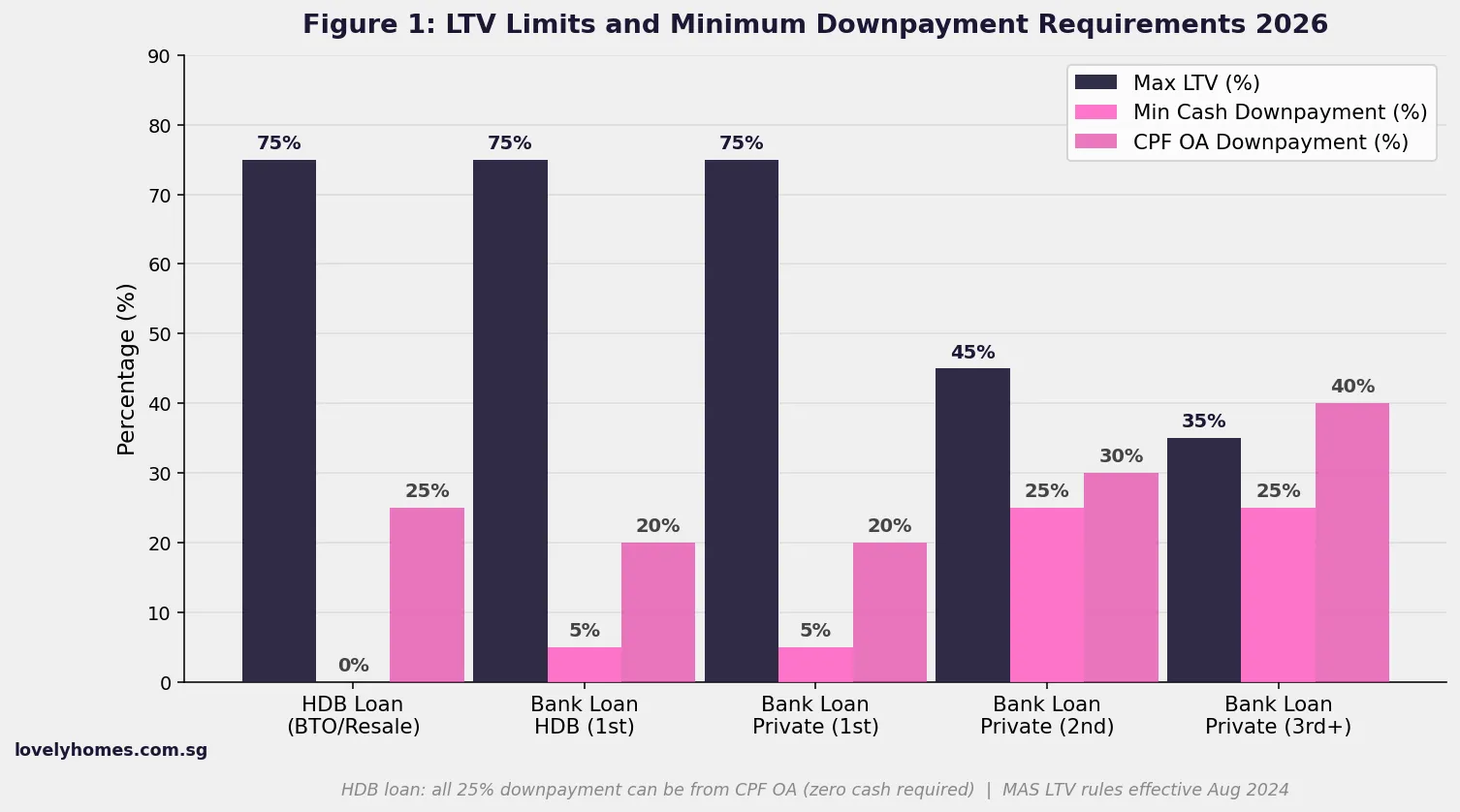
  • Bank loans require a minimum 5% cash downpayment; HDB loans require 5% cash on the 20% downpayment portion.
  • Floating-rate loans are pegged to SORA (Singapore Overnight Rate Average) — 3M SORA ~2.4% at June 2026.
  • A S$1 million loan at 3.5% over 25 years costs S$85,000 more in total interest than at 2.6%.
  • Lock-in periods of 1–3 years are standard on bank fixed-rate packages; exiting early triggers a clawback of ~1.5% of the outstanding loan.
  • Refinancing after the lock-in expires can save tens of thousands; always compare at least 3 banks’ packages.

What Is a Home Loan and Why Does the Structure Matter?

A home loan (or housing loan) is a secured credit facility from a lender — either the Housing and Development Board or a licensed bank — that allows you to finance the purchase of a residential property in Singapore. The property serves as collateral; if you default, the lender can repossess and sell it to recover the outstanding debt.

The structure matters because small differences in interest rate, tenure, and loan-to-value ratio compound dramatically over a 25–30-year horizon. A 0.9 percentage point difference (say, 2.6% vs 3.5%) on a S$600,000 HDB loan over 25 years translates to roughly S$51,000 in additional interest. That is not a minor detail. Beyond the rate, two Monetary Authority of Singapore (MAS) rules govern how much you can borrow: the Mortgage Servicing Ratio (MSR) for HDB and Executive Condominium (EC) purchases, and the Total Debt Servicing Ratio (TDSR) for all property loans.

HDB Concessionary Loan vs Bank Loan — The Key Differences

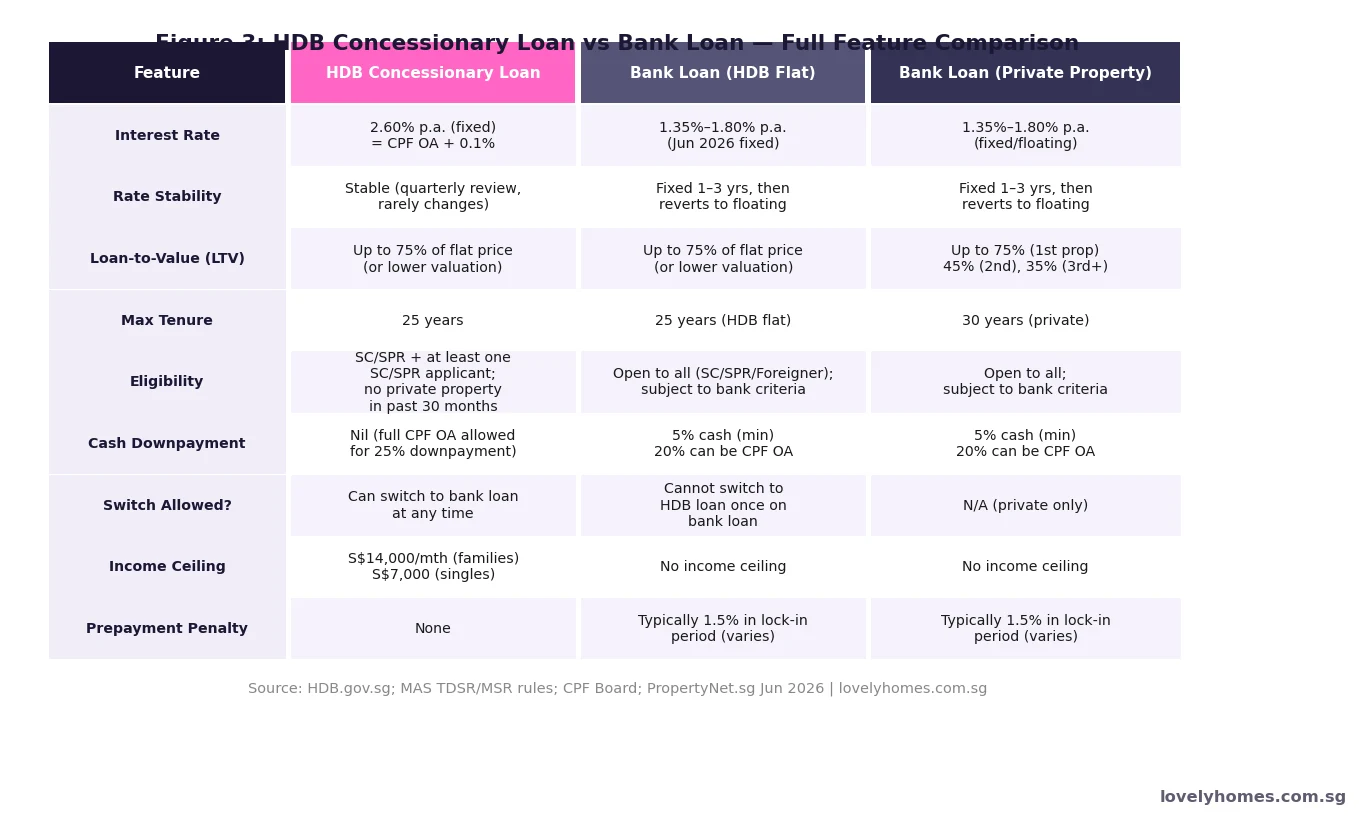
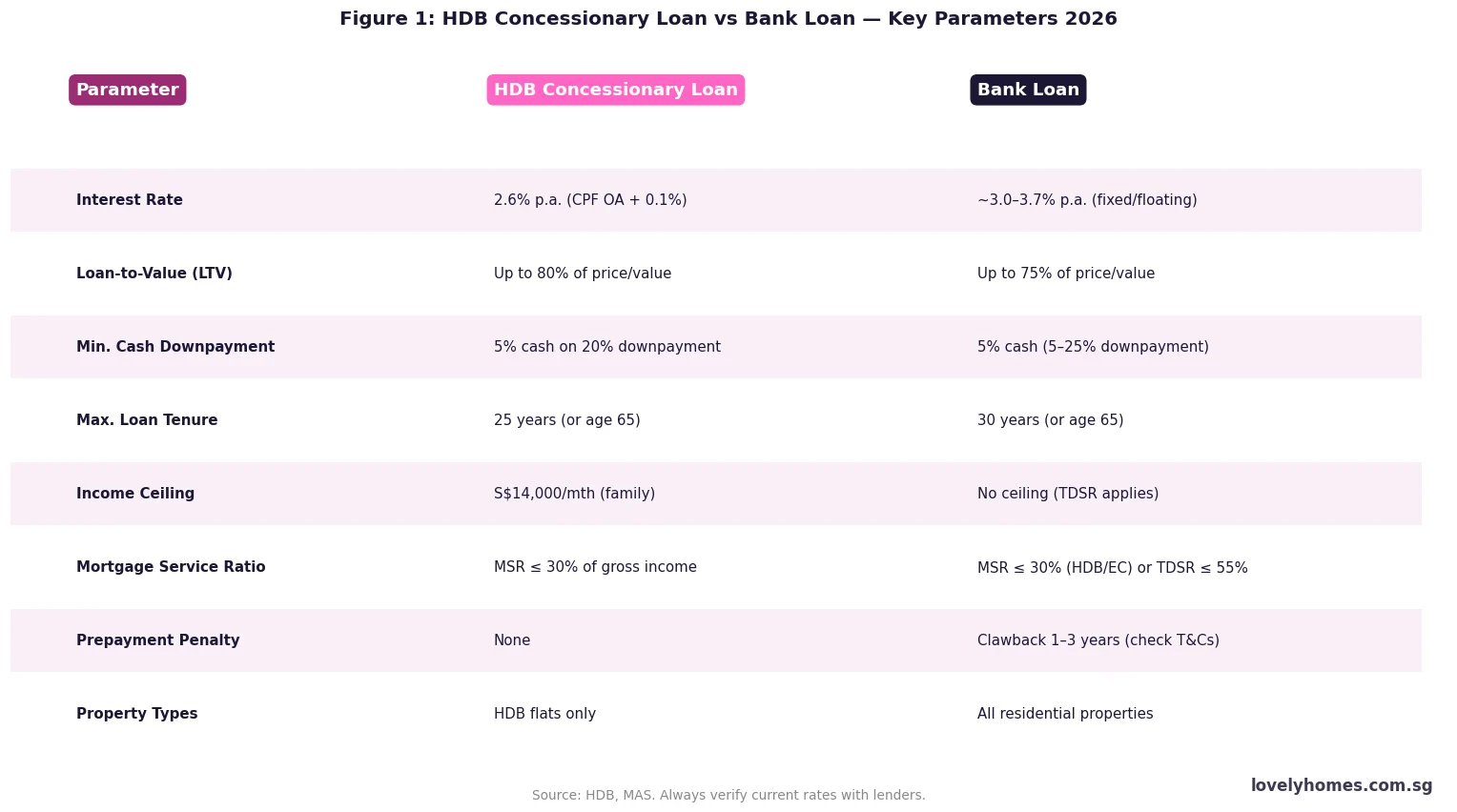
Every Singapore home buyer faces the same first question: HDB loan or bank loan? Each has distinct advantages and constraints. The comparison below sets out the essential differences.

HDB concessionary loan vs bank loan comparison table 2026 key parameters Singapore
Figure 1: HDB Concessionary Loan vs Bank Loan — Key Parameters (2026). Source: HDB, MAS.

The HDB loan rate of 2.6% p.a. is fixed at 0.1% above the CPF Ordinary Account (OA) rate of 2.5%. It moves only if the CPF OA rate changes — which has not happened since July 1999. Bank loans fluctuate with market rates. At June 2026, the best 2-year fixed bank packages sit at approximately 3.0–3.2% p.a., while SORA-pegged floating packages range from SORA+0.75% to SORA+1.20% (3M SORA ~2.4%, implying ~3.15–3.60% all-in).

HDB Concessionary Loan — Eligibility and Key Rules

To qualify for the HDB loan, at least one buyer must be a Singapore Citizen; the household gross income must not exceed S$14,000 per month (families) or S$7,000 (singles); and no buyer may currently own or have disposed of private property in the 30 months before the flat application. You also need a valid HDB Flat Eligibility (HFE) letter — a mandatory pre-application document from HDB confirming your loan eligibility, CPF grant entitlement and maximum loan quantum (mandatory since May 2023, valid for 9 months).

The maximum loan under the HDB loan is 80% of the lower of the purchase price or valuation. On a S$700,000 flat that is S$560,000. The remaining 20% (S$140,000) is the downpayment — at least 5% (S$35,000) must be cash; the rest may come from CPF OA.

Bank Loans — LTV, Lock-in and SORA

Bank loans allow a longer maximum tenure (30 years vs 25 years), access to all property types, and — potentially — lower rates during low-rate periods. The trade-off is variability and the lock-in period. Most bank fixed rates carry a lock-in of 1–3 years, after which the loan reprices to a floating SORA-pegged rate. The Loan-to-Value (LTV) for a bank loan is 75% if you have no outstanding loans; 45% if you have one; 35% if two or more. SORA replaced SIBOR as the benchmark rate on 1 October 2024 following the MAS phase-out of SIBOR.

MSR and TDSR — How Much Can You Actually Borrow?

The MAS introduced the TDSR framework in June 2013 and has maintained it as the primary constraint on borrowing. For HDB and EC purchases, the MSR applies as a tighter cap.

  • TDSR ≤ 55%: Total monthly debt obligations — home loan plus all other debts — must not exceed 55% of gross monthly income.
  • MSR ≤ 30%: For HDB and EC purchases only — the monthly home loan repayment alone must not exceed 30% of gross monthly income.
Maximum home loan quantum by household income MSR 30 percent TDSR 55 percent comparison chart Singapore 2026
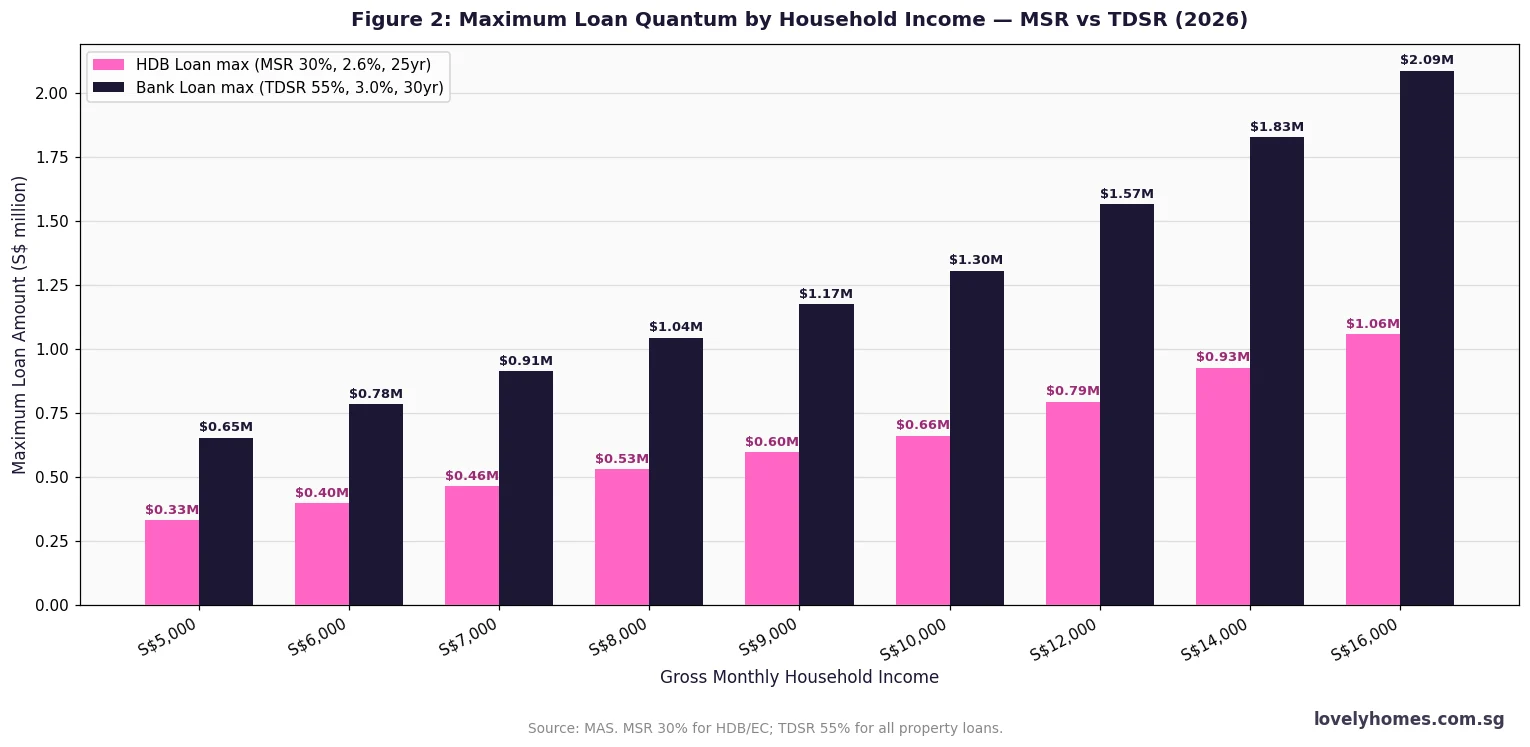
Figure 2: Maximum Loan Quantum by Household Income — MSR (HDB/EC) vs TDSR (private property), 2026.

A household earning S$10,000 per month can borrow up to approximately S$826,000 on an HDB loan (MSR 30% at 2.6% p.a. over 25 years) or up to S$1,514,000 under TDSR on a bank loan for private property (55% at 3.0% p.a. over 30 years). The MSR is the binding constraint for HDB buyers; TDSR is the constraint for private property buyers.

Fixed Rate vs Floating Rate (SORA) — Which Is Better?

Fixed-rate packages offer certainty: the rate is locked for 2–3 years. After the lock-in, the loan reverts to a floating rate and you may reprice or refinance. Breaking the lock-in early triggers a clawback penalty of approximately 1.0–1.75% of the outstanding loan.

Floating-rate packages pegged to 3M compounded SORA move with the market. When rates fall, your instalment falls. When rates rise (as they did sharply in 2022–2023), your instalment rises. Floating packages currently sit at SORA + 0.75%–1.20%.

Total interest cost on S$1 million home loan by rate scenario 2026 HDB 2.6 percent bank fixed SORA floating
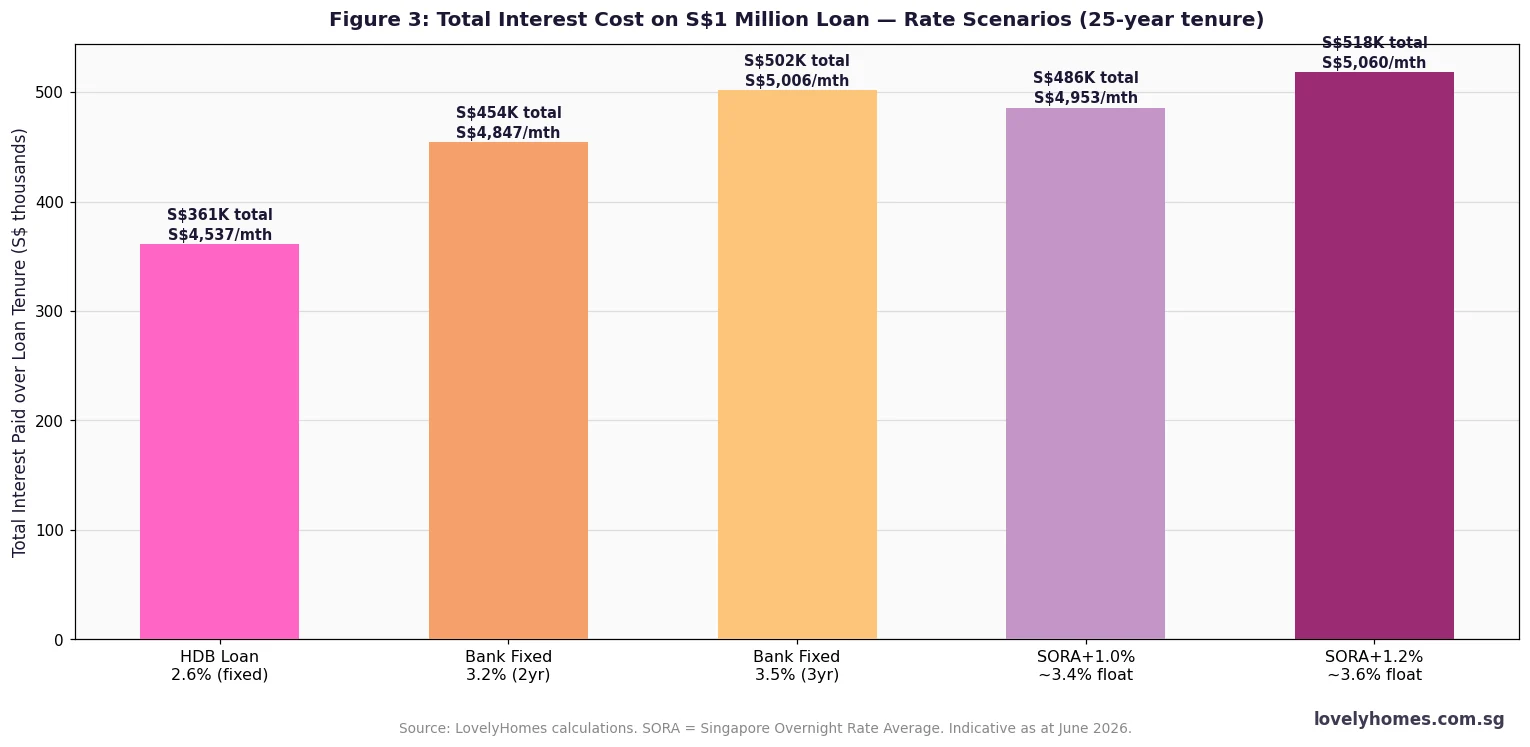
Figure 3: Total Interest Cost on S$1 Million Loan (25-year tenure) by Rate Scenario. Source: LovelyHomes calculations, indicative June 2026.

The chart shows the cost differential starkly. The HDB loan at 2.6% costs approximately S$377,000 in total interest over 25 years on a S$1 million loan. A bank fixed rate at 3.5% costs S$462,000 — a S$85,000 difference. For buyers of private property or ECs using bank financing, the choice between fixed and floating hinges on your rate outlook and risk tolerance.

CPF and Home Loan Financing

Most Singapore buyers use their CPF Ordinary Account (OA) to service instalments and fund the downpayment. The rules are set by the Central Provident Fund Board under the CPF Act (Cap 36). The key constraints are the Valuation Limit (VL) — the lower of price or valuation — and the Withdrawal Limit (WL), which is 120% of the VL. CPF OA can be used freely up to the VL; above the VL up to the WL only if you have set aside the Basic Retirement Sum (S$106,500 in 2026) in your CPF accounts.

A critical point: when you sell the property, you must refund to CPF the total principal withdrawn plus accrued interest at 2.5% p.a. This is not a penalty — it restores your retirement savings — but it reduces net cash proceeds from sale. See our CPF Property Withdrawal Limits 2026 guide for detail.

Summary Table — Singapore Home Loan Framework 2026

Parameter HDB Concessionary Loan Bank Loan (HDB/EC) Bank Loan (Private)
Rate (Jun 2026) 2.6% p.a. fixed ~3.0–3.7% p.a. ~3.0–3.7% p.a.
Loan-to-Value 80% 75% 75%
MSR Cap ≤ 30% ≤ 30% N/A
TDSR Cap ≤ 55% ≤ 55% ≤ 55%
Max Tenure 25 years (age 65) 30 years (age 65) 30 years (age 65)
Min Cash Down 5% of price 5% of price 5% of price
Lock-in / Clawback None 1–3 yr clawback 1–3 yr clawback
Property Types HDB flats only HDB + EC All types

Worked Example — Mr & Mrs Wong Buying Bishan 4-Room HDB Resale

Mr & Mrs Wong are a Singapore Citizen couple. Joint gross income: S$9,500 per month. They plan to purchase a 4-room HDB resale flat in Bishan at S$680,000. This is their first property. They hold S$90,000 combined CPF OA. They qualify for an Enhanced Housing Grant (EHG) of S$60,000 (income S$9,001–S$10,000) and a Proximity Housing Grant (PHG) of S$30,000 (parents within 4 km). Total housing grants: S$90,000.

  • Purchase price: S$680,000
  • HDB Loan (80% LTV): S$544,000
  • Downpayment (20%): S$136,000 — CPF OA S$90,000 + cash S$46,000
  • Grants applied: S$90,000 (EHG + PHG) — reduces net purchase price
  • Monthly instalment (2.6%, 25yr): S$2,468/month
  • MSR check: S$2,468 ÷ S$9,500 = 26.0% — PASS (threshold 30%)
  • Buyer’s Stamp Duty (BSD): 1% × S$180k + 2% × S$180k + 3% × S$320k = S$15,000
  • Legal fees: ~S$2,800 | HDB caveat: S$64.45
  • ABSD: Nil (SC first property)
  • Total cash outlay: ~S$46,000 (downpayment cash) + S$15,000 (BSD) + S$2,800 (legal) = ~S$63,800

The HDB loan is the clear choice here: the 2.6% fixed rate is materially cheaper than any bank offering in June 2026, the couple meets the S$14,000 income ceiling comfortably, and the S$90,000 grants significantly reduce the net outlay. Total cost of ownership over 25 years at 2.6%: approximately S$680,000 principal + S$200,000 interest + S$63,800 upfront costs = S$943,800 in total expenditure on a flat that, based on OCR HDB price growth of ~10% per year over the past 5 years, may be worth substantially more at resale.

Refinancing and Repricing — When and How

Repricing means switching to a new package with your existing bank; refinancing means moving to a new lender. Refinancing is generally more powerful but involves legal fees of S$1,800–S$3,500 and a valuation fee of S$200–S$500. Most banks offer cashback of S$1,800–S$2,000 to offset these costs. The optimal window to refinance is 3–6 months before your lock-in expires. Never refinance within the lock-in unless savings clearly outweigh the clawback penalty.

What to Watch in H2 2026

3M SORA has been stable at approximately 2.3–2.5% since early 2026 as global central banks paused tightening. The key variable remains the US Federal Reserve: any cut flows through to SORA within weeks. For buyers who value certainty, a 2-year fixed package now locks in June 2026 rates. For buyers expecting rates to fall over the next 12–18 months, a floating SORA package may deliver lower effective payments over the loan lifecycle. The prudent approach regardless: stress-test your affordability at a rate 1.5–2.0 percentage points above your current package rate.

Frequently Asked Questions

Can I switch from an HDB loan to a bank loan after purchasing?

Yes. You can refinance from the HDB loan to a bank loan at any time after the HDB loan is active — there is no lock-in or clawback on the HDB side. You will need a conveyancing lawyer to discharge the HDB mortgage and register the bank mortgage. Bank loans typically cover 75% LTV, so if your outstanding HDB loan balance is below 75% of the current valuation, it can be fully refinanced. Note: once you switch to a bank loan, you cannot switch back to the HDB loan.

What happens if SORA rises sharply on my floating-rate loan?

Floating-rate borrowers bear the full rate risk. A 1 percentage point rise in SORA increases the monthly instalment on a S$600,000 loan (30yr) by approximately S$300. MAS requires banks to stress-test borrowers at a floor of 3.5% or contractual rate plus 1%, whichever is higher — so your loan was approved assuming you can handle a rate rise. Budget a meaningful buffer above your starting instalment.

Can I use CPF to pay stamp duty?

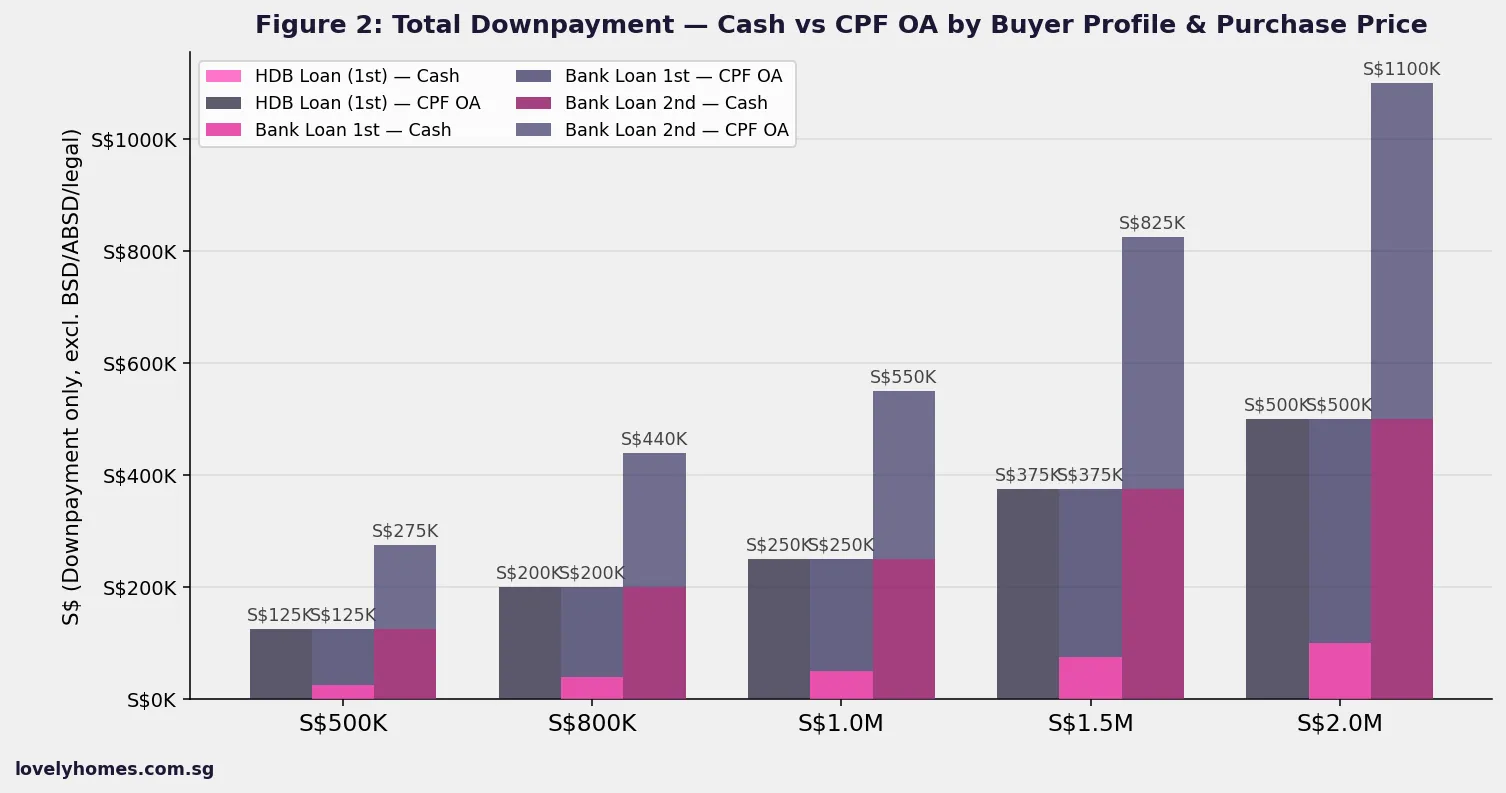
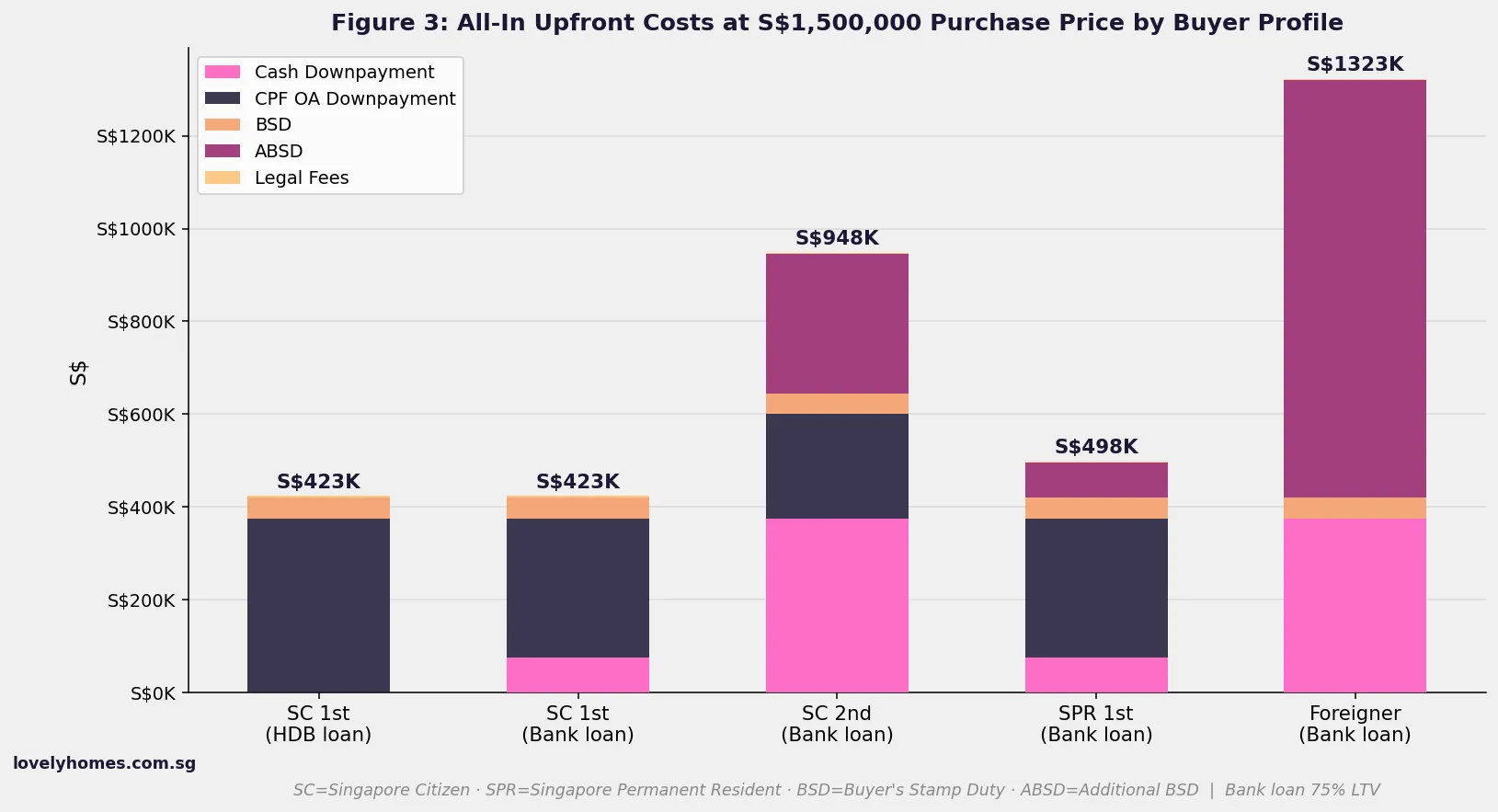
BSD and ABSD must be paid in cash within 14 days of signing the OTP. After payment, you may apply for CPF reimbursement from your OA. The initial cash payment is mandatory. This is a common cash-flow surprise: on a S$680,000 HDB flat, BSD is approximately S$15,000 cash on top of the downpayment.

What is the difference between repricing and refinancing?

Repricing means switching packages with your current lender (processing fee S$0–S$800; limited to that bank’s offerings). Refinancing means moving to a new lender (legal fees S$1,800–S$3,500; access to the full market). Refinancing is generally more effective but involves more paperwork and a 1–3 month processing window. Cashbacks from new lenders typically offset legal costs.

Does my car loan or personal loan reduce how much I can borrow for a home?

Yes — under TDSR, all outstanding debt obligations count against your 55% cap. A car loan of S$1,200/month and personal loan of S$500/month on a S$10,000/month income household reduces the permissible home loan instalment to S$3,800/month (55% × S$10k − S$1,700). MAS allows a 30% haircut on variable income (bonuses, commissions) when computing TDSR.

Can a foreigner get a home loan in Singapore?

Yes — foreigners can obtain bank loans for Singapore private residential property. The HDB loan is available only to eligible Singapore Citizens and Permanent Residents buying HDB flats. Note that foreigners purchasing private residential property pay 60% ABSD as at 2026 — see our ABSD guide for the full rate table. Bank loans for foreigners follow the same LTV and TDSR framework, though some banks may apply slightly stricter income documentation requirements for non-residents.

Related Articles

Disclaimer: This guide is for general information only and does not constitute financial, legal, or mortgage advice. Interest rates, LTV limits, MSR, TDSR, and CPF rules are subject to change. Always verify current rates with your lender or mortgage broker, and consult a licensed financial adviser before making borrowing decisions. Official references: MAS, HDB, CPF Board, IRAS.

Singapore Home Loan Interest Rates 2026: SORA vs Fixed Rate — Complete Guide

Singapore Home Loan Interest Rates 2026: SORA vs Fixed Rate — Complete Guide

Quick Answer — Key Takeaways

  • Singapore home loans are now primarily benchmarked to SORA (Singapore Overnight Rate Average) — the official replacement for SIBOR, which was phased out in December 2024.
  • As at May 2026, the 3-month compounded SORA is approximately 2.55%, down from its 2023 peak of above 3.7%.
  • Major banks offer two main packages: SORA-pegged floating rates (typically SORA + 0.85–0.90%) and fixed rates (typically 2.45–2.65% for a 2-year fixed term).
  • The HDB Concessionary Loan is pegged at CPF OA + 0.1%, currently 2.60%; it is available only for HDB flats and requires no lock-in period.
  • The Total Debt Servicing Ratio (TDSR) cap of 55% and Mortgage Servicing Ratio (MSR) cap of 30% remain in force and directly limit how much you can borrow.
  • Fixed rates offer payment certainty but come with a lock-in penalty (typically 1.5% of outstanding loan) if you refinance early.
  • SORA-pegged loans offer transparency and flexibility, but your repayment will move with rates — currently favourable as SORA trends down from its 2023 highs.

Understanding Singapore Home Loan Interest Rates in 2026

When you take out a home loan in Singapore, the single most consequential variable is the interest rate. On a S$1 million loan over 25 years, the difference between a 2.45% and a 3.40% rate translates to roughly S$470 more per month — or over S$140,000 in additional interest over the life of the loan. Yet many buyers in Singapore choose their home loan based on convenience, the advice of a mortgage broker with a vested interest, or simply whatever their bank’s relationship manager recommends at point of sale.

This guide explains how Singapore home loan interest rates are structured in 2026, what SORA is and why it replaced SIBOR and SOR, how to read bank package offers correctly, and how to decide between a floating rate and a fixed rate package given the current interest rate environment. It is written for Singaporean and Permanent Resident property buyers — the same principles apply to foreigners but their ABSD liability fundamentally alters the financing calculus.

Monetary Authority of Singapore (MAS) regulates home lending in Singapore under the Monetary Authority of Singapore Act and the Notice MAS 632 on Residential Property Loans. HDB administers the Concessionary Loan under the Housing and Development Act.

SORA 3M compounded vs fixed rate Singapore 2020 to 2026 chart
Figure 1: SORA 3-Month Compounded Average vs 2-year Fixed Rate — Major Singapore Banks, 2020–2026. Data: MAS, bank publications.

What Is SORA and Why Did It Replace SIBOR?

SORA — the Singapore Overnight Rate Average — is the volume-weighted average rate of all overnight unsecured Singapore dollar interbank transactions brokered in Singapore between 08:00 and 18:15 each business day. It is published daily by MAS and is calculated retrospectively, which makes it a backward-looking, transaction-based benchmark rather than a quote-based one like SIBOR was.

SIBOR (Singapore Interbank Offered Rate) was phased out on 31 December 2024 following a global reform of interest rate benchmarks prompted by the 2012 LIBOR manipulation scandal. SOR (Swap Offer Rate), which was partly based on USD LIBOR, was discontinued even earlier. MAS and the Steering Committee for SOR & SIBOR Transition to SORA (SC-STS) oversaw the transition, which required all existing SIBOR-pegged mortgages to be converted to SORA-linked packages by end-2024.

SORA is now used in three primary forms for home loans:

  • 1-Month Compounded SORA (1M SORA) — reflects the past 30 days of overnight rates. More reactive to short-term rate changes.
  • 3-Month Compounded SORA (3M SORA) — reflects the past 90 days. More commonly used by banks for home loans; provides a slightly smoother signal.
  • SORA Board Rates — some banks (notably UOB) have internal board rates that are partially informed by SORA movements but give the bank more discretion over repricing.

SORA-Pegged Floating Rate Packages

A SORA-pegged floating rate package ties your home loan to the prevailing 3M Compounded SORA, plus a fixed spread set by the bank. As at May 2026, spreads across major banks range from +0.85% to +0.90%:

  • DBS: 3M Compounded SORA + 0.85%
  • OCBC: 3M Compounded SORA + 0.88%
  • UOB: 3M Compounded SORA + 0.90%
  • Maybank: 3M Compounded SORA + 0.85%

With 3M SORA at approximately 2.55% in May 2026, an all-in floating rate works out to roughly 3.40–3.45%. This is broadly similar to the prevailing 2-year fixed rate, which sits at 2.45–2.65% for Year 1–2 before typically reverting to a board rate or SORA-linked rate from Year 3.

The key characteristics of a SORA floating package are:

  • No lock-in period — you can refinance or reprice at any time without a penalty clause.
  • Transparent repricing — your rate changes as SORA moves, typically with a 1-month lag for 1M SORA packages or a 3-month lag for 3M packages.
  • Currently in a declining environment — if MAS and the Federal Reserve continue rate normalisation through 2026, SORA is expected to drift toward 2.2–2.4% by end-2026, which would bring all-in floating rates to around 3.05–3.30%.

Singapore home loan bank package comparison table May 2026
Figure 2: Singapore Home Loan Package Comparison — DBS, OCBC, UOB, HDB Concessionary Loan and others, May 2026. Rates indicative; verify with lender.

Fixed Rate Packages

Fixed rate packages lock in an interest rate for a specified period — typically 2 years — after which the loan reverts to a floating rate, usually SORA-linked or a bank board rate. As at May 2026, major banks are offering:

Bank Year 1 Year 2 Year 3+ Lock-in
DBS 2.45% 2.55% FHR8 (board rate) 2 years
OCBC 2.50% 2.60% OHR+ (SORA-linked) 2 years
UOB 2.45% 2.55% SORA + spread 2 years
Standard Chartered 2.48% 2.60% Board rate 2 years
Maybank 2.50% 2.65% SORA + spread 2 years

The 2-year fixed period provides payment certainty — you know exactly what you will pay every month for the fixed term, which makes household budgeting straightforward. The risk is that if you need to refinance during the lock-in window — for example, because you sell the property, or a better package becomes available — you will typically pay a penalty of 1.50% of the outstanding loan amount at the time of early redemption.

On a S$1 million loan, that penalty is S$15,000. This is not an insignificant sum, and it is the primary reason experienced property investors often prefer no-lock-in floating packages despite the slightly higher all-in rate today.

The HDB Concessionary Loan — A Third Option

Buyers purchasing an HDB flat have access to a third option: the HDB Concessionary Loan, currently at a flat 2.60% per annum. This rate is set at CPF Ordinary Account interest rate (currently 2.5%) plus 0.1%, and is reviewed quarterly. It has remained at 2.60% since January 2023 when the CPF OA rate was last adjusted.

The HDB Concessionary Loan is notable for several reasons:

  • No lock-in — you can switch to a bank loan at any time without penalty.
  • LTV up to 80% — the maximum Loan-to-Value for an HDB loan is 80% of the purchase price or valuation (whichever is lower), versus 75% for a bank loan.
  • No cash down payment requirement — the 20% down payment can be funded entirely from CPF Ordinary Account (unlike bank loans, which require at least 5% in cash).
  • Eligibility conditions — all owners must not own any other residential property; income ceiling of S$14,000 household income applies for most flat types (no ceiling for HDB resale). You must obtain an HDB Flat Eligibility (HFE) Letter before exercising an OTP.

TDSR and MSR — How Much Can You Borrow?

MAS introduced the Total Debt Servicing Ratio (TDSR) framework in June 2013 to ensure borrowers do not over-leverage. TDSR limits total monthly debt obligations (including the new mortgage, car loans, personal loans, credit card minimum payments and all other credit facilities) to 55% of gross monthly income. Banks apply a stress-test rate of 4.0% per annum when assessing TDSR — meaning they calculate your hypothetical monthly payment at 4.0% regardless of the prevailing rate, to ensure you can afford the loan even if rates rise.

For HDB flat purchases (both BTO and resale), the additional Mortgage Servicing Ratio (MSR) cap applies: your monthly mortgage payment must not exceed 30% of gross monthly income. MSR applies to the actual servicing payment, not a stress-tested figure.

These rules mean that on a gross household income of S$10,000 per month, the maximum monthly mortgage payment you can qualify for (under MSR for HDB) is S$3,000; and the maximum all-debt obligation under TDSR is S$5,500. Practically, if you have a car loan of S$800/month, your maximum mortgage under TDSR is reduced to S$4,700/month.

Monthly repayment comparison by interest rate scenario S$1M loan 25 years
Figure 3: Monthly Repayment by Rate Scenario — S$1M Loan, 25-Year Tenure. Illustrative; based on standard annuity formula.

Worked Example — The Tan Family’s Loan Decision

Mr and Mrs Tan are Singapore Citizens purchasing a S$1.4 million OCR condominium in Tampines in June 2026. They are first-time buyers with no outstanding home loans. Their gross combined household income is S$14,000 per month. They have S$180,000 in CPF OA (combined) and S$100,000 in cash savings.

Loan quantum: 75% LTV on S$1.4M = S$1.05M bank loan. Down payment = S$350,000 (25%), of which at least S$70,000 (5%) must be in cash. The Tans comfortably clear this with S$70,000 cash + S$280,000 CPF.

BSD: S$24,600 on S$1.4M (first S$180k at 1%, next S$180k at 2%, next S$640k at 3%, remaining S$400k at 4% — total S$1,800 + S$3,600 + S$19,200 = wait, let me compute correctly: BSD on S$1.4M = 1%×S$180k + 2%×S$180k + 3%×S$640k + 4%×S$400k = S$1,800 + S$3,600 + S$19,200 + S$16,000 = S$40,600). ABSD: S$0 (first purchase, SC).

Rate comparison:

  • Option A — 2-year fixed at 2.45%/2.55%: Monthly in Year 1 = S$4,634; Year 2 = S$4,706. Reverts to SORA + spread from Year 3 (est. ~S$4,500–4,800 depending on SORA trajectory). Lock-in penalty if exit before 24 months: ~S$15,750 (1.5% × S$1.05M).
  • Option B — SORA float at SORA+0.85% ≈ 3.40%: Monthly = ~S$5,161. No lock-in. If SORA falls to 2.2% by end-2026, rate drops to ~3.05%, monthly ~S$4,956.
  • Option C — If they were buying an HDB resale (for illustration): HDB Concessionary Loan at 2.60% → monthly ~S$4,748 on S$1.05M, 80% LTV available.

TDSR check (Option A, Year 1): Monthly payment S$4,634. With no other debts, TDSR = S$4,634 ÷ S$14,000 = 33.1%. Well within 55%. Stress-tested at 4.0%: hypothetical monthly = S$5,534; TDSR = 39.5%. PASS.

Recommendation: Given the declining SORA environment in 2026, the Tans opt for Option A (2-year fixed) to lock in payment certainty during the early years of ownership when their cash position is most stretched. They set a calendar reminder to review and refinance in Month 20, before the lock-in expiry.

Fixed vs Floating — How to Decide in 2026

With fixed and floating rates now converging at around 3.35–3.50% all-in, the classic argument — “floating is cheaper, fixed is certain” — no longer cleanly applies. The decision framework for 2026 hinges on three questions:

  1. How long will you hold the property? If you plan to sell within 3 years (e.g., you are buying a resale flat as a stepping stone and expect to MOP a BTO), a floating package with no lock-in avoids the exit penalty. If you plan to hold for 10+ years, the 2-year fixed-then-float cycle is largely a moot point — both packages will track the same rates over the long run.
  2. How sensitive is your monthly budget to rate moves? If a S$300–500 increase in monthly repayment would significantly stress your household, a fixed rate gives you a planning buffer. If you have comfortable headroom under TDSR, floating is fine.
  3. What is the SORA outlook? As at May 2026, MAS and market consensus lean toward SORA continuing a gradual decline through 2026–2027 as the global rate cycle normalises. In a declining rate environment, locking in at today’s fixed rate means you may pay slightly more than the eventual SORA level. However, the gap is likely to be narrow (0.10–0.30%) and the certainty premium may be worth it for first-time buyers.

What Might Come Next — Singapore Loan Rate Outlook

Several factors will shape Singapore home loan rates through end-2026 and into 2027. MAS operates a unique monetary policy framework — it manages the Singapore dollar nominal effective exchange rate (S$NEER) rather than directly setting an overnight rate, meaning SORA is market-determined rather than policy-set. However, SORA is strongly correlated to the US federal funds rate through Singapore’s open capital account.

The US Federal Reserve has signalled two 25-basis-point cuts in the second half of 2026, which, if executed, would likely push 3M SORA from ~2.55% toward ~2.05–2.15% by year-end. This would bring SORA-pegged all-in rates to around 2.90–3.05% — meaningfully below today’s fixed rates of 2.45–2.65% over a 2-year view. Whether banks adjust their fixed rate offerings in anticipation remains to be seen; historically, fixed rates tend to reprice down with a 1–2 quarter lag.

Summary — Home Loan Rate Comparison at a Glance

Feature SORA Float Fixed Rate (2yr) HDB Concess.
All-in Rate (May 2026) ~3.40% 2.45–2.65% 2.60%
Rate Certainty None 2 years Stable (CPF+0.1%)
Lock-in Period None 2 years None
Exit Penalty None ~1.5% of loan None
Max LTV 75% 75% 80%
Min Cash Down 5% 5% 0% (CPF ok)
Eligible Properties All All HDB only
Best For Flexible holders; declining rate bet First-timers; budget certainty HDB buyers; tight cash

Frequently Asked Questions

What is SORA and how is it different from SIBOR?

SORA (Singapore Overnight Rate Average) is the volume-weighted average of unsecured overnight interbank SGD transactions, published daily by MAS. SIBOR was a forward-looking rate based on bank submissions — susceptible to manipulation, as the 2012 LIBOR scandal revealed globally. SORA is transaction-based and backward-looking, making it more robust and harder to manipulate. SIBOR was fully discontinued on 31 December 2024; all SIBOR-pegged mortgages were converted to SORA or fixed-rate packages during 2023–2024.

Should I choose a fixed or floating rate home loan in 2026?

With SORA declining toward 2.2% by end-2026 and fixed rates at 2.45–2.65%, the all-in rates are converging. For first-time buyers who need budgeting certainty, a 2-year fixed rate is sensible — it protects against any short-term rate surprise and costs only marginally more than today’s floating all-in rate. For investors and experienced buyers who plan to hold long-term or who may sell within 3 years, a no-lock-in SORA floating package avoids exit penalties and will benefit as SORA falls further. In 2026 specifically, the edge is modest either way; the bigger decision is the property itself.

What is the current SORA rate in 2026?

As at May 2026, the 3-month compounded SORA is approximately 2.55% per annum, down from its peak of above 3.74% in mid-2023. It has been declining steadily as the US Federal Reserve began its rate normalisation cycle in late 2024. MAS publishes daily SORA rates on its website at mas.gov.sg/monetary-policy/sora.

What is TDSR and how does it affect how much I can borrow?

The Total Debt Servicing Ratio (TDSR) limits your total monthly debt obligations (including the home loan, car loans, personal loans and other credit facilities) to 55% of your gross monthly income. Banks stress-test your loan at 4.0% per annum when assessing TDSR eligibility — so even if the prevailing rate is 3.0%, the bank calculates whether you could afford the repayment at 4.0%. On top of TDSR, if you are buying an HDB flat, the Mortgage Servicing Ratio (MSR) limits your monthly home loan repayment to 30% of gross monthly income.

Can I use CPF to pay my home loan?

Yes. CPF Ordinary Account savings can be used to service monthly home loan repayments for both HDB flats and private properties, subject to the Valuation Limit (generally the lower of the purchase price or valuation) and the Withdrawal Limit (up to 120% of the Valuation Limit for private properties). Note that CPF monies withdrawn for property earn accrued interest at 2.5% per annum, which must be returned to your CPF account upon sale. This accrued interest does not represent an additional out-of-pocket cost but reduces the net cash proceeds you receive when you sell.

What is a lock-in period and what happens if I break it?

A lock-in period is a contractual commitment to maintain your loan with the same bank for a set duration — typically 2 years for fixed rate packages. If you refinance, prepay or redeem the loan in full before the lock-in expires, you pay a penalty usually equal to 1.5% of the outstanding loan amount at the time of early redemption. On a S$900,000 outstanding balance, that is S$13,500. No-lock-in packages (all SORA floating packages and HDB Concessionary Loans) allow you to exit or refinance at any time without penalty.

What is the difference between refinancing and repricing?

Repricing is when you switch to a different loan package within the same bank — typically cheaper (no legal or valuation fees) but limited to that bank’s available packages. Refinancing is when you move your loan to a different bank entirely. Refinancing typically offers access to sharper rates but incurs legal fees (S$2,000–3,500), valuation fees (S$300–800), and potentially a clawback of cashback incentives if you refinance within the clawback period (usually 3 years). Both options are typically considered when a fixed rate lock-in expires.

Related Articles

Disclaimer

This article is for general informational purposes only and does not constitute financial or legal advice. Interest rates quoted are indicative as at May 2026 and are subject to change by individual lenders. The SORA rate is published daily by MAS and can be found at mas.gov.sg. TDSR and MSR rules are set by MAS and are subject to regulatory revision. For personalised advice on home loan selection and eligibility, consult a licensed financial adviser or mortgage specialist regulated by MAS. All stamp duty computations are based on IRAS published rates at iras.gov.sg. HDB Concessionary Loan eligibility criteria are set by HDB and available at hdb.gov.sg. CPF rules on property usage are administered by the CPF Board at cpf.gov.sg.

×

Click anywhere or press Esc to close

Home Loan Singapore 2026: HDB Concessionary Loan vs Bank Loan

Home Loan Singapore 2026: HDB Concessionary Loan vs Bank Loan

For most Singaporeans, purchasing a home represents the single largest financial commitment they will ever make. A typical S$500,000 home loan over 25 years will cost between S$180,000 and S$280,000 in interest alone—making the difference between an HDB concessionary loan (fixed at 2.6%) and a bank loan (pegged to SORA, pegged to 3M compounded SORA plus a bank spread) the difference between financial security and prolonged vulnerability to rate shocks. This 2026 guide walks you through both options, the figures that matter, and how to choose the right one for your circumstances.

Quick Answer

HDB Loan: 2.6% fixed for the loan’s life; rate stable; 75% max LTV; no surprises—but higher than current bank rates and you must be eligible (SC or PR, income ≤ S$14,000/month for families).

Bank Loan: Currently cheaper (1.5%–3.0% depending on fixed or floating); rate risk if SORA rises; 75% max LTV; fewer eligibility restrictions—but your monthly repayment could jump 20%+ if rates climb.

Trade-off: HDB = stability + higher cost; Bank = potential savings + rate risk.

HDB Concessionary Loan: How It Works

The HDB concessionary loan is Singapore’s most accessible home financing product. It is pegged to the CPF Ordinary Account (OA) interest rate plus 0.1%—a formula that has held since 1999. For 2026, the OA rate is 2.5%, making the HDB loan rate exactly 2.6% per annum, fixed for the life of the loan (or until you choose to refinance into a bank loan, at which point you cannot switch back).

HDB Loan: Eligibility

  • Citizenship: At least one owner must be a Singapore Citizen (SC). Permanent Residents (PRs) and foreigners cannot apply.
  • Income ceiling (monthly household): S$14,000 for families; S$7,000 for singles under the Young Single Scheme; S$21,000 for extended family schemes. These are hard ceilings—exceed them and you are ineligible, regardless of other factors.
  • Age: At least 21 at the time of the application.
  • Repayment by age 65: Loan tenure is 25 years maximum, or until you reach age 65, whichever is earlier.

HDB Loan: Key Terms

Term HDB Loan
Interest Rate 2.6% p.a. (fixed; CPF OA + 0.1%)
Maximum LTV 75% (lowered from 80% on 20 Aug 2024)
Minimum Down Payment 25% (mix of cash & CPF OA; no mandatory cash minimum)
Maximum Tenure 25 years or age 65, whichever is earlier
MSR Cap 30% of gross monthly income
TDSR Cap 55% of gross monthly income
Rate Lock Rate never increases; locked at 2.6% for life of loan
Early Repayment No penalty; can pay down anytime using CPF or cash
Refinancing to Bank Can refinance to bank loan (one-way; cannot switch back)

Example MSR Calculation: Your gross monthly household income is S$10,000. HDB MSR allows up to 30%, so your maximum monthly loan instalment is S$3,000. On a 2.6% 25-year loan, this translates to a maximum loan amount of roughly S$1,090,000 (before other debt).

Bank Loan: How It Works

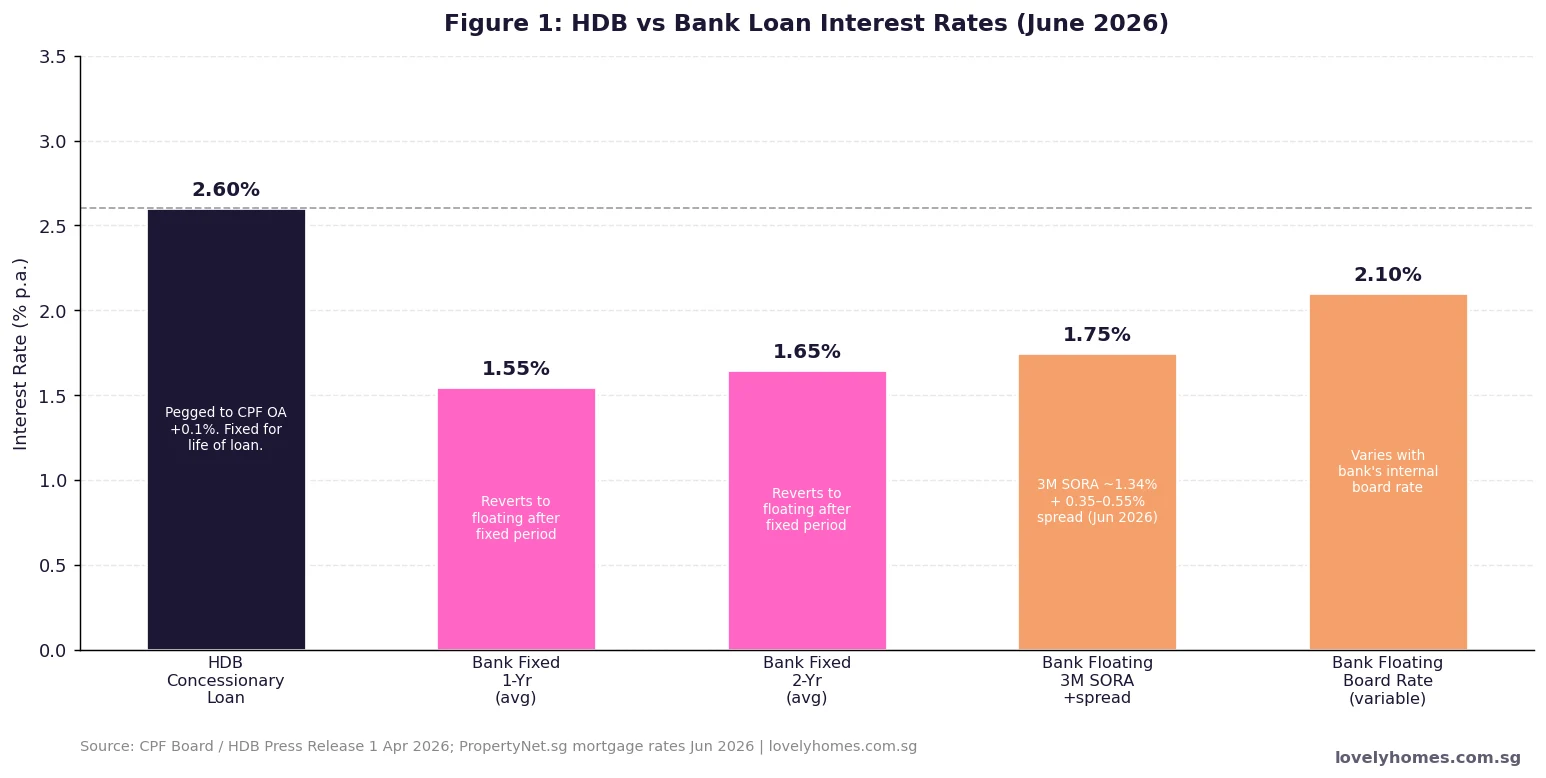
Bank loans offer more flexibility than HDB loans but introduce interest-rate risk. Banks offer two primary structures: floating rates (pegged to SORA + spread) and fixed-rate packages (locked for 1–3 years, then typically floating). Check the current 3-month compounded SORA on the MAS domestic interest rates page. Banks typically add a spread of around 0.5%–1.0% on top. Fixed-rate packages range from 1.4% to 1.8% for 1–2-year locks.

Bank Loan: Eligibility

  • Citizenship: SCs, PRs, and even some foreigners can qualify (though foreigner terms are stricter, requiring higher down payments and lower LTV).
  • Income: No hard ceiling, but TDSR and MSR caps apply (see below).
  • Credit & Employment: Banks assess credit history, employment stability, and income verification.
  • Age: At least 21 at the time of application; typically loan must be repaid by age 60–75 (varies by bank).

Bank Loan: Key Terms

Term Bank Loan (HDB) Bank Loan (Condo)
Interest Rate (Floating) 3M SORA + 0.5–1.0% (current ~2.0%) 3M SORA + 0.5–1.0% (current ~2.0%)
Interest Rate (Fixed) 1.4%–1.8% for 1–2 yr lock 1.4%–1.8% for 1–2 yr lock
Maximum LTV (1st property) 75% (with 25-year tenure) 75% (with 30-year tenure)
LTV (2nd property outstanding) 45% max 45% max
Minimum Down Payment 25% (5% cash minimum; rest CPF or cash) 25% (5% cash minimum; rest CPF or cash)
Maximum Tenure 25 years (or to age 65) 30 years (or to age 65)
MSR Cap (HDB only) 30% of gross monthly income N/A
TDSR Cap 55% of gross monthly income 55% of gross monthly income
Interest Rate Floor (TDSR calc) 3% (for calculation only) 4% (for calculation only)
Early Repayment Penalty 1.5% of outstanding balance (typically during lock-in; 2–3 yr lock-in standard) 1.5% of outstanding balance (typically during lock-in)
Rate Risk After lock-in expires, rate floats; monthly payment can increase significantly After lock-in expires, rate floats; monthly payment can increase significantly

Important TDSR Note: Banks use a minimum interest-rate floor when calculating whether you are eligible, even if the actual rate is lower. For HDB loans, the floor is 3%; for private property, it is 4%. So even if a bank offers you 2.0% floating, they assume 3%–4% when working out your TDSR, making the true affordability ceiling lower than the headline rate suggests.

HDB Loan vs Bank Loan side-by-side comparison
Figure 1: The two main home-loan routes in Singapore — compared on rate, eligibility, LTV and flexibility.

Side-by-Side Comparison: HDB vs Bank Loan

Factor HDB Loan Bank Loan
Interest Rate Type Fixed (pegged to CPF OA) Fixed (1–3 years) or Floating (SORA+)
Current 2026 Rate 2.6% 1.5%–1.8% (floating); 1.4%–1.8% (2yr fixed)
Maximum LTV (1st property) 75% 75% (HDB); 75% (Condo)
Min Cash Down 0% (full 25% can be CPF) 5% cash; remainder CPF or cash
Max Tenure 25 yrs or age 65 25 yrs (HDB) / 30 yrs (Condo), or age 65
MSR / TDSR MSR 30%; TDSR 55% TDSR 55% (no MSR for condo)
Rate Stability Locked forever; never increases Floating rate risk after lock-in; monthly payment can jump 20%+
Early Repayment Penalty None 1.5% during lock-in (typically 2–3 yrs)
Switching Flexibility Can refinance to bank (one-way; no switch-back) Can refinance to another bank; cannot switch to HDB
Eligibility Ceiling Income ceiling: S$14,000/mth (families); SC required No income ceiling; open to PRs & some foreigners
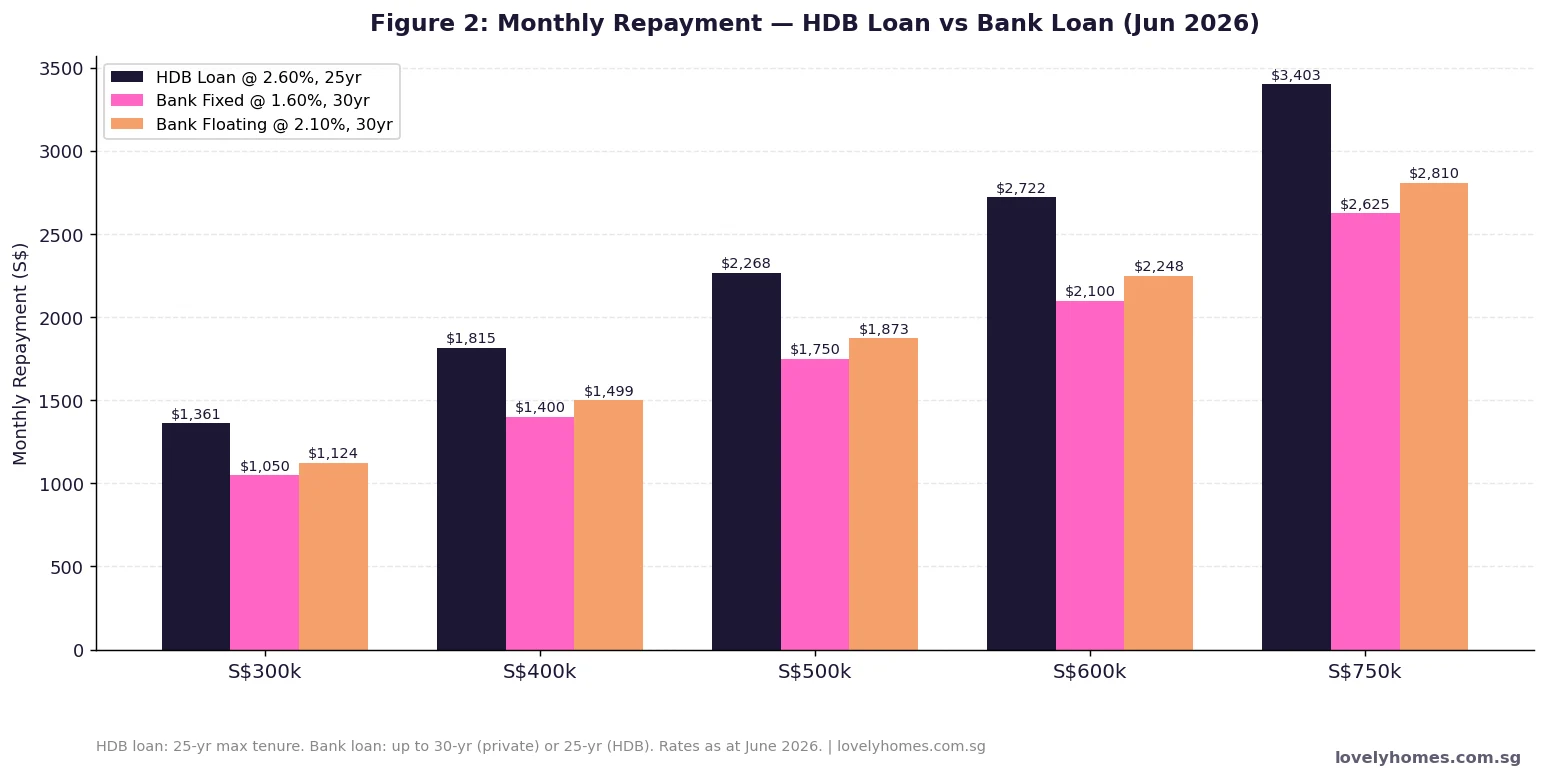
Worked example: S$500k loan over 25 years
Figure 2: Three loan paths, same borrower — HDB S$2,268/mo; Bank floating S$2,121/mo; Bank fixed-to-floating S$2,320 → S$2,503/mo.

Worked Example: S$500,000 Loan, 25-Year Tenure

Let’s compare the true cost of an HDB loan versus two bank scenarios: a floating-rate loan and a fixed-then-floating loan.

Scenario 1: HDB Concessionary Loan at 2.6%

Loan Amount: S$500,000
Interest Rate: 2.6% p.a. (fixed for life)
Tenure: 25 years (300 months)
Monthly Instalment: S$2,269
Total Interest Paid: S$180,700
Total Amount Repaid: S$680,700

Scenario 2: Bank Floating Loan (SORA + 0.65%, Current ~2.0%)

Loan Amount: S$500,000
Interest Rate (Current): 2.0% p.a. (floating; SORA ~1.35% + 0.65% spread)
Interest Rate (Assumption: Average over 25 yrs): 3.0% p.a. (to account for expected rate normalisation)
Tenure: 25 years
Monthly Instalment (at 2.0%): S$2,108
Monthly Instalment (at 3.0% average): S$2,372
Total Interest Paid (at 3.0% average): S$210,600
Total Amount Repaid: S$710,600
Life-of-Loan Difference vs HDB: +S$29,900 (approximately 3.5% higher total cost)

Note: The bank loan appears to save S$161/month initially, but that saving evaporates as rates normalise. Over the 25-year life, the HDB loan saves roughly S$30,000 despite starting at a higher rate.

Scenario 3: Bank Fixed (2.8%) for 3 Years, Then Floating (Assume 3.5%)

Years 1–3: 2.8% fixed
Monthly instalment: S$2,294

Years 4–25: 3.5% floating (after lock-in)
Recalculated instalment: S$2,506

Average Monthly Instalment: S$2,404
Total Interest Paid: S$221,200
Total Amount Repaid: S$721,200
Life-of-Loan Difference vs HDB: +S$40,500
Monthly Jump at Year 4: +S$212 (9% increase)

Key Insight: Even if you start with a bank loan at 2.0%–2.8%, the long-term cost edge of the HDB loan (at fixed 2.6%) becomes clear once you account for rate normalisation and the arithmetic of compound interest over 25 years. Moreover, the HDB loan offers psychological and budgetary peace of mind—your monthly repayment is guaranteed never to rise.

Sensitivity: What If Bank Rates Rise to 4.0%?

If 3M SORA drifts back toward 2.5% and bank spreads remain at 0.65%, a floating-rate loan would reset to approximately 3.15% base, but with TDSR floors at 4%, some borrowers would see repayments jump further. At a 4.0% effective rate:

S$500,000 loan, 25 years remaining (worst-case: rate shock in year 1):
Monthly Instalment at 4.0%: S$2,639
vs HDB at 2.6%: S$2,269
Monthly Shock: +S$370 (+16.3%)
Annual Impact: +S$4,440

For a household spending 30% of gross monthly income on the mortgage, a 16% rate shock could push TDSR above 55%, triggering a lender’s demand for early repayment or refinancing—a real risk during volatile rate environments.

Bank loan rate sensitivity stress test
Figure 3: Stress-tested at 2.6%, 3.5% and 4.0% — a rise to 4% adds ~S$111,000 in interest over 25 years vs the HDB baseline.

Which Should You Choose?

Choose HDB Loan If:

  • You are eligible (SC, income ≤ S$14,000/mth for families).
  • Rate stability is a priority. You plan to stay in the home for 15+ years and want zero uncertainty about future payments.
  • You are risk-averse or budget-conscious. Your household income is tight, and a 10%–16% payment jump would strain your finances.
  • You value the psychological benefit of a locked rate and a simpler loan structure.
  • You expect rates to rise. If SORA normalises to 2.5%+ (and spreads remain), HDB’s 2.6% becomes increasingly competitive.

Choose Bank Loan If:

  • You exceed HDB income ceilings (e.g. dual-income household exceeding S$14,000/mth) or are a PR/foreigner.
  • You are comfortable with rate risk and have sufficient financial buffers to absorb a 10%–20% payment increase.
  • You plan to sell or refinance within 5–10 years. Lower initial rates and longer maximum tenures (30 years for condos) offer flexibility.
  • You believe rates will stay low. If you expect SORA averages well below 2.6% over the life of your loan, a floating bank loan saves vs the HDB concessionary rate. If it averages above 2.6%, HDB is cheaper.
  • You want to refinance easily. Bank loans can be refinanced to another bank mid-term; HDB loans, once converted to a bank, cannot be converted back.
  • You own a condo or landed property. Bank loans offer longer tenures (30 years) and higher potential LTV; HDB loans only apply to HDB flats and ECs.

Refinancing: When and Why to Switch

The option to refinance exists at any point in your loan journey. Understanding when and why to refinance is crucial to optimising your loan cost.

HDB to Bank Refinance

If you currently hold an HDB loan at 2.6%, you can refinance to a bank loan. This is a one-way decision—once you switch to a bank, you cannot switch back. Refinancing makes sense if:

  • Bank rates fall significantly below 2.6% and are locked in for an extended term (5+ years).
  • You exceed HDB’s income ceiling due to a salary increase and want to increase your loan amount.
  • You are refinancing to raise cash (e.g. home equity release) against your property.

Give HDB three months’ written notice of your intention to refinance. HDB will calculate the outstanding balance and any adjustment due to CPF contributions.

Bank to Bank Refinance (or HDB → Bank)

If you hold a bank loan, you can refinance to another bank or (once) to HDB, depending on your eligibility. Refinancing makes sense if:

  • Your current fixed-rate lock-in is about to expire and rates have fallen; refinance before the jump.
  • Another bank offers 0.3%–0.5% lower rates or a longer fixed-rate tenure.
  • You want to consolidate multiple loans or restructure your debt.

Typical lock-in periods: 2–3 years. Early repayment within the lock-in incurs a 1.5% penalty on the outstanding balance. After lock-in, partial or full repayments are fee-free.

Lock-In Mechanics

Most bank home loans come with a lock-in clause that penalises early repayment during the initial fixed-rate period. The lock-in typically lasts 2–3 years. Here’s what you need to know:

  • Lock-in Period: Typically 2–3 years from the date of drawdown.
  • Early Repayment Penalty: 1.5% of the outstanding loan balance if you repay (or refinance) before lock-in expires.
  • After Lock-In: You can repay in full or in part without penalty. You can refinance to another bank.
  • Fixed-Rate Lock vs Lock-In: Do not confuse the fixed-rate period (e.g. 2.8% for 2 years) with the lock-in period. A 2-year fixed rate typically comes with a 2–3-year lock-in penalty clause.

Frequently Asked Questions

1. Can I switch from HDB to bank and back?

No. Refinancing from HDB to bank is one-way. Once you switch to a bank loan, you cannot return to HDB financing. Choose carefully before making the switch. If you are considering it, ensure bank rates are significantly lower and locked in for at least 5 years to justify the irreversibility.

2. What happens if I miss an HDB or bank loan payment?

Missing a payment triggers late fees and can damage your credit score, making future refinancing more expensive. For HDB loans, persistent defaults can lead to legal action and, in extreme cases, repossession of the flat. For bank loans, the consequences are similar. Both lenders are empowered to initiate enforcement proceedings if you default for more than three months. Contact your lender immediately if you foresee difficulties; many offer restructuring or deferment options for borrowers facing temporary hardship.

3. Can I use CPF to pay my mortgage?

Yes. You can use CPF Ordinary Account (OA) funds to pay both HDB and bank home loan monthly instalments, subject to: 

  • Your CPF OA balance must be sufficient to cover the instalment.
  • CPF will automatically deduct the monthly instalment from your OA if you have set up standing instructions.
  • If your CPF OA is insufficient, you must pay the balance in cash.
  • You cannot use your CPF Medisave Account (MA) or Special Account (SA) for loan repayment.

After loan maturity, CPF regulations allow you to retain a minimum sum in your Retirement Account (RA) for healthcare and longevity protection; excess funds can be withdrawn.

4. What is SORA, and why does it matter?

SORA stands for Singapore Overnight Rate Average. It is the interest rate at which banks lend to each other overnight in the Singapore money market, published daily by the Monetary Authority of Singapore (MAS). Most bank home loans in Singapore are now pegged to 3-Month Compounded SORA (reviewed quarterly) rather than the older SIBOR benchmark.

Why it matters: Your bank loan interest rate is typically SORA + a bank spread (e.g. 0.65%). As SORA fluctuates, your loan rate (and monthly payment) fluctuates. Historically 3M SORA has moved widely — from well under 1% in 2020–2021, rising above 3% through 2023–2024, and moderating thereafter. Always check the latest rate on the MAS website before committing to a package. Understanding SORA trends helps you forecast your likely repayment path.

5. How does the interest-rate floor affect my loan amount?

When calculating whether you qualify for a loan (TDSR test), banks assume a minimum interest rate, even if the offered rate is lower. For HDB loans, the floor is 3%; for private property, it is 4%. This means:

  • If a bank offers you 2.0% floating but applies a 4% floor for TDSR calculation, you are approved based on 4% affordability, not 2%.
  • If your income is S$10,000/month and TDSR is 55%, your maximum total debt repayment is S$5,500/month.
  • At a 4% rate (the TDSR floor), a S$500,000 loan over 25 years costs ~S$2,639/month.
  • Even though the actual rate might be 2.0%, the lender approves you at 4% to protect against future rate rises.

This floor is a safeguard for lenders and borrowers alike, preventing over-leverage in a low-rate environment.

6. Can I take a joint loan with a family member?

Yes. Both HDB and bank loans can be taken jointly (e.g. spouse, parent, or adult child). Joint applicants must:

  • Both be on the property title (either as joint tenants or tenants-in-common).
  • Both pass the eligibility checks (citizenship, age, credit, income).
  • Both be liable for the loan; if one co-borrower defaults, the lender can pursue either or both.
  • Agree on the split of ownership (50:50 is common; other splits are possible but more complex for tax and CPF purposes).

Joint borrowing increases the combined household income for TDSR/MSR purposes, often allowing a larger loan. However, both parties remain responsible if the other defaults.

7. Is a fixed or floating rate better?

There is no universally correct answer; it depends on your risk appetite and rate outlook.

Fixed Rate (1–3 years): Choose if you want certainty and believe rates will rise. Lock-in at the lowest rate available (currently 1.4%–1.8% for 1–2 years). After lock-in expires, you will refinance or face a floating rate, so you are not truly “locked” for 25 years.

Floating (SORA+): Choose if you believe rates will stay low and you can afford a 20%–30% payment increase. Currently, floating rates are lower than fixed (around 1.5%–2.0% all-in vs 1.4%–1.8% fixed), so you pay a rate-stability premium if you lock in.

In 2026, most experts recommend a 2-year fixed rate as a compromise: you get near-current rates locked in for two years, and then you can reassess when the lock-in expires.

Summary: Making Your Decision

Choosing between an HDB loan and a bank loan is ultimately a question of values: stability vs savings, predictability vs flexibility. The HDB loan offers peace of mind and long-term cost protection but requires eligibility. The bank loan offers potential short-term savings and flexibility but introduces rate risk. Work through the decision tree below to clarify your path:

Start here: Are you a Singapore Citizen with household income ≤ S$14,000/month (families)?

  • Yes: You can access the HDB loan. Proceed to the next question.
  • No: You must use a bank loan. Skip to bank-loan considerations below.

Next: Is rate stability your top priority, or are you comfortable with rate risk?

  • Rate stability: Choose HDB. You cannot beat a fixed 2.6% rate that will not rise for 25 years.
  • Comfortable with risk: Compare HDB (2.6%) with current bank rates (floating 1.5%–2.0%; fixed 1.4%–1.8%). If bank rates are <2.2% and locked in for 5+ years, bank may be worthwhile. If rates are expected to rise to 3%+, HDB’s 2.6% becomes increasingly attractive.

For bank-loan applicants: What is your holding timeline?

  • Short term (5–10 years): Floating or short fixed-rate packages (1–2 years) are fine; refinance or sell before rate shock.
  • Long term (15+ years): Lock in a fixed rate (2.8%–3.0%) for as long as possible (5+ years if available). The certainty is worth 0.3%–0.5% in extra rate cost.

Key Takeaways

  • HDB loans are fixed at 2.6% (pegged to CPF OA + 0.1%). This rate will not increase for the life of the loan—a powerful advantage in a rising-rate environment.
  • Bank loans are currently cheaper (1.5%–2.0% floating; 1.4%–1.8% fixed for 1–2 years) but introduce rate risk. After lock-in expires (typically 2–3 years), your payment can jump 10%–30%.
  • Over a 25-year life, an HDB loan typically costs S$30,000–S$40,000 less than a bank loan that averages 3.0% over the tenor, even though it starts at a higher rate.
  • Eligibility is the first gatekeeper. If you are a SC with income ≤ S$14,000/month, HDB is an option; otherwise, you must use a bank.
  • Refinancing is possible but irreversible. HDB → bank is one-way; bank → bank is flexible. Plan before you switch.
  • Rate floors and TDSR caps mean that your true affordability is often lower than headline rates suggest. Always ask your lender what rate floor they use in their TDSR calculation.
  • In 2026, the optimal strategy for most Singaporeans is: (1) if HDB-eligible, take the HDB loan unless bank rates are locked below 2.2% for 5+ years; (2) if bank-eligible only, lock in a 2-year fixed rate at 1.4%–1.8% as a bridge, then reassess when lock-in expires.

Related Articles

Disclaimer

This guide is for general information only and does not constitute legal, tax, or financial advice. Interest rates, LTV limits, MSR/TDSR caps, and eligibility rules change frequently. Always verify current figures with HDB (hdb.gov.sg), MAS (mas.gov.sg), and your bank before committing to a loan package. For complex situations—mixed-nationality couples, self-employed income, or refinancing decisions—consult a licensed mortgage advisor or conveyancing lawyer. CPF rules, tax treatment, and grant eligibility have edge cases; always verify your specific situation with the relevant authority.


Translate »