Mortgage Refinancing vs Repricing Singapore 2026: When to Switch Banks and When to Stay
Quick Answer — Refinancing vs Repricing 2026
- Refinancing means moving your home loan to a new bank. Repricing means renegotiating your rate with your existing bank.
- Refinancing typically saves more (0.2–0.5% p.a.) but incurs upfront costs of S$2,500–S$4,000 (legal + valuation). Repricing saves less but costs nothing or very little.
- The break-even horizon for refinancing a S$800,000 loan is approximately 13 months — refinance only if you plan to hold the loan beyond that.
- In Q2 2026, the 1-month SORA stands at approximately 1.20%, down from a peak of 3.68% in mid-2023. Fixed 2-year packages from major banks are available at 1.78%–1.85% p.a.
- Never refinance within a lock-in period without checking the penalty — typically 1.5% of the outstanding loan, which can wipe out years of interest savings.
- Banks are legally required to provide a 30-day free conversion option at the end of each lock-in period — use this as your review trigger date.
- If your remaining tenure is less than 5 years or your outstanding balance is under S$200,000, the absolute saving from refinancing is usually not worth the administrative effort.
Every Singapore home loan has an anniversary. When the initial lock-in period ends — typically after two or three years — you face a critical decision: do you let the bank roll your mortgage onto its standard rate (often significantly higher), do you reprice it with the same bank, or do you switch to a new lender entirely?
Most homeowners do nothing, which is the most expensive choice. Singapore banks rely on inertia: the standard variable rate a homeowner reverts to after lock-in can be 0.5–0.8 percentage points higher than the rate a new customer would receive. On a S$700,000 outstanding balance, that gap costs approximately S$3,500–S$5,600 per year in additional interest.
This guide explains exactly how refinancing and repricing work in Singapore in 2026, the mathematics of when each option pays, how to read the SORA-based rate environment, and the specific situations where each choice makes sense. Pair it with our Singapore Home Loan Comparison guide for the full picture on choosing between HDB loans, fixed rates, and floating packages.
1. The Core Distinction: Refinancing vs Repricing
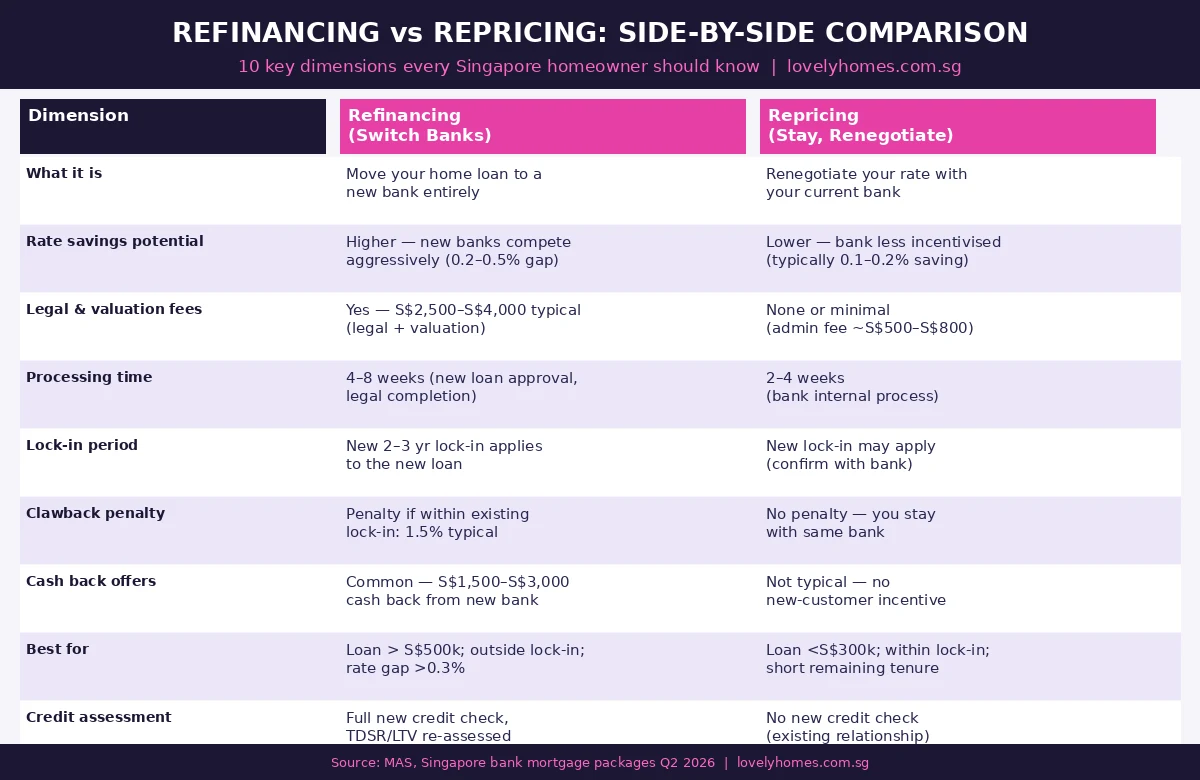
Refinancing is the process of discharging your existing home loan and taking out a new loan from a different bank. Legally, the new bank pays off your old loan and registers a new mortgage over your property. You go through a full credit assessment, a new loan agreement, legal completion and (usually) a new valuation. The entire process takes 4–8 weeks from application to disbursement.
Repricing is an internal renegotiation with your existing bank. You ask the bank to move your loan from its current rate to a newer, lower package. No change of lender takes place; no new legal process is required; and no new credit check is typically conducted. The bank simply updates your loan terms. Repricing can be completed in 2–4 weeks and usually costs nothing or carries a small administrative fee of S$500–S$800.
2. When Does Refinancing Make Sense?
Refinancing is financially beneficial when the interest rate saving is large enough to recover the upfront switching costs within your planned holding period. The key variables are:
- Outstanding loan balance: The larger the balance, the larger the absolute saving per percentage point of rate reduction. A 0.4% saving on S$800,000 is S$3,200/year; the same saving on S$200,000 is only S$800/year.
- Rate differential: The gap between your current rate and the best available package. In Q2 2026, homeowners on standard variable rates of 2.2–2.5% p.a. can often find fixed 2-year packages at 1.78–1.85%, creating a saving of 0.3–0.7 percentage points.
- Remaining tenure: With 20+ years remaining, even moderate rate savings compound significantly. With 3–5 years left, the absolute saving window is much smaller.
- Lock-in status: You must be outside the lock-in period. If you refinance within lock-in, the clawback penalty (typically 1.5% of outstanding loan) will likely exceed any rate saving.
As a general rule: refinancing makes sense when the outstanding balance exceeds S$400,000, the rate saving exceeds 0.3% p.a., and you are outside your lock-in period.
3. The Break-Even Mathematics
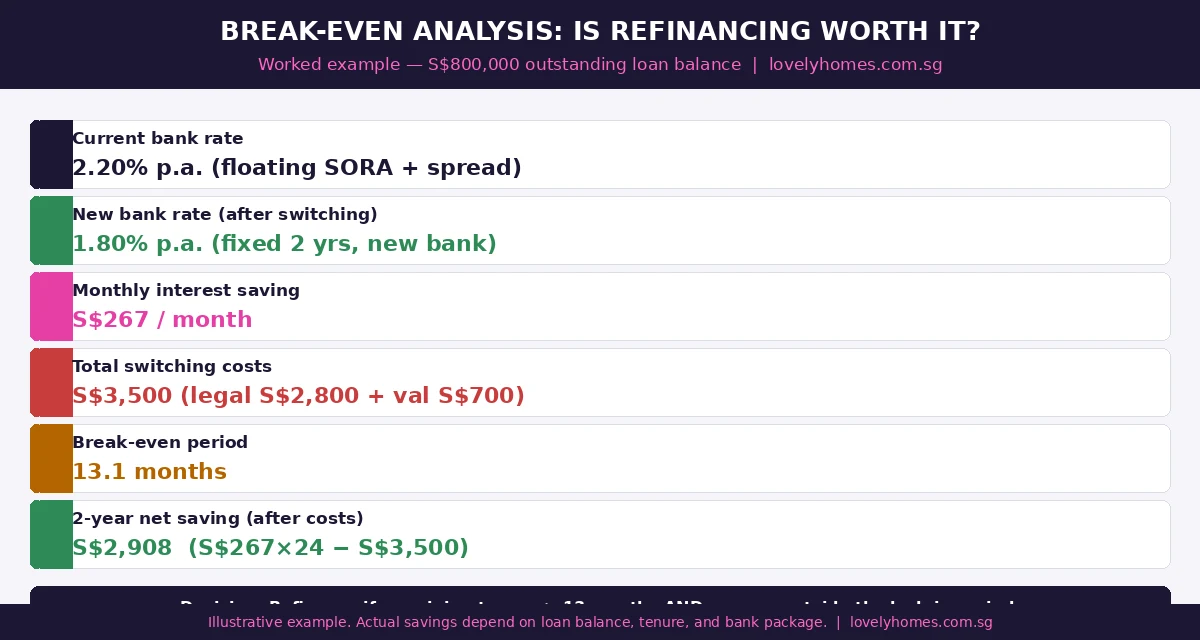
The break-even formula is straightforward:
Break-even months = Total switching costs ÷ Monthly interest saving
For the example in Figure 2: a S$800,000 outstanding balance at 2.20% costs approximately S$1,467/month in interest. At 1.80%, this falls to S$1,200/month — a saving of S$267/month. With total switching costs of S$3,500, break-even occurs at month 13.1. Over a 2-year new lock-in, the net saving is S$267 × 24 − S$3,500 = S$2,908.
Critically, this is a simplified calculation on interest only. In practice, you should also factor in: any cash-back offer from the new bank (which reduces effective switching cost); whether the new bank’s rate holds for the full 2 years or is a promotional teaser; and the difference in processing timescales that creates a month or two of overlap where both the old and new rates apply.
4. The 2026 Rate Environment: SORA Has Fallen Significantly
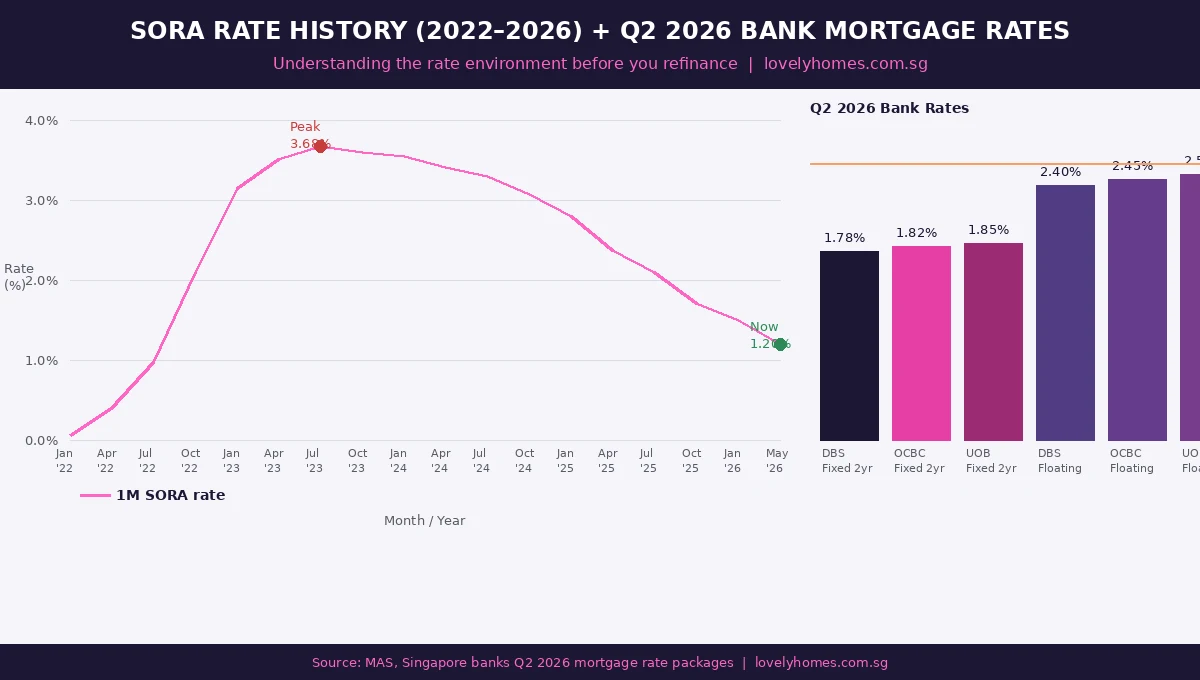
The SORA (Singapore Overnight Rate Average) is the benchmark underpinning most floating-rate home loans in Singapore, replacing SIBOR in 2024. After peaking at 3.68% in July 2023, 1-month SORA has fallen steadily as the US Federal Reserve began its easing cycle in late 2024. By May 2026, 1-month SORA stands at approximately 1.20%.
This rate decline has transformed the refinancing calculus. Homeowners who locked into 3-year fixed rates at 3.0–3.5% in 2023 are now significantly out-of-money relative to the market. Their lock-in periods of 2–3 years mean they are emerging (or will emerge in 2025–2026) into a market where 2-year fixed packages are available at 1.78–1.85%. The saving potential is substantial.
Conversely, homeowners on SORA-based floating packages taken in 2024–2025 at spreads of +0.8–1.0% above SORA are currently paying approximately 2.0–2.2% p.a. — and the rate will decline further as SORA continues to fall. These homeowners may find that staying floating is better than locking into a fixed rate, as the fixed rate today may prove higher than the floating rate in 12–18 months.
5. How to Negotiate Repricing
Repricing is underused by Singapore homeowners who assume the bank will not move. In practice, banks negotiate repricing regularly — particularly for borrowers with good payment records and large loan balances. The process:
- Check your lock-in expiry date. Most loan packages have a letter from your bank confirming the lock-in end date. If you cannot find it, call the mortgage servicing hotline.
- Review the bank’s current new-customer packages. Banks publish their mortgage rate sheets online (DBS, OCBC, UOB all have rate pages). Identify the best package a new customer would receive.
- Submit a repricing request. Call the mortgage servicing team (not the branch) and request a repricing. Mention that you are comparing competitor packages. Banks have a dedicated repricing/retention team.
- Request the “Board Rate” alternative. If the bank will not match a competitor’s promotional rate, ask whether a lower spread-over-SORA package is available.
- Compare the offer vs. refinancing. If the bank offers a rate within 0.1–0.15% of a competitor, the S$3,500 switching cost makes refinancing uneconomical for most loan sizes.
Banks are also required under MAS guidelines to proactively offer refinancing information to borrowers nearing the end of their lock-in periods. This obligation has been reinforced as part of the MAS guidelines on responsible mortgage lending.
6. Worked Example: Mr and Mrs Wong
Mr and Mrs Wong (both Singapore Citizens) purchased a S$1.35 million OCR condo in 2023, financing S$1,012,500 (75% LTV) with a DBS 2-year fixed rate at 3.10% p.a. Their lock-in period ends in August 2026. Outstanding balance at that point: approximately S$968,000 (after 36 months of instalments at ~S$4,980/month).
Option A — Reprice with DBS: DBS offers to move them to their current 2-year fixed package at 1.80% p.a. New monthly instalment: approximately S$4,480 — a saving of S$500/month. No fees. Total 2-year saving: S$500 × 24 = S$12,000.
Option B — Refinance to OCBC: OCBC offers 1.75% fixed 2 years with a S$2,000 cash-back incentive. Legal + valuation fees: S$3,200. New monthly instalment: ~S$4,450 — S$530/month saving vs current rate. Over 24 months: S$530 × 24 + S$2,000 cash-back − S$3,200 costs = S$11,520 net saving.
Decision: Option A (repricing) saves S$480 more over 2 years with far less administration. The Wongs should accept DBS’s repricing offer. Had DBS offered 1.90% instead of 1.80%, Option B would pull ahead — so it always pays to get the repricing offer in writing before deciding.
7. CPF Implications
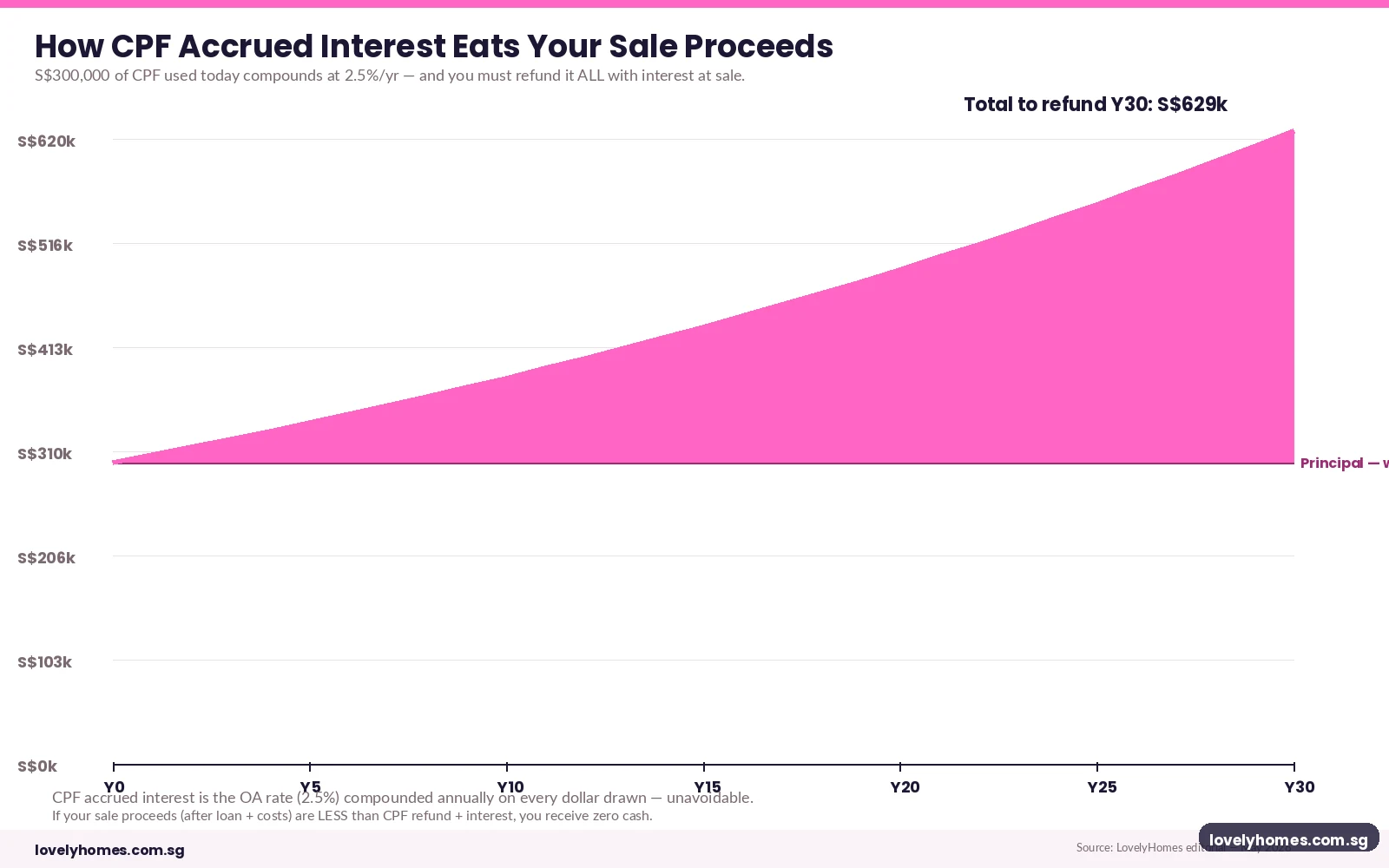
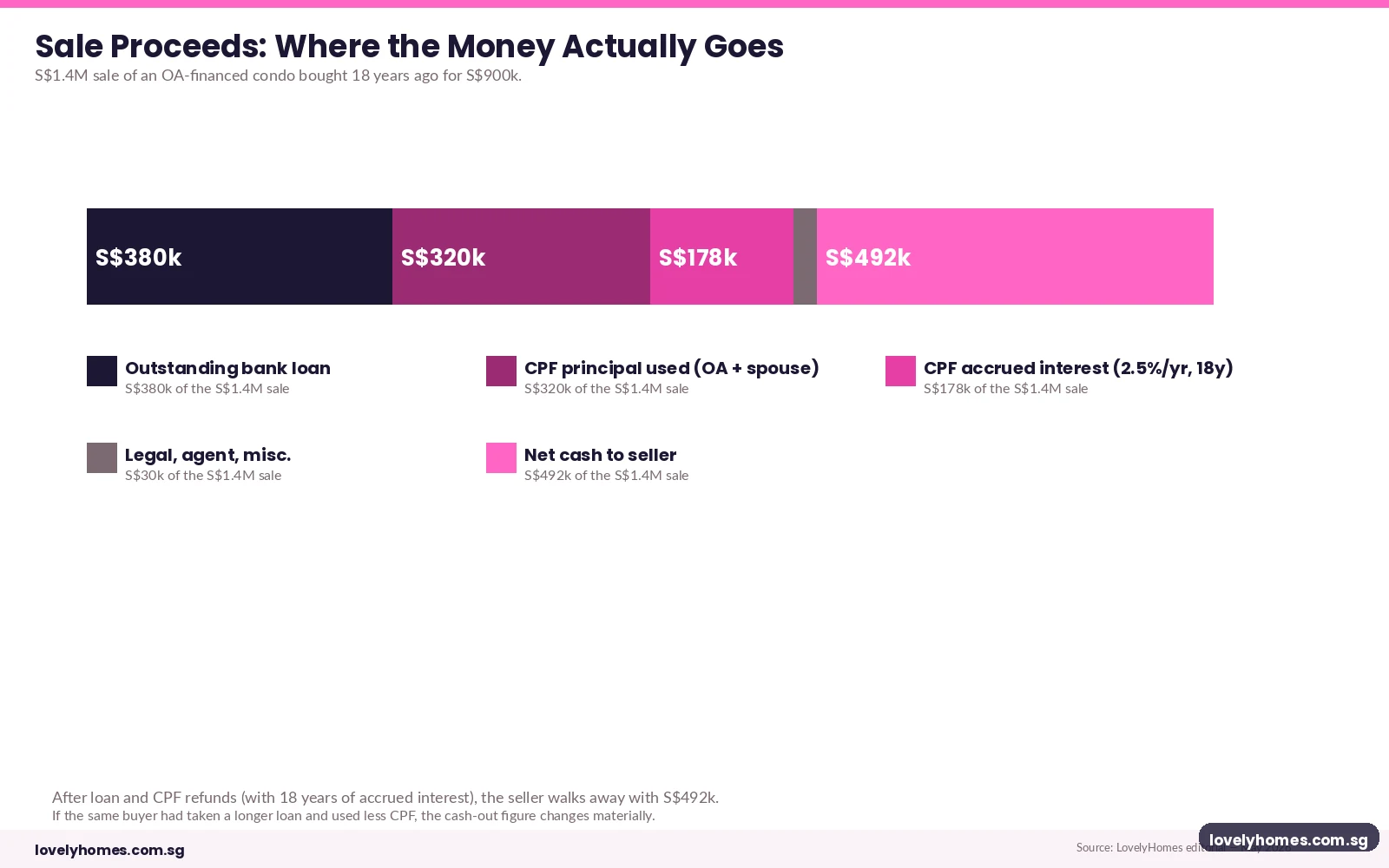
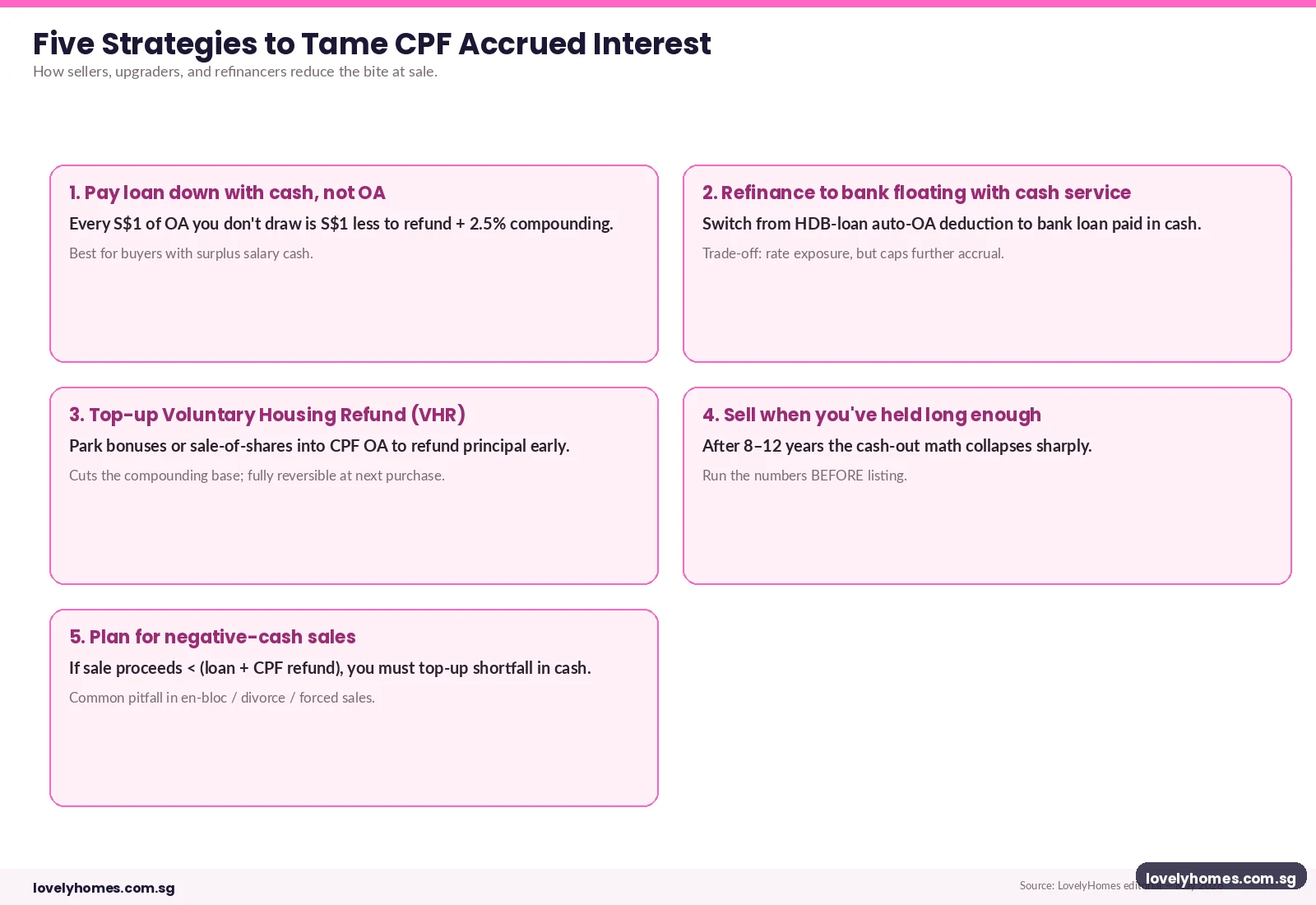
When you refinance (switch banks), the new bank uses CPF to service the new loan in the same way as the old one. There is no interruption in CPF usage. However, if you have been using CPF Ordinary Account for loan repayments, the CPF accrued interest on the CPF principal withdrawn continues to accumulate throughout — refinancing does not reset or reduce this accrued interest obligation. Ensure you understand how the accrued interest will be settled when you eventually sell the property.
8. What Might Come Next
The trajectory of SORA — which follows US Fed rates with a lag — is the key variable. As at May 2026, the market broadly expects one or two further Fed cuts in 2026, which would push 1-month SORA below 1.0% by end-2026. If this materialises, homeowners currently on SORA-based floating packages will see their rates fall further without any action required. Fixed rates, by contrast, are priced partly on the forward rate curve and already factor in some further SORA easing — locking in a 2-year fixed now is effectively a bet that SORA will not fall significantly below 0.8–1.0% over the next 24 months.
MAS has also indicated continued focus on responsible lending standards. Any homeowner refinancing must satisfy the TDSR 55% cap under the new lender’s assessment, even if they have been meeting repayments comfortably for years. If income has changed since the original loan was taken, this is an important consideration.
Summary Table: When to Refinance vs Reprice
| Situation | Recommended Action | Why |
|---|---|---|
| Outstanding balance > S$500k, outside lock-in, rate gap > 0.3% | Refinance | Break-even < 12 months; net saving substantial over 2 years |
| Outstanding balance S$200k–S$500k, rate gap 0.2–0.3% | Reprice first, then compare | Repricing may close the gap; only refinance if bank won’t budge |
| Within lock-in period | Wait or reprice only | Clawback penalty (1.5%) likely exceeds rate saving |
| Remaining tenure < 5 years | Reprice or do nothing | Short window limits absolute savings from refinancing |
| Outstanding balance < S$200k | Reprice only | Absolute saving too small to justify S$3,000–S$4,000 switching cost |
| Currently on floating SORA, SORA falling | Stay floating; review at 6-month intervals | Falling SORA reduces your rate automatically without any action |
FAQ: Mortgage Refinancing and Repricing Singapore 2026
What is the difference between refinancing and repricing?
Refinancing involves switching your home loan from your current bank to a new lender. The new bank pays off your existing loan and a new mortgage is registered. You incur legal fees, valuation fees, and go through a fresh credit assessment. Repricing means renegotiating your rate with your existing bank without changing lenders — no legal process, typically no fees, and faster completion (2–4 weeks vs 4–8 weeks). Refinancing typically offers a larger rate saving; repricing is simpler and cheaper to execute.
When is the right time to refinance my home loan?
The ideal time to refinance is in the 3-month window before your current lock-in period expires. By starting the process 90 days before expiry, you can complete the new loan application, approval, and legal completion just as your lock-in ends, avoiding any overlap or clawback penalties. Refinancing within the lock-in period triggers a clawback penalty (typically 1.5% of outstanding loan), which in most cases wipes out the rate saving entirely.
What are the typical costs of refinancing in Singapore?
The main costs are legal fees (S$1,800–S$2,500) and valuation fees (S$500–S$800), totalling S$2,500–S$3,500 for a standard condominium. Some banks offer a “legal subsidy” or cash-back offer of S$1,500–S$3,000 to offset these costs, effectively reducing or eliminating the net upfront expense. You should always ask the new bank whether a legal subsidy is available and factor it into your break-even calculation.
Does refinancing affect my CPF usage?
No — refinancing does not interrupt or change your CPF usage for the home loan. The new bank will receive CPF contributions in exactly the same way as the old bank, and the CPF Board processes this automatically. However, the CPF accrued interest on any CPF principal already used continues to accumulate throughout the life of the loan. Switching banks does not reduce or reset the accrued interest obligation that will be due when you sell the property.
Will refinancing affect my TDSR or LTV?
Yes — refinancing requires a full new credit assessment by the new bank, including a recalculation of your TDSR (Total Debt Servicing Ratio). If your income has changed significantly since the original loan was taken (e.g., you switched to self-employment, took a pay cut, or took on additional debt), you may find that the new bank’s TDSR calculation limits the loan amount they can offer. The LTV ceiling for refinancing an existing loan is generally 75% for private properties (bank loan), unchanged from a purchase. If property values have fallen since purchase, a new valuation may show a lower property value, potentially affecting the LTV-based loan amount.
Is a floating or fixed rate better in 2026?
In May 2026, with 1-month SORA at approximately 1.20% and market expectations pointing to further easing, floating SORA-based packages (SORA + spread of 0.8–1.0%) result in effective rates of approximately 2.0–2.2% p.a. Fixed 2-year packages are available at 1.78–1.85%. The fixed rates currently appear cheaper than floating, but if SORA falls below 0.8% in the next 12–18 months, the floating rate will dip below the fixed rate. The decision depends on your view on further SORA movements and your appetite for rate certainty. For most owner-occupiers prioritising budgeting certainty, a 2-year fixed package currently makes sense.
Can I refinance an HDB loan to a bank loan?
Yes. You can switch from an HDB concessionary loan (2.60% p.a.) to a bank loan, and many homeowners have done so when bank rates fell below HDB’s rate. The process involves applying to the bank, obtaining HDB’s agreement, and completing the documentation for the discharge of the HDB loan. One important restriction: once you switch from an HDB loan to a bank loan, you cannot switch back to an HDB loan. This is irreversible. Given that HDB’s 2.60% rate (pegged at 0.1% above CPF OA rate) is a stable floor and bank rates can rise above it, ensure you are comfortable with a bank loan for the life of the mortgage before making this switch.
Related Articles
- Home Loan Comparison Singapore 2026: HDB Loan, Fixed vs Floating and SORA
- TDSR Singapore 2026: How the 55% Cap and 4.0% Stress Test Work
- CPF Accrued Interest and Property Sales Singapore 2026
- ABSD Singapore 2026: Complete Guide to Additional Buyer’s Stamp Duty
- Renovation Loan Singapore 2026: Rates, Limits and Approved Works
- HDB Resale Flat Eligibility Singapore 2026
- Foreign Property Investment Singapore 2026: Complete Guide to Buying Overseas
- Singapore REITs vs Direct Property Investment 2026
Disclaimer
This article is for general informational and educational purposes only. It does not constitute financial, legal, or mortgage advice. Interest rates, bank packages, and SORA values referenced reflect information available as at May 2026 and are subject to change. Always obtain a current rate sheet from your bank or mortgage broker before making any refinancing or repricing decision. Consult a licensed mortgage broker, MAS-regulated financial adviser, or solicitor for advice specific to your circumstances. For authoritative guidance on TDSR and MAS mortgage regulations, refer to mas.gov.sg. For CPF-related queries, refer to cpf.gov.sg.