Singapore Mortgage Refinancing Guide 2026: When to Refinance, How Much You Save

Singapore Mortgage Refinancing Guide 2026: When to Refinance, How Much You Save

Quick Answer: Singapore Mortgage Refinancing 2026 — Key Takeaways

  • Refinancing replaces your existing home loan with a new one from a different bank, typically to secure a lower interest rate; repricing keeps the same bank but renegotiates the rate.
  • The best time to refinance is when your lock-in period expires — usually 2–3 years after taking the loan. Refinancing within the lock-in incurs a break cost of typically 1.5% of the outstanding loan amount.
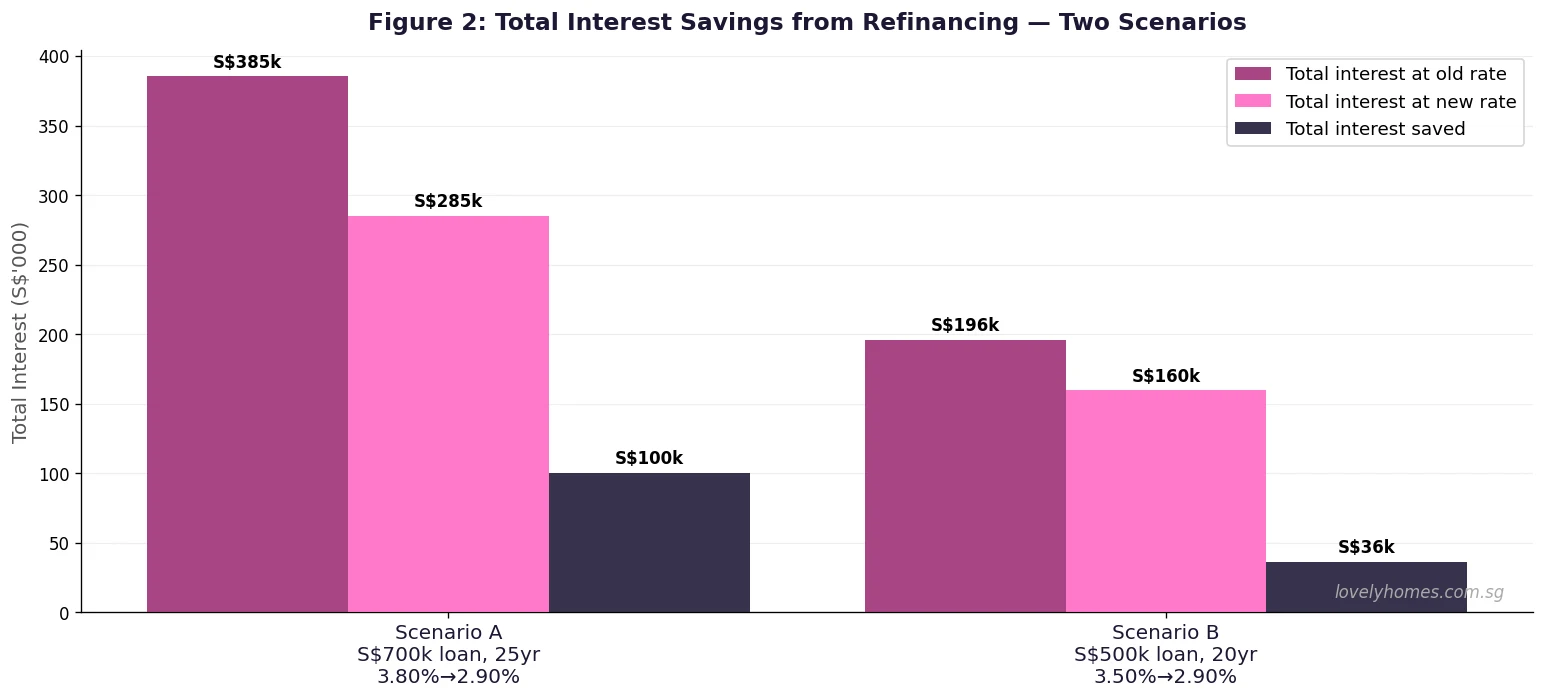
  • Typical savings in 2026: a borrower refinancing a S$700,000 loan from 3.80% (a 2024-vintage fixed rate) to 2.90% (current refinance rate) saves approximately S$78,000 in total interest over 25 years, or around S$260/month.
  • Transaction costs are modest: legal fees run S$1,800–S$3,000; valuation fees S$300–S$600; some banks offer full legal subsidy packages for refinancers.
  • SORA-pegged floating rates (Singapore Overnight Rate Average) offer potential savings when rates fall but expose you to upward repricing; fixed rates provide certainty for 2–3 years.
  • CPF OA funds can service the new loan, but the CPF accrued interest rule means any CPF monies used must be repaid (with accrued interest at 2.5% p.a.) on eventual sale.
  • Total Debt Servicing Ratio (TDSR) still applies at refinancing — you must prove the new monthly repayment stays within 55% of your gross monthly income.
  • Process timeline: from application to completion is typically 4–8 weeks; allow 3 months before lock-in expiry to start comparing packages.

In Singapore’s rate environment of 2024–2026, tens of thousands of homeowners took out fixed-rate mortgages at 3.50%–4.00% when the US Federal Reserve was tightening monetary policy. As those lock-in periods approach their two-year anniversary, refinancing has moved from a niche financial exercise to a mainstream priority. This guide explains exactly when to refinance, how to calculate whether it is worth it, what the process looks like and what to watch out for.

Refinancing vs Repricing: What Is the Difference?

These two terms are often conflated, but they involve distinct processes with different cost structures:

Refinancing means taking out a new home loan from a different bank to repay your existing loan. The new bank’s solicitors handle the discharge of the old mortgage and registration of the new one. You bear legal costs (S$1,800–S$3,000), valuation fees (S$300–S$600), and potentially a break cost if you exit before the lock-in period ends. Many banks offer legal subsidy packages that rebate S$1,800–S$2,500 to offset these costs for loans above a certain quantum.

Repricing means renegotiating your interest rate with your existing bank without changing lenders. The bank may offer this as a retention offer when your lock-in approaches expiry. Repricing is simpler and cheaper (typically S$200–S$800 in administration fees), but the rate offered is often not as competitive as what a new lender will offer to win your business. The trade-off is convenience versus maximum savings.

Rule of thumb: Always get competing quotes before accepting a repricing offer from your current bank. The rate gap between a repricing offer and an aggressive refinance package from a rival bank is often 0.30%–0.60% — which on a S$700,000 loan translates to S$2,100–S$4,200 per year in interest savings.
Singapore mortgage rates comparison SORA vs fixed rate refinancing 2026
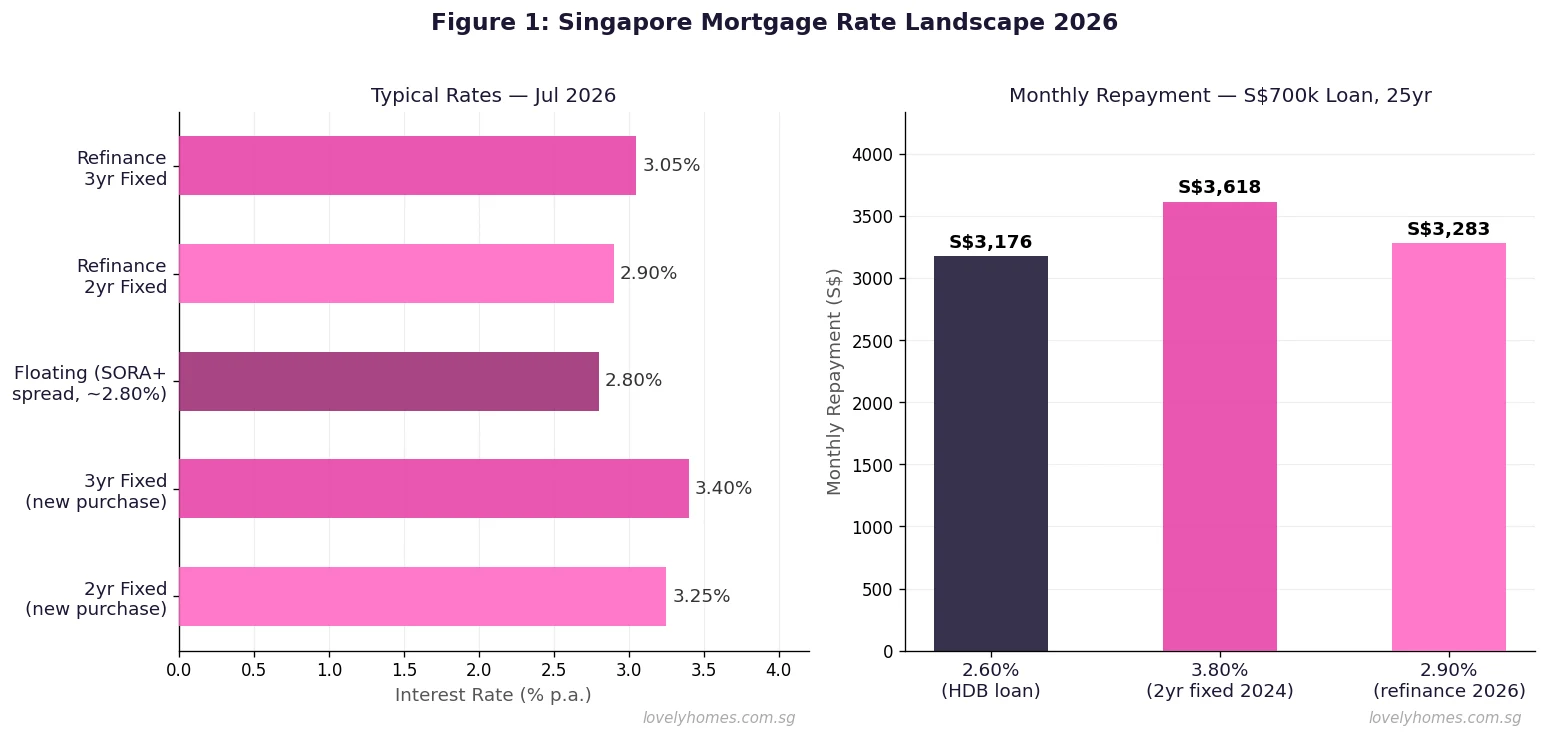
Figure 1: Left — typical mortgage rate offerings in Singapore as at July 2026, showing the current 2yr and 3yr fixed rates for new purchases and refinancing. Right — monthly repayment comparison for a S$700,000 loan at three rate scenarios over 25 years. Floating SORA-pegged rates are currently below most fixed offerings. Source: major Singapore bank public rate sheets, July 2026.

When Should You Refinance?

The single most important factor is the lock-in period. Most Singapore bank home loans carry a lock-in of 2–3 years, during which refinancing or full redemption triggers a penalty — typically 1.5% of the outstanding loan amount. On a S$700,000 outstanding balance, that is a S$10,500 penalty. You should almost never refinance within the lock-in unless the rate savings are dramatic and you have a very long holding horizon.

Outside the lock-in, refinancing is worth pursuing if the new rate is at least 0.50% lower than your current all-in rate. Below that threshold, the transaction costs (legal fees, valuation, time) may not justify the exercise unless your loan quantum is very large. The breakeven analysis in the next section provides the full framework.

Other triggers that make refinancing particularly timely:

  • Your property has appreciated significantly, improving your Loan-to-Value (LTV) ratio and qualifying you for a lower rate tier.
  • Your income has increased, qualifying you for a larger loan or improving your TDSR buffer, allowing you to reduce the loan tenure and total interest.
  • Interest rates in the market have fallen materially (as has been occurring in Singapore in 2025–2026 as the Fed easing cycle feeds through to SORA and fixed-rate offerings).
  • You want to switch from a floating-rate package (with rate uncertainty) to a fixed-rate package for budget certainty.

How Much Can You Save? The Breakeven Calculation

The refinancing decision is fundamentally a breakeven analysis: total savings from a lower rate versus total cost of switching. Here is the framework:

Step 1 — Calculate monthly repayment saving:
Monthly saving = [Old monthly payment] − [New monthly payment]
Example: Old rate 3.80%, new rate 2.90%, loan S$700,000, 25 years remaining.
Old payment: S$700,000 × 0.038/12 × (1+0.038/12)^300 / ((1+0.038/12)^300−1) = S$3,609/month
New payment: S$700,000 × 0.029/12 × (1+0.029/12)^300 / ((1+0.029/12)^300−1) = S$3,349/month
Monthly saving: S$260

Step 2 — Calculate total switching cost:
Legal fees: S$2,500 (conservatively; some banks subsidise S$1,800–S$2,500)
Valuation fee: S$500
Total cost: S$3,000 (or as low as S$700 if legal subsidy applies)

Step 3 — Calculate breakeven period:
Breakeven = Total cost ÷ Monthly saving = S$3,000 ÷ S$260 = approximately 11.5 months
With full legal subsidy: S$700 ÷ S$260 = approximately 2.7 months

If you plan to hold the property for more than 12 months after refinancing (virtually all owner-occupiers will), the refinancing exercise pays for itself many times over.

Mortgage refinancing savings calculator Singapore 2026 two scenarios total interest comparison
Figure 2: Total interest savings across two refinancing scenarios. Scenario A (S$700k, 25 years remaining, 3.80%→2.90%) saves approximately S$78,000 in total interest. Scenario B (S$500k, 20 years remaining, 3.50%→2.90%) saves approximately S$38,000. Note: figures are illustrative estimates based on standard amortisation; actual savings depend on your bank’s compounding convention and any prepayment. Source: LovelyHomes calculations using standard reducing-balance methodology.

Choosing Between SORA Floating and Fixed Rate

Singapore bank mortgages are broadly offered in two flavours: floating rate (pegged to the Singapore Overnight Rate Average, or SORA, plus a spread) and fixed rate (a guaranteed rate for a defined period, usually 2–3 years).

As at July 2026, 3-month compounded SORA is approximately 2.35% per annum, and bank spreads on SORA packages run from 0.45% to 0.65%, giving an all-in floating rate of approximately 2.80%–3.00%. This is lower than most 2-year or 3-year fixed offerings (2.90%–3.40%). The floating rate appears attractive at current levels — but it will reprice every quarter as SORA moves, and there is no guarantee it stays below fixed rates in 2027–2028 if global rate pressures return.

For borrowers who:

  • Have a tight monthly budget and cannot absorb rate increases → choose fixed rate (2–3 years).
  • Expect to sell within 2 years (and want no lock-in) → choose a floating package with no lock-in.
  • Are refinancing opportunistically and comfortable with rate uncertainty → floating SORA may deliver better outcomes if rates continue declining.

Many borrowers opt for a hybrid: fixed rate for 2 years to lock in current savings, then assess the rate environment at the next repricing/refinancing window.

The 6-Step Refinancing Process

Singapore mortgage refinancing process 6 steps 2026
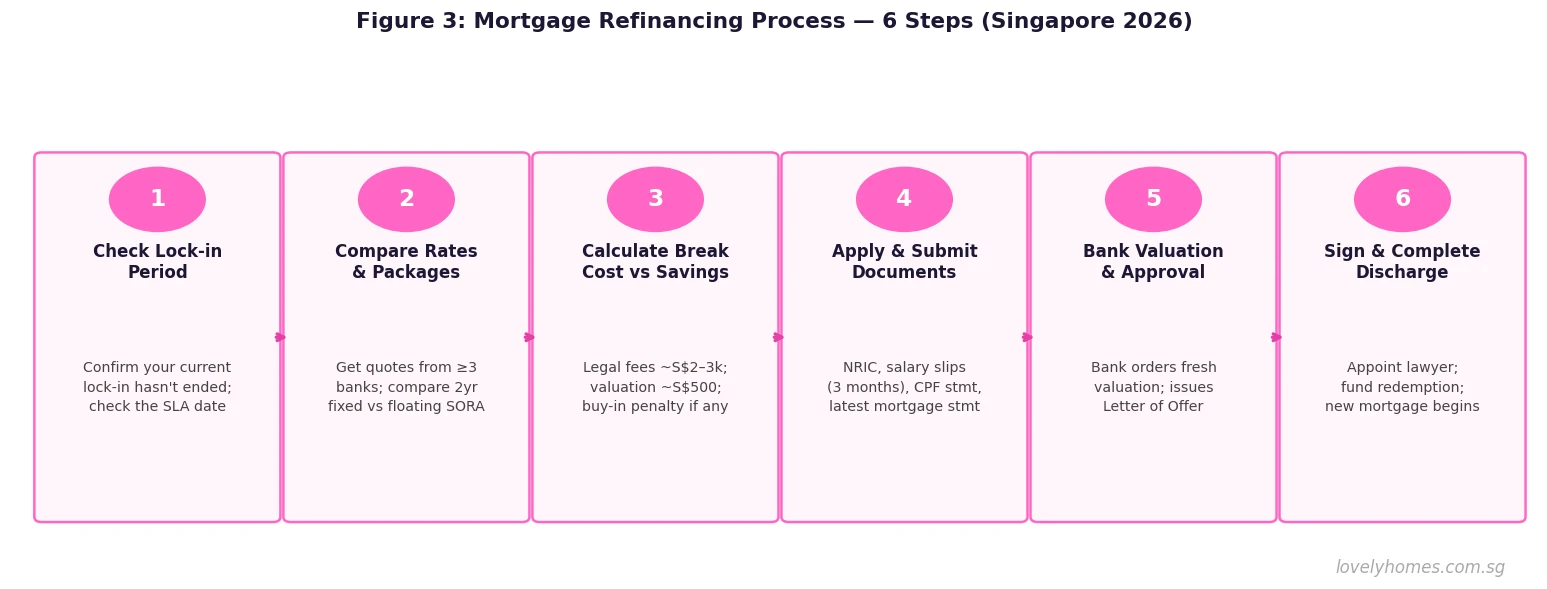
Figure 3: The mortgage refinancing process in Singapore from lock-in check to new mortgage commencement. Most homeowners complete the process in 4–8 weeks. Starting 3 months before your lock-in expiry gives you enough time to compare packages without pressure. Source: LovelyHomes.

The process works as follows in more detail:

Step 1 — Check lock-in period: review your current Letter of Offer (LOO) or contact your bank. Note the exact lock-in expiry date. If lock-in ends in 3 months or less, start immediately.

Step 2 — Compare packages from ≥3 banks: use mortgage brokers or direct bank websites. Compare: all-in rate, lock-in period, legal subsidy quantum, clawback conditions (most banks claw back subsidies if you refinance again within 3 years), late payment penalties.

Step 3 — Calculate break-even: use the formula above. Factor in any legal subsidy. Confirm the new bank’s loan quantum by checking your LTV (outstanding loan vs current valuation).

Step 4 — Apply and submit documents: typically required — NRIC/passport, last 3 months’ payslips, last 2 years’ NOA or CPF annual statement (for self-employed), last 3 months’ CPF transaction history, latest mortgage statement, title deed or SLA record search. Processing time: 2–3 weeks.

Step 5 — Valuation and Letter of Offer: the new bank orders a valuation (S$300–S$600; usually paid by borrower). On approval, a formal LOO is issued. Read all conditions carefully — especially the lock-in, penalty clauses and clawback on subsidies.

Step 6 — Legal completion: appoint a solicitor (often from the bank’s panel to qualify for subsidy). The solicitor handles mortgage discharge from old bank and registration of new charge. The process takes 2–4 weeks from LOO acceptance. On completion, the old loan is fully redeemed and the new mortgage commences.

Summary: When Refinancing Makes Sense

Situation Refinance? Reason
Lock-in expired, rate gap ≥0.50% Yes Savings clear the transaction cost in <12 months
Lock-in expired, rate gap <0.25% No / Reprice only Transaction costs may outweigh savings on small loans
Within lock-in, penalty 1.5% No Break cost typically exceeds 3–5 years of rate savings
Property value up significantly Yes, if lock-in expired Better LTV unlocks lower rate tier
Planning to sell within 12 months No Insufficient time to recover transaction costs
Want certainty vs. floating rate Switch to fixed Budget certainty has value beyond raw rate comparison
Want maximum saving now Floating SORA package SORA ~2.80% is below fixed rates as at July 2026

Worked Example: The Tan Household Refinancing Decision

Mr and Mrs Tan are Singapore Citizens who purchased a D15 condominium in March 2024 at S$1,450,000. They took a S$1,087,500 (75% LTV) bank loan at a 2-year fixed rate of 3.80% per annum. Their lock-in expires in March 2026 (which has now passed). Their outstanding balance as at July 2026 is approximately S$1,040,000 with 23 years remaining.

Current monthly payment: S$1,040,000 @3.80%, 23 years = S$5,730/month
Proposed refinance rate: 2-year fixed at 2.90% from Bank B
New monthly payment: S$1,040,000 @2.90%, 23 years = S$5,323/month
Monthly saving: S$407
Annual saving: S$4,884

Transaction costs:
Legal fees: S$2,800 (solicitors for discharge and new mortgage)
Valuation: S$500
Legal subsidy from Bank B: S$2,000
Net out-of-pocket cost: S$1,300

Breakeven: S$1,300 ÷ S$407/month = 3.2 months

Total interest saving over 23 years (rough estimate): S$112,000

Verdict: Refinancing is strongly justified. The Tan household breaks even in just over 3 months, and with Bank B’s legal subsidy absorbing most of the switching cost, the exercise is essentially self-funding within a quarter. Their combined TDSR at S$5,323/month on S$18,000 combined income is 29.6% — well within the 55% cap.

What Might Come Next

Singapore mortgage rates are tied to global monetary conditions via SORA, which tracks the US Federal Reserve’s policy rate with a lag. If the Fed continues its easing cycle into 2027 — as futures markets tentatively suggest — SORA could drift lower, making floating-rate packages increasingly attractive. However, the US election cycle, inflation trajectory and any geopolitical disruptions could reverse this direction quickly.

For 2026 specifically, the window of opportunity for borrowers with 2024-vintage fixed loans at 3.50%–4.00% approaching lock-in expiry is now open. Industry data suggests Singapore mortgage refinancing volumes in Q1–Q2 2026 have exceeded 2023 levels as a result. Borrowers who act in 2026 are capturing a rate environment that is materially better than two years ago; those who wait may find rates have either risen again or the best packages are no longer available.

What is the difference between a lock-in period and a clawback period?
A lock-in period is the minimum period you must hold the loan before you can redeem or refinance it without penalty. Refinancing within the lock-in typically triggers a break cost of 1.50% of the outstanding loan amount. A clawback period is separate and relates to any subsidies the bank gave you when you took the loan — legal subsidies, cashback and valuation fee rebates. If you refinance to a different bank within the clawback period (commonly 3–5 years), the new bank will not claw back anything, but your existing bank may require you to return the subsidies it paid. Clawback clauses vary by bank and package — always read the fine print in your Letter of Offer.
Can I refinance an HDB loan to a bank loan?
Yes — you can refinance from an HDB concessionary loan (currently 2.60% p.a.) to a bank loan. This is sometimes done when a borrower wants a longer tenure or wishes to free up CPF OA funds (by paying down the HDB loan with cash). However, the move is irreversible: once you switch from an HDB loan to a bank loan, you cannot return to an HDB loan. You also lose the flexibility of the HDB concessionary rate, which is pegged to the CPF OA rate plus 0.10% and tends to be more stable than market rates. As at July 2026, SORA-based bank floating rates (approximately 2.80%) are marginally higher than the HDB rate (2.60%), making the switch financially neutral to slightly negative at current rates — but bank packages with lock-ins set now may offer competitive 2-year fixed rates of 2.90%–3.10%. Consider this decision carefully and model the scenarios over your full remaining tenure.
Does TDSR apply when refinancing?
Yes, TDSR (Total Debt Servicing Ratio) applies at the point of refinancing. The bank will re-assess your income and all existing credit obligations (car loans, personal loans, outstanding credit card balances) to ensure the new monthly mortgage repayment, combined with all other debt obligations, does not exceed 55% of your gross monthly income. In practice, most refinancers who took a loan 2–3 years ago and have maintained their income pass TDSR comfortably — the new repayment is typically lower than the old one. If your income has fallen since the original loan, however, you may face difficulties qualifying for the same loan quantum at refinancing, especially if property values have declined and the bank’s fresh valuation results in a lower LTV ceiling.
How do I know if my property has appreciated enough to get a better rate?
When you refinance, the new bank orders a fresh valuation of your property. If the valuation comes in higher than when you originally purchased (e.g., your outstanding loan is S$700,000 but your property is now valued at S$1,200,000, giving an LTV of 58%), some banks offer lower rates for loans below a certain LTV threshold (typically 60% or 70% LTV). Check whether the bank’s rate sheet distinguishes by LTV tier. Additionally, a higher valuation means the bank is lending against a more valuable asset, which improves its credit comfort. If you believe your property has appreciated significantly, it is worth commissioning a preliminary desktop valuation before formally applying.
What documents do I need to refinance a Singapore home loan?
Standard documentation required for a refinancing application in Singapore includes: (1) NRIC or Singapore passport; (2) last 3 months’ payslips (for salaried employees) or last 2 years’ Income Tax Notice of Assessment (for self-employed or variable-income earners); (3) CPF contribution history for the past 12 months (downloadable from the CPF website); (4) latest mortgage statement showing outstanding balance and remaining tenure; (5) property title or SLA records search printout; (6) IRAS property tax statement (to confirm Annual Value); and (7) bank statements for the past 3 months if requested for income verification. Some banks also require the original Letter of Offer from your current bank. Preparing these in advance shortens the processing time from 2–3 weeks to 1–2 weeks.
Can I use CPF to pay off the legal fees when refinancing?
No. Legal fees and valuation fees at refinancing must be paid in cash. CPF Ordinary Account (OA) funds can only be used to service the ongoing monthly mortgage repayments (subject to the Valuation Limit and Withdrawal Limit rules) and, at the point of original purchase, for the downpayment and BSD. The transaction costs associated with refinancing — solicitors’ fees, valuation, any break cost — are out-of-pocket cash expenses. However, if a bank offers a legal subsidy rebate as part of its refinancing package, that rebate is typically credited to your loan account or paid directly to your solicitor, effectively reducing your cash outlay to near zero. Always check the terms of any subsidy before signing.
Is there a minimum loan amount to refinance in Singapore?
Most Singapore banks have an informal minimum loan quantum of around S$300,000 for refinancing to be commercially viable, as the legal and administrative processing costs are fixed regardless of loan size. For very small outstanding balances (below S$200,000 with only 5–8 years remaining), the interest saving may not justify the switching cost — a simple repricing request to your existing bank is likely more appropriate. There is no regulatory minimum loan size; the practical constraint is economic: at S$200,000 outstanding and a 0.50% rate saving, the annual interest saving is only S$1,000, which barely covers legal fees. Larger loan balances (S$500,000 and above) consistently produce compelling breakeven timelines of under 12 months when switching from a high-rate vintage to current market rates.
Disclaimer: The information in this article is for general educational purposes only and does not constitute financial advice. Mortgage interest rates, SORA, TDSR rules, bank packages and CPF withdrawal limits are subject to change. The calculations in this article use standard reducing-balance amortisation methodology and are for illustrative purposes only — your actual savings will vary depending on your bank’s compounding convention, exact outstanding balance, remaining tenure and prevailing market rates at the time of refinancing. Always obtain independent advice from a licensed financial adviser, mortgage broker or your bank before making any refinancing decision. LovelyHomes does not act as a licensed financial adviser and does not receive referral fees from any bank or broker.

×

Click anywhere to close

Singapore Property Agent Commission Guide 2026

Singapore Property Agent Commission Guide 2026

⚡ Quick Answer: Property Agent Commission Singapore 2026

  • Agent commission is negotiable — there are no legally fixed rates in Singapore. Industry benchmarks exist but are not mandated.
  • HDB resale sellers typically pay 1%–2%; HDB resale buyers typically pay 0%–1% of purchase price, plus 9% GST.
  • Private property sellers typically pay 1%–2%; private property buyers typically pay 0%–1%, plus 9% GST.
  • New launch condo buyers pay nothing — the developer pays the buyer’s agent commission directly (typically 1%–3% of purchase price).
  • Rental transactions: landlords and tenants each typically pay half a month’s rent for leases under 24 months; one month’s rent for longer leases.
  • All agents must be CEA-licensed and must sign a Client’s Agreement (CA) with you before conducting any work on your behalf — mandated under the Estate Agents Act.
  • Verify your agent at cea.gov.sg before signing anything. An unlicensed “agent” cannot legally claim commission and may expose you to fraud risk.

Property Agent Commission in Singapore: Who Pays What and Why

In Singapore’s property market, agent commission is one of the largest transaction costs after stamp duties — yet it remains one of the least understood. Unlike stamp duty, which is set by law and published in IRAS schedules, agent commission has no statutory fixed rate. The Council for Estate Agencies (CEA), which regulates all property agents under the Estate Agents Act (Cap. 95A), has never mandated a specific commission percentage. Instead, it publishes broad guidelines and requires that all commissions be agreed in writing via a Client’s Agreement before an agent begins work.

This means that the rates you see quoted — 1% for HDB buyers, 2% for private sellers — are industry convention rather than law. In practice, they are widely observed but negotiable, particularly for high-value transactions or where a single agent represents both buyer and seller (co-broking arrangements).

Understanding the standard rates, who pays whom, and what the commission covers can help you plan your transaction budget accurately and negotiate confidently.

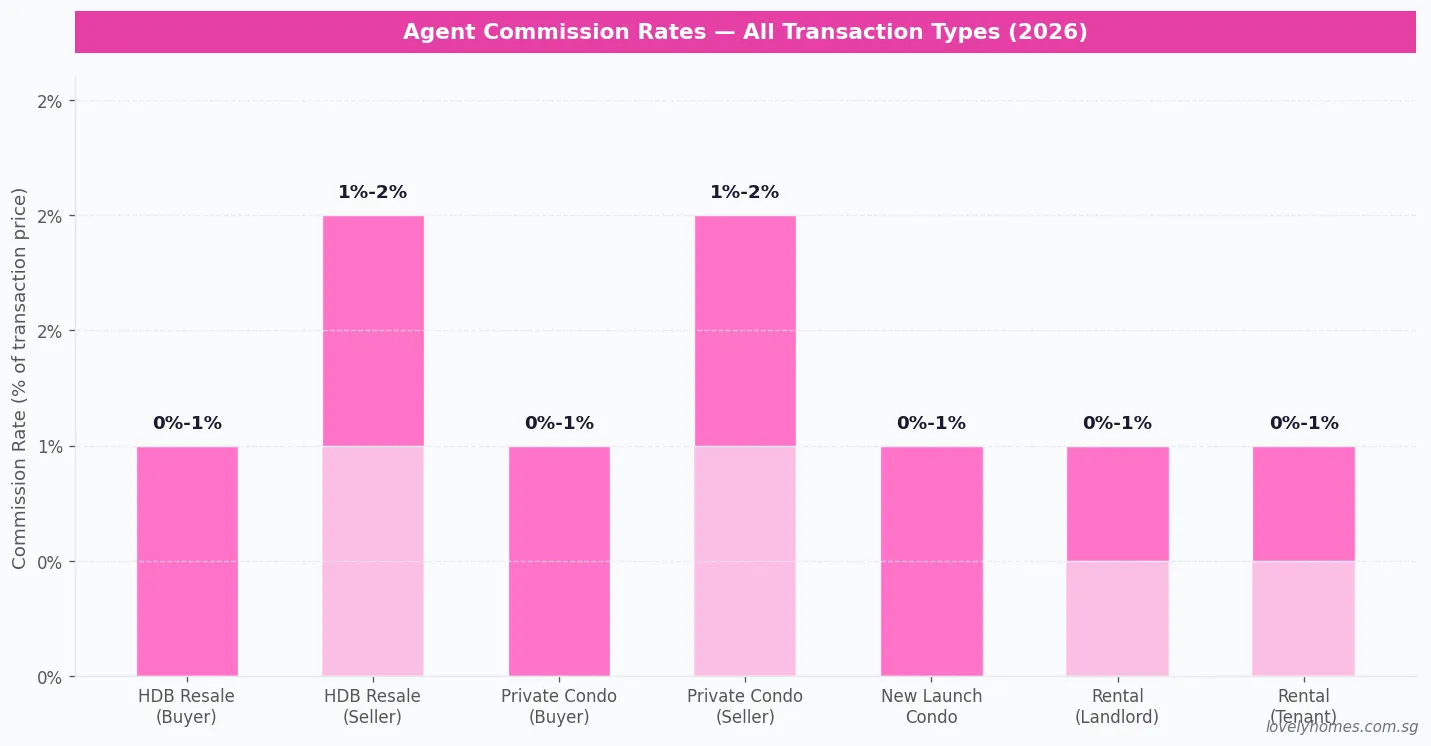
Singapore property agent commission rates 2026 — all transaction types including HDB, private condo, and rental
Figure 1: Industry benchmark commission rates by transaction type. All rates are subject to negotiation and exclusive of 9% GST. New launch buyer commission is paid by the developer, not the buyer. Source: CEA guidelines; LovelyHomes research.

Commission Rates by Transaction Type

HDB resale transactions: For buyers, the industry benchmark is 0% to 1% of the purchase price; many HDB buyers negotiate the buyer-side commission down or even to zero, since developers do not incentivise buyer agents the way new-launch projects do. For sellers, the benchmark is 1% to 2%. A seller paying 2% on an S$620,000 HDB flat will pay S$12,400 plus 9% GST = S$13,516.

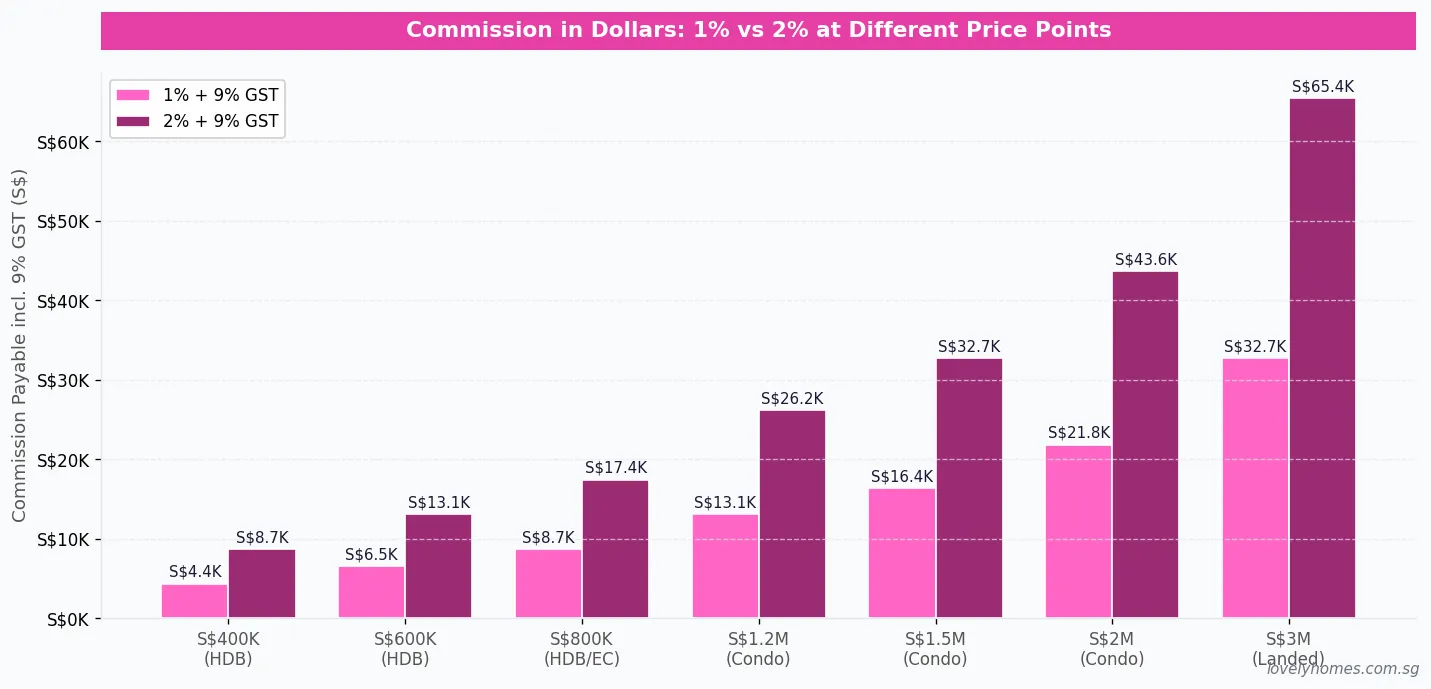
Private residential (resale condominiums, apartments, landed): For buyers, 0%–1% is typical. For sellers, 1%–2% is typical. Co-broking is standard — each agent receives their respective commission from their own client. At S$2,000,000, a seller paying 2% pays S$43,600 inclusive of GST.

New launch condominiums: Buyers pay nothing — developer commission structures compensate the buyer’s agent directly, typically at 1%–3% of the purchase price depending on developer marketing budget. This is why agents are often more enthusiastic about showing new launches than resale properties. The commission comes from the developer’s marketing spend, which is embedded in the developer’s pricing model.

Rental transactions: The standard for leases of 24 months or less is one month’s rent split equally between the landlord’s agent and the tenant’s agent (0.5 months each, plus GST). For leases longer than 24 months, the benchmark rises to one month’s rent each. Short-term rentals or corporate leases may attract different structures negotiated case by case.

GST note: Property agents are GST-registered if their annual turnover exceeds the GST registration threshold. As of 1 January 2024, GST is charged at 9%. Always confirm whether a quoted commission is inclusive or exclusive of GST.

Singapore property agent commission in dollars 2026 — at different price points, 1% vs 2% plus 9% GST
Figure 2: Commission payable in absolute dollar terms (inclusive of 9% GST) at 1% and 2% for a range of property prices. The left bar in each pair is 1% (buyer-side benchmark); the right bar is 2% (seller-side upper benchmark). Source: LovelyHomes calculation.

Commission Summary Table

Transaction Type Buyer Pays Seller / Landlord Pays Basis Notes
HDB resale flat 0%–1% of purchase price 1%–2% of sale price % of transacted price Both + 9% GST. Negotiable.
Private condo / apartment resale 0%–1% of purchase price 1%–2% of sale price % of transacted price Both + 9% GST. Negotiable.
Landed property resale 0%–1% of purchase price 1%–2% of sale price % of transacted price Both + 9% GST. Negotiable.
New launch condominium Nil (paid by developer) Developer pays buyer agent 1%–3% Developer marketing budget Buyer incurs no direct commission cost.
Residential rental (≤24 mths) 0.5 mth rent + GST 0.5 mth rent + GST Per-lease Split 50/50 between landlord agent and tenant agent.
Residential rental (>24 mths) 1 mth rent + GST 1 mth rent + GST Per-lease Higher commission for longer commitments.

CEA Licensing and the Client’s Agreement

Every person conducting estate agency work in Singapore must hold a valid salesperson registration or estate agency licence issued by the Council for Estate Agencies (CEA), established under the Estate Agents Act 2010. The CEA maintains a public register at cea.gov.sg where anyone can look up an agent’s registration number, licence status, agency affiliation, and disciplinary history.

Before an agent may commence any work on your behalf — searching for properties, arranging viewings, submitting offers — they are required by the CEA Code of Practice to provide and have you sign a Client’s Agreement (CA). The CA specifies the scope of work, the agreed commission rate, and the duration of the engagement. Signing the CA creates a binding contract. Without a signed CA, any commission claim by the agent is difficult to enforce.

If an agent pressures you to make an offer or view properties without first providing a CA, this is a CEA breach and a red flag. You should decline and find another agent.

CEA agent verification 6-step process — how to check a Singapore property agent is licensed in 2026
Figure 3: Six-step process for verifying a property agent via the CEA Public Register. Red flags in the final column indicate situations where you should cease dealings immediately. Source: CEA Estate Agents Act Cap 95A; LovelyHomes.

Worked Example: The Nair Family Sells Their D15 Condo

Mr and Mrs Nair decide to sell their freehold 3-bedroom condominium in District 15 (East Coast area). The property is listed at S$2,200,000 and eventually transacts at S$2,150,000.

They engage a seller’s agent at a negotiated commission of 1.5% (rather than the 2% upper benchmark), inclusive of marketing costs. Their buyer transacts through a separate buyer’s agent at 1% (paid by the buyer).

Commission calculation for the Nairs (sellers): S$2,150,000 × 1.5% = S$32,250. Add 9% GST = S$32,250 × 1.09 = S$35,152.50.

Commission calculation for the buyer: S$2,150,000 × 1% = S$21,500. Add 9% GST = S$21,500 × 1.09 = S$23,435.

The Nairs save S$10,750 pre-GST by negotiating from 2% to 1.5%. The saving is meaningful — equivalent to roughly one additional monthly mortgage payment.

Negotiation tip: Commission is most negotiable when (a) the property is priced competitively and likely to move quickly, (b) you offer exclusivity to one agent rather than engaging multiple agents simultaneously, or (c) you are conducting both a sale and purchase simultaneously through the same agency. Use these levers before signing the Client’s Agreement.

Why Agent Commission Matters: Singapore in Context

At first glance, 1%–2% might sound modest. But on a S$2,000,000 private condominium, the combined buyer and seller commission (at 1% + 2%) totals S$60,000 before GST — S$65,400 inclusive of GST. That is a material transaction cost, often comparable to two to three months of gross household income for many Singapore buyers.

Unlike in some markets where buyer agents are paid from a shared commission pool, Singapore’s market structure is transparent: each side typically pays their own agent. This reduces conflicts of interest but means buyers who forgo representation on new launches (where they pay nothing for a buyer’s agent) are effectively subsidising the developer’s marketing cost through the purchase price.

The CEA has discussed introducing more formal commission disclosure requirements in recent consultations, though no regulatory change had been announced as at June 2026. Buyers and sellers should nonetheless insist on a written, signed Client’s Agreement specifying the exact commission before any agent commences work on their behalf.

What Might Change in Agent Commission Rules

The CEA periodically reviews its Code of Practice for professional standards. Industry observers have noted ongoing discussion about whether a formal commission disclosure framework — similar to what exists in Australia — should be introduced to increase transparency. As at June 2026, commission rates remain entirely negotiable with no mandatory disclosure beyond what must appear in the Client’s Agreement. Buyers should monitor CEA announcements for any changes to co-broking standards or commission disclosure obligations.

Frequently Asked Questions

Is agent commission legally fixed in Singapore?

No. The Council for Estate Agencies (CEA) does not prescribe fixed commission rates. What it mandates is that any agreed commission must be documented in a signed Client’s Agreement before the agent commences work. The rates quoted throughout this article — 1%, 2%, half a month’s rent — are industry conventions that have become widely expected but are legally negotiable. An agent cannot demand a specific rate; the rate is whatever you and the agent agree and document.

Do I need a buyer’s agent when buying a new launch condo?

No, you do not — but having one costs you nothing because the developer pays the buyer’s agent commission directly. A buyer’s agent for a new launch can help you compare projects, assess floor plans, check price comparables, and advise on unit selection without charging you any fee. Using a buyer’s agent for new launches is therefore generally rational from a cost perspective.

Can one agent represent both buyer and seller (dual representation)?

Yes, but with restrictions. The CEA code permits an agent to act for both parties in a transaction (known as dual representation or co-broking by the same agent), but the agent must inform both parties, obtain their written consent, and act fairly to both sides. In practice, many experienced buyers and sellers prefer independent agents to avoid any conflict of interest. If a single agent represents both sides, it is common for the commission arrangement to be negotiated down to reflect the reduced workload.

What is the CEA Client’s Agreement and is it compulsory?

The Client’s Agreement (CA) is a written contract between you and your agent that specifies the scope of work (e.g., marketing your property, sourcing a tenant), the agreed commission, the duration of the engagement, and the agent’s obligations under the CEA Code of Practice. Signing the CA is compulsory under CEA rules before the agent may commence any estate agency activity on your behalf. Without a signed CA, the agent cannot legally enforce a commission claim if the transaction is completed.

What if I find a buyer myself — do I still owe commission?

It depends on your Client’s Agreement. If you signed an exclusive CA with an agent for a specified period, and you introduce a buyer yourself during that exclusive period, the agent may still be entitled to commission under the terms of the agreement. If you have a non-exclusive CA, and you find a buyer independently without the agent’s involvement, you may be able to argue no commission is owed — but the exact terms of your signed CA govern. Always read the CA carefully before signing, particularly the exclusivity clause.

How do I check if my agent is properly licensed?

Visit the CEA Public Register at cea.gov.sg/public-register and search by the agent’s name or registration number (which all agents are required to display on namecards, marketing materials, and messaging). Verify the status shows “Active”, check the estate agency affiliation matches what the agent told you, and review any disciplinary records. This takes under two minutes and is strongly recommended before signing any agreement.

Is agent commission subject to GST?

Yes, for GST-registered agents. As of 1 January 2024, GST in Singapore is charged at 9%. If your agent or their agency is GST-registered (mandatory once their annual turnover exceeds S$1 million), they will charge GST on top of the agreed commission. This means a 2% commission on a S$1,500,000 property becomes S$30,000 + 9% GST = S$32,700. Always clarify whether quoted commission rates are inclusive or exclusive of GST before signing the Client’s Agreement.

Related Articles


Disclaimer: This article is for general informational purposes only and does not constitute professional real estate, financial, or legal advice. Commission rates are industry benchmarks and are subject to negotiation. All agents must be CEA-licensed; verify at cea.gov.sg. For official guidance on estate agency regulation, refer to the Council for Estate Agencies at cea.gov.sg and the IRAS GST guidelines at iras.gov.sg.

How to Choose a Property Agent in Singapore 2026: CEA Checks, Red Flags and Questions to Ask

How to Choose a Property Agent in Singapore 2026: CEA Checks, Red Flags and Questions to Ask

Choosing how to select a property agent in Singapore 2026 is a decision that could save — or cost — tens of thousands of dollars. With approximately 35,000 licensed real estate salespersons registered with the Council for Estate Agencies (CEA) as at 2026, the quality and suitability of agents varies widely. This guide gives you a structured, step-by-step framework for finding, vetting, and working with the right agent for your specific transaction — whether you are buying, selling, or renting.

Quick Answer: How to Choose a Property Agent Singapore 2026 — Key Facts

  • CEA registration is mandatory: Every property agent in Singapore must be registered with the Council for Estate Agencies. Unregistered agents cannot lawfully conduct property transactions. Verify at eservices.cea.gov.sg using the agent’s phone number — if it does not match, stop dealing immediately.
  • Client’s Agreement is required by law: Under the Estate Agents Act, an agent must enter into a written Client’s Agreement with you before conducting any work on your behalf. Refuse any agent who asks you to proceed without one.
  • Dual representation is restricted: An agent cannot represent both buyer and seller in the same transaction — unless both parties give informed written consent. This is a common cause of conflict-of-interest disputes.
  • Commission rates are advisory, not fixed: CEA publishes advisory rates as a market benchmark; actual commission is negotiable. New launch buyer agents are paid by the developer, not the buyer.
  • Check disciplinary record: CEA’s Public Register shows past sanctions, fines, and licence suspensions. This is a critical check many buyers skip.
  • Specialisation matters: An agent who primarily transacts HDB resale may not have the market knowledge, network, or sub-sale experience for a D9 new launch.
  • Red flags: WhatsApp-only contact, pressure to pay before viewing, no CEA registration match on phone number, reluctance to sign Client’s Agreement.

Why the Right Property Agent Matters More Than the Platform

Online property portals, valuation tools, and AI-assisted market data have made property information more accessible than ever. But the actual execution of a property transaction — negotiating on price, managing the OTP timeline, coordinating between buyer’s and seller’s solicitors, handling mortgage applications, navigating HDB procedures — still depends heavily on the agent’s competence, ethics, and market network. A well-chosen agent protects your interests actively; a poor choice, or worse, a fraudulent one, can expose you to misrepresentation, conflicts of interest, and financial loss.

Step 1: Verify CEA Registration Before Anything Else

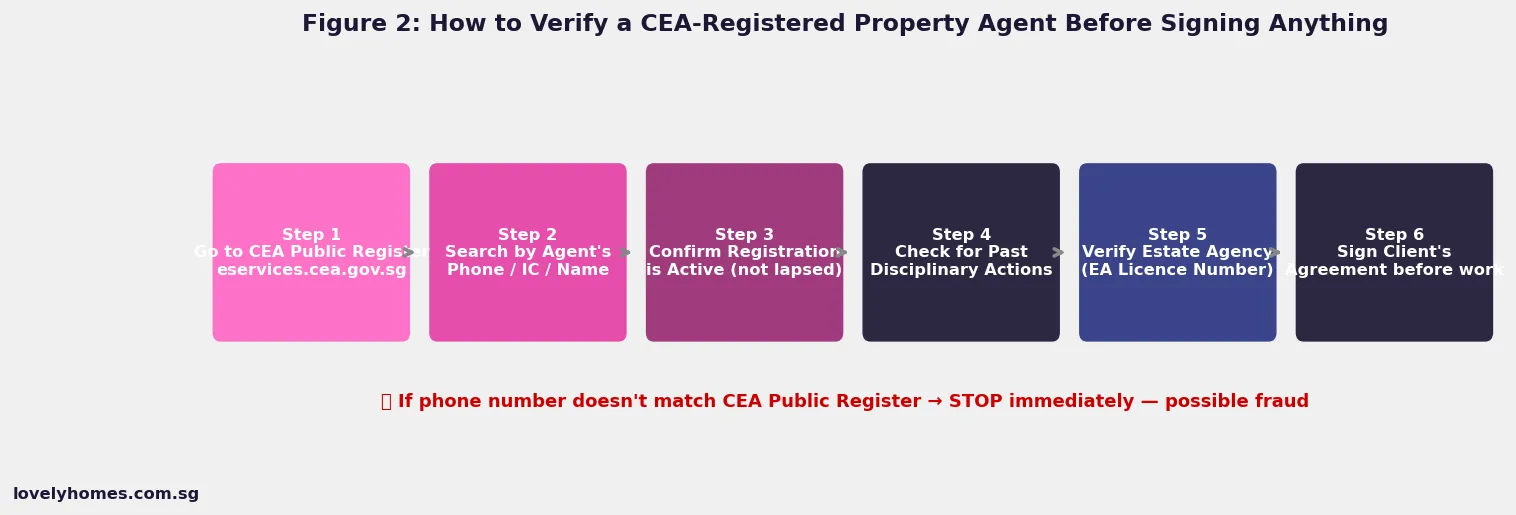
This is the single most important step and takes under two minutes. Visit eservices.cea.gov.sg and search using the phone number the agent contacted you from. If the phone number does not return a matching, currently active salesperson licence, stop all engagement immediately — this is a classic fraud indicator.

Do not rely solely on the business card, name, or IC number that the agent provides. Scammers regularly impersonate real agents by using stolen photos and legitimate-sounding names while substituting a different phone number that you are meant to contact.

The Public Register also shows:

  • The estate agency the agent is currently registered under.
  • Whether the licence is active, lapsed, or suspended.
  • The agent’s transaction history for the past 36 months (categories: HDB resale, HDB rental, private sale/resale, private rental).
  • Any disciplinary actions taken by CEA, including fines, reprimands, and licence revocations.
How to verify a CEA-registered property agent Singapore step by step guide 2026
Figure 2: How to Verify a CEA-Registered Property Agent — Six Steps from the CEA Public Register to signing the Client’s Agreement.

Step 2: Match the Agent’s Specialisation to Your Transaction

Transaction history is your most objective indicator of an agent’s specialisation. An agent with 50 HDB resale transactions in the past 36 months and zero private property transactions is unlikely to be the best choice for a high-value CCR condominium purchase. Conversely, a specialist in D9–D11 luxury resales may be unfamiliar with HDB procedures and the nuances of the CPF Housing Grant application process.

Ask the agent directly: “How many transactions of this specific type — resale 4-room HDB in Tampines / new launch in OCR / commercial shophouse — have you done in the past 12 months?” A trustworthy agent will show you their track record rather than deflect the question.

Key specialisation signals to look for:

  • HDB resale buyer: Look for 10+ HDB resale transactions in the past 36 months, familiarity with HFE letter procedures, and knowledge of the NCQ (Non-Citizen Quota) for rental scenarios.
  • Private resale buyer: Look for private property transaction history, knowledge of current sub-sale volumes in your target district, and relationships with mortgage brokers.
  • New launch buyer: Developer accreditation and attendance at developer previews; knowledge of ballot priority systems; familiarity with the Progressive Payment Scheme.
  • Seller (HDB or private): Track record of actual listings sold, average days on market for recent listings, familiarity with comparative market analysis.
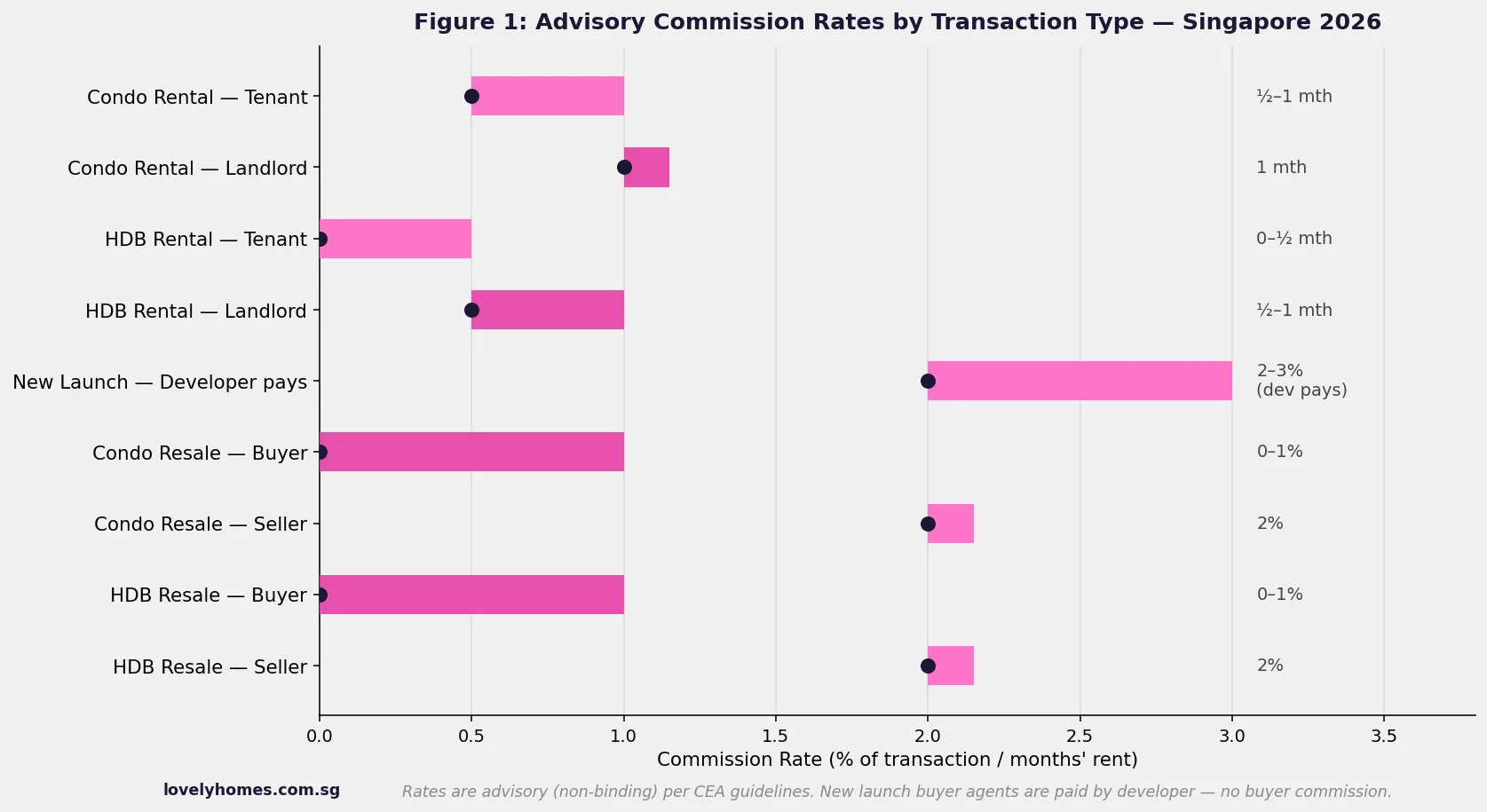
Singapore property agent advisory commission rates 2026 by transaction type
Figure 1: Advisory Commission Rates by Transaction Type — Singapore 2026. Rates are non-binding benchmarks published by CEA. New launch buyer agents are compensated by the developer at no cost to the buyer.

Step 3: Understand Commission and Negotiate Clearly

Commission rates in Singapore are not regulated by law — the figures published by CEA are advisory rates that serve as market benchmarks. They are not binding on either party. In practice, most HDB seller agents charge around 2% of the transaction price; HDB buyer agents typically charge 0–1%. For private property, seller agents charge approximately 2% and buyer agents 0–1% on resale transactions.

For new launch private condominiums, the developer pays the buyer’s agent directly — the buyer pays no commission. Developer commissions for buyer’s agents typically range from 2% to 3% of the purchase price, sometimes higher for international buyers or premium units. This creates a structural incentive that is worth understanding: the buyer’s agent in a new launch transaction is economically the developer’s agent. Ask whether the agent has compared alternative units in different projects at the same price point before endorsing a specific development.

Always agree on commission in writing as part of the Client’s Agreement before any work begins. Verbal agreements on commission are difficult to enforce and frequently the source of disputes lodged with CEA.

Step 4: Insist on a Client’s Agreement

Under section 64 of the Estate Agents Act (Cap 95A), an estate agent and a registered salesperson must sign a Client’s Agreement with any client before performing any estate agency work. The Client’s Agreement must specify: the scope of services, the commission rate (or formula), the duration of the exclusive arrangement (if any), and the salesperson’s and agency’s registration details.

An agent who is reluctant to sign a Client’s Agreement is operating outside the legal framework — and likely has good reason to avoid a paper trail. Refuse to proceed without a signed Client’s Agreement in every circumstance. The Client’s Agreement also gives you a formal dispute mechanism: if an agent breaches its terms, you have grounds to file a complaint with CEA and seek compensation.

Dual Representation: Know Your Rights

Dual representation occurs when a single agent acts for both the buyer and the seller (or both landlord and tenant) in the same transaction. CEA rules permit dual representation only if both parties provide informed written consent — and only if the agent discloses the arrangement and both clients agree they understand the conflict of interest involved.

If an agent introduces you to a property and then reveals they are also representing the seller, you have every right to refuse and engage a separate buyer’s agent. In practice, the seller’s agent who shows you a property is acting for the seller; you should either negotiate directly or engage your own buyer’s agent to represent your interests.

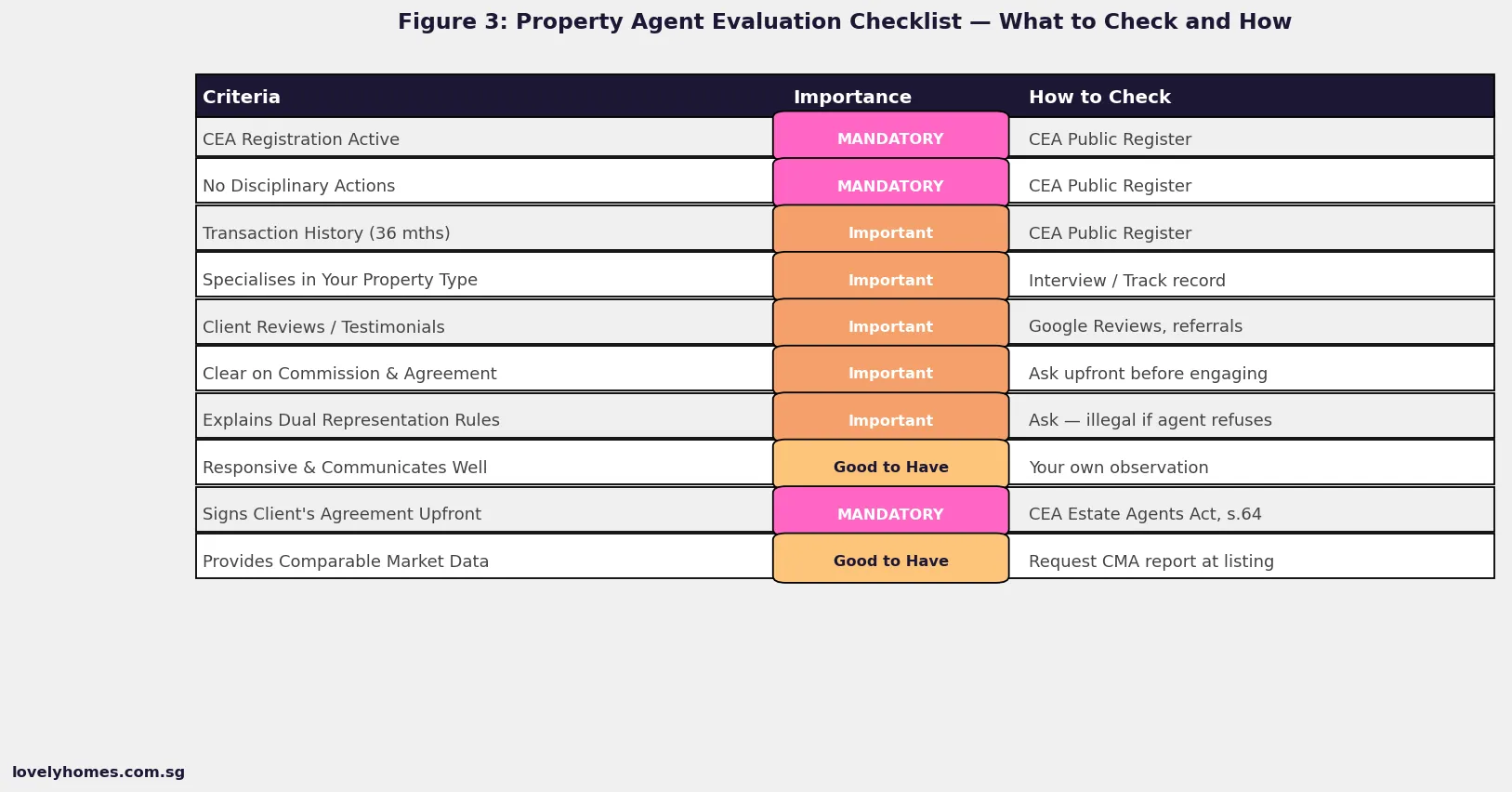
Singapore property agent evaluation checklist criteria importance how to check 2026
Figure 3: Property Agent Evaluation Checklist — criteria ranked by importance and how to check each one before engaging.

Summary Table: What to Check When Choosing a Property Agent

Check How to Do It Importance
CEA licence is active Search phone number at eservices.cea.gov.sg Mandatory — do not proceed without this
No disciplinary record CEA Public Register → check actions tab Mandatory
Transaction history matches your property type CEA Public Register → transaction history tab High
Client’s Agreement signed before any work Request before first viewing or listing appointment Mandatory by law
Commission agreed in writing Included in Client’s Agreement High
Dual representation disclosed and consented to (if applicable) Ask directly; get written confirmation High
Reviews from past clients for same property type Google Business profile, referrals, developer feedback Moderate
Comparative market data provided Request a CMA report before pricing your listing or making an offer Moderate

Worked Example: Mr Tan — Selling an HDB Flat in Tampines

Mr Tan holds a 5-room HDB resale flat in Tampines (MOP completed). He shortlists three agents by asking each the same set of questions:

  • Agent A: CEA-registered, 22 HDB resale transactions in past 36 months including 8 in Tampines, no disciplinary record, quoted 2% commission, offered to sign Client’s Agreement immediately. Provided a Comparative Market Analysis showing recent 5-room transacted prices in Tampines (S$680K–S$760K range). Explained the SSD regime for his acquisition year (no SSD applicable — MOP completed, held more than 4 years).
  • Agent B: CEA-registered, 5 transactions in past 36 months (mix of HDB and private), quoted 1.5% but said “we can discuss after the listing”. Did not proactively offer the Client’s Agreement. Could not provide a CMA on the spot.
  • Agent C: Could not be verified by phone number on CEA Public Register — immediately disqualified.

Decision: Mr Tan engaged Agent A. The higher commission (2% vs 1.5%) was justified by the stronger local track record and the immediate CMA. The listing was priced at S$720,000, received three offers within 10 days, and was sold at S$736,000 — S$16,000 above asking price.

Commission paid: 2% × S$736,000 = S$14,720 + 9% GST = S$16,044.80 — fully accounted for in Mr Tan’s net sale proceeds.

Questions to Ask a Property Agent Before Engaging

The following 10 questions help filter out unsuitable agents quickly and give you the information you need to make an informed choice. A competent, ethical agent will answer each question directly:

  1. Can I search for your CEA registration using your phone number right now?
  2. How many transactions have you completed in the past 12 months for my specific property type and area?
  3. Are you willing to sign a Client’s Agreement today before we proceed further?
  4. Are you representing the seller (or buyer) of any properties you will show me?
  5. What is your commission rate and is it inclusive of GST?
  6. Can you provide a Comparative Market Analysis for my target area or my listing price?
  7. What is your exclusive period, and what are the exit conditions if I am unhappy?
  8. How do you handle co-broking — will you share commission with a buyer’s agent?
  9. Have you been subject to any CEA disciplinary proceedings?
  10. How and how often will you update me on enquiries and market feedback?

Why This Matters: The Cost of Getting It Wrong

CEA received approximately 370 consumer complaints against property agents in FY2025, the majority relating to misrepresentation, failure to disclose material facts, and commission disputes. An agent who misrepresents the remaining lease, the NCQ position, or the property’s Minimum Occupation Period status can expose you to legal liability and significant financial loss. The consequences of working with an unverified or unregistered agent are even more severe — any contract entered into with an unregistered person is voidable, and the agent has no professional indemnity insurance.

The estate agency industry in Singapore is regulated under the Estate Agents Act (Cap 95A) and the CEA Code of Ethics and Professional Client Care. CEA has the power to fine agents, suspend or revoke licences, and impose a public reprimand. These enforcement tools exist precisely because the consequences of dishonest or incompetent agency work in a high-value property market are severe.

What Might Change: Digital Tools and AI in Property Agency

Several platforms now offer AI-assisted valuations and transaction matching that reduce the information asymmetry between buyers, sellers, and agents. Industry watchers expect the share of transactions involving “self-service” buyer portals to grow modestly, particularly for straightforward HDB resale transactions. However, for higher-value or more complex transactions (CCR condos, commercial properties, en-bloc proceedings, cross-border purchases), the regulatory, legal, and negotiation complexities mean the licensed agent remains the essential professional for the foreseeable future.

CEA is also exploring digital licence verification tools embedded in property portal listings, which would surface real-time CEA registration status alongside every listing. If implemented, this would make basic verification automatic — though the more nuanced checks (disciplinary history, specialisation fit, commission terms) will always require the buyer or seller to engage directly.

Frequently Asked Questions

Do I have to pay an agent as a buyer in Singapore?

For new launch private condominiums, no — the developer pays the buyer’s agent’s commission. For HDB resale and private resale transactions, the convention is that the seller pays the seller’s agent and the buyer may or may not engage their own buyer’s agent (typically at 0–1% of the purchase price). Some buyers choose to rely on the seller’s agent to facilitate the transaction, which is permitted only if dual representation is disclosed and consented to in writing. Engaging your own buyer’s agent provides independent representation for a relatively modest fee and is generally advisable for high-value or complex transactions.

What is a Co-Broking arrangement and should I be concerned?

Co-broking occurs when a listing agent (representing the seller) works with another agent (representing the buyer), splitting the total commission between them. This is a standard and healthy market practice — it incentivises seller’s agents to accept viewings from co-brokers, widening the pool of buyers. The seller typically pays the full commission, which the two agents then divide. As a buyer, co-broking generally means you are properly represented. As a seller, you should ask whether your listing agent is willing to co-broke; an agent who refuses co-broking is limiting your buyer pool, which can reduce your final sale price.

What are the consequences if an agent misrepresents a property to me?

Misrepresentation by a licensed property agent is actionable under both the Estate Agents Act and the Misrepresentation Act (Cap 390). You may file a complaint with CEA for disciplinary action against the agent, claim damages from the agent’s estate agency (which carries professional indemnity insurance), and, in cases of fraudulent misrepresentation, pursue civil action or a police report. If the misrepresentation relates to material facts — remaining lease, whether the property is encumbered, rental tenancy status — and you can demonstrate reliance and loss, damages claims can be substantial. Always get material facts confirmed in writing during the offer process, and instruct your solicitor to conduct due diligence independently.

How do I check if a property agent has been disciplined by CEA?

The CEA Public Register at eservices.cea.gov.sg shows the disciplinary record for every registered salesperson, including the date, nature, and sanction of any disciplinary proceedings. You can search by the agent’s name, registration number, or phone number. Disciplinary actions range from advisory letters and fines (minor breaches) to licence suspension or revocation (serious breaches such as misrepresentation, unauthorised receipt of monies, or criminal convictions). An advisory letter for a minor procedural breach should not necessarily disqualify an otherwise strong candidate; a licence suspension for misrepresentation is a clear disqualifier.

Can I switch agents if I am unhappy after signing a Client’s Agreement?

The Client’s Agreement will specify its duration, typically 60–90 days for an exclusive listing or buyer-representation arrangement. Most agreements include early termination provisions with notice periods of 7–14 days. If the agent has materially breached the agreement — failed to meet agreed obligations, made misrepresentations, acted without authority — you may have grounds to terminate immediately without notice. If the agent has merely been unsatisfactory without a clear breach, you will typically need to wait out the notice period or negotiate a mutual early termination. Any dispute about termination rights can be escalated to CEA’s Dispute Resolution Scheme before going to the courts.

What if I want to buy or sell property without an agent?

Transacting without an agent is legally permissible for private property and HDB resale (the HDB also facilitates direct seller-to-buyer transactions through its Resale Portal). However, you take on the full responsibility for negotiating the OTP, conducting due diligence, managing the conveyancing timeline, coordinating with the other party’s solicitor, and ensuring all regulatory conditions are met. A licensed solicitor is still required for the legal transfer. For straightforward transactions in a familiar market, experienced buyers and sellers sometimes transact direct; for first-time buyers, those unfamiliar with Singapore property law, or those handling complex transactions, engaging a qualified agent is strongly advisable.

Related Articles

Disclaimer: This article is for general information only and does not constitute financial, legal, or professional advice. Information on CEA registration requirements and the Estate Agents Act may be updated by the Council for Estate Agencies. Verify all agent details at eservices.cea.gov.sg and consult the CEA website for the current Code of Ethics and professional standards. Engage a licensed solicitor for all conveyancing matters.

TDSR and MSR Singapore 2026: Complete Guide to Property Borrowing Limits

TDSR and MSR Singapore 2026: Complete Guide to Property Borrowing Limits

Quick Answer — TDSR and MSR at a Glance

  • TDSR (Total Debt Servicing Ratio): Your total monthly debt obligations — including the new home loan — must not exceed 55% of your gross monthly income. Applies to all property purchases.
  • MSR (Mortgage Servicing Ratio): Your monthly HDB or EC loan instalment must not exceed 30% of your gross monthly income. Applies only to HDB flat and new EC purchases.
  • Both are assessed at the point of loan application, using a stress-test interest rate set by MAS — currently 4.0% p.a. for private property and 3.0% p.a. for HDB loans (floor rates; lenders use whichever is higher).
  • Variable income (commissions, bonuses) is typically discounted by 30% when computing TDSR/MSR.
  • Both rules are administered under MAS Notice 645 (for banks) and parallel HDB Board regulations.
  • Exceeding either limit means the bank cannot grant the loan — regardless of your credit score or property value.

What Are TDSR and MSR? Why Do They Exist?

The Total Debt Servicing Ratio and the Mortgage Servicing Ratio are Singapore’s two primary borrower-level safeguards in the property financing framework. Where measures like ABSD and SSD are transaction taxes designed to moderate demand, TDSR and MSR go deeper — they regulate how much any individual borrower can take on, regardless of the property’s value or the borrower’s wealth.

TDSR was introduced on 29 June 2013 by the Monetary Authority of Singapore (MAS), replacing an earlier and less comprehensive framework. It applies to all property loans — for purchases, refinancing, and equity loans on any residential, commercial, or industrial property. MSR — a tighter, supplementary ratio — applies specifically to loans for HDB flats and Executive Condominiums, reflecting the government’s commitment to keeping public and quasi-public housing genuinely affordable for owner-occupiers.

Together, these two ratios are one of the most powerful levers in Singapore’s financial stability toolkit. For a full picture of the broader cooling-measures context, see our Property Cooling Measures Timeline.

TDSR and MSR — The Framework Explained

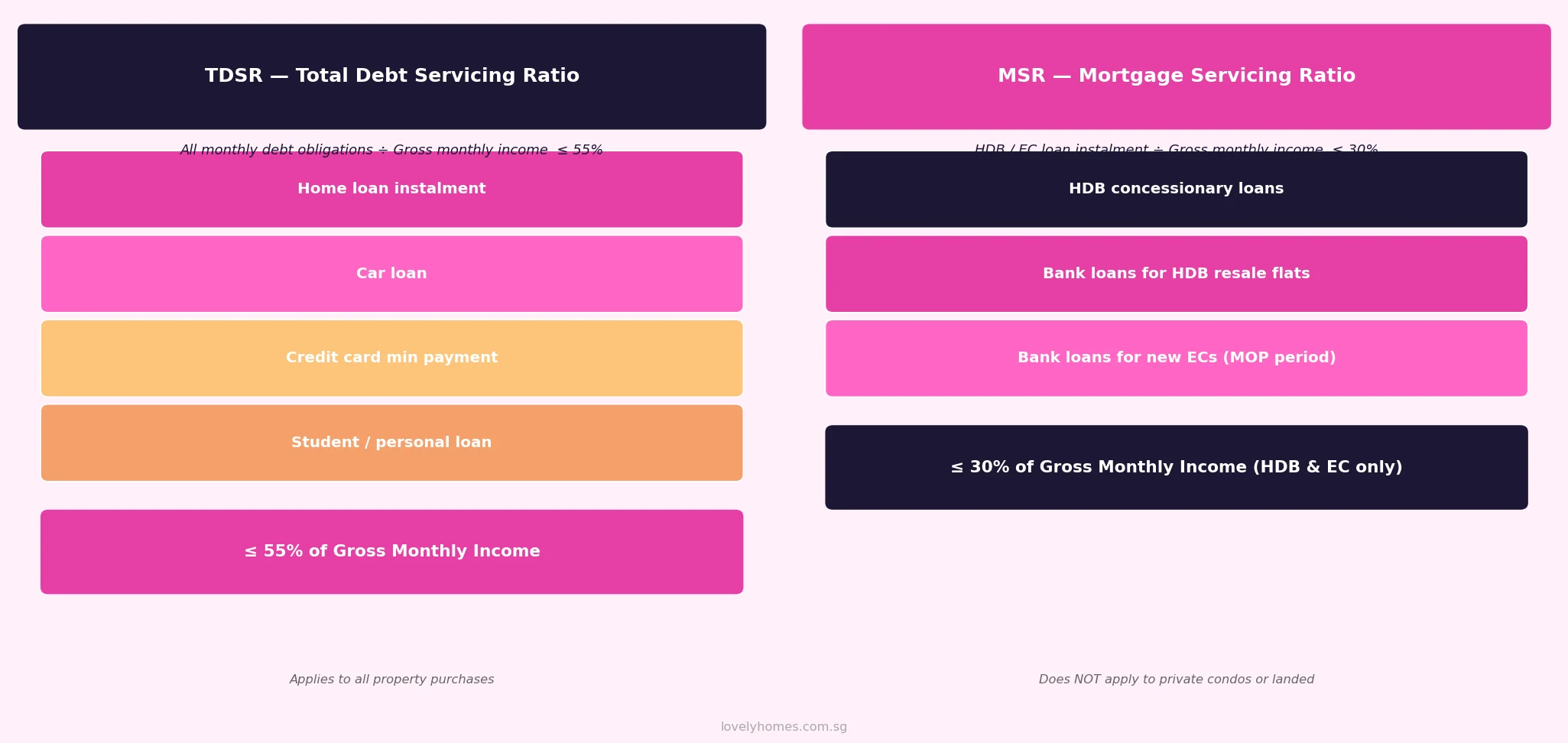
TDSR Total Debt Servicing Ratio and MSR Mortgage Servicing Ratio Singapore 2026 framework diagram
Figure 1: TDSR and MSR frameworks side by side — what counts, the applicable cap, and who each applies to. Source: MAS Notice 645 / HDB Board.

TDSR — Total Debt Servicing Ratio (55%)

The TDSR calculation adds up all monthly debt obligations — the proposed new home loan instalment, car loans, student loans, credit card minimum payments, personal loans, and any other outstanding borrowing — and divides the total by the borrower’s gross monthly income. The result must not exceed 55%.

TDSR = (All monthly debt obligations ÷ Gross monthly income) × 100 ≤ 55%

The computation is not quite as simple as it sounds. MAS rules require lenders to apply the following adjustments:

  • Stress-test rate: The home loan instalment is computed using the higher of the actual loan interest rate or the MAS floor rate (currently 4.0% p.a. for non-HDB residential properties, 3.5% p.a. for the medium-term rate). This means your TDSR-qualifying instalment is calculated on a higher hypothetical rate than the bank’s actual offer rate.
  • Variable income haircut: If part of your income is variable — commissions, overtime, bonuses, rental income — lenders typically apply a 30% discount. A borrower earning S$8,000 base + S$2,000 monthly commission would have an assessed income of S$8,000 + (S$2,000 × 70%) = S$9,400 for TDSR purposes.
  • Joint borrowers: Where two or more people take a loan together, the TDSR is assessed on the combined monthly income and combined monthly obligations. This can significantly increase the loan quantum available to a couple.

MSR — Mortgage Servicing Ratio (30%)

MSR applies only when you take a loan to buy an HDB resale flat or a new Executive Condominium (EC) during its initial owner-occupation period. It is an additional, tighter constraint on top of TDSR. Where TDSR considers all debts, MSR focuses only on the monthly instalment of the specific HDB or EC loan in question:

MSR = (Monthly HDB or EC loan instalment ÷ Gross monthly income) × 100 ≤ 30%

MSR does not apply to private condominiums or landed property — even those on 99-year leasehold land. When buying a private condo, only TDSR applies (plus the standard LTV limits). When buying an HDB flat or new EC, both TDSR and MSR apply; the borrower must satisfy whichever is the more restrictive of the two.

Worked Example — TDSR and MSR in Practice

Mr and Mrs Lim are a Singapore Citizen couple. Mr Lim earns S$7,500/month salary; Mrs Lim earns S$5,500/month. Combined gross income: S$13,000/month. They have a car loan with a monthly instalment of S$1,200.

Scenario A: Buying an S$800,000 HDB resale flat (bank loan)

  • MSR limit: 30% × S$13,000 = S$3,900/month for the HDB loan instalment.
  • TDSR limit: 55% × S$13,000 = S$7,150/month for all debts. Less car loan S$1,200 = S$5,950/month available for home loan.
  • The binding constraint is MSR at S$3,900/month.
  • Maximum loan at 4.0% stress-test, 25-year tenure: approximately S$741,000.
  • Property price S$800,000; 20% LTV floor for HDB → minimum 20% cash + CPF = S$160,000. Loan fits within LTV (S$640,000 < S$741,000 MSR limit). ✓

Scenario B: Buying a S$1.5 million private condo (bank loan, MSR does not apply)

  • TDSR limit: S$7,150/month for home loan (after car loan S$1,200).
  • Maximum loan at 4.0% p.a., 25-year tenure: approximately S$1.36 million.
  • LTV for second property (they still own a first property): 45% → maximum loan S$675,000. LTV is now the binding constraint, not TDSR.
  • This is why for investors buying second properties, ABSD and LTV often matter more than TDSR.

How TDSR Affects Your Maximum Loan Quantum

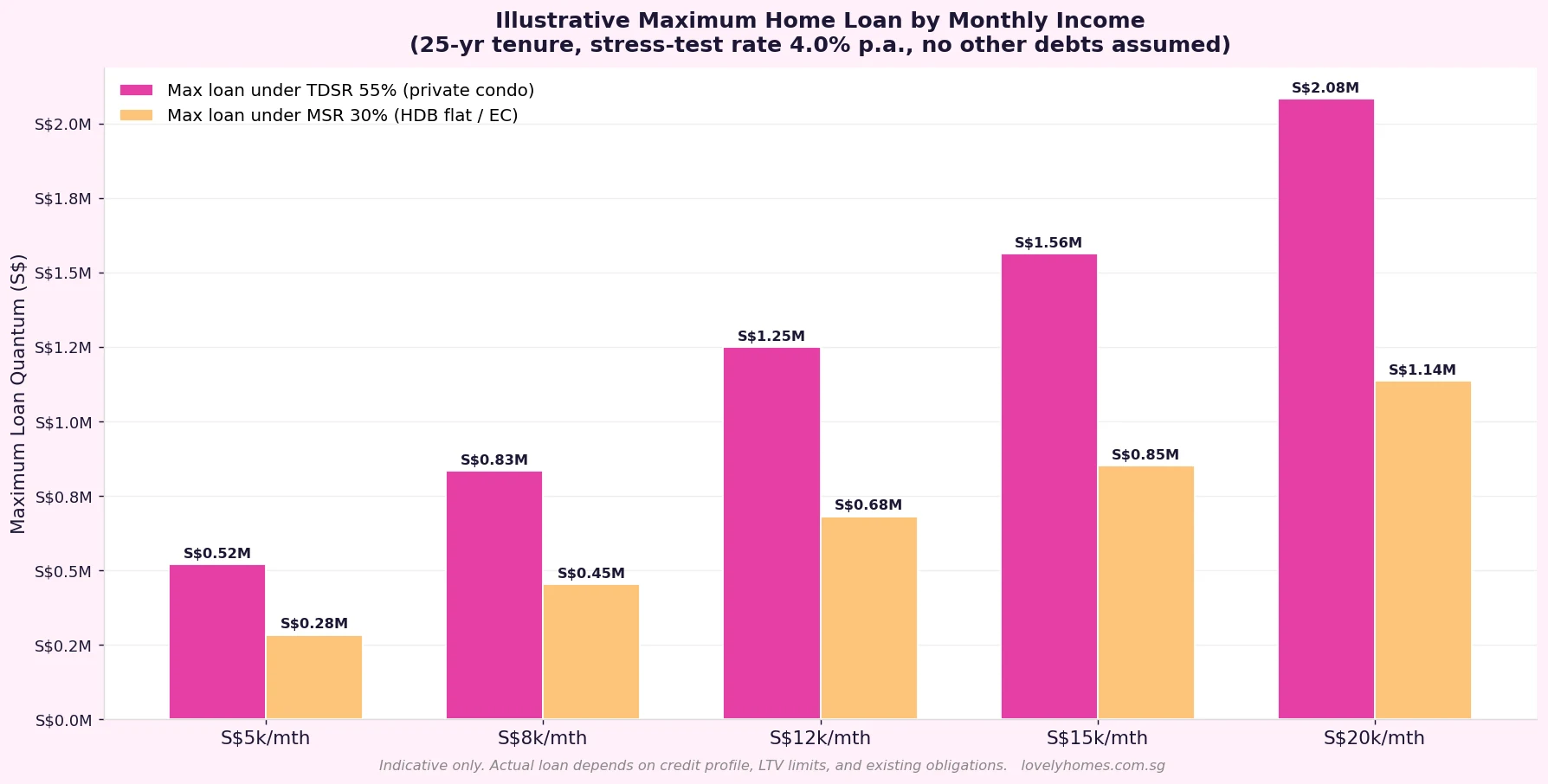
Maximum home loan by monthly income under TDSR 55% and MSR 30% Singapore 2026 bar chart
Figure 2: Illustrative maximum loan quantum by gross monthly income, assuming no other debts, 25-year loan tenure and 4.0% p.a. stress-test rate. Actual loan amounts depend on credit profile and LTV limits.

The chart illustrates how the 55% TDSR cap translates into loan quantum across different income levels, assuming no other debts. In practice, most borrowers have existing obligations — car loans, credit cards, study loans — that compress the available TDSR headroom and reduce the maximum home loan accordingly.

The Hidden TDSR Trap: Other Debts

Many first-time buyers underestimate how much existing debt erodes their borrowing capacity. Every dollar of existing monthly debt obligation reduces the monthly instalment available for a home loan, which translates into a smaller maximum loan.

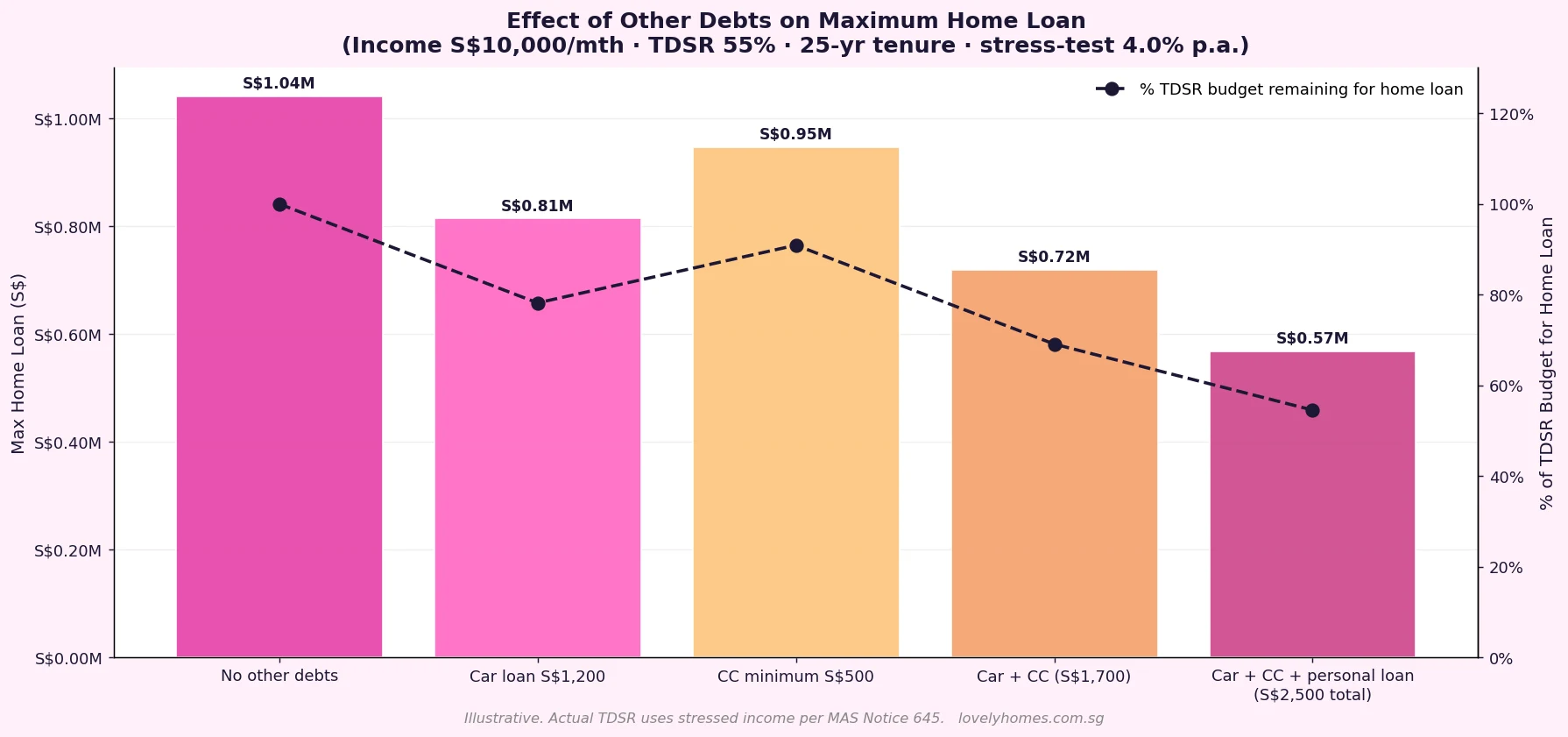
Effect of other debts on maximum home loan under TDSR 55% Singapore income S$10000 per month 2026
Figure 3: How car loans, credit card minimums, and personal loans reduce the maximum home loan for a borrower on S$10,000/month gross income. Stress-test rate 4.0% p.a., 25-year tenure.

A borrower earning S$10,000/month with a car loan of S$1,200/month and credit card minimum payments of S$500/month has only S$3,800/month left for a home loan instalment under the 55% TDSR cap — compared to S$5,500 if they had no other debts. That S$1,700 monthly reduction translates into roughly S$330,000 less in maximum loan quantum at current stress-test rates. This is why financial planners consistently advise property aspirants to pay down or close outstanding credit facilities before applying for a mortgage.

TDSR, MSR and the Loan-to-Value (LTV) Framework

TDSR and MSR cap how much you can service; the Loan-to-Value limits cap how much you can borrow as a proportion of the property value. The two frameworks operate in parallel — both must be satisfied simultaneously. The applicable LTV limit depends on whether you are buying with HDB loan or bank loan, and how many outstanding property loans you have:

Loan Type 1st Property Loan 2nd Property Loan 3rd+ Property Loan
HDB concessionary loan 80% of flat value N/A (only for 1st HDB purchase) N/A
Bank loan (no outstanding loans) 75% of property value 45% 35%
Bank loan (1+ outstanding loan) 45% 35% 35%

In practice, it is common for the LTV limit to be the binding constraint when buying investment properties (2nd or 3rd property), while TDSR / MSR is more likely to bite first-time buyers with lower incomes or significant existing debts.

TDSR Exemptions and Special Cases

A small number of situations fall outside the standard TDSR computation:

  • Bridging loans: Bridging loans used for the express purpose of financing a property being simultaneously sold are treated differently — the outstanding bridging instalment is excluded from TDSR until the property is sold, subject to conditions.
  • Retirees and elderly borrowers: Banks may use retirement income, CPF LIFE payouts, or annuity income to support TDSR calculations, though the assessment is more complex and requires additional documentation.
  • Refinancing with no cash-out: From August 2021, MAS allowed certain refinancing transactions — specifically owner-occupier residential loans where no equity is being extracted — to be exempt from TDSR. The borrower must have been servicing the existing loan for at least 12 months and must not be extracting equity.

Why TDSR and MSR Matter for Sellers Too

TDSR and MSR are typically framed as buyer concerns. But sellers are affected too:

  • Pricing strategy: A seller asking S$1.5 million for a condo needs to consider whether the pool of buyers who can qualify for a S$1.05 million bank loan (70% LTV) under TDSR is large enough to generate competitive offers. A listing price that implies a loan instalment near the TDSR limit for the target buyer profile will attract fewer bidders.
  • Timing of your own purchase: If you are selling to fund a new purchase, be aware that even after the sale proceeds come in, your TDSR is still assessed on your ongoing monthly income — not on net worth or cash in the bank.

What Might Change?

The TDSR framework has been remarkably stable since 2013, though MAS adjusted the cap from 60% to 55% in December 2021 as part of a broader tightening round. As of May 2026, MAS has not signalled any further changes to TDSR or MSR thresholds. However, MAS publishes annual Financial Stability Reviews (typically in November) which assess household leverage and mortgage risk — these are the best early indicators of possible future adjustments. Read the latest review at mas.gov.sg.

Frequently Asked Questions

What counts as “gross monthly income” for TDSR?

Gross monthly income includes fixed salary, director’s fees, and recognised recurring income. Variable components — commissions, bonuses, overtime — are typically discounted by 30% per MAS guidance. Self-employed individuals use their assessed income from NOA (Notice of Assessment) averaged over 2 years. Rental income is included but also subject to a discount. The bank will determine the applicable figure based on supporting documents submitted at loan application.

Why is my loan computed at a higher rate than the bank’s offer rate?

MAS requires lenders to stress-test all property loans using a minimum floor rate — currently 4.0% p.a. for private residential properties (or the actual rate if higher). This ensures borrowers can still service their loans if interest rates rise after the lock-in period expires. The bank’s actual offer rate (e.g. 3.0% in a low-rate environment) is used for the actual instalment calculation, but the TDSR computation uses the stress-test rate to determine affordability.

Does CPF count as income for TDSR purposes?

No. CPF contributions and balances are not counted as income for TDSR calculations — they are savings, not income. However, using CPF to fund the down payment or monthly instalment does reduce the cash instalment burden, and CPF usage is factored into your overall mortgage planning. The TDSR calculation is based on cash-equivalent gross income per MAS Notice 645.

Does paying off a car loan before applying for a mortgage really help?

Yes, significantly. Each S$1,000 in monthly debt obligations you eliminate frees up S$1,000 in TDSR headroom. At a 4.0% stress-test rate over 25 years, that translates into roughly S$190,000 in additional loan quantum. If you are planning a property purchase in the next 1–2 years, clearing high-instalment debts well in advance is one of the most concrete steps you can take to maximise your borrowing capacity.

I am buying an HDB flat. Do I need to satisfy both TDSR and MSR?

Yes. When taking a bank loan for an HDB resale flat, both TDSR (55%) and MSR (30%) apply. You must satisfy whichever is the more restrictive constraint. In most cases, for HDB buyers, the MSR 30% cap is the binding constraint because it is narrower. If you take an HDB concessionary loan (the HDB loan), the rules are similar but administered by HDB rather than MAS — the MSR cap of 30% still applies.

Can I use a guarantor to get around TDSR?

A guarantor’s income can be included in the TDSR computation only if the guarantor is a co-borrower — i.e. their name is on the loan. If the guarantor is merely guaranteeing repayment without being a borrower, their income cannot be used to support TDSR. Adding a co-borrower is a legitimate approach, but also means the co-borrower’s ABSD property count and LTV position are affected by the loan.

How do TDSR and MSR interact with HDB’s income ceiling for BTO?

HDB’s income ceiling for BTO applications (currently S$14,000/month for couples for most flat types) is a separate eligibility criterion — it determines whether you can apply for a BTO flat, not how much you can borrow. TDSR and MSR determine the loan quantum once you are eligible. A couple earning S$14,000 may pass the HDB income ceiling but still be limited in their borrowing by TDSR/MSR, particularly if they have significant existing debt obligations.

Related Articles

Disclaimer

This article is for general informational purposes only and does not constitute financial, legal, or mortgage advice. TDSR and MSR rules are administered by the Monetary Authority of Singapore under MAS Notice 645 and MAS Notice 645A, and by HDB under its loan policies — these are subject to change. The loan quantum illustrations in this article are indicative only and assume simplified conditions. Always consult a licensed mortgage broker or financial adviser, and verify the current rules directly at mas.gov.sg and hdb.gov.sg before making any borrowing decisions.

×

Click anywhere or press Esc to close

Mortgage Refinancing vs Repricing Singapore 2026: When to Switch Banks and When to Stay

Mortgage Refinancing vs Repricing Singapore 2026: When to Switch Banks and When to Stay

Quick Answer — Refinancing vs Repricing 2026

  • Refinancing means moving your home loan to a new bank. Repricing means renegotiating your rate with your existing bank.
  • Refinancing typically saves more (0.2–0.5% p.a.) but incurs upfront costs of S$2,500–S$4,000 (legal + valuation). Repricing saves less but costs nothing or very little.
  • The break-even horizon for refinancing a S$800,000 loan is approximately 13 months — refinance only if you plan to hold the loan beyond that.
  • In Q2 2026, the 1-month SORA stands at approximately 1.20%, down from a peak of 3.68% in mid-2023. Fixed 2-year packages from major banks are available at 1.78%–1.85% p.a.
  • Never refinance within a lock-in period without checking the penalty — typically 1.5% of the outstanding loan, which can wipe out years of interest savings.
  • Banks are legally required to provide a 30-day free conversion option at the end of each lock-in period — use this as your review trigger date.
  • If your remaining tenure is less than 5 years or your outstanding balance is under S$200,000, the absolute saving from refinancing is usually not worth the administrative effort.

Every Singapore home loan has an anniversary. When the initial lock-in period ends — typically after two or three years — you face a critical decision: do you let the bank roll your mortgage onto its standard rate (often significantly higher), do you reprice it with the same bank, or do you switch to a new lender entirely?

Most homeowners do nothing, which is the most expensive choice. Singapore banks rely on inertia: the standard variable rate a homeowner reverts to after lock-in can be 0.5–0.8 percentage points higher than the rate a new customer would receive. On a S$700,000 outstanding balance, that gap costs approximately S$3,500–S$5,600 per year in additional interest.

This guide explains exactly how refinancing and repricing work in Singapore in 2026, the mathematics of when each option pays, how to read the SORA-based rate environment, and the specific situations where each choice makes sense. Pair it with our Singapore Home Loan Comparison guide for the full picture on choosing between HDB loans, fixed rates, and floating packages.

1. The Core Distinction: Refinancing vs Repricing

Refinancing is the process of discharging your existing home loan and taking out a new loan from a different bank. Legally, the new bank pays off your old loan and registers a new mortgage over your property. You go through a full credit assessment, a new loan agreement, legal completion and (usually) a new valuation. The entire process takes 4–8 weeks from application to disbursement.

Repricing is an internal renegotiation with your existing bank. You ask the bank to move your loan from its current rate to a newer, lower package. No change of lender takes place; no new legal process is required; and no new credit check is typically conducted. The bank simply updates your loan terms. Repricing can be completed in 2–4 weeks and usually costs nothing or carries a small administrative fee of S$500–S$800.

Refinancing vs repricing comparison table Singapore 2026 — 10 key dimensions for homeowners
Figure 1: Refinancing vs repricing across 10 dimensions — a complete side-by-side comparison for Singapore homeowners in 2026.

2. When Does Refinancing Make Sense?

Refinancing is financially beneficial when the interest rate saving is large enough to recover the upfront switching costs within your planned holding period. The key variables are:

  • Outstanding loan balance: The larger the balance, the larger the absolute saving per percentage point of rate reduction. A 0.4% saving on S$800,000 is S$3,200/year; the same saving on S$200,000 is only S$800/year.
  • Rate differential: The gap between your current rate and the best available package. In Q2 2026, homeowners on standard variable rates of 2.2–2.5% p.a. can often find fixed 2-year packages at 1.78–1.85%, creating a saving of 0.3–0.7 percentage points.
  • Remaining tenure: With 20+ years remaining, even moderate rate savings compound significantly. With 3–5 years left, the absolute saving window is much smaller.
  • Lock-in status: You must be outside the lock-in period. If you refinance within lock-in, the clawback penalty (typically 1.5% of outstanding loan) will likely exceed any rate saving.

As a general rule: refinancing makes sense when the outstanding balance exceeds S$400,000, the rate saving exceeds 0.3% p.a., and you are outside your lock-in period.

3. The Break-Even Mathematics

Break-even analysis mortgage refinancing Singapore 2026 — S$800,000 loan worked example
Figure 2: Break-even calculation for refinancing an S$800,000 outstanding loan from 2.20% to 1.80% p.a. — the switching costs are recovered in approximately 13 months.

The break-even formula is straightforward:

Break-even months = Total switching costs ÷ Monthly interest saving

For the example in Figure 2: a S$800,000 outstanding balance at 2.20% costs approximately S$1,467/month in interest. At 1.80%, this falls to S$1,200/month — a saving of S$267/month. With total switching costs of S$3,500, break-even occurs at month 13.1. Over a 2-year new lock-in, the net saving is S$267 × 24 − S$3,500 = S$2,908.

Critically, this is a simplified calculation on interest only. In practice, you should also factor in: any cash-back offer from the new bank (which reduces effective switching cost); whether the new bank’s rate holds for the full 2 years or is a promotional teaser; and the difference in processing timescales that creates a month or two of overlap where both the old and new rates apply.

4. The 2026 Rate Environment: SORA Has Fallen Significantly

SORA rate history 2022 to 2026 and Singapore bank mortgage rates Q2 2026 comparison
Figure 3: Singapore’s 1-month SORA peaked at 3.68% in July 2023 and has since fallen to approximately 1.20% in May 2026. Q2 2026 bank fixed packages are now at 1.78–1.85% p.a.

The SORA (Singapore Overnight Rate Average) is the benchmark underpinning most floating-rate home loans in Singapore, replacing SIBOR in 2024. After peaking at 3.68% in July 2023, 1-month SORA has fallen steadily as the US Federal Reserve began its easing cycle in late 2024. By May 2026, 1-month SORA stands at approximately 1.20%.

This rate decline has transformed the refinancing calculus. Homeowners who locked into 3-year fixed rates at 3.0–3.5% in 2023 are now significantly out-of-money relative to the market. Their lock-in periods of 2–3 years mean they are emerging (or will emerge in 2025–2026) into a market where 2-year fixed packages are available at 1.78–1.85%. The saving potential is substantial.

Conversely, homeowners on SORA-based floating packages taken in 2024–2025 at spreads of +0.8–1.0% above SORA are currently paying approximately 2.0–2.2% p.a. — and the rate will decline further as SORA continues to fall. These homeowners may find that staying floating is better than locking into a fixed rate, as the fixed rate today may prove higher than the floating rate in 12–18 months.

5. How to Negotiate Repricing

Repricing is underused by Singapore homeowners who assume the bank will not move. In practice, banks negotiate repricing regularly — particularly for borrowers with good payment records and large loan balances. The process:

  1. Check your lock-in expiry date. Most loan packages have a letter from your bank confirming the lock-in end date. If you cannot find it, call the mortgage servicing hotline.
  2. Review the bank’s current new-customer packages. Banks publish their mortgage rate sheets online (DBS, OCBC, UOB all have rate pages). Identify the best package a new customer would receive.
  3. Submit a repricing request. Call the mortgage servicing team (not the branch) and request a repricing. Mention that you are comparing competitor packages. Banks have a dedicated repricing/retention team.
  4. Request the “Board Rate” alternative. If the bank will not match a competitor’s promotional rate, ask whether a lower spread-over-SORA package is available.
  5. Compare the offer vs. refinancing. If the bank offers a rate within 0.1–0.15% of a competitor, the S$3,500 switching cost makes refinancing uneconomical for most loan sizes.

Banks are also required under MAS guidelines to proactively offer refinancing information to borrowers nearing the end of their lock-in periods. This obligation has been reinforced as part of the MAS guidelines on responsible mortgage lending.

6. Worked Example: Mr and Mrs Wong

Mr and Mrs Wong (both Singapore Citizens) purchased a S$1.35 million OCR condo in 2023, financing S$1,012,500 (75% LTV) with a DBS 2-year fixed rate at 3.10% p.a. Their lock-in period ends in August 2026. Outstanding balance at that point: approximately S$968,000 (after 36 months of instalments at ~S$4,980/month).

Option A — Reprice with DBS: DBS offers to move them to their current 2-year fixed package at 1.80% p.a. New monthly instalment: approximately S$4,480 — a saving of S$500/month. No fees. Total 2-year saving: S$500 × 24 = S$12,000.

Option B — Refinance to OCBC: OCBC offers 1.75% fixed 2 years with a S$2,000 cash-back incentive. Legal + valuation fees: S$3,200. New monthly instalment: ~S$4,450 — S$530/month saving vs current rate. Over 24 months: S$530 × 24 + S$2,000 cash-back − S$3,200 costs = S$11,520 net saving.

Decision: Option A (repricing) saves S$480 more over 2 years with far less administration. The Wongs should accept DBS’s repricing offer. Had DBS offered 1.90% instead of 1.80%, Option B would pull ahead — so it always pays to get the repricing offer in writing before deciding.

7. CPF Implications

When you refinance (switch banks), the new bank uses CPF to service the new loan in the same way as the old one. There is no interruption in CPF usage. However, if you have been using CPF Ordinary Account for loan repayments, the CPF accrued interest on the CPF principal withdrawn continues to accumulate throughout — refinancing does not reset or reduce this accrued interest obligation. Ensure you understand how the accrued interest will be settled when you eventually sell the property.

8. What Might Come Next

The trajectory of SORA — which follows US Fed rates with a lag — is the key variable. As at May 2026, the market broadly expects one or two further Fed cuts in 2026, which would push 1-month SORA below 1.0% by end-2026. If this materialises, homeowners currently on SORA-based floating packages will see their rates fall further without any action required. Fixed rates, by contrast, are priced partly on the forward rate curve and already factor in some further SORA easing — locking in a 2-year fixed now is effectively a bet that SORA will not fall significantly below 0.8–1.0% over the next 24 months.

MAS has also indicated continued focus on responsible lending standards. Any homeowner refinancing must satisfy the TDSR 55% cap under the new lender’s assessment, even if they have been meeting repayments comfortably for years. If income has changed since the original loan was taken, this is an important consideration.

Summary Table: When to Refinance vs Reprice

Situation Recommended Action Why
Outstanding balance > S$500k, outside lock-in, rate gap > 0.3% Refinance Break-even < 12 months; net saving substantial over 2 years
Outstanding balance S$200k–S$500k, rate gap 0.2–0.3% Reprice first, then compare Repricing may close the gap; only refinance if bank won’t budge
Within lock-in period Wait or reprice only Clawback penalty (1.5%) likely exceeds rate saving
Remaining tenure < 5 years Reprice or do nothing Short window limits absolute savings from refinancing
Outstanding balance < S$200k Reprice only Absolute saving too small to justify S$3,000–S$4,000 switching cost
Currently on floating SORA, SORA falling Stay floating; review at 6-month intervals Falling SORA reduces your rate automatically without any action

FAQ: Mortgage Refinancing and Repricing Singapore 2026

What is the difference between refinancing and repricing?

Refinancing involves switching your home loan from your current bank to a new lender. The new bank pays off your existing loan and a new mortgage is registered. You incur legal fees, valuation fees, and go through a fresh credit assessment. Repricing means renegotiating your rate with your existing bank without changing lenders — no legal process, typically no fees, and faster completion (2–4 weeks vs 4–8 weeks). Refinancing typically offers a larger rate saving; repricing is simpler and cheaper to execute.

When is the right time to refinance my home loan?

The ideal time to refinance is in the 3-month window before your current lock-in period expires. By starting the process 90 days before expiry, you can complete the new loan application, approval, and legal completion just as your lock-in ends, avoiding any overlap or clawback penalties. Refinancing within the lock-in period triggers a clawback penalty (typically 1.5% of outstanding loan), which in most cases wipes out the rate saving entirely.

What are the typical costs of refinancing in Singapore?

The main costs are legal fees (S$1,800–S$2,500) and valuation fees (S$500–S$800), totalling S$2,500–S$3,500 for a standard condominium. Some banks offer a “legal subsidy” or cash-back offer of S$1,500–S$3,000 to offset these costs, effectively reducing or eliminating the net upfront expense. You should always ask the new bank whether a legal subsidy is available and factor it into your break-even calculation.

Does refinancing affect my CPF usage?

No — refinancing does not interrupt or change your CPF usage for the home loan. The new bank will receive CPF contributions in exactly the same way as the old bank, and the CPF Board processes this automatically. However, the CPF accrued interest on any CPF principal already used continues to accumulate throughout the life of the loan. Switching banks does not reduce or reset the accrued interest obligation that will be due when you sell the property.

Will refinancing affect my TDSR or LTV?

Yes — refinancing requires a full new credit assessment by the new bank, including a recalculation of your TDSR (Total Debt Servicing Ratio). If your income has changed significantly since the original loan was taken (e.g., you switched to self-employment, took a pay cut, or took on additional debt), you may find that the new bank’s TDSR calculation limits the loan amount they can offer. The LTV ceiling for refinancing an existing loan is generally 75% for private properties (bank loan), unchanged from a purchase. If property values have fallen since purchase, a new valuation may show a lower property value, potentially affecting the LTV-based loan amount.

Is a floating or fixed rate better in 2026?

In May 2026, with 1-month SORA at approximately 1.20% and market expectations pointing to further easing, floating SORA-based packages (SORA + spread of 0.8–1.0%) result in effective rates of approximately 2.0–2.2% p.a. Fixed 2-year packages are available at 1.78–1.85%. The fixed rates currently appear cheaper than floating, but if SORA falls below 0.8% in the next 12–18 months, the floating rate will dip below the fixed rate. The decision depends on your view on further SORA movements and your appetite for rate certainty. For most owner-occupiers prioritising budgeting certainty, a 2-year fixed package currently makes sense.

Can I refinance an HDB loan to a bank loan?

Yes. You can switch from an HDB concessionary loan (2.60% p.a.) to a bank loan, and many homeowners have done so when bank rates fell below HDB’s rate. The process involves applying to the bank, obtaining HDB’s agreement, and completing the documentation for the discharge of the HDB loan. One important restriction: once you switch from an HDB loan to a bank loan, you cannot switch back to an HDB loan. This is irreversible. Given that HDB’s 2.60% rate (pegged at 0.1% above CPF OA rate) is a stable floor and bank rates can rise above it, ensure you are comfortable with a bank loan for the life of the mortgage before making this switch.

Related Articles

Disclaimer

This article is for general informational and educational purposes only. It does not constitute financial, legal, or mortgage advice. Interest rates, bank packages, and SORA values referenced reflect information available as at May 2026 and are subject to change. Always obtain a current rate sheet from your bank or mortgage broker before making any refinancing or repricing decision. Consult a licensed mortgage broker, MAS-regulated financial adviser, or solicitor for advice specific to your circumstances. For authoritative guidance on TDSR and MAS mortgage regulations, refer to mas.gov.sg. For CPF-related queries, refer to cpf.gov.sg.

Translate »