River Valley & Robertson Quay Neighbourhood Guide Singapore 2026: Property Prices, MRT and Investment Outlook

River Valley & Robertson Quay Neighbourhood Guide Singapore 2026: Property Prices, MRT and Investment Outlook

River Valley and Robertson Quay sit at the heart of Singapore’s most coveted residential precinct — District 9 (D09), Core Central Region (CCR). Sandwiched between the Singapore River to the south and the Orchard Road belt to the north, these two sub-precincts offer a rare combination: walkable waterfront lifestyle, genuine city-fringe connectivity (three MRT lines within 600 metres since the Thomson–East Coast Line opened in June 2023), internationally acclaimed schools, and a concentration of freehold and long-tenure leasehold condominiums that rarely appear in the Outside Central Region. This River Valley Robertson Quay neighbourhood guide Singapore 2026 covers property prices, MRT access, top schools, rental yields, capital growth trends, and everything a buyer or investor needs to know before committing to D09.

Quick Answer — River Valley & Robertson Quay at a Glance

  • District 9, CCR — one of Singapore’s three Core Central Region districts alongside D10 and D11.
  • New TEL stations (Great World TE15 and Havelock TE16) opened June 2023, fundamentally improving connectivity without new launches disrupting the area’s streetscape.
  • Private condo prices range from S$1,100,000 for a 1-bedroom to S$6,500,000+ for a 4-bedroom; average PSF runs S$2,600–S$3,200 for freehold stock.
  • Gross rental yields: 2.5%–2.9% for larger units, 3.4%–3.8% for 1-bedrooms — lower than OCR, but sustained by high-income expat tenants in finance, law, and tech.
  • Five-year capital growth (2021–2026): +11.8% to +14.6% across private condos, tracking the broader CCR PPI.
  • No new GLS site has been awarded in the River Valley / Robertson Quay sub-precinct since 2018 — supply scarcity is a structural investment thesis.
  • Singapore Citizens buying their first private property pay 0% ABSD; foreigners pay 60%. ABSD 20% applies for SC second-property purchases.

River Valley Robertson Quay — Where Is It and What Makes It Distinctive?

River Valley and Robertson Quay are planning sub-zones within the Museum Planning Area and River Valley Planning Area of URA’s Master Plan. Geographically, the area stretches from River Valley Road (the main artery) south to the Singapore River, and from Mohamed Sultan Road / Clemenceau Avenue in the west to the Orchard/Somerset boundary in the east.

What makes this precinct genuinely different from Singapore’s other CCR sub-markets (Orchard, Cairnhill, Ardmore) is its character. Where Orchard feels commercial and Ardmore is quiet enclave-landed, River Valley and Robertson Quay have a lived-in, convivial quality — dozens of independent restaurants, riverside bars, weekend arts markets at Clarke Quay, Fort Canning Park’s concert lawn, and a density of international schools and nurseries that reflects the long-established expat tenant community. Many of Singapore’s largest private banks, law firms, and regional headquarters cluster within a 2-kilometre radius, feeding consistent demand for high-specification rental accommodation.
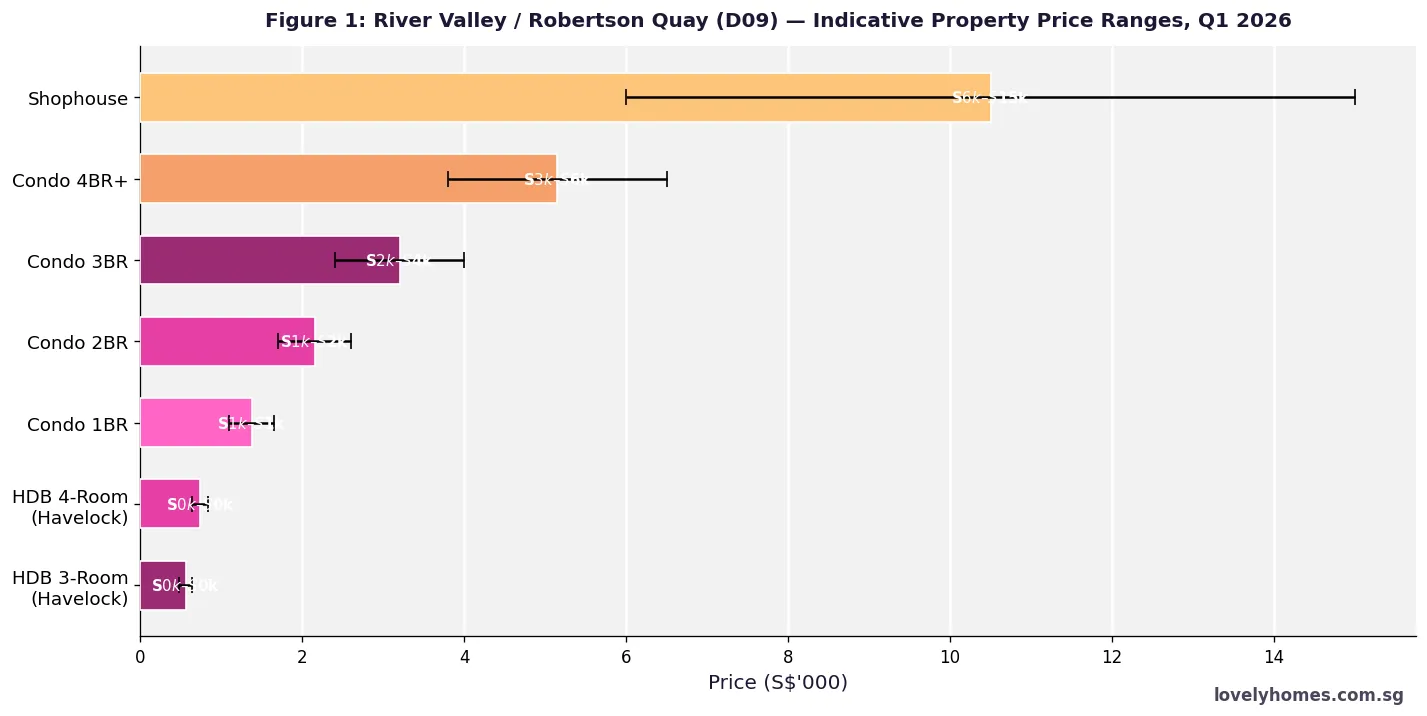
River Valley Robertson Quay D09 property price ranges 2026 — condo 1BR to shophouse, HDB Havelock
Figure 1: Indicative property price ranges in River Valley / Robertson Quay (D09), Q1 2026. Ranges reflect asking and transacted prices; actual pricing varies by unit, floor, and tenure.

MRT Connectivity — Three Lines Within Walking Distance

Prior to June 2023, District 9’s connectivity was widely cited as its one weakness relative to D10 or D11 — the nearest MRT stations (Somerset NS23 and Clarke Quay NE5) required a 10–15 minute walk from many River Valley condominiums. The opening of the Thomson–East Coast Line’s Stage 3 changed the calculus materially:

  • Great World (TE15 — TEL): Located on Kim Seng Road, a 5-minute walk from most River Valley condos along Kim Seng Road and Martin Road. Interchange planned with future Jurong Region Line extension in long-range planning; already connects to Orchard (TE14, 1 stop north) and the TEL’s eastern branches toward Marine Parade and Bayshore.
  • Havelock (TE16 — TEL): Serves the Havelock Road and Robertson Quay western edge; useful for residents in River Gate, Aspen Heights, and Havelock View Towers. Connects south toward Outram Park (TE17 — interchange with EWL and NEL) and Cantonment (TE18).
  • Fort Canning (DT20 — DTL): On the Downtown Line, this station is a 7–10 minute walk from Robertson Quay and links directly to Bugis (DT14/EW12), Downtown (DT17), and via interchange to Marina Bay, Buona Vista, and Expo.

For commuters to the CBD (Raffles Place, Shenton Way), the travel time from Great World TE15 to Marina Bay TE20 is approximately 8 minutes on the TEL — comparable to driving at peak hour and far more reliable. For residents working in the Orchard/Somerset belt, it is one stop. The TEL has repositioned River Valley from “slightly inconvenient” to “exceptionally well served”.

Schools in River Valley and Robertson Quay

River Valley Primary School (RVPS), located on River Valley Road, is the district’s anchor primary school and draws families from across Singapore willing to buy or rent in-zone to secure a Phase 2C ballot priority. The school is within the 1-kilometre priority zone for several major condominiums including The Avenir, Rivière, and Martin Modern.

At the secondary level, Gan Eng Seng School and Queenstown Secondary are accessible via the TEL. Singapore Management University (SMU) — one of Singapore’s six autonomous universities — is a 15-minute walk from Robertson Quay via Fort Canning; its proximity contributes to the area’s intellectual and professional character. For international families, the international schools cluster in the broader CCR zone (Orchard, Tanglin, Stevens) is accessible in 10–15 minutes.
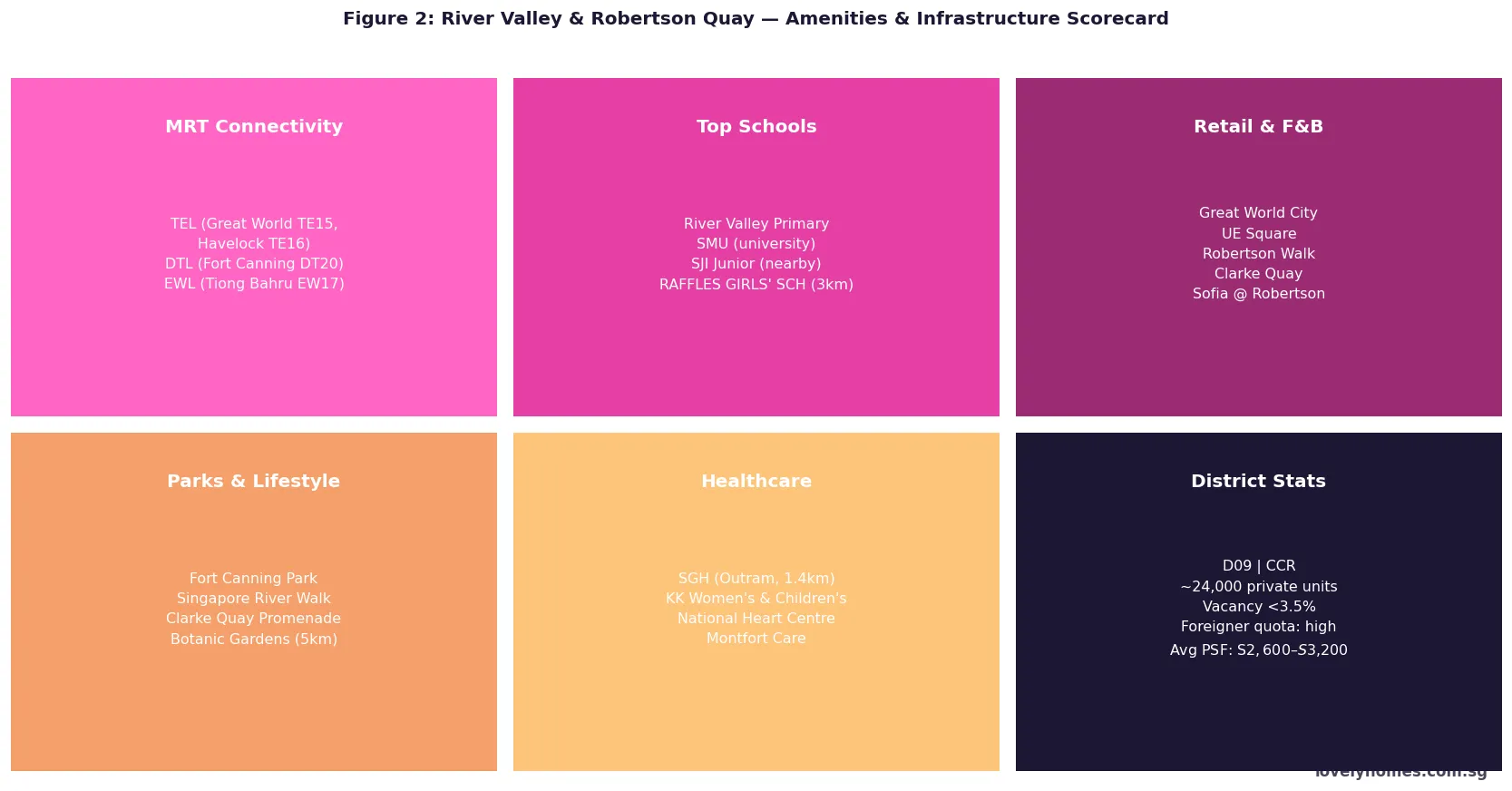
River Valley Robertson Quay amenities scorecard 2026 — MRT, schools, retail, parks, healthcare, district statistics
Figure 2: River Valley & Robertson Quay amenities and infrastructure scorecard.

Property Market Overview — D09 CCR Prices and Supply

District 9 is a near-exclusively private residential market. HDB flat supply in the area is negligible — the Havelock HDB estate on the western fringe has a small number of older flats, most of which are past their lease peak, but they represent a tiny fraction of the district’s housing stock. The dominant product is the private condominium — ranging from boutique freehold projects of 30–50 units to larger 99-year leasehold developments of 300–600 units.

Key benchmark projects:

  • The Avenir (freehold, D09, River Valley Close): 376 units across two 36-storey towers. Completed 2024. Benchmark PSF S$2,800–S$3,200. Developed by GuocoLand and Hong Leong Holdings.
  • Rivière (99yr leasehold, Jiak Kim Street): 455 units. Former Zouk site. TEL Great World station at doorstep. Benchmark PSF S$2,400–S$2,900. Frasers Property development.
  • Martin Modern (99yr leasehold, Martin Place): 450 units. GuocoLand. Benchmark PSF S$2,200–S$2,600.
  • The Waterfall, RV Altitude, One Draycott (freehold older stock): PSF S$2,000–S$2,500.

Transaction volume in D09 is thin by Singapore standards — typically 250–400 resale caveats per year — which means individual transactions can move the median PSF meaningfully. Freehold premium over 99-year leasehold in this precinct runs approximately 8–15%, narrower than the national average because the 99-year stock (Rivière, Martin Modern) is of very high quality with TEL access.

Property Type Indicative Price Range Indicative PSF Gross Yield (Est.) Tenure
HDB 3-Room (Havelock) S$480k – S$640k S$560–S$700 3.8% Leasehold (ageing)
HDB 4-Room (Havelock) S$640k – S$840k S$580–S$720 3.5% Leasehold (ageing)
Private Condo 1BR S$1.1M – S$1.65M S$2,400–S$3,000 3.4%–3.8% Freehold / 99yr
Private Condo 2BR S$1.7M – S$2.6M S$2,500–S$3,100 2.9%–3.3% Freehold / 99yr
Private Condo 3BR S$2.4M – S$4.0M S$2,600–S$3,200 2.5%–2.9% Freehold / 99yr
Private Condo 4BR+ S$3.8M – S$6.5M S$2,700–S$3,300 2.3%–2.7% Freehold / 99yr
Shophouse (Heritage) S$6M – S$15M S$5,500–S$9,000 1.8%–2.5% Freehold

Rental Market — Who Rents in River Valley and Robertson Quay?

The D09 rental market is structurally different from OCR precincts. Rather than young professionals on tight budgets seeking HDB rooms or studio apartments, the tenant pool in River Valley and Robertson Quay skews toward:

  • Expatriate finance and legal professionals — private banks, hedge funds, and international law firms cluster in the Marina Bay Financial Centre and Raffles Place, both reachable from Great World TE15 in under 12 minutes. Housing allowances of S$6,000–S$12,000 per month are common.
  • Senior corporate and tech executives — regional headquarters of multinational companies increasingly concentrate in the one-north/Tanjong Pagar corridor, accessible via the TEL.
  • International families — the area’s proximity to the international school belt (Tanglin Trust, UWCSEA East, ISS) makes it attractive to families with school-age children.

Median monthly rents in D09 for a 2-bedroom condominium run approximately S$5,800–S$7,500 (Q1 2026), reflecting a modest correction from the 2022–2023 rental peak of S$7,000–S$9,000 but still well above pre-pandemic levels. Vacancy in the precinct is estimated below 3.5% — reflecting tight supply and durable expat demand.
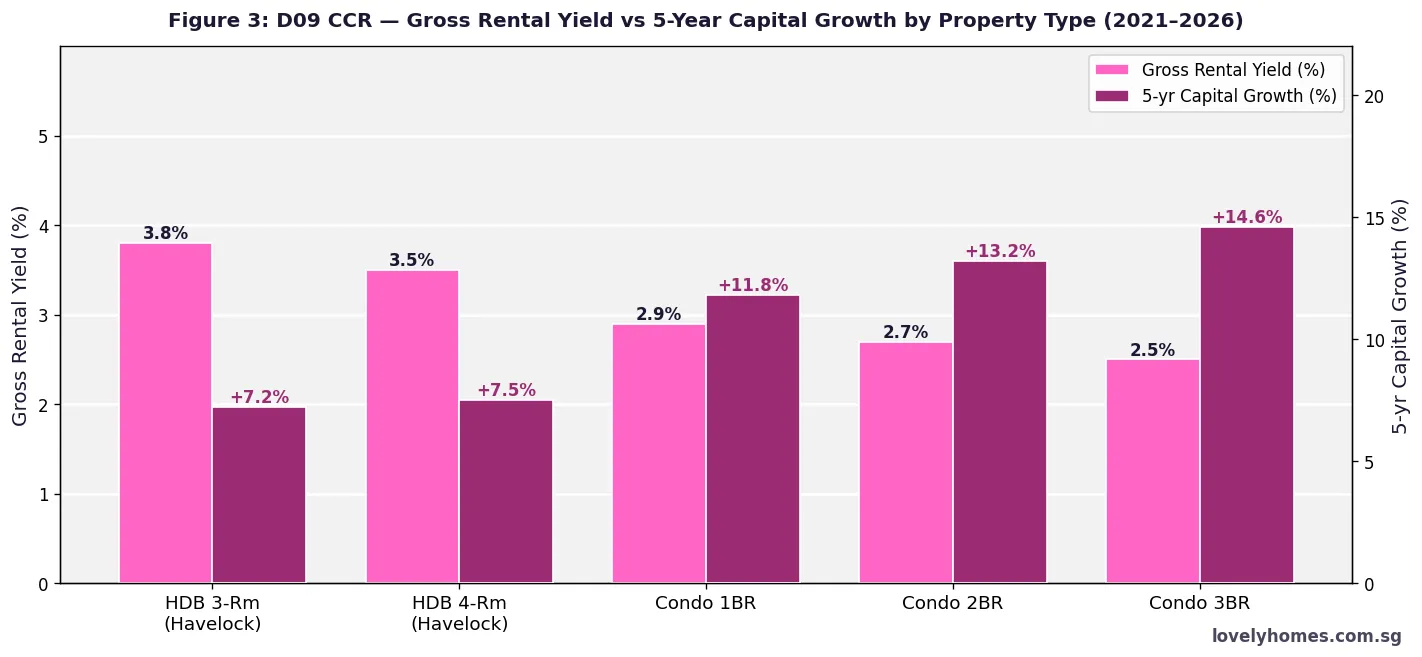
D09 CCR River Valley Robertson Quay gross rental yield vs 5-year capital growth 2021 to 2026 by property type
Figure 3: Gross rental yield and 5-year capital growth (2021–2026) for D09 CCR by property type. CCR yields are lower than OCR but paired with stronger capital growth for larger units.

🏠 Worked Example: Mr & Mrs Chua — SC Upgraders Buying Martin Modern 2BR

Profile: Mr & Mrs Chua, Singapore Citizens, joint income S$16,000/month. Currently own a Bishan 4-room HDB flat (MOP cleared, sold on 30 April 2026 for S$840,000). Buying a Martin Modern 2BR (99yr leasehold) at S$2,200,000. This is their first private property.

Stamp duty:

  • BSD on S$2,200,000: 1% × S$180k + 2% × S$180k + 3% × S$640k + 4% × S$500k + 5% × S$700k = S$1,800 + S$3,600 + S$19,200 + S$20,000 + S$35,000 = S$79,600
  • ABSD: Nil — SC couple, first private property (HDB sold before OTP granted)

Financing:

  • Purchase price: S$2,200,000 | LTV 75% → Bank loan: S$1,650,000
  • Monthly repayment at 3.0% p.a. 25yr: approximately S$7,832/month
  • TDSR: S$7,832 ÷ S$16,000 = 48.9% — PASS (within 55% limit)

Upfront cash/CPF required:

  • 25% down payment: S$550,000
  • BSD: S$79,600
  • Conveyancing fees: ~S$5,000
  • Total upfront: approximately S$634,600 (can partly draw from CPF OA after HDB CPF refund)

Investment projection: At +13.2% 5-year CCR growth (historical trend), the S$2.2M unit appreciates to approximately S$2.49M by 2031. Combined with net rental income (~S$5,800/month at 2.9% gross, less property tax and maintenance), the total return scenario is approximately S$290k capital + S$174k net rental = ~S$464k over 5 years. Past performance does not guarantee future results — see Disclaimer.

Investment Case — Why River Valley and Robertson Quay in 2026

The structural case for D09 rests on three pillars that are unique to this precinct. First, supply scarcity: unlike OCR planning areas such as Tampines or Sengkang where GLS sites are regularly released, the River Valley and Robertson Quay sub-zones are essentially built-out. URA has not awarded a GLS site in this immediate precinct since the Jiak Kim Street site (Rivière, awarded 2018). Future supply, if any, would likely come from en-bloc redevelopment — a slow, expensive process that takes 5–8 years from acquisition to launch.

Second, the TEL re-rating is still working through property values. Research from URA transaction data suggests that properties within 500 metres of new TEL stations in previously underserved areas have outperformed the broader CCR average by 2–4 percentage points per annum in the two to three years post-opening. The Great World and Havelock stations opened in June 2023, meaning the full impact may not yet be fully priced in.

Third, Singapore’s attraction as a global wealth hub continues to drive demand for the CCR’s top-end rental pool. Despite the 60% ABSD on foreigners (which has effectively removed foreign owner-occupier buyers from the market), Singapore’s population of ultra-high-net-worth individuals — many of whom now hold Permanent Residency or citizenship — continues to grow. Wealthy PRs buying a first or second property in D09 pay 5% or 30% ABSD respectively — meaningful but manageable given the capital quantum. Many still prefer D09 over offshore alternatives for personal use.

What Might Come Next for River Valley and Robertson Quay

This section is editorial opinion and forward-looking speculation, clearly labelled as such.

The URA Draft Master Plan 2025 identified the Greater Southern Waterfront (GSW) — a 2,000-hectare stretch from Pasir Panjang to Marina East — as a long-term transformation zone. River Valley and Robertson Quay sit at the northern edge of this precinct, and the eventual reconfiguration of the Tanjong Pagar port lands (expected 2027–2030 for the first phases) could draw more F&B, cultural, and lifestyle development southward along the Singapore River, extending the Robertson Quay “lifestyle zone” further toward the coast.

On the regulatory side, some market analysts have speculated that ABSD rates for foreigners (currently 60%) could be moderated if the US–Singapore bilateral economic relationship strengthens and if Singapore’s primary residential market cools further following the 60% ABSD introduction. However, there are no signals from the Ministry of National Development or the Ministry of Finance that any such change is imminent.

Frequently Asked Questions

Is River Valley a good place to buy property in Singapore?

River Valley and Robertson Quay offer a compelling combination of lifestyle, connectivity, and capital preservation that justifies the premium over OCR and RCR districts. The TEL opening in June 2023 resolved the precinct’s previous connectivity weakness. The absence of new GLS supply in the sub-zone for over seven years means that any further demand uplift — from population growth, wealth inflows, or the Greater Southern Waterfront transformation — would tighten an already scarce market. For buyers who can absorb the higher entry price (S$1.1M+ for a 1-bedroom) and do not need above-3% yield, D09 River Valley and Robertson Quay represents one of Singapore’s most defensible residential investments. It is not the right choice for buyers seeking high rental yield or affordable entry.

Which MRT stations serve River Valley and Robertson Quay?

Three MRT stations are within comfortable walking distance of the precinct. Great World (TE15, Thomson–East Coast Line) on Kim Seng Road serves the eastern River Valley portion; Havelock (TE16, TEL) serves Robertson Quay’s western side and the Havelock Road corridor. Fort Canning (DT20, Downtown Line) is a 7–10 minute walk from Robertson Quay via River Valley Road and is particularly useful for commuters heading toward Bugis, Promenade, or Buona Vista. Somerset (NS23, North–South Line) is a 12–15 minute walk from the northern edge of River Valley Road and provides access to Orchard and the NSL.

Can foreigners buy property in River Valley and Robertson Quay?

Foreigners can purchase private condominiums, apartments, and commercial shophouses in D09. However, since April 2023, foreigners pay 60% ABSD on any Singapore residential property purchase — a flat rate on the entire purchase price. On a S$2.5M condominium, that is S$1.5M in ABSD alone. Foreigners cannot purchase HDB flats, ECs (within MOP), or landed property (unless on Sentosa Cove or with specific SLA approval). Despite the 60% ABSD, a small number of ultra-high-net-worth foreign buyers continue to transact in CCR — particularly for trophy units above S$5M — typically sourced from family offices and private banking clients who view Singapore residential property as part of a broader wealth-preservation and residency strategy.

What are the best condominiums in River Valley and Robertson Quay?

The benchmark freehold projects in 2026 are The Avenir (River Valley Close, 376 units freehold, completed 2024, PSF S$2,800–S$3,200) and the established older-stock freehold buildings along River Valley Road including RV Altitude and The Grange. For 99-year leasehold, Rivière (Jiak Kim Street, 455 units, Frasers Property, adjacent to Great World TE15 station) and Martin Modern (Martin Place, 450 units, GuocoLand) are the contemporary benchmarks. Rivière in particular benefits from arguably the best direct TEL station access of any condominium in the precinct. Older boutique freehold projects (sub-100 units) can offer attractive value for buyers who prioritise freehold tenure and do not require a gymnasium or full facilities.

How does River Valley compare to Holland Village or Orchard?

All three sub-precincts sit within D09/D10 CCR, but each has a distinct character. River Valley and Robertson Quay offer the most vibrant street-level lifestyle — riverside F&B, Fort Canning Park, and the Singapore River waterfront — but at CCR prices and with smaller absolute retail mall footprints than Orchard. Holland Village (D10) has a village-in-the-city feel, lower density, and proximity to Buona Vista’s biomedical cluster. Orchard (D09/D10 border) offers the greatest retail density and brand-name condominium presence, but the immediate streetscape is less liveable. For families, Holland Village’s proximity to international schools (UWCSEA, AIS) is a draw that River Valley does not fully replicate. For young professionals and empty-nesters prioritising walkable lifestyle and CBD access, River Valley/Robertson Quay tends to win the comparison.

Is there any new HDB BTO supply in River Valley?

No. There is no HDB BTO supply in River Valley or Robertson Quay. The area is designated as a mature private residential precinct under the URA Master Plan. The only HDB stock in the broader D09 area is the existing Havelock Road HDB estate — older flats built in the 1970s and 1980s that transact at S$480,000–S$840,000 on the resale market. These Havelock flats are subject to lease decay risk given their age (remaining leases of 40–55 years as of 2026) and are generally not recommended for buyers seeking CPF-eligible long-tenure financing. For HDB BTO applicants interested in CCR-adjacent living at lower cost, the June 2026 BTO launch in Ang Mo Kio and Bukit Merah is the nearest available option.

Disclaimer: This guide is for general information purposes only and does not constitute financial, legal, or property investment advice. Property prices, rental yields, and market conditions change over time. All price ranges are indicative, based on public caveat data from the URA REALIS system and industry sources as at Q1 2026, and should not be relied upon as a valuation. Stamp duty rates are subject to change — verify current rates on the IRAS Stamp Duty page. Loan calculations are illustrative; consult a licensed mortgage broker and MAS guidelines before proceeding. LovelyHomes does not represent any property developer, agency, or agent.

×

Click anywhere outside the image to close
Holland Plain GLS 2026: Sim Lian Wins at S$1,491 psf ppr — D10 CCR Pricing, Investment Outlook and Buyer Analysis

Holland Plain GLS 2026: Sim Lian Wins at S$1,491 psf ppr — D10 CCR Pricing, Investment Outlook and Buyer Analysis

Quick Answer — Holland Plain GLS 2026: What You Need to Know

  • Sim Lian Group won the Holland Plain GLS tender on 12 May 2026 as the sole bidder at S$454 million — translating to S$1,491 psf ppr.
  • The 99-year leasehold site in District 10 (CCR) spans 15,717 sq m with a max GFA of 28,291 sq m and an estimated yield of ~280 residential units.
  • Building height is capped at 6 to 8 storeys, pointing to a low-rise boutique development — a rare product type in the Holland Road / Farrer Road corridor.
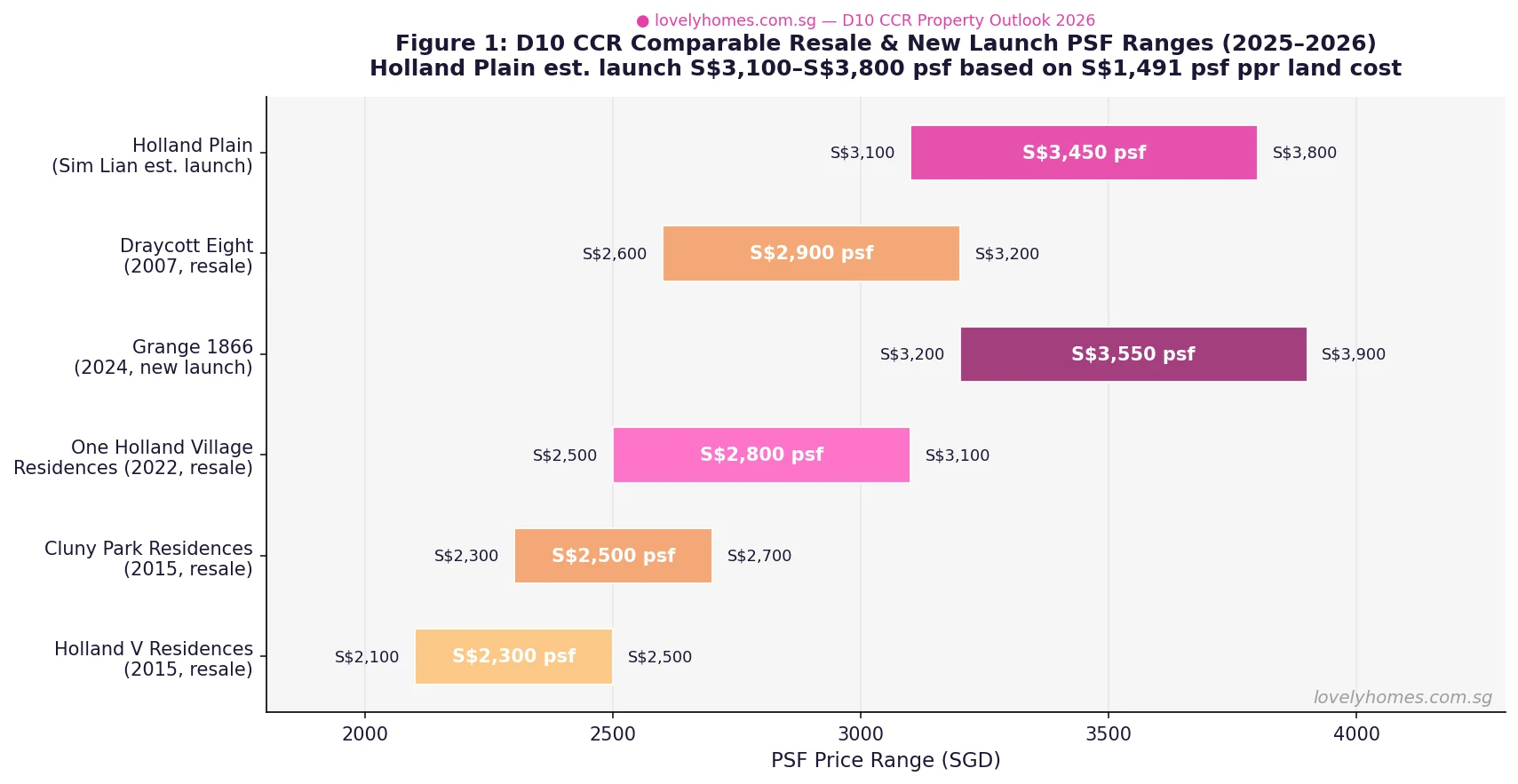
  • Estimated launch price: S$3,100–S$3,800 psf, based on the S$1,491 psf ppr land cost plus construction, financing, and a market premium over One Holland Village Residences resale benchmarks.
  • Preview is likely in Q3–Q4 2027 at the earliest, given the 18–24 month planning and construction mobilisation window typical of CCR boutique sites.
  • The sole-bid outcome reflects cautious developer sentiment in the CCR at current interest rates, but Sim Lian’s calculated entry represents a significant up-market pivot for the group.
  • For SC buyers, no ABSD on a first property purchase. Foreigners face a 65% ABSD surcharge — materially reducing demand from the international pool that traditionally drives CCR volumes.

Holland Plain GLS Awarded to Sim Lian — The Deal Breakdown

On 12 May 2026, the Urban Redevelopment Authority (URA) announced the award of the Government Land Sales (GLS) site at Holland Plain, District 10, to Sim Lian Group — Singapore’s only bidder. The developer tendered S$454,110,000 for the 99-year leasehold parcel, equivalent to approximately S$1,491 per square foot per plot ratio (psf ppr).

The sole-bid outcome drew immediate attention from industry observers. In previous cycles, prime CCR confirmed-list sites in District 10 attracted three to six bidders. The absence of competing bids from large listed developers such as City Developments, CapitaLand Development, UOL Group, or Frasers Property points to a recalibration of risk appetite in the Core Central Region, where the 65% Additional Buyer’s Stamp Duty on foreigners has significantly dampened the international buyer pool that historically underpinned CCR price discovery.

That Sim Lian Group — better known for large-scale Outside Central Region projects such as Treasure at Tampines (2,203 units) and Parc Clematis (1,468 units) — stepped into this site alone is a notable strategic shift for the developer. It signals confidence in the long-term premium of the District 10 address book and suggests Sim Lian has modelled a profitable outcome at launch prices that may be more measured than the aspirational pricing sometimes associated with CCR boutique developers.

Site Specifications — A Boutique Low-Rise in the Heart of D10

Parameter Details
Location Holland Plain, District 10 (CCR), Singapore
Tenure 99-year leasehold from 12 May 2026
Site Area 15,716.9 sq m (approximately 169,148 sq ft)
Max Gross Floor Area 28,291 sq m (approx. 304,590 sq ft)
Gross Plot Ratio 1.8
Permitted Building Height 6 to 8 storeys
Estimated Residential Units ~280 units
Land Use Residential (private condominium)
Developer Sim Lian Group
Award Price S$454,110,000 (S$1,491 psf ppr)
Tender Closed 7 May 2026
Award Date 12 May 2026

The six-to-eight storey height cap is significant. In the Holland Plain and Farrer Road precinct, most condominium developments are low-to-mid-rise, and the Master Plan’s height guidance for this parcel maintains the neighbourhood’s established residential character. Sim Lian is unlikely to build a high-density tower; buyers can expect a product more akin to Cluny Park Residences or Gallop Green — intimate, well-appointed, and positioned for owner-occupier and high-net-worth tenant demand from the nearby international schools.

D10 Comparable PSF — Where Holland Plain Fits

D10 CCR comparable PSF ranges Holland Plain One Holland Village Grange 1866 2026
Figure 1: D10 CCR comparable resale and new-launch PSF ranges for selected condominiums (2025–2026). Holland Plain’s estimated launch range of S$3,100–S$3,800 psf reflects the S$1,491 psf ppr land cost plus construction and a market premium. Source: URA REALIS, EdgeProp, LovelyHomes analysis.

The chart above places Holland Plain’s estimated launch price alongside established D10 benchmarks. One Holland Village Residences — the most proximate recent comparable, launched in 2022 and developed by Far East Organization — traded at roughly S$2,800–S$3,000 psf on launch and currently resells at S$2,500–S$3,100 psf depending on floor level and facing. Grange 1866 in D9 launched in 2024 at S$3,200–S$3,900 psf. Draycott Eight — an older freehold project in D10 — commands S$2,600–S$3,200 psf on resale despite its 2007 completion date, underlining the sustained value of CCR addresses.

Holland Plain’s 99-year leasehold tenure will attract a discount versus freehold and 999-year leasehold projects in the same district. Buyers accustomed to Cluny Park Residences or Good Class Bungalow (GCB) adjacency-premium projects will note that freehold equivalents in the Farrer Road–Grange Road belt command a 10–15% premium over comparable 99-year leasehold product. This suggests the achievable PSF at Holland Plain may cluster towards S$3,100–S$3,500 psf for the majority of units, with penthouses and premium stacks potentially touching S$3,800 psf.

Estimated Launch Pricing and Unit Mix

Holland Plain Sim Lian estimated cost stack land construction breakeven launch price 2026
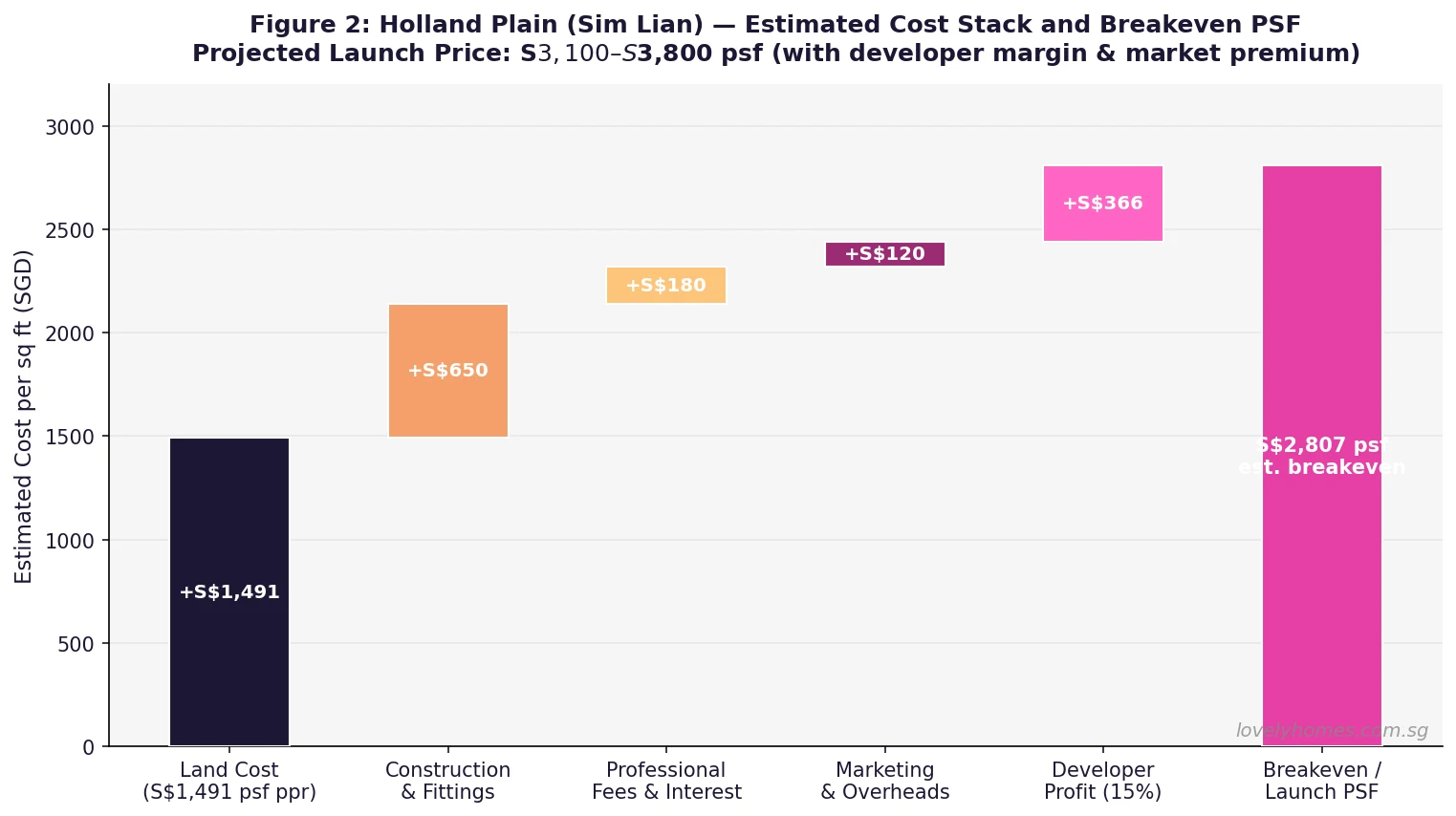
Figure 2: Holland Plain (Sim Lian) estimated cost-stack and breakeven PSF analysis. Land at S$1,491 psf ppr plus construction, professional fees, interest carry, and a 15% developer margin points to a breakeven of approximately S$2,800 psf, with the likely launch range of S$3,100–S$3,800 psf allowing for market positioning and a D10 CCR brand premium. Source: LovelyHomes analysis based on industry cost benchmarks.

With 280 units across ~304,590 sq ft of GFA, the average unit will be approximately 1,088 sq ft — consistent with a mix weighted towards 2- and 3-bedroom configurations appropriate for the family-oriented D10 demographic. LovelyHomes estimates the following indicative pricing grid, based on a blended average launch PSF of S$3,300:

Unit Type Est. Size (sq ft) Indicative Price Range
1-Bedroom 450–550 S$1.40M – S$2.09M
2-Bedroom 700–900 S$2.17M – S$3.42M
3-Bedroom 1,000–1,300 S$3.10M – S$4.94M
4-Bedroom / Penthouse 1,500–2,000 S$4.65M – S$7.60M+

Indicative only. Actual pricing will depend on Sim Lian’s unit mix strategy, prevailing SORA rates at the time of launch, and market conditions in 2027–2028. Consult a licensed property professional before making any commitment.

D10 GLS Land Rate Progression — Context

D10 CCR GLS land rate progression selected sites Holland Plain Sim Lian Singapore 2026
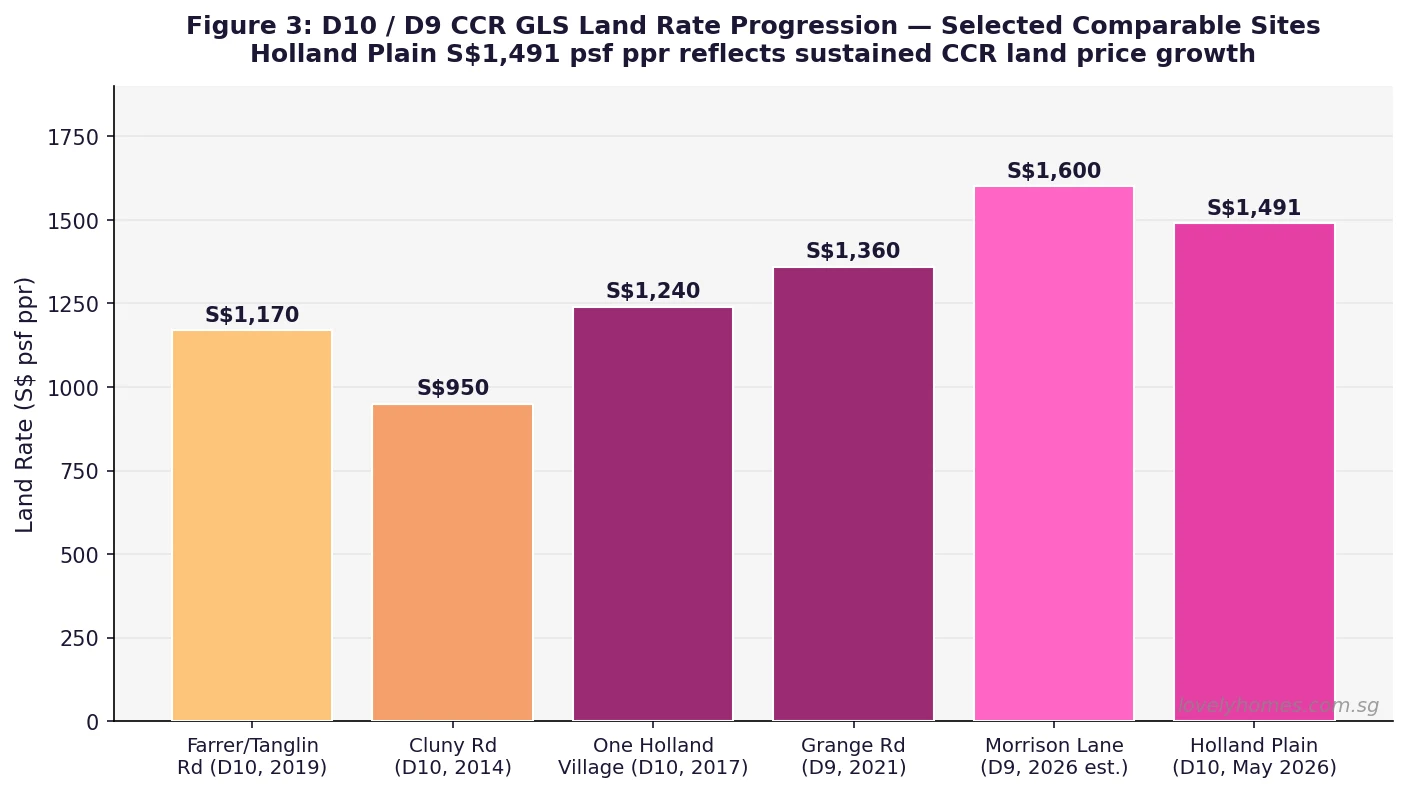
Figure 3: Historical D10 and D9 CCR GLS land rates for selected comparable sites, showing the broad upward trend in CCR land values since 2014. Holland Plain’s S$1,491 psf ppr reflects measured (not euphoric) CCR pricing, consistent with developers’ caution given the 65% foreigner ABSD. Source: URA GLS programme data, LovelyHomes analysis.

Holland Plain’s S$1,491 psf ppr land rate is notable for what it is not: a record. In the pre-cooling-measure era, CCR land bids regularly pushed past S$2,000 psf ppr. The 60% Additional Buyer’s Stamp Duty on foreigners (raised to 65% in April 2023) has structurally redirected international capital away from the new-launch CCR pipeline, removing the speculative demand layer that previously compressed developer margins and pushed bids skyward. What remains is the durable owner-occupier and long-term investment demand from Singapore Citizens and Permanent Residents, which is more price-sensitive and longer in decision horizon.

Sim Lian’s S$1,491 psf ppr bid is broadly consistent with a financially disciplined modelling exercise rather than a prestige land-banking move. The developer is betting on a specific thesis: that D10 boutique, low-rise product at 280 units will sell through comfortably to local families and returning expatriates, even at S$3,100–S$3,500 psf, given the paucity of new launch supply in the Holland Road–Farrer Road corridor since 2022.

Who Will Buy Holland Plain — The Target Buyer Profile

Several distinct buyer archetypes are likely to drive take-up at Holland Plain:

SC upgraders from the OCR. With OCR private condo prices rising 2.2% in Q1 2026 and MOP waves releasing large numbers of resale HDB flats into the market, a cohort of Singapore Citizens who purchased OCR condominiums or HDB flats in 2018–2021 are now sitting on significant capital gains. For couples with household incomes of S$20,000–S$30,000 per month, a 3-bedroom unit at Holland Plain at S$3.5M–S$4.5M represents an aspirational CCR upgrade with no ABSD on a first private property purchase.

D10 residents downsizing or lateral moving. Freehold condominium owners in the Farrer Road, Grange Road, and Tanglin Road precinct who seek newer infrastructure, modern facilities, and professional property management without leaving the district will look seriously at Holland Plain, even with the 99-year leasehold caveat.

Expat tenants’ employers and parents. The international schools immediately adjacent — United World College of South East Asia (Dover campus), the Australian International School, the German European School — generate sustained demand for family-sized rental units in D10. Investor-buyers who target the expat tenant pool will find Holland Plain’s 3-bedroom stock particularly compelling, especially given one-north and the Buona Vista biomedical employment cluster’s continued expansion driving corporate housing budgets.

High-net-worth Singaporeans for own stay. At six to eight storeys in a low-density neighbourhood, Holland Plain will offer a level of privacy and exclusivity rarely available in new launches. The limited unit count of ~280 means the development will feel intimate — a selling point for buyers accustomed to landed living who want managed-property convenience.

ABSD Implications — The Foreigner Market Is Largely Sidelined

The 65% Additional Buyer’s Stamp Duty on foreign buyers, in force since 27 April 2023, means that any foreigner purchasing a S$2M 2-bedroom unit at Holland Plain would face an ABSD bill of S$1.3 million — on top of BSD of approximately S$57,600. Total acquisition cost before loan: over S$3.35M. This is not a purchase case that works for most foreign nationals who do not have deep Singapore roots or a specific business reason to own in the CCR.

The practical implication: Holland Plain will be absorbed almost entirely by Singapore Citizens and Permanent Residents. SPR buyers pay 5% ABSD on a first property — manageable at S$100,000–S$180,000 on a typical unit — and a meaningful segment of the take-up will come from this pool. SC buyers on a first property pay zero ABSD. SC buyers on a second or subsequent property pay 20% ABSD — a S$640,000 bill on a S$3.2M unit — which remains a significant friction, though less prohibitive for high-net-worth upgraders than the foreigner rate.

For more on ABSD rates by buyer profile, see our ABSD Singapore 2026 complete guide.

Worked Example — Mr & Mrs Chua: SC Upgraders Buying a 3-Bedroom at Holland Plain

Mr & Mrs Chua are Singapore Citizens in their early 40s. They sold their OCR condominium in Tampines in late 2025 for S$1.55M (purchased in 2019 for S$1.1M), banking approximately S$350,000 in net cash after paying off the outstanding mortgage. They are now renting in D10 and plan to purchase a 3-bedroom unit at Holland Plain when it launches, estimated at approximately S$4.1M.

ABSD: As SC buyers on their second private residential property (they now own zero properties — the Tampines unit was sold), they are effectively first-time owners at point of purchase. Zero ABSD applies. ✓

BSD on S$4.1M: 1% × S$180k = S$1,800; 2% × S$180k = S$3,600; 3% × S$640k = S$19,200; 4% × S$500k = S$20,000; 5% × S$1.1M = S$55,000; 6% × S$1M = S$60,000. Wait — let me apply the correct BSD tiers. On S$4.1M: 1%×180k + 2%×180k + 3%×640k + 4%×500k + 5%×2.6M. Actually: First S$180k at 1% = S$1,800; next S$180k at 2% = S$3,600; next S$640k at 3% = S$19,200; next S$500k at 4% = S$20,000; above S$1.5M: next S$1.5M at 5% = S$75,000; above S$3M: remaining S$1.1M at 6% = S$66,000. Total BSD = S$185,600.

Financing: At a blended bank fixed rate of approximately 2.0% per annum (estimated for 2027), the Chua couple borrows 75% of the S$4.1M purchase price = S$3,075,000. Monthly instalment over 25 years ≈ S$13,020. TDSR check: assuming joint gross income S$35,000/mth — TDSR = 37.2% (below 55% cap). ✓

Down payment and cash needed: 25% down = S$1,025,000 (can be funded from CPF OA and cash); BSD S$185,600 in cash. Using S$350,000 cash from the Tampines sale and drawing S$675,000 from CPF OA, the couple meets both the down payment and stamp duty requirements with ~S$164,000 CPF OA remaining as a buffer.

Summary for Mr & Mrs Chua: S$4.1M Holland Plain 3-bedroom → ABSD nil → BSD S$185,600 → bank loan S$3.075M @ 2.0% for 25yr → monthly S$13,020 → TDSR 37.2% → cash outlay S$535,600 (cash from Tampines proceeds + stamp duty) + CPF drawdown S$675,000.

Development Timeline and What to Watch

Following the tender award on 12 May 2026, Sim Lian will enter the planning and approvals phase with URA. A provisional building plan is typically submitted within six months of award, with a building plan approval following three to six months later. Construction commencement generally occurs 18–24 months post-award for CCR boutique sites. Based on this trajectory, the likely public preview window is Q3–Q4 2027, with expected project completion (Temporary Occupation Permit) in 2030–2031.

Watch for: Sim Lian’s project name announcement (likely within six months), architectural rendering release, showflat construction in the Holland Plain vicinity, and any pre-indication of pricing through EdgeProp or Stacked Homes developer briefings approximately 60–90 days before the official launch date.

What This Means for D10 Buyers and the Broader CCR

The Holland Plain award is a data point in a larger story about CCR supply discipline. With the 65% foreigner ABSD in place and a generation of Singaporean private property owners sitting on significant unrealised equity from 2019–2024 price appreciation, the CCR market in 2026–2028 will be one where supply is lean, developer caution is visible (sole bids, measured land rates), and local buyers — particularly SC upgraders — will find themselves as the dominant demand driver for the first time in decades.

For buyers considering Holland Plain, the opportunity is clear: a boutique, low-rise D10 CCR address in a school belt with strong expat tenant demand, delivered by a developer with an established sales track record, at land rates that suggest a measured (rather than euphoric) launch PSF. The risk factors are the 99-year leasehold tenure, the reliance on local SC/SPR demand, and the long wait time (2027–2028 launch, 2030–2031 completion) during which market conditions may shift.

What Might Come Next — GLS Pipeline and CCR Outlook

This is speculative. The remaining 1H 2026 GLS confirmed list site — River Valley Green Parcel C — closes for tender on 18 June 2026 and is expected to attract two to four bidders given its smaller site area. If it also draws a sole bid at conservative land rates, it would confirm a broader pattern of developer restraint in the CCR. The URA may respond to this signal when compiling the 2H 2026 GLS programme (expected announcement December 2026) by adjusting the CCR mix on the confirmed list, potentially holding back sites to avoid depressing land values further or to allow existing pipeline to absorb before adding new confirmed-list supply.

Watch also for any policy review of the 65% foreigner ABSD. If global capital flows to Singapore property are assessed to have become too restricted and if housing prices stabilise, there is a non-trivial possibility of a partial relaxation (e.g., from 65% to 30–45% for longer-term PRs or certain FTA-holder nationalities) in the 2026–2027 National Day Rally or Budget cycle. Any such relaxation would immediately revive international demand at D10 project launches and push achievable PSF upwards — a significant upside scenario for early Holland Plain buyers.

FAQ: Holland Plain GLS 2026 — Sim Lian Award
Why did only one developer bid for Holland Plain?

The sole-bid outcome reflects a combination of factors: the 65% Additional Buyer’s Stamp Duty on foreigners has substantially reduced the addressable buyer pool for CCR new launches, narrowing the demand basis that developers model when deciding how aggressively to bid. Many larger listed developers were also managing existing CCR inventory — including ongoing projects in D9 (Peck Hay Road, River Valley) — and may have chosen to preserve capital rather than pursue a concurrent D10 commitment. Sim Lian’s willingness to bid alone at S$1,491 psf ppr suggests the group has a specific product and pricing thesis that pencils out within that land cost, without requiring the foreign buyer premium that other developers may have deemed necessary to justify a higher bid.

Is Holland Plain’s 99-year leasehold a concern for long-term value?

Leasehold tenure is always a consideration in the CCR, where freehold and 999-year projects exist as alternatives. A 99-year leasehold in D10 will typically trade at a 10–15% discount to a freehold equivalent on a like-for-like basis. However, for buyers with a 10–20 year investment horizon, the leasehold discount at point of purchase can represent a compelling entry point, particularly if the area’s rental demand and capital growth story remain intact. The critical factor is the remaining lease at the point of future sale: a buyer who purchases a 99-year leasehold unit in 2028 and sells in 2043 will be transacting a unit with approximately 84 years remaining — still well above the HDB housing grant lease-coverage threshold and broadly financeable for the next generation of buyers.

When is the expected launch date for Sim Lian’s Holland Plain project?

Based on the typical CCR boutique development timeline — URA planning approvals (6–12 months), building plan submission and approval (3–6 months), showflat construction and marketing preparation (3–6 months) — the most likely preview window is Q3 to Q4 2027. Construction commencement would follow in late 2027 or early 2028, with a Temporary Occupation Permit (TOP) date of approximately 2030–2031. This is an estimate based on typical timelines; Sim Lian has not publicly confirmed any milestones.

What is the nearest MRT station to Holland Plain?

The Holland Plain site is located approximately 700 metres to 1 kilometre from Holland Village MRT station (Circle Line CC21 and Thomson-East Coast Line TE17). The dual-line interchange at Holland Village provides excellent connectivity to Botanic Gardens (CC19/DT9), Buona Vista (CC22/EWL), and Marina Bay (TE20/CC29/NS27/CE1). The Thomson-East Coast Line also connects northward to Caldecott (TE9/CC17) and southward through the city to Bayshore. For commuters working in the CBD or Orchard, Holland Village MRT offers a one- to two-interchange journey of approximately 20–30 minutes.

What schools are near Holland Plain?

The Holland Plain site benefits from proximity to some of Singapore’s most sought-after schools. Henry Park Primary School is located within approximately 1 kilometre, making the project eligible for Phase 2B HDB priority balloting for future owners with children. Nanyang Primary School in Buona Vista is another highly-regarded option within approximately 2 km. For international school demand — which drives a significant portion of D10 rental volumes — United World College of South East Asia (Dover campus), the Australian International School, and the German European School Singapore are all within a 3–4 km radius. This cluster is a major driver of family tenant demand at S$5,000–S$9,000 per month for 3- to 4-bedroom units.

Should I register interest now to buy Holland Plain?

Sim Lian has not opened any registration of interest (ROI) process as at 22 May 2026. The project has not been named, priced, or publicly marketed. It is premature to commit funds or make any financial arrangement based solely on this GLS award. LovelyHomes recommends monitoring Sim Lian’s official announcements, EdgeProp project launch alerts, and URA’s building plan approvals database for planning-permission milestones, which will give approximately 60–90 days’ advance notice before a formal marketing launch. Do not rely on unofficial registration lists maintained by individual marketing agents, as these carry no legal weight and may involve data privacy risks.

Related Articles


Disclaimer: This article contains LovelyHomes’ independent analysis and projections based on publicly available URA GLS data, industry cost benchmarks, and comparable transaction information. Projected launch prices, unit mixes, timelines, and investment outcomes are estimates only and do not constitute financial advice, a solicitation to purchase, or a guarantee of any outcome. The Singapore property market is subject to government policy changes, interest rate movements, and macroeconomic conditions that may materially alter outcomes. Always consult a licensed real estate agent, licensed financial adviser, and qualified conveyancing solicitor before making any property purchase decision. Source data: URA GLS programme 1H 2026, URA REALIS, MND, CPF Board.

×

Click anywhere to close

Singapore REITs Investment 2026: Distribution Yields, Tax Treatment and How S-REITs Compare to Direct Property

Singapore REITs Investment 2026: Distribution Yields, Tax Treatment and How S-REITs Compare to Direct Property

Most Singaporeans know that property is a favoured investment asset. What fewer realise is that they can access Singapore’s real estate returns without buying a physical unit, without paying Additional Buyer’s Stamp Duty (ABSD), and with as little as the price of a single share on the Singapore Exchange (SGX). Singapore Real Estate Investment Trusts — known as S-REITs — are listed vehicles that pool capital to own income-producing real estate, distribute the bulk of their rental income to unitholders, and trade like stocks on SGX. In 2026, with interest rates easing and cap rates compressing, S-REITs are once again attracting strong attention from retail and institutional investors alike.

Quick Answer — Singapore REITs Investment 2026

  • What: Listed property investment vehicles traded on SGX; own commercial, industrial, retail, healthcare or hospitality properties
  • Minimum investment: As low as S$1 per unit (or one lot = 100 units for standard board lots)
  • Tax transparency: Singapore individuals pay no withholding tax on REIT distributions (subject to MAS rules)
  • ABSD: Zero — REITs are securities, not direct property purchases
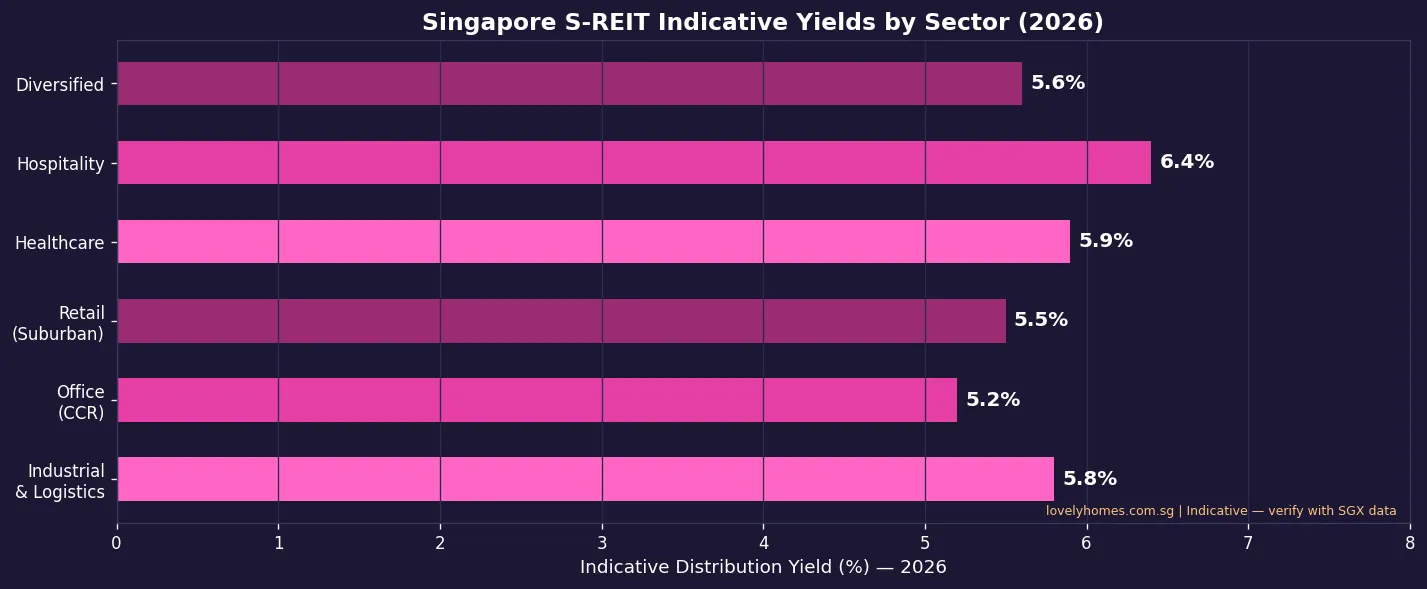
  • Indicative yields: 5.2%–6.4% distribution yield depending on sector (2026)
  • Leverage cap: 50% aggregate leverage ratio (MAS guidelines)
  • Key risk: Interest rate sensitivity — REIT unit prices fell sharply when rates rose 2022–2024; recovering in 2026
  • Best for: Investors wanting passive income, diversification, or property exposure without ABSD or large capital outlay

What Are S-REITs and How Do They Work?

A Real Estate Investment Trust is a collective investment scheme structured to own and operate income-producing real estate. In Singapore, REITs are regulated by the Monetary Authority of Singapore (MAS) under the Securities and Futures Act. To qualify for tax transparency treatment, a Singapore REIT must distribute at least 90% of its taxable income to unitholders each financial year. In return, MAS-regulated S-REITs pay no corporate tax on distributed income, and individual Singapore resident unitholders receive distributions free of withholding tax.

S-REITs raise capital by issuing units on SGX. They use this capital, plus debt (up to the 50% aggregate leverage cap), to acquire properties that generate rental income. A REIT Manager — a MAS-licensed entity — makes investment, financing, and asset management decisions on behalf of unitholders. Management fees (typically 0.3%–0.8% of assets under management per annum) reduce net distributions to unitholders.

Singapore S-REIT indicative distribution yields by sector 2026 — industrial, office, retail, healthcare, hospitality
Figure 1: Singapore S-REIT Indicative Yields by Sector (2026) — indicative figures; verify with SGX data

Types of S-REITs and Their Characteristics

Singapore hosts one of Asia’s deepest REIT markets, with approximately 40 S-REITs and property trusts spanning several asset classes. Industrial and Logistics REITs own warehouses, data centres, and business parks with long leases (5–15 years) and strong demand from technology occupiers; indicative yields around 5.5%–6.0%. Office REITs own Grade A commercial buildings in the CBD; yields around 5.0%–5.5%. Retail REITs own shopping malls — suburban malls have proven resilient post-pandemic; yields around 5.3%–5.8%. Healthcare REITs own hospitals and nursing homes on long triple-net leases; yields around 5.5%–6.0%. Hospitality REITs own hotels and serviced residences; more volatile income but recovering with Singapore tourism; yields around 6.0%–6.5%. Diversified REITs own a mix of asset types, offering built-in diversification; yields around 5.3%–5.8%.

S-REITs vs Direct Property — The Critical Differences

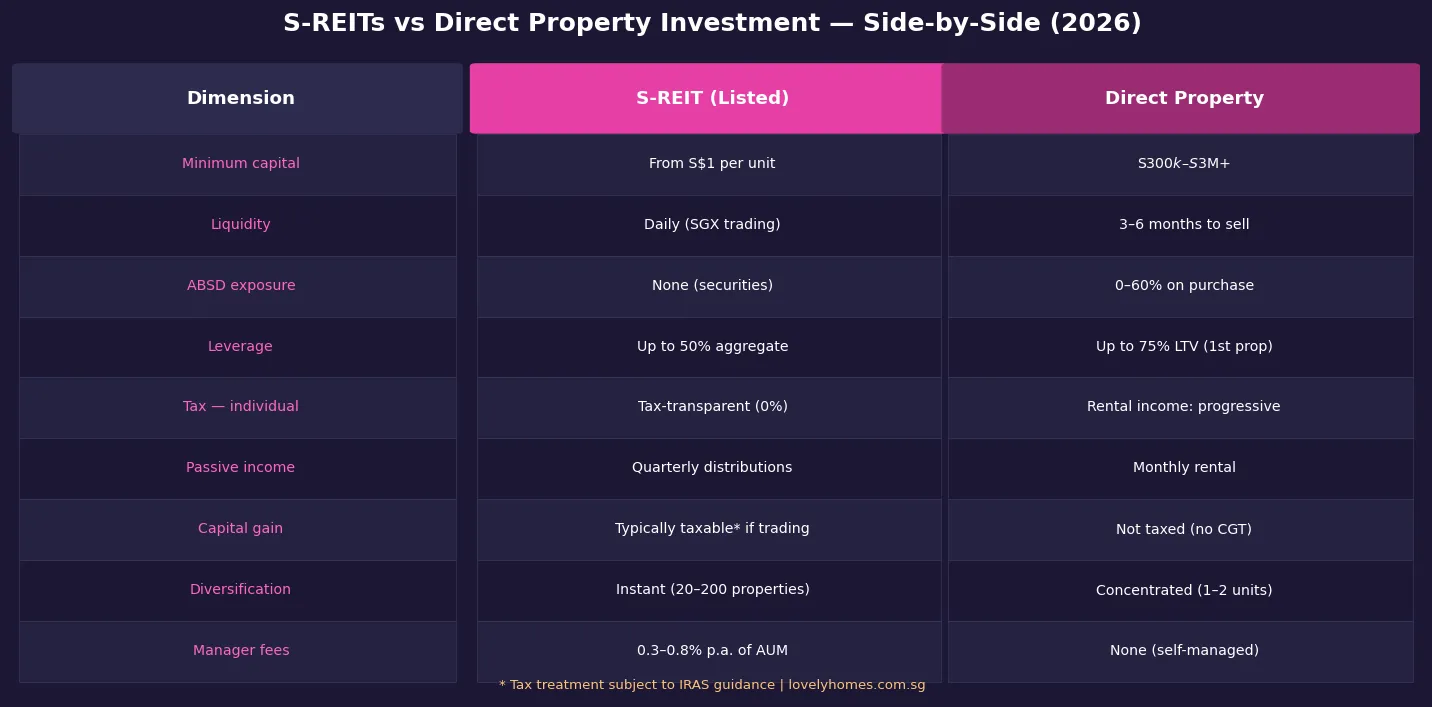
S-REITs vs direct property investment comparison — minimum capital, liquidity, ABSD, leverage and tax Singapore 2026
Figure 2: S-REITs vs Direct Property Investment — Side-by-Side Comparison (2026)

The most significant advantage of S-REITs for Singapore residents is zero ABSD exposure. A Singapore Citizen buying a second residential property pays 20% ABSD on the entire purchase price — on a S$1.5 million condo, that is S$300,000 in ABSD before accounting for the regular Buyer’s Stamp Duty (BSD). Buying S$300,000 worth of a diversified S-REIT incurs no ABSD, no BSD, no conveyancing fees, and no mortgage-related costs.

Liquidity is another major difference. A direct property investment typically takes three to six months to sell, involves legal costs, agent commissions, and Seller’s Stamp Duty (SSD) if sold within three years. A REIT unit can be sold on SGX in seconds during market hours, and settlement occurs within two business days. The trade-off is stock market volatility: many quality S-REITs declined 20%–35% in unit price terms between 2022 and 2024 as the US Federal Reserve raised interest rates aggressively, even as their underlying properties continued generating stable rental income. In 2026, with SORA easing, S-REIT valuations have partially recovered.

Tax Treatment for Singapore Individual Investors

Singapore residents who are individuals receive S-REIT distributions free of withholding tax under the MAS tax transparency framework, provided the REIT distributes at least 90% of its income. This is one of the most favourable tax treatments for any income-generating investment in Singapore. By contrast, rental income from a directly owned investment property is taxed at the individual’s marginal income tax rate (up to 24% for income above S$1 million) after deducting allowable expenses. There is no Capital Gains Tax in Singapore, so gains on disposal of REIT units held for investment are generally not taxable — though IRAS may tax gains as income if the frequency and pattern of trading suggests a business of buying and selling REITs.

Key Facts: S-REIT Investment at a Glance

Dimension S-REIT (Listed) Direct Property
Minimum capital From S$1 per unit S$300k–S$3M+
Liquidity Daily (SGX trading) 3–6 months to sell
ABSD exposure None (securities) 0%–60% on purchase
Leverage Up to 50% aggregate (MAS cap) Up to 75% LTV (1st property)
Tax — individual Tax-transparent (0% withholding) Rental income: progressive rates
Indicative yield 5.2%–6.4% (2026) 2.5%–4.5% gross OCR (2026)
Diversification Instant (20–200 properties) Concentrated (1–2 units)
Manager fees 0.3%–0.8% p.a. of AUM None (self-managed) or agent fees

Worked Example — Ms Chen Considers Her Options

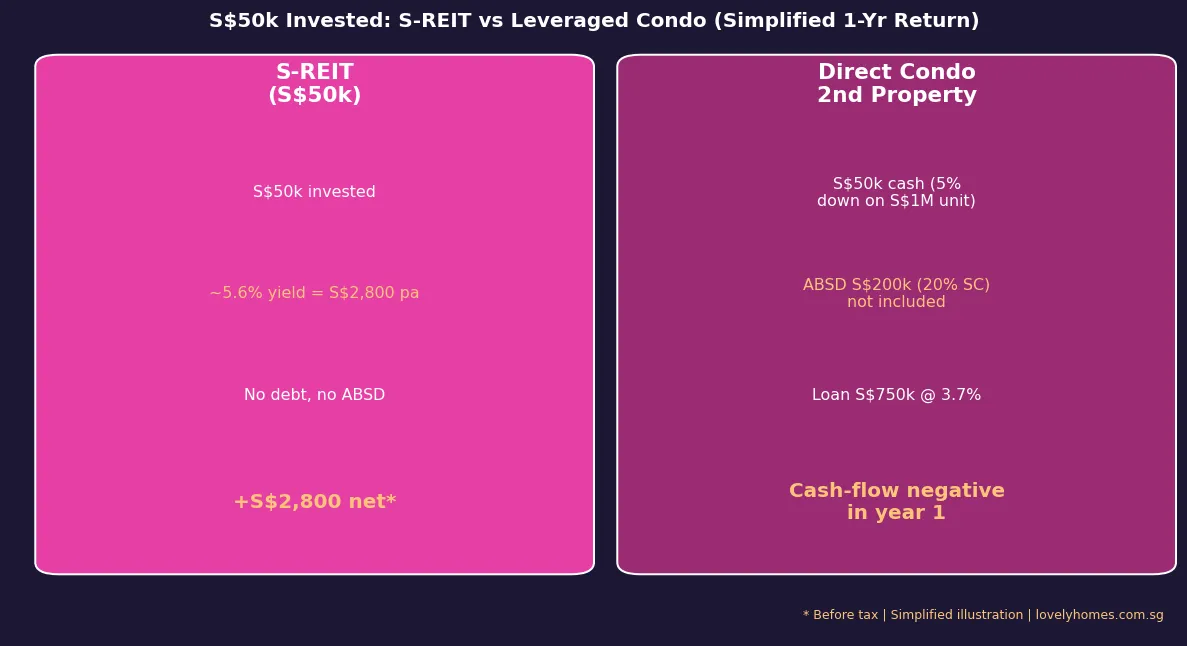
S$50k invested in S-REIT vs leveraged condo 2nd property — simplified year-1 return illustration Singapore 2026
Figure 3: S$50,000 Capital Deployed: S-REIT vs Direct 2nd Condo — simplified 1-year illustration (2026)

Ms Chen is 38, a Singapore Citizen who already owns her HDB flat and has S$50,000 in investable savings. Option A — S-REIT: She invests S$50,000 in a diversified industrial S-REIT yielding 5.8% per annum. Annual distribution income: S$2,900. No ABSD, no BSD, no legal fees. Option B — Second Condo: She targets a S$1 million OCR condo as a second property. ABSD as a Singapore Citizen = 20% = S$200,000. BSD ≈ S$24,600. Total upfront stamp duties: S$224,600. Her S$50,000 would not even cover the stamp duties — she would need an additional S$174,600 just to clear the stamp duty obligation, plus the 25% down payment (S$250,000) and legal costs. For investors at Ms Chen’s capital level who already own one property, the REIT route offers immediate, tax-efficient property income with no stamp duty barrier.

Why This Matters — REITs as a Portfolio Complement

Singapore has actively developed the S-REIT market since the first REIT listed on SGX in 2002. Today, Singapore is the third-largest REIT market in Asia by market capitalisation. For retail investors, S-REITs provide access to institutional-quality properties — prime CBD office towers, logistics parks, hospitals, and data centres — that would otherwise be entirely out of reach. A S$5,000 investment in a well-managed industrial REIT gives proportional exposure to a portfolio of properties worth hundreds of millions of dollars, managed by professionals and audited to MAS standards.

What Might Come Next

In 2026, the REIT market is benefiting from a gradual easing in SORA rates. As the 3-month compounded SORA trends lower from its 2024 peak, financing costs for S-REITs ease and the distribution yield spread above the risk-free rate widens, making S-REITs more attractive relative to fixed deposits and Singapore Government Securities (SGS bonds). Investors should monitor SORA trajectory, MAS interest rate guidance, and individual REIT occupancy rates and lease expiry profiles. Always check the latest REIT financial statements on SGX before deploying capital.

Frequently Asked Questions

Do I pay ABSD when buying S-REIT units?

No. ABSD applies to purchases of residential property. S-REIT units are securities — not direct property ownership — and are bought and sold on SGX in the same manner as shares. There is no Buyer’s Stamp Duty, no ABSD, and no conveyancing process. The only transaction cost is brokerage commission (typically 0.05%–0.28% per trade on standard Singapore platforms).

How often do S-REITs pay distributions?

Most Singapore REITs distribute income quarterly, though some distribute semi-annually. The distribution is declared per unit (in cents per unit) and paid to unitholders on the register as at the ex-dividend date, received in your brokerage account within a few weeks of the payment date. Check each REIT’s investor relations page for its historical distribution per unit (DPU) track record.

Can I use CPF to invest in S-REITs?

Yes, subject to the CPF Investment Scheme (CPFIS). You can invest CPF OA savings in approved S-REITs listed on SGX under CPFIS-OA. You may invest up to 35% of your investable savings (OA balance above S$20,000) in stocks and REITs under CPFIS. Note that the 2.5% OA interest rate is the opportunity cost benchmark — if your REIT does not beat 2.5% on a total-return basis, leaving the money in your OA would have been better.

What are the key risks of investing in S-REITs?

Key risks include: (1) Interest rate risk — rising rates increase REIT borrowing costs and make their yields less attractive relative to bonds. (2) Occupancy/tenant risk — if key tenants vacate or become insolvent, rental income falls. (3) Currency risk — many S-REITs own properties overseas (Australia, Japan, Europe, US); income is earned in foreign currencies and translated back to SGD. (4) Rights issue dilution — to fund acquisitions, REITs frequently issue new units at a discount. (5) Manager quality risk — poor capital allocation erodes long-term value. Diversifying across multiple REITs and asset classes mitigates several of these risks.

Is S-REIT income taxable for Singapore residents?

Distributions from S-REITs to Singapore individual residents are generally exempt from withholding tax under MAS’s tax transparency framework. You receive distributions gross, with no tax deducted at source, and generally do not declare them as taxable income on your personal tax return. Capital gains from selling REIT units are also generally not taxable for investors. Non-residents and entities are subject to withholding tax on distributions. Verify your specific position with a tax adviser, as IRAS guidance may evolve.

What is the MAS 50% leverage cap and why does it matter?

MAS requires Singapore REITs to maintain an aggregate leverage ratio (total debt divided by total assets) of no more than 50%. REITs meeting an interest coverage ratio (ICR) of at least 2.5× can access the upper 50% limit; others are capped at 45%. This protects unitholders from excessive debt risk. When evaluating a REIT, check its reported leverage ratio and ICR trend in its financial statements — these are disclosed quarterly.

How do I start investing in S-REITs?

Open a brokerage account with a SGX-licensed broker (DBS Vickers, OCBC Securities, UOB Kay Hian, Moomoo, Tiger Brokers, or Interactive Brokers). Fund it with SGD. Search for SGX-listed REITs on the broker’s platform — filter by sector, yield, and market capitalisation. Standard board lots are 100 units. Research each REIT’s annual report, distribution history, and investor presentation before investing. The SGX REITs and Property Trusts section is the authoritative listing of all Singapore-listed vehicles.

Disclaimer: This article is for general informational purposes only and does not constitute financial, legal, or professional advice. Property rules, grant amounts, eligibility criteria, and tax treatments are subject to change. Always verify current details with the relevant authorities — HDB, IRAS, CPF Board, URA — and consult a licensed professional before making any property or financial decision.

Freehold vs 99-Year Leasehold Singapore 2026: The Tenure Question Buyers Keep Asking

Freehold vs 99-Year Leasehold Singapore 2026: The Tenure Question Buyers Keep Asking

Freehold or 99-year leasehold? It is the single most-asked question on every Singapore condo viewing — and the most-misunderstood. The freehold premium is real but smaller than most buyers think. Lease decay is real but slower in the early years than buyers fear. Whether the freehold premium is worth paying depends almost entirely on your holding period, not your gut feeling.

This guide unpacks how Singapore property tenure actually works in 2026 — the four tenure types you will encounter, the maths behind Bala’s Curve (the lease-relativity table the Singapore Land Authority uses internally), the financing and CPF rules that bite as a lease shortens, and a worked 20-year hold comparison on a S$1.8 million condo in the same district. Where useful, we cross-link to the underlying frameworks at IRAS and CPF.

Quick Answer — Freehold vs 99-Year Leasehold at a glance

  • Freehold premium in comparable locations: typically 10–20% over 99-year leasehold
  • Bala’s Curve sets leasehold value at ~74.7% of freehold at 50 years remaining; ~60% at 30 years; ~49% at 20 years
  • CPF restrictions kick in when remaining lease is below 60 years; cannot use CPF at all if lease falls below 30 years for the next buyer
  • Bank financing tightens when remaining lease is below 40 years
  • Lease must cover the youngest applicant’s age + 95 for full CPF usage
  • Most new-launch condos and ECs are 99-year leasehold; freehold supply is fixed at ~5% of Singapore’s land area
  • For holding periods under 20 years in good locations, leasehold often outperforms freehold on a return-on-capital basis
  • For multi-generational holds (40+ years), the freehold premium pays for itself

What Are You Actually Buying? The Four Tenure Types

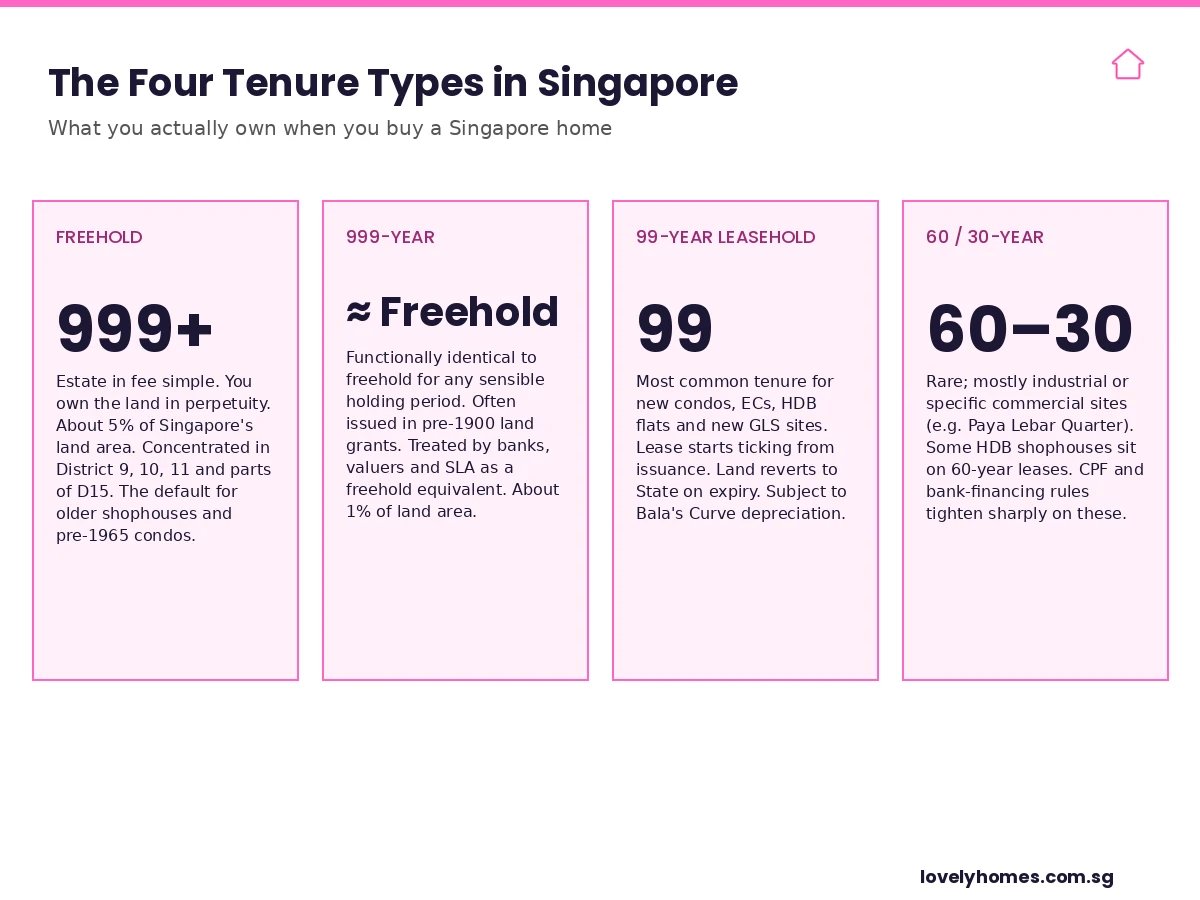
Singapore property comes with four main tenure types — and the difference between them is more legal than emotional. Tenure determines how long the State (or your descendants) recognises your interest in the land beneath your unit. Strata-Title in your condo gives you ownership of your apartment and a share in the land — for as long as the land tenure runs.

Singapore property tenure types — freehold 5 percent of land area, 999-year, 99-year leasehold, 60-30 year industrial
Figure 1: The four tenure types you will encounter in Singapore.

Freehold (Estate in Fee Simple)

You own the land in perpetuity, with the right to sell, lease or pass it to heirs without time limit. About 5% of Singapore’s land area is freehold — concentrated in the prime districts (D9, D10, D11) and pockets of D15. The State has not generally released new freehold land since 1965; almost all freehold supply today is from pre-1965 grants. This is why freehold supply is functionally fixed and cannot be created.

999-Year Leasehold

Issued mostly under pre-1900 colonial grants. Functionally identical to freehold for any sensible holding period — banks and valuers treat 999-year as a freehold equivalent. About 1% of Singapore’s land area sits on 999-year tenure. When you read a marketing brochure that says “freehold equivalent”, this is what is meant.

99-Year Leasehold

By far the most common tenure for new condos, Executive Condominiums, HDB flats, and almost every site released through the Government Land Sales (GLS) programme. The lease starts running on the date of issuance — which for a new launch is typically 1–2 years before TOP. Land reverts to the State at the end of the 99 years, with the building demolished or redeveloped. Subject to Bala’s Curve depreciation, which we cover next.

60-Year and 30-Year Leases

Unusual outside specific commercial or industrial sites. Some HDB shophouses sit on 60-year leases; certain industrial GLS plots are 30-year. CPF, bank-financing and resale rules are sharply restricted on these — not the tenure for a typical residential buyer.

Bala’s Curve — The Maths Behind Lease Decay

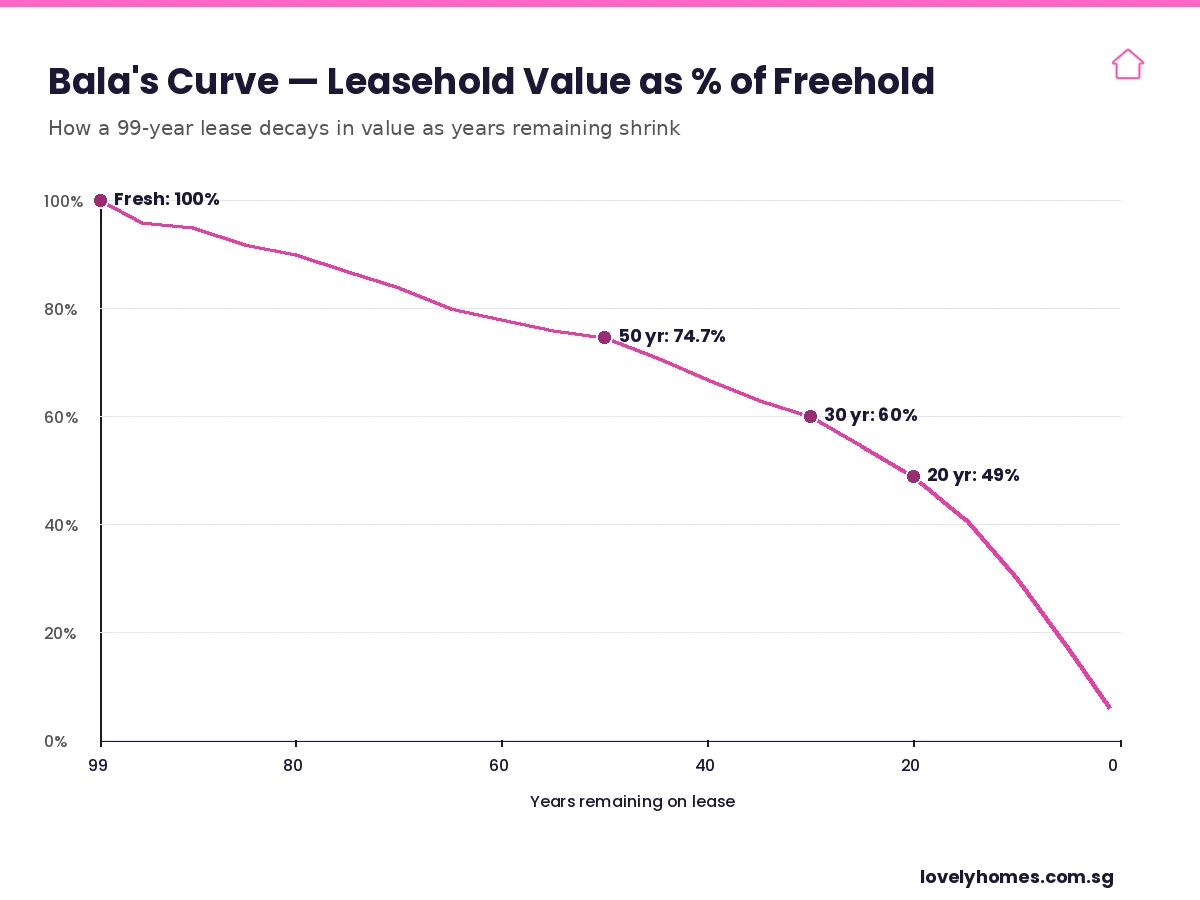
The single most important framework for understanding 99-year leasehold pricing is Bala’s Table (sometimes called Bala’s Curve, after Mr V K Balasubramaniam who developed it for the Singapore Land Authority in the 1990s). Bala’s Table sets out the value of a leasehold property as a percentage of its equivalent freehold value, indexed to the years remaining on the lease.

Bala's Curve Singapore — leasehold value as percent of freehold across 99 years remaining, non-linear depreciation
Figure 2: Bala’s Curve — non-linear lease decay across the 99-year lease. Steepest depreciation falls in the final 30 years.

Two features of the curve matter most:

  1. The depreciation is non-linear. A fresh 99-year lease is worth roughly the same as freehold — the curve sits at 100%. After 50 years remaining (i.e. ~half-life), value is still ~74.7% of freehold — a far gentler decay than the simple linear “halfway = 50%” intuition. The steep portion of the curve falls in the last 30 years, when value drops from ~60% (30 years remaining) to ~17% (5 years remaining).
  2. Bala’s Table is the floor, not the market. Real-world transactions rarely match the table exactly. Local demand, building condition, en-bloc potential, and lease topping-up rumours can push prices well above (or below) the Bala line. The table is what SLA uses to price lease top-ups and to convert tenure for tax purposes — not what the open market necessarily pays.

For a buyer, the practical implication is that the first 30–40 years of a 99-year lease behave very like freehold. A 99-year condo at TOP today is essentially “freehold for two generations”. The depreciation problem is real for buyers planning to hold past Year 60 or thinking about en-bloc redevelopment as the exit strategy.

The CPF and Financing Cliffs — When Lease Decay Starts to Bite

Bala’s Curve is the underlying valuation framework, but two regulatory cliffs determine when lease decay actually starts to hurt resale liquidity:

The CPF Usage Rules

CPF can be used in full only if the remaining lease covers the youngest buyer’s age plus 95 years. For a 35-year-old buying a property today, the remaining lease must be at least 60 years for full CPF use; otherwise CPF usage is pro-rated and capped. If the remaining lease is below 30 years, CPF cannot be used at all by your next buyer — which collapses the buyer pool to cash buyers only.

The Bank Financing Rules

Bank loan tenure cannot exceed (lease remaining minus a buffer; typically 5 years). If the remaining lease is below 40 years, banks will quote shorter loan tenures, lower LTVs, and higher rates — and some banks will decline outright. When this happens, your effective buyer pool narrows further.

Together, these two cliffs mean that the Bala’s Curve depreciation is amplified in the secondary market by liquidity contraction. A 40-year-remaining lease may be worth 67% of freehold in pure Bala terms, but the smaller buyer pool means actual transactions can clear at a steeper discount. This is why the “sweet spot” for selling a 99-year leasehold is usually before Year 50, not after.

Worked Example — 20-Year Hold, Same District, Same Specs

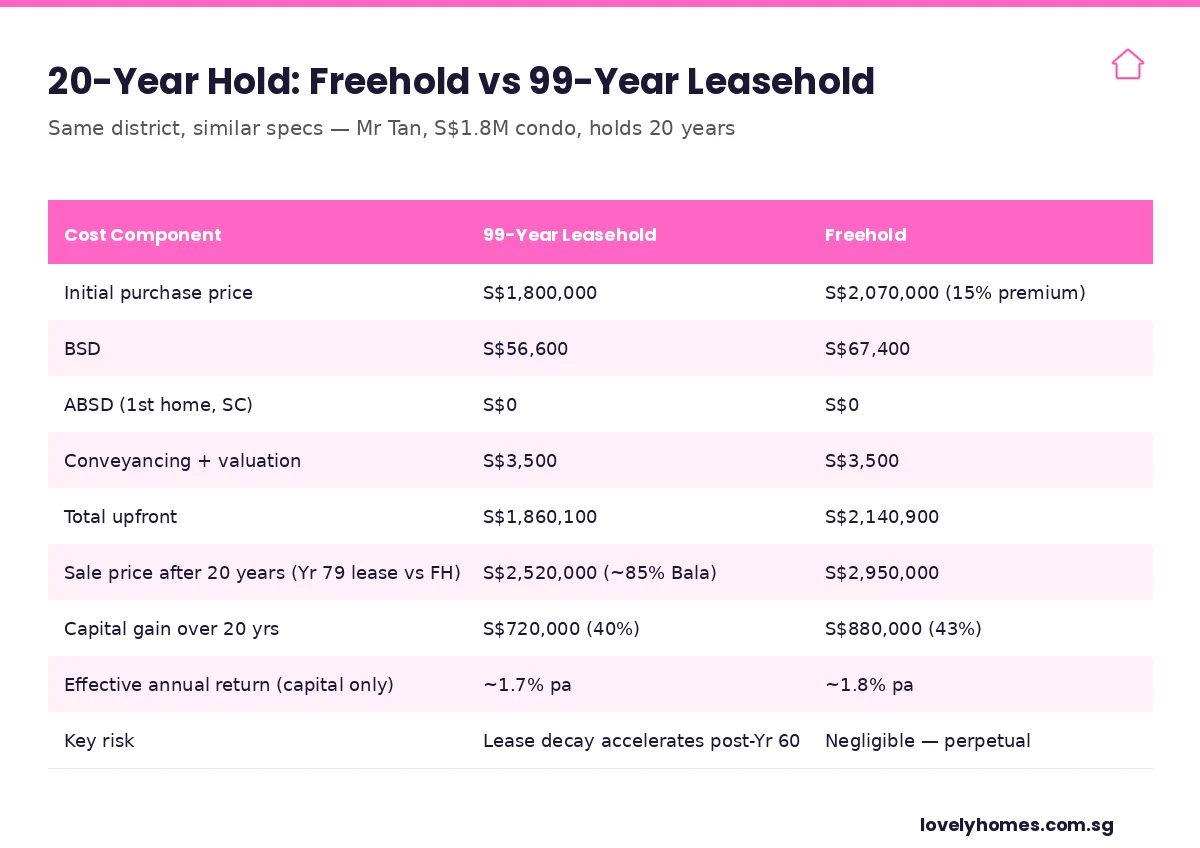
Let’s strip out emotion and compare on the maths. Mr Tan is 40, a Singapore Citizen first-time buyer. He is choosing between two condos in the same District 15 micro-market: a brand-new 99-year leasehold at S$1,800,000 and a 999-year (freehold-equivalent) unit at S$2,070,000 — a 15% freehold premium, which is roughly the historic norm. He plans to hold 20 years.

20-year hold cost stack freehold vs 99-year leasehold Singapore 2026 — S$1.8M condo identical district worked example
Figure 3: 20-year hold — freehold vs 99-year leasehold, identical-district worked example.
Cost / Outcome 99-Year Leasehold Freehold
Year 0 purchase price S$1,800,000 S$2,070,000
Year 0 BSD S$56,600 S$67,400
Year 0 ABSD (1st home, SC) S$0 S$0
Year 0 conveyancing S$3,500 S$3,500
Total upfront outlay S$1,860,100 S$2,140,900
Year 20 sale price (assume 2.0% pa district appreciation, freehold; leasehold capped at Yr 79 Bala factor ~92% of freehold) S$2,520,000 S$2,950,000
Capital gain S$720,000 (40%) S$880,000 (43%)
Effective annual return (capital only) ~1.7% pa ~1.8% pa
Return on incremental S$280,800 ~3.4% pa — the marginal freehold premium implies a ~3.4% annualised return on the extra capital tied up

The headline finding: in this worked example, the freehold buyer earns a ~3.4% annualised return on the extra S$280,800 tied up in the freehold premium — modest, and below typical bond returns. For a 20-year hold, the leasehold often comes out marginally ahead on a return-on-capital basis, especially if the freed-up capital can earn 4–5% in conservative investments.

Where the maths flips is at longer holding periods. Repeat the calculation across 40 years — with the leasehold now at Yr 59 remaining (~78% Bala) versus a still-perpetual freehold — and the freehold premium starts compounding strongly. By Year 50 of holding, the freehold has typically earned a meaningful spread.

When Freehold Wins, When Leasehold Wins

The framework most experienced Singapore buyers use is to match tenure to holding period and exit strategy:

  • Hold under 15 years: 99-year leasehold typically wins on return-on-capital. Lease decay is too gentle in this window to matter, and the freed-up capital can earn elsewhere. This is the typical short-to-medium hold investor case.
  • Hold 15–30 years: A toss-up. Outcome turns on (a) the actual freehold premium paid and (b) the district’s underlying appreciation rate. In high-growth districts, leasehold often wins; in slow-growth districts, the freehold premium does its job.
  • Hold 30+ years or multi-generational: Freehold wins. Lease decay enters its accelerating zone, and the freehold becomes a meaningfully stronger compounding asset. This is the family-legacy or trust-held case.
  • Buying for own-stay, expecting to en-bloc: Leasehold can win if the project has clear redevelopment upside (high plot ratio uplift, supportive URA zoning, agreeable owner mix). The collective sale becomes the “lease top-up” you couldn’t buy directly.
  • Buying for rental yield: Leasehold typically yields more — lower entry price for the same rent. Yield-focused investors generally prefer leasehold.

For a deeper read on holding-period maths and exit strategies, see our En-Bloc Sale Process Guide and our Seller’s Stamp Duty Singapore 2026 article, which together set out the cost of an early exit on either tenure.

What About Lease Top-Ups?

Owners and developers occasionally apply to SLA to top up a depleting lease — restoring it to a fresh 99 years for a payment based on the difference between the current and the topped-up value. The cost is calculated against Bala’s Table. In practice, lease top-ups are most often initiated as part of an en-bloc / collective sale, where the developer negotiates the top-up alongside the redevelopment approval.

An individual owner cannot reliably plan for a private top-up. The Government’s VERS (Voluntary Early Redevelopment Scheme), announced in 2018 for selected HDB precincts, is a separate framework from private leasehold top-ups and applies only to public-housing estates. There is no equivalent statutory framework for private leasehold properties — which means private leasehold owners cannot count on lease top-ups as part of their long-term plan.

What This Means for You

If you take only five things away from this guide, take these:

  1. Match tenure to holding period. Under 15 years, leasehold typically wins. Over 30 years, freehold typically wins. In between, run the maths on the actual freehold premium versus the capital-cost spread.
  2. Don’t pay more than ~15–20% premium for freehold. Above this, the maths almost never works for typical holding periods. Some new-launch freehold projects have asked for 25–30% premiums — treat those with caution.
  3. Watch the lease-remaining number when buying resale. 60 years is the CPF cliff for buyers in their late 30s. Below that, you start losing CPF eligibility for your next buyer — which compresses your exit price more than Bala’s Table would suggest.
  4. Check the lease commencement date carefully. A new-launch 99-year condo often has a lease that started 1–2 years before TOP, so a buyer at TOP only gets ~97–98 years remaining, not 99.
  5. If en-bloc is your exit strategy, leasehold can win. The collective-sale premium effectively converts the 99-year lease into a one-time cash payout that bypasses Bala’s Curve. But en-bloc success rates vary — do not assume your project will get there.

What Might Come Next

Three policy and market variables to watch in 2026–2027:

  • Bala’s Table revision. SLA last refreshed Bala’s Table several years ago. A revision — especially one that flattens the curve or pushes the steep zone closer to lease end — would mark up secondary leasehold values across the board. There is no current signal of revision in 2026.
  • Freehold premium compression. Several recent freehold launches have struggled to clear meaningful premiums over comparable leasehold launches in the same district. If this trend continues, the structural freehold premium may compress towards the 5–10% range, weakening the case for paying up.
  • VERS or analogous private-lease scheme. If the Government extends a VERS-style framework to private leaseholds (an idea floated occasionally by industry figures), the long-tail risk of holding past Year 60 reduces sharply — and the freehold premium loses some of its insurance value.

Frequently Asked Questions

Is freehold always better than leasehold?

No. Freehold is structurally lower-risk for very long holds (30+ years) and multi-generational holds. For shorter holds (under 15 years), the capital tied up in the freehold premium often earns a lower return than the same capital deployed elsewhere. The right answer depends entirely on your holding period.

What happens at the end of a 99-year lease?

The land reverts to the State. Owners typically receive no compensation unless a private collective-sale or a public scheme (e.g. VERS for HDB) intervenes earlier. In practice, almost every 99-year property in Singapore exits via en-bloc or major redevelopment well before the lease expires — full lease expiry is rare for residential land.

Can CPF be used for any leasehold property?

Only if the remaining lease covers the youngest applicant’s age plus 95. For full CPF withdrawal limits to apply, the lease must run at least to that age. Where the lease is shorter, CPF usage is pro-rated. Below 30 years remaining, CPF cannot be used at all by the next buyer.

How is Bala’s Curve different from straight-line depreciation?

Straight-line depreciation would assume the leasehold loses 1/99 of its value every year. Bala’s Curve recognises that the early years of a long lease have negligible depreciation (because the buyer pool is large and time-to-expiry is far away), while the final 20–30 years see steep depreciation (because financing and CPF rules compress the buyer pool sharply). Bala’s Table is non-linear and far more accurate for real-world pricing.

Are HDB flats freehold or leasehold?

All HDB flats are 99-year leasehold. The lease starts when the block is completed and the title issued. By the time most BTO buyers move in, the lease typically has between 96 and 99 years remaining. HDB resale flats from the 1970s and 1980s have far less remaining lease — some now under 60 years — which is why CPF eligibility for older HDB resale is increasingly tight.

Does freehold matter for rental yield?

Not really. Tenants pay for liveability, location and amenities — not for tenure. Rental yield is therefore a function of the lower entry price, which favours leasehold. Yield-focused investors typically prefer leasehold because the same rent against a lower entry price gives a higher gross yield.

Can I top up a 99-year lease privately?

An individual owner cannot reliably do so. SLA does process lease top-up applications, but they are typically in the context of an en-bloc / collective sale where the developer pays for the top-up as part of the redevelopment approval. A private owner asking SLA to extend their personal 99-year lease should not assume approval — nor should they assume the cost would be commercially reasonable.

Related Articles

Disclaimer: This guide is for general information only and does not constitute legal, tax, or financial advice. Bala’s Table and CPF / financing rules are administered by the Singapore Land Authority, the Central Provident Fund Board, and the Monetary Authority of Singapore respectively, and may be revised from time to time. Always verify the current position with the Singapore Land Authority, the CPF Board, and a licensed conveyancing lawyer before signing any Option to Purchase.

Translate »