Singapore MCST Guide 2026: Management Fees, Sinking Fund, By-Laws and Your Rights as a Condo Owner

Singapore MCST Guide 2026: Management Fees, Sinking Fund, By-Laws and Your Rights as a Condo Owner

Quick Answer: Singapore MCST and Condo Management 2026

  • MCST stands for Management Corporation Strata Title — the legal body that owns and manages common property in every privatised strata development in Singapore.
  • Management Council (MC) is elected by all unit owners at the Annual General Meeting (AGM) and is responsible for running the estate on their behalf.
  • Two statutory funds: the Management Fund (day-to-day operations) and the Sinking Fund (capital expenditure reserve, minimum 10% of total contributions under BMSMA).
  • Typical fees range from S$200–S$600/month for a 2–3 bedroom unit, depending on development size, facilities, and location.
  • By-laws are the rules governing unit owners’ rights and obligations — breach can result in fines of up to S$5,000 under the Building Maintenance and Strata Management Act (BMSMA).
  • Dispute resolution follows a clear pathway: raise with MC → formal complaint → Strata Titles Board (STB) mediation → STB Order (legally binding).
  • Legislation: the BMSMA (Cap. 30C) governs all strata management in Singapore, administered by the Building and Construction Authority (BCA).

What Is an MCST? The Legal Foundation of Condo Living

Every private strata development in Singapore — be it a condo, mixed development, or strata-titled commercial building — is governed by a Management Corporation Strata Title, commonly abbreviated as MCST. The MCST is not a service provider or a management company: it is a statutory body corporate created automatically by law when a strata development’s subsidiary strata certificates of title are issued. In plain terms, the moment you become a subsidiary proprietor (i.e., a unit owner) in a strata development, you automatically become a member of the MCST. You have voting rights, you share in the obligations, and you benefit from the management of common property.

The legal framework is the Building Maintenance and Strata Management Act (BMSMA), Chapter 30C of Singapore’s statutes. The BMSMA is administered by the Building and Construction Authority (BCA) under the Ministry of National Development (MND). It prescribes how MCSTs are constituted, how they manage funds, how by-laws are made and enforced, and how disputes are resolved. For buyers and investors, understanding the MCST is not optional — it directly affects your monthly costs, your rights in the estate, and your ability to renovate or use your unit.

The Management Council: Who Runs Your Condo?

The day-to-day affairs of the MCST are delegated to the Management Council (MC), a committee of elected subsidiary proprietors. Under BMSMA, the MC must have a minimum of 3 members and a maximum of 14, and council members must be unit owners (or nominees of corporate owners). The MC is elected at the AGM, which must be held within 15 months of the previous AGM.

The MC holds significant authority: it sets the annual budget, approves expenditure from both the Management Fund and Sinking Fund, engages and supervises the Managing Agent (MA), enforces by-laws, grants or denies renovation approvals, and represents the MCST in legal matters. In practice, the MC also exercises considerable informal authority over the day-to-day “feel” of an estate — how promptly maintenance issues are addressed, how strictly by-laws are enforced, how transparently accounts are reported to owners.

Most MCSTs engage a professional Managing Agent (MA) — a licensed company that handles operational tasks on the MC’s behalf, including maintenance scheduling, security rostering, contractor management, accounting, and AGM administration. The MA operates under a service contract and is accountable to the MC, not to individual unit owners. Disputes with the MA are resolved through the MC.

Management Fund and Sinking Fund: Your MCST Levies Explained

Every subsidiary proprietor pays monthly contributions (commonly called “maintenance fees”) to the MCST. Under BMSMA, these contributions are split between two statutory funds:

The Management Fund covers recurring operational costs: security services, cleaning, common area utilities (lifts, lighting, pool pumps), landscaping, insurance (fire and public liability), administration, audit fees, and routine minor repairs. Think of this as the MCST’s operating budget.

The Sinking Fund is a capital reserve for major future expenditure: lift overhauls, façade waterproofing, roof replacement, mechanical and electrical system replacements, pool refurbishment, road resurfacing, and similar major works. BMSMA requires that the Sinking Fund must receive contributions equivalent to at least 10% of the total contributions collected (i.e., at least one-tenth of the combined Management Fund and Sinking Fund contributions must go to the Sinking Fund). Most well-managed developments set a higher target — 25–35% of total contributions — to build an adequate reserve.
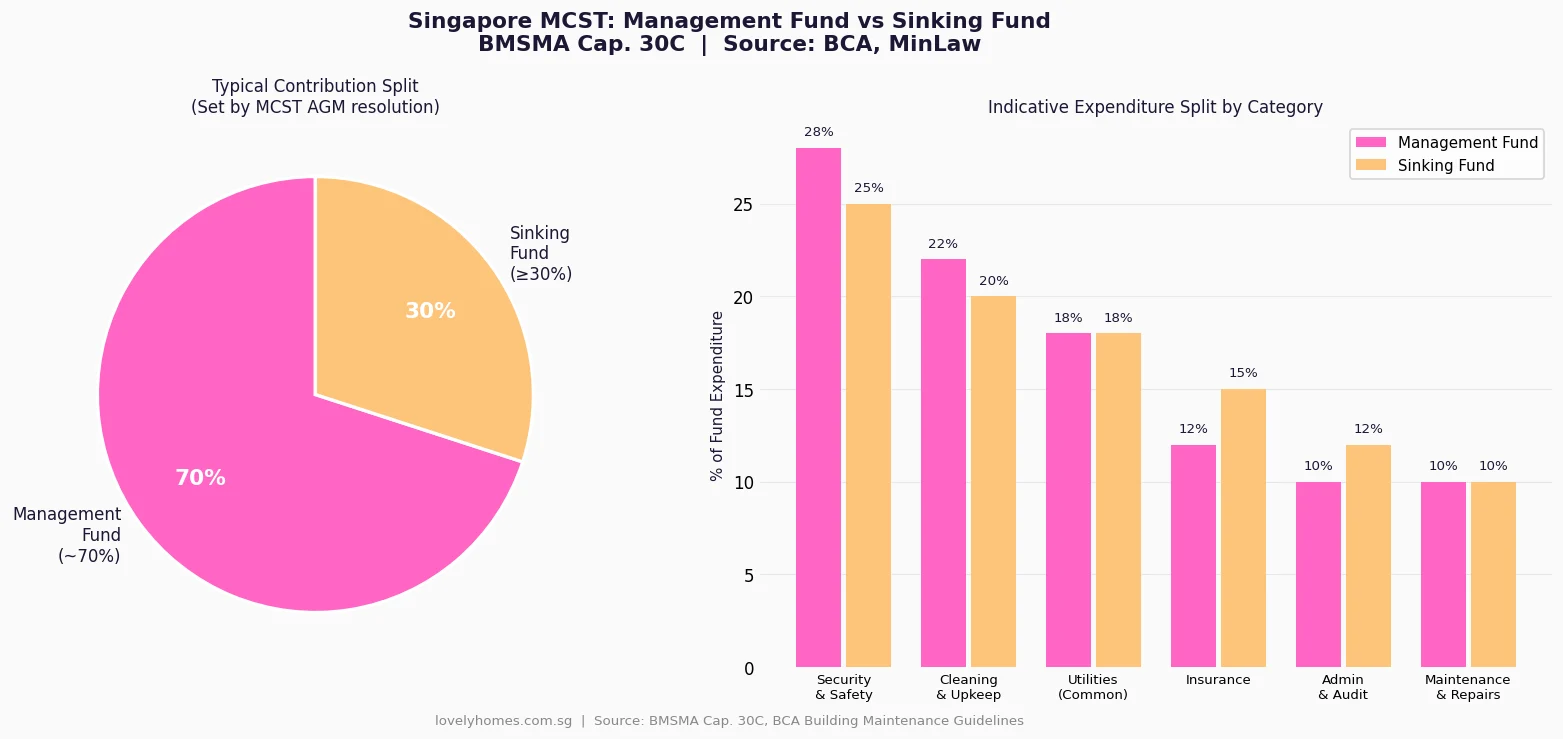
Singapore MCST management fund sinking fund breakdown BMSMA
Figure 1: MCST Management Fund vs Sinking Fund — Typical Contribution Split and Indicative Expenditure Categories. Source: BMSMA Cap. 30C, BCA Building Maintenance Guidelines.

Contributions are allocated per unit according to share values — a number assigned to each unit based on its area and type when the development is first surveyed. A larger unit typically carries a higher share value and pays a proportionately larger monthly contribution. Share values are fixed and cannot be changed without a unanimous resolution.

How Much Are MCST Fees? A Guide by Condo Type

MCST fees vary enormously across Singapore’s condo landscape. Key factors include the number of units in the development (more units spread fixed costs over a larger base, reducing per-unit fees), the range of facilities (pools, gyms, tennis courts, concierge all cost money to maintain), the age of the development (older buildings have higher maintenance costs), and the quality of financial management by the MC.
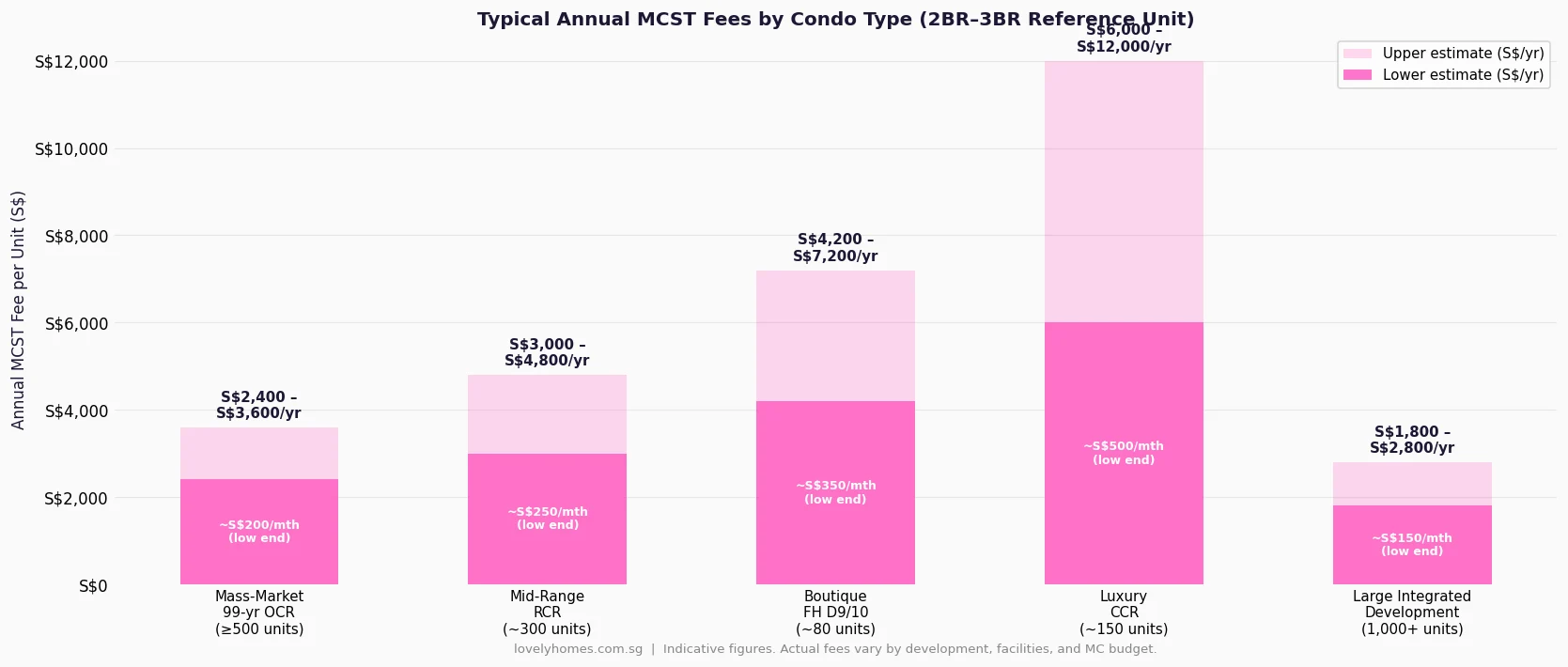
Singapore MCST annual fees by condo type 2026 indicative range
Figure 2: Indicative Annual MCST Fees per Unit by Condo Type (2BR–3BR Reference Unit), 2026. Figures are estimates based on typical fee structures; actual fees depend on each development’s budget.

As a general benchmark: a mass-market OCR condominium with 500 or more units and standard facilities (pool, gym, BBQ area) might charge S$200–S$300 per month for a 3BR unit. A mid-range RCR development with around 300 units and a fuller facility suite (multiple pools, function rooms, tennis court) might charge S$250–S$400 per month. A boutique freehold development in Districts 9 or 10 with 80 units and concierge services might charge S$350–S$600 or more per month — the smaller the development, the fewer units to share fixed costs.

Buyers should always request and study the MCST’s audited financial statements (particularly the Sinking Fund balance and adequacy ratio) before purchasing any resale unit. A development with an underfunded Sinking Fund is a red flag — owners will face either a special levy or deteriorating maintenance when major capital works are required.

By-Laws: The Rules of Strata Living

MCST by-laws govern the obligations and restrictions on subsidiary proprietors and their tenants and visitors. Singapore law establishes two tiers of by-laws. The Model By-Laws, set out in the Fourth Schedule of BMSMA, apply automatically to all strata developments and cover fundamentals: prohibiting nuisance to neighbours, keeping common areas clean, not obstructing stairways and corridors, maintaining smoke and cooking fumes within units, and not damaging common property.

Developments may additionally pass additional by-laws by ordinary resolution at an AGM. These can cover matters such as pet policies (breed or size restrictions), short-term rental rules (many condos have by-laws restricting Airbnb-style rentals to a minimum 3-month or 6-month tenancy), renovation hours and noise restrictions, car park allocation rules, and use of facilities. Critically, additional by-laws cannot override the BMSMA or conflict with it — a by-law purporting to ban all pets entirely, for example, may be challengeable as unreasonable.

Breach of by-laws can result in fines of up to S$5,000 per breach under BMSMA, imposed by order of the Strata Titles Boards (STB). In practice, MCSTs typically issue written warnings first; formal enforcement action is reserved for persistent or serious breaches.

Renovation Approvals: What You Need the MCST’s Permission For

If you own a strata unit, you generally have the right to carry out renovation works within your unit, subject to certain approvals and restrictions. Works that affect common property — balcony modifications, structural walls that may be shared, roof access, plumbing in common risers — require MCST approval in addition to any Building and Construction Authority (BCA) or Urban Redevelopment Authority (URA) permits. Internal reconfigurations (knocking down non-structural internal walls, replacing flooring, kitchen refits) typically do not require MCST approval but must comply with time and noise restrictions in the by-laws.

A common area of confusion is the aircon ledge and balcony enclosure. These are typically common property, meaning any modification (enclosing, expanding, adding screens) requires MCST approval. Unauthorised enclosures are one of the most frequent by-law enforcement issues in Singapore condominiums. Always confirm with the MC in writing before commencing any works that touch external walls, balconies, or roof areas.

Summary: Key MCST Rules at a Glance

Topic Rule / Key Point Legislation / Source
MCST formation Automatically formed when strata title issued; all unit owners are members BMSMA s. 29
Management Council size 3–14 members elected at AGM; must be unit owners or nominees BMSMA s. 53
AGM frequency Must be held annually; not more than 15 months since last AGM BMSMA s. 27
Sinking Fund minimum At least 10% of total contributions; MC can set higher target BMSMA s. 38
By-law breach fines Up to S$5,000 per breach, by STB order BMSMA s. 32
Common property works Require MCST written consent; MC can set conditions BMSMA s. 37
Dispute resolution STB mediation → STB Order → High Court appeal (law only) BMSMA Part VI
Quorum for ordinary resolution ≥30% of total share values represented at a general meeting BMSMA s. 75
Pets Governed by by-laws; model by-laws do not prohibit pets; additional by-laws may impose restrictions BMSMA 4th Schedule
Short-term rentals Permitted subject to by-laws and URA regulations; many MCSTs have by-laws requiring minimum 3–6 month tenancy URA guidelines

Worked Example: Mr Tan’s S$9,000 Balcony Dispute

Mr Tan owns a 3BR unit in a mid-range RCR condominium. His balcony faces a pleasant courtyard and he wishes to enclose it with floor-to-ceiling glass panels to create a larger living area. He proceeds without MCST consent and engages a contractor who completes the works over two weekends.

The MC sends a formal notice of breach under the by-laws: the balcony is common property under the strata plan, and any modification requires prior written MCST approval. The MC orders the works to be removed at Mr Tan’s expense within 30 days. Mr Tan disputes this — he argues the panels are removable and he is not damaging the building.

The MC applies to the Strata Titles Boards (STB) for an order requiring reinstatement. At mediation, the STB mediator helps both parties reach a compromise: Mr Tan may retain the glass enclosure provided it is a fully removable system (no drilling into structural walls), an engineer certifies it does not affect load-bearing elements, and he pays a S$500 administrative fee to the MCST. Without compromise, a formal STB Order could have required full reinstatement at an estimated cost of S$8,000–S$12,000 in contractor fees, plus a potential fine of up to S$5,000.

Lesson: always obtain MCST written approval before any works touching common property. The cost of a dispute far exceeds the inconvenience of applying in advance. For guidance on tenant-related strata disputes, see our Rental Tenant Rights Guide 2026.

Dispute Resolution: The Strata Titles Boards (STB)

When a dispute arises between a subsidiary proprietor and the MCST (or between two unit owners about strata matters), Singapore provides a dedicated tribunal: the Strata Titles Boards (STB), established under BMSMA and administered by the Ministry of Law (MinLaw). STB proceedings are designed to be accessible and affordable — filing fees are modest, legal representation is optional, and the process is less adversarial than court litigation.

Common STB applications include: orders requiring the MCST to carry out maintenance works; disputes about by-law enforcement or breach penalties; objections to special levies; disputes about the allocation of car park lots; and applications to invalidate decisions made at AGMs where proper notice was not given. The STB first attempts mediation — parties meet with a mediator in a structured session. If mediation fails, the STB constitutes a formal hearing panel, receives evidence, and issues an Order. STB Orders are legally binding and enforceable in the courts. Appeal lies to the High Court, but only on questions of law.
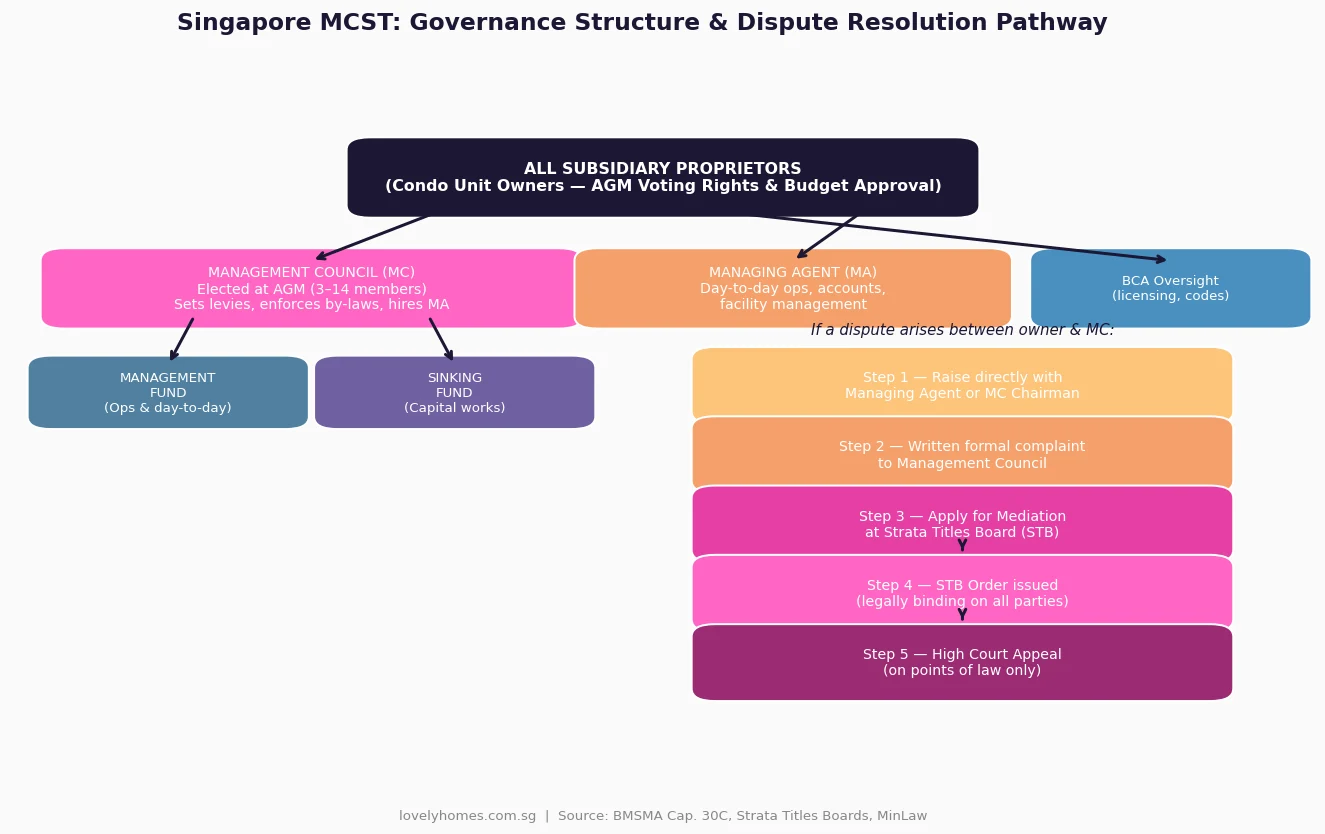
Singapore MCST governance structure dispute resolution pathway STB BMSMA
Figure 3: Singapore MCST Governance Structure and Dispute Resolution Pathway — from unit owners through Management Council to Strata Titles Boards. Source: BMSMA Cap. 30C, MinLaw.

What Might Change: BMSMA Review and Future Reforms

The BMSMA was comprehensively amended in 2010 and has been updated periodically since. BCA periodically reviews strata management regulations in response to industry feedback and changing market conditions. Areas of ongoing discussion as at mid-2026 include: tightening rules on managing agents’ qualifications and licensing; improving transparency of MCST financial reporting to unit owners; and clarifying the rules on short-term rental by-laws in the context of Singapore’s broader short-term rental regulatory framework. Buyers should monitor BCA and MinLaw announcements for any legislative updates that might affect their rights and obligations as condo owners.

Frequently Asked Questions About Singapore MCSTs

Can the MCST increase maintenance fees without my consent?

Yes. The Management Council has the authority to set the annual budget and the contribution amounts (maintenance fees) required from each unit owner, subject to approval at the AGM by ordinary resolution. An ordinary resolution requires a simple majority of votes cast (by share value) at a general meeting. If you disagree with a fee increase, you can vote against it at the AGM or requisition an extraordinary general meeting to challenge it. Practically speaking, however, fee increases are usually incremental and reflect genuine cost increases — MCSTs that chronically underfund their budgets end up with deteriorating estates and greater special levy calls down the line.

What is a special levy and when can the MCST impose one?

A special levy is a one-time additional contribution imposed on all unit owners to fund a specific capital expenditure that has arisen unexpectedly or that the Sinking Fund is insufficient to cover. Common triggers include emergency structural repairs, lift replacements ahead of schedule, or the costs of defending the MCST in legal proceedings. Under BMSMA, a special levy must be approved by ordinary resolution at a general meeting. The amount allocated to each unit is based on share value. Special levies are a red flag in developments that have historically underfunded their Sinking Fund — which is why buyers should always check the Sinking Fund balance and recent spending history before purchasing a resale unit. A healthy Sinking Fund protects against special levies.

What happens if I stop paying my MCST fees?

Unpaid MCST contributions are a debt owed to the MCST. Under BMSMA, the MCST has a statutory lien over your unit for unpaid contributions — it can register this lien with the Singapore Land Authority (SLA) and ultimately pursue recovery through the courts. If you are selling your unit, solicitors acting on the sale will identify any outstanding MCST arrears, which must be settled before completion. Persistent non-payment can also result in the MCST applying to the STB for enforcement orders. There is no grace period prescribed in law, though most MCSTs will issue demand letters before proceeding to formal enforcement action.

Can I attend an AGM and vote even if I have outstanding MCST fees?

Under BMSMA, unit owners who are in arrears of contributions may be denied the right to vote at a general meeting. Specifically, a subsidiary proprietor is not entitled to vote at any general meeting if any contribution payable in respect of their lot has been in arrears for more than 30 days before the date of the meeting. You retain the right to attend and speak, but you lose voting rights until the arrears are cleared. This is an important incentive for timely payment, particularly for contentious AGM resolutions such as special levies or managing agent contract renewals.

My neighbour is violating the condo by-laws — what can I do?

The primary enforcement mechanism for by-law breaches is through the MCST, not individual unit owners. You should first report the breach in writing to the Managing Agent or Management Council, providing clear details (date, nature of breach, evidence where available). The MC has the authority and obligation to investigate and take enforcement action. If the MC fails to act on a legitimate complaint, you can raise the matter at the AGM or requisition an extraordinary general meeting. As a last resort, you may apply to the STB directly under BMSMA section 111 for an order requiring the MC to take enforcement action. The STB process is designed to be accessible — you do not need a lawyer to file an application.

Can I rent out my condo unit on Airbnb or short-term rental platforms?

Short-term rental of private residential properties in Singapore is regulated by URA under its Short-Term Accommodation (STA) Framework. As at 2026, private residential properties listed for short-term rental must meet URA’s requirements, including a minimum rental period of three consecutive months per tenant. Many MCSTs additionally pass by-laws imposing their own minimum tenancy periods or restricting short-term rentals entirely within their estates. You should check both URA’s current STA guidelines and your specific development’s by-laws before listing your property. Breach of URA regulations can result in fines, and breach of MCST by-laws can result in STB enforcement. For the rental rules from the tenant’s perspective, see our Singapore Rental Tenant Rights Guide 2026.

I want to buy an en bloc / collective sale — how does the MCST factor in?

In an en bloc (collective sale), the MCST plays a key administrative role but does not initiate or block the sale. The en bloc process is governed by the Land Titles (Strata) Act (LTSA), not BMSMA. Owners seeking a collective sale form a collective sale committee (CSC), separate from the MC. The CSC must obtain consent from subsidiary proprietors holding 80% of total share value (for developments over 10 years old) or 90% (for developments under 10 years old) before applying to the STB for a sale order. Dissenting owners can file objections with the STB. The MC continues to manage the estate throughout the en bloc process, including collecting maintenance fees and addressing day-to-day repairs, until the sale is completed and the strata title scheme is wound up.

Related Articles

Disclaimer: This article is for general informational purposes only and does not constitute legal, financial, or property advice. Information on BMSMA provisions is based on the Act as at June 2026; amendments may occur — readers should verify against the current statutes at sso.agc.gov.sg and consult the Building and Construction Authority (bca.gov.sg), the Strata Titles Boards (mlaw.gov.sg/strata-titles-boards), or a qualified lawyer for advice specific to their strata development and circumstances.

Singapore Condo Sinking Fund and Maintenance Fee Guide 2026: What Every Owner Needs to Know

Singapore Condo Sinking Fund and Maintenance Fee Guide 2026: What Every Owner Needs to Know

When Singaporeans talk about the monthly cost of owning a condominium, they usually quote the mortgage repayment. What often gets overlooked — until the first few months after moving in — are the maintenance fee and sinking fund levy: two mandatory monthly contributions that every strata-titled condo owner must pay to the Management Corporation Strata Title (MCST). Together, these can add S$300 to S$1,200 per month to the cost of condo ownership, and failing to pay them has real legal consequences. This guide explains exactly what these charges are, how they are set, what they pay for, and how to plan for them when buying a condo in Singapore.

Quick Answer — Condo Fees at a Glance

  • Maintenance fee: monthly contribution for day-to-day estate running costs (security, cleaning, utilities, landscaping).
  • Sinking fund levy: monthly contribution to a reserve for major capital expenditure (lift replacement, roof waterproofing, facade repainting).
  • Both are collected by the MCST, the legal body representing all owners in a strata development.
  • Contributions are set at the Annual General Meeting (AGM) based on unit share value — larger units pay more.
  • Typical total condo fee (maintenance + sinking fund): S$300–S$1,200/month, depending on development size, age, and facilities.
  • The sinking fund must be maintained at a minimum of 10% of the preceding year’s management fund under the BMSMA.
  • Non-payment can result in MCST filing a court order against the owner. There is no grace period in law.
  • Governed by the Building Maintenance and Strata Management Act (BMSMA), administered by the Commissioner of Buildings (COB) under HDB.

What Is the MCST and Who Sets the Fees?

Every strata-titled development in Singapore — from a two-unit walk-up to a 1,000-unit mega-project — is governed by a Management Corporation Strata Title (MCST). The MCST is a body corporate constituted automatically when the strata title plan is registered with the Singapore Land Authority (SLA). It has its own legal personality: it can sue, be sued, hold property, and enter contracts.

The MCST is governed by a Management Council, elected by subsidiary proprietors (owners) at the AGM. The Council sets annual budgets for two distinct funds: the Management Fund (covering day-to-day operations) and the Sinking Fund (covering capital expenditure). Individual owner contributions to each fund are proportional to their unit’s share value — an integer assigned to each lot at the time of development based on floor area and usage. A 1,500 sqft unit might have a share value of 10; a 600 sqft studio might have a share value of 5. Your monthly levy is therefore your unit’s share value divided by the total share values of all units in the development, multiplied by the total annual budget for that fund, divided by 12.

The legal framework governing all of this is the Building Maintenance and Strata Management Act (BMSMA), Cap. 30C. Key rules include: the sinking fund must hold at least 10% of the management fund budget; the MCST must prepare audited accounts annually; and owners who are in arrears can have their contribution recovered as a civil debt.

Feature Management Fund Sinking Fund
Purpose Day-to-day operations Long-term capital expenditure reserve
Examples of use Security, cleaning, gardening, utilities Lift replacement, waterproofing, facade repainting
BMSMA minimum No statutory minimum set Must equal at least 10% of management fund budget
Planning horizon Annual (reset each year) Cumulative — builds over time; does not reset
Typical monthly levy S$200–S$1,200 (varies by unit size) S$30–S$200 (10–15% of management fee)
Recoverable on sale? No — stays with MCST No — stays with MCST

Maintenance Fee — What It Covers

The maintenance fee (sometimes called the management fee or conservancy charge) finances the Management Fund, which covers the development’s recurring, day-to-day operating costs. These typically include:

Security services (24-hour guardpost, patrols, CCTV monitoring), cleaning and housekeeping of common areas, landscaping and horticultural maintenance, utility bills for common area lighting and lifts, pool and gymnasium upkeep (water treatment, equipment servicing), insurance for the building fabric and common property, property management agent fees, and routine maintenance and minor repairs. For luxury developments with concierge services, valet parking, or hotel-grade amenities, the management fund also covers these premium services — which is why fees in such projects can reach S$900+ per month for a large unit.

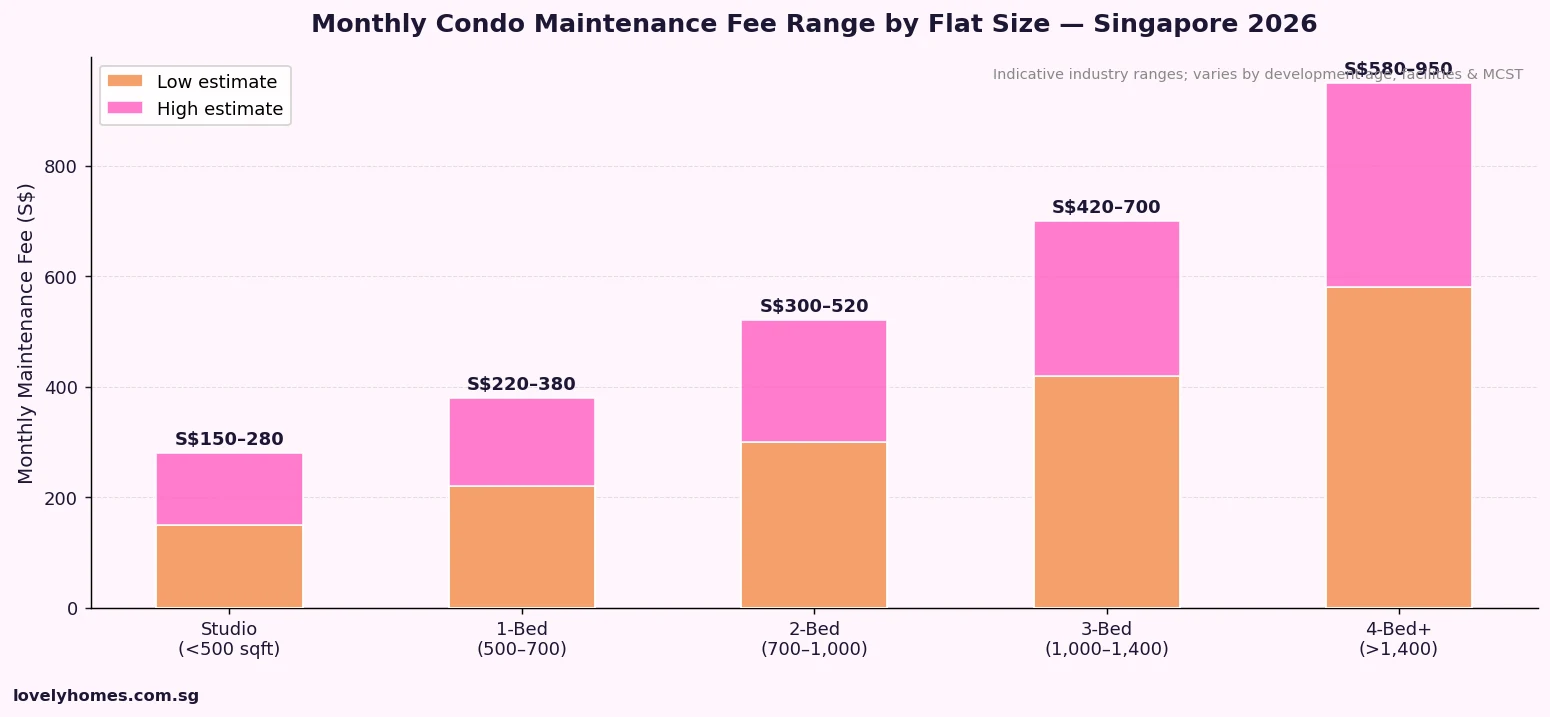
Monthly condo maintenance fee range by flat size Singapore 2026
Figure 1: Indicative monthly maintenance fee range by unit size — Singapore private condominium 2026. Actual amounts vary by development age, facilities, and MCST budget.
Unit Size Typical Monthly Maintenance Fee Key Variables
Studio / 1-bed (<500–700 sqft) S$150–S$380 Older projects, fewer facilities: lower end
2-bedroom (700–1,000 sqft) S$300–S$520 Most common resale condo bracket
3-bedroom (1,000–1,400 sqft) S$420–S$700 City-fringe projects with full facilities
4-bed / large unit (>1,400 sqft) S$580–S$950 CCR luxury projects at high end
Penthouse / duplex (>2,000 sqft) S$900–S$1,500+ Top-tier city projects, concierge, valet

Sinking Fund — What It Covers and Why It Matters

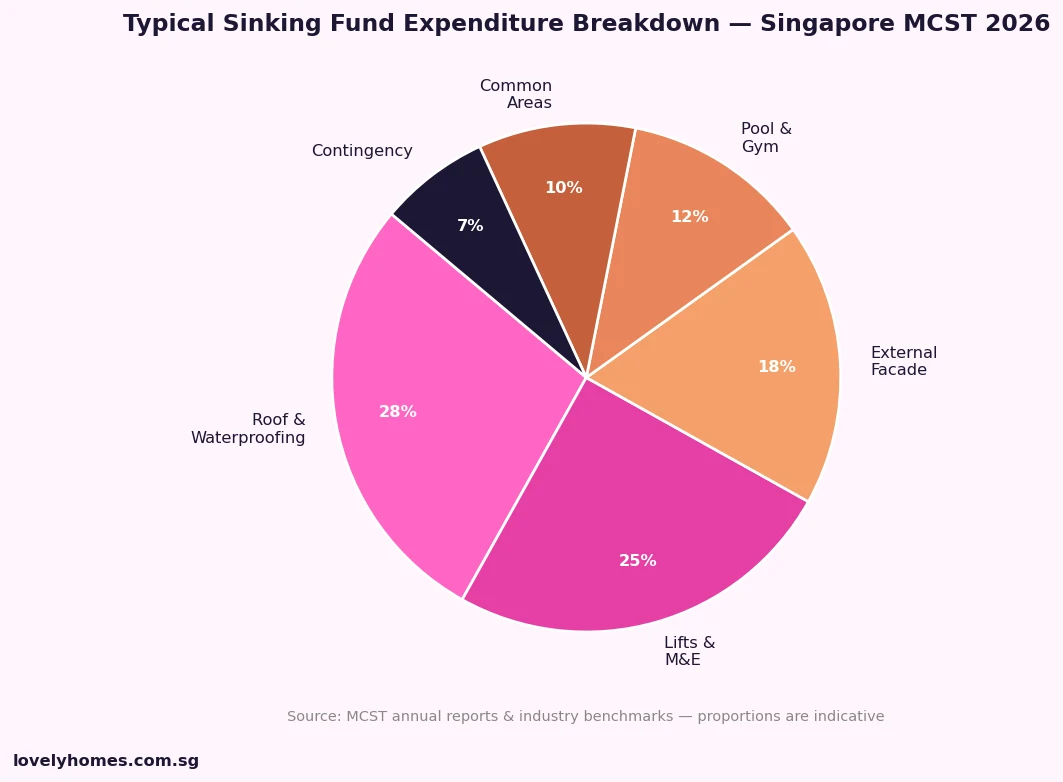
The sinking fund is a long-term capital reserve. Where the management fund covers ongoing operating costs, the sinking fund accumulates money for expenditure that is infrequent but extremely expensive — the kind of expenditure that cannot be funded from a single year’s management budget without creating a financial crisis for the MCST. Examples include: full lift replacement (typically every 20–25 years, S$200,000–S$500,000 per lift), external facade repainting (every 5–7 years for projects with extensive external surfaces), roof waterproofing membrane replacement, major mechanical and electrical (M&E) infrastructure overhaul, and swimming pool resurfacing.

Singapore condo MCST sinking fund expenditure breakdown pie chart 2026
Figure 2: Typical sinking fund expenditure allocation by category — Singapore MCST 2026. Proportions vary significantly by development age and building system profile.

The BMSMA requires the sinking fund to be maintained at a minimum of 10% of the preceding year’s management fund amount. In practice, well-managed MCSTs maintain a sinking fund that is a multiple of this minimum — particularly for older developments approaching major capital expenditure cycles. A prudent MCST will commission a 5-year capital expenditure plan and set sinking fund contributions accordingly. Buyers of older condos (15+ years old) should always ask for the current sinking fund balance and the 5-year capex plan before purchasing, as a depleted sinking fund may result in a special levy — a one-time extraordinary contribution demanded of all owners to fund urgent repairs.

Worked Example — Monthly Fees for a 3-Bedroom Condo in Clementi

Mr and Mrs Tan are purchasing a 1,100 sqft 3-bedroom resale condominium in Clementi (District 5) for S$1,580,000. The development has 320 units, was built in 2008, and has a shared value allocation of 8 for their unit. Total share values across all units sum to 2,240. The MCST’s annual budgets are: Management Fund S$1,680,000; Sinking Fund S$210,000.

Item Calculation Monthly Amount
Management Fund contribution (8 ÷ 2,240) × S$1,680,000 ÷ 12 S$500
Sinking Fund contribution (8 ÷ 2,240) × S$210,000 ÷ 12 S$62.50
Total monthly MCST levy S$562.50

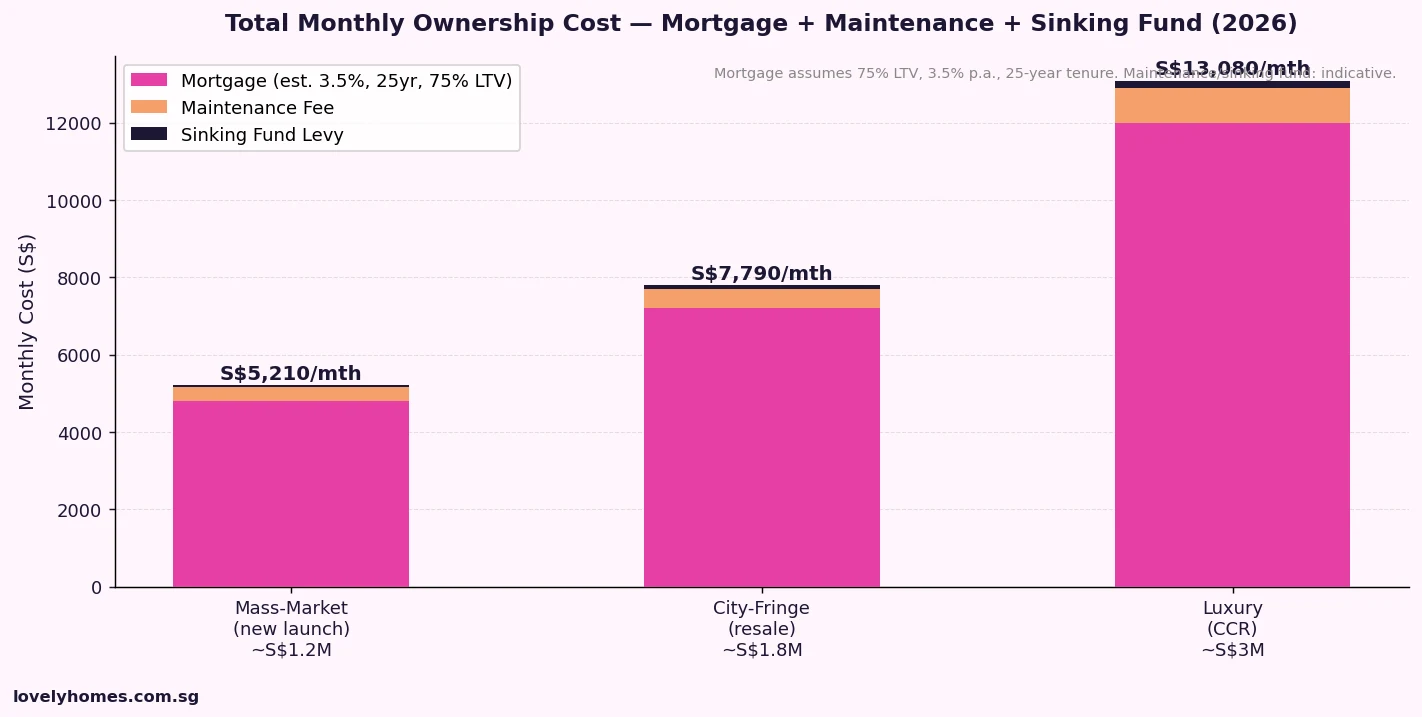
On top of this, the Tans’ estimated monthly mortgage repayment on a bank loan of S$1,185,000 (75% LTV) at 3.5% over 25 years is approximately S$5,926. Their total monthly ownership cost is therefore approximately S$6,488. When running TDSR calculations, the bank will factor in the maintenance fee as a financial commitment — check with your mortgage adviser on how this is treated.

Total Monthly Ownership Cost — Mortgage, Maintenance and Sinking Fund

Total monthly condo ownership cost Singapore 2026 — mortgage plus maintenance fee plus sinking fund
Figure 3: Estimated total monthly cost of owning a condo at three market segments — Singapore 2026. Mortgage assumes 75% LTV, 3.5% p.a., 25-year tenure.

What Happens If You Don’t Pay?

MCST contributions are not optional. Under Section 40 of the BMSMA, unpaid contributions (whether management fund or sinking fund) are a debt recoverable by the MCST in the same way as any civil debt. The MCST can file a Magistrate’s Court claim for outstanding amounts and, if judgment is obtained, apply for enforcement including attachment of the owner’s bank accounts or garnishment of rental income. The MCST also has the right to charge interest on late contributions at a rate fixed in its by-laws (commonly 10–12% per annum).

For landlords renting out their unit, unpaid MCST contributions remain the owner’s liability — not the tenant’s. If a seller has outstanding arrears at the point of property transfer, the arrears must be settled before the strata certificate of title is transferred. In practice, the conveyancing lawyers for both sides will conduct an MCST search to confirm that no arrears exist before completion.

Checking Sinking Fund Health Before You Buy

Before committing to a resale condo purchase, particularly in an older development, always request the following from the seller’s lawyers or directly from the MCST:

The current sinking fund balance (a healthy reserve is generally more than 3× the annual sinking fund budget); the 5-year capital expenditure plan (if available — well-run MCSTs have one); any pending special levies that have been voted on at an AGM but not yet collected; and the MCST financial statements for the past two years. A development with a healthy sinking fund and a documented capital plan is significantly lower risk than one that is underfunded and approaching major lift or roof works. In the latter case, you may be buying into an imminent S$10,000–S$50,000 special levy per unit.

What This Means for Condo Buyers in 2026

Condo maintenance fees have risen materially over the past three years, driven by higher labour costs for security and cleaning personnel, increased utility tariffs, and the generally higher cost of building materials for maintenance works. Industry data suggests average maintenance fees in mass-market condos have increased by 10–20% since 2022. For buyers underwriting their total monthly cost of ownership, this trend means that the maintenance fee is no longer a rounding error — it is a genuine budget line item that deserves the same scrutiny as the mortgage rate.

For investment buyers, maintenance fees directly affect net rental yield. A S$4,500/month rental on a unit with S$600/month in MCST fees represents a net operating yield (before mortgage) of about 3.2% on a S$1.5 million purchase — meaningful compression compared to the gross yield of 3.6%. Understanding and modelling the net yield after maintenance and sinking fund is essential for any investment analysis.

What Might Come Next

The COB has been increasingly attentive to poorly managed MCSTs. In 2024, the Building and Construction Authority (BCA) and COB jointly issued updated guidance on sinking fund adequacy, pushing MCSTs toward more rigorous 5-year planning. There is also ongoing discussion in the property management industry about whether the statutory minimum sinking fund (10% of management fund) is adequate for older developments — some practitioners argue it should be raised to 15–20% for projects over 20 years old. If such a change were legislated, monthly sinking fund levies would rise accordingly. Buyers of properties approaching their 15–20 year mark should factor in this regulatory risk.

Frequently Asked Questions

Can the management fee change from year to year?

Yes. The MCST Council proposes the annual budget at each AGM, and subsidiary proprietors vote on it. If costs have risen — for example, because security guard wages have increased or a landscaping contract was renewed at a higher rate — the management fee will be adjusted upward. Conversely, if the MCST finds cost savings, fees can decrease. In practice, fees rarely decrease; they tend to rise gradually with inflation. Buyers should ask for the last three years of AGM minutes to understand the fee trajectory of any development they are considering purchasing.

What is a special levy and when can the MCST charge one?

A special levy is an extraordinary, one-time contribution that the MCST can demand from all owners to fund urgent capital expenditure that cannot be covered by the existing sinking fund balance. Special levies require approval by a resolution at a general meeting (either an AGM or an Extraordinary General Meeting). They are most common in older developments where the sinking fund is under-provisioned and a major repair (such as lift replacement or waterproofing) is overdue. Special levies can range from S$5,000 to S$50,000 per unit depending on the size of the development and the scope of work. For this reason, checking the sinking fund balance before purchasing is critical.

Do maintenance fees apply to Executive Condominiums (ECs)?

Yes. Executive Condominiums are privately managed after the 10-year mark and are subject to the same BMSMA rules as private condominiums. During the initial period when HDB retains certain oversight, the management corporation is still constituted and maintenance fees apply from the date of key collection. EC buyers should budget for maintenance fees in the same way as any private condo buyer. EC maintenance fees are often somewhat lower than comparable private condos because ECs are typically built without the premium facilities found in luxury private developments, but the difference is not dramatic for mass-market comparisons.

Can landlords pass maintenance fees on to tenants?

In Singapore’s private residential tenancy market, there is no legal prohibition on a landlord including maintenance fees in the rent (i.e., charging a gross rent inclusive of the condo fee). In practice, however, most residential leases are structured on a net basis — the landlord pays the MCST contributions from the rental income and quotes the rent as an all-in figure. Some tenancy agreements explicitly state that maintenance fees are the landlord’s responsibility. Whatever the arrangement, the legal obligation to pay the MCST remains with the owner — the MCST cannot pursue the tenant for arrears.

How does share value affect my monthly levy?

Share value is a fixed integer assigned to each lot in the strata title plan at the time of development. It is broadly proportional to floor area but is also influenced by unit type and usage. A larger unit will have a higher share value and therefore pay a proportionally higher monthly levy. Share value cannot be changed by the MCST — it is set in the strata plan lodged with SLA and can only be altered by a unanimous resolution of all subsidiary proprietors followed by an amendment to the strata plan. Before buying, you can find out a unit’s share value by requesting the strata title plan from the developer, property agent, or MCST.

Is the sinking fund transferable when I sell?

No. The sinking fund belongs to the MCST, not to any individual owner. When you sell your unit, the accumulated sinking fund contributions you have made over the years remain with the MCST for the benefit of the development as a whole. You do not receive a refund of your share of the sinking fund balance on completion of sale. This is one reason why buying into a development with a healthy, well-funded sinking fund is in your interest even if you plan to sell within a few years — the sinking fund supports the quality of the common property, which in turn supports property values.

Where can I find out the exact maintenance fee before I buy?

For new launch condominiums, the developer is required to provide an estimated monthly maintenance fee in the sales documentation. For resale condos, the actual fee is best confirmed by requesting a copy of the latest MCST notice of contribution (which sets out the monthly levy per share value) or by asking the seller’s lawyer to conduct an MCST search. The MCST search will confirm the contribution rate, any arrears on the specific unit, and the sinking fund balance. This search is a standard step in any Singapore property conveyancing and costs approximately S$150–S$200.

Related Articles

Disclaimer: This article is for general informational and educational purposes only and does not constitute legal, financial, or property management advice. MCST contribution rates, sinking fund balances, and BMSMA requirements are subject to change and vary by development. Always verify actual maintenance fees with the relevant MCST, confirm current statutory requirements with the Commissioner of Buildings (HDB Strata Management portal), and obtain independent legal and financial advice before purchasing any property. LovelyHomes is not a licensed property management, legal, or financial advisory firm.

Strata Living in Singapore 2026: MCST, Sinking Fund & Condo Management — Complete Guide

Strata Living in Singapore 2026: MCST, Sinking Fund & Condo Management — Complete Guide

Quick Answer: Strata Living Key Facts

  • Every private residential condominium and flat development in Singapore with 3 or more units is governed by the Building Maintenance and Strata Management Act (BMSMA), administered by the Building and Construction Authority (BCA).
  • A Management Corporation Strata Title (MCST) is the legal body comprising all subsidiary proprietors (unit owners) that manages the common property.
  • All owners pay monthly contributions to two mandatory funds: the Management Fund (day-to-day operations) and the Sinking Fund (long-term capital work), proportional to their share value.
  • The Sinking Fund contribution must be at least 10% of the Management Fund contribution — BCA may require higher percentages for ageing developments.
  • A Management Council of 3–14 elected members runs the MCST between Annual General Meetings (AGMs). Owners are entitled to attend all AGMs and vote on motions.
  • Disputes between unit owners or between owners and the MCST are heard by the Strata Titles Board (STB) — a specialist tribunal under the Ministry of Law.
  • Singapore’s building stock is ageing: the BCA’s Building Condition Rating system and upcoming BMSMA amendments are expected to raise maintenance standards and minimum sinking fund requirements.

Introduction: What Is Strata Living?

When you purchase a private condominium unit or a strata-titled flat in Singapore, you own two things simultaneously: your individual unit (your strata lot), and a proportionate share in the development’s common property — the swimming pool, gymnasium, lobbies, lifts, car park, security systems, and landscaping that all residents share. This shared ownership model is called strata title, and it comes with both rights and obligations that every condo owner must understand.

The governance framework for strata living in Singapore is prescribed by the Building Maintenance and Strata Management Act (BMSMA), first enacted in 2004 and significantly amended in 2017. The BMSMA creates a corporation — the MCST — the moment a strata development is registered. From that point, the MCST is the legal owner of the common property and has the power to levy charges, enter into contracts, and enforce by-laws.

With over 4,000 registered MCSTs in Singapore as of 2026 (BCA data), and tens of thousands of condo owners paying monthly contributions, understanding how strata management works is no longer optional knowledge — it is essential for anyone who owns, buys, or rents in a private residential development.

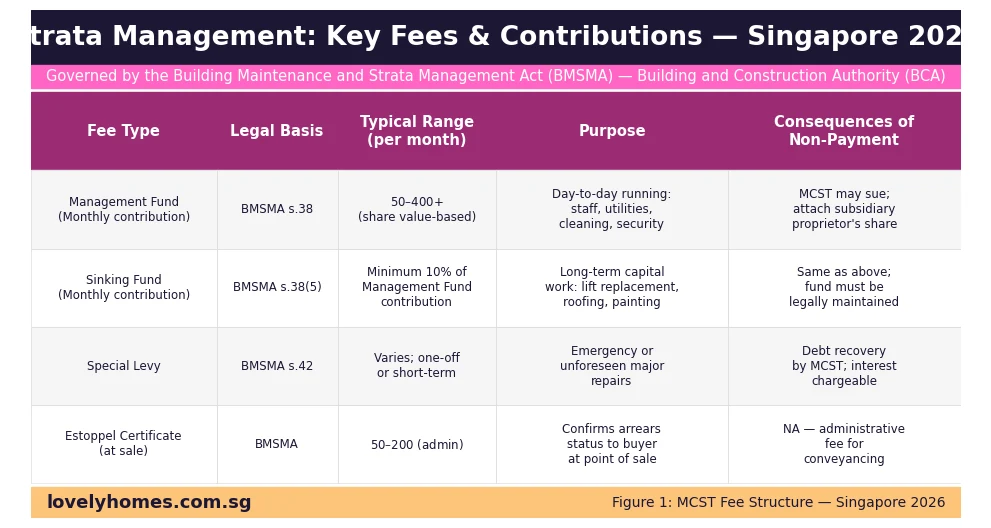
MCST fees management fund sinking fund strata Singapore 2026
Figure 1: MCST Fee Structure — Management Fund, Sinking Fund and Special Levy. Source: BMSMA; BCA guidelines.

The MCST: How It Is Formed and How It Works

A Management Corporation Strata Title (MCST) is automatically constituted when a strata development is registered at the Singapore Land Authority (SLA). The MCST number (e.g., MCST 1234) is assigned at registration. The MCST is a legal entity — it can sue, be sued, enter contracts, and own the common property in its own name.

The Management Council

The day-to-day governance of the MCST is delegated to a Management Council comprising between 3 and 14 subsidiary proprietors elected at the Annual General Meeting. The council must meet at least quarterly and is responsible for:

  • Approving budgets and setting the annual contribution schedule.
  • Engaging a licensed Managing Agent (MA) to handle day-to-day management (optional but near-universal in Singapore developments).
  • Enforcing by-laws relating to use of units and common property.
  • Commissioning periodic building condition inspections and major maintenance works.
  • Maintaining proper financial records (audited annually).

The council elects a Chairperson, Secretary and Treasurer from among its members. These office-holders have specific statutory duties — for example, the Secretary must convene the AGM within 15 months of the previous AGM and circulate financial statements at least 14 days before the meeting.

The Annual General Meeting (AGM)

The AGM is the supreme decision-making body for the MCST. All subsidiary proprietors are entitled to attend and vote. Key decisions at the AGM include:

  • Adoption of annual financial statements.
  • Election of the Management Council.
  • Approval of the annual budget and contribution rates.
  • Passing special resolutions (e.g., amending by-laws; requires 90% majority by share value at a properly convened meeting).
  • Engaging or dismissing the Managing Agent.

Every subsidiary proprietor has voting power proportional to their share value — a number assigned at the development’s inception that reflects the relative size and value of each unit. Owners of larger, more valuable units typically have higher share values and thus greater voting weight.

Management Fund and Sinking Fund: How Much Do You Pay?

Every subsidiary proprietor must pay monthly contributions to two mandatory funds under the BMSMA:

Management Fund

The Management Fund covers the development’s recurring operational costs: security staff, cleaning, lift maintenance, utilities for common areas, insurance for common property, landscaping, and the Managing Agent’s fees. Monthly contributions are calculated proportionally based on each unit’s share value relative to the total share value of the development.

Sinking Fund

The Sinking Fund is a long-term capital reserve mandated by law. It must be used exclusively for capital expenditure — major items such as repainting the external facade, replacing lift systems, repairing waterproofing, or upgrading fire safety systems. Importantly, the Sinking Fund cannot be used for routine operational expenses.

The BMSMA requires the Sinking Fund contribution to be at least 10% of the Management Fund contribution. For older developments or those undergoing major upgrades, the BCA may direct a higher percentage. A well-funded sinking fund is a hallmark of a well-managed development — buyers should always request the latest sinking fund balance before purchasing a resale unit.

Contribution Rates: What to Expect

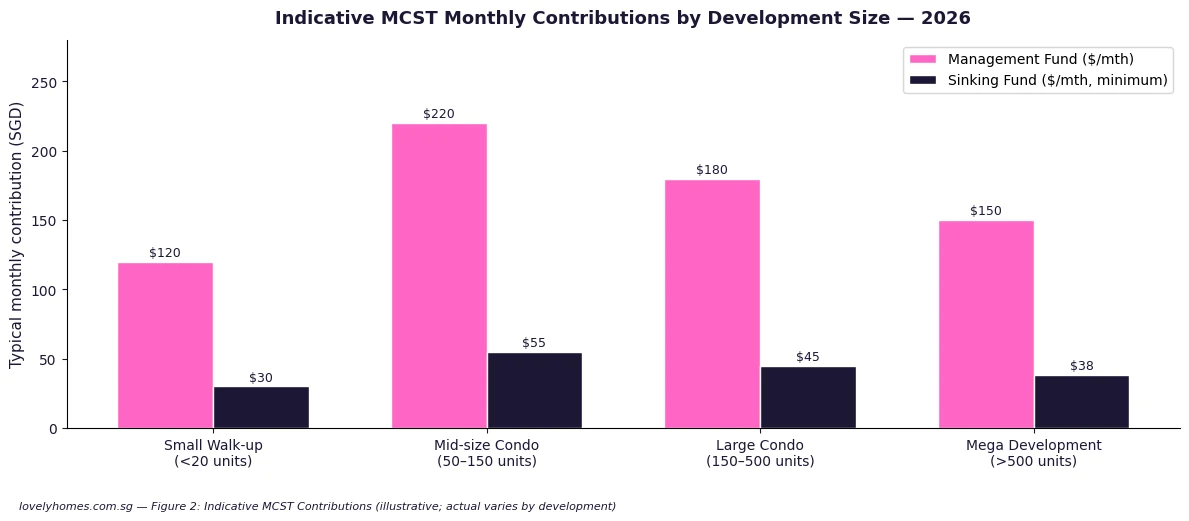
Development Type Typical Management Fund ($/mth) Typical Sinking Fund ($/mth) Notes
Walk-up / small condo (<20 units) $80–$150 $20–$40 Lower amenities; higher per-unit cost for shared items
Mid-size condo (50–150 units) $180–$280 $45–$80 Typical mass-market or OCR condo; pool, gym, BBQ pits
Large condo (150–500 units) $150–$250 $40–$70 Economies of scale; facilities-to-unit ratio diluted
Mega development (>500 units) $120–$200 $30–$55 Large-scale facilities; strong economies of scale
Luxury CCR condo $350–$600+ $90–$150+ Concierge services, premium finishes, higher utilities

Note: Contribution rates vary widely. Figures above are indicative only. Always check the actual budget prepared by your development’s MCST before purchase.

Indicative MCST management fund and sinking fund contributions by development size Singapore 2026
Figure 2: Indicative MCST Monthly Contributions by Development Size — Singapore 2026. Actual contributions depend on each development’s budget and approved rates. Figures are illustrative.

By-Laws: Rules Every Condo Resident Must Follow

Every MCST has a set of by-laws governing the use of units and common property. Singapore’s MCSTs operate under a two-tier by-law framework:

  • Prescribed by-laws — default rules set out in the Second Schedule to the BMSMA. These cover noise, pets, renovation works, use of common facilities, and prohibited conduct in common areas. They apply automatically to every MCST unless specifically modified.
  • Additional by-laws — rules adopted by the MCST at a general meeting (by special resolution) to supplement or modify the prescribed by-laws. Common additions include rules on airbnb-style short-term lettings, bicycle storage, deliveries, and smoking.

All by-laws are lodged with the SLA and are legally binding on all subsidiary proprietors, lessees (tenants), and occupants of the development. Breach of a by-law can result in a fine of up to $1,000 per offence, imposed after a Strata Titles Board order.

Renovation: MCST Approval Required

Renovation work that affects the common property, external facade, or structural elements requires MCST approval — in addition to any HDB or BCA permits where applicable. Even seemingly minor works — installing an additional air-conditioning unit, changing the main door design, or adding a glass panel to the balcony — may require written MCST consent. Always check with the Managing Agent before commencing any renovation.

Worked Example: Buying into a 200-Unit Condo — The True Monthly Cost

Mei Lin purchases a 2-bedroom, 800 sq ft unit in a 200-unit condominium in Bishan for $1.4M. The development was completed in 2012 and is 14 years old at the time of purchase.

Item Amount Notes
Mortgage (25 yr, 3.2% p.a. bank loan) ~$4,800/mth Assuming 75% LTV ($1.05M loan); illustrative rate
MCST Management Fund contribution ~$220/mth Based on unit share value; includes security, cleaning, utilities
MCST Sinking Fund contribution ~$55/mth Minimum 10% of Management Fund; may be higher given building age
Property tax (owner-occupied) ~$1,200/yr (~$100/mth) At 2026 progressive owner-occupier rates (IRAS)
Home contents insurance (est.) ~$25/mth General contents coverage for a mid-range condo unit
Total monthly housing cost ~$5,200/mth Excluding ad hoc special levies; excluding utilities

Note that for a 14-year-old building, the MCST may have already accumulated significant sinking fund reserves — or, conversely, may be facing a major capital cycle (external repainting, lift replacement, roof waterproofing) within the next 5–10 years. A well-managed MCST will present a 5-year capital expenditure plan at AGMs. Mei Lin should request the latest sinking fund balance, financial statements and AGM minutes before committing to purchase.

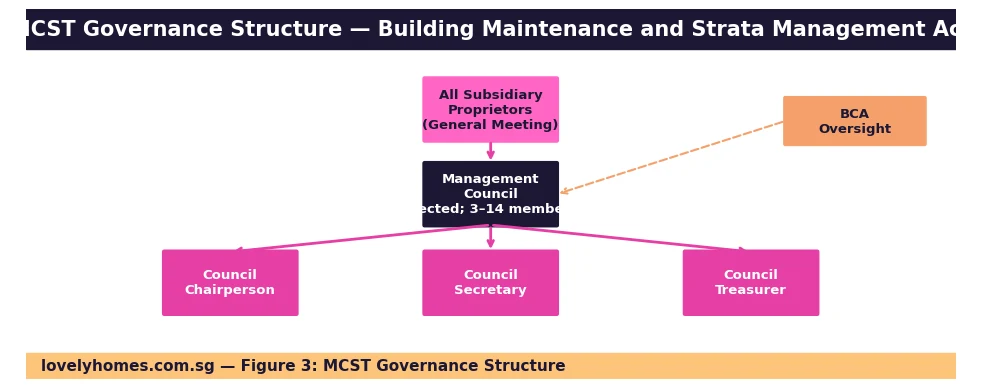
MCST governance structure management council subsidiary proprietors Singapore 2026
Figure 3: MCST Governance Structure — from the General Meeting (all owners) down through the elected Management Council. BCA provides statutory oversight.

Resolving Strata Disputes: The Strata Titles Board

When disputes arise — between subsidiary proprietors, between an owner and the MCST, or between owners and the managing agent — the first port of call is mediation through the Singapore Mediation Centre or the Community Disputes Resolution Tribunal. If mediation fails, the Strata Titles Board (STB) provides a specialist adjudicative forum.

Common STB applications in Singapore include:

  • Orders compelling the MCST to carry out repairs to common property.
  • Applications challenging invalid AGM proceedings or improperly passed resolutions.
  • Orders for recovery of unpaid contributions.
  • Applications to invalidate by-laws or compel the MCST to enforce by-laws against a neighbour.
  • Collective sale (en-bloc) consent orders (under the Land Titles (Strata) Act).

The STB has jurisdiction over disputes with a value up to $250,000. More complex or higher-value disputes are referred to the High Court. Legal fees in STB proceedings are generally lower than in court litigation, and many matters are resolved at the mediation stage without a full hearing.

Why Strata Management Standards Matter for Your Investment

Singapore’s private condo stock is maturing rapidly. The BCA’s Building Condition Rating (BCR) system — which evaluates developments on a 1–5 scale — shows that a significant proportion of condominiums completed in the 1990s and early 2000s are reaching critical maintenance thresholds. A poorly managed MCST with depleted sinking funds, deferred maintenance and acrimonious AGMs can materially reduce the market value and rental attractiveness of units within the development.

Conversely, a development with transparent governance, well-funded reserves, regular maintenance programmes and competent professional management commands a premium in both the resale and rental markets. Industry figures show that buyers increasingly request MCST financial statements and building condition reports as part of their due diligence — a trend that experienced conveyancing solicitors confirm has intensified since 2022.

The BCA’s Building Maintenance Masterplan, released in 2020 and updated in 2023, signals a regulatory direction towards mandatory 5-year building condition assessments and minimum sinking fund adequacy ratios for developments older than 20 years. These changes — if enacted — would directly affect contribution levels in older condominiums across Singapore.

What Might Change: BMSMA Amendments Expected

The Ministry of National Development (MND) and BCA have signalled further amendments to the BMSMA. Possible changes include: mandatory minimum sinking fund adequacy ratios (not just a 10% floor); reformed proxy voting rules to prevent vote concentration by a small number of owners; clearer rules on professional managing agent licensing; and improved transparency requirements for MCST financial reporting. These are under consultation as of June 2026 and have not yet been tabled in Parliament.

Frequently Asked Questions

Can I refuse to pay MCST contributions if I am unhappy with the management?

No. MCST contributions are a statutory obligation under the BMSMA — they are not discretionary. An unhappy owner’s recourse is to attend the AGM, vote against the incumbent council, stand for election to the Management Council, or apply to the STB if contributions have been improperly levied. Withholding contributions exposes the owner to legal action by the MCST, which can recover arrears (including interest and legal costs) through the courts or, ultimately, through enforcement against the unit.

How do I check the sinking fund balance before buying a resale condo?

Ask your conveyancing solicitor to request an estoppel certificate from the MCST as part of the purchase process. The estoppel certificate confirms (among other things) the outstanding contribution arrears attributable to the unit and the current state of the sinking fund. You may also request the most recent audited financial statements from the MCST or the managing agent — these are public documents that any subsidiary proprietor (and prospective buyer through their solicitor) is entitled to inspect.

What is a “special levy” and when can the MCST charge one?

A special levy is a one-off (or short-term) additional contribution levied on all subsidiary proprietors to fund an urgent or unplanned capital expense — for example, emergency structural repairs after an inspection reveals a defect, or to top up a depleted sinking fund ahead of a major cyclical maintenance programme. Special levies must be approved by a general meeting resolution. Like regular contributions, they are legally enforceable and pro-rated by share value.

Do I need MCST approval to renovate my condo unit?

For works confined entirely within your unit that do not affect the common property, structural elements or external appearance, MCST approval is generally not required — though you should notify the MCST and comply with renovation hours. However, any works that involve hacking structural walls, changing external finishes, altering air-conditioning condensers on external ledges, or modifying plumbing that serves common risers typically require written MCST approval. Always check with the managing agent before engaging any contractor, as unauthorised works can result in a reinstatement order at your cost.

Can my MCST ban short-term rentals (e.g., Airbnb) in my development?

Yes. An MCST may pass a by-law at a general meeting (by special resolution — 90% majority by share value) prohibiting short-term residential letting within the development. Many Singapore condominiums have passed such by-laws since the URA’s 2017 crackdown on unlicensed short-term accommodation. Even without a specific MCST by-law, letting a private residential property for fewer than 3 consecutive months requires URA approval (which is rarely granted for residential properties). Owners found subletting without URA approval face fines of up to $200,000 under the Planning Act.

What happens to the MCST and my contributions if the development goes en-bloc?

When a collective sale (en-bloc) is approved by the STB and completed, the MCST is dissolved. Sinking fund balances are distributed to subsidiary proprietors pro-rata by share value at the point of dissolution, after settling outstanding liabilities. This is a significant financial benefit of a successful en-bloc — the sinking fund distribution is in addition to the sale proceeds. Management fund balances are also distributed in the same way. All contributions stop on the date the sale is completed.

How do share values work and who sets them?

Share values are assigned by the developer at the point of the strata development’s registration, based on a prescribed formula in the Land Titles (Strata) Act. The formula takes into account each unit’s floor area, its floor level, and its entitlement to car park lots and other exclusive facilities. Once assigned, share values cannot be changed except through a court order. They determine each owner’s contribution quantum, voting weight at general meetings, and entitlement to sinking fund distributions on dissolution.

Related Articles

Disclaimer: This article is for general information only and does not constitute legal or financial advice. MCST governance, contribution rates and by-laws vary between developments. Readers should obtain the specific MCST financial statements and by-laws for any development they are considering purchasing or already own a unit in. Official resources: Building and Construction Authority (BCA), Ministry of Law (STB), Singapore Land Authority (SLA). Information accurate as of 10 June 2026.

Translate »