Singapore Property Financing Guide 2026: LTV, TDSR, MSR and HDB vs Bank Loan Explained

Singapore Property Financing Guide 2026: LTV, TDSR, MSR and HDB vs Bank Loan Explained

Quick Answer: Singapore Property Financing at a Glance

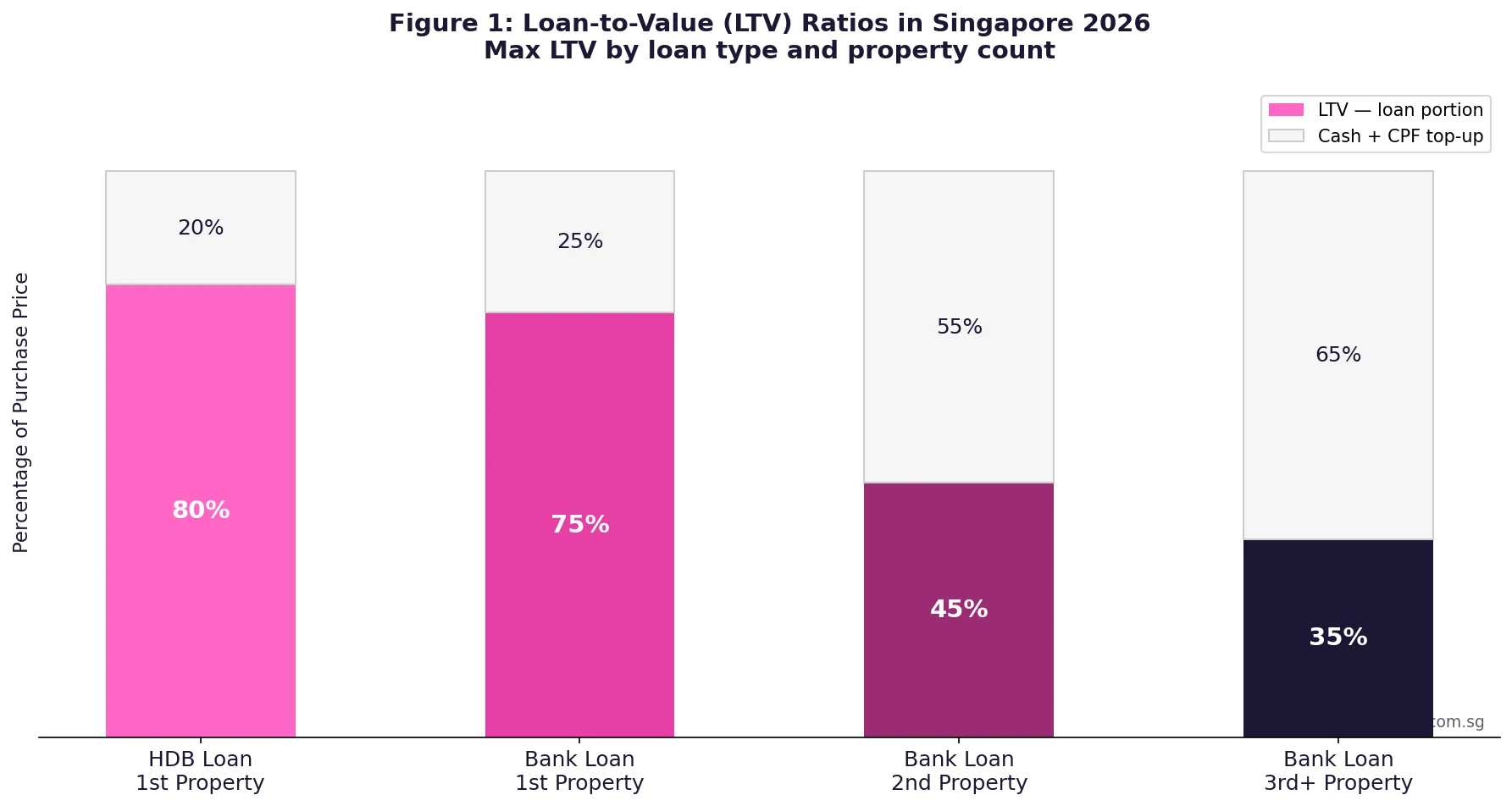
  • LTV ratios: HDB concessionary loan allows up to 80% LTV; bank loans allow 75% on a first property, 45% on a second, 35% on a third or more.
  • Minimum cash: Bank loans require 5% of the purchase price in cash (not CPF); HDB loans allow the full down payment to be settled using CPF OA.
  • TDSR: Total Debt Servicing Ratio caps all monthly debt obligations at 55% of gross monthly income for bank loans.
  • MSR: Mortgage Servicing Ratio caps HDB and executive condominium loan repayments at 30% of gross monthly income.
  • HDB loan rate: 2.6% per annum (CPF Ordinary Account rate of 2.5% plus 0.1%), variable but historically stable.
  • Loan tenure: Maximum 25 years for HDB flats and 30 years for private property; shorter if remaining lease or borrower age limits apply.
  • CPF usage: Both loan types allow CPF OA savings; CPF withdrawal is capped at the Valuation Limit or applicable withdrawal limits when the flat’s remaining lease is below 60 years.

What Is Property Financing in Singapore?

Property financing in Singapore refers to the combination of loan quantum, down payment, and grant structures that a buyer assembles to fund a residential purchase. It is governed by the Monetary Authority of Singapore (MAS) through property cooling measures and the Financial Institutions (Miscellaneous Amendments) Act 2013, with HDB administering its own concessionary loan product under the Housing and Development Act.

Two distinct lending channels exist for Singapore residential property. HDB’s concessionary loan is a government-backed product available to eligible Singapore Citizens and Permanent Residents buying HDB flats. Bank and licensed financial institution loans are available to all buyers of both public and private residential property, subject to MAS stress-testing rules. Understanding the differences between these channels — and the regulatory limits that constrain both — is the single most important financial decision you will make before signing an Option to Purchase.

This guide explains every major component of Singapore property financing in 2026: Loan-to-Value ratios, TDSR, MSR, the HDB versus bank loan decision, loan tenure limits, interest rate structures, and CPF interaction rules. All data references MAS notices, HDB guidelines, and IRAS regulations effective as at 25 June 2026.

Loan-to-Value (LTV) Ratios: How Much Can You Borrow?

The Loan-to-Value ratio is the maximum percentage of the property’s purchase price or market valuation (whichever is lower) that a lender may advance. LTV limits in Singapore are tiered by the number of outstanding housing loans a borrower holds at the time of application.
Singapore property LTV ratios 2026 — HDB loan 80% vs bank loan 75% 45% 35% by property count
Figure 1: Loan-to-Value ratios in Singapore 2026 — maximum loan percentages by loan type and property count. Source: MAS Notice 632 / HDB guidelines.

For HDB concessionary loans, the maximum LTV is 80% of the flat’s value or purchase price. Critically, there is no mandatory cash component: buyers may fund the entire 20% balance from their CPF Ordinary Account savings, or a combination of CPF and cash.

For bank loans on a first property, the maximum LTV is 75%. Of the 25% balance, a minimum of 5% must be paid in cash — CPF cannot be used to meet this first 5%. The remaining 20% may come from CPF OA or cash. On a second outstanding housing loan, LTV drops to 45%, with a mandatory 25% cash minimum. On a third or subsequent loan, LTV falls further to 35%, with 25% cash required.

Loan Situation Max LTV Min Cash CPF Permitted
HDB Loan — 1st property 80% 0% Yes — full 20% balance
Bank Loan — 1st property 75% 5% Yes — remaining 20%
Bank Loan — 2nd property 45% 25% Yes — remaining 30%
Bank Loan — 3rd+ property 35% 25% Yes — remaining 40%
Important: LTV is computed against the lower of the purchase price and the bank’s independent valuation. If you agree a price above valuation, the additional premium must be paid entirely in cash on top of the mandatory 5%.

Total Debt Servicing Ratio (TDSR): The 55% Rule

MAS introduced the TDSR framework in June 2013 to prevent borrowers from taking on more debt than they can sustainably service. The rule is simple: all monthly debt obligations — including the proposed mortgage, credit card minimum payments, car loans, personal loans, student loans, and any other credit facilities — must not exceed 55% of the borrower’s gross monthly income.

TDSR applies to all property loans from financial institutions regulated by MAS. It is computed on a stressed basis: variable-rate loans are assessed at 4% per annum or the actual rate, whichever is higher. Fixed-rate loans within the lock-in period are assessed at the contracted rate. From the borrower’s perspective, TDSR is the hardest ceiling — no bank may approve a loan that breaches it.
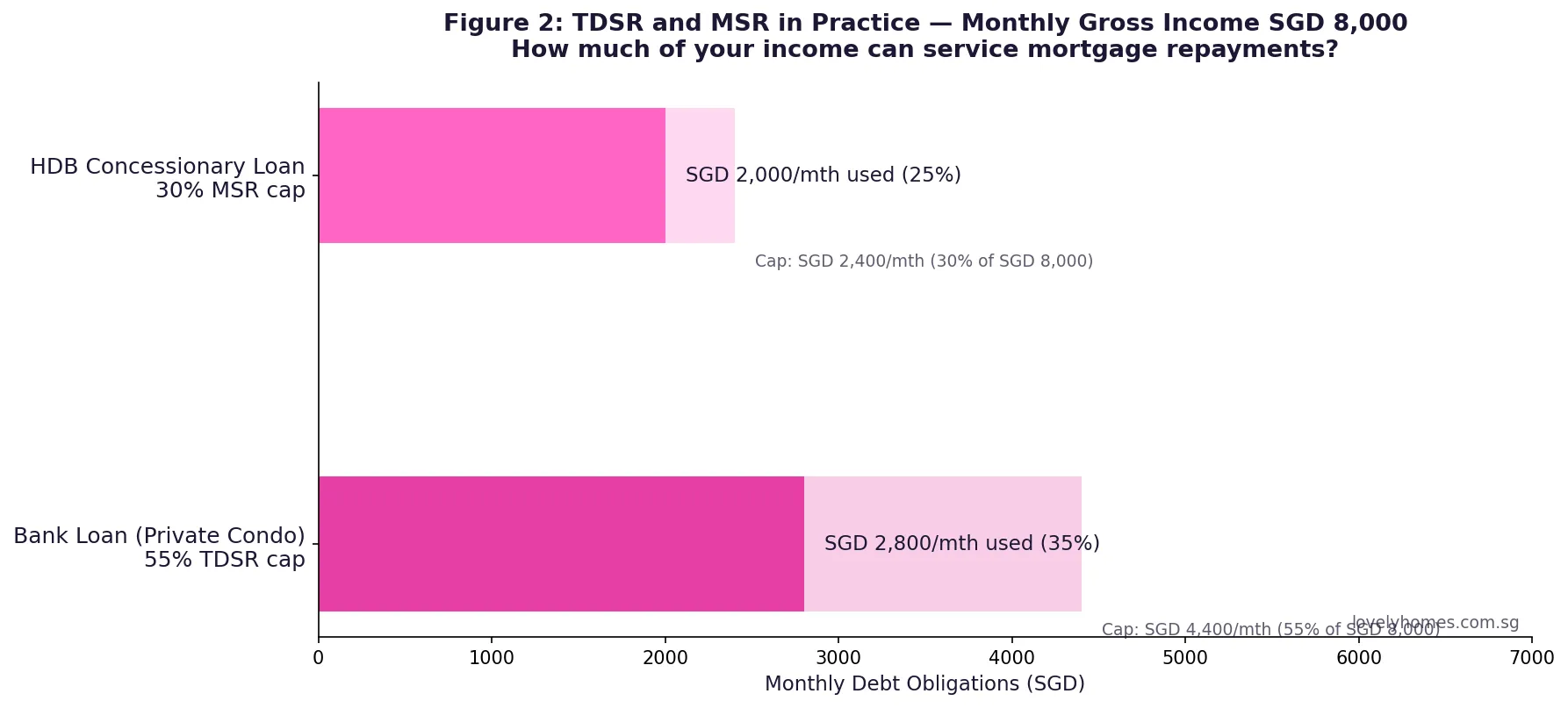
Singapore TDSR and MSR limits 2026 — 55% TDSR bank loan vs 30% MSR HDB loan on SGD 8000 monthly income
Figure 2: TDSR and MSR in practice on a SGD 8,000 gross monthly income — the regulatory caps on mortgage servicing. Source: MAS Notice 645 / HDB guidelines.

For a borrower earning SGD 8,000 per month, the TDSR limit is SGD 4,400. If the borrower has an existing car loan at SGD 800 per month, only SGD 3,600 remains available for mortgage repayments. That mortgage-service headroom in turn determines the maximum loan quantum a bank may approve.

Mortgage Servicing Ratio (MSR): The Additional HDB and EC Cap

The Mortgage Servicing Ratio is a tighter constraint that applies specifically when the property being financed is an HDB flat or an executive condominium. MSR caps mortgage repayments — the HDB or EC loan alone — at 30% of gross monthly income. It operates in addition to, not instead of, TDSR.

In practice, MSR is almost always the binding constraint for HDB and EC buyers. On an income of SGD 8,000, MSR allows a monthly repayment of SGD 2,400. At 2.6% for 25 years, SGD 2,400 per month services a loan of approximately SGD 504,000. This is frequently below what the TDSR calculation would theoretically permit, meaning the MSR — not TDSR — is what limits the HDB loan quantum for most buyers.

MSR does not apply to private residential properties (non-HDB, non-EC). Private property buyers are subject only to TDSR.

HDB Concessionary Loan vs Bank Loan: Which Should You Choose?

Choosing between the HDB concessionary loan and a bank loan is one of the defining decisions in a Singapore property purchase. The two products have materially different characteristics across rate, flexibility, cash requirements, and eligibility.
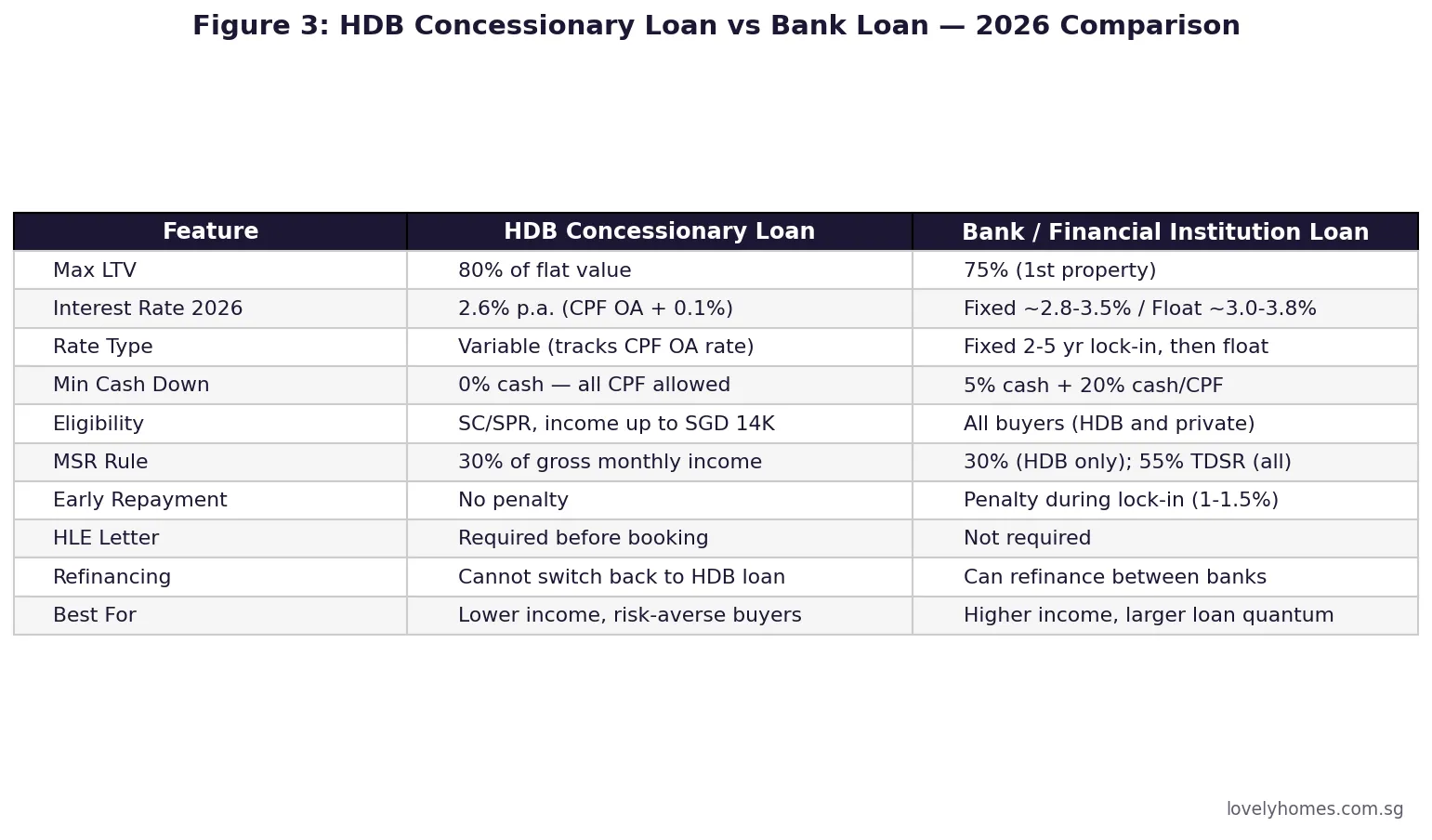
HDB concessionary loan vs bank loan comparison table Singapore 2026 — LTV interest rate MSR TDSR eligibility
Figure 3: HDB Concessionary Loan vs Bank Loan — comprehensive feature comparison for 2026. Sources: HDB, MAS.

The HDB concessionary loan offers the highest LTV at 80%, zero mandatory cash requirement, and a rate of 2.6% per annum — pegged to the CPF Ordinary Account rate of 2.5% plus 0.1 percentage points. The rate is variable in that it can move if MAS adjusts CPF OA rates, but the CPF rate has been stable at 2.5% since 1999. For buyers with limited cash reserves, the HDB loan’s absence of a cash-floor makes it significantly more accessible.

However, the HDB loan carries restrictions. It is available only to Singapore Citizens (or SPR applicants under specific schemes), requires an HDB Loan Eligibility (HLE) letter before booking, applies only to HDB flat purchases, and once you switch to a bank loan you may not return to the HDB loan. Income must also not exceed SGD 14,000 per month for families or SGD 7,000 for singles.

A bank loan at 75% LTV typically offers lower headline interest rates during lock-in periods — fixed rates for two to five years in the 2.8–3.2% range as at mid-2026, floating rates pegged to SORA (Singapore Overnight Rate Average) at approximately 3.0–3.8%. After the lock-in, rates revert to floating, introducing the risk of payment increases. Bank loans also incur a prepayment penalty during the lock-in, typically 1.0–1.5% of the outstanding loan, which can be material on a SGD 1 million loan.

Loan Tenure Rules

The maximum loan tenure in Singapore is 25 years for HDB flats and 30 years for private residential property, subject to the rule that the loan must be repaid by the time the youngest borrower turns 65 (75 for private). In practice, this means: if you are 40 years old buying a private property, your maximum tenure is 30 years. If you are 45, your tenure is limited to 30 years (75 minus 45). For HDB flats, the ceiling is 25 years and the age limit is 65.

Remaining lease also restricts tenure. Where the remaining lease of the property does not cover the borrower until at least age 80, CPF usage and HDB loans are further restricted. For private leasehold properties, if the remaining lease is below 30 years, no mortgage financing is generally available from regulated lenders.

Interest Rate Structures: Fixed, Floating, and SORA

Singapore bank mortgage products in 2026 are predominantly priced off the Singapore Overnight Rate Average (SORA), which replaced SIBOR and SOR as the benchmark rate following MAS reform. SORA is a compounded rate published daily by the Singapore Foreign Exchange Market Committee.

Fixed-rate packages lock the rate for two to five years, after which they convert to a floating rate. They offer payment certainty but come with lock-in penalties. Floating SORA packages adjust monthly or quarterly; they track interest rate movements in real time and typically carry no lock-in penalty after an initial period of six to twelve months. Hybrid packages combine an initial fixed period with a SORA-linked floating tail.

As at June 2026, the SORA three-month compounded rate has moderated from the highs of 2023–2024, with effective mortgage rates approximately 50–80 basis points below their 2024 peaks. Buyers should stress-test repayments at 4% per annum — the MAS assessment floor — to ensure affordability under adverse rate scenarios.

CPF and Property Financing: What You Can and Cannot Use

CPF Ordinary Account savings may be used to fund the down payment (any portion not required in cash), service monthly mortgage instalments, and pay Buyer’s Stamp Duty (BSD) on HDB purchases. CPF cannot be used to pay ABSD, valuation gaps, legal fees on private property, or the mandatory 5% cash component of a bank loan.

The Withdrawal Limit caps total CPF usage at the property’s Valuation Limit (the lower of purchase price and HDB/bank valuation). Once a property’s remaining lease drops below 60 years, CPF usage is further restricted: the proportion of purchase price that can be funded by CPF is reduced proportionally to ensure sufficient CPF for retirement. Properties with less than 20 years remaining on their lease cannot use CPF at all.

Worked Example: Lim Family — Tampines 4-Room Resale, HDB Loan vs Bank Loan

The Lim family is a Singapore Citizen couple with a combined gross monthly income of SGD 11,000. They are purchasing a Tampines 4-room resale flat at SGD 650,000 with no outstanding housing loans. Their CPF OA balance is SGD 120,000 combined. They qualify for the Enhanced CPF Housing Grant (EHG) of SGD 50,000 (income bracket SGD 9,000–SGD 11,000) and a CPF Family Grant of SGD 80,000 (resale, 4-room), total grants of SGD 130,000.

Option A — HDB Concessionary Loan (80% LTV):
Purchase price: SGD 650,000. Less grants: SGD 130,000. Net financed amount: SGD 520,000.
Max HDB loan (80% of SGD 650,000): SGD 520,000 — fully covers the net amount.
Cash/CPF required: SGD 130,000 (20%) — fully payable from CPF OA (SGD 120,000 CPF + SGD 10,000 cash).
Monthly repayment at 2.6%, 25 years: approximately SGD 2,358/mth.
MSR check: SGD 2,358 / SGD 11,000 = 21.4% — well within 30% cap. Pass.
BSD: SGD 15,600 (payable from CPF OA).

Option B — Bank Loan (75% LTV):
Max bank loan: SGD 487,500 (75% of SGD 650,000).
Down payment: SGD 162,500 (25%); of which SGD 32,500 must be cash (5% of SGD 650,000). Remaining SGD 130,000 from CPF OA.
Monthly repayment at 3.0% (2-yr fixed), 25 years: approximately SGD 2,307/mth.
TDSR check: SGD 2,307 / SGD 11,000 = 21.0% — within 55% cap. Pass.
MSR check: SGD 2,307 / SGD 11,000 = 21.0% — within 30% cap. Pass.

Recommendation for the Lim family: With CPF OA of SGD 120,000 and the bank loan requiring SGD 32,500 in cash (which they need to hold in reserve), Option A (HDB loan) preserves cash flow and minimises upfront cash outlay. The rate difference (2.6% vs 3.0%) saves approximately SGD 620/year in interest in year one. However, if the Lims anticipate upgrading within five years and the fixed bank rate falls, Option B avoids the “no-return” restriction.

Why This Matters: Financing Determines What You Can Realistically Buy

Singapore’s property financing framework is among the most conservative in the Asia-Pacific region. The combination of LTV limits, TDSR, and MSR means that even high-income buyers face hard ceilings on their maximum loan quantum. The practical effect is that the purchase price ceiling for any buyer is largely determined by their monthly income and existing debt — not simply by their willingness to take on more leverage.

This matters most at the point of upgrading from HDB to private. A couple with a combined income of SGD 10,000 and a two-year-old car loan of SGD 900 per month (TDSR component) effectively has only SGD 4,600 available for all debt service (55% TDSR). After the car loan, just SGD 3,700 remains for a mortgage. At 3.0%, 30 years, that supports a private condo loan of approximately SGD 880,000 — meaning on a 75% LTV, the maximum purchase price is roughly SGD 1.17 million. This is materially below the median new launch price in the Outside Central Region in H1 2026.

Compared with peer markets, Singapore’s rules are deliberately calibrated to prevent speculative leverage build-up. Australia’s debt-to-income assessment is less rigid; Hong Kong applies a TDSR equivalent but at 60% rather than 55%. Singapore’s framework has contributed to relatively stable debt-service coverage ratios across the property cycle, even as prices have risen substantially.

What Might Come Next

MAS reviews the TDSR and LTV frameworks periodically in response to market conditions. In late 2021, when private residential prices accelerated sharply, MAS tightened the TDSR from 60% to 55% effective 16 December 2021. Any future easing of TDSR would require evidence that household balance sheets are not over-leveraged and that price growth has moderated sustainably.

SORA-linked mortgage products will continue to dominate the Singapore market, and borrowers should monitor the MAS’s monetary policy stance closely. As global interest rate cycles evolve, SORA-pegged floating rates may move meaningfully. The prudent approach for long-term owner-occupiers remains fixing rates for an initial two to three year period if near-term rate stability is the priority.

Frequently Asked Questions

Can I use CPF to pay the 5% mandatory cash component of a bank loan?

No. The 5% minimum cash required for a first-property bank loan must be paid in cash — CPF OA funds cannot be used to meet this specific obligation. This applies regardless of how large your CPF balance is. The remaining 20% of the down payment (after the mandatory 5% cash and the 75% loan) may be settled using CPF OA savings, or a combination of CPF and additional cash.

If I take an HDB loan now, can I refinance to a bank loan later?

Yes, you may switch from an HDB concessionary loan to a bank loan at any time — typically when refinancing at the expiry of a fixed-rate period or when you believe market rates offer a better deal. However, once you switch to a bank loan, you cannot switch back to the HDB loan. This is an irreversible decision and should be made carefully, particularly if your income is variable or if you expect major financial changes in the near term.

Does TDSR apply to HDB loans?

HDB’s concessionary loan is not a financial institution product regulated under MAS Notice 632, so the TDSR stress-testing rules do not technically apply to it. HDB applies its own affordability assessment through the HDB Loan Eligibility (HLE) process, including an income ceiling, employment verification, and CPF contribution history check. In practice, the HDB’s MSR limit of 30% serves a similar function to TDSR for its loan product — it caps repayments relative to income — but the legal framework is different.

What happens to my LTV if the bank’s valuation is lower than the purchase price?

The bank’s LTV is applied to the lower of the purchase price and the bank’s valuation. If you agree a purchase price of SGD 1,200,000 but the bank values the property at SGD 1,100,000, the maximum loan is 75% of SGD 1,100,000 = SGD 825,000. The SGD 100,000 valuation gap must be covered entirely by your own cash (not CPF, not loan). This is sometimes called a “cash-over-valuation” payment and is a common risk in competitive resale markets. The HFE letter from HDB includes a market valuation for HDB flats; private property valuations are commissioned by the bank independently.

Can foreigners and permanent residents get HDB loans?

Singapore Permanent Residents (SPRs) are eligible for HDB loans only under specific schemes — generally when buying resale HDB flats — and subject to income ceiling limits and HDB eligibility rules. Non-resident foreigners are not eligible for HDB concessionary loans and must use bank financing if they are legally permitted to purchase the relevant property type. Most foreigners are restricted to non-landed private properties (condominiums and apartments). Sentosa Cove landed properties are the main exception, with Land Dealings Approval required.

How does loan tenure affect my monthly repayment and total interest paid?

A longer loan tenure reduces the monthly repayment but increases total interest paid over the loan life. For example, a SGD 800,000 bank loan at 3.0% over 30 years costs approximately SGD 3,373 per month — a total repayment of SGD 1,214,280, meaning SGD 414,280 in interest. The same loan over 20 years costs SGD 4,435 per month — total SGD 1,064,400, saving SGD 149,880 in interest. The maximum tenure for private property bank loans is 30 years; HDB is capped at 25 years, or until the younger borrower turns 65, whichever comes first.

What does “stress-testing at 4%” mean in practice for borrowers?

MAS requires banks to assess your ability to repay the loan at a minimum notional rate of 4% per annum, regardless of the actual contracted rate. If the loan is at 3.0% but the stress rate is 4%, the bank calculates your TDSR and maximum loan quantum using the 4% figure. This means your approved loan quantum may be lower than you expect based on current rates. For a 25-year term, the difference between a 3.0% and 4.0% assessment rate reduces the permissible loan by approximately 8–9%. This buffer is designed to ensure borrowers can still service their debt if rates rise.
Disclaimer: This article is intended as general educational information only and does not constitute financial, mortgage, or investment advice. LTV ratios, TDSR limits, MSR rules, interest rates, and CPF regulations are subject to change by MAS, HDB, or CPF Board. Readers should refer to official sources — MAS, HDB, CPF Board, and IRAS — for the most current rules, and consult a licensed financial adviser or mortgage broker before making any financing decision. All figures in this article are illustrative and based on data available as at 25 June 2026.

Singapore CPF Property Usage Guide 2026: OA Withdrawal, Accrued Interest and Retirement Sum Rules

Singapore CPF Property Usage Guide 2026: OA Withdrawal, Accrued Interest and Retirement Sum Rules

Quick Answer: Using CPF for Property in Singapore

  • CPF Ordinary Account (OA) savings can be used to pay the downpayment (above the minimum 5% cash), monthly mortgage instalments, and stamp duty — but not ABSD, which must be paid in cash.
  • CPF OA earns a guaranteed 2.5% per annum interest. When you withdraw CPF for property, the Board charges you that same 2.5% as accrued interest — meaning at sale, you must refund the full amount withdrawn plus the accrued interest to your CPF account.
  • The Valuation Limit (VL) caps total CPF use (principal + accrued interest) at the lower of the property’s purchase price or market value. Once VL is reached, you need to meet the Basic Retirement Sum (BRS) to continue withdrawing.
  • CPF use is restricted when the property’s remaining lease does not cover the youngest buyer to age 95 — leaseholds with fewer than 60 years remaining see meaningful restrictions.
  • At sale, CPF refund (principal + accrued interest) takes priority over your cash proceeds — understanding this prevents unpleasant surprises at completion.
  • You can use CPF OA for both HDB flats and private property, subject to different rules and loan types.
  • CPF rules are administered by the CPF Board; property CPF rules are set out in the Central Provident Fund Act and CPF Housing Schemes.

CPF (Central Provident Fund) savings are the backbone of Singapore’s property financing system. For most Singaporeans, the Ordinary Account (OA) — the component of CPF earmarked for housing, education, and investment — represents the single largest source of funds for a property purchase beyond a bank loan. Yet the CPF property rules are among the most frequently misunderstood in the market: buyers routinely underestimate accrued interest obligations, miscalculate CPF withdrawal limits, or fail to account for retirement sum requirements before committing to a purchase price.

This guide, correct as at 24 June 2026, explains how to use CPF OA for property in Singapore — covering withdrawal limits, the Valuation Limit framework, accrued interest mechanics, Basic Retirement Sum (BRS) interactions, lease-length restrictions, and what happens to your CPF refund when you sell. Whether you are buying your first HDB flat, upgrading to a private condominium, or refinancing an existing loan, this article gives you the numbers and worked examples you need to plan accurately.

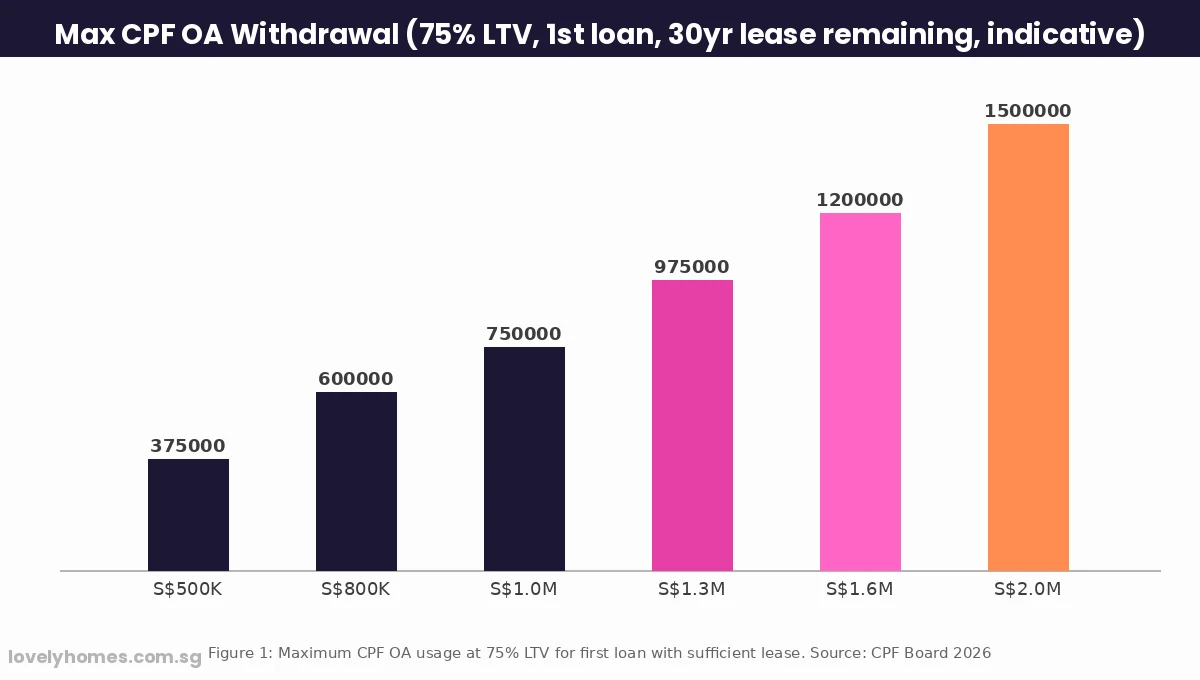
CPF OA maximum withdrawal amount by property price Singapore 2026
Figure 1: Indicative maximum CPF OA withdrawal at 75% LTV, first loan, sufficient remaining lease. Actual amount depends on property value, outstanding CPF balance, and BRS status. Source: CPF Board 2026

How CPF OA Works for Property: The Basics

The CPF Ordinary Account earns a risk-free 2.5% per annum interest, guaranteed by the Singapore government. This interest is credited monthly. When you withdraw CPF OA savings to pay for a property, the Board does not simply deduct the amount and close the account — instead, it records the withdrawal and continues to track what that money would have earned had it remained in your OA. That theoretical interest is the accrued interest, and it compounds at 2.5% per annum on the total amount withdrawn.

You can use CPF OA savings for the following property-related payments, subject to eligibility rules:

  • Downpayment: The first 5% of a private property purchase must be paid in cash (for bank loans). CPF OA can fund the remaining downpayment above 5% — typically a further 20% to reach the bank’s minimum 25% downpayment requirement.
  • Stamp duty: Buyer’s Stamp Duty (BSD) can be paid from CPF OA. ABSD cannot — it must be settled in cash.
  • Monthly mortgage instalments: Both HDB loan and bank loan monthly repayments can be deducted directly from CPF OA, provided sufficient balance is available and CPF limits have not been reached.
  • Legal and conveyancing fees: Limited CPF use is permitted for solicitor fees under certain HDB schemes but is not available for private property legal costs.

The Valuation Limit (VL) and Withdrawal Cap

Your total CPF property withdrawal is capped by the Valuation Limit (VL), defined as the lower of the property’s purchase price or its market value at the time of purchase. For a property bought at S$1.3M where the valuer assesses market value at S$1.25M, your VL is S$1.25M. For a property bought at S$1.0M with a market value of S$1.05M, the VL is S$1.0M (purchase price applies as the lower figure).

Your total CPF usage — being the sum of principal withdrawn plus accrued interest to date — cannot exceed 100% of VL, unless you first satisfy the Basic Retirement Sum (BRS). The BRS is the CPF Board’s threshold ensuring you retain sufficient retirement savings even after property purchases. As at 1 January 2026, the BRS stands at S$106,500. If the combined CPF OA and Special Account (SA) balance of all owners meets or exceeds the BRS, you can continue withdrawing CPF beyond the VL up to a maximum of 120% of VL.

In practice, most buyers of private properties priced above S$1.5M will hit the VL well before exhausting their CPF balances. For HDB buyers using HDB loans (80% LTV), the effective CPF usage is often very high relative to the property price, making the VL constraint more likely to bind near the end of the loan tenure.

Accrued Interest: The Hidden CPF Cost Most Buyers Underestimate

Accrued interest is the most frequently misunderstood element of CPF property usage. When you sell a property, the CPF Board requires you to refund the entire principal withdrawn plus all accrued interest at 2.5% compounding annually. This refund comes from the sale proceeds before any cash is released to you.

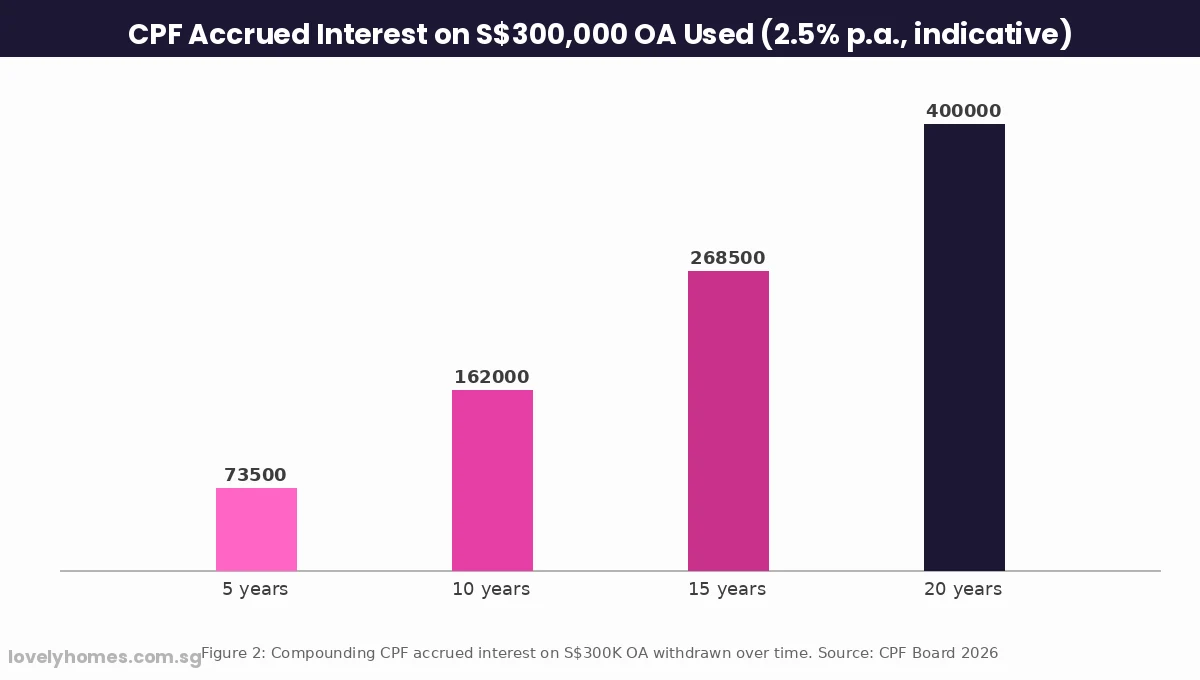
The compounding effect is substantial over a long holding period. On S$300,000 CPF OA withdrawn, accrued interest accumulates as follows: approximately S$38,000 after 5 years; S$83,000 after 10 years; S$145,000 after 15 years; and S$228,000 after 20 years. These are not small sums — on a property with modest capital appreciation, the CPF refund (principal + accrued interest) can equal or exceed the net cash proceeds, leaving the seller with little to no liquid cash from the transaction even if the property appreciated in nominal terms.

CPF accrued interest on S$300000 withdrawn over time Singapore property 2026
Figure 2: Compounding accrued interest on S$300,000 CPF OA withdrawn for property at 2.5% per annum. This amount must be refunded to CPF on sale, on top of the original S$300,000 principal. Source: CPF Board 2026

Lease Restrictions: When CPF Use Is Curtailed

Not all properties qualify for full CPF OA use. The CPF Board imposes lease-based restrictions to protect buyers from tying up retirement savings in an asset that may have minimal remaining economic life by the time they retire. The rules work as follows:

  • If the remaining lease covers the youngest buyer to at least age 95: Full CPF withdrawal is permitted, subject to the VL and BRS rules above.
  • If the remaining lease does not cover the youngest buyer to age 95: CPF withdrawal is prorated. The proportion of CPF use allowed equals the ratio of the property’s remaining lease over the number of years required to cover the buyer to age 95.
  • Minimum 20 years remaining: If fewer than 20 years of lease remain, CPF OA cannot be used at all for the purchase.

Practically, this means a 35-year-old buyer requires at least 60 years of remaining lease (35 + 60 = 95) for full CPF use. A 40-year-old requires at least 55 years remaining. These thresholds interact directly with the lease-decay dynamics discussed in our Singapore property land tenure guide 2026 — older 99-year leasehold resale properties are particularly affected. An older D15 resale condo launched in 1995 (99-year lease from ~1993) would have roughly 66 years remaining in 2026, still qualifying for some CPF use for buyers under 30 — but a 45-year-old buyer of the same property would only have 66/50 = 100% (just qualifying) while a 50-year-old would only get 66/45 = 100% (borderline). The proration kicks in severely once remaining lease drops towards 60 years for most buyer ages.

CPF property withdrawal rules comparison table HDB vs private property Singapore 2026
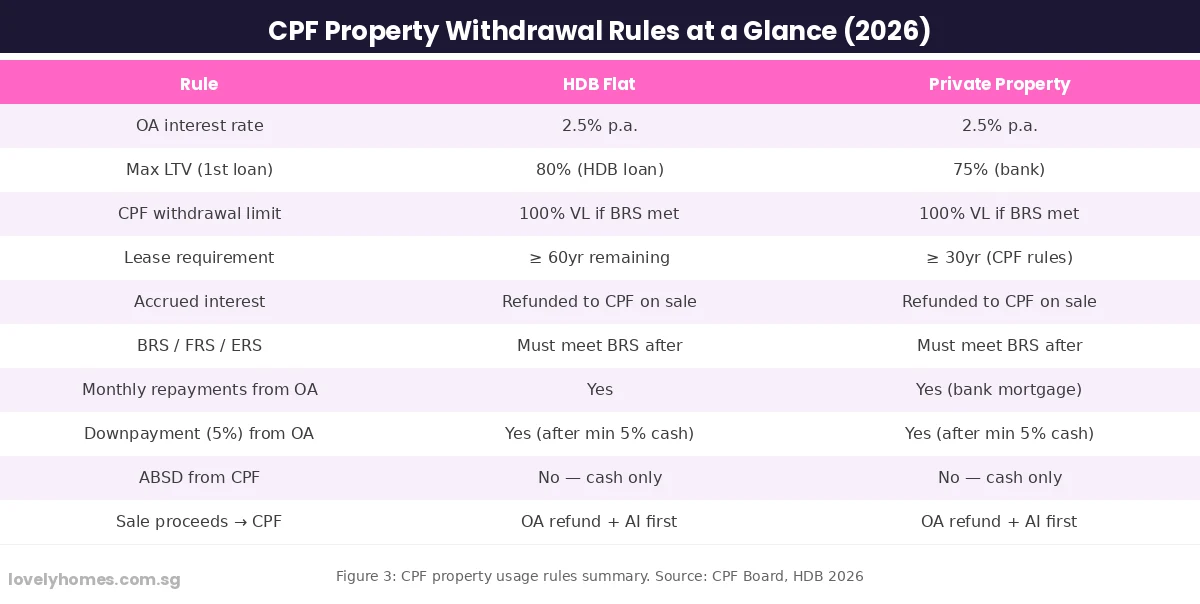
Figure 3: CPF property withdrawal rules at a glance — HDB flat vs private residential property, Singapore 2026. Source: CPF Board, HDB 2026

CPF Use for HDB vs Private Property: Key Differences

The broad CPF rules apply equally to HDB and private property, but there are material operational differences between the two contexts. For HDB flats purchased with an HDB concessionary loan (interest rate 2.6% per annum as at June 2026), the CPF OA is typically used heavily — with 80% LTV and monthly deductions often fully funded from OA until the balance runs low. HDB loan borrowers also benefit from the flexibility of prepaying their HDB loan in full using CPF OA at any time without penalty.

For private property purchased with a bank loan, the cash component is higher (minimum 5% cash downpayment; no cash top-up required for HDB), and the monthly instalment deductions from CPF OA are capped by the CPF OA balance available. Banks also apply the TDSR (Total Debt Servicing Ratio) of 55% — which counts CPF OA contributions as income — meaning that a buyer with a large CPF OA contribution may qualify for a higher loan quantum than a cash-only income assessment would suggest. See our Singapore TDSR calculator guide 2026 for details.

What Happens at Sale: The CPF Refund Waterfall

When you sell a property for which CPF was used, the proceeds are distributed in a legally prescribed order. Before any cash is released to you, the following must be settled from the sale proceeds in sequence:

  1. Outstanding mortgage balance: The bank (or HDB) is fully repaid from sale proceeds.
  2. CPF refund: The full amount withdrawn (principal) plus all accrued interest at 2.5% compounding is refunded to each owner’s CPF OA in proportion to their respective withdrawals. This refund is mandatory and cannot be waived.
  3. Legal and conveyancing costs: Solicitor fees, SLA lodgement fees, and other closing costs are deducted.
  4. Remaining cash: Only after steps 1–3 is the balance released to you as cash proceeds.

The CPF refund does not disappear — it returns to your OA and immediately starts earning 2.5% interest again, available for your next property purchase or retirement. However, for sellers whose capital appreciation has been modest relative to the accrued interest build-up, the net cash-in-hand can be surprisingly small. This is a common source of shock for first-time upgraders who discover that their S$420K resale gain on paper translates to only S$85K in actual cash after the CPF refund and mortgage payoff.

CPF Property Rules Summary

Parameter Rule / Limit (2026)
CPF OA interest rate 2.5% per annum (guaranteed by government)
Accrued interest rate 2.5% compounding on total principal withdrawn
Valuation Limit (VL) Lower of purchase price or market value
Withdrawal cap (without BRS) 100% of VL (principal + accrued interest combined)
Withdrawal cap (with BRS met) Up to 120% of VL
Basic Retirement Sum (BRS) 2026 S$106,500 (OA + SA combined per owner)
Minimum remaining lease for CPF use 20 years (prorated for shorter lease up to age-95 threshold)
ABSD payable from CPF No — ABSD must be paid in cash
BSD payable from CPF Yes
CPF refund on sale Mandatory — principal + accrued interest refunded to OA

Worked Example: CPF Usage and Accrued Interest on a Private Condominium

Mr and Mrs Tan are a Singapore Citizen couple aged 38 and 36, with combined monthly CPF OA contributions of approximately S$2,400 per month (employee + employer combined). They purchase a new-launch 3-bedroom private condominium in the OCR at S$1.35M, using a bank loan at 75% LTV. The property is a 99-year leasehold with approximately 97 years remaining from the date of grant.

  • Purchase price: S$1,350,000
  • Valuation Limit (VL): S$1,350,000 (purchase price = market value at launch)
  • Downpayment (25%): S$337,500. Of this, minimum 5% cash = S$67,500. Remaining S$270,000 can come from CPF OA.
  • BSD: S$39,600 — paid from CPF OA.
  • Bank loan (75%): S$1,012,500 at 3.1% per annum, 30-year term. Monthly instalment: S$4,320. TDSR: 27.0% — well within 55% limit.
  • CPF OA used at purchase: S$270,000 (downpayment) + S$39,600 (BSD) = S$309,600.
  • Monthly mortgage from CPF OA: S$4,320/month, reducing over time as OA contributions continue to top up the balance.

At 10-year resale (2036): Assuming total CPF principal withdrawn of S$620,000 (downpayment + BSD + 10 years of monthly instalments). Accrued interest at 2.5% compounding ≈ S$176,000. Total CPF refund: S$796,000.

Proceeds scenario: Property sells at S$1.72M (27.4% appreciation over 10 years, ~2.5% CAGR). Outstanding loan balance after 10 years ≈ S$790,000. Net proceeds after loan repayment: S$930,000. After CPF refund of S$796,000: cash-in-hand ≈ S$134,000. The remaining S$796,000 is returned to the Tans’ CPF OA accounts — not lost, but not spendable until they reach their retirement drawdown age.

This illustrates why understanding the CPF refund waterfall matters: a buyer expecting S$370K cash profit (S$1.72M less S$1.35M purchase) discovers that the actual cash received is only S$134K. The rest is in CPF — a retirement asset, but not liquid cash for the next purchase downpayment without careful planning.

What This Means for Property Buyers

CPF’s role in Singapore’s property market is profound and largely positive — the guaranteed 2.5% return on OA savings effectively subsidises mortgage costs, and the refund mechanism ensures Singaporeans rebuild their retirement savings even after a property exit. However, the accrued interest obligation creates a real constraint on liquid cash at sale, and buyers must plan for this in advance rather than discovering it at completion.

Three practical implications stand out. First, higher-priced properties generally leave less of their appreciation in cash, because a larger loan and larger CPF drawdown both create larger repayment obligations at sale. Second, sellers who want maximum cash flexibility should consider repaying their bank loan partially using CPF top-ups during the holding period, reducing outstanding loan balance at sale — but this reduces the leverage benefit of the mortgage. Third, the CPF refund constraint should factor directly into how you budget your next property downpayment: if you expect S$200,000 cash from a sale but the CPF refund absorbs most of the proceeds, your next purchase budget is very different from what you assumed.

What Might Come Next: CPF Property Policy Outlook

The CPF Board periodically reviews property withdrawal rules as part of its broader mandate to balance housing accessibility with retirement adequacy. Two trends are worth monitoring. First, the BRS is scheduled to increase annually until 2027 under the previously announced cohort-based adjustment framework — this means the threshold for accessing the 100%–120% VL band will rise each year, potentially restricting high-CPF-use buyers slightly more. Second, ongoing policy discussions about whether the CPF OA interest rate (fixed at 2.5% since 1999) should be adjusted to better reflect prevailing market rates could materially change the accrued interest burden on future buyers; any upward revision would increase accrued interest obligations for the same quantum of CPF used. Buyers planning long holds should factor this rate-review risk into their financial modelling.

FAQ: CPF Property Usage in Singapore

Can I use CPF OA to pay the Additional Buyer’s Stamp Duty (ABSD)?
No. ABSD must be paid entirely in cash — CPF OA cannot be used. This is one of the most important planning implications for second-property buyers, because ABSD on a S$1.5M property for a Singapore Citizen (20% rate) amounts to S$300,000 — a significant cash outlay that cannot be offset by CPF savings. The Buyer’s Stamp Duty (BSD), however, can be paid from CPF OA. For a full breakdown of ABSD rates and payment mechanics, see our ABSD Singapore 2026 complete guide.
What happens to my CPF if I inherit a property with a mortgage?
If you inherit a property, the CPF withdrawal history belongs to the deceased owner, not to you. You do not inherit CPF obligations — the estate handles the CPF refund (principal + accrued interest) from the deceased’s CPF savings, which are distributed under CPF nomination rules rather than the will. If you subsequently take over the mortgage on the inherited property in your own name, you start a fresh CPF usage record for your own withdrawals. Estate planning involving jointly owned property and CPF can be complex; consult a solicitor familiar with CPF estate administration for your specific circumstances. See also our guide on joint property ownership in Singapore 2026.
Can I use CPF to buy a second property if I still have an outstanding mortgage on my first?
Yes, subject to the CPF withdrawal limits applying independently to each property. For your second property, the VL and BRS rules apply to the second property’s purchase price and value. However, your total debt-servicing capacity (TDSR of 55%) across both mortgages will constrain how much you can borrow, which in turn affects how much CPF you need to deploy for the downpayment and instalments. Note that the second property will attract ABSD — for a Singapore Citizen that is 20% of the purchase price, payable in cash. CPF contributions each month will be split between the two mortgage deductions if you use OA for both. The CPF Board website allows you to check your available OA balance and projected usage across multiple properties using their online calculators.
Does refinancing my mortgage affect my CPF accrued interest?
No — refinancing changes your loan terms and lender but does not affect your CPF accrued interest calculation. Accrued interest continues to compound at 2.5% per annum on the total CPF principal withdrawn to date, regardless of which bank is financing your mortgage. What refinancing does affect is your monthly instalment — if you refinance to a lower rate, your monthly CPF deduction for mortgage repayment may decrease, freeing up OA balance for other uses or allowing it to accumulate faster. See our Singapore home loan refinancing guide 2026 for a full analysis of when and how to refinance profitably.
If my CPF refund at sale is large, does all of it go back into CPF OA?
Yes — the full refund (principal + accrued interest) is credited back to each owner’s CPF OA in proportion to their withdrawals. Once credited, the money immediately starts earning 2.5% OA interest again. If you are above 55, the refund may be directed partly to your Retirement Account (RA) to top up your Retirement Sum before the excess flows to OA. For buyers who have used very large amounts of CPF on a long-held property, this refund can actually boost their retirement savings meaningfully — the CPF system is designed so that property serves as a medium through which Singaporeans cycle retirement savings in and out, rather than a vehicle that permanently depletes them.
Can foreigners use CPF to buy property in Singapore?
Foreigners who are CPF members (typically those employed in Singapore on an Employment Pass or S Pass who have contributed to CPF) can use their CPF OA for property purchases in Singapore, subject to the same VL, BRS, and lease rules that apply to Singapore Citizens and PRs. However, most foreigners buying residential property in Singapore are subject to 60% ABSD — a cash-only obligation that typically dwarfs any CPF savings available. In practice, very few foreigners use CPF for property purchases; the ABSD barrier and the requirement to own only non-restricted property types (private condominiums only — no HDB, no landed for most foreigners) make it a niche scenario. For the full rules on foreigner property ownership, refer to the URA’s residential property restrictions.
How do I check my CPF property withdrawal limit before making an offer?
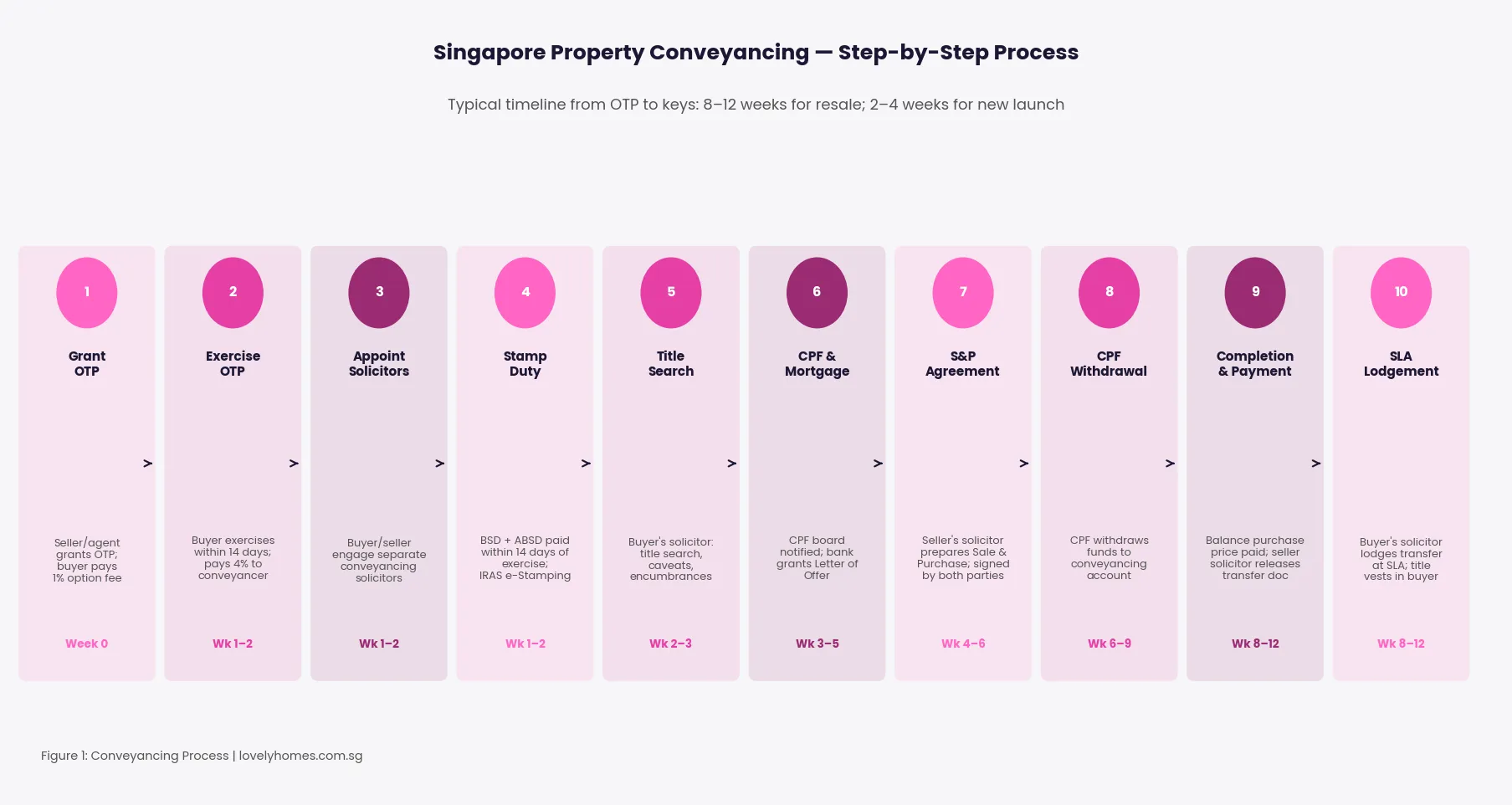
The CPF Board provides an online CPF Housing Usage Calculator on its official website. You can input the property’s purchase price, remaining lease, and the ages of all buyers to receive an immediate estimate of your CPF withdrawal limit, the applicable VL, and whether BRS needs to be met. This check takes about 5 minutes and should be done before signing any OTP — do not assume full CPF availability for older leasehold resale properties without first running this check. Your solicitor will also independently verify CPF eligibility as part of the conveyancing process, but it is far better to know the constraints before you commit to a purchase price. See our Singapore property conveyancing guide 2026 for the full timeline of a property purchase.

Disclaimer: This article is for general informational purposes only and does not constitute financial, legal, or CPF advice. CPF rules, BRS thresholds, and property financing regulations change periodically. All figures are indicative and correct as at 24 June 2026. For current rules and calculators, refer to the CPF Board, the Housing & Development Board (HDB), and the Monetary Authority of Singapore (MAS). Consult a licensed financial adviser and a solicitor before making any property purchase decision.

Singapore Property Land Tenure Guide 2026: 99-Year vs Freehold vs 999-Year Explained

Singapore Property Land Tenure Guide 2026: 99-Year vs Freehold vs 999-Year Explained

Quick Answer: Singapore Land Tenure at a Glance

  • Freehold means you own the land in perpetuity — no expiry date. More common in CCR/RCR and older landed estates.
  • 999-year leasehold is functionally near-freehold for most buyers’ lifetimes; found mainly in older District 9–11 properties and some landed estates.
  • 99-year leasehold is the most common tenure for HDB flats and most modern private condominiums in Singapore; lease starts from the date of grant, not your purchase date.
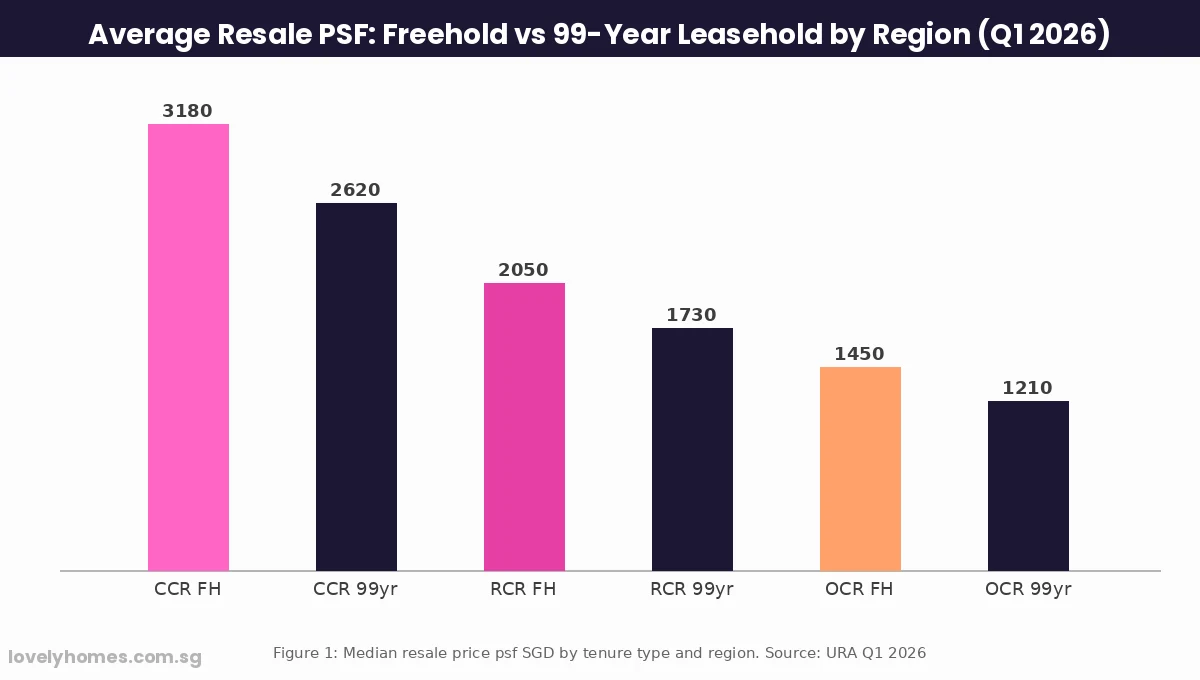
  • Freehold resale properties command roughly 15–25% price premium over comparable 99-year leaseholds in the same district.
  • CPF OA use and bank loan availability are restricted when a property’s remaining lease falls below 60 years (CPF) or 30 years (bank financing).
  • Value decay under Bala’s Table becomes measurably steep once a 99-year lease drops below 60 years remaining — roughly equivalent to a flat purchased new in 1965.
  • The Singapore Land Authority (SLA) administers all land titles; lease top-ups are discretionary and not guaranteed.

Land tenure is one of the most fundamental — and most misunderstood — concepts in the Singapore property market. When you buy a private condominium or landed home, you are not just buying bricks and mortar: you are buying a right to occupy the land beneath for a defined period. That period, and what happens as it runs down, has profound consequences for your mortgage eligibility, CPF usage, resale value, and long-term investment returns.

Singapore operates under three primary tenure types: freehold (perpetual ownership), 999-year leasehold (quasi-freehold for practical purposes), and 99-year leasehold (the dominant tenure for HDB flats and most modern private developments). Each carries different price dynamics, financing rules, and exit strategies. This guide, correct as at 24 June 2026, explains what each tenure type means, how it affects your purchase decision, and what buyers and investors need to know before signing any Option to Purchase.

Freehold vs 99-year leasehold average resale price psf by region Singapore Q1 2026
Figure 1: Median resale price per square foot (PSF) in SGD — freehold vs 99-year leasehold by market region, Q1 2026. Source: URA Realis

What Does Land Tenure Mean in Singapore?

All land in Singapore is ultimately owned by the state. When you purchase a freehold property, the government grants you perpetual right to that parcel; when you purchase a leasehold property, you receive the right to occupy the land for a defined term. HDB flats are all built on 99-year leasehold land granted by the Housing & Development Board, which in turn holds the land from the state. Private leaseholds are similarly titled under the Land Titles (Strata) Act, administered by the Singapore Land Authority (SLA).

The practical implication is straightforward: a 99-year leasehold property bought new today will have zero land value — and may be compulsorily acquired — when the lease expires 99 years hence. A freehold property, by contrast, can theoretically be passed on to your descendants indefinitely. In practice, most Singaporeans will never own a property long enough for this distinction to matter personally, but it matters enormously to the resale market, to developers calculating en-bloc potential, and to CPF Board and bank underwriters assessing loan risk.

The Three Tenure Types: Freehold, 999-Year and 99-Year

Freehold

A freehold title in Singapore confers perpetual ownership of the land. The property can be sold, inherited, or redeveloped without any lease-expiry concern. Freehold land is disproportionately concentrated in the Core Central Region (CCR), particularly Districts 9, 10, and 11, as well as in older landed residential estates in districts like D15 (East Coast) and D19 (Serangoon Gardens). Because supply is finite — the government rarely grants new freehold sites in the Government Land Sales programme — freehold properties trade at a sustained premium over 99-year equivalents.

999-Year Leasehold

A relic of colonial land grants, 999-year leases are functionally indistinguishable from freehold for any buyer whose investment horizon is shorter than several centuries. Properties holding 999-year titles include some older landed estates in Districts 9, 10, and 11, as well as certain heritage shophouses. Banks treat 999-year and freehold identically for loan-to-value purposes; CPF Board similarly imposes no material restrictions. From a market-pricing perspective, 999-year properties command a modest 5–10% premium over comparable 99-year leaseholds, but typically trade at a slight discount to true freehold owing to the perception gap among less-informed buyers.

99-Year Leasehold

The dominant tenure for HDB flats and for most private condominiums launched since the 1980s. When a developer acquires a Government Land Sales site, the land comes with a 99-year lease running from the date of state grant — not the date the units are sold. This distinction matters: if a developer takes two years to build and TOP, the first owner enters at 97 years remaining. By the time a flat is resold five years later, the remaining lease may be only 92 years. Each transfer compresses the remaining term further.

The 99-year structure is by design: the government retains the ability to redevelop land as planning priorities evolve, and the Selective En-Bloc Redevelopment Scheme (SERS) — under which HDB compulsorily acquires older estates at market value and rehouses residents — is the clearest expression of this model. SERS compensation has historically been generous, but it is not guaranteed, and fewer than 5% of HDB estates have been selected since the programme began in 1995.

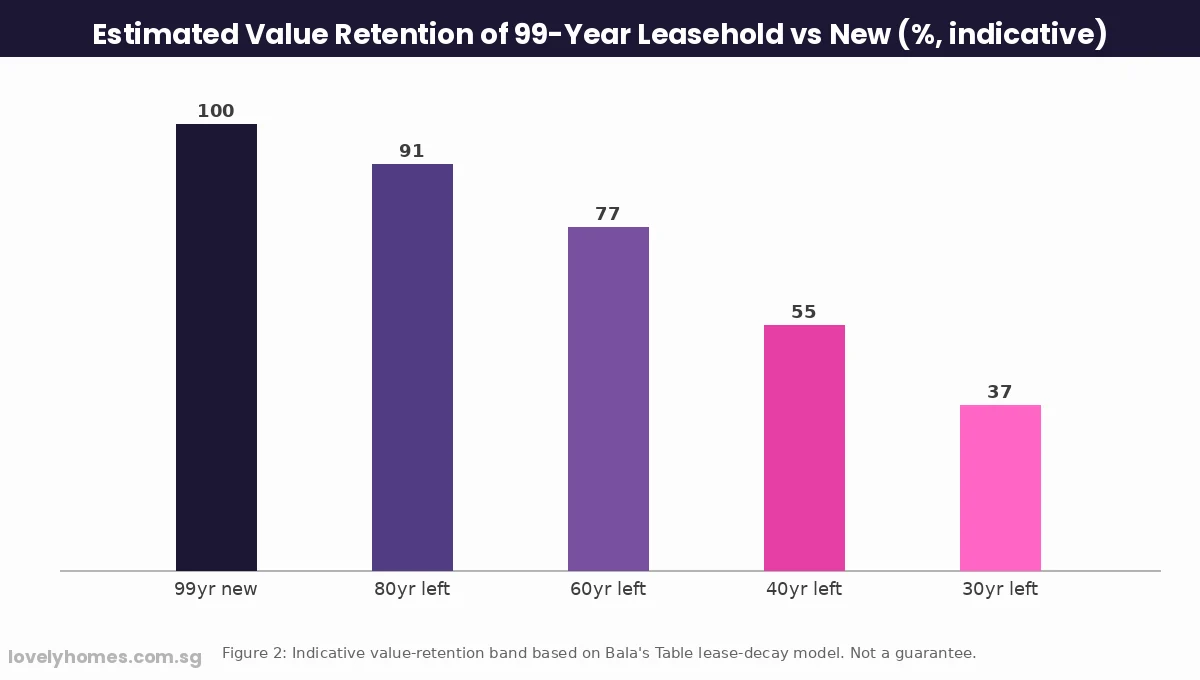
99-year leasehold value decay chart Singapore Bala's Table lease decay model
Figure 2: Indicative value retention of a 99-year leasehold property at different remaining lease durations, based on Bala’s Table. Not a guarantee of actual market prices. Source: LovelyHomes analysis

How Lease Decay Works: Bala’s Table Explained

Singapore’s property valuation profession applies Bala’s Table — a standardised depreciation formula used by licensed valuers — to determine the land value attributable to a leasehold site relative to a freehold equivalent. The table, developed by the late Chief Valuer TC Bala, accounts for the non-linear nature of lease decay: value does not fall in a straight line. Instead, the first 40 years of a 99-year lease retain the bulk of their value, while decay accelerates steeply once the remaining term drops below 60 years.

Practically, a 99-year leasehold property with 80 years remaining retains roughly 91% of its freehold-equivalent land value; at 60 years remaining, approximately 77%; at 40 years remaining, only about 55%. These are not exact market outcomes — sentiment, location, and property condition all intervene — but the directional trend is well-established. Properties approaching 30 years remaining often struggle to attract bank financing and CPF usage altogether, sharply limiting the pool of eligible buyers and putting downward pressure on price.

CPF Rules and Bank Financing by Remaining Lease

The CPF Board and commercial banks both impose restrictions tied to remaining lease duration. These restrictions become a significant pricing factor for older leasehold properties and should be front of mind for any buyer of a resale leasehold property.

CPF OA withdrawal restrictions (CPF Board, 2026): To use CPF Ordinary Account (OA) savings for a property purchase, the remaining lease must be at least 20 years. However, where the remaining lease does not cover the youngest buyer to the age of 95, CPF withdrawal is prorated based on the lease coverage ratio. Practically, a property with fewer than 60 years remaining will see meaningful CPF withdrawal restrictions. A property with fewer than 30 years remaining will typically see CPF usage restricted to very small amounts that make it effectively unusable for most buyers.

Bank loan availability: Most commercial banks in Singapore will not extend a housing loan if the remaining lease at loan maturity is less than 30 years. This effectively creates a financing cliff: properties whose leases will fall below 30 years during the expected loan tenure become very difficult to mortgage, dramatically reducing buyer pools. For a buyer seeking a 25-year loan, this means a property with 54 years remaining today (30 + 25 = 55 years minimum requirement, with slight buffer) may already face bank restrictions from certain lenders.

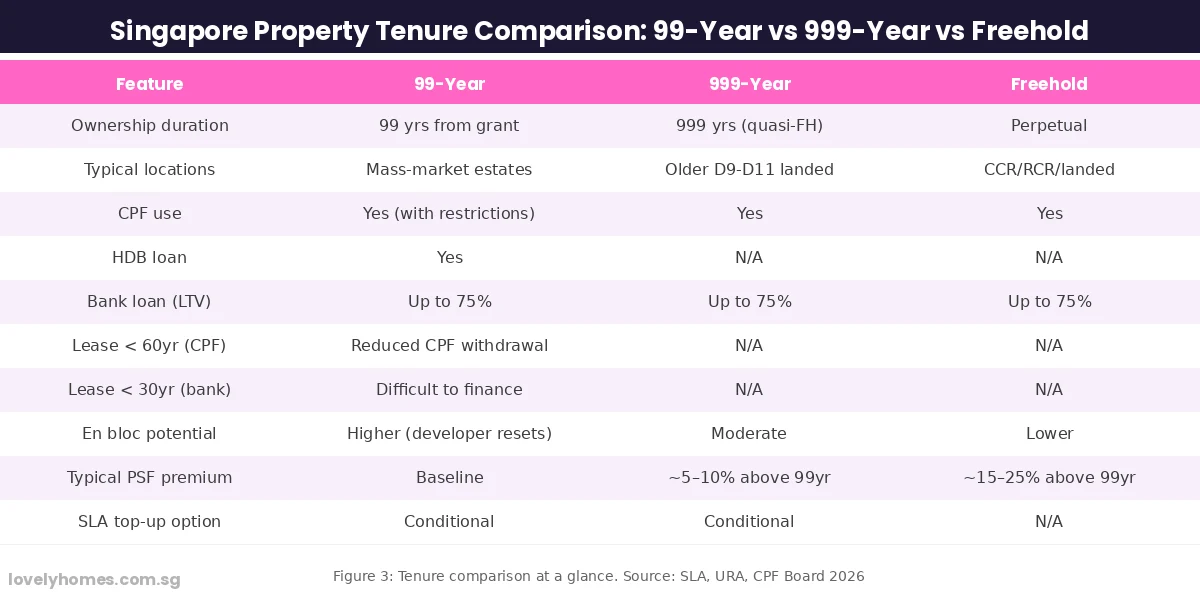
Singapore property tenure comparison table 99-year vs 999-year vs freehold 2026
Figure 3: Singapore property tenure comparison at a glance — 99-year vs 999-year vs freehold. Source: SLA, URA, CPF Board 2026

Price Premium: How Much More Does Freehold Cost?

The freehold premium in Singapore’s private residential market is real but variable. Across the market as of Q1 2026, URA Realis transaction data shows freehold resale properties trading at approximately 18–22% above comparable 99-year units in the same district and development class. The premium is most compressed in the OCR (Outer Central Region), where affordability constraints and the dominance of 99-year GLS supply have thinned the buyer pool for freehold stock. In the CCR, the premium is most pronounced because freehold supply is finite and demand from high-net-worth buyers and foreigners (who pay 60% ABSD and tend to prioritise tenure permanence) sustains elevated pricing.

However, the premium is not universal or permanent. Several factors compress it: strong new-launch condo launches on 99-year land in the same area; sentiment swings toward newer facilities over older freehold stock; and the government’s ABSD-driven cooling of foreign buyer demand since April 2023. Buyers should never assume that freehold status alone justifies a premium purchase — location, remaining lease (for 99-year comparables), age of building, and facility quality all matter more in the short-to-medium term.

Quick Reference: Land Tenure Rules at a Glance

Rule / Parameter 99-Year Leasehold 999-Year / Freehold
Typical tenure start Date of state grant (before developer build) Perpetual (FH) / colonial grant (999yr)
CPF OA use (min remaining lease) ≥ 20 years; prorated below 60 years No restriction
Bank loan (min remaining at maturity) ≥ 30 years (most banks) No restriction
Typical PSF premium vs 99yr Baseline +15–25% (FH); +5–10% (999yr)
Value decay (Bala’s Table) Accelerates below 60yr remaining None
En bloc potential High — developer resets to 99yr Lower — developer pays FH premium
SLA lease top-up (discretionary) Possible in select estates N/A
ABSD treatment Same as FH Same as 99yr

Worked Example: 99-Year vs Freehold — A Buyer’s Calculation

Mr and Mrs Wong are a Singapore Citizen couple in their early 40s, combined monthly income of S$16,000, with their HDB Minimum Occupation Period (MOP) recently cleared. They are considering two options for their first private condominium purchase in District 19:

  • Option A — 99-Year Leasehold: A well-appointed 3-bedroom condominium at Serangoon, built in 2012, with approximately 85 years remaining on its 99-year lease. Asking price S$1.45M (S$1,380 psf).
  • Option B — Freehold: A comparable 3-bedroom freehold condominium in the same neighbourhood, built in 2008. Asking price S$1.70M (S$1,620 psf) — a 17.2% premium over Option A.

Stamp duty comparison (both as 2nd property — ABSD remission strategy: sell HDB first):

  • BSD on S$1.45M: S$43,800 (CPF). BSD on S$1.70M: S$56,800 (CPF).
  • ABSD (SC 2nd property before HDB sale): S$290,000 (20%) vs S$340,000 (20%). Subject to ABSD remission if HDB sold within 6 months of purchase completion.

Bank financing: Both options qualify easily at 85 and freehold remaining lease. At 75% LTV: Option A loan S$1,087,500 @3.1% 30yr = S$4,685/mth (TDSR 29.3% — PASS). Option B loan S$1,275,000 @3.1% 30yr = S$5,497/mth (TDSR 34.4% — PASS).

20-year resale outlook: If Bala’s Table decay holds, Option A at 65 years remaining (in 20 years) retains roughly 80% of its current freehold-equivalent land value; Option B retains 100%. At a 3% compound annual capital appreciation baseline before decay effects, Option B’s perpetual tenure provides a structural hedge against the lease-decay headwind that will increasingly weigh on Option A beyond year 20.

The verdict for the Wongs: If they plan to exit within 10–12 years, Option A’s lower entry price and higher TDSR headroom make it the pragmatic choice — lease decay will be minimal in that window. If their horizon extends to 20+ years or they plan to pass the property to children, the S$250,000 upfront premium of Option B may be justified by the absent lease-decay risk.

What This Means for Buyers and Investors

For most Singaporeans whose investment horizon is under 15 years, the 99-year vs freehold debate is largely academic. In that window, location, property condition, and market sentiment dominate returns; lease decay makes only a marginal dent. The freehold premium, however, means you are paying a significant sum for insurance against a risk you may never face. The rational framework is straightforward: buy freehold if you plan to hold generational wealth or if you are purchasing in a location where supply of 99-year land is abundant and freehold is genuinely scarce. Otherwise, the 99-year product — particularly in new launches with modern facilities — offers better entry economics.

For investors targeting en-bloc exit, the calculus flips. Ageing 99-year leasehold condominiums with plot ratios below the current Master Plan allowance and lease starting to decay offer the highest en-bloc probability — developers need to reset the lease to 99 years from acquisition, making older leaseholds disproportionately attractive for collective sale. For an en-bloc investor, freehold status can actually reduce probability of a successful bid because developers pay a higher land price for equivalent redevelopment potential.

What Might Come Next: Policy and Market Outlook

Several policy trends will shape the tenure premium over the next decade. First, the government’s confirmed intent to replenish the SLA lease top-up scheme selectively — most recently applied to the Farrer Road and Boon Lay clusters — suggests that some 99-year leaseholds nearing the 40-year remaining mark may receive top-ups, partially arresting decay. However, these are discretionary, site-specific, and not widely available. Second, as Singapore’s urban redevelopment continues to pivot land away from landed and low-density uses toward mixed-use and transit-oriented development, freehold landed estates in the Core Central Region may face increasing redevelopment pressure — paradoxically making their freehold status more valuable as a negotiating chip in collective sale proceedings.

Third, the government’s ongoing review of HDB flat pricing and subsidy structures — including the HDB’s recent commentary on asset enhancement aspirations vs housing-as-a-home objectives — is likely to produce further policy signals on whether the 99-year model for public housing will be extended, supplemented, or restructured. Any formal announcement of an expanded SERS programme or a new lease buyback extension scheme would meaningfully affect the value calculus for older 99-year stock.

FAQ: Singapore Property Land Tenure

Does tenure type affect how much ABSD I pay?
No. The Additional Buyer’s Stamp Duty (ABSD) rate in Singapore is determined entirely by buyer profile (Singapore Citizen, Permanent Resident, or Foreigner) and ownership count (first, second, third property). Tenure type — freehold, 999-year, or 99-year — has no effect on ABSD rates. ABSD is administered by the Inland Revenue Authority of Singapore (IRAS). For a full breakdown of ABSD rates by buyer profile, refer to our ABSD Singapore 2026 complete guide.
Can I use my CPF OA to buy a 99-year leasehold property?
Yes, subject to two conditions. First, the remaining lease at the time of purchase must be at least 20 years. Second, CPF withdrawal is prorated where the remaining lease does not cover the youngest buyer to the age of 95. In practice, most buyers purchasing a 99-year leasehold that was launched within the last 20 years will have no CPF restriction. Problems arise for older resale leaseholds — particularly those with fewer than 60 years remaining — where CPF usage may be significantly curtailed. The CPF Board’s online calculator allows you to check CPF usage eligibility by remaining lease.
What happens when a 99-year HDB lease expires?
At lease expiry, the land reverts to the state — the HDB flat owner receives no compensation and loses the right to occupy. In practice, no HDB estate has yet reached the end of its 99-year lease (the earliest post-independence flats would reach this point around 2060), so there is no established precedent. The government has indicated through various policy statements that HDB residents in expiring estates would be rehoused, but the terms and pricing of any such scheme have not been formalised. Most HDB observers expect an expanded Selective En-Bloc Redevelopment Scheme (SERS) or an equivalent programme, but this remains speculative. Buyers of very old HDB resale flats should factor this uncertainty into their purchase decision — particularly the CPF and financing restrictions that kick in as remaining lease shrinks.
Is a 999-year leasehold really as good as freehold?
For all practical purposes, yes. No living buyer will ever be affected by the difference between 999 years and perpetuity — even if a 999-year property was granted in 1826 (early colonial Singapore), it would still have over 800 years remaining. Banks and CPF Board treat 999-year and freehold identically. The only meaningful distinction is perception-based: some buyers and investors — particularly less experienced ones — conflate “999-year” with “short lease” owing to the word “leasehold” appearing in the title. This perception gap can occasionally compress the secondary market price below a true freehold equivalent of similar specification, creating a minor buying opportunity for informed buyers who understand the distinction.
Can I apply to the SLA to extend my 99-year lease?
In theory, yes — SLA does consider lease top-up applications on a case-by-case basis. However, these are not routine or commonly approved. SLA evaluates each application against planning objectives, development potential, and public interest. Where approved, a premium is payable based on the difference in land value between the existing remaining lease and the extended term. In practice, the instances of SLA approving lease top-ups for private residential properties have been limited to select estates (such as areas near major MRT interchanges where redevelopment is planned). You should not purchase a 99-year leasehold property in anticipation of an SLA lease top-up — treat any potential top-up as an unexpected upside, never a baseline assumption.
How does an en-bloc sale affect leasehold properties differently from freehold?
In a collective sale, the developer who acquires the site will typically obtain a fresh 99-year lease from the state (even if they acquire a freehold site — they may redevelop on a new 99-year lease if the GLS mechanism is used). For owners of an ageing 99-year leasehold condominium, an en-bloc sale can therefore be particularly valuable: their diminishing lease is effectively “reset” by the developer, and the sale proceeds are based on the full redevelopment potential of the site rather than the decaying residual value of their individual units. This is why you sometimes see older 99-year condominiums command surprisingly high collective sale valuations — the land value is assessed on plot ratio and location rather than the remaining lease held by current owners. Our en-bloc seller’s guide 2026 covers the full collective sale process.
Does tenure matter when renting out a property?
No — tenure type has no effect on your ability to rent out a private property or on the rental income you can earn. Tenants do not care (and generally do not know) whether the property is freehold or 99-year. However, tenure indirectly matters through capital allocation: because freehold properties have a higher purchase price, your yield (rental income as a percentage of purchase price) will typically be lower on a freehold property than on an equivalent 99-year one. For yield-focused investors, this means 99-year leaseholds with modern facilities in strong rental catchment areas (near MRT, universities, business parks) often generate better rental yields than freehold properties at higher price points. See our Singapore property portfolio guide 2026 for yield and ABSD analysis.

Disclaimer: This article is for general informational purposes only and does not constitute legal, financial, or property advice. Singapore property regulations, CPF rules, and lending criteria change periodically. All figures cited are indicative or based on publicly available data as at 24 June 2026. For current rates and rules, refer to the Urban Redevelopment Authority (URA), the Singapore Land Authority (SLA), and the CPF Board. Consult a licensed property professional and a solicitor before making any property decision.

Singapore HDB Flat Eligibility Guide 2026: HFE Check, Income Ceilings and What Qualifies You

Singapore HDB Flat Eligibility Guide 2026: HFE Check, Income Ceilings and What Qualifies You

Quick Answer: HDB Flat Eligibility Singapore 2026

  • The HDB Flat Eligibility (HFE) letter replaced the old HDB Loan Eligibility (HLE) letter in May 2023. It is a single document that confirms both your eligibility to buy an HDB flat and your eligibility for an HDB housing loan and CPF housing grants.
  • The HFE letter is mandatory before you can apply for a BTO flat or place an Option to Purchase (OTP) on a resale HDB flat.
  • It is valid for 9 months from the date of issue and can be renewed by reapplying.
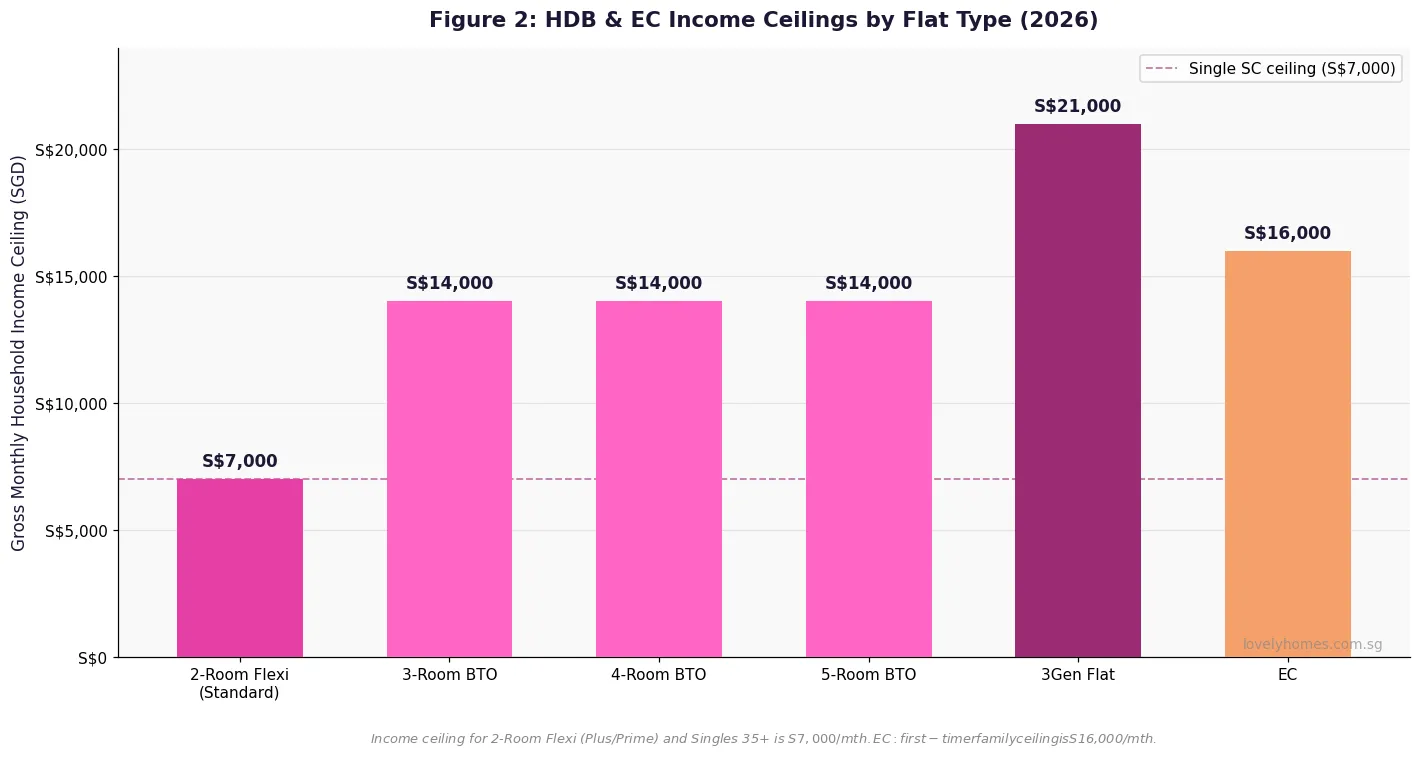
  • The income ceiling for most BTO flat types (excluding Singles schemes) is S$14,000 per month gross household income.
  • For Singles 35+ buying 2-Room Flexi under the Single Singapore Citizen Scheme, the income ceiling is S$7,000/mth.
  • You cannot buy a subsidised HDB flat if you currently own private property or have sold private property within the last 30 months.
  • Permanent Residents (PRs) can buy resale HDB flats but are not eligible for BTO flats or CPF housing grants.
  • For Executive Condominiums (ECs), the income ceiling is S$16,000/mth for first-timer families.

What Is HDB Flat Eligibility — and Why the HFE Letter Matters

Buying an HDB flat in Singapore is not simply a matter of picking a unit and signing a contract. The Housing and Development Board (HDB) administers the most heavily subsidised public housing programme in the world: as of 2026, over 78% of Singapore’s resident population lives in HDB flats, many purchased at significant subsidies relative to market prices. To maintain the fairness and integrity of this system, the HDB enforces a detailed eligibility framework governing who can buy which type of flat, under what conditions, and with what assistance.

The centrepiece of this framework — for buyers — is the HDB Flat Eligibility (HFE) letter, introduced in May 2023. The HFE letter replaced both the old HDB Loan Eligibility (HLE) letter and the separate eligibility self-check that buyers previously performed themselves. Today, a single HFE application, submitted via the HDB Flat Portal, generates a letter that simultaneously confirms your:

  • Eligibility to purchase an HDB flat (including flat type and scheme).
  • Eligibility for an HDB concessionary housing loan and the maximum loan quantum.
  • Eligibility for CPF housing grants and the grant amounts applicable to you.

No HFE letter means no BTO application and no resale OTP. Understanding how to obtain the HFE letter — and what it assesses — is therefore the logical starting point for any prospective HDB buyer in 2026.

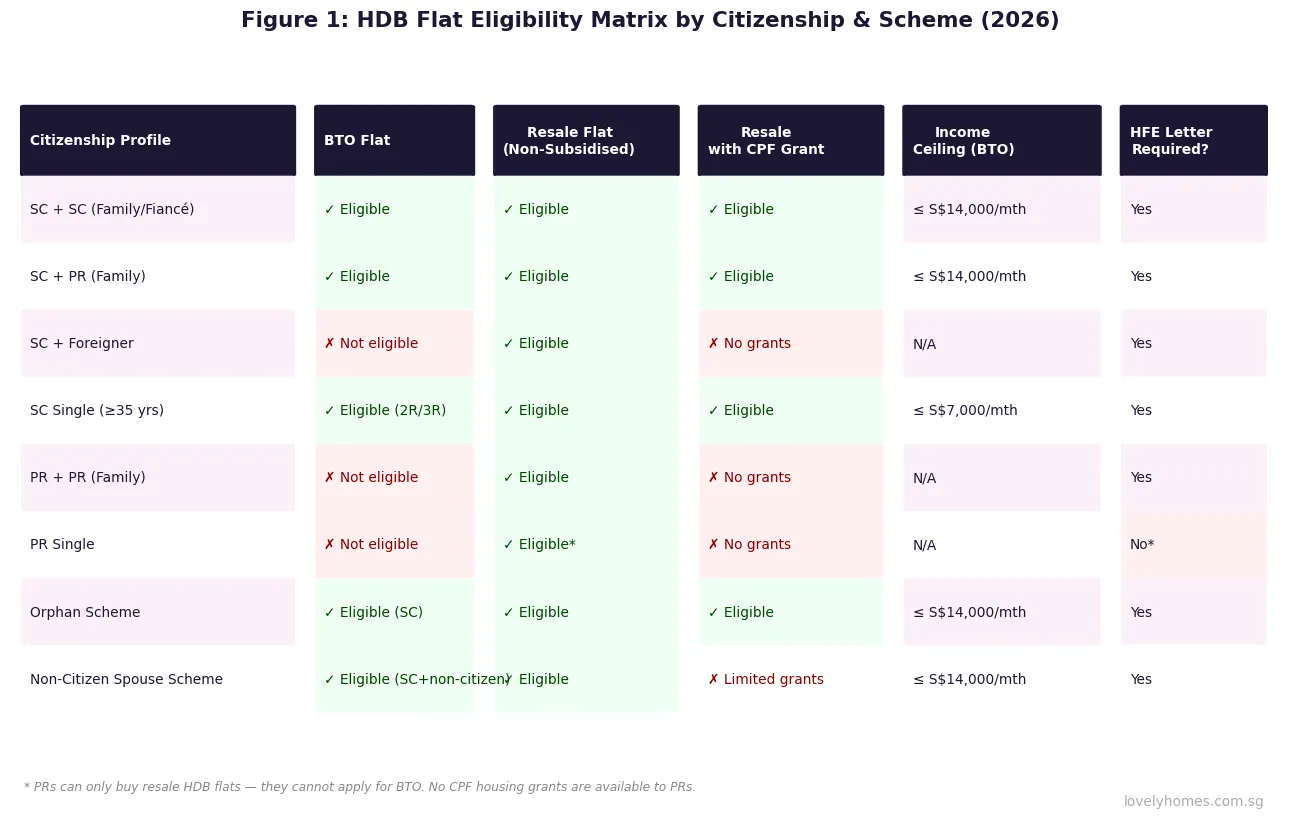
Figure 1: HDB flat eligibility matrix by citizenship and scheme Singapore 2026
Figure 1: HDB flat eligibility by citizenship profile and scheme in Singapore (2026). Green = eligible; red = not eligible for that pathway.

The Seven HDB Eligibility Schemes: Which One Applies to You?

The HDB does not use a single eligibility rule. Instead, it operates seven distinct eligibility schemes, each designed to accommodate a specific family or household configuration. Every applicant must qualify under one of these schemes.

1. Public Scheme: The most common scheme. Requires at least one Singapore Citizen (SC) applicant. The other person(s) in the nucleus (spouse, children, parents, or siblings) can be SCs or Permanent Residents (PRs). This covers the vast majority of married couples and families applying for BTO or resale flats.

2. Fiancé/Fiancée Scheme: Allows SC couples who are not yet married to apply for a BTO flat or book a resale flat together. Both parties must be at least 21 years old and must register their marriage within three months of the resale flat keys being collected, or within three months of the BTO flat booking.

3. Orphan Scheme: For applicants who are single SCs (i.e., unmarried, widowed, or divorced) and whose parents are deceased. The applicant must have at least one sibling who is also unmarried or widowed and who was living with the parents prior to their passing. This scheme allows siblings to pool their eligibility to purchase a flat together.

4. Non-Citizen Spouse Scheme: Allows an SC to buy a flat with a foreign (non-PR, non-SC) spouse. The SC applicant must be the essential occupier; the foreign spouse is named as an occupier. Only a limited selection of HDB flat types is available under this scheme, and CPF grant eligibility is more restricted.

5. Single Singapore Citizen (SSC) Scheme: For SCs aged 35 and above who are single (unmarried, widowed, or divorced). Singles may only purchase 2-Room Flexi flats in non-mature estates under BTO, or any resale flat size. The income ceiling under this scheme is S$7,000 per month.

6. Joint Singles Scheme: Allows two to four single SCs, each aged 35 or above, to buy a flat jointly. The same rules as the SSC Scheme apply; participants must remain as joint owners during the Minimum Occupation Period (MOP).

7. Joint Singles with Widowed/Divorced Persons Scheme: A specific subset allowing a widowed or divorced SC of any age to purchase a resale flat jointly with other single SCs (aged 35+).

Income Ceilings: BTO, Resale and EC

Figure 2: HDB and EC income ceiling by flat type Singapore 2026 BTO eligibility
Figure 2: HDB income ceilings by flat type (2026). Income ceiling for 2-Room Flexi BTO in Plus/Prime classification and Singles 35+ is S$7,000/mth.

Income ceilings for BTO flat purchases exist to ensure subsidised flats are channelled to households that genuinely cannot afford private market alternatives. The ceilings are based on gross monthly household income — the sum of all assessable income of all applicants and essential occupiers listed in the application.

Flat Type / Scheme Income Ceiling (Gross Monthly) Notes
2-Room Flexi BTO (Standard estates) S$14,000 (family) / S$7,000 (singles) Singles 35+ eligible for S$7,000 ceiling
2-Room Flexi BTO (Plus / Prime) S$7,000 (family) Lower ceiling for higher-subsidy estates
3-Room BTO S$14,000 Standard, Plus, and Prime classifications
4-Room BTO S$14,000 Most common flat type
5-Room and 3Gen BTO S$14,000 / S$21,000 (3Gen) 3Gen flats require multi-generational households
HDB Resale (no CPF grant) No income ceiling Any eligible buyer can purchase at market price
HDB Resale (with CPF grants) S$14,000 (family) / S$7,000 (singles) EHG eligibility requires household income check
Executive Condominium (EC) S$16,000 (first-timer family) EC is quasi-private; higher ceiling than HDB BTO

Ownership History and Private Property: The 30-Month Rule

One of the most consequential eligibility rules concerns private property ownership. To prevent higher-income households from simultaneously benefiting from HDB subsidies and private market appreciation, the HDB imposes strict conditions:

  • You and any listed occupier must not currently own private residential property in Singapore or overseas at the time of application.
  • You and any listed occupier must not have disposed of any private residential property (in Singapore or overseas) within the 30 months immediately before the HFE application date (for subsidised BTO or resale with grants). This is the so-called “30-month wait-out period” for private property owners.
  • Owning a commercial property does not affect HDB eligibility, but owning a residential property held through a company or trust may be assessed on a case-by-case basis.

For buyers purchasing a resale flat at market price without any CPF housing grant, the private property ownership rule does not apply — you can own a private property and buy a resale HDB flat simultaneously, subject to paying the applicable stamp duty. However, you would need to sell the private property if you wish to continue owning the HDB flat beyond the applicable occupation period under the terms of the purchase.

MOP Interaction: When Previous Flat Ownership Matters

If you have previously owned an HDB flat, your Minimum Occupation Period (MOP) history affects your eligibility for a subsequent subsidised purchase:

  • You must have fully completed the MOP on your current or most recently sold HDB flat before applying for a new BTO flat.
  • If you are currently within the MOP of an existing HDB flat, you cannot book a new BTO flat — you must wait until the MOP is cleared and the existing flat is sold.
  • Second-timer applicants applying for BTO flats have reduced priority balloting and are subject to a resale levy payable to HDB if they had previously received a housing subsidy on a first subsidised flat.
  • The resale levy ranges from S$15,000 to S$55,000 depending on the flat type of the first subsidised flat, and is payable upon the booking of the second flat.

Figure 3: HFE letter 8-step application process flowchart HDB flat eligibility Singapore 2026
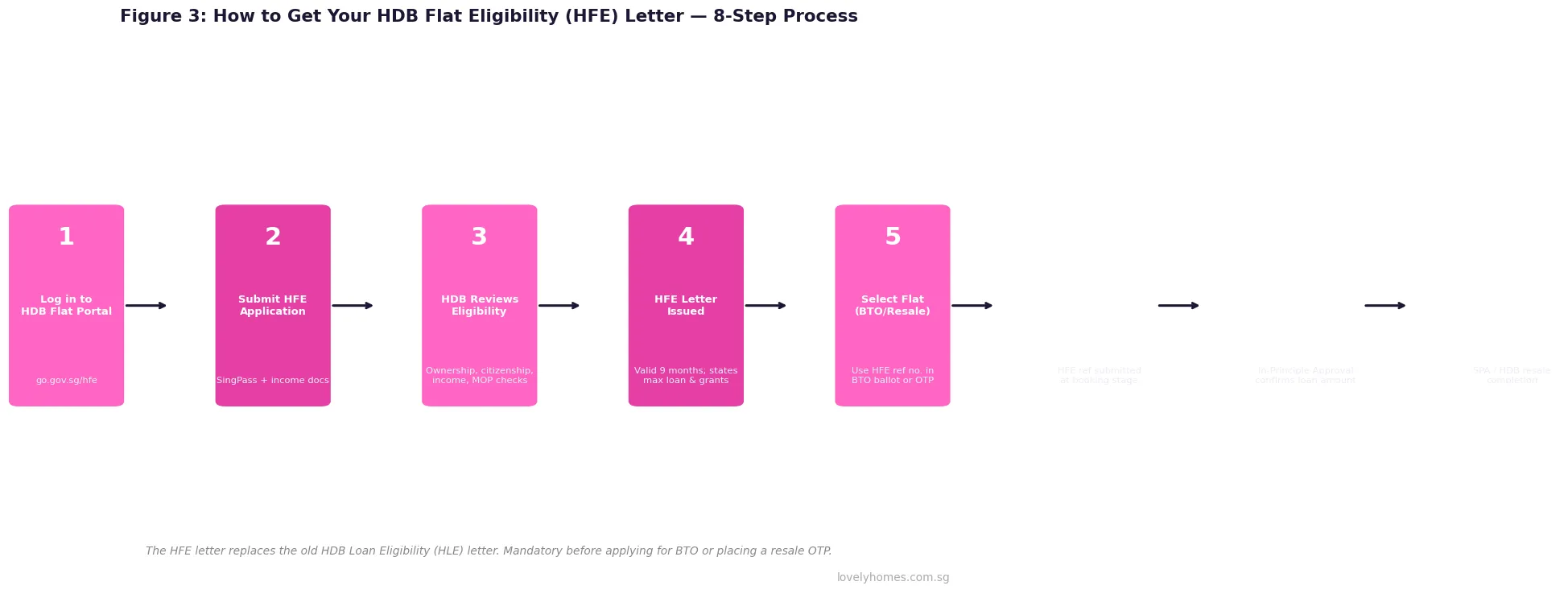
Figure 3: The 8-step HDB HFE (Flat Eligibility) letter application process in Singapore (2026). The HFE replaces the old HLE letter and combines loan and grant eligibility in one document.

How to Apply for the HFE Letter: Step-by-Step

Applying for the HFE letter is done entirely online via the HDB Flat Portal at homes.hdb.gov.sg (also accessible at go.gov.sg/hfe). The process requires all applicants to log in via Singpass and provide income documentation. Here is what you need:

  • Singpass login for each applicant.
  • Latest CPF contribution history (auto-retrieved with Singpass consent).
  • Latest payslip(s) for each employed applicant.
  • Income Tax Notice of Assessment (if self-employed or commission-based).
  • Documents for variable income, including bonuses, allowances, and rental income (typically the average over the past 12 months).
  • Details of all outstanding loans (used to assess HDB loan quantum and TDSR/MSR compliance).

Once submitted, HDB typically issues the HFE letter within 5 to 7 working days, though complex applications (e.g., overseas property interests, atypical income structures, or previous flat ownership history) may take longer. The HFE letter is valid for 9 months. If you do not book a flat or sign a resale OTP within this window, you must renew the HFE application.

Worked Example: The Lee Family’s HFE Application and BTO Journey

Mr Lee Jian Ming and Ms Tan Wei Ling are Singaporean citizens, both aged 29, engaged to be married in August 2026. They wish to apply for a 4-Room BTO flat in Bishan under the Fiancé/Fiancée Scheme. Their combined gross monthly income is S$9,200. Neither owns any private property; both are first-time flat buyers.

Step 1 — HFE Application: They apply jointly via the HDB Flat Portal, logging in via Singpass and uploading their payslips. Mr Lee earns S$5,800/mth; Ms Tan earns S$3,400/mth. Combined: S$9,200/mth.

Eligibility check: Income S$9,200 < ceiling S$14,000 ✓. Both are SCs ✓. Neither owns private property ✓. Both are first-timers ✓. Scheme: Fiancé/Fiancée (Public Scheme) ✓.

HFE Letter outcome: Eligible to purchase 4-Room BTO. Eligible for HDB concessionary loan at 2.6% p.a. (pegged to CPF OA rate + 0.1%). Maximum loan quantum: based on TDSR/MSR — HDB assesses their monthly repayment capacity. Eligible for Enhanced CPF Housing Grant (EHG) at S$9,200/mth household income = approximately S$20,000 (tapering scale, family; income ≥ S$9,001 and ≤ S$9,500 band).

At ballot: The Lees apply for a 4-Room flat in Bishan Lakeview (June 2026 BTO exercise, Prime classification). As first-timers under the Fiancé/Fiancée Scheme, they receive a First-Timer Priority ballot advantage. Wait time: approximately 4.5 years (Top in 2031).

Key numbers: BTO price approximately S$680,000 (indicative, Prime D20 4-Room). BSD: S$14,400. No ABSD (first HDB purchase). HDB loan 90% LTV = S$612,000 at 2.6% 25 years = S$2,780/mth. MSR 30%: maximum monthly mortgage S$2,760 — just at the boundary. The couple may consider topping up CPF or adjusting the loan tenure to keep monthly payments within MSR.

Why HFE Matters: Singapore’s Public Housing System and What It Delivers

The HFE framework reflects the extraordinary scope of Singapore’s public housing commitment. The government subsidises HDB flats at prices well below what a private developer would charge for comparable space in comparable locations — a deliberate policy to enable homeownership across virtually all income bands. This subsidy comes with conditions, and the HFE is how those conditions are enforced consistently and fairly.

For buyers, the HFE letter serves another practical function: it gives you certainty before committing. Knowing your exact grant quantum, maximum loan, and MSR headroom before entering the ballot prevents over-commitment and planning failures — a significant improvement over the old system where buyers sometimes discovered eligibility issues only at the booking stage.

By global comparison, few countries provide both a guaranteed right to affordable housing and a structured eligibility framework as rigorous as Singapore’s. The HFE system continues to be refined: the HDB has signalled that digital verification of income will become more automated through MyInfo and CPF integration, reducing the documentation burden on applicants whilst maintaining eligibility integrity.

What Might Change in HDB Eligibility Rules From 2026 Onwards

The HDB and the Ministry of National Development have signalled several potential directions for HDB eligibility policy in the medium term. Observers expect further calibration of the Plus and Prime flat classification framework — introduced in October 2024 — including the possibility of expanding the number of estates with Plus-level restrictions as the scheme matures. The resale levy quantum, last revised in 2006, is overdue for review given the rise in flat prices. The HDB has also mooted reforms to the singles policy, potentially lowering the age threshold below 35 in future BTO launches for certain flat types, in response to demographic changes and the rising number of young singles. Any policy changes would be announced by the Ministry of National Development and take effect for BTO sales exercises from the announcement date.

Frequently Asked Questions

How long is the HFE letter valid, and what happens if it expires?

The HFE letter is valid for 9 months from the date of issue. If you do not apply for a BTO flat or place a resale OTP within this period, you must reapply. The reapplication process is the same as the original application — you log in via the HDB Flat Portal, update your income and financial details, and HDB reassesses your eligibility. Your eligibility may change if your income, property ownership status, or household composition has changed since the last application. There is no limit on the number of times you can renew an HFE application.

Can a Permanent Resident buy a BTO flat in Singapore?

No. Permanent Residents (PRs) are not eligible to apply for BTO flats. PRs may only purchase resale HDB flats, and only if they form a family nucleus with at least one SC (or apply under the PRs-only joint purchase arrangement for resale flats). PRs are not entitled to CPF housing grants. Furthermore, PRs who buy an HDB resale flat must sell the flat before buying or owning any private residential property.

What is the resale levy, and when does it apply?

The resale levy is a payment to HDB made by second-timer applicants who are buying a second subsidised HDB flat (BTO or resale with CPF grants) after having previously received a housing subsidy on a first flat. The levy ranges from S$15,000 (for a previous 2-Room flat) to S$55,000 (for a previous 5-Room or larger flat), indexed to the flat type at time of first subsidy. The levy is intended to reduce the cumulative housing subsidy received by any one household. It is payable at the booking of the second flat and can be paid from CPF OA funds.

Can I apply for the HFE letter if I am currently renting an HDB flat?

Yes. Renting an HDB flat — whether through HDB directly or through a sub-tenancy arrangement from a flat owner — does not disqualify you from applying for the HFE letter or purchasing an HDB flat, provided you meet the other eligibility criteria (citizenship, income, ownership history, age). Your rental status is not assessed as part of the HFE eligibility check. However, note that if you are renting a room in an HDB flat owned by someone else, the owner’s eligibility is what governs the rental — not yours as a tenant.

What happens if my income exceeds the ceiling after I have already booked a BTO flat?

Once you have successfully booked a BTO flat and the booking is confirmed, the income ceiling is assessed at the point of application and booking — not retrospectively at key collection. A temporary increase in income after booking (for example, a salary increment or bonus) does not cause you to lose your booking. However, if you fraudulently misrepresented your income at the time of application, HDB can cancel your booking and take disciplinary action. The CPF grant quantum is fixed at the time the HFE letter is issued; subsequent income changes do not affect the grant amount already confirmed.

Can foreigners buy HDB flats in Singapore?

Foreigners (non-SC, non-PR) cannot buy HDB flats in Singapore under any scheme. They are also ineligible for CPF housing grants. Foreigners may purchase private residential property subject to paying Additional Buyer’s Stamp Duty (ABSD) at 60% of the purchase price (as at 2026). A small category of citizens from countries with bilateral Free Trade Agreements (Iceland, Liechtenstein, Norway, and Switzerland under the EUSFTA/FTA frameworks) may be treated similarly to SCs for ABSD purposes on first purchases, but are still ineligible to purchase HDB flats.

Does the 30-month wait-out period apply if I am giving up my private property through inheritance?

The 30-month wait-out period applies to the disposal of private residential property, not to its acquisition through inheritance. If you inherit private residential property, you are not immediately disqualified from HDB eligibility — however, you must dispose of the inherited private property before your HFE application or BTO booking (within the timeframe specified by HDB). If you are applying for a subsidised BTO flat or resale flat with CPF grants, you cannot hold private property simultaneously. The 30-month clock starts running from the date you legally dispose of the inherited private property, not from the date of inheritance.

Related Articles

Disclaimer

This article is intended for general information purposes only and does not constitute legal, financial, or professional advice. HDB eligibility rules, income ceilings, grant quantum, and related policies described in this article are accurate to the best of our knowledge as at June 2026 but are subject to change by the Housing and Development Board and the Ministry of National Development. Readers should verify all information directly with HDB before making any purchase decisions. Official HDB flat eligibility information is available at hdb.gov.sg. CPF housing grant information is available at cpf.gov.sg. Income tax and stamp duty information is available at iras.gov.sg.

×

Singapore Property Conveyancing Guide 2026: Complete Step-by-Step Process from OTP to Keys

Singapore Property Conveyancing Guide 2026: Complete Step-by-Step Process from OTP to Keys

Quick Answer — Singapore property conveyancing at a glance

  • Conveyancing is the legal process that transfers ownership of a property from seller to buyer — it covers the Option to Purchase, Sale & Purchase Agreement, stamp duties, CPF and bank drawdown, title searches, and SLA registration.
  • Resale private property: typically 8–12 weeks from OTP exercise to keys; new launch: 2–4 weeks from OTP to S&P signing (but full completion may be years away at TOP).
  • Buyer pays BSD and ABSD (if applicable) within 14 days of exercising the OTP via IRAS e-Stamping — no grace period.
  • Buyer and seller engage separate conveyancing solicitors for HDB transactions; for private property they may use different lawyers from the same firm, but must each have their own.
  • Buyer’s solicitor fees typically run S$2,200–S$5,000; seller’s solicitor S$1,500–S$3,800, plus disbursements of S$850–S$1,650 (title searches, SLA lodgement, miscellaneous).
  • CPF Ordinary Account funds can be used for the purchase price, BSD, monthly mortgage instalments, but NOT for ABSD — that must come from cash.
  • Title is formally vested in the buyer upon SLA lodgement — this is the last step and must be done by the buyer’s solicitor after completion.
  • For new launches, the developer’s solicitors handle conveyancing on the developer’s side; buyers appoint their own solicitor for the S&P review, CPF and bank drawdown.

What Is Property Conveyancing in Singapore?

Conveyancing is the legal process by which ownership of real property is transferred from one person to another. In Singapore, it encompasses everything from the initial offer document — the Option to Purchase (OTP) — through the exchange of contracts, payment of stamp duties, withdrawal of CPF funds, mortgage drawdown, and finally registration of the transfer at the Singapore Land Authority (SLA).

The Singapore conveyancing process is governed principally by the Conveyancing and Law of Property Act, the Land Titles Act, and various subsidiary legislation administered by the SLA. The Law Society of Singapore sets recommended scale fees for conveyancing work, although solicitors may agree different rates with clients. The Council for Estate Agencies (CEA) regulates the property agents who facilitate the transaction, but agents do not conduct the legal conveyancing — that is the exclusive domain of Singapore-qualified solicitors or law firms.

Understanding what your solicitor does — and when — is critical for budgeting, meeting deadlines, and avoiding costly mistakes such as missing the 14-day stamp duty deadline.

Step-by-Step Conveyancing Process for Resale Private Property

Singapore conveyancing process 10-step timeline from OTP to SLA lodgement
Figure 1: Singapore property conveyancing — 10 steps from OTP to SLA title registration. Typical timeline: 8–12 weeks for resale private property.

The ten steps below reflect a typical resale private property transaction. HDB resale follows a similar process but routes certain steps through the HDB Resale Portal instead.

Step 1: Seller grants OTP

The seller (or seller’s agent) issues the OTP — a standard form prescribed by the Law Society — and the buyer pays the 1% option fee (non-refundable if the buyer does not exercise). The OTP specifies the property, agreed price, and a 14-day window in which the buyer may exercise. For private property, the 14-day window is negotiable; 14 calendar days is standard. HDB OTPs have a fixed 21-day period.

Step 2: Buyer exercises the OTP

Within 14 days, the buyer exercises the OTP by signing and returning it to the seller’s solicitor, together with a further 4% exercise fee. This brings the total deposit to 5% of the purchase price, held by the seller’s solicitor as stakeholder pending completion. Once exercised, both parties are contractually bound to complete.

Step 3: Appoint conveyancing solicitors

Buyer and seller each appoint their own conveyancing solicitor promptly on grant of the OTP — waiting until exercise wastes time. The buyer’s solicitor handles title searches, CPF and bank liaison, and the SLA lodgement. The seller’s solicitor prepares the S&P Agreement and manages the seller’s CPF refund obligations and outstanding mortgage discharge.

Step 4: Pay stamp duty

BSD and ABSD (if applicable) must be paid to IRAS within 14 days of exercising the OTP — this applies to the instrument (the OTP), not the S&P. Payment is made via IRAS e-Stamping. CPF Ordinary Account funds may be used for BSD only, subject to CPF Board approval and sufficient OA balance. ABSD must be paid fully in cash; CPF cannot cover it.

Step 5: Title search and due diligence

The buyer’s solicitor conducts a title search at the SLA to confirm: (a) the seller has indefeasible title, (b) there are no subsisting caveats or charges beyond the disclosed mortgage, and (c) the property boundaries match the approved survey plan. Additional searches are conducted at the Building and Construction Authority (BCA), Urban Redevelopment Authority (URA) for planning approvals, and relevant town councils for arrears.

Step 6: CPF and mortgage

The CPF Board must be notified if the buyer is withdrawing CPF OA funds. The Board checks the property’s Valuation Limit (VL) and Withdrawal Limit (WL) — CPF usage is capped at the lower of the VL or purchase price, and must not cause the buyer’s CPF OA balance to fall below the Basic Retirement Sum (BRS) in certain circumstances. The bank issues a formal Letter of Offer (LO) once it is satisfied with the title search and property valuation.

Step 7: Sale & Purchase Agreement

The seller’s solicitor prepares the S&P Agreement, which converts the exercised OTP into a full bilateral contract. Both parties sign, and the buyer’s solicitor retains a copy. The S&P specifies the completion date (typically 8–10 weeks from OTP exercise for resale), encumbrances to be discharged, and the process for handing over vacant possession.

Step 8: CPF withdrawal

The CPF Board processes the formal withdrawal request from the buyer’s solicitor. Funds are transferred from the buyer’s OA directly to the conveyancing account held by the buyer’s solicitor. CPF will also file a CPF caveat with the SLA if CPF funds are used — this protects the Board’s interest and must be discharged by the Board when you eventually sell.

Step 9: Completion and payment

On completion day, the buyer’s solicitor (holding CPF funds and bank loan proceeds) pays the balance of the purchase price to the seller’s solicitor. The seller’s solicitor simultaneously releases the executed transfer documents (Form A for private property; a separate HDB transfer form for HDB) and arranges for discharge of the seller’s outstanding mortgage. Keys are handed over, and the buyer takes vacant possession.

Step 10: SLA lodgement

Within a few days of completion, the buyer’s solicitor lodges the Instrument of Transfer and any mortgage deed with the SLA electronically (via STARS e-lodge). This is the step that vests legal title formally in the buyer’s name on the Singapore Land Register. Until this is done, the buyer holds only equitable title. A fresh title search will show the buyer as the registered proprietor.

Conveyancing Fees — What You Will Pay in 2026

Singapore conveyancing legal fees by property price 2026 — buyer seller solicitor comparison
Figure 2: Conveyancing legal fees by property price — buyer’s solicitor, seller’s solicitor and disbursements (2026 estimates based on Law Society scale).

Conveyancing fees in Singapore comprise three components: the professional fee charged by your solicitor, disbursements (out-of-pocket costs for searches and filings), and GST (9% on the professional fee and most disbursements).

Property Price Buyer’s Solicitor Seller’s Solicitor Disbursements (buyer) Total (buyer, excl. GST)
S$500,000 S$2,200 S$1,500 S$850 S$3,050
S$800,000 S$2,800 S$1,800 S$950 S$3,750
S$1,000,000 S$3,000 S$2,000 S$1,050 S$4,050
S$1,500,000 S$3,500 S$2,500 S$1,200 S$4,700
S$2,000,000 S$4,000 S$2,800 S$1,350 S$5,350
S$2,500,000 S$4,500 S$3,200 S$1,500 S$6,000
S$3,000,000 S$5,000 S$3,800 S$1,650 S$6,650

Disbursements typically cover: SLA lodgement fees (S$250–S$450 depending on transaction type), title search fees (S$100–S$200), BCA/URA/Town Council searches (S$80–S$150 combined), private caveat registration (S$60), CPF-related filings (S$80), and miscellaneous (postage, photocopies). Some banks subsidise the buyer’s legal fees as part of their mortgage package — a legal fee subsidy of S$1,500–S$2,000 is common on refinancing, and occasionally on new purchases. Always confirm the scope of the subsidy before assuming it covers all conveyancing work.

OTP versus Sale & Purchase Agreement — What You Are Actually Signing

OTP versus Sale and Purchase Agreement key differences Singapore property conveyancing
Figure 3: OTP vs Sale & Purchase Agreement — key differences, obligations, and government bodies involved.

Many buyers conflate the OTP and the S&P Agreement, but they are legally distinct documents that arise at different points in the process and carry different obligations. The OTP is a unilateral promise by the seller — it does not bind the buyer until the buyer exercises it. The S&P is a full bilateral contract. The key practical implications: the 14-day stamp duty clock starts from OTP exercise, not from S&P signing; and the seller can legally market the property to other buyers until the OTP is exercised.

HDB versus Private Property Conveyancing — Key Differences

The broad process is similar, but there are important differences:

  • HDB Resale Portal: Both buyer and seller must register their intent to buy/sell on the portal before negotiating. HDB issues a Resale Checklist that must be acknowledged. This formalises the process and prevents side-deals.
  • HDB Flat Eligibility (HFE) check: Buyers must complete an HFE check (covering income, citizenship, ownership history, CPF grants) and receive an HFE Letter before exercising the OTP. The HFE Letter is valid for 9 months.
  • HDB valuation: HDB will conduct its own valuation; the purchase price minus valuation is the Cash Over Valuation (COV), which must be paid in cash — no CPF, no bank loan.
  • Timeline: HDB resale takes 8–10 weeks from OTP exercise to completion; HDB prescribes the timeline and the completion appointment is fixed by HDB.
  • Same solicitor: Unlike private property transactions, HDB insists that buyer and seller use separate solicitors from different firms. Some buyers skip a solicitor for straightforward HDB purchases, but this is inadvisable.

For private property, the parties are free to negotiate the OTP period and completion date. Some sellers may grant a 6-week OTP on new launches to allow buyers to secure financing — but note that the 14-day stamp duty deadline still runs from the date of exercise, not the date of grant.

CPF in the Conveyancing Process — Practical Notes

CPF OA funds may be used to pay the purchase price (principal) and BSD, and for monthly mortgage instalments thereafter. The CPF Board must give written approval before any withdrawal, and the Board will lodge a CPF caveat against the property once withdrawal occurs. This caveat remains on title until fully discharged, which happens automatically when you sell and repay CPF (principal plus accrued interest at 2.5% per annum).

There is one common surprise: if you are purchasing a leasehold property with remaining tenure under 30 years, the CPF Board restricts or blocks OA usage entirely. For properties with 20–30 years remaining, CPF usage is capped at the purchase price pro-rated by (remaining tenure / 60). Under 20 years of lease remaining, CPF cannot be used at all. This is particularly relevant for buyers of older resale HDB flats or short-lease commercial properties.

New Launch Conveyancing — What Is Different

For a new private condominium, the developer issues the OTP and the developer’s solicitors prepare the S&P Agreement. The buyer appoints their own solicitor to review the S&P — this fee is typically absorbed within a legal fee subsidy provided by the developer (usually S$3,000–S$5,000 credit). The buyer still pays BSD (and ABSD if applicable) within 14 days of exercising the OTP.

Because the property is under construction, completion and SLA lodgement happen at TOP (Temporary Occupation Permit) or after, potentially 3–5 years after OTP. In the interim, the buyer makes progress payments under the Progressive Payment Scheme (PPS) as construction milestones are reached. CPF and bank loan drawdowns are tied to each stage of the PPS.

Worked Example: The Tan Family — Resale Condo in D15

Scenario: Mr and Mrs Tan, both Singapore Citizens (SC), have a fully paid HDB flat in Tampines (MOP cleared). They agree to buy a freehold 3BR resale condo in East Coast (D15) for S$1,800,000. This is their second property — they intend to sell the HDB within 6 months to claim the ABSD remission.

Step-by-step conveyancing costs and timeline:

  • OTP grant (Week 0): Seller grants OTP; Tans pay 1% = S$18,000 option fee.
  • Solicitor appointed (Week 0–1): Tans engage conveyancing solicitor — estimated professional fee S$3,800, disbursements S$1,250, GST S$456 → total S$5,506.
  • OTP exercised (Week 1): Tans exercise OTP, pay further 4% = S$72,000. Total deposit S$90,000 (5%).
  • Stamp duty (within 14 days of exercise):
    BSD: S$44,600 (on S$1.8M) — paid via CPF OA.
    ABSD (SC 2nd property at 20%): S$360,000 — paid in cash only. ABSD remission applied if HDB sold within 6 months of S&P completion.
  • Title search & CPF / bank approval (Week 2–5): No subsisting caveats found. Bank issues LO at 75% LTV = S$1,350,000 loan at 3.1% p.a. 30 years → S$5,764/month. TDSR: (5,764 + 0) / 17,000 household income = 33.9% PASS.
  • S&P signed (Week 5): Completion date set for Week 10.
  • Completion (Week 10): CPF OA drawdown S$390,000 (balance purchase price minus loan). Bank loan S$1,350,000. Total funds: S$1,800,000.
  • SLA lodgement (Week 10–11): Buyer’s solicitor lodges transfer. Tans are registered owners.
  • Net cash outlay (before ABSD remission):
    ABSD: S$360,000 + BSD: S$44,600 (CPF) + deposit: S$90,000 + legal/disbursements: S$5,506 + 20% DP (post BSD/ABSD): S$360,000 + misc = approx S$820,000.
    After HDB sold within 6 months → ABSD refund S$360,000 → net cash approximately S$460,000.

What Conveyancing Might Look Like After 2026

The SLA has been progressively digitalising land title records, and fully electronic conveyancing (e-Conveyancing) using the STARS platform is already the norm. Looking further ahead, the legal technology sector is exploring smart contract-based property transfers, though regulatory frameworks are not yet in place. The 14-day stamp duty deadline is unlikely to change — it is a revenue measure administered by IRAS. Solicitor fees are not regulated at the transaction level, but the Law Society’s recommended scale continues to serve as an industry benchmark. Any buyer purchasing after 1 January 2026 should also note that the GST rate of 9% has been in effect since 1 January 2024 and applies to legal fees.

Common Conveyancing Mistakes to Avoid

  • Missing the 14-day stamp duty deadline: A penalty of up to 4× the unpaid duty applies. If you are exercising close to the deadline, liaise with your solicitor and IRAS in advance — there is no automatic extension.
  • Not confirming CPF eligibility before exercising: If the property’s lease has fewer than 20 years remaining, or if your CPF OA balance is insufficient, you may be forced into a cash purchase at completion. Confirm CPF eligibility with the CPF Board and your solicitor before exercise.
  • Using ABSD remission window incorrectly: SC couples who rely on the 6-month remission window must sell their HDB within 6 months of legal completion of the private property purchase — not from OTP or TOP. Document dates carefully.
  • Assuming the developer pays for your solicitor in new launches: The legal subsidy covers only the S&P review for the purchase. Any additional advice — disputes, CPF queries, refinancing — is charged separately.
  • Overlooking URA/HDB planning restrictions: Your solicitor’s title search does not cover pending planning applications or future MRT lines that might compulsorily acquire the land. Check the URA Master Plan and SLA’s INLIS for additional context.

Summary — Singapore Property Conveyancing at a Glance

Item Details
Governing law Conveyancing and Law of Property Act; Land Titles Act; CPF Act; Stamp Duties Act
Key bodies SLA (registration), IRAS (stamp duties), CPF Board (CPF withdrawals), Law Society (solicitor regulation), CEA (agents)
OTP option fee 1% of purchase price; non-refundable if buyer does not exercise
OTP exercise fee 4% of purchase price; total deposit becomes 5%
Stamp duty deadline 14 days from OTP exercise; penalty up to 4× for late payment
CPF for ABSD Not permitted — ABSD must be paid in cash
Buyer’s legal fees (estimate) S$2,200–S$5,000 + disbursements S$850–S$1,650 + 9% GST
Typical resale timeline 8–12 weeks from OTP exercise to keys
HDB vs private HDB: HFE Letter required + HDB Portal; private: more flexible timeline but same stamp duty rules
SLA lodgement Required to vest legal title in buyer; done by buyer’s solicitor post-completion

Frequently Asked Questions

Can the buyer and seller use the same solicitor in Singapore?

For HDB resale transactions, no — HDB requires buyer and seller to appoint separate solicitors from different firms. For private property, the buyer and seller may use solicitors from the same firm, provided each party has their own individual solicitor and there is no actual conflict of interest. However, this is considered a potential professional risk, and most solicitors will decline if any conflict exists. Best practice is always to appoint separate firms.

What happens if the bank valuation comes in below the agreed purchase price?

The bank’s loan-to-value (LTV) ratio is applied to the lower of the bank’s valuation or the purchase price. If you agreed to pay S$1,500,000 but the bank values the property at S$1,400,000, the 75% LTV gives a loan of only S$1,050,000 (not S$1,125,000). The shortfall of S$75,000 must be funded in cash or CPF. This is why it is prudent to commission an independent valuation before exercising the OTP if there is any doubt about the market price.

Is the Diplomatic Clause (DC) a conveyancing matter?

The Diplomatic Clause is a lease term that allows a tenant (not a buyer in a purchase transaction) to terminate a tenancy early if they are posted overseas. It is not a conveyancing concept — it appears in tenancy agreements, not in property purchase documents. If you are purchasing a property that is currently tenanted, the existing tenancy agreement (including any DC) should be disclosed by the seller and reviewed by your solicitor during the conveyancing process, as you will take the property subject to that lease.

Can I use my CPF to pay the 5% deposit at OTP?

No. CPF funds cannot be used to pay the option fee (1%) or the exercise fee (4%) at the OTP stage. CPF withdrawal for property requires a formal application to the CPF Board supported by the signed S&P Agreement and the bank’s Letter of Offer. By that stage the 5% deposit has already been paid in cash. CPF funds are disbursed at the completion stage (or via monthly mortgage instalments), not at the OTP stage.

What is the difference between Instrument of Transfer and the S&P Agreement?

The S&P Agreement is the contract between buyer and seller — it sets out the terms of the sale but does not itself transfer ownership. The Instrument of Transfer (Form A) is a statutory form prescribed by the Land Titles Act that, once lodged with the SLA, effects the actual change of ownership on the Singapore Land Register. Both documents are prepared by solicitors, and both are required for a complete resale private property transaction.

How long does it take to get title registered at the SLA?

Electronic lodgement through STARS e-lodge is typically processed within 2–5 business days. Straightforward transactions with no complications are often registered within 2 days. Complex transactions involving discharge of multiple mortgages or unusual encumbrances may take longer. Your solicitor will confirm registration and provide you with a copy of the updated title search showing your name as registered proprietor.

What searches does the buyer’s solicitor conduct and who pays?

The buyer’s solicitor routinely conducts: (1) SLA title search (to confirm ownership, caveats, mortgages, easements); (2) URA development control search (planning permissions); (3) BCA building plan search; (4) Town Council search (arrears in maintenance fees); (5) PUB search (drainage reserves); and (6) LTA search (road lines, MRT zones). These are typically bundled into the disbursements figure charged to the buyer, usually S$850–S$1,650 in aggregate including SLA lodgement fees. Some searches carry a small per-unit charge; the solicitor will itemise them in the final bill.

Related Articles

Disclaimer: The information in this article is provided for general educational purposes only and reflects the law and practice as understood in June 2026. Property conveyancing involves complex legal rights and obligations; errors can result in financial loss or loss of title. Always engage a qualified Singapore solicitor and seek independent legal advice before entering into any property transaction. For the latest stamp duty rates and deadlines, consult the IRAS Stamp Duty page. For CPF withdrawal rules, consult the CPF Board. For SLA registration, visit the Singapore Land Authority.

Singapore ABSD Remission and Refund Guide 2026: SC Couple Scheme, 6-Month Window and Clawback Rules

Singapore ABSD Remission and Refund Guide 2026: SC Couple Scheme, 6-Month Window and Clawback Rules

Quick Answer: ABSD Remission & Refund Singapore 2026 — Key Takeaways

  • The ABSD remission scheme for Singapore Citizen (SC) married couples allows a full refund of the 20% ABSD paid on a second residential property purchase — provided both spouses are SC and the existing property is sold within 6 months of the new purchase’s completion date.
  • Remission is not automatic: you must apply to IRAS within the 6-month window. IRAS does not proactively initiate the refund.
  • If the 6-month window is missed, IRAS will clawback the full ABSD plus interest at 5% per annum from the date of the original transaction.
  • ABSD must be paid upfront within 14 days of exercising the OTP — the remission is a refund after the fact, not a waiver at the point of purchase.
  • The remission applies to the first joint property purchase by a SC married couple where both spouses are SC and neither has previously owned another residential property in Singapore simultaneously.
  • For SPR married couples buying their first joint property, a separate 5% ABSD remission applies with no sale requirement.
  • Developers buying residential land for development qualify for a partial ABSD remission if all units are sold within 5 years; the unsold-unit penalty is significant.
  • ABSD remission is separate from BSD — Buyer’s Stamp Duty is never remitted and is always a sunk cost of purchase.
  • Careful timing of the HDB sale is essential: sellers must not delay their HDB OTP exercise if they wish to stay within the 6-month window.

What Is ABSD Remission and Who Administers It?

Additional Buyer’s Stamp Duty (ABSD) is levied by the Inland Revenue Authority of Singapore (IRAS) on residential property purchases in Singapore, on top of the standard Buyer’s Stamp Duty (BSD). The ABSD rates introduced in April 2023 are among the highest in Singapore’s property history — 20% for Singapore Citizens buying a second property, 30% for SC buying a third or subsequent property, and 60% for foreign buyers on any purchase. These rates were designed explicitly to curb speculative activity and cool an overheated market.

However, recognising that many SC married couples engage in sequential upgrading — selling their HDB flat and buying a private condominium as a genuine housing upgrade rather than an investment — the government provides a remission (refund) mechanism for a specific, tightly defined buyer profile. This remission does not reduce the ABSD rate payable at purchase; instead, the full ABSD must be paid upfront, and a refund application is made after the old property is sold within the prescribed window.

ABSD remission policy is set by the Ministry of Finance (MOF) and administered by IRAS. Changes to remission criteria require an MOF announcement, usually as part of the broader set of property cooling measure adjustments. The current remission framework has been in force since the April 2023 cooling measure revision.

Eligibility Matrix: Who Qualifies for ABSD Remission?

ABSD remission eligibility matrix by buyer profile Singapore 2026
Figure 1: ABSD Remission Eligibility by Buyer Profile — as of June 2026. Source: IRAS.

The eligibility criteria are deliberately narrow. The SC married couple remission is the most widely applicable scenario and applies to upgraders transitioning from their HDB flat to a private condominium. Both spouses must be Singapore Citizens (not Permanent Residents, not foreigners) at the time of the new purchase, the new purchase must be their first jointly-owned residential property together (neither spouse may hold another residential property at the time of purchase), and the existing property — typically an HDB flat — must be sold and the sale completed within 6 months of the new property’s purchase completion date.

Critically, the “completion date” for a new launch condominium is the Temporary Occupation Permit (TOP) date, not the date the OTP was exercised or the Sales and Purchase Agreement (SPA) was signed. For resale private properties, completion is typically 10–12 weeks after OTP exercise. This distinction matters greatly for the 6-month window calculation: an SC couple who exercises an OTP on an under-construction new launch today does not begin their 6-month countdown until the project obtains TOP — which could be 3 to 5 years away. This is a significant planning advantage for new-launch buyers compared to resale buyers.

How Much Is the ABSD Remission Worth?

ABSD remission amounts at various property purchase prices Singapore SC couple 2026
Figure 2: ABSD Remission Value for SC Married Couple at the 20% Rate — Across Various Purchase Prices.

At the current 20% ABSD rate for SC buying a second property, the remission amounts are material — often exceeding the total legal, agent, and renovation costs of the purchase combined. A couple buying a S$1.5 million condominium faces S$300,000 in upfront ABSD, all of which can be recovered if the HDB flat is sold in time. At S$2 million, the recoverable ABSD is S$400,000. These are not marginal amounts: they represent a fundamental difference in the affordability and financial feasibility of the upgrade.

It is worth noting that ABSD cannot be paid from CPF — it must be paid in cash. This means a couple must have S$300,000 to S$600,000 or more in liquid cash available at the time of purchase (before the remission is received). For many upgrading households, this is the single biggest financial planning challenge of the entire transaction. Some couples structure a bridging loan to cover the ABSD temporarily, which is repaid once the HDB flat is sold and the remission is received. The cost of the bridging loan — typically at prime rate or slightly above, for 3–6 months — is a relatively small price for preserving the remission eligibility.

The 6-Month Window: How It Works and the Clawback Risk

ABSD SC couple remission step by step timeline 6 month clawback window Singapore
Figure 3: ABSD SC Married Couple Remission — Step-by-Step Timeline and the 6-Month Clawback Window.

The 6-month window begins on the completion date of the new property purchase, not from the OTP date or the SPA signing date. For a private condominium under construction, this is the TOP date. For a resale condominium, it is the completion of the property transfer — typically 10–12 weeks after OTP exercise. The existing property sale must be completed within this 6-month window, not merely contracted or in progress. A scenario where the HDB OTP is exercised on Month 5 but the HDB sale only completes on Month 7 would fail the test.

If the 6-month window is missed — whether due to a buyer falling through on the HDB flat, a delayed completion, or simply poor timeline management — IRAS will issue an assessment for the full ABSD plus interest at 5% per annum from the date of the new property’s stamp duty payment. On a S$300,000 ABSD amount, 5% interest is S$15,000 per year. If the miss is discovered and collected 18 months later, the clawback amount would be approximately S$322,500. There is no grace period and no appeal mechanism short of demonstrating exceptional extenuating circumstances, which IRAS assesses on a case-by-case basis with a high bar for approval.

ABSD Remission at a Glance: Summary Table

Parameter Details
Who qualifies (main scheme) Singapore Citizen married couples — both spouses must be SC; first joint property purchase
ABSD rate paid upfront 20% (SC 2nd property) — must be paid in cash within 14 days of OTP exercise
Remission quantum Full 20% of purchase price refunded if conditions met
Condition — existing property Existing HDB flat or private residential property must be fully sold and completed
Deadline to sell Within 6 months of new property completion date (TOP for new launches; legal completion for resale)
How to apply IRAS e-Stamping portal — submit remission application with documentary proof of sale
Refund timeline Typically 3–4 weeks after IRAS approves the application
Clawback if missed Full ABSD + 5% per annum interest from date of original stamp duty payment
SPR couple (1st joint) 5% ABSD remission — no sale condition; applies to first joint purchase where neither holds residential property
Can CPF be used for ABSD? No — ABSD must be paid in cash; CPF cannot be used for ABSD
Does BSD get remitted? No — BSD is always payable and is not remitted under any scheme

Worked Example: The Ng Family SC Couple Upgrade

Scenario: SC couple selling Sengkang HDB and buying a Tampines resale 3BR condo

Mr and Mrs Ng are Singapore Citizens, married, joint owners of a 5-room HDB flat in Sengkang (Market Value: S$720,000, mortgage outstanding: S$180,000, CPF drawn: S$350,000 + S$65,000 accrued interest = S$415,000). MOP cleared. They wish to upgrade to a 3-bedroom resale condominium in Tampines priced at S$1,600,000.

ABSD calculation:
Purchase price: S$1,600,000
ABSD rate (SC 2nd property): 20%
ABSD payable: S$320,000 (cash, within 14 days of OTP)
BSD: S$44,600 (can use CPF)
Legal fees: ~S$3,500
Agent commission: ~S$16,800 (if using buyer’s agent at 1%+GST)

Cash flow at purchase:
Down payment (25% of S$1.6M): S$400,000 (5% cash = S$80,000 + 20% CPF/cash = S$320,000)
ABSD: S$320,000 cash
BSD (can use CPF): S$44,600
Legal + misc: ~S$20,300
Total cash required before remission: ~S$420,300

HDB sale proceeds (to fund the purchase):
Sale price: S$720,000
Less: outstanding mortgage S$180,000
Less: CPF refund (principal + accrued interest) S$415,000
Less: legal fees + agent commission: ~S$14,800
Net cash from HDB sale: ≈S$110,200

Remission strategy:
The Ngs complete the condominium purchase on 15 July 2026. They have until 15 January 2027 (6 months) to complete the HDB flat sale. They list the HDB at S$720,000 immediately, receive an OTP from a buyer in August 2026, and the sale completes on 15 October 2026 — well within the 6-month window. They apply to IRAS for remission in November 2026 and receive the S$320,000 refund by mid-December 2026.

Net position after remission:
ABSD refunded: S$320,000
Net cash outlay (BSD + legal + agent): ~S$63,100
CPF refund reinvested to CPF OA: S$415,000 (can be redrawn for new condo mortgage servicing)
This is a financially viable upgrade — the key risk is the 6-month sale timeline.

What This Means for Upgraders: Practical Takeaways

For the vast majority of HDB upgraders — SC couples who have cleared their MOP and wish to own a private condominium — the ABSD remission scheme is what makes the upgrade financially viable. Without it, the 20% ABSD on a S$1.5 million–S$2 million condominium would represent a permanent, irrecoverable cost of S$300,000 to S$400,000, which would push many upgrades into the realm of financial imprudence. With the remission, the upgrade structure works — but only if the timing is managed with precision.

The most important practical point is that the HDB sale should not wait until the condominium purchase completes. Upgraders who procrastinate on listing their HDB flat — waiting to see if the condominium purchase proceeds, or delaying to maximise HDB rental income — run a real risk of missing the 6-month window. In a slower resale market, a flat may take 2–4 months to find a buyer and another 8–10 weeks to complete. That is already 5–6 months consumed. There is very little margin for slippage.

The comparison with HDB upgraders buying new launch condominiums is instructive: new launch buyers typically have 3–5 years before TOP, giving them ample time to sell their HDB flat — often at the most favourable market moment. Resale condominium buyers, by contrast, must manage the HDB sale on a much tighter 6-month clock.

What Might Come Next: Remission Policy Outlook

The ABSD remission framework is a carve-out within the broader ABSD system that the Ministry of Finance has maintained consistently since ABSD’s introduction in 2011, though the qualifying conditions and rates have evolved alongside each cooling measure adjustment. There is no current indication that the SC married couple remission will be abolished — it serves an important social function by supporting genuine upgrading rather than speculative multi-property accumulation. However, the remission conditions could tighten further if the government observes systematic abuse or if the market overheats again.

A potential policy direction that has occasionally been discussed in market commentary is the application of ABSD to new launch OTP exercise dates rather than TOP dates, which would eliminate the time advantage new launch buyers currently have over resale buyers in managing the 6-month HDB sale window. If implemented, this would be a material tightening that would force many upgraders to sell their HDB flat before the condominium purchase — reversing the current sequencing that most buyers prefer.

Frequently Asked Questions

Can I use CPF to pay the ABSD before receiving the remission?

No. ABSD must be paid entirely in cash — CPF Ordinary Account funds cannot be used to pay ABSD under any circumstances. This is a hard rule set by IRAS and CPF Board. Only Buyer’s Stamp Duty (BSD) and the property purchase price can be funded using CPF. If you do not have sufficient cash for the ABSD upfront, you may need to explore a bridging loan to cover the amount temporarily, which is repaid once the HDB sale completes and the ABSD remission is received. Always consult a bank or licensed financial adviser about bridging loan options and costs before proceeding.

Does the ABSD remission apply if my spouse is a Singapore Permanent Resident, not a citizen?

No. The SC married couple ABSD remission requires both spouses to be Singapore Citizens at the time of the new property purchase. If one spouse is an SPR and the other is an SC, the SC-couple remission does not apply. In this scenario, the combined SC+SPR buyer profile attracts a 30% ABSD on the second property (or the applicable rate based on the profile with the higher ABSD obligation), and no remission is available for the difference above the SPR rate. SPR married couples buying their first joint residential property can qualify for a separate full remission of their 5% ABSD — but this applies only to SPR+SPR couples on a genuinely first joint purchase where neither holds another residential property.

What if my HDB flat sale falls through after I have already purchased the condominium — can I extend the 6-month window?

IRAS does not provide an automatic extension of the 6-month window due to a failed HDB sale. However, IRAS may consider an extension in exceptional and documented circumstances — for example, if the buyer of the HDB flat absconds or commits a fundamental breach, causing the sale to abort, and the seller (you) acted in good faith to find an alternative buyer promptly. These situations are assessed individually and are not guaranteed. If a buyer falls through, you should immediately relist the flat and notify your conveyancer and IRAS in writing. In a difficult HDB resale market or if the flat is in an over-quota block (EIP), the risk of a failed sale is higher — factor this into your planning before exercising the condominium OTP.

The new launch condominium I bought has been delayed past its expected TOP. Does this affect my 6-month window?

For new launch condominiums, the 6-month remission window begins at the actual TOP date, not the projected or contractual TOP date. If TOP is delayed by 6 or 12 months, your 6-month window shifts accordingly — you have more time to sell your HDB flat. This is generally advantageous: if your HDB flat has already been sold before TOP (as many prudent upgraders do), the delay merely means you wait longer in rental or temporary accommodation before moving into the new property. However, if you have not yet sold the HDB flat and are waiting for clarity on TOP before acting, a TOP delay can compress the effective timeline between TOP and your actual start of marketing, so do not wait for the very last moment.

Is there an ABSD remission for Singapore Citizens who are not married — for example, singles or divorced individuals?

No. The full ABSD remission for a second residential property is only available to married Singapore Citizen couples. Single SC individuals, divorced SC individuals, and cohabiting SC couples (unmarried) do not qualify for the remission and must pay the full 20% ABSD on a second property purchase without any refund mechanism. This is a deliberate policy choice — the remission is designed to support the family unit’s housing upgrade, not individual investment. Singles who wish to own a private condominium after selling their HDB flat may consider selling first and then buying as a first-time private property buyer with no existing HDB — this eliminates the ABSD entirely rather than triggering and then seeking remission.

What documents do I need to apply for the ABSD remission, and how do I submit them?

The ABSD remission application is submitted through IRAS’s e-Stamping portal (mytax.iras.gov.sg). You will need: (a) the stamp duty reference number from the original ABSD payment; (b) a copy of the signed HDB resale completion documents or the private property sale and purchase agreement with evidence of completion (typically a letter from your solicitor confirming that the sale has been completed); (c) evidence that the selling party is the same person/persons who purchased the new property (NRIC details); and (d) your marriage certificate, if not already on record with IRAS. Your conveyancer or property lawyer can typically prepare and submit the remission application as part of the conveyancing engagement — confirm with them early in the process so they are ready to file as soon as the HDB sale completes.

Can the ABSD remission be used if the new property is bought in one spouse’s sole name, not jointly?

This is a nuanced point. The SC married couple remission applies to purchases made in the joint names of both spouses. If the new condominium is purchased in the sole name of one spouse only, the SC married couple scheme may not apply — the buying spouse is effectively treated as an individual, and whether the purchase constitutes a “second property” depends on whether that spouse already holds other residential property. If the buying spouse has never owned a residential property before (having sold their share in the HDB flat prior to purchase, for example), they may qualify as a first-time buyer with 0% ABSD — this is the “decoupling” strategy. Decoupling and ABSD remission are alternative approaches to the same upgrading problem; they are not typically combined in the same transaction. Consult a licensed conveyancer before choosing a structure.

Disclaimer: This article is for general informational purposes only and does not constitute tax, legal, or financial advice. ABSD rates, remission conditions, and application procedures are subject to change by the Ministry of Finance (MOF) and IRAS. Always verify current rates and eligibility conditions at iras.gov.sg before making any property purchase or sale decision. Consult a licensed conveyancer, qualified financial adviser, or tax professional before proceeding with any transaction involving ABSD. The worked examples in this article are illustrative only and may not reflect your specific financial circumstances.

Translate »