Singapore Property Buying Checklist 2026: 12 Steps from IPA to Key Collection

Singapore Property Buying Checklist 2026: 12 Steps from IPA to Key Collection

✔ Quick Answer — Singapore Property Buying Checklist 2026

  • 12 steps from budget check to key collection, covering both HDB resale and private property transactions.
  • OTP window: 21 days (private resale) or 14 days (HDB resale) to exercise after paying the option fee.
  • BSD deadline: Buyer’s Stamp Duty must be paid within 14 days of exercising the OTP/SPA — late payment attracts penalties from IRAS.
  • ABSD: SC first property = 0%; SC second = 20%; PR first = 5%; foreigner = 60%. Rates as of 2026.
  • TDSR limit: 55% of gross monthly income (MAS ruling) for all property loans; MSR 30% applies additionally for HDB purchases.
  • CPF OA can fund the downpayment and monthly instalments — but accrued interest must be returned to CPF on sale.
  • Resale timeline: 8–14 weeks from OTP to key collection for private resale; 3–5 years for HDB BTO.
  • Upfront costs at S$1.5M (SC first property, no HDB): BSD S$44,600 + 25% downpayment S$375,000 + legal ~S$3,200 ≈ S$423k total cash/CPF required.

Introduction: Why a Checklist Matters More Than Ever in 2026

Singapore’s property market in 2026 is defined by overlapping rules, deadlines and financial thresholds that interact in ways that can catch even experienced buyers off guard. Since the government introduced ABSD remission conditions for upgraders in 2023, revised the BSD progressive rates, extended the TDSR framework, and introduced new EC cooling measures in May 2026, the compliance landscape has become materially more complex than it was five years ago. Missing one deadline — such as the 14-day BSD payment window or the 21-day OTP exercise period — can result in financial penalties, forfeited deposits, or unexpected stamp duty liabilities running into tens of thousands of dollars.

This guide provides a structured, sequenced checklist for buying property in Singapore in 2026. It applies equally to Singapore Citizens (SC), Permanent Residents (PR) and foreigners purchasing private residential property, with specific callouts for HDB buyers. The checklist is administered by four principal government bodies: the Urban Redevelopment Authority (URA) for planning and private property matters; the Housing and Development Board (HDB) for public housing transactions; the Inland Revenue Authority of Singapore (IRAS) for stamp duty collection; and the Central Provident Fund Board (CPF) for CPF withdrawal approvals.
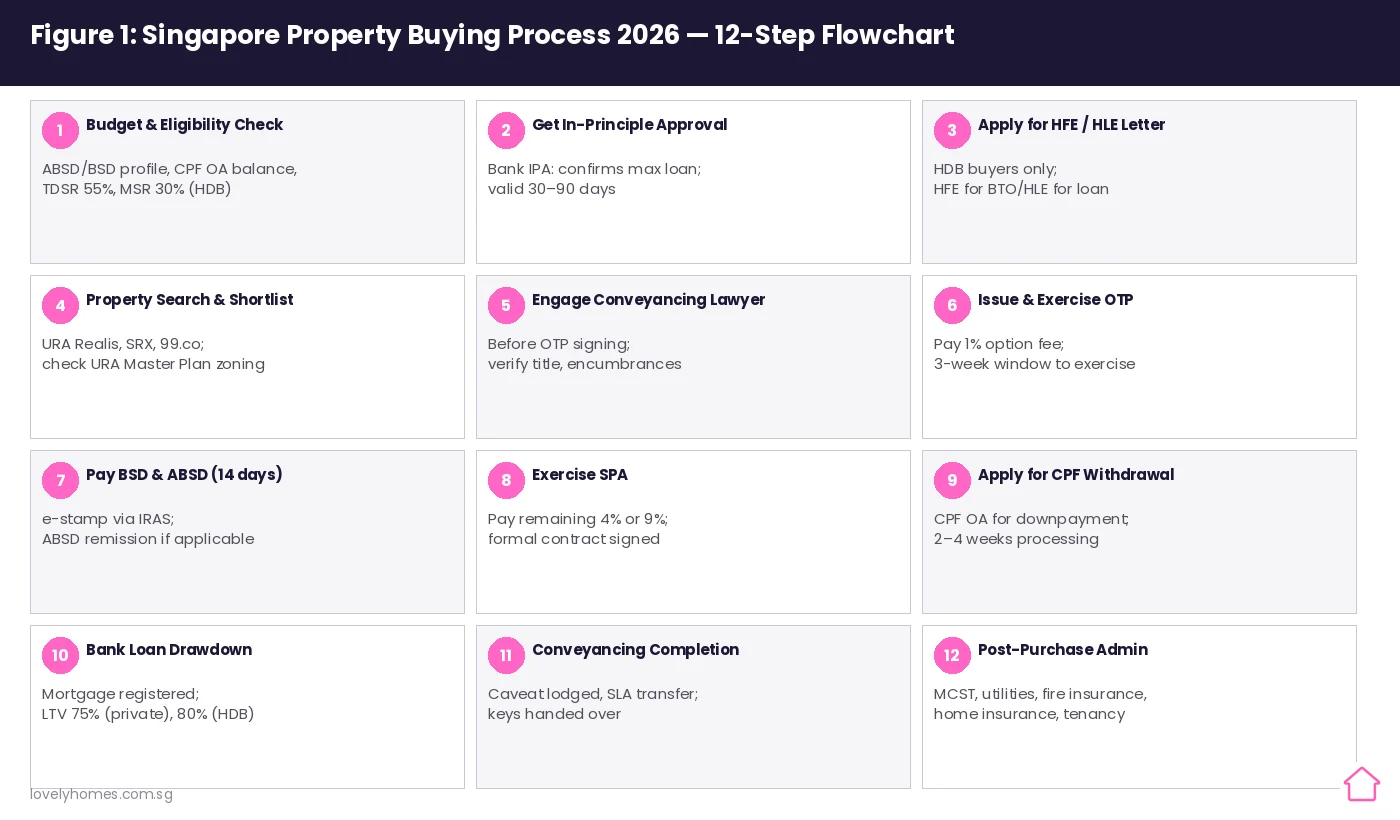
Singapore property buying process 2026 12 step flowchart OTP SPA BSD ABSD CPF keys

Figure 1: Singapore Property Buying Process 2026 — 12-Step Flowchart from Budget Check to Post-Purchase Admin. Applies to both private resale and HDB resale transactions with noted differences.

The 12-Step Singapore Property Buying Checklist

Phase 1: Pre-Purchase Preparation (Steps 1–5)

1

Budget and Eligibility Check

Determine your ABSD profile (SC / PR / foreigner; first, second or subsequent property) and calculate your maximum purchase price. Run a TDSR calculation: your total monthly debt obligations — mortgage plus any outstanding car loan, personal loan or credit card minimum — must not exceed 55% of gross monthly income. For HDB purchases, the MSR 30% cap applies to the mortgage alone. Check your CPF OA balance at my.cpf.gov.sg. Confirm your legal eligibility: foreigners may only buy private non-landed property (or Sentosa Cove landed); PRs may buy HDB resale flats but not new BTOs.

2

Obtain an In-Principle Approval (IPA) from a Bank

Before viewing properties seriously, apply for an IPA (sometimes called AIP — Approval-In-Principle) from at least two banks. The IPA tells you the maximum loan quantum, the indicative interest rate, and the loan tenure available to you. Most banks honour the IPA for 30–90 days. For HDB purchases using the HDB Concessionary Loan, apply for a HDB Loan Eligibility (HLE) letter instead — this has a validity of 6 months and is mandatory before HDB will process your flat application.

3

HDB Buyers: Apply for HFE Letter

Since May 2023, all HDB flat purchasers (BTO and resale) must obtain a HDB Flat Eligibility (HFE) letter before an OTP can be issued. The HFE confirms your eligibility to buy, the grants you qualify for (EHG, PHG, Step-Up Grant), and the HDB loan amount if applicable. Processing takes approximately 3–4 weeks. Apply at the HDB Flat Portal early in your property search to avoid delays at the OTP stage.

4

Property Search and Due Diligence

Use URA Realis for verified transaction data (S$2.50 per search or bulk subscription), SRX Property for market trend analysis, and the HDB Resale Flat Prices portal for HDB-specific data. When you shortlist a property, check the URA Master Plan 2019 (or its 2025 revision) to confirm the surrounding land use zoning and any future development plans. Request from the seller or listing agent the Maintenance and Sinking Fund arrears status, the MCST minutes (for strata property), and any outstanding charges on the land title.

5

Engage a Conveyancing Lawyer Before OTP Signing

Do not sign the OTP without first engaging a conveyancing lawyer. The lawyer’s role is to review the OTP terms, check for encumbrances on the title, liaise with CPF Board and the mortgagee bank, and manage all legal milestones including caveat lodgement. Legal fees for a private resale at S$1–2 million are typically S$2,800–S$4,500 inclusive of disbursements. For HDB resale, fees are lower (S$1,500–S$2,500). Many law firms offer a fixed-fee quote — get at least two quotes before committing.

Phase 2: Option to Purchase and Contract (Steps 6–8)

6

Issue and Exercise the OTP

The seller issues you an Option to Purchase upon receipt of the option fee (1% of purchase price for private; S$1 for HDB resale). You then have 21 calendar days (private resale) or 14 calendar days (HDB resale) to exercise the OTP by paying the exercise fee (typically 4% for private, making a 5% total deposit; or the agreed sum for HDB). During this window, your lawyer will conduct title searches and CPF checks. Do not let the OTP expire unexercised — the option fee (1%) is forfeited. The OTP is the most time-pressured stage in the entire process.

7

Pay BSD and ABSD Within 14 Days

Once you exercise the OTP (i.e., sign the Sale and Purchase Agreement or equivalent HDB resale application), both BSD and ABSD must be e-stamped and paid to IRAS within 14 calendar days of signing. Late payment attracts a surcharge of up to S$25 or 4× the unpaid duty, whichever is higher. BSD and ABSD cannot be paid directly from your CPF at this stage — you must first pay in cash, cheque or bank transfer, and may later claim reimbursement from CPF if eligible. Use IRAS’s e-Stamp portal to calculate and pay online.

8

Execute the Sale and Purchase Agreement

The SPA (or HDB Resale Agreement) is the binding contract that transfers the property. Your lawyer will review the SPA draft before signing. Key items to verify: the correct unit number, floor level, car park lot allocation (if any), existing tenancy (for investment purchases), completion date, and any furniture or fittings being sold with the property. The SPA typically requires payment of the balance of the deposit (if not already paid with the OTP exercise fee) and sets out the completion timeline — usually 8–12 weeks from OTP for resale.

Phase 3: Financing and Completion (Steps 9–12)

9

Apply for CPF Withdrawal

After the SPA is executed, your lawyer will submit a CPF withdrawal application to the CPF Board on your behalf. Processing typically takes 2–4 weeks. CPF OA funds can be used for: the downpayment (above the 5% minimum cash), legal fees, and monthly mortgage instalments. For private property, the Valuation Limit (VL) and Withdrawal Limit (WL — capped at 120% of VL) govern how much CPF can be used over the life of the property. Plan your CPF usage carefully if you anticipate needing OA funds for retirement.

10

Bank Loan Drawdown and Mortgage Registration

Your bank will disburse the loan (drawdown) on or before the completion date. The mortgage is registered with the Singapore Land Authority (SLA), and a caveat is lodged to protect your interest in the property. For new launch condominiums, the drawdown is typically progressive (tied to construction milestones under the Normal Payment Scheme) or deferred (no longer an option for EC sites tendered from May 2026, when DPS was abolished for new EC GLS sites). Ensure your fire insurance is in place before drawdown — most banks require this as a condition of the mortgage.

11

Completion — Key Collection

Completion is the day the ownership transfers to you. Your lawyer will attend the completion appointment, where the balance of the purchase price is paid to the seller’s lawyers (net of any CPF retention and existing mortgage redemption). The SLA updates the land register, and you collect the keys. For resale properties, inspect the property thoroughly on the day of completion — check all fittings and appliances against the SPA schedule, and document any defects in writing to the seller immediately.

12

Post-Purchase Administration

After key collection: register with the Management Corporation Strata Title (MCST) for strata properties and pay any outstanding Maintenance and Sinking Fund contributions. Activate utilities (SP Group, NTUC FairPrice Gas). Set up a home contents insurance policy. If you are renting out the property, register the tenancy with HDB (for HDB subletting) or comply with URA’s short-term rental rules (minimum 3-month tenancy for private residential). Inform IRAS of rental income for the relevant Year of Assessment — failure to declare rental income is an offence under the Income Tax Act.

Key Deadlines and Cost Summary

Milestone Deadline from OTP Amount / Action Payable To
OTP Exercise (Private) Within 21 calendar days 4% exercise fee (total 5% deposit) Seller (via lawyer)
OTP Exercise (HDB Resale) Within 14 calendar days As agreed in OTP HDB Resale Portal
BSD & ABSD Payment Within 14 days of SPA signing BSD 1%–6% progressive; ABSD 0%–60% IRAS (e-Stamp Portal)
CPF Withdrawal Application After SPA execution 2–4 weeks processing CPF Board (via lawyer)
Completion (Private Resale) 8–12 weeks from OTP Balance purchase price Seller (via lawyer)
Completion (HDB Resale) 8–10 weeks from HDB approval Balance purchase price HDB
Fire Insurance Before loan drawdown ~S$150–S$400/yr depending on sum insured Licensed insurer
Rental Income Declaration By 18 April each YA Declare via myTax Portal to IRAS IRAS

Worked Example: Ms Lim, SC First-Time Buyer — OCR Condo at S$1.1M

📊 Case Study — Ms Lim, Singapore Citizen, Single, Income S$8,000/mth

Property: 1-bedroom resale condo in Tampines (OCR), 560 sq ft at S$1,930 psf = S$1,080,800 (rounded to S$1.08M).

ABSD: S$0 — SC purchasing first residential property. No ABSD applies.

BSD Calculation:

  • First S$180,000 × 1% = S$1,800
  • Next S$180,000 × 2% = S$3,600
  • Next S$640,000 × 3% = S$19,200
  • Remaining S$80,000 × 4% = S$3,200
  • Total BSD: S$27,800

Financing: Bank loan at LTV 75% = S$810,000. At 3.0% p.a. over 30 years: approximately S$3,413/month. TDSR: S$3,413 ÷ S$8,000 = 42.7% — within the 55% TDSR limit. Ms Lim qualifies without a joint borrower.

Downpayment: 25% = S$270,000. Minimum 5% cash = S$54,000. Balance S$216,000 from CPF OA.

Legal Fees (Buyer): approximately S$3,000 including disbursements (caveat, SLA searches, CPF liaison).

Total Upfront Cash/CPF Required: BSD S$27,800 (cash) + Downpayment S$270,000 (S$54k cash + S$216k CPF) + Legal S$3,000 ≈ S$300,800 (including minimum S$81,800 in cash).

Checklist Critical Date: OTP issued Day 0. Ms Lim must exercise by Day 21, pay BSD within 14 days of SPA signing, and complete within ~10 weeks of OTP. Her lawyer sets a calendar reminder for Day 18 to ensure OTP exercise happens before the deadline.
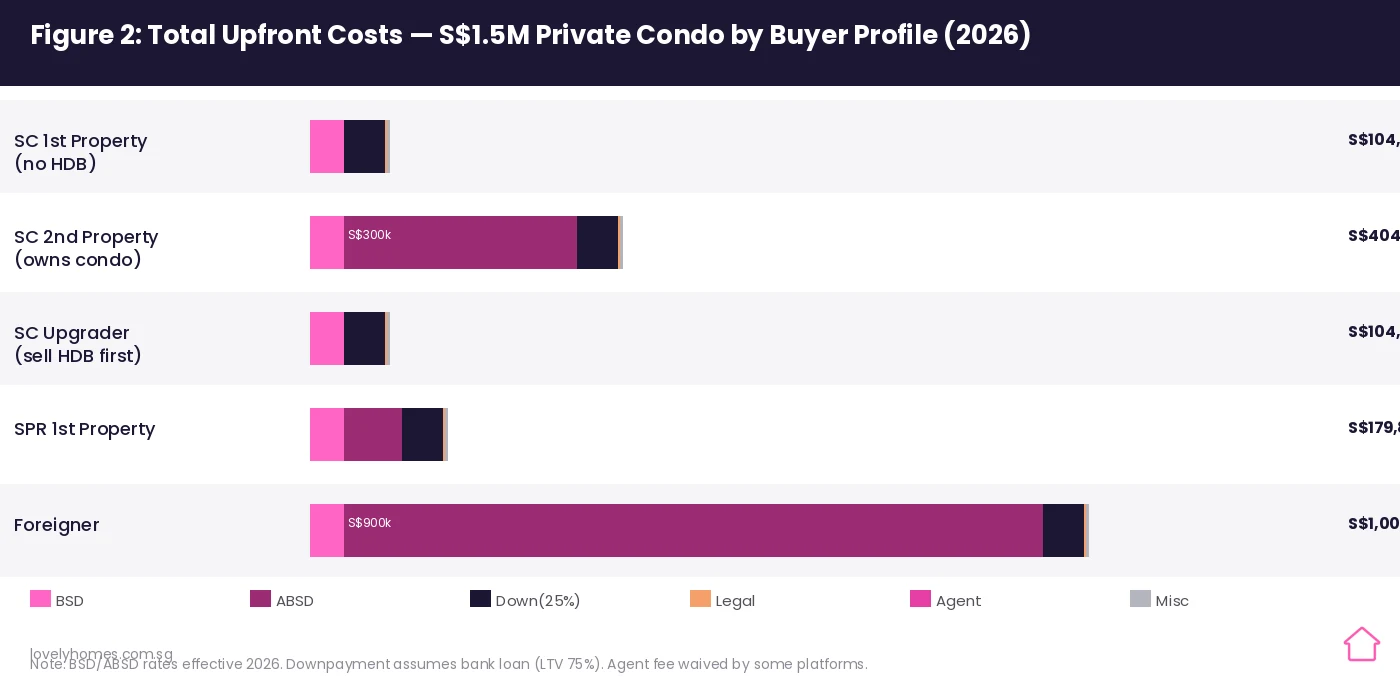
Singapore property buying costs 2026 BSD ABSD downpayment by buyer profile at 1.5 million

Figure 2: Total Upfront Costs at S$1.5M — BSD, ABSD, Downpayment and Legal by Buyer Profile 2026. Note: ABSD of S$900,000 for foreigners makes the effective total cost S$1.45M above and beyond the purchase price — a near-doubling of the upfront outlay.

Why the 2026 Regulatory Landscape Demands Extra Care

The Singapore property market has accumulated layer upon layer of regulatory measures since the first cooling round in 2009. As of 2026, a buyer simultaneously navigates BSD (four-tier progressive, administered by IRAS), ABSD (five-tier by residency and ownership count, administered by IRAS), TDSR (MAS-mandated income test, enforced by banks), MSR (HDB/EC purchases only, administered by HDB and banks), CPF Withdrawal Limits (CPF Board), ABSD remission conditions for upgraders (IRAS), EC cooling measures (MND/HDB, revised May 2026), and rental restriction rules (URA, SLA). None of these systems talk to each other automatically — the buyer’s lawyer is the only party who checks the full suite in one place.

This is precisely why engaging a conveyancing lawyer before signing the OTP is not optional. Singapore Law Society guidelines permit a lawyer to act for both buyer and mortgagee bank in the same transaction, but the lawyer’s primary duty is to the client. First-time buyers should ensure they understand each cost line before OTP day, not the morning they are asked to sign.

What Might Come Next: Tech-Enabled Property Transactions

URA and HDB are actively developing digital streamlining tools that may, in future, consolidate several of the 12 steps above. The HFE letter introduced in May 2023 already replaced three separate application processes. Industry participants have proposed that BSD and ABSD e-stamping be integrated directly into the OTP workflow so that buyers receive a real-time stamp-duty estimate at the point of OTP issuance. CPF Board’s e-conveyancing integration has progressively reduced the time for CPF withdrawal approvals from six weeks (pre-2020) to the current two-to-four weeks. It is reasonable to expect that a future iteration of the conveyancing process reduces total timeline from the current 8–14 weeks to under 6 weeks for straightforward resale transactions.
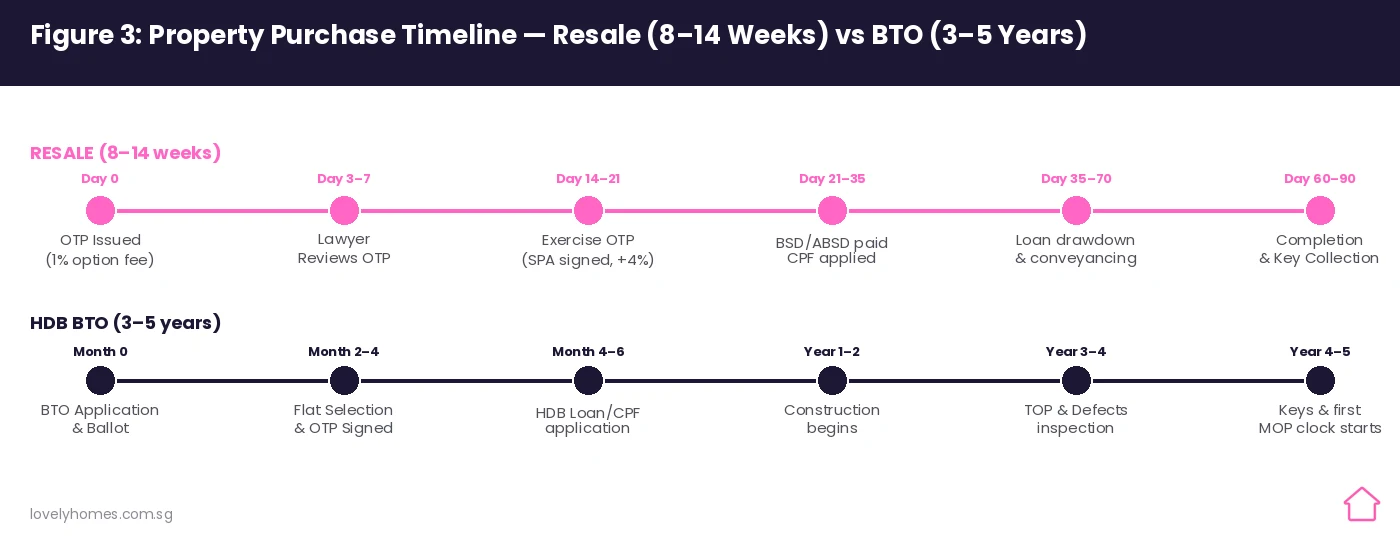
Singapore property buying timeline 2026 resale vs BTO OTP to keys weeks years comparison

Figure 3: Purchase Timeline Comparison — Resale (8–14 weeks) vs HDB BTO (3–5 years). BTO buyers must manage cash flow, CPF accrual and bank loan conditions across a multi-year period before receiving keys.

Frequently Asked Questions

What happens if I miss the 21-day OTP exercise window?

If you do not exercise the OTP within the prescribed period (21 calendar days for most private resale transactions), the OTP lapses automatically. The seller retains your option fee (typically 1% of the purchase price) as a forfeiture. There is no legal recourse unless the seller agreed in writing to extend the option period. Given the financial stakes — 1% of S$1.5 million is S$15,000 — always ensure your lawyer, bank and CPF paperwork are already in progress before the OTP is issued, not after.

Can I use CPF to pay BSD or ABSD?

No — not directly at the point of payment. BSD and ABSD must be paid to IRAS within 14 days of signing the SPA, and IRAS does not accept CPF funds directly. You must pay in cash (bank transfer, FAST, cheque). However, once the property is legally stamped and the CPF withdrawal is approved, you may use CPF OA funds to reimburse yourself for the BSD paid (subject to the property’s Valuation Limit and your remaining CPF balance). ABSD, by contrast, is generally not reimbursable from CPF in this manner — it must be funded from personal cash.

What is the ABSD remission for Singapore Citizen couples upgrading from HDB?

Singapore Citizen married couples who own an HDB flat and purchase a second residential property (typically a private condo) are liable for 20% ABSD on the new purchase. However, they may apply to IRAS for an ABSD remission under the Married Couple Remission, provided they sell their existing HDB flat within 3 years of the private property’s stamp duty date (for resale) or 3 years from the property’s TOP date (for new launch). The ABSD is paid upfront in full, and the refund is processed after the HDB sale is confirmed. The refund does not include the interest cost of funding the ABSD during the interim period — a real but often-overlooked carrying cost.

How much cash do I need on hand to buy a S$1.5M private condo as a first-time SC buyer?

The minimum cash requirement (amounts that cannot be funded from CPF) is: (1) at least 5% of the purchase price as downpayment cash = S$75,000; (2) BSD S$44,600 paid in cash upfront (reimbursable from CPF later); (3) legal fees approximately S$3,200 (usually payable from CPF for private property). So the hard minimum cash outflow is approximately S$75,000 + S$44,600 = S$119,600, plus any miscellaneous costs. In practice, buyers should have S$130,000–S$150,000 in cash for comfortable headroom, with the remaining S$225,000–S$300,000 (balance downpayment) coming from CPF OA.

What is TDSR and how does the bank calculate it?

The Total Debt Servicing Ratio (TDSR) framework, mandated by MAS since 2013 and revised in 2022, caps your total monthly debt obligations at 55% of gross monthly income. “Debt obligations” include: the new property mortgage instalment, any existing home loan instalments, car loan instalments, and the minimum monthly repayment on credit cards (calculated at 5% of outstanding balance under MAS rules). The bank stress-tests your mortgage at a medium-term interest rate (typically 4.0%–4.5% for TDSR calculation purposes, regardless of the actual rate offered) to ensure affordability even in a rising-rate environment. Exceeding 55% TDSR means the bank cannot approve the loan; reducing outstanding credit card debt or settling the car loan before applying can meaningfully improve your TDSR headroom.

Does the checklist apply to buying a HDB BTO flat?

The BTO process differs significantly from resale in timing but not in regulatory obligations. BTO buyers apply during the sales exercise (quarterly or otherwise), ballot for a flat, select a unit, sign the Agreement for Lease (not an OTP), and make progress payments over the construction period — which can span 3–5 years. BSD applies and must be paid within 14 days of signing the Agreement for Lease. ABSD applies at the point of signing. CPF can be used from the point of agreement signing, subject to HFE confirmation. The HDB Loan (2.6% pegged to CPF OA + 0.1%) is available for BTO buyers who meet income and eligibility criteria; bank loans are also permitted.
Disclaimer: This article is for general informational and educational purposes only and does not constitute financial, legal or investment advice. Stamp duty rates, loan-to-value ratios, CPF rules and conveyancing procedures are based on publicly available information from IRAS, MAS, HDB and CPF Board as at May 2026 and may be subject to change. Always verify current rules via the official IRAS e-Stamp portal, MAS website, HDB Flat Portal and CPF website before transacting. For advice specific to your financial situation, consult a licensed mortgage broker, conveyancing lawyer and/or financial adviser.

Singapore Property Checklist for First-Time Buyers 2026: Complete Step-by-Step Guide

Singapore Property Checklist for First-Time Buyers 2026: Complete Step-by-Step Guide

Singapore Property Checklist for First-Time Buyers 2026: Complete Step-by-Step Guide

Quick Answer — Key Facts for First-Time Buyers in 2026

  • Singapore Citizens buying their first residential property pay 0% ABSD — only BSD applies
  • Maximum grants for HDB buyers: EHG S$120,000 + CPF Housing Grant S$80,000 = up to S$200,000 combined
  • Bank loan LTV: 75% (private property); HDB concessionary loan: 90% — but you must not own other property and meet income ceiling
  • TDSR ceiling: 55% of gross monthly income; MSR ceiling for HDB/EC: 30%
  • BSD on S$700k HDB resale: ~S$17,400; on S$1.4M condo: ~S$44,600 — payable within 14 days of OTP
  • Always sell your current home before buying a second one to avoid triggering the 20% SC second-property ABSD
  • Conveyancing lawyer and IPA (In-Principle Approval) should be secured before you commit to an OTP

Buying your first property in Singapore is one of the largest financial decisions you will ever make — and one of the most bureaucratically complex. Between eligibility rules, grant calculations, loan approvals, stamp duties, and legal processes, first-time buyers in 2026 face a matrix of decisions that can take months to navigate correctly. The cost of getting it wrong — particularly on ABSD, CPF rules, or MOP requirements — can run into the hundreds of thousands of dollars.

This checklist is designed to walk you through every step of the Singapore property buying process in the right sequence. Whether you are planning to buy an HDB flat (BTO or resale), an executive condominium, or a private condo or landed property, the framework below applies — with notes on where the process diverges for each property type.

The 10-Step Singapore Property Buying Checklist

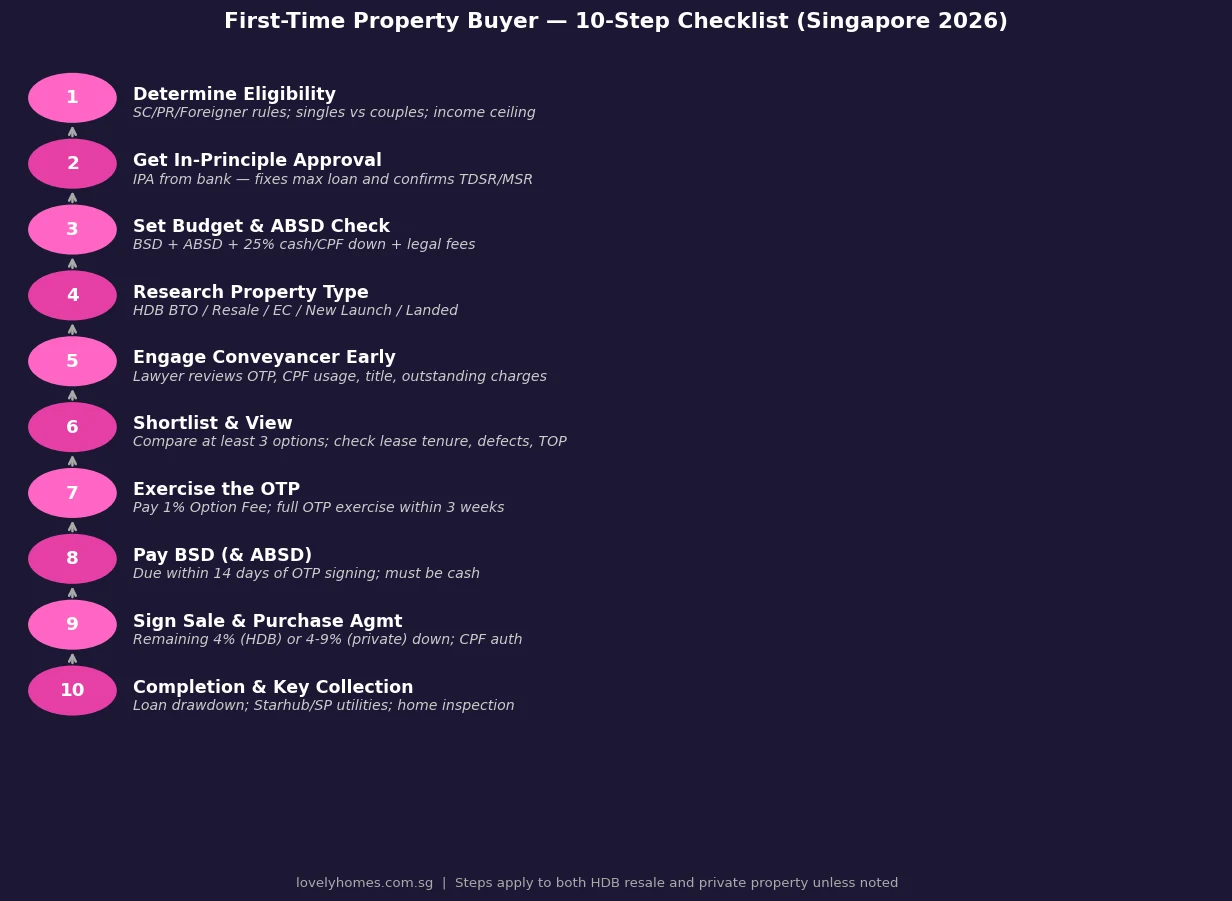
Singapore first-time property buyer 10-step checklist 2026
Figure 1: The 10-step Singapore property buying process — applicable to HDB resale and private property purchases, 2026.

Step 1 — Determine Your Eligibility

Before browsing listings, you need to know what you are legally allowed to buy. Singapore’s property eligibility framework is citizenship-dependent and property-type-specific.

Singapore Citizens (SC) have the broadest access: they can purchase HDB flats (BTO, resale, EC), private condominiums, and (with restrictions) landed property. There is no property ownership limit per se, but each additional residential property increases your ABSD exposure significantly — from 0% on the first to 20% on the second.

Singapore Permanent Residents (SPR) may purchase resale HDB flats (with a family nucleus and after three years of PR), private condominiums, and certain ECs on the open market. SPRs pay 5% ABSD on their first residential property purchase. They cannot buy new BTO flats directly and face additional HDB Ethnic Integration Policy (EIP) restrictions on resale flats.

Foreigners (non-PR) are restricted to private condominiums and certain commercial properties. They pay 60% ABSD on any Singapore residential property. Nationals from Iceland, Liechtenstein, Norway, Switzerland, and the United States are treated as Singapore Citizens for ABSD purposes under FTA provisions.

If you are buying a BTO HDB flat, additional eligibility conditions apply: income ceiling (S$7,000/mth for 2-room Flexi, S$14,000/mth for 3-room and above), family nucleus requirement for most schemes, first-timer status, and the Ethnic Integration Policy quota at the block and neighbourhood level.

Step 2 — Secure Your In-Principle Approval (IPA)

An IPA (also called an AIP — Approval In Principle) from a bank or, for HDB loans, HDB itself, is your preliminary loan commitment. It is not the final loan offer, but it tells you — and the seller’s agent — how much you can borrow, which in turn defines your maximum purchase price.

For bank loans, the key constraints are the Total Debt Servicing Ratio (TDSR) at 55% of gross monthly income, and the Loan-to-Value (LTV) limit of 75% for private property. For HDB concessionary loans, the Mortgage Servicing Ratio (MSR) of 30% applies (your monthly loan repayment cannot exceed 30% of gross income), and the LTV is 90%. However, to qualify for a HDB loan, your household income must not exceed S$14,000/mth, and you must not own any private residential property.

Secure your IPA before viewing seriously or making any offers. An IPA is typically valid for 30 days (bank) or 6 months (HDB HLE), and it will save you from falling in love with a property you cannot actually finance.

Step 3 — Set Your Total Budget Including All Costs

First-time buyer upfront costs comparison HDB resale versus private condo Singapore 2026
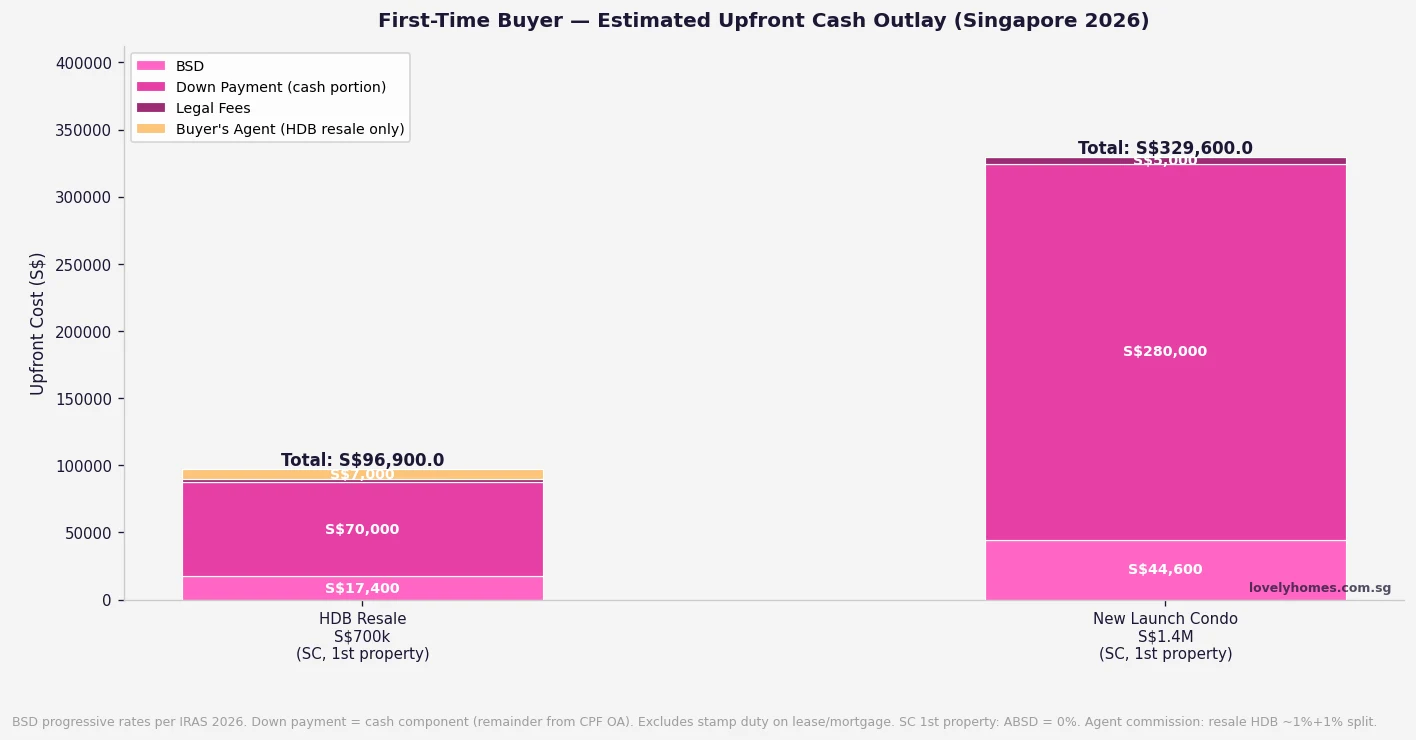
Figure 2: Estimated upfront cash outlay for a Singapore Citizen first-time buyer — HDB resale S$700k vs new launch private condo S$1.4M. Source: IRAS BSD tables, MAS LTV framework, May 2026.

Your headline property price is just the beginning. The full upfront cost of purchasing includes Buyer’s Stamp Duty (BSD), the down payment (with a mandatory cash component), legal fees, and in some cases agent commission. For a first-time SC buyer, ABSD is zero — but BSD is unavoidable.

Cost Item HDB Resale S$700k Private Condo S$1.4M Notes
Buyer’s Stamp Duty (BSD) S$17,400 S$44,600 Payable in cash within 14 days of OTP
ABSD (SC, 1st property) S$0 S$0 0% for SC first property — confirm ownership count
Down Payment (cash portion) S$70,000 (10%) S$280,000 (20% of 25%) Minimum 5% cash for HDB; 5% cash for private (rest CPF)
Legal Fees (conveyancing) ~S$2,500 ~S$5,000 Includes title search, CPF charge registration
Agent Commission (buyer side) ~S$7,000 (1%) S$0 New launch: developer pays; resale private: negotiated
Total Estimated Cash Outlay ~S$96,900 ~S$329,600 Remainder of down payment can use CPF OA

Note that for private property, only the first 5% of the purchase price must be paid in cash (before or at OTP exercise). The remaining 20% of the 25% down payment can come from CPF Ordinary Account. For HDB loans, only 5% cash is required upfront — the remaining 85% is funded by the HDB concessionary loan.

Steps 4–6 — Research, Engage Your Lawyer Early, and View Properties

The biggest mistake first-time buyers make is viewing properties extensively before understanding their financing ceiling and legal standing. The reverse sequence — finance and legal first, then view — saves both time and negotiating leverage.

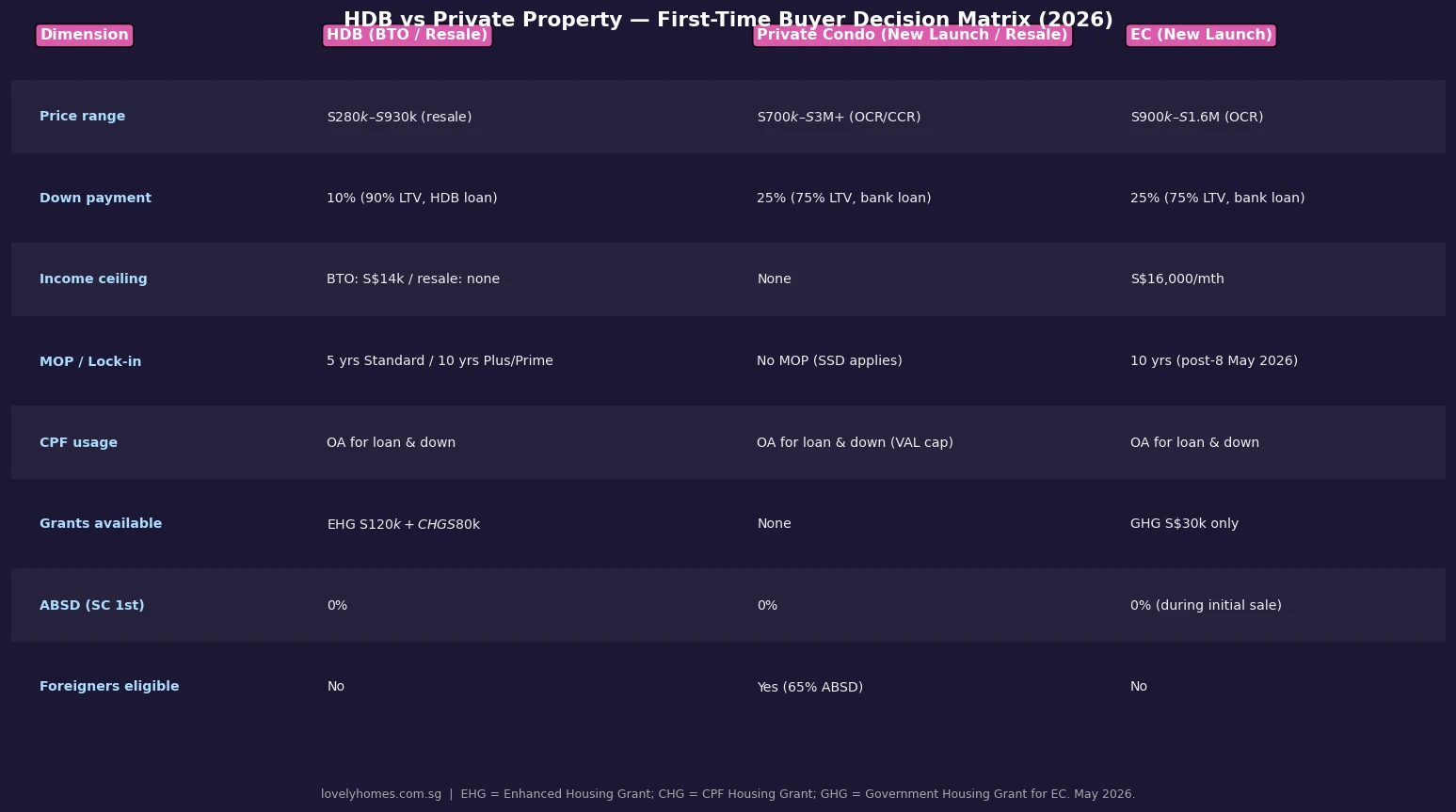
Property type selection (Step 4) depends on your income, CPF balance, timeline, and lifestyle priorities. The decision matrix in Figure 3 below compares HDB, private condo, and EC across the key dimensions first-time buyers care about most.

HDB versus private condo versus EC decision matrix for first-time buyers Singapore 2026
Figure 3: HDB vs Private Condo vs Executive Condominium — first-time buyer decision matrix, May 2026.

Engaging a conveyancing lawyer early (Step 5) is advice most first-time buyers receive too late. A good conveyancing lawyer will review the OTP before you sign it, not after. They will flag title issues, outstanding mortgages on the property, caveat searches, and CPF charge implications — all of which affect whether and at what price you should proceed. Legal fees for a straightforward purchase are modest (S$2,500–S$5,000) relative to the transaction value; do not treat them as a cost to defer.

When viewing properties (Step 6), check the remaining lease tenure carefully — especially for HDB flats and older freehold condominiums. CPF Ordinary Account funds cannot be used if the remaining lease does not cover the youngest buyer to age 95. A 60-year-old resale HDB flat may look attractively priced, but the financing and CPF limitations will materially alter your actual cost of acquisition.

Steps 7–8 — Exercise the OTP and Pay Stamp Duty

When you have identified your property, the seller will issue an Option to Purchase (OTP) in exchange for an option fee (typically 1% of the purchase price). You have a defined window — 21 calendar days for private property under the standard Law Society OTP — to exercise the option by paying the exercise price (typically another 4–9% for private, with the first 1% option fee credited) or walk away (forfeiting the 1% option fee).

Within 14 days of the OTP signing date, you must pay Buyer’s Stamp Duty (and ABSD if applicable) to IRAS via e-Stamping. Late payment attracts penalties starting at 5% of the duty payable. BSD cannot be paid from CPF — it must be in cash. This is why ensuring you have sufficient liquidity before signing the OTP is essential.

Steps 9–10 — Sale & Purchase Agreement and Completion

After exercising the OTP, your lawyer will coordinate the formal Sale and Purchase (S&P) Agreement, CPF Ordinary Account authorisation, and the loan drawdown with your bank. For new launch condominiums, the payment schedule follows the Progressive Payment Scheme (NPS) — where each tranche is tied to construction milestones — or the full lump-sum payment at completion for resale. The Deferred Payment Scheme (DPS) for executive condominiums was abolished on 8 May 2026 — all new EC purchases now follow the Normal Payment Scheme (NPS).

At completion (or key collection for BTO), your lawyer discharges their obligations and you register as the new owner at the Singapore Land Authority. Arrange for SP Group and StarHub connectivity, conduct a thorough defects inspection, and retain the developer’s or seller’s maintenance obligations where applicable.

Worked Example — SC First-Time Buyer, S$700k HDB Resale in Tampines

Ms Tan, a 31-year-old Singapore Citizen, is buying her first home — a 4-room HDB resale flat in Tampines listed at S$700,000. She earns S$6,800 per month. She has applied for an Enhanced Housing Grant (EHG) and CPF Housing Grant (CHG), and has S$120,000 in her CPF Ordinary Account.

Grants calculation: At S$6,800/mth (singles scheme), EHG = S$35,000 (approximately, based on the singles-rate EHG table at ~S$6,500–S$7,000 bracket). If she buys with a co-applicant (e.g. her mother, Singles scheme not applicable — assuming she buys as a single first-timer), or as a couple. For simplicity, assume Ms Tan buys jointly with her fiancé (combined income S$10,500/mth): EHG = S$40,000 + CHG = S$80,000 = S$120,000 total grants applied to the purchase price, reducing the effective cost.

BSD: On S$700,000 = (1%×S$180k) + (2%×S$180k) + (3%×S$340k) = S$1,800 + S$3,600 + S$10,200 = S$15,600 (payable in cash within 14 days).

Financing: Grants reduce the purchase price for grant disbursement, but BSD is still calculated on the full S$700,000 transaction price. HDB concessionary loan: 90% LTV on S$700,000 – grants S$120,000 = net S$580,000 → 90% = S$522,000 loan. Monthly repayment at 2.6% over 25 years: approximately S$2,370. MSR check: S$2,370 ÷ S$10,500 = 22.6% — within the 30% MSR ceiling.

Cash outlay at purchase: BSD S$15,600 + 10% down payment S$70,000 (min S$35,000 cash; balance from CPF OA) + legal S$2,500 + agent S$7,000 = approximately S$95,100 total, of which a minimum S$57,600 must be in cash (with the rest from CPF OA).

What to Watch in 2H 2026

Singapore’s property market for first-time buyers in the second half of 2026 will be shaped by three key developments. First, the June 2026 BTO exercise offering 6,900 flats across Bishan, Ang Mo Kio, Bukit Merah, Sembawang, and Woodlands will open for applications in mid-June — this is the largest BTO exercise of the year and the first to include Bishan Lakeview units in over four decades. First-timers with strong ballot positioning should register their interest before the application window closes.

Second, bank interest rates continue to ease in Singapore: the three-month SORA fell to approximately 1.20% as at May 2026, and major banks’ fixed-rate packages (2-year) now sit in the 1.75–1.85% range. For first-time buyers with long planning horizons, locking a rate now before any policy shift is worth discussing with a mortgage broker.

Third, the EC market is adjusting to the 8 May 2026 changes: the Deferred Payment Scheme is gone, the MOP is 10 years (up from five), and the first-timer quota has expanded to 90%. First-timers with the income and budget to qualify for an EC now have a higher allocation probability than at any point in the past five years — but they also face a longer hold requirement before they can monetise the property.

Frequently Asked Questions

Do I need to pay ABSD as a first-time Singapore Citizen buyer?

No. Singapore Citizens purchasing their first residential property pay 0% ABSD. You pay only Buyer’s Stamp Duty (BSD), which is a progressive tax starting at 1% on the first S$180,000 and rising to 6% on the portion above S$3,000,000. However, if you own any residential property at the time of OTP signing — including inherited property or a share in a property — you will be treated as a second-property buyer and face 20% ABSD. Always verify your property ownership profile via the IRAS myTax Portal before signing any OTP.

Can I use CPF to pay Buyer’s Stamp Duty?

No. BSD (and ABSD, if applicable) cannot be paid from your CPF Ordinary Account. These duties must be paid in cash within 14 days of the OTP signing date. CPF OA funds can, however, be used toward the property’s down payment (subject to the Valuation Limit), monthly mortgage instalments, and certain legal fees. Ensure you have sufficient cash liquidity to cover stamp duties before you exercise any OTP.

What is the difference between HDB loan and bank loan for first-time buyers?

An HDB concessionary loan charges a fixed rate of 2.6% per annum (0.1% above CPF OA rate), allows up to 90% LTV, and can be refinanced to a bank later (irreversibly — you cannot switch back to HDB loan once moved to a bank). A bank loan currently offers fixed rates of approximately 1.75–1.85% for a two-year lock-in (as at May 2026), requires a minimum 25% down payment with 5% in cash, and requires a stress test. For buyers who prioritise certainty and lower initial cash outlay, the HDB loan is simpler. For those who want to minimise total interest over a long loan tenure, a bank loan often saves significantly more — but exposes you to rate refixing risk every 2–3 years. See our Home Loan Comparison Singapore 2026 guide for a detailed worked comparison.

How long does the HDB BTO process take from ballot to key collection?

The full BTO cycle — from launch ballot to key collection — typically takes four to five years for standard construction timelines, though some projects take longer. The sequence is: Launch (application window) → Ballot result (2–3 months) → Flat selection queue (typically 6–12 months) → Sign S&P Agreement (within the selection window) → Construction period (3–4 years typically) → Temporary Occupation Permit (TOP) → Key collection. For buyers who need housing sooner, resale HDB flats, Sale of Balance Flats (SBF), or private property are the alternatives. See our HDB BTO Ballot System 2026 guide for full ballot probability data by flat type and estate classification.

What happens if I sign an OTP and then cannot secure a loan?

If your bank does not approve the final loan (distinct from the IPA, which is only in-principle), you will forfeit the option fee (typically 1% of the purchase price) and potentially face claims from the seller if the failure to complete is attributable to financing. This is why securing a firm IPA before signing the OTP is essential. Most conveyancing lawyers will recommend including a financing condition in the OTP for resale transactions, which allows you to withdraw and recover the option fee if you cannot secure financing by a specified date — though sellers do not always agree to such conditions in competitive markets.

Can foreigners buy HDB flats or ECs in Singapore?

No. Foreigners (non-PR) cannot purchase HDB flats (BTO or resale) or new ECs from developers. They are restricted to private condominiums and most commercial/industrial property. A foreign national would pay 60% ABSD on any Singapore residential property purchase. The only exception is citizens of the five FTA countries (Iceland, Liechtenstein, Norway, Switzerland, USA) who are treated as Singapore Citizens for ABSD purposes — but even these buyers cannot purchase HDB flats or new ECs, as that restriction is based on citizenship/PR status, not on ABSD rates.

Related Articles

Disclaimer: This checklist is for general informational purposes only and does not constitute financial, legal, or property advice. All figures, grant amounts, BSD rates, LTV limits, and loan terms cited are based on publicly available sources including IRAS, HDB, MAS, and CPF Board as at May 2026, and are subject to change. Past performance is not indicative of future results. Consult a licensed conveyancing lawyer, financial adviser, and HDB/CEA-registered property agent before making any property transaction. Verify current grants, rates, and eligibility conditions at HDB.gov.sg, IRAS.gov.sg, and MAS.gov.sg.

Singapore Property Auction Guide 2026: Mortgagee Sales, How to Bid & Hidden Costs

Singapore Property Auction Guide 2026: Mortgagee Sales, How to Bid & Hidden Costs

Singapore’s property auction market is small but consistent. Roughly 150–200 properties are publicly auctioned every year, mostly mortgagee sales arising from borrower default, with a smaller flow of owner sales and a handful of sheriff (court-ordered) sales. For prepared buyers, auctions can deliver a 5–15% discount to recent comparables, and on rare occasions deeper. For unprepared buyers, they are an efficient way to lose a 5% deposit. This guide explains how the three auction types work, what to do on the day, the full cost stack including ABSD, and the legal traps that catch first-time bidders.

All references to amounts and rates reflect the position in April 2026 and the cooling-measures regime in force since 27 April 2023. Cross-check the IRAS stamp-duty page, Singapore Land Authority and your appointed conveyancing lawyer before bidding.

Quick Answer — auction buying at a glance

  • Three public auction types operate in Singapore: mortgagee, owner and sheriff sales.
  • Mortgagee sales (lender-driven) account for roughly two-thirds of public listings.
  • The winning bidder pays a 5% deposit at the fall of the hammer (cashier’s order).
  • Stamp duty (BSD + ABSD if applicable) is due within 14 days of the auction date.
  • Completion is typically within 60–90 days of the auction.
  • Properties are sold “as-is, where-is” with very limited vendor warranties.
  • A 5–15% discount is realistic; deeper discounts come with more risk, not less.
  • A bidder without an in-principle approval (IPA) and a cashier’s order at the auction is gambling.

Why Singapore property auctions matter

Public auctions sit at the margin of the Singapore market — the secondary market clears the vast majority of resale transactions through private treaty. But the auction floor is interesting for two reasons.

First, mortgagee sales are distressed sales by definition. The bank is enforcing under the mortgage deed and wants to clear the asset off the balance sheet at fair value within the calendar year. Where the property is unusual (unique strata mix, awkward layout, sub-12-month tenancy, dated condition), the auction route signals that. Buyers willing to accept the unusual feature typically capture a real discount.

Second, auctions are price discovery in public. Every reserve, every withdrawn lot, every successful bid is reported. In a quiet quarter for new launches, watching the auction order book gives you a real-time read on what the market thinks a CCR three-bedder or an OCR resale flat is genuinely worth. We track auction prints alongside private-treaty data in our Transaction News section.

The three auction types — mortgagee, owner, sheriff

Singapore property auction guide 2026 — mortgagee, owner and sheriff sale comparison
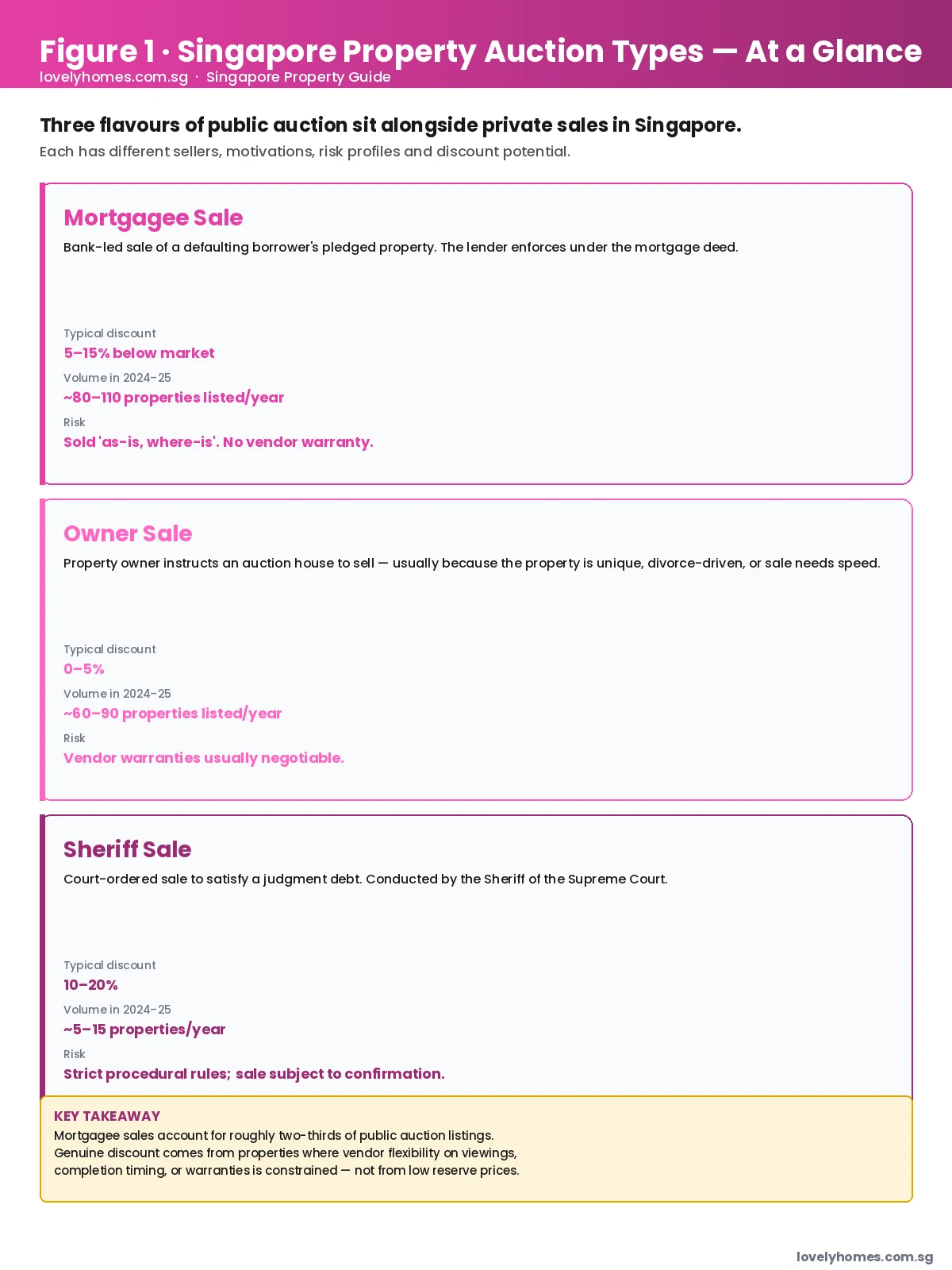
Figure 1: Singapore’s three public auction types — volume, motivation and risk profile.

Mortgagee sale

A mortgagee sale is a forced sale by a mortgagee (typically a bank or financial institution) to recover an outstanding loan. The mortgagor (borrower) has defaulted; the lender has issued and exhausted statutory notices; and the property is being sold under the power of sale in the mortgage deed. The sale is conducted by a licensed auctioneer instructed by the lender. The lender does not warrant title quality, vacant possession, or condition — the buyer takes the property as it stands.

Mortgagee sales are the bulk of the public auction calendar. In 2024–25 around 80–110 mortgagee listings reached the auction floor each year, with 50–60% selling in the room, the rest withdrawn or rolled to the next sale. Discount versus comparable resale typically runs 5–15%, with deeper discounts available where the property is occupied by a holdover tenant or has known disputes attached to it.

Owner sale

An owner sale is a sale instructed by the registered owner, usually because the property is unique (a high-floor penthouse with no comparable benchmark), the timeline is short (divorce, estate distribution), or the owner wants the auction transparency. Volume is similar to mortgagee sales. Discounts are smaller — often 0–5% — but vendor warranties on title and vacant possession are usually negotiable, narrowing the risk gap.

Sheriff sale

A sheriff sale is a court-ordered sale by the Sheriff of the Supreme Court, conducted to satisfy a judgment debt. Volumes are tiny — perhaps 5–15 a year — and the procedure is rigid: the sale price must be confirmed by the court, and the buyer takes title only on confirmation, which can take weeks. Discounts of 10–20% are common but the procedural fragility means many bidders avoid sheriff sales unless the discount is large enough to compensate.

The bidder’s timeline — from catalogue to completion

Singapore property auction guide 2026 — bidder timeline from listing to completion
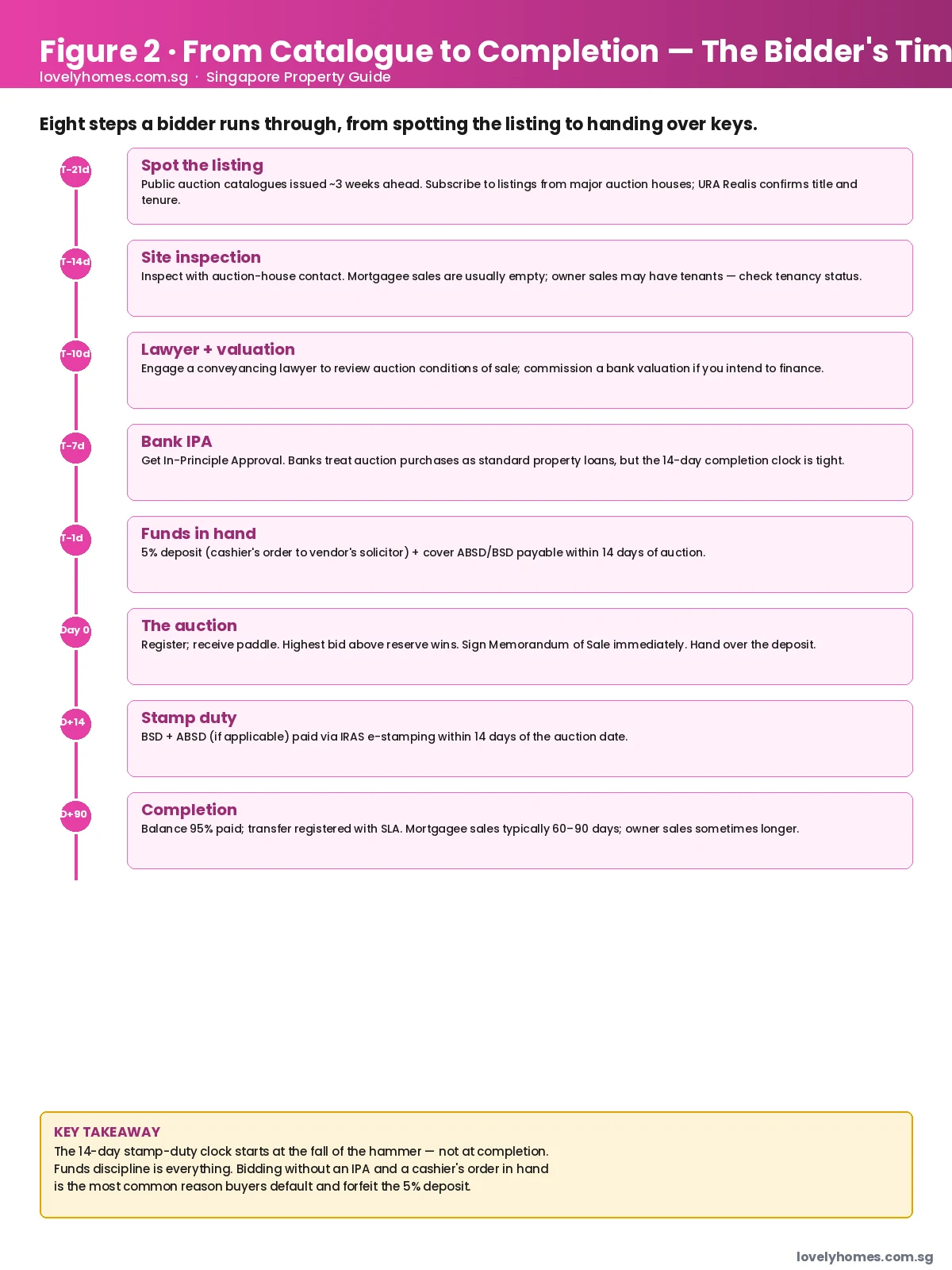
Figure 2: Eight steps from spotting the catalogue to receiving the keys.

The full sequence is mechanical and unforgiving on dates:

  1. T-21 days — spot the listing. Public auction catalogues are issued roughly three weeks ahead of each sale. The major Singapore auctioneers publish digital catalogues with property details, reserves and conditions of sale. URA Realis (the URA’s title and tenure portal) is the authoritative cross-check on tenure, plot ratio and outstanding charges.
  2. T-14 days — site inspection. Inspect the property with the auction-house contact. Mortgagee sales are usually delivered with vacant possession; owner sales sometimes come with sitting tenants whose tenancies survive the sale. Check the tenancy status and any holdover risk before bidding.
  3. T-10 days — lawyer and valuation. Engage a conveyancing lawyer to read the conditions of sale (these are non-negotiable on the day) and identify any unusual covenants, head-leases or maintenance disputes. If you intend to finance, instruct a bank-panel valuation report so the lender can issue an IPA quickly.
  4. T-7 days — bank IPA. Get the IPA in writing. Banks treat auction purchases as standard property loans — LTV up to 75% for first-property residents, lower for foreign buyers (50–55%). The IPA is honoured for 30–60 days and gives the bidder confidence to commit. See our Singapore Home Loan Guide 2026 for the LTV and stress-test framework.
  5. T-1 day — funds in hand. Issue the cashier’s order for 5% of your maximum bid (yes — you may bid below it; no — you cannot bid above it without further funds). Earmark cash and CPF for ABSD/BSD due within 14 days.
  6. Day 0 — the auction. Register at the door; receive a paddle. Bids open at the auctioneer’s call. The reserve is rarely declared in advance; watch the room. The winning bid above reserve is final on the fall of the hammer. The buyer signs the Memorandum of Sale immediately and hands over the deposit.
  7. Day +14 — stamp duty. BSD and ABSD (if applicable) are paid via IRAS e-stamping within 14 days of the auction date. Late payment attracts penalties at IRAS’s stated rate. Refer to the BSD guide and ABSD guide for the calculation.
  8. Day +60 to +90 — completion. The balance 95% is paid; the transfer is registered with SLA; the buyer receives the keys. Mortgagee sales typically complete within 60–90 days. Sheriff sales need court confirmation and may stretch to 120 days.

What you actually pay — full cost stack on a S$1.4M win

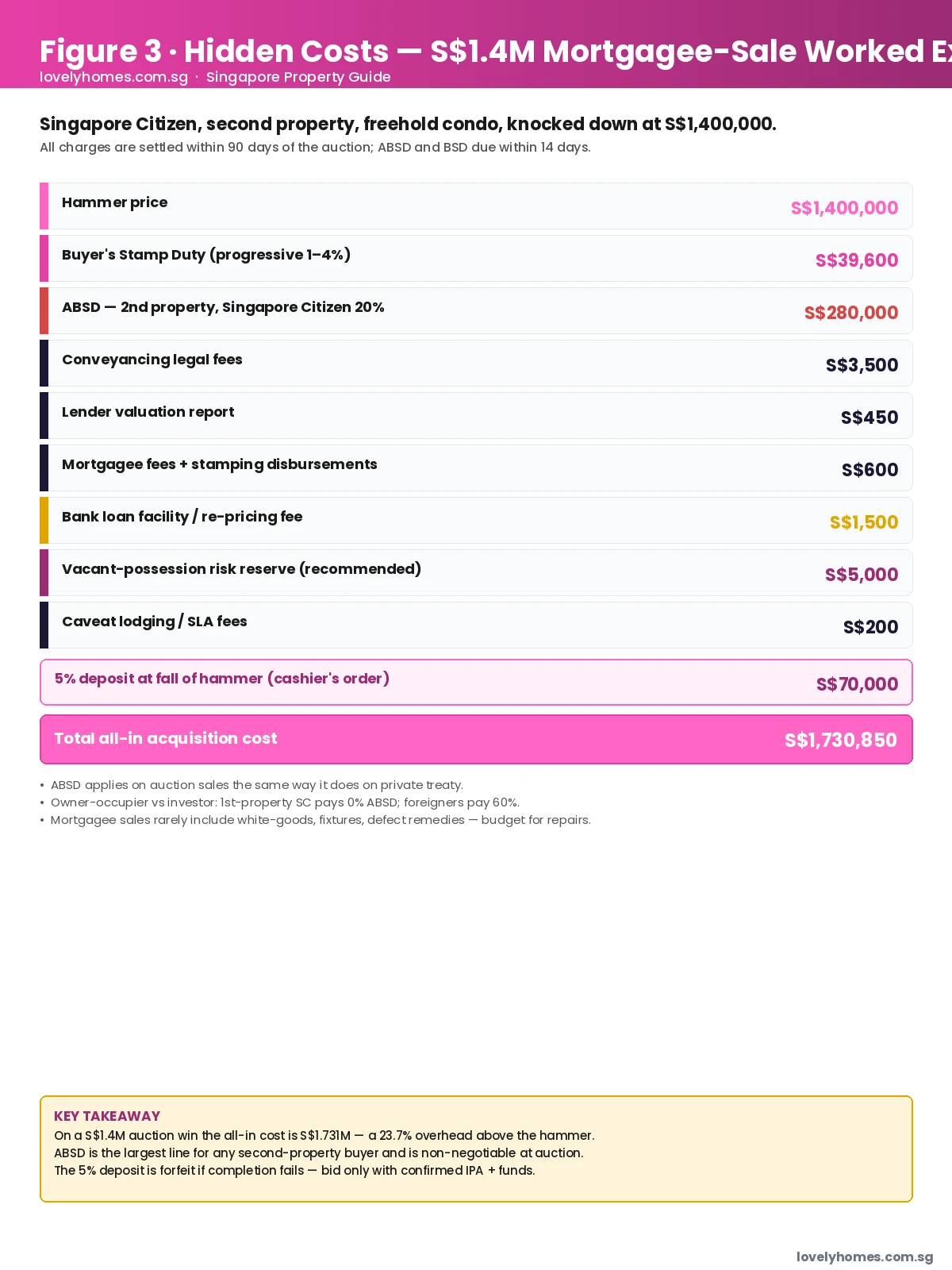
Take a Singapore Citizen second-property buyer who wins a freehold two-bedroom condominium at a mortgagee auction with a hammer price of S$1,400,000. The full cost stack — including everything most first-time bidders forget — looks like this:

Singapore property auction guide 2026 — S$1.4M mortgagee sale total cost worked example
Figure 3: Day-1 deposit and full all-in acquisition cost on a S$1.4 million Singapore Citizen second-property auction win.
  • Hammer price: S$1,400,000;
  • 5% deposit at the fall of the hammer: S$70,000 (cashier’s order);
  • BSD: S$39,600;
  • ABSD at SC second-property 20%: S$280,000;
  • Conveyancing legal fees: ~S$3,500;
  • Lender valuation, mortgagee fees, SLA fees: ~S$1,250;
  • Bank loan facility / re-pricing fee: ~S$1,500;
  • Vacant-possession reserve (recommended): S$5,000.

Total all-in cost: roughly S$1,731,250 — about 23.7% above the hammer. A bidder who treats the hammer as the “real” price and budgets only for it will be cash-short by Day 14. ABSD is the largest single line and applies on auction sales the same way it does on private treaty.

Legal traps that catch first-time bidders

Auction is a public-law procedure with much sharper edges than private treaty. The five most common traps:

  1. “As-is, where-is” condition. Mortgagee sale Conditions of Sale typically exclude all warranties on physical condition. The buyer takes the property exactly as it is on auction day — defects, illegal renovations, encroachments, pest damage, leaks. Always inspect personally.
  2. Holdover tenants. A mortgagor may, at the time of auction, still have a tenancy agreement in place. The mortgagee sale extinguishes some tenancies but not all — tenancies with a registered head lease can survive the sale. Read the tenancy documents before bidding.
  3. Outstanding maintenance and management corporation arrears. The MCST may have a charge over the property for unpaid maintenance and sinking-fund contributions; these can attach to the new owner. Auction-house fact sheets often disclose, but not always.
  4. Caveats and CPF charges. Where the previous owner used CPF for the purchase, the CPF Board’s charge must be discharged at completion. Where there are private caveats, your lawyer must lift them before transfer.
  5. Failure to complete. If you fail to pay the 95% balance by the completion date, the vendor (or mortgagee) may rescind, retain the 5% deposit and re-auction. The original buyer has no claim back. This is the most common reason auction buyers lose substantial sums — it is almost always avoidable with a confirmed IPA before bidding.

Summary table — auction snapshot 2026

Item Position at Singapore property auction
Deposit at hammer 5% of hammer price (cashier’s order)
Stamp-duty deadline 14 days from auction date
Completion window 60–90 days (sheriff sales: up to 120)
Vendor warranties Minimal. Usually none on condition.
Typical discount band Mortgagee 5–15%; sheriff 10–20%; owner 0–5%
ABSD payable Yes — same as private treaty
Buyer’s Stamp Duty Yes — 1–6% progressive
Bank financing Yes — IPA from at least one bank required
CPF use Yes for SCs/PRs (subject to OA balance)
Cooling-off period None — bid is final on fall of hammer

Why this matters — how auction discounts compare to private treaty

Auction is sometimes positioned as a high-discount route to Singapore property. The reality is more nuanced. URA caveat data suggests that average mortgagee-sale prints land at roughly 92–95% of comparable private-treaty values for the same building, with deeper discounts only where the property is unusual or distressed. Net of the buyer-side legal and vacant-possession risk reserve, the realised discount is typically 5–10 percentage points — meaningful, but not transformative.

The genuine edge for an auction buyer comes elsewhere: access to atypical inventory (high-floor penthouses, partial-strata bungalows, en-bloc-pending units that owners want to clear before the SoR vote), and certainty of timing. If you must complete by a fixed date, an auction commitment with confirmed IPA delivers that certainty in a way that a 14-day OTP private-treaty negotiation often cannot.

What might come next

Two trends in 2026 are worth watching:

  1. Volume sensitivity to the rate cycle. Mortgagee sale volumes have a clear correlation with mortgage stress. With 3-month compounded SORA having stabilised in the 2.7–3.0% band through 2025–26, mortgage default volumes have eased back to roughly 80–100 mortgagee listings a year. A renewed rate spike could push that materially higher; a sharper Singapore Dollar rate cut would reduce supply further.
  2. Online auction normalisation. Singapore’s main auction houses moved to hybrid online + in-room formats from 2021. Online registration, livestream bidding and digital paddle systems are now standard. The risks of remote bidding (fat-finger entries, latency on accelerating bid books) are real and a reason to keep your maximum bid documented in writing before you log in.

Frequently Asked Questions

Can I view the property before bidding?

Yes. Auction houses arrange supervised viewings during the 7–10 days before the auction. Mortgagee-sale viewings are usually empty units; owner-sale viewings may have furniture or sitting occupants. Always personally inspect — the photographs in the auction catalogue are not warranted.

Do auction buyers pay ABSD on the same basis as private-treaty buyers?

Yes. ABSD is administered by IRAS based on the Buyer Profile and the property count at the time of the document attracting duty (the Memorandum of Sale on auction day). The 60% foreigner rate, 20%/30% SC rates and 30%/35% PR rates all apply unchanged. See our ABSD complete guide.

What happens if the property fails to sell at auction?

The lot is “withdrawn”, and the auctioneer typically invites private-treaty offers above the reserve. Many auction-floor failures sell within four weeks at or near the reserve, with the same conditions of sale. This is a useful route for bidders who attended the auction and watched the bidding stall just below their valuation.

Can I bid by proxy or remotely?

Yes. Most major Singapore auction houses accept written or telephone proxy bids and offer hybrid online bidding portals. The proxy form must be signed and lodged before the auction; the highest authorised proxy bid will be entered automatically when called. Confirm IT and identification requirements with the specific auction house.

Do I lose the deposit if my bank withdraws financing after I win?

Yes — if you cannot complete by the contractual completion date, the vendor (mortgagee) may rescind and retain the 5% deposit. This is why a pre-auction IPA is non-negotiable. Banks do not usually pull a written IPA without good reason, but if your circumstances change between IPA and completion (job loss, a second mortgage commitment), the IPA can be withdrawn.

Can I use CPF for an auction purchase?

Yes, on the same basis as a private-treaty purchase. CPF Ordinary Account funds may be used for the down payment (subject to the OA balance), and CPF can service monthly mortgage instalments after completion. CPF cannot, however, be used for the 5% deposit at the fall of the hammer — that must be a cashier’s order from a Singapore bank account.

Are auction prices visible in URA caveat data?

Yes. Auction completions are lodged as caveats with SLA in the same way as private-treaty completions, and they appear in URA Realis, IRAS Property Tax records, and downstream property data feeds. Look at the caveat date vs auction date to spot mortgagee transactions — auction closes typically lag 60–90 days behind the auction date.

Related reading on LovelyHomes

Disclaimer: This guide is for general information only and does not constitute legal, tax, or financial advice. Auction Conditions of Sale, ABSD remissions and bank-lending caps are fact-specific and change over time. Always verify the current position with the IRAS Stamp Duty page, the Singapore Land Authority, and a licensed Singapore conveyancing lawyer before signing any Memorandum of Sale.

Translate »