Singapore Condo Resale Guide 2026: Step-by-Step Buyer’s Complete Guide

Singapore Condo Resale Guide 2026: Step-by-Step Buyer’s Complete Guide

Quick Answer: Buying a Resale Condo in Singapore — Key Facts

  • Who can buy: Singapore Citizens, Permanent Residents, and foreigners may all purchase private resale condominiums — but ABSD rates differ dramatically by profile
  • Minimum cash outlay: At least 5% of purchase price in cash; the remaining 20% of downpayment can be CPF OA
  • Timeline: Approximately 10–12 weeks from Option to Purchase (OTP) to completion and key collection
  • BSD: Progressive 1–6% on purchase price, payable by all buyers; SC first property ABSD = S$0
  • Key eligibility check: TDSR (Total Debt Servicing Ratio) capped at 55%; no MSR applies for private property
  • Foreigner ABSD: 60% on purchase price as at 2026 — substantially increases total outlay
  • No MOP: Private condos have no Minimum Occupation Period; you may rent out immediately or sell at any time (but Seller’s Stamp Duty applies if sold within 3 years)
  • New vs resale: Resale condos offer immediate occupation, negotiable price, and visible condition — often priced at a discount to new launches in the same area

Buying a resale condominium in Singapore is the most straightforward route into the private residential property market. Unlike new launches, which require you to pay progressively as construction progresses, a resale unit lets you see exactly what you are buying, negotiate directly with the seller, and move in as soon as the transaction completes — typically within 10–12 weeks. That said, the process involves a specific sequence of legal, financial, and administrative steps that every buyer should understand before signing anything.

This guide walks you through the full condo resale purchase journey, from getting your finances in order to collecting your keys, explaining every cost, timeline, and regulatory check that applies in 2026. Whether you are a first-time buyer, an upgrader, or a Singapore Permanent Resident (SPR) navigating your first private property purchase, this is the definitive reference.
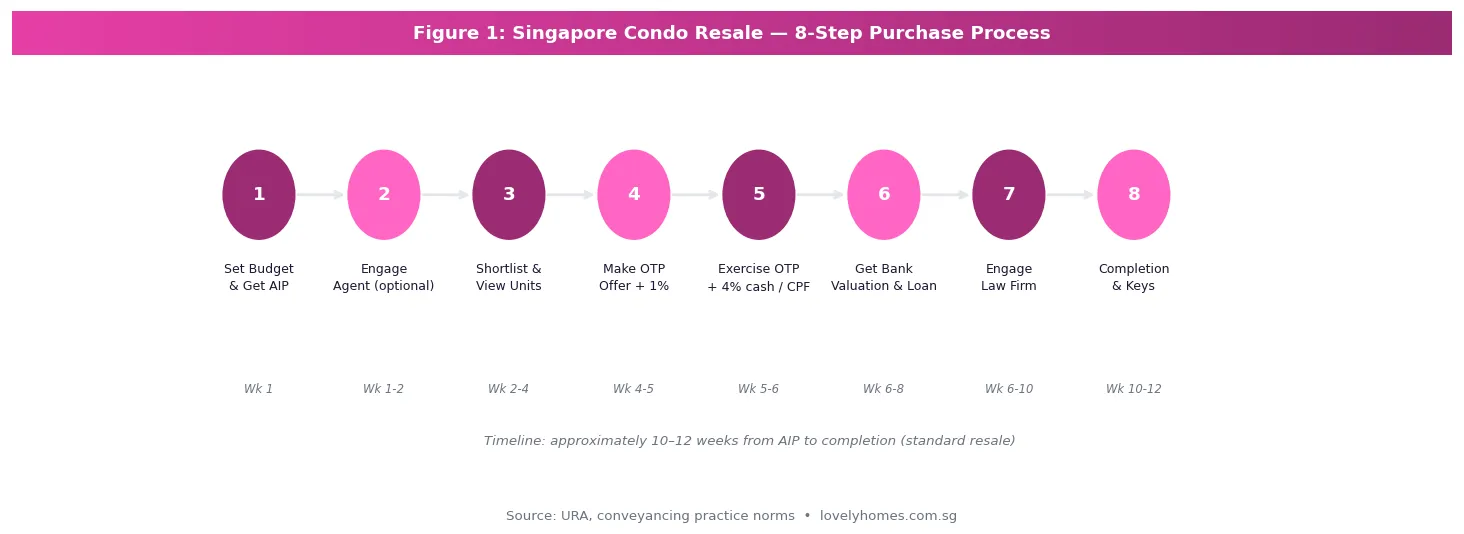
Figure 1: Singapore condo resale 8-step purchase process — from AIP to completion
Figure 1: The 8-step Singapore condo resale purchase process. Total timeline approximately 10–12 weeks from Option to Purchase to legal completion. Source: URA, conveyancing practice norms.

Step 1: Set Your Budget and Get an Approval-in-Principle (AIP)

Before you view a single property, you need a firm number in your head — and a bank’s provisional agreement to lend it. The Approval-in-Principle (AIP), sometimes called In-Principle Approval (IPA), is a letter from a bank confirming the maximum loan amount it will offer you based on your income, existing debts, and credit profile. It is not a committed loan offer, but it is the most reliable anchor you have for your property budget.

The two financial frameworks that govern how much you can borrow in Singapore are the Total Debt Servicing Ratio (TDSR) and the Loan-to-Value (LTV) limit:

Framework Rule Implication for Buyer
TDSR Monthly debt repayments ≤ 55% of gross monthly income Includes all loans: mortgage, car, personal, student. Stress-tested at the higher of actual rate + 0.5% or a floor rate set by the bank
LTV (1st property loan, 30yr) 75% of lower of purchase price or valuation Minimum 25% downpayment; 5% must be cash
LTV (2nd outstanding property loan) 45% 55% downpayment; 25% must be cash
LTV (3rd+ outstanding property loan) 35% 65% downpayment; 25% must be cash
Max loan tenure (private) 30 years; subject to age-65 cap Loan tenure ends when youngest borrower turns 65; longer tenures reduce monthly repayments but increase total interest

Get AIPs from at least two or three banks — rates and offered amounts can vary meaningfully. Processing typically takes 3–5 business days. Note that the AIP lapses after 30–90 days (varies by bank), so do not apply too early.

Step 2: Understand Your Full Stamp Duty Liability Before You Bid

Stamp duty is computed on the purchase price (or market valuation if higher) and is payable within 14 days of signing the OTP. For private resale condominiums, two duties apply: Buyer’s Stamp Duty (BSD) for all buyers, and Additional Buyer’s Stamp Duty (ABSD) for buyers who are not Singapore Citizens purchasing their first residential property.

Buyer Profile BSD (on purchase price) ABSD On S$1.5M — Total Stamp Duty
SC, 1st property 1%–6% progressive 0% S$43,600
SC, 2nd property Same 20% S$343,600
SC, 3rd+ property Same 30% S$493,600
SPR, 1st property Same 5% S$118,600
SPR, 2nd+ property Same 30% S$493,600
Foreigner (any) Same 60% S$943,600
Entity / trust Same 65% S$1,018,600

The BSD progressive scale on a S$1,500,000 purchase: 1% on first S$180,000 = S$1,800; 2% on next S$180,000 = S$3,600; 3% on next S$640,000 = S$19,200; 4% on next S$500,000 = S$20,000. Total BSD = S$44,600. (Note: the 5% tier applies on value above S$1.5M; the 6% tier applies above S$3M.)
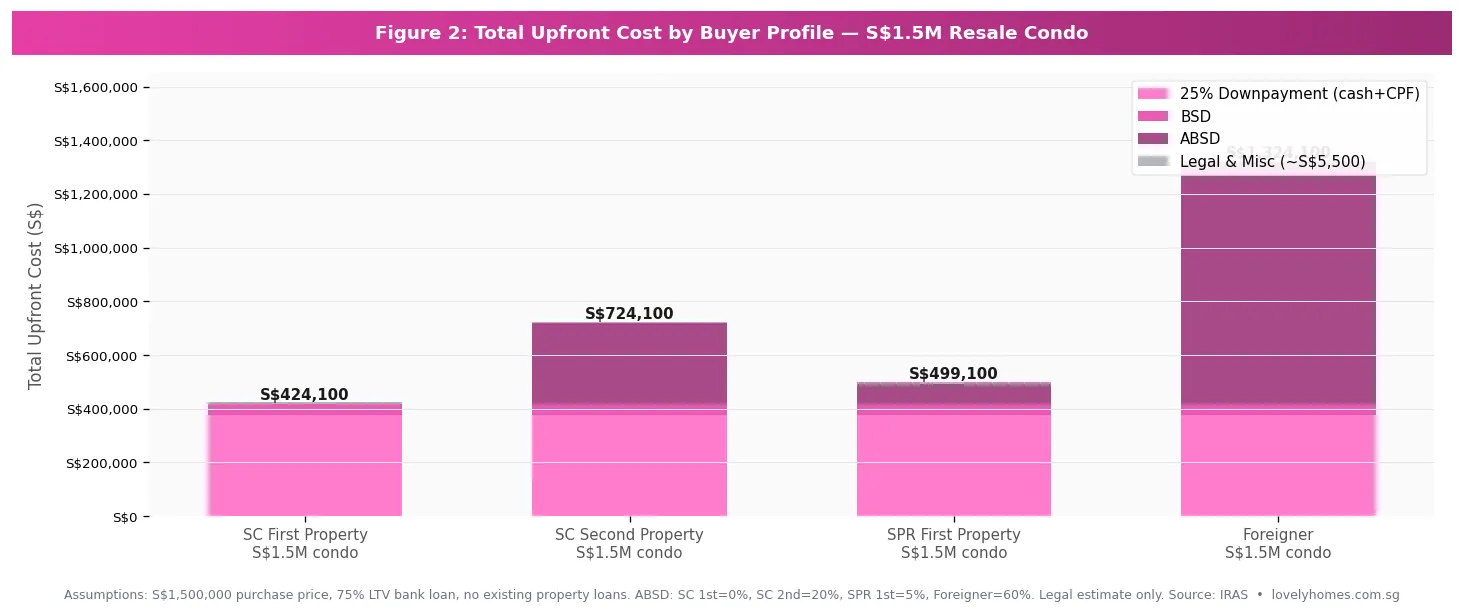
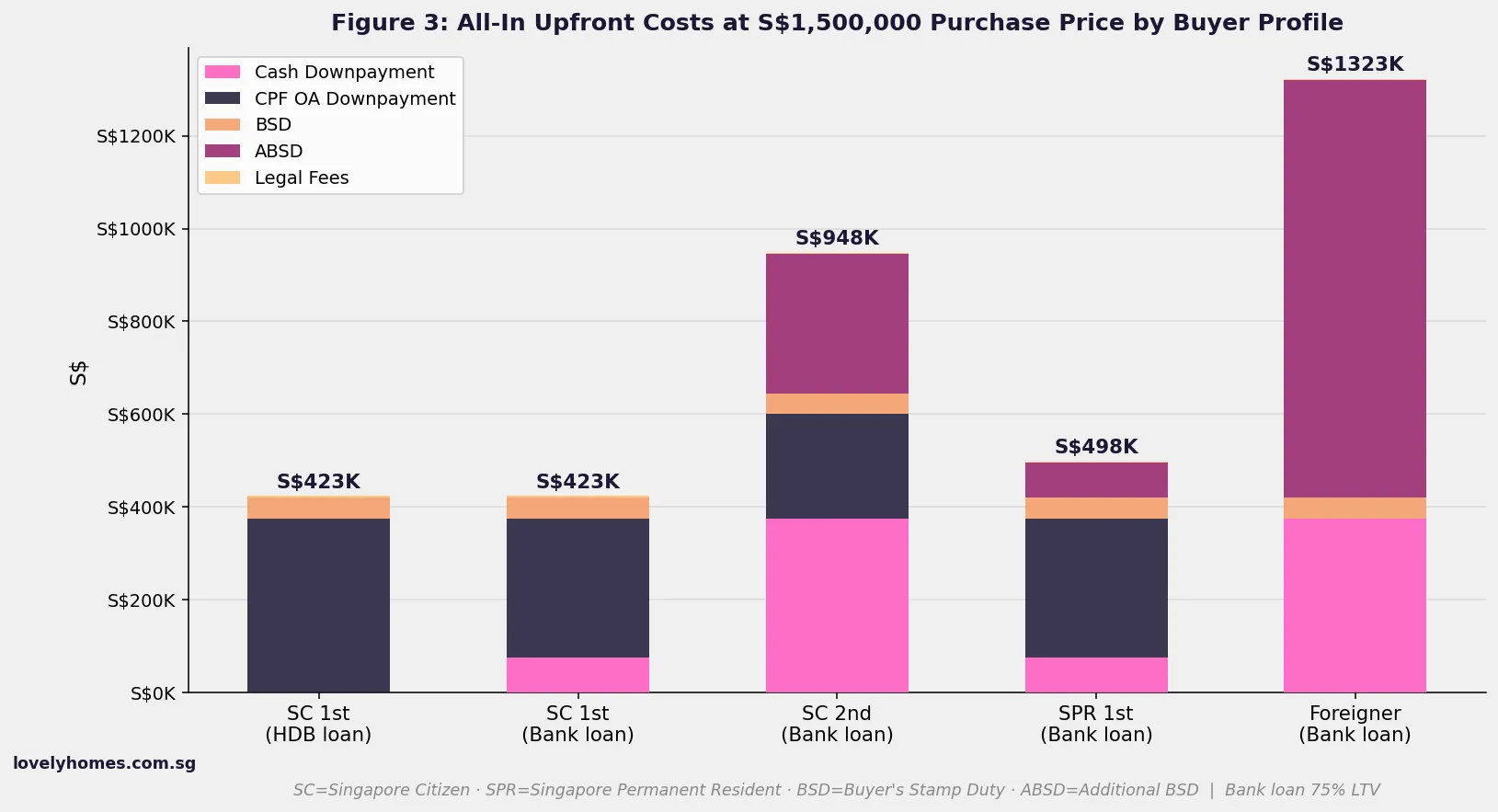
Figure 2: Singapore condo resale upfront costs by buyer profile — BSD, ABSD, downpayment comparison
Figure 2: Total upfront cost breakdown for four buyer profiles at S$1,500,000 purchase price, with 75% LTV bank loan. Note: ABSD for foreigner (60%) dominates and nearly equals the property price. Source: IRAS, MAS guidelines.
Key Takeaway: For Singapore Citizens buying their first property, ABSD is zero — the entire stamp duty bill is BSD alone, which at S$1.5M works out to approximately S$43,600 or 2.9% effective rate. For foreigners, the 60% ABSD makes Singapore one of the most expensive markets globally for foreign residential buyers. Always compute your personal ABSD liability before any negotiation.

Step 3: Search for Your Property and Make an Offer

Private resale condominiums transact through the URA REALIS database (which records all caveats), property listing portals (PropertyGuru, 99.co), and via property agents. When searching, look up URA REALIS for recent transacted prices in your target building — this is your most reliable benchmark for market value and will help you assess whether a listed price is reasonable or inflated.

Key things to investigate before making an offer include: the remaining lease (for leasehold condos); the Annual Value (AV) as assessed by IRAS (affects property tax); whether the unit is subject to any caveats, legal charges, or mortgages (your conveyancing solicitor will conduct a title search); the Management Corporation Strata Title (MCST) financial health (ask for the last two AGM minutes and the sinking fund balance); and any pending special levies that could increase monthly maintenance fees post-purchase.

Step 4: Option to Purchase (OTP) — The Formal Offer

When you agree on a price, the seller issues you an Option to Purchase (OTP). Signing and returning the OTP with the option fee locks in the deal:

1

Option fee (1% of price): Paid in cash when you receive the OTP. This fee is held by the seller. If you exercise the OTP, it forms part of your deposit. If you do not exercise it within the option period (usually 14 days), you forfeit the option fee — so do not sign if you are not serious.

2

Exercise fee (4% of price): Paid in cash or CPF when you exercise the OTP — i.e., when you formally confirm purchase by signing and returning the OTP within the option period. Together, the 1% + 4% = 5% constitutes your initial downpayment cash tranche.

3

Remaining 20% of downpayment: Due at legal completion, from cash or CPF OA after the 5% initial deposit.

Step 5: Appoint a Conveyancing Solicitor

You must appoint a Singapore-licensed conveyancing solicitor to act for you in the purchase. Your solicitor will: conduct title searches to confirm the seller has clean title; check for encumbrances, mortgages, and caveats; prepare the Sale and Purchase Agreement (SPA); coordinate with the bank and seller’s solicitors; handle stamp duty submission to IRAS; and manage the legal completion on the agreed date.

Legal fees for a resale condo transaction typically range from S$3,500 to S$6,500, depending on complexity and the firm. Some banks offer free legal conveyancing if you take their mortgage — compare this offer against independent solicitor rates.

Step 6: Bank Valuation and Formal Loan Offer

Once the OTP is exercised, your bank will commission a formal property valuation by a licensed RICS/AVA-accredited valuer. This is separate from your AIP — it is a binding document that determines the maximum amount the bank will lend (75% of valuation or purchase price, whichever is lower). If the bank valuation comes in below your agreed purchase price, you must top up the shortfall entirely in cash — it cannot be covered by CPF or the loan.

After valuation, the bank issues a formal Letter of Offer (LO). Review the interest rate structure carefully: most banks in 2026 offer floating-rate packages pegged to SORA (the Singapore Overnight Rate Average) or fixed-rate packages for 2–3 years before floating. As at mid-2026, prevailing bank mortgage rates for new loans are in the 3.0–3.7% range depending on package and tenure.

Step 7: Legal Completion

On the completion date (agreed in the SPA, typically 8–10 weeks after OTP exercise), your solicitor coordinates fund transfers from CPF, your bank, and your own cash account to the seller’s solicitor. The total payment disbursed covers: the purchase price minus any deposits already paid; BSD and ABSD (already paid to IRAS directly); and any outstanding amounts. Simultaneously, any mortgage over the property is discharged by the seller’s bank and your own mortgage is registered. The Certificate of Title is issued in your name.

Step 8: Key Collection and First-Year Ownership Costs

On or shortly after completion, you collect the keys from the seller’s solicitor or the seller directly. At this point the property is yours. However, ongoing ownership costs begin immediately:

Cost Item Frequency Typical Amount (1,000 sqft condo)
Property tax Annual (IRAS) S$1,200–S$3,200 (based on Annual Value)
MCST maintenance fee Monthly S$280–S$600 (Management Fund)
MCST sinking fund Monthly S$30–S$80 (share of Sinking Fund)
Home insurance Annual S$200–S$600 (basic fire + contents)
Mortgage repayment Monthly Depends on loan amount and rate

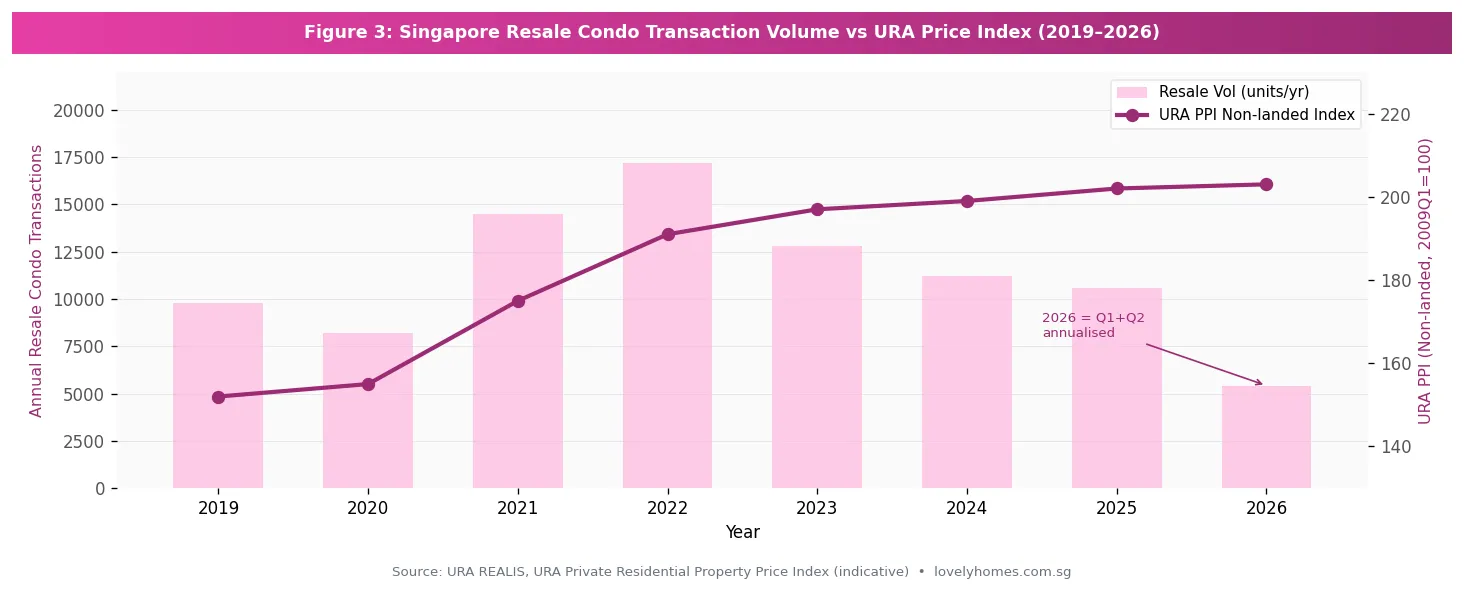
Figure 3: Singapore resale condo transaction volume versus URA price index 2019–2026
Figure 3: Singapore private resale condo transaction volume (bars) vs URA Private Residential Price Index, non-landed (line), 2019–2026. 2026 volume is Q1+Q2 annualised. Sources: URA REALIS, URA PPI.

Resale vs New Launch: How to Choose in 2026

Figure 3 shows that resale transaction volumes peaked in 2022 (17,200 units) before moderating as prices hit all-time highs and higher interest rates compressed affordability. By mid-2026, the resale market has stabilised, with the Q2 2026 URA flash estimate showing overall private prices up just 0.5% quarter-on-quarter — a signal that the market is absorbing elevated price levels without sharp correction or fresh exuberance.

For buyers deciding between a resale unit and a new launch in 2026, the key trade-offs are: resale offers immediate occupation, disclosed condition, and typically a discount of 10–20% per square foot compared to new launches in the same vicinity; new launches offer deferred payment via the Progressive Payment Scheme, brand-new fittings, and in some cases longer remaining lease. In a rising-rate environment, the progressive payment structure of new launches is less compelling as the interest-servicing obligation on bridge financing grows. In 2026, resale condos offer compelling value in many districts — particularly CCR, where new launches are sparse and resale prices have softened relative to their 2022 peaks.

What Might Come Next for the Condo Resale Market

This section reflects editorial analysis and forward-looking commentary only. It should not be read as investment advice.

The URA Q2 2026 flash estimate revealed a CCR rebound of +2.0% QoQ against a softening RCR and OCR. If this trend sustains, savvy resale buyers targeting the CCR may have a narrowing window before CCR prices re-accelerate. The URA’s 2H 2026 GLS Confirmed List releases 4,745 units — a meaningful supply addition, but concentrated in RCR and OCR; CCR supply remains constrained. The mid-year data points suggest the two-year period of price consolidation (2024–mid-2026) may be in its final stages, though the trajectory of global interest rates remains the key variable. Buyers who complete purchases in Q3–Q4 2026 may benefit from current price softness.

Worked Example: Resale Condo Purchase — Full Cost Breakdown

Scenario: Mr and Mrs Lim (SC/SC, married couple), purchasing first home together

Property: 3-bedroom resale condo, D19 Serangoon, 1,200 sqft, listed at S$1,850,000. Bank valuation: S$1,820,000 (lower of two).

BSD (on S$1,820,000): 1%×S$180k + 2%×S$180k + 3%×S$640k + 4%×S$820k = S$1,800 + S$3,600 + S$19,200 + S$32,800 = S$57,400

ABSD: S$0 — SC first residential property

Downpayment:
— LTV: 75% of S$1,820,000 = bank loan S$1,365,000
— 25% downpayment on S$1,820,000 = S$455,000
— Of which 5% must be cash: S$91,000; remaining S$364,000 can be CPF OA

TDSR check: Combined income S$12,000/mth. At 3.5% for 25 years: monthly repayment on S$1,365,000 ≈ S$6,840. TDSR = 6,840/12,000 = 57.0% — exceeds 55% cap. Solution: extend tenure to 30 years or reduce loan. At 30yr: S$6,130/mth = TDSR 51.1% PASS.

Short-price issue: Purchase price (S$1,850,000) exceeds valuation (S$1,820,000). Shortfall of S$30,000 must be paid in cash — cannot use CPF.

Total cash required at completion:
— 5% option money paid (already paid): S$92,500 (5% of S$1,850,000 as negotiated)
— Shortfall: S$30,000
— Balance downpayment (20% of S$1,820,000 minus already-paid cash): funded from CPF OA
— BSD: S$57,400 (paid separately to IRAS, cash or CPF)
— Legal fees: ~S$5,200
Estimated total cash outlay: ~S$155,000–S$185,000 depending on CPF OA balance available

Lesson: Always check whether the bank valuation will match your offer price. A valuation shortfall can derail affordability if cash reserves are tight.

Frequently Asked Questions: Singapore Condo Resale Purchase

Can I use my CPF to pay for a resale condo?

Yes, CPF Ordinary Account (OA) savings may be used for: the downpayment (except the first 5% which must be cash), monthly mortgage repayments, and BSD/ABSD (you can instruct IRAS to debit your CPF OA for stamp duties, subject to having sufficient balance). However, CPF usage for property is subject to the CPF usage limit — you can use CPF only up to the Valuation Limit (VL, which is the lower of purchase price or valuation) and subject to the accrued interest rule: all CPF OA funds used, plus accrued interest at the CPF OA rate (currently 2.5% per annum compound), must be refunded to your CPF when you sell the property. Buyers with significant CPF usage from a prior HDB flat should obtain a CPF statement to understand how much OA is available before committing.

Is there a Minimum Occupation Period for resale condos?

No — private condominiums, whether purchased as new launches or resale, have no Minimum Occupation Period. You may rent out the unit immediately after purchase (though check your development’s by-laws regarding short-term rental via platforms), or sell it at any time. However, the Seller’s Stamp Duty (SSD) applies if you sell within 3 years of purchase: SSD is 12% (sold in Year 1), 8% (Year 2), or 4% (Year 3), computed on the higher of selling price or market value. Hold for at least 3 years to avoid SSD entirely.

What checks should I do on the MCST before buying a resale condo?

The MCST (Management Corporation Strata Title) is the body corporate that manages the common areas of the development. Before buying, request from the seller or managing agent: the last two AGM minutes (to understand any disputes, special levy proposals, or major works planned); the current sinking fund balance (adequate reserves = lower risk of special levies); the monthly maintenance fee quantum; and whether any arrears are owed by the unit. Your conveyancing solicitor will conduct a title search but will not necessarily review MCST financial health — that is your due diligence responsibility.

What happens if I need to sell before 3 years?

Selling within 3 years of purchase triggers SSD: 12% (Year 1), 8% (Year 2), 4% (Year 3), computed on the selling price or market value, whichever is higher. On a S$1.5M condo sold in Year 2, the SSD would be S$120,000 — a significant drag that can wipe out any appreciation gained. Genuine hardship cases (financial difficulty, death, divorce) may be considered for remission by the IRAS on application, but remission is not guaranteed and not a planning assumption. Buyers who are uncertain about their 3-year commitment should factor SSD into their exit scenario modelling.

Can a Singapore Permanent Resident (SPR) buy a resale condo?

Yes. SPRs may purchase private condominiums without restriction. However, SPRs pay ABSD of 5% on their first residential property purchase and 30% on second and subsequent purchases. An SPR married to a Singapore Citizen and purchasing jointly may be eligible for a remission of the ABSD (refunded after satisfying a 5-year joint ownership condition) under the ABSD Remission for Married Couples scheme. Check the current IRAS ABSD remission conditions before structuring your purchase.

How is the bank valuation determined and what if it differs from the asking price?

The bank appoints an RICS/AVA-accredited independent valuer who inspects the property and analyses recent comparable transactions in the same development and surrounding area from URA REALIS. The valuation is an arm’s-length professional opinion — it can come in above, at, or below the agreed purchase price. If it comes in below: the bank lends 75% of the valuation (not the purchase price), and you must fund the shortfall entirely in cash. If it comes in above: the bank still lends 75% of purchase price (the lower figure), but you face no shortfall. Banks typically complete valuations within 3–5 business days of being instructed.

What are the tax obligations after buying a resale condo?

After purchase, you are liable for annual Property Tax assessed by IRAS based on the property’s Annual Value (AV) — the estimated annual rental income. Owner-occupiers enjoy a preferential progressive rate (0% on first S$8,000 AV, rising to 23% on AV above S$100,000 as at 2026). Landlords (non-owner-occupied) face higher rates. IRAS will send you an annual property tax bill. Additionally, rental income is subject to Singapore income tax — you must declare rental income and can deduct allowable expenses such as mortgage interest, MCST fees, and repairs. Consult a tax professional for your specific situation.
Disclaimer: This guide is for general information and educational purposes only. Stamp duty rates, LTV limits, TDSR rules, and CPF usage policies are accurate as at July 2026 and subject to change by IRAS, MAS, CPF Board, and HDB. The worked example is illustrative only; individual transactions will vary. Nothing herein constitutes financial, investment, legal, or property advice. Consult a licensed property agent, conveyancing solicitor, and independent financial adviser before making any purchase decision. Official sources: IRAS, MAS, URA, CPF Board.

×

Click anywhere to close

Singapore Home Mortgage Guide 2026: Fixed vs Floating, SORA Rates and How to Choose

Singapore Home Mortgage Guide 2026: Fixed vs Floating, SORA Rates and How to Choose

Quick Answer: Singapore Home Mortgage Guide 2026

  • Best SORA-linked floating rates start from 1.27% p.a. as of June 2026 — down from a peak of ~3.65% in mid-2023.
  • Fixed rates (2-year) range from 2.45%–2.75% p.a. — offering payment certainty at a higher starting cost.
  • The HDB concessionary loan rate stands at 2.6% p.a. — pegged to CPF OA rate + 0.1%, available for HDB flat purchases only.
  • Bank loans allow LTV up to 75% on a first property; HDB loans allow up to 80% LTV.
  • TDSR (Total Debt Servicing Ratio) cap is 55% of gross monthly income; MSR (Mortgage Servicing Ratio) cap of 30% applies additionally to HDB and EC loans.
  • MAS stress-tests TDSR calculations at a floor of 4% regardless of the actual contractual rate.
  • Refinancing can save S$8,000–S$20,000 over two years for a S$700,000-plus loan at current spreads.
  • Lock-in periods of 2–3 years are standard; early full redemption penalty is typically 1.5% of outstanding loan.

What Is a Singapore Home Mortgage?

A home mortgage (or home loan) is a secured loan extended by a financial institution to help you finance the purchase of a residential property in Singapore. The property itself serves as collateral: if you default on repayments, the lender has the right to repossess and sell the property to recover the outstanding debt.

In Singapore, home mortgages are regulated by the Monetary Authority of Singapore (MAS), which sets the framework governing lending limits, stress tests, and debt servicing ratios for all licensed banks and finance companies. HDB separately administers its own concessionary loan programme for eligible flat buyers under different terms to bank loans. Every borrower in Singapore — whether buying an HDB flat, executive condominium, or private property — is subject to MAS’s property cooling measures, including the Loan-to-Value (LTV) limits and the Total Debt Servicing Ratio (TDSR) framework.

HDB Concessionary Loan vs Bank Loan: Which Should You Choose?

The first decision any Singapore property buyer faces is whether to finance through the HDB concessionary loan (available for eligible HDB flat buyers) or through a bank loan (available for both HDB and private property). The two options differ substantially on rate, eligibility, flexibility, and long-term cost.

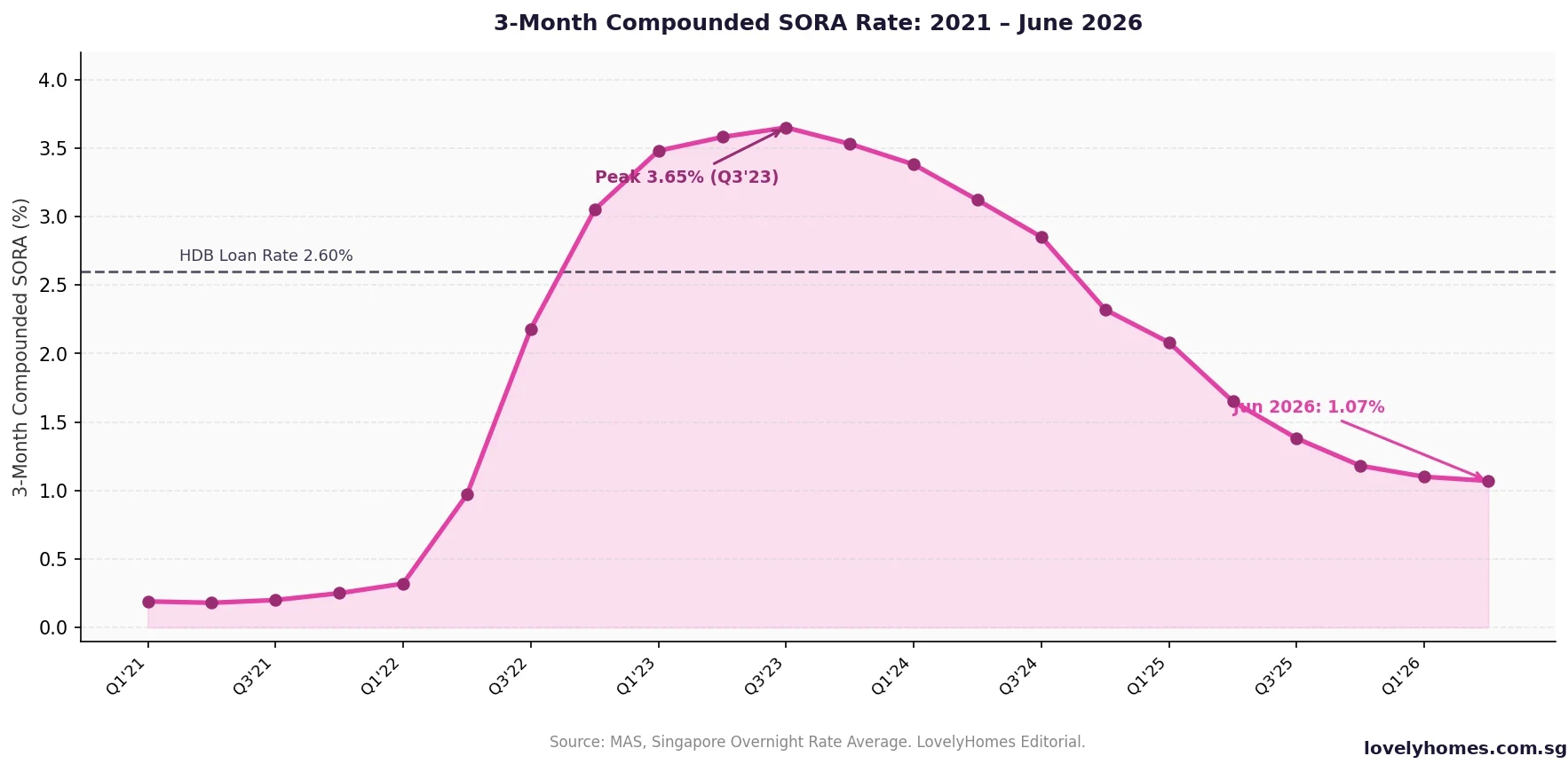
The HDB concessionary loan charges interest at 2.6% p.a. — a rate pegged by policy to the CPF Ordinary Account (OA) interest rate of 2.5% plus 0.1%. This rate has remained unchanged since 1999 despite global interest rate cycles, though it can theoretically be revised if CPF OA rates change. Bank loans, by contrast, track market interest rates: as Singapore Overnight Rate Average (SORA) has fallen from 3.65% in late 2023 to 1.07% in June 2026, floating bank rates have fallen correspondingly to 1.27%–1.95% p.a., making them significantly cheaper than the HDB loan at current market conditions.

However, the HDB loan offers important advantages for risk-averse buyers: there is no lock-in period, no early redemption penalty, and the rate — while higher today — provides stability if global interest rates rise again. The HDB loan also allows a higher LTV of 80% (versus 75% for bank loans), reducing the upfront cash required.

One critical constraint: once you switch from an HDB loan to a bank loan, you cannot switch back. This makes the initial decision consequential.

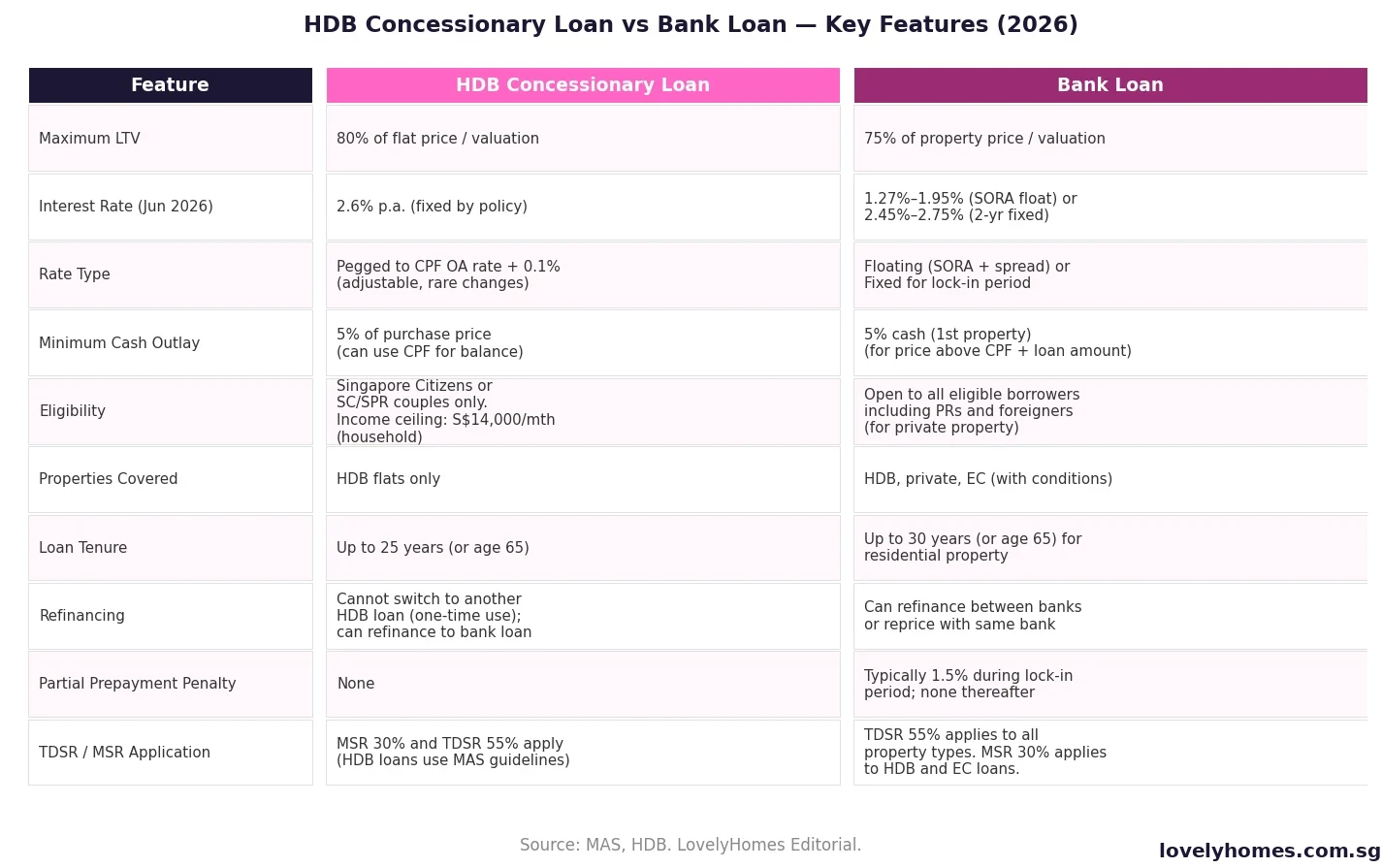
HDB concessionary loan vs bank loan comparison table Singapore 2026 — LTV rates TDSR MSR features
Figure 1: HDB Concessionary Loan vs Bank Loan — 10 key feature comparison for Singapore property buyers (2026). Click to enlarge.

Understanding SORA: Singapore’s Mortgage Benchmark Rate

Since October 2021, Singapore banks have migrated their floating-rate home loans from the old SIBOR (Singapore Interbank Offered Rate) and SOR (Swap Offer Rate) benchmarks to SORA — the Singapore Overnight Rate Average administered by MAS. SORA is computed daily as the volume-weighted average rate of unsecured overnight interbank SGD transactions brokered in Singapore.

Home loans today are typically priced at a spread over the 3-Month Compounded SORA — for example, “3M SORA + 0.80% p.a.” A 3-Month Compounded SORA of 1.07% plus a 0.80% spread produces an effective rate of 1.87% p.a. The spread varies by bank, product, and loan size, but typically ranges from 0.20% to 0.90% p.a. for competitive packages in June 2026.

SORA fell sharply from its peak of approximately 3.65% in Q3 2023 as the US Federal Reserve paused and then cut rates, and as Singapore’s monetary policy stance eased. By June 2026, 3-Month Compounded SORA stands at approximately 1.07%, close to pre-2022 levels. Most analyst forecasts see SORA remaining between 0.7% and 1.5% through the second half of 2026, though any renewed global inflationary pressure could reverse this trajectory.

SORA 3-month compounded rate trend Singapore 2021 to June 2026 mortgage benchmark chart
Figure 2: 3-Month Compounded SORA — Quarterly Average, Q1 2021 to June 2026. The HDB concessionary loan rate of 2.6% is shown for reference. Source: MAS. Click to enlarge.

Fixed vs Floating Rate Mortgages in 2026

The choice between a fixed rate and a SORA-linked floating rate is the central strategic decision for most Singapore borrowers in 2026. Both options are currently available from major banks, and the decision hinges on your risk tolerance, cash flow needs, and view on where interest rates will move.

A floating SORA-linked rate adjusts with market conditions — if SORA falls further, your monthly instalment decreases; if it rises, it increases. In June 2026, best floating rates begin at 1.27% p.a., making them substantially cheaper than fixed alternatives. A fixed-rate package locks in a specified rate for 2–3 years, providing certainty on monthly payments regardless of what SORA does. June 2026 fixed rates range from 2.45% to 2.75% p.a. for 2-year fixed terms — a premium over floating rates, but offering protection against rate hikes.

Given that SORA is already low and forecasts suggest it will stay subdued through 2026, many financial advisers in Singapore currently favour floating packages for their immediate cost savings. However, borrowers should note: if MAS’s monetary policy stance tightens or if US rates rise unexpectedly, SORA could climb quickly. A hybrid approach — taking a shorter fixed term for certainty, then reassessing at repricing — is a common strategy for 2026.

Current Mortgage Rate Landscape in Singapore (June 2026)

As at June 2026, competition among banks for Singapore mortgage business remains intense, and indicative best rates are broadly as follows. Note that all packages require the borrower to meet eligibility criteria (income, property type, loan quantum), and rates are subject to change. Always obtain an In-Principle Approval (IPA) and compare offers from at least three banks before committing.

Rate Type Indicative Rate (Jun 2026) Lock-in Period Notes
SORA Floating (best) ~1.27% p.a. (3M SORA + ~0.20%) None / 1 year Rates move quarterly with SORA resets
SORA Floating (typical) ~1.50%–1.95% p.a. 1–2 years Spread 0.43%–0.88% over 3M SORA
2-Year Fixed ~2.45%–2.65% p.a. 2 years Converts to floating after lock-in
3-Year Fixed ~2.60%–2.75% p.a. 3 years Longer certainty; higher early exit penalty
HDB Concessionary Loan 2.6% p.a. No lock-in HDB flat buyers only; SC/SC-PR eligible

Key Mortgage Terms Decoded

Loan-to-Value (LTV) Ratio: The maximum percentage of the property’s purchase price or valuation (whichever is lower) that a lender will finance. Under MAS rules, a first bank loan allows up to 75% LTV for a 30-year term; a second outstanding loan reduces this to 45%, and third-or-subsequent loans to 35%.

Total Debt Servicing Ratio (TDSR): MAS caps the total monthly debt obligations (all loans, including car loans, personal loans, and the new mortgage) at 55% of gross monthly income. Banks stress-test the TDSR at 4% to ensure the loan remains serviceable if rates rise. If your TDSR exceeds 55% at the 4% floor rate, the bank will not approve the full loan amount requested.

Mortgage Servicing Ratio (MSR): An additional cap of 30% of gross monthly income that applies specifically to bank loans used to purchase HDB flats and executive condominiums. MSR is calculated on the actual loan rate.

Lock-in Period: A period during which you cannot fully repay or refinance the loan without incurring a penalty — typically 1.5% of the outstanding loan amount. Partial prepayments of up to a certain amount (often S$30,000–S$50,000 per year) may be allowed penalty-free even during lock-in, depending on the package.

Spread: The margin above SORA that the bank adds to arrive at the actual loan rate. For example, 3M SORA + 0.80% spread = effective rate. The spread is fixed for the life of the package (unlike the SORA component, which floats).

Repricing vs Refinancing: Repricing means switching to a different rate package offered by the same bank — usually possible at the end of a lock-in period, with a modest administrative fee (S$500–S$1,500). Refinancing means moving the entire loan to a different bank — typically saves more but involves legal fees (S$2,000–S$3,500), valuation fees, and a minimum loan quantum (usually S$200,000 or above).

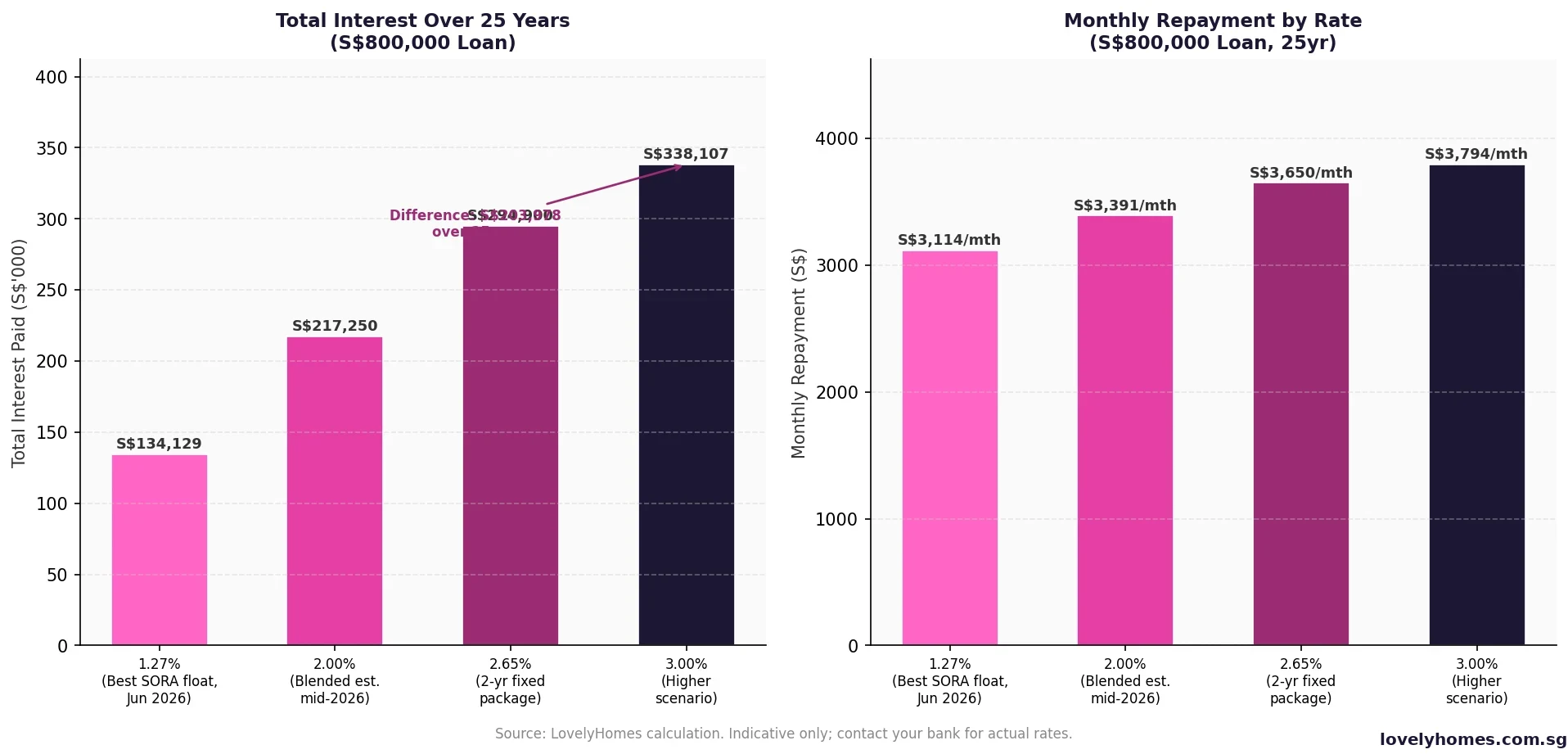
Singapore mortgage total interest cost and monthly repayment comparison 1.27% 2% 2.65% 3% rate scenarios S$800K loan 25 years
Figure 3: Total interest over 25 years and monthly repayment — S$800,000 loan at four rate scenarios. Rate differences compound substantially over the loan term. Source: LovelyHomes calculation. Click to enlarge.

Refinancing vs Repricing: When to Switch

Refinancing — moving your mortgage from one bank to another — is one of the most effective ways Singapore property owners can reduce their borrowing costs over time. Most financial advisers recommend reviewing your home loan at least every 2–3 years, and particularly as your lock-in period expires.

The typical break-even calculation for refinancing involves comparing the projected interest savings over the next 2 years against the one-time costs: legal fees (S$2,000–S$3,500), valuation fees (S$300–S$500), and any cashback that was received from the existing bank and may need to be returned on early exit. As a rule of thumb, refinancing makes economic sense when the annual interest saving exceeds S$3,000–S$4,000 — typically achievable on loans of S$500,000 and above where the rate differential is 0.3% or more.

Repricing with the same bank is lower-cost and requires no legal or valuation work, making it attractive for smaller loan balances or where the new rate from your existing bank is competitive. Some banks now offer online repricing portals that complete the process in days without the need to submit income documents again.

Worked Example: The Choo Family — Choosing a Mortgage Package for an S$1.35M Condo

Marcus and Lin Choo are a Singapore Citizen couple with a combined gross monthly income of S$12,000, purchasing their first property — a 3-bedroom resale condominium in the OCR at S$1,350,000. This is their only residential property (no ABSD payable as first-purchase SC couple).

BSD calculation: 1% on first S$180,000 = S$1,800 + 2% on next S$180,000 = S$3,600 + 3% on next S$640,000 = S$19,200 + 4% on remaining S$350,000 = S$14,000. Total BSD = S$38,600 (payable from CPF OA).

Bank loan at 75% LTV: S$1,350,000 × 75% = S$1,012,500. Cash/CPF down payment required: S$337,500.

Option A — SORA floating at 1.27% p.a.: Monthly instalment ≈ S$3,940 (25yr, 300 months). TDSR: S$3,940 / S$12,000 = 32.8% — PASS (well within 55%). MAS stress test at 4%: monthly ≈ S$5,338; TDSR 44.5% — PASS.

Option B — 2-year fixed at 2.65% p.a.: Monthly instalment ≈ S$4,616 (25yr). TDSR: 38.5% — PASS. Monthly difference vs Option A: S$676/mth (S$16,224 over 2 years at current rates).

Decision: The Choos chose Option A (SORA floating) for the immediate S$676/mth saving. They note that if SORA rises to 2.5% (making their rate ~3.3%), the monthly payment would increase to approximately S$5,103/mth (TDSR 42.5% — still within limits). They set aside S$800/mth as a rate-rise buffer in a high-yield savings account.

Refinancing plan: At month 24, the Choos will review rates and consider refinancing to whichever bank offers the best package. Estimated legal fees if they refinance: S$2,500; break-even requires saving more than S$1,250/yr in interest — achievable if any bank offers a rate more than 0.13% lower than their renewal rate.

What This Means for Singapore Borrowers in 2026

The current rate environment represents a meaningful turning point for Singapore’s property financing landscape. After three years of elevated SORA rates that squeezed buyer affordability and contributed to a slowdown in the mid-price condo market, SORA at 1.07% marks a return to conditions last seen before the 2022 global rate-tightening cycle. For existing variable-rate borrowers, monthly instalments have already fallen materially from their 2023–2024 peaks — providing direct cash-flow relief and improving property investment yields.

For new buyers, low SORA rates increase the maximum loan quantum that passes the TDSR stress test, effectively expanding the pool of properties buyers can afford. The concern, however, is that easier financing conditions could feed further price growth — particularly in the OCR segment where demand remains robust and new supply is limited outside of GLS launches.

International peer comparison: SORA’s current 1.07% level is low by historical standards but is not out of line with broader Asia-Pacific trends. Australia’s RBA cash rate remains elevated at ~3.85%, while Hong Kong’s HIBOR has also eased but remains above Singapore levels. Singapore borrowers currently enjoy some of the most competitive mortgage rates in Asia.

What Might Come Next

Most analysts expect SORA to remain in the 0.7%–1.5% range through the remainder of 2026, supported by continued easing from the US Federal Reserve and MAS’s own exchange-rate-based monetary policy stance. A key risk is renewed US inflation — if the Fed pauses or reverses cuts, SORA could drift upwards. However, Singapore’s property market cooling measures (ABSD, TDSR, LTV limits) are designed to prevent mortgage stress even in rising-rate scenarios.

On the lending side, banks are actively competing for mortgage originations, and rate packages may become even more attractive in the second half of 2026 as lenders fight for market share. Borrowers who are out of lock-in — or approaching the end of their lock-in periods — should actively benchmark their current rates against the market before auto-repricing kicks in, as default repricing rates are typically less competitive than the best new-customer packages.

Frequently Asked Questions: Singapore Home Mortgage Guide 2026

Can I use CPF Ordinary Account funds to pay my monthly mortgage instalment?

Yes. CPF OA savings can be used to service monthly mortgage instalments on both HDB flats and private properties, subject to property-specific limits. For HDB flats, you can use CPF OA up to the Valuation Limit (the lower of the purchase price or the HDB valuation). For private properties, CPF OA usage is subject to the Valuation Limit and the Withdrawal Limit (typically 120% of the Valuation Limit for properties with remaining lease of at least 60 years). Note that CPF funds used incur accrued interest at 2.5% p.a., which must be refunded to your CPF account on the sale of the property.

What is the difference between an IPA and an AIP?

An In-Principle Approval (IPA), sometimes called an Approval-in-Principle (AIP), is a conditional commitment from a bank indicating how much they are willing to lend you based on a preliminary assessment of your income, credit history, and existing obligations. An IPA is not a formal loan offer and does not guarantee final loan approval (which is subject to a satisfactory property valuation and final income verification). Nevertheless, having an IPA before making an offer to purchase gives you confidence in your borrowing power and demonstrates seriousness to sellers. Most banks issue IPAs within 1–3 working days, and they are typically valid for 30–90 days.

What happens if my bank’s valuation comes in below the purchase price I agreed to pay?

If the bank’s valuation is lower than the agreed purchase price, your loan quantum is based on the lower valuation figure — not the price you agreed to pay. The shortfall (often called a “Cash-over-Valuation” or COV for HDB, or a valuation gap for private property) must be paid in cash and cannot be financed by the bank or from CPF. For example, if you agree to pay S$1.5M but the bank values the property at S$1.45M, the 75% LTV bank loan is S$1,087,500 (75% of S$1.45M), and you must fund the S$50,000 valuation gap in cash, plus your down payment. This is why checking property valuation before exercising the OTP is an important part of the buying process.

Can I take a home loan if I am a Singapore Permanent Resident or foreigner?

Singapore Permanent Residents (PRs) can take bank home loans for private properties and, under certain conditions, for HDB resale flats (subject to eligibility and the 5% deposit requirement). PRs are not eligible for the HDB concessionary loan. Foreign nationals (non-PRs) can take bank loans for approved private residential properties but are subject to significantly higher ABSD rates (60% as at June 2026) that effectively price most foreigners out of residential property investment. All borrowers — including PRs and foreigners — are subject to MAS’s TDSR framework and LTV limits for any property financing in Singapore.

What is the penalty for selling or refinancing during the lock-in period?

Early full redemption during a lock-in period typically attracts a penalty of 1.5% of the outstanding loan amount at the time of redemption. On a S$900,000 outstanding balance, this equates to S$13,500. Some packages allow partial prepayments of up to S$30,000–S$50,000 per year without penalty during lock-in. Banks sometimes also claw back any cashback or legal fee subsidies they paid at the time of the original loan. Before refinancing, always calculate the total cost of exit (penalty + clawback + new legal fees) against the projected savings from the new rate to determine the true break-even period.

Is the HDB concessionary loan better than a bank loan in 2026?

At current SORA levels (1.07% as of June 2026), bank floating rates of 1.27%–1.95% are materially below the HDB concessionary loan rate of 2.6% p.a., making bank loans financially more attractive in the short term. Over a S$500,000 loan at 25 years, the interest saving from a 1.5% bank rate versus 2.6% (HDB) is approximately S$67,000–S$80,000 in total interest. However, the HDB loan offers rate certainty, no lock-in, and a higher LTV (80% vs 75%), and is the only option if you cannot meet the bank’s income documentation requirements or if the interest rate environment changes materially. Risk-averse buyers — particularly first-timers with tight cash flows — may still prefer the simplicity and stability of the HDB loan despite the current rate disadvantage.

How does the TDSR stress test at 4% affect how much I can borrow?

MAS requires banks to compute your TDSR using a minimum rate of 4% (or the actual contractual rate if higher) when assessing whether your total monthly debt obligations stay within 55% of gross monthly income. This means even if your actual loan rate is 1.5%, the bank calculates affordability as if you were paying at 4%. On a S$1,000,000 loan at 25 years and 4%, the theoretical monthly instalment is approximately S$5,278. If your gross monthly income is S$10,000 and you have no other debts, your maximum monthly instalment under TDSR is S$5,500 (55% × S$10,000) — which barely passes. This stress test prevents borrowers from over-leveraging at low rates only to face distress if rates normalise upwards.

Disclaimer: This article is produced by LovelyHomes Editorial for informational and educational purposes only. It does not constitute financial, legal, or mortgage advice. Interest rates, TDSR limits, LTV ratios, and CPF policies described are indicative as at June 2026 and are subject to change by MAS, HDB, CPF Board, and IRAS without notice. Loan quantum, eligibility, and monthly repayment figures used in examples are illustrative only — actual figures will depend on your specific financial profile, credit history, property type, and the bank’s assessment. Always consult a licensed mortgage broker or your bank’s mortgage specialist, and refer to MAS, HDB, and CPF Board official sources before making any financing decisions.
×

Click anywhere outside to close

Singapore TDSR Guide 2026: Total Debt Servicing Ratio Explained

Singapore TDSR Guide 2026: Total Debt Servicing Ratio Explained

⚡ Quick Answer: TDSR Singapore 2026

  • TDSR stands for Total Debt Servicing Ratio — a MAS rule capping all monthly debt repayments at 55% of gross monthly income.
  • All debts count: mortgage, car loan, personal loan, student loan, credit line, renovation loan — every obligation.
  • HDB and EC buyers face two limits: TDSR 55% (all debts) and MSR 30% (the HDB/EC mortgage alone).
  • Gross income is used, including CPF. Variable income (commission, bonuses) is typically haircut by 30%.
  • TDSR was reduced from 60% to 55% on 30 September 2022 — the tightening that cooled the 2022 market.
  • Banks stress-test at a slightly higher rate than your actual rate to ensure you can cope with rate rises.
  • Exceeding 55% = loan declined — no exceptions under MAS Notice 645 for residential property loans.

What Is TDSR and Why Did MAS Introduce It?

The Total Debt Servicing Ratio (TDSR) is a financial prudential measure introduced by the Monetary Authority of Singapore (MAS) on 29 June 2013 under MAS Notice 645. It requires every MAS-regulated financial institution in Singapore to verify that a borrower’s aggregate monthly debt obligations — across all loans, not just the new mortgage — do not exceed 55% of gross monthly income before extending a property loan.

The policy was created in response to a prolonged low-interest-rate environment that was encouraging households to borrow heavily for property. Without TDSR, a borrower could theoretically obtain a mortgage even if their total monthly repayments consumed 80% or more of their income. TDSR closed that gap by introducing a single universal ceiling enforced across all lenders simultaneously.

On 30 September 2022, MAS tightened the TDSR from 60% to its current 55%, as part of a package of property cooling measures. This 5-percentage-point reduction effectively cut maximum loan sizes by approximately 8-10% and is credited with contributing to the slower price growth seen in 2023 through 2025.

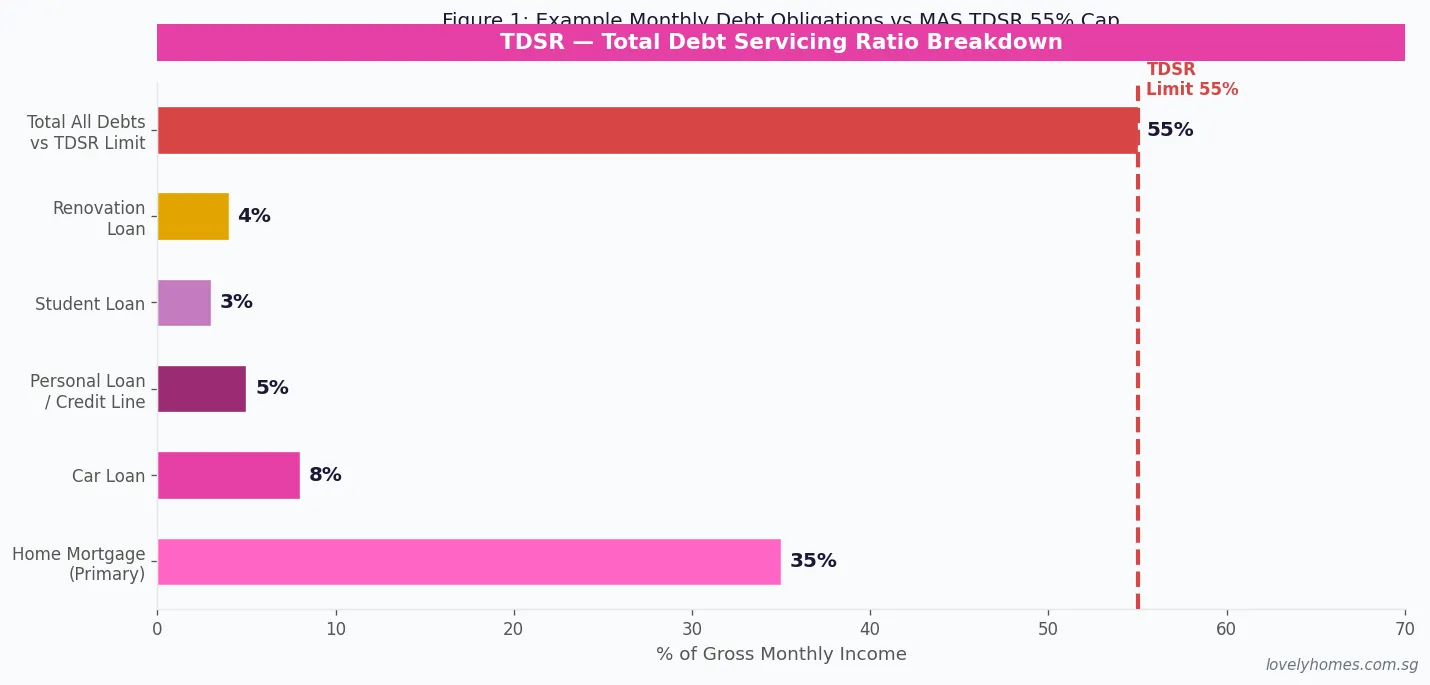
TDSR breakdown: example monthly debt obligations versus MAS 55% cap, Singapore 2026
Figure 1: Illustrative household with S$10,000 gross monthly income. The bars show how individual debts each consume a share of income, and how the 55% TDSR ceiling constrains the total. Source: MAS Notice 645; illustration by LovelyHomes.

How TDSR Is Calculated

The TDSR formula is:

TDSR = Total Monthly Debt Obligations ÷ Gross Monthly Income × 100
Must be ≤ 55% for a residential property loan to be approved under MAS Notice 645.

Gross monthly income includes fixed salary (before CPF deduction), allowances, and discounted variable pay. Variable components — commissions, overtime, bonuses, rental income — are typically reduced by 30% (i.e., the bank counts only 70% of such income). Self-employed borrowers must provide at least two years of IRAS Notices of Assessment; the bank uses the lower of the two-year average or the latest year’s net trade income, often with a further haircut.

Total monthly debt obligations covers: the proposed new property mortgage (at the bank’s applicable stress-test rate, which may be 0.5%–1% above your actual rate), all existing property loans, car hire purchase instalments, personal loan repayments, student loan repayments, credit card minimum payments (typically 5% of outstanding balance per month), and renovation loans.

If you own another property with an outstanding mortgage, that entire monthly repayment is included in your TDSR calculation for any new loan application. This is the key reason why owning multiple properties progressively reduces your borrowable amount on each subsequent purchase.

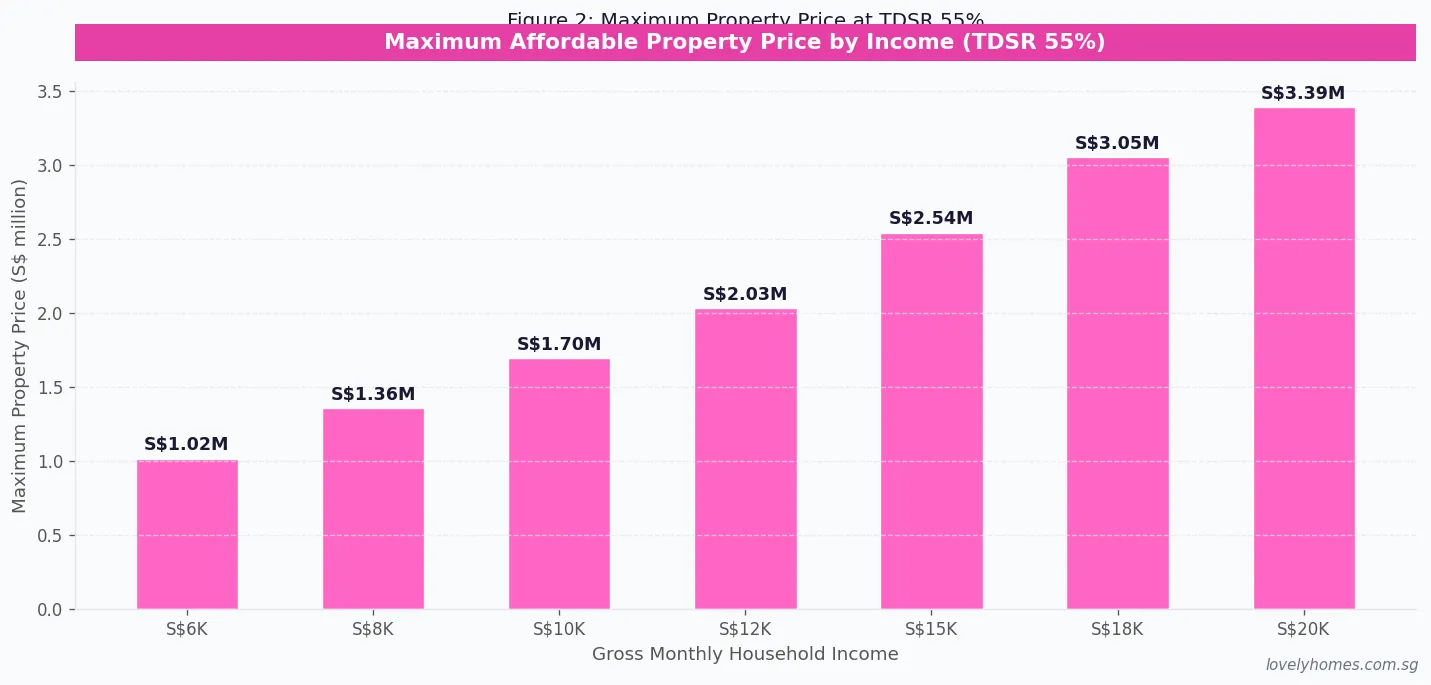
TDSR affordability chart: maximum property price by gross monthly income, Singapore 2026
Figure 2: Maximum property price at TDSR 55% with no other debts, 30-year bank loan at 3.2% p.a., 75% LTV. The chart shows the affordability ceiling for clean-balance-sheet borrowers. Source: LovelyHomes calculation.

TDSR for Different Property Types

The TDSR framework applies to all property loans extended by MAS-regulated financial institutions, but the practical constraints differ by property type:

Private residential (condominiums, apartments, landed homes): TDSR 55% applies. There is no separate MSR restriction. LTV starts at 75% for a first property, falling to 45% and 35% for second and subsequent properties respectively.

HDB resale flats (bank loan): Both TDSR 55% and MSR 30% apply simultaneously. MSR requires that the monthly HDB mortgage payment alone must not exceed 30% of gross income. MSR is usually the binding constraint for most HDB buyers since 30% is typically hit before the 55% TDSR ceiling.

HDB resale flats (HDB loan): The HDB Concessionary Loan is administered by HDB, not subject to MAS Notice 645 in the same way, but HDB applies its own 30% MSR equivalent. The HDB loan rate is pegged at 0.1% above the CPF OA rate, currently 2.6% per annum (effective 1 January 2026).

Executive Condominiums: Both TDSR 55% and MSR 30% apply at point of purchase. After the five-year mark, once an EC is privatised, resale buyers are only subject to TDSR (no MSR restriction).

Commercial and industrial property: TDSR applies but MAS sets the cap for non-residential property loans at 60% — a more lenient threshold than the 55% residential cap.

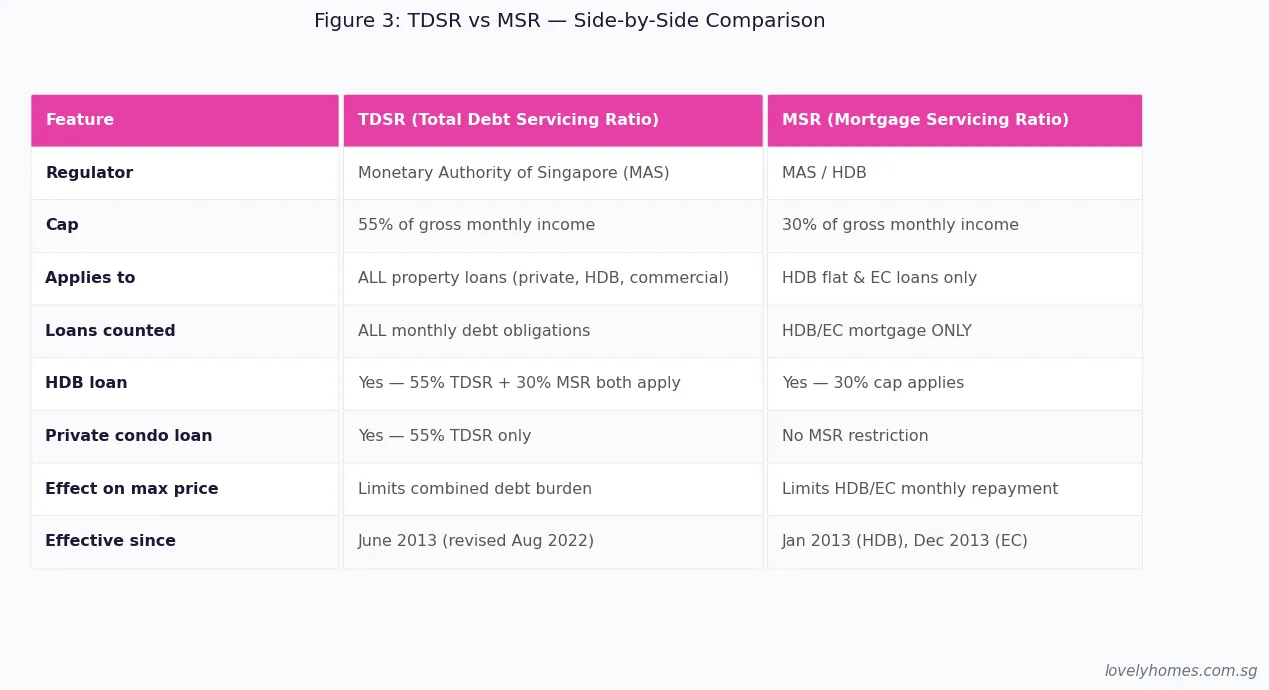
TDSR vs MSR comparison table — Total Debt Servicing Ratio vs Mortgage Servicing Ratio Singapore 2026
Figure 3: TDSR vs MSR side-by-side across eight dimensions. For HDB and EC buyers, both ratios apply simultaneously — the more restrictive constraint governs. Source: MAS Notice 645, MAS Notice 632; LovelyHomes.

TDSR and MSR — Summary Table

Loan / Property Type TDSR Cap MSR Cap LTV (1st Prop.) Notes
Private condo / landed (1st property) 55% None 75% 5% cash + CPF for balance of DP
Private condo / landed (2nd property) 55% None 45% 25% cash mandatory downpayment
Private condo / landed (3rd+ property) 55% None 35% 25% cash mandatory downpayment
HDB resale flat (bank loan) 55% 30% 75% Both caps apply; MSR typically binds first
HDB resale flat (HDB loan) N/A 30% 80% No cash DP required; CPF OA used
Executive Condominium (at launch) 55% 30% 75% 5% cash booking fee; MSR applies
Commercial / industrial property 60% None Up to 70% Higher TDSR cap for non-residential loans

Worked Example: Mr and Mrs Ong Buy Their First Private Condo

Mr and Mrs Ong are a Singapore Citizen couple. Combined gross monthly income: S$12,000 (Mr Ong S$7,500 fixed; Mrs Ong S$4,500, of which S$2,000 is commission).

Existing debts: car hire purchase S$850 per month; personal loan S$300 per month.

Target property: OCR 3-bedroom condo at S$1,500,000. Bank loan 75% LTV = S$1,125,000 over 30 years at 3.2% p.a. Monthly repayment: approximately S$4,862.

Income adjustment: Mrs Ong’s S$2,000 commission is haircut by 30% (bank counts S$1,400). Qualifying income = S$7,500 + S$2,500 fixed + S$1,400 variable = S$11,400 per month.

TDSR calculation: Total obligations = S$4,862 (new mortgage) + S$850 (car) + S$300 (personal) = S$6,012 per month. TDSR = S$6,012 ÷ S$11,400 = 52.7% — below the 55% cap. Loan approved (subject to credit assessment and valuation).

Sensitivity: If the Ongs wished to buy at S$1,700,000 instead (loan S$1,275,000, repayment ~S$5,517), total obligations would rise to S$6,667, giving TDSR = 58.5% — which exceeds 55%. The S$1,700,000 purchase would be declined unless they clear the car loan (saving S$850/mth) or increase their qualifying income.

Lesson: A single car loan can cost you S$200,000+ in purchasing power. Clearing non-housing debts before applying for a mortgage is one of the most effective ways to maximise your TDSR headroom.

Why TDSR Matters: Singapore in Global Context

Singapore’s TDSR framework is widely regarded as one of the most comprehensive income-based mortgage controls in the Asia-Pacific region. Countries like Australia and the UK use similar debt-to-income concepts in their macroprudential toolkits, but Singapore’s version is legally binding on all lenders — there is no discretion to override it for high-net-worth clients or particularly creditworthy borrowers.

The practical effect is a structurally cautious mortgage market. Singapore mortgage arrears remain among the lowest in Asia, and the 2022 cooling measures (which included the TDSR tightening) contributed to a soft-landing scenario rather than a sharp price correction. For buyers, this means the market is protected from speculative excess, but also that stretching to buy at the top of your affordability range carries real interest-rate risk if rates rise post-purchase.

What Might Change in TDSR Policy

MAS reviews the TDSR threshold as part of its broader macroprudential toolkit, typically alongside reviews of LTV limits and stamp duty rates. With the 3-month compounded SORA having eased to approximately 1.0% in early 2026, some market observers have speculated whether MAS might loosen the TDSR to 60% if sustained rate normalisation persists. However, as at June 2026, no public consultation or announcement has been made. Prospective buyers should plan all financing decisions on the current 55% threshold and not rely on any anticipated easing.

Frequently Asked Questions

Does CPF count as income in the TDSR formula?

The gross monthly income used in TDSR is your gross salary before CPF deduction. CPF contributions are not separately added — they are already implicit in the gross figure. However, CPF OA contributions do help service the mortgage (reducing your cash outlay), which gives HDB buyers and those using CPF for loan repayment meaningful payment relief even though the income figure itself is unchanged in the TDSR calculation.

Can I exclude a loan that will be fully paid in six months?

Some banks will exclude short-term residual debt (typically fewer than 6 to 12 months remaining) from the TDSR calculation at their discretion, since such obligations will not affect long-term serviceability. Policies differ by bank. If your car loan has only a few months left, it is worth asking your mortgage banker whether it will be included. Alternatively, fully clearing the loan before applying can improve your TDSR ratio — and often has an outsized positive impact on your maximum loan quantum.

What if my TDSR exceeds 55%?

A bank is required under MAS Notice 645 to decline your application if TDSR exceeds 55%. There is no exception or waiver for residential property loans. Your options are to: (a) make a larger downpayment to reduce the loan amount and therefore the monthly mortgage obligation; (b) clear existing debts before applying; (c) choose a lower-priced property; or (d) add a co-borrower whose income improves the combined TDSR, provided that person’s debts do not make things worse.

How is TDSR calculated for the self-employed?

Banks require at least two years of IRAS Notices of Assessment and, for incorporated businesses, audited or signed financial statements. Qualifying income is typically the lower of the two-year average or the most recent year’s net trade income. Many banks apply an additional haircut of 20–30% on top of this. Self-employed borrowers should expect their qualifying income to be assessed conservatively, which reduces their maximum mortgage relative to a salaried employee with the same stated earnings.

Does TDSR apply when I refinance?

Yes. Refinancing is a new loan application and must satisfy TDSR at the time of application. If your financial circumstances have changed since your original purchase — new debts, a drop in income — you may find you fail the current TDSR test even if you passed it years ago. This is an important practical risk for borrowers on fixed-rate packages coming up for repricing who intend to switch lenders.

Is TDSR the same as DSCR?

No. TDSR is a consumer-lending rule for individuals applying for property loans in Singapore. DSCR (Debt Service Coverage Ratio) is a commercial-lending metric used for corporate or commercial real estate loans; it measures whether a property’s net operating income covers its debt service. A residential buy-to-let investor is subject to TDSR on the individual borrower side; a developer or company owning commercial property typically uses the DSCR framework instead.

Joint purchase — is TDSR calculated on combined income?

Yes. Joint borrowers’ incomes are pooled and their debts are also pooled. This generally allows a couple to qualify for a much larger loan than either could secure individually. However, if one co-borrower carries significant debts (a large car loan, for instance), those debts also enter the combined TDSR calculation and reduce the joint loan quantum. Both parties will need to provide full income and liability documentation.

Related Articles


Disclaimer: This article is for general informational purposes only and does not constitute financial, tax, or legal advice. TDSR rules and MAS policies are subject to change without notice. All borrowers should seek independent advice from a licensed financial adviser or mortgage broker, and verify current rules directly with the Monetary Authority of Singapore at mas.gov.sg and the Housing & Development Board at hdb.gov.sg.

HDB Loan vs Bank Loan Singapore 2026: Rates, LTV, Eligibility and Which Saves You More

HDB Loan vs Bank Loan Singapore 2026: Rates, LTV, Eligibility and Which Saves You More

📌 Quick Answer: HDB Loan vs Bank Loan Singapore 2026

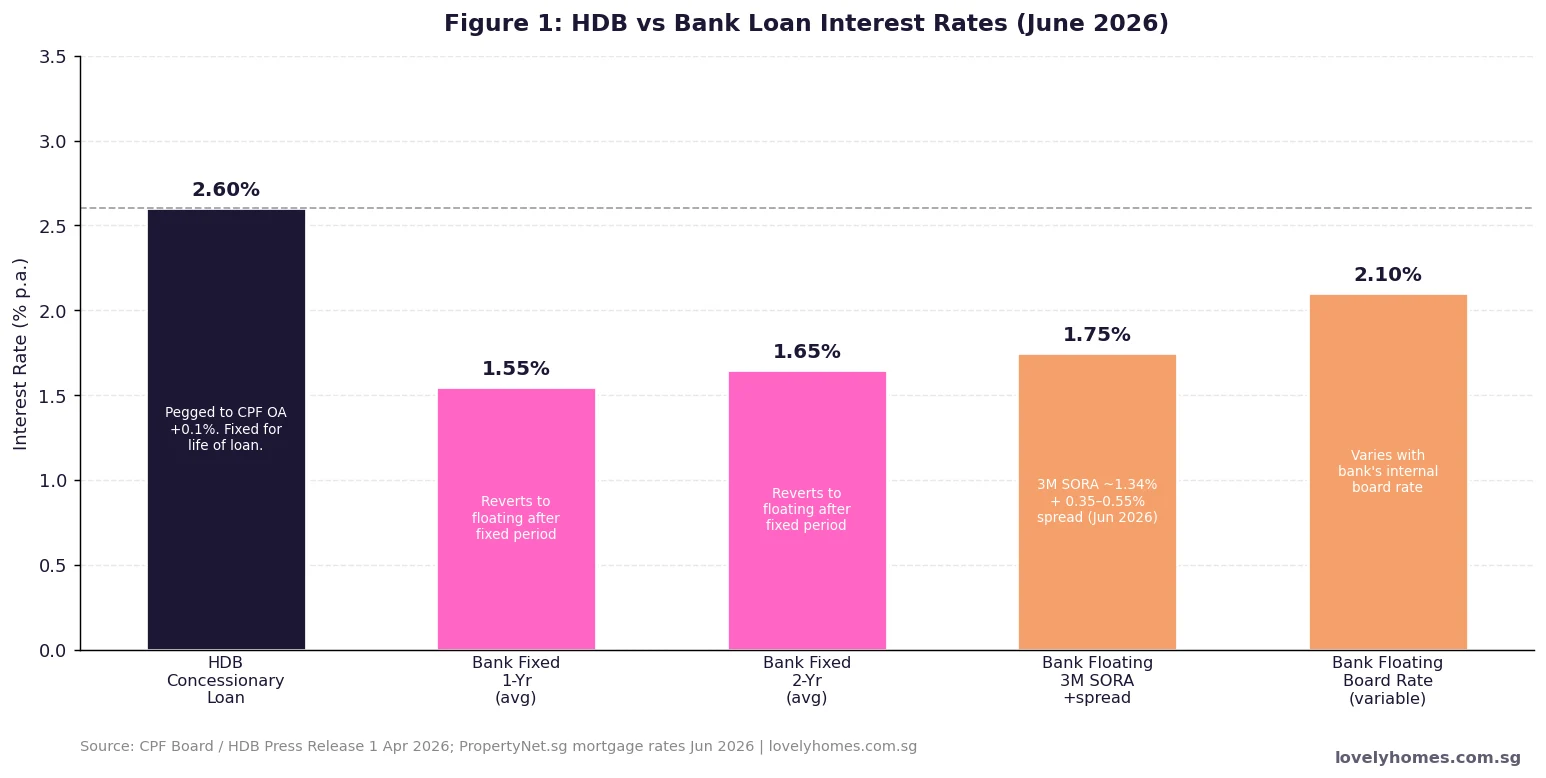
  • HDB loan rate: 2.60% p.a. (fixed at CPF OA rate + 0.1% = 2.5% + 0.1%), unchanged from January to June 2026. Bank fixed rates are lower at 1.35%–1.65% for 1-year and 1.55%–1.80% for 2-year packages as at June 2026.
  • LTV is now the same: Both HDB loans and bank loans offer up to 75% LTV for HDB flats following the August 2024 policy change (previously 80% for HDB loans). The minimum downpayment is 25% for both.
  • Key difference — cash downpayment: With an HDB loan, the entire 25% downpayment can be paid from your CPF OA. With a bank loan, you must pay at least 5% in cash, with the remaining 20% from CPF OA.
  • One-way door: You can switch from an HDB loan to a bank loan at any time. But once you are on a bank loan, you cannot switch back to the HDB concessionary loan.
  • HDB loan eligibility: Subject to an income ceiling of S$14,000/mth (families) or S$7,000/mth (singles). Bank loans have no income ceiling but apply standard TDSR/MSR rules.
  • Rate risk: The HDB rate is stable and rarely changes. Bank fixed rates revert to floating (SORA-based) after the fixed period — typically 1–3 years — meaning repayments can rise if SORA increases.
  • Bottom line: Bank loans save on interest but require cash downpayment and carry rate risk. HDB loans offer stability and zero-cash downpayment but cost more in interest over the long run.

Every HDB flat buyer in Singapore must make one of the most consequential financing decisions of their lives: take the Housing & Development Board’s own concessionary loan, or borrow from a bank. The choice affects how much cash you need upfront, what you pay monthly for up to 25 years, and how exposed you are to interest rate fluctuations.

This guide explains both options in full — rates, LTV, eligibility, cashflow impact, and the one-way door rule — so you can make a fully informed decision before exercising your HDB Flat Eligibility (HFE) letter or signing a bank Letter of Offer. It also covers the role of the Mortgage Servicing Ratio (MSR) and Total Debt Servicing Ratio (TDSR), which govern how much either type of lender can lend you.

Interest Rates: HDB Loan vs Bank Loan (June 2026)

The interest rate difference is the single most scrutinised comparison between the two options. As at June 2026, the data is as follows.

HDB concessionary loan 2.60 percent versus bank fixed and floating loan rates Singapore June 2026 comparison bar chart
Figure 1: HDB Loan vs Bank Loan Interest Rates as at June 2026. HDB rate is 2.60% p.a. Bank fixed rates range from 1.35%–1.80%; floating SORA-based rates are around 1.70%–1.90%. Click to enlarge.

The HDB Concessionary Rate

The HDB concessionary interest rate is pegged at 0.1% above the prevailing CPF Ordinary Account (OA) interest rate. The CPF OA rate has been at its floor of 2.5% p.a. continuously since 2009, making the HDB loan rate 2.60% p.a. The CPF Board reviews OA rates quarterly (in January, April, July, and October). The HDB and CPF Board confirmed on 29 March 2026 that the rate remains unchanged at 2.60% for the April–June 2026 quarter.

The HDB rate is therefore effectively fixed for most borrowers’ planning purposes — it has not changed in over 15 years. However, it is technically variable, and a CPF OA rate increase (which requires the prevailing 3-month average yields of 10-year SGS bonds and similar benchmarks to exceed 2.5%) would flow through to HDB loan repayments.

Bank Loan Rates (June 2026)

Bank loan rates in Singapore come in two main varieties: fixed-rate packages (where the rate is locked for 1–3 years, then reverts to a floating rate) and floating-rate packages (pegged to 3-month SORA or the bank’s internal board rate). As at June 2026, the range observed in the market is as follows. For fixed 1-year packages, rates range from approximately 1.35% to 1.65% p.a. For fixed 2-year packages, rates range from approximately 1.55% to 1.80% p.a. Floating SORA-based packages price at 3-month SORA (~1.34%) plus a spread of 0.35%–0.55%, resulting in effective rates of approximately 1.70%–1.90% p.a.

The critical caveat for bank fixed rates is that after the initial fixed period expires, the loan typically reverts to a floating rate — either SORA-based or the bank’s board rate — which is currently around 2.0%–2.5% p.a. Borrowers who take a 1-year fixed package at 1.45% should budget for a step-up to a floating rate when the fixed period ends, unless they refinance to another fixed package (which typically incurs legal and valuation fees of S$2,000–S$3,500).

Loan-to-Value and Downpayment Requirements

One of the most important practical differences between the two loan types is the cash component of the downpayment. Since August 2024, both HDB loans and bank loans have the same LTV cap of 75% for HDB flats. However, the source of the downpayment differs significantly.

Item HDB Concessionary Loan Bank Loan (HDB flat)
Loan-to-Value (LTV) Up to 75% Up to 75%
Minimum downpayment 25% of purchase price 25% of purchase price
Minimum cash downpayment Nil (full CPF OA allowed) 5% cash required
Balance of downpayment 25% from CPF OA 20% from CPF OA
Max tenure (HDB flat) 25 years 25 years
Max tenure (private) N/A 30 years

For a flat priced at S$500,000, the HDB loan borrower can fund the entire S$125,000 downpayment from CPF OA savings — requiring zero cash at exercise. The bank loan borrower must bring S$25,000 in cash (5%), with the remaining S$100,000 from CPF OA. For first-time buyers with limited liquid savings but substantial CPF OA balances, this distinction can be decisive.

Monthly Repayment Comparison

Despite the higher HDB rate, the impact on monthly repayments is less dramatic than many buyers expect, because the HDB loan uses a shorter maximum tenure of 25 years while bank loans for HDB flats are also capped at 25 years.

Monthly repayment comparison HDB loan 2.60 percent versus bank fixed 1.60 percent and floating 2.10 percent Singapore 2026 at various loan amounts
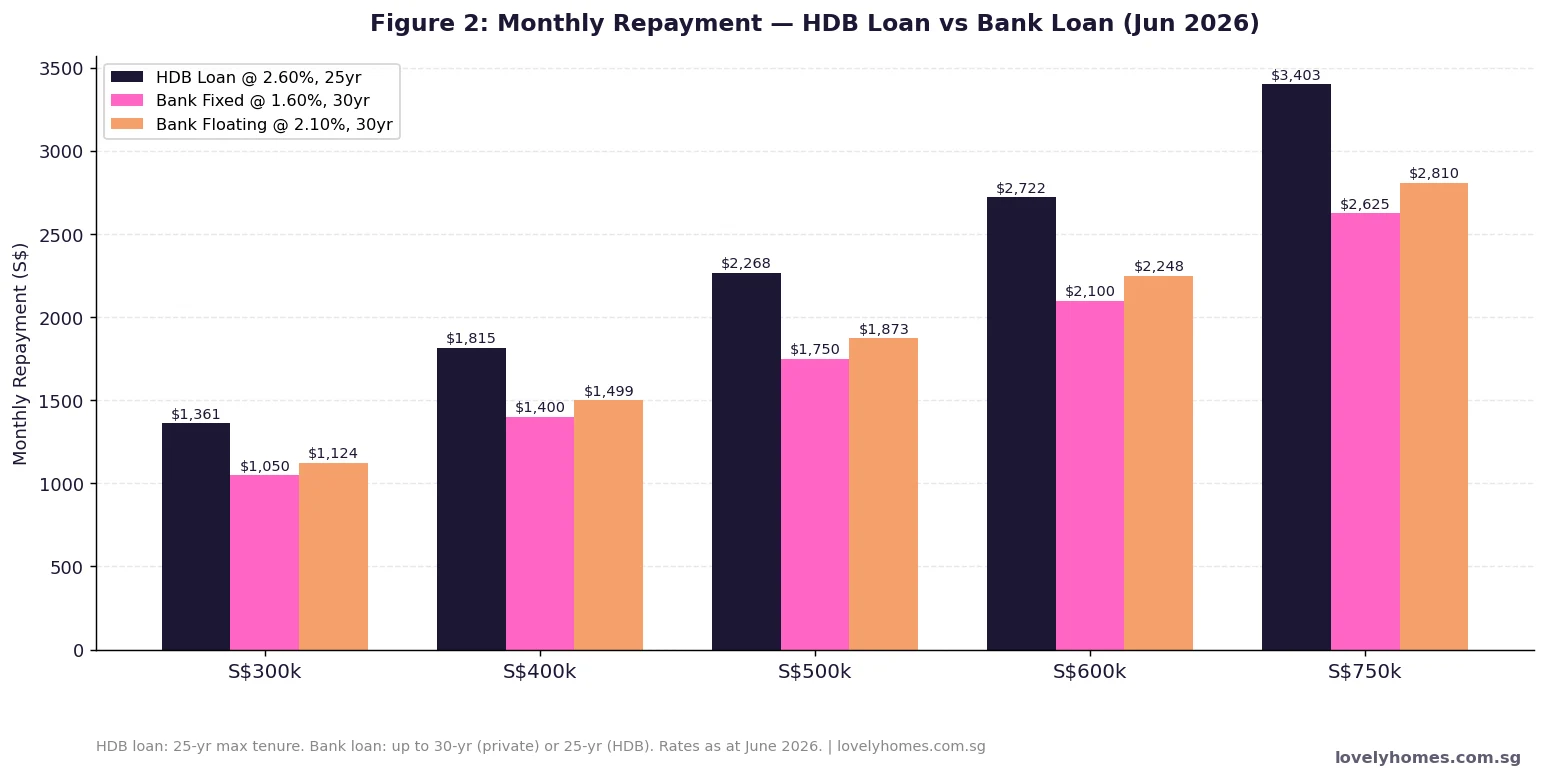
Figure 2: Monthly Repayment Comparison — HDB Loan vs Bank Loan at S$300k–S$750k loan amounts. Bank loan at 1.60% (fixed, 30yr equivalent for illustration) saves S$150–S$380/mth versus HDB loan; floating at 2.10% narrows the gap. Click to enlarge.

At a S$500,000 loan, the HDB borrower at 2.60% over 25 years pays approximately S$2,260/mth. The bank borrower at 1.60% over 25 years pays approximately S$2,020/mth — a saving of S$240/mth, or S$2,880/year. Over the full 25-year tenure, this compounds to a total interest saving of approximately S$34,000–S$40,000. However, if the bank rate reverts to 2.50% floating after the initial fixed period, the saving shrinks substantially. The total interest difference over 25 years narrows to S$5,000–S$12,000 depending on the rate path taken by SORA.

Eligibility: Who Can Take an HDB Loan?

Not all buyers can choose between the two options — the HDB concessionary loan has eligibility criteria that bank loans do not.

To qualify for an HDB loan in 2026, the borrower must meet the following requirements. The household gross monthly income must not exceed S$14,000 for families (including couples), or S$7,000 for singles applying under the Single Singapore Citizen or Joint Singles Scheme. At least one borrower must be a Singapore Citizen. The co-borrower (if any) must be a Singapore Citizen or Permanent Resident. The borrower must not have disposed of any private residential property in the 30 months immediately before the flat application — the HDB loan is intended for buyers who are in genuine need of public housing finance, not for investors cycling between private property and HDB. The flat being purchased must be an HDB flat (resale or BTO); HDB loans are not available for private condominium purchases.

Bank loans have none of these eligibility restrictions — they are open to Singapore Citizens, SPRs, foreigners, companies, and buyers of any income level. The governing constraints for bank loans are the Mortgage Servicing Ratio (MSR) — capped at 30% of gross monthly income for HDB flat purchases — and the Total Debt Servicing Ratio (TDSR) — capped at 55% of gross monthly income for all property purchases.

Full Feature Comparison Table

HDB concessionary loan versus bank loan full feature comparison table Singapore 2026 — interest rate LTV eligibility tenure cash downpayment prepayment penalty
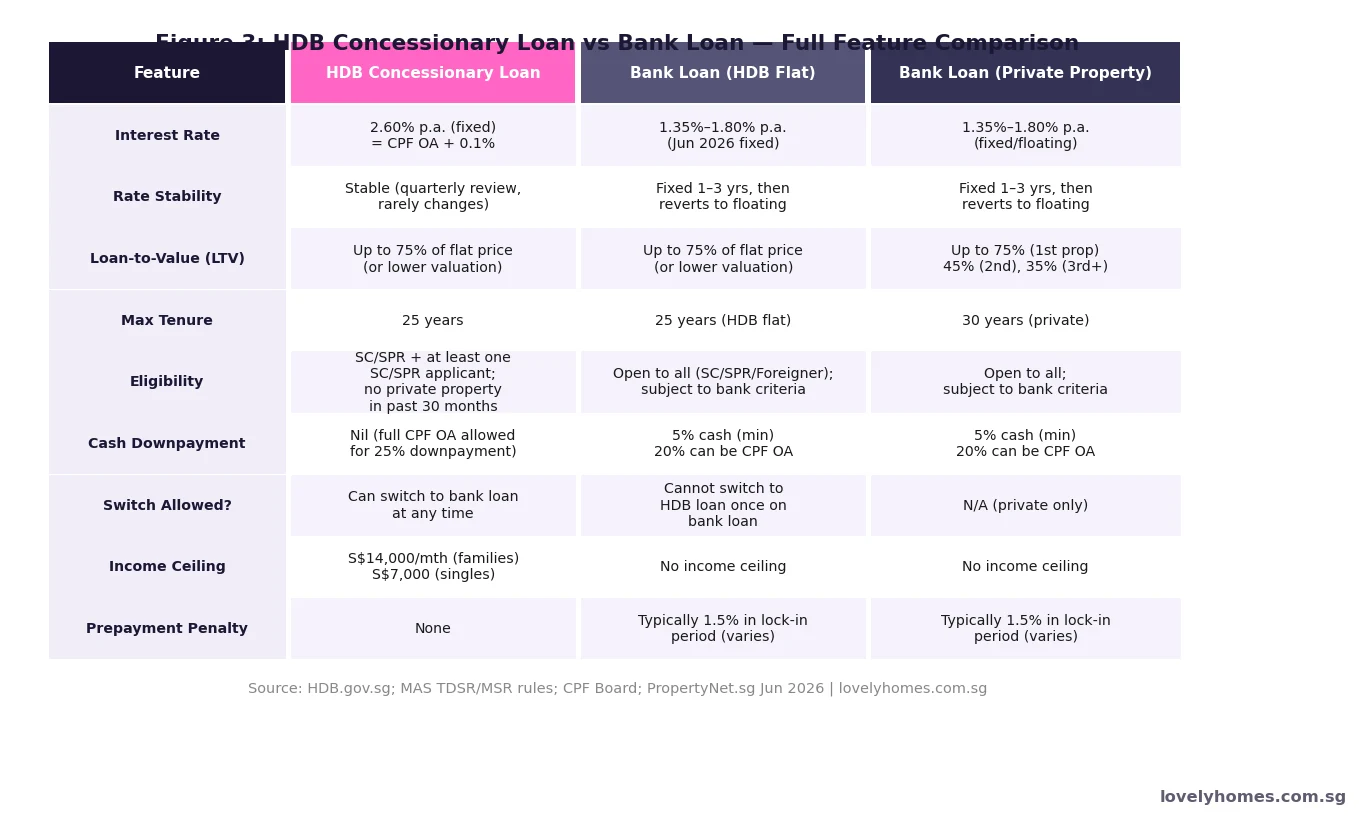
Figure 3: HDB Loan vs Bank Loan — Full Feature Comparison (2026). Nine features compared side-by-side. Click to enlarge.

The One-Way Door Rule

Perhaps the most important strategic consideration is the one-way door: you can switch from an HDB loan to a bank loan at any time, but you cannot switch from a bank loan back to an HDB loan.

This asymmetry has significant implications. Buyers who start on an HDB loan preserve optionality — if bank rates fall materially (as they did in 2021–2023 and again in 2025–2026 as the SORA rate cycle eased), they can refinance to a bank loan at the more favourable rate. Buyers who start on a bank loan, by contrast, are permanently locked out of the HDB concessionary rate. This means that if bank rates were to rise significantly (as they did in 2022–2023 when 3M SORA peaked above 3.8%), a bank loan borrower who refinanced cannot fall back to the HDB rate as a safety net.

Given that bank rates are currently at or near their cyclical lows as at June 2026, the relative attractiveness of a bank loan is greatest at present. But starting on a bank loan is an irreversible choice — buyers with lower risk tolerance or less financial flexibility may prefer to start on the HDB loan and refinance later if rates remain favourable.

Worked Example: S$550,000 Resale 4-Room HDB

Mr and Mrs Goh are SC joint buyers, gross household income S$9,000/mth. They are purchasing a resale 4-room HDB flat in Bedok for S$550,000. They have CPF OA savings totalling S$130,000 between them and liquid cash savings of S$80,000.

Option A — HDB Concessionary Loan:
Loan amount (75% LTV): S$412,500
Downpayment: S$137,500 (all from CPF OA — no cash required)
Monthly repayment @ 2.60%, 25yr: S$1,862/mth
MSR check: S$1,862 / S$9,000 = 20.7% ✅ (under 30% cap)
Cash preserved: S$80,000
Total interest over 25yr: ~S$148,500

Option B — Bank Loan (1.60% fixed 2-yr, then SORA ~2.10% thereafter):
Loan amount (75% LTV): S$412,500
Downpayment: S$137,500 (5% cash = S$27,500 + CPF OA S$110,000)
Monthly repayment @ 1.60%, 25yr: S$1,675/mth (fixed period)
Monthly repayment after fixed period @ 2.10%: S$1,784/mth (illustrative)
MSR check: S$1,784 / S$9,000 = 19.8% ✅
Cash required upfront: S$27,500 (leaves S$52,500 liquid)
Total interest over 25yr (blended at ~2.10%): ~S$132,000 — saving ~S$16,500 vs HDB loan over full tenure

Decision: The bank loan saves approximately S$16,500 in total interest over 25 years (assuming the blended rate stays around 2.10%). However, the Gohs must commit S$27,500 in cash now, reducing their emergency fund. Given their stable employment and comfortable MSR headroom, they might reasonably prefer the bank loan. If either spouse expected a career break or job change, the HDB loan’s nil-cash requirement and rate stability would be more prudent. The right answer depends on cashflow resilience, not just rate arithmetic.

MSR and TDSR: The Regulatory Caps That Govern Both

Regardless of whether you take an HDB or bank loan, your maximum loan quantum is limited by the Monetary Authority of Singapore’s (MAS) borrower stress-test rules. For HDB flat purchases, the MSR caps your monthly property loan repayments at 30% of gross monthly income. The TDSR caps total monthly debt repayments (including car loans, personal loans, credit card minimum payments, and all property loans) at 55% of gross monthly income.

Practically speaking, the MSR is the binding constraint for most HDB buyers. A couple earning S$8,000/mth can service a maximum monthly repayment of S$2,400 (30% MSR). At 2.60% over 25 years, this translates to a maximum loan of approximately S$510,000. At 1.60% over 25 years, the maximum loan is approximately S$572,000 — about 12% higher. The higher loan quantum available under a bank loan can sometimes allow a buyer to afford a higher-value flat.

Why This Matters: The Rate Cycle Context

As at June 2026, Singapore’s 3-month SORA has eased to approximately 1.34% p.a. from a peak of over 3.8% in late 2023, reflecting the US Federal Reserve’s rate-cutting cycle that began in late 2024. Bank fixed rates have consequently fallen to multi-year lows. This environment — low bank rates, stable HDB rate — makes the bank loan comparison particularly favourable relative to the 2022–2023 period, when SORA-based floating rates exceeded the HDB rate.

Comparable markets offer useful perspective. In Australia, the Reserve Bank rate is 3.35% (June 2026), making equivalent fixed mortgages over 5.0% p.a. In Hong Kong, HIBOR-linked mortgages sit around 3.5%–4.0%. Singapore’s bank rates at 1.60%–1.80% fixed reflect the city-state’s position as a global financial centre with deep SGS bond markets — structural factors that have historically kept Singapore mortgage rates below comparable developed markets.

What Might Come Next

The MAS reviews TDSR/MSR thresholds periodically. There is no current indication of a change to the 30% MSR or 55% TDSR limits — they were last revised in September 2022, when the TDSR was lowered from 60% to 55%. However, if the Singapore property market were to overheat (the URA Private Residential Price Index rose 0.9% in Q1 2026, after several quarters of moderation), further macro-prudential tightening cannot be ruled out. On the CPF side, the OA rate is reviewed quarterly — sustained strong SGS yields could theoretically push the OA rate above 2.5%, which would raise the HDB loan rate. This has not occurred in over 15 years but is a tail risk worth monitoring.

Frequently Asked Questions

Can I use my CPF OA for the cash component of a bank loan downpayment?
No. The 5% cash component of a bank loan downpayment for an HDB flat must be paid in cash — CPF funds cannot be used for this component. The remaining 20% of the 25% downpayment can come from your CPF OA. CPF funds can, however, be used to pay Buyer’s Stamp Duty (BSD) on an HDB resale flat, as well as the monthly loan repayments, subject to your CPF OA balance not falling below the applicable Basic Retirement Sum (BRS) in later life. Check the CPF Board’s guidelines at CPF.gov.sg.
What happens to my HDB loan if the CPF OA rate increases?
If the CPF OA rate rises — say from 2.5% to 2.75% — the HDB concessionary loan rate rises by the same amount, from 2.60% to 2.85%. Your monthly repayment would increase accordingly. HDB typically gives borrowers notice before rate changes take effect. Practically, an OA rate rise requires average 10-year SGS yields to sustain above 2.5%, which has not occurred since 2008. An OA rate increase would simultaneously increase the returns on your CPF OA savings — the same savings you are using to service the loan — partially offsetting the impact.
I took a bank loan. Can I switch back to the HDB loan if bank rates rise sharply?
No. Once you are on a bank loan for an HDB flat, you cannot switch back to the HDB concessionary loan at any point. This is one of the most important asymmetries between the two loan types. If bank rates rise sharply after you refinance (as occurred in 2022–2023, when SORA-linked rates jumped from under 0.5% to over 3.8%), you have no option to revert to the HDB rate. Your mitigation strategies are: refinancing to another bank’s fixed-rate package (which locks in a new fixed rate for 1–3 years at the cost of legal/valuation fees of S$2,000–S$3,500), or riding out the floating rate if you have sufficient cashflow buffer. This is why financial advisers often suggest that buyers with lower risk tolerance or tighter cashflow margins consider starting on the HDB loan, preserving the option to switch to a bank loan later.
Does taking an HDB loan affect my ability to buy a second property?
Yes, indirectly. If you have an outstanding HDB loan when you purchase a second property, the outstanding HDB loan balance is counted as a debt under the TDSR framework. This reduces the maximum loan quantum you can obtain for the second property. Additionally, if you purchase a second property before selling the first, you face the ABSD on the second purchase (20% for SC, 30% for SPR, 60% for foreigners on a second property as at 2026). The type of loan — HDB or bank — does not directly change the ABSD position, but the higher monthly repayment of the HDB loan at 2.60% (compared to a bank loan at 1.60%) increases your TDSR exposure, which may reduce your loan eligibility for the second property. See our ABSD 2026 Guide for the full stamp duty framework.
Can foreigners or SPRs take an HDB loan?
SPRs can take an HDB concessionary loan as a co-applicant alongside a Singapore Citizen principal applicant — for example, an SC-SPR married couple can jointly apply for an HDB loan. The SC must be listed as the primary applicant. Foreign nationals without Permanent Residency cannot take an HDB loan and are not eligible to purchase new HDB flats. They may purchase resale HDB flats in limited circumstances (SPR + at least one SC in the family nucleus) or private property. For resale HDB flat purchases by SC-SPR couples, the HDB loan eligibility income ceiling of S$14,000/mth applies to the combined household income.
What is an HFE letter and do I need it before approaching a bank?
An HDB Flat Eligibility (HFE) letter confirms your eligibility to purchase an HDB flat and, if applicable, your eligibility for an HDB concessionary loan and CPF housing grants. The HFE letter is mandatory for all HDB flat purchases (BTO and resale). You apply for the HFE letter via the HDB flat portal with your SingPass, and HDB assesses your eligibility based on citizenship, income, CPF OA balance, and prior property ownership. The HFE letter is valid for 9 months. You should obtain the HFE letter before approaching banks for a mortgage, as the HFE confirms your eligibility position and helps banks assess your loan application accurately. If the HFE letter confirms HDB loan eligibility, it does not mean you must take the HDB loan — you are free to choose a bank loan instead. Find out more at HDB.gov.sg.
Is the MSR calculated on gross or net income?
The MSR is calculated on gross monthly income — that is, your income before CPF contributions, personal income tax, or any other deductions. This is consistent with the TDSR framework administered by MAS. Variable income (bonuses, commissions, overtime) is typically assessed at 30% of the monthly average over the most recent 12 months by most lenders, though practices vary. Self-employed individuals use IRAS-assessed income over the most recent 2 years. The 30% MSR cap means that if your gross household income is S$10,000/mth, your maximum monthly HDB loan repayment (principal + interest) is S$3,000. At 2.60% over 25 years, this implies a maximum loan of approximately S$636,000. Use our Singapore Property Downpayment Guide for full affordability calculations.

Related Articles

Disclaimer: This article provides general information for educational purposes as at June 2026 based on publicly available data from the Housing & Development Board (HDB), the Monetary Authority of Singapore (MAS), the CPF Board, and publicly quoted mortgage rates from Singapore banks as at June 2026. Interest rates, LTV limits, MSR/TDSR thresholds, and eligibility criteria may change at any time following government or MAS policy announcements. The worked example and rate figures are illustrative. This article does not constitute financial advice. Readers should consult a licensed mortgage adviser, HDB, or a qualified financial planner before making any home loan decision.

Singapore Property Downpayment Guide 2026: How Much Cash and CPF You Need

Singapore Property Downpayment Guide 2026: How Much Cash and CPF You Need

Singapore property downpayment 2026 — understanding exactly how much cash and CPF you need before you make an offer is one of the most practical steps any buyer can take. The rules changed on 20 August 2024 when MAS lowered the HDB Concessionary Loan LTV from 80% to 75%, and many buyers are still calculating on outdated figures. This guide consolidates every rule that applies in 2026, from BTO flats to freehold CCR condos, with specific dollar amounts at common price points.

Quick Answer: Singapore Property Downpayment 2026 — Key Facts

  • HDB Loan (BTO/Resale): LTV 75% → 25% downpayment, payable entirely from CPF OA — zero cash required for the downpayment itself.
  • Bank Loan (HDB or Private, 1st property): LTV 75% → 25% downpayment: minimum 5% cash, remaining 20% from CPF OA.
  • Bank Loan (2nd property, 1 outstanding loan): LTV 45% → 55% downpayment: minimum 25% cash, remaining 30% CPF OA.
  • Bank Loan (3rd+ property): LTV 35% → 65% downpayment: minimum 25% cash.
  • New Launch (Progressive Payment Scheme): 5% Option Fee in cash + 15% on exercise (CPF/cash) + stage payments during construction.
  • CPF cannot pay: BSD, ABSD, legal fees, agent commission — these are always cash out-of-pocket (unless funded by CPF OA for BSD/ABSD in certain cases — see below).
  • ABSD remission window: SC couple selling HDB must sell within 6 months of new private purchase to claim ABSD remission — plan cashflow accordingly.
  • MAS rule change: HDB loan LTV reduced from 80% → 75% on 20 August 2024. All downpayment calculations in 2026 use the new 75% figure.

What Is a Property Downpayment in Singapore?

The downpayment is the portion of the purchase price you must pay from your own resources — cash, CPF Ordinary Account (OA), or a combination — before the bank or HDB disburses the loan for the remainder. The Monetary Authority of Singapore (MAS) and HDB set Loan-to-Value (LTV) caps that determine how large a loan you can take, and therefore how large a downpayment you must make.

The LTV ratio is expressed as a percentage of the lower of the purchase price or the property’s valuation (known as the “valuation limit”). If you pay above valuation — a premium called Cash Over Valuation (COV) — the COV must be paid entirely in cash.

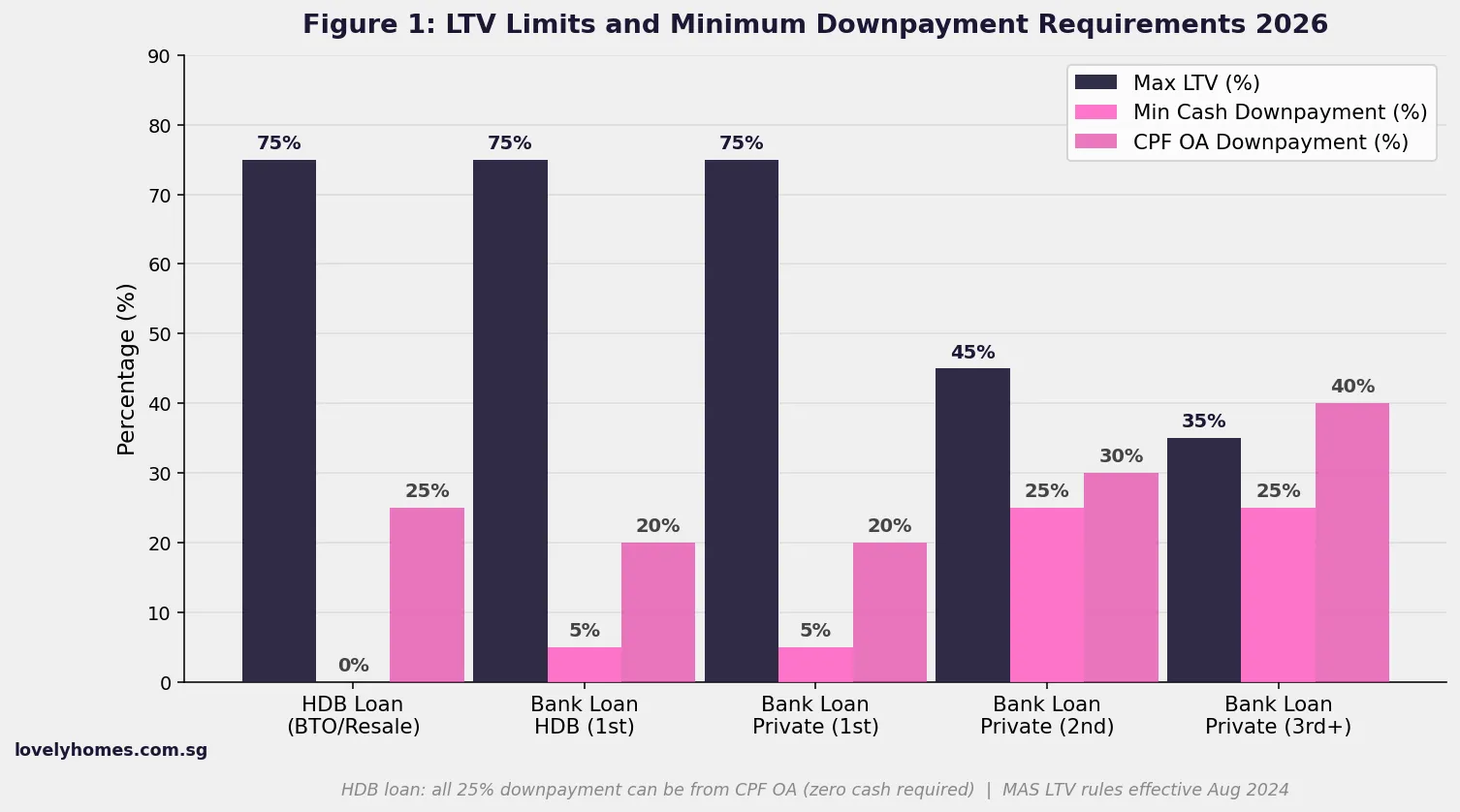
Singapore property LTV limits and minimum downpayment requirements 2026 by loan type
Figure 1: LTV Limits and Minimum Downpayment Requirements 2026 — HDB Loan vs Bank Loan by property count. Source: MAS, HDB (effective 20 Aug 2024).

HDB Loan Downpayment 2026

An HDB Concessionary Loan (commonly called the “HDB loan”) is available only for HDB flats (BTO, resale, DBSS) with an income ceiling of S$14,000 per household per month. As of 20 August 2024, the LTV cap is 75%, meaning you must provide a 25% downpayment.

The key advantage: the entire 25% may come from your CPF Ordinary Account — no cash is required for the downpayment itself. If your CPF OA balance does not cover the full 25%, any shortfall must be topped up in cash.

For BTO flats purchased under the Staggered Downpayment Scheme (SDS), the 25% is paid in two tranches: 2.5% on signing the Agreement for Lease, and 22.5% at key collection. Both tranches can be paid from CPF OA.

Flat Type LTV (HDB Loan) Downpayment Cash Required CPF OA Allowed
BTO (Standard/Plus/Prime) 75% 25% S$0 Up to 25%
HDB Resale 75% 25% + any COV COV in cash only Up to 25% of valuation
DBSS 75% 25% S$0 Up to 25%
2-room Flexi (Seniors SLS) 75% 25% S$0 Up to 25%

Bank Loan Downpayment — HDB Flats and Private Property

Bank loans follow the MAS LTV framework, which applies uniformly whether you are buying an HDB flat, EC, or private condominium. The LTV ceiling depends on the number of outstanding home loans you currently have at the point of applying for the new loan.

For your first property (no outstanding home loans), the LTV cap is 75%, giving a downpayment of 25%. Of that 25%, at least 5% must be paid in cash; the remaining 20% can come from CPF OA.

For your second property (one outstanding home loan), the LTV drops to 45%, requiring a 55% downpayment. At least 25% must be cash; the rest may be CPF OA.

For a third or subsequent property, the LTV falls further to 35%, requiring 65% downpayment (minimum 25% cash).

Singapore property downpayment cash vs CPF OA by buyer profile and purchase price 2026
Figure 2: Total Downpayment — Cash vs CPF OA by Buyer Profile and Purchase Price 2026. LTV rules: MAS Notice MAS 632.

New Launch Condo: Progressive Payment Scheme

When buying a new launch private condominium directly from the developer, the Progressive Payment Scheme (PPS) governs when and how you pay. The structure is different from a resale purchase:

  • Booking fee (Option Fee): 5% of purchase price — payable in cash on the day you exercise your option. This cannot come from CPF.
  • On signing Sale and Purchase Agreement (8 weeks later): 15% of purchase price — payable in cash or CPF OA after deducting the 5% already paid.
  • Progressive stage payments: Released as construction hits each milestone (foundations, structural frame, partition walls, etc.) — each stage is up to 10–11% of the price.
  • On Vacant Possession / TOP: Remaining balance typically 25% (before your bank loan kicks in fully).

Because new launch buyers typically take bank loans, the 5% + 15% = 20% upfront is split between cash (minimum 5%) and CPF OA. The bank loan of up to 75% is only drawn progressively as construction progresses — meaning your loan interest begins only on the amount drawn down, not the full loan amount.

Cash Over Valuation (COV) — the Hidden Cash Cost

When you buy an HDB resale flat and agree a price above the HDB-commissioned valuation, the excess is called Cash Over Valuation. COV must be paid entirely in cash — it cannot be funded by CPF OA or any loan.

As of Q1 2026, median COV for popular 4-room HDB resale flats in mature estates ranges from S$10,000 to S$50,000. For million-dollar flats, COV can exceed S$100,000. Always request the HDB valuation report before finalising your offer price.

What CPF Cannot Pay

Understanding what CPF OA cannot cover prevents nasty surprises on legal completion day. The following must always be paid in cash:

  • Buyer’s Stamp Duty (BSD) — CPF OA can pay BSD if the property is residential and you have enough CPF OA after accounting for the downpayment and any outstanding CPF charges. Check with your solicitor and CPF Board before assuming this.
  • Additional Buyer’s Stamp Duty (ABSD) — Same CPF OA rule as BSD above.
  • Cash Over Valuation (COV) — always cash only.
  • Legal fees — always cash.
  • Agent commission — always cash.
  • Property tax — always cash.

BSD and ABSD are significant: at S$1.5 million, BSD alone is S$44,600 and ABSD for a Singapore Citizen purchasing a second property is S$300,000. These must be funded before legal completion and are not financed by the loan.

Singapore property all-in upfront costs BSD ABSD downpayment by buyer profile at S$1.5 million 2026
Figure 3: All-In Upfront Costs at S$1,500,000 by Buyer Profile 2026. Includes cash downpayment, CPF OA downpayment, BSD, ABSD, and legal fees. Source: IRAS, MAS.

Summary Table: Downpayment by Scenario 2026

Scenario LTV Cap Min Cash DP Max CPF OA Total DP
HDB Loan (1st HDB) 75% 0% 25% 25%
Bank Loan, HDB (1st) 75% 5% 20% 25%
Bank Loan, Private (1st) 75% 5% 20% 25%
Bank Loan, Private (2nd) 45% 25% 30% 55%
Bank Loan, Private (3rd+) 35% 25% 40% 65%
New Launch (PPS, 1st) 75% (on loan) 5% (booking) + 15% on S&P Part of 15%+ 20% upfront
COV (HDB Resale, any) N/A 100% cash None = COV amount

Worked Example: Mr & Mrs Lim — SC Couple Upgrading to a Private Condo

Mr and Mrs Lim are Singapore Citizens purchasing their first private property (they have already sold their HDB flat). Purchase price: S$1,650,000 for a 3-bedroom condo in the OCR. They take a bank loan.

  • LTV: 75% → loan amount S$1,237,500
  • Total downpayment (25%): S$412,500
  • Minimum cash (5%): S$82,500 cash
  • CPF OA portion (20%): S$330,000 from CPF OA (if available)
  • BSD: S$51,600 (payable from CPF OA or cash)
  • ABSD: Nil (first private property, SC)
  • Legal fees: ~S$4,000 cash
  • Agent commission (buyer’s side): S$0 (new launch — developer pays) or ~S$16,500 (resale, ~1%)
  • Monthly instalment: S$1,237,500 @ 3.2% fixed 30yr = S$5,345/mth → TDSR 38.2% on combined income S$14,000/mth ✓

Minimum liquid cash required on completion day: S$82,500 (downpayment) + S$51,600 (BSD, if not CPF) + S$4,000 (legal) = ~S$138,100 cash at minimum, assuming CPF OA covers the CPF-eligible portions.

Why Downpayment Planning Matters Beyond the Number

The downpayment figure is only the starting point. Buyers often underestimate total day-one liquidity requirements because BSD, ABSD (for second properties), and legal fees are payable within 14 days of exercising the Option to Purchase — before the bank loan is even applied for. For an upgrader buying a S$1.8 million condo while retaining an existing HDB, the ABSD alone can be S$360,000 (SC buying second residential property at 20%). Even if ABSD remission applies (selling the HDB within 6 months), the full amount must be paid upfront and is refunded only after the HDB is disposed of.

CPF accrued interest adds another dimension: every dollar of CPF OA withdrawn for property attracts 2.5% per annum compounded interest that must be refunded to your CPF account when you eventually sell. A buyer who taps the maximum CPF OA early in ownership will owe a substantially larger CPF refund at sale — reducing the net cash proceeds.

What Might Change in 2027 and Beyond

MAS reviews LTV and TDSR settings periodically as part of its property market calibration. When private residential prices rose sharply in 2021–2022, the MAS introduced cooling measures including ABSD hikes and TDSR tightening. Any future overheating or correction could trigger further LTV adjustments. The direction of change is typically a reduction in LTV (higher downpayment) during boom cycles and a relaxation during downturns. Buyers purchasing in 2026–2027 should stress-test their cashflow against a potential LTV reduction of 5–10 percentage points.

For HDB buyers specifically, the BRS/FRS for CPF withdrawal limits is adjusted annually and indirectly affects how much CPF OA remains available for property downpayment. The 2026 BRS is S$106,500 per person (both spouses), which is a floor CPF requires to remain after property pledging in some scenarios.

Frequently Asked Questions

Can I use my CPF OA to pay the full 25% downpayment with no cash at all?

Only if you are taking an HDB Concessionary Loan and your CPF OA balance is sufficient. The HDB loan requires no minimum cash component for the downpayment — the entire 25% can come from CPF OA. However, if you take a bank loan (for either an HDB flat or private property), at least 5% of the purchase price must be paid in cash even if your CPF OA is substantial. There is no exception to this 5% cash floor for bank loans.

How does Cash Over Valuation (COV) work and do I always need to pay it?

COV arises only in HDB resale transactions when the agreed price exceeds HDB’s own valuation of the flat. It is entirely optional — if you and the seller agree on a price at or below valuation, COV is zero. However, in a competitive resale market where popular 4-room flats in Toa Payoh or Queenstown routinely transact above valuation, a meaningful COV is unavoidable. COV cannot be financed by any loan or CPF — it is pure cash. Always commission a preliminary valuation estimate before making an offer and factor the likely COV into your cashflow.

What happens to my downpayment if the deal falls through?

For resale properties, the standard Option to Purchase (OTP) contains a 1% Option Fee paid by the buyer. If the buyer decides not to proceed, that 1% Option Fee is forfeited to the seller. If the seller decides not to proceed after granting the option but before the buyer exercises it, the seller must return the Option Fee plus an equal sum as penalty (i.e., 2× the Option Fee). For new launch purchases, the developer’s Sales and Purchase Agreement governs refund rights — buyers who pull out after exercising the option may lose all or part of the booking fee, and developers may sue for specific performance in some cases. For HDB, a booking fee of S$2,000 (2-room Flexi) to S$10,000 (5-room and larger) applies; this is forfeited if the buyer withdraws after signing the flat booking form.

Can I use a personal loan or credit card to fund part of the downpayment?

No. MAS rules explicitly prohibit using unsecured credit (personal loans, credit cards, renovation loans used as de facto downpayment funding) to meet property downpayment requirements. Banks are required to detect and penalise this under the MAS’s Total Debt Servicing Ratio framework. Any unsecured debt obtained close to a property purchase will increase your total debt obligations, reducing the loan quantum you can obtain, and could constitute misrepresentation on your loan application. The only permissible sources for downpayment are cash savings and CPF OA.

How does the downpayment change if I have an existing HDB loan?

If you are an upgrader who still has an outstanding HDB loan on your current flat, you are treated as having one outstanding home loan for LTV purposes. This means the LTV cap for your new purchase falls from 75% to 45% — requiring a 55% downpayment with at least 25% in cash. This is one key reason most upgraders sell their HDB first, extinguish the outstanding loan, and then purchase — so they qualify for the 75% LTV (first-loan) regime on the new private property. If you sell your HDB with proceeds and repay the HDB loan before exercising the OTP on the new property, you revert to zero outstanding loans and regain access to the 75% LTV tier.

Is there a difference in downpayment for a freehold versus a 99-year leasehold property?

From an MAS LTV perspective, no — the LTV caps and cash/CPF rules are the same regardless of tenure. However, banks may apply internal risk adjustments: for older 99-year leaseholds with a remaining lease of less than 60 years (or less than 30 years for CPF withdrawal), the effective LTV they are willing to lend may be lower than the MAS maximum, requiring a larger effective downpayment. HDB resale flats must have sufficient remaining lease to cover the youngest buyer to at least age 95 for CPF OA usage — if not, CPF withdrawal is capped or prohibited entirely.

Can I use my CPF to pay BSD and ABSD in addition to the downpayment?

Yes, CPF OA can pay BSD and ABSD for residential properties, but this comes at a cost: every dollar used reduces the CPF OA balance available for other purposes and must be refunded (with 2.5% p.a. accrued interest) on eventual sale. In practice, most buyers pay BSD and ABSD in cash to preserve their CPF OA for loan servicing. For ABSD on a second property (typically S$200,000–S$600,000+), paying from CPF OA is common simply because the cash outlay is prohibitive — but buyers should model the long-run CPF refund obligation before doing so.

Related Articles

Disclaimer: This article is for general information only and does not constitute financial, legal, or mortgage advice. Downpayment rules, LTV limits, and CPF withdrawal eligibility are set by MAS, HDB, and CPF Board and may be updated at any time. Verify current figures at mas.gov.sg, hdb.gov.sg, and cpf.gov.sg. Engage a licensed mortgage broker and solicitor before proceeding.

Translate »