Buying a Condo in Singapore 2026: OTP, Stamp Duties, TDSR and Step-by-Step Process Explained

Buying a Condo in Singapore 2026: OTP, Stamp Duties, TDSR and Step-by-Step Process Explained

×

Click anywhere to close
Quick Answer — Buying a Condo in Singapore 2026: Key Facts

  • Any Singapore Citizen (SC), Permanent Resident (SPR), or foreigner may buy a private condominium — no eligibility restrictions apply beyond the owner-occupier requirement lifted for private property.
  • Bank loans cover up to 75% LTV; minimum cash downpayment is 5% of purchase price; the remaining 20% may come from CPF OA.
  • Total Debt Servicing Ratio (TDSR) cap: 55% of gross monthly income. No Mortgage Servicing Ratio (MSR) applies to private property.
  • Buyer’s Stamp Duty (BSD) is payable by everyone: S$44,600 on a S$1.5M condo; S$69,600 on S$2.0M.
  • Additional Buyer’s Stamp Duty (ABSD): 0% for SC buying their first property; 20% for SC second property; 60% for foreigners.
  • For resale condos, the Option to Purchase (OTP) process runs 14 days; completion typically 70–90 days. New launch condos use a booking fee/S&P process taking 8–12 weeks to first payment milestone.
  • Condo prices range from roughly S$700K (OCR 1BR) to S$6.5M+ (CCR 4BR) in 2026.
  • No Capital Gains Tax applies in Singapore — profits on sale are generally tax-free (Seller’s Stamp Duty applies if sold within 4 years).

A private condominium is the most aspirational stepping stone in Singapore’s property ladder. It represents the point at which a buyer exits the HDB framework — and its attendant rules — and enters the open market. Yet the process of buying a condo, especially for first-timers, involves a layer of documents, timelines, and financial calculations that can feel daunting. This guide walks through every stage: from eligibility and financing, to the Option to Purchase (OTP), stamp duties, CPF rules, and what you will actually pay before you get the keys.

All figures are current as at 11 June 2026. Regulations on loan-to-value (LTV), TDSR, and stamp duties are set by the Monetary Authority of Singapore (MAS), the Inland Revenue Authority of Singapore (IRAS), and the CPF Board respectively.

Who Can Buy a Condo in Singapore?

Private condominium units are open to all buyers regardless of citizenship or residency status — Singapore Citizens, Singapore Permanent Residents, and foreigners may all purchase. There is no income ceiling, no minimum occupation period restriction prior to purchase, and no ethnic integration quota. The key constraints are purely financial: ABSD rates, LTV limits, and TDSR/income requirements.

One constraint that often surprises first-time private buyers: if you currently own an HDB flat, you must dispose of it within six months of taking possession of the condo (if you are an SC) — failing to do so means you will have paid 20% ABSD on the condo and will face IRAS penalties. This “sell first” obligation is the operational heart of the Singapore upgrader journey and we cover it in detail in our HDB Upgrading Guide 2026.

Condo Price Ranges in Singapore 2026

Prices vary dramatically by location. Singapore’s private residential market is segmented into three main regions: Outside Central Region (OCR), Rest of Central Region (RCR), and Core Central Region (CCR). OCR encompasses the heartland suburbs — Tampines, Sengkang, Jurong, Punggol. RCR covers the city fringe — Queenstown, Toa Payoh, Bishan, Eunos. CCR is prime — Districts 9, 10, 11, Marina Bay, Sentosa.
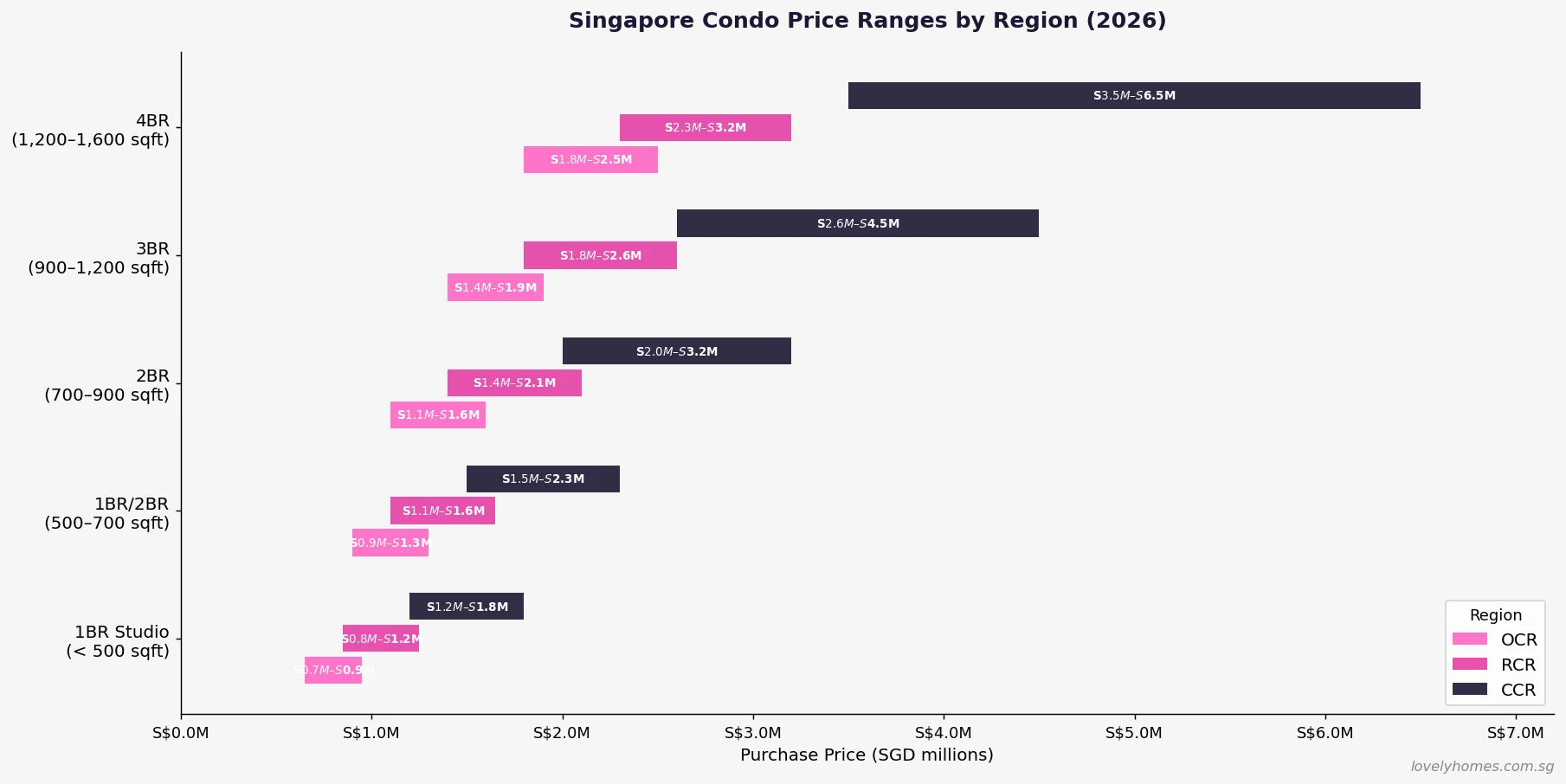
Singapore condo price ranges by region 2026 — OCR RCR CCR comparison bar chart
Figure 1: Singapore private condo price ranges by unit type and region (2026). OCR = Outside Central Region; RCR = Rest of Central Region; CCR = Core Central Region. Source: URA, industry transaction data.

For a 3-bedroom unit in 2026, an OCR condo typically transacts at S$1.4M–S$1.9M; the same unit in the CCR can reach S$2.6M–S$4.5M or beyond for prime addresses. New launches carry a new-launch premium over resale units of roughly 5–15% in most districts.

New Launch vs Resale: Key Differences

The most fundamental decision before buying a condo is whether you are looking at a new launch (bought directly from the developer, often before the building is complete) or a resale unit (bought from a private seller on the open market).

New launches are typically launched with deferred payment: a booking fee of 5% (cash only), then 15% at S&P signing (within 8 weeks), then progressive payments tied to construction milestones. You take possession 3–5 years after booking. During that period, no rental income and no physical inspection of the unit. The upside: you lock in today’s price and CPF/mortgage cashflow spreads across years. Developers often offer stamp-duty absorption or furniture voucher promotions on slow-moving units.

Resale condos are completed units. You can inspect them, move in within 10–12 weeks of OTP exercise, and rent them out immediately. The OTP process involves a 1% option fee, followed by 14 days to decide and exercise. On exercise, you pay a further 4% (totalling 5% of purchase price), then complete within 70–90 business days.

Feature New Launch Resale Condo
Payment structure Progressive (booking fee → milestones) Full 5% on OTP + balance at completion
Time to possession 3–5 years (from booking) 10–12 weeks from OTP exercise
Physical inspection Show unit only (not actual unit) Full inspection possible
Rental income Only after TOP (3–5 years) Immediately after completion
CPF + loan drawdown Progressive during construction Full drawdown at completion
SSD risk Only on re-sale within 4 years of TOP Applies if sold within 4 years of purchase
Price premium vs resale Typically +5–15% for comparable location Benchmark price
Renovation needed? Bare unit; full reno required Often move-in ready or partial reno

The Condo Buying Process — Step by Step
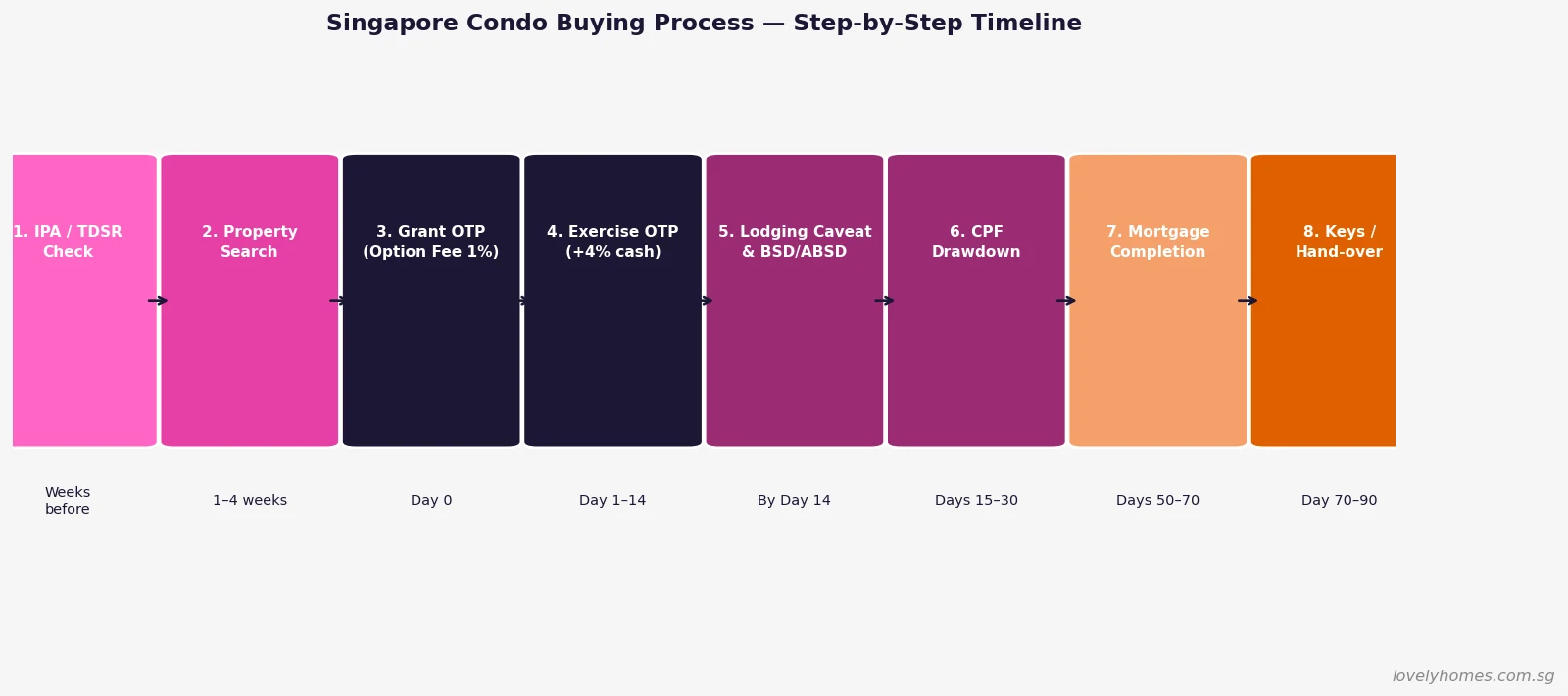
Singapore condo buying process step-by-step timeline 2026 — OTP exercise BSD ABSD completion
Figure 2: Step-by-step condo buying timeline for a resale transaction. New launch timelines differ: milestone payments replace the single-completion structure.

For a resale condo, the legal process is tightly choreographed:

Step 1 — Loan Pre-Approval (IPA). Before making any offer, obtain an In-Principle Approval (IPA) from your chosen bank. This confirms your borrowing capacity and signals seriousness to sellers. IPAs are valid for 30 days.

Step 2 — Property Search & Negotiation. View units, compare recent caveats on URA’s Real Estate Information System (REALIS), and negotiate the price. Once agreed, the seller’s representative issues the OTP.

Step 3 — Receive and Pay OTP Option Fee (1%). The option fee is typically 1% of the purchase price (negotiable for very high-value properties). This gives you the exclusive right to purchase for 14 days.

Step 4 — Exercise OTP (+ 4% cash). Within 14 days, your lawyers will advise you to exercise the OTP by paying the remaining 4% exercise fee (total 5% paid). At this stage, you engage a conveyancing lawyer if you haven’t already.

Step 5 — Stamp Duty: BSD + ABSD (within 14 days of OTP). Both BSD and ABSD must be stamped within 14 calendar days of signing the OTP. Late payment incurs IRAS penalties. BSD can be reimbursed from CPF post-stamping; ABSD must be paid in cash.

Step 6 — CPF Drawdown & Mortgage Disbursement. Your lawyers submit the CPF withdrawal application and lodge a caveat at the Singapore Land Authority (SLA). The bank releases the loan funds.

Step 7 — Completion (S&P / Transfer). Typically within 70–90 days of OTP exercise for a resale condo. Title transfers, keys are handed over.

Financing a Condo Purchase: LTV, TDSR and Loan Options

Private condo buyers borrow from commercial banks (not HDB). The key regulatory frameworks are:

Loan-to-Value (LTV) limits. For your first property mortgage with a bank: LTV 75%, meaning you can borrow up to 75% of the purchase price or valuation (whichever is lower). For a second property, LTV drops to 45%; third and subsequent to 35%. These MAS limits were last updated in August 2024, when the HDB loan LTV was reduced from 80% to 75%.

Total Debt Servicing Ratio (TDSR). No more than 55% of your gross monthly income may be committed to total debt obligations — home loan, car loan, credit card minimum payments, personal loans, all included. Banks apply a stress test interest rate of 4.0% (as at 2026) regardless of the actual offered rate, which is usually lower.

No MSR for private property. The Mortgage Servicing Ratio (MSR) — which caps housing loan payments at 30% of income — only applies to HDB flats and ECs bought from developers. Private condo buyers only need to satisfy TDSR.

Interest rates. Most banks in 2026 offer SORA-pegged packages (3-month SORA at approximately 2.4%) or fixed-rate packages. All-in rates for 30-year private property loans typically range 3.1%–3.8% in mid-2026. Always compare SIBOR-to-SORA transition implications with your relationship manager. More detail in our Singapore Home Loan Complete Guide 2026.

Stamp Duties: BSD and ABSD Explained

Every condo buyer pays Buyer’s Stamp Duty (BSD) — a progressive tax on purchase price. On top of that, ABSD applies for second-and-subsequent properties or non-citizens:

Purchase Price BSD Payable Effective BSD Rate
S$800,000 S$18,600 2.33%
S$1,200,000 S$33,600 2.80%
S$1,500,000 S$44,600 2.97%
S$2,000,000 S$69,600 3.48%
S$2,500,000 S$94,600 3.78%
S$3,000,000 S$119,600 3.99%
S$4,000,000 S$219,600 5.49%

For ABSD, remember: SC 1st property = 0% ABSD; SC 2nd = 20%; SC 3rd+ = 30%; SPR 1st = 5%; SPR 2nd = 30%; Foreigner = 60% (all properties). Full details in our ABSD Complete Guide 2026.
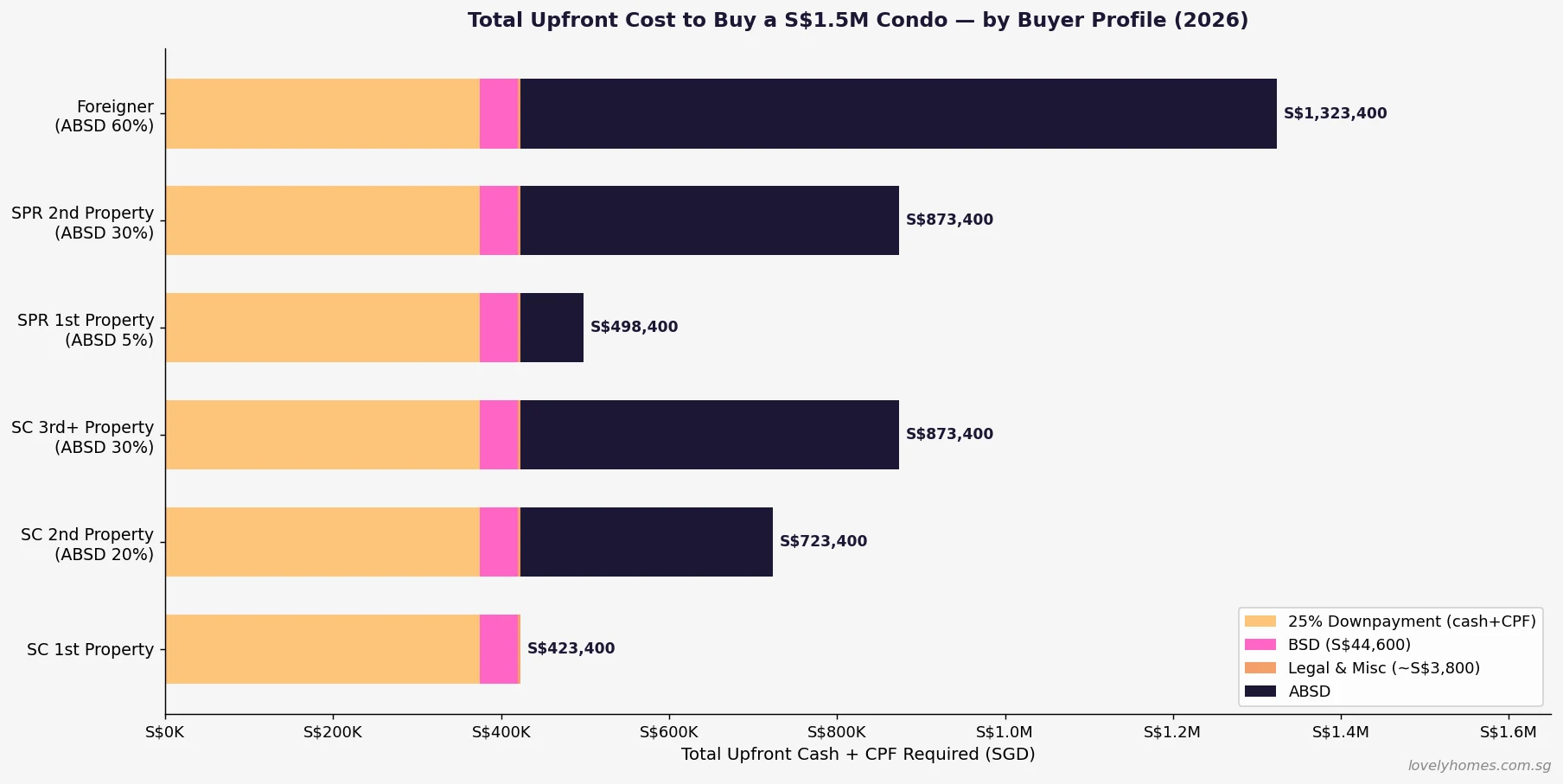
Total upfront cost to buy S$1.5M condo by buyer profile 2026 — BSD ABSD downpayment comparison
Figure 3: Total upfront cash and CPF required for a S$1.5M condo across buyer profiles (2026). LTV 75% assumed (25% downpayment). BSD S$44,600 applies to all profiles.

Using CPF to Buy a Condo

Your CPF Ordinary Account (OA) may be used to pay the downpayment (the 20% non-cash portion) and ongoing monthly mortgage instalments for a private condo, subject to:

The Valuation Limit (VL): total CPF usage cannot exceed the lower of the purchase price or the valuation at the time of purchase — so if you pay S$1,650,000 for a condo valued at S$1,600,000, your CPF ceiling is S$1,600,000.

The Withdrawal Limit (WL): once you have drawn CPF up to the VL and still have an outstanding bank loan, you may draw a further 20% of VL provided you have set aside the applicable Basic Retirement Sum (BRS — S$106,500 in 2026) in your CPF accounts.

The 5% cash rule: the minimum 5% downpayment must be in cash. CPF may only fund the remaining 20% of the 25% total downpayment.

Critically: every dollar of CPF drawn for property accrues interest at 2.5% per annum compounding. When you eventually sell, you must refund the principal plus all accrued interest back to your CPF OA. This does not reduce your profit on paper, but it does reduce the cash you take home from the sale. Read the full analysis in our CPF Private Property Guide 2026.

Choosing Between OCR, RCR and CCR

The three-region framework is more than a price guide — it reflects fundamentally different buyer profiles, rental markets, and investment theses:

OCR (Outside Central Region) is where most Singaporean families and HDB upgraders buy. Yields are strongest here — typically 3.8%–4.8% gross for 2BR/3BR units — because rental demand from expats, young professionals, and domestic upgraders is broad. Capital appreciation can be rapid when an infrastructure catalyst (a new MRT line, a GLS announcement) lands nearby. The tradeoff: commute times to CBD are longer, and CCR-calibre tenants (senior bankers, diplomats) rarely rent in OCR.

RCR (Rest of Central Region) is the sweet spot for many: city-fringe convenience, more manageable entry prices than CCR, yet close enough to attract both expat and local renters. Districts 3, 10 (parts), 14, 15, 20 are all RCR. Yields run 3.2%–4.2%. New launches here have outperformed on price appreciation in the 2020–2026 run, driven by URA master-plan transformations (Queenstown, Kallang, Pearl’s Hill).

CCR (Core Central Region) is Singapore’s luxury and investment-grade market. Prices per square foot range from S$2,500 to S$5,000+ for prime District 9/10/11 addresses. Rental yields are the weakest (2.5%–3.5%) because asset values are high, but capital preservation in USD/GBP/EUR terms attracts significant foreign (FTA-exempt) and ultra-high-net-worth demand. The 60% ABSD has effectively handed CCR supply to the FTA-exempt buyer pool.

Worked Example: Mr & Mrs Chen Buy Their First Condo

Profile: SC couple, first private property, joint income S$16,000/mth

Property: 3-bedroom OCR condo in Sengkang, S$1,650,000. Freehold.

BSD: S$180K×1% + S$180K×2% + S$640K×3% + S$500K×4% + S$150K×5% = S$1,800 + S$3,600 + S$19,200 + S$20,000 + S$7,500 = S$52,100

ABSD: 0% (SC, first residential property)

Financing: Bank loan 75% LTV = S$1,237,500 @3.2% 30yr
Monthly repayment = approximately S$5,354/mth
TDSR = S$5,354 / S$16,000 = 33.5% — PASS (below 55% ceiling)

Downpayment (25%): S$412,500
  — Cash (min 5%): S$82,500
  — CPF OA (up to 20%): S$330,000

Total upfront outlay:
Downpayment: S$412,500
BSD (can reimburse from CPF after stamping): S$52,100
Legal & conveyancing fees: ~S$4,200
Grand total: ~S$468,800

Note on SSD: If the Chens sell within 4 years of purchase, SSD applies: 16% (Year 1), 12% (Year 2), 8% (Year 3), 4% (Year 4). They plan to hold long-term, so SSD is not a concern. Full details: SSD Guide 2026.

What This Means for Singapore Property Buyers in 2026

The private condo market in 2026 sits in a period of relative stability after the sharp price run of 2020–2023. URA’s private residential price index for Q1 2026 shows OCR prices up 1.1% quarter-on-quarter — moderate, not frothy. Interest rates, while above the near-zero era of 2010–2021, have stabilised: 3M SORA has hovered around 2.4% since late 2025. The TDSR and LTV framework means buyers are better-capitalised than in previous cycles.

For SC first-timers, the 0% ABSD window is exceptionally powerful: you can buy a S$1.6M condo and pay zero ABSD. Compare this to your SPR peer who pays 5% (S$80,000) or your foreigner colleague who pays 60% (S$960,000). Singapore citizenship carries extraordinary financial value in the property market — an advantage worth leveraging before your second purchase triggers the 20% ABSD.

What Might Come Next for the Condo Market

The Government’s track record on cooling measures is well-established: when private prices accelerate beyond what income growth can justify, additional rounds of ABSD increases, LTV tightening, or supply-side intervention (GLS increases) follow. The 2H2026 GLS programme announced in June 2026 adds approximately 4,010 private residential units to the Confirmed List — a signal that supply is being managed upward to prevent affordability deterioration.

Speculation (not official MAS guidance): if private price growth accelerates beyond 5–6% annually in the second half of 2026, the Government may revisit ABSD or TDSR thresholds, as it has done in April 2023. Buyers with strong holding power and clear owner-occupier intent are best insulated from policy risk; leveraged short-term investors should be especially mindful of SSD exposure within the four-year window.

Frequently Asked Questions

Can I buy a condo while still owning an HDB flat?

Yes — but with significant financial consequences. An SC who holds an HDB flat and buys a private condo will trigger 20% ABSD on the condo (second property rate), as they are deemed to hold two residential properties. To avoid ABSD, most upgraders adopt a “sell first, buy second” sequence, disposing of the HDB before exercising the condo OTP. Alternatively, the ABSD remission scheme allows an SC couple to buy a replacement home while still owning the first property, provided they sell the first within six months of the later of the condo’s purchase or its TOP date. See our full analysis in the HDB Upgrading Guide 2026.

Is there a minimum income to buy a private condo?

There is no statutory minimum income requirement. However, the TDSR framework means that your borrowing capacity — and therefore the price range you can access with a loan — is directly tied to gross income. A borrower with S$6,000/mth gross income is limited to a monthly mortgage payment of approximately S$3,300 (55% TDSR). At 3.2% over 30 years, that equates to roughly a S$762,000 loan. At 75% LTV, the maximum purchase price would be around S$1,016,000. Buyers with no debt obligations will find this headroom useful; those with car loans and credit card debt will find it tighter.

What is the difference between freehold and 99-year leasehold condos?

In Singapore, freehold (FH) and 999-year leasehold condos hold title in perpetuity, while 99-year leasehold (LH99) condos revert to the State at lease expiry. As a practical matter, a 99-year leasehold condo built today has roughly 92–95 years remaining — well within the CPF “cover to age 95” rule for most buyers. LH99 condos are typically 10–15% cheaper than equivalent freehold units, and price growth on LH99 units can be equally strong within the first 30 years. CPF usage becomes restricted once remaining lease falls below a threshold that does not cover the youngest buyer to age 95. Read more about lease decay implications in our related investment analysis.

Can I use CPF to pay ABSD?

No. ABSD (and BSD) must be paid in cash within 14 days of signing the OTP or S&P Agreement. However, you may apply to CPF Board to reimburse BSD from your OA after it has been stamped — so while the cash must flow out first, you can recover the BSD component from CPF. ABSD remains a pure cash cost and cannot be reimbursed from CPF.

What happens if I cannot exercise the OTP within 14 days?

If you fail to exercise the OTP within 14 days, the option lapses and the seller retains your 1% option fee as forfeiture. You have no further obligation to proceed with the purchase. If you have already stamped the OTP (i.e. paid BSD), you may apply to IRAS for a refund of part of the stamp duty paid — though this process involves fees and is not guaranteed. Always ensure your financing is in order before paying the option fee.

Is there Capital Gains Tax on condo profits in Singapore?

Singapore does not levy a Capital Gains Tax (CGT). Profits from the sale of a private condo are generally not taxable, provided the activity is not deemed a trade (i.e. you are not treated as a property dealer by IRAS). The exception is the Seller’s Stamp Duty (SSD) — introduced as a transaction deterrent — which applies at 16%/12%/8%/4% if you sell within 4 years of purchase respectively. Beyond the four-year holding window, there is no SSD and no CGT. See our detailed SSD Guide 2026.

Can a foreigner buy a condo in Singapore, and how much does it cost?

Yes — foreigners may purchase private condominium units without restrictions (other than ABSD). However, the ABSD rate for foreigners is 60% of the purchase price or valuation (whichever is higher). On a S$1.5M condo, that is S$900,000 in ABSD alone, on top of BSD of S$44,600. Citizens of Iceland, Liechtenstein, Norway, Switzerland, and the United States are entitled to Singapore Citizen ABSD rates under Free Trade Agreement provisions — so an American buying their first Singapore condo pays 0% ABSD. Our Foreign Buyer Guide 2026 covers the full picture.
Disclaimer: This guide is for general information purposes only and does not constitute legal, financial, or tax advice. All figures are current as at 11 June 2026 and are subject to change by MAS, IRAS, CPF Board, or HDB. LTV, TDSR, and ABSD rules are regularly reviewed by the Singapore Government. Always verify current rates at IRAS, MAS, and CPF Board, and engage a licensed conveyancing lawyer and mortgage broker before committing to any property transaction.

Marine Parade Neighbourhood Guide Singapore 2026: Property Prices, Schools, TEL MRT and Investment Outlook

Marine Parade Neighbourhood Guide Singapore 2026: Property Prices, Schools, TEL MRT and Investment Outlook

Marine Parade is one of Singapore’s most storied residential estates — a coastal enclave in District 15 (D15) that blends Peranakan heritage, East Coast Park living, and a maturing private condo market. Long overlooked because of limited MRT access, the neighbourhood underwent a connectivity transformation in 2023 when the Thomson–East Coast Line (TEL) opened two stations — Marine Parade (TE26) and Marine Terrace (TE27) — directly into the heart of the estate. The result is a neighbourhood now fully linked to the city and, as a consequence, attracting stronger buyer interest than at any point in its history.

This guide covers everything prospective buyers, upgraders, and investors need to know about Marine Parade and the D15 corridor in 2026: property prices, MRT connectivity, schools, lifestyle amenities, rental yields, capital growth data, and a step-by-step buyer worked example.

Quick Answer: Key Facts About Marine Parade

  • District: D15 (Marine Parade, Katong, Siglap, Tanjong Katong)
  • MRT access: TEL Marine Parade (TE26) and Marine Terrace (TE27) since 2023; Paya Lebar EWL–CCL interchange ~1.8km away
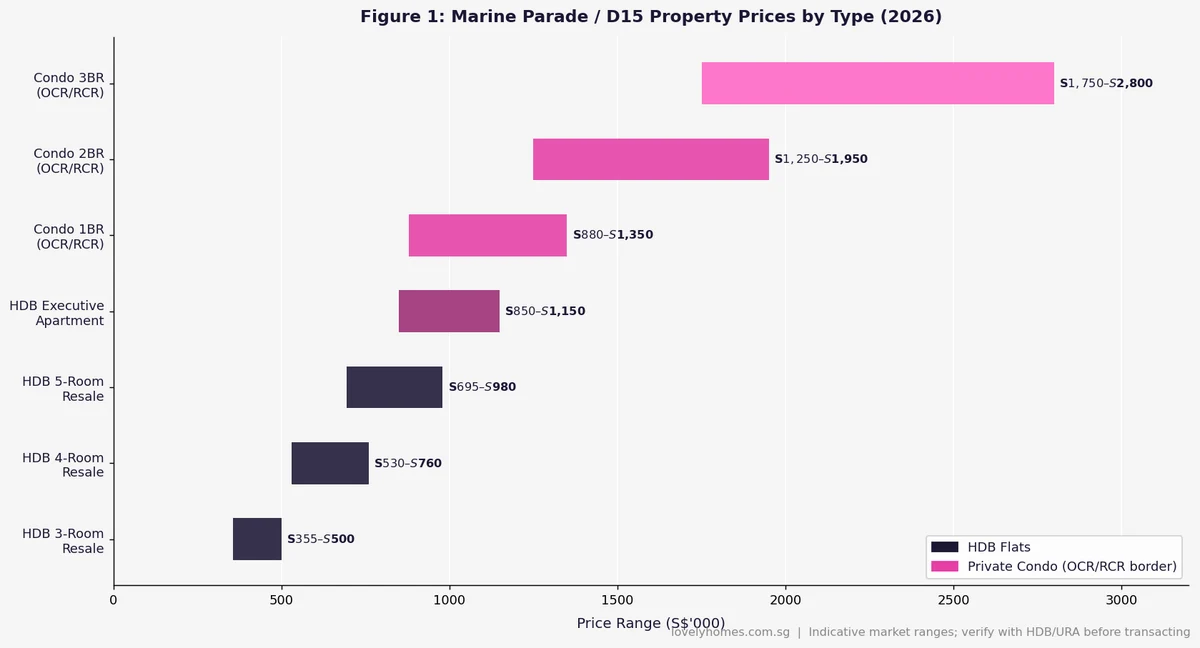
  • HDB resale prices: 3-room S$355,000–S$500,000; 4-room S$530,000–S$760,000; 5-room S$695,000–S$980,000
  • Private condo prices: 1BR S$880,000–S$1,350,000; 2BR S$1,250,000–S$1,950,000; 3BR S$1,750,000–S$2,800,000
  • Gross rental yield: HDB 3.8–4.1%; condo 2.9–3.6%
  • 3-year capital growth: private condos +9.8–13.1%; HDB flats +10.5–11.2%
  • Notable development: The Continuum (freehold, 816 units, ~S$2,700–S$3,200 psf); Amber Park (fully sold); Tembusu Grand (D15 border)
  • No new BTO supply: D15 is a fully mature private-dominated market — HDB stock is resale-only
  • Buyer profile: Strong expat rental demand (UWCSEA East nearby); Peranakan heritage appeal; upgraders from eastern HDB towns

What Is Marine Parade and Where Is It?

Marine Parade is a planning area administered by the Urban Redevelopment Authority (URA) in Singapore’s East Region. It sits along the southern coastline, bounded by the Kallang area to the west, Bedok to the east, and the Katong/Siglap subzones in between. The area is classified as Outside Central Region (OCR) for most HDB-dominated stretches and borders Paya Lebar’s Rest of Central Region (RCR) on its western flank.

The name “Marine Parade” refers both to the planning area and the prominent arterial road — Marine Parade Road — that runs parallel to East Coast Parkway (ECP). Most residents know the area by its Katong identity: a vibrant Peranakan district famous for laksa, nyonya kueh, and rows of colourful shophouses along East Coast Road and Joo Chiat Road.

Marine Parade D15 property prices by type 2026 — HDB and condo price ranges
Figure 1: Marine Parade / D15 property prices by type, 2026. Source: HDB resale portal, URA REALIS, indicative market data.

MRT Connectivity: The TEL Game-Changer

For decades, Marine Parade’s biggest drawback was the absence of MRT. Residents relied on buses along the congested ECP and Marine Parade Road corridor. That changed on 23 June 2023, when the Land Transport Authority (LTA) opened TEL Stage 3, bringing two new stations directly into the neighbourhood.

Marine Parade MRT (TE26) sits at the junction of Marine Parade Road and Still Road, within walking distance of i12 Katong mall and the East Coast Road food belt. Marine Terrace MRT (TE27) is positioned further east along Marine Terrace, serving the residential precincts near Siglap and Katong Park. Both stations connect directly to the TEL mainline, giving riders one-stop access to Great World (TE15) for the Great World City retail cluster, Orchard (TE14) for ION and Takashimaya, and Marina Bay (TE20/NS27/CE2) for the CBD.

In addition to the TEL, residents can access Paya Lebar MRT — an EWL and CCL interchange — approximately 1.8km away via bus or cycling. The EWL links Paya Lebar to the CBD (City Hall, Raffles Place), Tampines, and Changi Airport, while the CCL provides a circle-line connection to Bishan, one-north, and HarbourFront.

Property Prices in Marine Parade 2026

D15 covers a range of property types and price points. The market broadly divides into three segments: HDB resale (concentrated in Marine Parade proper and Tanjong Rhu), mid-range private condos along the East Coast Road corridor, and premium freehold condos in the Amber Road and Meyer Road micromarkets.

HDB resale flats in Marine Parade trade at a modest premium to the OCR average, reflecting the estate’s maturity, school catchments, and the post-TEL connectivity uplift. A typical 4-room resale flat in the Tanjong Rhu or Marine Parade estate commands S$530,000 to S$760,000 in 2026, with premium blocks (high floor, unblocked sea-facing views) occasionally breaching the S$800,000 mark. Executive Apartments — a Singapore-specific HDB flat type featuring more floor area — trade at S$850,000 to S$1,150,000 in this locale.

Private condos span a wide PSF range. Older 99-year leasehold projects along Marine Parade Road trade at S$1,300–S$1,600 PSF, while newer freehold developments in the Amber Road and Meyer Road corridors command S$2,200–S$3,200 PSF. The benchmark project is The Continuum (freehold, 816 units), launched in 2023 at an average of approximately S$2,730 PSF and now approaching completion, with secondary market transactions in the S$2,800–S$3,100 PSF range in Q1 2026. Amber Park (fully sold; completed 2023) set a prior record at S$2,500–S$2,800 PSF. For investors, older 99-year leasehold condos such as Waterplace and Marine Blue provide more accessible entry points in the S$1,200–S$1,600 PSF range with correspondingly higher gross yields.

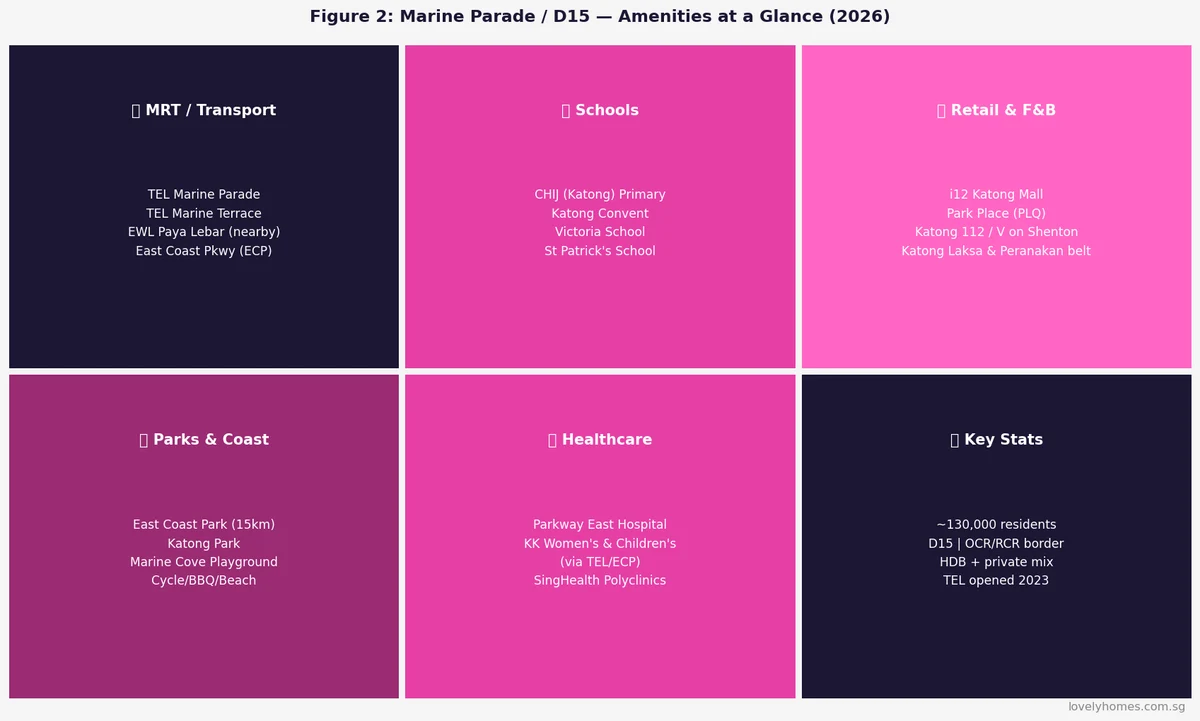
Marine Parade D15 amenities grid — MRT, schools, retail, parks, healthcare, key stats
Figure 2: Marine Parade / D15 amenities at a glance — transport, schools, retail, parks and healthcare.

Schools in Marine Parade

D15 is one of Singapore’s strongest school catchment zones for primary and secondary education, which is a significant driver of resale demand from families.

At the primary level, CHIJ (Katong) Primary — an all-girls SAP school administered by the Catholic community — draws buyers willing to pay a premium for the within-1km address advantage. Tao Nan School (a SAP school on Still Road South) is another highly sought-after feeder, with the 1km radius covering parts of Katong. At the secondary level, Victoria School (Siglap Road), St Patrick’s School (Siglap Road), Dunman High School (Tanjong Rhu), and Katong Convent are all established institutions within the planning area. Singapore Management University (SMU), accessible by TEL, adds to the tertiary ecosystem for residents in the estate.

Lifestyle and Amenities

Marine Parade’s quality-of-life proposition is anchored by three distinctive draws: the Peranakan food culture, East Coast Park, and a growing retail cluster.

East Coast Park, stretching 15km along the southern coastline, is Singapore’s most popular recreational park. Residents of Marine Parade enjoy direct cycling and walking access to its beach, barbecue pits, hawker centres, water sports facilities, and Marine Cove Playground. The upcoming Bayshore integrated development — a GLS site near Bedok South MRT (TEL) — will add further coastal amenity and residential supply to the broader East Coast corridor in the late 2020s.

Retail is anchored by i12 Katong (a mid-sized mall with a supermarket, F&B, and lifestyle tenants adjacent to Marine Parade MRT), 112 Katong on East Coast Road, and the heritage Parkway Parade mall in Marine Parade Road, which underwent a major refurbishment. For daily provisions, the Katong and Marine Parade market and food centres remain beloved neighbourhood institutions. Healthcare is served by Parkway East Hospital (a private hospital on East Coast Road) and multiple SingHealth polyclinics.

Rental Yields and Investment Case

Marine Parade has historically been a strong rental market. The estate benefits from proximity to UWCSEA East Campus (Dover Road, ~8km via ECP), generating consistent expat family demand. Post-TEL, the improved connectivity has expanded the catchment of corporate renters commuting to the CBD and Marina Bay financial district.

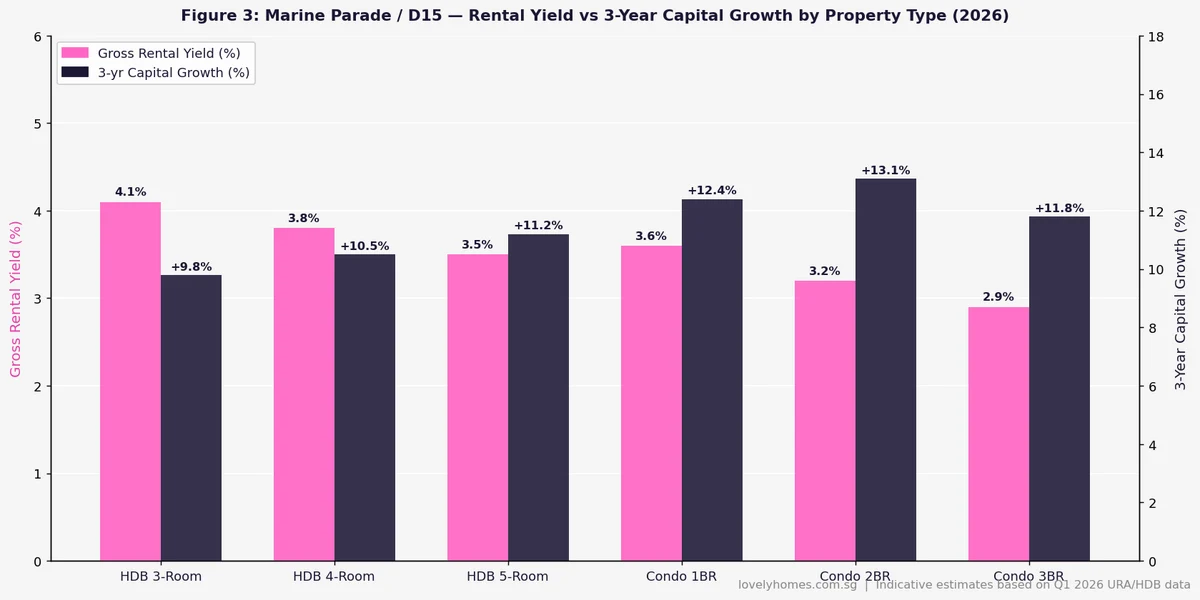
Marine Parade D15 rental yield vs 3-year capital growth by property type 2026
Figure 3: Marine Parade / D15 — gross rental yield vs 3-year capital growth by property type (2026). Source: indicative estimates based on URA/HDB Q1 2026 data.

HDB 3-room flats in the estate yield approximately 4.1% gross, reflecting a more affordable entry price combined with strong rental demand from young professionals and couples. Private condo yields compress as PSF rises: older 99-year leasehold projects deliver 3.4–3.6% gross, while premium freehold units at S$2,700–S$3,200 PSF yield closer to 2.8–3.0% gross. Capital growth, however, has been robust across all segments: D15 private properties recorded a +12.4% gain on a 3-year basis (condo 2BR benchmark) through Q1 2026, well above the OCR average of +11.3% and reflecting the post-TEL re-rating.

Summary: Marine Parade Property Types at a Glance

Property Type Typical Price Range Median PSF Gross Yield Tenure
HDB 3-Room Resale S$355,000–S$500,000 ~S$510 psf ~4.1% 99-yr (HDB)
HDB 4-Room Resale S$530,000–S$760,000 ~S$560 psf ~3.8% 99-yr (HDB)
HDB 5-Room Resale S$695,000–S$980,000 ~S$590 psf ~3.5% 99-yr (HDB)
Private Condo (1BR) S$880,000–S$1,350,000 S$1,300–S$1,800 psf 3.4–3.6% Mixed 99yr/FH
Private Condo (2BR) S$1,250,000–S$1,950,000 S$1,500–S$2,700 psf 3.0–3.4% Mixed 99yr/FH
Private Condo (3BR) S$1,750,000–S$2,800,000 S$2,200–S$3,200 psf 2.8–3.2% Mainly FH

Worked Example: Upgrader Purchasing a 2BR Condo in Marine Parade

Profile: Mr and Mrs Lim, Singapore Citizens, joint monthly income S$13,500. Currently own a fully paid-up Bedok 4-room HDB. Intending to sell the HDB and purchase a 2BR condo in Marine Parade as their home — first private property purchase.

Target unit: 2BR condo (older 99-year leasehold project on Marine Parade Road), asking price S$1,580,000 (approximately S$1,520 PSF for 1,040 sqft).

  • Buyer’s Stamp Duty (BSD): S$1–S$180,000 @ 1% = S$1,800 + S$180,001–S$360,000 @ 2% = S$3,600 + S$360,001–S$1,000,000 @ 3% = S$19,200 + S$1,000,001–S$1,580,000 @ 4% = S$23,200 = total BSD S$47,800
  • Additional Buyer’s Stamp Duty (ABSD): Nil — SC purchasing first private property (after selling HDB)
  • Loan quantum: 75% LTV (bank loan, no outstanding HDB loan) = S$1,185,000
  • Monthly repayment: S$1,185,000 at 3.0% p.a. over 25 years = approximately S$5,615/month
  • Total Debt Servicing Ratio (TDSR): S$5,615 ÷ S$13,500 = 41.6% — within the 55% TDSR limit
  • Cash/CPF upfront: 5% cash = S$79,000 + 20% CPF/cash = S$316,000 + BSD S$47,800 + legal fees ~S$5,200 = approximately S$448,000 total upfront

The Lims use S$200,000 CPF OA savings and S$248,000 in cash proceeds from the HDB sale. The transaction is feasible, with the monthly repayment well within TDSR and comfortable given their joint income.

Why Marine Parade Matters: The TEL Re-Rating

Marine Parade represents one of Singapore’s clearest examples of infrastructure-driven property re-rating. For 50 years after the estate was developed in the 1970s and 1980s, D15 property traded at a persistent discount to comparable RCR districts because of MRT absence. The TEL stations opened in 2023 have begun to close that gap. Industry data as at Q1 2026 shows that TEL-adjacent condos in D15 have outperformed the broader OCR by approximately 200–300 basis points on capital appreciation over the 24 months since the line opened.

The estate’s enduring appeal — heritage culture, East Coast Park, and school catchments — combined with the new connectivity advantage positions Marine Parade as a structural beneficiary of Singapore’s south-eastern TEL corridor build-out. The Bayshore GLS site (near Bedok South TEL) and the East Coast Plan (ECP) long-term coastal development will further reinforce the area’s desirability through the late 2020s and 2030s.

What Might Come Next for Marine Parade

This section contains forward-looking analysis and should not be construed as a prediction of future prices.

Several factors could drive further upside in D15 over the medium term. First, TEL full-line completion (Stages 4 and 5, connecting to Changi Airport and Tanah Merah) will add more riders to the line and increase throughput at Marine Parade and Marine Terrace stations, enhancing the commercial viability of street-level retail along the corridor. Second, the impending completion of The Continuum (816 units) will provide a fresh benchmark for freehold PSF in the submarket. Third, any announcement of an East Coast masterplan update — particularly relating to the Bayshore precinct — could boost buyer sentiment across D15. Conversely, a surge in completions across the broader TEL corridor (Tanjong Rhu, Katong, Siglap) could moderate near-term price appreciation if supply temporarily exceeds demand.

Frequently Asked Questions

Is Marine Parade a good area to buy property in 2026?

Marine Parade offers a compelling combination of lifestyle amenity (East Coast Park, Peranakan food culture, established schools), post-TEL MRT connectivity, and a strong tenant base. For buyers seeking a mature coastal estate with no new HDB BTO supply (meaning limited competing public housing entering the resale market), D15 is one of Singapore’s more defensible residential choices. The trade-off is price: D15 commands a premium over other OCR markets. First-time buyers on tighter budgets may find better value in Tampines, Jurong West, or Sengkang.

Which MRT stations serve Marine Parade?

Two TEL stations serve the estate directly: Marine Parade (TE26) and Marine Terrace (TE27), both opened in June 2023 as part of TEL Stage 3. The TEL connects directly to Orchard, Marina Bay, Stevens, and (via TEL Stage 4 onward) Bayshore, Bedok South, and Sungei Bedok. The closest EWL station is Kembangan (about 1.5km east) and the EWL–CCL interchange at Paya Lebar is approximately 1.8km to the north-west.

Can a Singapore Permanent Resident (SPR) buy an HDB resale flat in Marine Parade?

Yes. SPRs who meet HDB’s Public Scheme eligibility (SPR + any other SPR or SC family member forming a family nucleus) can purchase HDB resale flats anywhere in Singapore, including Marine Parade. However, SPRs pay a 5% Additional Buyer’s Stamp Duty (ABSD) on their first residential property and a 15% ABSD on their second. Additionally, SPRs must wait 3 years from the date of obtaining PR status before purchasing an HDB resale flat. SPRs cannot purchase HDB BTO flats — those are reserved for SC-led households.

What are the best condos to consider in Marine Parade?

For freehold investment, The Continuum (D15, 816 units, launch ~S$2,730 PSF, near completion) represents the newest benchmark. Amber Park (fully sold but tradeable on the secondary market) and older freehold projects like Silversea and Waterford Residence also trade in the premium tier. For yield-focused buyers on a tighter budget, older 99-year leasehold condos along Marine Parade Road — such as Waterplace, Aquarius by the Park, or Marine Blue — offer more accessible entry prices with yields in the 3.4–3.6% range. Always check remaining lease tenure carefully for leasehold units before committing to CPF usage.

How does Marine Parade compare with Tampines or Bedok for investment?

Marine Parade offers higher capital growth potential and stronger lifestyle appeal, but at significantly higher price points and lower rental yields than Tampines or Bedok. Tampines and Bedok HDB resale flats are typically S$100,000–S$200,000 cheaper than D15 equivalents, and their private condos trade at S$500–S$800 PSF lower. However, D15’s scarcity (no new HDB BTO; limited new condo supply after The Continuum) and the TEL connectivity uplift support a structural premium. Investors seeking high yield typically favour Tampines or Bedok; those seeking long-term capital appreciation in a lifestyle estate may prefer D15.

Is there any new HDB supply coming to Marine Parade?

No. HDB Build-To-Order (BTO) launches are not available in Marine Parade, as the estate is a fully developed mature town with no vacant sites set aside for new public housing. Prospective HDB buyers must purchase resale flats in the open market, subject to the standard Ethnic Integration Policy (EIP) quotas and SPR quotas for the block and neighbourhood. This supply scarcity is one reason why D15 HDB resale flats have maintained their price premium.

What are the ABSD implications for a foreigner buying a condo in Marine Parade?

Foreign individuals (non-citizens, non-PRs) who are not covered by a Free Trade Agreement (FTA) concession pay a 60% Additional Buyer’s Stamp Duty on all residential property purchases in Singapore, including in Marine Parade. At S$1,500,000 for a condo, that is an ABSD of S$900,000 — on top of BSD of approximately S$44,600. The few foreigners who pay reduced ABSD (5%, same as a Singapore Citizen second purchase) are nationals of the United States, Switzerland, Norway, Iceland, and Liechtenstein under their respective FTAs with Singapore. MAS administers the ABSD policy, and rates are updated by ministerial order — always verify the current rates at IRAS.gov.sg before transacting.

Related Articles

Disclaimer

This article is for general informational purposes only and does not constitute financial, legal, or property advice. All property prices, rental yields, and capital growth figures are indicative estimates drawn from URA REALIS data, HDB resale portal transactions, and market analysis as at Q1 2026. Actual transaction prices vary by unit, floor, condition, and prevailing market conditions. ABSD rates, BSD rates, CPF rules, and HDB eligibility criteria are set by the Singapore Government (IRAS, HDB, MAS, CPF Board) and are subject to change. Readers should conduct their own due diligence and consult a licensed property agent, lawyer, and financial adviser before making any property transaction. For authoritative data, refer to URA (ura.gov.sg), HDB (hdb.gov.sg), IRAS (iras.gov.sg), and MAS (mas.gov.sg).

Condo Downpayment Singapore 2026: LTV, Cash & CPF Breakdown

Condo Downpayment Singapore 2026: LTV, Cash & CPF Breakdown

The condo downpayment question — how much cash does a Singapore buyer actually need on day 1 — sounds simple, but it is where most first-time buyers underestimate by S$50,000 or more. The answer depends on three overlapping rules (LTV, minimum cash, and stamp duties), and it changes dramatically if this is your second or third property.

This 2026 guide walks through exactly what you need to write cheques for on the day you collect your condo keys, with worked tables for first-property Singaporean citizens, second-property buyers, and foreign buyers. For the regulator’s guidance, see MAS Notice 632 on residential LTV.

Quick Answer — Condo Downpayment on a S$1.5m Unit

  • First condo, Singapore Citizen: ~S$119,600 cash + S$225,000 CPF/cash = S$344,600 total day-1 outlay (including BSD).
  • Second condo, Singapore Citizen: ABSD alone adds S$300,000. Total day-1 outlay S$1,169,600.
  • Foreigner buyer, any property: 60% ABSD on top of a 45% LTV. Total day-1 outlay S$1,769,600.
  • Minimum cash: 5% of purchase price for 75% LTV; 10% for 45% or 35% LTV.
  • BSD & ABSD: payable in cash within 14 days of OTP (reimbursable from CPF OA after).

The Three Rules That Set Your Downpayment

Three layers combine to set the cash and CPF you need:

  1. Loan-to-Value (LTV) ratio. MAS caps bank lending at 75% for a first housing loan, 45% for a second, and 35% for a third and beyond. The balance is your downpayment.
  2. Minimum cash portion. MAS requires at least 5% of the purchase price in cash for a first property, 10% for second and subsequent.
  3. Stamp duties. BSD and, where applicable, ABSD are paid in cash within 14 days of OTP. You can reimburse from CPF afterwards.
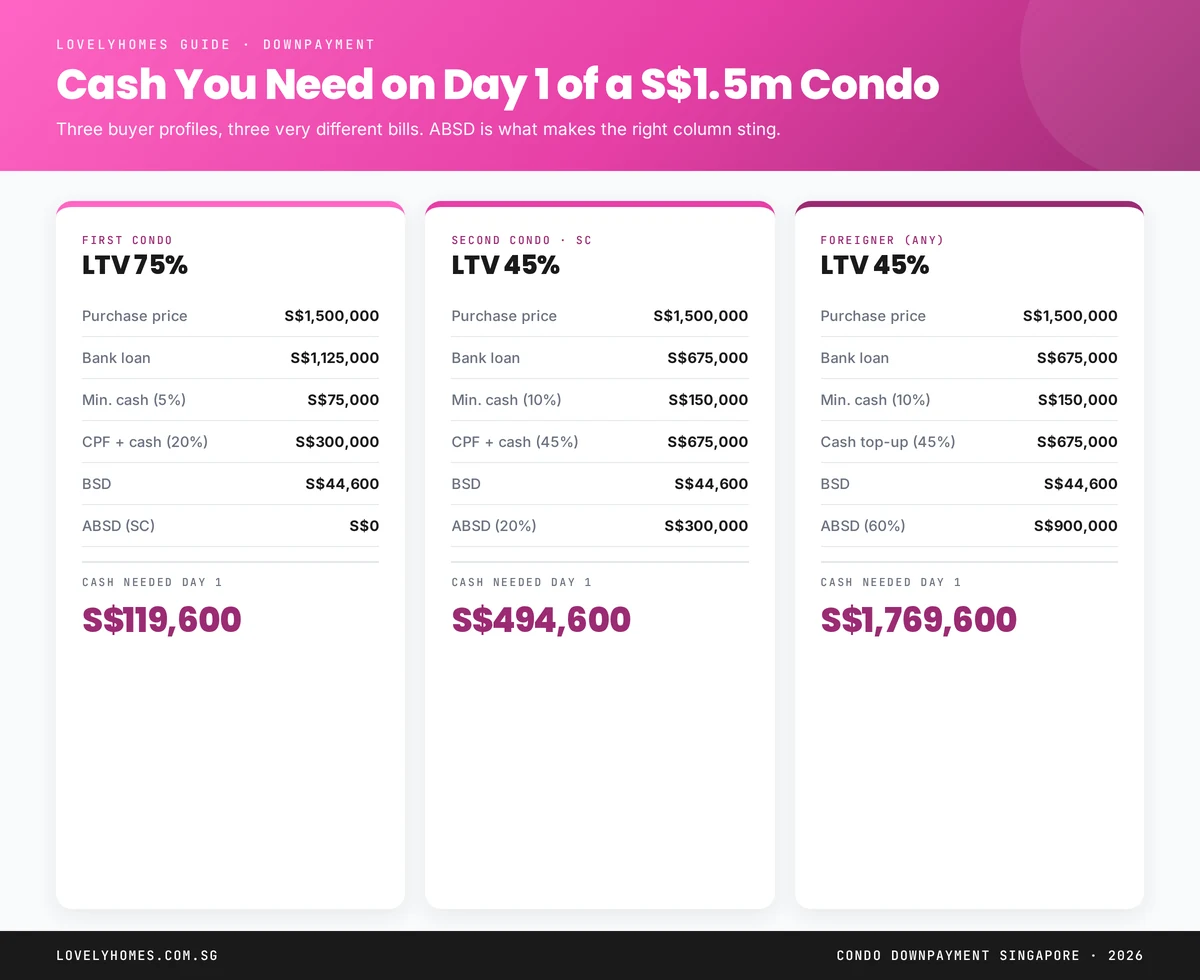
Condo downpayment comparison for S$1.5m Singapore property showing first, second and foreigner cash requirements
Figure 1: Same S$1.5m condo, three buyer profiles, cash needed on day 1 varies by nearly S$1.7 million.

First Property: Singapore Citizen on a 75% LTV

The easiest case. On a S$1.5m condo, an SC buying their first home gets:

  • Bank loan: up to S$1,125,000 (75% LTV, subject to TDSR).
  • Downpayment: S$375,000 split as:
    • Minimum 5% cash: S$75,000 — this is a hard floor, not a guideline.
    • Remaining 20%: up to S$300,000 can come from CPF OA, cash, or a combination.
  • BSD: ~S$44,600 (progressive on S$1.5m, capped at 5% at this level).
  • ABSD: 0% (first residential property for a Singapore Citizen).

Total cash needed on day 1: S$75,000 (min. cash) + S$44,600 (BSD) = S$119,600. BSD can be reimbursed from CPF OA after stamping.

Second Property: Singapore Citizen on a 45% LTV

Two major shifts bite here. First, LTV drops to 45% — meaning you fund 55% of the purchase. Second, ABSD kicks in at 20%.

  • Bank loan: S$675,000 maximum.
  • Downpayment: S$825,000 split as:
    • Minimum 10% cash: S$150,000.
    • Remaining 45%: S$675,000 from CPF OA, cash, or combination.
  • BSD: S$44,600.
  • ABSD (20% SC 2nd): S$300,000.

Total cash needed day 1: S$150,000 + S$44,600 + S$300,000 = S$494,600. That is before the S$675,000 of CPF/cash needed to reach the loan ceiling.

This is why many Singaporean upgraders follow the sell-first-buy-second route — or take a bridging loan — to avoid holding two properties simultaneously.

Foreigner: 45% LTV + 60% ABSD

The most expensive profile. Foreign non-residents face LTV 45% (most banks drop to 40% for non-residents without local income), plus a flat 60% ABSD.

  • Bank loan: S$675,000 maximum.
  • Downpayment: S$825,000 in cash (no CPF access for foreigners).
  • BSD: S$44,600.
  • ABSD (60%): S$900,000.

Total cash needed day 1: S$1,769,600 against a S$1.5m purchase price. Many foreign buyers end up paying 100%+ cash when accounting for legal fees and renovation.

What About CPF OA?

CPF Ordinary Account can cover most of the non-minimum-cash portion of the downpayment, plus BSD/ABSD reimbursement after stamping. Critical caveats:

  • CPF cannot cover the mandatory minimum cash portion (5% first, 10% subsequent).
  • For private property, CPF usage caps at the Valuation Limit (purchase price or valuation, whichever lower) and the Withdrawal Limit of 120% of VL.
  • Every dollar used compounds at 2.5% accrued interest — see our CPF for Property guide for the full maths.

New Launch vs Resale: Different Cash-Flow Timing

For a new launch (BUC — Building Under Construction), payments are staggered via the Progressive Payment Scheme. You typically need 25% at the Sale & Purchase Agreement (5% OTP deposit + 20% at S&PA), then 10% at foundation, 10% at reinforced concrete, etc. This reduces upfront cash strain dramatically.

For a resale, the entire downpayment hits at completion — typically 10–14 weeks after OTP. You need the full amount in cash and CPF by completion day.

TDSR Still Applies

The LTV numbers above are ceilings, not entitlements. Your actual bank loan may be smaller if your TDSR maxes out first — see our TDSR & MSR guide. A couple earning S$16,000 a month may qualify for a S$1.1m loan under TDSR even if LTV would allow S$1.125m on a S$1.5m purchase. In that case, the extra S$25,000 shortfall is yours to fund in cash or CPF.

Frequently Asked Questions

Can I put down more than 5%/10% in cash?

Yes. The minimums are floors, not ceilings. Some buyers put 20%+ cash to reduce their loan quantum and future interest.

Does option fee count as part of the downpayment?

Yes. The 1% Option Money and the 4% Option Exercise Fee together form the initial 5%, which is also the minimum cash portion for a first property.

Can I borrow more than 75% LTV?

Not from a MAS-regulated bank. Some private financing vehicles lend above 75% but at materially higher rates and with punitive terms — we do not recommend this route.

Does the 75% LTV apply to under-construction properties?

Yes, but payment is progressive — you do not need the full downpayment on day 1 for a new launch.

What if I am using an HDB loan for an HDB flat, not a bank loan for a condo?

HDB concessionary loans offer up to 75% LTV with 0% minimum cash. See our HDB Loan vs Bank Loan guide for the full difference.

What to Do Next

  1. ABSD Singapore 2026 Complete Guide — the biggest line in any upgrader’s cash-flow.
  2. BSD Singapore 2026 — full progressive rate ladder.
  3. TDSR & MSR 2026 — what your loan can actually be.

Disclaimer: This guide is general information, not financial advice. LTV and stamp-duty rules are subject to change. Verify current rules at mas.gov.sg and iras.gov.sg, and consult a licensed mortgage broker.


Translate »