Singapore Private Property Resale Process 2026: Step-by-Step Guide from OTP to Keys

Singapore Private Property Resale Process 2026: Step-by-Step Guide from OTP to Keys

Quick Answer: Buying a Private Resale Property in Singapore 2026

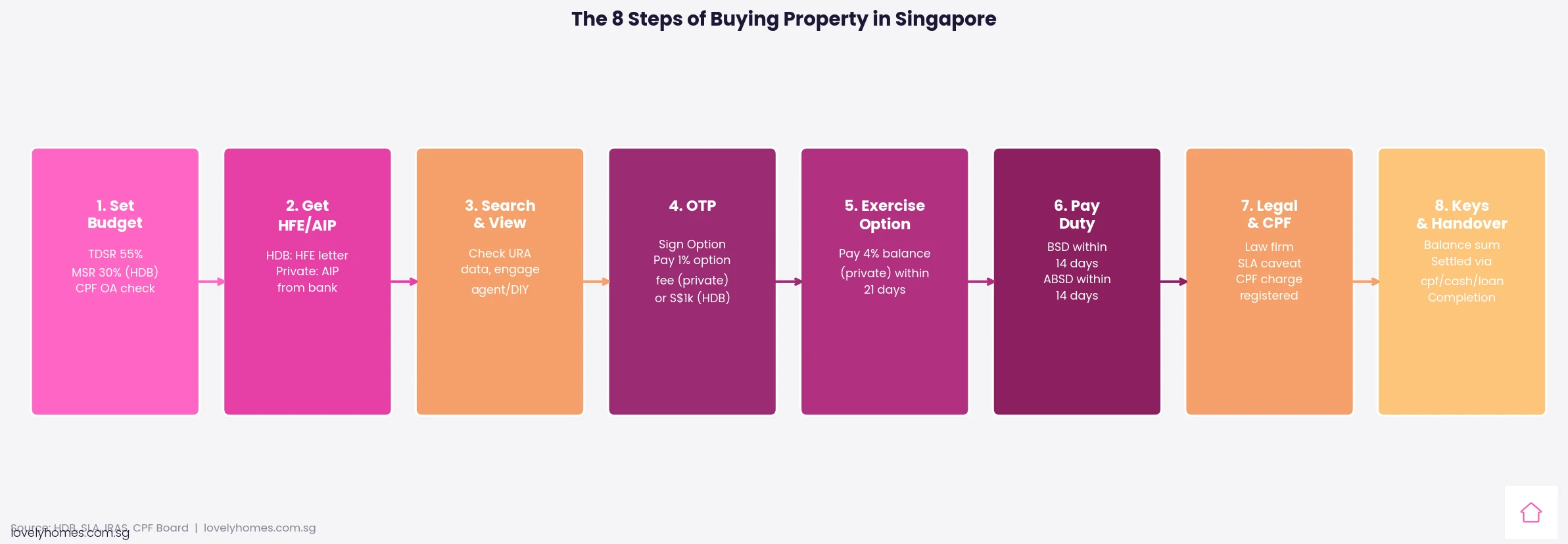
  • The full resale process — from engaging a solicitor to receiving keys — typically takes 10–14 weeks.
  • You pay an Option Fee (1% of price) to secure the OTP, then exercise it within 14 days by paying the balance 4%.
  • Buyer’s Stamp Duty (BSD) must be paid within 14 days of exercising the OTP; ABSD is also due at exercise.
  • CPF Ordinary Account can be used for private property purchases subject to the Valuation Limit and Withdrawal Limit.
  • Foreigners and PRs face Additional Buyer’s Stamp Duty (ABSD) of 60% and 5–30% respectively.
  • A licensed solicitor is legally required for conveyancing — buyers and sellers cannot use the same law firm.
  • The Total Debt Servicing Ratio (TDSR) cap of 55% applies to all private property mortgage loans.

What Is the Private Property Resale Process in Singapore?

Purchasing a resale private property — whether a condominium, apartment, or landed house — in Singapore follows a structured legal and financial process regulated by the Urban Redevelopment Authority (URA), the Singapore Land Authority (SLA), and the Inland Revenue Authority of Singapore (IRAS). Unlike buying a new launch (where you deal with a developer over a preview and balloting exercise), a resale transaction involves a private seller, a binding Option to Purchase (OTP), and a conveyancing timeline governed by the Law Society Conditions of Sale.

The process is considerably more compressed than buying a new launch — you can move in within 12 weeks of the OTP being granted, compared to the 3–5 year construction wait for a new launch. This immediacy comes with its own demands: due diligence, financing pre-approval, and legal fees must all be lined up before the OTP is granted.

This guide walks through every step from identifying a property to receiving keys, and explains the stamp duties, CPF rules, and financing mechanics that determine how much cash you need to have ready.

The 10-Step Private Resale Process: A Timeline Overview

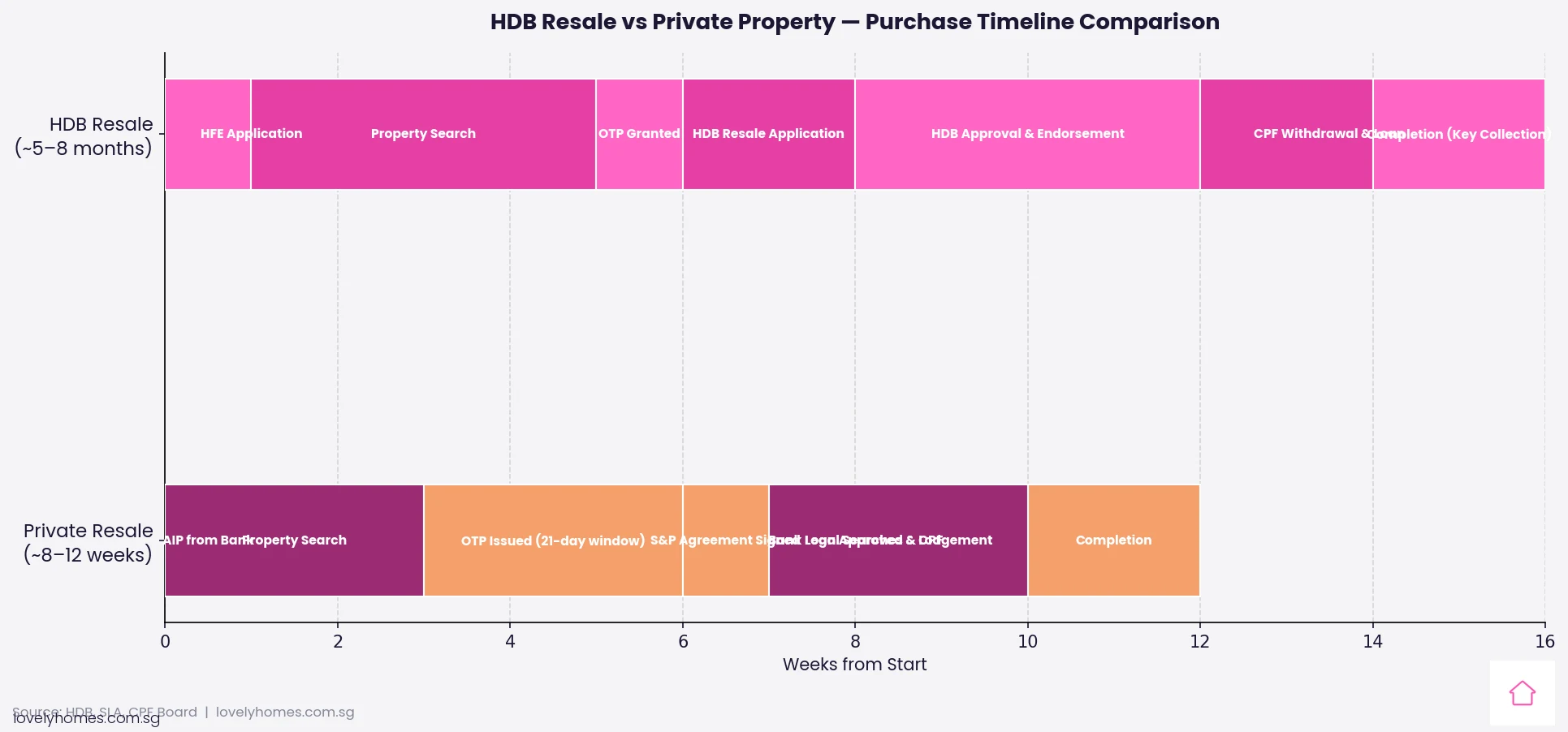
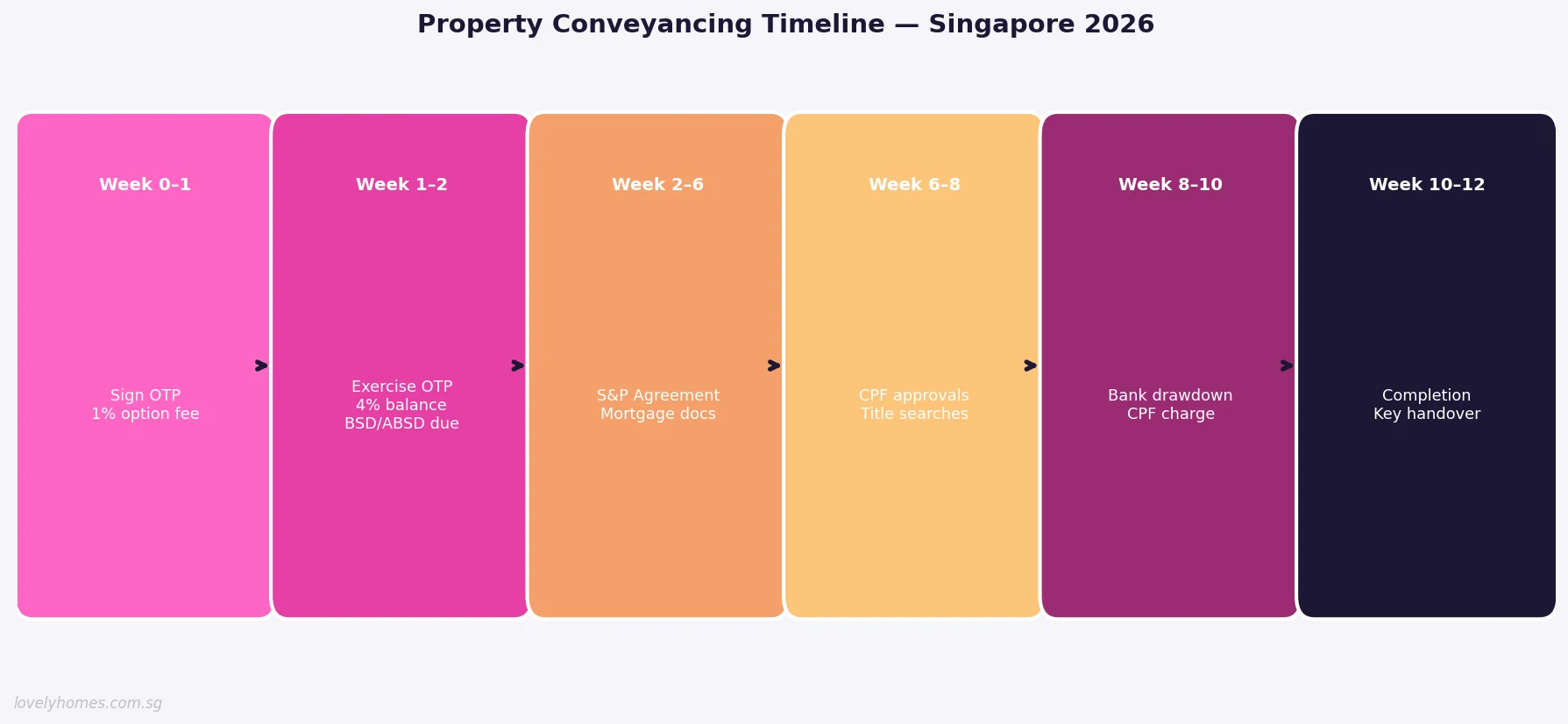
Figure 1 below shows the typical timeline across the ten stages of a private resale transaction. The entire process from engaging a solicitor to key collection typically spans 10 to 14 weeks (8 to 12 weeks for the legal completion period), though parties can agree to a shorter or longer completion period of up to 12 weeks by mutual consent.

Singapore private property resale process 10-step timeline buyer guide 2026
Figure 1: Typical timeline for a private resale property transaction in Singapore — 10 steps, 10–14 weeks. Source: LovelyHomes editorial.

Step 1: Engage a Solicitor (Before You Even Make an Offer)

The first step — one many buyers skip at their peril — is engaging a conveyancing solicitor before making any offer on a property. You need your solicitor in place because: (a) the OTP’s 14-day exercise window moves fast; (b) your solicitor must review the OTP wording and raise any queries before you exercise; and (c) you need legal confirmation of the CPF rules, title status, encumbrances, and outstanding maintenance fees before committing.

Buyer and seller cannot use the same law firm. Typical buyer legal fees for a S$1.5M condo range from S$3,500 to S$5,000 (inclusive of disbursements such as SLA caveat registration, title search, and stamp duty filing). Fees are broadly governed by the Law Society’s conveyancing fee guidelines but are now freely negotiable.

Your solicitor will conduct a title search via SLA to confirm the seller has clear, unencumbered title; check for any outstanding mortgage that must be discharged on completion; verify there is no Subsidiary Strata Land Act (SSLA) restriction or approved change of use that affects the property; and review the Management Corporation Strata Title (MCST) accounts for outstanding arrears and sinking fund adequacy. For a deeper primer on MCST issues, see our Singapore Condo MCST Guide 2026.

Step 2: Search and View Properties — Due Diligence Before the OTP

Before agreeing to any price, buyers should undertake thorough due diligence on the unit and the development. Key checks include: verifying the actual floor area against the strata title plan; confirming the remaining lease term (for leasehold developments); reviewing the MCST annual report for sinking fund balance and any pending special levies; checking for outstanding renovations bans or works on the common property; and reviewing recent comparable transactions in the development (available via URA REALIS or on the URA website’s Resale Transactions tool).

Buyers should also verify their eligibility. Singapore Citizens may purchase all private property types. Permanent Residents may purchase apartments, condominiums, and commercial property freely but require approval from the Land Dealings (Approval) Unit to purchase landed residential property. Foreigners may only purchase landed property in designated areas (Sentosa Cove) or with SLA approval, and face 60% ABSD on any residential purchase.

Step 3: Grant and Exercise of the Option to Purchase (OTP)

Once you have agreed on a price, the seller grants you an Option to Purchase in exchange for the Option Fee — typically 1% of the agreed purchase price paid in cash. The OTP gives you an exclusive right to purchase the property at the agreed price, typically for a 14-day option period (this period is agreed between parties and can be shorter or longer).

During the option period, your solicitor reviews the OTP. If you are satisfied, you exercise the OTP by signing it and paying the exercise fee — typically the balance 4% of the purchase price in cash or a combination of cash and CPF. On exercise, the OTP becomes a binding contract. The completion date is set for 8–12 weeks from the exercise date.

If you do not exercise the OTP within the period, the Option Fee is forfeited to the seller. There is no other penalty — the purchase simply does not proceed. This is why due diligence and financing must be in order before granting an OTP.

Step 4: Stamp Duties — BSD and ABSD (Due Within 14 Days)

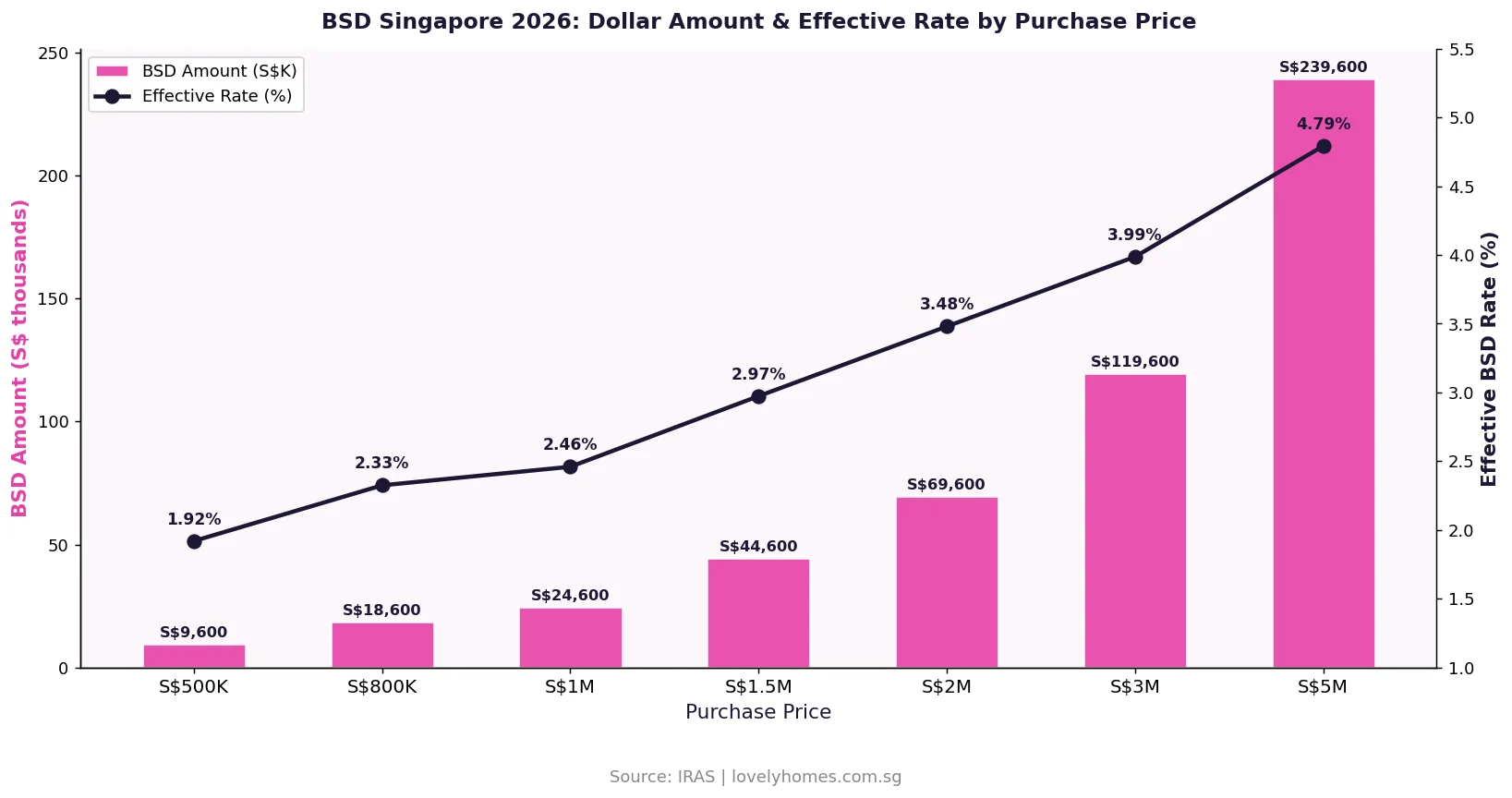
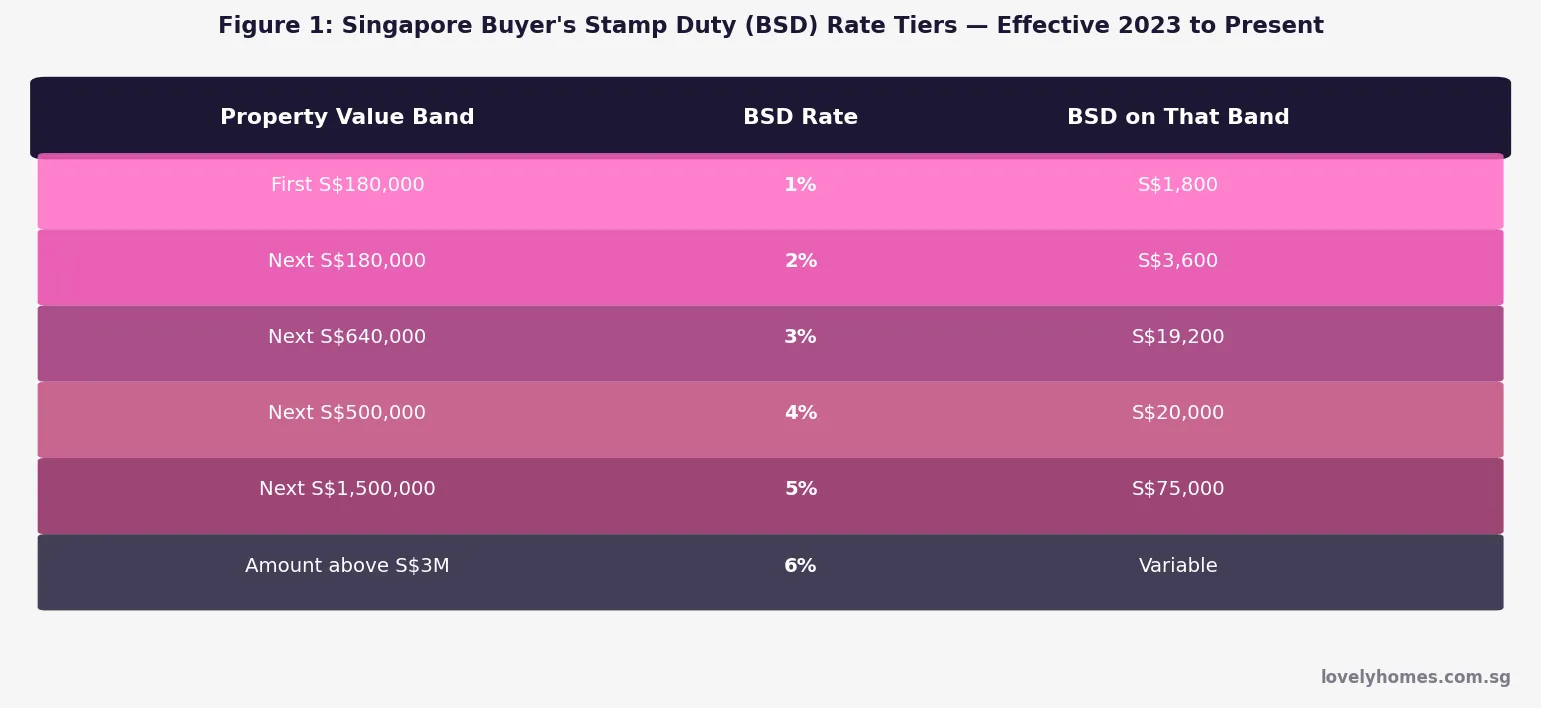
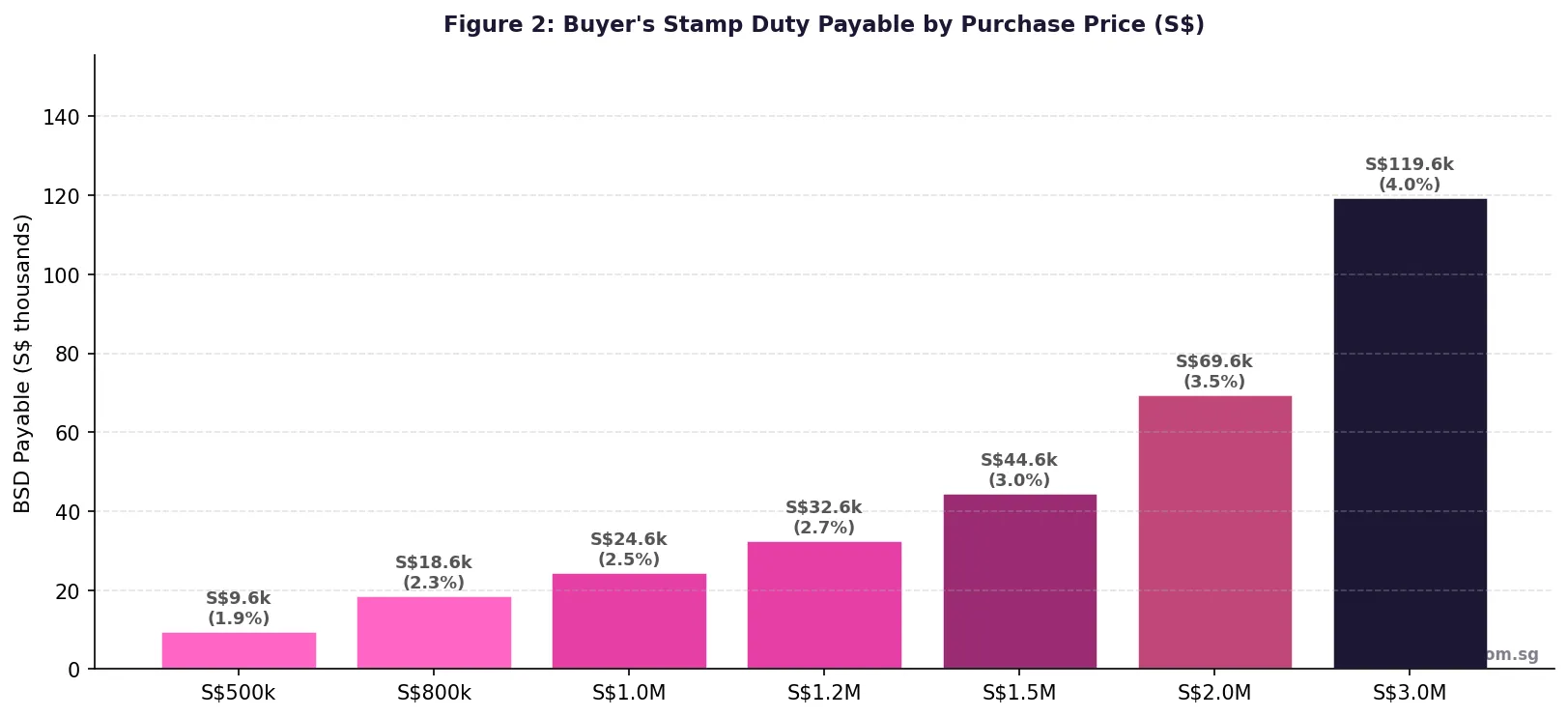
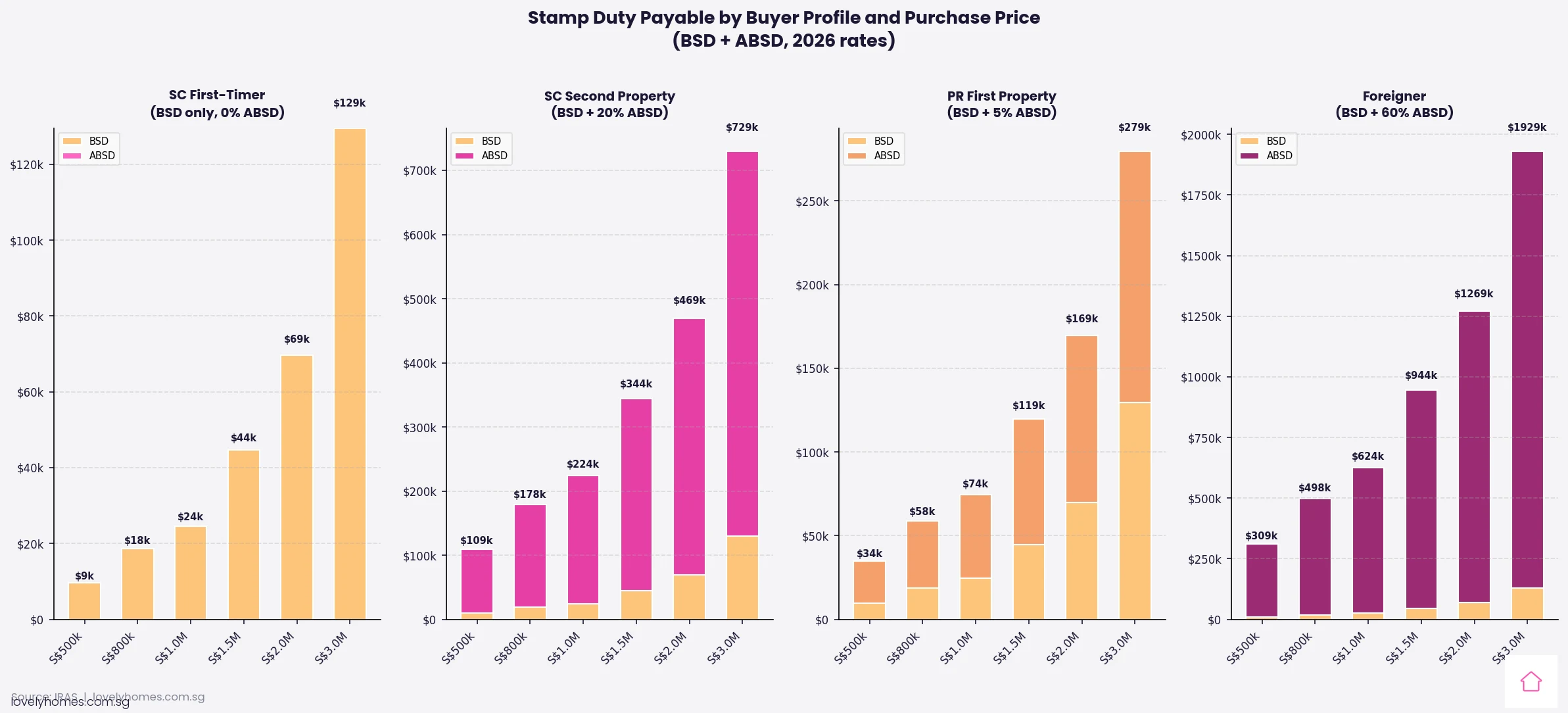
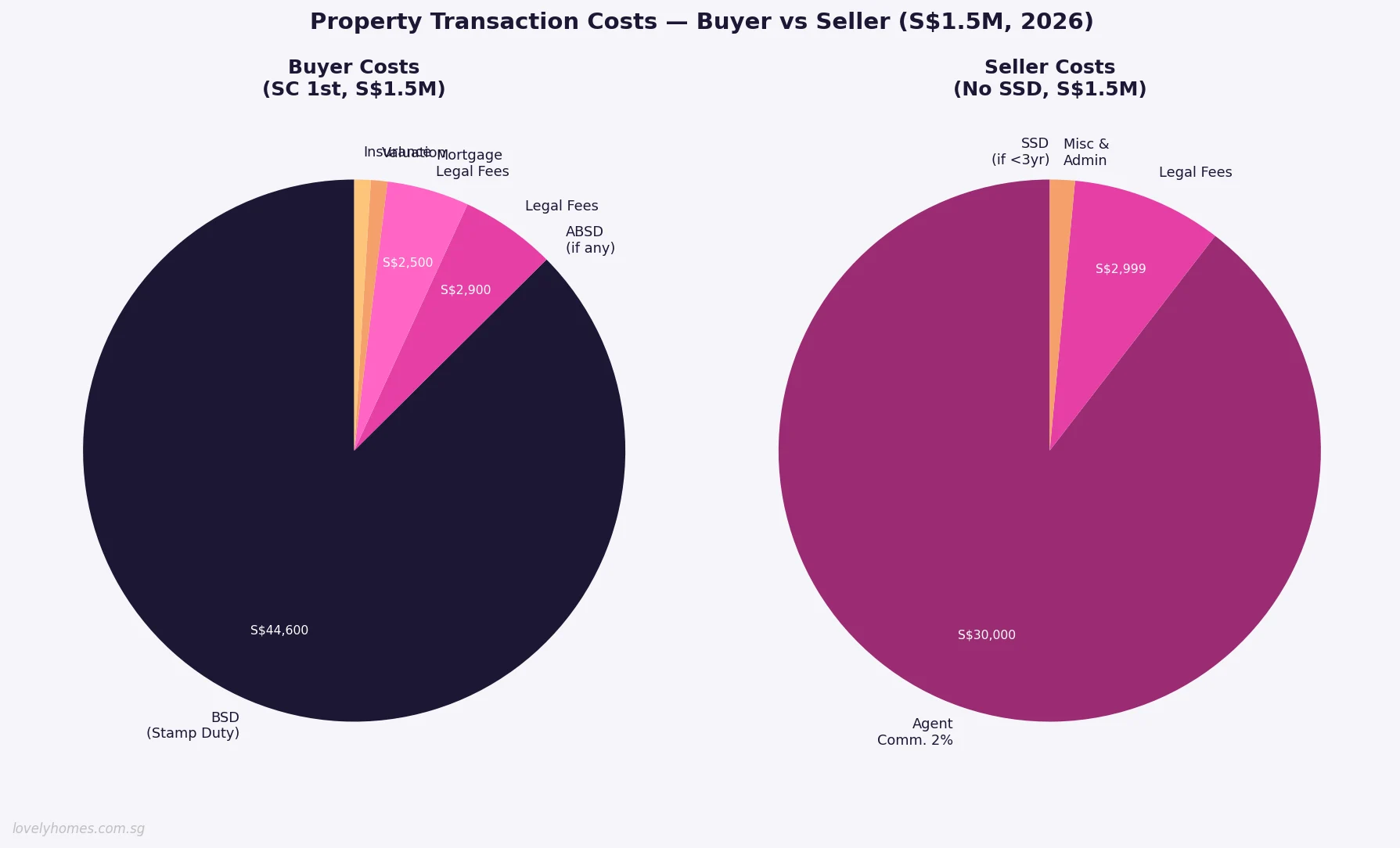
Buyer’s Stamp Duty (BSD) is payable on all property purchases. It is calculated on a graduated scale on the purchase price or market value, whichever is higher. On a S$1.5M purchase, BSD is S$44,600 (effective rate approximately 2.97%). BSD must be paid via IRAS e-Stamping within 14 days of the date of the OTP exercise.

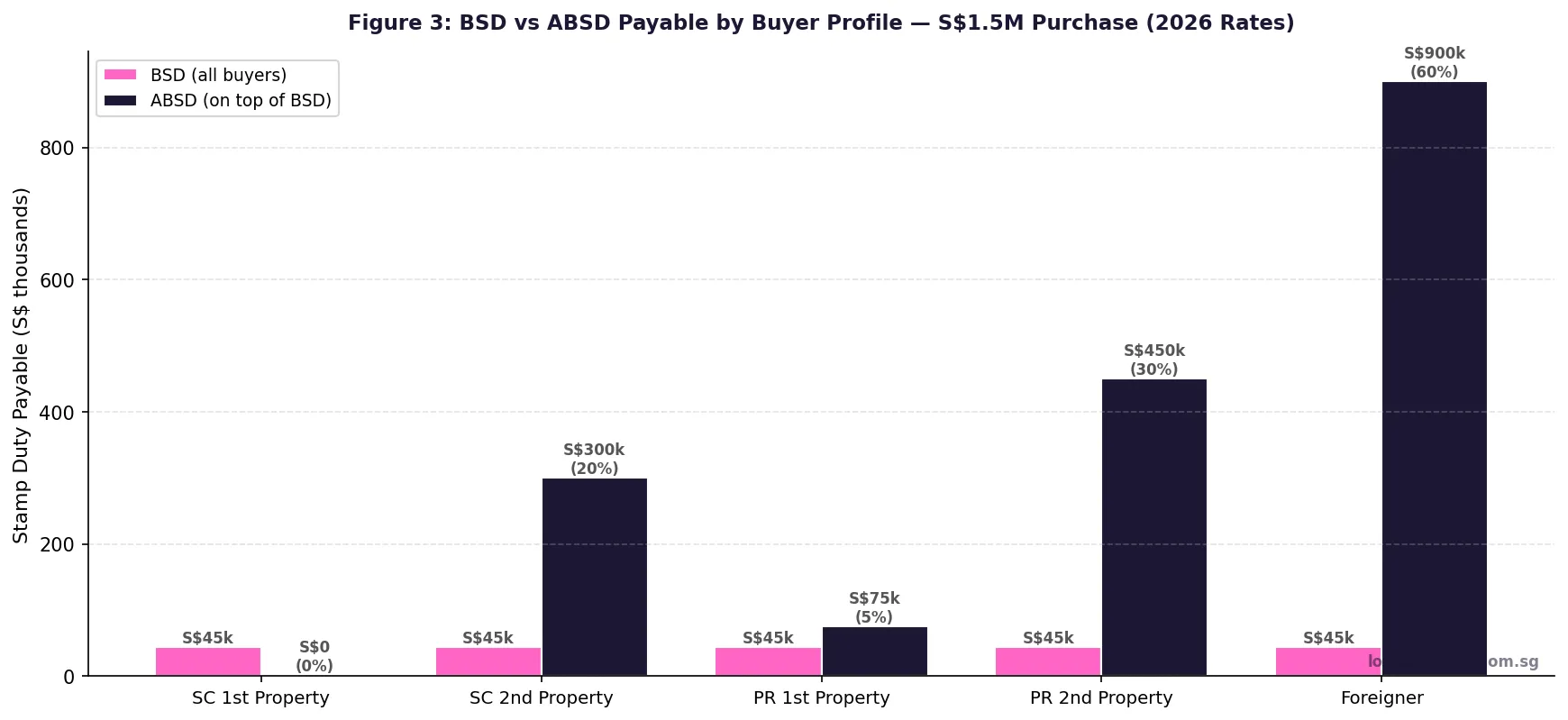
Additional Buyer’s Stamp Duty (ABSD) applies to SC buyers purchasing a second or subsequent residential property, and to all PR and foreigner buyers. ABSD rates in 2026 are: SC 2nd property 20%, SC 3rd+ 30%, SPR 1st property 5%, SPR 2nd+ 30%, foreigners 60%. For a full ABSD breakdown, see our ABSD Singapore 2026 Complete Guide. ABSD is also due within 14 days of exercise.

Both BSD and ABSD can be paid from CPF Ordinary Account (for residential property). However, ABSD amounts for second properties are substantial — for example, a SC buying a S$1.5M second property pays S$300,000 in ABSD alone, which would exhaust most CPF balances. The ABSD remission scheme allows SC couples who are upgraders to claim a refund of the ABSD if they sell their existing residential property within 6 months of purchasing the new one. See our Stamp Duty Remission Guide for details.

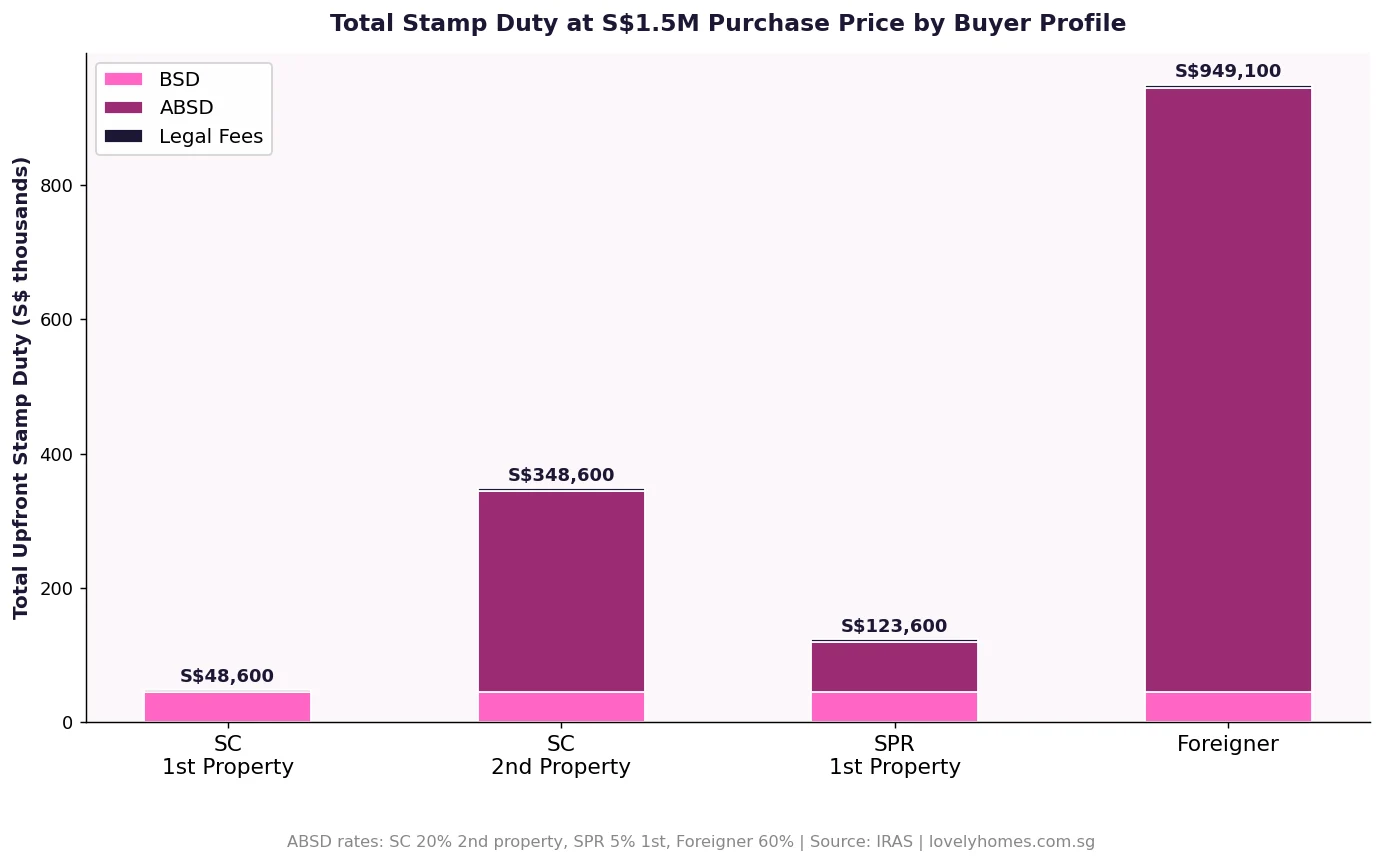
Upfront Stamp Duty and Legal Costs by Buyer Profile (S$1.5M)

Figure 2 illustrates the total upfront stamp duties and legal costs at a S$1.5M purchase price across five buyer profiles. The disparity between a SC first-time buyer (S$49,100) and a foreigner (S$944,600) underlines why Singapore’s ABSD is one of the world’s most aggressive foreign-buyer deterrents.

Upfront stamp duty and costs private property resale Singapore S$1.5M by buyer profile 2026
Figure 2: Total upfront stamp duties and legal costs at S$1.5M for five buyer profiles (Q2 2026 ABSD rates). Source: IRAS, LovelyHomes editorial.

Step 5: Arranging the Mortgage

Private property purchases must comply with the Monetary Authority of Singapore’s Total Debt Servicing Ratio (TDSR) framework. Under the TDSR, monthly debt obligations — including the new mortgage plus any existing credit facilities — cannot exceed 55% of gross monthly income. Unlike HDB loans (which have a 30% Mortgage Servicing Ratio cap), private property loans use TDSR only.

The Loan-to-Value (LTV) ratio for a first private property mortgage is up to 75%, requiring a minimum 25% downpayment (of which 5% must be in cash). For a buyer with an existing outstanding mortgage, the LTV drops to 45% (first subsequent loan). See the prior reference in our Property Downpayment Guide 2026.

Banks will commission an independent valuation of the property. If the valuation comes in below the agreed price, the bank will lend only against the valuation — meaning the buyer must fund the shortfall in cash. For example, if you agreed to pay S$1,550,000 but the valuation is S$1,500,000, the bank’s 75% LTV is based on S$1,500,000, so the buyer must fund the additional S$50,000 from cash.

For CPF usage: CPF Ordinary Account can be used for the downpayment and monthly instalments for private property up to the property’s Valuation Limit (the lower of purchase price or valuation). Beyond the Valuation Limit, the Withdrawal Limit (120% of the property value for properties with sufficient lease) applies. See our CPF for Private Property Guide 2026 for the full mechanics.

Step 6: Lodge a Caveat with the Singapore Land Authority (SLA)

Once the OTP is exercised, your solicitor should promptly lodge a Caveat with the SLA. A caveat protects your interest in the property by registering your claim against the title. It prevents the seller from selling to a third party or granting another mortgage on the same property. The caveat fee is approximately S$150–S$200. Caveats are registered via the SLA’s e-Conveyancing system.

Step 7: Completion of the Sale and Purchase

Completion is the legal transfer of title from seller to buyer. On the completion date (typically 8–12 weeks from OTP exercise), all parties’ solicitors meet (or exchange completion documents electronically via e-Conveyancing). The buyer’s solicitor pays the balance purchase price from the mortgage loan drawdown and any remaining CPF/cash. The seller’s solicitor receives the funds and transfers title.

At completion, the seller’s outstanding mortgage is discharged from the sale proceeds. The SLA registers the transfer of title and the buyer’s new mortgage. The buyer’s solicitor registers the mortgage instrument. Typically, keys are handed over on the completion date or shortly thereafter.

Singapore Resale Condo Price Ranges by Region and Unit Type (Q1 2026)

Figure 3 illustrates indicative resale condo price ranges by unit size and region. The Core Central Region (CCR — Districts 9, 10, 11, and the Downtown Core) commands the highest prices, particularly for larger units. The Outside Central Region (OCR) offers the widest value range for buyers seeking more affordable entry points.

Singapore resale condo price ranges by unit type and region OCR RCR CCR Q1 2026
Figure 3: Indicative resale condo price ranges by unit type and region, Q1 2026. Error bars show typical market range. Source: URA Resale Transactions data, LovelyHomes editorial.

Private Resale Process at a Glance: Key Facts Table

Stage Who Acts Key Deadline Typical Cost
Engage solicitor Buyer Before OTP S$3,500–S$5,000
Grant OTP / Option Fee (1%) Seller grants, Buyer pays At agreement 1% of price (cash)
Exercise OTP (4%) Buyer Within 14 days 4% of price (cash/CPF)
BSD + ABSD payment Buyer via solicitor 14 days from exercise Varies (BSD + any ABSD)
Lodge caveat (SLA) Buyer’s solicitor Promptly after exercise ~S$150–S$200
Mortgage drawdown Buyer / Bank Before completion Bank valuation fee S$300–S$700
Completion / Key collection Both solicitors 8–12 weeks from exercise Balance purchase price

Worked Example: The Kumar Family Buying a Resale 3-Bedroom in the RCR

Scenario: SC Couple, First Private Property, Selling Their HDB

Mr Kumar (38, SC) earns S$9,500/month; Mrs Kumar (36, SC) earns S$8,800/month. Joint income: S$18,300/month. They currently own an HDB flat (5-room, Tampines) with no outstanding mortgage. They wish to upgrade to a private resale 3-bedroom condo in the RCR.

  • Target unit: 3-bedroom resale condo, RCR (District 3), 1,000 sqft, freehold.
  • Agreed price: S$2,100,000
  • Bank valuation: S$2,050,000 (shortfall S$50,000 — must fund in cash)
  • BSD: S$74,600 (progressive on S$2,100,000: 1% × S$180K + 2% × S$180K + 3% × S$640K + 4% × S$500K + 5% × S$600K = S$74,600)
  • ABSD: 20% × S$2,100,000 = S$420,000 (SC 2nd property — HDB still owned at time of purchase)
  • ABSD remission plan: The Kumars plan to sell their HDB flat within 6 months of completion. If sold within 6 months, ABSD S$420,000 is refunded by IRAS. They pay ABSD upfront and claim the remission later.
  • Loan (75% LTV on valuation S$2,050,000): S$1,537,500 at 3.1% p.a., 30 years → S$6,567/month
  • TDSR check: S$6,567 ÷ S$18,300 = 35.9% (below 55% cap — PASS)
  • Downpayment (25% of S$2,050,000): S$512,500 (5% cash = S$102,500 + 20% CPF = S$410,000)
  • Price shortfall (purchase price above valuation): S$50,000 (cash)
  • Total cash at exercise and completion: Option fee S$21,000 (1%) + exercise S$84,000 (4%) + BSD S$74,600 + ABSD S$420,000 + valuation shortfall S$50,000 + legal S$5,200 + CPF mortgage arrangement S$0 = S$654,800 gross cash outlay (S$234,800 net after ABSD remission assuming HDB sold within 6 months)

Key takeaway: The Kumars’ biggest cash item is the upfront ABSD of S$420,000 — which they recover after selling the HDB. The net out-of-pocket (excluding ABSD) is approximately S$234,800. Planning the HDB sale timeline to remain within the 6-month remission window is critical.

Why the Private Resale Market Has Structural Depth

Unlike new launches, where pricing is controlled by the developer and buyers often face limited negotiation leverage, the resale market allows genuine price discovery between informed parties. This creates opportunities for buyers who do thorough research — understanding block-level transaction data, comparable lease terms, and development-specific factors like upcoming en-bloc potential, MCST financial health, and facilities.

The resale market also offers a distinct advantage: immediate occupation. For families with school enrolment timelines, existing rental commitments, or home sale proceeds that need to be redeployed promptly, the 10–14 week completion window is a significant operational benefit over a 3–5 year new-launch wait.

Resale buyers are also protected by a more mature legal framework. The Law Society Conditions of Sale provide standardised terms. The conveyancing system is transparent, title searches are reliable, and disputes are resolvable via the High Court or the Small Claims Tribunal (for deposits and agent disputes).

What Might Come Next for Singapore’s Private Resale Market?

This section reflects editorial analysis and forward-looking opinion, not a guarantee of future market performance.

The private resale market in 2026 is characterised by moderate volumes and selective price growth. OCR resale condos have held up well due to strong HDB upgrader demand — particularly from families exiting their MOP-completed BTO flats and entering the private market for the first time. CCR volumes remain relatively subdued as the 60% ABSD on foreign buyers has largely eliminated the speculative froth that characterised 2010–2013.

Looking ahead, the GLS tender pipeline — including sites at River Valley Green Parcel C (tendered June 2026), Town Hall Link white site (July 2026), and several OCR sites — will deliver new supply from 2028 onwards. This supply pipeline, while healthy, is not expected to flood the market given construction cost inflation and developer pricing discipline. The 2H2026 GLS Confirmed List of nine sites yielding approximately 4,745 residential units is broadly consistent with household formation rates and replacement demand.

For resale buyers, the near-term window before new-launch supply hits the market in volume (2027–2028) may represent a relative opportunity for well-priced resale units in established OCR and RCR estates.

Frequently Asked Questions: Buying Private Resale Property in Singapore

Can buyer and seller use the same solicitor?

No. Buyer and seller in a private property transaction must each engage their own separate law firm. This is a professional conduct requirement under the Legal Profession (Professional Conduct) Rules. Having the same solicitor act for both parties creates a conflict of interest — the solicitor cannot independently advise each party on a transaction where interests may diverge. In practice, buyers sometimes attempt to share a solicitor to save costs; this is not permitted for private property transactions (though an exception exists for certain straightforward HDB transactions under specific conditions).

What happens if my bank valuation comes in below the agreed price?

If the bank’s independent valuation of the property is lower than the agreed purchase price, the bank will only lend based on the lower valuation. The buyer must fund the difference (the shortfall between valuation and price) entirely in cash. CPF cannot be used for amounts above the valuation, and the ABSD is still calculated on the actual purchase price (the higher amount). For example, if you paid S$1,600,000 for a unit valued at S$1,550,000, you fund the S$50,000 shortfall in cash; BSD and ABSD are calculated on S$1,600,000. Buyers can seek a second valuation from a different valuer if they believe the first is too conservative, but banks are not obliged to accept it.

What is a Diplomatic Clause and should I request one?

A Diplomatic Clause is a lease termination right inserted into a tenancy agreement (not a purchase OTP). It allows a tenant to terminate an ongoing tenancy early if they are required to relocate due to work reasons (typically due to a transfer or job loss). It typically kicks in after a minimum period (commonly 12–14 months) with 2 months’ notice. It is relevant for buyers who intend to rent out the unit before moving in or while relocating — they would negotiate a Diplomatic Clause into the tenancy they offer to their tenant, not into the OTP for the purchase. It is standard practice for developments popular with expatriate tenants in CCR and RCR.

Does ABSD apply if I buy a private property with my spouse for the first time?

If both you and your spouse are Singapore Citizens purchasing your first residential property together, no ABSD applies. SC buyers (individually or jointly) are exempt from ABSD on their first residential property. If one spouse already owns property (including overseas property counts for ABSD purposes), ABSD will apply based on the higher-count buyer’s profile. For example, if you own an HDB flat (first property) and your spouse does not, joint purchase of a private condo is treated as a second property for ABSD purposes — the 20% SC 2nd-property ABSD applies on the entire purchase price. Decoupling strategies (where one party transfers their share to the other) may be considered to reset the count; see our Joint Property Ownership Guide for the decoupling mechanics and costs.

What are the key differences between buying a new launch condo and a resale condo?

There are several material differences. New launches are purchased from a developer during a preview/balloting period using the standard Sale and Purchase Agreement (SPA) under the Housing Developers (Control and Licensing) Act, with a progressive payment schedule as construction milestones are met. Resale purchases use an OTP and a Law Society SPA, with full payment at completion. New launches typically offer developer discounts and stamp duty absorption deals near launch, but buyers wait 3–5 years for completion. Resale condos allow immediate occupation and give you a complete picture of the actual unit, renovation condition, view, and development quality before committing. Resale buyers can also inspect the MCST accounts in detail before purchase, something impossible for a new launch. Price transparency also favours resale — URA publishes every resale transaction, whereas new-launch prices require asking agents or checking URA REALIS.

Can I negotiate below the seller’s asking price?

Yes — negotiation is standard in the private resale market. Reference points for your offer include: recent comparable transactions in the same development (from URA Resale Transactions data), the property’s age and condition, any pending special levies or MCST deficits, how long the unit has been listed, and the seller’s motivation (e.g., upgrading, emigrating, financial pressure). In a buyers’ market (higher inventory, slower volume), 3–8% below asking is not unusual for motivated sellers. In a tight market (low inventory, fast absorption), properties can transact at or above asking. Always let the bank’s independent valuation inform your offer ceiling — paying significantly above valuation means funding the excess in cash without CPF or loan coverage.

Do I need a property agent to buy a resale condo?

No — there is no legal requirement to engage a buyer’s agent for a private resale transaction. However, a buyer’s agent provides value through: identifying suitable listings and arranging viewings; interpreting transaction data to assess fair market value; negotiating the OTP price and conditions; and coordinating between the solicitors and seller’s agent. Buyer’s commission for private resale is typically not charged to buyers directly — it is paid by the seller via a co-broking arrangement with the seller’s agent. Effectively, you get buyer’s representation at no direct cost in most resale transactions. For those who proceed without an agent, ensure your solicitor reviews the OTP carefully before exercise, and do your own comparable transaction research via URA REALIS.

Related Articles


Disclaimer: The information in this article is for general educational purposes only and does not constitute financial, investment, or legal advice. Stamp duty rates, CPF rules, LTV limits, and property market conditions are subject to change by the relevant Singapore government bodies. Verify current rates and rules with IRAS (iras.gov.sg), HDB (hdb.gov.sg), CPF Board (cpf.gov.sg), URA (ura.gov.sg), and the Monetary Authority of Singapore (mas.gov.sg). All property transactions should be conducted through a licensed solicitor for conveyancing. Engage a Council for Estate Agencies (CEA)-licensed property agent if you require professional property advisory services.

Singapore Stamp Duty Remission Guide 2026: ABSD Upgrader Refunds, Married Couple Exemptions and How to Apply

Singapore Stamp Duty Remission Guide 2026: ABSD Upgrader Refunds, Married Couple Exemptions and How to Apply

Stamp duty in Singapore is not one-size-fits-all. The government has deliberately built a system of remissions and exemptions that recognise legitimate circumstances — the upgrading family, the divorcing couple, the deceased estate, the registered charity — and provides a mechanism to recover the stamp duty paid, or to pay a lower rate in the first place. Understanding these remissions is not an advanced topic for lawyers; it is practical knowledge that can save a Singapore family anywhere from S$40,000 to well over S$1,000,000 in upfront costs.

This guide explains every major stamp duty remission available in Singapore in 2026 — who qualifies, how much is refunded, how to apply, and what the key deadlines are. The framework is administered by the Inland Revenue Authority of Singapore (IRAS) under the Stamp Duties Act (Cap 312). All rates reflect the 27 April 2023 cooling measures, which remain in force.

Quick Answer — Stamp Duty Remissions at a Glance

  • ABSD Upgrader Remission: SC and SPR second-property buyers who sell their existing home within 6 months of completion can reclaim the full ABSD paid (20% for SC; 30% for SPR).
  • Married Couple Remission: Couples where at least one party is a Singapore Citizen buying their first joint residential property together pay 0% ABSD regardless of the other party’s nationality (subject to conditions).
  • Divorce / Court Order: A court-ordered transfer of property between divorcing spouses may attract an ABSD remission or BSD exemption on a case-by-case basis.
  • Death and Inheritance: Properties transferred from a deceased estate to beneficiaries are exempt from ABSD under s.74 of the Stamp Duties Act.
  • SSD Exemptions: Properties sold under en-bloc, compulsory acquisition, court order (divorce/death), or gifted to lineal descendants are exempt from Seller’s Stamp Duty.
  • BSD Remissions: Rare — mainly for government bodies, charities, and certain trust arrangements. Most individual buyers do not qualify for BSD remission.
  • All remission claims are filed at myTax Portal → Stamp Duty → Apply for Remission. ABSD remissions for upgraders require documentary proof of the sale of the existing property.
  • The key upgrader deadline is 6 months from completion of the new purchase to sell the existing property. Miss this window and the ABSD paid is forfeited.

What Is Stamp Duty Remission?

A remission is a partial or full waiver of stamp duty that would otherwise be payable. Unlike an exemption (which means the duty was never due), a remission often means the duty is paid upfront and then refunded once the qualifying conditions are met. The Ministry of Finance (MOF) and IRAS administer Singapore’s remission framework under Part IV of the Stamp Duties Act. The rationale is to avoid distorting legitimate property transactions — particularly family upgrading, matrimonial transfers, and estate administration — while still collecting duty on speculative purchases.

There are three types of stamp duty in Singapore where remissions may arise:

  • Additional Buyer’s Stamp Duty (ABSD): The most significant remissions. ABSD can be 0–65% of purchase price depending on buyer profile. Remissions here can be worth hundreds of thousands of dollars.
  • Buyer’s Stamp Duty (BSD): Remissions are rare and mainly apply to non-individual entities (charities, government bodies). Most homebuyers do not benefit from BSD remission.
  • Seller’s Stamp Duty (SSD): Certain exit scenarios — en-bloc, compulsory acquisition, divorce, death — are exempt from SSD even within the 4-year holding period.
Singapore ABSD remission scenarios and eligibility by buyer profile 2026
Figure 1: ABSD Remission Scenarios — Eligibility Matrix by Buyer Profile (IRAS 2026). Click to expand.

ABSD Upgrader Remission — The Most Common Remission in Singapore

The ABSD Upgrader Remission is the single most commonly used remission in Singapore and affects tens of thousands of families each year. It applies when a Singapore Citizen or Singapore Permanent Resident purchases a second residential property while still owning an existing one, intending to sell the existing property after moving into the new one.

How It Works

Under the current rules, a Singapore Citizen purchasing a second residential property must pay ABSD at 20% of the purchase price at the point of signing the Option to Purchase (OTP) or Sale and Purchase (S&P) Agreement — within 14 days. The duty is paid first; the remission is claimed after the fact. If the buyer subsequently sells the existing property within 6 months of completing the new purchase, they may apply to IRAS for a full refund of the ABSD paid. The same mechanism applies to Singapore PRs purchasing a second property at the 30% ABSD rate.

Buyer Profile ABSD Rate Remission Available? Key Condition
SC buying 2nd property 20% Yes — full 20% refund Sell existing within 6 mths of completion
SPR buying 2nd property 30% Yes — full 30% refund Sell existing within 6 mths of completion
SC buying 3rd+ property 30% No — not eligible Must only hold one other property for remission to apply
Foreigner buying any property 60% No (except FTA nationals on 1st property) No upgrader remission for foreigners
Entity (company/trust) 65% Case-by-case only Qualifying trust structures may apply — see IRAS guidelines

The Critical 6-Month Deadline

The 6-month window runs from the date of completion of the new purchase — not from the date you sign the OTP. For a new launch condominium, completion (when the keys are handed over) may be 3 to 5 years after you sign the OTP. This means upgraders buying off-plan have a generous window: the clock only starts ticking when TOP is obtained and legal completion occurs. For resale properties, completion is typically 8 to 12 weeks after signing the OTP, so the window is tighter in practice.

If you miss the 6-month deadline, IRAS will not extend it except in very exceptional circumstances (documented illness, death in the immediate family, force majeure). Do not rely on an extension being granted.

Worked Example — The SC Upgrader

Mr & Mrs Tan are Singapore Citizens who own a Tampines 5-room HDB flat purchased in 2019. In March 2026, they sign an OTP for an Orchard Rd 2BR condominium at S$2,200,000. Within 14 days, they pay:

  • BSD: S$79,600 (progressive: 1% on first S$180,000 + 2% on next S$180,000 + 3% on next S$640,000 + 4% on next S$500,000 + 5% on next S$700,000)
  • ABSD at 20%: S$440,000
  • Total stamp duties upfront: S$519,600

They list their HDB flat and complete the sale in August 2026 — 5 months after the new condominium’s completion date in July 2026. They then apply to IRAS for the ABSD remission. IRAS processes the claim and refunds S$440,000 within approximately 4 to 6 weeks. The Tan family’s net stamp duty cost is thus S$79,600 (BSD only) — exactly the same as a first-time buyer at the same purchase price.

ABSD dollar savings for SC upgrader remission 2026 comparison chart
Figure 2: ABSD Dollar Savings — SC Upgrader 2nd-Property Remission at Various Price Points (IRAS 2026). Click to expand.

Married Couple Remission — Buying Your First Home Together

The Married Couple Remission (formally the “remission for married couple purchasing first residential property together”) addresses a common scenario: a Singapore Citizen marrying a foreigner or a Permanent Resident, where the couple’s combined nationalities would otherwise attract a higher ABSD rate.

Who Qualifies

The conditions are strict. At the time of purchase, the couple must be legally married (not merely cohabiting). At least one party must be a Singapore Citizen. The property must be their first jointly-owned residential property in Singapore — neither party may own any other residential property in Singapore at the time of purchase. If either party already owns a property, the remission does not apply.

Couple Profile Rate Without Remission Rate With Remission Saving at S$1.5M
SC + SC (both first property) 0% 0% Nil (no ABSD to begin with)
SC + SPR (first joint purchase) 5% (SPR 1st rate) 0% S$75,000
SC + Foreigner (first joint purchase) 60% (foreigner rate) 0% S$900,000
SC (existing property) + SPR 20% (SC 2nd) or 5% (SPR 1st) Not eligible — SC already owns property No remission

The most significant application is the SC + Foreigner couple. Without the remission, buying a S$2,000,000 condominium would attract ABSD of S$1,200,000 (foreigner rate of 60%). With the Married Couple Remission, ABSD falls to nil — a saving of S$1,200,000 at that price point. This is why the remission is one of the most financially impactful pieces of property law for internationally mixed families in Singapore.

It is important to note that the remission applies at the time of purchase — the couple does not pay ABSD first and then reclaim it. The conveyancing solicitor applies for the remission before e-Stamping the instrument of transfer, and if approved, the stamp duty assessed is nil ABSD from the outset.

Divorce and Court-Ordered Transfers

When a court orders a matrimonial property to be transferred between spouses as part of a divorce settlement, the question of stamp duty arises. Singapore law provides relief in two forms. First, BSD may be remitted on a court-ordered transfer of a matrimonial home between divorcing spouses — the instrument of transfer lodged pursuant to a court order is submitted to IRAS with the order attached, and IRAS will assess whether BSD is payable. Second, an ABSD remission may be available where the transfer results in one party holding the property as their sole property (so the ABSD for a second property would not apply after the divorce).

These cases are assessed on the specific facts by IRAS. Engage a conveyancing solicitor with experience in divorce property transfers to ensure the application is properly structured and timed. The Stamp Duties Act s.15 provides the general power for IRAS to remit duty; ministerial notifications specify which scenarios qualify.

Deceased Estates and Inheritance

When a property owner dies, the transmission of their property to their beneficiaries under a will or intestacy is not an arm’s length commercial transaction. Singapore law accordingly exempts transfers by way of transmission on death from ABSD (Stamp Duties Act s.74). BSD may still be payable on the transmission instrument, but IRAS has published guidance noting that the transmission of property from a deceased to a beneficiary under an approved will or intestacy is generally exempt from stamp duty provided it is not a sale. Families dealing with an estate should confirm the exact position with their estate lawyer, as the specific structure of the transfer (assent, deed of family arrangement, court order of distribution) affects the stamp duty treatment.

Qualifying Remissions for Trusts

Trusts are a more complex area. IRAS has issued guidelines on ABSD for trust arrangements. Generally, where a residential property is transferred into a trust, ABSD is chargeable at 65% — the rate for entities — unless specific conditions are met. The main qualifying condition for a lower ABSD rate (or nil ABSD) is that the trust is an irrevocable discretionary trust whose beneficiaries are all Singapore Citizens. The ABSD is then assessed at the applicable individual rate for the beneficiaries’ profile rather than the entity rate. This area is highly technical and requires legal and tax advice before any trust structure is implemented.

Seller’s Stamp Duty (SSD) Exemptions

The SSD exemptions are discrete scenarios where the duty simply does not arise, even within the 4-year holding period introduced on 4 July 2025 (rates: 16% / 12% / 8% / 4% in Years 1–4). The following transactions are exempt from SSD:

  • En-bloc (collective sale): A property sold as part of a collective sale under the Land Titles (Strata) Act is exempt from SSD regardless of how recently the individual unit was purchased. This is a significant carve-out for owners whose development is acquired en-bloc within their first 4 years of ownership.
  • Compulsory acquisition by the State: Where Singaporean authorities acquire a property under the Land Acquisition Act, SSD is not payable.
  • Court order (divorce): A property transferred pursuant to a divorce court order is exempt from SSD.
  • Death: Transmission of a property on the death of the owner is exempt from SSD.
  • Gift to lineal descendants: A property gifted (not sold) to a child, grandchild, or other lineal descendant is exempt from SSD, provided the gift is not commercially motivated and no consideration passes.
  • Industrial SSD exemptions: Industrial properties have their own regime (15%/10%/5% over 3 years). The same categories of exemption — compulsory acquisition, death, court orders — apply.
ABSD remission application process steps and deadlines for SC SPR upgrader Singapore 2026
Figure 3: SC/SPR Upgrader ABSD Remission — Step-by-Step Process & Key Deadlines (IRAS 2026). Click to expand.

How to Apply for an ABSD Remission — Step by Step

The process for claiming an ABSD remission for upgraders is well-defined. Your conveyancing solicitor will typically guide you through it, but understanding the steps independently protects you from missing a critical deadline.

  1. Sign OTP or S&P Agreement on the new property. This triggers the 14-day deadline to pay stamp duties (BSD + ABSD).
  2. Pay BSD and ABSD within 14 days via IRAS e-Stamping or through your solicitor. Note: you must pay ABSD upfront even if you intend to claim a remission. Failure to pay by the deadline incurs penalties.
  3. Complete the new property purchase. For resale, this is typically 8–12 weeks after OTP. For new launches, this is when TOP is issued and legal completion occurs (potentially years later).
  4. Sell your existing property within 6 months of the completion date of the new purchase. Sign the OTP, exercise it, and complete the sale — all within the 6-month window.
  5. File the remission claim at IRAS. Go to myTax Portal → Stamp Duty → Apply for Remission. You must file the claim within 6 months of completing the sale of your existing property (i.e., there are two successive 6-month windows).
  6. Submit supporting documents: Completion Statement for the new property, Option to Purchase and Sale & Purchase Agreement for the existing property, Completion Statement confirming the sale of the existing property, and your identity documents.
  7. Receive the refund. IRAS typically processes approved claims within 4 to 6 weeks and credits the refund to the bank account or solicitor’s account you specify.

For married couple remissions, the process is different: your solicitor applies before stamping, submitting the marriage certificate and statutory declarations confirming neither party owns other Singapore residential property. If approved, the instrument is stamped at nil ABSD from the outset.

Common Mistakes and Pitfalls

The most frequent error is missing the 6-month sale deadline. This can happen when sellers are over-confident about finding a buyer, or when the sale falls through at the last minute and the window cannot be recovered. A second common error is assuming the remission applies when one spouse already owns a property — the Married Couple Remission requires both parties to have no existing residential property in Singapore. A third pitfall is failing to maintain the marriage: if a couple applies for the Married Couple Remission and subsequently divorces or annuls the marriage, IRAS may claw back the remission.

Tax professionals also warn against structuring a trust to access lower ABSD rates without proper advice. IRAS scrutinises trust arrangements and applies a facts-and-circumstances test. An arrangement that appears primarily tax-motivated rather than genuinely estate-planning-driven risks being disregarded, with ABSD assessed at the 65% entity rate.

What This Means for You

Singapore’s stamp duty remission framework is materially generous for families following the conventional housing ladder: HDB flat → private property, with a short overlap period. A Singapore Citizen couple upgrading from their HDB flat to a S$1,800,000 condominium will pay S$360,000 in ABSD upfront, but recover every dollar of it within 6 months if they sell the HDB flat on schedule. The net stamp duty cost is simply BSD — S$56,600 at that price, equivalent to 3.1% of the purchase price.

The framework is less generous for those who want to hold multiple properties simultaneously. There is no remission for a Singapore Citizen buying a third property; the 30% ABSD is final. For SPRs and foreigners, the investment calculus must factor in the full ABSD cost as a permanent drag on returns.

The one area where policy may evolve is the trust ABSD regime. The government has signalled that it will continue to monitor whether trust structures are being used to circumvent the cooling measures, and further tightening cannot be ruled out.

Frequently Asked Questions

Can I claim the ABSD upgrader remission if I buy a new launch before my HDB MOP expires?

No. If your HDB flat is still within its Minimum Occupation Period (MOP) — typically 5 years for standard BTO flats, 10 years for Plus/Prime location flats — you are prohibited from privately listing or selling it. This means you cannot sell your HDB flat within the required 6-month window after completing the new purchase. You would therefore be unable to claim the ABSD remission, and the 20% (SC) or 30% (SPR) ABSD paid on the new purchase would be forfeited. Wait until your MOP is completed before purchasing a second property if you intend to rely on the upgrader remission.

What documents does IRAS require for an ABSD remission claim?

You will need: (1) the Instrument of Transfer (stamp certificate) for the new property showing the ABSD paid; (2) the Completion Statement for the new property purchase; (3) the executed Option to Purchase and Sale & Purchase Agreement for the existing property sold; (4) the Completion Statement for the sale of the existing property confirming completion date and proceeds; (5) NRIC / passport copies of the purchasers; and (6) if applicable, proof of marriage (for Married Couple Remission). Your conveyancing solicitor will typically compile this package. IRAS may request additional documents and will reject incomplete applications.

If I paid ABSD on a new launch in 2023 and the TOP is only in 2027, when does the 6-month window start?

The 6-month window starts from the date of legal completion of your new property purchase. For new launch condominiums, this is the date when the developer issues the Certificate of Statutory Completion (CSC), the TOP is obtained, and legal completion takes place — not the date you signed the OTP. So if you signed the OTP in 2023 and TOP/completion is in 2027, you have until approximately 6 months after the 2027 completion date to sell your existing property and file the remission claim. This gives upgraders buying off-plan a significantly longer window than resale purchasers.

Can both the BSD and the ABSD be refunded via remission?

BSD and ABSD are treated separately. The ABSD upgrader remission refunds only the ABSD — not the BSD. BSD is considered a fundamental transaction tax on the acquisition of property and is not remitted for individual buyers under the upgrader framework. The Married Couple Remission also applies only to ABSD (bringing it to nil), not to BSD. BSD remains payable in all standard purchases regardless of remission status. The only scenarios where BSD may be waived are very narrow: government-linked acquisitions, certain approved charities, and specific statutory transfers.

What happens if I cannot sell my existing property within 6 months?

If you miss the 6-month deadline, you lose the right to claim the ABSD remission and the amount paid (20% or 30% of the purchase price) is forfeited. IRAS does not routinely grant extensions. In exceptional cases — certified medical incapacitation of the owner, death of an immediate family member, or an Act of God materially preventing the sale — IRAS may consider an appeal with supporting documentation, but this is discretionary and not guaranteed. Property market conditions (“I could not find a buyer at the price I wanted”) are not accepted as grounds for extension. Plan your sale timeline carefully and engage a property agent well in advance of the deadline.

Does the ABSD upgrader remission apply to the purchase of a commercial or industrial property?

No. The ABSD upgrader remission applies exclusively to the purchase of residential properties (landed houses, apartments, condominiums, executive condominiums before privatisation). Commercial properties (shophouses, offices, retail units) and industrial properties (factories, warehouses) do not attract ABSD in the first place — they are subject only to BSD. There is no equivalent upgrader remission mechanism for commercial or industrial property. The SSD industrial exemptions discussed above are separate and concern selling, not buying.

Is there a remission if my spouse and I decouple ownership of our property?

Decoupling — where one co-owner transfers their share to the other so that the transferee becomes the sole owner and the transferor becomes a “first-time buyer” for ABSD purposes on a future purchase — is a legal strategy but does not enjoy a special remission. BSD is payable by the transferee on the share acquired (at the standard progressive rates). There is no BSD or ABSD remission specifically for decoupling transfers. The tax cost of the decoupling (BSD on the transferred share plus legal and valuation fees) must be weighed against the ABSD saving on the future purchase. IRAS treats the transfer at market value and will assess BSD on the higher of the consideration paid or the market value.

Related Articles

Disclaimer

This article is published for general informational purposes only and does not constitute legal, tax, or financial advice. Stamp duty rates, remission conditions, and application procedures are subject to change by the Ministry of Finance and IRAS. Always refer to the IRAS Stamp Duty website and the Stamp Duties Act (Cap 312) on Singapore Statutes Online for the authoritative and current position. Seek independent legal and tax advice from a qualified Singapore solicitor or tax practitioner before making property decisions. LovelyHomes does not accept liability for any decisions made in reliance on this article.

Buying Property Near Top Schools in Singapore 2026: Complete Guide

Buying Property Near Top Schools in Singapore 2026: Complete Guide

📌 Quick Answer: Buying Property Near Top Schools in Singapore 2026

  • School proximity drives property premiums: homes within 1 km of an oversubscribed primary school can command 8–18% higher prices than comparable homes 2 km away, depending on the district.
  • MOE’s Phase 2C priority gives Singapore Citizens living within 1 km of a school priority registration places before those living within 2 km — making the 1 km radius the most prized zone.
  • Bukit Timah, Novena, and Queenstown carry the largest school-proximity premiums; Jurong and Tampines carry the smallest, though still meaningful.
  • Not all popular schools are equally scarce: a school oversubscribed at Phase 2C is the one that matters for the proximity premium. Schools that regularly have vacancies at Phase 2C generate no meaningful price premium.
  • HDB resale flats near top schools are significantly cheaper entry points than condos and still qualify for Phase 2C priority as long as your registered address is within the distance cut-off.
  • The premium is time-limited: once your child has secured a place, the school-proximity rationale diminishes and you may be able to upsize or relocate without premium pricing.
  • Distance is measured straight-line from the main gate of the property to the school’s main gate using MOE’s official measurement tool — not Google Maps driving distance.
  • Verify distance before transacting: even 50 metres can determine whether you fall inside or outside the 1 km cutoff, so always use the MOE School Finder to confirm.

Why School Proximity Matters in Singapore Property

Singapore’s Primary 1 (P1) registration system is one of the most consequential drivers of residential property demand in the country. Unlike many education systems where school admission is determined purely by merit or choice, Singapore’s Phase 2C priority system gives automatic preference to children living closest to a school when balloting places are contested. This policy — administered by the Ministry of Education (MOE) — has created a predictable and enduring link between residential addresses and primary school access, making the 1 km radius around any oversubscribed primary school one of the most reliably valued assets in the Singapore property market.

For parents weighing their next property purchase, understanding how the P1 registration phases work, which schools generate meaningful premiums, and how to quantify the value of proximity is not a luxury — it is a core part of the buying decision. For investors who do not have school-going children, the same proximity premium represents a defensible demand floor that tends to support property values even through softer markets.

This guide explains the MOE priority phase system in full, maps the districts and schools that generate the largest premiums, provides a worked example of the financial implications, and offers a framework for deciding whether the school-proximity premium is worth paying for your specific situation.

MOE primary school priority registration phases 2026 Singapore Phase 2C 1km 2km
Figure 1: MOE Primary School Priority Registration Phases 2026 — Phase 2C gives priority to Singapore Citizens within 1 km first, then 2 km. Source: Ministry of Education Singapore.

MOE Primary 1 Registration Phases — How Proximity Works

The P1 registration exercise is structured in phases that proceed in order of priority. A school only opens to later phases if vacancies remain after earlier phases are filled. The relevant phases for proximity are Phase 2B and Phase 2C.

Phase 2B gives priority to children whose parents are active volunteers at the school (40 hours per year for at least the preceding year), who have community or CCA connections to the school, or whose parents are of the relevant religious affiliation for mission schools. Within Phase 2B, if there are more applicants than places, children living within 2 km of the school are given priority over those living further away. Distance matters even here.

Phase 2C is the general registration phase for all Singapore Citizens. This is where proximity becomes most critical. If the number of Phase 2C applicants exceeds the remaining vacancies, MOE ballots first among children living within 1 km of the school, then — if vacancies remain — among those living within 2 km, and finally — if still not full — among those living further away. For the most oversubscribed schools, the ballot has historically been decided entirely within the 1 km tier, meaning that a family living at 1.1 km may receive no priority whatsoever.

Phase 2C Supplementary covers Singapore Permanent Residents after all Singapore Citizen applicants have been processed. Phase 3 covers non-PR foreigners and is only relevant if the school still has vacancies after all citizen and PR phases are complete — an unusual scenario for popular schools.

Which Schools Generate the Largest Property Premiums?

Not every primary school generates a proximity premium. The premium is driven by two factors working together: the school’s perceived academic and co-curricular reputation, and its level of oversubscription at Phase 2C. A school that clears all its places by Phase 1 or Phase 2A1 (alumni parents’ children) before Phase 2C is even reached is effectively inaccessible via proximity alone — distance does not help if the school fills up before the distance-based phases. Conversely, a school with consistent Phase 2C balloting in the 1 km zone generates a hard, measurable demand for nearby addresses.

The schools that have historically generated the most sustained proximity premiums — based on their consistent oversubscription at Phase 2C and their reputation — cluster in the following districts: Bukit Timah (District 21), Novena and Newton (District 11), Queenstown and Buona Vista (District 10), Bishan and Ang Mo Kio (District 20), and Marine Parade (District 15). These areas also happen to be among Singapore’s most expensive residential districts for reasons beyond schools alone, which makes it challenging to isolate the school premium precisely.

Property price premium near top schools Singapore districts 2025 1km vs 2km
Figure 2: Indicative Resale Price Premium — within 1 km of a top primary school vs. beyond 2 km, by district (2025 data). Source: URA resale caveats and industry analysis. Not financial advice.

Key Districts and Their School-Proximity Premium Characteristics

District Notable Schools Typical Premium (1km vs 2km+) Property Type
Bukit Timah (D21) Nanyang Primary, Methodist Girls’ Primary 15–20% Landed, high-end condo
Novena / Newton (D11) Anglo-Chinese School (Primary), Saint Joseph’s Institution Junior 14–18% Condo, terrace
Queenstown / Buona Vista (D10) Raffles Girls’ Primary, Henry Park Primary 13–17% Condo, HDB (older)
Bishan / Ang Mo Kio (D20) Ai Tong School, Catholic High Primary, Pei Hwa Presbyterian 10–14% Condo, HDB
Marine Parade (D15) Tao Nan School, CHIJ Katong Primary 10–13% Condo, shophouse
Clementi / West Coast (D5) Nan Hua Primary, Clementi Primary 9–13% HDB, condo
Tampines / Pasir Ris (D18) Poi Ching School, Elias Park Primary 7–10% HDB, EC
Jurong East (D22) Rulang Primary, Fuhua Primary 6–9% HDB, EC

Top primary schools by district Singapore property proximity price 2026
Figure 3: Selected Top Primary Schools by District — historically oversubscribed at Phase 2C with indicative 1 km property price ranges. Source: MOE, URA. Not an official MOE ranking.

Worked Example: The Tan Family’s School-Proximity Purchase

🏫 Scenario: Tan Family, Child Entering P1 in 2028

Target school: Ai Tong School, Bishan (historically oversubscribed at Phase 2C within 1 km)

Budget: S$1.8 million for a condominium

Without school premium: A comparable 3-bedroom condo 2.5 km from Ai Tong in Ang Mo Kio averages S$1.55 million in 2025 resale.

With school premium: A comparable 3-bedroom condo within 1 km of Ai Tong averages S$1.78 million — a premium of approximately S$230,000 (14.8%).

  • The Tans have a child born in 2021, meaning P1 registration is in 2027 (for entry in January 2028).
  • They need to be registered at the address before the Phase 2C registration exercise, which typically opens in July 2027 and requires the address to be active at least 30 months before the exercise for Phase 2B purposes.
  • Break-even analysis: The S$230,000 premium represents approximately S$19,200 per year over a 12-year horizon (primary through secondary school). If the school-proximity effect sustains the property’s relative value through resale, the net cost may be substantially less — or even zero if the 1 km zone appreciates faster than the 2.5 km zone.
  • ABSD: As Singapore Citizens buying a second property, the Tans pay 20% ABSD on S$1.78 million = S$356,000. If this is their first property, no ABSD applies.

Is the School-Proximity Premium Worth Paying?

The answer depends on three variables: the school in question, the phase at which you expect to compete, and your time horizon. If you are a Phase 2B volunteer parent, you may already enjoy priority within 2 km — paying the 1 km premium may not be necessary. If you have no Phase 2B connection and the school is consistently balloted within the 1 km zone at Phase 2C, then the 1 km address is effectively a prerequisite for reasonable access, and the premium reflects a real, functional benefit rather than pure sentiment.

From a resale perspective, the proximity premium tends to be self-reinforcing in areas with good overall fundamentals (MRT access, amenities, estate quality). It is weakest in areas where the school is the sole driver of demand — in those cases, the premium may erode once your child has completed primary school and you decide to sell. The strongest investment case is therefore found where school proximity overlaps with strong general demand: Bukit Timah, Queenstown, and Bishan all fit this profile.

First-time buyers and HDB upgraders should note that HDB resale flats in the 1 km catchment area of oversubscribed schools can represent excellent value. A 4-room HDB flat in Bishan within 1 km of Ai Tong or Catholic High Primary typically transacts at S$700,000–S$900,000 in 2025 — a fraction of the condo price while qualifying for exactly the same Phase 2C priority. The trade-off is flat size, lease remaining, and the absence of condominium facilities.

What Investors Should Know About the School-Proximity Premium

For property investors without school-going children, the school-proximity premium is a demand-side floor to understand rather than a purchasing criterion. The premium is most durable in schools that are oversubscribed consistently year after year, such as those on the MOE’s School Information Service with Phase 2C balloting records visible at MOE’s P1 registration results page. Schools that recently became popular due to merger or re-branding may not sustain the same premium. URA’s transaction data, accessible at ura.gov.sg, allows investors to overlay resale transaction prices against school catchment boundaries to quantify the premium empirically for any school they are considering.

One structural risk to the school-proximity premium is MOE policy change. In 2019, MOE capped the number of children who can benefit from Phase 2B volunteerism, and has periodically adjusted how distance tiers are applied. Any future change to Phase 2C that removes or reduces the distance priority would directly erode the 1 km premium. Buyers who are paying a large premium on the basis of school access alone should keep this policy risk in mind.

🔮 Looking Ahead: Will the School-Proximity Premium Persist?

Singapore’s P1 registration system has been broadly stable for decades, and the government has shown little appetite for eliminating the distance-based priority — it is seen as a reasonable community-based principle. However, MOE has been expanding school capacity at the primary level and has encouraged parents to consider neighbourhood schools as credible alternatives to branded schools. If these efforts succeed in reducing the prestige gap between schools, the Phase 2C premium for any individual school may narrow. The safest bet remains properties in estates with multiple oversubscribed schools within range, so that the premium is supported by a cluster of demand rather than a single school. These are speculative observations — official policy may change without notice.

Frequently Asked Questions

How exactly does MOE measure the 1 km distance?

MOE measures the straight-line distance from the main entrance of your home to the main gate of the school. This is not walking distance or driving distance — it is the straight-line (crow flies) measurement. MOE uses its own GIS system to calculate this; the result may differ from Google Maps or other mapping tools by up to 100–200 metres in some cases. You can check your address against any school using the MOE School Finder tool. Always verify using MOE’s official tool before relying on any proximity claim made by a property agent or listing.

Can I use a relative’s address to get the 1 km priority?

No. MOE requires you to be genuinely registered and residing at the address provided. Using a relative’s or friend’s address to claim proximity priority is considered fraudulent and may result in the child’s application being rejected, even after a school place has been allocated. MOE conducts checks including cross-referencing with NRIC records, HDB or URA records, and utility bills. Parents found to have provided false addresses face disqualification from the registration exercise and potential legal consequences. The address must be your genuine principal place of residence at the time of registration.

Does the school-proximity premium apply to secondary schools too?

Not in the same way. Secondary school admission in Singapore is primarily determined by PSLE results (Direct School Admission aside), so residential proximity plays no formal role in secondary school access. The property premium phenomenon is therefore primarily a primary school effect. That said, some parents choose to live near certain secondary schools for practical convenience (shorter commute), and a cluster of good primary and secondary schools in the same area can create a compounding “educational belt” effect on property values — as seen in the Bishan–Ang Mo Kio corridor.

Will buying an HDB flat near a top school get me the same Phase 2C priority as a condo?

Yes. MOE’s Phase 2C priority is based on the registered residential address and its distance from the school — it does not distinguish between property types. An HDB flat within 1 km of Ai Tong School receives exactly the same Phase 2C ballot priority as a private condominium within 1 km. The key is that the address must be your genuine place of residence and registered in the HDB or URA records. For HDB buyers, note that the MOP (Minimum Occupation Period) means you must already own or purchase an HDB flat that is within 1 km — you cannot simply rent a nearby property to claim proximity.

How long before the P1 registration exercise must I live at the address?

For Phase 2C, MOE requires the child to be residing at the registered address. There is no explicit minimum duration stated for Phase 2C, but MOE may request supporting documentation. For Phase 2B (volunteer parent priority), the volunteerism must be completed in the year before registration, typically requiring at least 40 hours of actual service at the school. If you purchase a property specifically for school access, moving in at least several months before the registration exercise (which typically opens in July for January the following year) is strongly advisable to avoid any documentary issues.

What if I rent a property near the school rather than buying?

Renting is a legitimate and often lower-cost strategy for securing the proximity priority without paying the purchase premium. A tenancy agreement and utility bills in your name at a 1 km address are typically accepted as evidence of residence for MOE purposes. However, renting near a top school can itself be expensive — landlords in these catchment areas are aware of the demand and price accordingly. Rental premiums of 10–15% over comparable properties outside the catchment are not uncommon in Bukit Timah and Queenstown. If you only need the proximity for one registration year, renting for 12 months may be materially cheaper than paying the purchase premium over a longer horizon.

Are international schools affected by the same proximity rules?

No. International schools in Singapore operate under different admission frameworks set by the individual school and the Ministry of Education’s International Schools Unit. They are not subject to the MOE P1 Phase 2C priority system, so residential proximity to an international school creates no formal priority advantage. Property premiums near international schools do exist in some cases — particularly near the American School, United World College, and the German European School — but these are driven by the convenience of expatriate communities rather than any formal regulatory priority linked to the address.

Related Articles

Disclaimer: This article is for general informational purposes only and does not constitute legal, financial, or educational advice. Property prices, school admission policies, and MOE phase criteria are subject to change; always verify current rules directly with the Ministry of Education and Urban Redevelopment Authority. Price premiums cited are indicative estimates based on publicly available URA transaction data and industry analysis — they are not financial advice. Consult a licensed financial adviser and property professional before making any property decision. School names and reputations are referenced for informational purposes only; LovelyHomes does not endorse or rank any school.

HDB Minimum Occupation Period (MOP) Singapore 2026: Complete Guide

HDB Minimum Occupation Period (MOP) Singapore 2026: Complete Guide

📌 Quick Answer: HDB Minimum Occupation Period (MOP) 2026

  • The MOP is the mandatory period you must live in your HDB flat before you are allowed to sell it on the open market or buy a private residential property.
  • Standard BTO and resale flats carry a 5-year MOP, counted from the date you collect your keys (for BTO) or the date the resale transaction is completed.
  • Prime Location Housing (PLH) flats — introduced in October 2021 — carry a 10-year MOP and come with a permanent ban on renting out the whole flat.
  • During MOP you cannot sell the flat on the open market, rent out the entire flat, or purchase a private residential property without first disposing of the HDB flat.
  • Renting out individual rooms is permitted during MOP with HDB’s approval, provided occupancy caps are met.
  • Executive Condominiums (ECs) have a 5-year MOP under HDB rules; they become fully privatised at the 10-year mark.
  • Violation consequences include compulsory acquisition at below-market value, grant clawback, and debarment from future HDB applications.
  • The MOP applies to the flat, not the owner: any attempt to sell before expiry is void and attracts penalties.

What Is the HDB Minimum Occupation Period (MOP)?

The Minimum Occupation Period — universally known as MOP in Singapore property circles — is a Housing & Development Board (HDB) policy requiring flat owners to physically occupy their flat for a stipulated number of years before they are permitted to sell, rent the entire unit, or purchase a private residential property. The MOP is administered under the Housing and Development Act and is one of the most consequential rules shaping the Singapore HDB resale market.

HDB introduced the MOP to prevent speculative “flipping” of subsidised public housing. Because the government provides substantial grants and subsidies when selling BTO flats, it wants genuine owner-occupiers to benefit from those subsidies rather than investors who might resell immediately for a quick profit. The MOP therefore acts as a temporal lock-in that aligns the interests of flat buyers with the public-housing mission of HDB.

The standard MOP has stood at five years since 2010. However, the introduction of the Prime Location Housing (PLH) model in October 2021 created a new, more restrictive 10-year MOP for BTO projects in central and highly sought-after locations. Understanding which MOP category applies to your flat — and what you are and are not permitted to do during that period — is critical before making any property decision.

HDB MOP summary table Singapore 2026 standard BTO PLH resale EC
Figure 1: HDB Minimum Occupation Period at a Glance — standard BTO, PLH BTO, resale, and EC rules. Source: HDB Singapore.

How Is the MOP Counted?

The MOP clock starts differently depending on how you acquired the flat. For a BTO flat, the MOP begins on the date of key collection, which HDB formally records. If you collect your keys on 15 January 2022, your 5-year MOP expires on 15 January 2027. For a resale HDB flat, the MOP begins on the date the resale transaction is legally completed — that is, the date shown on the HDB resale completion letter, typically 8–12 weeks after HDB accepts the resale application. DBSS flats follow the same rule as resale. For an EC bought from an HDB-appointed developer, the MOP starts from the date of vacant possession (VP) and lasts five years, after which the EC becomes partially privatised and fully private at the 10-year mark.

Importantly, the MOP measures calendar time, not duration of active occupation. Even if you are posted overseas for work and your flat sits empty for part of the period, the clock does not pause. You must also maintain the flat as your sole registered address in Singapore during the MOP; abandoning the flat to stay elsewhere while the clock runs is a violation that HDB actively monitors through its inspection programme.

MOP by Flat Type — 2026 Reference Table

Flat Type MOP Duration Whole-flat Rental After MOP? Key Rule
Standard BTO (non-PLH) 5 years from key collection Yes, with HDB approval Flat must be primary residence during MOP
Prime Location Housing (PLH) BTO 10 years from key collection No — permanently prohibited Introduced Oct 2021; applies to centrally located BTO projects
HDB Resale (standard area) 5 years from completion Yes, with HDB approval Buyer’s MOP starts from resale completion date
HDB Resale (PLH-designated area) 10 years from completion No — permanently prohibited PLH restriction travels with the address, not the seller
DBSS flat 5 years Yes, with HDB approval Treated the same as standard BTO for MOP purposes
Executive Condo (EC) 5 years (HDB rules apply) Yes, after MOP + HDB approval Fully private at 10 years; no HDB restrictions thereafter

HDB MOP timeline chart 5-year 10-year standard PLH BTO Singapore 2026
Figure 2: MOP Timeline by Flat Type — visual comparison of 5-year versus 10-year lock-in periods. Source: HDB Singapore.

What Can You Do During the MOP?

Many flat owners are surprised to discover that the MOP is not a blanket prohibition on all activity — it targets sale and whole-flat rental specifically. Renting out spare bedrooms is permitted: HDB allows flat owners to sublet individual rooms, subject to occupancy caps and prior HDB approval via the resale portal. The total number of occupants including owners must not exceed the flat’s authorised occupancy limit — six persons for a 3-room flat, eight for larger flats as of 2026. Running a small home-based business under HDB’s Home-Based Small Scale Business guidelines is also permitted and does not affect the MOP. Internal renovations are allowed subject to HDB’s renovation guidelines and town council rules.

What is prohibited is more significant. You cannot sell the flat on the open market — any purported contract of sale during MOP is void. You cannot rent out the entire flat for standard flats during MOP, and for PLH flats this prohibition is permanent. You cannot purchase a private residential property in Singapore while an HDB flat is under MOP; if you do, HDB will require you to dispose of the HDB flat within six months and may impose financial penalties. Voluntary ownership transfers to family members are generally not permitted during MOP without HDB’s prior approval, which is granted only in specific circumstances such as divorce, death, or financial hardship.

HDB MOP before and after comparison matrix Singapore 2026
Figure 3: Before vs. After MOP — permitted and prohibited actions by flat type. Source: HDB Singapore.

Worked Example: The Lim Family’s MOP Journey

👥 Scenario: Lim Family, 4-Room BTO in Tampines

Key collection date: 15 March 2021

MOP expiry date: 15 March 2026 (5-year standard MOP)

Goal in early 2026: Sell the flat and upgrade to a private condo.

  • From 15 March 2026, the Lims are free to list the flat on the open market via the HDB resale portal.
  • They may simultaneously exercise an OTP (Option to Purchase) on a private condo. If they buy the condo before completing the HDB sale, a 6-month disposal window applies.
  • Had they bought the condo in January 2026 — before MOP expiry — HDB would have required them to sell the flat within 6 months and could have imposed a financial penalty.
  • CPF Family Grant: Received at BTO purchase; not subject to clawback on MOP completion. A Resale Levy of S$50,000 applies if they later purchase another subsidised flat.
  • They had also rented out two spare bedrooms since October 2022 (with HDB approval), earning approximately S$1,800 per month — a permitted activity during MOP.

The PLH Model and the 10-Year MOP

The Prime Location Housing (PLH) model was launched by HDB in October 2021 to address public concern that prime-location BTO flats — particularly in districts such as Rochor and the Central Area — were underpriced relative to private property. The two key additional restrictions of the PLH model are the 10-year MOP and the permanent ban on renting out the whole flat.

For buyers of PLH BTO flats, this means the flat cannot be sold until 10 full years from key collection. Even after those 10 years, the whole-flat rental prohibition is perpetual — it is address-based and permanent, running with the flat and not the owner. A resale buyer who purchases a PLH-designated flat on the open market inherits the same restriction; there is no way to clear it by buying second-hand. Individual rooms may still be sublet with HDB approval.

The Ministry of National Development (MND) has indicated that the PLH model will be applied selectively. Research from industry analysts suggests that PLH resale transactions — when they eventually enter the market after 2031 for the earliest PLH BTO projects — may be priced at a discount to non-PLH flats of equivalent size and location, precisely because of the rental prohibition narrowing the buyer pool.

Consequences of Violating the MOP

Violation HDB Action Additional Consequence
Selling flat before MOP expires Void transaction; possible compulsory acquisition at below-market value Debarment from future HDB flat purchases for up to 5 years
Renting out whole flat during MOP Fine of S$3,000–S$5,000; instruction to terminate tenancy immediately Repeat offence may result in compulsory acquisition
Buying private property during MOP without disposing of HDB flat 6-month disposal notice issued by HDB Financial penalty; potential stamp duty complications
Giving false occupation declaration Civil and/or criminal prosecution under the Housing and Development Act Fines up to S$5,000 or imprisonment up to 6 months

What Happens After the MOP?

Once your MOP expires, you gain substantially greater freedom. You may list the flat for sale via the HDB resale portal; the price is negotiated freely between buyer and seller with no government-set ceiling. Standard flat owners may apply to HDB for permission to sublet the entire unit, typically approved for 6–36 months under the Fair Tenancy Framework. You may also purchase a private property concurrently with your HDB flat — note that Additional Buyer’s Stamp Duty at 20% applies to Singapore Citizens buying a second residential property. Married couples may also explore decoupling one partner’s name off the HDB flat to facilitate a private property purchase by the other partner at a lower ABSD rate, subject to eligibility.

What the MOP Means for Singapore’s Property Market

The MOP is one of the most effective supply-management tools in Singapore’s housing policy toolkit. By locking new BTO supply out of the resale market for five years, HDB ensures that subsidised flat sales benefit genuine first-time owner-occupiers rather than investors arbitraging the gap between discounted BTO prices and open-market resale values. The MOP also creates a predictable “event horizon” in the resale market: estates where BTO keys were collected in large numbers five years ago tend to see a surge of resale supply as those MOP clocks expire. Estates where keys were collected in 2020 and 2021 — including Tengah, Tampines North, and Canberra — will see their 5-year MOPs rolling off through 2025 and 2026, contributing to resale supply in those towns. Buyers looking for competitively priced resale flats would do well to track upcoming MOP expiry clusters using HDB’s transaction data on the HDB website and URA transaction records.

🔮 Looking Ahead: Will the MOP Change?

The 5-year standard MOP has remained stable since 2010, and the government has consistently defended it as appropriately calibrated. The 10-year PLH MOP is newer (effective from 2021) and will only be stress-tested when the first PLH BTO projects complete their wait and owners begin to sell from 2031 onwards. Should PLH resale prices still show large profits despite the longer lock-in, policymakers may consider extending the PLH MOP further or broadening the PLH classification. Conversely, if PLH proves to dampen demand and leads to undersubscribed BTO launches in prime locations, the criteria may be moderated. These are speculative projections — official policy remains as described above.

Frequently Asked Questions

Can I buy a private property while my HDB flat is under MOP?

No. Purchasing a private residential property in Singapore while your HDB flat is under MOP is prohibited. If you exercise an OTP on a private property before your MOP expires, HDB will issue a notice requiring you to dispose of the HDB flat within six months. Failure to comply can result in financial penalties and debarment from future HDB applications. The practical approach is to wait for the MOP to expire, then purchase the private property. You may co-own both thereafter, though the second-property ABSD of 20% (for Singapore Citizens) will apply to the private purchase.

Does the MOP restart if I add a family member to my flat?

No. Adding an authorised occupier or essential occupier to your flat does not reset the MOP clock. The MOP runs from your original key collection date (for BTO) or resale completion date and continues uninterrupted regardless of changes in the list of occupants. If you are seeking to transfer ownership — for example, adding a spouse as co-owner — HDB’s approval is required and may be subject to conditions, but an approved ownership change does not affect the MOP count.

Can I rent out my whole flat after MOP if it is a PLH flat?

No. The prohibition on renting out the entire flat is a permanent condition attached to all Prime Location Housing designated flats. It applies regardless of whether the flat has completed the 10-year MOP. Once a flat is designated PLH — determined by the BTO project it belongs to or, for resale flats, by the address being in a PLH-designated estate — the whole-flat rental ban is perpetual. You may still rent out individual rooms with HDB’s prior approval, subject to occupancy cap rules. If rental income is important to your long-term plan, verify whether any flat you are considering carries PLH status before committing.

What happens to my CPF housing grant if I sell before MOP?

Selling your HDB flat before the MOP expires is prohibited and any purported sale is void. Were HDB to compulsorily acquire the flat due to a MOP violation, CPF housing grants received would be subject to clawback — amounts deducted from the proceeds, returned to your CPF Ordinary Account, and you would face an additional financial penalty. Beyond the clawback, you would be debarred from purchasing an HDB flat or EC for up to five years. Attempting to circumvent the MOP is both illegal and financially destructive.

Can I sell my flat on the very day my MOP expires?

Yes. On the expiry date, you may submit a resale application via the HDB resale portal. In practice, most owners arrange a buyer in advance through private negotiation and grant the OTP a few days before the MOP date, with the actual HDB resale application submitted on or after the expiry date. Check with your conveyancing solicitor on precise timing — HDB’s position is that the resale application must be submitted after the MOP, though the OTP can be arranged a few days ahead.

How does the MOP interact with divorce proceedings?

If a couple holding an HDB flat divorces during the MOP, the Family Justice Courts of Singapore may make orders relating to the flat — including ordering a sale or transfer to one party — notwithstanding the MOP. HDB has an established process for court-ordered transfers that may occur before MOP expiry, handled case-by-case and requiring a court order before HDB will process the transfer. HDB does not automatically waive the MOP on divorce, but a court’s order can effectively override HDB’s normal MOP restriction for the purpose of the divorce settlement. Legal advice from a family law solicitor is strongly recommended.

What is the MOP for an EC bought on the resale market?

If you buy an EC on the resale market (i.e., after it has been privatised), there is no HDB MOP applicable to you as the buyer — the EC is already a private property. HDB rules only apply during the first 10 years of an EC’s life from the date of TOP (Temporary Occupation Permit). If you buy an EC that is, say, 12 years old on the resale market, you are buying a fully private condominium and the transaction is governed by standard private property rules, including ABSD if applicable.

Related Articles

Disclaimer: This article is for general informational purposes only and does not constitute legal, financial, or professional advice. HDB rules and policies are subject to change; always verify current requirements directly with the Housing & Development Board, the Inland Revenue Authority of Singapore, or your legal and financial advisers before making any property decision. LovelyHomes does not accept responsibility for reliance on information in this article.

Singapore Buyer’s Stamp Duty (BSD) 2026: Rates, Calculations and Worked Examples

Singapore Buyer’s Stamp Duty (BSD) 2026: Rates, Calculations and Worked Examples

📌 Quick Answer: Buyer’s Stamp Duty (BSD) in Singapore 2026

  • BSD is paid by every buyer of property in Singapore — residential or commercial — regardless of nationality, residency, or how many properties they own.
  • Residential BSD rates are progressive: 1% on the first S$180,000, rising to 6% on amounts above S$3 million (rates raised in February 2023 Budget).
  • Non-residential BSD is capped at 4% (no 5% or 6% tiers apply).
  • BSD must be paid within 14 days of exercising the Option to Purchase (OTP) or signing the Sale & Purchase (S&P) agreement.
  • On a S$1.5 million condo, BSD is S$44,600 — that is before any Additional Buyer’s Stamp Duty (ABSD) kicks in.
  • BSD is separate from ABSD: ABSD applies only to second or subsequent properties (for Singapore Citizens) or all properties (for Permanent Residents and foreigners).
  • No exemptions for first-time buyers — BSD applies to everyone; only certain inherited or court-ordered transfers are exempt.
  • CPF Ordinary Account funds may be used to pay BSD on eligible residential properties.

What Is Buyer’s Stamp Duty (BSD)?

Buyer’s Stamp Duty (BSD) is a tax levied by the Inland Revenue Authority of Singapore (IRAS) on every purchase or acquisition of property in Singapore. Unlike the Additional Buyer’s Stamp Duty (ABSD) — which applies only to certain buyers — BSD is universal: it falls on every transaction regardless of whether the buyer is a Singapore Citizen (SC), Permanent Resident (PR), foreigner, or corporate entity, and regardless of how many properties they already own.

BSD is calculated on the higher of the purchase price or the market value of the property. IRAS uses the property’s assessed annual value and recent comparable sales to determine market value; if your agreed price is below market value, IRAS will compute BSD on the higher market-value figure. The tax is administered under the Stamp Duties Act (Cap. 312) and must be paid promptly — late payment attracts penalties.

The February 2023 Budget introduced new higher rate tiers for residential property, bringing the top marginal rate to 6% for portions of the price above S$3 million. For non-residential property (commercial, industrial, mixed-use), the maximum rate remains 4%. Understanding BSD is therefore a mandatory step in any property budget — you cannot legally complete a purchase without stamping the documents.

BSD rate bands residential vs non-residential Singapore 2026
Figure 1: BSD Rate Bands — Residential vs Non-Residential (2026). Source: IRAS / Stamp Duties Act.

BSD Rates for Residential Property (2026)

The following progressive rate schedule applies to all residential property purchases from 15 February 2023 onwards (Budget 2023). Note that the rates are marginal — each band applies only to the portion of the price falling within that range, not the entire purchase price.

Purchase Price Band BSD Rate Maximum BSD in Band
First S$180,000 1% S$1,800
Next S$180,000 (S$180,001 – S$360,000) 2% S$3,600
Next S$640,000 (S$360,001 – S$1,000,000) 3% S$19,200
Next S$500,000 (S$1,000,001 – S$1,500,000) 4% S$20,000
Next S$1,500,000 (S$1,500,001 – S$3,000,000) 5% S$75,000
Remaining amount (above S$3,000,000) 6% Unlimited

The cumulative BSD payable at the top of each band is S$1,800 → S$5,400 → S$24,600 → S$44,600 → S$119,600 and beyond. For a S$1 million property the BSD is exactly S$24,600; for a S$1.5 million property it is S$44,600; for a S$3 million property it is S$119,600.

BSD Rates for Non-Residential Property (2026)

Industrial, commercial, and mixed-use properties follow a different schedule that was last revised in 2018. The rates are lower and the top marginal rate is capped at 4%, reflecting government policy to keep transaction costs manageable for business property buyers.

Purchase Price Band BSD Rate Maximum BSD in Band
First S$180,000 1% S$1,800
Next S$180,000 (S$180,001 – S$360,000) 2% S$3,600
Next S$640,000 (S$360,001 – S$1,000,000) 3% S$19,200
Remaining amount (above S$1,000,000) 4% Unlimited

On a S$2 million shophouse, for instance, the BSD is S$24,600 (the S$1 million cumulative) plus 4% of S$1 million = S$40,000 → total S$64,600. Compare this to a residential property of the same price where BSD would be S$69,600. The difference is modest at S$2 million but widens materially at S$5 million and above.

Total BSD payable and effective rate by purchase price Singapore 2026
Figure 2: Total Residential BSD Payable and Effective Rate by Purchase Price (2026). Effective rate is BSD ÷ purchase price. Source: IRAS.

How to Calculate BSD Step by Step

BSD is a progressive tax, so the calculation requires applying each marginal rate to the corresponding band of the purchase price. The cleanest method is to use the marginal-band approach. Consider a S$1,800,000 residential property:

  1. 1% × S$180,000 = S$1,800
  2. 2% × S$180,000 = S$3,600
  3. 3% × S$640,000 = S$19,200
  4. 4% × S$500,000 = S$20,000
  5. 5% × S$300,000 (the remaining S$1.8M − S$1.5M = S$0.3M) = S$15,000
  6. Total BSD = S$59,600

IRAS also publishes a shortcut formula for common brackets. For residential properties priced between S$1 million and S$1.5 million the formula is: BSD = (4% × price) − S$15,400. For S$1 million: (4% × S$1M) − S$15,400 = S$40,000 − S$15,400 = S$24,600 ✓. These formulae are available in IRAS’s stamp duty calculator at iras.gov.sg.

When and How to Pay BSD

BSD must be paid within 14 days of the document being signed or executed — that is, within 14 days of exercising the Option to Purchase (OTP) for resale properties, or within 14 days of the date of the Sale & Purchase agreement for new launches. Late payment attracts a penalty of S$10 or the unpaid duty, whichever is higher, plus additional penalties of up to 4× the original duty for prolonged non-payment.

Payment is made through e-Stamping at the IRAS portal, accessible via Singpass. Solicitors acting for buyers routinely handle this on their clients’ behalf. The stamped document is legal evidence of the transaction; an unstamped instrument cannot be admitted as evidence in court.

BSD may be paid using CPF Ordinary Account (OA) funds for eligible residential properties — subject to the CPF withdrawal limit and valuation limit rules. If paying by CPF, the CPF Board will typically release the BSD payment to IRAS directly on completion. Cash payment via GIRO, credit/debit card, or bank transfer is also accepted. Foreigners without a Singpass account must pay through their appointed solicitor.

📌 Worked Example: Mr & Mrs Nair — D11 Condo S$2,200,000

Mr Nair is a Singapore Citizen; Mrs Nair is a Singapore Permanent Resident. This will be their first property. They are purchasing a 3-bedroom condominium in Newton / Novena (D11, RCR) at S$2,200,000. The solicitor will compute BSD as follows:

  • 1% × S$180,000 = S$1,800
  • 2% × S$180,000 = S$3,600
  • 3% × S$640,000 = S$19,200
  • 4% × S$500,000 = S$20,000
  • 5% × S$700,000 (S$2.2M − S$1.5M) = S$35,000
  • Total BSD = S$79,600 (effective rate: 3.62%)

ABSD position: because this is a joint purchase and Mrs Nair is a PR, the joint ABSD rate is determined by the buyer with the higher rate. SC buying 1st property = 0%; PR buying 1st property = 5%. As a mixed-citizenship couple, IRAS applies the higher rate — so ABSD of 5% × S$2,200,000 = S$110,000 applies. (They may request an ABSD remission if they intend to occupy the property, but remission is not automatic for SC/PR joint purchases on first property.)

Combined stamp duties: BSD S$79,600 + ABSD S$110,000 = S$189,600. Legal fees approximately S$5,500. Total transaction costs at completion: approximately S$195,100 (excluding down payment and financing costs).

Bank loan (SC income S$18,000/mth): 75% LTV = S$1,650,000 at 3.0% p.a. over 30 years → monthly instalment S$6,955. TDSR: (S$6,955 ÷ S$18,000) = 38.6% ✓ (below 55% TDSR limit).

BSD and ABSD total stamp duty by buyer profile Singapore 2026 at S$1.5 million
Figure 3: Total Stamp Duty (BSD + ABSD + legal) at S$1.5M by Buyer Profile (2026). BSD is constant at S$44,600; ABSD varies by citizenship and property count. Source: IRAS.

Why BSD Matters: The True Cost of Buying Property in Singapore

BSD is a non-negotiable transaction cost that must be factored into every property budget from day one. At S$1 million, BSD alone is S$24,600 — roughly 2.5% of the purchase price. At S$3 million, it reaches S$119,600. For buyers stretching their budget to the maximum under Total Debt Servicing Ratio (TDSR) rules, forgetting to account for BSD can push a deal beyond their financial reach. Solicitors and mortgage advisers always incorporate BSD into the cashflow calculation alongside down payment, valuation fees, legal fees, and agent commissions.

Compared to peer jurisdictions, Singapore’s BSD is moderate but has been rising. Hong Kong’s stamp duty on residential property ranges from HK$100 to 4.25% of the price for the basic rate, with additional buyer’s stamps up to 30% for non-residents. Australia’s stamp duty varies by state and can exceed 5% in New South Wales and Victoria. Singapore’s BSD at an effective rate of around 2.5–4% for typical residential purchases sits within the regional norm, though the additional ABSD layers make total stamp costs for repeat or foreign buyers among the highest globally.

📊 What Might Come Next: BSD Outlook

This section is speculative and based on publicly available signals. It is not investment advice.

The February 2023 BSD increase targeted high-value transactions (above S$1.5 million), nudging effective rates higher for luxury properties. In the near term — through 2026 and into 2027 — industry observers do not anticipate a further upward revision to BSD, given that ABSD rates (raised to 60% for foreigners and 20% for SC second properties in April 2023) already provide strong price-stability signals. However, should the private residential price index continue its upward trajectory into the upper percentiles, a further adjustment to the S$3 million+ band (currently at 6%) cannot be ruled out in a future Budget.

For commercial and industrial BSD, a revision has been discussed informally in property finance circles, particularly given that strata industrial and shophouse prices have risen sharply since 2021. Any Budget announcement would take effect immediately on the date of the Budget speech, as has historically been the case.

Frequently Asked Questions: Buyer’s Stamp Duty Singapore

Does BSD apply to HDB flat purchases?

Yes. BSD applies to all residential property acquisitions in Singapore, including HDB resale flats and new BTO flat purchases. However, most HDB flats are priced well below S$1 million, so the effective BSD rate is typically 1–2%. For a S$600,000 4-room resale HDB flat, BSD is: (1% × S$180,000) + (2% × S$180,000) + (3% × S$240,000) = S$1,800 + S$3,600 + S$7,200 = S$12,600. The BSD on HDB purchases is significantly lower than on private condominiums. Note that for HDB purchases, CPF OA funds are routinely used to pay BSD, and the HDB will typically manage the stamping process on your behalf.

Is BSD different from ABSD? Can I avoid one but not the other?

BSD and ABSD are two separate taxes levied by IRAS. BSD applies to every buyer on every property — there is no exemption for first-time buyers. ABSD is an additional tax that applies to: Singapore Citizens buying a second or subsequent residential property (20% for second, 30% for third or more); Singapore PRs buying any residential property (5% first, 25% second and beyond); all foreigners buying any residential property (60% as of April 2023, with limited FTA exemptions for certain nationalities). It is impossible to avoid BSD; ABSD can be avoided by Singapore Citizens on their first property and in certain limited circumstances (e.g., FTA exemptions, ABSD remission for married couples). BSD is always payable on both residential and non-residential acquisitions.

What is the BSD deadline and what happens if I pay late?

BSD must be paid within 14 days of the date the relevant instrument is executed or signed. For resale properties, this means within 14 days of exercising the Option to Purchase (OTP). For new launch properties, within 14 days of signing the Sale & Purchase agreement. IRAS imposes penalties for late payment: S$10 or the unpaid duty (whichever is higher) for the first default, scaling up to 4× the outstanding duty for extended non-payment. In practice, conveyancing solicitors almost always handle BSD stamping within the 14-day window as a standard part of their service. You should therefore ensure you have the BSD funds ready to transfer to your solicitor’s client account well before the stamping deadline.

Can I use CPF to pay BSD in Singapore?

Yes, for eligible residential properties. CPF Ordinary Account (OA) savings may be used to pay BSD, subject to the applicable CPF withdrawal limits. The property must be used as a principal place of residence, and the purchase must satisfy CPF Board criteria (e.g., remaining lease of the property must meet the minimum occupation period requirements). CPF cannot be used to pay BSD on non-residential property purchases (shophouses, industrial, commercial). If you are using CPF for BSD, inform your solicitor at the start of the conveyancing process so they can arrange the CPF withdrawal in time. Any CPF withdrawn for BSD forms part of your total CPF withdrawal and attracts accrued interest at the OA rate of 2.5% per annum, which must be refunded to your CPF upon the eventual sale of the property.

Are there any exemptions from BSD in Singapore?

BSD exemptions are narrow. Transfers pursuant to a court order (e.g., divorce proceedings under section 112 of the Women’s Charter) may be exempt or subject to ad valorem duty on a different basis. Inherited property transferred via probate or letters of administration under intestate succession is also exempt from BSD (as it is a transmission, not a purchase). Government land acquisitions under the Land Acquisition Act are exempt. However, gifts of property between family members (including parents, siblings, and children) are generally not exempt unless effected as a court order; such transfers attract BSD at market value. There is no general first-time buyer exemption and no BSD discount for owner-occupiers — every voluntary purchase triggers the full progressive rate.

Is BSD based on the purchase price or the market value?

BSD is computed on the higher of the purchase price or the market value as assessed by IRAS at the time of the transaction. If you purchase a property below its assessed market value — for example, buying from a relative at a discounted price or acquiring a distressed-sale unit below prevailing comparable prices — IRAS will compute BSD on the market value, not the agreed price. Conversely, if you pay above market value (rare, but possible in competitive bidding situations), BSD is based on the actual price paid. IRAS cross-references the Urban Redevelopment Authority’s (URA) caveats database and the HDB resale transaction data to assess market value. Disputes about assessed value may be referred to the Stamp Duties Appeal Board.

Does BSD apply to property acquired through a company?

Yes. When a company — whether a Singapore-incorporated or foreign-incorporated entity — acquires property, BSD applies on the same basis as for individual buyers. The company must pay BSD on the higher of the purchase price or market value. In addition, corporate buyers are subject to ABSD at 65% for residential property (as of April 2023), making entity-held residential acquisitions extremely expensive. For commercial and industrial property, companies pay BSD at the non-residential rates (up to 4%) with no ABSD. Transfers of shares in a property-holding company may also attract stamp duty under Section 15 of the Stamp Duties Act; the rules are complex and specialist tax advice is recommended for such structures.

Related Articles on Singapore Property Taxes and Buying Costs

Disclaimer

This article is for general informational purposes only and does not constitute legal, financial, or tax advice. BSD rates and rules are set by the Inland Revenue Authority of Singapore (IRAS) and may change with each annual Budget. Always verify current rates and your personal BSD and ABSD obligations at iras.gov.sg before transacting. For a formal computation and to ensure timely stamping, engage a licensed Singapore conveyancing solicitor. LovelyHomes is not a licensed financial adviser or solicitor; no reliance should be placed on this article as a substitute for professional advice tailored to your specific circumstances.

Translate »