Singapore Property Conveyancing Guide 2026: OTP, S&P Agreement, Legal Fees and Timelines Explained

Singapore Property Conveyancing Guide 2026: OTP, S&P Agreement, Legal Fees and Timelines Explained

Quick Answer: Conveyancing in Singapore 2026

  • Conveyancing is the legal process of transferring property ownership in Singapore, handled by licensed Singapore lawyers.
  • For private property, it involves an Option to Purchase (OTP), exercise of the OTP, and completion — typically over 8–12 weeks.
  • HDB resale transactions use the HDB Resale Portal and take approximately 8–10 weeks after HDB approval.
  • Buyer’s Stamp Duty (BSD) and Additional Buyer’s Stamp Duty (ABSD, if applicable) must be paid within 14 days of signing the OTP or S&P Agreement.
  • Legal fees for buyers typically range from S$2,200 to S$5,000 depending on property price; sellers pay S$1,800–S$4,200.
  • Disbursements (search fees, caveats, IRAS e-Stamping) add a further S$500–S$1,500 per transaction.
  • A conveyancing lawyer lodges a caveat on the title to protect the buyer’s interest between OTP exercise and completion.
  • CPF funds used for the purchase are refunded with 2.5% per annum accrued interest upon sale — factor this into your net proceeds calculation.

What Is Property Conveyancing?

Conveyancing is the Singapore legal process by which ownership of land or property is formally transferred from seller to buyer. Every private residential transaction — whether a new launch, resale condominium, landed property, or executive condominium — requires a conveyancing lawyer admitted to the Singapore Bar under the Legal Profession Act (Cap. 161). No individual may conduct their own conveyancing in Singapore; you must appoint a licensed law firm.

The Singapore Land Authority (SLA) maintains the land register under the Land Titles Act (Cap. 157). Separately, the Inland Revenue Authority of Singapore (IRAS) collects Buyer’s Stamp Duty (BSD) and Additional Buyer’s Stamp Duty (ABSD) via its e-Stamping portal. Your lawyer interfaces with both agencies on your behalf, making the choice of conveyancing firm a meaningful decision — not just a rubber stamp on your property purchase.

HDB flat transactions follow a slightly different route: they use the HDB Resale Portal and require HDB’s administrative approval, but buyers and sellers still appoint separate law firms (or use HDB’s approved conveyancing panel) to handle legal documents.

Step 1 — The Option to Purchase (OTP)

The OTP is a unilateral contract granting the buyer an exclusive right to purchase the property at an agreed price within a specified period. Under the Law Society of Singapore’s Conditions of Sale 2012, the standard OTP gives the buyer a 14-day option period from the date of grant. During this window, the property is effectively taken off the market.

Option fee: Typically 1% of the agreed purchase price, paid by cheque or cashier’s order to the seller (or seller’s lawyer). This fee is forfeited if the buyer does not exercise the option. It is not part of BSD — it is consideration for the option contract.

Exercising the OTP: The buyer exercises by paying a further 4% exercise fee (bringing the deposit to 5% total). BSD and ABSD are due within 14 days of exercising the OTP. Failure to pay on time attracts a late payment penalty of 5% per annum on the unpaid amount plus a flat 1% penalty.

Completion: Standard completion is 8–10 weeks after exercise. The buyer pays the remaining 95% of the purchase price (less any CPF utilised and bank loan disbursement) on completion day, and receives the keys and certificate of title.

Step 2 — The Sale and Purchase Agreement

Once the OTP is exercised, the seller’s lawyers typically issue a formal Sale and Purchase (S&P) Agreement within 2–4 weeks. The S&P Agreement sets out all conditions of sale including: completion date, vacant possession, included fixtures and fittings, representations and warranties on title, and risk allocation between exchange and completion.

For HDB resale flats, there is no separate S&P Agreement — instead, the parties register their Intent to Sell and Intent to Buy via the HDB Resale Portal, and HDB issues the resale completion letter setting the completion appointment.

Singapore property conveyancing timeline 2026 - OTP to completion business days
Figure 1: Typical conveyancing timeline for a resale private property in Singapore, measured in business days from OTP grant.

Step 3 — Stamp Duties: BSD and ABSD

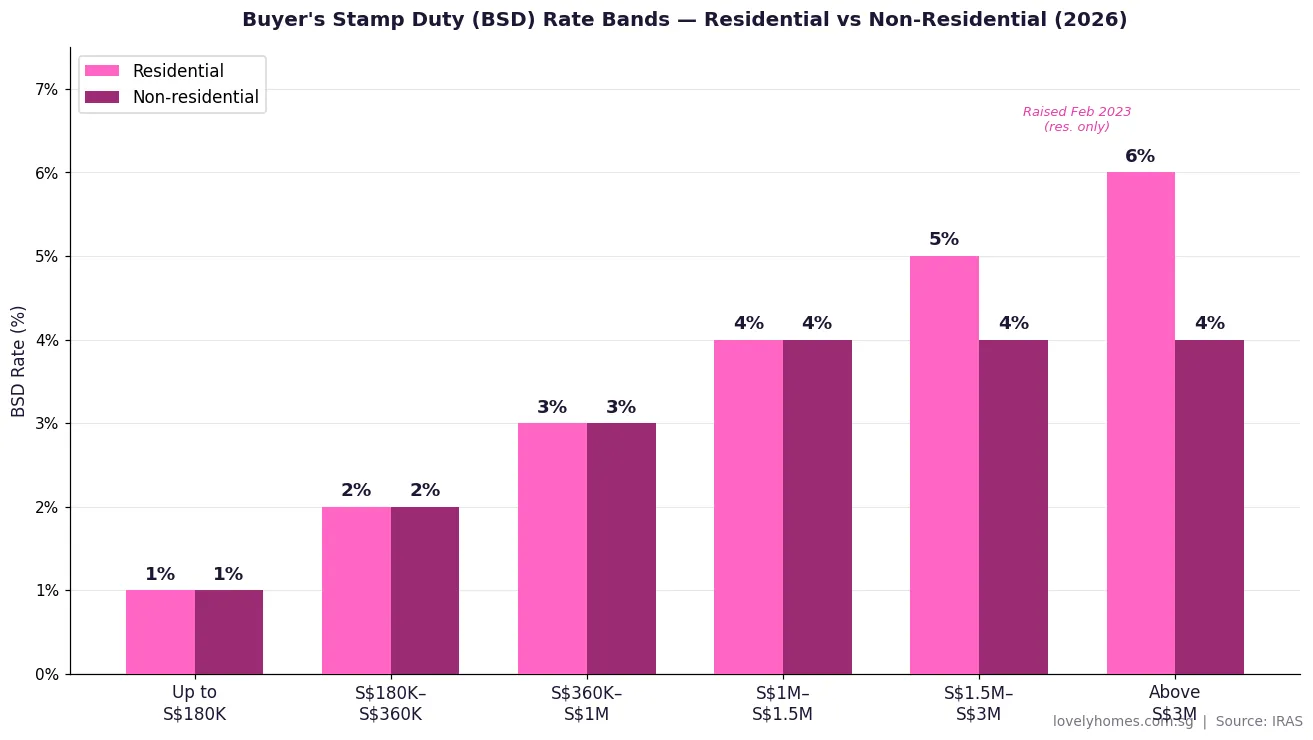
Stamp duties are collected by IRAS under the Stamp Duties Act (Cap. 312). They are the buyer’s obligation. The Buyer’s Stamp Duty (BSD) rates as at 7 June 2026 are:

Purchase Price Bracket BSD Rate
First S$180,000 1%
Next S$180,000 2%
Next S$640,000 3%
Next S$500,000 4%
Next S$1,500,000 5%
Remainder above S$3,000,000 6%

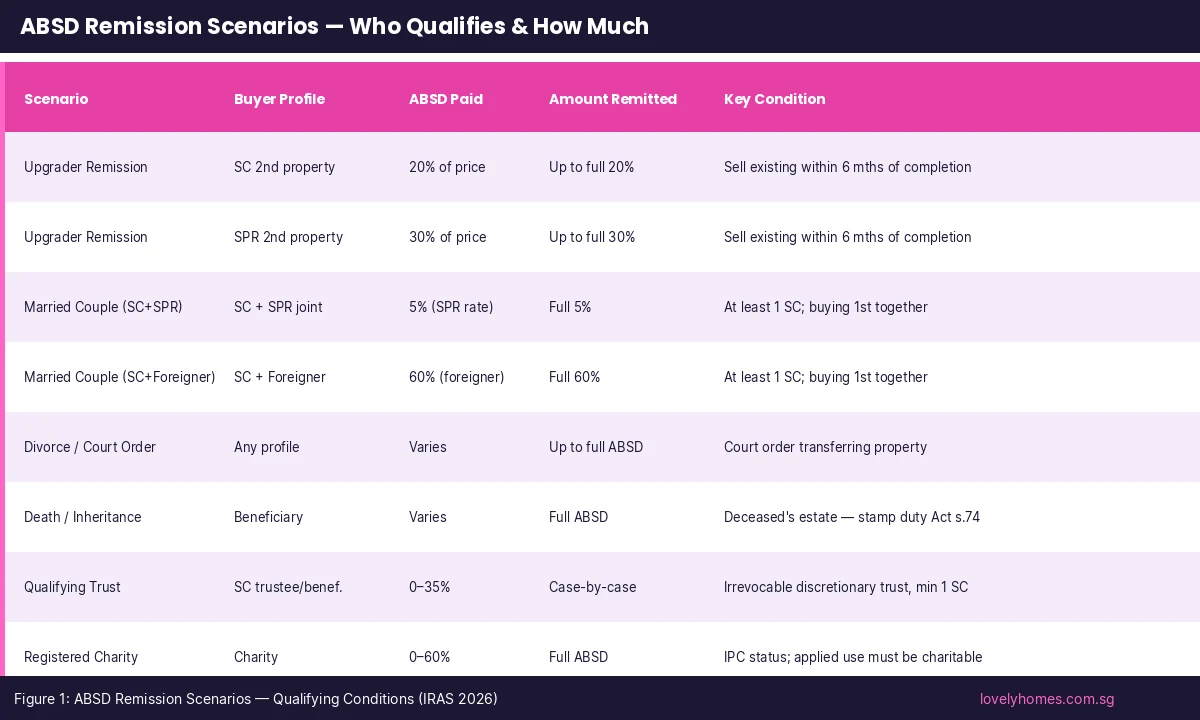
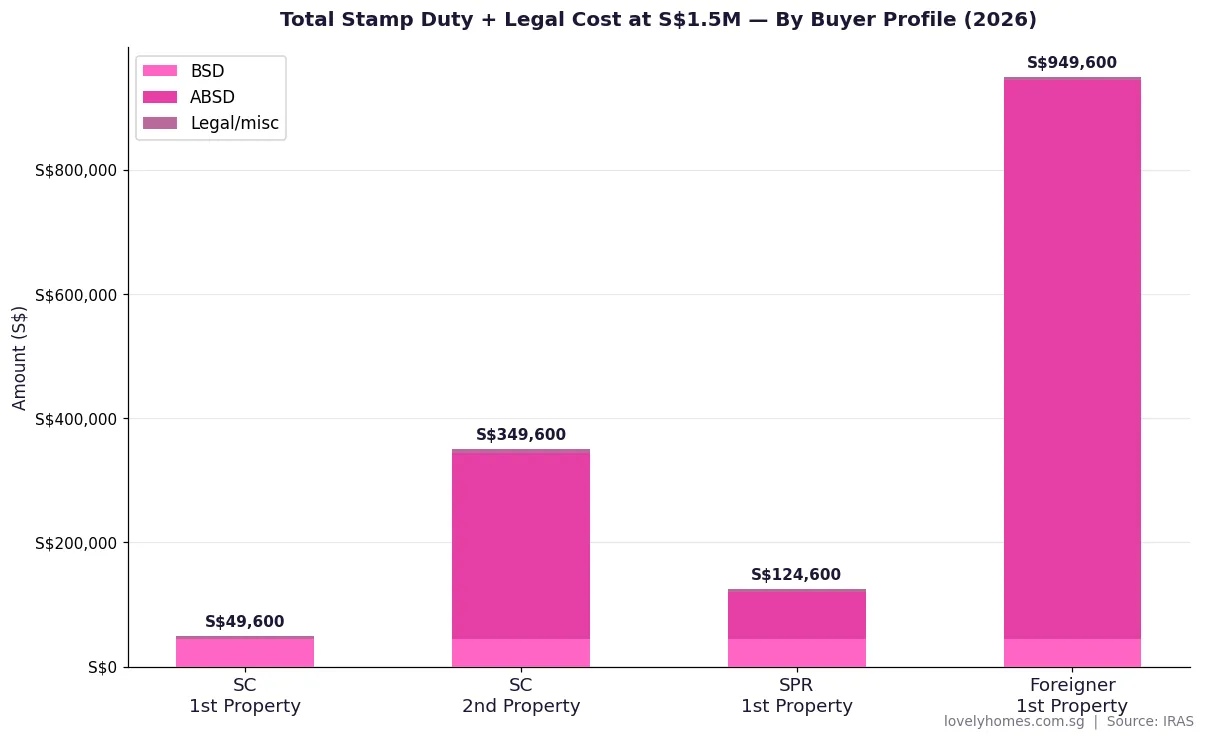
Additional Buyer’s Stamp Duty (ABSD) applies on top of BSD for second and subsequent properties (Singapore Citizens), all purchases by Singapore Permanent Residents, and all purchases by foreigners and entities. For a complete ABSD table, see the LovelyHomes ABSD Singapore 2026 Guide.

Step 4 — Appointing Your Conveyancing Lawyer

You should appoint your conveyancing lawyer before you sign the OTP, so that they can advise you on the option terms and perform preliminary title searches. The Law Society of Singapore’s Conveyancing Practice Directions require lawyers to advise clients on conflicts of interest — the same law firm generally cannot act for both buyer and seller in the same transaction.

Your lawyer’s duties as buyer’s solicitor include: conducting all title searches; preparing or reviewing the S&P Agreement; handling BSD/ABSD payment to IRAS; lodging a caveat at SLA to protect your interest; liaising with your bank’s lawyers on mortgage documentation; requisitioning CPF funds from CPF Board; and attending completion to receive title from the seller.

Singapore conveyancing legal fees 2026 - buyer and seller estimates by property price
Figure 2: Estimated conveyancing legal fees for buyers and sellers by property price, Singapore 2026. Obtain written fee quotes from your firm before proceeding.

Legal Fees and Disbursements

Law Society scale fees for residential conveyancing were abolished in 2009, meaning firms now charge freely. As a buyer, expect to pay S$2,200–S$5,000 in professional fees depending on transaction price and complexity. On top of professional fees, your lawyer will pass through disbursements — out-of-pocket costs charged at cost. Typical disbursements include:

  • SLA title search: approx. S$30–S$80
  • SLA caveat registration: approx. S$64.45 (includes GST)
  • Bank mortgage registration: approx. S$350–S$500
  • SLA transfer lodgement fee: approx. S$28–S$38 per instrument
  • CPF requisition fee: approx. S$15–S$25 per utilisation
  • Property valuation fee: S$300–S$1,200 depending on property type

Budget approximately S$500–S$1,500 in disbursements for a straightforward private resale transaction, in addition to professional fees.

Singapore property buying costs comparison 2026 - HDB resale vs private condo BSD ABSD legal fees
Figure 3: Total upfront buying costs including BSD, ABSD and legal fees — HDB resale vs private condo at three price points, Singapore 2026.

Summary: Key Conveyancing Facts at a Glance

Item HDB Resale Private Resale New Launch
OTP / booking fee S$1 (HDB prescribed) Typically 1% of price Booking fee 5% on S&P day
OTP exercise fee N/A — HFE/portal process 4% within 14 days Further progress payments
BSD payment deadline 14 days from HDB flat offer letter 14 days from exercise 14 days from S&P date
Standard completion period 8–10 weeks (HDB schedule) 8–12 weeks from exercise On TOP or CSC date
Caveat filed by HDB portal (automatic) Buyer’s lawyer Developer’s panel lawyer
Buyer legal fees (indicative) S$1,500–S$2,200 S$2,200–S$5,000 S$2,200–S$3,500
Seller legal fees (indicative) S$1,000–S$1,800 S$1,800–S$4,200 N/A (developer pays)
CPF accrued interest on refund 2.5% p.a. on OA withdrawn 2.5% p.a. on OA withdrawn 2.5% p.a. on OA withdrawn

Worked Example: Mr and Mrs Koh Buy a Resale Condominium in Queenstown

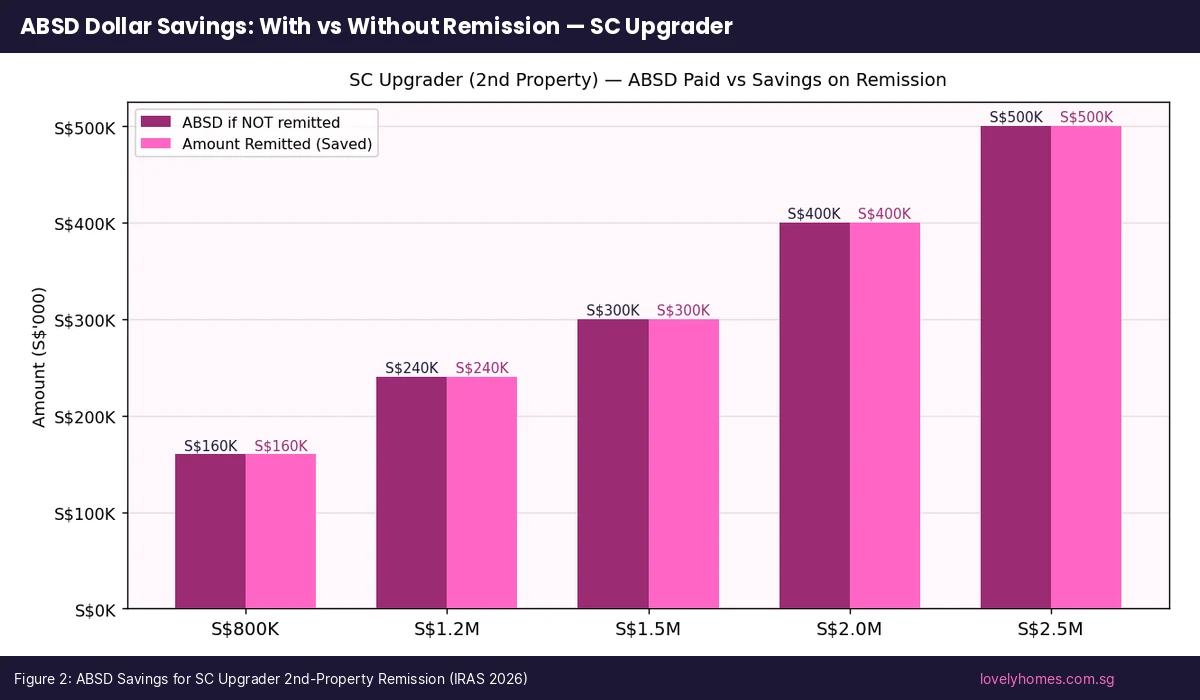
Mr and Mrs Koh are Singapore Citizens purchasing their second property — a resale 2-bedroom condominium in Queenstown (District 3) for S$1,600,000. They are selling their HDB flat simultaneously (see our HDB Upgrader Guide 2026 for ABSD remission timing).

  • Option fee (1%): S$16,000 — paid by cashier’s order on grant of OTP.
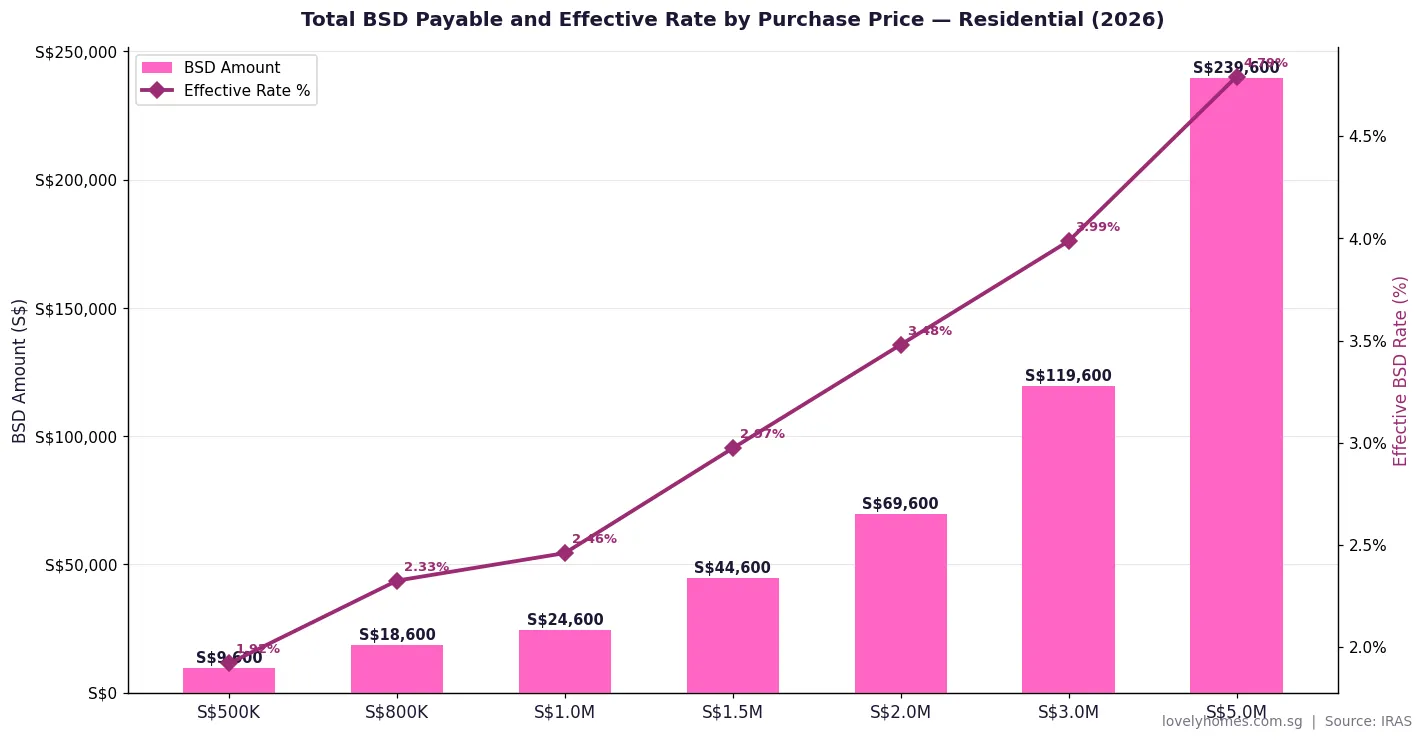
  • BSD at exercise: 1% × S$180,000 + 2% × S$180,000 + 3% × S$640,000 + 4% × S$500,000 + 5% × S$100,000 = S$1,800 + S$3,600 + S$19,200 + S$20,000 + S$5,000 = S$49,600
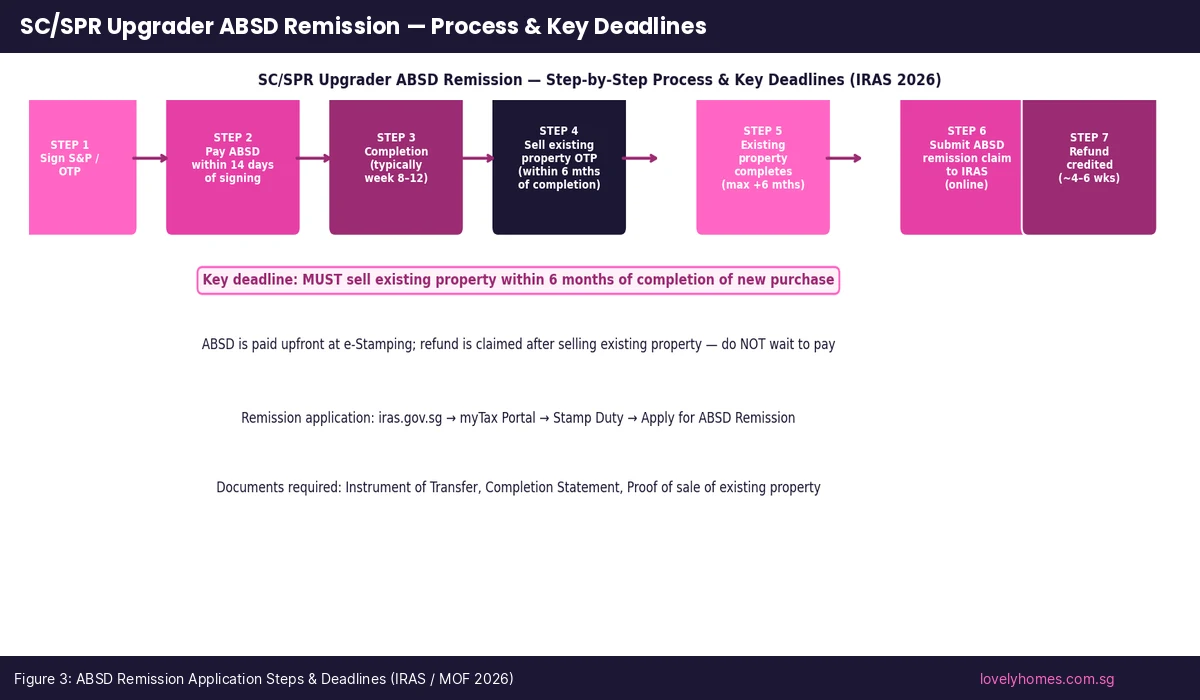
  • ABSD remission: If HDB sold within the stipulated window, ABSD is remitted for SC joint first-time private purchase. If outside the window, ABSD at 20% = S$320,000 — manage this timing carefully.
  • Buyer’s legal fees: Approx. S$3,400 professional + S$900 disbursements = S$4,300
  • Valuation fee: S$700
  • Bank loan: S$1,200,000 at 3.0% p.a. over 30 years = S$5,058/mth; TDSR 36.1% on joint income S$14,000/mth — PASS.
  • Completion cash balance: S$1,600,000 − S$80,000 (deposit) − S$1,200,000 (bank) − S$100,000 (CPF) = S$220,000 cash

The entire conveyancing process, from OTP grant to completion, spans approximately 10 weeks — aligning with the typical resale timeline shown in Figure 1 above.

What to Watch in 2026 and Beyond

Singapore’s conveyancing framework has remained largely stable since the Land Titles Act was modernised in 1994, but two pressure points are worth watching. First, the Ministry of Law has periodically reviewed whether HDB flat conveyancing should be further streamlined through the portal — licensed lawyers remain mandatory as at 2026. Second, the SLA has been progressively digitalising title documents towards a fully electronic land registry, which reduces search turnaround times and potentially disbursement costs.

For buyers, the practical implication is that while stamp duties remain the dominant cost item (dwarfing legal fees for most transactions), shopping for a competitive legal fee quote matters more the larger your transaction. For a second-property private condominium purchaser, ABSD is typically 20–60 times larger than legal fees — making ABSD remission timing the single most important conveyancing consideration of all.

Frequently Asked Questions

Can I use the same lawyer as the seller?

Generally no. The Law Society’s Conveyancing Practice Directions prohibit a single law firm from acting for both buyer and seller in the same residential transaction — a conflict-of-interest rule designed to protect both parties. Exceptions exist for new launch sales where developer panel lawyers act for the developer, but you as the buyer still engage your own firm. Having separate representation ensures your lawyer’s duty runs exclusively to you.

What happens if I miss the BSD payment deadline?

BSD and ABSD must be paid within 14 days of signing the OTP or S&P Agreement. Late payment attracts a penalty of 5% per annum on the unpaid stamp duty, plus a flat penalty of 1% of the unpaid duty under the Stamp Duties Act. Your conveyancing lawyer will typically pay stamp duties on your behalf immediately on instruction — ensure you have sufficient cleared funds in your account by the day of exercise.

What is a caveat and why does my lawyer lodge one?

A caveat under the Land Titles Act is a formal notice lodged at the Singapore Land Registry (via SLA) once you have exercised the OTP. It signals to the world — including any subsequent buyer, mortgagee, or judgment creditor — that you have a legal interest in the property. This prevents the seller from dealing with the property inconsistently with your purchase contract during the period between exercise and completion. The caveat lodgement fee is approximately S$64 and is a standard disbursement.

How does CPF work in a property purchase?

Singapore Citizens and PRs may use their CPF Ordinary Account (OA) savings towards the purchase price and monthly mortgage instalments, subject to a Valuation Limit (VL) of 100% of the lower of purchase price or valuation, and a Withdrawal Limit (WL) of 120% of VL for properties with at least 30 years remaining lease. CPF monies withdrawn for property must be refunded with 2.5% p.a. accrued interest upon sale — returned to your own CPF account. See our HDB Upgrader Guide for worked CPF refund calculations.

What is the difference between new launch and resale conveyancing?

New launch transactions involve a developer under a Housing Developers (Control and Licensing) Act licence. Instead of an OTP, you sign a Standard Sale and Purchase Agreement in the prescribed form under the Housing Developers Rules, and pay a booking fee (typically 5%) on the day of signing. Stamp duties are payable within 14 days. Completion occurs on the issue of the Temporary Occupation Permit (TOP) or Certificate of Statutory Completion (CSC), which may be 2–5 years from booking. Your CPF usage and bank loan terms must be structured to accommodate drawdowns aligned with the developer’s progress billing schedule.

Can a foreigner buy Singapore property and what additional steps apply?

Foreigners may purchase private condominium units, executive condominiums that have reached their 10-year privatisation mark, and Sentosa Cove landed properties — subject to the Residential Property Act (Cap. 274). The conveyancing process is identical, except that ABSD at 60% of the purchase price is payable by foreigners on any residential property purchase as at 2026. US, Swiss, Icelandic, Norwegian, and Liechtenstein nationals benefit from Free Trade Agreement (FTA) exemptions and are treated at Singapore Citizen rates for ABSD purposes. See our Singapore Foreign Buyer Property Guide 2026.

What happens on completion day?

Completion is typically conducted at the seller’s lawyer’s office. Your bank disburses the loan directly to the seller’s lawyers; your CPF Board requisition is remitted; and you or your lawyer presents cashier’s orders for any remaining cash. The seller hands over keys and access cards. Title transfers on completion — your lawyer registers the transfer at SLA (typically processed within 1–3 business days). You will receive a Land Register printout confirming your name as the registered proprietor.

Related Articles

Disclaimer: This article is intended for general informational purposes only and does not constitute legal or financial advice. Conveyancing procedures, stamp duty rates, and CPF rules are subject to change. All figures, fees, and timelines cited are based on information available as at 7 June 2026. Readers should consult a licensed Singapore conveyancing lawyer and a Monetary Authority of Singapore (MAS) licensed financial adviser for advice specific to their circumstances. Authoritative references: IRAS (iras.gov.sg), Singapore Land Authority (sla.gov.sg), CPF Board (cpf.gov.sg), Law Society of Singapore (lawsociety.org.sg).

Singapore Seller’s Stamp Duty (SSD) 2026: New 4-Year Holding Period, Rates and Exemptions Explained

Singapore Seller’s Stamp Duty (SSD) 2026: New 4-Year Holding Period, Rates and Exemptions Explained

Singapore Seller Stamp Duty SSD 2026 complete guide new 4-year holding period rates
Singapore Seller’s Stamp Duty 2026 — New 4-year holding period, updated rates and exemptions guide.
Quick Answer: Singapore SSD 2026 — Key Facts

  • What is SSD? Seller’s Stamp Duty is a tax on residential (and industrial) property sellers who dispose of their property within a specified holding period. Administered by IRAS.
  • New 2025 regime (effective 4 July 2025): 4-year holding period. Rates: Year 1 = 16%, Year 2 = 12%, Year 3 = 8%, Year 4 = 4%, after Year 4 = 0%.
  • Old regime (11 March 2017 to 3 July 2025): 3-year holding period. Rates: Year 1 = 12%, Year 2 = 8%, Year 3 = 4%, after Year 3 = 0%.
  • Applies to: All residential properties purchased on or after the respective effective dates — HDB flats, condominiums, landed homes, and ECs.
  • Calculated on: The higher of the actual selling price or the market value at date of sale.
  • Payment deadline: Within 14 days of signing the OTP acceptance or S&P agreement via the IRAS e-Stamping Portal.
  • Key exemptions: Divorce, death of owner, en-bloc collective sale, compulsory Government acquisition, HDB disposal back to HDB.
  • Industrial SSD (separate): 3-year regime — 15%/10%/5%/0%.

What is Seller’s Stamp Duty?

Seller’s Stamp Duty (SSD) is a tax levied by the Singapore Government on sellers who dispose of residential property within a prescribed holding period. The rationale is anti-speculation: by making it financially punishing to flip property shortly after purchase, the Government moderates short-term price volatility and encourages genuine owner-occupier demand. SSD was first introduced for residential property on 20 February 2010 in response to a rapid price run-up following the global financial crisis. It has been calibrated several times since, most recently on 4 July 2025 when the Government extended the holding period to four years and raised all rate tiers by four percentage points.

SSD is administered by the Inland Revenue Authority of Singapore (IRAS) under the Stamp Duties Act (Cap 312). It operates alongside the Additional Buyer’s Stamp Duty (ABSD) and Buyer’s Stamp Duty (BSD) as part of Singapore’s property market stabilisation toolkit. Where BSD and ABSD are levied on buyers, SSD is the only stamp duty that falls on the seller.

SSD Rates in 2026: The New 4-Year Regime

The 2025 tightening — announced on 3 July 2025 and effective for all residential properties purchased on or after 4 July 2025 — extended the SSD holding period from three to four years and raised each rate tier by four percentage points. The chart below makes the difference between the old and new regimes vivid:

Singapore SSD rate comparison pre and post 4 July 2025 holding period rates by year
Figure 1: SSD Rates — Pre-4 July 2025 (3-year regime) vs Post-4 July 2025 (4-year regime) | Source: IRAS / Stamp Duties Act

Under the current regime, a seller who purchased a condominium on 1 August 2025 and sells it on 30 June 2026 — 10 months later — will pay SSD at 16% on the higher of the sale price or market value. On a S$1,500,000 sale, that is S$240,000 in SSD alone, on top of outstanding mortgage costs and agent commissions. The new rates make very short-duration property investments economically unviable in most scenarios.

For properties purchased between 11 March 2017 and 3 July 2025, the previous three-year regime applies: 12% (Year 1), 8% (Year 2), 4% (Year 3), 0% thereafter.

Which Properties Are Subject to SSD?

SSD applies to the following categories of residential property in Singapore:

  • Private residential property: Condominiums, apartments, landed homes (terraces, semi-detached, bungalows, GCBs), strata landed units, and mixed-use units with a residential component.
  • Executive Condominiums (ECs): Subject to SSD during the initial privatisation period for units resold on the open market within the holding period.
  • HDB flats: SSD technically applies, but the 5-year Minimum Occupation Period (MOP) required before open-market resale means most HDB sales occur outside the 4-year SSD window anyway. See our HDB resale guide for details.
  • Partial disposals and gifts: SSD applies to any disposal of a residential property interest — including gifts and transfers at below-market value — within the holding period. Computed on market value, not consideration paid.

SSD does not apply to commercial property or industrial property (the latter has its own separate SSD regime).

How SSD is Calculated

The computation is: SSD = applicable rate × max(selling price, market value).

IRAS uses the higher of two figures to prevent sellers from artificially deflating the declared sale price to reduce their SSD liability. If IRAS determines the declared price is below open-market value, it substitutes the market value — typically determined by a licensed valuation firm or IRAS’s own assessment — as the calculation base.

The holding period runs from the date of purchase (date of OTP or S&P, whichever is earlier) to the date of disposal (date the seller signs the acceptance of OTP or S&P agreement). If you bought on 1 March 2025 and sell on 2 March 2026, you have crossed into Year 2, and the Year 2 rate applies.

Singapore Seller Stamp Duty dollar cost by property selling price 2026 new regime Year 1 Year 2 Year 3 Year 4
Figure 2: SSD Dollar Cost by Selling Price and Holding Year — Post-4 July 2025 Regime | Source: IRAS

Figure 2 illustrates how costly an early sale can be under the new regime. A seller disposing of a S$1,800,000 property in Year 1 pays S$288,000 in SSD — more than the typical agent commission, legal fees, and BSD combined. The prudent investor’s minimum exit window is now four years and one day.

SSD Payment — Deadline and Process

SSD falls legally on the seller and is incorporated into the conveyancing process by the seller’s solicitor. Key steps:

  1. Date of disposal: The date you sign the acceptance of OTP or S&P agreement (whichever is earlier).
  2. 14-day deadline: SSD must be paid to IRAS within 14 days of the date of disposal. Late payment attracts a penalty of up to four times the unpaid duty.
  3. e-Stamping: Payment via the IRAS e-Stamping Portal. Your conveyancing lawyer handles this on your behalf.
  4. Funded from sale proceeds: SSD is deducted from the sale proceeds at completion — sellers do not need to fund it upfront.

SSD Exemptions — When the Tax Does Not Apply

Not every disposal within the holding period triggers SSD. IRAS provides specific exemptions for involuntary or non-commercial transfers:

Singapore Seller Stamp Duty exemptions divorce death en-bloc compulsory acquisition HDB
Figure 3: SSD Exemptions — When Seller’s Stamp Duty Does Not Apply | Source: IRAS / Stamp Duties Act
  • Divorce or judicial separation: Transfer between spouses pursuant to a court order under the Women’s Charter or Matrimonial Proceedings Act — SSD waived. Voluntary spouse transfers without a court order are NOT exempt.
  • Death of owner: Transmission of a deceased owner’s share to beneficiaries via intestacy or valid will is not treated as a disposal for SSD purposes.
  • En-bloc collective sale: Where a Strata Titles Board (STB) or High Court order compels the collective sale, individual owners selling pursuant to that order are not subject to SSD. See our Singapore en-bloc guide.
  • Compulsory acquisition: Where the Government acquires the property under the Land Acquisition Act (Cap 152), no SSD applies.
  • HDB disposal back to HDB: Sale back to HDB (e.g., through voluntary early redemption schemes) is exempt.
  • Gift to lineal relatives: A specific remission order may reduce SSD in qualifying circumstances, but ad valorem stamp duty on the transfer may still apply — consult a lawyer.

Industrial Property SSD — A Separate Regime

Industrial property — factories, warehouses, logistics facilities, and flatted factories — has its own SSD regime introduced on 12 January 2013. The holding period is three years with higher base rates:

Holding Period (from purchase date) Industrial SSD Rate
Up to 1 year 15%
More than 1 year and up to 2 years 10%
More than 2 years and up to 3 years 5%
More than 3 years Nil

Industrial SSD rates effective 11 March 2017 | Source: IRAS

Summary Table: Residential SSD Regimes at a Glance

Purchase Date Year 1 Year 2 Year 3 Year 4 After Year 4
On/after 4 July 2025 (current) 16% 12% 8% 4% Nil
11 March 2017 to 3 July 2025 12% 8% 4% Nil Nil
14 January 2011 to 10 March 2017 16% 12% 8% 4% Nil
20 February 2010 to 13 January 2011 3% 2% 1% Nil Nil

Source: IRAS / Stamp Duties Act Cap 312 | Properties purchased before 20 February 2010 were not subject to SSD.

Worked Example: Mr Lee Sells His Condo 18 Months After Purchase

Mr Lee, a Singapore Citizen, purchases a resale condominium in Buona Vista for S$1,650,000 on 15 September 2025. His employment situation changes and he lists the property for sale in early 2027. He accepts an OTP at S$1,720,000 on 12 March 2027 — approximately 18 months after purchase.

Since the property was purchased after 4 July 2025, the new regime applies. The holding period from 15 September 2025 to 12 March 2027 is just over 18 months — meaning Mr Lee is in Year 2. The SSD rate for Year 2 is 12%.

IRAS compares the sale price (S$1,720,000) against the market value. An independent valuation confirms market value at S$1,700,000. The higher figure is the sale price of S$1,720,000.

  • SSD base: S$1,720,000 (higher of sale price vs market value)
  • SSD payable: 12% x S$1,720,000 = S$206,400
  • Payment deadline: 14 days from 12 March 2027 = 26 March 2027
  • Agent commission (approx. 1%): S$17,200
  • Legal fees: S$2,500 to S$3,500
  • Total selling costs: approximately S$226,100 to S$227,100

Had Mr Lee waited until 16 September 2029 — four years and one day after purchase — his SSD would be nil, saving him S$206,400. This is the clearest possible illustration of why the four-year holding period matters fundamentally to investment planning.

Why SSD Matters — What It Means for Property Investors

SSD is the Government’s most direct lever for curbing short-horizon speculation. Unlike ABSD — which targets buyers — SSD makes the exit itself expensive, creating a two-sided cost barrier that effectively locks investors in for at least four years under the current regime. For genuine owner-occupiers, this is largely irrelevant: they have no intention of selling quickly. For investors, the SSD calculus must be front-loaded into any acquisition model.

The July 2025 tightening came as the private residential price index rose 0.9% in Q1 2026 (following a 0.6% rise in Q4 2025, per URA Q1 2026 real estate statistics), signalling that investor appetite was returning. By extending the SSD window to four years and returning rates to the 2011-2017 levels (16%/12%/8%/4%), the Government effectively replicated the strictest historical SSD regime. For buy-to-let investors, the four-year minimum hold conveniently encompasses roughly two two-year lease cycles, allowing investors to cover carrying costs through rental income before an SSD-free exit.

What Might Come Next for SSD

This section reflects editorial analysis and is speculative in nature.

Having just restored the 2011-2017 rate structure in 2025, it would be unusual for the Government to tighten SSD further in 2026 absent a sharp market acceleration. The more likely near-term scenario is a data-driven review in mid-2027, 18 months after the July 2025 measures. If private residential prices cool to under 2% year-on-year growth, the framework will likely remain unchanged. A relaxation — possibly reverting to a three-year regime — would only be expected if the market corrects sharply due to external shocks such as a global recession or material rises in financing costs. Investors should plan on the four-year structure being the baseline through at least 2027.

Frequently Asked Questions

Does SSD apply if I bought my condo in 2023 and want to sell now in 2026?

Yes — under the old (pre-4 July 2025) three-year regime, since you purchased before 4 July 2025. If you bought in early 2023 and sell in mid-2026, you are within Year 3 of the three-year window, so the SSD rate is 4% on the higher of the selling price or market value. If you bought in mid-2023 and sell after mid-2026, you are past Year 3 and no SSD applies. The holding period is measured precisely from the date of your OTP or S&P agreement.

Can I avoid SSD by transferring the property to my spouse or child?

No. IRAS treats a transfer to a family member — even a spouse or child — as a disposal for SSD purposes. The SSD is computed on the market value of the property at the date of transfer, not the consideration paid. The only exempt family transfers are those made pursuant to a divorce court order, or specific lineal-relative remission scenarios under the Remission of Stamp Duties Order. If you are considering a transfer to a family member as part of a tax planning or decoupling strategy, consult a Singapore property lawyer first. See also our guide on property decoupling in Singapore.

My property is going en-bloc — will I pay SSD?

If the collective sale is effected by a Strata Titles Board (STB) order or High Court order, SSD is waived regardless of how long you have held your unit. However, if all owners agree to a private treaty collective sale without a STB or court order, the sale is treated as a voluntary disposal and SSD may apply. In practice, most collective sales proceed via the STB route, and the exemption applies. More detail at our Singapore en-bloc guide.

Does SSD apply if I sell my HDB flat?

Technically yes — SSD applies to HDB flat sales within the holding period. However, the HDB Minimum Occupation Period (MOP) of 5 years prohibits you from selling on the open market until 5 years from the date of collection of keys. Since the new SSD window is 4 years, by the time your MOP expires, you will typically be past the SSD window, and no SSD is payable. Plus and Prime flats have a 10-year MOP, making SSD entirely academic for them. The SSD overlap with HDB MOP is thus a theoretical rather than practical concern for the vast majority of flat owners.

Who pays SSD — the buyer or the seller?

SSD is legally the liability of the seller. Unlike BSD and ABSD which are buyer obligations, SSD is accounted for in the seller’s completion statement and deducted from sale proceeds at completion. Buyers are not responsible for paying it, though if SSD is unpaid IRAS has recovery powers that could cloud the title. Your conveyancing lawyer will confirm all stamp duties are paid before releasing title documents to the buyer’s lawyer.

I am relocating overseas — can I apply for an SSD waiver?

There is no general hardship or relocation waiver for SSD. The exemptions are limited to the specific statutory categories (divorce, death, en-bloc, compulsory acquisition, HDB disposal). A job relocation, financial hardship, or change in visa status does not qualify. If you are certain you will relocate within the holding period, it may be more cost-effective to rent out the property rather than sell it — provided you are eligible to do so. See our HDB rental landlord guide for how to do this compliantly.

How does SSD interact with ABSD remission for upgrading couples?

These are separate stamp duties and do not offset each other. ABSD remission for married SC couples allows the ABSD paid on a second property to be refunded if the first property is sold within 6 months of acquiring the second. SSD, if applicable on the first property being sold, is still payable — the ABSD remission does not waive or offset SSD. In the upgrading scenario, couples must factor in both: buyer pays BSD/ABSD on the new purchase, and seller pays SSD on the disposed property if within the SSD holding period. See our HDB upgrading guide for the full analysis.

Related Articles

Disclaimer

This article is for general informational purposes only and does not constitute legal, tax, or financial advice. Stamp duty legislation and IRAS administrative practice can change at any time. Always verify current rates and exemptions directly with the IRAS website and consult a qualified Singapore conveyancing lawyer or tax adviser before making property decisions. Property values, interest rates, and government policy cited are based on information available as at 7 June 2026.

Singapore Property Decoupling Guide 2026: Save ABSD, Costs, Risks and Step-by-Step Process

Singapore Property Decoupling Guide 2026: Save ABSD, Costs, Risks and Step-by-Step Process

Quick Answer: Property Decoupling Singapore 2026

  • What is decoupling? One co-owner transfers (sells) their ownership share to the other, leaving the transferee as sole owner — free to purchase a second property as a “first-time” buyer and pay 0% ABSD (SC).
  • Why decouple? To avoid the 20% Additional Buyer’s Stamp Duty (ABSD) on a second residential property — worth S$240,000 on a S$1.2M purchase, S$360,000 on S$1.8M.
  • Cost of decoupling: Buyer’s Stamp Duty on the half-share transferred + conveyancing legal fees (~S$4,000–S$6,000) + CPF accrued interest refund considerations. BSD on a 50% share of S$1.5M = approximately S$20,100.
  • CPF complication: The transferor must refund CPF OA monies (principal + 2.5% p.a. interest) back to their CPF account on the part-disposal. This reduces the available cash to the couple.
  • Who can decouple? Any co-owners of a private property — married couples, siblings, business partners. HDB flats cannot be decoupled (HDB must approve any ownership change and will not approve part-share sales to achieve ABSD avoidance).
  • Timeline: Typically 6–10 weeks from legal instruction to registration of transfer with the Singapore Land Authority (SLA).
  • Risk: IRAS assesses BSD on market value, not agreed price. Undervaluing the transfer to minimise BSD exposes both parties to penalties and back-taxes.

Property decoupling Singapore refers to the legal process of one co-owner divesting their share in a jointly-owned property to the other, with the primary objective of allowing the transferee (or the transferor, if they are the one moving on) to purchase a subsequent property as a sole first-time owner, thereby avoiding ABSD. The strategy became widely discussed after the April 2023 cooling measures raised ABSD on a second property for Singapore Citizens to 20% — equivalent to S$270,000 on a S$1.35M condominium.

Decoupling is entirely legal. IRAS does not prohibit the practice; it merely requires that BSD be paid correctly on the transferred share at market value. What IRAS does scrutinise is any attempt to transact at artificially low prices to reduce stamp duty. The Stamp Duties Act (Cap. 312) empowers IRAS to assess BSD on the market value of the interest transferred, regardless of the stated consideration — so proper valuation is not optional; it is mandatory.

Property decoupling versus ABSD savings comparison chart Singapore 2026 at three purchase price points
Figure 1: ABSD saved versus total decoupling cost at three property purchase prices, 2026. At S$1.8M, decoupling saves approximately S$284,000 net of all costs. (Source: IRAS BSD schedule; author calculations.)

How Decoupling Works: The Legal Mechanics

In a typical residential decoupling, a married couple owns a condominium together — say, as tenants-in-common in equal 50/50 shares, or as joint tenants. One spouse (the transferor) agrees to sell their 50% share to the other spouse (the transferee). The transaction is treated by IRAS as a sale at arm’s length: BSD is levied on the consideration paid or the market value of the half-share, whichever is higher.

The parties instruct a conveyancing lawyer who: obtains a formal valuation of the property from a licensed valuer, calculates the BSD payable on the half-share, prepares the Transfer Instrument, and lodges it with the Singapore Land Authority (SLA) for registration. BSD is paid electronically to IRAS before lodgement. The entire process takes 6–10 weeks under normal conditions.

Once registered, the transferee is the 100% sole owner of the property. The transferor holds no residential property in Singapore and is classified as a first-time buyer for ABSD purposes. They may now purchase a new private property — condominium, landed, EC (after MOP) — and pay 0% ABSD as a Singapore Citizen buying their first private residential property.

4-step property decoupling process Singapore 2026 from legal advice to buying second property
Figure 2: The 4-step decoupling process — from legal advice to purchasing a second property as sole owner. The critical step is completing registration before the transferor exercises the OTP on the new purchase. (Source: SLA, IRAS.)

Decoupling Costs: BSD, Legal Fees and CPF

Three cost categories apply to a decoupling exercise. The first and largest is Buyer’s Stamp Duty on the transferred share. BSD is calculated on the market value of the 50% interest: 1% on the first S$180,000, 2% on the next S$180,000, 3% on the next S$640,000, 4% on the next S$500,000, and so forth. For a property valued at S$1,500,000, the half-share is S$750,000 and the BSD is approximately S$20,100. For a S$2,000,000 property, the half-share is S$1,000,000 and BSD is approximately S$29,600.

Second, conveyancing legal fees for both sides (a lawyer is typically appointed for each party to avoid conflicts of interest, though one firm may act for both if both parties provide informed consent under the Legal Profession Act). Expect S$2,500–S$3,500 per side — total S$4,000–S$6,000.

Third, CPF complications arise when the transferor used CPF Ordinary Account funds to finance the original purchase. On a part-disposal of a property, CPF Board requires the transferor to refund the proportionate CPF drawn (including accrued interest at 2.5% p.a.) back to their CPF account. This refund may need to be funded by cash from the transferee — that is, the transferee pays the transferor for their 50% share, and the transferor uses that cash to repay CPF. The net position depends on how much CPF was drawn and how long ago.

Decoupling Cost Summary at Key Property Values

Property Market Value 50% Share BSD on Half-Share Legal Fees (est.) Total Decoupling Cost ABSD Saved (SC 20%) Net Saving
S$800,000 S$400,000 S$9,600 S$5,000 S$14,600 S$160,000 S$145,400
S$1,200,000 S$600,000 S$15,600 S$5,000 S$20,600 S$240,000 S$219,400
S$1,500,000 S$750,000 S$20,100 S$5,000 S$25,100 S$300,000 S$274,900
S$1,800,000 S$900,000 S$24,600 S$5,000 S$29,600 S$360,000 S$330,400
S$2,000,000 S$1,000,000 S$29,600 S$5,000 S$34,600 S$400,000 S$365,400
S$2,500,000 S$1,250,000 S$42,100 S$5,000 S$47,100 S$500,000 S$452,900

BSD cost of decoupling 50 percent property share at various full property values Singapore 2026
Figure 3: BSD payable and total decoupling cost (BSD + S$5K legal estimate) across a range of property market values. The cost curve rises gradually as higher BSD slabs apply to larger half-shares. (Source: IRAS.)

Worked Example: The Lee Couple

Mr and Mrs Lee are Singapore Citizens who jointly own a condominium in the River Valley area, purchased in 2019 at S$1,600,000. Current market value: S$2,100,000. Outstanding bank mortgage: S$900,000. CPF drawn (Mr Lee’s OA): S$200,000 principal + S$28,000 accrued interest (7 years at 2.5% p.a.) = S$228,000 to be refunded.

Mr Lee transfers his 50% share to Mrs Lee. Half-share value: S$1,050,000. BSD on S$1,050,000: 1%×S$180,000 + 2%×S$180,000 + 3%×S$640,000 + 4%×S$50,000 = S$1,800 + S$3,600 + S$19,200 + S$2,000 = S$26,600. Legal fees both sides: S$5,500.

Consideration paid by Mrs Lee to Mr Lee: S$1,050,000 (half the market value). Of this, S$450,000 represents Mr Lee’s half of the outstanding mortgage (which Mrs Lee refinances into her sole name), and S$600,000 is cash/CPF to Mr Lee. Mr Lee refunds S$228,000 back to his CPF OA. Net cash Mr Lee receives: S$600,000 − S$228,000 = S$372,000. Mrs Lee’s bank refinances the full S$900,000 mortgage into her sole name (subject to TDSR).

Total decoupling cost to the Lees: BSD S$26,600 + legal S$5,500 = S$32,100. Mr Lee is now a first-time property purchaser. He buys a S$1,800,000 new launch condo: BSD S$53,600, ABSD 0%. Without decoupling, ABSD would have been 20% × S$1,800,000 = S$360,000. Net saving: S$360,000 − S$32,100 = S$327,900.

When Does Decoupling Make Sense?

Decoupling is financially worthwhile when the ABSD saved on the intended second purchase materially exceeds the BSD and legal costs of the transfer. Since ABSD is a flat percentage of the full purchase price and BSD is levied on only half the existing property value at a slab rate, the saving grows steeply with the price of the intended acquisition. At 2026 rates, decoupling is almost always cost-positive for SC couples buying a second property above S$600,000 — the break-even point sits well below the median condo transaction price of approximately S$1.3M (OCR).

Decoupling becomes less attractive — or potentially impossible — in three scenarios. First, when the transferee cannot service the full mortgage alone after TDSR assessment (the bank may require refinancing into the transferee’s sole name, and their income alone may not support the loan quantum). Second, when significant CPF accrued interest reduces the net cash benefit below the headline numbers. Third, when the ownership structure is joint tenancy (which does not recognise distinct shares) and the couple must first convert to tenancy-in-common before the transfer can proceed — a process that also carries legal costs and SLA registration fees.

Can HDB Flats Be Decoupled?

No. HDB resale flats cannot be decoupled in the same way as private properties. Under the Housing & Development Act, any change in ownership of an HDB flat requires HDB approval. HDB will not approve an ownership transfer whose purpose is clearly to circumvent ABSD on a subsequent private property purchase. Any attempt to do so constitutes a breach of HDB rules and may result in the flat being compulsorily acquired. Executive Condominiums during their MOP period are also governed by HDB and cannot be decoupled. After the EC’s 5-year MOP, it transitions to private property status and decoupling becomes legally permissible.

Decoupling Versus Other ABSD Strategies

Decoupling is one of several legally recognised methods for managing ABSD exposure. Alternatives include: the ABSD remission buy-first strategy (SC couple buys second property, pays 20% ABSD upfront, then sells HDB within 6 months and claims remission from IRAS — works only for upgraders selling an HDB); purchasing property in a company structure (ABSD does not technically apply to entities, but Additional Conveyance Duties apply to residential property held by companies, and the rates are punitive); and staggered purchase timing (one spouse buys in their sole name today, the other waits until the first property is sold). Each strategy carries its own cost-benefit profile, legal requirements, and risks. Professional legal and financial advice is essential before committing to any of them.

What Might Come Next for Decoupling in Singapore

This section reflects editorial analysis and is speculative in nature. The Singapore government has been aware of decoupling as a practice for many years. It is sanctioned by law — IRAS collects BSD on every transfer — and there is no indication of an imminent legislative move to prohibit or penalise the practice. However, any significant increase in BSD rates (the last upward revision to the top tier was in February 2023, adding a 6% slab for properties above S$3M) would raise the cost of decoupling proportionally. Conversely, if ABSD rates were ever to be reduced — which would require a material cooling of demand — the financial case for decoupling would diminish but not disappear. For now, decoupling remains a rational and widely-used tax-planning tool for property-owning couples in Singapore.

Frequently Asked Questions

Does IRAS allow decoupling, or is it considered tax evasion?

Decoupling is fully legal and explicitly recognised by IRAS. The Stamp Duties Act requires BSD to be paid on the higher of the agreed consideration or the market value of the transferred interest — IRAS simply ensures the correct amount of stamp duty is paid. What is prohibited is undervaluing the transaction to reduce BSD. Provided the transfer is done at or above market value (supported by a licensed valuation), decoupling is not tax evasion. It is tax planning — the use of lawful structures to minimise tax, as distinct from illegal concealment or misrepresentation.

What does the bank say about decoupling my mortgage?

The bank’s primary concern is that the remaining borrower (the transferee) can independently service the full outstanding mortgage. The bank will reassess the transferee’s TDSR, credit history, and income documentation as if they were applying for the loan afresh. If the transferee’s income alone does not support the existing loan quantum, the bank may require a partial repayment to bring the outstanding loan within acceptable limits. It is advisable to obtain a conditional bank approval before instructing lawyers to proceed with the transfer.

Can unmarried co-owners (e.g. siblings) decouple?

Yes. Decoupling is not restricted to married couples — any co-owners of private property may execute a part-share transfer. The same rules apply: BSD at market value, conveyancing via a licensed lawyer, SLA registration, and CPF refund obligations if applicable. There is no marital relationship requirement. The ABSD saving accrues to whichever party emerges as sole owner and subsequently purchases another property as their “first” private residential acquisition.

Do I need to convert from joint tenancy to tenancy-in-common before decoupling?

Yes, if your property is held as joint tenants. Joint tenancy confers equal undivided ownership with right of survivorship — there are no distinct percentage shares that can be separately transferred. Before a decoupling transfer can proceed, the parties must first sever the joint tenancy and convert to tenancy-in-common (typically 50/50). This severance is registered with SLA and carries a separate fee of approximately S$200–S$500. The lawyer handling the decoupling will usually do this simultaneously as part of the same exercise.

What are the Seller’s Stamp Duty (SSD) implications of decoupling?

If the property being decoupled was acquired less than 3 years ago, the transfer of the half-share may trigger SSD. SSD rates are 12% (if sold in year 1), 8% (year 2), and 4% (year 3) of the higher of the sale price or market value of the interest transferred. For a S$1M half-share disposed of within 2 years of original purchase, SSD could add S$80,000. Most couples planning to decouple therefore wait until their property has been held for at least 3 years. The SSD clock runs from the date of the original purchase, not from the date of decoupling.

What happens to CPF accrued interest when I transfer my share?

When the transferor disposes of their interest in the property (even a 50% share), CPF Board requires the proportionate refund of CPF monies withdrawn for that property — both principal and accrued interest at 2.5% per annum compounded annually. The refund goes back into the transferor’s CPF OA. The amount can be significant on properties held for 10+ years: S$200,000 of CPF drawn at 2.5% compounded annually for 10 years accrues to approximately S$256,000 — meaning the effective CPF refund obligation is S$256,000, not S$200,000. Plan this cash-flow carefully before executing the transfer.

After decoupling, when can the transferor buy a new property?

The transferor can purchase a new property as soon as the decoupling transfer is registered with SLA — typically 6–10 weeks after engaging the lawyers. There is no mandatory waiting period after the transfer. However, it is critical not to exercise the OTP on the new property before the decoupling transfer is registered; doing so could mean you technically hold a 50% share in the existing property at the time of the new purchase, triggering ABSD. The sequencing is: complete decoupling → register transfer → only then exercise OTP on new purchase.

Related Articles

Disclaimer: This article is provided for general informational purposes only and does not constitute legal, financial, tax, or property advice. Decoupling involves complex stamp duty, CPF, mortgage, and legal considerations that are specific to each individual’s circumstances. BSD and ABSD rates, CPF rules, and HDB policies are subject to change without notice. Always verify current rates and rules directly with the Inland Revenue Authority of Singapore (IRAS) at iras.gov.sg, the Singapore Land Authority (SLA) at sla.gov.sg, and the Central Provident Fund Board (CPF Board) at cpf.gov.sg. You should engage a licensed Singapore conveyancing lawyer before proceeding with any property transfer or stamp duty planning strategy.

Decoupling for Married Couples Singapore 2026: Saving ABSD on a Second Home — Legally and Step-by-Step

Decoupling for Married Couples Singapore 2026: Saving ABSD on a Second Home — Legally and Step-by-Step

Last updated 28 April 2026. Reflects ABSD rates effective 27 April 2023 and Buyer’s Stamp Duty rates effective 14 February 2023.

Quick Answer — 30-second takeaways

  • Decoupling is the legal restructuring of a co-owned residential property so that one spouse ends up holding 100% of it. The other spouse is then restored to first-time-buyer status and can buy a second residential property without paying ABSD.
  • For a married Singapore Citizen (SC) couple, ABSD on a S$1.5 million second home is 20% (S$300,000). Decoupling typically costs S$50,000–S$70,000 in BSD on the internal transfer plus legal fees.
  • The maths almost always favours decoupling once the second property is above S$1 million.
  • Decoupling is only legal for private residential property. HDB flats cannot be decoupled (since 1 April 2016, except in narrow exceptions like divorce, death or financial hardship).
  • The receiving spouse must be able to solo-service the loan under TDSR (60%) and refund any CPF used by the outgoing spouse with 2.5% accrued interest.
  • Decoupling is administered by IRAS for stamp duty and CPF Board for refund of utilised CPF; conveyancing must be handled by a licensed Singapore lawyer.
  • Allow 6 to 10 weeks end-to-end. Add 2–4 weeks if the loan must be refinanced into one name.

What is decoupling?

“Decoupling” is the informal name for a transaction in which co-owners of a Singapore residential property restructure their ownership so that one party transfers their share to the other. The receiving owner ends up with 100% legal title; the outgoing owner ends up with no residential property in their name.

The reason this is done is rarely sentimental. It is an Additional Buyer’s Stamp Duty (ABSD) avoidance technique — and a perfectly legal one, provided it is structured as an arms-length sale at market value, with stamp duty correctly paid on the transferred share. Once the outgoing spouse no longer owns any residential property, they are restored to “first residential property” status with the Inland Revenue Authority of Singapore (IRAS), and any subsequent purchase falls outside the punitive ABSD net.

The technique was already common before the 27 April 2023 ABSD hike that took the second-property rate for SCs from 17% to 20%. After that hike, decoupling became one of the most-discussed topics on Singapore property forums — and a regular line item in mass-affluent household financial plans.

Decoupling property Singapore 2026 — ABSD vs decoupling cost comparison for a S$1.5M second home
Figure 1: For a married SC couple buying a S$1.5 million second residential property, decoupling cuts upfront stamp + legal cost from S$343,100 to S$60,300 — a saving of S$282,800.

Why decoupling exists — the ABSD wall

Singapore’s ABSD regime treats any residential property held by either spouse as a household-level holding for stamp duty purposes. Under IRAS rules a married couple is taxed as a single buyer profile: if either spouse has an existing residential property, the next purchase is treated as a second (or third) property and attracts ABSD at the higher band, even if the new property is bought solely in the unencumbered spouse’s name.

The 2026 ABSD ladder for residential property is:

Buyer profile 1st residential 2nd residential 3rd & subsequent
Singapore Citizen (SC) 0% 20% 30%
Singapore PR 5% 30% 35%
Foreigner 60% 60% 60%
Entity / Trust 65% 65% 65%

For a married SC couple, the 20% band on a S$1.5 million purchase is S$300,000 — payable upfront, in cash or CPF, within 14 days of exercising the Option to Purchase. That is the wall decoupling is designed to remove.

Who can decouple — and who cannot

Decoupling is only available for private residential property: condos, executive condominiums (after the privatisation date), and landed homes. It is not available for HDB flats — the Housing and Development Board removed the loophole on 1 April 2016, requiring HDB flats to be held jointly under specified eligibility schemes (Public, Fiance, Joint Singles, etc.) and prohibiting “part-share” transfers between named owners except in narrow circumstances like divorce, death of co-owner, financial hardship or marriage to an existing co-owner.

Within private residential property, decoupling typically works for couples where:

  • The property has appreciated enough that BSD on the transferred share is meaningfully smaller than the avoided ABSD;
  • The receiving spouse can solo-service the existing mortgage under the 60% Total Debt Servicing Ratio (TDSR);
  • Both parties are aligned that the outgoing spouse will end up holding the new property in their sole name (with the implications that brings on inheritance, CPF refund and divorce settlement).

The 4-step decoupling process

Decoupling property Singapore 2026 — 4-step process timeline from valuation to second purchase
Figure 2: The decoupling timeline: valuation, S&P drafting, transfer + BSD payment, then the second purchase.

Step 1 — Valuation and lender check

The conveyancing lawyer obtains a market valuation. The receiving spouse approaches the existing mortgagee bank (or an alternative bank) to confirm they can solo-service the loan under TDSR — meaning total monthly debt repayments cannot exceed 60% of gross monthly income. The Monetary Authority of Singapore caps the loan tenure at 30 years for private property and the loan-to-value ratio at 75% for the first housing loan.

Step 2 — Prepare S&P agreement and CPF refund schedule

The lawyer drafts an internal sale and purchase agreement at market value. CPF Board issues a refund schedule covering all CPF principal previously used by the outgoing spouse plus 2.5% accrued interest from the date each contribution was used. This is non-negotiable: the CPF refund is a lien on the property and must be settled at completion.

Step 3 — Execute the transfer and pay BSD

On completion, legal title transfers from joint to sole ownership. The receiving spouse pays BSD on the value of the share bought (i.e., 50% of the market valuation in a 50/50 joint tenancy, scaled accordingly for tenancy-in-common). BSD must be paid within 14 days of execution; late payment attracts IRAS penalties.

Step 4 — Buy the second property

The outgoing spouse, now restored to “no residential property” status, exercises the Option to Purchase on the new property and pays standard BSD only — no ABSD. There is no waiting period required between Step 3 and Step 4, but in practice the second OTP is often timed to coincide with the new launch ballot date or resale negotiation.

What decoupling actually costs

Decoupling is not free. The cost stack is dominated by BSD on the share transferred at market value. Other line items include legal fees, valuation, and any bank refinancing/discharge fees if the loan moves to a single name.

Cost line Typical range Notes
BSD on internal transfer S$8,000 – S$30,000+ Calculated on 50% of market value at standard BSD rates
Conveyancing legal fees S$5,000 – S$8,000 One firm typically acts for both spouses; ask for an itemised quote
Bank legal subsidy clawback up to S$2,000 If the existing mortgage was taken < 3 years ago
Valuation report S$300 – S$600 Required by both bank and lawyer
Bank early-repayment penalty 1.50% of outstanding loan Only if existing loan is within lock-in period; waived if simply refinancing in same name
CPF refund (with accrued 2.5% interest) Varies Cash flow item, not a sunk cost — money is returned to your CPF account

When does decoupling pay off?

Decoupling property Singapore 2026 — worked example showing ABSD avoided vs decoupling cost across S$1M to S$3M second-property prices
Figure 3: Across the S$1 million to S$3 million range, decoupling produces large net savings — and the gap widens with second-property price.

Worked example — Mr and Mrs Tan

Mr and Mrs Tan are both Singapore Citizens. They own a S$1.2 million Outside-Central-Region condo as joint tenants (50/50). They are looking to buy a S$1.5 million Rest-of-Central-Region condo for investment.

Path A — buy as joint owners, no decoupling:

  • BSD on S$1.5M = S$39,600
  • ABSD at 20% (second residential property, SC) = S$300,000
  • Legal fees on the new S&P = S$3,500
  • Total upfront: S$343,100

Path B — Mrs Tan sells her 50% share to Mr Tan first; Mr Tan then buys the new property in his sole name:

  • BSD on internal transfer of 50% × S$1.2M = S$14,200 (paid by Mr Tan)
  • Legal + valuation + bank fees ≈ S$6,500
  • Mrs Tan now has no residential property. She buys the S$1.5M ROC condo in her sole name.
  • BSD on new S$1.5M = S$39,600
  • ABSD = S$0 (first residential property in her name)
  • Total upfront: S$60,300

Net saving: S$282,800, or roughly 82% of the original cost. That number is the entire reason decoupling exists as a household financial-planning lever.

The risks people forget to weigh

Decoupling looks like a tax-arbitrage layup. It is — but the structure has consequences that linger long after the BSD is paid.

  • Loss of joint protection. Once the property is in one name, the outgoing spouse has no automatic legal interest in it. In divorce, ancillary matrimonial property division still applies — but creditor exposure (e.g. the sole owner’s business debts) shifts.
  • Loss of right of survivorship. Joint tenancy carries automatic survivorship: when one spouse dies, the survivor takes the whole property. After decoupling, the property passes via the sole owner’s will (or intestacy rules) — make sure both estate plans are updated immediately.
  • CPF cash-flow sting. The accrued-interest refund on CPF used can be substantial — often S$50,000 to S$150,000 in cash that has to be parked back in the outgoing spouse’s CPF account.
  • Refinance friction. If TDSR fails on a single income, decoupling cannot proceed. Some couples bridge this by adding a parent or adult child as a co-borrower, but this triggers fresh ABSD considerations.
  • Future ABSD changes. The outgoing spouse only retains “first residential property” status until they buy. If the new purchase is delayed and ABSD is hiked again, the saving narrows.

Decoupling vs alternatives

Decoupling is one of three structural ways for couples to manage ABSD. The other two are:

  • Buying in one spouse’s name from the start. Cheaper than decoupling because there is no internal transfer cost — but only works if you start the journey with this in mind. Most couples don’t.
  • Buying through a trust for a child. ABSD at the trust rate (65%) is usually paid upfront and refunded if the trust beneficiary is a citizen child under 21 and meets IRAS conditions. This is a niche structure for high-net-worth families.

For most existing joint-owner couples, decoupling is the most direct route. The “buy from one name” technique is preferable for new couples planning their property ladder before the first purchase.

What might come next

The Ministry of Finance has reviewed the decoupling loophole multiple times since 2017 without closing it for private property. The April 2023 ABSD hike effectively made decoupling more attractive, not less, because the avoided amount grew. If a future cooling-measures package extends the post-2016 HDB anti-decoupling rule to private property — for example, by treating the receiving spouse’s holding as a “household second property” if the divestment was within 3 years — the technique would be neutered overnight. As of April 2026 there is no public signal of such a move, and Singapore’s policy preference has been to raise stamp duty rather than restrict ownership structures. Treat this as policy risk, not a base case.

Frequently asked questions

Can I decouple my HDB flat?

No. Since 1 April 2016, HDB flats can only be held under HDB’s eligibility schemes (Public Scheme, Fiance Scheme, Joint Singles, etc.), and “part-share” transfers between named owners are not permitted except in narrow circumstances: divorce, death of co-owner, financial hardship, marriage of a co-owner, or renunciation of citizenship by a co-owner. The pre-2016 path of selling one party’s share to the other to free up an ABSD slot is closed for HDB.

Will IRAS treat decoupling as tax avoidance?

IRAS has consistently treated genuine decoupling as a legitimate restructuring, provided the transfer is at market value and BSD is correctly paid on the share transferred. The General Anti-Avoidance Provision in section 33 of the Stamp Duties Act has not been used to challenge bona fide decoupling. The risk arises only if the transfer is not at arm’s length or if the receiving spouse subsequently transfers the property back — that pattern would attract scrutiny.

How long does the whole process take?

Six to ten weeks is typical: one to two weeks for valuation and S&P drafting, three to four weeks to the transfer completion and BSD payment, and a further two weeks of buffer for the second property’s OTP timeline. If the loan needs to be refinanced into a single name with a different bank, add another two to four weeks for credit underwriting.

Can I decouple just before retirement?

Yes, but think carefully. The receiving spouse must continue to solo-service any remaining loan; if their income drops in retirement, TDSR may already be tight. Many retirees opt to redeem the loan in full at decoupling, which avoids TDSR issues but pulls cash or CPF out of liquid reserves.

Can I decouple if my property is still within Seller’s Stamp Duty (SSD) holding period?

Yes. SSD only applies on a sale to a third party within the holding period (3 years from purchase for residential property). An internal transfer between spouses is ordinarily exempt from SSD, but check with your conveyancing lawyer because the exemption depends on documentation of the transfer being a transfer of beneficial interest, not a market sale to an unrelated party.

Does CPF need to be refunded immediately?

Yes. The outgoing spouse’s CPF principal plus 2.5% accrued interest must be refunded to their CPF Ordinary Account at completion. The CPF refund is a lien on the property — completion will not proceed without it. The funds can subsequently be used by that spouse for the second property’s downpayment, subject to CPF housing rules.

What if I’m not married — can two siblings or partners decouple?

Decoupling is structurally available to any joint owners, not only married couples. However, the ABSD treatment is different: unmarried co-owners are not aggregated for ABSD by IRAS in the same way spouses are. Two unmarried joint owners who each own only one residential property are already at first-property ABSD on their respective slots. Decoupling for unmarried co-owners is mostly relevant for estate planning, debt segregation, or pre-marriage clean-up rather than ABSD avoidance.

Disclaimer. This article is general guidance only and does not constitute legal, tax or financial advice. Stamp duty, CPF and conveyancing rules in Singapore are administered by the Inland Revenue Authority of Singapore (IRAS), the CPF Board and the Singapore Land Authority respectively. Always consult a licensed Singapore conveyancing lawyer and verify current rates against iras.gov.sg, cpf.gov.sg and mas.gov.sg before acting. Loan eligibility under TDSR/MSR is set by the Monetary Authority of Singapore.
Decoupling
ABSD
Buyer’s Stamp Duty
Property Tax
Singapore Property
Conveyancing
Property Investment
Tax & Legal
Joint Tenancy
CPF Refund

Translate »