Singapore HDB Ethnic Integration Policy (EIP) 2026: Quotas, SPR Limits and How It Affects Your Flat Purchase

Singapore HDB Ethnic Integration Policy (EIP) 2026: Quotas, SPR Limits and How It Affects Your Flat Purchase

When you decide to buy an HDB resale flat in Singapore, you may encounter an unusual hurdle that has no equivalent in most other housing markets: your ethnicity matters. The Ethnic Integration Policy (EIP), administered by the Housing & Development Board (HDB) since 1 March 1989, sets maximum proportions for each of Singapore’s three broad ethnic categories — Chinese, Malay, and Indian & Others — at both the block and neighbourhood level. If the sale of a flat would push the proportion of your ethnic group beyond the designated quota, HDB will not approve the transaction.

Understanding the EIP — how it works, who it affects, when a block is quota-full, and how the related Singapore Permanent Resident (SPR) Quota interacts with it — is essential for any resale HDB buyer, seller, or property professional in 2026.

Quick Answer — Key Takeaways

  • The EIP sets maximum ethnic proportions at two levels: the block (individual HDB building) and the neighbourhood (surrounding precinct).
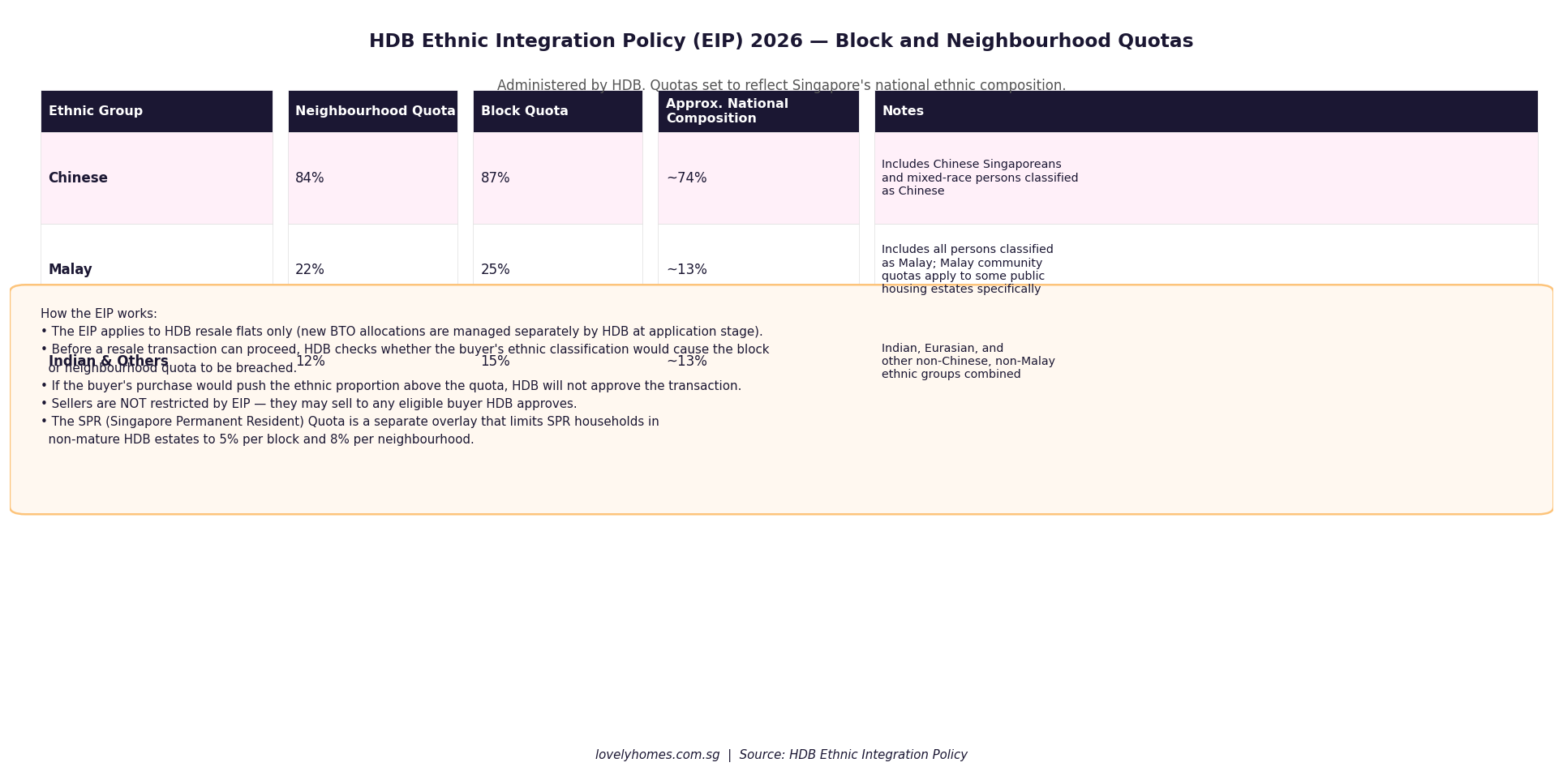
  • Current quotas: Chinese up to 87% (block) / 84% (neighbourhood); Malay up to 25% (block) / 22% (neighbourhood); Indian & Others up to 15% (block) / 12% (neighbourhood).
  • EIP applies only to HDB resale transactions — not to new BTO flat applications, which are managed separately.
  • A buyer whose ethnic group has exceeded the block or neighbourhood quota cannot purchase a resale flat in that block or neighbourhood until the proportion drops back below the limit.
  • The SPR Quota is a separate restriction: SPR households are limited to 5% of units in any block and 8% in any neighbourhood in non-mature HDB estates.
  • Sellers can sell to any ethnically eligible buyer — the EIP restricts buyers, not sellers.
  • A flat in a quota-full block may be priced lower than comparable units in non-restricted blocks, as the pool of eligible buyers is smaller.
  • You can check whether a specific block is EIP- or SPR-quota-full using HDB’s online e-service before making an offer.

What Is the Ethnic Integration Policy?

The EIP was introduced by the Singapore government in 1989, during a period when natural market forces were producing ethnic concentration in certain HDB estates — reversing the government’s longstanding policy of distributing ethnic groups evenly across public housing. Before 1989, resale transaction patterns had allowed Chinese Singaporeans to cluster in newer, higher-demand estates, while Malay and Indian households remained concentrated in older estates. The EIP was HDB’s mechanism to enforce ethnic integration as a social policy objective, reflecting Singapore’s commitment to multiracialism as a founding principle of the nation.

The policy is administered by HDB under the Housing and Development Act. HDB sets the quota limits and updates them periodically (though they have been broadly stable for many years) based on Singapore’s national ethnic composition as measured by the Department of Statistics Singapore (SingStat).

EIP Block and Neighbourhood Quotas — The Numbers
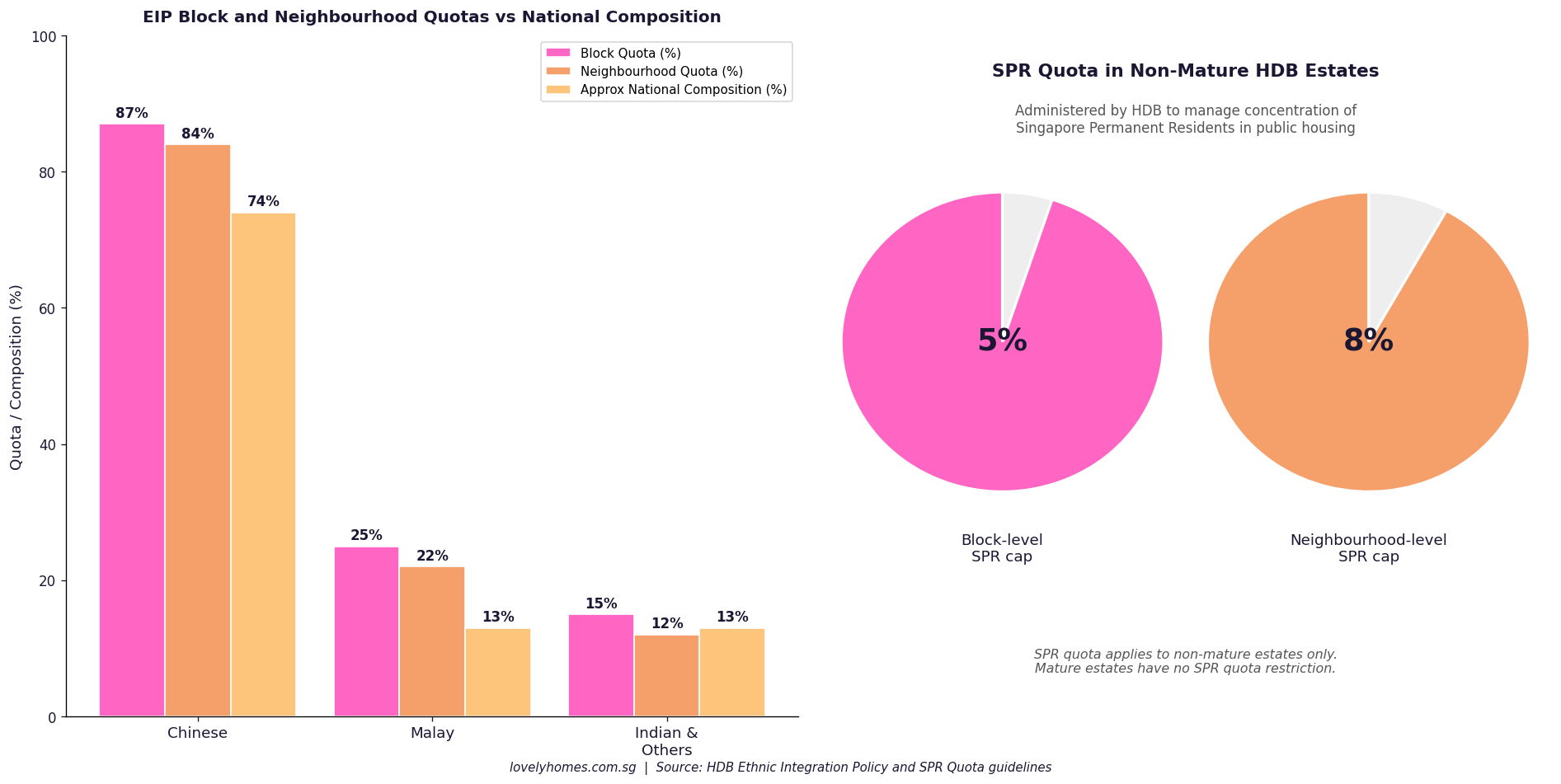
HDB Ethnic Integration Policy 2026 block and neighbourhood quotas for Chinese Malay Indian Singapore
Figure 1: EIP Block and Neighbourhood Quotas (2026) versus approximate national ethnic composition. Source: HDB Ethnic Integration Policy guidelines; SingStat population data.

The current EIP quotas are set above the national composition to give headroom for natural movement while still preventing concentration. A block is considered quota-full for a particular ethnic group when adding one more household of that group would breach the block-level cap. At that point, only buyers of a different ethnic group (or mixed-race buyers whose reported ethnicity is in a different category) can purchase units in that block until existing residents move out and reduce the proportion.

The two-tier system (block + neighbourhood) means a buyer might face no restriction at the neighbourhood level but encounter a quota-full block — or vice versa. Both must be satisfied before HDB will approve the transaction.

Ethnic Group Block Quota Neighbourhood Quota Who Is Counted
Chinese 87% 84% SC and SPR registered as Chinese
Malay 25% 22% SC and SPR registered as Malay
Indian & Others 15% 12% SC and SPR registered as Indian, Eurasian, or Others
SPR Households (non-mature estates) 5% 8% SPR-only households (no SC members) — non-mature estates only

Who Is Affected and How?

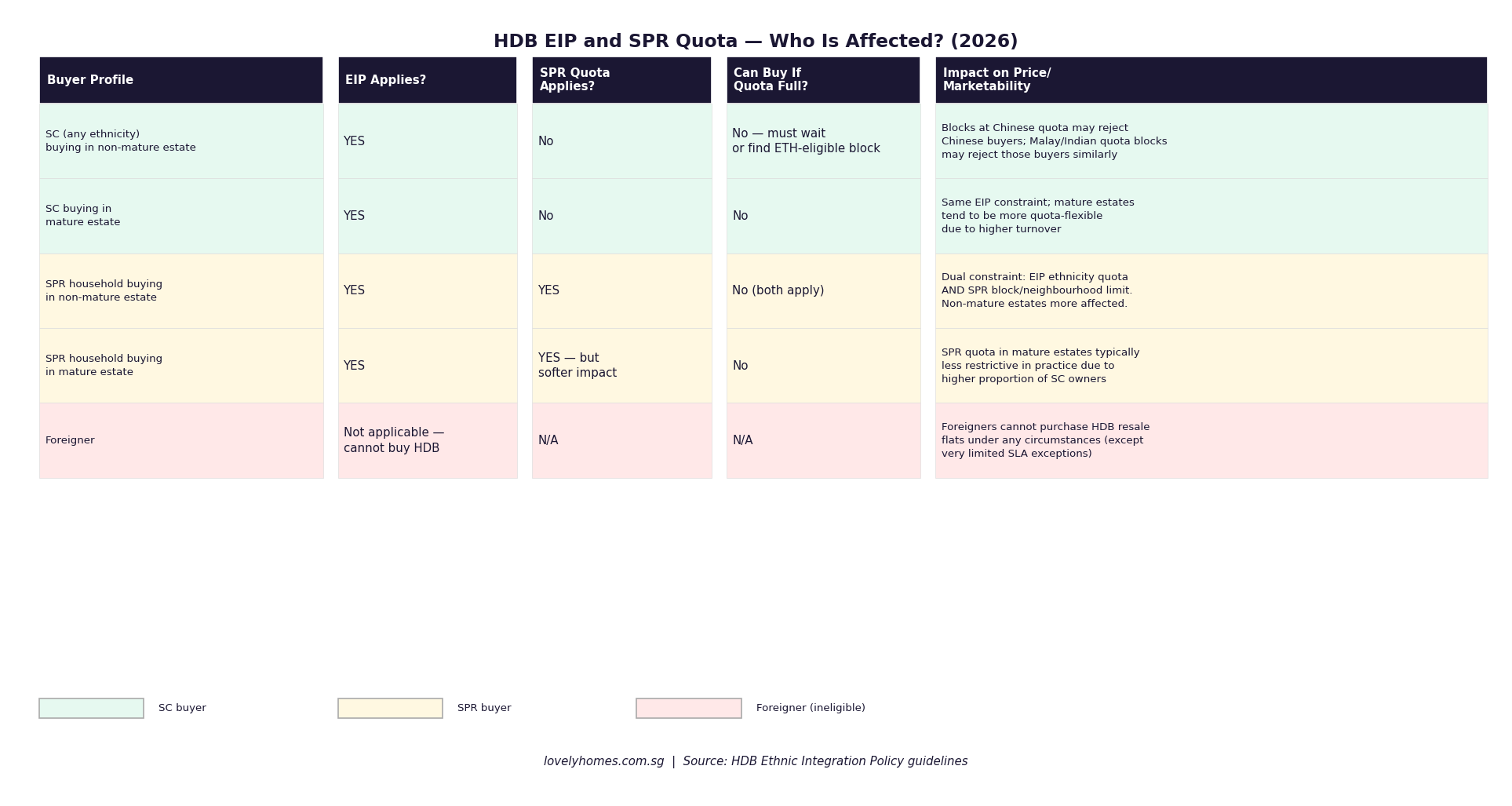
HDB EIP and SPR Quota buyer eligibility matrix 2026 — SC SPR foreigner affected or not
Figure 2: Matrix showing how the EIP and SPR Quota affect different buyer profiles in 2026. Source: LovelyHomes editorial based on HDB guidelines.

The SPR Quota — A Separate Overlay

HDB SPR Quota 2026 — 5% block and 8% neighbourhood cap for Singapore Permanent Residents non-mature estates
Figure 3: SPR Quota limits for non-mature HDB estates: 5% per block and 8% per neighbourhood. The SPR Quota is separate from and additional to the EIP ethnic quotas. Source: HDB Singapore.

The Singapore Permanent Resident (SPR) Quota was introduced in 2010 and is a distinct policy from the EIP, though both are administered by HDB. The SPR Quota limits SPR-only households to 5% of units in a block and 8% in a neighbourhood, but only in non-mature HDB estates. Mature estates — broadly, estates established before 1990, such as Toa Payoh, Ang Mo Kio, and Queenstown — are exempt from the SPR Quota.

A household qualifies as “SPR-only” (i.e., subject to the SPR quota) if all owners and occupants are SPRs with no Singapore Citizens. Households that include at least one SC are not counted against the SPR Quota, even if the flat is primarily purchased by an SPR. This means an SC-SPR couple is exempt from the SPR Quota (though they still face the EIP ethnic quota for the SPR’s ethnicity classification).

How to Check EIP and SPR Quota Status Online

HDB provides a free e-service on its website that allows prospective buyers to check the EIP and SPR Quota status of a specific block before making an offer. The tool requires the block number and the buyer’s IC number (or similar identifier). It returns a clear indication of whether the buyer’s ethnic group is eligible to purchase in that block and neighbourhood at the time of enquiry. This check should be the first thing any resale buyer does after identifying a property of interest — before arranging viewings, making verbal offers, or paying any booking fees.

Note that quota status is dynamic: a block that is quota-full today may become eligible again in weeks if a unit in the over-represented ethnic group is sold to a buyer of a different ethnicity. Conversely, a block that is eligible today may become quota-full by the time you complete your Option to Purchase exercise.

Worked Example: The Ramanan Family — Indian SPR Couple in Punggol

Mr and Mrs Ramanan are a married couple of Indian ethnicity holding Singapore Permanent Residence. They wish to purchase a 4-room resale flat in Punggol, which is a non-mature estate. Before viewing, they check HDB’s e-service.

  • EIP check — Indian & Others quota: HDB’s e-service shows the specific block they are interested in has an Indian & Others proportion of 12% at block level — within the 15% block quota. They are eligible.
  • SPR Quota check: The same block has an SPR-only household proportion of 6.2% — above the 5% block cap. The Ramanan family, as an SPR-only household, cannot purchase in this block despite passing the EIP ethnicity check.
  • Resolution: Mr and Mrs Ramanan check an adjacent block in the same neighbourhood. That block has an SPR-only proportion of 3.8% and an Indian & Others proportion of 11.4% — both within limits. They proceed to make an offer on a unit there.

This example illustrates how the SPR Quota can be the binding constraint even when ethnicity is not an issue, and why checking both quotas before viewing is essential for SPR buyers in non-mature estates.

Impact on Flat Prices: When a Block Is Quota-Full

When a block is quota-full for the dominant ethnic group (typically Chinese), the pool of eligible buyers shrinks significantly — sometimes to just two or three per cent of potential buyers. This reduced marketability can suppress prices for those units relative to comparable flats in non-restricted blocks. Sellers may accept lower offers because their buyer pool is smaller. Conversely, buyers who happen to be of the rarer ethnicity eligible to purchase in a quota-full block may find better value in those units.

Industry observation suggests that the price discount for a flat in a quota-full Chinese block (where only Malay and Indian & Others buyers are eligible) can range from 3% to 8% below comparable non-restricted flats, depending on the estate and flat type. This is not an official figure from HDB or any regulator — it reflects observed transacted price trends — and buyers should form their own view.

EIP and New Launches (BTO Flats)

The EIP as described above applies to resale transactions. For new BTO flats, HDB manages ethnic integration differently: at the allocation stage, HDB applies similar ethnic proportion targets when assigning balloted flats to successful applicants. Buyers do not interact with the EIP directly when applying for a BTO flat — HDB handles the integration mechanically during the allocation process. Once allocated, the flat is subject to the standard Minimum Occupation Period (MOP) of five years before it can be sold on the resale market, at which point the EIP would apply to the buyer in the resale transaction.

What Might Come Next

The EIP has remained broadly unchanged since 1989, though quota levels have been adjusted marginally over the decades in line with shifting national demographic compositions. As Singapore’s population continues to evolve — with a declining Chinese majority share and growing Indian community share in newer cohorts — HDB may review quota levels periodically. The introduction of the SPR Quota in 2010 reflects the government’s willingness to add new layers to the integration framework as housing market dynamics shift. Whether the EIP will be extended or modified to address new demographic realities (such as multiracial households whose classification is more complex) is a policy question that HDB and the Ministry of National Development (MND) are best placed to address.

Frequently Asked Questions

Does the EIP apply if I am buying a new BTO flat directly from HDB?

Not in the same direct way. When you apply for a BTO flat, you do not check EIP quota status yourself — HDB manages ethnic integration during the allocation process administratively. However, the result is functionally similar: HDB ensures that no single ethnic group exceeds the policy proportions in any block. For resale flats, the responsibility shifts to the buyer to check EIP eligibility before making an offer. This is one of the key differences between the BTO and resale processes.

What happens if the block becomes quota-full after I make my offer but before HDB approval?

HDB assesses EIP eligibility at the point of resale application submission, not at the time of the initial offer. If the block became quota-full between your offer and your application, HDB may decline the transaction. This is why solicitors and experienced buyers recommend submitting the HDB resale application as quickly as possible after exercising the OTP. The window between OTP exercise and HDB approval submission is typically one to four weeks, during which quota status can change if another transaction is approved first.

Can a mixed-race (Eurasian or multiracial) buyer choose which ethnic category to use for EIP purposes?

No. Ethnic classification in Singapore follows the IC (identity card) classification, which is assigned at birth and follows the father’s ethnicity for Singapore Citizens. Mixed-race individuals may carry a dual classification in some circumstances, but for HDB and EIP purposes, the primary classification on their NRIC is used. If a buyer feels their classification is incorrect or outdated, they should first seek to update it with the Immigration & Checkpoints Authority (ICA) before applying to purchase a resale flat.

If I am an SC married to a foreigner, which ethnicity is counted for EIP?

For an SC-foreigner household, the flat ownership is registered in the SC’s name (foreigners cannot own HDB flats). The EIP is therefore assessed based on the SC’s ethnicity. The foreign spouse is listed as an approved occupant but not as an owner. This means the EIP constraint tracks the SC, not the foreigner’s nationality or ethnicity.

Does the SPR Quota apply if my household has one SC and one SPR?

No. The SPR Quota only applies to households where all registered owners and occupants are SPRs — i.e., there is no SC in the household. A household with at least one SC member is exempt from the SPR Quota (though the EIP ethnic quota still applies based on the SC’s ethnicity). This distinction is important for SC-SPR couples planning to buy in a non-mature estate.

Are there any exemptions to the EIP for certain types of buyers?

There are limited circumstances where HDB may grant an EIP exemption, but these are rare and not publicly detailed. Elderly Singaporeans wishing to live near family members, or specific compassionate cases, may apply for HDB’s consideration. In practice, the EIP is enforced consistently and buyers should not assume an exemption will be granted. The practical solution for most buyers facing a quota-full block is to expand their search to nearby blocks or different neighbourhoods where their ethnic group has quota space.

Can an SPR couple buy in a mature estate without facing the SPR Quota?

Yes. Mature estates (broadly, those established before 1990) are exempt from the SPR Quota. An SPR-only household can purchase a resale flat in a mature estate such as Toa Payoh, Queenstown, Ang Mo Kio, Bedok, or Clementi without the SPR Quota constraint. They would, however, still be subject to the standard EIP ethnic quota for the owner’s ethnicity. This makes mature estate resale flats generally more accessible for SPR buyers, though they typically command higher prices than comparable flats in non-mature estates.

Related Articles

Disclaimer: This article is produced for general informational purposes only and does not constitute legal, financial, or property advice. Ethnic Integration Policy quotas, SPR Quota limits, and HDB eligibility rules are administered by the Housing & Development Board and are subject to periodic review. Always verify current EIP and SPR Quota status for a specific block using HDB’s e-service at www.hdb.gov.sg before making any property purchase decisions. For personalised advice on your specific circumstances, consult a CEA-registered property salesperson or solicitor.
Singapore Condo Buying Process 2026: Step-by-Step from Offer to Keys — OTP, BSD, ABSD and Completion

Singapore Condo Buying Process 2026: Step-by-Step from Offer to Keys — OTP, BSD, ABSD and Completion

Buying a condominium in Singapore is one of the largest financial decisions most households will ever make. Whether you are a first-timer upgrading from an HDB flat, a permanent resident purchasing your first private home, or a foreigner entering Singapore’s property market, the process involves multiple stages, strict regulatory requirements, and substantial upfront costs. This guide walks you through every step — from checking your eligibility and financing to collecting your keys and settling in — so you can proceed with confidence and without surprises.

Quick Answer — Key Takeaways

  • A Singapore condo purchase follows 10 distinct stages: eligibility check → search → offer → OTP → solicitor/valuation → exercise OTP (S&P) → bank loan → requisitions → completion → post-completion.
  • Buyer’s Stamp Duty (BSD) is payable by all buyers; rates run from 1% to 6%, administered by IRAS.
  • Additional Buyer’s Stamp Duty (ABSD) applies to Singapore citizens purchasing a second or subsequent residential property, Singapore Permanent Residents from their first purchase, and all foreigners — rates range from 5% to 65% of the purchase price.
  • The Total Debt Servicing Ratio (TDSR) cap is 55% of gross monthly income; the Mortgage Servicing Ratio (MSR) cap of 30% applies only to HDB loans, not private condo purchases.
  • The minimum cash down payment is 5% of the purchase price (for bank loans); the remainder of the 25% LTV shortfall can come from CPF Ordinary Account funds.
  • Completion of a resale condo typically takes 10–12 weeks after option exercise; a new launch can take 3–5 years to TOP depending on construction progress.
  • Legal fees for a condo purchase typically run S$2,500–S$4,000 for a standard transaction, covering title search, requisitions, and completion.
  • A In-Principle Approval (IPA) from your bank should be obtained before making any offer — it costs nothing and lasts 30 days.

What Is a Condominium in Singapore?

Under Singapore law, a condominium is a privatised residential development governed by the Building Maintenance and Strata Management Act (BMSMA), administered by the Building and Construction Authority (BCA) and the relevant Management Corporation Strata Title (MCST). Condominiums differ from HDB flats in that they are privately built and sold, carry strata titles, are managed by an MCST, and typically feature shared amenities such as a swimming pool, gymnasium, and security. They can be sold on a freehold, 999-year leasehold, or 99-year leasehold basis. The Urban Redevelopment Authority (URA) regulates the development, sale, and advertising of private residential property, while IRAS administers stamp duties.

Step 1 — Check Your Eligibility and Financing

Before viewing a single showflat or property listing, establish your financial position. Singapore’s Monetary Authority of Singapore (MAS) mandates that all residential loans are subject to the Total Debt Servicing Ratio (TDSR) of 55% — meaning all monthly debt obligations (including the proposed mortgage) cannot exceed 55% of gross monthly income. Unlike HDB purchases, private condo purchases are not subject to the 30% Mortgage Servicing Ratio (MSR) cap.

Obtain an In-Principle Approval (IPA) from a bank before making any offer. The IPA is free, takes one to three working days, and tells you the maximum loan quantum, indicative interest rate, and monthly repayment. As at 1 July 2026, Singapore bank SORA-linked packages are pricing at approximately 1.15%–1.35% spread over the 3-Month Compounded SORA (currently around 1.07%), giving effective rates of approximately 2.22%–2.42%. Fixed-rate packages for two-year terms are available at approximately 2.55%–2.80%.

Simultaneously, check your ABSD profile: Are you a Singapore Citizen (SC), Permanent Resident (SPR), or foreigner? How many residential properties do you currently own or have you previously owned? Your ABSD liability — which can add 0% to 65% of the purchase price — will directly affect your cash requirements.

Step 2 — Property Search and Viewings

Search listings on URA’s Real Estate Information System (REALIS) for actual transacted prices, which reflect what buyers actually paid rather than asking prices. For new launches, request access to the developer’s showflat; for resale units, arrange viewings through the seller’s representative. Compare stacks, floor plans, and psf prices across comparable transactions before forming a view on value.

At this stage, commission your own valuation if considering a resale unit — banks will only loan against the lower of the transacted price or the formal valuation. A gap between the two means cash top-up from your own funds.

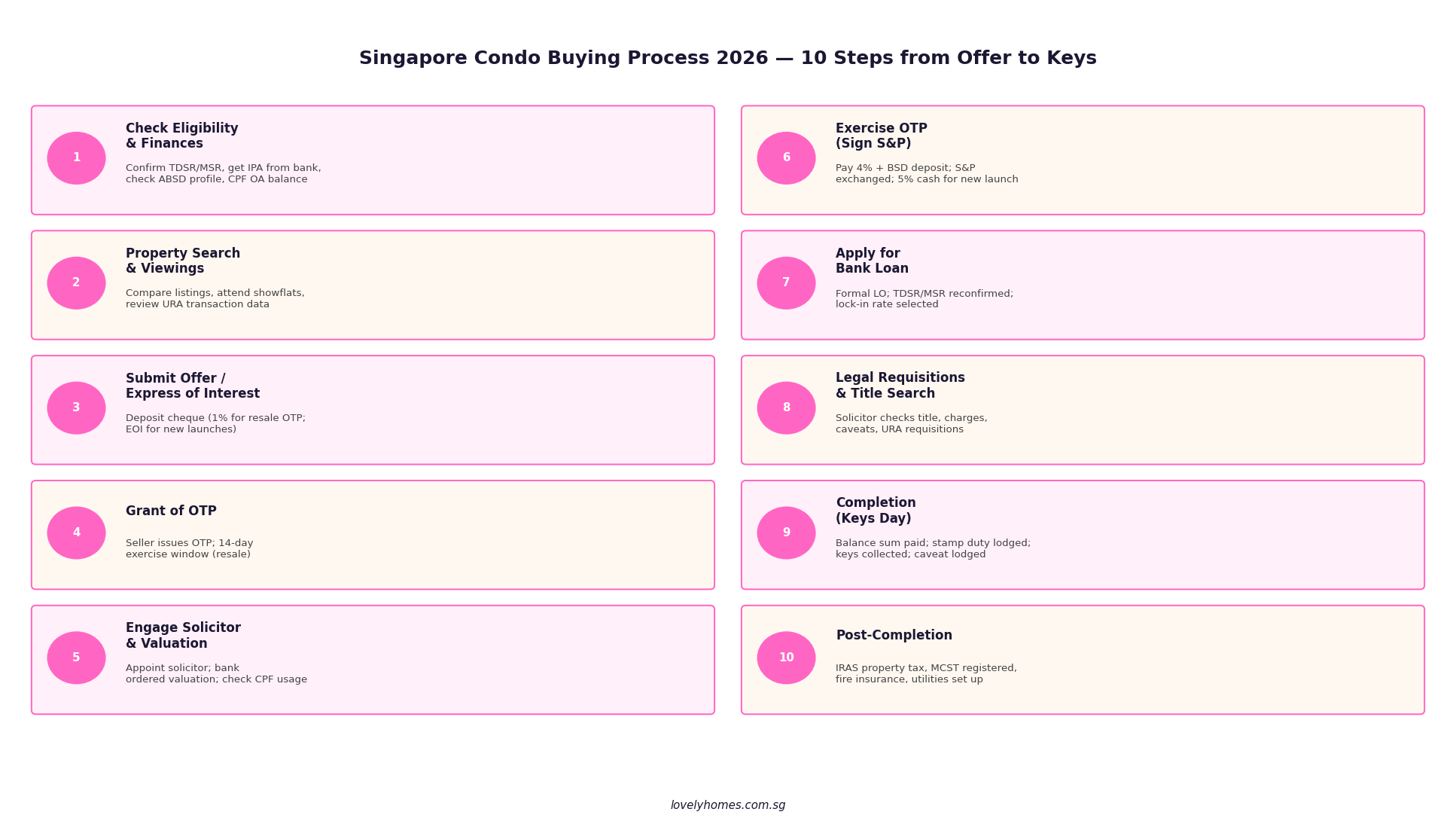
The 10-Step Buying Process — Visual Overview

Singapore condo buying process 2026 — 10-step timeline from offer to keys
Figure 1: The Singapore condo buying process in 10 steps — from eligibility check to post-completion. Source: LovelyHomes editorial, based on CEA and IRAS guidelines 2026.

Step 3–4 — Making an Offer and the Option to Purchase (OTP)

For a resale condo, the buying process is governed by the Controller of Housing under the Housing Developers (Control and Licensing) Act for new launches, and by common law for resale. In a resale transaction, the buyer and seller agree on a price, and the seller grants the buyer an Option to Purchase (OTP). The buyer pays an option fee (typically 1% of the purchase price), which grants them the exclusive right to buy the property within 14 calendar days. During this 14-day window, the buyer must arrange financing, engage a solicitor, and decide whether to proceed.

For a new launch, the process differs: buyers register an Expression of Interest (EOI) or join a ballot, attend a showflat, and — if selected — pay a 5% booking fee to receive the Sales & Purchase Agreement (S&P) from the developer. For a new EC (Executive Condominium), additional eligibility rules under HDB guidelines apply.

Step 5–6 — Engaging Your Solicitor and Exercising the OTP

Once you have decided to proceed, engage a solicitor immediately. Your solicitor will conduct a title search via the Singapore Land Authority (SLA) to confirm ownership, identify any caveats or encumbrances (outstanding mortgages, charges, or restrictive covenants), and raise legal requisitions with government agencies. To exercise the OTP, the buyer pays a further 4% of the purchase price (bringing the total deposit to 5%) and receives the signed S&P agreement. The balance of the purchase price is payable on completion, typically 10–12 weeks later for a resale unit.

BSD is payable within 14 days of exercising the OTP (for Singapore-issued documents) and can be paid from CPF Ordinary Account funds. ABSD is payable within 14 days of executing the S&P agreement and must be paid in cash.

Stamp Duty Deep-Dive: BSD and ABSD

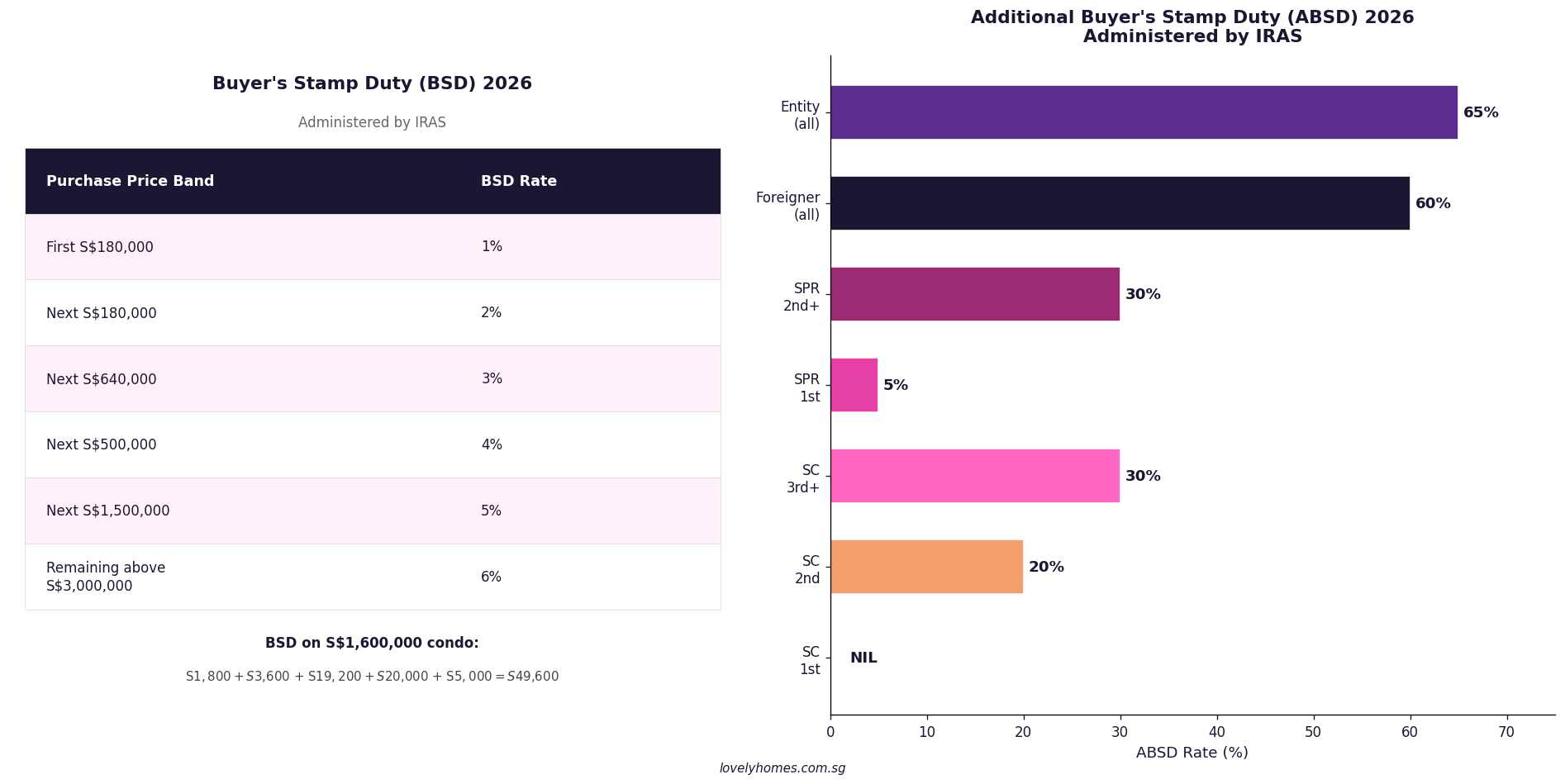
Singapore BSD rates 2026 and ABSD rates by buyer profile — condo buying stamp duty guide
Figure 2: Left — BSD rates by purchase price band (IRAS 2026). Right — ABSD rates by buyer profile (IRAS 2026). SC = Singapore Citizen, SPR = Singapore Permanent Resident.

BSD is levied on all residential property purchases in Singapore, at progressive rates administered by the Inland Revenue Authority of Singapore (IRAS): 1% on the first S$180,000, 2% on the next S$180,000, 3% on the next S$640,000, 4% on the next S$500,000, 5% on the next S$1,500,000, and 6% on amounts above S$3,000,000. On a S$1,600,000 condo, BSD amounts to S$49,600.

ABSD is an additional stamp duty introduced by the government to moderate investment demand. As at 1 July 2026, key ABSD rates are: SC 1st property 0%, SC 2nd 20%, SC 3rd+ 30%; SPR 1st property 5%, SPR 2nd+ 30%; foreigners (all) 60%; entities (all) 65%. ABSD must be settled in cash within 14 days of the date of the instrument — it cannot be paid using CPF funds.

Buyer Profile BSD (S$1.6M) ABSD Rate ABSD Amount Total Stamp Duty
SC — 1st property S$49,600 NIL NIL S$49,600
SC — 2nd property S$49,600 20% S$320,000 S$369,600
SC — 3rd+ property S$49,600 30% S$480,000 S$529,600
SPR — 1st property S$49,600 5% S$80,000 S$129,600
Foreigner — any property S$49,600 60% S$960,000 S$1,009,600

Total Cash Required — Three Buyer Profiles for a S$1.6M Condo

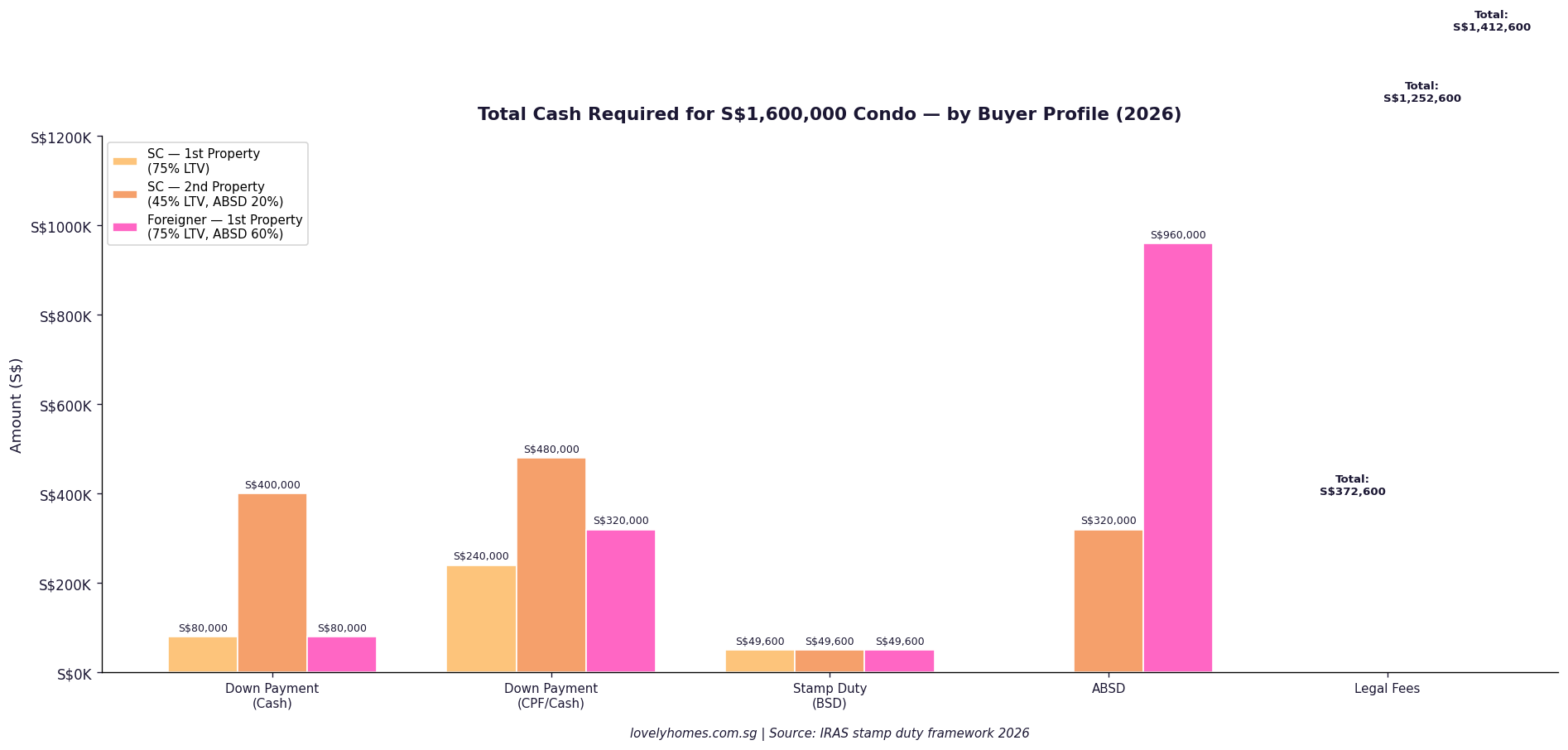
Total cash required to buy a S$1.6M condo Singapore 2026 — SC first property, SC second property, foreigner
Figure 3: Breakdown of total cash required to purchase a S$1,600,000 condominium in Singapore under three buyer profiles (2026). ABSD and down payment assumptions based on MAS LTV framework and IRAS stamp duty rates. Source: LovelyHomes editorial analysis.

Step 7 — Applying for Your Bank Loan

After exercising the OTP, your solicitor notifies the bank to proceed with the formal loan. The bank issues a Letter of Offer (LO), which sets out the loan quantum, interest rate structure, lock-in period (typically two to three years), and prepayment penalty. Review the LO carefully before signing. The Loan-to-Value (LTV) limit for a first housing loan is 75% of the lower of the purchase price and the bank’s valuation; for a second outstanding housing loan, LTV drops to 45%; for a third or subsequent, 35%. These limits are set by MAS and were last revised in September 2022.

Note that CPF Ordinary Account funds can be used to service the monthly instalment and to pay for the BSD — but not for ABSD or cash top-up arising from a valuation gap.

Step 8–9 — Requisitions, Title Search and Completion

Your solicitor will raise legal requisitions with IRAS (property tax status), the Land Transport Authority (road interpretation plan), the Public Utilities Board (water and drainage charges), and other relevant authorities. These take five to ten working days. On completion, the buyer’s solicitor forwards the balance purchase price (net of the deposit already paid) to the seller’s solicitor, who simultaneously releases the title. Your caveat is lodged at SLA on the same day, protecting your interest. Keys are handed over and you become the registered proprietor.

Worked Example: The Teo Family — SC Couple Buying a 2nd Property

Mr and Mrs Teo are Singapore Citizens purchasing a 3-bedroom OCR condo in Tampines at S$1,600,000 as their second residential property. They currently own an HDB flat in Bedok (MOP cleared), which they are retaining. Their combined gross monthly income is S$18,000.

  • BSD: S$49,600 — paid from CPF Ordinary Account.
  • ABSD (20%, 2nd property SC): S$320,000 — paid in cash at signing.
  • Down payment: 55% (LTV 45% for 2nd property) = S$880,000 total equity. Minimum 25% cash = S$400,000; remaining 30% (S$480,000) may come from CPF OA.
  • Bank loan: S$720,000 at 2.35% (2yr fixed); monthly repayment ~S$3,180. TDSR = 17.7% — well below 55% cap.
  • Legal fees: ~S$3,200.
  • Total cash outlay at completion: S$400,000 (cash downpayment) + S$320,000 (ABSD) + S$3,200 (legal) = S$723,200 cash; CPF drawdown S$529,600 (BSD + remaining downpayment).

This example illustrates why a Singapore Citizen buying a second residential property must maintain substantial liquid reserves — ABSD alone accounts for S$320,000 that must be settled in cash.

Why This Matters: Cooling Measures and the Investment Calculus

Singapore’s layered stamp duty framework — BSD plus ABSD plus Seller’s Stamp Duty (SSD) — is a deliberate policy tool that the Ministry of Finance and MAS use to moderate speculative activity and maintain housing affordability. Since April 2023, when ABSD was raised sharply (SC 2nd property from 17% to 20%; foreigner from 30% to 60%), transaction volumes among investment buyers have moderated but have not collapsed. Demand from owner-occupiers and upgraders has remained resilient, underpinned by Singapore’s robust employment market and steady inflow of high-net-worth residents. URA’s Q2 2026 Flash Estimates, released 1 July 2026, show the overall PPI still rising — +0.5% QoQ — even as the market digests the significant supply pipeline of 61,000 units expected to complete over the next few years.

New Launch vs Resale — Which Should You Buy?

New launches offer the ability to select your unit from a plan, benefit from the Progressive Payment Scheme (PPS), and potentially capture price appreciation between the launch date and TOP. However, they carry construction risk, deferred occupation, and you cannot see the exact finished product. Resale condos offer immediate entry, known physical condition, and existing community — but require cash top-up for any valuation gap. A thorough due diligence process, including engaging a structural inspector (approximately S$300–S$600) and reviewing the MCST’s financials, is advisable for resale condos.

What Might Come Next

With 9,320 private residential units on the 2026 GLS Confirmed List — over 50% above the 10-year annual average — supply is rising. URA’s full Q2 2026 data (due 24 July 2026) will clarify whether the modest +0.5% QoQ growth reflects genuine price moderation or a base effect from a particularly strong Q1. Analysts are watching whether the Federal Reserve’s policy trajectory, MAS exchange rate management, and global economic uncertainty will affect the purchasing power of foreign buyers who still face a 60% ABSD threshold. For Singapore Citizens buying within their first property, the outlook remains favourable — ABSD-free access to the market at a time when interest rates are declining from their 2023–2024 peaks.

Frequently Asked Questions

Can I use my CPF to pay ABSD?

No. ABSD must be paid entirely in cash. This distinguishes it from BSD, which can be settled using CPF Ordinary Account funds. ABSD must be paid to IRAS within 14 days of executing the instrument (typically the Sales & Purchase Agreement), so you must have the cash available before signing. This is one reason why financial planners recommend stress-testing your liquidity before committing to a second property purchase.

What happens if the bank valuation is lower than my purchase price?

If the bank’s formal valuation is S$1,550,000 but you are purchasing at S$1,600,000, the bank will only lend against the lower figure. With a 75% LTV, your loan quantum drops to S$1,162,500 instead of S$1,200,000 — meaning you must fund the S$37,500 shortfall from cash or CPF. This is known as a cash over valuation (COV) situation, though HDB uses this term more formally. For private condos, always check comparable transactions on URA REALIS and obtain a preliminary estimate from your bank before committing.

How long does a resale condo purchase take from offer to keys?

From the date the OTP is exercised to legal completion, the typical timeline is 10–12 weeks. The first four weeks involve legal requisitions, title search, and bank processing. Completion is then scheduled between the buyer’s and seller’s solicitors to align with the bank’s disbursement schedule. Delays can arise from outstanding property tax arrears, disputed caveats, or bank processing backlogs during peak periods. Build contingency time into your planning, especially if you need to vacate your current home simultaneously.

Do I need a solicitor, or can I use the developer’s panel firm for a new launch?

For a new launch, the developer’s solicitors handle the S&P agreement on a panel basis, and buyers can use them without engaging separate legal representation — the fee is typically absorbed by the developer. However, it is strongly advisable to engage your own independent solicitor (approximately S$2,500–S$3,500 for a standard new launch transaction) so that someone is specifically acting in your interests, reviewing payment schedules, and flagging any unusual conditions. For resale transactions, you must engage your own solicitor.

Can a foreigner buy any type of condo in Singapore?

Foreigners (non-citizens, non-PRs) may purchase units in private condominiums and apartments in Singapore without restriction, subject to the 60% ABSD. However, foreigners cannot purchase HDB flats, executive condominiums within the first 10 years of completion, or landed residential property (houses, bungalows, semi-detached, or terraced) without prior approval from the Land Dealings Approval Unit (LDAU) under SLA. Approval is rarely granted except in exceptional circumstances of permanent residency or significant economic contribution.

What is the Seller’s Stamp Duty (SSD), and does it affect my purchase?

SSD is payable by the seller, not the buyer — but it affects the seller’s net proceeds and can influence pricing and negotiation. SSD rates are 12% (if sold within 1 year), 8% (within 2 years), 4% (within 3 years), and nil beyond. If you plan to resell within three years, factor SSD into your exit modelling. On a S$1,600,000 condo sold at S$1,750,000 in 18 months, SSD at 8% = S$140,000 — wiping out most of the gross gain.

Is there a minimum occupation period for private condos?

There is no Minimum Occupation Period (MOP) for private condos in the same sense as HDB flats. However, the SSD effectively imposes a three-year hold before selling without penalty. If you purchased using an HDB resale flat that was originally classified under the MOP rules, you would also need to comply with those rules separately before buying the private property (unless you are an SC buying as a 2nd property). Confirm with HDB if any concurrent ownership obligations apply to your specific situation.

Related Articles

Disclaimer: This article is produced for general informational purposes only and does not constitute financial, legal, or investment advice. Property prices, stamp duty rates, LTV limits, TDSR thresholds, and interest rates are subject to change by the relevant Singapore authorities (URA, IRAS, MAS, SLA, HDB, CPF Board). Readers should consult licensed financial advisers, solicitors, and CEA-registered property salespersons before making any property purchase decisions. Always verify current rates directly with IRAS at www.iras.gov.sg and MAS at www.mas.gov.sg.

HDB Resale Price Records June 2026: Bidadari 3-Room Flat Hits S$945,000 — Singapore’s New All-Time Record

HDB Resale Price Records June 2026: Bidadari 3-Room Flat Hits S$945,000 — Singapore’s New All-Time Record

Quick Answer: Key Takeaways

  • A 3-room HDB resale flat at 118A Alkaff Crescent, Bidadari sold for S$945,000 in June 2026 — a new all-time record for 3-room HDB resale flats in Singapore.
  • The flat is on the 16th–18th floor, spans approximately 72 sqm, achieved S$1,219 psf, and has a remaining lease of approximately 93 years 6 months.
  • This surpasses the previous record of S$930,000 set in October 2025 (also at Alkaff Crescent, Bidadari).
  • Bidadari commands a structural premium driven by its park integration, Woodleigh MRT access, and comparatively newer lease commencing from 2019.
  • Singapore’s overall HDB resale market remains active in mid-2026, with million-dollar HDB transactions continuing at pace.
  • The record does not mean all 3-room flats are heading there — location, floor, lease, and estate quality are the primary valuation drivers.

Bidadari 3-Room Flat Breaks S$945,000 Record — June 2026

Singapore’s HDB resale market registered another record in June 2026: a 3-room flat at 118A Alkaff Crescent in the Bidadari estate changed hands at S$945,000, the highest transacted price ever recorded for a 3-room HDB resale flat in Singapore. The unit sits on the 16th to 18th floor, has a floor area of approximately 72 sqm (775 sqft), and achieved a price per square foot of S$1,219. With the lease commencing in 2019, the remaining lease at transaction is approximately 93 years and 6 months — among the longest available in the HDB resale market, which is itself a key pricing driver.

The transaction surpasses the previous 3-room record of S$930,000, transacted in October 2025 at 115C Alkaff Crescent — also in Bidadari, and also on a high floor. The fact that both records come from the same estate is not a coincidence.

Why Bidadari Commands a Premium

Bidadari was Singapore’s most ambitious HDB estate design project in a generation. Developed as part of the Bidadari Masterplan by HDB and URA, the estate integrates an 11-hectare Heritage Lake, the 10-hectare Bidadari Park, a network of park connectors, and a biodiversity corner into a residential development that was always intended to feel different from standard HDB estates. The flats — BTO from approximately 2016 to 2019 in multiple phases — only entered the resale market from around 2022 onwards (after the 5-year Minimum Occupation Period).

Key structural reasons for Bidadari’s premium:

  • New lease, long remaining tenure: BTO flats built from 2016–2019 have leases starting then, meaning buyers in 2026 receive approximately 90–93 years of remaining lease — more than almost anywhere else in the resale market, where mature-estate flats commonly carry 60–75 years of remaining lease.
  • Woodleigh MRT (NE Line): Direct MRT access to the city and Dhoby Ghaut interchange within approximately 10 minutes.
  • Park integration: The park, lake, and heritage biodiversity corner are physical amenities baked into the masterplan — not afterthoughts. Buyers pay for this.
  • School catchment: Cedar Girls’ Secondary School, Woodleigh Primary School, and proximity to MacPherson are among the school catchments residents cite.
  • Limited supply: Bidadari was a single-phase estate — HDB does not develop more land there. Once the original BTO batches are fully occupied and past MOP, supply is capped.

Context: HDB Resale Price Records in Singapore 2026

The S$945,000 Bidadari 3-room transaction sits within a broader 2026 narrative of continued HDB resale price pressure in select estates. Singapore’s million-dollar HDB transaction count — flats transacting above S$1 million — has remained elevated since the post-pandemic 2021–2022 surge, though the rate of new records has moderated as buyers absorb the impact of ABSD increases and interest rate adjustments.

  • Million-dollar HDB transactions continue to occur primarily in Bishan, Queenstown, Toa Payoh, Buona Vista, and Central for large flat types.
  • Bidadari has emerged as the standout performer for smaller flat types (3-room and 4-room), where its premium lease and park access translate into record psf figures.
  • Towns with very short remaining leases (below 60 years) are seeing growing price bifurcation — buyers have become acutely lease-aware since TDSR and CPF withdrawal rules tightened the cost of buying short-lease flats.
  • The HDB resale price index for 2H 2025 rose approximately 2.6% according to HDB flash data, and the market remains seller-favoured in premium estates.

What This Means for Buyers

If you are a first-time buyer targeting an affordable 3-room resale flat, Bidadari is now firmly out of range for most standard grant stacks. A S$945,000 resale flat requires substantial cash and CPF — buyers would need balances well above the S$800,000 level at which most bank valuations on 3-rooms settle, with any gap above valuation payable in cash. A buyer with strong CPF savings and Family Grant eligibility can still structure a purchase — the long remaining lease makes CPF usage efficient compared to older stock.

For upgraders and investors, the Bidadari record confirms that premium HDB locations with newer leases increasingly behave like a sub-segment of their own — the S$1,200+ psf that Bidadari 3-room units now command exceeds the psf of many suburban OCR freehold condos purchased in the early 2010s.

Perspective check: A S$945,000 3-room HDB flat is extraordinary, but should be read as a record for a specific product type (high-floor, premium estate, newer lease) — not an indicator of where Singapore’s median 3-room flat trades. The vast majority of 3-room resale transactions in 2026 occur between S$350,000 and S$550,000 in mature towns.

HDB Resale Trends to Watch in 2H 2026

  • URA Q2 2026 Flash Estimates: Not yet released as of 1 July 2026. When released, these will clarify whether the overall market continued to appreciate or moderate in April–June 2026.
  • Interest rate trajectory: SORA-based mortgage rates have been influenced by US Federal Reserve policy. Any easing supports higher sustainable prices; tightening would dampen buyer capacity.
  • MOP releases from 2021–2022 BTO exercises: A significant number of BTO flats from 2021–2022 will reach their 5-year MOP from 2026 onwards, adding resale supply in newer estates including Tengah, Tampines, and Kallang/Whampoa.
  • Policy risk: Singapore’s government has historically moved quickly to cool the property market when transaction volumes and prices exceed policy comfort levels.

Frequently Asked Questions

Can I use CPF to buy a high-price HDB resale flat like those in Bidadari?

Yes, CPF can be used to purchase any HDB resale flat, including those at S$900,000+. However, the CPF Valuation Limit applies: you can only use CPF up to the assessed valuation of the flat (not the transacted price, if it is higher). For a S$945,000 transaction where the bank values the flat at S$900,000, your CPF usage is capped at S$900,000 combined (inclusive of BSD). The gap between transacted price and valuation must be paid in cash.

Why are Bidadari flats so expensive compared to nearby mature estates?

Bidadari’s premium over comparable mature estates (e.g., Toa Payoh or MacPherson) reflects the combination of new lease (93–95 years remaining vs. 60–75 in nearby mature towns), exceptional park and MRT integration, and scarcity of supply. Toa Payoh 3-room flats on high floors typically transact at S$600,000–S$750,000 — Bidadari commands a 25–35% premium. Buyers are pricing in 20–30 extra years of lease and the park lifestyle premium, both broadly rational given how the Singapore HDB market values lease longevity.

Are there more record-breaking transactions likely in Bidadari?

It is plausible, though not certain. Bidadari’s highest-floor units in the most sought-after blocks are a finite pool. As each generation of owners hits MOP and selectively sells, the next wave of premium transactions will depend on whether buyer demand remains strong enough to absorb these prices. Given the 90+ year leases running to 2112–2115, demand from younger, longer-horizon buyers is likely to remain robust in the near term.

Related Articles

Disclaimer

This article is for general information only and does not constitute financial or property advice. Transaction data is sourced from publicly available HDB resale records. Remaining lease and floor information are indicative based on published reports. Always verify current data with the Housing & Development Board (HDB) before any property transaction. Consult a licensed financial adviser and a licensed conveyancing solicitor for advice specific to your circumstances.

×Click anywhere to close

Singapore New Launch Condo Buying Guide 2026: Showflat, Balloting, Progressive Payments and Everything to Know Before You Buy

Singapore New Launch Condo Buying Guide 2026: Showflat, Balloting, Progressive Payments and Everything to Know Before You Buy

Quick Answer: Key Takeaways

  • Buying a new launch condo in Singapore means purchasing directly from the developer before or shortly after the project receives Temporary Occupation Permit (TOP).
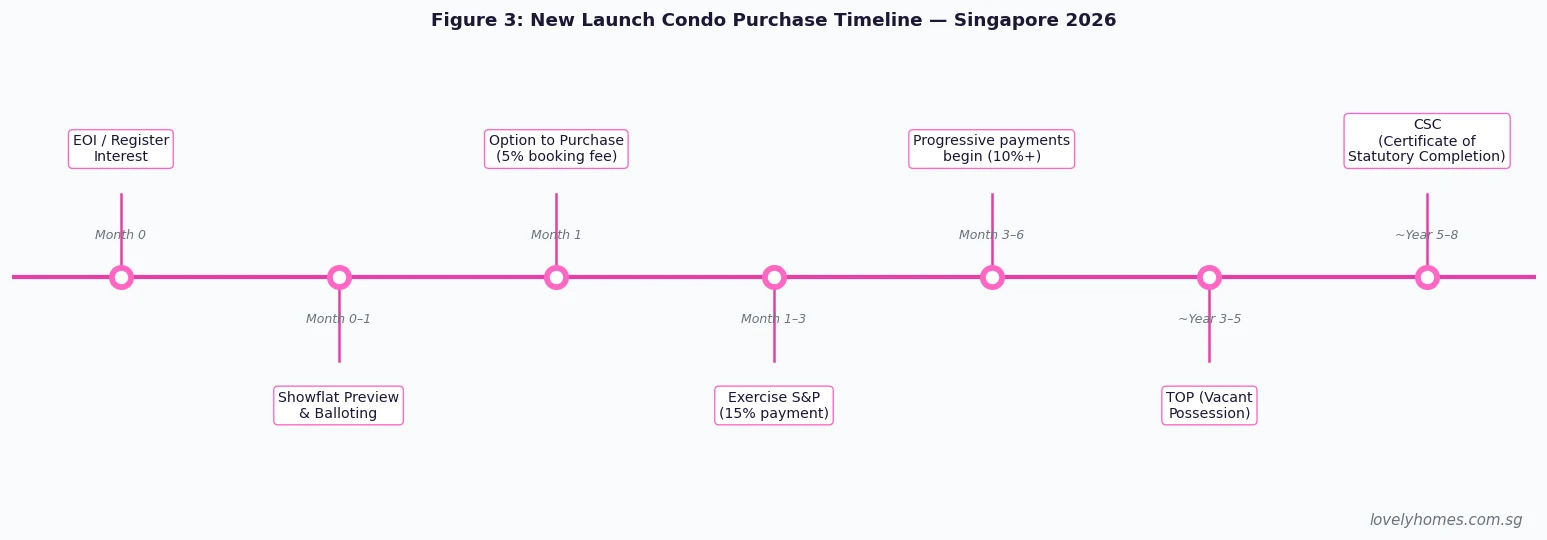
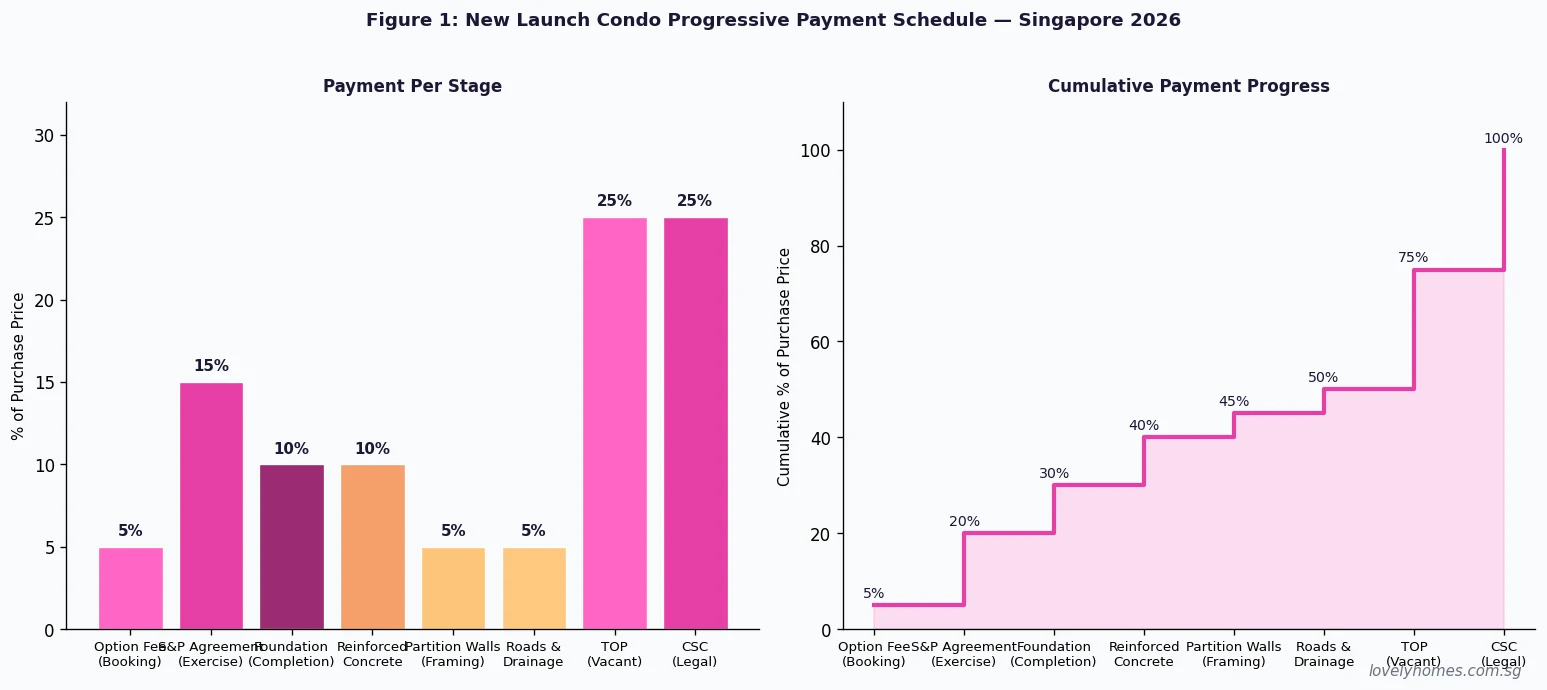
  • You pay via the Progressive Payment Scheme (PPS): 5% booking fee at OTP, 15% on exercising the Sales & Purchase (S&P) Agreement, then staged payments tied to construction milestones.
  • ABSD applies upfront and is due within 2 weeks of the OTP exercise. For Singapore Citizens buying their second property: 20%. Foreigners: 60%. Plan for this before you commit.
  • New launches carry a 5-year Seller’s Stamp Duty (SSD) lock-in — you cannot sell without a significant penalty within 5 years of purchase.
  • Unlike resale, you receive the flat in its bare shell at TOP. Renovation costs (typically S$50,000–S$120,000 for a standard 2-bedroom) must be budgeted separately.
  • The ballot system — especially for highly anticipated launches — means you may not get the unit or floor you want even after registering interest.
  • New launch condos in Singapore have historically outperformed resale on price quantum appreciation from launch to TOP, but this is not guaranteed and varies by project and location.

What Is a New Launch Condo?

A new launch condo (or new launch private residential property) is a condominium development released for sale by the developer before or shortly after it receives TOP. In Singapore’s context, most new launches happen via a showflat sales exercise during the construction phase — you view show units and buy off-plan, before the actual building is complete. The developer holds a licence from the Urban Redevelopment Authority (URA) to sell, and the transaction is governed by the Housing Developers (Control and Licensing) Act.

New launches are distinct from resale condos (completed units bought on the secondary market) and from executive condominiums (ECs) (hybrid developments with HDB-like eligibility restrictions for the first five years). This guide focuses exclusively on private new launch condos.

Step 1: Registering Interest and the Showflat Preview

Before a formal launch, developers typically invite potential buyers to register their interest (EOI). Registering is non-binding — it gives you priority access to a showflat preview before the public, and ensures you receive the developer’s price list and floor plan release in advance. At the preview, you view the show units (which may be furnished or bare-shell mock-ups) and indicate interest in specific units and stacks.

For highly subscribed projects, the developer may hold a ballot: if more buyers are interested in a particular unit type than units available, a computerised draw selects the order of purchase. Being balloted does not guarantee you receive your preferred unit — you may be offered an alternative or invited to return if units remain after the first round.

Under URA rules, developers must release at least 35% of available units in the first sale tranche. Price lists must be published at least 24 hours before the launch, and developers may not collect more than 5% as a booking fee (OTP fee) before exercising the Sale & Purchase Agreement.

New launch condo purchase timeline Singapore 2026 — EOI, showflat, OTP, S&P, progressive payments, TOP, CSC
Figure 3: New launch condo purchase timeline from EOI to CSC — Singapore 2026. Source: URA, HDB (indicative milestones).

Step 2: The Option to Purchase (OTP) and Booking Fee

When you decide to proceed, you sign an Option to Purchase (OTP) and pay the booking fee — typically 5% of the purchase price. In Singapore, developer OTPs for new launches have a standard form prescribed by the Controller of Housing. You then have a fixed period — typically 3 weeks — to exercise the OTP by signing the Sales & Purchase Agreement (S&P) and paying the next instalment.

The booking fee is non-refundable if you decide not to exercise. However, if you exercise the OTP and subsequently fail to complete (e.g., cannot obtain financing), the forfeiture is typically 25% of the purchase price — an extremely significant sum. This underscores why financing pre-approval matters before you sign any OTP.

Step 3: Stamp Duties — BSD and ABSD

Singapore imposes Buyer’s Stamp Duty (BSD) on all property purchases, calculated on the higher of the purchase price or market value:

  • 1% on the first S$180,000
  • 2% on the next S$180,000
  • 3% on the next S$640,000
  • 4% on the next S$500,000
  • 5% on the next S$1,500,000
  • 6% on any excess above S$3,000,000

For most new launch condos — commonly priced between S$1.5M and S$3M in 2026 — BSD is typically S$39,600 to S$69,600.

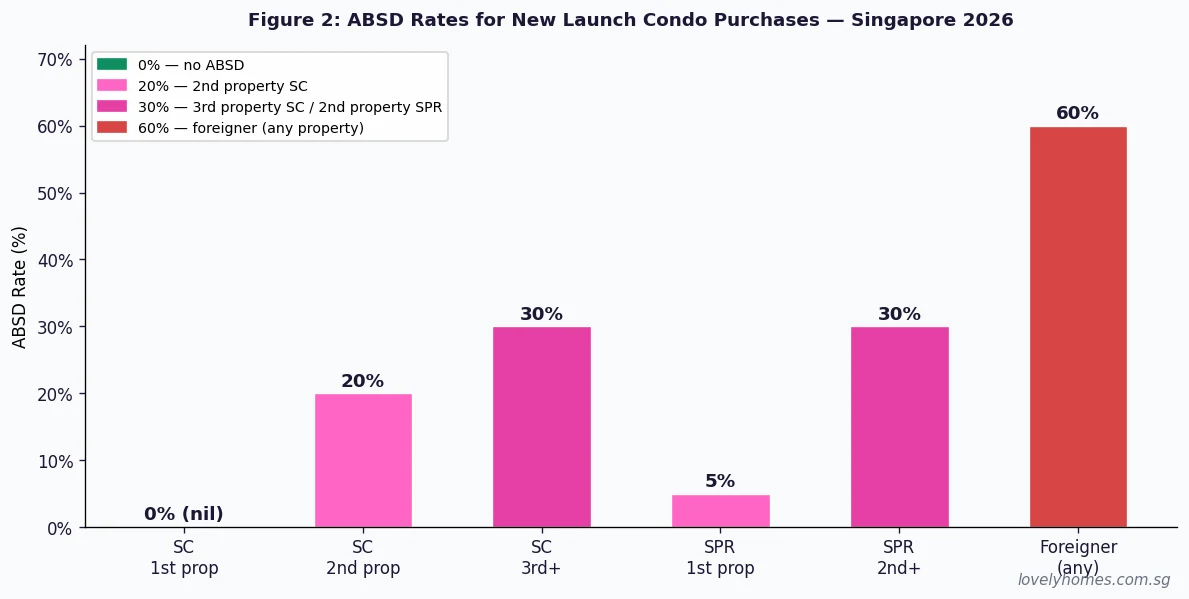
Additional Buyer’s Stamp Duty (ABSD) applies on top of BSD for buyers beyond their first property, PRs, and all foreigners:

ABSD rates for new launch condo purchases Singapore 2026 — bar chart showing 0% to 60% by buyer profile
Figure 2: ABSD rates applicable to new launch condo purchases by buyer profile — Singapore 2026. Source: IRAS.
ABSD is due within 2 weeks of the OTP date — not after TOP, not at completion. For a S$2M condo, a Singapore Citizen buying a second property owes ABSD of S$400,000 within a fortnight. Ensure your liquidity is in place before signing the OTP.

Married couples where one spouse is an SC and the other is a PR buying their first property together are eligible for ABSD remission — the ABSD paid is refunded after holding the property for 5 years, provided they sell the other property (if any) within 6 months of TOP or purchase, and the purchased property remains their primary residence.

Step 4: Financing — LTV, TDSR and MSR (if applicable)

Private condo financing in Singapore is governed by the Total Debt Servicing Ratio (TDSR) framework: total monthly debt obligations (all loans) must not exceed 55% of gross monthly income. The Loan-to-Value (LTV) limit for private properties depends on your loan count:

Loan Count Max LTV (bank loan) Min Cash Down Min CPF/Cash Down
1st housing loan 75% 5% cash 20% cash/CPF
2nd housing loan 45% 25% cash 30% cash/CPF
3rd and beyond 35% 25% cash 40% cash/CPF

Note: these are the LTV limits for standard bank loans. HDB loans are not available for private properties. There is no MSR cap for private condos — only TDSR applies.

Step 5: The Progressive Payment Scheme (PPS)

Unlike resale purchases (where you pay the full price in one transaction), new launch condos use the Progressive Payment Scheme. You pay in stages as the building reaches construction milestones. Each payment is called a “progress payment” and corresponds to a defined stage of construction certified by an architect.

New launch condo progressive payment schedule Singapore 2026 — bar chart showing % at each construction milestone
Figure 1: Progressive Payment Scheme stages — typical new launch condo in Singapore 2026. Source: Housing Developers Rules.

Each progress payment triggers a corresponding drawdown of your bank loan. This is why you need a bank’s Letter of Offer (LO) before or shortly after exercising the S&P — the bank needs to be ready to disburse as each stage is reached. You pay interest on the disbursed loan amount as construction progresses, typically at the bank’s prevailing rate (SORA-based in 2026).

Step 6: Deferred Payment Scheme (DPS) — Is It Still Available?

The Deferred Payment Scheme (DPS) allows buyers to defer up to 80% of the purchase price until TOP or CSC, rather than paying progressively. However, since 2007, the Monetary Authority of Singapore (MAS) has effectively restricted DPS on standard residential properties. Most developers no longer offer DPS as a standard option; where it appears, it is typically for high-end projects (luxury segment) under specific conditions. The PPS is the default for virtually all new launch condos launched from 2026 onwards.

Step 7: TOP, Possession and Renovation

When the building receives its Temporary Occupation Permit (TOP) from the Building and Construction Authority (BCA), you can take vacant possession of your unit. At this stage, you pay the remaining progress payments: typically 25% on TOP (vacant possession) and a final 5% on CSC (Certificate of Statutory Completion).

A new launch unit at TOP is delivered as a bare shell — bare concrete floors, unpainted walls, basic sanitary fittings (unless the developer has included a renovation package). You will need to engage contractors for flooring, painting, kitchen and bathroom fittings, carpentry, air-conditioning, and more. Budget conservatively: renovation for a 2-bedroom (around 700–850 sqft) typically ranges from S$50,000 to S$100,000 in Singapore’s 2026 market; for larger units, S$120,000 or more is common. Include this in your total acquisition cost model.

Seller’s Stamp Duty (SSD): The 5-Year Lock-In

Singapore’s SSD was introduced in 2011 to curb short-term speculation. For residential properties purchased on or after 11 March 2017, SSD applies if you sell within 3 years of purchase:

  • Sold within 1st year: 12%
  • Sold within 2nd year: 8%
  • Sold within 3rd year: 4%
  • Sold after 3rd year: 0%

SSD is calculated on the higher of the sale price or market value. For new launch condos, this effectively means you cannot profitably flip a unit until at least 3 years after OTP. Since most new launches take 3–5 years to reach TOP, many buyers hold well past the SSD window regardless.

New Launch vs Resale: Quick Comparison

Factor New Launch Resale Condo
Payment structure Progressive (PPS) Full payment on completion
Condition at handover Bare shell Existing fittings
Waiting time 3–5 years to TOP Immediate
Price Usually at or above market premium Negotiated market price
HDB grant eligibility Not applicable (private) Not applicable (private)
CPF usage Yes (Ordinary Account) Yes
Renovation budget needed Yes (significant) Usually lower (existing fit-out)
ABSD Same rates as resale Same rates as new launch

Worked Example: The Teo Family

Mr and Mrs Teo are Singapore Citizens, both aged 34. They own a 4-room HDB flat in Bishan (fully paid). They wish to buy a new launch 2-bedroom condo in Jurong East at S$1,600,000. This will be their second property.

BSD: 1%×S$180K + 2%×S$180K + 3%×S$640K + 4%×S$600K = S$1,800 + S$3,600 + S$19,200 + S$24,000 = S$48,600

ABSD: 20% on second property (SC) = S$320,000 — due within 2 weeks of OTP.

Booking fee (5%): S$80,000 cash.

S&P exercise (15%): S$240,000 (cash/CPF). Total upfront = S$320,000 cash + S$368,600 stamp duties.

Bank loan (75% LTV on first loan — but this is their 2nd property): LTV = 45%, so bank loan max = S$720,000. Total cash + CPF must cover S$880,000 (55%) — plus S$368,600 stamp duties already paid. Renovation budget: S$70,000.

Total funds required: approximately S$1,320,000 in cash and CPF before loan proceeds. The Teos should model whether their HDB flat sale proceeds (if they plan to sell) are sufficient, or whether they can service a bridging gap.

Planning note: Many buyers purchase a new launch before selling their existing property, intending to sell after TOP. Be aware that (a) if TOP is delayed, you may hold both properties for longer than expected, (b) carrying two mortgages or a mortgage plus HDB loan simultaneously can stress TDSR, and (c) the ABSD for the second property is paid now and is not refunded unless you meet the strict ABSD remission criteria (married SC/SPR couple, first home only).

Common Pitfalls to Avoid

  • Not stress-testing TDSR at higher SORA: SORA-based mortgage rates have fluctuated. Ensure you can service your loan even if rates rise 1–2 percentage points above today’s levels.
  • Underestimating renovation costs: Get a proper quote before committing; budget overruns on renovation are extremely common in Singapore.
  • Assuming your preferred unit is available: Popular stacks (high floor, pool-facing, corner units) are typically balloted first. Be prepared to accept alternatives.
  • Overlooking maintenance fees: New launch condos with extensive facilities (pool, gym, concierge) can carry maintenance fees of S$400–S$800/mth or more for larger units.
  • Not checking the developer’s track record: Review the developer’s past completions — quality, adherence to timeline, and handover defects. Singapore’s REDAS and the Controller of Housing maintain records of licensed developers.

Frequently Asked Questions

Can I use CPF to pay for a new launch condo?

Yes. You may use your CPF Ordinary Account (OA) balance to pay for the S&P downpayment and progressive payments (except the booking fee — the initial 5% OTP fee must be in cash). You can also use CPF OA for BSD and legal fees. However, you cannot use CPF for ABSD payments — ABSD must be paid in cash. CPF usage on private property is subject to the valuation limit and the withdrawal limit (typically capped at the assessed value of the property); once the OA balance used for the property reaches the assessed valuation, you must pay subsequent instalments from your bank loan or cash.

What happens if the developer delays TOP?

Developers in Singapore are legally required to obtain TOP by the Delivery Possession Date (DPD) stated in the S&P Agreement. If they fail to do so, they must pay Liquidated Damages (LD) to buyers — typically calculated at 8% per annum on the progressive payments already made, pro-rated for each day of delay. LD is automatically due; you do not need to take legal action to claim it. For extended delays (beyond 6 months), the Controller of Housing may also take action against the developer’s licence.

Can I back out after signing the S&P Agreement?

You can withdraw after exercising the S&P, but the consequences are severe. Under the standard Housing Developers (Show Units) Rules, the developer can forfeit up to 25% of the purchase price as liquidated damages. You also lose your 5% booking fee. In practice, most buyers do not withdraw after exercising — the financial penalty makes it uneconomical except in extreme circumstances (e.g., inability to obtain financing).

What is the difference between TOP and CSC?

TOP (Temporary Occupation Permit) is issued by BCA when the building meets minimum safety, fire safety, and occupancy standards. You can move in and begin renovation after TOP. CSC (Certificate of Statutory Completion) is issued when the development fully meets all planning and statutory requirements — typically 1–3 years after TOP. The final 5% payment is due on CSC. Legal completion (transfer of title) typically happens at or shortly after CSC. Until CSC, the developer retains the final 5% and your strata title has not yet been issued.

Do I need a lawyer for a new launch condo purchase?

Yes. All property transactions in Singapore require a licensed Singapore solicitor to act for you on conveyancing. For new launches, the developer typically has a panel of law firms; you may use one of these or appoint your own solicitor. Your solicitor will review the S&P Agreement, verify that the developer’s housing licence is valid, liaise with CPF Board (if you are using CPF), liaise with your bank (if you have a mortgage), and register the transfer of title at the Singapore Land Authority (SLA). Legal fees for a new launch typically range from S$2,500 to S$5,000 for standard condos.

Related Articles

Disclaimer

This article is for general information only and does not constitute financial, legal, or property advice. Stamp duty rates, LTV limits, TDSR rules, and grant schemes are subject to change by the Singapore government. Always verify current rules with the Inland Revenue Authority of Singapore (IRAS), Urban Redevelopment Authority (URA), and Monetary Authority of Singapore (MAS) before making any purchase decision. Consult a licensed conveyancing solicitor and a licensed financial adviser for advice specific to your circumstances.

×Click anywhere to close

Singapore HDB CPF Housing Grants Guide 2026: EHG, Family Grant, PHG and Every Dollar You Can Claim

Singapore HDB CPF Housing Grants Guide 2026: EHG, Family Grant, PHG and Every Dollar You Can Claim

Quick Answer: Key Takeaways

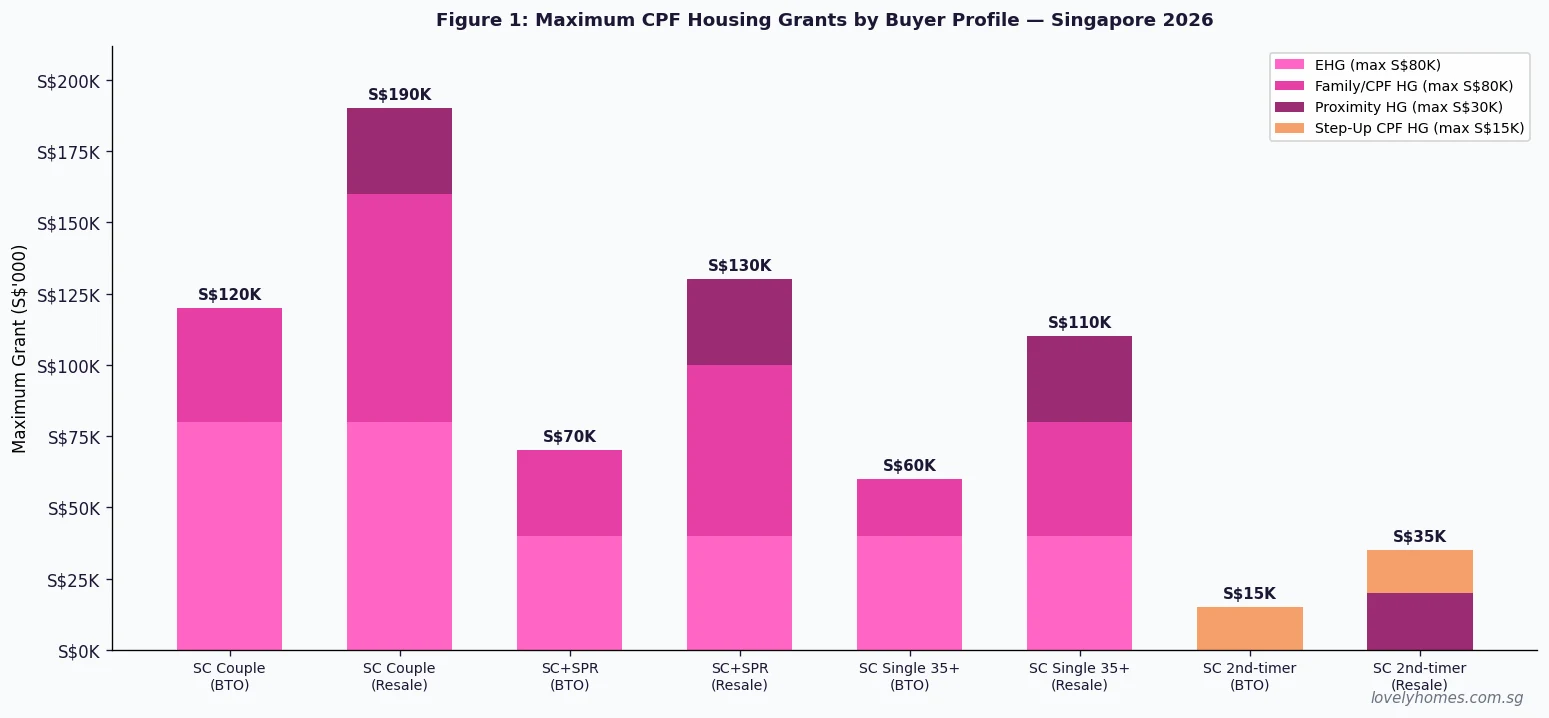
  • Singapore first-time HDB buyers can receive up to S$230,000 in combined CPF housing grants (resale) or up to S$120,000 for a BTO flat.
  • The Enhanced CPF Housing Grant (EHG) is the cornerstone — up to S$80,000 for couples, tapering with income. It applies to both BTO and resale flats.
  • The CPF Housing Grant (Family Grant) for resale adds up to S$80,000 on top of EHG; the Proximity Housing Grant (PHG) can add another S$30,000.
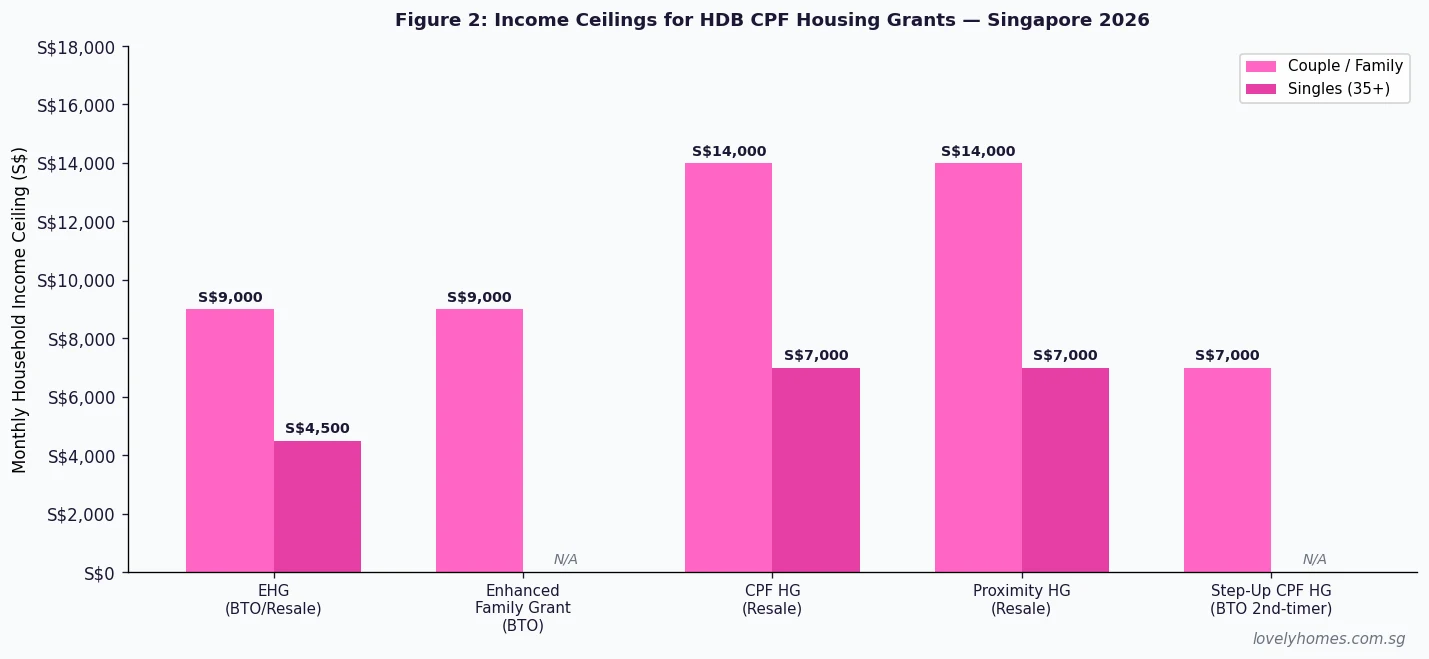
  • Income ceilings vary: EHG caps at S$9,000/mth (couples); Family Grant and PHG cap at S$14,000/mth.
  • All grants are disbursed into your CPF Ordinary Account and used for the flat purchase — they do not arrive as cash.
  • Second-timer families buying BTO flats can access the Step-Up CPF Housing Grant (S$15,000) if upgrading from a 2-room Flexi.
  • Apply for grants during the HDB Flat Eligibility (HFE) Letter application process — grants are assessed and confirmed before you book a flat or submit an OTP.

What Are HDB CPF Housing Grants?

Singapore’s CPF housing grant system is one of the most comprehensive homeownership subsidy programmes in the world. Administered jointly by the Housing & Development Board (HDB) and the Central Provident Fund (CPF) Board, these grants reduce the effective purchase price of an HDB flat by transferring funds directly into your CPF Ordinary Account. You then draw on that CPF balance to pay your flat’s downpayment and monthly instalments — effectively cutting your out-of-pocket cash requirements.

Grants apply to Singapore Citizens (SCs) buying HDB flats, whether new BTO or resale. Permanent Residents purchasing resale flats together with an SC spouse are eligible for reduced grant amounts on certain schemes. Grants do not reduce your BSD liability — stamp duty is levied on the full purchase price — but they substantially lower the cash you need to bridge.

As at 1 July 2026, the four active grant schemes are: the Enhanced CPF Housing Grant (EHG), the CPF Housing Grant for resale (sometimes called the Family Grant), the Proximity Housing Grant (PHG), and the Step-Up CPF Housing Grant for eligible second-timers.

Singapore HDB CPF Housing Grants by buyer profile 2026 — stacked bar chart showing EHG, Family Grant and Proximity Grant maximums
Figure 1: Maximum CPF housing grants stacked by type and buyer profile — Singapore 2026. Source: HDB.

Grant 1: Enhanced CPF Housing Grant (EHG)

The EHG is the flagship grant available to first-timer families and singles buying their first subsidised home — applicable to both BTO and resale HDB flats. It was introduced in September 2019, replacing the earlier Additional CPF Housing Grant (AHG) and Special CPF Housing Grant (SHG), and is designed to taper sharply with household income so that the lowest-income buyers receive the most support.

EHG eligibility

  • At least one applicant must be a Singapore Citizen.
  • All applicants and occupiers must not own or have disposed of any private property (locally or overseas) in the 30 months before the flat application.
  • All applicants and essential occupiers must have been in continuous employment for at least 12 months before the application, or be self-employed for 12 months with CPF contributions.
  • Gross monthly household income must not exceed S$9,000 for families (or S$4,500 for singles aged 35 and above).
  • Buying a flat with a remaining lease of at least 20 years that covers the youngest buyer to age 95.

EHG amounts

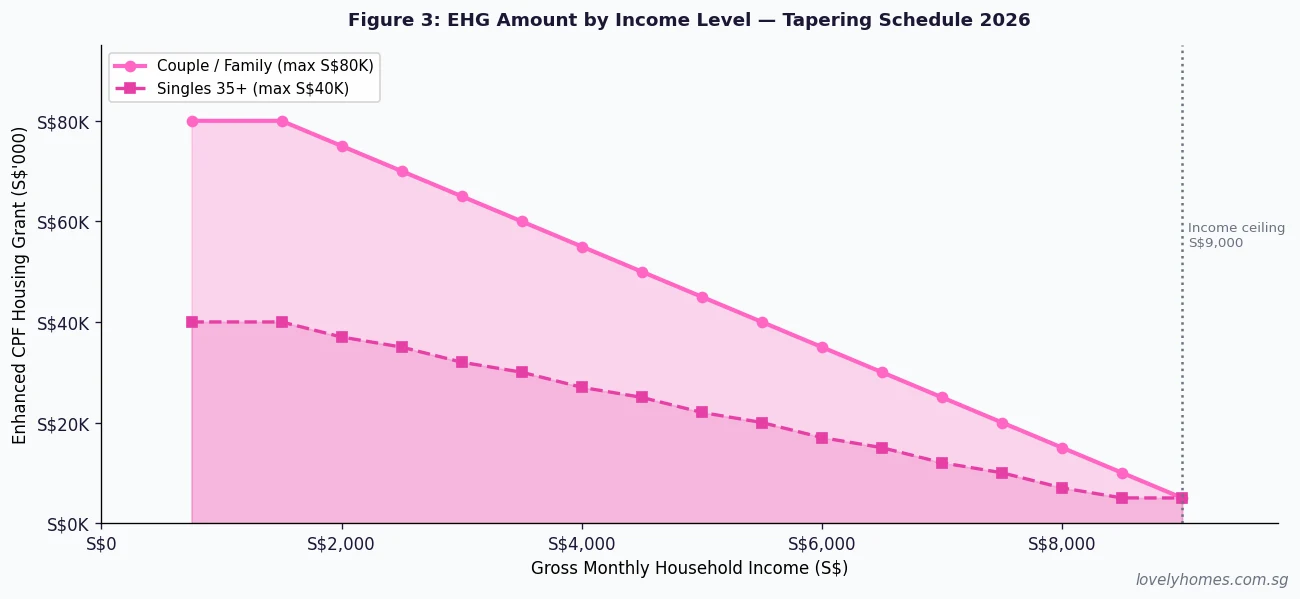
The EHG is income-progressive. The lower your household income, the higher your grant. For a couple or family, the maximum is S$80,000 (for households earning S$1,500 per month or less), tapering in roughly S$5,000 increments as income rises, to a minimum of S$5,000 for households earning S$8,501–S$9,000 per month. For singles aged 35 and above, the amounts are halved: maximum S$40,000 at income ≤ S$1,500, down to S$2,500 at ≤ S$4,500. Note that the EHG applies for every flat type — a couple buying a 2-room BTO in Tengah receives the same EHG as one buying a 5-room resale flat in Bishan, as long as income and other criteria are met.

EHG Enhanced CPF Housing Grant tapering by income level Singapore 2026 — line chart couples vs singles
Figure 3: EHG tapering schedule — grant amount falls as household income rises. Source: HDB (indicative bands, 2026).

Grant 2: CPF Housing Grant — Family Grant (Resale Flats)

The CPF Housing Grant for resale flats — commonly called the Family Grant — applies exclusively when you buy a resale HDB flat from the open market. It is layered on top of the EHG and brings the total potential subsidy to well over S$100,000 for eligible buyers.

Family Grant amounts

Buyer Profile 2-room / 3-room flat 4-room flat and above
SC couple or family (both SC) S$50,000 S$80,000
SC + SPR couple (one SC, one PR) S$40,000 S$60,000
SC singles (35 and above) S$25,000 S$40,000

Family Grant eligibility

  • At least one applicant must be an SC.
  • For couples: at least one must have been working and making CPF contributions continuously (or self-employed) for at least 12 months immediately before the OTP date.
  • Gross monthly household income must not exceed S$14,000 (couples/families) or S$7,000 (singles).
  • First-timer families only (you must not have previously received any CPF housing grant).
Key takeaway: The Family Grant and the EHG are stackable. A SC couple earning S$6,000/month buying a 4-room resale flat could receive EHG S$35,000 + Family Grant S$80,000 = S$115,000 in combined grants — potentially eliminating any cash downpayment requirement.

Grant 3: Proximity Housing Grant (PHG)

Singapore’s Proximity Housing Grant incentivises multigenerational living — or at least living close to family. Administered by HDB, it applies when you buy a resale flat to live near or with your parents, children, or in-laws. The PHG recognises that family proximity reduces social isolation and supports informal caregiving, and it is stacked on top of EHG and the Family Grant.

PHG amounts

Living arrangement Grant
Living WITH parents / child (in the same flat, at time of application) S$30,000
Living NEAR parents / child (within 4 km, different flat) S$15,000

PHG eligibility

  • The applicant and the relevant family member (parent/child) must both be SCs or PRs.
  • The family member being lived near/with must be in a qualifying flat (HDB, EC, or private).
  • Income ceiling: S$14,000/month (couples/families).
  • Applies to resale flats only — not BTO.
  • The applicant’s flat and the parent’s/child’s flat must each be in Singapore, and the 4 km radius is measured door-to-door (straight line) by HDB.

Grant 4: Step-Up CPF Housing Grant

The Step-Up CPF Housing Grant was introduced to help Singapore Citizens who are second-timers but from lower-income backgrounds make the jump from a 2-room Flexi BTO flat to a larger subsidised flat. It is specifically designed for households that may have missed the first-timer grant window or have more modest means.

Step-Up Grant criteria

  • Both applicants must be SCs, and at least one must be currently living in a 2-room Flexi BTO flat (built by HDB after 2017).
  • Household income must not exceed S$7,000/month.
  • Buying a 3-room BTO flat or larger from HDB.
  • Grant amount: S$15,000.

Singapore HDB housing grant income ceilings comparison chart 2026 — couples vs singles across EHG, Family Grant, PHG, Step-Up
Figure 2: Income ceiling comparison across all four HDB CPF housing grant schemes — 2026. Source: HDB.

How the Grants Stack: A Summary Table

Grant BTO / Resale Max Amount (SC Couple) Income Ceiling Stackable With
EHG Both S$80,000 S$9,000/mth Family Grant, PHG
Family Grant Resale only S$80,000 S$14,000/mth EHG, PHG
Proximity HG (PHG) Resale only S$30,000 S$14,000/mth EHG, Family Grant
Step-Up CPF HG BTO only (3-room+) S$15,000 S$7,000/mth EHG (limited)
Maximum (Resale, SC Couple) Resale S$190,000 S$9,000/mth (EHG) + S$14,000/mth (others) All stacked
Maximum (BTO, SC Couple) BTO S$80,000 S$9,000/mth EHG only (+ Step-Up if 2nd-timer)

Worked Example: The Lim Family

Mr and Mrs Lim are a Singapore Citizen couple, both aged 29, with a combined gross monthly income of S$5,500. They have been continuously employed for over 12 months. Their CPF OA balance is S$28,000 combined. They are buying a 4-room resale HDB flat in Tampines for S$620,000. Mrs Lim’s parents live in Tampines, approximately 1.8 km away.

Step 1 — Determine EHG. Income S$5,500, SC couple, first-timers. EHG taper table: at S$5,001–S$5,500, the grant is approximately S$45,000.

Step 2 — Determine Family Grant. 4-room resale flat, SC couple, income below S$14,000 → Family Grant = S$80,000.

Step 3 — Determine PHG. Mrs Lim’s parents are within 4 km but not in the same flat → Near-parents PHG = S$15,000.

Total grants: S$140,000.

Step 4 — Work out the purchase.
Purchase price: S$620,000
BSD: S$620,000 × (1% × S$180K + 2% × S$180K + 3% × S$260K) = S$15,000 (paid from CPF OA)
HDB loan (80% LTV): S$496,000 (assuming they take HDB loan)
CPF contribution: S$620,000 − S$496,000 = S$124,000 needed (grants S$140,000 disbursed into CPF OA — covers this entirely)
Cash outlay: approximately S$0 for downpayment (CPF + grants cover it); cash needed for legal fees ~S$2,000.
Monthly instalment: S$496,000 at 2.6% over 25 years ≈ S$2,255/mth, within HDB’s 30% MSR rule on S$5,500 income (MSR = 41% — slightly over; they may consider a bank loan at lower rate or extend tenure to reduce instalment).

Planning note: The EHG and Family Grant together can eliminate the cash component of an HDB purchase. However, CPF accrued interest (at 2.5% p.a.) still accrues on all CPF withdrawn for the flat and must be refunded upon sale. Always model your net sale proceeds with the CPF refund factored in.

Why Singapore’s Grant System Is Designed This Way

The tiered grant structure reflects HDB’s policy objective: to ensure that housing affordability scales with means. Lower-income households receive proportionally larger subsidies, while higher-income households approaching the ceiling still receive meaningful support. The separation between BTO and resale grants — with resale grants being substantially higher — is deliberate: it reflects the higher market price of resale flats and provides a counterweight to the price premium that resale commands over BTO. Singapore’s model is unusual globally in that subsidies are not means-tested as one-time eligibility checks; rather, the progressive tapering of EHG mirrors the progression of income in a household’s early career.

What Might Come Next

The grant framework has been broadly stable since the 2019 EHG introduction and the 2023 cooling-measure adjustments. Looking forward, analysts expect the income ceiling for the Family Grant (S$14,000) to remain unchanged through 2026–2027 given that median household incomes in Singapore are still well below this level. There is some speculation — given rising resale prices, particularly in mature estates — that the EHG maximum for resale buyers could be revised upward before the next major budget cycle. Any revision would likely be announced in the Singapore Budget (typically February) or as a standalone HDB policy announcement.

Frequently Asked Questions

Can I receive both EHG and Family Grant for the same resale purchase?

Yes — the EHG and the Family Grant are stackable for resale purchases. For a first-timer SC couple buying a 4-room or larger resale flat, you can receive up to S$80,000 EHG (subject to income) + S$80,000 Family Grant = up to S$160,000 in combined grants, before the PHG. This is the “full stack” for resale purchasers and represents the most generous scenario in the HDB grant system.

Can a SC buying with a foreigner (non-PR) spouse receive any grants?

No. The CPF housing grants require that the co-applicant be at least a Singapore Permanent Resident. A SC buying with a foreign national (non-PR) does not qualify for the EHG, Family Grant, or PHG. The SC buyer would also be subject to ABSD at 60% on the non-citizen co-buyer’s share. In this situation, the SC typically purchases the flat in their own name, without the foreign spouse as a co-applicant — which means only one income is assessed for the MSR/TDSR, and the flat may not be co-owned by the foreigner.

Are BTO buyers eligible for the Proximity Housing Grant?

No. The PHG applies to resale flats only. When you buy a BTO flat, there is no equivalent proximity grant. This is one of the reasons why resale buyers in proximity to their parents can receive substantially more total grants than BTO buyers — resale buyers can access EHG + Family Grant + PHG simultaneously, while BTO buyers only receive the EHG (plus Step-Up Grant for eligible second-timers).

How are the grants disbursed — do I receive cash?

Grants are not paid in cash. HDB disburses the approved grant amount into your CPF Ordinary Account (OA). Once in your OA, the funds can be used to pay the flat’s downpayment, BSD, and monthly loan instalments — but they remain in the CPF ecosystem until the flat is sold or the CPF balance reaches a withdrawal limit. This means grants directly reduce your cash outlay (by building up your CPF OA balance), but they do not arrive in your bank account.

Does receiving grants affect my CPF accrued interest obligation when I sell?

Yes, indirectly. The more CPF you draw on for the flat (including grant monies credited to your OA and subsequently withdrawn for the flat), the larger the CPF refund — principal plus 2.5% p.a. accrued interest — due upon sale. The grants increase your CPF OA balance, which you then draw down. Upon sale, the full CPF drawn amount plus accrued interest is refunded to your CPF accounts first. This can significantly reduce your net cash proceeds, particularly if you hold the flat for 15–20 years and have drawn heavily on CPF. Always model this in your net-proceeds calculation before deciding whether to maximise CPF usage.

Can I use my grants to pay Buyer’s Stamp Duty (BSD)?

Indirectly, yes. The grants are credited to your CPF OA, and you may use your CPF OA balance to pay BSD on the flat. So while the grants themselves do not directly pay BSD, they boost your OA balance from which BSD can be paid, reducing the cash you need to set aside. BSD is capped at the amount the CPF Board allows you to use based on the flat’s valuation, so very low-valuation flats may require some cash top-up for BSD regardless.

What is the HDB Flat Eligibility (HFE) Letter and how does it relate to grants?

The HFE Letter is the entry point to both the HDB loan and the grants system. Introduced in 2023, it replaced the HDB Loan Eligibility (HLE) letter and the older grant assessment process. You apply for the HFE letter on the HDB Flat Portal before booking a flat or submitting an OTP for a resale purchase. HDB assesses your eligibility for an HDB loan AND all applicable grants simultaneously, so you know upfront exactly what financial support you qualify for. The HFE letter is valid for 6 months, after which you must reapply if you have not completed the purchase.

Related Articles

Disclaimer

This article is for general information only and does not constitute financial, legal, or property advice. Grant amounts, income ceilings, and eligibility conditions are subject to change; always verify current rules with the Housing & Development Board (HDB) and the Central Provident Fund (CPF) Board before making any purchase decision. Stamp duty figures are indicative only. Please consult a licensed financial adviser or HDB-registered solicitor for advice tailored to your circumstances.

×Click anywhere to close

Translate »