HDB BTO October 2026 Guide: All 7 Projects, Prices, Grants and Application Tips for Bedok Bayshore, Toa Payoh Caldecott, Yishun, Tengah and More

HDB BTO October 2026 Guide: All 7 Projects, Prices, Grants and Application Tips for Bedok Bayshore, Toa Payoh Caldecott, Yishun, Tengah and More

Quick Answer: HDB BTO October 2026 Key Facts

  • Total supply: approximately 7,970 flats across 7 projects in 6 towns.
  • Towns: Bedok (Bayshore ×2), Toa Payoh (Caldecott), Geylang (Mattar), Yishun (Chencharu), Tengah (Garden Avenue), Sembawang North.
  • Classification: Bedok Bayshore (Prime), Toa Payoh Caldecott (Prime), Geylang Mattar (Plus), Yishun/Tengah/Sembawang (Standard).
  • HFE letter deadline: Submit all supporting documents to HDB by 15 September 2026 to ensure your HDB Flat Eligibility (HFE) letter is ready for the October sales exercise.
  • Estimated 4-room prices: Standard (Yishun/Tengah) ~S$360K–S$400K; Plus (Geylang) ~S$500K–S$540K; Prime (Bedok/Toa Payoh) ~S$500K–S$555K.
  • MOP: 5 years for Standard; 10 years for Plus and Prime classifications.
  • Subsidy clawback: Plus and Prime flats are subject to a subsidy clawback on resale, calculated as a percentage of the resale price or value.
  • Hottest picks: Toa Payoh Caldecott (only Prime project; next to Caldecott MRT interchange); Bedok Bayshore (waterfront precinct; near East Coast Park).

Overview: Singapore’s Final BTO Launch of 2026

The October 2026 Build-To-Order (BTO) exercise is the final sales launch of the year and one of the largest in recent memory, with the Housing and Development Board (HDB) offering approximately 7,970 flats across seven projects in six towns. The October exercise completes the government’s 2026 BTO calendar, which has collectively offered around 19,600 new flats — matching HDB’s earlier public commitment to sustain high supply to moderate resale prices and address first-timer demand.

The exercise is notable for the geographic spread of its projects: it spans the sought-after east (Bedok’s new Bayshore waterfront precinct), the central region (Toa Payoh’s Caldecott precinct), an inner-city mixed area (Geylang’s Mattar neighbourhood near the Downtown Line), and the established growth corridors of Yishun and Tengah. For first-timer applicants who missed earlier launches, this is a high-stakes application exercise with a meaningful mix of price points and location quality.

HDB BTO October 2026 all 7 projects overview table classification units MRT prices
Figure 1: All 7 projects in the HDB BTO October 2026 exercise — location, classification, flat types, unit count, nearest MRT station and indicative 4-room prices. Prices are pre-launch market estimates and will be confirmed only when HDB releases official pricing during the sales exercise.

Project-by-Project Analysis

Bedok — Bayshore I & II Prime

The two Bedok Bayshore projects together supply 2,500 flats (1,640 and 860 units respectively) in the new Bayshore housing estate along Bayshore Drive, adjacent to East Coast Park. Both are served by Bayshore MRT station on the Thomson-East Coast Line (TEL), which provides direct access to the CBD via Marina Bay. The Bayshore precinct is a purpose-built waterfront residential neighbourhood — the first HDB estate developed in this part of Singapore — and the BTO flats sit alongside private condominiums and commercial amenities in a mixed-use environment.

Both projects carry Prime classification under HDB’s 2023 flat classification framework, meaning buyers are subject to a ten-year Minimum Occupation Period (MOP) and a subsidy clawback on resale. Flat types span 2-room Flexi, 3-room, and 4-room, with no 5-room units offered — reflecting the Prime classification’s intent to maximise accessibility for first-timers rather than offer larger investment-grade units. Indicative 4-room pricing is estimated at approximately S$500,000–S$520,000.

Toa Payoh — Caldecott Prime

The Toa Payoh Caldecott project is expected to be the single most competitive project in October 2026. With 1,430 units — comprising around 590 two-room Flexi flats, 580 four-room flats, and a tranche of public rental units — it occupies land immediately adjacent to Caldecott MRT station, the interchange between the Circle Line (CCL) and the Downtown Line (DTL). This provides unparalleled MRT connectivity in a mature estate known for its proximity to Bishan, Ang Mo Kio, and Novena.

Caldecott is the only Pure Prime project in this exercise. Indicative 4-room prices are estimated to start from approximately S$550,000, reflecting the mature estate premium and the exceptional MRT interchange location. The ten-year MOP and subsidy clawback apply. Ballot competition is expected to be intense — the June 2026 Queenstown Prime project saw approximately 8× first-timer ballot rates for 4-room units, and Caldecott may approach similar demand.

Geylang — Mattar Plus

The Geylang Mattar project offers approximately 440 flats near Mattar MRT station on the Downtown Line (DTL3), within walking distance of MacPherson and the MacPherson estate. Geylang carries Plus classification — a ten-year MOP and subsidy clawback — reflecting its central location and good MRT connectivity without meeting the full Prime threshold. Flat types are expected to be 2-room Flexi and 4-room, with indicative 4-room pricing around S$500,000–S$540,000. The Geylang Mattar neighbourhood is undergoing gradual upgrading, and the BTO project sits in an area with established hawker centres, schools, and neighbourhood commercial facilities.

Yishun — Chencharu Standard

The Yishun Chencharu project is the largest single project in the October 2026 exercise at 1,580 units. Flat types run the full range — 390 two-room Flexi, 80 three-room, 460 four-room, and 650 five-room units — making it the most options-rich project for buyers seeking larger flat types at Standard pricing. Chencharu is the fifth BTO project launched in this new Yishun sub-precinct, which HDB is systematically building out on the former Chencharu estate lands near Khatib MRT station. Standard classification means a five-year MOP and no subsidy clawback. Indicative 4-room prices are estimated around S$360,000–S$400,000 — among the most affordable in this exercise.

Tengah — Garden Avenue Standard

Tengah Garden Avenue continues the ongoing build-out of Tengah New Town, the first car-lite eco-town in Singapore’s western corridor. The project is expected to offer approximately 620 units with 3-room, 4-room, and 5-room flat types. Tengah’s future MRT stations on the Jurong Regional Line (JRL) are under construction; the nearest current public transport option is bus connectivity to Bukit Gombak and Bukit Batok MRT stations. Standard classification applies; indicative 4-room prices are approximately S$360,000–S$380,000. Tengah’s car-free town centre design and green corridors are a lifestyle draw for buyers who prioritise environment over MRT proximity.

Sembawang — North Standard

The Sembawang North project adds approximately 400 units in the northern growth corridor, near Canberra MRT on the North-South Line. Flat types are expected to include 2-room Flexi, 3-room, 4-room, and 5-room options. Standard classification; indicative 4-room prices around S$320,000–S$360,000 — the most affordable in this exercise. Sembawang has seen a consistent stream of BTO launches in recent years as HDB continues to develop the Sembawang New Town precinct. The area is served by Canberra Plaza (opened 2020), Sembawang Shopping Centre, and a growing number of amenities. Bus connectivity is the primary mode of access to the town centre from the BTO site.

HDB BTO October 2026 indicative 4-room prices and unit count by project bar chart
Figure 2: Left — Indicative 4-room BTO prices by town and classification. Right — Unit count by project. Prime projects (Bedok, Toa Payoh) are expected to command the highest ballot rates. Prices are indicative pre-launch estimates; actual prices will be confirmed by HDB at launch.

BTO Flat Classification — Standard, Plus and Prime in October 2026

The October 2026 exercise marks the third full year under HDB’s revised flat classification framework (Standard / Plus / Prime), which replaced the former Open Market / Prime Location Housing (PLH) and Mature / Non-Mature estate designations. The classification is determined by HDB based on locational advantage, transport connectivity, and proximity to the city centre:

Feature Standard Plus Prime
MOP 5 years 10 years 10 years
Subsidy clawback on resale None Yes (% of resale price) Yes (higher % of resale price)
Private property ownership during MOP Not allowed Not allowed Not allowed
Eligible buyers Usual HDB eligibility Only first-timers (for 95% of units at launch) Only first-timers (for 95% of units at launch)
Rental during MOP With HDB approval after 3 yrs (rooms only) Not allowed during MOP Not allowed during MOP
October 2026 projects Yishun, Tengah, Sembawang Geylang Mattar Bedok Bayshore, Toa Payoh Caldecott

A critical implication of Plus and Prime classification is the subsidy clawback: when you resell a Plus or Prime flat after the ten-year MOP, HDB recovers a percentage of the gross resale price. This amount is not refunded to you — it is recovered by HDB as a repayment of the additional subsidy embedded in the below-market launch price. For buyers who plan to sell their flat after MOP to unlock equity, the subsidy clawback meaningfully reduces net sale proceeds.

Grants — What First-Timers Can Receive in October 2026

First-timer Singapore Citizen households applying for BTO flats may be eligible for the following CPF housing grants:

Grant Maximum Amount Eligibility Income Ceiling
Enhanced CPF Housing Grant (EHG) S$80,000 (couple); S$40,000 (single) First-timer SC couple or single; buying new or resale HDB S$9,000/mth (couple); S$4,500/mth (single)
CPF Housing Grant — BTO S$40,000 (SC couple); S$20,000 (single) First-timer buying directly from HDB (BTO, SBF) S$14,000/mth
Step-Up CPF Housing Grant S$25,000 Second-timer moving from 2-room to larger BTO in non-mature/Standard estate S$7,000/mth
Proximity Housing Grant (Resale only) S$30,000 (couple); S$20,000 (single) Buying resale HDB within 4km of parents; does not apply to BTO Not applicable for BTO

For a qualifying SC first-timer couple with household income below S$9,000 per month, the maximum combined BTO grant (EHG + CPF Housing Grant) is S$120,000. This means a Yishun Standard 4-room BTO estimated at S$380,000 could effectively cost as little as S$260,000 after grants — making it among the most subsidised home-ownership options available in 2026.

HDB BTO October 2026 CPF housing grant EHG by buyer profile eligibility bar chart
Figure 3: Maximum CPF housing grant amounts by buyer profile and grant type for the October 2026 BTO exercise. SC couples (both first-timers) are eligible for the highest total grant quantum of up to S$120,000 for BTO. Grants are means-tested against average household income over the 12 months preceding application.

How to Apply — Key Steps and Dates

The October 2026 BTO application process follows the standard HDB BTO application procedure:

1. Obtain a valid HDB Flat Eligibility (HFE) Letter. An HFE letter confirms your eligibility to buy an HDB flat, the loan amount you qualify for, and the grants you may receive. HFE letters are valid for six months. HDB recommends applying for the HFE letter early — submit all required documents by 15 September 2026 to ensure your letter is processed before the October application window opens. Apply via the HDB Flat Portal at homes.hdb.gov.sg.

2. Select your project and flat type. When the October 2026 sales exercise opens (HDB will announce the exact application window), log into the HDB Flat Portal, browse available projects, and submit your application for one project and flat type.

3. Ballot and queue number. HDB conducts a computer ballot. First-timer SC applicants receive priority balloting status (two ballot chances before being deemed a second-timer). Your queue number determines the order in which you book a flat. A lower queue number (closer to 1) means you have first pick of available units within your shortlisted flat type.

4. Flat selection and signing of Agreement for Lease (AFL). When called for flat selection, you choose a specific unit, pay the option fee (typically S$2,000), and subsequently sign the Agreement for Lease and pay the down payment (5% of flat price from cash/CPF, plus stamp duty).

5. Keys collection. BTO construction timelines typically run 3–5 years. For most projects in non-mature towns (Yishun, Tengah, Sembawang), expected completion is 2029–2031. For Prime projects in mature areas, timelines may be shorter given higher development priority, though HDB has not yet released official completion estimates for the October 2026 projects.

Worked Example: The Wong Family Apply for Yishun Chencharu 4-Room

Scenario

Mr and Mrs Wong, both Singapore Citizens aged 28, are first-time home buyers. Combined gross monthly income: S$7,500/mth. Both are applying for the Yishun Chencharu 4-room BTO in October 2026.

Grant eligibility:

  • EHG (S$7,500/mth income → proportionate to income): approximately S$50,000
  • CPF Housing Grant (BTO, SC couple): S$40,000
  • Total grants: S$90,000

Estimated 4-room flat price: S$380,000

Effective price after grants: S$380,000 − S$90,000 = S$290,000

HDB Loan (90% LTV on post-grant price, subject to MSR):

  • Maximum HDB loan: 80% of flat price = S$304,000 (before grants reduce the price quantum; HDB loan is on flat price, grants reduce initial outlay)
  • Monthly instalment at HDB loan rate 2.6% p.a., 25 years on ~S$290,000: approximately S$1,320/mth
  • MSR check: S$1,320 / S$7,500 = 17.6% — well within the 30% MSR cap — PASS

Cash outlay at sign of AFL: approximately S$3,200 (option fee S$2,000 + legal S$1,200)

BSD payable: S$290,000 × 1% = S$2,900 (paid from CPF OA)

Estimated waiting time: approximately 3.5–4 years; expected keys collection 2030–2031.

For this couple, the Yishun BTO is an exceptionally affordable path to home ownership — the effective post-grant cost of S$290,000 for a new 4-room flat in a growth precinct compares favourably to current HDB resale 4-room prices in Yishun (~S$420,000–S$490,000).

What Might Come Next — BTO Supply and Policy Outlook

The October 2026 exercise completes the government’s publicly stated 19,600-flat target for 2026. For 2027, HDB is expected to announce the BTO supply target in January — industry observers anticipate a maintained high supply of 18,000–22,000 units given continued strong first-timer demand. The government has signalled that BTO supply will remain elevated until the HFE application-to-first-timer-receipt wait time is consistently below four years for most non-Prime projects.

The longer-term supply story for October 2026 buyers is positive: Bedok Bayshore (TEL fully operational 2025), Toa Payoh Caldecott (Caldecott interchange operational), and Yishun Chencharu (fifth project in a maturing precinct) will all benefit from continued infrastructure investment and precinct maturation during the waiting period. Tengah buyers face a longer MRT wait — the Jurong Regional Line stations serving Tengah are not expected to open until 2028–2029 — but the car-free town centre design and cycling-focused layout are increasingly valued by younger buyers.

Summary: October 2026 BTO At-a-Glance

Town Project Class Units MOP Est. 4-Room MRT
Bedok Bayshore I Prime 1,640 10 yrs ~S$510K Bayshore (TEL)
Bedok Bayshore II Prime 860 10 yrs ~S$510K Bayshore (TEL)
Toa Payoh Caldecott Prime 1,430 10 yrs ~S$555K Caldecott (CCL+DTL)
Geylang Mattar Plus ~440 10 yrs ~S$520K Mattar (DTL)
Yishun Chencharu Standard 1,580 5 yrs ~S$380K Near Khatib (NSL)
Tengah Garden Avenue Standard ~620 5 yrs ~S$370K Future JRL
Sembawang North Standard ~400 5 yrs ~S$340K Canberra (NSL)
Total ~7,970 HFE deadline: 15 September 2026

Frequently Asked Questions

What is the difference between Prime, Plus and Standard BTO flats in October 2026?

The classification reflects the locational advantage of each project and determines the restrictions placed on the flat. Prime flats (Bedok Bayshore, Toa Payoh Caldecott) carry a ten-year MOP, a subsidy clawback on resale, and a restriction on renting out the whole flat or any room during the MOP period. Plus flats (Geylang Mattar) have the same ten-year MOP and clawback, but the subsidy is calibrated as less than Prime. Standard flats (Yishun, Tengah, Sembawang) have a five-year MOP and no subsidy clawback — they behave like traditional BTO flats and can be resold on the open market at prevailing prices after the MOP. If you are buying primarily as a home rather than as an investment, the classification matters mainly for your lifestyle flexibility during MOP. If you intend to sell after five to seven years, Standard is strongly preferable.

Can I apply if I currently own a private property?

No. HDB BTO eligibility requires that you do not own a private residential property (in Singapore or overseas) at the time of application, and that you have not disposed of any private property within 30 months before the HDB flat application date. If you or your co-applicant own or recently sold a private property, you are ineligible to apply for a BTO flat. This 30-month wait-out period also applies if your private property is held through a company or other entities where you hold a significant interest. Check your eligibility carefully via the HDB Flat Eligibility portal before submitting an application.

What happens if my ballot number is beyond the available units — can I try again for free?

Yes. If you applied as a first-timer and your ballot number is beyond the available units (or you did not receive any ballot chance), you are considered to have made an unsuccessful attempt. Your first-timer priority status is not used up by simply not receiving a queue number low enough to select a flat. You retain your first-timer priority ballot chips for future exercises. However, if you receive a queue number and are called for flat selection but decline to select a flat, you lose one ballot chip and may be deemed a non-first-timer for subsequent exercises. HDB provides two priority ballot attempts for first-timer SC households before reclassifying them as second-timers.

Can Singapore Permanent Residents (SPRs) apply for October 2026 BTO flats?

SPRs cannot apply for BTO flats as the sole applicant or as two SPR co-applicants. However, a SPR can co-apply as a joint applicant with a Singapore Citizen spouse or family member under the Public Scheme or Fiance/Fiancee Scheme. In that case, the SC-SPR household is eligible to apply for Standard and Plus classification BTO flats but may not apply for Prime classification flats (which are restricted to SC households only at launch). The SC-SPR household also qualifies for a reduced set of CPF grants — for example, the CPF Housing Grant for BTO is capped at S$20,000 (rather than S$40,000 for SC-SC couples), and EHG applies at the SC first-timer level for the SC co-applicant only.

How is the EHG (Enhanced CPF Housing Grant) calculated — is it always S$80,000?

The EHG is means-tested. The maximum of S$80,000 (for SC couples) is only available to households with an average gross monthly income of S$1,500 or less. As income rises, the EHG tapers down in steps. At S$4,500/mth the EHG for a couple is approximately S$50,000; at S$6,000/mth it is approximately S$30,000; at S$9,000/mth (the income ceiling) it is S$5,000. Income is assessed as the average gross monthly household income over the 12 months preceding the flat application, including variable components such as overtime, commissions, and bonuses. Check the official HDB EHG calculator at hdb.gov.sg for your specific income band.

Can I buy a BTO flat on a single income if I am not applying as a single?

Yes, but your borrowing capacity and grant eligibility are assessed on the household’s combined income. If you are applying as a couple (Public Scheme or Fiance/Fiancee Scheme) but only one person is currently working, HDB assesses your income ceiling based on the working person’s income alone for grant purposes, but the MSR (Mortgage Servicing Ratio) of 30% is applied to the working person’s gross monthly income for loan affordability. At an income of S$4,000/mth, MSR 30% allows a monthly HDB loan repayment of up to S$1,200, which at 2.6% over 25 years supports a loan of approximately S$268,000. Combined with grants, this can comfortably support a 4-room BTO in a Standard estate like Yishun or Tengah.

Is there a priority ballot for applicants near the project location?

Yes, under certain conditions. HDB provides a Married Child Priority Scheme (MCPS) for applicants whose parents live in the same town or within 4km of the BTO project. MCPS allocates a portion of units (typically 30% for those in the same town, 15% for within 4km) to eligible applicants before the general ballot. This priority scheme is separate from the EHG and does not require an income ceiling. To qualify, both the applicant household and the parents’ household must be Singapore Citizens, and the parents must be registered at an HDB address in the applicable town or within 4km of the BTO site. There is no corresponding scheme for applicants working near the project — only family proximity qualifies.
Disclaimer: This article is for general informational and educational purposes only. Flat prices shown are indicative pre-launch estimates compiled from publicly available market commentary and are not official HDB figures. Actual flat prices, flat types, unit counts and specific project details will be confirmed only when HDB officially launches the October 2026 sales exercise. Grant eligibility and amounts are subject to HDB’s assessment of your specific household circumstances. Always verify eligibility, pricing, and grant quantum directly with HDB at hdb.gov.sg or homes.hdb.gov.sg before making any decision. This article does not constitute financial, legal, or housing advice.

Singapore Property Seller Complete Guide 2026: OTP, Valuation, SSD, Agent Fees and Net Proceeds

Singapore Property Seller Complete Guide 2026: OTP, Valuation, SSD, Agent Fees and Net Proceeds

Quick Answer: Selling Property in Singapore 2026

  • Minimum occupation period: 5 years for HDB flats before you can sell on the open market; no MOP for private property.
  • Seller’s Stamp Duty (SSD): 12% / 8% / 4% / NIL for private property sold within Year 1 / 2 / 3 / 4+ of purchase. HDB flats are exempt from SSD.
  • Agent commission: typically 1–2% of sale price for the seller’s agent; 0% for the buyer’s agent (paid by buyer).
  • CPF refund: every dollar of CPF used (plus 2.5% p.a. accrued interest) must be returned to CPF at completion — this reduces your cash proceeds.
  • OTP process: Seller grants a 14-day Option to Purchase; buyer pays 1% option fee; upon exercise buyer pays another 4–9%.
  • Completion timeline: typically 10–16 weeks from OTP grant to key handover; HDB resale takes 8–16 weeks.
  • Net proceeds formula: Sale Price − Outstanding Loan − CPF Refund (principal + accrued interest) − SSD − Agent Fee − Legal Fees = Cash in Hand.
  • Valuation: Banks and HDB commission independent valuations; if you sell above valuation on an HDB flat the buyer must pay the difference (“Cash Over Valuation”) in cash.

What Does It Mean to Sell Property in Singapore?

Selling a property in Singapore is a structured, legally regulated process administered by the Urban Redevelopment Authority (URA), the Housing and Development Board (HDB), the Inland Revenue Authority of Singapore (IRAS), and the Central Provident Fund Board (CPF). Whether you are selling a Housing and Development Board flat or a private condominium, the transaction follows a defined sequence — Option to Purchase, valuation, loan redemption, stamp duty, CPF refund, legal completion — and each step carries financial consequences that sellers must understand before listing.

In 2026, Singapore’s resale property market is active but more deliberate than the pandemic-era surge. HDB resale transaction volumes have moderated, private resale prices have risen a measured 2–3% year-on-year, and the government’s Seller’s Stamp Duty framework remains in full force. This guide explains the complete selling process from the first decision to sell to the final cash deposit — and equips you to compute your actual net proceeds before you sign anything.

Singapore property selling process 8-step timeline infographic 2026
Figure 1: The 8-step property selling timeline in Singapore — from engaging an agent to receiving your keys-handover proceeds. Most HDB resales complete in 10–14 weeks; private resales in 12–16 weeks.

Step 1: Deciding to Sell — Eligibility and Timing

Before listing your property, confirm that you are legally entitled to sell. For HDB flat owners, the critical gate is the Minimum Occupation Period (MOP), which is five years from the date of key collection for most flats. Prime and Plus-classification flats (under the 2023 HDB flat classification framework) carry a ten-year MOP. During the MOP, you may not sell on the open market, rent out the entire flat, or purchase a private residential property in Singapore. Selling before the MOP ends is a serious breach of HDB regulations and can result in compulsory acquisition of the flat.

For private residential properties — condominiums, landed houses, executive condominiums after the five-year privatisation period — there is no MOP. However, the Seller’s Stamp Duty framework imposes a financial penalty for selling within three years of purchase, which effectively discourages short-term flipping.

Once eligibility is confirmed, consider the market context. Check URA’s Private Residential Property Price Index (PPI) and HDB’s Resale Price Index (RPI) for trend data. In Q1 2026, the URA PPI rose 0.9% quarter-on-quarter (+2.63% year-on-year) while the HDB RPI dipped a marginal 0.1% — the first dip since Q2 2019, though volume remains high. Timing your sale to a period of stable or rising prices, and avoiding major political or economic events, is prudent.

Step 2: Valuation — Setting the Right Price

Property valuation in Singapore has two purposes: establishing a credible asking price and satisfying bank loan requirements for the buyer. For HDB flats, HDB commissions valuations through its panel of approved valuers. For private property, banks engage their own valuers (from their panel of approved valuation firms) as a condition of the mortgage loan offer.

As a seller, you may commission your own valuation — at approximately S$300–S$700 depending on property type — to anchor your asking price. This is not compulsory but is advisable for unique properties (high-floor penthouses, large freehold units, unusual configurations) where comparable transaction data is sparse.

For HDB resale, if your agreed transacted price exceeds the HDB-commissioned valuation, the difference — known as Cash Over Valuation (COV) — must be paid entirely in cash by the buyer. COV is non-fundable from CPF or HDB loan proceeds. In the current market, COV for popular estates (Queenstown, Bishan, Buona Vista) can reach S$30,000–S$80,000, while non-mature towns typically transact at or below valuation. As a seller, setting an aspirational price above valuation is legitimate but risks a longer time-on-market.

Step 3: Engaging an Agent — What You Pay and What You Get

Under the Council for Estate Agencies (CEA) guidelines, property agents must be licensed and registered. CEA introduced major reforms in 2024 requiring co-broking arrangements to be disclosed and prohibiting dual representation without written consent from both parties. As a seller, you typically engage one agent (the “seller’s agent”) and pay that agent a commission of 1–2% of the transaction price, negotiated upfront in a written agreement.

The buyer’s agent commission is typically paid by the buyer, though in practice some co-broking arrangements share the seller’s commission. Always confirm in writing who pays what before signing any engagement letter.

Singapore property seller net proceeds waterfall and agent commission rates 2026
Figure 2: Left — Net proceeds breakdown for a typical HDB 4-room (S$850K sale) and an OCR condo 3-bedroom (S$1.8M sale), both held more than three years. Right — Typical agent commission rates by sale price band in 2026.

Step 4: Marketing and the Option to Purchase

Once you have signed an exclusive agreement with your agent (usually for 3 months, though non-exclusive arrangements are permissible), your property will be listed on PropertyGuru, 99.co, and SRX. ViewThat, Carousell Property, and direct developer channels are secondary platforms.

When a buyer makes an offer you wish to accept, the transaction proceeds via an Option to Purchase (OTP). The OTP is a standardised legal document — HDB provides its own form; private property uses the CEA-prescribed format or a solicitor-drafted version. Key OTP terms:

OTP Term HDB Resale Private Resale
Option fee (on grant) S$1 (symbolic) to S$5,000 max 1% of agreed price
Option exercise period 21 calendar days 14 calendar days (customary)
Exercise fee (on exercise) S$5,000 − option fee (HDB loan) or up to 9% (bank loan) 4% of agreed price
OTP validity 21 days, non-extendable 14 days; extendable by agreement
If buyer does not exercise Option fee forfeited to seller Option fee forfeited to seller
Administering body HDB Resale Portal Law Society / solicitors

Once the buyer exercises the OTP, the transaction is binding. Both parties must engage solicitors to proceed to legal completion.

Step 5: Seller’s Stamp Duty — Know Your Exit Cost

The Seller’s Stamp Duty (SSD), administered by IRAS, applies to private residential property sold within three years of acquisition. It is calculated on the higher of the sale price or market value:

Holding Period SSD Rate Example: S$1.5M Sale Price
Year 1 (within 12 months) 12% S$180,000
Year 2 (12–24 months) 8% S$120,000
Year 3 (24–36 months) 4% S$60,000
Year 4 and beyond NIL S$0

SSD does not apply to HDB flats. For private property sellers, SSD must be paid within 14 days of the option exercise date. It cannot be funded from CPF and is payable in cash. Failing to pay SSD on time incurs a penalty of up to four times the duty owed.

Exemptions exist for inherited property (where the holding period restarts from the date of inheritance), court-ordered sale, and transfers pursuant to divorce proceedings. Check IRAS’s e-Stamping portal for the precise holding period calculation — the clock starts from the date of OTP exercise, not the date of completion.

Step 6: CPF Refund — The Cost That Surprises Most Sellers

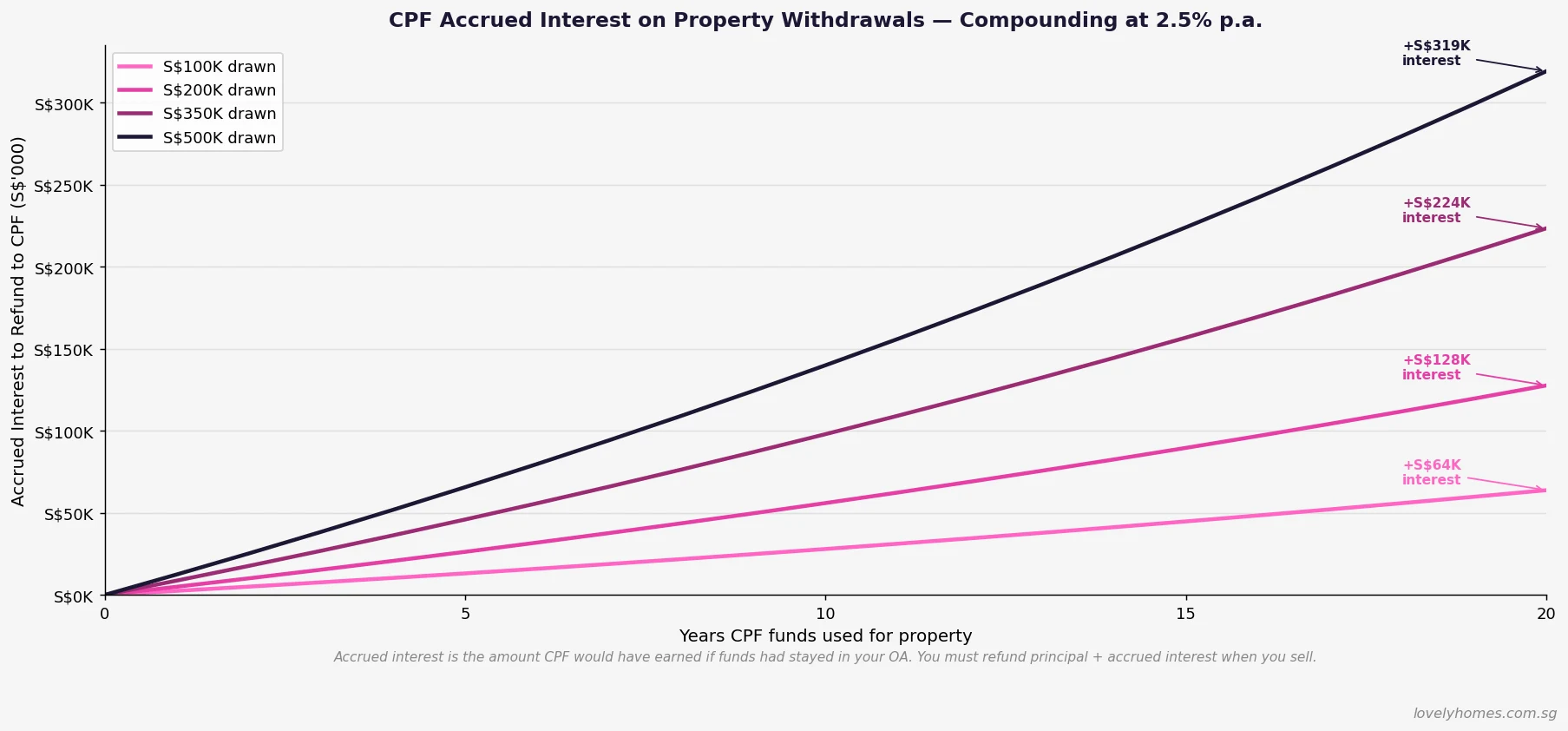
If you used CPF Ordinary Account (OA) savings to fund your property purchase — whether for the down payment, monthly mortgage instalments, or BSD — you are required by the CPF Act to return the full amount withdrawn, plus accrued interest at the CPF OA rate of 2.5% per annum compounded annually. This refund is deducted from your sale proceeds at completion and credited back to your CPF OA. It does not go to you in cash.

The accrued interest calculation compounds monthly over the period you held the property. On a S$300,000 CPF withdrawal held for ten years, accrued interest amounts to approximately S$83,000 — meaning S$383,000 is refunded to CPF, not the original S$300,000. Many sellers underestimate this figure and are surprised to find their cash proceeds are far lower than expected.

CPF Board’s online CPF Property Withdrawal Statement is the authoritative source for your specific CPF amount to be refunded. Request this before accepting an offer so you can compute net proceeds accurately.

CPF accrued interest compounding and seller stamp duty SSD impact Singapore 2026
Figure 3: Left — CPF accrued interest compounding on S$300K used over different holding periods at 2.5% p.a. Right — How SSD reduces (or eliminates) the net gain on a S$1.5M property bought for S$1.35M (S$150K gross gain), depending on when you sell.

Step 7: Computing Your Net Proceeds

Your actual cash payout at completion is not your sale price. The correct formula is:

Item Example: HDB 4-Room S$850K Sale Example: Condo OCR 3BR S$1.8M Sale
Sale Price S$850,000 S$1,800,000
Less: Outstanding HDB/Bank Loan −S$0 (paid off) −S$560,000
Less: CPF Refund (principal + accrued) −S$420,000 −S$630,000
Less: Agent Commission (1%) −S$8,500 −S$18,000
Less: Legal Fees (seller’s solicitor) −S$3,000 −S$5,500
Less: Seller’s Stamp Duty (if applicable) NIL (HDB exempt) NIL (held >3 yrs)
Net Cash Proceeds S$418,500 S$586,500

Note that the CPF refund goes back into your CPF OA, not your bank account. If you plan to use CPF again for your next property purchase, this is neutral — but if you need cash liquidity (for retirement or other purposes), plan around this constraint.

Worked Example: The Lim Family Sell Their Tampines 5-Room HDB

Scenario

Mr and Mrs Lim, both Singapore Citizens in their early 50s, purchased their Tampines 5-room HDB flat in July 2019 for S$530,000. They took an HDB loan of S$477,000 at 2.6% per annum over 25 years. They have made regular monthly CPF contributions to service the mortgage. They are now upgrading to an OCR condominium and wish to sell the flat in July 2026 (exactly 7 years’ hold, MOP fully satisfied).

Sale agreed: S$785,000 (a COV of approximately S$18,000 above the HDB-commissioned valuation of S$767,000)

Outstanding HDB loan at completion: approximately S$362,000 (after 7 years of repayments)

CPF OA used (principal withdrawn): S$148,600

CPF accrued interest @ 2.5% over 7 years: approximately S$27,400

Total CPF refund to CPF OA: S$176,000

Agent commission (1%): S$7,850

Seller’s legal fees: S$2,800

SSD: NIL (HDB exempt)

Net cash proceeds: S$785,000 − S$362,000 − S$176,000 − S$7,850 − S$2,800 = S$236,350 cash in hand

Additionally, S$176,000 is credited to their CPF OA — available for the next property purchase.

Total equity released: S$236,350 cash + S$176,000 CPF = S$412,350 — significantly less than the S$785,000 sale price, illustrating why understanding the net proceeds formula is essential before committing to an upgrade.

What This Means for You: Key Considerations Before Selling

Singapore’s property market has historically rewarded patient long-term ownership. The government’s SSD framework, CPF accrued interest rules, and agent commission structure all work in the same direction: discouraging short-term transactions and encouraging owners to hold property for meaningful periods. Before deciding to sell, ask yourself:

  • Have you satisfied MOP? (HDB sellers only — non-negotiable)
  • Is SSD payable? (Private sellers within 3 years of purchase — calculate the cost against your expected gain)
  • What is your actual CPF refund? (Get the exact figure from CPF Board before accepting any offer)
  • Do you have a replacement housing plan? (If selling HDB and upgrading to private, the 15-month wait-out period applies if you buy first)
  • Is the market timing favourable? (Track URA PPI and HDB RPI quarterly; selling in a rising quarter often justifies a short delay)

What Might Come Next: Singapore Property Market and Seller Policy Outlook

As at mid-2026, there are no credible signals of an SSD rate change or new seller-specific cooling measures. The government has consistently stated that the existing ABSD-SSD-TDSR framework is sufficient to manage speculative demand. The more likely policy development affecting sellers is the ongoing refinement of the HDB flat classification system (Standard / Plus / Prime), which introduces a subsidy clawback on resale if the flat is sold within the enhanced MOP.

For the second half of 2026, the primary variable affecting seller proceeds is interest rate direction. If the US Federal Reserve continues its easing cycle (as widely anticipated), Singapore mortgage rates — priced off SORA — should trend modestly lower, improving buyer affordability and potentially supporting seller-side pricing power in Q3 and Q4 2026. The URA Q2 2026 Flash Estimates, expected in the first week of July 2026, will provide the next definitive data point on private residential price momentum.

Summary: Seller’s At-a-Glance Table

Item HDB Flat Private Property
Minimum Occupation Period 5 years (standard); 10 years (Plus/Prime) None
Seller’s Stamp Duty Exempt 12% / 8% / 4% / NIL (Yrs 1–4+)
Agent commission (seller pays) 1–2% negotiable 1–2% negotiable
Legal fees (seller) ~S$2,500–S$4,000 ~S$3,500–S$8,000
CPF accrued interest 2.5% p.a. compounded on all CPF used 2.5% p.a. compounded on all CPF used
OTP option period 21 days 14 days (customary)
Completion timeline 8–14 weeks from OTP exercise 10–16 weeks
Key regulator HDB (flat) + IRAS (stamp duty) + CPF Board URA + IRAS + CPF Board
Administering portal HDB Resale Portal SLA e-lodgement + IRAS e-Stamping

Frequently Asked Questions

Can I sell my HDB flat if I still have an outstanding HDB loan?

Yes. At completion, your solicitors will arrange for the outstanding HDB loan to be repaid from your sale proceeds. HDB provides a “Loan Balance Statement” that gives the exact redemption figure as at the completion date. You do not need to clear the loan before listing — the redemption is handled at the point of legal completion. However, if the outstanding loan and CPF refund together exceed your sale price, you may have a “negative sale” — meaning you would owe money at completion. This is rare but possible if you purchased at a high price and have not held long enough for equity to build. Always compute your net proceeds before committing.

What happens if I sell my property at a loss — do I still pay CPF accrued interest?

Yes, with an important exception. If your sale proceeds are insufficient to cover the full CPF refund (principal + accrued interest), CPF Board will only recover what is available from the proceeds. The shortfall is waived — you are not personally liable to make up the difference from other savings. However, if you took a bank loan and the bank’s outstanding loan is redeemed first (which is typical), the CPF amount recovered may be further reduced. This scenario arises in cases of significant negative equity, usually only following a sharp market correction or after a very short holding period with SSD also payable. For most long-term sellers, selling at a nominal loss after holding for many years is uncommon in the Singapore market, but not impossible in specialised segments like commercial shophouses or declining lease leasehold properties.

Do I need a lawyer to sell my property in Singapore?

Yes. Unlike some jurisdictions where private sales without solicitors are possible, Singapore requires conveyancing solicitors for all property transactions. As a seller, you must engage a Singapore-qualified solicitor (or a law firm with a licensed conveyancing practice) to handle the title transfer, prepare the completion documents, redeem your outstanding mortgage, arrange the CPF refund, and liaise with the buyer’s solicitors. Solicitor fees for a seller typically range from S$2,500 to S$8,000 depending on property type, transaction complexity, and whether a mortgage is involved. Always obtain a fee quote from at least two firms before engaging. The Law Society of Singapore maintains a directory of licensed conveyancing lawyers at lawsociety.org.sg.

What is the 15-month wait-out period and how does it affect HDB sellers who want to buy private?

The 15-month wait-out period, introduced in September 2022, requires that Singapore Citizens and Permanent Residents who own an HDB flat — or who have sold an HDB flat — must wait 15 months from the date of the HDB flat sale before purchasing a private residential property. The measure was designed to prevent HDB sellers from immediately using sale proceeds to compete in the private market, which was driving up private prices. If you sell your HDB flat in July 2026, you cannot exercise an OTP for a private property until October 2027 at the earliest. Note that the wait-out period applies from the date of HDB sale completion, not the date of OTP grant. Buying under a spouse’s name alone does not avoid the restriction if the spouse also owns or has owned an HDB flat. Check with your solicitor for any exemptions applicable to your specific circumstances (e.g., purchase of a completed private property where the OTP was granted before the HDB sale was completed, subject to specific conditions).

Can I grant an OTP while my flat is still within the MOP?

No. HDB does not allow you to grant an OTP, list on the open market, or accept any purchase deposit while the MOP is still running. Any such agreement would be void and could expose both buyer and seller to HDB enforcement action. For HDB resale, the HDB Resale Portal is the official platform for registering the OTP — it will reject submissions where the MOP has not been satisfied. The MOP clock starts from the date of flat purchase (key collection), not from the date of legal completion. For PLH (Prime Location Public Housing) and Plus flats launched from 2023 onwards, the enhanced MOP is ten years.

What is Cash Over Valuation (COV) and is it normal to pay it?

COV is the amount by which the agreed transaction price of an HDB resale flat exceeds HDB’s commissioned valuation. It must be paid entirely in cash by the buyer — it cannot be funded from CPF or HDB loan proceeds. COV is legal and common in desirable estates (mature towns, near MRT, high floors) but can range from zero to over S$100,000 depending on market conditions and unit specifics. As a seller, setting a price that implies COV is your right, but it narrows your buyer pool to those with sufficient cash reserves. In 2026, COV is present in popular estates but has moderated from the elevated levels seen during the 2021–2023 market peak. HDB publishes quarterly resale transaction data which allows you to benchmark transacted prices by block and floor range before setting your asking price.

When is the best time of year to sell property in Singapore?

Historically, the Singapore property market sees higher transaction volumes in Q2 (April–June) and Q3 (July–September), with Q4 (October–December) being softer as the year-end holiday period approaches and buyers delay decisions. The Chinese New Year period (January–February) is typically the quietest. However, market-wide price trends matter far more than seasonal patterns — selling in a rising market at any time of year will generally yield better proceeds than selling in a falling market during the “peak” season. If you have flexibility, tracking URA PPI and HDB RPI quarterly and listing when momentum is positive is more impactful than calendar timing. In 2026, the private market is in a modest uptrend with URA PPI at +0.9% QoQ in Q1; the Q2 flash estimates (expected July 2026) will indicate whether momentum is sustained.

Disclaimer: This article is for general informational purposes only and does not constitute legal, financial, or tax advice. Property transactions in Singapore are subject to specific rules and regulations that may have changed since publication. Always verify stamp duty rates, CPF rules, and HDB eligibility with the official authorities: IRAS (iras.gov.sg), CPF Board (cpf.gov.sg), HDB (hdb.gov.sg), and URA (ura.gov.sg). Engage a licensed solicitor and, where appropriate, a licensed financial adviser before making any property transaction decisions. Agency commission rates and transaction costs used in this article are indicative only and may vary.

Singapore Stamp Duty Remission Guide 2026: ABSD Upgrader Refunds, Married Couple Exemptions and How to Apply

Singapore Stamp Duty Remission Guide 2026: ABSD Upgrader Refunds, Married Couple Exemptions and How to Apply

Stamp duty in Singapore is not one-size-fits-all. The government has deliberately built a system of remissions and exemptions that recognise legitimate circumstances — the upgrading family, the divorcing couple, the deceased estate, the registered charity — and provides a mechanism to recover the stamp duty paid, or to pay a lower rate in the first place. Understanding these remissions is not an advanced topic for lawyers; it is practical knowledge that can save a Singapore family anywhere from S$40,000 to well over S$1,000,000 in upfront costs.

This guide explains every major stamp duty remission available in Singapore in 2026 — who qualifies, how much is refunded, how to apply, and what the key deadlines are. The framework is administered by the Inland Revenue Authority of Singapore (IRAS) under the Stamp Duties Act (Cap 312). All rates reflect the 27 April 2023 cooling measures, which remain in force.

Quick Answer — Stamp Duty Remissions at a Glance

  • ABSD Upgrader Remission: SC and SPR second-property buyers who sell their existing home within 6 months of completion can reclaim the full ABSD paid (20% for SC; 30% for SPR).
  • Married Couple Remission: Couples where at least one party is a Singapore Citizen buying their first joint residential property together pay 0% ABSD regardless of the other party’s nationality (subject to conditions).
  • Divorce / Court Order: A court-ordered transfer of property between divorcing spouses may attract an ABSD remission or BSD exemption on a case-by-case basis.
  • Death and Inheritance: Properties transferred from a deceased estate to beneficiaries are exempt from ABSD under s.74 of the Stamp Duties Act.
  • SSD Exemptions: Properties sold under en-bloc, compulsory acquisition, court order (divorce/death), or gifted to lineal descendants are exempt from Seller’s Stamp Duty.
  • BSD Remissions: Rare — mainly for government bodies, charities, and certain trust arrangements. Most individual buyers do not qualify for BSD remission.
  • All remission claims are filed at myTax Portal → Stamp Duty → Apply for Remission. ABSD remissions for upgraders require documentary proof of the sale of the existing property.
  • The key upgrader deadline is 6 months from completion of the new purchase to sell the existing property. Miss this window and the ABSD paid is forfeited.

What Is Stamp Duty Remission?

A remission is a partial or full waiver of stamp duty that would otherwise be payable. Unlike an exemption (which means the duty was never due), a remission often means the duty is paid upfront and then refunded once the qualifying conditions are met. The Ministry of Finance (MOF) and IRAS administer Singapore’s remission framework under Part IV of the Stamp Duties Act. The rationale is to avoid distorting legitimate property transactions — particularly family upgrading, matrimonial transfers, and estate administration — while still collecting duty on speculative purchases.

There are three types of stamp duty in Singapore where remissions may arise:

  • Additional Buyer’s Stamp Duty (ABSD): The most significant remissions. ABSD can be 0–65% of purchase price depending on buyer profile. Remissions here can be worth hundreds of thousands of dollars.
  • Buyer’s Stamp Duty (BSD): Remissions are rare and mainly apply to non-individual entities (charities, government bodies). Most homebuyers do not benefit from BSD remission.
  • Seller’s Stamp Duty (SSD): Certain exit scenarios — en-bloc, compulsory acquisition, divorce, death — are exempt from SSD even within the 4-year holding period.
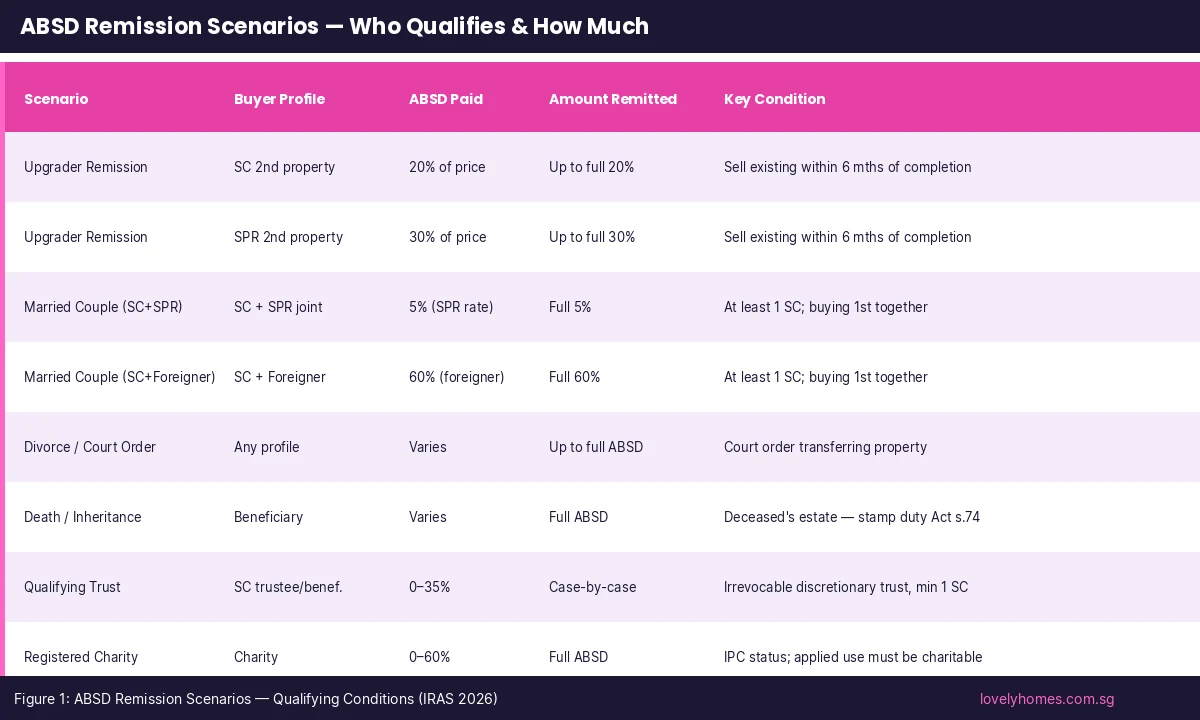
Singapore ABSD remission scenarios and eligibility by buyer profile 2026
Figure 1: ABSD Remission Scenarios — Eligibility Matrix by Buyer Profile (IRAS 2026). Click to expand.

ABSD Upgrader Remission — The Most Common Remission in Singapore

The ABSD Upgrader Remission is the single most commonly used remission in Singapore and affects tens of thousands of families each year. It applies when a Singapore Citizen or Singapore Permanent Resident purchases a second residential property while still owning an existing one, intending to sell the existing property after moving into the new one.

How It Works

Under the current rules, a Singapore Citizen purchasing a second residential property must pay ABSD at 20% of the purchase price at the point of signing the Option to Purchase (OTP) or Sale and Purchase (S&P) Agreement — within 14 days. The duty is paid first; the remission is claimed after the fact. If the buyer subsequently sells the existing property within 6 months of completing the new purchase, they may apply to IRAS for a full refund of the ABSD paid. The same mechanism applies to Singapore PRs purchasing a second property at the 30% ABSD rate.

Buyer Profile ABSD Rate Remission Available? Key Condition
SC buying 2nd property 20% Yes — full 20% refund Sell existing within 6 mths of completion
SPR buying 2nd property 30% Yes — full 30% refund Sell existing within 6 mths of completion
SC buying 3rd+ property 30% No — not eligible Must only hold one other property for remission to apply
Foreigner buying any property 60% No (except FTA nationals on 1st property) No upgrader remission for foreigners
Entity (company/trust) 65% Case-by-case only Qualifying trust structures may apply — see IRAS guidelines

The Critical 6-Month Deadline

The 6-month window runs from the date of completion of the new purchase — not from the date you sign the OTP. For a new launch condominium, completion (when the keys are handed over) may be 3 to 5 years after you sign the OTP. This means upgraders buying off-plan have a generous window: the clock only starts ticking when TOP is obtained and legal completion occurs. For resale properties, completion is typically 8 to 12 weeks after signing the OTP, so the window is tighter in practice.

If you miss the 6-month deadline, IRAS will not extend it except in very exceptional circumstances (documented illness, death in the immediate family, force majeure). Do not rely on an extension being granted.

Worked Example — The SC Upgrader

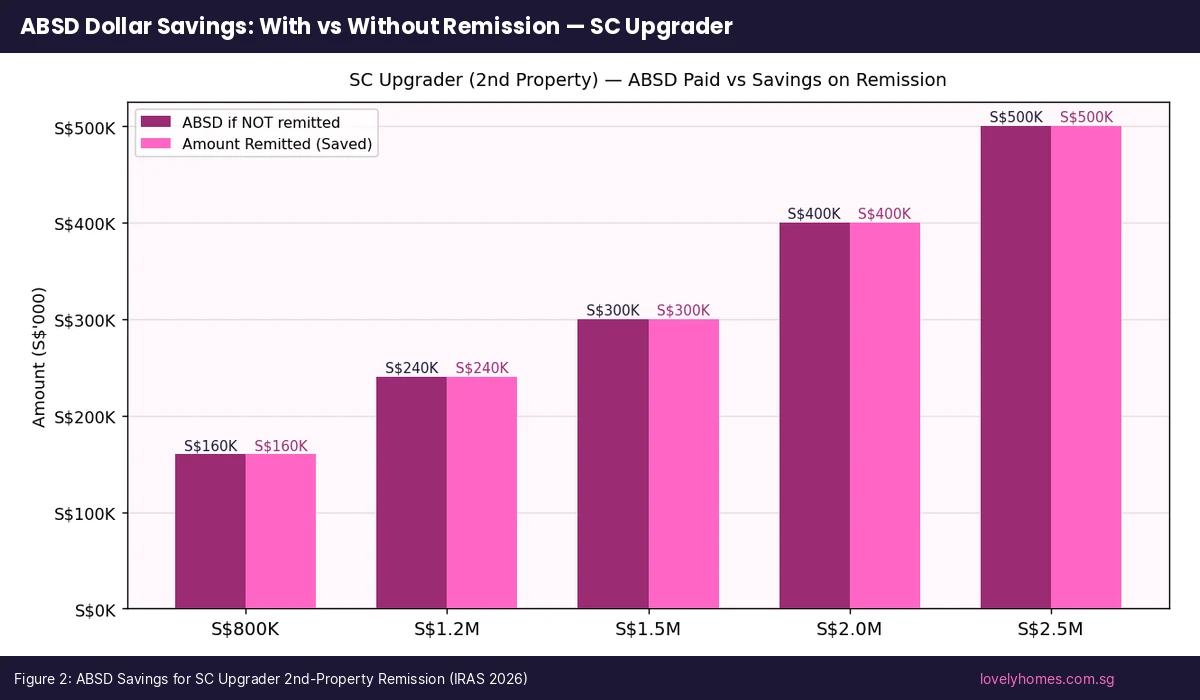
Mr & Mrs Tan are Singapore Citizens who own a Tampines 5-room HDB flat purchased in 2019. In March 2026, they sign an OTP for an Orchard Rd 2BR condominium at S$2,200,000. Within 14 days, they pay:

  • BSD: S$79,600 (progressive: 1% on first S$180,000 + 2% on next S$180,000 + 3% on next S$640,000 + 4% on next S$500,000 + 5% on next S$700,000)
  • ABSD at 20%: S$440,000
  • Total stamp duties upfront: S$519,600

They list their HDB flat and complete the sale in August 2026 — 5 months after the new condominium’s completion date in July 2026. They then apply to IRAS for the ABSD remission. IRAS processes the claim and refunds S$440,000 within approximately 4 to 6 weeks. The Tan family’s net stamp duty cost is thus S$79,600 (BSD only) — exactly the same as a first-time buyer at the same purchase price.

ABSD dollar savings for SC upgrader remission 2026 comparison chart
Figure 2: ABSD Dollar Savings — SC Upgrader 2nd-Property Remission at Various Price Points (IRAS 2026). Click to expand.

Married Couple Remission — Buying Your First Home Together

The Married Couple Remission (formally the “remission for married couple purchasing first residential property together”) addresses a common scenario: a Singapore Citizen marrying a foreigner or a Permanent Resident, where the couple’s combined nationalities would otherwise attract a higher ABSD rate.

Who Qualifies

The conditions are strict. At the time of purchase, the couple must be legally married (not merely cohabiting). At least one party must be a Singapore Citizen. The property must be their first jointly-owned residential property in Singapore — neither party may own any other residential property in Singapore at the time of purchase. If either party already owns a property, the remission does not apply.

Couple Profile Rate Without Remission Rate With Remission Saving at S$1.5M
SC + SC (both first property) 0% 0% Nil (no ABSD to begin with)
SC + SPR (first joint purchase) 5% (SPR 1st rate) 0% S$75,000
SC + Foreigner (first joint purchase) 60% (foreigner rate) 0% S$900,000
SC (existing property) + SPR 20% (SC 2nd) or 5% (SPR 1st) Not eligible — SC already owns property No remission

The most significant application is the SC + Foreigner couple. Without the remission, buying a S$2,000,000 condominium would attract ABSD of S$1,200,000 (foreigner rate of 60%). With the Married Couple Remission, ABSD falls to nil — a saving of S$1,200,000 at that price point. This is why the remission is one of the most financially impactful pieces of property law for internationally mixed families in Singapore.

It is important to note that the remission applies at the time of purchase — the couple does not pay ABSD first and then reclaim it. The conveyancing solicitor applies for the remission before e-Stamping the instrument of transfer, and if approved, the stamp duty assessed is nil ABSD from the outset.

Divorce and Court-Ordered Transfers

When a court orders a matrimonial property to be transferred between spouses as part of a divorce settlement, the question of stamp duty arises. Singapore law provides relief in two forms. First, BSD may be remitted on a court-ordered transfer of a matrimonial home between divorcing spouses — the instrument of transfer lodged pursuant to a court order is submitted to IRAS with the order attached, and IRAS will assess whether BSD is payable. Second, an ABSD remission may be available where the transfer results in one party holding the property as their sole property (so the ABSD for a second property would not apply after the divorce).

These cases are assessed on the specific facts by IRAS. Engage a conveyancing solicitor with experience in divorce property transfers to ensure the application is properly structured and timed. The Stamp Duties Act s.15 provides the general power for IRAS to remit duty; ministerial notifications specify which scenarios qualify.

Deceased Estates and Inheritance

When a property owner dies, the transmission of their property to their beneficiaries under a will or intestacy is not an arm’s length commercial transaction. Singapore law accordingly exempts transfers by way of transmission on death from ABSD (Stamp Duties Act s.74). BSD may still be payable on the transmission instrument, but IRAS has published guidance noting that the transmission of property from a deceased to a beneficiary under an approved will or intestacy is generally exempt from stamp duty provided it is not a sale. Families dealing with an estate should confirm the exact position with their estate lawyer, as the specific structure of the transfer (assent, deed of family arrangement, court order of distribution) affects the stamp duty treatment.

Qualifying Remissions for Trusts

Trusts are a more complex area. IRAS has issued guidelines on ABSD for trust arrangements. Generally, where a residential property is transferred into a trust, ABSD is chargeable at 65% — the rate for entities — unless specific conditions are met. The main qualifying condition for a lower ABSD rate (or nil ABSD) is that the trust is an irrevocable discretionary trust whose beneficiaries are all Singapore Citizens. The ABSD is then assessed at the applicable individual rate for the beneficiaries’ profile rather than the entity rate. This area is highly technical and requires legal and tax advice before any trust structure is implemented.

Seller’s Stamp Duty (SSD) Exemptions

The SSD exemptions are discrete scenarios where the duty simply does not arise, even within the 4-year holding period introduced on 4 July 2025 (rates: 16% / 12% / 8% / 4% in Years 1–4). The following transactions are exempt from SSD:

  • En-bloc (collective sale): A property sold as part of a collective sale under the Land Titles (Strata) Act is exempt from SSD regardless of how recently the individual unit was purchased. This is a significant carve-out for owners whose development is acquired en-bloc within their first 4 years of ownership.
  • Compulsory acquisition by the State: Where Singaporean authorities acquire a property under the Land Acquisition Act, SSD is not payable.
  • Court order (divorce): A property transferred pursuant to a divorce court order is exempt from SSD.
  • Death: Transmission of a property on the death of the owner is exempt from SSD.
  • Gift to lineal descendants: A property gifted (not sold) to a child, grandchild, or other lineal descendant is exempt from SSD, provided the gift is not commercially motivated and no consideration passes.
  • Industrial SSD exemptions: Industrial properties have their own regime (15%/10%/5% over 3 years). The same categories of exemption — compulsory acquisition, death, court orders — apply.
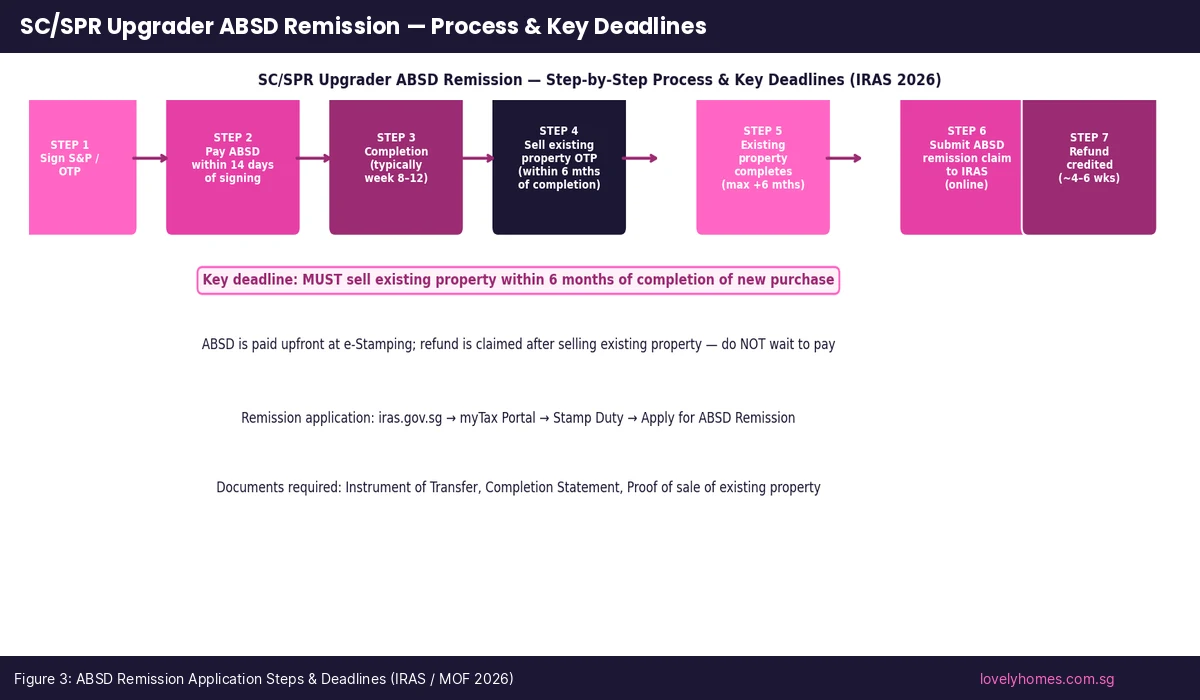
ABSD remission application process steps and deadlines for SC SPR upgrader Singapore 2026
Figure 3: SC/SPR Upgrader ABSD Remission — Step-by-Step Process & Key Deadlines (IRAS 2026). Click to expand.

How to Apply for an ABSD Remission — Step by Step

The process for claiming an ABSD remission for upgraders is well-defined. Your conveyancing solicitor will typically guide you through it, but understanding the steps independently protects you from missing a critical deadline.

  1. Sign OTP or S&P Agreement on the new property. This triggers the 14-day deadline to pay stamp duties (BSD + ABSD).
  2. Pay BSD and ABSD within 14 days via IRAS e-Stamping or through your solicitor. Note: you must pay ABSD upfront even if you intend to claim a remission. Failure to pay by the deadline incurs penalties.
  3. Complete the new property purchase. For resale, this is typically 8–12 weeks after OTP. For new launches, this is when TOP is issued and legal completion occurs (potentially years later).
  4. Sell your existing property within 6 months of the completion date of the new purchase. Sign the OTP, exercise it, and complete the sale — all within the 6-month window.
  5. File the remission claim at IRAS. Go to myTax Portal → Stamp Duty → Apply for Remission. You must file the claim within 6 months of completing the sale of your existing property (i.e., there are two successive 6-month windows).
  6. Submit supporting documents: Completion Statement for the new property, Option to Purchase and Sale & Purchase Agreement for the existing property, Completion Statement confirming the sale of the existing property, and your identity documents.
  7. Receive the refund. IRAS typically processes approved claims within 4 to 6 weeks and credits the refund to the bank account or solicitor’s account you specify.

For married couple remissions, the process is different: your solicitor applies before stamping, submitting the marriage certificate and statutory declarations confirming neither party owns other Singapore residential property. If approved, the instrument is stamped at nil ABSD from the outset.

Common Mistakes and Pitfalls

The most frequent error is missing the 6-month sale deadline. This can happen when sellers are over-confident about finding a buyer, or when the sale falls through at the last minute and the window cannot be recovered. A second common error is assuming the remission applies when one spouse already owns a property — the Married Couple Remission requires both parties to have no existing residential property in Singapore. A third pitfall is failing to maintain the marriage: if a couple applies for the Married Couple Remission and subsequently divorces or annuls the marriage, IRAS may claw back the remission.

Tax professionals also warn against structuring a trust to access lower ABSD rates without proper advice. IRAS scrutinises trust arrangements and applies a facts-and-circumstances test. An arrangement that appears primarily tax-motivated rather than genuinely estate-planning-driven risks being disregarded, with ABSD assessed at the 65% entity rate.

What This Means for You

Singapore’s stamp duty remission framework is materially generous for families following the conventional housing ladder: HDB flat → private property, with a short overlap period. A Singapore Citizen couple upgrading from their HDB flat to a S$1,800,000 condominium will pay S$360,000 in ABSD upfront, but recover every dollar of it within 6 months if they sell the HDB flat on schedule. The net stamp duty cost is simply BSD — S$56,600 at that price, equivalent to 3.1% of the purchase price.

The framework is less generous for those who want to hold multiple properties simultaneously. There is no remission for a Singapore Citizen buying a third property; the 30% ABSD is final. For SPRs and foreigners, the investment calculus must factor in the full ABSD cost as a permanent drag on returns.

The one area where policy may evolve is the trust ABSD regime. The government has signalled that it will continue to monitor whether trust structures are being used to circumvent the cooling measures, and further tightening cannot be ruled out.

Frequently Asked Questions

Can I claim the ABSD upgrader remission if I buy a new launch before my HDB MOP expires?

No. If your HDB flat is still within its Minimum Occupation Period (MOP) — typically 5 years for standard BTO flats, 10 years for Plus/Prime location flats — you are prohibited from privately listing or selling it. This means you cannot sell your HDB flat within the required 6-month window after completing the new purchase. You would therefore be unable to claim the ABSD remission, and the 20% (SC) or 30% (SPR) ABSD paid on the new purchase would be forfeited. Wait until your MOP is completed before purchasing a second property if you intend to rely on the upgrader remission.

What documents does IRAS require for an ABSD remission claim?

You will need: (1) the Instrument of Transfer (stamp certificate) for the new property showing the ABSD paid; (2) the Completion Statement for the new property purchase; (3) the executed Option to Purchase and Sale & Purchase Agreement for the existing property sold; (4) the Completion Statement for the sale of the existing property confirming completion date and proceeds; (5) NRIC / passport copies of the purchasers; and (6) if applicable, proof of marriage (for Married Couple Remission). Your conveyancing solicitor will typically compile this package. IRAS may request additional documents and will reject incomplete applications.

If I paid ABSD on a new launch in 2023 and the TOP is only in 2027, when does the 6-month window start?

The 6-month window starts from the date of legal completion of your new property purchase. For new launch condominiums, this is the date when the developer issues the Certificate of Statutory Completion (CSC), the TOP is obtained, and legal completion takes place — not the date you signed the OTP. So if you signed the OTP in 2023 and TOP/completion is in 2027, you have until approximately 6 months after the 2027 completion date to sell your existing property and file the remission claim. This gives upgraders buying off-plan a significantly longer window than resale purchasers.

Can both the BSD and the ABSD be refunded via remission?

BSD and ABSD are treated separately. The ABSD upgrader remission refunds only the ABSD — not the BSD. BSD is considered a fundamental transaction tax on the acquisition of property and is not remitted for individual buyers under the upgrader framework. The Married Couple Remission also applies only to ABSD (bringing it to nil), not to BSD. BSD remains payable in all standard purchases regardless of remission status. The only scenarios where BSD may be waived are very narrow: government-linked acquisitions, certain approved charities, and specific statutory transfers.

What happens if I cannot sell my existing property within 6 months?

If you miss the 6-month deadline, you lose the right to claim the ABSD remission and the amount paid (20% or 30% of the purchase price) is forfeited. IRAS does not routinely grant extensions. In exceptional cases — certified medical incapacitation of the owner, death of an immediate family member, or an Act of God materially preventing the sale — IRAS may consider an appeal with supporting documentation, but this is discretionary and not guaranteed. Property market conditions (“I could not find a buyer at the price I wanted”) are not accepted as grounds for extension. Plan your sale timeline carefully and engage a property agent well in advance of the deadline.

Does the ABSD upgrader remission apply to the purchase of a commercial or industrial property?

No. The ABSD upgrader remission applies exclusively to the purchase of residential properties (landed houses, apartments, condominiums, executive condominiums before privatisation). Commercial properties (shophouses, offices, retail units) and industrial properties (factories, warehouses) do not attract ABSD in the first place — they are subject only to BSD. There is no equivalent upgrader remission mechanism for commercial or industrial property. The SSD industrial exemptions discussed above are separate and concern selling, not buying.

Is there a remission if my spouse and I decouple ownership of our property?

Decoupling — where one co-owner transfers their share to the other so that the transferee becomes the sole owner and the transferor becomes a “first-time buyer” for ABSD purposes on a future purchase — is a legal strategy but does not enjoy a special remission. BSD is payable by the transferee on the share acquired (at the standard progressive rates). There is no BSD or ABSD remission specifically for decoupling transfers. The tax cost of the decoupling (BSD on the transferred share plus legal and valuation fees) must be weighed against the ABSD saving on the future purchase. IRAS treats the transfer at market value and will assess BSD on the higher of the consideration paid or the market value.

Related Articles

Disclaimer

This article is published for general informational purposes only and does not constitute legal, tax, or financial advice. Stamp duty rates, remission conditions, and application procedures are subject to change by the Ministry of Finance and IRAS. Always refer to the IRAS Stamp Duty website and the Stamp Duties Act (Cap 312) on Singapore Statutes Online for the authoritative and current position. Seek independent legal and tax advice from a qualified Singapore solicitor or tax practitioner before making property decisions. LovelyHomes does not accept liability for any decisions made in reliance on this article.

Buying Property Near Top Schools in Singapore 2026: Complete Guide

Buying Property Near Top Schools in Singapore 2026: Complete Guide

📌 Quick Answer: Buying Property Near Top Schools in Singapore 2026

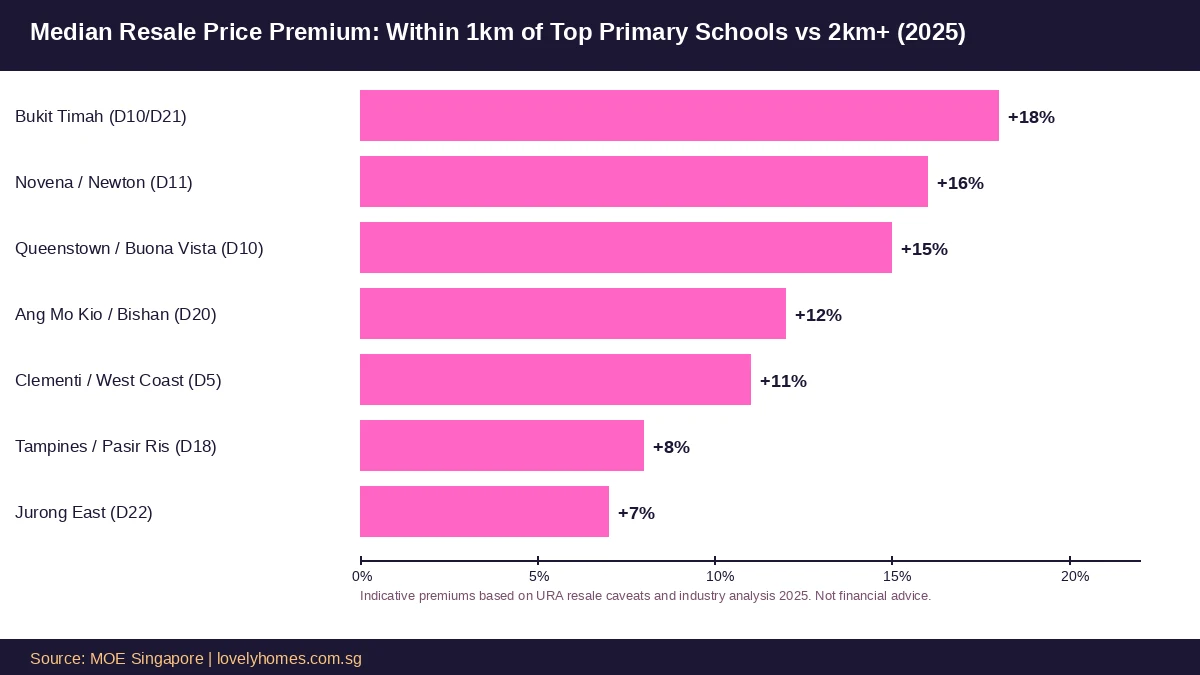
  • School proximity drives property premiums: homes within 1 km of an oversubscribed primary school can command 8–18% higher prices than comparable homes 2 km away, depending on the district.
  • MOE’s Phase 2C priority gives Singapore Citizens living within 1 km of a school priority registration places before those living within 2 km — making the 1 km radius the most prized zone.
  • Bukit Timah, Novena, and Queenstown carry the largest school-proximity premiums; Jurong and Tampines carry the smallest, though still meaningful.
  • Not all popular schools are equally scarce: a school oversubscribed at Phase 2C is the one that matters for the proximity premium. Schools that regularly have vacancies at Phase 2C generate no meaningful price premium.
  • HDB resale flats near top schools are significantly cheaper entry points than condos and still qualify for Phase 2C priority as long as your registered address is within the distance cut-off.
  • The premium is time-limited: once your child has secured a place, the school-proximity rationale diminishes and you may be able to upsize or relocate without premium pricing.
  • Distance is measured straight-line from the main gate of the property to the school’s main gate using MOE’s official measurement tool — not Google Maps driving distance.
  • Verify distance before transacting: even 50 metres can determine whether you fall inside or outside the 1 km cutoff, so always use the MOE School Finder to confirm.

Why School Proximity Matters in Singapore Property

Singapore’s Primary 1 (P1) registration system is one of the most consequential drivers of residential property demand in the country. Unlike many education systems where school admission is determined purely by merit or choice, Singapore’s Phase 2C priority system gives automatic preference to children living closest to a school when balloting places are contested. This policy — administered by the Ministry of Education (MOE) — has created a predictable and enduring link between residential addresses and primary school access, making the 1 km radius around any oversubscribed primary school one of the most reliably valued assets in the Singapore property market.

For parents weighing their next property purchase, understanding how the P1 registration phases work, which schools generate meaningful premiums, and how to quantify the value of proximity is not a luxury — it is a core part of the buying decision. For investors who do not have school-going children, the same proximity premium represents a defensible demand floor that tends to support property values even through softer markets.

This guide explains the MOE priority phase system in full, maps the districts and schools that generate the largest premiums, provides a worked example of the financial implications, and offers a framework for deciding whether the school-proximity premium is worth paying for your specific situation.

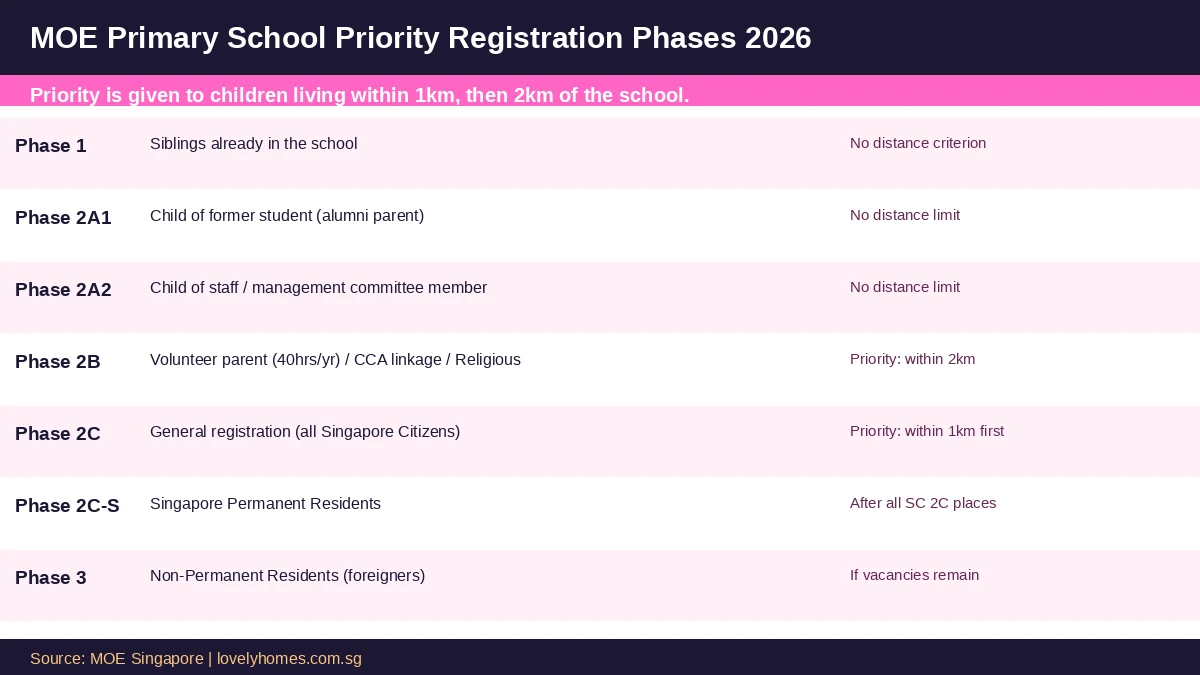
MOE primary school priority registration phases 2026 Singapore Phase 2C 1km 2km
Figure 1: MOE Primary School Priority Registration Phases 2026 — Phase 2C gives priority to Singapore Citizens within 1 km first, then 2 km. Source: Ministry of Education Singapore.

MOE Primary 1 Registration Phases — How Proximity Works

The P1 registration exercise is structured in phases that proceed in order of priority. A school only opens to later phases if vacancies remain after earlier phases are filled. The relevant phases for proximity are Phase 2B and Phase 2C.

Phase 2B gives priority to children whose parents are active volunteers at the school (40 hours per year for at least the preceding year), who have community or CCA connections to the school, or whose parents are of the relevant religious affiliation for mission schools. Within Phase 2B, if there are more applicants than places, children living within 2 km of the school are given priority over those living further away. Distance matters even here.

Phase 2C is the general registration phase for all Singapore Citizens. This is where proximity becomes most critical. If the number of Phase 2C applicants exceeds the remaining vacancies, MOE ballots first among children living within 1 km of the school, then — if vacancies remain — among those living within 2 km, and finally — if still not full — among those living further away. For the most oversubscribed schools, the ballot has historically been decided entirely within the 1 km tier, meaning that a family living at 1.1 km may receive no priority whatsoever.

Phase 2C Supplementary covers Singapore Permanent Residents after all Singapore Citizen applicants have been processed. Phase 3 covers non-PR foreigners and is only relevant if the school still has vacancies after all citizen and PR phases are complete — an unusual scenario for popular schools.

Which Schools Generate the Largest Property Premiums?

Not every primary school generates a proximity premium. The premium is driven by two factors working together: the school’s perceived academic and co-curricular reputation, and its level of oversubscription at Phase 2C. A school that clears all its places by Phase 1 or Phase 2A1 (alumni parents’ children) before Phase 2C is even reached is effectively inaccessible via proximity alone — distance does not help if the school fills up before the distance-based phases. Conversely, a school with consistent Phase 2C balloting in the 1 km zone generates a hard, measurable demand for nearby addresses.

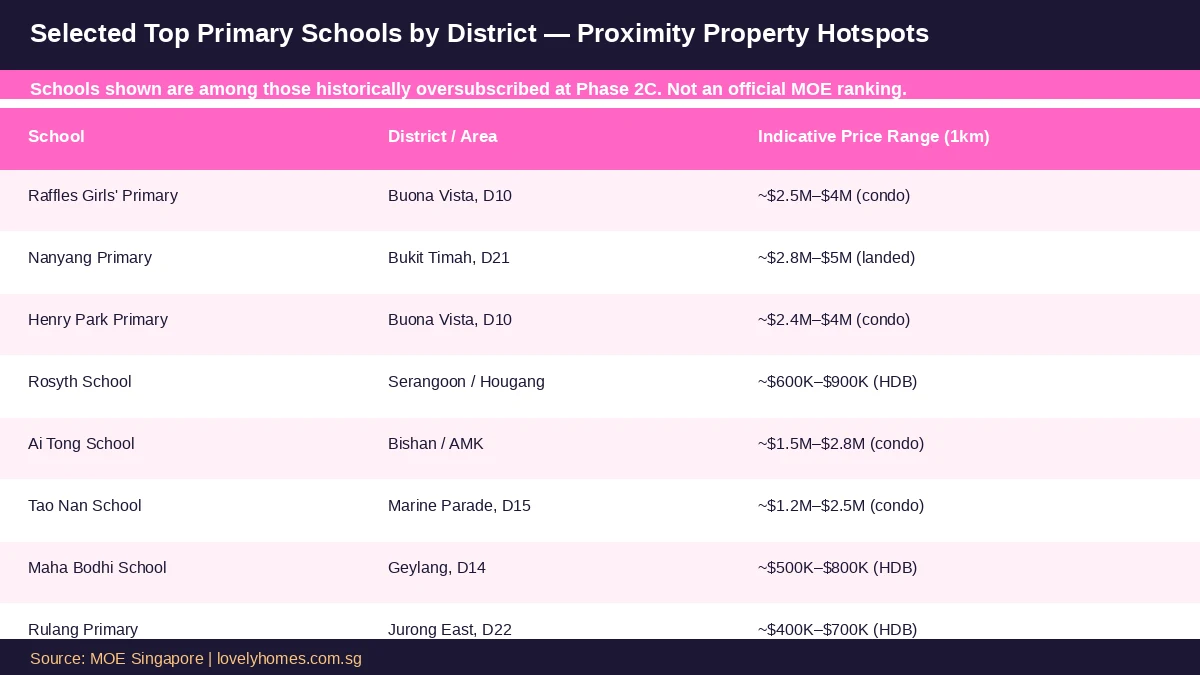
The schools that have historically generated the most sustained proximity premiums — based on their consistent oversubscription at Phase 2C and their reputation — cluster in the following districts: Bukit Timah (District 21), Novena and Newton (District 11), Queenstown and Buona Vista (District 10), Bishan and Ang Mo Kio (District 20), and Marine Parade (District 15). These areas also happen to be among Singapore’s most expensive residential districts for reasons beyond schools alone, which makes it challenging to isolate the school premium precisely.

Property price premium near top schools Singapore districts 2025 1km vs 2km
Figure 2: Indicative Resale Price Premium — within 1 km of a top primary school vs. beyond 2 km, by district (2025 data). Source: URA resale caveats and industry analysis. Not financial advice.

Key Districts and Their School-Proximity Premium Characteristics

District Notable Schools Typical Premium (1km vs 2km+) Property Type
Bukit Timah (D21) Nanyang Primary, Methodist Girls’ Primary 15–20% Landed, high-end condo
Novena / Newton (D11) Anglo-Chinese School (Primary), Saint Joseph’s Institution Junior 14–18% Condo, terrace
Queenstown / Buona Vista (D10) Raffles Girls’ Primary, Henry Park Primary 13–17% Condo, HDB (older)
Bishan / Ang Mo Kio (D20) Ai Tong School, Catholic High Primary, Pei Hwa Presbyterian 10–14% Condo, HDB
Marine Parade (D15) Tao Nan School, CHIJ Katong Primary 10–13% Condo, shophouse
Clementi / West Coast (D5) Nan Hua Primary, Clementi Primary 9–13% HDB, condo
Tampines / Pasir Ris (D18) Poi Ching School, Elias Park Primary 7–10% HDB, EC
Jurong East (D22) Rulang Primary, Fuhua Primary 6–9% HDB, EC

Top primary schools by district Singapore property proximity price 2026
Figure 3: Selected Top Primary Schools by District — historically oversubscribed at Phase 2C with indicative 1 km property price ranges. Source: MOE, URA. Not an official MOE ranking.

Worked Example: The Tan Family’s School-Proximity Purchase

🏫 Scenario: Tan Family, Child Entering P1 in 2028

Target school: Ai Tong School, Bishan (historically oversubscribed at Phase 2C within 1 km)

Budget: S$1.8 million for a condominium

Without school premium: A comparable 3-bedroom condo 2.5 km from Ai Tong in Ang Mo Kio averages S$1.55 million in 2025 resale.

With school premium: A comparable 3-bedroom condo within 1 km of Ai Tong averages S$1.78 million — a premium of approximately S$230,000 (14.8%).

  • The Tans have a child born in 2021, meaning P1 registration is in 2027 (for entry in January 2028).
  • They need to be registered at the address before the Phase 2C registration exercise, which typically opens in July 2027 and requires the address to be active at least 30 months before the exercise for Phase 2B purposes.
  • Break-even analysis: The S$230,000 premium represents approximately S$19,200 per year over a 12-year horizon (primary through secondary school). If the school-proximity effect sustains the property’s relative value through resale, the net cost may be substantially less — or even zero if the 1 km zone appreciates faster than the 2.5 km zone.
  • ABSD: As Singapore Citizens buying a second property, the Tans pay 20% ABSD on S$1.78 million = S$356,000. If this is their first property, no ABSD applies.

Is the School-Proximity Premium Worth Paying?

The answer depends on three variables: the school in question, the phase at which you expect to compete, and your time horizon. If you are a Phase 2B volunteer parent, you may already enjoy priority within 2 km — paying the 1 km premium may not be necessary. If you have no Phase 2B connection and the school is consistently balloted within the 1 km zone at Phase 2C, then the 1 km address is effectively a prerequisite for reasonable access, and the premium reflects a real, functional benefit rather than pure sentiment.

From a resale perspective, the proximity premium tends to be self-reinforcing in areas with good overall fundamentals (MRT access, amenities, estate quality). It is weakest in areas where the school is the sole driver of demand — in those cases, the premium may erode once your child has completed primary school and you decide to sell. The strongest investment case is therefore found where school proximity overlaps with strong general demand: Bukit Timah, Queenstown, and Bishan all fit this profile.

First-time buyers and HDB upgraders should note that HDB resale flats in the 1 km catchment area of oversubscribed schools can represent excellent value. A 4-room HDB flat in Bishan within 1 km of Ai Tong or Catholic High Primary typically transacts at S$700,000–S$900,000 in 2025 — a fraction of the condo price while qualifying for exactly the same Phase 2C priority. The trade-off is flat size, lease remaining, and the absence of condominium facilities.

What Investors Should Know About the School-Proximity Premium

For property investors without school-going children, the school-proximity premium is a demand-side floor to understand rather than a purchasing criterion. The premium is most durable in schools that are oversubscribed consistently year after year, such as those on the MOE’s School Information Service with Phase 2C balloting records visible at MOE’s P1 registration results page. Schools that recently became popular due to merger or re-branding may not sustain the same premium. URA’s transaction data, accessible at ura.gov.sg, allows investors to overlay resale transaction prices against school catchment boundaries to quantify the premium empirically for any school they are considering.

One structural risk to the school-proximity premium is MOE policy change. In 2019, MOE capped the number of children who can benefit from Phase 2B volunteerism, and has periodically adjusted how distance tiers are applied. Any future change to Phase 2C that removes or reduces the distance priority would directly erode the 1 km premium. Buyers who are paying a large premium on the basis of school access alone should keep this policy risk in mind.

🔮 Looking Ahead: Will the School-Proximity Premium Persist?

Singapore’s P1 registration system has been broadly stable for decades, and the government has shown little appetite for eliminating the distance-based priority — it is seen as a reasonable community-based principle. However, MOE has been expanding school capacity at the primary level and has encouraged parents to consider neighbourhood schools as credible alternatives to branded schools. If these efforts succeed in reducing the prestige gap between schools, the Phase 2C premium for any individual school may narrow. The safest bet remains properties in estates with multiple oversubscribed schools within range, so that the premium is supported by a cluster of demand rather than a single school. These are speculative observations — official policy may change without notice.

Frequently Asked Questions

How exactly does MOE measure the 1 km distance?

MOE measures the straight-line distance from the main entrance of your home to the main gate of the school. This is not walking distance or driving distance — it is the straight-line (crow flies) measurement. MOE uses its own GIS system to calculate this; the result may differ from Google Maps or other mapping tools by up to 100–200 metres in some cases. You can check your address against any school using the MOE School Finder tool. Always verify using MOE’s official tool before relying on any proximity claim made by a property agent or listing.

Can I use a relative’s address to get the 1 km priority?

No. MOE requires you to be genuinely registered and residing at the address provided. Using a relative’s or friend’s address to claim proximity priority is considered fraudulent and may result in the child’s application being rejected, even after a school place has been allocated. MOE conducts checks including cross-referencing with NRIC records, HDB or URA records, and utility bills. Parents found to have provided false addresses face disqualification from the registration exercise and potential legal consequences. The address must be your genuine principal place of residence at the time of registration.

Does the school-proximity premium apply to secondary schools too?

Not in the same way. Secondary school admission in Singapore is primarily determined by PSLE results (Direct School Admission aside), so residential proximity plays no formal role in secondary school access. The property premium phenomenon is therefore primarily a primary school effect. That said, some parents choose to live near certain secondary schools for practical convenience (shorter commute), and a cluster of good primary and secondary schools in the same area can create a compounding “educational belt” effect on property values — as seen in the Bishan–Ang Mo Kio corridor.

Will buying an HDB flat near a top school get me the same Phase 2C priority as a condo?

Yes. MOE’s Phase 2C priority is based on the registered residential address and its distance from the school — it does not distinguish between property types. An HDB flat within 1 km of Ai Tong School receives exactly the same Phase 2C ballot priority as a private condominium within 1 km. The key is that the address must be your genuine place of residence and registered in the HDB or URA records. For HDB buyers, note that the MOP (Minimum Occupation Period) means you must already own or purchase an HDB flat that is within 1 km — you cannot simply rent a nearby property to claim proximity.

How long before the P1 registration exercise must I live at the address?

For Phase 2C, MOE requires the child to be residing at the registered address. There is no explicit minimum duration stated for Phase 2C, but MOE may request supporting documentation. For Phase 2B (volunteer parent priority), the volunteerism must be completed in the year before registration, typically requiring at least 40 hours of actual service at the school. If you purchase a property specifically for school access, moving in at least several months before the registration exercise (which typically opens in July for January the following year) is strongly advisable to avoid any documentary issues.

What if I rent a property near the school rather than buying?

Renting is a legitimate and often lower-cost strategy for securing the proximity priority without paying the purchase premium. A tenancy agreement and utility bills in your name at a 1 km address are typically accepted as evidence of residence for MOE purposes. However, renting near a top school can itself be expensive — landlords in these catchment areas are aware of the demand and price accordingly. Rental premiums of 10–15% over comparable properties outside the catchment are not uncommon in Bukit Timah and Queenstown. If you only need the proximity for one registration year, renting for 12 months may be materially cheaper than paying the purchase premium over a longer horizon.

Are international schools affected by the same proximity rules?

No. International schools in Singapore operate under different admission frameworks set by the individual school and the Ministry of Education’s International Schools Unit. They are not subject to the MOE P1 Phase 2C priority system, so residential proximity to an international school creates no formal priority advantage. Property premiums near international schools do exist in some cases — particularly near the American School, United World College, and the German European School — but these are driven by the convenience of expatriate communities rather than any formal regulatory priority linked to the address.

Related Articles

Disclaimer: This article is for general informational purposes only and does not constitute legal, financial, or educational advice. Property prices, school admission policies, and MOE phase criteria are subject to change; always verify current rules directly with the Ministry of Education and Urban Redevelopment Authority. Price premiums cited are indicative estimates based on publicly available URA transaction data and industry analysis — they are not financial advice. Consult a licensed financial adviser and property professional before making any property decision. School names and reputations are referenced for informational purposes only; LovelyHomes does not endorse or rank any school.

Translate »