HDB Minimum Occupation Period (MOP) Singapore 2026: Complete Guide

HDB Minimum Occupation Period (MOP) Singapore 2026: Complete Guide

📌 Quick Answer: HDB Minimum Occupation Period (MOP) 2026

  • The MOP is the mandatory period you must live in your HDB flat before you are allowed to sell it on the open market or buy a private residential property.
  • Standard BTO and resale flats carry a 5-year MOP, counted from the date you collect your keys (for BTO) or the date the resale transaction is completed.
  • Prime Location Housing (PLH) flats — introduced in October 2021 — carry a 10-year MOP and come with a permanent ban on renting out the whole flat.
  • During MOP you cannot sell the flat on the open market, rent out the entire flat, or purchase a private residential property without first disposing of the HDB flat.
  • Renting out individual rooms is permitted during MOP with HDB’s approval, provided occupancy caps are met.
  • Executive Condominiums (ECs) have a 5-year MOP under HDB rules; they become fully privatised at the 10-year mark.
  • Violation consequences include compulsory acquisition at below-market value, grant clawback, and debarment from future HDB applications.
  • The MOP applies to the flat, not the owner: any attempt to sell before expiry is void and attracts penalties.

What Is the HDB Minimum Occupation Period (MOP)?

The Minimum Occupation Period — universally known as MOP in Singapore property circles — is a Housing & Development Board (HDB) policy requiring flat owners to physically occupy their flat for a stipulated number of years before they are permitted to sell, rent the entire unit, or purchase a private residential property. The MOP is administered under the Housing and Development Act and is one of the most consequential rules shaping the Singapore HDB resale market.

HDB introduced the MOP to prevent speculative “flipping” of subsidised public housing. Because the government provides substantial grants and subsidies when selling BTO flats, it wants genuine owner-occupiers to benefit from those subsidies rather than investors who might resell immediately for a quick profit. The MOP therefore acts as a temporal lock-in that aligns the interests of flat buyers with the public-housing mission of HDB.

The standard MOP has stood at five years since 2010. However, the introduction of the Prime Location Housing (PLH) model in October 2021 created a new, more restrictive 10-year MOP for BTO projects in central and highly sought-after locations. Understanding which MOP category applies to your flat — and what you are and are not permitted to do during that period — is critical before making any property decision.
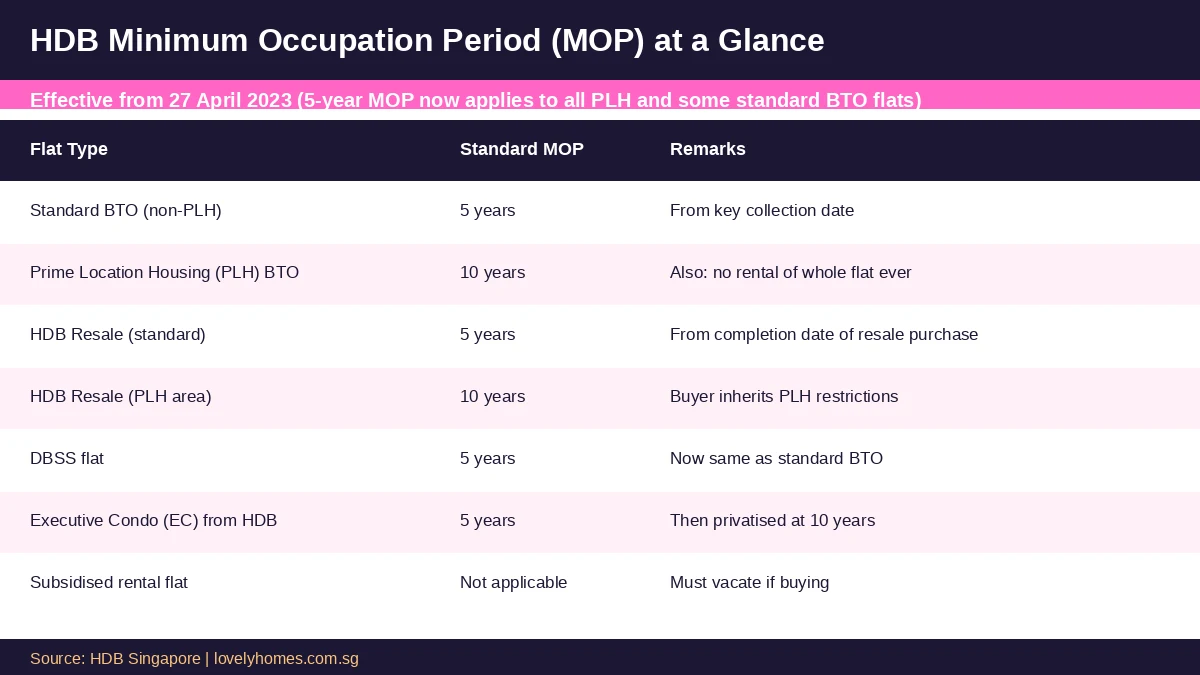
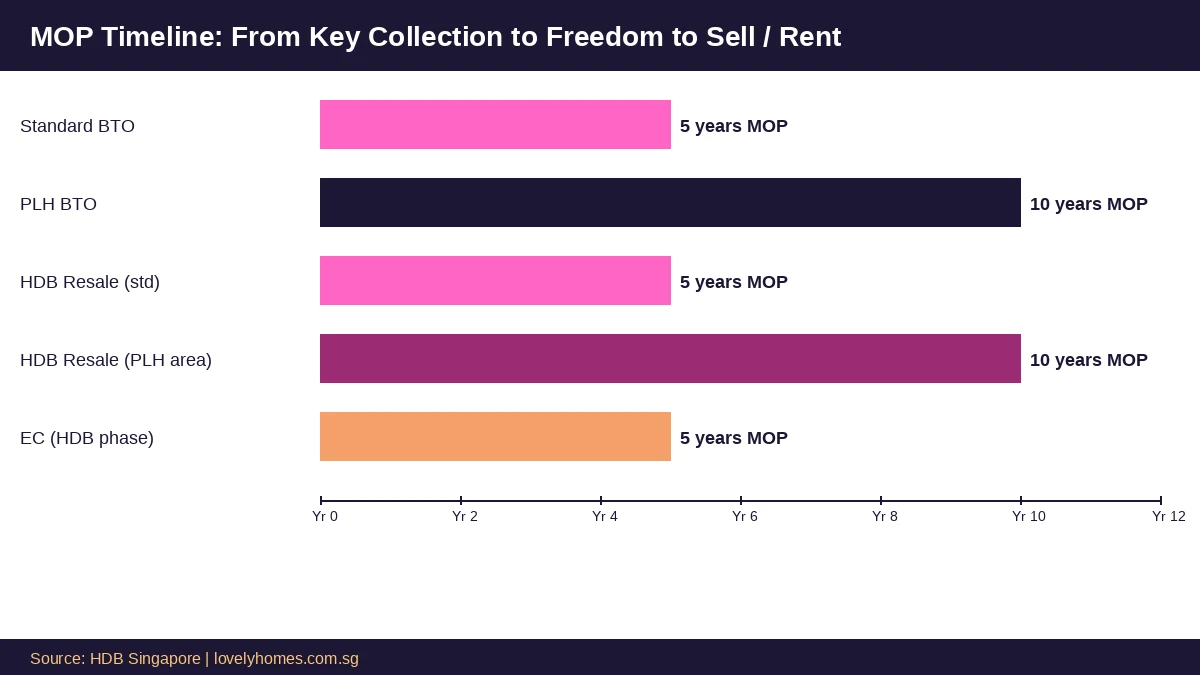
HDB MOP summary table Singapore 2026 standard BTO PLH resale EC
Figure 1: HDB Minimum Occupation Period at a Glance — standard BTO, PLH BTO, resale, and EC rules. Source: HDB Singapore.

How Is the MOP Counted?

The MOP clock starts differently depending on how you acquired the flat. For a BTO flat, the MOP begins on the date of key collection, which HDB formally records. If you collect your keys on 15 January 2022, your 5-year MOP expires on 15 January 2027. For a resale HDB flat, the MOP begins on the date the resale transaction is legally completed — that is, the date shown on the HDB resale completion letter, typically 8–12 weeks after HDB accepts the resale application. DBSS flats follow the same rule as resale. For an EC bought from an HDB-appointed developer, the MOP starts from the date of vacant possession (VP) and lasts five years, after which the EC becomes partially privatised and fully private at the 10-year mark.

Importantly, the MOP measures calendar time, not duration of active occupation. Even if you are posted overseas for work and your flat sits empty for part of the period, the clock does not pause. You must also maintain the flat as your sole registered address in Singapore during the MOP; abandoning the flat to stay elsewhere while the clock runs is a violation that HDB actively monitors through its inspection programme.

MOP by Flat Type — 2026 Reference Table

Flat Type MOP Duration Whole-flat Rental After MOP? Key Rule
Standard BTO (non-PLH) 5 years from key collection Yes, with HDB approval Flat must be primary residence during MOP
Prime Location Housing (PLH) BTO 10 years from key collection No — permanently prohibited Introduced Oct 2021; applies to centrally located BTO projects
HDB Resale (standard area) 5 years from completion Yes, with HDB approval Buyer’s MOP starts from resale completion date
HDB Resale (PLH-designated area) 10 years from completion No — permanently prohibited PLH restriction travels with the address, not the seller
DBSS flat 5 years Yes, with HDB approval Treated the same as standard BTO for MOP purposes
Executive Condo (EC) 5 years (HDB rules apply) Yes, after MOP + HDB approval Fully private at 10 years; no HDB restrictions thereafter

HDB MOP timeline chart 5-year 10-year standard PLH BTO Singapore 2026
Figure 2: MOP Timeline by Flat Type — visual comparison of 5-year versus 10-year lock-in periods. Source: HDB Singapore.

What Can You Do During the MOP?

Many flat owners are surprised to discover that the MOP is not a blanket prohibition on all activity — it targets sale and whole-flat rental specifically. Renting out spare bedrooms is permitted: HDB allows flat owners to sublet individual rooms, subject to occupancy caps and prior HDB approval via the resale portal. The total number of occupants including owners must not exceed the flat’s authorised occupancy limit — six persons for a 3-room flat, eight for larger flats as of 2026. Running a small home-based business under HDB’s Home-Based Small Scale Business guidelines is also permitted and does not affect the MOP. Internal renovations are allowed subject to HDB’s renovation guidelines and town council rules.

What is prohibited is more significant. You cannot sell the flat on the open market — any purported contract of sale during MOP is void. You cannot rent out the entire flat for standard flats during MOP, and for PLH flats this prohibition is permanent. You cannot purchase a private residential property in Singapore while an HDB flat is under MOP; if you do, HDB will require you to dispose of the HDB flat within six months and may impose financial penalties. Voluntary ownership transfers to family members are generally not permitted during MOP without HDB’s prior approval, which is granted only in specific circumstances such as divorce, death, or financial hardship.
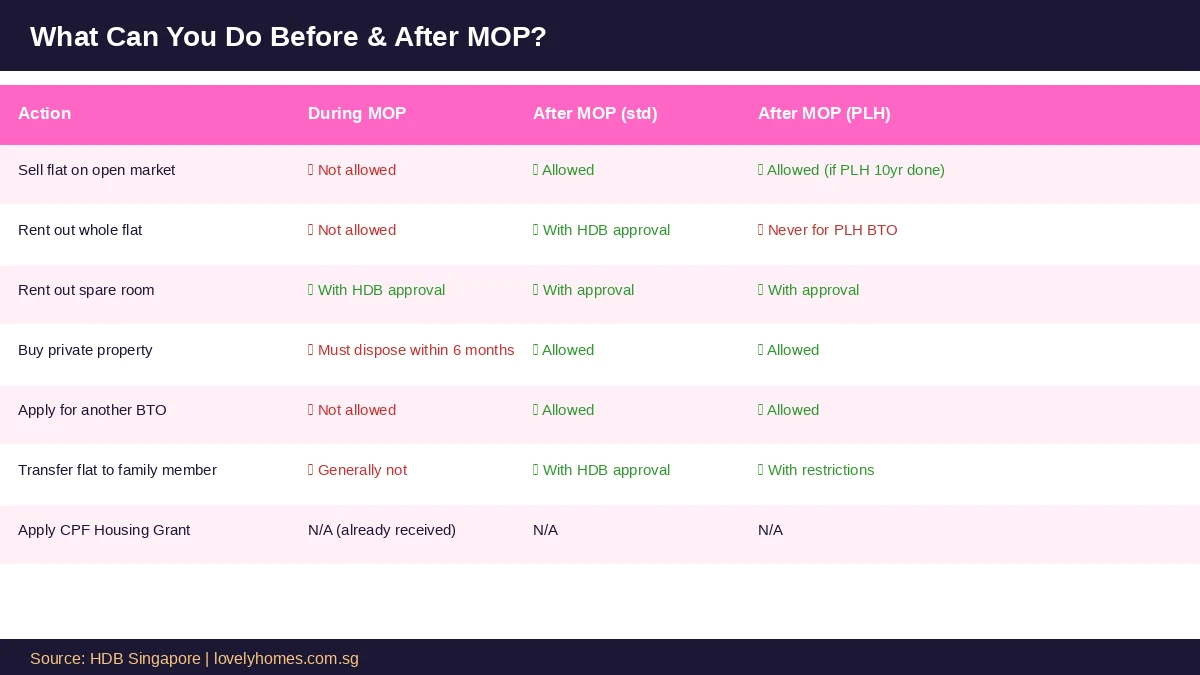
HDB MOP before and after comparison matrix Singapore 2026
Figure 3: Before vs. After MOP — permitted and prohibited actions by flat type. Source: HDB Singapore.

Worked Example: The Lim Family’s MOP Journey

👥 Scenario: Lim Family, 4-Room BTO in Tampines

Key collection date: 15 March 2021

MOP expiry date: 15 March 2026 (5-year standard MOP)

Goal in early 2026: Sell the flat and upgrade to a private condo.

  • From 15 March 2026, the Lims are free to list the flat on the open market via the HDB resale portal.
  • They may simultaneously exercise an OTP (Option to Purchase) on a private condo. If they buy the condo before completing the HDB sale, a 6-month disposal window applies.
  • Had they bought the condo in January 2026 — before MOP expiry — HDB would have required them to sell the flat within 6 months and could have imposed a financial penalty.
  • CPF Family Grant: Received at BTO purchase; not subject to clawback on MOP completion. A Resale Levy of S$50,000 applies if they later purchase another subsidised flat.
  • They had also rented out two spare bedrooms since October 2022 (with HDB approval), earning approximately S$1,800 per month — a permitted activity during MOP.

The PLH Model and the 10-Year MOP

The Prime Location Housing (PLH) model was launched by HDB in October 2021 to address public concern that prime-location BTO flats — particularly in districts such as Rochor and the Central Area — were underpriced relative to private property. The two key additional restrictions of the PLH model are the 10-year MOP and the permanent ban on renting out the whole flat.

For buyers of PLH BTO flats, this means the flat cannot be sold until 10 full years from key collection. Even after those 10 years, the whole-flat rental prohibition is perpetual — it is address-based and permanent, running with the flat and not the owner. A resale buyer who purchases a PLH-designated flat on the open market inherits the same restriction; there is no way to clear it by buying second-hand. Individual rooms may still be sublet with HDB approval.

The Ministry of National Development (MND) has indicated that the PLH model will be applied selectively. Research from industry analysts suggests that PLH resale transactions — when they eventually enter the market after 2031 for the earliest PLH BTO projects — may be priced at a discount to non-PLH flats of equivalent size and location, precisely because of the rental prohibition narrowing the buyer pool.

Consequences of Violating the MOP

Violation HDB Action Additional Consequence
Selling flat before MOP expires Void transaction; possible compulsory acquisition at below-market value Debarment from future HDB flat purchases for up to 5 years
Renting out whole flat during MOP Fine of S$3,000–S$5,000; instruction to terminate tenancy immediately Repeat offence may result in compulsory acquisition
Buying private property during MOP without disposing of HDB flat 6-month disposal notice issued by HDB Financial penalty; potential stamp duty complications
Giving false occupation declaration Civil and/or criminal prosecution under the Housing and Development Act Fines up to S$5,000 or imprisonment up to 6 months

What Happens After the MOP?

Once your MOP expires, you gain substantially greater freedom. You may list the flat for sale via the HDB resale portal; the price is negotiated freely between buyer and seller with no government-set ceiling. Standard flat owners may apply to HDB for permission to sublet the entire unit, typically approved for 6–36 months under the Fair Tenancy Framework. You may also purchase a private property concurrently with your HDB flat — note that Additional Buyer’s Stamp Duty at 20% applies to Singapore Citizens buying a second residential property. Married couples may also explore decoupling one partner’s name off the HDB flat to facilitate a private property purchase by the other partner at a lower ABSD rate, subject to eligibility.

What the MOP Means for Singapore’s Property Market

The MOP is one of the most effective supply-management tools in Singapore’s housing policy toolkit. By locking new BTO supply out of the resale market for five years, HDB ensures that subsidised flat sales benefit genuine first-time owner-occupiers rather than investors arbitraging the gap between discounted BTO prices and open-market resale values. The MOP also creates a predictable “event horizon” in the resale market: estates where BTO keys were collected in large numbers five years ago tend to see a surge of resale supply as those MOP clocks expire. Estates where keys were collected in 2020 and 2021 — including Tengah, Tampines North, and Canberra — will see their 5-year MOPs rolling off through 2025 and 2026, contributing to resale supply in those towns. Buyers looking for competitively priced resale flats would do well to track upcoming MOP expiry clusters using HDB’s transaction data on the HDB website and URA transaction records.

🔮 Looking Ahead: Will the MOP Change?

The 5-year standard MOP has remained stable since 2010, and the government has consistently defended it as appropriately calibrated. The 10-year PLH MOP is newer (effective from 2021) and will only be stress-tested when the first PLH BTO projects complete their wait and owners begin to sell from 2031 onwards. Should PLH resale prices still show large profits despite the longer lock-in, policymakers may consider extending the PLH MOP further or broadening the PLH classification. Conversely, if PLH proves to dampen demand and leads to undersubscribed BTO launches in prime locations, the criteria may be moderated. These are speculative projections — official policy remains as described above.

Frequently Asked Questions

Can I buy a private property while my HDB flat is under MOP?

No. Purchasing a private residential property in Singapore while your HDB flat is under MOP is prohibited. If you exercise an OTP on a private property before your MOP expires, HDB will issue a notice requiring you to dispose of the HDB flat within six months. Failure to comply can result in financial penalties and debarment from future HDB applications. The practical approach is to wait for the MOP to expire, then purchase the private property. You may co-own both thereafter, though the second-property ABSD of 20% (for Singapore Citizens) will apply to the private purchase.

Does the MOP restart if I add a family member to my flat?

No. Adding an authorised occupier or essential occupier to your flat does not reset the MOP clock. The MOP runs from your original key collection date (for BTO) or resale completion date and continues uninterrupted regardless of changes in the list of occupants. If you are seeking to transfer ownership — for example, adding a spouse as co-owner — HDB’s approval is required and may be subject to conditions, but an approved ownership change does not affect the MOP count.

Can I rent out my whole flat after MOP if it is a PLH flat?

No. The prohibition on renting out the entire flat is a permanent condition attached to all Prime Location Housing designated flats. It applies regardless of whether the flat has completed the 10-year MOP. Once a flat is designated PLH — determined by the BTO project it belongs to or, for resale flats, by the address being in a PLH-designated estate — the whole-flat rental ban is perpetual. You may still rent out individual rooms with HDB’s prior approval, subject to occupancy cap rules. If rental income is important to your long-term plan, verify whether any flat you are considering carries PLH status before committing.

What happens to my CPF housing grant if I sell before MOP?

Selling your HDB flat before the MOP expires is prohibited and any purported sale is void. Were HDB to compulsorily acquire the flat due to a MOP violation, CPF housing grants received would be subject to clawback — amounts deducted from the proceeds, returned to your CPF Ordinary Account, and you would face an additional financial penalty. Beyond the clawback, you would be debarred from purchasing an HDB flat or EC for up to five years. Attempting to circumvent the MOP is both illegal and financially destructive.

Can I sell my flat on the very day my MOP expires?

Yes. On the expiry date, you may submit a resale application via the HDB resale portal. In practice, most owners arrange a buyer in advance through private negotiation and grant the OTP a few days before the MOP date, with the actual HDB resale application submitted on or after the expiry date. Check with your conveyancing solicitor on precise timing — HDB’s position is that the resale application must be submitted after the MOP, though the OTP can be arranged a few days ahead.

How does the MOP interact with divorce proceedings?

If a couple holding an HDB flat divorces during the MOP, the Family Justice Courts of Singapore may make orders relating to the flat — including ordering a sale or transfer to one party — notwithstanding the MOP. HDB has an established process for court-ordered transfers that may occur before MOP expiry, handled case-by-case and requiring a court order before HDB will process the transfer. HDB does not automatically waive the MOP on divorce, but a court’s order can effectively override HDB’s normal MOP restriction for the purpose of the divorce settlement. Legal advice from a family law solicitor is strongly recommended.

What is the MOP for an EC bought on the resale market?

If you buy an EC on the resale market (i.e., after it has been privatised), there is no HDB MOP applicable to you as the buyer — the EC is already a private property. HDB rules only apply during the first 10 years of an EC’s life from the date of TOP (Temporary Occupation Permit). If you buy an EC that is, say, 12 years old on the resale market, you are buying a fully private condominium and the transaction is governed by standard private property rules, including ABSD if applicable.

Related Articles

Disclaimer: This article is for general informational purposes only and does not constitute legal, financial, or professional advice. HDB rules and policies are subject to change; always verify current requirements directly with the Housing & Development Board, the Inland Revenue Authority of Singapore, or your legal and financial advisers before making any property decision. LovelyHomes does not accept responsibility for reliance on information in this article.
Singapore Buyer’s Stamp Duty (BSD) 2026: Rates, Calculations and Worked Examples

Singapore Buyer’s Stamp Duty (BSD) 2026: Rates, Calculations and Worked Examples

📌 Quick Answer: Buyer’s Stamp Duty (BSD) in Singapore 2026

  • BSD is paid by every buyer of property in Singapore — residential or commercial — regardless of nationality, residency, or how many properties they own.
  • Residential BSD rates are progressive: 1% on the first S$180,000, rising to 6% on amounts above S$3 million (rates raised in February 2023 Budget).
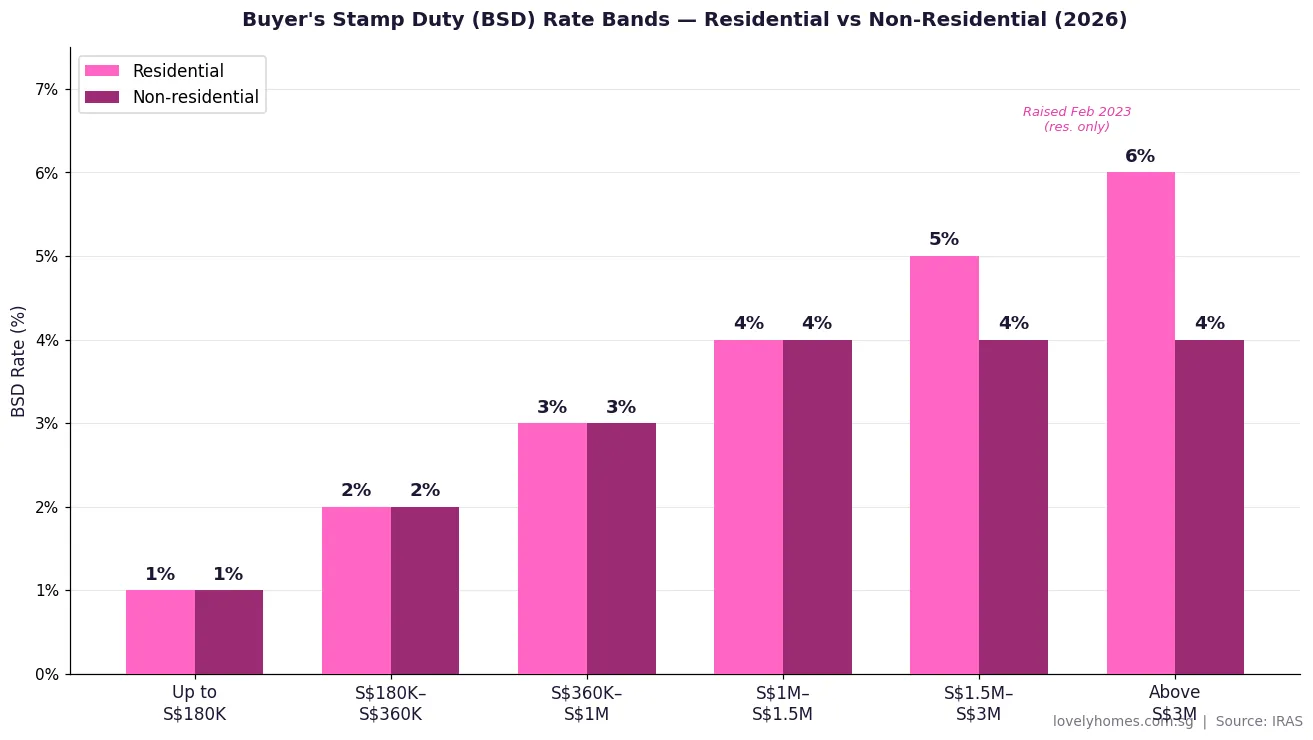
  • Non-residential BSD is capped at 4% (no 5% or 6% tiers apply).
  • BSD must be paid within 14 days of exercising the Option to Purchase (OTP) or signing the Sale & Purchase (S&P) agreement.
  • On a S$1.5 million condo, BSD is S$44,600 — that is before any Additional Buyer’s Stamp Duty (ABSD) kicks in.
  • BSD is separate from ABSD: ABSD applies only to second or subsequent properties (for Singapore Citizens) or all properties (for Permanent Residents and foreigners).
  • No exemptions for first-time buyers — BSD applies to everyone; only certain inherited or court-ordered transfers are exempt.
  • CPF Ordinary Account funds may be used to pay BSD on eligible residential properties.

What Is Buyer’s Stamp Duty (BSD)?

Buyer’s Stamp Duty (BSD) is a tax levied by the Inland Revenue Authority of Singapore (IRAS) on every purchase or acquisition of property in Singapore. Unlike the Additional Buyer’s Stamp Duty (ABSD) — which applies only to certain buyers — BSD is universal: it falls on every transaction regardless of whether the buyer is a Singapore Citizen (SC), Permanent Resident (PR), foreigner, or corporate entity, and regardless of how many properties they already own.

BSD is calculated on the higher of the purchase price or the market value of the property. IRAS uses the property’s assessed annual value and recent comparable sales to determine market value; if your agreed price is below market value, IRAS will compute BSD on the higher market-value figure. The tax is administered under the Stamp Duties Act (Cap. 312) and must be paid promptly — late payment attracts penalties.

The February 2023 Budget introduced new higher rate tiers for residential property, bringing the top marginal rate to 6% for portions of the price above S$3 million. For non-residential property (commercial, industrial, mixed-use), the maximum rate remains 4%. Understanding BSD is therefore a mandatory step in any property budget — you cannot legally complete a purchase without stamping the documents.

BSD rate bands residential vs non-residential Singapore 2026
Figure 1: BSD Rate Bands — Residential vs Non-Residential (2026). Source: IRAS / Stamp Duties Act.

BSD Rates for Residential Property (2026)

The following progressive rate schedule applies to all residential property purchases from 15 February 2023 onwards (Budget 2023). Note that the rates are marginal — each band applies only to the portion of the price falling within that range, not the entire purchase price.

Purchase Price Band BSD Rate Maximum BSD in Band
First S$180,000 1% S$1,800
Next S$180,000 (S$180,001 – S$360,000) 2% S$3,600
Next S$640,000 (S$360,001 – S$1,000,000) 3% S$19,200
Next S$500,000 (S$1,000,001 – S$1,500,000) 4% S$20,000
Next S$1,500,000 (S$1,500,001 – S$3,000,000) 5% S$75,000
Remaining amount (above S$3,000,000) 6% Unlimited

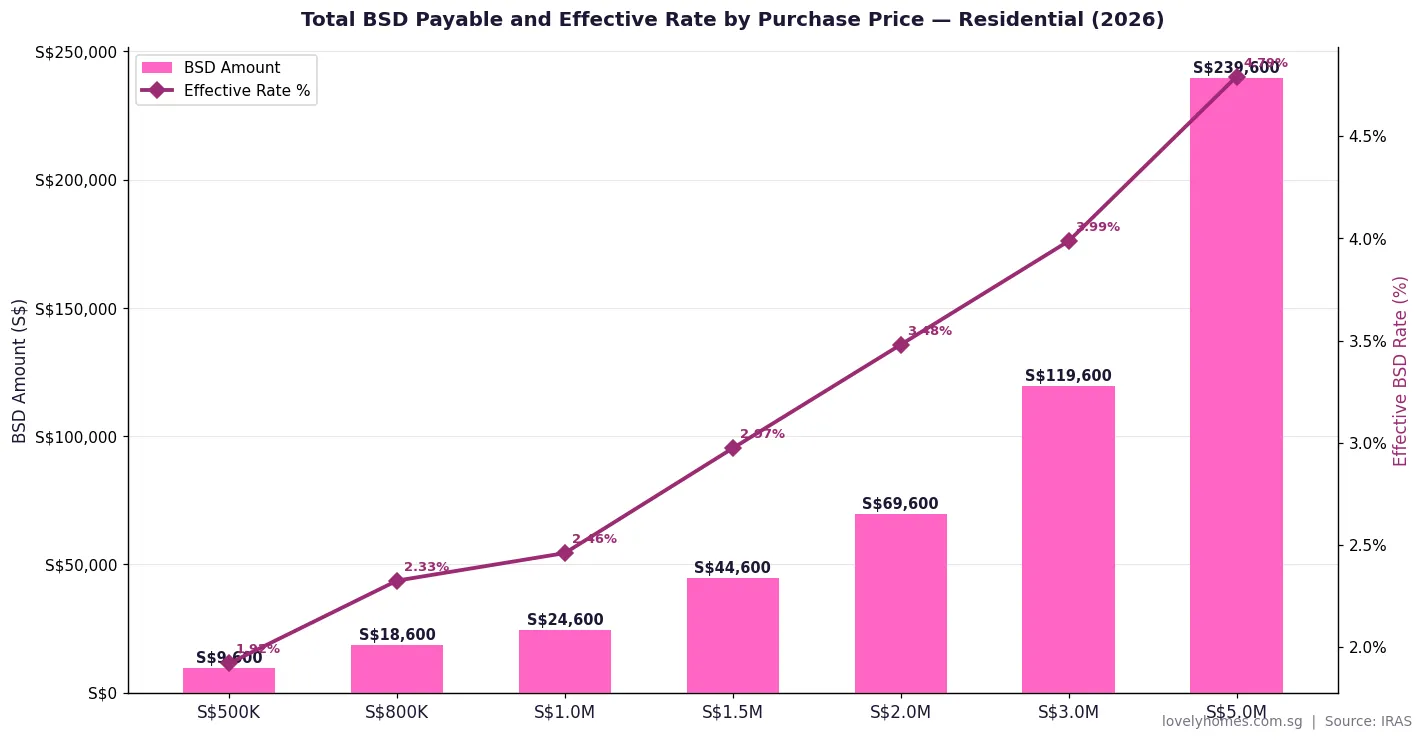
The cumulative BSD payable at the top of each band is S$1,800 → S$5,400 → S$24,600 → S$44,600 → S$119,600 and beyond. For a S$1 million property the BSD is exactly S$24,600; for a S$1.5 million property it is S$44,600; for a S$3 million property it is S$119,600.

BSD Rates for Non-Residential Property (2026)

Industrial, commercial, and mixed-use properties follow a different schedule that was last revised in 2018. The rates are lower and the top marginal rate is capped at 4%, reflecting government policy to keep transaction costs manageable for business property buyers.

Purchase Price Band BSD Rate Maximum BSD in Band
First S$180,000 1% S$1,800
Next S$180,000 (S$180,001 – S$360,000) 2% S$3,600
Next S$640,000 (S$360,001 – S$1,000,000) 3% S$19,200
Remaining amount (above S$1,000,000) 4% Unlimited

On a S$2 million shophouse, for instance, the BSD is S$24,600 (the S$1 million cumulative) plus 4% of S$1 million = S$40,000 → total S$64,600. Compare this to a residential property of the same price where BSD would be S$69,600. The difference is modest at S$2 million but widens materially at S$5 million and above.

Total BSD payable and effective rate by purchase price Singapore 2026
Figure 2: Total Residential BSD Payable and Effective Rate by Purchase Price (2026). Effective rate is BSD ÷ purchase price. Source: IRAS.

How to Calculate BSD Step by Step

BSD is a progressive tax, so the calculation requires applying each marginal rate to the corresponding band of the purchase price. The cleanest method is to use the marginal-band approach. Consider a S$1,800,000 residential property:

  1. 1% × S$180,000 = S$1,800
  2. 2% × S$180,000 = S$3,600
  3. 3% × S$640,000 = S$19,200
  4. 4% × S$500,000 = S$20,000
  5. 5% × S$300,000 (the remaining S$1.8M − S$1.5M = S$0.3M) = S$15,000
  6. Total BSD = S$59,600

IRAS also publishes a shortcut formula for common brackets. For residential properties priced between S$1 million and S$1.5 million the formula is: BSD = (4% × price) − S$15,400. For S$1 million: (4% × S$1M) − S$15,400 = S$40,000 − S$15,400 = S$24,600 ✓. These formulae are available in IRAS’s stamp duty calculator at iras.gov.sg.

When and How to Pay BSD

BSD must be paid within 14 days of the document being signed or executed — that is, within 14 days of exercising the Option to Purchase (OTP) for resale properties, or within 14 days of the date of the Sale & Purchase agreement for new launches. Late payment attracts a penalty of S$10 or the unpaid duty, whichever is higher, plus additional penalties of up to 4× the original duty for prolonged non-payment.

Payment is made through e-Stamping at the IRAS portal, accessible via Singpass. Solicitors acting for buyers routinely handle this on their clients’ behalf. The stamped document is legal evidence of the transaction; an unstamped instrument cannot be admitted as evidence in court.

BSD may be paid using CPF Ordinary Account (OA) funds for eligible residential properties — subject to the CPF withdrawal limit and valuation limit rules. If paying by CPF, the CPF Board will typically release the BSD payment to IRAS directly on completion. Cash payment via GIRO, credit/debit card, or bank transfer is also accepted. Foreigners without a Singpass account must pay through their appointed solicitor.

📌 Worked Example: Mr & Mrs Nair — D11 Condo S$2,200,000

Mr Nair is a Singapore Citizen; Mrs Nair is a Singapore Permanent Resident. This will be their first property. They are purchasing a 3-bedroom condominium in Newton / Novena (D11, RCR) at S$2,200,000. The solicitor will compute BSD as follows:

  • 1% × S$180,000 = S$1,800
  • 2% × S$180,000 = S$3,600
  • 3% × S$640,000 = S$19,200
  • 4% × S$500,000 = S$20,000
  • 5% × S$700,000 (S$2.2M − S$1.5M) = S$35,000
  • Total BSD = S$79,600 (effective rate: 3.62%)

ABSD position: because this is a joint purchase and Mrs Nair is a PR, the joint ABSD rate is determined by the buyer with the higher rate. SC buying 1st property = 0%; PR buying 1st property = 5%. As a mixed-citizenship couple, IRAS applies the higher rate — so ABSD of 5% × S$2,200,000 = S$110,000 applies. (They may request an ABSD remission if they intend to occupy the property, but remission is not automatic for SC/PR joint purchases on first property.)

Combined stamp duties: BSD S$79,600 + ABSD S$110,000 = S$189,600. Legal fees approximately S$5,500. Total transaction costs at completion: approximately S$195,100 (excluding down payment and financing costs).

Bank loan (SC income S$18,000/mth): 75% LTV = S$1,650,000 at 3.0% p.a. over 30 years → monthly instalment S$6,955. TDSR: (S$6,955 ÷ S$18,000) = 38.6% ✓ (below 55% TDSR limit).

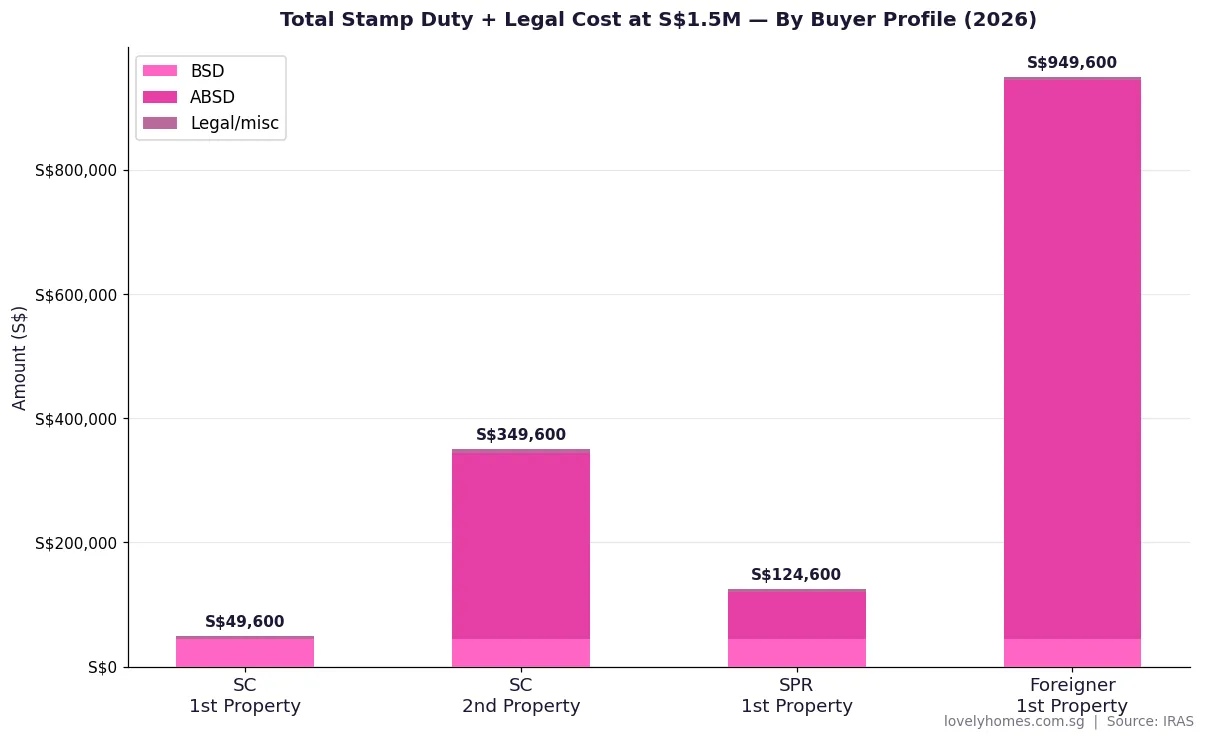
BSD and ABSD total stamp duty by buyer profile Singapore 2026 at S$1.5 million
Figure 3: Total Stamp Duty (BSD + ABSD + legal) at S$1.5M by Buyer Profile (2026). BSD is constant at S$44,600; ABSD varies by citizenship and property count. Source: IRAS.

Why BSD Matters: The True Cost of Buying Property in Singapore

BSD is a non-negotiable transaction cost that must be factored into every property budget from day one. At S$1 million, BSD alone is S$24,600 — roughly 2.5% of the purchase price. At S$3 million, it reaches S$119,600. For buyers stretching their budget to the maximum under Total Debt Servicing Ratio (TDSR) rules, forgetting to account for BSD can push a deal beyond their financial reach. Solicitors and mortgage advisers always incorporate BSD into the cashflow calculation alongside down payment, valuation fees, legal fees, and agent commissions.

Compared to peer jurisdictions, Singapore’s BSD is moderate but has been rising. Hong Kong’s stamp duty on residential property ranges from HK$100 to 4.25% of the price for the basic rate, with additional buyer’s stamps up to 30% for non-residents. Australia’s stamp duty varies by state and can exceed 5% in New South Wales and Victoria. Singapore’s BSD at an effective rate of around 2.5–4% for typical residential purchases sits within the regional norm, though the additional ABSD layers make total stamp costs for repeat or foreign buyers among the highest globally.

📊 What Might Come Next: BSD Outlook

This section is speculative and based on publicly available signals. It is not investment advice.

The February 2023 BSD increase targeted high-value transactions (above S$1.5 million), nudging effective rates higher for luxury properties. In the near term — through 2026 and into 2027 — industry observers do not anticipate a further upward revision to BSD, given that ABSD rates (raised to 60% for foreigners and 20% for SC second properties in April 2023) already provide strong price-stability signals. However, should the private residential price index continue its upward trajectory into the upper percentiles, a further adjustment to the S$3 million+ band (currently at 6%) cannot be ruled out in a future Budget.

For commercial and industrial BSD, a revision has been discussed informally in property finance circles, particularly given that strata industrial and shophouse prices have risen sharply since 2021. Any Budget announcement would take effect immediately on the date of the Budget speech, as has historically been the case.

Frequently Asked Questions: Buyer’s Stamp Duty Singapore

Does BSD apply to HDB flat purchases?

Yes. BSD applies to all residential property acquisitions in Singapore, including HDB resale flats and new BTO flat purchases. However, most HDB flats are priced well below S$1 million, so the effective BSD rate is typically 1–2%. For a S$600,000 4-room resale HDB flat, BSD is: (1% × S$180,000) + (2% × S$180,000) + (3% × S$240,000) = S$1,800 + S$3,600 + S$7,200 = S$12,600. The BSD on HDB purchases is significantly lower than on private condominiums. Note that for HDB purchases, CPF OA funds are routinely used to pay BSD, and the HDB will typically manage the stamping process on your behalf.

Is BSD different from ABSD? Can I avoid one but not the other?

BSD and ABSD are two separate taxes levied by IRAS. BSD applies to every buyer on every property — there is no exemption for first-time buyers. ABSD is an additional tax that applies to: Singapore Citizens buying a second or subsequent residential property (20% for second, 30% for third or more); Singapore PRs buying any residential property (5% first, 25% second and beyond); all foreigners buying any residential property (60% as of April 2023, with limited FTA exemptions for certain nationalities). It is impossible to avoid BSD; ABSD can be avoided by Singapore Citizens on their first property and in certain limited circumstances (e.g., FTA exemptions, ABSD remission for married couples). BSD is always payable on both residential and non-residential acquisitions.

What is the BSD deadline and what happens if I pay late?

BSD must be paid within 14 days of the date the relevant instrument is executed or signed. For resale properties, this means within 14 days of exercising the Option to Purchase (OTP). For new launch properties, within 14 days of signing the Sale & Purchase agreement. IRAS imposes penalties for late payment: S$10 or the unpaid duty (whichever is higher) for the first default, scaling up to 4× the outstanding duty for extended non-payment. In practice, conveyancing solicitors almost always handle BSD stamping within the 14-day window as a standard part of their service. You should therefore ensure you have the BSD funds ready to transfer to your solicitor’s client account well before the stamping deadline.

Can I use CPF to pay BSD in Singapore?

Yes, for eligible residential properties. CPF Ordinary Account (OA) savings may be used to pay BSD, subject to the applicable CPF withdrawal limits. The property must be used as a principal place of residence, and the purchase must satisfy CPF Board criteria (e.g., remaining lease of the property must meet the minimum occupation period requirements). CPF cannot be used to pay BSD on non-residential property purchases (shophouses, industrial, commercial). If you are using CPF for BSD, inform your solicitor at the start of the conveyancing process so they can arrange the CPF withdrawal in time. Any CPF withdrawn for BSD forms part of your total CPF withdrawal and attracts accrued interest at the OA rate of 2.5% per annum, which must be refunded to your CPF upon the eventual sale of the property.

Are there any exemptions from BSD in Singapore?

BSD exemptions are narrow. Transfers pursuant to a court order (e.g., divorce proceedings under section 112 of the Women’s Charter) may be exempt or subject to ad valorem duty on a different basis. Inherited property transferred via probate or letters of administration under intestate succession is also exempt from BSD (as it is a transmission, not a purchase). Government land acquisitions under the Land Acquisition Act are exempt. However, gifts of property between family members (including parents, siblings, and children) are generally not exempt unless effected as a court order; such transfers attract BSD at market value. There is no general first-time buyer exemption and no BSD discount for owner-occupiers — every voluntary purchase triggers the full progressive rate.

Is BSD based on the purchase price or the market value?

BSD is computed on the higher of the purchase price or the market value as assessed by IRAS at the time of the transaction. If you purchase a property below its assessed market value — for example, buying from a relative at a discounted price or acquiring a distressed-sale unit below prevailing comparable prices — IRAS will compute BSD on the market value, not the agreed price. Conversely, if you pay above market value (rare, but possible in competitive bidding situations), BSD is based on the actual price paid. IRAS cross-references the Urban Redevelopment Authority’s (URA) caveats database and the HDB resale transaction data to assess market value. Disputes about assessed value may be referred to the Stamp Duties Appeal Board.

Does BSD apply to property acquired through a company?

Yes. When a company — whether a Singapore-incorporated or foreign-incorporated entity — acquires property, BSD applies on the same basis as for individual buyers. The company must pay BSD on the higher of the purchase price or market value. In addition, corporate buyers are subject to ABSD at 65% for residential property (as of April 2023), making entity-held residential acquisitions extremely expensive. For commercial and industrial property, companies pay BSD at the non-residential rates (up to 4%) with no ABSD. Transfers of shares in a property-holding company may also attract stamp duty under Section 15 of the Stamp Duties Act; the rules are complex and specialist tax advice is recommended for such structures.

Related Articles on Singapore Property Taxes and Buying Costs

Disclaimer

This article is for general informational purposes only and does not constitute legal, financial, or tax advice. BSD rates and rules are set by the Inland Revenue Authority of Singapore (IRAS) and may change with each annual Budget. Always verify current rates and your personal BSD and ABSD obligations at iras.gov.sg before transacting. For a formal computation and to ensure timely stamping, engage a licensed Singapore conveyancing solicitor. LovelyHomes is not a licensed financial adviser or solicitor; no reliance should be placed on this article as a substitute for professional advice tailored to your specific circumstances.

Singapore Seller’s Stamp Duty (SSD) 2026: New 4-Year Holding Period, Rates and Exemptions Explained

Singapore Seller’s Stamp Duty (SSD) 2026: New 4-Year Holding Period, Rates and Exemptions Explained

Singapore Seller Stamp Duty SSD 2026 complete guide new 4-year holding period rates
Singapore Seller’s Stamp Duty 2026 — New 4-year holding period, updated rates and exemptions guide.
Quick Answer: Singapore SSD 2026 — Key Facts

  • What is SSD? Seller’s Stamp Duty is a tax on residential (and industrial) property sellers who dispose of their property within a specified holding period. Administered by IRAS.
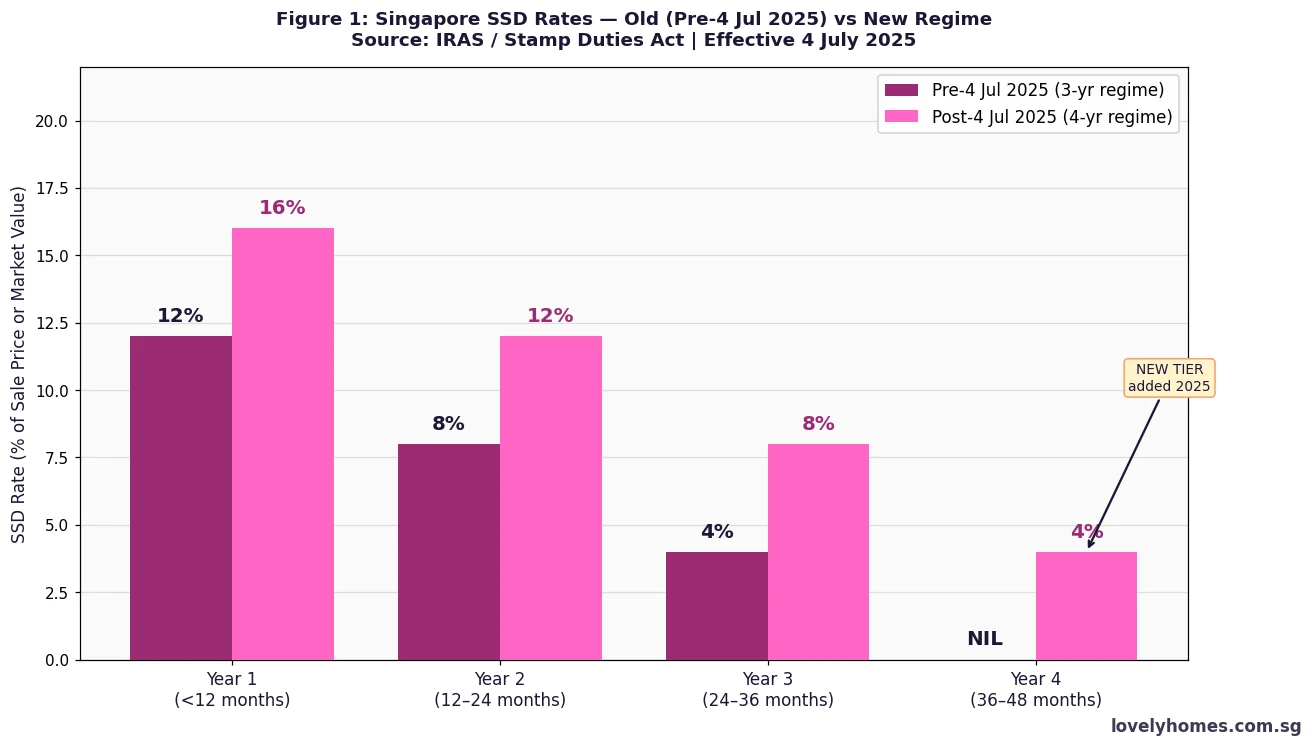
  • New 2025 regime (effective 4 July 2025): 4-year holding period. Rates: Year 1 = 16%, Year 2 = 12%, Year 3 = 8%, Year 4 = 4%, after Year 4 = 0%.
  • Old regime (11 March 2017 to 3 July 2025): 3-year holding period. Rates: Year 1 = 12%, Year 2 = 8%, Year 3 = 4%, after Year 3 = 0%.
  • Applies to: All residential properties purchased on or after the respective effective dates — HDB flats, condominiums, landed homes, and ECs.
  • Calculated on: The higher of the actual selling price or the market value at date of sale.
  • Payment deadline: Within 14 days of signing the OTP acceptance or S&P agreement via the IRAS e-Stamping Portal.
  • Key exemptions: Divorce, death of owner, en-bloc collective sale, compulsory Government acquisition, HDB disposal back to HDB.
  • Industrial SSD (separate): 3-year regime — 15%/10%/5%/0%.

What is Seller’s Stamp Duty?

Seller’s Stamp Duty (SSD) is a tax levied by the Singapore Government on sellers who dispose of residential property within a prescribed holding period. The rationale is anti-speculation: by making it financially punishing to flip property shortly after purchase, the Government moderates short-term price volatility and encourages genuine owner-occupier demand. SSD was first introduced for residential property on 20 February 2010 in response to a rapid price run-up following the global financial crisis. It has been calibrated several times since, most recently on 4 July 2025 when the Government extended the holding period to four years and raised all rate tiers by four percentage points.

SSD is administered by the Inland Revenue Authority of Singapore (IRAS) under the Stamp Duties Act (Cap 312). It operates alongside the Additional Buyer’s Stamp Duty (ABSD) and Buyer’s Stamp Duty (BSD) as part of Singapore’s property market stabilisation toolkit. Where BSD and ABSD are levied on buyers, SSD is the only stamp duty that falls on the seller.

SSD Rates in 2026: The New 4-Year Regime

The 2025 tightening — announced on 3 July 2025 and effective for all residential properties purchased on or after 4 July 2025 — extended the SSD holding period from three to four years and raised each rate tier by four percentage points. The chart below makes the difference between the old and new regimes vivid:

Singapore SSD rate comparison pre and post 4 July 2025 holding period rates by year
Figure 1: SSD Rates — Pre-4 July 2025 (3-year regime) vs Post-4 July 2025 (4-year regime) | Source: IRAS / Stamp Duties Act

Under the current regime, a seller who purchased a condominium on 1 August 2025 and sells it on 30 June 2026 — 10 months later — will pay SSD at 16% on the higher of the sale price or market value. On a S$1,500,000 sale, that is S$240,000 in SSD alone, on top of outstanding mortgage costs and agent commissions. The new rates make very short-duration property investments economically unviable in most scenarios.

For properties purchased between 11 March 2017 and 3 July 2025, the previous three-year regime applies: 12% (Year 1), 8% (Year 2), 4% (Year 3), 0% thereafter.

Which Properties Are Subject to SSD?

SSD applies to the following categories of residential property in Singapore:

  • Private residential property: Condominiums, apartments, landed homes (terraces, semi-detached, bungalows, GCBs), strata landed units, and mixed-use units with a residential component.
  • Executive Condominiums (ECs): Subject to SSD during the initial privatisation period for units resold on the open market within the holding period.
  • HDB flats: SSD technically applies, but the 5-year Minimum Occupation Period (MOP) required before open-market resale means most HDB sales occur outside the 4-year SSD window anyway. See our HDB resale guide for details.
  • Partial disposals and gifts: SSD applies to any disposal of a residential property interest — including gifts and transfers at below-market value — within the holding period. Computed on market value, not consideration paid.

SSD does not apply to commercial property or industrial property (the latter has its own separate SSD regime).

How SSD is Calculated

The computation is: SSD = applicable rate × max(selling price, market value).

IRAS uses the higher of two figures to prevent sellers from artificially deflating the declared sale price to reduce their SSD liability. If IRAS determines the declared price is below open-market value, it substitutes the market value — typically determined by a licensed valuation firm or IRAS’s own assessment — as the calculation base.

The holding period runs from the date of purchase (date of OTP or S&P, whichever is earlier) to the date of disposal (date the seller signs the acceptance of OTP or S&P agreement). If you bought on 1 March 2025 and sell on 2 March 2026, you have crossed into Year 2, and the Year 2 rate applies.

Singapore Seller Stamp Duty dollar cost by property selling price 2026 new regime Year 1 Year 2 Year 3 Year 4
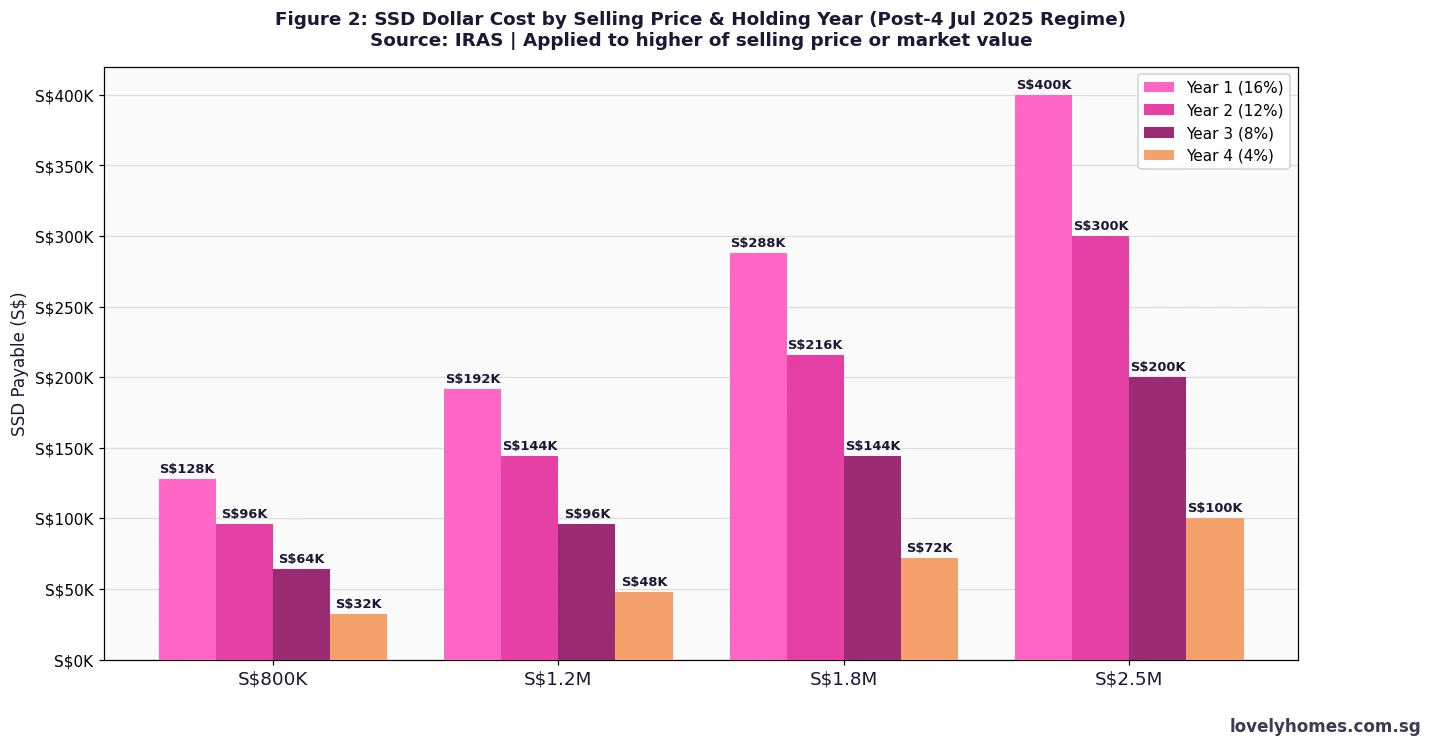
Figure 2: SSD Dollar Cost by Selling Price and Holding Year — Post-4 July 2025 Regime | Source: IRAS

Figure 2 illustrates how costly an early sale can be under the new regime. A seller disposing of a S$1,800,000 property in Year 1 pays S$288,000 in SSD — more than the typical agent commission, legal fees, and BSD combined. The prudent investor’s minimum exit window is now four years and one day.

SSD Payment — Deadline and Process

SSD falls legally on the seller and is incorporated into the conveyancing process by the seller’s solicitor. Key steps:

  1. Date of disposal: The date you sign the acceptance of OTP or S&P agreement (whichever is earlier).
  2. 14-day deadline: SSD must be paid to IRAS within 14 days of the date of disposal. Late payment attracts a penalty of up to four times the unpaid duty.
  3. e-Stamping: Payment via the IRAS e-Stamping Portal. Your conveyancing lawyer handles this on your behalf.
  4. Funded from sale proceeds: SSD is deducted from the sale proceeds at completion — sellers do not need to fund it upfront.

SSD Exemptions — When the Tax Does Not Apply

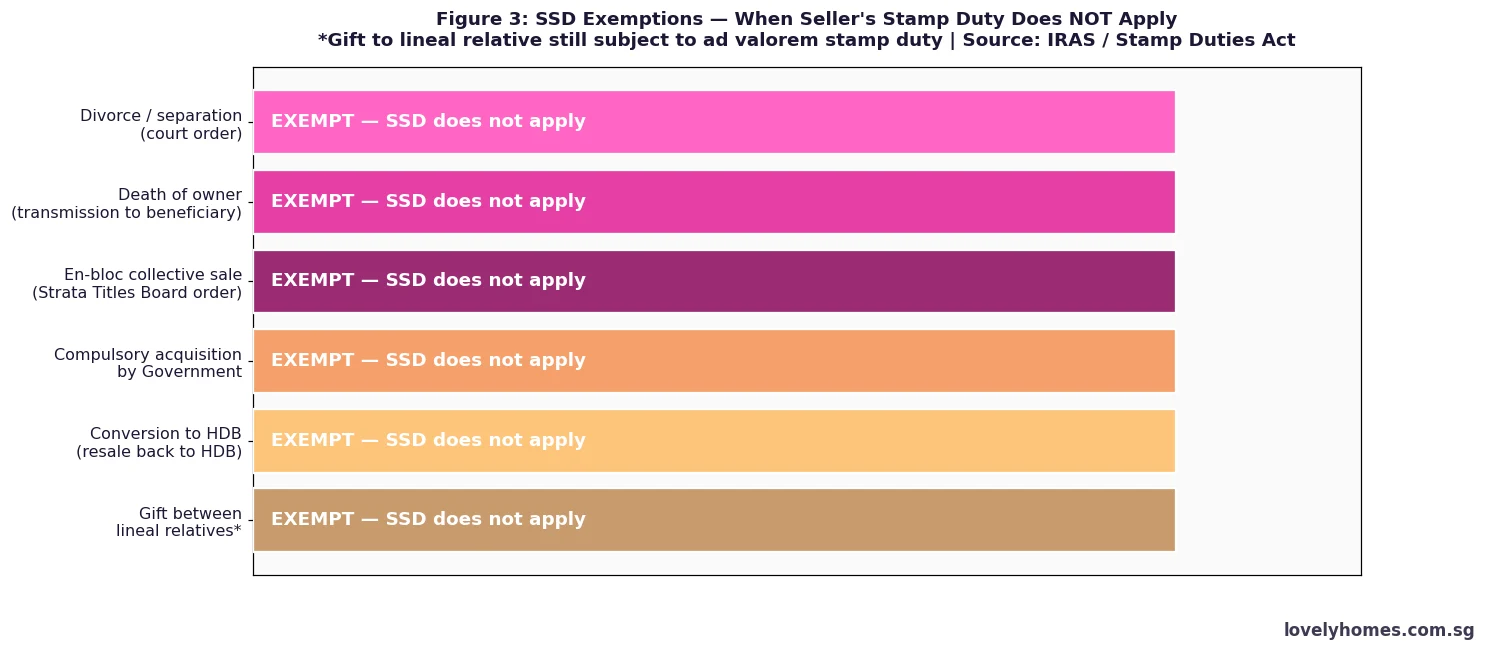
Not every disposal within the holding period triggers SSD. IRAS provides specific exemptions for involuntary or non-commercial transfers:

Singapore Seller Stamp Duty exemptions divorce death en-bloc compulsory acquisition HDB
Figure 3: SSD Exemptions — When Seller’s Stamp Duty Does Not Apply | Source: IRAS / Stamp Duties Act
  • Divorce or judicial separation: Transfer between spouses pursuant to a court order under the Women’s Charter or Matrimonial Proceedings Act — SSD waived. Voluntary spouse transfers without a court order are NOT exempt.
  • Death of owner: Transmission of a deceased owner’s share to beneficiaries via intestacy or valid will is not treated as a disposal for SSD purposes.
  • En-bloc collective sale: Where a Strata Titles Board (STB) or High Court order compels the collective sale, individual owners selling pursuant to that order are not subject to SSD. See our Singapore en-bloc guide.
  • Compulsory acquisition: Where the Government acquires the property under the Land Acquisition Act (Cap 152), no SSD applies.
  • HDB disposal back to HDB: Sale back to HDB (e.g., through voluntary early redemption schemes) is exempt.
  • Gift to lineal relatives: A specific remission order may reduce SSD in qualifying circumstances, but ad valorem stamp duty on the transfer may still apply — consult a lawyer.

Industrial Property SSD — A Separate Regime

Industrial property — factories, warehouses, logistics facilities, and flatted factories — has its own SSD regime introduced on 12 January 2013. The holding period is three years with higher base rates:

Holding Period (from purchase date) Industrial SSD Rate
Up to 1 year 15%
More than 1 year and up to 2 years 10%
More than 2 years and up to 3 years 5%
More than 3 years Nil

Industrial SSD rates effective 11 March 2017 | Source: IRAS

Summary Table: Residential SSD Regimes at a Glance

Purchase Date Year 1 Year 2 Year 3 Year 4 After Year 4
On/after 4 July 2025 (current) 16% 12% 8% 4% Nil
11 March 2017 to 3 July 2025 12% 8% 4% Nil Nil
14 January 2011 to 10 March 2017 16% 12% 8% 4% Nil
20 February 2010 to 13 January 2011 3% 2% 1% Nil Nil

Source: IRAS / Stamp Duties Act Cap 312 | Properties purchased before 20 February 2010 were not subject to SSD.

Worked Example: Mr Lee Sells His Condo 18 Months After Purchase

Mr Lee, a Singapore Citizen, purchases a resale condominium in Buona Vista for S$1,650,000 on 15 September 2025. His employment situation changes and he lists the property for sale in early 2027. He accepts an OTP at S$1,720,000 on 12 March 2027 — approximately 18 months after purchase.

Since the property was purchased after 4 July 2025, the new regime applies. The holding period from 15 September 2025 to 12 March 2027 is just over 18 months — meaning Mr Lee is in Year 2. The SSD rate for Year 2 is 12%.

IRAS compares the sale price (S$1,720,000) against the market value. An independent valuation confirms market value at S$1,700,000. The higher figure is the sale price of S$1,720,000.

  • SSD base: S$1,720,000 (higher of sale price vs market value)
  • SSD payable: 12% x S$1,720,000 = S$206,400
  • Payment deadline: 14 days from 12 March 2027 = 26 March 2027
  • Agent commission (approx. 1%): S$17,200
  • Legal fees: S$2,500 to S$3,500
  • Total selling costs: approximately S$226,100 to S$227,100

Had Mr Lee waited until 16 September 2029 — four years and one day after purchase — his SSD would be nil, saving him S$206,400. This is the clearest possible illustration of why the four-year holding period matters fundamentally to investment planning.

Why SSD Matters — What It Means for Property Investors

SSD is the Government’s most direct lever for curbing short-horizon speculation. Unlike ABSD — which targets buyers — SSD makes the exit itself expensive, creating a two-sided cost barrier that effectively locks investors in for at least four years under the current regime. For genuine owner-occupiers, this is largely irrelevant: they have no intention of selling quickly. For investors, the SSD calculus must be front-loaded into any acquisition model.

The July 2025 tightening came as the private residential price index rose 0.9% in Q1 2026 (following a 0.6% rise in Q4 2025, per URA Q1 2026 real estate statistics), signalling that investor appetite was returning. By extending the SSD window to four years and returning rates to the 2011-2017 levels (16%/12%/8%/4%), the Government effectively replicated the strictest historical SSD regime. For buy-to-let investors, the four-year minimum hold conveniently encompasses roughly two two-year lease cycles, allowing investors to cover carrying costs through rental income before an SSD-free exit.

What Might Come Next for SSD

This section reflects editorial analysis and is speculative in nature.

Having just restored the 2011-2017 rate structure in 2025, it would be unusual for the Government to tighten SSD further in 2026 absent a sharp market acceleration. The more likely near-term scenario is a data-driven review in mid-2027, 18 months after the July 2025 measures. If private residential prices cool to under 2% year-on-year growth, the framework will likely remain unchanged. A relaxation — possibly reverting to a three-year regime — would only be expected if the market corrects sharply due to external shocks such as a global recession or material rises in financing costs. Investors should plan on the four-year structure being the baseline through at least 2027.

Frequently Asked Questions

Does SSD apply if I bought my condo in 2023 and want to sell now in 2026?

Yes — under the old (pre-4 July 2025) three-year regime, since you purchased before 4 July 2025. If you bought in early 2023 and sell in mid-2026, you are within Year 3 of the three-year window, so the SSD rate is 4% on the higher of the selling price or market value. If you bought in mid-2023 and sell after mid-2026, you are past Year 3 and no SSD applies. The holding period is measured precisely from the date of your OTP or S&P agreement.

Can I avoid SSD by transferring the property to my spouse or child?

No. IRAS treats a transfer to a family member — even a spouse or child — as a disposal for SSD purposes. The SSD is computed on the market value of the property at the date of transfer, not the consideration paid. The only exempt family transfers are those made pursuant to a divorce court order, or specific lineal-relative remission scenarios under the Remission of Stamp Duties Order. If you are considering a transfer to a family member as part of a tax planning or decoupling strategy, consult a Singapore property lawyer first. See also our guide on property decoupling in Singapore.

My property is going en-bloc — will I pay SSD?

If the collective sale is effected by a Strata Titles Board (STB) order or High Court order, SSD is waived regardless of how long you have held your unit. However, if all owners agree to a private treaty collective sale without a STB or court order, the sale is treated as a voluntary disposal and SSD may apply. In practice, most collective sales proceed via the STB route, and the exemption applies. More detail at our Singapore en-bloc guide.

Does SSD apply if I sell my HDB flat?

Technically yes — SSD applies to HDB flat sales within the holding period. However, the HDB Minimum Occupation Period (MOP) of 5 years prohibits you from selling on the open market until 5 years from the date of collection of keys. Since the new SSD window is 4 years, by the time your MOP expires, you will typically be past the SSD window, and no SSD is payable. Plus and Prime flats have a 10-year MOP, making SSD entirely academic for them. The SSD overlap with HDB MOP is thus a theoretical rather than practical concern for the vast majority of flat owners.

Who pays SSD — the buyer or the seller?

SSD is legally the liability of the seller. Unlike BSD and ABSD which are buyer obligations, SSD is accounted for in the seller’s completion statement and deducted from sale proceeds at completion. Buyers are not responsible for paying it, though if SSD is unpaid IRAS has recovery powers that could cloud the title. Your conveyancing lawyer will confirm all stamp duties are paid before releasing title documents to the buyer’s lawyer.

I am relocating overseas — can I apply for an SSD waiver?

There is no general hardship or relocation waiver for SSD. The exemptions are limited to the specific statutory categories (divorce, death, en-bloc, compulsory acquisition, HDB disposal). A job relocation, financial hardship, or change in visa status does not qualify. If you are certain you will relocate within the holding period, it may be more cost-effective to rent out the property rather than sell it — provided you are eligible to do so. See our HDB rental landlord guide for how to do this compliantly.

How does SSD interact with ABSD remission for upgrading couples?

These are separate stamp duties and do not offset each other. ABSD remission for married SC couples allows the ABSD paid on a second property to be refunded if the first property is sold within 6 months of acquiring the second. SSD, if applicable on the first property being sold, is still payable — the ABSD remission does not waive or offset SSD. In the upgrading scenario, couples must factor in both: buyer pays BSD/ABSD on the new purchase, and seller pays SSD on the disposed property if within the SSD holding period. See our HDB upgrading guide for the full analysis.

Related Articles

Disclaimer

This article is for general informational purposes only and does not constitute legal, tax, or financial advice. Stamp duty legislation and IRAS administrative practice can change at any time. Always verify current rates and exemptions directly with the IRAS website and consult a qualified Singapore conveyancing lawyer or tax adviser before making property decisions. Property values, interest rates, and government policy cited are based on information available as at 7 June 2026.

Singapore Property Decoupling Guide 2026: Save ABSD, Costs, Risks and Step-by-Step Process

Singapore Property Decoupling Guide 2026: Save ABSD, Costs, Risks and Step-by-Step Process

Quick Answer: Property Decoupling Singapore 2026

  • What is decoupling? One co-owner transfers (sells) their ownership share to the other, leaving the transferee as sole owner — free to purchase a second property as a “first-time” buyer and pay 0% ABSD (SC).
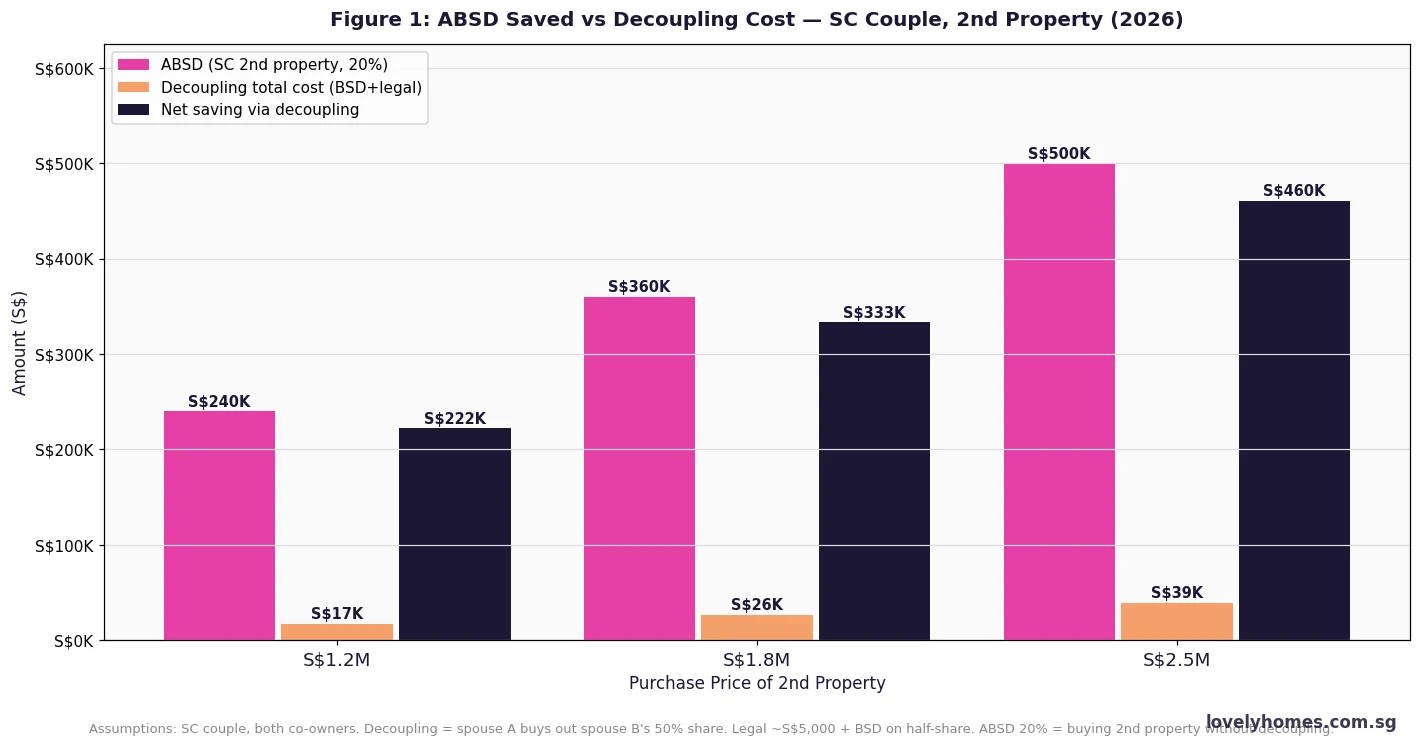
  • Why decouple? To avoid the 20% Additional Buyer’s Stamp Duty (ABSD) on a second residential property — worth S$240,000 on a S$1.2M purchase, S$360,000 on S$1.8M.
  • Cost of decoupling: Buyer’s Stamp Duty on the half-share transferred + conveyancing legal fees (~S$4,000–S$6,000) + CPF accrued interest refund considerations. BSD on a 50% share of S$1.5M = approximately S$20,100.
  • CPF complication: The transferor must refund CPF OA monies (principal + 2.5% p.a. interest) back to their CPF account on the part-disposal. This reduces the available cash to the couple.
  • Who can decouple? Any co-owners of a private property — married couples, siblings, business partners. HDB flats cannot be decoupled (HDB must approve any ownership change and will not approve part-share sales to achieve ABSD avoidance).
  • Timeline: Typically 6–10 weeks from legal instruction to registration of transfer with the Singapore Land Authority (SLA).
  • Risk: IRAS assesses BSD on market value, not agreed price. Undervaluing the transfer to minimise BSD exposes both parties to penalties and back-taxes.

Property decoupling Singapore refers to the legal process of one co-owner divesting their share in a jointly-owned property to the other, with the primary objective of allowing the transferee (or the transferor, if they are the one moving on) to purchase a subsequent property as a sole first-time owner, thereby avoiding ABSD. The strategy became widely discussed after the April 2023 cooling measures raised ABSD on a second property for Singapore Citizens to 20% — equivalent to S$270,000 on a S$1.35M condominium.

Decoupling is entirely legal. IRAS does not prohibit the practice; it merely requires that BSD be paid correctly on the transferred share at market value. What IRAS does scrutinise is any attempt to transact at artificially low prices to reduce stamp duty. The Stamp Duties Act (Cap. 312) empowers IRAS to assess BSD on the market value of the interest transferred, regardless of the stated consideration — so proper valuation is not optional; it is mandatory.

Property decoupling versus ABSD savings comparison chart Singapore 2026 at three purchase price points
Figure 1: ABSD saved versus total decoupling cost at three property purchase prices, 2026. At S$1.8M, decoupling saves approximately S$284,000 net of all costs. (Source: IRAS BSD schedule; author calculations.)

How Decoupling Works: The Legal Mechanics

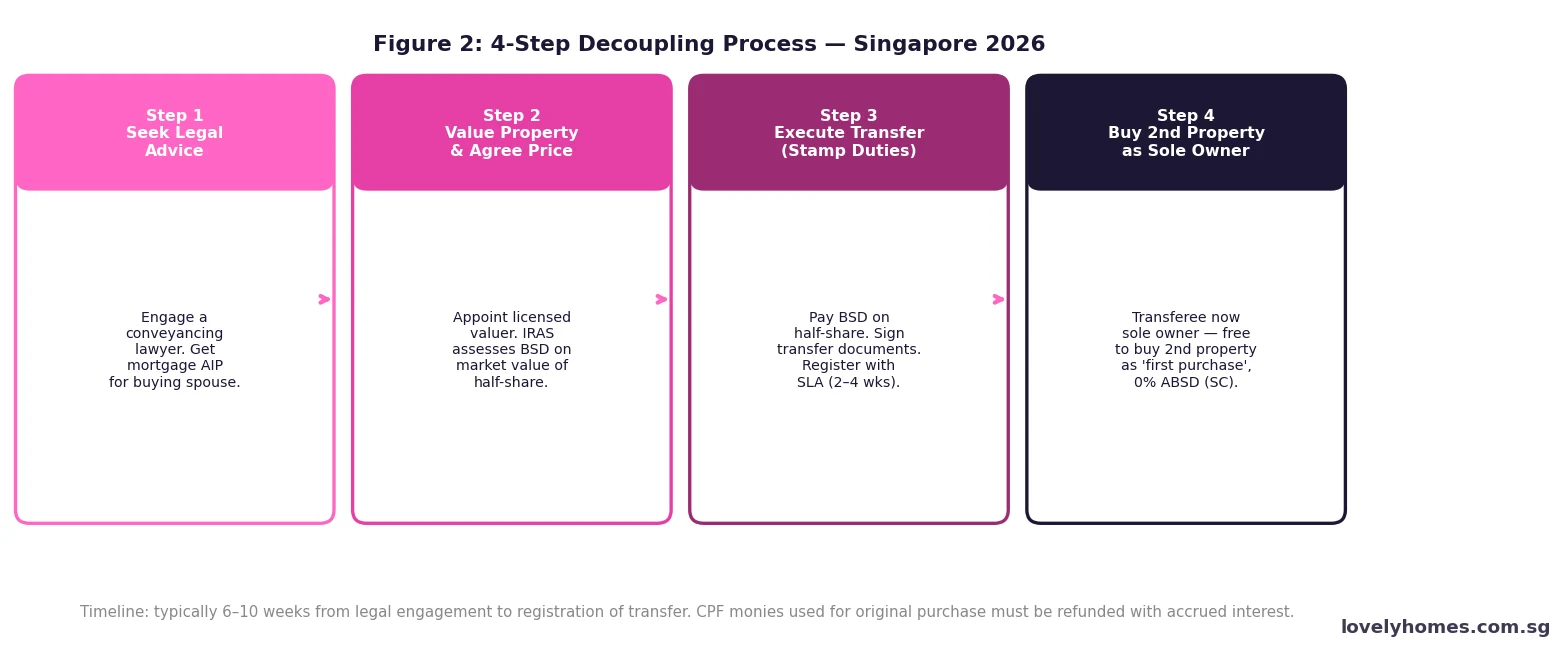
In a typical residential decoupling, a married couple owns a condominium together — say, as tenants-in-common in equal 50/50 shares, or as joint tenants. One spouse (the transferor) agrees to sell their 50% share to the other spouse (the transferee). The transaction is treated by IRAS as a sale at arm’s length: BSD is levied on the consideration paid or the market value of the half-share, whichever is higher.

The parties instruct a conveyancing lawyer who: obtains a formal valuation of the property from a licensed valuer, calculates the BSD payable on the half-share, prepares the Transfer Instrument, and lodges it with the Singapore Land Authority (SLA) for registration. BSD is paid electronically to IRAS before lodgement. The entire process takes 6–10 weeks under normal conditions.

Once registered, the transferee is the 100% sole owner of the property. The transferor holds no residential property in Singapore and is classified as a first-time buyer for ABSD purposes. They may now purchase a new private property — condominium, landed, EC (after MOP) — and pay 0% ABSD as a Singapore Citizen buying their first private residential property.

4-step property decoupling process Singapore 2026 from legal advice to buying second property
Figure 2: The 4-step decoupling process — from legal advice to purchasing a second property as sole owner. The critical step is completing registration before the transferor exercises the OTP on the new purchase. (Source: SLA, IRAS.)

Decoupling Costs: BSD, Legal Fees and CPF

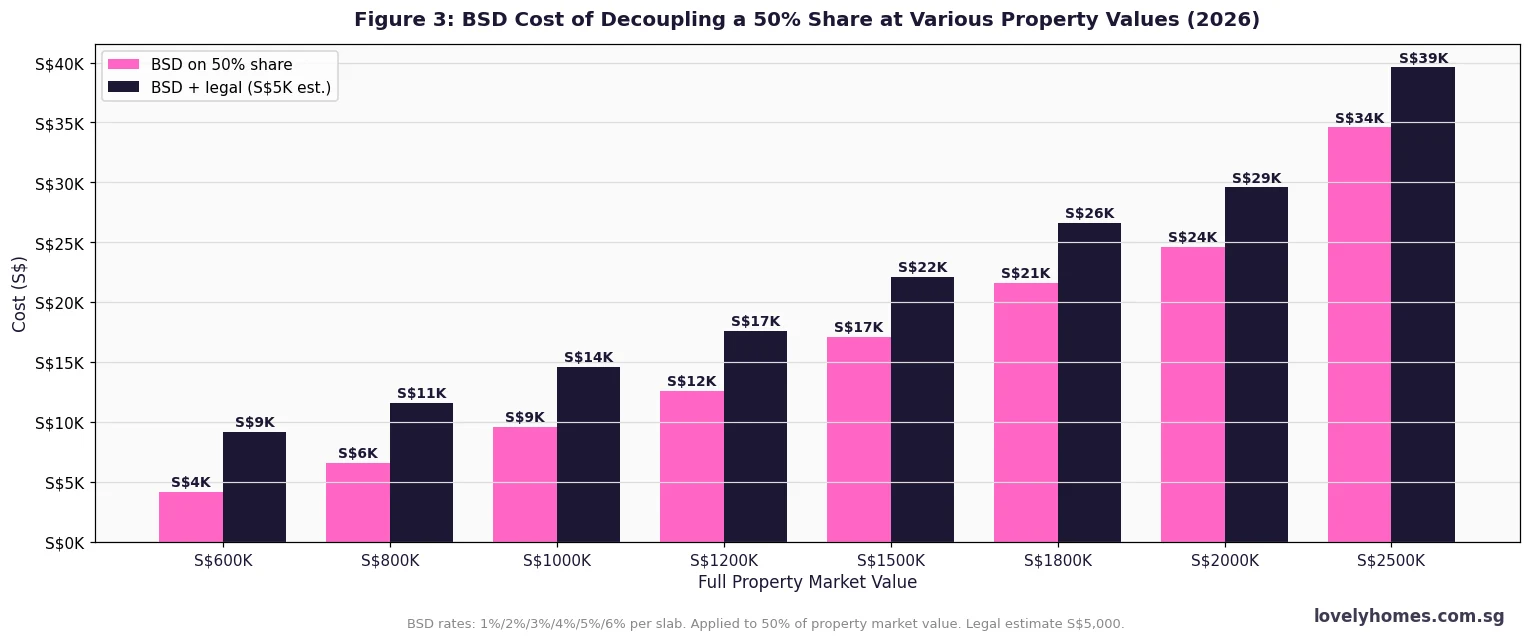
Three cost categories apply to a decoupling exercise. The first and largest is Buyer’s Stamp Duty on the transferred share. BSD is calculated on the market value of the 50% interest: 1% on the first S$180,000, 2% on the next S$180,000, 3% on the next S$640,000, 4% on the next S$500,000, and so forth. For a property valued at S$1,500,000, the half-share is S$750,000 and the BSD is approximately S$20,100. For a S$2,000,000 property, the half-share is S$1,000,000 and BSD is approximately S$29,600.

Second, conveyancing legal fees for both sides (a lawyer is typically appointed for each party to avoid conflicts of interest, though one firm may act for both if both parties provide informed consent under the Legal Profession Act). Expect S$2,500–S$3,500 per side — total S$4,000–S$6,000.

Third, CPF complications arise when the transferor used CPF Ordinary Account funds to finance the original purchase. On a part-disposal of a property, CPF Board requires the transferor to refund the proportionate CPF drawn (including accrued interest at 2.5% p.a.) back to their CPF account. This refund may need to be funded by cash from the transferee — that is, the transferee pays the transferor for their 50% share, and the transferor uses that cash to repay CPF. The net position depends on how much CPF was drawn and how long ago.

Decoupling Cost Summary at Key Property Values

Property Market Value 50% Share BSD on Half-Share Legal Fees (est.) Total Decoupling Cost ABSD Saved (SC 20%) Net Saving
S$800,000 S$400,000 S$9,600 S$5,000 S$14,600 S$160,000 S$145,400
S$1,200,000 S$600,000 S$15,600 S$5,000 S$20,600 S$240,000 S$219,400
S$1,500,000 S$750,000 S$20,100 S$5,000 S$25,100 S$300,000 S$274,900
S$1,800,000 S$900,000 S$24,600 S$5,000 S$29,600 S$360,000 S$330,400
S$2,000,000 S$1,000,000 S$29,600 S$5,000 S$34,600 S$400,000 S$365,400
S$2,500,000 S$1,250,000 S$42,100 S$5,000 S$47,100 S$500,000 S$452,900

BSD cost of decoupling 50 percent property share at various full property values Singapore 2026
Figure 3: BSD payable and total decoupling cost (BSD + S$5K legal estimate) across a range of property market values. The cost curve rises gradually as higher BSD slabs apply to larger half-shares. (Source: IRAS.)

Worked Example: The Lee Couple

Mr and Mrs Lee are Singapore Citizens who jointly own a condominium in the River Valley area, purchased in 2019 at S$1,600,000. Current market value: S$2,100,000. Outstanding bank mortgage: S$900,000. CPF drawn (Mr Lee’s OA): S$200,000 principal + S$28,000 accrued interest (7 years at 2.5% p.a.) = S$228,000 to be refunded.

Mr Lee transfers his 50% share to Mrs Lee. Half-share value: S$1,050,000. BSD on S$1,050,000: 1%×S$180,000 + 2%×S$180,000 + 3%×S$640,000 + 4%×S$50,000 = S$1,800 + S$3,600 + S$19,200 + S$2,000 = S$26,600. Legal fees both sides: S$5,500.

Consideration paid by Mrs Lee to Mr Lee: S$1,050,000 (half the market value). Of this, S$450,000 represents Mr Lee’s half of the outstanding mortgage (which Mrs Lee refinances into her sole name), and S$600,000 is cash/CPF to Mr Lee. Mr Lee refunds S$228,000 back to his CPF OA. Net cash Mr Lee receives: S$600,000 − S$228,000 = S$372,000. Mrs Lee’s bank refinances the full S$900,000 mortgage into her sole name (subject to TDSR).

Total decoupling cost to the Lees: BSD S$26,600 + legal S$5,500 = S$32,100. Mr Lee is now a first-time property purchaser. He buys a S$1,800,000 new launch condo: BSD S$53,600, ABSD 0%. Without decoupling, ABSD would have been 20% × S$1,800,000 = S$360,000. Net saving: S$360,000 − S$32,100 = S$327,900.

When Does Decoupling Make Sense?

Decoupling is financially worthwhile when the ABSD saved on the intended second purchase materially exceeds the BSD and legal costs of the transfer. Since ABSD is a flat percentage of the full purchase price and BSD is levied on only half the existing property value at a slab rate, the saving grows steeply with the price of the intended acquisition. At 2026 rates, decoupling is almost always cost-positive for SC couples buying a second property above S$600,000 — the break-even point sits well below the median condo transaction price of approximately S$1.3M (OCR).

Decoupling becomes less attractive — or potentially impossible — in three scenarios. First, when the transferee cannot service the full mortgage alone after TDSR assessment (the bank may require refinancing into the transferee’s sole name, and their income alone may not support the loan quantum). Second, when significant CPF accrued interest reduces the net cash benefit below the headline numbers. Third, when the ownership structure is joint tenancy (which does not recognise distinct shares) and the couple must first convert to tenancy-in-common before the transfer can proceed — a process that also carries legal costs and SLA registration fees.

Can HDB Flats Be Decoupled?

No. HDB resale flats cannot be decoupled in the same way as private properties. Under the Housing & Development Act, any change in ownership of an HDB flat requires HDB approval. HDB will not approve an ownership transfer whose purpose is clearly to circumvent ABSD on a subsequent private property purchase. Any attempt to do so constitutes a breach of HDB rules and may result in the flat being compulsorily acquired. Executive Condominiums during their MOP period are also governed by HDB and cannot be decoupled. After the EC’s 5-year MOP, it transitions to private property status and decoupling becomes legally permissible.

Decoupling Versus Other ABSD Strategies

Decoupling is one of several legally recognised methods for managing ABSD exposure. Alternatives include: the ABSD remission buy-first strategy (SC couple buys second property, pays 20% ABSD upfront, then sells HDB within 6 months and claims remission from IRAS — works only for upgraders selling an HDB); purchasing property in a company structure (ABSD does not technically apply to entities, but Additional Conveyance Duties apply to residential property held by companies, and the rates are punitive); and staggered purchase timing (one spouse buys in their sole name today, the other waits until the first property is sold). Each strategy carries its own cost-benefit profile, legal requirements, and risks. Professional legal and financial advice is essential before committing to any of them.

What Might Come Next for Decoupling in Singapore

This section reflects editorial analysis and is speculative in nature. The Singapore government has been aware of decoupling as a practice for many years. It is sanctioned by law — IRAS collects BSD on every transfer — and there is no indication of an imminent legislative move to prohibit or penalise the practice. However, any significant increase in BSD rates (the last upward revision to the top tier was in February 2023, adding a 6% slab for properties above S$3M) would raise the cost of decoupling proportionally. Conversely, if ABSD rates were ever to be reduced — which would require a material cooling of demand — the financial case for decoupling would diminish but not disappear. For now, decoupling remains a rational and widely-used tax-planning tool for property-owning couples in Singapore.

Frequently Asked Questions

Does IRAS allow decoupling, or is it considered tax evasion?

Decoupling is fully legal and explicitly recognised by IRAS. The Stamp Duties Act requires BSD to be paid on the higher of the agreed consideration or the market value of the transferred interest — IRAS simply ensures the correct amount of stamp duty is paid. What is prohibited is undervaluing the transaction to reduce BSD. Provided the transfer is done at or above market value (supported by a licensed valuation), decoupling is not tax evasion. It is tax planning — the use of lawful structures to minimise tax, as distinct from illegal concealment or misrepresentation.

What does the bank say about decoupling my mortgage?

The bank’s primary concern is that the remaining borrower (the transferee) can independently service the full outstanding mortgage. The bank will reassess the transferee’s TDSR, credit history, and income documentation as if they were applying for the loan afresh. If the transferee’s income alone does not support the existing loan quantum, the bank may require a partial repayment to bring the outstanding loan within acceptable limits. It is advisable to obtain a conditional bank approval before instructing lawyers to proceed with the transfer.

Can unmarried co-owners (e.g. siblings) decouple?

Yes. Decoupling is not restricted to married couples — any co-owners of private property may execute a part-share transfer. The same rules apply: BSD at market value, conveyancing via a licensed lawyer, SLA registration, and CPF refund obligations if applicable. There is no marital relationship requirement. The ABSD saving accrues to whichever party emerges as sole owner and subsequently purchases another property as their “first” private residential acquisition.

Do I need to convert from joint tenancy to tenancy-in-common before decoupling?

Yes, if your property is held as joint tenants. Joint tenancy confers equal undivided ownership with right of survivorship — there are no distinct percentage shares that can be separately transferred. Before a decoupling transfer can proceed, the parties must first sever the joint tenancy and convert to tenancy-in-common (typically 50/50). This severance is registered with SLA and carries a separate fee of approximately S$200–S$500. The lawyer handling the decoupling will usually do this simultaneously as part of the same exercise.

What are the Seller’s Stamp Duty (SSD) implications of decoupling?

If the property being decoupled was acquired less than 3 years ago, the transfer of the half-share may trigger SSD. SSD rates are 12% (if sold in year 1), 8% (year 2), and 4% (year 3) of the higher of the sale price or market value of the interest transferred. For a S$1M half-share disposed of within 2 years of original purchase, SSD could add S$80,000. Most couples planning to decouple therefore wait until their property has been held for at least 3 years. The SSD clock runs from the date of the original purchase, not from the date of decoupling.

What happens to CPF accrued interest when I transfer my share?

When the transferor disposes of their interest in the property (even a 50% share), CPF Board requires the proportionate refund of CPF monies withdrawn for that property — both principal and accrued interest at 2.5% per annum compounded annually. The refund goes back into the transferor’s CPF OA. The amount can be significant on properties held for 10+ years: S$200,000 of CPF drawn at 2.5% compounded annually for 10 years accrues to approximately S$256,000 — meaning the effective CPF refund obligation is S$256,000, not S$200,000. Plan this cash-flow carefully before executing the transfer.

After decoupling, when can the transferor buy a new property?

The transferor can purchase a new property as soon as the decoupling transfer is registered with SLA — typically 6–10 weeks after engaging the lawyers. There is no mandatory waiting period after the transfer. However, it is critical not to exercise the OTP on the new property before the decoupling transfer is registered; doing so could mean you technically hold a 50% share in the existing property at the time of the new purchase, triggering ABSD. The sequencing is: complete decoupling → register transfer → only then exercise OTP on new purchase.

Related Articles

Disclaimer: This article is provided for general informational purposes only and does not constitute legal, financial, tax, or property advice. Decoupling involves complex stamp duty, CPF, mortgage, and legal considerations that are specific to each individual’s circumstances. BSD and ABSD rates, CPF rules, and HDB policies are subject to change without notice. Always verify current rates and rules directly with the Inland Revenue Authority of Singapore (IRAS) at iras.gov.sg, the Singapore Land Authority (SLA) at sla.gov.sg, and the Central Provident Fund Board (CPF Board) at cpf.gov.sg. You should engage a licensed Singapore conveyancing lawyer before proceeding with any property transfer or stamp duty planning strategy.

Upgrading from HDB to Private Property Singapore 2026: Step-by-Step Guide, Costs and Timing

Upgrading from HDB to Private Property Singapore 2026: Step-by-Step Guide, Costs and Timing

Upgrading from an HDB flat to a private condominium is the most common property-wealth move in Singapore — and the most misunderstood. This guide walks you through every stage, every cost and every timing trap.

Quick Answer

  • You must fulfil the Minimum Occupation Period (MOP) — 5 years for standard HDB flats, 10 years for Plus or Prime classification flats — before selling and upgrading. The 5-year clock starts from the date of key collection, not the BTO application.
  • Upgrading while retaining the HDB flat triggers 20% ABSD on the private property (SC buying second residential property). Selling the HDB first and then buying private means you pay 0% ABSD as a first-time private buyer — but you face a timing gap.
  • CPF Ordinary Account funds used for the HDB must be refunded with accrued interest (2.5% p.a.) upon sale. This is not a penalty — it is your own money going back to your CPF — but it reduces the cash proceeds from the HDB sale.
  • Most upgraders secure an in-principle approval (IPA) from a bank before listing their HDB, to confirm their private-property borrowing capacity.
  • The typical timeline from HDB listing to moving into the private property is 9–12 months. A decoupling strategy can shorten this but adds complexity and legal costs.
  • For a S$1.35M OCR condo purchase (SC selling HDB and buying private): expect total cash outflow of S$340,000–S$380,000 (25% downpayment + BSD ~S$38,600 + legal fees) if CPF is used for the remainder of the downpayment.

Why Upgrading Is Such a Defining Decision in Singapore

For most Singapore families, the HDB flat is the largest asset they own — and the only asset from which they can extract equity to fund the next step in their property journey. Unlike in most developed economies, Singapore’s public housing system is tightly regulated: the MOP, resale levy rules, and eligibility restrictions mean that the upgrade from HDB to private property is not simply a matter of listing one property and buying another. It is a sequenced, rules-bound process that requires careful planning of CPF, ABSD, TDSR and timing.

In 2026, this upgrade pathway has become more complex following the 8 May 2026 measures by the Ministry of National Development, which doubled the MOP for new Executive Condominiums to 10 years. While this does not directly affect standard HDB upgraders, it has recalibrated expectations about holding periods across the market.

Step 1 — Confirm You Have Cleared the MOP

The Minimum Occupation Period is enforced by HDB under the Housing and Development Act (Cap. 129). For BTO, DBSS and most resale flats purchased under HDB schemes, the MOP is 5 years from the date of keys collection. For Plus classification flats (transitional zone — introduced under the October 2024 BTO reclassification) and Prime classification flats (central/mature areas under the PLH model), the MOP is 10 years.

During the MOP, you may not sell, sublet the entire flat, or purchase another private residential property. Breach of MOP is a serious offence — HDB may require compulsory acquisition at below-market rates. You can verify your MOP completion date via the HDB Portal (my.hdb.gov.sg).

Step 2 — The ABSD Decision: Sell First or Buy First?

This is the central financial decision of any HDB upgrade. Two paths exist:

Strategy ABSD Risk Best for
Sell HDB first, then buy private 0% (first private property) Timing gap — may need bridging loan or temporary rental Cost-conscious upgraders; those with flexible timeline
Buy private first, then sell HDB 20% (SC 2nd residential) 20% ABSD payable immediately; can claim remission if HDB sold within 6 months of private completion Those who need continuity; if new launch with long wait
Decoupling (married couple) One spouse buys private as first-timer: 0% ABSD Stamp duty + legal costs on decoupling; ABSD remission rules complex Married couples; wealth-splitting strategy

ABSD remission for the second-purchase strategy: If you purchase the private property first, you pay 20% ABSD upfront. However, if you sell your HDB flat within 6 months of the private property’s completion (for completed property) or within 6 months of the private property’s Temporary Occupation Permit (TOP) (for new launch under construction), you may apply to IRAS for a partial ABSD remission. The remission is not automatic — it requires a formal application and supporting documents confirming the HDB was sold within the stipulated period.

7-stage HDB to private property upgrading roadmap Singapore 2026
Figure 1: The HDB-to-private upgrading roadmap — 7 key stages from MOP check to occupation.

Step 3 — CPF Accrued Interest: The Hidden Cost of Upgrading

Every dollar withdrawn from your CPF Ordinary Account for the HDB purchase — whether for the downpayment or monthly mortgage instalments — accrues interest at 2.5% per annum from the date of withdrawal. When you sell the HDB flat, this full amount plus accrued interest must be refunded to your CPF OA before any cash proceeds are released to you.

For a household that bought a 4-room BTO for S$350,000 in 2017, used S$90,000 CPF for the downpayment and S$30,000 in CPF for monthly instalments over 9 years: the accrued interest can easily reach S$28,000–S$35,000. This sum reduces the net cash-in-hand from the HDB sale, though it is returned to CPF and can be re-deployed for the private property purchase.

Cost stack HDB sale proceeds vs private property purchase upgrader Singapore 2026
Figure 2: Upgrader cost stack — S$550k HDB sale vs S$1.35M OCR condo. SC couple, no existing ABSD. Net-of-ABSD strategy (sell HDB first).

Step 4 — Finance Check: TDSR, LTV and Bank IPA

Before listing your HDB, obtain an In-Principle Approval (IPA) from a bank. This confirms your maximum loan quantum for the private property. Key constraints:

  • LTV (Loan-to-Value): 75% of the lower of purchase price or valuation for a first private property (no outstanding housing loan). If you still have an HDB concessionary loan at time of private purchase — i.e., you are buying private before selling HDB — LTV drops to 45%.
  • TDSR (Total Debt Servicing Ratio): Monthly mortgage obligations must not exceed 55% of gross monthly income, stress-tested at 4.0% per annum (or the contracted rate + 2.0%, whichever is higher). At a 30-year loan tenure, a combined household income of S$12,000/month supports a maximum loan of approximately S$1.6M at a 3.8% actual rate — but the stress test at 4.0% (or effective 5.8%+) may reduce this.
  • MSR (Mortgage Servicing Ratio): The 30% MSR applies only to HDB loans and EC purchases; it does NOT apply to private condominium purchases. However, banks apply internal stress tests that are effectively similar.

Step 5 — The HDB Resale Levy: When It Applies

The HDB Resale Levy is payable if you have previously enjoyed a housing subsidy from HDB — typically from purchasing a new BTO or SERS flat at subsidised rates — and then purchase another subsidised HDB flat (BTO or DBSS) or an EC at the subsidised price. The levy ranges from S$15,000 (2-room flat) to S$50,000 (5-room flat and above).

Importantly, the resale levy is NOT payable if you are upgrading directly to a private condominium. It only applies when you move from a subsidised HDB flat to another subsidised HDB or EC. For the typical HDB-to-private upgrade journey, the resale levy is irrelevant — but it becomes relevant if, later in life, you sell the private condo and wish to purchase a subsidised flat again.

ABSD rates for upgraders second residential property Singapore 2026
Figure 3: ABSD rates applicable when purchasing the private property — by buyer profile and existing property count.

Worked Example: The Lim Family’s Upgrade

Mr and Mrs Lim — both Singapore Citizens, combined gross income S$13,500/month — own a 4-room BTO in Sengkang purchased in 2019 at S$420,000. They collected keys in December 2019 and have cleared their 5-year MOP as of December 2024. They aim to upgrade to a 3BR OCR condo in Tampines priced at S$1,350,000, using the sell-first strategy.

HDB sale side:

  • Estimated resale value (2026): S$550,000
  • CPF principal withdrawn (downpayment + 5 years of instalments): S$130,000
  • CPF accrued interest (2.5% p.a. × ~6 years average): ~S$24,500
  • Total CPF refund required: S$154,500 → returns to OA
  • Outstanding HDB loan (HDB concessionary at 2.6%, 25-year, ~5 years elapsed): ~S$268,000
  • Agent fees + legal: ~S$14,000
  • Net cash from sale: S$550,000 − S$154,500 − S$268,000 − S$14,000 = S$113,500 cash + S$154,500 to CPF OA

Private purchase side (S$1.35M OCR condo, first private property — 0% ABSD):

  • BSD: S$38,600
  • Downpayment (25%): S$337,500 — covered by CPF OA S$154,500 + additional CPF savings S$80,000 + cash S$103,000
  • Bank loan (75% LTV): S$1,012,500
  • Legal + stamp duties: ~S$5,000
  • Monthly instalment at 3.8% for 25 years: ~S$5,260/month (TDSR at S$13,500: ratio = 39% — within 55% limit)

The Lims transition from a paid-down HDB flat (equity ~S$282,000 post-CPF-refund) to a S$1.35M private condo with a S$1.01M loan. Their monthly outgoing rises from ~S$1,400 (HDB loan) to ~S$5,260 (bank loan) — a significant lifestyle adjustment that underpins why financial planning before committing to the OTP is essential.

Decoupling: A Strategy for Married Couples

Decoupling refers to the transfer of one spouse’s share of the HDB flat to the other, so that the first spouse becomes a private-property first-timer with no existing residential property — thereby buying the condo at 0% ABSD. This is a legitimate strategy permitted under Singapore law but involves several costs: Buyer’s Stamp Duty on the share transfer (at prevailing BSD rates), legal fees (~S$3,000–S$5,000), and CPF accrued interest implications if the receiving spouse uses CPF to buy out the transferring spouse’s equity.

Post-8 May 2026, decoupling strategies for Executive Condominiums are more complex given the extended 10-year MOP, but for standard HDB flats the fundamentals are unchanged. Note that a decoupling exercise does not reset the MOP clock — both spouses must still fulfil the residual MOP on the existing flat before selling it.

What Might Come Next

The upgrader market in Singapore is highly sensitive to HDB resale prices, private condo prices and the ABSD quantum. With the HDB Resale Price Index posting its first quarterly decline since Q2 2019 in Q1 2026, upgraders who have waited now face a window where HDB proceeds are softening — but private prices in the OCR have remained resilient (+1.3% in Q1 2026 per URA flash estimates). If HDB prices soften further while OCR condo prices hold, the upgrade gap widens, potentially tempering upgrader demand. Conversely, a release of the ABSD remission ceiling — which has been discussed informally in policy circles but not announced — could re-energise the buy-first strategy.

Frequently Asked Questions

Can I buy a private property before my HDB MOP is up?

No. HDB rules explicitly prohibit the purchase of any private residential property — whether in Singapore or overseas — during the MOP. This restriction applies to both spouses if the HDB flat is held jointly. Violation is treated as a breach of HDB terms and can result in compulsory acquisition of the HDB flat. The HDB actively cross-checks URA caveats and IRAS stamp duty records to detect such breaches. Once MOP is cleared (confirmed via the HDB Portal), you are free to purchase private property — though ABSD implications depend on whether you retain or sell the HDB.

How do I compute the CPF accrued interest I need to refund?

The CPF Board applies 2.5% per annum compounded on each CPF OA withdrawal from the date of that withdrawal. The total CPF refund = sum of all withdrawals × compounded interest from withdrawal date to sale completion date. You can get an exact figure by logging into the CPF website (cpf.gov.sg) under “My Home” → “Property Withdrawal Details”. The computation is provided automatically based on your withdrawal records. Accrued interest on CPF used for private property follows a similar principle but uses the OA interest rate applicable to each year (2.5% p.a. currently).

If I sell HDB first and the market rises before I buy private, am I stuck?

Yes, this is the primary risk of the sell-first strategy: the private property market may move against you between HDB sale completion and private purchase completion. Most upgraders mitigate this by either (a) securing the OTP on the private property before accepting the HDB offer, relying on the ~10-week HDB completion timeline; or (b) renting temporarily (typically 3–6 months) while searching for the right private unit. Some banks offer a bridging loan to cover the gap between HDB sale and private purchase completion, though interest rates on bridging loans (typically prime + 1–2%) can be costly if the gap extends beyond 3–6 months.

What happens to my HDB loan when I upgrade?

The outstanding HDB concessionary loan balance must be fully repaid from the HDB sale proceeds. HDB does not allow you to maintain an HDB loan on a flat you no longer occupy. Once the loan is discharged at completion, the CPF charge and bank caveat (if any) on the HDB flat are also withdrawn. If you had taken a bank loan (not HDB loan) for the flat, the bank will be repaid from sale proceeds in the same way. Note that having previously taken an HDB concessionary loan means you will not be eligible for a future HDB concessionary loan — you will need a bank loan for any future HDB purchase.

Can I use CPF savings to pay for the private property?

Yes — CPF OA savings can be used for the downpayment and monthly mortgage instalments on a private residential property purchased with a bank loan (not HDB loan). The funds returned to your CPF OA from the HDB sale (principal + accrued interest) are immediately available for the private purchase. There is a Valuation Limit (VL) — you may withdraw up to the lower of purchase price or valuation — and a Withdrawal Limit (WL) at 120% of the VL for properties with remaining lease below certain thresholds. For a new private condo with a 99-year lease, the VL and WL are unlikely to be the binding constraint for most upgraders.

What is the typical timeline for the HDB-to-private upgrade?

For a sell-first strategy: HDB Option-to-Purchase exercise → HDB resale registration with HDB → 8-week HDB flat completion → gap period (1–12 weeks) → private OTP exercise → 10–12 weeks to private completion (for resale condo). Total: approximately 5–9 months. For a new launch with progressive payment scheme, the private purchase is effectively a commitment today for a TOP 2–4 years away, during which time you can sell the HDB (and potentially claim ABSD remission). This is the most common “buy-first” timing for upgraders targeting new launches.

Is there a grants programme to help first-time private buyers?

No — CPF Housing Grants (EHG, CPF Housing Grant, Proximity Grant) apply only to HDB flat purchases, not private properties. Once you upgrade to a private condo, you lose access to these grant programmes for that purchase. However, the CPF OA funds returned from your HDB sale (including accrued interest) are your own funds and can be redeployed freely for the private purchase within CPF rules. Some banks offer preferential mortgage rates or fee waivers for existing mortgage customers upgrading — it is worth requesting a private banking review if your combined assets are above S$1M.

Related Articles


Disclaimer: This article is for general information purposes only and does not constitute legal, financial or tax advice. Stamp duty rates, CPF rules, HDB eligibility criteria and MAS lending regulations are subject to change — always verify with official sources including the HDB Portal (hdb.gov.sg), CPF Board (cpf.gov.sg), IRAS (iras.gov.sg), MAS (mas.gov.sg) and the URA (ura.gov.sg). Consult a licensed conveyancing solicitor, a MAS-regulated financial adviser and a CPF-accredited mortgage specialist before making any property decision.

Translate »