Singapore Property Conveyancing Process Guide 2026: Legal Fees, Timeline and Due Diligence
Quick Answer — Property Conveyancing Singapore 2026: Key Takeaways
- Conveyancing is the legal process of transferring property ownership from seller to buyer; in Singapore it is governed by the Conveyancing and Law of Property Act (Cap. 61) and conducted by licensed solicitors registered with the Law Society of Singapore.
- For private residential property, the buyer and seller each engage their own solicitors; for HDB resale flats, HDB’s in-house legal team handles the registration, though buyers may seek independent advice.
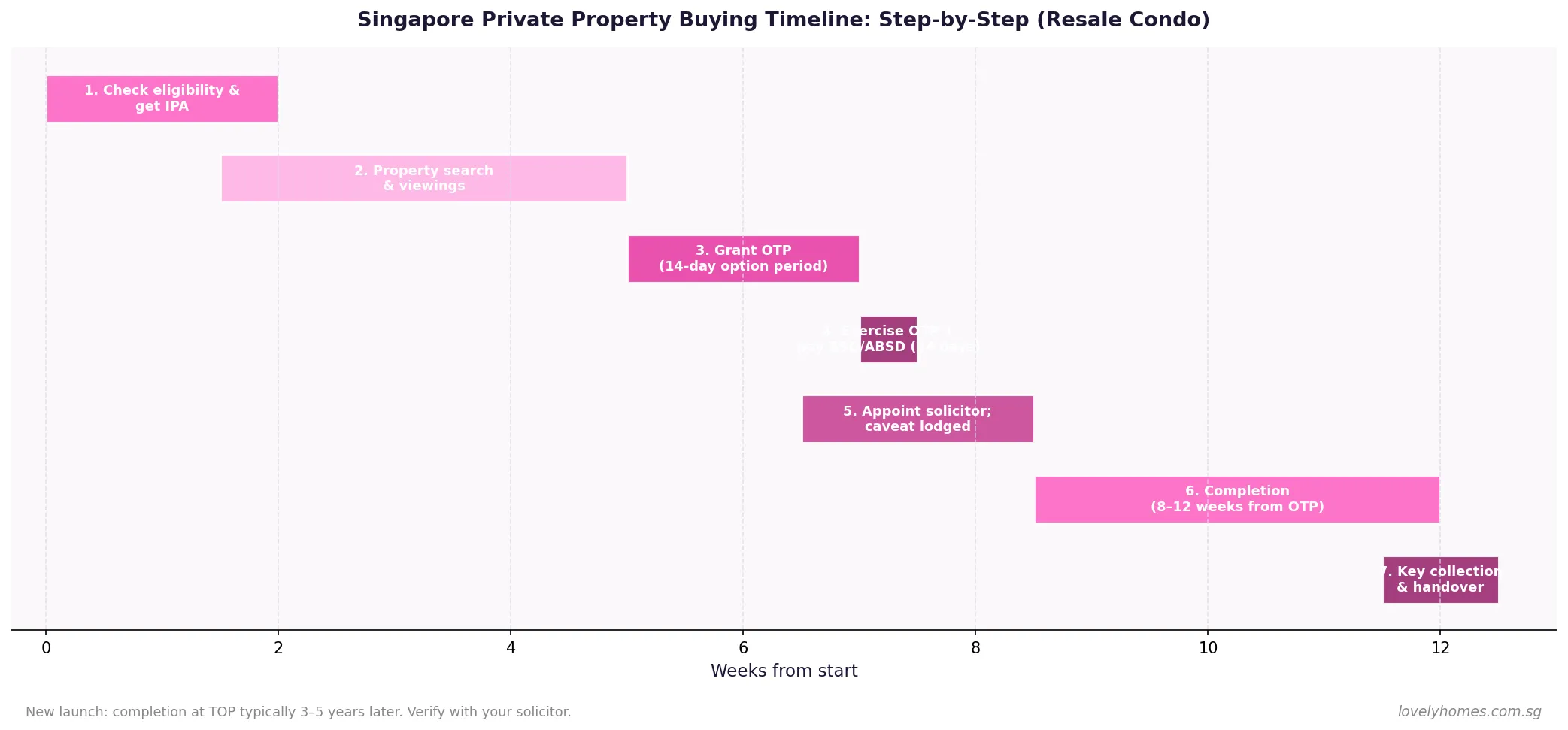
- The typical private property conveyancing timeline is 8 to 12 weeks from OTP exercise to completion (key collection); the full process from OTP issue to keys is typically 10 to 14 weeks.
- Buyer’s legal fees follow the Law Society conveyancing fee scale: approximately S$2,800–S$6,200 all-in (legal fees plus disbursements plus 9% GST) for most residential transactions.
- A caveat must be lodged with the Singapore Land Authority (SLA) within 14 days of exercising the OTP to protect the buyer’s interest against subsequent encumbrances.
- Due diligence searches — title search, CPF charge search, property tax check, URA planning search — are essential and typically cost S$400–S$800 total; your solicitor will conduct these on your behalf.
- Stamp duty (BSD and ABSD) is payable to IRAS within 14 days of signing the OTP or sale and purchase agreement, whichever is earlier.
What Is Property Conveyancing?
Property conveyancing is the legal transfer of ownership of real property from one party to another. In Singapore, every residential and commercial property transaction — whether a resale private condominium, a HDB flat, a landed house, or a strata office unit — involves a conveyancing process governed primarily by the Conveyancing and Law of Property Act (Cap. 61) and the Land Titles Act (Cap. 157). The process encompasses drafting and reviewing the sale and purchase agreement, conducting due diligence searches on the title, managing stamp duty compliance, coordinating the drawdown of housing loans and CPF funds, lodging the transfer instrument with the Singapore Land Authority (SLA), and completing the financial settlement between the parties.
Conveyancing in Singapore is performed by advocates and solicitors who are members of the Law Society of Singapore. The Law Society publishes a non-binding conveyancing fee scale — the Conveyancing Scale — which most firms use as a guide, though fees are ultimately negotiable. Many law firms offer fixed conveyancing packages for straightforward residential transactions.
Unlike some jurisdictions where buyers can conveyance themselves (“DIY conveyancing”), Singapore does not permit this for property transactions where a mortgage is involved or where CPF funds are used. Even for cash purchases, the complexity of SLA registration and due diligence searches makes engaging a solicitor strongly advisable.
The Conveyancing Process for Private Residential Property
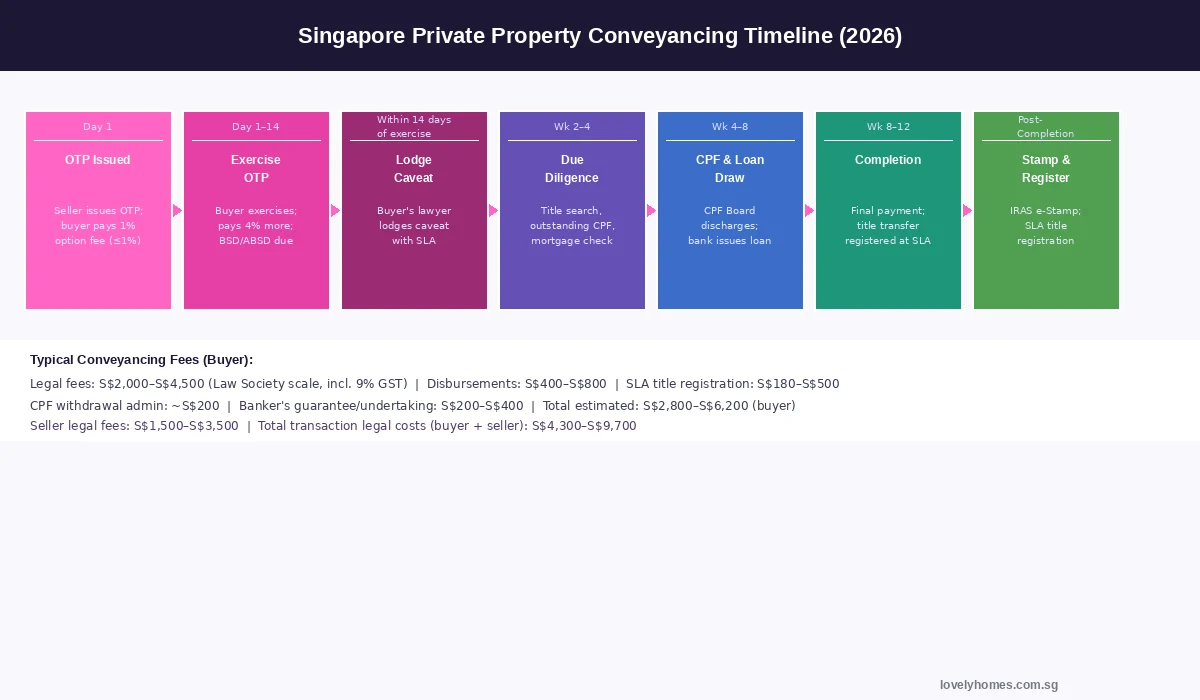
Step 1 — Option to Purchase (OTP)
The conveyancing process begins when the seller grants the buyer an Option to Purchase. In Singapore, the OTP for private residential property is typically drafted on the standard Law Society option form (or a developer’s standard form for new launches). The buyer pays the seller an option fee, usually 1% of the agreed purchase price, to secure the OTP. The OTP grants the buyer an exclusive right to purchase the property within the option period — typically 14 calendar days, though parties may agree on a longer period (often up to 21 days for resale private property).
During the option period, the buyer should immediately instruct a solicitor, who will commence preliminary due diligence and advise on any issues. The seller’s solicitor will simultaneously prepare the draft Sale and Purchase Agreement (SPA) or the standard transfer documentation.
Step 2 — Exercising the OTP and Paying Stamp Duty
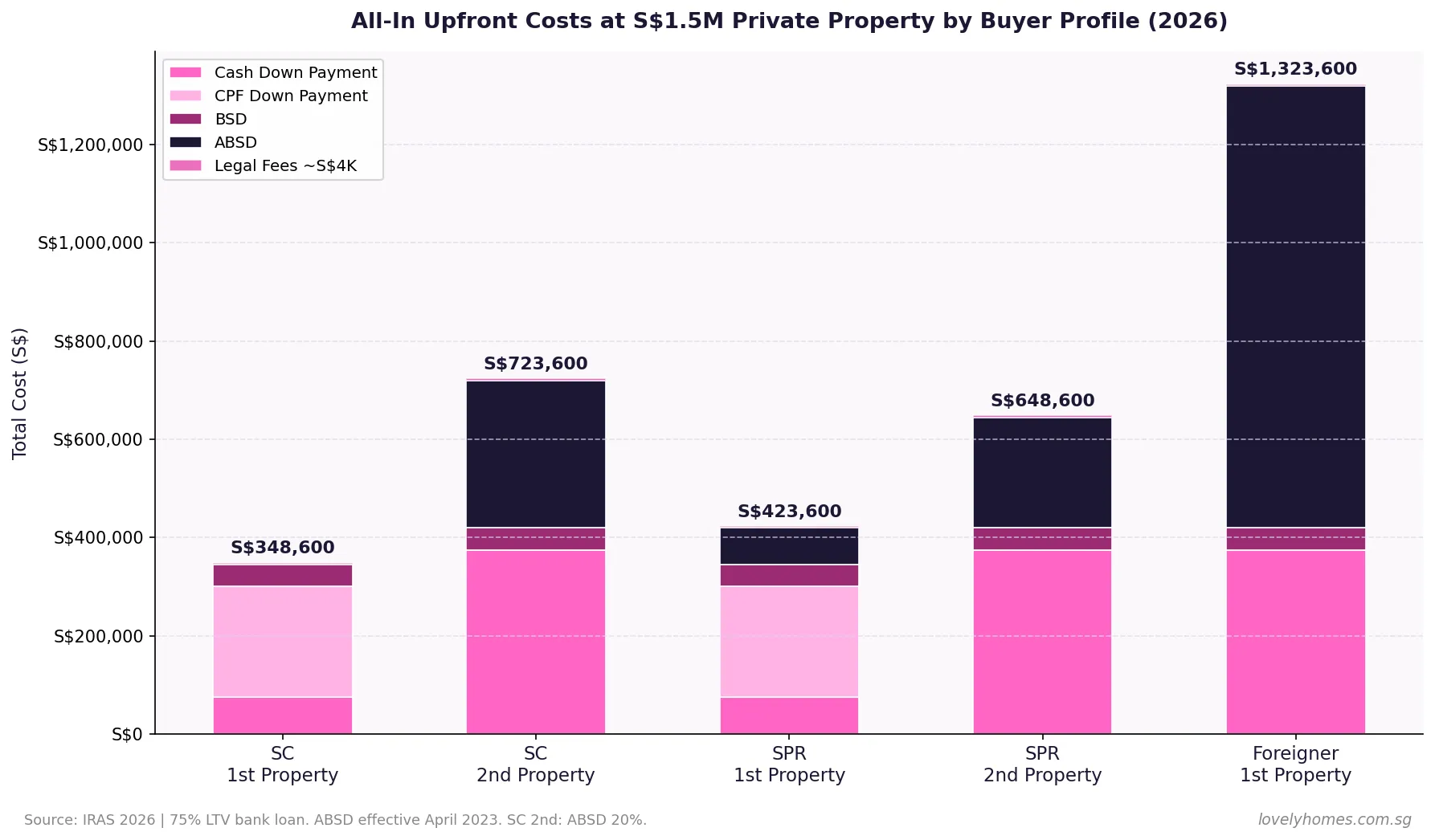
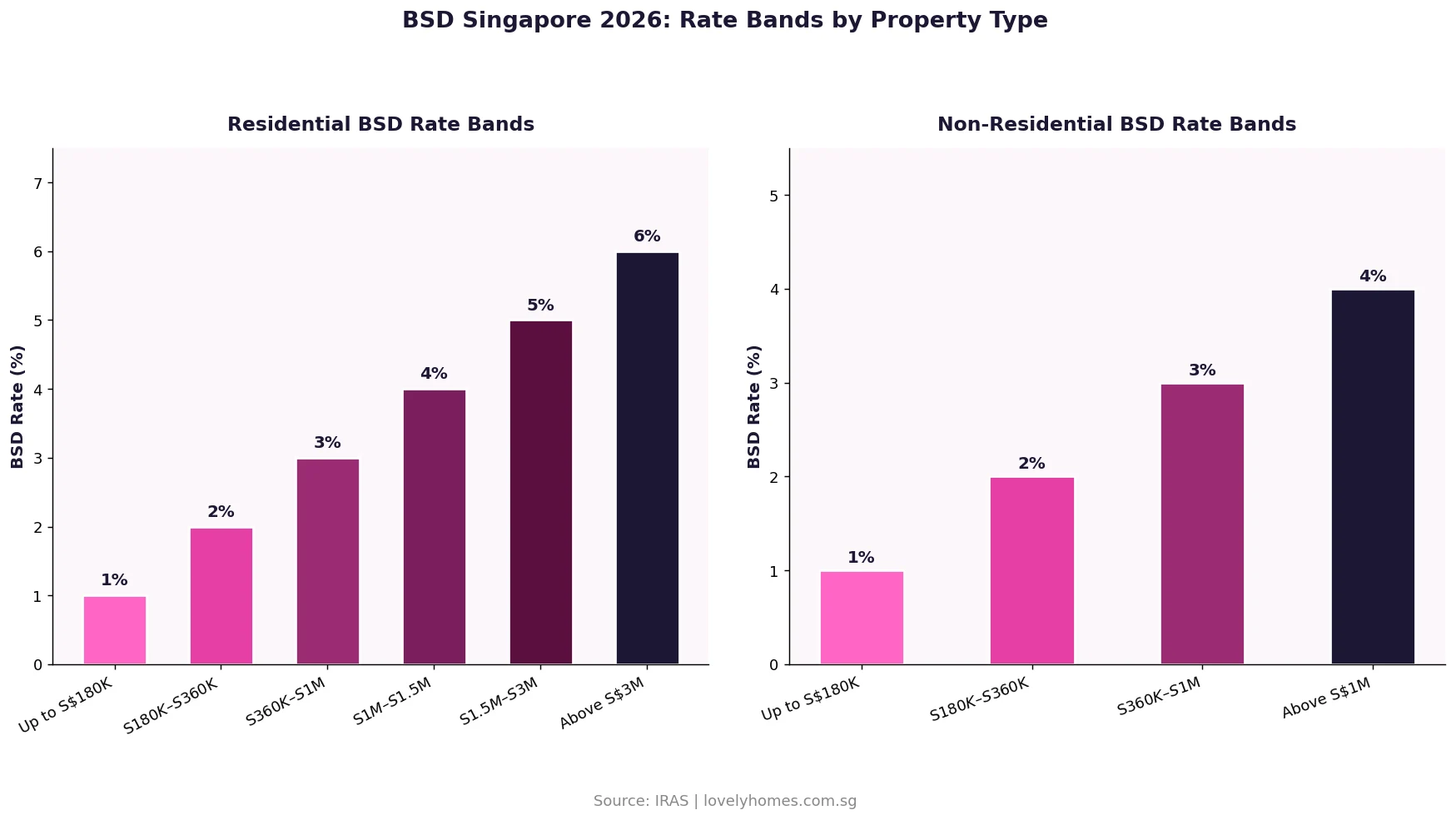
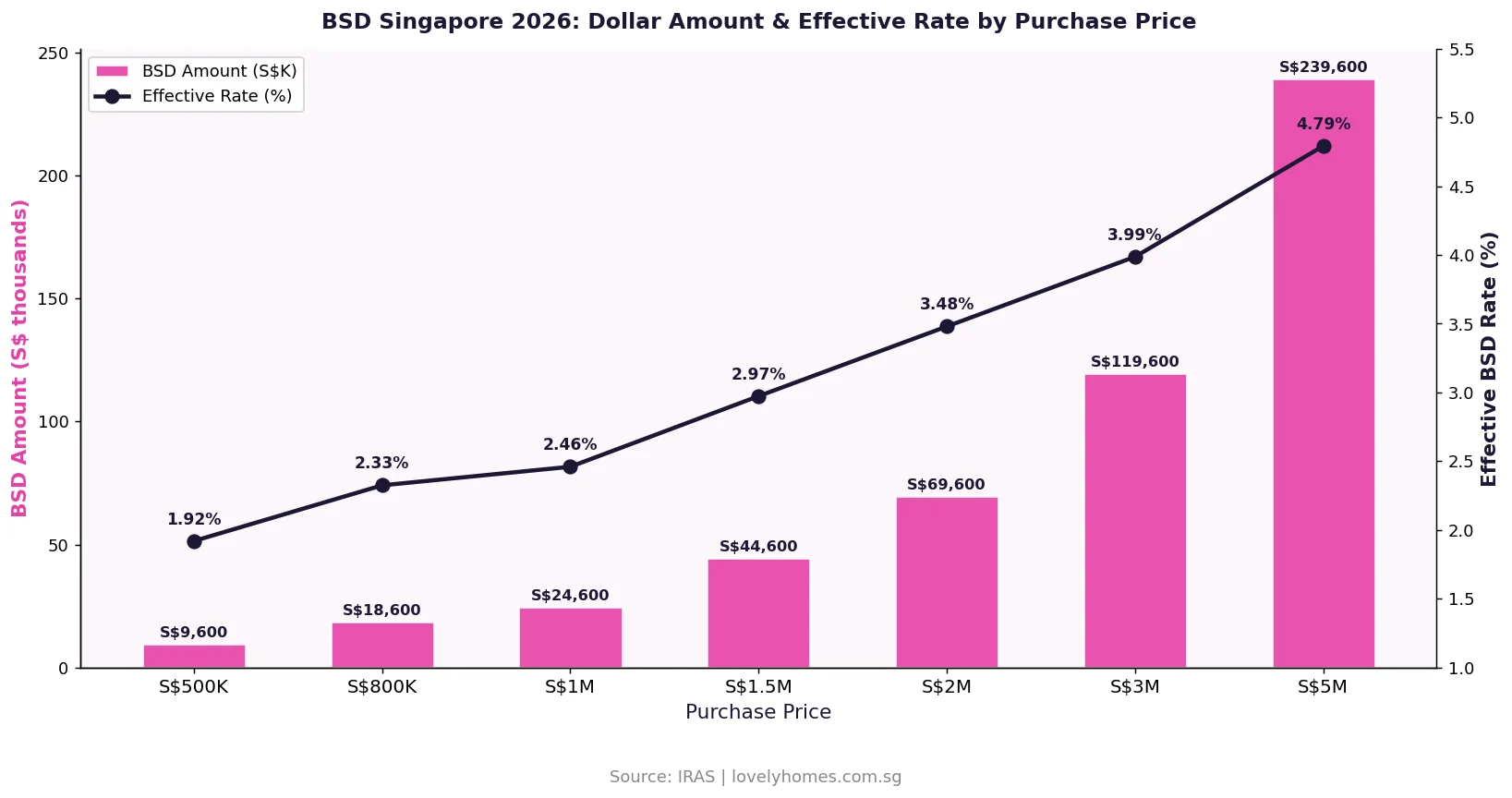
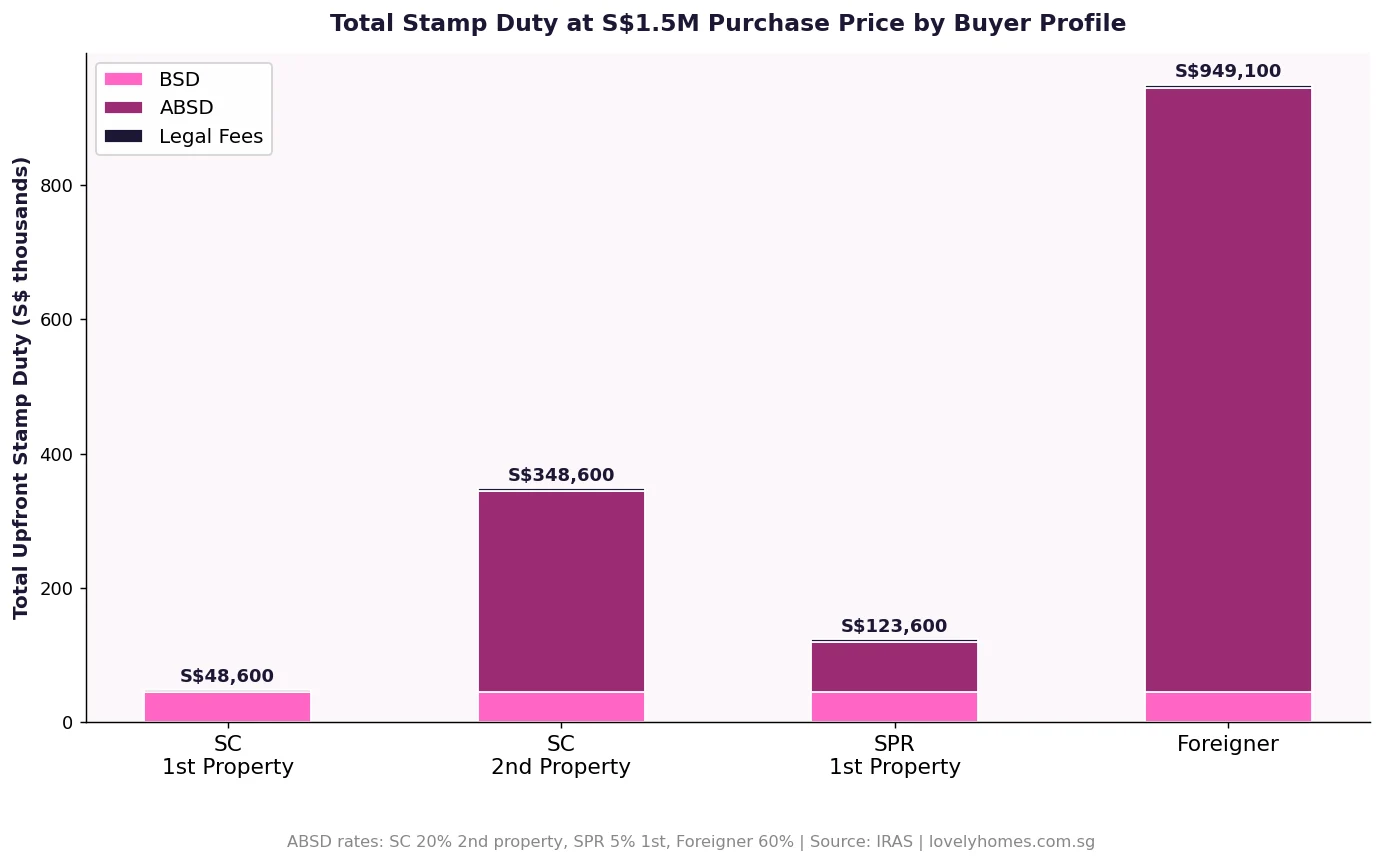
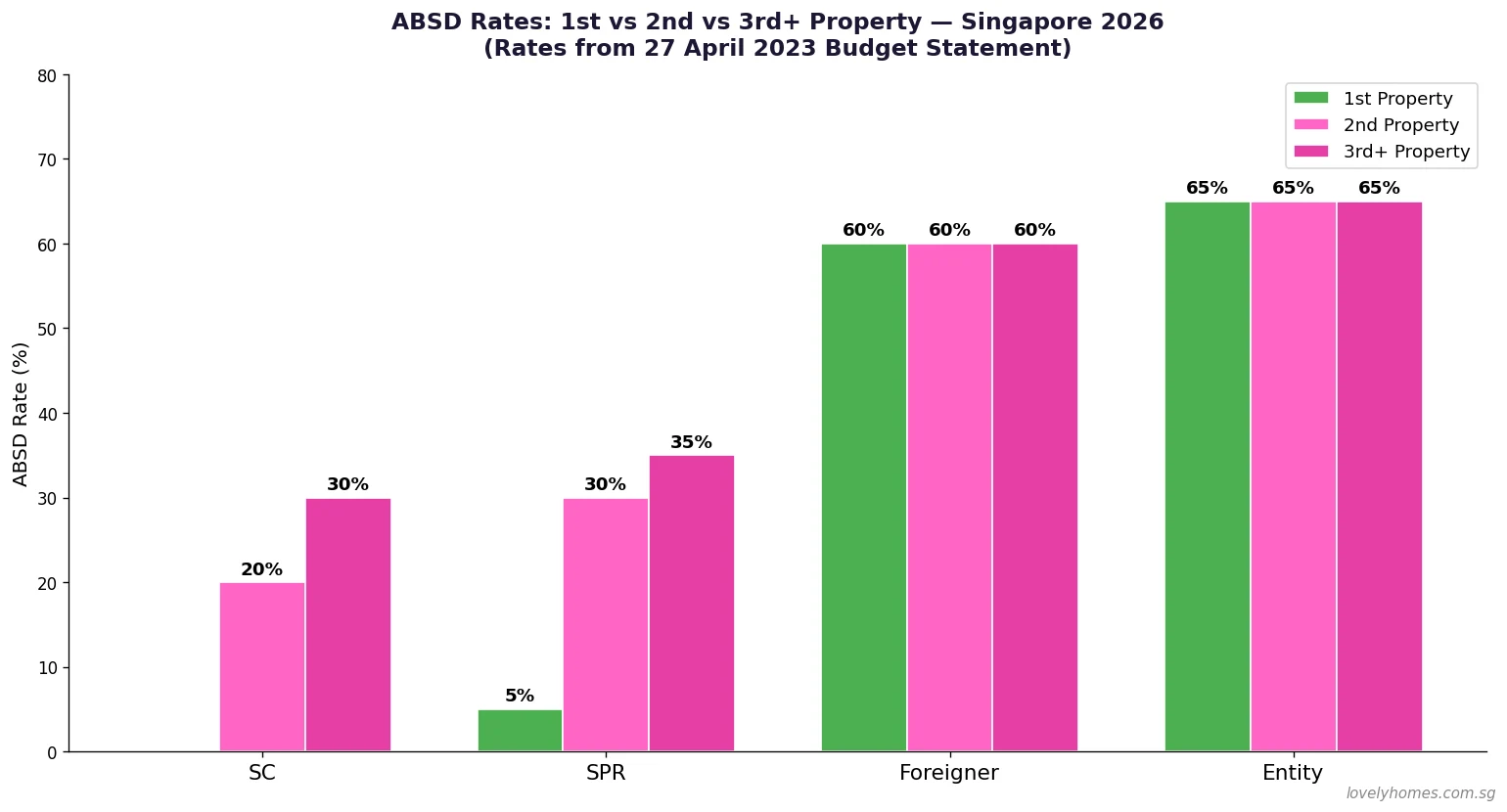
To exercise the OTP, the buyer signs the acceptance copy and pays the option exercise fee (typically the balance of the downpayment component, often 4% of the purchase price, making a total of 5% paid before the loan drawdown). The signed OTP or SPA is returned to the seller’s solicitor. Buyer’s Stamp Duty (BSD) is payable to IRAS within 14 days of the date of the OTP exercise (or the date of the SPA, whichever is earlier). BSD is calculated progressively: 1% on the first S$180,000; 2% on the next S$180,000; 3% on the next S$640,000; 4% on the next S$500,000; 5% on amounts from S$1.5 million to S$3 million; and 6% on any amount above S$3 million. Additional Buyer’s Stamp Duty (ABSD) is also payable within 14 days if applicable (e.g., 20% for SC purchasing a second property, or 60% for foreigners).
BSD and ABSD are paid via the IRAS e-Stamping portal. Your solicitor will handle this on your behalf.
Step 3 — Lodging the Caveat
Within 14 days of exercising the OTP, the buyer’s solicitor lodges a caveat against the property at SLA. The caveat is a legal notice that the buyer has an interest in the property; it prevents the seller from dealing with the property in a manner inconsistent with the buyer’s right (for example, granting a second mortgage or selling to another party). The caveat lodgement fee at SLA is S$64.45 (as of 2026). If a caveat is not lodged in time and the seller creates a subsequent encumbrance, the buyer’s interest may be defeated. Prompt lodgement is therefore a critical step.
Step 4 — Due Diligence Searches
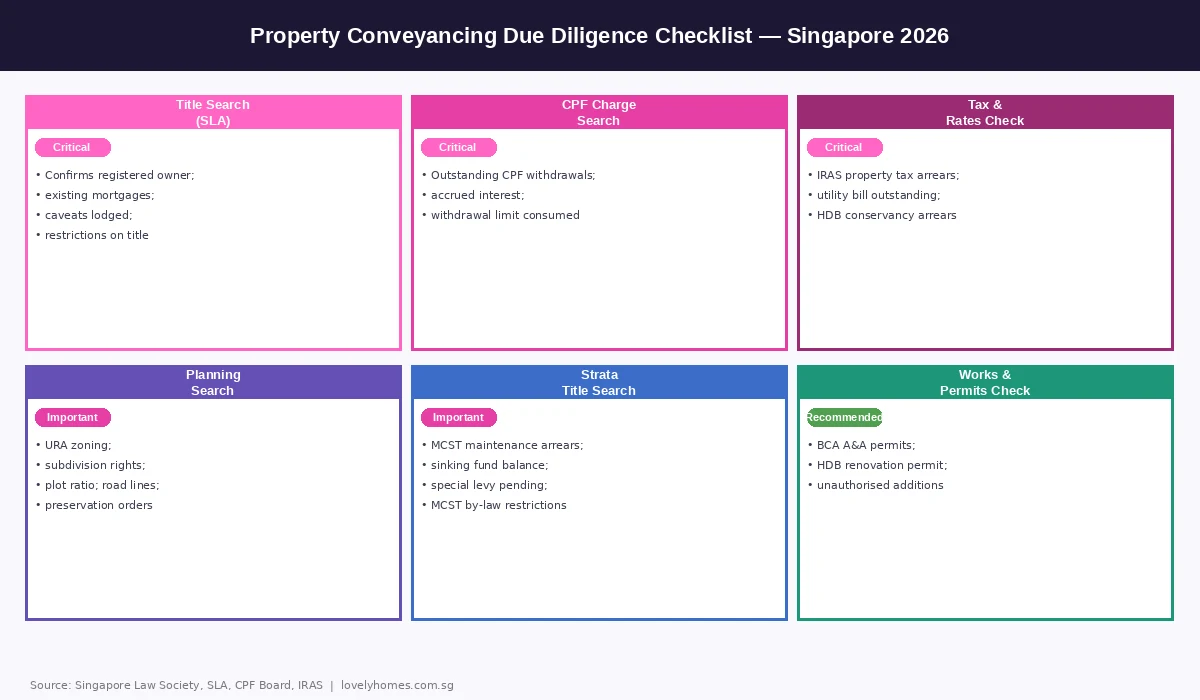
While the administrative processes proceed, the buyer’s solicitor conducts a suite of due diligence searches:
Title search (SLA): Confirms the seller is the registered proprietor, discloses any existing mortgages, caveats, charges, or restrictions encumbering the title. A property with an undischarged mortgage requires the seller to use the sale proceeds to redeem the mortgage before or on completion. A property with a CPF charge requires the seller to refund their CPF OA withdrawals (plus accrued interest at 2.5% p.a.) to CPF Board upon sale.
CPF charge search (CPF Board): Reveals the total CPF funds withdrawn by the seller and the accrued interest, which must be refunded to the seller’s CPF OA on completion. This affects the net proceeds the seller receives and can have implications for the buyer if the outstanding CPF refund approaches or exceeds the sale price.
Property tax search (IRAS): Confirms whether any property tax, conservancy charges (for HDB), or MCST contributions are in arrears. Unpaid property tax is a charge on the property that runs with the land; the buyer’s solicitor will require that all arrears are cleared before completion.
URA planning search: Reveals the zoning and planning parameters for the property — whether it is zoned residential, the gross plot ratio, road line plans (which may affect the usable area or value), and any preservation or conservation status. For landed property buyers in particular, this search is indispensable to understand development potential.
Strata title search (for condominiums and strata-titled properties): Discloses outstanding MCST maintenance contributions, sinking fund balance, any special levies, and MCST by-law restrictions that may affect the buyer’s use and enjoyment.
Step 5 — CPF Withdrawal and Loan Drawdown
If the buyer is using CPF OA funds, the buyer’s solicitor applies to the CPF Board to approve the withdrawal. CPF Board charges a flat administrative fee of approximately S$200 for the initial drawdown. CPF OA funds can only be applied up to the Valuation Limit (the lower of the purchase price and the property’s assessed valuation) and subject to the Withdrawal Limit (Valuation Limit plus accrued interest, capped at age-related rules). If the buyer is using a bank loan, the bank’s solicitor (who may be the same firm, or a separate firm in a situation of conflict) issues a Solicitor’s Undertaking to the buyer’s solicitor confirming the bank will release the loan proceeds on completion. For HDB loans, HDB directly disburses the loan at the Second Appointment.
Step 6 — Completion
Completion is the point at which the sale is finalised. The buyer pays the outstanding balance of the purchase price (calculated as the purchase price less the 5% option fee already paid, less the loan amount, less CPF OA applied, minus the seller’s CPF refund and outstanding mortgage amounts). Funds are transferred between solicitors via lawyers’ account. The seller delivers vacant possession (unless a tenancy is being taken subject to an existing tenancy) and hands over keys, title documents, and relevant warranties or maintenance manuals. On the same day, the transfer instrument is lodged with SLA for registration, which typically takes one to three working days. Once registered, the buyer is the legal owner of the property.
Step 7 — Post-Completion
After completion, the buyer’s solicitor ensures the title registration is updated at SLA and delivers the original title documents to the buyer (or the bank, if a mortgage is taken). IRAS is notified of the change in ownership for property tax purposes. The buyer should update their residential address with relevant authorities (ICA, IRAS, CPF, banks) and arrange for fire insurance (compulsory for HDB; advisable for private property) and home contents insurance. For condominium buyers, the MCST should be notified of the change in ownership so maintenance fee invoices are redirected.
Conveyancing Fees — What You Pay
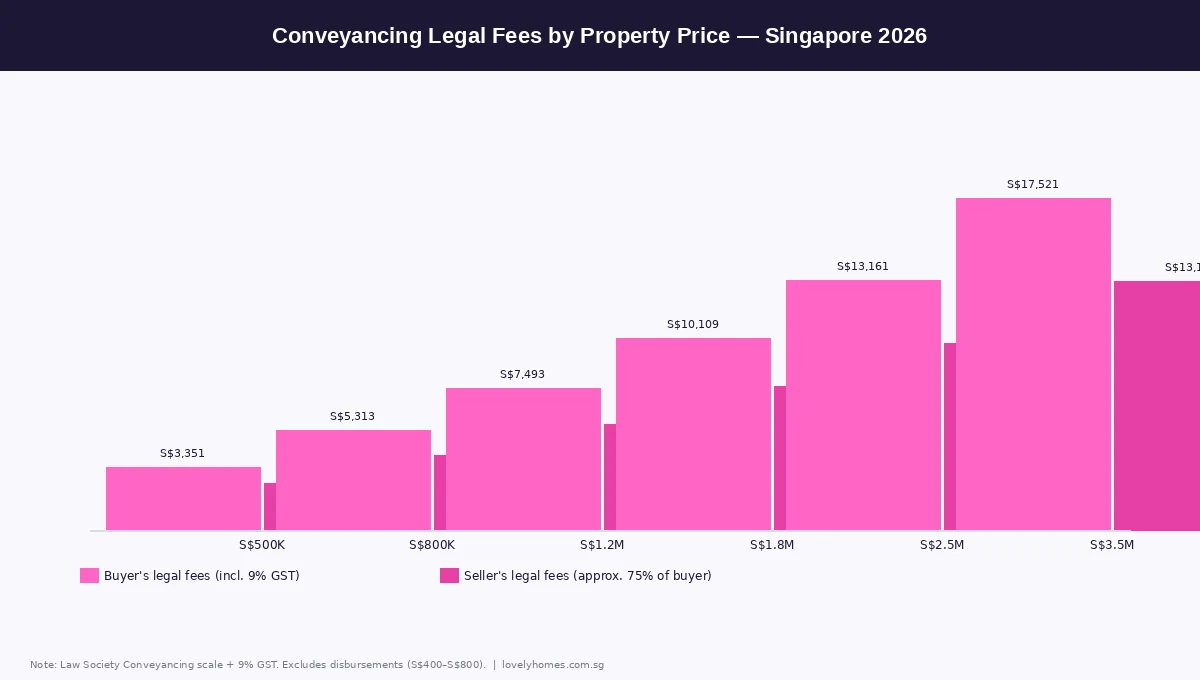
The Law Society of Singapore publishes a recommended conveyancing fee scale. The scale applies to the purchase price (or the valuation, whichever is higher). The scale rates are: 0.75% on the first S$30,000; 0.70% on the next S$30,000; 0.60% on the next S$940,000; and 0.40% on any amount above S$1,000,000. These are before GST at 9%. In practice, most law firms offer fixed-fee packages for residential conveyancing, particularly for transactions below S$3 million, so the actual fee quoted may be somewhat below or above the scale for a given transaction.
Disbursements are additional and cover the out-of-pocket expenses incurred by your solicitor on your behalf: SLA lodgement fees (caveat S$64.45, transfer S$180–S$500 depending on value), title search fees (S$8–S$20 per search type), planning search (S$130), CPF Board fees (~S$200), stamp duty (paid to IRAS on your behalf), court filing fees (if relevant), and photocopying and postage. Total disbursements for a standard residential transaction typically range from S$400 to S$800.
For reference, at a purchase price of S$1,200,000, the Law Society scale fee (pre-GST) is approximately S$7,850; at S$1,800,000 it is approximately S$10,250; and at S$2,500,000 it is approximately S$13,250. Adding 9% GST and disbursements, the total buyer’s legal cost at S$1,200,000 is approximately S$8,960–S$9,300; at S$1,800,000 approximately S$11,500–S$11,900. Seller’s legal fees are typically 70–80% of the buyer’s, as the seller’s work is somewhat less involved (no loan drawdown, no CPF application).
Summary — Conveyancing Fees and Disbursements
| Item | Who Pays | Typical Cost | Notes |
|---|---|---|---|
| Buyer’s legal fees | Buyer | S$2,000–S$8,000+ | Law Society scale + 9% GST; depends on price |
| Seller’s legal fees | Seller | S$1,500–S$6,000+ | Approx. 70–80% of buyer’s scale; varies |
| SLA caveat lodgement | Buyer | S$64.45 | Payable at lodgement; buyer’s solicitor handles |
| SLA title registration | Buyer | S$180–S$500 | Based on property value; scales up |
| Title / property search fees | Buyer (mainly) | S$50–S$300 | Multiple searches; included in disbursements |
| URA planning search | Buyer | S$130 | Essential for landed and larger transactions |
| CPF Board admin fee | Buyer | ~S$200 | For CPF OA drawdown; once-off on first property |
| Bank undertaking fee | Buyer | S$200–S$400 | Issued by buyer’s solicitor to bank/HDB |
| Total (buyer) — S$1.2M property | Buyer | ~S$3,500–S$9,500 | Varies widely by firm and fixed-package deals |
HDB Resale Conveyancing — Simplified Process
HDB resale flat conveyancing follows a slightly different path. HDB’s in-house legal team handles the registration of the title transfer, the CPF charge, and the HDB mortgage (if using an HDB loan). Buyers and sellers do not need to engage private solicitors for the straightforward conveyancing work; instead, they submit documents and instructions through HDB’s online Resale Portal. HDB charges an administrative fee (S$80–S$640 depending on flat size) for the processing.
However, buyers are strongly recommended to engage a private solicitor for independent advice if: the transaction involves a sub-sale (selling before TOP); there is a tenancy in place; the seller is a deceased estate; there are disputes or negotiations over conditions of sale; or significant COV is involved. Private solicitors for HDB resale typically charge S$500–S$1,500 for an advisory role, as they are not doing the formal registration work.
Worked Example — Mr and Mrs Ng, D15 Condo Purchase
Scenario
Mr and Mrs Ng are Singapore Citizens purchasing a 2-bedroom resale condominium in District 15 (Marine Parade) for S$1,480,000. They are using a bank loan (LTV 75%) and CPF OA funds. They engage Solicitor A for S$3,800 (fixed package, incl. disbursements, excl. stamp duty).
Key Figures
- Purchase price: S$1,480,000
- BSD: 1%×S$180K + 2%×S$180K + 3%×S$640K + 4%×S$480K = S$1,800 + S$3,600 + S$19,200 + S$19,200 = S$43,800
- ABSD: nil (first property, SC couple)
- Option fee paid (1%): S$14,800
- Option exercise fee (4%): S$59,200 (total 5% upfront: S$74,000)
- Bank loan (75%): S$1,110,000 at 3.40% / 30-year tenure = S$4,908/mth; TDSR: S$4,908 ÷ S$14,000 (combined income) = 35.1% — PASS
- Balance CPF OA available: S$220,000 (applied towards 20% balance downpayment)
- Total cash outlay: S$74,000 (DP) + S$43,800 (BSD) + S$3,800 (legal) + S$2,200 (disbursements) = S$123,800
Timeline
OTP issued: 1 August 2026. OTP exercised: 12 August 2026 (day 11 — within 14 days). BSD paid via IRAS e-Stamping: 14 August 2026 (2 days after exercise — within 14 days). Caveat lodged by Solicitor A: 14 August 2026. Title search, CPF charge search, tax search, planning search: 15–22 August 2026. CPF Board application for OA withdrawal: 18 August 2026 (approx. 10–14 working days to approve). Bank loan letter of offer signed: 16 August 2026. Completion date agreed: 14 October 2026 (9 weeks from exercise). SLA title registration: 15 October 2026. Keys collected: 14 October 2026.
Note on Solicitor Selection
Mr and Mrs Ng obtained three quotes. Fixed-package fees ranged from S$2,800 to S$4,500 (all-in excluding stamp duty). They chose a mid-range firm with a dedicated property department, having verified the solicitor’s practising certificate on the Law Society’s Find a Lawyer portal. They explicitly confirmed the scope: quote covered caveat lodgement, full title and search suite, CPF application, SPA review, completion, and SLA registration.
Why This Matters — Conveyancing Protects Your Largest Asset
A residential property is typically the largest single purchase a Singapore household makes. The conveyancing process exists to ensure that the buyer receives a clean, unencumbered title and that the transfer is legally effective and registered. Without proper due diligence, a buyer risks inheriting the seller’s outstanding debts (which run with the property as charges), discovering zoning restrictions that prevent intended use, or finding undisclosed encumbrances that reduce the property’s value or mortgageability.
Singapore’s Torrens title system (introduced via the Land Titles Act) provides strong protection once a title is registered. Under the indefeasibility principle, a bona fide purchaser for value who registers their interest cannot have it set aside by a prior unregistered interest — provided the buyer did not have notice of the prior interest. This underscores the importance of lodging the caveat promptly (to protect against subsequent encumbrances) and completing the registration quickly after completion.
Compared to many other jurisdictions, Singapore conveyancing is relatively streamlined. The electronic SLA system (e-lodgement), IRAS e-Stamping, and CPF’s online disbursement system mean that most steps can be completed electronically with minimal paper. The entire process from exercising the OTP to title registration is typically accomplished within 10 to 14 weeks for a standard resale private property transaction.
What Might Come Next
The legal profession in Singapore has been steadily adopting technology to streamline conveyancing. The Law Society’s conveyancing platform and the SLA’s online systems have already reduced turnaround times substantially. Discussions around further digitisation — including electronic signatures for sale and purchase agreements and blockchain-based title registration — are ongoing at the industry level. It is possible that completion timelines could be compressed further in coming years as digital systems mature. For buyers, this means quicker certainty of title; for sellers, faster receipt of proceeds. These developments will not change the fundamental due diligence requirements, which remain the buyer’s best protection.
Frequently Asked Questions
Do I need a solicitor for an HDB resale flat purchase?
Strictly speaking, you do not need to engage a private solicitor for an HDB resale flat, because HDB’s in-house legal team handles the formal conveyancing work (including registration of the title transfer, HDB mortgage, and CPF charge). Both buyer and seller transact through HDB’s Resale Portal. However, many buyers choose to engage a private solicitor for independent advice, particularly where there is a complex situation such as a divorce, estate matter, dispute over conditions, or significant COV. Private solicitors for HDB resale typically charge S$500–S$1,500 for an advisory role.
Can I use the same solicitor as the seller to save money?
In Singapore, the same firm can act for both buyer and seller in a property transaction only in limited circumstances — where there is no conflict of interest and both parties give informed consent. In practice, most law firms will not act for both parties in a residential property transaction due to the inherent conflicts (particularly around price negotiation and title defects). If you are a buyer, you should engage your own solicitor to ensure your interests are protected independently. For HDB resale, this question does not arise as HDB handles the formal work centrally.
What happens if the seller cannot discharge their mortgage before completion?
If the seller has an existing mortgage over the property, their solicitor will coordinate with the mortgagee bank to discharge the mortgage upon completion using the sale proceeds. The seller’s net proceeds are calculated as: sale price minus outstanding mortgage redemption amount minus CPF refund obligation minus legal fees and agent commission. If the outstanding mortgage and CPF obligations together exceed the sale price (a situation of “negative equity”), the seller must make up the shortfall in cash before completion can proceed. Your solicitor will conduct a title search to identify the seller’s outstanding mortgage early in the process so that these issues are identified promptly.
What is a completion account and how is it calculated?
A completion account is a financial statement prepared by the solicitors shortly before completion, setting out exactly how much money needs to change hands on the day of completion. For the buyer, it shows the balance purchase price (after deducting the option fee already paid, the loan drawdown, and CPF funds applied), plus any adjustments for property tax (apportioned to the date of completion — the buyer takes on property tax from the completion date onwards). For the seller, it shows the sale proceeds net of the outstanding mortgage redemption, CPF refund, legal fees, and agent commission. Both solicitors agree the completion account before completion takes place.
How long does a new launch (direct developer purchase) conveyancing take?
A new launch (developer sale under the Housing Developers Rules) follows a different timeline from a resale purchase. The buyer and developer sign the Sale and Purchase Agreement within 3 weeks of the Option Date. BSD is payable within 14 days of execution. Progress payments are then disbursed by the buyer’s bank to the developer’s solicitor as construction milestones are reached, under the Standard Payment Scheme. The completion of the transaction occurs upon issuance of the Temporary Occupation Permit (TOP) and Vacant Possession; the buyer’s solicitor coordinates the drawdown of the final tranche, registration of the mortgage, and title transfer. This process can span several years from the OTP to final completion if the project is under construction.
What is the difference between a caveat and a mortgage in terms of protecting my interest?
A caveat is a notice lodged with SLA that alerts anyone searching the title to the fact that you have a claim or interest in the property. It does not in itself transfer title; it merely protects your position while the full transfer is being processed. A mortgage, by contrast, is a legal charge over the property granted to the lender as security for the loan; it is registered and remains on the title until the loan is fully repaid. As a buyer, your solicitor lodges a caveat immediately after you exercise the OTP to protect your interest before completion; once the title is registered in your name, the caveat is automatically removed and replaced by your registered title.
What should I check about my solicitor before engaging them?
Verify that the solicitor holds a valid practising certificate on the Law Society’s Find a Lawyer portal. Check that the firm has a dedicated property or conveyancing practice, not just a general litigation firm. Ask for a clear written quote covering the full scope: draft SPA review, caveat lodgement, all standard searches, CPF application, bank coordination, completion, and SLA registration — so there are no surprise additional charges. Confirm whether the quote is inclusive of all disbursements or whether disbursements are quoted separately. Enquire about the solicitor’s availability and response times, as property transactions are time-sensitive.