Tampines North Neighbourhood Guide Singapore 2026: Property Prices, MRT, Schools and Investment Outlook

Tampines North Neighbourhood Guide Singapore 2026: Property Prices, MRT, Schools and Investment Outlook

Quick Answer — Tampines North 2026 at a Glance

  • Tampines North is Singapore’s newest planned sub-town within the established Tampines New Town in District 18 (D18), located in the northeast of Singapore, approximately 25 km from the CBD.
  • The area currently has excellent EWL access via Tampines MRT (EW2) and DTL access via Tampines DT32; the upcoming Cross Island Line (CRL) Tampines North Station (~2030) will significantly reduce journey times to the west and Jurong Lake District.
  • Parktown Residence (1,193 units), the largest launch in Tampines in years, is integrated with the future Tampines North MRT station and includes a new hawker centre, community club, and retail space.
  • HDB resale 4-room flats in Tampines currently trade between S$520,000 and S$700,000; executive condominiums such as Aurelle of Tampines launched from around S$1,100,000.
  • Gross rental yields in D18 run from 4.8% (HDB 4-room) down to 2.9% (private 3-bedroom), above the Singapore average for the same flat types.
  • UWCSEA East Campus, Temasek Polytechnic, and Singapore University of Technology and Design (SUTD) all anchor the area’s education catchment.
  • Tampines Hub, Singapore’s largest community centre (60,000 sqm), Tampines Mall, Century Square, White Sands, and IKEA make Tampines North one of the best-served retail sub-markets outside the city.
  • The 5-year HDB resale price growth in D18 has been approximately 24–28%, in line with the broader OCR market and supported by the CRL pre-announcement uplift.

Tampines North: Where Is It and Why Does It Matter?

Tampines North is the designated northern section of Tampines New Town — a planned urban extension built out on land that was, until the mid-2010s, largely farmland and industrial reserve. In URA’s parlance, “Tampines North” refers specifically to the sub-town north of Tampines Avenue 10, anchored by the future Tampines North MRT station on the Cross Island Line. The rest of Tampines — served by Tampines MRT on the East-West Line and Tampines DTL on the Downtown Line — is the mature, established town Singaporeans know well.

For property buyers, the distinction matters because Tampines North carries a CRL uplift thesis — the Cross Island Line station is expected to open circa 2030, bringing a third MRT line to the area and cutting the journey time to Jurong Lake District, Singapore’s second CBD, by more than 30 minutes compared to the current EWL route. This pre-station infrastructure play is similar to the uplift enjoyed by Jurong East in the early 2010s as the EWL–NSL interchange became a recognised commercial hub.

The broader Tampines district is classified as an OCR (Outside Central Region) submarket by URA, commanding lower per-square-foot prices than the city core but delivering superior gross rental yields for buy-to-let investors. In Q1 2026, URA data shows OCR private residential prices up approximately 2.2% quarter-on-quarter and HDB resale prices broadly stable across the east.

Property Prices — What You Can Expect to Pay in 2026
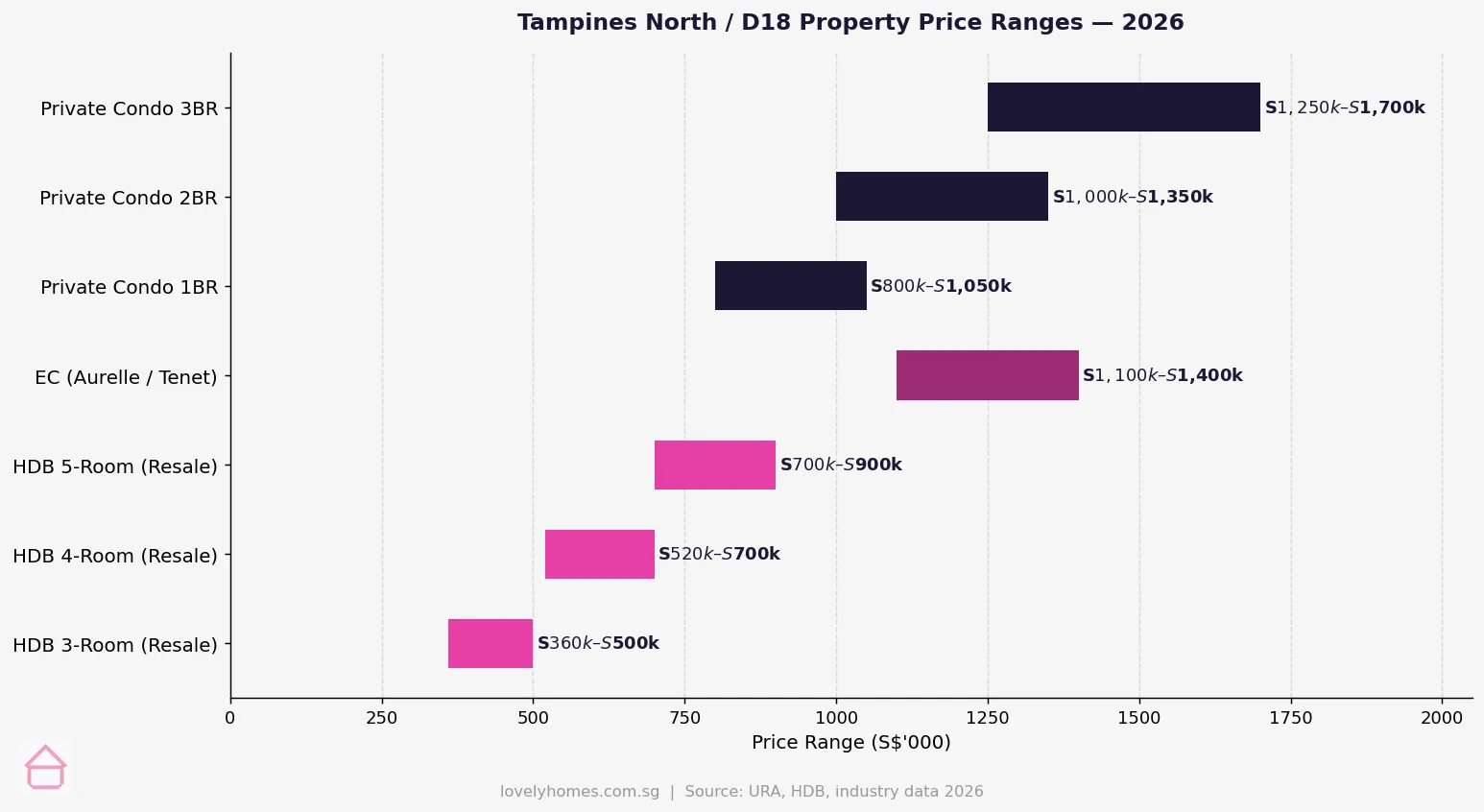
Tampines North D18 property price ranges 2026 — HDB resale EC and private condo
Figure 1: Tampines North / D18 property price ranges — 2026. Indicative. Source: URA, HDB, industry data.

HDB resale prices in Tampines have risen meaningfully since the 2021 cooling-measure-driven market trough. A typical HDB 4-room resale flat in the Tampines North sub-town trades between S$520,000 and S$700,000 depending on floor level, specific block location relative to greenery and noise, and remaining lease. Units closer to Tampines North (the newer blocks built from 2018–2023) tend to command slight premiums given longer remaining leases and proximity to the future CRL station.

Executive Condominiums — a uniquely Singaporean asset class that blends subsidised pricing for SC/PR buyers with private condominium facilities — are prominent in Tampines North. Aurelle of Tampines EC (583 units, Sim Lian Group) launched in 2025 at an average of approximately S$1,350 per square foot, with entry prices from around S$1.1M for 2-bedroom units. The project sits within a 10-minute walk of the future CRL station site. Tenet EC, an older privatised EC in the area, now trades on the resale market between S$1.0M and S$1.3M for 3-bedroom units.

Private condominiums in Tampines North are dominated by the mega-project Parktown Residence — a 1,193-unit, 99-year leasehold integrated development launched in 2025 by a UOL Group, CapitaLand and HDB co-development. It is physically integrated with the Tampines North MRT station and includes a hawker centre, a community club, and a retail precinct. Entry pricing for 1-bedroom units started at approximately S$800,000–S$900,000; 3-bedroom units were in the S$1.35M–S$1.7M range at launch.

MRT Connectivity — The CRL Catalyst

Tampines North is already well-connected by two existing MRT lines and will gain a third by around 2030, making it one of the best-positioned OCR sub-towns for transport connectivity outside the mature estates closer to the city.

The East-West Line (EWL) passes through Tampines (EW2) and Simei (EW3), connecting directly to Changi Airport in one stop and to the city core via Paya Lebar in seven stops. The Downtown Line (DTL) has Tampines (DT32) as its eastern terminus, connecting via Bedok Reservoir, Kembangan, and Marine Parade to the Botanic Gardens and Buona Vista, then turning north-west toward the city. The DTL journey from Tampines to the Botanic Gardens is approximately 30 minutes.

The transformative addition is the Cross Island Line (CRL), specifically Phase 2 (CRL2), which brings a dedicated Tampines North station. CRL links Tampines North westwards through Defu, Hougang, Serangoon North, Ang Mo Kio, and onwards to Jurong Lake District — bypassing the city core and eliminating the need for a transfer at Paya Lebar or City Hall for passengers heading west. The LTA has indicated Phase 2 is targeted for completion around 2030. For property buyers, the practical implication is that the CRL uplift is currently priced into Parktown Residence (which fronts the station site) but only partially priced into the wider HDB resale market, meaning today’s buyers may capture some of the remaining discount-to-station pricing.

Amenities — Everything You Need Within 10 Minutes
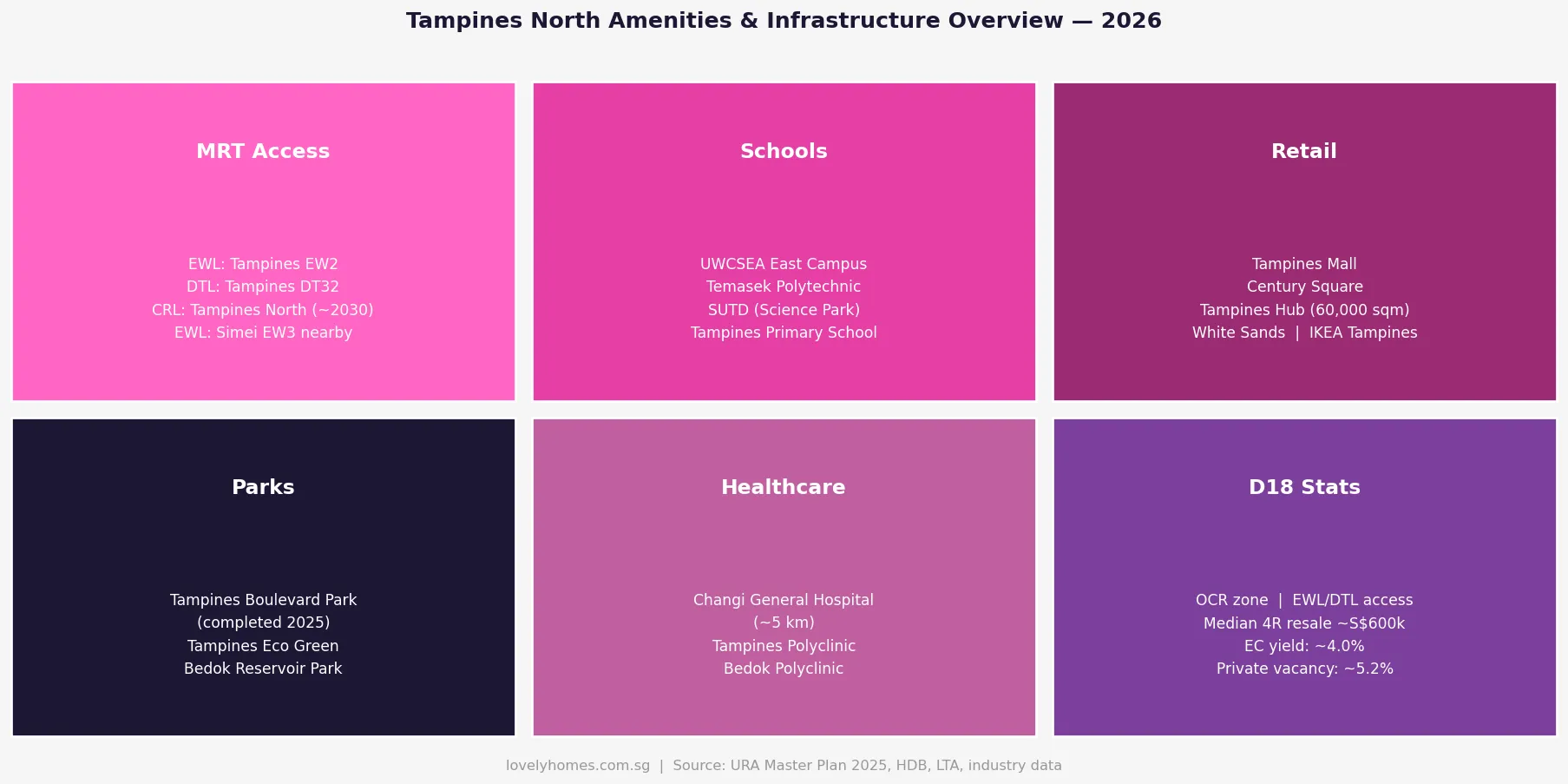
Tampines North Singapore amenities overview 2026 MRT schools retail parks healthcare
Figure 2: Tampines North key amenities overview — MRT, schools, retail, parks, healthcare and district statistics.

Retail and food. Tampines is arguably the best-served OCR sub-market for retail outside Bishan/Ang Mo Kio. The town centre is anchored by Tampines Mall (280,000 sqft), Century Square (revamped in 2021, 560,000 sqft), and White Sands. The IKEA Tampines store and Courts Megastore on Tampines North Link add destination retail. Tampines Hub — opened in 2017 and at 60,000 sqm Singapore’s largest integrated community and lifestyle hub — houses the community library, an Olympic-sized swimming complex, a hawker centre, sports courts, and a 5,000-seat stadium.

Parks and greenery. The Tampines Boulevard Park (completed late 2025) runs along the length of Tampines Avenue 9 as a 3.2-km linear park connecting Tampines North to the Central Catchment, with cycling paths, fitness stations, and community gardens. Tampines Eco Green (36 ha) is a secondary forest reserve within the town, unusual for an urban estate and valued by residents for birdwatching and nature trails. The Bedok Reservoir Regional Park is a 10-minute cycle away.

Healthcare. Changi General Hospital (CGH), a 1,000-bed acute regional hospital, is approximately 5 km from Tampines North. Tampines Polyclinic and Bedok Polyclinic both serve the broader catchment, with a third polyclinic at Pasir Ris serving the eastern corridor.

Schools — A Strong Education Catchment

UWCSEA East Campus (United World College of South-East Asia) sits within Tampines, consistently ranked among the top international schools in Singapore and drawing an expat tenant base that anchors higher-end rental demand. Temasek Polytechnic (TP), one of Singapore’s five polytechnics, is located on Tampines Avenue 1 and adds a significant student population of approximately 18,000 enrolled students. Singapore University of Technology and Design (SUTD), a research university set up in partnership with MIT and ZHEJIANG University, is located at the Changi-Tampines border and draws an educated demographic to the wider east. Primary and secondary schools within the Tampines North catchment include Tampines Primary School, Elias Park Primary, Junyuan Secondary, and St. Hilda’s Primary (popular 1-km circle school further south).

Investment Outlook — Yield vs Capital Growth
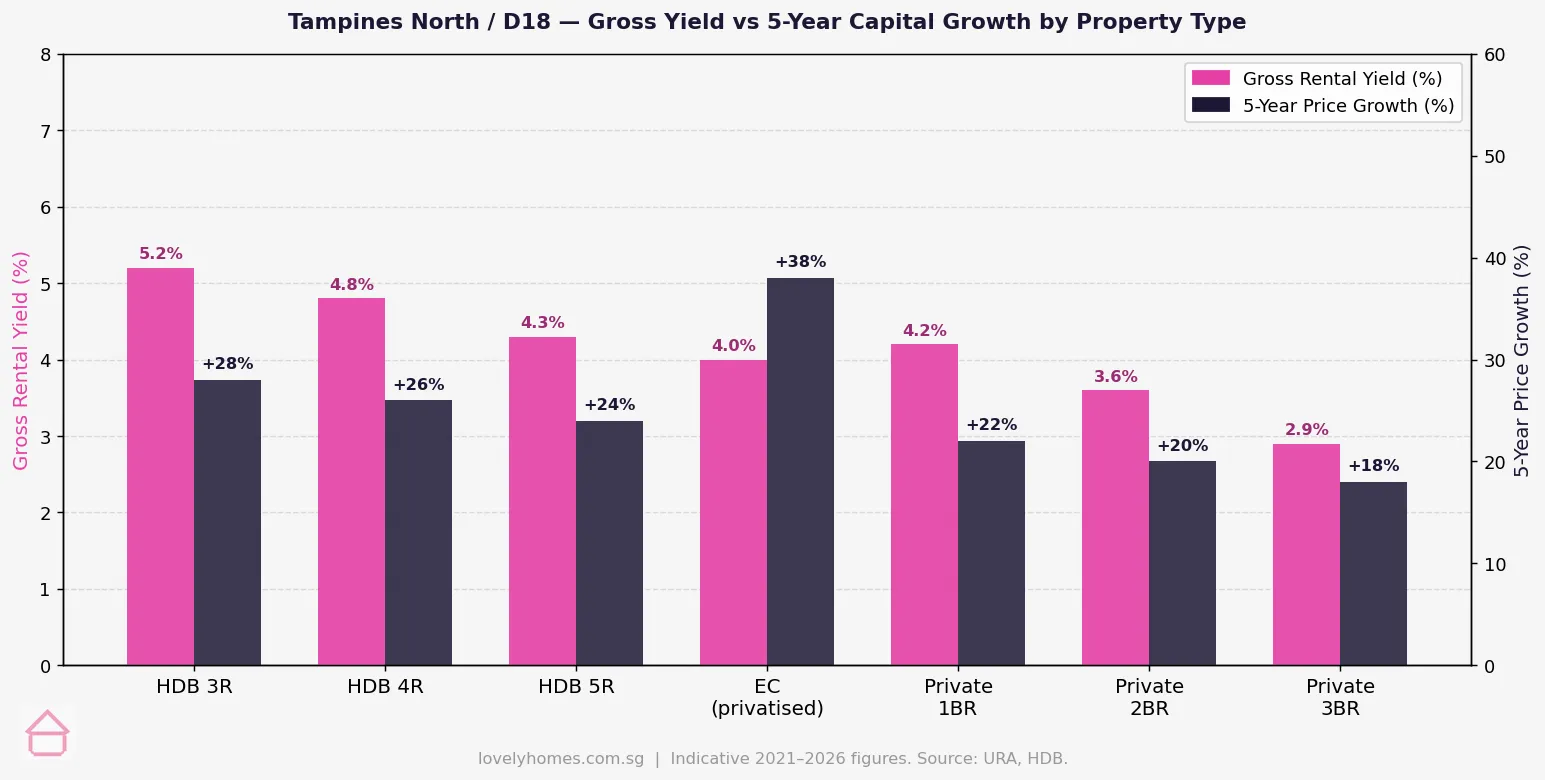
Tampines North D18 gross rental yield vs 5-year capital growth by property type 2026
Figure 3: D18 Tampines North — estimated gross rental yield vs 5-year capital growth (2021–2026) by property type. Indicative.

The investment case for Tampines North rests on two distinct thesis strands depending on the buyer’s horizon. Short-to-medium-term (1–5 years), the yield-on-cost argument favours HDB resale and older privatised ECs: gross yields of 4.8% on a S$600,000 4-room resale flat, with low vacancy and a large tenant pool anchored by UWCSEA, SUTD, and TP staff and students. Longer-term (5–10 years), the capital growth argument points to the CRL opening circa 2030 as the primary catalyst, with EC and Parktown Residence buyers positioned to benefit from station-adjacency re-rating.

Five-year price growth (2021–2026) in D18 has been approximately 24–28% for HDB resale and 35–38% for privatised ECs, both broadly in line with or slightly above the URA OCR PPI growth over the same period. Private condominiums have grown more modestly at 18–22% given higher absolute entry prices. The important caveat is that the Tampines North private market is predominantly occupied by projects launched from 2022–2025 whose resale data is limited; the 2030 CRL opening is the true test of the station-adjacency premium thesis.

Property Comparison Summary

Property Type Price Range (2026) PSF (est.) Gross Yield Tenure Key Development
HDB 3-Room (Resale) S$360k – S$500k S$420–S$560 psf ~5.2% 99yr (remaining) Various blocks
HDB 4-Room (Resale) S$520k – S$700k S$450–S$600 psf ~4.8% 99yr (remaining) Tampines North BTO blocks
HDB 5-Room (Resale) S$700k – S$900k S$420–S$540 psf ~4.3% 99yr (remaining) Various blocks
EC (privatised/resale) S$1.0M – S$1.4M S$900–S$1,200 psf ~4.0% 99yr leasehold Tenet EC, Aurelle of Tampines
Private Condo 1BR S$800k – S$1,050k S$1,400–S$1,700 psf ~4.2% 99yr leasehold Parktown Residence
Private Condo 2BR S$1.0M – S$1.35M S$1,300–S$1,600 psf ~3.6% 99yr leasehold Parktown Residence, Pinery
Private Condo 3BR S$1.25M – S$1.70M S$1,200–S$1,500 psf ~2.9% 99yr leasehold Parktown Residence

Worked Example — Mr & Mrs Ng, Buying Tampines North 4-Room HDB Resale

Mr and Mrs Ng are a Singapore Citizen married couple, both in their early 30s. Their combined gross monthly income is S$9,500. They wish to sell their current 3-room HDB flat in Jurong West (fully paid off at S$480,000) and upgrade to a 4-room resale HDB flat in Tampines North, targeting proximity to Temasek Polytechnic where Mrs Ng works.

They identify a 4-room resale flat on the 12th floor of a Tampines North block with a remaining lease of 72 years, listed at S$660,000.

Stamp duties: BSD on S$660,000 — first S$180,000 at 1% = S$1,800; next S$180,000 at 2% = S$3,600; next S$300,000 at 3% = S$9,000. BSD = S$14,400. ABSD: nil — SC married couple, concurrent sale of existing HDB means property count stays at one.

Grants: At S$9,500 joint income, EHG for resale is S$15,000. PHG: if Tampines North is within 4 km of Mrs Ng’s parents’ home in Pasir Ris — qualifying distance — PHG = S$20,000 (living near parents). Total grants = S$35,000. Net effective price = S$660,000 − S$35,000 = S$625,000.

Financing: HDB concessionary loan LTV 80% = S$500,000. Monthly instalment: S$500,000 at 2.6% over 25 years ≈ S$2,274/month. MSR: S$2,274 / S$9,500 = 23.9% — within the 30% MSR limit. TDSR: 23.9% — well within 55%. Cash upfront (5% cash + BSD): S$33,000 + S$14,400 = S$47,400.

Outcome: The Ngs can feasibly complete the purchase, using the S$480,000 proceeds from their Jurong West flat to fund the upfront costs and CPF top-up, with the CRL opening in 2030 providing a potential capital gain catalyst within their 10-year holding horizon.

What Might Come Next for Tampines North

The structural story for Tampines North is the CRL. Once the Cross Island Line Tampines North station opens (~2030), the area transitions from “well-connected east sub-town” to “triple-line MRT hub” — a designation shared by fewer than ten stations in Singapore. The immediate consequence is typically a rental yield compression (higher prices) and a transaction volume uplift as buyers from outside the east discover the area.

Beyond CRL, the URA Master Plan 2025 identifies a stretch of land near Sungei Loyang — northeast of Tampines North — as a potential new neighbourhood study area. An environmental study is underway; if positive, this could yield an additional residential supply pipeline of several thousand units beyond 2030, including park space and community facilities that would benefit Tampines North residents further north.

For existing Tampines residents, the advice is to document their lease adequacy carefully: flats with remaining leases dropping below 60 years within a 20-year horizon will lose CPF financing eligibility, which progressively reduces the buyer pool for those units on resale. This is a watch-point particularly for older blocks in the southern part of Tampines town.

Frequently Asked Questions

Is Tampines North a good area to buy property in 2026?

For buyers with a 7-10 year investment horizon, Tampines North has a credible structural case built on the CRL opening (~2030), strong rental demand from UWCSEA and TP, one of Singapore’s best OCR retail hubs, and prices that remain below RCR comparables for similar connectivity. Short-term buyers should be aware that private condo prices in Tampines North are already partly pricing in the CRL uplift, particularly Parktown Residence. HDB resale buyers get better value relative to future connectivity than private condo buyers.

Which MRT lines serve Tampines North?

As of 2026, Tampines North is served by the East-West Line (EWL) at Tampines (EW2) and the Downtown Line (DTL) at Tampines (DT32). Both stations share a common paid concourse. The upcoming Cross Island Line (CRL) Tampines North station, targeted around 2030, will add a third line specifically serving the northern sub-town and integrated with Parktown Residence. Simei (EW3) on the EWL also serves the southern edge of Tampines North.

Can foreigners buy property in Tampines North?

Foreign individuals (non-PRs) may purchase private condominium units in Tampines North, such as Parktown Residence, subject to the 65% Additional Buyer’s Stamp Duty (ABSD) on the purchase price. Singapore PRs buying their first property pay 5% ABSD. Foreigners and PRs cannot purchase HDB flats or executive condominiums below 10 years old (except PRs buying resale HDB with a Citizen spouse). The 65% ABSD rate was introduced in April 2023 and remains in force as of June 2026.

What is Parktown Residence and how is it different from a regular condo?

Parktown Residence is a 1,193-unit 99-year leasehold integrated development co-developed by UOL Group, CapitaLand, and HDB, launched in 2025. “Integrated” in this context means it is physically connected to the Tampines North MRT station (CRL), a hawker centre, a community club, and a retail precinct within a single development. Residents will have sheltered, direct access to the CRL station without going to street level. This is similar to the Bidadari integration model (Woodleigh Residences + Woodleigh MRT) and commands a moderate premium over non-integrated private condos nearby.

How does Tampines North compare to nearby Bedok or Pasir Ris for property investment?

Tampines North has a younger housing stock on average than Bedok (where many leases are entering the 40-50 year range) and a cleaner CRL catalyst story than Pasir Ris (which benefits from the EWL and the Pasir Ris-Punggol Regional Line, but has already partly priced in those upgrades). Bedok offers more mature amenities and better CBD commute times via the EWL, while Pasir Ris offers more land area and green space. Tampines North is the strongest play for buyers specifically betting on the CRL station uplift over a 5-10 year horizon.

What income is needed to buy a condo in Tampines North in 2026?

For a 2-bedroom private condo in Tampines North at approximately S$1.2M, assuming a bank loan at LTV 75% and a 30-year tenure at 3.0% per annum: the loan quantum is S$900,000 and the monthly instalment approximately S$3,795. Under TDSR at 55%, the required gross monthly income is approximately S$6,900. In practice, lenders typically want comfortable headroom, so a combined household income of S$10,000–S$12,000 per month is advisable for sustainable financing at this quantum. Cash/CPF available for the downpayment (25%) plus BSD should be in the S$320,000–S$350,000 range.

Related Articles

Disclaimer: This article provides general information about the Tampines North property market as at 3 June 2026. Property prices, yields, and infrastructure timelines are indicative and subject to change. This is not investment advice. Refer to official sources including URA, HDB, and LTA for authoritative figures, and consult a licensed property agent and financial adviser before making any property purchase decision.
URA Q1 2026 Private Home Prices Rise 0.9% — Revised Up from +0.3% Flash, OCR Leads at +2.2%

URA Q1 2026 Private Home Prices Rise 0.9% — Revised Up from +0.3% Flash, OCR Leads at +2.2%

Singapore private home prices rose 0.9% in the first quarter of 2026 — almost three times the pace flagged in the URA flash estimate three weeks earlier. The final reading, published by the Urban Redevelopment Authority on 24 April 2026, marks the sixth consecutive quarter of growth in the private residential price index, and it tells a story that diverges sharply from the volume picture: prices firmed, but transactions slumped almost 40% quarter-on-quarter.

Quick Answer — what the URA Q1 2026 release shows

  • Overall private residential PPI: +0.9% q-o-q, sixth consecutive quarter of growth.
  • Sharp upward revision from the +0.3% flash estimate on 1 April.
  • Non-landed properties: +1.3%; landed: -1.8%, reversing the +3.4% prior quarter.
  • OCR led non-landed with +2.2%; RCR +0.8%; CCR +0.6%.
  • Transaction volume crashed: only 4,041 deals recorded by mid-March, -39.7% versus 4Q 2025.
  • Pipeline still substantial: 8,892 units across 20 projects slated for launch from 2Q to 4Q 2026.
URA Q1 2026 private home prices +0.9% — guide cover
URA Q1 2026 final release — private home prices revised up to +0.9%.

Flash to Final — A Substantial Upward Revision

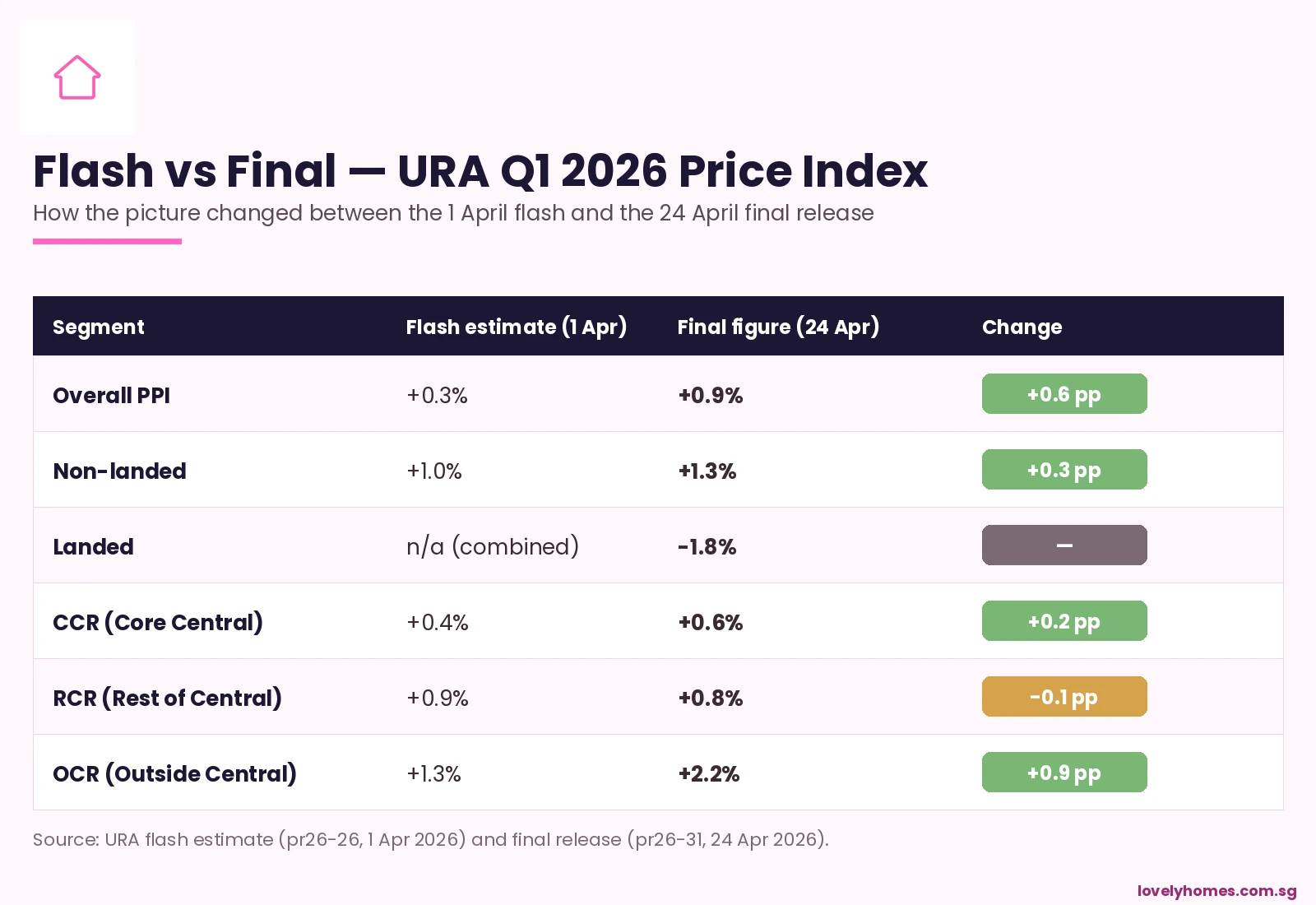
URA flash estimates are released on the first business day of every quarter, before the full transaction sample is in. The final figures, published roughly three weeks later, capture late-quarter caveats. In most quarters the gap between flash and final is small — perhaps 0.1 to 0.3 percentage points. In Q1 2026 the gap was larger than usual: from +0.3% to +0.9%.

URA Q1 2026 flash vs final by region — overall +0.3% revised to +0.9%, OCR +2.2%
Figure 1: Flash vs final — URA Q1 2026 PPI revisions by region.

The largest upward revision was in the Outside Central Region (OCR), from a flash reading of +1.3% to a final +2.2%. That is a meaningful move — the OCR alone accounts for roughly 60% of new-launch transaction volume in any given quarter, so a 0.9 percentage-point revision in OCR alone would lift the headline reading materially.

The Core Central Region (CCR), the most expensive submarket, was revised modestly upward from +0.4% to +0.6%, after a punishing -3.5% in 4Q 2025. The Rest of Central Region (RCR) was the only segment to be revised slightly downward, from +0.9% to +0.8%.

Why Were OCR Numbers Revised So Sharply?

Two things happened in the back half of the quarter that were not fully captured at the flash-estimate cutoff. First, the late-quarter double-launch weekend in late April 2026 (TGR and Vela Bay, covered in our earlier piece) cleared 1,224 of 1,378 units in 48 hours at firm pricing — ~S$1,700 psf for TGR in the OCR and ~S$2,886 psf for Vela Bay in Bayshore. Both sets of transactions dragged up the OCR PPI when finally captured.

Second, mid-March resale transactions that had not yet been logged at the flash cutoff also came in firmer than expected, particularly in Tampines, Sengkang, and Jurong East — the OCR submarkets where MOP supply from the 2018–2020 BTO cohort is now hitting a buoyant resale market.

The Volume Story — A 39.7% Crash

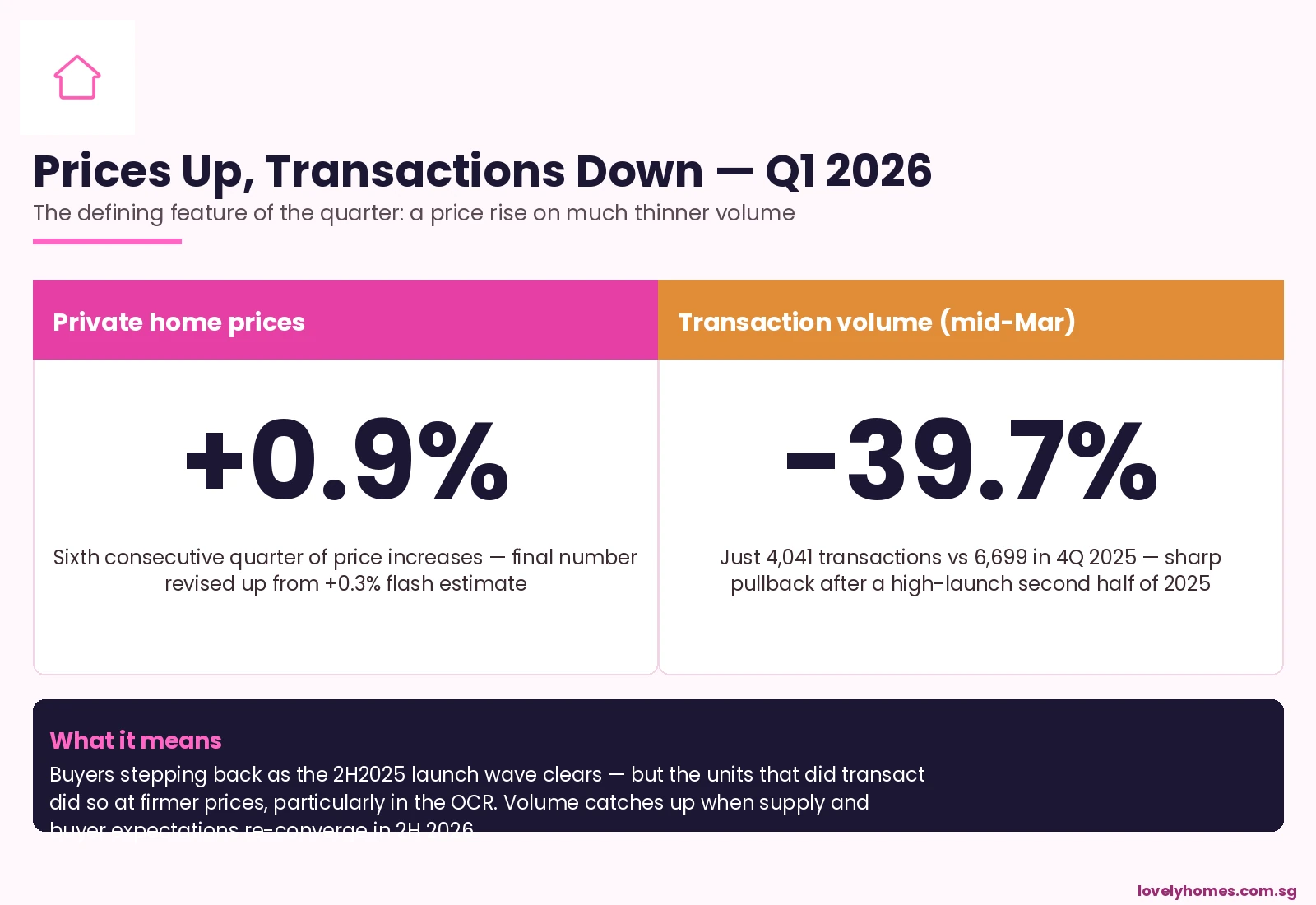
The price firming has to be read against a steep drop in activity. Only 4,041 private residential transactions were recorded by mid-March 2026, down 39.7% versus the 6,699 transactions in 4Q 2025. That is the lowest quarterly transaction count in nearly two years.

URA Q1 2026 prices +0.9% but transactions -39.7% — divergence chart
Figure 2: The defining tension of Q1 2026 — firmer prices on much thinner volume.

The volume drop has two readable causes. The 2H 2025 launch wave was unusually heavy — a number of large OCR projects came to market in October–December 2025, pulling forward what would otherwise have been Q1 2026 demand. Q1 2026 was always going to look soft on volume by comparison.

The second cause is sentiment. Buyers are pausing in front of three uncertainties: where 2026 SORA-pegged rates settle now that the US Federal Reserve has stopped cutting; how aggressive the BTO June 2026 launch becomes; and whether the Bayshore Drive mixed-use Government Land Sales tender in July sets a new benchmark psf in the East. Volume usually returns once these three questions get answered.

Landed -1.8% — Mean-Reverting After a Hot 4Q

The landed segment swung from +3.4% in 4Q 2025 to -1.8% in Q1 2026, a 5.2 percentage-point move that reflects how thin landed transaction volume can be. Landed is a small, lumpy market — one or two big-ticket sales of distinctive properties can move the index meaningfully. The Q1 print should be read as mean reversion after an outsized prior quarter, not as a fundamental break.

Rental Index +0.3% — Stabilising After 2024 Cool-Off

The private residential rental index ticked up 0.3% in Q1 2026 after the multi-quarter cool-off through 2024 and early 2025. Yields on private condos remain in the 3.0–3.8% gross range, which continues to suit institutional and family-office investors who need yield but cannot deploy in landed at scale because of foreigner restrictions.

What Comes Next — The Q2 to Q4 Pipeline

Indicator Q1 2026 reading What it implies for the rest of 2026
Overall PPI +0.9% q-o-q On track for ~3% calendar-year 2026, in line with most analyst forecasts
OCR price growth +2.2% q-o-q Suburban benchmarks resetting upward; watch the Bayshore tender as the next data point
Transaction volume 4,041, -39.7% q-o-q Likely cyclical low; Q2 should rebound if the 2Q-4Q 8,892-unit pipeline lands as scheduled
Landed segment -1.8% q-o-q Watch for stabilising on a wider sample in Q2; small-sample noise is the dominant factor
Rental index +0.3% q-o-q Yields steady; institutional appetite for buy-to-let condos persists

What This Means for Buyers — The Counter-Cyclical Window

For end-user buyers who have been waiting on the sidelines, Q1 2026 is the kind of moment that historically gets revisited as a buying window. Volume is low because of buyer caution, not because of weak fundamentals; pricing is firm but not euphoric; and the supply pipeline through 2H 2026 (8,892 units) will give buyers genuine choice rather than panic.

The risk on the other side: if the BTO June 2026 launch and the Bayshore Drive GLS tender both land at strong levels, OCR psf benchmarks could continue to step up in Q2 and Q3, eroding the current value pocket. Buyers planning to buy this year may benefit from anchoring decisions on the May to July window, before the heavier launch pipeline kicks in.

Frequently Asked Questions

Why was the upward revision from flash to final so large this quarter?

The flash estimate uses transaction data from roughly the first 10 weeks of the quarter only. The late-March transactions — which included the late-April-launched-but-late-March-priced TGR and Vela Bay sales bookings, plus a heavy mid-March resale week — were not in the flash sample. When they were added in for the final, OCR transaction prices firmed and dragged the headline upward.

Does this change the 2026 full-year forecast?

Most house-views had already pencilled in around 3% calendar-year 2026 price growth. Q1 at +0.9% is broadly consistent with that pace — not a beat, not a miss. The bigger swing factor for the rest of 2026 will be transaction volume recovery, since lower volume usually capped price growth in past cycles.

If volume is so weak, why are prices going up at all?

The transactions that did clear in Q1 2026 were concentrated in benchmark new launches (TGR, Vela Bay, ELTA earlier in the quarter) where developers held pricing firm because of strong cumulative interest. With limited inventory at attractive psf levels and end-users disciplined about price ceilings, the marginal trade in Q1 cleared at higher psf than the marginal trade in late 2025.

What does this mean for HDB upgraders?

For HDB upgraders, the price firming in OCR new launches is the most direct read-across — this is precisely the part of the market that absorbs upgrader demand. The flip side, however, is that HDB resale prices dipped 0.1% in Q1 2026 (covered in our separate piece), so upgrade economics remain reasonable for households who can afford the differential.

Does the URA Q1 2026 release affect cooling-measure expectations?

Almost certainly not. +0.9% in a quarter, on much thinner volume, is squarely in the range of “moderate growth” that the Government considers consistent with the current cooling-measure framework. Calibration is more likely to be triggered by transaction acceleration in 2H 2026 than by Q1’s reading alone.

How much new supply is coming?

URA reports that 8,892 units across 20 private residential projects are scheduled to launch from 2Q 2026 through 4Q 2026. That is a substantial pipeline, weighted to the OCR. Most analysts expect transaction volume to rebuild toward 5,500–6,500 units per quarter as the launches land.

Related Articles

Disclaimer

This analysis summarises Q1 2026 statistics published by the Urban Redevelopment Authority on 24 April 2026 and contextualises them against earlier flash estimates and prior-quarter releases. Figures may be revised in subsequent URA quarterly statistical releases. The piece does not constitute investment, tax, or legal advice. For authoritative figures consult URA, HDB, the Monetary Authority of Singapore, the Inland Revenue Authority of Singapore, CPF Board, and SingStat. Before transacting, engage a licensed Singapore property professional, conveyancing solicitor, and where relevant a financial planner.

Singapore Double-Launch Weekend April 2026: TGR + Vela Bay Move 1,224 Homes in 48 Hours

Singapore Double-Launch Weekend April 2026: TGR + Vela Bay Move 1,224 Homes in 48 Hours

Published 28 April 2026. Reflects developer launch-weekend announcements and Singapore property press coverage of 25–26 April 2026.

Quick Answer — what happened

  • Two major Singapore new condo launches went live on the weekend of 25–26 April 2026: Tengah Garden Residences (863 units, 99-yr leasehold, GuocoLand × CSC Land) and Vela Bay (515 units, 99-yr leasehold, SingHaiyi × Haiyi Holdings).
  • Combined, the two projects sold 1,224 of 1,378 units (89%) over the launch weekend.
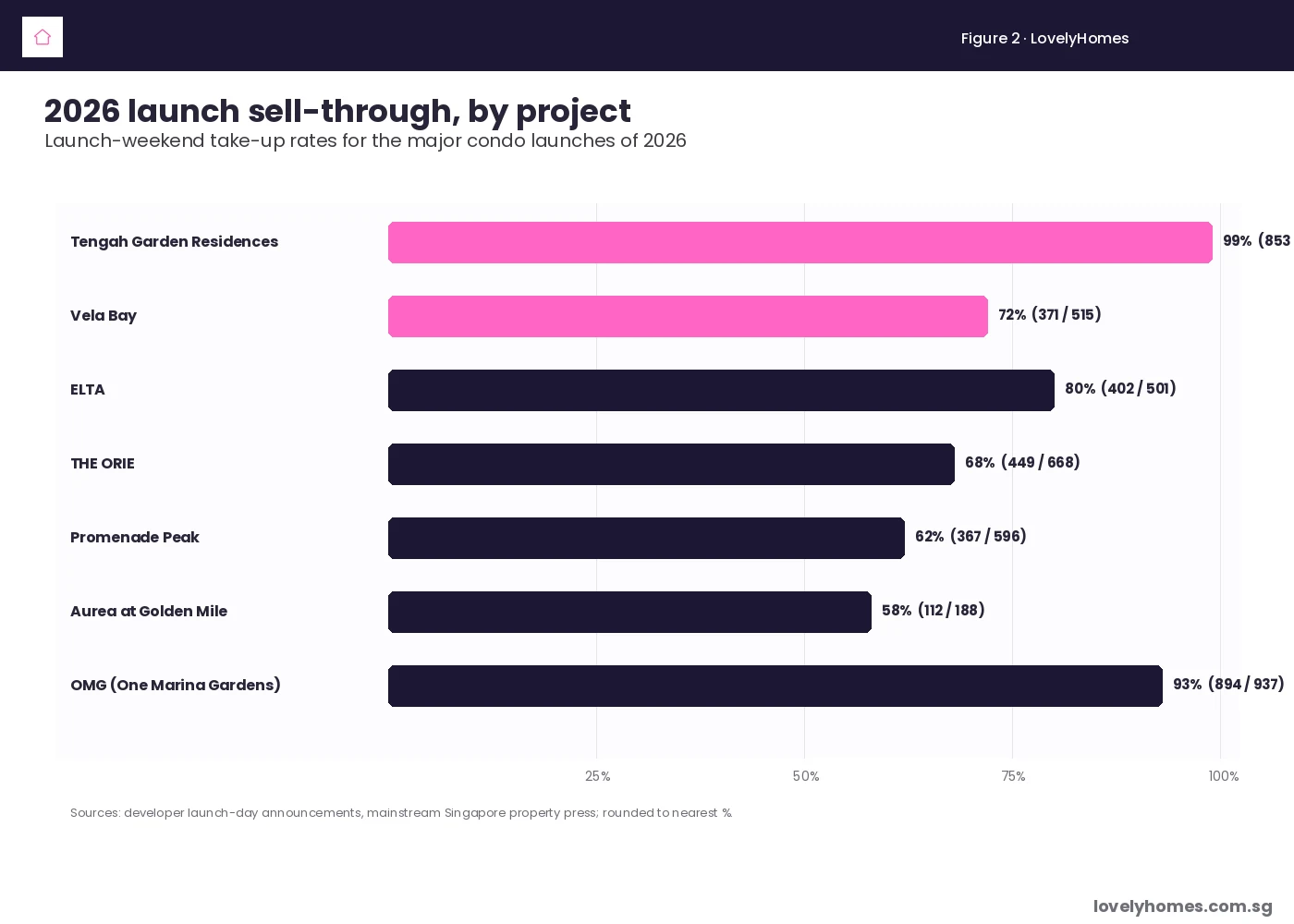
  • Tengah Garden Residences cleared 853 of 863 units (~99%) by Saturday afternoon, the strongest launch-day take-up since ParkTown Residences in February 2025.
  • Vela Bay sold 371 of 515 units (~72%), becoming the first private launch in the 60-hectare Bayshore waterfront precinct.
  • Average prices: Tengah Garden Residences ≈ S$1,700 psf, with units from S$980,000. Vela Bay ≈ S$2,886 psf, with units from S$1.27 million.
  • The weekend’s combined gross sales value is approximately S$2.4 billion, the largest dual-launch weekend on record for Singapore residential property.

The headline numbers

Singapore’s primary condo market has been described as “thin but priced firm” through Q1 2026. The weekend of 25–26 April 2026 ended that narrative with a single set of launch figures. By close of business Sunday, two new projects in different parts of the island had between them moved more units than the entire month of February 2026.

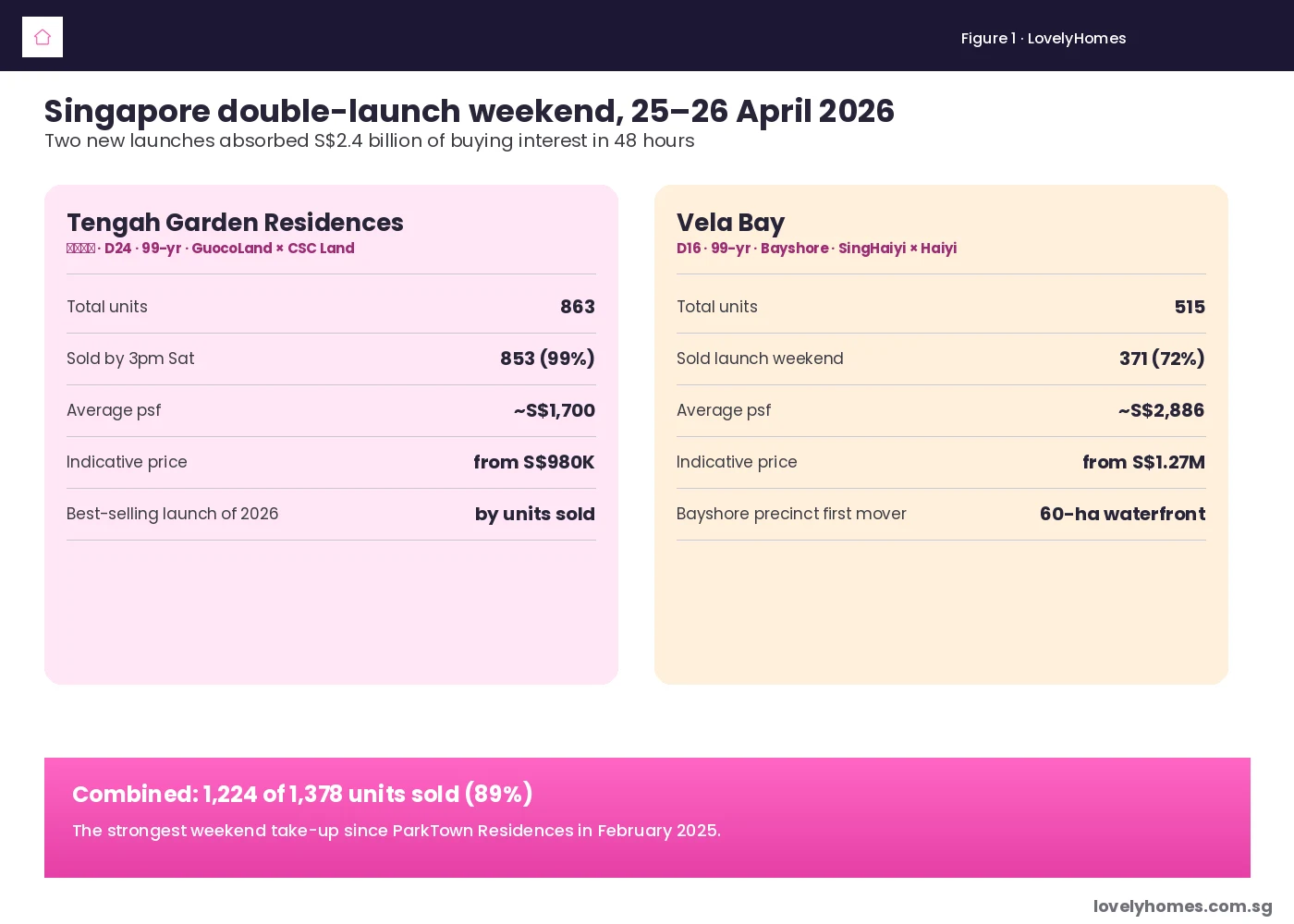
Tengah Garden Residences, the first private condominium launched inside the Tengah HDB-led new town, registered 853 sales out of 863 units — a 99% sell-through rate. Vela Bay, the first private residential launch in the Bayshore precinct in the East, sold 371 of 515 units. The two projects together absorbed buyer demand worth roughly S$2.4 billion in 48 hours.

Tengah Garden Residences and Vela Bay launch weekend results 25–26 April 2026 — combined 1,224 of 1,378 units sold
Figure 1: 1,224 of 1,378 units sold across the two projects — roughly 89% of available stock cleared in two days.

Tengah Garden Residences — the suburb story

Developed jointly by GuocoLand and CSC Land Group on a 99-year leasehold parcel along Tengah Garden Avenue (District 24), Tengah Garden Residences was launched at indicative prices from S$980,000 for one-bedroom units. Average pricing landed at roughly S$1,700 per square foot, slotting in between recent Outside-Central-Region (OCR) launches and the older Bukit Batok mass-market resale stack.

Key drivers of the near-sellout:

  • Pent-up Tengah demand. Tengah’s residential identity has been HDB-led since 2018, with no private launches inside the estate. The opening of the first private project tested an aspirational segment that had been waiting four years.
  • Pricing that read as “below ParkTown”. ParkTown Residences in Tampines launched at a higher OCR psf in February 2025; the Tengah price point felt restrained by comparison.
  • Singapore-Citizen-heavy buyer mix. Over 90% of buyers are reported to be Singapore Citizens, consistent with the post-2023 ABSD regime where foreign demand at OCR price points has thinned.
  • Connectivity story. Future Tengah MRT (Jurong Region Line, opening 2027–2028) and the proximity of the new Tengah town centre supported the long-hold buyer thesis.

Vela Bay — the Bayshore opener

Vela Bay, by SingHaiyi Group and Haiyi Holdings, launched at average prices of around S$2,886 psf, with one-bedroom units from S$1.27 million. The 515-unit project sits inside the Bayshore precinct, an emerging 60-hectare master-planned waterfront on the East Coast.

The Vela Bay take-up of 72% is more modest than Tengah Garden Residences’ 99%, but no less interesting:

  • Higher absolute price point. A typical 2-bedroom Vela Bay unit lands above S$2 million; that is a different buyer profile from Tengah.
  • First-mover premium. As the only private launch in a precinct still under construction, Vela Bay’s price had to absorb the discount buyers usually demand for “go-first” risk on infrastructure delivery.
  • Nine new sites in 1H 2026 GLS. URA’s 1H 2026 Government Land Sales programme released nine confirmed-list sites with capacity for ~9,185 units. The sequencing of those sites — including the Bayshore Drive mixed-use plot whose tender closes 15 July 2026 — is shaping how buyers price first-mover Bayshore stock.
  • SingHaiyi balance-sheet narrative. SingHaiyi has been a heavy participant in en-bloc and GLS bids in 2026 (it was also part of the consortium that won Loyang Valley en-bloc at S$880 million); its Bayshore launch is a clear conviction trade by the developer.
2026 Singapore condo launch sell-through rate comparison across major launches
Figure 2: Tengah Garden Residences sits at the top of the 2026 launch sell-through table. Vela Bay’s 72% is also above the 2026 OCR/RCR average.

What the weekend tells us about 2026 demand

Metric Reading Implication
Combined launch-weekend take-up 1,224 / 1,378 units (89%) Latent demand absorbing strongly when supply opens at the right price
OCR launch psf — Tengah ~S$1,700 Below recent comparable OCR launches; a “value” anchor for 2026 OCR pricing
RCR/East launch psf — Vela Bay ~S$2,886 Setting the benchmark for the Bayshore precinct ahead of the Bayshore Drive GLS tender
Buyer mix Predominantly Singapore Citizen Foreign demand still suppressed by the 60% ABSD; the market is local-driven
2026 launch pipeline ~17 projects, ~8,100 units 30% lower than 2025 — supply scarcity supports launch-day pricing power

What this means for buyers

For prospective Tengah buyers who missed the launch ballot, the resale option will likely sit at a 3–7% premium once units start changing hands — typical for a near-sellout launch. Tengah Garden Residences will not have additional release tranches for some months given the sell-through.

For Vela Bay, with 144 units (28%) still available, the post-launch phase remains accessible at launch pricing. Buyers should monitor whether units in Towers 1 and 2 are released before infrastructure milestones in the Bayshore precinct — first-mover units historically appreciate as the precinct fills out, but only if pricing on later launches doesn’t undercut them.

For the broader market, the weekend confirms that well-priced, well-located new launches in Singapore can still clear at speed in 2026, against the narrative of cooling-measure overhang. The discipline is on launch-day pricing: Tengah’s near-sellout came at a psf below what some industry watchers had projected for an OCR launch this cycle. Vela Bay’s slower (but still strong) take-up suggests that buyers in the higher-price RCR segment remain willing to pay up only for clearly differentiated locations.

What might come next

Two near-term watchpoints:

  • Bayshore Drive mixed-use GLS tender (closes 15 July 2026). The land bid will be read against Vela Bay’s launch psf as a price discovery point for the precinct.
  • BTO June 2026 ballot (~6,900 flats). If HDB pricing continues to compress against private OCR pricing, the substitution effect supports a second wave of OCR private demand later in 2026.

The next major private launches in the calendar — Bayshore Drive (if the tender awards in 1H 2026), Sembawang Drive EC, and a likely 2H 2026 District 5 OCR launch — will tell us whether the 25–26 April weekend was a one-off catch-up after a thin Q1, or the start of a measurably stronger primary market.

Frequently asked questions

Why did Tengah Garden Residences sell so much faster than Vela Bay?

Three reasons. First, price: at ~S$1,700 psf, Tengah’s entry price of S$980,000 sits below the typical OCR launch and is reachable for HDB upgrader couples. Vela Bay at ~S$2,886 psf and S$1.27 million entry sits in a different affordability cohort. Second, Tengah is a four-year-old new town with a built-out HDB community already in occupation; Vela Bay is the first launch in a precinct still under construction. Third, Tengah was the first private launch in the new town — a one-off scarcity premium that Vela Bay does not enjoy because more Bayshore launches will follow.

Is this evidence that cooling measures aren’t working?

Not necessarily. Cooling measures (the April 2023 ABSD hike, the September 2022 LTV / TDSR tightening) have visibly suppressed foreign demand and kept investor flows thin. The April 2026 launches were powered overwhelmingly by Singapore Citizen owner-occupier and upgrader demand, which is exactly the segment policy-makers wanted to remain active. The strong take-up reflects pent-up local demand meeting limited new supply, not a re-acceleration of speculative buying.

Should buyers chase a near-sellout launch like Tengah?

Generally no. Once a launch clears 90%+, the remaining stock is typically the less attractive layouts or units, and the resale market opens at a premium. The discipline for buyers is to be at the front of the queue at launch — or wait for the resale market to settle 6–9 months later when the urgency premium has softened.

What does this mean for the Bayshore Drive GLS tender?

Vela Bay’s 72% sell-through at ~S$2,886 psf gives bidders a reference point for what a Bayshore launch can absorb at price. If the Bayshore Drive GLS tender bids land at above S$1,400 psf ppr, the implied launch psf for the next Bayshore project would be approximately S$3,000+, which is testable against Vela Bay’s revealed demand curve.

How does this compare to historical strong launches?

The 99% Tengah figure is the highest launch-weekend take-up since ParkTown Residences in February 2025, which moved 87% on launch day. Going further back, Lentor Mansion (2024), Amo Residence (2022), and Treasure at Tampines (2019) all booked similar 90%+ launch-day percentages. Each of those projects shared the same ingredients as Tengah: a clear price-point anchor, an underserved sub-market, and a strong upgrader cohort.

Will more units be released?

For Tengah Garden Residences, the developer has not announced a second tranche; with only 10 units unsold, there is little to release. For Vela Bay, the remaining 144 units (28%) will be released in batches over the coming weeks at the same indicative price band; movements above launch pricing typically follow demonstrated take-up of 80%+.

Disclaimer. All sales figures, prices and dates are based on developer launch-day announcements and public reporting in the Singapore property press. Final transaction figures will be reflected in URA Realis caveats over the coming weeks. This article is general market commentary and does not constitute investment, legal or financial advice. Buyers should always verify current pricing and availability with the developer’s appointed sales gallery and consult a licensed Singapore conveyancing lawyer before exercising any Option to Purchase. Cooling-measure thresholds and ABSD rates are administered by the Inland Revenue Authority of Singapore and the Monetary Authority of Singapore.
New Launch
Tengah Garden Residences
Vela Bay
Singapore Property Market
Property News
OCR
Bayshore
Tengah
SingHaiyi
GuocoLand

CCR vs RCR vs OCR: Singapore’s Three Property Regions Explained (2026)

CCR vs RCR vs OCR: Singapore’s Three Property Regions Explained (2026)

Quick answer
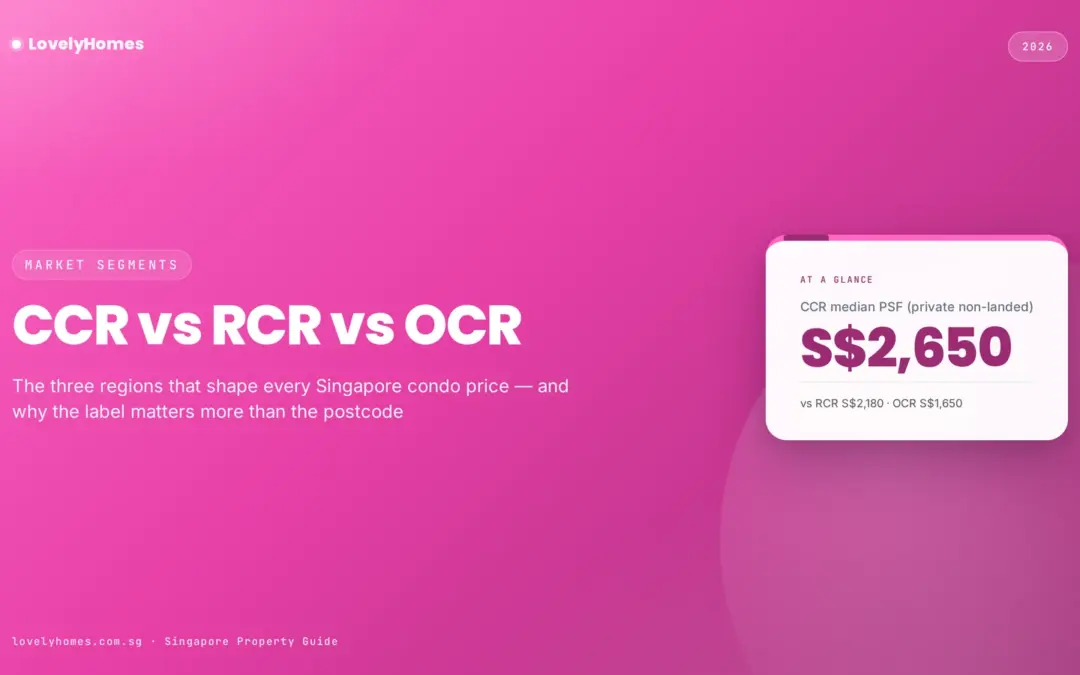
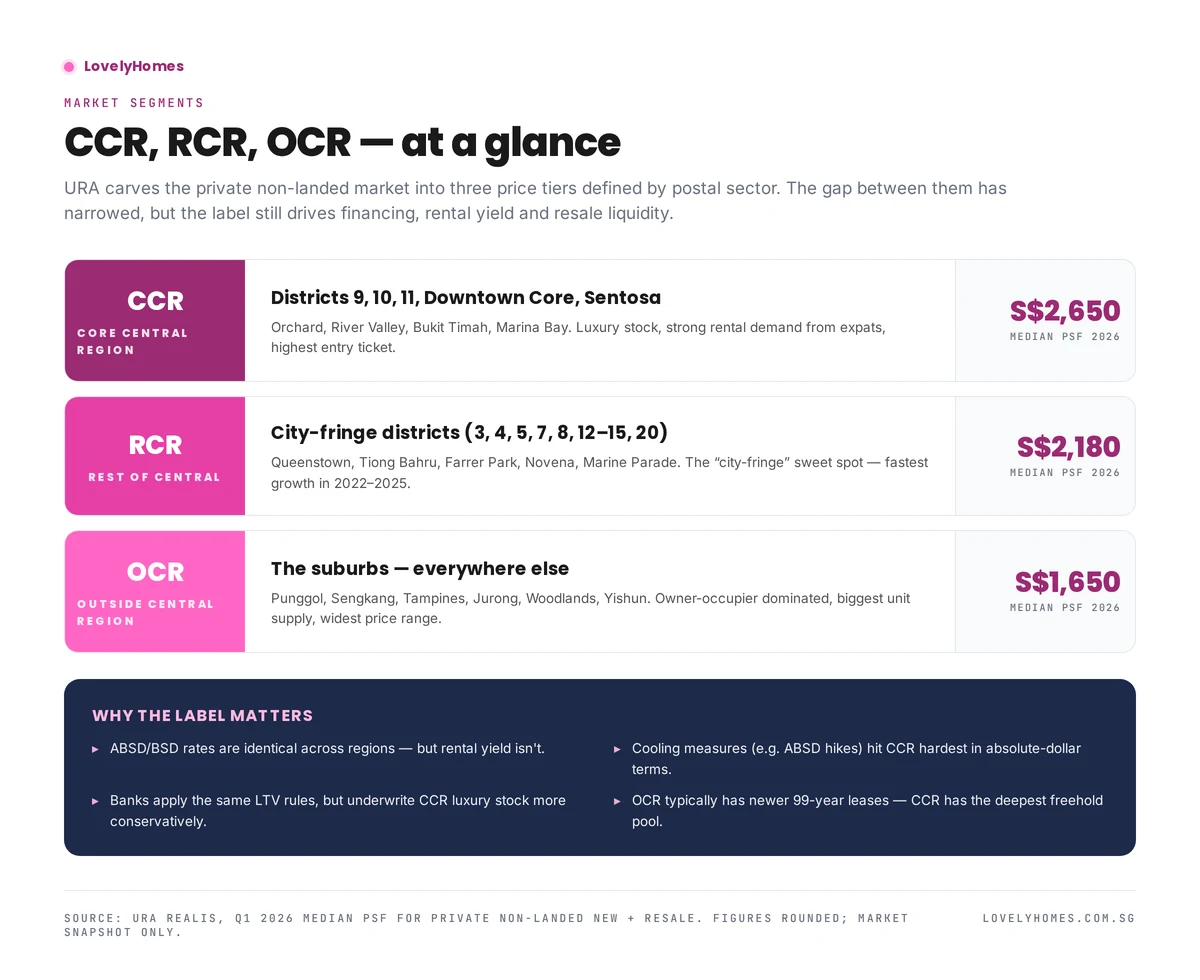
CCR, RCR and OCR are Singapore’s three private non-landed market segments defined by URA. CCR (Core Central Region) is the luxury belt around Orchard and the Downtown Core. RCR (Rest of Central Region) is the city fringe. OCR (Outside Central Region) is everywhere else. In Q1 2026 median PSF runs roughly S$2,650 in CCR, S$2,180 in RCR and S$1,650 in OCR — though the spread narrows for new launches in hot city-fringe pockets.

Every time URA releases the quarterly Property Price Index, the headlines split the private condo market into three buckets: CCR, RCR and OCR. New buyers usually learn the labels when a property agent drops them into a pitch — “this is a rare RCR freehold” or “OCR yields are better than what you’d get in CCR”. The labels shape price, rental yield, buyer profile and the resale pool you are competing with.

This guide sets out what each region is, how the 2026 numbers stack up, and where the label matters most in real buying decisions. If you are comparing condo formats as well as regions, pair this with our condo downpayment breakdown.

CCR vs RCR vs OCR comparison — median PSF tiers and what the labels mean for buyers
Illustrative 2026 median PSF and buyer-impact summary by URA region.

What the three regions mean

Core Central Region (CCR)

CCR covers postal districts 9, 10 and 11, plus the Downtown Core and Sentosa. Think Orchard, River Valley, Bukit Timah, Marina Bay, Sentosa Cove. The stock skews luxury: many freehold blocks, lower-density cluster homes, a deep pool of foreign-bought units pre-2023.

Rest of Central Region (RCR)

RCR is the city fringe — districts 3, 4, 5, 7, 8, 12, 13, 14, 15 and parts of 20. Queenstown, Tiong Bahru, Novena, Toa Payoh, Farrer Park, Marine Parade. From 2022 to 2025 this has been the fastest-appreciating band, thanks to new MRT lines and a rush of 99-year city-fringe launches.

Outside Central Region (OCR)

OCR is the suburbs — everywhere else. Punggol, Sengkang, Tampines, Jurong, Woodlands, Yishun, Bukit Panjang. OCR has the largest supply of new 99-year condo stock, the most owner-occupier demand, and the widest internal price range (budget 99-year next to premium integrated developments).

Where the numbers sit in 2026

Region Median PSF (new + resale) Typical 2-bedder quantum Rental yield (gross)
CCR ~S$2,650 S$2.3m–S$3.2m 2.5%–3.2%
RCR ~S$2,180 S$1.6m–S$2.3m 3.2%–4.0%
OCR ~S$1,650 S$1.1m–S$1.7m 3.5%–4.6%

Note the yield curve inverts the price curve: OCR delivers the highest gross yield; CCR the lowest. This is why investor pockets of OCR — near MRT interchanges, business parks — have been crowded for years.

Why the label still matters

1. Financing is region-neutral, but underwriting isn’t

ABSD, BSD, LTV limits and TDSR are identical across regions. But bank valuation and loan-amount appetite can diverge: CCR luxury units are sometimes under-valued by conservative banks, producing Cash-Over-Valuation surprises. Our COV guide explains how this works in detail for HDB, but the same dynamic shows up in high-ticket CCR resales.

2. Cooling measures hit CCR hardest in absolute dollars

A 20% ABSD rise on a S$3m CCR purchase hurts more than the same percentage on a S$1.2m OCR unit. Post-April-2023 foreigner ABSD (60%) has cooled CCR rental-to-own investment demand the most.

3. Tenure mix differs

CCR has the deepest freehold pool. OCR is mostly 99-year leasehold with a narrow freehold band around older landed enclaves. For the trade-off itself, see our freehold vs 99-year guide.

Worked example — same quantum, three regions

Imagine you have S$1.8m in purchase budget. That buys:

  • CCR: A small 1-bedder (~650 sqft) in district 9 or a shoebox resale in Sentosa Cove.
  • RCR: A decent 2-bedder (~750 sqft) in Queenstown, Novena or Toa Payoh resale stock.
  • OCR: A generously-sized 3-bedder (~1,000–1,100 sqft) in Tampines, Sengkang or Woodlands.

For owner-occupiers, OCR tends to win on size and yield; for investors banking on capital appreciation, RCR has been the sweet spot for a decade.

Frequently asked questions

Is CCR always the safest investment?

“Safe” depends on horizon. CCR held its value better than expected through the 2014–2018 cooling-measure trough, but capital appreciation has lagged RCR and OCR from 2020 to 2025. Luxury CCR stock is also more exposed to foreigner ABSD changes.

Can a development sit across regions?

No — URA assigns each postal sector to one region. Some large projects near boundaries (for example, in Farrer Road or Redhill) feel CCR but are classed RCR. The label on the transaction determines the bucket.

Does the region change the stamp duty rate?

No. BSD and ABSD are identical regardless of region. See our BSD guide for the 2026 rate ladder.

Which region produces the best en bloc candidates?

Historically CCR and RCR, because land scarcity drives developer appetite. OCR en blocs happen, but reserve prices need to fit tighter developer margins.


This guide is for general information only and is accurate as of April 2026. Singapore property rules, taxes and cooling measures change frequently — always verify current figures with URA, IRAS, HDB or a licensed professional before committing. LovelyHomes is not a financial, legal or tax advisor.


Translate »