Singapore Seller’s Stamp Duty (SSD) Guide 2026: Rates, Calculations and When It Applies

Singapore Seller’s Stamp Duty (SSD) Guide 2026: Rates, Calculations and When It Applies

Seller’s Stamp Duty (SSD) is Singapore’s principal tool for discouraging short-term property speculation. Introduced in 2010 and tightened several times since, SSD imposes a tax on sellers who dispose of their residential property within three years of purchase. It is distinct from the Buyer’s Stamp Duty (BSD) paid at purchase and the Additional Buyer’s Stamp Duty (ABSD) — SSD applies solely to the sale side of the transaction and targets holding-period behaviour. For any property investor or owner considering a sale, understanding SSD is essential before signing an Option to Purchase.

Quick Answer: Singapore SSD Key Facts 2026

  • SSD rates (from 27 April 2023): Year 1 — 12%; Year 2 — 8%; Year 3 — 4%; Year 4 and beyond — 0%.
  • Who pays: The seller pays SSD, not the buyer. It is calculated on the higher of the sale price or the market value.
  • Properties covered: Residential properties only — private condos, landed houses, and ECs after privatisation. HDB flats are excluded from SSD (they have the MOP instead).
  • Administered by: IRAS (Inland Revenue Authority of Singapore).
  • Payment deadline: Within 14 days of signing the Option to Purchase (OTP) or agreement.
  • Remissions exist for death, bankruptcy, divorce, en bloc collective sale, and certain compulsory acquisitions.
  • SSD is not deductible against income tax — it is a capital transaction cost.
  • The holding period runs from the date of purchase (completion) to the date of sale (contract).

What Is Seller’s Stamp Duty and Who Administers It?

Seller’s Stamp Duty (SSD) is a stamp duty levied by IRAS on the seller of a residential property when the property is disposed of within three years of acquisition. It was first introduced on 20 February 2010 by the Ministry of Finance as part of a suite of cooling measures designed to curb short-term speculative buying and selling that had contributed to rapid price escalation in the aftermath of the 2009 property boom.

SSD is fundamentally different in purpose from BSD and ABSD. BSD is a transaction tax levied on all buyers regardless of intent. ABSD targets the demand side — discouraging multiple property ownership, especially by foreigners. SSD, by contrast, targets the supply side: it penalises sellers who sell too quickly, making “flipping” — buying property to sell within a short period at a profit — financially unattractive. The policy intent is to encourage genuine owner-occupation and long-term investment rather than short-term trading.

IRAS administers SSD. The seller’s solicitor is responsible for computing, stamping, and remitting the SSD to IRAS before the completion of the sale. SSD is a charge against the proceeds of sale and is typically deducted from the sale proceeds held by the seller’s solicitor before the seller receives the net cash.

Singapore SSD seller's stamp duty rates by holding period 2026 bar chart and table
Figure 1: Singapore SSD Rates by Holding Period 2026 — left panel shows the rate schedule, right panel shows the SSD amount on a S$1.5 million residential property. Source: IRAS 2026.

Current SSD Rates 2026: The Three-Year Window

The current SSD rate schedule, effective from 27 April 2023, applies to residential properties acquired on or after that date. For properties acquired before 27 April 2023, the rates that prevailed at the time of acquisition apply — but since April 2023 is now more than three years ago, virtually all transactions occurring today are within the current rate schedule or have already crossed the three-year SSD-free window.

The rates are straightforward: if you sell within the first year of ownership, SSD is 12% of the higher of the sale price or market value. Between one and two years, the rate drops to 8%. Between two and three years, it is 4%. After three full years from the date of acquisition, SSD falls to zero — the property may be sold without any SSD liability. The holding period is measured from the date the seller legally acquired the property (the date of completion, or in the case of a new launch, the date of the Sales & Purchase Agreement) to the date the seller enters into the agreement to sell (the OTP date for a resale, or the S&P date for a new launch).

For a property valued at S$1.8 million, the SSD exposure is: Year 1 — S$216,000; Year 2 — S$144,000; Year 3 — S$72,000; Year 4+ — S$0. These are substantial sums that fundamentally change the investment calculus for anyone considering a quick exit.

How SSD Is Calculated: The “Higher Of” Rule

A critical nuance that many sellers overlook is that SSD is calculated on the higher of the transacted price or the market value of the property at the time of sale — not simply on the contract price. IRAS may commission its own valuation if it suspects the declared sale price is below market. This prevents sellers from artificially depressing the sale price to reduce SSD. In most arm’s-length transactions the contracted price and market value are the same, but in related-party sales (e.g. selling to a sibling at a discount), IRAS will use the higher market value figure.

The SSD formula: SSD = Applicable Rate × Higher of (Sale Price or Market Value). There are no progressive tiers within each year — the rate applies to the full consideration amount. Sellers should confirm the applicable rate with their solicitor before signing the OTP, since any change in holding-period calculation can significantly alter the tax.

Net proceeds after seller's stamp duty SSD at different holding periods Singapore 2026
Figure 2: Net gain after SSD — S$1.5 million property sold at S$1.65 million (10% appreciation). The SSD at Year 1 (12%) consumes S$198,000, turning a gross gain of S$150,000 into a net loss of S$48,000 before other costs. Source: IRAS, illustrative calculation.

Which Properties Are Subject to SSD?

SSD applies to residential properties in Singapore: these include private condominiums, apartments, landed houses (terrace, semi-detached, detached), and Executive Condominiums (ECs) that have completed their privatisation (i.e. after the 10-year privatisation milestone from TOP). Mixed-use properties where part of the floor area is residential may attract partial SSD depending on the proportion of residential use — this is assessed by IRAS on a case-by-case basis.

Notably, SSD does not apply to HDB flats. HDB flat owners are governed by the Minimum Occupation Period (MOP) instead — a 5-year MOP for standard flats and a 10-year MOP for Plus and Prime classification flats. During the MOP, an HDB owner simply cannot sell. Once the MOP is cleared, HDB resale transactions carry no SSD liability whatsoever. This distinction means that the SSD burden falls exclusively on private property owners.

Commercial and industrial properties are also exempt from SSD — these asset classes have their own regulatory frameworks but do not carry residential SSD exposure. An investor who owns a private residential unit and a shophouse must assess SSD only in respect of the residential unit.

SSD Remissions: When IRAS May Waive or Reduce SSD

IRAS provides remissions (full or partial waivers) for SSD in specific circumstances where the sale is not voluntary or speculative. The key scenarios are as follows. In the case of death, if a property is disposed of by the estate of a deceased owner or transferred to a beneficiary, SSD is remitted — the disposal is not treated as a voluntary sale. For bankruptcy, if the Official Assignee sells the property as part of bankruptcy proceedings, SSD is remitted on the forced-sale transaction. In divorce proceedings, a transfer of property between divorcing spouses pursuant to a court order (Division of Matrimonial Assets) is not subject to SSD. For en bloc / collective sale, when a building or development is sold collectively under the Land Titles (Strata) Act through an en bloc process, SSD is remitted for the individual owners in that collective sale. Similarly, properties acquired compulsorily by the state under the Land Acquisition Act attract full SSD remission.

Remissions are not automatic — they must be claimed. The solicitor managing the transaction should identify whether a remission applies and file the appropriate application with IRAS. Unsolicited sales by genuine owner-occupiers who face sudden hardship (e.g. job loss, medical emergency) do not constitute remission grounds — only the specific categories above qualify. Buyers upgrading from an HDB flat to a private property and needing to sell quickly after ABSD remission are not eligible for SSD remission on the private property side unless their circumstances fall into one of the above categories.

Summary Table: SSD At a Glance 2026

Factor Details
Administered by IRAS (Inland Revenue Authority of Singapore)
Effective from (current rates) 27 April 2023
Year 1 rate (held < 1 year) 12% of sale price or market value (higher)
Year 2 rate (held 1–2 years) 8%
Year 3 rate (held 2–3 years) 4%
Year 4+ (held > 3 years) 0% (no SSD)
Who pays The seller
Payment deadline 14 days from OTP/agreement signing
Properties covered Residential — private condo, landed, privatised EC
HDB flats Exempt (MOP rules apply instead)
Remission scenarios Death, bankruptcy, divorce (court order), en bloc, compulsory acquisition
Tax deductibility Not deductible against income tax

Worked Example: The Full SSD Impact on an Investment Property Sale

Mr Chen purchased a 1,000 sqft condominium unit in the Outside Central Region (OCR) for S$1,400,000 in June 2024. By December 2025 (18 months later), the development has appreciated and he receives an offer of S$1,580,000. He is tempted to sell. Let us calculate the full financial picture.

Holding period: June 2024 to December 2025 = approximately 18 months = Year 2 (1–2 years). SSD rate: 8%.

SSD on S$1,580,000 at 8%: S$126,400.

Other sale costs: agent commission at 2% = S$31,600; legal fees (seller) = S$3,000; property tax adjustment to date of completion = S$1,200. Total other sale costs: S$35,800.

Purchase costs already sunk: BSD at purchase on S$1,400,000 = S$36,600; legal fees at purchase = S$3,500; ABSD if applicable = nil (SC second property was 20% ABSD = S$280,000 — included in total outlay). Let us use a scenario where Mr Chen’s first property was an HDB flat and he sold it within the same week, triggering the ABSD remission window, so effectively 0% ABSD was paid.

Gross gain: S$1,580,000 − S$1,400,000 = S$180,000.

Net position after SSD and sale costs: S$180,000 − S$126,400 (SSD) − S$35,800 (sale costs) = net loss of S$18,200, before factoring in purchase costs (BSD, legal) and financing costs (mortgage interest paid over 18 months — at 2.5% on S$1,050,000, approximately S$26,250 in interest payments).

Conclusion: A sale at 18 months with 12.7% nominal appreciation results in a net loss when SSD, transaction costs, and financing costs are properly accounted for. Mr Chen would need to achieve a sale price of at least S$1,648,000 — a 17.7% appreciation — just to break even at the 18-month mark. If he waits until Month 37 (past the 3-year SSD window), the same appreciation of S$180,000 becomes a net gain of approximately S$144,200 (gross gain less sale costs and BSD, before financing). This illustrates precisely why SSD achieves its policy intent.

SSD vs ABSD: How They Interact for Property Investors

Singapore’s property investor faces a layered stamp duty landscape. At purchase, BSD (1%–6%) and ABSD (0%–65% depending on buyer profile and property count) apply. At sale, SSD (0%–12%) applies for the first three years. These taxes do not offset each other — they are separate liabilities at separate points in time.

An SC buyer of a second property pays 20% ABSD at purchase and up to 12% SSD on an early sale — a combined transactional tax burden of 32% of the purchase price in a worst-case Year 1 sale scenario, on top of BSD. At these levels, property speculation in the short term is essentially economically unviable for individual investors, which is precisely the government’s stated intention. The ABSD remission available to HDB upgraders (where the HDB is sold within 6 months of private purchase) provides relief from ABSD but does not affect SSD — the SSD clock runs from the private property acquisition date regardless.

Singapore seller's stamp duty SSD policy timeline 2010 to 2026
Figure 3: Singapore SSD Policy Timeline 2010–2026 — introduction, successive tightening, 2017 rationalisation, and current position. Source: IRAS, MND, Government Gazette.

What Might Come Next

The SSD framework has been broadly stable since the April 2023 cooling measures, which left SSD rates unchanged while tightening ABSD. Industry observers and research desks generally expect the SSD structure to remain unchanged through the rest of 2026 and into 2027, barring a significant correction in private residential prices. The government has consistently signalled that Singapore’s property cooling measures are not designed as permanent fixtures but as calibrations to market conditions — any future SSD liberalisation is more likely to come alongside ABSD relaxation in a cooling-demand environment, rather than in isolation. Buyers and investors should not plan transactions around expected SSD changes; the base case is status quo.

One area to monitor is the treatment of ECs under SSD as the government’s May 2026 EC MOP extension (from 5 years to 10 years from TOP) works through the pipeline. The interplay between the extended EC MOP and the SSD three-year clock for privatised ECs means buyers of recently privatised ECs face a narrow window where both MOP-based restrictions and SSD restrictions overlap — though by the time privatisation occurs (10 years from TOP), any SSD liability would have long since lapsed.

Frequently Asked Questions

Does SSD apply if I sell my property at a loss?

Yes. SSD is calculated on the higher of the sale price or market value, regardless of whether you make a profit or a loss on the transaction. If you paid S$2 million for a property and sell it for S$1.8 million within Year 1, the SSD is calculated on S$1.8 million (assuming that is the market value), giving an SSD liability of S$216,000 — on top of the S$200,000 capital loss. This makes early distressed sales of recently purchased property extraordinarily costly. The policy deliberately does not provide for an exemption when selling at a loss, as the government’s concern is speculative behaviour rather than the seller’s profit outcome.

When exactly does the SSD holding period start?

For a completed property (resale purchase or a completed development), the holding period starts on the date of completion — typically when the title transfers to the buyer upon payment of the balance purchase price. For a new launch (uncompleted property under progressive payment), IRAS uses the date the Sale and Purchase Agreement (S&P) was signed as the start date, not the TOP date. This means a buyer who signed an S&P in 2022 and received their keys in 2026 has already served well past the three-year window — no SSD applies on a subsequent sale. Conversely, a buyer who signed an S&P in January 2024 and sells the unit in February 2026 (before TOP) would be selling in Year 2 — an 8% SSD applies on the sub-sale price.

Can SSD be paid using CPF?

No. SSD is a charge against sale proceeds and must be paid in cash by the seller’s solicitor from the proceeds of sale. Unlike BSD, which buyers can settle from their CPF Ordinary Account, SSD is on the selling side and is deducted before the net proceeds are released to the seller. If the sale proceeds are insufficient to cover SSD (e.g. the property is heavily mortgaged), the seller must top up in cash.

How does SSD interact with an en bloc sale?

In a collective sale (en bloc) conducted under the Land Titles (Strata) Act, SSD is fully remitted for all owners participating in the collective sale — including owners who might still be within their SSD holding period. The rationale is that en bloc owners are not voluntarily choosing to sell; they are bound by the collective decision once the requisite majority approves the sale. The remission applies to all participating owners regardless of when they acquired their units, provided the collective sale is completed through the prescribed statutory process with IRAS confirmation.

Is SSD the same as the Additional Seller’s Stamp Duty (ASSR)?

There is no instrument in Singapore called “Additional Seller’s Stamp Duty (ASSR).” SSD is the only seller-side stamp duty for residential property. You may occasionally see references to SSD in older documents as distinct from “BSD-SSD” — this simply means the stamp duty payable by the seller, as opposed to the BSD payable by the buyer. Do not confuse SSD with ABSD: ABSD is paid by the buyer (not the seller) and applies based on the buyer’s residential property count, not the holding period.

I gifted my property to a family member — does SSD apply?

Yes, a gift or transfer at undervalue between related parties is still subject to SSD if the holding period has not elapsed. IRAS treats the market value of the property (not the consideration, if any) as the basis for SSD assessment. The only gift-related exemption is a transfer pursuant to a court order in divorce proceedings. A transfer to a child, sibling, or parent — even at nominal S$1 consideration — will attract SSD at the applicable rate on the market value, if the property was acquired within the past three years. This is one of the most common and costly misunderstandings around SSD.

Related Articles

Disclaimer

This article is for general information only and does not constitute legal or tax advice. SSD rates, remission criteria, and payment timelines are subject to change by IRAS and the Ministry of Finance at any time. All figures and rates quoted are as of June 2026. Stamp duty calculations involve factual determinations that depend on the specific circumstances of your transaction. Readers should verify all information with IRAS (www.iras.gov.sg) and consult a licensed conveyancing solicitor before entering into any property transaction. For complex scenarios — en bloc participations, related-party transfers, divorce settlements — professional legal advice is strongly recommended.

×Click image to close

Singapore First-Timer Home Buyer Complete Guide 2026: Grants, BTO vs Resale, HFE and Everything You Need

Singapore First-Timer Home Buyer Complete Guide 2026: Grants, BTO vs Resale, HFE and Everything You Need

Buying your first home in Singapore is one of the biggest financial decisions you will ever make — and the government has designed a system that genuinely rewards first-timers. From priority balloting in the Build-To-Order (BTO) exercise to grants worth up to S$230,000 for resale flat buyers, first-timer status unlocks advantages that second-timers and investors cannot access. This guide covers everything from how HDB defines a first-timer to the full buying timeline, so you can make the right choice with confidence.

Quick Answer: Key Facts for Singapore First-Timer Buyers 2026

  • First-timer status applies to Singapore Citizens (SC) and Permanent Residents (PR) who have never owned a subsidised HDB flat or private residential property in Singapore.
  • CPF housing grants can total up to S$230,000 for SC couple buying an HDB resale flat (EHG + Family Grant + PHG combined).
  • BTO priority balloting: first-timers get two ballot chances for every one chance given to second-timers.
  • HDB Flat Eligibility (HFE) letter is mandatory before you can apply for any BTO or resale HDB flat — validity is 9 months.
  • ABSD: SC buying first property pays 0% ABSD; PR pays 5%; foreigners pay 65%.
  • MSR cap: monthly HDB/EC mortgage must not exceed 30% of gross monthly income.
  • BTO waiting time: 2.5–5 years for standard flats; resale is immediate.
  • New classification (2024 onwards): BTO flats are now categorised Standard, Plus, or Prime — each with different resale restrictions and grant levels.
  • MOP: standard flats require 5-year Minimum Occupation Period; Plus/Prime BTO and new ECs (from May 2026) require 10 years.
  • BSD is payable by all buyers regardless of first-timer status — progressive from 1% to 6% on purchase price.

What Makes You a First-Timer in Singapore’s Property System?

HDB defines a first-timer applicant as someone who has not previously received a housing subsidy from HDB. Practically, you are a first-timer if all the following are true: you have never owned an HDB flat (purchased directly from HDB), you have not previously received an HDB grant, and you have not owned a private residential property in Singapore in the 30 months before your flat application (this 30-month rule applies to resale applications). If you co-own a private property overseas, it does not automatically disqualify you for HDB purposes, but you must divest any Singapore private property.

The key distinction is subsidised housing: inheriting an HDB flat from a deceased parent does not strip your first-timer status, provided you sell it within the required period. Similarly, owning a commercial property or industrial unit does not affect your HDB eligibility. HDB reassesses your status at the point of application, so the 30-month rule runs backwards from the date you submit your HFE application.

First-timer home buyer eligibility and CPF housing grants matrix Singapore 2026
Figure 1: Singapore First-Timer Eligibility and Grant Overview — who qualifies and what grants are available in 2026. Source: HDB 2026.

CPF Housing Grants: What First-Timers Can Claim

The CPF housing grant system is tiered and means-tested. Higher grants are available to buyers with lower household incomes, with most grants phasing out at S$9,000 per month for couples. All grants are disbursed as CPF Ordinary Account (OA) credits — they reduce the cash you need for the purchase, but they accumulate accrued interest at 2.5% per annum that must be refunded to CPF when you sell.

Enhanced CPF Housing Grant (EHG) is the most generous and the most means-tested. For SC couples buying a BTO, EHG ranges from S$5,000 (income S$8,501–S$9,000) up to S$120,000 (income ≤S$1,500). For SC couples buying resale, the EHG is capped at S$80,000 (income ≤S$1,500). Singles aged 35 and above can claim up to S$60,000 for BTO and S$40,000 for resale. The EHG requires that at least one buyer is buying a flat with a remaining lease that can cover the youngest buyer until age 95.

Family Grant applies to resale flats only and is a flat amount: S$80,000 for SC couples, S$60,000 for SC + SPR couples. There is no income ceiling for the Family Grant itself, but the EHG already tapers to zero above S$9,000 household income, so high-income buyers effectively claim only the Family Grant.

Proximity Housing Grant (PHG) rewards buyers who choose a resale flat within 4 km of their parents or children, or who buy in the same town. Amounts range from S$10,000 (living within 4 km of parents) to S$30,000 (living with parents in the same flat). PHG is available to SC buyers only.

Half-Housing Grant: where one buyer is a first-timer and the other is a second-timer, the first-timer can still claim half the Family Grant — S$40,000 for SC + SC, S$30,000 for SC + SPR — on a resale flat purchase.

Maximum CPF housing grants for first-timer buyers by profile Singapore 2026 stacked bar chart
Figure 2: Maximum CPF Housing Grants by First-Timer Buyer Profile 2026. BTO buyers access EHG only; resale buyers can stack EHG + Family Grant + PHG. Source: HDB 2026.

The HDB Flat Eligibility (HFE) Letter: Your First Step

Before you can ballot for a BTO or make an offer on an HDB resale flat, you must obtain an HFE letter from HDB. The HFE replaced the earlier Eligibility Letter (EL) in 2023 and now serves a dual purpose: it confirms your eligibility to purchase, and it indicates the CPF grants and HDB housing loan you may be entitled to. The HFE letter is valid for 9 months from its date of issue.

Applying for an HFE takes roughly 2–3 weeks. You submit an application through the HDB Flat Portal (homes.hdb.gov.sg), providing details of your household members, income documents, and ownership declaration. HDB pulls information from government databases — IRAS for income, SLA for property records — so you do not need to submit separate ownership declarations for most scenarios. If you plan to use an HDB loan, you receive a Loan Eligibility assessment alongside the HFE. If you prefer a bank loan, you should obtain an In-Principle Approval (IPA) from your chosen bank separately.

BTO vs Resale: The Core Decision for Every First-Timer

The most consequential decision for any first-timer is whether to buy a BTO flat or an HDB resale flat. This is not purely a financial decision — it involves trade-offs between price, location, waiting time, grant entitlements, and lifestyle.

BTO flats are sold by HDB directly at subsidised prices — typically 20–40% below the equivalent resale transaction in the same estate. The trade-off is time: you ballot for a flat first, and you wait for it to be built, which takes 2.5–5 years from booking to key collection. In the meantime, you and your partner typically have to continue renting or living with family. BTO flats in Plus and Prime zones (central estates and highly sought-after areas) carry additional resale restrictions under the 2024 classification framework, including a 10-year MOP and a clawback of HDB subsidy on resale.

Resale flats are immediately available and offer greater locational flexibility — you can buy in virtually any HDB estate, at any floor level, and move in within 8–12 weeks of completing the transaction. They are more expensive than BTOs on a per-unit basis, but first-timers can use the full resale grant stack (EHG + Family Grant + PHG), which partially offsets the premium. Resale flats also come with a shorter remaining lease, which affects CPF withdrawal limits and future resale value — so buyers should check that the remaining lease covers the youngest buyer to age 95.

BTO vs HDB resale price and waiting time comparison for first-timer buyers 2026
Figure 3: BTO vs HDB Resale — Price Range and Waiting Time for First-Timer Buyers 2026. BTO prices are after HDB pricing subsidy, before grants. Source: HDB 2026.

Financing Your First Home: LTV, MSR, TDSR and Choosing Your Loan

First-timer buyers have two loan options: an HDB Concessionary Loan or a bank loan. Understanding the constraints and advantages of each is critical, because the choice is largely irreversible — once you switch from an HDB loan to a bank loan, you cannot switch back.

HDB Concessionary Loan: available to SC buyers only (not PR-only households), with a combined household income cap of S$14,000 per month. The interest rate is pegged to the prevailing CPF OA rate plus 0.1%, currently 2.6% per annum. LTV ratio is 80%, and there is no cash down payment requirement beyond the minimum 20% top-up (which can be entirely from CPF). The monthly repayment must not exceed 30% of gross income (MSR rule).

Bank loans: available to all buyers. LTV is 75% for the first property, meaning a minimum 25% down payment (with at least 5% in cash and the remaining 20% from cash or CPF). Bank loan interest rates are tied to the Singapore Overnight Rate Average (SORA) — as of June 2026, the 3-month compounded SORA is approximately 1.07%, with typical bank packages for new HDB purchases ranging from 1.5% to 2.2% on floating-rate terms and 2.4%–2.7% on fixed-rate terms. Bank loans are subject to both MSR (30%) and TDSR (55%).

Stamp Duty for First-Timers

Buyer’s Stamp Duty (BSD) is payable on all property purchases in Singapore, without exception. It is calculated on the higher of the purchase price or the market value at a progressive rate: 1% on the first S$180,000, 2% on the next S$180,000, 3% on the next S$640,000, 4% on the next S$500,000, and 5%–6% on amounts above that. For a S$500,000 HDB resale flat, BSD is approximately S$9,600. For a S$650,000 flat, BSD is approximately S$14,400. BSD is payable within 14 days of signing the Option to Purchase and can be paid from your CPF OA.

Additional Buyer’s Stamp Duty (ABSD) for SC buyers purchasing their first property is 0% — no ABSD applies. PR buyers purchasing their first property pay 5% ABSD, and foreigners pay 65% on any residential property. The ABSD rates announced in the April 2023 cooling measures remain in effect as of June 2026.

Summary Table: First-Timer Home Buying at a Glance

Topic HDB BTO (First-Timer SC Couple) HDB Resale (First-Timer SC Couple)
Max CPF Grants Up to S$120,000 (EHG only) Up to S$230,000 (EHG+FG+PHG)
Income Ceiling (loans/grants) S$14,000/mth (HDB loan); S$9,000/mth for max EHG Same; Family Grant has no separate income ceiling
Waiting Time 2.5–5 years from ballot to keys 8–12 weeks from OTP to keys
Loan Options HDB (2.6%) or bank loan (SORA-based) Same
Min Down Payment 20% (all CPF; 5% cash if bank loan) Same
BSD Payable (from CPF OA) Payable (from CPF OA)
ABSD (SC 1st property) 0% 0%
MOP (Standard) 5 years from key collection 5 years from key collection
MOP (Plus/Prime) 10 years; subsidy clawback on resale N/A (Plus/Prime applies to BTO only)
Ballot Priority 2× chances vs second-timer N/A (open market)

Worked Example: First-Timer Couple Buying Their First HDB Flat

Mr and Mrs Ng are a Singapore Citizen couple. Both are first-timers aged 29. Their combined gross monthly income is S$7,800. They are considering two options: a 4-room BTO flat at a non-mature estate, or a 4-room resale flat in Tampines.

Option A — BTO (non-mature estate, 4-room): Indicative price S$380,000. EHG entitlement at S$7,800/mth income: approximately S$45,000 (income bracket S$7,501–S$8,000, couple BTO). Effective price after EHG: S$335,000. HDB loan at 80% LTV: S$268,000. Monthly repayment at 2.6% over 25 years: S$1,218/mth — MSR = 15.6%, well within the 30% cap. BSD on S$380,000: S$7,100 (payable from CPF). Cash required: essentially S$0 if CPF OA balance is sufficient (S$67,000 down payment + BSD from CPF). Waiting time: approximately 3.5 years.

Option B — Resale (Tampines, 4-room, ~25 years remaining lease): Price S$620,000. Grant entitlement: EHG S$45,000 + Family Grant S$80,000 + PHG S$10,000 (living within 4 km of parents) = S$135,000 total grants. Effective cost after grants: S$485,000 cash/CPF. HDB loan at 80% LTV: S$496,000 (on purchase price; capped to MSR: at S$7,800/mth income, MSR cap S$2,340/mth, loan tenure 25yr @ 2.6% → max loan S$515,000 — CLEAR). Monthly repayment: approximately S$2,250/mth — MSR 28.8% PASS. BSD: S$13,800 from CPF. Cash outlay: S$800 (OTP exercise fee) + legal fees ~S$2,500. Move-in: approximately 10 weeks from OTP.

Decision: Option A is S$240,000 cheaper in sticker price but requires a 3.5-year wait. Option B is immediately available and offers full grant stacking. At S$7,800/mth combined income, both options are financially feasible. The couple should weigh the rental cost during the BTO wait period (estimated S$80,000–S$100,000 over 3.5 years if renting privately) against the S$240,000 BTO price advantage.

What First-Timers Often Get Wrong

The most common mistake is treating the HFE letter as a mere formality — in fact, it is the document that locks in your grant entitlement. Applying for an HFE too early (income changes between HFE and purchase can reduce grants) or too late (HFE takes 2–3 weeks, which can cause you to miss an OTP deadline) both have real financial consequences. A second common error is underestimating CPF accrued interest: every dollar of CPF and grants deployed for the property accumulates 2.5% interest annually, which must be refunded to CPF upon sale. On a S$300,000 CPF drawdown over 10 years, that refund obligation reaches approximately S$85,000 — significantly reducing net cash in hand at sale. Third, first-timers sometimes overlook the BSD timing difference between BTO (payable on exercise of the Sale and Purchase Agreement, typically several years after ballot) and resale (payable within 14 days of signing the OTP) — a BTO purchase technically defers the BSD cash outflow.

What Might Come Next

Industry observers note that the new Standard/Plus/Prime BTO classification, introduced in 2024, is still bedding in. The October 2026 BTO exercise is expected to offer approximately 7,970 flats across Bedok, Geylang, Sembawang, Tengah, Toa Payoh, and Yishun — providing first-timer couples with options across multiple towns. The Bedok Bayshore sites (adjacent to Bayshore MRT) are being watched closely as the first BTO flats in a new waterfront neighbourhood. Policy observers have also been monitoring whether HDB will adjust the EHG income bands as Singapore’s median household income continues to rise, though no changes have been announced as of June 2026. The 15-month Wait-Out Period (WOP) for private property owners who wish to purchase an HDB resale flat — introduced in September 2022 — remains in place, adding a structural floor to HDB resale demand as upgraders are prevented from buying immediately.

Frequently Asked Questions

Can I apply for a BTO as a first-timer if I currently live in a private property?

Yes, provided you are an SC citizen and have never previously purchased a subsidised HDB flat. However, if you (or your spouse) currently own a private residential property in Singapore, you must dispose of it within 6 months of receiving the keys to your BTO flat. Overseas private property does not disqualify you. The 30-month Look-Back Period applies to resale HDB flat applications, not BTO ballot applications — so private property owners can ballot for a BTO flat while still holding their private property, as long as they sell it after receiving keys.

My spouse is a second-timer. Do we still get first-timer benefits?

You are treated as an “essential occupier + first-timer” family unit. For BTO balloting, you get first-timer ballot priority (2 chances). For grants, you can still claim the EHG based on your individual first-timer status. For resale, you can claim the Half-Housing Grant (half the Family Grant amount) rather than the full Family Grant. Your spouse’s second-timer status does not eliminate your personal grant eligibility, but it does reduce the total grant quantum compared to an all-first-timer couple.

How long does the HFE letter application take, and when should I apply?

The HFE letter typically takes 2–3 weeks to process from the date of submission. You should apply before — not after — you identify a flat. For BTO applicants, apply at least 3 weeks before the BTO launch window opens. For resale buyers, apply before you start your flat search, since an OTP seller may ask you to exercise within 14–21 days, and you need your HFE confirmed before you can proceed to the resale portal. The HFE is valid for 9 months; if it expires, you must reapply.

Can I use CPF to pay for the Option to Purchase (OTP) fee and BSD?

No — the OTP option fee (S$500–S$1,000) and the OTP exercise fee (1% of purchase price) must be paid in cash. BSD, however, can be paid from your CPF OA once the Option to Purchase is exercised. Your solicitor will process the CPF withdrawal for BSD after the OTP is exercised and the conveyancing process begins. Cash payments made before CPF is available cannot be reclaimed from CPF later.

What is the Deferred Income Assessment (DIA) and does it affect my grants?

The Deferred Income Assessment (DIA) allows eligible first-timer couples who are full-time students, National Service (NS) personnel, or freelancers with irregular income to defer their income declaration until key collection, when the EHG quantum is then assessed. This prevents buyers from being penalised during a temporarily low-income phase. The DIA is not automatic — you must declare eligibility at the HFE application stage. If your income rises significantly between application and key collection, your EHG may be lower than expected.

What is the Minimum Occupation Period (MOP) and what can I do during it?

The MOP is the minimum period you must live in an HDB flat before you can sell it on the open market. For standard HDB flats purchased from HDB (BTO), the MOP is 5 years from the date you collect your keys. For Plus classification BTO flats, the MOP is 10 years. During the MOP, you cannot rent out the entire flat (you can rent out individual bedrooms, subject to HDB approval and quota rules). You also cannot purchase a private residential property in Singapore until the MOP is cleared, unless you are buying it to upgrade and will sell the HDB flat within 6 months.

How much cash do I actually need to buy my first HDB flat?

For an HDB loan (no bank loan), the minimum cash required is remarkably low. The 20% down payment can come entirely from CPF OA. BSD is payable from CPF. Legal fees (~S$2,000–S$3,000) are payable in cash. The OTP option fee (S$500–S$1,000) and exercise fee (1%) are in cash, but these are modest. Total cash outlay for a S$500,000 BTO with HDB loan and S$80,000 CPF balance: approximately S$6,000–S$8,000 in cash (legal fees + OTP fees). For a bank loan, the minimum 5% cash down payment on S$500,000 is S$25,000 — the largest single cash item.

Related Articles

Disclaimer

This article is for general information only and does not constitute financial, legal, or conveyancing advice. Grant amounts, income ceilings, LTV ratios, and stamp duty rates are subject to change by HDB, IRAS, and MAS at any time. All figures quoted are as of June 2026. Readers should verify all information with official sources — HDB (www.hdb.gov.sg), IRAS (www.iras.gov.sg), MAS (www.mas.gov.sg), and CPF Board (www.cpf.gov.sg) — before making any property purchase decision. For complex situations involving second-timer spouses, foreign co-buyers, or inherited properties, consult a licensed conveyancing lawyer.

×Click image to close

Singapore Property Market Forecast 2H 2026: Price Outlook, Key Risks and What Buyers Should Know

Singapore Property Market Forecast 2H 2026: Price Outlook, Key Risks and What Buyers Should Know

Quick Answer: Singapore Property Market Forecast 2H 2026

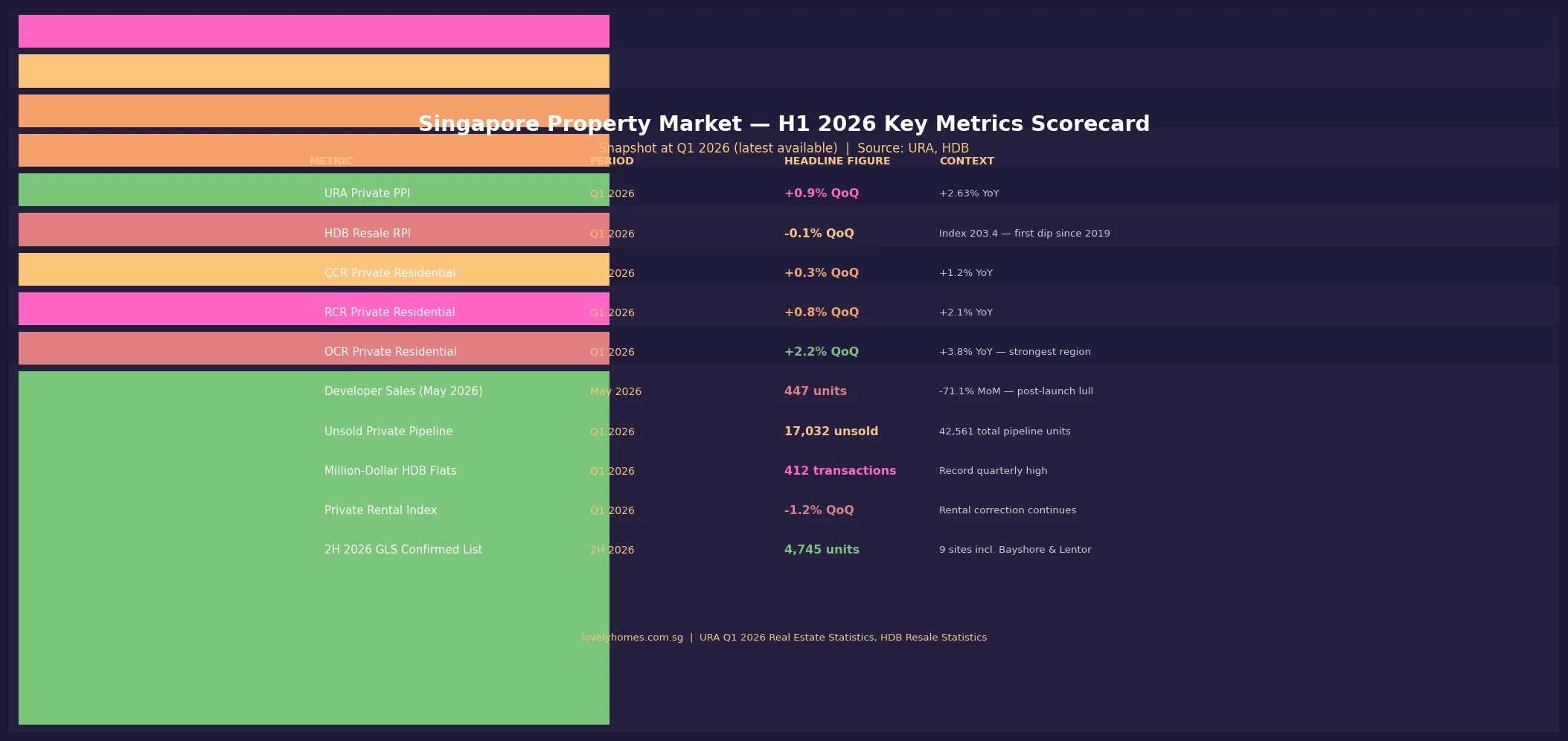
  • Private residential prices rose 0.9% QoQ and 2.63% YoY in Q1 2026, with the Outside Central Region (OCR) leading at +2.2% QoQ — price growth is positive but moderating.
  • HDB resale recorded its first quarterly dip (-0.1% QoQ) since Q2 2019; index sits at 203.4. Not a crash — more of a pause after a five-year run.
  • 2H 2026 GLS launches 9 confirmed-list sites (4,745 units), adding meaningful supply to OCR and RCR. Pricing discipline from developers is expected.
  • Key risk: interest rates remain elevated at 3.0–3.5% for bank mortgages; affordability is stretched for many first-time buyers.
  • Key catalyst: any US Federal Reserve rate cut signals would unlock significant pent-up demand — watch the September and December 2026 Fed meetings.
  • For buyers: fundamentals remain sound — Singapore’s employment is near-full, rental demand supports investment yield, and supply is finite. Timing the market is less reliable than time in the market.
  • URA Q2 2026 Flash Estimates are expected in early July 2026 and will be the next major data point.

H1 2026 in Review: Where the Singapore Property Market Stands

As the calendar turns to the second half of 2026, Singapore’s property market presents a nuanced picture. Private residential prices continued their gradual upward trajectory in Q1 2026, with the Urban Redevelopment Authority (URA) reporting a Property Price Index (PPI) increase of 0.9% quarter-on-quarter — a modest but consistent gain that extends a trend stretching back to the post-pandemic recovery that began in mid-2020. On a year-on-year basis, the private residential index is up 2.63%, a pace that is firm but well below the double-digit growth seen during the post-pandemic surge of 2021 to 2023.

The Housing Development Board’s Resale Price Index (RPI), however, told a slightly different story. At 203.4 in Q1 2026, the HDB resale market recorded a 0.1% quarterly decline — the first such dip since Q2 2019. This is not alarming in isolation: the index had surged more than 54% since its 2019 trough, and a modest pause is consistent with natural market digestion. What it does signal is that the exceptional run of HDB resale price appreciation is transitioning into a more measured phase.
Singapore property market H1 2026 key metrics scorecard URA HDB data
Figure 1: Singapore Property Market H1 2026 Key Metrics Scorecard — URA Q1 2026 Real Estate Statistics and HDB Resale Statistics.

Private Residential Market: A Three-Speed Story

The defining characteristic of Singapore’s private residential market in 2026 is regional divergence. The three planning zones administered by URA — the Core Central Region (CCR), Rest of Central Region (RCR), and Outside Central Region (OCR) — have performed at markedly different speeds in 2026.

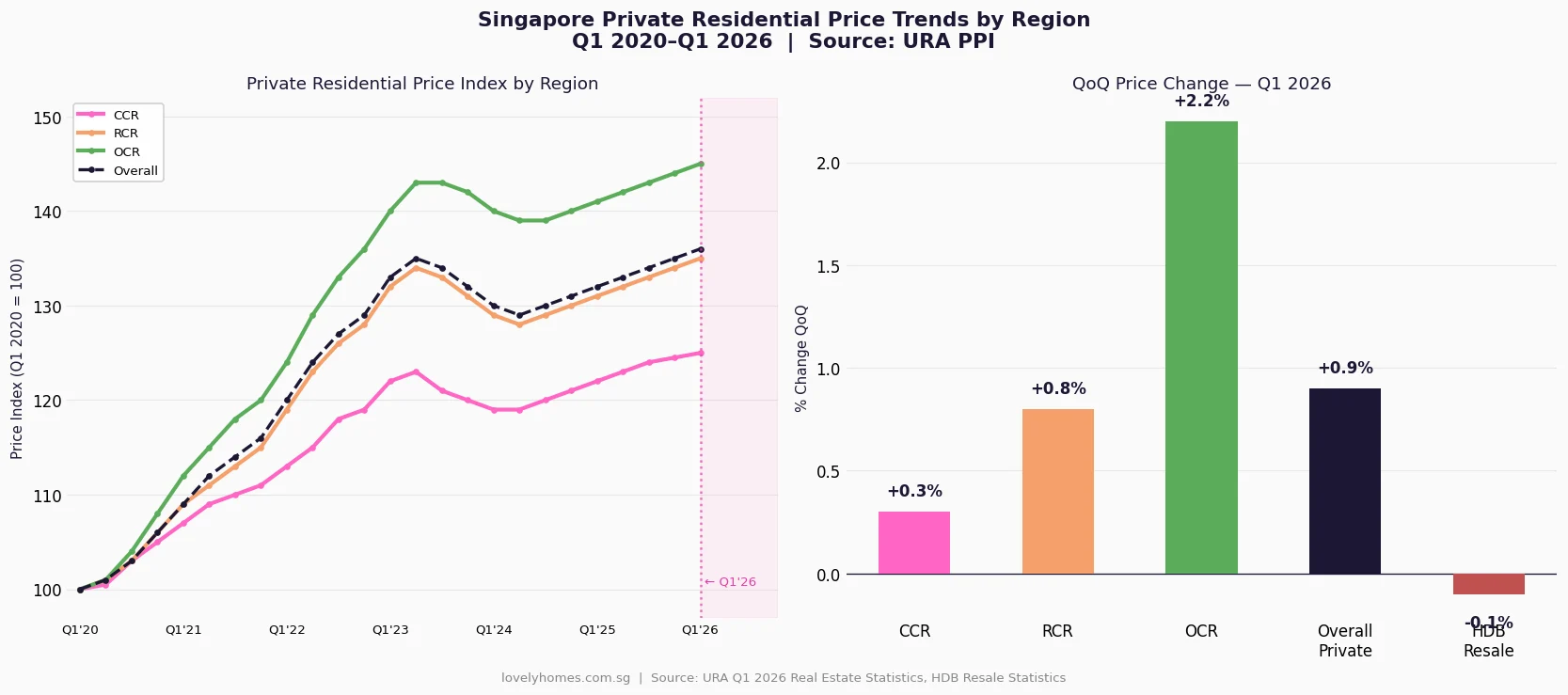
The OCR is the undisputed pace-setter. A 2.2% quarterly gain in Q1 2026, following similar momentum in late 2025, reflects genuine demand from HDB upgraders — a cohort whose Minimum Occupation Period (MOP) clears in waves and who target mass-market new launches in the S$1.3M–S$1.8M range. The 2H 2026 GLS programme deliberately concentrates supply here (Tampines Street 94, Bayshore Road), which should moderate any further sharp price acceleration without causing a price correction.

The RCR recorded 0.8% QoQ growth — solid mid-field performance driven by a mix of first-time private buyers, professionals, and some foreign-related buying in the city-fringe. River Valley Green Parcel C (awarded June 2026 at a top bid of approximately S$1,730 psf ppr) is the headline indicator of developer confidence in this zone.

The CCR grew just 0.3% QoQ, a subdued reading that reflects several headwinds: the 60% Additional Buyer’s Stamp Duty (ABSD) on foreigners that has been in place since April 2023 continues to suppress international transaction volumes; and the global macro uncertainty discussed in the risk section below has weighed on ultra-high-net-worth discretionary buying. That said, CCR is not in distress — it remains a long-term beneficiary of Singapore’s family office growth and wealth inflows.
Singapore private residential price index CCR RCR OCR Q1 2026 regional trends
Figure 2: Singapore Private Residential Price Index by Region (Q1 2020–Q1 2026) and QoQ Change for Q1 2026. Source: URA Q1 2026 Real Estate Statistics.

HDB Resale Market: A Healthy Pause, Not a Reversal

Singapore’s HDB resale market has been one of the defining investment stories of the 2020s. From a low point in 2019 (RPI ≈ 132), prices surged to an index of 203.4 by Q1 2026 — a 54% cumulative increase. The Q1 2026 dip of 0.1% QoQ is, in that context, the market catching its breath after an exceptional run rather than a structural reversal.

Two counterintuitive data points reinforce this view. First, million-dollar HDB transactions reached a record quarterly high of 412 in Q1 2026 — indicating that at the premium end of the resale market (large mature-estate flats, high-floor units in sought-after towns), demand remains fierce. Second, overall HDB resale transaction volumes for Q1 2026 remained healthy, with four-room flats accounting for the largest share (approximately 2,690 transactions in Q1 2026 alone) at a median price of around S$575,000.

For 2H 2026, the HDB resale market is likely to remain range-bound rather than sharply appreciating or correcting. MOP cohorts from the 2016–2019 BTO launches are gradually clearing, releasing units back to the resale market — but supply from this channel is relatively thin compared to the 2013–2016 peak cycle. Demand remains supported by couples who cannot access BTO (due to income ceiling, citizenship mix, or urgency) and Permanent Residents who remain ineligible to buy BTO directly.

Developer Sales and the New Launch Pipeline

Developer sales activity is the indicator most directly shaped by new launch timing. The monthly data tells a story of feast and famine: January to April 2026 saw 1,120, 895, 1,348 and 1,548 units sold respectively — solid months driven by a cluster of project launches. May 2026 crashed to 447 units (-71.1% month-on-month), not because demand evaporated, but because there were few projects launching that month.

The pipeline going into 2H 2026 remains substantial. URA data shows 17,032 unsold units in the private pipeline as of Q1 2026 (total pipeline including units not yet launched: 42,561). The 2H 2026 GLS Confirmed List adds nine further sites including Lentor Gardens Parcel A and B, Bayshore Road, Tampines Street 94, and an EC site at Jurong East. These launches are phased across 2H 2026 into 2027, so the impact on completed supply will be felt primarily in 2028–2030.

Rental Market: Correction Underway, Yields Compressing

Singapore’s private residential rental market began correcting in 2024 after a record two-year surge and that correction extended into 2026. The URA rental index fell 1.2% QoQ in Q1 2026, following declines across 2024 and 2025. In absolute terms, rents remain significantly above their pre-pandemic levels — a 2BR in D15 that rented for S$2,800/month in 2019 may still command S$4,200–S$4,800/month in 2026 depending on specification — but the exceptional post-pandemic pricing has normalised.

For investors, this rental correction compresses gross yields. A S$1.5M 2BR in the RCR yielding S$4,500/month gross generates a gross yield of approximately 3.6%, which is broadly comparable to bank deposit rates in 2026. Net yield after management fees, property tax, and maintenance is lower — making the case for property investment in 2026 primarily a capital appreciation thesis rather than a pure income play.

2H 2026 Market Outlook Summary

Segment Base Case Bull Case Bear Case
Private Residential (Overall) +1%–2% for full year 2026 +3%–4% if rates ease and demand recovers Flat to -1% if global recession deepens
OCR (Mass Market) Continues outperforming; +2%–3% YoY +4%–5% with strong HDB upgrader demand Supply pressure from GLS launches moderates gains
RCR (City Fringe) Steady +1%–2% YoY +3% with new launch interest Flat if affordability ceiling is hit
CCR (Core Central) Sideways to +1%; foreign buyer ABSD drag +2%–3% if ABSD reviewed or wealth inflows surge -1%–2% if global HNW sentiment deteriorates
HDB Resale ±0.5% QoQ; range-bound in H2 +1%–2% if upgrader demand stays robust -1% if affordability stress bites flat demand
Private Rental Further -2%–4% as supply catches up Stabilises if employment influx resumes Deeper correction if expat headcount falls

Worked Example: The Chen Family — Buy in 2H 2026 or Wait?

Mr and Mrs Chen are Singapore Citizens in their early 30s. They have cleared their HDB MOP on their Bishan 4-room flat and are looking to upgrade to a 3-bedroom OCR condo. They have combined income of S$13,500 per month, CPF OA savings of S$180,000, and cash of S$120,000.

They are eyeing a 3BR at an upcoming OCR launch in Q3 2026 priced at S$1.65M. Under the ABSD SC couple remission scheme, they can purchase the new condo and claim a full refund of the 20% ABSD (S$330,000) provided they sell their HDB flat within six months of the condo purchase date.

Key numbers: BSD S$47,600 (payable from CPF); ABSD S$330,000 (cash, but refundable within six months of HDB sale); 5% cash S$82,500; legal fees ~S$5,500. Bank loan: 75% LTV = S$1,237,500 at 3.2% over 30 years → monthly repayment approximately S$5,338. TDSR = S$5,338 ÷ S$13,500 = 39.5% (PASS, under 55%). Total cash needed upfront: ~S$208,000 (cash component + ABSD float pending HDB sale).

Should they wait? If OCR prices rise another 2% by Q1 2027, the same unit would cost S$1,683,000 — an additional S$33,000. If interest rates fall 50 bps by then, monthly repayments fall by ~S$300/month. The calculus slightly favours acting when they are ready rather than trying to time the market precisely, provided the ABSD remission window can be managed. See our guide on ABSD remission for SC couples for the full rules.

What Might Come Next: Risks and Catalysts for 2H 2026

The Singapore property market operates at the intersection of domestic fundamentals (employment, wage growth, HDB upgrader cohorts) and global macro forces (US interest rates, geopolitical risk, capital flows). For the second half of 2026, both sides of that equation are in play.

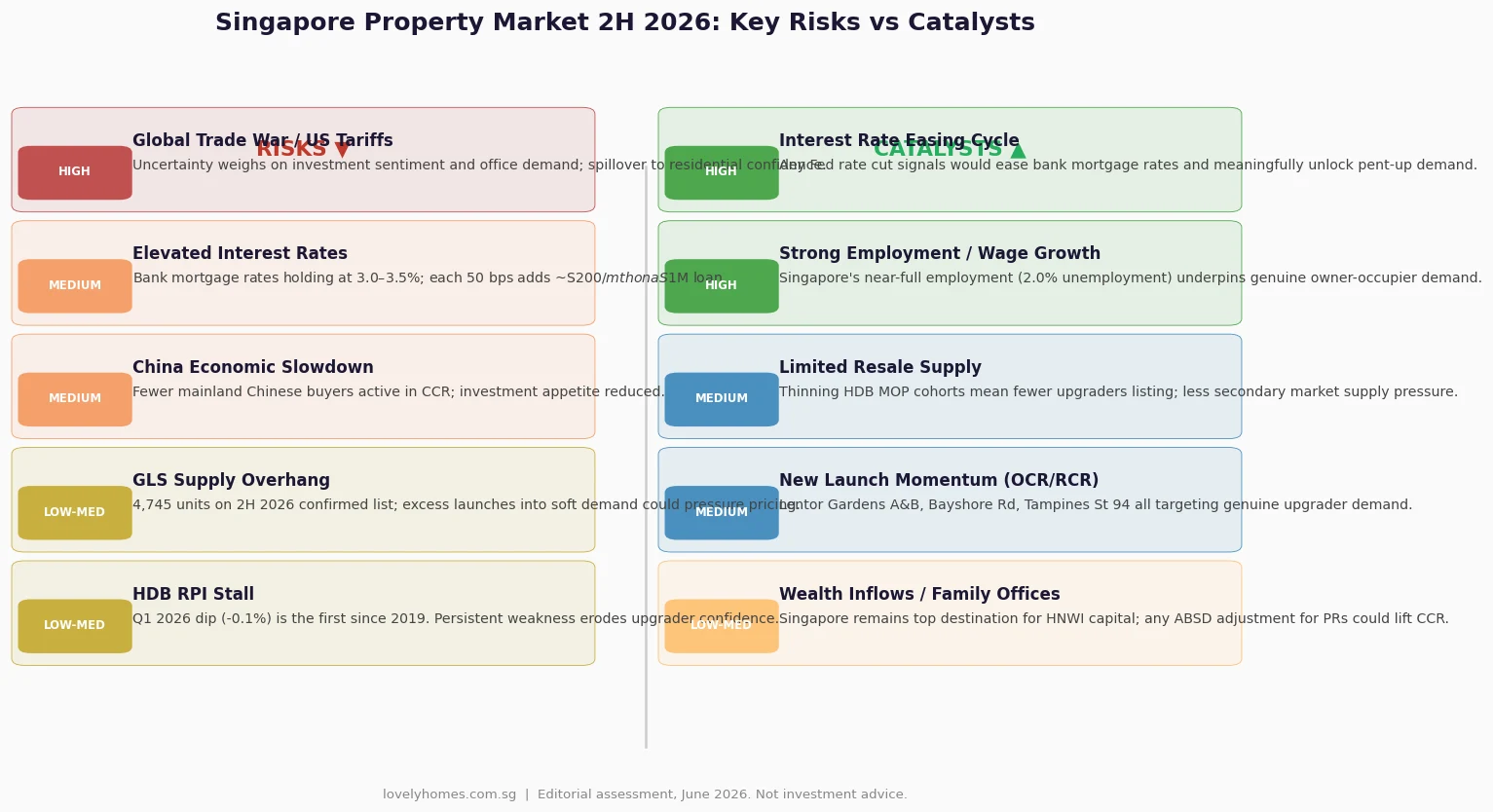
Key downside risks include the persistence of elevated interest rates — if the US Federal Reserve holds rates through 2026 without cutting, Singapore bank mortgage rates (which track SORA and swap rates) will remain in the 3.0–3.5% range, keeping affordability stretched. Continued global trade disruptions from US tariff policy create a dampening effect on business investment sentiment and, indirectly, on expatriate headcounts and rental demand. China’s economic slowdown reduces the pool of Chinese-origin buyers who were historically active in the CCR.

Key upside catalysts include the prospect of Fed rate cuts in September or December 2026 — even one 25-basis-point cut would move Singapore’s forward rates and boost buyer confidence. Singapore’s own fundamentals remain strong: the unemployment rate is approximately 2.0%, wage growth is positive, and the Government’s managed-supply approach via the GLS programme means developers are not flooding the market with distressed inventory. Any relaxation of ABSD for permanent residents (which has been debated, though there is no official signal) would be an immediate CCR and RCR catalyst.
Singapore property market second half 2026 risks catalysts analysis
Figure 3: Singapore Property Market 2H 2026 — Key Risks vs Catalysts. Editorial assessment as at June 2026. Not investment advice.

Frequently Asked Questions

Will Singapore property prices drop in 2H 2026?

A broad price correction in 2H 2026 is not the base-case scenario for most analysts. Singapore’s property market is underpinned by limited land supply, robust employment, and the Government’s disciplined GLS programme which calibrates supply to demand. The most likely outcome for 2H 2026 is modest positive growth in the private residential segment (0%–2% for the full year in a base case) and range-bound movement in HDB resale. A sharp correction would require a confluence of events unlikely to materialise simultaneously: a major spike in unemployment, a severe global financial shock, and a government decision to release large additional land supply. None of these is the current outlook.

When will the URA Q2 2026 Flash Estimates be released?

Based on URA’s established release pattern, the Q2 2026 Flash Estimates for the private residential property price index are expected in the first week of July 2026 — likely 1 or 2 July. The full Q2 2026 real estate statistics (including detailed regional breakdowns, rental index, and developer sales data) typically follow approximately three to four weeks later. The flash estimate gives a preliminary QoQ price change figure; the full release provides granular transaction and rental data. LovelyHomes will publish a dedicated analysis article as soon as the data is available.

What does the HDB resale -0.1% dip in Q1 2026 actually mean for sellers?

A -0.1% quarterly change in the HDB Resale Price Index is, in practical terms, negligible. On a S$600,000 flat, it represents a S$600 notional price movement — far smaller than the typical negotiation buffer in any individual transaction. What it signals is a shift in market psychology: buyers are less willing to pay premiums above valuation (Cash-Over-Valuation, or COV), and the exceptional seller’s market conditions of 2021–2024 have normalised. Sellers should still expect good prices — the index is 54% above its 2019 trough — but they should set realistic expectations and price to comparable transactions rather than aspirationally. For guidance on reading HDB data, see our HDB Resale Price Index Guide.

Is this a good time to buy a private property in Singapore?

This depends entirely on your personal financial circumstances, intended holding period, and purpose. If you are buying for genuine owner-occupation (primary home or long-term family residence), timing the market precisely is less important than buying within your means — ensuring your TDSR is comfortable, that you have adequate cash reserves, and that your loan tenor is appropriate. If you are buying as an investment (rental yield or capital appreciation), you need to stress-test the numbers at current mortgage rates (3.0–3.5%) and assess whether the rental yield justifies the carrying cost. For a personalised assessment, consult a licensed financial adviser and a property professional. See also our Singapore Property Financing Guide for a full breakdown of LTV, TDSR, and MSR rules.

How does the 2H 2026 GLS supply affect new launch prices?

The 2H 2026 Government Land Sales Confirmed List adds nine sites capable of yielding approximately 4,745 private and EC units. This is a substantial supply injection, particularly into the OCR and RCR. In theory, more supply means developers compete harder for buyers, which moderates launch prices. In practice, Singapore developers rarely slash prices — they tend to phase launches to match demand and hold firm on pricing. The more likely outcome is that new launches in 2H 2026 are priced at modest premiums (5%–8%) to recent comparables rather than at exceptional premiums. Buyers interested in specific sites such as Lentor Gardens Parcels A and B, Bayshore Road, or Tampines Street 94 should monitor the URA tender awards and developer launch announcements as they are made throughout 2H 2026. Full details of all 2H GLS sites are in our 2H 2026 GLS Programme Guide.

What is the ABSD rate for Singapore Citizens buying a second property in 2026?

A Singapore Citizen purchasing a second residential property pays 20% ABSD on the purchase price or market value, whichever is higher. This is paid in cash (CPF cannot be used for ABSD). For SC couples who own an HDB flat, the 20% ABSD on their second private property can be refunded under the SC Couple ABSD Remission Scheme, provided the HDB flat is sold within six months of the completion of the private property purchase. The full rules are detailed in our ABSD Remission Guide and Complete ABSD Singapore 2026 Guide.

How do I track the Singapore property market between official URA releases?

Between URA quarterly releases, you can monitor real-time trends through several free sources. The URA REALIS portal (accessible via My SingPass) provides transaction-level data for private residential properties. The HDB Resale Flat Prices portal shows individual HDB transactions. SRX Property and EdgeProp Singapore publish weekly market commentaries based on caveats lodged. The Business Times Real Estate section and Channel NewsAsia Property cover major announcements and tender results. For a guide on how to interpret the data you find, see our HDB Resale Price Index Guide and CCR RCR OCR Property Guide.

Related Articles

Disclaimer: This article is for general informational purposes only and does not constitute financial, investment, or property advice. All property market data is sourced from the Urban Redevelopment Authority (URA) and Housing Development Board (HDB) official releases as at Q1 2026. Property prices, interest rates, and government policies can change — readers should refer to the latest official URA (ura.gov.sg), HDB (hdb.gov.sg), MAS (mas.gov.sg), and IRAS (iras.gov.sg) publications and consult a licensed financial adviser or property professional before making any property-related decision. Past price performance is not indicative of future results.

My review of One Marina Gardens by the Kingsford Group

My review of One Marina Gardens by the Kingsford Group

[This article was first posted on daryllum.com on 26 Mar 2025]


You know what I find perplexing? If location is key when it comes to property investment, then why are properties in the core central region getting so little interest from developers and buyers alike? Little when comparing the interest in places like Tampines. Buyers do realise that projects like Parktown Residences are located in Tampines and Tampines is located at the east end of Singapore yup? Was the pricing so impressively attractive that buyers needed to flood the showrooms? Yes it is an integrated development but why do buyers not consider something in the core central region as well?

The highly restrictive Additional Buyers’ Stamp Duties (ABSD) levied on foreign buyers has put the brakes on almost all foreign purchases. I have always maintained that if a foreigner chooses to pay the 60% ABSD, there is something that should be scrutinised. Imagine this, a foreigner purchases an SGD$5 million property. He pays SGD$3 million as ABSD. His total acquisition cost, including the usual Buyers’ Stamp Duty and other fees amount more than SGD$8 million. As a foreigner with more than SGD$8 million, he would have choices galore. He has access to properties all around the globe. If that individual can purchase properties from all over the world, what is his motivation to pay more than SGD$8 million for something that is perhaps valued at around SGD$5 million? This means that the moment he purchases the property, the asset that he is holding is worth much less than what he paid for. This, in investing sense, is purely illogical. However, if that individual acquired his monies relatively easily, then he would not mind losing that value. Foreign buyers are almost non-existent. In fact, if I were the authorities, I would question and scrutinise the very few purchases by foreigners. I would want to understand the motivation and purpose for such a purchase. Well, if there were no clear motivation for the buyer to purchase Singapore properties then it would be prudent to scrutinise his source of funds for the property purchase.

So then, foreign property purchases have slowed to a trickle. This perverts the normal demand for Singapore properties. Foreigners would be less motivated by things like familiarity and proximity to other family members. For example, if my family members and I have been living in a certain part of Singapore, say Toa Payoh, then if there is a new property launch in Toa Payoh, I would be more likely to be enticed to make a purchase because I want to live near my family members and also to live in a part of Singapore that I am familiar with. This is why, to me, properties like Chuan Park are selling well as compared to a property like Aurea. There are fewer existing families living around Aurea as compared to Chuan Park. Hence there will be less “familiar” buyers for Aurea. Go to Chuan Park and the typical buyer will be someone who lives or lived around the area. Or has family members living in the area.

Location, despite what we have always focused on, may not weigh as much on current buyers’ consideration in today’s market. Familiarity with a particular location is high on buyers’ consideration. This is why many developers look at marketing their projects to HDB upgraders. This can be seen in the weak bids for land in areas with less HDB upgraders. Let me turn you back to end 2024 where the Marina Gardens Crescent site drew just one bid of SGD$770.5 million, or SGD$984 per square foot per plot ratio (psf per) This bid was too low and URA did not award this site to the bidder. This bid is nearly 30% lower than the neighbouring Marina Gardens Lane site. This is the site on which One Marina Gardens is located on. This one Marina Gardens Lane site was awarded to the Kingsford Group in July 2023 for SGD$1.03 billion or SGD$1,402 psf ppr. Look around this area. There are no residential properties around the area. It is inconceivable that someone will walk into the One Marina Gardens sales gallery and say, “I lived in this area for the past few decades and would like to purchase a unit in this development due to my familiarity with the location”.


Details about the development

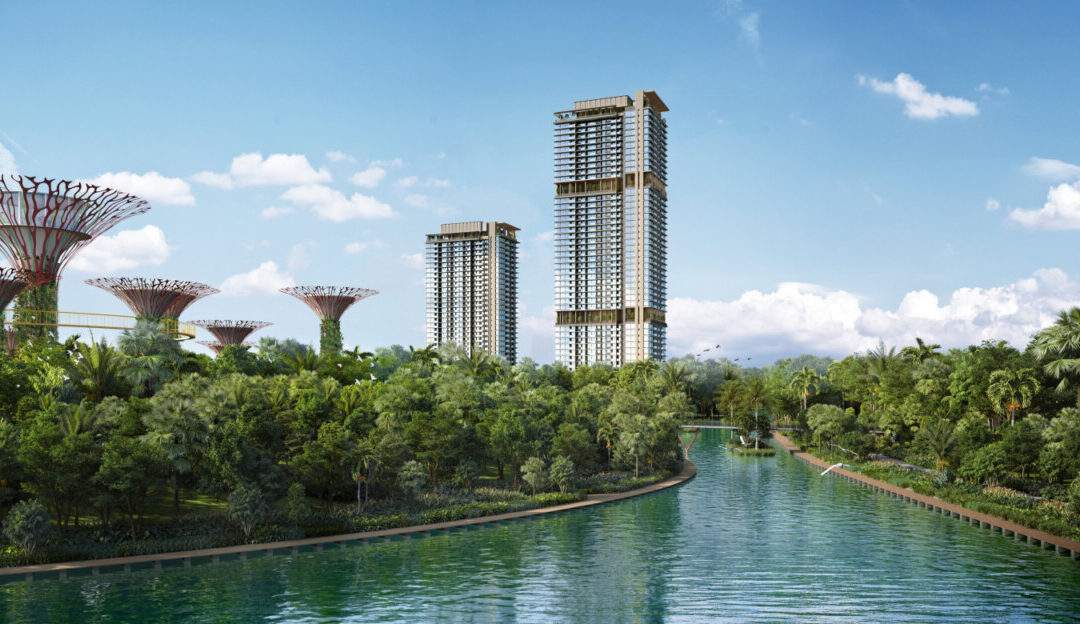
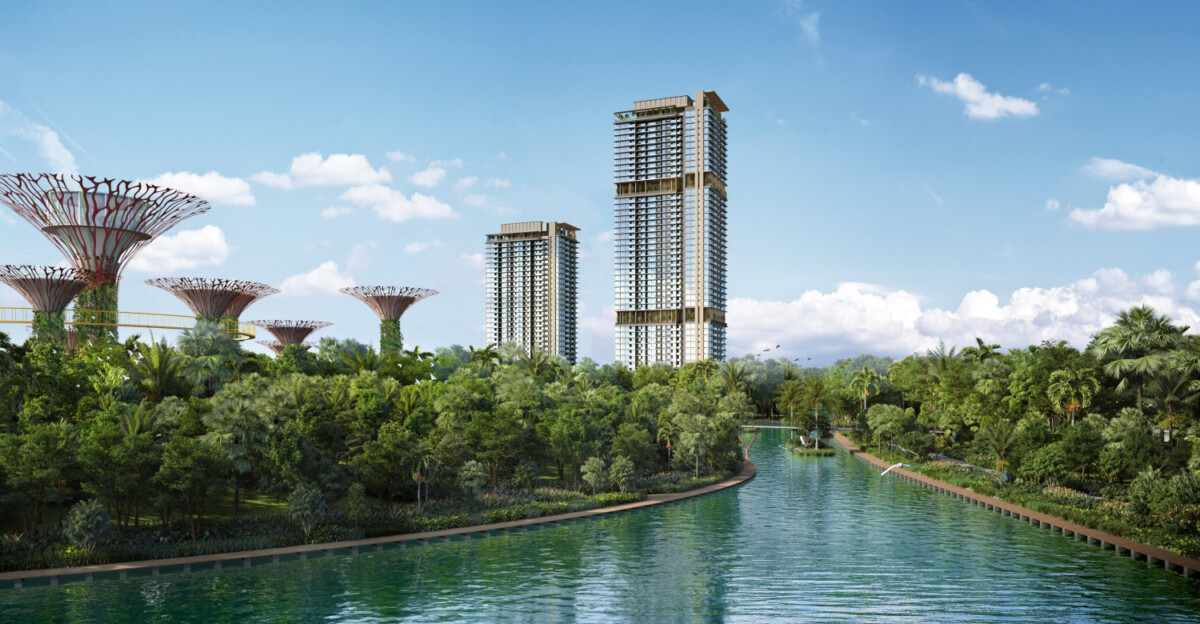
One Marina Gardens is a 99-year leasehold development. The total site area is 12,245.10 square meters. The development consists of 937 units spread across two blocks. The two blocks are 30 and 44 storeys. It will also have commercial units like 2 restaurants, 2 shop units and a childcare centre. There will be 445 carpark lots. The expected completion is in 2029.


Where is the development located?

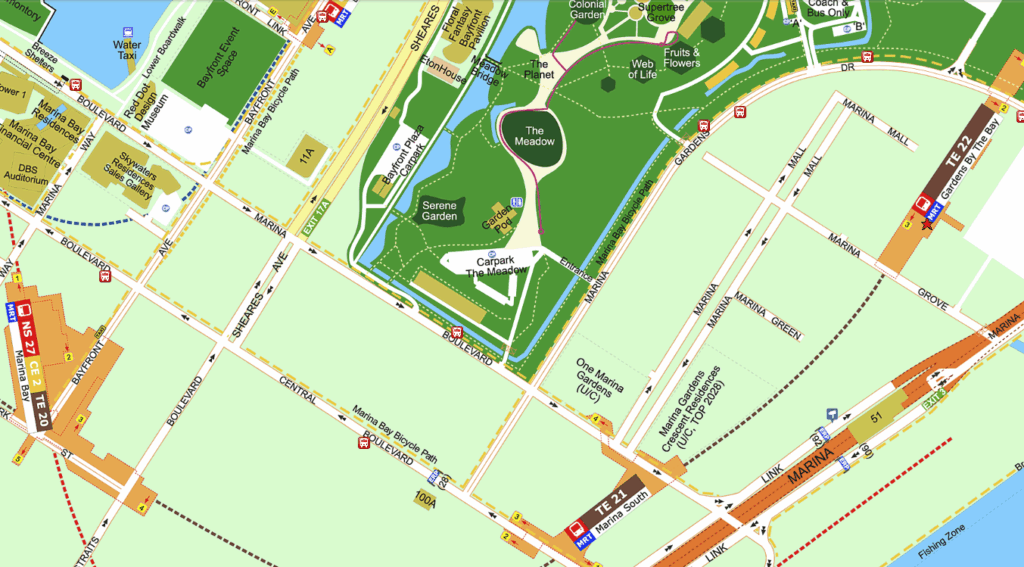
One Marina Gardens is located along Marina Boulevard.

One Marina Gardens Location Map


It is located right next to exit 4 of Marina South MRT Station. Marina South MRT Station is one of the stations on the Thomson East Coast Line. Marina South MRT Station is not yet opened. It is scheduled to open in tandem with developments in this area. I believe that this means that when One Marina Gardens is completed, Marina South MRT Station will be operational. For the purposes of this review, we will refer to TE22 Gardens by the Bay MRT Station rather than TE21 Marina South MRT Station.

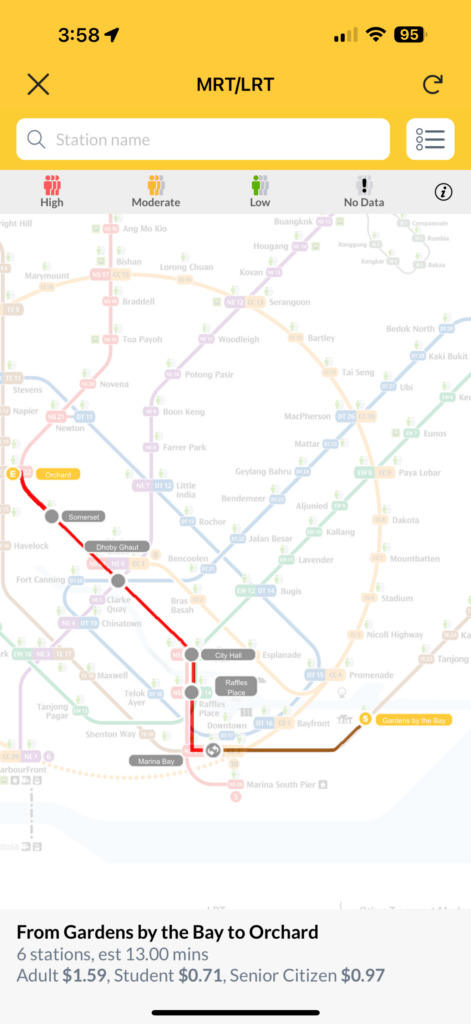
Travelling from Gardens by the Bay MRT station to Orchard MRT station would take a total of 13 minutes over 6 stations. The cost is $1.59.

Gardens by the Bay MRT to Orchard MRT


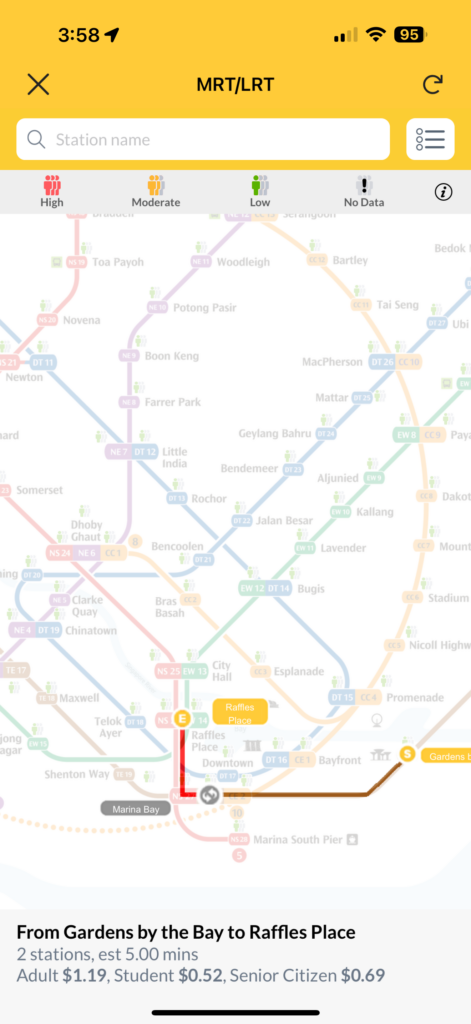
Travelling from Gardens by the Bay MRT station to Raffles Place MRT station would take a total of 5 minutes over 2 stations. The cost is $1.19.

Gardens by the Bay MRT to Raffles Place MRT


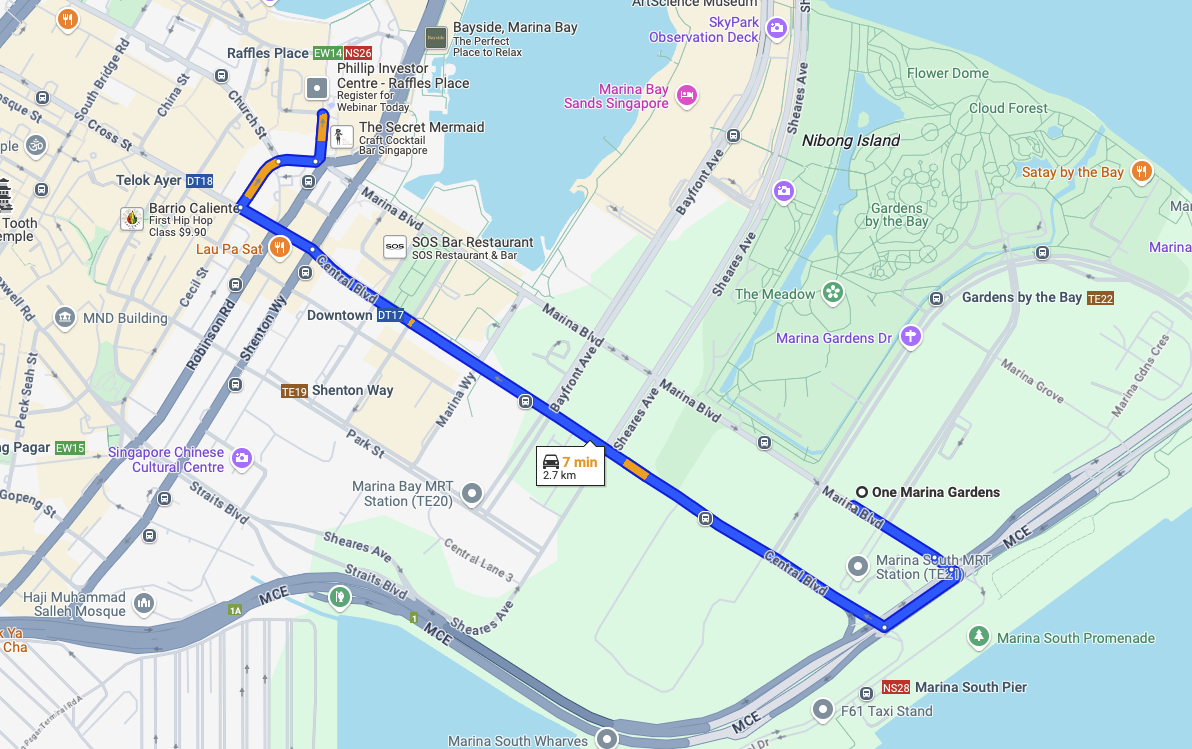
The drive from One Marina Gardens to Raffles Place would take approximately 7 minutes and the distance travelled is about 2.7 kilometres.

The drive from One Marina Gardens to Raffles Place


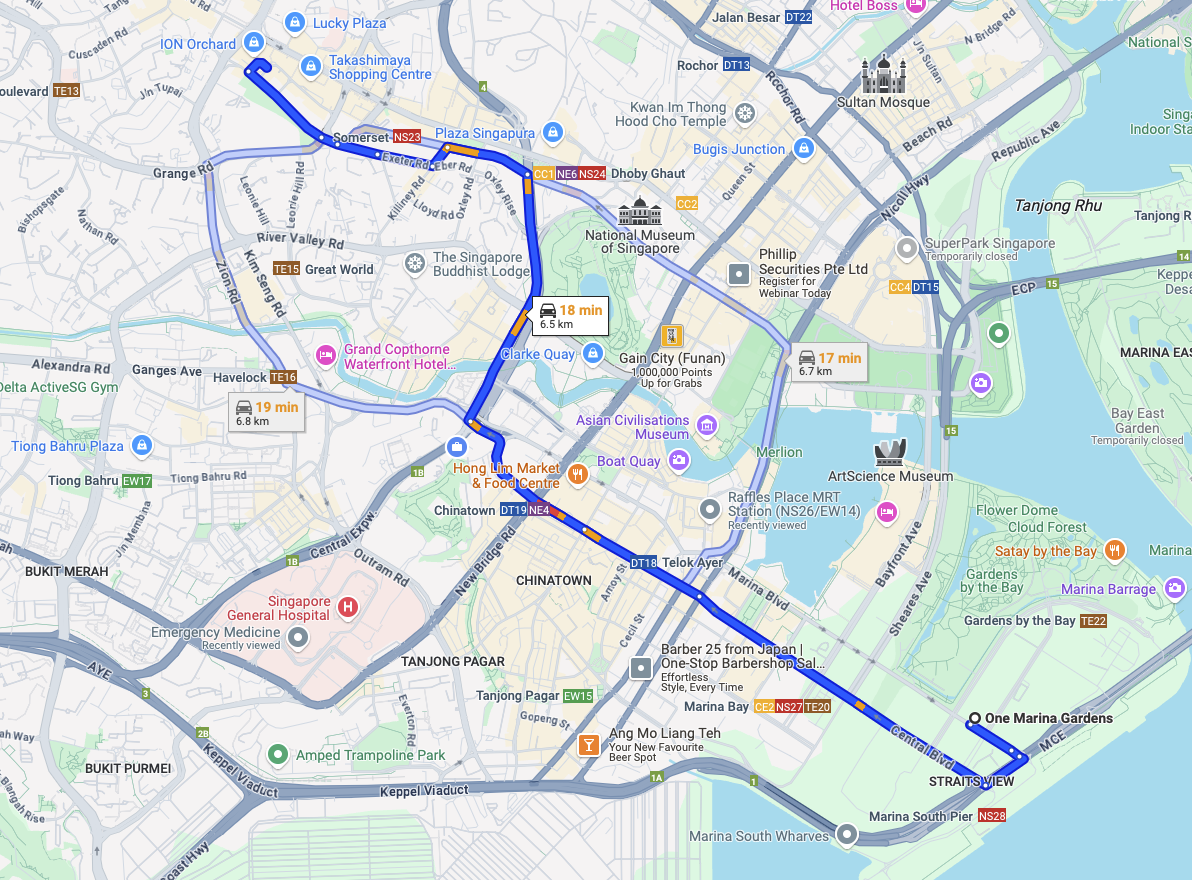
The drive from One Marina Gardens to Orchard Road would take approximately 18 minutes and the distance travelled is about 6.5 kilometres.

The drive from One Marina Gardens to Orchard Road


One Marina Gardens is located at the fringe of the Marina Bay Financial District. I do not think that residents would drive to Raffles Place. I believe the short train ride would be the most ideal option. As a point of reference, the Google Map query was done in the afternoon at about 4pm. Hence traffic is light. If you are driving during peak hours, do factor in additional travelling time.


Who is this development for?

I genuinely think that if you believe in the concept of catchment areas, then why are you not considering properties in and around the Marina Bay Financial District? Are your tenants not coming from people who work in offices in the area? If so, I do think that if you are looking to purchase for rent, then this is the ideal property for you. I am a person who always focuses on what is around the area. If the area is littered with offices with highly paid employees, then this is a huge plus.

One of the reasons I can offer as to why many Singaporeans do not think this way is because of the ABSD. On multiple properties, ABSD applies. Hence Singaporeans only have one property purchase which is not subject to ABSD. If so, that first property is likely to be a property in a location which they are familiar with. In certain cases where a married couple plans to have two private properties, one under the husband’s name and another one under the wife’s name, then this is an ideal second property.

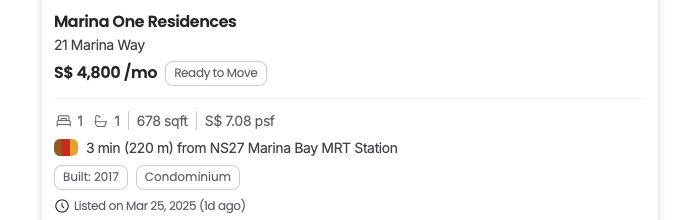
Marina One Residences One Bedroom for rent


A simple search on PropertyGuru would show that a 1 bedroom condominium at Marina One Residences is going for about $4,800 a month.

According to a recent Business Times article, the 1 bedroom units at One Marina Gardens starts at SGD$1.16 million.

Working out the yield based on an assumed rent of $4,800 a month or $57,600 per annum,

$57,600 / $1,160,000 = 4.97% per annum

Of course there are a few assumptions when it comes to my calculation. I am making the assumption that the 1 bedroom unit at One Marina Gardens can be rented out for $4,800 in about four years time. I believe my assumption is reasonable because it is likely that rents are likely to increase in the next four years, albeit at a much slower pace. The $4,800 is based off the current rent in an older development. Secondly, the purchase price is based on the lowest priced unit. However, if you factor in a higher purchase price, you would still receive a yield of more than 4%.

Ever heard the notion that yields tend to be lower in the city centre? Well not necessarily so. Especially when current property prices in the Outside Central Region (OCR) are so close to the prices in the Core Central Region (CCR) and Rest of Central Region (RCR). Try going to Chuan Park and getting a 1 bedder for less than SGD$1 million. I do not think it is possible. Then look at the prices at developments in areas that are so much closer to Singapore’s Central Business District (CBD).

Hence I firmly believe that if I were looking for a property with good rentability, One Marina Gardens is something I would look at.


The selling points of the development

Rentability and closeness to the MRT station and Singapore’s CBD. If location is the prime determinant of how much one should pay for a certain property, is the market making a mistake in looking away from developments in the Marina Bay Area?

Oh yes, heard of the Marina Bay Development Plan? The Greater Southern Waterfront?

If you require more information about developments in this area, you can refer to the URA website on The Marina Bay Story.

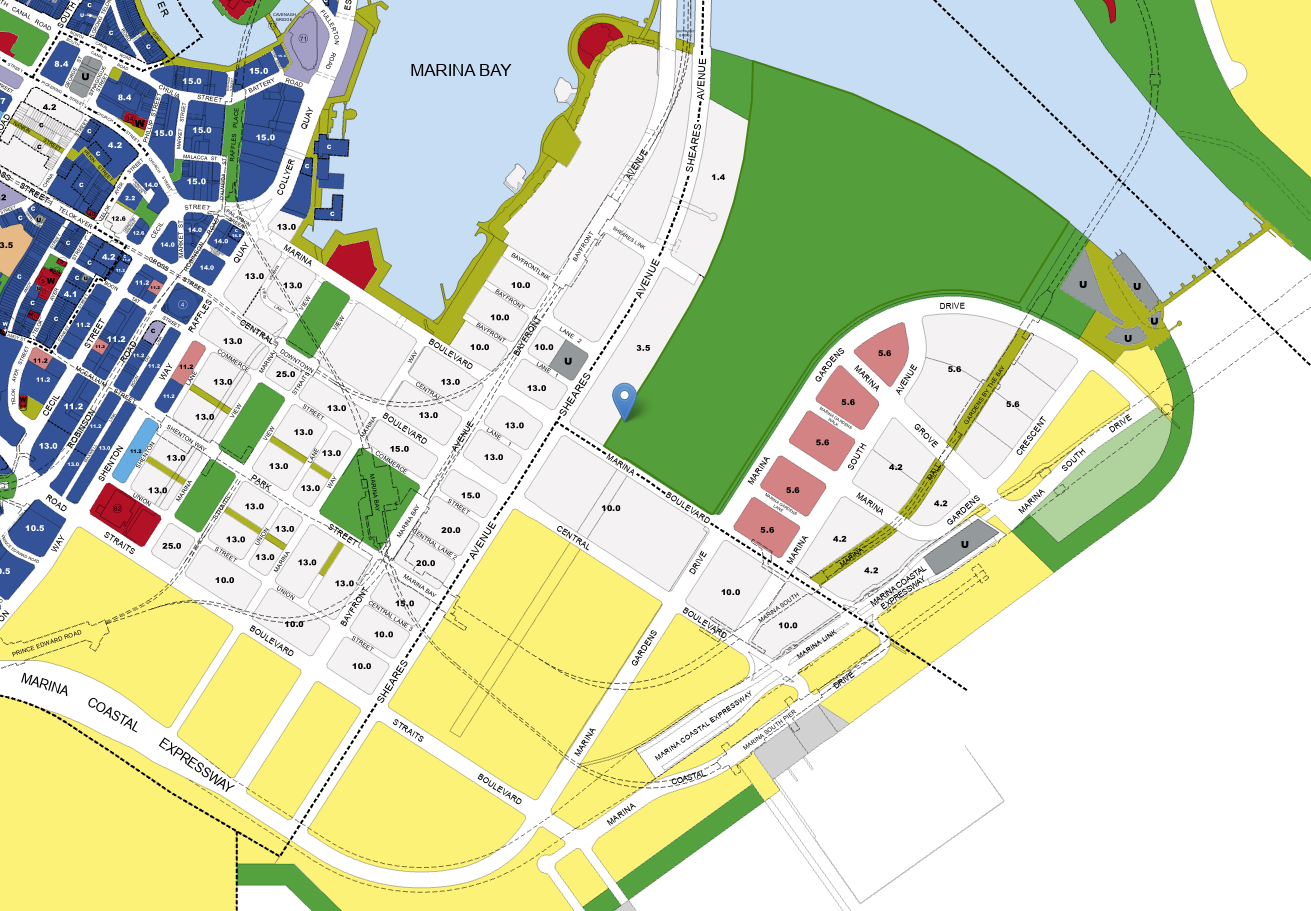
If you need more confirmation that there will be developments in the area, this is the URA Master Plan. The reddish pink areas where One Marina Gardens sits on are zoned Residential with Commercial at 1st storey. Those in white are White sites. It is clear that this is an area slated for future development. There will be HDB flats built in this area as well. It was announced in 2023 that more homes are planned in central locations to let more people enjoy city living. Marina South is one of those areas stated. With HDB flats in the vicinity, the usual amenities that are associated with HDB neighbourhoods are likely to also follow suit. Hence, if you do not have a food centre or supermarkets in the vicinity currently, if HDB flats are built here, then all these conveniences should make their way to this neighbourhood.

URA Master Plan


Possible bad points of the development

There is another plot of land slated for development right next to One Marina Gardens. This would block, perhaps partially, the sea view of units facing the sea. However, it is likely that there will be many new developments in the area so having an unblocked view would not be a permanent thing.


One Marina Gardens


Pricing 4/5

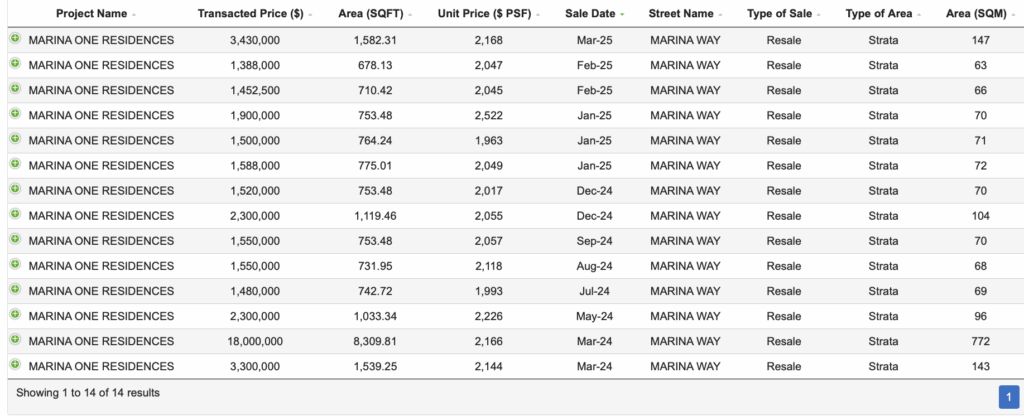
Prices start from $1.15 million or about SGD$2,762 psf. Yes you can get a Marina One Residences unit for $1,993 psf but then for some reason there is also an outlier that transacted at $2,522 psf. The average psf for transactions within the last 1 year is $2,112. Assuming an average price of about $2,900 psf, One Marina Gardens is going for a 37% premium over Marina One Residences. Of course you are getting a new lease and this is in an area with a lot of new developments. Hence you will need to factor this into the premium that you are paying.

Marina One Residences Past Transactions


Location 4.5/5

I believe this area is going to be filled with amenities as private developments as well as HDB developments start to fill the area. One Marina Gardens is the closest you can get to the Marina South MRT Station. The thing about the URA is that once it has announced developments in the area, it is most certainly going to happen. I believe in time to come this area is going to develop into an extremely desirable area.


If there were no ABSD on purchases beyond a Singaporean’s first property, I would seriously consider a property like One Marina Gardens.


Yours sincerely,

Daryl Lum


My other recent Singapore property reviews:

My review of Aurea by Far East Organization and Perennial Holdings

My review of Parktown Residence by CapitaLand, UOL and Singapore Land


Translate »