Chinese Capital Surge into Singapore Property 2026: What Mainland Investment Means for Buyers

Chinese Capital Surge into Singapore Property 2026: What Mainland Investment Means for Buyers

Quick Answer — Chinese capital and Singapore property in 2026

  • China became the second-largest source of fixed-asset investment in Singapore in 2025, accounting for approximately 21% of S$14.16 billion in total committed fixed-asset investment across all sectors — up from around 2.5% the prior year.
  • Chinese-linked developers are actively bidding for Government Land Sales (GLS) sites and replenishing their residential land banks in Singapore.
  • The 60% ABSD on foreign residential purchases has not deterred Chinese developers, who pay 40% developer ABSD (5% non-remittable, 35% remittable on qualifying sale of all units).
  • Individual Chinese nationals buying Singapore residential property still face the full 60% ABSD on any purchase — there is no bilateral tax treaty carve-out between China and Singapore on ABSD.
  • The Singapore government has acknowledged the investment flows but has given no indication of relaxing the existing cooling-measures framework in response.

China’s Investment Surge — From Marginal to Major Player

Singapore has always been a destination for global capital. What is new in 2026 is the pace and scale at which mainland Chinese money has repositioned itself within the city-state’s investment ecosystem. According to data cited by South China Morning Post and corroborated by regional financial media in early May 2026, China-origin fixed-asset investment in Singapore across all sectors totalled an estimated S$2.97 billion in 2025 — representing around 21% of Singapore’s total S$14.16 billion in committed fixed-asset investment. This compares to approximately S$354 million (2.5%) in 2024.

The drivers of this shift are multiple and mutually reinforcing. Geopolitical tensions between China and the United States, ongoing uncertainty in Hong Kong’s role as a regional financial hub, a domestic Chinese property market that remains structurally stressed, and Singapore’s well-understood legal and regulatory environment have all contributed to capital outflows from China that disproportionately target Singapore. For Chinese institutional investors, Singapore is familiar — the legal system is English-language common law, property rights are robustly protected, and there is a large existing Mandarin-speaking business community.

China share of Singapore fixed-asset investment 2025 vs 2024 — Chinese capital property market
Figure 1: Estimated China-origin fixed-asset investment in Singapore vs selected other sources, 2025. Source: SCMP citing EDB data, May 2026.

How This Flows Into the Property Market

Fixed-asset investment encompasses manufacturing plants, data centres, logistics hubs, financial services operations, and real estate. The property-market channel specifically manifests in three ways.

Developer land banking. Chinese-linked property developers — firms with mainland Chinese ownership or significant Chinese institutional backing — have become active bidders in Singapore’s GLS programme. Forsea Holdings (Chinese-owned) was awarded the one-north Queensway residential site in 2025. Qingjian Realty (with Chinese sovereign-fund links via its parent Qingjian Group) remains active in EC and private residential land. These firms are not new to Singapore but their bidding frequency and scale have increased materially since 2024.

Commercial real estate. Chinese institutional investors have been acquiring strata-titled commercial and industrial assets — office floors, retail shophouses, and industrial units — which do not attract ABSD. For investors seeking Singapore-dollar exposure to Singapore real estate without the 60% ABSD drag, commercial property is the natural vehicle. Freehold shophouses along heritage corridors in Districts 1, 2, and 7 have attracted particular interest from Chinese family offices.

Residential purchases by high-net-worth individuals. Despite the 60% ABSD, ultra-high-net-worth (UHNW) Chinese nationals continue to purchase Singapore condominiums and Good Class Bungalows (GCBs). The motivation is not yield — at 60% ABSD, net yields are essentially negligible relative to purchase cost. The motivation is capital preservation, residency (Singapore PR applications are often easier to support when accompanied by a significant economic footprint), and portfolio currency diversification into Singapore dollars.

GLS Bidding — Chinese-Linked Developer Participation

Chinese-linked developer GLS bids Singapore 2024-2026 — land sales demand analysis
Figure 2: Selected GLS bids with noted Chinese-linked developer participation, 2024–2026. Source: URA, industry research, LovelyHomes analysis.

The two CCR GLS sites currently on tender — Peck Hay Road (closing 11 June 2026, ~315 units) and River Valley Green Parcel C (closing 18 June 2026, ~470 units) — are expected to attract bids in the S$1,600–S$1,800 psf per plot ratio (ppr) range based on comparable recent transactions. Industry observers cite Chinese-linked developers as likely participants in both tenders, noting that CCR sites present strong brand positioning for marketing to Chinese UHNW buyers, whose preference for Core Central Region addresses remains robust even at 60% ABSD rates. The alternative interpretation is that units are priced to reflect the ABSD cost as part of the marketing proposition for other buyer profiles — mixed-nationality couples, FTA nationals, or Singapore Citizen investors — rather than purely targeting foreign buyers.

Factor Impact on Singapore Property Market
Chinese developer GLS bids Supports land price floors; higher bid confidence means higher implied launch prices, positive for existing condo valuations in surrounding areas
Commercial property demand Compresses shophouse and strata commercial yields; buyers seeking income plays face tighter cap rates
UHNW residential purchases Supports CCR luxury segment; limited volume impact on mass-market prices
60% ABSD on foreigners Continues to substantially limit volume of Chinese individual purchases; policy unchanged
Developer ABSD (40%) Requires developers to sell all units within 5 years to recover 35% remittable component; creates inventory-clearing incentive

What Singapore’s Position Means for Local Buyers

The surge in Chinese institutional investment is primarily a commercial and developer-side phenomenon. For the Singaporean household buying their first home or upgrading from HDB to private, the direct impact is limited. The mass-market Outside Central Region (OCR) residential segment — where most Singaporean buyers transact — is not significantly influenced by Chinese developer activity, which is concentrated in the CCR and selected RCR developments.

The more relevant indirect effect is on GLS land prices. Increased international developer competition for GLS sites elevates winning bid prices, which flow through to higher launch prices and, with a lag, higher resale prices in surrounding areas. This is a slow-moving structural force rather than a near-term price driver. The Holland Plain Parcel B result (Sim Lian sole bid at S$1,491 psf ppr) in May 2026 — noticeably below the S$1,600–S$1,750 psf ppr range that six-to-eight-bidder competition would have implied — illustrates that developer caution persists even as Chinese interest in the broader investment landscape grows.

For property investors evaluating Singapore condos against a 60% ABSD exposure for Chinese buyers, the read-through is nuanced. Strong Chinese interest in Singapore as an investment destination is a medium-term positive for capital values. But the 60% ABSD is a sufficiently high barrier that it effectively segments the market: Chinese buyers are a price-setter in the ultra-luxury CCR segment but not a material volume driver in broader residential transaction statistics.

What Might Come Next

The Singapore government has consistently calibrated the ABSD framework to domestic affordability and market stability objectives rather than to the source of inbound investment. The April 2023 doubling of the foreigner ABSD rate to 60% was a clear signal that capital-flow considerations do not override the domestic affordability mandate. There is no indication that the government will relax foreigner ABSD to capture Chinese investment flows — the policy calculus runs the other way: allow commercial and industrial investment to flow freely (no ABSD on commercial property, no foreign ownership restrictions on most commercial assets) while maintaining robust residential market protection.

What to watch in the near term: the results of the Peck Hay Road and River Valley Green Parcel C tenders (closing June 2026), which will give a fresh read on bidder depth and the role of Chinese-linked developers in the CCR pipeline. If either tender attracts five or more bidders including at least two Chinese-linked firms, it would confirm that the investment thesis remains active at current GLS pricing levels.

FAQ 1: Can a Chinese national buy a Singapore HDB flat?

No. HDB flats may only be purchased by Singapore Citizens (and in some schemes, Permanent Residents). Foreign nationals — including those from China — cannot purchase HDB flats regardless of ABSD considerations. The eligibility rules for HDB ownership are set by HDB under the Housing and Development Act and are entirely separate from the stamp duty framework.

FAQ 2: Does the 60% ABSD apply to Chinese developers as well as individual buyers?

No. Entities (including developers) purchasing residential property pay 65% ABSD, but housing developers who meet BCA licensing conditions pay 40% ABSD on residential land (5% non-remittable, 35% remittable provided all units are sold within five years of the acquisition date). This structure allows developers — including Chinese-linked ones — to effectively defer or recover most of the ABSD if they develop and sell the project on schedule.

FAQ 3: Does buying a Singapore condo help a Chinese national get Singapore PR or citizenship?

Property ownership is not a direct pathway to Singapore Permanent Residency or citizenship. Singapore’s PR application process is primarily employment-based and discretionary. However, significant economic contributions — including investment through the Global Investor Programme (GIP), which requires a minimum S$10 million commitment into a Singapore-registered company or fund — can support a PR application. Simple residential property ownership does not qualify as a GIP investment and carries no preferential PR weighting.

FAQ 4: Are there any restrictions on Chinese companies owning Singapore commercial property?

Singapore imposes very few restrictions on foreign ownership of commercial or industrial property. Chinese companies and individuals can purchase strata-titled offices, retail units, and industrial units without ABSD and without requiring special approval. Certain sensitive sectors (near defence facilities, for example) may require clearances, but this applies to the use of the property rather than ownership. The Residential Property Act restrictions that limit foreign ownership of landed residential property do not apply to commercial or industrial assets.

FAQ 5: Should I be concerned that Chinese investment is inflating Singapore property prices beyond fair value?

The evidence does not support a conclusion that Chinese investment is systematically inflating residential prices to unsustainable levels. The 60% ABSD effectively quarantines the Chinese buyer pool from the mass-market residential segment where most Singaporeans transact. The URA Q1 2026 Private Residential Property Price Index showed a modest +0.9% quarterly increase — consistent with long-run averages and not indicative of a speculative spike. The government’s clear willingness to tighten the ABSD further if needed (as demonstrated in April 2023) provides a credible policy backstop. The more direct affordability issue for Singaporean households is domestic supply and the pace of BTO completions — not the level of Chinese investment activity.

Related Articles

Disclaimer: This article is for informational purposes only and does not constitute investment or financial advice. Data on fixed-asset investment flows are sourced from third-party media reports citing Singapore EDB figures and are directional estimates rather than official published statistics. Verify all figures against primary sources before making any investment decision. ABSD rates and foreign ownership regulations are subject to change — refer to IRAS and URA for current rules.

Singapore Property as a Safe Haven in 2026: What the URA Data Shows Amid Global Uncertainty

Singapore Property as a Safe Haven in 2026: What the URA Data Shows Amid Global Uncertainty

As trade tensions, currency volatility and geopolitical fractures reshape capital allocation globally, Singapore’s residential property market is drawing renewed attention from high-net-worth investors. This analysis examines what the data actually shows — and what it does not.

Quick Answer

  • Singapore’s private residential price index rose 0.3% quarter-on-quarter in Q1 2026, per URA flash estimates, with the OCR leading at +1.3% — a measured performance that belies the “booming market” narrative in some international headlines.
  • The CCR (Core Central Region) — the segment most exposed to foreign UHNW demand — has appreciated modestly but steadily since Q1 2024, driven by wealth-preservation flows from Europe, the Middle East and Southeast Asia.
  • Singapore’s 65% ABSD for foreign buyers, introduced in April 2023, has not reversed this structural demand — it has filtered out speculative short-term buyers while leaving long-horizon wealth-preservation purchasers largely undeterred.
  • The Asia-Pacific UHNW population grew by approximately 24.8% between 2021 and 2026, generating a larger pool of potential buyers even at elevated ABSD rates.
  • Singapore’s macroeconomic fundamentals — GDP growth forecast 2–4% in 2026, inflation ~1–2%, MAS-managed SGD, AAA sovereign credit — underpin the safe-haven thesis more than any single property market metric.
  • Key risks: rising private housing completions in 2026–2027, softening HDB resale prices, and TDSR constraints limiting domestic upgrader demand.

The Global Context: Why Investors Are Looking at Singapore

In the first quarter of 2026, global financial markets contended with renewed trade tensions, a volatile US dollar and a broader reassessment of risk assets in key emerging-market economies. Against this backdrop, Singapore has attracted significant commentary as a potential beneficiary of capital-flight demand.

Singapore offers a stable rule-of-law jurisdiction under the Singapore Land Authority and the Urban Redevelopment Authority; transparent property transaction records through the URA’s caveat system; a currency managed by MAS under a nominal effective exchange rate framework that has historically appreciated against peer currencies during risk-off periods; and a property market with deep liquidity in the resale condominium segment.

What Singapore does not offer — and this is the corrective that international analysis sometimes omits — is a low-friction entry for foreign buyers. The 65% ABSD on any residential property purchased by a non-Singapore national (excluding US/Iceland/Liechtenstein/Norway/Swiss nationals who receive SC-equivalent rates under FTA arrangements) means the effective purchase premium is extraordinary. A S$5M CCR condominium purchased by a foreign buyer carries an ABSD bill of S$3.25M, bringing total acquisition cost to approximately S$8.43M. That is the price of safe-haven status in Singapore.

URA private residential price index CCR RCR OCR Q1 2024 to Q1 2026
Figure 1: URA Private Residential Price Index — CCR, RCR and OCR sub-markets, Q1 2024 to Q1 2026. Source: URA pr26-31.

What the URA Data Actually Shows

URA’s Q1 2026 release (pr26-31, 25 April 2026) reported an overall private residential price increase of 0.3% q-o-q, down from 0.6% in Q4 2025. The sub-regional breakdown: OCR +1.3% (domestic upgrader and new-launch driven); RCR +0.9% (mid-tier, mix of domestic and regional demand); CCR +0.4% (internationally exposed, softest performer). Transaction volume softened to ~4,041 caveats in Q1 2026, 39.7% below Q4 2025’s 6,699 — a seasonal correction amplified by Chinese New Year, not a structural demand collapse.

UHNW Demand: Real But Measured

UHNW foreign buyer ABSD cost share S$5M CCR condo Singapore 2026
Figure 2: For a foreign UHNW buyer, the 65% ABSD represents 38.5% of total acquisition cost on a S$5M CCR condominium. Source: IRAS ABSD schedule 2023–2026.

Asia-Pacific UHNW population growth of ~24.8% between 2021 and 2026 has expanded the pool of potential buyers even at elevated ABSD rates. For buyers at this wealth tier, the 65% ABSD may represent an acceptable price for: no inheritance tax (abolished 2008), no capital gains tax on property, political neutrality in a fractured geopolitical environment, and world-class infrastructure supporting family relocation. The volume of such buyers is small — perhaps 200–400 transactions annually in the CCR above S$3M — but their price-setting impact is disproportionate.

Structural Safeguards: Why Singapore’s Market Is Different

Singapore’s residential market benefits from structural safeguards that collectively reduce speculative volatility: MAS property loan rules (TDSR 55%, LTV 75%/45%, MSR 30%) enforced since 2013; Sellers’ Stamp Duty (12%/8%/4% on years 1–3) that eliminates short-horizon flipping; URA’s calibrated GLS programme managing supply against demand signals; and an approximately 90% homeownership rate among resident households providing a stable owner-occupier base. Taken together, these mechanisms make Singapore’s residential market more resistant to sharp price swings than most international comparators.

Summary: Singapore Property Safe Haven — Key Metrics at a Glance

Indicator Singapore (Q1 2026) Context
Overall private residential price growth (q-o-q) +0.3% Source: URA pr26-31
OCR price growth (q-o-q) +1.3% Strongest sub-market Q1 2026
CCR price growth (q-o-q) +0.4% UHNW-exposed segment — stable
ABSD for foreign buyers 65% Effective since 27 April 2023 (IRAS)
ABSD for FTA nationals (US/CH etc.) SC rates (0–30%) Only 5 nationalities qualify
Capital gains tax on property None Subject to IRAS badge-of-trade test
Sellers’ Stamp Duty (year 1) 12% Eliminates short-term flipping
SG GDP growth forecast 2026 2–4% MAS macroeconomic review
Private residential pipeline (2025–2027) ~40,000 units Key supply-side risk to watch

Worked Example: The UHNW Relocation Decision

A European technology entrepreneur, Ms K, relocating to Singapore on an Entrepreneur Pass targets a S$6M freehold 4BR unit in District 10. As a foreigner: ABSD 65% = S$3.9M. Total acquisition cost ~S$10.23M (plus BSD ~S$329,600 + legal). On a 10–15-year horizon, she foregoes yield (estimated gross yield 2.1%) and treats the property as a wealth-preservation vehicle. At a 3% annual SGD appreciation against EUR, the currency return alone adds S$2.4M over 10 years on a S$8M net asset position. For this buyer profile, the 65% ABSD is the cost of accessing the full Singapore safe-haven package — not a deterrent.

Key Risks to Watch

The safe-haven thesis for Singapore property in 2026 is credible but conditional. A synchronised global recession would pressure Singapore’s open economy (trade-to-GDP ratio above 300%), affecting employment, wages and domestic demand. The ~40,000-unit private residential completion pipeline for 2025–2027 could generate a supply overhang if demand softens concurrently. MAS’s higher-for-longer rate environment (effective mortgage rates 3.5–4.2%) keeps carrying costs elevated for leveraged buyers. And any relaxation of ABSD or TDSR rules — unlikely but not impossible — could paradoxically signal government concern about market weakness, dampening rather than stimulating confidence.

What Might Come Next

The URA April 2026 new home sales data (expected ~15 May 2026) will provide the next empirical test of whether OCR demand has been sustained after the strong Q1 new-launch take-up. If the April figure confirms momentum above 800–900 units sold, the safe-haven/OCR-upgrader thesis for 2026 looks intact. A print below 600 would flag a more cautious consumer posture and would likely see analysts revise full-year private residential price forecasts toward the lower end of the 3–5% annual range.

Frequently Asked Questions

Does the 65% ABSD apply to all foreigners buying Singapore property?

Yes, with one group of exceptions. Nationals of the United States, Iceland, Liechtenstein, Norway and Switzerland pay ABSD at Singapore Citizen rates under respective FTA provisions — 0% for first property, 20% for second, 30% for third and beyond. All other foreign nationals, including those on Employment Passes or Long-Term Visit Passes, pay 65% ABSD on any residential property purchase. The rate was set at this level effective 27 April 2023 by the Ministry of Finance and administered by IRAS.

Is Singapore property really capital gains tax free?

Singapore does not impose a capital gains tax. Gains from the sale of Singapore property are not taxed, provided the transaction is an investment rather than a trading activity. IRAS applies a “badges of trade” test (frequency of transactions, holding period, leverage, stated intent) to determine whether gains are assessable as income. For genuine long-hold investors, capital appreciation on Singapore property is effectively untaxed. This policy could change in future — investors should model scenarios that include a potential capital gains tax, which several peer jurisdictions have introduced in recent years.

How does Singapore compare to Hong Kong as a safe-haven property market?

Hong Kong reduced its Buyer’s Stamp Duty for non-permanent residents from 30% to 7.5% in February 2024 to revive its property market. Despite this, transaction volumes and prices in Hong Kong’s residential market have remained subdued, weighed by political uncertainty, reduced expatriate headcount and weak domestic economic confidence. Singapore, by contrast, has maintained its cooling measures and seen stable, positive price growth. Many international investors currently rate Singapore above Hong Kong for residential real estate, given rule-of-law certainty, financial-sector depth and the SGD’s track record of appreciation.

Can a Singapore PR benefit from safe-haven demand dynamics?

Yes, indirectly. PRs purchasing their first residential property in Singapore pay 5% ABSD — a fraction of the foreigner rate. If global uncertainty continues to drive wealth flows into Singapore, demand-support effects on CCR and RCR prices benefit all existing property owners, including PRs. PRs also benefit from the SGD’s safe-haven appreciation effect in their overall balance sheet if they hold Singapore-denominated assets. A PR who became a Singapore Citizen before purchasing a second property saves 25 percentage points in ABSD (0% SC first property vs 5% PR + 25% differential on second).

What are the most sought-after districts for UHNW foreign buyers in 2026?

Districts 9 (Orchard, River Valley), 10 (Tanglin, Bukit Timah, Holland) and 11 (Novena, Thomson) remain the primary targets for UHNW foreign buyers in Singapore’s CCR. Sentosa Cove (District 4) is the only area where foreigners may purchase landed property without separate government approval — though its pricing and yield dynamics are highly specific. D9 and D10 freehold condominiums with full-facility buildings in the S$5M–S$15M range have seen the most sustained foreign interest in 2025–2026 per URA caveat data.

Related Articles


Disclaimer: This article is a news analysis and commentary piece, not financial or investment advice. Data cited from URA, HDB, MAS and IRAS as at Q1–Q2 2026. ABSD rates, tax policies and MAS regulations are subject to change. Readers should consult a MAS-regulated financial adviser, a licensed property agent and qualified legal counsel before making any property investment decision. Foreign nationals should also obtain independent legal advice on residency, visa and tax implications in their home jurisdiction before purchasing Singapore property.

Rental Yield Singapore 2026: Complete Guide to Gross, Net and Location-Adjusted Yields

Rental Yield Singapore 2026: Complete Guide to Gross, Net and Location-Adjusted Yields

Understanding gross yield, net yield and leveraged returns is essential before committing capital to any Singapore investment property. This guide breaks down the numbers honestly.

Quick Answer

  • Gross rental yield in Singapore ranges from about 2.0% (landed) to 4.2% (HDB 3-room OCR) as of Q1 2026.
  • Net yield — after property tax, maintenance, agent fees and vacancy — is typically 0.9–1.4 percentage points lower than gross.
  • OCR condos (Jurong, Bukit Batok, Tampines, Sengkang) generally offer the best risk-adjusted net yields at 1.9–2.6% for condominiums.
  • HDB flats deliver the highest gross yields but come with restrictions: only Singapore Citizens and Permanent Residents may own them as investment vehicles through the resale market.
  • Leveraged net yields (30% equity down on a condo) can reach 7–10% in the early years — but this figure omits loan interest costs, which must be modelled separately.
  • The break-even period (years to recover purchase price via rent alone) ranges from ~38 years for an HDB flat to over 90 years for a landed property — reinforcing that rental income complements but does not drive Singapore property returns.
  • The Total Debt Servicing Ratio (TDSR) caps mortgage obligations at 55% of gross monthly income; rental income from the property counts only at a 30% haircut in TDSR calculations.

What Is Rental Yield and Why Does It Matter?

Rental yield is the annual rental income expressed as a percentage of the property’s purchase price or market value. It is the primary metric Singapore investors use to compare the income-generating efficiency of different asset classes — condominiums, HDB resale flats, commercial shophouses and industrial units — against each other and against fixed-income alternatives such as Singapore Savings Bonds (currently ~2.8% p.a.) or the CPF Ordinary Account rate (2.5%).

The Urban Redevelopment Authority (URA) publishes quarterly rental indices for private residential properties, and the Housing and Development Board (HDB) tracks the HDB Rental Index — both of which feed into the rental yield calculation. As of Q1 2026, private residential rents are broadly stable after a post-pandemic surge that saw CCR rents rise over 45% between 2021 and 2023. The correction phase has softened yields slightly from their 2022 peaks, but the OCR and RCR remain attractive relative to interest rates.

Gross Rental Yield by Property Type

Gross rental yield uses contract rent (what the tenant actually pays) divided by the property’s transacted or current market price. It ignores all costs on the landlord’s side.

Gross rental yield by property type Singapore 2026 horizontal bar chart
Figure 1: Indicative gross rental yield by property type — Singapore Q1 2026. Source: URA rental caveats; SingStat.

Key observations from the data:

  • HDB 3-room OCR flats lead at ~4.2% gross, because median transaction prices remain moderate (S$450k–S$580k for non-mature estates) while monthly rents of S$2,200–S$2,500 remain robust, driven by PRs and upgraders who cannot yet buy a condo.
  • OCR 1BR condominiums (≤500 sq ft) typically achieve 3.3–3.7%, with median transacted prices of S$800k–S$1.05M and rents of S$2,800–S$3,200/month.
  • CCR 2BR units in Districts 9, 10, 11 deliver gross yields of only 2.2–2.6%, reflecting premium transaction prices of S$2.5M–S$3.5M against rents that have softened from 2022 peaks as expat headcount stabilises.

Net Rental Yield: What You Actually Pocket

Net yield strips out all landlord-side costs: property tax (levied by IRAS at 10–20% of Annual Value for non-owner-occupied residential property since 1 January 2023), maintenance and sinking fund, property management or agent fees (one month’s rent per tenancy for a 12-month lease, amortised annually), and a vacancy allowance of approximately 4–6% for the typical between-tenancy gap.

Gross vs net rental yield comparison table Singapore 2026
Figure 2: Gross yield vs net yield and implied break-even period — Singapore Q1 2026.

The deduction gap between gross and net yield widens as property value rises, because Annual Value assessments by IRAS scale with rental evidence in the district, while absolute maintenance costs rise more slowly. A Sentosa Cove villa carrying S$180,000 in annual gross rent might have an Annual Value of S$150,000, generating a property-tax bill of ~S$22,500 at the 15% non-owner-occupied tier — a disproportionate cost for a S$12M asset yielding only 1.5% gross.

Location-Adjusted Yields: OCR vs RCR vs CCR

Singapore’s three market regions — Outside Central Region (OCR), Rest of Central Region (RCR) and Core Central Region (CCR) — display structurally different yield profiles driven by tenant demographics, supply-demand dynamics and capital value trajectories.

Region Typical Tenant Avg Gross Yield (2BR) Avg Net Yield (2BR) Vacancy Risk
OCR PRs, young professionals, upgraders 3.0–3.5% 1.9–2.5% Low–Moderate
RCR Mid-tier expats, dual-income households 2.7–3.1% 1.7–2.2% Moderate
CCR Senior expats, C-suite, institutional 2.2–2.6% 1.3–1.8% Moderate–High

OCR condominiums have historically offered the best combination of rental stability and yield depth for individual investors. Districts 19 (Serangoon, Hougang), 22 (Jurong West), 23 (Bukit Batok, Hillview) and 27 (Yishun, Sembawang) consistently rank among the top-yielding non-landed private residential submarkets.

Worked Example: 2BR OCR Condo, S$1.1M

Worked example net rental yield 2BR OCR condo S$1.1M Singapore 2026
Figure 3: Worked example — 2BR OCR condo purchased at S$1.1M, monthly rent S$3,200 (Jurong/Bukit Batok area).

Worked Example: The Tan Family’s Investment Property

Mr and Mrs Tan — both Singapore Citizens, owning one HDB flat — purchase a second property, a 2BR OCR condo at S$1,100,000 in Bukit Batok, for investment. This is their second residential property, triggering a 20% ABSD charge of S$220,000 payable within 14 days of the option being exercised. They plan to rent it out immediately.

  • Purchase price: S$1,100,000
  • BSD: S$30,600 (1% on S$180k + 2% on S$180k + 3% on S$640k + 4% on S$100k)
  • ABSD (SC 2nd property, 20%): S$220,000
  • Total acquisition cost: S$1,350,600
  • Monthly rent: S$3,200 | Annual gross rent: S$38,400
  • Annual deductions: property tax ~S$3,100 + maintenance ~S$2,400 + agent fee (amortised) ~S$1,600 + vacancy allowance ~S$1,920 + repairs/insurance ~S$1,200 = S$10,220
  • Annual net rental income: S$28,180
  • Gross yield on purchase price: 3.49%
  • Net yield on purchase price: 2.56%
  • Net yield on total acquisition cost (incl. ABSD + BSD): 2.09%

The ABSD drag is significant: when measured against total acquisition cost including ABSD, the net yield falls to 2.09% — well below the current Singapore Savings Bond rate of ~2.8%. This is the economic reality of owning a second residential property in Singapore. The investment case depends on capital appreciation — historically strong — rather than rental income alone.

HDB Rental Yield: The Special Case

HDB flats cannot be purchased as direct investments by most buyers: you must intend to occupy the flat, and only after the 5-year Minimum Occupation Period (MOP) — or 10 years for Plus/Prime classification flats — may you rent out the entire unit. That said, after MOP, many households do move to a private property and rent out the HDB flat, effectively converting it to an income asset.

Gross yields on HDB resale flats in non-mature estates (Punggol, Sengkang, Sembawang, Yishun) tend to be the highest in Singapore’s residential market at 3.8–4.5%, because resale prices have moderated while rents remain firm. The key restriction is that the tenant must also be a Singapore Citizen, PR, or hold a valid Employment Pass, Work Permit or Student Pass — and the flat cannot be sublet to more than 6 occupants without HDB approval.

Leveraged Yield: Handle With Care

When financed with a bank loan (maximum LTV 75% for a first private property; 45% for a second property under existing MAS guidelines), the return on equity deployed can look dramatically higher. For the Tan family’s example above: equity deployed of S$330,000 (30% downpayment) + S$220,000 ABSD + S$30,600 BSD = S$580,600 total cash outflow. Against an annual net rent of S$28,180, the leveraged yield on cash deployed is ~4.8% — better, but the loan interest (at current SORA-pegged rates of roughly 3.6–4.0% effective) must be deducted before any true profit is made. At 75% LTV on S$1.1M = S$825,000 loan at 3.8% for 25 years, annual interest in year 1 is approximately S$31,350 — which exceeds the annual net rent. The property is cash-flow negative until rents rise or the loan is substantially paid down.

What This Means for You: Is Singapore Property Worth Buying for Yield?

The honest answer, for most individual investors, is: not primarily for yield. Singapore property generates competitive income only if you own it free and clear (no mortgage) and have navigated the ABSD correctly (first property, or HDB after MOP). For leveraged investors or those paying ABSD on second/third properties, the rental income rarely covers holding costs in the near term.

The investment thesis for Singapore residential property has historically rested on capital appreciation — with the URA Private Residential Price Index rising approximately 3.8% per annum compounded over 20 years — augmented by rental income as a partial carry offset. Viewed that way, a 2.5% net yield on a leveraged position that appreciates at 3–4% per annum generates a total return of 5.5–6.5%, which compares reasonably well to a Singapore REIT yielding 5–6% with lower capital upside.

The structural advantages of direct property investment remain: leverage (not available in REITs), CPF usage (for the first property), exemption from capital gains tax (absent a finding of trading intent by IRAS), and the psychological comfort of a tangible, Singapore-based asset.

What Might Come Next for Singapore Rental Yields

Several structural forces could compress or expand rental yields over 2026–2028. On the supply side, MAS and URA have projected ~40,000 private residential units in the pipeline, with significant completions in 2026–2027. This supply overhang is most acute in the OCR, where the bulk of GLS sites have been awarded. On the demand side, Singapore’s S Pass and Employment Pass headcount — the backbone of the expat rental pool — is sensitive to global economic conditions and the pace of multinational relocations to Singapore. In a downside scenario where global firms retrench Asian headcount, CCR and RCR rents would feel the pressure first.

Interest rates remain the most important swing factor: a 100 basis-point fall in SORA over 2026–2027 would turn many currently cash-flow-negative second properties cash-flow-positive, potentially releasing pent-up investment demand. The converse — a rate spike — would further widen the gap between gross yield and financing cost.

Frequently Asked Questions

How is rental yield calculated in Singapore?

Gross rental yield = (annual rent ÷ property purchase price) × 100. For example, a condo bought at S$1.2M generating S$3,500/month rent has a gross yield of (S$42,000 ÷ S$1,200,000) × 100 = 3.5%. Net yield further deducts property tax (administered by IRAS), maintenance fees, agent commissions and a vacancy allowance — typically reducing the headline figure by 1.0–1.4 percentage points.

What is a “good” rental yield in Singapore?

Context matters enormously. In the current interest-rate environment (effective mortgage rates 3.5–4.0%), a gross yield below 3.5% on a mortgaged property means the rental income will not cover financing costs in the early years of the loan. A net yield above 2.5% is generally considered solid for a private residential property in Singapore. For HDB flats held after MOP, gross yields of 3.8–4.5% in non-mature estates are achievable and are broadly competitive with Singapore Savings Bonds or CPF rates.

Do I need to declare rental income to IRAS?

Yes. Rental income from Singapore properties is assessable income under the Income Tax Act (Cap. 134) and must be declared in your annual income tax return. You may deduct allowable expenses — mortgage interest, property tax, maintenance fees, agent commissions, fire insurance, and wear-and-tear on furnishings (at 20% of the cost of fittings under IRAS’s deemed-expense basis). IRAS offers two deduction methods: actual expenses (you must keep receipts) or a simplified 15% deemed-expense deduction of gross rental income.

Can I use CPF to finance an investment property?

Yes, subject to limits. CPF Ordinary Account savings may be used for the downpayment and monthly mortgage instalment on a private residential property (bank loan only — CPF cannot be used with an HDB concessionary loan for a private property purchase). However, for a second property, the Valuation Limit and Withdrawal Limit rules under the CPF Housing Withdrawal Scheme apply, and any CPF used attracts accrued interest that must be refunded to your CPF account upon sale. This accrued interest — compounding at 2.5% per annum from the date of each withdrawal — can significantly erode the net sale proceeds if the property is held for many years.

Is the rental income counted in TDSR for my next purchase?

Rental income from investment properties counts towards TDSR calculations, but only at a 30% haircut. That is, if you receive S$3,200/month in rent, only S$960/month is counted as eligible income for TDSR purposes. This conservative treatment, mandated by MAS, is intended to prevent investors from using projected rental income to qualify for larger loans than their employment income alone would support. You must also provide documentary evidence — a signed tenancy agreement — for the rental income to be included.

What are the ABSD implications of buying a second property for rental?

If you are a Singapore Citizen purchasing your second residential property (including condominiums, landed homes, or HDB resale flats), you pay 20% ABSD on the full purchase price, payable within 14 days of the Option to Purchase being exercised. This is a significant upfront cash cost — S$220,000 on a S$1.1M property — that meaningfully dilutes rental yield when measured against total acquisition cost. Singapore Permanent Residents purchasing a second residential property pay 30% ABSD. Foreigners pay 65% ABSD on any residential property. The ABSD is administered by IRAS and there is no remission for investment purposes.

How does Singapore rental yield compare to REITs?

Singapore-listed REITs (S-REITs) currently yield 5.5–7.0% in dividend terms for diversified and industrial sub-sectors, and 4.5–5.5% for retail-focused trusts — well above the 2.0–3.5% net yield available on direct residential property. However, S-REITs do not benefit from leverage in the hands of the individual investor (the REIT itself is leveraged at 30–45% gearing), CPF cannot be used to buy REITs in the same way as CPF investment scheme rules apply, and historical capital appreciation has been more muted. Many Singapore investors hold both — residential property for capital appreciation and CPF-backed stability, S-REITs for income stream and liquidity.

Related Articles


Disclaimer: Rental yield figures in this article are derived from publicly available URA rental caveats, HDB rental transaction data and SingStat as at Q1 2026. They are indicative and will vary by specific unit, floor, facing, condition and negotiated rent. This article is for general information only and does not constitute financial, investment or tax advice. Readers should consult a licensed financial adviser (MAS-regulated), a property tax specialist and IRAS official guidance before making any investment decision. For authoritative data, refer to the URA Real Estate Information System (REALIS), HDB’s InfoWeb resale portal, IRAS property tax guidelines, and MAS’s property loan rules at mas.gov.sg.

Singapore REITs vs Direct Property Investment 2026: Where S$200,000 Works Harder

Singapore REITs vs Direct Property Investment 2026: Where S$200,000 Works Harder

When a Singapore investor with S$200,000 sits down to think about property exposure, the choice is rarely abstract. They can buy a stake in 20 to 80 institutionally-managed Singapore properties through the SGX-listed S-REIT universe — getting a 5.5% to 8.0% distribution yield, daily liquidity, and zero ABSD friction. Or they can put the same capital down on an OCR 1-bedroom condo with a 75% LTV bank loan, capturing the gearing-amplified capital appreciation but absorbing transaction taxes, vacancy risk, and the labour of being a landlord. This guide quantifies both paths in 2026 numbers, with a side-by-side worked example, an 11-row structural comparison, and a sector-level look at where the S-REIT yield band sits today.

Quick Answer

  • S-REITs deliver a 5.5% to 8.0% distribution yield in 2026 and trade on SGX with T+2 settlement.
  • Direct property in Singapore yields 2.5% to 4.0% gross rental and 4 to 6 weeks to transact.
  • S-REIT distributions to individual unitholders are tax-free; rental income is taxed at the marginal rate.
  • S-REITs are capped at 50% gearing (MAS Property Funds Code); residential mortgages allow up to 75% LTV.
  • Direct property carries BSD 1% to 6%, ABSD 5% to 60%, plus property tax, MCST, vacancy and refurbishment cost.
  • On a S$200,000 allocation, a 6.5% S-REIT portfolio nets ~S$12,800 a year vs ~S$8,300 on a S$650k OCR 1BR (5% cash + 25% down).
  • S-REITs lose to direct property only on capital-appreciation leverage and control over tenant + rent.
Singapore REITs vs direct property investment 2026 hero
LovelyHomes — S-REITs vs direct property: structural differences that change the answer in 2026.

What is an S-REIT?

A Singapore REIT is a publicly-listed trust that holds a portfolio of income-producing real estate and is required by MAS regulation to distribute at least 90% of its taxable income to unitholders annually. In return, the REIT itself pays no corporate tax on that distributed income. The Singapore S-REIT market dates back to 2002 (CapitaLand Mall Trust, the first listing) and has grown to over 40 names spanning industrial, retail, office, hospitality, healthcare, and data-centre real estate.

S-REITs are governed by MAS’ Code on Collective Investment Schemes — Property Funds Appendix 6, which caps aggregate leverage at 50% of deposited property and limits permitted investments. The Code was tightened in 2020 (raising the gearing cap from 45% during COVID-stress) and reviewed in 2025 with no further structural change.

The 11-row comparison

S-REITs vs direct property comparison matrix Singapore 2026
Figure 1: structural comparison across capital, yield, leverage, tax, liquidity, control.

Where each route wins

S-REITs win on: minimum capital (S$200 vs S$250,000 down), yield (~6.5% vs ~3.5%), liquidity (T+2 vs months), diversification (one ticker = 20+ properties), tax (distributions are tax-free for individuals), and zero transaction friction (no ABSD, no property tax to manage, no MCST).

Direct property wins on: leverage (75% LTV vs 50% REIT gearing — the investor’s own gearing on top), capital-appreciation magnification (a 10% price gain on S$650k = S$65k against S$200k cash put down, a 32.5% return on capital), control (you choose tenants and rent), and historical capital growth (residential property prices have outpaced REIT NAV growth since 2010).

Worked Example: S$200,000 across both routes

S$200k REIT portfolio vs OCR 1BR rental yield Singapore 2026
Figure 2: side-by-side cash-flow comparison — S-REIT portfolio vs geared OCR 1-bed rental.

Route A — Diversified S-REIT portfolio. Investor allocates the full S$200,000 across five names: a logistics REIT (S$50k), a suburban-retail REIT (S$40k), an office REIT (S$40k), a healthcare REIT (S$35k), and a hospitality REIT (S$35k). Weighted average distribution yield: 6.5%. Annual distribution income: S$13,000. Less commission and bid-ask spread (~0.18% per round trip): S$200. Net annual cash flow: S$12,800. Effective yield on capital: 6.4%. No ABSD, no BSD, no property tax payable by the investor.

Route B — OCR 1-bedroom rental, 75% LTV. Investor uses S$200,000 across down-payment (S$162,500) plus BSD (S$15,600) plus legal/admin (~S$3,000) to acquire a S$650,000 OCR 1BR. Loan: S$487,500 at 4.0% interest p.a. (TDSR-stress rate). Annual mortgage interest: ~S$19,500. Annual rent at S$2,800/month: S$33,600. Less property tax (10% on annual value, AV ~S$24,000 = S$2,400), MCST + sinking-fund (~S$2,400), vacancy + repairs (~S$1,000): S$5,800 in holding costs. Net annual cash flow: S$33,600 − S$19,500 − S$5,800 = S$8,300. Effective yield on capital (S$200,000): 4.2%.

Headline verdict (cash yield only): S-REITs generate ~54% more annual cash on the same S$200,000 of capital, with vastly better liquidity. But Route B captures gearing-amplified capital appreciation — Route A’s gain depends on REIT NAV growth, which is structurally slower than residential capital growth in Singapore.

Capital appreciation — the gearing question

The most important hidden number in any property-vs-REIT comparison is gearing-amplified return. If the OCR 1BR’s value rises by 4% over a year, the property is worth S$676,000 — a S$26,000 capital gain. On the S$200,000 capital deployed, that is a 13% return on capital in a year, on top of the 4.2% rental yield. Total return: ~17.2%.

If the same year sees the S-REIT portfolio appreciate by 4% in unit price, the gain is S$8,000 on S$200,000 — a 4% return on capital, plus the 6.4% distribution. Total return: ~10.4%.

Note the asymmetry runs the other way too: a 4% decline in property value is a 13% loss on capital (before the rent helps offset). REIT-price declines hurt unit price by the same percentage but the loss on capital scales 1:1, not 3:1. Direct property is structurally a higher-volatility, higher-leverage instrument.

The S-REIT sector landscape in 2026

S-REIT sector overview Singapore 2026 yield gearing
Figure 3: six S-REIT sub-sectors with 2026 yield-band and aggregate-gearing snapshot.

Industrial / Logistics S-REITs sit in the 5.5% to 7.0% yield band, with gearing typically 32% to 38%. Demand is supported by warehouse rents and data-centre conversions. Suburban retail REITs trade at 5.5% to 6.5% on stable heartland-mall footfall — these are the closest REIT analogue to residential rental income (long lease, defensive demand). Office REITs sit at 5.0% to 6.5% with higher gearing (38% to 44%); CBD vacancy improvements through 2025 have anchored yields. Hospitality REITs are more cyclical at 6.0% to 8.0%; tourist-arrival recovery and weekend leisure demand are the swing factors. Healthcare REITs (5.5% to 6.5%) are the most defensive and have the lowest gearing. Diversified / data-centre REITs span 5.5% to 7.5% depending on their tech-asset weighting.

Summary table — when to choose which route

Investor Profile Recommended Route Reasoning
First-time investor, S$10k to S$50k S-REITs Diversified exposure at low minimum, tax-free distributions, no ABSD risk.
Cash-yield-focused, S$200k+, no ABSD remission S-REITs Higher net cash on capital, no transaction friction, daily liquidity.
First-property buyer, owner-occupier Direct property Owner-occupier route attracts no ABSD; CPF can be deployed; capital-appreciation leverage substantial.
Long-horizon (10+ year), comfortable with leverage Direct property + small S-REIT sleeve Capture 75% LTV gearing while keeping liquid REIT exposure for diversification.
Foreigner or PR with ABSD friction S-REITs Avoid 30% to 60% ABSD; participate in Singapore real-estate returns through SGX.
Income-replacement near retirement S-REITs Steady tax-free distributions, no landlord obligations, easy estate planning.
Existing landlord seeking tax efficiency Hybrid Keep one well-located unit; rotate excess capital into S-REIT sleeve to reduce ABSD on additional residential.

What this means for you

The choice between S-REITs and direct property in Singapore is rarely binary — most professional investors run both. The honest framing is: if you do not need leverage, S-REITs deliver more cash yield with vastly less administrative burden. If you can deploy 75% LTV with discipline and you accept the volatility, direct property captures more of the long-run upside through gearing on a positively-trending asset class. ABSD changes the maths sharply: a Singapore citizen second-property buyer pays 20% ABSD on the entire purchase price, eroding ~3 years of expected rental yield in a single transaction. For PRs (30%) and foreigners (60%), ABSD essentially kills the direct-property arithmetic against a tax-free S-REIT distribution.

What might come next

MAS’ 2025 Property Funds Code review confirmed the 50% gearing cap with no immediate plan to lower or raise it. Looking ahead to 2027, three trends matter: (1) data-centre exposure within S-REIT portfolios is rising as developers convert older industrial space, (2) healthcare S-REITs may re-rate as Singapore’s ageing demographics push nursing-home demand, and (3) the SGX REIT ETF universe is consolidating — making one-ticker diversification cheaper than picking five names. On the direct-property side, the OCR 1BR yield band is unlikely to expand materially: completed unit supply is heavy (Faber Residence, LyndenWoods, Tengah Garden, Pinery, Vela Bay all delivering 2027 to 2029), but rental demand remains structurally underpinned by foreign-talent inflows and family decoupling.

FAQ

Can I use CPF to buy S-REITs?

Yes, partially. CPF Investment Scheme (CPFIS) allows up to 35% of investible CPF OA savings to be invested in approved S-REITs (the rest stays in OA earning 2.5%). Use the CPFIS-OA route for stable, established REITs; speculative or new listings are not on the approved list. The mechanics: open a CPFIS account at a participating bank, transfer eligible OA funds into it, and trade S-REITs through that account.

Are S-REIT distributions really tax-free?

For Singapore-resident individual unitholders, yes — distributions from Singapore-listed REITs holding Singapore real estate are tax-free. Two exceptions: distributions arising from non-property income (e.g. interest) may be taxed, and unitholders who hold REIT units through a corporate vehicle face corporate tax. Foreign-resident individuals may be subject to a 10% withholding tax on certain distributions; check the latest IRAS guidance.

What is the minimum to buy an S-REIT?

One lot equals 100 units. With S-REIT unit prices in 2026 ranging S$0.40 to S$3.00, the minimum is roughly S$40 to S$300. Some brokers offer fractional / odd-lot trading on SGX which lets you buy fewer than 100 units, though commissions are slightly higher per unit at small sizes.

How does ABSD interact with my decision?

ABSD applies to direct residential property at 0% (first-time SC), 20% (SC second), 30% (SC third+; PR first; foreigner discount), 60% (foreigner second), or other tier rates. ABSD does NOT apply to S-REIT purchases at any tier — the trust itself pays property tax on its assets, but the unitholder pays no transaction stamp duty beyond a small share-transfer duty (capped at S$10 per transaction historically). For PR and foreign buyers, this single difference often decides the route.

Is the 50% S-REIT gearing cap a problem?

Not for unitholders directly — it is the REIT’s own balance-sheet leverage. The cap caps the manager’s ability to add debt-funded acquisitions, which slows growth in expansionary cycles. Unitholders should focus on aggregate-gearing trends across their portfolio (target average 35% to 40% as a sleep-well number), interest-coverage ratios (≥3x is comfortable), and weighted-average debt maturity (target ≥3 years).

Do S-REITs ever cut distributions?

Yes — distributions move with portfolio income. Hospitality REITs cut distributions sharply in 2020 to 2021 during the pandemic-driven travel collapse. Office REITs cut distributions in 2024 when CBD vacancy rose. Healthcare and industrial REITs were materially less volatile. Diversification across sub-sectors is the standard mitigation, and the 2020 crisis showed REIT distributions are more resilient than developer-share dividends but more volatile than direct rental income from a fully-tenanted unit.

If I already own one residential unit, should I still consider direct property?

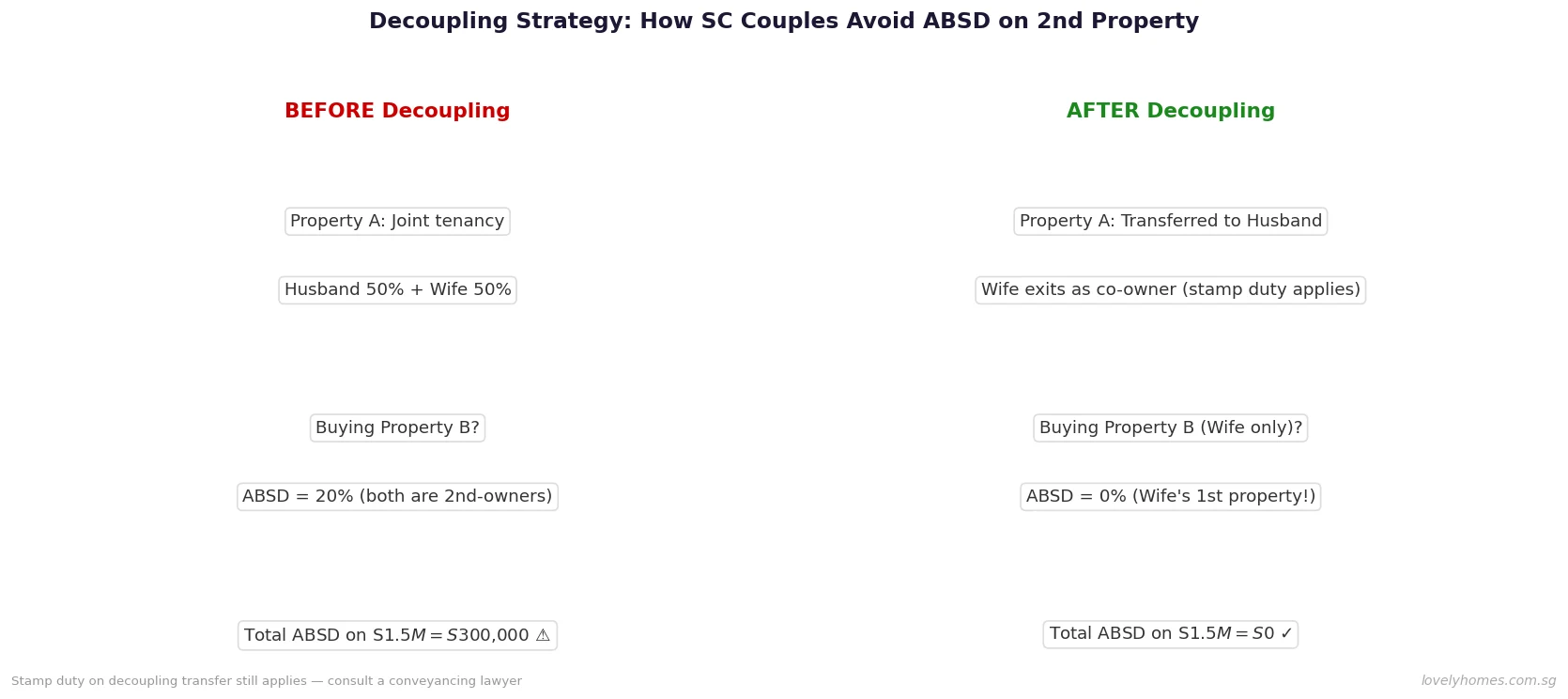
It depends on your tax bracket and ABSD friction. A Singapore citizen second-property buyer pays 20% ABSD on the full price — that is roughly 5 years of net rental yield wiped out before the first rent cheque arrives. The case for a second residential unit improves materially if the buyer plans to live in it (no ABSD), is decoupling on a marriage event (s.33A IRAS rules require care), or is buying for a long-horizon family hold rather than yield. For PRs (30%) and foreigners (60%), ABSD friction is generally prohibitive against an equivalent S-REIT sleeve.

Related Articles

Disclaimer

This article is general guidance for Singapore investors weighing S-REIT exposure against direct residential property. S-REIT regulation sits with MAS via the Code on Collective Investment Schemes; market data is published by SGX; tax rules sit with IRAS. Yields and prices in worked examples are illustrative and based on April 2026 market levels. Consult a licensed financial adviser for advice tailored to your circumstances.

Tags: S-REITs, Singapore REITs, property investment, rental yield, ABSD, OCR 1BR, gearing, leverage, MAS Property Funds Code, SGX, CPF Investment Scheme, distribution yield, REIT sectors, hospitality REIT, office REIT, industrial REIT, healthcare REIT.

Property Auction Singapore 2026: Mortgagee Sales, Bidding Mechanics and Deposit Forfeiture Explained

Property Auction Singapore 2026: Mortgagee Sales, Bidding Mechanics and Deposit Forfeiture Explained

A property auction is the open public sale of a Singapore property under conditions printed in advance — a fixed reserve price, a published Conditions of Sale, a 10% deposit on the fall of the hammer, and a binding contract that crystallises the moment the highest bid is accepted. Most auction listings in Singapore are mortgagee sales — the seller is a bank exercising its power of sale after a defaulted mortgage, not the original homeowner. Mortgagee-sale auction listings jumped roughly 28.8% quarter-on-quarter in the first quarter of 2026, the sharpest single-quarter rise in five years, and industry research expects the climb to extend through the rest of the year. This guide walks through how the auction route actually works in Singapore in 2026, where the legal traps lie, what the 10% deposit really binds you to, and a worked S$1.95 million bid-and-completion example.

Quick Answer

  • Two routes: mortgagee sale (bank as vendor under its power of sale) and owner sale (registered proprietor selling voluntarily). Mortgagee sales were ~71% of Q1 2026 listings.
  • The hammer creates a binding contract the moment it falls. There is no cooling-off period, no Option to Purchase, no 14-day reflection window.
  • Buyer pays a 10% deposit on the fall of the hammer — cashier’s order, payable to the vendor’s solicitor — and the auction memorandum is signed within the same hour.
  • Buyer’s Stamp Duty (BSD), Additional Buyer’s Stamp Duty (ABSD) and any Lender’s Duty on Acquiring Units (LDAU) fall due to IRAS within 14 days of the contract — exactly as for a private-treaty sale.
  • Standard completion: balance 90% in 12–14 weeks; failure to complete forfeits the 10% deposit and exposes the buyer to a damages claim if the property is re-auctioned at a lower price.
  • Mortgagee sales are sold on an “as-is, where-is” basis. Vacant possession is not guaranteed in many mortgagee deals — squatters, holdover tenants, and pending caveats can survive completion.
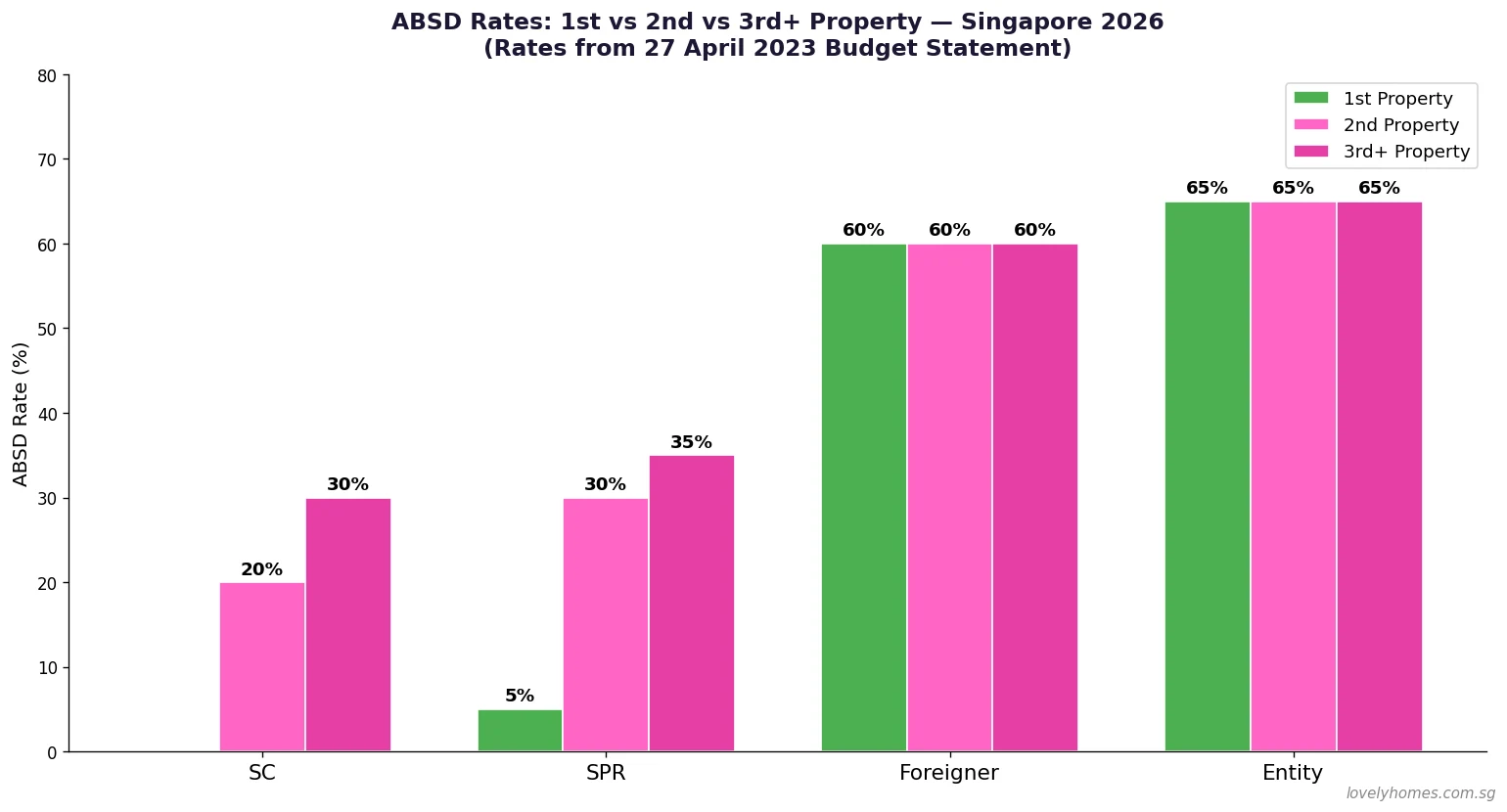
  • ABSD applies in full at the buyer’s profile rate. Citizens 60% on second property; PRs and entities tagged at higher rates. The auction route confers no stamp-duty discount.

Why Auctions Are Suddenly Busier in 2026

Auction activity is countercyclical. Through the strong 2021–2022 price run, mortgagee sales were rare — refinancing was easy, valuations had risen comfortably above purchase prices, and distressed sellers preferred the open market. Through 2024 and 2025, however, two forces pushed listings higher. The first was the lagged effect of the 2022–2024 rate rise: borrowers on three-year fixed packages from 2022 rolled onto materially higher floating rates in 2025, and households at the margin began missing instalments from the second half of 2024. The second was the 2024 wave of small commercial and shophouse defaults, particularly in F&B-heavy enclaves, which fed niche commercial lots into the auction calendar.

By the first quarter of 2026, mortgagee-sale auction listings had jumped roughly 28.8% quarter-on-quarter — Knight Frank’s Q1 auction-market update flagged the figure and noted that the climb is expected to continue through 2026 even as benchmark rates ease. The composition is also shifting: prime-district condominium units in Districts 9, 10 and 11 made up a larger share of Q1 2026 mortgagee listings than in any quarter of 2025, reflecting strain among investor-borrowers who funded second-home purchases on tight cash flow.

Property Auction Singapore 2026 mortgagee sale vs owner sale matrix
Figure 1: Mortgagee sale and owner sale — the two routes onto the Singapore auction block.

Mortgagee Sale: How the Bank Actually Sells

The legal foundation of a mortgagee sale in Singapore is the power of sale conferred on the lender under the mortgage instrument and the Conveyancing and Law of Property Act 1886. Banks invoke that power only after a documented default — typically six months or more of unpaid instalments — and after issuing a formal demand letter and a Letter of Demand under section 75 of the Act. The borrower is given a final window, usually 30 days, to remedy the default. If the arrears are not cleared, the bank instructs an auctioneer, agrees a reserve price benchmarked to the lender’s panel valuation, and lists the property at the next scheduled public auction.

The bank’s duty is narrow but real. It must obtain the “true market value” of the property — meaning the reserve cannot be set artificially low simply to clear the loan. If the property is sold materially below value and the borrower can prove a breach of that duty, the borrower retains a residual claim against the bank. In practice Singapore reserve prices on mortgagee sales are set within 5–10% of the lender’s valuer’s market estimate.

The mortgagee sale extinguishes the bank’s mortgage on completion. The buyer takes title free of that charge — but not necessarily free of other caveats, such as a second-mortgage caveat held by another financial institution, a maintenance charge from a management corporation, or a CPF charge against the borrower’s withdrawal. Ascertaining the full encumbrance position is the responsibility of the buyer’s solicitor before the auction; once the hammer falls there is no scope to renegotiate.

Owner Sale: Auctions as a Speed Tool

The second route is the owner sale — a voluntary auction by the registered proprietor. Owners use the auction route for three reasons. First, speed: an auction marketed for two weeks delivers a binding contract in a single afternoon, against the multi-week dance of options, exercise and conveyancing in a private-treaty sale. Second, price discovery: when the property is unusual (a freehold conservation shophouse, an estate-administered Good Class Bungalow, a subdivided strata mix) and there is no obvious comparable, an auction extracts the highest bidder rather than the highest opening offer. Third, process discipline: estate executors, divorce-mandated sales and corporate liquidations face fiduciary duties to obtain market value, and a public-auction record is the cleanest defensible audit trail.

Owner sales are typically sharper on title quality. The owner remains in possession until completion and contracts to deliver vacant possession on legal completion — that is the usual position for a private-treaty sale and it carries through to the owner’s auction. Caveats are routinely discharged on completion using the sale proceeds. The buyer faces fewer “legacy” risks than on a mortgagee lot.

The Auction-Day Mechanic

Singapore auctions follow a near-uniform script. The auctioneer reads the lot description, calls a starting price (usually 5–10% below the reserve), and accepts ascending bids in fixed increments — typically S$10,000 for residential lots under S$2 million, S$50,000 above that. Bids in the room are visible; absentee written bids are submitted to the auctioneer on a sealed form before the lot is called. Online and telephone bidding are now standard at every major Singapore auction house since 2021. The reserve is undisclosed but the lot is withdrawn if no bid clears it.

When the highest bid clears the reserve and three calls fail to produce a higher bid, the hammer falls. The successful bidder produces a 10% cashier’s order on the spot — issued in advance to the auctioneer’s instruction — and signs the auction memorandum. That memorandum, attaching the printed Conditions of Sale, becomes the executed Sale and Purchase Agreement. From that moment the buyer is locked in: no cooling-off, no inspection contingency, no financing contingency.

Property Auction Singapore 2026 hammer-to-completion 14-week timeline
Figure 2: From the fall of the hammer to legal completion — a standard mortgagee auction takes 12–14 weeks.

The 10% Deposit and Forfeiture

The 10% deposit is more than earnest money — it is liquidated damages. If the buyer fails to complete on the contractual completion date (typically 12–14 weeks after the hammer), the vendor is entitled to forfeit the deposit absolutely under the Conditions of Sale. There is no notion of partial forfeiture; the entire 10% is lost. If the property is later re-auctioned at a price below the original bid, the defaulting buyer is liable for the shortfall as further damages — including the costs of the re-auction.

This is the single highest-risk feature of the auction route. A buyer who cannot complete because financing fell through (the bank’s loan amount was lower than expected once a fresh valuation came in below the bid), or because vacant possession proved harder than expected, has no escape. The 10% deposit on a S$2 million lot is S$200,000 of cash. That cash is gone.

Stamp Duties on the Auction Buyer

Auction purchases attract the same stamp-duty regime as private-treaty purchases — there is no auction-route discount. Buyer’s Stamp Duty applies on a sliding scale up to 6% on the slab above S$3 million for residential property. Additional Buyer’s Stamp Duty applies at the buyer’s profile rate: 0% for a Singapore Citizen first home, 20% on a Citizen second home, 30% on a third or subsequent home; 5% for a Permanent Resident first home, 30% on second; 60% for foreigners; 65% for entities; with a 35% LDAU surcharge for housing-developer entities. Stamp duty falls due to IRAS within 14 days of the contract date, which for an auction is the date the hammer falls.

Buyers planning an auction bid should compute the all-in cost — bid price plus BSD plus ABSD plus typical S$2,500 of legal cost plus 10% deposit financing — before raising the paddle. A foreigner bidding S$2 million on a residential lot pays S$1.2 million in ABSD on top, taking the all-in cost beyond S$3.25 million.

Q1 2026 Listings — Where Volume Came From

Property Auction Singapore 2026 mortgagee sale listings Q1 2026 +28.8 percent quarter on quarter
Figure 3: Mortgagee-sale listings climbed roughly 28.8% quarter-on-quarter in Q1 2026 — owner-sale activity remained range-bound.

The Q1 2026 climb in mortgagee-sale listings was concentrated in three property classes. Strata-titled commercial units — small office and retail lots in mixed-use buildings — accounted for the largest single increment, reflecting accumulated rental softness from the 2024 supply wave. Prime-district condominiums in Districts 9, 10 and 11 made the second-largest contribution, particularly two-bedroom and three-bedroom investment units bought between 2018 and 2021 with high LTV. Suburban executive condominiums and freehold landed terraces in Districts 13, 15 and 19 made up the third stream, mostly owner-occupier defaults rather than investor-driven listings. Owner-sale listings were broadly flat across the same period — the rise in auction volume was overwhelmingly distress-driven, not voluntary.

Worked Example: A Foreigner Bid on a S$1.95 Million Mortgagee Lot

Mr Ravi, a Permanent Resident on his second residential property in Singapore, attends a major April 2026 auction. The lot is a 1,184 sq ft three-bedroom freehold condominium unit in District 15, listed under mortgagee sale by a major retail bank. The reserve, undisclosed, has been set at S$1,950,000 (~S$1,647 psf). The starting bid is S$1.85 million; the room runs the bid up in S$10,000 increments to S$1,960,000, where Mr Ravi’s S$1.97 million bid sees off a final telephone bidder. The hammer falls.

On the spot. Mr Ravi produces a S$197,000 cashier’s order — 10% of the bid — payable to the auction firm. He signs the auction memorandum and the printed Conditions of Sale. The contract is binding.

Within 14 days. Mr Ravi’s solicitor lodges and pays:

  • Buyer’s Stamp Duty: ~S$70,000 (sliding scale to S$1.97M)
  • ABSD at PR-second-home rate: 30% × S$1.97M = S$591,000
  • Total stamp duties to IRAS: S$661,000

Weeks 1–4. Solicitor runs full title search at SLA, verifies discharge of the bank’s first mortgage on completion, and probes for any second-charge caveat or maintenance lien. Two outstanding maintenance arrears of S$11,400 are flagged from the management corporation; under the Conditions of Sale these survive completion and the buyer settles them as a post-completion debt to the MC.

Weeks 4–10. Mr Ravi finalises a refinance loan from a different bank at 1.65% fixed for 2 years, 75% LTV on his bid price. He receives the Letter of Offer at week 8. Critically, the new bank’s valuer puts indicative market value at S$1,920,000 — S$50,000 below the bid. The bank lends 75% of the lower of bid price and valuation, so the loan amount is S$1.44 million, not the S$1.4775 million Mr Ravi modelled. He has to top up S$37,500 in cash from the LTV gap, on top of the 25% he already had ready.

Week 14 — completion. Balance 90% (S$1.773 million) paid; legal completion at SLA. Mr Ravi takes vacant possession (the unit was already vacant — the previous borrower had moved out at default). All-in cost: bid S$1.97M + BSD S$70k + ABSD S$591k + legals S$3.5k + maintenance arrears top-up S$11.4k + cash gap S$37.5k = ~S$2.683 million. The “discount to market” once stamp duties are layered in is closer to 1% than the headline 5–10% reserve discount the auction was marketed at.

The Five Traps Newcomers Miss

Trap What goes wrong
Vacant possession not guaranteed Mortgagee sales are “as-is, where-is”. Holdover tenants, family members in occupation, or squatters can survive completion; the buyer must apply for a writ of possession at extra cost and time.
Loan in principle is not loan certainty A pre-auction LIP is not binding. The lender’s actual loan amount is determined post-bid, on a fresh valuation. If valuation comes in below bid, the LTV gap is the buyer’s cash problem, not the bank’s.
CPF release is slower than expected CPF Board needs an executed S&P plus the new mortgage instrument before disbursing OA funds. On a 12-week auction completion, the CPF release usually arrives just-in-time; missed paperwork can push the buyer into late-completion penalties.
Outstanding caveats survive A second-mortgage or judgment-debt caveat that isn’t the bank’s own first charge can ride through completion and become the buyer’s title problem to solve post-hand-over.
“Below valuation” can be illusion The bank’s panel valuation is not the same as a buyer-side valuation. A reserve set at the bank’s number can sit above what an independent valuer signs off — and that is the number that drives loan size.

Why This Matters

For most Singapore homeowners the auction route is simply not the right purchase channel — the binding-contract speed, the no-financing-contingency rule and the deposit forfeiture risk are unforgiving. For experienced investors with cash buffers, however, the auction calendar through 2026 is likely to widen the opportunity set: more mortgagee listings, in better postcodes, with reserves anchored to the lender’s valuation rather than seller aspiration. Anyone planning to bid should treat the auction not as a discount channel but as a different procurement mechanism with its own legal architecture and its own failure modes.

What Might Come Next

Three signals will tell you where the 2026 auction year is heading. First, watch the quarterly mortgagee-listings count reported by the major Singapore auction houses — Q2 2026 figures, due in July, will confirm whether Q1’s 28.8% rise is the start of a multi-quarter trend or a one-off catch-up. Second, track average winning-bid spread to reserve: a tight spread (winning bid 0–3% above reserve) signals weak buyer pool; a wider spread (5–10%) signals contested bidding and stronger market psychology. Third, monitor commercial vs residential mix: a continued tilt toward strata commercial and shophouse lots would suggest that 2026 distress is corporate and small-business, not household, and that residential auction risk stays bounded.

Frequently Asked Questions

Can I attend a Singapore property auction without bidding?

Yes. Public auctions are open to attend; you can register as a non-bidder simply to observe. Most major Singapore auctions are also live-streamed online, and recordings of past auctions are sometimes posted by the auction house. Attending two or three auctions before raising your own paddle is the cheapest education there is on how the room actually behaves under bidding pressure.

Can I bid online or by phone?

Yes. Every major Singapore auction house since 2021 supports online bidding, telephone bidding, and absentee bid forms. Pre-registration is required, including identity verification and proof of funds. The auctioneer reads remote bids into the room as they come in; a remote bidder who wins still has to deliver a 10% cashier’s order to the auctioneer within hours of the hammer.

Is there any cooling-off period after the hammer falls?

No. Auctions are expressly excluded from the Sale of Commercial Properties Act / Housing Developers Act cooling-off framework. The contract created by the auction memorandum is binding from the moment of execution. There is no 14-day Holding Period, no 3-day reflection window. This is the single most important difference between auction and private-treaty purchase.

Do I pay ABSD if I buy at auction?

Yes. The auction route confers no stamp-duty discount whatsoever. BSD applies on the sliding scale to the bid price, and ABSD applies at the buyer’s profile rate — 0%/20%/30% for Citizens by property count, 5%/30% for PRs, 60% for foreigners, 65% for entities. Both fall due to IRAS within 14 days of the auction date.

What happens if my financing falls through after I win the bid?

The 10% deposit is forfeited. If the property is re-auctioned at a lower price, the defaulting buyer is also liable for the shortfall plus the costs of the re-auction. There is no financing contingency in the auction Conditions of Sale. Bidders should secure a Letter of Offer or at minimum an in-principle approval before bidding, and should bid at a level the LIP supports — not a level that depends on a higher post-bid valuation.

Are there auctions for HDB flats?

HDB resale flats are not sold at public auction in Singapore. HDB resale transactions must go through HDB’s own resale portal and require the seller to be the registered owner. Mortgagee-sale auctions therefore concern only private property — condominiums, apartments, executive condominiums (post-privatisation), landed homes, strata commercial and shophouse lots. Where an HDB flat enters a forced-sale scenario, HDB itself supervises the sale through its resale process rather than via a third-party auction house.

Do reserve prices change during an auction calendar?

Frequently. If a lot fails to sell at the published reserve in one auction round, the auctioneer will discuss a revised reserve with the vendor before the next round. Mortgagee sales typically see reserve cuts of 2–5% per failed round, capped by the bank’s duty to obtain market value. Owner-sale reserves are more elastic — the owner may withdraw the lot entirely if bidding is weak. Tracking a lot through two or three rounds is a routine technique among experienced auction investors.

Related Articles

Disclaimer

This article is editorial commentary for general information only and does not constitute legal, financial, or stamp-duty advice. Auction Conditions of Sale, reserve prices and bidding procedures vary by auction house and by lot; always read the printed Conditions of Sale issued for the specific lot before bidding. Consult IRAS at iras.gov.sg for the prevailing BSD, ABSD and LDAU rates and the 14-day stamping deadline; consult SLA at sla.gov.sg for INLIS title-search and caveat information; consult MAS at mas.gov.sg for the prevailing TDSR cap and stress-rate; and engage a qualified solicitor familiar with auction conveyancing before raising a paddle.

Property Inheritance Singapore 2026: Estate Duty, Intestacy, ABSD on Inherited Property and CPF Nominations Explained

Property Inheritance Singapore 2026: Estate Duty, Intestacy, ABSD on Inherited Property and CPF Nominations Explained

Property inheritance in Singapore is governed by a small library of statutes — the Land Titles Act, the Probate and Administration Act, the Intestate Succession Act, and (for Muslim deceased) the Administration of Muslim Law Act. The headline numbers are deceptively simple. There has been no estate duty in Singapore since 15 February 2008, and inheritance itself does not attract Buyer’s Stamp Duty (BSD) or Additional Buyer’s Stamp Duty (ABSD). What actually drives outcomes is the ownership structure of the property and whether the deceased left a valid will.

Quick Answer

  • No estate duty since 15 February 2008. Singapore abolished estate duty by amendment to the Estate Duty Act; deaths from that date forward attract zero estate-duty liability.
  • Joint tenancy property bypasses the estate. The surviving co-owner takes the deceased’s share automatically by survivorship. The will is irrelevant to that property.
  • Tenancy-in-common shares form part of the estate. They pass via the will (Grant of Probate) or, if there is no will, per the Intestate Succession Act (Letters of Administration).
  • ABSD does not apply on inheritance. But an inherited property counts toward future ABSD — the heir’s “property count” goes up.
  • CPF moneys pass by CPF Nomination, not by will. Without a nomination, the Public Trustee distributes per the Intestate Succession Act after a court application.
  • Insurance with named beneficiaries bypasses the estate by virtue of the section 49L Insurance Act statutory trust.
  • HDB flat eligibility is rechecked at inheritance. Beneficiary must satisfy citizenship and family-nucleus rules or HDB will require sale within a defined period.
  • Muslim deceased follow Faraid rules under the Administration of Muslim Law Act, applied through the Syariah Court.
  • No estate duty does NOT mean no costs. Probate or Letters of Administration require court fees, lodgement fees, and legal fees that typically run S$3,000-S$8,000 for a straightforward estate.

The Backdrop — Why Singapore Has No Estate Duty

Singapore abolished estate duty for deaths occurring on or after 15 February 2008. The Estate Duty Act remains on the books for legacy estates from earlier dates, but for any contemporary death there is no estate-duty assessment, no requirement to file an estate-duty return, and no clearance certificate from the Inland Revenue Authority of Singapore (IRAS) before assets can be distributed.

The policy logic was straightforward: estate duty had become a leaky tax. High-net-worth individuals routinely structured their wealth into trusts, joint accounts, foreign holding vehicles, and life-insurance products that legally bypassed the duty. By the mid-2000s, most of the burden was falling on middle-class estates, especially those holding a single HDB flat or condominium with limited cash to settle the duty before distribution. Abolition simplified administration and removed a regressive tax in fact, even if not in headline rate.

The absence of estate duty does not mean the absence of administration. Probate or Letters of Administration are still required to convey title; CPF moneys still need to be claimed; insurance still needs to be filed for. The mechanics matter even when the tax does not.

Ownership Type — The Single Biggest Determinant

Singapore property is held under one of two ownership structures, and the difference is decisive on death.

Joint tenancy creates a unified ownership where each co-owner holds the whole property, subject to the others’ equal claims. It is the default form for HDB flats co-owned by spouses and is common for condominium units owned by married couples. On the death of one joint tenant, the right of survivorship (jus accrescendi) operates by force of law: the surviving co-owner(s) take the deceased’s interest automatically. The deceased’s share never falls into their estate. The will, even if it purports to leave the property to someone else, has no effect on a joint-tenancy property. Title is updated by lodging a Notice of Death with the death certificate at the Singapore Land Authority (SLA); no probate is needed for that property.

Tenancy-in-common creates defined shares (50%/50%, 70%/30%, 1%/99%, etc.) that each owner holds independently. On death, that defined share falls into the deceased’s estate and passes by will or, if there is no will, per the Intestate Succession Act. The share is conveyed via Grant of Probate or Letters of Administration. Typical scenarios for tenancy-in-common include: married couples who deliberately want each spouse’s share to pass to children rather than to the surviving spouse, business partners co-owning commercial property, family members co-investing in a condominium, and “99-to-1” arrangements (now under heightened IRAS scrutiny — see our separate piece).

Unsure which form applies? Title can be checked at SLA’s INLIS (Integrated Land Information Service) for any property in Singapore — a S$5.40 per record search. The title document itself names the form: “Joint Tenants” or “Tenants-in-Common in shares of [X:Y]”.

Property Inheritance Singapore 2026 - joint tenancy vs tenancy-in-common routing on death decision tree
Figure 1: How a property routes to heirs depends first on ownership type, then on whether there is a will.

If There Is a Will — Probate

A valid Singapore will is one signed by a testator aged 21 or older, in writing, witnessed by two persons present at the same time, neither of whom is a beneficiary or a beneficiary’s spouse. Wills made overseas are recognised if they comply with the law of the place where they were made or with Singapore law. The will should name an executor — the person responsible for administering the estate — and should ideally be lodged with the executor and a solicitor for safekeeping.

On death, the executor applies to the Family Justice Courts for a Grant of Probate. Application is via the eLitigation electronic filing system. The court assesses the will’s validity, the executor’s appointment, and the schedule of assets. For an estate without contest, a Grant of Probate is typically issued in 4-8 weeks. The executor then collects the assets, settles debts and expenses, files the deceased’s final income tax return, and distributes the estate per the will’s terms. For property, this means executing transfer documents in favour of the named beneficiaries and lodging them with SLA.

Court fees: S$50-S$1,500 depending on estate value (graduated). Lodgement at SLA: approximately S$120 per title. Legal fees for an uncontested probate of a typical Singapore estate: S$3,000-S$6,000. Where the estate is contested or complex (foreign assets, business interests, contested executor appointment), costs scale rapidly and probate can take 6-12 months or longer.

If There Is No Will — Intestacy

The Intestate Succession Act (Cap 146) sets out a fixed distribution rule for non-Muslim deceased who died without a valid will. The administrator — typically the closest surviving relative — applies for Letters of Administration, again via the Family Justice Courts. The bonded administrator then distributes the estate per the statutory rules.

Property Inheritance Singapore 2026 - Intestate Succession Act distribution rules table
Figure 2: Intestate Succession Act distribution table – the statutory rules that apply when a non-Muslim Singaporean dies without a will.

The rules in plain language: a surviving spouse always takes priority; children share equally with the spouse where both exist; in the absence of children, the surviving spouse shares with the deceased’s parents; in the absence of all of these, the estate moves outward to siblings, then grandparents, then uncles and aunts. If no person within the statutory classes survives, the estate escheats — that is, falls to the State.

Several pitfalls trip up families relying on intestacy. Step-children are excluded unless legally adopted. A long-term partner without marriage receives nothing under the ISA — Singapore does not recognise common-law marriage and there is no equivalent statutory inheritance for unmarried partners. Foreign assets are governed by the law of the place where they sit, so an HDB flat in Singapore distributes per ISA but a Malaysian property distributes per Malaysian law (which requires a separate grant). Where the deceased held property as joint tenant with someone unrelated, that share is taken by the survivor by operation of law, regardless of intestacy intentions.

ABSD and Inherited Property — The Common Misunderstanding

Inheritance itself does not trigger Buyer’s Stamp Duty (BSD) or Additional Buyer’s Stamp Duty (ABSD). The transfer of property by way of inheritance is exempt from stamp duty under the Stamp Duties Act. This is true whether the property passes by will, by survivorship, or by intestacy.

The misunderstanding arises on the heir’s next property purchase. An inherited property counts as a “property owned” for ABSD-rate purposes. So a Singaporean who has never owned property, but inherits a 50% share of a condominium from a parent, becomes — for ABSD purposes — an owner of one residential property. If she subsequently buys her first home in her own right, she will face the second-property ABSD rate (currently 20% for Singapore Citizens) rather than the first-property zero rate.

Three consequences flow from this. First, families should plan inheritance with the next-purchase ABSD impact in mind, particularly for adult children who will be buying property soon. Second, where a property is held jointly between, say, a parent and an adult child for the parent’s protection in old age, the child’s ABSD profile is permanently affected — the child is treated as already owning a property even if their actual interest is small. Third, decoupling — the practice of transferring a share between spouses to “free up” one spouse’s first-property ABSD slot — is a separate planning move that has no overlap with inheritance and is governed by its own rules. Inheritance does not “reset” the ABSD count; only an outright transfer or sale of all property holdings can do so.

CPF Moneys — Do Not Pass by Will

This is the single most-missed point in Singapore estate planning. CPF moneys — Ordinary Account, Special Account, MediSave Account, and from age 55, the Retirement Account — do not form part of the deceased’s estate and do not pass by will. They pass by CPF Nomination. Without a CPF Nomination, the Public Trustee distributes the moneys after the estate is administered, applying the Intestate Succession Act rules but with administration fees deducted upfront (currently 0.3% of the first S$1,000, 0.15% of the next S$10,000, 0.075% of the next S$988,000, and 0.0375% of any amount above that).

A CPF Nomination is a separate instrument from a will. It is filed online via the CPF Board’s website with myInfo authentication, or in person at a CPF Service Centre. It can be updated at any time. Marriage and divorce automatically revoke an existing nomination — so a spouse who divorces and remarries must file a fresh nomination, or the post-divorce CPF moneys default to the Public Trustee on death. CPF Nominations cover only CPF balances; they do not cover any property purchased using CPF (the property itself follows ownership-type rules, not the nomination).

Insurance proceeds with a named beneficiary under section 49L of the Insurance Act 1966 also bypass the estate by virtue of the statutory trust. A spouse, child or parent named as beneficiary under section 49L receives the proceeds directly from the insurer, regardless of will or intestacy. Where the policy beneficiary is named under the older section 73 (now superseded but still in force for old policies), the trust position is the same.

HDB Flats — A Special Eligibility Recheck

HDB flats inherited by way of joint tenancy survivorship pass to the surviving co-owner without a fresh eligibility assessment, provided the survivor was already a registered owner. Where an HDB flat passes via probate or intestacy to someone who was not previously a registered owner — for example, a son inheriting his deceased mother’s solely-owned flat — HDB applies an eligibility assessment.

The assessment looks at: citizenship (Singapore Citizen or Permanent Resident with at least one Singapore Citizen co-occupier); family nucleus (the heir must form a recognised family unit with the flat); concurrent property holding (heirs already owning private property may be required to dispose of it); and where the inherited flat is a Plus or Prime classification, the resale income ceiling of S$14,000 monthly applies. Where the heir cannot satisfy eligibility, HDB requires the flat to be sold within a defined window (typically six to twelve months from inheritance), with the heir taking the cash proceeds rather than retaining the flat.

Because HDB classification rules can intervene unexpectedly, estate planners typically advise married couples in HDB flats to hold as joint tenants (default and usually optimal) and to discuss any tenancy-in-common arrangement with HDB before locking it in. Any change of HDB ownership form mid-tenure (e.g. converting joint tenancy to tenancy-in-common) requires HDB consent and is a separate stamping event.

Worked Example — An Ordinary Singaporean Estate

Mr Tan, 65, Singapore Citizen, dies intestate. He is survived by his wife Mrs Tan (62, SC), one adult son (35, married, lives separately) and one adult daughter (33, single, lives separately). His assets:

  • HDB 4-room in Tampines, held in joint tenancy with Mrs Tan, current market valuation S$700,000.
  • 50% tenancy-in-common share in a District 19 freehold condominium, valuation of his half-share S$1.2 million. The other 50% is held by his brother.
  • CPF moneys totalling S$220,000 across OA, SA, MA and RA.
  • Whole-life insurance policy with sum assured S$200,000 and Mrs Tan named as section 49L beneficiary.
  • Bank deposits in his sole name totalling S$80,000.
Property Inheritance Singapore 2026 - worked example Mr Tan estate distribution
Figure 3: Mr Tan’s estate distributed across spouse and two adult children – asset by asset, the routing differs sharply.

HDB flat: Mrs Tan takes 100% by survivorship. Notice of Death lodged at SLA with death certificate; title is updated within weeks. No probate needed for the flat. No BSD, no ABSD.

Condo share (50% TIC): Falls into the estate. Per ISA, Mrs Tan takes 50% (S$600,000 of equity), son takes 25% (S$300,000), daughter takes 25% (S$300,000). Letters of Administration are needed to convey title. ABSD-wise: the son becomes a part-owner of the District 19 condo; this affects his future ABSD profile permanently. The brother’s 50% TIC share is unaffected.

CPF S$220,000: Mrs Tan filed a CPF Nomination for 100% to her benefit some years ago. The CPF Board distributes S$220,000 to Mrs Tan within 6-8 weeks of receiving the death certificate. No probate required for the CPF moneys.

Insurance S$200,000: Filed directly with the insurer. Mrs Tan is named beneficiary under section 49L. S$200,000 paid directly to Mrs Tan within 2-4 weeks of claim filing. No probate required.

Bank deposits S$80,000: Falls into the estate. Distributed per ISA. Mrs Tan takes S$40,000, son takes S$20,000, daughter takes S$20,000. Letters of Administration required to release bank moneys.

Estate administration cost: court fees, S$200; lodgement fees, S$120 per title; bond fees, S$300; solicitor’s fees for Letters of Administration, S$3,500-S$5,000. Total: approximately S$4,000-S$5,500. No estate duty (zero rate since 2008). No BSD or ABSD on the inheritance itself. Future ABSD on subsequent purchases by the son will be calibrated to recognise his now-existing condo share.

Summary Table — Asset Routing on Death

Asset type Default routing Document needed Stamp duty / tax
Property in joint tenancy 100% to surviving co-owner by survivorship Notice of Death + death cert at SLA No BSD, no ABSD, no estate duty
Property in tenancy-in-common (with will) Per will Grant of Probate No BSD, no ABSD on the inheritance; impacts heir’s future ABSD
Property in TIC (intestate) Per Intestate Succession Act Letters of Administration Same as above
CPF (with nomination) Per CPF Nomination CPF Board claim form + death cert No tax
CPF (no nomination) Public Trustee per ISA Court application via PTO PTO administration fees apply
Insurance with s.49L beneficiary Direct to named beneficiary Insurer claim form + death cert No tax; bypasses estate
Bank deposits (sole) Per will or ISA Probate or Letters of Admin No estate duty
Bank deposits (joint) Surviving account holder takes (subject to bank’s internal rules) Death cert + bank’s release form No estate duty
HDB flat with non-eligible heir HDB requires sale; cash to heir Probate / LOA + HDB resale process No tax on the inheritance; resale process attracts BSD on next purchase

Why This Matters — Estate Planning in 2026

The absence of estate duty has not made Singapore estate planning trivial. Three forces are now driving more careful planning. First, ABSD: with the rate at 20% for Singapore Citizens on a second property and 30% on a third, an inheritance that “uses up” an heir’s first-property ABSD slot can cost six figures on their next purchase. Second, the Plus / Prime HDB framework: an HDB flat inherited by a heir whose family income exceeds S$14,000 may force a forced sale, with the heir taking cash rather than the flat. Third, longer life expectancy: the median Singaporean now dies at 84 (men) or 88 (women), and with substantially more accumulated property and CPF wealth than a generation ago.

The estate-planning toolkit has not changed dramatically: a current will, a current CPF Nomination, a clear understanding of which properties are joint-tenancy versus tenancy-in-common, named beneficiaries on insurance, and a record of foreign assets. What has changed is that the cost of getting it wrong has risen, particularly for heirs about to enter the property market.

What Might Come Next — A Forward View

Three policy currents are worth watching. First, the periodic discussion of reintroducing some form of inheritance or wealth tax — flagged in academic and policy circles in 2024-25, but not adopted. Any reintroduction would likely come with substantial thresholds and would target estates well above the median. Second, refinement of HDB inheritance rules under the Plus / Prime framework, particularly around how the S$14,000 income ceiling is applied to inherited resale flats — currently it is applied at the moment of inheritance, which is unforgiving. Third, digital-estate developments: the growing weight of digital assets (cryptocurrency, online accounts) and how they interact with traditional estate administration is an unsettled area, and Singapore courts have only begun to encounter the issues.

Frequently Asked Questions

Do I need a will if my estate is simple and held in joint tenancy?

For property held in joint tenancy with a spouse, the will has no effect on the property — survivorship operates regardless. But your other assets (bank accounts, investments, personal items, foreign assets) still pass through the estate. Without a will, intestacy rules apply, which may not match your intentions — particularly for blended families, unmarried partners, or where you want to provide for a charity or non-relative. A simple Singapore will costs S$300-S$800 to prepare and is strongly advisable for any adult with assets, even if those assets are modest.

If I inherit a condo from my late father, do I pay ABSD on it?

No. Inheritance itself does not attract Buyer’s Stamp Duty or Additional Buyer’s Stamp Duty. The transfer is exempt under the Stamp Duties Act. However, the inherited property now counts as a property you own — so when you next buy a property in your own right, you will be assessed at the second-property ABSD rate (20% for SCs, 25% for SPRs, 65% for foreigners as of May 2026) on the new purchase, not at the first-property zero or 5% rate.

Can my will override a joint tenancy on a HDB flat?

No. Joint tenancy survivorship operates by force of law; the will is irrelevant to that property. If you and your spouse hold an HDB flat as joint tenants, your spouse takes 100% on your death regardless of what your will says. To direct the flat to someone else (for example, an adult child from a prior marriage), you must first sever the joint tenancy and convert it to tenancy-in-common — a documented act involving HDB consent — and then provide for the share in your will.

My CPF nomination names my mother — but I am now married. Do I need to update it?

Yes — and likely sooner than you realise. Marriage and divorce automatically revoke an existing CPF Nomination. Without a fresh nomination after marriage, your CPF moneys default to the Public Trustee on your death, who distributes per the Intestate Succession Act with administration fees deducted. The Intestate rules give your spouse a 50% share alongside your parents (no children scenario) — which may not match your intentions. Update your CPF Nomination online via the CPF Board portal within weeks of marriage. The same applies after divorce.

How long does probate or Letters of Administration take in Singapore?

For a straightforward, uncontested estate where all documents are in order, Grant of Probate or Letters of Administration is typically issued by the Family Justice Courts in 4-10 weeks from filing. Estates with foreign assets, contested wills, or complex business holdings can take 6-12 months or longer. Court fees scale with estate value (S$50-S$1,500 graduated), legal fees for an uncontested matter are typically S$3,000-S$6,000, and administrator’s bond requirements (for intestacy) add a small further cost. Cash flow during the probate period: insurance with named beneficiaries pays out within weeks; CPF with a nomination pays within 6-8 weeks; everything else waits for the grant.

What about Muslim deceased — do the same rules apply?

No. For Muslim deceased, the Administration of Muslim Law Act applies and the Faraid (Islamic inheritance) rules govern the distribution. The Syariah Court issues an Inheritance Certificate that sets out each beneficiary’s fixed share. The Faraid scheme is fundamentally different from the Intestate Succession Act — it provides fixed fractions to defined classes of relatives (spouse, children, parents, siblings) and does not allow more than one-third of the estate to be willed away from the Faraid scheme. Muslims who wish to deviate from Faraid for a portion of their estate (within the one-third limit) typically use a will (wasiyyah) and a hibah (lifetime gift). Specialist Syariah-law guidance is essential.

If my late spouse owned an overseas property, does Singapore probate cover it?

No. Singapore probate covers Singapore-situated assets only. For an overseas property, a separate grant must be obtained in the jurisdiction where the property sits — typically a “resealing” of the Singapore grant where the foreign jurisdiction recognises Commonwealth probate (Australia, the United Kingdom, Malaysia), or a fresh grant where it does not (mainland China, Indonesia, Thailand). Foreign tax may apply on the inheritance even when Singapore tax does not — Australia, the United Kingdom and the United States all impose some form of estate or inheritance tax on assets situated in their jurisdictions. Cross-border estate planning requires advice from solicitors qualified in both Singapore and the foreign jurisdiction.

Related Articles

Disclaimer

This article provides general information about property inheritance in Singapore as at May 2026 and is not legal, tax or financial advice. Inheritance outcomes depend on individual ownership structures, the validity of any will, the applicable rules under the Land Titles Act, Probate and Administration Act, Intestate Succession Act and Administration of Muslim Law Act, and may change. For binding determinations consult a Singapore-qualified solicitor specialising in probate and estate administration. For CPF-specific guidance refer to the Central Provident Fund Board; for stamp duty refer to the Inland Revenue Authority of Singapore; for HDB-specific inheritance rules refer to the Housing & Development Board. Numerical figures and the worked example are illustrative only.

Translate »