Commercial Property Investment Singapore 2026: No ABSD, GST, Types & Yields Guide
Quick Answer — Commercial Property Investment Singapore 2026
- No ABSD — commercial property attracts 0% Additional Buyer’s Stamp Duty regardless of your citizenship, residency status, or number of properties owned.
- No Residential Property Act restrictions — foreigners may purchase strata commercial units (offices, retail, shophouses) without special approval.
- GST applies — if the seller is GST-registered, you pay 9% GST on the purchase price. This is the single largest “hidden” cost for commercial buyers.
- Lower LTV — banks typically lend up to 55% (first commercial purchase) versus 75% for residential. Expect to deploy more equity upfront.
- No SSD — Seller’s Stamp Duty does not apply to commercial property; you can sell at any time without a holding-period penalty.
- Gross yields of 3.5–6.5% — strata offices and industrial units typically yield more than residential condos, but capital appreciation potential is generally lower.
- Four main types — strata office, strata retail / shophouse, industrial (B1/B2), and conservation shophouse each have distinct lease terms, tenant profiles, and yield bands.
- GST registration threshold — if your commercial rental income exceeds S$1 million per annum, you must register for GST and charge 9% to tenants.
What Is Commercial Property Investment in Singapore?
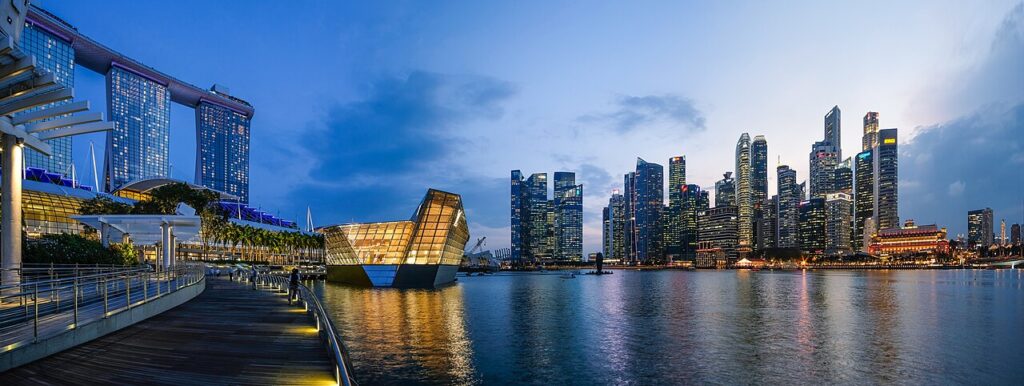
Singapore’s commercial real estate market encompasses office towers, retail podiums, shophouses, industrial buildings, and mixed-use developments. Unlike residential property, commercial assets are not governed by the Residential Property Act and are not subject to Additional Buyer’s Stamp Duty (ABSD) — making them a popular route for investors seeking rental income or portfolio diversification without the stamp-duty burden that residential purchases now carry.
Commercial property is regulated by the Urban Redevelopment Authority (URA) for planning matters, IRAS (Inland Revenue Authority of Singapore) for stamp duties and GST, and the Monetary Authority of Singapore (MAS) for financing rules. The key legislation governing transactions includes the Stamp Duties Act, the Goods and Services Tax Act, and the Land Titles Act.

Key Types of Commercial Property in Singapore
The four main categories relevant to individual investors are strata offices, strata retail units, industrial properties, and conservation shophouses. Each carries a different lease tenure, typical tenant profile, yield band, and financing environment.
Strata Office Units
Strata offices are individual floors or partial-floor units in commercial buildings, sold as separate titles. Found predominantly in the Central Business District, Orchard, and Jurong Lake District, these units are popular with SME owner-occupiers and yield-seeking investors. Gross yields range from approximately 3.5% to 5.0% in 2026, with CBDpremium offices at the lower end and suburban offices at the higher end. Buildings may be freehold or 99-year leasehold; the distinction affects both capital values and bank financing terms.
Strata Retail Units and Conservation Shophouses
Retail strata units — including ground-floor shop spaces in mixed-use developments — offer yields of roughly 3.0% to 4.5%, with location being the dominant driver. Conservation shophouses (two- to three-storey terraced buildings in gazetted areas such as Chinatown, Little India, and Kampong Glam) are a distinct asset class. Most are freehold with strong scarcity value; gross yields typically run at 2.5% to 4.0%, but capital appreciation has historically been robust. The URA’s conservation guidelines impose strict rules on external façade alterations, which investors must factor into refurbishment budgets. LTV for shophouses tends to be lower — around 40% — because banks treat them as specialised assets.
Industrial Property (B1 and B2)
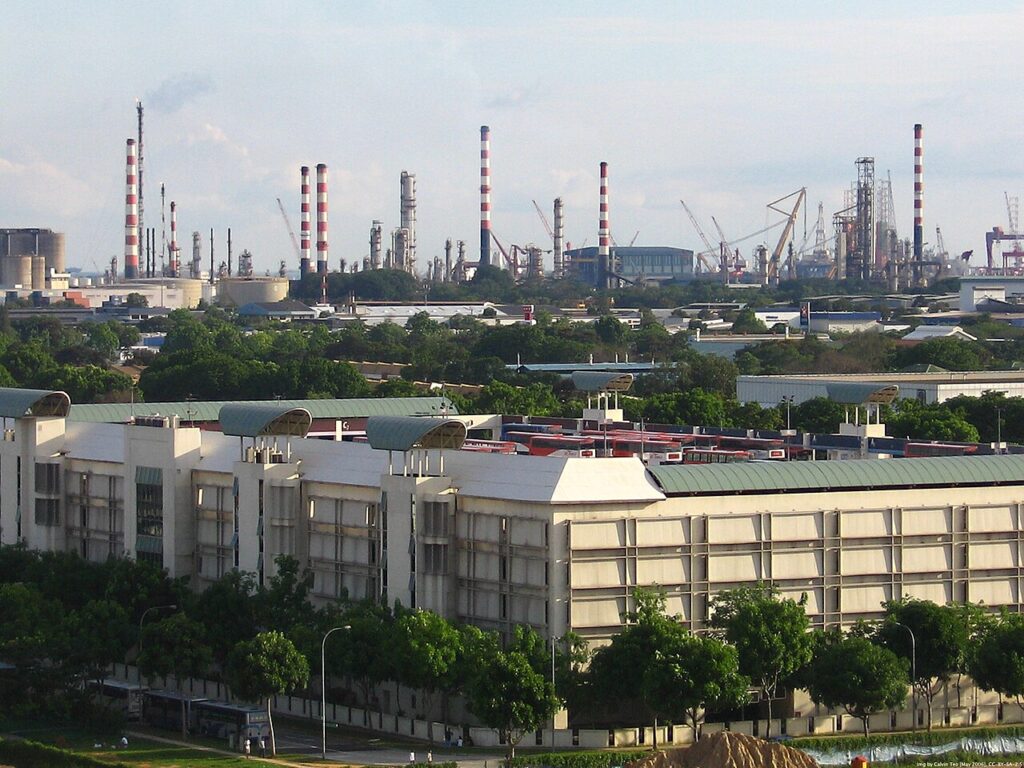
Industrial property in Singapore is stratified by use type: B1 (clean/light industrial) allows uses compatible with a residential environment, while B2 (general industrial) permits heavier manufacturing and logistics. Most industrial land is leased from JTC Corporation at 30- to 60-year tenures, depressing capital values but pushing gross yields to 4.5%–6.5% — the highest of the four main types. Key clusters include Jurong, Tuas, Ubi, and Tai Seng. Since September 2017, resale of strata industrial units is permitted only to end-users for the first three years, a rule introduced by the Ministry of Trade and Industry to curb speculation. Foreigners may invest in industrial property without additional restrictions.

Why Commercial Property Attracts Zero ABSD
ABSD was introduced in December 2011 (and significantly increased in April 2023) specifically to cool demand in the residential housing market, which the government regards as a social good requiring price stability. Commercial and industrial properties serve business rather than shelter needs, and are therefore entirely outside ABSD’s ambit. This means a foreign investor purchasing a strata office pays the same stamp duties as a Singapore Citizen — solely Buyer’s Stamp Duty (BSD) at the standard progressive rates.
BSD rates on commercial property in 2026 are: 1% on the first S$180,000, 2% on the next S$180,000, 3% on the next S$640,000, 4% on the next S$500,000, 5% on amounts from S$1.5 million to S$1 billion, and 6% above S$1 billion. This mirrors the residential BSD schedule and was last revised in Budget 2023.
GST: The Hidden Cost Most Buyers Underestimate
Goods and Services Tax at 9% (effective 1 January 2024) applies to commercial property transactions where the seller is GST-registered. This is separate from BSD and is payable on the purchase price or market value, whichever is higher. On a S$2 million strata office, GST alone adds S$180,000 to the cost — a sum larger than the BSD on the same transaction. Buyers should always verify the seller’s GST registration status via the IRAS MyTax Portal before committing to an Option to Purchase.
If you are purchasing the commercial property for your own GST-registered business, you can claim the input tax credit — effectively recovering the GST through your quarterly GST returns. Investors who are not GST-registered absorb the full 9% as an acquisition cost. Rental income from commercial tenants must also include 9% GST if your annual rental income (across all commercial properties) exceeds S$1 million.

Financing Commercial Property in Singapore
Commercial property loans are not subject to MAS’s Total Debt Servicing Ratio (TDSR) framework in the same way residential mortgages are — though banks still apply their own stress-testing. The Loan-to-Value (LTV) ceiling for a first commercial property loan is approximately 55%, compared to 75% for a first residential property. This reflects the higher perceived risk of commercial assets. Expect to deploy at least 45% equity plus BSD, GST (if applicable), and legal fees on day one.
Interest rates on commercial loans are typically 20–50 basis points higher than equivalent residential loans, reflecting the lower liquidity and higher vacancy risk of commercial assets. Loan tenures are shorter — typically 25 to 30 years maximum for freehold assets, and capped at remaining lease term minus 5 years for leasehold properties. Conservation shophouses, viewed as specialised collateral, often face tighter LTV of around 40%.
Key Facts Summary
| Parameter | Residential Condo | Strata Office | Strata Industrial |
|---|---|---|---|
| ABSD (SC 2nd) | 20% | 0% | 0% |
| ABSD (Foreigner) | 60% | 0% | 0% |
| SSD on resale | 12/8/4% (≤3yr hold) | 0% | 0% |
| GST on purchase | None | 9% if seller GST-reg | 9% if seller GST-reg |
| LTV (first purchase) | 75% | ~55% | ~55–60% |
| Gross yield (2026) | 2.5–4.0% | 3.5–5.0% | 4.5–6.5% |
| Foreigner eligible? | Yes (high ABSD) | Yes (no ABSD) | Yes (no ABSD) |
| CPF usable? | Yes (own use) | No | No |
Worked Example: Ms Rajah Acquires a S$1.5M Strata Office in Tanjong Pagar
Ms Rajah, 45, is an Indian national on an Employment Pass. She already owns a residential condominium purchased with 60% ABSD (S$420,000 on a S$700,000 condo). She now wishes to diversify into commercial property.
Property: Strata office unit, 600 sq ft, Tanjong Pagar CBD, S$1.5 million. The seller is GST-registered.
Acquisition costs:
- BSD: 1% × S$180,000 + 2% × S$180,000 + 3% × S$640,000 + 4% × S$500,000 = S$1,800 + S$3,600 + S$19,200 + S$20,000 = S$44,600 BSD
- ABSD: S$0 (commercial — not applicable)
- GST at 9%: 9% × S$1,500,000 = S$135,000 (recoverable if Ms Rajah registers for GST)
- Legal / conveyancing: approximately S$5,000
- Total upfront cash (excluding mortgage): S$44,600 + S$135,000 + S$5,000 + 45% deposit = S$184,600 + S$675,000 = ~S$859,600
Rental income: At 4.2% gross yield, monthly rent ≈ S$5,250. After property tax (10% of annual value of ~S$44,000 = S$4,400), maintenance, and agent fees, net yield is approximately 3.5%, or S$4,375/month.
Key insight: If Ms Rajah had purchased a residential condo of equivalent value as a second property, her ABSD alone would have been S$900,000 (60% of S$1.5M). By choosing commercial, she eliminates this entirely — and has no SSD exposure if she sells within three years.
Why Commercial Property Matters for Singapore Investors
The April 2023 ABSD increases — which pushed the foreigner residential rate to 60% and the SC second-property rate to 20% — dramatically changed the calculus for investors. Commercial property became the natural hedge: the same capital now buys a non-residential asset with no ABSD, no SSD, and typically a higher gross yield than residential. Between 2023 and 2026, URA data shows elevated transaction volumes for strata commercial and industrial units as investors sought ABSD-free alternatives.
Compared to regional peers, Singapore’s commercial property market benefits from rule-of-law certainty, transparent title, a deep pool of institutional tenants, and strong infrastructure connectivity. Hong Kong and Kuala Lumpur offer comparable tax advantages in some segments, but Singapore’s political stability and AAA-rated credit environment command a premium.
What Might Come Next for Singapore Commercial Property
(This section contains the editorial team’s forward-looking analysis; it does not constitute financial advice.)
The URA’s 2019 Master Plan designated the Greater Southern Waterfront, Jurong Lake District, and Woodlands Regional Centre as key nodes for commercial growth. These decentralisation drivers are expected to support demand for strata office space outside the CBD over the 2025–2030 planning horizon. Industrial REITs have flagged tightening vacancy rates in B1 space as the tech and biomedical sectors continue to grow, potentially supporting rental growth.
GST is not expected to rise above 9% before 2028 based on current MAS and MOF guidance. ABSD on commercial property has never been introduced in Singapore’s policy history, and any future imposition would require legislative change — there is no current signal of this from the government. The main risks for commercial investors are interest rate movements (commercial loan rates are closely tied to SORA and 3-month bank rates), potential oversupply in the CBD Grade A office segment following several large completions, and global economic uncertainty affecting tenant demand.
Frequently Asked Questions
Can foreigners buy commercial property in Singapore without restrictions?
Yes. The Residential Property Act (Cap 274) restricts foreigners from purchasing certain residential property categories (such as landed property and non-approved condominium units without special approval), but commercial property is entirely outside its scope. A foreigner may purchase a strata office, retail unit, shophouse, or industrial unit without any Ministry of Law approval, and pays 0% ABSD on the transaction. BSD and GST (if the seller is GST-registered) still apply.
Do I need to pay GST when buying a commercial property from a private individual who is not GST-registered?
No. GST only applies when the seller is a GST-registered entity. If you are purchasing a strata office from a private individual who has never registered for GST (which is common for smaller investors), no GST is payable. Always verify the seller’s GST registration status on the IRAS MyTax Portal before signing the Option to Purchase. If the seller is GST-registered, factor in the full 9% — this is non-negotiable and non-refundable unless you yourself register for GST and claim input tax.
Can I use my CPF savings to purchase a commercial property?
No. CPF Ordinary Account savings may only be used for the purchase of approved residential properties in Singapore — HDB flats, private residential apartments, and executive condominiums. Commercial and industrial properties are explicitly excluded from CPF usage. You must fund the entire purchase — including deposit, BSD, GST, legal fees, and the equity portion — using cash or cash equivalents.
Is rental income from commercial property taxable in Singapore?
Yes. Rental income from commercial property is taxable under the Income Tax Act as part of your assessable income for the relevant Year of Assessment. You may deduct allowable expenses including mortgage interest, property tax, maintenance and repairs, insurance premiums, and agent commission. If your gross rental receipts exceed S$1 million per year, you must register for GST and charge 9% GST to tenants (which you then remit to IRAS quarterly, after claiming input tax credits on your own GST-bearing expenses).
What is the difference between B1 and B2 industrial property?
Both are industrial land-use categories defined by the URA. B1 (clean/light industrial) permits uses such as food production, light manufacturing, research-and-development labs, and data centres — activities compatible with a residential environment. B2 (general industrial) permits heavier manufacturing, storage, and logistics activities that may generate noise, vibration, or emissions. B2 properties tend to offer higher yields but a narrower tenant pool, and are located further from residential zones. Investors should check the specific approved uses of any industrial unit before purchase, as unauthorised use can result in URA enforcement action.
Are there any restrictions on reselling commercial property in Singapore?
Generally, no — commercial property may be resold at any time with no Seller’s Stamp Duty. However, strata industrial units sold under JTC leases have a restriction: they may only be sold to end-users (not investors) during the first three years of ownership, a rule introduced in September 2017 to reduce speculation. After three years, the restriction lifts and the unit may be sold to any buyer. Conservation shophouses may be subject to URA conservation conditions that restrict certain types of renovation or façade changes, which can affect marketability.
How does the Seller’s Stamp Duty (SSD) work for commercial property?
It does not. Seller’s Stamp Duty was introduced specifically for residential property to discourage short-term speculation. It applies at 12% (sold within one year), 8% (sold in year two), and 4% (sold in year three) for residential properties acquired after 16 December 2021. Commercial and industrial property are entirely exempt from SSD — you may sell a strata office one month after purchase with zero SSD liability. BSD and any applicable GST on the subsequent buyer’s transaction are unrelated to your SSD position as a seller.
Related Articles
- ABSD Singapore 2026 — Complete Guide to Additional Buyer’s Stamp Duty
- Buyer’s Stamp Duty Singapore 2026 — Full Rate Table and Worked Examples
- Singapore Rental Yield Guide 2026: Where to Find 4%+ Gross Yields
- Foreigner Property Buyer Singapore 2026: What You Can Buy, ABSD Rates & Residential Property Act Rules
- Capital Gains and Rental Income Tax Singapore 2026: How Property Investors Are Actually Taxed
- 99-to-1 Property Purchase Singapore 2026: ABSD Anti-Avoidance Rules Explained