First-Time Property Buyer Guide Singapore 2026: HDB, EC and Condo — Every Step, Cost and Grant Explained

First-Time Property Buyer Guide Singapore 2026: HDB, EC and Condo — Every Step, Cost and Grant Explained

Quick Answer — First-Time Property Buyer Singapore 2026

  • Singapore Citizens buying their first property pay zero ABSD on the purchase
  • HDB BTO is the most affordable entry point — balloted flats from ~S$180k (non-mature, 2-room Flexi) with Enhanced Housing Grant (EHG) up to S$80,000
  • For private condos: minimum 5% cash downpayment + 20% CPF (or cash); TDSR limit = 55% of gross monthly income
  • HDB resale: Proximity Housing Grant (PHG) adds S$10k–S$30k for buying near parents/children
  • Executive Condominiums (EC): income ceiling S$16,000/month; bank loan only; 5-year MOP; privatises after 10 years
  • BSD (Buyer’s Stamp Duty) is payable by all buyers regardless of citizenship — progressive 1–6% on purchase price
  • CPF Ordinary Account (OA) can fund downpayment and monthly instalments — up to the Valuation Limit (VL)
  • HDB Loan (2.6% p.a.) vs Bank Loan: bank rates lower short-term but variable; HDB offers security and HLE letter approval process
  • First-timers have priority balloting at HDB BTO: 95% of flat supply reserved for first-timers (85% for mature estates)

Why First-Time Buyers Have a Significant Advantage in Singapore

Singapore’s public housing framework is deliberately designed to give first-time buyers a material advantage over repeat purchasers. This advantage operates through four channels: zero ABSD on the first residential property for Singapore Citizens (SCs) and a reduced 5% rate for Singapore Permanent Residents (SPRs); substantial cash grants (up to S$80,000 for HDB flat buyers); priority ballot access to subsidised Build-To-Order (BTO) flats; and the ability to deploy CPF Ordinary Account (OA) savings towards both the downpayment and monthly mortgage instalments.

The result is that a married couple of SCs purchasing their first HDB flat at S$550,000 will pay less than S$1,000 in net upfront cash once grants and CPF savings are applied — one of the most government-supported entry pathways to home ownership in the world. This guide, organised by the three main property pathways — HDB flat, Executive Condominium (EC), and private condo — walks through every cost, rule, and decision point a first-time buyer in Singapore needs to know in 2026.

Pathway 1: HDB BTO and Resale Flats

Who Qualifies?

To buy an HDB flat (new BTO or resale), you must satisfy the Public Scheme or one of five other eligibility schemes administered by HDB. The most common for first-timers is the Public Scheme, which requires: at least one Singapore Citizen applicant, plus a Singapore Citizen or Permanent Resident co-applicant (or a single SC aged 35+), and no existing HDB flat or private property ownership (or interest). You must not have previously disposed of an HDB flat.

BTO versus Resale

A BTO (Build-To-Order) flat is purchased directly from HDB at a government-subsidised price, but involves a 3–5 year construction wait. A resale flat is purchased from an existing owner in the open market and is ready for immediate occupation, but carries a higher market price. For most first-timers, BTO is considerably more affordable; resale is preferred when location, flat maturity, or timeline constraints make the wait impractical.

HDB Grants Available to First-Timers in 2026

Singapore’s CPF Board and HDB administer three principal grants for HDB flat buyers:

  • Enhanced Housing Grant (EHG): Up to S$80,000 for families and S$40,000 for singles (35+). Granted on a sliding scale based on average gross monthly household income (GMHI), with the full S$80,000 available to families earning up to S$1,500/month. EHG applies to both BTO and resale purchases.
  • Proximity Housing Grant (PHG): S$30,000 (living with parents/children) or S$20,000 (living within 4km) for buying a resale flat near family members. An additional S$10,000 for singles. PHG is only for resale flats.
  • Step-Up Housing Grant: S$15,000 for second-timers from 2-room Flexi flats upgrading to 3-room flats — applies to a specific subset of buyers, not typical first-timers.
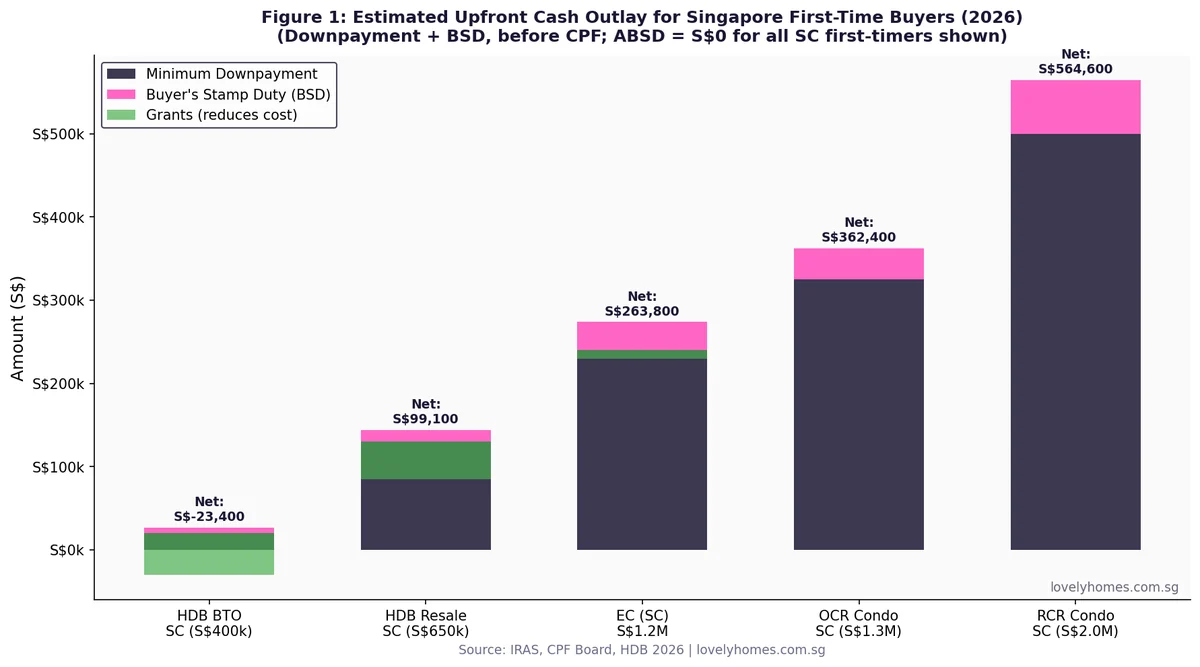
Singapore first-time buyer upfront costs by property type 2026
Figure 1: Estimated upfront cash outlay for Singapore first-time buyers at common price points (2026). ABSD = S$0 for all SC first-timers shown. Source: IRAS, CPF Board, HDB 2026.

HDB Loan vs Bank Loan

First-time HDB buyers may choose between an HDB Concessionary Loan (2.6% p.a., pegged to CPF OA rate + 0.1%) and a commercial bank loan (fixed from ~3.0% p.a. or SORA-based floating). The HDB loan requires a minimum 10% downpayment (all CPF allowed); a bank loan requires 5% cash + 20% total downpayment. The HDB vs bank loan comparison guide shows that bank loans save approximately S$92,000 in total interest over 25 years on a S$500k loan — but carry repricing risk if interest rates rise. First-timers must obtain an HDB Flat Eligibility (HFE) letter before exercising any OTP, confirming their loan eligibility and grant quantum.

Pathway 2: Executive Condominiums (ECs)

Executive Condominiums are a uniquely Singaporean housing type that straddles the HDB-private divide. Built by private developers on government land, ECs are sold at a discount to comparable private condominiums (~10–15% discount), with HDB oversight during the 5-year MOP and 10-year privatisation period. After privatisation, EC owners enjoy the same rights as private property owners and may sell to foreigners.

EC Eligibility in 2026

  • Gross monthly household income ceiling: S$16,000
  • At least one SC applicant; at least one more SC or SPR
  • Cannot own or have disposed of a private property in the 30 months before application
  • Must not have previously purchased a subsidised flat or EC as a first-timer (with exceptions)
  • EC buyers must take a bank loan (no HDB Concessionary Loan); MSR applies (30% of gross monthly income)
  • From 8 May 2026: DPS (Deferred Payment Scheme) abolished for ECs; rental restriction extended to 10 years post-TOP; privatisation milestone extended to 15 years from TOP; 90% of units reserved for first-timers

EC Grants Available

  • AHG (Additional Housing Grant): Up to S$30,000 for families with GMHI ≤ S$10,000
  • FHG (Family Housing Grant): S$10,000 for families; available on top of AHG

Pathway 3: Private Condominiums

SCs buying a private condo as their first and only property pay zero ABSD — but BSD still applies. For a S$1.3M OCR condo, BSD is S$37,400. The minimum downpayment for a bank loan (LTV 75%) is 5% cash (S$65,000) + 20% CPF or cash (S$260,000) = S$325,000, assuming the buyer has enough CPF savings. The Total Debt Servicing Ratio (TDSR) of 55% applies; for a S$1.3M purchase with a S$975,000 loan at 3.0% over 25 years, the monthly instalment is approximately S$4,627, requiring a minimum gross household income of ~S$8,413/month to satisfy TDSR.
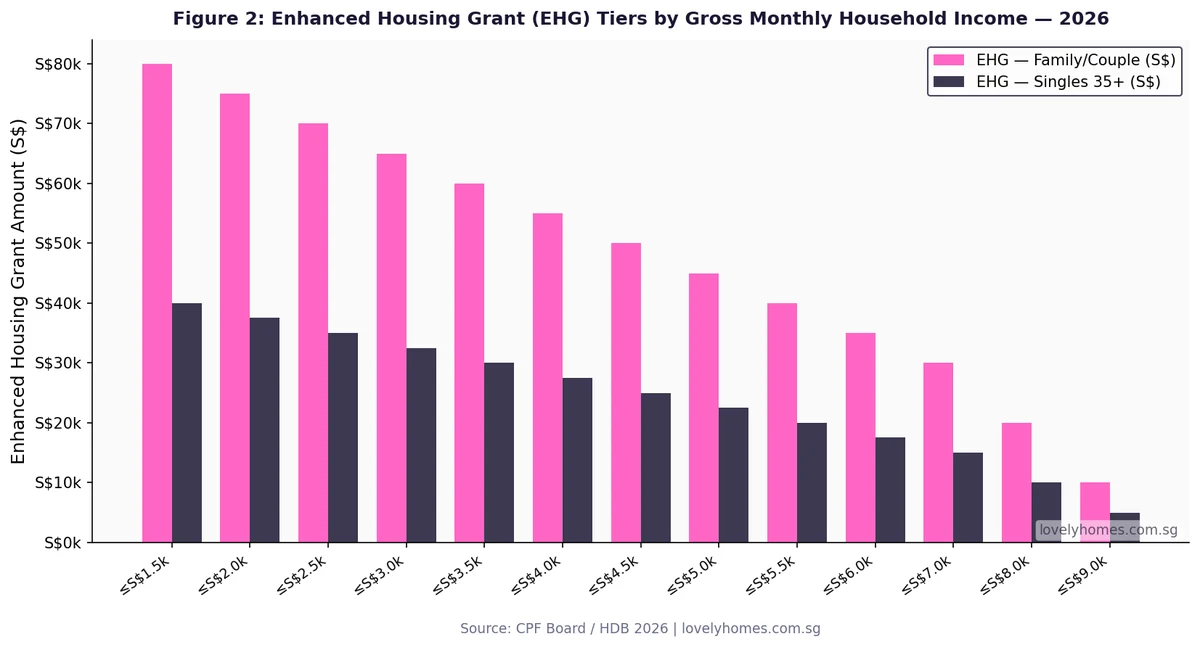
Singapore Enhanced Housing Grant EHG tiers by income 2026
Figure 2: Enhanced Housing Grant (EHG) quantum by gross monthly household income — Singapore 2026. Source: CPF Board / HDB.

CPF Usage for Private Property

CPF OA savings may be used for the downpayment and monthly instalments of a private property, up to the Valuation Limit (VL) — equal to the lower of purchase price or market valuation. Once CPF usage reaches VL, further CPF withdrawals require the flat’s remaining lease to cover the buyer to age 95, and are capped at the Withdrawal Limit (WL) of 120% of VL. For buyers aged under 55 purchasing a property with a 99-year lease, the VL and WL constraints are typically non-binding at normal private condo price levels.

Upfront Cost Comparison: HDB vs EC vs Private Condo

Parameter HDB BTO (S$400k) EC (S$1.2M) OCR Condo (S$1.3M)
BSD S$6,600 S$33,800 S$37,400
ABSD (SC 1st purchase) Nil Nil Nil
Min. downpayment 10% (all CPF ok) 5% cash + 20% CPF 5% cash + 20% CPF
Min. cash downpayment S$0 (if CPF sufficient) S$60,000 S$65,000
Grants available EHG up to S$80k AHG+FHG up to S$40k None
Loan type HDB 2.6% or bank Bank loan only Bank loan only
Income test MSR 30% MSR 30%; ceiling S$16k TDSR 55%
MOP / Restriction 5-year MOP 5-year MOP; 15-yr privatisation None
Can buy jointly with SPR? Yes Yes Yes
Singapore first-time buyer decision matrix HDB EC private condo 2026
Figure 3: First-time buyer decision matrix — HDB BTO/Resale vs Executive Condo vs Private Condo, Singapore 2026. Source: HDB, CPF Board, MAS, IRAS.

Worked Example: Mr & Mrs Tan’s First Home

Mr Tan (SC, 31) and Mrs Tan (SC, 29) are newly married, renting a room in Queenstown. Mr Tan earns S$5,800/month; Mrs Tan earns S$4,200/month — combined gross S$10,000/month. They have S$80,000 in combined CPF OA savings and S$35,000 in cash savings.

Option A: HDB Resale 4-room, Bishan — S$720,000

  • EHG: S$35,000 (income S$10k → upper tier; max S$35k)
  • PHG: S$0 (not buying near parents in same town)
  • BSD: S$16,800 (progressive on S$720k)
  • ABSD: Nil (SC first property)
  • HDB loan (80% LTV): S$576,000 at 2.6% p.a., 25yr = S$2,607/month — MSR 26.1% ✓
  • Downpayment 20%: S$144,000 (paid: S$80,000 CPF OA + S$64,000 cash)
  • BSD paid via CPF OA: S$16,800
  • Less EHG offset to CPF: −S$35,000
  • Net cash outlay: S$64,000 − S$35,000 (grant to CPF) ≈ S$29,000 cash
  • Monthly payment (CPF OA deduction): S$2,607 — fully funded by CPF contributions (~S$2,700/month combined for salaries S$10k)

Option B: OCR Condo 2BR, Tampines — S$1,300,000

  • BSD: S$37,400
  • ABSD: Nil (SC first property)
  • Bank loan (75% LTV): S$975,000 at 3.0% p.a., 25yr = S$4,627/month — TDSR 46.3% ✓
  • Downpayment: 5% cash (S$65,000) + 20% CPF/cash (S$195,000) = S$260,000 total; but CPF OA only S$80,000 → cash shortfall of S$115,000
  • Shortfall vs available savings: S$65,000 + S$115,000 − S$35,000 cash available = S$145,000 cash required vs S$35,000 available
  • Verdict: Not feasible at current savings. Mr & Mrs Tan should buy the HDB resale first, build equity over 5 years, and upgrade to a private condo once CPF and capital appreciation allow.

This is a textbook application of Singapore’s HDB-first, upgrade-later strategy — the single most common path for Singaporean households to accumulate property wealth over their lifetime.

Why the First-Timer Advantage Matters for Long-Term Wealth

Singapore’s property framework rewards patience and sequential upgrading. The first-timer’s zero ABSD status — worth S$0 now but S$260,000 on a S$2M purchase if purchasing a second property — is a one-time use entitlement. Preserving it by making the right first purchase is critical. A first-timer who buys a S$650,000 resale HDB flat at age 28 and sells at age 33 (MOP completed) can potentially walk away with S$150,000–S$200,000 in equity and CPF proceeds, enough to fund the downpayment on an OCR condo — all without ever having paid a cent of ABSD. This sequential pathway is not available to foreigners (65% ABSD from purchase 1) or even to SPRs (5% ABSD on first purchase).

What Might Change for First-Time Buyers in 2026 and Beyond

The HDB June 2026 BTO exercise — covering approximately 6,900 flats across Ang Mo Kio, Bishan, Bukit Merah, Sembawang, and Woodlands — is expected to release ballot results in late June or early July 2026. Successful applicants in mature estates (Bishan, Bukit Merah) will benefit from the 85% first-timer priority allocation. The HDB’s ongoing review of the Prime Location Public Housing (PLH) classification boundaries — particularly as the definition of what constitutes a “prime” location has attracted debate — may affect grant eligibility and resale restrictions for upcoming BTO exercises. First-timers considering a BTO application in 2026–2027 should watch MND announcements closely.

Frequently Asked Questions

Do I pay ABSD as a Singapore Citizen buying my first property?

No. Singapore Citizens purchasing their first residential property are fully exempt from Additional Buyer’s Stamp Duty (ABSD) — effective 27 April 2023 and ongoing. You will still pay Buyer’s Stamp Duty (BSD) at the standard progressive rates (1–6% of purchase price). The BSD is unavoidable for all buyers regardless of citizenship. ABSD at 20% kicks in only from the second property for SCs; the rate rises to 30% for a third and subsequent property. SPRs pay 5% ABSD even on their first property.

How much CPF can I use to buy a flat or condo?

You may use CPF Ordinary Account (OA) savings for both the downpayment and monthly mortgage instalments, up to the property’s Valuation Limit (VL) — which is the lower of the purchase price and the property’s market valuation. Once your total CPF withdrawals reach VL, further CPF usage is subject to the property’s remaining lease covering you to age 95. In practice, for most buyers under 45 purchasing 99-year-leasehold properties, the VL cap is non-binding until the CPF balance is exhausted. An upper Withdrawal Limit (WL) of 120% of VL applies as an absolute ceiling. Check your CPF OA balance and projected contributions at cpf.gov.sg.

Can a single Singapore Citizen buy an HDB flat alone?

Yes — a single Singapore Citizen aged 35 or above may buy an HDB flat (resale) or apply for a BTO flat (2-room Flexi units in non-mature estates or Prime/Plus locations via the Single Singapore Citizen (SSC) scheme). Singles below 35 cannot buy an HDB flat on their own. Singles purchasing HDB flats are eligible for the EHG at half the family quantum (up to S$40,000) and may qualify for PHG of S$10,000 for buying near parents. Private condominiums and ECs have no age or single/married restrictions — a single SC of any age may purchase a private property with zero ABSD.

What is the Minimum Occupation Period (MOP) and why does it matter?

The MOP is the minimum period a HDB flat or EC buyer must physically occupy the property before selling it in the open market or buying another HDB flat. For standard HDB flats, the MOP is 5 years from the date of key collection. For Plus and Prime Location Public Housing (PLH) flats — introduced under the new HDB classification framework effective October 2023 — the MOP is 10 years. For ECs (from the 8 May 2026 cooling measures), the MOP remains 5 years but privatisation is extended to 15 years from TOP. The MOP prevents short-term speculation and ensures that subsidised housing goes to genuine owner-occupiers. An owner who violates MOP conditions (e.g., by subletting the entire flat before MOP completion) risks compulsory acquisition of the flat by HDB.

What is the TDSR and how does it affect my borrowing capacity?

The Total Debt Servicing Ratio (TDSR) is a MAS-mandated framework limiting total monthly debt obligations to 55% of the borrower’s gross monthly income. It applies to all loans secured on private residential properties. For HDB flats, the Mortgage Servicing Ratio (MSR) applies instead, capping the home-loan instalment (only) at 30% of gross monthly income. TDSR includes all existing loan obligations — car loans, personal loans, credit card minimum payments — not just the property mortgage. For example, a couple earning S$12,000/month combined with a S$500/month car loan payment has a remaining TDSR capacity of S$6,100/month (55% × S$12,000 − S$500), which at 3.0% p.a. over 25 years translates to a maximum loan of approximately S$1,285,000.

Should I buy HDB first and upgrade, or go straight to a private condo?

For most Singaporean households, buying HDB first and upgrading later is the mathematically superior strategy — but it depends on your income, savings, and goals. The HDB route gives you access to grants (up to S$80,000 EHG), a subsidised purchase price, and the CPF usage advantage. After the 5-year MOP, you can sell the HDB flat and use the proceeds plus CPF accrued value to fund the downpayment on a private condo — still with zero ABSD (as it is your first private property purchase). The alternative — buying a private condo directly at age 25–30 — requires substantially more upfront cash and eliminates access to HDB grants entirely. However, if you have the savings and income, a direct private condo purchase avoids the 5-year illiquidity of HDB ownership and offers better rental income flexibility from day one. A worked comparison for upgraders is available on LovelyHomes.

Related Articles


Disclaimer: The information in this guide is for general educational purposes only and does not constitute legal, tax, or financial advice. Property grant eligibility, loan limits, ABSD rates, and HDB policies change regularly. Always verify current rules at the official government portals — hdb.gov.sg, cpf.gov.sg, iras.gov.sg, and mas.gov.sg — and consult a licensed property agent or conveyancing solicitor before signing any Option to Purchase. LovelyHomes is an independent editorial platform and is not affiliated with any property agency.

Singapore CPF Property Withdrawal Limits 2026: OA Valuation Limit, Withdrawal Limit and Accrued Interest Explained

Singapore CPF Property Withdrawal Limits 2026: OA Valuation Limit, Withdrawal Limit and Accrued Interest Explained

Quick Answer: CPF Property Withdrawal Limits in 60 Seconds

  • Valuation Limit (VL): The lower of the purchase price or the property’s market valuation. CPF usage is capped at 100% of the VL for down-payments and loan instalments combined.
  • Withdrawal Limit (WL): 120% of the VL — the absolute maximum CPF that may be drawn for a property (for leases with ≥ 60 years remaining when the youngest buyer turns 55).
  • Accrued interest: CPF Board charges 2.5% p.a. on all CPF Ordinary Account (OA) monies used for property. On sale, you must refund the principal plus accrued interest to your CPF account.
  • Age 55 rule: After age 55, you must first set aside the Basic Retirement Sum (BRS) or Full Retirement Sum (FRS) in your Retirement Account before further CPF OA can be used for property.
  • Lease adequacy: CPF OA cannot be used if the remaining lease is under 20 years; for shorter leases (20–59 years), a pro-rated WL applies. The lease must cover the youngest buyer to age 95 for unrestricted use.
  • HDB loans: Up to 80% LTV from HDB; CPF OA can cover the full 20% cash/CPF downpayment. Bank loans: 75% LTV with 5% mandatory cash; CPF can cover the remaining 20% downpayment.
  • Refund on sale: Net sale proceeds first repay the bank/HDB loan; remaining cash replenishes CPF up to the refund amount before you receive any cash proceeds.

What Is the CPF Ordinary Account and How Is It Used for Property?

The Central Provident Fund (CPF) is Singapore’s mandatory social security savings system, administered by the CPF Board. Every employed Singapore Citizen and Permanent Resident contributes a percentage of their monthly wages into three CPF accounts: the Ordinary Account (OA), the Special Account (SA), and the MediSave Account (MA). The OA earns a guaranteed 2.5% per annum (p.a.) interest, currently with a floor rate maintained by the CPF Board. It is the OA that may be used for housing — specifically for the purchase or construction of HDB flats, Executive Condominiums (ECs), and private residential property, as well as for home protection insurance premiums and property tax.

The CPF framework for property withdrawals is governed by the CPF Act (Cap. 36) and the CPF Housing Schemes administered by the CPF Board. Two concepts sit at the heart of the framework: the Valuation Limit (VL) and the Withdrawal Limit (WL). Understanding both — and their interaction with accrued interest, lease adequacy rules, and the post-55 retirement sum requirements — is essential for every property buyer in Singapore.

Valuation Limit (VL) and Withdrawal Limit (WL) Explained

The Valuation Limit (VL) is defined as the lower of the purchase price or the Chief Valuer’s assessed market value of the property at the time of purchase. For most buyers transacting at or near market price, the VL will equal the purchase price. For buyers paying a significant premium above valuation — common in competitive en-bloc or collective-sale situations — the VL will be capped at the lower valuation figure. CPF OA monies used for the downpayment and all subsequent monthly mortgage instalments together cannot exceed the VL.

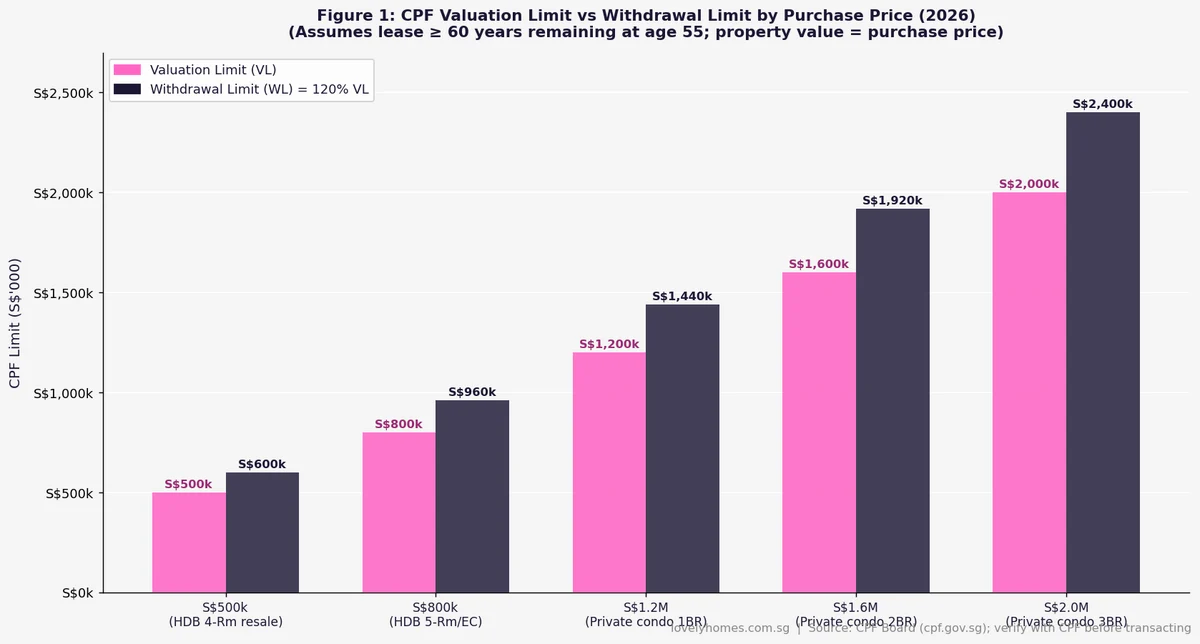
The Withdrawal Limit (WL) is set at 120% of the VL. This is the absolute ceiling on the total amount of CPF OA that may be used for a single property across the entire ownership period. The WL is higher than the VL to accommodate the progressive drawdown of CPF for monthly instalments: even after the full VL is exhausted for the principal portion, buyers may continue using CPF for instalments up to the WL threshold. Figure 1 visualises the VL and WL across five representative purchase price scenarios.

CPF valuation limit vs withdrawal limit by purchase price Singapore 2026 — bar chart showing VL and WL for S$500k to S$2M properties
Figure 1: CPF Valuation Limit vs Withdrawal Limit by Purchase Price (2026). WL = 120% of VL. Assumes lease ≥ 60 years remaining at age 55 and property value equals purchase price. Source: CPF Board (cpf.gov.sg).

Lease Adequacy: How Property Lease Length Affects CPF Usage

The CPF Board applies lease adequacy rules to protect CPF members from over-investing their retirement savings in depreciating assets. For a buyer to enjoy unrestricted CPF usage up to the full WL (120% of VL), the property’s remaining lease must cover the youngest buyer from the date of purchase to at least age 95. In practice, this means a 30-year-old buying a property with an 80-year remaining lease has no CPF restriction (80 years covers them to age 110 well above 95). However, a 45-year-old buying a 99-year flat built in 1985 — meaning approximately 58 years of lease remain — would face a pro-rated WL calculation, since the lease does not cover them to age 95 (45 + 58 = 103: marginal case; check CPF Board calculator for exact figure).

If a property’s remaining lease at the time of purchase is under 30 years, CPF OA cannot be used at all. Properties with remaining leases between 30 and 59 years at the time the youngest buyer turns 55 are subject to a reduced pro-rated WL — the CPF Board will provide an exact figure through its online calculator. This lease adequacy framework was substantially tightened in a series of regulatory updates in 2019 and 2021 and is particularly relevant for older HDB resale flats and ageing freehold private properties on a 99-year lease nearing expiry.

Remaining Lease (at purchase) CPF Usage Permitted? WL Cap Notes
≥ 60 years AND covers youngest buyer to 95 Yes — full WL 120% of VL Standard case for most new and resale purchases
30–59 years Yes — pro-rated WL Reduced (CPF Board calculator) Common for older HDB flats built pre-1985
20–29 years Restricted use only Significantly reduced CPF Board approval required
Under 20 years No CPF usage Nil Full cash purchase only

Accrued Interest: The Hidden Cost of Using CPF for Property

One of the most frequently misunderstood aspects of CPF housing withdrawals is the concept of accrued interest. When you use CPF OA monies for your property, the CPF Board does not treat those funds as a gift — they are treated as a loan from your retirement account. The 2.5% p.a. interest that your OA would have earned had the money not been used for property continues to accumulate as a notional debt against your CPF housing account. This means that when you sell your property, you must refund both the principal amount withdrawn and all the accrued interest to your CPF OA (or Retirement Account if you are over 55). You do not pay this interest out of pocket while you own the property — it accrues notionally — but it becomes payable at the point of sale from your net sale proceeds.

CPF accrued interest accumulation over 30 years — S$200,000 CPF drawn at 2.5% per annum OA rate Singapore 2026
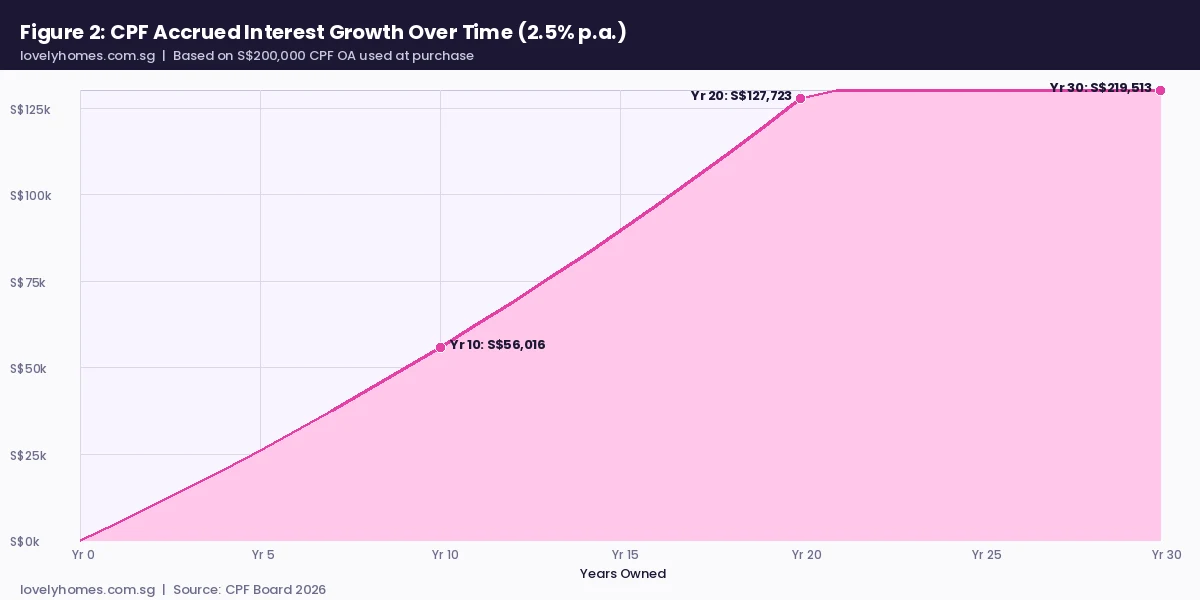
Figure 2: CPF Accrued Interest Accumulation — S$200,000 CPF Drawn at 2.5% p.a. OA Rate over 30 Years. By Year 30, the total CPF refund required is approximately S$419,000 — more than double the original withdrawal. Source: CPF Board formula; indicative calculation.

Figure 2 illustrates the compounding effect: on a S$200,000 CPF withdrawal at the 2.5% p.a. OA rate, the accrued interest reaches approximately S$28,000 by Year 5, S$62,000 by Year 10, and S$219,000 by Year 30. The total CPF refund required after 30 years of ownership is thus approximately S$419,000 — more than double the original withdrawal. This is not a cash loss if property prices appreciate sufficiently, but it means that the net cash proceeds from a property sale are significantly lower than buyers sometimes expect. For HDB upgraders who use maximum CPF for their flat purchase, this accrued interest obligation can materially affect the cash available for a subsequent private property purchase.

CPF Usage After Age 55: Retirement Sum Rules

Once a CPF member turns 55, the CPF Board creates a Retirement Account (RA) by sweeping funds from the Special Account (SA) and then OA into the RA up to the applicable Full Retirement Sum (FRS). For 2026, the FRS is S$213,000 and the Basic Retirement Sum (BRS) is S$106,500. The Enhanced Retirement Sum (ERS) is S$319,500 (150% of FRS).

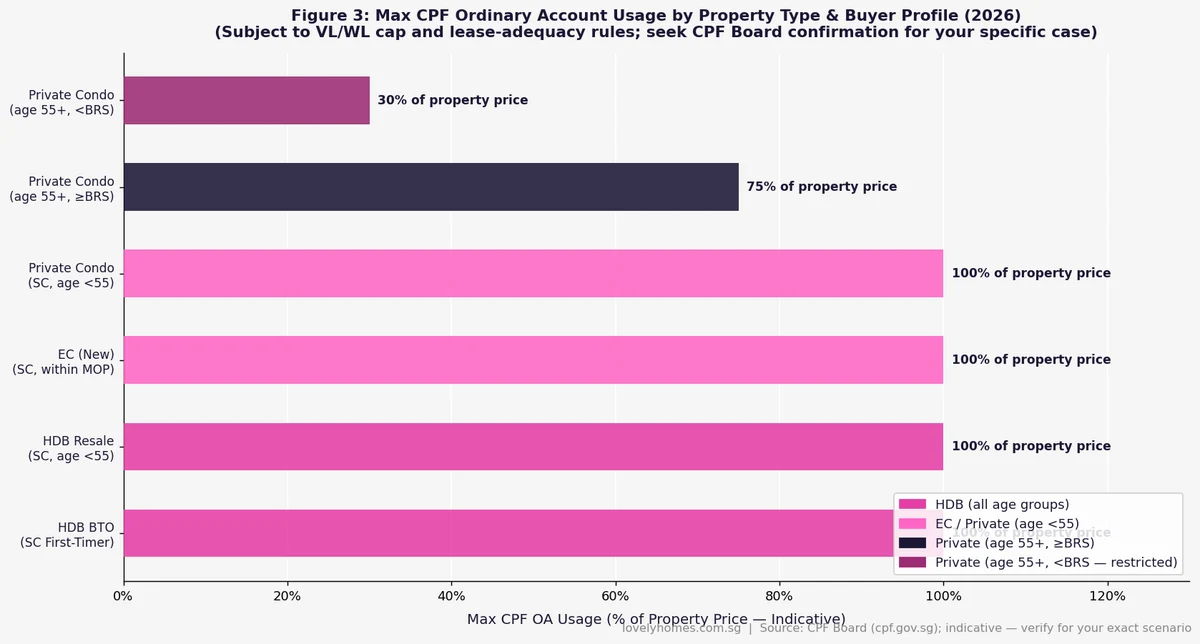
After age 55, you may continue using your remaining OA for property only after setting aside the BRS in your RA — and only if you have pledged your property to cover the BRS shortfall up to the FRS. In practical terms: if your RA balance after the SA and OA sweep equals or exceeds the FRS, you retain full flexibility to use the remaining OA for property instalments. If your RA is below the FRS but above the BRS and you have pledged your property, you may also continue using OA. However, if your RA is below the BRS, no further CPF OA can be used for property until the BRS shortfall is resolved. Figure 3 summarises the maximum CPF OA usage across different buyer profiles.

Maximum CPF OA usage by property type and buyer profile Singapore 2026 — HDB BTO EC private condo age 55 plus
Figure 3: Maximum CPF OA Usage by Property Type & Buyer Profile (2026). Indicative — verify with CPF Board for your specific case. Source: CPF Board (cpf.gov.sg).

CPF for HDB Flats: HDB Loan vs Bank Loan Rules

Singapore Citizens (SCs) purchasing an HDB flat have the option of a concessionary HDB loan (administered by HDB, funded by the government) or a bank loan from a commercial lender. The loan type significantly affects how CPF may be deployed. Under an HDB loan (LTV up to 80%, interest rate currently 2.6% p.a.), buyers may use CPF OA to cover the full downpayment — there is no mandatory cash component for the 20% downpayment, and CPF can cover 100% of the downpayment. Under a bank loan (LTV 75%), buyers must pay a minimum of 5% of the purchase price in cash, but the remaining 20% downpayment (and monthly instalments within the WL) can come from CPF OA. For first-timer SC couples purchasing an HDB flat, the Enhanced CPF Housing Grant (EHG) and Proximity Housing Grant (PHG) supplements, administered by HDB, reduce the effective purchase price and therefore the total CPF required, making home ownership more accessible.

CPF for Private Property and Executive Condominiums

For private residential property (and ECs, which are treated as private property for CPF purposes after their five-year Minimum Occupation Period), the CPF OA may be used for: the downpayment (above the mandatory 5% cash for bank loans); monthly loan instalments to the bank; and stamp duties. The VL and WL rules apply as described above. It is important to note that for private property, CPF usage for the downpayment is capped at the difference between the purchase price and the bank loan amount (i.e. the cash/CPF portion of the downpayment). CPF cannot be used to pay the mandatory 5% cash downpayment — that must always come from cash. Stamp duties (BSD and ABSD) may be paid from the CPF OA in some circumstances, but most buyers pay these from cash to preserve CPF for loan servicing.

The CPF Refund Calculation: What You Owe on Sale

When you sell a property, the sequence of repayments from the net sale proceeds is: (1) outstanding bank or HDB loan; (2) seller’s legal fees and agent commissions; (3) CPF refund (principal withdrawn + accrued interest) to CPF OA; (4) any remaining cash to the seller. If the net sale proceeds after paying off the loan are insufficient to cover the full CPF refund, you are not required to top up the shortfall in cash — you simply refund what is available. However, this shortfall means your CPF OA and retirement savings are permanently reduced, which can affect your CPF LIFE monthly payout in retirement and your ability to make future CPF-funded property purchases.

Worked Example: HDB Resale Flat Purchase and Sale

Mr and Mrs Lim are Singapore Citizens, both aged 34. They purchase a Bishan 4-room HDB resale flat for S$750,000 in January 2021. They take an HDB concessionary loan of S$600,000 (80% LTV, 2.6% p.a.) and use S$150,000 from their combined CPF OA for the downpayment. Over five years of ownership, they make monthly CPF OA contributions totalling an additional S$120,000 towards mortgage instalments, bringing total CPF drawn to S$270,000.

Valuation Limit: S$750,000 (purchase price = valuation). Withdrawal Limit: S$900,000 (120% × S$750,000).

CPF drawn by January 2026 (5 years): S$270,000 principal. At 2.5% p.a. compounding, accrued interest over 5 years ≈ S$270,000 × ((1.025)^5 – 1) = S$270,000 × 0.1314 = approximately S$35,500. Total CPF refund required: S$270,000 + S$35,500 = S$305,500.

Sale in January 2026: Market price S$950,000. Outstanding HDB loan balance ≈ S$540,000. Legal and agent fees ≈ S$16,000. Net proceeds after loan repayment and fees: S$950,000 – S$540,000 – S$16,000 = S$394,000. CPF refund of S$305,500 is repaid to CPF OA; remaining cash proceeds to Mr and Mrs Lim: S$394,000 – S$305,500 = S$88,500. This S$88,500 in cash, combined with the S$305,500 refunded to CPF OA (now available for a new purchase), provides the platform for their next HDB or private property purchase.

What This Means for You: Planning Around CPF Limits

The CPF housing framework is designed to strike a balance between enabling Singaporeans to purchase homes and preserving retirement adequacy. The 2.5% p.a. accrued interest rule and the post-55 retirement sum requirements are both policy tools to prevent CPF members from depleting their retirement savings on property speculation. For long-term owner-occupiers who purchase well-located property and hold through full loan tenure, the accrued interest is offset by capital appreciation — but buyers who purchase at the top of a cycle or sell in a down market may find that the CPF refund obligation leaves them with less cash than expected.

Key planning implications: First, preserve CPF OA capacity for property by minimising voluntary CPF top-ups or top-ups to Special Account (SA) if you anticipate a large property purchase within three to five years — money in SA cannot be used for housing. Second, understand the WL ceiling: once you have used 120% of the VL for a property, no further CPF OA can be drawn for that property regardless of your remaining OA balance. Third, for buyers approaching age 55, model the post-55 retirement sum scenario carefully with a CPF planner — the retirement sum set-aside requirement can significantly reduce the CPF available for property instalments precisely at the point when income typically peaks.

What Might Come Next: CPF Housing Framework Changes to Watch

The CPF Board reviews the housing withdrawal framework periodically, typically in conjunction with the HDB Loan-to-Value (LTV) and MAS TDSR policy cycles. Key forward-looking considerations for 2026–2028 include: the annual upward revision of the BRS and FRS (typically 3%–5% per year), which progressively tightens the CPF available for property after age 55; potential further tightening of the lease adequacy rules for older HDB flats as more pre-1990s stock enters the 30–40-year remaining lease window; and the long-run policy direction on whether CPF should be used more restrictively for investment properties (currently allowed within the same VL/WL framework as owner-occupied units). Buyers should check cpf.gov.sg for the most current BRS/FRS figures, WL calculators and policy updates before transacting.

Frequently Asked Questions: CPF Property Withdrawal Limits Singapore 2026

How much CPF can I use to buy a private condo?

For a private condominium, you can use CPF OA up to the Withdrawal Limit (WL), which is 120% of the Valuation Limit (VL). The VL is the lower of the purchase price or the property’s valuation. For example, on a S$1,500,000 private condo with a valuation of S$1,500,000, the VL is S$1,500,000 and the WL is S$1,800,000. You cannot use more than S$1,800,000 in total CPF OA for that property across its entire ownership period. In practice, most buyers will not reach the WL because the bank will only lend 75% LTV (S$1,125,000 on a S$1,500,000 purchase), leaving S$375,000 for cash/CPF downpayment (of which S$75,000 — 5% — must be cash). The CPF OA portion for the downpayment is thus up to S$300,000, and subsequent instalments continue to draw down against the WL.

Do I have to pay back accrued interest when I sell my property?

Yes. When you sell your property, you must refund the total CPF used (principal + accrued interest at 2.5% p.a. for OA) back to your CPF OA. This refund is automatic — it is deducted from your sale proceeds before you receive any cash. If the net sale proceeds after the mortgage repayment are insufficient to cover the full CPF refund, you repay only what is available; there is no obligation to top up the shortfall in cash. However, this will reduce your CPF OA and retirement savings balance. The accrued interest rate is 2.5% p.a. compounded on OA monies. It is important to note that this is not a cash expense while you own the property — it accrues notionally and becomes payable only at the point of sale or transfer.

Can I use CPF after age 55 to pay for property?

Yes, but with restrictions. After age 55, the CPF Board creates a Retirement Account (RA) and sweeps funds from your Special Account (SA) and, if needed, Ordinary Account (OA) to meet the Full Retirement Sum (FRS) — S$213,000 for 2026. You may continue to use your remaining OA for property instalments only after setting aside the Basic Retirement Sum (BRS, S$106,500 for 2026) in the RA, provided you have pledged your property to cover the BRS-to-FRS gap. If your RA exceeds the FRS, you retain full OA flexibility for property. In all cases, the VL/WL cap continues to apply — you cannot use OA beyond the WL for any single property regardless of age. The BRS and FRS are revised upwards annually, so check cpf.gov.sg for the current year’s figures.

What happens to CPF if the remaining lease on my flat is less than 60 years?

If the remaining lease on an HDB flat or private property is between 30 and 59 years at the time the youngest buyer turns 55, CPF usage is subject to a pro-rated Withdrawal Limit — the CPF Board will calculate a reduced WL based on how much of the lease remains relative to the CPF member’s projected lifespan to age 95. If the remaining lease is under 30 years, CPF OA usage is even more restricted. If it is under 20 years, no CPF OA may be used at all. This rule primarily affects older HDB resale flats built in the 1970s and 1980s, particularly those in mature estates like Toa Payoh, Queenstown and Ang Mo Kio where some units now have fewer than 60 years of lease remaining. Buyers should use the CPF Housing Usage calculator at cpf.gov.sg to check the exact WL for any specific unit before committing to a purchase.

Can CPF be used to pay Additional Buyer’s Stamp Duty (ABSD)?

In principle, CPF OA can be used to pay Buyer’s Stamp Duty (BSD) and Additional Buyer’s Stamp Duty (ABSD) for property purchases under the CPF Approved Housing Schemes. However, given that stamp duties must typically be paid within 14 days of signing the Option to Purchase (OTP) — and CPF disbursements can take several working days — most buyers pay BSD and ABSD from cash to avoid timing risk. For large ABSD bills (e.g. 20% on a second SC purchase, or 60% for a foreign buyer), the quantum involved often far exceeds the buyer’s CPF OA balance, making cash payment the only viable option. Always verify the CPF withdrawal conditions with the CPF Board and your conveyancing lawyer before the OTP exercise.

What is CPF pledging, and how does it affect my property purchase?

CPF pledging is a mechanism that allows property owners over age 55 who have not met the Full Retirement Sum (FRS) in their Retirement Account to pledge their property as security against the shortfall between the Basic Retirement Sum (BRS) and the FRS. By pledging, the member demonstrates to the CPF Board that the eventual sale proceeds of the property will fund the retirement sum gap, and the CPF Board then permits continued use of the OA for mortgage instalments. Pledging does not restrict the owner’s ability to sell or refinance the property — it simply records the CPF Board’s interest in a portion of future sale proceeds. Importantly, pledging can only be applied if the property has sufficient equity (net value after mortgage) to cover the BRS-to-FRS gap. Members should initiate the pledging application through the CPF Board’s online portal.

How does CPF usage affect my net cash proceeds when I sell my property?

CPF usage reduces your net cash-in-hand on property sale, because the refund (principal + accrued interest) comes directly out of your sale proceeds before you receive any cash. For example, if you sell a flat for S$950,000 with an outstanding loan of S$540,000 and a CPF refund obligation of S$305,500, your net cash after costs is only around S$88,500 — even though the gross sale profit appears much larger. The CPF refund is not a loss: the money goes back into your CPF OA where it earns 2.5% p.a. guaranteed and can be reused for your next property purchase. However, it means that sellers who need a large cash sum from their property sale (e.g. for a private property downpayment) must carefully model the CPF refund obligation in their upgrade financial planning.

Related Articles on LovelyHomes


Disclaimer: This article is produced by LovelyHomes for general informational purposes only and does not constitute financial, legal or CPF advice. All CPF withdrawal limits, accrued interest calculations, retirement sum figures and property financing examples are indicative and based on CPF Board and HDB published guidelines as at 2026. The Basic Retirement Sum (BRS), Full Retirement Sum (FRS) and Enhanced Retirement Sum (ERS) are revised annually by the CPF Board. Before making any CPF withdrawal for property purposes, readers should verify all information with the CPF Board (cpf.gov.sg), HDB (hdb.gov.sg), and the Inland Revenue Authority of Singapore (iras.gov.sg), and consult a licensed financial adviser and/or property conveyancing lawyer. CPF rules are subject to change; always rely on the official CPF Board website for authoritative guidance.

×

Singapore Property Inheritance Guide 2026: Wills, CPF Nominations, HDB Flats and Stamp Duty Explained

Singapore Property Inheritance Guide 2026: Wills, CPF Nominations, HDB Flats and Stamp Duty Explained

Inheriting property in Singapore is rarely straightforward. Whether you are the surviving spouse of an HDB flat owner, a child named in a parent’s will, or a beneficiary who just discovered their loved one died without any estate planning, the rules governing how Singapore residential property passes on death are layered, sometimes counterintuitive, and — if you get them wrong — expensive. This Singapore property inheritance guide 2026 consolidates everything you need to know: the Intestate Succession Act, making a valid will, CPF nomination rules that override your will, HDB flat transfer procedures, stamp duty obligations, the probate process, and the legitimate planning strategies every property owner in Singapore should consider.

Quick Answer — Singapore Property Inheritance at a Glance

  • Without a will, the Intestate Succession Act (Cap 146) governs distribution — your spouse gets 50%, your children share the other 50% (or spouse takes all if no children).
  • CPF savings bypass your will entirely — they go to your CPF nominees, or to the Public Trustee if you have none.
  • HDB flats may be retained by eligible family members under the Right of Occupancy Scheme; if no eligible occupier exists, HDB buys back the flat at market value.
  • No estate duty applies in Singapore — abolished in February 2008. Inherited property itself is not subject to stamp duty on the death transfer.
  • However, a subsequent gift or sale of inherited property to another person can trigger Buyer’s Stamp Duty (BSD) and, critically, ABSD based on the recipient’s property count and citizenship.
  • A properly executed will, CPF nomination, and LPA can prevent months of delays, court applications, and avoidable costs.
  • Probate in Singapore typically takes 4–9 months for a straightforward estate; more complex multi-property or overseas-asset estates may take 12–24 months.

The Intestate Succession Act — What Happens Without a Will

When a Singapore resident who is not a Muslim dies without a valid will, the Intestate Succession Act (Cap 146), administered by the Family Justice Courts, determines who inherits the estate. The Act follows a fixed hierarchy of beneficiaries and applies to both HDB flats and private residential property (subject to the special HDB rules discussed later).

The most important thing to understand is that the Act’s rules are inflexible — the court has no discretion to vary them based on your wishes or circumstances. If you want a different outcome, you need a will.

Singapore intestacy distribution chart by family situation 2026 — Intestate Succession Act shares for spouse, children, parents, siblings
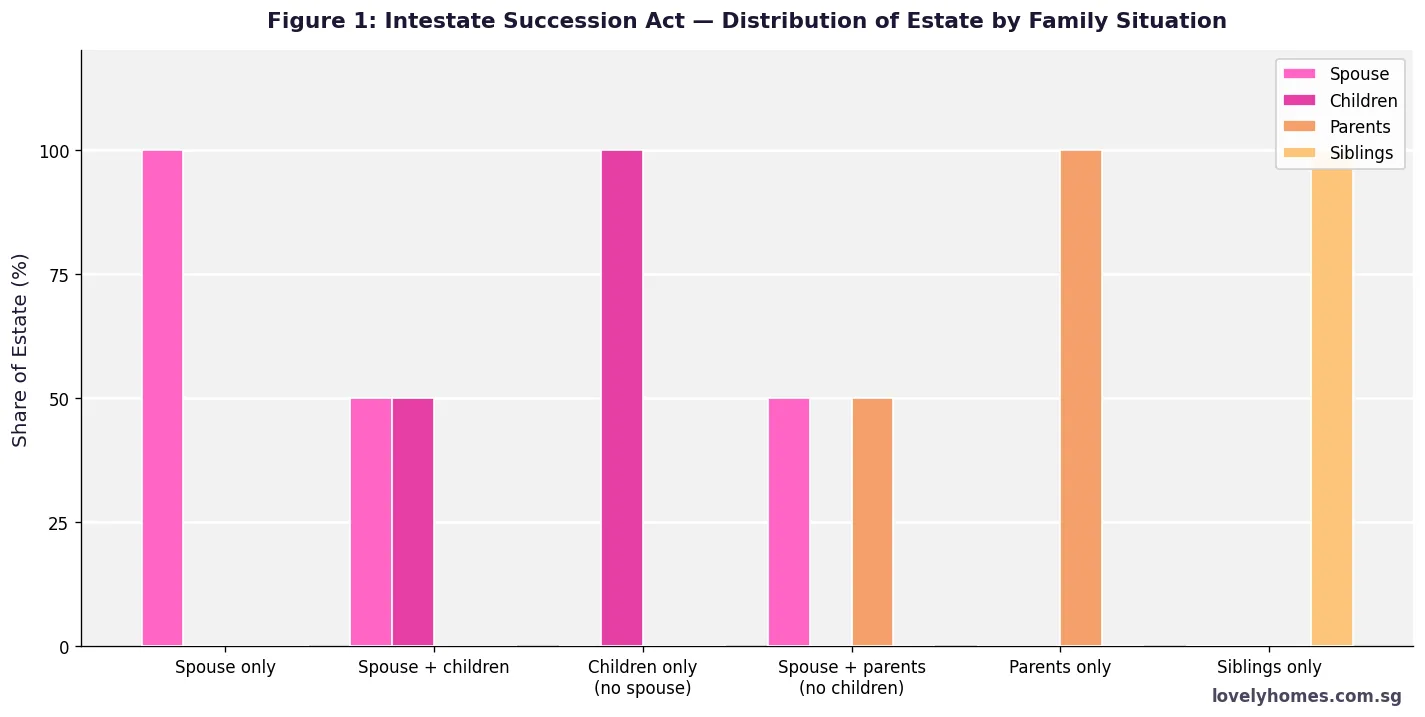
Figure 1: Distribution of estate under the Intestate Succession Act by family situation. Percentages represent share of the full estate.
Survivors at Death Who Inherits (and Share)
Spouse only (no children, no parents) Spouse — 100%
Spouse + children Spouse 50% / Children share 50% equally
Children only (no spouse) Children — 100% shared equally
Spouse + parents (no children) Spouse 50% / Parents 50%
Parents only (no spouse, no children) Parents — 100% equally
Siblings only Siblings — 100% equally
No family at all Government — bona vacantia

Critically, the Intestate Succession Act does not apply to Muslims in Singapore — Muslim estates are governed by Islamic inheritance law (faraid) administered through the Syariah Court and Muslim Trust Fund (MUIS). If you are Muslim, consult a lawyer or MUIS directly.

Making a Valid Will in Singapore

A will is the cornerstone of any estate plan. Under the Wills Act (Cap 352), a valid Singapore will must be:

  • In writing (typed or handwritten).
  • Signed by the testator (the person making the will) at the foot of the document.
  • Witnessed by two independent witnesses — both present at the same time when the testator signs. Neither witness (nor their spouse) can be a beneficiary.
  • Made by a person aged 21 or older (or a member of the armed forces on active service).

There is no requirement to register a will with any government body in Singapore, though many solicitors recommend lodging it with the Wills Registry at the Singapore Academy of Law for a small fee (~S$50). A will can be revoked at any time by making a new one or by destroying the original with the intention to revoke. Marriage automatically revokes a prior will in Singapore.

What your will can do: direct who receives your private residential property; name your executor; appoint guardians for minor children; specify funeral wishes; establish testamentary trusts for minors or dependants. What it cannot do: override CPF nominations, bypass HDB rules on flat ownership, or transfer assets held in joint tenancy (these pass automatically to the surviving joint tenant by operation of law).

CPF Nominations — The Rule That Overrides Your Will

Many Singapore property owners are surprised to learn that their CPF Ordinary Account (OA) savings — which are frequently used to fund property purchases and monthly mortgage instalments — do not form part of their estate and cannot be distributed via a will. CPF monies are governed separately by the Central Provident Fund Act and paid out exclusively to CPF nominees upon death.

If you have not made a CPF nomination, your CPF savings (OA, SA, MediSave) will be transferred to the Public Trustee’s Office, which then distributes them according to the Intestate Succession Act — but charges an administration fee (0.75%–2.75% of the CPF balance, capped at S$6,000). This process can take 6–12 months. A CPF nomination is free, takes about 10 minutes via the CPF Board website, and can be updated any time.

Note also: if you bought your HDB flat using CPF, the CPF funds drawn plus accrued interest must be refunded to your CPF account on the sale or transfer of the flat. This affects the net cash proceeds available to your estate or your surviving family members.

HDB Flat Inheritance — Special Rules Apply

HDB flats come with a unique set of rules on death that do not apply to private residential property. The guiding principle is that an HDB flat should continue to be used as an owner-occupied home for a qualifying Singapore household — it is not freely tradeable inheritance that can be sold at will.

Scenario A: Joint tenancy — surviving joint tenant takes all

Most married couples own their HDB flat as joint tenants. On the death of one owner, the surviving joint tenant automatically becomes the sole owner by right of survivorship — no probate is required, and no will can override this. The surviving owner needs only to lodge a Notice of Death with HDB and the Singapore Land Authority (SLA) to update the title.

Scenario B: Tenancy-in-common — estate share passes via will or ISA

If the flat was held as tenancy-in-common, the deceased’s share passes to the estate and is then distributed via the will or the Intestate Succession Act. The beneficiary of the share must be an eligible person under HDB’s policies — meaning they must form a family nucleus with the remaining flat owner(s), be a Singapore Citizen or PR, and meet the HDB eligibility criteria. If the beneficiary is not eligible (e.g. a foreigner child), HDB will require the flat to be sold.

Scenario C: Sole owner dies — HDB’s Retention Scheme

If the deceased was the sole owner, HDB allows eligible occupiers (family members currently living in the flat who meet eligibility criteria) to apply to retain the flat under the Right of Occupancy Scheme. If no eligible occupier exists, HDB will buy back the flat at market value, and the proceeds go to the estate.

Importantly, the Minimum Occupation Period (MOP) for the inherited flat is assessed separately. An inheriting family member does not automatically “reset” the MOP clock — HDB’s rules on this have specific carve-outs. Always check with HDB directly at the time of inheritance.

Private Residential Property — Inheritance and Stamp Duty

Private condominiums, landed houses, and freehold/leasehold private apartments follow a different set of rules from HDB flats. There is no HDB eligibility requirement — foreigners can inherit private property — but stamp duty implications arise when the property is subsequently transferred or sold.

Stamp duty BSD and ABSD costs on property transfer by recipient profile Singapore 2026 — gifting S$800,000 property
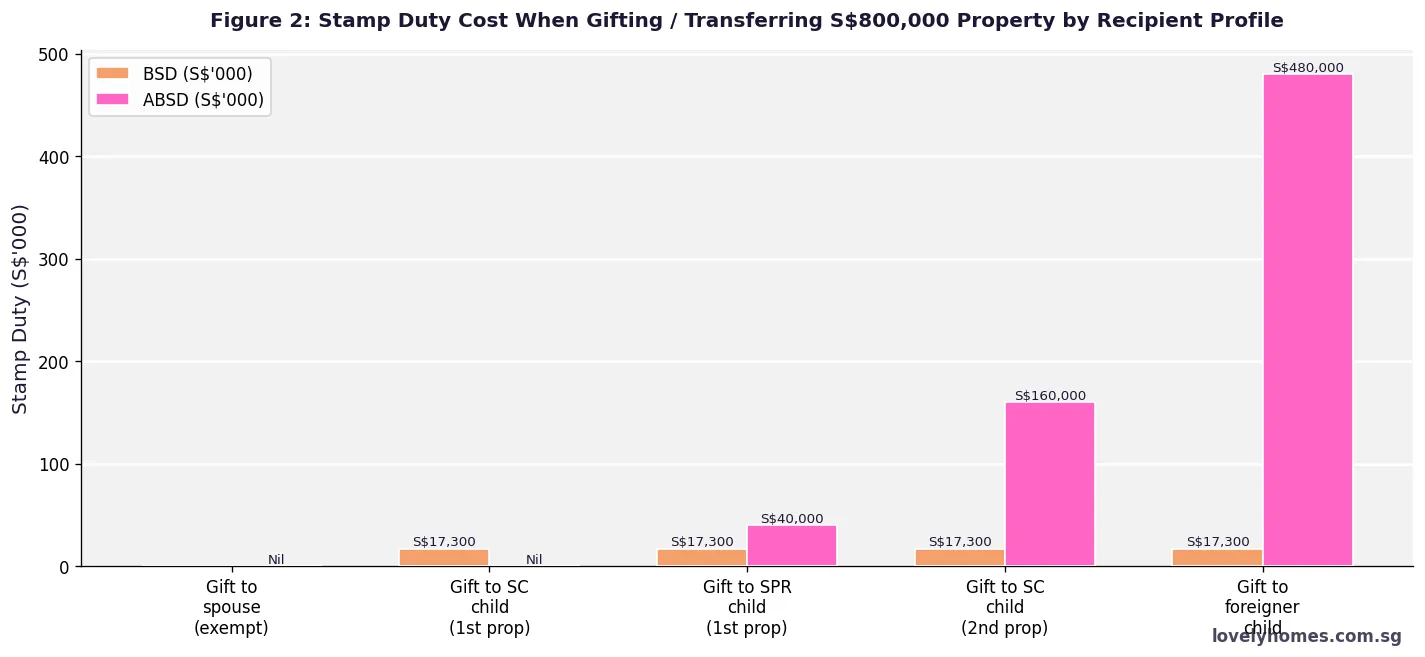
Figure 2: Indicative BSD and ABSD payable when gifting/transferring a S$800,000 private residential property by recipient profile. Note: inheritance itself (via estate) is not subject to stamp duty; duty is triggered by a subsequent gift or sale.

No stamp duty on the death transfer itself

The transfer of property to a beneficiary via a will or intestacy is treated as a transmission on death. Under the Stamp Duties Act, such transmissions are exempt from Buyer’s Stamp Duty and ABSD. No duty is payable when the executor or administrator assents the property to the beneficiary. Singapore also abolished estate duty in February 2008, so there is no inheritance tax on the total value of the estate.

ABSD when you inherit a second or third property

However, the inherited property is counted toward your property count for future purchases. This is a critical but frequently misunderstood rule. If you are a Singapore Citizen who already owns one condominium and then inherb a second private property from a deceased parent, your property count becomes two. If you subsequently buy a third property, ABSD of 30% (SC rate for 3rd property) applies. Plan accordingly.

Gifting property inter vivos (lifetime transfers)

If you choose to gift a property to a family member during your lifetime (rather than leaving it via will), BSD is triggered on the market value of the property at the time of transfer. ABSD also applies based on the recipient’s citizenship and property count. A gift to your Singapore Citizen child who already owns one property would attract 20% ABSD on the market value — potentially hundreds of thousands of dollars.

🏠 Worked Example: The Tan Family Estate

Situation: Mr Tan (Singapore Citizen) passed away on 15 March 2026, leaving a 4-bedroom condominium in Bishan worth S$2,100,000 and a 5-room HDB flat in Ang Mo Kio worth S$780,000. Mr Tan had a valid will leaving both properties to his wife (Mrs Tan, SC) and two adult children (both SC, each with their own private condominiums). The HDB flat was held in joint tenancy with Mrs Tan; the condo was held in Mr Tan’s sole name.

HDB flat (joint tenancy):

  • Passes automatically to Mrs Tan by right of survivorship — no probate required for HDB.
  • Mrs Tan lodges a Notice of Death with HDB and SLA. Title updated in her sole name.
  • No stamp duty on this transmission. Mrs Tan now holds the HDB as sole owner.

Bishan condominium (sole name, covered by will):

  • Executor obtains Grant of Probate from the Family Justice Courts — estimated 4–6 months.
  • Will bequeaths the condo 50% to Mrs Tan and 25% each to Child 1 and Child 2.
  • Transmission to all three beneficiaries: BSD = Nil; ABSD = Nil (transmission on death exempt).
  • Mrs Tan’s property count: now HDB flat + 50% share in Bishan condo = 2 properties held.
  • Each child’s property count: now their existing condo + 25% Bishan share = 2 properties each.
  • If any of them buys another property, ABSD will be charged at the 3rd-property SC rate (30%).

BSD + Legal costs for probate:

  • Probate solicitor fees (estimated): S$3,500–S$6,000 for a clean estate
  • Court filing fee (estimated): S$750–S$1,500
  • Assent (Conveyancing for condo transfer): S$1,500–S$2,500 legal fees + SLA registration ~S$165
  • Total estate settlement cost: approximately S$6,500–S$10,000

Key lesson: Having a valid will allowed Mr Tan’s estate to be distributed efficiently. Without a will, the ISA would have given Mrs Tan 50% and split the other 50% equally between the two children — a similar result here, but in more complex family structures the ISA’s rigid hierarchy can produce very different outcomes from what the deceased intended.

The Probate Process in Singapore

When a person dies leaving a will, the executor named in the will applies to the Family Justice Courts for a Grant of Probate, which authorises the executor to administer the estate. If there is no will, the next-of-kin applies for Letters of Administration — a broadly equivalent process but typically requiring two sureties (guarantors).

Key steps in the process:

  1. Death registration — the attending doctor issues a Cause of Death certificate; the Registrar of Deaths (ICA) issues the Death Certificate, usually within a few days.
  2. Identify and value assets — bank accounts, CPF balances, property title searches (SLA), shareholdings, insurance policies, foreign assets.
  3. Engage a probate solicitor — unless the estate is very simple (below S$50,000 with no immovable property), legal representation is strongly recommended.
  4. File for Grant of Probate / Letters of Administration at the Family Justice Courts — fees are payable on a sliding scale based on the estate value.
  5. Advertise for creditors — in a local newspaper, to flush out any outstanding liabilities.
  6. Pay outstanding debts and liabilities — including any outstanding mortgage (the estate must redeem the mortgage or service it until the property is transferred or sold).
  7. Transfer or sell the property — the executor assents (transfers title) to the beneficiary or conducts a sale, remitting proceeds to the estate.
  8. Distribute balance to beneficiaries — with a proper estate account and receipts.

A straightforward Singapore estate with no overseas assets, no disputes, and a valid will typically takes 4–9 months from death to final distribution. Estates with overseas property can take significantly longer due to separate probate requirements in each jurisdiction.

How CPF monies, HDB flat and private property are distributed on death with and without a will Singapore 2026
Figure 3: Distribution of CPF monies, HDB flat, and private residential property on death under different planning scenarios.

Estate Planning — What Every Singapore Property Owner Should Do

Singapore’s property market is one of the most valuable asset classes for most families. Leaving the transmission of that wealth to chance — or to the rigidities of the Intestate Succession Act — is a risk that is easily and cheaply avoided. A comprehensive estate plan for a property-owning Singapore family typically involves four instruments:

Instrument What it Covers Who Administers Cost (Approx.)
Will Private property, bank accounts, personal effects, guardianship of minor children Family Justice Courts (probate) S$300–S$1,200 (straightforward)
CPF Nomination CPF OA, SA, MediSave balances CPF Board (direct payment) Free
HDB Nomination (if applicable) Share in HDB flat (for tenancy-in-common owners) HDB Free
Lasting Power of Attorney (LPA) Decision-making if you lose mental capacity (not on death) Office of the Public Guardian S$75 (standard); free if certified by legal aid

Why Singapore Property Inheritance Matters in 2026

Singapore is in the midst of a significant intergenerational wealth transfer. According to industry estimates, the cohort of HDB flat owners who purchased under SERS and other early schemes in the 1970s–1990s are now in their 70s and 80s. Hundreds of thousands of HDB flats — many now in the S$600,000–S$1,100,000+ resale range — will change hands via inheritance over the next decade. Add private condominiums and landed property to the mix, and the scale of property wealth being inherited is unprecedented in Singapore’s history.

At the same time, the 2023 ABSD increase to 60% for foreigners and 20%/30% for Singapore Citizens on 2nd/3rd properties has made the counting of inherited properties a material financial issue. An unexpected inheritance that tips a SC buyer from “first property” to “second property” status can turn a planned purchase into an ABSD liability of 20% — potentially S$400,000+ on a typical CCR condominium.

What Might Come Next

This section contains editorial speculation and is clearly labelled as such.

Singapore’s government has occasionally reviewed the rules around HDB flat inheritance, particularly in the context of ageing lease profiles and the VERS (Voluntary Early Redevelopment Scheme) pipeline. There is some industry discussion about whether the Right of Occupancy Scheme might be tightened as Singapore’s HDB stock ages and more flats with shorter remaining leases pass between generations — since family members inheriting a flat with 30 or 40 years of lease remaining face a very different investment proposition from those inheriting a newer flat.

On the stamp-duty side, there is no indication that Singapore intends to reintroduce estate duty (abolished 2008). The MND and MOF have historically viewed the abolition as positive for Singapore’s competitiveness as a wealth hub. For now, the transmission-on-death BSD/ABSD exemption also appears stable. Changes to ABSD for inherited properties — e.g. a grace period or exemption from the property count for inherited shares — have been discussed in industry circles but have not been signalled by the Government.

Frequently Asked Questions

Does inheriting a property count toward my ABSD property count?

Yes. Once a property is transmitted to you as a beneficiary and you are registered as owner (or part-owner) at the Singapore Land Authority, it counts toward your residential property count for ABSD purposes. This means that if you already own one private property and you inherit a second one, you are considered a second-property owner. A subsequent purchase would attract the SC third-property ABSD rate of 30%. There is currently no grace period or inherited-property exemption from this counting rule. If you are planning a purchase and know an inheritance is likely, speak to a lawyer about the timing and sequencing.

My parent passed away and left an HDB flat in their sole name. What happens?

If the deceased was the sole HDB owner and there is a valid will, the executor will apply for Grant of Probate. HDB will then assess whether any of the occupiers listed in the flat (or beneficiaries named in the will) qualify to retain it under their eligibility criteria — they must be a Singapore Citizen or PR, form a proper family nucleus, and satisfy income/property ownership requirements. If an eligible person exists, the flat can be transferred to them (subject to HDB’s approval). If no eligible occupier or beneficiary qualifies, HDB has the right to buy back the flat at market value, and the proceeds form part of the estate. Contact HDB’s Branch directly early in the probate process to understand your options.

Can I sell an inherited private property immediately, or do I need to wait?

There is no mandatory holding period for private property inherited via an estate. Once the Grant of Probate or Letters of Administration is obtained and the title is assented to you, you can sell the property. However, Seller’s Stamp Duty (SSD) applies if the property is sold within 3 years of the deceased’s purchase date — not from the date you inherited it. SSD is 12%/8%/4% for disposals in the 1st/2nd/3rd year respectively. Check the original purchase date on the title register before deciding to sell quickly after inheritance. For HDB flats, the 5-year MOP from the original flat purchase date must also be observed before the flat can be sold on the open market.

What is the difference between a CPF nomination and a will for property?

A CPF nomination governs your CPF savings only (OA, SA, MediSave balances) and completely overrides your will for those assets. The CPF Board pays out directly to your nominees without going through probate. A will governs your private property, bank accounts, personal assets, and other estate assets — but not CPF savings. If you have bought your property using CPF funds and there is an outstanding CPF accrued interest amount, that is refunded to the CPF account on sale or transfer of the property, and then distributed to your CPF nominees. You should make both a valid will and a CPF nomination to ensure all assets are covered.

Is there any tax payable on inherited property in Singapore?

Singapore abolished estate duty in February 2008. No estate duty or inheritance tax is levied on the value of an estate. The transmission of a property to a beneficiary via will or intestacy is also exempt from Buyer’s Stamp Duty (BSD) and Additional Buyer’s Stamp Duty (ABSD) at the point of transfer. However, once you are registered as the owner of an inherited property, normal property tax (administered by IRAS) applies going forward at the prevailing rates — owner-occupied or non-owner-occupied depending on whether you live in the property. Annual property tax on a S$800,000 private condominium (non-owner-occupied) is approximately S$3,200–S$6,400 depending on the Annual Value assessed by IRAS.

What happens to an inherited HDB flat if none of the beneficiaries are eligible to own it?

If none of the will’s beneficiaries (or ISA-entitled family members) meet HDB’s eligibility criteria to retain the flat — for instance, all of them are foreigners, or they each already own private property — HDB will issue a directive requiring the estate to sell the flat on the open market or surrender it to HDB. If sold on the open market, any SC or PR eligible buyer can purchase it as a resale HDB flat in the normal manner. The net proceeds (after mortgage redemption and CPF refund obligations) are distributed to the estate’s beneficiaries. HDB typically allows up to 12 months for the estate to resolve the flat’s status before taking further action.

How long does probate take in Singapore and how much does it cost?

A straightforward Singapore estate with a valid will, no overseas assets, and no disputes typically takes 4–9 months from death to final distribution. An estate requiring Letters of Administration (no will) adds 1–3 months for additional surety and advertising requirements. Complex estates with foreign property, trust structures, or contested claims can take 12–36 months or more. Professional costs typically include: probate lawyer fees (S$3,500–S$8,000 for a clean estate, higher for complexity), Court filing fees on a sliding scale based on estate value, property assent legal fees (S$1,500–S$3,000 per property), and SLA registration fees (~S$165 per property). The Public Trustee’s Office also charges a fee of 0.75%–2.75% of CPF monies distributed where there is no CPF nomination.

Disclaimer: This guide is for general information only and does not constitute legal, tax, or financial advice. Inheritance and estate law is complex and fact-specific. Rules around HDB flat eligibility, CPF nominations, stamp duty, and probate procedures may change. Always verify the current position on the Intestate Succession Act (Singapore Statutes Online), the CPF Board nomination portal, and HDB’s official guidance. Consult a licensed Singapore lawyer for advice specific to your situation. For tax implications, refer to IRAS Property Tax.

×

Click anywhere outside the image to close

Singapore Bridging Loan Guide 2026: How to Bridge the Gap Between Selling and Buying Property

Singapore Bridging Loan Guide 2026: How to Bridge the Gap Between Selling and Buying Property

Quick Answer: Singapore Bridging Loan 2026 at a Glance

  • What it is: A short-term loan that bridges the timing gap between buying a new property and receiving sale proceeds from your existing one. It covers the shortfall when both transactions overlap.
  • Who needs it: Typically upgraders who sign an Option to Purchase (OTP) on a new property before completing the sale of their current HDB flat, condo, or landed home.
  • Loan quantum: Usually up to 120% of the sale price of the property being sold, capped by the bank’s assessment. The amount typically covers the gap between the new purchase price and your available cash and CPF savings.
  • Interest rate: Singapore banks typically price bridging loans at 5.0–6.5% per annum (as at Q1 2026), charged on the drawn-down amount on a daily rest basis. This is significantly higher than standard mortgage rates of 2.8–3.5%.
  • Maximum term: Most banks limit bridging loans to 6 months, with some allowing up to 12 months by exception. They are designed to be short-term instruments, not medium-term financing.
  • Repayment: The bridging loan is repaid in full from the sale proceeds of your existing property at completion. Interest may be capitalised (added to the loan balance) or paid monthly, depending on the bank’s product structure.
  • TDSR applies: The bridging loan amount and interest must be included in the Total Debt Servicing Ratio (TDSR) calculation alongside your new home loan, which can affect the amount you are eligible to borrow for the new property.
  • Alternative: Selling your current property first before buying the new one eliminates the need for a bridging loan entirely — but requires temporary accommodation and precise transaction timing.

What Is a Bridging Loan in Singapore Property?

A bridging loan (sometimes called a bridging facility) is a short-term credit instrument provided by Singapore banks to property buyers who need to complete the purchase of a new property before the sale of their existing one has been finalised. The loan “bridges” the financing gap — giving you access to the equity locked in your current property so that you can meet the payment obligations on your new home without waiting for completion of the sale.

In Singapore’s property market, bridging loans arise most commonly in the upgrader scenario: an owner-occupier who is selling their HDB flat or private condo and simultaneously buying a larger or more expensive replacement home. Because Singapore’s property transactions involve a sequence of deposits, Option exercises, and completion dates that cannot always be synchronised precisely, it is common for buyers to need short-term funds to plug the gap between “paying for the new place” and “receiving money from selling the old one”.

The Monetary Authority of Singapore (MAS) does not publish specific rules governing bridging loans as a product category, but banks are required to apply the Total Debt Servicing Ratio (TDSR) framework to all property-related credit facilities. This means the bridging loan reduces the amount you can borrow on your new home mortgage, and the combined debt burden must not exceed 55% of your gross monthly income.

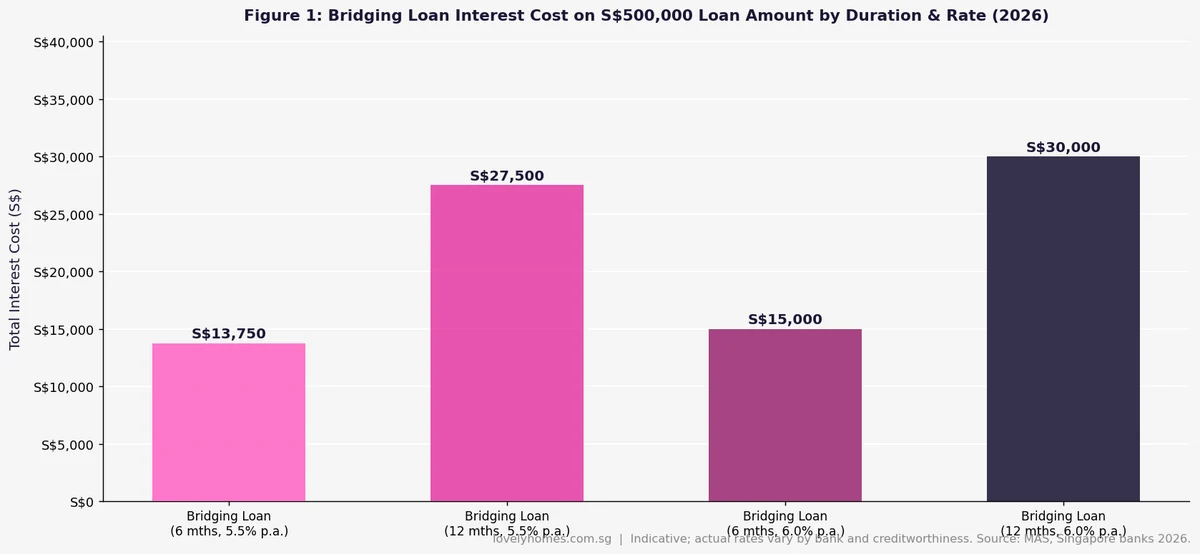
Singapore bridging loan interest cost comparison 2026 duration rate
Figure 1: Total interest cost on a S$500,000 bridging loan at typical Singapore bank rates and durations (2026). Sources: Major Singapore banks, MAS. Actual rates vary by borrower profile and bank.

When Do You Need a Bridging Loan?

The need for a bridging loan arises whenever you are committed to buying before you have received the proceeds from your sale. In practice, the scenarios that most commonly trigger a bridging loan in Singapore are:

Scenario 1 — HDB upgrader buying before HDB flat is sold. You find a private condo you want to buy. You grant the OTP, which starts the 21-day clock. Your HDB flat has not yet been sold. The CPF and proceeds you plan to use for the new downpayment are still tied up in your HDB flat. A bridging loan covers the downpayment shortfall until your HDB sale completes (typically 8–16 weeks after OTP exercise).

Scenario 2 — Private upgrader with overlapping completion dates. You are selling your existing condo (completion in Month 6) and buying a new condo (completion in Month 4). The two-month timing mismatch means you need bridging to cover the new home’s completion before your old one is sold.

Scenario 3 — New launch purchase with progressive payment. For some uncompleted private condominiums, the S&P stage payments fall due before the buyer’s existing property sale completes. Bridging covers the interim stage payments.

In each case, the bridging loan is a temporary instrument. It is never designed to be a permanent part of your capital structure — it should be repaid in full from sale proceeds as soon as they arrive.

How Does a Bridging Loan Work in Singapore?

Here is the typical process a buyer goes through when arranging a bridging loan alongside a new home purchase:

  1. Apply to your bank — usually the same bank providing your new home loan. Most banks will only offer a bridging loan if they are also lending you the mortgage on the new property. You will need to provide the signed OTP (or S&P Agreement) for both the property you are buying and the property you are selling.
  2. Bank assesses quantum and TDSR — the bank will confirm (a) the maximum bridging quantum (typically up to the lower of the expected sale proceeds or 120% of the existing property’s market value), and (b) whether the combined TDSR — new mortgage + bridging loan — passes the 55% cap. If the combined TDSR fails, the bank will reduce either the bridging quantum or the new home loan accordingly.
  3. Bridging loan is drawn down at the point when the funds are needed — usually at completion of the new purchase or at the OTP exercise stage requiring a cash deposit.
  4. Interest accrues daily on the outstanding bridging balance, typically at 5.0–6.5% per annum. Some banks allow interest to be capitalised (added to the loan balance and settled at repayment); others require monthly interest servicing.
  5. Bridging loan is repaid when the sale of the existing property completes and the proceeds are disbursed. The law firm acting in the sale will typically direct the net sale proceeds to discharge the bridging loan before releasing any balance to the seller.
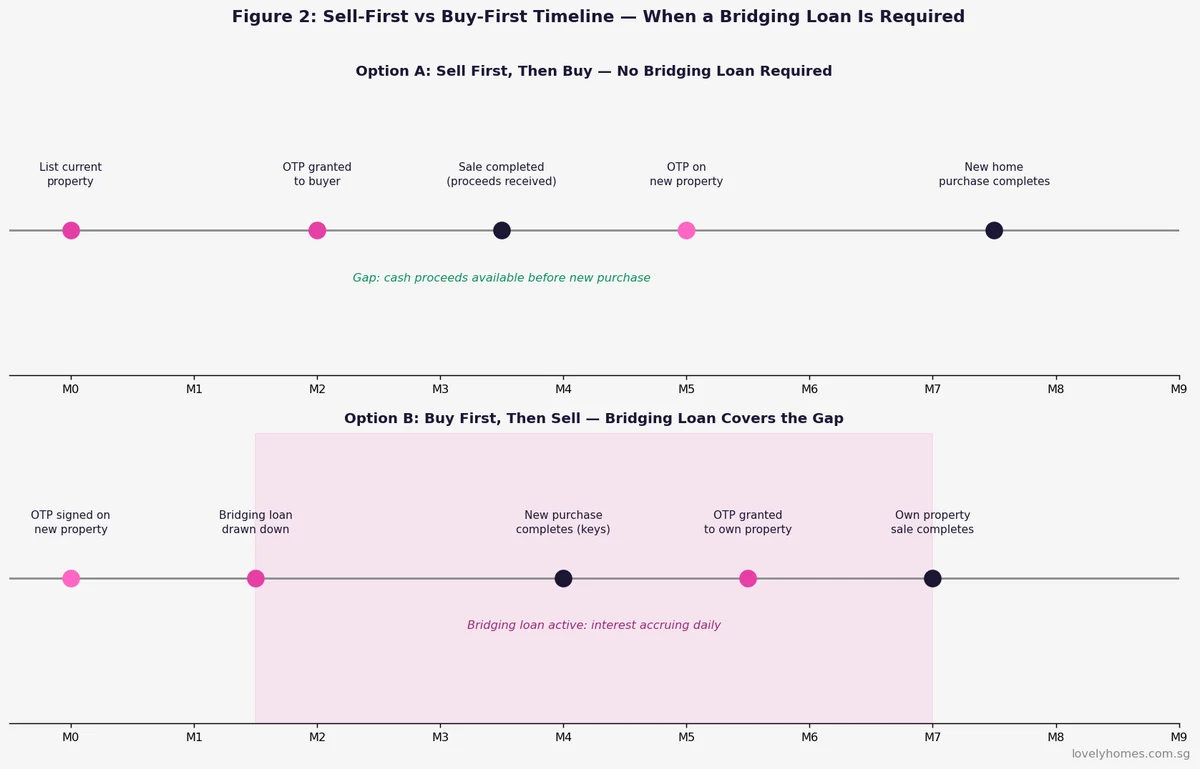
Singapore property sell first vs buy first bridging loan timeline comparison 2026
Figure 2: Transaction timeline comparison — selling first (no bridging needed) vs buying first (bridging loan required to cover the overlap period). Indicative months only; actual timelines vary.

Bridging Loan vs Selling First: Which Is Better?

The most important decision an upgrader makes is not “which bank to use for the bridging loan” — it is whether to use a bridging loan at all. The sell-first strategy eliminates the bridging cost entirely, but introduces its own set of trade-offs.

Factor Sell First, Then Buy Buy First (Bridging Loan)
Bridging interest cost Nil S$13,750–S$30,000 on S$500k for 6–12 mths
ABSD risk None — only one property at OTP date 20% ABSD if OTP on new home before HDB/condo sold
Negotiating position Strong — you are a cash buyer with no chain Weaker — subject to bridging approval and old sale completing
Temporary accommodation Required (rent or stay with family during transition) None needed — move from old to new directly
Market risk New property price may rise while you wait to buy New property secured; old property sold in current market
Stress and timing Can negotiate purchase at leisure Time pressure from both transaction deadlines simultaneously
Suitable for Buyers with flexible accommodation options; rising market Buyers wanting seamless move; found specific property they want

The ABSD trap is the most important consideration in the buy-first scenario. If you are a Singapore Citizen and you sign an OTP on a new property while still owning your HDB flat or condo, you technically hold two properties at the OTP date. This triggers 20% ABSD on the new purchase for SCs (30% for SPRs on a second property). You can claim back the ABSD under the Married Couple Remission — but only if you complete the sale of the existing property within six months of the new purchase completion (or TOP/CSC date for uncompleted units). Miss the six-month window, and the ABSD is forfeited. Our full ABSD Singapore 2026 guide covers the remission conditions in detail.

Worked Example: The Tans — HDB Upgraders Using a Bridging Loan

Profile: Mr & Mrs Tan, Singapore Citizens, joint gross income S$14,500/month. They own a fully paid-up Tampines 5-room HDB flat (est. market value S$920,000, no outstanding HDB loan, CPF accrued interest to refund approx. S$180,000). They wish to buy a 3-bedroom 99-year leasehold condo in Bedok for S$1,650,000.

Transaction plan: They sign an OTP for the new Bedok condo first (grants on 1 June 2026). They intend to sell the HDB flat, estimated completion 15 August 2026. The bridging period is approximately 2.5 months.

ABSD: The Tans hold two residential properties at the OTP date for the Bedok condo. ABSD of 20% on S$1,650,000 = S$330,000 is payable within 14 days. They apply for the SC Married Couple Remission, planning to complete the HDB sale within 6 months of Bedok condo completion (expected December 2026). If remission is granted, S$330,000 is returned; if the HDB sale slips past the 6-month window, the S$330,000 is forfeited.

BSD on new condo: 1%×S$180k + 2%×S$180k + 3%×S$640k + 4%×S$500k + 5%×S$150k = S$1,800 + S$3,600 + S$19,200 + S$20,000 + S$7,500 = S$52,100.

New condo bank loan (LTV 75%): Maximum S$1,237,500. Minimum 5% cash = S$82,500; remaining 20% (S$330,000) via CPF OA.

CPF available: After CPF accrued interest refund of S$180,000, the Tans expect approximately S$310,000 in CPF OA from the HDB sale — but this only arrives at HDB completion in August. For the June new purchase, their current CPF OA balance is S$95,000. Shortfall for 20% cash-or-CPF at June completion = S$330,000 – S$95,000 = S$235,000 bridging required.

Bridging loan: S$235,000 at 5.5% per annum for approximately 2.5 months = S$235,000 × 5.5% × (2.5/12) ≈ S$2,698 interest. This is the cost of the bridging loan — relatively modest at this quantum and short duration.

New home loan monthly repayment: S$1,237,500 at 3.0% over 25 years ≈ S$5,868/month. TDSR = S$5,868 ÷ S$14,500 = 40.5% — well within the 55% cap. The bridging loan itself adds minimal TDSR impact given its short remaining term at the time of the new home loan drawdown.

HDB sale net proceeds: S$920,000 – CPF accrued interest refund S$180,000 = est. S$740,000 (before conveyancing costs, agent commission and any CPF OA refund offset). The net cash/CPF from the HDB sale repays the bridging loan and tops up the Tans’ CPF OA for the new condo.

This example is illustrative. CPF calculations depend on actual contribution history; ABSD remission requires strict compliance with timelines; engage a conveyancing lawyer before signing any OTP.

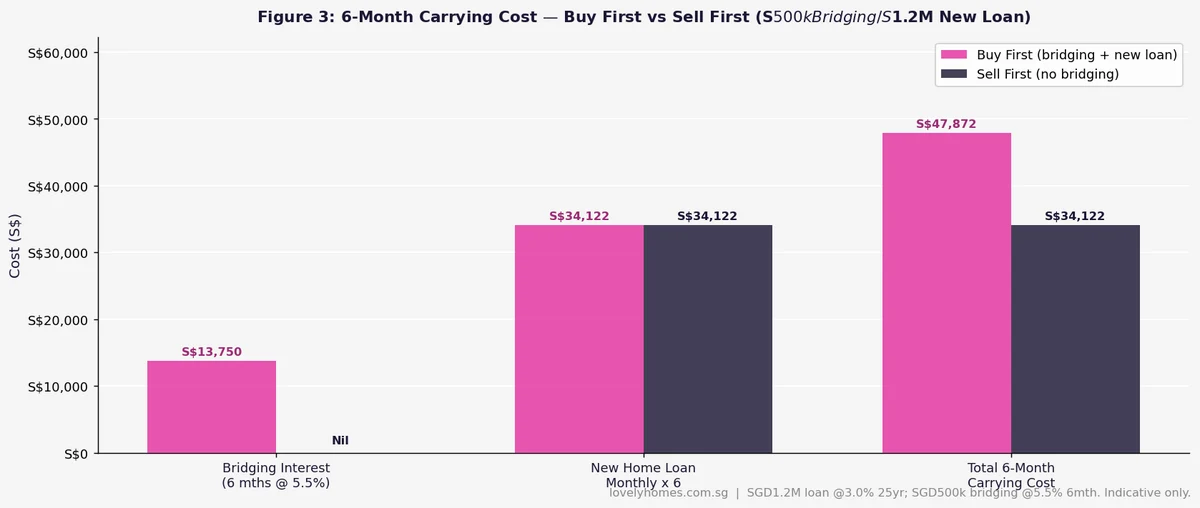
Singapore bridging loan vs sell first 6-month carrying cost comparison 2026
Figure 3: Six-month carrying cost comparison — buy first (with bridging loan) vs sell first (no bridging), on a S$500,000 bridging amount and S$1.2M new home loan at 3.0% over 25 years. Sources: Major Singapore banks, indicative rates 2026.

Interest Rates and Fees: What Singapore Banks Charge in 2026

Bridging loan interest rates are not regulated individually — each bank sets its own pricing, typically benchmarked against the prime lending rate or a fixed spread. As at Q1 2026, the indicative rates from major Singapore banks are:

  • DBS / POSB: Approximately 5.5% per annum, daily rest, on the drawn-down outstanding balance.
  • OCBC: Approximately 5.75–6.0% per annum, depending on loan quantum and customer relationship tier.
  • UOB: Approximately 5.5–6.0% per annum.
  • Standard Chartered, HSBC, Maybank: Typically 5.5–6.5% per annum for bridging, priced on a case-by-case basis.

In addition to the interest, some banks charge a processing or commitment fee of 0.5–1.0% of the bridging quantum, though this is waived by some banks as part of a combined new home loan package. There is no early repayment penalty on bridging loans — redeeming early as soon as sale proceeds arrive is standard practice and incurs no penalty.

Always compare the all-in cost (interest + fees) rather than the headline rate, and clarify whether interest is capitalised or must be serviced monthly. Monthly interest servicing on a S$500,000 bridging loan at 5.5% per annum = S$500,000 × 5.5% ÷ 12 ≈ S$2,292 per month — a significant additional monthly cash outflow on top of the new mortgage.

TDSR Implications: How Bridging Loans Affect Your Borrowing Capacity

This is the most frequently misunderstood aspect of bridging loans. Under the MAS TDSR framework, all outstanding debt obligations must be counted when calculating your maximum new home loan. This includes the bridging loan.

In practice, most banks assess TDSR at the point of new home loan approval by considering the bridging loan as a temporary debt that will be retired at the old property’s sale completion. Banks typically apply a “stressed” annualised interest rate (usually at or slightly above the actual bridging rate) to the bridging outstanding balance to calculate a monthly debt equivalent. This monthly equivalent is added to your projected new home mortgage payment, and the combined total must be below 55% of gross income.

The practical impact: if you are borrowing close to the TDSR limit on your new mortgage, a bridging loan may push you over the threshold. In such cases, the bank will either reduce the new home loan quantum or decline the bridging facility. This is a key reason why property lawyers and mortgage brokers recommend getting in-principle approval for the combined new home loan and bridging loan before signing any OTP on the new property.

What Might Change: Bridging Loan Policy Outlook 2026

This section represents forward-looking analysis only and should not be taken as advice.

The MAS has not signalled any specific changes to bridging loan regulation in 2026. However, the broader property cooling measure landscape — particularly the 20% ABSD for SC second-property purchases and the six-month remission window — creates ongoing policy interaction with bridging loans. Any extension of the ABSD remission window (currently six months) would reduce the timing risk for upgraders using bridging loans and might marginally increase demand for such facilities.

Conversely, if MAS tightens the TDSR methodology to apply higher stress rates to bridging loan obligations, the maximum new home loan quantum for borrowers using bridging would fall further. This is speculative at this stage but worth monitoring if you are planning a mid-2026 transaction.

Frequently Asked Questions

Can I use CPF to repay a bridging loan?

No. CPF Ordinary Account (OA) funds can only be used for specific approved purposes: purchasing a residential property, servicing the monthly mortgage instalment on that property, or paying stamp duties. Repaying a bridging loan directly from CPF is not an approved use. However, when your existing property (the one being sold) completes its sale, your solicitors will refund any CPF OA amounts you previously drew from that property back to your CPF OA, with accrued interest at 2.5% per annum. Those refunded CPF funds can then be applied toward the new property’s mortgage or downpayment, which indirectly allows you to reduce the amount of cash needed from your bank loan or bridging facility. For the detailed CPF rules on property purchases, see the CPF Board’s official guidelines.

What happens if my existing property sale falls through while I have an outstanding bridging loan?

This is the primary risk of the buy-first strategy. If your sale falls through after the new purchase has completed, you are left holding two properties with no sale proceeds to repay the bridging loan. In that scenario, the bridging loan continues to accrue interest at 5.0–6.5% per annum until a new buyer is found and the sale completes. Additionally, you may be holding two properties simultaneously — triggering 20% ABSD on the newer purchase (for SCs) unless you already paid it and are waiting for remission. You would need to refinance the bridging loan as a longer-term mortgage, which requires bank approval and may not be granted at favourable rates. This scenario underlines why most financial advisers recommend the sell-first sequence for buyers who do not have strong cash reserves to cover an extended bridging period if plans go awry.

How long does it take to get a bridging loan approved in Singapore?

Most major Singapore banks can approve a bridging loan in principle within 2–5 business days, provided you submit complete documentation: income documents (latest 3 months’ payslips or 2 years’ NOA for self-employed), the signed OTP or S&P Agreement for both the purchase and sale properties, and the latest CPF Statement showing your OA balance. Some banks require the new home loan approval to be finalised in parallel with the bridging approval. In practice, most upgraders apply for the combined facility (new home loan + bridging) at the same time, which can take 1–2 weeks for formal approval. Always apply at least 3 weeks before the payment obligation falls due.

Do HDB sellers qualify for a bridging loan?

Yes, if they are simultaneously buying a private property. HDB sellers who are selling their flat and purchasing a private residential property can apply for a bridging loan from a bank, provided the bank also approves the new private property mortgage. Note that HDB resale transactions involving the Central Provident Fund Board typically have a completion timeline of around 8–16 weeks after exercising the OTP, which determines how long the bridging facility needs to remain outstanding. HDB sellers cannot use an HDB Concessionary Loan for a private property purchase — only bank loans apply to private residential transactions.

Is a bridging loan the same as a renovation loan or a personal loan?

No. A bridging loan is a property-secured short-term credit facility specifically designed to cover the timing gap in a simultaneous sale-and-purchase transaction. A renovation loan is an unsecured or property-secured loan used to fund home improvements, typically capped at S$30,000–S$200,000 and repaid over 1–5 years. A personal loan is unsecured, typically carries a higher effective interest rate (6–12% per annum), and is not tied to a specific property transaction. Of the three, only the bridging loan and the renovation loan (if secured) fall within the MAS TDSR framework as property-related credit; a personal loan is counted separately under the broader all-debt-obligation test. Never use a personal loan as a substitute for a bridging loan on a property transaction — the higher cost and the TDSR double-counting will almost always make your financial position worse.

Can I use a bridging loan to buy an investment property I do not intend to sell my current home for?

A bridging loan is specifically designed for the scenario where an existing property is being sold and the proceeds are needed to fund a replacement purchase. Banks will not issue a bridging loan simply because a buyer wants short-term leverage on a second investment property without an underlying sale. For buyers seeking to fund an investment property purchase while retaining their existing home, the standard instruments are a standard bank mortgage (subject to LTV and TDSR) or, for short-term portfolio financing, specialist property investor loans. The 20% ABSD (for SCs) and 30% ABSD (for SPRs) on second properties make leveraged second-property investment a high-bar exercise in Singapore regardless of the loan type.

Disclaimer: This guide is for general information and educational purposes only. It does not constitute financial, legal, or banking advice. Bridging loan terms, interest rates, and eligibility criteria vary by bank and individual borrower profile and are subject to change. Always obtain a formal Letter of Offer from your bank and take independent legal and financial advice before entering into any property transaction that relies on a bridging loan. Verify all ABSD, TDSR, and CPF rules with the Inland Revenue Authority of Singapore (IRAS), the Monetary Authority of Singapore (MAS), and the CPF Board respectively before transacting.
×

Click anywhere outside to close
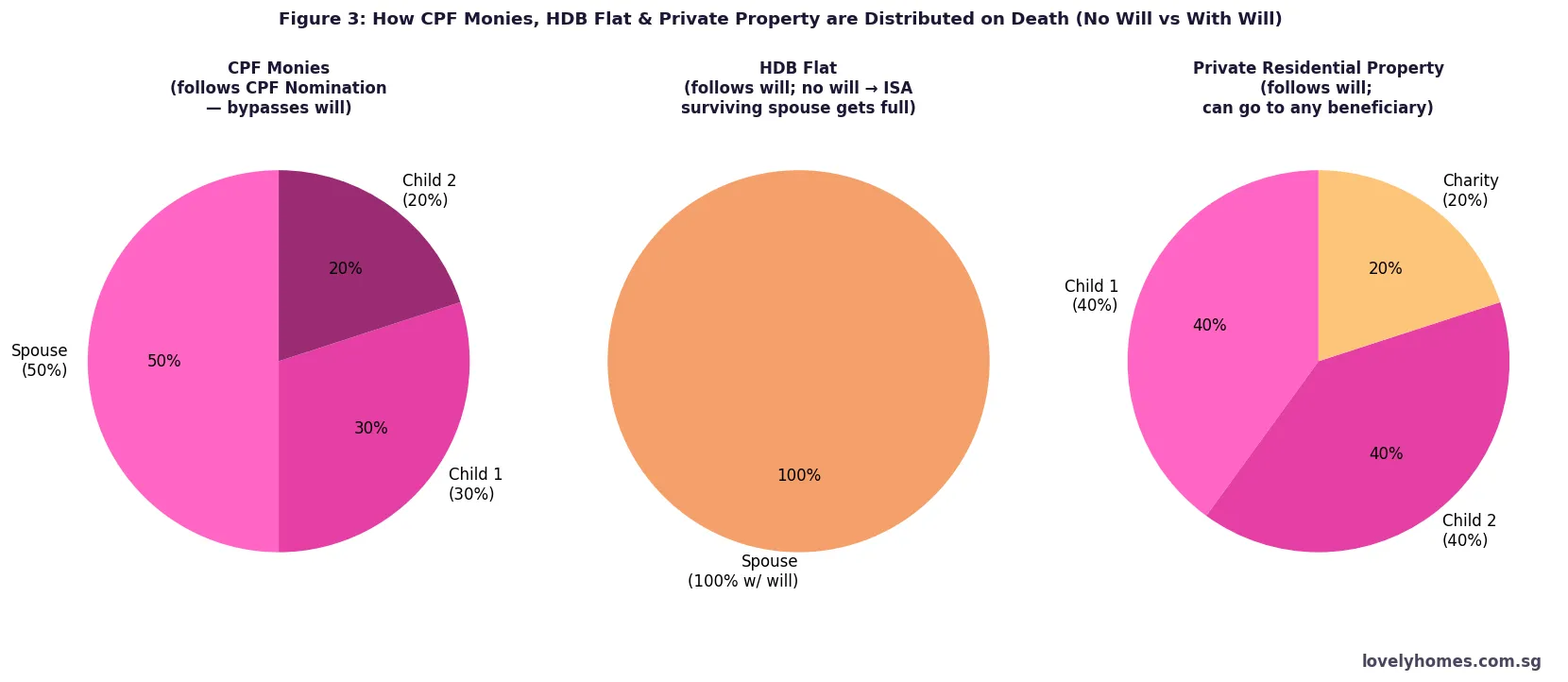
Singapore Property Buying Checklist 2026: 12 Steps from IPA to Key Collection

Singapore Property Buying Checklist 2026: 12 Steps from IPA to Key Collection

✔ Quick Answer — Singapore Property Buying Checklist 2026

  • 12 steps from budget check to key collection, covering both HDB resale and private property transactions.
  • OTP window: 21 days (private resale) or 14 days (HDB resale) to exercise after paying the option fee.
  • BSD deadline: Buyer’s Stamp Duty must be paid within 14 days of exercising the OTP/SPA — late payment attracts penalties from IRAS.
  • ABSD: SC first property = 0%; SC second = 20%; PR first = 5%; foreigner = 60%. Rates as of 2026.
  • TDSR limit: 55% of gross monthly income (MAS ruling) for all property loans; MSR 30% applies additionally for HDB purchases.
  • CPF OA can fund the downpayment and monthly instalments — but accrued interest must be returned to CPF on sale.
  • Resale timeline: 8–14 weeks from OTP to key collection for private resale; 3–5 years for HDB BTO.
  • Upfront costs at S$1.5M (SC first property, no HDB): BSD S$44,600 + 25% downpayment S$375,000 + legal ~S$3,200 ≈ S$423k total cash/CPF required.

Introduction: Why a Checklist Matters More Than Ever in 2026

Singapore’s property market in 2026 is defined by overlapping rules, deadlines and financial thresholds that interact in ways that can catch even experienced buyers off guard. Since the government introduced ABSD remission conditions for upgraders in 2023, revised the BSD progressive rates, extended the TDSR framework, and introduced new EC cooling measures in May 2026, the compliance landscape has become materially more complex than it was five years ago. Missing one deadline — such as the 14-day BSD payment window or the 21-day OTP exercise period — can result in financial penalties, forfeited deposits, or unexpected stamp duty liabilities running into tens of thousands of dollars.

This guide provides a structured, sequenced checklist for buying property in Singapore in 2026. It applies equally to Singapore Citizens (SC), Permanent Residents (PR) and foreigners purchasing private residential property, with specific callouts for HDB buyers. The checklist is administered by four principal government bodies: the Urban Redevelopment Authority (URA) for planning and private property matters; the Housing and Development Board (HDB) for public housing transactions; the Inland Revenue Authority of Singapore (IRAS) for stamp duty collection; and the Central Provident Fund Board (CPF) for CPF withdrawal approvals.

Singapore property buying process 2026 12 step flowchart OTP SPA BSD ABSD CPF keys

Figure 1: Singapore Property Buying Process 2026 — 12-Step Flowchart from Budget Check to Post-Purchase Admin. Applies to both private resale and HDB resale transactions with noted differences.

The 12-Step Singapore Property Buying Checklist

Phase 1: Pre-Purchase Preparation (Steps 1–5)

1

Budget and Eligibility Check

Determine your ABSD profile (SC / PR / foreigner; first, second or subsequent property) and calculate your maximum purchase price. Run a TDSR calculation: your total monthly debt obligations — mortgage plus any outstanding car loan, personal loan or credit card minimum — must not exceed 55% of gross monthly income. For HDB purchases, the MSR 30% cap applies to the mortgage alone. Check your CPF OA balance at my.cpf.gov.sg. Confirm your legal eligibility: foreigners may only buy private non-landed property (or Sentosa Cove landed); PRs may buy HDB resale flats but not new BTOs.

2

Obtain an In-Principle Approval (IPA) from a Bank

Before viewing properties seriously, apply for an IPA (sometimes called AIP — Approval-In-Principle) from at least two banks. The IPA tells you the maximum loan quantum, the indicative interest rate, and the loan tenure available to you. Most banks honour the IPA for 30–90 days. For HDB purchases using the HDB Concessionary Loan, apply for a HDB Loan Eligibility (HLE) letter instead — this has a validity of 6 months and is mandatory before HDB will process your flat application.

3

HDB Buyers: Apply for HFE Letter

Since May 2023, all HDB flat purchasers (BTO and resale) must obtain a HDB Flat Eligibility (HFE) letter before an OTP can be issued. The HFE confirms your eligibility to buy, the grants you qualify for (EHG, PHG, Step-Up Grant), and the HDB loan amount if applicable. Processing takes approximately 3–4 weeks. Apply at the HDB Flat Portal early in your property search to avoid delays at the OTP stage.

4

Property Search and Due Diligence

Use URA Realis for verified transaction data (S$2.50 per search or bulk subscription), SRX Property for market trend analysis, and the HDB Resale Flat Prices portal for HDB-specific data. When you shortlist a property, check the URA Master Plan 2019 (or its 2025 revision) to confirm the surrounding land use zoning and any future development plans. Request from the seller or listing agent the Maintenance and Sinking Fund arrears status, the MCST minutes (for strata property), and any outstanding charges on the land title.

5

Engage a Conveyancing Lawyer Before OTP Signing

Do not sign the OTP without first engaging a conveyancing lawyer. The lawyer’s role is to review the OTP terms, check for encumbrances on the title, liaise with CPF Board and the mortgagee bank, and manage all legal milestones including caveat lodgement. Legal fees for a private resale at S$1–2 million are typically S$2,800–S$4,500 inclusive of disbursements. For HDB resale, fees are lower (S$1,500–S$2,500). Many law firms offer a fixed-fee quote — get at least two quotes before committing.

Phase 2: Option to Purchase and Contract (Steps 6–8)

6

Issue and Exercise the OTP

The seller issues you an Option to Purchase upon receipt of the option fee (1% of purchase price for private; S$1 for HDB resale). You then have 21 calendar days (private resale) or 14 calendar days (HDB resale) to exercise the OTP by paying the exercise fee (typically 4% for private, making a 5% total deposit; or the agreed sum for HDB). During this window, your lawyer will conduct title searches and CPF checks. Do not let the OTP expire unexercised — the option fee (1%) is forfeited. The OTP is the most time-pressured stage in the entire process.

7

Pay BSD and ABSD Within 14 Days

Once you exercise the OTP (i.e., sign the Sale and Purchase Agreement or equivalent HDB resale application), both BSD and ABSD must be e-stamped and paid to IRAS within 14 calendar days of signing. Late payment attracts a surcharge of up to S$25 or 4× the unpaid duty, whichever is higher. BSD and ABSD cannot be paid directly from your CPF at this stage — you must first pay in cash, cheque or bank transfer, and may later claim reimbursement from CPF if eligible. Use IRAS’s e-Stamp portal to calculate and pay online.

8

Execute the Sale and Purchase Agreement

The SPA (or HDB Resale Agreement) is the binding contract that transfers the property. Your lawyer will review the SPA draft before signing. Key items to verify: the correct unit number, floor level, car park lot allocation (if any), existing tenancy (for investment purchases), completion date, and any furniture or fittings being sold with the property. The SPA typically requires payment of the balance of the deposit (if not already paid with the OTP exercise fee) and sets out the completion timeline — usually 8–12 weeks from OTP for resale.

Phase 3: Financing and Completion (Steps 9–12)

9

Apply for CPF Withdrawal

After the SPA is executed, your lawyer will submit a CPF withdrawal application to the CPF Board on your behalf. Processing typically takes 2–4 weeks. CPF OA funds can be used for: the downpayment (above the 5% minimum cash), legal fees, and monthly mortgage instalments. For private property, the Valuation Limit (VL) and Withdrawal Limit (WL — capped at 120% of VL) govern how much CPF can be used over the life of the property. Plan your CPF usage carefully if you anticipate needing OA funds for retirement.

10

Bank Loan Drawdown and Mortgage Registration

Your bank will disburse the loan (drawdown) on or before the completion date. The mortgage is registered with the Singapore Land Authority (SLA), and a caveat is lodged to protect your interest in the property. For new launch condominiums, the drawdown is typically progressive (tied to construction milestones under the Normal Payment Scheme) or deferred (no longer an option for EC sites tendered from May 2026, when DPS was abolished for new EC GLS sites). Ensure your fire insurance is in place before drawdown — most banks require this as a condition of the mortgage.

11

Completion — Key Collection

Completion is the day the ownership transfers to you. Your lawyer will attend the completion appointment, where the balance of the purchase price is paid to the seller’s lawyers (net of any CPF retention and existing mortgage redemption). The SLA updates the land register, and you collect the keys. For resale properties, inspect the property thoroughly on the day of completion — check all fittings and appliances against the SPA schedule, and document any defects in writing to the seller immediately.

12

Post-Purchase Administration

After key collection: register with the Management Corporation Strata Title (MCST) for strata properties and pay any outstanding Maintenance and Sinking Fund contributions. Activate utilities (SP Group, NTUC FairPrice Gas). Set up a home contents insurance policy. If you are renting out the property, register the tenancy with HDB (for HDB subletting) or comply with URA’s short-term rental rules (minimum 3-month tenancy for private residential). Inform IRAS of rental income for the relevant Year of Assessment — failure to declare rental income is an offence under the Income Tax Act.

Key Deadlines and Cost Summary

Milestone Deadline from OTP Amount / Action Payable To
OTP Exercise (Private) Within 21 calendar days 4% exercise fee (total 5% deposit) Seller (via lawyer)
OTP Exercise (HDB Resale) Within 14 calendar days As agreed in OTP HDB Resale Portal
BSD & ABSD Payment Within 14 days of SPA signing BSD 1%–6% progressive; ABSD 0%–60% IRAS (e-Stamp Portal)
CPF Withdrawal Application After SPA execution 2–4 weeks processing CPF Board (via lawyer)
Completion (Private Resale) 8–12 weeks from OTP Balance purchase price Seller (via lawyer)
Completion (HDB Resale) 8–10 weeks from HDB approval Balance purchase price HDB
Fire Insurance Before loan drawdown ~S$150–S$400/yr depending on sum insured Licensed insurer
Rental Income Declaration By 18 April each YA Declare via myTax Portal to IRAS IRAS

Worked Example: Ms Lim, SC First-Time Buyer — OCR Condo at S$1.1M

📊 Case Study — Ms Lim, Singapore Citizen, Single, Income S$8,000/mth

Property: 1-bedroom resale condo in Tampines (OCR), 560 sq ft at S$1,930 psf = S$1,080,800 (rounded to S$1.08M).

ABSD: S$0 — SC purchasing first residential property. No ABSD applies.

BSD Calculation:

  • First S$180,000 × 1% = S$1,800
  • Next S$180,000 × 2% = S$3,600
  • Next S$640,000 × 3% = S$19,200
  • Remaining S$80,000 × 4% = S$3,200
  • Total BSD: S$27,800

Financing: Bank loan at LTV 75% = S$810,000. At 3.0% p.a. over 30 years: approximately S$3,413/month. TDSR: S$3,413 ÷ S$8,000 = 42.7% — within the 55% TDSR limit. Ms Lim qualifies without a joint borrower.

Downpayment: 25% = S$270,000. Minimum 5% cash = S$54,000. Balance S$216,000 from CPF OA.

Legal Fees (Buyer): approximately S$3,000 including disbursements (caveat, SLA searches, CPF liaison).

Total Upfront Cash/CPF Required: BSD S$27,800 (cash) + Downpayment S$270,000 (S$54k cash + S$216k CPF) + Legal S$3,000 ≈ S$300,800 (including minimum S$81,800 in cash).

Checklist Critical Date: OTP issued Day 0. Ms Lim must exercise by Day 21, pay BSD within 14 days of SPA signing, and complete within ~10 weeks of OTP. Her lawyer sets a calendar reminder for Day 18 to ensure OTP exercise happens before the deadline.

Singapore property buying costs 2026 BSD ABSD downpayment by buyer profile at 1.5 million

Figure 2: Total Upfront Costs at S$1.5M — BSD, ABSD, Downpayment and Legal by Buyer Profile 2026. Note: ABSD of S$900,000 for foreigners makes the effective total cost S$1.45M above and beyond the purchase price — a near-doubling of the upfront outlay.

Why the 2026 Regulatory Landscape Demands Extra Care

The Singapore property market has accumulated layer upon layer of regulatory measures since the first cooling round in 2009. As of 2026, a buyer simultaneously navigates BSD (four-tier progressive, administered by IRAS), ABSD (five-tier by residency and ownership count, administered by IRAS), TDSR (MAS-mandated income test, enforced by banks), MSR (HDB/EC purchases only, administered by HDB and banks), CPF Withdrawal Limits (CPF Board), ABSD remission conditions for upgraders (IRAS), EC cooling measures (MND/HDB, revised May 2026), and rental restriction rules (URA, SLA). None of these systems talk to each other automatically — the buyer’s lawyer is the only party who checks the full suite in one place.

This is precisely why engaging a conveyancing lawyer before signing the OTP is not optional. Singapore Law Society guidelines permit a lawyer to act for both buyer and mortgagee bank in the same transaction, but the lawyer’s primary duty is to the client. First-time buyers should ensure they understand each cost line before OTP day, not the morning they are asked to sign.

What Might Come Next: Tech-Enabled Property Transactions

URA and HDB are actively developing digital streamlining tools that may, in future, consolidate several of the 12 steps above. The HFE letter introduced in May 2023 already replaced three separate application processes. Industry participants have proposed that BSD and ABSD e-stamping be integrated directly into the OTP workflow so that buyers receive a real-time stamp-duty estimate at the point of OTP issuance. CPF Board’s e-conveyancing integration has progressively reduced the time for CPF withdrawal approvals from six weeks (pre-2020) to the current two-to-four weeks. It is reasonable to expect that a future iteration of the conveyancing process reduces total timeline from the current 8–14 weeks to under 6 weeks for straightforward resale transactions.

Singapore property buying timeline 2026 resale vs BTO OTP to keys weeks years comparison

Figure 3: Purchase Timeline Comparison — Resale (8–14 weeks) vs HDB BTO (3–5 years). BTO buyers must manage cash flow, CPF accrual and bank loan conditions across a multi-year period before receiving keys.

Frequently Asked Questions

What happens if I miss the 21-day OTP exercise window?

If you do not exercise the OTP within the prescribed period (21 calendar days for most private resale transactions), the OTP lapses automatically. The seller retains your option fee (typically 1% of the purchase price) as a forfeiture. There is no legal recourse unless the seller agreed in writing to extend the option period. Given the financial stakes — 1% of S$1.5 million is S$15,000 — always ensure your lawyer, bank and CPF paperwork are already in progress before the OTP is issued, not after.

Can I use CPF to pay BSD or ABSD?

No — not directly at the point of payment. BSD and ABSD must be paid to IRAS within 14 days of signing the SPA, and IRAS does not accept CPF funds directly. You must pay in cash (bank transfer, FAST, cheque). However, once the property is legally stamped and the CPF withdrawal is approved, you may use CPF OA funds to reimburse yourself for the BSD paid (subject to the property’s Valuation Limit and your remaining CPF balance). ABSD, by contrast, is generally not reimbursable from CPF in this manner — it must be funded from personal cash.

What is the ABSD remission for Singapore Citizen couples upgrading from HDB?

Singapore Citizen married couples who own an HDB flat and purchase a second residential property (typically a private condo) are liable for 20% ABSD on the new purchase. However, they may apply to IRAS for an ABSD remission under the Married Couple Remission, provided they sell their existing HDB flat within 3 years of the private property’s stamp duty date (for resale) or 3 years from the property’s TOP date (for new launch). The ABSD is paid upfront in full, and the refund is processed after the HDB sale is confirmed. The refund does not include the interest cost of funding the ABSD during the interim period — a real but often-overlooked carrying cost.

How much cash do I need on hand to buy a S$1.5M private condo as a first-time SC buyer?

The minimum cash requirement (amounts that cannot be funded from CPF) is: (1) at least 5% of the purchase price as downpayment cash = S$75,000; (2) BSD S$44,600 paid in cash upfront (reimbursable from CPF later); (3) legal fees approximately S$3,200 (usually payable from CPF for private property). So the hard minimum cash outflow is approximately S$75,000 + S$44,600 = S$119,600, plus any miscellaneous costs. In practice, buyers should have S$130,000–S$150,000 in cash for comfortable headroom, with the remaining S$225,000–S$300,000 (balance downpayment) coming from CPF OA.

What is TDSR and how does the bank calculate it?

The Total Debt Servicing Ratio (TDSR) framework, mandated by MAS since 2013 and revised in 2022, caps your total monthly debt obligations at 55% of gross monthly income. “Debt obligations” include: the new property mortgage instalment, any existing home loan instalments, car loan instalments, and the minimum monthly repayment on credit cards (calculated at 5% of outstanding balance under MAS rules). The bank stress-tests your mortgage at a medium-term interest rate (typically 4.0%–4.5% for TDSR calculation purposes, regardless of the actual rate offered) to ensure affordability even in a rising-rate environment. Exceeding 55% TDSR means the bank cannot approve the loan; reducing outstanding credit card debt or settling the car loan before applying can meaningfully improve your TDSR headroom.

Does the checklist apply to buying a HDB BTO flat?

The BTO process differs significantly from resale in timing but not in regulatory obligations. BTO buyers apply during the sales exercise (quarterly or otherwise), ballot for a flat, select a unit, sign the Agreement for Lease (not an OTP), and make progress payments over the construction period — which can span 3–5 years. BSD applies and must be paid within 14 days of signing the Agreement for Lease. ABSD applies at the point of signing. CPF can be used from the point of agreement signing, subject to HFE confirmation. The HDB Loan (2.6% pegged to CPF OA + 0.1%) is available for BTO buyers who meet income and eligibility criteria; bank loans are also permitted.

Disclaimer: This article is for general informational and educational purposes only and does not constitute financial, legal or investment advice. Stamp duty rates, loan-to-value ratios, CPF rules and conveyancing procedures are based on publicly available information from IRAS, MAS, HDB and CPF Board as at May 2026 and may be subject to change. Always verify current rules via the official IRAS e-Stamp portal, MAS website, HDB Flat Portal and CPF website before transacting. For advice specific to your financial situation, consult a licensed mortgage broker, conveyancing lawyer and/or financial adviser.

Condo vs HDB Singapore 2026: The Upgrader’s Complete Decision Framework

Condo vs HDB Singapore 2026: The Upgrader’s Complete Decision Framework

⚡ Quick Answer — Condo vs HDB Singapore 2026

  • HDB resale costs significantly less upfront (10% downpayment, HDB loan at 2.6%, CPF grants up to S$120,000) but carries MOP restrictions (5–10 years before rental/sale) and 99-year lease limitations.
  • Private condominiums require a minimum 25% downpayment (5% cash), bank loans only (no HDB loan), and no CPF housing grants — but offer immediate rental flexibility, freehold options and typically higher long-term capital gains in OCR/RCR markets.
  • ABSD: Singapore Citizens pay 0% ABSD on their first residential property whether HDB or private. Retaining an existing HDB flat and buying a private condo triggers 20% ABSD on the private purchase.
  • Capital growth over 10 years: OCR condos +73%, RCR +58%, CCR +40%, HDB mature estates +52%, landed +82% (URA/HDB estimates).
  • Monthly cost gap is substantial: a comparable S$650k HDB resale 4-room costs ~S$2,781/month total; a S$1.5M OCR condo costs ~S$6,126/month — a S$3,345/month premium for the condo lifestyle.
  • Rental yield is broadly similar (HDB 3.5–4.5%, OCR condo 3.5–4.0%) but HDB subletting requires completion of MOP and HDB’s prior approval.
  • The right choice depends on your income, existing property ownership, investment horizon and lifestyle priorities — there is no universal answer.

Condo vs HDB — Why This Is Singapore’s Most Important Property Decision

For most Singapore families, the decision between buying a Housing Development Board (HDB) resale flat and a private condominium is the single largest financial choice they will make. The two asset classes differ not just in price, but in financing rules, government intervention, rental flexibility, resale eligibility, CPF usage, and long-term wealth outcomes. In 2026, with HDB resale prices stabilising (Q1 2026 Resale Price Index: 203.4, −0.1% — first quarterly decline in seven years) and private property prices having climbed 73% in OCR markets since 2018, the trade-offs have never been starker.

This guide — structured for Singapore Citizens and Permanent Residents considering either an outright upgrade from public to private housing, or a first purchase in 2026 — breaks down costs, financing constraints, capital growth data, rental rules, ABSD implications and a full worked example comparing like-for-like outcomes over a 10-year horizon. We draw on data from the HDB, Urban Redevelopment Authority (URA), Monetary Authority of Singapore (MAS), Inland Revenue Authority of Singapore (IRAS) and CPF Board.

HDB resale vs private condo upfront and monthly costs comparison Singapore 2026 — downpayment, BSD, maintenance fees
Figure 1: Upfront costs and monthly ownership costs — HDB Resale 4-Room (S$650k) vs OCR Private Condo (S$1.5M) for a Singapore Citizen first-time buyer. HDB upfront ~S$76k; condo upfront ~S$423k. Monthly: HDB ~S$2,781; condo ~S$6,126. Source: HDB, IRAS, MAS.

How Financing Differs — HDB Loan vs Bank Loan

The most fundamental structural difference between buying HDB and buying private is the loan source. HDB resale flat buyers (who meet income eligibility requirements) may take an HDB Concessionary Loan at 2.60% per annum — a rate pegged to the CPF Ordinary Account (OA) interest rate (2.5%) plus 0.1%. This rate has remained stable since September 2022 and is reviewed quarterly. In contrast, private condominium buyers must use a bank loan; bank fixed rates as at May 2026 range from approximately 2.7–3.2% (2-year fixed) with floating rates (SORA + spread) at approximately 2.8–3.5% effective after lock-in.

The HDB loan’s advantage is stability: no repricing risk, no lock-in penalties, and the ability to switch to a bank loan at any time without penalty. The HDB loan’s LTV is 80% of the lower of purchase price and valuation, versus bank loans at 75% LTV for private property. This means HDB buyers need only a 10% cash/CPF downpayment (with 5% being cash) versus the 25% private downpayment (5% cash minimum). However, the HDB loan is only available to eligible buyers (Singapore Citizens and some PR categories) for HDB properties; it cannot be used for private condominiums, Executive Condominiums (ECs) or landed housing.

For private property purchases, MAS’s Total Debt Servicing Ratio (TDSR) of 55% is the binding constraint. A S$1.5M condo with 75% LTV bank loan (S$1,125,000) at 3.0% over 25 years costs S$5,339/month — requiring minimum gross monthly income of S$9,707 at the 55% TDSR. Add maintenance fees (~S$550/month) and property tax (~S$237/month) and total monthly cost reaches ~S$6,126 — meaningful for middle-income Singapore families.

CPF Housing Grants — A Major HDB Advantage

One of the most frequently overlooked advantages of HDB resale flat purchases is access to CPF Housing Grants, administered by the Housing Development Board. These grants are available to eligible Singapore Citizen households and do not need to be repaid on sale (though they are returned to CPF with accrued interest). In 2026, the main grants available for HDB resale buyers are:

The Enhanced CPF Housing Grant (EHG) provides up to S$120,000 for families (joint income ≤ S$9,000/month) and up to S$60,000 for singles (income ≤ S$4,500/month). The Proximity Housing Grant (PHG) provides S$30,000 for buyers living with parents/married child (or S$20,000 for living within 4km). The Step-Up CPF Housing Grant provides S$15,000 for second-timer SC families upgrading from a 2-room Flexi flat.

These grants are entirely absent for private condominium purchases. A SC couple earning S$8,000/month who buys a S$650k HDB resale flat may receive EHG S$35,000 + PHG S$20,000 = S$55,000 in grants — meaningfully reducing their net purchase cost to S$595,000, or their CPF/cash outlay after HDB loan. The same couple buying a S$1.5M condo receives nothing from government and must fund the full 25% (S$375,000) from their own CPF/cash savings.

Parameter HDB Resale (4-Room S$650k) Private Condo OCR (S$1.5M)
Loan Type HDB Concessionary (2.60%) or bank Bank only (2.7–3.5%)
Max LTV 80% (HDB loan) / 75% (bank) 75% (bank)
Min Downpayment 10% (5% cash, 5% CPF/cash) 25% (5% cash, 20% CPF/cash)
BSD ~S$8,700 ~S$39,600
ABSD (SC 1st prop) S$0 S$0
CPF Housing Grants Up to S$120k (EHG) + PHG None
Monthly Repayment ~S$2,651 (HDB loan 25yr) ~S$5,339 (bank 3.0%, 25yr)
Property Tax (annual) ~S$660 (owner-occupier rate) ~S$2,844 (est. AV S$40k)
Maintenance ~S$75/mth (S&CC) ~S$550/mth (management fee)
Total Monthly Cost ~S$2,781 ~S$6,126
MOP restriction 5–10 years (classification-dependent) None (immediate full rental allowed)
Rental permitted during MOP Bedrooms only (with HDB approval) Full unit (Strata Title Act applies)
Tenure 99-year HDB lease 99-year or Freehold

Singapore property capital growth vs rental yield by type 2016–2026 — HDB resale, OCR, RCR, CCR condo and landed
Figure 2: 10-year capital growth (2016–2026) and gross rental yield by property type — Singapore. OCR private condos led capital growth at +73%; landed led at +82%; CCR lagged at +40%. HDB mature estates: +52%. Gross yield is broadly similar across types at 2.1–4.5%. Source: URA REALIS, HDB, LovelyHomes research.

Capital Growth — Who Has Won Over 10 Years?

The data unambiguously shows that OCR private condominiums and landed property have delivered stronger capital appreciation than HDB resale flats and CCR prime condos over the decade 2016–2026. URA REALIS data and HDB Resale Price Index tracking indicate OCR private non-landed property appreciated approximately +73%, landed (terrace and semi-D) approximately +82%, RCR condos +58%, HDB mature estates +52%, and CCR prime condos +40%.

However, raw capital growth figures must be adjusted for acquisition costs and ABSD where applicable. A SC second-timer who pays 20% ABSD (S$300,000 on a S$1.5M condo) needs the condo to appreciate more than S$300,000 before they break even relative to having bought an HDB — a 20% price rise is needed before any net gain appears. Conversely, for a first-time SC buyer (0% ABSD on both HDB and condo), the private OCR condo’s faster capital growth trajectory means that if held for 10 years, the private condo would typically generate meaningfully higher absolute gains on a like-for-like equity basis — but with a much higher absolute equity commitment at the start.

The key variable that academic research on Singapore property consistently highlights is the leverage ratio. A S$650k HDB with 80% loan uses S$130k equity to control a S$650k asset. A S$1.5M condo with 75% loan uses S$375k equity to control a S$1.5M asset. At the same 50% price appreciation, the HDB generates S$325k on S$130k equity (2.5× return); the condo generates S$750k on S$375k equity (2.0× return). Lower-priced assets with higher LTV often outperform on an equity-return basis, even if nominal capital gain is lower.

The Upgrader’s ABSD Trap — And How to Avoid It

The most critical ABSD consideration for HDB owners upgrading to private property is timing. If a Singapore Citizen sells their HDB flat before purchasing a private condominium — or purchases the private condo under an OTP (Option to Purchase) with completion before the HDB sale is exercised — they qualify as a “first-time private property buyer” paying 0% ABSD. However, if they retain the HDB flat while buying private, they are buying their second residential property and must pay 20% ABSD.

This distinction can save hundreds of thousands of dollars. On a S$1.5M OCR condo, the difference is S$300,000. The challenge is the transitional period — selling the HDB first creates a gap during which the family may need to rent temporarily, or the purchase of the private property is contingent on the HDB sale completing within a very tight timeline (typically within 6 months of obtaining the HDB Flat Eligibility (HFE) letter or within the OTP validity). Many upgrader families use a bridging loan or negotiate a longer completion period to manage this window.

Condo vs HDB decision matrix Singapore 2026 — key factors for upgraders: budget, ABSD, CPF grants, rental, capital growth
Figure 3: Condo vs HDB decision matrix for Singapore buyers 2026 — 11 key factors from budget and ABSD to rental flexibility and capital growth. Source: HDB, MAS, IRAS, LovelyHomes research.

Worked Example: Mr and Mrs Tan — HDB or Condo Over 10 Years?

Mr and Mrs Tan are Singapore Citizens, joint gross monthly income S$12,000. They currently rent and are buying their first home. They have CPF OA savings of S$120,000 combined and cash savings of S$80,000. They are comparing two options in Tampines/Pasir Ris (D18).

Option A: HDB Resale 4-Room (Tampines, mature estate), S$690,000
EHG grant (income S$12k/mth — above S$9k limit — so no EHG eligible). BSD: S$9,300. HDB loan 80% = S$552,000 @ 2.60% 25yr = S$2,500/month. MSR: S$2,500/S$12,000 = 20.8% ✓ (below 30%). CPF: S$9,300 BSD + S$138,000 downpayment (20%) = S$147,300 from CPF/cash (all within CPF OA S$120k + cash S$27,300). Total upfront ~S$147,300. Monthly: S$2,500 repayment + S$70 S&CC + S$58 property tax (owner-occupier) = S$2,628/month. After 10 years at +52% appreciation: est. S$1,049,000 valuation, outstanding loan ~S$363,000, net equity ~S$686,000 (from initial S$138,000 equity = 4.97× return on equity).

Option B: OCR Private Condo (Tampines/Pasir Ris area), S$1,350,000
BSD: S$37,200. ABSD: S$0 (SC, first property). Bank loan 75% = S$1,012,500 @ 3.0% 25yr = S$4,802/month. TDSR: S$4,802/S$12,000 = 40.0% ✓ (below 55%). Cash/CPF needed: S$337,500 downpayment (25%) + S$37,200 BSD + S$8,500 legal = S$383,200. Available: S$120k CPF + S$80k cash = S$200k — shortfall of S$183,200. The Tans cannot afford the private condo at this income and savings level without additional equity (e.g., gifts, investments). If they wait 3 years and save an additional S$180,000, the condo becomes feasible — but the property price may have moved. At +73% over 10yr: est. S$2,335,000 valuation, outstanding loan ~S$668,000, net equity ~S$1,667,000 (from initial S$337,500 equity = 4.94× return on equity).

Conclusion for the Tans: HDB is the only feasible option today given savings. On equity-return basis, both options generate roughly comparable returns (~5×) over 10 years if the condo option were available — the private condo generates more absolute gain (S$1.667M vs S$686k equity) but requires nearly 2.5× more equity at entry and generates 2.3× higher monthly costs. For the Tans, HDB now is demonstrably better than deferring until they can afford private.

Why This Matters — The Policy Context Behind the Choice

Singapore’s bifurcated residential market — public housing (administered by HDB) and private residential property — is a deliberate policy architecture. HDB flats are subsidised, built on State land and subject to resale restrictions specifically to ensure affordability and equitable access to housing. Private condominiums are market-priced, subject only to stamp duties and MAS financing rules, and serve as the vehicle for investment-grade residential real estate in Singapore’s economy.

The government’s consistent message since the 2021–2023 cooling measures is that the HDB market should remain primarily for owner-occupiers, not speculative investment, while the private market should remain accessible to Singaporeans who can afford it without excessive leverage. The 20% ABSD for second-property SC buyers is a deliberate friction to prevent HDB-to-condo upgrading being used as a property speculation vehicle — ensuring that upgraders who buy private typically sell their HDB first and consolidate ownership.

Compared to peer cities, Singapore’s public housing model is exceptional: 79% of residents live in HDB flats, and HDB resale prices have broadly outperformed consumer price inflation over the past 30 years. For the majority of Singapore families, the HDB resale market remains the optimal primary housing choice for financial stability and household formation. Private property is best considered when the family has sufficient surplus beyond HDB ownership, or when investment returns on private assets materially exceed the ABSD cost of entry.

What Might Come Next — Condo vs HDB Dynamics in H2 2026

The Q1 2026 HDB resale price decline (−0.1% — the first since Q2 2019) is being watched closely by market participants. A continuation of the softening trend in H2 2026 could narrow the price gap between mature-estate HDB resale and entry-level OCR condominiums, making the upgrade decision more financially accessible for a wider cohort. Conversely, if SORA rates ease (Fed rate cuts expected late 2026 under consensus forecasts), bank mortgage rates for private property would fall, reducing the monthly cost gap between HDB and condo ownership.

The June 2026 BTO exercise (approximately 6,900 flats in Sembawang, Bishan, Punggol, Queenstown and Tengah, with the new Standard/Plus/Prime classification) will also influence the resale market: buyers who receive BTO allocations will defer resale flat purchases, potentially softening HDB resale demand further in H2 2026. Watch the July 2026 HDB flash estimates for Q2 2026 RPI data as the next inflection point.

Frequently Asked Questions — Condo vs HDB Singapore 2026

Can I buy a private condo and keep my HDB flat?

Yes — but you will pay 20% Additional Buyer’s Stamp Duty (ABSD) on the private condominium purchase, as it becomes your second residential property. On a S$1.5M condo, that is S$300,000 in ABSD alone. Additionally, you must ensure you can satisfy the TDSR (55%) on both your HDB loan and the new condo mortgage simultaneously. Many upgraders choose to sell their HDB flat first to avoid ABSD, then use the net proceeds (after CPF refund and outstanding loan repayment) to fund the private condo downpayment. The timing requires careful legal coordination between the two transactions.

Is HDB resale a better investment than private property?

The answer depends on the buyer profile and time horizon. For first-time SC buyers with moderate incomes, HDB resale typically delivers better equity returns because of the lower equity-entry requirement (10% vs 25% downpayment), CPF housing grants (which effectively subsidise the acquisition cost) and the HDB loan’s stable 2.6% rate. Over 10 years, HDB mature estate appreciation of ~52% is competitive with CCR prime condos (~40%) and not far behind RCR (~58%). Only OCR mass market condos and landed significantly outperform HDB resale in recent capital growth terms. However, HDB’s 99-year lease decay, MOP restrictions and absence of en bloc potential cap its long-term ceiling in ways that freehold private property does not face.

What happens to my CPF if I sell my HDB flat to buy a condo?

When you sell your HDB flat, all CPF monies used for the purchase (principal withdrawn + accrued interest at the CPF OA rate of 2.5% per annum) are refunded to your CPF Ordinary Account first, before you receive any cash proceeds. If your sale proceeds are S$750,000 but your CPF refund (principal + accrued interest) is S$350,000 and your outstanding HDB loan is S$250,000, your cash proceeds are S$150,000. These CPF refunds can then be reused for the downpayment on a private condo — CPF can be withdrawn for private property up to the CPF Withdrawal Limit (120% of the property’s Valuation Limit). Many upgraders underestimate CPF accrued interest on older HDB flats, reducing their net cash-in-hand more than expected.

Are there income requirements to buy a private condo?

There is no government-mandated income ceiling for purchasing private residential property in Singapore — unlike HDB BTO or EC purchases, which have income ceilings of S$7,000–S$16,000/month depending on flat type. However, the MAS Total Debt Servicing Ratio (TDSR) of 55% effectively enforces an income threshold: for a S$1.5M condo with 75% LTV bank loan at 3.0%, the minimum gross monthly income needed to satisfy TDSR is approximately S$9,700 (assuming no other debt). For a S$2M condo, the minimum income rises to approximately S$13,000/month. The TDSR includes all recurring debt obligations (existing loans, car loans, credit cards), so buyers with significant other debt will need higher incomes.

Can a Singapore PR buy HDB resale and private condo?

Singapore Permanent Residents (PRs) may purchase HDB resale flats, subject to the following restrictions: at least one PR applicant must be eligible (e.g., bought under the PR Public Scheme — two PR holders applying together) and must satisfy the Non-Citizen Quota (NCC — typically 5% of total HDB flats per precinct for PRs). PRs may not buy HDB BTO directly. For private condominiums, PRs may purchase non-landed residential property, subject to 5% ABSD on their first property and 30% ABSD on any subsequent residential property from April 2023. PRs may not purchase landed residential property (including terrace houses, semi-Ds and GCBs) without specific SLA approval.

How do I decide whether to upgrade to condo now or wait?

The decision framework we recommend covers four variables: (1) Affordability today — can you fund the 25% downpayment + BSD from CPF + cash without depleting your emergency reserves? (2) ABSD exposure — if retaining HDB, is the investment case strong enough to absorb 20% ABSD? (3) Income trajectory — will the monthly condo commitment (~S$5,000–8,000/month for most OCR condos) remain sustainable through a job change or interest rate rise? (4) Opportunity cost — what else could you do with the downpayment capital (REITs at ~5–7% yield, index funds, Singapore Savings Bonds)? If all four pass, upgrading now rather than waiting has historically been the better choice in Singapore’s property market — timing the market has cost many prospective buyers more than they saved.

Related Articles

Disclaimer

This article is for general informational and educational purposes only. HDB policies, stamp duty rates, CPF rules, MAS financing requirements and property prices are subject to change; always verify current figures with official sources including the Housing Development Board (hdb.gov.sg), Inland Revenue Authority of Singapore (iras.gov.sg), Monetary Authority of Singapore (mas.gov.sg), CPF Board (cpf.gov.sg) and Urban Redevelopment Authority (ura.gov.sg). Capital growth and rental yield figures cited are illustrative estimates based on broad market data and individual property outcomes will vary. Nothing in this article constitutes financial, legal, tax or investment advice. Before making any property purchase decision, consult a licensed financial adviser, a practising Singapore lawyer and a CEA-registered property agent. LovelyHomes publishes this content in good faith and accepts no liability for decisions made in reliance on the information presented.

×Click image or press Esc to close

Translate »