Singapore Strata Title and MCST Guide 2026: Management Fees, Sinking Fund, By-Laws and En Bloc Rights

Singapore Strata Title and MCST Guide 2026: Management Fees, Sinking Fund, By-Laws and En Bloc Rights

Strata title is the legal framework that governs ownership and shared management in Singapore’s condominiums, executive condominiums, townhouses, shophouses, and other multi-unit developments. When you buy a condominium unit in Singapore, you are buying a strata-titled property — you own your individual unit outright while sharing ownership of the common areas with all other unit owners as a collective body. This guide explains what strata title means in practice: how the Management Corporation Strata Title (MCST) operates, what management fees and sinking funds cover, your rights as a subsidiary proprietor, and how strata law intersects with en bloc collective sales.

Quick Answer — Strata Title and MCST Singapore 2026

  • Strata title splits a development into individual lots (your unit) and common property (lobbies, lifts, pools, carparks) owned collectively by all unit owners as an MCST.
  • The MCST (Management Corporation Strata Title) is a statutory body created automatically when a strata development is registered — it has legal personality and can sue, be sued, and enter contracts.
  • All unit owners are subsidiary proprietors and have equal legal right to attend and vote at general meetings (AGM and EGM).
  • A Council of 5–14 elected members (elected at the AGM) handles day-to-day decisions; a Managing Agent (MA) licensed by BCA is typically appointed for operational management.
  • Two funds are mandatory: the Management Fund (operational maintenance) and the Sinking Fund (capital repairs and long-term works).
  • Monthly contributions are collected based on your unit’s share value — a number assigned at the point of development approval that reflects your unit’s relative size and floor level.
  • By-laws govern use of common property and can be changed by special resolution (75% of votes cast at a general meeting).
  • En bloc collective sale requires 80% consent (by share value and floor area) for developments at least 10 years old, or 90% for newer ones.

What Is Strata Title?

Strata title is a form of property ownership introduced in Singapore by the Land Titles (Strata) Act (LTSA), which allows a single piece of land to be subdivided vertically into multiple strata lots — each independently owned — while designating the remaining areas as common property shared by all lot owners. The concept originated in New South Wales, Australia in the 1960s and was adapted for Singapore in the 1960s, when high-rise residential development began in earnest.

Every strata development in Singapore has a strata plan filed with the Singapore Land Authority (SLA), which delineates the boundaries of each individual lot (measured in floor area) and designates all remaining areas — corridors, lifts, void decks, swimming pools, gymnasiums, carparks, and landscaped grounds — as common property. Your Certificate of Title will show your strata lot number, floor area, and share value in the development.

The legislation governing strata management in Singapore is the Building Maintenance and Strata Management Act (BMSMA), administered by the Commissioner of Buildings under the Building and Construction Authority (BCA). The BMSMA came into force in 2005, consolidating and updating the earlier Land Titles (Strata) Act provisions on management, and was significantly amended in 2017 to strengthen owner rights and governance.
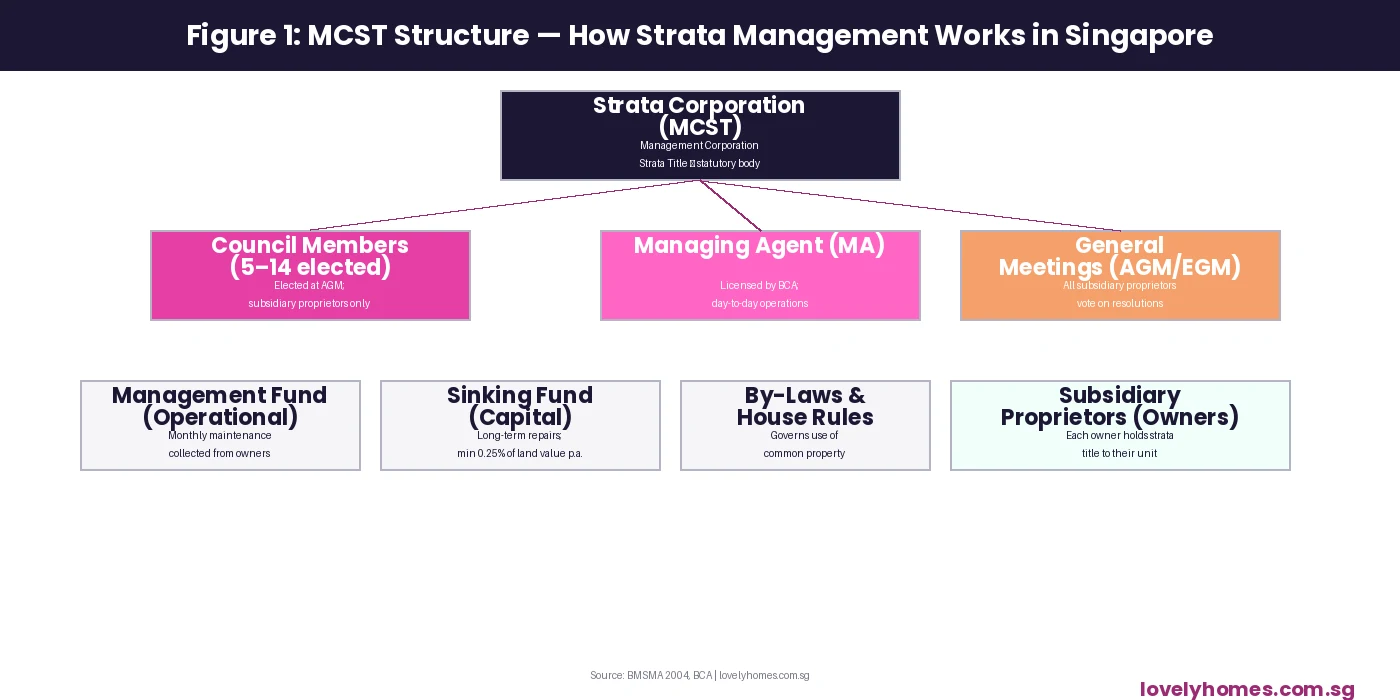
MCST structure strata management Singapore 2026
Figure 1: MCST Structure — How Strata Management Works in Singapore. Source: BMSMA 2004 (as amended 2017), BCA.

The MCST — Who It Is and How It Works

The Management Corporation Strata Title (MCST) is a statutory body that comes into existence automatically when the strata development is registered with the SLA. It has its own legal personality — it can enter into contracts (with managing agents, insurers, contractors), open bank accounts, sue, and be sued. Every subsidiary proprietor is automatically a member of the MCST by virtue of owning a unit in the development. The MCST’s legal authority, governance framework, and financial obligations are set out in the BMSMA.

The Council

The MCST is governed by a Council of elected subsidiary proprietors, comprising between 5 and 14 members depending on the size of the development. Council members are elected at the Annual General Meeting (AGM), serve for one year, and may stand for re-election. Only subsidiary proprietors (or their nominees, who must be individuals, not companies) may serve on the Council. The Council makes day-to-day management decisions on behalf of the MCST — approving expenditure, directing the managing agent, and setting maintenance schedules — within limits set by the general meeting.

The Managing Agent

Most MCSTs appoint a Managing Agent (MA) — a licensed property management company — to handle day-to-day operational tasks: collecting management fees, maintaining common area facilities, engaging contractors, handling resident feedback, and administering the development’s accounts. MAs must hold a valid licence from BCA. The appointment of the MA is approved at the AGM or EGM, and the MA acts as agent of the MCST, not as a principal.

General Meetings

The MCST must hold an Annual General Meeting (AGM) within 15 months of the preceding AGM. At the AGM, the management fund budget for the coming year is approved, council members are elected, and the MA’s appointment is ratified. Extraordinary General Meetings (EGMs) may be convened by the Council or by requisition of subsidiary proprietors holding at least 25% of total share value. Decisions at general meetings are made by ordinary resolution (simple majority of votes cast), special resolution (75% of votes cast), or unanimous resolution (100% agreement), depending on the matter.

Management Fund and Sinking Fund — What Your Monthly Fee Covers

The BMSMA requires every MCST to maintain two distinct funds:

Management Fund

The Management Fund covers the day-to-day operational costs of the development: managing agent fees, landscaping and cleaning, utility bills for common areas, pest control, routine maintenance and minor repairs, insurance premiums for the development’s common property, and administration costs. Every subsidiary proprietor is required to pay contributions to the Management Fund in proportion to their unit’s share value. The contribution rate is set at the AGM when the annual budget is approved.

Sinking Fund

The Sinking Fund is a long-term capital reserve for major repairs and replacement works that cannot be funded from the Management Fund. Examples include repainting the entire development, replacing lifts, repairing the roof, resurfacing the carpark, and replacing pool filtration systems. The BMSMA requires that the Sinking Fund contribution be at least 10% of the Management Fund contribution, but most well-managed developments set aside considerably more. The Commissioner of Buildings may direct the MCST to increase Sinking Fund contributions if the fund is deemed inadequate relative to the development’s age and condition.
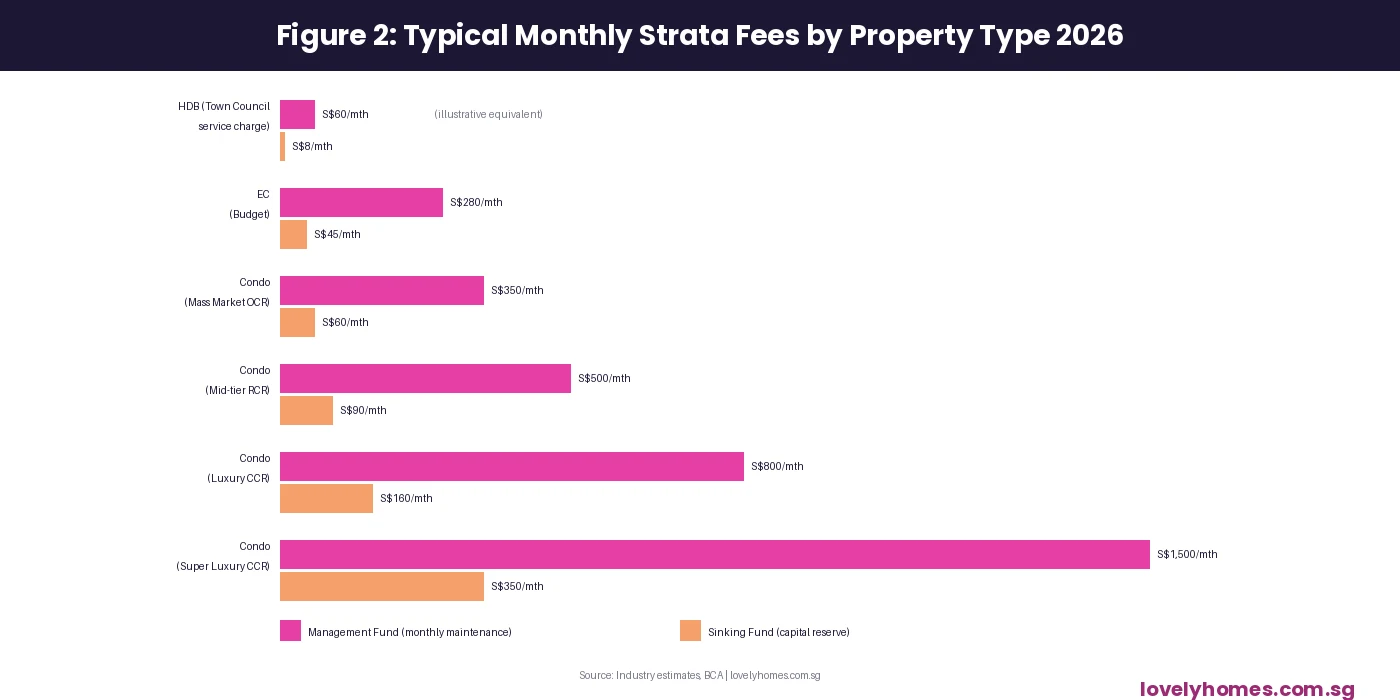
Strata management fees and sinking fund comparison Singapore 2026
Figure 2: Typical Monthly Strata Fees by Property Type 2026. Monthly Management Fund and Sinking Fund contributions by property segment. Source: Industry estimates, BCA.

Share Value — How Your Contribution Is Calculated

Your share value is a number assigned to your unit at the point of strata subdivision approval by the SLA. It reflects your unit’s relative size, floor level, and use within the development — larger or higher units typically have a higher share value than smaller or lower units. Share value determines two things: your monthly contribution to the Management Fund and Sinking Fund (fees are proportional to your share value as a fraction of the total share value of the development), and your voting weight at general meetings (each share value equals one vote).

Share values are fixed at the time of development and cannot be changed without unanimous resolution of all subsidiary proprietors and SLA approval. This means that if you buy a penthouse with a share value of 12 and the development has a total share value of 1,200, you contribute 1% of all maintenance costs and have 1% of the total voting weight — regardless of how many units there are.

By-Laws — House Rules with Legal Teeth

The MCST’s by-laws are the rules that govern the use of individual strata lots and common property. Singapore law distinguishes between prescribed by-laws (default rules set out in the Third Schedule of the BMSMA, which apply automatically to every development unless modified) and additional by-laws (rules adopted specifically by the MCST at a general meeting).

Common by-law subject matter includes: prohibition on smoking in common areas, restrictions on pet ownership (type, size, or number), noise curfews, rules about renovation works (times permitted, types of works requiring approval, deposit requirements), guest and visitor access to facilities, and restrictions on the use of facilities (e.g. pool hours, gym booking system). By-laws are enforceable by the MCST. A subsidiary proprietor or occupier in breach of a by-law can be issued a written notice to comply, and persistent breach can result in the MCST applying to the Strata Titles Board (STB) for a compliance order.

Type of Resolution Threshold Common Uses Legal Basis
Ordinary Resolution Simple majority of votes cast Approval of annual budget, election of Council, appointment of MA BMSMA s.28(1)
Special Resolution 75% of votes cast Adding/changing by-laws, special levy, withdrawal from Sinking Fund BMSMA s.28(2)
Unanimous Resolution 100% of all subsidiary proprietors Amalgamating or subdividing lots, altering the strata plan BMSMA s.28(3)
En Bloc (LTSA) — 10+ yr 80% of share value and floor area Collective sale of the entire development LTSA s.84A
En Bloc (LTSA) — under 10 yr 90% of share value and floor area Collective sale of newer development LTSA s.84A

En Bloc Collective Sale — How Strata Law Enables It

One of the most significant aspects of Singapore’s strata law is the provision for en bloc collective sale under section 84A of the Land Titles (Strata) Act. This allows a majority of owners in a strata development — measured by both share value and floor area — to force the sale of the entire development, including the minority who may not wish to sell. The objective is to prevent a small number of holdout owners from blocking the redevelopment of ageing buildings where the majority have agreed to sell.

For developments that are at least 10 years old (measured from the date of the Temporary Occupation Permit or Certificate of Statutory Completion, whichever is earlier), the consent threshold is 80% of the total share value and 80% of the total floor area of all lots. For developments less than 10 years old, the threshold rises to 90%. Heritage or conservation properties may require 100% consent, effectively making collective sale impossible without unanimity.

Once the requisite consent is obtained, a Sale Committee is constituted, a marketing agent is appointed, and the development is put up for tender. Following a successful tender, the Strata Titles Board (STB) reviews the transaction to ensure it is not against the interests of minority owners and approves the sale. Dissenting owners may object to the STB on limited grounds (primarily that the transaction is not in good faith or the distribution method is inequitable). Once approved, all owners must sell — dissenting or not.
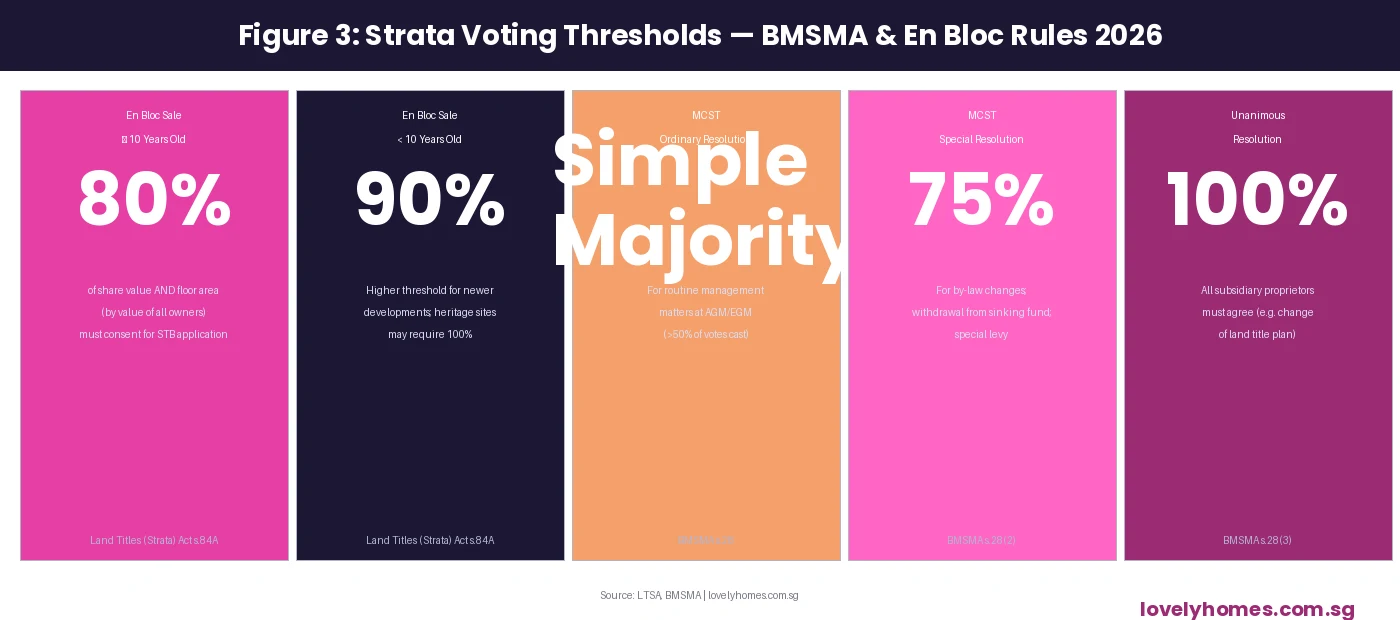
Strata en bloc voting thresholds BMSMA LTSA Singapore 2026
Figure 3: Strata Voting Thresholds — BMSMA and LTSA En Bloc Rules 2026. Source: Land Titles (Strata) Act, BMSMA.

Worked Example — Monthly Strata Fees for a Typical Singapore Condo Owner

Scenario: Ms Tan owns a 3-bedroom (1,100 sqft) unit in a 300-unit mid-tier condominium in the Rest of Central Region (RCR), completed in 2018. The development has a total share value of 900, and her unit has a share value of 6. The MCST has approved an annual Management Fund budget of S$3,240,000 and a Sinking Fund contribution of S$450,000 for 2026.

Her Management Fund contribution = (6 ÷ 900) × S$3,240,000 ÷ 12 = S$1,800/month (this is on the higher end; mass-market OCR condos typically run S$300–S$500/month for a similar-sized unit). For our illustration using a mid-tier RCR development with extensive facilities (two pools, gym, tennis courts, 24-hour security), S$1,800/month is realistic.

Her Sinking Fund contribution = (6 ÷ 900) × S$450,000 ÷ 12 = S$250/month.

Total monthly strata fees: S$2,050/month. When buying or investing in a strata property, these fees are a real cost of ownership that affects cash flow and net rental yield. A S$4,500/month gross rental income less S$2,050 in strata fees translates to a net rental before tax and other costs of S$2,450/month — a yield compression that buyers often underestimate.

Your Rights as a Subsidiary Proprietor

As a subsidiary proprietor, Singapore law grants you a suite of rights under the BMSMA that the MCST and Council must respect. You have the right to: inspect the MCST’s accounts, rolls, and records (on reasonable notice); attend and vote at all general meetings; stand for election to the Council; receive a notice of any general meeting at least 14 days in advance; challenge any resolution passed in breach of the BMSMA; apply to the STB to resolve disputes with the MCST or neighbouring owners; and receive a copy of the by-laws in force.

You also have responsibilities: to pay your Management Fund and Sinking Fund contributions on time (arrears attract interest), to comply with by-laws, to obtain written approval from the MCST before carrying out renovation works that affect the common property or building structure, and to ensure that your tenants and occupiers also comply with the by-laws.

What Might Come Next for Strata Governance?

Singapore’s strata governance framework has been progressively strengthened over the past decade. The 2017 BMSMA amendments introduced mandatory Council training, tightened the MA licensing regime, and strengthened the STB’s dispute resolution powers. Looking ahead, with an ageing private residential stock and an increasing number of developments approaching the 10-year en bloc window in the late 2020s, observers anticipate further refinements to the collective sale process. The Urban Redevelopment Authority and BCA periodically review the regulatory framework, and industry stakeholders have previously suggested reforms around proxy voting rules, electronic AGMs, and reserve fund adequacy standards.

Frequently Asked Questions

What is the difference between the MCST and the managing agent?

The MCST is the statutory body — it is you and all other owners collectively, and it has legal personality. The managing agent (MA) is a private company appointed by the MCST to carry out day-to-day operational work: collecting fees, managing contractors, maintaining records, and administering the development. The MA acts on behalf of the MCST; it does not own the building or have authority beyond what the MCST’s appointment contract grants. If you disagree with a decision, your recourse is through the Council or at a general meeting of the MCST — not directly with the MA.

What happens if I do not pay my management fees?

Arrears in Management Fund or Sinking Fund contributions accrue interest at the rate specified in the BMSMA. If arrears remain unpaid, the MCST may file a claim in the Magistrate’s Court or District Court to recover the debt. The MCST also has the right to lodge a caveat against your property title, which will prevent you from selling or mortgaging the property until the arrears are cleared. In practice, MCSTs generally issue written demand letters before taking legal action, but persistent non-payment does result in court proceedings and caveats being lodged.

Can I refuse to participate in an en bloc sale?

You may refuse to sign the collective sale agreement — and if the consent threshold is not met, the sale cannot proceed. However, if the requisite threshold (80% or 90%, as applicable) is obtained by other owners and the Strata Titles Board approves the sale, you are legally compelled to sell, even if you object. Your recourse is to object to the STB on specific grounds — primarily that the sale is not in good faith (e.g. the price is grossly inadequate, or there has been a conflict of interest in the sale process) or that the distribution method is inequitable. Pure disagreement with the sale price does not by itself constitute grounds for a successful STB objection if the price was set by a fair open-market process.

Can I carry out renovation works without MCST approval?

It depends on the nature of the works. Cosmetic works within your unit (painting, replacing flooring, changing kitchen cabinets) that do not affect the structure or common property generally do not require MCST approval. However, any works that affect the structure of the building, penetrate the slab, alter the plumbing or electrical systems serving common areas, or involve changes to the facade require the MCST’s written approval. The MCST’s by-laws will set out a renovation approval process and may require a renovation deposit. Carrying out structural works without approval is a by-law breach and can expose you to a compliance order from the STB and liability for any resulting damage to the building or neighbouring units.

How are disputes between neighbours in a strata development resolved?

The first step is usually direct negotiation or mediation facilitated by the managing agent. If that fails, parties may apply to the Strata Titles Board (STB) for mediation or adjudication on matters such as by-law breaches, unauthorised renovation, common property damage, or noise nuisance. The STB is an administrative tribunal — its proceedings are less formal and expensive than court. For disputes that fall outside the STB’s jurisdiction (e.g. pure contract disputes or tortious claims), the regular courts apply. The Community Disputes Resolution Tribunal (CDRT) also handles certain neighbour disputes, particularly noise and harassment.

What is the difference between a strata-titled property and a non-strata property?

A non-strata property — such as a detached or semi-detached house — has a single land title covering the entire lot. The owner owns both the building and the land beneath it outright, with no shared governance obligations. There is no MCST, no management fee, and no collective ownership of common areas. Strata-titled properties (condominiums, ECs, multi-strata commercial buildings) have individual strata lot titles plus shared ownership of common property, governed by the MCST. When comparing landed versus strata properties in Singapore, the absence of monthly maintenance fees is one of the cost advantages of landed property, though landed owners bear the full cost of their own land and building maintenance individually.

Who regulates MCSTs and managing agents in Singapore?

The Building and Construction Authority (BCA), through the Commissioner of Buildings, regulates both MCSTs and managing agents under the BMSMA. All managing agents and their key personnel must be licensed by BCA; BCA maintains a public register of licensed MAs. If an MA is found to be operating without a licence or in breach of the licensing conditions, BCA may revoke the licence and take enforcement action. Subsidiary proprietors who have concerns about their MCST’s governance — for example, accounts not being produced, AGMs not being held, or the MA acting outside its authority — may report these to BCA or apply to the STB for appropriate orders.

Related Articles


Disclaimer: This article is for general informational purposes only and does not constitute legal, financial, or property management advice. BMSMA provisions, MCST governance rules, en bloc thresholds, and BCA licensing requirements are subject to change. Always verify the current rules with BCA (bca.gov.sg), the Strata Titles Board (stratatb.gov.sg), and SLA (sla.gov.sg) before making any property decisions. For specific legal advice, consult a licensed Singapore lawyer.
Singapore Private Property Prices Q2 2026: URA Flash Estimate Shows +0.5% Overall, CCR +2.0%, Landed +2.6%

Singapore Private Property Prices Q2 2026: URA Flash Estimate Shows +0.5% Overall, CCR +2.0%, Landed +2.6%

⚡ Key Numbers — URA Q2 2026 Private Residential PPI Flash Estimate

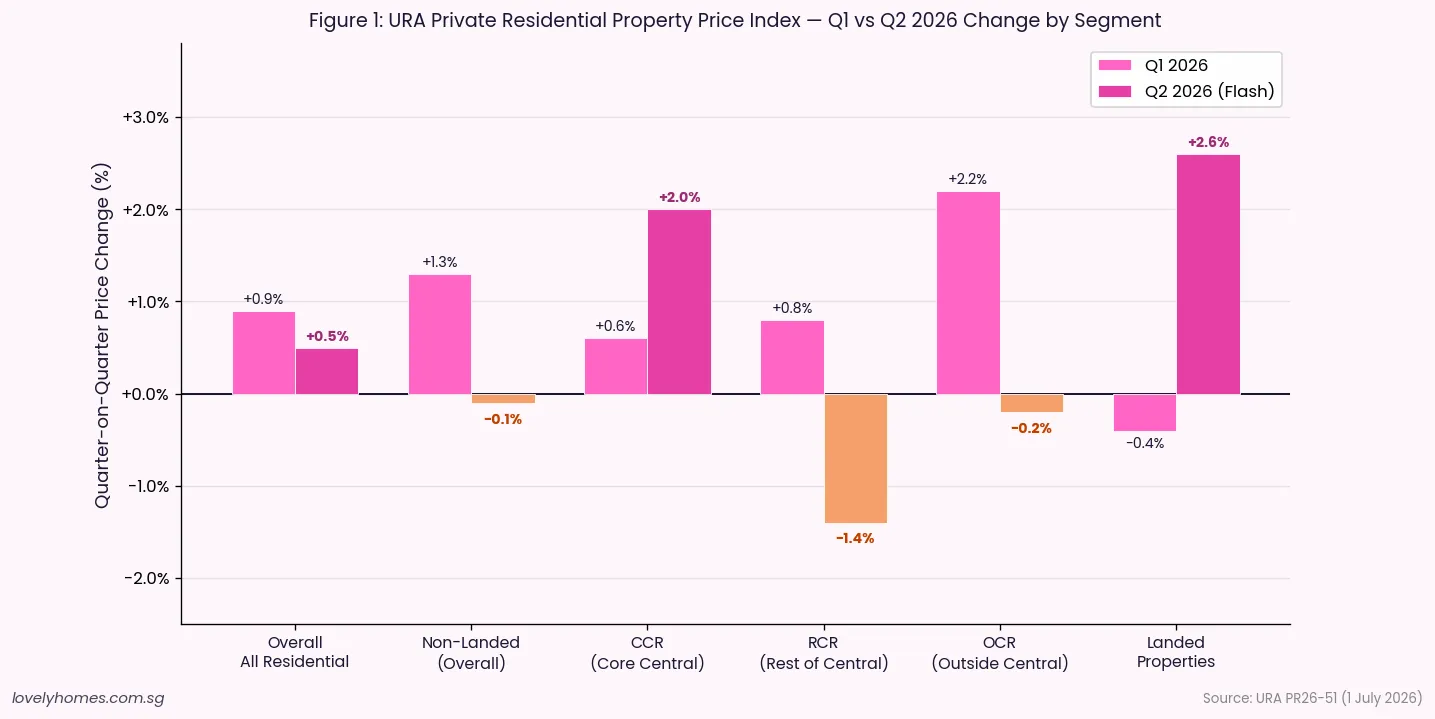
  • Overall PPI: +0.5% quarter-on-quarter in Q2 2026, decelerating from +0.9% in Q1 2026.
  • Non-landed properties (overall): –0.1% in Q2 (vs +1.3% in Q1) — a broad softening across the mass and mid-tier segments.
  • Core Central Region (CCR): +2.0% in Q2 (vs +0.6% in Q1) — the only non-landed segment to accelerate, driven by luxury demand.
  • Rest of Central Region (RCR): –1.4% in Q2 (vs +0.8% in Q1) — the weakest segment this quarter.
  • Outside Central Region (OCR): –0.2% in Q2 (vs +2.2% in Q1) — sharply slower after the strong new-launch-driven Q1 performance.
  • Landed properties: +2.6% in Q2 (vs –0.4% in Q1) — a notable reversal and the strongest segment in Q2.
  • Transaction volume: 5,420 units (up to mid-June 2026), broadly flat versus 5,413 in Q1.
  • Full Q2 statistics to be released by URA on 24 July 2026.

What the URA Flash Estimate Tells Us About Q2 2026

On 1 July 2026, the Urban Redevelopment Authority (URA) released the flash estimate of Singapore’s private residential property price index (PPI) for the second quarter of 2026. The headline figure — a 0.5% quarter-on-quarter increase — confirms a continuing but moderating upward trend in private home prices. The deceleration from Q1’s 0.9% gain reflects a more complex underlying picture: diverging fortunes between CCR luxury units and the mid-tier and mass-market segments, alongside a significant turnaround in landed property pricing.

Flash estimates are compiled from stamp duty submissions and developer sales data covering 1 April to mid-June 2026. URA notes that past estimates have differed from final figures and advises the public to interpret them with caution. The full Q2 dataset — including rental, vacancy and supply statistics — will be released on 24 July 2026.

URA private residential property price index Q1 vs Q2 2026 change by region CCR RCR OCR landed
Figure 1: URA Private Residential Property Price Index — quarter-on-quarter change by segment, Q1 vs Q2 2026. Source: URA Press Release PR26-51 (1 July 2026).

Segment-by-Segment Breakdown

CCR: Luxury Demand Re-Emerges

The Core Central Region posted the strongest non-landed performance in Q2 2026 at +2.0%, up from a modest +0.6% in Q1. The CCR comprises Districts 9, 10, 11 and the Downtown Core and Sentosa Cove — Singapore’s prime and ultra-prime residential markets. The acceleration reflects continued interest from overseas buyers (particularly those from Southeast Asia and Europe), ABSD-resilient demand at the upper end, and limited new launch supply in the CCR pipeline for the remainder of 2026. Several analysts had anticipated a softer CCR following the 60% ABSD rate for foreigners introduced in April 2023; instead, those who remain in the market appear to be purchasing at higher price points.

RCR: Sharpest Correction

The Rest of Central Region posted the weakest result at –1.4% after a +0.8% gain in Q1. The RCR — encompassing the city fringe and established residential neighbourhoods — had benefited strongly from new launch activity in 2024 and early 2025. With fewer significant launches pricing in during Q2 2026 and buyers digesting earlier purchases, the RCR has retreated modestly. This is not unusual: RCR prices tend to be more launch-driven and can oscillate more sharply quarter-to-quarter than the CCR or OCR.

OCR: Post-Launch-Boom Cooling

The Outside Central Region, which drove Singapore’s 2024–2025 private property rally on the back of strong new BTO and EC launches drawing first-timer upgraders, slipped 0.2% in Q2 after a 2.2% surge in Q1. The normalisation is expected — Q1’s exceptional OCR performance was partly attributable to a cluster of well-received project launches recording strong take-up in the Jan–Mar window. Q2’s mild correction suggests that pricing has reached a level where buyers are exercising greater selectivity.

Landed: The Standout Performer

Landed property — comprising detached houses, semi-detached homes and terraces — rebounded sharply to +2.6% in Q2, reversing a –0.4% dip in Q1. The landed market is structurally limited in supply (foreigners cannot purchase landed property without Singapore Land Authority approval, and government resale restrictions apply to certain categories) and tends to recover quickly from short-term softness. The Q2 bounce aligns with a pickup in transaction volumes observed in the Good Class Bungalow (GCB) and semi-detached segments in prime districts.

Supply Context: Record GLS Output in 2026

URA simultaneously highlighted the Government’s sustained GLS (Government Land Sales) programme as the key supply-side stabiliser. The 2H2026 Confirmed List adds 4,745 private residential units, bringing the full-year 2026 Confirmed List total to 9,320 units — more than 50% above the 10-year annual average. When combined with the Reserve List, the total GLS pipeline for 2026 is the largest in over a decade.

Metric Value
Overall PPI change, Q2 2026 +0.5% q-o-q
Non-landed overall –0.1% q-o-q
CCR (non-landed) +2.0% q-o-q
RCR (non-landed) –1.4% q-o-q
OCR (non-landed) –0.2% q-o-q
Landed properties +2.6% q-o-q
Sale volume (to mid-Jun 2026) 5,420 units
Q1 2026 volume (full quarter) 5,413 units
2H2026 GLS Confirmed List 4,745 units
Full-year 2026 Confirmed List 9,320 units (>50% above 10-yr avg)
Expected completions (next few years) ~61,000 units (incl. ECs)
Full Q2 statistics release 24 July 2026

What This Means for Buyers and Investors

📈 Analytical Note

The Q2 2026 flash estimate presents a nuanced picture rather than a simple upward or downward trend. The headline +0.5% masks significant divergence: CCR and landed properties are moving upward while the broader non-landed market (RCR, OCR) has softened or retreated modestly. For buyers, this suggests that bargaining power has returned somewhat in the mid-tier and mass-market segments, while CCR and prime landed command a premium and show no signs of price fatigue.

The record GLS supply pipeline — 61,000 units expected to complete over the next several years — is the most important structural factor for 2027 onwards. High supply typically dampens rental yields and constrains capital appreciation. Investors underwriting strong rental yield assumptions should pressure-test those models against the forthcoming supply wave.

MAS’s advisory to “exercise prudence” in the context of “highly uncertain macroeconomic outlook” is a consistent boilerplate, but the macro context in mid-2026 is genuinely uncertain: US tariff policy, global growth deceleration, and potential further geopolitical shocks could all affect Singapore’s export-dependent economy and, by extension, household income and property demand.

FAQ: URA Q2 2026 Flash Estimate

Why is the Q2 2026 flash estimate only partial data?

Flash estimates are compiled from stamp duty payment data submitted to IRAS and developer sales figures covering only the first two and a half months of the quarter (1 April to approximately mid-June). They do not include all transactions completed in June and cannot account for late-filed stamp duty submissions. URA releases full statistics, including rental, vacancy and pipeline data, at the end of July. The flash estimate is intended to give early market guidance, not a definitive picture.

What is driving CCR’s outperformance in Q2 2026?

CCR outperformance typically reflects foreign buyer demand, ultra-high-net-worth activity, and limited new supply in prime districts. Despite the 60% ABSD on foreign purchases introduced in April 2023, a residual pool of buyers for whom ABSD is not prohibitive — often high-net-worth individuals from Southeast Asia, India and Europe — continues to underpin CCR pricing. Domestic demand for CCR properties has also been relatively firm among Singapore Citizens and PRs trading up from large OCR condominiums.

Is the OCR correction a sign of a broader market downturn?

A –0.2% quarter-on-quarter movement is well within normal volatility for the OCR segment and does not signal a broad downturn. OCR prices tend to be more sensitive to the timing and reception of specific new launch projects; a quarter with fewer strong launches will naturally produce softer headline numbers. The underlying driver of OCR demand — the HDB upgrader pipeline, which remains robust given the volume of BTO completions expected in 2025–2027 — is structurally intact.

How does the GLS supply pipeline affect property prices?

High GLS supply expands the stock of private housing over a 3–5 year horizon as sites are tendered, developed and completed. More completions increase rental supply, which typically compresses rental yields, and adds to the inventory available for resale. Historically, URA has calibrated the GLS programme to balance supply and demand; a 9,320-unit Confirmed List in 2026 signals the government’s intent to sustain supply-side pressure on prices and rents. The full impact on capital values will depend on how quickly completions translate into market inventory and how strongly household formation and investment demand absorb the new supply.

When will the full Q2 2026 URA statistics be released?

URA has stated that the full set of real estate statistics for Q2 2026 will be released on 24 July 2026. The full release will include the definitive PPI (which may differ from the flash estimate), rental index, vacancy rates, pipeline supply and transaction volume by district and property type. LovelyHomes will publish a detailed analysis of the full Q2 2026 data upon release.

Disclaimer: This article is based on URA’s flash estimate press release PR26-51 dated 1 July 2026. Flash estimates are preliminary and may differ from final Q2 2026 statistics to be released on 24 July 2026. This article is for informational purposes only and does not constitute property, financial or investment advice. Readers should refer to official data at ura.gov.sg and consult a licensed property professional before making any purchase or investment decision.

Singapore Housing Loan Guide 2026: HDB Loan, Bank Loan, TDSR, MSR and Fixed vs Floating Rates

Singapore Housing Loan Guide 2026: HDB Loan, Bank Loan, TDSR, MSR and Fixed vs Floating Rates

⚡ Quick Answer — Singapore Housing Loan Guide 2026

  • Two loan types: HDB Concessionary Loan (2.60% p.a., LTV up to 80%) or Bank/FI Loan (variable 2.5%–3.8%, LTV up to 75%). Once you switch to a bank loan, you cannot return to HDB financing.
  • TDSR (Total Debt Servicing Ratio): all monthly debt repayments must not exceed 55% of gross monthly income — applies to every borrower.
  • MSR (Mortgage Servicing Ratio): for HDB flat purchases only, your property loan repayment must not exceed 30% of gross monthly income.
  • Loan tenure: up to 25 years (HDB loan); up to 30 years (bank loan on HDB flat); up to 35 years for private property, subject to age-65 cut-off.
  • Minimum cash downpayment: 5% cash for a bank loan (first property); HDB loan requires minimum 10% downpayment, fully payable from CPF OA — no mandatory cash.
  • Fixed vs floating: fixed rates lock in certainty for 1–5 years; floating (SORA-based) tracks market rates and benefits from falling rate environments.
  • HFE letter required: before exercising an OTP on any HDB flat, you must hold a valid HDB Flat Eligibility (HFE) letter specifying your loan eligibility.

Singapore Housing Loans: The Regulatory Framework

Singapore’s residential mortgage market is governed by the Monetary Authority of Singapore (MAS) through the Financial Advisers Act and the Banking Act, supplemented by the suite of property cooling measures active since 2009. HDB’s own concessionary loan scheme operates in parallel, governed by the Housing & Development Act and administered by HDB.

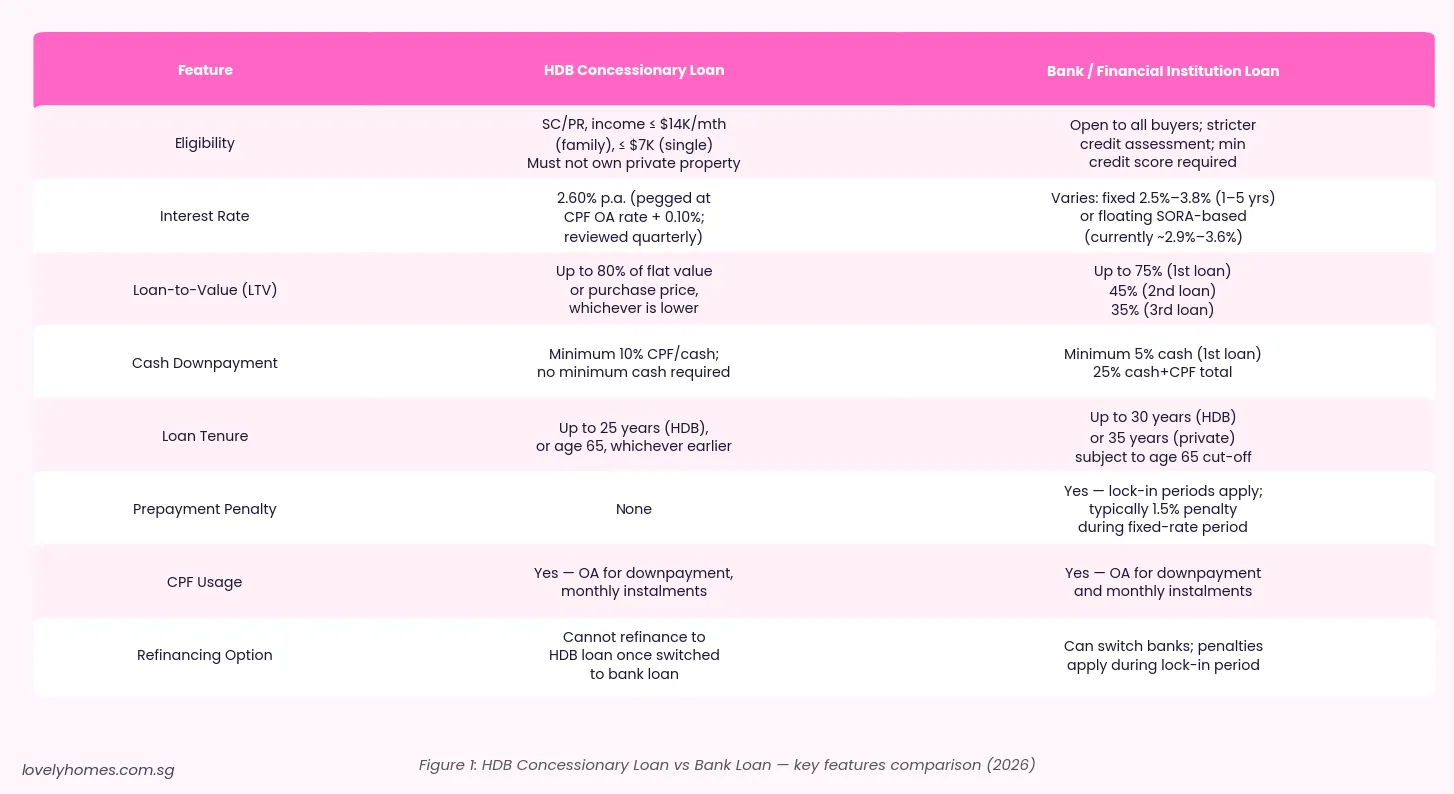
Two bodies set the lending guardrails every Singapore borrower must work within: MAS (TDSR and LTV limits for bank loans) and HDB (MSR and income-ceiling criteria for the concessionary scheme). Understanding both frameworks before committing to any home purchase is essential, because your borrowing capacity — and the monthly cash-flow required to service the mortgage — depends entirely on which loan type you take.

HDB concessionary loan versus bank loan comparison table Singapore 2026 interest rate LTV downpayment
Figure 1: HDB Concessionary Loan vs Bank Loan — key features at a glance (2026). Source: HDB, MAS.

HDB Concessionary Loan — Who Qualifies and What It Offers

The HDB concessionary loan is available only to buyers of HDB flats and only to households where at least one applicant is a Singapore Citizen. The interest rate is pegged at 0.10 percentage points above the CPF OA rate (2.50% p.a. since 1999), making the HDB loan rate 2.60% p.a. — reviewed quarterly but unchanged since 1 January 1999.

HDB Loan Eligibility (2026)

Criterion Requirement
Citizenship At least one Singapore Citizen applicant
Gross Monthly Income ≤ $14,000/mth (families); ≤ $7,000/mth (singles)
Private Property Must not currently own private residential property; none disposed of in preceding 30 months
Prior HDB Loans Maximum two HDB concessionary loans in a lifetime
Flat Type HDB flats only — not ECs, DBSS or private property
HFE Letter Valid HDB Flat Eligibility (HFE) letter required

A key advantage of the HDB loan is that the minimum 10% downpayment can come entirely from the buyer’s CPF OA — no mandatory cash component is required. For buyers with substantial CPF savings but limited liquid cash, this is a significant advantage over bank loan requirements.

Bank Loans — Flexibility and Market Rates

Bank loans are available from any MAS-licensed bank or financial institution in Singapore. Unlike HDB loans, bank loans are available for all property types — HDB flats, ECs, private condominiums, landed homes, and commercial property. Rates are either fixed for an introductory period or floating, pegged to SORA.

LTV Limits by Outstanding Loan Count (Bank Loans)

Outstanding Loans LTV Limit Minimum Cash Downpayment Total Minimum Downpayment
0 (first property loan) 75% 5% cash 25% (5% cash + 20% CPF/cash)
1 (second property loan) 45% 25% cash 55%
2 or more (third+ loan) 35% 25% cash 65%
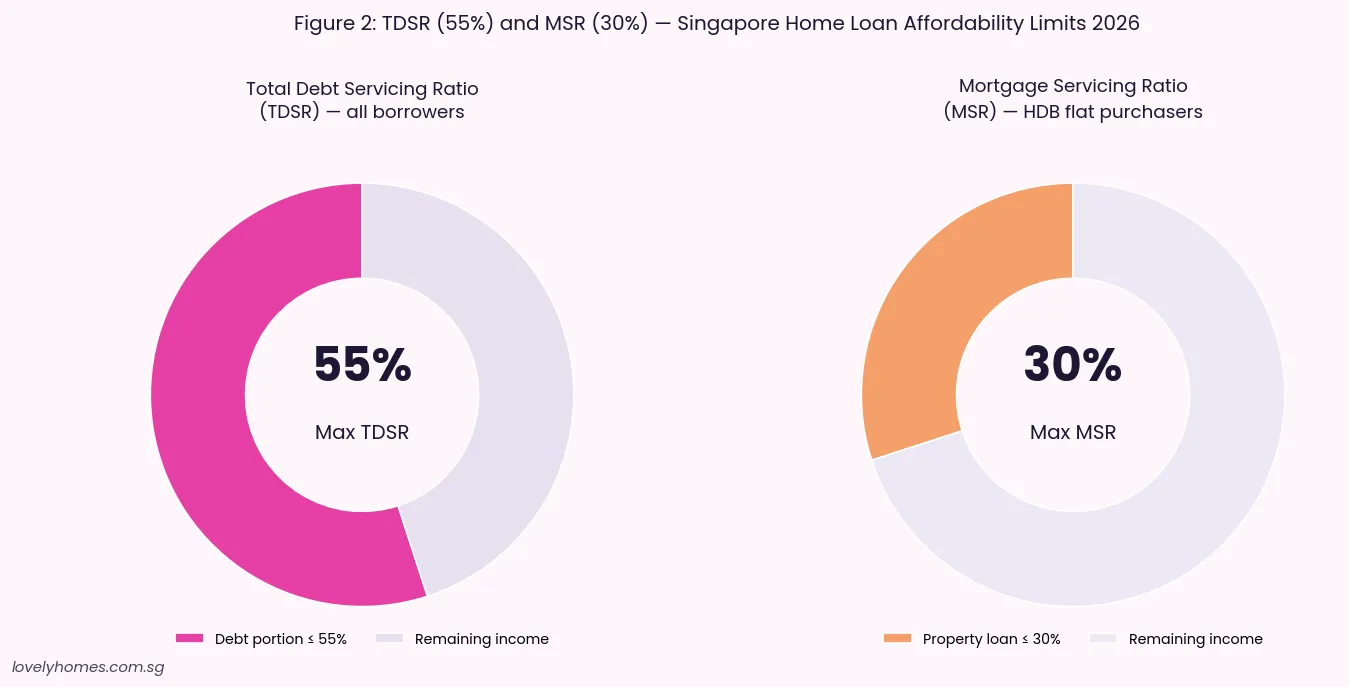
TDSR 55 percent and MSR 30 percent Singapore home loan affordability limits 2026
Figure 2: TDSR (55%) and MSR (30%) — Singapore home loan affordability guardrails (2026). Source: MAS, HDB.

TDSR and MSR: The Two Affordability Tests

Total Debt Servicing Ratio (TDSR), set by MAS at 55%, caps all monthly debt obligations — including car loans, personal loans, credit card minimums and the proposed mortgage — at 55% of gross monthly income. TDSR applies to every property purchase in Singapore, regardless of type or buyer nationality.

Mortgage Servicing Ratio (MSR), at 30%, applies specifically to HDB flat purchases. It limits the monthly mortgage repayment on the HDB loan alone to 30% of gross monthly income. For a household earning $8,000/month, the MSR ceiling is $2,400/month — often the binding constraint when purchasing a larger HDB flat.

The two tests serve different purposes. TDSR prevents households from taking on unsustainable total debt across all borrowings. MSR ensures that HDB — as government-subsidised housing — is not leveraged beyond a prudent level. A buyer can pass TDSR yet fail MSR, requiring either a smaller loan or a higher income.

Fixed vs Floating Rate: Which Is Right For You?

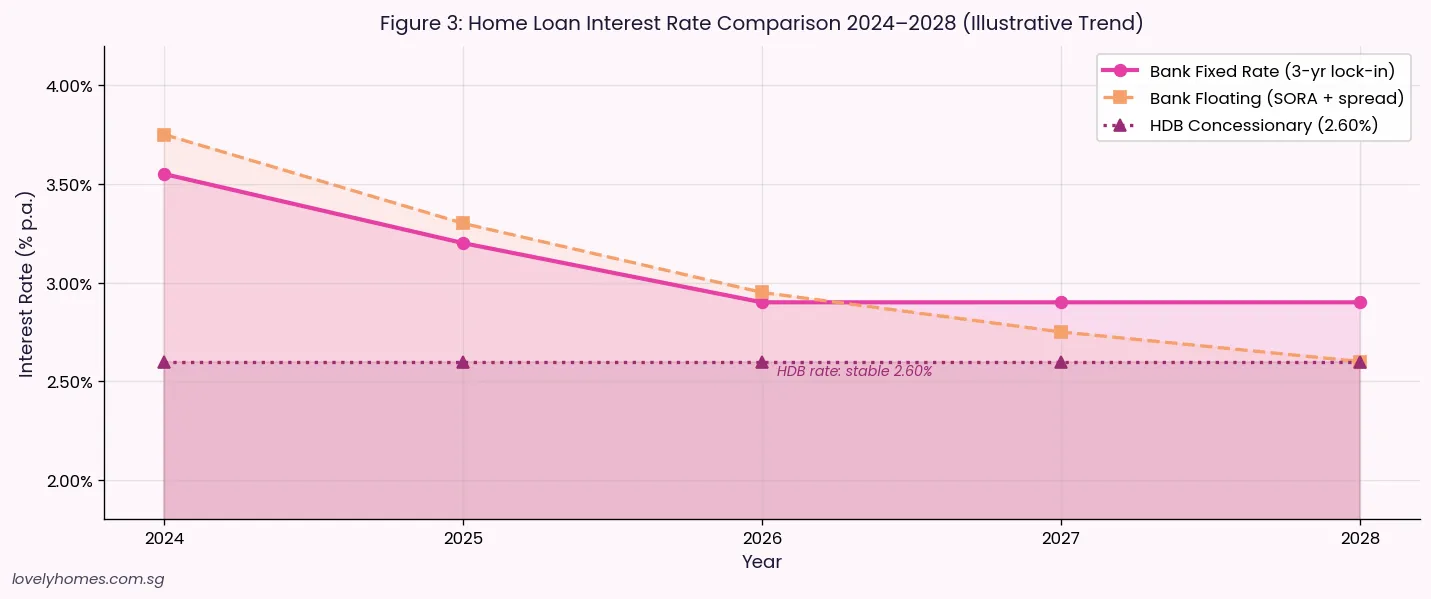
The 2022–2023 rate spike, when SORA climbed from near zero to above 3% following global monetary tightening, made this question acutely important for Singapore borrowers. By mid-2026 SORA has moderated; the choice between fixed and floating is less stark but still consequential for monthly cash flow.

Home loan interest rate comparison Singapore 2024 to 2028 fixed floating HDB rate trend
Figure 3: Home Loan Interest Rate Trend 2024–2028 — fixed, floating (SORA-based) and HDB rate (illustrative). Source: MAS, industry data.
Package Type Typical Rate (Mid-2026) Lock-in Period Best For
Fixed (1-year) ~2.65%–2.80% p.a. 1 year Short-term certainty; expect to refinance
Fixed (2-year) ~2.75%–2.95% p.a. 2 years Medium certainty; most popular in 2026
Fixed (3–5 year) ~2.90%–3.20% p.a. 3–5 years Long certainty; premium for stability
Floating (SORA + spread) ~2.85%–3.20% p.a. None to 1 year Benefits from rate falls; higher volatility
HDB Concessionary 2.60% p.a. None Stable, no lock-in; eligible buyers only

Worked Example: HDB Loan vs Bank Loan

📺 Case Study — the Lim Household

Profile: Mr and Mrs Lim, SC-SC couple, both first-timers. Combined gross income $9,500/month. Buying a 5-room resale flat in Bishan for $750,000 (HDB valuation $730,000). They have $150,000 in combined CPF OA.

HDB Loan check: Income $9,500/mth exceeds the HDB loan ceiling of $9,000/mth for families. The Lims do not qualify for the HDB concessionary loan — they must take a bank loan.

Bank Loan (LTV 75%): Loan up to $562,500. Downpayment: 25% of $750,000 = $187,500 (mandatory 5% cash = $37,500; CPF $150,000). Loan: $562,500 at 2.85% p.a. (floating), 30 years → monthly repayment ≈ $2,328/month. MSR: 24.5% ✓ PASS. TDSR (no other debts): 24.5% ✓ PASS.

Total cash at completion: $37,500 mandatory cash + ~$5,000 legal fees. BSD $17,100 payable from CPF. Total cash outlay ≈ $42,500.

Key takeaway: The Lims must take a bank loan due to the income ceiling. The 5% cash minimum ($37,500) is manageable; CPF covers the balance of the downpayment and BSD. At a 24.5% MSR, they have headroom if rates rise modestly. If SORA falls in 2027, their floating-rate repayment will reduce automatically.

Why Singapore’s Mortgage Rules Are Structured This Way

The dual-layer TDSR/MSR framework reflects MAS and HDB’s shared objective: ensuring home ownership does not become a source of financial distress. TDSR at 55% was introduced in 2013 in direct response to rising household leverage during the post-2008 low-rate period, when lenders were extending mortgages to buyers whose total debt obligations far exceeded sustainable levels. By standardising a hard ceiling across all lenders, MAS established a consistent affordability floor across Singapore’s banking system.

MSR at 30% is deliberately tighter for HDB purchases because HDB flats are government-subsidised public housing. The 30% threshold is calibrated so that most HDB buyers can continue servicing their mortgage even if one income earner loses employment — preserving the social objective of housing stability. Singapore’s approach contrasts with markets like Australia (individual serviceability tests without hard regulatory caps) or the UK (soft loan-to-income ratios). The result is a structurally lower mortgage default rate.

Rate Outlook and Refinancing

The trajectory of the US Federal Reserve and the Singapore overnight lending market will determine whether floating-rate packages remain competitive through 2027. Market consensus as at mid-2026 places the next Fed rate cut in late 2026 or early 2027, which would pull SORA lower. Buyers entering floating-rate packages now may benefit from falling monthly repayments. Those on 2-year fixed packages locked in 2024–2025 at higher rates should review refinancing options as their lock-in period expires.

FAQ: Singapore Housing Loans 2026

Can I use CPF OA to pay monthly mortgage instalments for a bank loan?

Yes. CPF Ordinary Account savings can service monthly mortgage instalments for both HDB loans and bank loans on eligible property, subject to the Valuation Limit and accrued-interest rules. The bank deducts the instalment from your CPF OA monthly, with any shortfall requiring cash top-up. CPF withdrawals for property accrue interest at 2.5% p.a., which must be refunded to CPF on sale.

What is SORA and how does it affect my floating-rate mortgage?

SORA (Singapore Overnight Rate Average) is the volume-weighted average rate of unsecured overnight interbank SGD transactions, published daily by MAS. Most Singapore bank mortgage packages moved from SIBOR-based to SORA-based pricing since 2021. A typical floating package might be “1-month SORA + 1.00% spread” — your rate moves monthly with SORA. When the Fed cuts rates, SORA tends to follow with a short lag, reducing your repayment. The risk is the reverse: the 2022–2023 spike demonstrated how sharply obligations can rise.

Can I refinance from a bank loan back to an HDB loan?

No. Once you switch from an HDB concessionary loan to a bank loan, you cannot refinance back to HDB financing. The switch is permanent. You can refinance between banks — subject to lock-in penalties — or switch between rate types with the same bank. This makes the initial loan-type decision particularly consequential.

Does a larger loan affect ABSD?

The loan amount does not directly affect ABSD. Additional Buyer’s Stamp Duty is calculated on the purchase price (or market value, whichever is higher) and must be paid in cash within 14 days of signing the S&P Agreement. ABSD cannot be financed or paid from CPF; it requires a separate cash outlay. A higher purchase price implies higher ABSD, but the financing structure is irrelevant to the ABSD computation.

What happens if I cannot meet my mortgage repayments?

For HDB loans, HDB has an arrears management framework with grace periods and restructuring options before enforcement. For bank loans, lenders may issue a Letter of Demand and, ultimately, commence foreclosure if repayments remain delinquent beyond the contractual default period (typically 3 months). Borrowers in difficulty should contact their lender early — most banks have hardship assistance programmes, and MAS expects lenders to engage proactively. HDB also operates a Financial Assistance Scheme for eligible borrowers.

Can foreigners take bank loans for Singapore property?

Yes. Foreigners and PRs can obtain bank mortgages from Singapore-licensed banks for eligible property types. LTV limits, TDSR and tenure rules apply equally. Foreigners are not eligible for HDB loans. Some banks apply additional credit assessments or require larger downpayments for non-residents — particularly for borrowers with income in volatile currencies.

Disclaimer: This article is for general informational purposes only. Mortgage terms, interest rates, LTV limits and eligibility criteria are subject to change. Verify current terms with your bank, the Monetary Authority of Singapore (mas.gov.sg) and HDB (hdb.gov.sg). This article does not constitute financial advice. Consult a licensed financial adviser before committing to any home loan.

Singapore HDB Grants Guide 2026: EHG, Family Grant, PHG and All CPF Housing Grants Explained

Singapore HDB Grants Guide 2026: EHG, Family Grant, PHG and All CPF Housing Grants Explained

⚡ Quick Answer — HDB CPF Housing Grants at a Glance (2026)

  • Enhanced CPF Housing Grant (EHG): up to $120,000 for eligible couples; $60,000 for singles — applies to both BTO and resale flats, income ceiling $9,000/mth (couple).
  • CPF Family Grant (FG): $50,000–$60,000 for eligible SC-SC couples buying a resale flat; no income ceiling applies.
  • Proximity Housing Grant (PHG): up to $30,000 to live with or near parents/children — resale flats only.
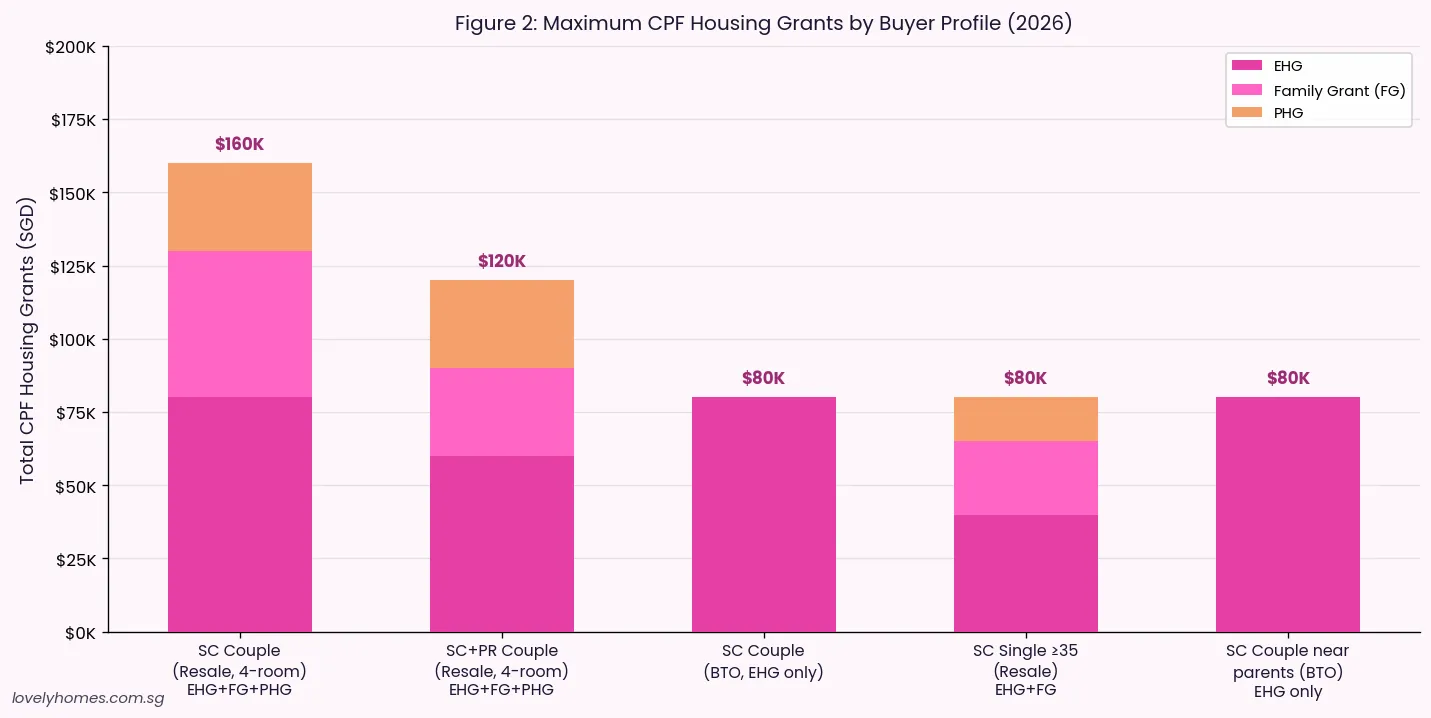
  • Grants can be stacked: a first-timer SC couple buying a resale flat near parents could qualify for EHG + FG + PHG = up to $160,000 in total grants.
  • Grants are credited to CPF Ordinary Account (OA) and deducted from the purchase price; they reduce your outstanding loan and accrued interest.
  • Second-timers may still access PHG (resale only) and a reduced FG if one party is a first-timer.
  • All grants are administered by HDB and disbursed via CPF Board — you apply through the HDB Flat Portal after obtaining an HDB Flat Eligibility (HFE) letter.

What Are CPF Housing Grants?

CPF housing grants are cash subsidies that the Singapore Government channels through the Central Provident Fund (CPF) Ordinary Account to help eligible buyers afford Housing & Development Board (HDB) flats. Unlike the earlier Building & Construction Authority rebates or direct handouts, these grants go directly into the buyer’s CPF OA and are credited against the flat’s purchase price — reducing the loan quantum and, over the life of the mortgage, the accrued interest the buyer ultimately owes CPF.

The grant framework has evolved significantly since the early 2000s. The Additional CPF Housing Grant (AHG) and Special CPF Housing Grant (SHG) were consolidated and superseded on 11 September 2019 by the Enhanced CPF Housing Grant (EHG), which provides a single, tiered subsidy that scales down with household income. The Family Grant and Proximity Housing Grant, both introduced in 2015 for resale flat buyers, remain active. Together, these three grant streams — EHG, FG, PHG — form the backbone of Singapore’s HDB affordability architecture in 2026.

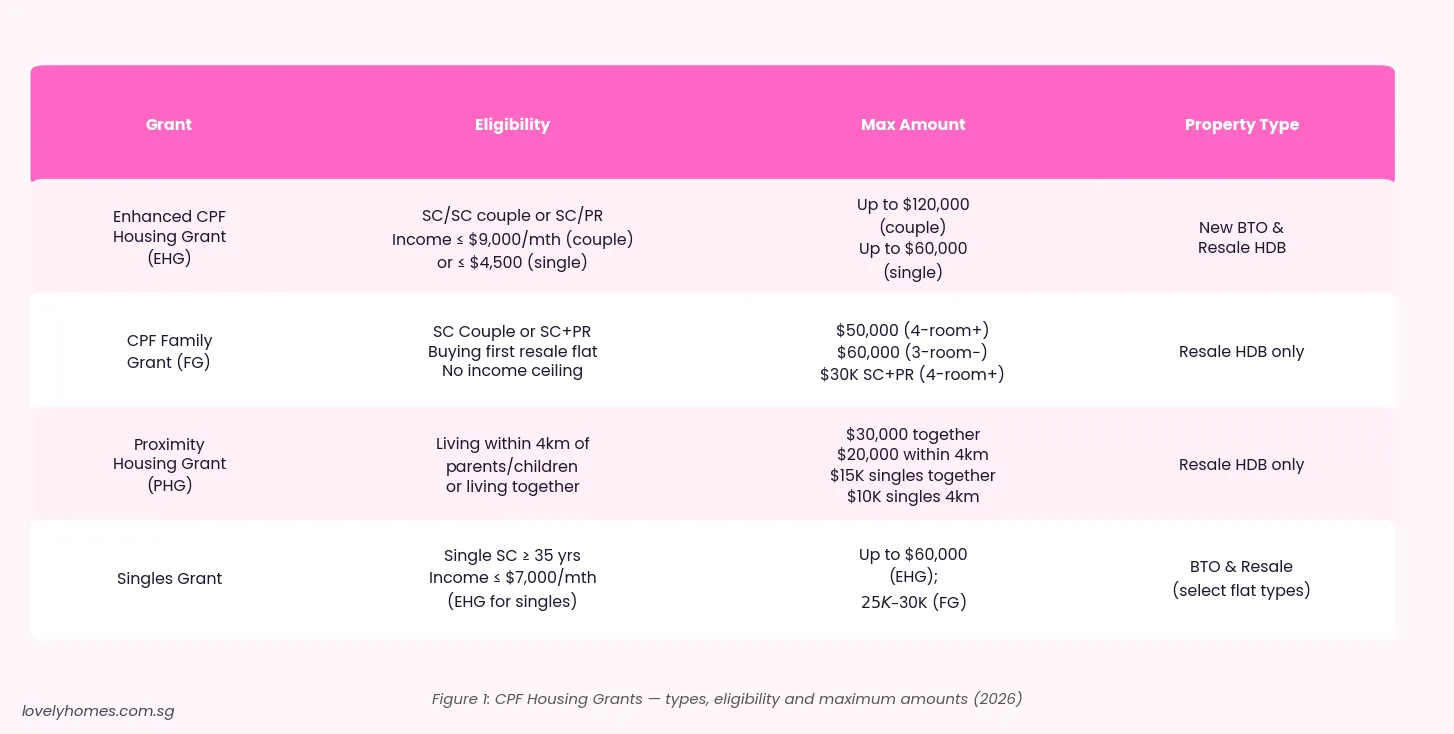
CPF housing grants types eligibility and maximum amounts Singapore 2026 table
Figure 1: CPF Housing Grants — types, eligibility and maximum amounts (2026). Source: HDB Singapore.

Enhanced CPF Housing Grant (EHG) — The Foundation Grant

The EHG, introduced in September 2019, is the primary income-based subsidy for first-timer buyers. Unlike its predecessors, the EHG applies to both new BTO flats and resale flats, eliminating a long-standing disparity where resale buyers received less support than BTO buyers. HDB administers the scheme; CPF Board disburses the funds.

EHG Eligibility Criteria

To qualify for EHG, the household must meet all of the following:

Criterion Couples / Families Singles (≥ 35 years old)
Citizenship At least one Singapore Citizen Singapore Citizen
Gross Monthly Income ≤ $9,000/month ≤ $4,500/month
Prior Housing Grant Must not have received AHG or SHG previously Same
Flat Type (BTO) Any HDB flat type (2-room Flexi to 5-room) 2-room Flexi (BTO) only
Flat Type (Resale) Any eligible resale flat 2-room or 3-room resale only
Continuous Employment At least one applicant employed for ≥ 12 months continuously Same

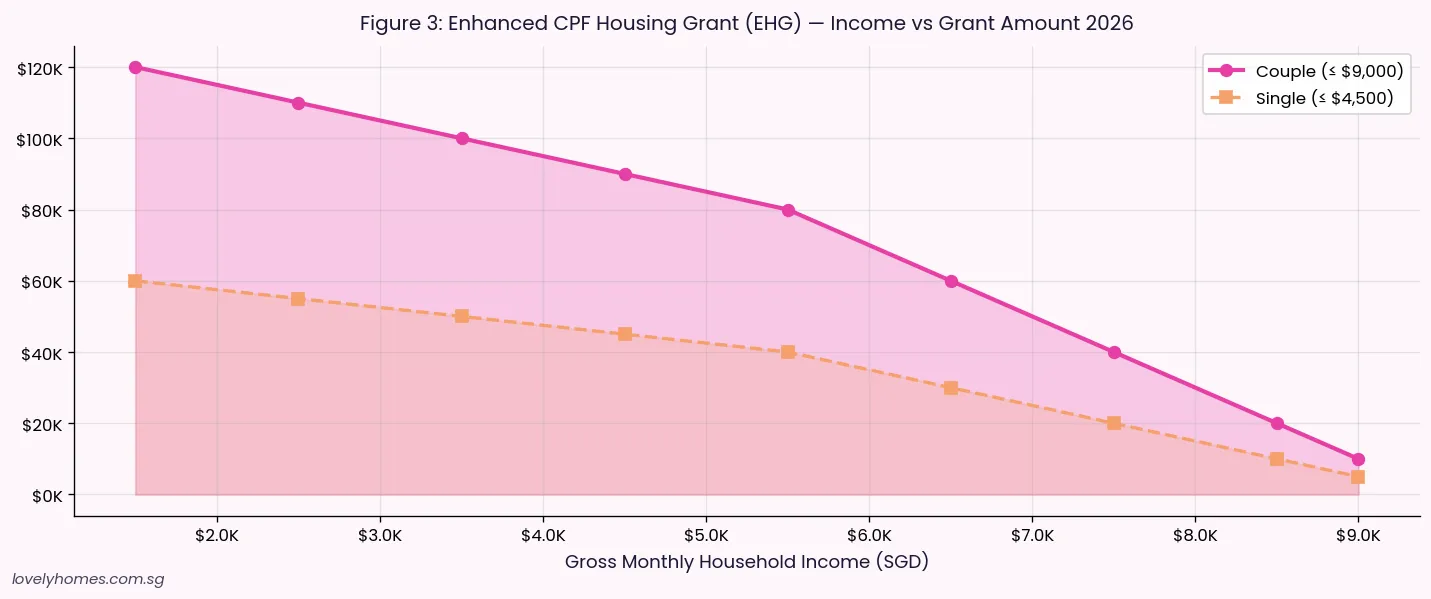
The EHG quantum scales inversely with income: buyers at the bottom of the income band receive the maximum grant, while those approaching the $9,000 ceiling receive the minimum. The grant is calculated based on the average gross monthly household income over the preceding 12 months.

Enhanced CPF housing grant EHG income ceiling versus grant amount Singapore 2026
Figure 3: Enhanced CPF Housing Grant (EHG) — income versus grant amount for couples and singles (2026). Source: HDB Singapore.

EHG Grant Amounts

For couples with a household income at or below $1,500/month, the maximum EHG is $120,000. The grant steps down by $5,000 for every additional $500 in household income until it reaches a minimum of $5,000 at the $8,500–$9,000 income band. Singles receive exactly half the couple quantum at each band (maximum $60,000 at ≤$750/month income). The EHG is credited to the buyer’s CPF OA and applied to the purchase price at completion.

CPF Family Grant (FG) — For Resale Flat Buyers

The CPF Family Grant targets first-timer buyers purchasing a resale HDB flat and does not have an income ceiling — making it accessible to middle-income households that earn too much for the EHG. The Family Grant replaced the Additional CPF Housing Grant (Resale) in 2015 and has remained structurally unchanged since.

Family Grant Amounts by Flat Type and Household Composition

Buyer Profile Resale Flat ≤ 3-room Resale Flat 4-room+
SC + SC Couple (first-timer) $60,000 $50,000
SC + PR Couple (first-timer SC) $40,000 $30,000
SC Single (≥ 35 yrs, first-timer) $30,000 $25,000

Where one spouse is a second-timer and the other is a first-timer, the couple may receive half the applicable Family Grant. The Family Grant is not available for BTO flats — that distinction is important for buyers weighing resale against new launches.

Proximity Housing Grant (PHG) — Living Near Loved Ones

The Proximity Housing Grant encourages multi-generational living arrangements by subsidising buyers who choose to live with, or within 4 kilometres of, their parents or children. Available for resale flats only, it was introduced in 2015 to address Singapore’s social goal of strengthening family ties and providing informal eldercare support networks.

PHG Amounts

Living Arrangement SC-SC Couple SC-PR or Single
Living with parents / child (in same flat) $30,000 $15,000
Living within 4 km of parents / child $20,000 $10,000

The PHG is granted based on the residential address of the parent or child at the time of application. There is no income ceiling. However, buyers must satisfy a 5-year occupation requirement: if they move away from the stated proximity within 5 years of flat completion, the grant is subject to clawback by HDB.

Maximum CPF housing grants by buyer profile Singapore 2026 bar chart EHG family grant PHG
Figure 2: Maximum CPF Housing Grants by buyer profile — EHG, Family Grant and PHG stacked (2026). Source: HDB Singapore.

Step-Up CPF Housing Grant (SHG)

The Step-Up CPF Housing Grant is a smaller, targeted subsidy of up to $15,000 for second-timer households who currently live in 2-room flats and are upgrading to a larger BTO flat (3-room or bigger) in a non-mature estate. Unlike EHG, FG and PHG — which are first-timer grants — SHG is specifically for second-timers making an upward move. The household income ceiling for SHG is $7,000 per month.

SHG is far less commonly used than the three main grants, but it plays an important role for low-income second-timer families who need more space but cannot afford private property.

Summary: All HDB Grants at a Glance

Grant Max Amount Income Ceiling BTO? Resale? First-timer?
EHG (couple) $120,000 $9,000/mth Yes
EHG (single) $60,000 $4,500/mth ✓ (2-room) ✓ (≤3-room) Yes
Family Grant (SC-SC) $60,000 None Yes (both)
Family Grant (SC-PR) $40,000 None Yes (SC spouse)
Proximity Housing Grant $30,000 None Both tiers
Step-Up Grant (SHG) $15,000 $7,000/mth ✓ (≥3-room) Second-timer

Worked Example: How Much Can a First-Timer Couple Receive?

📺 Case Study — the Wong Family

Profile: Mr and Mrs Wong, both Singapore Citizens, both first-timers. Combined gross income $6,200/month. Buying a 4-room resale flat in Ang Mo Kio for $650,000. Mrs Wong’s parents live in the same estate (within 4 km).

EHG: Income $6,200 → falls in $6,000–$6,500 band → EHG = $60,000.

Family Grant (FG): SC-SC couple, 4-room resale → $50,000 (no income ceiling).

Proximity Housing Grant (PHG): Living within 4 km of Mrs Wong’s parents → $20,000.

Total grants = $130,000 credited to their combined CPF OA.

Effective purchase price: $650,000 − $130,000 = $520,000.

HDB Loan (80% LTV on $520,000 effective): $416,000. Monthly instalment at 2.60% p.a. over 25 years ≈ $1,886/month. MSR check: $1,886 / $6,200 = 30.4% — marginally above 30% MSR. The couple reduces their loan to $390,000 using additional CPF savings, bringing the monthly instalment to $1,770/month (MSR 28.5%, PASS).

Key takeaway: Without the grants, the Wongs would need a $520,000 loan; with grants, their effective loan burden drops by 25%. Grants reduce lifetime accrued interest by an estimated $48,000 over 25 years.

Why Housing Grants Matter for Singapore’s Property Affordability

Singapore’s CPF housing grant framework is one of the most generous owner-occupier subsidy systems in developed Asia. The EHG alone — at up to $120,000 for eligible couples — represents roughly 15%–20% of the purchase price of a 4-room or 5-room flat in many non-mature estates. When stacked with the Family Grant and PHG, the aggregate subsidy can exceed $160,000, decisively reducing the loan quantum and monthly servicing burden for lower- and middle-income families.

The policy rationale is threefold. First, it sustains home-ownership rates: Singapore’s resident home-ownership rate has remained above 88% for over two decades, among the highest globally, partly because of demand-side grants that reduce the effective cost to buy. Second, grants embedded in CPF rather than cash reduce the risk of inflation in the resale market — sellers cannot directly “see” the grant quantum and adjust prices accordingly in the way they might with a cash handout. Third, by tiering EHG to income and removing the income ceiling on FG, HDB broadens access across the income spectrum: lower-income families get the largest EHG; middle-income families (who earn too much for EHG) still benefit from FG.

The PHG specifically addresses Singapore’s demographic challenge: with a rapidly ageing population, encouraging younger families to live near or with their parents reduces formal eldercare costs while maintaining social cohesion in mature estates. HDB data has historically shown a meaningful uptick in resale transaction volumes in estates with a large elderly population whenever PHG quantum is adjusted upward.

What Might Come Next: Grant Outlook

The EHG has not been adjusted since its introduction in September 2019. With Singapore’s median household income rising steadily — the median resident household income grew from $9,520 in 2019 to approximately $11,200 by 2025 — the real coverage of the EHG income ceiling has gradually eroded. An increasing share of first-timer households now earn above $9,000/month and are therefore ineligible for EHG even for their first BTO flat.

Industry observers anticipate that the next round of grant revisions could raise the EHG income ceiling or adjust the grant quantum bands, possibly linked to a broader review of BTO pricing and the housing affordability framework. HDB has historically reviewed grant levels every five to seven years. With the next review potentially due in 2025–2027, buyers with incomes close to the current ceilings should monitor MND/HDB announcements closely. Any upward revision to EHG or FG would directly benefit middle-income first-timers locked out of the current framework.

FAQ: HDB CPF Housing Grants 2026

Can I receive CPF housing grants for a BTO flat and a resale flat in my lifetime?

Only if you are a genuine first-timer for each purchase — which is almost never possible, since receiving the EHG for your BTO flat makes you a grant recipient and therefore ineligible for EHG again. However, you may qualify for PHG (resale only, no income ceiling) as a second-timer if you meet the proximity requirement. First-timer status resets only in very limited circumstances, such as divorce where neither party retains the flat and no grant was previously disbursed.

Does receiving a CPF housing grant affect how much I need to repay CPF when I sell?

Yes. Grants credited to your CPF OA are treated as CPF withdrawals. When you sell the flat, you must refund the principal grant amount plus accrued interest at the CPF OA rate (currently 2.5% per annum, compounded annually) back into your CPF account. This does not mean you “lose” the money — it remains in your CPF for retirement — but it does reduce the net cash proceeds you receive on sale. Buyers often underestimate this accrued-interest obligation, particularly for long holding periods.

Can I use CPF housing grants to pay for ABSD?

No. Additional Buyer’s Stamp Duty (ABSD) must be paid in cash within 14 days of signing the Agreement for Lease (for BTO) or the Sales & Purchase Agreement (for resale). CPF funds — including housing grants — cannot be used to pay ABSD, stamp duties, or Cash Over Valuation (COV). Only Buyer’s Stamp Duty (BSD) may be paid via CPF OA.

Can Singapore Permanent Residents (PRs) receive CPF housing grants?

PRs are ineligible for CPF housing grants on their own. However, a SC-PR couple buying their first resale HDB flat together qualifies for the Family Grant (reduced quantum — $30,000 for 4-room+, $40,000 for 3-room or smaller) provided the Singapore Citizen spouse is a first-timer. PRs are not eligible for EHG or PHG in their own right. PRs also cannot purchase new BTO flats.

What happens if I sell my flat within the Minimum Occupation Period (MOP)?

HDB grants are linked to the Minimum Occupation Period. If you sell your flat before satisfying the MOP (5 years for most BTO and resale flats; 10 years for PLH BTO flats under the Prime Location Public Housing model), you must refund all housing grants received, on top of repaying the CPF principal and accrued interest. Early sale also attracts resale levy obligations for subsidised flat owners.

Are grants available for Executive Condominiums (ECs)?

Yes, but only the Family Grant and an EC-specific variant. First-timer SC-SC couples buying a new EC may receive a Family Grant of $30,000. The EHG is not applicable to ECs. EC buyers must also satisfy the EC income ceiling of $16,000/month gross household income, and must not own or have disposed of any private residential property in the 30 months before the EC application.

How do I apply for CPF housing grants?

Grants are applied for through the HDB Flat Portal (flat.gov.sg) as part of the HDB Flat Eligibility (HFE) letter application — or via the Sales of Balance Flats / BTO application process. You do not need to file a separate grant application; HDB assesses your eligibility automatically based on the information submitted in the HFE or flat application. The HFE letter will specify the grants you qualify for and the indicative amounts before you commit to a purchase.

Disclaimer: This article is for general informational and educational purposes only. CPF housing grant eligibility criteria, income ceilings and grant amounts are set by the Housing & Development Board (HDB) and CPF Board and are subject to change. Readers should verify the latest terms at hdb.gov.sg and cpf.gov.sg before making any property purchase decision. This article does not constitute financial, legal or property advice. Consult a licensed property agent and financial adviser for personalised guidance.

En Bloc Sale Singapore 2026: Complete Guide to Collective Sales, 80% Consent and Owner Rights

En Bloc Sale Singapore 2026: Complete Guide to Collective Sales, 80% Consent and Owner Rights

En bloc sale Singapore 2026 complete guide — LTSA process, 80% consent and owner rights
Figure 0: En Bloc Sale Singapore 2026 — Complete Guide to the Collective Sale Process, Consent Thresholds and Owner Rights

Quick Answer — En Bloc Sale at a Glance

  • An en bloc sale (also called a collective sale) occurs when the majority of owners in a strata development agree to sell the entire development to a developer, who typically demolishes it and rebuilds.
  • The governing legislation is the Land Titles (Strata) Act (LTSA), administered by the Strata Titles Board (STB) under the Ministry of Law.
  • Consent threshold: 80% (by strata area and share value) for buildings aged 10 years or more; 90% for buildings aged under 10 years.
  • Owners who dissent but are in the minority can be overruled by the STB once the threshold is met, provided the sale is not prejudicial to the minority and the transaction is bona fide.
  • Typical en bloc payout: anywhere from S$800,000 to S$5M+ per unit, depending on development size, location, and land value.
  • The process typically takes 12–24 months from the formation of a Sales Committee to sale completion.
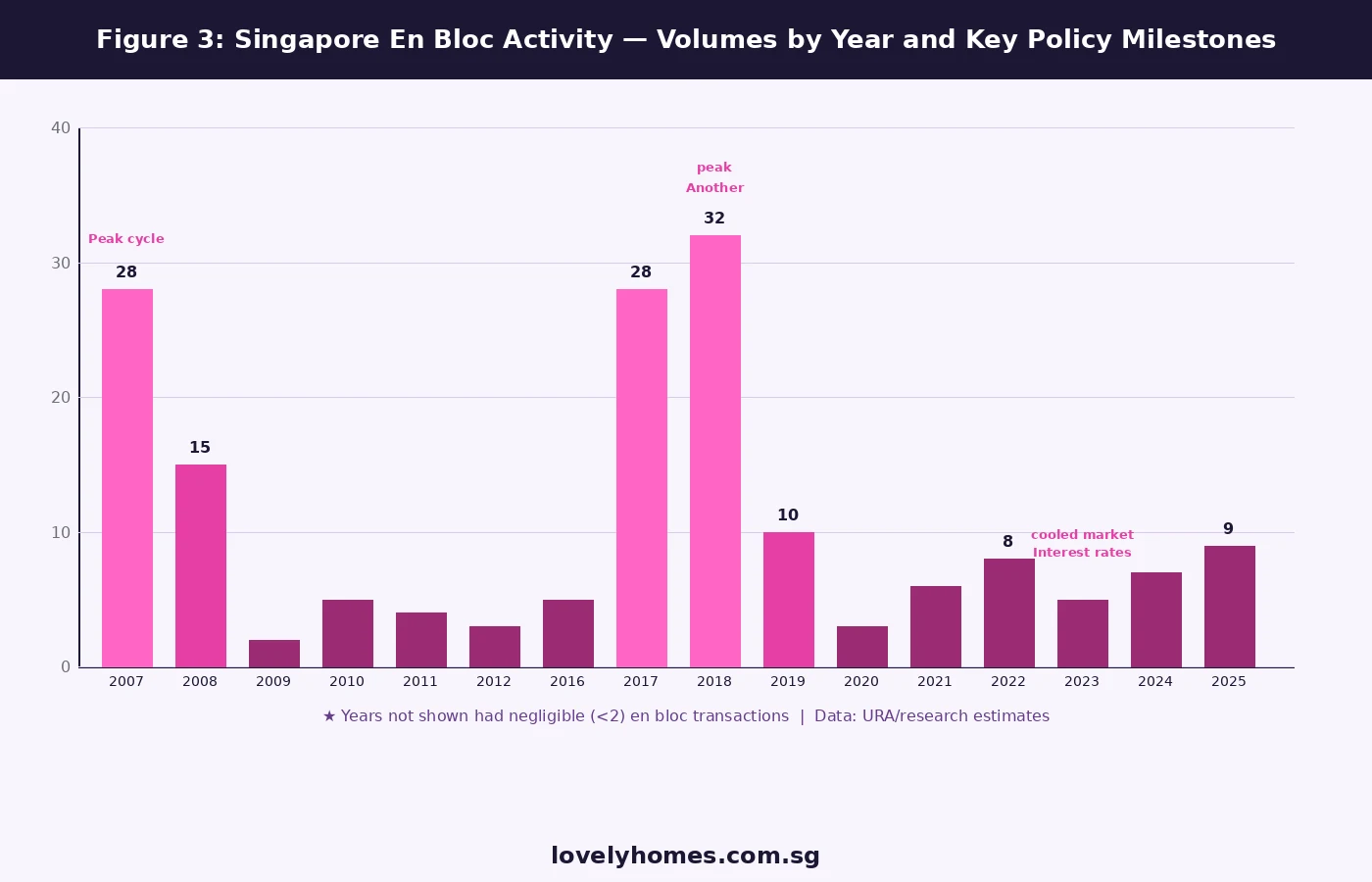
  • En bloc activity in Singapore is cyclical, spiking during low-interest-rate, high-land-demand periods (2007 and 2017–18 being recent peaks).

What Is an En Bloc Sale in Singapore?

An en bloc sale — from the French en bloc, meaning “as a whole” — is a collective sale of all the individual strata-title units in a development to a single buyer, usually a property developer. Rather than selling your individual unit separately, all (or most) owners sell their units together as one package, typically because the combined land value exceeds what individual unit sales could achieve.

In Singapore, en bloc sales are governed by Part VA of the Land Titles (Strata) Act (Cap. 158) (LTSA), which was amended in 2007 to introduce the current safeguards and procedures. The Strata Titles Board (STB), a quasi-judicial tribunal under the Ministry of Law, plays the key role of approving contested collective sales where a minority of owners object.

En bloc sales tend to occur when: the development is ageing and maintenance costs are rising; the plot ratio on the site has not been fully maximised and a developer can build more units; or land prices in the area have risen sufficiently that developers will pay a premium above individual unit values to unlock the redevelopment potential. In most cases, successful en bloc owners receive well above the prevailing open-market price for their unit — but they must also vacate and find replacement housing, which comes with its own costs and complexities.

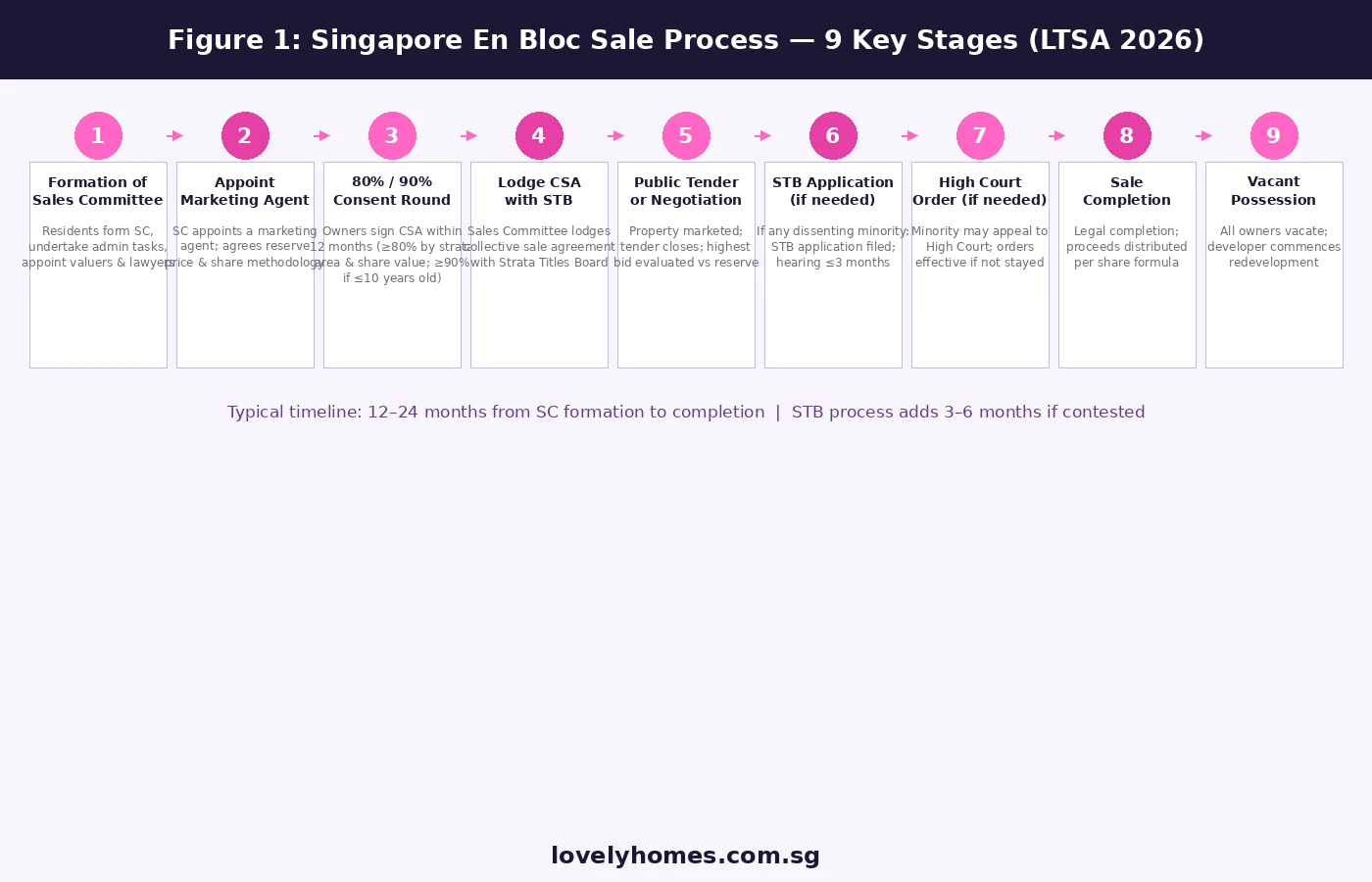
En bloc sale process timeline Singapore 2026 — 9 stages from sales committee to completion
Figure 1: Singapore En Bloc Sale Process — 9 Key Stages under LTSA. Typical timeline: 12–24 months. Source: Ministry of Law / STB Singapore.

The En Bloc Sale Process — Stage by Stage

Stage 1: Formation of the Collective Sale Committee (CSC)

The process begins at a general meeting of the management corporation (MC) of the development, where owners vote to form a Collective Sale Committee (CSC) — commonly called the Sales Committee (SC). The CSC is elected by the owners and is responsible for managing the entire en bloc process on behalf of the consenting majority. The CSC must act in the best interests of all owners, not just those who support the sale.

Importantly, since the 2007 LTSA amendments, the formation of the CSC requires no minimum consent — any owner can propose it at an AGM or EOGM, and a simple majority vote (by share value) elects the CSC members. The 80% or 90% consent threshold comes later, when owners sign the Collective Sale Agreement (CSA).

Stage 2: Appointing Professionals

Once constituted, the CSC appoints three sets of professionals: a property valuer (to establish the reserve price and independent appraisal); a marketing agent (a licensed estate agent firm to run the public tender); and a law firm specialising in collective sales (to draft the CSA, manage STB filings, and handle the legal completion). All these appointments must be made by public tender among the professionals — the CSC cannot simply nominate a preferred firm without a competitive process.

Stage 3: Collecting Signatures — The 80%/90% Threshold

This is the pivotal stage. Owners are invited to sign the Collective Sale Agreement (CSA), which sets out the reserve price, the apportionment method, and the conditions of sale. The CSC must collect signatures from owners representing:

  • At least 80% of the total share value AND at least 80% of the total strata area — for developments aged 10 years or more.
  • At least 90% of the total share value AND at least 90% of the total strata area — for developments under 10 years old.

Both conditions must be met simultaneously. If a development has very large penthouses or commercial units with high strata areas, their owners’ signatures carry significant weight in the area test, even if their share values are proportionally lower. This dual-test structure was deliberately designed to protect both large-unit owners and those with high share values.

The signature collection exercise must be completed within 12 months from the date the first owner signs the CSA. If the threshold is not achieved within 12 months, the CSA lapses and the process must restart from scratch.

Stages 4–6: STB Lodgement, Tender and (if needed) Hearing

Once the threshold is met, the CSC lodges the CSA with the STB and simultaneously launches the public tender. If all owners (including dissenters) ultimately agree, the STB approves the sale by order on consent — a relatively quick administrative process. If there are dissenting minority owners who refuse to agree, the STB holds a hearing to determine whether the sale should be approved. The STB will approve the sale if it is satisfied that: (a) the sale is in good faith, (b) the transaction is at arm’s length, and (c) the sale is not prejudicial to the interests of the minority owners.

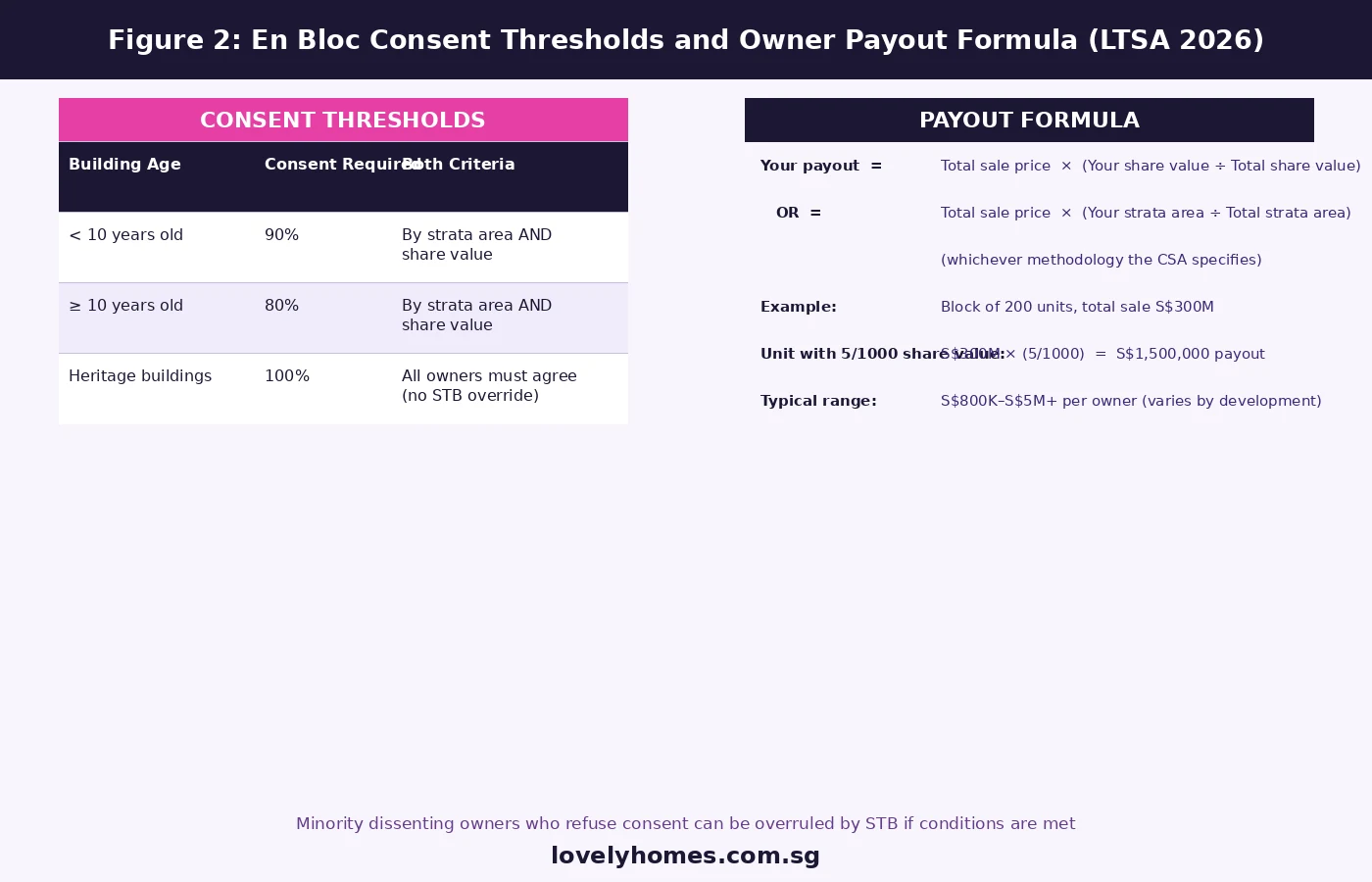
En bloc consent thresholds and owner payout formula Singapore 2026 — 80% and 90% rules LTSA
Figure 2: En Bloc Consent Thresholds and Payout Formula (LTSA 2026). The dual test (strata area AND share value) means large-unit owners and high-share owners both have meaningful leverage. Source: Ministry of Law / STB Singapore.

How Much Will Each Owner Receive?

The total sale price is distributed to individual owners according to a formula set out in the CSA. Two common methods are used, and the CSA must specify which applies:

  1. Share value method: Your payout = Total sale price × (Your share value ÷ Total share value of the entire development). This method tends to benefit owners of units with higher share values (typically larger or higher-floor units).
  2. Strata area method: Your payout = Total sale price × (Your strata area ÷ Total strata area). This method benefits owners of larger units by floor space.

In practice, many developments use a combination formula that blends both methods to produce a result acceptable to the majority. The valuer advises on the apportionment, and the CSC negotiates with owners to achieve sign-on. Some CSAs also incorporate a “premium” for ground-floor units or units with additional features.

Individual payouts vary enormously. In central Singapore, successful en bloc sales of small freehold developments have produced payouts of S$2M–S$5M+ per unit. In suburban or leasehold developments, payouts are typically S$800K–S$1.5M. The key driver is the land rate the developer is willing to pay for the site — which itself depends on the Gross Floor Area (GFA) the developer can build, the development charge payable to URA, and the estimated selling price of the new project.

Key Facts: What Makes a Development En Bloc Ready?

Factor What It Means Impact
Age of development Older = lower consent threshold (80% vs 90%) Easier to achieve consensus
Plot ratio Under-utilised plot = more GFA for developer Higher land price bid; higher per-unit payout
Tenure (freehold vs 99-year) Freehold land commands a premium Higher payout for freehold en bloc
Number of units Smaller number of units = fewer signatures needed Easier to reach 80% threshold
Homogeneity of unit sizes Similar units = smaller spread in payout Easier to get all owners to agree
Location and URA masterplan Upzoning potential increases developer appetite Key demand driver for developer bids
Interest rate environment Low rates reduce developers’ cost of capital En bloc cycles coincide with low rate periods

Singapore en bloc sale activity by year 2007 to 2025 — historical volumes chart
Figure 3: Singapore En Bloc Sale Activity — Estimated Transactions by Year. Activity peaked in 2007 and again in 2017–2018, both periods of low interest rates and high developer demand. Sources: URA / research estimates.

Worked Example: The Greenview Court En Bloc

Development Profile

Greenview Court is a fictional illustration. Actual en bloc outcomes will vary.

Development Greenview Court (hypothetical) — freehold, 28 units, built 2001
Location River Valley, Singapore (CCR) — URA zoning: Residential, 2.8 plot ratio
Age at time of en bloc launch 24 years → 80% consent threshold applies
Total reserve price S$168,000,000
Your unit 2BR, 850 sqft, share value 10/280 of total
Your en bloc payout S$168M × (10/280) = S$6,000,000
Estimated open market value of your unit S$4,500,000 (individual sale)
En bloc premium over individual sale S$1,500,000 (33% premium)

Costs to factor in after receipt of proceeds: CPF refund (principal + accrued interest), outstanding mortgage repayment, legal fees (~S$3,000–S$8,000), and the cost of temporary accommodation while you find a replacement home. The net windfall is generally still significant — but always model cash flows before assuming you can immediately afford a replacement at the same tenure and size.

Rights of Dissenting Minority Owners

Owners who do not wish to sell and who are in the minority have several avenues available to them. They may object to the STB on grounds set out in the LTSA, including: the transaction is not in good faith (e.g. the reserve price is too low or there are undisclosed relationships between the CSC and the buyer); they will suffer financial loss (i.e. the payout is less than their replacement cost); or the proceeds of sale are insufficient to enable them to obtain a replacement property of similar quality.

The STB will hear submissions from both the CSC and the dissenting owners. If the STB is satisfied that the sale is proper, it will issue a collective sale order that is binding on all owners, including dissenters. Dissenting owners may appeal to the High Court on points of law but not on factual grounds. In practice, High Court appeals are rare and generally unsuccessful unless there is a genuine procedural irregularity.

Once a collective sale order is issued, all owners — including dissenters — must vacate the development and hand over their units to the purchaser by the completion date. Refusal to vacate can result in court enforcement proceedings.

What an En Bloc Sale Means for Singapore Property Buyers

For buyers of older developments — particularly freehold condominiums in the Core Central Region (CCR) — en bloc potential is both an opportunity and a risk. An en bloc windfall can deliver a premium well above open-market value, making older freehold developments attractive investments for buyers who are patient and comfortable with the uncertainty. On the other hand, a successful en bloc means you are forced to sell and relocate — which may not suit occupiers who value stability, especially families with children in nearby schools.

From a market perspective, en bloc sales supply developers with land for new projects — replenishing the pipeline of new launches. The URA Q2 2026 Flash Estimates showed the CCR recovering (+2.0% QoQ), partly driven by anticipation of new launches that will replace older en bloc sites. Monitoring URA’s Master Plan and plot ratio changes helps identify which neighbourhoods are most likely candidates for the next en bloc cycle.

If you are currently in a development that is being discussed for en bloc, it is worth engaging a property lawyer early — even before the signature collection exercise begins. Understanding your rights, the valuation methodology, and the likely payout range will help you make an informed decision about whether to support or resist the collective sale. See our Singapore Property Seller Guide 2026 for broader context on your options when selling.

Frequently Asked Questions — En Bloc Sale Singapore 2026

Q1. Can I refuse to sell even if 80% of owners agree?

You can object, but once the 80% (or 90%) threshold is met and the STB issues a collective sale order, you are legally bound by it and must sell. Your remedy is to object before the STB on limited grounds (principally, financial loss or bad faith). The order, once granted, is enforceable against all owners including dissenters. The Singapore Court of Appeal has upheld this framework as constitutional.

Q2. Do I have to pay ABSD or SSD on an en bloc payout?

No. The Seller’s Stamp Duty (SSD) does not apply to en bloc sales — SSD applies only to residential property resales by individual sellers, not to collective sales under the LTSA. Similarly, the en bloc sale itself does not trigger ABSD (ABSD applies to buyers, not sellers). You may, however, trigger ABSD if you buy a replacement property and already own other residential properties at the time of that new purchase — consult our ABSD Guide 2026 for details.

Q3. What happens to my CPF after an en bloc sale?

Just as with any property sale, the CPF principal you withdrew plus the accrued interest (at 2.5% p.a.) must be refunded to your CPF Ordinary Account (OA). The refund comes from the sale proceeds before any net cash is paid to you. If the en bloc payout exceeds your outstanding loan and CPF refund obligations, you receive the balance in cash. For a detailed explanation of how CPF refunds work on property sales, see our CPF for Property Guide 2026.

Q4. How long does an en bloc sale take?

A typical en bloc sale takes 12–24 months from the formation of the Collective Sale Committee (CSC) to legal completion. The signature collection exercise alone can take 6–12 months. If the STB process is contested, add another 3–6 months for hearings. Legal completion after a sale agreement typically takes 6–9 months (including any High Court delay). Some en blocs have taken up to 3 years for complex developments with significant dissenting minorities.

Q5. Can HDB flats be sold en bloc?

Not in the conventional sense. HDB flats are public housing and cannot be collectively sold to a private developer under the LTSA — HDB retains the freehold title on all HDB land. However, HDB administers its own Selective En-bloc Redevelopment Scheme (SERS), under which HDB selects old precincts for redevelopment and offers affected residents replacement flats at a subsidised price, plus compensation. SERS is a government-initiated exercise, not owner-initiated, and the rules governing compensation and replacement flat eligibility are entirely separate from LTSA collective sales.

Q6. Is now (mid-2026) a good time for an en bloc?

En bloc activity in 2024–2026 has been below the 2017–2018 peak, primarily because elevated interest rates globally raised developers’ cost of capital and reduced their appetite for large land acquisitions. As at mid-2026, interest rates have started to ease, and developer sentiment has improved slightly — particularly in the CCR, which saw a +2.0% price increase in Q2 2026. However, this is speculative commentary, not advice. Individual development decisions depend on the specific site, its plot ratio, lease term, and the willingness of your specific neighbour cohort to agree. Any indication that the market is “ready” is a general observation, not a guarantee of a successful en bloc for any particular development.

Q7. What is the difference between an en bloc sale and a private treaty sale?

A public tender is the most common route for en bloc sales — the property is publicly advertised and developers submit sealed bids. A private treaty sale is a negotiated sale directly with a single buyer, without a public process. The LTSA allows private treaty, but it is less common as the CSC has a fiduciary duty to maximise value for all owners, and a competitive tender is the most defensible way to demonstrate that the reserve price is fair. A private treaty requires all the same STB approvals if there are dissenting owners.

Related Articles

Disclaimer: This article is for general educational purposes only. En bloc sale law in Singapore is technical and fact-specific. Individual outcomes depend on the precise terms of the Collective Sale Agreement, the development’s profile, market conditions, and the STB’s assessment. Always engage a qualified property lawyer and a licensed valuer before making any decision about a collective sale. Official guidance is available from the Ministry of Law, the Urban Redevelopment Authority (URA), and the Strata Titles Board. This article does not constitute legal or financial advice.

×

Click anywhere outside to close

HDB Resale Levy Singapore 2026: Amounts, Who Pays, Exemptions and How It Works

HDB Resale Levy Singapore 2026: Amounts, Who Pays, Exemptions and How It Works

HDB resale levy Singapore 2026 complete guide
Figure 0: HDB Resale Levy Singapore 2026 — Complete Guide to Amounts, Exemptions and How It Works

Quick Answer — HDB Resale Levy at a Glance

  • The HDB Resale Levy is a payment required when a second-timer household buys a new subsidised HDB flat or an Executive Condominium (EC) unit after previously enjoying a housing subsidy.
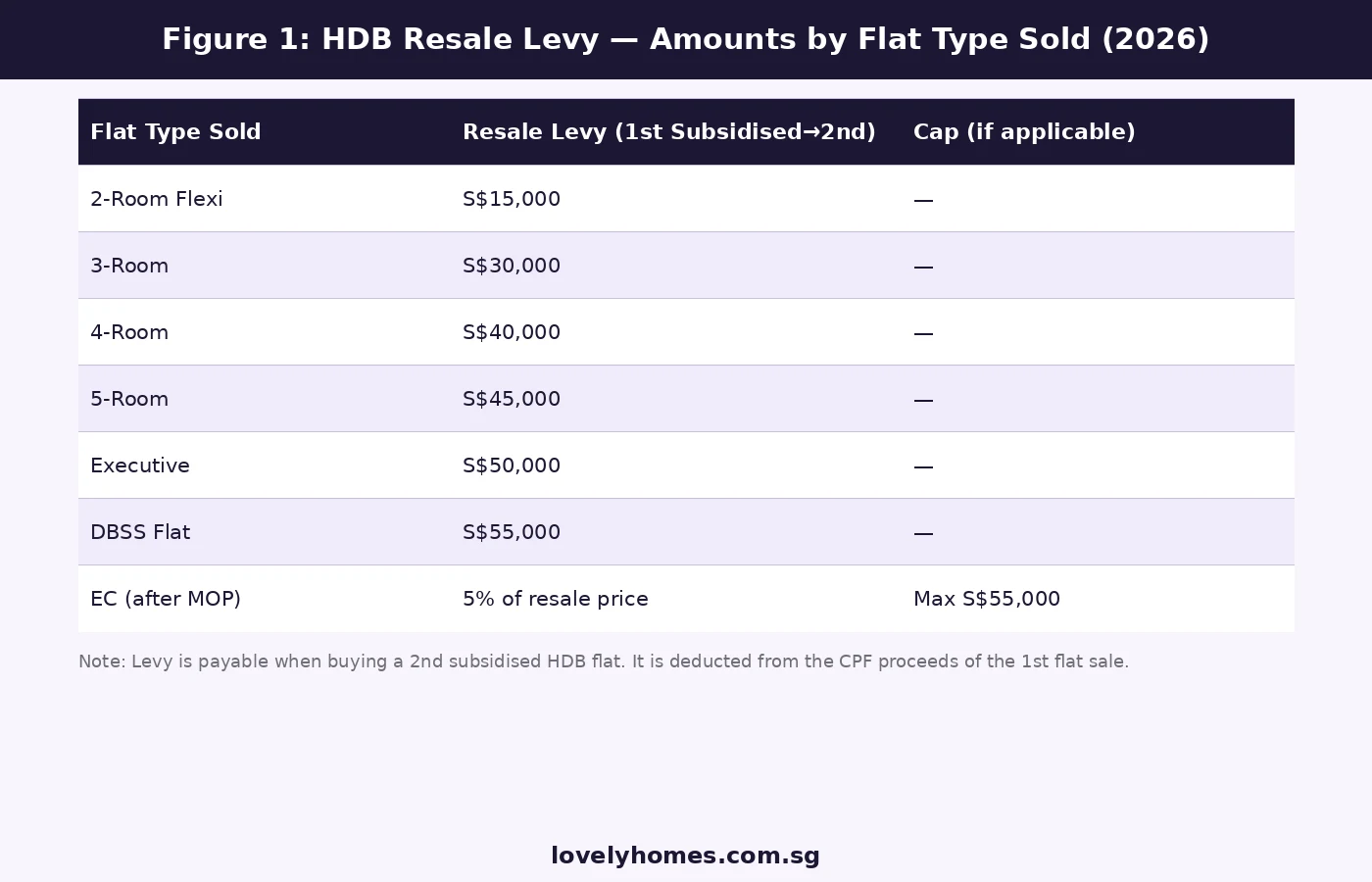
  • Levy amounts range from S$15,000 (for a 2-Room Flexi sold) to S$55,000 (for a DBSS flat sold), with EC buyers paying 5% of resale price (capped at S$55,000).
  • It is paid by deduction from the CPF refund when your first flat is sold — you do not write a cheque.
  • Exemptions apply if you bought your first flat on the resale market without any CPF Housing Grant, inherited the flat, or received it via a court order.
  • The levy does not apply when buying a private property — only a second subsidised HDB flat or EC triggers it.
  • Getting the levy wrong can delay your second flat booking and result in owing HDB cash if your CPF proceeds are insufficient.
  • From 3 March 2006, all levy amounts were fixed at the flat-type level — they are not a percentage of the first flat’s resale price (except for EC).

What Is the HDB Resale Levy?

The HDB Resale Levy is a subsidy recovery mechanism administered by the Housing & Development Board (HDB) under Singapore’s public housing framework. When the government provides a housing subsidy — such as the Central Provident Fund (CPF) Housing Grant, the Additional CPF Housing Grant (AHG), the Special CPF Housing Grant (SHG), or the Enhanced CPF Housing Grant (EHG) — it does so on the understanding that this benefit is tied to one subsidised flat per household. If that household later purchases a second subsidised flat or Executive Condominium unit, they are required to “return” a portion of the earlier subsidy benefit in the form of the resale levy.

The policy was introduced to ensure that public housing subsidies are targeted at households that genuinely need them and to maintain the long-term sustainability of Singapore’s public housing system. HDB administers the levy and collects it automatically at the point of sale of the first flat — it is not a separate bill sent to you but a deduction from your CPF Ordinary Account (OA) proceeds before they are refunded.

As at July 2026, the levy framework has remained stable since the flat-type rate schedule was fixed on 3 March 2006. Understanding it correctly is essential for any second-timer household planning to upgrade or right-size within the public housing system.

HDB resale levy amounts by flat type 2026 — S$15,000 to S$55,000 table
Figure 1: HDB Resale Levy Amounts by Flat Type Sold (2026). Fixed rates since 3 March 2006; EC applies a 5% rate with S$55,000 cap. Source: HDB Singapore.

Who Pays the HDB Resale Levy?

You are required to pay the resale levy if all three of the following conditions are met:

  1. You (or your co-applicant, spouse, or essential occupier) previously purchased a subsidised HDB flat — meaning you received a CPF Housing Grant, AHG, SHG, EHG, Step-Up CPF Grant, or bought directly from HDB at a subsidised price in a Build-To-Order (BTO) or Selective En-bloc Redevelopment Scheme (SERS) exercise.
  2. You subsequently sold that subsidised flat (or are in the process of doing so).
  3. You are now applying to buy a second subsidised flat from HDB — either a new BTO flat, a SERS flat, a Design, Build and Sell Scheme (DBSS) unit, or an Executive Condominium (EC) unit from a developer.

The key point is that the levy applies to subsidised second-time purchases only. If your second property is a private condominium, a landed home, a resale HDB flat (from the open market), or any commercial property, no resale levy is chargeable. Many upgraders mistakenly believe the levy applies whenever they buy a second property — it does not. It is specifically a tax on accessing public subsidies a second time.

Couples and Joint Applications

For married couples and joint flat buyers, the resale levy status of either party is taken into account. If either the main applicant or the co-applicant previously received a housing subsidy, the levy is applicable to the household. This prevents a household from circumventing the levy simply by swapping the person listed as main applicant on the second purchase. The rule is designed to capture the household’s cumulative subsidy benefit, not merely the individual’s.

Singles

Singles purchasing under the Single Singapore Citizen (SSC) scheme — eligible for 2-Room Flexi BTO flats — are also subject to the levy if they previously benefited from a housing subsidy. As the levy amount for a 2-Room Flexi flat is S$15,000, it is still a meaningful cost for solo buyers planning to upsize.

HDB Resale Levy Amounts (2026)

The levy amount depends on the type of flat you previously sold. Since 3 March 2006, the rates have been fixed at the following flat-type level:

Flat Type Sold (First Flat) Resale Levy Payable Notes
2-Room Flexi S$15,000 Applies to subsidised 2-Room Flexi BTO flats
3-Room S$30,000
4-Room S$40,000 Most common upgrader profile
5-Room S$45,000
Executive Flat S$50,000 HDB Executive flat (not EC)
DBSS Flat S$55,000 Design, Build and Sell Scheme (discontinued)
EC (Executive Condominium) 5% of resale price Capped at S$55,000; applies after the EC’s 5-year MOP when sold on the open market

One common source of confusion is that the levy is based on the type of flat you sold, not on its resale price. Whether you sold your 4-Room flat for S$500,000 or S$900,000, the levy is always S$40,000. The EC rule is the sole exception: there the levy is 5% of the EC’s resale price (i.e. the proceeds from selling the EC), subject to a maximum of S$55,000.

HDB resale levy bar chart by flat type Singapore 2026 — S$15,000 to S$55,000
Figure 2: Resale Levy by Flat Type (2026). The levy is flat-based, not price-based — except for EC where it is 5% of resale price, capped at S$55,000. Source: HDB Singapore.

How and When Is the Resale Levy Paid?

The resale levy is settled automatically at the completion of the sale of your first flat. HDB deducts the levy amount from the CPF Ordinary Account (OA) refund you would otherwise receive when the flat sale is completed. You do not receive a separate invoice from HDB and you do not make a cash payment at any counter.

Here is how the sequence works:

  1. Apply to buy second flat: When you apply for a BTO flat or EC as a second-timer, HDB identifies your levy status at the point of application.
  2. HDB confirms levy payable: HDB notifies you of the levy amount in the appointment letter for your second flat booking.
  3. First flat sold: On the day of the legal completion of your first flat sale, the CPF Board refunds your OA principal and accrued interest as usual — but before the refund is credited to you, HDB deducts the levy amount directly from those CPF proceeds.
  4. Balance returned: The net CPF refund (after levy deduction) is credited to your OA account.

What If Your CPF Refund Is Less Than the Levy Amount?

This can happen in rare situations — for instance, if the outstanding HDB loan and CPF accrued interest together consume most of the sale proceeds. In such cases, the shortfall must be made up in cash. HDB will require you to pay the difference out-of-pocket before the second flat booking proceeds. This is one reason why financial planning ahead of an upgrade is important: always model your net CPF position against the levy amount before committing to a second BTO application.

Who Is Exempt from the HDB Resale Levy?

Not everyone who has previously owned an HDB flat will be required to pay the resale levy. Key exemptions include:

  • Resale flat purchased without a CPF Housing Grant: If you bought your first flat on the open HDB resale market and did not receive any CPF Housing Grant (Family Grant, Enhanced Housing Grant, Proximity Housing Grant, or any earlier-generation grant), you are not a “subsidised” flat owner for levy purposes. The levy reflects subsidy recovery — without a subsidy, there is nothing to recover.
  • Inherited flat: If the flat was left to you in a will or through intestacy, you did not receive a direct purchase subsidy, so the levy does not apply.
  • Court order transfer: Flats transferred to one party as part of a divorce settlement are generally exempt because the transfer is not a voluntary purchase attracting a subsidy.
  • Private property purchasers: The levy applies only when the second purchase is a subsidised BTO flat or EC. Upgraders to private property are not subject to the levy — though they face ABSD (Additional Buyer’s Stamp Duty) instead.
  • Flat returned to HDB involuntarily: If your first flat was compulsorily acquired by the government (e.g. for road widening or MRT works), this is not considered a voluntary sale and the levy is not triggered.

HDB resale levy exemptions and second-timer rules Singapore 2026 — who pays vs exempt
Figure 3: Who Pays vs Who Is Exempt — HDB Resale Levy 2026. Source: HDB Singapore.

Worked Example: The Tan Family’s Second BTO Application

Scenario

Mr and Mrs Tan (both Singapore Citizens) purchased a 4-Room BTO flat in Tampines in January 2019 at S$420,000, using a CPF Housing Grant of S$40,000. They have fulfilled the 5-year Minimum Occupation Period (MOP) and sell the flat in July 2026 for S$710,000.

They are applying for a new 5-Room BTO flat in Tengah at a subsidised price of S$620,000 — a second subsidised HDB purchase, making them second-timers.

Levy Calculation

Flat type sold 4-Room
Resale Levy payable S$40,000
Sale price of 1st flat S$710,000
Outstanding HDB loan (est.) S$235,000
CPF principal + accrued interest refund S$278,000
Levy deducted from CPF refund – S$40,000
Net CPF refund after levy S$238,000
Net cash proceeds S$710,000 − S$235,000 (loan) − S$278,000 (CPF) = S$197,000 cash

The Tans’ second flat purchase proceeds normally. The S$40,000 levy is handled automatically by HDB and CPF Board; neither party needs to make a separate payment. The net cash received is S$197,000, which can go toward the downpayment and costs of the new flat.

Special Situations and Edge Cases

EC Owners Selling and Buying a Second BTO

If you bought an EC (fully privatised after 10 years) and now wish to purchase a new BTO flat, you are subject to the resale levy at 5% of the EC’s resale price, subject to a maximum of S$55,000. Because EC prices have risen significantly — many ECs in mature estates now resale at S$1.2M–S$1.8M — the effective levy is almost always the capped S$55,000. For example, an EC sold for S$1.4M would attract a levy of S$70,000 in the absence of the cap; the cap holds it at S$55,000.

SERS Flat Recipients

Households that received a replacement flat under the Selective En-bloc Redevelopment Scheme (SERS) are treated as having received a housing subsidy. If they subsequently wish to buy a second new flat from HDB or an EC, the levy applies based on the type of flat they were re-housed in.

Divorce and Reassignment of Flat Ownership

When a flat is transferred to a divorced spouse under a court order, that spouse is considered a second-timer if the transferred flat was a subsidised purchase. If they later apply for a new BTO flat, the levy will apply. Seeking early legal advice on how divorce asset division affects CPF and HDB subsidy status is advisable.

Concurrent Applications

Some second-timers apply for a BTO flat while still occupying their first flat. HDB allows this — but the levy is held in reserve and deducted at the point of the first flat’s sale completion. You must sell your first flat within 6 months of collecting the keys to the second (this is the standard condition for second-timers purchasing new flats).

Why the Resale Levy Matters for Your Upgrade Strategy

The resale levy is one of several interlocking costs that second-timer households must budget for when planning an upgrade within the public housing system. It is easy to overlook because it is deducted automatically from CPF, making it feel invisible — but it directly reduces the cash and CPF resources available for your second flat.

Consider the total cost of a 4-Room BTO upgrade: beyond the flat price itself, a second-timer household must account for the Buyer’s Stamp Duty (BSD) on the new flat, legal fees, potential income grant reductions (second-timers receive smaller EHG amounts than first-timers), renovation costs, and the S$40,000 resale levy. These costs collectively can reduce the effective CPF buffer you have on hand.

In contrast, upgrading to private property involves no resale levy — but attracts ABSD of 20% as a second property purchase (if you own the HDB flat at the time of buying private, and have not yet sold it). The ABSD on a S$1.5M private property would be S$300,000 — a very different magnitude. Households navigating this choice should consider the full cost picture of each route. Our ABSD Singapore 2026 Complete Guide and HDB Upgrader Guide 2026 cover the private-property upgrade path in detail.

Frequently Asked Questions — HDB Resale Levy 2026

Q1. Can I avoid the resale levy by selling my flat before applying for the BTO?

No. Your levy status is determined by your subsidy history, not by the sequence of sale and purchase. Whether you sell before or after booking the BTO flat, the levy still applies because you previously received a CPF Housing Grant. Selling early may give you more CPF OA funds to draw on, but it does not remove the levy obligation.

Q2. My spouse is a first-timer. Does the household still pay the levy?

Yes. HDB assesses the household as a unit. If either the main applicant or co-applicant has previously received a housing subsidy, the entire household is classified as a second-timer for levy purposes. There is no mechanism to apply as a “first-timer” household if one party is a second-timer. However, in this situation, the household may be eligible for a reduced levy in some cases — consult HDB directly for your specific profile.

Q3. Is the resale levy the same as the CPF accrued interest I must return?

No — these are two completely different obligations. CPF accrued interest (at 2.5% p.a.) is the amount you owe your own CPF account for the OA savings you withdrew to pay for the flat. It is returned to your OA upon sale — you are repaying yourself. The resale levy, in contrast, is paid to HDB as a subsidy recovery charge. Both deductions happen at the point of sale, but they serve entirely different purposes and go to different places.

Q4. Can I use CPF to pay the resale levy, or must it come from cash?

The levy is deducted automatically from the CPF OA refund you receive when your first flat is sold. You do not need to arrange a separate cash payment unless your CPF refund is insufficient to cover the levy — in which case HDB will require the shortfall in cash before releasing the booking fee for your new flat. Always check your estimated CPF refund against the applicable levy amount before committing to a second BTO booking.

Q5. Does the resale levy apply if I buy an EC as a first-time EC buyer but sold an earlier subsidised flat?

Yes. If you are buying an EC and you previously sold a subsidised HDB flat, the resale levy is payable. The EC levy is the higher of: 5% of the resale price of your sold flat or (if you are selling a non-EC subsidised flat) the flat-type levy amount — unless you are selling the EC itself, in which case it is 5% of the EC’s resale price (capped S$55,000). HDB’s levy assessment letter, issued before your EC booking, will specify the exact amount applicable to your situation.

Q6. Has the HDB resale levy changed recently? Will it increase?

The flat-type levy rates have been unchanged since 3 March 2006. As at July 2026, there has been no announcement by HDB or the Ministry of National Development (MND) of any impending change to the levy framework. Given that BTO prices have risen considerably since 2006, some analysts have speculated that a levy increase is overdue — but this is speculative. Decisions on the levy are policy matters resting with MND. Monitor HDB press releases and MND Budget announcements for any changes.

Q7. What happens if I cannot sell my first flat in time to pay the levy before the second flat completion?

Second-timers purchasing a new HDB flat must generally sell their existing flat within 6 months of collecting the keys to the new flat. If you have not sold your first flat by the time you need to complete the purchase of the new flat, HDB may defer key collection or require you to arrange an interim cash payment for the levy amount. Contact HDB directly if your sale is delayed — they may grant a time extension in genuine cases, but this is not guaranteed and is assessed case by case.

Related Articles

Disclaimer: The information in this article is intended for general educational purposes only. HDB policies, levy amounts, and eligibility rules can change. Always verify current requirements directly with the Housing & Development Board (HDB), the CPF Board, and the Ministry of National Development (MND). This article does not constitute financial, legal, or property advice. Consult a licensed property agent (CEA-registered), a qualified financial adviser, or a solicitor for advice specific to your situation.

×

Click anywhere outside to close

Translate »